Episode Transcript
Dave (2s):
Think of the last time you saw a fish rise to eat an insect. Were you able to identify what stage of the insect that that fish was feeding on? How about trying to identify the actual bug and what’s your best method for capturing an insect? If you want to try to idea it, today’s guest is gonna give you answers to all these questions, and he’s gonna dive into fishing Spring creeks. So you are ready for your next big trip on the water. This has Traveled where we take a deep dive into a specific region of the country so you have a better feel for what it takes to put together a great trip. And so you are better prepared for that next journey. Hey, I’m Dave host of Traveled. I’ve been fly fishing since I was a kid, and I grew up around a fly shop and we’ve created one of the largest fly fishing podcasts in this country.
Dave (48s):
We’ve also interviewed more of the greatest fly anglers than just about anyone in the country. Sathi Yamamoto, fly tying expert in Spring Creek Guide in the Yellowstone country shares his best tips on fishing spring creeks. Today you’ll find out which are the best hatches during the year and the best times to fish each of those hatches. How to focus on and fish the PMD hatch and some killer fly time tips if you’re fishing smallies or even the larger Atlantic salmon flies. Plus, you’re gonna hear the story of Satoshi’s dream of being a cowboy and how it brought him westward and the story of how he all made this a reality. Pretty inspirational here. This episode of travel is presented by Yellowstone Teton territory, where you can explore great fishing, hunting, hot springs, winter sports, and so much more.
Dave (1m 34s):
Let’s jump into it and see where that road less Traveled is gonna take us today. Satoshi Yamamoto from Lefty angler and flies.com. How you doing Satoshi?
Satoshi (1m 46s):
Doing good, thank you. Yeah,
Dave (1m 48s):
Thanks for coming on here today. We are going to talk about a few things as normal. We’re gonna talk about the fly tying expo, the Eastern Idaho Fly Tying and Fishing Expo out there. That’s one thing out in Eastern Idaho. And we’re gonna also talk about some spring creeks and some of the guiding you do out in that part of the world out west and, and just get your background on, you know, kind of where you came from and all that stuff. So, so does that all sound good to you?
Satoshi (2m 12s):
Yes. Yes. Sounds good to me.
Dave (2m 14s):
Okay, perfect. Well, let’s just start there with your background. Take us back real quick. How did you, how’d you get into fly fishing and what’s your first memory there?
Satoshi (2m 22s):
So I guess, I guess that’s where I’m from. I originally from Japan and then I grew up and then I went to college in Tokyo. By then my brother, older brother was a typical of a, a generation of a river and through, so he was fly fishing several years by then. And then I wasn’t quite into it, but finally senior year in college I did, I started fly fishing there. But I was typical, most of Japanese fly fishing, my, you know, they go to a small mountain stream and try to catch some native 12 species over there.
Satoshi (3m 4s):
That’s typical, you know, small stream, short rod and such. But somehow I just don’t, don’t have time or mean to, you know, get up like this. So I start to fish suburban river, Tokyo suburb river for car fishing.
Dave (3m 21s):
Alright, so that’s it. So pretty much your brother was a big influence on you and he, he kind of planted the seed and then eventually you figured you were like, okay, this is pretty cool. And you were in, in Tokyo. Yeah,
Satoshi (3m 31s):
It’s in the, so the, I wasn’t in the T of my college was, was not in the typical of, you know, central, really central part of Tokyo or Japan. My college was located in Tokyo suburb. It’s not the really main, main Tokyo. And then that’s where I fish. I fished for the cup in as a kawa as a river. So yeah.
Dave (3m 53s):
Are Kap pretty pop like here in the United States? As you probably know, the carps getting more popular. Do you find in Japan? What was it pretty popular back then as compared to the other species?
Satoshi (4m 4s):
I honestly, I do not think so. But for me, I grew up fishing for carp in the nearby river. My hometown doesn’t really have a, you know, truck ’cause it’s a, it’s not really high up in the mountain. So I grew up fishing for a cup with yeah, bait fishing basically. And then a bait fishing and the spinning rod. And then, so catching cup now catching fries is quite interesting. And then what happened on that river is for what I hear was back then, sometime, maybe a couple of decades ago, the city released a cup for people to fish and catch and eat. But you know, the age progresses, you know Yeah.
Satoshi (4m 46s):
Progresses, you know, people don’t do that. You don’t, they don’t wanna eat. Didn’t have to catch. So the cop population just exploded. And then where it was, is that cop was rising on the, like a bubble bubbles from the treated water, you know? Then so fast fly I learned was white dry, white egg fly. Oh right. Like a bubble. So, so copper, not just, you know, dumb, I have to cast right there on. Then there’s a tiny drug on the, the dry egg fly. They not only eat it. So I, I learned that, you know, casting accuracy and mending and drift.
Satoshi (5m 28s):
That’s still my, you know, kind of backbone of my, yeah, very, very. I really think I, and then once I hook them, you know, they run like crazy, you know? Right. So it’s really no difference from catching eight inch brown thread on the Yellowstone River.
Dave (5m 43s):
Let’s talk about that, the Yellowstone. So is it easier to catch one of those carf in Japan on that egg fly? Or is it easier to catch a, a trout in a Spring Creek and a Yellowstone
Satoshi (5m 54s):
Definitely car at the time. Yeah. ’cause it’s just, yeah, there’s so many of them.
Dave (5m 59s):
The carp is harder.
Satoshi (6m 0s):
Carp is easier to catch.
Dave (6m 2s):
Oh, easier. Yeah.
Satoshi (6m 3s):
Okay. Yeah. Much easier. But it, it was quite a practice looking back. Yeah, I still think so. And then, yeah, I did that. That was 1999. Then oh, after graduation I decided to come to United States. And then just a quick, quick region, top region was in my senior year at the time in Tokyo, I’m sorry, junior year in Tokyo. I participated in kind of sister school pro, you know, exchange student program for just a summer, summer break. My college is nothing really big, but I had a sister school agreement with the Purdue University in Indiana.
Satoshi (6m 48s):
And then I understand the Purdue is a, you know, really big in the United States and then the agriculture department big. And then we don’t really go to school, just state in the host family. But then I went to college. It’s just the scale is way different. And then that, the system and such. So I really want to come and the study in United States and then of course now I’m being a, you know, a fry fisherman, even a fishing guide. Many people would think that I came to Montana just for, you know, fishing. But that’s not true. Actually. I came to Montana to be a cowboy because I always wanted to be a cowboy. Nice.
Dave (7m 26s):
Yeah. That’s amazing. So
Satoshi (7m 27s):
That’s, yeah. And then, so I studied animal science. I was admitted to a master’s degree in the animal science department here in the Mountain State University. That was year 2000.
Dave (7m 41s):
2000.
Satoshi (7m 42s):
Yeah. Year 2000. Now then Bozeman, I mean, I kind of under, I already kind of understood that. Yeah, the movie River Run Through, it was actually filmed around there. Bosman and then, yeah, gall out in river. But I just simply didn’t have money and time to go fishing. ’cause I really dedicated myself for, you know, studying. And then I’m very actually proud of that. Yeah. ’cause I, I studied and finished my degree. Wow. And then up upon graduation, I, next several years again, I still don’t have time to fish because I just worked very hard to establish myself in this country.
Dave (8m 26s):
Well, let’s take it back to real quick on the, so where did that love of cowboys come from?
Satoshi (8m 30s):
Oh, well, you know, yeah. It’s like western movies and TVs. Yeah. And then
Dave (8m 36s):
Do you remember the movies? Was it like, was it, was it Clin Eastwood movies or what were the movies you were watch? Do you remember those?
Satoshi (8m 43s):
I think the most as may not be a Cowboy in a true sense, but have you heard of a TV series called Young Riders? Oh yeah. It’s about Pony Express. Yeah. Young Riders. You know that one? Yeah, I do. It’s in the Amazon right now. Amazon Prime right now.
Dave (8m 58s):
Okay. Yeah.
Satoshi (8m 58s):
Yeah. I like that one. Oh, nice. Yeah. Well there’s a, yeah, fictional character, you know, wild Bill Cock. Yeah. You know, Buffalo Bill K things. So I was, yeah. You know, really into those things that, that’s
Dave (9m 12s):
Right. No, those are great. Those are great.
Satoshi (9m 14s):
I just thought that’s really cool. Yeah. And then, so coming into Montana, it’s a, it is a summer in the Western United States, and then was not, I guess dream, but then again, real study I really wanted to study. So, and I did so master’s in, I studied very hard. So, and then wow. That’s why I could speak English right now, kind of. Right.
Dave (9m 38s):
When did the switch come from, when you went from, you know, basically being, doing that kind of the animal science stuff? When did it switch to where you were really fly fishing? Was your, you know, kind of your main thing?
Satoshi (9m 48s):
Okay, yeah. Again, after graduation I did, I worked in the ranch and the farm. Yes. I did some cowboy. Yeah, you did it in the ranch. So, and then to utilize my degree and then have a bit more better life, rather than being a paid by, you know, wage, basically paid for, you know, working for the waste, I, I got into artificial insemination on cows, animal cattle breeding. That’s what I studied at Mountain State University. So yeah, artificial insemination technician. So, and then, so that took me to Nevada.
Satoshi (10m 30s):
Long story. But yeah, suddenly, but suddenly I’m moving out of the state and then I actually roamed live. Yeah. Stay in the hotel motel or something. And then I went to Nevada. That was two Southern, three to five. And then next I got a job in bit more advanced job in California, central of California. But life was very hard at the time. 2, 7, 6 or so. Then I thought maybe I wanna go back to mountain and be a cowboy again. I said, but then I got a job of similar job of, in eastern part of Washington state.
Satoshi (11m 10s):
So it’s not quite mountain lake, but you know, quite similar. And now it’s farm. And then this time in the 2007, I moved to somewhere between Yakima and the Tri-City along the Yakima River. And then now I have more time and then the steady income. So now I could start fry fishing and the fry tank. That’s what happened. Oh, I see. That’s how you did it. Yeah, there was a blank seven, eight years, you know, since I started fry fishing. But yeah, so 2007, that’s my fry fishing set. And then, so
Dave (11m 43s):
You’re now, and now what, where do you live now? Currently
Satoshi (11m 46s):
I live in living in stone, Montana. So I came back, so four, four years I lived in the Washington state, of course at the beginning, it’s going to be four years. But I was, I was, again, I was doing a cattle breeding job. And again, paper’s, salary was good and I have lots of time. So I fished pretty much all over the drought streams. I would say there are lots of small lakes and ponds in the eastern Washington. But I focused on the streams. And then actually more precisely the tributaries to Yakima River, Yakama River, I felt too big at the time. So I was fishing and then I, I caught rainbow trout and the west slope, cutthroat very pretty.
Satoshi (12m 29s):
Then suddenly I want to catch brown drug, you know, I thought, now it’s time for me to go back to visit Montana. And then 2007, like September I came to, I came, basically, I came back to Montana. I was visiting Montana, you know, see my friends waiting or something, you know, while I was away. But this time I came back as just a fisherman. And then I fished West Yellowstone, like a Yellowstone park. And I caught a brown trout and then took a leave from work for a week. And then after that, it seems ridiculous, but 2008 maybe, I came to Montana like four times, you know, four trips, like lasting from five to 10 days.
Satoshi (13m 14s):
And then 2009, pretty much about the same. But, so the first like year or two, you know, my coworkers are like, oh, hey, I thought she’s enjoying his life fishing and doing great job at work. And I was really good. I was really very good worker, disciplined. And then a good job, job result, basically, you know, cows, cattle, conception, you know, result. I was very good. And never be late for work, or never forget, never miss, you know, schedule. And, but by summer, by the 2009, or definitely in 2010, I feel some air, you know, now they’re talking behind my back. This guy goes too much fishing, you know?
Satoshi (13m 57s):
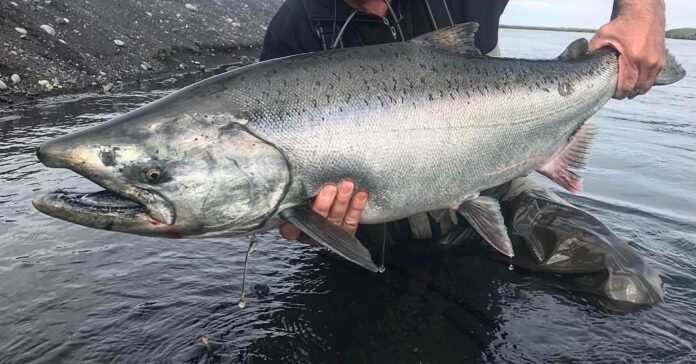
So it went on. And then, then summer and then September, this is a kind of a turning point of like, life was, I was fishing Yakima River, Tribu, which called Nez River, N-O-A-C-H-E-S, Nazi River. And yeah, near Yakima, city of Yakima. And then I was fishing a streamer for route. I hit something like that. I thought I snugged the log or rock or something and all, but some suddenly something started move that I was fishing with a six weight and sinking line. And then that was a Chinook sum. Oh, right, giant king sum.
Satoshi (14m 39s):
Yeah, it passed right, right in front of me. And then, what’s this, this is like a seven inch brown trout that is Saw magazine. No, then I, there’s no brown trout here. It’s gonna be a summer. So I chase upstream and I pulled in, that was, that was September. So it was definitely, you know, the one that’s, you know, yeah, spring swam up. Yeah. All the way from, you know, from the ocean, from the Pacific. Yeah. For I think that it would be probably 300 road miles, highway miles. Right. So, boy, it just, I don’t know how many dams, you know, he swung back and then I caught it and then I just, but I was using a short, like a maybe 20 pound maxima, you know, like a three, four feet.
Satoshi (15m 28s):
So I was able to put into the little nook of the bank and then took a picture, still my wall. And then it’s like, yeah, I was so moved about it. And then I thought I got all the fish here in the, you know, this area. I thought. So then again, in the, just at the same time, pay system change. And then, you know, like I said, I wasn’t in fight or anything, but with the coworkers or you know, bosses or company. But I got the fish and then now pay system changes. And then, you know, cattle breeding industry with daily farm milk, car industry is never gonna be improved.
Satoshi (16m 9s):
Oh. So it just, it’s the same drama, up and down, up and down, and somebody get blamed. So I’m down. So October, yeah, 2010, October, 2010 I packed my everything and then I’m gonna go to Montana. Then this time I chose Livingstone. ’cause by then, like I said, I fished West Yellowstone, but I know, I knew West Yellowstone is, you know, twice time it, I know it’s very hard to make living there. And of snow is like as high as roof. Oh, right. You know, so winter months. So I don’t think I could live in the west of Austin, you know? But Bozeman, by then, Bozeman was like a really developing, yeah,
Dave (16m 50s):
Bose Angeles, right?
Satoshi (16m 52s):
Yeah. That’s the time. Yes sir. Yeah. So, and then rent was expensive, so I don’t think I would, not even Bozeman. And by then I fished the Spring Creeks in the Livington. I stayed here some occasions. So I think I’m gonna move to a Livington. So I just find a place in Livington. I just moved in so that, that was the end of 2010. And then I still do now, I, my plan originally was still wasn’t really planning to be a fishing guide. I, I want to fish, but I saved up some money by then. So probably I wouldn’t die without working for a year. Oh, nice.
Satoshi (17m 32s):
You know, that’s great. Probably at that time, you know, at that time. So I could do something, I think. And then, yeah, I wasn’t just fishing. I saved up some money during the four years in Washington, so Yeah, you did, you know, that’s good. And I was, I only had modest years, you know, and then, so originally I still planted some, now I would do a beef cattle breeding, which is a very seasonal around here. Beef cattle season is like, breeding season will be like a spring. So then they go to the summer, they’re gonna go to the summer pasture in, you know, during summer months.
Satoshi (18m 12s):
And then, and then winter, then the, right after the new year, they, they are going to calve carving season, then go to breeding season. It’s beef ies. All ranch schedule is about yearly thing. Yearly thing. But, so it’s very limited. Then maybe if I, if I would do some breeding. Yeah. I had a few contexts. And then 2011 I do some cattle breeding in the mountain and the South Dakota, Wyoming. But you’re
Dave (18m 42s):
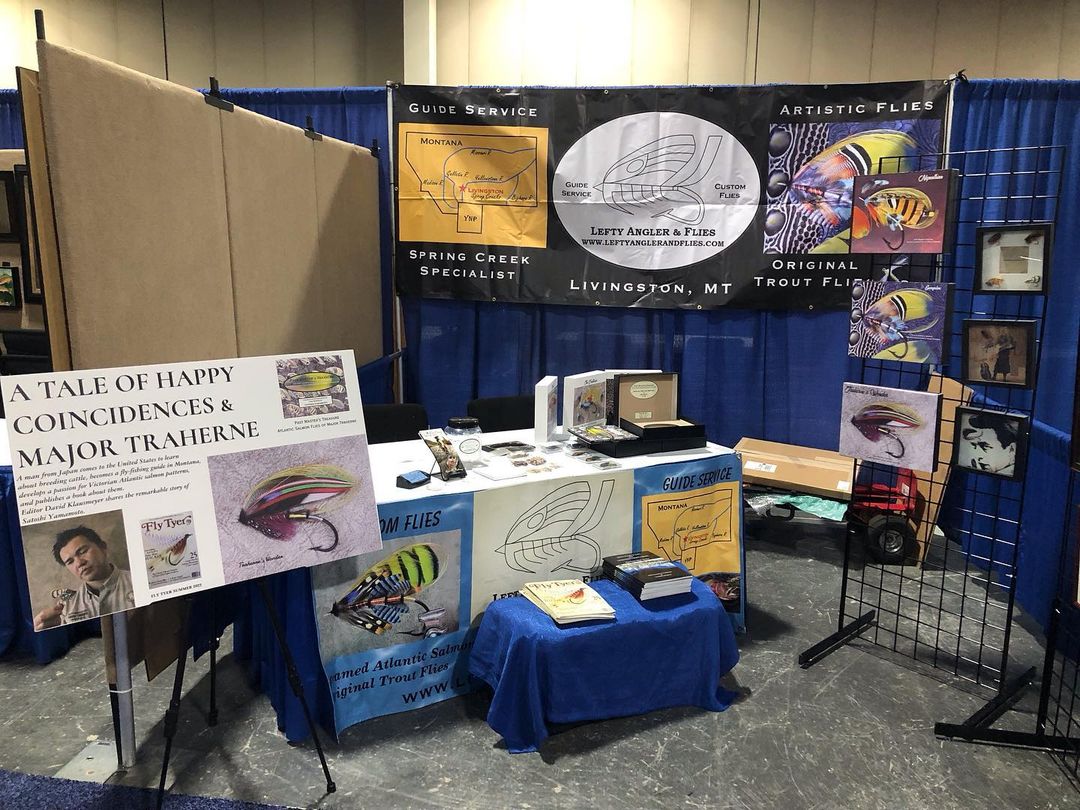
Foley now, you’re, you’re pretty much guiding is what you’re focused on. That’s your passion guiding and flight tying. And Yes. And I think one thing I wanted to highlight, we’re gonna talk about Spring Creeks a little bit, but I wanted to highlight the East Idaho Flight tying Expo. Sure. Which you were at this year. Maybe talk about that a little bit on the East Idaho, maybe describe that event and what you were, what that was like. Tying flies there.
Satoshi (19m 5s):
Okay. Yeah. So the by short, short answer is that as the East Idaho is best smallest expo, I think. Right? What, what happened is, I know that I may mention some name, but I’m not, I don’t mean to, you know, trade in their names, you know, it’s just great, sir. Yeah. I wanna, I, I wanna make sure that, I think that the Bruce Staples, he’s in Falls. He’s, he’s author and also he’s award winning writer year. He published so many books. And then, so with his influences, he can invite and talk to many other great flight hire.
Satoshi (19m 45s):
And then, let me tell you, 2014, I just visited there as an audience in the spring. Then first time I went there, I saw that the Scott Sanchez and then Steven Fernandez, they are tying right next to each other. I’m like, what, what’s the, what’s going on here? And then 24, that’s the 2014 spring. And then early, right after in the January, 2015, I obtained the Monte outfit license. So I can do, now I have my own business and very free, free to advertise.
Satoshi (20m 27s):
I mean, I can go there and type flies, but more free is to advertise and then including some advertisement and then yeah, maybe yes, sell my flyer or get guide trip booked. I did have those, you know, those ambition kind of. But with that, in my, with that, I contacted East Idaho Expo, actually a Bruce staple again. And then he said, yeah, yeah, come on over. Yeah. And then I was invited and I get there. But yeah, it was a really busy show. And then I was tying tra fries at the time, like a Yellowstone Park flies was some Spring Creek flies. And then that 2015, maybe another, another year next year, and even the next year, I was, you know, that kind of idea and attitude to get my name out.
Satoshi (21m 18s):
But years go by and I keep working on it. Honestly, I don’t get any sales order or guide booking, but I realize that’s not a point. It’s like, it’s how I interact with audience. And also the other flight ideas who come and the great learn some from them too. I realize that. And mostly enjoy the event.
Dave (21m 43s):
What do you love most? And I do too. I love the, all the events. You know, they’re, they’re cool. What do you love most about going to like this event? What, what’s the biggest thing you really enjoy?
Satoshi (21m 52s):
Yeah, no, like I said, I, it’s, it’s about the camaraderie. Yeah.
Dave (21m 57s):
Just connecting with all these great people that, people that have the same passion as you. Right, exactly. That’s the thing you have, you can hear it in your voice. This passion. You were, yeah. You were in this field and you were fly fishing so much that people started to be like, oh my gosh, you know, you could see it. That that was your passion, right? You feel like fly tying. There’s no question when you compare fly tying to animal husbandry, you’re still fly. Tying is still your thing. Or fly fishing. Yes.
Satoshi (22m 20s):
And then again, I realized, I learned that, I learned, basically, I’m sure I developed this attitude from actually those are the famous players. They are there to enjoy. They don’t care to be famous or anything, you know, rather, they are there to share, share flighting skills and the theories and all the talk, this and that, you know, with the audience and other flight I learned from them. And then, so it’s, it’s, I don’t care whether I’m famous or not, but event was actually apparently like anything else, it’s, you know, inactive because of the Covid 2022 up to 24 years.
Satoshi (23m 4s):
Well, 20, 21, 22, 3, 3 years, they are absent. And then 23, they came back and then this year was even better. And then now, like, like I said, with that, I don’t care being famous or anything, but now I, I was featured in the East Idaho newspaper with a picture. Oh really? Yeah. Yeah. I can send you a link, but yeah,
Dave (23m 29s):
Do that. Yeah. Yeah. We’ll put it in the show notes. If we can get a link out, we’ll put that, that news article in the show news. Yeah,
Satoshi (23m 34s):
Yeah. With, with a me picture. And then that’s, so yeah, I guess that’s, what
Dave (23m 38s):
Was the headline? Satoshi, what was the headline in that newspaper article? What, what did they, was it an interview or why, why were you on the page there?
Satoshi (23m 45s):
Oh no, I, I was just a, a wonderful flight. Yeah,
Dave (23m 48s):
They took your picture.
Satoshi (23m 50s):
Yeah, yeah.
Dave (23m 51s):
You know, obviously the fly tying expo is, is a great event flight tying fishing. So talk about your flies. Like what are you, what did you tie at the expo that, you know, those days? And then what do you, what do you think you’re most known for? What do you enjoy tying most
Satoshi (24m 5s):
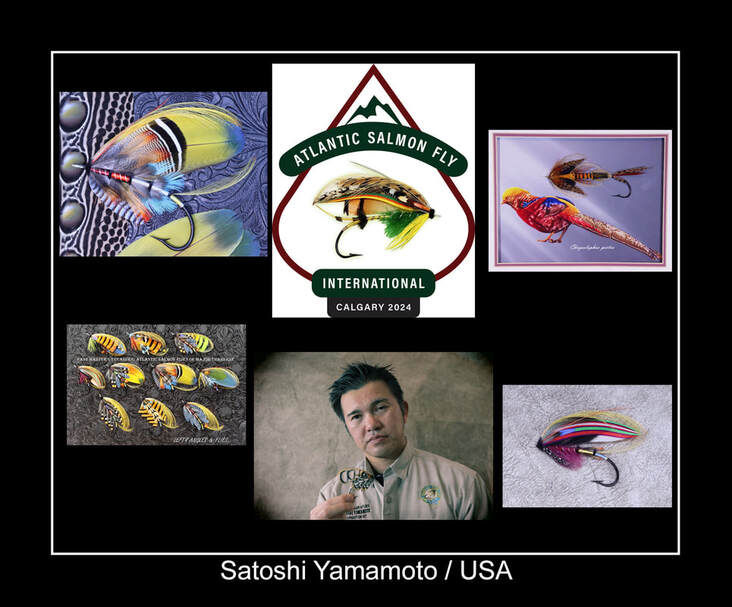
Again, I started doing Spring Creek fries and then a Yellowstone Park fries. And I even did a workshop over there about Spring Creek fries, Yellowstone region, Yellowstone, Yellowstone area fries, those things. So yeah, mostly matching the hut green drink, pale morning dunk. It’s all stuff. And then, but eh, frying, if we really talk about fry time, I just have to mention I cannot get by my involvement and the passion for the Atlantic salmon fries. So,
Dave (24m 41s):
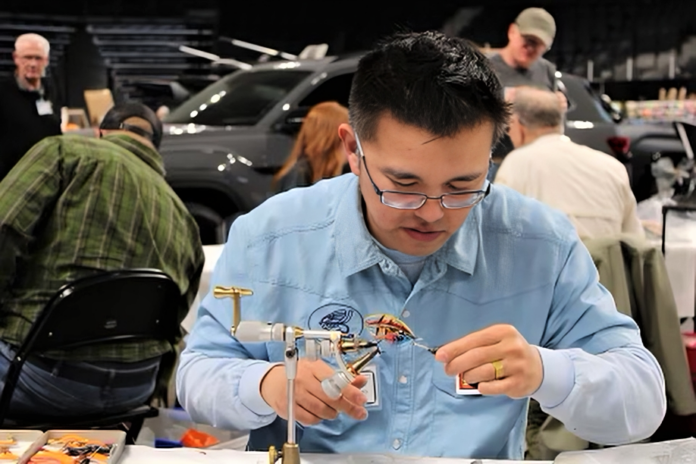
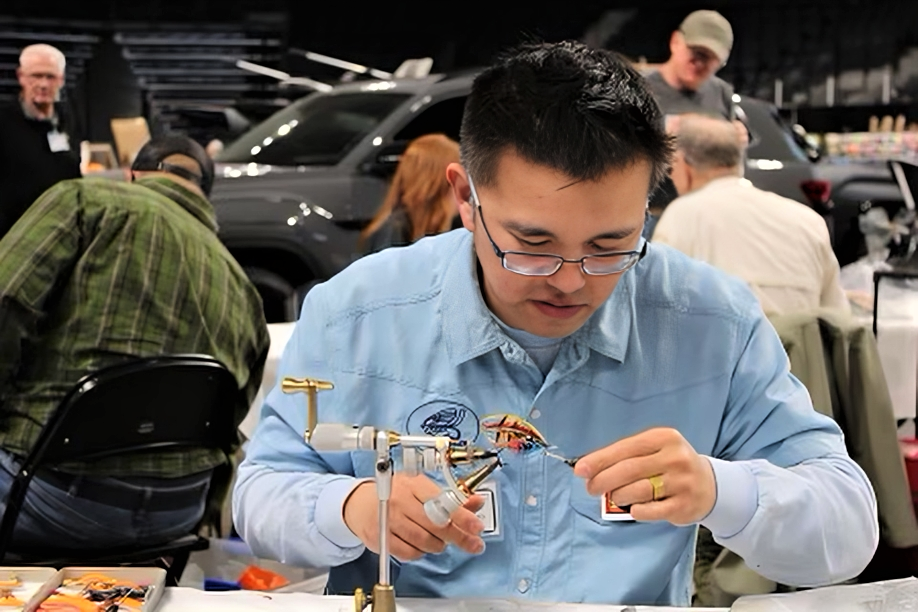
Yeah, I was just gonna say that. So I’m looking at your photo you sent me by email and it says, and you’re sitting there tying an amazing land salmon flying in, in the photo,
Satoshi (24m 48s):
Right? Yeah, yeah. And then, yeah, I’ve been, I’ve been tying a trial fridge, you know, before I become a guide and then constantly of commercial tie, you know, doing some wholesale, wholesale tie for like a fry shops and such. But yeah. Or sell on my own. But 2013 by twenties, I basically, a few years after I moved in here, barely a few years after I moved into a Livingstone, I first, and then Thai established fries, you know, published flies. But also I start to design my own. And then within that short period, very short period, I really, I can really co, I really literally cover the most hues, the most hutches, the most fly patterns that work for this area from Spring Creek to Yellowstone River, Florida to Yellowstone Park waters, park streams.
Satoshi (25m 43s):
And then that by spring of 2013, you know, I gotta keep, may tweak a little bit. And then, oh yeah, this imagine new, imagine I change a little bit. CDC, new image or whatever that is, you know, I could keep doing. But I kind of felt like, you know, in terms of like a creativity, I kind of hit the wall like a stuck, you know, then just, I’m only doing a small tweaks here and there. So, but then maybe now, now I thought it may be a time for me to learn something new and then I want to do something as maybe I can develop like different skills, you know, advanced skills, maybe a time.
Satoshi (26m 27s):
So then after that I may learn something from there. So what is it maybe someday, like I said, I, like I said, I, I once lived in Washington, so I did, back then I thought about, you know, steelhead fry. And then, yeah, I, I was thinking about it. Then there are a couple of coincidences here at that, the, do you know the fly tire magazine?
Dave (26m 54s):
Yeah. Fly tire, right?
Satoshi (26m 55s):
And then 20 20 13, like I believe a spring issue that one had that one featured the step by step of Atlantic salmon rice. And then, oh, okay. Yeah, that’s, that’s quite challenging. And there are lots of users. And then, but then again, that’s interesting. And then at the same time, this, the department store, you know, outta the department store, it’s called a sportsman warehouse. They getting rid of nature split inventory as they said, what’s going on here? I said, oh, we just changing vendors. And then they just slushing off the price, you know, of the nature split inventories. So I, I was able to buy a golden pheasant, you know, skins all whole skins or goose, goose showed the dy goose for the mew.
Satoshi (27m 44s):
And then I, I still have them. And then I was able to buy those in the very good price, in know, very, very basic materials to do. Some is steel had to the sum of fry.
Dave (27m 56s):
Well that was the question I was gonna have about the show. So were you at the Eastern Idaho Expo? Were you tying Atlantic salmon flies mainly? Or did you also tie some Spring Creek flies?
Satoshi (28m 6s):
So I shifted to salmon fries to tie Atlantic salmon fry in, I think 2018, I believe. Yeah. And then what happened was, I think one year, maybe 2017 was really like a slow year. Not many people, you know, so, so rather than just spinning the thread and then somehow that year was really slow, and then audience here and just, you know, who’s, who sat with me and then to kind of, you know, occupy myself, I, I wasn’t sure if I could do it, but maybe I can do Atlantic some of, right. ’cause one friend might take, you know, minimum couple of hours, right?
Satoshi (28m 47s):
So yeah, with without audience I can do this. So, you know, that’s, and then, but once I started doing it, people kinda sit with me. But the problem is I can give that fly to only one person. So, but people look at me and then right now, unless single change, I do only one. I like to do the Atlantic summer fries in. Yeah, you do that one fly for one session,
Dave (29m 11s):
One fly for one session.
Satoshi (29m 13s):
Yeah. And then maybe I should do some, you know, either still had the fly or more like a bit simpler, like a space fly or something like that. So I can tie more than one. But the people definitely like to look some, you know, married wing or something. So that’s
Dave (29m 29s):
It. So the Atlantic salmon flies. So basically that’s what you’re doing now, if you do that show again, you’re probably gonna tie Atlantic Sandflies.
Satoshi (29m 37s):
Yeah, I, I like to think so. Yeah. And then suddenly not many people would do that, so,
Dave (29m 43s):
Oh, really? So at that event, you didn’t see a lot of Atlantic salmon fly tires at that event?
Satoshi (29m 47s):
Yeah, I, I just say only my mentor who, who was going to mention Marvin ti from Wyoming, is I met him right after I got all those book and magazine and materials in the 2013. And then I asked him to teach me. And then we did a correspondence with email and pictures and I send him flies. Yeah, that winter, 2013 to 2014, I had a lesson with him. And then, yes, now spring came in 2014. This is important for, yeah, even the Spring Creek flies. Now I kind of get to some level. I didn’t develop a basic of the Atlantic sum of rice.
Satoshi (30m 31s):
But life year sad thing is, well now I gotta go back to tra flies, right? Spring I got stock up fresh, you know, I couldn’t believe it. I’m tying trout fries, spring Creek fresh, much more efficiently. ’cause they, what happened was, it’s about the thread control. When we do trout fries, people go move quick, spin the bombing like this. You like, ah, you know, maybe we need a camera now, you know, but, you know, but I learned, you know, we don’t need that through Atlantic salmon rice. We don’t need that many thread wraps.
Dave (31m 5s):
Right. So what you’re saying is with Atlantic salmon, we’ve talked to a few people that have tied the Atlantic salmon flies. But you know, every single wrap of your thread counts because it’s bulk. Right. It makes it, and so what you’re saying is that the transition is, is on trout flies, you should also be thinking of every single wrap, even on a tiny little 18 size 18. Is that true?
Satoshi (31m 25s):
Correct. Yeah. You don’t need that many thread wraps. Suddenly we don’t have to over garnish our flies, you know, and then I knew that, but I just, I can kind of perceive it right in front of me. And then, so I just, I can tie fries much more efficiently and my fries are much more elegant right after I learned that Atlantic sum. Right. So it’s, you know, from am to, we are talking about size five zero hook to size, 22 hook, right? But it’s just a shame
Dave (32m 2s):
Step into the world where the river whispers and the fishing is nothing short of legendary. This year I ventured into the heart of Eastern Idaho’s Yellowstone Teton territory where the fish were larger than life and the waters held the secrets of the best fly fishing out West Yellowstone Teton territory is not just a location, it’s a gateway to adventures that will etch themselves into your memory with crystal clear rivers like the Henry’s Fork and the South Fork of the Snake, and enough lakes to keep you going all year long. Make your way to Yellowstone Teton territory and embark on a journey to one of North America’s finest fly fishing destinations. Whether you’re planning your trip now or, or just dreaming it up, the YTT is where those dreams turn into reality.
Dave (32m 44s):
Remember Yellowstone Teton territory, that’s Teton. T-E-T-O-N. It’s time to experience eastern Idaho for yourself and support this podcast at the same time. Which one’s easier for you to tie? Is it easier to tie the, the five T Atlantic salmon fly or the size 22 little tiny dry fly?
Satoshi (33m 4s):
Yeah, mid would be probably easier. Mid, yeah, it’s, well still it’s Which
Dave (33m 10s):
One? The Midge. Yeah.
Satoshi (33m 11s):
It probably fry is still easier. And then well yeah, because if I try something big, you know, wanna look, look better, so, so
Dave (33m 20s):
Yeah. Yeah. Gotcha. What is the, if you think about, you’re talking about Spring Creeks a little bit on the flies, I wanna talk about that. Maybe let’s take it into Yellowstone and you know, the river you got these spring creeks. It sounds like that’s where you’re guiding a little bit. Describe what you’re doing first with your guide operation there on Spring Creeks. What somebody could expect if they grabbed a trip with you. And then maybe give us a couple of tips on fishing Spring Creeks.
Satoshi (33m 44s):
So the Spring Creek is, it’s not difficult one, it’s not impossible place to catch fish, but it’s just so many things going on, so many facets to get there, to catch, to get some results. And then, you know, to enjoy. Now, now I’m talking about my other mentor other than flight, Tom Travis. He’s been guiding, even before I was born. He’s been guiding us since seventies. He taught me, first thing was Spring Creek is a classroom of fry fishing because again, so many things going on, you can see the fish, fish rising or fish resting on the bottom.
Satoshi (34m 24s):
Looks like feeding something. What they’re feeding. How they’re feeding, you know, how. So that, and then how the, how could we present our flights? How could we deliver our flight to them? Those things. And what’s the technique there? Oh, and why fish rose but refuse, refuse my flight. It’s just so many things happening. That’s about Spring Creeks and then Deus Spring Creek, you know that one?
Dave (34m 50s):
Yeah, I was just gonna say, yeah, the question I was gonna have was let, let’s just take it to, well first off, are you guiding, is Spring Creeks, is that in your, are you guiding Spring Creeks now?
Satoshi (34m 60s):
Oh, I just did last weekend. The build Spring Creek and Armstrong. Spring Creek. Yeah.
Dave (35m 4s):
So, so let’s talk about that. Like, if somebody right now is wanting to go fishing a Spring Creek, they’re brand new to it. First of all, when, when is a good time to fish? Yellowstone area? Spring Creeks.
Satoshi (35m 15s):
Spring Creek is available throughout the year ’cause they don’t get frozen, but the water came out of the, you know, out of the ground, out of the spring and at 53 or 55 Fahe. So they don’t get frozen even in the middle of winter. But I wouldn’t recommend to come, you know, December. So February it’s just cold and then Too cold. Yeah, a fish fisher there, but not much going on.
Dave (35m 40s):
So like right now, a April may would be a good time.
Satoshi (35m 43s):
It’s pretty good.
Dave (35m 44s):
When would be a good time? The best time to get some dry fly action where you can really
Satoshi (35m 48s):
Best dry fly action is, is without any hesitation. That’s a paid morning done period, end of June through most part July. That’s the best part of the year. It’s, you know, the spring creeks, private spring creeks, they have, they reserve the, you know, they set, they limit a rod, you know, fisherman, how many fisherman per day and then
Dave (36m 12s):
Oh they do?
Satoshi (36m 13s):
Oh yes they do.
Dave (36m 14s):
Is this in Yellowstone Park?
Satoshi (36m 16s):
Oh no. Spring Creeks look within the private ranch. So fisherman pays the rod fee for the, to access, it’s like a British, like a British system. Fisherman re reserves the road and pays the rod fee to the ranch and then fish, so,
Dave (36m 34s):
Oh, I see. So this is on private property, just a private ranch? Correct.
Satoshi (36m 38s):
And then so people reserve the road and then during the period, period, paid morning period, late June through most popular a departure, right? That’s the most popular time people reserve the road year after year practically until they, you know, die. Right? Yeah. It’s that good. Yes, that’s the one, you know, be on the cancel list and I, or then wait until, you know, somebody may not die, but you know, I could make it this year. Yeah, they may be open spot and then, gotcha. And then the people on the council list might get called. It was being there then I was just fortunate to be a guide and then kind of experience that singer well without paying basically.
Satoshi (37m 23s):
So, you
Dave (37m 24s):
Know, so if you’re on, if you’re with you, let’s just take it to where fishing, we’re getting ready to fish a day for Spring Creeks. It’s, let’s just say it’s early July. What is, you know, take us to the river. Like when is a good time to be hitting the river? When, when would that PMD hatch start coming off?
Satoshi (37m 40s):
We see PMD like mid June. So we are talking about 15th, 18th around that time, but definitely Right. And then it’s not quite, they don’t quite established, but maybe we see a few few rises, you know, like a PMD has like a middle of afternoon or something. Then I’d say somewhere around after 20 years, now’s starts to be more typical. Action is pm MD starts around the start hatching around 10. And on a good day last until one or two in the afternoon. Then we have typically in the guide we have lunch and then afternoon there’s always, during that period grazing about that period, there’s always some trick of pm MD, you know, hatching or, so maybe a mid, a maybe bit slower, but you can find rising fish in the cast for it.
Satoshi (38m 32s):
And then that goes on until five. And then as a kind become very period as well as you know, so mi we might as well take a break then. Best, best scenario is somewhere around when the evening calm and not windy evening or calm and the warm evening, the, the pmm D spinners start to fall and then fish. Just like a quiet water, quiet stuff is like a boiling, like with a rising fish, it’s, and then that goes on on the best day. It goes until like eight or nine in the at night. Wow.
Dave (39m 9s):
You know what, I’m starting to picture Satoshi, I’m starting to picture the river runs through it. You mentioned this at the start, but I always think that movie had all that great, you know, of course Robert Redford and all the great video, you know, videography and stuff. Yeah. But like you could picture that, you know, that perfect calm day in Montana Yeah. On the trout stream. And it feels like that’s what you’re talking about here. Is that kind of a similar thing? Yeah,
Satoshi (39m 30s):
Yeah. The even it’s kinda windy, somewhat windy during the daytime, you know, in the valley the air kind of always shift from the river, river bottom, you know, river level to top of the mountain. So usually by 6:00 PM or so, five, 6:00 PM depending on the day, it’s kind of, there’s always a kind of calm hours little bit. So yeah, it, it tends to happen often.
Dave (39m 54s):
What’s the on the spinner fall, how would you, if you were fishing, you mentioned the morning fishing, 10:00 AM to 1:00 PM and then the spinner fall at 6:00 PM to nine. What would be the difference in flies you might use for say the, the, the dun versus the spinner? Give us a couple of names of flies that you might, somebody might use.
Satoshi (40m 10s):
Let’s see, during the hot, yeah, PMD is, I think I’d just say
Dave (40m 16s):
Pale morning. Done, right?
Satoshi (40m 17s):
Yeah. Pale morning done is during the pmm D time I say we can actually catch fish with a dung, you know, totally soft fly. And then as well as, you know, half sinking image type, you know, low riding or a half sinking image type. We catch fish on those. But VMD is a time that when the fish actually, you know, breaks the surface to gorge to either at the, you know, down on the surface. So yeah, you can still a compar or sparkle down as a dry fry or know surface manager. And then I have some PMD manager pattern that I developed and then like a floating lymph type. Yeah, those works really well.
Satoshi (40m 58s):
And then, yeah, right on the surface, in the surface film, those are very effective during the, the hatch time and then
Dave (41m 6s):
The emergence, right?
Satoshi (41m 7s):
Yeah. Then the spinner during the spinner for actually that the kind of a soft taco box. Yeah. Just soft taco fish Dagur light as a drive. Right. They work really well.
Dave (41m 21s):
Well, what’s it called?
Satoshi (41m 22s):
Just soft taco.
Dave (41m 23s):
Oh, soft tackle. Oh yeah. So soft tackle kind of fish in a soft taco, like a kind of a wet fly or you fish more like a dry
Satoshi (41m 29s):
No, we fish in dry fry. We, we dust with, you know, powder, you know, float and powder and then the fish dry that works. But also I have a, as the spinner pattern as I’ve been tying like five to 10 dozen, sometimes 20 dozen for the fresh up. Know that.
Dave (41m 46s):
Yeah. What’s a spinner? What would be a, a spinner pattern? Like Okay,
Satoshi (41m 49s):
It’s a hand tip wing, a hang handker tip wing spinner. It’s a split wing pattern. Okay. But we use it split wing. Okay. Yeah. We use a tip of the he hacker, not that the, you know, fiber, you know, tied in the, you know, crosswise perpendicular to the hook shank, but instead we use it. But that makes a realistic, probably the most realistic, the spinner pattern. Again, it’s just, I’ve been, I’ve been asked over and over to tie that for the fly shop there. So yeah, that one works really well. And then, yeah,
Dave (42m 25s):
Which fly shop is that, that you’re tying for? That’s
Satoshi (42m 27s):
The fly shop within the Depe Spring Creek. Depe Spring is a huge ranch. And then on the upper end of the, the creek there’s a, it’s called a Spring Creek specialist fry shop run by Mr. Buzzini. He runs a fry shop there within the Depe Spring Creek. So Itai wholesale fries for him. And then the spinners, as I’ve been tying since something like 2018 or 19, I’ve been tying like 10 dozen minimum of year. So. Gotcha. That keeps me busy for a couple of days during the winter months. So, so yeah,
Dave (43m 4s):
I’m looking at, I’m over at buzzes site, spring Creek specialist.com. That’s him. Yeah. And it says he’s got a report on April 1st, so he is keeping it fairly updated and he is talking about, you know, midges, some betas. He’s got a little report here. It looks like he, he does that throughout the year.
Satoshi (43m 18s):
Yeah. So the, I didn’t mention PM MD ’cause I’m asked, you know, why the best days, but right now a great time to, we just had a, we only fished a mid be drive fry, you know, last weekend. My, my client was very skilled, so yeah, we had a tiny small size 20 to 22 midges and the bees drive fry. That’s all we use for two days in Armstrong and then depu. So yeah. And now it’s a great time too. And then rot was a bit lower than the summer, you know, prime time. So yeah, we just had a great time. And then of course, but then as the summer goes by, besides P-M-D-P-M-D may start to, yeah, start to taper down now.
Satoshi (44m 1s):
But now we have a Cadi SFA may fry. Oh yeah. And then suddenly terrestrials, you know, like, like fishing, the Freestone River.
Dave (44m 10s):
What do you do for Cadis? Because CADs seem to be a challenging bug to hit. Like what is, give us a couple, what, what is the CADs hatch? What do you fishing? What, what are a couple flies you use? And then give us a tip on cadi
Satoshi (44m 22s):
Ca. You can use some, like a type not really high riding, like, you know, typical driver such as cadi, those, those wouldn’t, wouldn’t be eaten much. But they prefer the, because of the nature of the, you know, sprinkling, slow moving, they prefer the low profile, you know, I mean the low riding, if that’s a drive. Right. And then again, soft taco or like pupil pattern slightly below the surface. Yeah. Oppo type. That would be great. And then right now actually with this warm spring, I’ve seen Cadi and the fish eating as early as early, early April, you know, during the warm spring.
Satoshi (45m 2s):
And then may like Mother’s Day ca in, in Yellowstone River kind move up basically, you know, during the May.
Dave (45m 10s):
Oh, what is the Mother’s Day? I’ve heard that before. What is the Mother’s Day cat? How big is that? Bug is how different
Satoshi (45m 16s):
Mother’s Day? Cat is a size 12 to 16. And then really dark olive, almost a black-ish body and a really kind of thick chubby that’s, that’s a mother they had. And then yeah, they hatch a lot and hatch in a great number besides Yellowstone River. The Madison River just outside of Bozeman. Commonly we call the Lower Madison. They have a great huts of the, the million, billions of Caddish hut, you know, early May.
Dave (45m 49s):
Are you getting a lot of Caddi in the spring creeks? Are you getting a lot of CADs there in the Spring Creek?
Satoshi (45m 54s):
Not hold a lot. Yeah. Not hold a lot. Then during the summer months we see a small black CADs, oh, I can’t remember the, as the small black ies, like we fish on the big Hong River in the Eastern Montana, you know the Crow reservation over there? Yeah. Small black ies, like size 18 to 20. If they, if throughout the really feeding on them, that’s really challenging as well. Again, the high riding, the pattern user refused, but the low riding imagine or people dropped slightly beneath the surface, those ones that tried the hitting. So
Dave (46m 32s):
Why is the, why do you think that, is that the, ’cause I’m looking at some on the Orvis website, the peacock fluttering ca, the, the Royal Elk Care ca, there’s a bunch of these. Why do you think it is that they’re not hitting the, the, the elk care, the higher writing stuff? Why, why do they need that stuff in the surface?
Satoshi (46m 48s):
Oh, I believe that trout feeding on the, you know, trout feeding that easier, praying on the merger Yeah. Emerge the, the people are sending right in front of them before they, you know, fly out, dry fly, fly out, hatch out and dry out and then fly out. And then that pupil, and then even the, you know, imagine strangling in the surface, those are the ones that they are hitting. And then, and then due to the nature of that, you know, spring Creek, you know, floor, you know, quiet floor. So they just, even, especially how good high riding, they seldom touch it. Yeah. So then that about Ka, but the Ka compared to PMD or SFA may fry or be, you know, in the spring and the fall ka we kadish action, we, we see far less Yeah.
Satoshi (47m 41s):
Even compared to mids. Yeah. But I never, yeah, during the summer months, I always carry KA box just in case. Yeah, it’s, it may not be this spot, but next spot, you know, we might see some fish feeding on cad.
Dave (47m 55s):
Yeah. How do you know when you’re out there, when you would fish a caddi? Do you just wait till you see a couple flying or, or fish eating ’em? How do you know when to switch to a caddi? Oh,
Satoshi (48m 2s):
Exactly. Yeah. What, what riding and what is a fish rising? Why do we see anything on the surface, you know, flying around us. And then I always carry a small aquarium net as my th so I walk downstream, I waited waiting to downstream from the, you know, rising fish. And then I see the surface and that’s how I find out, you know, I may not see actual insects, but oftentimes I see the pupil shock or you know, mha and then the, oh, that’s what’s going on. And then I can’t describe by words, but the rice forms, yeah. Very important.
Dave (48m 39s):
Yeah. Talk, give us the, give us the rice form a little bit. Update on that. If somebody is new to it, how would you describe seeing a rise form or types of rice form? How would you know what they’re eating?
Satoshi (48m 48s):
Oh, okay. So the, you know, we talk about dry, dry fishing, but truly, you know, truly dry, you know, they’re feeding on the, like a doubt or d what I mean, grasshopper, that’s okay, but that’s a bit different story. But it is like, I, like you say, I, as I described for car, it’s a slightly different, because I wouldn’t count on catch fish on the dry rice unless we see them, you know, upper joint is totally breaking the surface, right?
Dave (49m 17s):
Like jumping, like exactly. Eating and jumping outta the water.
Satoshi (49m 20s):
Yeah. As, yeah, ajo is sticking out like a pyramid, you know. So then that’s definitely feeling is definitely on surface is a,
Dave (49m 30s):
Have you ever seen a fish when you’re sitting there watching fish, have you ever seen a fish jump outta the water and catch the bug as it’s flying away
Satoshi (49m 37s):
Occasionally on the cage? Yes. Yeah. And then, yeah, like I said, I remember one spring I became friends with some, you know, regular fisherman, the, the build Spring Creek. And he said, oh yes, that, that a spring early April fish feeding on Caddish. And he said, oh yeah, the, that fish took my caddish and then almost torpedo to my chair. Yeah. So the, yeah,
Dave (50m 1s):
We, so they’re, they’re aggressive.
Satoshi (50m 3s):
Yeah. We see once in a while, especially on Kaddish, like any other rivers, it, it is interesting to observe all the different, different rise forms and then the attitude of the truck. And then we see, you know, the, how do you say, like, po poisoning, we see the dorsal fin and the tail. Definitely that imagine
Dave (50m 23s):
Oh, oh. So when you see the, the fish come up and you just see it’s like dorsal fin and then, then a little bit of the tail going down that that’s an emerge.
Satoshi (50m 29s):
Imagine were feeding the ascending new for ascending pupil two or three inches below the surface. And then also I classified, we just see right wings, but we couldn’t not quite rocket the fish. Then they are probably feeding fiber or six inches below the surface. Same thing feeding either pupil or lava or n in that, in that column.
Dave (50m 51s):
How do you know when they’re fishing? About six inches below the surface?
Satoshi (50m 54s):
Again, that’s my guess, but we just see the rising ring, rising ring on top. Oh
Dave (50m 59s):
Yeah. You just see a ring. So you don’t even see the fish. You don’t even see the fish. You just see the ring.
Satoshi (51m 3s):
Not quite, not quite. And then same goes with that. It is interesting. Sorry, I’m, I’m afraid it might be a slightly off the topic, but you know, that, are you familiar with or maybe listeners as who familiar with classic research from England? Like Fred Harford or George SKUs?
Dave (51m 24s):
Oh yeah, yeah. George SKUs. Sure,
Satoshi (51m 25s):
Yeah, yeah. Drive fly fishing or fishing. I mean, those folks are doing, you know, way before computer, you know, I was reading those things. And then exactly the chalk stream of the, you know, British, British eels is fascinating. Yeah. And Kus briefly, I, I’m sorry I, I don’t mean to give a lecture to anybody, but Yeah,
Dave (51m 50s):
Yeah, let’s hear it. Yeah, let’s hear it.
Satoshi (51m 52s):
Kus was a dedicated Dagur friend Fisher Yes. Following Hartford or Marriott. And then, but he realized we cannot take that what, what he calls ing fish, some fish rising, rising, but not feeding on driveway at all. That’s why he start to fish straight to subsurface and then, oh,
Dave (52m 12s):
Right,
Satoshi (52m 13s):
Yeah, that, yeah, like fast. I was, honestly, I was, I observed the exactly same thing before I, I read those books or read those guys and Oh, okay. And yeah, that’s what happened. So.
Dave (52m 27s):
Well, that’s amazing. And I’m looking at, I’m on the, the, the Catskills fly fishing website, but it says George SKUs em skews. Yeah. Yeah. He says consider one of the greatest trout fishermen ever. He experimented with, with basically telling people at the time they thought it was just dry flies and they thought it was heresy what he was saying, but he basically described from one of the first times that these fish were actually feeding below the surface instead of on the, the actual Right.
Satoshi (52m 51s):
Correct. Yeah. Feeding in the column, yeah. Column, you know, slightly below the surface, the column
Dave (52m 57s):
Column,
Satoshi (52m 58s):
Right. Yeah, that’s a, that’s what I discovered too. When we see any rises, we think about, oh, drive fried fishing hutch. Well, hutchings true, but there’s, it’s not just, it’s a different stage of hatch. So,
Dave (53m 11s):
So how many types of rise forms, you mentioned a few, you mentioned one where the fish is jumping outta the water, the one where you see its dorsal fin and tail going down, you see just the ring. Are there any other types of rise forms you might see that would show, tell you where they’re feeding?
Satoshi (53m 24s):
That’s pretty much, yeah, those three categories, that’s what I emphasize. Sorry, I, I’m maybe jumping a topic, but I published, I self published a book about, it’s on my website, but I just saw that, I wish I could send it to you, Juan. Yeah,
Dave (53m 39s):
Yeah. Is this the one about fishing Livingston hatches and stuff in Livingston? Yeah.
Satoshi (53m 44s):
Yeah.
Dave (53m 44s):
What, what’s the name of the title or what’s the title?
Satoshi (53m 47s):
The Trout Food and Flies for Living Stones. Spring Creek. Spring Creek. Yeah. I was going to, yeah, I just sold that. I told, I sold, saw, published, I sold 400 copies. Oh, wow. Yeah, I, I did all by myself. I did all the editing and the picture, you know, of got pictures, accumulation of all by 10 years of my guiding and fishing on the creeks, and then writing tweaks and then second edition went really quick. And so I wish I had another copy and I sent it to you, but insects. And then the fly balance on the second edition, I did some discussion, like exactly rise form and then, you know, how you gonna cast it and those things, very basic things.
Satoshi (54m 32s):
But yeah, those are, yeah, typically three rises. That’s what I look for. I mean, when we really talk about, depending on the time of the year, I’d say again, especially pmm D time, that’s when the fisher really, really eager to feed.
Dave (54m 48s):
How are they feeding then on the PMDs? How are they, what’s the rise they’re taking? Is it usually under the surface
Satoshi (54m 53s):
Before the hatch, we can see that the trout are chasing the ni underneath in the water. It’s because water’s clear, they go side by side, you know, and then we, I don’t think anybody can really, you know, spot the n in the water, no, from 20 or 30 feet away. But we can, we can see throughout the, you know, like change position on the snatching n underneath. And then, so we could just height anything those things too. And then, yeah, in my experience, those are the most tried really feeding, you know, aggressive one, the and in down below. In, yeah, down below. Yes.
Dave (55m 27s):
Well, this is awesome. This has been, I mean, this is a, I’m gonna, we’re gonna take it out here in a little bit with our, this is our kind of brand shout out segment. And some of the brands, I know you’ve probably worked with all, you mentioned a few today, but let’s, I’m gonna do the brand shout out, but I want to just mention this is presented by Yellowstone Teton territory, and I think they help promote the actual Eastside Idaho flight tying event this year, so, oh,
Satoshi (55m 48s):
Okay. Sure. We’ll
Dave (55m 49s):
Give a shout out to them. If, if anybody wants to go to we wet fly swing.com/teton, they can check out more information on some of the brands out in that neck of the woods. But let’s hear maybe one of your brands that you really love in, in the fly tank or fly fishing space. What, what’s something you, you, you’re really hot on right now?
Satoshi (56m 6s):
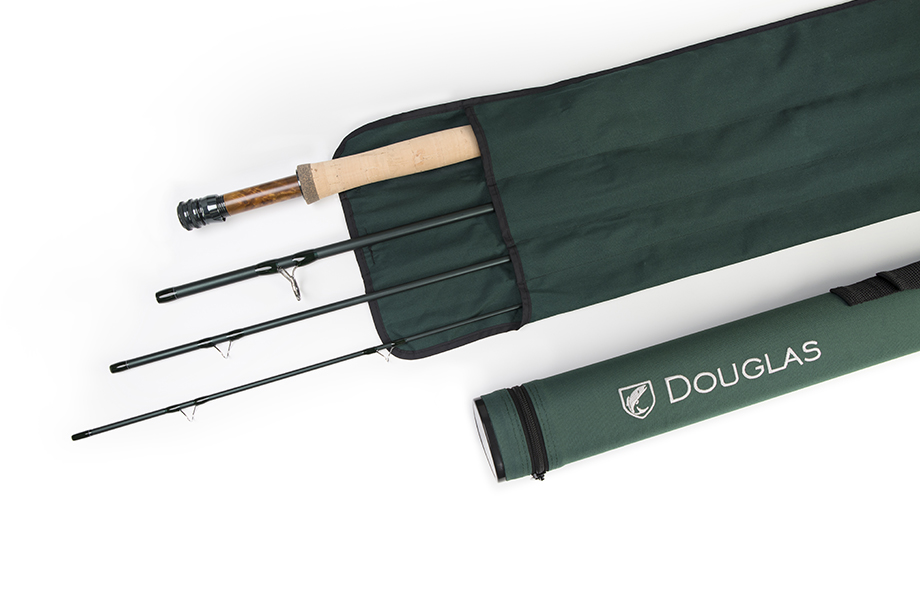
The as far the graphite rod? Well, my gear gear preference changed drastically in the last year or two, but, so that’s another story I guess. But DX answer is, I prefer the CF Heimer rod. Oh,
Dave (56m 24s):
Heim.
Satoshi (56m 24s):
Rod to trout, rod to spare Rod, what,
Dave (56m 28s):
What’s your rod, what’s your berkheimer rod? For? For like spring creeks,
Satoshi (56m 33s):
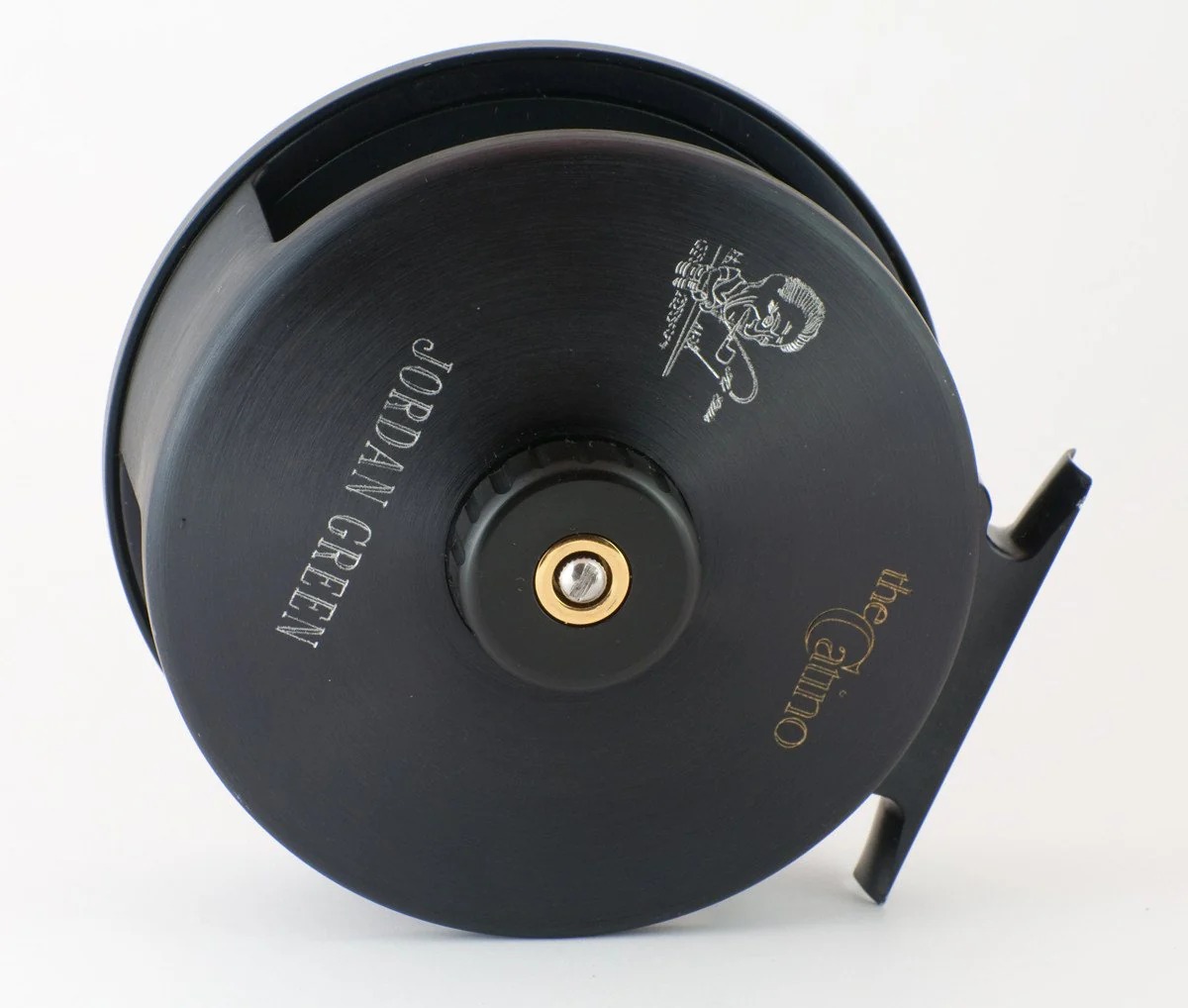
Actually I’m getting a, what’s called a 5 8 9 feet DAL, deep action rod, that, I think that’s how it’s called. DAL. That’s a softer rod, basically. Yeah. And then compared to, you know, standard action and then that’s the one. And then over the years, over years of, you know, using the contemporary disc drug wheels, I am into vintage, you know, click Pro Power hardy reels. Oh,
Dave (57m 1s):
Cool. So you’re using vintage, so you have a vintage reel on there?
Satoshi (57m 4s):
Actually I do that. That’s awesome. Just don’t, please don’t tell my wife. But
Dave (57m 10s):
What year was that reel made?
Satoshi (57m 11s):
I have a couple of them. So for the DAL, actually I’m ordering now the Heim, you know, five grade, I think it’s a late 1940s saint to George, three inch. And then I have some perfect Hardie. Perfect. I’m casting with, or recent, I purchased three, three inch and three A for Hardie Bamboo. Yeah, it’s, it’s old, nowhere as fancy or light lighter as you know, the contemporary bamboo, but it’s a bamboo road, 1950s. Yeah, I have that one. And I fish with them actually when I have time on Spring Creek. Yeah. And then I have couple puffs, and then for the steelhead, steelhead fishing, I have, I even have a Hardy High Heels from 1890s.
Satoshi (58m 2s):
Yeah, actually that works. Yeah. And then couple of 1950s. Perfect. And then, yeah, those things. Yeah. Yeah. Some, again, as you guess it’s from the, my Atlantic summer of my pass suits now directing it to, you know that, that way too, so,
Dave (58m 19s):
Yeah. Yeah. I hear you. Well give us, as we’re kinda wrapping it up here pretty quick, give us one, one big tip for fishing Spring creeks. If somebody’s coming in and they’ve been struggling to catch a fish on a Spring Creek, what would be one big tip you would give them?
Satoshi (58m 33s):
So definitely be observant. And then, and also if you really want to fish for the huts, you know, just ask around or yes, do online search or read the hot chat or call refresh, shop Outfitters like myself, and ask that, what hat do we expect do, can I expect at this time of the year? I mean, just, I say, please don’t do, you know, just come here and wear the hu Yeah. Just please, please don’t, don’t do that. You know, don’t, don’t expect that convenience, you know, around here, I would say. Yeah. I see. So, yeah, I mean, pretty much not just Spring Creek, but everyone.
Satoshi (59m 16s):
Yeah. You know? Yeah. If you are really serious about it, ask around and then get some help and then yeah. What to expect.
Dave (59m 23s):
That’s perfect. And, and what would be, I got two more for you and then we’ll take it out here. Sure. So for, if, you know, this is your beginner, you know, if you go back to when you started knowing what you know now, what would be the biggest tip you would give yourself? If you could go back to, you know, when you first started?
Satoshi (59m 38s):
Oh, it is a, is a Spring Creek. So anywhere for Yeah, anywhere.
Dave (59m 43s):
Anywhere. Just, just kinda in general. Yeah. Anything
Satoshi (59m 46s):
I think that, again, you know, being there has happened site, but not just actual physical experience, you know, le less knowledge, but, you know, get interested and then enjoy that. Yeah. That’s, that’s the most important thing to me.
Dave (1h 0m 3s):
Don’t stress, don’t make it like it’s life or death. It’s just fly fishing. Right,
Satoshi (1h 0m 6s):
Exactly. Yeah. It’s, it’s like I said, I left before I left Montana for some other job, and I come back, I still, you know, I’m so, I feel blessed just being this, you know, area. So just enjoy the, you’re a magical
Dave (1h 0m 20s):
Place
Satoshi (1h 0m 21s):
And then yeah.
Dave (1h 0m 22s):
You’re a magical place for sure. Yeah. Okay. What would be on the, so this is our last one vices question. So I know you use, I think you use a regal vice, but on the other end Yes. I’m not sure if you’ve ever heard the word you vices. What are some of the things maybe you’ve done in your life that you’ve had to quit? You know, because maybe they haven’t been as healthy or they’ve, you know what I mean? For me, I always go back to the tobacco, you know, that was something I quit. But what are, what is one of your vices? What’s something you’re either doing now or something in the past that you had to quit or something you did?
Satoshi (1h 0m 48s):
Ah, oh, what I did? Yeah. I did smoke like any other Japanese, I was even know was young. Oh, you smoked?
Dave (1h 0m 54s):
Yeah. Yeah. You smoked cigarettes. How’d you quit? How’d you quit smoking? Why? Why’d you quit smoking?
Satoshi (1h 0m 58s):
My first winter in Montana, my throat, I feel like I, I, sorry. I feel like I had adhesion or something. I didn’t, not not good, but it’s just so dry for me. I know it’s nothing hero, you know, it just, I can smoke. It’s a fast winter in Montana. I quit smoking.
Dave (1h 1m 16s):
There you go. So your body, your body. I feel that that happens a lot. Your body tells you when you need to give these things up. Yeah. It sounds like that’s, that’s what happened. And was it hard? Was it hard quitting?
Satoshi (1h 1m 26s):
It was very hard, yes. Yeah. And then another thing is, and after that, actually I started smoking. I, I was stay in college, so I started hang around my friend, you know, students more often. And then I learned to drink a beer. And then even then, once I graduated, I started drink, you know, tequila or whiskey. And then I often tell other people that during the 20th I was walking like Johnny Walker. Oh yeah. During my thirties, I was a Canadian because I like Canadian whiskey. Oh, yeah. But I gotta tell you, and I, when I turned 40, I was guiding through my thirties, and that’s when I started. But the moment I hit the 40, I felt my body changed. Yeah. And then at my metabolism changed, I, there was some weight in the middle.
Satoshi (1h 2m 8s):
And then after, then at the same time I got married and I, I, I was a baby coming. Oh,
Dave (1h 2m 14s):
Wow.
Satoshi (1h 2m 15s):
That’s all happened. That’s what happened when I got four. Yeah. Then, so I’m, I’m gonna be old like this, and then when he get 20, I’m 60. Right? Yep. And then, so I changed my, I don’t mean to just quit, you know, drinking, but I start to walk out eventually just my drinking habit diminished. So I’ve been, I’m not drinking whiskey since whiskey or any alcohol since 2018, for six, seven years now. Oh,
Dave (1h 2m 41s):
Amazing. Yeah,
Satoshi (1h 2m 42s):
It just, that’s so cool. I’m not saying, but don’t get me wrong, please don’t get me wrong, either smoking or c or the, with alcohol, I’m not criticizing anything. No. You know, ’cause like people doing it that enjoying it like I did. So yeah. I’m not Christian or anything, but for me it just didn’t work out. And then now I start to work out waiting lifts and then as such, since right after I turned 40 and then yeah. I’m in better shape and we’re now 20, I guess. There
Dave (1h 3m 9s):
You go. There you go. That’s good to hear. I think that’s awesome inspiration because I feel like we all, we all have our own journeys, you know, but you, the health thing is Yeah. Is big because we all love fly fishing and, and you wanna be around longer. Right?
Satoshi (1h 3m 21s):
Exactly. As for guiding, I can guide until, you know, clients quit, basically. Yeah. I don’t wanna do overnight, but Yeah. Yeah. Yeah. That’s awesome. In my early, early, early, early career, you know, my side, like, yeah. As I try 40, I’m like, I’m tired, I wanna go home, you know? I’m at, yeah. Just now it’s, I I just, I can be on, I can standing on the ribbon until you client just, we call it for the day. Yeah. Are you done now? Okay. Yeah.
Dave (1h 3m 52s):
Yeah. That’s it. Yeah. That’s awesome. Yeah,
Satoshi (1h 3m 54s):
I’m, I’m very strong since, yeah. So
Dave (1h 3m 57s):
This is great. Satoshi I think, I think like you said, we were send, you mentioned at the start, lefty Angler and flies.com or at Lefty Angler, yeah. One, one on Instagram. This has been awesome today. I appreciate all your, your words of wisdom and tips on fishing and tying, and we’ll send everybody out. Hopefully we’ll see you there at the event next year on the East Idaho Fly Tying Expo. Cool. Okay. Yeah. Yeah. I’m not sure what the plans are yet. I’m gonna be talking to Bruce here in a couple weeks, but I would love to connect with you there. Oh, you do. Yeah. I would love to connect with you there and see you at the show. And yeah, thanks for shedding light on all of this and we’ll be, look forward to keep in touch. You
Satoshi (1h 4m 32s):
Can, you can check with Bruce, but they already announced the date though, like March 21st, 22nd, regular next year. Oh,
Dave (1h 4m 39s):
It’s already, it’s already announced.
Satoshi (1h 4m 41s):
Yeah, it’s, it’s happening I think. Yeah, so, yeah. Yeah.
Dave (1h 4m 44s):
There you go. So, all right Satoshi, thanks again and we’ll, we’ll talk to you soon.
Satoshi (1h 4m 48s):
Yeah, it’s quite an opportunity. Thank you very much. And then hopefully we can be in touch
3 (1h 4m 55s):
Yha
Dave (1h 4m 56s):
Now. That was a good story. If you have a chance to get out and, and implement what Satoshi called the greatest little expo in the country, you can check in that right now. You can check in on that right now, wetly swing.com/teton and you can find out when that next thing’s coming up and when the next big event is. It’s gonna be right around the corner. So check in and if you get a chance, we will see you out there. We’ve got schools and great trips going all year long. We’ve got another trip going out to this part of the country in 2025, so you can check in on that right now. Wetly swing.com/schools. It’s the best place to find out what we have going, wetly swing.com/schools.
Dave (1h 5m 37s):
Alright, time to let you get outta here and get onto your next thing. I hope you’re having a good drive out there if you’re in the car. And if you’re running, I’m gonna let this blend right into that next episode. Thanks for checking out Travel today. I hope you can live that dream trip this year or just get out more often in that back woods behind the house, drivable location and I hope you experience that road less Traveled.