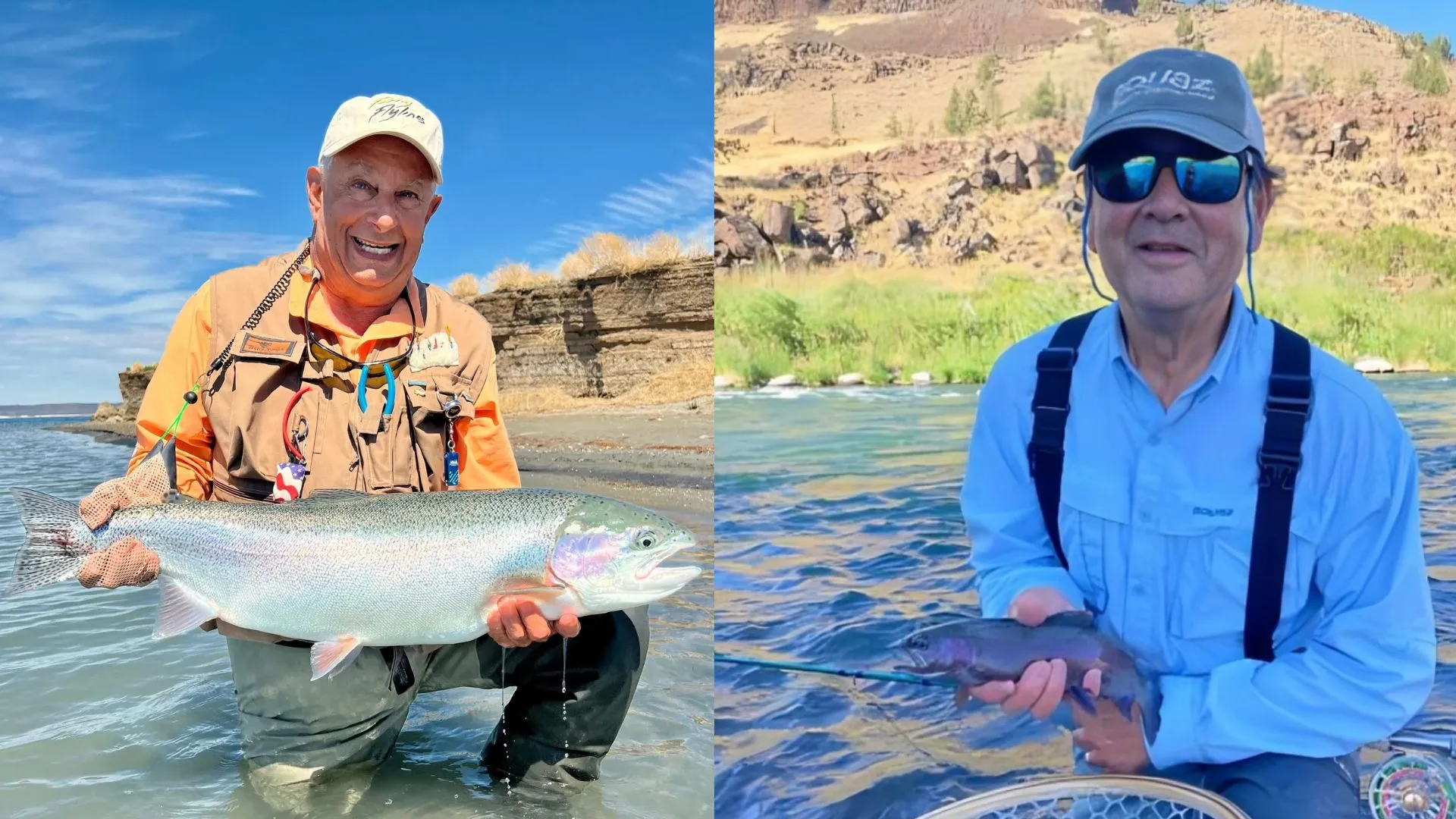
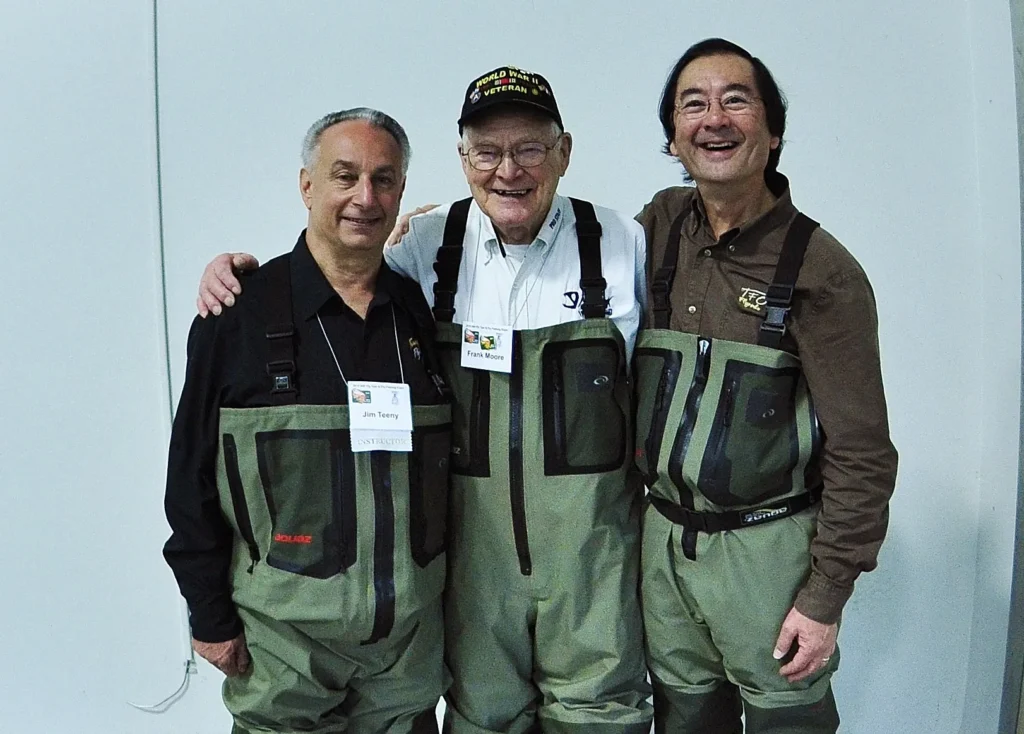
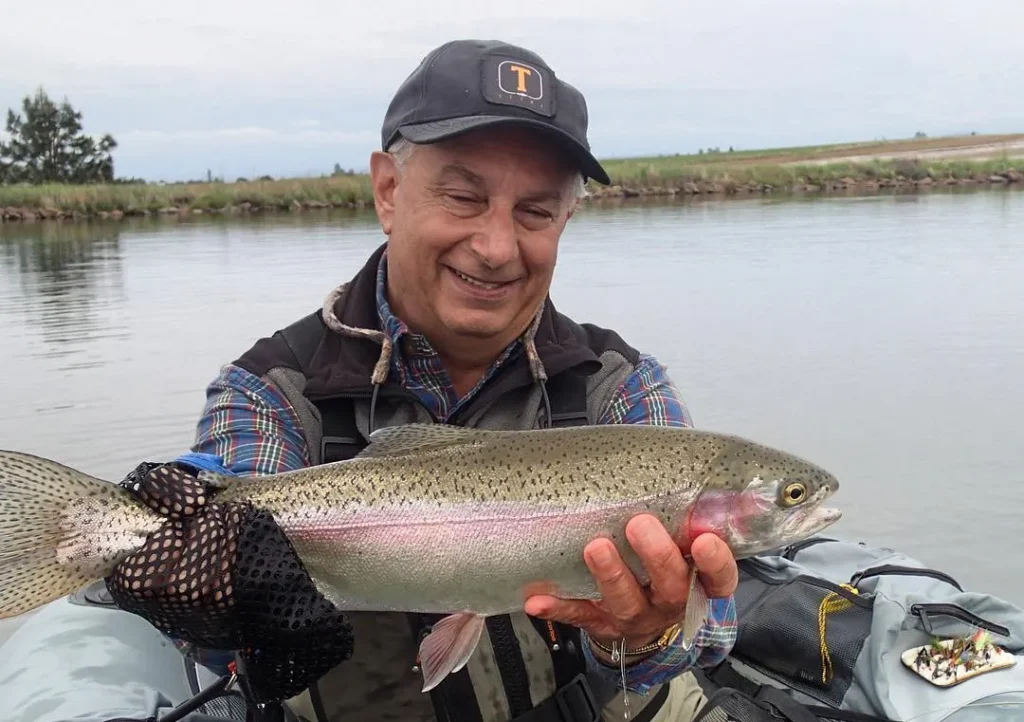
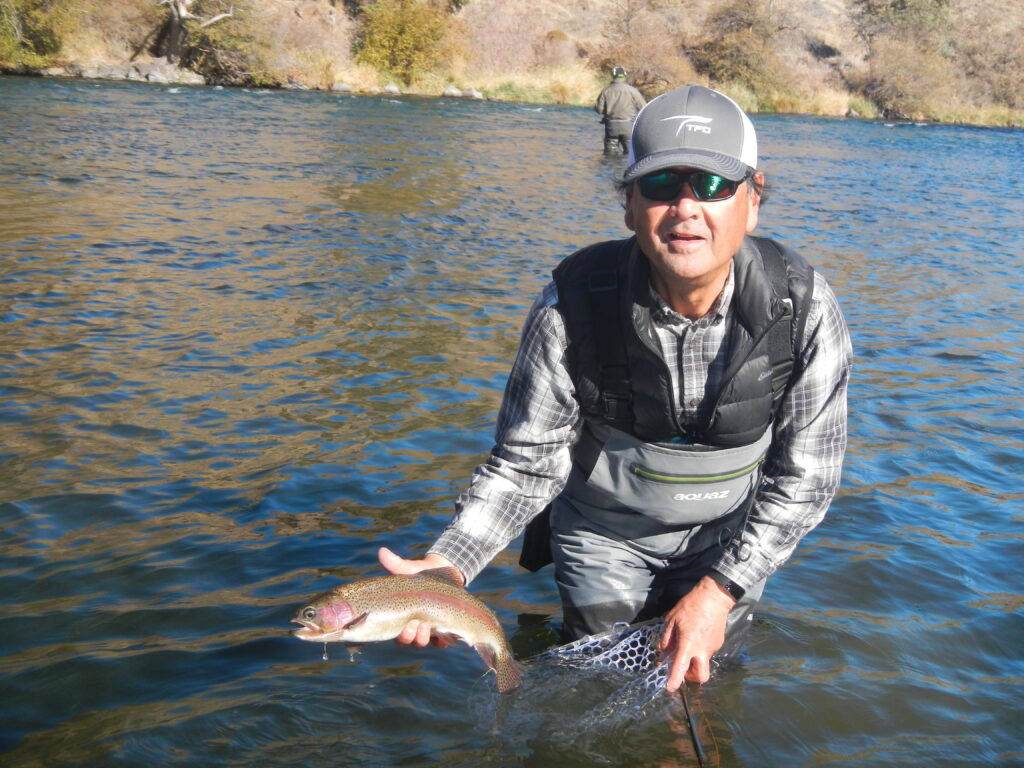
There aren’t many anglers left who were there when modern fly fishing was still being figured out. Jim Teeny and Dick Sagara lived through that era, helped shape it, and still have the stories to prove it.
In this episode, we dig into the early days of winter steelhead fly fishing in the Pacific Northwest, the birth of the Teeny fly lines, and the people who changed the sport along the way. We also talked about the famous “I spot ’em, I got ’em” philosophy that still sparks conversation today.
This one moves from steelhead to tarpon to fly line design and back again, with a bunch of classic stories packed in between. Let’s go!
[01:48] Jim Teeny and Dick Sagara go way back to the early days of fly fishing shows in the 1970s. They met at a fly fishing event in a gymnasium somewhere around Portland or Gresham shortly after Jim started Teeny Lines in 1971.
Dick says he was impressed right away by how welcoming and polite Jim was. Later, when Dick visited Jim’s home office, he was blown away by how many different fly lines Jim had already developed.
Jim talks about working with some of the biggest names in fly fishing at the time, including:
[05:26] Jim shares a personal story about losing his dad on the Sandy River in 1979 after a float tube accident. He says it took him a long time before he could comfortably fish parts of the river again. My dad was one of the few people he trusted enough to wade the Slaughter Hole with after that experience.
Jim remembers the old Sandy River steelhead days below Marmot Dam, when hundreds of fish stacked into the Slaughter Hole while hardly anyone else was hooking fish.
He and my dad spent about a month and a half fishing there together and landed more than 90 steelhead between them. He says they felt like “little kids in a candy store”.
Jim talks about the early days of winter steelhead fly fishing, back when hardly anyone was doing it. He says most anglers were still using gear, while he and his dad were out there swinging flies in places like the Kalama River and the Sandy.
He shares a story from the late 1960s when he hooked and released two chrome winter steelhead while nearby gear anglers hadn’t touched a fish all morning. The next time he saw those same guys, they were carrying fly rods too.
Dick also remembers how crowded some of those runs could get, but says anglers always made room for Jim because everybody knew who he was.
The conversation also touches on some legendary names from those early steelhead days:
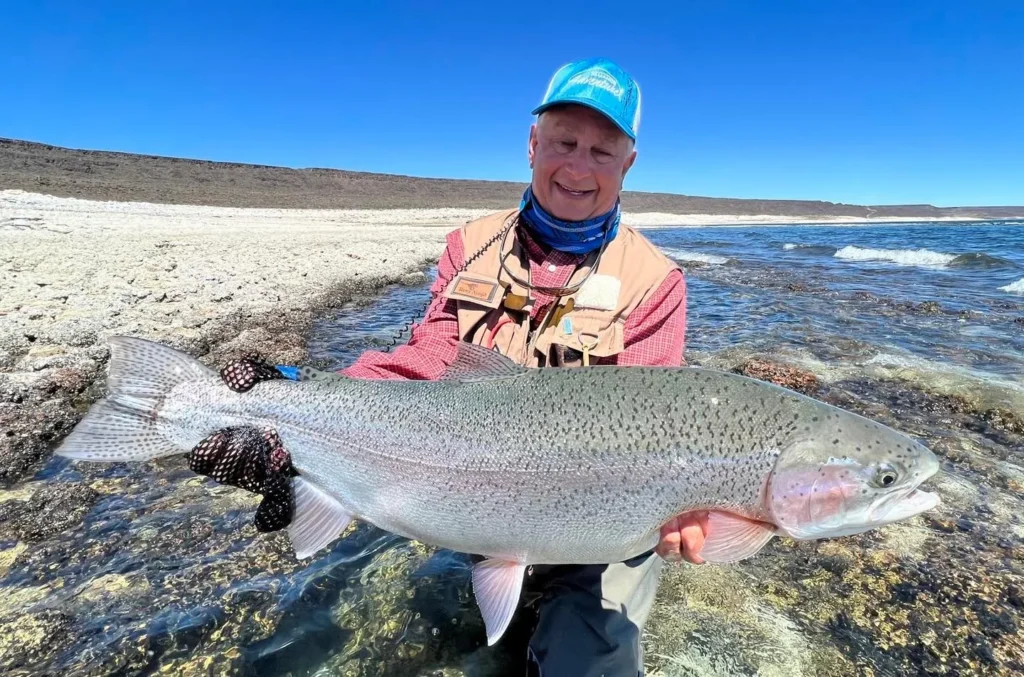
[18:37] Jim shares stories from some of the trips that stuck with him the most over the years, from Argentina in the 1970s to chasing giant trout in Tierra del Fuego and Jurassic Lake.
One trip even started with lost fly rods in Buenos Aires before turning into a month full of big browns, rainbows, brook trout, and landlocked Atlantic salmon.
He also shares a fun story about Lefty Kreh calling him after a trip and saying the T-300 line helped him outfish everyone at the lodge.
Jim says he’s still hosting trips today, including Jurassic Lake trips for giant rainbows. If a trip like that has always been on your list, he mentions there are still a few openings left for the October 31 through November 7 trip. Check in with Jim here.
When Dick asks Jim about his favorite fish, Jim immediately says tarpon. That kicks off a fun stretch of stories from the Florida Keys, including fishing with Billy Pate, jumping fish at night under the bridges, and battling giant tarpon that nearly broke both anglers and gear.
Jim also shares how experimenting with fly lines helped him outfish a crowded fleet of tarpon boats back in the early days. Dick adds that for him, fishing has always been about more than the species. It’s the people, places, and memories that make the trip special.
Dick also shares that for him, it’s never just about the species. It’s about the people, the places, and the whole experience that comes with the trip.
Dick talks about how many fly line companies eventually copied Jim’s sinking line designs after seeing how successful they were. He also explains how important sink rates, head lengths, and density lines have become in modern fly fishing, especially for anglers willing to move beyond a basic floating line.
Jim and Dick also look back on the original T-series lines, including the T-200, T-300, and Mini Tip lines that are still popular today. He says the lines were carefully balanced from the start, and many guides still recommend them because they simply cast well and catch fish.
They’re currently rebuilding the business and bringing several classic lines back because so many anglers and guides still ask for them by name.
I ask Jim and Dick about some of the biggest debates in fly fishing today. Dick says anglers can get way too caught up arguing over gear, rods, and techniques when most modern fly rods are already really good.
Jim also talks about one of his biggest frustrations in fishing: people assuming sockeye salmon can only be flossed or lined. He explains how he fishes dead drifts with small Teeny Nymphs and says plenty of sockeye will actually eat the fly when it’s presented naturally.
The guys laugh about Jim’s famous “I spot ’em, I got ’em” line from the old Scientific Anglers videos. Jim says if he can spot a steelhead that’s holding and not spooked, he feels like he has a really good chance of catching it.
Dick explains that a lot of people misunderstood Jim over the years and accused him of flossing fish, but says Jim simply has an exceptional ability to spot fish and understand how they react to different presentations.
He also shares the old “man throws rocks at fish” story after an article by Jim Zumbo gave people the wrong idea about how Jim used rocks to gently move fish into better holding water before fishing for them properly.
Jim also talks about how watching fish react underwater taught him to adjust things like leader length, fly position, and presentation speed.
If you enjoyed this episode, definitely reach out to Jim or Dick and let them know.
Episode Transcript
WFS 932 Transcript
00:00:00 Dave: There aren’t many people left who saw the early days of modern fly fishing firsthand, and even fewer who helped shape it. Today, we’re sitting down with two guys who were right there as things were changing. Fly lines evolving and techniques being figured out in a generation of anglers learning what actually works on the water. Jim, Teenie and Dick Segura are here. Two longtime voices in fly fishing who’ve seen it all from the early days steelheading in the Pacific Northwest to the fly line that changed the game for anglers all around the world. Today, you’re going to hear about the story behind the early teenie lines and how these sink tip and full sinking lines came to be, and how they changed the game. We’re gonna find out what most anglers still miss when it comes to sinking rates and presentation. We’re going to talk about how Jim does it on the water, and we’re going to get a bunch of stories here, including this breakdown on T series and how this evolved into a lot of the modern day sinking lines you know, of today. Plus, we’re going to hear the story of I spotted I got him and the story behind the man who throws rocks at fish. This is a fun one. We’ll have some links in the show notes if you want to connect with Jim or Dick. Let’s get into it. Here they are. Jim Tiny and Dick Segarra. How are you guys doing? Wonderful.
00:01:12 Jim : Doing good. Yes. Doing good. Dave.
00:01:15 Dave: It’s great to have you guys on here. We we’ve had episodes, podcast episodes in the past with both of you guys. We’ve talked all over the place about history and flies and lines and rods. It’s been great. Today, I think we’re going to talk about the people really, maybe that both of you guys, you know, have connected with Jim. You’ve obviously both of you guys, I mean, we’re talking a long time in the industry, so we’re going to get a background there. But before we get into that, I want to hear right away the story because I’m not sure if I remember this one. First off, you know, what is the story of you guys meeting? Do you guys both remember that? Can one of you tell that story?
00:01:48 Dick: Well, I do, and Jim may have forgotten how I met Jim, but way back in the seventies, uh, I had moved out here from back east, and I remember distinctly walking up to Jim at an event, a fly fishing event in a gymnasium. Okay. And I almost recalled what happened. I think I showed Jim some flies or something. And, uh, as usual, Jim was very polite, very receptive. And, uh, you know, I was impressed with him from the very beginning. Now, Jim and I’ll let Jim respond. Jim, I think, told me where we probably met, you know, at that event. It was in a gymnasium, though.
00:02:36 Dave: Huh.
00:02:37 Jim : Well, I wonder if it was the Gresham High School or, um, the one maybe downtown Portland.
00:02:45 Dick: Yeah, it was in a gymnasium, so I think it’s more likely it was in Gresham for some. Yeah. This was when, of course, you were just getting started. This would have been in the early seventies.
00:02:56 Jim : Yeah, my starting date was July one, nineteen seventy one.
00:03:01 Dick: It wasn’t too soon after that that I think we actually met.
00:03:05 Jim : But I do remember, Dick, when you came by our office and you looked and you went, oh my gosh, I didn’t realize you had so many different fly lines. You remember? You remember that?
00:03:17 Dick: Oh, yeah. Well, I remember I, Jim and I had started a dialogue about representing, uh, his company, Jim Tierney. And I stopped by the office and, uh, you know, Jim, his office was, uh, out of the home at that time. And I was amazed at how many fly lines that Jim had. Jim had a professional series. And at that time, he had kind of nailed down most of the luminaries in the industry. I mean, he had and I’ll just recite these, and I’m sure I may forget some, but he had Kelly Gallop, he had lefty, he had flip. He had I think Bruce Chard may have come on a little later. Uh, but, uh, he had Dave Whitlock and, uh, back then these guys were all day long. Gary Lafontaine in fact, that was our number one selling series out, uh, line out of that series, as I can recall. Uh, did I forget anyone else?
00:04:21 Dave: These were all people that you were working with, Jim at the time that were using your lines?
00:04:25 Jim : Yeah. And then we had Billy Pate.
00:04:27 Speaker 4: Oh, wow. Oh that’s right, that’s right.
00:04:29 Jim : Yeah. I mean, honestly, it was the best of the best in our industry. And it was as they were all friends of mine. And it was quite an honor, uh, to help them design a fly line. And then we put their name on it, and then we paid them a, a royalty for every line we sold. And it worked out. It was just amazing. It was a win win for everybody.
00:04:51 Speaker 4: Yeah.
00:04:51 Dick: And you know, those are all luminaries in the industry and we added some other people later on.
00:04:59 Jim : Yeah, we had Mel Krieger.
00:05:00 Dick: Yeah. Mel. Yeah.
00:05:02 Speaker 4: Wow.
00:05:02 Jim : And then we were almost had Lonnie Waller. Oh you did. I mean, but but, uh, at that time, the, the line manufacturers, when loops, welded loops were first coming in and, uh, our supplier and I’m not mentioning names, but they were not able to do a good welded loop and everything kind of went a little sideways on that. But, but no big deal. We were still friends, you know. Yeah.
00:05:26 Dave: So this is nineteen seventy one. What was going on before seventy one in the fly line, you know. And is that when you you know, it must have taken some years to meet all these guys and build that relationship.
00:05:38 Jim : It did. Um, actually, just to give you a story, um, in nineteen it was, uh, March seventh, nineteen seventy nine, um, my dad went missing on the Sandy River in Oregon here. And we were up at. Donna and I were up at the Seattle Sports Show. It was Wednesday and it was the start. And we got a phone call that my dad was missing. And, um, but, uh, John Randolph, who was editor for Fly Fisherman magazine, and Lefty Craig were both up there and I had just met them. And I think that’s when I first met both the guys, you know, uh, that became lifetime friends for me. But anyway, um, that story, um, you know, uh, the next day when, when I drove back down here, it was really miserable, but there were probably over two hundred people helping to look for my dad. And so I went up four different times in a Hughes five hundred from, uh, Dan Hanna, who had the rub a dub car washes at the time. And he said, Jim, anytime you want to go up. So on the on the fourth trip up, I remember we were at Revenue Bridge and we were in the chopper. And I remember I asked the Lord to loan me his eyes because I didn’t think I could find him. And probably less than three minutes I spotted my dad. He was down about ten feet off the point of a rock, and I told the pilot and Jack Ebling, I said, there he is. I said, that’s my dad. And neither one of them could see him, even though we hovered and. But I said, well, if that’s not my dad, that’s somebody you know. I says, it’s a person. And I could see the green, you know, the green waders. And the next day they retrieved my dad. But the reason I’m telling this story, Dave, is that it took me a long time before I could go to wade the tail out of the slaughter hole on the Sandy River. And your dad, Doug, was the one that I trusted. And we waded across together.
00:07:50 Dave: Oh, wow.
00:07:51 Jim : Yeah. It was really meaningful for me.
00:07:53 Dave: And your dad. He, uh. What was it? He was in a tube or something, right? And. Or.
00:07:58 Jim : Yeah, he was in a flow tube, and he was trying to cross a sandy river. And. And then a Chinook went in the river. It’s just a long story, but but I mean, but the river went up. But it stayed clear. And that’s one of the things about the Sandy River. I mean, it doesn’t blow out that much, you know. Yeah. And, uh, and so he tried to cross it, but got washed downstream. So but anyway, that was a rough time for me.
00:08:24 Dave: So at that time, and that was seventy nine. So you had known my dad prior to that time for a little bit.
00:08:29 Jim : Yeah. Your dad and I on the, on the slaughter hole. I mean, I went there, um, uh, there was one of the outdoor writers that, uh, he called me up and he goes, Jim, he says, I’d like to get a picture of, uh, you landing a steelhead with a net. And I says, really? I said, we don’t carry nets. He said, no, I got that, you know, but they’re asking for it. One of the magazines. So I took him to the slaughter hole. We waded across, got the slaughter hole, and there wasn’t any place to stand. There were so many people there. And and I said, man, I don’t know where we can even fish. And then this one guy got off of a rock. And so I quickly jumped up on the rock and I looked out into the water. And of course, I’m wearing Polaroid glasses. Honest to God, I was looking at probably six to eight hundred steelhead. Nobody had hooked a fish. Nobody. I mean, there were guys on both sides of the river and everything, and they were just fishing and nothing. And I told them, I says, oh my God. I says, get ready. And so I made a cast out and I, I, I don’t remember, I only stayed to hook um, probably three or four, but I landed two really beautiful steelhead. Then I said, I says, do you have the footage that you need? And he goes, I do. And so we took off and just, you know, we released both the fish took off. As soon as I got home, I called your dad. I says, Doug, I says, you’re not going to believe this, but the slaughter hole is stacked and your dad and I, we went, um, I think it was January and February, uh, during about a month and a half to probably a month and a half time, we were like little kids on us in a candy store. I mean, we went there and we landed. Um, it was either ninety three or ninety seven steelhead between the two of us. And in about a month and a half period of time. And every time we went there, we were putting on a clinic. Yeah. I mean, and it was just so fun. I mean, we, we were and I remember your dad, he said, Jim, enjoy this because we may never see this again.
00:10:42 Speaker 4: Yeah.
00:10:42 Dick: And that’s sad. But it’s that was going to be my comment. I mean, can you imagine that fishery in that era? And Jim, uh, you know, lived in that era.
00:10:53 Dave: Where was that?
00:10:54 Jim : Where was nineteen seventy eight, seventy eight?
00:10:56 Dave: Where was the slaughter hole.
00:10:57 Jim : Was below a marmot dam?
00:10:59 Dave: Yeah. So a big part of this was there was actually a dam there that was kind of holding fish up to stack up.
00:11:04 Jim : Well, but they had a distance from Marmot Dam to go up to the dam.
00:11:08 Dave: How far was the slaughter hole from marmot?
00:11:10 Jim : Um, probably a quarter mile.
00:11:14 Dave: Yeah. So a decent distance.
00:11:15 Jim : Yeah. But the slaughter hole was just a big, long, beautiful drift. I mean, it just, you know, smooth, but nobody was doing it. And we, your dad and I were on fire. It was so fun.
00:11:25 Dave: What were you guys doing? I mean, obviously you you were using your teeny nips and all that, but what were you guys doing differently that nobody else was doing? Was this where the lines were really taking effect?
00:11:34 Jim : Well, no, I think, um, I came out with the lines in nineteen eighty three and this was nineteen seventy eight. And what that what it was, it was a shooting head that I trimmed down and we. We put a running line and a shooting head together, but we always had the knot and the splice. We couldn’t get around it, but that was the just the perfect line for fishing. The, the slaughter hole. It was just perfect. And then our our teeny nymphs in black and insect green antique gold, natural. Those seem to be the best colors like our trout colors. And mostly size four is what we were fishing. But it, it we just it was one, uh, one beautiful steelhead after another. And, and I remember, I remember Doug and I both landed him up to about sixteen pounds. We didn’t get any, you know, eighteen or twenty but, but we got a lot of fish. That’s pretty good. I mean, every trip.
00:12:30 Dave: That’s pretty.
00:12:30 Speaker 4: Good. Yeah.
00:12:31 Dick: Can I add something here. Yeah. This is this brings back a memory, a personal memory. You know, I can remember going fishing with Jim. May have been on the Sandy. I think it was, uh. And, uh, you know, Jim shows up at the stream and all these guys, uh, most of them older guys, they recognized Jim and they go, hey, Jim, come on down here. You can fish along with us. And you think they would have invited me?
00:13:03 Speaker 4: No.
00:13:06 Dick: Heck no. But, you know, Jim was used to that combat style of fishing, too.
00:13:13 Speaker 4: Oh, right. You know.
00:13:14 Dave: Is that what it was? Was it combat? Was it just, uh, you know, gear fishermen, fly fishermen were there. How many fly fishermen were out there when you were fishing those runs?
00:13:22 Jim : Well, that’s a really good question because there wasn’t any. And I’ve got a short story here. My dad and I, uh, one morning we went to the deadline hole on the Kalama River in southwest Washington. And it was, uh, we didn’t get there. We usually got we weren’t the first ones there. There was a couple of guys fishing and we got down there and we says, um, are you guys, um, how are you guys doing? And they, because we had seen him before and I had my fly rod and they said, no, we haven’t hooked anything. And honestly, I was so excited because I made a few casts. I hooked a beautiful steelhead. Now it wasn’t big. It was probably about eight pounds, but chrome and I got it in and released it. And then just a few minutes later, I hooked another one, almost a twin to that one, got it in and released it. And the guys looked at me and they said, you hook one more fish. I says, no, I says, I’m done fishing. I’m very happy. And, uh, that was when nobody else was really winter fly fishing for steelhead. Yeah. And the next time that we saw those two guys, they were carrying a fly rod. No kidding. Also, yes.
00:14:34 Dave: And what year was that?
00:14:36 Jim : Oh my God, that would have been maybe the the late sixties.
00:14:40 Dave: Oh, okay. So yeah, late sixties. So there weren’t many people fly fishing for steelhead in the late sixties.
00:14:44 Jim : Oh, no. No, I think I got my first steelhead on a fly was nineteen sixty eight.
00:14:50 Dave: Sixty eight. Right.
00:14:51 Speaker 4: And then and I was going to say.
00:14:53 Dick: I was going to say, Jim, Jim can relate to this. I remember I moved to Oregon in nineteen seventy one. Okay. The summer of seventy one. I can remember reading the Old Salmon Trout Steelheaders, uh, Black and White magazine. I still have a few editions, and the only person I can remember who was really, uh, writing about winter steelhead fly fishing locally was Frank Amato.
00:15:23 Speaker 4: Yeah.
00:15:23 Dick: At least that’s what kind of sticks in my memory. And I think Jim would support that. Now, you look in the Seattle area. However, there were winter fly fishermen, I think, uh, maybe even earlier. Is that right, Jim? Some of the the famous winter steelhead guys.
00:15:40 Jim : Yeah. Oh, yeah. You know. No definitely they were doing that. But they, they weren’t really overly talking about it I think.
00:15:49 Speaker 4: Yeah.
00:15:51 Dave: Check out Montana Fly Fishing Lodge, a twenty twenty four Orvis endorsed Lodge of the year finalist, where luxury meets adventure on one point five miles of private, wild and scenic East Rosebud River frontage. Experienced world class fly fishing on numerous Yellowstone Basin streams. Gourmet cuisine made from locally sourced ingredients and rustic luxury accommodations surrounded by breathtaking wilderness. You can book your all inclusive Montana fly fishing adventure today and discover why they are the premier destination for unforgettable fishing experiences, head over to Montana Fly Fishing lodge dot com right now. Today’s show is brought to you by Visit Idaho and Yellowstone Teton Territory, a place that should be on every angler’s list, from the Henrys Fork to the South Fork of the snake, and all the hidden creeks and alpine lakes in between. This region is built for fly fishers who like a little room to roam. You can head over to Wet fly swing dot com slash Teton right now for guides, lodges, and trip ideas to plan your next adventure. That’s Teton T e t o n. Who are those guys? Who was one guy up there? You mentioned a few. We actually all all the guys you talked to Lefty Flip Kelly those are all non really non steelheaders right. More trout. Who are the who are the some of the big name Steelheaders. You mentioned Lonnie and maybe that Seattle area area.
00:17:08 Jim : Yeah. Well Lonnie was from California but he he really pioneered the Sabine River up in British Columbia, you know, with silver Hilton steelhead Lodge and, um, God, there were just. Well, of course, down in Oregon you got Frank Moore.
00:17:23 Dave: Oh, yeah. Frank Moore. Sure.
00:17:25 Jim : He was an absolute total legend. Yeah. And a great person.
00:17:29 Speaker 4: Did.
00:17:29 Dick: Les Johnson. I know. And that group up there uh uh, weren’t they known for winter steelhead. I mean, uh, les was known to as a sea run cutthroat salmon guy, but there was a group of old time winter steelheaders up there. And I don’t know, Jim, if you remember any of those.
00:17:48 Jim : I do remember, I do remember, and I’m trying to dig up their names, uh, because they were very legendary and I got a vision of them and, uh, but it was a small group. And then they would also go to the Kispiox River in British Columbia for the giant. Um, Carl Mauser was one of the guys from California that went to the Kispiox River and fly hooked and landed a thirty three pound steelhead. Wow. Which was, you know, but he told him, but Carl told me, he said, Jim, he says for whatever reason, it wasn’t a really good fighter. And he got him in, in probably less than eight minutes, but it might have been a traveling fish, you know what I mean? Moving up the river.
00:18:31 Speaker 4: Yeah.
00:18:32 Jim : But it was a monster Thirty three pound steelhead, man.
00:18:37 Dave: When did you start, Jim? Traveling around to fish? You know, for some of these other species, like did you fish with Kelly and Flip and all these guys just. I mean, you must have done. How much traveling have you done over the years?
00:18:50 Speaker 4: Go ahead. Well, I’ll have to interject. Yeah.
00:18:53 Dick: Uh, because, Jim, uh, a lot of your listeners probably don’t realize this. Jim is a photography collector. I mean, I will get at all times of the day and night photos that Tony has forwarded to me. And Jim knows where I’m going with this. He’s been forwarding me photos of fishing in the Great Lakes with Kelly Gallup.
00:19:22 Dave: Oh that’s.
00:19:22 Speaker 4: Cool.
00:19:22 Dick: And and go ahead, Jim, take it away.
00:19:25 Speaker 4: Yeah.
00:19:25 Dave: Keep doing that. By the way, Jim, keep doing that because that is great. We have too many of these old photos.
00:19:30 Jim : I love I love to share photos and the picture of you, Dave, with your brothers? Yeah. You know.
00:19:36 Dave: That’s.
00:19:36 Jim : Classic Barnes beauty. That is a classic.
00:19:39 Dave: We still talk about that. We still. I was probably like eight, but we still me and my brother still talk about that because that photo, because you have that photo of us sitting there.
00:19:48 Jim : It’s such a great shot. But but no, you know, um, I my first big trip of my life was, uh, it was because of the late Joe Brooks. You know, I, I would read articles that he had written and there he was down in Argentina holding up an eighteen pound German brown and two eastern brooks that were probably five or six pounders. Uh, and I’m going, oh my God, my trout fishing. I’ve never caught any trout like that. And it was March of, um, nineteen seventy four that I made my first big trip of my life down to South America. And I went with, uh, a dentist friend of mine, Jim Hodson. And it was, um, we were supposed to be three weeks, but we ended up being four weeks because Braniff Airlines, um, when we got to Buenos Aires, they lost our fly rods. And the city back then was twelve million people. There wasn’t one fly rod for sale. So we spent four days in Buenos Aires waiting. And then here comes our fly rods. So we were there almost a month. It was a an amazing trip. We got land locked, Atlantic salmon, we got German browns, we got eastern brooks, we got rainbows. And we got to see a beautiful part of the world. You know, Argentina is special.
00:21:13 Dave: Yeah. And you did a few of those trips right over the years. One I think.
00:21:16 Jim : Yeah I’m still doing it.
00:21:17 Dave: Are you. You’re still doing them.
00:21:19 Jim : Oh my God. I got a trip coming. I just had yesterday. Um four people had to cancel because of their health. And, uh, I’ve got a trip down to Estancia Laguna Verde, which is what they call Jurassic Lake for those.
00:21:36 Dave: Yeah.
00:21:36 Jim : Jurassic giant sea run. Have you or not? Sea run. But there. Lake. Yeah. Rainbows. Have you been there?
00:21:43 Dave: I haven’t, but it’s been on the list. The the lodge. You know, we’ve been talking. It’s just one of those one of those things where I. That’s why it’s amazing. Amazes me because I think of all these places I want to go to and I’m like, man, in a lifetime. How do you get to all the places? Did you did you struggle with that? Like where to go next? It feels like you hit a lot of those places.
00:22:02 Jim : Oh, no. I’ve, um. Well, I got the date coming up just in case anybody that might hear this. It’s October thirty first.
00:22:11 Dave: So there’s still some openings.
00:22:12 Speaker 4: There’s four.
00:22:13 Dave: Okay.
00:22:14 Jim : It just came open and it’s October thirty first and November seventh. So just contact me if they’d like to go on this amazing trip. I mean, the Baron Costa River will be fin to fin with giant rainbows. Yeah, and plus the lake too, because they spawn the rainbow spawn at two different times. There’s a spring and the fall and for whatever reason. But no, it’s um. Then I’d like to share another story with you. Before I started going back to Argentina in nineteen ninety nine and prior to that, I get a call from lefty, and lefty goes, Jimmy! He says, I just got back from the Rio Grande River in Tierra del Fuego for the Sea Run Browns. And I mean, I was drooling because that was so big on my bucket list and I had never done it. And so, um, and he says, I had your T three hundred line and I out fished everybody at the lodge because I could cast to the far shore and that’s what you needed to do. And, uh, and then, and then he goes on and he says, and my guide would not let me leave with that line. And I says, so, lefty, what are you saying? You need another T three hundred? And he goes, hell yes.
00:23:40 Speaker 4: So.
00:23:43 Jim : And and lefty told me, he says, I don’t go anywhere in the world, anywhere without a T three hundred. He says, it saved my bacon more than you can ever imagine, you know. Yeah. But that was a great. And then I went in ninety nine and then I’ve been many times now because it is pretty special. I mean, if you you want an opportunity, you know, for giant trout, I don’t know if you can go to a better place than, you know, for C browns and those big rainbows, you know? Yeah, but it’s a great experience.
00:24:16 Speaker 4: Well, Jim.
00:24:17 Dick: I have to ask this questioner, uh, intercede here. If you look at all the species you fish for, what is your favorite species though? I mean, if you could choose one species and.
00:24:33 Dave: I.
00:24:33 Dick: Know the place in time to to fish. I know, let me answer. Okay. Go ahead.
00:24:38 Jim : It’s tarpon. There’s something about those tarpon. And you know, I know I was really honored that I caught my first tarpon and it was probably about a eighty pounder maybe. Uh, it was with Billy Pate out of Isla Morada in the Florida Keys. And I had taken Billy, you know, steelhead fishing. And he says to my friend Steve Dawn and I to come down and tarpon fish. But we didn’t know what a tarpon was, you know what I mean? Hardly ever just to see. I mean, seriously, you know, as we were trout, steelhead, salmon, bass, bluegill, whatever. And, um, so I don’t want to bore you with stories, but the TV was on for then Steve and his wife, Lynn and Lynn said, honey, you remember that guy that you took out fishing on the Deschutes for Jimmy? Uh, his name, Billy Pate. And he goes, yeah. He says, well, he’s going to be on American Sportsman tarpon fishing. Steve sat down, watched the program, called me up, and this is Steve. Exactly what he said. I just watched Billy Pate tarpon fishing. I’m calling him. We’re going and that and that’s all. And he hung up on me. That was it, I all I got to say was, hello. And so the next thing we go down there and, uh, and that started the tarpon thing, but oh my God, they’re so beautiful. They’re just, there’s something really special about them. But you know what? I honestly, I still love to fish for bluegill.
00:26:12 Dave: I.
00:26:13 Jim : It’s just I’m not just unlocked down that that’s the only thing I’m going to do. And I know there’s a lot of people that are diehard steelhead or things like that, But I love the flexibility and the availability of a lot of our fish.
00:26:29 Dave: I got a question for you, Dick. What’s your top species? You came over from Michigan. What’s the one that you you love?
00:26:35 Dick: Well, you know, I I’m a pedestrian fisherman and I really there are so many places in the US that I haven’t fished for. I’m not species specific, though. To answer your question succinctly, but I was asked that recently at a banquet a guy goes, well, I think he was trying to pry me, uh, pry information out of me. He said, uh, where’s your favorite place to fish? I looked at him and I said, there are too many for me to choose one. And, you know, not to wax too philosophical. I know Jim feels the same way. I really look at it. And I think a lot of us do. We look at the total experience. We look at the people that we go fishing with, the surroundings and the environment. So it’s not just about where you fish. I think it’s, you know, the total environment. Uh, yeah, that that really makes it. In fact, Jim, I’ll let him tell another funny story that I recall. Jim once told me about fishing for tarpon at night around the bridges. Uh, do you want to expand on that, Jim? Oh, my.
00:27:49 Jim : Oh, well, I’ll tell you. Uh, Bruce, uh, Chard was, uh, our friend and guide down there at the time in the keys, and, um, he had not done it before. And, uh, but the daytime, you know, like tarpon are nocturnal. They’re like a brown trout. They do most of their feeding at night, and then they travel during the tarpon travel during the day. And he goes, well, I went out with my friend, um, and he and we were gear fishing, but I just went out to sea and he took me out at night, and men, they jumped some nice tarp. And he says, do you want to try it? And I was with my, uh, a brother in law Walker, I believe, at the time. So we went out with him and we, we jumped, we jumped about the first time out. We jumped fourteen tarpon in about four hours. Now, that doesn’t mean you land fourteen tarpon, you know what I’m saying? Yeah. But we jumped that many tarpon. The more when you say well okay, we hooked eighteen tarpon, we hooked seventeen tarpon, that means, you know, you’re not going to land them all because they’re, uh, amazing, you know? Uh, but, but I did, I did have a, uh, this clay run one trip out there doing that with him, uh, you know, the following year and stuff, we, um, we broke. Now, this is pretty factual. We broke three nine foot twelve weight fly rods and lost eight fly lines and we had a ball. I mean, we were hooked. Jumping so many of those big fish and it was just. And you know what? You just needed a floating line and it didn’t have to be dark. Dark. It just needed to be when the, the, the tide was falling from the gulf to the ocean. And then the current going through the bridges, uh, was really strong. And the tarpon, the, the shrimp would be there. And then the tarpon would line up to feed on the shrimp. And then the sharks would line up to feed on the tarpon.
00:29:58 Dave: Wow.
00:29:59 Jim : It was a food chain thing there. And you weren’t, you know, you had to be careful. But gosh, it was I mean, it was the most biggest adrenaline rush I’ve ever had, you know, at night time.
00:30:10 Dave: Yeah. What flies were you using there?
00:30:13 Jim : Well, I was just tying our our big, teeny nymphs with big pheasant feathers and and, uh, black. You know, the dark color, uh, for the floating line and the surface was really all you did. Now, I experimented down the road with ginger and other ones, and they worked, but they didn’t work like you needed a a cast, a shadow, you know, so natural black, uh, gold or anything like that. But the biggest tarpon that I ever hooked and basically landed was in Homosassa Springs. Uh, when Steve and I were there and, and we were staying with Billy Pate and I jumped this tarpon on her antique gold leech, which was probably about, I don’t know, two and a half inches long. And, uh, and I fought him for clock time now four hours, thirty five minutes. And we chased him between, uh, Rick, our guides. We chased him between six and seven miles. And, uh, he missed him three times with the gaff, which at that time, this is way back in the, you know, in the early eighties. And we didn’t really know, you know, what was going on. Now, I would never. But, um, and then finally he asked me to, uh, break it off because I jumped it at four and then it was eight thirty five. And he said, well, it’s going to get dark. We got to run up the Homosassa channel. And I said, let me get him one more time to the boat or try, you know. So I brought it right up to the boat and now it’s broadside just floating with us. He grabbed the leader. So I took all the tension off my line. It was, you know, considered a caught fish then, but two other guides followed us around, and all three of the guides estimated the fish at two hundred and fifty pounds. Wow. And and it was eight feet long because at one time he had the kill gaff out and he said, look, it’s as long as the kill gaff. I mean, it was an honest to God. It was the greatest fish I’ll ever hook in my life. And I remember getting back to the house, you know, after everything was over. Because with the leader in hand and the fish right there, uh, the electrics had gone dead hours ago. And, um. And Steve and I are hollering, get him, Rick, get him. And I think he just froze because there was a time when he took all his clothes off, but his shorts, like he took his watch, his shoes, his shirt. And we said, what are you doing? He said, well, if I stick him, he’s going to pull me in and I’ve got to hang on to the to the gaff. So I know, I know he was afraid of the fish, there’s no question, just the size of it, you know. But, uh, yeah, it was a beautiful fish. It was a great fish and, you know, and, uh, it was just an honor to have jumped such a tarpon. And I watched him meet my fly, too. That was really exciting.
00:33:01 Dave: And that was in the early eighties.
00:33:03 Jim : Yeah, it would have been the early eighties. Yeah. It was either eighty one or two right in there.
00:33:10 Dave: Okay. Yeah, I was just looking. We had Monty Burke on the author of Lords of the fly, and he wrote about the. That whole area down there. The you know, the like you said, the the hunt for the giant tarpon. And what it did was I think that was probably in the seventies. I’m not sure. Do you guys know do you guys remember hearing about those stories of all the famous people going down there trying to with all the tarpon, maybe. Was that in the seventies?
00:33:34 Jim : Stu Apte was there. Stu right at the time. And you know, there were I don’t want to take up too much time, but I want to tell you, um, the first day out, Steve and I, we didn’t do very well. We couldn’t, we weren’t casting or doing really good. And it was the morning, I think of the second day and there was like forty seven boats. Um, but I, but we got back to where we were staying with Billy and I says to Steve, do you mind if I cut and splice, you know, and do some things with line? No. He said, do whatever you want to do. So I took an intermediate line. I trimmed it down, took the tip off, and I trimmed it to twenty four feet. And then I put an Albright joining it with a level floating line. So now I had an intermediate shooting head. I we took that out. Um, I think it was our third morning or maybe it could have been the second morning, but I think it was the third morning. And out of forty seven boats, Steve and I jumped the most tarpon. And so that night at dinner, uh, Stu, he says, I just want you to know I want, I want, I want your attention, everybody is these two guys here from Oregon out fished all of us today. You know what I mean? Yeah. And seriously, it was the fly line. We were able to absolutely cast, make better presentations and strip back. And that’s where a lot of my when I started designing fly lines, that’s where a lot of my things were. And I remembered that line very well because it was perfect.
00:35:14 Dave: It was. And that was something where Dick, you were working with Jim then to, um, you know, get his lines out there. What were you doing in that, in those, in that time, in the eighties?
00:35:24 Dick: Well, it’s really kind of interesting and a bit sad to, um, join lines have been knocked off by every major and even probably some minor fly rod companies because they quickly learned how successful the lines were. And so when I started with Jim, really twenty five years ago, uh, the market was already starting to get saturated, uh, with Jim’s line designs. And I think what Jim just told you, though, is a perfect example of how many anglers do not realize how important sink rates are to fishing, to fly fishing. You know, most guys use floating lines. And in fact, we know the most common, uh, line size is a floating weight forward five. But boy, you open the world if you start using different density lines, uh, different sink rates, different head lengths and so on. And, and Jim’s really an expert at that. And frankly, I don’t think gets enough credit for that. Uh, the other thing that Jim, you know, has spoiled me on, uh, because I started fishing, uh, for steelhead, uh, in the early seventies when I moved out here and I was doing the exact same thing that Jim talked about. We were splicing lines, you know, we were using S a high D lines or whatever, and attaching shooting lines to them. And Jim’s development of the integrated line, where they’re all one piece, really, it spoils you. I mean, you don’t have a knot running through the guides and they cast so smoothly. But by the time I joined Jim twenty five years ago, uh, you know that the integrated sinking lines really were were, uh, pretty well known. And every major manufacturer now, if you look at it, has a line very similar to Jim’s, uh, best selling fly line, which is the T series, which we always remind people the T actually stands for teeny, not tungsten. I know it stands for teeny. And, uh, you know, and, and I’ve had to, you know, I’ve had to deal with that over my twenty five years with, with Jim, I’m sure. Yeah, yeah. And, uh, but we’ve had a lot of fun. And, uh, the other thing that, uh, Jim touched on is Jim is a fisherman, a fly fisherman, and he just loves every potential species you can fish for. Like you said, from bluegills to tarpon to bass. Uh, you know, we’ve had some fun trips together. Fishing for bass. Correct. Jim.
00:38:20 Jim : Oh, yeah. Oh my gosh. Absolutely.
00:38:25 Dick: Yeah. We had a trip a number of years ago. I lost track where we went on a Davis Lake with Fred Force and, uh, for the largemouth. And, uh. Boy, we had a riot. We had a riot.
00:38:39 Jim : You had one. One opened his mouth and take your fly. That looked. It was a monster.
00:38:48 Dick: Yeah. Jim said that the boil that left was like when you flushed the toilet. Yeah.
00:38:54 Jim : It was, it was.
00:38:56 Dick: Yeah.
00:38:57 Dave: Gosh. So the T. Yeah, the T series, the T one hundred two hundred was the three hundred. What was your most popular line over the years?
00:39:06 Jim : Right Now, you know, because we’re revamping our business, we’re changing up our website. We’re in process of doing that and we’re coming back because, you know, uh, the two most popular are the T two hundred, T three hundred and then the T one thirty. But every, a lot of people like the T four hundred because that’s a, you know, an eight, nine ten. Wait for steelhead and salmon. So we’ll we’ll, we’re going to add that in. But it just takes time. You know what I mean to bring back. And then our mini tip the five foot sinking. We’ve always had that from the beginning. We’re going to continue that because it’s singly our most favorite line. Uh, but yeah, it’s just, uh, I was Donna and I were thinking because we, this will, this will be our, what, our fifty fifth year coming up the first of July. But, you know, we were thinking, oh, well, you know, what are you going to do? And too many people have come back to our teeny lines. They said, Jim, your lines are the original and they’re the best, you know. And I said, well, I really thought them out when I made them. The only thing we’ve done to change is we put a factory welded loop on the tip end, but the lines are perfectly balanced, you know. And then some of the competitors. Oh, yeah. Well, you, you know, they said our lines hinged and whatever. And there’s, they don’t hinge. They cast and fish like machines. And um, that’s why a lot of guides and outfitters have recommended when their clients come and said, bring a teeny t two hundred or a T three hundred, you know, or a mini tip, you know, because they’re really good lines for fishing, you know.
00:40:49 Dave: Fishing expeditions offers world class fly fishing right off Alaska’s incredible road system for monster rainbow trout to feisty Arctic grayling, you’ll chase big species in the stunning landscape. Whether you’re a seasoned angler or just starting out there, expert guides ensure an unforgettable adventure. Book your trip today before spots fill up and experience Alaska’s diversity like never before. Check them out right now. That’s Fishing expeditions dot com. This episode is brought to you by AVC Rig Adventure Vehicle Concepts out of Colorado. These guys build next level adventure vans designed to help you explore farther and stay out longer. Are you dreaming of a full van build? Or maybe you just need the best aluminum cabinets and storage for your DIY rig? AVC rig makes it easy to turn your vehicle into the ultimate mobile base camp. You can check them out right now at ABC dot com. That’s a v c rig dot com. How would you fish the you know, if you take. I’m not sure if you fish in any of the coastal rivers, but if you’re fishing something with that, you know, your your t series, describe how you would fish it. Are you swinging flies or what do you do now? And let’s just take.
00:42:01 Speaker 5: Yeah, we’re, we’re drifting.
00:42:02 Jim : Drifting and swinging our flies. And like for an example, if you were down on the Oregon coast and you were on the, you know, the, the Trask or the Wilson or the Kilchis or Miami or the Nestucca a T three hundred is a pretty basic line. It’s a good line. And then we fish it with about a four foot leader, you know, I mean, from the end of your fly line to your fly is about roughly four feet. Doesn’t mean you got to measure it out to, you know, forty eight inches. It could be fifty, it could be forty five, whatever. But what that does is when that line is sinking, it’s dragging that fly down with it and keeps it down in the zone where you want to get, you know.
00:42:43 Dave: Yeah. And then are you casting kind of just up and across or in. Yeah, yeah.
00:42:48 Jim : Usually I’m quarter casting up and across and then I can throw a mend if I want it to get deeper, you know, or I want the fly to move slower or sink more natural, but you can also throw it straight out or even quartering down if you’re on a tail out and you know you feel there’s some fish down there. Yeah. You know, so but they’re very versatile and they’re easy to pick up because one of the things that I made sure that I did is that I color coded the lines, and I had the balance point of where it goes from the floating line to the sinking. If you have that at your rod tip or within a foot or two, then you can roll cast that line back to the surface or just roll, cast it back out. Or you can roll. Cast it to the surface immediately, come back single, false cast and shoot the line and it’s gone. That’s all. I mean, it’s so simple. And so that’s the balance point. Is that color change by your rod tip out maybe a foot or two or whatever, whatever fits your rod and your casting. But that’s something to remember. But but then at that point, it’s easy, you know, to get your line and fly where you want it to go.
00:44:01 Dave: I, you know, it’s interesting because I think of some stories, you know, from you and my dad and all that. And I one of them, I always go, I’ve talked a lot about the podcast, the fact that I got into Spey casting really late in the game, you know, because mainly because my dad was anti sp-a, you know, I mean, back in the Deschutes, we’d see all these guys, we’d see the the hazels. And I remember talking and they’re, you know, they were kind of at the leading edge of a lot of this. And I was like, no, no, we’re not into it. We’re single handed. But the funny thing is, eventually I got into it, you know, and now it’s like, you know, I spey it’s a huge thing for steelhead. What was your take on that, Jim? Did you did you you must have saw the Spey out there and you just I guess you had your the way you did it, you caught a lot of fish. What’s your take on that whole Spey revolution?
00:44:45 Jim : Your dad and I are on the same page.
00:44:47 Speaker 5: Yeah.
00:44:49 Dick: Well, wait a minute, wait a minute, Jim. Hold on, hold on. Uh, Jim told me I. You can verify whether or not this is true, that you back in the day actually were, uh, manufacturing or distributing a lot of, uh, two handed lines for the European market. I thought.
00:45:09 Jim : No, you’re right. Uh, and that’s before actually rail was even a company. We were selling thousands of, uh, Spey lines over to Europe, all the Scandinavian countries and, you know, the experts there, they, uh, send in a design and we would make them for them. And we sold thousands of Spey lines back then. I mean, to Germany, to Sweden, to Norway, to wherever, you know.
00:45:35 Dick: Well, I do want to raise one hot button that this kind of alludes to. I find it as a sales rep. I find it really interesting that, uh, many fly fishers really are so dogmatic about the way they fish. They will only fish with a spey rod and they will only fish with a single handed rod. And you know, I’m of the opposite school, and that’s neither right nor wrong. That’s just me personally. I want to try everything I possibly can and then make my own decision whether or not I like it. Here’s, here’s the here’s here’s a perfect example. You know, and I’m sure you’ve had podcasts about this. Um, there is a large group of fly anglers who think that, uh, Euro nymphing and we’ll call it technical euro nymphing, uh, such as guys like Devin Olson and various other Euro nymphs do. Uh, they think it’s heresy. They and they tell me that personally, because as a sales rep, I have a very large territory. And, uh, so I visit a lot of shops in different areas of the country. And I mean, there are times I come out almost giggling, uh, Because a shop owner will just tell me exactly what I just said. They’ll say, oh, that you’ll you’ll bring it up to them casually. You’ll say, hey, how is your nymphing in your area? Uh, are you getting any interest in it? And they’ll look at you and go, that’s disgusting, Dick. I, I mean, it comes out of their mouths. They’ll go, that’s disgusting. I said, oh, kind of like eating paste. And they’ll go, yeah. And I just think it’s funny that we’ve gotten all into our niches about this and that. And I think Jim would agree it’s all just fishing. And if yeah, if that’s what floats your boat, whatever. I do have to tell one story that I think Jim may have talked about before on one of your podcasts. Um, and I’ll let Jim tell the story, but several years ago, it’s actually been quite a few years ago, we got access to the East Fork of the Lewis through the Washington Department of Fish and Wildlife. We got permission on a special permit system to go up and fish the Lucia Falls area, which has been closed, I guess for years. And, uh, I found out about it and Jim and I, and there were some other people that went with us. Jim. Uh, maybe Walker was with us then, I can’t recall, but we went up.
00:48:18 Speaker 5: I think he did.
00:48:19 Dick: We went up there and, oh, Eric was with us. Uh, your son in law, Eric, was with us, too. And, uh, Jim had designed this. Uh, Jim, don’t get insulted, but it was a horrible casting line. The joke.
00:48:35 Speaker 5: Was it was.
00:48:36 Dick: Chuck and duck line. But tell him the story about, um, about our experience that day at Lucia Falls. And then I’ll chime in because I have a something that you may have forgotten about, but go ahead.
00:48:50 Jim : The, the original owner of the property There was false gas away and I pulled in. I was driving to go to the Upper East Fork of the Lewis River and there was no cars in the parking lot, so I, I went in there and I says, I says, if I spend the five bucks, can I fish? Lucia Falls, you know, the falls. Are you. Because they never allowed fly fishing. It was all just bait, right? Or and, uh, and he goes, okay, Jim, you can fish there until somebody shows up and I says, done. And I gave him the five dollars and I freaking ran down and got in there and I got my line out there. And before I, I don’t know, first or second cast, I hooked and landed about a twelve pounder. And here comes a couple of guys down and I knew I was done. So when Dick told me that we could fish that I mean, I think I did a back flip. I mean, it was like, Holy mackerel. I remember I was telling me a story of when a lady came up there, bought her fishing license and went out there in her first deal, it was twenty eight and a half pounds, you know. No, it’s a pretty special spot. I don’t know how good it is now, but, you know, with the runs and everything, but.
00:50:07 Speaker 5: Yeah.
00:50:08 Dick: Well, uh, let me finish the story though, too, because this will give the audience some a teeny fodder. Well, we were using this chuck and duck line, and I gotta admit, I kind of hated the line because it just was a bear to cast. Well, I’ll be darned if I flip my chuck and duck into the froth there. It’s it’s a falls, literally. And I hooked up right away. I lost, I lost the fish. Jim will remember that. Well, then Jim gets up there and he proceeds to hook a fish, and then we’re going, oh, we’re in trouble, because that fish took off and went over the falls. Right. It went over the falls, and I’ll be darned if teeny doesn’t jump up on. It’s a ledge you’re up on a ledge. Jim’s. Jim’s jumping on a ledge and fighting this fish down, and. He landed it at the bottom at the base of the falls. But what.
00:51:06 Speaker 5: We.
00:51:07 Dick: Lost.
00:51:07 Speaker 5: Thanks to you.
00:51:08 Dick: Yeah, but the thing that we. I laughed about that Jim probably has forgotten about. I can remember what he was, uh, freaked out about. He was worried about losing his fly line. Do you remember that, Jim?
00:51:21 Speaker 5: Oh, because that.
00:51:22 Dick: That that fish ran down through the falls. Went over the falls and and teeny’s there screaming. I’m going to lose my fly line. Oh, God. And I said, oh, that cheapskate. He can buy another one.
00:51:40 Speaker 5: So, you.
00:51:41 Jim : Know, uh, Dave.
00:51:42 Speaker 5: Through the years, I.
00:51:43 Jim : Just wanted to touch base with you. Yeah. When I started the business. July one, Seventy one. Dawn Hobart had the High and Wild TV series, and then after that was Jim Conway. Lucky Jim? Yeah. And then it was Larry Schönborn fishing the West, and then Jerry Mckinnis of ESPN who had the fishing hole. And these were all friends of mine and all people that we did filming with. And we did a lot of, you know, things to promote, you know, fly fishing and which I was really happy to be part of that. And, um, I remember, um, that, um, I got a call from my friend Daryl Sundby who was in charge of, I’d say seven of the Sears stores in the Seattle area. And, uh, at that time, Ted Williams, uh, was part of the Sears operation, you know, and, uh, and he and Daryl said, Jimmy, do you want to have dinner with Ted Williams? He’d like to have dinner with you. And I said, man, that would be great. So I drove up to Seattle and had dinner with Ted Williams, which was really, really quite an honor. And then another time with, uh, uh, Jerry McInnis called me and he says, Jimmy, he says, I’m going to the gold River in Vancouver, in British Columbia, and I’m taking Coach Bobby Knight, who’s is a very close friend, but he’s never steelhead fish. And he said, if I send you a ticket, would you come up and just be in the background and help? And I said, absolutely. And so I went up and I coached the coach into his first two fly caught steelhead with a T three hundred and an insect green number four teeny nymph. Oh yeah. Absolutely, I spotted him. The guide walked right by him. Nobody saw him. They were going to another spot. And I says, hey, there’s a couple steelhead out here. And he went, he caught them both. Wow. And then and you know, and then we’ve had like Corey Wells of Three Dog Night, John Denver. Gary Brooker of Procol Harum from England, Eric Clapton and then Robert Wagner. Stefanie Powers I mean, these are people that we did, you know, that that reached out to us to do fly fishing that loved the sport. And so I’m so we are so Donna and I are so honored that we were able to do this and, and really meet some great people on the journey.
00:54:12 Dick: Yeah. Isn’t it interesting, though, how, uh, a guy out of the Pacific Northwest who grew up in Gresham, Oregon, uh, developed, uh, fame and notoriety in the steelhead of venue and look at the doors that had opened and look at the fascinating people that Jim has fished and spent time with, you know, and and Jim and I, having worked together for so long, you know, I’ve heard most all of the stories, you know, that we’ve talked about today. But it’s a fascinating, fascinating history. And History. It is, I think, as I mentioned, Dave, you know, you can talk to Jim because Jim doesn’t brag about any of these things, but you can have a casual conversation with him and he’ll go, oh, yeah, I fished with that person like several years ago, several years ago. Uh, Roland Martin was at the Pacific Northwest Sportsmen’s Show. And I saw, I think, uh, excuse me if I don’t have the facts right, but I think I Donna was there, too. I noticed Jim and Donna talking with Roland and his wife, and I go, you know, do you know Roland Martin? And Jim goes, yeah, I met him at the doing the show circuit or something. And, um, that’s one other fascinating thing. And I don’t, I don’t know if we have the time to get into it. Jim used to travel a lot and do a lot of shows with all over the country.
00:55:37 Jim : Yeah we did. I there’s one thing I want to mention and I hope I don’t want to forget it. Yeah. Back in nineteen eighty three is when we first came out with the T series lines. So we’re up with Dave Duncan and Sons up in Alaska and Irwin Brown. We’re we were friends and we were fishing together. And Irwin, uh, was the vice president of the three M company. That’s Minnesota Mining. So and Irwin said, Jimmy, I’ve got forty seven thousand people working under me. And so we’re up there fishing. We’re both throwing t three hundreds. And he looks over at me. He goes, Jim, this is the best casting sinking line I’ve ever fished with. And I said, well, thanks, Irwin. That’s quite a compliment from you. In a few minutes later, he stops and he looks at me and he goes, why didn’t we think of this? Which he meant is why didn’t scientific anglers think of this? but but the story is, I approached scientific anglers five or six years earlier than eighty three, and I said, why don’t you make a shooting head with a built in running line so we don’t have that knot in splice? I says, I know I could sell a lot of those lines for you. And I wasn’t even thinking about our company. And this one fellow came back, he says, we don’t think we can make it, and I don’t think it’ll work. Well, I was building them and I knew it would work, but I just needed to eliminate that knot. But that’s really how everything got started for me, and I was hoping that I’d be known for the teeny nymph because yeah, it’s really the only fly that I fished with, but I know it’ll it’s going to be more the fly line development, you know. Yeah.
00:57:30 Dave: Yeah it is. No, it’s cool because I, I think you’ve got multiple stories here, but yeah, the lines we’ve heard a lot about that and, and it’s cool to, to check on that. So did most of the people you mentioned Ted Williams, Bobby Knight, Steve, you know, all these people. John Denver. Were they coming for, you know, to to connect with the steelhead? Was that mostly what people they’d come in or were there a mix of species you guys were fishing for?
00:57:53 Jim : Well, when I met Ted Williams was that it would have been nineteen, about nineteen seventy five. And, uh, we were having dinner and, and I was just, you know, I, I was just really kind of a rookie guy. I was started in seventy one, but we were going to the Kalama River.
00:58:10 Dave: And Ted and Ted Williams and I, let me just stop because there might be some younger people, I think most Ted Williams might be the greatest baseball hitter of all time. Right?
00:58:19 Jim : He’s yeah. He’s absolutely.
00:58:20 Dave: Oh, he was just.
00:58:22 Dick: I’ll interrupt and, uh, and support that. I just picked up a used book recently of the greatest hitters of all time, uh, that some guy wrote and they’re like fifty of them or whatever. Uh, number one greatest hits of all time. Number one was Ted Williams.
00:58:42 Dave: Yeah, Ted. Yeah. So you knew and you knew Ted.
00:58:45 Jim : So here I am sitting there. I’m just a a young whippersnapper. And I said to Ted, I said, Ted, if you want to come back in in early September, I’ll take you to the Kalama River. And I’ll guarantee you that you land a king salmon of at least forty pounds. And he looked at me and he said, I’ve never caught a salmon over thirty pounds, and I know he thought I was blowing smoke. You know what I mean? But we were really, we were releasing fifty plus pounders up to maybe sixty and I. I thought forty would be a safe marker, but he never did come because I. But I did see a picture of him in later years wearing our teeny vest and everything like that.
00:59:32 Dave: Right.
00:59:33 Jim : Yeah. But, you know, but it was just, you know, it was just, uh, but but I well, that’s my story and I’m sticking to it.
00:59:41 Dick: Yeah. Ted, I found out from talking to lefty. Lefty knew Ted very well. Uh, Ted was definitely a. Based on what lefty told me. A no BS guy. I mean, and I’m sure he thought, oh, this young guy is just blowing smoke.
00:59:59 Jim : I don’t know, absolutely. I’m sure of it. Yeah.
01:00:03 Dave: That’s awesome. Well, let’s I got a question for you guys. We’ll leave it with and maybe we’ll get a couple random ones here. But and let’s we can either one of you guys. I think this is an interesting take on it. So what is do you guys have as you look back. Because a lot’s changed in fly fishing over the years we’ve seen lots of changes. But do you kind of have an opinion of, you know, a value or some view that maybe is a little controversial, that you kind of still believe in, that you hold on to these days? And maybe we’ll start with you. Maybe. Well, that’s a tough that’s a that’s a serious question. But maybe we’ll start with you, Dick. I know you’ve got some opinions on things out there.
01:00:36 Dick: Yeah. You know. Well, I guess being put on the spot like this, what pops into my mind right away is this ongoing battle about one product’s better than another. This fly line’s better than another. This A-Rod, especially Rod’s. Yeah. And the gym will support this. I think the Rod’s we are using now are so much better than what Jim and I began with as young men that there. It’s hard to find a bad rod. And anyone who believes that one product is vastly superior than another. I don’t know. I think they’re headed in the wrong direction. Uh, you know, and, you know, I always ask people because I do a lot of shows and Jim has two. I diffuse that by saying, why do you drive the car? You drive. Yeah. Well, you drive the car, you drive. Because something about that product makes you believe it’s better is a better value. Whatever. And that’s great. There’s no problem with that. The other thing that I I’ll say now, I guess given the chance now, is that and and Jim will agree with this. I think I do so many shows, I’ve got some coming up, uh, in the next few weeks where guys who walk up to me as a sales rep and they’ll go, well, you know, I want to try some of your, uh, fly rods. And so of course you accommodate them. And, um, you know, some of them are pretty fussy. And the thing that I like to confront him with, frankly, is I go, you know, to be honest, uh, fly lines vary, uh, so much, Especially single handed fly lines. So much in their tapers and grain weights that it really does affect the stability of any given rod. It really does. The line that you use can affect the stability of a rod. So I always tell people I meet at shows that, you know, you’re best. If you’re shopping for a fly rod, make sure to bring the fly line that you like to use or conversely, all the better shops. Uh, no. And I don’t think they always confess this. They have a good idea of what fly lines. And I’m talking about floating, uh, standard fly lines. They have a darn good idea of what specific lines, uh, cast best with specific rods and what lines cast best for varying degrees of expertise. You know, if you’ve got a beginner, you know, a beginner fly caster is going to cast differently than someone who’s cast for decades. So I’ll leave it at that. I don’t know if Jim has anything to add to that.
01:03:50 Jim : No, I think you covered it well, Dick. Uh, my big thing in the fishing, because my first trip to Alaska was nineteen seventy five. Yeah. And when we got up to the Iliamna area, we bought our licenses. And then we asked the outfitter what salmon are running now. They said sockeye salmon, but they won’t bite. And but you can snag them. And I said, I didn’t come to Alaska to snag fish, you know. So anyway, long story short, we just nailed these sockeye salmon. And even the game warden came the next day to watch us. And he said, this could be the start of a whole new fishery. So this idea of flossing, lining, snagging sockeye salmon, if people will just fish properly and not do the side jerk at the end of their drift, you know what I mean? And they fish for them properly. They’ll get them to bite. And we have set several world records. Our daughter Wendy, she caught and released a sockeye by length and girth was seventeen pounds. I mean, we have got we don’t get them all to bite, you know what I’m saying? Yeah, but you don’t strip through a school and expect to get action, and I. And we learned the technique of dead drifting and going with the speed of the current and following your line with your rod tip. I mean, it’s so simple in our our teeny nymphs in the sparkle in a size six. It’s not a big long streamer fly. It’s just a nymph. It’s deadly. And, you know, hot pink and and the chartreuse and the chili and ginger. Those colors are so consistent. But that’s my deal is I. And we battle it every year. Oh, yeah. We’re flossing. We’re lying. Yeah.
01:05:47 Dick: Can I, can I add to this? And I’m glad Jim brought this up.
01:05:51 Dave: Yeah. This is a good topic.
01:05:52 Dick: Very important because I’m a sales rep and have been for a long time. Jim gets accused all the time for being a flosser. Okay. Uh, Jim’s aware of this. Jim and I have done presentations where that issue has arisen, and I won’t go into the details. We have a funny little story from the Tri-Cities a number of years ago, but the fact of the matter is, and we didn’t talk about this, Jim is got exceptionally good fish spotting ability, which most people don’t have. In fact, lefty wrote a series of books called Lefty’s Little Library, and lefty asked Jim to write one of the ten books or twelve or whatever there were. And, you know, lefty told me specifically that Jim has exceptional ability to spot fish. And not everyone has that ability. And, uh, you know, I don’t think the scientific anglers, uh, video that Jim did way back, uh, uh, in some ways it did him a lot of good, but in other ways.
01:07:09 Dave: Which one was that? Was that the, was that the ice bottom I got him.
01:07:12 Speaker 6: Is that the yeah, yeah, yeah, yeah.
01:07:14 Dave: Let’s hear that one. Because I feel like, Jim, if there’s anything. And again, sometimes that you hear this saying like bad press is any press is good press, right? Bad can be good because it gets, you know, but who came up with ice bottom? I got him was that was that, uh, that slogan.
01:07:27 Jim : No, that was me. I mean, because I honestly believed that, you know, like. But, you know, you don’t get them all. But but I honestly, if I have, if I spot a steelhead and I’m allowed to fish for it and he doesn’t move off or do whatever. Uh, I think I’ve got an excellent chance at hooking that fish. You know, uh, but some get spooky and some don’t. Yeah, but if they hold there and they allow me to experiment, you know, where I cast presentations. I’ve got an excellent chance at hooking that fish.
01:08:00 Speaker 6: You know you do.
01:08:01 Dave: And another one, I think this is one we’ve talked about before, but I love it because again, it’s kind of like the press, you know, the the man throws rocks at fish story, right.
01:08:10 Speaker 6: Which is which is New York.
01:08:12 Dave: I mean, right. New York Times, I think. Right. This is nothing.
01:08:14 Speaker 6: Bigger.
01:08:14 Jim : It was that was Jim Zumbo. And I took him out and we just slammed the steelhead.
01:08:20 Dave: So you took a New York Times reporter out? Well.
01:08:23 Jim : Well, no, that’s who he was working for.
01:08:27 Dave: Okay.
01:08:27 Jim : Outdoor life at the time. And so it was, yeah, it was New York Times. But anyway, anyway, uh, Zumbo calls me up one day and says, Jim, he says, you’re not going to like me. I says, why? Why? Because we were great friends, you know, and and he goes, they named a title for your story that I wrote. And I says, yeah, so what is it? This man throws rocks at fish.
01:08:54 Dave: And what happened with that? When that went live, what happened? What was the next day like? Or the next week?
01:08:59 Jim : Oh my God. Well, that was, you know, that was nineteen eighty three. So for ever since that year, I’m having to tell people I’m not throwing rocks at fish. I’m throwing them above them.
01:09:10 Dave: Or do you still now, do you ever hear from people that do you still hear about that?
01:09:14 Jim : Oh, once in a while you do. I mean, nothing like it was, but I proved it to Zumbo when we went. We were on the Washougal and there was a pool And there was a group. It was only maybe six fish, but they were in the pool. And I said, so see that riffle, Jimmy? This is way in the beginning. I says, I want those fish to get up in that the riffle. So I took a couple little rocks, threw them below him, and they moved right up to the riffle. And I looked back at Jim and I says, okay, so let’s go catch him. So I go right up there. Bam, I nail one, bam, I nail another one and I says, here, it’s your turn. Bam! He nails one. And he never said a word. He was silent. He says, I thought you were crazy. God.
01:10:02 Dave: That’s it.
01:10:03 Jim : But it was just getting them in where you could fish for him properly, you know?
01:10:07 Dave: Yeah. Because you weren’t fishing in pools. Very. That wasn’t a good way to be effective.
01:10:11 Jim : Well, no, we know we learned that we could, uh, pool fish, but we had to have the mini tip, the five foot sinker and then use longer leaders like nine to maybe sometimes, you know, ten, eleven foot just so that just the fly and part of the leader would come by the fish in a slower moving water. And because you didn’t, a lot of times we were watching, if you used a shorter leader like we normally do, they would shy away from the shadow of the fly line coming down. And so as soon as I could see what they were doing, I thought, well, I got to go to Longer leader. And that’s where I learned that, you know, you learn a lot when you can see what’s going on.
01:10:49 Dave: Yeah. That’s it. Awesome guys. Well, this is I think we’ll have to leave this one here for the day. And I want to thank you for your time again. Always love these stories. And we’ll have to follow up on it on another one and get a few more of these. Thanks again for all your time.
01:11:02 Jim : Yeah, yeah. Thank you Dave. Thank you. Yeah. Thanks for. And Dick, that was a great, great time, I appreciate it.
01:11:09 Dick: Okay. Yeah, we had a fun time. Thanks, Dave.
01:11:14 Speaker 7: All right. Hope you enjoyed that one. Uh, as always.
01:11:16 Dave: Please connect with Jim or Dick right now if you get a chance. Uh, I know they’d love to hear some feedback. If you love this episode, definitely check in with them if you’re interested in connecting with us on a trip. Jim mentioned a good one. Actually, if you’re interested in going down south, definitely connect on that. We’re going to be doing some trips as well. Wet fly Swing Pro. So if you want to connect with me, Dave at web dot com, we’d love to hear from you and get some details. Figure out where you’re planning on heading this year and see if we can make a trip happen this year. It’s going to be a big one. All right. Thanks again for stopping in here, and I hope you enjoyed it. And we look forward to seeing you and catching you on the next episode. I hope you’re having a good day. Hope you have a good evening or morning, and we’ll look forward to seeing you on the water. Talk to you then.
01:12:01 Speaker 8: Thanks for listening to the Wet Fly Swing Fly Fishing show. For notes and links from this episode, visit Wet Fly swing dot com.
If you enjoyed this one, definitely reach out to Jim or Dick and let them know. And if one of those Argentina trips has been sitting on your bucket list, Jim still has a few openings available