Allie Cunningham from Science on the Fly breaks down how anglers can become community scientists by collecting water samples from their local rivers. The project focuses on tracking nutrients, water chemistry, and long-term watershed health while helping everyday anglers better understand what’s happening in the places they fish.
This conversation also highlights how grassroots conservation can create real change. From polluted wastewater entering Texas rivers to monitoring watersheds in the Amazon, Science on the Fly is helping anglers move from simply caring about rivers to actively protecting them.
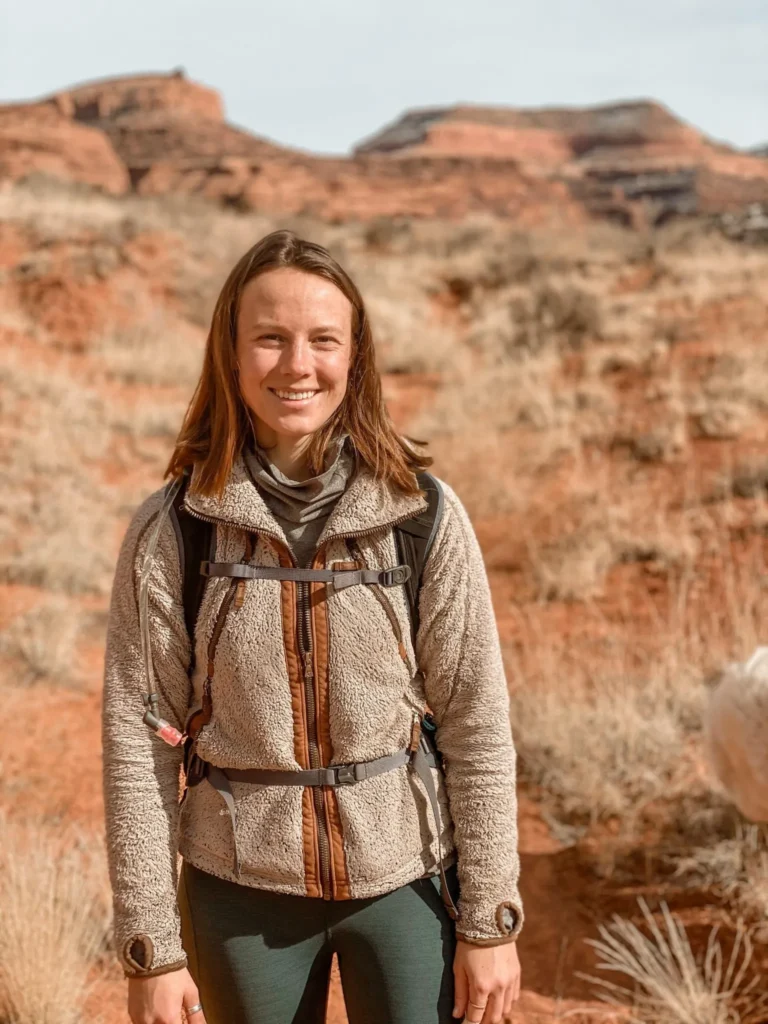
Allie Cunningham is the director of Science on the Fly, a community science organization focused on monitoring river health through angler-collected water samples. She grew up in New England, discovered fly fishing during summers in Wyoming, and later worked at Telluride Angler while helping launch the Science on the Fly program.
Her background combines fly fishing education, conservation work, watershed restoration, and community engagement. She now manages a growing network of volunteer community scientists across multiple countries while helping make scientific research more accessible to everyday anglers.
Allie grew up in Massachusetts but spent summers in Wyoming at a ranch camp where she first picked up a fly rod during a backpacking trip. A simple dry fly experience turned into a lifelong connection with fly fishing, even though she didn’t fully realize it at the time.
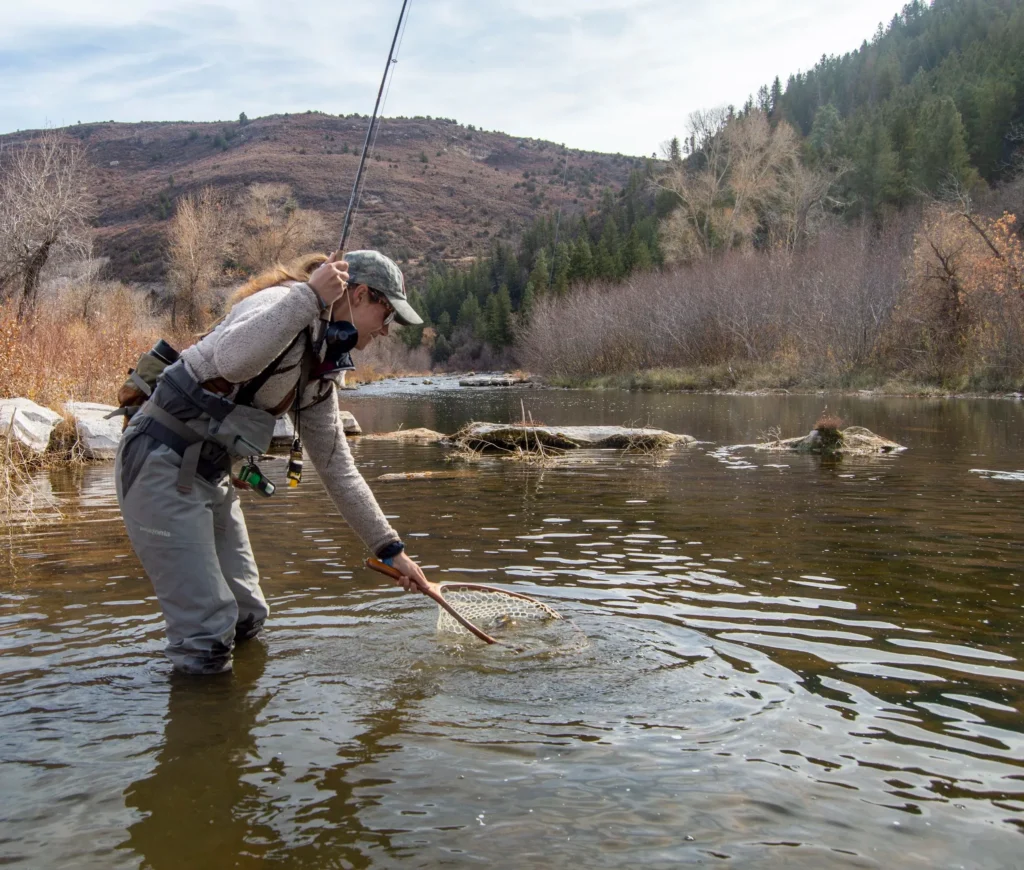
Years later, after returning to work at the same camp, she rediscovered fly fishing and eventually moved to Telluride, Colorado, where she worked multiple jobs while teaching kids how to fish. That eventually led to a job at Telluride Angler and a deeper connection to the fly fishing industry.
One of the coolest parts of the story came after her grandmother passed away. Allie discovered her grandmother had traveled the world fly fishing and had even landed a record Atlantic salmon on the Miramichi decades earlier.
Science on the Fly began as a collaboration between anglers, scientists, and fly shop owners who wanted to create a community science project focused on river health. While working at Telluride Angler and a mine restoration site, Allie crossed paths with Johnny Spillane and Dr. Max Holmes as they started developing the project.
The original idea focused on fly shops and guides collecting water samples with clients, but Covid changed everything. Once the online signup portal launched in 2020, anglers from around the country immediately started volunteering to help monitor rivers.
Science on the Fly quickly grew to over 150 community scientists collecting long-term water quality data from rivers across North America and beyond.
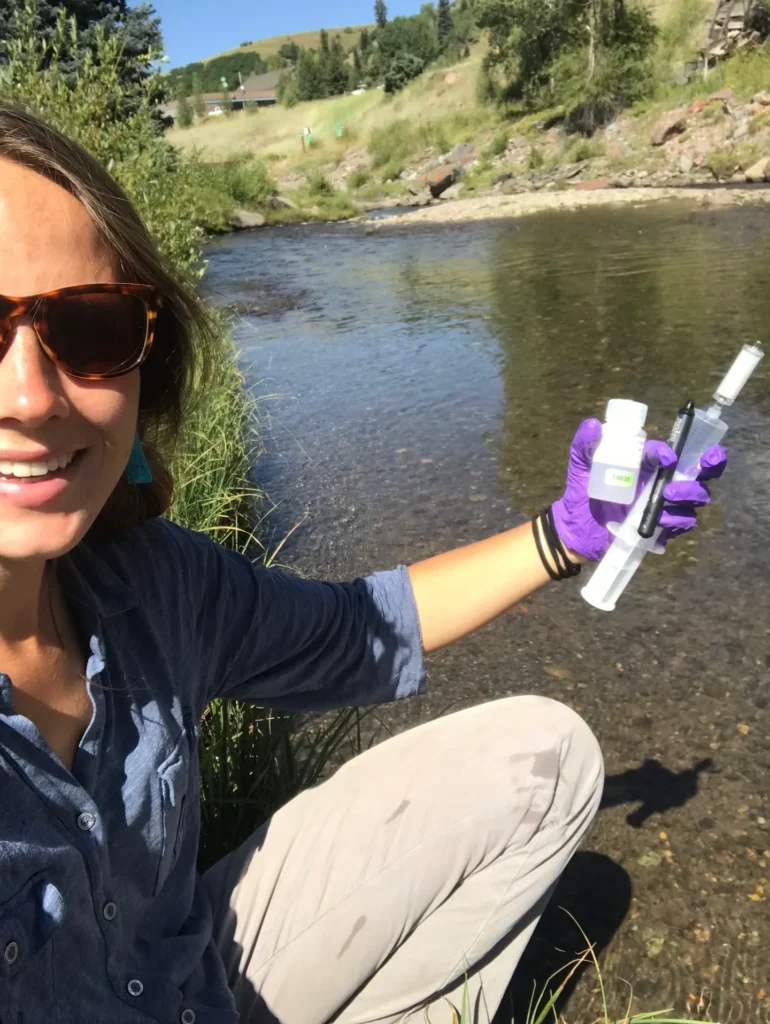
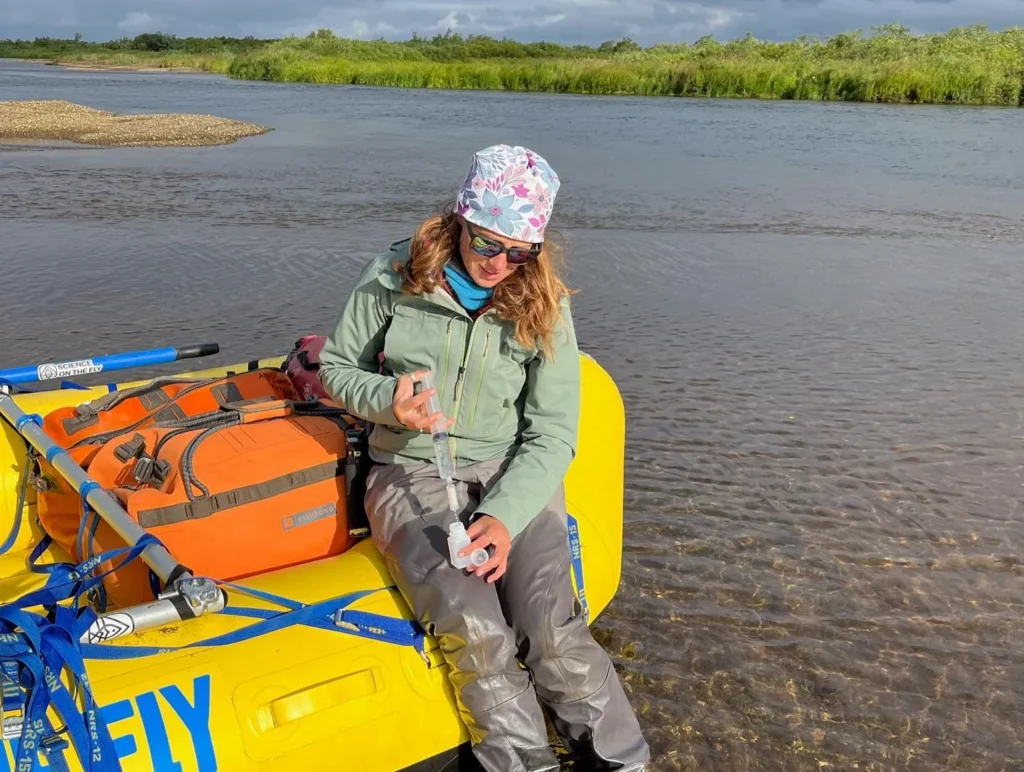
The Science on the Fly sampling kits are surprisingly simple. Volunteers use a syringe, a small sample bottle, a 22-micron filter, and temperature readings to collect water samples directly from rivers. The team analyzes nutrients like:
These measurements help researchers understand how watersheds are changing over time and how climate change, development, and pollution may be affecting aquatic ecosystems.
Allie explains that nutrients and water chemistry can reveal problems that anglers would never notice just by looking at the river. A stream might appear crystal clear while still carrying pollution or experiencing harmful chemical changes.
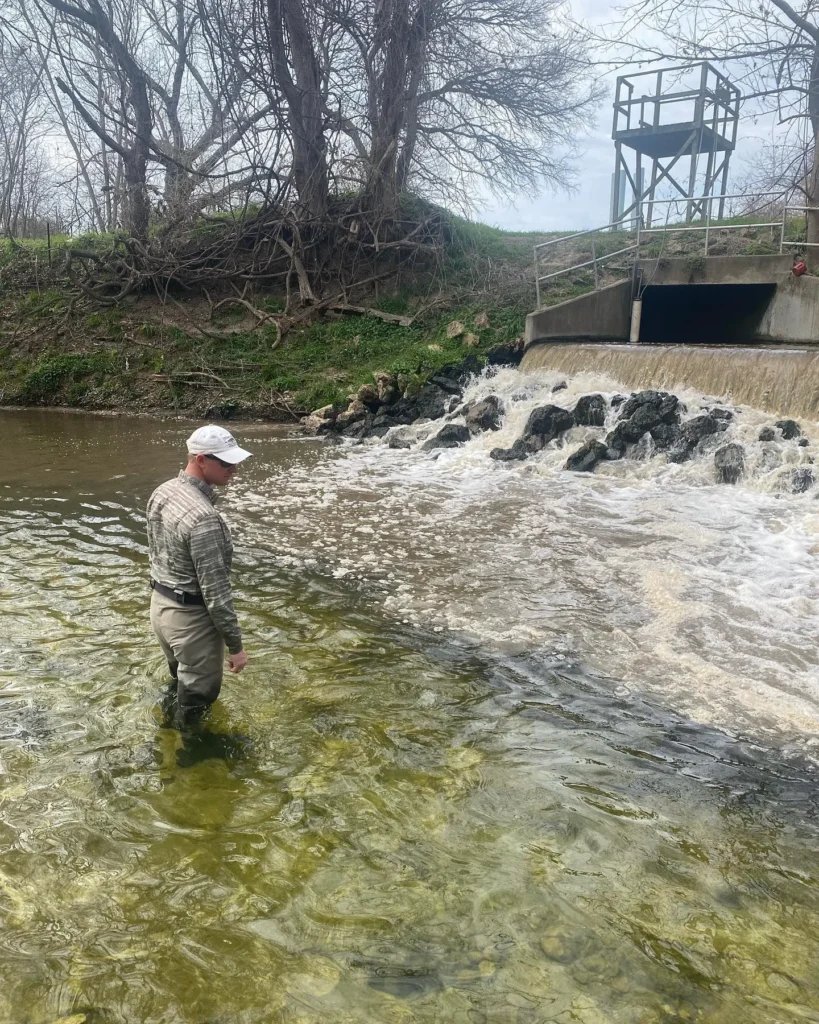
One of the biggest stories from the episode came from Brushy Creek in Round Rock, Texas. Community scientist Chris Johnson from Living Waters Fly Shop noticed nutrient levels that were far outside normal ranges.
When the team visited the creek, they found untreated wastewater flowing directly into the river system. The smell alone made it obvious something was wrong. Local residents had already been warned not to let dogs enter the water.
Science on the Fly helped expose the issue publicly, and local community members pushed for action at town hall meetings. Within months, the city approved major upgrades, including a $21 million tertiary filtration system to improve the wastewater infrastructure.
This section really shows how citizen science can move beyond data collection and create real-world conservation results.
One of the key takeaways from this episode is that climate change can’t be understood through a single snapshot in time. Science on the Fly is focused on collecting long-term watershed data so scientists can identify trends developing over years and decades.
Water temperature often gets most of the attention in fisheries conversations, but Allie explains that nutrient levels, sedimentation, wastewater overflow, and changing precipitation patterns are all connected pieces of the same puzzle. The project has expanded into:
The team is also beginning new projects with indigenous communities in Brazil to help monitor watersheds and protect critical Amazon ecosystems.
Allie makes the point that not every angler automatically becomes a conservationist just by fishing. Real conservation happens when people actively show up for their rivers and watersheds.
Science on the Fly recently launched a conservation observation tool through the onWater app that allows anglers to log observations directly from the water.
The original vision for Science on the Fly focused on fly shops and guides collecting samples with clients, but the project evolved into something much larger once individual anglers started stepping up during Covid.
Today, the organization continues building a growing network of community scientists while improving data visualization and expanding partnerships with researchers and conservation groups. The long-term goal is to create a larger picture of how rivers are changing across entire watersheds.
This episode is a reminder that small actions from individual anglers can eventually create large-scale conservation impact.
Episode Transcript
WFS 933 Transcript
00:00:00 Dave: What if the biggest threat to your river isn’t what you can see, but what you never think to measure? Today we’re breaking down what actually is happening beneath the surface, and how a small group of anglers is uncovering changes most people would never notice. Ali Cunningham from Science on the Fly is here to share how everyday anglers are collecting real data from their home waters, and how this data is starting to influence real decisions on the ground. Today, we’re going to talk about why nutrients and water chemistry matter just as much as water temperature, how science on the fly grew from a small idea into a nationwide effort. We’re going to get the story of how they discovered this polluted stream in Texas, and how they fixed the issue, and managed to get a twenty million dollars grant to help out this process, and how long term data is helping track shifts across entire watersheds. Plus, we’re going to let you know how to get involved today and how to take some action, even if you’ve never thought about science before. This is a good one. You can find Ali Cunningham at Science on the fly dot org. All right, let’s get into it. Here she is Allie Cunningham. How are you doing, Ali?
00:01:07 Allie: Great. How are you doing? Dave, thanks so much for having me on Wet Fly Sway. I’m excited to be here.
00:01:13 Dave: Yeah, yeah. Thanks. It’s going to be a good episode today because we’re following up on a conversation we had with Johnny at Fish Pond. It was great. We dug into a little bit of their history, which was awesome to finally hear. And then he brought up science on the fly. And we’re always interested in hearing more of the good stuff that’s going out there in the conservation world. So, so we’re here now to hear the story from you. So we’re going to talk about that today. Maybe just kick us off kind of from the top on science, you know, on the fly. How did you come into this role as the director?
00:01:42 Allie: Well, so I grew up in New England, uh, in Plymouth, mass. Or Rochester, mass. Um, so right near the Cape did not fly fish over here at all. Um, but I went out west to Dubois, Wyoming for a little ranch camp every summer. Um, and as a little girl, we would go on backpacking trips at this ranch, and then my counselors would always bring fly rods. So one time I asked like, hey, could I, you know, come with you and fish? After we’d been hiking, uh, like nine miles that day. And obviously the counselor wants to, you know, get away from the kids. Uh, it’s a kids camp. It’s their like, favorite, like hour to themselves. And he’s like, sure, sure. Why not? Um, and so first cast, uh, on a dry fly. I got like a little Berkey. Um, and I was like, oh, cool. That was fun. We fished for like an hour, got a bunch of fish, uh, handed back the rod. And I was like, cool. Don’t really need to do any more of this. Thanks for letting me do it once. And then about ten years later, I went back to work at that camp, and I was just a counselor and same thing. I was on a backpacking trip, but my co-counselor had brought a fly rod with him and I asked, hey, could I, you know, take a few casts? And then as I was casting, I was like, oh yeah, I remember doing this and that I liked it. And then all of a sudden another fish on and I was like, oh, this is this is great. And you know, I was like, oh, it might be a little natural on it. So that was, that was fun, you know, kind of forgot about it a little bit more. And then after college, I was, I went back to the ranch camp and I applied for their assistant position for fly fishing and then slowly became the director of the fly fishing program at that ranch camp. Um, and a little fun fact was when I was a camper there, they didn’t have the fishing program. It was just, uh, backpacking pack trips and then just camp activities. And then, um, I heard that from my interest when I was a little kid that the directors decided to start thinking about adding fly fishing into the curriculum, which also makes sense given it’s in Wyoming where this is all happening. And so after that, as I was kind of teaching myself how to fly fish, as in teaching little kids how to fly fish at this ranch camp, I moved to Telluride, Colorado, after college and worked ten jobs. Just like every other person that moves to a small mountain town does, and I was, uh. So this is like a couple years into learning how to fly fish now. And I walked into the fly shop. I just found out news that my grandma was had a stroke and was about to die. And so I hadn’t had a day off in six months because you can’t have a day off in Mountain Town. Um, and so I was like, I’m gonna go on the fly shop. I haven’t checked it out yet, but I really want to go in there when I’m with my ex-boyfriend and my ex boyfriend goes and looks at the rods on the wall and the guys at the fly shop go up to him and ask, hey, how can we help you? And he’s like, well, you should talk to her. She like knows how to fish. Um, so then they all came over to me and we shook hands. We talked about a couple things and I didn’t know, but that was an interview basically. And they said, hey, if you, uh, come back after your grandma’s funeral and all that, let us know and we’d love to have you work at the fly shop. And I was like, okay, I’ll think about it. But you know, I’m not really focused on this right now. And so that was like a nice little invite from the fly shop just in case, and I ended up going to my grandma’s in Georgia. She ended up passing away, but in that time, my family sitting around telling stories about her, and I’m learning that she had traveled the world fly fishing with my grandfather. And I had always known that my grandfather was an angler. I did not know that she had caught record salmon on the Miramichi and, you know, in the sixties. And so I’m slowly learning. I have it in my blood as well. Um, so after a funeral, I emailed the club where she caught that largest salmon and they had painted it actually on the wall because it was so big at the time. And so I don’t know how big, I can’t find any records, but so I emailed the lodge and I said, hi, I’m inquiring about your rates so I could take my dad and I on a trip up there. Um, it’s probably so expensive, I can’t even try to afford it. But, you know, I want to just inquire. Um, and I got a response back and it was my great uncle. His name is Rick Cunningham, and I’ve also learned he’s written a lot of articles within the fly fishing industry. He writes, or he does a lot in the fly fishing industry specifically for Atlantic salmon. And so I’ve slowly learned as I’ve gotten into fly fishing and as I self taught myself that it’s actually been in my blood. So I’m pretty fortunate in that. But then I ended up going back to Telluride after my grandma’s funeral and worked for the fly shop at Telluride Angler for about six years. So dunk, Troy, Rick, all of those guys, they’re like family to me. And they really helped teach me, um, better techniques that I needed and how to sell fly rods. Um, and I love my Scott fly rods. Oh my gosh. And then still working a couple jobs to get by there. And I was working at a mine restoration site on the other side of Telluride. Basically, we were restoring the water quality from abandoned mine tailings. So it was super, super, super bad. pH is like a zero. It was like a two pH. Crystal clear water though. Um, and we had this like gravity fed system that would spike the pH of the water, drop some iron out of it. And then what went it turned into this nasty orange sludge before going back into the water system. But we were actively trying to clean it. And then at the same time I was working at the fly shop. I did try guiding for a second. I realized I liked teaching. Not guiding.
00:07:22 Dave: So yeah, guiding is hard.
00:07:24 Allie: Yeah, guiding is hard. And I had a big white dog and I would have to keep my car clean. And um, beside of teaching for me was always so much more impactful. I love teaching kids how to fly fish. So we started like a kids camp. So between working at the mine and then jumping to the fly shop, I still wanted to make more of a difference. And all of a sudden I remember doctor Max Holmes and Johnny Laycock came in the store to go talk to John and Troy at the Fly shop about creating this program called science on the Fly. I had no idea they were creating this project, and I was helping Max’s wife, Gaby, get fitted with some Patagonia waders, and we were just chatting so much because we had so many connections in Woods Hole. Um, and basically they were creating science on the fly while we were hanging out in the fly shop.
00:08:17 Dave: Yeah, back to the fly shop, you said. So they offered you the job. I mean, this is a pretty amazing story, by the way. So but I’m curious, they offered you a job at the fly shop. Why do you think they offered you a job at that time? When you came in there, did you have experience or.
00:08:31 Allie: Yeah, I asked them that because I had been teaching that kids camp for a couple summers by then, or just like two summers, but like, I knew how to tie a woolly bugger. I knew what I was talking about when I, you know, was talking about streamers, dry flies, nymphs. Like I knew the basics. We went out fishing like I could relatively fish. Fine, but it’s all whatever I taught myself. So, you know, some things were poor, some things weren’t, but I didn’t. I, I hate YouTube, I never watch YouTube videos, you know.
00:09:02 Dave: So you had some experience. So then the other part of the story is the grandma, your grandma, which is pretty amazing. The Miramichi and then Rip Cunningham. So rip was your great uncle, is he? So you called a lodge. And it turned out that rip was working at that lodge. Is that how that happened?
00:09:17 Allie: So rip is. He just emailed me back. So he is on the board of that lodge, right.
00:09:23 Dave: So he’s connected to the lodge?
00:09:25 Allie: Yeah. So they passed the email along to him saying, hey, she might be your relative.
00:09:30 Dave: Uh oh. So so they knew, right? Okay. So at that point, they were like, hey, this is Allie. The same last name. Likely this might be your. And then your grandma’s been there. Yeah. Okay. So but that’s pretty amazing. The Miramichi, which is a famous river out, is it Newfoundland or where is that located? Or is it Nova Scotia? I can’t remember.
00:09:49 Allie: I’m pretty sure it’s Nova Scotia. And the really sad thing I keep hearing from some of our community scientists around the region is that it’s just getting decimated by the bass. Um, with climate change. And so the, the Atlantic salmon population that used to have record breaking salmon, um, it’s just so much harder to find the salmon now, but there are some really cool things that my community scientists and a lot of their community members are working on to help improve that, which we can talk about as well.
00:10:18 Dave: Yeah. And we’re actually it’s interesting because we’re heading to Newfoundland this year, and I’m going to be fishing for Atlantic salmon for the first time. And the runs there are really good. That’s one of the things about them. It’s just north, I think, of Nova Scotia, but the runs are kind of when you look around, Atlantic salmon haven’t been doing well, but that part of the country of the world is still pretty healthy, at least in that area. And we’ve been doing some stories on that. But no. So I think it is really exciting. And your grandma going way back to the I’m sure many years ago, caught one of the largest Atlantic sandwiches. Cool. So yeah, take us into. So you’ve got Johnny there at the fly shop. Obviously he’s from in Colorado. He’s there talking. What was that first offer or how did that work when it was like, hey, it was clear that you were going to be the, you know, the director there.
00:11:01 Allie: Yeah. So, so I guess I got into science on the fly because I was working at the mine at the time, and I was working with the fly shop pilot angler. And so I always wanted to make more impact. I didn’t know how that was going to be. And so Johnny, Max, Troy and John from Taylor Angler all are in the back trying to figure out this program of how to bring anglers as community scientists in. And I’m helping Gaby Max’s wife, get fitted into waders while they’re scheming this thing up. And they. So this was July of twenty nineteen. Um, and they did a little Q&A session, an intro session at the library, and they were saying, hey, we’re going to start this community science project called science on the fly. If any of you are interested, we’d love to talk to you. And I immediately was like, hey, all of you, why are you not including me? This? I literally do this for my job every other day is collect data. So obviously I’ll be help volunteer number one. I actually didn’t meet Johnny that time, but I met Johnny later and it’s really fun hearing his podcast the other week because that was exactly how I met Johnny. He gave me like the intro spiel. I was so nervous to meet Johnny the Coke, like the founder of fishpond and go fishing with him. And he would. So we were meeting because he was going to take a photo shoot for science on the fly with some of the new fishpond products. And it’s like in the middle of winter, uh, in Telluride. And so I was so nervous to meet like this famous guy, as you can hear and know from just Johnny’s voice is he is so enthusiastic with life and so passionate about it and so passionate about just like getting people in the water. And so I was like, Johnny, like, give me your background. And he talked about case logic and, you know, the photography background of him. Um, and that’s exactly my family’s background. They’re all photographers and like, I knew case logic well, so I immediately just vibed with Johnny. Um, and we just went down to the river. We did that photo shoot, took cast and catch any fish that wasn’t the goal of said photo shoot. Um, but collected data we trudged into like this one part of our sampling sites. Um, and it was just gnarly to get down there. I was like, oh, this is a good avalanche though. And Johnny was like, hey, you know, you should come up to do this trip in Alaska we’re doing for science on the fly. Um, that’d be really fun. And I said, oh yeah, obviously I’d want to go. This was January twenty twenty. Stayed in touch with them. I was just so fired up on the project science on the fly. I just wanted to like, do whatever I could to like, be more a part of it than just to volunteer or volunteer more hours just to onboard more people. And so after the photo shoot, I just immediately emailed Johnny and Mac saying, hey, do you have like, can I help in any way? February hits. Covid hits. And all of a sudden myself, Johnny, and Max are sitting down trying to figure out what we can do to grow this program. Science on the fly. And we just were off to the races. Um, we made our website and we made an interest form posted on social media. And so I was volunteer number one, we had about three other volunteers, one in New York, probably like one in New Mexico. And in February twenty twenty, we turned on this online portal for anyone that’s interested in partaking in community science as an angler to sign up. And we were so busy onboarding the year of twenty twenty. Uh, that was my extra volunteer effort. Um, and we onboarded basically all one hundred and fifty community scientists that we have. And we realized we had to just pause at one fifty. It was, it could just grow exponentially if we wanted to. But, um, the powerful thing about a community science project and about science on the fly is that it’s a free toolkit for anglers to give back to their watersheds. And we are providing it at a really critical time when people are trapped in their homes and realizing, what can I do? What can I do for my watershed? What can I do to fill my time right now? But a lot of people want to give back. And especially modern day, we just don’t know how. Um, we’re inundated with so much like so many things to do through social media, so many requests to donate just in general, sorry, people can’t donate five thousand dollars to every single organization or five dollars to every organization. But there’s also really hard ways to like it’s, it’s not easy to get off the couch to just go like to find the energy to give back. Um, because there’s so many options out there and we, we’ve created a really easy option to help have someone have the ability to get out on their watersheds and give back. Um, which has been really, really fun to watch, fun to see and super successful for science on the fly.
00:15:51 Dave: Golden Fly Shop isn’t your average fly shop. They have a twelve foot shark painted like a cutthroat, hovering over a huge selection of the best rods in the business, a massive assortment of tying materials and their famous steakhouse streamer display. And it’s the hub for a community of anglers who never stop tinkering with new ways to catch fish. Sometimes the conversation behind the counter includes what hatches are going off and what techniques are working best. Then tales of destination fishing, adventures, sought after species, or a good old congratulations when a customer brings stories of finally connecting with that fish they’ve searched for forever. With a growing online store and a budding YouTube channel, you’ll be able to follow along with their fun antics, international adventures, and helpful fly fishing tips. Golden fly shop where the community is hanging out even if they’re supposed to be working. That’s Golden Fly shop dot com. Check them out. Right now. Trout Routes by Onix is built for fly anglers who want better Intel without spending hours digging. For the information, you’ll get access to public land maps, stream access points, regulations, and even road and trail maps all in one place. It’s become my go to app for scouting new trips. You can check them out right now. Go to fly dot com and download the app today. Let’s jump into a little bit on well, I guess the big question I have is, so it sounds like science on the fly is an easier way for the community to get involved, to volunteer. But what are the main things that you’re collecting out there? Maybe talk about that and talk about how somebody’s listening now, how they would do it, you know, what are they collecting on the water?
00:17:25 Allie: Yeah, yeah. So science on the fly. Um, we’re community science project partnering with anglers to study their watersheds over time long term. So we created a little sampling kit. It’s basically a twenty two micron filter. So it’s basically like the length of your thumb. Um, so they’ll use a sixty millilitres sample bottle and they’ll, they have a twenty two micron filter. And then they also have a syringe and then water temperature and air temperature. So with this syringe and filter, they’re going to pull water, put it into the six million bottle. And we’re primarily looking for nutrients in the watershed. So we’re going to be looking for dissolved organic carbon nitrate ammonium total dissolved nitrogen phosphate silica. Um and then we will have the volunteers freeze it and ship it back to Woodwell Climate Research Center. And that’s where the actual analysis is done. Um, we’re also looking at water temperature and air temperature. Those are really important for our fisheries in terms of thermal regimes. And we’re really excited. We actually just hired a new, um, lead scientist for science on the fly who specifically works in that area of study. Uh, so that will be really, really fun connecting those dots a little bit more and researching that more. So with the twenty two micron filters, they’re also really cool because so they’re filtering all the crud out of the water. And what one day would be really cool is to actually use these filters for what their main purpose is, is for looking at Edna in the rivers. So Edna is the basically like the environmental DNA of the river. And you could actually trace through the filter itself and what’s collected on what, what types of fish are in the watershed. So it’s a, it’s a less invasive way to be collecting data instead of saying like, shocking the river, you could actually pull the Edna through this filter. But that’s also super expensive. And we don’t have the laboratory space or equipment for it. But one day it would be super, super cool to do. But for the nutrients I’ll quickly go over like what we what is it, where it comes from and why we study it just so everyone has a quick understanding of it.
00:19:36 Dave: Yeah, yeah. Understand like, because I think that we hear a lot about, you know, a big thing we talk a lot about, we’ve heard a lot of guests is the temperatures, you know, higher climate change is now higher temperatures. So some of the cold water species aren’t doing as well. But you’re talking about nutrients as well. So yeah. Describe how the nutrients fit into the whole picture.
00:19:54 Allie: Yeah, definitely. And I am I’ll just say on the podcast, I am not the PhD chemist. I hire those who got it started this as a PhD chemist, but, uh, I can always connect to you, but I’ll go over the basics. Um, so the first one will be dissolved organic carbon. Um, what is it? It’s basically the basis for all organic compounds and all organic life on earth. So doc, it’s a measurement of the carbon in organic carbons that have been broken down enough in water to pass through a small pored filter. So basically our twenty two micron filter, where does it come from? So it comes from the breakdown of organic matter plants, soil organic matter decomposition.
00:20:33 Dave: So I think there is a lot dissolved organic carbon. There’s a number of these different things. How would you take when you get a sample? Let’s take it to that. Let’s say you get a sample in the lab. The smart people PhDs analyze it. What does that tell you about a stream? Let’s say you’re on the the Provo River in Utah, and you got this sample from somebody who sampled it at noon on, you know, January. You get the sample. What can you do with that sample? What does that sample tell you? You know, basically, or, or maybe after it tells you something, what are the next steps?
00:21:02 Allie: So analytically, the next steps is we run it into these really cool machines that basically this is actually a fun fact that I’ve learned because I’m not the PhD chemist. Um, so basically think of those strips that we put into our water, those basic like pH strips and they have a color, you know, or someone has a pool and they do that. So we’re doing that to like the nth degree at the laboratory and they use spectrometers. And then there’s a number associated with like this light that is being penetrated through the water sample to see like how much of the concentration is there, and then I’ll spit out on the computer, and then they’ll do a bunch of fancy stuff. And, um, and then I get the number and we report it. But yeah, so like doc, I always think for rivers organic carbon. So it’s, it’s always going to be the food source for many organisms. And at the base of the aquatic food system. Um, so it can increase the cloudiness and color of the water. It can acidify the water. Uh, it can increase the availability of heavy metals for organism uptake. So.
00:22:08 Dave: Right. So there’s a bunch of things.
00:22:10 Allie: Yeah. And something like when I used to live in Telluride, Colorado, that would be really interesting to see with the heavy metals and the mining everywhere, um, versus like sampling it in a different location.
00:22:21 Dave: That’s the biggest thing. So you’re bringing in all these different things, the D o, C, and these other, you know, data points. They’re basically telling you quality same. It’s just more quality, more data on the stream. So you could see if there was a mine tailings from mining in the stream, or if there was poor, you know, dissolved oxygen. It’s like you’re going deep to figure out like the health of the stream, essentially more deeper than just the water temperature.
00:22:43 Allie: Yeah, yeah. Our, our goal is to see long term how climate change is altering our watersheds over time and the health of the watersheds specifically for nutrients. So we aren’t looking at heavy metals, but what we can say is, you know, if the doc is changing, that might also correlate and say the heavy metals changing as well, because it’s increasing the availability of heavy metals and the organism uptake. And that’s the fun thing about science on the fly too. We’ve there’s a lot of organizations, a lot of people out there that are researching rivers. Um, we’re not the only ones. Um, we are one of the only free ones for community scientists. It’s free for the person to sample, not for us to run it.
00:23:24 Dave: Um, well, and it also sounds like one of the other challenges we’ve heard about is, you know, how do you get the volunteers to be, you know, to take the samples. We’ve heard of other projects. You know, we were talking to the The Salmon Fly project, and they have this great program where they’re documenting aquatic invertebrates. And it’s, it’s awesome. But I think there are some challenges. I think you can’t take necessarily let a volunteer go out there and take a qualitative sample of bugs. Right. There’s some challenges there, but it sounds like this is something where you can literally could somebody listening now go to the website and get these bottles and take the sample or describe that, how it works with the volunteers?
00:23:58 Allie: Yeah, definitely. Um, yeah. So, and I love the salmon project. Those guys are great. And the work they’re doing is wonderful, especially in the Mountain West. Um, for science on the fly. It’s a little different than that project in terms of how hands on and like what fully the analysis is kind of the same. They’re doing it with Macroinvertebrates. So we’re doing it with water quality. So basically you go on our website science on the fly dot org. There’s an area where it says get involved. Um, you can click it and then there’s just a form that you fill out. And after Johnny’s last podcast, I was like, whoa, we got a spike in activity on.
00:24:34 Dave: Oh, Roy.
00:24:35 Allie: Nice. Yeah.
00:24:36 Dave: Nice. Yeah.
00:24:37 Allie: Thank you. Thank you. Everyone listening. Um, and so you just fill it out, um, fill out as much info as you can. That’s really helpful. And then, um, whenever I, I, I’m in charge of that and it’s so hectic with science on the fly. Um, I’m basically managing one hundred and fifty people and um, doing all the things it’s, you know, non-profit work. So I’ll try to get back to you as soon as we can. What we’re trying to focus on right now is actually what I like to tell our community scientists is I understand that you guys have lives. So if you guys move, if you guys, if you have a child and you don’t have time to sample anymore, just let me know, because we do want our sampling to be as consistent as possible in the locations. And so right now we’re trying to onboard places that might have a scientist that has to leave. Um, so we can fill that gap back in to keep the consistency of the data happening. There are some special occasions where we might onboard elsewhere, but just so the listeners know, we are onboarding, but we’re being strategic on our onboarding right now because we are a almost two person team. Um, coming up. Um, so there’s, uh, we manage best we can.
00:25:45 Dave: You got a lot going on. Yeah. So basically you have these one hundred and fifty people around the country. And is this mostly North America focused or what areas do you cover with the streams?
00:25:57 Allie: So we are one hundred and fifty community scientists, three hundred and fifty sample locations. That is not rivers. That’s locations. We don’t have the stats on how many rivers. And then we are forty two or forty three states in six countries. And we um, so no, it’s not just us based. We actually, we just got approval to go down to, we went down to Brazil with untamed angling a couple of years ago just to scout out possibility of working down there. And we are now working. We just got seed funding to start doing some research with the Kayapo project and their Kayapo Forest School. And so the Kayapo people, uh, are the indigenous people, one of the many indigenous people within the Amazon territory. And they protect so much land on a satellite map. You can see in satellite image, you can see the Amazon forest and it in its green and beautiful and lush, and then you can see the edge of their territory and the boundary of the Kayapo people and the deforestation and the agriculture and the mining. And so they are the largest stewards like of that region.
00:27:07 Dave: How do you spell that? How do you spell their name? Those people.
00:27:10 Allie: Uh, k a y a p. Oh.
00:27:12 Dave: Wow. So you’re expanding. Yeah. You’re expanding out outside of definitely North America. There’s a big goal that sounds like to, to kind of conquer the world and cover it all.
00:27:21 Allie: Yes and no. We wanted it strategically and not get ahead of ourselves. Um, and, you know, science. We we max out this once, but science like is not cheap. But the nice thing about science on the fly is we make it really affordable. Um, because community scientists are doing the heavy lifting of what typically would be the most expensive part for the scientist is to travel the time, the cost to go to the locations. And our community scientists are able to show up and do it consistently. So like with Brazil, it’s really cool because it’s going to be co-developed by us and the indigenous people, and then it’s ideally going to be indigenous led and sustained. So the goal is to actually set this one up and make it sustainable. And then actually science on the fly will slowly and my, my work on it will slowly fall back. And actually, then the scientists will be able to help provide information to the Kayapo people of, hey, what we’re seeing in the watersheds, how can we help you protect this really important landscape for the climate and give them the indigenous data sovereignty they need to. You know, I hate using the word fight, but fight to protect their watersheds.
00:28:28 Dave: Yeah. Inform them. Yeah, exactly.
00:28:30 Allie: Yeah. And also just inform them, like inform them of the health. So if we’re able to partner with some Brazilian research institutions, um, which we’re really close on, then we might be able to do more like mercury analysis too, which is a really big issue down there.
00:28:48 Dave: Let on to Mark Lodge give you the Montana fly fishing experience you deserve. The gin clear waters of the Missouri River offer a world class experience with one of the finest rainbow trout and brown trout fisheries in the world. Whether you’re a seasoned angler or new to the sport, their family of guides will tailor a trip just for you. You can head over to Onda Mark lodge dot com to fish one of the great trout streams in the country. Check out Montana Fly Fishing Lodge, a twenty twenty four Orvis endorsed Lodge of the year finalist, where luxury meets adventure on one point five miles of private, wild and scenic East Rosebud River frontage. Experienced world class fly fishing on numerous Yellowstone Basin streams, gourmet cuisine made from locally sourced ingredients and rustic luxury accommodations surrounded by breathtaking wilderness. You can book your all inclusive Montana fly fishing adventure today and discover why they are the premier destination for unforgettable fishing experiences. Head over to Montana Fly Fishing lodge dot com right now. So let’s take it back home. So if we’re on a stream again, maybe that stream in Utah or well, let’s just take you’ve got one hundred and fifty people out there working. When you get these samples back, what are the next steps as you’re documenting this? I guess you’re seeing the river. What if you see something that’s got impacted water quality? Do you prioritize those areas or how does that work?
00:30:06 Allie: Yeah, so there’s many different things. So since we started in Covid, laboratory was shut down, we also had pretty old laboratory instruments. So our backlog backlog got pretty insane. We ended up getting congressional All appropriations money during the Biden administration to buy two brand new fancy equipment, which has been so life changing for the program. So what used to take us weeks to analyze a set of sixty samples we can analyze, um, now one hundred and twenty samples in two days. And so that has allowed us to get over crazy backlog that we’ve been in. Um, so our data is really just getting crunched out now, but in that we keep our ears and our eyes open. So, uh, if we see any nutrient concentrations coming out into our data, um, that are super eye opening, we are going to call that community scientist and say, hey, what’s happening in your watershed? Do you have any ideas? Um, so we, we create a quick report. We originally wanted to do like a long form report, but I’ve realized with one hundred and fifty scientists, we can’t write long form reports, especially if I’m not the scientist and can’t do that. Um, so it’s just a quick, quick overview of like, hey, does it look healthy? Does it look poor? But what we do is we do a Zoom call and we have this report with us in the community scientist and the scientist, and we have a conversation about it. So the scientist gets to understand the watershed. And then the community scientist gets to understand the science, because science is extremely intimidating to anyone that does not study it. And it’s extremely confusing to people. And so my goal with science on the fly is to make it as digestible for the everyday person and everyday angler as it can be. So like, we’ll, we’ll bring out some of our, our quick reports and then we’ll still get me trying to make it super digestible and we’ll still get people being like, what does this mean? Which is really great. We want to just keep bringing the Y back into the most simple language we can for our community scientists. And so in these conversations, we did have an example of one. So in Texas back in, I think, twenty twenty three. We were analyzing Brushy Creek and Brushy Creek is, um, in round Rock, Texas. And, uh, Chris Johnson who owns Living Waters Fly Shop, he was sampling for us and we’re like, hey, Chris, why are your water samples or why is why are your nutrient concentrations of the roof? What do you think’s going on? And he goes, oh, that one’s easy. It’s a wastewater treatment facility. They like are so out of compliance. Um, but no one’s doing anything about it. So he went down there with a video camera and, uh, some sampling kits, and we didn’t even need the sampling kits we put on our readers. We just had barbecue. It was so delicious. Um, and then we get to this community, start putting on our waders and you can smell it in the air, how nasty the watershed is. And we’re a couple hundred feet.
00:33:09 Dave: Oh, wow. And flowing into a river or a Stillwater.
00:33:12 Allie: Uh, it’s flowing into a river and it’s flowing into like crystal clear brushy Creek. So upstream, it’s just like super beautiful and right where the wastewater treatment facility is. There’s a seam coming in. But I remember like standing there, like putting on my waders. And this woman came up to us and she had tears in her eyes being like, are you doing something about this watershed? Like, we don’t know what to do. Um, and they, they’ve all they’ve been told is like, hey, don’t let your dogs go in the water. It’s really bad. Um, that’s for months, like they had been getting told this and sadly, this is like a very normal story for our watersheds, especially like in urban places. So we went down to the watershed, we walked up river and it was so disgusting. It just was. It came from a wastewater treatment facility.
00:34:00 Dave: Geez, like like sewage, like raw sewage.
00:34:02 Allie: Yeah. That was not filtered coming out. Yeah. And like, you didn’t need our, our signs to say that like you could just smell it and see it. And we. Chris Johnson stood on the seam of the wastewater treatment facility effluent and then the crystal clear Brushy Creek coming in. And we took that photo and it made their local news. And then I think it made their state news. And then all of a sudden, and with Chris, this is Chris and his community members, science and the fly, I like to say, just helped expose this issue. And it had already been there. A lot of people knew about it. But, you know, the wastewater treatment facility is just getting a little tap on the wrist saying, hey, like maybe clean up your crap. Um, like actually and Chris Johnson, uh, asked people to show up to town hall. He went to town hall. There’s so many other people a part of this. And, um, like I said, we only helped expose it, but within that they were approved fairly quickly for a, all the satellite, um, wastewater treatment facilities to turn online to help with the issues happening as it was like overflow older equipment they needed, um, new, just a bunch of new infrastructure. And so turn on the satellite offices. And then within, I think it was six months, they got approved for twenty one million dollar tertiary filtration system. And so that in itself was a massive win for the town and for that watershed. I mean, that was a huge, big thing with round Rock and and Brushy Creek. And it’s not the cleanest in the state, but it’s not the dirtiest. Um, it was, it was fun to see like people got activated because they cared, they cared about their resource and they’re concerned about it. And even still, a lot of people don’t know how to show up. It’s not just reposting on social media saying, call your congressman. Like I always see that on social media. And I want to be like, how many are actually calling their congressmen? Like, it’s really hard.
00:36:00 Dave: Yeah, call or email or sometimes they set a template form up where you can literally just copy it or, you know, and it sends directly to your, you know, so, but, but what you’re saying is this is actually a little bit different than that, you know, they’re getting involved, but you’re hearing about it and then you’re taking it to maybe describe that. Yeah. How is what you did there different than just calling your congressman? It sounds like what you did worked pretty well.
00:36:23 Allie: Yeah. I mean, for that example, we really exposed it. We took a photo. We had our data. We asked questions. We took a photo. Chris Johnson and his committee members did the rest. And we updates. And that’s because Chris Johnson and the community have incredible leaders for that. For what we try to do is I like to say we activate the community scientists. So we’ll have those discussions. And it really just depends on what the nutrient concentrations are saying. If it’s another wastewater treatment facility issue, we’ll start working with the town council. Well, also like in Telluride, where I used to sample, we had a spike in nutrient concentrations one week. And so I just had background investigation. I was like, hey, what’s happening with our wastewater treatment facility? Like, are they working on it? Are they working on future plans? And like, yes, they are. I saw that like they have a five year plan of like, they have the funding and they’re going to build it out. So, you know, I’m not concerned about that. It’s the places where it’s like just getting pushed aside. So we’ll activate the community scientists, how best to do it. Um, and one of it, you know, we have a community scientist in Wisconsin and they’re really concerned about the increase in logging and the sedimentation it’s bringing in. And so we actually just brought her voice and her data to the senator when we were in DC this fall to start those conversations and also see like, what the senator has to say about the increase in logging if they’re concerned about it. So we’re starting those conversations right now with the data, but nothing’s like we’re jumping in on it for dam development.
00:37:55 Dave: Yeah, right. But you’re both you’re collecting the data. That’s what’s cool about this. You’re actually collecting the data, but then you’re also taking the data to the next step and saying, here’s the data and really bringing it to the people that are making the decisions and getting the community involved. Right?
00:38:10 Allie: Yep, yep. So science and fly. So we’re a long term project for climate change. I always say you really can’t study climate change overnight though. It’s a long term process. And so we have so much data coming in all the short term data.
00:38:24 Dave: And it’s not just climate change to. Right. That’s the great thing about this, because climate change is obviously the thing that we’re hearing a lot about. But sewage treatment from a plant isn’t directly related to climate change, right? I mean, you’re you’re finding these things which are a direct point source pollution, right? So it feels like you’re just as much of that as you are climate change. Or maybe it kind of works together.
00:38:45 Allie: Yes and no. I mean, I wastewater can also be correlated with climate change. Um, so like if you think of flash floods and like increase in precip and some wastewater treatment facilities can’t handle it. And so they’re overflowing. And so they actually have to release more water faster.
00:39:07 Dave: So it all comes back to climate. And really at all, if you if you look at it, this all comes back to climate change in some way.
00:39:12 Allie: It can. Yeah. Yeah it can.
00:39:14 Dave: And it’s cool because again, the thing we come up with a lot is like you said it, you know, God, what do you do? We’re all sitting here thinking here in climate change and everybody’s like, man, what can I do? I can’t change, you know, saving some recycling some bottles isn’t going to save the planet, you know, that sort of stuff. But what we’re hearing here is that actually there is a lot of stuff that people can do. And it might be you mentioned one hundred and fifty scientists. What if somebody here listening and they’re not one of those one hundred fifty, they’re just a, a person that fishes, but they’re interested in protecting their waters. What would you tell them they could do today?
00:39:45 Allie: Always pick up trash whenever you see it on the watershed, just in general. So one of our community scientists, when I was onboarding them, they said, yeah, all anglers are conservationists. And I so wanted to agree with them. I so wanted to believe that. And I was just like, no, not all anglers are conservationists.
00:40:06 Dave: Maybe not quite yet.
00:40:07 Allie: Not not quite yet. I think I believe a lot of anglers want to be conservationists, but the amount of flies I’ve seen hanging in trees, the amount of, you know, leader I’ve seen just trashed everywhere. And, you know, thank you for filling up my fly box full of flies. Um, so yeah, science on the fly is that free toolkit for everyone, but just the everyday person. If they don’t want to collect water samples, or maybe it’s not available to them right now, pick up the trash even if it’s in your fishing hole. Okay, fish that hole and then go back and get, you know, that fly you see dangling from the tree. Um, so the swallow doesn’t hang from it later. I’ve seen that way too many times to count. And then if you’re concerned about something, say something and like, research it. Go to your town halls, go to your trout. Unlimited events, learn what’s happening on the watershed. Is there a new development happening that is, you know, fully out of looks like it might be affecting your watershed. Like we had one of our community scientists share with us this article. In a new massive warehouse getting built. And they were going to reroute their, you know, beautiful stream in Pennsylvania. Um, they, they, they won one battle, didn’t they might not win the next, but start showing up because they need you at the town hall to be showing up for that and share it with your friends, show your other angler friend like, hey, this is cool to protect our watersheds. And then yeah, call your senators when you are concerned they should be listening to you and they are led by you. Um, so give them your opinions and your thoughts and we’ll go to DC with our science and give them our scientific expertise of why they should be really thinking about this for their area. So yeah, there’s, there can be many things to do, but it’s, uh, it’s really hard with modern day. Everything feels for science on the fly. We’re not, we’re not funded much by the government. Um, the opportunities have definitely decreased. And what I am just so proud of is that we are community Science project funded by many different ways and that we are. Community scientists are showing up because they care, not because it is a paycheck. Because right now a lot of people can’t aren’t, you know, showing up to monitor the rivers, um, for, you know, scientific research that is funded by the government, but they are showing up as a community scientist, as a volunteer just because they care. So we’re really fortunate that we’ve built this since twenty nineteen. And our community scientists continue to show up.
00:42:39 Dave: It’s cool. And I’m looking at on your website, which is awesome. Of course, it’s Johnny, I’m sure had some part in the, you know, with his background. It’s so good. But the website looks great. But it says in the get involved other ways to give, right? So you can definitely donate, mail a check, donate to the advised funds d a f donor advised funds. There’s gifts of stock, donate online. So there’s a lot of ways to donate. And would you say that any amount is good here? Like, you know, it looks like yeah, you’ve got any type of donation, twenty five dollars or whatever people can give this will go. And then where does it go when that money funds basically the staff, right? You’ve got a small staff of people, but then also doing the water samples. Where does where does that money, I guess you’re, you’re probably the director. So you know a little bit about this. But yeah, if somebody donated, say twenty five dollars today, where would that go?
00:43:26 Allie: Yeah, no, that’s a great question. Yeah. I mean, your job in a nonprofit is constantly fundraising. It’s so fun. I did not realize that.
00:43:33 Dave: And is the fundraising, the fundraising that comes from this, you’ve got what we’re talking about here, which is, you know, say somebody right now could donate, but then you also have fundraising you’re probably doing to other groups. You said you don’t have a lot of funding from the government, but where would you, other than the donor funds? Or is it all coming from basically private.
00:43:51 Allie: Primarily from private, uh, different grants. So like what we’re doing in Brazil, I want to make sure that had funding behind it before we went down there, because we also want to show up for the indigenous people and not, you know, be stepping down their starting project and then just leaving fully without it being sustainable. Um, so like one hundred dollars from a donation, let’s say our sampling supplies, it’s going to go towards all of our sampling supplies, um, analysis lab time. A lot of the support actually goes towards staff time and lab reporting and analysis. It used to take a lot longer because of our old instruments. It’s gotten more efficient, which makes our reporting a lot faster and more efficient. But it’s always going back towards the science. Yeah. And you know, right now, uh, just for this project, um, and I run this so tightly, this ship, um, and there’s, there’s going to be two of us full time and then we have, uh, one or two part time people. It costs us about six hundred thousand dollars a year to run this project. Um, and so we are just constantly, constantly fundraising through different foundations, individuals, all of that.
00:44:59 Dave: Yeah. And one hundred and fifty people. That’s no, that’s no small amount of people that you’ve got and the samples coming in. And it makes sense. I mean, that story you shared about Texas and Chris, I mean that right there. I can imagine if I was on that creek and I was somebody who fished it, I mean, there’s no amount of money that. Right? I mean, you did something there that, you know, could have changed, you know, the, the whole, you know, somebody’s whole world. Right. And I feel like those are the opportunities that are out there. So how did you, when you get to the forty two, it sounds like originally are you now you have forty two different locations around or did those come early on sound like those were pretty selected? How do you find you look out at getting new locations. Are you pretty much set with what you have now and you’re going to keep doing this for the foreseeable future?
00:45:42 Allie: Yeah. So we have we have one hundred and fifty locations, forty two states. Um, so we’re happy right now just because of the capacity for me, because I also run like the marketing and, um, fundraising, you know, and, you know, managing one hundred and fifty scientists. So for me, one hundred and fifty is just really sustainable and what we can do, and it’s really nice when we can just keep those locations moving forward instead of adding a new locations. Um, so there’s a river map that needs to be updated when I have a second, I’ll update it. Yeah.
00:46:16 Dave: Yeah. Is there a map online? Is there someplace you can see where all these places are at?
00:46:20 Allie: Yep, yep. Uh, science on-the-fly dot org slash rivers. You can find all of our locations there. And this next year we’re going to be making it so you can have more interactive data visualization with our new science lead. That will be one of their goals is to really get the data visualization up. Uh, so, you know, when a sample comes in or it gets analyzed, it will go real time on there.
00:46:42 Dave: I see it. Yeah. And it’s actually science on the fly dot org slash the rivers, the rivers.
00:46:47 Allie: Sorry. Yeah.
00:46:49 Dave: So yeah, no, it’s cool because this is, I love these maps because when you look at it, you’re like, okay, it’s, you know, one hundred and thirteen in the east, you got seventy six in the southeast, you got Midwest twenty eight. I mean, it’s pretty well, it’s just like fly fishing is split right down the middle of the country, the Dakotas and stuff. You don’t have as much angling, but Texas is big. And then you look around, you spread out and you’re like, okay, you got Mexico, you got Alaska, you got some up in Canada. Yeah. So I see so. Four nineteen so this is cool. So I mean, I love these maps. And then there’s the map. When you click in there, is that interactive or describe how how else we could use the map.
00:47:25 Allie: Yeah. So I think there’s three maps on the website or two. Um so one is just the locations. Then if you scroll a little past there’s one for nutrients. Um, and that one needs to get updated, but there’s different areas, different nutrients that you can click on. And then the larger the circle on it, the colored circle, um, like the higher concentration it is, uh, like the larger and like brighter orange or darker blue, the, the increased in concentration. It is so you can play around there. But going back to your other question about like, how did we choose the locations? It was all individuals reaching out to us. So originally, science on the fly was going to be a fly shop model. So when it started at Tele Angler, they were partnering with Telluride Angler as a fly shop, not with me as a community scientist. And the goal was science on the fly was going to teach the guides of fly shops and outfitters how to sample their watersheds, and then they were going to go out with their clients and teach the clients about sampling and about their watersheds and talk about it and what they’re concerned about or what they’re excited to learn about. But it’s going to be a really interactive and educational experience overall. And then after I had been working at the fly shop for so long, I kind of I saw the overhead, I saw this model might not work out because fly shops get extremely busy seasonally. Um, and their, their guides are going to get burnt out super fast. Um, and also their priority is their clients, it’s not taking the water sample. Um, and so We actually, like quickly pivoted during Covid once we realized, hey, fly shops weren’t reaching out to us about sampling, but individuals were. And the individuals that are reaching out, you can tell that they already want to get involved. And so, you know, they’re going to make the time for it. Whereas if we reached out to the fly shop asking if they want to get involved and telling them they should kind of concept, then they might not show up all the time. But if you’re taking the initiative to want to do this, then you’re going to most likely show up more often and consistently, which is what we’ve seen. And so yeah, the when we onboard the community scientists, the one thing we asked through experience when we started with angler, we had eight locations and in. And that they were all set up by Max, uh, the founder of science fly. And Max doesn’t live in Telluride. He doesn’t realize where the danger is in the middle of winter when you’re sampling, um, or like what’s private or public property. Um, and so we immediately learned it has to be off of the community scientist using the locations and not on the the larger, higher PhD scientist determining the location. So the criteria are that they’re convenient and accessible on a monthly basis and safe. And then if that river freezes over in the winter, like some of the locations do, I tell them, do not auger through the ice. Like just make a note, you know, it can’t be sampled. I will also say like, going back to your question about how else people can give back. So we actually just launched on, on water, um, which is an app, um, for fishing and there’s an area called the conservation observation tool. So, um, for a community scientist, it’s where they can do their observations and um, instead of a field notebook, it’s now online on an app, which is really nice and convenient on our back end. But for the everyday angler right now we’re offering it as areas for them to input their conservation observations. So if they see something nasty happening on the watershed, they could write it there. Or if they just want to take note of the hatches happening or a fish they’ve caught, it can also act as a journal for them. But long term, we could potentially be pulling that data, say it’s water temperature data or something like that to just be able to if we’re, say, sampling the Teton River in Idaho and our community scientists, they’re sampling. And then we have more anglers that are just participating in the observations. It can slowly add up and then we can use all of this information. We could combine forces with like, say, the salmon fly project. Here’s a nutrient data. Let’s pair it with the macroinvertebrate data. Let’s tell a bigger story about how it’s altering the watershed. Oh, hey, guys. Like, uh, we know this issue on the wastewater with Teton River is not looking great. Let’s get more community members involved. So yeah, we’re we’re constantly wanting to have more eyes and ears on the watersheds.
00:51:56 Dave: So that’s it. So that’s another way. Another touch point there. Well, this has been awesome. And I see the map. I think it is great. You’ve got when you click on it, I see the one from the Teton River. Old old Teton Dam site. You’ve got Ron Rosellini and you you’re on the sampling. So you’ve got listed on all those dots who actually took the sample, which is cool. So you can kind of see around the country.
00:52:14 Allie: Yeah. I try to update them. I was updating them, but I realized I was updating them on their on Excel sheet recently and, uh, they haven’t been updated properly.
00:52:23 Dave: So that’s okay. We get, we get the gist of it. Well, this is, this is good. Well, give us any anything else we missed today. I feel like we got a good overview of the program and everything. Any last words or you want to give people as they head out of here today?
00:52:35 Allie: Just keep showing up for your watersheds. Um. See something, say something. Um, but definitely reach out if you guys are interested in sampling and yeah, I’m, I’m so excited to, to see everyone, my community scientists whenever I can. I onboarded every single one of our community scientists and like the cheeky Schoolboy tournament is coming up here soon and two of our volunteers are going to be there, so I’m excited to see them in person. So if you’re a community scientist, let me know. I want to see you in person. But other than that, um, yeah, keep showing up for your rivers everyone. And yeah, thanks for being like the biggest conservationist by, you know, observing them and taking note and caring.
00:53:15 Dave: Perfect. Yeah. No, I think that’s a great call out to everybody today. Is that just knowing we have some options, I think your site gives us another option to, uh, to reach out here. So. Well, we’ll be in touch. Definitely. Uh, like Johnny, like you said, he’s got a ton of energy and I’m looking forward to staying in touch with him and, and everything here. So. So yeah, Ali, thanks for your time today. We’ll be in touch and we’ll talk to you on the next one.
00:53:37 Allie: Perfect. Thank you Dave.
00:53:40 Dave: There you go. Hope you enjoyed that one. If you get a chance, check in with science on the fly dot org. Uh, one also thank Johnny from Fish Pond for, uh, connecting us. I’m excited to share more of these stories about some of the citizen scientists and volunteers around the country. So check in with science on the fly right now if you’re interested in connecting with our community Wet Fly Swing Pro, you can go to fly swing dot com slash pro and sign up there. It will get you some information on when that next cohort opens up. We’d love to have you in the community, and I would love to get you in touch with our anglers and find ways to support all the good stuff and all the good waterways we have going out there. I’m gonna get out of here. I appreciate you for stopping in today. Hope you’re having a great morning, a great afternoon or evening, and we’ll look forward to catching up with you on the next episode. Thanks again and we will talk to you then.
00:54:28 Speaker 3: Thanks for listening to the Wet Fly Swing Fly Fishing Show. For notes and links from this episode, visit Wet Fly swing dot com.
This episode with Allie Cunningham highlights how much anglers can contribute beyond simply fishing. Science on the Fly is creating a simple path for people to gather meaningful data, protect local rivers, and become part of long-term conservation efforts.
If you’ve ever wondered how to help your watershed in a practical way, this conversation is a great place to start.