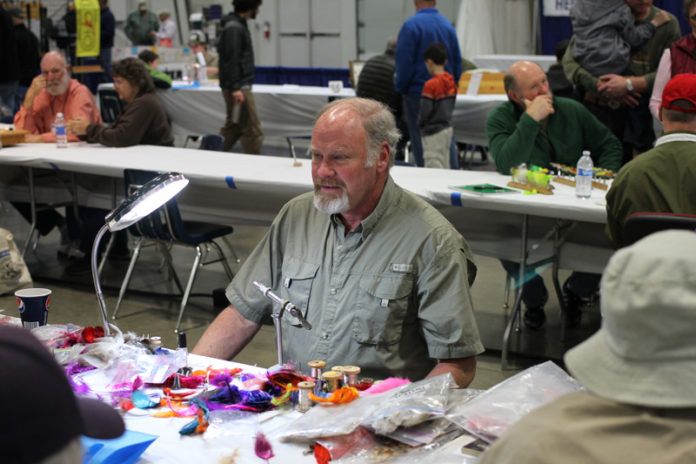
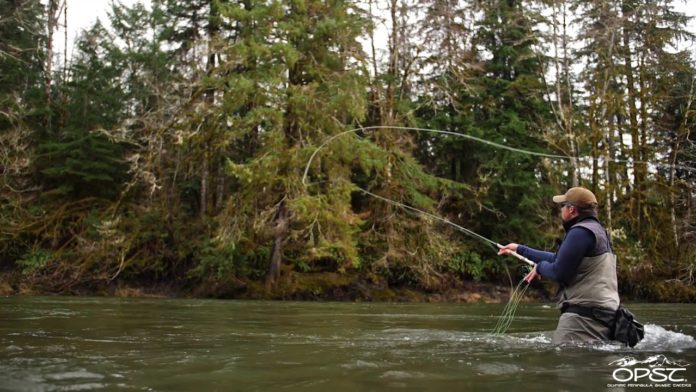
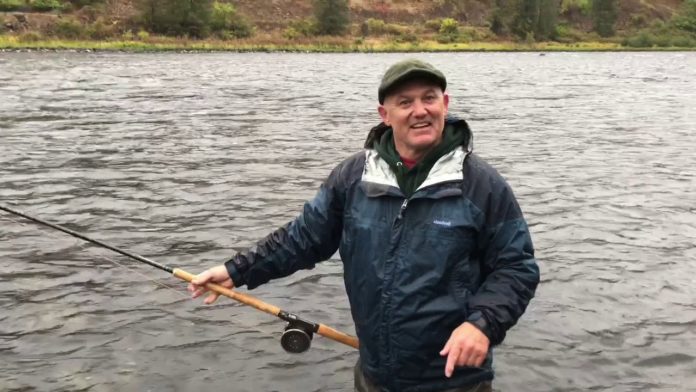
Richard Harrington, from the River Rambler Podcast, is on the show today to share the fly fishing story of Oregon to New York and back again for steelhead. Richard also shares some great tips on steelhead fishing the North Umpqua.
we talk about skating flies and the best way to hitch a fly behind the head so it skates up nicely for you. We get into a little bit of everything including who is the mastermind behind Richard’s podcast and which spey rods he loves.
Click below and listen to the Richard Harrington Interview:
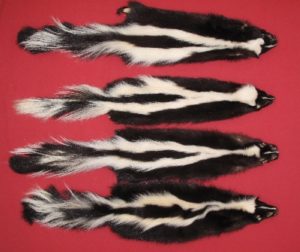
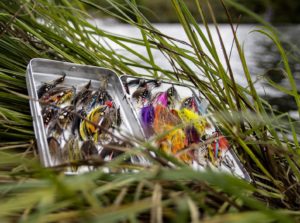
28:40 – Here’s the skunk I used to catch the Frank Moore fish on the river. I tell the story of how Frank coached me into my first North Umpqua steelhead.
“You’re not going to skate fish if you don’t fish skaters.”
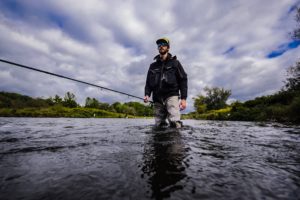
Photo credit: Kevin Hospodar
Conclusion with Richard Harrington and the River Rambler Podcast
We hear Richard Harrington’s amazing story of creating a steelhead focused podcast after being “stuck” in New York for 40 years prior to returning to the NW. Richard and I talk about everything in this one from D Day to the Wallowas.
We also dig into some resources and tips on skating flies for steelhead including some great blogs, books and videos that you’ll love. click the link below to subscribe so you get updated when the next podcast drops.
This is Episode 100!!! – I’m happy to share a chat I had with one of the greatest people in the history of fly fishing. Joan Wulff shares her great story and how she came to make a life in fly fishing even before she met Lee Wulff.
We talk about how to double haul correctly, her first job with Garcia in the early days, how she toured the fly fishing show sequence, and how she built a fly fishing school that is still going strong today.
Click below to listen to the Joan Wulff Interview:
12:20 – See below for the photo of Joan in a dress vs how she was doing the casting sessions in hip waders. Joan tells us how Monty Blue put together this idea in the early days to get her started.
12:30 – See below for the short shorts pic with Joan. This is likely one of the most iconic photos in fly fishing and of Joan.
20:00 – The short movie – Autum Silver produced by Lee Wulff with Joan.
28:10 – The yarn rod was a training tool that Lee invented to help people see there loop. I used this rod teaching fly casting as a young person as well. Here is a link to Echo’s yarn rod.
32:30 – The grooved handle with Winston was one of Joan’s ideas and a first of it’s kind. The basic idea was that there were no handles at the time that fit womans smaller hands.
The amazing Joan Wulff shares her story in fly fishing and provides some nice tips along the way. She won her first fly casting tournament at age 12 and went on to make a life in the sport.
Rick Pope, the founder of Temple Fork Outfitters, is on the podcast to share the history of TFO rods and the impacts to the fly fishing industry.We hear how Lefty Kreh was instrumental in elevating the company and how it all came to be.
Rick shares the background on how he started and scaled one of the big fly rods companies in the world.This is the perfect episode if you want to hear the past, present and future plans from one of the best and most respected guys in the fly fishing business.
Click below and listen to the Rick Pope Interview:
Rick Pope and the Cosmic Cowboys – Photo via: https://shotgunsportsmagazine.com/blog/cosmic-cowboys
Conclusion with Rick Pope
Rick Pope, the founder of TFO Rods, is on the podcast to share his story about how he started a low cost fly rod company.We talk about the importance of community and where we are all heading in the fly fishing business.
We even get a few tips on skeet shooting and bird hunting from Rick. This one brings it all together as we talk about Flip Pallot, Gary Loomis, Lefty and all of the people who helped to make TFO Rods the company today.
I sat down with Brian Wise from Fly Fishing the Ozarks on youtube.Brian is a huge player in the streamer game producing some amazing fly tying videos on his channel.We talk about fishing giant streamers on the North Fork of the White River.
We hear the background of how Brian could dunk the hoop at a height of 5’8” and was on his way to a scholarship when a blown out knee crushed his dreams.But, this is also how his fly fishing career came to be.
Click below and listen to the Brian Wise Interview:
Brian Wise shares some great tips on fishing streamers in the North Fork of the White River.We also get into his youtube channel and how he produces content that is a little different that your normal fly tying video.
We find out how to tie a 9 inch weightless fly and the right sinking fly lines to use that make casting an ease.We find out how to find fish in a new river by identifying the habitat on dry land.
James Carlin shares some great tips from his competition fly fishing background with a focus on dry fly fishing.James is also the founder of So Fly Gear who is our most recent podcast sponsor.I’ve been wearing So Fly’s Hoodie and been loving it this summer.
James has a great story and the youngest guest we’ve had on the podcast.We hear about the youth Competitive fly fishing team with a focus on dry flies and euro nymphing strategies for trout.
Click below and listen to the James Carlin Interview:
04:45 – Guy Robbins was James’ first mentor and a world renown kayaker. Guy was also the guy who brought the youth team out west.
I talked about Dry flies with Gene Shropshire who was one of my personal mentors in episode 165. Gene covered his top 6 dry flies of all time in this classic episode.
07:00 – Big Wood Flies was James’ first website from his 6th grade year. Yes, 6th grade.
09:50 – We talk about Rip Curl and the effects to surfing similar to what James is going for with his So Fly brand and the state of Flow.
11:00 – TASC Performance is the manufacturer of So Fly Apparel and produces some amazing products.
12:40 – Laird Hamilton is a flow hacker and rides some crazy waves. Check out the link.
17:40 – The Youth Fly Fishing Team was held out west in Ketchum Idaho.Michael Bradley was part of the event.
38:30 – I noted the Maxima heavy duty leader in relation to the x factor. I love Maxima for steelhead fishing and if you click this link and purchase from our local fly shop the podcast receives a commission at no extra charge to you.
Dave with a nice summer steelhead wearing the So Fly Hoodie!photos via: Charlies Fly Box
Conclusion with James Carlin
James Carlin shares the story of how he created a brand with killer fly fishing and life style clothing I’ve been loving.We find out what Find Your Flow means to So Fly and how it can help you enjoy your time on the water even more.
Thank you for your interest in fly tying and checking out the beginner fly tying Series. This series is perfect for you if you are new to fly tying and want to learn How to Tie Flies.
This Blog post can be thought of as a lesson plan. Within this blog post, there will be videos, text and action items to walk you step by step through learning to tie flies.
Wet will walk through the basics in fly tying including a quick introduction video, talk about basic tools, show you how to setup your tying space, cover the basic materials for tying our first fly, and then get more general into the categories of flies.
Table of Contents
Chapter 1: Introduction to the Course
Chapter 2: Basic Fly Tying Tools
Chapter 3: Setting up Your Fly Tying Space
Chapter 4: How to Tie Flies – Basic Fly Tying Materials
Chapter 5: How to Tie Flies – Categories of Flies
Chapter 6: How to Tie Flies – Module 1 Summary and Action Items
We are going to start out slow and work our way step by step until you feel comfortable tying flies. If you have any questions throughout this process, you can email me at dave@wetflyswing.com.
If you already have your tools then some of this will be repetition but you can at least meet me today.
You can also send me photos of your patterns as we go through the course and I can provide direct feedback on how to improve.
Just send me a message with “Fly Tying Class” in the subject line.
Much of the step by step content that follows, easily walks you through the process.
If you haven’t checked out the Wet Fly Swing Podcast, I wanted to share a great resource where we had an entire season 4 focused on interviewing great fly tying guests.
Coaching calls are my way to assure everyone is learning effectively. I have received feedback from students that this is one of the highlights of the course.
Click here to add your name to an upcoming one on one coaching call with me.
(just type “coaching” in the subject line of the email.)
So, let’s dig into this today to get you ready to tie flies!
Ch. 2 – How to Tie Flies – Basic Fly Tying Tools
Do you have your fly tying gear? Here is a list of basic gear to get you started. Each item below, if clicked, will link you to an associated item where you can buy this product.
If you would like to find a vise that is under $50 then click the link above and send me a message and I’ll help you out.
#1 Vise – There is a wide range of types and prices of vises. You can pay anywhere from $20 up to $500 and more for a vise. The basic task a vise does is hold your hook.
Click on this link to see one vise that I have used before that is in the $150 range. If you would like to get a vise for under $100 then this is a good option: Griffin Vise here.
An additional feature that many of the more expensive vises have is the ability to rotate. This is very helpful for some fly patterns.
#2 Scissors – There are many different types of fly tying scissors, but the main thing in common with most of them is a very fine point. Here is a pair of scissorsthat I have used before. You may also want to get another pair of cheaper scissors that you can use for cutting wire and such that would dull your good scissors.
#3 Bobbin – The bobbin is the tool that holds your thread as you tie the fly. There are many quality bobbins out there at a very low cost. Here’s onethat is a high quality and should last for years.
#4 Thread – I am putting in thread within the tools section here because it is a requirement and doesn’t have to change much from fly to fly.
Here’s a link to Uni-thread which I have used for years. 8/0 works for most trout flies and 6/0 for bigger patterns.
You’ll be able to tie your first fly in the series solely with these tools plus the materials I’ll show you later on.
Here are a few additional items that you will likely need as you get into fly tying.
#5 Hackle Pliers – Hackle pliers are very helpful especially when using smaller materials. They allow you to grab the hackles as you turn the feather over the body of the fly.
#6 Hair Stacker– A hair stacker is useful when trying to even out wing materials from deer, elk or other natural hair fiber.
#7Dubbing Wax– Dubbing wax is used when adding dubbing to your thread. This wax adds a sticky substance to your thread and helps to keep the dubbing material on your thread.
#8 Head Cement– After finishing off your fly and head, this cement will secure the head of the fly down for the rest of it’s days.
#9 Bodkin– It is used to place the head cement on your fly and is helpful in “picking out” hair material from your flies.
That is the main tool list to get you started. If you think you’re are ready to go all in, you can click on the links above to purchase from our affiliate partners (we get a small commission if you purchase through those links but you do not get charged extra).
I’ve got a few more things for you this week. First, I would like you to fill out a quick survey to help me understand a little about your history.
The setup and organization of your fly tying area will be important. Try to find a dedicated area where you can leave your gear setup. This will make it much easier to keep tying regularly.
Hooks – I will be using a Umpqua 3x long for the demo but the Mustad R74 size 8 is a very similar hook. You can grab a box of hooks here if you need extras. Make sure to get 3X long streamer hooks.
There are the four main categories of flies that we will cover in this course:
Streamers – We’ll be tying a spruce fly later to demonstrate an easy and effective streamer pattern. The spruce is an old school streamer pattern. There are many more common modern streamers that you can find on the Wet Fly Swing Podcast
Dry Flies – You will start off with an elk hair caddis to learn about dry flies but there are so many different types that we won’t even come close to covering them all.
Get the 4 basic tools lined up so you will be ready to tie a fly next week. You can click on the links above to grab all of the tools for this course.
Setup your fly tying area so you are organized and ready to go.
Get the materials you need to tie the first fly in our course.
Make a list of the flies you are interested in tying or types of fly fishing you plan on doing.
Click on this linkto take the short survey and help me guide the course.
If you are interested in free personalized coaching for free, click here and I’ll help you get started.
That’s all I have for you today. Be ready for your next email that will be coming soon with the next module. This module will walk you through tying the woolly bugger.
You’ve got to get started today. You’ve got to take action to make this a reality. Let’s do this together right now!
You can subscribe to the Youtube channel so you don’t miss the next video here:
Dave McNeese tells his stories of a life in fly fishing, fly tying and dyeing feathers.Dave is working on the book on Syd Glasso’s life and has been an expert material dying all star for 5 decades.Dave has done a little bit of everything in fly fishing including building custom rods, custom reels, flies and a fly shop.
We connect the dots even more today as we hear about the life of one of the really interesting guys in fly fishing.We also hear the story of the felony conviction that Dave received for trading animals but as you hear this was a bad rap sheet on Dave.
Click below and listen to the Dyeing Feathers Podcast with Dave McNeese:
Dave Mcneese shares his story of how he started his fly shop and became a material dying master.We find out how he connected to many of the old timers including Syd Glasso.Dave shares some of the story of who Syd Glasso was and how he got ahold of some of
We hear how Dave started his fly shop based on a mail order business and expanded it out until he ran into trouble with the Federal government in relation to some illegal game that was sent to him.
Trevor Covich shares his story of how came to be a full time Olympic Peninsula Steelhead fly fishing guide splitting his time between the Olympic Peninsula and Alaska.We dig into the story of how the Olympic Peninsula changed into a big swing game and how you can find big fish and quiet waters even as pressure increases.
We find out who Perry was and why the poke is such a key cast to know when fishing tight waters. Lots of great tips for the OP with a focus on fishing higher water with short rods and unweighted flies.
Click below and listen the Olympic Peninsula Steelhead Podcast with Trevor Covich:
Trevor 0:00
And finally he looks over at me. He goes, you know, Trevor I, I suck at golf, too, but it doesn’t mean it doesn’t mean I don’t like to play, you know that it opened my eyes to a lot of things. It’s like, you know, it’sYeah, you, you don’t have to be you got you just have to enjoy what you’re doing. You know, I suck at golf but every now and then I put a really good shot
Dave S 0:24
and that was Trevor kovas describing why you don’t have to be an expert spake caster to find success with steelhead fishing. For some reason I never get tired of a good steelhead jet. This is the wet fly swing fly fishing show.
Unknown Speaker 0:38
Welcome to the wet fly swing fly fishing show where you discover tips, tricks and tools from the leading names in fly fishing. today. We’ll help you on your fly fishing journey with classic stories covering steelhead fishing, fly tying and much more.
Dave S 0:54
Hey, how’s it going, everyone thanks for stopping by the fly fishing show today. Trevor kovitch one of the best known steelhead On the Opie is here to share some tips on finding fish during high water. This is one of the one of the best shows we’ve had and one of the first ones on the Opie so this is going to be good to dig into it today, we find out how to tell if a steelhead is ready to bite by how it rolls in the water. What diamond shop is all about in the best place to find fish that most people are skipping. This one is definitely jam packed with some value bombs. So please share it with one other person today. And without further ado, here’s Trevor kovitch. How’s it going, Trevor?
Trevor 1:35
Everything’s good here. Just just waking up some coffee in Washington.
Dave S 1:40
That’s right. That’s right. Where are you? Where are you at Washington?
Trevor 1:43
Well, I’m based out of forks which is generally where I run my my winter steelhead business. And then usually at this time I’m I’m up in Alaska, and of course through the virus and everything is going on this year. A lot of seasons have been canceled. sold all over Alaska So, so I’m kind of sitting this one out it’s the first time and and 17 seasons I’ve never I’ve never gone up so it’s a huge change so you just changed it to put it lightly
Dave S 2:12
well as the reason that you’re not going up there just some lodgest chose to close down in some Lodges are staying open.
Trevor 2:20
Yeah, absolutely. And then like I work you know I work for a couple different lodges but the first one is ran by a native Corporation and they they really are. They stand they tend to be really cautious on these things. You know, and then also we have a lot of clientele that’s that’s generally older, the majority of our clientele is older so just just to play it safe, they bowed out, you know of the Chinook season and then the mid season also bowed out as well because there you work next to a native village in Canada And then, you know, and then the the village itself, the elders didn’t want a lot of outside folks coming in which which is understandable. So they, they, they made sure there was no operations running there.
[expand title=”CONTINUE READING HERE”]
Dave S 3:13
So there you go. Yeah, that’s that’s probably the probably the smart move given, given where we’re at things are kind of spiking a little bit again, we’re in.
Trevor 3:20
It’s going up, especially in up there, you know what I mean? It was it was starting to creep down to where I thought that that things were gonna, that things were going to go and then all of a sudden said just it kind of switched and then they pulled the plug on.
Dave S 3:34
Yeah. Okay. Well, well, we’ll probably dig into a little bit of that as we go. I wanted to, you know, we’ll probably talk about I guess, the OP and I mean, you kind of split it between the OP and the Alaska is that pretty much how you do it.
Trevor 3:47
That’s pretty much that’s what I do. Now. You know, I I used to travel around a lot when I was younger, and i i missed I miss being in the Northwest. You know, and I missed seeing my, my family you know, if you’re if you’re always traveling, you’re never you never seen your folks and then they they, every time you see them when you get off a plane, they’re physically older. So I eventually quit going around to a bunch of places and I started my guide business out in forks, which is a place that I’ve been steel efficient for a while. Like I was steel had been out here for for like seven price seven years, you know, when I was when I was a teenager and then and loved it. And so I just do that pretty much. Like November is kind of an off month for me but like I start guiding in December down here, and then it goes all the way through April. So it’s a it’s a wet it’s a cold, wet disease. That’s awesome.
Dave S 4:51
Yeah, yeah, that’s right. I was just talking to somebody yesterday on a call. I was doing a little coaching call with somebody. I’ve got another podcast that I do, and And he’s in North Carolina and he is fishing. He’s a guide out there for you know, fish in North Carolina but he’s got a friend that just moved out from Portland and he was talking about steelhead and he’s got the steelhead bug now so he’s he’s jacked up and especially now that we’re getting into a little summer steelhead action, that’s good, but well we’re gonna take it away. Let’s let’s take it Take us back a little bit. So we’re gonna get into the space and and kind of all the micro and everything around space, but how did you get into fly fishing start us off there. Well, I was
Trevor 5:31
my father and my uncles were were outdoorsman. My dad was more of a a gear guy. Love the saltwater. My uncle, john kovitch. He, he runs the Cuba side of fly water travel. He’s the guy who really put a flier on my hand and he he would take my brother and I fishing for like a week, a week or two Every summer to some place and then I remember I think I was six years old when when I finally put when I finally started actually casting a fly rod my dad my dad would put me on his flow tube in the lake and you know he he’d fish around and then when you’d hook a fish he let me reel it in or or a troll me around or whatever and it wasn’t wasn’t telling met or not met but when john started taking my brother and I, we really started kind of hiking around and learning how to properly cast and present flies and stock fish and, and tie flies, you know, like, like john john was the guy who he bought me these these two Randall Kaufman fly tying books. One was a nymph book, one was a was a dry fly book. And so I just those were my, I mean, that was my instruction there, you know, and then I also did some through that there was a local fly shop that I where I grew up in is a call Washington It was called Creekside angling. And the owners Pete Corbett and Hugh passerines they were they would hold these fly tying classes. And it’d be me and like three or four other kids in there in the evening and we tie wooly buggers and Mickey fans and, and pretty much whatever else but it was just the basics. Pretty much it’s cool, then it kind of just went on from there. You know?
Dave S 7:25
That’s really cool. So yeah, you got kind of a family I mean, and john, your uncle is still see over it. Still fly water.
Trevor 7:32
Yeah, he’s still fly water, you know, and then he’s repping a, you know, a couple other things as well. But what he what he really loves to do is, is take people down to Cuba, and then you know, his photography and his drone stuffs really good. Cool. And then of course, he’s got two sons, that her you know, kind of one just graduated once about two and then his son just got a job Up, up in North this year and one of the places that are still operating, just he’s he’s kicking ass so he’s just loving.
Dave S 8:06
There you go, you guys. Sounds like you guys got a little a little kovatch flyfishing dynasty going on?
Trevor 8:11
Um, it’s, uh, it will No, it’s just it’s just, I don’t know if it’s in our DNA but, but it drives us forward. It’s really it’s just a fun. It’s a fun way of life. Yeah, you know? Yeah, not easy, but it is, but it is fun.
Dave S 8:25
Yeah, that’s, that’s cool. Let’s go. Okay, so yeah, I guess it started now, you know, well, let’s just take it back. So you’re kind of you know, you sounds like you’ve been fly fishing. You know, good luck your life. I mean, now you’re the kind of opia Alaska How did you know I mean, that’s it did you grow up out there up and
Trevor 8:43
so, my father bought into this small piece of property out in a place called CQ Washington, which is right on the Strait of Juan de Fuca. And, and it was right on the CQ river and he went in on a piece of property with three of his buddies. He’s from Boeing. They were all Boeing mechanics. And they were all saltwater guys. And so we’d go out fish and you know, we got five in the morning, go fish now in the saltwater and then come back. And we’d be we’d be limited out by, you know, nine or 10. Well, then we had the whole rest of the day to do stuff. Well, the CQ river was right there, you know. And so my brother and I would blow up our float tubes at the time, and then we’d go paddle around here. And it’s like, it’s like a tidal slew. Oh, and then we go fish, sea run cutthroat, and then every now and then there was a silver and I remember one time my brother, he was skating. It was a stimulator and I think I can’t remember how old we were but and then a summer steelhead actually grabbed a stimulator and this one, we were just little kids and we still we had no idea what it was. We just figured it was a salmon. And then, and so that was kind of a summer thing. You know? And then one time, we had to go do some work out there. And it was in it was in December, and I went in you know, went up looking up the road and stuff like that kind of just looking for cutthroat trout and I was with my cousin. And, and I had a, I just had a trout rod. And I just remember throwing out there and and next thing I knew I had something, something really big on and it was it was just it was working me you know what I mean? And took me under a log jam came back out went back in the log jam. And finally, I screwed it up on the on the sand and it was a it was probably 1213 pound wild steelhead, well, it was a hand gnosis and I was sitting there, I was sitting there going and I think I was I think I was 12 or 13 at this time. And and that was the moment I kind of knew that I wasn’t going to be doing any more snowboarding You know, you know what I mean? Yeah. And, and so and so that was kind of the, you know, that was that was the spark. And so when I got my driver’s license, I would try and find any way possible to go out there. So me and a couple buddies would every now and then we did school, you know, on Friday and then head over for a long weekend. Um, you know, and then and then we just read fish for steelhead. And it was awesome. I mean, it was really good and that and, you know, kind of a common trend now. That river, you know, which was really awesome. Of course, it’s not so awesome anymore. It’s the point where it’s, it’s, I want to go fish it but I don’t fish it anymore. You know, just because it’s not it’s not even close to what it used to be and, and where my where my deck situated is right in front of like there’s there’s probably three nets there’ll be right out front, so It’s just like and so now it’s more of a vacation spot. You know, I’ve been taking my girlfriend and one of her friends out there and we’ve just been trout fishing lately but my main my main thing now is so I bought a house in forks and so I operate right here and I’ve got rivers a stone’s throw away from me so it’s really easy for me to go go take guys to wherever I want and then I’ve got a downstairs where I keep my clients cold and most parts so they can just roll in I don’t get to go pick them up at a hotel so it makes it really easy
Dave S 12:35
Listen, what’s the How is the the winter steelhead season there this year on the Opie
Trevor 12:40
Oh, it was good. You know, every every year is different and then everybody’s gonna have their own their own outlook on what they would feel good is you know, the winter steelhead thing, especially the winter stick still out here, especially if you’re swinging to fly is is extremely tough, you know, just the fish move on in weird ways out here, you know what I mean? They don’t, they don’t sit still for long. And then you have you have the constant changing of weather and, and water conditions. Like, I’ll just, I’ll just, I’ll just give you this, this season’s example of what they’re so I lost the majority of January out here because of big water, you know, constantly blown out the I mean, there were pictures of the, the quilly like, and the bogus shell overflow and that whole lower end of the road down there was totally swamp with water, you know, and then of course, the power goes out, and then February comes along. February is a great month. So you get some mixed rain, good water conditions, and then March came along. And march was, was like it does sometimes there’s barely any rain, you know, and I mean, and so what it does is it stuffs fish up in certain places, and so on. And so depending on the time of year, and then the water flow it depends on kind of where I’m going to be with my clients you know and so the rivers change
Dave S 14:11
yeah and that’s the cool thing about the O p is that there’s a number of different rivers and depending on the condition and how things are going you can adjust accordingly right that’s exactly how do you find guys what percentage of guys out there do you find just for fly fishing that are nip nip fishing versus you know versus swinging?
Well it used to be it used to be really one sided You know, there was you know, there wasn’t many swing guys there was some some swing guys out here but not really swing guides, you know, and then but the majority were, were you got you got your gear guys and then you got nippers that would slowly infant then they would then some guys would do some swing. And then it wasn’t until like when when Jerry Brown ferencz started putting in a full campaign out here and started to be really successful. You know, and since then also still, you know, taking this beatings, like, like most steelheaders do, you know, but like, Jerry was the guy who opened my eyes to a lot of stuff like I thought it was a pretty good steelhead fisherman when I met Jerry, then Jerry, French was the guy who got me thinking about things a little, little differently. And then also, especially with the flight time, too, you know, he’s just, he’s, he’s, he’s the master when it comes to that kind of stuff. But he really got me thinking about, about where they’re sitting, how long they’re sitting, you know, stuff like that. But I would say that in the last three to four years, the swing, the swing contingent has gone up tenfold. Like now there’s like it used to be me and Jerry, and then You know, one or two other guys, and now there’s, there’s a whole bunch of new, you know, swing guides out here. And so and so that so the, the pressure kind of that, you know, it just gets, it just gets more and more pressure. And so I have to start doing things that are a little more crafty, you know, just to try and kind of get away from people sometimes. But every now and then you end up on a stretch of river and you’re all by yourself because everybody decided to go to the same boat launch on a certain river and some other places left totally empty, empty. It’s really cool.
So there were a few guides back in the day and now there’s more I mean, do you know all these guys pretty much do talk to all these guys? You know, 10?
Trevor 16:41
Yes, no, I, I try. I try and have a really good rapport with people just in case. A You got it. You got to get along with people that you work around, or else it’s not going to be fun for anybody be if you get in trouble, and you need help or vice versa, like, yeah, it’s good to have friends and so You know I try and talk to everybody and of course I have a main core group of buddies out here that that you know swing flies that I share I would share information with and a couple gear guys that are they’re good friends of mine. But you know we stay pretty pretty zipper lipped when it comes to to share and that kind of stuff. Ross Ross Oh yeah. Somebody will be there the next day so that’s
Dave S 17:25
right that’s that’s good I had I’ll put a link in the show notes I had Jerry French on recently and I pretty much I’ve had a number of kind of the big names in the space game on you know in your your name that’s been popping around there. I just you know, finally got getting on here to talk about this. So that’s that’s great. I can’t remember who I connected with recently that mentioned mentioned your name, but you know, there’s all sorts of ways to do it. Right. You got the long, long, long bill. I just had Bruce Kruk on who was talking all about the long belly lines, right.
Trevor 17:55
He’s the Is he the guy who’s in the upper Columbia.
Dave S 17:58
Yeah.
Trevor 18:00
Okay, yeah, I look at this stuff on I think it’s either Facebook or Instagram that water looks awesome. One day
Dave S 18:06
Yeah, I know he’s a he’s a big and we talked a little about the Clearwater and all that stuff but I think all those guys I mean the Opie is such a amazing place I think everybody it’s on their list right each year they’re probably heading down that way so it sounds like and as it gets busier, you know, what are the tips for you know, I mean for somebody who’s out there trying to find more of a remote experience any any tips there?
Trevor 18:29
Well, if you’re if you’re willing to get out and and, and hike around, if you’re really if you’re trying to get away from people, I mean, you might want to stick to maybe, you know, there’s some, there’s some smaller streams out here you could go look at but the thing is, is like you got to be if you want to get away from people, you got to fish in the conditions that are not favorable. That’s the one that’s the that’s the one thing that that separates the good anglers and the good guides from the From the weekenders, okay? Meaning, meaning some of my best days here, and some of the days where I catch my biggest fish here are when the water is extremely high, because what it does when the waters really high Well, two things have happened right? So the waters high and fishable chances are a couple days before was pretty muddy. Okay, meaning nobody’s fishing, there’s no nets and because all the logs get stuffed up in the nets, right and so nobody’s fishing. So once it gets back into shape, fish are generally going to be sitting in places because they’ve come in and they haven’t been messed with at all. The big fish thing what happens? So if a river is low fish, those big fish have to be in certain lies, right to feel safe. When the waters high it’s a it’s an open freeway and what it does is it sucks those fish really close the bank. And then some of the biggest fish have ever taken out here with clients have been, have been within five to 10 feet back when the water is giant, meaning like and when the water giant you’ve got a you’ve got a swing run that is let’s say it’s usually let’s say it’s 35 to 40 yards. Well now it’s 10 to 15 yards. Because if you go down too far, you’re gonna you’re gonna start floating, you know, so it’s that that’s, that’s why this this whole season down here is what I call my Super Bowl because it’s it’s the hardest it’s the hardest guiding I do all year just having to doing the mental gymnastics around the conditions and knowing where I should be at what time of year and then what spots are going to be swinging at this flow versus that flow. Okay, and then and then you’ve got guys who who you know who are fishing around you and then you you know what spots those guys like So like, if I’m on a, for example, if I’m on a, on a run of water with my buddy grace Drew’s Nick, like, I’m gonna be talking to him and ask him where he’s gonna be going versus where I’m gonna be going. That way we can line our days out and then not be stepping on each other’s toes. And then that way, both of all of our clients get good shots and fish so
Dave S 21:24
that’s great. That’s a good tip there so basically fishing the inside water. What lines would you be is if the water is really high, you know, and you’re talking about so the water blows out it’s muddy and then it’s just coming soon as it comes down. It is getting that the muds gone but it’s still you can only see maybe a foot that’s the way you’re talking about but it’s still
Trevor 21:41
Yeah, well, I mean, it’s still raging so you can’t you like in a lot of people will be like will tell you that you got to go super light, which in some spots, you absolutely should. But the problem is sometimes when the waters when the waters up, it’s also got some more flow going to it. Okay, and so You kind of get a hold it in there and so sometimes I’m using I’m still using you know 10 to 12 feet at 14 other times I’m using five and five it’s, it’s it all changes with the spots okay? And then when the waters up like that and slightly offset I mean I’m using a foot a leader, we’re not we’re not going we’re not doing four foot leaders I rarely go I rarely go above four feet and then I’m a 20 or nothing guy. Meaning if it’s not 20 pound test, I don’t want it on your sink tip at all. Not even close because for a few reasons. First reason is like some of my clients are supernovas casters, right okay, so there it’s flying out there funny and then sometimes there’s gonna be there’s gonna be some knots that show up some that I’m that I didn’t see, you know, or else I would have to check it like every other cast or keep changing Their leader and official busta official bust 15 pounds with a win not but but what I would and so what I tell people or what I show them in the boat is I’ll take 15 pound test and I’ll take 20 pound test and I’ll tie when not in it, and I’ll try and I’ll go break this one and then try and break that one. So you prepare for the fish that you want to catch versus the fish you’re probably going to catch because the really big fish that are out here they just show up and you’ve got it and you just got to be ready because your next cast could be the biggest fish of your life and then you’re Fishing Guides life out here. You know, you just never know when it’s gonna happen. So so we’re prepared
Dave S 23:43
what so if you’re fishing that say again, you’re at the high water, you’re fishing a T 14 something pretty heavy, what and what line are used Are you are you kind of doing all the old PST stuff.
Trevor 23:54
Well, I used to do a lot of that stuff I’ve been I’ve been gravitating and trying out some some ads Sa lines but it’s been it’s it’s pretty early in the stages of that I still I still like the the LPS t lines it’s it’s yeah you know it’s what I really started on as far as the the the shorter lines you know before that it was a it was a scheduled flight but the commando head is what what opened up a lot of different things for me especially on the single hand side you know to
Dave S 24:28
are you in are you what can you maybe you can just walk us through again just for an example let’s just think of that high water you’re on the OP and you know your fish one of those higher you know, the rivers way up at what rod are using wait and just talk about that just generally.
Trevor 24:42
So So for the most part on the anywhere on the peninsula, I use a I use a 12 foot nine wait. That’s that’s the thing I used to use a 12 and a half but as I’ve as I fish more and as I get older, I start going on gravitating towards shorter rods, it’s gotten shorter and shorter and shorter since I started spey casting. So I’m going to use a 12 foot nine wait just in case because like for example in the waters high and let’s say you’re on the sole duck river, well the sole duck river doesn’t have these broad these broad gravel bars, okay, so you’re going over big rocks, you got logs coming out and then you’ve got, you know, a bunch of grass and trees. And so I want to be able to put my anchor way out there and I want to be able to make a fishable cast with with minimal effort. Okay, and then also went with the water being up being up and then being offset now I’m going to throw I’m going to throw a monstrosity, I’m going to throw a monstrosity of a fly just because I wanted to see it and then I want I want you to my clients to be able to hold their their flying long enough to where they can get a good look at it. And then sometimes that means also holding it down below you for for a few seconds because there’s there’s plenty of current and said some of these fish will be right next to the bank. But it’s all it’s all 12 foot tall 12 footers for me, but most of my clients will bring out 1313 two, you know? Or does the general
Dave S 26:19
Yeah, that’s the typical Yeah, so the advantage of the 12 foot versus a 13 What is the advantage there if you’re in that situation?
Trevor 26:27
Well, you’re not going to be chopping wood as much. That’s that that’s the main thing. Okay, you got all these low hanging tree branches. I mean, every time you every time you smack your rod on it, you know, it takes the life of your rod down a notch you know, and then you know, and then you’re always wondering in the back of your mind when what cast is it going to be or is it going to be when you go sit on that fish that you really want to get in and now you’ve got half a rod. But But no, it’s mainly just being able to put your anchor where you want to okay with the with the with the shorter rock I can end in a shorter line I can, I can place my anchor exactly where I want to, I can poke way out. And if I didn’t, when I poke out if it didn’t get out as far as I want to, I’ll just compose come around again and poke out further. And then I’ll just do a roll cast when I’m when I’m really when everything’s really tight. But mainly it’s just doing it’s just mainly doing nice fishable cast. That’s the next thing fishable cast not not casting as far as you can every single time. Like it’s silly to me, it actually drives me nuts. It drives a lot of people nuts out here, especially if you’re if you’re guiding. Everybody wants to cast a long line. I mean, it’s it’s fun. It’s it looks super cool. But if you really want to catch fish, you’re gonna make good presentation. And you’re gonna you’re gonna search as many spots as you can.
Dave S 27:53
Yeah. You had that conversation with Bruce Kruk. He was talking about fishing. His water which actually it is advantage of casting way out there because there’s some of those absolutely are further out and he and he’s also a spray he’s at the spill rim and that’s a whole different thing you know those guys are just you know they just
Trevor 28:13
it’s a whole nother can of worms yeah yeah well yeah exactly but you know here and I’m sure it’s a it’s a it’s a vantage up here but what people don’t factor in here is the traveling lane. Okay that the traveling lane is is just as important as the holding water and sometimes said they’re right there right at your feet. That’s where they’re moving
Dave S 28:35
right in next to the basically right in next to the bank a lot kind of within that
Trevor 28:39
off your rod tip Yeah, right right up your rod tip and then the and then the the traveling lane changes. That’s the next thing whereas the river rises and falls you got to be able to to rise and fall with it. Okay, meaning the traveling lanes can be here at this CFS at 3500 CFS and it’s going to be over here at 1250 Okay, so if you don’t if you’re not on top of that you’re gonna be you’re gonna be out of it
Dave S 29:07
and how are you learning again you obviously are up there every day and stuff but if if somebody is new their first time the OPI they’re heading up to whatever river and and it’s one of these rivers that’s changing quite a bit you know how are they you know and how do you do it right the river changes how do you find that new that new Lane?
Trevor 29:24
Oh it’s time time on the water Yeah, it’s all time on the water and it’s and it’s going out when you don’t you you don’t feel confident going out. Like I said when the waters when the waters messed up. Every day. You put your boat in or you go fishing, it should be it should be a learning experience. Okay, so you’d like I’ll be when not when I’m guiding for example, I’m not just watching my clients. I’m watching other parts of the river below me. Right? I’ve got binoculars as well, but I’m looking for rolling fish in certain places that I’ve seen him roll before you know And then like for example, you know, out here, there’s there’s a slower roll and there’s a faster roll. Okay? The faster rolls are the fish that are that are really moving, they’re pushing other other rolls or we’re Fisher are kind of like stuck in a spot and they’re just kind of holding and then and generally rollers are eaters, okay? Because the first thing about you know, steelhead fishing is knowing that they’re there you can fish all the best water in the world and if your timings not right, and there’s no fish there, you’re not going to catch anything. And that’s the thing that discourages a lot of people out here is they get to a great piece of water, they fish it they catching that and they go back the next day they fished again, maybe a little differently catch nothing and so they go You know what, there’s nothing here. Well, on the third day when they should have gone back, there’s probably a fish there. Mm hmm. You know, and that’s and that’s why I say time on the water
Dave S 30:53
time on the water. So is that the tip so basically, instead of instead of going out and fishing, you know, six different pieces of water maybe if you had to Three or four day trip just stay on that one section maybe that few miles section,
Trevor 31:04
you should find a couple really good spots that you like and stick to them and then if you stick to them it’s like a you know, it’s like a slot machine you pull it out enough Okay, it’s gonna it’s gonna hit but but it really is time on the water and and the reason that I’ve had the success that I’ve had out here is because of all the days that I’ve spent catching nothing and learning and being so miserable, you know, putting gas in my truck hiking through brush, you know tearing my waders and then in unfavorable conditions and and the guys that are really successful out here the guys that put in their time there’s definitely some luck involved as well like like like most fishing, but but the guys that that do well out here the guys that put their time in and they and they’ve been they’ve struggled everybody out here. If you’ve ever wanted to fly has struggled There are guys that I know that are that that think they’re really awesome great fishermen and they come out here and they just they get whooped it’s not it’s not a favorable place but if you put your time and you learn like you’re gonna see some pretty cool stuff and not to mention you just look around you it’s a visual masterpiece there really is
Dave S 32:23
because maybe paint that picture well let’s get into the visual masterpiece in a second but I want to take it back to the Perry Polk right you’re talking about can you describe the Perry if Perry was a perfect Oh, who Perry was and it talks about described the Perry Pope for somebody who’s never seen that cast and while you’re doing
Trevor 32:40
well, I guess the Perry poke apparently was was made up from guys that like you know, blew their anchor set, you know what I mean? And so they would just dump down. So a lot of times when, for example, if you’re trying to set your anchor below you and let’s say you come up a little too strong your and your flag goes whizzing by you stream, well, then you can just take your rod and then and then poke it straight down in front of you, and then come out and around and then do do your cast, you can do it off any side. You know, and then you can, you can sit there and poke your rod like three times to get all your lines just lined up right in front of you, and then just do that around and over the top and through and it’s and the thing is, it’s a, it’s, it’s a, it’s extremely powerful cast, like I said, and then it’s also a calf that doesn’t, you know, if you keep your hands tight, it’s you don’t have to do a lot of ranging movements. You know what I mean? You can keep everything really tight to your body and then the, the line will stick to the water. Which is going to create a lot of lot of load in your rod and a lot of bent.
Dave S 33:51
Yeah, that’s right, that that’s the thing when I think of it, I think, I guess I’m painting that picture. Again, we’re, I’m thinking of this high water situation. I’m plowing through the brush. I’ve done this steep cliff and I drop in and I’m you know, on river left right rivers going from right to left and I’m a kind of top hand up and you know I’m setting this thing up so I do say a snap tee or something and I and I do the do the Poke and get out there and then I bring it back and when you bring it back basically like you’re saying all this line, there’s a lot of line on the water that you’re pulling back and that’s that exact that’s a good thing, right?
Trevor 34:25
Yes, absolutely. Because that like for example, like a big reason for like sketch lines, okay, sketch lines are thick. Okay, it’s to create it’s to you, so you got a lot of surface area, okay. And so that’s, that’s a lot of area for that water to grip your line, which is which is, you know, if you’re, if you’re, if you’re a bow hunter, okay, you’re you’re loading up that boat to make your kill shot pretty much. So it’s loading and loading everything and you don’t have to you don’t necessarily have to be sweeping fast with your rod. You know, as long as Your constant if even if you’re slow, the waters grip and grip in that line are really nice. Okay, and then your release point is the same release point an NFL quarterback is going to have when he’s trying to hit a receiver, way down the field, okay, it’s everything’s in control until that last that last little bit and it’s the last extension is where I put all my maximum effort and then you can you can also breathe out while you’re doing it. And I’ll just kind of, you know, they’ll give you that little extra extra juice. But yeah, you can punch out there but the main thing is starting short. Like Like all steel heading, okay, fish your feet, and then it doesn’t like your casting does not there’s no ceremony out here, okay, it’s Can you make official cast? Like I don’t care. I really don’t care what it looks like. Okay, you could do some weird crap and throw it out there. And as long As it’s where it needs to be and you’re mending when you have to and you’re holding it in and then you’re being patient being patient by if when the time comes like all the every eat from steel has gonna be different and you need to react accordingly you know and it’s really it’s really tough to keep to keep calm when when a fish is chewing on so
Dave S 36:21
So what you’re saying is you know you don’t have to be fishing out there in the situation a perfect you know turning that fly over just perfectly I mean you could you could pile it up and do it man I I asked this question occasionally because I know that you know would like summer steelhead you probably if you’re if you’re turning the flyover better and getting a beautiful cast you probably
Trevor 36:39
totally different game yeah totally different. Yeah, it’s a totally different thing and then like said these are that Yeah, that’s a that’s a whole nother realm. I’m from what the winner thing is the winner is generally said it’s you don’t have to be you don’t have to be a rock star caster you It helps to be a rock star waiter. Yeah. No uncertain place, especially where you’re at out here. Yeah, or else you’re going to be really, really wet. But if you can make a manageable cast, you’re going to have a shot some fish.
Dave S 37:10
That’s cool. Let’s go see that. That’s kind of my dilemma. My dilemma is that I, I’m actually kind of a rock star waiter. I’m not a great caster, but I love summer steelhead, and I love winter, but if I had to pick one, I would rather I’d rather be in 90 degree weather swing and for summers, and oh yeah, I think I need to change it to either get better at casting or fish for winters war.
Trevor 37:31
Mm hmm. No, and then it said it’s just I you know, I know a lot of different steelhead guys and they and it’s crazy. You know, depending on you know, where you grew up or where you started fishing kind of you like, you know, one of my buddies, his name’s Nick Raul, he shoots a guy loves that place and I’ve fished this shoots a bunch and it’s it’s a super, super magical place. That everybody Should fish Yeah. But if I had if I if I died and went to heaven I’d be on it. I’d be on a steelhead river out here somewhere or in BC you know, I really would.
Dave S 38:11
That’s it. I know it’s so cool. I love it because everybody’s everybody’s got their their thing so well
Trevor 38:17
and also you don’t have to deal with rattlesnakes and ticks out here.
Dave S 38:20
Good point. Those are the Yeah, that’s thing in order to in the northwest, go down to the south go to the southeast or anywhere in the world and there’s things that can kill you but in orange or in the northwest, rattlesnakes are pretty much the only animal that can kill you.
Trevor 38:35
Yeah, and then you know, you’ll have it you’ll have a random Black Widow around them. But for example, if like on the dish shoots, those rattlesnakes will buzz you from you know, 10 feet 10 yards away, like you go to the Grand Ron, the grand Ronde, I’ve always found to be a little different. I’ve never had a rattlesnake, let me know they were there. You know what I mean? I almost sat on one one year. I will I was hiking up a ridge I was setting up a camp for some steelheaders and I hiked up on a ridge and I sat down I looked right to the right of me and there is a rattlesnake going right by me he didn’t care you know, so I’d rather I’d rather No
Dave S 39:16
I’ve had it too well on the issues I’ve had rattlesnakes laying there in the next to the river on my thermarest I’ve had a rattlesnake go across my bed roll you know and that’s that’s
Trevor 39:25
Oh yeah,
Dave S 39:26
sketchy but this is good. I love the rattlesnake tails and all that stuff but hey, I want to take us back again. So line so somebody is going you know, they want a line like we’re talking about a line for maybe these higher events that come up like we’re fishing what what is if they want to just go buy one right now? What is the Oh PST line they could get?
Trevor 39:44
Well, they could just go with it. You know, they could just go with the commando head commando head. Um, you know, they’ve got some newer stuff out, but I don’t I don’t work for those guys anymore. Jen. Like I’ve had a couple guys bring some of the newer stuff up and I think it’s it’s more of an intermediate Which I’m not I’m not a fan of I’m a fan of it in certain situations mainly like for Chinook or certain faster water, but really, I want I just want a regular scheduled line. Okay? Because you know, it’s, you’re gonna be you’re gonna be at a depth that I that I know. Okay, and then also I would rather have a guy off the bottom than directly on it I mean most of those guys there when they bring their intermediate sout here they’re snagging up where the fish where the fish should be.
Dave S 40:33
Yeah, and I think about the like the one is that the fist right is that I think airflow that is that kind of a
Trevor 40:38
Yeah, the fist is cool. No, the so like, and that’s it. That’s a Sylvie wine. And I remember I remember I cast one of the spay clave and then I sent a message afterward because an absolute rocket and talk about a line that sticks to the water. And, and I mean, you can you can feel like a Rock Star. Now I cast him but, but holding your line where it needs to be like, where I really like that line is is for Chinook. Okay, because it digs especially in the sun, especially in those deep tanks where where those Chinook really like to be. And they, you know, Chinook like fast and and slow presentations depending on where they’re at and how aggressive they are. But the but I definitely use the intermediate. It’s more up north during the schnuck thing than I do down here.
Dave S 41:30
Gotcha. Yeah, you just want more control and how do you so if you need to get it down? Are you mostly doing that depending on where you’re casting? Are you putting heavier flies on?
Trevor 41:40
Well, I do I do. I do both. Okay, so I’ll set up differently. I might take I might do a couple man’s in a step. I’ll definitely put like a tungsten head on. But yeah, it’s it all depends on the spot, every spots different and then there’s like Every one of these spots out here, not everyone, but a lot of them especially in certain water with more bolder structure when a guy’s fishing a piece of water You know, I’m pretty sure I know where that fish is going to be coming from, you know, and I mean, I try and I try and lay it out for those guys that play it out. But, um but yeah, I would just, I you know, some of those some of those times I think it’s mainly when the water gets low is when I start fishing a lot deeper because those fish get into some deeper stuff. Okay, and then and it’s a lot of places where I mean the gear guys get to extremely easy I mean, they can just park on it and fish 12 feet in the water slow those fish have to stack and they got to be in certain places.
Dave S 42:47
Yeah, you know, and they get in spookier and stuff like that’s the nice thing about the high water is that and so when you’re efficient so you obviously you’re not fishing when it’s brown. But as soon as that color starts to clear you’re fishing the next morning.
Trevor 43:00
Yeah, oh yeah, the like, you know we’ve caught them in six inches of busy out here. A foot foots fine two feets really nice. Like for example, the lot of the gear guys out here will like I mean they want to stall at four feet of visibility. Okay, and four feet four feets. Great there’s everybody’s got the the steelhead color they really like and I just want I what I want is I want to look at the water and just barely see the the the the boulders you know what I mean? That’s that’s when I’m feeling super confident because I know that those fish can be sucked and really tight. Right next to all those all that stuff my guys can just pound through water and not and not beat themselves up by trying to cast you know, country mile, right? But yeah, give me give me two or three feet I’m super happy to is great.
Dave S 43:56
Yep. How do you what fly are you putting on there? Well, what’s our how big Maybe 10 I know you’ve got some of your own fliers, right? You have
Trevor 44:02
Yeah, no, I just I know I keep it I keep it really basic. And then of course, a lot of my clients bring their own stuff too. But I fish what’s just called a guide fly. It’s just, it says nothing special. It’s just a single station. And then with some hackles and then some flash on it and in different colors, and then I put some weight on some and then I, I put a lot of weight on others and then a lot of my keep unweighted, but like what I like to do out here I’m a big fan of controlling the fly with the sink tip, meaning I’ll fish mostly unweighted flies out here. And then I’ll put my tip on accordingly. That way, because said everybody, like, if you snag up on the in the traveling lane, it’s, it’s over, okay and then and the things that that will really also chapter guides, as is when you’ve you spent Time these flies and you got a guy who who you know will swing through and then he’ll go look up at the clouds on the hang down the flower gets stuck or he’ll step down or and then he’ll get snagged up and instead of trying to get the fly off or let me do it, he’ll just snap it off, ask for a new one. Right and so and so after guys done this a couple of times you start not wanting to give that guy your nice Fleiss
Dave S 45:26
and also then snap it off at 20 pounds that’s not easy to do.
Trevor 45:30
It’s no it’s not easy to do most the time they straighten out the hook Yeah, on that and then I just have to change that but but I want to be I want to have a really nice fluid swing. Okay, and I don’t want to be I don’t always want to be grabbing you know on the inside either. And then there’s you know, there’s ways you can speed your fly up to to keep it cut off the bottom without putting putting slack into it.
Dave S 45:53
So that kind of like I mostly like leading the fly rod tip.
Trevor 45:57
Well, it’s it’s it’s leading the fly And then drop into the surface of the water and then go and then moving your rod tip foot back out. So when you’ve done is you’ve just created a sail or a bow. Okay? So for example, if you cast out there you let’s say throw meant. Okay, sinking in there, it starts swinging, really nice. start swinging really nice, really nice, really nice. I’ll I’ll downstream and into shore. And then I’ll drop my rod tip all the way to the water. And then I’ll move the rod tip one foot back out to the middle. And what that does is it’ll just it’ll speed that fly right in. Especially, like, for example, there’s places where, right at the bottom, it’s actually pretty deep on the hang down, okay, but but there’s not a lot of flow. And I’ll do that. That same thing and sometimes I’ll bring it in sometimes I’ll mend it back out and then just let it kind of kind of go back and forth below me if I think there’s a fish down there. Something’s rolling.
Dave S 46:56
Yep. Yeah, that’s that’s a cool tip. Because Yeah, when you get enclosed You’re not going to have the flow and you can’t lead you can’t lead it with your tip. So that’s a cool, that’s a cool
Trevor 47:05
tell you can’t do it. No. And so that’s why. So I’m really a fan of the unweighted stuff. But there’s, there’s always a place for weighted flies. And then also, you got to think of, you know, you got to think of your clients too. Okay? I have a lot of clients that don’t just straight up don’t like casting with flies, okay? It’s, it feels clunky to them. It doesn’t roll out as nice as they want it to be and you want these you want your clients to enjoy it while still letting them you know, do their thing, right? And you still want to have success if they’re, if they’re definitely not going to have success. I’m gonna go Hey, like, I’m just gonna say, George. George. I know you don’t like doing this but I feel like we’re gonna be in the game if we, if we do this, okay. And if they’re, if they’re smart, they’re gonna listen, they’re fishing guy. And then, but you know, other guys, like I said, they you know, they they been trying really hard to, to be a better cast and be a better fisherman and I’ve had this one guy, he, he was not good at all. He was really horrible a fishing and he’s been in he’s been fishing for like 878 years and I’ve tried to help him numerous times. And finally he looks over at me. He goes, uh, you know, Trevor, I, I suck at golf, too. But it doesn’t mean it doesn’t mean I don’t like to play. You know, that it opened my eyes to a lot of things. It’s like, you know, it’s, uh, yeah, you you don’t have to be you got you just have to enjoy what you’re doing. Exactly. You know. It really is like, I suck at golf. But every now and then I put a really good shot and then I drink some beers. So it’s pretty pretty good.
Dave S 48:23
I love I love that take because you know, like I say, and I’ve had Bruce Kruk and some of these guys on who are outstanding cat You know, they’re they’re casting a country mile. I mean, some of these guys are like Travis Johnson, right. He’s got the 200 you know? 200 foot or whatever. Yeah, you know this record.
Trevor 49:02
Yeah, Travis is an animal.
Dave S 49:03
Yeah, Travis is crazy. And but the point is, is that sure if you want to go for that and you’re enjoying it, then go for it. But if you’re if you’re just out there fishing and you’re having fun and then do that, you know,
Trevor 49:14
and one thing I like about Travis is not only is he he’s not only just uh I mean, I mean, he was a wrestler, right? So he’s, he’s, he’s built like a wrestler. He’s super strong. And you can put a long line out there, but at the end of the day, I he’s, he’s a fisherman. Yeah. You know what I mean? Like, and so he’s a guy, like, if you’re, if you’re fishing the sandy in Oregon, or you’re fishing on the chutes, he’s a good guy. I mean, he’s been doing it for a long time.
Dave S 49:46
Yeah, he’s been doing it. Yeah, definitely. So so anything else? I mean, we’re going to start to wrap this up here a little bit, I guess. Maybe we can just start off with the 222 which is top two flies, tips and resources that I like to dig into before we get out of here and you’ve mentionedn Couple of fly well you’ve mentioned your your flight is there another fly if somebody just wanted to check out a fly that they could find online or do you pretty much stick with it?
Trevor 50:09
Well, I stick with I stick with my stuff generally but if there was one other person and I’ve already mentioned it would be anything that Jerry French ties for steelheading mainly look for example, the dirty Whoa, flies, right? Which is, you know, fly just develop back here on the whole you know, it’s just it’s a it’s a leech, you know, with a hothead on it, but it’s got, it’s got maximum movement, good hook placement, slight cone on it, and then and then a really nice shoulder. And so it has a lot of it as we’ll factor and like I was and that guy’s had an epic amount of success and I use that fly like he he, you know, he sells those through Aqua flies, right. And so and that’s a fly that you can that you can use for steelhead and Chinook, whatever, you know, it doesn’t matter. It’s still it’s still got the same appeal depending on what what a natural Miss Fisher you’re going after. What I mean, here’s a here’s an example like I remember one time, we’re fishing this gadget, and he had fished this piece of water through and he was remember he was reeling up and that and reeling up flies got a lot of wiggle and I’m, I’m across the river from and his his, his rod just jams down he goes hey, he goes Dude, you see that? And I looked over and then came right back again and just nailed him. It was probably like a 14 pound buck, you know, just super bright on the lower budget and But no, his flies are tried and true. They’re really strong. And then he’s he’s said he’s put more time in the wire than most people.
Dave S 51:59
Yeah. He’s gonna just make another no yeah. Jerry. Well, I’ve had some I’ve been trying to tell a little bit the story, you know, all these guys, I’m sure but you know, George cook told a little bit of the story and, you know, I mean, we’re all built on the top of the people that came before us right so you’ve got yes Harry Loomer and all
Trevor 52:17
Yeah, you know that the godfathers of spay
Dave S 52:19
exactly how they got.
Trevor 52:22
And depending on where, where you are in the, in the course of this history, like for example, there were the guys that that Edward and Jerry would would, I guess not look up to but that came before them. You know, like I George cook was the first guy to ever put a spear on my hand. Well, I’ve known I’ve known George since I was a little kid. Um, I just I went fishing with him last spring out of Isaac’s Ranch, which is a really cool place in eastern Washington, where he does some guiding Georgia. I love George
Dave S 52:54
George George’s name. He seems to be one of the guys I guess he said. Amy obviously in the That other older generation out there who, who else is out there other than Jordan, who’s at that similar? I’m trying to think cuz it seems like George’s name just keeps coming up when you talk about steel.
Trevor 53:09
Because the thing about George what you know and so, you know, George is a rep but George is the guy that made that I believe that I believe God space fishing to really explode out here. I mean as far as people buying rods I mean George has been a salesman for a long time. He’s, I mean, he can kill anything that moves. Yeah. And, and he’s a good fisherman and he’s a king of the one liners. I mean, if you’ve ever spent around a time with George, you will, your mind will be exhausted after because he’s always he’s always pitching something or telling a joke, but He’s, uh, George is great. And like I said, I I would, I wouldn’t have touched a spay rod as soon as I did and tell. You know, I met George because George he’s come up to the connections Talk do we used to have these? Like they were called spade gurus they come up and help our clients stay cast and like another one of those guys was Charles St. Pierre. Yep. I’ve ever heard of that guy Charles They call him the doctor. You know, I mean, he’s he can he can line out your spray cast and really fix all the problems and that’s what a good like a really good spray spray instructor is gonna. It’s gonna smooth you out and George George can smooth you out and he can and he can sell your rod.
Dave S 54:32
Yes, right. He’s gonna cover so here. Yeah, if you’re struggling with your spray cast George might be a good guy to look out.
Trevor 54:38
Yeah, George the good guy. But and I would I mean, George and Charles, I think are some of the best guys out there.
Dave S 54:45
It’s cool. Awesome. So So yeah, let’s keep on that to 20. So talk to so you mentioned a bunch of tests. But let’s think again, we’re fishing that high water The river is kind of coming down any other a couple tips that come to mind that could help somebody find a fish
Trevor 54:59
well I’ll tell you that my two best tips are the five and five t 11 and a two and a half floating seven and a half sinking t 14.
Dave S 55:10
Okay,
Trevor 55:10
those are those are the two best tips that I use and then I of course fluctuate between weighted and unweighted. And that should give you kind of a a picture of the water I’m looking for.
Dave S 55:23
In great describe the describe that describe the five and five quickly and then the other one what
Trevor 55:29
So, so I so I really like mo tips, okay, because it’s something I’ve been using for a really long time. So, um, so a five and five. So you’re going to have it’s, a lot of those mo tips are going to be 10 feet long, which was the point of them, right. And so the 10 feet long is going to make sure that your casting stroke does not have to change with having a longer line or a shorter line. So it stays the same, but you have different sync rates. So a five and five to 11 is good. going to be five feet of floating, and five feet of sinking to equal 10 feet plus, of course, your leader and your fly. Okay. And they’re also they’re all color coordinated. So it’s pretty easy to decipher. Because the thing is when people think about lions are talking about stink tips, it’s something that’s really confusing to a lot of people. And I’ve found that it doesn’t get any easier than that system just because it’s color coded. Like it’s been around a long time. If you can’t figure out that system. It’s going to be tough going forward. So but but but, and then of course, you’ve got the intermediate, okay, and the intermediates are nice, but I still I’m a huge fan of the floater, or the floating, the floating sections versus the intermediate tips, which are gonna are going to swing through slower and dig a little deeper.
Dave S 56:50
Gotcha. And so you had the the five, five and then what was the second one,
Trevor 56:54
fdit was a two and a half. So it’s a two and a half foot floating section and then a second Seven and a half foot sinking section t 14 t 14. Hmm. And then like most of the water out here, you can fish with that tip, whether it’s deep or shallow, depending on what fly you put on as far as weight factor unweighted, and then how you set your caste up, where you How, how many times you men where you put tension on your fly, you know, until you put tension on, it’s pretty much gonna, it’s gonna drop. And then it’s also it also could be lifeless also, until you engage your swing. So but those are those are my my two favorite tips out here. Of course, the conditions changed to where I’ll use some really some much heavier stuff. And then rarely do I have to go lighter than that. But every now and then there’s there’s always a spot that comes out of nowhere where it’s like I need the lightest thing possible. Because I’ve wrote over it five times and five times there’s been a steel head there and then the sixth time I’ve decided to decide to fish it. You know what I mean? It usually doesn’t take five times but If I roll replaced twice and there’s a steelhead there, chances are the next time down there, I’m going to be pulling it.
Dave S 58:05
Yeah, that’s it. Okay, cool. So, in on those tips, just just briefly, you know, we do talk about occasionally about just actual, you know, fly fishing tip and sort of thing, anything else you wanna throw out there as far as like, you know, somebody on the water and not necessarily the you know, the tip that that was, those are amazing tips and tips, but anything else you throw out there that helped them get into a fish
Trevor 58:27
or get into a fish? Oh, as far as tips, I would say probably fish a little deeper into a tail out than you’re used to. And how do you do that? This is this is really simple when you want to when you want to, when you want to reel up and head back the boat keep going at least 10 more perfect. And that that’s the problem is that is that most guys like especially after a really long piece of water like that, if the waters too, too long, they they’ll get bored. Okay, so they’ll start they’ll start being complacent. They’ll want to reel up they’ll they’ll, they’ll strip in a cast halfway through the swing. And then one thing, like for example, a lot of times, like the book boats will go by their name thing or gear fishing and then they pull up at a certain point because they’ll start getting really shallow and they’re gonna have to either go down a rabbit hole, right, well, the first place those fish are stopping is rats on top of that rapid so I would fish pretty deep into the tail outs. that’s a that’s a really good piece of advice that I would tell people that want to be successful.
Dave S 59:32
That’s good advice. So winter steelhead for winter still. Yeah, so when you feel like you want to get out just basically do Did you say 10 more casts or 10 more steps to go do or both? Yeah, both. Both. Yeah, don’t just stay in the same place but no, go. Go go into it. Go swing your fly into where the water really starts moving into the top of the wrap. Oh, yeah. You know, there because what you’ll notice in a lot of places out here is they’re really big boulders. Kind of at where they kind of the the next wrap will the rapid will start Okay, and those special they’ll hang right there. How I know this is that I float over and I see him like, I generally fish a spot and then I go float and I stand up and I look and, and a lot of spots I find out here places I just see you see fish and and that’s where you know they’re gonna sit. So and then you then you try and figure out how you’re going to fish it. A lot of those places are their gear spots, there’s no waiting. So you can anchor up and then swing out of the boat. I do that a little bit out here in certain water conditions. So yeah, but yeah,
so and in any Do you wanna throw one more tip out there for winter steelhead.
Trevor 1:00:45
Diamond chop?
Dave S 1:00:46
What What is it?
Trevor 1:00:48
diamond chop? diamond shop, find the chop. Oh, find the shop. Yep, find the chop was like there was a place on a river out here that I used to call the chop shop and it was And it was a really cool piece of water is really shall but the diamonds in the chop man they were just they were really aggressive and I mean and and fish were coming out of you know two feet of water. So if there’s chop on top, it’s like think of it as a screen as a as as cover and then and generally it’s a place where those fish have to stop. So yeah, fish deep in the tail outs, find the chop that’s a that’s the two the two pieces I would tell
Dave S 1:01:32
those are killer. Those are great tips for sure. And, and on resources. Anything you want to recommend is you know, no books, magazines, websites, anything that would help somebody if they’re thinking about the OP and fishing for winter steelhead.
Trevor 1:01:44
There’s the you. You follow john McMillan.
Dave S 1:01:48
Oh, yeah, John’s awesome.
Trevor 1:01:50
Yeah, yeah, John’s great, you know, um, you know, he knows a lot about kind of this area, but you know, I think his stuff is mainly focused on on the environment. mental side of things. I mean, he’s a hell of a steel header.
Dave S 1:02:03
Yeah. Well, the cool thing about john is and I’ll put a link in the show notes is that john started in a podcast as well. Yeah. And it’s called, well, it’s part of the op. It’s the barbless guys. And, and here’s the cool thing about him as I didn’t realize that he fished he’s kind of both gear and fly. Well, yeah. Which is cool. It’s kind of like the more people I talked to on this, the more people I realized, those that that kind of go both ways are usually the people that are like innovating and stuff, right?
Trevor 1:02:34
Yeah. Well, the thing is, like, you know, when I first started steelhead, and I was fishing sand, shrimp and eggs and POM plugs, and, and it wasn’t until and I would fly fish a lot but it was always trout. And then, instead it was it was it was it was George cook that actually got me thinking about Swing, swing and fly and and baits really, I mean bait or gear is really productive. Okay, you know where those fish are going to be sitting like a lot of times you can swing a fly in a place and you’re probably not going to be down far enough and your fly is not going to be in where it’s supposed to be for long enough for them to react to it. Right those gear guys, they can they can change depths really easy. And they catch fish. Yeah, I mean, you can’t compete cannot compare the numbers. When when people when people tell me out here that the fish it’s horrible, okay, and there’s no fish around. All you got to do. I’ll go talk to a couple of my buddies that are ringers out here with gear fishing and they’re going to give me a number fits a certain number. I know that they’re telling the truth but if it’s not like chances are you’re just you just don’t know where they’re at or you’re not you’re just not being effective. Yeah, I’m here guys get them.
Dave S 1:03:48
They do they do. Before we get before we get out here Did you want to throw one more? I know Johnny I’ll put a link to his Instagram as well. Anything else that you want to just note to help somebody maybe sir
Trevor 1:03:59
ah I don’t know, I don’t know too many books on this place. I never, I don’t think there’s there’s much but there’s no and then and, and and i and i, you know I always saw the the books grown up and it was like you know, it was a book that said you know the whole river nerd tell you like put ins and takeouts but I didn’t really read them you know what I mean? Like I I started Yeah, I was just exploring I mean I don’t even know what I didn’t know where that the numbers for shuttles around here when I started I had a nine foot pontoon boat and a bike or I’d use my thumb. Yeah, you know, and I’d hitchhike back to my back to my rig after de steelheading and then I finally figured out three shells.
Dave S 1:04:41
There’s tons of good like camping is pretty decent up there to
Trevor 1:04:45
campings awesome. Like the summer right now is packed like the, the the busiest time of year here is in March and then in the middle of the summer. For example, I run an Airbnb on my house when I’m up Alaska and and it’s full all summer long you know so it pays pays the mortgage yeah you can’t you have to reserve camping out here you know in the summertime but the winter it’s a lot easier especially if you come when it’s when it’s raining a lot of people will look at the forecast and if there’s too much rain they’ll just stay home so if you’re willing to to slug it out and and be damp for a few days you there’s some great places to camp and then some and and some fishing cash so
Dave S 1:05:34
is there a Is there a local fly shop? Well what is your local fly shop? Is there anything?
Trevor 1:05:38
Oh well out here out here it’s gonna be waters West and a guy named Ed runs it he took it over from a fella named Dave Steinbach who was the original owner of that shop. Epic. It’s got the greatest assortment of fly tying materials if you are a especially a steel heads Fishermen that I’ve ever seen so they do they do a good amount of online business too okay but yeah it would be it’d be waters West it you know back in his car I grew up it be Creekside England comes cool but but waters West has got to they got sewing materials I mean they really got they have everything and I generally send my clients there when they’re you know when they come out here like for example they’ve never been out here before I go you know take your time driving out here make sure you stop in at waters West and take a look around it’s like toys r us to a fly tire to it to a kid you know i mean it’s just yeah, I mean bring us on. Give yourself a limit of how much you’re going to spend to like I said because you could go overboard in there with the with the materials. I mean it really is it really is top notch so
Dave S 1:06:50
right on Trevor so in the next six to 12 months what was he anything new you got come I know that the code or the COVID thing is really threw a wrench in but anything else? I guess we don’t really All right, we don’t know what’s gonna go on.
Trevor 1:07:02
No, well No, nobody knows But all I know is that there people are going to be out fishing like I’m I’m spending this time fishing a little bit than working on house projects but but pretty soon we’re going to have coho showing up and then fall Chinook and then you know still summer steelhead and then some cutthroat out here so i’ll be doing some of that stuff out here. And then just I’m really looking forward to put in 2020 in the in the rearview mirror to be totally honest with you. There’s been there’s been cool things that have happened but it’s I don’t think America I don’t think anybody low on the world or Americans like to be out of their their comfort zone of what they you know what they should be doing. You know what I mean? Like I feel I feel bad for and I feel bad for so many people you know, I mean I’ve got my my jobs cut but there are people have been able to see their their families that are you No, yeah. Are there parents that are dying or going to funerals or weddings or anything? So it’s, it can always be worse. So yeah. I’m looking forward to 2021.
Dave S 1:08:09
Yeah. Amen to that for sure. So if they want to find you, Trevor underscore kovitch on Instagram is the best place.
Trevor 1:08:17
Yeah, that’s the best place where you can find me. You can write an email at op fly. guy@gmail.com
Dave S 1:08:24
No, perfect. All right. Yeah, I’ll put a link to that. All that in the show notes. And cool, Trevor. Hey, thanks for coming on. Just one to let you know I appreciate you spend the time here. I we didn’t know exactly where we were going to go. And I I think, you know, Alaska, obviously, is a big part of your thing, but it seems like whenever I do when I talk about Alaska versus steelhead, it seems like more people are interested in hearing about steelhead. Even though I’ve talked about it like hundreds of times you don’t need
Trevor 1:08:48
dude steelheads that said it’s a weird thing. Um, if I had never done it, I would not have I mean, I wouldn’t have bought a house. Next. to one of my favorite stretches of water, you know, I wouldn’t be traveling I’d probably have a I’d have probably have a pretty decent job with you know, a couple kids by now.
Dave S 1:09:11
Yeah. Just Just to give you a minute here if you were the the Opie Alaska, what would you be doing if you are good,
Trevor 1:09:19
dude, you know, I don’t know, I’d probably be doing some kind of trade you know what I you know, what I always wanted to do is I always wanted to be a chopper pilot, I would I would really like to fly a helicopter. But it’s it’s it’s because you can still do the same stuff you’re still taking people heli skiing and and and dropping them into the upper skeena or something like that or doing stuff around Hawaii. So it’s it’s good money. You get to meet a lot of different people and be in some really interesting places. And so I think that’s kind of what what drives me it’s not I never wanted to be in a warehouse for the rest of my life. Like my my parents try to get me to work for Boeing. right because my grandpa’s my parents uncles, you know a lot of they all work for Boeing. My brother works for Boeing. And I just didn’t I I don’t want I don’t want to do that it’s it’s not it’s just not for me. It’s for somebody just not for me. I don’t like traffic.
Dave S 1:10:19
Yeah, no, I know Yeah, you’re up in I mean, yeah, that whole Seattle thing is is crazy so
Trevor 1:10:25
it’s it’s crazy man I drive right through it you know every now and then I have stopped for some construction out here herd of elk you know? Yeah. And that that’s that’s that’s it. That’s it.
Dave S 1:10:35
I know I was coming into our I’m up on the north coast in Oregon and man we’re there’s a traffic jam that was like miles long. And eventually when we got to the top we were like, Oh my god, there was a dozen of these beautiful Roosevelt elk just right off the side of the road. And you know, it had backed up traffic for miles but it was worth it.
Trevor 1:10:54
No, yeah, for sure. No is in Portland. The Portland traffic Find just as excruciating as the CL traffic that’s why I don’t do it much or I pick the great thing about being a fishing guide and like especially being a fishing guide when when you got some days off as you can choose your times when you get to drive you know you’re not you know you’re not chained to being having to leave at this time with everybody else so you can kind of pick your windows but the I’ve been cutting so much evening traffic down there because I used to go fish with that guy was telling Nick Raul He guides Clackamas and then the the Halem Trask, all those rivers and I’d have to have to get to his house and was usually coming in the evening and I was just like, Good God.
Dave S 1:11:42
Alright, go Hey, man, thanks again. Well, I’ll let you know when this gets ready to go and yeah, we’ll check back with you then.
Trevor 1:11:49
Right on. All right, thanks a lot. You take it easy.
Dave S 1:11:52
So there you go. If you want to find all the shownotes all links we covered just go to wet fly swing comm slash 154 Have you ever thought about starting up your own podcast? I’m helping people get started at outdoors online co slash s AP that’s outdoors with an S, slash SAP start a podcast. You can find how to start find out how to start a podcast there with a super quick and easy checklist that walks you through all the steps of getting started. And you know, this isn’t just for fishing. If you have any passion that you love on the side that could be knitting, dog walking, you name it, there’s there’s probably an audience out there that you could help serve. So it’d be great to see a new podcast I love listening to them. If you have a podcast right now reach out to me Dave at wet fly swing COMM And let me know I’d love to listen to a new show this week. So that’s all I got for you. I really appreciate you for stopping by today and look forward to catching up with you online or on the river.
Unknown Speaker 1:13:00
Thanks for listening to the wet fly swing fly fishing show. For notes and links from this episode, visit wet fly swing COMM And if you found this episode helpful, please subscribe and leave a review on iTunes
hidden content[/expand]
“Some of my best days here, and when I catch the biggest fish, are when the river is extremely high.”
Trevor Covich is on the podcast to share some tips on fishing the Olympic Penisula for steelhead.He tells us why you should be fishing the river when it’s high and why some of the biggest fish come then.
Trevor describes some great tips on fishing for steelhead with a spey rod during high water events.We talk about the best two tips to use
Ryan Taylor shares his story on tying and fishing steelhead and Atlantic salmon flies and how he mixes it up for steelhead with a focus on the Grand River.We dig into some tips on finding and hooking steelhead and how to tie a fly in hand.
We talk about who is the greatest spey caster in the world, how to become a great fly tier and the instagram fly tying influencer. Lot’s of great fly tying, steelhead and coffee tips from another cool steelhead fisherman.
Click below and listen to the Ryan Taylor on Tying Atlantic Salmon Flies:
Ryan Taylor shares his background on tying atlantic salmon flies and how he catches steelhead on the Grand River.We talk about the difference between Spey and D Flies – something not easy todo.Ryan talks about confidence in your flies and where he is going next with his brand.
Bruce Kruk is on the podcast to share some tips for spey casting with a focus on long belly spey lines and long 14, 15 and 16 foot rods.We bring it to the bank of the Clearwater River and the Upper Columbia with a focus on steelhead fishing.
We find out why longer spey rods in the 14 or 15 foot length are actually great tools for the beginner to cast a lot of line.We also here the D Loop pet peeve for Bruce in relation to placement of the D Loop.Listen at 30:44 to hear how to complete the entire cast.
(Apologies for any transcription errors – this was generated automatically by Otter.ai)
Bruce 0:01
I can cast a huge fly off the end of a long belly line that has applied for a taper. If I can keep tension in the line all the way through the cast, and one of the best demos I ever saw about this was Albert, where he was showing he had a piece of line between his hands, and it’s loose and he’s just kind of shaking it around. And he’s like, you know, how will this go through the wind?
Dave S 0:26
That was Bruce Kruk talking about the importance of tension in your space cast. This is the wet fly swing fly fishing show.
Unknown Speaker 0:35
Welcome to the wet fly swing fly fishing show where you discover tips, tricks and tools from the leading names in fly fishing. today.
Unknown Speaker 0:42
We’ll help you on your fly fishing journey with classic stories covering steelhead fishing, fly tying and much more. Hey, how’s it going, everyone thanks for stopping by the fly fishing show today. Bruce Kruk is on the podcast to share some of his best tips on casting long Billy lines and even longer. rods. We find out which book Bruce believes is hands down the best for spay. Hint the author has not yet been on this podcast we hear about the red shed spay clave and why it’s so impactful and find out about underhand casting scheduled style and what longer spey rods all have in common. There’s something you can do with all those and be a successful speed caster. Please share this episode if you find value today with one other person. Before we get started, let’s hear from our sponsors. Since 1977, the fly fishing and tying journal has long been considered the anglers magazine with original how tos and technical articles written by the best trout and steelhead anglers in the West. They are committed to sharing exceptionally written essays, fiction, poetry and in depth guides to fly tying and fly fishing. FDJ is one of my go to magazines and if you haven’t checked it out recently, you can get started today by calling one 800 541 19498 or heading over to the web at Ft. J angler.com. Got fishing comm is your trusted source of information with access to the world’s best fishing trips. You’ll never pay a dime extra for the trip you book and in many cases less than advertised. Find out where got fishing could take you by heading over to gut fishing calm today. That’s g o t fishing calm or reach them by phone at 208-630-3373 got fishing COMM The easiest place to start your next fishing adventure. So without further ado, here is Bruce Kruk.
Dave S 2:38
How’s it going, Bruce?
Bruce 2:39
I’m good. How are you doing?
Dave S 2:40
Good. Thanks for coming on and chatting here. We’re gonna we’re gonna dig back into a little bit on a topic that we’ve talked a lot about od spay because you know that’s a struggle for a lot of people out there and also we’re going to get back into the upper Columbia River. So before we get there, can you just talk about how you first got into fly fishing and how you brought that into a spray in the spirit. Spare RAM and everything else. Ah,
[expand title=”CONTINUE READING HERE”]
Bruce 3:02
wow, how far back do you want me to go?
Dave S 3:04
You know, go go as far back as you think or you know before before fly fishing and when you started Yeah,
Bruce 3:10
well of course. I love fishing as a kid. My dad worked for a railroad company up here in Canada and we moved around a lot. And one of the last places we ended up as a young adult was Kodak. And, you know, I fished a ton as a kid, but then later on as I got older, I got interested in motorcycles and girls and stuff like that. So I kind of left that for a while. And I got married and bought a house and it was on the end of an island. And one time we were stuck in traffic driving home and saw a bunch of smallmouth bass jumping in this little park in the river there. And I was like, you know, I should get back into fishing. So I I got back in hard and To with gear. And then I always wanted to fly fish as a kid, but I just couldn’t afford it. And so I got into that hard also. And the job that I had at the time I was just managing a company where I had a lot of free time. So basically, I was fishing every minute I could.
Dave S 4:20
That was for bass mostly.
Bruce 4:22
Yeah, that was for bass. And then I started doing some Atlantic salmon stuff, but then I found out about the steelhead in the Great Lakes. And I started hitting that really hard in the winter at least a couple days a week. And yeah, I was doing that for about four or five years and then an opportunity came up for me to move to BC. And, you know, I was ready for change the political climate and all that in Quebec wasn’t great at the time. And I ended up in BC and the rest is kind of history.
Dave S 4:59
Okay. We’re in BC.
Bruce 5:02
I live in trail BC, which is about two and a half hours straight north of Spokane. Yeah. So if you if you’re looking at a map, like where the Columbia dumps right into Washington State, that’s where I live right there. right on the border. Oh, cool.
Dave S 5:18
Yeah, you’re right there. Okay. And what was the so your dad? What was the the railroad company? What was that company called?
Bruce 5:24
Oh, that was a Canadian National the CME.
Dave S 5:27
Okay. Well, what was that? Like? What would you learn on that? Anything from being a kid of a railroad guy working for the railroad?
Bruce 5:35
Wow. He was like, my dad worked in an office. Of course, I wasn’t on the train.
Dave S 5:41
He wasn’t he wasn’t throwing down.
Bruce 5:43
No, but we did know. But we did move around a lot until we kind of set root and correct there. So, you know, I’ve lived across Canada basically, which is kind of neat. Yeah. But now BC is the place that I’ve lived the longest now. I’ve been here for 2324 years. Wow. Yeah.
Dave S 6:03
How is how is bc different or you know from Quebec or as far as the natural resources and all that stuff?
Bruce 6:11
Well in cabac if I wanted to go fish trout, I’d have to drive an hour to two hours just to find little 12 inch stock trout, you know? Yep. And then here I can just, yeah, literally, it’s a five minute drive and I can be into some monster trout, wild fish, you know,
Dave S 6:28
that’s it. So there’s no comparison.
Bruce 6:31
No, no, it’s really different.
Dave S 6:34
That’s cool.
Bruce 6:34
I do miss I do miss the Great Lakes. steelhead, though it was quite an interesting experience. Like I mean, with what’s happening with steelhead, the great lakes are kind of the future. Oh, I’m still heading. I hate to say that but you know, like, I mean, if you’re if you’re looking for fast track way to learn steelheading that’s a good way to go rather than a one. Right.
Dave S 7:01
Yeah, things are we’re in a down. We’re on the downhill side right now. Hopefully.
Bruce 7:08
Hopefully, hopefully it changes I’ve seen, you know, I saw the Thompson die. And now once like I had moved from the Thompson over to Clearwater and then, you know, the clear waters closed last year. Yeah, the numbers are a little better this year, but who knows what’s gonna happen?
Dave S 7:26
we you know, I don’t talk about this occasionally. We don’t get into a ton of conversation, but I’m just curious your take on, you know, up in Canada, the Thompson, do you have any take on what’s going on there?
Bruce 7:41
Wow. I don’t know. There’s a lot of different theories. I was talking to some guys that I’m taking note today and they’re there. They had an interesting take, like they were saying that the fish instead of going down to the ocean, or just In the river.
Dave S 8:03
That’s because ocean conditions are so poor,
Bruce 8:06
like, like, it could be. And also, there’s a lot of cow farming around the area. So you know, a lot of nutrients in the river and there’s more feed than there normally would be because of that. I don’t know. I think there’s, yeah, there’s Yeah, ocean conditions in that thing. And
Dave S 8:25
I had john mcmillon on a while back and we talked okay. And he compared to, you know, he compared to, you probably remember this, or I think you started in 97. Somewhere in there, at least you’re right. Is that when you’re Yes. Yeah. So, so 97, at least the 90s. That’s when we the ESA list and everything hit and that’s when the numbers are real low. And that’s kind of the last time it was low like this, right? Yeah. And it took, you know, basically, mid 90s, you know, it took 20 years, 1520 years to pull out and then in the mid 20s, right in the mid 2000s. We had these amazing run. So it’s looking like hopefully we can pull back Lisa word, another word in the bottom of a trough and then yeah, but that’s a long time.
Bruce 9:04
That’s, that’s definitely another take like I mean, I remember reading and Trey combs book, I believe it was both when they were exploring the West Coast, they were starving bands of Indians because the salmon runs were so bad. So hopefully everything just cycles, right. Yeah. And maybe we’re just more aware of ocean conditions or you know, different things like that. That can help explain what we weren’t able to explain. honored years ago. Exactly. Yeah, yeah.
Dave S 9:33
I always stay with the the optimistic, you know, definitely. Otherwise, it’s quite depressing. Exactly. It’s like the diver down with all this stuff that’s going on, man, you could get pretty depressed if you didn’t stay positive because it’s appalling. Definitely. Yeah, crazy world. By the way, how are things going? We’re in the COVID we’re still in the COVID Well, at least down here, how are things COVID wise up in your neck?
Bruce 9:55
Uh, you know, we were doing really good MBC and then we It seems that when they loosen up a little bit, people start traveling a bit. And we’ve we’re seeing a few more cases than we have in the past. But you know where I live is pretty rural. And we haven’t really been hit hard by it by him. Yeah. Yeah,
Dave S 10:21
you guys are good. Okay, well, so so let’s take that back to the Great Lakes. So what year was that? When you start steelhead fishing the Great Lakes?
Bruce 10:28
I 90.
Dave S 10:29
Oh, yeah. 90 Wow. So you were right there at the start. And that’s kind of when space
Bruce 10:32
it was. It was stupid back then. Because they they stopped like, unreal numbers of steelhead. And I remember the first time I went, it was on a two day trip. And I hooked 52 steelhead before I landed one Chase. Because I was using like, you know, four pound test Tippit in them since.
Dave S 10:54
Yeah. 52 steelhead, that is crazy.
Bruce 10:58
Yeah.
Dave S 11:00
So so that’s early 90 so you’re getting into it and then the pay game for you started and it was at 97
Bruce 11:06
Why was the fall of 96 was the first time I picked up a spear right I was actually down on the Wenatchee and I had a trip with Bill Maher to how to fly shop down there the blue done and I wanted to fish with Bill because he was such a great simple hand caster but he was trying to force the spirit into my hands all day. And I finally picked it up and I made you know, I flipped the line out and I hooked a fish right away and I was like, Oh, that’s nice. Let’s get back to the single habit. But then, the following fall, I picked up my first stay rod or no it was springtime sorry. The following spring in 97 I picked up my first spay rod from Bill. It was a sage 7136 and Yeah, I went to this gadget that spring and the sock And where else I went to skykomish. And I, you know, I was with a young friend of mine and he had my single adder and he was casting further than I could cast with the spear. It was driving me crazy. But I stuck with it because it was just so beautiful to watch the guys who were doing it. Well. You know, it was just amazing to watch. So yeah, and then and then of course, you know, even with the single hand rod I was always obsessed with distance. So it’s just one of those things.
Dave S 12:40
That explains Yeah, the the the spare RAM and everything you have going now.
Bruce 12:45
Yeah, yeah.
Dave S 12:46
What was the so Who were some of those people that you were watching back then that were that casting beautifully with the spray?
Bruce 12:52
Well, Harry Lumiere, for sure. You know, he was probably one of the first people I saw first, you know, Guys that really knew what they were doing. And
Dave S 13:03
so I know Harry lover, he’s, you know, you’re seeing this guy out there and this is in the, you know, the 90s, the late 90s I mean, how do you take it from you know that 13 the 13 foot six rod into now you’re kind of known for this long belly the longer stuff, right? Well, how did you get into that? Ah,
Bruce 13:24
I guess it would be Derrick Brown was a big influence on me. He was, you know, coming over from Scotland and instructing way back when. And I took a class with him and then you know, he was the more traditional 15 foot rod with a with a longer line, he was making a line at the time called the spade driver that was based on Alexander Gratz designs from 100 years ago, or something like that. And you know, the longer lines, just give Be more distance it’s like that even was single headline So yeah, that’s that’s how that happened.
Dave S 14:07
So that’s it the distance thing is in and here’s the biggest question of the episode for it does does a longer cast help you catch more fish?
Bruce 14:15
where I am? It does it does well you know a lot of guys say oh you don’t need Caspar to catch fish well it’s true but when you’re fishing waters that get covered quite quite a bit especially for summer run fish all the best casters that I know are the guys catching the most fish just because you’re covering water. They you know, a good caster is flies turning over pretty much every time. See your fly is fishing that much more than then a lot of people were just kind of lobbying and cathode and the plies kind of loose and just swinging around on a dead drift rather than Swimming. So that’s that’s my take on it anyway.
Dave S 15:05
Yeah, that’s a great take for sure. Yeah, you’re actually more in control of your fly as opposed to just it’s kind of doing whatever.
Bruce 15:12
Yeah. And actually a really big step for me was reading fine for off by john Scott. And in it, there’s illustrations of blogs undergrad, he used to fish, long lines and just pick up and cast without shooting line, right. And it was really interesting in that book because it showed the angles that he fished with the long lines. And it’s, you’re casting more downstream than you would with a shorter line to keep control because you’re casting so far and there’s so many conflicting currents. So the theory is, the faster the water the further downstream you cast to keep that tight, tight line to your to fly. So that that was a real game changer for me I started hooking up a lot of fish once I moved over to that technique for sure huh
Dave S 16:07
nice nice and then and so the rods you’re using now the longer rods in the lines are they have similar similar are they to the old historic you know lines or the stuff they’re using back in you know kind of in Europe and stuff
Bruce 16:22
well basically their long shooting heads is what they are like I my go to rod on the river here is a 16 foot nine Lake kill force and then the line is the 83 equalizer cut into a head and then I run model behind it I’m not aware of anybody making the long lines like they used to like I mean Alexander Graham apparently picked up and cast 180 feet and those those lines were a braided silk so it’s very, very you know, like the plastics aren’t conducive to me. Something like that because the mass that can be held in silk compared to plastic and the diameters are so different. But, but they were all based on a continuous taper, which is what all the best spray lines are nowadays.
Dave S 17:19
Sorry. So there’s sort of the stuff you’re using now, this long, the long Valley stuff isn’t really comparable to the say, go back to, you know, whatever, whatever time hundred years ago. Yeah,
Bruce 17:30
yeah, well, we’re definitely shooting line rather than just picking up and casting those long distances. But we are also easily attaining the distances that they used to. That’s right. You know, so, you know, what was, what was once you know, the domain of just a few people in the world, or, it’s, you know, there’s, like, say 100 people that are capable of it now, rather than Just two or three people. Oh, wow. Yeah.
Dave S 18:03
Okay. And, and who are the other so galeforce? I’ve heard a lot about them. Who are the other companies making similar lines and rods in that range? It seems like I mean, yeah, you hear a lot about the, the short, you know, the O p s t is right. The other end things going that way.
Bruce 18:18
Yeah. Well, uh, you know, the European companies are the ones really like galeforce and lucem. Walker. And as far as lines, longer lines, I know that some friends of mine have bought supply lines. And I guess that’s mainly done by Jean Oswald, who is the North American rep for Bruce and Walker. And then there’s next cast lines. Yeah, there’s, you know, they’re out there. Yeah. You know, like, way back when, you know, I met You’ve chosen weigh in, and they were the guys behind the XL t, which was the first commercially available really long belly line that was on that continuous taper idea. And those, those were really long lines. And quite, they were a little harder to work with. But, you know, overall, the the longer lines, you have to be a better caster. You know, the short lines, a lot of people can just kind of lob them out there. Yeah, the longer lines you have to, like, you know, technically, things have to be right or otherwise the line isn’t going anywhere.
Dave S 19:41
That’s right. That’s right.
Bruce 19:42
Yeah. And it’s it’s interesting, like, I mean, somebody who’s really good with a short line, but never cast a long line will struggle. But somebody who’s good with long line could pick up a short line caster. That’s right.
Dave S 19:58
What percentage I mean, it seems like the Maybe there’s a little bit of a movement towards the longer stuff but what percentage of people do you see you know long long bellies versus the shorter stuff these days?
Bruce 20:09
wow you know it all depends on the the fish you’re fishing for like I mean summer runs are conducive to longer lines
Dave S 20:19
Let’s save summers up on the the your river the Clearwater something like that.
Bruce 20:23
Yeah, well it’s well on the Clearwater there’s a lot of people with the long bellies. Yeah. Yeah. But you know if you were to go to the Opie you know, I wouldn’t be fishing along Belene on the LP No. Just because you know, you are fishing tips and those rivers are smaller and you know it. It really depends on a lot of different factors. But you know, good casting is good casting. That’s what I always say. Yeah, like with my with my clients, you know, like The original idea behind schedule lines from what I understand was to make it easy for clients to fish sink tips and get into, you know, get into a casting, right because it’s a short, heavy piece of line and you can really feel the rock band and whatnot. But for my clients, I use a longer rod in the 14 or 15 foot length. And I have them just when they haven’t Steakhouse before, I just have them doing double space off of each side. And within a half hour, I can get them where they’re fishing in the 80 to 90 foot range. Whereas if you were using short lines, having to deal with all that running line, like they’re not shooting line at this point. So with the short lines, you know, you’d have to be able to manage lots of running line to cast that bar consistently.
Dave S 21:56
So yeah, I know this is a great conversation because I’ve had a lot of you know, it Just had Jerry French on and we talked about the history, you know, and how that all came to be. And you’re right. That’s how that’s how it happened. It was easier but it’s interesting to hear you talking that sounds like you know, you could take somebody who’s fairly new to spay and with a longer belly line you can actually have efficient pretty easy just just like they talk like you can get a you know, person with the Oh, PST stuff going.
Bruce 22:20
Yeah, but again, like I mean, my river is huge. Yeah, you know, so it’s solid. It all depends on where you are.
Dave S 22:28
Exactly. You’re not you have plenty of room behind you for your
Bruce 22:33
Wow, that’s, that’s another thing. You know, like for a long time a lot of people thought the bigger the de loop you could make behind you the more distance you can get, but that’s kind of not true. Yeah, like though the whole idea behind stay rods is so that you can fish in tight to the bank, right? Yeah. So that’s kind of a pet peeve of mine where people say oh, you can’t use a long belly on tight to the bank, but you definitely Can Yeah, well explain that? Well it’s an adjustment of angles right? Like Like I said, we’re casting further downstream now I can mean how I view it and how some of the better casters that I know view it is that the the energy trapped between the point of the rod tip and the line touching down on the water so if your anchor is far in front of you, you can have a de loop that’s like a couple feet behind you and you’ll still get the same distance or better and you definitely get better turnover when your anchor as far in front of you. So that’s kind of my take on it.
Dave S 23:43
Gotcha. So it just depends again where you’re Yeah, gotcha where we start that okay and and then you know again I’m so maybe you could just take us through it because i i’d like to dig in a little bit. So you know, first thing is somebody who’s, you know, been doing a lot of the the short, the shorter stuff and they’ve never they’ve never cashed it. A 1516 foot rod. Yeah, what if they go out and they pick up one, you know, one of these rods and it’s all ready to go, you know, obviously a lesson would be the best thing. But if they were out there, how would you explain that they might get up and get going? What what do they need to know to get to get started?
Bruce 24:14
Ah, is that is that too much? Good, they just watch it. Could they just watch a couple videos of you casting? I know, you know, people do that. I know, that’s not the best thing. But if they watched some of your videos, well, you know, would they be able to learn enough to get going? Uh, it would help definitely, you know, because there are certain rules to casting that that apply. You know, like, for myself, like I said, I live in a rural area, but I always sought out people to take lessons from I’ve always been that way in my fly fishing, career, flattening and stuff like that. So yeah.
Dave S 25:00
Who’s your first lesson?
Bruce 25:02
So George cook was the first school I went to that was put on on the one Archie It was a one day school. And it was really interesting because back then we were fishing with cutters. And like I said, I had that 7136 which is just a total noodle. And George handed me his rod at the end of the day, which was 50 foot 10 weight with a wind cutter. And I made one cast with it and I was across the river like nothing so that that kind of opened my eyes a little bit to what what the difference could be like on the one he didn’t really need that it wasn’t a huge river, but the potential for distances is much greater with a heavier rod. You know, like a lot of people come here with trout space and they’re, you know, the trucks pay is limited just because the length of the line and the weights and and the, you know the rod is softer compared to something that’s got a little more to it. And, you know, they’ll catch fish. Definitely. But you will not hit those seams that are 100 to 150 feet out there. Yeah. So that that’s the difference. But it fishing like I mean, you know, like with short rods like with single hand rods, I, I’m totally the opposite I prefer rods under seven feet long. And I used to fish a lot of like five foot six and six foot fiberglass rods way back in the day. Just because it was fun. Yeah. So I don’t know. You know, every everybody’s got their own take on what’s fun, so, have at it.
Dave S 26:40
That’s right. That’s right. There’s a lot. There’s a lot of options. And there’s a lot of more options these days than when you started in the mid 90s. Right.
Bruce 26:47
Oh, man, it’s amazing how far we’ve come it’s, you know, like you can’t you can’t get a bad spay rod nowadays. For is back in the day, you know, there was a lot of rods that were like huh Not good. Yeah, either either too stiff or too soft or, you know, but the UK rods have always had that action you know where the tip is stiffer and the bend deep into the butt. So and that’s another thing with the long rods like a lot of people are like oh man a 16 foot nine. Wait, that’s crazy for trout. Are you nuts? The thing is, though, is the longer the lever. The bigger advantage of fish has on you like those longer rods they’ve been really deep. So, you know, there that’s that’s another take on it also.
Dave S 27:36
Yeah, so that’s a good that’s another bonus. Yeah. What about the I had class for you are on from, you know, from loop and everything. Yeah. He talks about underhand casting you. Can you talk about the differences between what you do and what he does?
Bruce 27:52
Uh, you know, what I do and what he does, it’s not that far off.
Dave S 27:56
Yeah. Okay.
Bruce 27:58
Yeah, like I said before, Good casting is good casting. Yeah, you know, we’re, we’re trying to use the top hand as a fulcrum point and the bottom hand to move the rod, which is the whole basis of underhand casting. Mm hmm. And there, there’s an exercise that I do with newer people were I, I get them to hold the rod firmly in front of their face and just get the line to move back with the bottom hand by pushing forward, and then get the line to go forward by pulling in with the bottom hand. And once people get an understanding that the bottom hand makes you like us the whole rod with the bottom hand compared to, you know, the upper third of the rod with the top hand that that idea kind of sticks with people because it’s just easier, right? My whole theory is the rod does the work for me, with minimal movements from my hands and I use a lot of body For my casting and locking my arms and turning and stuff like that, so that’s, that’s my take. It’s good casting is good casting.
Dave S 29:10
Yeah. So it’s all so none of it’s really that much. I mean, even compared to say, obviously the scheduled stuff is a different types of, you know, where you’re putting your anchors and things, but the cast itself is similar. Would you say overall?
Bruce 29:24
Uh, well, yeah, there’s always a basic principle where the line, the back part of the line is in the air. You have an anchor and you have the line attached to the rod tip. Yeah. So it’s, you know, if, to me, the most important part of the spey cast is really going into your back cast, your are your de loop. It’s kind of like a single hand rod. If you make a great back cast, the front cast is just basically you’re just turning over the rod. And it’s kind of the same idea. The hardest On on spirit especially with a long belly line is learning to relax and let the rod do the work for you. Most people try and overpower everything especially going into the back half and then you’re blowing anchors or you’re getting too much line on the water. You know like your top hand if it goes behind your head, then your rod tip goes down in line follows rod tip and, you know, so yeah, basic principles just just like you know what, Edward or any of those sketchy guys you know, he says book staying inside the box. It’s the it’s kind of the same thing with Yeah, and you know, all the best guys will tell you it doesn’t matter what line system slowed down. Do not overpower the rod. Like a lot of people think that for distance casting, let’s say. Especially with the competition stuff that the harder you can hit it initially the farther it’s going to go. That’s not true. If, if you hit it as hard as you can, right from the get go, you’re you’re overloading the rod. And the rod never has a chance to line never has a chance to catch up with the rod. But if you do a smooth application of power from the bottom hand to affirms crisp stop on the podcast, then you’re releasing the energy from the rod. The rod will be bent as as deep as you want it to be. And then it just lets go it’s kind of like a bow and arrow. The arrow doesn’t go anywhere until the the bull has stopped. When you release that energy, so So yeah, that’s kind of you know, these are all things that I use a gold teaching these Yeah, exactly. Another thing I talk about in a, you know, in a demo type scenario, is if you’ve ever seen one of those machines that holds a golf club, and it makes the exact same swing Every time and it hits the ball and the ball goes the exact same place every time. Well, that’s how I feel about the bat cast. So I, I’ll do my lift to target, and I lock my arms and I just turned my body. So I’m making myself like that machine and then my anchor lands consistently the same place every time. That’s, you know, that’s my take on it.
Dave S 32:22
That’s it. So So from the pickup if you just paint that picture you know audio it’s always hard to do but you do your you do your your shotgun lift. I guess it’s a similar thing you do. You’re like, No, no, I don’t really do a shotgun lift. Yeah, describe the whole process from we’re sitting there on the river, we’re looking say, let’s say we’re on the river left, the river is going from right to left and you’re, you’re gonna pick up a bay. And yeah, just describe the whole thing.
Bruce 32:49
Yeah, so basically, my hips will be facing, like, I’ll be squared to my target where I’m cast into and then I turned to the Pick up. And with the rod tip I’ll lift up but at an angle lifting towards my target. Now once the rod tip gets to my target, that’s when I just turned my body with my arms locked. And it’s it’s simple to explain. It’s simple to demonstrate. But it’s deceptively hard to do. Like this, this was all described to me, you know, 10 years ago and it’s taken me 10 years and I’m sure it’ll take me a lot longer to like, I feel like I’m comfortable with it now. But the whole idea of getting away from that top hand where you’re like, dipping the rod or whatever, like all these things are introducing slack. And then you have to compensate by pulling with the top pen. But if you use the rod you know, as a lever with a fulcrum. That bottom hand is so key to making making magic happen. Yeah. And and it it it applies to like i mean you know I don’t fish just long belly lines I you know i’m i’m able to fish the schedule lines and the scan the lines and all that much shorter lines and the exact same principles work.
Dave S 34:25
Yep. Gotcha yeah same, the same and then taking it back to the water. So if you like you said you start you know with your hips pointed at the target where you’re going to cast you do your lifts up and then you turn
Bruce 34:40
well I lift to the target.
Dave S 34:42
Yeah, lift Yeah, right. You lift towards the target diagonal. Yeah.
Bruce 34:46
Yeah. So I never lift straight up. Gotcha. I’m always lifting at an angle to the target.
Dave S 34:52
And is it not? Is it not a shotgun like angled lift? Oh, how’s it different?
Bruce 34:58
Well, you know, lifts will vary because of different water currents. And you know, if you’re in gruffly water or smooth water, that’s the thing with a long line is that you have to be able to
Dave S 35:11
sure change your watch.
Bruce 35:13
Yeah, yeah, you know, there’s a lot of variables there. So, like the biggest thing, right from the get go is watching, you’re watching what happens when, as the lion comes off the water. Like I’m into, other than this, I’m really into motorcycle racing and not on tracks. And I’ve been to a lot of courses and everything is visual on a motorcycle like you go where you look. So when I teach, I’ll teach you to watch the lift, make sure you’re lifting the line off the water. And then at a certain point, you’re kind of watching your top hand into your back cast to keep it from moving back. And then you’re watching your bottom hand and then out of To the corner of the eye, you’re watching your anchor land, that’s when you know it’s time to go forward. So then I’m watching my hands and then I’m watching the rod tip, release the energy and then I’m watching my line go up. And it gives you a more continuous flow that way rather than just concentrating on one thing over and over. Now that’s in actual casting, but you know, there’s a lot of benefit also to just doing one movement over and over and over also, like when I when I was really working on this this fulcrum casting style casting I, I got some advice about just doing your anchors and nothing else. So I would just go down and do a couple hours of just placing my anchor the exact same place every time I pop the line back at an angle and then I do the anchor back anchor back anchor and you know that that stuff really pays off in the long run. I like that A lot of people just want to go fishing. But how much? How much money do you spend on a trip?
Dave S 37:05
I know.
Bruce 37:06
And then you get there, you’re like, Oh, I don’t know how to cash. So that’s your job as the guide, you know.
Whereas, you know, you look at golfers or, you know, they’re out there practicing the best golfers all the time. So that’s, that’s a comparison I can make. And like, I mean, it’s, it’s worth your while to figure out how to cast.
Dave S 37:32
And now a quick word from our sponsors, got fishing.com, a boutique booking agency for fishing adventures around the world. Golf fishing is unique and working with a small hand selected group of Outfitters from around the world that are known for providing an experience that is second to none. Golf fishing can be your trusted source of information with access to the world’s best fishing trips. Their sole purpose is to help you plan the most authentic fishing adventure while making sure it fits within your budget. The beauty is that everything they do is 100% free. You will never pay a dime extra for your trip and in many cases less than advertised. I can attest personally to the service that God fishing provides as they have been working with me closely to set my first trip to the Yucatan for saltwater. They have taken care of all the important details and allowed me to avoid worrying about any other complications. I know Brian and the crew have you covered at golf fishing. Whether you need a fishing consultant, travel consultant gear pro or like they have you covered with top of the line Outfitters they represent around the world. They are confident they have just the right trip for you. You can give them a call at 208-630-3373 are head over to God fishing calm to get started today. Let God fishing help you plan the fishing trip you’ve been dreaming about. That’s got fishing.com I forget that in the center rivers and fish unspoken for that there are valleys the strata of which we lower into perhaps in the hollow between breaths and the tiny pause between the rise of summer and is departure. I nearly forget the long sleeve of winter the absence the fractional glimpses of light, dear one, I will go without speaking, ablaze keep me until I disappear. That was a poem by Molly dam in the summer edition of the fly fishing and tying journal. On top of some great poetry as you as you hear here FDJ is jam packed with another round of great articles and diverse departments. Joseph Rosano is back again provides another classic steelhead lesson for everyone. We hear from Garrett Lesko in a stacking deer hair frenzy find out about striped bass from Angelo peloso and hear from David mixie McNeese on seeing the blues the material dying. Lots of additional articles in the summer edition, including an editor’s interview with yours truly about how I became a fly fishing podcaster Craig did a really good job with this one some I’m pretty proud to be in this edition I believe I have found the perfect sponsor for the show I would be it would be really great if you can support ftg by heading over to F TJ angler.com and subscribing so you don’t miss any of the tips, tricks and stories in the next issue. That’s f TJ angler.com to get started today and tell them tell Craig to the crew out there. You heard about the magazine from the podcast and I’ll find a way to put something extra special together for you. Okay, back to the show. Okay, and so if we take it to, you know, back to the river, so maybe you can just describe I know we had Stephen bird on it a while back and we talked about the upper Columbia, which is this this really cool I got some feedback from people that listen to that episode. They’re like, holy crap, that sounds amazing. Right? These are essentially steelhead, kind of steelhead that aren’t making it to the ocean that you guys are fishing for kind of trout trout like can you explain take us to the river your area.
Bruce 40:56
Okay, so once you cross the border there River widens and shallows. So we have huge huge runs like I mean you could take three or four runs and fish those and like it’ll take a day to fish them. That’s how big they are. And yeah, that’s that’s the big difference between okay you know Stephen Stephens water and my water so the like, I mean, the the optimal time for me is September through into the springtime because the water is much lower than it is right now right now it’s it’s raging basically so so the runs that I would normally fish are all underwater, and the water is moving so fast he can’t wait it. So it’s, it’s a unique situation like I mean, it’s all said by dams above us also. So the water temperature stay very consistent and the fish you know, like I was talking to one biologist, one time And they were doing a lot of radio tagging for a while there and the fish that they would catch within like a year they would have two or three growth rates on their scales. Whereas a normal fish somewhere else would have one growth rate. So, you know, the, the the feed and the water conditions and everything just just lend it lends itself to these fish getting bigger plus the steelhead genes that are in them. There’s five strains rainbows up here that I know of, and one of them is like, I mean, it’s we call them red sides, but they are definitely a landmark steelhead. Yeah.
Dave S 42:45
Yeah. And how big How big do those get?
Bruce 42:51
while. The biggest I’ve ever landed was around 20 pounds. Oh, wow. Yeah, there was one line While I’ve seen quite a few landed on gear that are in the 2324 pound range, and then there was talk of a fish that was caught up caught in a net pen at the mouth of a creek that was around 33 pounds. Now, you have to take it into consideration there is a reservoir above us. And there is a lock on one dam and there are gerards in there. And you know, they’re in that they can get into that 20 pound range. So those fears could be coming down through the lock from the reservoir, but whatever, they’re still in the river so
Dave S 43:40
can you explain gerards
Bruce 43:43
gerards are a a it’s a strain rainbows that we have up here. They get really big and they were also a landlocked steelhead and that they’re kind of an interesting fish. Because the the head and the body are are huge. But yet the tail is really small. Whereas the read sides, the the body is slender. Like they’re really well proportioned but their tails are huge. So that’s cool. I don’t Yeah, I don’t know I think Yeah, I don’t really want to go into that now I’m by no means a biologist or anything like that. I would know them to see them.
Dave S 44:31
Exactly what I’m thinking is interesting though. So the lake I mean typically a steelhead we go the ocean so they’re they’re not going down to a lake and coming back, they’re going up to a lake and
Bruce 44:41
well, that’s the thing, like the ones that I’m going for, which are really the red side. So those are the ones that I try and catch. They do go down into the big reservoir down below us.
Dave S 44:53
Oh, there is a big reservoir down below.
Bruce 44:54
Oh, yeah. Yeah, there’s just it’s like Roosevelt. So this big Yeah. It’s huge. So that’s basically the ocean. Right?
Dave S 45:02
That’s it. Yeah. Yeah. So they are doing the same life history issues. And oh, yeah, like Yeah.
Bruce 45:08
Okay, so they move around a lot.
Dave S 45:10
Yeah, gotcha. Gotcha. Okay, cool. So, so that’s the deal. And this is similar. It’s funny because I had, you know, we obviously have been all around the North America and talked about steelhead. But, you know, gosh, Peter, Charles was on he was talking about out in Ontario fish in the Grand River. And, you know, and he was saying how, again, that one was a real challenging river, really, like you’re saying long and big and flat. Yeah, I mean, are the fish up there in your area? pretty hard to catch. I mean, are they more challenging than your typical steelhead?
Bruce 45:45
typical Steelhead?
Dave S 45:46
That’s a good That’s a tough question. Let’s say, Well, yeah, exactly. Let me let me rephrase that. What’s uh, you know, if you go out there fishing in a typical average day, what’s it like? I mean, how much action that sort of thing are you getting
Bruce 45:59
a while tart targeting the bigger fish. So like if you want to catch small fish you can float around in the back end with a bobber you know there’s a lot of different ways to do this river. Like the whole evolution of the the space thing with the trode here is kind of weird because basically what I was doing was I was going to this one run in particular, and practicing my spey casting. And I would put on a little nip with the appropriate size tippet but I kept getting my ass handed to me. So there was one day I was like out whatever, I’ll just put on a big leech with a heavy tippet and then I landed this fish that was, you know, eight or nine pounds, something like that. And it’s an I think the the, what what I believed was heavy tippet at the time was like six or eight pound test. Yep. And like Now, typically When I go steelheading I’ll use 10 pound test. But here I use 12 pound test. Oh, yeah. And it’s, they they. So here’s the deal, right like these fish haven’t run up from the ocean. They’re fresh as can be. And they’re actively feeding and they, they don’t fight like a typical steelhead, like a typical steelhead will kind of stay out in the current. And like you prepare these guys, they’ll run downstream in the current and then if there’s any kind of a back, Eddy, they’ll come straight back at you. And, you know, like when I’m guiding I like strip one of the first things I tell guys, if you hook a fish, get to shore and be ready to run upstream, I tell you, so, you know, it’s it’s it’s a different deal. But it’s it’s not I don’t know like I mean, I fish traditional spay flies and little man all stacked wing Atlantic salmon classic type patterns and you know it like I mean it is what you make it. I don’t I wouldn’t say that I catch more fish than anybody else. But I do catch larger fish just because of the you know, I’m targeting them with bigger flies and and heavier tippet yeah
Dave S 48:27
so that’s the biggest that’s the biggest thing you’re saying when you target bigger fish you’re just using bigger flies heavier tip but also covering in the deeper further out one Yes,
Bruce 48:37
yes.
Dave S 48:38
Yeah, that’s it. That’s where the bigger fish there’s the bigger fish are out in that heavier water.
Bruce 48:42
Yeah, but like, I mean, it all depends if like at this time of year, I’ll get up at four o’clock in the morning and fish drop offs and those big fish will be, you know, within 40 5060 feet. So, but that’s this time a year later when the water drops And it just turns into a big open run. Like there’s seams on top of seams on top of seams. So there’s, there’s lots of times I wish I could cast further than I can. Yeah.
Dave S 49:11
Gotcha. Okay. So it sounds like again, I know it’s Stephen bird. He described the process of catching fish down there, you know, just downstream of you, is it other than the larger rivers? Is that process fairly similar on how you swing flies? I think he uses more. So a lot of soft tackle stuff and things. Yeah,
Bruce 49:30
Steve, Steve uses more than on trout that would typically recommend represent trope food, but he does fish bigger. And actually, you know, like, I’ve known Steven for a while, but last year was the first time that we actually met in fish together. And the similarities were there, you know? Yeah. Like how we fish so that’s cool. Obviously, we’re both doing something right. Yeah. Or Totally wrong. That’s right.
Dave S 50:02
What about that? I had a question in the Facebook group it was on a water temperature I know a steelhead that can be pretty well just any fish obviously it can be pretty important but do you see I know you guys are out there kind of right in the desert and that sort of thing. Do you see differences in morning versus evening and water temps and
Bruce 50:17
I’m not really you know, I used to really pay attention to that stuff coming from back east and now I it’s not even a consideration like
Dave S 50:30
yeah,
Bruce 50:31
I don’t know. Don’t worry because the water stays very consistent. Alright.
Dave S 50:35
tell tell water essentially. Yeah,
Bruce 50:36
basically. Yeah. One thing I do here in the wintertime is I I just face dry lines. I have experimented with some tips and that it didn’t really make any difference. So it’s just much pleasant, much more pleasant to fish a full line or dry line. And that is fish. You know, the big ones. They’re actively feeding, like I said, so if you get a fly near them, they’re gonna grab it just like a steelhead. Like I mean that that was that was something that was interesting the difference between the Great Lakes, steelhead and the West Coast steelhead was, you know, the way that you fish them. Just to go back to the Great Lakes stuff I remember, you know, I tried all kinds of different things and like, strike indicators and, you know, yeah, chuck it, you know, like Chris slinkys, stuff like that. Yeah, shocking. But then, one day I saw a guy, he was casting a single head rod with a sinking shooting head is casting out an angle downstream angle with a big muddler. And I saw the rod just bend like that the take right? And that that was like my last year of living back east. So as soon as I saw that, I ran to town and Got a sink tip from the local flower shop and I was right back at it right away. And sure enough, I got my ass handed to me. Because the only the only modelers I had were trope modelers and the hook just wasn’t strong enough right so I still have that mud with with the hook totally straightened out. Which is kind of interesting, but that that was kind of a game changer for me too. That that really convinced me to move out west. All right, help. It helped influence my move out west. My ex wife will say different Yeah.
Dave S 52:32
That’s That’s amazing. So you moved out west for the fishing. That was your number one reason.
Bruce 52:37
Wow. On a personal level, yes. Yeah. work was part of it, you know, but I had an opportunity to have a good job out here. So I, I took it but the steel had was definitely a deciding factor. And then finding the trode in the Columbia like I figure is just like, you know, but to find what was really here like pubis.
Dave S 53:00
Yeah, you had no idea you had no idea.
Bruce 53:02
I had no idea. None whatsoever. Yep. Yeah,
Dave S 53:08
it still seems like it’s a little little secret spot out there. You know, you hear a lot of these you hear a lot about steelhead. You hear a lot about Montana and everything else. But yeah, that little section where you’re at seems like you don’t hear as much about is that
Bruce 53:21
Well, we are kind of in the middle of nowhere. Oh, yeah. Well, we’re like seven or eight hour drive from Vancouver. We’re a seven hour drive from Calgary. Yeah, the closest city is is Spokane Spokane right? Yeah, which is two and a half. Oh, it’s only two. Okay, so a few hours. Yeah.
Dave S 53:40
Yeah. Gotcha. Okay. I wanted to just dig into a little bit just a few other tips and things but I was curious. I’ve heard a lot about the the red shed the spay clave and things like that. Can you describe you know, I guess it’s Poppy. And that whole thing can you describe that the spay clave that you guys have going Is it is it similar to other spay? claves and what what’s that field? What’s that all about?
Bruce 54:00
It’s definitely similar to other spake plays the instruction is top notch like I mean, you know, Simon Cosworth, Mike Kenny, you know, Alber Zach Williams. Travis Johnson Whitney gold, like I mean, all the Yeah, you know all the good people and definitely the red shed is like my second family. So I might be a little biased. Now I feel about them but if you ask anybody that knows on they’ll say the same thing. They are Yeah, our family.
Dave S 54:41
It is Poppy. Is he the guy that’s been there kind of the longest been running that that thing out there kind of the Ben Yeah.
Bruce 54:49
You know, like the red shed is, is his baby. And the first time I met him, I couldn’t believe you know, I drove Around the river looking for this big fly shop and it ended up being this little, little barn at the end of the driveway. So it was basically a horse table at one time and yeah, I walked into this little shop and I just couldn’t believe the amount of space stuff that was in there because that’s all he carried all the time he and the fly time materials and everything. And so it’s kind of an interesting story. When I first met Papi. I, I was in the middle of divorce and I had one spay rod with sores is huge 18 foot die. Wow. And I was gonna buy puppy had what he calls experienced rods for sale. I was going to buy one of his rods and he and at that time, I’ve just started in association with G Loomis, and we were waiting for the grease liners to come out. And he was like, Well don’t buy that here. I’ll just lend you this rod. for the weekend type of deal, I didn’t know he didn’t take a credit card number or anything, right. So that’s very typical of taco like me. Yeah. Like I’ve seen him give, give rods to kids and you know, stuff like that or waiters or just, you know. Yeah. So that’s amazing. Yeah, yeah, he’s, they’re quite quite the amazing people. And, and it all extends into the speedway, too, you know, like, it’s a labor of love. Really. You know, they put on a nice big launch, and they don’t ask for anything. And so it’s, yeah, it’s pretty cool. Where’s that one app? It’s on Clearwater. It’s, it’s out of state park, which is about maybe seven miles downriver from where the red shade is.
Dave S 56:56
Okay.
Bruce 56:57
Something like that. So it’s it’s in bits. It’s in between or Lewis turn and orofino.
Dave S 57:03
Okay, and what time is Lewiston?
Bruce 57:06
It’s the last weekend in September. Gotcha.
Yeah, but I don’t know what’s happening this year with the slide runs because last year the store was closed, right? We still had the clave and it was kind of fun like a bunch of us went down there early just to kind of hang out we didn’t fish. Yeah. And but we did get together and cast and stuff like that. So, you know, it’s kind of like I I’m not a hardcore fisherman, like I used to be like, I I like just hanging with my friends or having a nap on my boat while either other people face. Yeah. Climb in behind them. Type a deal. And yeah,
Dave S 57:46
so Was there any talk? I mean, I hope I hope things you know, recover obviously, and maybe this year’s a better year and you know, things like that. But, you know, I’m trying to think of I had a guest way, way back a couple years ago. ago that was well, I guess we were talking about the Thompson and some of that stuff too. I think it was spot Scott Baker McGarvey and yeah and and he said it was really a great chat but he said that you know what I always talking about the kind of the the stuff around North northern Washington and the fact that you know, they those rivers were close to right and mm hmm and he said a really important thing to remember is that you know, what if you close the rivers too long people forget about him. Yeah, and he said like, that’s what happened up there people after five or so years, they you know, or whatever, they just forgot about them and you lose the conservation people that are backing up. I mean, do you think the Clearwater you know, first of all, do you think that could be an issue there? And then secondly, do you think opening up or maybe people are just fishing with hair with no hook and you know what I mean, something like that would be worthwhile. Well, the
Bruce 58:48
the thing down on the Clearwater it’s a lot different than the Thompson you know, like there’s a hatchery on the Clearwater right? Oh, right. So the system is is kind of geared towards putting take gotcha mentality and there’s a lot of gear guiding that goes on down there. Like you know there’ll be a party bowl where everybody’s oh wow bought bottom bouncing egg sacks and stuff like that and that the I forget who it is but they’re really pushing for a shinnok opening in the fall that coincides with what used to be the cat release season for steelhead. Now the cats release season used to be artificials only now it’s this whole thing with the this salmon opens up like you could theoretically be fishing and all troubles with with fate at that time here, but Yeah. So that that’s kind of the You know, there’s a lot of political battles going on there also. And I like I mean, it’s it’s just sad to see something happened to another river you know? Yeah. But it’s it’s also like I mean everybody pushes for removal of the dams and yeah and wild fish but that that river this might be a little controversial what I’m about to say but that river kind of is what it is at this point like i mean you know it needs a little help from the hatchery. Like I’ve had hatchery fish there kick my ass just as much as I’ve had wild fish kick my ass. Yeah. So,
Dave S 1:00:46
so you don’t think you don’t think closing shutting the river down and removing the for lower snake? river de la that would be the optimal thing to do. But is that gonna happen in our lifetime? I don’t know. No, I think I think Well, I think the potential that those four dams come out you know, I think yeah,
Bruce 1:01:07
if they did that, it would be a no brainer that the you know, any river where the downs have been removed Of course they they the fish come back they just do that like even here where I am like they’re they’re starting to you know there’s a whole treaty going on between the Canada and us in the native bands boat getting salmon back up here. Yep. So how they do that, I don’t know. The fish will come back. Ah, you know, that’s just what they do. But as far as the smokes getting down from to the ocean from here, that’s a whole other matter. It’s kind of like the Clearwater if the fish are there, they’ll come back. But whether it’s a small make it down to the ocean is a whole other story because of all the everything you know, the dead water and the downs. In the predators, yeah, there’s an increase on the predators now. I don’t know.
Dave S 1:02:04
Yeah, there’s a lot going on there’s, there’s I don’t want to get too much for this, but I always have arrested the guy remember the, you know, the Hanford nuclear plant, right. How, how far is that? That’s downstream, you guys, right? Yeah. So that’s a little waves, but there’s actually I think, you know, a radioactive reservoir area adjacent to the Columbia.
Bruce 1:02:26
Yeah. So so there’s, you know, like, overall, still had survival in the ocean. Like there’s talk about the radiation that’s leaking out of Japan. In the steelhead runs so mad, you know, and then the blob and the seals and everything. Dead water for the fish to have to get through. You name it. Yeah, you name it.
Dave S 1:02:47
Yeah. Okay, well, let’s, let’s not go down that road. No, please don’t keep this on the positive on the positive. Yeah, but so yeah, we’re gonna get out here pretty quick. I did want to touch on a few more tips just because you know Like I said, the long belly the long rods you know it sounds like you know if you had just learned to become a good spell caster it’ll probably go a long ways to casting those longer lines and things like that rods
Bruce 1:03:11
like I said, it’ll, you’ll be able to cast anything better.
Dave S 1:03:14
Yep, there you go. So what would you give somebody just you know, if you talk about some tips if you had to throw out there a few just you know, you got a new client out there picking up the rod, what do you tell him when he gets on the water to start to think about?
Bruce 1:03:26
Slow down?
Dave S 1:03:27
Okay, so that’s, that’s one.
Bruce 1:03:30
Yeah. Watch your lift. Watch the line coming off of the water every time. Okay. And try not to overpower the rod, especially with the top hand.
Dave S 1:03:45
Yep. Don’t overpower.
Yeah. So those, those three, there’s three of those pretty much the top three things you would say. Yeah,
Bruce 1:03:54
those are the three things when I’m working with a client that Yeah, always come up.
Dave S 1:03:59
So now watch your lift and don’t overpower when you watch that lift. How do you know? When do you make the end, again, you said depends on the water conditions and things. But typically when do you make that transition to set up your anchor?
Bruce 1:04:12
Well, you know, with a longer line, the weight is in the back and then the front is mostly taper. So, you’ll lift and pull back. You know, you can just kind of play with it for a little bit like this is where a little bit of practice goes a long way. With just, you know, the, the least amount of lift that will allow you to pull the line back to where you want to get to, will be the optimal because you’re, the less you lift, like the the higher you lift the rod tip, the more chance there is for the line to drop at a certain point. And that’s when you create slack. Yeah. You know, tension is everything like if you can keep tension and water Like, I can cast a huge fly off the end of a long belly line that has fine front taper. If I can keep tension in the line all the way through the cast. And one of the best demos I ever saw about this was Albert, where he was showing he had a piece of line between his hands, and it’s loose, and he’s just kind of shaking it around. And he’s like, you know, how will this go through the wind? versus and then he pulled it pulled it tight. And the line was tight, you know? And like, I mean, you know, if you have that tension, then it will cut through the the wind or throw a bigger fly or no tension is is a big deal. Okay. Yeah, if that makes sense.
Dave S 1:05:49
Yeah. No, it does it. It makes it all like you said it really depends on the conditions because if you have faster water or slower like the difference between casting out of a pool versus casting out Faster riffle.
Bruce 1:06:01
Oh definitely. Yeah.
Dave S 1:06:02
And that’s the struggle or, or when the waters up to your chest versus at your ankles. Right
Bruce 1:06:07
exactly. Yeah and that’s why watching the list is very key right you
Dave S 1:06:13
will know where you are what about when you make you know from a beginner you know when you make that you know your swing and you set up your deal with them and you’re coming for you know, with your hands a lot of times you see this where it seems like along the lines you guys are your hands are going higher up. Can you can you talk about where your hands are placed above your head? Or it seems like you know, rods they’re not that you can be more compact.
Bruce 1:06:35
Yeah, well, it is compact because it’s tight to the body.
Dave S 1:06:39
Right? So in that box,
Bruce 1:06:40
yeah. Really all you’re doing is compensating for the longer line. Okay, said it. As you go up, you keep that D loop up in the air. Now I I try and I try and get away from telling the people to rise up and because they have a tendency to raise just the top hand, and then the bottom hand stays in close to the body. So I tell them, what I want them to do is just push out the bottom hand versus rising up. Gotcha. And typically, my top hand will never go above my head. But my bottom hand will be kind of flat. Oh, you know, like the rod will be flat, because my longtime is so far out. Now, the whole idea is that it’s the bottom bottom hand is away from your body, you will use that. But if it’s tight against your body, you can’t use that. So even just like a couple inches of bottom hand, being away from your body will force like you. It’s just natural that you pull in first before you push with the top app. And that’s where you get that full, nice bend down. Down through the hole right right through the cork. That’s it. Yeah,
Dave S 1:07:54
that’s great. And how are you holding on the grip? What is your grip look like with your top.
Bruce 1:08:01
So thumbs on top. Yeah, yeah. Okay, if you’re holding it without the thumbs on top like everything lines up perfectly right like so if you’re not holding it with the thumbs up the rod can get into weird kind of contortions with your hands right? But if you have your thumbs on the rod the the it’s just a natural movement that things stay in line
Dave S 1:08:29
perfectly so you’re not making a you know, instead of holding with your thumb making like a your index finger and thumb a loop around the cork like actually not what I’ve heard some people describe that to keep you from using the top and you know, yeah,
Bruce 1:08:43
well yeah, there’s there’s different techniques, but overall for myself personally, yeah, that’s that’s how I do it. Yeah, gotcha. And that’s only for when I’m working on specific things like to get people to stop using their top hat and use their bottom hand more. I’ll tell them to squeeze the crap out of the box. And have the super super light or just two fingers on the top or actually move your top hand down the cork about halfway down the cork and then you have more propensity to use the the bottom hand rather than the top.
Dave S 1:09:17
Perfect. What? What about a resource? I know would you have like a book that maybe somebody can learn a little bit more about space or any other resource that
Bruce 1:09:28
Travis Johnson Travis’s book? Yeah. His book on on spey casting is amazing. Perfect. Yeah, everything you need is in that book. And like I mean, every time I read that book, I pick out something new that helps me. And you know, I’ve been added a long time and it’s to find something new like that all the time is pretty amazing. Nice. And then lessons of course, yeah.
Yeah, Yeah. Having a second set of eyes makes a big difference. Like I mean, a lot of guys still go out and practice. But if you’re practicing the same mistake over and over and over, you’re just making yourself worse overall.
Dave S 1:10:12
How well could you not that this is the way you should do it? But how well could you if you video, you know, took a video of yourself casting and you and you are watching somebody’s video, how accurately could you analyze that cast?
Bruce 1:10:24
A pretty good now? It used to be that I would video myself and I had no idea what was going on. But now I’ve got a different understanding. Definitely. And I have helped people just by them sending me videos, you know, through Facebook or Instagram, stuff like that. Yeah. So yeah. But, you know, it really is what you put into it. Like I’ve given lessons to people that by the end of the lesson, it made a big difference. But they didn’t go out and practice what I taught them and he like I would write out you know what they need to work on. And then never do it. And so then we’re back again the next day. Which is, is good that way. But, yeah, I’d rather that people get something out of it. You know what I mean?
Dave S 1:11:11
That’s right. That’s right. Cool. What about on? You know, as far as you know, they’re learning to say what would what do you recommend somebody comes to you, they fished with you that you teach them how to cast when they go back home and say, they’re not gonna fish again with you until you’re later? How often do you tell them, they need to work on that snake has to make sure they keep improving?
Bruce 1:11:30
Well, the more you put into it, the more you put into it, the more you’re going to get out of it. I’ve been working with a fellow for a year and a half now who, when I met him, he he couldn’t, he couldn’t speak AST basically. And he listened to me. You know, as far as year wise and blind length and stuff like that, and I, you know, I would, he would come where I would be practicing And he cast and I’d give them some some tips on that. And long story short, within a year and a half. He’s like, you know, in the area, I would say he’s the second best caster. Oh, yeah, he’s retired. And he goes out every morning faithfully, and cast. And, you know, like, I mean, he’s, he’s my buddy Lyle now, and he’s, I mean, he’s, you know, had ups and downs the whole way through, but he’s definitely on the upward swing. So it just goes to show like, I mean, he’s he’s app. What, you know where he is in a year and a half is what took me 10 years to get to, to even have a comprehension of it. Now, another thing when I’m teaching is I, I’m always questioning people so that they understand why something happens that they can do a lot of self analyzing. And I think that’s Really important in teaching casting so that when, you know you don’t have an instructor available, you can understand you can fix your own casting. So that that’s a big part of what I do also. Yeah,
Dave S 1:13:15
perfect. Perfect. Before I let you get out of here, I just want to check flies if you’re heading out this, you know, September October to start fishing up there what or do you have a go to pattern or to
Bruce 1:13:29
you know, personally I fish you know, traditional stuff. Like I said, You know, I fished with Steven last fall and he was fishing board trophy type flies, but bigger Yeah, like bigger stone flies and stuff like that. We both caught fish like I mean, it’s it’s really more a matter of covering the water than typical pattern. I’m not a big believer like even right now where it’s like dry fly time. I’m not a big believer in magic. The hatch here you know there’s a gazillion cats on the water I’m not gonna throw the exact same cat as I throw a big stimulator and I find presentation is far more important than actual imitation. Yeah, so that’s that’s kind of my take care if you have a favorite fly fishing you have a competence fly fishing.
Dave S 1:14:21
Gotcha. are using tubes tubes up there.
Bruce 1:14:24
I do in the winter I use metal tubes. Small ones. It’s just a real simple rabbit for with the hackle type fly. I call it the guide fly because I can tie it in under a minute. There you go. And and yeah, that’s what I use in the winter in the
Dave S 1:14:39
metal and the metal tubes just to get you down just a little bit. Yeah,
Bruce 1:14:42
just a little bit, you know, because there’s a couple of deeper pools that all pull those out, but I’ve I’ve caught fish just with regular flies too. Yeah, same thing. Gotcha. Yeah. Okay.
Dave S 1:14:53
All right. Perfect. Well, I think you know, as always, we touched on a little bit of everything, but You know, we were all over the place. It’s hard to you know, it’s such a big topic obviously, you know, oh yeah, there’s a lot of confusion I think just you know letting people know that they have a you know where to get started which I think like you said is that always the best advice is find a local guide your local shop absolutely local lesson and I think that’s always the take home so yeah, Bruce, I appreciate you sharing today any you know if in the next six to 12 months, anything new coming for you? It sounds like you’ve got some Well, I guess the obviously COVID still going but are you looking at doing some guidance this fall if it works out? I yeah.
Bruce 1:15:36
So I hadn’t been in guiding for a while, but I was starting to really miss the teaching aspect of it. So I got back up. I got back into it this year with a fellow that I met. So we’re rugged point logs or Columbia River fly fishing right now the website is kind of combined, but it’s going to be splitting. Step one is fly fishing and one is up you’re fishing for salmon in the ocean. And it’s been a really great collaboration. I really appreciate Matt and Christy. You know, it’s it’s nice to meet people that have the same kind of ethics and morals that you have towards the fishery. And yeah, like we had a bunch of trips lined up, you know, with some really great, great clients that I was really disappointed that it didn’t pan out because I wanted to meet some of these people, some, some authors and some rod makers and stuff like that. But hopefully this fall, things open up a little bit more. And yeah, I’m really looking forward to it again. Especially from a teaching aspect that I really you know, I love when people get aha moments, you know, the light bulb going up above their head type of deal. Yeah, it’s It’s really fun. Like, I mean, a, you know, I’m quite spoiled in that I can go out and fish this anytime I want, but sometimes I don’t. So when I when I get on with people, I get to fish through them, you know? So I, I like, I like to think of it as well I remember when I first started guiding here, a friend of mine, he’s like, Well, you know, not everybody can do what you do. So you got to figure out how to get these people into fish without doing what you do
Dave S 1:17:36
without being a spear ama casting, right.
Bruce 1:17:39
Yeah. So you know, it’s been interesting over the years. Back when I first started, I had a lot of people from Europe, and they have a lot different view of what a guide is then then, you know, North American people. So yeah, it’s just been an interest Evolution I’m real happy to be back into it again. And in particular for the teaching aspect.Yeah, I really miss that.
Dave S 1:18:08
Well if anybody wants to track you know, I guess be Kruk on Instagram is a good place to go.
Bruce 1:18:13
Yeah, yeah. All right
Dave S 1:18:15
well yeah.
Bruce 1:18:16
Your best bet
Dave S 1:18:18
I’ll direct people that way and yeah Bruce just want to thank you for coming on and sharing everything your knowledge today and it’s been fun I’ve been hearing your names have been popping around out there as I’ve been interviewing some some you know, recent guests. So it’s been fun to connect with you and all I’ll keep in touch hopefully make it up to your neck of the woods subtype to it. Yeah.
Bruce 1:18:34
Any time Yeah, I’d love to show you around.
Dave S 1:18:37
Be Awesome. I’d love to love to get up there. So okay, I will talk to you soon.
Bruce 1:18:41
All right, thanks, Dave.
Dave S 1:18:43
So there you go. If you want to find all the show notes, all links we’ve covered just go to wet fly swing.com slash 152. I created this show for you. I love hearing how I’m doing getting feedback if you can be great if you can head over to wet fly swing comm slash members that mem ve RS and join the group and let me know how I’m doing. I would love to hear some comments in there if you get a chance. You can ask questions for upcoming guests and just connect with the community.
unknown speaker…. 1:19:11
Thanks again for stopping by today to check out the show. I’m looking forward to maybe seeing you soon and catching you on the river or online. Thanks for listening to the wet fly swing fly fishing show. For notes and links from this episode, visit wet fly swing .com and if you found this episode helpful, please subscribe and leave a review on iTunes.
hidden content[/expand]
Conclusion with Bruce Kruk
Bruce Kruk, one of the great Long Rod Spey casters and teacher is on to share some tips and how to fish the Clearwater River for Steelhead.Tons of amazing tips on casting long rods, short rods and everything in between.We bring it all together on this one for spey so hope you love it.
We also dig back into the upper Columbia and the steelhead trout that are up in that part of the world. Lot’s of tangents with a focus on spey and the people that have influenced Bruce’s fly fishing.


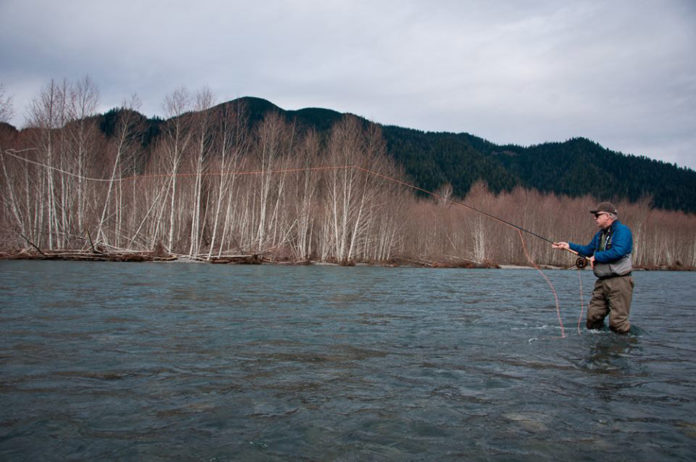


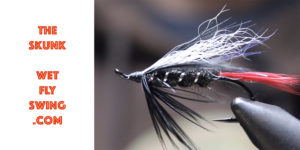
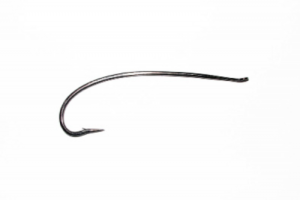
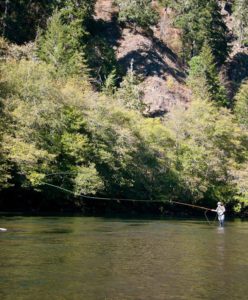
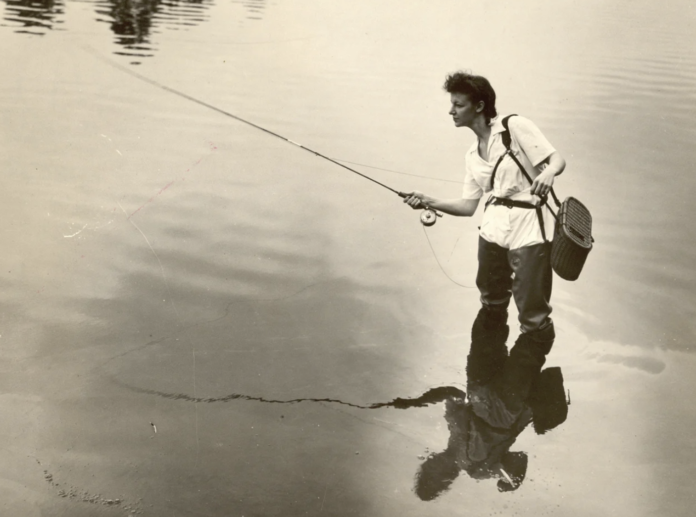



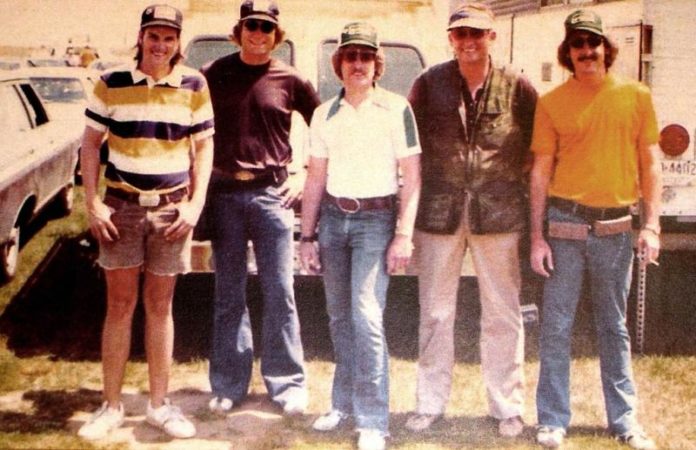


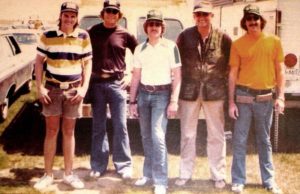
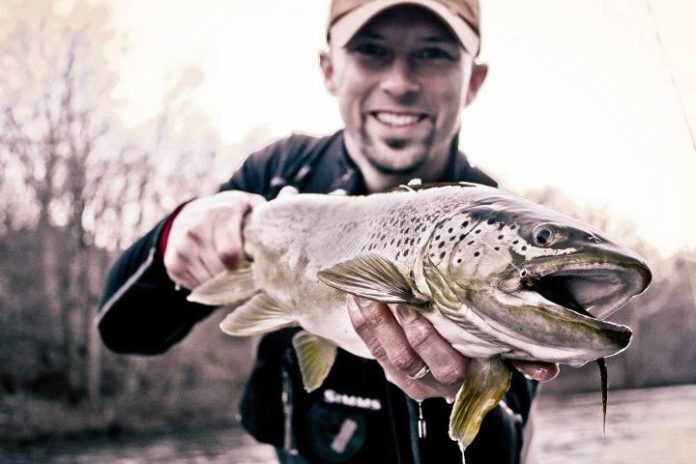
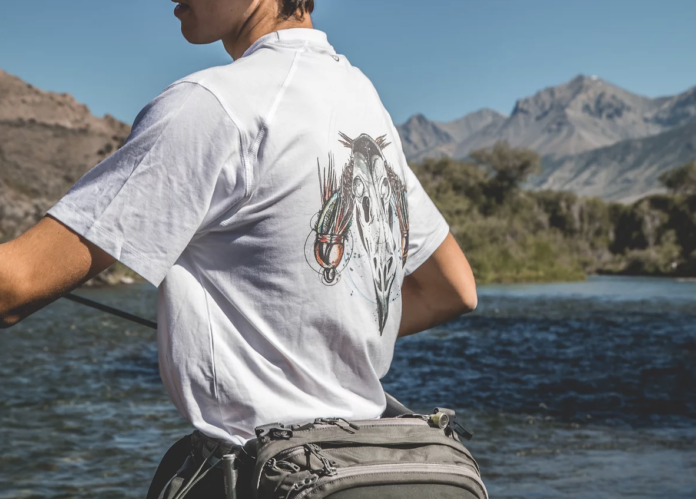


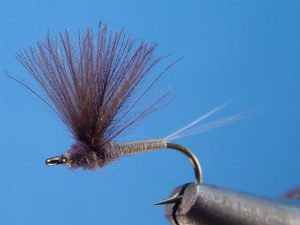
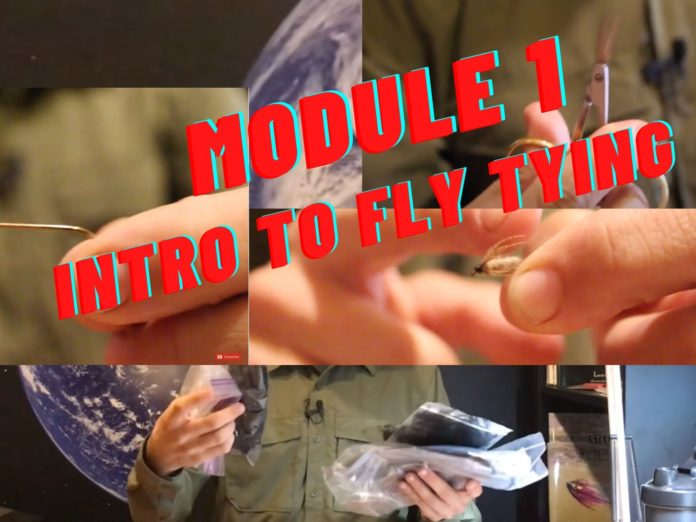


 Here is a pair of


 This wax adds a sticky substance to your thread and helps to keep the dubbing material on your thread.