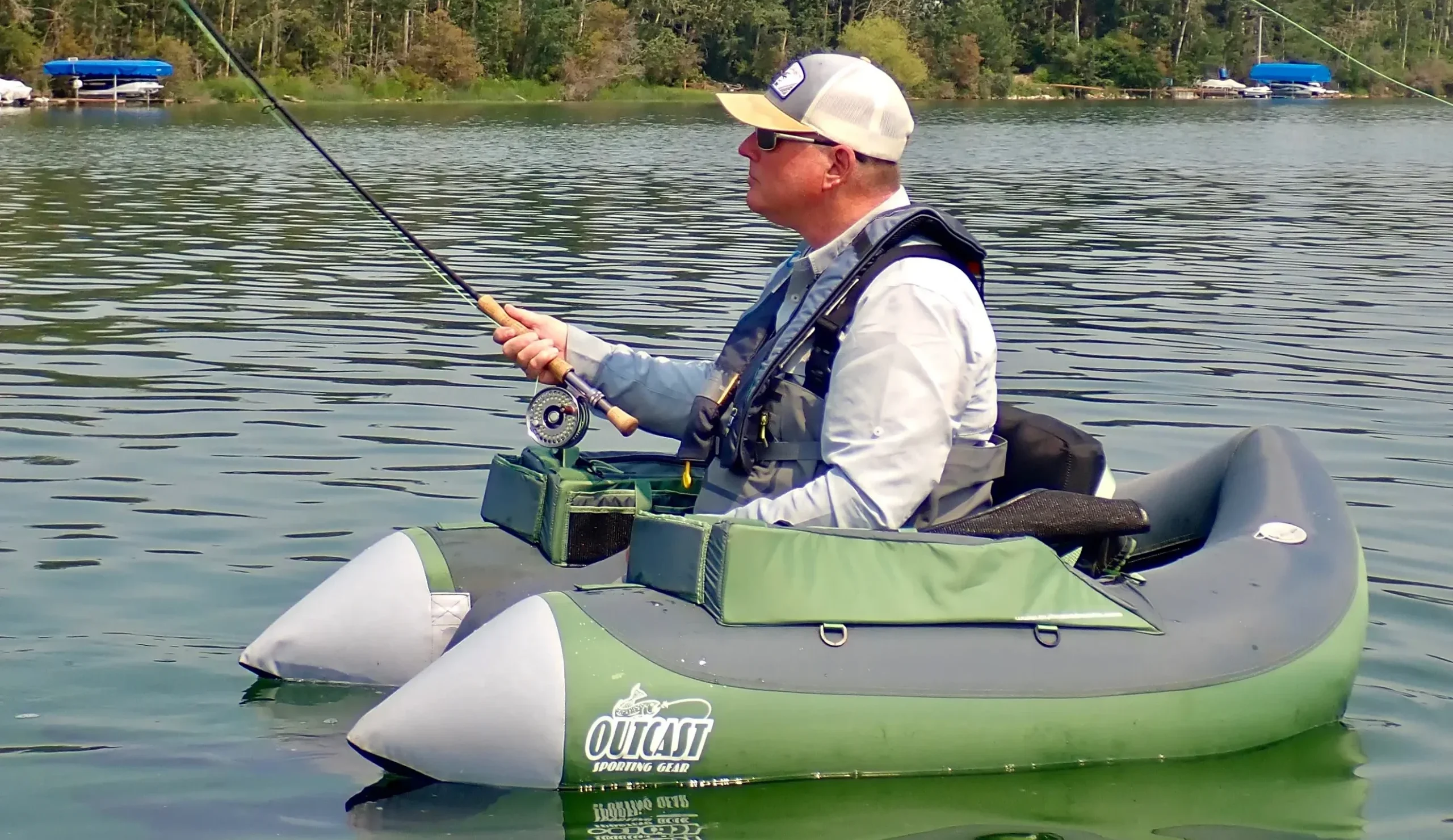
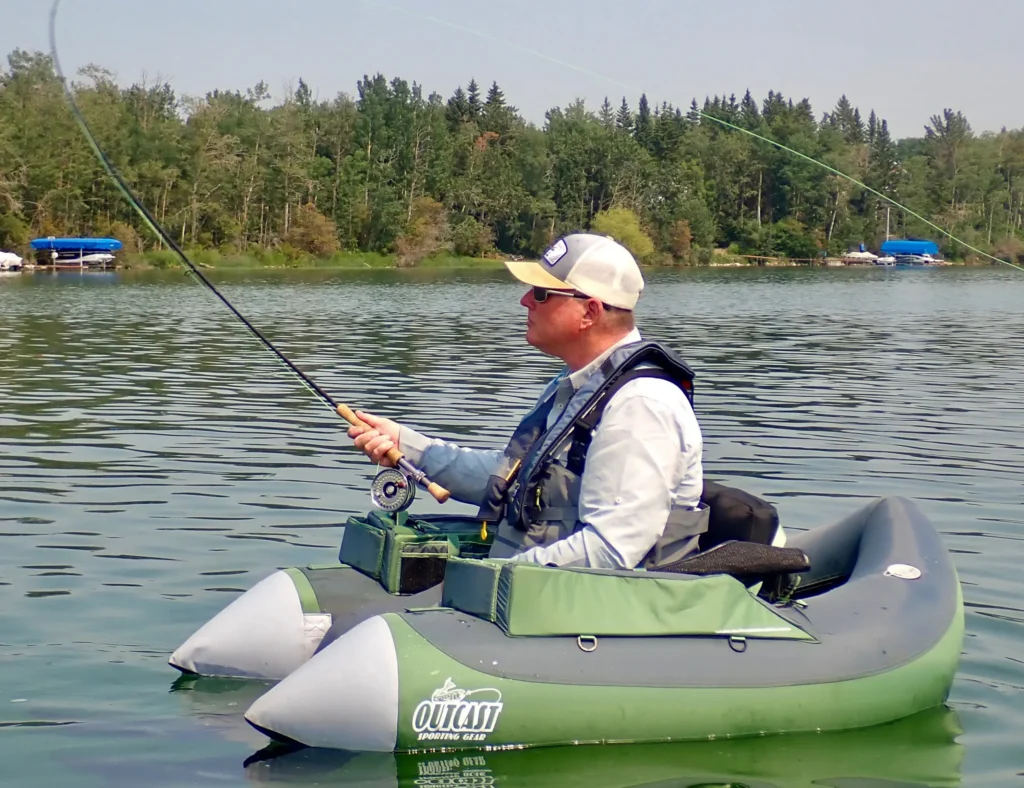
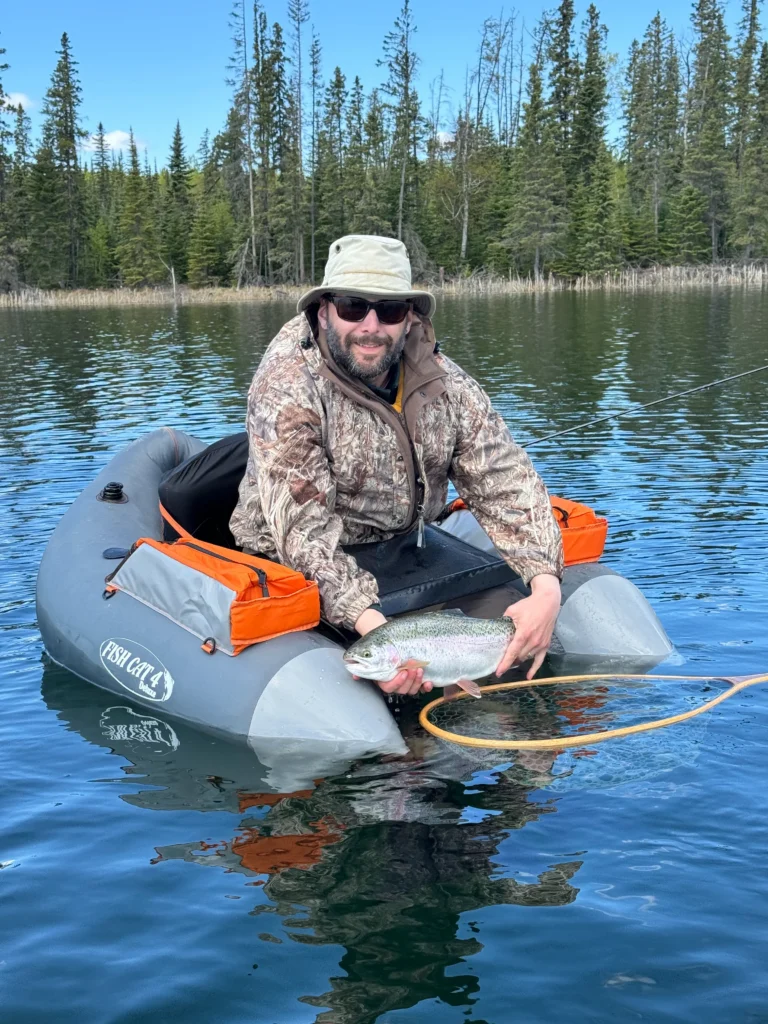
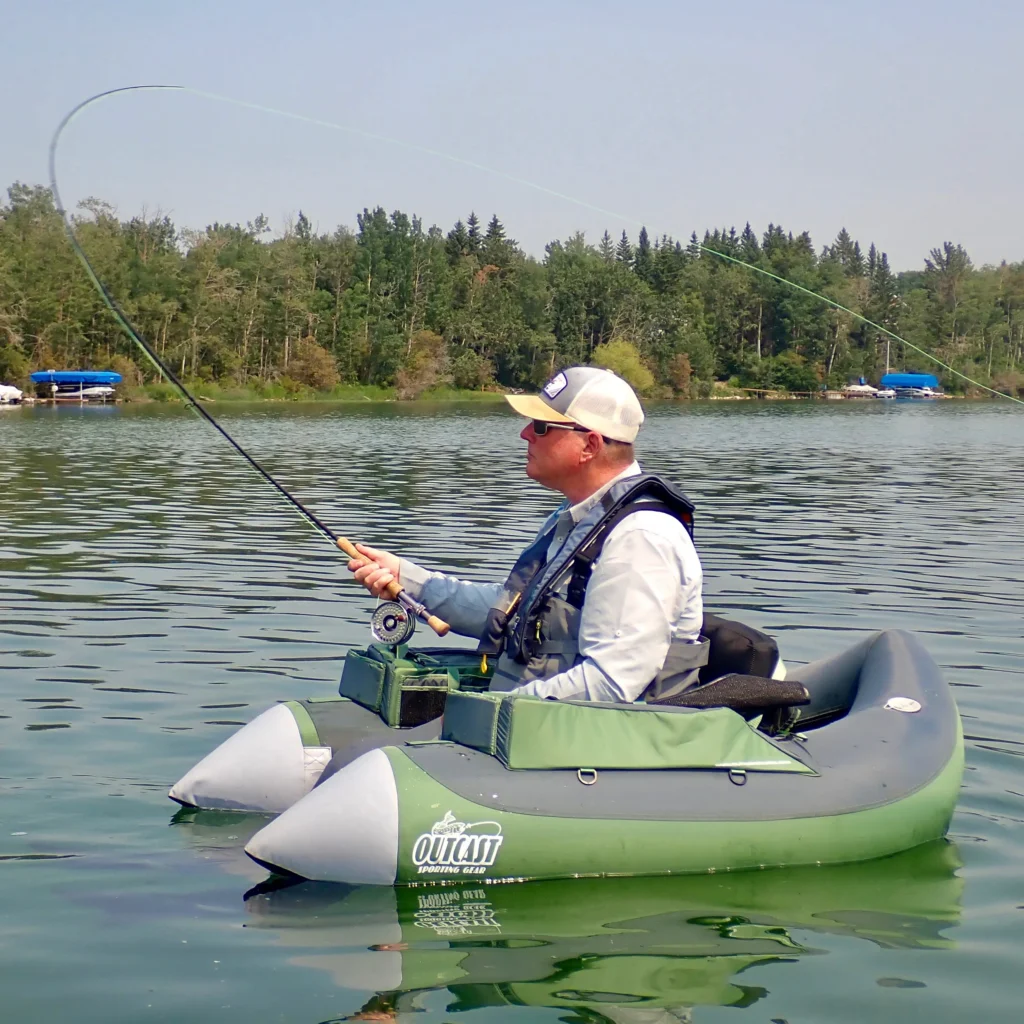
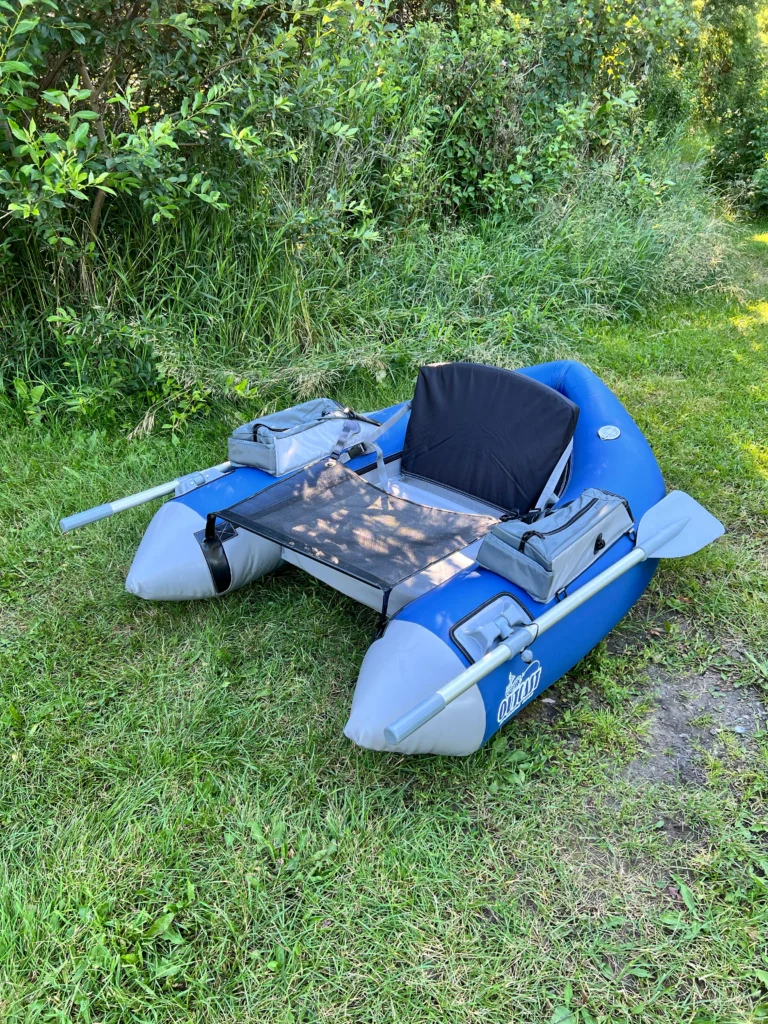
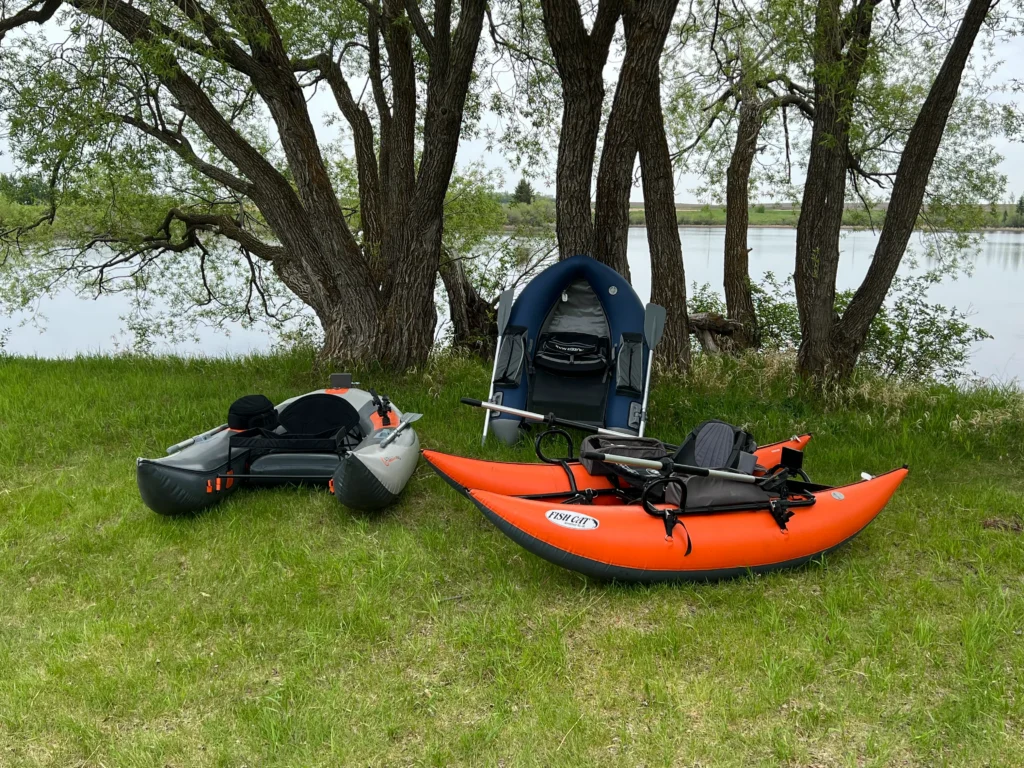
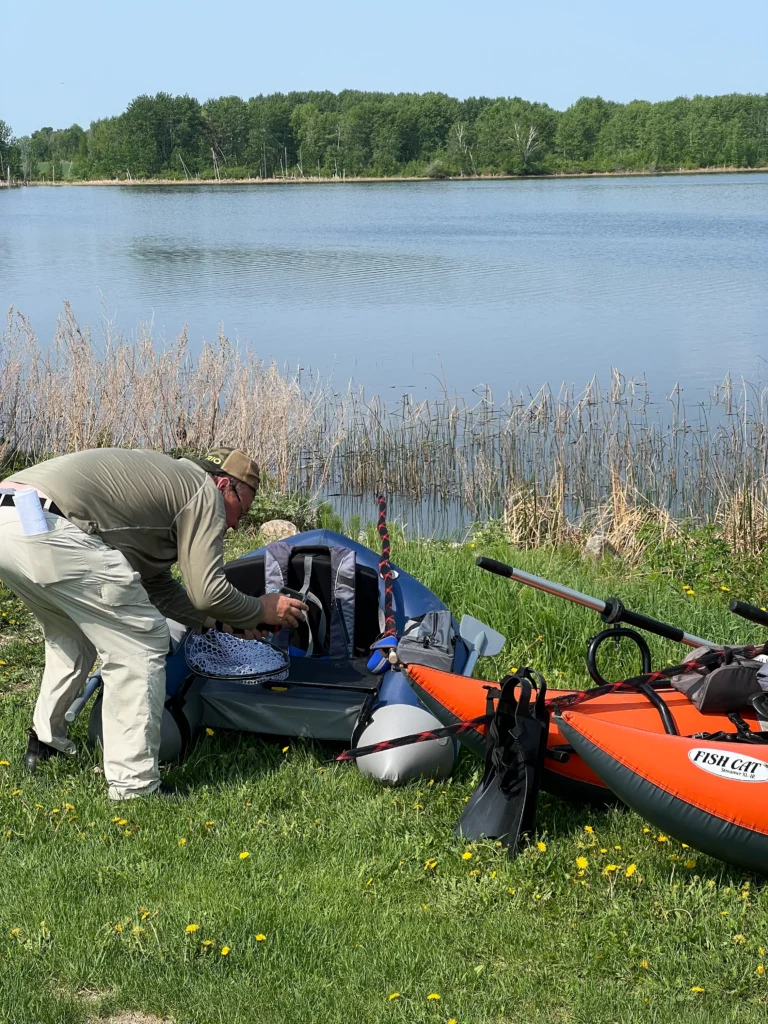
In this episode, our stillwater guru, Phil Rowley, sits down with Chris Callanan from Outcast Sporting Gear to talk about inflatable watercraft for lakes.
They dig into float tubes, pontoon boats, frameless boats, anchoring systems, safety, maintenance, storage, and how to choose the right setup for your fishing style.
Chris also shares the history behind Outcast and how portable watercraft evolved from the old donut-style float tubes into today’s modern V-hull designs.
Fishing lakes from shore works sometimes, but not always. Weed beds, muddy banks, limited casting room, and access issues can all make things tough pretty quickly. That’s where inflatable watercraft for lakes really shine.
Phil also explains why he still loves fishing from inflatable watercraft today, even with access to larger boats.
Before getting into boats, Phil answers a question from Roger about using loop knots for chironomid fishing. Phil says he uses loop knots for almost all stillwater flies because they allow more natural movement in the water.
The only exceptions are dry flies and jig flies under indicators, where he prefers a clinch knot to help the fly sit properly. Otherwise, it’s “loop knots all the way.”
(4:43) Chris Callanan says he’s been with AIRE and Outcast for more than twenty years and now works as Director of Sales. The company has three divisions:
He also talks about the company becoming employee-owned and how that helps keep good people around.
Before joining Outcast, Chris worked in publishing and advertising. Fishing and the outdoors were always part of his life, though. He guided in college, worked in a fly shop, and says he mostly chose Montana because he liked to fish and ski.
(8:18) Phil says one of the biggest barriers to fly fishing lakes is that people feel intimidated by all the open water. A lot of anglers also think they need an expensive boat and trailer setup before they can really fish lakes properly.
Chris says that’s exactly where inflatable watercraft for lakes come in. As he puts it, “access is everything.” These boats make it easier for anglers to get on the water without spending a fortune or needing a ton of space.
(13:37) Phil and Chris talk about how float tubes have changed over the years. The old versions were basically little donut-style tubes where anglers sat low in the water from the waist down.
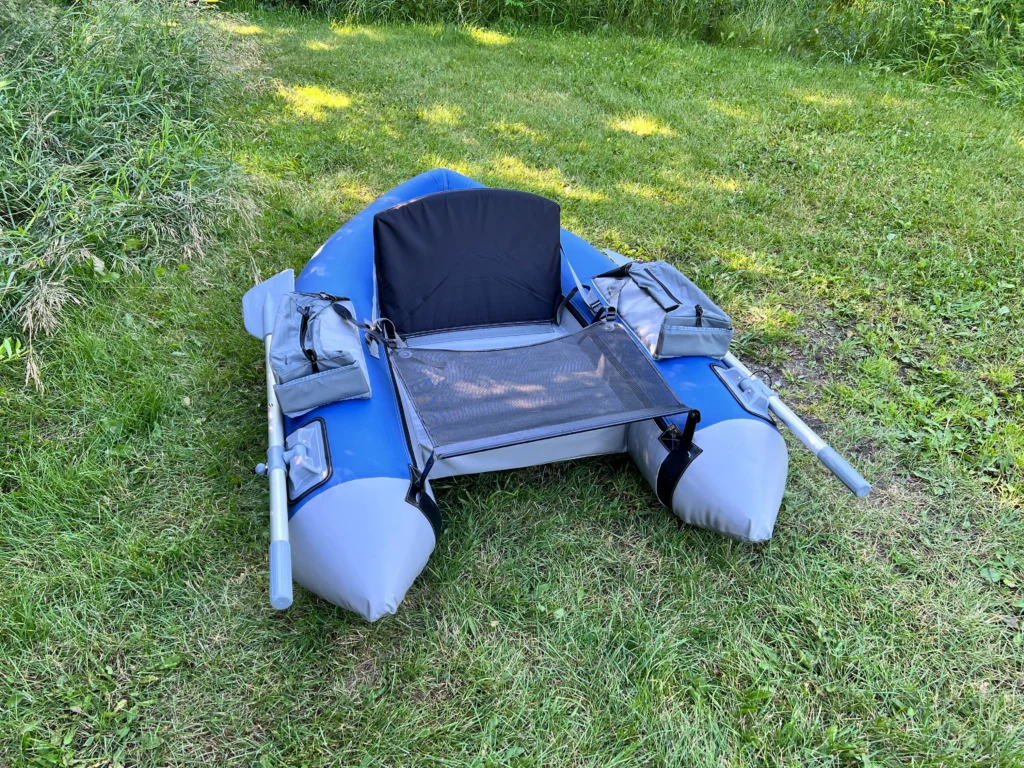
Chris explains how Outcast evolved from pontoon boats into today’s V-hull float tubes with raised seats, better visibility, and more comfort on the water. Phil says sitting higher helped anglers stay warmer and made it easier to see strike indicators in rough water.
(21:28) Phil and Chris talk about the little learning curve that comes with float tubes, especially back in the old donut-style days when anglers learned quickly not to walk forward in fins.
Chris says modern open-front float tubes make getting in and out much easier, and adding oars ended up being a huge upgrade, especially for dealing with wind and covering more water without kicking all day.
Phil also points listeners to Outcast’s YouTube channel for tips on anchoring, setup, and float tube safety.
(23:01) Chris says Outcast originally thought customers were crazy for wanting oars on float tubes. Then they tested them and quickly realized how useful they actually were.
Phil explains how he likes using oars for long moves across the lake and fins for fine positioning once he reaches productive water. They also get into some of the tradeoffs that come with float tubes.
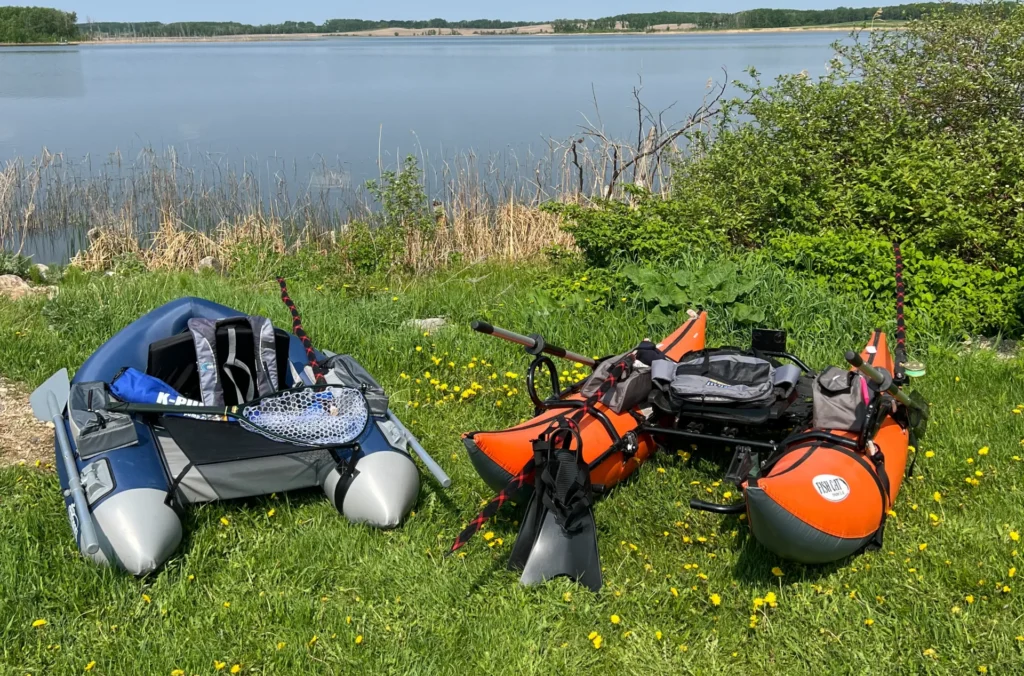
(34:02) Chris says pontoon boats are still one of the most versatile options because they work on both lakes and rivers. Most framed models use 9-foot pontoons, solid frames, and longer oars that can handle bigger water.
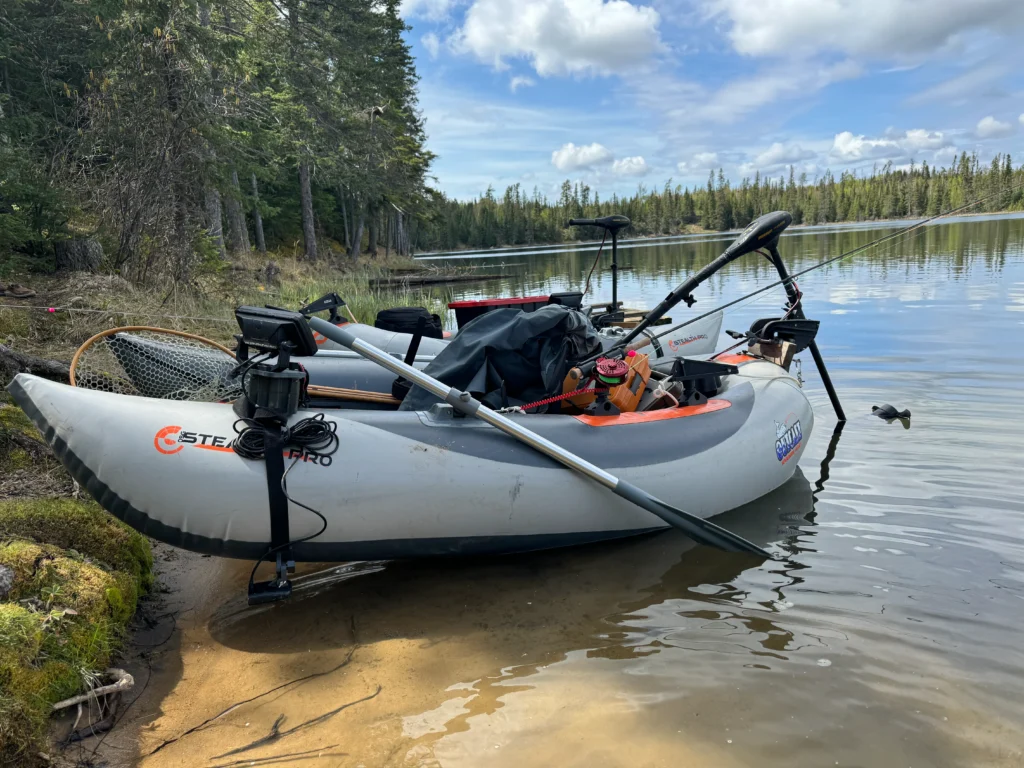
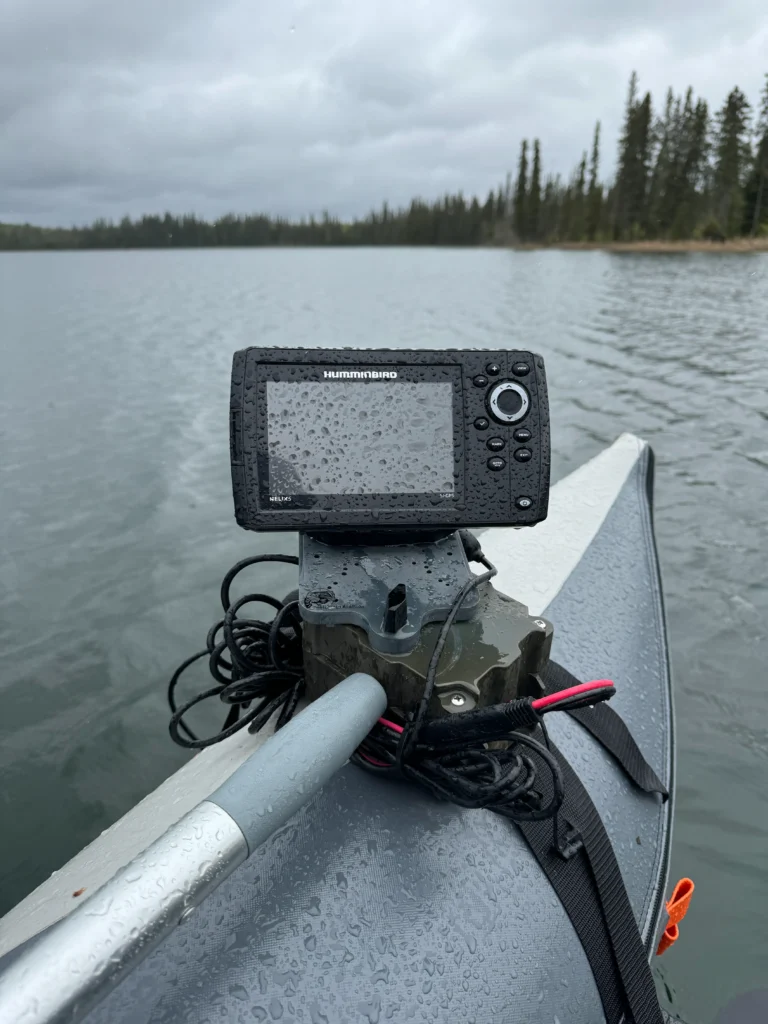
Phil also talks about how customizable pontoon boats have become. He’s seen anglers rig them with PVC camera mounts, sounders, GPS units, extra storage, and all kinds of creative setups.
When it comes to rivers, Chris says rowing skills matter just as much as the boat itself. As he puts it, “it’s not the sword, it’s the samurai.” He recommends practicing rowing before fishing in bigger moving water and always wearing a PFD.
Chris says he personally likes the frameless boats because they keep things simple. No trolling motors. No fish finders. Just easy rowing and fishing.
Phil also talks about using drogues or drift socks to control the drift on lakes, especially during competition-style fishing.
Phil and Chris talk about how most anglers leave framed pontoon boats assembled once they’re set up.
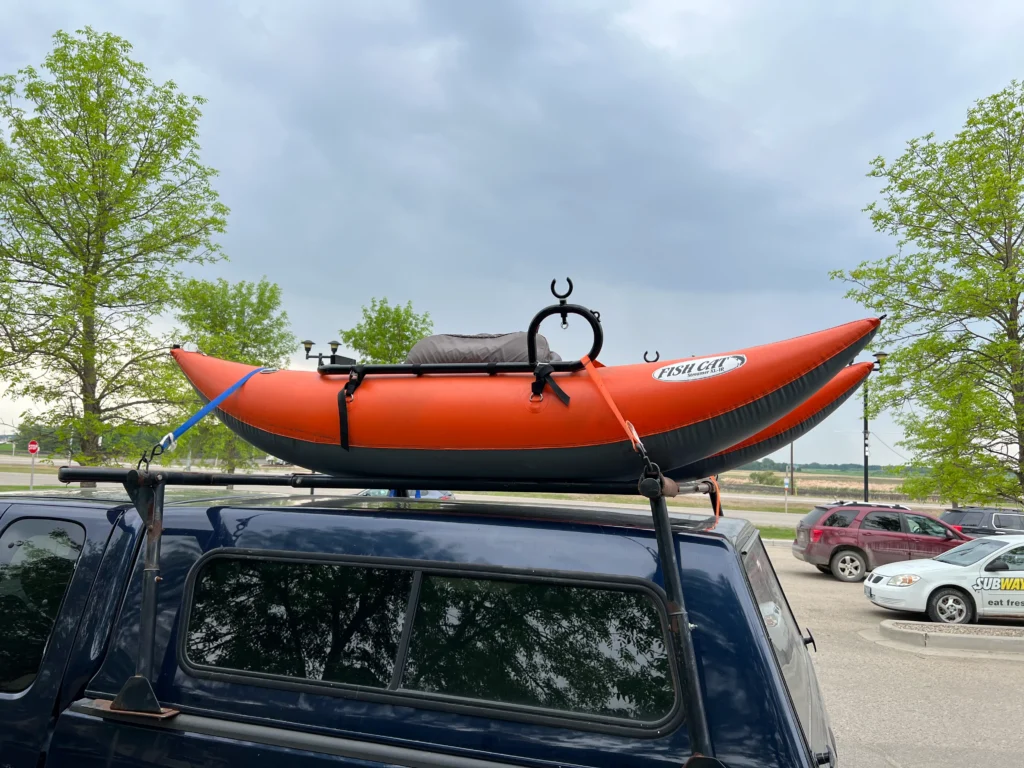
Chris says he likes keeping the frame on the roof rack and deflating the pontoons for travel instead of constantly adjusting for heat and elevation changes.
Phil says he usually leaves the pontoons attached, straps everything together, and slides the whole setup into the back of his truck.
He also recommends sticking with basic soap and water for cleaning. No harsh chemicals and no zipper lube since it can attract dirt and debris.
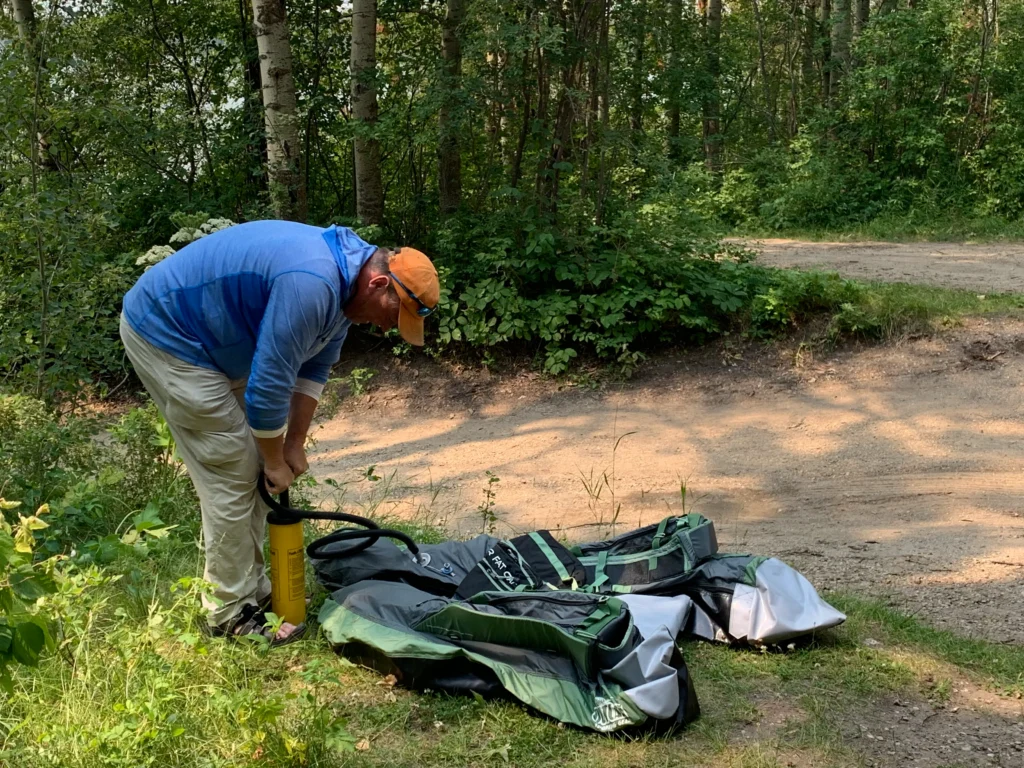
Phil says he usually lays all his boats out in the spring, pumps them up, gives them a wash, and checks that they’re still holding air before the season starts.
(55:56) Phil and Chris talk about how important good anchoring systems are for lake fishing, especially when you want better boat control and cleaner presentations.
They also get into anchoring float tubes. Phil explains a simple rope-and-bungee setup he runs behind the seat so the tube stays straight downwind instead of pulling him sideways. Chris also mentions the Scotty strap-on anchor mount as another simple option for float tubes and frameless boats.
Chris says the best advice he gives people is to buy the boat they’ll use 80% of the time because there’s no single boat that does everything.
For simple after-work lake fishing, he says a float tube is usually enough. For anglers mixing lakes and moving water, he likes frameless boats like the Stealth Pro or Scout. He also mentions the Clearwater for anglers who want more room and a raft-style feel.
They also briefly talk about the Stryker, a lightweight two-person raft-style boat that works well for lakes and rivers, especially for fishing with kids or family.
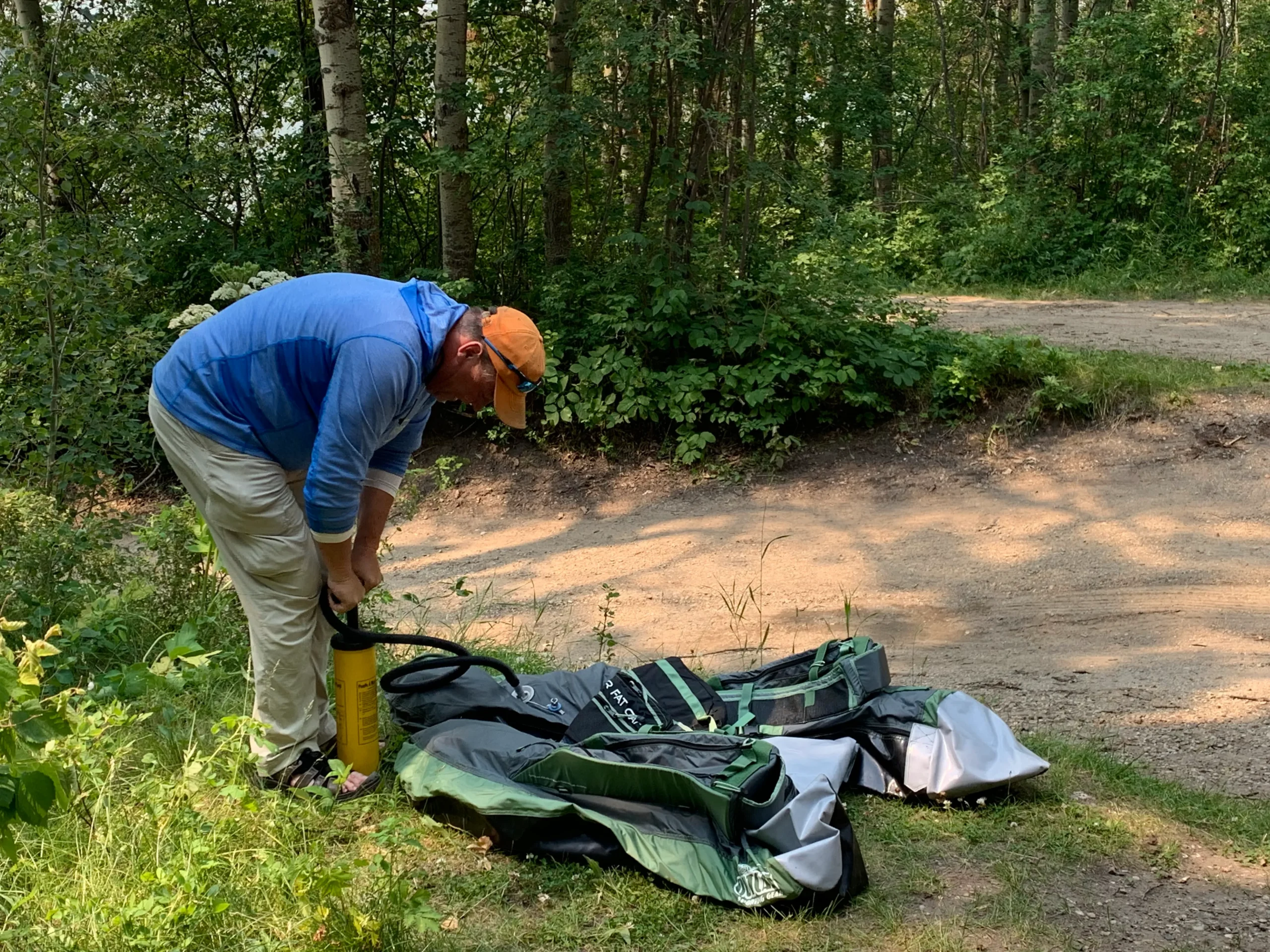
Phil and Chris talk about different pump options for inflatable boats, from K-Pumps and foot pumps to battery-powered inflators like the Ryobi. Chris says he likes the K-Pump because it’s simple, durable, and doesn’t use hoses that always seem to break.
They also talk about how all Outcast valves work across different boats, which makes setup a lot easier.
If you want to dig deeper into inflatable watercraft for lakes, check out these resources:
Episode Transcript
Littoral Zone #25 Transcript
00:00:00 Phil: Welcome to the Littoral Zone podcast. I’m your host, Phil Rowley. The littoral zone or shoal area of the lake is a place where the majority of the action takes place. My podcast is intended to do the same, put you where the action is to help you improve your Stillwater fly fishing. On each broadcast, I, along with guests from all over the world, will be providing you with information, tips and tricks, flies, presentation techniques along with different lakes or regions to explore. I hope you enjoy today’s podcast. Please feel free to email me with your Stillwater related fly fishing questions and comments. I do my best to answer as many as we can prior to each episode, just before the main content. Thanks for listening. I hope you enjoyed today’s show. As most of you already know, you can successfully fly fish lakes from shore, but this isn’t always possible for a variety of reasons. There is often a definite advantage to getting out on the water, allowing you to explore different areas of the lake, positioning yourself so the natural elements work with you and prospecting different structures from different angles. When I first began fly fishing, getting out on the water was a challenge. I know that for many other fly fishers, getting out on the water can also be a difficult barrier to overcome. For me, boats were expensive. I didn’t have the space to store one, nor did I have a vehicle suited to carrying or towing it. For me, an inflatable watercraft was my only option. I began my lifelong Stillwater journey fishing out of a belly boat, now commonly called a float tube. Although I now have more than one boat at my disposal. I still enjoy fly fishing from an inflatable watercraft whenever I can. Be it a float tube or a pontoon boat. In many instances, a float tube or pontoon boat is the best option for me or the lake or the conditions I’m facing. Joining me today is Chris Callanan from Outcast Sporting Gear. Together, Chris and I will discuss all aspects of inflatable watercraft, including their use, safety tips, accessorizing a float tube or a pontoon boat, maintenance and care. Anchoring your watercraft and much more. This should prove to be an informative episode if you are considering purchasing an inflatable boat, this episode will provide you with some guidance. If you already have a float tube or pontoon boat, perhaps Chris and I can help you get even more enjoyment and use from them. But before Chris and I jump into inflatable watercraft and their use, let’s address a question from Roger about my thoughts on using loop knots for Chironomid fishing. On today’s question, Roger asked me what my thoughts were on using loop knots for Chironomids. Well, I highly recommend using loop knots not only for Chironomids, but for other flies too. For me, there are strong knot that allows the fly to move more than knots that are cinched tight to the hook eye, such as a clinch or improved clinch knot. When fly fishing lakes. I believe anything you can do to add movement to your fly during your presentation is a definite benefit. The only time I don’t use loop knots for my flies is when fishing dry flies or jig flies under an indicator. I really don’t have a great reason for using them on drys. I just prefer to use clinch or improve clinch knots. But when I’m using jig flies under an indicator, I like to use a clinch. Not that I cock back towards the hook point and this will encourage the fly to hang horizontal like a regular balanced fly. Other than that, it’s loop knots all the way. Well, Chris, welcome to the littoral zone. Why thank you. Yeah. Sounds kind of dirty. Well, it’s actually called this because in the late vernacular, the littoral zone or the shoal areas where all the activity takes place as far as where’s the best opportunity to catch fish in particular trout. So of course, other species love to live there too. So yeah, but tonight we’re going to talk about inflatable watercraft for lakes and their use. So why don’t you introduce yourself. Tell us a little bit about, you know, you and I have been friends for a long time. You’ve been with outcast sporting gear, outcast boats for many years, worn many hats. So why don’t you walk a little bit through how you came to be where you are today in relationship to watercraft?
00:04:43 Chris: Oh, sure. So, um, I’ve been with air for twenty one years and we have three divisions. We have air, which is whitewater Outcast fishing and then er environmental, which is bill containment, which I have nothing to do with. Um my title is I’m the director of sales for Air and Outcast Space. Okay. So we’re a nice company. We’re about forty five of us. We’re, uh, employee owned now about a year ago. So that’s a pretty cool thing. Um, you know, nobody’s making millions in the fishing industry or the whitewater industry. So it’s a great way for us to keep great employees and, and recruit other good employees.
00:05:30 Phil: All right. How long has outcast been in business then? Because were you there right from the start?
00:05:34 Chris: No. So air started in eighty nine and then outcast was acquired by air in ninety six. And outcast had been doing their owning their own thing. And air had been making their stuff and it just makes sense to come in. I came to air in two thousand and four, and previously I worked for a publishing company called Prime Media, which had all sorts of tie, you know, fly fisherman being one surfer, surfing and air was a customer of mine. And so my son was about about ready to go to school. Air was a customer of mine and they said, hey, we’re looking for a sales manager to merge the whitewater fishing. I had the paddle sports back down for the magazine. And then growing up, I was a fisherman. In college. I worked at a fly shop and guided. So it was kind of this harmonic convergence, basically.
00:06:42 Phil: So it’s amazing how life plays out, right? Yeah. Was that what you wanted to be when you were had visions of where you were going to?
00:06:49 Chris: No. I, you know, you and I are the same age, so we kind of track the same. I mean, I went to college in Montana because I like to fish and ski. Um, I mean, uh, I had to work hard to be a good student. Um, so I didn’t fish or ski as much as I wanted. Studied business and communications. And, you know, I really didn’t know what I was going to do. And the economy was terrible. I got into advertising. Boise at the time was struggling, moved to Seattle and, and, and got better paying jobs and that that kind of stuff. So, um, I always loved fishing and outdoors. Basically people always ask me, are you a fisherman? And I’m like, no, I am, but I’m more of an outdoor guy. Yeah. You know, I like to ski. I like to fish. I like to hike. Yeah.
00:07:41 Phil: So yeah, you and your wife just came back from Patagonia. We did. Yeah.
00:07:46 Chris: And she’s a non fishing person, so we, uh, We did a hiking dig, which is great.
00:07:53 Phil: Yeah, you got to see Mount. I see Mount Fitzroy from the road. We stop, we pull over. Look at it. You showed me your pictures and you saw it from a spectacular vantage point.
00:08:02 Chris: It is. It’s great. And the the hiking keeps me thinner. I mean, I can use it. Fishing doesn’t help me. My exercise.
00:08:12 Phil: Well, with an outcast boat, you can with from your from your sort of thighs down.
00:08:17 Chris: Yeah.
00:08:18 Phil: And maybe a little bit of chest workout. Yeah. Dragging it out and putting it back in the vehicle. So well that’s cool. So okay, so let’s talk watercraft. And I think one of the barriers I’ve heard to why more people don’t fly fish lakes is a couple of reasons. First of all, they look at all that water and are just intimidated. It’s featureless, it’s vast. It doesn’t speak to them like a moving water does, like a river or stream. Um, but the other barrier is, you know, that getting on the water and you guys and your products certainly meet that need because I think some people think they need, like we talked before we started recording about, they need to get a, you know, twenty five thousand dollars boat and trailer, which well, certainly is a good option. But it’s not always practical. It’s not always the right choice. And what you’ve got is, um, you know, something to offer them a gateway into fly fishing lakes, right?
00:09:09 Chris: You’re exactly right. I mean, our tagline is access is everything. And that’s whether moving water or still water. And you can get a basic flow flow tube is, you know, three hundred and thirty dollars, which is pretty cheap, you know, and it’s, you know, you can’t cover the ground as a bass boat, but, you know, there’s smaller lakes, it gets you out there. And, you know, we’ve also found, particularly in Idaho and the West, that so many people are fishing now and fishing, moving water that it’s getting busy and lakes in Stillwater are pretty vacant. You know, not only it’s not just trout, it’s bass, it’s walleye, whatever, whatever you can do. Yeah. Because I think most people want an outdoor experience, right. You know, and you don’t want to be jammed up. People or people are being jerks or something like that. And, and the Stillwater offers, I mean, you fish lakes all the time. How much room is on a lake?
00:10:14 Phil: Lots. Maybe we should stop this conversation right now. Don’t want people on lakes, but yeah, but yeah, you know, when I first started fly fishing, um, I started, you know, in British Columbia has a rich history of fly fishing lakes. It’s kind of the affordable option. Um, you know, our rivers and streams on the coast were anadromous bass, some steelhead salmon. So not a, you know, there’s some resident fish, there’s some great rivers and streams in the southeast corner of the province and up in the north, northeast and up north. But And if you wanted steelhead, you had to drive long distances. So lakes were the place to go. The place to be. And I started not with an outcast boat. With a box boat. No it wasn’t, it wasn’t even a box boat. It was some other brand. I don’t even know what it was, but I could throw it in a trunk of a car. I could pump it up with a little portable air pump that went into a cigarette lighter. Remember when those were in cars? Yeah, and? And I could go fishing. Uh, right. And you guys still, still have that opportunity with the products you offer, right?
00:11:16 Chris: Yeah. It makes it easy for anybody. And you can, whether it’s a float tube for three hundred bucks and you kick. We have frameless boats or pontoon boats. You can row or ad trolling motors. It really makes it easy for people who don’t have the space to store a boat at home. Yep. Um, they don’t have spent as quite as much money and it’s faster.
00:11:39 Phil: It is. And it’s sometimes, you know, some of them will go through the different products you carry in their applications to still waters. But you know, you can’t hump a drift boat up a mountain trail into a remote alpine lake, can you? Unless you got a helicopter.
00:11:55 Chris: No. And we have, you know, backpack stuff. It’s, um, it’s easy. I mean, that’s what we talk all the time is, you know, why use an inflatable? It’s like, it’s just so convenient. It’s so versatile.
00:12:07 Phil: Yeah. You talked about storage. You know, growing up, I, when I left school and left home, um, I had an apartment, so I didn’t have a lot of space, uh, to put things. So a float tube fit in there. It threw in the back of the trunk. It got me access. It got me out in the lakes, you know, because we needed that. Because I don’t know about you, but many of the lakes were private land was an issue. You may have had an access for a boat launch and that was it. Um, trees behind you. So back cast was a problem. Um, you tried to wade in. It was soft. It was muddy, which is common to a productive lake. And all of a sudden you’re up to your throat in mud and can’t get out. There’s weeds. So that mobility, that access, um, tagline you talk about is everything. Um, for that. So why don’t we walk through, um, the different products, the float tubes, uh, pontoon boats, etc. and just talk about them what’s, uh, what their benefits are, maybe some of their limitations just again, to help guide somebody so they get the right watercraft for what they want. Um, you know, I think you and I remember the first float tubes, they look more like inflatable toilet seats. Yes. They were that little donut you sat in and you were basically from the waist down. You were in the water. And and that’s sort of how it all started, right? So what did outcasts do differently from those first generation boats to get to the sort of the, I guess the, the, what do we call them V hulls now or the V hulls?
00:13:37 Chris: So it’s actually started with the pontoon boats.
00:13:41 Phil: Okay.
00:13:42 Chris: Um, you know, there was the, the round tubes, you know, but Outkast, uh, the guy Jimmy Dean created, uh, pontoon boats, which are two pontoons in a frame. And off you go. Yeah. And then with that kind of evolved to, uh, this V shaped, uh, float tube ours have above the water seating, whereas the old ones. Right? Like you said, it was a toilet seat. You’re sitting in the middle. I don’t even think I could get in and out of one today. I know, and put on fins.
00:14:13 Phil: I don’t hike as much as you, so I’m more rotund.
00:14:18 Chris: So it all kind of evolved. Pontoon boat to float tube. Because we were with air, there were always rafts, you know, so it’s all kind of kind of kind of evolved. And then, you know, people like you. I was the same way. You know, you go to a lake and it’s like, I don’t know. I’m just going to huck something. Huck stuff.
00:14:40 Phil: Going. I’m going left today as opposed to right. The other day I went right. It didn’t work. So it must be left. Yeah. Or it’s always the far side of the lake, right? There’s nothing good at the boat launch. It’s always the far side of the lake.
00:14:51 Chris: But guys like you have taught all of us. You know how to understand lakes better. Um, and how to fish them better, that it’s just not blind fishing, you know? I mean, there’s all. It’s really technical.
00:15:03 Phil: Oh, yeah. If you, if you want to get into the weeds, we can go there. Yeah.
00:15:08 Chris: So that was kind of the, it was the single person, uh, watercraft that then bounced the float tubes went to rafts and it was always just portable watercraft is how we are. Plus in Idaho where we are, we have a great spring Stillwater season, you know, basically starts here a couple weeks, you know, goes till June first. Then we tend to get warm. Um, you know, the rivers get back in shape and then we have a great, uh, spring Stillwater or I’m sorry, fall. Spring water season. Um, and now, because so many are floating the rivers, we can fish all the time on the lake.
00:15:50 Phil: Yeah. Well, that’s what the pontoon boats. But let’s start with the float two first. So it was that round little toilet seat or donut. Yeah. Yeah. And then evolved into the V-hull and I, I think having the seat elevated was a real bonus because that was one of the, you know, one of the pros of a float tube is you could paddle very close to fish because of the whole refraction thing. They couldn’t see you very well, but it also made it challenging. If you’re fishing techniques, and I guess strike indicators would be the best one where you’re almost on the same level as your indicator. And if you’re in some sort of chop, which typically there’s usually some sort of wind, it got difficult to see, you know, you see the take and then react to it. And having that seat up a little higher not only gave you better perspective for that, but also, I think kept you a little warmer too, didn’t it? Because you were you were basically knees down getting wet, maybe a little bit on your butt in the seats, but not like you were before we were in that little sort of, uh, saddle or. Yeah, it was almost like, like a jolly jumper for adults.
00:16:49 Chris: And you could, you could fish longer, right? You can see better. You know, one of the things we have a lot of conversation with is, you know, people want to stand, right? It’s clearly not in a float tube, but when you look at it, it’s like you generally have at least a nine foot rod and you’re sitting above the water level, you have really good visibility, you know, I mean, that should be should it’s nice to be able to stand up in a boat and make long casts. Yes. But I don’t think that’s necessary.
00:17:16 Phil: No, no, it’s because you’re low profile. Usually you’ve got you know, if you stand up, you’re easier for the fish to see, right? So you have to cast further because the fish won’t come too close. But with a float tube, I can remember, you know, paddling around, looking over to my left. And because my, you know, I’m so low to the water, there’d be a fish swimming eight, ten feet from me at times. Very happy. Didn’t really notice me and actually very difficult to cast with a nine or a ten foot fly rod, because it’s not a good tool for that kind for dapping I guess. But yes. So you’ve got um, three different models of float tube, am I correct? You’ve got the fat cat, the fish cat and the summit.
00:17:54 Chris: So we do. So we have two brands, right. Fish cat would be kind of mid-level pricing stuff. Outcast is upper level. And then we kind of mesh them together with its quality of materials. I’ll have a five year warranty. So it’s good quality. Um, but on the fish cat side, we have a standard fish cat four form, uh, foam seat backrest, fish cat four deluxe and inflatable seat and backrest standard float tool. Yeah. Then on the, the outcast side, we have a fat cat, which is um, bigger, better pocket system, foam seat and backrest. Super fat cat is inflatable seat and backrest better? Pockets and that kind of stuff. And then we have the summit, which is back packable because in Idaho we have such great alpine fishing. You know, me being a hiker, I like that. So it’s a seven pounds. It’s really compact. So because people get really focused on the the, the weight of the tube, but it’s really the stuff you’re going to take with you, right? You got to take waders, you got to take fins, you know, so it’s still a high quality tube, but it’s lightweight. And then we have what we call the Prowler, which we made for guys that are really big, like the three hundred pound club. And it’s not that they’re going to sink it, but they need a wider V, right? So their legs aren’t rubbing. So we kind of have the float tube thing covered for anything that one might want to do.
00:19:29 Speaker 3: Check out Jackson Hole Fly Company today. Premium fly gear straight to your door without the premium price. Jackson Hole Fly Company designs and builds their own fly rods, reels, flies and gear. Delivering quality you can trust at prices that let you fish more and spend less. Whether you’re picking up a fly rod for the first time or guiding every day, they’ve got what you need. Check them out right now. That’s Jackson Hole Fly company dot com. Jackson Hole fly company dot com. Golden Fly Shop isn’t your average fly shop. They have a twelve foot shark painted like a cutthroat, hovering over a huge selection of the best rods in the business, a massive assortment of tying materials and their famous steakhouse streamer display. And it’s the hub for a community of anglers who never stop tinkering with new ways to catch fish. Sometimes the conversation behind the counter includes what hatches are going off and what techniques are working best. Then tales of destination fishing adventures sought after species are a good old congratulations. When a customer brings stories of finally connecting with that fish they’ve searched for forever. With a growing online store and a budding YouTube channel, you’ll be able to follow along with their fun antics, international adventures, and helpful fly fishing tips. Golden fly shop where the community is hanging out even if they’re supposed to be working. That’s Golden Fly shop dot com. Check them out right now.
00:20:51 Phil: Well, that’s summit when you you know, I’ve seen it at shows. When it folds up, it’s like a little small sleeping bag. Yeah. It’s amazing how small and compact that is. You can just throw it on a backpack with the rest of your gear, including the sleeping bag in the tent and everything. If you’re going for an overnight or a few day trip. Um, and the v-hull obviously cuts through the water better. More than that.
00:21:10 Chris: It does, it does. It doesn’t push water cuts through the water, you know, it allows you to, to fish out of the front. You know, I mean, I’m not the expert like you are, but I like to put my tip in the water sometimes, you know, and strip in. It’s just it’s easier to land a fish. So I like that open bow.
00:21:28 Phil: It’s got the stripping aprons and, Yeah. And we’ve also got tips on how to anchor them even. Right. Because you, Outkast has got a reasonably active YouTube channel with lots of information about the products, but also, um, information on, uh, tricks and tips and, you know, how to safely get in and out of a float tube because that’s always a, you know, a concern. I’ve seen, you know, I’ve seen people trying to walk forward with fins and the float tube. I remember one year on Dry Falls Lake, this was back in the, the donut days. Um, and he caught his fin and tripped and fell face forward into the lake, only into about a foot and a half, maybe two feet of water. And he had a hell of a time getting himself up and out of there. And we were trying to rush over to help him out before he drowned. So there’s definitely an art to to getting in, uh, to a float tube, isn’t there?
00:22:17 Chris: There is. And we take so much of it for granted, right? I’ve been float tube fishing since I was twelve. Yeah. You know, and when you’re twelve, you learn not to walk forward and fins, you know.
00:22:28 Phil: Once to faceplant on a gravel boat ramp.
00:22:31 Chris: Took me two or three times. So, you know.
00:22:34 Phil: Slow learner. Yeah.
00:22:34 Chris: You said. Yeah.
00:22:35 Phil: You said you had to work hard in school. Yeah, yeah.
00:22:40 Chris: But um, so yeah, so particularly that open front there, it’s easy. You put it in there, you face in the back, you sit in it, put your fins on, put the apron on and push off and off you go. The other thing we’ve morphed into is for years, customers wanted oars on float tubes and we thought they were crazy.
00:23:01 Phil: Yeah.
00:23:01 Chris: And then we put them on and we thought, oh man, we’re crazy. We should have done this years ago.
00:23:06 Phil: Yeah. Yeah. That’s the cruiser, right?
00:23:08 Chris: Yeah. That’s the cruiser. Yeah. As I’ve gotten older, I don’t like kicking all day, I get tired. And so it limits my time on the water. We’re it’s real windy for us in the spring. Um, so having those oars to just row out to where you want to get to and then use your fins to kind of fine tune as you scare fish around. Um.
00:23:29 Phil: Yeah. It’s, uh. Well, I’ve I’ve got one of the cruisers and I was, you know, the oars tucked away neatly when they’re not in use, they lay flush along the sides of the tube. They’re not in the way. And, uh, you just pick them up and scoot. Right. And it’s yeah, it’s funny because I think sometimes people with oars, you and I talked about it at shows when we’ve been together is people, um, maybe we’re getting ahead of it a bit here. More into the pontoon boats, but people always guess, you know, those oars, the right length. Right. And I think your association with air, who, for those of you who don’t know, air is very well known for whitewater rafting where or length and everything’s critical because, you know, some of the waters, those boats go down, you better have everything right or you’re going to be in a lot of trouble. So, um, what are you looking for in your design? You know.
00:24:17 Chris: So for the oars and the float tubes, a lot of it is it’s the size, right? People always want technically in there, right? They want a longer or because it’s going to be easier to go, but you can’t get the blades out of the water, right. You’re pushing down between between your. So we want something that you’re going to sit there and it’s going to be right there, and you’re going to tuck it out of the way. And we spend a lot of time talking to people and they’re correct in their thinking, but they just haven’t thought through like, oh, do I really want to push down all day? Yeah. You know, or do I just want to be able to row? And particularly with the flute too, it’s a portable watercraft, watercraft, if you want to add fish finders, anchors, you know, bigger oars, rod holders. It’s one of the framed pontoon boat is awesome, right? Because it has that frame. You can bolt all this stuff on, do two anchors like you like to do. You know, it’s so much easier on that stuff. Um, you know, we, we talk to people all the time that want to put a motor on a float. It’s like, that’s not what it’s meant.
00:25:28 Phil: No, no.
00:25:29 Chris: No, it’s moved to a pontoon.
00:25:30 Phil: It’s a kick or a roll. Yeah. And that’s, that’s probably, you know, we’ll talk about some of the cons now I guess that’s a great segue Chris. Well done.
00:25:37 Chris: Um thank.
00:25:37 Phil: You. You know, there is I guess you can only carry so much with you in a float tube. Some of us, myself included, are gear junkies. We like to carry a lot of stuff to cover every potentiality, so pockets only hold that much. Um, I did find it challenging sometimes there’s some lakes. I remember one um, what was it called? It was up north of Whistler in British Columbia. Was it that far north? I can’t remember. Anyway, it was really soft, muddy bottoms, difficult to launch and almost impossible to get out. Um, because, you know, you go to stand up and you’ve got nothing to stand against. You just suck back down in the mud again. You had to crawl out of the water like, yeah, it was a little thank God nobody saw us back then. But sometimes I know people who fished that lake. They bring a little piece of three eighths plywood with them and lay that down to, you know, disperse their weight of course would tends not to sink. So when you stand on it and let go, it kind of shoots off like a big Frisbee and it’s gone. But that works against you. Um, of course it’s human powered. So as we talked about, there’s no motor. I don’t, I can’t, you know, why you’d want to put. That’s just not what that boat’s for. It would just be danger. And of course, you can’t use them on rivers and streams, right. You wouldn’t want your. You don’t want your legs hanging down, going through. You know, it’d be at the very least hard on your ankles and could be potentially fatal.
00:26:58 Chris: Yeah.
00:26:59 Phil: And of course, the washroom. Yes, yes I did. It’s funny, I had a a gentleman once in a fly tying class and we were all tying away doing things. And then the at the time, float tubes were very, very popular. And the always the discussion of how do you deal with the washroom? Right. And he had this catheter system that he figured out. This was back in the days of those neoprene waders, and just the little tube would stick over. And then he happened to mention that sort of stopped the class in mid sort of, oh, where’s this going? And then we started up again. And then it sort of moved on. And then he pipes up, oh. And then it was the shaving. And we’re all like okay, you know what? We can row ashore. And for ten minutes out of our out of our life, we can go to the washroom. So but again, great for storage. You guys have the boat bags, it’ll fit. Um, you know, you can throw the float tubes in there, um, portable back of the car, checked baggage if you want to take one with you on a trip. Um.
00:28:05 Chris: Most all our bags have a D-ring on them. Yeah. Um, as do the float tubes that you can put backpack straps on to, to carry them and make it really easy for transportation. Um, the bags that we gear bags that we put on are always ample. Yeah. Right. That and I use a gear bag to zip up my rod in there instead of a rod holder. Um, so we’re, we’re always conscious about, um, because we’ve all bought a cheap whatever sleeping bag. Yes. And you can never get the sleeping bag back in the bag.
00:28:36 Phil: Or a tent.
00:28:37 Chris: Or tent. Yes.
00:28:38 Phil: Same.
00:28:39 Chris: So we always overengineer any bags that we have that it’s easy fit. The gear bags are big enough to have a, you know, take all your good stuff. Right. I mean, how many fly boxes should you really take out on the lake?
00:28:55 Phil: Oh, a hundred.
00:28:55 Chris: I mean, I know, I know.
00:28:57 Phil: No it’s true. You know, it’s trouble is if you bring all that gear, you sort of get reliant on it. But then you. Yeah. I think as we get a little older and wiser, we start streamlining and go. I have not taken this thing out in ten years, but I carry it around with me. I need it, I need it, of course, the one day I’m not taking that sure as hell. Yeah. Yeah, but that’s just Murphy’s Law. One thing we forgot to mention is the construction. Because the original float tubes were the old truck inner tube tires, right? And that’s evolved much more for the better now, isn’t it? Because it’s a two. You’ve got the outer covering and then you’ve got a urethane bladder that’s indestructible almost.
00:29:35 Chris: So and that goes back to the original air days. So Greg Graham, one of the original owners, um, original owners, Greg Graham and Alan Hamilton and Dennis Hill, and they all had unique deals. Um, Alan was more of the finance guy, sales guy. Dennis was great about looking down the road at future stuff. And Greg was kind of the mad scientist builder, engineer. Yeah. And he worked, he built, um, inflatable kayaks in his garage with PVC, worked at Moravia, which is also an Idaho company. Um, and we heat weld PVC and PVC is air tight, but it’s not abrasion resistant. Yeah. So over time, if you drag stuff, you get a seeping leak. So Greg’s idea, um, instead of coding it with a rough urethane on the outside was an inner tube essentially. And so we used depending on the model, the high end models have urethane bladders, um, a fish cat, the mid level more of a vinyl bladder. Um vinyl is less expensive. It can be a little bit more challenging to weld. Um, but again everything has a five year warranty. So there it’s sometimes our people look at our stuff and think, well, it’s a little heavy. It’s like, well, it is, but it’s double the thickness. It’s easy to repair. I mean, you can literally put duct tape on a bladder reinflate it, and you get that compression fit that’s going to last for a couple days at least.
00:31:06 Phil: So and while we’re on that just popped into my mind, let’s talk about pumping up inflatable watercraft. Um, because it’s not a sci thing, is it? It’s a volume. It’s low pressure, high volume. Right.
00:31:19 Chris: So it’s we and we sell pressure gauges, but it’s just two and a half psi. And we have struggled finding consistent readings on a low pressure. So it’s just so much easier to press mid tube with a quarter inch of give. And you know that’s two and a half. And you know that in the morning if it’s cold is one thing and then it warms up in the afternoon. So it’s just easier. You know you’re going to press mid tube. I’ve got a little air out, you know, or whatever.
00:31:53 Phil: I always recommend people to be very cognizant of, you know, traveling with an inflated tube, not only for air temperature, but elevation, right?
00:32:02 Chris: Because big.
00:32:03 Phil: Yeah. And really the strength of your inner, your tubes is so much that it’s not so much the tube that it just expands and expands and eventually it’ll split the cover, right? Is that correct? Fair to say? Yeah, correct. That’s another testament to the quality of the tubes you guys have. So, you know, I think some people new to this or, you know, it’s some people are not, you know, terribly happy about walking on a frozen lake, fearing that they’re, you know, going to crack through twenty some odd inches of ice, at least in my neck of the woods or more and just worry about their safety, uh, in a flow tube that, you know, that you’ve just provided, I think peace of mind that, you know, these things are durable and are not, you’re not going to pop it like a party balloon to fly around the lake backwards. Right?
00:32:44 Chris: Well, I had a conversation with the guy today and he had a boat that was twenty years old and he wanted to replace the bladders. Yeah. I’m like, is it losing air? He said no. And I said, well, you don’t need to replace the bladders. The all the abuse is on the outer material, you know, so if you got an issue, you know, we have replacements or we can make them. But it’s really that outer material. And sometimes the gaining elevation and heat is a big deal. Somebody might have a nick in it and they don’t know it, and all of a sudden it’s hot, or you’re gaining elevation and it’s in the back of your truck and it yeah, it’s nasty.
00:33:23 Phil: Not good. But yeah, but, uh, and of course, always, I guess it goes without saying, always wearing a pH D of some sort whenever you’re in, in anything. But, uh, okay, let’s move on to, um, pontoon boats, right? Because they have become increasingly popular, I think in recent years, maybe not as portable as a float tube, although we’ll talk about some of the frameless models you have, um, but dual purpose rivers and lakes as well. So you’ve got that, you know, the, you know, there are anglers out there, uh, myself included, that don’t mind drifting down a river once in a while. I’m not good at it.
00:34:02 Chris: Well, I think, you know, we started with pontoon boats and they’re great. Uh, and the advantage is, you know, generally speaking, they’re nine feet long, Sixteen inches in diameter, you have either a steel or an aluminum frame and a good set of six or seven foot oars. If you’re good rowing, I mean, you can go three plus rapids on those things. You can also with the frame boats, as we’ve talked about, add rod holders, depth finders, better anchors, multiple anchors. So there’s a lot of use, um, for those boats. And we still sell a lot of them and they’re very versatile. What we have found, we sell a lot of frameless boats, which is basically in a lot of cases, it’s, it looks like a big float tube. Yeah. With six foot oars. The a general framed pontoon boat weighs say seventy pounds. The frameless ones are half that.
00:34:59 Phil: Yeah. The stealth pro is what.
00:35:01 Chris: thirty thirty five and it’s real compact.
00:35:04 Phil: Yeah. Roll it up like a big sleeping bag in into the boat bag.
00:35:08 Chris: Right. And so it just kind of depends on what people are doing. You know, if you want to do the Stillwater thing and add a lot of stuff, that’s great. Or if you’re going to fish like the Deschutes, right, where you can’t fish from a boat, but they have significant whitewater, and you’re going to want a really good set of oars and a good frame. You know, you want a framed pontoon.
00:35:33 Phil: Have you taken one of your pontoon boats down? Something like that. The Deschutes. I’ve fished Deschutes. It scares me to weight it.
00:35:41 Chris: Yeah, I know you’re up to your nipples in water and stepping on boulders.
00:35:45 Phil: It’s like putting your foot over a boulder and just about to transfer weight, and you’re not sure where the bottom is. On the other side, you assume it’s in the same two and a half feet of water that you’re standing in, but it may not be.
00:35:56 Chris: So the nice thing about having a Whitewater department is every Thursday, um, our whitewater guys take boats out and, you know, I think they call it throw down Thursday. Yeah. And they go, you know, and they test stuff and have fun.
00:36:12 Phil: Try to.
00:36:13 Chris: Break. All right. All our fishing stuff is tested on class three plus whitewater. So for me, I’m like maybe a class three guy. You know, I don’t I don’t need to do that. So, um, but we have people that test it. Um, so it’s awesome. And I wish I coined this term and I didn’t, but when it comes to the boats, it’s not the sword, it’s the samurai, right?
00:36:39 Phil: So I like that.
00:36:41 Chris: The boats can do anything. Yeah. But it’s your ability and it’s really important that we educate people that you should wear a PhD and you should be knowledgeable on how to row a boat. And if you’ve never rode a boat, then take it out without your fishing stuff a time or two. So you gotta understand because, you know, like anything, even class two, class one, you’re, you’re having a great day and you’re not paying attention and you hit a rock. Funny. Yeah, well, that could be really dangerous.
00:37:11 Phil: Or pushed into a sweeper and then rolled. You know, sweepers are scary. Yes. That’s why again, vote for lakes. Um, you can still hurt yourself on lakes. It just.
00:37:22 Chris: You can.
00:37:23 Phil: It takes a little longer. The light bulb should have gone on a few times before it got really terminal. Um, but again, you talked about more storage so you can take more stuff. You, you, you know, we keep much of what you, you offer as well as all the accessories that go with these boats. You’ve got the, um, the seat back um packs.
00:37:43 Chris: Yeah. We have like a seat saddle bag that holds a net and stuff for, um, you know, beverages and a jacket. Um, we have all cargo pockets on everything. Um, and I use, I try not to take my chest packer vest, whatever you use. Um, you know, I just like to use the pockets, you know.
00:38:02 Phil: Well, you’ve even got little sub pockets. You can put tippet spools in them and fly boxes and tuck a reel in there if you have to, uh, you know, and hold a rod. Um, yeah. So much you can do. It’s actually, you mentioned about accessorizing, you know, some lakes I’ve been to, you know, everybody’s sort of set up for the day or maybe they’re camped there and they leave there. You know, it’s safe enough to leave your, um, your pontoon boat on the beach and you go with the coffee in the morning and walk along and see the customization. Um, it’s quite inspiring at times because they can, uh, you look at a problem you’ve had and they’ve solved it with some PVC pipe and some straps. And, you know, I remember a guy in Manitoba I saw had a, a built a PVC apparatus, um, I think it was one of your pontoon boats. And he had a rack set up for his camera for his selfies. When he held a fish, he had another um mount. You know, it’s kind of this continuous frame with these different mounts on it. One for a camera, one for his sounder. What was the other one? Oh, the other one I think was for a GPS when handheld GPS were all, you know, before they were integrated into Sounders. This guy had everything on there and it was pretty impressive, right? To do all that kind of stuff. So. Wow. Yeah. Um, I also like the high seat position on him as opposed to a float tube. Again, a little more perspective. Um, yeah, you’re perhaps more visible, but you’re up a little bit. You’re really only you’re from your shins down or getting wet. Um, do you wear just back to the whitewater just popped up all over the place as usual. Um, recommend using fins on moving water or not.
00:39:34 Chris: You know, we do. It depends. It really like the South Fork of the Boise which we have here can be kind of nasty and there’s some significant rapids. And so a lot of people use fins. Me personally, I find it difficult to fish from a boat in moving water with fins on.
00:39:56 Phil: Yeah. Because they’re going.
00:39:57 Chris: To spend more time mucking around with my line. So for me, I’ve gotten so frustrated. I generally use those boats to go point A to point B.
00:40:08 Phil: Yeah, it’s a transportation system and then get out and fish. Yeah.
00:40:12 Chris: Plus, you know, when I’m fishing, I’m kind of impatient at times, so I don’t want to bend over and take my fins off, on and off. You know, I just I want to go fishing.
00:40:20 Phil: Yeah. And you could if you wanted to bring them along, you know, put them in the, you know, store them somehow right on the boat, you know, strap them into place. You’ve got lots of those neat little straps that I love. Like, what are they? Cam straps, cam straps. Yeah. I love those things.
00:40:36 Chris: Um, and it just depends, you know, I think it’s my personality being somewhat impatient at times that it just doesn’t work for me. Lots of guys do it. Yeah. I mean, I talk to guys all the time that don’t even use oars. They just use their fins like, wow.
00:40:49 Phil: I think I want that. Isn’t there some states and provinces? You’ve got to have multiple forms of propulsion. If something fails, something else will work.
00:40:57 Chris: Um, I, you know, in the, in the US each state is different. So I’m sure that’s probably true. We don’t have that here in Idaho.
00:41:07 Speaker 3: Fish the Fly Guide service is dedicated to sharing the incredible fly fishing opportunities around Jackson Hole. Whether floating the scenic snake River in search of native cutthroat trout or hiking into the mountains to explore pristine tributaries, every day on the water is an adventure. You can join them for an unforgettable fly fishing experience in the heart of the Tetons at fish. The fly dot com Trout Routes by Onyx is built for fly anglers who want better Intel without spending hours digging for the information. You’ll get access to public land maps, stream access points, regulations, and even road and trail maps all in one place. It’s become my go to app for scouting new trips. You can check them out right now. Go to fly dot com and download the app today.
00:41:53 Phil: Yeah, I think that may pertain more to boats. I know when I’m taking out some of my boats, I’ve got to have, you know, you usually got a gas or electric motor and then you’ve got to have some and common sense says you should have something else. Um, because both of those things can run out of gas, run out of battery, or just have some mechanical and then you’re stuck, right? So I think it’s always good on a lake to have, you know, a lot of times I use the oars, as we mentioned with the cruiser from getting a point A to point B, doing those big moves, right. And then when it gets to a spot, and then you just use the fins to do your fine tuning, you’re kicking into position or moving twenty feet or what have you. Um, the frameless boats, you’ve got the stealth pro, right.
00:42:35 Chris: Okay. Stealth pro, the scout, the commander. And so the commander is more like a kayak.
00:42:43 Phil: Yep.
00:42:44 Chris: And, uh, the stealth pro and scout are like big flow tubes with oars. You know, one is eight feet. One is seven feet. Different quality materials for Stillwater. I like the scout and the stealth pro because it’s got that open bow right. I can fish strip in front, you know, or look at my indicator better. Um.
00:43:05 Phil: Land of fish.
00:43:06 Chris: Yeah. Land of fish.
00:43:07 Phil: Or as the video I did for you guys. Watch a fish go by your right shoulder over the back, bounce off and go through. We’ll put a link to Outkast’s, um, uh, video channel and some of the key videos in the show notes. Uh, I encourage you to have a look because full disclosure, I’ve worked with Outkast for a number of years now, and we’ve done a number of how to videos and from boat set up to, you know, how to get in and out of a float tube safely, how to row a boat, you know, how to fight fish in a boat, how to fish chironomids a bunch of things, uh, from a boat. So there’s some great tips there that I encourage people to have a look at if they’re, you know, looking at getting into inflatable watercraft and just seeing what they’re in for and understanding and I guess how to choose one, right? You know, what’s the best boat for their needs? But even that stealth pro, you’ve the only metal, the only frame, if you want to call it is the foot bar. And that’s removable, right. So and you can add electric motor mounts.
00:44:00 Chris: You do a motor mount, um, anchor system pockets, rod holders for my fishing. You know, I like, uh, anchor in one pocket. Mhm. Um, it’s pretty good. When we tested the, uh, designed and tested the, the frameless series, we were like, no one will ever buy a frame boat again. Well.
00:44:23 Phil: I got.
00:44:24 Chris: You know, it’s just so easy to move around. We test those in class three Whitewater as well. Even myself, who’s not exactly a whitewater guy.
00:44:33 Phil: But you’re an outdoor guy.
00:44:34 Chris: I am an outdoor guy. Yeah, you’re a big deal. So, uh. Um. So yeah, the frameless, they really suit my fishing. Yeah. Because again, I don’t want to use the trolling motor. Um, I don’t want to use depth finder. Fish finder. You know, I’m not interested in that, I know.
00:44:55 Phil: That’s a whole nother subject.
00:44:57 Chris: Yeah.
00:44:57 Phil: I know would start my listener or listeners, um, both of them that we will, uh, we’ll do something on Fishfinders in the near future.
00:45:05 Chris: Uh, and I should do those.
00:45:07 Phil: Yeah. But we have to fish more together.
00:45:10 Chris: That’s true, that’s true. You’ll spoil me.
00:45:12 Phil: Yeah. And I know lots of, uh, competition anglers that are practicing for competitions where you have to lock style, which, if you’re not familiar with that, is using an under a parachute. We call a drogue that slows and controls the drift. And, and both the stealth pro and your frame boats work very well with a conical style, uh, drogue or sea anchor or drift sock, um, out, you know, upwind. And it allows you just to drift in a controlled manner. You still casting retrieve down when you’re still working the fly. You may have to tweak the order once in a while, a little kick of a fin because the, the one thing with the, um, I found with the, with the boat, with the pontoon boat style is because they’re good on moving water. You don’t want a deep keel, you want a rocker. They are a little more prone in a lake to swinging and swinging around, but that’s one of their benefits because they scoot maneuverable and everywhere, so just got to adapt for it.
00:46:05 Chris: And with our frameless boats, what I like, particularly in Stillwater, is those oars fold down, right? So with a traditional boat, you’ve always got the oar handles up. Yeah. In a bad angle. So you the all the frameless boats fold those oars down and they’re never in the way.
00:46:22 Phil: Yeah. Because the frame boats, they’re up the handles. You know, they’re usually sitting with the you know I tend to tuck the paddles, the blades behind me, uh, either tuck them inside the oars or you’ve got the blade rests that you can, you know, one of the things again, about outcast when you go to their site and have a look and we’ll have links to the site, of course, is all the accessories that you guys offer, um, that make life just a little bit more comfortable on the water and, and, you know, purpose driven. They’re not, you know, you’re not taking something that was designed for something, not even in fishing. It was something else. These are all, you know, purpose driven and adapt and fit perfectly.
00:46:56 Chris: And, you know, honestly, a lot of our things like a blade rest or the seat saddlebag, those have been from customers.
00:47:03 Phil: Yeah.
00:47:04 Chris: People have called us and said, hey, you know, would be really cool. Yeah. It’s like, what? Oh yeah, you’re right.
00:47:09 Phil: Or send you a picture. Look what I made. And you’re like, yeah, we can do that.
00:47:12 Chris: So, um, I think we’re pretty good. Um, you know, the Whitewater or the Outkast guys are fishing guys and we’re pretty good about realizing, hey, we don’t know everything. Um, but some of our customers have some good ideas. Sometimes they don’t.
00:47:29 Phil: Know. Most of it’s, it’s interesting. You know, it shows talking to people about some of the things they’ve done, and you scratch your head and then you get a picture in the email and go, oh, that actually makes sense now. Yeah. How’d you do all that stuff?
00:47:40 Chris: We had a customer one time thought that we should put a design of a shark on the front with big teeth. Oh, you know, which would.
00:47:48 Phil: Flying tigers p-40.
00:47:50 Chris: Yeah. He thought that would be that would improve our brand image. Kind of tough guys.
00:47:55 Phil: Yeah. Well that always, you know, just Segway. Remember the there’s a YouTube video out there. I’ll see if I can find it. Remember it was somebody using one of your float tubes fishing for tarpon in the Everglades or in Florida.
00:48:07 Chris: I don’t know, South America. So it was called Tappan.
00:48:10 Phil: Tappan. Okay.
00:48:11 Chris: It was awesome. Yeah. And this guy, um, I mean, we didn’t even know, you know, sometimes you get this people, influencers or whatever. And this is before the big influencer thing and, you know, they bought a float tube and cut the pockets off and then sent us this video of him catching tarpon. It was it’s called Tappan. Yeah, t a p a n I think. Look it up. It’s awesome.
00:48:35 Phil: Yeah. If I can find it, I’ll put a link in the show notes. Yeah. What. All I could think about in that, um, you know, I float tubed a little bit. Um, when we on the coast, when salmon would return and they’d stage at the, in the estuaries and we’d paddle out there and, you know, all you can think about is the movie jaws. Right, Right. There’s there’s a lot of nasty things. And all I can think about with that guy with the tarpon is like, there’s bull sharks and other things. Crocodiles or alligators, I don’t know. Yeah. All those both I think. Yeah. And, uh, and, uh, barracuda and all kinds of everything’s bigger, meaner, faster in the oceans. I was like, you’re just looking like a nice bite sized snack out there. But yeah, I remember seeing that watching somebody, the perspective of catching a giant tarpon next to, you know, silhouetted, you know, for perspective against this little guy, he looked little in a float tube and.
00:49:24 Chris: It was a cool, it was really cool thing.
00:49:25 Phil: Yeah. That’s where you can take it. Um, you mentioned the frame boats, um, sometimes fidgety to get those frames together. I know once I typically get mine together is I tend to leave it. Yeah.
00:49:36 Chris: I, I think, and I’ve tried a bunch of different ways, you know, people want a car top the boats, the frame boats. I think it’s great for the shuttle. Right? You’re either at a lake that’s easy and you’re camping for the weekend, and you want to drive around to the other side and put in. I think it’s fine. Um, also, if you’re doing a put in take out on moving water car top and that’s fine. I have car top, uh, inflated pontoons and we talked about heat and elevation gain and the tubes get tight going up and when you come down they get loose. And I spend so much time readjusting that for me. I like to put the frame together. Yeah. And I car top the frame, strap it down with the straps that you do with the frame to the pontoons. And then I just deflate the pontoons in the back of the vehicle.
00:50:30 Phil: I’m sort of because I have a truck, so I have the benefit of a bed, but I usually deflate the pontoons still attached to the frame, fold the ends of the pontoons into each other bungee cord, rope, whatever, strap them all together, pick the whole thing up, and just push the whole assembly into the back of the truck, shut the tailgate, close the canopy, whatever, and away you go. Right. And then that’s how I store them at home. I’ve got hooks in my garage. Um, you’d be impressed with my garage. It kind of looks like a really poorly maintained outcast boat showroom, but, um, my wife’s always. Do we need these? Of course we need them. Yeah. Um, but, um. Yeah, hanging them up that way because I know one of my favorite boats you don’t make anymore was that, uh, Pac nine thousand? Yeah. With the double pontoons and the, the frame that it actually fit into like little stirrups, didn’t it? It was. Yeah. Um, but it’s.
00:51:24 Chris: A really cool boat. And we make something similar called the Panther, which again, it’s a really good Stillwater boat. It’s two, uh, pontoons on each side. There’s, uh, ten inches in diameter. So you, you don’t get blown around as much. It’s kind of a wider stance.
00:51:40 Phil: Um, it’s kind of the La-Z-Boy of, uh, of a, it was. Yeah, I thousand.
00:51:46 Chris: Is.
00:51:46 Phil: Awesome. Yeah. If I let somebody sit in those boats, I can’t get them out. Yeah. Like you want to sell this? No. Yeah. Because this thing is a a collector’s item. Right. And. Yeah. It’s I don’t use it as much as I want because you told me not to. Yeah. Because everybody will see it and they can’t meet that demand. But yeah, they’re really great. Um, let’s talk a little bit about you invest in a float tube or a pontoon boat taking care of it. What are some of your maintenance? Um, you know, we’ve, there is a video out there we’ve done with um, how to take care of them, but some of the things you recommend to, you know, just keep it in near showroom condition as you can.
00:52:25 Chris: I think that for all the boats, doesn’t matter what it is. Um, I personally take a blue tarp. Yeah. And so when I’m done, I lay out a blue tarp. Depending on the boat, I may stand it up on my vehicle and let some water drain out of it. And then I let it dry. And then I roll up the pontoons or the frameless boat float tube, Whatever you do. Yeah. And it’s mostly dry, you know. And I’m in southern Idaho, so stuff is is easy to drive.
00:52:55 Phil: Yeah. It’s like my climate. Wait five minutes. It’s bone dry.
00:52:57 Chris: Yeah. And it’s, it’s fine and flip it over and, um, I like to store mine in a bin.
00:53:03 Phil: Mhm.
00:53:03 Chris: We see a ton of rodent damage every spring. You know, somebody left a granola bar in a pocket in those mice or rats, whatever they do. Just love chomping on that stuff. So just clean it, dry it, wipe the goose poop off it, whatever. Whatever’s on.
00:53:20 Phil: There. Fish residue. Because bears fish float too.
00:53:22 Chris: Yeah, you’re right.
00:53:23 Phil: It smells like that.
00:53:25 Chris: Um, but and if people, a lot of people will want to say, well, I’ll unzip it and clean the tubes. And we don’t recommend that because it’s just encouraging to get debris inside the tube. So don’t do it. It’s pretty simple. Dry and wipe it down. Um, and I wish people before you go on your first trip of the year the day before, blow up your boat and see if it holds air. Because we get a lot of calls. People are angry because their boat has a leak in it and I can’t fix it. And generally we can overnight stuff. Yeah, if you know whatever you need a bladder tape, whatever, whatever it is. But if you’re on the water, I’m really kind of stuck. Yeah. You know, maybe Amazon will have those drones. We can fly you out and, you know, drop down a repair kit for you.
00:54:18 Phil: Can you imagine how many drones will be whizzing around because Amazon will have them Fedex, UPS, the postal service, um, other organizations doing different things. It’ll be a congested airspace for sure. Block the sun out. Um, washing just soap and water. No chemicals. No.
00:54:35 Chris: No chemicals. No three hundred and three. Just a little dish. Soap and water.
00:54:40 Phil: Yeah. Uh, and I’ve used, I think you recommended Mr. Clean Magic Eraser if you get the odd scuff on it.
00:54:46 Chris: Yeah, and I wouldn’t worry about it.
00:54:48 Phil: Yeah, I know it’s usually you want to make it, you know, pretty clean and look new, but.
00:54:52 Chris: Yeah, I mean, just wipe it down and get the dirt off it and it’s dry.
00:54:55 Phil: Yeah. And no zipper lube. Right.
00:54:59 Chris: Uh, you shouldn’t have to, you know, if you’re fishing, you know, on the coast and salt water, you certainly want to wash that down really well and, you know, use a toothbrush.
00:55:09 Phil: Yeah. That’s what I was told. Use a toothbrush and soapy water. Um, avoid the zipper lube because it actually draws dirt and debris in. Correct. Because it’s, it’s adhesive. It sticks up to that stuff. So. Yeah. And I think just, you know, take a look at your boat every time you put it together and take it. Usually I put mine together. I’ll have warm spring day. My neighbors will be impressed because I’ll have them all laying out there pumped up and give them a wash. And just make sure, like you said, they hold air because it’s usually the bladder on the inside that’s the issue, not the outer stuff. Right. That can be addressed. Okay. Um, anchoring because we’re in lakes. Let’s talk a little bit about that. Um, obviously with the frame boats you have, um, anchor locks you work with Scotty, uh, they make that great anchor lock.
00:55:56 Chris: So with the frame boats, the, um, we have a good pulley system. It’s either running through the tube or on the outside of the tube and it hangs off the back. Um, it’s the best anchor system. Yeah. Right. Because it’s a bulkier boat you could then off and, and you would correct me on this stuff. I think when you guys like two anchors that you can use as Scotty and put it off that foot bar.
00:56:24 Phil: Yeah, we use a, a rail. What? Scotty makes a rail mount. And again, I’ll put links to all these products, uh, in the show notes, but they make a rail mount. I think it’s a seven eighths or three quarters. I’ll have to double check, but obviously I knew that clamps around the foot peg and it has the female part in it and you just drop the male portion of that anchor lock in there. And I, as a right handed caster, I put mine on the left hand side foot peg and all this. It’s a you know, I think back in the days before we knew better, we used to melt lead in our garages and, and make our own anchors. You could make it out of a Campbell’s soup can. It was just enough to stop that boat from swaying back and forth. When you’re anchored so you can control your presentation, you’re not constantly having to adjust it. And the beauty of that those anchor locks is, you know, if a fish is, you know, concerned about it getting around that front anchor, you can haul that up with a single hand. And the way that anchor lock works, if you slip your grip, it, the that little cam or dog just drops down and locks it right. It’s not going to go plummeting down to the bottom. So you can pick it up. And there’s a video on how to do that. And I encourage people to do that. Float tubes are a little more challenging. Um, used to back in the day just tie off to a D ring, which would put you kind of sidesaddle, which was kind of not comfortable to sit twisted. So I know on mine I have run a strap system behind the seat on a D-ring. Sorry. From D ring to D ring with a rope, a good strong bungee cord. And I’ve actually managed to get one of those dog leash clips. I think they’re actually called snap links on there. And you feed the anchor rope through there and play it through the hole in the back of the flow tube. And then that allows you to anchor. Um, so that rope is straight behind your back and you’re going to anchor straight downwind, and then you just pull the rope up, tie it off. When it’s in the up position, stuff the other rope in the pocket and off you go. So you can anchor, um, uh, float tubes that way. And there’s a video for that as well.
00:58:22 Chris: And Scotty makes a good strap on anchor mount that we have a little space in the back that you can do that. I mean, the system that you described sounds better. Yeah. But if you want a simple one that Scotty strap on is pretty good. And we use that for the Something. The basic for the frameless boats too.
00:58:42 Phil: Yeah, that works really good. Um, any record you ever get recommendations? People going love your products. I’m not sure which one I want to get. Um, what kind of discussion would you have on trying to find him the right boat for their needs? Yeah.
00:58:56 Chris: I think the best way, and to be honest with you, I mean, I we have this conversation a lot. Yeah. And what I have leaned into is buy a boat that you’re going to use eighty percent of the time and then beg, borrow and steal for the rest because there isn’t one boat for everything.
00:59:12 Phil: No.
00:59:13 Chris: I think for Idaho, our use boat style frameless boats work really well. I like the Stealth Pro for all my Stillwater stuff. We make another great boat called, um, the Clearwater. I like that, which is a roundish boat. Um, people with the frameless boats, they wanted three things. Um, they wanted to sit up higher. They wanted open door locks and they wanted a little more rocker and the. And the clear water does that. I like the clear water, um, for moving water. It has those open or stands like we talked about on the frameless boats. So the oars are kind of in the way for landing fish on Stillwater. But if you’re just going to do, I mean, if you just want to go after work to a lake or something, get a float tube, you know, that’s going to be just fine. Yeah. Um, they’re not terribly expensive if you’re going to do, uh, moving in Stillwater, I think the scout or the stealth pro, if you’re just going point A to point B, you got the commander, which is kind of a kayak style. We have the Clearwater, which is more of a rafty style. And there’s a lot of room in that for overnighters, you know, so for the personal watercraft, those are the ways to go. And then the frame boats, you know.
01:00:29 Phil: But you also have the Stryker. Uh, right. Which is I.
01:00:33 Chris: Do have the Stryker, which is.
01:00:34 Phil: More of a river boat, but certainly would be adaptable to lakes for a two person. Correct?
01:00:40 Chris: You know, you’re right. And I forget about that because I just think of that as as a moving water boat, but it’s a nine and a half foot raft with minimal frame. It weighs one hundred pounds, uh, inflatable lean bar. Um, and it is good. And we, I, we talk to a lot of guys, um, who have a youngster that’s getting into fishing. So you’re close enough where you could. Yeah, yeah. Um, but you know, you can help each other on that one.
01:01:13 Phil: Yeah. Because the only frame on that is the seat frames, right. That slide into what do you call the, uh, the.
01:01:19 Chris: The little pockets.
01:01:20 Phil: The pocket sleeves that they go into and, and.
01:01:23 Chris: They, when you inflated, it stiffens it up. Yeah. But that is a really good boat for lake stuff. Um, I think it would be tight for two adults. Yeah. You know, you’d have to be, you know.
01:01:34 Phil: Like each.
01:01:34 Chris: Understand each other.
01:01:35 Phil: Yeah, yeah. So not a husband and wife? Both.
01:01:38 Chris: No.
01:01:39 Phil: It’s not, it’s not his.
01:01:41 Chris: It’s not his and hers.
01:01:42 Phil: I’m tough as nails when my wife isn’t around. Um. Um, one thing we mentioned about just popped into my head again is a lot of things do is, uh, pumps. So you’ve got the K pump, right? Which is a hand pump, you know, kind of a piston kind of thing. You, you pump up. But I’ve noticed you’ve also picked up a Ryobi makes it now doesn’t it? It’s a yeah. You know, because you make the, uh the high volume pumps. Um the, what’s the name.
01:02:14 Chris: We’ve got, we’ve got double action hand pumps. We’ve got foot pumps, we have pumps. You can go to your car battery. Again, this is just personal. I like the K pump. There’s no hose. It’s easy to manage. You’re always breaking a hose. K pump has really cool adapters. You know they’re kind of conical So they fit in there. And then I use that Ryobi inflator.
01:02:38 Phil: Yeah.
01:02:39 Chris: Because it’s not it’s I mean, I charge it once a year.
01:02:43 Phil: Yeah. And they’re very inexpensive aren’t they. They’re like less than fifty bucks.
01:02:48 Chris: Right. So the top I was already Ryobi power tools. Not that I can build anything.
01:02:54 Phil: Um, you and me both. Home depot loves me because I buy three of everything.
01:03:01 Chris: And then you don’t want to return it and be embarrassed. I don’t want to pretend I don’t know.
01:03:05 Phil: A different day or go in the evening versus.
01:03:07 Chris: I gotta go to a different.
01:03:08 Phil: Can help you with that.
01:03:09 Chris: Fortunately, Boise has two of them. I can go to one in the morning and one in the afternoon.
01:03:17 Phil: Well we digress. Uh, yeah.
01:03:20 Chris: So but yeah, the Ryobi inflator, the top, the plastic part is thirty bucks. Um, and it’s really cool. And I’ve always, it’s in my mind when I’m going to my car battery and I’m isolated somewhere in Idaho. I’ve always been kind of like pinky, like, oh, am I gonna drain my battery because I don’t pay attention to my car? So this way I don’t have to worry about it.
01:03:43 Phil: Yeah, no, that’s a cool thing. And what I like about the K pump too, like you say, you don’t remember the some of the foot pumps you need. They got all the different valve. Yes. God. And you never have. You lose the one you need, uh, most often. And that’s another good thing about your products as well is the valves are all the same pretty well through every, you know, from your float tubes right on up to your full size rafts. Yeah, exactly. All the same. So yeah, everything fits. Uh, and you guys have great warranty. People can I know you showed me when I visited there earlier this year that, um, just what you guys are capable of. It’s pretty impressive, uh, what you can do and, and how things are all put together and, and welded and just the, the dedication to quality, which is, I think really important when people’s lives depend on your products. Right. You know, not from a life saving perspective, but just to be safe. Safe of use, right.
01:04:36 Chris: Well, in a little part about the company is we’re lucky. I mean, there’s thirty five to forty of us. Yeah. Everybody there. I mean, now it’s employee owned. So it’s a little bit different deal. But everybody thinks of it as their own company and they always have. And the owners always allowed us to make decisions on our own, whether it was giving away a raft package or whatever they were more at like, take care of the customer. You know, bladder doesn’t cost that much. Maybe the guy’s lying to you. It doesn’t matter. Yeah, just send them a new bladder. Cost us whatever it costs. Um, and so we have all these really dedicated people that want, we have a repair shop on site. We have three guys in there. It’s a horrible job, you would think, because everything that goes in there is broken. Yeah. Right. People are anxious and these guys fix it. They’re great. We have shipping group that, you know, goes through stuff. Make sure everybody gets their customer’s stuff. We have engineers that are all whitewater guys. They want to work in the outdoor industry. Our sales guys for whitewater and fishing, some guys do both. Um, some guys are just fishing some that’s.
01:05:53 Phil: Important because they’re using the products, right? They’re not just, you know, reading a script, um, that they were trained to read. Um, they actually get out there on their time off on the weekends, in the evenings, like I said, the Thursday night. Um.
01:06:06 Chris: Throwdown.
01:06:07 Phil: Yeah. And that’s really cool. And I think that just makes for great products. Um, so how can people learn more about Outcast Boat? Do you have your website? That’s one of the best places to go.
01:06:18 Chris: Yeah, we have a website, you know, YouTube. We have a lot of great videos. You’ve done an awesome job with our videos, which we appreciate. We have a lot of good partners, you know, that, are committed to the company. Not that we pay anybody anything. They’re just they they’re nice, you know, buy him a beer or something, you know. Um, but yeah, I mean, we’re not everybody thinks and I think it’s for all these industries, um, you know, like sage is huge. It’s not, you know, Outkast is not, you know, I mean, people we like to, to work at where we do because we get to talk about fishing. You know, we get to maybe we don’t go as much, but we talk about it. That’s true. But we’re, you know, you talk to nice people and it’s like, oh, that’s a good idea. Let’s see if we can make that work. So, um, and we have a marketing department that, um, we have one person that runs it, you know, she makes us look huge.
01:07:16 Phil: Yeah. She does a great job.
01:07:18 Chris: She does a great job. So right now our website’s the best YouTube videos, you know, trade shows that we go, we have great dealers, you know, to talk to them, call us. I mean, one of the best and worst things about our company is we don’t have reception. So if you call, you’re going to and if it’s the fishing line, you’re going to talk to me or Andy. One of the guys, if you talk to, um, you call the Whitewater line, you’re going to talk to Whitewater person. So we can take care of you.
01:07:49 Phil: Yeah. Because you know, the product you use.
01:07:51 Chris: I know.
01:07:51 Phil: The product. Yeah.
01:07:52 Chris: Right. We use it. You’re exactly right.
01:07:54 Phil: Okay. Well, we’ll put links to all of that in the show notes, the YouTube channel specific YouTube videos. Um, you know, some of the ones we’ve got how to anchor a float tube, how to change a line in a float tube. Um, we’ve done that one. Uh, how to clean and maintain, uh, sort of the way you can trick out a pontoon boat, uh, rod storage. That’s one thing we talked about using a plastic umbilical cord while you’re in Home Depot.
01:08:18 Chris: Um, you.
01:08:19 Phil: Can pick one of those up because I learned early on in my float tube career that as you’re releasing a fish and you lay your rod and what you believe to be a secure location. They’re almost like a dog or a child when you’re not looking. They’re gone. And so at least you can, you know that split rings to one of the d rings and you just clip that onto your reel, wrap it around the reel handle or the stripping guide. So if your rod does fall off, it’s just not going anywhere, right? You just pull it out of the water and you’ve got it safe. So we got a lot of there. We’ll put the whole links down because you’ve got other, you know, videos, the sort of the lifestyle stuff. You’ve got other maintenance tips, how to replace certain things, how to I was watching how to replace a D ring the other day, which is not exciting stuff. Yeah, it’s, it’s riveting stuff. It’s amazing what you can do. It’s kind of fascinating. Yeah. So we’ll put contacts. But Chris, I just want to thank you for taking the time to join me. Hopefully everybody understands, um, float tubes a little bit more and pontoon boats. And um, can use this to guide and get yourself out on the water to experience, uh, stillwaters as I love as you love as well for, as you mentioned, lack of crowds, bigger fish, not fighting the current, all those kind of things. Uh, it’s a great way to go. And you can choose the right float tube or pontoon boat for yourself. And of course, they can always give you or Andy a call and yeah, you’re happy to talk about them and perhaps what’s fishing well, in the greater Boise or Idaho area as well. So do you guys have a tips hotline now? Is that something? No.
01:09:48 Chris: We’re not going to tell anybody.
01:09:50 Phil: I know Andy won’t know.
01:09:52 Chris: Oh yeah. He’s horrible.
01:09:54 Phil: Yeah. All right Chris I really appreciate it. And thank you Phil. Thanks everyone for listening. And we’ll see you on the next episode.
01:10:01 Chris: Sounds great. Thank you.
01:10:04 Phil: Thank you for listening to today’s episode. I also wanted to take this time to once again, thank Chris for taking the time to join me. I hope you found our discussion both helpful and informative. Please don’t forget to check out the Show notes section of this podcast for links to Outcast Sporting Gear’s website, along with their YouTube channel and links to my Outcast Boats playlist on my personal YouTube channel. Here you will find a specific tip videos Chris and I mentioned during our talk, along with other valuable tips. You will also find a link to the Ryobi Whistler Series High Volume Inflator kit we discussed. This handy tool makes inflating your watercraft a breeze. If you enjoyed this episode, please spread the word. Tell your fishing friends or share it as well. Lastly, if you have any ideas or specific Stillwater challenges you would like me to base an episode on, please don’t hesitate to let me know through my email address. Phil at Phil flyfishing dot com. Until next time, be sure to get out on the water, get in an inflatable watercraft, and enjoy lake fishing as much as I do.
Hopefully, this episode gives you a few ideas to make getting on the water a little easier. Phil and Chris covered a ton here, but more than anything, it’s just a fun conversation between two guys who really love fishing lakes and spending time outdoors.