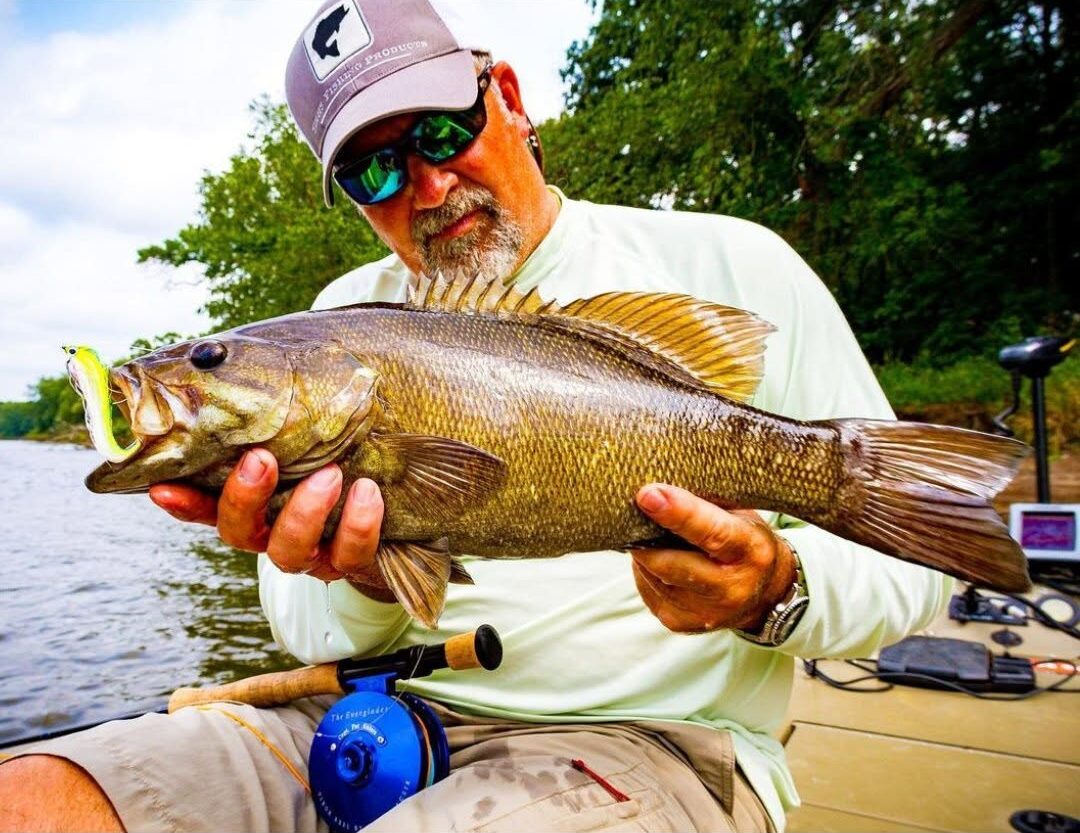
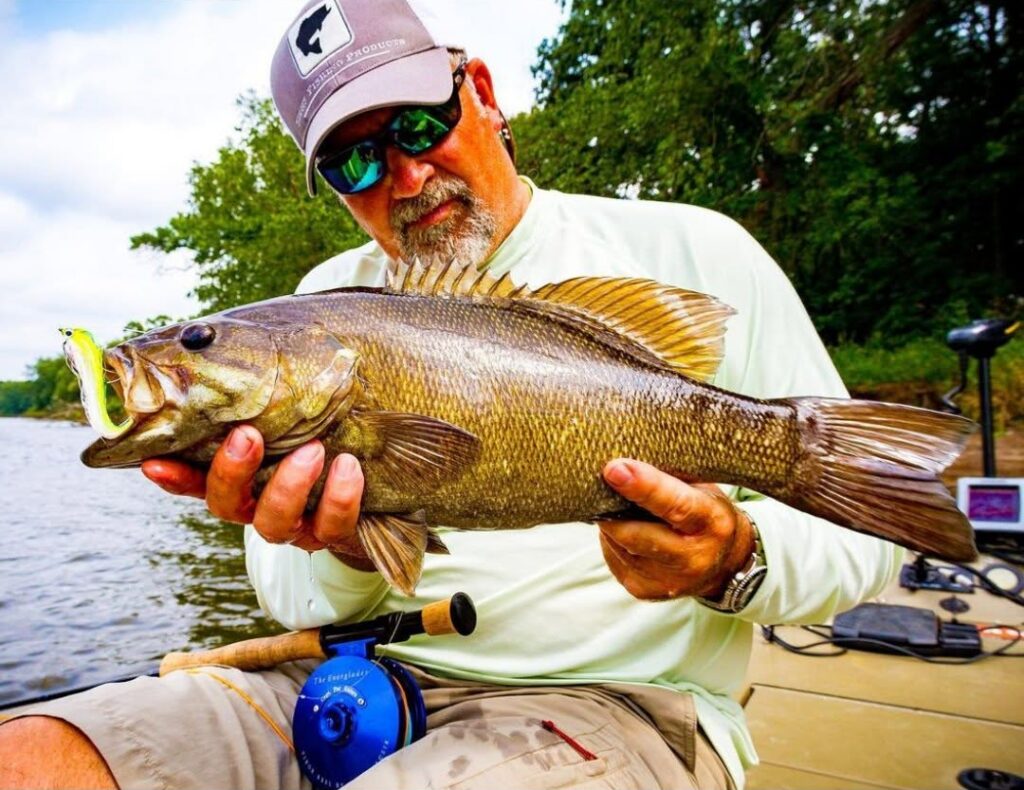
Pat Ehlers has been fly fishing since he was a kid exploring trout streams in Wisconsin’s Upper Peninsula. Over the years, his curiosity expanded far beyond trout, leading him to become one of the leading voices in warmwater fly fishing and innovative fly design.
We dug into bass behavior, fly line selection, fly tying materials, electronics, and how lessons from conventional bass fishing continue to improve fly fishing techniques.
He’s worked closely with Scientific Anglers on fly line development, designed rods and flies, and continues to experiment with new materials and techniques that bridge conventional and fly fishing.
Like many anglers, Pat started chasing trout before discovering the incredible warmwater opportunities closer to home. Growing up near Milwaukee meant bass, bluegill, pike, and musky were always within easy reach, and that shaped the direction of his fishing.
Wisconsin offers an impressive variety of fisheries within a few hours, including:
One point Pat emphasized is how much public access Wisconsin offers for anglers willing to explore.
While smallmouth have become the fly angler’s favorite bass species, Pat believes largemouth are still one of the most overlooked gamefish on a fly rod.
Instead of limiting bass fishing to topwater poppers, he recommends thinking about where fish position themselves throughout the year. During summer, bass often hold deeper around weed edges, making sinking lines and subsurface presentations much more effective.
One of the biggest themes throughout the episode was translating successful gear fishing techniques into fly fishing.
Pat explains that many productive conventional presentations can be recreated with fly tackle by choosing the right line rather than simply changing flies.
He also recommends shortening leaders dramatically when fishing full sinking lines.
Rather than fishing the Dahlberg Diver strictly as a surface fly, Pat fishes it underwater like a crankbait by pairing it with sinking lines.
He explained how modern materials allow flies to become more durable while producing better movement underwater.
One lesson that stood out involved crayfish research conducted by biologists. Pat learned that bass consistently preferred smaller crayfish around 1½ to 2 inches long over much larger prey. That experience continues to influence his fly designs today.
Another major takeaway was slowing down. Pat believes many fly anglers retrieve streamers much too quickly, especially as water temperatures cool. He recommends experimenting with:
Changing retrieve speed often matters more than changing flies.
Although electronics dominate tournament bass fishing, Pat uses them differently. Instead of chasing individual fish with forward-facing sonar, he prefers using electronics to locate productive structure before making casts with the fly rod. His favorite tools include:
The biggest benefit is efficiency. Rather than spending hours searching unfamiliar lakes, electronics help identify weed edges, rock piles, baitfish, and structure where bass naturally hold.
Over the years, the business has continued to grow by focusing on knowledgeable staff, adapting to industry changes, embracing e-commerce, and making customer service the highest priority. One thing hasn’t changed: Everyone working in the shop still fishes.
Reach their shop at 1-414-791-8100.
Episode Transcript
WFS 968 Transcript
00:00:00 Jeff: Hey hey hey. This is your Great Lakes dude. Jeff Lasky coming to you on the Wet Fly Swing podcast, where we’re going to be going rage angler on all things Great Lakes from gear fly, big water and swing and flies. Of course, if it concerns the Great Lakes, we’ve got you covered. So stay tuned to this next episode. Welcome to the Wet Fly swing Great Lakes. I’m your host, Jeff Lisk, aka Great Lakes dude. Well, it’s been a while since I did a podcast. Guiding has been fairly a lot, a lot of long days, sixteen hour days. So I had to take a little break. But I can’t tell you this is going to be a killer episode. This one, we’re going to revert back from the British Columbia steelhead and all the rivers swung fly stuff. And I’m going to introduce a long time friend and fly shop owner Pat Ehlers. Pat is an influential fly designer, professional guide, gear innovator, longtime owner of thirty eight years of the Fly Fishers Shop in Milwaukee, Wisconsin. He started the shop in nineteen eighty eight. He picked up his first fly rod in the early seventies, sometime around when I was introduced to it, to his pioneering techniques, his specialized gear. Highly productive fly patterns. He’s also a specialist in warm water species, which is sort of unusual. So I think it’s going to be a really good one to talk about. He’s well noted in the saltwater industry, too, but a lot of times we’re going to be talking about how flies and gear also cross over. Pat’s a signature tire for rainy’s flies. He’s going to be showing us a few flies of his way, what he thinks about with the new synthetic materials. But you know, without further ado, welcome to the show, Pat.
00:01:48 Pat: Hey, Jeff, how are you? I appreciate that nice introduction. Thanks for having me. I’m flattered.
00:01:53 Jeff: Yeah. No, Pat, it’s it’s something else. There’s one thing like me and you both have is when you you get a little older. We have a lot of seat time, right?
00:02:01 Pat: Yeah, exactly.
00:02:03 Jeff: Right.
00:02:04 Pat: Exactly.
00:02:04 Jeff: But, um, so let’s talk a little bit about, you know, you started this shop and thirty eight years ago and it’s so successful now, and we’re going to talk a little bit about the warm water and the cold water pioneer because, you know, you’re, you know, up in Wisconsin, everybody’s trout centric, steelhead centric, so mounted, but you’ve got a pretty good foothold in that warm water species. Things talk about the thought process of how you went up that avenue.
00:02:33 Pat: Yeah, I started like most of us do, trout fishing. My dad was from the Upper Peninsula, and every weekend during the summer, we’d go up to visit my grandmother and I’d have a bicycle up there, and I was about a ten minute bike ride over the border back into Wisconsin, uh, some trout streams. So I’d been tying flies at home learning how to do that before I could drive, but I had no place to go without a car. So once I had access to the trout stream, I just got out there with the mosquitoes and figured out how to catch them on flies. And that was my introduction to it. But then being back at home in the Milwaukee area, we don’t have any trout streams right in this area here, but what we do have is tons of warm water stuff. So taking your royal coachman or whatever, you had your nymphs playing for brook trout up, up northern Wisconsin, the U.P., I’d go find a dock and catch some bluegills and every so often get bass off of it. And I’m just thinking, boy, that’s what I’ve got around here. So let’s work on it. And I remember one of the first flies I tied, I found an Outdoor life magazine. And if you remember the old tip Grillo cigars with that plastic tip. Well, this guy did an article on how to make a bass popper out of them. You stuffed them with cork and some glue and put a hook through there and tie some feathers in my mom. I’m just a young kid and I’m out scouring the gutter like a hobo looking for Tipperary hose so that I can tie poppers with it. She wasn’t too keen on that. But anyway, that got me kind of rolling with with popper fishing and stuff. And one thing led to another. And then I got Ahold of Tom Nixon’s book on bass and panfish fly tying, which is an old Bible. I’ve still got the original copy here. I think the the dollar amount on that hardcover book was like five point nine five. And that thing, to this day, I still go back and look at it for ideas of what am I missing? And so yeah, it’s been a long journey, thirty eight years alone in the shop, but since I was a kid messing with this stuff and it was just like, yeah, I’m the kind of guy that looks like a good spot for what’s up around the next bend. And it was the kind of the same thing with, well, if this tip works, what else can I get? And you’re looking for corks and everything else. So that was kind of the genesis of it all.
00:05:06 Jeff: Yeah, that’s pretty cool. I remember, uh, my first one when I went steelhead fishing up in Michigan, some old timer gave me a cigarette butt, took the thing off and lucky, you know, it wasn’t even a lucky strike. And he’s like, put that on his yarn, you’re going to catch a steal. And I was like, oh, okay. But, um, so yeah, you got this shop. You started out, um, you’re in Milwaukee and then you have this diverse fishery. You know, you go all the way up in the door County. You have guides working for you. Maybe walk us through a one hundred mile area radius. Like what is your clientele like that? Come to the shop. You know, you’re going north. I’m sure you got the steelhead rivers, but let’s talk a little bit about the harbor fishing. So you talked about a marsh. Talk to the listeners about like, what could they expect out of Milwaukee within a hundred mile area. Maybe.
00:05:51 Pat: First, I got to say, we don’t do any guiding anymore. We’re kind of out of that game. But the shop has gotten to the point where if you’re going to guide, you got to go guide. You know, we don’t have full time guides down here. We don’t have the people coming. So we’ve stepped away from that. But we do have the fishing. We’ve got just west of town. I mean, I can take my bass boat and put it in the water less than twenty five minutes from leaving the shop and being some of the best Bass Lakes in the state down here. So we’ve got that. We’ve got rivers like the Milwaukee rivers, a hundred mile long river, which fills up with salmon and trout in the the fall, through the spring. But then all summer long, it’s an incredibly good smallmouth river. You know, we’ve got the Sheboygan fifty miles north of us, the pigeon. So there’s tons of anadromous fishing. We got the whole Lake Michigan shoreline and just I would extend that past one hundred miles because so many people that come in the shop, they’re going up to northern Wisconsin, the Eagle River area, Minocqua Hayward, and they’ve got lakes and ponds and warm water rivers that they’re fishing pike, muskie, bass, all that with flies. Then you take all the trout streams we have and you go two hours to the north. We got all the central Wisconsin streams and you go two hours, three hours to the west. We’ve got the driftless area. And then you even get into the Mississippi River, which is an incredible fishery on its own. So we’ve got so much stuff here. It’s just I don’t think people in Wisconsin realize what they have and that you can access it. That’s the really cool thing. You know, the fisheries are there, but we have so much public access that it’s a it’s a real blessing for anglers.
00:07:43 Jeff: Yeah, absolutely. Is there a lot of green space in Wisconsin is there like a and not like we have the greenway corridors in that. But if a steelhead angler or trout angler steps into the river in Wisconsin, is it legal as long as the high water mark or how’s that work in Wisconsin?
00:07:58 Pat: No, you got to keep your feet wet. The Mississippi River actually is what the basis of that law is here. Because when that that law got judicate or whatever you say, the problem is if you want high water mark in Wisconsin, the high water mark on the Mississippi River could be two miles away in somebody’s backyard. So you could literally say, well, I can pitch a tent in your backyard because you’re inside the high water mark. And literally that because we had an attorney in the shop I was talking to, that was part of it with t u so that you got to keep your feet wet. But if you do have a problem, like there’s a pier or some kind of safety problem, like a tree in the water that you can’t wait around, you are allowed to get out. Get over that problem and back in the water in the shortest safe way of doing it.
00:08:52 Jeff: Well, that’s remarkable because, you know, down in the little runoff rivers here, you know, that go into Lake Erie, Ohio, and PA, we can’t even step on the bank or the river bottom. So it’s all private.
00:09:04 Pat: We’ve got the river bottom, but not the bank.
00:09:06 Jeff: Yeah. That’s awesome man. That’s a really I mean, that’s one reason that, you know, when I visited Wisconsin to just to go on record, I took the family up for quite a lot of vacations. The nicest people I think I’ve ever dealt with. The truck broke down way up in green Bay told me back just very, very nice, friendly people in Wisconsin too. So I thought it was a it’s a great state to visit, you know, so I think that’s a pretty good advantage. Let’s. So we’ve got some marshes and you talked about bass and we’re going to get into this. Everybody is I call it smallmouth crazy. I mean, but the largemouth bass to me, I think is an underrated fish, you know, especially in your area. My area, they hit chicken feathers, they go on top. Like what’s your thoughts between the two? I we love smallmouth, but maybe get a little like, what do you think about largemouth? You said bass, right?
00:09:54 Pat: Yeah, absolutely. Largemouth bass are the number one game fish in the country, but not so much with the fly rod. You know the smallmouth have really taken over as a game fish with the fly. I used to do, uh, a school up in Shawnigan Bay up in Ashland, Wisconsin, with Roger Penner, who owned a shop up there. He’s since passed away. And Tom Anderson, our old rep for Sage and Simms and Uncle Feather merchants, the three of us did this school together, and it was just a fish factory. And an article got written. And the next thing you know, there was two hundred boats a day parking in the the boat ramp there. And it kind of got discovered. But it was a real beginning to people opening up their eyes to how cool small mouth work. But the thing is, we got great small mouth fish, and we live in a part of the country that has the best smallmouth fishing in the world. You know, you take Minnesota, Wisconsin, Michigan, Upper Peninsula, southern part of Ontario, and even into Illinois and Indiana and that. But the thing is, they’re not everywhere here in Wisconsin. And I’d be willing to wager that everybody lives within twenty minutes of something that has largemouth bass in. It might be a farm pond, might be a small lake, a big lake, but they’re just everywhere. And I think people just miss out on it. And one of the problems is bass fishing has been for so long a top water floating line fishery. And that’s a lot of times, especially this time of the year, in the summer, early in the morning, late in the evening. But people just expand their horizons. It’s what I’ve been working on a lot and doing some work with scientific anglers. You know, we’re both ambassadors with them, and it’s just so much fun to have folks to work with that get it. And they say, yeah, there’s something there, but people just need to get down in the water column more to be successful and open it up to new patterns and ways of fishing them. And that’s kind of where I get to with the gear rods, figuring out how to catch them on gear rods. And then how do I transfer that to my fly fishing?
00:12:11 Jeff: Yeah, I agree. There’s many a days that the smallmouth have disappointed me as a guide and as great angling from my clients, but crappie guiding and I say, well, let’s just I back to largemouth and they saved my day quite a few days and everybody’s happy, they jump, they fight. It’s pretty cool. So wet fly, swing. We go down the rabbit hole, a swung fly and everything else. But let’s, let’s look at the Milwaukee Harbor in that, you know, Lake Michigan shoreline for maybe brown trout or coho. Opportunity. Steelhead. I know back in the day I fished used to fish a few power plants in the winter. But maybe talk to the listeners a little bit. What can expect if you wanted to fish off the break walls without owning a boat like me and you? Is it still achievable? What’s the skinny on that?
00:12:53 Pat: It’s definitely achievable. One of the problems we have here in the Milwaukee Harbor is the harbor wall is so tall that it’s hard to to work a fly rod successfully because you’re so high up above the water. It’s easy enough to buy a long handled net if you get one, but it’s a problem keeping your rod tip down and making the retrieve. Whereas it’s not a hard thing to do with a spinning rod, but fish come right in. We get west winds here, blows the warm water out, cold water comes in and those fish can be here all summer depending on what the wind direction is. Well, we like to do is target that stuff earlier in the season. Those cohos make like a migratory Run up the coast and they’ll start down in Indiana and work their way through Illinois and up to Milwaukee and north of here. And they’re really catchable on flies. I mean, I’ve done it down in Gary, Indiana. Um, with Austin Adduci. I don’t know if you’ve ever met Austin, but he’s a great guy. He’s moved down to Florida now, but man, he had that dialed in and we’d go out and catch tons of cohos on the the little streamers and that from a boat. You can do the same thing up here, just timing it. And one of the guys in the shop lives up in Port Washington, and he’ll go out for a few hours early in the morning, because these fish are extremely light sensitive. And as the sun comes up, they’ll move out to deeper water too. But Carlos goes out and he’ll cast flies up in Port Washington, where he’s got a better angle on the water. He doesn’t have the big rock walls and the high, uh, concrete walls that we do in Milwaukee. and he’ll do a great job with it. Catching fish. He just brought in a couple of cohos the other day that we smoked up and had in the shop. So it’s definitely doable. It’s probably best to have a boat though, and you got to be kind of careful of that because it’s the Great Lakes. But you can even get by with a fourteen sixteen foot boat with an outboard on it. If you stay inside the harbor walls. And then you got the brown trout that are in there, they will, you know, work around the power plants and be there all year. Some of the problem with that is it’s hard to fly fish when you got other boats in there. And that could be in January or February when the conditions are good, it’s calm out there and the fish are are active. It can be tough to fly fish, but you can do it. And the other thing with the harbor is and it helps to have the electronics in that because you find the bait, the shad, the alewife, and you’ll see those fish charging through it right on your screens. And then again, you want to use some sinking lines like the bass, but you can target them out there when they’re crashing bait. Catch big browns on there. My son Jared, who works with us, he got a twenty two pounder there a season or so ago. That thing was like a striper just crashing on the surface. So it’s all doable and it’s an exciting fishery.
00:15:57 Dave: Stonefly nets, handcrafts, wooden landing nets, fly boxes and reel seats in little Rock, Arkansas, using premium hardwoods and burls sourced from landowners across the United States. Every piece is built by hand, combining traditional craftsmanship with the durability anglers need on the water. What makes Stonefly different is the attention to detail. You can customize your net with your choice of wood, and even add personal engraving to create something that’s truly unique. And these aren’t just pieces of gear. They’re the kind of tools that become part of your fishing story and stay with you for a lifetime. You can check in with Stonefly nets right now. Just head over to Stonefly nets dot com. Check them out right now and get started today. Check out Montana Fly Fishing Lodge, a twenty twenty four Orvis endorsed Lodge of the year finalist, where luxury meets adventure on one point five miles of private, wild and scenic East Rosebud River frontage. Experienced world class fly fishing on numerous Yellowstone Basin streams. Gourmet cuisine made from locally sourced ingredients and rustic luxury accommodations surrounded by breathtaking wilderness. You can book your all inclusive Montana fly fishing adventure today and discover why they are the premier destination for unforgettable fishing experiences. Head over to Montana Fly Fishing lodge dot com right now.
00:17:15 Jeff: I get a lot of inquiries about, you know, the Wisconsin brown trout fishery and the harbors. And of course, you know, the ice fishing stuff if you’re into gear fishing. So that’s good. And I’m sure you know anybody’s listening. You just reach out to Pat, you know, and the sons at the shop and they can get you dialed in and at least give you a weather report, or at least get you started. But, you know, let’s dig into a little bit now. You know, you’ve got you’ve been designing lines for scientific anglers. You’ve been designing flies for Raney flies. You’ve been doing this crossover thing like myself and some of the other guys that we gear fish and then we take that knowledge into our fly fishing. Let’s talk a little bit about the crossover between lures and flies, because a lot of times there’s a good correlation if you have an open mind, right, Pat?
00:17:58 Pat: Yeah, absolutely. The river fishing, that’s a pretty easy transition because if you trout fish to me, you can find smallmouth or even largemouth for that matter, because a lot of our warm water rivers have large mouth as well as smallmouth in it. But these fish are going to use the same holding areas, feeding areas. It’s going to be kind of the same thing. But in the lakes there’s definitely a transition. Like right now it’s ninety eight degrees outside and I wouldn’t want to be in a boat today. It’s just so brutally hot. But come mid-summer time of the year, these fish typically go down deeper. And one of our issues with fly fishing is a vertical presentation. And this is the time of year when you need to be punching through the weeds. And it’s just just about impossible to do that with a fly rod. You know, you’re literally taking half ounce, three quarter ounce weights and a big piece of plastic and just kind of pitching it out there and busting through the weeds and the fish are underneath it. But it’s a hard deal to imitate with a fly rod. So you got to pick your battles this time of the year. If I was fishing a fly rod in a lake, I’d try to make a horizontal pattern work because I can’t make a vertical pattern work. You know, wacky worm looked like a Senko. That’s one of the most popular ways to catch bass. And over the years, I’ve watched guys try to do that with flies. But you can tell the guys making the flies. I’m not giving them a hard time. You just know they don’t know how to fish a sink or how they work because they’re heavy. They’re full of salt and that’s what makes them sink. And you need that presentation where that thing is going down. I’ve watched guys use pieces of chenille. They get the shape in a vise, but it doesn’t fish correctly at all. And so it’s just so hard to imitate that vertical fishery with a fly rod. So what do you do then. Go to the weed edges. You know, fish your your stuff on the edges of the weeds. Those fish are still in ambush points, whether it’s a muskie, whether it’s a pike or a largemouth bass for that matter, and fish the edges because you’re not going to penetrate the middle of it. And what I get back to with the sinking lines we talked about earlier. That’s where you need to do it. You know the Daubert diver. Larry Daubert came up with one of the greatest fly patterns ever invented when he came up with the diver. It was just revolutionary. That and Bob Clauser. Clauser minnow are two of the coolest things that have ever been invented for warmwater fishing. But there’s more to it than fish in a diver on top. You can grease that thing up, put it on a sinking line with a relatively short leader. Now you got to crank bait underwater. And that’s where that. How’s my gear stuff work in conjunction with fly stuff. Or you can just let them get water soaked and pull them through, because that head will push water and the fish can pick up on that. And so I may be looking at a ten or twelve foot deep weed line, and I know there’s fish on there. I’m pulling a fly anywhere from the top down to the bottom with a sinking line in a presentation like that. Maybe it’s a diver, maybe it’s some other kind of streamer, something that’ll push water, something that the fish will pick up on and come out and ambush. So that’s where you got to think differently. It’s not just poppers and and floating lines. And then once we get back in the fall and fish start moving up shallow again, that whole thing changes back to a, a springtime type of fishery in many respects. Then when they start feeding up for the winter, you really got a good shot at some good fish. So in a nutshell, that’s kind of the way the the largemouth bass fishing goes, but there’s still more work to be done on that with fly line design. And, you know, we’re working on stuff all the time with that and got some fun stuff hopefully on the horizon with it and get it to work out.
00:22:11 Jeff: So we’re basically fishing this Dahlberg diver as a jerk, underwater jerk bait, you know, at subsurface down to the bottom. What’s the go to scientific angular line that you’re using and just and let’s clarify when you say short, what’s the leader length?
00:22:27 Pat: So the sonar sink tips are typically fifteen foot. And if I really ought to get down, that’s probably what I’m going to use. Or one of the full sinking lines like in I-35 where the running line’s intermediate the heads three inches, the tip is seven inches per second. There’s three, five, seven. It all depends on how deep I got to get down. I don’t like fishing more than twelve thirteen feet. You start to lose contact. I may be going with a heavier sink rate for more of the matter. If I’m trying to keep a bigger, more buoyant fly down deeper than trying to get down fifteen twenty feet because it’s really hard to be effective that deep with a fly rod. But I’ll tell you, the fly line I use the most for my sink tip fishing is the mini tip. It’s a five foot sink tip and I can fish over the weed tops with it. It’ll eventually sink down like one of the longer sinking ones, but it gives me a lot more flexibility. And especially in rivers where I just need to get down a little bit at trout fishing, it doesn’t matter. But I really like it for warm water fishing. And of all my sonar lines, that’s the one I use the most. But then that other stuff is for getting down and dirty. And as far as leader lengths go, you know, generally if I’m getting down deep, I’m looking at just taking some type of material like fifteen, sixteen pounds and maybe three or four feet, because the problem is people take a bass leader because the package says bass on it, and they’ll put it on a sinking line. And the problem is a sinking line goes down, but the flies more buoyant. So it stays up in the water column by just running that little short tippet, section three or four feet, it’ll stay down with the sinking portion of the line, which is dark colored anyway to help camouflage it from the fish. And so it’s a lot more effective doing that. However, there’s times to use that nine foot leader. And what I’ll do with that is I’ll use that mini tip and I’ll grease up a diver, put a regular bass leader on eight or nine foot bass leader, cast it out, you know, and this isn’t necessarily for getting down ten feet of water, but just for fishing around like when fish might be a little shallower to maybe six, seven feet deep. And I’ll pop that fly a couple of times so that diver dives down and then it’ll swim back up, which is a cool part about a diver. But when you use that mini tip, the mini tip sink in. The fly pops down a couple of times with that long leader allows it to go back to the surface, and then you pop it a couple of times, and then a really long strip, and that’ll dry the fly down three, four feet or so, and then you stop and it swims back up on that long leader. And a lot of times the fish will come up and eat that because it’s coming back up like a crippled minnow. So don’t be afraid to try stuff.
00:25:31 Jeff: Right? Yeah. So we should probably just go over what we were, you know, because me and you, we understand mini tips and multi density lines. Maybe explain like these mini tips, the five and ten foot because it’s a float with a, you know, a sink on the tip of it. So let’s, you know, just to confirm that’s a sink. Six right. Oh, Pat. I think at the end of that.
00:25:51 Pat: Correct. Yeah. And it’s basically it’s a floating line up to the final five feet, which sinks. So it’s a miniature sinking tip line where the standard standard sonar tips are like fifteen feet long, which is good for heavier current, bigger flies needing to get down deeper. And then the triple densities. The reasoning behind that is by changing the densities, you get more of a straight line sink. So you don’t get a bow in your line. You pick up the strike quicker and it’s easier to set the hook because there’s no bone. The line to have to take out to get the hook set. So it just gives you a real advantage in fishing sinking lines.
00:26:36 Jeff: Yeah, exactly. And I’ve been using the mini tips with heavy weighted fly like we discussed. I’m not fishing weeds like you. I’m fishing a lot of rocks. And I noticed that float with the sink has that hinge point. So when you do strip it, you do have the slack. Like you said, it’s hard to connect with the fly, but it gives it a little more lift and it gives a little more up and down because that float sink hinge. So it’s, it’s good, like you said, around ten feet or so. So I’ve been using that a lot over the full sink because then you’re just dredging bottom. You’re not getting that, you know, that vertical up and down as much. Yeah, it’s pretty cool. These new lines. I’m super excited to hear what you got going on with Brad at SA there and the the designers and that. So looking forward to that one.
00:27:18 Pat: Yeah, we’re always playing with stuff over there. And you know you go to bed at night and you get the monkey brain going and go, well, if we did this or we did that, and then you wake up in the morning, you go, oh man, what was I thinking of? You know, you go to Jerry Seinfeld. If you watch any of that, there’s always an episode for every life experience in the one where he thought of something and wrote it down and couldn’t read his writing. So I wake up in the morning and go, oh, I had a really good idea last night, but I can’t remember.
00:27:47 Jeff: It sounds like stuff like me. I should probably wake up when we think of it, write it down. But that doesn’t happen. But all right, so we’ve got the gear in the crossover. And let’s dive into your thought process of now all these new materials and some of the flies and how you design it. I know you have a few to show and let’s just talk a little bit, you know, is it synthetics? The rubber? Wait, let’s just talk a little bit about how your thought process goes when you’re designing a fly for warm water fish.
00:28:15 Pat: Yeah. Like I go out, if you look at my bass boat, I’m not gonna lie. There’s twenty plus gear rods in the rod locker and they’re just always in there for whatever reason. And I start out fly fishing, and if I can’t figure it out with that, I’ll pull out one of the gear rods, see what I can come up with, and then make contact. And I treat every day of fishing is gonna sound somewhat egotistical, like I have to catch fish every time I go out, but I go out to catch fish. I treat every day out there as if it was a tournament. And what I mean by that is I’m constantly trying to figure out what the puzzle is, and it’s just kind of fun that all right, I just caught a fish. What happened? What did I do? What didn’t I do? And I try to imitate that. And it doesn’t matter if you’re using fly gear or regular gear and try to imitate it. See if you can come up with a pattern. And so over time, in fishing gear, I mean, I grew up with a baitcaster my hand when I was about eight or nine years old and stuff like swim jigs, swim jigs are just, they’re so good, they’re so effective. And I always wanted to come up with one, you know, and forever we’ve had going back like we do. We didn’t have all these cool synthetics nowadays. And so with rabbit strips, with Bucktails, I think those are two of the premier materials for doing warm water flies and saltwater flies and somewhat trout flies. But stuff is really good. But the thing is with the new stuff, and this goes back to that Tom Nixon book I was talking about, he had a pattern came out of Louisiana. I think it was probably butchered the name of Calcico Pig. And it was basically a hook with a bunch of he called a rubber hackle, but he just took rubber bands because he didn’t have rubber hackle like we have nowadays, like silly legs and that and just tied it on. And so with everything we’ve got, I mean, I can go in the shop on Sunday morning when we’re closed and look around if I got an idea and I’m kind of lucky that way and figure out what I want to do, but it’s okay. How do I transition a swim jig into a fly? And that’s where I came up with the Grim Reaper. And it works really well. And what I’ve done with it, it’s hard to see the hook on here, but it’s a sixty degree jig hook. The nice thing with this is you can see the eyes lay right into the the crook of that jig hook, and it’s an extra wide gap. This is a gamakatsu hook. And what that does is it gives an angle like this to the hook. And I’ve got some video and we got some tie in instructions coming out on that fly that shows them underwater, and it’s extremely weedless the way it is without even putting a weed guard on it. But you get that rubber hackle like you get in a swim jig and I’m using it’s, uh, ultra suede for the tail. I think it’s a Coen product and you can take a marking pen. It comes white, make it whatever color you want. And so this is a bluegill pattern I showed you, but I’ve got crayfish and green pumpkin, all the good food group colors that you might find on the wall of your Cabela’s full of swim jigs. And it’s something I fish it the same way I can fish it on the bottom. I can swim it like a swim jig. And boy, it catches a lot of fish can fish it on a sinking line. I can fish it on a floating line depending on what I’m doing with that. So that’s one of the things where I transition swim jigs into a fly. Another one that I just came out with is a Zodiac streamer. This is a pretty new one now. It looks like a streamer, but what I did was I used some of the, uh, stuff from Z-Man, the tech and this fly will last. It looks like, you know, it’s got some plastic on it. It looks like it’ll come right apart, but it doesn’t. I figured out how to add that. We’ll have tying instructions for this too, and I put an epoxy head on it. But it’s a great searching pattern. It’s translucent. You can see that. And when it gets wet, it looks just like a baitfish imitation. And that elastic gives it that soft feel. You know, I’ve gotten a little bit of a hard time from some people going, oh, that’s not a fly. Whatever. There’s new materials out, you know, take a look at what Blane chocolate’s doing. Blaine is one of the most innovative guys that I know when it comes to fly tying. And I’ve had people complain, oh, his are all synthetic and they’re jointed and there’s pieces of metal in there, but they really catch fish. You can throw them with a fly rod. So I’m way past the semantics of what’s a fly and what isn’t in this elastic stuff. It’s a way of incorporating that into a fly. It’s easy to do and it works really well. And the stuff is a buoyant material, so it kind of helps keep your fly up out of the weeds if you need to above the rocks, but down where the fish are on a sinking line. So that’s just sort of the kind of stuff that I’ve been playing with.
00:33:35 Jeff: So this elastic, and I use a lot of it because I am a Z man product user myself, I’ve noticed that it’s very durable, but how do you store it and how do you. Have you figured out how to keep the synthetics away from. Like when you’re not fishing it? Do you have like each one separate compartments? Because I noticed, you know, even I tie a lot of Ned. I use his Ned’s and then I put marabou and rubber in front of the Ned head and it seems that it stays apart. But they do eventually. That elastic material, it wants to melt stuff a little bit. Have you figured that out? Store it separately or how do you do that now?
00:34:11 Pat: No. You know, I, I put them in slotted fly boxes so that they’re vertically they’re on edge inside of the, the fly box. And I haven’t had any problem with the foam in the slotted boxes. I do know some of this stuff you got to be careful of. Like if you throw it in, let’s call it a Plano box, like a streamer box of that kind of stuff like you might find in a hardware store that yeah, it can melt in there and you can ruin the flies, but the stuff is extremely durable. I’m super gluing it to the tail. It was the best way I could find to do it because it’s so spongy, you can’t tie it on. And I couldn’t believe I started using them on tarpon when I caught the snot out of baby tarpon with it down in Puerto Rico and Mexico and that and it’s nothing against six seven tarpon out of one of these flies. So even with the rough mouse in that, and any time I can get six fish like that out of one fly, I’m good with it.
00:35:11 Jeff: So we have the all purpose search bait. Then we have the Grim Reaper or the jig fly, just in case the fish aren’t really in the super chase mode. The line do you tie the Grim Reaper weedless sometimes, or just to, you know, for that purpose to or no, just the open hook. It’s pretty weedless on its own.
00:35:28 Pat: I don’t because I’m kind of lazy.
00:35:30 Jeff: Okay.
00:35:32 Pat: But to be quite honest with you, um, Rainey’s when they do this pattern, they put weed guards on them and we got some feedback on the fly. Hey, we want weed guards. Consumers want them, which is fine, but I was amazed when we shot the underwater footage, how the attitude of that fly is kind of on a forty five degree angle when it’s swimming, and I could run it through some brush and through some weeds and rocks, and it doesn’t hang up that much, so. But yeah, weed guards. I got nothing against them. I just be honest. I’m kind of lazy.
00:36:07 Jeff: Okay, well, I just wanted to make sure there was like, okay, this is when I use the weed guard, but I’m sort of I’m even lazier than you just to go on record. But, uh, well.
00:36:16 Pat: Just to expound on that a little bit, there’s a, one of the big tournament guys is out of Wisconsin. I just listening to him talking about weed guards on swim jigs, and he’s been taking his weed guards off of those. And he found his catch rate to go up because some of those weed guards get pretty obtrusive on trying to drive a hook home on a big, like a largemouth bass. So they’re, you know, it’s six to one half dozen the other.
00:36:44 Jeff: Yeah. I just wanted to confirm that because I, I’ve had issues with the hookups with the weed guards too, but we talked about the vertical drop. It’s hard to get. We’re still working on that. We talked about, you know, the floating or neutral, buoyant fly on sinking lines. Let’s talk a little bit about hang time with the fly and the pause, because I think that’s super important, right? It’s like sometimes you want that long pause, you know, like dead drifting a pop or just hanging that new fly of yours. What do you think of that? Give us a little, you know, little thing about the pause and the hang time.
00:37:18 Pat: Yeah, that’s that’s a great point, Jeff, because, you know, going back to the gear guys, especially in the water cools off baits like jerk baits for the conventional guys that retrieve is a jerk and then pause. And there’s times when guys wait five, six, seven seconds before they make another jerk into the retrieve. That doesn’t sound like a lot of time, but if you count to one thousand, two thousand when you’re fishing and I’m a guy that’s not real patient a lot, it’s hard to wait that long, but it really makes a difference, especially in cooler temperatures. And that’s just a matter of if you’re not catching them. Try something different to me. You know, if I think maybe I’m retrieving too fast. And one of the biggest things that helped my bass fishing, no matter what I was using flies or gear was slowing down. I’ve always been a little bit too impatient. I learned from a tournament slash guide. Buddy of mine used to be one of our reps, um, and the fly rod business. And I’ve known Ron for thirty years and he got me to slow down and it made all the difference in the world. So there is a lot to what you’re saying on that, but then there’s days when you want to rip it through the water as fast as you can. And that might even mean putting that rod underneath your armpit and doing a two handed retrieve like you might do with barracuda or tarpon, something like that too. And the other thing is with that retrieve, and I learned this with tarpon fishing, I get a lot more hookups when I’m doing a two handed retrieve, and it doesn’t mean you got to go fast. It just means you’re never not in contact with the fly line when you’re retrieving, so you’re not in between strips when that fish eats. How many times does that happen? And you’re reaching for the line even to do a strip set and you miss it with a two handed retrieve. You feel that bump you just keep retrieving and you just strips it on the fish. So there’s a lot of different things and ways to attack that, but I’m a big fan of the work and change it.
00:39:25 Dave: Experience the waters of Bristol Bay at Togiak River Lodge, where fly fishing meets Alaska’s rugged beauty. This is the place to complete the Alaska Grand Slam with all five salmon species rainbow trout, Arctic char and more, where each day offers a new Alaskan adventure. You can visit Togiak lodge dot com right now to start planning your Bristol Bay experience with Togiak River Lodge. Trout routes by. Onyx is built for fly anglers who want better Intel without spending hours digging for the information. You’ll get access to public land maps, stream access points, regulations, and even road and trail maps all in one place. It’s become my go to app for scouting new trips. You can check them out right now. Go to Netflix dot com slash routes and download the app today.
00:40:14 Jeff: Is there a point in time that you would consider using an intermediate line for more hang time?
00:40:20 Pat: Absolutely. Yeah. We didn’t even talk about intermediate lines, but that’s just a whole nother tool in the arsenal. And, uh, that’s where you want to hang stuff. You know, maybe that one and a half inch per second. Yeah, it’s going to sink to the bottom eventually, but it gives you more of the so-called hang time in the zone that you want to be. And again, that way you can manipulate that leader length to increase that or shorten it up a little bit too. There’s no free lunches when it comes to figuring out the fish. You can’t just do one thing and expect to go out and be successful. You got to keep trying stuff until you come up with it.
00:41:00 Jeff: Yeah, I mean, I think first off, you buy the floating line and then if you don’t want to dive into a mini tip, you get a sinking leader right on the end of it. I use the Titan with the sinking leader. But eventually if you go down the rabbit hole, you know, not as bad as we do. You’re going to get a floating line, a mini tip, and an intermediate line for your rod. That would be pretty good Arsenal to have just to go all cover all options. Wouldn’t you think?
00:41:24 Pat: Absolutely. You know, and I don’t want to spend that much on another line. Okay. You’re not going to catch as many fish. And when you look at the cost of the fly line, what does it cost nowadays to go out to eat? You know, you use that fly line for two or three seasons for the cost of one dinner, catch more fish. You just need to have some variety in your gear and be able to accommodate what the fish are doing. Not force on them what you want them to do because it’s just not going to work. Sometimes it will, but most of the time it won’t.
00:41:57 Jeff: We should probably talk color, right? I mean, we know pumpkin seed works. Is there any insight about like colors?
00:42:02 Pat: Absolutely. Um, if we’re talking largemouth bass, bluegill type colors are always going to be good. That’s one of the main forage for these fish. And with this kind of fishing, it’s matching the hatch every bit as much as trout fishing is. We’re just matching a different hatch. And that could be crappies. It could be bluegills. One of the things that I try to tell people go into Cabela’s going to a Bass Pro shop, and I’m saying this kind of metaphorically, and just look at the tackle wall, all the baits, and you look at that wall and you go, Holy crap, how am I going to figure out what I want to buy? So you figure out, okay, what what are the fish going to be feeding on when I’m at my place or I’m going on my fishing trip? If they’re going to be feeding on bluegills, crappies, some kind of sunfish, we want something a little bit wider and a little bit shorter profile. So you go look for those baits. You just cut that wall down in half. Now. Now we’re just matching up colors. If the fish are going to be eating sucker minnows, if they’re going to be eating chubs, that kind of stuff. Now we’re looking for maybe a longer Rapala type of bait that cuts off the other half of the wall. And then we start looking again at colors. And it could be chartreuse, which doesn’t really imitate anything in particular, but it’s a good fish catching color, or it could be something realistic. That’s the same with our flies. I got patterns here that imitate bluegills. I could make that thing, and I do make it all chartreuse for those different light periods, like maybe on a bright day. So by just taking that to shape and length and then going to color, you can match the hatch on anything that might be being fed upon in the water that you’re fishing, whether it’s a river, whether it’s a lake. And then we get into crayfish patterns. One of the cool things with crayfish, I got real lucky up in the Upper Peninsula. One time I was up fishing a smallmouth lake earlier in the season. I stumbled on these guys and girls and they were all had their heads. And in these viewing things, looking into the water in a small boat. Oh, what the heck are they doing? So I went over there and it was a science team from Notre Dame, and they came up there to study crayfish and it was so enlightening. They were so cool. They said, come on, watch what we’re doing. And what they had done was they put down one foot by one foot, white tiles down on the bottom of the lake. And then they caught a bunch of crayfish and they took a snap swivel and put it through the tail of the crayfish. This place was full of smallmouth, and they had them from half inch inch up to about five or six inches, big rusty crayfish, and they spiked them down and let them swim on this tile so they could see the reactions of the bass. And the number one crayfish that lasted the shortest amount of time was about the length of my index finger. You know, like an inch and a half, just a little less than two inches. The big ones would literally keep the bass from eating them. The pinchers would come out and it would scare the largemouth. They’d clamp down on them. It was amazing watching this. So I tell people, anytime you’re trying to come up with a crayfish pattern, keep them small. Even the big fish would come in there. Three, four pounders would come in and they’d just snap up those inch and a half crayfish like candy. But the bigger that crayfish was, the less they would would go after it. They would only do that, start chasing all the little ones that had been eaten. And the other thing that I realized was the variety of colors, the blues, the greys, the olives, the reds, the oranges. So there’s a lot going on down there that, you know, I was so fortunate to be in the right place at the right time. I gave up a couple hours of fishing. I probably learned the Somersworth by watching them, right?
00:46:19 Jeff: Because we don’t, you know, we don’t see that me and you were like the fish crazy. Like you said, we’re like, go, go, go figure out the pattern. But that was that was worth everybody listening. Just that information there now. So if you got the crayfish pattern, you do have one, the crazy craw, which is I’ve used it a lot. It’s a great pattern. Is it a tick tick on the bottom? If you got a crayfish what’s it to retrieve? Tick. Tick on the bottom paws. Just walk us through that a little bit.
00:46:42 Pat: Yeah, for the most part. I mean, you gotta you gotta realize they don’t swim in two foot strips, you know? Little crayfish. Especially if we’re going to be dealing with inch and a half two inch. It’s a little tick, tick, tick across the bottom typically maybe a little pop off the bottom. But for the most part, it’s just a swimming it down close to the bottom. And again, slow down, not too fast. And the thing about that crazy craw is that is a, an impressionistic fly. So it’s easy to tie. It’s not super realistic, but it’s got a lot going on. So there’s even movement going on when that fly isn’t being moved. And I like that kind of stuff. That one, I’d like to take all the credit for it, but I can’t because a good buddy of mine, you know, we were kind of playing around with that stuff and, uh, he helped on that quite a bit.
00:47:37 Jeff: So yeah, what’s the famous fly that, you know, like everybody, the new bass range with the koi thing, it looks like a sea urchin. But in the fly fishing world, was it the tequila fly with all the rubber we had? Remember back in the day it was like a woolly bugger with just a whole bunch of legs.
00:47:51 Pat: Yeah, those things still work.
00:47:53 Jeff: Yeah. It’s like a lot of rubber.
00:47:57 Pat: You know, I, I don’t know how to answer that because so many patterns come and go and, uh, I use my stuff quite a bit because I know it works. And I don’t know how to answer that. Everything will be odd for a while and then it’ll cool off, but that doesn’t mean it’s not going to keep working. So I’m kind of at a loss for that one because we still sell a ton of tequilas. So that could be one.
00:48:24 Jeff: I just one of.
00:48:25 Pat: Those things.
00:48:25 Jeff: And no, I me too. It’s like when I heard that, you know, my buddies are fishing, they’re using the, uh, the koi ones, you know, like this ball with a bunch of things. It’s the hottest bass in the market, and they’re fishing like a jerkbait. And I’m like, I get it. It’s a bluegill, but it’s also a mayfly, whatever it is. But I’m just thinking to myself, a bass smallmouth bass is like, is it different? I don’t know, but I just sometimes I need to think a little bit more outside the box.
00:48:51 Pat: Yeah, it’s one of those, why didn’t I think of that? And when you look at those things, when I first saw him, I just went, oh, come on. But then I saw some underwater footage of those. And when those things are bouncing along the bottom, it’s not like the crazy craw. It doesn’t look like that. But it kind of follows along those lines is that it’s impressionistic. All those legs flow back as you’re stripping it. It can be construed as a crayfish swimming along the bottom. So I can see where it is. And the big thing with fishing is, you know, we think every brown trout in the creek is been reading all the books we’ve been reading, and these masks are as smart as we are, and they only got a brain the size of a pea. So don’t give them too much credit. They’re eating a piece of plastic with a bunch of tentacles on it. They’re just a little more tuned in to our environment. We just had a thing the other day, and I always use this example that we just go through life not paying attention, and our shop is on a real main street in town, and there’s a couple of fire engine or fire stations on either side of us. So the sirens are always coming and you just don’t even pay attention to them. And the other day, a truck came by and we happened to have a fireman in the shop at the time. And it was the craziest sounding siren I ever heard. And I said, what’s up with that? He said, they’re changing them up because nobody pays attention to sirens anymore. They hear them so much. And I always use I always use the analogy of you got your dog sitting in the house And a piece of wood creaks or something, that ear goes up. We don’t pay attention to it, but the dog does. And that’s the thing with fish. That piece of wood creaks. That fish is on it. We’re not paying attention to all those little things. So a little more observation and tuning in make you a better fisherman, because we just kind of blow through life, not paying attention.
00:50:52 Jeff: Is it that the fact so we’ve covered some flies now we could talk about for like hours, but let’s talk a little bit about you designed a rod. Most fly rods are nine feet. And then there’s this trend to shorter rods. Maybe talk a little bit about what rod you use when we’re throwing these lines, and that.
00:51:09 Pat: I was working with Tim Rajeff when he owned the place at Atco, and he had come to me and asked me if I would like to help him develop a series of warm water rods. And that was where the edge eighty four came from. And the thought process behind that was I wanted to go shorter than nine feet. And the reason being, it’s a little bit more accurate for casting. A lot of times when we’re warm water fishing, we’re not necessarily making seventy, eighty foot casts. And I’d rather be accurate at forty or fifty feet than just kind of not having a clue at seventy or eighty. So the shorter rod and this was all Tim and I sitting down compare notes. He wanted to know what was in my head when I came up with this. And, uh, I said, the shorter rod’s going to be more accurate. And the other thing is it’s going to be easier to fight fish and set the hook with a shorter rod. Everybody thinks the longer the rod is, the more leverage you have. And that’s true depending on where the lever is. But with the reel and the handle being on the far end of it, the fish actually has more leverage on a longer rod than a short one. That’s why all the offshore boats are using five and six foot pads to fight those multi hundred pound fish. Because if you use a nine nine foot rod for that, it’d be brutal trying to get them in. So it gave you a little bit more leverage in hook setting on tougher mouth fish that you typically find in warm water fishing and then fighting them as well as the accuracy. And so that’s, that’s where the premise of those rods came from. Tim sold the company, and when he sold, I resigned from it. I mean, we’re still great friends. I love Jamie and Jared and echoes a lot of their rods. But it was just after ten, twelve years. It was just time for a change. And those rods actually went away, as everything does, like the model T, you know, everything’s going to get changed eventually. So it had its life cycle and the e p s was a that was an ex rod model I came up with with echo with Tim before he sold the company. And that’s actually still in the catalog. So that’s a nine foot rod. And quite honestly, we found the nine foot rods. Whether we thought we were the smartest guys on the planet with an eight foot four inch rod or not, the nine footer sold better than the eight foot fours.
00:53:45 Jeff: So but you did start a trend, though, because there was a lot of other manufacturers that do have, you know, that eight foot under eight and a half feet streamer rod now too, because, you know, like you said, accuracy in a river, smallmouth fishing, trout fishing with big streamers, guys are fishing seven and eight weights on the white River with, you know, so they’re using shorter rods. So you did start a little bit of a revolution regardless if it ran its cycle. So there is something to say about shorter rods and accuracy for sure.
00:54:12 Pat: Well, I wouldn’t say I started it. I’d like to say I was part of it, but quite honestly, sage came out with their bass rods. I’m trying to remember what the length of those were, I think they were seven foot eleven and I got to work with Jerry Siem when he was the ride designer there. One day a package of about twelve rides showed up. I said, take them, fish them, play with them, break them, do what you want. So I want to hear more about it. And the premise of that ride back then with the length was because you couldn’t have, I think at the time you could not fish rods in bass tournaments over eight feet. Now that’s since been changed. I think it’s eight and a half, nine feet now. They allow longer rods, but he wanted to get under the limit. So I played with those rods. I took him up to Alaska when I was guiding up there for Pike and we used it. They were great rods for that, and it was part of my thought process with the rods. I wanted something a little bit longer, and when I talked to Jerry Angotti, he’s one of the best ever lived. That’s designed rods, and I was so flattered to be able to work with him, kind of that, you know, along those lines, one of the things I told him was I like something a little longer for a little bit more casting distance. And he just was adamant about staying under the eight foot rule. But the problem was, I kind of knew the tournament stuff that didn’t matter. Most tournaments do not allow fly rods. I just got a thing the other day trying to remember who sent it to me. It was for a tournament. Some kind of owners group might have been Minnkota Humminbird or something because I’m on a pro staff with them. And it’s it’s I think it’s down in Tennessee and it’s spelled right out. No fly rods allowed. It didn’t matter what the length was. And I don’t know why that is. I never could get a clear answer on it. At first it was the length of the rods. But they’re still saying that. So. But it got me to really thinking And working with Jerry on those rides. Yeah. This is where we need to be as shorter. So I don’t want to say I started the trend, but I’d like to say I was part of it.
00:56:29 Jeff: You were there in the semi beginning. We’ll say that. How’s that sound?
00:56:33 Pat: Well, I’ll say the beginning, but okay. I’m not the guy who started it.
00:56:38 Jeff: Okay, great. Well, we got I want one more segment here. You know what I really want to hear about is that both me and you, we have these fancy glitter boats that we have, uh, electronics fancy. And not everybody is lucky as us. But I will say, um, the new electronics from down imaging side imaging, forward facing imaging. Now, Garmin just came out and hummingbird with live two. Garmin came out with this. So let’s just chit chat a little bit about electronics where it has helped you in the fly fishing world compared to we obviously know that every bass guy has five units on their boat, but let’s just talk a little bit about the fly fishing industry, where you think this is going to go, how it’s helped you? It’d be pretty cool to me.
00:57:23 Pat: It’s a big time saver and I do work with hummingbird, so I want to say that up front. But for me, it’s a big time saver because I mean, we’ve got so much water right around here. We talked about that earlier, but I fish all over the state. I go up in the Upper Peninsula. You might find me in Minnesota and it’s just all over the place. So I’m kind of a jack of all trades and master of none when it comes to focusing on one piece of water. And like this past first week of June, I went up with a friend, came up from Missouri. We just went up and fished for four days, and I was on two pieces of water. I’d never been on in my life before and they were big lakes. I would have wasted those three or four days just trying to find a starting spot. So I think it’s really important. It’s coming up now with the forward facing sonar. And that’s that’s kind of a can of worms. Um, I’ve got it on mind because I want to be able to discuss it. It’s somewhat of a moot point down here where I fish around home because these lakes are so I believe the term is your troll, your trophic. They’re just full of weeds. That doesn’t do me any good. It’s. I’m looking for holes in the weeds and stuff like that. I don’t have a lot of places where I fish a lot of real super major weed lines that I can use it on, and even then I got to go horizontal with it because normally that stuff reads on edge, but you can set the transducer to read horizontally. So once in a while I do it. I am not a fan of sitting and watching a screen and trying to get a fish eat. That’s just not my deal. I didn’t grow up that way. I’m not going to die that way. And it’s an impossibility to me to do that with a fly rod. I’m using that stuff to find fish, and it’s not so much for me to see fish. It’s to find the structure. And I’ve got side imaging. I’ve got down imaging, and I’ve got the three hundred sixty. And to me, the one thing I would not give up is the three sixty, because it gives me a three hundred and sixty degree angle around my boat. And so I can see rock piles, I can see brush piles, weed edges, weed beds, all of that three hundred and sixty degrees around my boat. The side imaging use that as much when I’m kind of putting around to see what I’m missing. Especially like up in northern Wisconsin, a lot of those lakes don’t have the weed presence that we may have here. And you’ve got rock bars, you’ve got big rocks that smallmouth may relate to, and you can be driving across a piece of water and not realize you just went over a hot spot. That happens two or three times a day when you’re looking for those windows of active fish, and they might be sitting on that boulder down there. By putting her out and keeping an eye on the side imaging, I may see something on and go, wow, I’ve never seen that before. I’ll mark it. And it’s something I’ll come back to later in the day and the week, maybe the next trip up there. But now I’ve got a waypoint to go to. But for my active fishing and down imaging, that was the hot ticket in the beginning before these other things came in. And all you’re seeing is what’s below the boat. The three sixty. I like it because I got such a broad view of everything around me, and then the forward facing sonar stuff is pretty much it came about for those big reservoirs down south where they’re looking for schools of suspended fish. It could be eighty, ninety feet deep. And those fish are They’re eating shad. Twenty feet down. That’s how they’re finding them. That’s how they’re fishing to them. So I prefer to still be that structure related guy. I need to find the structure. I don’t want to have somebody show me the fish. It’s like, you know, somebody goes online and puts down. I caught him here. Go to the county highway X bridge. Look for the red mailbox. That’s the fun of it is finding it yourself and figuring it out. It’s one thing to save time. It’s another thing that I don’t need to use a forward facing to go out there and do that.
01:01:49 Jeff: I’m like you, I have two birds and one Garmin, and then I have a lowrance on mine. And um, what I have used the forward facing for, and we don’t cast these fish with the fly rod, but I’ve noticed on my tougher days, it shows that they’re just sitting there static. But when they’re moving around like a bunch of gypsies in a camp, I know that I can be a little more aggressive with my retrieves. These fish are up off the bottom a little bit and it has helped me immensely that way as far as like just their disposition. On a cold front, it’s like, oh, these fish are not moving. So I just sort of like fish faster. If it gives me, it sets my tempo of my guide day. And then like you, I’m a structure angler. I don’t fish really that deep, you know, but, uh, and then the next would be a lot of times that forward facing, I can see how deep our sinking lines get. And it’s amazing that I think in our industry because we’re so trout centric, right? Me and you are breaking the barriers, especially maybe in my venues where we’re some of our sinking lines from SA are getting down. I can fish thirty feet now if I really wanted to. So I think that showed me the confidence that our flies can get deep if we want to. So I think that was one of my major points was like, wow, look at these things, right?
01:03:06 Pat: Yep. The other thing with the forward facing that I like about it is it allows me to see bait fish. You can see the schools of bait fish. You can see bluegills, you know, and then you take a look at your three hundred sixty and you see the bluegill beds and you just go, okay, this is a place where we should have active bass. So there’s a lot of uses for it other than just being in a reservoir and targeting fish, swimming around and playing that video game thing. So it’s definitely a usable tool, don’t get me wrong, but I just I don’t typically fish the scenarios like you might see the guys doing in the Elite Elite series on TV.
01:03:49 Jeff: I would have to agree though, if I had one unit to buy, it would be the three sixty. I can’t tell you like you, you’re on your little honey holes, a little few rock piles or a little weed patch, and you move a little bit and all of a sudden you see you’ve been fishing that area for ten years, and you move a half a football field away in that three hundred sixty says, oh, there’s three rocks over there. You’re like, I never knew they were there. Exactly right. Then you you mark it. And then, like you said, you either wander over there next time or you wander over that day, you’re like, oh, I got another waypoint. I got another spot to fish. So it’s pretty amazing. Pretty amazing technology, man.
01:04:22 Pat: One of the tips I would say to for those guys that are listening, that do have that, especially the three sixty. One of the problems with the three sixty, it’s not a problem. It’s just you need to understand this when it shows you the boat icon. The bow of the boat is the bow of the boat, but the transom is not the transom, because you typically get those rings on there that you can set at ten feet, fifteen feet, twenty feet. So you got a range on there. And you got to remember that from the bow of the boat on that little icon. If you got a twenty foot long boat, back of the boat is to the back of that ring, not to the back of that little icon. So that could really mess you up. If you’re throwing to a brush pile and you’re thinking it’s off that little icon. No, it may be right in front of you if you’re in the back of the boat casting. So just be aware of that.
01:05:18 Jeff: Ah, yes. It’s those little things like side imaging, you know, it’s like you have to realize that black in the middle is you got to fold it up and get rid of it.
01:05:26 Pat: Exactly.
01:05:28 Jeff: That’s pretty cool. That’s a good Intel there. We’re going to start winding down pat. But I really one question I wanted to ask you is that thirty eight years in business in a fly shop, and I’ve been in your shop and I’m going to recommend to any listeners ever going to go through Wisconsin, stop and shop with his sons. And it’s, it’s an unbelievable shop with resources. But how did you manage to keep it going? And because most fly shops, they go and come yours. What’s the secret? Or like, you don’t have to give us the secret, but like, how did you keep it going? Was it you know, that way?
01:06:00 Pat: It started with a guy who told me I’d never make it. And and being from Wisconsin and growing up a lifelong Packer fan, I’ve got that Aaron Rodgers chip on my shoulder of saying, oh yeah, I’ll show you. I’ll go broke before I close the place down. Just being stubborn. So I’ve always had that chip on my shoulder. And I can tell you the guys, I won’t I don’t know if he’s still alive or not, but he laughed in my face and I said, okay. And I won’t repeat the rest of the language. But that had a lot to do with it. But you know, it’s just like anything else, just determination and, and hopefully not making any. You’re going to make mistakes. Just hopefully they’re not too big to take you down. And it’s, you got to realize it’s not something you’re going to get rich doing. And you got to embrace the lifestyle. And I think it’s pretty cool because all these decades later, you and I are sitting here talking, You know, we’re still in it. And I guess that’s because we both get it. But it’s like any other job, we still got to pay taxes and insurance and everything else, and you got to take care of everything and it’s taking care of business, keeping an eye on trends, making sure you got the good product in there, good inventory, and that you’re taking care of customers. Because in this day and age, I’m so fed up with people not returning calls and going into a place and asking a question about a product, and they take the box and start reading it. I just look and say, oh, you think I can’t read? I can read the box too. And our guys are. We got a couple other guys other than the two boys working in there. And they’re, they’re pretty good about, you know, being on top of things and everybody’s got a fish in there and be connected to, uh, to the fishing. You got to want to be fishing. You can’t just go in there like They’re selling widgets. And today I sold ten and tomorrow I sold twenty. It’s all about the products and the companies that you’re with. You and I have seen a lot of changes in this business, and the companies we started with may still have the same names with a lot of them aren’t the same companies and are not run the same. And you just got to be able to adapt with it. And thank God for my kids, because if it wasn’t for them, I’d be throwing computers all over the place. And I can’t believe I got hooked up with you on this thing without swearing. But, uh, that’s a big part of it is embracing the changes and keeping up with the changes because it’s going to keep changing. And the e-commerce is a big part of it too. And we got into that at the right time.
01:08:44 Jeff: That’s a good Intel too. So you have your two sons working there, everybody. If you ever have any information, make sure you reach out. Pat, why don’t you tell the listeners how they can get Ahold of you? The best way to get Ahold of you for questions, we’re going to be putting this on maybe some videos or the shop. Why don’t you give us your contact for the shop and stuff right now? That way everybody listens. Can, uh, maybe hit you guys up?
01:09:05 Pat: Sure. Our website is the Fly fishers dot com. My email is pat at the fly fishers dot com, and our number is four one four two five nine eight one zero zero. And just call and ask for me, I’d be happy to talk to anybody that’s got any questions on anything. And especially what we discussed here today.
01:09:29 Jeff: Man. Pat, you know it’s a privilege to talk to you. Thanks for all the great information, my friend, and looking forward to my next trip. Heading up maybe to the Menominee or Nipigon or something, stopping in and doing a little fishing, man.
01:09:42 Pat: Hey, Invitation’s always there. There’s a couple of boats sitting there just waiting for Jeff Lisk to be in them.
01:09:48 Jeff: Thank you so very much, Pat. We’re going to wrap this episode up. Thanks for the listen and we’ll catch you up in the next one.
01:09:55 Pat: Thank you Jeff, I appreciate it.
01:09:58 Dave: That is a wrap. You can grab all the show notes at Netflix dot com. And please follow us on Instagram and share this episode out with someone you love. Please send me an email Dave at web dot com if you have any feedback or want us to put together an episode on this podcast for you. Check in any time. I hope you enjoyed this podcast and would love to meet up with you on the water. We have new fly fishing schools going all year long and all around the country. So if you want to connect, let’s do it right now. All right, time to get out of here. I hope you have a great evening. I hope you have a great morning or afternoon wherever in the world you are. And I appreciate you for stopping by and checking out the show today. We’ll talk to you soon.
Pat has spent decades testing ideas, designing flies, and learning from both fly and conventional fishing. His willingness to question traditional approaches has produced valuable insights for anyone looking to catch more bass on a fly rod.
If you’re ready to think differently about sinking lines, retrieves, and warmwater fly fishing, this episode is packed with ideas you can put to work on your next trip.