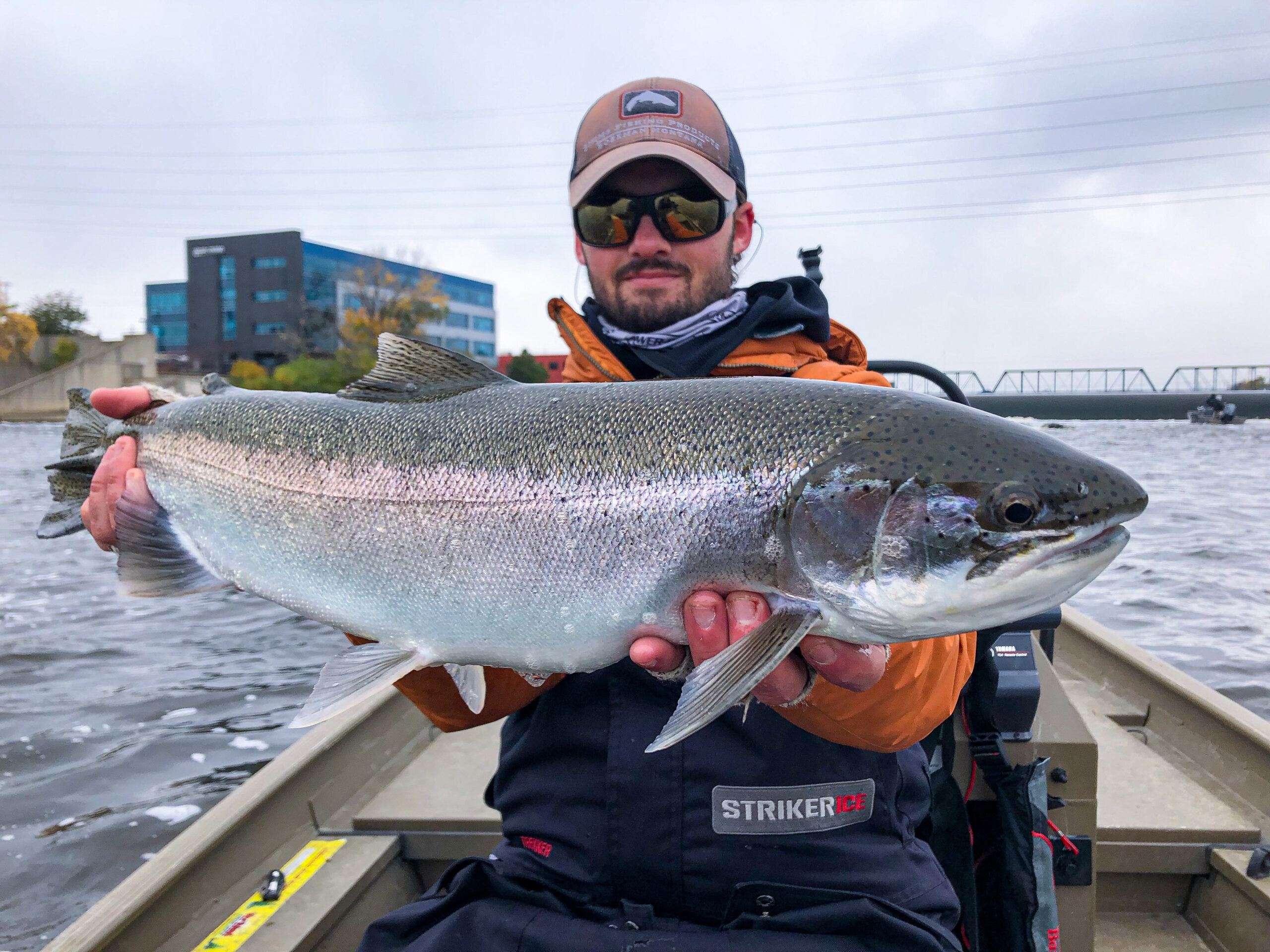
If you’re curious about Michigan steelhead and salmon fishing, this episode is for you.
Christian Gradowski swings streamers under city bridges, strips flies for kings in water warmer than most trout would tolerate, all while capturing it all on film.
You’ll learn how to read tricky currents without obvious structure, get prepped for Great Lakes kings, and why July bass fishing can actually teach you how to swing in November. Christian keeps it real, sharing stories from the gravel runs of the Muskegon to the busy Grand River, where steelhead stack up under freeway overpasses.
Find out why stripping streamers could be your new go-to and how glow-headed flies help get bites in cold water.
I just got back from my first big trip fishing for Chinook salmon in Alaska. Turns out Christian was also up there around the same time, chasing kings and filming content for the Katmai Trophy Lodge. He spent almost two weeks stripping flies through the Naknek, racking up double-digit hookups. He even landed a 20-pounder while some of his buddies caught a 30-pound chinook.
In Alaska, Christian said he was hooking kings left and right. Like double-digit days, heavy fish fresh from the salt, and fights that felt like they could pull the rod from your hands. The fish are aggressive, fueled by cold water and the short distance from Bristol Bay, so stripping streamers can be nonstop action.
Michigan Kings, on the other hand, make you work. Same flies and sizes will catch them, but the bite is slower, the colors change, and the odds aren’t in your favor. Stripping usually outfishes swinging, except when fish are holding on gravel, where Christian swings for aggressive males in dark pockets. He says landing two or three kings here isn’t just a good day. It’s a hard-earned victory.
The Grand runs about 75 to 100 yards across, and the Muskegon is closer to 50–75. You can float them, but Christian says most folks run jet boats. For kings, he likes to fish lower in the system (about 20 miles or so below the dam) where there are good holes and the fish will sit.
Unlike Alaska, Michigan kings can hang in the lake for weeks before coming in, already changing color and getting into “king die-out mode.” They’ll still bite, even in full “boot” or “zombie” mode, but it’s a grind.
Christian has worked with several lodges, such as Werkman Outfitters, creating content for social media. He also teamed up with TroutRoutes to film the M-37 Tour, a mini-series on YouTube where he and Alex Lafkas fished a bunch of rivers that M-37 crosses, like the Muskegon, the PM, and the Manistee. For Christian, who’s been guiding for almost five years, it was a chance to learn a ton from someone like Alex, who’s been at it for nearly three decades.
Christian’s roots in Michigan run deep. He grew up fishing the Au Sable River, where his family has had a cabin since before he was born. He started fly fishing at four or five, then got hooked on tournament bass fishing through middle and high school. That passion led to a college bass fishing scholarship, but he soon realized that school wasn’t for him.
After a stint filming pro wakeboarders, he landed in a fly shop, started guiding, and never looked back. About four and a half years ago, he joined Werkman Outfitters so he could focus on what he does best—getting people on fish—without the business side pulling him away from the water.
Christian says every part of Michigan has its own fishing obsession. Near Detroit, it’s all about trout, with quick access up I-75 to northern rivers. On the west side, anglers chase steelhead and kings. Up north, it’s a mix of everything. The state’s waters offer something year-round, and for Christian, that means plenty of variety and a long season on the water.
Christian says November is prime time for fall steelhead with fast runs, screaming drags, and plenty of fish in the system. Some trickle in as early as October, but it’s a grind. December can be great if it’s not too cold, while January slows down to mostly nymphing.
By mid-February, he’s stripping and swinging again to keep moving and find active fish. It’s the same approach as salmon—covering water from a drift boat, jet boat, or on foot. Christian shared that he learned the strip game thanks to some tough love from Russ Maddin and Alex Lafkas, who pushed him to put down the “spey pole” and pick up the streamer rod.
Christian’s swinging setup changes between the Muskegon and the Grand. On the Muskegon, he keeps it short 1(1’6” to 12’ rods) because you’re usually fishing one log jam, a couple of boulder piles, or other small targets. T
he Grand’s a different game. Below town, it’s mostly sand with scattered wood, so he runs 13’ to 13’8” to bomb casts and cover ground. One of his favorite runs is just a single chunk of concrete in the middle of the river, and he swears there’s almost always a fish behind it.
Christian keeps most of his swinging trips out of the boat. On the Muskegon, there are spots you could wade, but he says the risk of clients slipping into deep holes isn’t worth it. It’s even trickier on the Grand. Steep drop-offs, cold water, and hidden hazards make wading risky. He fishes right in downtown Grand Rapids, even under the big blue Varnum building, in a fully urban setting.
Christian jokes that his Muskegon “grand slam” is landing a steelhead, a king, and a trout in the same day. The trout could be a brown, a rainbow, or even a small jack steelhead. Coho can be part of the mix too, but they’re more of a bonus.
Christian has used TroutRoutes for everything from filming dry fly trips to finding new steelhead water. For his Hendrickson hatch film, the app’s mapping tools helped him zero in on the biggest, most productive riffles—even on water he’d never fished before. He says these features save time, keep you on fish, and make multi-day trips more productive.
Episode Transcript
Dave (2s):
He swung for steelhead under city bridges and strip flies for kings and water warmer than most trout would tolerate, all while filming every cast along the way. By the end of this episode, you’ll know how to read water in Structureless flows, how to prep for Great Lakes kings, and how bass fishing in July might teach you everything you need to know about swinging in November. This is the Wet Fly swing podcast where I show you the best places to travel to for fly fishing, how to find the best resources and tools to prepare for that big trip And what you can do to give back to fish species we all love. Christian Grabowski brings a raw boots on the Jets sled deck perspective of Michigan fly fishing from the gravel choke runs of the Muskegon to the gritty concrete face currents of the Grand River where a steelhead stack below freeway overpasses.
Dave (48s):
In this episode we’ll talk about why stripping streamers for salmon and steelhead might be more effective than you think and what glow headed flies can trigger in cold water. Here he is, Christian Grabowski. You can find him at Christian Grabowski on Instagram. How are you doing Christian?
Christian (1m 6s):
Good. How’s it going Dave?
Dave (1m 7s):
Very good man. It’s so cool to have you on here. You know, we was talking to some listeners of the podcast and we were just talking about swinging flies and steelhead and the Great Lakes specifically. We have a ton of people that are either in the Great Lakes or they’re around the country and You know, and wanna go out there and fish. I think it’s pretty cool because you guys have a ton going on. You’re up in Michigan. We’re gonna talk about salmon and steelhead today, maybe some other species and everything, but You know, we’re gonna talk about your guiding and all that. But maybe just take us back real quick just where we are today. You know, we’re kind of, July, August is right around the corner. What are you up to this time of year?
Christian (1m 41s):
So currently right now we’re running a lot, a lot of bass trips. That’s mostly what it is. Our trout waters are kind of shut down due to the heat. I think on average they’re sitting at like 67 to 72 degrees. So that is not a happy habitat for trout. Yep. So it’s mostly the small mouth jam. We’ve been doing pretty good. I’ve been running this the Muskegon, if people are familiar in the Grand River.
Dave (2m 6s):
Nice.
Christian (2m 6s):
So it’s been a lot of fun this summer we’ve had a lot of good top water ’cause the water’s been so low. So it’s been entertaining as a guide to be able to just watch something all day, not just strip streamers. Right,
Dave (2m 16s):
Right. That’s awesome. And is now the Muskegon and the grand, how far? Because there’s a few different grands out there. What, which, how far a part of these rivers that we’re talking about here? The Grand and Muskegon. So
Christian (2m 27s):
The Grand River flows right through Grand Rapids, goes out to Grand Haven, then it goes all the way up to Lansing and the little trips that flow in. And then the muskegon’s about an hour north on 1 31 up in like new Wago is like the center capital of it for most people to like recognize the Muskegon. It’s new Wago. Okay.
Dave (2m 46s):
Yeah. And so yeah, this is not the grand, there’s the Grand River. Well there’s a few different grands. Right. Have you fished any other Grand Rivers around the, around the states?
Christian (2m 55s):
Not around the states. The grand in Grand Rapids is the only grand I have fished.
Dave (2m 60s):
Okay, cool. Yeah, because you’ve got the grand that’s up in Canada, you got the grand that’s down on the South Shore Lake Erie. Yes. And I’m sure there’s some other ones too, but we’re talking about the grand, we’re talking about Michigan today. So this is great and we’re gonna get into steelhead in a little bit of that. And it’s pretty interesting because I’m coming hot off Chinook, which I think today we’ll talk about that a little bit. I just got back from really my first real big trip in Alaska fishing for Chinook and swinging for,
Christian (3m 23s):
Hey so did I.
Dave (3m 24s):
Oh cool. So we can talk about this a little bit. So it was pretty amazing to get the feel and we could talk about that. Right. The chewing, the gum. George Cook has been on the podcast number time. He is talked about, You know, let him chew the gum and finally I had a schnook on the end that was chewing the gum and it’s this really crazy feeling when you gotta, you gotta do it just right and set the hook just right or you kind of pull it out of their mouth. Now first off, where were you at in Alaska and then we’ll get into Michigan a little bit.
Christian (3m 46s):
Yeah, so I was over with the KTL Cat, my trophy lodge crew. I was filming content for them out there. So they brought me out for like a week and a half, two weeks to come film And I got to pull on some kings and the knack, which was really, really cool.
Dave (4m 3s):
Wow. So you got in the nack? Nack.
Christian (4m 4s):
Yep. Got to strip some flies through the nack. And I mean coming from Michigan one to two is like your baller day out here stripping flies for kings and then you go out to Alaska and you hook 10, you’re like, oh my gosh, this is the coolest thing I’ve ever done. And they fight way harder ’cause they’re an hour out of Bristol Bay basically.
Dave (4m 25s):
Right.
Christian (4m 26s):
And so I was a believer in the gum, like you said, like I had never threw pink in my life and then chewing on the bubble gum.
Dave (4m 32s):
Yeah, right. Exactly. So what was that? So you guys had some pretty decent action out there? Yeah,
Christian (4m 37s):
We got a lot of, I got my first like 20 pounder like on the strip, which is really cool. And then a bunch of like what they called super jacks and then jacks like the jacks go to like what it’s like 16, 18 inches and the super jack is at 24, 26 range.
Dave (4m 54s):
Right.
Christian (4m 55s):
Yeah. So there was a lot of that. And then after I left one of my really good buddies who’s the head guide up there, Dylan Denning, he with a customer nbb like a 33 pounder. Oh wow. So it’s like, oh my gosh they, the possibilities are endless up there for big fish.
Dave (5m 11s):
Right, exactly. So You know, we’re talking Alaska but today we’re really getting into Michigan. So I’ve never fished, You know, anywhere for salmon in the Great Lakes. What is Michigan? What is the Chinook like there? Is it a lot different than what you’re doing up in Alaska?
Christian (5m 25s):
It’s different in the sense of your bites, the gear fishing, like throwing thunder sticks, spoons and like your big rooster tail stuff like that stuff is gonna work hand over fist with fly compared to fly. But it’s honestly it’s identical. Just different colors. Like same flies, same size. You’re just, your chances are very limited in Michigan. I don’t know if that’s due to they sit in lakes longer and kind of get stagnant and then they push up. Like I feel like where all the guys are trolling the lakes, if those fish just came immediately in, I bet we’d probably have better numbers of fish on the strip and things like that.
Christian (6m 8s):
But I mean we’re dealt the hand we are, we just have fun with it. I mean it kind of more rewarding that you do end up with like two or three Michigan kings in a day. It’s like I worked my butt off for this.
Dave (6m 18s):
Right, right. No, that’s awesome. So there is a chance, so you are, you guys are hooking into ’em like and are you swinging flies for the Michigan Chinook
Christian (6m 24s):
So you can, I only swing them when if they get up on gravel And I got a guy that wants to catch ’em when they’re on gravel areas, you, it’s really hard to strip ’em because you end up snagging fish and you don’t wanna do that. Right. You’re running through a run. There’s so many of ’em congregated. Oh yeah. So what I will do is I will come off of the gravel and sit in the dark spots like you would for like a trout or a steelhead behind Kings and I’ll swing through the back ends of that to look for like the aggressive males that are trying to hop up with the female. So we can do it a little bit with the swing, but it’s really more effective for the salmon on the strip. Like the swing is very hit or miss in Michigan for Okay.
Christian (7m 6s):
At least for my end with the Kings.
Dave (7m 9s):
Gotcha. So more of the strip, so more like, You know, back to Alaska, like coho are known for stripping, right? Yep. You could strip ’em in and they’ll hit that. So the same kind of technique there where you’re casting out into like a backwater pool and stripping through.
Christian (7m 20s):
Yep, absolutely. Like row it just like you would for Browns like rowing streamers, that’s especially on like the grand, you basically have like the Grand River, you got a couple deeper little pools they’ll congregate in. You just kind of, they’re a hundred yards. You just rinse and repeat over ’em a couple times stripping through and usually you can get one or two to like move the chances of them eating. You never know, but you’ll get one or two to kind of follow you out of that pool.
Dave (7m 45s):
I see. Wow, that’s cool. So, and and this I haven’t, You know, we’re Muskegon, we’ve heard a lot about it, we’ve talked about the grand, but I haven’t been there. What size, You know, are these rivers we’re talking about? How big are they?
Christian (7m 55s):
I’d say on average the grand is maybe a hundred yards to 75 yards across.
Dave (8m 2s):
Okay. Yeah. So pretty decent. Yep. Yep.
Christian (8m 4s):
And then the Muskegon at least like where the steelhead and kings are, so below Croton dam, that’s kind of their cutoff point or that is their cutoff point? I’d say it’s probably the same, like not a hundred yards but 75 to 50 yard. I mean there is some wider stretches too but that’s the average. Yeah.
Dave (8m 21s):
So decent rivers and these are rivers that you guys are floating for the most part.
Christian (8m 25s):
You can float ’em or We all mostly run jet boats if the float Oh jet boats. Yep. A lot of jet boats.
Dave (8m 31s):
Gotcha. So you’re doing the jet boat thing and then you maybe talk about that. What does that look, let’s just go into the salmon a little more here before we’ll probably jump around a little bit, jump into steelhead and some other stuff. But what does that look like typically on a day? Are you guys hopping in the boat and then motoring up river? Talk about that when you get in the water and then how do you find the fish there?
Christian (8m 49s):
Yeah, so for the most part when we’re doing the king thing, once they get into like the areas that most people fish ’em when they’re on like gravel or reds, they’re not super bity. So what we try to do is fish the lower parts of the system. So like take, if you take Muskegon anything below, there’s like areas that it’s at like the 20 mile marker up to the dam. So I’m 20 miles below the dam and that’s kind of where I’ll start. So like if anyone knows like Anderson Flats is a very popular area below that water you can do a lot of the stripping for cans ’cause there’s good holes for them to congregate in And they just kind of sit there so you can run over them a couple times basically with your fly. Gotcha. So low water or like lower in the system is where we do the king stripping.
Christian (9m 32s):
Yeah.
Dave (9m 33s):
Lower in the system. So as close as you can get down to Yeah. The lake essentially the better.
Christian (9m 37s):
Yes, exactly.
Dave (9m 38s):
It’s interesting ’cause You know when you look at the west coast, the further, You know you got Alaska where these really aggressive Chinook are, but as you go further south, the more you go south down through the lower 48th, the harder it seems to get fish to come take a fly. Oh yeah. And I’m not sure exactly why that is, but it’s true. And it’s the same thing for you guys. You deal with that too at the lake is that it’s just not like Alaska. These fish aren’t just, I don’t know what it is. Right. But it’s the same deal.
Christian (10m 1s):
I swear it’s something to do with like when they’re in Bristol Bay, like I was asking my buddy out there when I was fishing with ’em, I was like why are they so aggressive here? And what they think is, is when they’re in Bristol Bay they are immediately coming up. They’re not sitting for two to three weeks in a lake like they do for us. Right. So like when they come off Lake Michigan, when that thermal climb flips and they’re like, it’s go time. So they head in from the pier heads at Muskegon and then they have a massive lake, massive lake to just hang out in and decide if they want to go up the river. In that time they start flipping their body over getting ready for reproduction and all that stuff And they start to go into like river mode or the king die out mode as I call it.
Christian (10m 46s):
Hmm. And I think that’s where you lose your bite window with them. Yep. So like in Alaska they’re shooting straight in like immediately up in and then they start to change colors by the time they hit the rivers for us they already are that like, I don’t know, greenish brownish kind of like
Dave (11m 3s):
Oh they are? Yeah. So they’re not chrome when they’re coming, when they’re up.
Christian (11m 6s):
No, it’s very rare you’ll get chrome. I mean you get ’em obviously like it happens. But yeah, a lot of the times they already have that kite over, they are already beat up looking, they’re rotting to a degree already. ’cause 70 degree water in those lakes. What’s it gonna do to a, a fish that loves 45 to 50?
Dave (11m 25s):
Right, right, right. Yeah they’re on their, they’re on their path to the end, which is amazing, amazing cycle. Yes. Gotcha. Okay. So they’re, and yeah, like I said, same thing down, I think the lower 48, You know, it’s, it’s kind of that way. But Alaska is this unique kind of unicorn thing and that’s why a lot of people love to go up there. But, but what you’re saying is up on the Muskegon and the grand people, you can still hook these fish. They’re still biting. It’s not like you’re, you’re lining them or anything like that?
Christian (11m 47s):
Oh yeah, no, a hundred percent I have, I mean last year alone I think it’s a very small like market of mine. Like I, my diehard trout streamer fisherman, they do the king thing ’cause they know the struggle. Oh
Dave (12m 0s):
Right. Like
Christian (12m 1s):
The, the bleeding fingers from stripping a line all day. Like that’s their thing. Yeah. So those guys get it. So I’ll run like maybe let’s call it eight to 10 trips with my like, like my streamer anglers and I mean on average you at least will move two or three. The chances of actually hooking one it’s probably you just stare at
Dave (12m 22s):
It. Oh right.
Christian (12m 23s):
And then you run outta room so they see the bow the or things like that.
Dave (12m 29s):
Okay. And are any, is anybody out there if you don’t have a sled, You know, if you wanted to do the fly thing, is it hard to do like DIY over there or do you have to kind of go to those areas where, I mean I guess if you had a boat you can do it but what’s that look like if you’re trying to do it yourself?
Christian (12m 43s):
No wade fishermen could, there’s a couple rivers like I don’t want to name Dropper River, but if You know Michigan, there is one river that is like super, super wadeable that gets a really good run of kings in steelhead. I don’t, I mean I don’t wanna like drop it’s a smaller river,
Dave (12m 58s):
We don’t wanna burn anything. No, definitely
Christian (12m 59s):
Not. But if You know, You know, and if you wanna figure it out, there’s one small river that carries kings in steelhead and you can easily strip through that entire river and then don’t let me be the bearer like, or like the downer here. But like the tributaries that get kings, some of those kings will still bite. Usually it’s that later window once they’ve hung out with that female and spawned, they get into that like full boot mode and you get those zombie bites. Like we’ll have zombies chase flies a lot. Wow. Like you’re asking about swinging them. A lot of times I get by catches on early steelhead swing trips on boot salmon
Dave (13m 34s):
And what’s a boot salmon?
Christian (13m 36s):
It’s like rotting like missing chunks of flash that’s like the Michigan term of boot or whatever.
Dave (13m 41s):
Oh right. That’s awesome. Love it. So you got the boot salmon, the zombie and the zombie fish is, You know, it is pretty amazing because again it’s like this fish that’s on the end of its lifecycle but at the same time you’re saying like these fish actually still bite even when they’re there. That’s crazy.
Christian (13m 55s):
Oh yeah. I mean especially I feel like a lot of people, if you’re familiar with like the Manistee is a big river, tippy dam is like the mecca of kings. Like that’s where like if You know Michigan and know King Fishing, everyone goes to Tippy Dam.
Dave (14m 8s):
Oh they do the manistee. Okay.
Christian (14m 10s):
Yep. So up there that that water system guys, like I know a couple of people that I’m friends with that their guiding season is throwing wraps a little bit later in the season because these big boots are, these big zombies will just come out and t-bone a thunder stick. Wow. I mean they’re a little bit less aggressive on the fly that time of year, at least for me. ’cause I switch over to kind of steelhead at that point once they’re rotting. But I know a lot of guys that run thunder stick trips And they do fairly well on King. So you definitely could get ’em on fly too, I think throw rattle in there. Yeah. Tie something a little bit different.
Dave (14m 44s):
Cool. Well this is a good start. I think I, I wanna touch on that a little bit because Sam is definitely on my mind. We’re, I wanna touch base on Steelhead a little bit, bit too and maybe some other species. But before we jump into that, you mentioned on the video it sounds like you’re doing some stuff around video production. Tell us a little bit about your video production work you’re doing then. I know you’re doing some stuff with trout routes. What is this little tour you’ve been doing with them and give us a little background on that.
Christian (15m 5s):
Yeah, so the most of what I do is I work, I’ve worked with a couple lodges and then obviously Workman Outfitters doing content for social media and things like that. And then for trout routes we have been doing little what I’d call miniseries on like mini TV shows on YouTube. I did the M 37 tour, which we phished a bunch of different rivers on M 37, which is a road through Michigan and it crosses over a bunch of different rivers crosses over the Muskegon, the pm, the Manistee area. Like you have so many different options. So we did a little tour of that and it’s a lot of just like TV show style but not really scripted.
Christian (15m 47s):
It’s just me. And I don’t know if you’ve ever had Alex Lka on? Oh yeah, he’s a good friend of mine.
Dave (15m 51s):
Oh actually Alex was on, yeah, so Alex pretty cool. So CJ is does our southern, You know, our, our CJ Southern podcast. Right. And so, okay. Yeah, so CJ is actually our host. He’s hosting our stuff and he had Alex on on one of his recent episodes.
Christian (16m 5s):
Oh sweet.
Dave (16m 6s):
It’s called CJ’s real Southern podcast if you wanna check it out.
Christian (16m 10s):
Yeah, I’ll have to check that out. Yeah.
Dave (16m 12s):
So, But yeah, Alex was on so I’ve heard Alex, I’ve heard of him now. So it’s great.
Christian (16m 16s):
Yeah, a lot of Midwest people know him. He’s kind of like in that trifecta with like Russ Madden and Kelly Gallup, they were all together kind of doing the streamer dreaming thing when it first started off in Michigan. And so he, him And I did the trout routes tour together, which was really fun. I mean it’s, you’ll learn a lot from someone that’s been guiding for 28 years. So as a younger guide, I’ve only been guiding for about four and a half, almost five years now. And he’s been doing it for 27, 28. So you’ll learn a lot with those guys.
Dave (16m 44s):
Yeah, definitely. Definitely. That’s awesome. So basically, yeah you guys, so on that tour with Alex, what, what were you doing? So you’re taking a tour to just show people the M 37 and then essentially using trout routes to kind of find your way around and and doing the Yep. Land ownership and all the great features. What is on trout routes, we’ll get into a little more at the end, but what is the, what do you find is the feature you, I know there’s a lot of great features, but what is one you really love about trout routes?
Christian (17m 8s):
100% the fact you can calculate how long your floats gonna be.
Dave (17m 11s):
Oh nice.
Christian (17m 13s):
I love that for when I fish new rivers, especially with filming, I’m always trying to go do something different or try a new program out with like filming content. Yep. So like we just did something up north this summer already, I can’t talk about yet, but we did something up north and we used trout routes and if I wouldn’t have checked the float we were doing, we would’ve been stuck out there for a very long time. I’ll just put it that way. Yep. So it’s a, that’s my favorite feature. ’cause like you can use Onyx but Onyx you have to make all the pins and it’s not very accurate. That boat ramp to boat ramp feature is number one in my opinion. And the offline stuff. ’cause a lot of the Michigan cell phone service isn’t great on our rivers, which it’s probably not great everywhere, but
Dave (17m 56s):
No, no it’s not. That’s good. Okay, perfect. So that sounds like an awesome feature. We definitely will give a shout out to here. And then you mentioned this stuff you were doing up in Alaska at the Nack Nack, so that was kind of filming, just basically get some fish stuff and kind of covering the lodge and all that.
Christian (18m 12s):
Yeah, hunter. So I basically came in and did content for their Instagram. So doing Instagram reels and making, when they go to shows they usually have a, like a little booth at the stealth craft boats. Oh yeah. Area. They have a little KTL booth and so I, I, I’m, I’m going to be making videos of the content I got for their, like showing their lodge, their programs and all that stuff. And then I’ll also be making like a full like YouTube film out of it for my channel, also my trip in Alaska. Perfect.
Dave (18m 47s):
So we can check all that out on your YouTube. A lot of your reminds us again where, where can we find your YouTube channel there?
Christian (18m 53s):
Yeah, my YouTube’s just Christian Grabowski Phish And that is all it is.
Dave (18m 57s):
Perfect. All right, great. So we’ll get that, we’ll get some links to show notes to that. People can check that out. Is this, this episode probably is gonna go out sometime later this summer, so I’m sure it’ll probably time well with the other stuff. But let’s take it back a sec too. I wanna, again we’re gonna talk steelhead here, but I also wanna hear a little bit of your story and maybe take this broader perspective on Michigan because I know I think you have some early days fishing out there and some other stuff. So first off, tell us, You know, have you been fishing out in Michigan a while and then how’d you kind of get into the whole guiding program?
Christian (19m 25s):
Yeah, so I started fortunate enough my grandfather’s like, it’s a long story short, my grandfather’s an immigrant from Germany and when he was down in Detroit after coming over from Germany, he is like, I need to find a place in the woods. And the place he chose was the Isabel River. Nice. And so I’ve had a generational cabin on the Isabel River since I was, before I was even born it was there. So I learned at about four or five my mom thinks is when my dad first took me fly fishing. So I learned to fly fish real young out on the OBO through the holy waters. Yep. As I got older into like the middle school, high school timeframe, I got basically obsessed with tournament bass fishing And I chased that dream all the way to going to a college for one semester’s all I lasted.
Christian (20m 16s):
But I did have a scholarship for bass fishing and college just was not my jam. And I, after I dropped outta college, started filming with Pro Wakeboarders, which is kind of a really weird side quest of my life. I got to travel around with a bunch of pro wakeboarders and film content and film their contests, like entries basically. And then I was like, yep, I am gonna start working in a fly shop. I love fishing, yada yada. And that was six years ago, seven years ago. There you go. And picked up guiding, just kind of came with it. It was one of those things, I took a couple buddies out fishing, I’m like, it’s kind of fun to get someone on their first, like steelhead ever their first this and then got the job at the fly shop and then they basically were like, Hey, we want you to guide for us.
Christian (21m 5s):
So I was their guide And that was history about four and a half years ago.
Dave (21m 10s):
Yeah. And that was Workman Outfitters.
Christian (21m 12s):
Yep. Yeah, I, so I started with another fly shop and then I moved over to Workman ’cause I was, after working for them for a little bit, I left them be to go solo because I wanted to just run trips, not working a shop because it was just kind of taken away from trips. And so I thank them a lot for that opportunity. But I left them and then I was solo doing, filming, running a website, running ads and all that. And Tom and Max were the only Workman Outfitters, Tom and Max, they were the only ones else fly fishing on the grand and they’re like, Hey you should join us. And I’m like cool, I don’t need to run the business side. I get to do what I’m just good at. Sweet.
Dave (21m 49s):
There you go. Yeah. Yeah. And so in the filming, it sounds like it’s something you’ve been doing for quite a while, not just fly fishing, but before that.
Christian (21m 56s):
Oh yeah, I’ve, yeah, filming, I mean I used, no one will find them but there is an old YouTube channel of me making bass fishing tutorial videos. Oh cool. When I was about like 12 years old or 10 years old. And then I was a skateboard kid and snowboard kid. So I grew up filming that stuff and then transitioned into Wakeboarders when I was like getting paid, like paid work. That was my first like paid gig was wakeboarding stuff.
Dave (22m 20s):
I see. So you got a little bit of the skating and all that stuff in, in the background. Yep. Cool. And then you mentioned, so the Obel, which is kind of up north, right? More towards Grayling, Michigan and Yep. And then you’ve got, you’ve got all these kind of really famous names of, You know, whether it’s the Osbo, you’ve got the, the Manisty up near kind of right up north again Traverse City area, you got the Muskegon which is down south and then everything over across the state to Detroit. I mean, what do you think when you think of Michigan as far as species wise, what is the, is there one that’s overwhelmingly like the fish that people are kind of going for? Or what does, what’s that look like? If you had to narrow that down?
Christian (22m 57s):
I swear it depends on where you’re at. I think everyone on, so I grew up originally near Detroit area and then I moved up to the Grand Rapids area about eight years ago. And I will say everyone near Detroit is obsessed with trout fishing. Oh really? And so and so is, I like it’s the easiest way to get north is on 75 hour and a half your fish and trout. So then you move to the west side and everyone’s obsessed with like your steelhead, your king fishing and all that. You go north and they’re kind of mixed in with everything. So it’s like every little part of Michigan I feel like has their own little like obsession is how I like to put it.
Dave (23m 37s):
How long does it take to drive from Detroit to the Osbo River?
Christian (23m 41s):
About two, like about two hours and 20 minutes if that.
Dave (23m 44s):
Oh yeah, not bad. Not bad at at all. No to, yeah. So you’re basically crossing the state in less than three hours you’re getting Yep. Or well at least north to south. Yeah. Cool. Okay. And so you spend your time though at the shop, like we talked, we talked a little salmon. It sounds like you even have a coho program, which is interesting. And then steelhead and You know, pike and some of the other species. Is steelhead definitely a big thing that you’re spent a lot of time on throughout the year?
Christian (24m 6s):
Oh, a hundred percent. I think it’s like by far technically our longest season, like mid-October, end of October all the way until I ran my last steelhead trip April 22nd I think, or 23rd this year. So due to just if you look at it on pen and paper or a calendar, your fish and steel had a lot more than your fish and bass technically. Yeah
Dave (24m 29s):
You are. Okay. So steelhead and, and that’s great too. May, And I think what I’d love to do is just kind of break down that fishery a little bit. You know, I think when we were up there we were a little bit further towards, You know, out Ohio, but I know there’s some similarities there. What does it look like for steelhead? Do you kind of have that, You know, that fall, You know, early and then the winter time focus? Or talk about, You know, when, if somebody’s thinking about a trip when they can kind of have a chance at a steelhead?
Christian (24m 52s):
Yeah. So if you, if you’re a, okay, so if for a trip standpoint, I tell everyone November 100% for your fall. Your fall like screaming drag, steelhead swing bite. Okay. That’s when you wanna book a trip. It’s not guaranteed but that’s when you’re gonna have the most fish in the system. Now if you’re just a guy that wants to get really into it, I have started as early as October 7th And I haveve hooked a steelhead I think on October 8th when I was doing the filming for this short film I did for Grand Rapids, I was doing a steelhead film and then we started filming at the start of October. So you can do it really early, some trickle in, it’s a grind but you can do it.
Christian (25m 32s):
But then you work into November, that’s prime time swinging streamers, screaming, drags, just absolute airborne tail walk and steelhead December. I always love, ’cause no one’s out there ’cause it’s really cold, but the bite stays pretty good as long as it’s not like freezing, freezing. But by January I’d say we’re pretty, our fish have slowed down. It’s a lot of like in like nim thing and indicator fishing. But I will say like coming out of that window in mid-February, that’s when I start stripping for steelhead and swinging for steelhead. So I start running strip trips for steelhead.
Christian (26m 12s):
You can do it in the fall, like obviously I just like the fall swinging a lot more than stripping them. But when it’s February and you wanna keep your body moving and not just stand there and hold your pole vaulting pole right, you can definitely strip flies for ’em and do fairly well all the way until they get on them reds. Oh
Dave (26m 29s):
Wow. So that’s in February. And, and does this now, what is the stripping for steelhead game look like? Is this something where you’re out of a boat similar to the salmon?
Christian (26m 38s):
Yep. Same exact thing. Like you could do it outta your drift boat, you could do it walk and wade style, just cover a lot of ground and you can do it outta your jetboat. It’s a program that I was, I shouldn’t say a pro like program, it was Russ Madden is like a diehard strip angler for anything that swims breeds or anything that’s just Russ. And so him and Alex were basically like, you need to grow up and put the spray pole down and you need to start stripping for steelhead. That’s kind of how it all started. Nice. I basically got bullied into learning how to strip for steelhead from those two guys.
Dave (27m 13s):
That’s so good. I was just watching, I always love the, sometimes the YouTube, You know, And I love that you’re on YouTube because it’s such a interesting thing, You know what I mean? It’s so like, they’ve got the algorithm so good, You know, because you’ll be watching some video on fly fishing and then on the side there’ll be like an NBA like Charles Barkley highlight reel and I’ll, and I’ll be like, there’s no way I’ll be, no I’m not gonna watch it. And then after about 10 minutes I’m watching Charles Barkley and You know, but it was funny because they were talking about, You know, just the history and it’s interesting because Charles, You know, I’m not sure if you’re a basketball fan, but he was in 84, You know, is when he got going. But one of his mentors was Moses Malone, just this guy who won like three, You know, it was just a dominant NBA player. Okay. But he was his mentor and, and it was a big thing and, and Charles Barkley was kind of an a-hole and he was just like this guy that didn’t listen to anybody, but he listened to Moses because Moses was like a superstar all star.
Dave (28m 3s):
And Moses like, dude Barkley, you’re fat and you’re, and you talk too much. You know? And so, but but, but the reason that Barkley became kind of what he was a big part of it was the fact that Moses was his mentor. I’m kind of making the transition to you with, You know, you got Russ Madden who we’ve had on the show and he’s such a big name that you can’t say no to a guy like that, right? No. Because You know his history and so you were smart enough to actually listen to the the wisdom.
Christian (28m 26s):
Oh yeah. I mean when I got sent photos they went out fishing two years ago and this like Russ has always done it, but he doesn’t advertise everything. Like Russ is a, he likes to keep his stuff quiet and likes to do Russ. Yeah. And so I got sent some photos, they’re like, yeah, you need to learn how to do this because you suck at guiding if you keep throwing spray poles. And I’m like, oh my gosh guys.
Dave (28m 48s):
Right. And what are the spray poles?
Christian (28m 50s):
They’re your YouPay pole.
Dave (28m 53s):
Oh,
Christian (28m 53s):
Fishing rod. That’s what Russ calls
Dave (28m 55s):
Him. He calls him sprays poles. He calls
Christian (28m 56s):
Gotcha. Or he calls me the pole vaulting champion.
Dave (28m 59s):
Yeah. So Russ isn’t a spay, he’s not a swing spay guy.
Christian (29m 2s):
No, he is. I mean he used to be, that’s what he always claims is that he used to, he can still do it, but he rather strip him. That’s his big joke. Gotcha.
Dave (29m 10s):
Okay. So Russ is the, yeah, so the stripping and, and yeah maybe let’s describe that a little bit. What, what is that, You know, how would somebody, again they’re listening here that we’d love if they could check in with you, get a trip. But if they can’t do that, how would somebody strip for describe what that looks like for steelhead?
Christian (29m 23s):
Yeah, so the best way I explain it is you can a hundred percent throw your regular streamers for trout. Now if you want to double your odds, you’re basically taking any streamer pattern you have and making the biggest egg head thing on the front end. So like if you took Russ’s Circus Peanut, he calls it the weaponized Nut. He takes a bunch of chail like bright orange, chartreuse pink and puts that as the head. So like a big glowing orb at the front of the fly as an attractor in. So take any streamer pattern and make a big orange hotspot or just make a big like egg hotspot. Anything you throw egg wise color, throw it on the front of your streamer.
Christian (30m 4s):
The next thing you’re gonna wanna do is get some sort of sinking line and you’re gonna fish all of your transition waters as steelhead are gonna be moving up. That’s why I always like that February is those steelhead are moving to go get ready to spawn so you can catch them off guard. And they seem to be a little bit more snappy in that timeframe. ’cause I feel like in the fall they’re chewing, they’re chewing And I, I’ll be honest, I like catching ’em on the, the swing rod in the fall. But especially in February you can do the strip game with good numbers of fish and it’s just covering water like every trip. I think this February and March I ran, I was doing over 15 miles of water every day.
Christian (30m 47s):
Not fishing fully 15, but I was like jetting here, fishing this jetting down here, fishing that. And if you don’t have a jet boat and you’re just going to one spot, like if you’re from Michigan, go put in at point A at the dam, that’s your best spot. Start at a dam and go as far down as you want and just keep casting. ’cause it’s gonna happen. You just need to cover water and find the right one that’s in the right mood. Gotcha.
Dave (31m 12s):
Find the right one and, and so the fish are spread out. And are you fishing kind of typical steelhead water? Or is this more like pools?
Christian (31m 20s):
So I like to, it all depends on my temperature of my water. If I have like below 40 or I should, yeah, below 40, let’s just call it that. Below 40 you’re slow water, like what you’d bobber fish or indicator fish like throwing streamers through that you will get ’em to turn. But once you get to that like 45 degree water, that 43 seems to be the magical number. And up anywhere where they’re gonna be using to travel to go find their spawning grounds, that’s where you’re gonna find them. So anywhere behind, like if you have, You know, there’s a big gravel flat where they all spawn go fish in between the gravel. ’cause those dark spots will hold them early as we all know.
Christian (32m 2s):
But then those channels leading in to that gravel, that’s gonna be your juice as you wanna call it. Like that’s what you’re looking for.
Dave (32m 12s):
Today’s episode is brought to you by Trout Routes by Onyx, the ultimate mapping app for trout anglers. Whether you’re planning a big road trip or sneaking away for an afternoon session, trout routes helps you find and explore new waters fast. You’ll get detailed maps that include public land boundaries, stream access points, regulations, and other extras like hiking trails and parking spots. I’ve been using it to plan my trips and it’s taken the guesswork out of the process. No more bouncing between multiple tools. Everything you need in one spot, give it a try right now at wetly swing.com/trout routes and download the app to start exploring smarter today. And when you’re doing this, so February where it’s colder, You know, it sounds like the s dripping game is the better thing to do.
Dave (32m 58s):
But in the fall, can you, are you swinging flies? And then are you also doing some stripping there maybe at the end of the swing? Or is it worthwhile to do some of that in the fall as well?
Christian (33m 7s):
Yeah, absolutely. Like I’m pretty, I’m pretty what’s the best animated with my swing and stuff. Yeah. Like I like to throw some like jiggles in there, some up and down, some back and forth poles, like do a little bit of everything with it. I like to experiment. I feel like it kind of hurts me in my guiding world because I, I always like to just try something new and keep it fresh. Yep. But I also think it helps me a lot too. It does with steelhead because not every steelhead is thinking the same way as the other one you just hooked is. And so like what, there’s a YouTube video I posted teaching people how to basically cast a spay rod. And on my strip in I stripped in a, a steelhead during my tutorial video.
Christian (33m 48s):
So it just shows you like they will eat the strip, they will eat that real animated stuff in that fall timeframe. Yeah,
Dave (33m 56s):
That’s right. That’s, that’s good. And I think that’s a smart thing. We’ve heard that before on the podcast here. Just that it’s good to mix it up, try different things, You know, you never know it is phishing. Right. And you’re probably gonna be Yeah. Hundred doing, doing things differently than other people out there.
Christian (34m 8s):
Yeah. And I feel like everyone that gets into swinging, they, like, you watch all the videos online and you’re like, All right, I’m gonna stand there And I will do one to two pullbacks. And then I see it a lot the guys that are just doing that and I’m like, throw something in there, make it fun. Like give yourself something to do when you’re not catching anything. Like you’re, you’re spay fishing, you’re not gonna hook a bunch of ’em. That’s just the nature of the beast.
Dave (34m 31s):
Right, right, right. Yeah. So to yeah, maybe let’s jump into that on the, the swinging. So in your typical that you’re in a run, you’re swinging, what does it look like there on the Manis or the, sorry, on the Muskegon and the grand as far as your setup on the spay? Are you using pretty short, smaller stuff or what? What are you using there?
Christian (34m 46s):
So the Muskegon I run, oh, I gotta think of it. So I’m the Muskegon, I run 11 sixes. Okay. Yep. And I’ll go up to 12. Eight is the biggest on the Muskegon. ’cause a lot of the times the Muskegon, you’re fishing a very niche spot or like a spot that’s like not all the way across the river. You’re not trying to cover a bunch of ground. You’re fishing one log jam that’s sitting right there. This couple boulder piles like you’re fishing shorter stuff. The grand, I have 13 sixes. 13 eights, 13 flats. Like I throw the big stuff as far as you can cast, cover the water. The grand is very featureless, I would say below town.
Christian (35m 27s):
So below Grand Rapids. So it’s a lot of sand with like scattered wood here and there maybe a boulder mixed in. So what you’re doing is you’re just trying to draw attention. So cover that ground, make a long cast. Yep. Or if you can find concrete, it’s an urban fishery. Concrete holds a lot of fish on the grand.
Dave (35m 46s):
It does. So concrete is good out
Christian (35m 48s):
There. Concrete slabs are good. One of my favorite runs is one chunk of concrete And I always pull one off it. Nice. Like I usually get a, like a nip or I’ll get one on, but I always get a bite on it because there’s no structure. It’s all sand. And then there’s one, I think it’s like six by six foot wide and about two foot thick chunk of concrete sitting right in the middle of the run. And there’s always seems to be one behind it. There
Dave (36m 13s):
You go. That’s sweet. So, so yeah, you have the shorter, some of the shorter rods and Muskegon, the grand’s a little bit bigger. And then are you kind of like six weight, seven weight? What? What sort of weight rod are you using there?
Christian (36m 24s):
So we run, sevens are my short ones and eights are my 13 footers. So my like 12 and elevens are sevens. And then my 13 foots are eights. So all like 5 65 75 grain five 50 on the lowest for the 13 footers. And then 505 4 75 is about the lowest. I’ll go with those elevens. Okay. And I mean, change it for your customer too or like if you’re learning, I always seem like the heavier lines help people that are learning. ’cause you can get more of like a lob out there and you can get more used to it. And then once you get dialed in with the swing, like if like my, a couple of my real good repeater customers, they like a lighter head And they cast it a lot better.
Christian (37m 5s):
And I’ve seen that a lot too, even with myself. Like the lighter heads, like you get more accuracy I think sometimes out of ’em.
Dave (37m 12s):
Yep. Gotcha. Okay. And and what are your, I guess you guys are probably throwing like Skagit with kind of the normal sinking lines and Yep. Stuff like that. Yeah, t
Christian (37m 21s):
Yeah. All depending on flows like here T 14, I’ve had times when the grand floods I’ll go up to T 17, but usually it’s T 14 to T 11 for the most part. And then I missed it And I wish SA would bring it back and maybe if SA hears this, yeah, they’ll bring back their intermediate skagit head.
Dave (37m 38s):
Oh, okay. Intermediate Skagit head. Yeah. Good.
Christian (37m 40s):
Yep. They everyone, no one makes just a plain intermediate everyone anymore.
Dave (37m 44s):
Oh they’re all the, they’re all the integrated, right integrated heads now.
Christian (37m 47s):
Yep. They’re all integrated. And I’m a, a believer in the wintertime, just pure intermediate. I stocked up before they were discontinued. I got like six left.
Dave (37m 57s):
Yeah, because it’s interesting the way, You know, it’s all about turning over the flies and the stuff, right? Like we were talking about the Chinook, You know, you’re out there casting, You know, nine, 10 weights and these are bigger 14 foot rods because again, you’re tossing heavier stuff, bigger flies, it makes it easier. Here you’re using a little, You know, less because it’s not as big, but the li the fly lines are a big part of this because You know the like the fist, right, the floating intermediate sink tip, the idea being there, it makes it easier to turn these flies over. But the, the full intermediate seems like that would be a little bit harder. Just like a full sinking line would be harder to turn over. Is that the case? Or why do you like the intermediate?
Christian (38m 30s):
So the intermediate in the slow, like the, And I shouldn’t say the slow, the cold timeframes where you’re fishing really slow water, I think it keeps it hovering Oh right in their face a little bit longer. When I get those multi density lines, those have a tendency to sink at a 45 degree angle. So they’re catching different currents. When you have the whole 23 foot head sitting at the same water depth at the same current speed, you get a very consistent swing in my opinion. Which I personally have yet. Like I’ve played with a couple of the inter like the multi density lines And I just haven’t found the right one for my program. But I definitely need to experiment out with it because I know like Kevin Fetra fishes with the rep Ben hunting if you’ve that Yeah, he’s like our Midwest like rep.
Christian (39m 20s):
Okay. And Ben’s always on me like, you need to try these real ones, you need to do it. It will make you better. And I’m like, I know I’m just stuck in my ways. Right.
Dave (39m 28s):
Yeah.
Christian (39m 29s):
But I, there’s a time and a place And I think it’s whatever you’re confident in at the end of the day, whatever you have confidence in is gonna get you a bite. And I swear by that with swinging. Yeah,
Dave (39m 39s):
Definitely. Yeah. Confidence is huge. And are you guys, when you’re swinging, are you doing a mix on your guide pro, You know, out boats and, and in kind of walking weight or is it mostly boats?
Christian (39m 48s):
So the Muskegon, you could do it. I never do it because I mean, I’m a little scared to let, like if I don’t know the person’s abilities walking through the water, I am definitely a little bit more nervous. ’cause the water we’re fishing on say the Muskegon, there’s definitely areas you can do it, but you could end up in a situation where you get a fish, you go to walk and all of a sudden it’s a hole or it’s a big rock, they slip off. So I like to keep people in the boat. The grand, I definitely don’t let ’em get in the water for the grand because that is a, at least if you’re in town, the guys that wade downtown Grand Rapids, they have the, it’s like a map. You have to know how to wade that river. And personally I don’t even feel comfortable waiting it when it’s like in the winter one it’s, if it’s cold and you fall in, then you run into issues there.
Christian (40m 35s):
But two, there’s a lot of like, oh it’s one foot here and it drops to five foot here. Right. And so I see it when I’m out there guiding, at least if I ran seven days in a row, I’ll at least see one person slip off like a legend fall into like a five foot hole And I have to like get up onto the shelf and then they’re filled with water in their waiters And I just don’t deal with that. And we have coffers and low head dams that we’re dealing with too down there. Yep. So a lot of that adds to my worry as a guy getting clients in the water for it.
Dave (41m 6s):
Yeah, definitely. Safety is big. And are people, are you able to like write like downtown Grand Rapids? Can you fish swing out there?
Christian (41m 13s):
Yeah. Oh like under the, like there’s a big blue building that I feel like most people see in Grand Rapids photos. It’s called the Verna building. I fish right in front of that, we fish right at the front. It’s a pure urban environment.
Dave (41m 27s):
Nice. That is so cool. Right. And so there’s runs that, that’s pretty cool. Yeah. And you have a, you have a dam like there’s some low head dams in that area, so that helps to kind of regulate the flows. Is that, is that the situation with the grand?
Christian (41m 38s):
Yeah. Yep. That’s what they, they basically had ’em set up for was the flooding down river so it didn’t flood out the homes lower towards like Grand Haven and things like that. But they’re currently, which they should have started, I think they’re blowing ’em up. They’re getting rid of them and they’re putting bedrock in to restore the rapids currently right now and bring new habitat in that is not manmade. And the big push is to make spawn able gravel in Grand Rapids again. Wow. Because a lot of like the rock down there is like, I call ’em like one to two pounder rocks up to like five pounder rocks. Like, You know, like a, yeah like almost like a foot wide, like the big ones a steelhead and a king can’t spawn on that.
Christian (42m 20s):
And by like getting the water to turn up more, we might get our, like that pea gravel again where it’s gonna be spawn able habitat for these fish.
Dave (42m 28s):
Wow. So they’re removing the low head dams and putting in more natural habitat to, to hope to get steelhead spawning in in that main stem area.
Christian (42m 36s):
Yep. I’m real excited for it. Hopefully they’re working on it right now as we speak. They should be.
Dave (42m 40s):
Yeah. That’s really cool. No, that’s amazing to think that the fish are actually spawning in the grand that you would think that they would be maybe up in tributaries. Are there many tributaries to the grand?
Christian (42m 50s):
There’s more than I could count on that. Yeah, there’s lots Okay. On my hand. Yeah, there’s hundreds and if you go to any of ’em during early timeframes you can figure out which ones hold like migratory fish. ’cause the kings and cohos will stack up in front of ’em before they push in. And I’ve learned a couple little sneaky creeks for fun fishing. Just like, oh there’s a king there, there’s gotta be steelhead here in a couple weeks. And I’ve gone in and caught a steelhead.
Dave (43m 14s):
Yep. Wow. That’s cool. So there’s a lot of opportunities and you, you’re in kind of one of these meccas there, You know, again, we’re not going to touch on everything around steelhead, but just some high level stuff. You know, we talked a little bit about the gear and everything. If somebody’s, You know, wanting to, You know, target some steelhead there, what do you, what are you telling them to maybe have, or maybe you could take this, like what are some things you see people doing wrong out there? Do you see a lot of mistakes being made? What, what would you, what would be the advice you would give to somebody listening now?
Christian (43m 39s):
Ooh. Mistakes. I think there’s no, there is definitely mistakes, but I feel like it’s all, we all start somewhere, right? Yeah. And I feel like they’re, I’m trying to think of the best way to put it. Like basically it, it’s not mistakes they’re making, it’s water. They’re fishing. Mm. Right. I feel like that I see a lot of people swinging water that I’m like, I wouldn’t be doing that.
Dave (44m 2s):
Right. And that’s hard too because right? Yeah. ’cause to choose water, you look at the water and you’re like, okay, you got the whatever steelhead water is three to five feet. It’s got the walking speed. But sometimes it’s hard to see other than that like, okay, what’s down there? Where are the fish? So how would you explain that to somebody to help them know where to, to find good water?
Christian (44m 20s):
I, I live and die by this go fish bass in a, a small mouth identically sit almost in the same spot. Steelhead work. No
Dave (44m 29s):
Kidding. I
Christian (44m 29s):
Will, I have seen it on the grand, I have found most of my sneaky swing spots on the lower end of the grand. So heading towards Grand Haven, like out of the city because I caught small mouth there And I have caught scams there. Fishing for small mouth, like throwing a crank bait for a small mouth or stripping a fly. You’ll catch a, like a skamania steelhead. Oh, every now and then. Yeah. Yeah. Sorry. I say scam for sure Sia. Yep. And I have gone to those spots when it’s steelhead timeframes and caught steelhead out of those spots and I’m like, that looks good. And there’s small mouth in it And I swear they sit in the exact same zones. And in the, during the filming of my, the first video I ever did with trout routes was all about Grand River steelhead swinging and all that.
Christian (45m 17s):
Multiple times I caught small mouth swinging early in October and then would catch a steelhead shortly after.
Dave (45m 23s):
Right. That’s so cool. And
Christian (45m 25s):
Yeah, so I would say go learn in the summer and go see the runs in low clear water and figure out where small amount they’re sitting and go back there when it’s steelhead timeframe. Yep.
Dave (45m 38s):
Wow. That’s, that’s an awesome tip. So, so you get your early intel, get out there and figure it out and, and do you find that water, I guess flows come up? Is that typical how the summertime you get low flows and then towards the fall they come up or the flows pretty regulated at the same flow?
Christian (45m 52s):
Oh, it’s whatever mother nature gives us with water, the grand can fluctuate. I think right now it’s at like 2200 I think. And so a couple days ago it was at 1100 and we got one rainstorm and it bumped it up a thousand cfs. Yeah, it’s a big drainage ditch is the best way to explain the Grand River. It’s a big drainage ditch with a bunch of creek arms or tributaries that come in. So all that water gets pulled into a slow moving river that doesn’t have a ton of gradient. So it just trickles on out. So if you get rain, it’s up. If you get no rain for a while, it’s way down. There’s nothing feeding it. Yeah.
Dave (46m 29s):
Way down. Gotcha. Okay. So, so that’s the grand and you got the bass water And I Is the typical water, like you’re saying, I mean you’re in the, some of these urban areas, but is it pretty much, maybe describe what that bass or steelhead water looks like. Do you have a certain level or are you just looking for structure?
Christian (46m 44s):
Okay, so biggest thing for me is finding structure, finding something, ’cause I’m fishing a structuralist river by the technical terms. Like we don’t have a log jam that’s holding a bunch of fish. Our log jams are up in two inches of water. ’cause the river’s so wide and it has like basically a cut to it or it’s like there’s always like a center trough that runs, that’s your deepest spot, if that makes sense. So everything on the sides is really, really shallow, like a foot or less. So everything I’m fishing is main river structure. And if you go out to the grand or you got a river that you’re fairly familiar with and it’s just structureless, the only structure that’s in there, that’s where those fish are gonna be.
Christian (47m 25s):
And so you see it a lot when you bass fish. You’re like, oh, there’s a log log jam in the middle of the river. Throw your streamer or your popper over there, boom, there it is. Go back and swing off the side of that And I guarantee you there’s a steelhead sitting right off that current break from that log jam or from that boulder, from that concrete. If you’re in an urban environment, a lot of it comes down. It comes down to just finding the right structure. It’s hard to explain for me ’cause I don’t fish many rivers that have like your normal structure. Like a steelhead is like I do a lot on the grain And that is structureless. So it’s hard for me to think of other situations.
Dave (48m 1s):
Sure. Is it Muskegon a similarly structureless or does it have more structure?
Christian (48m 5s):
No, it’s got structure. It’s got wood piles here, gravel hump here, big boulder there. Like it’s got, it’s like a A, it’s a normal trout stream.
Dave (48m 15s):
Well what if you had to choose between fishing the Muskegon or the grand? What’s your choice?
Christian (48m 21s):
You gotta, so you gotta put a thing in there. Is it based off numbers or enjoyment of the river because Oh
Dave (48m 26s):
Right, right. If it’s, yeah. Not numbers. Not numbers. It’s just sheer steelhead. Like you’re just going to fish for steelhead. Which one, if you had to choose one for that forever.
Christian (48m 33s):
Oh, I honestly, I’m probably a like, everyone’s like, oh I, I fish because of the peace and quiet. I love the downtown environment. I really do. It’s, I mean, you see weird stuff. I mean that’s kind of the fun part for me is like I’m used to fishing trout streams that there’s nothing going on and then all of a sudden there’s a homeless guy showering in the water next to me while I’m swinging steelhead. Right. So it kind of, it’s almost entertaining for me. And a lot of people, we get a lot of people that come into town And they don’t know anything about our programs or don’t know anything about it. And when they ask where are we going? Steelhead fishing. And I’m like, oh, we’re going downtown. They’re like, you can catch fish down there.
Christian (49m 14s):
And I’m like, yeah. And I’ll show ’em photos or we go out and do it and they’re like, this is the weirdest but coolest thing. Yeah. So I think for me it’s the urban environment. It just, that
Dave (49m 24s):
Is cool.
Christian (49m 25s):
It’s just kind of sweet.
Dave (49m 26s):
That is cool. No, I love it. I think it’s, we’ve had those, we’ve done a number of episodes where it’s been urban environment and it’s always really interesting. Right. Whether that’s middle of Phoenix for carp and we hadn’t talked about this before, which is great. I mean, steelhead fishing right in, You know, downtown Grand Rapids. Right, right down in the city. Yep.
Christian (49m 42s):
Yeah. Right in the heart. If you’re from the area of Grand Rapids, 1 31 and 96 intersect where I catch steelhead. Okay. And those are two major roads. If people are from, if they’re listening from Michigan And they haven’t been to the grand, I’m fishing under highways catching steelhead.
Dave (49m 59s):
Yeah. One, is it 1 96 and 1 31,
Christian (50m 2s):
Yep. 1 96 and 1 31. Yep.
Dave (50m 4s):
Yeah, I see it. Yeah. And there’s a blue building. I see the, and then there’s a dam, there’s a like dam right upstream of that, of that bridge. Right.
Christian (50m 10s):
Yep. That sixth street dam that eventually, apparently is gonna come out. But they have to build a te, like another technical dam for the lamp prey barrier.
Dave (50m 19s):
Oh the lamp prey. So you have lamb pre what and what are the lamb prey in there?
Christian (50m 23s):
So we get those, those invasive ones off Lake Mission.
Dave (50m 26s):
Oh gotcha.
Christian (50m 27s):
Are invasive. We have some of the, yeah, yep. Yeah, we have the bad ones from Lake Michigan. Like I’ll catch a lot more with kings. I’ll see ’em on it. You’ll see the lamp ray marks or like the suction cup mark on the kings. The steelhead not so much, but every now and again you will hook. Never done it with a steelhead but a king a hundred percent have hooked a king and netted it. And there’s lamp rays in my boat.
Dave (50m 49s):
Oh wow. Yeah, you’ve seen it.
Christian (50m 51s):
Yep. And they’re not the chestnut ones, they’re the big nasty. I like they’re, I don’t know the exact name
Dave (50m 56s):
Of those. Yeah, they’re parasites. The Great
Christian (50m 58s):
Lakes. Yep.
Dave (50m 59s):
Okay. So that’s a awesome, so we’ve got a, a destination right downtown. So, so that’s kind of a little on the steelhead, I mean, kind of a little bit on that. I mean, what do you think, again, going broader now as far as Michigan, You know, you do some other fishing. What do you think is maybe the most underrated fishery or fishing species out there in Michigan?
Christian (51m 19s):
I think it’s the Great Lakes bass fishing on fly. I think that’s a hundred percent the most underrated one. No one does it. Everyone thinks rivers.
Dave (51m 28s):
Oh so not rivers. Yeah. So you’re not talking fishing the rivers, you’re talking actually in the Great Lakes. Yeah.
Christian (51m 33s):
Yep. In the Great Lakes. Yep. You can do it. I’m not in the greatest spot for it. Like you can a hundred percent do it outta Grand Haven, your numbers. I’ve done it And I cannot get a consistent enough program. ’cause those fish will, it’s just like the kings and the steelhead and the cohos. When you have thermal climb switches or you have the wind pushing cold water in those small mouth move like miles, they will run away and go do, I mean at least in Grand Haven I’ve seen it where I’m like catching ’em right next to the pier. The following day I went down two miles down shore and that’s just not consistent enough for me to like, Hey, let’s go run a program out here. But like on the Lake St.
Christian (52m 15s):
Clair, because I grew up near Detroit, so I fished Lake St. Clair with flies. You have the Traverse City area, like if this is a, a plug for Alex, but if anyone’s looking for a trip for small mouth, Alex is your guy for like Traverse City area, small mouth on the fly.
Dave (52m 30s):
That’s Alex Lafkas.
Christian (52m 32s):
Yep. He’s got a sweet program that I am jealous of as a guy living down here that I can’t go do that up there in the Traverse City area.
Dave (52m 40s):
Yeah. Right. And is that, that’s the lake itself? Yeah.
Christian (52m 43s):
That’s like he’ll, he’ll fish Lake Michigan and then he’ll fish like, they call ’em Traverse City Bay, but they’re connected to Lake Michigan. It’s just a little cut in the, in Michigan down. So if you look up in Traverse, if you’re familiar with it, those bays are directly connected to Lake Michigan. So they’re all influenced by the, the wind, the water, everything out there. Like grand traverses is like 400 feet deep in the center. Wow,
Dave (53m 7s):
Okay. Yeah, this is obviously the Great Lakes are huge. These are huge pump of water. Yeah. Okay. And
Christian (53m 12s):
That’s a, that’s a, I’m a jealous of that program. That is the coolest thing. And I think it’s the most underrated thing in Michigan is getting to pull on like a seven pound small mouth on the fly. Like yep, 20 inches is cool and all but when it’s seven, six pounds. Wow. It’s really cool.
Dave (53m 29s):
Nice. Well that might be one we’ll have to follow up back with either you or Alex and talk more.
Christian (53m 34s):
Oh yeah, you should get him on. He would be giddy to talk about it. ’cause that program is, I’m jealous. Yeah. And again, I’ll say it a thousand times as a bass angler, I’m jealous I don’t live up there. Totally.
Dave (53m 43s):
That’s good. That’s another good little tip there. And then what about, we talked some species again high level, if you had to say, I always love talking about like the grand slams, you hear about these grand slams, whether it’s salt water or whatever. What do you think in Michigan are those top maybe 3, 4, 5 or so species that You know would fit it? If you could get these caught in the same day or the week, what would those be?
Christian (54m 3s):
The grand, so my, my grand slam that I make the joke about is if we catch a steelhead, a king and a trout in the same day on the Muskegon. Oh, there you go. So that’s like my grand slam. If, if we’re running a streamer trip or a swing trip, that’s your grand slam is king steelhead brown trout or like a resident rainbow you could add in there. But those are technically just steelhead sometimes.
Dave (54m 26s):
Yeah, they’re steelhead because they’re basically the same species there just fish that what didn’t go out to the lake and grow.
Christian (54m 32s):
Yep, exactly. They didn’t head out. They got stuck or they are, we get a lot of jack steelhead or like the juvie steelhead.
Dave (54m 40s):
Yeah. Jack or
Christian (54m 40s):
Ju. Okay. They have like 12 inches to 16 inch steelhead.
Dave (54m 44s):
Okay. So steelhead kings and trout. And I’ve had the, I haven’t done the grandson like I was saying down the south shore Lake Erie, but I did catch a brown and a steelhead. But kings I, that is the X factor. Then you also mentioned coho. Now when you’re coho, is that a kind of strip and flies sort of game?
Christian (54m 60s):
Yeah, that’s strip only. Like we, we get a short window in basically mid September. Yeah, mid-September, I’d call it mid-September on the grand where they flood in for a very short amount of time. Like I always say they’re in and they’re out with their SI never see ’em real stagnant sitting around. So you’ll, you’ll see ’em let’s how here, how do I put it? So I run the trips as a multi-species trip. So like, it’s usually strip clients. It’s like, Hey guys, let’s go strip for whatever’s gonna bite. And we throw like mostly migratory colors. So like with like a hot spot of some sort. You’re like your high chartres with red in it.
Christian (55m 41s):
Those like thunders stick colors. Right. We’re just imitating a jerk bait with flies. Okay. So you stripped that through your areas and it’s like, oh today they’re all those cohos moved up and they’re sitting in front of that creek really cool, let’s catch ’em. And then the next day I could run a trip and there’s none there. Hmm. And then the next day there’s another pot of 50 of ’em. So it’s not real targetable by me. Hmm. As you move north, there’s a lot better coho opportunities, but at least for me it’s like if they’re there, they’re easy to catch. You can always, they’re really snappy. They want to eat.
Dave (56m 15s):
Yep. And how do those coho look? Do they have some color on ’em when they’re coming in too?
Christian (56m 19s):
Yeah, they get kind of, so sometimes you get the cool firetruck ones and, but for the most part you get ’em kind of like darker, like they get kind of black looking is the best way to describe it. It’s like a greenish black, like a really dark olive sometimes. Yep.
Dave (56m 32s):
Right. And are those fish, can you keep any of those fish, are they, if you hit ’em right, can you eat any of those salmon? Yeah.
Christian (56m 39s):
I mean you get a hundred percent any, I mean people eat ’em all the time. I put it this way. Would you drink the water out of the Grand River as it dumps from downtown Grand Rapids? That’s my argument. They’re in there for a short time. I’d rather just go to Costco and buy some salmon.
Dave (56m 55s):
Right. Buy some salmon. Exactly. Some fish that are coming from the open ocean sort of thing. Yeah.
Christian (57m 0s):
I, that’s my little thing. But a hundred percent you could eat ’em. I’ve ate ’em before. But like I, I mean if I ke if we kept fish, I put it this way, like if there’s not guides not doing catch and release, you’re losing your fishery really quickly on lease the grand at least. Yeah. We, two years ago I caught a steelhead under the 96th bridge and it had a big yellow mark on it and about three weeks later a buddy of mine was running a guide trip and he caught the exact same fish three weeks later. Wow. During the exact same spot. And that right there just tells me catch and release works. And that’s why I’m a fan of it. And that’s why we don’t do kill trips.
Christian (57m 41s):
I’m just a big big com like advocate for that.
Dave (57m 45s):
Yeah, definitely. Yeah, because it’s, it’s a pretty easy one. You, you kill that salmon or whatever and it’s not going up there to spawn for sure. Right. The the ones that make it back. So, okay, great. Well let’s take it outta here pretty quick here. We’re gonna do our, we’ve got a couple of things going on here. We’ve got a casting challenge, which I’m loving that’s coming up here. So this is gonna kind of be a couple of tips from you. I’m not sure on the, we might talk spay today because we’re gonna be talking single hand, but, so I’m gonna have that for you today. But this is presented, we mentioned earlier by trout routes. So trout Routes is doing some great stuff out there. We talked a little bit about, You know, what you have going with some of the videos. Let’s start there. Before we get into the tip, just tell us on trout routes, what is some of the other content that we could check out? Is it, you mentioned the, the the road system, the the 37.
Dave (58m 28s):
What else are you doing or what’s coming up with trout routes that we can expect to see on the channel?
Christian (58m 32s):
Yeah, so 10. So I just dropped a big, a big dry fly film that was pre presented that trout routes sponsored. It’s a 45 minute film about Hendrick chasing
Dave (58m 43s):
He I saw Heon. Oh, I saw that. Yeah. Yeah. Cool. Yeah.
Christian (58m 45s):
Yep. So we did that one That was with trout routes. Using trout routes to basically keep us on bugs with those hendricksons, it’s every riffle could be going or one riffle could be going and using that 3D feature to find riffles and find the gradient to know where bugs are gonna be spin out. It helped us a lot.
Dave (59m 6s):
Yeah, describe that a little bit. Now how is this feature for somebody that hasn’t seen it, what, what is this feature on finding the bugs?
Christian (59m 12s):
So basically certain dry flies or certain mayflies, they’re, they’re sitting in your rocky riffle water And they come out of that ’cause they’re clinger bugs. So they come outta that riffle, they float down into the s like the slow water below it. That’s where they tend to do the emergence or they’ll do the emergence in the riffle and then they spit up from there. Hmm. Well if the duns are stuck on the water, where are all the fish gonna be feeding on a bunch of duns below that riffle. So using the gradient feature and the 3D feature, you can see the riffles and you can see the gradient change in the river giving you a good indication of you’ve never been there before. Alright, I need to get down to this riffle and sit and wait ’cause that’s gonna be my first big producing riffle.
Christian (59m 57s):
I’m a big fan of going to the, the biggest riffle first I will skip over riffles and when we were fishing in that video, I have never Henny fished that water or Hendrickson fished that water. So it was a learning curve for almost all of us in the video. And using trout routes, we actually kind of keyed in on this one big riffle every day. That was our spit, like our, that was the start or this first like kickoff for our hendricksons every day at three was this riffle. And the only reason we stopped there first is we were gonna stop at a small one. And I’m like, dude, look at this one right here. It looks huge. Let’s go to that one first.
Christian (1h 0m 37s):
We sat on it immediately the bug started going and we caught our first trout in the video right there. Yep. The other feature I will bring up real quick that we used a lot And I think more dry fly fishermen need to use it is you’re not gonna be a hero in one day. You have to put your days in for a big dry fly fish. And the way to stay on top of that is what we learned is pinning locations on the water and taking a picture of the spot they were rising helps you a lot when you’re doing multiple days in a row, remembering where that one fish rose, there’s a fish we caught, my buddy Connor caught it, we saw it on day one, didn’t see it on day two because we actually set up on top of it.
Christian (1h 1m 25s):
And so when we were going down river, it went after we sat on top of it And I took a picture, I go, that’s where it is. I’m marking it. The next day we came in, looked at the picture, All right, he’s off that little boulder there and there, yada yada. So we pulled off to the side, he made the cast after it rose a couple times and we caught him. So that right there, I’m a big fan of that pinning feature with the ability to post a photo within your pin and give a description like this, log off the right corner with a little bit of moss on it and then you take a picture of it. That is a really cool feature I think more dryly anglers need to use.
Dave (1h 2m 1s):
Oh that’s sweet. Yeah. And you can embed whatever information you need. You probably get the, the flows and whatever weather, anything you want to
Christian (1h 2m 8s):
Yep. You could add. Yeah, you could add it all. And then too the, the fact they added that stream flow thing, I could talk about this for hours. Yeah. The stream flow thing is my favorite feature. I don’t have to go to 50 fricking websites anymore, I can just click on the river system. That is my favorite.
Dave (1h 2m 23s):
That is huge. I know. Yeah. But the days of going and searching all the USGS and trying to find the right gauge and all that, that’s gone. It’s all in one spot.
Christian (1h 2m 32s):
Exactly. Yeah.
Dave (1h 2m 33s):
That is good. Awesome. So cool. Well we got a good shout out to Trout Routes for sure. It’s awesome to hear they’re, they keep, You know, I think the cool thing is they keep adding stuff, right? They’re listening to their, You know, their customers and and You know, And I think with Onyx now with that partnership, I think that’s helping to up things as well.
Christian (1h 2m 50s):
Oh absolutely. It’s, I think it’s only gonna get better and better And I think they’re still pretty young, You know, in the grand scheme of things. And I think it’s gonna turn into one of the biggest apps in Phish. Like it’s gonna be sweet. It’s just like how Onyx took over hunting. I know. And navigation now they’re owned by Onyx. It’s gonna get really cool, really quick.
Dave (1h 3m 8s):
Yeah, Onyx totally did. Yeah, it was pretty much the hunting app, so that’s great. And so let’s hear on a, a tip. So casting, I think, You know, we were out there spa casting, it’s, I mean I had a day, I gotta say this is, You know, I was fishing one day with Floyd. He was, You know, our guide on the river and, And I just had one of those rough days, You know, I was going well and then I just started getting tired and struggling and it was just a, a mess. And then I came back the next day and, but, but what would you be your, You know, for somebody who is learning to spay cast, maybe they’ve already spay cast, what, what are you telling them if they’re struggling that to have more success? Maybe either before they get out there while while they’re on the water,
Christian (1h 3m 44s):
On the water, everyone needs to slow down. Yeah.
Dave (1h 3m 47s):
Yep.
Christian (1h 3m 47s):
That’s it. That’s the biggest thing I see. Everyone’s rushing it and trying to get it out there as quick as possible. And a lot of times too like, I mean I’m only 26 And I get sore And I get tired that like casting 13 foot rods is hard. Yeah. If you just take your time and slow down and make the right cast every time it’s less effort in the long haul and you’re spending less energy overall all day. You get a lot of guys that are like gung-ho like outta the gate, they’re like, oh, oh, just firing it out there and you see by noon every time everything gets shorter and s swamper.
Dave (1h 4m 26s):
Yeah, it does. You’re
Christian (1h 4m 27s):
Tired, it happens. You’re using your, your whole body to, I mean not your whole body spade cast, but you’re using everything and those shoulder muscles, everything gets sore after a while. It does. So I’d say slow down for yours spade cast, just take everything and 20% it like minus it by 20% is kind of what I say in my boat. The next thing I would do is when you’re in the off season, I force myself to go swing small mouth so I don’t get rusty on my spay cast. If you’re fortunate enough to live near like a small mouth river, that’s big enough to throw a switch rod or even a single hand spay. But if you like the grand, I can fish my full 13 foot rods in the middle of the summer and swing bass.
Dave (1h 5m 12s):
Oh that’s cool. So you’re catching bass out there.
Christian (1h 5m 14s):
Yeah, it’s really fun. It’s not a full program yet, it’s real hit or miss. I just, I do it for fun. Sure. It’s something just basically to keep me not growing rust on my body with my spay cast because I have done no spay casting through a whole summer. Once you get back to go teach the first client of the year how to spay fish and you’re like, oh god, I suck too. Yep,
Dave (1h 5m 35s):
That’s right. That’s right.
Christian (1h 5m 37s):
So I’d say if you got the chance in the summers to go do it, just go fart around on your local, your local Bass River and see if you can swing a bass up. And least it’s gonna do is make you practice and keep you not as rusty as if you were to just put it away in the closet for the entire summer.
Dave (1h 5m 55s):
So good. Yeah, I love that. That’s if, yeah, if you have bass, that’s an awesome thing to do. And there’s probably some other species you could probably go practice swinging for out there as well. Oh
Christian (1h 6m 3s):
Yeah, like trout. I mean you could go to, everyone knows Trout Spa, but they’re smaller rods. Yeah. And lighter lines and stuff. So that’s why I tell everyone Go bass because the trout spa is not gonna give you the full effect as your 12 foot rod or your 11 six or 13 foot rod is gonna do to you.
Dave (1h 6m 20s):
Yeah, definitely. Okay, cool. Well that’s awesome. And I wanna give one shout out to, to John Jacks who’s in our wet flight swing Pro membership group. He is. He was asking some questions about, You know, where to go in the Great Lakes and obviously it’s a big area, but what would you tell John if you were sitting here talking to him and he wanted to go fishing? What, where’s the best resource to figure out where to go if you, let’s just say you’re in Michigan or some of these other states. Do you do go to the local fly shop? Is that usually the best answer? What would you say?
Christian (1h 6m 47s):
So my first answer is always like, go ask your local fly shop. I’m a fishing guide everywhere I go, I book trips with guides or if I’m going somewhere new, I walk into a fly shop. I am not gonna search the internet and trust things online, I’m going to a fly shop. That’s number one. I say that on with everyone. Like you’re the reason why we’re, I’m able to do what I do for a living and everyone else that guides us is because of fly shops. There was no fly shops, no one would be a guide because no one would know, no one would have the interest. And that’s what it, it comes down to the fly shops being the hub of fishing. Love that of fly fishing.
Christian (1h 7m 27s):
Two, I would say you need to download trout routes. I know this sounds like a shameless plug right? But it just says rinse and repeating. But yeah,
Dave (1h 7m 34s):
How would you do that? You can looked up, yeah, how, how would he take the Trout routes app and utilize it after he went to a shop or maybe even before to to use that? Yeah,
Christian (1h 7m 42s):
I mean if you’re in an area that doesn’t get like, I mean anywhere in Michigan, if it’s attached to Lake Michigan, it gets some sort of migratory fish. So doesn’t matter where you’re looking, if it’s attached to Lake Michigan, it has migratory fish in it. Even the smallest little creeks off Lake Michigan get ’em, there’s a mud, like a mud river in Holland, Michigan that gets salmon and steelhead in it and it’s, they probably just die in there. It’s all sediment, there’s no flowing water. But they do try to go up in it. Yeah. You see every someone every year try to do it. It. So look on trout routes, look at the river, you’re thinking about fishing or looking up. If it connects to Lake Michigan, you you’re gonna have migrator in it.
Christian (1h 8m 24s):
And so from there, most of the stuff on trout routes too, you can go to the local information, it’s gonna tell you what’s in that river system and what they get too. So I would say number one though, go to your fly shop because I mean, when I go out west or I go do anything, I’m going to a fly shop and asking. And if your fly shop’s not giving you good advice, don’t get discouraged, go to a different fly shop because there’s plenty of fly shops. Not every fly shop is created equally. And some like to gate keep, that’s their thing. Whatever. Don’t care. Yeah. Go find another fly shop. I pride myself And I worked in fly shops And I still work with Workman’s Fly Shop. I try to give every bit of information I can out without like burning something.
Christian (1h 9m 7s):
But we’re here to help everyone. We’re here for the people and we want more people into it. ’cause that’s how I pay my, my electricity bill is helping people get more into it. Love
Dave (1h 9m 17s):
It. Love it. Perfect. Well let’s do a couple of, a couple of random ones and then we’ll, we’ll jump outta here. Yeah, well not, not totally random because boats are on what we were talking, but you mentioned the boat. What is your, what’s your sled or, and are you mostly using kind of a jet, a sled or what, what’s your boat you’re using out there?
Christian (1h 9m 33s):
Yeah, so I took a a G three, which is a common boat, I believe they’re Texas swamp boats. And what I did is it came with a jet motor already on it. So what I did was I added casting braces, I added or locks to it. I added a trolling motor. And then this winter I’m actually moving stuff around and putting some nice decking in. ’cause right now in the summer that aluminum Oh, gets hot aluminum. Yeah. It cooks you like a baked potato. Yep,
Dave (1h 10m 1s):
Yep. Right, right. Exactly. Yeah. So you’re gonna do some like decking, just some like what type like wood decking or something like that?
Christian (1h 10m 7s):
No. Have you seen, have you ever been in like a stealth craft with that? Like rubber mesh netting?
Dave (1h 10m 12s):
Yeah, I’ve seen it. I haven’t, I haven’t floated in one, but I think I know what you’re talking about.
Christian (1h 10m 16s):
Yeah, so that like, like spider webbing or spaghetti mat is what they call it. I’m getting that the, funny enough, this is a fun fact for everyone. What it’s actually is, is its min’s moss from the slew boxes of the gold, like the gold sifters. Wow. So what it does is it lets all the small particles down through. So the sand in your boat, huh? The little pebbles. But it keeps the big stuff on top. So you got like a big rock, you can throw it out but crazy. Your boat looks really clean and it lets all the sand go to the bottom. But then you have a nice looking clean boat. Wow.
Dave (1h 10m 46s):
What and what’s it called?
Christian (1h 10m 48s):
It’s called I, it’s called spaghetti mat or miner’s Moss is actually I think what it is. Miner’s moss.
Dave (1h 10m 54s):
Miner’s moss. Okay. For boats. I’ve, I’ve never heard of that. That’s cool.
Christian (1h 10m 58s):
Yeah, it’s for the slew boxes. If you ever watch Gold Rush the TV show, that’s what it’s, that’s what it is.
Dave (1h 11m 4s):
Oh, okay. Yeah, I’m seeing it now. Yeah. Miners moss. Yeah. Flooring floor. Okay cool. Yeah, I see it. And so that’s really awesome. And so it’s almost a, almost like a natural material kind of.
Christian (1h 11m 15s):
I, yeah, I don’t, no, it’s all fake I
Dave (1h 11m 18s):
Think. Yeah, it’s all fake, right? Mine’s moss. I see it now. Yeah, it it, gotcha. But it lets, it lets the fine stuff go down into and then what go out your bo bilge pump sort of thing and then the Yeah,
Christian (1h 11m 27s):
If it gets wet or like it, I mean honestly you really think I’m washing my boat if I’m running seven no to 10 days in a row. So it kinda, that’s why I want it. ’cause it hides the sand mess that happens to high boat.
Dave (1h 11m 37s):
Heck, that’s a good idea. All right, so that, that’s the boat. And then, and so let’s take it out here with the wakeboards. I thought that was pretty interesting with your background. Well the skateboards too, because I think we’ve talked skating. We’ve had at least one professional skateboarder on the podcast that Oh cool. Yeah, we had that. He was, we, he actually got some hate mail on that one because he, I think he cussed like 500 times on it. He was really, he was really messed up. He, he was talking about his surgeries that he had in all these broken bones and stuff. So we did hear some, but, but, but, but regardless it was a great episode and it was awesome. ’cause I used to do a little bit of skateboarding. But for you, how did, how did the, with the, You know, getting into these wakeboards, how does that become a thing where you’re like in the, were you like in the circuit or filming or how did that look?
Christian (1h 12m 19s):
So basically we in Michigan have a very, so it’s, they’re really big down south. They’re called cable parks. So imagine a, a lake that’s like an oval and there’s towers and then a rope connects you to a pulley system that’s pulling you around a lake with like rails and features like jumps, rails, side hits. It’s like a Wow. Snowboarding on like a train park for snowboarding Sure. On water. So it’s not behind a boat.
Dave (1h 12m 47s):
So you’re doing flips and you’re doing all sorts of crazy stuff. Yep.
Christian (1h 12m 50s):
And when I moved up to gr originally I went to the cable park once or twice and when I got there I actually met a, a guy named Derek. And Derek And I became friends and he was a professional rider for slingshot water sports. And I traveled around with them to demos, filming demos and filming a lot of what’s in wakeboarding with contests. It’s, there are a lot of like online like film part submission stuff. So I did a lot of Derek Derek’s filming for those film submissions. And with that I traveled all over Georgia, Florida, North Carolina and filmed at all these really cool wake parks. And there’s also one in Illinois too.
Christian (1h 13m 31s):
Shout out WestRock is probably the coolest one. Okay. WestRock. Wakeboard Park is so weak.
Dave (1h 13m 36s):
No kidding. West. Okay. This is great In, in Illinois. Awesome. So yeah. So you filmed all and is some of the stuff still out there? Can you see some of these?
Christian (1h 13m 44s):
There is some, there’s some stuff, but most of it, like I said, was all like submission film stuff so they never get posted. Oh right. So like I, oh funny enough, like I think I have like three videos that were actually allowed to be on the, like go public because when you submit ’em, you can submit ’em afterwards but you’re basically signed into an NDA to not post it anywhere and people have to go through your website to do this and vote for it and yada yada.
Dave (1h 14m 11s):
Okay. And what was the craziest, did you see any like the, the, the tricks or the flips or the injuries? What, what was the craziest thing you saw?
Christian (1h 14m 18s):
Oh, I mean I’ve seen guys chuck triples on a, like a kicker that was not made for throwing triple flips. I’ve seen some pretty crazy knockouts ’cause water at 22 miles an hour is concrete. I don’t care what anyone says.
Dave (1h 14m 33s):
Oh it is. So if you hit water like that, it’s, it’s hard.
Christian (1h 14m 36s):
Oh, it’s, it’s hard. I’ve knocked myself out before I’ve ruptured an eardrum. Holy cow. And then a couple of times we’ve had, we had one bad one where the guy was not clean out face underwater and we had to go save him. Oh geez. He didn’t wake up till he was in the ambulance or the ambulance. So it was, there’s a couple scary moments in that. Like you’re kind of sitting there like, oh gosh, like this person might actually be dead. Wow. Yeah. Wakeboarding is a pretty gnarly sport because it, on paper it’s just water. Yeah. But paper at 20 miles an hour is just concrete.
Dave (1h 15m 9s):
It is. Okay. That’s a good reminder. Awesome. So, so cool. Well this has been awesome. Christian, we mentioned before we’ll send every out to workman outfitters.com and, and your, your YouTube channel. You, you’re on Instagram, it’s Christian Grabowski and then what is your, remind us again on your YouTube channel?
Christian (1h 15m 26s):
My YouTube is just Christian grabowski fishing. Perfect.
Dave (1h 15m 29s):
And we can track you down, we can check out some of those trout routes videos and Cool man. Well this has been awesome. I appreciate all the, the full circle here. It was good chatting on Chinook starting up in Alaska and then really digging into everything you have going. We’ll be excited to keep in touch with you and hopefully someday I’ll be out in Michigan and then hopefully we’ll meet up with you, maybe get on the water and, and chase somebody these migratory fish. Yeah,
Christian (1h 15m 49s):
Any day, any time you’re in Michigan, you gimme a call. I got a spot free in my boat. And then I wanna say one more thing. Yeah. If people are looking me up on Instagram dm me questions, no one’s ever bothering me. I will answer anything. People DM me when I’m in fly shops, I tell people that. Okay, like you don’t have to come in. If you got questions about swing fishing, stripping, fly tying, shoot me a message. You are not bothering me guys. I love to help everyone out. That’s great to hear. I had help getting into this And I just wanna repay it ’cause I’ve had some awesome mentors. So if you got questions, let me know. That’s
Dave (1h 16m 21s):
Great to hear. Yeah. And we will send John and some other people definitely that’s a good reminder to them if they can actually just go to Instagram and send you a DM and get some answers directly.
Christian (1h 16m 29s):
Yes.
Dave (1h 16m 30s):
Cool. All right Christian, well thanks again for all your time. Looking forward to keeping touch and we’ll talk to you soon.
Christian (1h 16m 35s):
Awesome. Thanks so much Dave. Have a good one.
Dave (1h 16m 39s):
If Great Lake Steelhead Streamer eats or fishing under freeway overpasses. Sounds like your your jam. I hope today’s episode was good for you. We got a bunch going on here. You can follow Christian on Instagram, Christian Grabowski, you can check him out on YouTube or find him at Workman Outfitters if you want to get into a trip on the Muskegon Grand or Swinging Flies anywhere else in the Great Lakes region. If you haven’t yet checked out Wetly Swing Pro, go to wetly swing.com/pro and you can sign up there and we’ll update you when we open up our next launch for this. We’re closed right now, but if you go there right now, get your name on the list, we’ll let You know when we’re gonna be open things up again and you can find out more about Wet Fly Swing Pro there.
Dave (1h 17m 20s):
If you’re interested in fishing Great Lakes, Montana, Alaska, any other trips, You know where to find me, dave@wetflyswing.com And hope you have a great afternoon, hope you have a great PM if it’s, if this evening And I hope you have a great morning if it’s morning, and look forward to talking to you on the next episode. We’ll see you then.
If Great Lakes steelhead streamer eats or fishing under freeway overpasses sounds like your jam, I hope today’s episode was good for you. Follow Christian on Instagram or check him out on YouTube. And don’t forget to explore TroutRoutes to see the tools and features Christian talked about today.