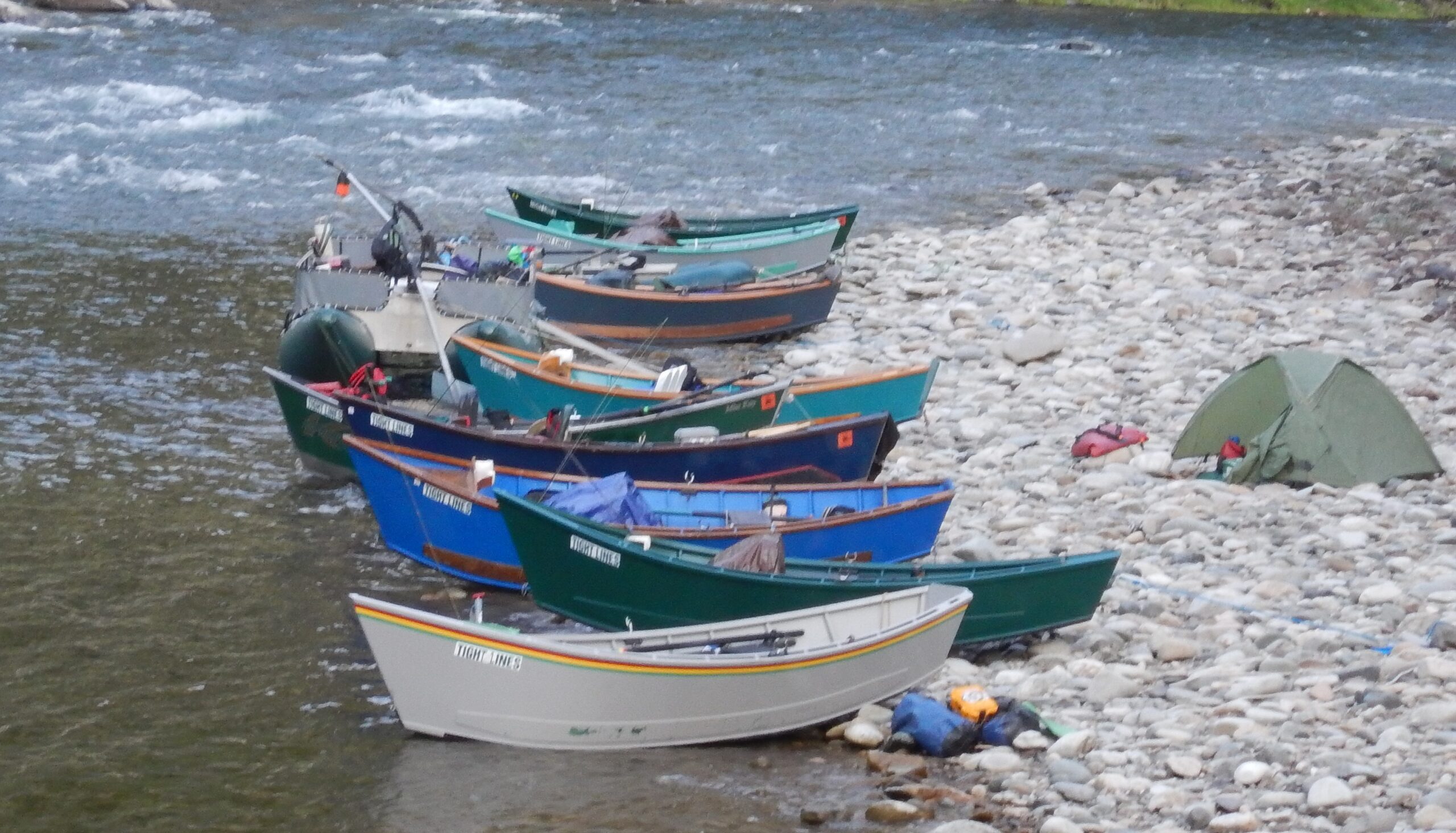
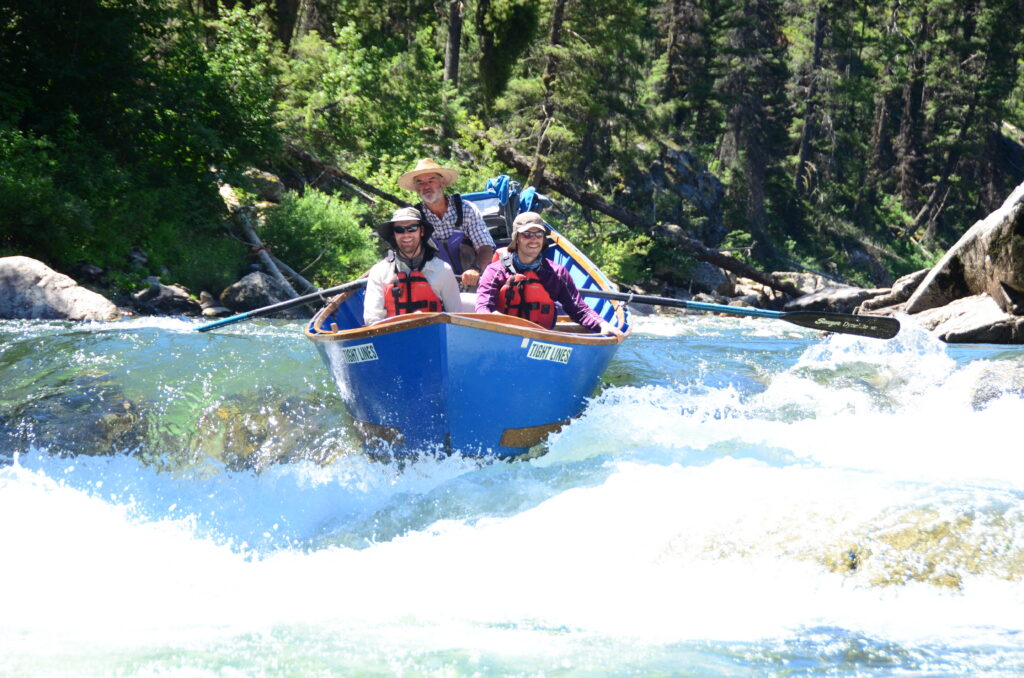
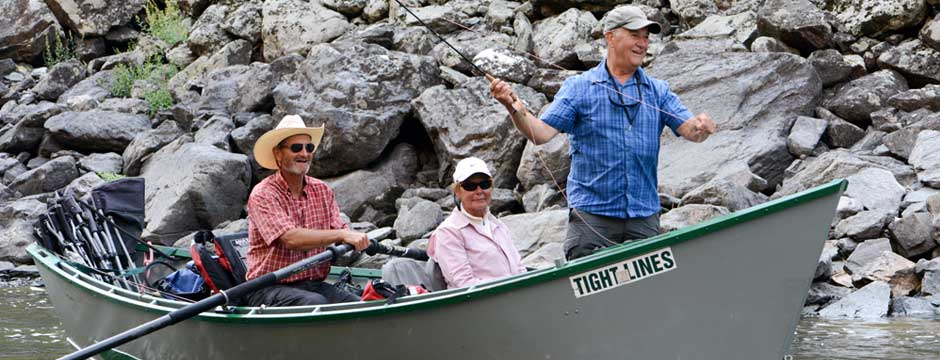
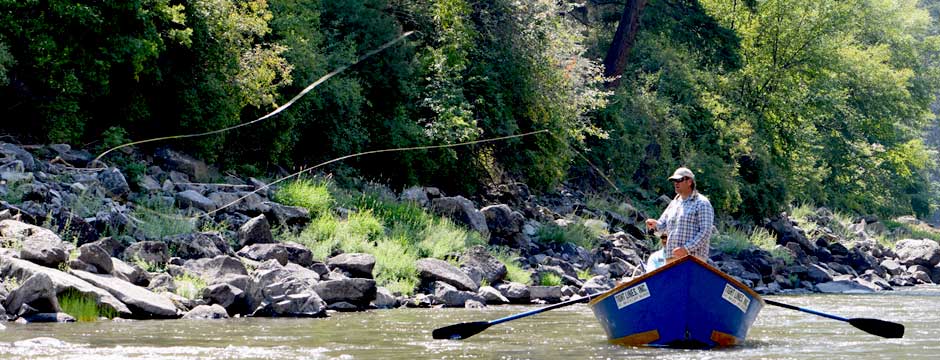
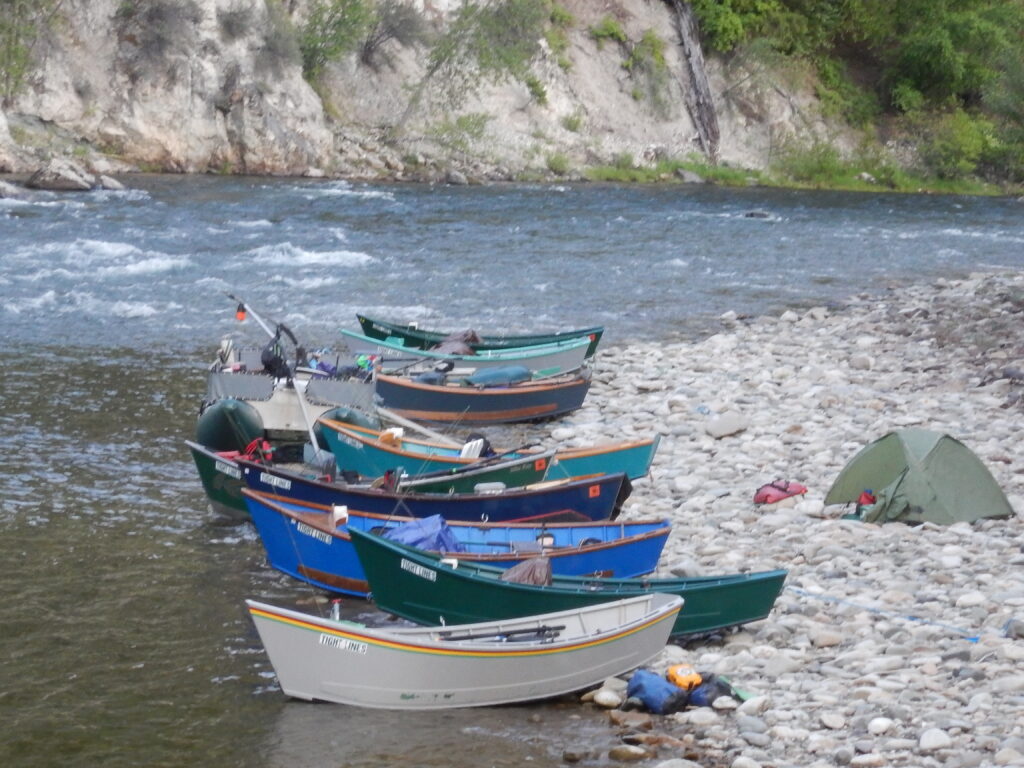
What happens when a family helps shape the history of drift boats for nearly a century? In this episode, Jeff Helfrich joins us to share stories from the early days of McKenzie River drift boats, how his grandfather Prince Helfrich helped evolve whitewater boat design, and what it’s really like navigating technical rivers like the Middle Fork Salmon and Rogue River in wooden boats.
We dig into the transition from plank boats to plywood, the origins of the McKenzie-style drift boat, and why certain whitewater rapids still give experienced guides butterflies. Jeff also shares incredible stories from the Frank Church Wilderness, including flash floods that created entirely new rapids overnight, how drift boats handle technical water, and why these wilderness river trips remain some of the most unique fly fishing experiences in the country.
00:00 – 02:15 — Jeff Helfrich Explains Why McKenzie Drift Boats Were Designed Specifically for Whitewater
The curved-bottom McKenzie-style drift boat evolved to handle technical rapids more safely by improving maneuverability, wave handling, and weight distribution.
05:30 – 07:30 — The Double-Ender Drift Boat Was Created for Bigger Idaho Whitewater
Jeff shares how Prince Helfrich helped develop pointed double-ender boats after encountering larger waves and technical rapids on Idaho rivers.
10:00 – 12:45 — UHMW Plastic Bottoms Allow Wooden Drift Boats to Slide Over Rocks Safely
Modern drift boats use slippery plastic bottoms that help boats slide over shallow rocks without major damage during low-water conditions.
12:45 – 15:00 — Permit Systems on the Middle Fork Salmon Limit Crowding and Protect the Wilderness Experience
Jeff explains how designated campsites and limited daily launches help preserve solitude despite multiple groups floating the river.
15:00 – 18:00 — Salmonfly Hatches Create Incredible Early-Season Fishing on the Middle Fork
High water conditions during June often concentrate hungry cutthroat trout into soft water and eddies where fishing can become exceptional.
21:00 – 24:00 — Flash Floods and Wildfires Can Completely Reshape Rivers Overnight
After major wildfires and thunderstorms, Jeff witnessed entire rapids disappear while new Class IV and V rapids formed within hours.
24:00 – 27:30 — Running Empty Drift Boats Through Class V Rapids Requires Completely Different Tactics
Some dangerous rapids on the Middle Fork now require guests to hike around while guides rope and maneuver unloaded boats through steep drops.
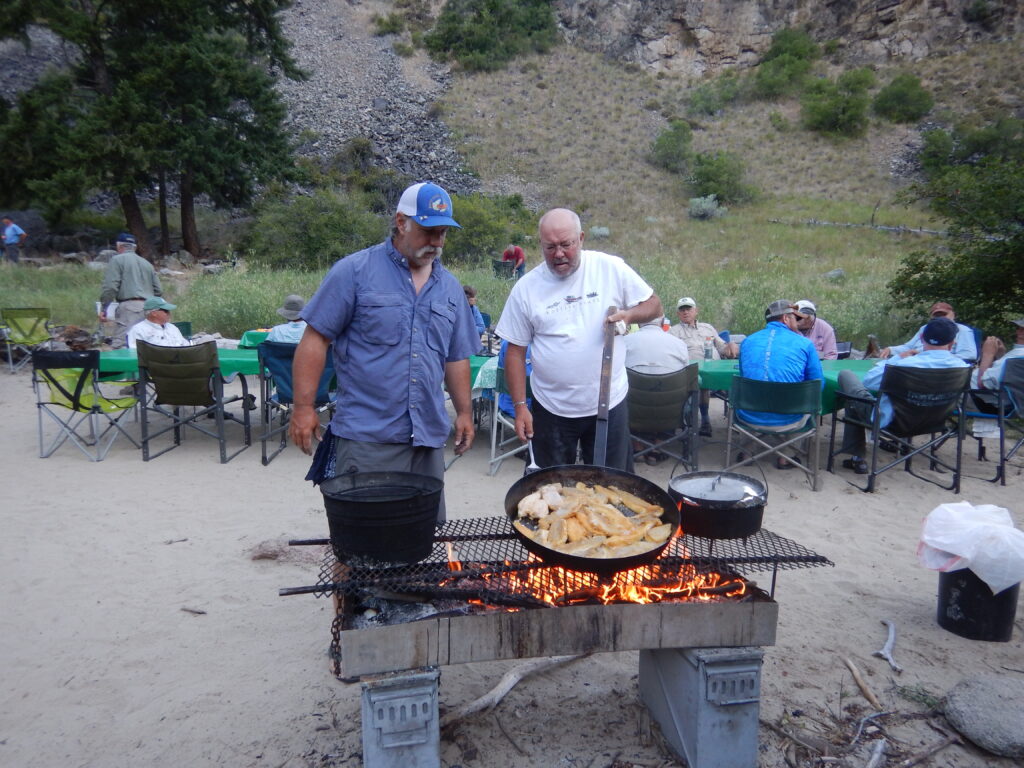
31:00 – 35:00 — Middle Fork Trips Combine Fishing, Hot Springs, Hiking, and Wilderness Camping
The river experience goes far beyond fishing, with hot springs, designated camps, trail access, and wilderness cooking becoming key parts of the trip.
35:00 – 39:00 — Some Rapids Still Give Experienced Guides Butterflies After Decades on the Water
Jeff explains why difficult rapids like Blossom Bar and the Narrows demand full concentration no matter how many times you’ve rowed them.
39:00 – End — Jeff Reflects on the Helfrich Family Legacy and Nearly 100 Years of Drift Boat History
The episode closes with stories about family permits, wilderness outfitting, and how drift boating became a lifelong passion passed through generations.
Episode Transcript
00;00;02;00 – 00;00;22;23
Dave
Would Whitewater and zero margin for error. That’s where today’s story starts. On this podcast, we’re digging into drift boats, river history, and what it really takes to guide through technical water where one small mistake actually matters. Today we’ve got Jeff Helfrich on the show. He is a guide outfitter and part of a family that’s been shaping drift boat history for nearly a century.
00;00;22;26 – 00;00;48;01
Dave
This is the Wet by Swing podcast, where I show you the best places to travel to for fly fishing, how to find the best resources and tools to prepare for that big trip, and what you can do to give back to the fish species we all love. Jeff Helfrich is here, and today you’re going to hear how Jeff’s grandfather helped shape the early days of drift boats in the 1920s and find out about the evolution of plank boats and how this transferred into plywood and why this was a game changer back in the day.
00;00;48;13 – 00;01;07;04
Dave
Find out what makes Mackenzie style drift boats different from other boats. When you’re talking about real whitewater and what getting on the middle fork, the salmon is truly like when you’re floating down the drift boat. Just been doing this for decades. This family story goes all the way back to the beginning. And we’re going to take a deep dive and hear all the good stuff.
00;01;07;14 – 00;01;15;07
Dave
All right. Let’s get into it. You can find Jeff at tight lines fishing dot com. Here he is. Jeff Helfrich I do. Jeff.
00;01;15;16 – 00;01;17;01
Jeff
I’m doing great. Thanks for having me.
00;01;17;01 – 00;01;35;15
Dave
Dave Yeah, yeah, Thanks for putting this together. I’m really excited to jump into this one. We we’ve done a number of Drift boat episodes over the years. We’ll be sending people out today. We’ve got a page of some of the episodes we’ve done. What if I swing dot com slash drift boat history and it’s pretty awesome because we’ve we’re kind of documenting.
00;01;35;15 – 00;01;49;22
Dave
I’ve been always adrift boat kind of nerd and interested in the history and we’ve kind of gone into that and you’re right in the middle of it because you guys have been doing floating the rogue, the middle fork, the salmon. You got these beautiful wood boats. So the first off, before we get into all that, just give us an update.
00;01;49;23 – 00;01;51;04
Dave
What are you up to this time of year?
00;01;51;18 – 00;02;10;19
Jeff
We’ll just kind of get ready for the season right now. Dave Making sure our boats are painted and up to date ready to go for the season. We’ll have some low water this year, of course, due to the lower snowpack. So I’m just getting everything all set now. Start working food lists and things like that.
00;02;10;26 – 00;02;16;19
Dave
Yeah. And are you doing now the rogue and the middle fork? Are you still doing trips on both of those rivers?
00;02;16;19 – 00;02;31;09
Jeff
I don’t do the Rogue River trips anymore. I sold that business two years ago with a Tim Conway. He was a long time guide for me and he’s doing a great job down there and he really enjoys it. He’s from the Eugene area here also.
00;02;31;17 – 00;02;47;10
Dave
Yeah. Okay, good. Yeah, and we met Tim as well, so that’s awesome. Well, I’m glad. I think, you know, we’re going to talk middle for good, Sam. That’s a river that I would love for people to know a little more about. We’ll get into that. But I want to kind of start take it back into the really the drift boat because you guys have been there.
00;02;47;10 – 00;02;52;29
Dave
I’m not sure of the whole history, but maybe tell us that what is your first memory of drift boats, you know, in your life?
00;02;53;25 – 00;03;18;01
Jeff
You know, I actually my my very first drift boat was the last drift boat that my granddad, Prince Helfrich, ever made. And it was given to me when I was 16 by my grandmother. And and so I actually started running that boat at that age and of course, take very good care of it. And I ended up selling it after a while, just to get a new one, just because I kind of banged it up.
00;03;18;01 – 00;03;26;06
Jeff
So but that was kind of my first initiation into drift boating and have done it ever since.
00;03;26;17 – 00;03;34;09
Dave
Yeah. And what in Prince? So was he the original Maybe. Describe that. How did the idea take us back to the family, how this started there with the drift boats?
00;03;34;19 – 00;03;59;07
Jeff
Yeah, well Prince clear back and he started a our business here on the Mackenzie River clear back in the mid 1920s and they caught the boats at that time were were made out of planks and leaked a lot and they’d still take at least one or two guests in there and they were extremely wet as far as I’ve heard.
00;03;59;25 – 00;04;17;29
Jeff
And then in the early thirties, as plywood evolved, they suddenly decided to try that, you know, build one out of plywood, which they found out to be much, much better, higher floating. And and that’s too heavy to row and and it actually worked out good as that’s that’s where they are today.
00;04;18;11 – 00;04;29;20
Dave
And what was the original style you know we’ve talked about this before on kind of history you had the the two styles Drift boats Mackenzie and Rogue style. What was the original boat that your grandfather built?
00;04;30;05 – 00;04;35;04
Jeff
And the original ones were? Yeah, the plank ones were like, it was like.
00;04;35;10 – 00;04;45;24
Dave
Probably even before. Yeah, it was like before, right. There was a heat was there at the beginning of the whole. Is that true? Is that when you look back at the history, was he there at the first drift boats that were really made out there?
00;04;46;08 – 00;05;05;28
Jeff
Yeah, he was there really when they first started that they were flat on one end. The flat end would go down the river first at the point it did was in the transom of the boat. And so they would, they would roll them in that manner. Of course they were extremely wet due to, you know, rapids with the waves splashing in and things like that.
00;05;05;28 – 00;05;27;01
Jeff
So finally somebody got the idea to turn the boat around and put the flat in towards the back, which was the transom. And they began to run the white water much better and not nearly as wet. And then my granddad, Prince, actually, when he got started running Whitewater over in Idaho, that’s when they developed the double or so.
00;05;27;01 – 00;05;42;24
Jeff
It was actually the double indoor was was pointed at both ends and a little bit longer boat and it was just specifically made for Whitewater with more more rate to the bottom had more curvature and it would take on the big waves way better.
00;05;43;03 – 00;05;54;13
Dave
Yeah the double engine. That’s right. And so, yeah, you had some different models in there and now the model that you guys how would you describe the one you currently run? How long have you had that that design is, you know, there.
00;05;54;25 – 00;06;13;26
Jeff
You know this design that we have here. Dave Now it was actually developed in the, in the forties after the double ender to put the transom in the back in the, in the point in the front and that’s pretty much what we have run for all these years and it hasn’t changed very much.
00;06;14;05 – 00;06;27;26
Dave
Right. Yeah it hasn’t changed. And is it. And is it the I guess going back to that the mechanic. Because the I’m trying to think we had the, the drift boat, one of the guys that wrote the book on on the drift boat history I’m drawing a blank on his name but we’ll have a link in the show notes to that.
00;06;27;26 – 00;06;40;14
Dave
But it was he talked about the two styles you had, the Mackenzie versus the Rogan, the I think the one of them had kind of a flatter area right in the middle of the boat. The other one was more curved the whole way, Which style was is your current boat or.
00;06;40;15 – 00;07;06;15
Jeff
Is it It’s the one that’s more curved, more rate to the bottom the whole way. Yeah. And these are the, the one we would run today. We refer to it as, you know, the Mackenzie River, a standard white water boat because they’re, they’re made specifically for Whitewater where we have two guests in the front of the boat so that your your weight distribution is more in the front.
00;07;06;21 – 00;07;20;20
Jeff
So it’s a much more maneuverable boat. And then if we had, like one person sitting in the front or and then one in the back, which you see a lot of those boats today in certain shooting water like in Montana and so on.
00;07;21;01 – 00;07;34;04
Dave
Yeah, right. That’s right. So this is when you’re going down the river, you’ve got basically the two or three people up on the front. See, there’s nobody in the back. It’s you kind of have like it’s the gear bone. You’re able to fish out of that way as you’re going.
00;07;34;11 – 00;07;46;09
Jeff
Yeah, that’s exactly right. We’ll have two guests in the front and then we pivot off the weight where they sit so you can move the boat quickly one way or another. And that way you can maneuver the whitewater rapids.
00;07;46;18 – 00;08;04;24
Dave
Yeah. And that’s one of the interesting things about this, is that, you know, I remember I’ve been on the middle fork, the salmon. One time we went down in rafts. It was probably this river a year, not too different than this one’s going to be. It was like lower flows and it was pretty bony. I mean, I was kind of happy with it because I was pretty scared, you know, about the size of the white water.
00;08;05;05 – 00;08;19;20
Dave
And so the fact that it was lower, I was like, All right, this is going to be easier for me. And it actually it was bony. So we dragged a little bit. But what is that like for, you know, you’d think a would drift boat wouldn’t be the best thing to go down. Bang rocks. How does that how does the the Woodruff boat do on those rivers.
00;08;19;29 – 00;08;46;19
Jeff
Yeah, that’s a good question. A lot of folks always are wondering about that, that these boats have got the UHF W or plastic bottom, which is the very bottom part of the boat, is very slippery. And so what we found is that if you maneuver the boat slowly down through those rapids, even though you’re going over rocks and things where you just you kind of bump here and bump there and you just keep sliding.
00;08;46;19 – 00;08;56;04
Jeff
And as long as you don’t just plow into something hard, why they do very, very well. And it doesn’t it doesn’t seem to, you know, harm the boat whatsoever.
00;08;56;14 – 00;09;04;09
Dave
Yeah, it does. And. Okay. And do you guys see any other boats on the middle fork. The same another a drift boats because it’s a lot mostly rafts Right. That are doing the trips.
00;09;04;17 – 00;09;38;14
Jeff
Correct. Yeah. We see almost exclusively all rafts there and it is a limited entry area there. So we we see generally every day you can have there’s seven parties that start per day. So there’s either three commercial groups and four private or four private and three commercial. And none of the other commercial groups that that start with us rent drift boats, although there’s one other group throughout each week session that that does run drift boats, which is our relative.
00;09;38;14 – 00;09;42;10
Jeff
So we don’t ever see them, but they are on the river part of the time too.
00;09;42;25 – 00;09;58;26
Dave
Okay. Yeah, that’s right. And it’s kind of unique too, because I think of the comparison between, you know, the well, the three rivers, the rogue, the middle fork, the salmon. Then you’ve got the Grand Canyon, which had its own, you know, the Dory’s. And those were a little bit different style. I think those were more of the rogue style.
00;09;59;12 – 00;10;09;08
Dave
Yeah, but Right. But you had the whole Dory’s were those are a whole other level, right. They were decked over and they were able to flip over. And do you know the history there with Martin Lynton and all that stuff on the Grand Canyon?
00;10;09;20 – 00;10;37;21
Jeff
Yeah. You know, Martin Litton actually came up here. Keith Steele was was building the wooden drift boats here, the McKinsey style drift boats. And he realized that they needed a boat that would not take on as much water. Just plowing through the waves is what their older grand Canyon Dory’s did, so he still built two boats to start with for Martin Litton, and they took those back to the Colorado and started running them there.
00;10;37;21 – 00;10;58;09
Jeff
They found that with more rate to the bottom, they would drive the waves much better. And so that’s kind of where they start running those boats. More and more on the Colorado. And they did go to some of the rock style also and just found that that was the way to do it. So they were always built up here at that time.
00;10;58;24 – 00;11;09;12
Dave
Yeah. Wow. So I guess taking it back, you have So Prince Helfrich was your grandfather and is your dad your dad, I guess, was he did he take over after Prince retired?
00;11;10;03 – 00;11;32;16
Jeff
You know, there was three brothers. My dad was Dick and then Dave Helfrich and Dean Helfrich. They were the sons of Prince Helfrich. And so Dean and Dave were my uncles and everybody running much the same Rivers, a middle fork of the salmon and and the rogue and some here on the Mackenzie, right, right where we live.
00;11;32;26 – 00;11;38;23
Dave
Right. So all the brothers were running on the same kind of business, or were they run their own program or how that look?
00;11;39;07 – 00;11;59;15
Jeff
Yeah, when it first started out, Dave, they actually they would kind of get together and, you know, whoever set up the trip, of course, would be kind of a head person on that trip. But they helped each other out in 1972 and the Forest Service stepped in and said, Hey, you know, we’re getting too much usage on some of these rivers.
00;11;59;15 – 00;12;23;21
Jeff
We’ve got to begin to limit the entry into these areas. So at that time, whoever had been paying their 3% dues for their trips would got a permit between the three brothers. They got two permits and they wanted a third one. So my dad had been working with a fellow by the name of Everett Spalding, who was from Idaho quite a bit.
00;12;24;12 – 00;12;41;03
Jeff
And so Everett said, Well, I, I don’t want my permit. I know. I just work on the snake and the salmon. So I’ll go ahead and I’ll just give it to you. And of course, they went to the Forest Service, and the Forest Service said, Well, you can’t just give it to them. You got to place a monetary value on it.
00;12;41;21 – 00;12;45;05
Jeff
So my dad bought that permit for $1.
00;12;45;05 – 00;12;45;29
Dave
For $1.
00;12;46;09 – 00;12;51;06
Jeff
Yeah. $1. He got it. And so that’s the very same permit that I still run on today.
00;12;51;16 – 00;12;58;17
Dave
It is. Wow. So basically, yeah, your dad is the one that expanded out from the rogue into the middle for the salmon. Not not prince.
00;12;58;29 – 00;13;20;21
Jeff
Right. They Prince was there some of the time, too. They all were kind of helping each other. But because Prince actually went there in his first trip on the middle fork was 1940. So. Oh, he went over with some friends, a guy by the name of Woody Heineman, who had run it in 1939 as just kind of a fun trip with his wife.
00;13;21;09 – 00;13;52;04
Jeff
They went back in 1940 and they did a another thing, a trip there with their wives. And Prince already had a couple of clients lined up. So after their fun trip in 1940, he turned around and did the first commercial trip ever on the river. And so I’m sure in those days it’s much was much different than than it is today, of course, with having fire pans and we carry our toilet along and and lawn chairs and all that kind of stuff.
00;13;52;18 – 00;14;13;19
Dave
Yeah, yeah, it’s a little bit different. It’s pretty cool the way they’ve done. I feel like we have this conversation quite a bit on some of the rivers where you’re hearing about more pressure and it’s like, Well, what do you do? You know, like for example, the Madison River up there, you hear about like, you know, all these oats and and I feel like there’s some really good success because I know when we did the meadow for the salmon, it was like I mean, we didn’t almost didn’t see anybody, even though there were.
00;14;13;19 – 00;14;24;06
Dave
Right. We were in this place where they had it set up, where even though there were other people on the river, you wouldn’t really see them. So I feel like the middle. Do you feel like the permit system has worked pretty well on the on the middle fork, the salmon?
00;14;24;18 – 00;14;52;07
Jeff
I really do. I think it’s worked fantastic. It just by limiting the number of people there you’d you’d say you still think well there are seven groups starting each day and like commercial groups are allowed 30 total including the guides private groups are allowed 24. But you really don’t see all the other folks that much. You know, some days you don’t see anybody and the campsites are all designated prior to you starting your trip.
00;14;52;07 – 00;14;58;07
Jeff
So you know exactly where you’re going to go each night. And so it works out really well, I think.
00;14;58;20 – 00;15;10;18
Dave
Yeah, it does. And it’s a cool trip all around. So so that’s basically what you’re spending your summers. And when you get going, do you do you have a pretty short window I guess depends on flows or how does that look for you? When do you start the season and when does that end?
00;15;11;03 – 00;15;33;23
Jeff
Yeah, generally, Dave, we start the season in in June because we’re primarily oriented around fishing. So the river some some years you get a big run off some years not even when the water’s pretty high. The fish are still they’re actually migrating up the river at that time. And of course they’re hungry. They’re coming up to water and go up tributary eventually to spawn.
00;15;34;08 – 00;15;56;02
Jeff
And so as we’re hitting the water, when it’s high like that, sometimes like fishing can be absolutely incredible. There’s a big salmon fly hatch there in in June and then it kind of peters out as the water begins to warm up just a little bit. Then there’s parasitism and all sorts of mayflies and things like that that come on.
00;15;56;02 – 00;16;12;14
Jeff
And terrestrial is a little bit later on in the summer. And so if the river gets if it gets too warm, which I really never used to in this day and age, occasionally if it’s really low, it can get a little bit warm in late July. Then of course, the fishing slows down.
00;16;12;26 – 00;16;15;22
Dave
Yeah. So. And are these all West Slope cutthroat?
00;16;16;02 – 00;16;38;27
Jeff
Yep, pretty much West Slope cutthroats. We do catch some a few rainbows. However, I think most of those rainbows are are like steelhead smolts that have not gone out to the ocean and they stay there and begin to just live there and get bigger. And so occasionally you catch a fairly good sized one, but for the most part the rainbows are to me, they’re mostly all steelhead smolts.
00;16;38;27 – 00;16;41;12
Jeff
They’ll be six, seven, eight inches long.
00;16;41;23 – 00;16;45;07
Dave
Oh, wow. So, so there’s actually so there’s steelhead in this this area.
00;16;45;20 – 00;17;03;01
Jeff
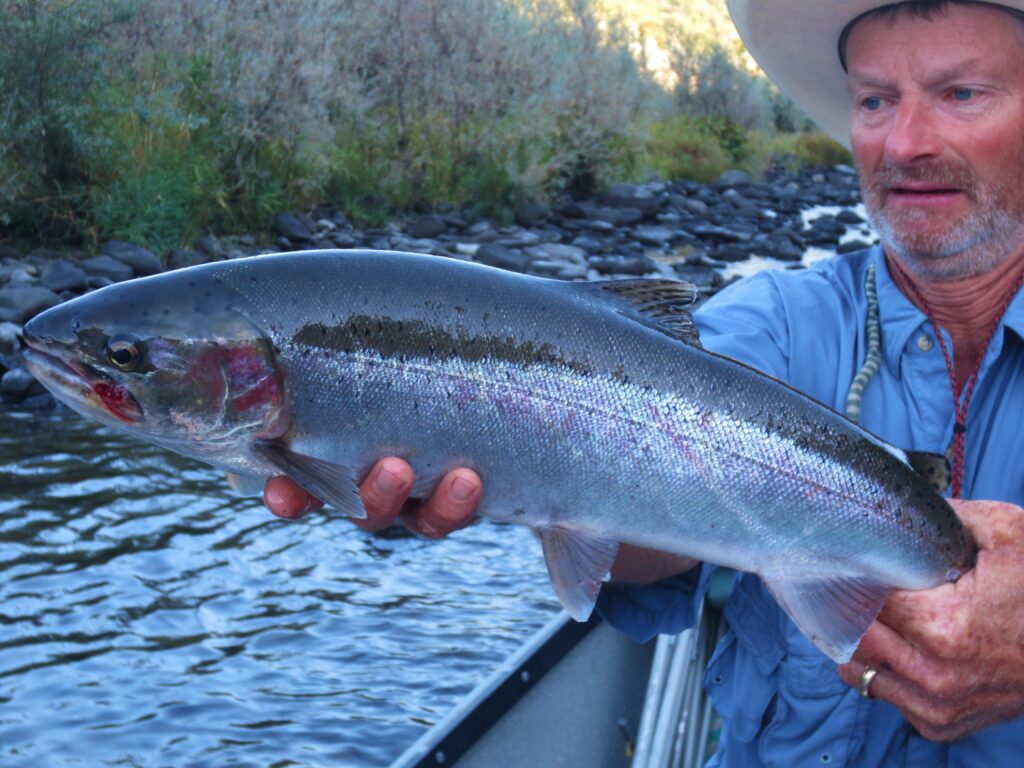
Yeah, there’s a great, great run of the wild steelhead comes up the middle fork in the fall and they’re not actually even supposed to fish for them. But I know they’re in there and I know folks catch them down where the confluence is with the salmon when everybody’s fishing from there, clear down towards the snake.
00;17;04;27 – 00;17;27;17
Dave
Today’s show is brought to you by visit Idaho and Yellowstone Teton Territory, a place that should be on every angler’s list from the Henry’s Fork to the south, Fork of the snake and all the hidden creeks and alpine lakes in between. This region is built for fly fishers who, like a little room to roam. You can head over to wet fly swing dot com slash teton right now for guides, lodges and trip ideas to plan your next adventure.
00;17;27;17 – 00;17;47;23
Dave
That’s t. T. T e. T. O. N. When it comes to high quality flies that truly elevate your fly fishing game, drift hokum is the trusted source you need. I’ve been using drift hooks expertly selected flies for a while now, and they never disappoint. Plus, they stand behind their products with a money back guarantee. Are you ready to upgrade your fly box?
00;17;47;24 – 00;17;59;14
Dave
Head over to drift. Hook ecom today and use the code swing at checkout to get 15% off your first order. That’s drift hook D.R. i f t h. Okay. Dot com. Don’t miss out.
00;18;02;12 – 00;18;19;08
Dave
That’s what’s amazing about this trip is you’ve got you kind of you’ve got the drift boats which is really cool. These wooden drift boats, you’ve got the fishing and you’ve got this trip which is hot springs. Right. And I mean all sorts of amazing. Yeah. What is the when you’re out there, maybe describe that. How would you describe that trip?
00;18;19;08 – 00;18;22;15
Dave
How is it different than, say, the rogue? Is the Millbrook a lot different than the road?
00;18;22;27 – 00;18;46;04
Jeff
It really is. Of course, the middle fork You’re in true wilderness, the Frank Church Wilderness came into play in 1980 and it was originally a wild and scenic river, also the middle fork wise. And so. So the road gets a wild, scenic river. They both that was two of the first eight wild and scenic rivers that that came into play in 1968.
00;18;46;23 – 00;19;08;12
Jeff
And so they’ve stayed that way. All go The middle fork then went to True Wilderness. And as far as the rivers go, the Rogue River is like a pool and drop river. So it’s you have a long stretch with no rapids whatsoever, real calm and flat and then a sudden big drop, whereas the middle fork is just a continuous flow.
00;19;08;12 – 00;19;31;02
Jeff
We we start at just under 6000 feet elevation. That Boundary Creek is the launch site. And then where we take out down on the salmon is about 2700 feet elevation. So it’s a it’s a big drop in the first 15 miles or so. You drop close to a thousand feet in elevation. So it’s extremely steep, real fast water.
00;19;31;11 – 00;19;37;00
Dave
Yeah. And who’s guiding? So are you out there still running the boats or who do you guys have on your your trips?
00;19;37;07 – 00;20;05;10
Jeff
Yeah, I try to make it. Yeah. As I’m getting older, it’s a little tougher every trip. But I love to join the trips and and I’ve got a great group of guides. I’ve got a couple of fellows that I’ve been working with myself for since I went back and owned this business, which was 22 years ago. And then we have another group of guides that actually we’ve hired and they’ve just stayed with us year after year.
00;20;05;10 – 00;20;26;02
Jeff
It takes kind of a special person to be able to run a drift boat down there, But we are always checking around for new guides in case somebody retires. And and so it’s it’s really worked out well that that we can just kind of keep a flow of guides coming through. Not everybody has a wooden boat. Most of them do just fine.
00;20;26;10 – 00;20;27;01
Dave
All right.
00;20;27;01 – 00;20;29;20
Jeff
And a few of them still run aluminum boats.
00;20;29;21 – 00;20;32;11
Dave
Oh, okay. So there are some aluminum boats on the on the middle fork.
00;20;32;20 – 00;20;59;03
Jeff
Yeah, Yeah, we still have got. All right. See, I guess about three guides that have aluminum boats, which they they like so they don’t make them up as much. And and they, they work they’re just as maneuverable, I would say, down there as a wood boat set. We just we like the wooden boat. So as far as maneuvering myself, I think they’re just maybe a little bit faster on the water and of course, they don’t make make as much noise if you do hit a rock.
00;20;59;12 – 00;21;08;21
Dave
Yeah. The wood boats. Yeah. And if you do, how does that happen? I mean, have you had any places where you’ve hit rocks and maybe, you know, you’ve even got the rocks gone through the boat or any of that stuff?
00;21;09;02 – 00;21;29;05
Jeff
Yeah, for sure. I’ve over the years way every once in a while that has happened. And when the water is low, of course, we’re actually bringing a lot of rocks. So we’re just telling folks, you know, be ready, we’re going to be all the time. You just kind of roll over them. But every once in a while, if you see that, you’re get a bang going a little harder than normal.
00;21;29;05 – 00;21;56;03
Jeff
Why we just let folks know. Hold on. We’re going to bump here a little bit harder. And and then, of course, there is a time every once in a while and we hit one that you don’t know was there. So those those you’re probably going to hit a little harder. But the boats are tough. So for the most part, it doesn’t really bother whatsoever that there has been a few times when, you know, run it through real tight spots like we have at the upper end of the river right now with a big slide that occurred here in the last few years.
00;21;56;20 – 00;22;07;23
Jeff
There’s some really tight spots up there where maybe you don’t get in or tact or or there’s a new rock in the middle of a run that you don’t see and you can bring a pretty good.
00;22;08;04 – 00;22;13;16
Dave
Yeah, right. Have you been in any situations where you, you know, had a dumped a boat or any of that stuff.
00;22;14;09 – 00;22;35;25
Jeff
No, not, not that we’ve ever dumped a boat or anything like that. But there has been a few times when that the side of those boats is only a quarter inch plywood. So if you bang a boat on the side, you can put a crack in it. And of course it generally won’t leak or anything like that, but it doesn’t look very good and you feel bad about it.
00;22;35;25 – 00;22;38;22
Jeff
So we’ll repair those when we get back into town.
00;22;39;02 – 00;22;54;06
Dave
Oh, okay. So all right, So the worst that’s happened is you really hit one really solid. I can imagine you’re going through rapid. And if you got sideways or something or maybe off the front of the boat and and it crack a rock and you never had the, like a big hole. It doesn’t do that. It just kind of cracks, splits it a little bit.
00;22;54;17 – 00;23;06;26
Jeff
Right? Yeah. Normally it’ll just kind of crack the plywood and stuff like that. And so we’ve seen some of those occurs as we run more and more of those rivers, especially in low water. Why It happens every once in a while.
00;23;07;02 – 00;23;30;29
Dave
It does. Wow. Yeah, I’ve run a lot of wood, but my dad has a raise. River Dory, you know, which is right raised. And it’s a similar I think it’s pretty similar style to what you have, but it feels like in the water. I remember I actually run a Koffler an aluminum but okay. The wooden boat, you know definitely feels like it’s more and I hear that from people so it sounds like to you that it’s probably a little more just because it’s wood, right?
00;23;30;29 – 00;23;34;04
Dave
It’s in the water. Maybe it’s a little bit more maneuverable. Is that how you feel about it?
00;23;34;18 – 00;23;56;17
Jeff
Yeah, It just seems like comparing an aluminum boat to a wood boat that one of the main differences is that chain back, which is where the the bottom and sides of the boat come together. That’s the chain bat. So you have one on each side right at the at the water’s edge and and a wood boat that actually sticks out a little bit on each side.
00;23;56;17 – 00;24;18;02
Jeff
So you kind of learn how to run it that way. That’s a it’s a great way to slow down in the water. If you hit that chain that you swing it into the water fast, it’ll kind of slow the boat, whereas an aluminum boat doesn’t have that. So it tends to slide through those points a little more. And myself, I’ve got a coarser aluminum boat also.
00;24;18;15 – 00;24;44;19
Jeff
And so you can you can feel a difference when you switch from one boat to another. You definitely know that with that feel, it’s going to run just a little bit different, especially in technical spots like like on the river, in the coffee pot and all that real strong hydraulics. You can you can feel it if it if it grabs your chain, that kind of kind of holds on to you or with an aluminum boat, you slide through that water a little differently.
00;24;45;01 – 00;24;51;28
Dave
Yeah, you do. Okay. And and are your boats mostly like 16 foot like by 48 or 54? What what’s the dimensions?
00;24;52;07 – 00;25;12;01
Jeff
Yeah, we actually kind of have a selection of them. Like the boat that I’m running at right now is actually it’s 16 feet four inches with about a 40, 49 inch bottom. And then there’s a couple of the guys have got with boats that are very similar. They’re just maybe a little longer, still up to 17 feet with a 50 inch bottom.
00;25;12;16 – 00;25;21;14
Jeff
And so there’s just kind of whatever they prefer. And of course, some of the guys are bigger, stronger, too. Somebody like that little bit bigger boat.
00;25;21;14 – 00;25;34;14
Dave
A little bit bigger, right? So a little bit. A few inches. Yeah. That’s that’s cool. What is the you know, so you’ve got your boats here. Who’s making the boat? Is this something where you’ve built these boats yourself or still or how does all that work.
00;25;34;29 – 00;25;54;08
Jeff
Yeah. You know there’s that we generally we don’t build them ourselves. You can buy kits to build one but there’s still a couple of builders here and one of them is a guy on our trip pictures Guard Pete runs our our big sweet boat. Most of the time, and now he’s kind of converting to a adrift boat as he’s gotten older.
00;25;54;08 – 00;26;12;25
Jeff
But but Pete’s built some of our you see, I’m on my third wooden boat that Pete has built, and it’s made out of a South American hardwood called Sapele. And then there’s another fella here locally on the Mackenzie, Jason Hayes and Jason, he builds wood boats also.
00;26;13;02 – 00;26;14;12
Dave
Oh yeah. We’ve heard of. Yeah. Before him.
00;26;14;12 – 00;26;34;06
Jeff
Yeah, Yeah. He’s wooden boats and and he does a great job too. They’re, they’re beautiful boats and it, it amazes me how those guys can make all those noise, those joints come together because I myself I’m, I’m not much of a, a woodworker, I do a few things, but those guys make them come out incredibly perfect.
00;26;34;12 – 00;26;34;26
Dave
Right.
00;26;35;02 – 00;26;38;12
Jeff
There. Yes. No gaps whatsoever. And they they look beautiful.
00;26;38;21 – 00;26;55;04
Dave
That’s pretty cool. Yeah, I love that. I think you find your things that you’re really into. I mean, for me, I remember my dad was a great rod builder, a fly rod, very real, really nice. Right. And then and I built a few, but I just never didn’t have the same level, you know what I mean? And it’s I think that’s part of it.
00;26;55;04 – 00;27;01;11
Dave
Now, did your did your dad build boats or did Prince or who is on that history was who was building the original boats?
00;27;01;22 – 00;27;06;17
Jeff
Yeah. You know, a fellow by the name of Carr whose was building those boats.
00;27;07;10 – 00;27;11;04
Dave
It was Who is that. Who who, who is that. That built the boats car.
00;27;11;04 – 00;27;41;27
Jeff
Whose it was. I think it’s spelled k r h u u s I believe. And he was building them and Woody Hindman, who is he kind of learned from Carr House about how to build them. He was building them also. And then my granddad did build some of his own too. And it was interesting, I know in the boat that I had that was is something that he did with that boat was he wanted to make it lighter, so he put in way fewer nails and screws than some of the original bolts.
00;27;42;12 – 00;27;53;03
Jeff
Like in the floorboards. There would only be maybe a third the number of screws that there is that is the the original boats that they built. And he would paint a rubber strap on the side either just to make it lighter.
00;27;53;04 – 00;27;56;26
Dave
Oh, wow. No gravel guard or is that what you call it? The grout, the thing that hit rock?
00;27;57;01 – 00;28;16;24
Jeff
That’s correct. Yeah. Rock guard, some people call it. Yeah. And just to make it a lighter boat, right. That’s that’s what he did. But those guys all, you know, they just kind of over the years kept trying new little things, then add their own thoughts here and there and amazing the way it developed to what it is today.
00;28;17;05 – 00;28;30;09
Dave
Yeah. No, it is They’re they’re definitely beautiful boats. And so you have these boats. You’ve had three it sounds like. I mean, how long does a wooden boat last? Is it the last four? I mean, what made you switch to your next boat? You know, over the years.
00;28;30;25 – 00;28;35;26
Jeff
You know, I always would feel like I would keep a wooden boat for about five years.
00;28;35;29 – 00;28;36;14
Dave
Okay.
00;28;36;22 – 00;29;06;28
Jeff
And I was just kind of the norm, I guess. And then it’s actually if you take good care of what they’re still they’re in really good shape. And and you can sell that to one of the guides, which I’ve done most of the time, just show to one of our own guides. And and it’s always been really exciting to get a brand new wooden boat, get it in the shop and and try to figure out how you’re going to stain it or paint it or whatever you’re going to do with it, and then get it out in the spring and go give it a try.
00;29;06;28 – 00;29;11;02
Dave
Give it a try. Is the current boat you have that you’re using this year? How long have you had that one?
00;29;11;18 – 00;29;37;17
Jeff
The one I have this year is this’ll be its fifth year and it’s actually in really good shape. I haven’t wrecked it or hit too many rocks with it or anything like that and I’ll probably keep it for another year or two as I’m as I’m getting ready to retire. And it just seems like a course when we stack our boats on the trailer, we stack them 6i0 wow.
00;29;37;17 – 00;29;48;25
Jeff
Six Yeah, the boat on top gets the least amount of wear and tear on the road, which we’ve always figured we get more wear and tear when they’re on the trailer than in the river itself.
00;29;48;26 – 00;29;50;18
Dave
Oh, right. Yeah. The banging. Yep.
00;29;50;24 – 00;29;58;06
Jeff
So I’ve always had the option to put mine on top, which I have normally done. So it hasn’t gotten as much wear and tear as some of the others.
00;29;58;15 – 00;30;10;23
Dave
Yeah, that’s right. Yeah. It’s pretty cool. The whole experience of the middle fork because it’s such a, you know, such a long ways. I remember I think the shuttle was like 8 hours from where you because it’s 100 mile float right in that range.
00;30;11;05 – 00;30;38;01
Jeff
That’s correct. Yeah. If you start at Boundary Creek and you go all the way to Cash Bar, which is on the main Salmon River, about two miles down the main salmon, it comes out to 100 or two miles. So once you hit the confluence of the main and the middle for quiet, you actually still have one really big rapid to go through on the main salmon, which is called Cramer Creek, which never used to be a rapid bit.
00;30;38;01 – 00;30;53;10
Jeff
A big slide came down in Cramer Creek, which is a tiny, tiny little creek. You barely even see it. And it washed, washed the road out and brought all these huge boulders and things into the river. So now it’s a it’s a really exciting rapid in a race boat.
00;30;53;18 – 00;30;55;20
Dave
Oh, it is. When did that one get created?
00;30;56;01 – 00;31;01;16
Jeff
That one came in about Oh, gosh, it’s been probably 15 years ago now.
00;31;01;16 – 00;31;02;17
Dave
15. Okay.
00;31;02;29 – 00;31;15;06
Jeff
Yeah. And it was just created by a big thunderstorm bringing a lot of water down a real narrow passage all at once and just created this this big washout, which created the whole rapid.
00;31;15;19 – 00;31;22;13
Dave
Yeah. And then what are the other rapids you have going there. Describe those a little bit like because there are some there’s a few big ones, right?
00;31;22;25 – 00;31;56;07
Jeff
Yeah, there’s a bunch of class fires on the middle fork and some of them have been there as long as I can remember, of course. And then and there there’s a, you know, a high range of difficulty. And those depending on the stage of the river, whether it’s high or low or or even in between. But in the last five years, there’s been some brand new ones created in the upper Middle Fork due to a a forest fire that burned a large area up there, a timber that had never been burned in the last, you know, I don’t know, probably a couple of hundred years.
00;31;56;26 – 00;32;06;29
Jeff
And then after that big fire y, we had some giant thunderstorms which we were on the river during during a couple of those instances where it it created new rapids.
00;32;07;05 – 00;32;15;01
Dave
Oh, wow. So you were floating down where you were a situation where it’s like you’re floating, you know, all of a sudden there’s this new rapid in front of you had you had to go through.
00;32;15;13 – 00;32;39;01
Jeff
Yeah, it was pretty exciting stuff. Dave After the the big fire, I believe the first big fire was in 1221 up there and which we were deadheading our boats down to Indian Creek airfield, which means that the river was too low at that time for us to navigate that upper end and with clients and all of our gear and everything.
00;32;39;01 – 00;32;46;16
Jeff
So what we do is we run that up route 25 miles down to Indian Creek Airfield, and then we fly our guests in there to start the trip.
00;32;46;22 – 00;32;51;06
Dave
Oh, so you you take the boats down, just you with nothing in it. So you’re superlight.
00;32;51;16 – 00;33;17;15
Jeff
Correct? Yeah. So we’ve we run that up for 25 miles. We generally we, we spend the night on the river. So that means we don’t have a night in town. We’re just. We get back into town, finger up and, and we’re headed out again. And so on that particular trip we launched and we’re going to run down that evening and just spend our night down on the river and then get our boats all the way to the creek the next day.
00;33;17;29 – 00;33;45;04
Jeff
And we got involved in this just tremendous thunderstorm storm. And this was this was in August, just a torrential downpour of it lasted 45 minutes or so. And we keep bailing. The boats are bailing the boats. And and so then everybody’s talking about, well, something could happen due to all this extra water. So we were going to camp that night right below Velvet Creek Falls, like a quarter mile below.
00;33;45;04 – 00;34;04;23
Jeff
Build a Creek Falls. There’s a little camp. We’d pull over and stay. And and as we were in camp that evening, getting ready to make dinner, somebody looked down, said, Wow, you guys look at the river, there’s almost no water. The river is dropping. Well, we saw that. Of course, we knew immediately there’s a total blockage upriver. And of course, it turned muddy.
00;34;04;23 – 00;34;27;21
Jeff
And and so a couple of guys took off walking up river, and we’re still watching it as it drops. So we started tying boats up up to trees higher and higher because we didn’t know what was going to happen when the river broke through. And they still had a couple good videos and pictures of a Delaware Creek Falls where it has absolutely no water whatsoever going over it.
00;34;27;29 – 00;34;30;09
Jeff
It’s absolutely, absolutely dry.
00;34;30;17 – 00;34;31;12
Dave
Wow.
00;34;31;12 – 00;35;00;24
Jeff
And there was a big slide that occurred right above that. And another one we didn’t know about about that. And so it took about, gosh, I don’t know, 45 minutes to an hour. And suddenly it started breaking through and and it wasn’t all that much water right at once. It kind of began to do it slowly. But there was just a tremendous amount of debris that came down, logs and you could hear rocks rolling and just all kinds of stuff coming down the river.
00;35;00;24 – 00;35;17;10
Jeff
And our our boats were safe enough. They were up kind of high and dry and we were on a corner so that most of the debris was going in the opposite bank. But a lot of it did come where we were, but we were use it awesome things to push it away from our boats. So it was a it was a scary deal.
00;35;17;10 – 00;35;40;21
Jeff
And then we did not know that the blockages up above were some of them did not wash out, so they were in there. So the other groups that it started that day that did not make it down as far as we did, they had to get all their their gear out of the river and they had to use helicopters to take out their sweep boats and then a bunch of a big pack train to take a lot of their gear out on mules.
00;35;41;04 – 00;35;43;21
Jeff
So there was no passage in for a short time.
00;35;44;00 – 00;35;46;29
Dave
Oh, there wasn’t. And then but you guys were below it, so you were able to float out?
00;35;47;10 – 00;35;57;02
Jeff
Yeah, we were below it. Somehow. We luckily had gotten down there. There was a a big slide barely below us, but it did not encompass the whole river.
00;35;57;05 – 00;35;58;09
Dave
Yeah, it wasn’t as big.
00;35;58;17 – 00;36;07;10
Jeff
Right. And so we were able to get by that one and of course we expected more below that, but there were not. So we were extremely lucky to be down as far as we were.
00;36;07;20 – 00;36;11;29
Dave
Wow, that’s crazy. And then and then those rapids were there. New Rapids created up there?
00;36;12;08 – 00;36;24;19
Jeff
Velvet There were, yeah. There’s about half a dozen new rapids up there, which there was one or two that were made easier. But of course, as luck would have it, most of them were made more difficult.
00;36;24;26 – 00;36;25;13
Dave
Yeah.
00;36;25;14 – 00;36;31;27
Jeff
Wow. So there’s one now up there that we’ve never taken guests through since that happened. That’s called Hell’s Half Mile.
00;36;32;05 – 00;36;33;07
Dave
Oh, they walk around.
00;36;33;15 – 00;36;55;21
Jeff
Yeah. And it’s not a real easy walk. It’s about a it used to be longer. It was about a three mile walk to get gas back. Yeah. Now we’ve, we’ve made it to where it’s about one mile where we can get folks back into our boats and and so we can, we can still run it empty and. And now we can still we can run that bill Rock Creek Falls has changed back somewhat to its original look.
00;36;56;03 – 00;37;00;11
Jeff
And so we get folks back into our boats above it and we could get them through there.
00;37;00;20 – 00;37;04;16
Dave
Yeah. So you take the people out because it makes it less weight for you to run through.
00;37;04;25 – 00;37;12;15
Jeff
Correct? Yeah, it just makes it much more navigable for us. And and this helps out. Miles is more like a class five.
00;37;12;19 – 00;37;14;05
Dave
Oh really. What’s it like?
00;37;14;19 – 00;37;45;12
Jeff
Oh, it’s it’s extremely steep to start with. And it’s got a big rock right in the middle. We call it the fan rock, and it’s shooting this big plume of water up in the air. And there’s very, very little room to get between it and the bank. But that’s that’s really the only run when we can run down through there and when it gets too low to get between that big rock and the left bank, we actually bring our boats down the upper end with a rope and rope around that fan rock.
00;37;45;12 – 00;37;48;18
Jeff
Then we can run the rest of it to get on downriver.
00;37;50;15 – 00;38;16;05
Dave
Experience the waters of Bristol Bay at Togiak River Lodge, where fly fishing meets Alaska’s rugged beauty. This is the place to complete the Alaska Grand Slam with all five salmon species, rainbow trout, arctic char and more, where each day offers a new Alaskan adventure, you can visit Togiak Lodge dot com right now to start planning your Bristol Bay experience with Togiak River Lodge, check out Jackson Hole Flight Company today.
00;38;16;07 – 00;38;35;07
Dave
Premium Fly gear straight to your door without the premium price. Jackson Hole Flight Company designs and builds their own fly rods, reels, fliers and gear delivering quality you can trust at prices that let you fish more and spend less. Whether you’re picking up a fly rod for the first time or guiding every day, they’ve got what you need.
00;38;35;18 – 00;38;58;01
Dave
Check them out right now. That’s Jackson Hole, Flight Company, AECOM, Jackson Hole Flight, CNNMoney.com. Well, the middle fork I’ve run, but I ran in a raft, so it’s a little bit different and I don’t remember exactly. But but the Rog, I’ve run a bunch of times in Adrift Boat and I know that whole trip when I’m on, I’m always thinking of Blossom Bar, you know, because you’ve got all these rapids.
00;38;58;01 – 00;39;05;22
Dave
But Blossom’s the one that seems to be, you know, kind of the trickiest one. How does the middle fork some of those rapids compare to Blossom?
00;39;06;07 – 00;39;30;03
Jeff
Well, yeah, Blossom is a class for, for sure. And it’s a really difficult it in itself just being that you have to navigate all those rocks and maneuver in and out and then blossom really changes with water flows too. It’s, it’s, it’s always tough. Like most rapids that are class are, but it’s one that is, is really, really tricky.
00;39;30;03 – 00;39;51;27
Jeff
We we would walk our guests around here also it’s a not very long walk but it’s on the right bank. We can walk our guests around the upper part of that and then get them back into the boats when the water gets real low. So when it’s running, oh, anything under about 1000 to 11, 1100 cubic feet per second, like we would normally walk our guests at that time.
00;39;51;27 – 00;40;08;26
Jeff
And that’s there’s still there’s some on the middle for better that way to that when the water is up we can run it with two guests as it we move to just one and we’ll have one person walk around and as it drops even lower, why we we’ll have both guests walk. And those are mostly real quick rapids.
00;40;08;26 – 00;40;25;18
Jeff
So they’re big drops. And so it’s not a very long walk, but it’s just one that that we want to be real careful in. And, you know, so if any of the guides have a question about the rapid and if there anybody is a little bit hesitant why we have our guests walk around and pick them up and play it safe.
00;40;25;26 – 00;40;32;08
Dave
Play it safe and on the middle for. So there’s probably a number of rapids that are kind of the level of blossom bars.
00;40;32;08 – 00;40;38;15
Jeff
Yeah, I mean, from the middle of Sam. And if you start up at Boundary Creek Class four Rapids on it.
00;40;38;20 – 00;40;39;20
Dave
How many Class four does it.
00;40;39;20 – 00;40;40;26
Jeff
Have? 18.
00;40;41;00 – 00;40;42;29
Dave
Oh, wow. It’s got 18 class force.
00;40;43;10 – 00;40;49;19
Jeff
Yeah. So there’s a bunch of good ones at that on the Rogue River. There’s also there’s cerebral down through there.
00;40;49;19 – 00;40;53;05
Dave
Yeah. There’s probably what, like half a dozen class fours at least something like that.
00;40;53;05 – 00;41;12;29
Jeff
There is like the coffee pot that that’s considered a class for and another one that most people never considered as a really serious spot. That was one of our most difficult spot was the one they call the Narrows, which is is also in Mule Creek Canyon. I think myself, I dislike that rapid more than any other rapid on the whole river.
00;41;14;01 – 00;41;17;29
Dave
Yeah, because you have to tuck the in. Right. It’s so narrow that you got to tuck the yours in when you go through.
00;41;18;06 – 00;41;38;21
Jeff
Yeah. And it would shoot your right to the right wall and that one is actually changed just a little bit the last, oh like three years to where it doesn’t pull you quite as hard to the right wall in those big, big boils. But yeah that one it would when you’re a bug that you have so many butterflies in your stomach that it almost makes you sick.
00;41;39;03 – 00;41;42;24
Dave
So there’s that one a little bit more or is it equal to the blossom for you?
00;41;43;04 – 00;41;59;20
Jeff
I would say that one bothered me more of a blossom, but now that it’s a little bit easier, why? It’s not bad, but I know it’s always been said that if you don’t get butterflies in and start feeling that in your stomach, right, and you’re not excited about it, you’re probably better. Quick boated.
00;41;59;28 – 00;42;06;27
Dave
That’s right. Yeah. It’s good to have that. It’s like anything having a little bit of nervousness, anxiety is is a good thing, actually. Right. It gives you that edge and.
00;42;07;04 – 00;42;09;09
Jeff
That’s for sure. Need to be ready.
00;42;09;18 – 00;42;30;13
Dave
Yeah, be ready. That’s cool. Wow. So you’ve got I mean, obviously all this history 19. I mean, it’s been over 100 years, right, since your grandfather first really kind of had that first boat. Do you think about that quite a bit or do you think about that? You know, the fact that the family history and does it is it going to keep going here with I’m not sure what your family looks like, but is this going to keep going after you retire?
00;42;30;13 – 00;42;53;03
Jeff
Yeah, You know, it’s not looking like our families get to take over my permit right now. We had hoped it would be that way, but, you know, some of the other guides that I work with over there are still very interested in it running that same trip. And I know my cousin can help Rich here. His daughter kind of runs their business now.
00;42;53;28 – 00;43;16;09
Jeff
Her name is Kelsey And and they they run quite a few drift boats there as well. So we were kind of hoping that it would work that way. But I know folks find other things to do. And in fact, when I was young, I never really saw myself as is taking over this business until, oh, I, I actually took forestry in college and I thought I might do something.
00;43;16;09 – 00;43;41;24
Jeff
But once I started working for my dad, I, I really fell in love with it and just decided that that’s what I wanted to do forever. And so I, I bought into the road River permit. Gosh, I had that for over 30 years. And then our middle fork to a salmon permit, which my dad had, he actually sold that to one of the guides that had been working with him for years, whose name was Steve Shafer’s.
00;43;42;12 – 00;44;06;03
Jeff
And Steve operated that for 12 to 13 years or so. And then I went and approached Steve and bought it back from him. So that got it back into the family again. And so that’s why I, I mean, it kind of gets in your blood when you start doing it and you realize what it takes to put food and logistics and everything going on.
00;44;06;13 – 00;44;10;07
Jeff
It kind of got in my blood and I just love doing it forever.
00;44;10;17 – 00;44;20;16
Dave
Yeah. See, you got into and just yeah, I love it. I mean, so you’re doing both. You’re doing The Rogue and the middle four is the road or the middle folks earlier. And then you move over to the Rogue later in the season.
00;44;20;29 – 00;44;51;22
Jeff
That’s correct. Yeah. We would start out fishing here locally on the Mackenzie River. And then in June I’d head over to Idaho to do the middle fork to the salmon, and then I would be there all summer. We would run trips into the fall and then we would run trips. At that time I would be on the Road River starting September one, so we would have another crew going back on the main Salmon River doing karst and blast down through there where we were hunting for checkers and catching steelhead and bass.
00;44;51;22 – 00;45;02;08
Jeff
And so that would go clear in October. Okay, so the Rogue River end up around the 1st of November. We would that was the end of our season down there.
00;45;02;18 – 00;45;18;29
Dave
Yeah, end of November. Right. Wow. That’s cool. And then like you said, you’ve got the the boats. What does that look like for, you know, on the boats for maintenance? Like you said, my dad’s got this boat. I’ve been looking at this boat in the in his garage and then thinking, man, I’d be really cool to, you know, you probably take it out on the water now.
00;45;18;29 – 00;45;25;09
Dave
You know, it’s just it needs some work. But, you know, what are your thoughts there? Is there a lot of maintenance that you have to do every year for the wood boat?
00;45;25;22 – 00;45;36;03
Jeff
Yeah, that’s actually a good idea to give it a good painting every year, kind of clean things out. And the older those boats get, you know, they get the boat gets kind of loose.
00;45;36;03 – 00;45;37;11
Dave
Oh, loose, right?
00;45;37;18 – 00;45;56;23
Jeff
Yeah. It kind of moves around just a little bit. You know, you can go through it, tighten up all the the nuts and bolts and and then it’s but it’s a good idea to take the floorboards and everything off every year and and clean it out nice, give it a good paint job that if it ever begins to leak a little bit after you’ve had it several years.
00;45;56;23 – 00;46;04;02
Jeff
Right. You can put it in the water and kind of soak up some water and generally any leaks that are in there will will stop right.
00;46;04;02 – 00;46;06;05
Dave
Because it swells. Right. The wood swells a little bit.
00;46;06;17 – 00;46;12;28
Jeff
Exactly. Yeah. It swells up and and so that’s that’s good for your boat to keep it on the water as much as possible.
00;46;13;13 – 00;46;23;08
Dave
Interesting. Well so this year basically, yeah, we’re talking here. It’s April. May is right around the corner. So you’re you’re getting ready. You’re going to be heading over to the middle for fork win in like June.
00;46;23;21 – 00;46;30;16
Jeff
Yeah. Yeah. Our first trip will start this year and it could have probably been Ely’s, you know, earlier looking at the snowpack.
00;46;30;18 – 00;46;30;27
Dave
Over.
00;46;31;07 – 00;46;49;12
Jeff
There, which is not very good. No, we have a start date on, on June 9th, which I generally haven’t used just because due to high water there’s been years when you can’t even drive into the road to launch boats at that time due to too much snow. And so we would always start our first trip on June 18th.
00;46;50;00 – 00;47;02;05
Jeff
And that one can be kind of high too. But boy, this year it’s it’s probably going to be perfect, probably be the best fishing trip of the whole year with that early high water. Probably salmon flies hatching at that time.
00;47;02;11 – 00;47;16;25
Dave
Oh, yeah. Same flight and the you when you’re fishing down so you’re rowing. You’ve got a couple clients in the front. Are you just, you know, what does that look like. Are you just kind of hitting any little seam and letting them cast and then you hook fish and, you know, can’t do that all day long?
00;47;17;10 – 00;47;47;29
Jeff
Yeah. Yeah. You know, that’s that’s a good point, Dave. When the water is higher, the fish are they come into the eddies and they will stop it. Big bunches in all the eddies along the river. So, so we don’t just, we don’t just fish the whole river at that time, what we kind of do is leapfrog, each boat will leapfrog as we go down and you just go to the different eddies and you you may catch 15 fish in one Eddy and then you have everybody bring the line in and then we float to another one.
00;47;47;29 – 00;48;07;28
Jeff
It just keep working your way down the river. But as it drops, those fish spread out. So they they’re all along the banks and around the rocks. And so at that time, as it drops down to, say, the level of the river gauge over there, once it drops under about 2.3 or four way, the fish are all spread out.
00;48;08;12 – 00;48;26;26
Jeff
You get a fish. It just like any other river where the fish are laying behind rocks or any deep little cut along a ledge. And so we still kind of leapfrog like that. So everybody gets fresh water as we go, but we probably get more fishing time then as it as it drops, and then we can fish the whole river.
00;48;27;06 – 00;48;34;27
Dave
Yeah, the whole river. And then you then you have your designated spots to those spots. Are they just given to you or how does that work on the permitting system?
00;48;35;11 – 00;49;09;18
Jeff
Yeah, we just, we send to the Forest Service the campsites that we want to use throughout the trip nights one through five, and they will look at that. Everybody does the same thing. And depending on the group size, a lot of times if we’re a pretty full group, which we normally are, quite a lot of times we’ll get a little bit larger campsite so we can get all of our tents set up and and our kitchen and get all of our boats part and, and there are certain campsites that we really like of course and we don’t always get the ones we like, but it’s always fun to get one with a hot spring, at
00;49;09;18 – 00;49;30;07
Jeff
least one night. And that way folks can enjoy that. Or they can. Some folks enjoy hiking along the trail, which there’s a trail along 80 miles, 100 mile trip. So they can they can hike and fish that way, too, or hike up tributaries and fish. Okay. So there’s a kind of a lot of different things there that that you could do.
00;49;30;13 – 00;49;38;07
Dave
Yeah. And then just and then you guys have the big the big raft in front of you that’s setting up camp. Is that how you guys do it? So you can just pull into camp? It’s ready to go.
00;49;38;19 – 00;50;02;06
Jeff
That’s exactly right. Every day we we set the camp up at the new site and get all the tent set up, and our big sweep boat runs ahead. They get everything unloaded and they’ve got all the tents and cots and and thermos pads. Everything is put in the tents and the kitchen is set up and the bar is set up and we’re required to use fire pans for all of our fires, which is kind of unique.
00;50;02;06 – 00;50;23;16
Jeff
Most rivers don’t allow you anymore to to have fires in the summer. Oh, right, right. Yeah. Idaho always has allowed us to do that. So like, our main big fire pan is it’s about, oh, four feet by 18 inches or so. So we, we build a fire in there every guide stops and picks up firewood before we get into camp each night.
00;50;23;16 – 00;50;40;10
Jeff
And and so we do a lot of cooking over the, the hot coals and we collect hot mountain mahogany, which is incredibly great hardwood in that country for poles. And so that way it’s just fun cooking over the the open fire with our big fry pans and and dutch ovens and that sort of thing.
00;50;40;18 – 00;50;55;03
Dave
Wow, that’s really cool. And then you typically you’re getting there, like you said, June 9th. So you arrive just kind of on a, you know, the night before. Describe that a little bit. I know that put in is a boundary creek you’ll meet there. How does that look for people that are coming in where they meet you?
00;50;55;17 – 00;51;00;14
Jeff
Yeah, the guests will always meet, meet us there the night before that trip. And Stanley.
00;51;00;14 – 00;51;01;23
Dave
Idaho. Stanley Yeah.
00;51;01;24 – 00;51;20;08
Jeff
And we always do an orientation there, so we get everybody to the beach for a glass of wine and, and we just kind of visit about the next morning’s plan as far as when we’re going to get on the bus or if we’re if we have to fly in when we go up to the airport to fly into Indian Creek.
00;51;20;24 – 00;51;40;01
Jeff
And so that way we’re all on the same page. We get everybody ready and make sure they haven’t forgotten their sleeping bag. And and we get that the car shuttles all taken care of. And that way, you know, everybody, they don’t have to worry while they’re going on the trip about what’s happening to their call for the end of the trip.
00;51;40;01 – 00;51;56;20
Jeff
So it trips and we we have transportation that comes around and picks everybody up and takes them back into the town of Salmon, Idaho, which is where their car is probably waiting for them or if they’re going to fly out or bus will take them directly to the airport to get on the flight back to Boise.
00;51;56;20 – 00;52;12;02
Dave
Yeah, that’s right. So basically, you start meeting Sam or Stanley, Idaho. You have a night there and then you drive out in the morning and you’re all you’re there with you. You’re going you get to the the put in. It’s I mean, that’s got to be one of the best feelings, right? You’re on there. You’re kind of in the it’s not really the desert environment.
00;52;12;02 – 00;52;16;12
Dave
Right. But it’s it’s kind of definitely nice weather when you’re out there during June.
00;52;16;12 – 00;52;37;07
Jeff
Yeah, it’s it’s generally pretty warm. June can have more big thunderstorms but for the most part it you know, it can be 90 degrees or I can remember starting a trip when there were six inches of fresh snow on the ground. Oh, wow. And everybody’s thinking, wow, what are we doing here? And but then the next day was 80 degrees and then 88 after that.
00;52;37;07 – 00;53;02;17
Jeff
Yeah, it’s it’s amazing the way it changed there. Yeah, that, yeah, that high elevation stuff. You never know what you’re going to get And in in July is generally the hottest month in Idaho so it can be it can get up to 8095 degrees. And and the thing about that the upper middle fork early in the spring usually first night you could easily have a freeze up there.
00;53;02;17 – 00;53;22;23
Jeff
It could get down and get 32 degrees or under. But there’s a few mosquitoes on that first night due to kind of the high elevation with quite a bit of water. Not many, but there’s always a few but then after that, you don’t have any more bugs As you get down lower elevation, there’s no more bugs the whole rest of the trip, which is fantastic.
00;53;23;02 – 00;53;39;07
Dave
Wow. So that’s it. And then you’re you said five nights on the river, basically just enjoying the fishing and the camping and and the white water. Right. And then it kind of every. Yeah. And it’s pretty cool. Yes. It seems like this trip is one of those you know, we mentioned the Grand Canyon, the rogue, the middle fork.
00;53;39;07 – 00;53;50;18
Dave
These are trips I feel like everybody should do at least once, you know, because they’re so right. I’m not sure if you’ve done many other rivers, but they seem like they’re, you know, in the middle fork is in the largest wilderness area, I think in the lower 48, right?
00;53;51;01 – 00;54;13;14
Jeff
That’s correct. Yeah. The Frank Church Wilderness is a 2.3 million acres. It’s the largest in the lower, the lower 48. And the actually start out, you are kind of a high, high Alpine type forest with trees close to the river. And as by the second day you start seeing big ponderosa pines along the edge of the river and the hills become fewer, fewer trees.
00;54;13;14 – 00;54;39;27
Jeff
And then we get more into a desert. And then as we get down, we we hit the impassable canyon generally on either the fourth or fifth day, which is just in incredible canyon with high precipitous walls on both sides. The river narrows up the rapids. You get bigger, as do the waves. And so in the lower end of the river, generally, we have the some of the very biggest rapids of the whole trip before we get out.
00;54;40;09 – 00;55;00;05
Dave
Guys. So cool. Yeah, I feel like. So I’ve got most of all the river I haven’t checked off yet is is the Colorado you know through the Grand Canyon though it should be pretty epic especially with Martin Linton did you’re when you’re grandfather prince when he was getting going in that period of time was he I guess Martin was a little was he did he know him?
00;55;00;05 – 00;55;03;20
Dave
Did they connect? You mentioned earlier, but was there a connection there at all?
00;55;04;00 – 00;55;33;15
Jeff
Yeah, there actually there was some connection. I think they both they both kind of were connected through like the Sierra Club, which was became kind of a conservationist club, which I think they still are, But they they begin to kind of know one another when Martin came here, when he actually called my granddad and said, hey, you know, we’re looking for a way to to build some boats that will take these big rapids of the Colorado a little better.
00;55;34;10 – 00;55;42;23
Jeff
My granddad Prince, told him at that time, Hey, come up here. Mickey Steele talked to him. He builds the wooden boats. And so that’s that’s exactly what they did.
00;55;43;01 – 00;55;47;27
Dave
That’s what you know. So you’re basically prince connected, Martin, to Keith Steele. That was the big thing.
00;55;47;27 – 00;56;02;15
Jeff
Yeah, that’s right. Yeah. So they they decided to deck those over because I have not been on the Colorado River myself. But it sounds like, you know, they just needed a way to deck them over so they wouldn’t fill up with water so much.
00;56;02;22 – 00;56;08;18
Dave
Yeah. And that’s the thing on the middle for the salmon. Is that not an issue filling up with water? The rapids aren’t quite big enough to do that.
00;56;08;29 – 00;56;22;12
Jeff
Yeah, it can certainly happen. I’ve seen it happen before where you take on a big wave that there’s many of those rapids we can skirt. The very biggest stuff or know you might say we the rapid a little bit we missed.
00;56;22;25 – 00;56;23;00
Dave
The.
00;56;23;12 – 00;56;34;12
Jeff
Big step right And and we’ll maneuver because our boats are so maneuverable we can slip around the side and. They’re not all that way. But for the most part, a lot of them are.
00;56;34;20 – 00;56;47;29
Dave
Yeah, that’s right. Yeah. And if you fill water up in your boat, I guess you could put a lot of water in that boat. It’s never a good feeling, but it still float it. It’ll just be like a bar. They’ll kind of bet you could swamp it, right? I mean, ultimately, if you get too much in thing, just swamps.
00;56;47;29 – 00;56;52;09
Dave
Have you ever I guess you guys. Never. It sounds like it’s amazing. You guys have never had any of those issues.
00;56;52;18 – 00;57;08;15
Jeff
Yeah, we’ve never really had any really, really serious issues. We I can think of some times when we’ve taken on a a lot of water where, you know, you may have six or eight inches of water in the bottom of your boat and you got to get to Bailey real quick to get that out.
00;57;08;25 – 00;57;23;28
Dave
Yeah, I get to baling. Wow. Yeah, that’s amazing. Well, I’m hopeful. I think that there’s obviously I’m guessing you guys like if somebody wanted to learn more about trips, is there availability the people are usually booking out a year in advance or what does that look like?
00;57;24;07 – 00;57;56;00
Jeff
Yeah, a lot of these trips they we book a year or two or even three years in advance, especially for larger groups that would like to have, you know, one date all to themselves, which is, you know, up to 18 guests. And I do some trips that are if we get a bunch of big family groups, they like to do our combination trip, which is, you know, maybe like five drift boats and then some rafts so they can do paddle rafting or we’re just we’ll just take a big raft that that we roll ourselves and they just want to relax and maybe hike and things like that.
00;57;56;21 – 00;58;18;21
Jeff
But yeah, like this year we always have a few cancellations every year. So I try to let folks know if we have a couple folks cancel here or there or sometimes we have one person cancel and we try to fill that spot in and and go with it that way. But like for next year, I’ve still got so I think next year that she’ll have available space on them.
00;58;18;29 – 00;58;40;14
Jeff
We have some guests on them, but we’ve still got available space for like six or eight folks on one in early June and then one in in August. So, you know, we just kind of book them as we go like that. And but the difference is some trips, we have a lot of folks that don’t know each other as we get started, but they become to know each other quickly or some groups.
00;58;40;14 – 00;58;50;22
Jeff
Everybody knows everybody else, which is fine too. Either way, it works great. And and many of them are couples, we probably have more couples, groups and family groups than than anything else.
00;58;51;01 – 00;59;05;03
Dave
Yeah, that’s good to know. Yeah. So there’s some opportunities if people are interested. And yeah, I think it seems like that river for sure is one that you want to probably go with the guide. I mean, I guess there’s people that are doing it on their own, but they probably have some experience, right? Especially with all the white water.
00;59;05;03 – 00;59;07;03
Dave
It’s, it’s. Yeah, yeah, yeah.
00;59;07;13 – 00;59;21;13
Jeff
Interestingly enough, we get quite a few groups that will call me and say, Hey, you know, we’ve done this trip for years by ourselves. That is, we’ve gotten older. We would rather go with somebody. So is there a date you have open? And so we we put them in.
00;59;21;27 – 00;59;38;29
Dave
They put them in. Yeah. Yeah. There’s no question. The drift boat experience gone down in a wood boat. I mean, down the middle fork would be, you know, a unique experience. And rafts are great. There’s no question. Rafts are awesome. It’s just a little bit different experience, right? I feel like. Do you think about that? You know the history, right?
00;59;38;29 – 00;59;46;10
Dave
You’ve got this wood boat going back to your grandfather. And I guess that’s a big part of it, right? Just experiencing something that’s kind of pulls you back to those days.
00;59;46;25 – 01;00;21;00
Jeff
Yeah, it’s it’s really cool just pushing off from Boundary Creek in a drift Now knowing that you’ve a boat that’s really maneuverable and we can maneuver through all those spots. And it of course, you kind of think ahead as to where am I going to go here or where am I going to go there, But each night, you know, we pull in and we generally get into camp by 530 at night and the camp is set up and we do some orders and and we we have some great meals that we cook that are these all the guides I have are great outdoor chefs.
01;00;21;16 – 01;00;37;10
Jeff
And so we, we have some meals every night that are different and we can even sometimes we get folks that are, you know, non gluten and or they have other dietary issues and we try to fit them all in and work with them. So everybody has plenty to eat. It works out great that way.
01;00;37;13 – 01;00;47;00
Dave
That’s cool. And then you have the fishing, of course, the West Slope cutthroats. And are those you mentioned, those are migrating. Is that well what are the fish do in there? Are these is there a mix of sizes, size classes of these fish.
01;00;47;14 – 01;01;06;13
Jeff
Yeah, there sure is. You know, they actually those fish migrate kind of out of the middle fork or way down into the lower parts of the middle fork in the fall. And just due to the the harsh winters that the fish and game tells us that there’s a 30 to 40% mortality rate there every year, which seems really high.
01;01;06;27 – 01;01;29;22
Jeff
But every year, then in the spring, when the flows begin to get high upriver, they they migrate. So they’re going to shoot up river and and go up. A lot of them go up the tributaries to spawn that catch cutthroat up to 18 inches or so and they’re really they’re deep healthy fat fish they never look like they’ve had any lack of nutrition.
01;01;29;22 – 01;01;36;13
Jeff
And we never notice that there’s any fewer fish in a year. It seems like there’s always yeah, big numbers of them.
01;01;36;23 – 01;01;42;18
Dave
Always go, yeah, all dry, right. You’re pretty much fish. You don’t, you’re not fish and nymphs and it really does all dries.
01;01;43;02 – 01;02;00;10
Jeff
As many dries as we can. If it slows down some days we’ll go to a jump a little bit just to make sure they’re still there. We use like a hopper drop a rig to see what dry fly they want and which are extremely effective. And then it’s a great way for folks that are just beginning to finish.
01;02;00;10 – 01;02;06;04
Jeff
If they never fly fish before way, it’s a great way for them to learn how to do it and catch fish at the same time.
01;02;06;12 – 01;02;13;18
Dave
Do you find out of your clients any given year that you’ve got a good mix of, you know, new anglers and experienced fly anglers?
01;02;14;00 – 01;02;38;23
Jeff
For? For sure, yeah. We we probably have more inexperienced anglers than experienced, but we have some folks that are just extremely good that have fished everywhere in the whole country or overseas. And of course they’re really good. But then if they have family members or there’s other friends that have joined a lot of those folks, they’ve never held a fly fishing right in their hands before ever.
01;02;39;11 – 01;02;57;13
Jeff
So but everybody catches fish. And and that’s kind of where our slogan came from. We, you know, calling our business tight lines, right? When my dad used to have it, we always called it tight lines cheap that risky guide service. And I’m sure we never sold many trips with that name, but.
01;02;57;19 – 01;02;59;28
Dave
Is that what your dad that was your slogan before?
01;03;00;09 – 01;03;19;06
Jeff
Well, that’s what we we always called it to everybody else. He called it Bridge Outfitters, but we always said it was cheap but risky. Guide service. Right. But that kind of gave me the idea to call it tight lines when when I bought a back. So that’s what we called it ever since. And I think everybody kind of gets the idea.
01;03;19;06 – 01;03;26;19
Jeff
There’s actually lots of tight lines now when you Google that way, you you see it, you know, tight lines. There’s jewelry and.
01;03;27;02 – 01;03;34;23
Dave
There’s tight lines. I think there’s tight lines. I think there’s a flat tire on the East Coast. I think it’s tight Lines productions.
01;03;35;02 – 01;03;46;18
Jeff
Yeah, for sure. That guy is he comes to a lot of shows and there’s tight lines, fly fishing, like all fly fishing supplies that I see when I go back to back in New York.
01;03;46;25 – 01;03;52;25
Dave
I’ll bet you if you Google smart enough these days, I’ll bet if they type in Health Ridge Outfitters, I’ll bet you come up, right?
01;03;53;08 – 01;03;57;11
Jeff
Yeah. If you type in help Rich outfitters, that generally will go to my cousin.
01;03;57;16 – 01;03;58;18
Dave
Oh, your cousin. Gotcha.
01;03;58;19 – 01;04;01;03
Jeff
Because their company is called Health. Reach out.
01;04;01;03 – 01;04;01;26
Dave
Better. Okay.
01;04;02;07 – 01;04;07;25
Jeff
But if you Google the are middle port group of salmon juice boats, we always come up in that.
01;04;07;25 – 01;04;27;00
Dave
That’s okay. So we can track you down there. But this is great. Yeah, I think it’s like you said, it’s a unique experience. I hope that people get a chance to take it out there. I think it’s cool too, that you’re bringing on a lot of new people, right? New people that are maybe have never fly fish, do like a 1 to 1 kind of fly fishing thing on the boat or, you know, with somebody new.
01;04;27;00 – 01;04;29;07
Dave
How Do you do the how do you get them going? Ready to go.
01;04;29;16 – 01;04;53;26
Jeff
Yeah. Yeah. So good question. Dave Yeah. That we always kind of talk to our group beforehand and find out, you know, who who’s whitefish or never fly fish before. And so sometimes like in the Indian Creek we have a great spot there. But if we don’t generally the first day at lunch we will do a little demonstration as the fly fishing, just kind of a real one or one type type things.
01;04;54;07 – 01;05;13;22
Jeff
And then when they get in the boat, each of our guides is very experienced reply, fly casting instruction. And so we just kind of lead them through all these steps. And generally, you know, they get to the middle or end of the trip way. They know exactly what to do. They grab that rod and get ready and start, put it in the pockets where the fish are going to be.
01;05;14;04 – 01;05;37;01
Dave
Yeah, just go for it. That’s pretty, pretty awesome. It’s definitely doable. So cool. Jeff, I think we could leave it there for today. We’ll send everybody out to take lines fishing. ICOM if they want to connect with you on trips and yeah, this has been fun. Definitely appreciate a little bit of the history. We’ll have a link. Like you said, we’ve got a a special drift boat at web by swing dot com slash drift boat history.
01;05;37;01 – 01;05;42;27
Dave
People can listen to this episode and all the other drift boat episodes we’ve had in the past as well. So. So yeah, appreciate your time.
01;05;43;13 – 01;05;47;29
Jeff
Okay Dave, I sure appreciate being invited on the show.
01;05;47;29 – 01;06;07;07
Dave
I hope you enjoyed that one. If you check in with Jeff, check in with him on Facebook or go to Tait Lyons fishing dot com and let me know you heard this podcast we’re excited as always you can also go to VI swing dcoms slash drift boat history and you can take a look at all of the past episodes we’ve had on this podcast focused on drift boats.
01;06;07;20 – 01;06;24;29
Dave
Excited to share that and add this to the list. We’ve got a big week next week. We’re starting off kicking off early with Jason Randall. Jason’s here and he is going to be breaking down some good stuff. As always, we’re starting to build up to some of the events this summer and and later in the week we’ve got the literal zone on as well.
01;06;25;02 – 01;06;40;17
Dave
Always good all year long. So check in with there and if you’re interested, let fly Swing Pro. If you want to find out more, you can go to y swing dot.com slash pro. Check it out right now and get all the information you need to check out our next trip, connect with the community, get a masterclass, get all the good stuff.
01;06;41;09 – 01;06;56;22
Dave
We’re doing good things over there with fly, Swing pro. All right. That’s all I got for you. I Hope you enjoyed this one today. Thanks for sticking on till the very end and hoping you’re having a great afternoon, evening or morning wherever in the country or world you are right now. And we’ll look forward to talking to you on the next episode.
01;06;57;10 – 01;07;13;24
Dave
Thanks for listening to the West Fly Swing, Fly Fishing show for notes and links from this episode. Visit Wet Fly, Swing, Dotcom PM here.
This episode captures both the technical evolution of drift boats and the wilderness culture built around them. Jeff Helfrich shares how small design changes transformed whitewater navigation, why McKenzie-style boats remain legendary on rivers like the Middle Fork Salmon, and how decades of wilderness guiding shaped his family’s legacy. Beyond the history, the conversation highlights the respect and focus required to safely navigate technical water where conditions can change overnight. Whether you love drift boats, whitewater, or river history, this episode offers a rare look into one of fly fishing’s most iconic traditions.