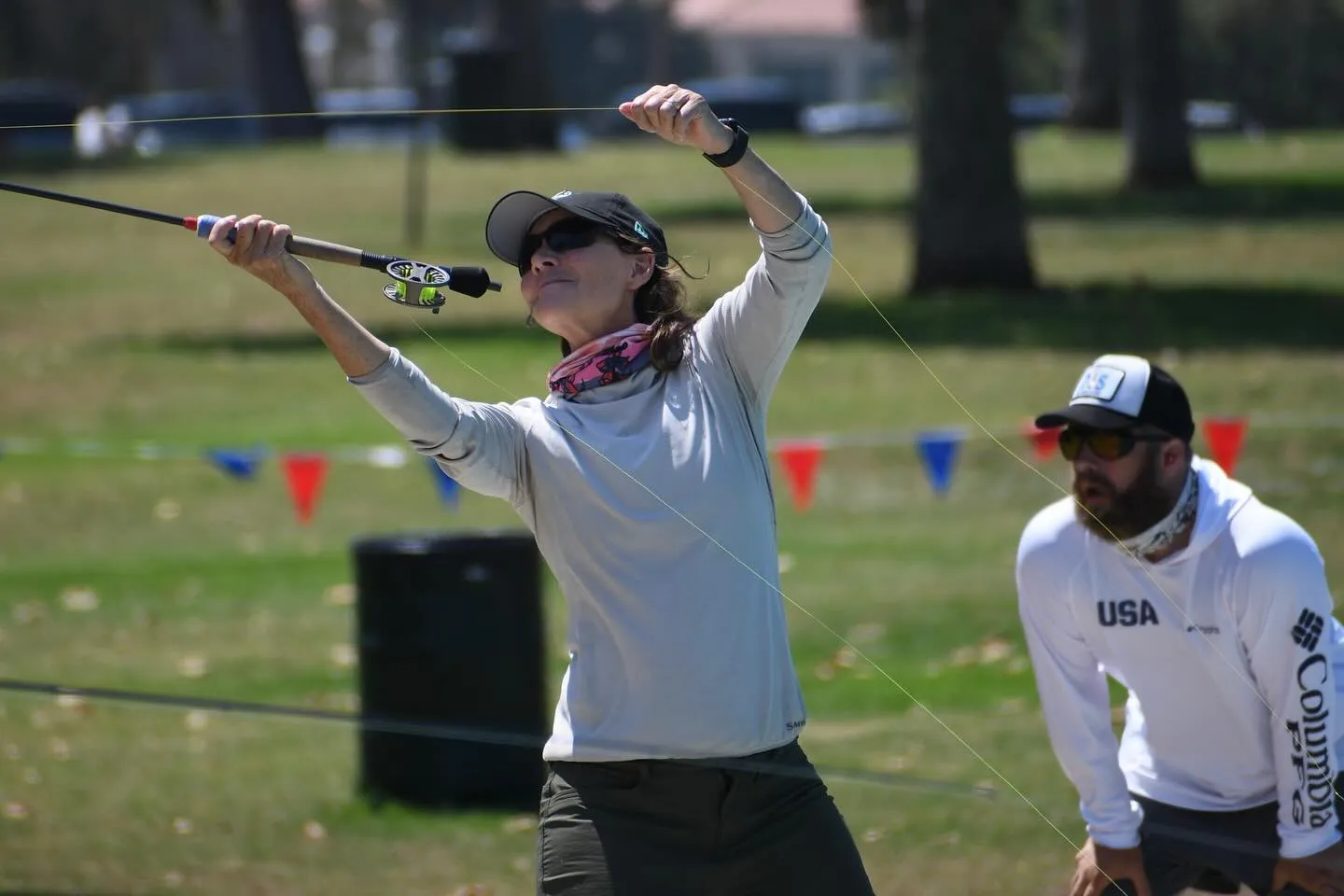
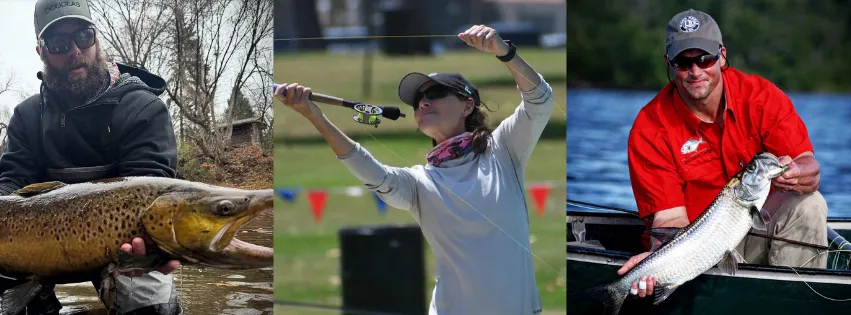
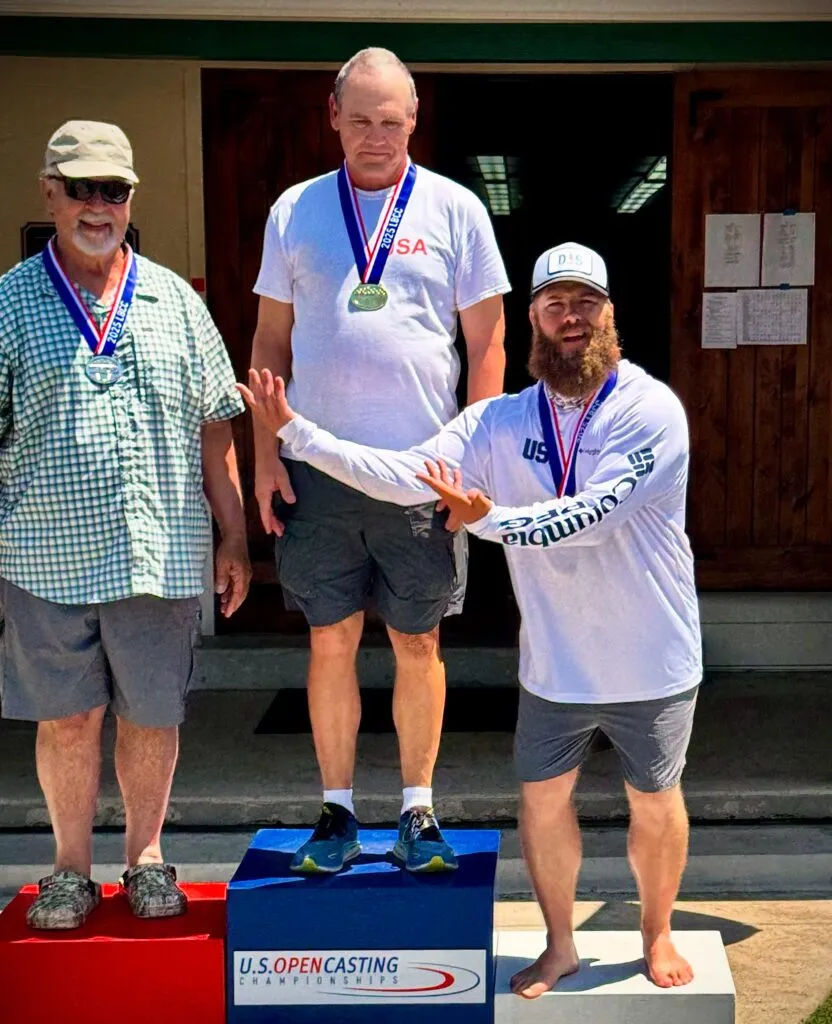
In this episode, we go inside the minds of world champion fly casters Whitney Gould, Rick Hartman, and Kalyn Hoggard to break down what really separates good from elite.
We talk about the World Fly Casting Championships, what it takes to carry 80+ feet of line in the air, and the biggest mistakes most anglers make when trying to cast farther.
Have you ever stopped and thought about how the people throwing the farthest aren’t actually trying harder? They’re doing less. Less tension, less force, less wasted movement — and somehow they’re getting way more line speed, control, and distance out of it.
I’m excited for this one because we have three of the best fly casters in the world today. This is our chance to hear directly from them and see what it really takes to get to that level.
[02:26] Rick Hartman guides for redfish on the lower Laguna Madre in South Texas. He got into casting competitions kind of by accident. He says he had to “perform poorly for a couple of years” before figuring things out.
Kalyn Hoggard has been taking the competition side seriously for about a year now. He does some guiding, but his main focus is helping people get better at casting. He runs virtual lesson programs with Marty McVey.
Whitney Gould started out guiding for salmon and trout in Alaska about fifteen years ago, then made her way to Craig, Montana, where she focused on trout Spey. She’s now back in Idaho guiding for steelhead and swinging flies.
[5:45] Rick says the easiest way to understand fly casting competitions is to relate them back to fishing. The most familiar events are Spey casting and the five-weight game, since those are the closest to what most anglers already do.
Once you get into shooting head events with grain weights and different setups, it gets more technical and harder to relate to everyday fishing.
Kalyn explains that five out of the six events are distance, where you stand on the line and cast as far as you can, and only one event focuses on targets and accuracy.
(07:41) I asked whether fly casting is one of those areas where it doesn’t really matter if you’re a man or a woman.
Whitney explains that power can help, like when you’re throwing a big Clouser 50 feet versus a dry fly. But it’s not about brute force. It’s about how and when you apply that power.
She says it comes down to line speed and being quick and precise. She compares it to watching a basketball player move fast and deliver with accuracy. If you can pick up the line and put it where you want it, that’s what makes it an even playing field.
[12:04] Rick says he didn’t invent anything. He was just trying to fix what he was doing wrong. Early on, he was using way too much brute force and ended up with a bad case of tennis elbow.
So he started casting with his hand as open and relaxed as possible. He did that for nearly a year, and somehow, his distance improved.
That’s where the long stroke and wide arc started and what Paul Arden later called the 170-degree cast.
Whitney says the biggest challenge is moving from Spey to 5-weight distance. Instead of just shooting line, you have to carry and control a lot of it in the air, and do it with fewer false casts.
She says that at around 80+ feet, it can feel like a “big noodle” out there.
Rick adds that once you’re holding that much line, everything gets very technical. One small mistake in timing or tracking and the cast falls apart.
Kalyn says cold weather makes it even harder, since the line gets stiff and coily, which affects control and accuracy.
Whitney says you can’t just start practicing accuracy a couple of months before and expect it to work.
Rick compares it to hitting a golf shot in front of a crowd. Easy when you’re alone. Different when it counts. Kalyn adds that practicing indoors helped him improve his accuracy.
Whitney says at this level, it’s mostly mental. In fishing, it’s about line management. In competition, it’s more like mental management.
All three of them have worked with Phil Blackmar, who’s known for helping athletes with the mental side of performance.
He says once you step up to perform, pressure kicks in. That’s where the mental side matters. A big part of that is visualizing your best cast and taking a few seconds to breathe before you go.
We talked about the World Championships and the different fly casting competitions out there.
Rick says if you break it down by event, the World Championship is the main one for a lot of them. They also mentioned:
[35:40] Gear is not one-size-fits-all here, and all three are constantly tweaking. The line is often more important than the rod, especially in Spey and shooting head events.
Rick’s setup shows how things have changed.
Rick mentioned that before, you had to use whatever rods were at the event. Now you can bring your own.
He notes every event needs something different, and finding the right rod is part of the process.
Episode Transcript
WFS 919 Transcript
00:00:00 Dave: You ever think and realize that the people throwing the farthest aren’t trying harder? They’re actually doing less. Less tension, less force, less wasted movement. But somehow they get way more line speed, control, and distance. Today’s episode is one of those rare conversations where you’ll get behind the scenes with three of the best flight casters in the world, taking us through what actually separates good from elite. Whitney Gould, Katelyn Hoggard, and Rick Hartman are here to break it all down. From the World Championships of casting to what actually carries over in fly fishing. This is the Wet Fly Swing podcast, where I show you the best places to travel to for fly fishing, how to find the best resources and tools to prepare for that big trip, and what you can do to give back to the fish species we all love. We got a big one for you today, Whitney. Katelyn and Rick are going to break down some good stuff. We’re going to hear about the background on the World Casting Fly Championship. We’re gonna find out what it actually takes to hold eighty feet of line in the air without losing control. The biggest mistake almost everyone makes when trying to cast further. We’re going to talk about that today. How relaxing your grip can instantly improve your cast. Uh, Rick goes into a great story here and how this all translate back to better fishing. Whether you’re swinging flies or throwing dry flies out there. We literally have three of the best fly casters in the world on this podcast today, so I hope you enjoy it. Here we go. Whitney Gould, Rick Hartman and Kalen Hoggard. How y’all doing?
00:01:25 Rick: Doing great. Another beautiful day.
00:01:28 Whitney: Fantastic. Thank you.
00:01:30 Dave: Right on. Well this has been uh like some of our best episodes. This has been a long time coming. You know, I think Whitney we’ve been talking for a while trying to get you on the podcast. Rick, we’ve talked to you before. Kalen, you’ve obviously been out and you’re all, you know, you’ve been here, you’ve all been doing great things in fly casting. I mean, basically essentially the best in the world. That’s what I have lined up here. So I want to thank everyone for coming on here. And we’re going to talk about the World Championships. We’re going to talk about whatever we go into here today. And I’m going to let you know, I think Rick a little bit let you lead. I’ll have some questions here. But, um, okay. I’m excited because I think that there’s, uh, you know, a lot of things we could talk about, but I feel like the championship, you know, the people struggle with fly casting. It’s the number one thing in fly fishing. So I feel like listening from the best of the best will be fun today. So so first off, Rick, let’s go to you. Maybe give us a heads up really quick. We’ll go around, let’s do a little intro first, uh, with everybody. Tell the audience who you are and then what you do out there.
00:02:27 Rick: Uh, my name is Rick Hartman. Uh, mostly, uh, I come from, uh, you know, come from the area of, of guiding, uh, guiding South Texas on the lower Laguna Madre and, uh, mostly redfish. They getting into this whole casting arena was kind of by accident. Um, I, uh, I just got noticed by a local rep back in my early twenties, maybe even late teens and said, you know, there’s these cool tournaments out there that you can actually win some money and stuff. And and I thought, man, that sounds kind of fun. I’ll start trying to learn to cast. And, uh, and that’s kind of how it started. I, I had to really perform poorly for, you know, a couple years to figure out how much work needed to be done. And that’s just kind of where it started.
00:03:16 Dave: Nice. That’s so cool. And, and, uh, how about you, Caitlin? Let’s go to you. Give us an update. I know you, we’ve done plenty of stuff. You’ve been on the podcast before, but, uh, give new listeners a heads up.
00:03:27 Kalyn: Yeah. So the competition casting thing is a big part of my life. Uh, now I’ve been pretty serious about it. I think Whitney and I talked maybe in April of last year, so I’ve almost been doing this for a year. Um, but yeah, casting instructions is what I’m into. You know, I like to do some guiding for run fish. Um, I also like to do like dry fly fishing in the driftless, like guiding, but for the most part, I’m trying to steer everything toward casting instruction and, and helping people get better.
00:03:56 Dave: Perfect. And your. And give us a heads up on your website. Best place they can track you down.
00:04:00 Kalyn: Yeah, my website is thefly dot com and you can reach me at kayleen at thefly dot com to set up lessons. I do a really interesting virtual program. So Marty McVey and I can do lessons for you pretty much anywhere in the globe. And so that’s, yeah, that’s our main gig, uh, education on the line. And you can reach me at Kaitlyn at the dot com and get started.
00:04:21 Dave: Perfect. And how about you, Whitney? Give us a heads up of who you are and what you do out there.
00:04:25 Whitney: Uh, well, my name’s Whitney Gould, and I’m a full time fishing guide. I started probably about fifteen years ago as a steelhead guide. Um, no, sorry. Salmon and trout in Alaska. Um, I had been a landscape architect prior to that and was laid off in two thousand and eight. Obvious reasons and um, then start transition to trout here in Craig, Montana, where we focused a lot on trout Spey using the two hand fly rod to catch trout and fish traditionally out of the boat with single hand. And now I’m back in Idaho guiding for steelhead. Um, swinging flies. And that’s like really my passion. So yeah.
00:05:11 Dave: That’s it. Awesome. Well, this is great. We got and we’ve obviously, uh, swinging flies, we’ve got a huge contingent of listeners that are into that. So we’re excited to talk more about that here. But I think let’s start this off, Rick. Maybe I’ll let you take this away. I think I want to hear I mean, my question would be off the start, is the world fly casting championship? I think that we’ve talked a lot about the team USA from the, you know, the World Championships, kind of the stuff that’s, you know, Devin Olson and the crew over there, Euro Nymphing and all that. But what you do is fly casting. Maybe describe Rick, what would be a a good setup to describe for people listening who are unfamiliar with it, what it is you all do?
00:05:46 Rick: Well, I mean, there’s, um, I think what kind of Lends itself to what most people understand. Uh, when you relate it back to fishing, I think would be two of the events in particular, uh, would be what Whitney is doing, uh, with the Spey. I think a lot of people understand that related back to fishing. And as far as the, you know, the overhead cast, most people would probably relate to the five weight game, uh, that they, that it hasn’t really been part of the worlds for really all that long. Uh, compared to the other events. Uh, I think those two would be, uh, a little easier for people to get a grasp on because when you start talking some of the shooting head events, you’re going to lose a lot of people. You know, you start talking grain weights and the different rods and, and, uh, that seems to be there’s a departure, uh, from those and related to, to most fishing, not all fishing, but some of it, uh, but I think that five weight game and especially what Whitney does, with the spade. That’s very relatable to, uh, what we’re doing in the world. Uh, and relating that back to most people that are fishing.
00:07:00 Dave: Yeah. Gotcha. Well, I think, uh, you know, I’m interested too in this. And, you know, Whitney, we had just last night, we had some, uh, meet up with some of the members that are kind of in wet fly swing pro. And we were talking and one of the people there was, was a lady and she was asking us like, how many people are in the group that are women? And, you know, and we struggle. That’s one of the things I think that we struggle with. But she did say she thought that, you know, the percentages out there have gone to like forty percent women in fly fishing sort of thing. There’s always that question, right? The women fly fishing. But but Whitney, you’re one of the basically the greatest fly casters. I mean, it doesn’t sound like it male or female matters in fly casting. Is that true? And how did you get to to where you are?
00:07:41 Whitney: I think that fly casting, there’s a special. I mean, yeah, I think the more power you put into it, uh, can be a deterrent, but it also can be helpful. For example, say you’re fishing a big clouser and you’re having to throw it fifty feet. You’re going to have to put a little bit more energy into that than, say, fly cast a dry fly. Right? So when people say power doesn’t matter, I kind of, um, it kind of does in some aspects. It’s when you apply the power, but it’s not brute force. So I think that that’s why women and men can compete on the same level at times is because it’s not brute force. It’s about how you apply the power and when. And it’s also about line speed. And I feel like the quicker you are. I just was watching basketball last night, the, um, I was watching the college basketball plays and I was watching Olivia Miles and that thing, she is quick and, and she just picks up that ball and throws it with precision. And it’s just amazing to watch. And I feel like when it comes to men or women, it doesn’t matter. As long as you can pick up that fly line and throw it quick or get it to where you want it. And I think that’s where I think it’s the even playing field for me.
00:09:01 Dave: Yeah. Perfect. And Caitlin, let’s go around here. What would it be for you? You’ve got Whitney and Rick on here. What should, uh, listeners know or what questions would you want to ask them that maybe, you know, I wouldn’t be able to think about asking or something I might not know about.
00:09:17 Kalyn: Yeah. I mean, you know, one thing I wanted to clarify, just with like the World Championships, how that plays out is five out of the six are distance. So you stand at the line and throw it as far as you can. And then one is, you know, targets and accuracy. And so that’s the five weight games that Rick talks about. And you know, it’s essentially there’s two events set up with the five weight line. You have to use the s a m e d for now. Um, with those type that two number one. And number two is what those events are. And then five and six are of the sp-a and three or four heads. Um, that one and two, it really is something that you can, you can take all the information that you learn and you can use it some way successfully on, on the rivers as well, which I think is really important. I think one of the things that’s weird for me, and this is maybe something I would ask these guys, you know, they’ve been doing this for quite a bit longer than I have. And you know, it’s always for me, it’s like a who’s who. Like I met Rick, you know, in Texas and I met Whitney through Paul and, you know, standing on the pond with Steve Rajeff and Henry Middle and Larry Allen and everybody, you know, um, for me, it’s just been like a who’s who this entire time. So like, I’m just trying to catch up. You know, Rick had mentioned that he worked on that cast for a long time and didn’t really get it together for a couple of years, even when he was competing. And, you know, I’m a year end struggling to keep up, I guess. And so it’s all I’m focused on right now is getting as much information I can from the two of them. Um, Whitney would never tell you, but she’s one of the best casters that there’s ever been. Um, and she’ll know it at some point. And, uh, you know, with Rick, I mean, he’s literally stood in a skating rink for years and invented the cast that’s now basically the modern standard. Um, or at least it’s the baseline of what the modern standard cast would be. So yeah, I mean, you have two of the greatest that ever play the game. And then you have me, I guess, on here for for fun and to be the clown.
00:11:08 Dave: And, uh, you’ve won. You’ve done some good stuff in recent years, right?
00:11:12 Kalyn: Yeah.
00:11:14 Dave: Yeah, yeah. You don’t want to sell yourself short. You, you were number two, right? At this year as part of the competition.
00:11:19 Kalyn: I was there, I lost to Steve and Henry Middle so I could have lost to worse people, I think.
00:11:24 Whitney: And let’s clarify, there’s some really great women spot casters out there, like single hand. I would think that Maxine McCormick is probably hands down, like, I would love to be in that category and I aspire to be in that category. But let’s, you know, she’s out there.
00:11:42 Kalyn: What’s funny about trying to find those categories sometimes is that you realize late that you’re already there. Right. I think you’re great, man. Great.
00:11:51 Whitney: Thanks. I appreciate it. Thank you. That’s really kind.
00:11:55 Dave: Rick, maybe you can talk about the what Caitlin’s talking about what you invented or describe this modern cast. Is this. What does that mean?
00:12:04 Rick: Yeah, I didn’t, I don’t I didn’t invent anything. I mean it. Well, I’ll tell you exactly. Really what happened is, um, while I was trying to learn their, you know, things I was doing wrong, you know, back when I was playing around with this, you know, in the beginning, there really wasn’t internet to get on there and, and find out anything. And in South Texas, you really don’t have anybody to learn from. So I had to make every mistake in the book and figure out how to correct it on my own. And what was really funny is, you know, Whitney mentioned brute force. And in the beginning it was obvious that it is now obvious. Back then, it wasn’t, uh, that I was using too much brute force. And I got the worst case of tennis elbow. I couldn’t even shake somebody’s hand for six months. And I was like, golly, you know, I still want to keep practicing. And so I just completely would open my hand and keep it as loose as possible where the fly rod would almost fall out of my hand. And that’s how I had to practice for almost a year. And oddly enough, from doing that, my distances increased substantially. And you know, that in and of itself taught me that, you know what that you got to lay off. And I mean, you need to be as relaxed as possible. And, you know, you don’t want to hit it. You don’t want to use brute force. And that’s kind of where this long, super long stroke, long back cast the one hundred and seventy degree arc. That’s kind of where it all started from. And truthfully, it was not something that I said, oh wow, this seems like this is what I need to do. It was mostly an accident as to how it came about.
00:13:52 Dave: So you’re talking about maybe explain a little bit on that, the difference of the the ten to two, right. That versus say the wider arc.
00:13:59 Rick: Yeah. And there’s, hey, there’s nothing wrong with, you know, with talking about ten to two. And when you’re teaching beginners and giving them a visual, uh, but this is definitely a departure from that because, you know, in this game, this five way game, you really have to concentrate on holding or realizing more line. And with this, in the beginning, you actually used five weight rods. So they’re substantially slower than what everybody’s using in the worlds. And so you have to reach further back because you’re loading the rod so much deeper, uh, because you’re analyzing so much more line. That’s, uh, obviously a lot of weight as far as the fly lines concerned, and that loads the rod deeper. So you’re having to reach so far back. Um, and then, uh, I’m basically, you know, my rod is pretty much at a point on the back cast and the forward cast. So, you know, your rod is almost stopping at your target, uh, on the back cast and on the forward cast because it’s loading so deeply. And when you, you know, when you kind of look at that on a video, you know, most people’s arc is, I don’t know, probably, you know, eighty degrees, one hundred degrees, one hundred and twenty degrees. Uh, but, you know, the arc that started ended up throwing the furthest was literally I, you know, Paul Arden was down with me and, and, um, I thought he named it the one hundred and seventy degree cast, but he says I did, but, uh, it literally is pretty much about one hundred and seventy degree arc. Uh, when you’re realizing close to ninety or a little over ninety feet of line.
00:15:46 Whitney: You know, it’s interesting about that is, uh, Rick is I, that, that’s what’s so difference between the, uh, shooting eight games, which is space, space shooting head game, right, right. Versus the five weight distances that you actually have to slip line and carry line. And that for me has been one of the biggest, biggest challenges with the, the whole one hundred and seventy, whatever you call it. I mean, I work with Paul and Paul, Andrew, Rick, of course. And so being able to slip line and do it in and hold that line area lies that line, and then do it in as few casts as possible. Um, so you don’t lose control, right? And doing too many false passes is, I find, been the biggest challenge for me because like in space or say sea trout. You don’t do a bunch of false casts, you know. You go one, two, three and shoot you if you, you know, takes mass, move mass. So if you shoot too much line in the backcast, you’re going to lose control, right? Right. So I find that that’s been the biggest challenge for me transitioning from the shooting head games, which is Spey to the five weight distance, is to figure out how to analyze and hold that line in a manner in a certain, like with a minimal false cast.
00:17:08 Rick: Yeah, I think you’re right. I think it’s even now, it’s the hardest part of it because, uh, you know, mentally it can still mess with you and one slight, you know, tracking error or, you know, hall timing various things and man, it’s gone. I mean, it’s just, it’s very technical to keep that much line in the air, uh, with any kind of speed and a lot, no tip deflection that throws the lower leg down. I mean, it’s yeah, it’s tough. And if you get amped up in a competition, it’ll all fall apart in a moment’s notice.
00:17:40 Whitney: Yeah, yeah. It’s like a big noodle out there, like you’re trying to analyze. I mean, right now I’m up to eighty four feet of line carrying that long. And I’m just like, oh my gosh. Sometimes you get you’re scaring yourself. Can I hold this up here?
00:17:56 Rick: Yeah. Well, and that goes back to what you said earlier. Um, earlier you were saying, you know, brute force is actually a deterrent. And, and, you know, when you start analyzing that much line, it’s like, oh boy, it all comes to hand speed rather than brute force. Boy, you add a little too much and it’s just a big pile of junk out there.
00:18:16 Whitney: Yeah. And then throw the wind in there too.
00:18:19 Rick: Oh, gosh. Yeah. Caitlin knows all about wind and weather.
00:18:23 Whitney: Right?
00:18:24 Rick: Yeah. All I.
00:18:25 Kalyn: Cast in is wind.
00:18:27 Rick: And cold.
00:18:28 Rick: And cold.
00:18:29 Kalyn: And snow for the most part.
00:18:30 Whitney: How does that cold affect your line, Caitlin, when you’re practicing?
00:18:34 Kalyn: The med gets coily after a certain temp. Um, but I think everything does. You know, it’s so cold that it’s contracting, you know. And so since it contracts, it basically makes those little circles that we get right in line and you can stretch them out. But, you know, with how cold it is for me, even if I get it stretched out good. I don’t have very long before it’ll start cooling back up. Accuracy is okay.
00:18:59 Dave: Golden Fly Shop isn’t your average fly shop. They have a twelve foot shark painted like a cutthroat, hovering over a huge selection of the best rods in the business, a massive assortment of tying materials and their famous steakhouse streamer display. And it’s the hub for a community of anglers who never stop tinkering with new ways to catch fish. Sometimes the conversation behind the counter includes what hatches are going off and what techniques are working best. Then tales of destination fishing, adventures, sought after species, or a good old congratulations when a customer brings stories of finally connecting with that fish they’ve searched for forever. With a growing online store and a budding YouTube channel, you’ll be able to follow along with their fun antics, international adventures, and helpful fly fishing tips. Golden fly shop where the community is hanging out even if they’re supposed to be working. That’s Golden Fly shop dot com. Check them out right now. Trout Routes by Onix is built for fly anglers who want better Intel without spending hours digging for the information. You’ll get access to public land maps, stream access points, regulations, and even road and trail maps all in one place. It’s become my go to app for scouting new trips. You can check them out right now. Go to fly dot com slash routes and download the app today.
00:20:15 Whitney: Yeah. So have you been practicing indoors? I’m curious, like what you find the difference between going indoors and outdoors is?
00:20:23 Kalyn: Well, you know, like I said, I’m playing the catch up game. So I didn’t really have time in the winter to just not be casting. And we had a pretty rough winter. And then, you know, the qualifier was in February. So I had to cast inside and I found a place that had a couple of indoor soccer fields. And, uh, it wasn’t big enough for like my big stuff, but it was big enough to keep me going and keep me smooth and straight. And I think it did help me get straight. I think that there are some disadvantages. You know, all the lines in the room are straight and available to see. So I think it makes it easier for you to line up everything and make good casts. So it might be a detriment maybe, but I know that it helped me with accuracy. I know that inside I could line everything up and feel what straight felt like, like actually straight. And I think it just kind of changed everything for my definitely for my accuracy cast. And I think it keeps me alive for the distance stuff.
00:21:18 Whitney: Yeah. I’ve been having to play catch up on my accuracy for a while. It felt like I can’t be an American. I can’t seem to do this like Steve and all those guys are like, oh my God.
00:21:31 Kalyn: Dave, what you don’t know is that we as the Americans are notoriously the best at accuracy and have been and have been for decades. Huh.
00:21:42 Whitney: That kind of fell short.
00:21:45 Rick: Uh, I guess I’m from Mexico.
00:21:51 Speaker 6: I just.
00:21:52 Whitney: Yeah, I mean, like, yeah, I think that’s been fun is doing accuracy.
00:21:57 Kalyn: I think meeting you guys has been really fun. You know, Whitney, we kind of met through Paul and. Right. You invited me out and and that I mean, I’m forever in your debt, right? For that because you, you kind of changed everything for me by coming out and being on the team. And Rick, I’ve got this wonderful photo for the first time. I met Rick. Uh, Andre Spinetti took the picture and he.
00:22:18 Rick: You told me you were going to erase that.
00:22:21 Kalyn: And so, so Rick is standing there, hands on his hips, you know, watching my back cast. And you kind of see me in the foreground and he just looks like he’s real upset with the way I’m throwing that back cast in this picture, and I’ll never forget it. I’ll blow it up, put it on my wall first chance I get. But yeah, it’s fun to meet these people because you know, you don’t know, you know, like Rick has been, you know, a name amongst the crowd since I’ve been doing the fly fishing thing. But, uh, you know, you don’t necessarily know what you’re getting into. You don’t know that you’re ready. And like she was talking about, like Whitney was talking about with accuracy, you know, you got a lot of catching up to do as a rookie, you know, like somebody who’s just trying out, you gotta spend time in the box and, uh, not get nervous. And I think maybe I’m whipping that. We’ll see. But no, I’ve had a great time just meeting the two of you guys and, and everybody else, you know, that’s involved with it. And it’s actually been a pretty good like almost family like, uh, situation.
00:23:18 Whitney: Definitely. Yeah. It’s good to get to know you too. I think the whole accuracy thing has been interesting because like for the last world Championships. Like, yeah, I got the accuracy covered. I’ll figure I’ll do, I’ll practice like maybe start practicing the last two months. And you just can’t do that with accuracy. I think it’s the most understated, but it’s the hardest in some ways because you’ve got everybody’s like, how hard can it be to hit a hoop? Right? I’m like, dude, they’re right there. How hard can this be? Right. And there’s so many nuances to it. I remember, um, when I was casting with, uh, last world Championships and I don’t know what was going on, the judges were just playing catch up and they were talking while we were casting. It was kind of difficult. They did it to everybody. It wasn’t just me. And, uh, it was so frustrating because I realized how much concentration it takes to be able to do that. I mean, you’re hitting sixteen targets in five minutes. Is it five minutes? Yeah, it’s five minutes. I should know that. And there are all these other factors going on, and you just need to just focus. And that’s been a real challenge is the focusing part with accuracy. So doing mental drills, doing it every morning, just going through a bunch of targets and calling it good. That’s practicing for that.
00:24:50 Rick: Yeah. It’s kind of like a professional golfer walking up and hitting one off the tee with the driver in front of thousands of people. Uh, you can do it all day long when you’re by yourself, but you start second guessing everything when you’re standing in the box. And boy, it can play head games for certain.
00:25:06 Whitney: Yeah, I agree with that. I mean, I think like ninety percent of this is also, you know, this is funny because like, when I think of it as when I’m teaching fly casting or I’ve got people in my boat and I’m like, they’re like, well, I can’t cast. And I’m like, yeah, just get it in there. What you can’t do is lie on management, right? I mean, and that’s the way I think about competition, right? So fishing for me, it’s two percent casting ninety eight percent line management for these world tournaments. It’s like two percent casting, ninety eight percent mental management, you know.
00:25:48 Rick: Yeah, I believe that.
00:25:50 Kalyn: Yeah. It’s funny you say that because I think all three of us have talked with Phil. Right. Rick, have you talked with Phil about like managing the mental stuff?
00:26:00 Rick: Oh yeah. Absolutely.
00:26:01 Kalyn: So we all three have talked to there’s, you know, uh, famously known as the tallest golfer in the PGA. Uh, Mr. Phil Blackmar has done a lot of, you know, working with people’s mental game during sport. And, um, you know, I think he’s written about it, but, uh, yeah, he’s worked with all three of us. Something that you wouldn’t think of, you know, it’s just flycasting. Right. Well, I mean, a lot of it’s between the ears. It’s all about the cheese. Kind of like what Whitney saying and, um, working with somebody that that can help you kind of step up there and do your best and actually do your best. Um, I think has been pretty vital and you spend more time talking to Phil, I think. But, uh, you know, I think that’s something that people don’t think about too. You know, there is a lot of pressure. You are trying really hard and you’re putting a lot into it. You know, you put a lot into something and you stand up on the stage and try to prove to everybody else how much you’ve put into it. You know, you get a little nervous.
00:26:53 Whitney: Yeah.
00:26:54 Kalyn: Does that make sense?
00:26:56 Rick: Definitely does to me.
00:26:58 Whitney: Me too.
00:27:01 Speaker 6: This is getting gushy. Let’s move on.
00:27:03 Speaker 7: Oh, sorry. Sorry sorry, sorry. Yeah.
00:27:06 Dave: Well, let me hop in here. This is really cool. And we had Phil on the podcast and it was great because I think he is he a is he seven feet tall or he’s a super tall golfer, six, six, ten or something like that. I think he’s the tallest PGA pro ever or something like that. Right. And I love the mental thing because I love the analogies too, about, you know, the sports analogies, right, in golf and all that. But maybe talk about you’ve been talking a little bit about the, the comp, the targets and things like that. Maybe you can take us into what that comp and is this always in mixed around different countries around the world? Because I’ve heard about different things and you have space, you’ve got, you know, different comps, like describe. So people know, is this the top place where everybody from the world comes to? And is it in the USA typically?
00:27:50 Rick: Um, well, I mean, if you break it down to the specific events, I would say yes. I mean, Whitney would probably chime in a little bit more, uh, when you start talking about space, because it seems like to me there’s more events and different events in space than, say, the five weight game. I mean, for some of the events, the worlds is it. But then you look at, you know, space drama and all these other different events. And I don’t know, you tell Whitney, what do you think? Do you think the best, uh, come to the worlds? Or is there another event that you think is more competitive?
00:28:29 Whitney: Uh. Well, I think hands down, any competitor will who has experienced the world spay event, this is only spay versus spay orama. They say spay orama is the hardest event out there, but it’s an international event. It’s not a world championship.
00:28:46 Rick: Um, okay.
00:28:48 Whitney: The ones in Europe by the I see. So did I get that right? Yeah, I hope so. Um, those are hosted by a world championship organization, I believe. I don’t know, Henry could get this right. These are the details that I’m not very good at. Um, but that itself brings all these people together from other countries. And I believe that each team, their teams are more organized and they practice these specific games, and they’re just as hard in a different way. There’s different competitions and, you know, there and in some ways, because I’m speaking of the women, because there’s more women that do it overseas. It becomes a harder competition because and it’s something I look forward to because it’s real competition, right? I’m not saying that spectrum is not real competition. In fact, there’s a group of women who are coming up who are going to be deadly. I can’t wait to see what they do. But yeah, it’s just you go and you meet these women who you don’t tasked with every day. Guess that’s what I’m trying to say. And so there’s that random factor. And and they’re good. I mean, they’re really good. So like, Anita, I look forward to casting with Anita because it’s always like. And I look forward to casting with carbonate and Donna and all these people because it’s like, yeah, okay, bring it on kind of situation. And it just pushes you to be better.
00:30:28 Rick: Yeah. It just seems like, you know, some of these events that, uh, you know, that we’re practicing right now, it’s like there’s not really anything else. Um, you know, where you compete in those events, right?
00:30:43 Whitney: Oh, I’d say the world events.
00:30:45 Rick: Yeah. I mean, it just seems like that’s it.
00:30:48 Whitney: Yeah. There’s the a c a the American Casting Association. Um, when they are putting on their U.S. open and those events, the Europeans are invited to come. In fact, Sweden and Norway came a couple of years ago and competed and they competed in the a c a games in the casting games, um you know, which had plug distance and all that which you figure ninety eight percent of the world is more castoring than fly casting, right? This is such a small niche. Um, and they had a couple of days of world games. So there’s opportunities and they’re trying to get more opportunities for that and bring in more people and enthusiasm for the sport of casting and fly casting. So it’s exciting what they’re looking to. And actually they’re beginning to relaunch their website and stuff and do some more marketing in order to bring the message out and bring in more enthusiasm for the casts and educational videos. So we’re excited for what’s coming down the line for that.
00:32:00 Kalyn: I think one thing that probably all of us would agree about is that we want everyone to be there. We want everyone to show up and we want to compete against everyone, you know, and like, there’s people here and there that can’t because of timing or you know, or what have you. The amount of money, because it’s not a cheap sport to play either. But you know, like, I’m pretty certain that Nick Moore from the UK is not going to show up for worlds because we talked about it and I kind of want to beat him. I mean, he did so good. So I’d hate to show up to a championship, an international championship or a world championship and not have everybody there. You know, I want everybody to show up and have a good time. And I’m hoping that there’s going to be a lot of people at worlds this time. And I hope that we have a good time.
00:32:46 Dave: When is the world’s typically so people can check in? And can you check this out? Is this something I’m I’m guessing it’s not on ESPN at this point, but no. Can people find this go to these events?
00:32:58 Speaker 6: Mike says it’s like watching paint dry. I guess I shouldn’t say that, but my husband and I try to get my husband to go with me. He’s like, dude, it’s like watching paint dry. You guys are all amped, you’re having fun, and I’m just sitting there.
00:33:13 Rick: No, I mean, it’s in August um, this year and I, I assume it’s usually in the same time of year, uh, when they have it. Um, but yeah, I don’t know how you would be able to, uh, watch any of it, honestly, uh, unless someone did a live feed on their phone. Uh.
00:33:32 Kalyn: I’m working on ways to make it more fun.
00:33:34 Rick: Yeah. To, to Instagram or something, but no, I’m, I’m pretty sure ESPN would have no interest in, uh, in filming that.
00:33:43 Kalyn: It’s ironic that you say that, Rick, because some of your stuff wasn’t some of the stuff that you used to do, like with the, uh, the Danish games or whatever, wasn’t some of that on ESPN?
00:33:51 Speaker 7: Yeah.
00:33:52 Rick: No, they used to have, uh, some of the events that I was messing around with was, uh, on ESPN and the, uh, outdoor channel back in the early two thousand.
00:34:03 Kalyn: The precedent is there. We just gotta bring it back, man.
00:34:06 Dave: Yeah, yeah.
00:34:07 Speaker 6: Cool.
00:34:07 Whitney: Yeah. I think, you know, it was really fun for, um, when I went to Norway, Um, the Norwegians had a board that had all the scores and people could follow the live scores. Right. And so you could go up and see where you were and where you were, and place of the other categories. And people at home had access to that. And that was really exciting. Um, I had a lot of friends and family that were watching that and I was getting texts and stuff. So it was cool. You know, the whole thing is when I’m in a competition, I turn my phone off. I don’t even pay. I don’t even go on the, uh, Instagram or any of the social medias. I try to just keep noise out. And I think it’s, you know, for them. So I get these texts and I’d be like, what are they talking about? I had to turn it off. I had no idea at the time, but it was cool. They were excited. So that’s helpful.
00:35:07 Dave: Yeah. Well, we had a pod you mentioned we mentioned Maxine at the start. We had Chris Corich on a while back and he was describing the. It was really interesting and he was describing the the rods and the rods that like Maxine was using and how I think he talked about how they were like from the eighties or they were older rods. They weren’t like the new rods. Describe what you use out there. You all use. Talk about that a little bit and what people should know about what you use and maybe what could help. You know, what people, what you know, you’re using for these. And then what can listeners get from that?
00:35:38 Kalyn: We might be the first three people to ask.
00:35:40 Speaker 8: Yeah. Okay.
00:35:42 Kalyn: Yeah.
00:35:44 Rick: I don’t, I don’t think one of us is, uh, in the same arena when it comes to, uh, what rods we’re using.
00:35:49 Kalyn: No. Yeah. And we switch a lot. The three of us in particular switch a lot more, I think, than anybody else.
00:35:54 Dave: So it’s not that critical then. There’s a lot of different rods.
00:35:58 Kalyn: I wouldn’t go that far for.
00:36:00 Whitney: Okay. So for rods, I’m pretty much dialed. But, you know, even when it comes to fishing, I think the line is more important. But, um, so I spend a lot of time dialing my Spey line, and that’s a gale force line made by James Chalmers out. And it’s one of his extreme distances. And it’s the same with the shooting head games. It’s like I spend a lot of time trying to figure out which shooting head there is. As for the fly rods, right now I’m using a sexyloops rod by Paul Ardens. I think it’s one of his hot torpedo rods, which are amazing, and borrowed one from a friend. And um, I’m going back between two back and forth between two different line weights on that. You know, I have a seven weight and a ten weight, so I’m just kind of going back and forth. Actually seven weight. It’s more of a nine weight. Um, and the idea is how much can I carry versus how fast that rod is and to be able to move it and heavy, um, for Spey, I’m, you know, Sp-a for me is pretty much dialed up. You have to get a competition rod. At this point, you can’t just pick up a fishing rod. Um, so I’m using a gale force, um, his new ride called Boomer. It’s a boomer. And then for five weight distance, that’s back to the old Chris Korge. Um, I don’t use the softest rod as Maxine and these other gals, they use the Eagles, which is a Fenwick. I’m actually using an old sage rod, um, a graphite three, and I’ve totally torn it apart. Evidently I, it was an eight and a half foot five or six, I don’t even know. Totally tore apart and put it back together with the new guides of Chris’s recommendations. And, um, it was funny because Peter, um, Peter Knox from sage, he was casting it and he goes, Wow, this was a lot faster than I expected you would want. And I was like, yeah, well, you know, I wanted a faster ride for the wind. But he looked at me and he’s like, you did something to this and probably did, but I don’t remember. You know, I might have cut something off the tip or done something like that, but I’m not not adverse to tearing apart these rods and putting them back together and cutting them and moving handles up and down. So I guess that’s where Kaitlyn is laughing because like, you know, all of our rods, at least I can say are in different disarrays and, you know, they look like a hot mess at this point. So there you go. What do you think, Rick? Where are you at with rods?
00:38:51 Rick: Well, yeah. Um, it’s interesting because, uh, before the five way event was even close to being in the worlds when I started doing it, you show up at the event and they’ve got five rods on a rack and you just go pick up one of them, and that’s what you threw in the competition. You didn’t get to use your own rod. Uh, but you knew what models and make, uh, rods they were going to have. And so you, you probably had one of those, but no two rods are the same. Uh, even if it’s a, a sage TCR five. Wait, your sage TCR five wait. And the one they have at the competition are not going to feel the same. They may be close, but not identical. And it was so interesting because those were so much harder to throw, you know, say one hundred and twenty, one hundred and thirty feet. It was more difficult. Your timing was more critical and you had to slow things down. And I kind of disappeared from competing for a while. And then I hear that people are throwing there’s a lot more people reaching these extreme distances. And I’m like, man, how did that happen? And it turns out that in these new competitions, you’re throwing the same line that we used to throw, but now you can use any nine foot rod. That means a ten weight, nine weight, eleven weight, and it’s your own rod. And, um, it’s funny, I kind of, as I got back into it over the last year, after twelve or so years, I, I started off saying, well, let’s try an eight weight. And it felt stiff at first, but after about two months, I was like, man, this rod’s not stiff enough. And then I’d move to a nine weight and think, man, that’s better. And then I’d say, well, it’s not quite stiff enough. And then I moved to a ten weight and, uh, I thought, man, that’s it. I’ll, I’ll, I won’t need anything stiffer than this. And then after about two months, I moved to a different company’s eleven weight. And, uh, that’s where I’m at right now is, uh, with an eleven weight to throw the five weight line. Uh, so it’s been an interesting transition to see how it changed from back in two thousand and one two thousand and two. And, you know, just using your own rod, that’s considerably faster than, uh, than what the game used to be. And that’s been an interesting change. It’s actually been kind of fun.
00:41:19 Dave: Yeah. So you’re using an eleven weight rod, casting a five weight line.
00:41:23 Rick: You’re right. Now I am there’s an eleven weight with a fairly soft tip. Uh, but it’s very quick in the first half of the rod. But yeah, I right now, um, you know, this morning’s practice has been the same as about the last week. My, you know, it seems that consistently my longest casts have been with, uh, this eleven weight that has a pretty soft tip, but it’s, uh, stiff as all get out in the first half. First half of the rod.
00:41:51 Dave: Yeah. What about you, Caitlin? Are you which track are you on here with your setup?
00:41:57 Kalyn: Oh, me um, accuracy rod, I feel pretty confident with. I’m gonna keep it for sure. Um, and it was basically a, you know, nine foot six weight and it’s not the same length that used to be. So I’m not sure exactly what weight or length it is. I think it’s eight foot eight. Um, and that’s what I’m using for accuracy for distance. I think that each cast has a rod that helps. I think that, you know, equally, each cast, you know, has a rod that doesn’t help or makes you perform, you know, poorer. I think with the distance stuff for me right now, I don’t have a dedicated five weight distance rod, which is terrible. But I think as long as you can keep that long stroke going with something else that has the same kind of cast and performs the same, you know, or similar, um, is kind of the way I go. So it’s funny, you know, you may put in a certain amount of money to get rods and then you have to think about who you’re sponsored by and if they want you to throw their rods and so on. So it can be kind of a an interesting dynamic. I think there’s a lot of rods out there that would be great for me. I don’t know that there’s one perfect one or not. Um, if there is, maybe it’s the blank that I have sitting here that’s about to be built, but we won’t talk about that. Um, but yeah, rods have been an interesting game to play. You know, each of these events really requires a different kind of rod. I mean, you could maybe get away with the same five weight distance rod as your sea trout rod with my kind of cast, but, you know, with a very short stroke, very hard cast it it you wouldn’t. Right? I don’t think so. It’s an interesting dynamic because you’re looking at all these different events. You want to make your casting better, but if you match the rod to your cast, it will make you better. And so that in and of itself is kind of paradoxical, right? Because maybe there’s another rod out there, maybe there’s another, you know, and we don’t have infinite money. Like I said, I keep coming back to it’s an expensive game to play and we’re all doing our best to maintain. But, um, sometimes you’re just stuck with your sponsor and not stuck. But sometimes that’s the rod that is chosen for you more so than the rod that you’re going to throw.
00:44:11 Whitney: And that’s why I don’t have a sponsor.
00:44:13 Speaker 9: That’s right.
00:44:14 Rick: Yeah.
00:44:15 Whitney: That’s like I’m not on any pro staff. I just you can’t afford to be on a pro staff, right?
00:44:20 Kalyn: You can’t afford it. There’s no way.
00:44:22 Whitney: I mean, like, like who can afford to be on these pro staffs.
00:44:26 Kalyn: Nobody right.
00:44:27 Dave: Yeah.
00:44:28 Kalyn: Not to digress too far.
00:44:29 Dave: But yeah that’s right. Yeah. The pro staffs aren’t necessarily sending out million dollar contracts like they would be in the the NBA or these other places. Right.
00:44:39 Kalyn: Well, a lot of times they’re going to require you to use their rod.
00:44:42 Whitney: Well rightly so.
00:44:44 Rick: Right, right. Yeah. It’s I’m with you guys. I’m not on any rod pro staff right now. And, uh, in fact, I really wasn’t back in the day either. I just used, you know, I just tell the company, man, I think this is the best one for this game. And if they sent you one, great. But, uh, yeah, if you get on with one company and you get tight with them, you’re, you’re gonna, you’re a little limited on what they have on, on hand or what they’re making. And, uh, that’s, I guess partially how you end up with a ten weight or an eleven weight, depending on the rod model and make.
00:45:20 Whitney: Yeah. I mean, guaranteed that what I carry in my boat is something that I’m going to fish. Right, right. Not something that somebody’s going to. Yeah. And like, and, you know, if you figure they give you three free rods. And then in my thing, I would have to buy twelve rods to replace everything. Because you think of all the nuances for Spey trout, spey, single hand trout, and then steelhead, it just so you choose the rod that you fish with and hand it to your clients for By the sun. You know, a boat ride that you can afford breaks. So it’s interesting that way.
00:46:04 Dave: Do you think you need a bush plane to fish Alaska’s legendary waters? Think again. Fishing expeditions specializes in road accessible adventures that don’t skimp on excitement. Picture yourself fishing for massive rainbow trout, Arctic grayling, and plenty of salmon species, all within Alaska’s epic road system. It’s doable. I fished the road system on our first day with Adam and the crew, and it did not disappoint. The largest leopard rainbow I caught and landed was right off the road system, and we’ll be driving up again this year, heading up from the lower forty eight all the way up to Alaska to hit those streams again. You’ll experience the breathtaking beauty of Alaska’s wilderness, from mountain streams to hidden rivers perfect for anglers of all levels, fishing expeditions makes it easy to explore Alaska. Why wait? Your Alaska adventure is just a drive away? Book your spot now before spaces fill up. That’s fishing expeditions dot com. F I s h h o u n d expeditions dot com. Don’t miss out. This is great. I also want to hear about one person that obviously Steve Rajeff. What rod is Steve using? Because I think there’s a long history here with Steve going back to you know, I think he was designing rods with Loomis back in the day. And now I think I did hear we had Larry Kenney on recently, who is a founder of Scot, and he talked about how there’s a sixteen hundred dollars Asquith rod now out there, which I think is connected to Loomis in some ways. But talk about that. What is Steve’s for people that don’t know him, what do you think he’s using? Do you got do you guys know.
00:47:37 Rick: Um you know, he seems to bounce around a little bit, but he did bring basically a blank of the new Asquith. And it’s probably just a little bit slight variation On the new Asquith, but it’s basically the blank with different guides. And he had brought a nine and a ten and I don’t know, Calen, you might. I’m pretty sure that’s what he was using. Um the last times he was throwing.
00:48:10 Kalyn: Yeah. He’s a Loomis man through and through. Yeah. That’s. Yeah he was throwing last time.
00:48:14 Rick: And they’re extremely light. Uh, they felt great. I got to throw them a little bit and, uh, I thought they threw great, but I just got a. Steve and I were texting last night, and I think that he kind of got them to make that blank ever so slightly softer in the butt section, uh, for one that he’s gonna have the next time. Um, we, uh, we go to Long Beach score. Yeah. I mean, I’d like to feel it because I, I thought they threw great, uh, light as hell. I mean, just really, really, really light.
00:48:54 Kalyn: Mhm.
00:48:54 Dave: Yeah.
00:48:55 Kalyn: The big rod that Steve is known for is the GLX.
00:48:59 Dave: The GLX.
00:49:00 Kalyn: He made the G. Loomis GLX, like the design wise or whatever. I think it was a nineties rock. It was a nineties. Roderick.
00:49:07 Rick: Um.
00:49:08 Kalyn: Early two thousand.
00:49:09 Rick: Yeah. No, I think probably, uh, late nineties.
00:49:13 Kalyn: Okay. So that ride, uh, is famous for a good reason, right? I mean, he made it. I know some rod builders in the industry that call the GLX the King, that no matter what has happened since then, the GLX is still the king. And I’ve heard a couple of different builders say that. And I know that that’s one of the ones that Steve usually has around, right? Because that’s the rod that he made for himself pretty much. And it’s famous for that reason because it’s that good.
00:49:41 Whitney: He’s also designed I mean, I think he’s also doing the sea trout blanks. Actually, I know he’s making having the sea trout blanks and the salmon blanks made at Loomis. And then you can buy those on the ACA website, and then you can cut them and build them in any manner that you want. You can take some off the tip or some off the. But depending on how fast or soft you want them. But those shooting had game rods are available on the ACA website and they’re designed. I think they’re Steve’s blanks, aren’t they?
00:50:16 Rick: Yeah. Rick. They are. Yes. Yeah. Yeah. He, um, went back and specifically for me on that two handed, he had to make one that was stiffer than what was available through the ACA and got that for me to throw. And that’s, uh, his design that I’m throwing right now.
00:50:34 Whitney: Yeah. And I’m throwing an older, softer, I guess, more forgiving graphite. I’m throwing Larry Allen’s old one because he went to the faster graphite. I think mine is more of a stinger.
00:50:47 Rick: Yeah. Larry through Steve brought, uh, an update. Slightly different than the one he sent me. And it’s faster than Larry’s old rod, or even the one that Larry was currently using. And, uh, when Larry threw it this last go round in, uh, February, uh, yeah, Larry was automatically going to switch to that faster one.
00:51:10 Whitney: Oh, wow. That means I have another rod. Yeah, exactly. Out of this.
00:51:14 Rick: one.
00:51:15 Speaker 7: Whoa whoa whoa whoa whoa whoa.
00:51:20 Rick: Yeah. It never ends. It never ends.
00:51:24 Kalyn: It’s funny because, like, even speaking of Larry, you know, he told me one time, he said, you know, be very cognizant and be very careful and be very mindful when you’re making your rods. Because if you’re not, you’ll spend a lot of money on them and they’ll end up in the closet like my closet. And apparently he’s been around the block building rods and making new rods and being a champion like he is. I mean, he won the overall, I think in the veterans, last World Championships, if I’m not mistaken.
00:51:51 Whitney: Oh, Larry’s a stud. I mean, he’s a stud, dude. That guy, he’s a weight lifter. Um, he is so generous and such a great casting instructor on top of it. Um, he has been really helpful with me, especially.
00:52:09 Rick: Yeah, he’s a rare, rare human being. He is just a wonderful person all the way around.
00:52:14 Speaker 7: Mhm. Yeah.
00:52:14 Dave: And who is this again?
00:52:16 Rick: Larry. Larry Allen. Okay. He’s in the veterans in, uh, on the US team. And, uh, I think he usually is winning the worlds in the veteran group anyway.
00:52:25 Speaker 7: Yeah, usually.
00:52:26 Whitney: Yeah. He is. Yeah, definitely. He’s, uh, you know, and he given a day it could be him and Steve.
00:52:33 Rick: Wright.
00:52:34 Whitney: Going against each other. Right. And someday Steve wins. Some days Larry. Steve wins. Larry is you know, what’s interesting about Larry and Steve is they’re both, you know, think of themselves as anglers first, right. They’re serious fishermen. So I think it’s cool.
00:52:54 Kalyn: That’s funny. I think the cool thing about our team this year for world championships is our veteran team is going to be pretty tough to beat. It’s going to be hard for other people to get medals this time around in veterans because we’ve got, uh, you know, I think we’ve got Steve, Chris Corey and Larry Allen playing in a lot of the events. And those three are, you know, past time champions. And so we’re going to show up a pretty solid veterans team I think this year.
00:53:25 Dave: And the veterans are those the older age maybe describe that. How many people are on the team and how many different levels are there?
00:53:31 Kalyn: It’s sixty years old and up is veteran.
00:53:34 Dave: Veteran, and then everybody else is under that in the or how many people are in the the regular.
00:53:39 Kalyn: Well, you can still you can still compete in the open. You can choose to compete in the open, but you’d have to have the same qualifying numbers. To be able to be in the men’s open or in the women’s. Is the women’s veteran a thing, or do the women still compete in veteran?
00:53:53 Whitney: Yeah, we’ve got women veterans, Alice Gilbert and um. Lenggong.
00:53:58 Kalyn: Yeah. Yeah. See, I didn’t know exactly how that all worked out, but yeah. So it’ll be a good year for the veterans. Hopefully the rest of us can show up.
00:54:06 Whitney: I’m excited this year for the women’s we have, um, Pam Peters, Donna Elizabeth, Lilly and myself. That’s four people. AM I missing somebody? No. I keep on wanting to say Audrey because that’s wishful thinking, but.
00:54:23 Kalyn: Well, you and Maxine being on the.
00:54:25 Whitney: Maxine.
00:54:26 Kalyn: Is pretty intense.
00:54:27 Speaker 9: Given the.
00:54:28 Whitney: Vaccines are given.
00:54:30 Dave: Oh. Maxine McCormick.
00:54:31 Speaker 9: Yeah. Uh, yeah.
00:54:32 Whitney: She’s looking at coming this year.
00:54:34 Dave: Oh, right. Because she took did she take a little time off for college in that or is she.
00:54:38 Speaker 9: Yeah, she graduated.
00:54:39 Whitney: And I don’t want to speak for Maxine, but from what I understand, she’s looking for a job right now. And so, um, she may or may not come depending on life.
00:54:49 Dave: Right, right, right. Yeah. Again, this is going back to this, right. There’s not a ton of money in fly fishing. It’s, uh. Yeah. Right. You’re doing this for the love of this thing, right? I mean, you’ve got sponsors. We talked about that a little bit, but there’s not, like a prize package that’s in this or is there?
00:55:07 Rick: No.
00:55:08 Speaker 9: No.
00:55:09 Dave: No.
00:55:09 Kalyn: I’m working on it. I’m working on it.
00:55:11 Dave: You’re working on it. Good.
00:55:13 Rick: It’s interesting. I mean, there used to be a lot more money in it. Not so much like a prize for winning. Well, actually, there was prizes for winning back in the old five weight games when I was doing it back in the early two thousand, but companies were willing to write a check back then. Uh, but times have really changed. And, uh, that really doesn’t exist much anymore.
00:55:39 Dave: So they were writing a check for to individual people or to the event to.
00:55:44 Rick: No, no, just to certain people. You know, if you’re winning the event and you know, you’re doing some televised stuff, the companies would approach, you know, uh, sometimes approach you and say, hey, you know, if you’d come on with us, we’d be willing to give you X amount and, uh, tons of product and things like that. But, um, that just really is, you know, it just doesn’t really exist now. Uh, things have changed. It, uh, it used to, you could be have notoriety from competitions you were doing or televised events. And now a lot of that’s gone away and it’s how many Instagram followers you have. And it could very well be somebody that really, honestly doesn’t know a whole lot about any of it. But they have one hundred thousand followers, and that’s who the company is going to be interested in. And, uh, so that’s, it’s kind of changed.
00:56:38 Speaker 9: Yeah, yeah.
00:56:38 Whitney: I’ve been told by companies like, hey, I Come teach your class and they say they have this one person. And I’m like, well, can I help her? Does she know anything about this particular thing? And they’re like, she knows enough to get by. Right. So, but at least she’ll fill the class. And I’ve been pretty much told that a few times. I’m like, okay, I’ll stay in my lane.
00:57:02 Rick: This day and age. It’s not about who knows the most, it’s who has the most followers.
00:57:06 Dave: Yeah, right. I’ve heard that before. And flight time, we had a somebody who’s been on, uh, Dave Allison was on the podcast and he was talking about how yeah, he was in the flight time. He used to have all the companies were coming to him. And now it’s the same thing. It’s how many social followers do you have? Those are the people that are getting sponsored by, you know, fly companies and interesting.
00:57:28 Speaker 9: Marketing.
00:57:29 Whitney: Thing there. It’s just looking for free marketing, right?
00:57:33 Dave: Yeah. Yeah, exactly. Um, so Caitlin, you were, you mentioned kind of when we got started, I’m interested in this story because you mentioned the best in the West, best in the East. We off air. We were talking a little about this. I’m not sure how much, if this applies to anything we talked about today, but I love the history and hearing these stories. So what is that? Can you describe that or that question you had maybe? I think it was for Rick.
00:57:54 Rick: Um, Caitlin, you want to I mean.
00:57:59 Kalyn: Uh, well, I was just going to say, you know, mainly the history behind, you know, I guess money fly casting, um, is something, right. And they, they had these events and Rick went to these events and stuff. And I’d love for him to tell a story about it. Um, but the joke has always been that if there was going to be a best in the West, then there has to be a beast of the East. And if there’s a beast of the East and a best of the west, then they should go against each other in competition. Right? That was kind of like this flow of ideas. Um, I’m actually talking with Ed Matousek about it. Um, and he and I are going to try to start something going on here on the east side of the Mississippi. Um, but Rick, if you wanted to talk about I mean, we touched on it a little bit, but if you want to talk about like casting against Steve, I guess, in the parking lot versus casting against Steve when he’s on the line, um, a little bit and best of the West, that might be interesting.
00:58:55 Rick: Um, well, you know, it was interesting. You know, how I’ll try to burn through this pretty quick. Um, when I first went, uh, before I blew my elbow out and learned how to actually throw that five way game. The first time I ever showed up at one of those was probably like ninety nine or two thousand. And I thought, well, you know, I was good for, you know, my long cast was probably one hundred and eight back then. Maybe one hundred and ten would be my best. And I’d never competed before. And I got there and I had no idea that standing on that stage, what it would do to your nerves, and I just immediately just fell apart and, you know, through like ninety nine feet, uh, or something like that. And Steve and Tim showed up at the finals. They were both part of the very first time I went there. And what was interesting is I’d never really got to see Steve cast all that much. And he stepped up and held about the same amount of line that he would use at a shooting head event. And so while he threw, well, it’s nowhere near what he would be throwing three years later or four or five years later in that event. And, um, so he just didn’t hold enough line. He treated it as kind of like a shooting head event there at the beginning. And I, I think he threw one hundred and four, maybe one hundred and five, but there were two guys there that worked at a fly shop in Utah. And, uh, one of them, his parents owned the flying shop. His name is Jimmy Gunderson. And the other one, which a lot of you’ve already heard of is Lance Egan, and they both worked at that same shop, and I sat there and watched him cast, and both of them carried more line than anyone else. A little bit wider. Loop reached way back. And, you know, Lance was throwing I think he threw one round one eleven and, uh, Jimmy threw one that one it that was about one hundred and fifteen. And at that point when I, I got to watch Steve throw and I got to watch Jimmy and Lance throw. I took good notice of how they cast. And that’s immediately when I went back and got inside my. Got Ahold of that roller hockey rink. Uh, that was big enough to cast in and said, okay, there’s something to this long stroke reaching way back. And that’s kind of where I started changing my cast a lot to, to, to what they were doing and then changing it and going even further beyond what they were doing. And, um, that’s when I started reaching a lot longer distances. And anyhow, what was funny is I didn’t see Steve, uh, competing for the next two or three. And, um, then Steve showed up again at one of these, and lo and behold, Steve was carrying a lot more line in the air. Air lies in a lot more line and obviously reaching a lot longer distances. And, uh, so then it just kind of became where, where Steve and I would bounce back and forth, you know, in those competitions. But, um, you bring up what it’s like about casting against Steve, which you guys have already seen. Steve is a block of ice. Uh, when it comes to competing that what amazes me about him is he can throw the exact same distances in competition that he can throw in practice. And it always boggled my mind because everyone I was a running joke. Uh, if I was throwing one hundred and thirty feet in practice, everyone was like, well, you might be good for one twenty or one eighteen. uh, off the podium. And it was true. I mean, I just nerves get to me and the muscles would take over and I’d try to nail one. And obviously that always had poor results. And that’s what’s always amazed me about Steve. Not only is he just simply amazing, but mentally, uh, he is just, you know, like, I guess a Tiger Woods of throwing a fly rod. I hate to make that comparison, but, uh.
01:02:55 Kalyn: Some people have called him the Terminator, apparently. Oh.
01:02:58 Rick: No. Just unbelievable. Uh, but, uh, he, I learned a lot just by being able to cast with him. And it really, uh, I really grew to, uh, see him. He became more and more of a friend, uh, each year that we did that competed against each other. And it’s, uh, I’m thankful for that event and that show, uh, that I got to, you know, become friends with him through that show and actually many other people as well.
01:03:23 Dave: Yeah. And Phil Blackmar, we mentioned the golf instructor. What sort of advice did he give you all on the mental side of it for comps? Anything you remember that stuck with you?
01:03:34 Kalyn: One of the things is he’s a big visualizer guy, you know, and I think that’s a good thing to do. You know, visualize what it was like to throw your best cast that you’ve thrown or visualize what it’s like to have that round where you hit all fives on the round. Um, that’s something I’ve talked to him about, you know, and how to get into that place, how to turn on that, I don’t know, turn the button on, you know. Um, but that’s mostly what I’ve talked to him about. Yeah.
01:04:03 Rick: That was kind of the same. Uh, he talked to me a lot about visualization, uh, breathing. Uh, but visualization is a big thing. And, uh, I think it’s easy to forget about that stuff when you’re rushing, trying to get up into the box, set your line and, uh, and it’s, I think it’s really easy to forget all of those techniques. Uh, when you’re, you’re scrambling to try to get ready to throw. And, uh, I think it would, you know, if I could just set aside four seconds, five seconds to just, you know, stop and visualize and breathe. Remember to do that would probably be extraordinarily helpful.
01:04:38 Dave: Nice and well, Whitney, before we get out of here, I wanted to hear from you too, because we mentioned the Sp-a. We talked about that steelhead fish, and we have a lot of anglers that are in and trout spey everything. What’s that look like for, you know, your program? Are you doing? It sounds like you’re doing quite a bit of trout Spey and you’re doing steelhead. You kind of mix it up throughout the year. Maybe describe that a little bit. And what where would you find.
01:05:01 Speaker 9: So for me.
01:05:02 Whitney: Personally, I’m not guiding Trout Spey anymore. I’m going to have my first Montana summer ever. I have lived here now for ten years and I’ve never gone to Glacier. So I am doing a part time job and teaching fly casting and fishing on my own. So for me, it’s starting the season with, um, you know, small Skagit heads, small two and three weights, a lot of leeches and jigging flies. Kind of a common thing that I got when back in the old days when I, when I actually did throw a, you know, a gear rod or a lightweight tackle rod and, um, then moving to swinging soft hackles with a two hander with a floating line and targeting trout, rising trout or trout that are, you know, uh, keyed in on in mergers. And then, um, then I do floating line only for summer run steelhead. Um, September through. Oh, smallmouth bass. I’m sorry, I’m starting a small mouth bass program on the snake River. Um, out of my jet boat. Um, swinging those same rods, the, the, um, swinging the, uh, the two and three weights and then moving to steelhead. Um, swinging dry flies and wet flies for summer run steelhead. And you know the great thing about a two hand rod? You can swing flies or target steelhead with a single hand or a bobber and an egg pattern. But for me personally, I like the two hand is kind of built for swinging flies. You can cast it out there in the current and swing it to the fish. And, and, and that’s really what I like to do, I think, and I like to teach that. I like to teach the cast, um, not only for the cast, but for the anglers fishing, um, in order to best set up the fly for that potential of the fish to grab that fly. Um, you know, as a guide and Rick and Katelyn can both speak to this. You get these people who want to go out and try spey fishing, you’ve got five minutes to a trust them that you know what you’re doing. B you’ve got another twenty minutes to get them to at least be able to cast in order to begin to fish. So the whole day doesn’t turn into one big casting lesson. So I focus on not necessarily the cast, but the angle of the cast and how that fly line is going to land so that they’re already fishing right off the bat. And so that’s what my season and program looks like.
01:07:49 Dave: Nice. That’s great. How about you, Rick? What do you have coming up here on your your year.
01:07:55 Rick: Well, it’s you know, the same old same old. I’m getting into the busy season and, um, you know, it’s mostly, uh, I’d say probably eighty five percent of what I do is, is for redfish, um, preferably tailing, you know, hopefully, uh, at least the early part of the morning and then site casting the rest of the day. And I, I think, um, I think Whitney kind of hit on that note that it, um, you know, you’re going to, you’re going to get to your spot and, uh, you know, make sure everything’s rigged up and then you, you gotta kind of see what you’re dealing with when they stand on the front of the boat. And, um, and a lot of the times, yeah, you’re, you’re going to have to figure out ways to help them or each individual, uh, because obviously everyone learns a little bit different or the analogy hits or it doesn’t hit. And, um, yeah, you know, you need to get them to, you know, trying to cast, you know, hopefully forty feet and, um, and so you’ve got to take, you know, some things that you’ve learned or things that hit home for you or, or things that hit home for another client and, and try to find a way to, uh, to infuse that into their cast or into their head and get them casting a little bit further. Because there are days where if you could just cast ten feet further, your catch ratio will go up by four or five hundred percent. Uh, you know, some days they’re easy as heck. They’ll swim right up fifteen feet of the boat. No problem. You can just have a great day. But, uh, with boat traffic and angler traffic on the water these days, those easy days are fewer and far between. And, uh, that extra ten, fifteen feet, uh, on somebody’s cast is hugely helpful. And I think that that’s where doing what all of us do, practicing as much as we do for these games, it helps you kind of find ways to relate that back to the angler.
01:09:49 Dave: Nice. And Caitlin, give us a heads up on what you have going now.
01:09:53 Kalyn: Yeah, the guiding stuff I’ve really moved toward teaching, right? Both, you know, Whitney and Rick have pointed out that sometimes it’s difficult to get a decent caster that wants to go on a trip. And what I fish, you know, I fish the run. But the driftless can be very difficult. If you’re not a decent caster, it can be really hard to do. And so what I’ve done is more move toward teaching people, you know, one on one on the river rather than guiding. Um, because I think that with guiding, I do my best to find a foolproof way. No offense to anybody that is a fool. Um, but try to find a foolproof way to make them catch fish. And like, I can do that in certain ways and you can do it out of a boat behind an indicator, and you can maybe catch redfish on the flap. Can’t cast, but it’s gonna be tough. And oh boy, better pull real good for you and make sure everything’s downwind. Um, and so that’s why I’ve kind of moved away from guiding as much, but I am willing to teach people on the water. Um, and so that’s why I’m hoping to do this year, especially this spring, you know, the driftless has one of the best caddis hatches that I’ve ever seen. And, uh, so, you know, we get a whole month of fun dry fly, go play around. And I’m hoping that I get to teach some people about it this year, but if not, I’ll just give them lessons in the grass and hopefully they can get out there and do it on their own.
01:11:15 Dave: Perfect. And as we just wrap this up, give us your best. Uh, I know this is always hard kind of tip fly casting, but you got somebody new on your boat. You know, that’s always just like I said, we’re talking to some of our listeners recently. We got some people that are brand new. We got some one of the guys, you know, shout out to Tom. He’s trying to get certified through FFI. We got different levels, but do you have a tip, something you find yourself telling a lot of your clients out there? And maybe we’ll start back with you. Whitney.
01:11:44 Whitney: Uh, yeah. Mine is. It’s a broken record, but I’m like, fish the fly right away.
01:11:49 Dave: Yeah.
01:11:50 Whitney: That’s it. Just fish the fly right away.
01:11:52 Speaker 9: Yeah, we.
01:11:53 Whitney: Can think about casting when I know the fish aren’t around, but we need to start fishing that fly right away.
01:12:00 Dave: Perfect. How about you, Rick? What’s your advice to somebody that’s coming on on your boat? Oh.
01:12:05 Rick: You know, that’s a tough one. It um flats fishing is, um so target oriented.
01:12:11 Dave: The wind right is the wind is kind of a big part of it. Right.
01:12:14 Rick: Yeah. The wind is crucial and it’s always there typically in the afternoons. And you know, you don’t get to you don’t fish the water. You’re fishing a fish. And that fish, it could be spooky. It could be tailing, it could be swimming. You know, it could be it, if you’re lucky, twenty feet, twenty five feet. Uh, these days it seems to be more like thirty five and forty. And so I find myself, you know, you find the most common denominator of what the client is doing wrong. And I think some of the very biggest problems I see that are that are very common across the board with anglers on the front of my boat. Uh, number one, uh, they’re breaking their wrist and opening up their loop to an extent that the wind just pummels it just punishes it. And so you have to get a little bit critical, uh, and go back to some of the basics, uh, like trying to find ways to keep them from breaking the wrist and, uh, maybe have a little more sense of urgency on the back cast stop and the forward cast stop. And, uh, you know, it’s, it’s, it seems like just same old basic stuff, but, uh, man, I gotta tell you, I see it so often that you really kind of have to pounce on some of those basic things and find ways to make it, you know, get it into their head, which is not as easy as it seems. Everybody learns differently. Some are more mentally. Others learn it more physically where you literally would, you know, have to put grab a hold of their hand and mimic the cast. And some of them will go, oh well, I got it. Now that makes sense. And then other ones, you can just tell them something and they can visualize it and they can pull that off. But yeah, I breaking the wrist is a huge one. And opening up the loop is, you know, and, uh, and yeah, a lot of people just don’t have a real sense of urgency on the cast. And, uh, so you’ve got to really figure out a way to, to tell them that, look, we need to have a little bit more of an abrupt stop on either the forward cast or the back cast, or both, depending on the, uh, the angler. And, uh, I know those two things seem probably very redundant. Uh, I’m sure everybody’s heard that before, but at least what I see on my boat, um, I see those two things causing a lot of problems for, uh, a lot of, uh, newer anglers.
01:14:36 Speaker 9: Yeah, yeah.
01:14:37 Whitney: So I have to add something to fishing the fly right away. And Rick pointed this out is in order to fish to fly right away, you got to be able to stop the rod to present the fly. Right. So there you go.
01:14:51 Dave: Yep. The abrupt stop, the flicking the paint right. Flicking the paint.
01:14:54 Speaker 9: Flicking the paint.
01:14:55 Whitney: And we’re talking two hand also.
01:14:57 Dave: Yeah. Right. Rick is saying, but use your bottom hand on the two hand. Yeah. Okay. And, Caitlin, take us out of here. What? What’s your. You got somebody there coming in? Maybe the casting. Fishing. What are you telling them? What’s your big tip? You find yourself telling people?
01:15:12 Kalyn: Yeah. I mean, I think the biggest it’s not necessarily a tip, but it’s something that I have to do on, on my migratory fish. Um, so we have fish that come out of Lake Michigan into rivers and then they spawn and then they hang out for a little while and they’ll eat and, uh, sometimes they’ll eat on the way up, but it’s real hard to get them to do that. But my biggest thing is I’ll have people that have fly fish and that are good and have fly fish for years and years, and they’ll come with me and they’ll get too excited and they’ll blow that delivery cast, you know, several times in the day. And then once you’ve blown it three times, the fourth time becomes more likely, right? And so I think a lot of mine is just to, to stay calm, put the fly where you want it to go, or at least to try to put it where you want to go. And for me, that helps a lot because I get guys that on that last cast will punch the crap out of it and throw a tail and put not in their leader, maybe accidentally catch a fish and break it off with a knot in their leader, right? And so for me, it’s just take your time, be calm and deliver the fly. And I think that’s good for a beginner as much as it is for an advanced caster. But I find advanced casters blow it a lot, too.
01:16:22 Dave: Yeah. Stay relaxed. This is awesome. Well.
01:16:25 Kalyn: Keep fishing, man.
01:16:27 Dave: Keep calm. Yeah, I love it. Stay calm, stay relaxed. It’s fly fishing after all. Right. This is the amazing thing, right? This is we’re talking about fly fishing. It’s.
01:16:35 Kalyn: I mean, it’s hard for anybody staring down a thirty pound brown, you know, but.
01:16:39 Dave: Oh, yeah.
01:16:39 Kalyn: You’ve got to get them focused back, right? You just got to keep cheering them into the right direction.
01:16:44 Dave: And we’ve all had those moments where you’ve got this, you know fish of a lifetime on and you lose it and you’re just and you don’t forget about that fish. I know I’ve had some steelhead on that. That happened. And I had one actually recently that jumped out and it was a quick release jumped in front of me and I lost it. But I actually felt pretty good about it because I saw the fish nice, you know, but but yeah, no, this is great. Well, thanks again everyone. I just want to give a shout out. Uh, we mentioned at the start where everybody can find you. Let’s just do that really quick just so we get that again. Whitney, you’re at, uh, the Gould standard fly fishing, is that right?
01:17:17 Speaker 9: Uh, yeah.
01:17:18 Whitney: You can find me on Instagram under Gould standard fly casting. Or you can just email me directly, which is Whitney Gould spey at gmail dot com. Sorry, I didn’t think that through.
01:17:29 Speaker 9: I should have W.
01:17:30 Whitney: G Spey, but space s p e y.
01:17:35 Dave: Yeah, S p e y, that’s right. Perfect. And, uh, and then and Rick and remind us again where you’re at.
01:17:41 Rick: Yeah. You can, uh, my website is Texas redfish adventures dot com. Long name I know, um, Instagram fish with Rick two zero two eight. And my email is also fish with Rick at sbcglobal dot net.
01:18:02 Dave: Perfect. And Caitlin, how about you?
01:18:04 Kalyn: Yeah, I’m on the fly road. Uh dot com is my website. You can go in there and, uh, shoot me a message. Also, I’m on Instagram at the Fly Road and on Facebook. I’ve recently.
01:18:18 Dave: Oh.
01:18:18 Kalyn: Facebook covered the necessity to have a Facebook account and so now I have a Facebook.
01:18:23 Dave: There you go. Cool. Well, this has been amazing. I really appreciate all the time. And hopefully we’ll stay in touch with you if the events coming up here this summer, maybe we can circle back around after and check in on on things, see how that went, but appreciate all your time and looking forward to keeping in touch.
01:18:36 Rick: Absolutely. Thank you Dave.
01:18:37 Kalyn: Yeah. Thank you.
01:18:38 Speaker 10: Thank you.
01:18:41 Dave: Hope something clicked for you today. Or if not, hope you just enjoyed that conversation. I always love the history. Amazing to get all three of them on this podcast today. You can check in. We mentioned where you can track them down. Please do that. Let them know you heard this podcast if you get a chance and if you’re interested, you want to hear more like this. Send me an email, David dot com. I want to give you a big heads up this week. We’ve got a great episode coming up here. Loop. We got a great series from loop fly tackle. They’re talking about, uh, we’re going to be going traveling around the world. Um, and stay tuned for that one this week. Excited to share that episode, another multi guest episode coming. If you’re liking these, where we have multiple guests on, please let me know. We’ll definitely put more of these together for you. And, uh, and I’m gonna get out of here. Got to get a lot done today. So hope you have a great one out there. Hope you’re having a good morning so far. Or afternoon or evening? Uh, if you’re out late in the night and you’re listening now, appreciate you for stopping in today. And, uh, please check in, send me an email. I’ll respond as soon as I see it. Thanks again. We’ll talk to you on the next one.
01:19:43 Speaker 11: Thanks for listening to the Wet Fly Swing Fly Fishing show. For notes and links from this episode, visit wet fly dot com.
Hope something clicked for you in this one. And if not, hopefully you just enjoyed the conversation. It was pretty amazing getting all three of them on together and hearing their take on this stuff.