Fly fishing in Texas offers anglers much more than bass and trout. In this episode, Mitch Kemp shares why rivers like the Brazos, Devils, and Pecos have become must-visit destinations for anglers looking to target carp, gar, and other warmwater species.
Along the way, Mitch talks about building Fatty’s on the Fly, planning overnight river trips, and the small adjustments that lead to more success on the water. Whether you’re new to fly fishing in Texas or planning your next adventure, this episode is full of practical tips and memorable stories.
Today, Mitch and his team focus on creating memorable trips where guests can learn, explore new water, and enjoy everything that makes fly fishing in Texas special.
[00:05:30] Mitch, says the best trips aren’t measured by how many fish end up in the net. They’re about slowing down, enjoying the river, sharing a meal around the campfire, and making memories with family and friends. That’s the experience he and his team strive to create on every guided trip.
That philosophy has become the foundation of every guided trip, creating an experience that guests remember long after they leave the river.
Instead of rushing through a full day of fishing, Mitch encourages anglers to enjoy the entire experience. Spending more time outdoors, disconnecting from everyday life, and sharing stories around camp are just as important as the fish.
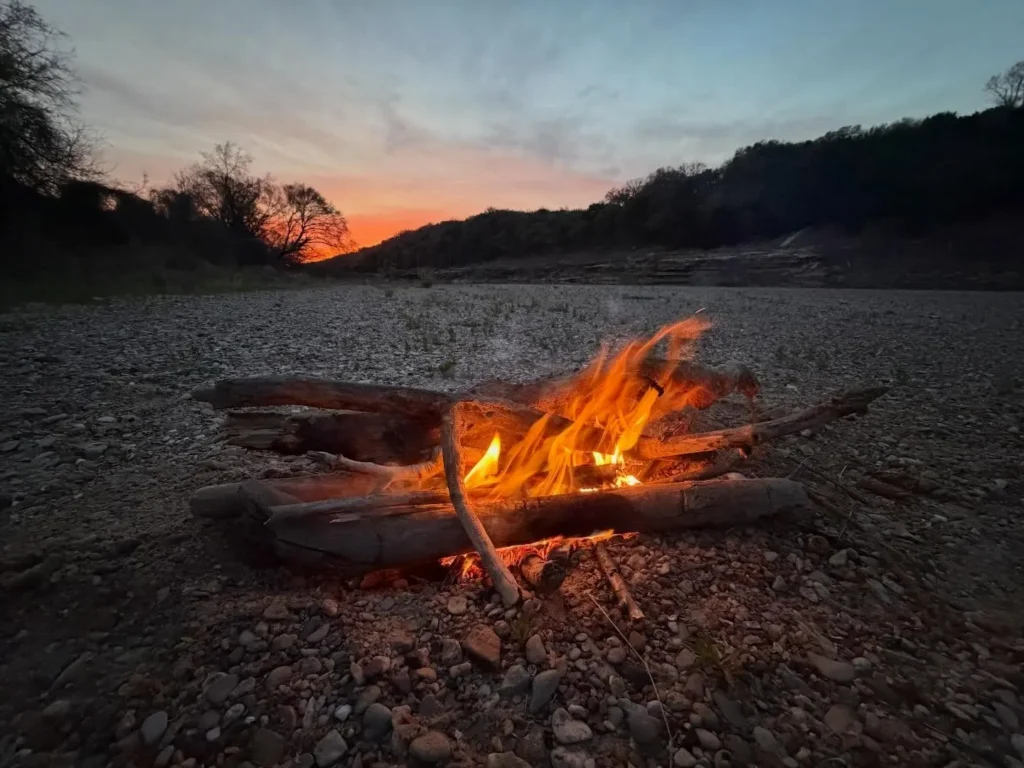
[00:04:20] One of the highlights of fishing with Mitch is the overnight float trip. Besides packing everything into one day, anglers spend the night along the river, sharing meals, relaxing around the campfire, and waking up to another day of fishing.
The slower pace gives them more time to enjoy the scenery and makes the trip about more than just catching fish.
Camping beside the river gives anglers the chance to unplug and enjoy the outdoors differently. It’s often these quiet moments that become the most memorable part of the trip.
[00:10:48] Every season is different on Texas rivers. Mitch explains how changing water levels, weather, and fish behavior all play a vital role in deciding when to plan a trip.
Paying attention to river conditions often matters more than simply picking a date on the calendar.
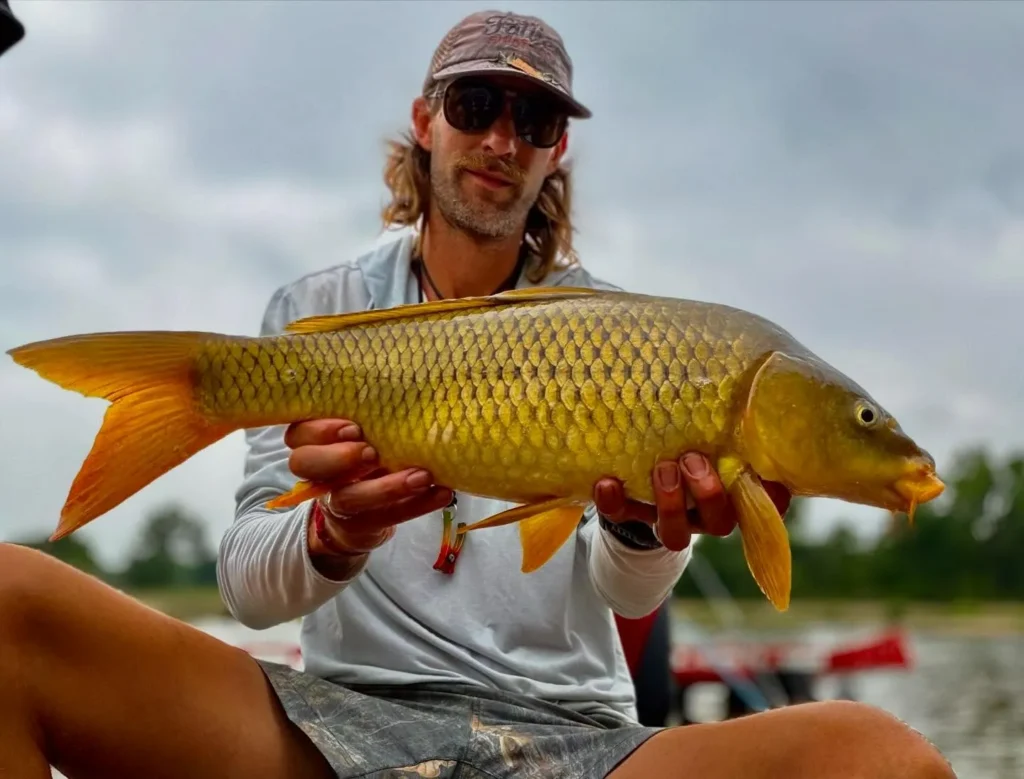
[00:13:27] Carp have become one of Mitch’s favorite species because every fish has to be earned. Their feeding habits are different from carp in many other parts of the country, making observation and presentation more important than simply making a long cast.
Understanding what carp are feeding on helps anglers choose the right fly and present it naturally.
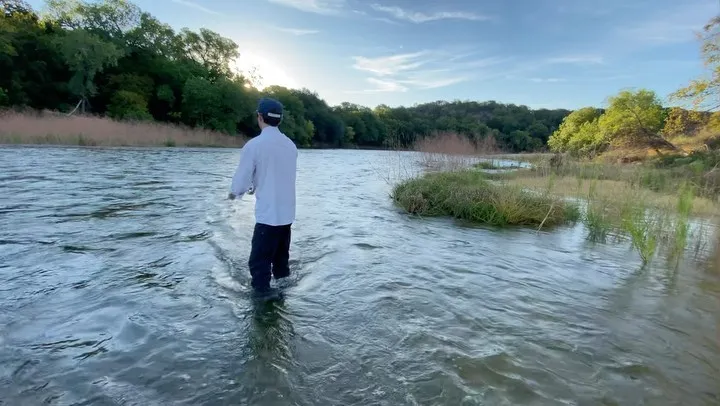
[00:14:41] Instead of constantly stripping the fly, Mitch likes to let it sink naturally where the fish is already feeding. This drag-and-drop technique creates a presentation that looks much more natural.
Sometimes slowing down and making one good cast is all it takes to convince a carp to eat.
[00:15:27-00:18:01] Mitch says watching a carp before casting is one of the best lessons. Reading the fish’s direction, speed, and behavior helps anglers know exactly where to place the fly.
Getting close without making too much noise is as important as making an accurate cast.
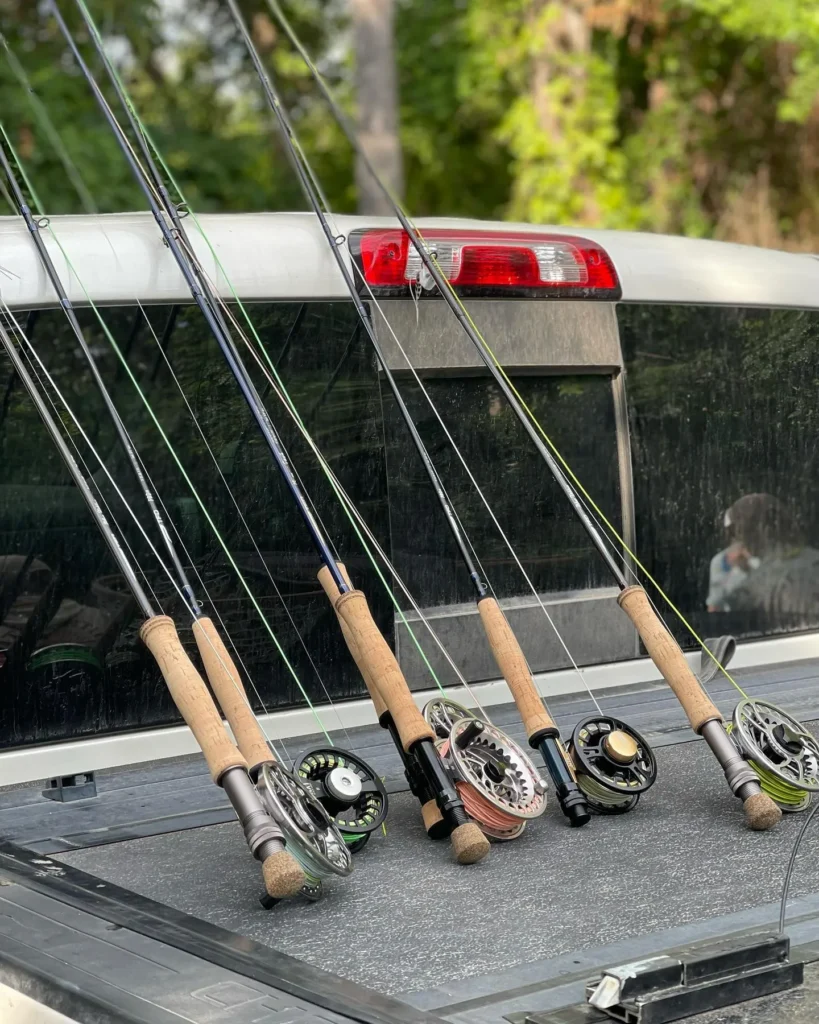
[00:24:34] A versatile fly rod can cover several different species during the same trip. Mitch talks about the rod weights he reaches for most often and how they handle everything from carp to gar.
Now, having the right setup helps anglers spend more time fishing and less time changing their gear.
There’s no need to carry multiple outfits for every situation. A well-balanced rod and a few proven fly patterns are often all you need for a successful day on the water.
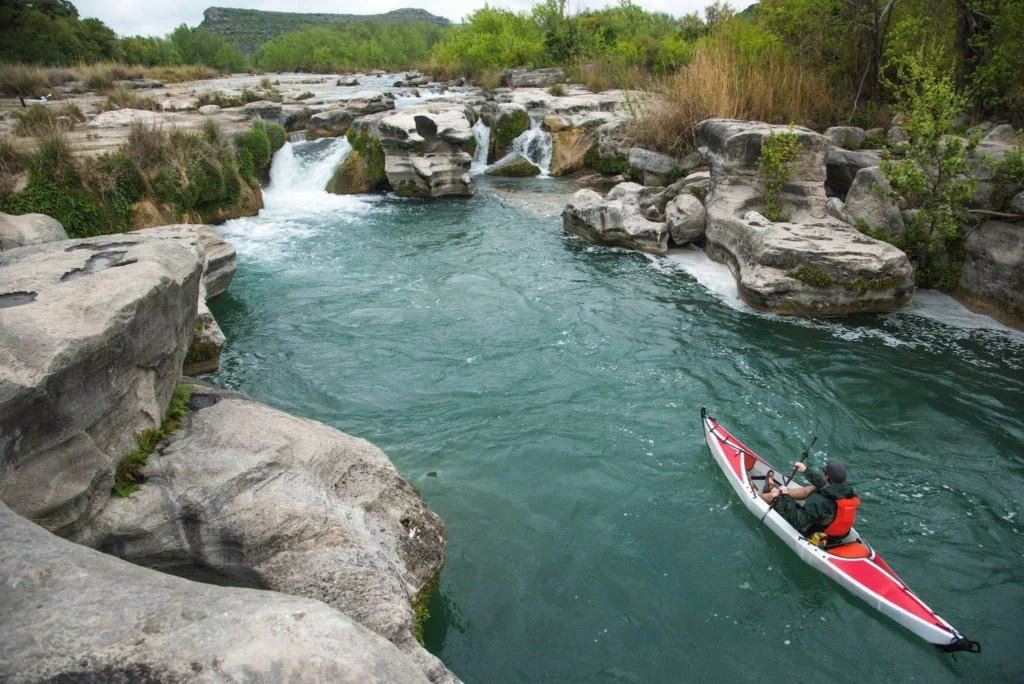
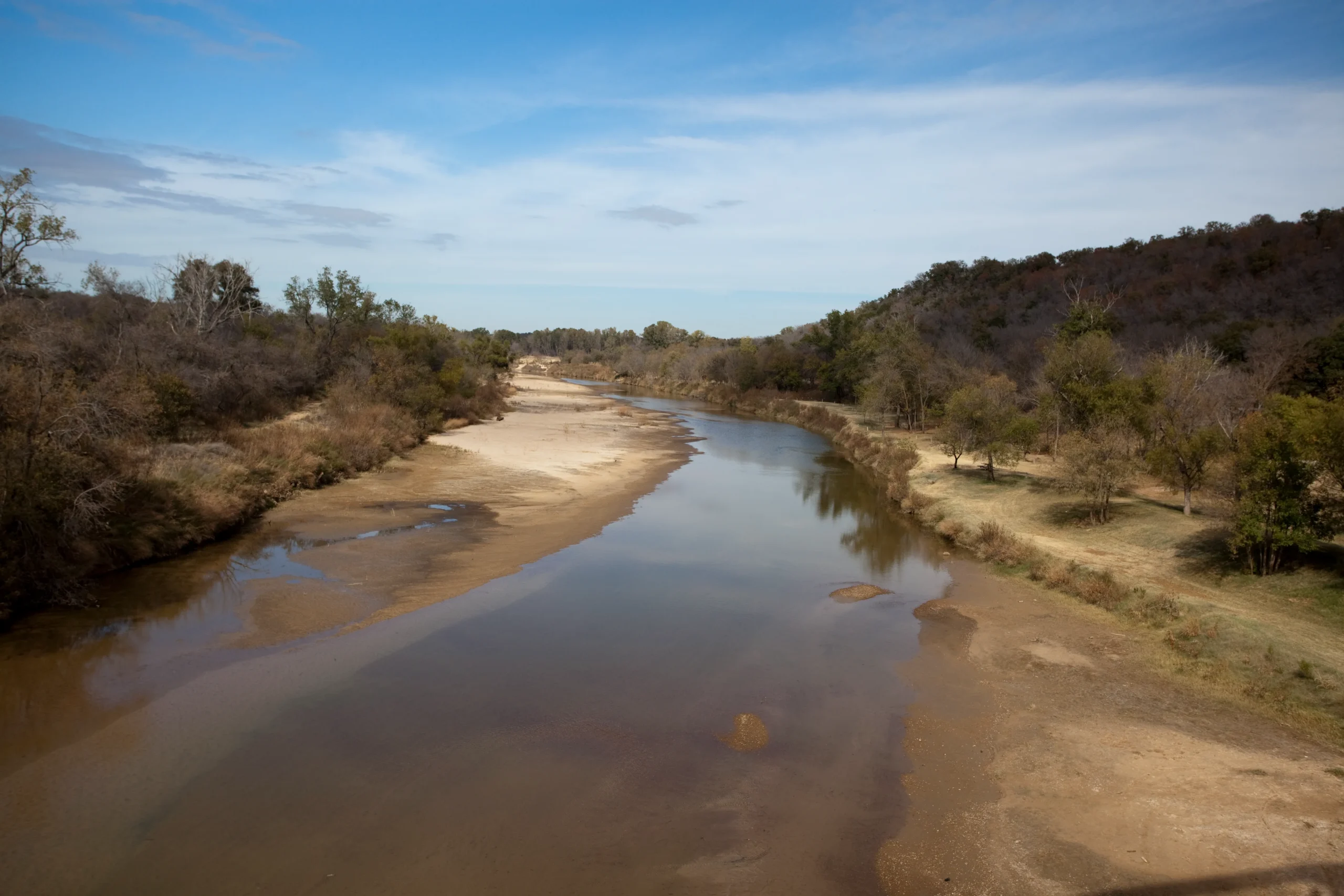
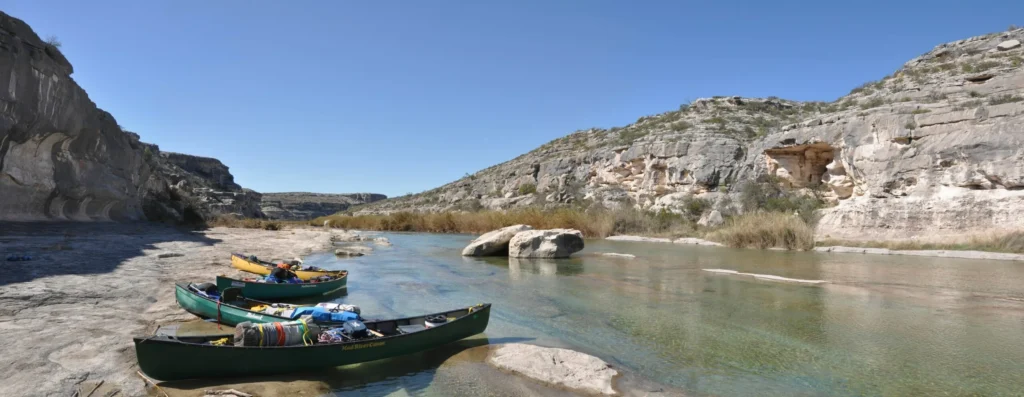
[00:27:30] The Brazos, Devils, and Pecos Rivers each offer a different kind of adventure. Some are perfect for day trips; others reward anglers willing to spend several days floating through remote country.
Every river has its own personality, scenery, and mix of fish species.
[00:35:25] River conditions can change quickly, especially when water is released from upstream dams. Mitch explains that understanding water levels helps anglers know where fish are likely to hold throughout the day.
Being willing to adjust your approach is often the key to success.
[00:37:40] Carp may get most attention, but they’re far from the only fish swimming in these rivers. Mitch talks about targeting gar, bass, stripers, buffalo, and several native Texas species depending on the season and water conditions.
Mitch also shares one piece of advice that applies to every species: slow down. Taking a few extra seconds to watch how a fish is moving before making a cast usually leads to better presentations and more hookups.
Episode Transcript
00;00;01;29 – 00;00;23;29
Dave
Some trips aren’t about numbers. They’re about sleeping under the stars with no cell service and waking up to tailing carp. Today, we’re heading deep into Texas with Mitch Kemp from Fatty’s on the Fly to talk about kayak-based fly fishing, overnight trips, tailing carp, aggressive gar eats, and why some of the best fishing experiences have nothing to do with trout.
00;00;24;17 – 00;00;42;26
Dave
We’re going to get into the Brazos River, the Devils River, fishing from rafts and kayaks, and what it’s really like to experience Texas fly fishing.
This is the Wet Fly Swing Podcast, where we show you the best places to travel for fly fishing, how to find the best resources and tools to prepare for your next trip, and what you can do to give back to the fish species we all love.
00;00;43;26 – 00;01;01;02
Dave
Mitch Kemp is here, and today we’re going to find out why gar might be one of the most addictive sight-fishing species in freshwater. We’ll also hear how Mitch approaches carp a little differently than most anglers, and what the “drag and drop” presentation is all about and how it can help you hook more carp.
00;01;01;12 – 00;01;22;04
Dave
We’re also going to go into the Devils River, this remote river on the Texas-Mexico border, and talk about what a multiday river trip looks like, sleeping under the stars on the gravel. This is an amazing one. We’re going to be getting into it all today, including smallmouth bass and what it looks like to have a successful trip. All right, here we go.
00;01;22;04 – 00;01;39;05
Dave
Tailing carp, small mouth, large mouth. We got it. All species. We even have some native fish mixed in there to talk about today. Here he is, Mitch Kemp. You can find him at Fatty’s on the fly and at fly Fish. Mitch on Instagram. I do, Mitch.
00;01;39;14 – 00;01;41;03
Mitch
I’m good. How are you doing this morning?
00;01;41;10 – 00;01;57;14
Dave
I’m doing great. I’m doing great. Yeah. We’re going to get into a nice conversation today. You’re in Texas. We’ve had a number of listeners that have mentioned you guys and what you have going there, fatties on the fly. So we’re we’re going to get an update on your program and probably dig into a couple of species that we always love talking about.
00;01;57;15 – 00;02;10;20
Dave
You know, bass is a big one for you guys. Gar and I think Carp as well, so. But maybe take us back before we get into it. How’s this? Fatty’s on the fly is a, you know, pretty unique name you don’t hear every day. How did this come to be for you?
00;02;11;04 – 00;02;30;04
Mitch
Absolutely. So we started as a fly subscription service back whenever monthly subscription services were a big deal. And the owner of our company, him, his name is Ben Taber. He would leave his wife a little note on the fridge when he’d go fishing in the morning and he set out to catch a fatty. And so over time it just kind of built into, you know, chasing fatties on the fly.
00;02;30;04 – 00;02;43;06
Mitch
And and I think it just kind of has a good persona for the guys that we have. We’re a jovial bunch and we have a great friendship. And so I think it kind of feeds into just the service that we have and the times that we spend on the water right on.
00;02;43;17 – 00;02;46;12
Dave
And where are you guys located for those that are familiar with you?
00;02;46;23 – 00;02;54;26
Mitch
Absolutely. So we’re based out of Granbury, Texas, and so we are on the Brazos River, which is where we do primarily most of our guiding behind the Lake Granbury Dam.
00;02;55;09 – 00;03;01;15
Dave
Okay. And so this is a behind the lake. Describe that. What is the fishing you got? Still waters and flowing waters.
00;03;01;25 – 00;03;19;08
Mitch
You know, we’re supposed to be flowing water being a river, but it’s all depending on how much water to let out of the dam. I’d say most of the year. It’s not a moving river by any means. We’re looking at like 19 CFS as our average throughout the year and being a fairly wide river. It kind of just like a long lake.
00;03;19;26 – 00;03;28;28
Mitch
But we do have periods of time where, you know, this time of the year where we’re getting our rain, we’re seeing those releases happen and we’re getting to cover a lot more water and fishing a little bit differently though.
00;03;28;28 – 00;03;32;08
Dave
Okay. And what was the name of the the the nearest town you mentioned there?
00;03;32;23 – 00;03;34;18
Mitch
Granbury. Granbury, Texas.
00;03;34;18 – 00;03;35;18
Dave
Oh, Granbury. Okay.
00;03;36;00 – 00;03;37;27
Mitch
Yes. A real local and near the Fort Worth.
00;03;38;06 – 00;03;50;02
Dave
Near Fort Worth. Okay, Awesome. Yeah. What is it? So maybe describe your program a little bit, kind of high level. Are people coming there? It sounds like for multiple species, What’s the when you pick up the phone, you know, what are they What are they asking about?
00;03;50;14 – 00;04;10;10
Mitch
Sure. So most trips that we run are a two person half day trip, which is, you know, four or 5 hours on the water. But we do everything from the half day, the full day overnights, multi days, a little bit of everything. We we really love to cook. And so fireside meals that kind of stuff on our overnight is something we love to do.
00;04;10;16 – 00;04;13;05
Mitch
But I’d say our most popular trip is that two person half day.
00;04;13;17 – 00;04;20;20
Dave
The two person that overnight always gets Beatrice said out there is this overnight for base or what species is this for?
00;04;20;29 – 00;04;55;06
Mitch
And so it’s overnight in a sense that we’ll start our trips usually around 4:00 in the afternoon, fish for four, 4 hours on the water until sunset. Pull up on sunset. I can’t bar her at a a sandbar and just have a fireside meal going for the client. So it’s easily a wild game meal that we’ve we’ve been able to access on our river, whether that be the wild onions, the the venison, the wild hog and try to make a full circle experience just for those clients of fishing on the river, you know, catching fish coming out, taking the food from the river and then sleeping on the riverbank and, you know, kind of soaking
00;04;55;06 – 00;04;55;20
Mitch
it all in.
00;04;55;27 – 00;04;59;09
Dave
Amazing. And then getting up the next day early and going for it again.
00;04;59;10 – 00;05;10;13
Mitch
Absolutely. Absolutely. And so, you know, depending on the clients, we can go out and do a midnight row. But most of the people have a belly full of food and a couple of beers in them. And so they’re ready for the night.
00;05;11;09 – 00;05;15;04
Dave
Right. And what species are you chasing there during those runs?
00;05;15;17 – 00;05;38;03
Mitch
So mostly it’s going to be our largemouth bass. We have a great spotted bass population and then the carp and the gar also, you know, the carp stuff in the evening times right before sunset and then early in the mornings can be really productive. And so that’s a good way to, you know, you have the coffee going over the fire and you’re out there chasing carp on the shoreline and then you jump on the boats once the sun get tiger, chase all the other species nice.
00;05;38;03 – 00;05;46;20
Dave
And is it when you’re out there on this trip, is it just as, you know, equal to catch a largemouth bass as a carp guard? Is there you know, or is there one that’s more prevalent?
00;05;47;00 – 00;06;04;25
Mitch
I’d say, you know, it’s a lot easier to catch our bass and our ga. You know, the guard are hard to hook because of the kind of the snout that they have. It’s all bone, but the bass fishing. The bass fishing is pretty simplistic. You know, you find rocks, you find structure, you throw a bait fish or whatnot, and and they’re usually there.
00;06;05;06 – 00;06;19;26
Mitch
The carp stuff takes, you know, we love the fishing because we get to really get down and coach and get nitty gritty with it of, you know, which where they’re facing. And a lot of it relies on the client’s cast. And so we we like to push the skill level there when people want to go carp fishing.
00;06;20;07 – 00;06;23;19
Dave
Yeah, definitely. What are you guys floating the river? What kind of boats are you using?
00;06;24;01 – 00;06;42;14
Mitch
So we’ve got a slew of everything we’ve got as so Tara, We’ve got a river, we’ve got a a Rio craft, we’ve got a in our as two person. We’ve got a Hog Island jet bow. Wow. A couple 17 foot Grumman canoes with some outboards on them. And so, you know, I was talking earlier about the depending on flow.
00;06;42;14 – 00;06;46;03
Mitch
And so we have a craft for any kind of flow rate that we see.
00;06;46;16 – 00;06;55;24
Dave
Yeah, right, right. That’s really cool. When do you guys do the if you’re going to do the overnight or is there and is there also like multiday when would you do it won’t be the best time.
00;06;56;07 – 00;07;14;29
Mitch
So before it gets hot down here is the best time to do it. You know we just kind of off a good month of some overnight trips, you know, some lows in the fifties and highs in the seventies, in the mornings and afternoons. And so that’s a that’s a really primo time. But at the same time, we will run them all year if the clients are down for it.
00;07;15;00 – 00;07;15;24
Mitch
Yeah, absolutely.
00;07;15;29 – 00;07;26;10
Dave
So to avoid the hot weather. So right now we’re talking it’s May it we’re kind of coming up June is right around the corner so probably May April May would be good or. Yeah.
00;07;26;26 – 00;07;45;00
Mitch
Yeah. We’ve had a little bit milder over spring this year. We’ve got some cold fronts pushed through. You know, right now we’re looking at high fifties for our morning time temps, which has got a little bit lower right now. And so, yeah, we’ve been able to push out that camping in the and the overnights a little bit longer this year just because the tame weather we’ve had.
00;07;45;10 – 00;08;01;26
Dave
Gotcha GA seems to be one of the species we’ve talked a little bit about in the past, but maybe the most unique, I mean, they’re all unique, right? You know, But what is it? Do you know a little bit of the GA life history or kind of their, you know, evolution that unique no snout they have and all that stuff.
00;08;02;07 – 00;08;27;07
Mitch
You know no as much the evolution part of it but just the the species are pretty cool because in our section of the river you know you have your biggest would be your alligator gar and we don’t find that under the Lake Granbury Dam they have that a little bit farther down and also in the Trinity River. But we have a great population as spotted along those GA and so the GA really cool because you’ll get you know most of our clients are out there to catch a bass because it’s Texas and you know, that’s what it’s famous for.
00;08;27;21 – 00;08;39;20
Mitch
But you know, you’ll get out there and you mentioned, you know, it would be of any interest in catching a GA and usually they’re like, Oh heck no, they’re disgusting. And then all of a sudden you’re you’re in the boat and you’re row into the next bass spot and a four foot guard pops. Up next to your boat.
00;08;39;20 – 00;08;53;18
Mitch
And and then, you know, it’s everything you can do not to cast out it. And so they’re they’re super cool. They’re an opportunistic fish and they’re just like big old cats, man. If you can put something in front of them, they’re follow it up to the bow. They will try to bring it. Absolutely. Yeah.
00;08;54;00 – 00;08;56;11
Dave
Gotcha. So these things are pretty they’re pretty aggressive.
00;08;56;25 – 00;09;21;11
Mitch
They’re super aggressive. You know, it’s really neat. It’s something I like to tell people is, you know, you put that fly out there and you’re going to get multiple opportunities at the fish. Even if he misses the first the first strike, though, it usually come up and snap at the fly. And my idea is that is when they’re naturally feeding on Baitfish, they’ll come up and stun that fish with a snap of the snout and then they’ll circle back around and come actually eat that fish.
00;09;21;25 – 00;09;36;26
Mitch
And so when you get one that’s, you know, two or three inches on the surface, you’ll make that first cast, you’ll strip strip strips, you’ll see the flash of the mouth, you’ll sit, and it usually comes right through those teeth. But you’re going to have multiple opportunities because that fish is going to circle around looking for that stun baitfish that it just knocked out.
00;09;37;09 – 00;09;51;06
Mitch
And so you can get them real pissed off and it’s awesome. And then, you know, the bigger ones, they’ll even like we’re talking, they’ll, they’ll follow a fly all the way up to the boat and they’ll let some of those streamers just sit on top of their nose and they won’t even notice that I’m on top of their snout.
00;09;51;06 – 00;09;55;12
Mitch
And so, yeah, they’re irritating, so off. Yeah, they’re super cool to watch.
00;09;55;18 – 00;10;12;27
Dave
So they’re just almost playing with it. They’re just sitting there like it’s on the stuff and the body morphology is cool because when you look at them, they look kind of like the same morphology as a like a muskie or a pike, right? They’ve got long. So they’re probably more similar to that than than a car, Right? A carp is the opposite of what we’re looking at with a gar.
00;10;13;07 – 00;10;32;14
Mitch
Absolutely. You know, your carp got you little rubber lips. And, you know, they’re they’re pretty simple to hook. And we have to give the analogy a lot because, you know, you’ll see 20 gar in the first 4 hours of a trip and you might you might hook in jump ten of them just because they’re so hard to land because that then especially with this spot in long those they have a real thin beak on them.
00;10;32;28 – 00;10;44;16
Mitch
And so you know we really used a lot of like heavy gauge curved folks rather than like large gap, you know, one or two out hooks because you get a little bit more perches with those bites out of them.
00;10;44;24 – 00;10;52;15
Dave
Okay. Yeah. And I think I’ve heard something where they do like a it’s almost like I don’t know if it’s a hook, but it’s like it tangles their snout. Have you heard of that before?
00;10;52;24 – 00;11;08;13
Mitch
Yeah. So no flies are a huge deal in Texas for, for many reasons. A lot of people, you know, especially the fishermen that bass fishermen, they’ll see up on the rivers, they won’t be able to hook them. So they’re known to take a piece of nylon rope, brush it out and then throw that and it gets entangled in the teeth.
00;11;09;04 – 00;11;12;16
Mitch
We try to stay away from that just because you put that fish in danger.
00;11;12;18 – 00;11;13;09
Dave
Oh, you do?
00;11;13;17 – 00;11;28;06
Mitch
Yeah. You know, we have a lot of people around here that if you have an idea of what you should be fishing, you know, if you’re going out there with £50 or £60 or something super heavy that you know you’re not going to break, it’s not that much of a risk. But we see a lot of people going out there, you know, on a trip.
00;11;28;06 – 00;11;47;03
Mitch
It’s different because we can control what they’re throwing, but they might go out there with, you know, three X or four X, not really have an idea. And, you know, throw in that, Fred, fly out there, they’ll hook the fish, snap it off, and then that fish is stuck with that mess of rope in its face. So so anglers, you know, they understand the pounds as they should be throwing all that stuff.
00;11;47;03 – 00;11;53;17
Mitch
I think it’s a feasible way to do it, but it just throws that risk factor in there. If you do snap it off, that thing’s stuck with a big mouthful of nylon.
00;11;53;28 – 00;12;11;09
Dave
Right, right, right. That makes sense. Okay. Yeah. No, that’s a great point on the on the breaking of the fly because it gets roped up and now the fish is mounted, snouts shut and probably, you know, doesn’t survive. So that’s a good point. So no rope flies. That’s something to avoid. And you can it sounds like you can hook them with a regular fly.
00;12;11;09 – 00;12;13;06
Dave
It just might take a few shots to get them.
00;12;13;20 – 00;12;31;26
Mitch
Absolutely. And, you know, I tell clients, you know, try to break that rod. I like a good trout set on a on a guard because it forces those flies, you know, upwards or downwards and not in a horizontal motion work and slide through the teeth. And so that’s the deal too, is, is, you know, a small little four inch articulated fly curve Netflix and a good, good trout set.
00;12;31;26 – 00;12;33;26
Mitch
And I feel like we had a pretty good hook up ratio.
00;12;34;04 – 00;12;50;08
Dave
Okay, perfect. You know, I always like to look at it. You mentioned the tree. I love the overnight idea. If we were to get a few people together, listeners on the podcast to come out there, have a trip with a group, what do you think would be a good time for looking out to 2027? Is that hard to do, to predict or is there a good time?
00;12;50;08 – 00;12;53;07
Dave
You could say, Hey, we could come out and maybe have a chance to get all three of these species.
00;12;53;18 – 00;13;10;04
Mitch
In your spring and summertime are going to be very legit on that. Right now we play the game of if we’re going to get water, we’re not going to get water, which is great. If we get water, it opens up a different fishery for us. We have striper white bass and more efficient you want to catch in a day, but the low water, it opens up, you know, the back side of it.
00;13;10;04 – 00;13;25;22
Mitch
We have your side fishing opportunities, your carp in the shallows, and your guard just toasted up in the in the shallow water as well. So I like the summertime and I like that that June, July, I like getting out there, getting a sunburn and earning those fish. And then, as I said, lower water, higher side. And so your visibility’s a lot better.
00;13;25;22 – 00;13;27;14
Mitch
And so I’ll love a summertime trip.
00;13;27;18 – 00;13;37;08
Dave
Okay, So summertime pre work and then describe the carp up there a little bit. Is this similar to carp around the country or is it different fishing for them in your kind of local water there?
00;13;37;19 – 00;13;54;05
Mitch
So from my experience, our carp are not as going to be as predatory as some of the carp that you find north of us, you know, are the diets of these fish. And the just what they’re eating on on the regular is usually more entomology based than it is some of your scorpions and that you can spot that you might find.
00;13;54;18 – 00;14;15;12
Mitch
So a lot of our a lot of our carp fishing is that drag and drop procedure, not stripping flies. And then it’s a lot smaller, you know, in my mind, a size six through ten is a really good sized carp fly out here. A lot of a lot of Montana hybrids, a lot of a lot of hybrid styles, small little crawfish patterns, that kind of stuff.
00;14;15;12 – 00;14;32;28
Mitch
We also have a really neat opportunity in our river. We have something called the Harris Freshwater mud crab. And so it’s like a little crab that you’d see in the salad except, you know, about an inch long or inch wide. And that’s a huge protein source for our fish out there and something that they really they really try to find.
00;14;32;28 – 00;14;37;02
Mitch
And so those crabs want to try to figuring that out has been a huge pattern for us.
00;14;37;14 – 00;14;41;10
Dave
Okay. And what was the what’s the drag and drop method you talked about?
00;14;41;10 – 00;14;59;25
Mitch
So the drag and drop is where you walk past past your fish, your target. Let that fly sink for a second, raise that rod tip up and drag that fly into position and drop it right back down. And so, you know, when a lot of them were throwing a streamer and stripping it past that fish with our bass and our predatory fish, does carb like it too?
00;15;00;02 – 00;15;18;06
Mitch
Almost fall in a just a vertical motion just straight down beside their eye. And so with the entomology, the crawfish, all that, we tend to think that, you know, they’ll scurry, they’ll drop down and they’ll hide in that dirt. And so and so when they see that fly drop just vertically down right past their eyes, I usually key on to it turn it ended every time.
00;15;18;21 – 00;15;26;18
Dave
Maybe just grab the carp a little bit. When are they kind of their time of year You fish in them or they spawning. What does that look like as far as how you’re, you know, targeting them?
00;15;27;03 – 00;15;47;22
Mitch
Sure. So we just got done with the spawn and so right now it’s their got their feedback on early mornings are always good just define themselves acceptable in the gravelly gravelly areas and we’ve got a lot of submerged vegetation. We get bumps and water and any time that happens, the carp are all up in the grass. They are.
00;15;48;06 – 00;16;02;27
Mitch
And that’s where we start to find some of our bigger fish are, you know, maybe ten feet off the bank in some submerged vegetation. And all you see is just big, big tail sticking up, waving in the air. A lot of our cookie cutter size will be up, you know, with their backs out of the water, very visible.
00;16;02;27 – 00;16;07;19
Mitch
But those bigger fish like to hang off the bank a little bit, but you can usually find them with their tails to get up in the grass.
00;16;07;26 – 00;16;13;12
Dave
So, yes, that’s it. So you do get kind of the tailing carp. So you get a time of year where you can hit them. Kind of like the flat style.
00;16;13;21 – 00;16;20;18
Mitch
Oh, absolutely. Yeah. So most of the carp that we’re targeting are going to be the tail up, base down feeding.
00;16;20;28 – 00;16;21;21
Dave
Oh, they are?
00;16;22;00 – 00;16;44;23
Mitch
Yes, sir. Yes, sir. If we find them, they’re they’re just stagnant or sitting under some tree limbs. They’re usually not they’re not too interested in feeding. But you can, you know, you can always get them to turn on something. But when you find them just nosed up in the grass, they’re ready for you. You know, that’s the biggest way is to find our fish around here, especially for new clients and people, and explain it is to find those clouds, find where they’re pushing the clouds.
00;16;45;01 – 00;16;50;20
Mitch
Once you get close enough to that cloud, they usually see a tail or a silhouette and figure out what that fish is doing and then you can pursue it from there.
00;16;52;17 – 00;17;09;23
Dave
Pescatore on the Fly offers a full range of fly fishing gear for any angler at any budget with premium rise delivered directly to you, the Craig six is the most packable high performance fly out on the market, performing like a four piece ride, but with unmatched portability in six pieces. And you can get 10% off your next order.
00;17;09;23 – 00;17;35;15
Dave
Right now if you use the code wet fly swinging at pesky door on the fly ecom never fly without your G six Discover the El Rey series and more at Pescatore on the fly icon. Check out Montana Fly Fishing Lodge, a 2024 August endorsed Lodge of the Year finalist where luxury meets Adventure on 1.5 miles of private, wild and scenic East Rosebud River Frontage Experience World class fly fishing on numerous Yellowstone Basin streams.
00;17;35;15 – 00;18;01;13
Dave
Gourmet cuisine made from locally sourced ingredients and rustic luxury accommodations surrounded by breathtaking wilderness. You can book your all inclusive Montana fly fishing adventure today and discover why they are the premier destination for unforgettable fishing experiences. Head over to Montana Fly fishing lodge AECOM. Right now, how do you guys get into your boats? Are you do you have like platforms or are you standing in the rafts?
00;18;01;13 – 00;18;03;04
Dave
How close are you able to get to the carp.
00;18;03;15 – 00;18;23;28
Mitch
So we can get pretty close in the in the boat. So that was one thing I noticed when I first got my raft. This was seven or eight years ago on the on the river. It triple or quadruple my carp numbers. It was okay just because, you know, a lot of hours we had very gradual banks and it drops off and then you get to the far bank and it’s usually something we couldn’t access without pushing those vibrations in the noise.
00;18;23;28 – 00;18;42;16
Mitch
Once the raft came along, it was, you know, my favorite line on the raft to the client is I’m going to give us two pushes forward. Whenever you’re comfortable with your cast, go ahead and make it and that we can target them from 30 feet away. But you can really we’ve had caught fish that are, you know, three feet off the side of the boat just because you’re drifting down on them, you see them from a distance and you’re ready for that shot.
00;18;42;24 – 00;18;49;22
Dave
No kidding. So you could literally get them right off the boat because they’re tailing. They’re not really are carp a little spooky at all or not really?
00;18;50;00 – 00;19;08;20
Mitch
Absolutely. So carp have the four lateral lines and so they can feel your vibrations and footsteps from about 50 feet away. And a good visual that is, you know, we’re for an away trip. We take a step into the water if it’s calm and you’ll see those waves dissipate from your feet. And so we tell people, as long as those waves are traveling across the water right there, that’s as far as the fish can fill up.
00;19;09;04 – 00;19;24;05
Mitch
And so, yeah, those those carp are super spooky. And when you speak, when you’re usually spooked, the pod of them and and depending on the movement of the water, it’ll take some time for them to move back in and start feeding that location again. And so if you screw it up, you screw it up, the wall is fine.
00;19;24;05 – 00;19;24;17
Mitch
Some more.
00;19;24;17 – 00;19;26;08
Dave
And so there’s plenty more.
00;19;26;18 – 00;19;29;28
Mitch
There’s plenty more. There’s no shortage of carbon taxes, thankfully now.
00;19;29;28 – 00;19;33;13
Dave
So. Carper The out of all the species that are they the hardest one to catch?
00;19;33;23 – 00;19;52;19
Mitch
You know, I’d say so. We have a fish called a small mouth buffalo out here that’s very similar to a carp. It’s part of the sucker family. So it’s a filter feeder and same, you know, typically the same diet as a carp when you look inside their stomachs and everything. But the way they feed is not an aggressive feeding pattern.
00;19;52;19 – 00;20;13;23
Mitch
So as a carp, you might pass the drag and drop and you get the turn in the eat and you see it’ll happen. A buffalo will kind of find a feeding pattern and stick in that line and just filter feed until it finds something. And so when it comes to, you know, how technical it is, I’d say a buffalo would probably be the hardest fish to catch because it’s almost luck of the draw when you put that fly in the right place.
00;20;14;11 – 00;20;21;02
Mitch
But the carp, when it comes to your skill level, your casting, all that has to be pretty in tune for you to be able to put one in the boat.
00;20;21;10 – 00;20;29;14
Dave
So yeah, so and I’m looking at one now. Yeah. The small buffalo. Yeah, it looks a lot like a carp. It’s got the big scales, right. You could confuse it with the carp almost.
00;20;29;22 – 00;20;46;06
Mitch
And so it’s one of those deals you know, we’ll pay people. We have more buffalo than carp in our water, right? Oh, wow. So you’ll get people out there and you’ll see these just big mounds of fish and people will be, oh, man, we’re coming up on carp and you got to break it to them. These are buffalo and you explain it, yada, yada, and you know, you’ll catch a few.
00;20;46;06 – 00;20;51;11
Mitch
But it’s just not like the the aggressive nature, right? Yeah. Those carp eating as Yeah.
00;20;51;11 – 00;20;53;23
Dave
Are the buffalo. So the buffalo do they tail or. No.
00;20;54;01 – 00;21;12;03
Mitch
And they will tell you know they’ll feed on your invertebrate, your nymphs, all that fun stuff your crabs and yeah, you will find them just happy as can be and sometimes you’ll get them to move to a fly. But most that time it’s just going to be finding that feeder pattern, put it in front of them and you’ll see them slow down a little bit or change their body angle and you’ll know it’s neat.
00;21;12;10 – 00;21;25;27
Dave
Okay, so if we were rolling down, it sounds like you guys were on the water. We see some carp. Describe that. If I’m on, you know, the front of your boat, how you set me up to make that cast. And then how do you make sure to get a good hook up with the fish?
00;21;26;07 – 00;21;40;00
Mitch
Absolutely. So let’s say that we’re rolling down, we see a car bad about, you know, 50 feet out in front of us. We see a cloud, we see discoloration, we see a tail, whatever it may be. And so we’re going to start talking about that fish. We’re going to first to make sure that you can see the fish.
00;21;40;23 – 00;21;52;10
Mitch
It’s one thing that, you know, our biggest thing we’re going to do is we want you to be able to replicate it after the trip. And so make sure you see the fish and then we’ll start talking about which ways it’s facing because we can’t hook or carp in its ass. We have to put it in its mouth.
00;21;52;21 – 00;22;08;04
Mitch
And so, you know, that’s the biggest thing, is figure out where it’s facing, figure out what depth it’s feeding in, because that might, you know, change how far we cast over or what fly we put on, depending on weight. And then kind of like I said, we’ll get up on it. We’ll figure out all the body situation, everything.
00;22;08;04 – 00;22;18;20
Mitch
And then I’ll tell the client I’m going to give us three pushes, probably about 30 feet away or one push about 30 feet away. And we’re just going to coast up on it. Whenever you’re comfortable with your cast, go ahead and put it in that spot.
00;22;18;20 – 00;22;26;26
Dave
Yeah, put in the spot and the fish is down feeding. You want to put it, like you said, kind of right in front of it, just a foot or so range or, you.
00;22;26;26 – 00;22;40;00
Mitch
Know, I like if we’re going to just a fresh leader. So we’re talking about nine feet. I will, you know, treat it like a kind of like you have a receiver running near the quarterback. And so they’re not going to be feeding fast, but you’re going to probably catch three feet in front of it and three feet past it.
00;22;40;09 – 00;22;57;18
Mitch
And when that when that fly hits the water, drop that rod tip and that fly will drop straight down. And then once you’re happy with that, we can raise that rod tip. It’ll bring that fly to the surface. And once it gets in the range, that feed plate will just drop that rod tip again and that flies once again going to drop straight down and hopefully it’s right in the zone of that carp.
00;22;57;18 – 00;23;04;26
Dave
Yeah. And then are you guys using it for carp specifically or maybe for all these are using a similar weight rod, or do you have multiple multi rod setups?
00;23;05;05 – 00;23;15;06
Mitch
Most of it’s going to be a67 weight. Six or seven weight can cover any basis that we have out there. And then we get into the eight weights for the bigger guard and the bigger flies and whatnot.
00;23;15;12 – 00;23;24;27
Dave
Okay. So if you had to pick one rod, would it be seven weight or and then if you had two rods, it sounds like maybe a68 or what would that what would be your choice there?
00;23;24;28 – 00;23;42;02
Mitch
Yeah, it is. You know, it’s set in a way it’s pretty much what I have two sixes and sevens in the boat and one eight at all time. As much as we want to throw those, you know, those big old fliers, yada, yada, yada, it’s, you know, with clients, it’s not the most efficient game sometime. So the seven weight is something that has a light swing way to it.
00;23;42;02 – 00;23;49;16
Mitch
It’s something that most people have cast before and they’re not going to be limited on, you know, how old they are or how young they are or their physical abilities.
00;23;49;24 – 00;23;56;18
Dave
Right? If people want to go out like on their own is there they didn’t have a boat. Is there is there doable places to do that for carp?
00;23;56;27 – 00;24;16;22
Mitch
Absolutely. Yeah. So we’ve got the Brazos River like we talk about, you know, the 14 or so miles that we guide on is private access. But the Brazos will range, you know, all the way from the top of the state down to the coast. And so you can access that and a bunch of public spaces. We’ve also got the Trinity River that runs close to our city through Fort Worth and everything.
00;24;16;22 – 00;24;25;13
Mitch
Same thing down. And that’s got just a enormous carp population as well. And they’re pretty much in any little body of water that you can find around the city or out here.
00;24;25;13 – 00;24;28;04
Dave
They are. And how do you spell the the river, the Princess.
00;24;28;26 – 00;24;31;07
Mitch
B-R, a z06.
00;24;31;18 – 00;24;33;10
Dave
OSIAS Gotcha.
00;24;33;14 – 00;24;33;27
Mitch
Yes.
00;24;34;06 – 00;24;41;23
Dave
BRAZOS Yeah. Okay. So cool. So and that’s kind of your big water. That’s the kind of the big water you guys fish most of the time it is.
00;24;41;23 – 00;24;59;10
Mitch
Yeah. That’s, you know, that’s kind of our home water. And then we run we run trips on the Devil’s River as well as the Pecos River as well. And so that’s usually a three night, four day trip on both those stretches of water. But that’s a that’s more of a fall spring destination type stuff. We have groups.
00;24;59;12 – 00;25;06;11
Dave
That’s the group. So if you’re doing like you’re saying, a group multi-day trip, the Devil’s or the Pecos would be the better that would be the trip to get you.
00;25;06;21 – 00;25;24;28
Mitch
You know, absolutely. It’s just it’s all about the experience they want. You know what? Those trips you are out of cell service. You’re usually sleeping on a rock with a bedroll. It’s on the border, the borderlands of Texas and Mexico over in that area. And so it’s pretty sweet. It’s in the middle of the desert, but it’s crystal clear water with small mouth and carb and everything you could dream up.
00;25;25;04 – 00;25;33;11
Dave
That sounds amazing. Yeah. You get you get a break from the tech and you get a flow to river and you’re on the border of Texas and Mexico.
00;25;33;11 – 00;25;48;22
Mitch
You’re over in that area. Absolutely no water is the water is crystal clear. It’s actually what Texas Parks and Wildlife will base their their clarity test on for the water across the state. So it’s it’s got natural springs that you can fill up your water bottles in. It’s got petroglyphs all the way down to very protected area.
00;25;48;28 – 00;25;54;23
Dave
Wow. So if you have the devil is the Pecos, are they in the same basin or they similar or that what.
00;25;54;24 – 00;26;13;29
Mitch
Would you views and they’re they’re close to the same area. The devil’s has more traffic than the Pecos does. The Pecos is a very privately owned hard to access area for most. And so I would I would I would roll the Pecos over the devil’s but it’s one of those grills that yeah, we’re just kind of starting to dip our toes into when it comes to access and everything.
00;26;14;05 – 00;26;17;17
Dave
Yeah, the Pecos is kind of a newer. You’re getting more dialed in now.
00;26;17;25 – 00;26;28;06
Mitch
Yes, sir. Yes, sir. You know we have been timber. I said the owner, he runs a good number of trips out there with a couple of the camp Jackson. So it’s one that we’re really excited about being able to access a little bit more.
00;26;28;12 – 00;26;38;12
Dave
Okay. And like you said, it sounds like, yeah, not just overnight. You could do a you could do a multi-day trip, say a four nights, three days in there with you guys and cover sounds like all these species.
00;26;38;24 – 00;26;52;24
Mitch
Correct? Absolutely. And so, you know, with the access laws in Texas, a lot of that is you get on the water and then you have a place that you have to get out, which is, you know, 19 or plus miles down. And so we usually break those up, as I said, in three nights or so. And yeah, we’re usually out of there on day four.
00;26;53;06 – 00;27;07;27
Dave
And day four. Okay. And then you have do you guys do the. Yeah, it sounds like you have a boat. How would you do it if you had let’s say you had six clients that were in there, You know, we were in there. How would you break that up? Would you have two per boat and then another boat setting up camper?
00;27;07;27 – 00;27;08;27
Dave
How do you how do you guys do that?
00;27;09;12 – 00;27;26;20
Mitch
So on those trips, we’d actually, we’d provide kayaks and so we’ll do like, you know, your guide and your Camp Jacks would have canoes with our coolers and frozen meat and whatnot on there. And then that way the client only has their fishing stuff on their kayak, and that’s all they have to worry about. A lot of it has some really good rapids.
00;27;27;19 – 00;27;32;19
Mitch
And so being able to hit all that without losing your stuff is a big deal.
00;27;32;23 – 00;27;41;04
Dave
Oh, this is great. So now you got individual kayaks and these are the kayaks that are I mean, the kayaks are dialed in these days, right? You can stand up on them. Describe the kayaks you guys are using.
00;27;41;16 – 00;28;02;06
Mitch
So we’re mostly using a Diablo Amigo Kayaks super flat platform that you can stand up on. Like you’re saying, walk around and they’re stable too. So a lot of our site fishing opportunities are going to be based off being able to stand up and not fall in the water. But like you’re saying, hold three days worth of gear and still flow pretty shallow so you can get over the small riffles and rocks.
00;28;02;16 – 00;28;24;00
Dave
Yeah. So, yeah, I’m looking at the Diablo kayak and these are pretty awesome. Like I was kind of picturing you’ve got the, the Y area where you can stay on the seat where you’re elevated and everything. So, so that’s pretty much if you’re going to do one of these we’re going to do these multi days, you would have your own kayak and basically be in as a group and then you’d have your the group or the camp setting up somebody ahead of you setting up camp.
00;28;24;00 – 00;28;24;29
Dave
Is that kind of how it work?
00;28;25;08 – 00;28;43;14
Mitch
Absolutely. So we usually try to cover, you know, 3 to 4 miles a day. And that way we can have some time to set up around camp and fish around camp with the water that we’re traversing. It’s usually, you know, you got to you got to paddle to get through. There’s some rapids, there’s some rocks. But we always pick camp spots by the the fishing around it.
00;28;43;14 – 00;29;04;13
Mitch
And so, I mean, the the other guides or whatnot, we would get down, peel off a little bit early, get a fire started, point out some really good fishing locations right outside of the camp. And then that way, while people are still fishing, settling down for the day, we’ve got the meal cooking on the fire and then as soon as they’re ready to eat, we’ll have, you know, whatever whatever we’ve got on the menu that night.
00;29;04;23 – 00;29;22;15
Dave
Wow. Wow. That’s really cool. Yeah. Now this is I feel like the multiday overnight. I mean, it’s not for everybody, right? But I think for those that are into it, it seems like you kind of get everything right. It’s the way to experience that part of the world. Probably better than any way that. Right. Than staying in a cabin or a lodge or something like that.
00;29;22;26 – 00;29;41;15
Mitch
You do. And you figured out a lot about yourself, too. You know, we take a lot of people that are, you know, 5 to 6 days in an office on these trips. And I love night number one on the Devils because we get to our camp spot and, you know, the sun goes down, everybody’s got a full belly, some wine and and then all of a sudden it’s dark and then, you know, they look around like, well, where do I sleep?
00;29;41;20 – 00;29;57;22
Mitch
And it’s like, well, you can have that rock over there. That’s right. And and then there’s a lot of rustling in the sleeping bags. In the tents is, you know, everybody’s a little nervous and unsettled. And then all of a sudden they take a deep breath and open their eyes and look up and you got shooting stars and satellites and every star that you can see.
00;29;57;22 – 00;30;05;10
Mitch
And and then, you know, it goes quiet. And and then after that, it’s just you. They’re there. And so it’s pretty spectacular.
00;30;05;17 – 00;30;10;02
Dave
Wow. Yeah. So you don’t have a lot of city lights around in that part of the world. It’s pretty dark.
00;30;10;17 – 00;30;12;27
Mitch
Yeah. No light pollution in that part of the world. Yes, sir.
00;30;13;03 – 00;30;25;15
Dave
There you go. Are you got 3 hours or so? So that’s kind of that experience. And then again, back to the fishing, you guys, you’re kind of going as you go. You pick what you want to do for the day. Is that kind of how it works as you’re going down? You’re just waiting to see what species you run into first.
00;30;25;26 – 00;30;40;21
Mitch
Yeah. And then you know, you’ve got where are your fish, what kind of congregate. So if you come down a rifle section or a section that has a confluence to it, you can usually find on the devils. You’ve got a good population of smallmouth bass, largemouth bass, that kind of stuff. And so they’ll like that high oxygenated water.
00;30;40;21 – 00;30;56;03
Mitch
So they’ll sit, you know, nose up to the riffles. The large mouth will sit in structure under the moving water. And so you can really you can really start to dissect it with this section, you know, with the moving water, I might find a small mouth a little bit farther down with some current, but, you know, some structure to hide.
00;30;56;03 – 00;31;08;28
Mitch
And I’ll start finding those large mouth and then you’ll get to the more open sections with the blue water in the soft water, and then you start finding some of those carp in the shallows, the gar taking gulps and stuff. And so, yeah, you can kind of break it down like that.
00;31;09;08 – 00;31;18;21
Dave
Right? Right. That’s right. So we did describe a couple of on the carp water. You mentioned a few of the flies. You have a couple of what would be if you had, you know, three or four flies to use, what would those be?
00;31;19;02 – 00;31;36;29
Mitch
Absolutely. So any kind of little damsel fly hybrid type pattern, all of that is really good for us. Big chain eyes, something that doesn’t make a big plop to it. I love a hybrid. I love a Montana’s hybrid with that little red tail sticking up. You know, we do a it’s very similar to a hybrid. It’s a bead chain.
00;31;36;29 – 00;31;53;08
Mitch
ISE and you just tie in a piece of chenille Is the tail going to wrap it up to the eyes and pink and you can throw a collar on it if you want it to drop a little bit slower. But that’s a the red in the pink is something that I think the carp really key into. And I’ve noticed a little bit more of an opportunity for them to move for a fly.
00;31;53;18 – 00;32;01;20
Mitch
Having that red or pink coloration where some of those damsel patterns, you know, they’ll nose over and eat it, but not as much as a ferocious I’m going to chase that down and and.
00;32;02;06 – 00;32;04;13
Dave
Oh, really? Kind of like a hot spot sort of thing.
00;32;04;21 – 00;32;05;25
Mitch
Correct? Absolutely.
00;32;06;08 – 00;32;10;14
Dave
Yeah. Okay. And so a little bit of you need a little bit and you’re just fish and dry lines for the most part.
00;32;10;22 – 00;32;21;25
Mitch
Yeah. Yeah. I mean, fishing floating lines for those fish. Yeah. Because most of it’s going to be your sight fishing that’s going to be in about 3 to 4 feet of water. And so you’re really depending on your leader to get that fly down. Then you are your fly line.
00;32;22;04 – 00;32;31;08
Dave
Okay. And what about sounds like these fish aren’t that pressure, but is there a big difference between fish and like pressured carp? Do you guys do that versus, say, the pressure areas?
00;32;31;20 – 00;32;41;25
Mitch
You know, I think the pressure the carp feel out here would be from like you’re both fishermen and stuff. We’ve got a boat. Fishing out here is a very popular hobby. Different people.
00;32;41;29 – 00;32;44;07
Dave
Oh, bow fishing like the species. Both fish.
00;32;44;15 – 00;32;47;21
Mitch
Oh, no, sorry. But people taking bows out and shooting the arrow.
00;32;47;21 – 00;32;48;23
Dave
Yeah, Yeah, right.
00;32;49;07 – 00;33;09;05
Mitch
Yeah, yeah. We’re not in our river, but. But no, we’ve got a bunch of boat fishers in our, in the Brazos, in our local lakes and everything. And so I think that, you know, for a fish that’s usually not targeted and Right and real around here I think that does bring a little bit of sense of, you know, they hear those boats motor and out, they hear that it’s on top of the water and and their buddy just got stuck with an arrow three days ago and so.
00;33;09;09 – 00;33;13;08
Dave
Oh, yeah, and what do they do? And when they do the bow, so are people eating carp?
00;33;13;18 – 00;33;26;18
Mitch
Oh, no, not as much. You know, carp are brought over as a delicacy fish when they first got here. And so it’s very interesting to see how it’s all changed. So, you know, you bring up the word carbon taxes and you get a lot of good that’s gross and yada, yada, yada.
00;33;26;22 – 00;33;32;09
Dave
All right. So carp is kind of like a lot of people think it’s like trash fish. So they’re exactly they’re killing them just to kill them.
00;33;32;09 – 00;33;44;09
Mitch
Almost. Just to kill them. Yeah. You know, they you know, you hear the word carp and you think, you know, a lot of people down here think the Asian carp and the, you know, the the highly invasive species. And so, you know, we find a lot of carp just at the boat ramp. You know, they’ll shoot them and throw them at the boat ramp.
00;33;44;09 – 00;34;01;26
Mitch
And and, you know, that’s usually how we’ll find the fish. Some people responsible, they’ll take them off the water. They use them as fertilizer. Some people will smoke them. But a lot of times we’ll find them just, you know, piled up on the bank or, you know, you’ll see a slew of buzzards up up the river and know exactly what they’re found.
00;34;02;02 – 00;34;07;16
Dave
Right. Can you fish or are there any fish? Can you keep bass? Are there other fish you keep an eat out there?
00;34;07;25 – 00;34;28;02
Mitch
Absolutely. Yeah. So bass, there’s a legal limit for bass. Are striper or white bass or a great delicacy fish. And so you know I’d say that’s the one. And then we also have know the catfish and crappie and stuff but I’d say like the white and striper are something if you wanted to keep that, that would definitely be, definitely be part of your best choice.
00;34;28;02 – 00;34;28;21
Mitch
Absolutely.
00;34;28;28 – 00;34;33;19
Dave
Okay. And the Striper, are you getting these are you seeing those as well on the on the strip?
00;34;34;01 – 00;34;54;03
Mitch
So not on the Devils but on the Brazos. Yes. So, so we’ve got a really cool opportunity. So we have a Lake Granbury and then under us we have Lake Whitney. And so when we have a sustained flow, let’s say, you know, 3000 or more for a week or so, our fish have the opportunity to move up river all the way up to our dam.
00;34;54;16 – 00;35;08;02
Mitch
And so we have a confluence at the dam that after that week of high flows, we can take the jet boat up there or the rafts up there with the motors and and you can sit there and and you’ll have the striper that are nose up to the dam, the white bass, as well as your large mouth as well.
00;35;08;29 – 00;35;25;18
Dave
Gotcha. Wow. Yeah. So you guys have a lot going, I mean, right. Species wise, depending on the conditions we’d mentioned. The devil’s which is this kind of sounds like a cool remote trip. And then you have the the Brad’s this, which is a little bit more the closer town I’m assuming and more of a reservoir type or I guess the tail water essentially, Right.
00;35;25;25 – 00;35;50;14
Mitch
It is, yeah. It’s a tail water near the dam so. Correct. So the the devil’s you know, we’re we’re traveling five and a half hours to get there. The practice is back door stuff and so but yeah, it’s, it’s a tail water fishery so it’s super dependent on the flow. That’s I think that’s the most stressful thing as a Texas fisherman in the tail waters is you could have a rain the night before and you know you have 19 CFS and you wake up the next day and it’s at 463 to 12000.
00;35;50;14 – 00;35;54;12
Dave
And so and it’s blowing and then you’re kind of out for the day. Is that how that looks.
00;35;54;16 – 00;36;20;00
Mitch
The way you gotta change the ball game? You know, it’s with the 14 miles we, we have really some interesting access points and so if it’s high water we can throw in a mile under the dam motor up to the dam and they do the stripers and they should be there. But we could also in and with our low water situation, there’s a lot of times of the year where we can’t do a multi mile down river float because we’re stuck doing a point a 2.8 float where you put it in, go down and then paddle back up.
00;36;20;09 – 00;36;39;03
Mitch
And so I love the opportunity to go cover some water and and that’s something we get to do with that high water is, you know, you’ll go down the fast water section and you look in your slews and your soft water then slides. And most of our most of our local fish will, especially for the first few days, we’ll try to find a refuge in that slow water because they’re just trying to acclimate to what how to feed in the high water and where to hold it.
00;36;39;26 – 00;36;50;11
Dave
Right. They’re trying to acclimate. Yeah. So things change and they’re just like they’re trying to adjust, so they’re probably not on. But once they get, you know, some level that stabilizes, they probably start to get comfortable. Then you can catch them at the higher flows, right?
00;36;50;22 – 00;37;11;23
Mitch
Absolutely. And something, you know, we something we saw last year more than we had before is that we had sustained flows all through the summertime. And so usually we’re we’re at 19 CFS. We were at like, you know, anywhere from 3000 to 10000 last summer. And so we had fish that finally figured out how to acclimate. And I think a lot of it had to do with just watching those fish that moved up river.
00;37;12;02 – 00;37;33;01
Mitch
We had, you know, the striper made their way up there and then we’re at the dam for a couple of months at a time as well as the white bass. And so you’d see these almost organized feeding patterns of, you know, we have a confluence and a depression under the confluence. And you’d have the striper move in and feed deep feed, and then you had the white bass move in and feed, feed, feed large mouth in spots or do the same.
00;37;33;01 – 00;37;47;21
Mitch
And then after that you’d have the guard follow up and kind of eat the remnants and scraps of all the shad that were getting busted up. And so really cool to see it all work together because, you know, you’d go in high water usually, you know, you’re picking off a large mouth every once in a while, just kind of blind casting it, soft water and structure.
00;37;47;21 – 00;37;56;04
Mitch
But this is something that you could tell that, you know, they had sat there, they had understood they’ve acclimated and now they’re all they found the hot spot and they’re just going at it.
00;37;57;18 – 00;38;20;22
Dave
This episode is brought to you by ABC Rig Adventure Vehicle Concepts out of Colorado. These guys build next level adventure vans designed to help you explore farther and stay out longer. Are you dreaming of a full van build? Or maybe you just need the best aluminum cabinets and storage for your DIY rig? AVC Rig makes it easy to turn your vehicle into the ultimate mobile base camp.
00;38;20;27 – 00;38;40;23
Dave
You can check them out right now at ABC Rig Com. That’s a V C rig. Dakar. What is it about? You know, I always think about this around the country because, you know, Texas is definitely one of those places we’re hoping to get to. And I mean, this sounds like an amazing trip. What is it about Texas that you really love?
00;38;40;29 – 00;38;45;03
Dave
You know, or maybe that people are surprised that is there. One thing that sticks out.
00;38;45;15 – 00;39;06;16
Mitch
Is definitely not the fishing. The fishing is amazing. Don’t get me wrong. The cultures are incredible. I think I mentioned earlier just how tight knit our guides services. You know, it’s literally four of our best friends are all coworkers and guides together. And so you’ve got like this Friday, we’ve got a group coming out, We have some stables where we’ll do a wild game dinner out the night before.
00;39;06;16 – 00;39;24;12
Mitch
We’ll put them up in our lodge or pick them up Saturday. And it’s just, you know, there’s music going, there’s camaraderie, and I think that’s it. You know, you’re looking at horses, you’re looking at sunsets over the river. You’re eating game that came off the off the prairie that you’re sitting on. And it’s a full circle just okay, I’m I’m here.
00;39;24;12 – 00;39;32;27
Mitch
I got the full experience. And then you got four dudes that just get along real well that are they’re telling jokes and stories and kind of painting this picture of the experience they’re built to have.
00;39;33;05 – 00;39;38;09
Dave
That’s cool. Yeah. So you guys all have been who was the original founder of Fatties?
00;39;38;09 – 00;39;39;19
Mitch
His name is Ben Tabor.
00;39;39;26 – 00;39;42;19
Dave
Yeah, Ben Tabor. So Ben Tabor. And you’ve known him a little while?
00;39;43;01 – 00;39;59;18
Mitch
I have. I’ve known Ben probably, I’d say probably 11, ten or 11 years now. We were at a five vision film fest one day and they stopped serving beer. And so I snuck out to my truck and he snuck out. There was and I just happened to park by each other. And so that was a solid friendship. And here we are.
00;39;59;19 – 00;40;07;20
Dave
There you go. We mentioned species. A number of different species. Are there what are the native fish in Texas? I don’t know if you’ve mentioned them. Some of the ones you know.
00;40;07;21 – 00;40;28;10
Mitch
So you got the ones that were, you know, talked a little crap about the small mouth buffalo. They’re a native fish. And so we got to love them. You know, you go to a large mouth and everything. Obviously your fish and then you’re you’re kind of your US fish species. But you know, a lot of the stuff that we target, ironically enough, as much as we push the local natural, is something that’s been introduced.
00;40;28;16 – 00;40;31;21
Dave
Yeah, in India, but they’ve been there a long time for the most part.
00;40;31;22 – 00;40;38;00
Mitch
Absolutely. Yeah. It’s so long that, you know, it’s, you know, most of the people just think of them as a little core native fish. But yeah.
00;40;38;07 – 00;40;46;28
Dave
Yeah, exactly. And actually they kind of are over time, right as they stay there longer, eventually they’re kind of well, they are wild, right? They’re spawning on the in the wild out there, aren’t they.
00;40;47;04 – 00;41;07;21
Mitch
Absolutely. Yeah. We don’t have a stocking program that stocks directly into our river and our section. Now we do have they stocked striper under the Possum Kingdom Lake which is one above us. But Texas Parks and Wildlife is not dumping Dome straight into the Granbury section of the basin. So everything that we’re seeing is something that’s moved up, it’s reproduced and it’s been there probably a while.
00;41;08;03 – 00;41;18;22
Dave
What are you telling somebody that’s listening now and they want to have more success in Carp? What are a couple of things you’re telling them before, you know, as they’re kind of getting out on the water? What do you think’s the most important thing about carp having success?
00;41;19;05 – 00;41;33;19
Mitch
Walk slower, walk slower, watch your fish. You know, if a fish is happy and feeding, it’s probably not going to go anytime soon. It’ll move around a little bit. But I think the biggest mistake, as we see a feeding fish, we see a tail, we see a mud cloud, we run over and we just make a cast at it.
00;41;34;05 – 00;41;53;12
Mitch
We haven’t looked at body position, We haven’t looked at, you know, how deep the fish is, which way it’s facing, any of that stuff. And because, well, you know, you don’t hate it because it’s excitement and, you know, that’s what we’re there for. But just increase your success rate. It would be sit back and watch that. And that’s you know 90% of fishing is and we took a little bit more time before we jumped on something we’d be more successful.
00;41;53;12 – 00;42;05;01
Mitch
But definitely with the CARB, with how spooky they are in their lateral lines and then what their diet is, It’s very you know, it’s very they’re not chasing big old streamers around here. You got to you got to know what size they’re hunting and put it in the right place.
00;42;05;10 – 00;42;17;01
Dave
Yeah, they’re not I mean, the flies that you’re talking about and you mentioned they’re they’re eating bugs too, right. You mentioned there. Yeah. So like the damsel flies. So when you cast that in, what does the strip retrieve? What does that vary a lot.
00;42;17;09 – 00;42;32;00
Mitch
As you know, there’s not much there’s not much stripping or retrieving. A lot of it’s controlling with that rod tip. And so replacing the fly with that rod tip, dropping that rod tip to get in position and then maybe a little drag with that rod tip to the right or left just to get some dirt kicked up from that fly to make it look alive.
00;42;32;16 – 00;42;51;20
Mitch
Then then even on the hooks, a lot of people like a strip set for a car. But I really I really like a trail set on those, too, because if you miss that fish and you lift straight up and you drop that rod straight down, that fly is going to drop straight down again. And so it’s going to look like that invertebrate or whatever, just tried to flee and then is hiding again.
00;42;52;02 – 00;43;06;09
Mitch
And so we’ve had fears that you’ll set they’ll go to turn, you know, and run off and then they see that fly drop back down. They’ll turn that head needed again. And where that that strips that motion sometimes will pull that so far out of the range for a fish that doesn’t have good eyesight that they’re not going to try to go after it again.
00;43;06;16 – 00;43;12;29
Dave
Right. Right. It makes sense. So, yeah, you trout said that way you’re still fish and then you just drop it back down if and then you can get a second shot at it.
00;43;13;08 – 00;43;14;01
Mitch
Exactly.
00;43;14;02 – 00;43;23;20
Dave
Exactly what puts the fish off other than, say, walking and spooking them sort of thing. Is there any other way you could put the fish off the you know, you can mess up and have them like move.
00;43;23;28 – 00;43;37;07
Mitch
You know, hit them on the head with the gas as will definitely do it. Oh well, yeah. You know, it’s it’s you screw up your first 90% of first carp trips as you’re all up to one, they’ll see the first fish. They make that gas and it hits them right on the head. And all you have left is a mud cloud.
00;43;37;21 – 00;43;55;15
Mitch
And so that’s that’s the biggest thing, which we hope that because that means they’re accurate enough to at least hit the fish. And so that’s coachable. That’s definitely coachable. But I’d say that’s that’s a huge thing is hitting it with the fly line, you know, hitting that fly right on top of their head because they’re so sensitive to vibrations that they’ll just scoot out of there.
00;43;55;25 – 00;44;06;22
Dave
Yeah, that’s good. Is that something you guys, I’m sure you deal with people that are maybe not that great with the fly casts. What’s your coaching look like on that? If you have somebody that needs some help, where do you start them out?
00;44;07;01 – 00;44;29;17
Mitch
Absolutely. So I think our favorite person to take out, it’s always great to take out someone that’s been to Alaska 97 times. But whenever you get the you know, last weekend had a 12 year old, I’d never fly first before cool. And we pulled off an ankle deep section and we went over cars and stuff and and that’s the biggest thing is just, you know, taking the time to make sure make sure they’re comfortable before you put a hook on there and put them in a boat.
00;44;30;00 – 00;44;45;15
Mitch
We’ll throw a little throw them in the grass. We’ve got Frisbees. We’ll take, you know, the first 30 minutes of a trip before we even hit the water and just go over casting stuff. And just because it’s like shooting free throws before a basketball game, the more you know, you’re going to get up there and not worry about the shot or the cast, you’re going to worry about what the fish is doing.
00;44;45;22 – 00;44;58;22
Dave
That’s right. That’s a that’s a key because you want to be able to as soon as you get that shot, be able to make the pass without thinking too much about it. Right. And struggling. And I love the Frisbee, too. That’s that’s awesome. That’s your pie plate essentially using that.
00;44;59;04 – 00;45;11;29
Mitch
Yeah, that’s my pie played. Or, you know, paper plates with a nail in the middle of it. We’ve got some. I used to work for Auburn, so we had some of those old cut out fish with the Velcro. But, but anything, anything that they can just kind of point to point to on that and cast that is we.
00;45;11;29 – 00;45;19;28
Dave
Were oh man, I love the Frisbee thing because that gives you two things. Now you got your Frisbee for your fly fishing, then you pick it up afterwards and toss the Frisbee a little bit. Right?
00;45;20;00 – 00;45;22;07
Mitch
Bingo, man. Absolutely. You’re never too old to go.
00;45;22;25 – 00;45;25;06
Dave
That one’s going on the trip this week with the kids.
00;45;25;14 – 00;45;39;15
Mitch
I love it. And that’s the thing, too. I’m a dad to man, so I’ve got three daughters and you had to make it. You got to make it fun. You got to make it fun. And that’s for 70 year old people on the boat or 12 year old people. All right. We’re all out there to have fun. Life’s very short.
00;45;39;15 – 00;45;42;02
Mitch
And so any kind of any kind of smiles you can put on it.
00;45;42;16 – 00;45;57;09
Dave
That’s great. Now, this sounds like an amazing trip. I think that, you know, I’m sure there’s a lot we’re leaving on the table. Well, let’s take it out of here. Well, I got a few more questions for you. This is kind of a wet fly swing pro shot. And I want to give a big shout out to Mike Willis because and I think he’s fished with you guys before.
00;45;57;19 – 00;46;16;28
Dave
He’s been doing some stuff. We’re going to be actually fishing. I’m going to be fishing with Mike for Atlantic Salmon up in Newfoundland this year. And so, Mike, I want to say shout out to Mike because he’s doing awesome. He’s a cool person in our community. Today’s this is presented by Patagonia Swift Current Waders. We’re always a gear kind of freaks out here thinking about the gear.
00;46;16;28 – 00;46;31;16
Dave
So we’ve been, you know, using Patagonia. So that’s our today’s sponsor. And so as we get into this kind of this gear segment, I always love kind of getting a little random on this. But we talk trash, we talk boats. What do you think is the other piece of gear you have that you have to have for fishing for carp?
00;46;31;16 – 00;46;33;14
Dave
I mean, what’s one thing that we haven’t talked about?
00;46;33;29 – 00;46;48;13
Mitch
Sunglasses, man. You’ve got to be able to see those fish. That’s that’s, you know, 99% of carp vision is be able to see them as we talked about body position, everything. So I like it. I like a good pair of sunglasses. I’m a big fan of Smith. I’m a big fan of Kosta.
00;46;49;06 – 00;46;50;10
Dave
What’s your lens color?
00;46;51;04 – 00;46;55;10
Mitch
Brown I like the gravy. I like a good gravy glass polarized.
00;46;55;13 – 00;47;01;06
Dave
What works? And if you’re getting out early in the morning, really when it’s kind of a little bit darker in the evening, what’s the best what do you like for Lens?
00;47;01;06 – 00;47;10;17
Mitch
You know, you can do like a yellow lens or a low light lens. I’ve got one that’s like almost like a clear, but it’s got a rose mirror on the exterior of it. And so something like that is killer.
00;47;11;00 – 00;47;16;02
Dave
Yeah. And where are you going to mention. Was there another get Smith Kosta any other the glass that where you mentioned something else there.
00;47;16;10 – 00;47;34;19
Mitch
No it’s just more lens color on that you know everything like everything I’ve got a few too few different brands but it’s all that typical kind of gravy tan lens color on that. We’ve got a lot of a lot of play and cloud cover and sunny days and bright days. And I feel like that just covers the biggest basis when it comes to water, clarity and everything, as well as what you’re dealing with in the sky.
00;47;34;25 – 00;47;39;29
Dave
Okay. And you mentioned Orvis. Was that a what was your connection to Orvis? What were you doing with them there?
00;47;40;06 – 00;47;49;11
Mitch
So I worked out as a manager and a fish manager for Orvis for five years. So then we were you then we’ve been an Orvis endorsed outfitter for, I guess, two years now.
00;47;49;12 – 00;47;55;26
Dave
Oh, cool. Yeah, that’s awesome. So there and is there any, are there any fly shops? What’s the nearest fly shop near you guys?
00;47;56;11 – 00;48;02;03
Mitch
There was one in South Lake, but they just closed that one and that’s how we picked up our last guide. So thanks, Orvis.
00;48;02;10 – 00;48;04;16
Dave
There you go. So I was nervous. I was out of a shop.
00;48;04;27 – 00;48;16;19
Mitch
Yeah. And then they’ve got one in Fort Worth. They’ve got one in Dallas right now. And so that’s where going to be the most local to our Granbury location. So you can go see Steven Woodcock over there. He’s the Fisher manager. He’s a great dude.
00;48;16;19 – 00;48;33;06
Dave
Okay. Yeah. I feel like we just had it did an episode yesterday on the West Coast with a shop that’s been around for many years, but then you see some that close up. You know, you always it’s always an interesting thing because you feel like the shops are they’re so important. But it’s not an easy game, right? It sounds like, you know, you’ve you’ve managed one, right?
00;48;33;06 – 00;48;36;16
Dave
So you kind of know it’s not the easiest game in town to run right?
00;48;36;16 – 00;48;54;17
Mitch
No, no, no. You know, as much as we’d love to have a standalone fly shop, be a fly shop and make all the money for you in Texas, it’s not the most efficient, feasible opportunity. You know, I think if you’re not making your money on fly rides and fliers and so it’s it’s one of those deals that you have to balance, you know, how much you want to be a fly shop and how much you wanted it to be a retail experience.
00;48;54;17 – 00;49;22;10
Mitch
And so but they’ve done a good job of kind of tailoring to local free classes around here, and we partner with them and do a lot of they have like a101201 and 301 series, right? About 301 is an on the water. And so we usually will partner with them. They’ll bring, you know, 12 people out, we’ll put them up in the lodge and then we’ll do a two day class with them on the water And so they, they do a really good job with connecting experiences with people that, you know, don’t really get out of the city or don’t get the opportunity to get on the water very much.
00;49;22;21 – 00;49;38;13
Dave
Yeah, perfect. Those are great. Well, let’s let’s take it out here. Like we said, we’re going to have a couple random ones, but we’re we’re going back to our rapid fire round. So I’m going to give you a few questions that we’re just going to fire through these as we go. So we haven’t talked to like so what is the simple how do you describe your leaders that pretty simple on what use.
00;49;38;28 – 00;49;56;16
Mitch
It is typical nine for it. If I’m not talking about the length of it, nine foot one x or zero x will get most things done for you around here. Mostly what I’ll do is I’ll fix a nine foot zero X until I got about four feet left. I’ll clip it off and then I’ll put a swivel on there and then I’ll use that swivel for a long time.
00;49;56;16 – 00;50;09;23
Mitch
And that way I can run off mono, I can run off fluorocarbon, and then I can change depending on scenario. If I’ve got a guard that pops up, I can throw 25 or 30. And if I got a carp, that’s the real shallow. I can jump it down to 12 without having to pick up a different rod.
00;50;10;01 – 00;50;13;22
Dave
There you go. So just use the same setup. And when would you go, Mano versus Floro?
00;50;14;06 – 00;50;27;17
Mitch
You know, I like Flor a lot for most my for most my approach is if I’m fishing, you know, like our elm seed hatch or something with small white flies that need to stay floating, probably throw a mono on. But for, for most our stuff that we’re doing, I’m throwing floral.
00;50;27;28 – 00;50;40;07
Dave
Okay, yeah, you’re doing floral. And what is let’s keep this going here on the Rapid fire. So on the fly, is there a difference between this heavy versus light? When would you go? Is it just really on depth? Do choose in which pattern you use.
00;50;40;18 – 00;51;01;22
Mitch
Absolutely depth in depth and presentation. You know, most our carp are going to be real shallow. So the same thing with our garden. So you don’t need a super heavy fly. We just got off our elm seed hatch, so our elm trees up here dropping seeds. Our carp really focus in on that like a dry fly hatch. And so you can sit up under a tree and the seeds will drop down.
00;51;01;22 – 00;51;09;26
Mitch
And so that’s the time that we’re using those dry flies for the car here, which is something we really don’t get to do. And so that’s the only time I’d say we’re using like a floating fly for the carp.
00;51;10;05 – 00;51;15;20
Dave
Okay. And what is the biggest mistake that you see anglers make after the fish, you know, eats it?
00;51;16;03 – 00;51;33;01
Mitch
You know, I think just not letting them run, they’re so used to, you know, we’ve caught, you know, a dozen have come back for the day and it’s a hook set and strip it and hook set and strip it in. And then all of a sudden they pull up on a, you know, a 26 inch fish. They set the hook and it’s just a different ball game for a fish that doesn’t build up lactic acid.
00;51;33;01 – 00;51;34;25
Mitch
It just keeps on fighting and fighting and fighting.
00;51;34;28 – 00;51;35;21
Dave
Oh, right.
00;51;36;03 – 00;51;41;11
Mitch
And so either pulling the hook or busting them off, I would say the be the biggest issue once the hook is that.
00;51;41;14 – 00;51;49;05
Dave
Okay, so let them run. Let them run. What conditions are make it really hard to catch almost impossible to catch a carp. Is there anything that can occur?
00;51;49;26 – 00;52;02;25
Mitch
Nothing Impossible. I think it just all changes things. You know, when we have our floods, you get really dirty water, but then you have the opportunity to get a little bit closer to them and find them in the grass, low water. You know, it’s going to be clear and it’s going to be harder to get up to them.
00;52;02;25 – 00;52;13;05
Mitch
And so I wouldn’t say it’s that makes it impossible unless you just wake up in the morning, you’ve got like maybe a 22 degree drop in temperature and those fish are just going to be a little bit lethargic and push off the bank.
00;52;13;17 – 00;52;22;05
Dave
Yeah. Okay. So there’s always a chance here. You’re likely, you know, obviously anybody can get skunked out there, but it sounds like carp. You got a pretty good shot to hook into one.
00;52;22;12 – 00;52;35;25
Mitch
Absolutely. You know, to do it, too, is you just got to figure out, you know, know what they’re feeding on. You know, know what their diet is and and then know where to find it on certain days, you know, they’re out, the fish got to eat. And so no matter what the water looks like and so you just got to figure out what they do.
00;52;36;04 – 00;52;49;15
Dave
Okay, perfect. Well, we mentioned the camping, so I wanted to kind of leave it on that and I’m just pitching this under the stars. What’s your tent? So are you guys doing tents or are some people just sleeping out on a right on the gravel, on a mattress? So what does that look like?
00;52;49;26 – 00;53;05;19
Mitch
Know, we all just sleep on pretty much the gravel the clients clients will bring tend to know if we grab clients with us, we will definitely bring a tent for them because everybody’s not comfortable with the Bedroll situation. But myself and the other guides, we’re throwing a bedroll down and sleeping under the stars.
00;53;05;27 – 00;53;10;09
Dave
Yeah. Yeah. And what’s your bedroll? What would that be? Is that like a inflatable mattress?
00;53;10;09 – 00;53;12;14
Mitch
It’s just a sleeping bag with a tarp under it.
00;53;12;22 – 00;53;17;13
Dave
Okay. Yeah, sleeping bag with the tarp. So literally, you’re. You’re on the rocks and you’re just. There’s going for it.
00;53;17;25 – 00;53;33;08
Mitch
You are? Yeah. And, you know, the tarp breaks, the condensation a little bit on the ground, you know, in the morning, don’t wake up with a soaking wet bag. But. But yeah, that. That’s it, man. That’s, you know, it’s pretty warm in our summer times even in the middle of the night. And so that gives you the best, the best airflow and comfort factor.
00;53;33;13 – 00;53;36;29
Dave
There you go. And then no snakes or is there any is that an issue out there at all?
00;53;37;03 – 00;53;39;04
Mitch
Oh, yeah. I mean, there’s snakes and stuff, but.
00;53;40;02 – 00;53;40;22
Dave
Not a big deal.
00;53;40;23 – 00;53;45;29
Mitch
Yeah, it’s been snores really loud. And so usually whenever we’re camping together, the mountain lions, the snakes, all that stuff.
00;53;46;02 – 00;53;47;14
Dave
Oh, yeah. Let’s do it right?
00;53;47;20 – 00;54;03;24
Mitch
Yeah, absolutely. And so, you know, that’s that’s part of it. You know, you sit up a little bit, you know, especially clients, the coyotes start going off, they’ll wake up and start all around. But then, no, it’s usually, you know, with three or fours clients or people out there, it’s, it’s we’re made enough noise down dinner time that we’ve scurried everything off.
00;54;03;27 – 00;54;13;15
Dave
Yeah. So you’re not too worried about the snakes all that. Well, let’s get to the important couple of random questions here. You mentioned drinks. Would you have a go to beer beverage like brand these days?
00;54;13;26 – 00;54;30;04
Mitch
You know, all hands cocktails has done a lot for us the past few years. So they send us, you know, a couple of cases during the season for clients and stuff. I’m a big fan of coconut water. I love a good coconut water. And so I like the Fogo coconut water in the boat all summer long.
00;54;30;04 – 00;54;31;04
Dave
FALCO Yeah.
00;54;31;07 – 00;54;44;10
Mitch
Yes. And then but no, that’s really it. You know, we drink a lot of lot of water in the summers, you know, especially when it’s 102105 outside and that and coconut drinks. And once you get off the water, you know, a good old cocktail to finish the day.
00;54;44;16 – 00;54;58;19
Dave
I’ve heard that. I remember the first time I ever I didn’t know about coconut water and had a French attests way back in the day. It was after a rough night of drinking too many beverages, adult beverages, and the next day we just wasn’t feel good. And it was like, Hey, have this, this is this will help you.
00;54;58;19 – 00;55;03;17
Dave
And I remember drinking that being like, Oh my God, I can’t believe I didn’t know about coconut water, you know?
00;55;03;17 – 00;55;04;19
Mitch
And then where it’s, you know, and.
00;55;04;19 – 00;55;11;09
Dave
Then the I mean, it’s literally the best drink you could have for replenishing, you know what I mean? Like, it’s probably there’s nothing better than coconut water.
00;55;11;18 – 00;55;20;21
Mitch
No, it tastes good. And that’s you know, I’m a huge person drinking water have like a little flavor in my drinks. And so, yeah, it helps not being stubborn, but still keep myself hydrated and take care of my body.
00;55;20;26 – 00;55;36;15
Dave
There you go. Well, there’s there’s our big tip, our big health tip today is to get the coconut water. And tell me this on the kids. I have a couple of girls, two daughters, two. They’re almost 12 and 14. What are your kids? How are they? Were the ages and are they into the fishing and all that stuff?
00;55;36;26 – 00;55;55;02
Mitch
Absolutely, yes. I’ve got three daughters. My oldest, her name is River, so she’s eight. And then I’ve got twins, Finley and Presley, who are five. Oh, wow. So, yeah, they’re they’re into it, man River. She’s my fishing and hunting buddy. You know, she has been for a long time. She rose the boat. She goes on deer hunting trips, nails all winter long.
00;55;55;12 – 00;56;11;07
Mitch
So, you know, the twins are there. They’re dipping their toes into, you know, we’ve all take the boat, inflate it after a trip, throw it in the front yard, and they’ll they’ll jump in there. I click the arrow and I collect their guy and each other. You go, they treat it as a bounce house. But yeah, so, you know, just introducing it to them.
00;56;11;07 – 00;56;15;15
Mitch
And however aspect, you can’t even if they don’t want a fish, just getting them out there is just so important.
00;56;15;20 – 00;56;26;01
Dave
Yeah it is. That’s the key and that’s really cool. So the deer hunting and I didn’t even think about that as well. So you guys get the hunting. That’s is that kind of your big game? Is that the big species you’re going for?
00;56;26;12 – 00;56;44;20
Mitch
I think, yeah. You know, it’s kind of like the large mouth bass in Texas. It’s what most people think of, like your your hunting aspect of Texas for us. So yeah, we’ve got a, you know, November through January blocked out usually every year for, you know, deer season and and time to fill the freezers up and get wild game meat for our upcoming trips and overnights and stuff.
00;56;44;28 – 00;56;51;22
Dave
There you go do you can you guys I’m assuming you’re not doing any deer gating on these trips like cast and glass sort of thing.
00;56;52;01 – 00;57;07;25
Mitch
And no, sir, not right now. We’re totally in it. Some options or we could do some bird hunting and stuff on the river. And then we’ve got the opportunity to go to some places, hunt and then travel the next day for an on the water opportunity. So we’re we’re exploring that option a little bit.
00;57;08;06 – 00;57;18;00
Dave
Yeah, it’s pretty cool. We were just we had, you know, Mia Mia Shepard was on the podcast and Marty, I know he is a big out West. He hunts, he got what he kind of guides for bighorn sheep.
00;57;18;08 – 00;57;18;24
Mitch
That’s when.
00;57;19;00 – 00;57;34;25
Dave
You know. And but at the same time, he’ll be like steelhead guiding and he’ll be looking up in glass in the hills looking for you know, bighorns. And it’s pretty cool because I feel like, you know, the more you add to the trip, sometimes you’re, you’re almost overwhelmed because there’s so much cool stuff. But sounds like, yeah, you guys are in this place.
00;57;35;04 – 00;57;40;04
Dave
You’ve got it all. I mean, right, You got the hunting. Can’t even think of what you guys are missing there. It sounds pretty amazing.
00;57;40;17 – 00;57;49;22
Mitch
Yeah, I figure take us back a hundred years. We’d be pretty set without grocery store to get, you know, our fish market or meat market. And as long as we had some coconut water, we’d be all right.
00;57;49;29 – 00;58;04;23
Dave
There you go. Yeah. Coconut. Awesome. Well, this is good, Mitch. I think we can leave it there for today. We’ll definitely keep in touch with you and hopefully, you know, down the line, we’ll be able to get on the water. We’ll send everybody out to fatties on the fly, Tor.com. And and also give us your handle on Instagram where they can track you down.
00;58;05;03 – 00;58;09;18
Mitch
Yeah. So fly fish, Mitch, just as it sounds, is my Instagram.
00;58;09;29 – 00;58;16;13
Dave
Okay, we’ll do that. Mitch and I appreciate all your time today. We’ll be looking forward to hearing more of the good stuff. And then till the next one, we’ll we’ll talk to you then.
00;58;16;26 – 00;58;19;19
Mitch
Awesome day. Thank you so much for having me on this morning, man. I appreciate it.
00;58;21;15 – 00;58;48;05
Dave
There you go. Hope you enjoyed that one. We always love a good Texas tale. This is exciting to get Mitch on. We’re we’re excited to also get on the river if you’re out there. We gave a big shout out to to Mike Mike Willis for checking in with Fly Swing Pro. He’s one of our pro members. If you’re interested in checking out with Swing Pro, you can do that right now Go to fly swing dot com slash pro and then we’ll let you know when we open up the next cohort to our next group.
00;58;48;05 – 00;59;03;17
Dave
And we’re excited to be doing that around the bootcamp. So if you haven’t heard about the boot camp, this is where we launch out our next program. So do that right now. Get your name on the list and we’ll follow up with you when we open things back up. But we want to thank Mike again and fatties on the fly.
00;59;03;17 – 00;59;26;04
Dave
We’re excited to be staying in touch with them this year and I just hope you get a chance to get on the water and as soon as you can. And if you want to get out with us, check in with me any time. Dave our fly swing dot com and I’m wishing you a good morning. A good afternoon If it’s afternoon and maybe it’s hot, maybe it’s a little bit hot right now and you’re you’re thinking of some shade if that’s you, I hope you’re enjoying this.
00;59;26;04 – 00;59;35;10
Dave
I hope you enjoyed this podcast and you catch the next one and we’ll see you on the next podcast. Talk to you then. Thanks for listening to the wet fly Swing Fly fishing show.
00;59;35;15 – 00;59;36;20
Mitch
For notes and links from.
00;59;36;20 – 00;59;48;12
Dave
This episode, Visit Wet Fly, Swing, Dotcom.
Texas fly fishing offers something for every angler, whether you’re stalking tailing carp, floating remote rivers, or spending a night under the stars. Mitch Kemp reminds us that the best trips are about more than the fish—they’re about the people, the places, and the memories you make along the way.