Paul Arden, founder of Sexyloops and one of the most respected fly casting instructors in the world, returns to the podcast to share lessons from more than three decades of teaching anglers how to cast more efficiently. From beginners learning loop control to experienced anglers searching for more distance and accuracy, Paul breaks down the fundamentals that separate average casters from great ones.
The conversation covers fly casting plateaus, loop control, back-cast awareness, the 170 cast, double-haul mechanics, fly line selection, and common misconceptions that hold anglers back. Paul also shares practical drills, coaching insights, and why understanding what happens behind you may be the fastest path to improving what happens in front of you.
Episode Transcript
WFS 939 Transcript
00:00:00 Dave: The difference between a sloppy and a sexy loop is what your rod tip does for a split second. Today we’re getting into fly casting at a deeper level loop control, timing, line speed, and why so many anglers hit a wall after years on the water. We’ve got Paul Arden back on the show, founder of Sexyloops, longtime casting instructor and someone who has coached some of the best fly anglers around the world. Today, you’re going to learn why most anglers plateau and what’s really holding them back. And we’re also going to find out what tight loops really come down to. We’re going to also discuss why watching your back cast changes everything and how to start doing it correctly. And we’re also going to talk timing, when to wait and when to go and how rushing kills your cast. Plus, we’ll find out how to generate real line speed with the haul and where most people lose it on the cast. If you want to go deeper with Paul, you can head over to Sexyloops dot com right now. That’s where you can find a full video library, casting drills, coaching, everything’s there. Sexyloops dot com. All right. Let’s get into it. Here he is, Paul Arden. How you doing, Paul?
00:01:06 Paul: I’m doing well. Dave, how are you?
00:01:08 Dave: I’m doing great. I’m doing great. Yeah, it’s really good to have you back on the podcast. It’s been a couple years since we chatted last episode. Six thirty eight you know, we’ll have a link in the show notes to that. We, we got into your story on how you created Sexyloops, which has been one of the big websites out there. You’re a Flycasting instructor. Your name has come up a lot recently. We’ve been doing interviews with some of the really some of the casting champions now. And they’ve mentioned your name. So you’re a big player out there. It’s cool to your story. You know, you’re you’re sitting on a boat right now and we could talk more about that. You told the story of where you’re at. It’s pretty amazing where you’re able to do all this. But but maybe just give us a heads up. Since the last couple of years, what’s been new? Give us an update on Sexyloops and what you got going.
00:01:51 Paul: All right. Well, well, it’s great to be back. Two years is a is a long time in this world. It’s two wet seasons. I’m still on the boat in the jungle. We had a really good wet season two years ago, and then the last one, it seemed to forget to rain on us. And so the fishing wasn’t wasn’t as good as it could have been. There was still some good fishing. It was just a very short season. So the fishing’s been been a bit up and down this year. Hopefully. Hopefully we’ll get a good wet season coming up next. Uh, but it’s, it’s very good actually, because it gives me a bit of free space to work on Sexyloops at the moment. Uh, a couple of major things happening there. I’ve got a rod builder in Texas, Andy Dyer So I’m sure, you know, we make rods. And so we’re manufacturing now in Texas, and my online coaching business has become a bit nuts. And so I’m bringing in I’m bringing in another coach from England. So I’m working with him and he’ll be starting in about three or four weeks.
00:02:44 Dave: Oh wow. So you’re going to have I think last time we talked a couple of years ago, I think availability was you were pretty maxed out. But now. So if people are listening now, there might be a chance to get some coaching.
00:02:53 Paul: Absolutely. That is the plan. He’ll be full time. So I’m very excited about that. So I’m currently transferring all my sort of program and knowledge and, and drills over to him. And we’re going to work very closely together.
00:03:06 Dave: That’s awesome. For somebody listening now, I know, you know, I was just in our membership group. We had a meetup last night and casting. I was asking them, okay, what’s your biggest things? You want me to bring more content in? You know, fly casting is always there, right? Because it’s, it’s the basics. It’s the, you know, it’s the foundation. But how does that work when somebody calls you for coaching? How do you do that?
00:03:25 Paul: Well, I think it sort of depends where they come in. So people have come to me are generally not beginners. They’ve generally been fishing for five to fifty years and they’ve been very successful in catching fish. And then they decide, well, what would it be like if I could be a better caster now, because most people plateau seventy, eighty feet in distance, maybe maybe a little bit further, but everybody sort of plateaus. Yeah. Without coaching. And so, so they generally come in there. Now, if they’re not quite at that level, that’s fine too, because we can get to that level quite quickly. But I look for long term coaching. So most of my students. So I do ten lesson packages. So I look to be coaching somebody for at least ten months. And often it becomes it can go into years, but it does take that sort of dedication because, you know, I do. So I do one lesson and I set eight or ten drills and then I, I want them to go away and practice for the next three weeks. And that’s usually where the magic sort of happens. It doesn’t happen during the lesson. And if it does, I get very suspicious of it. You know, if somebody’s a much better caster at the end of the lesson, well, I want to wait three weeks and see where they are. Then sometimes it’s sort of in one ear and out the other. So it’s really the longer term stuff that interests me. And that’s that’s new to me. Dave. I’ve, you know, I’ve been coaching for thirty years now this month and for. It’s only been the last Five or six years since I’ve been doing the Zoom, have I actually had multiple lessons? It’s either been day clinics or one or sometimes two lessons with somebody. And so I never really got to see them afterwards. And from what I know now, I wish I had because generally, you know, when I teach somebody now on the first lesson on Zoom, and then I get them back the second week, I have no idea where they’re going to be. It’s only until weeks less than three. And lesson four does it all start to come together. So it’s been I’ve learned a huge amount, amount, amount out of that over the last six years or so.
00:05:28 Dave: That’s amazing. Yeah. I feel like it’s there’s a couple of big things. It’s you being there. Obviously you’re one of the, the greats and you know, out there anywhere. And so you get the instruction, the lessons, you know, whatever that is. But then you also get the accountability, right? Because I feel like, you know, if you’re spending money, you got some skin in the game and then you also know you’re going to be speaking to you again in a month and you better be coming back with, you know what I mean? Like, how many times do you do those? And somebody comes back and maybe they haven’t practiced as much. Is that pretty noticeable? If you get that in the second week or third week?
00:05:57 Paul: I’ll be honest, that doesn’t happen.
00:05:59 Dave: No it doesn’t.
00:06:00 Speaker 3: There you go. It doesn’t happen.
00:06:02 Paul: I don’t I don’t know so much about the great.
00:06:04 Speaker 3: But.
00:06:05 Paul: It doesn’t happen. But they are putting money down and they know that they’ve got to practice if they want to see results. But if they haven’t got time, they don’t have to come back in three weeks. They can come back in five weeks whenever whenever they’ve managed to make the time.
00:06:16 Dave: Yeah. Gotcha. Okay. Yeah. No, I think this is cool. So I want to just talk and I know fly casting isn’t the easiest thing to talk about, you know, without video. And I hope hopefully we’ll maybe get some more video from you, you know, as we move forward. But today, maybe just start with, you know, I’d love to talk about again, let’s just take one of our members that we were talking to recently, I think. Well, we have a couple people that are kind of brand new, but let’s take that person that’s been casting for a while and they’re really struggling with kind of accuracy. Like you said, distance, maybe some of those reach casts and things like that. What are the kind of exercises you do? I mean, I guess you got to analyze somebody. Let’s just say you’re looking at them. What are you looking for?
00:06:55 Paul: Well, how about I look at it like this? Right? So generally when somebody plateaus in their fly casting, they do have loop control. Uh, whereas a beginner, they haven’t learned loop control. So maybe we should start with the beginner. Um, because it’s actually an easier place to start. And so what I liken this to is a, is a child. When you give a child a piece of paper, not that I’m calling all my students child children here, but when you give a child a piece of paper and a crayon and you ask them to draw something, they sort of scribble all around the around the paper, and then that’s their artwork. That’s kind of what you’ve got to do when you first start casting. You’ve got to learn to, to hold the rod and form loops. And that doesn’t mean starting with thirty or forty feet of fly line outside the rod tip. I, I start people with a leader in six feet of fly line out of the rod tip and then and then gradually build it from there. So six feet. I do twelve foot intervals, but six, twelve, eighteen. But you could go five, ten, fifteen. It doesn’t matter. The point is it’s short to long. And it’s important to not just watch the front cast, but you have to watch the back cast too. So you’re casting side on just shaping loops, understanding what forms are what forms a tight loop, which obviously the rod tip half controls the shape of the loop. So just playing with this, this line on the side, I don’t know if you’ve interviewed a guy called Lee Cummings, a friend of mine.
00:08:16 Dave: No I haven’t.
00:08:17 Paul: No. Okay. Well he took going back, he took something that he saw Joan Wolf doing and Bill gamble doing and which he then called the triangle method. And it became very influential. And I was particularly in the UK and Europe, where both Bill and Joan were casting loops on the side onto the ground, back and forwards. And I do that drill with a short length of line. So that’s how I that’s how I start people off. And then we can pick that up. I then look to do all planes, so not just horizontal, but then up to the vertical and cross body. I look to do all different loop sizes from narrow to medium to wide to medium to narrow. And then there’s a really good drill with somebody. You really must talk to a friend of mine called Mark Surtees, which we call his walking drill, where one somebody is sort of established loop control. They go walking around the field casting loops and it just unfreeze freezes all, all the restrictions in the movement. It has some other benefits too, I think. Um, so that sort of package, that sort of combination I think is a way to, is a way to start somebody off. Definitely not thirty foot or forty foot pick up and lay down. So it’s just crazy not watching the back cast start short.
00:09:33 Dave: No, this is cool. And I as you were talking and this makes sense. You start short and you work out longer. You’ve got the where you can see the loop both ways. It was interesting because I was at the there was a spei clave here recently, just this weekend. And and Whitney Gould was there who was on the podcast recently, actually, we had a, we did a podcast that was Whitney Gould, Rick Hartman and Kaitlin Hoggard. Right. And so wow. Right. I know, and then actually, that’s where your name popped up because I think you’ve obviously influenced them, but.
00:10:02 Paul: And vice versa.
00:10:03 Dave: Yeah, exactly. I didn’t realize it, but Whitney was at the space club. But she had this, I think it was a bamboo rod and she was out there casting. I was just watching her in the field. And I mean her loop. I was just looking at like, I just felt like, man, how did she get to that level? You know what I mean? She was doing a big wide like her, her arm, right? The whole thing was like she was really putting and doing the double haul. Like, what’s the difference between where where Whitney’s at or talk about that because she’s not just doing ten and two, you know what I mean? When she was casting.
00:10:31 Paul: Uh, well, I well, that’s so that’s an interesting process. So if we jump back a little bit. So Rick Hartman really is the instigator of what we now call the one seventy cast from the best of the West. And he says he got it from bits of it from Jim Gunderson. And I first watched him cast. I may have told you this last time I first watched him curse, and I thought, this is awful. He looks terrible. This is not fly casting. He looks running around like an elephant, and the loops are all over the place. And then and I got to know really, really well. And I went down and fished with him and Bill Gamble in Texas. And he had changed his stroke. And it was incredible. And I and then I thought, well, I’ve got to learn this now. This would be or probably close to twenty five years ago. And it changed, uh, distance casting in Europe. And but there are two aspects to it. So there’s a, there’s a, there’s this, what we call stop plus delivery cast, where we’re not trying to stop the rod to form this tight loop. We are just trying to direct the rod tip to the target. And this one seventy stroke has both of those elements backwards and forwards together. But because you’re carrying a lot of line, and I know Whitney is carrying eighty six feet of med and that’s not including the leader. And that’s measured to the line hand, which is a fantastic character because she’s got this amount of line. Even though you’re pulling down five or six feet of line away from the direction that you’re aiming at. There is so much line left that travels to target. So to answer your question, how to teach that? I start off by teaching Stop-loss delivery forward casts into targets with a high back cast. So you get a. So you’re not trying to throw a tight loop, but you’re trying to finish with the rod tip touching the water or the grass, which should be a saltwater shot for me so that the fly doesn’t hit the rod tip. And then I teach that backwards. Um, and then so the big one, where is just to teach the back cast and then three weeks later is to put that together into a one seventy cast. I teach that to all of my students. I think it’s really important I do because a they’re all saltwater and B it’s it’s a there are advantages. It allows you to cast into a headwind on the front cast, but it can also allows you to cast into a headwind on the back cast. You know, if you’re, if you’re on the flats and the wind is coming veering in at you, you need high line speed. That is the way to deliver backwards. And you can deliver backwards shots seventy, eighty feet, no problems at all with this technique. So I think it’s really important. But the interesting thing is I’ve noticed when I teach people this, they suddenly become much smoother overall casters. So everybody gets it.
00:13:11 Dave: Yeah. Everybody gets it. Yeah. So and the idea there is that there’s the shooting, the line, right where you have a bunch of line, you try to shoot out a bunch and then with like a shooting head, right. But then there’s more of the what Whitney was doing, what you’re talking about, which is you’re carrying a lot more line and shooting less. Is that pretty much the basic idea here?
00:13:27 Paul: Yeah, absolutely. This is she’s casting the the mastery expert distance line there, which is the competition. But but we used to use double tapers. So if you use a double taper or a lot, you know that’s an even longer belly if you like. This is the distance way to go. It’s just this. Bizarrely, lines have become shorter and overweight over the last twenty years. For me, they’re not very practical. They’re not very versatile. So particularly if you have to cast into a wind, right.
00:13:54 Dave: So that’s what’s happened. And we’ve talked about that before. We’ve had some other casting instructors I’m sure you know of and they’ve said, yeah, they’ve talked about how the lines have changed. They’ve gotten fat or the rods have gotten faster. The lines are trying to keep up. So now they’re kind of these almost like short, you know, the Spey would be Skagit Head, right? These short, heavy weight forward lines is that kind of where the industry has gone. But you’re saying a better line is more of a balanced double taper for casting?
00:14:18 Paul: Certainly for me. Yeah. I mean, double taper or a long belly line. I mean, it’s not to say that there aren’t uses for short belly lines. Of course there are. You may be restricted space, uh, deep wading. But as a general fishing line, I would personally much rather have a longer head because there is more I can do if I can make presentation casts at more distance, for example, or longer stay costs or just longer cast into a wind. So I would much rather have a longer head.
00:14:43 Dave: That’s a great point, and I’m not sure I was mentioning a he was in, you know, he’s in our membership group and he was saying, man, give me some more casting stuff. And I’m not sure. I think I think he’s in kind of the Oregon area. So I’m just going to take it to that. You know, the the salmon fly hatch is kind of right upon us. And I feel like casting big bugs. The wind is a big part of it. Would it make sense for him to go out? And if he’s got this weight for a line, maybe try to find a different line that’s more balanced. That might be like, what are your thoughts there? Are there some lines we should be looking at getting to help with our cast?
00:15:12 Paul: I, well, I would put it this way, I don’t think you can really want to fix a cast with a line. But the problem with the short belly lines is it restricts the sort of cast that you can make. So all of my students, you know, all of the intermediate and upward students, I asked them to get a long line. And we also work with shorter lines too, but the longer belly line is much more versatile. If you want to make a mend at sixty feet, there are only very limited ways of doing that. For shooting head or a short header line.
00:15:43 Dave: Right. Okay. And where would you just. And again, somebody out of the loop and they’re thinking, you know, they just go pick up a line or do all the major manufacturers have this, you know, that line? Where would somebody filter through that all the maze of lines?
00:15:57 Paul: Well, the Scientific anglers mastery expert distance is one that’s a competition orange, but they also have a, an expert trout, which is the same length, uh, head, uh, just a shorter line. And it’s a green color. Uh, but I know that ballistic have some sixty foot heads and Rios certainly had some. I don’t know what their current line up is at the moment.
00:16:22 Dave: So they all have some. And these are would be more like a double taper type of long belly line.
00:16:27 Paul: Uh, well, like a weight forward with the sixty foot head.
00:16:29 Dave: Okay. Well, good. So we can do a little more work and maybe this is something we could follow up with you on and talk more about. But there is a line piece. But let’s get back in. Let’s say we have our line. We’re sitting there and we want to do some, you know, walk us through again, you’re doing the training. What are a few exercises we might be able to start to think about to get, like you said, better accuracy, maybe a little bit longer distance, maybe better with, you know, changing conditions.
00:16:52 Paul: All right, so this is your typical caster who’s been fishing a long time and has plateaued, right?
00:16:56 Dave: Yep. Exactly.
00:16:57 Paul: Okay. So the first thing I do with my students is I get some accuracy, some rings out, some targets out, and I ask them to hit the targets to see what’s going on. Now, the problem with targets is it’s very difficult to watch your back cast. And so that has to be under control. So that then tells you quite a lot about about the caster. Because in order to learn to have like nice tight loops on the back cast, you have to have watched them while you’re learning it. But that’s not an option. If you’re in the salt and you’re taking a shot, you’re watching the fish. So it needs to be ingrained. And it’s a ring. I find rings very good for that. Rings are very good. I think a very good way of sorting. Tracking out, drawing back from the target to make the back cast. I always talk about an imaginary belt on the back cast that you have to ring, and that bell is one hundred and eighty from the target, and it and it lines up above the shoulder or it depends on the angle you’re casting, but there’s always an imaginary bell that you have to ring with the fly behind you, which solves an awful lot of problems. And then the next thing I like to look at is distance. Most people, I think we were talking there about the one seventy. So you’ve got I sort of see two strokes. You’ve got this one seventy stroke that this big wide arc. It’s called one hundred and seventy because it’s one hundred and seventy degree casting arc or approximately. So it’s this big wide arc. And then you’ve got something much more traditional, more like Steve Rajeff, uh, sort of with the hand finishing in front of the shoulder or level of the shoulder. Most people who come in to lessons are somewhere between those. They’re not quite into the shoulder and they’re not quite fully extended. So they’re sort of halfway between. And I generally take what they’re doing and I turn it into both. So I turn it into this blocking curse where the acceleration is basically the provided to the rod by flipping the wrist. And then this other, this one seventy with the acceleration is opening the elbow. It’s difficult to describe. You kind of want to see some videos for that. Yeah, there are some videos for that on Sexyloops.
00:18:56 Dave: Stonefly nets, handcrafts, wooden landing nets, fly boxes and reel seats in little Rock, Arkansas, using premium hardwoods and burls sourced from landowners across the United States. Every piece is built by hand, combining traditional craftsmanship with the durability anglers need on the water. What makes Stonefly different is the attention to detail. You can customize your net with your choice of wood, and even add personal engraving to create something that’s truly unique. And these aren’t just pieces of gear. They’re the kind of tools that become part of your fishing story and stay with you for a lifetime. You can check in with Stonefly Nets right now. Just head over to Stonefly nets dot com. Check them out right now and get started today. Check out Jackson Hole Fly Company today. Premium fly gear straight to your door without the premium price. Jackson Hole Fly Company designs and builds their own fly rods, reels, flies and gear. Delivering quality you can trust at prices that let you fish more and spend less. Whether you’re picking up a fly rod for the first time or guiding every day, they’ve got what you need. Check them out right now. That’s Jackson Hole Fly company dot com. Jackson Hole fly company dot com. Let’s take this further. So if somebody was going to flip over after this podcast and check out Sexyloops, where would you send them to? Take a look at some of this.
00:20:15 Paul: On the front page on the drop down menu. There is a header called video. And if you click on video, it will take you to, I don’t know, maybe one hundred and fifty YouTube videos on that page. Actually in order done twice. So first time was twelve years ago. It’s a bald version of me. And then the last time has been for the last two years, which is a Yeti version of me. So it’s quite easy to know which is the original content and which is the follow up content.
00:20:46 Dave: That’s awesome. Yeah, I see it. So yeah, you have a ton of videos. So basically go to that video link and people can start digging in there and take a look. You got and you got titles for everything too.
00:20:55 Paul: Yeah. And I would probably make when there’s a second video, I’d probably pay a bit more attention to that because ten or twelve years is a long time in instruction.
00:21:03 Dave: So tell us this. So you got you got two videos. You got one with you as the long hair, the longer hair you got now is that the current? That’s the current. And then the short hair is the current.
00:21:13 Paul: Yeah. Most people go the other way around.
00:21:16 Dave: Yeah. So do we want to watch the one with you clean cut or you with the long hair?
00:21:19 Paul: I would generally well, you want to watch them both. But but. And whichever one comes first. But it’s probably going to be the the Yeti one that you get to see first, because that’s more up to date. And I’ll talk about the other one, but I do sort of put them in order.
00:21:32 Dave: Okay.
00:21:33 Paul: If I think suitable, I haven’t gone right through them yet. I do plan to do that, by which point I don’t know. I don’t know what I’ll be looking like when I finish.
00:21:41 Dave: That is amazing. So so basically we got this ton of resources at Sexyloops. They can click the video link in your header and just basically probably watch videos all day. So this is awesome. They could take this further.
00:21:52 Paul: Many hours of content.
00:21:53 Dave: Yeah, you mentioned a couple. So the one seventy degree that stroke is basically. Yeah. I mean, one eighty is like full, obviously straight across. So you’re almost doing a full thing. But then you mentioned Steve Rajeff, who’s kind of more describe that. How does Steve do it? Because he’s people, some say he’s maybe the greatest, you know, caster out there. Right.
00:22:12 Paul: Wonderful cast. Yeah. Well, actually a wonderful caster.
00:22:15 Dave: And why is that? What is Steve doing differently out there than, say, maybe some of these other casting, um, you know, experts are doing.
00:22:22 Paul: I mean, Steve has widened up his his, uh, delivery. I mean, I think the difference really is on the back cast. I think the forward cast that Steve does is pretty similar to the forward cast that like a one to seventy cast would do. The difference is on the back cast. One of the most amazing things that Steve has, and Rick Hartman too, is an incredibly fast hall. And so it’s a blistering hall, which which really gives great line speed.
00:22:47 Dave: Like the double hall.
00:22:48 Paul: Yes. Yeah, yeah yeah. But I’m particularly on the forward cast on the delivery. It’s incredibly fast. Whereas most people seem to sort of swing from the shoulder when they make the hall. Uh, but, but neither of those two and they’re extremely powerful on the hall. But yeah, the main difference, I would say, like, if you look at somebody who. Rick, because Rick, Rick’s throws a one seventy and you look at somebody like Steve is the back cast. The one seventy, in my opinion, does certainly allow for longer carry. And if you’ve got a tailwind and you need to get that long carry for distance. That would be the way I’d recommend doing it. But Steve’s a very powerful guy. And, uh, you know, we’ve competed together. In fact, the last time I stood next to him, he put it past me. But the year I put it past him.
00:23:33 Dave: All right, there you go. Nice.
00:23:36 Paul: Very nice guy. I haven’t met Steve for a couple of years now, but, yeah, I’ve always liked meeting him. It’s a very small world. The competition world?
00:23:44 Dave: Yeah. The competition world is is pretty small. Yeah, definitely. And and so you have yeah, the whole piece. When do you really start focusing on that again, taking that person that’s you’re instructing, they’re getting, you know, you’re starting with the rings. At what point do you bring in the hall and start working on their hall?
00:24:01 Paul: I, when I look at distance in that first lesson, maybe these are guys who have been fishing. I definitely want to look at that. There’s a couple of really common faults that you see in the hall, particularly on the on the. So one is obviously is an obvious one is to not straighten the hauling arm. And so you’re, on a distance cast. You’re, you’re losing some of the speed because you’re not fully straightening the arm. Another is on the forward cast is and it’s taught like this is to reach back, to bring your hands together. But one of the issues with that is if when you reach back with your hand, you straighten your elbow and then you’ve got nothing left to give into the hall apart from a swing, from the from the shoulder and a little bit of elbow. So I like to get some bend in the elbow. And if you watch Steve, he definitely. And Rick, they both have very good bends in the elbow. So the speed is really the straightening of the elbow and a bit of wrist at the end, which generates a much higher line speed.
00:24:56 Dave: And the straightening of the elbow is on the casting arm that that elbow straightens.
00:24:59 Paul: No, the the hauling arm.
00:25:01 Dave: Oh, the hauling arm. Straighten. Okay.
00:25:03 Paul: Yeah. So you go from a bent elbow, elbows at ninety it’s a bit difficult but elbow at ninety. So on the back cast I liken it to holding a shield in front of you. And then the speed is that elbow joint joint straightening. And then. And then you want to again, find yourself in a position where you have a bend in the elbow, at least at some point during the hall on the forward cast, so that you can, you can extend your elbow through ninety degrees. That’s a much faster chopping movement than swinging from the shoulder. You’ll generate higher line speed. And then the other one is if you watch a lot of casters, they begin their hall with the rod behind the line hand, and it’s not really doing very much. But if they were to turn their body, put their right shoulder in front of the left, that automatically brings the rod in front of the line hand. Also much easier to show in person. So when you watch a lot of casters and you study how they’re hauling and you watch them, you will see on the forward cast, their rod is behind their line hand as they’re coming forward, as they’ve started the hall. And so that’s not doing anything. But if they were to twist their body from the waist, that brings the rod hand in front of the line hand. And now the two hands are separating, which makes ten foot distance on somebody’s distance cast. It’s very significant.
00:26:23 Dave: It is. Okay. Yeah. So the hall is a big part of that. And like you said, hauling all the way down through. And do you also track does the hall track your casting arm or your arc is the same thing, the speed and all the timing. Talk about that a little bit. How does somebody, you know, dial in their timing?
00:26:39 Paul: Oh, this again depends at level, but I would look for the rapid acceleration of the hall to be in the rapid acceleration of the rod stroke, which is the rotation of the rod. But I have a few cues for that. I think the rod tip should be above us. Remember, the rod is bent, but it should be above us when we begin the rapid part of the hall. So much, much later in the stroke than most people would begin, begin the hall. I tell you an interesting story about this. So I was. I was in the States and I was driving some huge drive from Michigan to Montana or somewhere, and I would stop, I would drive and I would be thinking about fly casting, and I would have an idea, and I’d pull over to a parking lot and cast on the grass, and then I would jump back in the car and, and this is how I did my whole three day journey. And, and, um, so maybe I’d come from Nova Scotia. It was a long way away. And so I thought, well, my, I could speed up my haul and I speeded up my haul, sped up my haul. And in the next parking lot, I was throwing tailing loops. Well, that’s not very good. So I tried to make the haul as fast as good jump back in the car. And then I thought, well, maybe if I started the haul later, I wouldn’t throw the tailing ups because the tailing loops are happening, because the haul is finishing while the rod is still bent. So next time I used a, I used a queue. The queue I used. Nowadays I look to see the upper part of the rod coming into view before I hit it. So it’s late that basically.
00:28:09 Dave: It’s late and is that the common. When you see somebody doing a tailing loop, is it the force is off?
00:28:15 Paul: Very unlikely. Not in the hall. It can be, but that’s generally a beginner’s hall for tailing loops are. It’s usually a power application in the rod stroke. It can be as subtle as a timing issue, though, especially in a good car. So it can be not quite letting the back car straighten. And then it does straighten and that pulls the rod tip down. So any time we get a tailing loop, it’s because the rod tip hasn’t travelled in a straight line, but it’s dipped down at some point and risen, and that’s put a wave in the fly leg. That wave then travels along the fly leg. Usually it expands in size and it intersects usually a double. It’s a classic tale as a double intersection and the rod leg, but there are quite a few ways to do it. Another one I often see. So there’s a very common and probably should say this. So there’s a very common misunderstanding, particularly in the States, which is fly casting is about loading the rod, loading the rod. You hear that a lot. And it’s not about loading the rod. And so people are trying to load the rod and they’re applying applying a lot of force early in the stroke. And this can be a result of tails and it’s certainly not a smooth cast. So the way I think about it is the beginning of this casting stroke. I’m trying to get the line moving through the air. And then in the second half or the final part of the casting stroke, I’m trying to sling it out so it’s much smoother. One cue that can be instead of trying to load the rod, think about trying to cast without bending the rod. So it really takes the power out. And um, generally for most people, it results in much better cast. I don’t want to necessarily want to go into the science of it, but rod loading is not, is only a very small part of how fly casting works. It’s mostly a lever.
00:29:51 Dave: Yeah. Right, right, right. And that’s a whole nother part of this. The fly rods, which I’m sure you’re just as knowledgeable about, right? Depending on the rod you have, you know, there could be a different cast. Like what’s your take there? I feel like that’s another thing, a challenge. Sometimes somebody maybe picks wrong. Rod. It’s too fast or something like that. What do you think is a good rod? Is there an all around action that you think is good for the most? The general people and they’re fishing for trout, that sort of stuff?
00:30:16 Paul: Yeah, but you’re asking a rod designer here what he thinks.
00:30:19 Dave: Yeah, right.
00:30:21 Paul: There’s only one answer.
00:30:22 Dave: Yeah. Give me the the whole rod speed thing of rods getting super fast. You’ve heard this, right? Like super fast. And now the lines. All right. Yeah.
00:30:31 Paul: I will give you my perspective on that. I think twenty five plus years ago, rod design took a wrong direction and became very stiff in the lower half of the rod. And I think that was a mistake. So my favorite rod from any other manufacturer was thirty years ago or maybe more now, thirty four years ago.
00:30:52 Dave: We’re talking the two thousand.
00:30:54 Paul: No, we’re talking no, maybe more then. So we’re talking nineteen ninety two.
00:30:59 Dave: Okay. Yeah. Ninety two. Yeah. So good. Yeah. Thirty years ago, whatever that is. Twenty five years.
00:31:03 Paul: Yes, thirty plus thirty five years ago. So depending on what year it is now, I’m never quite sure about that. Yeah, but my favorite rod then was the Loomis IMX, which I thought was just an absolutely wonderful rod. And that to me is what a rod should be. It should flex down to the handle. You should feel it flex under the cork, but not too much. If it bends too much, then you do start to throw tails or it’s very or it’s more difficult not to throw them. Whereas a lot of rods sit. Now, particularly saltwater rods are stiff in the lower half or even third. I mean, they still bend, but they don’t flex very much. And I just think that’s a design fault. And I obviously obviously I’m in a obviously most people don’t think that because they produce. I don’t know if. I don’t know if they’re producing rods that they think people want or if they’re producing rods that they think they want for themselves. I just make rods I want for myself. Yeah, that’s the easier way.
00:32:00 Dave: And tell us about that. The Sexyloops. Rob, how would you describe that? Rod? Is that. You know what I mean? Is it, um, do you cover everything with your rods, your lineup as far as species.
00:32:09 Paul: Ultimately we will. So there is mostly nine foot. There’s a four, five, six, seven, eight. There’s not a nine that’s finished and there’s a ten and there’s a seven foot six three way. But they’re all designed for true to weight lines. I think that’s really important, particularly nowadays when lines can be two or three line weights over weight. So if that’s the case, don’t go by what the number that’s written on the box go by the actual weight of the line and start there. But I always, because we sell direct, I always have this conversation with customers anyway. In fact, my first conversation is what lines do you use?
00:32:45 Dave: Right? Let’s take that example. So if you use a line, if you use a, let’s just take your standard, let’s say six weight. You’re going trout fishing. You want to maybe the six weight is the rod, the line you really love or the rod, what route would you take him then if you knew that?
00:32:59 Paul: Well, firstly, I need to know is it genuinely is a six weight line that they’re fishing because it may be an eight way, you know, or even more. And that makes that’s a significant part. In fact, I would say that people would do this. They go all about this the wrong way. They buy the rod first, and then they ask what line they should use. Maybe even to load this rod, right? That’s not the right way to go about this. The first thing is what fly are you going to use? What tippet are you going to use? And then what size line does that need. What type and what profile does that need. For example, if you’re fishing a size twenty midge, you probably want a four weight line. You know, maybe even a three weight line. And then you go, well, now what would be the best rod for this? Okay. And that would solve this problem where you’ve got these heavy lines matching to the rods because people are buying the rods and go, well, this is very stiff. I need a heavier line to get some sort of feel out of this. And that’s a problem. Whereas if you went, oh, look, I’ve got a double taper for what rod would you recommend? And that line really is a four way. Then in my. In our case, it’s really easy because you just buy the. You buy our four way because that was designed around a double taper for.
00:34:08 Dave: Yeah. So if we buy your six wait, the line that would match up with that good. If you’re fishing for. Let’s just say again on that trout fly, maybe some big bugs on a salmon fly hatch for trout. You might fish a. What would be the line you might pick up to match with that?
00:34:22 Paul: Yeah. Any, any six weight line is going to match that now. I mean, there is the other part of the story that rods will obviously cast lots of different line weights. That’s part of it. Because a rod can cast just the leader, only it can cast ten feet of line, twenty feet of line. It can cast eighty feet of line, right? So it has all these inbuilt gears. And so it is possible to up and down and down line. But to get the performance that I want out of it, it’s I want a line that actually matches after a f t the a f t m table.
00:34:55 Dave: Which is thirty feet. Is that typically where it’s balanced is thirty feet? Is that the number?
00:34:59 Paul: Yeah, it’s the old system that used to work. I mean, the point is, it doesn’t mean that you’re just casting thirty feet of line. It just means it’s going to feel in a certain way at thirty feet. But as soon as you get forty out, it’s going to feel a bit different. It’s a range for me. I don’t look at it as being a single line weight of a single length. I look at as being a gearing like on a car. So you’ve got first gear casting, second gear, third gear. I think third gear is about thirty feet of line and then fourth and fifth gear.
00:35:25 Dave: So I love that that’s actually true because I love the gears because if you think about a car, the old school, the stick shift first through fifth, whatever, a lot of, you know, back in the day, I remember third gear is the gear that you could drive, you know, you don’t want to, but you could go sixty miles an hour in third gear. You know, you could also go probably fifteen, you know, like, but first and second, you can’t go really fast. And fourth and fifth, you can’t go really slow in. Right. I feel like third gear. You’re right. You’re right on. Is that is that true? Is that kind of the I love the gear analogy.
00:35:54 Paul: Yeah, I guess so. I don’t know if I’d call it sticks. I don’t know if I’d call a manual, a manual gearbox, old school, but. Yes.
00:36:02 Dave: Yeah, totally. Well, I’ll tell you. I’ll break out a little fun fact and maybe you could have a story. My brother had this old Subaru car back in the day. It was like a nineteen seventy eight Subaru. And and and he gave it to me after he got his new car. But the problem was the transmission was going out and it only had one gear, and that was third gear. Right. It was. But this was let’s see. I think it was a yeah, it must have been a stick now that I think about it. But I remember my mom was like, all right, do not drive that car at all. And, you know, I can’t remember what age I was. I was like, okay, okay, great. And then we got up late that night and we took it out and we drove it up to the mountain and I drove it up literally using third gear on the highway. Wow. And, uh, long story short, we got pulled over eventually. And, you know, the bad things happened, right? But the point was, is that I made it up like probably an hour long drive up a mountain using third gear. And so it’s doable. So that’s my fun story. I’ll have to ask you, Paul, today if you have anything, anything random like that to ask. But let’s get back into that analogy. What is the knowing that? How do we choose lines, rods, kind of given what you talked about with the gear analogy?
00:37:06 Paul: Well, I think the thing is to decide on the line first and then to decide on the rod. And I mean, you know, there’s, I think it’s maybe difficult with the information, particularly on the internet, and you either have to go and cast it or you have to trust somebody. I think most people do, do actually buy, buy, buy gear without often through advertising. I don’t even know how people buy stuff anymore. But I used to, I would see adverts and papers and, you know, in magazines and I thought, well, that must be the rod for me.
00:37:33 Dave: Yeah. I think part of it is that, you know, we have like, like this example, right? Podcast. You listen to somebody talk about it. I feel like we’re getting a feel for obviously you’re a very knowledgeable person, so probably picking up one of your rods would be a good, a good place to go.
00:37:46 Paul: Yeah. Wonderful. Yeah, absolutely. The thing I, I mean, I’m not here to market rods or anything, but the thing I do is everybody who buys a rod? I have a Zoom lesson with them. I give them a Zoom meeting. So we get we get to meet each other and if they want any casting tips or advice, we can. We can work on that, work on the double haul or whatever. So I think that’s very important because it’s all about building relationships, I think with with customers. And then they don’t buy one. They buy, you know, half a dozen or eight. Then I feel like I’m doing a good job.
00:38:16 Speaker 4: Today’s show is brought to you by Visit Idaho and Yellowstone Teton Territory, a place that should be on every angler’s list, from the Henrys Fork to the South Fork of the snake, and all the hidden creeks and alpine lakes in between. This region is built for fly fishers who like a little room to roam. You can head over to Wet fly dot com slash right now for guides, lodges, and trip ideas to plan your next adventure. That’s Teton T e t o n fly fish with me. Utah discover year round blue ribbon trout fishing.
00:38:47 Dave: On the famed Provo River. Choose a guided walk and wade or a scenic float and experience big trout, stunning canyons and unforgettable days on the water. You can book your adventure right now at Fly Fish with Me, Utah dot com. World class water. Incredible fishing. That’s fly fishing with me Utah dot com. Well, tell me this when we’ve kind of bounced around a little bit. This is I think I always love these episodes, but talk about some of these. We get these questions sometimes about some of the I don’t even call them trick casts, but they’re casts that you could use the curve cast, the the reach cast are those things that you talk about. You, you instruct on.
00:39:25 Paul: Yeah, absolutely. I wouldn’t I don’t think them a trick cast. I mean, they’re very useful fishing casts on the presentation. Reach the reach the reach cast or reach mend is is an essential river cast really the over and under power curve particularly overpowered. I use a lot here uh, when casting in towards the banks to cast around obstructions or in my case, to cast around babies to get to the snakehead on the other side of it. But yeah, a lot of that’s about understanding how it works and then practicing it and practicing it to targets so that you can just go away and do it when you need to. On the river, it’s not much point in having a great curve cast if the fly isn’t going to to a spot.
00:40:04 Dave: You mentioned the overpower is the overpower the curve cast or what is that?
00:40:08 Paul: Yeah, sorry. There are largely two. So they’re both there is an overpowered and an underpowered curve cast. And what happens is we. In both cases we. The usual is. In both cases we throw horizontal loops and one under powers or collides with the water so it doesn’t fully straighten. And then the other is overpowered and it kicks around. And there are some interesting physics with that. And then ideally you should be able to do them on shoulder and off shoulder. And if you can do the off shoulder overpowered curve cast, that’s probably, I think that’s probably the hardest cast to get really good at.
00:40:44 Dave: Yeah. Over the shoulder. So over your shoulder.
00:40:46 Paul: Off shoulder, curve.
00:40:47 Dave: Off shoulder. And then the curve n is the big part of the curve is your. You’re kind of using your wrist to do a motion at the end to. How would you describe that curve?
00:40:56 Paul: So firstly, to understand how it works, it has to be a horizontal loop in order to curve. If it’s overpowered, it should be inclining slightly. So coming up if it’s declining it’s not going to turn properly. And the third reason it works is it’s not just because the fly kicks around, but because when the loop straightens, it has so much more energy. A wave kicks back along the line from the fly towards the caster. So you’ve got this wave coming back at you. The best way of doing that now I’m going to have I’m going to describe this. We have a technique called pullback. And a pullback is like bouncing the rod in your shop. Or it’s like taking a wet tea towel and flicking the wet tea towel at the end of the stroke. And I would incorporate that to, if you really want to accentuate the curve, is to sort of make that bounce of the rod right in at the end of the stroke in order to overpower it.
00:41:49 Dave: Okay.
00:41:50 Paul: You don’t sound very convinced by that, Dave.
00:41:52 Dave: Well, I’m still trying to take it in. I’m letting everybody take it. I’m. I’m trying to figure out the under power. Right. So let’s go back to the overpower. So you’ve got this line cast. Maybe describe it again. So we make sure to get this clear.
00:42:03 Paul: So which one is this. The overpowered.
00:42:04 Dave: Let’s do the under power.
00:42:05 Paul: All right. The underpowered one the underpowered one is is a loop that is on its side and it doesn’t straighten. So it curves. It doesn’t straight. And you can do that by underpowering it, which is why it’s called the underpowered. Or you can just use the trajectories so that the loop gently collides with the water without straightening. Then it’s a handier cast because you can use it in the wind and so on.
00:42:26 Dave: Yeah. So under power is the loop isn’t straightening, it’s just kind of hitting the water without a straightened loop. That’s the under power. And then the overpower is the kind of the opposite where it’s actually straightening and then it’s hooking around something to curve around it.
00:42:39 Speaker 5: Yes, exactly. Yeah. Yeah.
00:42:41 Dave: That’s it. Okay. And you, and I’m guessing you have a video that shows this on your website.
00:42:45 Paul: Yeah, absolutely. On that, on that page, on, on the, on the, if you go down to videos or whatever, it’s listed as zero down on there and you’ll find them on YouTube as well. It’s just easy to find them there on the drop down menu over and under.
00:42:57 Dave: Exactly. Yeah. You’ve got the snap cast, the steeple cast, the pendulum cast. You got it all.
00:43:01 Speaker 5: Everything is awesome. Everything is.
00:43:02 Dave: Immense. Okay, I’m going to be I’m going to be spending more time. This is great. They got all the you got Spey two. You got everything in here.
00:43:09 Paul: Everything’s in there.
00:43:09 Speaker 5: Yeah.
00:43:10 Dave: Wow. Okay. This is this is amazing.
00:43:12 Paul: Yeah. That was originally an app. I did that app without. That was about twelve years ago or thirteen years ago. We did all. Which is why I didn’t have any hair. So I wanted to look very clean on the app. And so we, we did the, we did this app and then, oh, they just kept changing the app. What the requirements and it and it became, I don’t know, Google was making all the money and, uh, and I wasn’t seeing any. So we thought, well, what we’ll just, we’ll just give it all away and put it on YouTube and sort of index it that way.
00:43:41 Speaker 5: That’s smart.
00:43:42 Paul: That was a long time ago, but now I’m going back and redoing it because I don’t teach like that. I mean, you can learn how to do it from twelve years ago, but now I’m putting in drills and exercises and different.
00:43:51 Speaker 5: Explanations.
00:43:52 Paul: And cues because we learn as we go, right?
00:43:54 Dave: Yeah, definitely. Okay. And then the reach cast is basically, how would you describe the reach cast, how to do that correctly?
00:44:00 Paul: It’s like you say, what you’re going to end up doing is you’re going to finishing with the rod generally pointing upstream, let’s say ninety, ninety degrees. And so it’s a straight line cast from as if you were casting upstream a rod length away. And so you make the cast to the target. And then as the loop is unrolling, you reach the rod, tip out to the side.
00:44:22 Speaker 5: Out.
00:44:22 Dave: To the side, right.
00:44:23 Paul: Usually upstream, it’s a drag free. It’s usually a drag. There are other uses for it, but it’s usually a. To overcome drag problems, casting a dry fly across a current and. It gives you a bit of slack line you can play with afterwards.
00:44:34 Dave: Yeah, it’s a little slack line. One of the casts that is always a fun one is the the bow and arrow cast. Is that something that you, uh, people are applying. Do you think that’s a good one to add?
00:44:43 Speaker 5: Absolutely.
00:44:44 Dave: Repertoire.
00:44:44 Speaker 5: Yeah.
00:44:45 Paul: Yeah. That’s in.
00:44:45 Speaker 5: There.
00:44:46 Dave: Yeah it is. How do you how does the bow and arrow cast. How do you describe that.
00:44:50 Paul: Basically like a bow and arrow. Yeah. And I use that here. I was telling you last week I worked a bit with the local indigenous last time with the Indigenous Malaysians and teaching them to be guides. And we have marsiya underneath the.
00:45:05 Speaker 5: In the jungle. Nice.
00:45:07 Paul: And that is that is the only cast you can use in some circumstances. So you get very good at it. And there are a couple of other casts in that family. So you’ve got the bow and arrow, and then there’s the bow and arrow role, which is pretty handy, especially if you want to cast under a low object on the other side. And there’s also an extended bow and arrow cast where instead of just holding the fly, you can actually coil up some line in your hand as well. And you can have loops that you fire out and it can go ten, ten meters. So it can go thirty feet, which is, I think it’s a very long bow and arrow cast.
00:45:38 Speaker 5: Wow.
00:45:38 Dave: That’s amazing. And essentially it’s you’re grabbing your fly, right? And you’re bending your rod back and kind of shooting, letting it go.
00:45:46 Paul: Be very careful though, not to break the tip.
00:45:48 Dave: Break the tip or, or hook the fly. Yeah.
00:45:51 Paul: Or yeah. Hook the fly on your thumb. Yeah. So you hold the fly up if it’s a very small fly there. I’ve held it in forceps before or I know people have put a little loop of line around their thumb and then double it over and hold the fly in that loop, and they can let go of the loop. That’s one way of doing it for the very small fly. But it’s very important that when you bend because it puts a very tight, if you’re not careful, you’ll put a very tight bend into the rod tip. And that is a. And they’re not very good at. They can break if you’re not careful.
00:46:18 Dave: Right. What do you do when somebody out there. Maybe they’re fishing on the water and things fall apart. Maybe they’re getting tired. The wind’s blowing and just struggle. What should somebody do when that happens? Is it a good idea to take breaks out there or what would you recommend?
00:46:31 Paul: Yeah. So here that doesn’t happen because they only get eight or ten shots a day.
00:46:36 Speaker 5: Oh right.
00:46:37 Paul: Right. So but it can fall apart for a different reason. But if we go to your example, I think if somebody casting falls apart, go back to those basic drills of just casting a short length of line, making very tight loops on the side where you can see it and build it from there. I call that first gear exercise.
00:46:54 Dave: That’s first.
00:46:54 Speaker 5: Gear.
00:46:55 Paul: That’s first gear. Just work with a short length of line, you know, six, six, ten feet of fly line outside the rod tip plus leader tight loops and dial it back in that way. Here on the other hand, it’s very different. This is shots. And it can be it’s quite difficult because firstly I was telling you last time you have this two shot window, two second window, which is very difficult. And when you’re not putting it in, your cast can fall, especially if you if you if you mess up, you know, ten, fifteen, twenty shots in a row over a course of four days, then things start to fall apart. And then it’s really a headspace. I think a lot of that stuff has to be dealt with before somebody comes, you know, that can be trained.
00:47:36 Dave: Right. You can prepare for that. So you start if you’re out there. So start with the short length. So just start short again like you said six twelve and working that. And then after you got that going, what’s the next exercise you’re adding or is that good enough to get and then get back in?
00:47:48 Paul: I think that’s probably good enough to get you back into it. I mean, you can keep adding, you can go, you know, five, ten, fifteen, twenty, up to thirty, you know, just keep going, but go incrementally.
00:47:57 Dave: But it’s that loop. Seeing your loop.
00:47:58 Speaker 5: It’s.
00:47:58 Paul: Just getting your loops under control. That’s usually where it falls apart. Either the loops are open or they’re not allowing the back cast to straighten, you know, these basic things, but just getting under control is the key.
00:48:09 Dave: How does that on the timing of the, you know, when you see your loop, let’s say you’re looking at your back cast, it’s going back. How do you know? Are you waiting till it’s totally straight or are you casting before it’s straight? It straightens out. Describe that on the timing there.
00:48:22 Paul: I think the it has to straighten. It doesn’t mean that we can’t be doing something else while it’s straightening. We can be repositioning, but we. But I want that fly to fully straighten before I properly apply power. It’s a very confusing question that you’ve just asked because you’ll get lots of different. You talk about people hitting the J and so on.
00:48:43 Dave: I know because I’ve heard, I’ve heard people say, and I’m not sure where, but like you actually want to cast before it straightens because if you wait till it straightens, then it’s too late.
00:48:51 Speaker 5: Yeah.
00:48:52 Paul: See, I think that’s wrong.
00:48:53 Speaker 5: Right? There you go.
00:48:55 Paul: But I, so I think that’s wrong. But there’s a caveat in that because you can make repositioning moves with the rod or the rod tip or the body. So sometimes you see that whole stroke and you think they’ve started early, but it’s getting themselves into position and they may mistake it for starting earlier. But if if you start, if you have a tight loop going backwards and you start the forward cast, that’s going to cause a whip crack that you hear.
00:49:22 Dave: That’s it. If you go to her, that’s the snap. You never want to hear the snap.
00:49:26 Paul: No. And it will just, it will disrupt the front loop as well. So I think there’s more time than most people think. And if you’re casting like hovering the fly at targets. On the forward cast, you can see that the fly just hangs there. It doesn’t suddenly fall out of the sky, right?
00:49:41 Dave: Yeah, it hangs there for a little.
00:49:42 Speaker 5: Bit.
00:49:42 Paul: More time. So this is one of the this is one of the drills I have is leader and maybe two feet of fly line and a weighted fly and being careful not to hit the top of the rod, but just casting this backwards and forwards and making it hang in the air. At the end of each stop you stop loop the fly. The fly straightens, the fly hangs there and then get it going again. And it just gives you a feeling of more time.
00:50:08 Dave: And you have a weighted fly. Like just a little like what?
00:50:10 Speaker 5: Like a beat head or something?
00:50:12 Paul: No, no closer. Or a crab.
00:50:13 Dave: Oh, gotcha.
00:50:14 Paul: Yeah, yeah. Especially saltwater. You know, if you can’t do that, then how can you do it with thirty, forty, fifty feet of line out. So you want to get that under control.
00:50:24 Dave: Okay, so that’s awesome. And then and then what about when you factor in the wind? Are there exercises? Is everything you’re talking about here helping for the wind or specific things you would do to get ready for the heavy wind.
00:50:35 Paul: So wind is about trajectories and line speed, and it depends which angle wind that you’re, um, you need to be able to put the loop on both sides of the body. And you need depends on where you’re fishing, but you really want to deliver forehand and backhand, particularly, you know, taking shots, which I’m sure a lot of you, a lot of your readers do, a lot of your listeners do. So if you’re casting into a headwind, the idea is that when the loop straightens, the fly is on the water. If the loop hasn’t straightened and it’s straightening, if the loop is straightening in the air, then the wind blows it back at you, right?
00:51:11 Dave: That’s not good.
00:51:13 Paul: For that to happen. Your backcast needs to be elevated one hundred and eighty from the front target. Otherwise all all that happens is the loop opens. So that bell on that backcast is is adjusted so that we’re one eighty away from the front target. And then the key is line speed. It’s not so much about tight loops, which people think it’s really about line speed and a straight fly leg to the target. So the best way to practice that is to go out on a windy day, put a whole bunch of targets around you at all different angles and aim at all the targets, and then move to different parts of the field and cast at the same targets. You’re constantly moving it around and making the adjustments.
00:51:50 Dave: Yeah, trying to replicate those conditions. And, and so what you’re saying is, yeah, lower to the either coming up, shooting it down. Are you also maybe keeping your rod tip low, like more horizontal is does that help at all closer to the water.
00:52:03 Paul: Well, I do, but it’s not necessarily for the reason that people say so. So the one you hear is there’s less wind down there.
00:52:10 Speaker 5: Exactly. And they may hear that. There may be. Yeah.
00:52:12 Paul: But then I remember reading in a book, they said, well, if there’s less wind down there, then why the waves filling my waders?
00:52:17 Speaker 5: Right.
00:52:17 Paul: So, so so there is still wind down there and you can’t really get under it. But what you’re really trying. I do tilt it for, um, not because of that reason, but because if you have canted the rod over the angle the line makes to the wind is flatter, it’s steeper. If we’ve if we’re on the vertical on a high back cast. And so there’s going to be more you presented more line to more face of line to the wind. So if it’s very windy, I will cast low off to the side. But the back cast has to be slightly elevated and the forward cast has to be declining straight to the target declining.
00:52:55 Dave: Right. And so it’s rolling out as close to the water as you, so the wind won’t affect it and you can drop it where.
00:53:00 Speaker 5: You.
00:53:00 Dave: Want it. Yeah. That’s great. And tell us this. We’re going to take it out of here in a little bit. But we we mentioned this on the last episode. Snakehead. You’re still describe that where you’re at right now for people listening, it’s pretty cool, right? You’re, I’m guessing using, uh, you’ve got some the satellite internet and stuff, but where are you at right now?
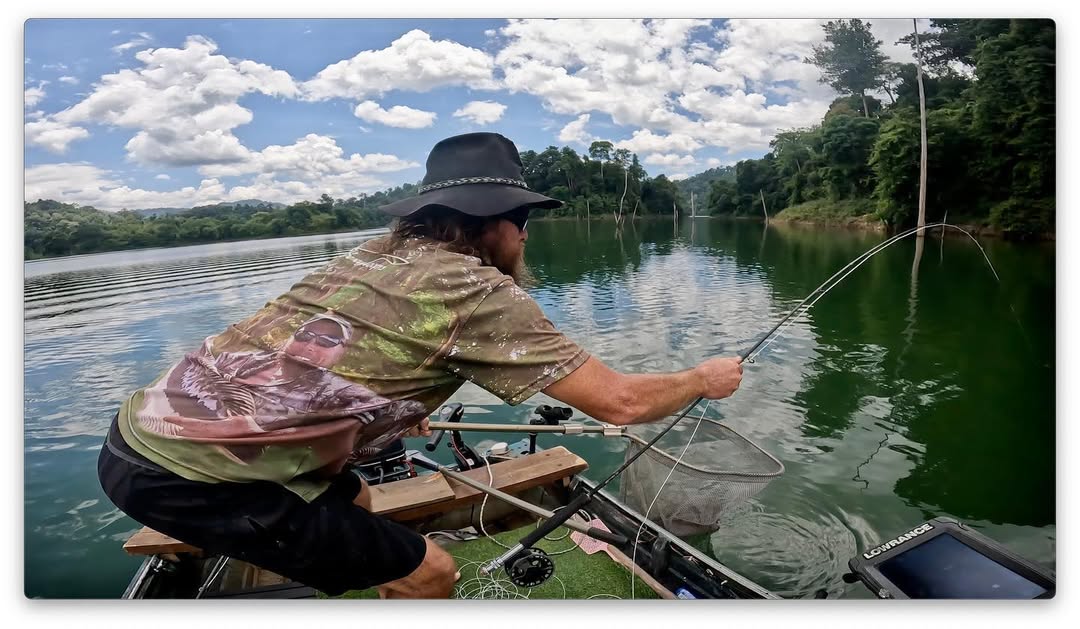
00:53:17 Paul: So I’m in the middle of the Malaysian jungle on a lake here, uh, just south of Thailand, about twenty or maybe thirty or forty kilometres a night. I’ve got a boat and I’m. And I’m sitting on the back of the boat. It’s thirty degrees. I don’t know what that is in Fahrenheit.
00:53:34 Dave: That’s sixty. That’s hot. It’s about ninety degrees. Yeah. Somewhere in.
00:53:37 Speaker 5: There.
00:53:38 Paul: And it’s about I can’t see, but it’s probably about ninety five percent humidity.
00:53:42 Speaker 5: Oh, wow.
00:53:43 Paul: Uh, it’s yeah, it’s very hot and warm and muggy. No bugs though.
00:53:48 Speaker 5: No bugs, no.
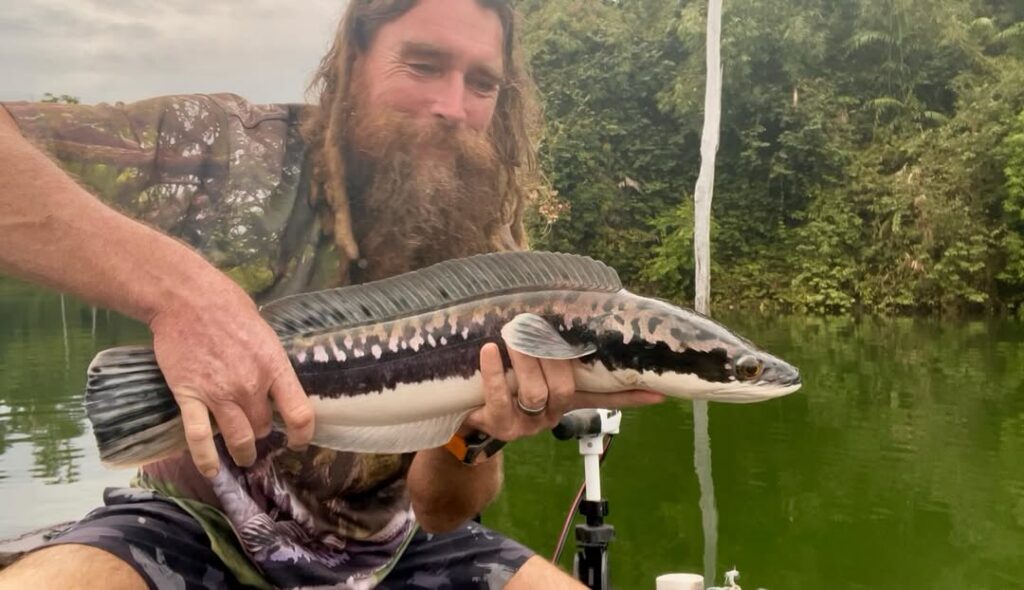
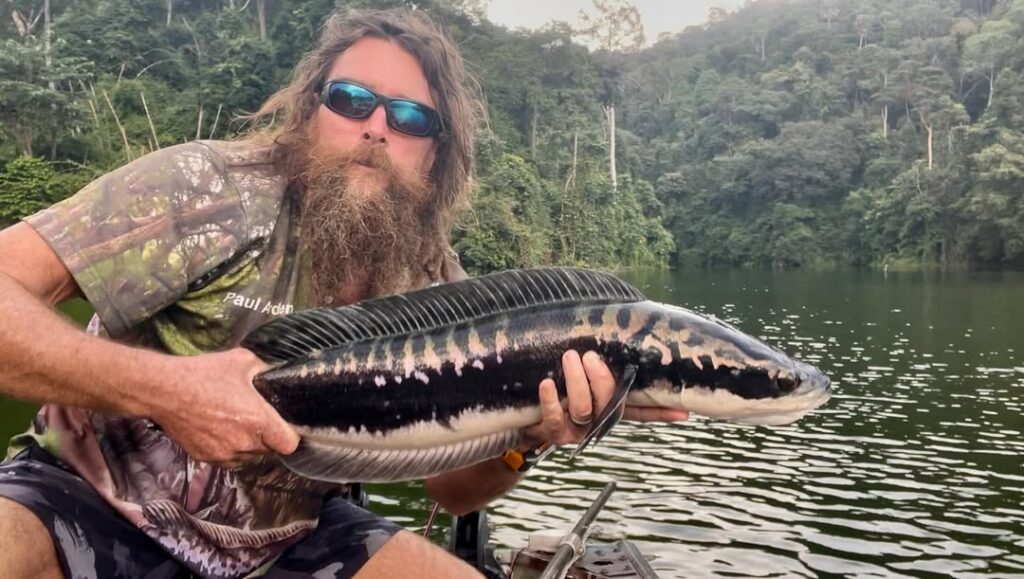
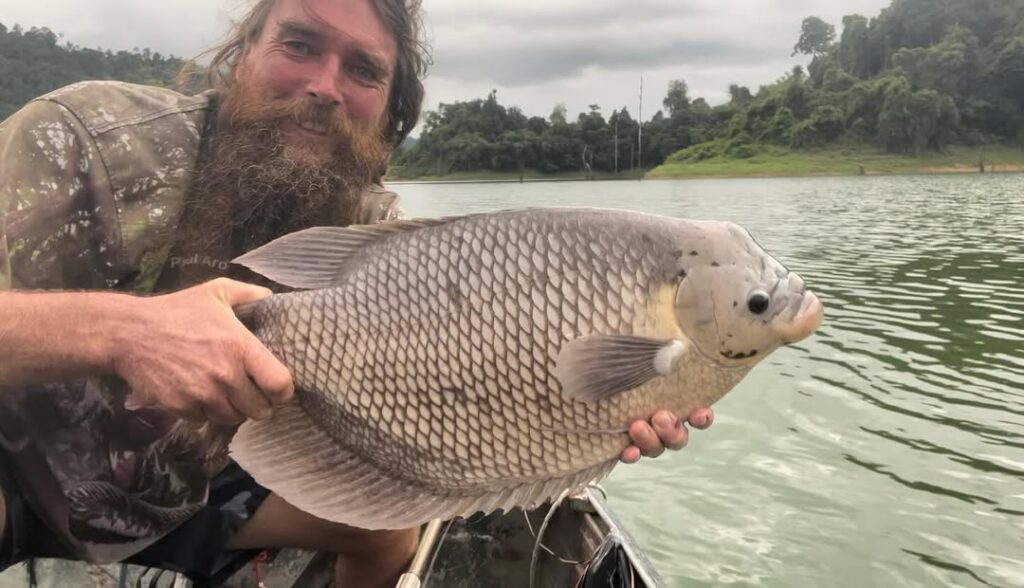
00:53:49 Paul: Mosquitoes, no bugs. There are snakes and elephants and tigers, but there’s no bugs. And I fish. I fish for giant snakehead and giant gourami. And the giant snake had, uh, they come up and they breathe air and we put poppers in front of them, which surprises them, and they grab it. And then the giant gourami and there are giant gourami around at the moment. They’re, they’re eating bugs like, um, ants and stuff like that.
00:54:13 Dave: Okay. And how do you spell that species Gourami G o u r a m I.
00:54:19 Paul: They have smaller ones. In the aquarium. We have the giant gourami species and a small one is about six or seven pounds, and the biggest I’ve had is five kilos. So about at about eleven, ten and a half, eleven pounds.
00:54:33 Dave: That’s amazing. They’re kind of like a almost like a sunfish body morphology kind of like.
00:54:38 Speaker 5: Yeah. Very deep.
00:54:40 Dave: Yeah. Very deep. Wow.
00:54:41 Speaker 5: Very clever.
00:54:43 Dave: Are they how are they? They’re a lot different than snakehead.
00:54:45 Paul: Yeah. So I was, I was guiding a chap here and he put the fly in front of the fish. And this fish came and looked at the fly and it looked at the fly. And I’m taking photographs and it’s looking at the fly and it comes and looks at us and goes back and looks at the fly, and eventually it swims away. And on the timestamps of the photo, it had been looking at the fly for over five minutes.
00:55:05 Speaker 5: Wow.
00:55:05 Paul: Five minutes and refused it. Now I can’t imagine any fish, any other fish looking at a fly for five minutes. So I have a little aquarium in the boat and I have a little gourami here, but he’s growing quite big and he.
00:55:18 Speaker 5: Spends.
00:55:18 Paul: All his time. All of his time looking out. If I’m well, I Well, I feed him cheese. He gets very excited by Cheez its.
00:55:26 Dave: That’s awesome. You got your pet. How do you pronounce it?
00:55:29 Speaker 5: Grammy Gourami. Yeah. Gourami.
00:55:31 Dave: Gourami. And how do you get your power there on on the boat. You’ve got a fish tank going. How do you do that?
00:55:36 Speaker 5: Oh, I got I got about six or seven.
00:55:37 Paul: Solar panels on the roof. So, uh, so I run a fridge. Uh, yeah, a lot, a lot of power really. And then, of course, the Starlink takes quite a lot of power as well.
00:55:46 Dave: And Starlink. Do you remember before Starlink? Because Starlink is amazing, right? I mean, before that, how were you were out there before Starlink, right.
00:55:52 Paul: I was out here a long time before Starlink. Yes.
00:55:54 Dave: Yeah. How’d you do it back in the day?
00:55:57 Paul: Well, I was going to I was getting back. There’s no phone reception in most of the lake, so I was managing to find phone reception twice a week and catch up with my emails. I wasn’t doing the online coaching then. And then I got the boat and I took Starlink. I still hadn’t arrived and I was doing online coaching, so I was having to part my boat in a couple of places where, where there is mobile reception, but I felt like I wasn’t really exploring the jungle then, you know, because I was I was so close to I mean, I’m, I’m, I’m about an hour right now from from, uh, from anybody.
00:56:28 Dave: You’re our boat driver.
00:56:30 Paul: From anybody, from anybody. And I can be, and I can be two hours boat drive from, uh, you know, so I’m very remote. In fact, I haven’t seen anybody on the lake for about a week.
00:56:39 Dave: No kidding.
00:56:40 Paul: Yeah. So it is, it is. It’s pretty much the only people I see here are the, the local indigenous or. Yeah. But I haven’t seen it. But but but I haven’t seen them. I haven’t seen anybody around here for quite a while. It’s great. I like I like spending time on my own. Otherwise I wouldn’t be here.
00:56:55 Dave: Right. No. You’re an amazing place. That’s like your. It’s pretty cool though, right? With the tech. I mean, the technology has allowed us to sit here with a podcast. You’re in the middle of nowhere and doing this thing. It’s pretty amazing.
00:57:06 Paul: I mean, being able to teach as well and run the business and everything. It is fantastic. But I also like to get away from it. This is the problem. We end up being connected.
00:57:15 Dave: You’re always connected.
00:57:16 Paul: And I and I’m, you know, old enough to remember not having social media and not having the internet in the pocket.
00:57:22 Dave: That’s why the trips, you know, we don’t all get to do. We all can’t live in Malaysia. But for, you know, like me, I’ve got this trip coming up here, you know, and it’s definitely going into a river canyon where there’s no cell phone coverage. So for at least a week, you know, I’m going to be disconnected. And it’s like, okay, well, I got a business to run and I’m going to, you know, we’ll do it and I’m going to be out of touch for a week. So I feel like we all need. I think that’s part of fly fishing, right? Being able to experience that.
00:57:45 Paul: I’m totally sure just getting away from everybody and. Yeah. Leaving it all behind. I used to spend, you know, well before I came here. I sometimes spend six weeks or even, you know, ten days in New Zealand and not, not again, not meet anybody and certainly not have any internet connection or connect or phone connection. And it’s just nice to get away from the world. The world doesn’t stop. So all those things we worry about on a day to day business, you know, we don’t have to worry about them. It turns out, because there’s still. Those problems will still be there when we get back.
00:58:20 Dave: Exactly. Yeah. They will be. Yeah. That’s that’s why you just got to go. You got to say, hey, I’m going. Well, this is awesome. So like we said, we’ll have links out to the show. Give us let’s take it away. A couple of tips. Again, we’ve talked tons of tips today. But again, somebody sitting here, you know, they’ve got some experience. What are the few things you’re going to leave them with today? Like they can actually take action on to help that cast? What would be the big thing?
00:58:40 Paul: Well, I think the first thing is to practice. I mean, not just practice when you’re fishing, but really to make that that part of it, everybody plateaus. And at some point then you’re going to want to look for coaching. I think you can’t do it all. But but there is I would go through those videos, there’s probably four or five hours of content there that you can go through. And I would go through it in order. Don’t just skip the beginnings because the beginnings have little drills that are useful for everybody. I mean, I think another way of looking at it is the really good cast is one of the reasons they’re really good. It’s not because they’re practicing all the difficult stuff, it’s because they’re just really good at the basics. So you want to get really good at the the foundations. And ideally, if you’re taking shots, you’ve got to be to do it without watching the back cast. But you need to learn. I think I’m quite sure at first you need to learn by watching and seeing what’s going on.
00:59:27 Dave: Yeah. See what’s going on. Okay. So watch, so watch the videos practice and is practicing. You know, if you only had a week, a one day a week to go out there for an hour, would that be.
00:59:37 Paul: Well, yeah, but I think you’re better off to do to go out more often and for less.
00:59:41 Dave: Yeah. For less.
00:59:42 Paul: You know, if you could do ten or twenty minutes a day, I mean, most people have got a garden. You just go and have go out and throw out some targets for ten minutes and keep the rod set up. And now, you know, as I say, I wouldn’t say most people have got a lot of people have a garden or a field that they can go in if they have a long way to travel to do that. Well, that’s, that’s difficult. But hopefully a lot of it, I think, is getting over that fear of casting in public and looking a bit different. But after that’s gone, people just if you if you talk to yourself while you do it, people will just avoid you. They’ll think you’re nuts.
01:00:12 Dave: That’s right, that’s right. That’s awesome. That’s always the yeah, the person that’s talking to themselves, you’re always like, okay, I’m staying clear of that guy.
01:00:19 Paul: So I’ll leave you this. So one of the guys I’m coaching down in down in Los Angeles, he I’ve been, he’s been over here and fished over here. He actually writes for the Sexyloops. Now one of the days. Okay, really great guy. And he was listening to Mark Surtees walking drill. And so he’s taken it to the new level and he’s running around making casts, running, running back. He’s sixty eight, running around forwards, around the park this way, running backwards, making different casts. I just thought this is just going to be hilarious for anybody watching what he’s doing.
01:00:48 Dave: That’s good. Well that’s what you said. That’s one of those drills we can do. It’s it’s good to cast and walk because what does that train you to do? It trains you to do. Why is the walking while you’re casting help?
01:00:58 Paul: I think there’s a few different reasons for it. Firstly, it frees up. It makes us less rigid. It makes us more mobile. It allows. And when we cast, we do depends on the cast. We do use weight shift. We’re standing on the front of the boat. We don’t use so much, but it just helps frees up free up all the body. But there is another thing. When we walk, we don’t think about walking. You know, we we’ve learned to do it. We don’t think about putting one foot in front of the other and the angle. We bend our legs and so on. We just do it. And it’s a autonomic thing that we do, and it helps make casting in the same way. You don’t want to be thinking about your arm, your wrist, your shoulder, or, you know, you want to be just want to be forming the loops and the movement should be natural. And so the walking really helps, uh, put that in place. It really is a very powerful drill.
01:01:45 Dave: Yeah. I feel like my cast was when I’m doing my cast the same thing, I’ll have that short distance where it’s just like, I could do it in my sleep, you know, it just feels good. But as soon as I get out to that certain, I don’t know what length it is, but it’s that longer length where I just I struggle. Right? And it’s because maybe I’m starting to think and stuff’s breaking down. Like, how do you do that when you get to that length where you’re at that length where you start struggling, what’s your tip there? If you, you know, to get past that.
01:02:10 Paul: What length is it?
01:02:11 Dave: Uh, well, I mean, I would, and I’m not good with length. I would say thirty to fifty feet, maybe thirty to forty, fifty feet. I can cast pretty good. But when I start trying to make that longer, I don’t know. I just guess it’s probably sixty, seventy, eighty feet, something like that maybe. Right. That’s where it’s tough, tougher. Maybe that’s I don’t even know. How do you even judge? I guess I should probably measure measure the length right, of what I’m casting.
01:02:32 Paul: Yeah, yeah. Tape measure.
01:02:33 Dave: Tape it. Is that a good idea?
01:02:34 Paul: Yeah yeah yeah, absolutely. Stand next to a tape measure. When you get to when at this point you kind of want to know.
01:02:41 Dave: Yeah. Okay.
01:02:42 Paul: But it really, it really, really depends. I mean, uh, it can be the back cast. Um, it can be hall. It could, it could even, I don’t know what line is this?
01:02:52 Dave: Um, what I mean, I’m always using it depends. I got a bunch of lines from different. I mean, you know, I’ve got, I’ve got everything. So I’m not it’s kind of I feel like part of it is the, um, you know, the conditions, the wind factors in. But I mean, I guess when you’re casting, if you just take it to you or Steve or anything, at a certain point, you know, if you’re casting one hundred feet or one hundred and fifty feet or one hundred and ninety feet, at some point, does it break down or does it just you just can’t cast any further. What’s how does that look with the people at the highest level?
01:03:21 Paul: Well, one hundred and ninety feet would be nice. I don’t use a tackle that goes one hundred and ninety feet. That’s a good question. Not really. No. Not so much so. But in order to get there, there are a couple of ways of doing it. But that’s why I was asking. So there is there is a drill I use where if somebody worked out that their maximum carry is X feet and then and anything after that it breaks down, then I get them to carry a little bit less, maybe five feet less, and I get them to play with speed, like going from one hundred percent effort to ninety, eighty, seventy, even sixty. And then I get them to play. And that can be enough to open it up. And then they can carry more because there’s some physics behind that, but the loops can end up being tighter. And then the other is I get them to play with loop shape, like that beginner’s drill we had from me, tight to medium to wide. So if this, whatever this, this carry is five feet less suddenly becomes very comfortable. And you can do a lot with it. And then that can help you extend. So the distance you can reach in the front is largely determined by how much line you’re carrying behind. So it depends a little bit on the line, the line profile and so on. They often it’s not quite accurate, but they can. They often say we shoot about half of what we carry. It’s not quite that. It’s more or less. And it’s, it’s less when it’s more. So one of one of the keys is to develop the back. But look, if you like Dave and you’ve got some time, let’s get together and have a meeting on Zoom, have a cast.
01:04:47 Dave: We’re all gonna. Yeah, let’s, we’ll all take you up on this. This will be good. So yeah, this is great, Paul. Let’s leave it there. And we’re going to hopefully follow up with you and get some more good stuff going. So we will send everybody out. Like we said, Sexyloops dot com. They can check the video page, follow up with you. And yeah, I appreciate your time today. This has been amazing and we’ll look forward to talking more.
01:05:05 Paul: Thanks, Dave. It’s great to talk to you again.
01:05:08 Dave: All right. I hope you enjoyed that one. If you want to check in with Paul, go to sexyloops dot com. Check in with him. There’s a ton of videos there, all sorts of step by step. This is a great place to take it to the next level. I want to give you a big heads up. Next week we are heading into the Stillwater School. The big giveaway launches next week. If you’re interested in joining us on the Stillwater School, check in with me, Dave at Netflix dot com. We have limited spots available. Uh, definitely enter the giveaway, but we’re also going to be selling a few key spots. If you are interested in fishing with Phil Roy, uh, heading over to eastern Idaho. Henry’s.
Paul Arden’s approach to fly casting combines decades of teaching experience, competition casting knowledge, and a deep understanding of how anglers actually learn. His message throughout the episode is simple: better casting doesn’t come from working harder—it comes from understanding loop control, timing, line speed, and practicing with purpose. Whether you’re looking to add distance, improve accuracy, or simply become a more efficient angler, Paul’s insights provide a roadmap for long-term improvement.