Few people have moved between the worlds of literature, fly fishing, film, and Western culture with a front-row seat to all of them.
In this episode, Dave sits down with Tom McGuane to talk about a lifetime of chasing fish, telling stories, and following his curiosity wherever it led. From tarpon in the Florida Keys to decades spent fishing the Dean River, Tom shares the experiences that shaped both his writing and his life.
We covered steelhead, Atlantic salmon, Spey casting, literature, Hollywood, Jimmy Buffett, Jeff Bridges, and what it feels like to keep chasing fish after decades on the water. If you’ve ever wondered what a lifetime devoted to fly fishing looks like, this episode is a master class.
Tom McGuane joins me to look back on a lifetime spent balancing literature and fly fishing. We talk about Montana, California steelhead, Atlantic salmon, tarpon, Spey casting, writing, Hollywood, aging as an angler, and why the pursuit itself matters more than ever.
(1:09) Tom still spends plenty of time fishing close to home in Montana. He fishes the Yellowstone, the Boulder River, the spring creeks, and the wade-only section of the Upper Madison. But every year, he’s really waiting for steelhead season.
Over the years, Tom has fished all over the world, thanks in part to writing for Sports Illustrated. Those assignments took him to places like Tierra del Fuego and Russia. He also returns to the Dean River every year, and this season marks his 42nd trip. As he puts it, age has changed how he fishes. He now picks his battles more carefully, choosing rivers that are a little easier to wade while still making time for several steelhead trips each year.
When I ask whether writing or fishing came first, Tom says they grew together. As a young man, he wasn’t interested in spending time indoors. Instead, he wanted to dedicate his life to both literature and fishing.
Looking back, Tom says that’s exactly how his life turned out. Along with family, dogs, and bird hunting, fishing and writing have always been his greatest passions, and that hasn’t changed.
(5:08) Tom looks back on catching his first steelhead while attending graduate school at Stanford. Growing up as a Midwestern trout angler, discovering California’s steelhead sparked a fascination that has lasted a lifetime.
Tom also shares his concern for the future of steelhead and other anadromous fish. From California to Norway, he sees many of these fisheries facing growing challenges, making every season on the water feel even more valuable.
(8:26) Tom looks back on the early days of tarpon fishing in the Florida Keys, when he and friends like Jim Harrison spent as much time on the water as they could. At one point, Tom says he fished for tarpon more than 100 straight days, chasing fish long before the flats became crowded.
He remembers a very different era, with few skiffs, no cell phones, paper tide tables, and plenty of wrong turns. Learning the fishery meant figuring everything out on your own, and that sense of exploration is one of the things he misses most about those early years.
(10:34) Tom reflects on how his passion for fishing fueled his writing career and eventually led him to Hollywood. He talks about directing the film 92 in the Shade after unexpectedly replacing Robert Altman just before production—a job he jokes he learned by buying a paperback on how to be a director.
We also talk about the realities of the movie business, from projects that can take years to reach the screen to the appeal of “mailbox money” from books and films that continue earning long after they’re released. Tom shares stories about The Sporting Club, his first novel, and why, despite his time in Hollywood, writing has always been the work he cares about most.
(15:31) One of my favorite parts of this conversation is hearing Tom talk about the language that naturally grows out of fishing. Every community develops its own vocabulary, and fly anglers are no different.
For Tom, fishing is more than catching fish. It’s also about the stories, the people, and the funny words that come from the experience.
(17:24) When I asked Tom where his unforgettable descriptions come from, he immediately pointed to the authors who shaped his own writing.
Tom says that principle applies just as much to fishing stories as it does to novels. Readers have already seen countless articles about fly selection, leaders, and rigging. The real challenge is making familiar subjects feel fresh again.
Tom believes good fishing writing has to offer more than gear lists, fly patterns, and rigging advice. Those topics matter, but they’ve been covered so many times that it’s hard to bring something new to them. For him, the challenge is finding a fresh way to tell the story.
(24:48) We switch gears and talk about Atlantic salmon, including one of my favorite stories from Tom’s book, The Longest Silence. It’s about a woman who caught a 50-pound Atlantic salmon after being talked into fishing for just one day. Her son spent the next 50 years trying to catch one himself. On her deathbed, she looked at him and said, “You’ll never get a fifty-pound fish.”
That leads to a conversation about storytelling. I ask Tom how much of his fishing writing is true, and he says the stories come from real experiences, with a little poetic license along the way.
We also talk about writers who influenced him. Tom points to John Gierach’s simple, unpretentious style and Charlie Waterman’s conversational writing as examples of storytelling that still stands the test of time.
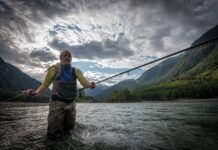
(30:12) We talk about single-hand rods, Spey rods, and why Tom still enjoys fishing a floating line with a single-hand rod. He says some of his favorite steelhead memories came from skating dry flies, and he believes that style of fishing still has a special place today.
Tom also shares one of the best days he’s ever had on the Dean River. After more than 40 years of fishing there, he and his friends hooked 26 steelhead on dry flies in one afternoon when the river dropped and cleared. He says those days are rare, and most years, landing one fish a day is enough.
Tom also talks about how unpredictable steelhead can be. Some days, anglers miles apart will all start hooking fish at the same time, and no one really knows why. As he puts it:
Tom says that’s one of the reasons fishing never gets old. There’s always something left to learn.
We also talk about Jimmy Buffett. Tom says Buffett wasn’t much of an angler when they first met, but he worked hard at it and became a dedicated fly fisherman over the years.
(1:09:56) Tom shares how he ended up in Montana after what was supposed to be a short stay. More than 50 years later, he still enjoys the quieter parts of the state.
We also talk about why he’s less interested in chasing the biggest fish these days and more interested in the memorable moments that happen on the water.
Episode Transcript
WFS 955 Transcript 00:00:00 Dave: Few people have moved between the worlds of literature, fly fishing, film and Western culture with a front row seat to all of them. Today my guest is Tom McGuane, novelist, screenwriter, lifelong angler, and one of the most influential voices ever to write about fishing and American culture. From the Florida Keys and giant Tarpon to four decades on the Dean River, from Hollywood film sets to the pages of The New Yorker. Tom has spent a lifetime following great stories and wild fish wherever they lead. In this episode, we talk about steelhead, Atlantic salmon, spey, casting, righting, aging as an angler, and some unforgettable stories from a life that has touched nearly every corner of the fishing world. And today, Tom shares a bunch of amazing stories about Jimmy Buffett Jeff Bridges. We’re going to talk about the evolution of fly fishing and lessons that only come from decades spent chasing fish and writing about it around the world. This is a really, really big one, and I am very happy to share this conversation with one of the greats. Here we go. Tom McGuane. How you doing, Tom? 00:01:07 Tom: I’m doing well. I’m glad to be here. 00:01:09 Dave: Yeah, I’m really excited for this one. This one. I’ve been thinking about this for many years. We’ve had lots of guests on the show. John Gierach many, you know, other famous writers who’ve talked about you as being a big influence on them. And so I’m excited to hear really just dig into your background. You’ve got so much work out there that’s, you know, has really inspired people around the world. So maybe just start off, you know, where you’re at, what’s going on today, maybe talk physically. Where are you located right now? 00:01:38 Tom: Uh, I’m south of Big Timber, uh, near McLeod, Montana, on the Boulder River. Um, yeah, that’s that’s it, that’s it. 00:01:46 Dave: So you’re on the boulder? Yeah. And so we’re going to be heading out to Montana this year. We’re going to be doing some fishing, uh, probably some Spring Creek fishing, probably some tailwater fishing. What’s in Montana? Do you have a certain type of fishing that you love on the fly, or do you love it all? 00:02:01 Tom: Well, I fished locally a lot. I fished on the Yellowstone and the boulder. Um, I sometimes go over and fish the spring creeks, but I used to live over by the spring creeks when it was free and, and, uh, and nobody was there, hardly anybody. People were fishing there in the late sixties when I first started fishing there. But, uh, then I go over to the upper Madison and fish in the Wade only section. Um, I’m always a little bit treading water until steelhead season, which is a vice a lot of us have. And yeah, we, we get a little bit killing time till we can go do it. Um, but I like any kind of fishing really. Um, but I’m originally a trout fisherman and uh, was for a long time a pretty avid saltwater fisherman. And I fished a lot of places in the world over time. I used to write for Sports Illustrated and they would pay incredible travel expenses. They wouldn’t pay you very much for writing, but you could go anywhere you wanted. So I went to Wild Places, Tierra del Fuego and Russia and places like that on their dime. And, um, uh, but I, you know, I’m old now, so I really have to kind of pick my battles. I’ve been going to the dean for. This will be my forty second year, uh, going to the Dean River. And the only thing I’ve noticed is in the first thirty eight years, I never fell on the river. And the last three years, I’ve fallen in every year. Yeah. But, uh, so, you know, that’s one of the issues. Yvon Chouinard and I are kind of contemporaries, and we we, uh, we have to pick where we fish now. I mean, there are a lot of things that are hard for me to do anymore. Just like the Boulder River is just brutal for wading, especially later in the season when the rocks get slippery. And. Yeah. So, um, that’s kind of it now, um, I’ll make a lot of steelhead trips this year. Probably three or four of them. 00:04:01 Dave: That’s awesome. No, I’m excited to hear more about the steelhead. I think that’s something that, you know, I’ve loved my entire life. We’ve got a lot of listeners that love steelhead fishing. And I want to hear about your kind of maybe your journey with Spey and all that stuff. But before we get into on steelhead, I want to hear just take us back, maybe way back to, you know, you’ve got all the, the writing we could talk for, you know, about all the books and everything and all the inspiration, like I said, but was it writing or was it fly fishing that came first for you or were they, you. 00:04:28 Tom: Know, I think they came simultaneously, or at least fishing and writing. I was sort of a terrible student. I didn’t want to be indoors. And I early on really wanted to dedicate myself to either literature or fishing, both at the same time, I hoped. And now that I can look back on many birthdays, um, I think I’m pretty happy. The fact that that’s what I’ve done with my life. I’ve fished and written. Yeah. You know, apart from the main things, you know, family life and dog life and bird hunting and all those other things that you can do. But those have been my passions and that hasn’t changed. 00:05:08 Dave: And you’ve been, like you said, you know, we all get older and things change and you evolve and you’re fly fishing, but you know, steelhead maybe take us there. When was that for you? When was your do you remember your first steelhead? 00:05:18 Tom: Uh, strangely enough, I caught my, I was a graduate student at Stanford back in the sixties. And, um, so I started figuring out what you could do in California because that was a Midwestern trout fisherman. And, uh, but the first deal had I caught, I caught in Big Sur Creek, um, which is kind of an unusual place to catch. 00:05:40 Dave: Right. 00:05:41 Tom: And in fact, I think that set off my fascination with the range of steelhead and how they almost go down to northern Mexico and The Arctic that some of the fish that we fished for in the Skeena system have been in the Sea of Japan that summer, and the romance of it really kind of caught me. And then. Then I was a friend of early California, Steelheaders Russ Chatham and Bill Shad and I fished with both of those guys. I think the steelhead fishing was really waning in California at that time. And, you know, the days when the Russian had thirty five thousand wild fish in the annual run. That’s my friend Russ Chatham, for example. That’s what he remembered from his high school years, was these runs that were sort of Skeena sized runs, basically in a California suburb. Then I went down, and not too long ago I went down, um, to, uh, what is that little river that feeds the water supply of Santa Barbara? 00:06:46 Dave: Oh, gosh. 00:06:47 Tom: Huh? 00:06:47 Dave: I’m not sure. 00:06:49 Tom: Um. uh, I’m trying to think of it, but they had a run of twenty eight thousand fish and three species and, you know, until pretty recently, uh, you know, all those wild steelhead going up through the California oaks. I mean, that’s fascinating. Yeah. Malibu creek, you know, where the. 00:07:05 Dave: Yeah. 00:07:06 Tom: Little, little chunky steelhead come in and spawn and shoot out of there. 00:07:10 Dave: Jeez. 00:07:11 Tom: Fifty or sixty fish in the run. So I remember when I was in Russia, a couple of the guides, the guides were mostly Montana guys at that time, and one of them was determined to give his life to steelhead fishing after his or during his guiding career. I remember an old time, uh, Atlantic salmon fisherman who was there. He was actually from the west coast of the US. Said to him when he when this kid poured out his passion for steelhead, he said, you’re a day late and you’re a dollar short. 00:07:45 Dave: Ah. 00:07:46 Tom: And, uh, you know, it hasn’t quite come to that. But everywhere in the world, we’re seeing these anadromous fish imperiled. Really? I was in Norway a year ago, and they’re worried now. You know, they’re deferring to salmon farms and oil. Um, lots of other things. So I, you know, you kind of feel like you’re racing time if you like to fish for steelhead. 00:08:11 Dave: Yeah. 00:08:12 Tom: And, uh, you know, I’m, I have an old friend who, whenever he brings up his rods, says, I thank God I’m not a day under eighty. 00:08:21 Dave: Right. 00:08:23 Tom: In some ways, I feel that a little bit myself. 00:08:26 Dave: I hear you, yeah. You guys were. You went through a time not only a steelhead, but some of those other species, like the saltwater, right? You go back to those days with that. You wrote about a lot, those crazy times, right? Talk about that. Now you’re sitting here, you know, you’re later in life versus, you know, your fifties, sixties, 70s 80s versus say that time when you were you describe that. What was that period when you guys were out there fishing for tarpon? And it was kind of a Jimmy Buffett and all the gang. 00:08:51 Tom: Yeah. And my friend, my old friend Jim Harrison. 00:08:55 Dave: Yeah. Jim Harrison. Yeah. 00:08:56 Tom: Yeah. The, uh. Well, that was great. I mean, we had really cut the moorings. We were living like dogs. We were doing everything, um, to be able to fish. And we really kind of overdid it in a way. I mean, uh, I had two or three years where I tarpon fished for at least one hundred days in a row. Um, and we had a kind of a little bit of a virgin opportunity there too. They were the fishing wasn’t pounded quite like it is now. There weren’t skiffs all over. I had a skiff, uh, poling skiff in Key West. It was the only one in town. There’s probably a hundred of them now. Um, and, uh, there are even places to dump old skiffs. 00:09:40 Dave: Oh, right. Uh, yeah. 00:09:42 Tom: Uh, you know, it was great. It was great for several reasons. First of all, we didn’t know what we were doing. Um, there were no cell phones, uh, didn’t have stainless steel props. So if you hit a coral head, you were going to sleep out that night. Um, you couldn’t call anybody for help? Uh, we didn’t have online. Uh, what do you call it? Tide tables. 00:10:05 Dave: Oh, right. All the tides, right. 00:10:06 Tom: These government tide tables and convert from Port of Miami all the way down to the lower keys and figure out what the difference between the Gulf of Mexico and the Oceanside were, because those were tide, tide change times. You had to figure it out. And then we were often lost. I mean, uh, just lost. Um, but you had to be young in doing that, trying to figure it out and finding your way through unknown territory was a wonderful experience. 00:10:34 Dave: Yeah. And you wrote a lot. I mean, maybe describe that those times. I mean, a lot of work came from that. I mean, the movies, um, you know, the um one of the biggest one was the ninety two in the shade, right. I mean, that was kind of this, that movie, but a lot of different things came out of that. How did, how did that era kind of, um, start, you know, evolve your writing? You know, were you already how did it and does it still influence you today when you think about that whole era? 00:11:02 Tom: Well, I think the lesson was, I mean, I was so passionate about what I was doing. And a lot of that writing was fueled by that passion and going through my life subsequently and trying to rediscover that kind of, uh, fire for writing or doing things in writing about it. Um, that that has been the challenge. I mean, to feel that strongly about something. And then there was always the, uh, the tug between kind of things, which are frankly, recreational and things that are professional and based on making a living. Well, I grew up in a town that didn’t have a movie theater, so the fact that I ended up in the movie business for about ten or twelve years, I still don’t watch movies. I never have. 00:11:50 Dave: Really? 00:11:51 Tom: Yeah. I don’t even watch television. So the fact that I had to sort of tread water until I understood how to movies were made. 00:11:59 Dave: And you were kind of thrown into it. Right? You directed that movie? 00:12:02 Tom: Yeah, I did, um, the producer and the, and the original director, Robert Altman, had a falling out just almost as we were ready to start the movie. And it was already financed. Everything was done, the sites were scouted. And, uh, so the producer turned to me and said, guess what? You’re the director. So I went down and bought a, I think I went down about a paperback, how to be a director. And then I got one of those little things that directors look through, you know. All right. And no directors use them, actually. But I had one want to go around town looking at things through my my little scope, but it turns out it’s not as hard as it looks. It’s not as hard as writing. 00:12:49 Dave: Oh, really? Wow. 00:12:50 Tom: Yeah. It’s just, you know, it’s logistically a lot of trouble. You know, you want to shoot one day and somebody’s house and the next day you have to shoot in the city jail. And a lot of preparations going to laying down plywood track for the cameras. Everything is so slow. Yeah. Um, or even getting to the point where you’re actually making a movie. I know, uh, uh, Harrison’s movie, uh, legends of the fall. Yeah. We were so excited because he needed some money and he sold the project, so we got one payment for the initial sale. The rest would come after the movie was made, and they made it fourteen years later. 00:13:30 Dave: Wow. 00:13:30 Tom: And that’s kind of normal. So it has a way of chewing up your life. And I didn’t like the town. I didn’t like the job, really, but I had to do it because I couldn’t make a living. 00:13:42 Dave: Right? That was it. And that movie was. How would you describe that movie? I mean, I think maybe a cult classic might be something. What would you. Because it wasn’t like a giant blockbuster film. But I mean, you had Peter Fonda. I mean, you had a bunch of great, amazing actors. 00:13:58 Tom: Yeah. No, it just it’s gone on to be it’s never stopped playing. Mhm. You know, those of us who ever had these jobs are focused on what we call mailbox money. And so, you know, you might go to the mailbox and says they just played, uh, ninety two in the shade in Czechoslovakia. Here’s your here’s your twenty five dollars thirty one cents. Yeah. Um, so that’s important. And, uh, and that’s across the board for, uh, writing. I mean, my, um, my first book came out in nineteen sixty nine and it’s still in print and, you know, none of them make a lot, a lot of money. But the accumulation of being a survivor is is significant. 00:14:41 Dave: What was that first book in sixty nine? 00:14:43 Tom: Uh, the sporting club. 00:14:45 Dave: The sporting club. Okay. 00:14:46 Tom: And that was made into a movie. That was yeah, a terrible movie. 00:14:50 Dave: Really? What was the was that the movie? What was the name of the movie? 00:14:54 Tom: It was, uh, I can’t I’m trying to remember who Ali MacGraw was it Ali MacGraw? 00:14:59 Dave: Okay, this is great. We’re gonna track these down, and I’m going to have a whole movie series of movies we’ll be watching. 00:15:04 Tom: Okay. Um, but, uh, that was just a portion of my writing life. As I look back on it now. I mean, I’d been very committed to what is now called literary fiction. And all I do now really is write for the New Yorker magazine. Uh, and I’ve recently renewed my contract with them. So that’s what I’ll be doing unless I write about fishing. 00:15:26 Dave: Okay, so that’s different. The fishing is if you get out and do some fishing, you’re still going to write about that? 00:15:31 Tom: Potentially, yes. Because something will Well, really, I was thinking today, you know, because I’m a language buff, you know. Yeah. I was thinking today of all the kind of funny language that comes out of the fishing world. And one of the ones that I was chuckling about recently was, uh, you know, when a boat turns over and all the stuff goes out of it and drifts up on the shore, that’s called a yard sale. 00:15:56 Dave: Exactly. I’ve been there. I’ve been in a yard sale. 00:15:58 Tom: I know you have. Yeah, I’ve heard you talk about that. 00:16:01 Dave: Right. 00:16:02 Tom: Then the other one I like is when a guy’s out in the river struggling to keep from falling in the river, and he’s making a lot of wild gestures. That’s called the funky chicken. 00:16:12 Dave: Oh, the funky chicken. 00:16:14 Tom: And then if somebody says, I really can’t wait anymore, I’m going to fish from the boat. That’s called the Princess Cruise. 00:16:22 Dave: Nice. I love it. 00:16:23 Tom: So anyway, uh, fishing, like any other passionate thing, especially when it’s involving other people, is a great generator of original language and usually comic. 00:16:36 Dave: And you’re the master. I mean, really of this. And this is what people. John Gierach, I think mentioned this first time when he was on. But you’re the master of this actually telling writing where you’re actually seeing a picture instead of just telling somebody like John, I think he mentioned, I can’t remember what book it came from with you, but he talked about this book where you were talking about somebody who was, and I’ve used this before, I’ve told this many times on the podcast, but where you’re, you’re describing somebody pointing a gun or his finger was so bent, you know, his finger was so bent that it was like when he pointed the gun, it was like, if he was to point a gun at you and shoot, pull the trigger, it would shoot you in the foot. His finger was so bent, you know, I mean, I don’t know, I think that might have been you, but, you know, again, that’s what you’re the master of. And another one, I mean, all these books, the longest silence. You know, it’s just like tons of that sort of stuff. Where does that come from? Have you always had that? Have you developed that? 00:17:24 Tom: Uh, well, you know, I’ve been a reader, big reader all my life. And one of the lessons that I, a couple of lessons that I got from the great masters. Joseph Conrad always said, the most important thing you can do is make people see. In other words, when you write a fishing story, it shouldn’t be very. Such an elevated level that people don’t know where they are physically. So I’ve always made an effort to make the reader understand what it felt like or looked like or smelled like to be there. And so that I probably stole that from Conrad. Okay. And then Henry James had a rule, which I’ve also tried to follow. And you have to do this inch by inch. And that rule is the only rule of literature is it must be interesting. And if it’s interesting, everything else is okay. And that’s a fine line and a lot of things. You know, you sometimes you read something that’s great and you just say to yourself, I see that this is great, but it’s just not interesting. Mhm. That’s a division in any kind of writing, including fishing, writing that, uh, I’d like to follow and I think is a kind of a universal rule. 00:18:39 Dave: So it can be, it can be writing can be great, but not interesting. 00:18:43 Tom: Yeah. Well, no, not really. But that’s the you can see that’s also the subjective. So the person could read, let’s say. 00:18:52 Dave: Write. 00:18:53 Tom: Dostoyevsky and say I’d see this as wonderful. But to me it’s not interesting. Gotcha. Fishing, writing. You have especially you have a kind of a challenge to rise above the usual tropes, which are things like, you know, rigging, flight selection, um, all those. I’m fascinated by all those things, but, you know, that’s been done so much. It’s hard to do that with freshness. 00:19:17 Dave: Right. It’s been done when you write like, let’s just take the longest silence. That’s one of your people talk about that a lot just because you covered so much amazing fishing. Um, when you’re writing that. Are you thinking of, um, you know, like tips and tricks or does that just come out in your writing, you know, because you definitely provide some tips and things along the way. Is that something you’re really thinking about? 00:19:38 Tom: Yeah, I do. I mean, you know, we’ll probably get around to casting and Spey casting and stuff like that, but, uh, one of the unusual things about fly fishing in any form is the casting itself is so much fun, and it can kind of get away from you in that you get to be so casting focused, you’ve kind of forgotten about fishing. And that’s become, uh, elaborate in the age of Spey casting. Yeah. Which I’ve been doing for thirty years now and I never get to the bottom of it. Um, and, uh, it’s a beautiful thing to do to be able to do and you’re never get to the end of it. There’s always something you could do to tweak it. And so there’s a little bit of a conflict between that passion for casting and fishing you can get so that you’re just trying to empty the reel and hear the hear the snaps when it gets to the end of the cast. And you know, you’re maybe not even looking at the river, looking at the divots. And little seams and bubble lines and stuff. Supposed to be watching. God, I remember, I think it was Tim Rajeff told me this story that, uh, when they were fanatical casters at Golden Gate, uh, just to prove to themselves that they were still fishermen, they would go up to the rogue and fish for one day a year and then go back to the casting ponds. That was not always true. And both Steve and Tim were avid fishermen. But at some point, they were so obsessed with casting, they didn’t fish. 00:21:10 Dave: Right? That’s definitely true. Yeah. And there’s a mix of that because we’ve interviewed a lot of casting instructors, and I think there’s a lot a lot of them are guides. You know, definitely there’s a mix of people out there. But yeah, I mean, Tim and Steve, I mean, they’re Steve’s probably the greatest right ever. And and Tim’s right there and probably would have been if he would have put more time. 00:21:28 Tom: Yeah. I mean, Steve is a guy that’s, you know, a real mono focused guy. And Tim’s interested in a lot of other stuff. 00:21:36 Dave: Yeah. Yeah. And he’s done great with echo. I mean, that’s the great thing about echo. It’s one of those brands. I mean, they actually they probably started about when you got going in space, you know, with Sp-a back then thirty years ago. But it’s just a great brand. You know, they built this rod, which you know, and they know it. You can’t have everything. You can’t have the fastest, most durable, you know, all that. But they pick durability as one of their big things. And a lot of people say, and the price, the price point do you have you’ve used everything, right? 00:22:03 Tom: Good rods too. 00:22:04 Dave: Yeah, they’re good and they’re good rods. 00:22:05 Tom: Yeah. And I listen to Tim’s podcast with you. 00:22:09 Dave: Yeah. 00:22:09 Tom: And I was in awe of how thoroughly he thought the whole thing out. I know he’s not just, you know, getting on a CAD cam machine and send the drawings to Korea, right. Uh, he really thinks. I mean, all these things are trade offs. I’m trying to find a balance, uh, in something that’s as malleable as a spey rod. You know, it’s a tough job. 00:22:34 Dave: When it comes to high quality flies that truly elevate your fly fishing game. Drift hook dot com is a trusted source you need. I’ve been using drift hooks expertly selected flies for a while now, and they never disappoint. Plus they stand behind their products with a money back guarantee. Are you ready to upgrade your fly box? Head over to Drift Hook dot com today and use the code swing at checkout to get fifteen percent off your first order. That’s drift Hook d r I f t h o o k dot com. Don’t miss out. Golden Fly Shop isn’t your average fly shop. They have a twelve foot shark painted like a cutthroat, hovering over a huge selection of the best rods in the business, a massive assortment of tying materials and their famous steakhouse streamer display. And it’s the hub for a community of anglers who never stop tinkering with new ways to catch fish. Sometimes the conversation behind the counter includes what hatches are going off and what techniques are working best. Then tales of destination fishing, adventures, sought after species, or a good old congratulations. When a customer brings stories of finally connecting with that fish they’ve searched for forever. With a growing online store and a budding YouTube channel, you’ll be able to follow along with their fun antics, international adventures, and helpful fly fishing tips. Golden fly shop where the community is hanging out even if they’re supposed to be working. That’s Golden Fly shop dot com. Check them out right now. I had a really interesting, uh, kind of track I was thinking about, you know, we’re doing a landing salmon trip. You know, I’ve been talking a little bit about this, but it’s kind of my first time going for Atlantic salmon. We’re going to Newfoundland and they’re they fish. It’s all single hand rods, you know. And of course there’s the Spey. There’s some people getting going more on Spey, but it’s mostly single hand. So I’m kind of excited to do it actually, to go back to that because that’s how I started steelhead fishing was single hand rod with my dad. Do you know. And and so I love Spey. I mean, Spey is the main thing. But back to the longest silence. I think in that book you had a a chapter in there that was talking about Atlantic salmon fishing. I can’t remember if it was Iceland somewhere over there. But you had this story about a lady who was caught, this fifty pound fish, fifty pound Atlantic salmon. And on her deathbed, she basically said something like, her son was there. She said, and you will never catch a fifty pound fish and then died. Yeah. Now that was. 00:24:48 Tom: Was that two things about that one. Uh, she didn’t want to fish. 00:24:52 Dave: Yeah. She didn’t want to fish. 00:24:54 Tom: They asked her to fish for one day. And then he spent the next half century trying to catch a fifty pound fish. 00:25:00 Dave: Right. 00:25:01 Tom: Uh, and then, yeah, on her deathbed, she looked at him and said, you’ll never get a fifty pound. 00:25:06 Dave: I mean, that’s so I was cracking up. And now, is that a true story? And is all your fishing? Is it pretty much all, you know, true stuff. Yeah. Describe that. 00:25:15 Tom: Yeah, I think it is. I mean, yeah, I don’t know how much embellishing you do. Um, all these things are artifacts in that you kind of created things. So there’s, I’m sure there’s some poetic license that goes into them. Some people like John Gierach, for example, just had such a natural American prose style. Um, it’s so unpretentious and yet, uh, profound. Um, that’s a very difficult thing to do. Uh, partly because, uh, like a lot of other things that are well done, it doesn’t, you don’t see it on the surface. There’s nothing flashy about it. So it was a kind of a model of genuine writing, uh, kind of like Charlie Waterman. Do you remember Charlie Waterman? 00:26:03 Dave: Yeah, yeah, a little bit, yeah, yeah. 00:26:05 Tom: He wrote wonderful stuff. And it was always in that kind of colloquial style. 00:26:10 Dave: Yeah, yeah. That’s great. You know, another writer, I River Horst Nakadate, he just, uh, book from with Patagonia is coming out and I think it’s his I think it might be his first book, but he was describing some of his influences. And we talked a little bit about some different writers, but he mentioned, you know, going back to Leopold and, you know, some of these really natural naturalists and kind of conservation focused writers. Right. Did you have a lot of those writers when you were that were influencing you back throughout the your career? 00:26:40 Tom: Probably, yes, a lot of them and I read a lot of natural history and stuff like that, and I’m pretty focused on that. And I knew Roderick Haig-brown. 00:26:49 Dave: Right. 00:26:49 Tom: And I wrote a little piece about him. I stayed in touch with him a little bit. In fact, I’m looking over here. I have some of his books that he signed for me. 00:26:56 Dave: Oh, wow. 00:26:57 Tom: He was kind of, from my standpoint, was kind of the perfect mix of a kind of a cultivated, literate person who was very passionate about fishing, but had a wide range of influences on his own work. Plus his, uh, life was so involved in reality, you know, as a as a magistrate in Canada. So that he was a kind of a high watermark for me in terms of the kind of stuff I love to love to aspire to. But there are others I really liked a lot of the English, uh, trout fishing books. Um, they were a little bit more experience oriented and a little bit less, uh, technique oriented. I mean, I’ve been drawn in both directions. I mean, I, uh, one time I was talking to Lefty Cray and we were talking about rigging and why rigging is so much fun. And it’s like fly tying. I mean, you’re there and you’re sort of fantasizing what’s going to happen when you deploy this rig or you deploy this fly. And it’s, it’s a kind of a way of invoking your imagination about when you finally get to the water with this thing. But you know, it’s going to work, but you’re snowed in. Yeah. Flies or, you know, rigging the tarpon leaders, you know, tying shock tippets. Even though it’s blowing forty and it’s cold. 00:28:24 Dave: I know there’s that part of and I love it the getting ready for the trip. You know, that’s, you know, like right now where they got this Atlantic salmon trip. And we’re like, man, just getting ready and, and looking at the weather and, and, you know, that there’s a chance that the river could be out. I mean, you never know. Right? I mean, you’ve probably had a few of those trips over the years, some of those big trips I have. 00:28:43 Tom: But I’m very interested in what you say about getting ready because, yeah, I’m sort of notorious for overdoing that. 00:28:50 Dave: You are. 00:28:51 Tom: Yeah. I mean, somebody said to me, you know, how soon for your before your trip do you start packing? I said, probably six weeks. Yeah. I mean, uh, you know, I just that’s part of the, the pleasure of it is. Chris. 00:29:07 Dave: Yeah. 00:29:08 Tom: And then it can get very complicated, you know, back in the day when you know the new graphite single handed rods would all take three line sizes if you pushed them. Now, in the age of Spey casting, I don’t know how many different lines they can take, but you can tear your hair out trying to figure out whether you want to fish a Skagit or a Skagit hybrid or, um, you know. 00:29:32 Dave: Or Scandi or. 00:29:34 Tom: Or or Scandi, but or, you know, or the one there’s now all these little blurred edges between the different kinds of lines. 00:29:40 Dave: God, you know, what I love about this is that, uh, you know, as I go. It’s so cool to have you on here because there’s been a lot of guests and probably lots that I haven’t had on yet that I’ve thought about it. You know, John Hazel is one of those guys. He’s the Deschutes River angler fly shop, and he was a big part of that Spey evolution, especially kind of in Oregon. And he talked about, you know, that whole his whole journey of how they came, you know, how he kind of brought some of those in. But he said it was interesting because he was like, you know what, I still like casting a single handed rod for steelhead and I still will do it, you know? So he’s not like, you know, and it sounds like you’re kind of the same way. 00:30:12 Tom: Well, you know, I as I say, I’ve been going to the dean for over forty years and I would say the first twenty, or at least maybe the only fifteen, we fished, everybody fished the same way. They fished a single hand, nine foot eight weight rod with a floating line. And you know, your, uh, steelhead caddis or your muddler, you know, or maybe you fished damp, you know, and then you right now I’ll fish two inches under the surface. And in those days, I mean, um, you know, the rivers were relatively undisturbed, but, you know, a fish a day was a nice day. I mean, we didn’t think in terms of bonanzas, uh, but a fish caught on a single handed rod on a skating fly. I mean, that’s worth thinking about for a year. 00:31:00 Dave: Yeah. 00:31:01 Tom: I mean, that makes a year in a way. Yeah. So, uh, I think we missed something getting away from single handed rods. Mhm. Especially, you know, now I don’t I understand. I’ll bring I’ll fish. I’ll bring two rods in the boat. One will be have a floating line on it and one will have a sink tip. But I don’t know why. I don’t have a single handed rod for the floating line. And then just a spey rod for the sink tip rod. 00:31:26 Dave: Right. 00:31:27 Tom: Uh, you know, you’re not. If you’re properly fishing a floating fly, you shouldn’t be casting very far anyway. 00:31:33 Dave: No. Yeah, that’s exactly what John said. He’s like, man, most of those fish are caught within thirty feet of the bank and, you know, right in close. Yeah, yeah. Is that the is the dean? I haven’t fished the dean yet. Is that the same way in the dean. Is it a fish caught in. 00:31:46 Tom: I mean it Dean can be very tough. Uh, fishing. I mean it’s great. It’s probably the best steelhead river there is at this point in time. But I was fishing there last year and out of a forty two years, last year was the best year we ever had. 00:32:03 Dave: No kidding. 00:32:04 Tom: And I was I was with Huey Lewis. And the river gets low and clear. And Huey and I went up to the top of the river and get this. And there was another guy from an environmentalist from BC who was with us in a very good fisherman. The three of us hooked on dry flies. Twenty six steelhead and one afternoon. 00:32:29 Dave: Wow. One afternoon. 00:32:30 Tom: Yeah. And I remember lots of years when I was just really would like to get one fish a day. 00:32:38 Dave: Yeah. 00:32:39 Tom: And so what we had was absolutely abnormal. But the river dropped, it got super clear. And. 00:32:44 Dave: And so the conditions were perfect. 00:32:47 Tom: They were just nailed it. And the mysterious thing about those rivers, the dean especially, is you can be fishing for a couple of days. Nobody hooks up and then everybody hooks up and then you call way downriver, twenty miles down the walkie talkie. And they said, why are you guys doing this? Oh, we all just hooked up. 00:33:07 Dave: Oh, wow. 00:33:08 Tom: Standing around for two days with. 00:33:10 Dave: No kidding. So twenty miles down. Yeah, they’re hooking up and you’re hooking up at the same time. 00:33:17 Tom: The same minute. 00:33:17 Dave: Yeah. That’s something that’s not just. Yeah. Because you think runs are coming in and maybe there’s hot spots throughout the river, but this is like at one point. 00:33:24 Tom: Yeah. It’s just it has something to do that we don’t understand. You know, there’s a Native American saying, which I cling to lately, which is any animal knows more than you do. 00:33:38 Dave: Yeah, that’s totally true. 00:33:40 Tom: Yeah. And so we think we know a lot about fish. We don’t really know enough, but. 00:33:46 Dave: Right. And that’s what makes it amazing. That’s what we love, right? We love that that we know we will never figure it out. 00:33:52 Tom: Yeah. And that’s the part of the drive. 00:33:54 Dave: Yeah. 00:33:55 Tom: Part of the drive is, you know, who wants to dedicate themselves to some sort of activity where you really can get to the end of it, right? Um, we’re never, we’re never going to get to the end of this with this one. We’re not even going to get to the end of the casting, which is no, that’s part A. 00:34:13 Dave: And you’re casting. Let’s hear about that casting because I think didn’t didn’t you get some good instruction early on? Was it Simon Bosworth that helped? 00:34:20 Tom: Yes. And I was um, I just told somebody about this. But anyway, so I was down in Tierra del Fuego. Simon was there and we got there was some kind of glitch. Anyway, the, the group that was coming after us cancelled. And so we got to stay on for free. And um, Simon was, he was, had been guiding I think, but he was just kind of running the camp at that point and um, he still had his big old huge tournament rod and he was carrying it around. 00:34:52 Dave: Oh yeah. 00:34:52 Tom: And, but anyway, I do remember I had one of those old four piece, ninety one, forty five brown sages remember those? 00:35:02 Dave: Yeah. 00:35:03 Tom: And I said I was in love with it. Yeah. And I said to Simon, I said, you got to try this, rod. And, and so he went on, he made a few casts and he said, he said, I see why everyone loves it. I hate it. 00:35:18 Dave: Yeah. 00:35:19 Tom: And, uh, but anyway, he, he gave me some kind of stuff to get going. I’d been trying to do it for a year or two on my own. 00:35:29 Dave: Just on your own? Just how were you doing that? Were you were you reading? Were you watching? How were you teaching yourself? 00:35:34 Tom: Probably a little of both. And I would be down at the river over again and making a fool of myself. And, um, we all had those, um, those old reel lines. Those were those lines, fifty four foot line. Um. 00:35:47 Dave: Oh yeah. Yeah. The. Yeah. The wing cutter. 00:35:49 Tom: Wing cutter. Yeah. 00:35:50 Dave: Yeah. The wing cutter. Yeah. 00:35:52 Tom: That was the first line. That really kind of yeah. Was a complete line for Spey fishing. It’s still not a bad line. I had one out the other day, but, uh. So anyway, I got some good tips from Simon, and we stayed in touch a little bit afterwards. And then I wrote the introduction to his Spey casting book. Um, and yeah, it’s all of us who do it know that it’s always in danger of becoming an infatuation. 00:36:17 Dave: Yeah. 00:36:18 Tom: I had a neighbor here who was really caught up in it. Uh, and I read it. He died last year. I read his obituary, and his wife said in the obituary that she’ll really miss him out in the backyard practicing his Spey casting. Gosh, I know. 00:36:35 Dave: Yeah, I know, yeah. And I’m the same. I mean, I definitely have so much work to do with the Spey. You know, it’s sometimes I and there’s these great casters. So sometimes you’re out there like, oh man, I should be at a higher level and I should be practicing more. But you know, we just never have enough time. It seems like. Right. 00:36:51 Tom: I’ve kind of simplified it a little bit. I mean, at one point I wanted to do everything from snake rolls to whatever, but not a single Spey on either side of my body. Yeah. 00:37:01 Dave: Simplify it. 00:37:02 Tom: That single Spey for everything. Off shoulder and on shoulder. 00:37:06 Dave: That’s exactly what John said. Hazel. He was like, man, you know, we’re talking Deschutes Dean these summer steelhead type rivers, right? I mean, you really just have those. There’s a couple casts you need the snake roll go off both shoulders and you know, all the snap stuff he was saying, like all that snap t stuff and circle. I mean, I use it all the time, but they created that because they didn’t know how to cast. Right. That’s back in the day. That’s why it was created. 00:37:27 Tom: Yeah. The single space is a tough cast for people to learn because it’s so timing critical. Um, I think you could get by with, if you could, with a single Spey and you probably need the Perry Polk. 00:37:41 Dave: Perry Polk. Yeah. 00:37:43 Tom: That’s, I mean, it’s just, it’s kind of an ugly thing, but there are places where you have to do it. Yeah. I mean, just to get your stick out there in front of you. 00:37:51 Dave: Exactly. What are you what are you working on? So you said now. So you don’t have necessarily a book that you’re thinking about in the future or looking ahead. 00:38:00 Tom: Uh, nothing really. I’ve been, um, I published a book this past year, uh, collection of stories that were mostly published in the New Yorker or the Paris Review, maybe any of these kind of highbrow literary places. Yeah. And none of my friends can read this stuff, but none of my friends can read it. But, uh, that’s really all I’m doing. I mean, I’m just trying to stay in shape so I can fish longer. Um, you know, I’m an octogenarian now, and that’s. I mean, nobody in my family has ever been an octogenarian going back several generations. Um, so I’m really striving to be fit enough to keep doing this. Um, a friend of mine, Tony Steller fish till he was ninety five, he was fishing the dean, but he was, but that’s another example. He was a fantastic spey caster. So by the time he lost his ability to do a lot of deep waiting. 00:38:58 Dave: Yeah, that’s where the Spey is nice though, right? Like the older you get you, you know, I remember when I was a kid casting the single hand rod with the wind and thinking, man, this is so much work, right? This makes it a little bit easier. 00:39:10 Tom: Oh, no question about it. Especially if you stay kind of in the box, you know, and don’t. Yeah, you can get it down to some pretty minimal physical motions to get good fishing casts. 00:39:22 Dave: Yeah, it’s been awesome. I’ve interviewed a number of ninety year old, you know, Frank Moore was one of the people, you know, he was I think he was in his mid nineties. And I mean, we were in person. I remember shaking his hand and I mean, he literally like almost crushed my hand. He was so strong. You know what I mean? Like that guy was just so I think I think really there’s a lot it’s that staying active. I, I do think, you know, my dad is a good example of somebody who didn’t take care of himself as much, although he was like a high level athlete, very, you know, very. But alcohol got him, you know, he really he really never figured the alcohol thing out. You know, he really never quit. And I feel like that’s something for even me now. I’m in my early fifties and I’m sitting here thinking like, you know, this is probably not something I have to do forever. What are your thoughts on that? Because you made that choice at some point, right? 00:40:07 Tom: I did. I gave up drinking altogether, um, in eighty one or eighty two. So it’s been forty years or more. 00:40:15 Dave: There you go. 00:40:16 Tom: And I had a lot of wild friends. Jim Harris and Gable Dean and Jimmy Buffett. Uh, and they’re all dead. 00:40:25 Dave: Yeah. 00:40:25 Tom: That’s the one thing they have in common, but. 00:40:27 Dave: Right. 00:40:28 Tom: Jimmy. Jimmy’s was a kind of a freakish thing because he had a, uh, a cancer. Skin cancer. 00:40:35 Dave: Oh. 00:40:35 Tom: But, I mean, look at the other guys. I mean, they didn’t need to do that. I mean, they had wet brain by the time they were sixty five and. 00:40:42 Dave: Yeah. 00:40:42 Tom: And I’m the sun. I am the child of alcoholics. So I, when I got to, um, the got to be around forty years old. And I was thinking, you know, in the afternoon. Thinking, you know, how much longer before I can have a cocktail? 00:40:56 Dave: Right. 00:40:57 Tom: I thought, no, this is not what I want to be doing. 00:41:00 Dave: Yeah. That’s it. You made a choice and that’s cool. You made that choice. And. Kind of like. I mean, the way I am, I’m I’m a like all or nothing sort of. Thing. That’s kind of my personality. I have that addictive personality. So I feel like I got to either just cold turkey quit it or, you know, that’s kind of is that kind of the way you are too? Is that. Yeah. 00:41:17 Tom: Absolutely. I mean, I wasn’t what you would call a bender kind of a drinker. I just would kind of wanted to throw the cork away though, you know, from this we’re here to do it. You know, that’s what they what’s interesting in Scandinavia, um where I’ve been a few times, they, they, uh, you know, you’re going to go to jail for a DUI. 00:41:38 Dave: Oh right. 00:41:39 Tom: That’s that you get a DUI. So they, they leave the house with a driving plan. Somebody’s going to be the driver because they leave the house intending to get drunk. 00:41:53 Dave: Right. 00:41:54 Tom: And but they’re covered because they’re not going to drive. Yeah. And we’ve never figured that one out. 00:42:00 Dave: No, no we haven’t. I know. Yeah. It’s still a problem. And and like I said, my dad now is in his, uh, you know, eighty seven, eighty eight and he’s struggling. And I, I think about it like, man, if he would have not done what he did, I might have ten more years, maybe more good years with him, right. Of fishing because there was a period of time, fifteen years where he, you know, it was always he was rowing the boat. And then I started rowing him for fifteen years. I was taking him out on the water and we had some good years. But then eventually, right, it caught up to him. 00:42:27 Tom: Yeah. Well, you know, and of course, you know, I was at these ages. I’m almost as old as your dad. 00:42:35 Dave: Yeah. 00:42:35 Tom: And, um, you know, we’re lucky to live this long. Number one, my, my, my parents died in their mid sixties. Mhm. But I was talking to Tom Brokaw this last winter, and he’s my exactly my age. And, uh, he said, you know, he said, if we appear in the obituaries tomorrow, they’re not going to use the phrase plucked from the flower of life. 00:42:59 Dave: Right. 00:43:00 Tom: So, you know, you gotta keep powering on. But I mean, like Tony Stellar, I mean, geez, ninety five and fishing the dean and. 00:43:09 Dave: Fishing the dean. 00:43:10 Tom: He made a cast, fired this enormous cast of Fisher seem on the far side of the river. As soon as it landed, this steelhead gulped it and the guide said, did you see that take? And Tony said, did you see that cast? 00:43:26 Dave: Right. I know, man, it is nice. It’s beautiful to see a perfect. A great fly caster, you know, single hand or or double hand, right. I mean, I agree. 00:43:37 Tom: I. 00:43:37 Dave: Agree, it’s a work of art for sure. Well as you look at, I mean you’ve done a lot. We’ve talked about it going back to the days of the Florida and all that. You’ve covered a lot of species. You know, anything you didn’t quite get to? I always think about that. Like, I know we’re not going to get to everything. Is there anything out there you’re thinking like, man, that’s one I wish I would have. Or maybe you’re still thinking about doing. 00:43:57 Tom: I’ll think about that, but I want to just drop back just an inch or two here. I was fishing last year, that year before last with a friend of mine, and we’d gone out and it was a really rough day and we had to take make a long run to where we were going. And we got over to the mouth of the Myakka River, close to the mouth of Myakka River, and there are big crystal clear rollers coming in. 00:44:22 Dave: Where’s that at? 00:44:23 Tom: Uh, in the southwest. Florida, on the Gulf. 00:44:26 Dave: Oh, okay. Yeah. 00:44:28 Tom: And my partner caught one right away, about a hundred pounds. And, um, then I hooked a fish. They were all, all these tarpon suspended in this super clear water, and they’re all laid up. Wow. And, uh, it was an unbelievable opportunity. So anyway, I saw a big fish and I made a cast to it and it ate. And it was the wildest ever. She jumped eight times, crashed back into the ocean and, uh, uh, and ran out of air. So I said to the guys I was fishing with, I said, I’m going to ping this fish off. I’m just too old to do one of these jobbies because I’d been through that with a two hour battle with a one hundred and fifty pounder. This fish was one hundred and sixty or plus. We had the boat in eight minutes. So the guy I was with said, is that the world’s record? I said, well, it used to be, but it’s still the world’s record for eighty two year olds. 00:45:24 Dave: Exactly, man, eighty two years old. And you landed a giant one hundred pounder. 00:45:30 Tom: one hundred and sixty plus. 00:45:32 Dave: one hundred and sixty plus. Jeez. 00:45:34 Tom: Yeah, that’ll be one hundred and sixty five. 00:45:36 Dave: Man. Yeah. That’s impressive. Yeah. Tarpon seems to be when I ask people occasionally that question, you know, that know that fish for a lot of species, you know, it seems like tarpon comes to the top of the list. A lot of times. 00:45:48 Tom: It’s right up there. For me, the steelhead are the number numero uno. Yeah. But tarpon have some things that they do that are unforgettable. One of them is the eat is startling. 00:46:00 Dave: Yeah. 00:46:01 Tom: I mean, when you see them, you may cast your little fly out there and you see them take two or three gallons of water to eat it, uh, right up in the top of the. Wow. And you’re fishing floating lines. Um, it’s, you know, so that’s pretty special. 00:46:17 Dave: That is special. You’ve done some Atlantic salmon. We mentioned it a little bit earlier. What’s the comparison between Atlantic salmon that you’ve done versus steelhead. How would you describe that? 00:46:26 Tom: Well, uh, I’ve done more steelhead fishing, but I’ve fished in Russia a couple of times. I’ve fished in Canada several times, fished with my dad long ago on the River of Ponds in Newfoundland. I fished the whale. Um, fished the Mr. Marguerite. Anyway, quite a few of them, but not as much as steelhead fishing. The thing that fascinated me, and this I really noticed this, is that, uh, salmon will stay in that hard water and mid-depth. I mean, they’ll get they’ll face right into hard fast water. And steelhead don’t much do that. Steelhead are trout here. You know, they like to get on those edges. They like getting behind stuff. Uh, they like to get in tail outs. Um, and I’ve seen some good steelhead fishermen really get baffled by, uh, Atlantic salmon fishing because they wanted, you know, they want to fish fast sinking lines and they end up fishing way below the salmon. Um, the salmon might be, you know, mid height in the river in the hard water. Right. So that’s a little bit hard to get used to for steelhead fishermen, but that’s a small part of it because eighty five percent of it is the same as steelhead fishing. 00:47:40 Dave: It is. 00:47:41 Tom: Yeah. 00:47:42 Dave: Yeah, it’s very similar. Yeah. And I go back to some of the old books. When I first started fishing that I was reading and you know, they were Atlantic salmon books, you know, written for Atlantic salmon. But a lot of that applied. I remember my dad because he started back fishing the Deschutes back in the fifties or somewhere in there, you know, the early days. Right. And I mean, that’s what they were using. They were like learning from Atlantic salmon fishermen. It’s a little different. Winter steelhead, it sounds like. Is that something? Have you done much winter steelhead fishing or is it mostly been summer? 00:48:07 Tom: I have not done much of that, and that’s probably where a lot of real hardcore steelheaders are made, you know? 00:48:14 Dave: Yeah, yeah. You got to be ready for. That’s that’s where the cold. It’s, it’s not as fun. I mean, again, I don’t do much steelhead fishing these days, but when I do, it’s summer, you know, because it’s hard to beat. 00:48:22 Tom: I feel the same way. Yeah. And the other thing is, um, you know, fishing lead eye stuff on T eighteen and yeah, you know, I’m willing to do it because any way, any way you could possibly catch a steelhead is interesting, but some are Steelheading is way more fun. 00:48:40 Dave: Yeah it is. No. It’s awesome. Well, we’re a couple of different. I mean, again, you’ve written you mentioned the movies. One movie that’s out there, this kind of goes back. I don’t know if you remember if this is a vivid memory, but it kind of goes back to more of the comedy, you know, and I’m kind of your comedy influence, but Rancho Deluxe, you were the was it the screenwriter on that? 00:48:58 Tom: I was a screenwriter. 00:48:59 Dave: Yeah, yeah. Describe that. How did that whole thing. Because that movie is quite a movie. Again, there’s some famous actors in it. It’s quite a movie. 00:49:07 Tom: Yeah. And it’s kind of a cult movie. It just plays out. Yeah. And especially here in Montana, you know, where it’s everybody remembers when it was being made. That was an interesting story. The producer had purchased the film rights to ninety two in the shade, and he came to my place and he said, um, it’s going to take us several years to get this going. Don’t you have something ready to go? Because there wasn’t even a script. It was just the novel for ninety two in the shade. And he said, don’t you have something ready to go? And I said to him, yes, I do. And, uh, that wasn’t true. I had fibbed. So he said, well, I’ll be back in two weeks and we’ll look at what you’ve done and we’ll see what we can do. So I just went into my kids bedroom and slammed the door and wrote day and night for two weeks. Wow. When he came back, I had the script done and I gave it to him, and he went back into my kids room and closed the door and came out and he said, it’s great. We’ll do it. 00:50:09 Dave: No way. 00:50:10 Tom: Yeah. Never happens like that. 00:50:12 Dave: No. 00:50:13 Tom: So and it was great. It was a number of ways. Jeff Bridges and I became lifelong friends for fifty years, I think now. I don’t know what year that came out, but no. That’s crazy. 00:50:25 Dave: Yeah. Jeff Bridges right. 00:50:28 Tom: Seventy. Seventy one. I don’t know. 00:50:30 Dave: Was it seventy one? 00:50:31 Tom: Yeah. 00:50:32 Dave: Yeah. 00:50:33 Tom: Anyway, it’s a long time and still know most of those guys that were in the movie. Sam Waterston and Jeff and. 00:50:42 Dave: Oh, it was a great cast. 00:50:43 Tom: Yeah. 00:50:44 Dave: Oh, and Jimmy Buffett. It was, I think did the music right in that too. 00:50:47 Tom: Yeah. He came on and, and, uh, I had a funny story about that. Jeff Vermilion told me this story. He said, um, when he was a kid, his mother was always humming this song and he could never figure out, uh, what the song was. And when he was later, he said to his mom, what is that song you’re always singing when you’re working in the kitchen? She said, oh, it’s that song from, uh, Rancho Deluxe. Why don’t we get drunk and screw? He completely changed his view of his mother. 00:51:18 Dave: Oh, was that the movie? Was that song actually written for that movie? 00:51:22 Tom: Yeah. 00:51:23 Dave: Oh it was yeah. That’s classic. Yeah. That’s. 00:51:25 Tom: Well, you know, I actually I don’t know the answer to that. Yeah, I remember Livingston Saturday night and Ringling. Ringling were from the movie. But why don’t we get drunk and screw might just be a Jimmy Buffett song. 00:51:38 Dave: It might just be a Buffett song. Yeah, I don’t I don’t know. Yeah, I love Buffett. Yeah. He had his what was he like as a, an angler? Was he just as similar to all you guys? Were you all just the same high level? 00:51:49 Tom: No, no, no. But he got better and better. I mean, when I first knew him in key wasn’t a fisherman and he started working at it and he got, you know, he was a very determined guy, I mean, unbelievably determined guy. So he just did everything in his power to become a better fisherman. Then he got off on these side trips, like trying to bonefish on a paddle board and other things like that. Right. 00:52:14 Dave: Didn’t work too well. 00:52:15 Tom: Um, but yeah, he was an avid fisherman. By the time he passed away, he’d been one for probably thirty years. 00:52:25 Dave: Check out Montana Fly Fishing Lodge, a twenty twenty four Orvis endorsed Lodge of the year finalist where luxury meets adventure on one point five miles of private, wild and scenic East Rosebud River frontage. Experience world class fly fishing on numerous Yellowstone Basin streams. Gourmet cuisine made from locally sourced ingredients and rustic luxury accommodations surrounded by breathtaking wilderness. You can book your all inclusive Montana fly fishing adventure today and discover why they are the premier destination for unforgettable fishing experiences. Head over to Montana Fly Fishing lodge dot com right now, Trout Routes by Onex is built for fly anglers who want better Intel without spending hours digging for the information. You’ll get access to public land maps, stream access points, regulations, and even road and trail maps all in one place. It’s become my go to app for scouting new trips. You can check them out right now. Go to fly dot com slash routes and download the app today. You mentioned writing this, you know, in two weeks doing what you did for Rancho Deluxe. What’s your normal writing? I always go back to the writing process because I feel like, you know, you got to have some system. Have you always had the same system throughout your career? 00:53:36 Tom: No, no, I don’t I’m a sort of a disorderly person in some ways. And so I just set out deciding I’m going to try to write something and maybe I have an idea, maybe I don’t. I’m just going to write and see what happens. Um, you know, I haven’t written a novel since twenty ten, partly age based because I don’t want to lock myself in into a desk job for two or three years, which is what it takes to write a novel. So now I just write short stories, and I’ve written three or four collections of them since then, and all of them, uh, I’m kind of glad I’d been doing that because they’d been, I think maybe some of the best writing I’ve done. I’ve had five selected for Best American short stories. And so, uh, yeah, I get good feedback about that. It’s not a good way to make a living, but I’ve got accumulated so many things that are still in print that I’m doing all right without writing a novel again, right? 00:54:38 Dave: Where can people track some of that down? So what you’re doing now, or what you’ve done the last ten years or so. 00:54:43 Tom: Uh, I think, well, let’s see. I think just go on Amazon. 00:54:48 Dave: Yeah, just go on Amazon. 00:54:49 Tom: And that’ll list everything I’ve got in print right now. 00:54:52 Dave: Perfect. And the, the longest silence that book, I keep going back to that because I feel like it was this book that really did a great job of describing what we all do, what we love. How did, when did that, um, you know, was that kind of your, the big book for fly fishing or describe how that came to be? 00:55:08 Tom: Well, it’s kind of accumulated because it was stuff written over a period of years, but it started out with the title story. Uh, at that time, I had got my first book had come out and Sports Illustrated asked me if I would write something for the magazine. And, um, so I was crazed about catching permit. At that time in my life, it was all I. It was. It was the air I breathed for a while. And so I thought, well, I’ll just write something about that because, you know, I was fishing by myself. I didn’t have anybody to pull me. We didn’t have permit flies and they were hard to catch. So I wrote this thing about the struggles of trying to catch a permit. And I had a wonderful editor. Then Ray cave, who was the editor in chief of Sports Illustrated, and he was a fantastic editor, and he kept making me do it over again. He raised these questions about it, or nobody can follow this, or this is only for your fellow anglers or this. And so it was highly polished, polished by the time I published it in S I, and then it became part of the book. And I don’t think I ever wrote a better fishing story than that one. 00:56:18 Dave: That was it. 00:56:19 Tom: Yeah. And but that was the template for what I wanted to do thereafter. And so anytime in the many years since then, if something just strikes me as interesting and it may not be really about success, or it might be about the people you’re fishing with, there might be any of the things that kind of engage your interest. Um, you know, I remember these little stories that you come up over the years that some of them I’m not a first hand witness of, but the guy who got his foot stuck between rocks on the dean and the guide was not there. 00:56:57 Dave: Oh, wow. 00:56:57 Tom: And he finally died. 00:56:59 Dave: Oh, really? Wow. He drowned with foot entrapment. 00:57:02 Tom: Yeah. You’ve gotten your foot in a crack. 00:57:03 Dave: Oh, yeah. I know a friend of mine has said that. Many. He said that’s the number one way people die. Kayakers, boaters, anybody on rivers is foot entrapment. 00:57:11 Tom: Wow. I haven’t heard that before. 00:57:13 Dave: Yeah, yeah. It’s it’s common. I mean, I’ve I’ve, yeah, I’ve had my foot got never really serious because I’m always thinking about it. But I mean, you could see how it could happen between a boulder and just boom, you’re done. 00:57:22 Tom: Yeah. no, I know. Well that happened. And, uh, so that’s something I just wonder about, you know, and how that what, what were the last hours of the guys waiting, hoping the guide will come back. 00:57:33 Dave: Jeez. 00:57:34 Tom: Um, then another one gloomy fishing story. I remember somebody told me when I was first on the Dean, these two old fellas, lifelong steelheaders, were fishing and they were fishing along this island, and jet boat went by them and they both waved. And then the jet boat later in the day came back and there was only one of them fishing, and they said, where’s Bill? And they said, well, he died about nine o’clock this morning, but we always promised each other we’d finish the day. 00:58:01 Dave: Oh my gosh. There you go. 00:58:04 Tom: So that’s a real steelhead. 00:58:06 Dave: Yeah that’s a real steelhead. Dang. God that is so good. What is the you mentioned the dean a couple times. How do you somebody who’s never been to the dean, how would you describe it to them? 00:58:18 Tom: Well, there are two Dean’s really the above and below the falls. Below the falls, it tends to be long gravel runs, you know. Uh, and in some ways it’s easier to fish than above the falls. Above the falls, more typical steelhead water. It’s, uh, uh, a lot of pocket water, a lot of changes, you know, just there’s something new every fifty yards, it would seem. On the upper dean. And it’s a much more complex fishery. Um, and it’s subject to all the things that steelhead rivers are when the one annual plague is, uh, uh, runoff from snowfields, you know, the kind of gray water that comes running off and gets. 00:59:02 Dave: In. 00:59:04 Tom: And sometimes the river completely blows out. One time I was on the dean and it blew out so bad, it was up in the trees, and you couldn’t. I mean, the river was eight feet too high. Geez. Chocolate brown. 00:59:20 Dave: Yeah. 00:59:20 Tom: I had a friend of mine with me who wanted to learn how to Spey cast. So we went out on the seaplane floats, and I kind of showed him some basic things about Spey casting. He. I remember he had my old sage seventy one thirty six rod with a floating line on it and a muddler. And so he’s making casts out in this mud water, which is eight feet high above normal. And, uh, this steelhead, big steelhead powered up off the bottom through all that mud and ate a waking fly. 00:59:52 Dave: No kidding. Aided in chocolate water. Chocolate. 00:59:55 Tom: So there’s another thing about any animal knows more than we do. 00:59:59 Dave: So good. 01:00:00 Tom: Yeah. Or I remember Bob Hall told me a story. He had these friends for Alaskan fishing guides who always wanted to see steelhead fish or wanted to steelhead fish of the bulkley. So they came down and stayed with him. And, uh, one of the guys said, I’ve always wanted to catch one on a waking fly, but it was. The water temperatures were in the forties. It was the end of the year, right when Bob said, you know, it seemed like a bad idea. So they fished for three or four or five days, and the guy fishing the waking fly was by far the high rod. 01:00:34 Dave: Yep. Yeah. That’s it. 01:00:36 Tom: We don’t know what they know. 01:00:38 Dave: No you don’t, you don’t. You just got to do it. You got to put enough reps in and just fish it just to find the water. 01:00:44 Tom: Like when you were a kid. 01:00:45 Dave: Yeah. Keep it in the water. That’s it. God, that’s so good. When you’re, you know, kind of on the longest silence on that, you know, it’s a compilation, but was it written, you know, did you write that for a certain person? Were you thinking about the more of the fly angler, the general person or, you know, overall or just maybe generally in your writing? Do you think about that, who you’re writing it for? 01:01:07 Tom: Uh, not really, but I accept in that case, because I know I’m, uh, I’ve sense my angling audience, you know, I know, I know, they know what they’re seeing and talking about. And, you know, I wouldn’t want to. 01:01:24 Dave: I wouldn’t say two basic of. 01:01:25 Tom: Yeah, yeah. And I know that I also know that some of the things that fascinate them, uh, because they fascinate me. And so I probably thinking of a collective fishing audience when I’m, when I’m doing. 01:01:37 Dave: But it appeals to, I’m guessing non fly anglers, people that. 01:01:40 Tom: So far that seems to be true. 01:01:42 Dave: Yeah. 01:01:43 Tom: And one of the big fans of that book was, you know, the great, uh, Vietnam reporter David Halberstam, who wrote about great books about war. And, um, he endorsed Sporting Club. I mean, the longest silence. He wrote a blurb for it. I don’t know if David fished at all. Um, but he just read it as fun reading, I guess. Or interesting reading. 01:02:06 Dave: Yeah. 01:02:07 Tom: So hopefully they cross over a little bit. I’ve been hearing from because it’s been published in some European languages and I started hearing from people from elsewhere, even from Russians and stuff like that. 01:02:19 Dave: No, it’s. 01:02:19 Tom: Like that because I love fish. I went to Russia a couple times and I love going there, and I love Russians. They’re just the most fun people to do stuff. I had a guide, uh, on the Rynda River on the Kola Peninsula, uh, who was a PTSD reviver of the war in Chechnya. And, um, he couldn’t even ask him questions about war or anything. He’d start crying. You know, he’s a great fisherman and, uh, and a great companion. Just a wonderful guy to spend the day with. Um. 01:02:53 Dave: Yeah. 01:02:53 Tom: And he said somebody, this is kind of rude, but somebody described, uh, Russians when you’re fishing as being like mules with a sense of humor. Yeah. They’re just great to do stuff with. It makes me increasingly unable to understand why we can’t get along with Russia. Because when you’re around Just like us. 01:03:15 Dave: Yeah they are. They love fishing. I’m sure they love steelhead fishing and salmon and everything else just as much as us. Yeah. They do. Yeah. Awesome. Anything else you want to make sure I hit on as far as what you have coming? Uh, you know. 01:03:25 Tom: No, we could, uh. The one thing I would had meant to talk about a little bit was my early days fishing in Michigan, which was where I started as a. 01:03:33 Dave: Oh, yeah, that’d be great. Yeah, I’d love that. That would be awesome. 01:03:37 Tom: Uh, my father and my grandfather were fly fishermen. Um, and so I got to start out pretty early being encouraged to do it. And we had the use of a friend’s cabin on the Pere Marquette River in Michigan, which was just a great trout river. And I had an old, uh, nineteen fifty four six shift Ford with the whole trunk was set up as a fly fisherman’s. Wow. Fished all those great, uh, northern Michigan rivers before I ever got out of state. And so, That was also an area that had a kind of a tradition in fishing. Um, Michigan was really one of the in fact, it seems to me that half the fishing guides out here from Michigan. 01:04:24 Dave: Yeah. They are. 01:04:26 Tom: Yeah. I know, it’s because we had such great fishing there and it got more and more crowded and people started coming here. I’m one of them actually. 01:04:33 Dave: Right, right. 01:04:34 Tom: But, um, I still look back on that kind of fishing as being just sort of this sandy bottomed rivers, you know, and forest rivers and free feeding, uh, insect driven trout. You know, this is it was a great fishery. I haven’t seen it sixty years. So. 01:04:53 Dave: Yeah. You haven’t been out there recently? 01:04:54 Tom: No, I romanticized it, but I’d love to go back, to be honest with you. 01:04:59 Dave: Yeah, exactly. Yeah, we’ve been thinking about it. We’ve been talking to some guys up there and we’re trying to put together a steelhead trip. I know a lot of listeners want to head out and hit that area. 01:05:08 Tom: Yeah, I think it’d be great. I just heard from somebody who was fishing the Manistee. I can’t remember who it was. 01:05:15 Dave: Yeah. 01:05:16 Tom: Recently I was going to. Oh, I know who it was. It was a friend of mine, Bert Jones, who loves to fish. And Bert Jones was the quarterback that followed, um, Johnny Unitas at Baltimore. And then. Oh, wow. He’s a fisherman. So he just wrote me he was visiting friends in Michigan and he said, I’m going steelhead fishing. He said, I’ll report. Well, I. 01:05:38 Dave: Never heard from. 01:05:39 Tom: Report, so I think they got skunked. 01:05:41 Dave: They got skunked. That’s great. Um, that’s pretty great though. Your dad and your grandfather. So this your fly in fly fishing. So your grandfather was a fly angler? 01:05:49 Tom: Yeah. They were, you know, they weren’t, uh, fancy folks. You know, they were. My grandfather was worked on the railroad and stuff for some reason or another. Uh, they were my grandfather especially was a very, uh, sporty guy. He gave me a model twelve twenty gauge when I turned twelve, and then when I turned sixteen, he gave me a twelve gauge. And, um, so I still have model twelves around the house. And, uh, but also we fly fish. I don’t know, I think we were very good flies. I remember we fished Mickey fins and just cast and retrieved. That’s all we knew how to do. 01:06:26 Dave: Yeah, right. 01:06:28 Tom: But it got better. We got better at it. 01:06:30 Dave: Yeah. He got better, so. Yeah. And your dad and I. Yeah. The hunting. Right. You have. You’re not just flying. You’ve got a lot of different backgrounds, right? The hunting, the horses. You had a number of different things you’ve done. 01:06:39 Tom: Yeah. Your life probably too many, in fact. Probably, uh, my father used to, uh, get on my case about it. He said I was too interested in too many things, and there’s some truth to that, but, uh, there’s nothing like old age to kind of narrow your narrow. Narrow. 01:06:55 Dave: Yeah, you’ve stuck with fly is the one thing that you’ve stuck with, right? 01:06:59 Tom: Absolutely. 01:07:00 Dave: Yeah. Yeah, yeah, it’s pretty impressive. I feel like I always think of these as, you know, I’m sitting here thinking ahead. You know, I’d love to be in your place. Like to look back, right. Because you never know. Life is short. Like you said, anything can happen, you know. And you got to enjoy it every day. You got it. You know, Calvin’s a person I’m going to be fishing with for Atlantic salmon. And he really made this point. I can’t remember where I was talking to him, but he said that, man, my dad died early and he wanted to get out. I think John Garrick was the same way. John Garrick said his dad loved fishing, but he worked all the time, so he never got out and got fishing. And John was like, I want to fish my life, right? And I feel like you’ve done that for yourself. You’ve been able to get around and really done what you’ve loved. 01:07:39 Tom: Well, not only that, but my, uh, uh, my dad really got me started fishing and we fished together a lot. And then he became kind of a workaholic and then an alcoholic, and I could just see he kind of faded out of my life. I was always, uh, regretted that. And I was determined not to do that. Um, and then, you know, also for me fishing, I live right on a river. So it’s easy for fish. Um, but, uh, you know, living in the, these agitated times that we live in, I mean, you get, I get a knot in my stomach every time I open a morning newspaper. 01:08:17 Dave: I know it’s terrible. 01:08:18 Tom: But it’s so nice, uh, to step into a river. Um, and that all changes and doesn’t change just in terms of escapism. It’s a chance to separate yourself from all the crap that’s showering our lives these days. You could step into a river, and you, you get a chance to try to get the perspective back. And I rely on it to keep from keep saying I would have to say. 01:08:44 Dave: Keep saying, yeah, well, there’s a the show. I’m not sure if you heard about it. And the only reason I even mentioned this a couple times is Mike Lawson mentioned this to me and some other people have Madison or the Madison. It’s a show that’s out there now on. Right? Right. It’s Kurt Russell. It’s, uh, you know, uh, Michelle Pfeiffer and it’s a, it’s a show, but, you know, they get into fly fishing and, um, yeah. And he was this guy from New York, right? The story. Right. He’s this guy from New York that basically loved Montana and wanted to get his family out there and never did until he died. And then finally his family came out and was like, wow, this place is the place, or at least the Michelle. What, like Montana? When did that when did you move to Montana? And what was it about that kept you there? 01:09:24 Tom: Well, I had had a graduate fellowship and I had about six hundred bucks left. And, um, I went into Winston’s shop there in San Francisco and I said, I’ve got a little bit of time before I got to go out and get a real job, and I’m going to go someplace and just fish. So I remember Gary, what’s his name? Rod builder there. 01:09:49 Dave: Oh, Loomis. 01:09:50 Tom: No, no. Um, worked for, uh, Winston. Oh. 01:09:56 Dave: I’m not. 01:09:56 Tom: Sure. Yeah. Famous bamboo rod builder. Yeah. And I said, you know, I’m trying to think of a place to go. I don’t have much time. I mean, my money’s going to run out. And he said, well, why don’t you go to Livingston, Montana? Uh, there are a lot of nice fishing towns, but Livingston has the most trees. So. So I thought, well, that sounds like a good idea. And I rented a room for twenty eight dollars a month. And, uh, uh, and while I was there in that short period of time, my first book was accepted. Wasn’t quite enough to live on, but I got a job taking care of a ranch and pray. Montana, uh, wasn’t anything to do but take care of the buildings. There was nothing else there. And so I found a little way of kind of hanging around a little bit longer. And then, you know, fifty years came and went. I never made it. I never made a decision. 01:10:50 Dave: Right. Yeah. You’re still there. Yeah. That’s really cool. Yeah. And you’re still in the same area. The same in Livingston. 01:10:57 Tom: Uh, no. I lived in the Paradise Valley up near pray if you know where that is. And then, uh, Deep Creek. And then I moved over here to the boulder about thirty five years ago. Um, uh, at that point, boulder seemed kind of remote. You had to go on a ten mile dirt road to get out here and. Yeah. Um, but it’s getting, like, everything else is getting busier. 01:11:20 Dave: Yeah. Yeah. It’s getting busier as Montana people are realizing more and more how cool Montana is, right? 01:11:26 Tom: And oh, I know, it’s kind of, you know, because I, I was a steer roper for years and going around. Oh yeah. Go to all these jackpots all over the state. You really soon realized that about two thirds of the state is pretty empty. 01:11:41 Dave: Yeah. 01:11:42 Tom: Um, but the southwest Montana or northwest Montana, I mean, that’s where everybody wants to be. It’s all all that’s why you see, you see Montana getting popular, but you don’t see the population rising. 01:11:54 Dave: Oh you don’t it’s still pretty small. 01:11:55 Tom: Yeah. 01:11:56 Dave: Yeah. That’s right. Yeah. And if you go east in Montana, it’s huge. So yeah, if you go east of where you’re at, eventually there’s a lot of open country out there. 01:12:04 Tom: I’m right on the edge of the prairie here. 01:12:05 Dave: Oh you are? Yeah. 01:12:06 Tom: Yeah. I kind of like it this way. In fact, except for the fishing angle. I would really be happy to live in eastern Montana. 01:12:14 Dave: Yeah. Eastern Montana. Exactly. Yeah, there’s. Well, there’s some, uh, you know, the big Horn, right? There’s some rivers out there that way that are pretty decent. 01:12:21 Tom: I fish all these little prairie rivers around here. 01:12:25 Dave: Okay. 01:12:25 Tom: We usually get thermally challenged by August, you know, but you never see anybody else, never catch any very big. No. 01:12:36 Dave: No. 01:12:37 Tom: Well, I have a story I kind of want to write, which is what’s so great about big. 01:12:42 Dave: About big o big fish. 01:12:45 Tom: Yeah. People say, I just want to catch a big fish. 01:12:48 Dave: Yeah. 01:12:49 Tom: I think there’s, you know, I remember I had a had a cabin on the Barkley for years and I never caught really big fish there, but I catch these pissed off twelve pound hens, you know? And I thought, well, I don’t want they don’t need to be any bigger than this. I’m one hundred percent happy with these fish. Um, and, uh, the ones that just spank the river when they’re there, I know. 01:13:12 Dave: I think that’s a, maybe an evolution of anglers. You know, I feel like, I mean, of course, I think a lot of people love to get into big fish. I love that, but I think a lot of people are just realizing catching diversity of fish species, right? Like the Western trout challenge, people are loving just catching these tiny little fish. Unique species. 01:13:29 Tom: Right? 01:13:30 Dave: You haven’t heard about the. Yeah, it’s pretty cool there. So I think it’s I’m not sure if it’s too. They have these challenges in some of the states where if you catch. You try to catch all the native species on their home range. And so it’s kind of people are into that a little bit. 01:13:41 Tom: But I think though, you know, if you, you know, steelhead fishing, you know, if you could catch more than one fish a day, or if you just have a great day or two or three things happen. I as I’ve gotten older, I’m sort of interested in events when you’re fishing, I mean, I had an event where I was fishing on the on the new fork of the green. And, uh, this big brown trout came up to my fly as a floating fly came up and looked at it and he said. 01:14:10 Dave: That’s right. 01:14:13 Tom: And he went off. I could see him kind of thinking. He went away about ten feet and he thought, I’m not so sure. And he came back in. 01:14:19 Dave: Oh no way. 01:14:20 Tom: Yeah. 01:14:21 Dave: Oh, man. 01:14:22 Tom: Even if that fish had come off, that was an event, you know, it was such a great event. 01:14:27 Dave: That’s so cool. I mean, that is just seeing it again. Back to John Hazel on that episode was so cool because he talked about when he was guiding on the Deschutes is really cool because it has these train tracks back in the day a hundred years ago. Right. Yeah. You fish, you know, those train tracks they had and both sides have tracks because they had this train war back in the day, and whoever won the race got the contract. 01:14:47 Tom: I didn’t know. 01:14:47 Dave: That. Yeah. So there’s this whole train war. There’s a whole book written about it, but it’s interesting. So so the one side lost, but there’s still the elevation. So John would say as a guy he loved. He would go down there and he would get up on these elevated and he would watch the guy, his anglers, fishing, and he could see the steelhead coming up, and he’d talk about how they’d come up and they wouldn’t take. And then he’d see. And because. And so he felt like that was just as good as fishing, being able to see the steelhead, like you’re saying with that. 01:15:12 Tom: Yeah, I agree with that. You know, um, uh, I’m having a senior moment, but the guy, those bamboo rods and. 01:15:19 Dave: Oh yeah, yeah. Um, I know, me too. 01:15:22 Tom: I just had a ridiculous. I’ve only known him for fifty years. 01:15:26 Dave: You’re right. 01:15:27 Tom: But he had the most unusual way of steelhead. He’s another one of those guys that went to, uh, that branch of the University of California way up north, you know, where all the steelhead guys went to college. Yeah, Bob Weddle and all those guys went there. But anyway, he had this thing the way he fished and he, he tied his flies on old herder hooks, which he was a big believer in. And, uh, he was very careful about the angle of sun, and he would cast single handed rod, and he’d have this this zone where he’s watched. And he said, because most steelhead that rise to the fly don’t eat. And he said, but people don’t know that because they’re not doing this right. And so he would stand there and look in this little cone into the water until he could see some get a refusal which you would have otherwise not seen. And then he would go back and he’d try to make little changes until he’d get that fish to eat. Mhm. 01:16:23 Dave: That’s it. 01:16:24 Tom: What’s his name? Isn’t that awful? 01:16:26 Dave: Yeah. 01:16:27 Tom: You know what I mean? 01:16:28 Dave: Yeah, I do. I know who you’re talking about, but I’m drawing a blank, too. Well, we’ll throw it in the show notes. We’ll follow up with you and get we’ll have a a nice show notes for this episode as well. Okay. Here, but let’s take it out here. A couple of random ones. We love to do a little bit of random segment here on the podcast. So, and I know you don’t drink now, but going back to the days when you were drinking back with, I go back to that period of time, ninety two in the shade. What was your beverage of choice back then? Did you have one that you enjoyed? 01:16:53 Tom: Yeah. George Dickel. 01:16:55 Dave: George Dickel. 01:16:56 Tom: Bourbon. 01:16:57 Dave: Oh, okay. There you go. Bourbon. 01:16:59 Tom: Sour mash. Bourbon. 01:17:01 Dave: Sour mash. Bourbon. Okay. 01:17:02 Tom: After all these years. I’d love to have one right now. 01:17:05 Dave: There you go. Isn’t that funny how that works, too? I, I for a long time chewed tobacco, mainly because my dad and my family did. It was a terrible habit. I, you know, I. 01:17:13 Tom: Quit. 01:17:13 Dave: It, I your dad did too. 01:17:15 Tom: I was totally addicted to snus. 01:17:18 Dave: Yeah. Snooze. Yeah. It was like, I loved it. And I even right now, I mean, it’s been a long time, but even right now, like, a Copenhagen shoe would be great. 01:17:26 Tom: How about when you screw the little cut top off and it’s a little moist mound in there? 01:17:31 Dave: Exactly. 01:17:32 Tom: I mean, I had I quit it, I was was so ill tempered when I quit it the first time in my life, I had an office in town because I couldn’t be around people. And then after I quit for two or three years, a friend of mine came over and he was visiting. He gets out his can of Copenhagen. Yep. And, uh, and he slides open the top. And I said, God, you know, I used to chew that. I wonder if I still like that. And so I got a pinch and put it in my lip and I was immediately sick to my stomach. 01:18:03 Dave: Oh, wow. 01:18:04 Tom: Swirling. So I said to him, I said, hey, I can’t even talk to you. I gotta go lie down for a minute. So I went into my bedroom. I laid down until the whirlies quit. As soon as they quit, I got up, jumped in my truck and drove into town, bought another can of Copenhagen. I was back on it for a year and a half. 01:18:23 Dave: There you go. That’s me too. That would be exactly me too. I know it’s it’s one of those things, but it’s good. You know, I think about I quit when I first did it because of my kids, you know, they were being born. I was like, all right, that’s something. I don’t need to have them because I do feel like, you know, your parents, your family’s a big influence. I don’t know if. Right. Oh, absolutely. That was a big part of it. But no, that’s cool to hear. Well, you you did it as well. Another thing. You’ve quit. What? Whatever. Give me another advice. What’s another advice you’ve given up over the years? 01:18:49 Tom: Other than another advice, that was advice. Alcohol was a vice. 01:18:53 Dave: Yeah, those are the big ones. 01:18:54 Tom: I think those were the big ones that I remember when I was. My wife’s from Alabama and I’d be down south, uh, quail hunting and stuff like that. And it felt like if you’re quail hunting, you had to have a big, you had to have a big hunk of chaw in your cheek. So yeah, you didn’t look like one of the boys unless one side of your face was distorted. Yeah. And, uh, so I did that for a while, but it wasn’t strong enough for me, so I had to. I had a guy cowboy working for me at one point, uh, uh, who was so addicted to Copenhagen that he couldn’t sleep through the night unless he totally packed his lower lip. Oh my God. So it would steep all night long. Otherwise, he was an insomniac. 01:19:38 Dave: Wow, that is. 01:19:39 Tom: Crazy. And then when I quit. I went down to the body shop here in town, and I told the guy, I said, uh, I said I was going to quit Copenhagen. And he was shrewd. And he said, you can’t. He said, you can’t quit it. Just forget about it. 01:19:56 Dave: Right. I know. Well, you know, I wrote a blog post about this, not, not anywhere near your writing, but I wrote a blog post I remember because it was back in the day and it was something like, you know, the twelve things that help me quit chewing, you know, because it was a big thing for me when I quit and I wrote this thing. And one of them was I had this crazy friend who I didn’t really like, but he was a friend. He was actually kind of a real, but he quit chewing like two years before me. And I always thought, like, if this guy can quit chewing, I can quit chewing. You know, he’s a total. Right. And so I used that as inspiration for me to think like, man, this is not that hard. It’s doable. Right? And then, and then I think I quit like one hundred times before I finally quit. Right. 01:20:33 Tom: Well, let me give you from the from my experience, if you even have one teensy pinch, you’re off on the railroad again. And you’ll have, you’ll be you’ll have hell getting off. 01:20:45 Dave: Yeah. That’s it. 01:20:47 Tom: That’s what Harrison’s thing with cigarettes, I mean. 01:20:49 Dave: Oh, right. 01:20:51 Tom: Yeah. Oh my God, he just killed himself. 01:20:54 Dave: He did. So he was a big smoker. 01:20:56 Tom: Oh, yeah. All his life. Like three packs a day. He never, never without a cigarette. Everything around him was intensely tobacco smelled. And, um, I remember one time because we had a neighbor, famous neighbor, Tom Brokaw. So Harrison had to go to the Mayo Clinic for heart problems. And, uh, he gets there. Brokaw was on the board of Mayo, so he got Harrison in to go in there. And so they got him a little suite at the Mayo Clinic. Very deluxe kind of a deal. Harrison gets in there and says, I can’t believe this hospital. You can’t smoke here. 01:21:29 Speaker 3: Oh, God. 01:21:31 Dave: Wow. That didn’t even that didn’t work. 01:21:34 Tom: At his office. He said, you got to put in a call for me. They won’t let me smoke. 01:21:38 Dave: Oh my gosh. Crazy I know. Yeah. I think some people are just. Yeah, it’s I guess I don’t know, you love something so much, right? You’re willing to give that, you know. 01:21:48 Tom: I know well, you know, it’s people that, you know, they cut a hole in their. 01:21:52 Dave: Yeah, I know. 01:21:53 Tom: Put the stick, put a ciggie right in the hole because they can’t stop. It’s so addictive. 01:21:59 Dave: It’s another level I know. Well tell me this, Tom, before we get out of here, you had another story where you mentioned the meat bucket, do you. I don’t know if that remembers if that rings a bell, but you talked about this meat bucket. It was. I can’t remember what story it was in, but it was basically describing, I think, kind of the that place in the stream. That’s like the place. Yeah, yeah. The bucket. Right. The meat bucket. Do you find when you’re on, let’s just take it back to steelhead. Are you pretty good at reading water? You get out on a run by yourself. Can you tell where that meat bucket’s at? Is that something you’ve learned over the years? 01:22:29 Tom: I think so, I think it’s finally sunk in. I mean, I for a long time I was into just water coverage, you know, hoping I stumbled on the flies and, um, and then that comes back with Spey casting because you think, well, you know, well, why don’t I just pop out a ninety footer here and a lot of fish are going to see that fly because it’s going to cover so much ground, but it’s a kind of a false invitation because you really need to be staring at the water as much. 01:22:57 Dave: As you and find that little within that giant run, whereas the little ten or the eighty twenty, right? Where’s the twenty percent? You know, the fish are in those little buckets. They’re not spread out all over the place. 01:23:07 Tom: And some of them are just divots in the stream bed. You know, they’re you can’t really tell. That’s really true. In Atlantic salmon fishing. You’ll just see, you know, some this little discrepancy in the in the stream bed. Um, wow. Yeah, yeah. That’s why a lot of steelhead camps, the great casters very often not the best. 01:23:29 Dave: That’s right. 01:23:29 Tom: Best catcher. 01:23:30 Dave: Yeah. I’ve heard that. I’ve heard that before. Which is, which is kind of. 01:23:34 Tom: Have you ever done a show with Dylan Tamina? 01:23:37 Dave: Uh, Dylan, I don’t think we’ve talked. I don’t think he’s been on the podcast yet. 01:23:40 Tom: Okay. Yeah. Because Dylan is, uh, he can get in behind on the I b five guys and have him fish through the run and yeah, get tired of it and realize nothing’s there. And then he’ll just step in the river and catch a fish. 01:23:54 Dave: And catch a fish. 01:23:55 Tom: Yeah. He’s a real fish catcher. 01:23:57 Dave: That’s awesome. Yeah. No, Dylan, I know we’ve talked. I you I don’t know if you get this after we’re I’m we’re over a thousand interviews now, right on the podcast. Like we’ve we’ve and I forgot I don’t remember, I remember all of them, but I don’t remember all the details or even you know what I mean? Like I don’t remember, but is that kind of how you’ve written a lot? It seems like you remember most of your stuff. Is there some things you’ve forgotten about, stories you’ve written over the years? 01:24:19 Tom: Oh, God. Yes. Yeah. In fact, I don’t really look back at them because I want to rewrite them. I mean, I’m a great reviser anyway. I mean, most of my stories have draft been drafted at least ten times. So I know if I went back and read my stuff, I’d be unhappy with it. Um, maybe not unhappy with it, but I’d say, how did I let that get by? Or, you know, could you do further tweaking? But, you know, there’s a point in any kind of writing where further effort is, um, unrewarded. I mean, you have to make it make a truce with it. There’s an old saddle bronc, uh, expression that I always like about doing things that are hard that involve a lot of revision. And the expression is there’s a time to try and a time to fly. And a smart bird knows why bronc riders mean that’s time you’re getting bucked off anyway. You might as well go now, right? And there’s a moment like that in, in writing where, you know, you just get to the point where it’s not what you want it to be, but you’ve given it your all and yeah, it’s good. And um, but further efforts not going to be rewarded. 01:25:31 Dave: Gotcha. So that’s when you know, and you know, you’re you’re good. And that’s yeah, yeah, yeah, that makes sense. Wow. Yeah, we’re we’re, uh, another writer. You know, we mentioned the Atlantic salmon. We’re going to be fishing kind of the same cabin, the same runs where Lee Wolfe fish back in the day. This was one of his. 01:25:47 Tom: River of ponds, by any. 01:25:48 Dave: Chance? I know this is. Well, he did know this is on Portland Creek right out of. 01:25:51 Tom: Oh yeah. 01:25:51 Dave: Okay. Yeah. Portland Creek. So this is he had a little bit of a lodge there. And I think the lodge for the most part is gone, although there are some pieces, but we’re going to there’s a new lodge at Mountain Water, so we’re going to be fishing. It’s going to be for me, kind of cool because I think he was such an inspiration. Like conservation. He was inspirational, inspired by. Right. He was was Lee Wolfe. Was that somebody that you’ve, uh, you’ve kind of thought about known over the years? 01:26:13 Tom: Uh, well, I’ve certainly read his stuff. Yeah, yeah. And I fished the Grand Cascapedia a couple of times. And one thing I remember, I was fishing with an old time guide there. Uh, and I was a guest. I’d been invited there because I was on a board with some people that had a camp and I was fishing with this old guy. Um, and he was talking about fishing with Lee Wolfe, and he said the nature of the river is sometimes you’ll see a little pocket in the river, and there’ll be a salmon there, and you can see him from a long way off. And he said, Lee Wolfe. And a lot of people say, you know, you can’t catch that fish or, you know, give it a couple of shots. He said Lee Wolfe would stay there until he got the fish. Yeah. And, um, that’s interesting because maybe other people in the camp had caught five. And this may be going to be the only fish he’s going to catch. But he’d stay till he got it. 01:27:09 Dave: He stayed till. Yeah. 01:27:10 Tom: Yeah. 01:27:11 Dave: He’s dedicated. 01:27:12 Tom: That gave me a real insight to what. What kind of a guy he was. 01:27:16 Dave: Yeah. I mean, he I’m just reading a book now, a biography about his, you know, about his his whole life. But, I mean, the plane thing was amazing, you know, because he had this idea of going up and basically exploring Canada and the government kind of paid for him. Right. But he had this idea that, man, if he can get one of these float planes, he could explore all of Canada, you know, Labrador and everything. And so he reached out to some company and he basically said, hey, you know, I want to do this. What do you think? And the plane company or the company was like, hey, we’ll give you this plane. If you promote do do what you’re doing. So he literally didn’t even know how to fly and he just learned how to fly, you know? And so the next year, like he, yeah. So he basically taught himself, you know, took a class and did the whole thing and then flew. And at one point, I mean, he flew from the US up to Newfoundland. I mean, it was one hundred mile chunk back in the day when people didn’t do that. So he was pushing the limits, you know what I mean of, of something. It was pretty inspiring. Right? I feel like I always go back to then the guys were a little tougher back then. Do you feel like that when you look back at the old days? 01:28:14 Tom: Oh yeah, I do. Although the one I think, you know, because I’ve been a little bit of a fishing bum in my life. And I remember when I was growing up, we didn’t have fishing bombs because everybody had a very in the fifties, everybody had a tough job, you know, And I remember my dad and his friends, they were such avid fishermen. But, you know, they’d work their buns off all week long, and then they’d get on the train or something, and they’d go up north and they’d fish for two days and then back to work. 01:28:43 Dave: That’s it. Right. Two days. 01:28:45 Tom: Yeah. And, uh, I’m sure that my dad and his friends, the guys I really worshiped, you know, I had a couple of so-called uncles, you know, who I really looked to? Um, I’m sure they would have a very low opinion of fishing bums. 01:29:01 Dave: Would they? Oh, right. They didn’t work hard enough. 01:29:03 Tom: Yeah. They. Yeah. They just, you know, this isn’t a vacation. 01:29:06 Dave: They’d say. Yeah. Yeah. That’s right, that’s right. Yeah. It’s interesting. Yeah. It’s it’s changed a little bit but. 01:29:11 Speaker 3: Yeah. 01:29:12 Dave: Well cool. Tom. I think this is probably a good place. We can leave it here. I want to keep talking to you all day here, but I’ll let you get out of here. Um, I just want to say thanks again. It’s been great, you know, to finally put this together and just thank you for all the, the work and the inspiration. And I know people are going to love this. And until we talk again. Thanks. Thank you. 01:29:30 Tom: You keep up your own good work because I’ll be paying attention. I have been for a long time now. 01:29:38 Dave: I hope you enjoyed that one. The great Tom McGuane on the podcast. This is a day to remember for sure. Hope you enjoyed some of those stories from Tom. And if you aren’t familiar with some of his work, now is your chance to dig in. I know we talked about just touch the surface on some of his work here, and if you haven’t checked out some of the stories and the books, definitely jump in today. I want to remind you as always, Wet Fly Swing Pro, we’re going to be launching this at the next boot camp. So you can go right now, fly swing dot com slash, sign up and you’ll get updated when we go live with our next cohort wet Fly Swing Pro. We got some good stuff coming, including meetups with listeners around the country. If you’re interested in doing some of that and connecting with other folks in the community, I’d love to hear from you. I want to let you know we’ve got the week of writers, great writers, and and is going strong. This week we got Stephen Brunt on the podcast. He’s going to be here this week. One of the biggest outdoor writers in the history of Canada is going to join us this week. We’re going to talk about some of the epic sports events he’s joined, and we’re going to talk about Mount Waters Resort, because we’re getting ready for a big trip out there to fish for Atlantic salmon. Um, this one is definitely a surprise and was a really fun one as well. So this is going to be a big week for us. Hope you get a chance to check out the rest of the episodes this week, and I’m gonna get out of here. We gotta get on to, uh, back, back to, uh, Devon and some Euro. Actually, we’re gonna get back to Devon and Team USA. We’re going to be talking about that as we get closer and closer to team USA going live this year, uh, in eastern Idaho. And, uh, and if you haven’t heard, they’re going to hopefully be bringing the gold home and we’re going to be reporting on it this year. So that’s all I got for you. Hope you’re having a good evening. I hope you have a good afternoon or morning wherever you are in the country. Thanks again for stopping by. We’ll talk to you soon.
Some guests teach you new techniques.
Others remind you why you started fishing in the first place.
Tom McGuane somehow does both. If you haven’t read Tom’s books yet, this episode is the perfect place to start.