Marlon Prince gives us a guide’s view of New Brunswick, including the famous Miramichi River and a long list of fisheries that don’t always get the same attention. We dig into when to come, what to bring, how the spring salmon fishery works, and why New Brunswick has become much more than a place anglers drive through on their way somewhere else.
Marlon grew up fishing with his dad in Ontario and eventually found his way east, first exploring Nova Scotia and then New Brunswick. Muskie helped pull him deeper into fly fishing, and what began with a 10-weight and giant flies eventually became a full-time guiding career.
He created New Brunswick Fishing Guides as a network of guides across the province. The idea is to help anglers build trips around different regions and species while connecting them with guides who share a similar standard of service.
Marlon grew up in Ontario and spent his summers on the French River, fishing for muskie, walleye, pike, and bass. His dad put him to work early, telling him that if he was going to outfish him, he’d better learn to tie his own knots, read maps, and deal with his own snags.
Fly fishing came later, and Marlon got into it from the opposite direction of most anglers. His first fly rod was a 10-weight, and he spent snowy winters casting giant muskie flies in the driveway after learning from videos online.
Eventually, fishing turned from an obsession into his living. That path also took him through Nova Scotia, where a job that involved plenty of driving gave him a chance to explore East Coast water with waders and boots that, as Marlon remembers it, barely had time to dry.
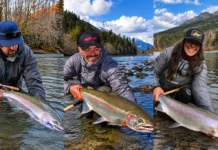
Marlon has a real soft spot for the Miramichi’s spring salmon fishery. These are Atlantic salmon that entered the river the previous year, spawned, and spent winter in the system before beginning their trip back toward salt water. As the river opens, the fish begin reconditioning. They’ll feed on things already in the river before the smelt arrive, and once that bait shows up, the salmon can put weight back on quickly.
Marlon’s spring season opens April 15, and he now generally books salmon trips through roughly May 5 or 6 because springs have been getting warmer and the river has been opening earlier. After the salmon move on, the Miramichi’s brook trout fishing can turn on.
Spring fishing looks much more like a predator game than many anglers expect. Marlon compares some of his approach to steelhead fishing, using Skagit-style systems, sink tips, intruder-style flies, and bigger baitfish patterns.
When salmon get aggressive, the grab can be completely different from a subtle summer take. Marlon has even borrowed streamer tactics from the brown trout world, ripping flies away from the bank and watching salmon switch into predator mode.
New Brunswick regulations discussed in the episode prohibit adding weight to the fly, so the sinking line system does the work of getting the presentation down. Marlon also explains that Atlantic salmon water is fly-only with a single barbless hook.
One of the biggest advantages of the spring season is access. Marlon explains that while many famous pools become private later, spring gives anglers a chance to see and fish much more of the river, although non-resident anglers still need a guide on scheduled salmon water.
A lot of the spring fishing happens from boats. Guides anchor facing into the current and work flies across seams much like an angler stepping down a run on foot, except they can reposition the boat a few feet at a time and continue covering water.
Marlon prefers getting out and wading when the water, location, and clients allow it. But spring weather can be rough enough that sometimes even trolling becomes the practical way to keep a fly fishing effectively.
Marlon also talks about river etiquette. Even when a piece of water is technically first come, first served, he respects anglers and camps with generations of history on particular runs and has developed his own water over time.
Atlantic salmon may be the name most anglers associate with New Brunswick, but Marlon’s season shows just how much more is available. Smallmouth, muskie, striped bass, brook trout, and sturgeon can all become part of the fishing calendar.
Geography helps break things down. Fredericton makes a useful central starting point, with salmon and trout water generally to the north, warmwater opportunities like muskie and smallmouth through central New Brunswick, and striped bass fishing toward the south and Bay of Fundy.
Marlon backs off the smallmouth once they’re spawning rather than targeting fish on beds. As that bite changes, it’s also a signal that muskie season is coming into play.
Muskie were actually what pulled Marlon toward New Brunswick in the first place. He quickly learned they weren’t going to behave like the smallmouth fisheries where catching 20 or 30 fish could be part of a day.
For fly anglers, timing matters. Marlon likes roughly mid-June into mid or late July, plus the late October and November period, depending on the water and conditions. In fall, that slower presentation and the ability of a big fly to hang and breathe can become a major trigger.
Marlon says muskie fishing with a fly is almost its own sport. Anglers are blind casting big flies rather than waiting for a guide to point out a fish, so knowing how a muskie wants a presentation to move can matter just as much as casting mechanics.
Striped bass may be the surprise fish in this episode. Marlon describes spring and early-summer opportunities around the Miramichi and other northern rivers, including fish chasing gaspereau into heavy current.
We’re talking about swinging and stripping flies around serious whitewater, with fish Marlon says average around 35 inches in one of these fisheries and can push into the low 40-inch range. The current turns an already strong fish into something else entirely.
Early starts matter for some of these fish. Marlon may push upriver around 4:00 or 4:30 in the morning, fish until the bite fades around 9:00, then head back out in the evening. He recommends packing for everything because early June in New Brunswick can bring a huge swing in weather.
Marlon also mentions guide Mike Bordeau, who may spend 45 minutes or an hour searching with sonar before stopping on a school of stripers. The point is to be patient and let the guide find the right fish before getting started.
For somebody trying to put together three or four days, the best timing depends on the fish at the top of the list. If Atlantic salmon are the priority and the goal is simply to connect with one, Marlon points toward April 15 through the first week of May.
Late June into early July is a different kind of trip. That’s a great window to combine muskie and smallmouth in moving water, with long summer days giving anglers enough daylight to fish a morning session, take a break, and switch species later.
October offers another Atlantic salmon option as rain returns, rivers cool, and New Brunswick moves into fall color. Marlon also notes that summer salmon fishing can face closures or shortened fishing hours when water temperatures become too warm.
Away from fishing, Marlon recommends exploring the coastline, small fishing villages, local diners, cafes, secluded beaches, and the places that don’t necessarily make the tourist brochures. That’s part of what makes a New Brunswick trip work even when you’re taking a break between fishing sessions.
Episode Transcript
WFS 978 Transcript 00:00:00 Dave: For generations, the Miramichi has been one of the great names in Atlantic salmon fishing. But there’s a short window each spring when that famous river becomes a very different place. Today we’re heading into New Brunswick to find out why. Spring might be one of the best times to explore the Miramichi. How these salmon behave differently after spending their winter in the river. And what else is waiting across a province that has a lot more going than just Atlantic salmon? Marlon Prince is here from New Brunswick Fishing Guides. And today we’re going to find out why. April fifteenth might be a good time to start thinking about Atlantic salmon. He’s going to get into their program there. We’re gonna find out what happens when these fish start feeding on smelt. We’re going to also talk about muskie and how this led Marlon into fly fishing in the first place, including a ten weight giant flies how he got into it all. We’re gonna get that story and why late June and July can open up a completely different trip where you can fish for muskie, smallmouth, and all sorts of species. We’re gonna get into the whole program. This is New Brunswick on the fly today. Marlin has spent years guiding this area and today you’re going to get the background on it. You can find Marlin at New Brunswick Fishing guides dot CA. Here he is. Marlon Prince, how you doing, Marlon? 00:01:12 Marlon: I’m doing awesome, man. It’s, uh, mid-summer here. Uh, we got a trip going this afternoon. So nice. Cool to sit and chat and, uh, yeah, we’ll be back on the water here this afternoon. 00:01:21 Dave: Sweet, sweet. What are you going for this afternoon? 00:01:23 Marlon: Uh, today we’re going to probably do a mixed bag. I’ve actually got some guys who want to catch their first muskie on, uh, either gear or fly. And then, uh, if we do get into some fish or if things aren’t happening and they want to take a break, they actually asked me to, uh, bring out some fly rods and teach them how to fly fish. 00:01:40 Dave: There you go. Sweet. That’s pretty awesome. Well, we’re going to talk about that. You got a diversity of things you cover there, uh, in New Brunswick. And so we’re going to touch base on that and as we go here. But, um, yeah, maybe just why don’t you take us back to, you know, how you came into, to what you got going here, you’ve got a bunch of things going fly A conventional, a bunch of different species. How did you get into all of this? 00:02:00 Marlon: I mean, I guess I’ll start from the beginning. I grew up in, uh, in Ontario, and I spent my summers on the French River in northern Ontario, which is kind of a famed muskie, walleye, pike, bass water. You know, for me, it was it was my dad getting me out. And it was all about more the experience than just fishing for him. Anyway, I really latched onto the fishing stuff at a certain point. I remember, uh, I remember at one point he said, if you’re gonna out fish me, you know, you’re going to tie all the knots, you’re gonna read the maps, you’re gonna do a lot of this work. I’m not going to get your snags out anymore and that sort of thing. So I kind of joke sometimes people ask me when I started guiding and I said, oh, about eight years old. Right. So obviously, you know, I, the, you know, the outdoors is dear to my heart. It’s something I grew up doing fishing kind of took a back seat for quite a few years. I, I, I went out west chasing the oil money in Canada, like a lot of young men did. I do have regrets not, uh, not being as much into fishing out there. I did a little bit of pike stuff, but I missed a lot of angling opportunities regardless in, in, uh, you know, in my late twenties, mid twenties, I started coming out out east where my family had moved and I really fell in love with the East Coast. I found out, you know, there was there’s a lot of angling opportunities out here. Some species I knew, uh, and some species I was completely unfamiliar with. And I just caught the bug. Like it just, it just got bad, you know, it got it got to be an obsession. Uh, and then it even kind of doubled when I picked up a fly rod. And I kind of got into the fly stuff ass backwards. Uh, compared to most people, my first rod was a ten weight. And, you know, I’d spend the winters kind of watching YouTube videos and being out in my driveway while it’s snowing, casting these giant muskie flies. You know, I saw some muskie on the fly stuff, and I just thought it was like, I’ve said it before, I think it’s the most punk rock thing and fishing. And it really appealed to me. So, uh, that’s how I got into fly fishing. And then I realized, you know, muskie season takes a while to get here. So I bought myself a five weight, started practicing, you know, on local trout streams and smallmouth and stuff like that. And, uh, yeah, the, the bug really hit me and then I started tying flies and, uh, I guess the rest is history. I, I just kept doing it and eventually ended up, uh, making it how I make a living now it’s, it’s, uh, it’s a dream come true, man. 00:04:09 Dave: Amazing. Yeah. It’s, and you’re at a, in a cool area. We were, we were on our way to fish for Atlantic salmon my first time kind of out that way and flew into Nova Scotia before jumping up to Newfoundland. So. And you’re kind of right in that area, right. You’re just a little bit closer actually connected to Maine. 00:04:25 Marlon: Yeah, yeah. At the time when I when all this started, like I said, when I moved out East, I was actually living in in Truro, Nova Scotia. So I, I, I, I had a really cool job that allowed me to travel the province. Um, I was working in the service industry, like going into people’s homes and, uh, and doing security systems. But, uh, I got to drive around the province and my boss would let me and I said, hey, do you care if I camp? And like, if, if I’ve got to drive six hours away from home and eight hours, you know, the next day of driving, like, can I just camp on the road? I’ll grab a shower at a gym or a truck stop. So I just pack my waders van and my wading boots. I don’t think they I don’t think they dried out for a year. They were just always wet. You know, I was just always exploring all the different new water and stuff. It was, it was a really cool, uh, period of my life to be able to explore all the whole East coast, right? And get familiar with all these different species we have. 00:05:14 Dave: That’s cool. Were you covering exploring all of Nova Scotia or are there in other areas? 00:05:19 Marlon: Yeah, most mostly Nova Scotia at that time. But I would I would dip up to New Brunswick as well. The Muskies are what really kind of attracted me to New Brunswick, a funny story. I remember kind of talking with my dad saying, hey, we should go up and try these muskies. We never fished them in Ontario. I caught one like a month or two before I went out west, and I thought it was a cool thing to check off the bucket list. But I remember thinking, you know, instead of catching like twenty or thirty fish a day, like we typically would with like smallmouth or something, you know, I figured we’d go out and catch a couple every day. I knew they were a little bit harder to catch, But I learned pretty quick that wasn’t the case, and it took me a little while to get to that point. Like, you know, ten, fifteen years to the point where, you know, I can confidently say most days we’re getting into a fish or two. At least. 00:06:02 Dave: That’s right. That’s right. Cool. And what is it? Maybe on New Brunswick, maybe talk about that a little bit. What are the, you know, top species you think people are coming there for? And, you know, is it different than Nova Scotia, different from Maine and kind of the surrounding areas? 00:06:18 Marlon: Yeah. I think, uh, you know, when most people think of New Brunswick and the East Coast in general, they’re thinking of that, that famed Atlantic salmon culture. And that’s still there. You know, there’s, there’s certainly some struggles in that world. Um, but, you know, I still guide for Atlantic salmon and there’s still Atlantic salmon fishing to be had. Most people don’t realize where they didn’t realize, I think in the past few years, past ten years, really that the spotlight has been shone on, uh, our smallmouth, our striped bass, our muskie, uh, even our sturgeon. You know, there there’s a, there’s there’s quite a few angling opportunities out here that are very diverse. You know that especially whether you’re a fly angler or a traditional gear angler, there’s a lot that fills my season as a guide. You know, I, I kind of bounced around all over the place through the season and, and do a number of different things. 00:07:04 Dave: That’s cool. Is the, it sounds like you do a little bit of teaching from beginners. Is that something that, uh, fills up your, your year a little bit where you get people that are kind of conventional fishing and that they want to test out fly. 00:07:16 Marlon: I get a mixed bag of new anglers like, uh, you know, whether they’re just new to fishing altogether or new to fly fishing. More and more, I’m seeing muskie anglers that have never touched a fly rod. And they want to, they want to try the fly side of things. Uh, and believe it or not, I, I really prefer those guys, you know, muskie fishing on a fly. It’s almost a completely different sport. And, you know, you get those guys and they’re like, oh, I’ve caught, you know, a hundred pound tarpin or, you know, I’ve, I’ve caught this and that around the world. And it’s really a different game because we’re blind casting big giant flies, you know, we’re not sight fishing these fish, right? Like, I don’t want to trip. You’re casting when the guide tells you to and you see a fish. We’re working hard out there, right? And it really is advantageous for an angler that knows what a muskie is gonna eat, that knows what that presentation should look like, whether it be the speed or the erratic movement on the fly. Once I get those guys, you know, their mechanics down and the basics of throwing the fly, the presentation comes a lot more natural to those guys. 00:08:15 Dave: Yeah, it’s it’s, uh, it’s pretty cool. We went up to a lodge up in Scott Lake Lodge in Saskatchewan, fishing for pike and nice and right. And, and we met up with, uh, you know, it was like half kind of conventional, half fly. And it was pretty cool because a couple of the guys at our table, we met at the hotel, Mike and Dave, they were conventional, you know, they were going for Northern Pike. They had been there like many years, multiple years. And, uh, and it was cool because they were really interested. The fly, right? Same thing. They were like, oh man, it sounds, it sounds great, but maybe, you know, maybe it’s a little work getting into, right? How does that look for you if Muskie, you know, if you compare muskie fishing for fly conventional, is it about equal or is it is it harder to catch a muskie on a fly? 00:08:55 Marlon: Man, that’s such a loaded question. I think it really depends on the situation. Right. And the time of year and the water that you’re on after, you know, after fifteen years of doing this thing up here, I, I, I really, I really set my schedule. Whereas in the past, you know, it was a little bit tougher. Like, you know, I would take the trips and there, there are opportunities through the river at different times. I just can’t be bouncing around as a guide as much. So I think my success rate has really gone up when, you know, I know the best windows of the year. I know when that that specific fly water is going to fish a certain way. And, you know, I load my schedule that way. So if someone calls me for a fly trip, you know, I’ll, I’ll tell them like, there’s always a chance and I can always teach you how to do this, whether the fish are going to react or not. You know, if your goal is to really get into a trophy fish, then, you know, I’m going to recommend a certain time of year, you know, and a lot of times those clients are coming back year after year. So it’s getting tougher to get on the schedule for people, uh, for that fly for that fly bite. 00:09:52 Dave: It is. And when is the like, you know, again, it’s, there’s probably a mix, but when is the time? When’s the best time? 00:09:58 Marlon: Yeah, it kind of bookends my season to be honest. Like, uh, you know, usually kind of mid June into mid or late July or, uh, November, you know, like late October, November, you know, those big fish in the bigger water, you know, a lot of times in the summer, they’re just, they’re just too deep for us to target here. And they’re just, you know, or, or they just want it so fast. Like, you know, if I’m running a trolling trip with two conventional gear, I’m running some days upwards to six miles an hour. Uh, no one’s going to be able to pull a fly that fast from sun up to sun down and, and be able to, you know what I mean? Be able to walk at the end of the day or talk at the end of the day. So, um, yeah, you know, in the, in the fall, that slower presentation, that big hang and the way those flies can breathe without moving, you know, forward is, is, uh, is really a trigger for the muskies. 00:10:44 Dave: Gotcha. Yeah. Another you mentioned, you know, start the Atlantic salmon. You know, that’s what we were heading up to Newfoundland for. And, you know, New Brunswick has the Miramichi, right, which is a super known famous river. What does that look like for Atlantic salmon? Are you fishing? What rivers are you fishing? Are there a bunch of different rivers in New Brunswick to fish? 00:11:02 Marlon: So I, I do guide the Miramichi. I’m actually hoping that that we’re going to get some, some kind of media or like a little mini documentary done on the spring fishery. You know, let’s, let’s just call what it is. A lot of people call them slinks, right? Or black salmon, the fish that have wintered over the river and they kind of get a bad name or that fishery gets a bad name. I, I absolutely love it. You know, it’s cold water. It’s fast moving water. It’s oxygenated water. These fish are, uh, you know, these fish are actively feeding. So it’s a, it’s a, it’s definitely a completely different game almost than your summer salmon fishing, right. There’s definitely opportunities to do it from shore or, you know, in waders, like on foot. I do prefer that myself. If there’s opportunities and I have the right clients, I try and set up that way. But a lot of the fishing is from a boat. But the really cool thing in New Brunswick, and I’m sure you noticed that coming to Newfoundland, there are there’s a lot of rules and regulations, not just how to fish for the salmon, but just getting on the water can be tough whether you’re in Quebec, whether you’re, you know, in, uh, Newfoundland, Labrador, or whether you’re in New Brunswick. Uh, it’s not always easy to get on that water. So what I love about the spring season is that the whole river is public. You know, I get clients that come out sometimes and, you know, they’ve caught a lot of salmon in their life, but they’ve never seen a certain stretch of water because maybe it’s, it’s private or it’s just so tough to get into that lodge that owns those pools. So in the springtime, we can we can cruise the whole river. I can, I can kind of get anywhere I want. And just to lay eyes on that water is, is something really special. That’s cool. You know, that’s, that’s what I’m hoping we can kind of document. And if we do get to film, what I’m hoping we will in the spring is just how special that spring season is. It’s it’s so cool to see, uh, you know, there’s history on that river. You can feel it when you’re out there, you know? And the other cool thing about about the spring salmon fishing is it’s a fantastic way for someone that hasn’t fly fished before or hasn’t caught a fish for Atlantic salmon. It’s a really good introduction to the sport. Generally, the fish are pretty active and taking. When the when the conditions are right and you’re still swinging a fly. You know, some people say, oh, those old you know, the old, uh, we kind of laugh. The old boys here, the old, those old black salmon come in like a boot. And, uh, that that couldn’t be further from the truth. You know, once they get reconditioned, I’d say about a man sometimes, especially these days where the ice is the river is usually flowing. By the time the season opens, they’ve been eating, they’re gaining some weight. And I mean, you’re gonna see backing man on a on a good fish. You’re gonna see backing and you’re gonna get fish up in the air. Um, they’re gonna put on a show for you. It’s really a fun, a fun time. I’ve, I’ve had guys come out that had this preconceived notion of what the spring fishing was. And after a day or two, they were like, you’re like, I don’t know why I come in the summer. And I and I swept my bag off and I grind through fish. I mean, hey, a chrome, you know, a bright chrome salmon is something, you know, I there’s no denying that that a spring fish is nothing like that. And that’s really a special thing. But, uh, you know, it’s getting harder and harder to get your to hook up with those fish. So the spring fishing is just, is just a heck of a lot of fun. 00:14:00 Dave: What is the spring? What does that look like? Because you have, I think of the, you know, I know there’s a variation, but I feel like, you know, Atlantic salmon, typically they’re coming in and, um, you know, sometime in that late June and then going through the summer spring wise. So what are these? These are fish. Describe that a little bit. What is the life history of these fish? 00:14:17 Marlon: So these are fish that have come up the year before and spawned. And generally, uh, you know, they, they hang out in, in slack water through the winter under the ice. And then once that ice starts moving, they’re going to be back on their way out. Right? They’re, they’re going to be on their way out of the river. But before they do so, they’re, they’re going to recondition themselves. They’ve got a big trip out to Greenland. You know, they’re going to hit that salt water. So, you know, they’re going to start off by eating things like leeches, like stuff that’s in the river. And then you’re gonna get a big smelt run, right. And, and for those who don’t know, smelt are like, uh, you know, four or five, six inch, uh, kind of shiny ocean run fish. And once they start eating those, those, uh, smelt, they put on some weight really quick. Some of these fish to like, the closer you fish to the salt water in these river systems. I’ve seen fish with sea lice on them that you could swear was a, was a bright salmon that that was coming in from the ocean. 00:15:05 Dave: Oh really? 00:15:06 Marlon: Wow. But they’ll actually leave with tides and come back into the river chasing the smelt. So they don’t. It’s not just one, you know, one line out of the river. Right. And I would compare it to I would really compare it to I’ve now I’ve never steelhead fished, but I, I use a lot of I study a lot of steelhead fishing. I use a lot steelhead tactics when you’re on shore, when you’re on foot, you’re using Skagit lines, you’re using sink tips, you know, and you’re using the same kind of flies that the kind of like, you know, intruders and stuff like that. Big minnow patterns, like almost, uh, almost like flat wing striped bass flies. I remember the first time I tied one of those on and, uh, yeah, it was like, Holy crap, this. Why haven’t I been fishing this for the last three years? 00:15:44 Dave: Right? That’s so amazing. Yeah. And the cool thing about Atlantic salmon is that, um, you know, they’re more similar to. Well, I mean, brown trout, right? They look like a brown trout, you know, and they so and I’m looking at some pictures on your website, on your salmon section. And I see, I see some Atlantic salmon. You can see it. They’re not chrome, but they’re not like dark, you know, these are just they’ve got their more of their colors, more their trout colors. Right. 00:16:06 Marlon: Yeah, exactly. Yeah. Yeah. It’s, it’s, uh, one thing that’s really cool that I was just the best way to the coolest thing about spring fishing, we call them tight line grabs where, you know, those summer fish, you’re kind of, you know, a lot of times you’re just skating like a bomber or something. You’re you’re trying to annoy that fish. Yeah. 00:16:22 Dave: Get him to come up and. 00:16:23 Marlon: Yeah. And that that takes sometimes, you know, they’ll, they’ll roll on a fly or they’ll, you know, they kind of sip it down type of thing when you’re swinging a fly through spring freshet condition. And it’s like, you know, that fly is moving out there. Like I said, it’s a lot like steelhead. If you get an aggressive Atlantic salmon, that that basically T-Bones that fly like I’ve even, I’ve even used like brown trout, like streamer. Kelly gallop style tactics, like drifting and ripping flies off the bank. And you see these fish come unglued. Like they, they turn into predators, you know, uh, and it’s really cool to see because anyone who knows, you know, those, those fish got wheels, man, and they got wings when they want to fly and, and get up in the air. So it is a, it’s a pretty cool experience when the fish turn on. It really is. 00:17:09 Dave: Check out Montana Fly Fishing Lodge, a twenty twenty four Orvis endorsed Lodge of the year finalist, where luxury meets adventure on one point five miles of private, wild and scenic East Rosebud River frontage. Experienced world class fly fishing on numerous Yellowstone Basin streams, gourmet cuisine made from locally sourced ingredients and rustic luxury accommodations. Surrounded by breathtaking wilderness, You can book your all inclusive Montana fly fishing adventure today and discover why they are the premier destination for unforgettable fishing experiences. Head over to Montana Fly Fishing lodge dot com right now. And is it like a. And it looks like it’s kind of a a month there. April mid April to mid May. Is that kind of the window? 00:17:51 Marlon: Yeah, we our season opens April fifteenth. And, uh, you know, it used to, I, I used to say like, you know, you’d get a good month into it, like mid May, the springs have been warmer and warmer every year. The river’s opening up earlier and earlier every year. So I’d say now like my, my salmon season, I, I book clients in from April fifteenth, usually into like, you know, may fifth or sixth just to be safe. The cool thing is though the salmon are gone by that point, the brook trout fishing on a mere machine just turns right on and, and can be really fantastic. 00:18:21 Dave: Oh, right. So you got brookies in the Miramichi. We’ve had, I think the first time I heard about it was when we had Trey Combs on the podcast a long time ago, and he was talking about some of the, you know, just the how great of a river it was and some impacts, but it sounds like there’s still Atlantic salmon there. This is like, how is that looking? 00:18:36 Marlon: Yeah, it’s it’s, there’s no denying that it’s, it’s, it’s a shadow of its former self. But I mean, we’re talking about what once was one of the greatest Atlantic salmon rivers in the world. So I, you know, I, I, I don’t know what the future’s going to hold the fish and, and the rivers itself are, are up against a lot. But to me, that’s all the more reason to get out there and experience while you can. You know, I tell a lot of my clients that, uh, you know, obviously we all hope for the best, but, uh, I tell clients that if they want their children to, to say they’ve been out on the Miramichi and caught an Atlantic salmon, like kind of now’s now’s the time, you know, and the springtime is the time to do it because because, you know, those fish are there. You know, those fish, you’ve got more fish in the river than, you know, theoretically, any other time except for the fall, really. But in the fall, they’re they’re doing other things. 00:19:22 Dave: Right, right. Oh yeah. Yeah. Right. And so the springtime, you have the fish that are, you know, basically all the fish are heading out, right? And the difference of and we had this happen on when we were up in Newfoundland, we, we found some fish. But, you know, they, they may have been there before and run through or, you know, and the water was higher. And so it wasn’t like we didn’t hit it perfect. But that’s just kind of salmon and steelhead fishing. You know, it’s hard. 00:19:46 Marlon: That’s it. Yeah. That’s the reality. Salmon fishing. I mean most salmon fishermen make very good muskie fishermen because they they understand the you know, the fish are there, but that doesn’t mean you’re gonna catch him. You know, you got you gotta grind and you gotta just, you gotta just love being out on the water for for fish like that, you know? 00:20:03 Dave: Yeah. That’s perfect. Well, I want to keep, uh, tie this up as we go here because salmon is a big one. But talk about and we talked muskie, you mentioned smallmouth bass. And just in general, New Brunswick. Now when you’re when people are coming up there, is it similar to with Atlantic salmon, you have to have a guide or what are the regs on that for somebody to say if they’re. 00:20:21 Marlon: No, no. So what what it’s called New Brunswick is scheduled water. I believe there are a few trout rivers that that are scheduled, but what scheduled water means is, is basically all salmon water, all, all water where that is open to Atlantic salmon fishing. If you’re an out of province angler, you have to be with a guide. So that’s that’s not how it works for muskie, smallmouth striped bass, that sort of thing. 00:20:44 Dave: Gotcha. So Atlantic is yeah. And if it’s a a small river without Atlantic salmon, then then that’s different. 00:20:50 Marlon: Exactly. Yeah. 00:20:51 Dave: Yeah. Okay. And so the other species you mentioned, and then what about the area around, you know, when you just look at New Brunswick itself, you know, north, south, east, west, what does that look like? Is are there opportunities? Have you do you fish around the whole area or are you focused in one area? 00:21:05 Marlon: I used to bounce around a little bit more. Like I said, now I’ve kind of got my set schedule and, and that’s a big part of why I, why I started New Brunswick fishing guides, right? Is because there are so many angling opportunities in New Brunswick. There’s guides all through the province. A lot of people, you know, they have they they have a bit of a hard time navigating that. It, uh, a lot of the East Coast, like Nova Scotia and New Brunswick doesn’t look that big on a map, but you’re still, you know, north to south. You’re still six or seven hours, right? So, you know, I, our website does a pretty good job of laying that out. There’s an interactive map that you can like kind of click on points and it’ll tell you what species and what guides are available there. But, uh, you know, getting in touch with, with, with a guide out here, especially with New Brunswick fishing guides, we all work together. So if you wanted that combination trip, you know, we can, we can help you navigate that, help with the logistics of what time of year and how you’re going to get from one place to another and what species you want to target. 00:21:58 Dave: Perfect. And let’s just say we were calling you now and, and thinking about heading out there for maybe three or four days, something like that. And, you know, and I was talking to you, what would that conversation be like? What would you be like? Where would you guide us? 00:22:12 Marlon: The salmon thing right now would be a tough crack. We have got a little bit of rain, but you know, water is warm. We are mid-August right now. So right now, you know, you’re, you’re looking at, uh, you’re looking at muskie. There are some muskie opportunities on the right water for fly fishing. Like if we’re just talking fly, the smallmouth fishing can be pretty good right now. There might be a mix of on foot and in a boat. I do run a jet boat like a jet drifter that I can get up into some pretty skinny stuff and do that kind of traditional drift boat stuff. But there’s a lot of great opportunities in New Brunswick that I think go overlook that are, uh, you know, smaller creeks or even bigger rivers that are just kind of dried up right now. There’s still pools and there’s still moving water that, you know, you can get out there and fly fish, you know, some whitewater kind of stuff and swing some flies and work those pockets and stuff. For Smallies, uh, striped bass is another big one. Most of the striped bass are out of the fresh water right now. They’re not going to be in your rivers springtime. That’s a really cool opportunity to, to, to fish stripers up against rapids where they’re chasing, uh, ocean run baitfish and herring and stuff like that. Uh, right now you’d kind of be fishing tides either, you know, mouths, the rivers on the ocean or even the surf. 00:23:20 Dave: Gotcha. And what is the area like if we were flying in or driving in where what part of the country or, you know, I think. 00:23:26 Marlon: Most people fly in that most people would fly into Fredericton for, for angling opportunities. It’s kind of central, you know, you’re you’re right in the heart of the Saint John River, the Saint John River Valley. And from there, you know, a couple hours north, you know, things get a little a lot more rural. And, and then up north towards Miramichi, uh, that’s where you’re going to get your, your salmon fishing down south towards Saint John, like, you know, along the coast, the Bay of Fundy. That’s where you’re going to get your striped bass opportunities. 00:23:52 Dave: Oh, I see, okay, so south striped bass and then, but the Atlantic salmon, mainly it’s Miramichi. That’s the big river. 00:23:58 Marlon: Yeah. So the north shore of New Brunswick is, is, uh, into Quebec. Like that’s going to be your salmon and trout waters. Everything’s a little bit cooler. You know, central is going to be your warm water species, like your muskie and your smallmouth. And then southern NB is going to be your, uh, your kind of your striped bass stuff. 00:24:14 Dave: Okay, perfect. And, and then so your season, you’ve got the summer now or in the summer. September is right around the corner. And then when does this kind of slow down for you? Or like when the winter comes? Typically, I know that’s been changing, but what does that look like? 00:24:27 Marlon: Yeah, I generally guide into late November into mid or late November. You know, like I said, there’s a really good there’s typically a really good fly bite for muskies. Uh, that keeps me busy, like kind of late October. And then obviously I do my traditional gear stuff as well. Those are kind of my hardcore guys that, that usually book, you know, five days, like they’re in for a week. They know that there could be a weather day that the wind’s going to blow or, you know, we could get snow or some brutal rain type of thing. So if you book five days in the fall, it’s awesome if you get all five, but usually there’s at least one weather day or something on the on those trips and those, those guys know that. But, uh, you know, anybody Muskie fishes know, that knows that we call it fall magic. You gotta grind for it. But but it’s a real thing. And, and if you stick it out, you can be rewarded in a big way. And as the weather turns and things get cold. 00:25:15 Dave: Awesome. And so and then you kind of close things down until the next spring time when the ice comes off. 00:25:22 Marlon: Yeah, I start now. This isn’t fly, but I do start with sturgeon. That’s that’s kind of the it’s kind of the only game in town when when you’re, when you’re looking at March and and the ice just starts moving. So I start my season run some sturgeon trips. Kind of a cool thing. We, we’ve got a, uh, we’ve got the only thriving population of short nose and Atlantic sturgeon in the world. Um, it’s the only place you’re allowed to target those two species. On a typical day, we’re putting a dozen fish in the boat. Some days we’re putting like, upwards of thirty five, uh, you know, into the boat. 00:25:53 Dave: And this is Saint John. Is this Saint John area? 00:25:55 Marlon: Yeah, that’s that’s the Saint John River. Yeah. So we do that in, in, in March into mid-April. And then I do my, my mirror machine migration. I, I’ll keep doing that. I just love it up there so much. And then I kind of bounce around. I kind of do a little bit of after the Miramichi season, I do a little bit of sturgeon kind of depends on the spring. Uh, and then we, we do have a, we do have like an incredible pre-spawn smallmouth bite And again, having the jet boat, being able to run up into those rivers where the smallmouth are, are staged to spawn. You get into some pretty cool fish in there. If it gets warm enough, you’re getting them on top. You know, a lot of times you are you’re using streamers. And then from there, once the smallmouth starts spawning, I back off them. I’m not the kind of guy that likes to target fish on beds or anything like that. I leave him alone. But that that’s your cue for the Muskie stuff to kind of start. So, uh, yeah, we get started on the muskies kind of early to mid June, and then it’s kind of a mixed bag through the summer, right? Muskie smallmouth for me, you know, I’ll even do some perch fishing and do some fish fries for people. Uh, we have white perch here and yellow perch, and we have fish called chain precursor, like small pike. And then the other guys are doing, you know, the other guys with New Brunswick fishing guides are doing the, the stripers and all that. I, I used to bounce around and, and I’d say my schedule was a little bit more diverse, but, uh, you know, I, I fill up so much and it’s just, you know, it’s, it’s, it’s a grind. It’s, it’s grueling. Uh, especially those months in June, like here, you know, June, you’ve got like sixteen, seventeen hours of daylight. Oh, sure. Sometimes I’m doing doubles and, and, uh. Yeah, it it can take it out of you. I typically take a little bit of a break early August just, you know, like that things are getting real warm. Uh, and then like, like right now, I, you know, I’ve, I’ve taken some time for boat maintenance, self maintenance, uh, you know, just, just that kind of break and getting ready for the fall grind. 00:27:40 Dave: Man. That’s awesome. Yeah. It sounds like you got, you got enough to keep you going, uh, throughout the year. 00:27:44 Marlon: Oh you. 00:27:44 Dave: Bet. And so, yeah, back to the same, I think, you know, out of all these, I mean, that would be amazing, right? Musky. All these species would be awesome to hop into. But I feel like the the Atlantic salmon, especially with the Miramichi. And that the unique thing about like you said, the spring time is that you’re able to fish a river. Some areas you can’t even fish in this famous river, you know, world famous. And you can actually swing flies right in the spring. Describe that a little more. What, like sort of gear lines you’re using on when you’re swinging those flies? 00:28:12 Marlon: We’re out of the boat. We’re typically using single handers, uh, a seven, eight, even a nine weight, uh, will get the job done. I actually, I really prefer like some of these new integrated Skagit lines, even on a single hander, they lend themselves really well to, to throw in that sink tip on, they make throwing a sink tip a lot easier. And you know, we’re running a short leader. You don’t have to have that like ten foot leader in the spring. The the fish are pretty aggressive and we’re generally running pretty big flies in terms of what Atlantic salmon flies are. I’m a predator guy. I like big like, you know, it doesn’t always get the job done. But you know, I, I’m not against, uh, downsizing when, when you have to, but we’re running, like I say, to kind of start, we’re running like lichee patterns, like maybe some zonker strips, you know, the fly here, they call it like the slime flies. A green slime is like, uh, basically just Palmer marabou over like a, you know, a one or maybe even a two fly. And then sometimes as it gets warmer, you do have to size down. If there’s a smelt run, you’re running like really smelly patterns, you know, basically or like I, like I mentioned earlier, like almost like a flat wing stripe pattern. We are the regulations here deem that, you know, you can’t run weight, so you can’t run lead heads or anything like that. 00:29:21 Dave: No weight at all. 00:29:22 Marlon: No, no weight at all on your fly. That’s right. 00:29:24 Dave: But you could use sticky lines. 00:29:25 Marlon: Exactly. So there’s a lot of traditional flies out here. You know, I, I, and I love the history behind some of the flies, like, you know, a gray ghost or a black ghost or renew special. Those are those are standbys here that always get the job done. 00:29:37 Dave: Oh, they do. So Gray ghost works well for, for fish in the spring. 00:29:41 Marlon: Oh yeah. You bet. 00:29:41 Dave: Yeah. So and then when you get out the spring. So it sounds like the river opens up. I mean describe that a little bit. Is it? There are sounds like you use the boat, but there’s not really as many runs to get out and wait and kind of walk through the run sort of thing. 00:29:55 Marlon: Yeah. You got to kind of know your river. I mean, it’s called the mighty Miramichi for a reason. It is a big, very long system. I’m fishing the the main southwest for the most part. You know, there’s a whole other branch of the river, the northwest that, I’ve honestly, I’ve spent maybe a day on that, that stretch of river. And that’s, you know, it takes a lifetime to get to know it. I’m a little different than a lot of the guides here. Some of the guides, you know, they’re either working out of a lodge or they’ve just got history on that, that stretch of river where, you know, they kind of stay put and they’re, they’re fishing that same water day after day. I do have my stretch, but I, I’m, I’m not opposed to running up and down the river or taking the boat out and kind of launching somewhere else. If, like I say, if the opportunity presents itself, they might have got the right clients. Not everybody has waders and not everybody wants to do stand in that cold water. But if I have the right anglers, I’ll certainly, you know, pull up onto an island or, or off the side of a run. And, and I love, you know, getting in the water. It’s, uh, to me, that’s how an Atlantic salmon should be caught. But it’s just, you know, you don’t always have that opportunity, right? It’s just where the fish are. And you, you gotta. So what we do, it’s kind of unique from a boat. Typically guys are running a pulley system with, uh, with a big kind of pulley and an anchor wheel off the front of their boat. And, uh, you know, we’ll, we’ll, we’ll drop our anchors, which are just, uh, big balls of chain, right? So I mean, the bigger the boat, the bigger the chain. I’ve, I’ve got like eighty pounds of, uh, of chain off the front of my boat just wrapped up in a ball. And what that allows you to do is your nose into the current, you’re either right up against the shore or just off the shore. And you’re, you’re just like you would be on foot. You’re casting usually ninety degrees or forty five down and across. You’re letting that fly, swing into that, that kind of current seam off the side. And, you know, then then you’re just, you’re instead of, you know, taking a few casts and stepping, I can either pull that anchor or put the boat in reverse, drag the anchor five to ten feet. And then, you know, that’s how you’re working your run. 00:31:53 Dave: Just covering the water. 00:31:54 Marlon: Yeah. There are guys that troll. I always said I’d never troll for an Atlantic salmon. But then you get out there in the spring and it’s raining and it’s like seventy kilometer winds, right? 00:32:03 Dave: And you can’t. 00:32:04 Marlon: Cast like, I think we have to troll today, you know, so there’s, you know, you’re kind of forced by the conditions sometimes. I, I always stay in the spring. You’re fighting the conditions as much as you are. You know, the, the fish themselves, right? Like, like, uh, sometimes it’s just a matter of getting those flies in. And, and, uh, I did come around to the trolling thing and there’s certainly an art to it, you know, uh, it’s not as easy as just, you know, you don’t just put a line out there and drive in a straight line where a lot of times we’re back trolling, like, so you’re basically swinging the fly with the boat, you’re taking big cuts and you’re making sure the client’s got got their rod at the right angle, and that you really do have to be ready. Like in some ways, trolling is almost harder for people to get that hook set because that boat’s moving in some really fast currents. Uh, then you’ve got to drop the anchor when you hook up, and they’ve got to keep that fish pinned on a single barbless fly. 00:32:54 Dave: That’s crazy. And looking at the river. So like you’re saying, there’s a split. So you have the Miramichi coming up as you head up river and then it splits somewhere. 00:33:01 Marlon: Is it the renews that. So the renews reduce is just a is just a tributary of the Miramichi, right. 00:33:07 Dave: Okay. So that’s just a trip, right? Gotcha. 00:33:09 Marlon: Yeah. Yeah, exactly. Then there’s the Cains River as well, which is like a super famous salmon River. And that’s got a really good run of trout as well. Big run of sea run trout, you know, so I, I actually fish around the Cains quite a bit in the spring. That’s kind of, you know, there’s, there’s no, uh, there’s certain etiquette I like to follow. You know, most guys wouldn’t mind, like most of the old guys will tell you if you ask them, they’ll say it’s first come, first serve. You get to a spot and it’s yours. But I know damn well that those guys that they’ve been fishing that spot since before I was born. So, you know, some of those spots I, I just lay off and, you know, I’ve kind of developed my own beats and my own water that, that, you know, uh, and I, and I kind of know when, when guys got a crew in, you know, like a lot of these camps, uh, are Americans that are coming up year after year. And, you know, they’ve, they’ve got the water that they’ve been fishing and it means a lot to them to be able to go back to that water. You know, even though, yes, I’m a guide and I’m running a business. I’m not going to step on any toes. And I think that goes a long way with those guys and helps you make some friends on the river, for sure. 00:34:10 Dave: Definitely. So after the spring, when does that is it kind of late June? You start to see the new fresh fish coming in. 00:34:17 Marlon: Um, I mean, guys are catching them earlier and earlier every year with the, with the warming water. So, uh, the river goes, goes back to, uh, you know, the private pools are in effect. I think it’s May fifteenth. You know, usually there’s not many people out there like that early, but, uh, by the end of May, you know, the hardcore guys are out there looking for those first chrome fish. And, and I’ve seen some big, big, you know, that’s your chance at those, uh, you know, those, those big bright fish that come in and power through and they can come in like the last week of May, first week of June. 00:34:48 Dave: Yeah. It sounds like for opportunities, like you said, just to see the river that month period in the spring would be cool because you can kind of cover it all or our guys coming up there. Is it a mix of people fishing for conventional and fly, or is it mostly fly? 00:35:03 Marlon: No. No. All Atlantic salmon fishing and all Atlantic salmon. All scheduled water in New Brunswick is fly. Fly only and single. Yeah, like no weight and single hook barbless. 00:35:13 Dave: Okay. And that’s including the April fifteenth through May fifteenth period. 00:35:16 Marlon: Yeah. You bet. Yeah. You bet. 00:35:18 Dave: Yeah. I see, okay, so it’s just that in that period, it’s not, it’s not scheduled. So you can, you can fish wherever you can get to. 00:35:25 Marlon: Well, it’s scheduled in the fact that you still, if you’re an out of town or if you’re, if you’re not from New Brunswick, you still have to hire a guide. 00:35:31 Dave: Oh you do. Yeah. 00:35:32 Marlon: It’s just not private. Right? It’s, it’s just not private water. 00:35:34 Dave: Yeah, yeah, I gotcha. So yeah, so to fish the Miramichi any time of year, you have to have a guide. 00:35:39 Marlon: That’s right. 00:35:39 Dave: Yeah, yeah. Makes sense. Okay. So perfect. And that’s why we got you on here because we’re, uh, we got the guide right here, so this is good. And then you sounds like you got a good crew of people. Have you been building that for a while? Your the other guides in your crew? 00:35:51 Marlon: I have, I mean, when I first got to New Brunswick, I could I really couldn’t believe that there was nobody advertising charters or guide trips. Like, you know, there’s all these fantastic angling opportunities, obviously, I guess I should say outside of the salmon world, you know, the salmon lodges and the salmon guides, that’s a rich tradition that’s been going on since, you know, the eighteen hundreds. 00:36:11 Dave: So there’s lodges on the Miramichi, plenty lodges? 00:36:13 Marlon: Oh yeah. You bet. Yeah. There’s there’s a lot of established lodges up on the Miramichi, you know that to get out with them and they all, some of them run spring trips, some of them don’t. But most of them do have guides in, in the spring. And it’s pretty cool to drive by one of the lodges. And you see all the boats lined up at lunch time, all anchored up on the shore and the sports coming out. It’s, uh, you know, there’s, there’s, there’s life on the river again, right? It’s pretty, pretty cool thing. But, uh, yeah, the, the rest of New Brunswick, um, there really is the odd guy kind of dabbling in it. Nobody was doing it full time. So that was a bit of a scary thing for me, making that leap, going from a, you know, a well-paid job with benefits and pension and that kind of stuff. And then, uh, you know, following your dream and, and taking that leap. But, uh, you know, it had got to a point where, where the calls just kept coming in, and then I knew I could fill my schedule. And then it just got to the point where, like I said, I, I was killing myself going, oh, they want a striper trip down here. And then they want to do muskies up there. And I, you know, with the price of gas and just, just physically, I couldn’t keep up. So, uh, you know, I, I figured, uh, I, there was kind of a big rush of guys, a lot of, lot of new guys starting. Right. And, and, uh, my, my idea was like, man, a lot of these guys, you know, they just didn’t have that experience and they weren’t offering the level of service or the level of guiding that I, that I thought, you know, really would set the bar. So my idea with New Brunswick fishing guides was to take the guys I knew that, you know, obviously there’s a little mini network of guides existing and, and guys, you know, and talk to and kind of send some trips to here and there. My idea was to take kind of the best of the best. And the guys who all shared that vision and create, uh, you know, basically a guides co-op is kind of how I, you know, just this network of guides through the province. And that way, if someone wants that multi-species experience or, you know, they come one year and then they want to come back, they do striped bass one year, and then they want to try salmon or muskie or whatever the next year. Then, you know, we’ve got someone that that we can confidently send them to that’s going to provide the same level of service, and they’re going to come back for years to come. 00:38:15 Dave: Exactly. No, this is awesome. I feel like you got you got things dialed in and I’m guessing people are coming through to fish other areas. Is New Brunswick or people hitting that than maybe going to Nova Scotia? Because there’s plenty of opportunities there too. What’s that look like for you guys? 00:38:30 Marlon: Yeah, absolutely. I think for years we were known as the drive through province. 00:38:34 Dave: Right. Oh really? Right. Yeah. 00:38:36 Marlon: Yeah. A lot of people would call us the drive through province. And you know, when I started guiding, I would get those guys that are like, yeah, I’m on my way to, uh, the Marguerite is a really popular river, Nova Scotia, right as salmon River. So they would stop and they’d, yeah, I’ll book a four hour trip with you or, you know, a day trip with you. And then I’m going to crash in Fredericton and then I’ll drive to, to, uh, To Marguerite, where I’m spending a week and more and more that, you know, we’ve we’ve highlighted, I think people are aware of all the angling opportunities. More and more we’re seeing we’re seeing New Brunswick become that angling destination where more people are coming for four or five days. I’ve got my regular clients or New Brunswick fishing guides as regular clients that that come with one guy for, for a year, and then the next year, they want a different experience and they’ll go with a different guy in a different part of the province. 00:39:21 Speaker 3: Stonefly nets, handcrafts, wooden landing nets, fly boxes and reel seats in little Rock, Arkansas, using premium hardwoods and burls sourced from landowners across the United States. Every piece is built by hand, combining traditional craftsmanship with the durability anglers need on the water. What makes Stonefly different is the attention to detail. You can customize your net with your choice of wood, and even add personal engraving to create something. 00:39:48 Dave: That’s truly unique. And these aren’t just pieces of gear. They’re the kind of tools that become part of your fishing story and stay with you for a lifetime. You can check in with Stonefly Nets right now. Just head over to Stonefly nets dot com. Check them out right now and get started today. Trout routes by Onix is built for fly anglers who want better Intel without spending hours digging for the information. You’ll get access to public land maps, stream access points, regulations, and even road and trail maps all in one place. It’s become my go to app for scouting new trips. You can check them out right now. Go to web dot com slash routes and download the app today. Well, back to that question. I was talking, you know, if we were calling you right now and just looking ahead the next year or so, you know, let’s just say we’re going to bring in some listeners on the podcast to meet up there. What would you be telling us as far as, you know, kind of when to set up a trip? If we had a few days, three or four days to come out to New Brunswick. 00:40:46 Marlon: I mean, obviously we spot we spoke in depth. If you if you want Atlantic salmon and you know, your goal is really to hook up with one unless you’re dead set on that bright fish. I would definitely say that spring season, you know, that April fifteenth into the first week of May. After that, if you’re into smallmouth fishing, you know that late May into early June, that bite is really good. That, or I would say like it picks back up when they recover from their spawn, like late June, early July is like a really cool time to do the combo. Muskie and smallmouth trip on the moving water. Like, like I know a lot of fly guys that’s, you know, that’s, that’s really fun stuff, right? And there’s a lot of water that time of year that it’s moving fast. It’s oxygenated, it’s not too warm. You know, uh, temperatures are pretty tolerable. And you’ve got, again, you’ve got like fifteen, sixteen, seventeen hours of daylight. So, uh, what some guys do is, you know, they, they, uh, they’ll do the morning session. You know, they’ll say, well, we’ll commit to muskies for the morning or small amount for the morning and then switch it up. You know, they’ll go take a break, get a nap in or, or, or just go get some air conditioning and, and get a bite to eat, and then come back out for an evening trip and do the other species right. August can be tough on the fly. You know, there’s there’s definitely opportunities. You know, I, I would say again, I wouldn’t highlight August as like a muskie opportunity. There are chances there. But generally I would say, you know, for August, you know, be be prepared for some hot temperatures. You know, be prepared for those warmer days and have an open mind on, on what can happen. Some years, the water just gets too warm to even fish for muskies, right? Like so I usually book August clients. I try and say like, you know, you just have to have an open mind and, and if we can’t fish muskies, we’ll, we’ll, we’ll do what we can do or we won’t have to go out and fish some smallies. And then again, like I say, October can be a great time for Atlantic salmon. If you wanted to get up on the Miramichi and, and get, you know, a summer run fish or a fall run fish, you know, usually by October we’re getting some rain again. The rivers are moving and, and, and, you know, the water’s cool. So that’s a great time for, for, uh, and just the foliage here. I mean, the colors fall in New Brunswick. It really is fall magic when the leaves start changing. It’s pretty cool that that usually starts late September. And then again, there’s there’s muskie opportunities then as well. There are some small enough opportunities that late, but it can be kind of hit or miss on a fly rod. 00:43:02 Dave: Yeah. So the October period for the salmon would be worthy that that period. 00:43:07 Marlon: Absolutely. Yeah. Yeah. Yeah. That’s that’s you, you know, you’re, you’re not gonna like in the summertime on the Miramichi and salmon rivers can actually have closures where, where, you know, it’s, it’s closed to salmon fishing. Or they’ll say, you know, you can only fish from six a m from sunrise until like nine o’clock in the morning, right? It just gets too hot during the days, which is not good for the fish. Right. And there are some great, uh, striped bass opportunities on the fly as well through the summer and, and into even late October. 00:43:35 Dave: Yeah. Gotcha. Wow. Yeah. So it feels like it would be either that early season or the later in October might be the best time to hit it for Atlantic salmon. 00:43:44 Marlon: I mean, we we haven’t even talked about the Miramichi striped bass as well. All right. It’s like I mean, the Miramichi striped bass is. It’s unbelievable really. You know, there’s some really, really cool fly opportunities for for anglers on the Miramichi in like, uh, I would say late May into like early June, mid May into early June. Uh, and then I even run some striper trips. It’s something I just started doing where there’s some of these, these, uh, we call them gaspereau here. They’re basically like picture of herring or shad. And they’ll run up the rivers in mid June and these big striped bass, you know, we’re talking, I’d say average size is like thirty five, thirty five inch, you know, you’re gonna get, you’re gonna get your low forties as well. But these like you’re fishing these things in whitewater, like you’re swinging flies into like big, like really heavy rapids. It is really cool. And they’re hitting top water. You’re gonna see back in like, you know, you want to hear an old hardy, real thing, uh, or get your knuckles busted up. You know, that’s a, that’s, that’s a really cool time to do that. 00:44:43 Dave: That’s crazy. And this is the Miramichi? 00:44:45 Marlon: Yeah, the Miramichi and that whole north shore. There’s opportunities. The Miramichi. Like I say, is like mid May into probably the first week of June. And then mid June, some of those fish will leave the Miramichi and they actually relocate to other areas. So that’s your kind of spring in the early summer striper fishing and then the Fundy coast. Uh, there’s fly opportunities through like, uh, late June into October. 00:45:07 Dave: Wow. Yeah. So now that you say the stripers, that kind of adds the X factor into it. 00:45:11 Marlon: Yeah. Well, yeah, I can’t not mention it because, I mean, you know, I never want to promise anything as a guide. You know, you don’t like throwing numbers around because it sets expectations. But, uh, you know, there’s days where, you know, hundreds are, are normal. 00:45:25 Dave: Wow. And these are fish that are, uh, stripers and, and you’re catching them out, like you said, on the coast too, but they’re coming in specifically during this period. 00:45:32 Marlon: Yeah. Those, those fish are coming into the Miramichi River. So a lot of that’s done from a boat in the, uh, kind of brackish water. Uh, you know, uh, that’s, that’s on the spring stuff. And then on the other side of things, like I say later, they’ll start busting into the rivers, chasing the baitfish. And then again through the summer. You’re on a boat fishing the Fundy coast or the Saint John at the Reversing Falls. It’s called. 00:45:52 Dave: I gotcha. So that June period. So you could fish for both really, if you’re there early June, maybe stripers and Atlantic salmon. 00:45:58 Marlon: Absolutely. Yeah. Yeah, absolutely. You can. 00:46:01 Dave: Well there you go. So I think you just build that. I think that would be a cool period to to do right. Because stripers is not something you can find everywhere. 00:46:08 Marlon: No, for sure. There’s, there’s even a little bit of overlap there. It’s not always going to be both on the I mean, it’s not always going to be a stripers on the fly. It is doable. But some, you know, on the right week it’s no problem to come up and and hit some stripers on the fly on the Miramichi and then up river. You’re still you still have runs of the spring fish that are on their way out. 00:46:28 Dave: Oh, right. And you still have spring in June. So June, you still have fish that are coming out still. 00:46:33 Marlon: Well, no, we’re not that. We’re talking early May. 00:46:35 Dave: Yeah. Early May. That’s right. What’s the striper gear used when you’re swinging and you’re swinging flies out of the boat, similar to how you’d be doing it for Atlantic salmon. 00:46:42 Marlon: For that, like mid June, um, that like where they’re chasing the bait fish up the rivers, that stuff easily done with an eight weight. I would more recommend though in that heavy water, you know, I wouldn’t say easily done with an eight weight. I guess eight weight is doable, but uh, generally like a nine, ten, even eleven or twelve weight. Like sometimes I’m using the muskie gear for that stuff just because I mean, man, these fish can be bulldogs. You know, they, they get in that big white, heavy weight water. They know how to use that current to their advantage. And those reels just man, they can, they can sing, that’s for sure. 00:47:14 Dave: What are you using? What’s your line. 00:47:16 Marlon: Generally? Generally because you’ve got such heavy current. You know, I, I usually have three rods in the boat. Uh, I’ve usually got an intermediate line, uh, a floating line for some topwater action with a popper rig. And then I’ve usually got a really aggressive, like, I don’t know, four hundred, three hundred and fifty grain, like, you know, saltwater, uh, thirty foot sink tip on there. You know, we’re using bigger, neutrally buoyant flies and that heavy water, you know, to get them down. You know, you got to have that heavy sink tip. 00:47:42 Dave: Yeah. So you got to get down here. So these fish are they’re down pretty deep. They’re chasing. 00:47:46 Marlon: Well they’re not necessarily down deep, but it’s just the water is so fast. Like, uh, you know, there there’s one little video I put on there like, like we’re talking whitewater. You know, we’re talking heavy rapids, waterfalls, that sort of thing, right? Where, you know, you’re flying barely has a chance to get down on, on a, on a swing. So you need that heavy sink tip just to get your fly down like three, four feet. 00:48:06 Dave: And the same sort of thing, casting kind of across and just getting. 00:48:10 Marlon: That. Yeah, that’s a mixed bag. A lot of times like that’s the best, that’s the most fun way to get them, you know, any, any fish on a kite line swing like that. But sometimes you’re, you’re hitting, you’re hitting those little slack pockets in between that whitewater and you’re stripping. Um, it just kind of depends on how the fish are acting. 00:48:24 Dave: Okay. And when you’re fishing, uh, for maybe let’s just go, we’re kind of bouncing around a little bit here, but on, on the Atlantic, I’m, I’m kind of picturing both of these things now in June, but let’s just say we have a day we’re swinging for Atlantic salmon. Is that that June period. Now it’s just you’re back to the dry line fishing bombers and all that stuff. 00:48:41 Marlon: Yes. Yeah. Yeah, absolutely. Yeah. The rivers, the rivers had a nice had a nice level. But yeah, generally you’re back to on foot and using floating lines. 00:48:51 Dave: Gotcha. And you guys are doing a, a decent amount of that Atlantic salmon kind of dry fly. 00:48:55 Marlon: I’m personally not I’m just I’m just so busy, like I say with my smallmouth and muskie, but I have guides that we have guides that are doing that sort of thing. 00:49:02 Dave: Oh you do? Yeah. Good. That’s awesome. Yeah. Because I think that the like I said, if I had to pick one, it’d be hard, right? It’d be hard to pick one because I feel like there, you know, stripers would be pretty cool that that might be the one just because I’m coming. You know, I would be coming from a little further away from stripers, although they’re out, you know, they’re they’re all over the country too, right? I mean. 00:49:20 Marlon: Yeah, they sure. 00:49:20 Dave: Are on the West Coast and awesome. Well, let’s take it out of here with just a couple of tips and tricks as we kind of kind of start to wrap this up here. But what is your, you know, biggest people are coming in to, you know, getting ready for this trip. What are you telling them if they’re coming in? Let’s just focus in on that, that striper game. What’s your advice you’re telling if we’re kind of getting ready for that early June period. 00:49:42 Marlon: Uh, for early June stripers, I would just say, I mean, early June in New Brunswick, pack, pack all of your, uh, clothing because the weather can change. Uh, you know, you have a cold front come through, you know, snows probably not going to happen in early June, late May. It could, you know, but I, I’ve seen it as hot as like, you know, forty degrees, which is like, you know, in the upper nineties. And, you know, I’ve seen it as cold as, as, uh, almost zero, you know, almost down to freezing in early June. You know, you could get rain, you could get wind. So just be ready for all different conditions. And at that time of year, yeah. You know, and, and, uh, pace yourself, I guess is the other big thing, right? Be ready to pace yourself. You know, a lot of times with like when I’m running striper trips that time of year in the rivers, we’re out at, uh, like the break of dawn. Like, you know, it’s no secret big stripers don’t like sunlight. So if you do have sunny conditions, you know, I’m probably gonna ask my clients that, you know, we we want to get out as soon as it’s safe to run the boat, essentially. Right. If there’s fog on the water, obviously I’m not going to run up. I’m not going to run a jet boat through skinny water. But, you know, I need a little bit of light. But we’re we’re pushing up that river at four or four thirty in the morning, five o’clock in the morning, and we’re fishing till around nine a m and then as soon as as soon as the bite dies down, you know, you can go in and enjoy your day. Go see the sights and the scenery, get a nap. And then we’re probably going back out around seven o’clock fishing till maybe ten, ten thirty. That’s when I’m running my striper trips, uh, kind of up, up north in the rivers on the Miramichi. They’ll generally bite during the day. So, uh, you know, you, you can, you know, you don’t, you don’t need to spend like the sunup to sundown out there, but, uh, be patient with, with the fish, I guess is the one thing there. I personally don’t guide that Miramichi system, but I know guides that do. Being patient with your guide like I, I one of my guides that that fishes up there, he’s Mike Bordeau. He’s one of the best uh, best of the best on the on the Miramichi striper system. And I, I personally know he’ll, he’ll spend forty five minutes to an hour just cruising around watching his sonar, trying to find you the most fish possible. Right. He’s not going to stop because he sees a pot of like twenty striped bass. He’s gonna stop when he sees a pot of like five hundred. Oh, wow. Right. Yeah. And then once you’re into them, you’re, you’re you’re into them, you know. 00:51:56 Dave: Yeah. You’re going, wow, this is cool. So so yeah, like you said, there’s a lot of opportunities. What is the, uh, you know, if you’re taking a break and looking around New Brunswick, what are some of the things people are doing other than fishing? Is the sights and stuff like that? What are people coming there for? 00:52:10 Marlon: I mean, the Fundy coast or just the coastlines are really kind of special. You know, I, I find a lot of New Brunswick’s, you know, what a lot of the stuff I love about New Brunswick is not on the pamphlet. I’ll say, you know, you certainly have your kind of tourist attractions and, and, uh, you know, your well-known spots, but, uh, just taking a drive up and down the coast, kind of meeting the locals. You know, New Brunswick is famous for for that that down home hospitality, you know, going into little cafes or diners or, or just cruising up and down the coast, seeing some of the small fishing villages and that sort of thing. I, I really enjoy that kind of stuff. There’s a ton of hidden gems that you’re not going to find on your apps or on the pamphlet, like I said. So just taking a cruise and, and, uh, finding that that kind of secluded beach or, or, or shoreline or lake or river or whatever, you know, for, for nature lovers, there’s, there’s a ton of that kind of stuff. 00:53:02 Dave: There is no, that’s cool. Yeah. When we were, when I was in Halifax, I stayed there just for a day and I went up to the, um, uh, you’ll probably know the place. It’s the, the thing on the hill where it was like the last place that they held kind of held the country essentially. 00:53:17 Marlon: I think is that Citadel. Hill. 00:53:18 Dave: Yeah. 00:53:18 Marlon: Citadel. Yeah. 00:53:19 Dave: Yeah, exactly. Citadel. And it’s really cool. They had a whole thing, right? They had a, it was just like a really cool just to see it. 00:53:25 Marlon: There’s a time. Yeah. I mean, the history here goes way back, right? This is where, uh, this is where a lot of the fishing and boats and and everything first kind of settled North America. So, uh, there’s a ton of history here to explore as well. Yeah. 00:53:37 Dave: Yeah, exactly. Cool. Well, this has been awesome. I think that, um, you know, we can kind of take it out of here and just had a couple random ones before we get out today. And maybe let’s just start with the kind of the tips again, you know, so Atlantic salmon sounds like that’s not your focus. You’re really focusing on, at least for you personally, the stripers, the smallmouth muskie, is that kind of what keeps you busy most of the year? 00:53:57 Marlon: Yeah, yeah, I, I do like I say, my striper season is pretty short. I used to do a little bit more striper fishing, but, uh, these days I just stay so busy with the muskie smallmouth sturgeon and then that short Atlantic salmon season. So that’s, that’s me personally, but like I say, New Brunswick fishing guides, we we’ve got our share striper guides as well, whether it’s fly or traditional gear. And then we do have guys that do that summer salmon. We do have guys that do, uh, summer brook trout as well, like, you know, spring summer brook trout, you know, that’s, uh, if you hit those, if you hit the, you know, it’s getting tougher and tougher for rookies everywhere. I think with, uh, you know, with the warming weather. But, uh, if you hit that C run like those fish that come in from the ocean, there’s, there’s some big trout to be caught. And, and again, I, I would, I would recommend, like, that’s kind of a, a late May into like mid June, maybe early July type thing. And then it can be a little bit of a dice roll with the weather. 00:54:49 Dave: Gotcha. And like you said, you’re today you’re heading out for Muskie. But muskie on the fly is not it’s not prime time because they’re a little bit deeper. Right. 00:54:58 Marlon: That’s right. Yeah. Just the stretches of river. I mean they’re if someone wanted a summer muskie trip, I can make it happen. But it would be the type of thing where I would need someone to come in for like, you know, a minimum of three days where I would have to relocate to a different stretch of river. There are angling opportunities. I just can’t, can’t only be in so many places at once. Uh, and where I’m kind of set up, you know, if someone wanted that, that August Muskie trip, I can certainly offer it. I would just have to, uh, like I say, it would have to be worth my time. And I’d have to kind of relocate upriver to get them. 00:55:28 Dave: That’s cool. What’s your muskie? If you know your big muskie tip or just in general, you know, if somebody’s trying to get into, you know, muskie is probably one of the hardest out there. What are you telling somebody, you know, whether that’s conventional or fly to help them. 00:55:40 Marlon: Listen to your guide. Uh, fish with confidence. I mean, what makes Muskie, uh, the fish of ten thousand cast is their is basically their metabolisms is really what does it muskies only eat once every three days. You know, that’s a that’s at their summer peak, right? They can go weeks without eating if they want. So you just have to remember they’re a fish that that isn’t going to eat all day long. And there’s nothing you can do to make them eat right on a fly rod. You’re asking them to eat a certain way. So put yourself on water where you know, you know, they’re going to be able to hit and, and will eat a fly presentation. And then from there, don’t burn yourself out. I, I really on the fly, you know, if I’ve located fish and I can tell that they’re just, they’re being lazy and they’re probably not going to eat. I’m going to look for something that, you know, something coming up, whether it’s a weather change, whether it’s a moon phase, whether it’s just a light change at sunrise or sunset. And a big part of my job as a guide is, uh, resting my clients is making sure that they’re not burning themselves out. I know you want to catch that fish, but if you grind all day through ninety degree weather and ninety degree heat, when that sun sets and the fish turn on, you’re going to be burnt out and you’re not, you know, you’re going to miss that strike. You’re gonna miss that hook set. So whether, you know, if you want to keep fishing, maybe we go pot through some poppers, throw the sticks, wait around for some smallies, and we wait them out. And, you know, you make sure you’re fresh and you’re dialed in and you’re confident and your presentation is on point. You know when that bite’s going to come. 00:57:08 Dave: You ready to go? Yeah. When we were I’m not sure the compare. I know Northern Pike and Muskie are similar in some ways, but I know when we were fishing up there to some pretty big northern pike, they were in the shallows and the bays like digesting their food and stuff, and they probably didn’t have to eat. But I remember Josh, our guide, was like he was describing like, you know, like if you had a French fry and you throw it on somebody’s stomach and it’s like, it’s just sitting there, you’re gonna eat it, you know, you’re gonna eat the fry. Yeah. And I feel like that’s what it’s like this cat and mouse game with the northern Pike. And they would take sometimes. Sometimes they wouldn’t, but sometimes they would take. Is that kind of how musky, I guess? Is it similar to that? Is it. 00:57:40 Marlon: I think there are periods where musky might not be hunting, but that French fry theory does hold true. But I also think more than more than with northern pike are any other fish that swims in fresh water. I think there are times where. Well, I know there are times I. I’ve even seen muskies like on the flats in the shallows warming up like you probably like you described in Saskatchewan, where I’ve been able to like, you know, first you think it’s a log and then you go, oh no, that’s a muskie sitting beside our boat. I’ve actually taken my rod under their belly, levitated them to the surface, and they just kind of roll their eyes at you and look at you like, why? Like, why are you messing with me, buddy? 00:58:17 Dave: Oh that’s crazy. 00:58:18 Marlon: I think there are just times where musky is so shut down that there’s nothing any angler can do with any gear that’s going to make them eat. You know, I mean, I’ve seen underwater footage where a muskies surrounded by bait fish of all types and sizes. And they, you know, they why aren’t those fish scared? Because they know that things they know that thing’s probably going to sleep for the next three days. 00:58:39 Dave: Yeah, I hear you. That’s it. Okay. Well, I got a random one or two, and then we’ll get out of here. So, um, you know, sports is kind of something I’m interested in. Although I don’t watch or play as much as I used to. What’s your hobby? What’s your thing you’re doing when you’re not fishing? Or are you just fishing all the time? 00:58:52 Marlon: I’m just fishing all the time. I do have quite a bit of, uh, experience. I played pretty high level ball and hockey, actually. 00:58:59 Dave: Oh, yeah. 00:58:59 Marlon: I played some high school football as well. Yeah. 00:59:01 Dave: Oh, there you go. So football. Hockey, that was, uh. 00:59:03 Marlon: What sport? No. Well, baseball was my big one. Uh, believe it or not, I was like. I was born in Cincinnati, Ohio, so. 00:59:09 Dave: Oh, wow. Okay. 00:59:10 Marlon: Baseball town. Yeah, yeah. 00:59:12 Dave: Oh, cool. So you’re born in Cincinnati and then moved up? 00:59:14 Marlon: Yeah, I moved up when I was real young. You know, a dad was. Dad was Canadian. So, uh, you know, I don’t remember much of growing up in Cincinnati. I’ve gone back to visiting here and there, but dad was a big Reds fan and and yeah, I grew up with a jugs machine. I, I was a catcher. Uh, I, I’ll tell you a cool story. I, uh, I was at an LA Dodgers camp in Toronto and, uh, you know, they time catchers leather the leather, right when someone’s stealing second base. And, uh, he said, you’re like, I was not some shave of a second quicker than Mike Piazza. 00:59:45 Dave: Oh. No kidding. 00:59:46 Marlon: Oh, my head, like, blew up and I had this big chest is out. I’m off. And one of the other scouts looks at me and goes, he’s by far the worst catcher in the major leagues. Don’t get don’t get too proud. 00:59:56 Dave: Oh, right. Yeah. Piazza was a great hitter. 00:59:58 Marlon: He was a great hitter. Maybe not the best catcher, but hey, but still, that was still a pretty cool compliment for a seventeen year old kid. You know, that is. 01:00:05 Dave: Wow. So you were. Yeah, you were going for it. You were in the kind of you had a thought. 01:00:09 Marlon: Yeah, yeah, we I played in a wood bat league and we’d go down and, and kind of tour, uh, Ontario Blue Jays Association is the organization I played with. And we, it was would bad and we’d go down the down south and go to Cocoa Beach, Florida every year. And I played with some guys that, that that went that went all the way and made it. The pros was pretty cool. 01:00:27 Dave: Yeah. That’s great. Yeah. Baseball was one of my sports too. I, I was kind of thinking just recently, well, we had an episode of that Newfoundland trip. I connected with Stephen Brunt, who’s like a sports writer in Canada. And he’s, he’s done all sorts of cool stuff, but he’s, he’s produced a few amazing movies and about really boxing. He and he had this one that he sent me after I said, and I just it’s George Chuvalo, right? He was a famous. Yeah, yeah, yeah. Right. So he did a couple of documentaries. Well, really just movies on George and that because he fought Ali. Right. Muhammad Ali, it was his whole thing. And God, what a cool story about that guy. Right? 01:01:00 Marlon: I’m gonna have to check this out. My, my father, I was actually named after a middleweight, uh, Marlon Starling. 01:01:05 Dave: Oh, okay. 01:01:05 Marlon: Yeah. My old man was a really big boxing fan. Uh, I have, uh, dad used to. Dad used to develop his own photos, uh, in his own black room and everything. And, uh, he lived in Florida for a while, and he’s got to. I’ve got black and whites of Ali sparring. 01:01:19 Dave: Oh no. 01:01:19 Marlon: Kidding. My father took. Right. Yeah. They look like they look super cool. So I got a couple write up on the fridge there. 01:01:25 Dave: Oh that’s amazing. 01:01:26 Marlon: Yeah. Pretty neat. Boxing’s, uh, boxing’s. I definitely grew up watching. You did? Yeah, yeah, we had, we had a, we had an Everlast heavy, heavy bag in the speed bag in the basement and everything. So I, I even did a little bit of training as a kid. Yeah. 01:01:38 Dave: So you did. Yeah. Well, you should definitely check out the, the movie he produced was called Facing Ollie facing. Okay. Right. So it was this movie, basically the premise was he, uh, he didn’t track Ollie, but he tracked the fighters who fought Ali in their stories. And it was really cool because it was like, Ollie, of course, this amazing guy who stood up to the government and right this whole thing. But but yeah, so, so check that one out. And then there’s another video. I’ll get you on that. But so, so cool. So baseball back to it for you was, was your sport and you were a catcher and, and what else like other than that, it sounds like that was your, your go to did you have any other, um, any other sport? You said hockey was your other big one. 01:02:14 Marlon: Yeah. I played pretty high, high level hockey. I played up to juniors. At a certain point you kind of had to decide, you know, it’s, uh, I wasn’t Deion Sanders, so I had to, right? I had to kind of decide, you know, was if I was going to focus on one or the other. And I, I chose baseball and ultimately I chose just to get out of, to get out of sports. It just wasn’t the life path for me. No regrets at all. Man. I, I’m, I like I say I’m chasing my dream now and I love what I do. 01:02:39 Dave: That’s awesome. Cool. All right. Marlon. Well, we’ll leave it there and send everybody out to New Brunswick fishing guides dot CA. If people want to connect and learn more about everything, I go on. But yeah, I appreciate all the time today and shed some light on New Brunswick. Uh, definitely excited to learn more as we go. So thanks again for all your time. 01:02:55 Marlon: Thank you man. I’m going to get prepped and get out on the water here. 01:02:59 Dave: All right. Hope you enjoyed that one. Hope you’re excited. The Miramichi is definitely been on my list for a while, so hopefully we can put this together in the coming years. And I’ve heard, I think the first time we mentioned it, we had on this podcast a guest that was talking about the changes in the Miramichi and some of that. So we talked about that today. But if you’re interested, definitely let me know. You can check in with me at Wet Fly Swing Pro. You can go to fly swing dot com slash pro, and we’ll let you know when we join and open up our next boot camp, which is coming very quickly. The boot camp, fly fishing boot camp right now. We’re going to be launching this soon. So if you’re interested, this is your best chance to get access to Wet Fly Swing Pro. Just join the boot camp and you’ll get notified when we open up the doors to Pro. This is where we’re building trips together. We’re answering questions. We’re just building a community to support you on your journey. If you haven’t done it yet, you can check with me anytime, Dave at web dot com. As always, love to hear from people who haven’t checked in. And in fact, I’m going to read one right now. Okay. Uh, had a great email from Rich, uh, rich H rich. I’m not going to pronounce your name because I’m not totally sure, but I know you know who you are from Apple Valley, Minnesota. And, uh, and here’s what Rich says. This is amazing. It’s probably one of the best emails I may have ever gotten. So rich says, hey, Dave, your podcasts get me through my work days at the plant. He said, Dave, you seem cool and clearly get the big picture on life. Dude, I was so moved by your father’s podcast, Real Life. I had to take time. I had to take a quick time out to gather myself because my own memories of a spectacular dad that introduced me to fly fishing. Montana, seventy in seventy four as a six year old on the Smith River. Fifty two years of gratitude and chasing my dreams in the river and lakes across the country. If you are ever in or near the Twin Cities, like to fish or cross paths with a brew, it would be an honor. You probably get a ton of feedback. I look forward to learning from you and your guests daily at this point. So powerful. Just started my steelhead journey getting crushed often, but remain hungry with intent. Thanks Dave for making such quality content. My son and I now share your podcast. He’s in Missoula studying fishing. God bless and keep rocking the pods and catching Rich H. Rich. Uh, I know we already. I connected with you on email, but I really appreciate that email and, uh, and your support, uh, and everyone out there. So if you haven’t checked with me, you want to send me an email, uh, just like that or anything that just says, hey, or if you have an episode topic, you want me to check in with anything you got, I’d love to hear rich I has the first time I heard from him and, and that’s what keeps us going, man. Community and doing something cool out there. And that’s what I think that’s what we’re all about. So, uh, so thanks again for checking this one today. Uh, and I hope you have a great afternoon. Uh, a great evening or morning, wherever you are in this country. And I’ll look forward to seeing you on the next one. Talk to you then. 01:05:46 Speaker 4: Thanks for listening to the Wet Fly Swing Fly Fishing show. For notes and links from this episode, visit Wet Fly swing dot com.
New Brunswick may always be tied to Atlantic salmon, but Marlon makes a strong case for looking beyond a single fish or season. From spring salmon on the Miramichi to whitewater stripers, smallmouth, sturgeon, and giant muskie flies, there’s enough variety here to build a completely different trip every time you return.
And if the Miramichi has been sitting on your list for years, that April 15 spring opener might be worth circling.