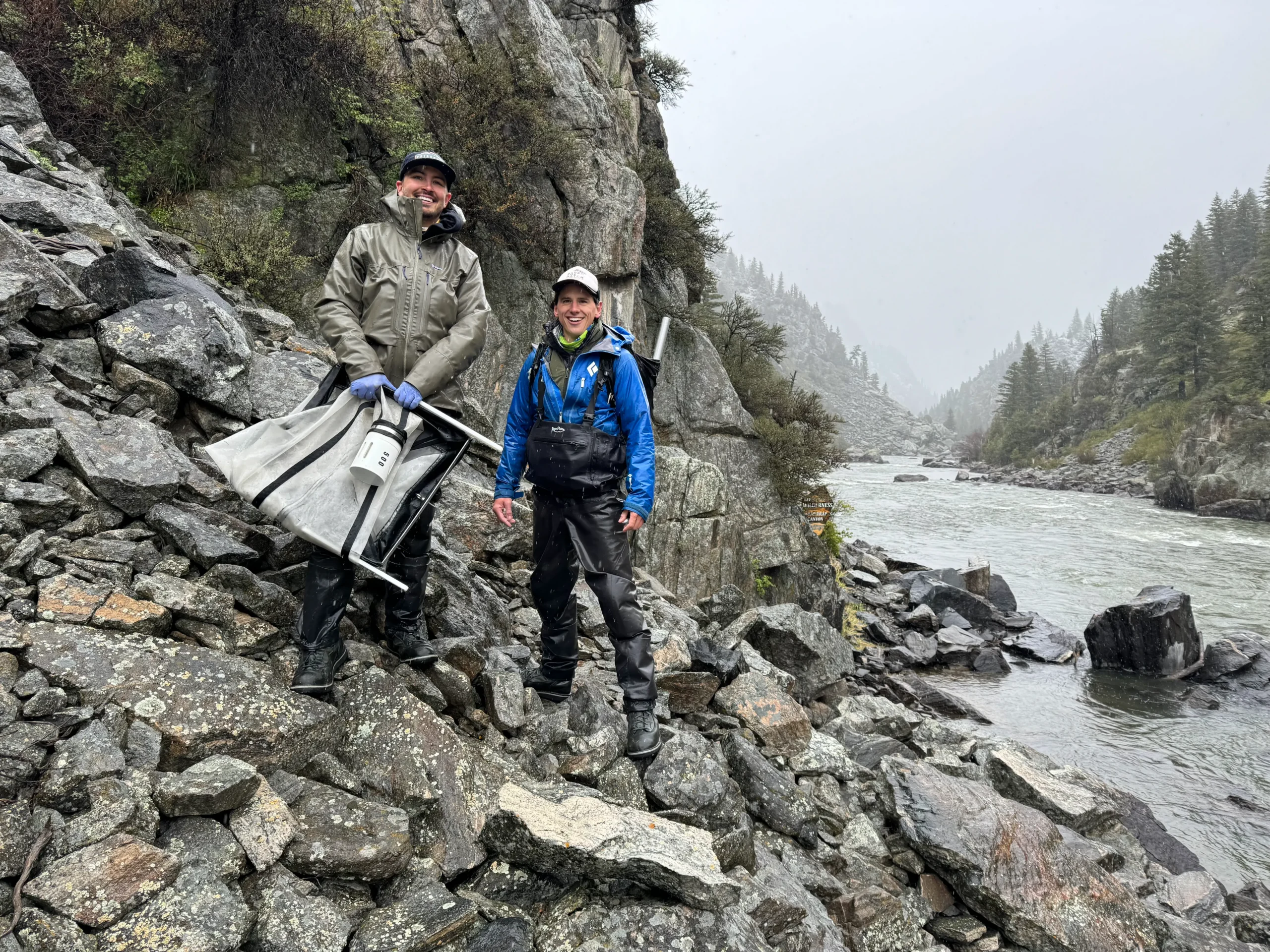
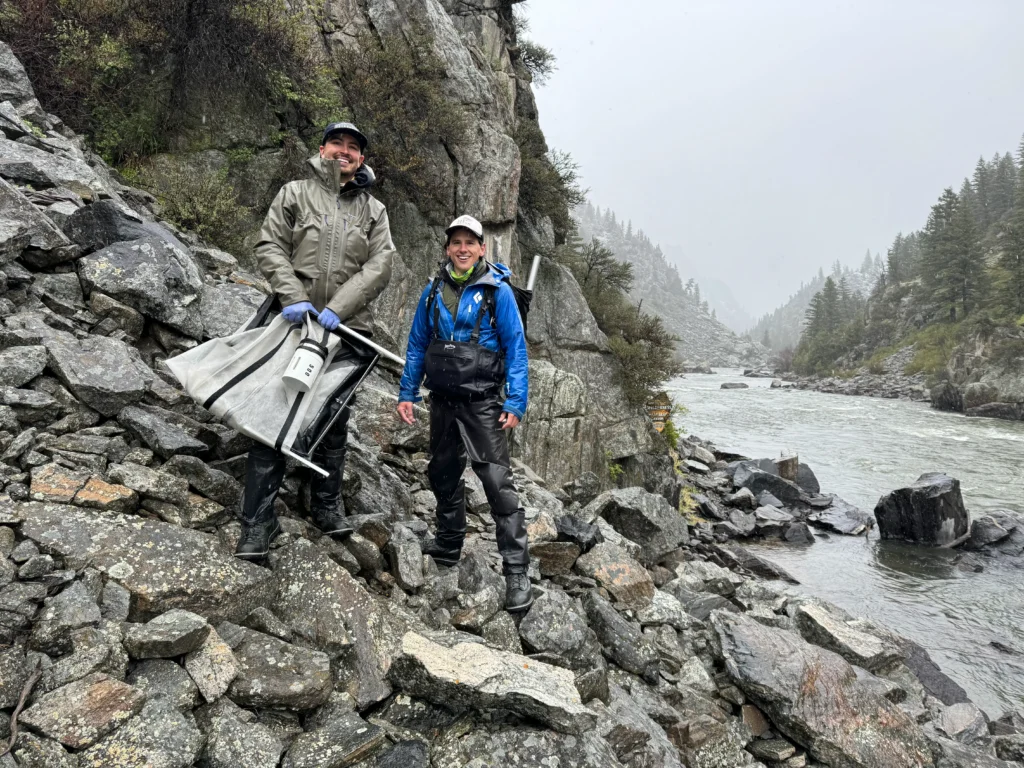
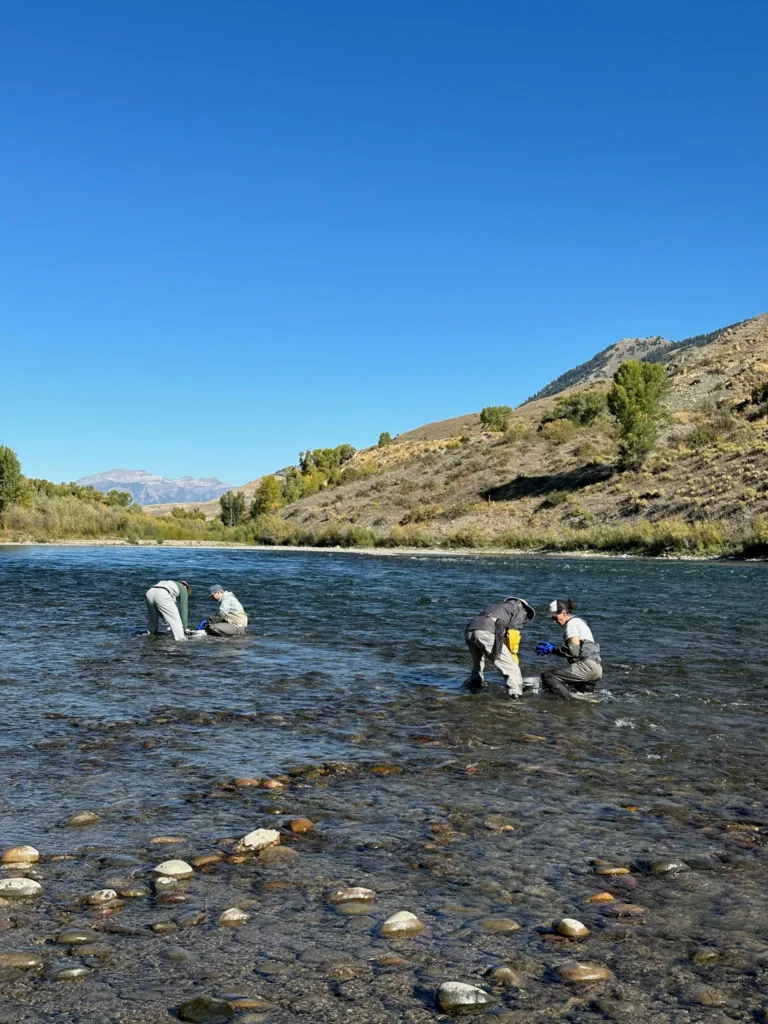
You’ll also hear how habitat, water quality, and insect life all connect, and what anglers can do to pay attention and get involved.
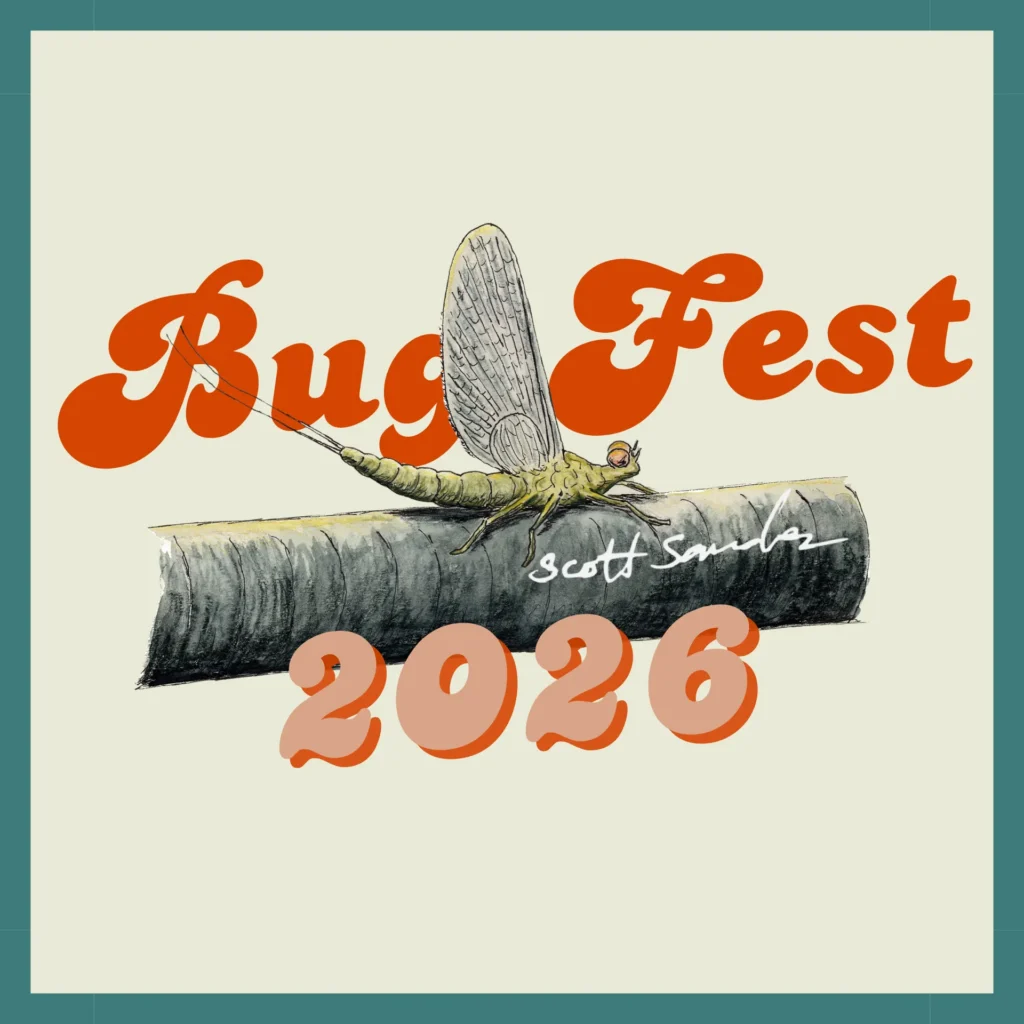
They also touch on Bug Fest, coming up soon, where you can learn more and connect with the project in person.
We love talking about destinations, gear, and the rivers we fish. But this one shifts the focus.
It all comes back to the bugs.
The insects drifting in the current and the small changes along the riverbank tell the real story. When bugs disappear, fishing changes. And when rivers start to struggle, insects are usually the first sign.
This episode goes deeper into the connection between bugs, water, and river health.
James and Jackson met in grad school at the University of Montana, working in the same lab studying aquatic insects. It was more like an apprenticeship, doing research together and learning side by side.
After graduating, they had the idea to start something of their own, and that turned into the Salmonfly Project.
Right now, their focus is out West. They’ve got around 17 projects across the Rocky Mountain region, including Montana, Idaho, Wyoming, Utah, Colorado, Oregon, and starting in California.
The higher the EPT, the healthier the river, since those bugs are more sensitive to change. Stoneflies are usually the most sensitive, followed by mayflies, then caddis.
There are a few exceptions, like the Madison, Henrys Fork, and Deschutes, but in general, big tailwaters don’t have them. They do best in water that’s cool but not cold all the time. That slight warming helps them grow.
James and Jackson break down the main stoneflies anglers should know, from biggest to smallest.
They also mention a few others that don’t get talked about as much.
Since they’re a small and growing nonprofit, even small support goes a long way.
In some places, populations have dropped sharply over time. The goal is to use that data to flag problems early and help states recognize species that need protection. That can lead to more research and conservation before things get worse.
A lot of the issues come down to water, and it’s different on every river. Things like drought, water use, and temperature all play a role. They share a few simple things anglers can do:
Follow them on socials, check out their work, and stay updated on events like Bug Fest and ways to get involved.
Episode Transcript
WFS 914 – Salmonfly Project
00:00:00 Dave: We love to talk about the destinations and the gear. The rivers we travel to, the rods we carry, the flies in the box. But the heart of fly fishing lives in the bugs drifting through the current and the small changes happening along the riverbank. Because when insects disappear, the fishing changes. And when the rivers change, the insects are usually the first to tell the story. Today’s episode goes deeper into that connection the relationship between bugs, water, and the health of the rivers we care about. The Salmon Fly project is working across the West, studying aquatic insects and helping anglers understand why bugs like salmon, flies, stoneflies, and mayflies are more than just patterns in the fly box. This is the Wet Fly Swing podcast, where I show you the best places to travel to for fly fishing, how to find the best resources and tools to prepare for that big trip, and what you can do to give back to the fish species we all love. James Frakes and Jackson Burrell are here, and they’re going to talk about the Salmon Fly project. This is a program and a nonprofit they created to help discover population levels of insects. We’re going to find out why insects are one of the most important indicators of river health. What salmon flies and other stoneflies can tell us about changes in Western rivers that are currently happening, how the connection between habitat restoration, water quality and insect populations can affect fish, and how you as an angler can play a role as a conservation citizen scientist. And we’re going to show you how you can get involved in this, how you can support to protect our species today. This is a really big one. Plus we get into Bug Fest. It’s right around the corner. And if you are interested and you’re going to be out west, you got to stop by Bug Fest and check in with the guys. Learn a little bit about aquatic insects. Here we go. James and Jackson. You can find them at Sam and Fly projects. How are you guys doing?
00:01:51 James : Great. We’re doing great. Thank you for having us. Thanks for having us.
00:01:54 Dave: Yeah, yeah, definitely. This is going to be good. I’ve got James Frakes on and Jackson Burrell, who and I don’t know the whole story, you guys. So this is going to be really cool today to get this. But you guys, I’ve heard a lot about you in recent months, the Salmon Fly project. Um, you’re doing a lot to collect aquatic insects to understand more about the streams. We’re going to talk about that today, how that applies. You know, I think we talk a lot about, um, you know, bugs come up, but I think a lot of people don’t understand the life history. And so we’re going to talk about that here, but maybe just give us a heads up before we jump into some of the, the cool nerdy bug details. Did you guys start this? Was it just you two starting this together?
00:02:31 James : That’s right. Yes. We we are the co-founders of the Salmon Fly Project. That’s right. Jackson and I, um, we met in grad school, actually, we were working in the same lab at the University of Montana. And, uh, one day we had this wild idea to start a non-profit after we both graduated. And this is what it’s developed into.
00:02:49 Dave: No kidding. So you guys started and were you guys in, what was your degree in? How did you guys first met?
00:02:55 Jackson: Yeah, absolutely. So I joined the University of Montana for a PhD in what was that, twenty eighteen? And James was finishing up his undergrad when I started my PhD. Um, and we were working in the same lab. So, you know, when you’re going to grad school in the sciences, you basically, it’s almost like an apprenticeship you work with. And for a professor doing research. And the same professor that I had joined forces with to do research with, uh, James was helping out in that lab to do research and learning a bunch of stuff. And then he jumped on a Masters after he graduated. And there was a ton of crossover between our research questions. And that was, of course, an entomology lab. We were focused on aquatic insects. Uh, no surprise, you know, given that we ended up doing the same project.
00:03:40 Dave: Nice. Yeah. This is exciting to hear the story. And we’ll dig deeper into the story. For those that don’t know what the Salmon Fly project is, maybe we can just start there so people out there can understand what it is you guys do and how maybe they can get involved.
00:03:53 Jackson: Absolutely. So we are an aquatic insect conservation non-profit. Our mission is really simple. We conserve aquatic insects and the fisheries, ecosystems and people they support. So we have a vested interest in not only the biodiversity and conservation of the bugs themselves, but also the fisheries. Fly fishing as a sport, as a recreation, as an industry. Um, and we perform tons and tons of research and monitoring projects. And all of that is geared towards developing data to support conservation. So there’s not a whole lot of bug or aquatic insect focused conservation that goes on at a large landscape scale. It’s pretty fish focused. And that makes sense because, you know, people like to catch fish, but the, the bugs are really what holds the ecosystem together. Um, so we develop projects collaboratively with government agencies, other non-profits, universities to get data on the status and trends of our insects. Threats. Conservation solutions, because that’s really what you need to do management to do restoration at a watershed scale. So we develop data and then we work on implementing boots on the ground sort of solutions.
00:05:05 Dave: Amazing. And are you guys working focused in the West around the country? Do you have a goal to kind of conquer the world? How does that look?
00:05:13 James : Yeah, right now we are west wide. We’ve got about seventeen different projects going on. Um, blue ribbon trout streams all across the Rocky Mountain West.
00:05:23 Dave: Okay.
00:05:24 Jackson: And our organization is based in Montana, so we graduated from the University of Montana. We kept it. You know, our home base local to Missoula. But right now only about half of our projects are in Montana. Um, we have a lot of projects in Idaho, Wyoming, Utah, Colorado. We have one in Oregon and some starting up in California as well.
00:05:43 Dave: Gotcha. Okay, so basically Western right now. And is there plans? I mean, it makes sense to start out where you’re at, you know, Montana in the West. Do you plan on moving across and hitting the eastern eventually.
00:05:55 James : Yeah, maybe. Maybe one day. Um, yeah. We don’t want to grow faster than we can. Uh, you know, produce quality outcomes. So, you know, we’re a very small and scrappy group. Jackson and I are really the two main, uh, staff members. So we like to keep it small and produce as much of an impact as we can. So we’re not trying to expand faster than we can handle.
00:06:18 Speaker 4: Yeah. But when we do look.
00:06:20 Jackson: At our, you know, long term trajectory, we do envision eventually moving out of the western United States. We just need to be, be strategic. Um, once we are, you know, no longer small and mighty, once we’re a little bit bigger and mightier, you know?
00:06:33 Dave: Right. That makes sense. Okay. And, and what does it look like for the sampling? You know, are these you’ve got like citizen scientists out there collecting bugs. Describe that a little bit how this all works and how somebody’s listening now, who’s a fly angler, how they could help what you guys do.
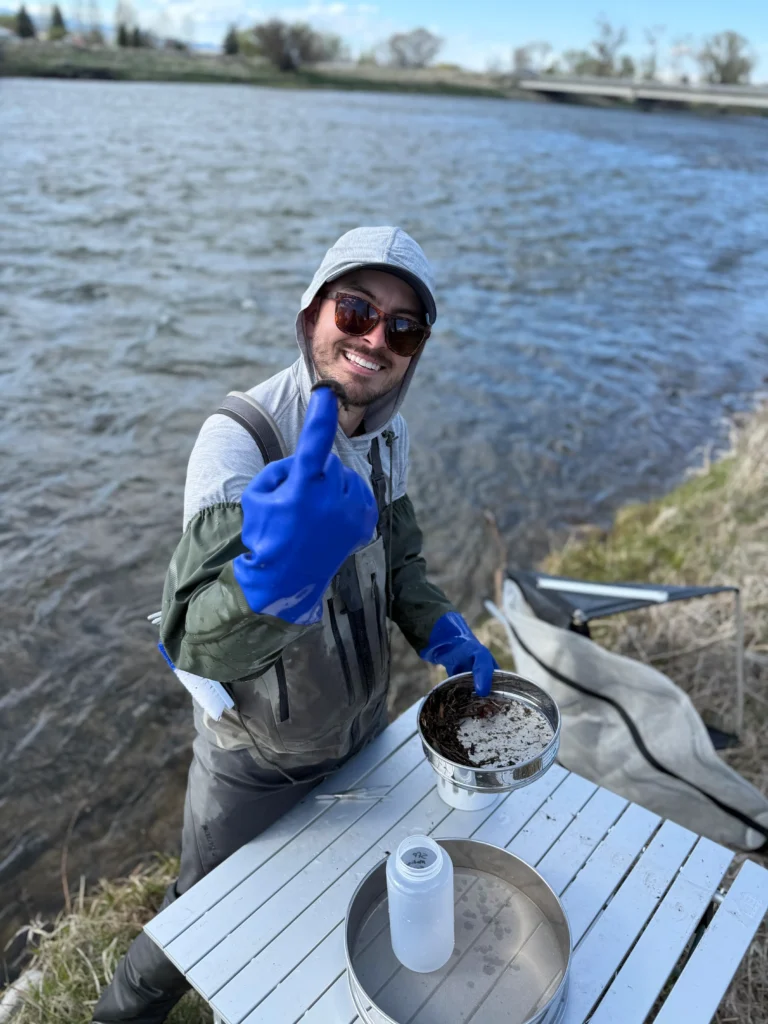
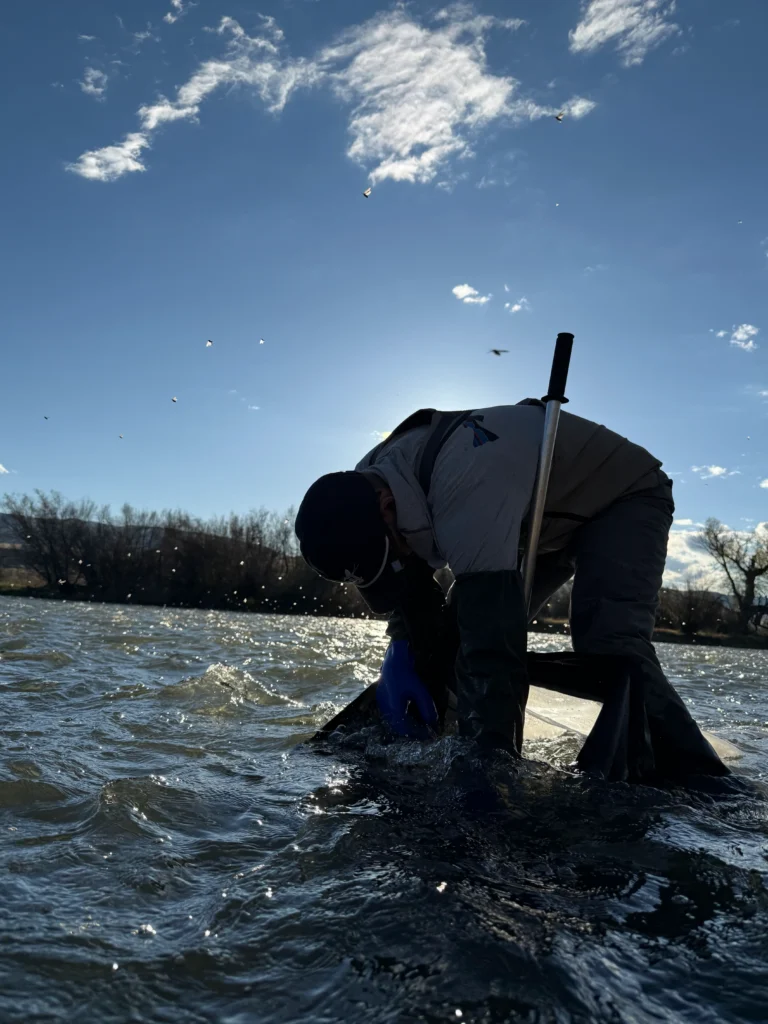
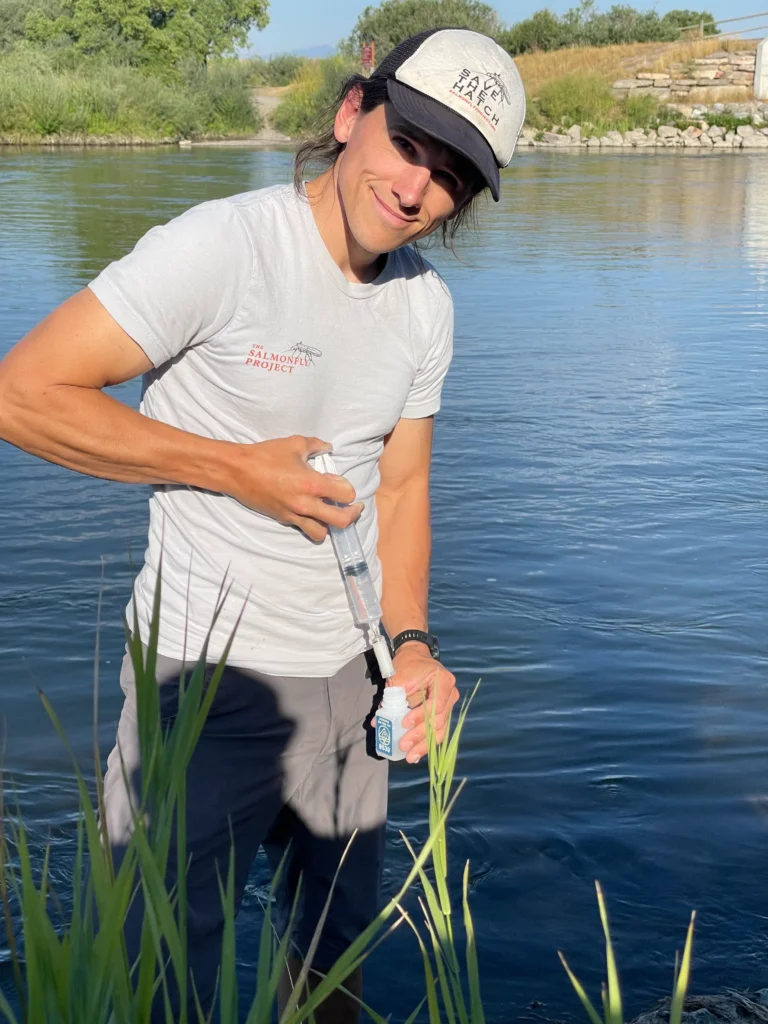
00:06:48 James : Sure. Yeah. So we use this really interesting type of sampling. It’s called a quantitative method. So we use these specialized nets that are called Hess samplers. And these nets are made out of you can kind of envision like a, a large steel drum with an open bottom, and there’s a net that’s attached to that. And the idea is that you drive that down into the river and you catch every single bug on every rock inside of that circle, that area, right? And then you can back calculate based off of that unit of area, how many bugs are in that particular known area. And that gives you a density, right? And so what we do with this project is instead of treating the bugs as like a proxy for water quality, we try to treat them as like game species, right? Similar to how fisheries managers treat their trout, right? They go out there, they do fish, shocking surveys, and they count the trout per mile, right? That’s a unit that all of us fishermen really care about. And what we’re trying to do is kind of put that lens onto the important aquatic insect hatches, because frankly, they’re just as important, right? Like, if we can’t feed our fish and we don’t have hatches to fish over, uh, what are we doing? So yeah, that’s kind of how we, we do things a little bit more different than, um, say the DEQ or our methods are differ a little bit compared to some of the other agencies that are collecting macroinvertebrate data.
00:08:19 Dave: Okay. So and some of those are collecting it to understand what species there are there currently, and maybe the species that are more tolerant or intolerant to changes in water quality, that sort of thing. So you’re not as focused on that as you’re focused on just understanding what bugs are there currently?
00:08:36 James : Yeah, it’s kind of both of those things, right? So we always quantify what we call our target species. These are our important hatches. You know, obviously salmon flies being our flagship species are included in any of the rivers where they occur. But that also includes, you know, Mother’s Day, caddis, spotted sedges, bluing, olives, Western March browns, green drakes, pale morning duns, all these very famous hatches. We quantified those as well. But then we also create, you know, metrics so we can understand how the water quality is doing, right. So like a very common one is percent EPT, which just means what proportion of the Macroinvertebrate community is made up of mayflies, stoneflies and caddis. And the higher the proportion of those bugs, the healthier your stream is, right? Because those are some very sensitive aquatic insects. They also happen to be the most important for anglers.
00:09:32 Dave: And those are. What were those again? Mayflies. Was that mayflies stoneflies and caddis flies?
00:09:36 James : Yeah. So EPT kind of goes back to the Latin, right? So E stands for Ephemeroptera, P stands for Plecoptera and T stands for trichoptera. That’s the mayflies. Stoneflies. Caddis.
00:09:50 Dave: Gotcha. And out of those three orders, is there one that’s more susceptible to changes in water quality? It seems like the Caddis are quite a bit different as far as their life cycle and all that.
00:10:03 Speaker 4: Yeah, that’s definitely true.
00:10:05 Jackson: There is a lot of variation within each group, but by and large, on average, stoneflies tend to be much more sensitive than mayflies or caddisflies. Um, it’s generally really stoneflies the most. And then, and then generally mayflies and then caddis flies. But it depends where you are and what species in particular you’re looking at.
00:10:24 Dave: Mhm.
00:10:25 Jackson: Yeah. But you’re right. Those two things, the, the counts of the bugs and then the water quality perspective are, you know, very, very linked. Because even if there’s a lot of bugs still, and those bugs are facilitating a lot of trout per mile. If you are experiencing bug declines, some of your most sensitive species, let’s say salmon flies, for instance, are declining. Maybe some other ones as well. That’s an early warning signal. That is a red flag of bad things, right? It doesn’t mean that the fishery has gone to pot, not even close. But it does provide a signal that there are changes to the ecosystem that are preventing that sensitive creature from living there. And historically, we haven’t paid too much attention to that because we haven’t been tracking the disappearances of these bugs. Right? We, you know, government agencies might show up and they’ll do their monitoring, create their little index score, and they just use that to show does it support, you know, does it meet Clean Water Act standards and then forget about it? They don’t really come back usually. So that’s really what we’re doing is trying to create those trends, get those early warning signals. And then if we are proactive, we can prevent worse things from happening instead of just waiting until the drought and the rest of the ecosystem are severely impacted.
00:11:46 Dave: Right. And how often on your sampling protocol are you coming back to? Like if you sample a stream at one time, when would you come back and resample it?
00:11:56 James : So for our typical, um, annual monitoring programs, we do that each year. And, you know, we’d set up between five and ten sites on each of these rivers. And then we work with volunteers to go back each year and sample. Now, we don’t write a report on each river each year because that’s, you know, a ton of work. We wait, you know, three to four years and then do a subsequent analysis on trends over that time period.
00:12:22 Dave: I see. And is this a tool that everybody, you know, just somebody that has never done it before can just grab this, do a quick little, you know, session tutorial and they can be out there sampling at the same level as anybody else.
00:12:34 Speaker 4: Unfortunately not.
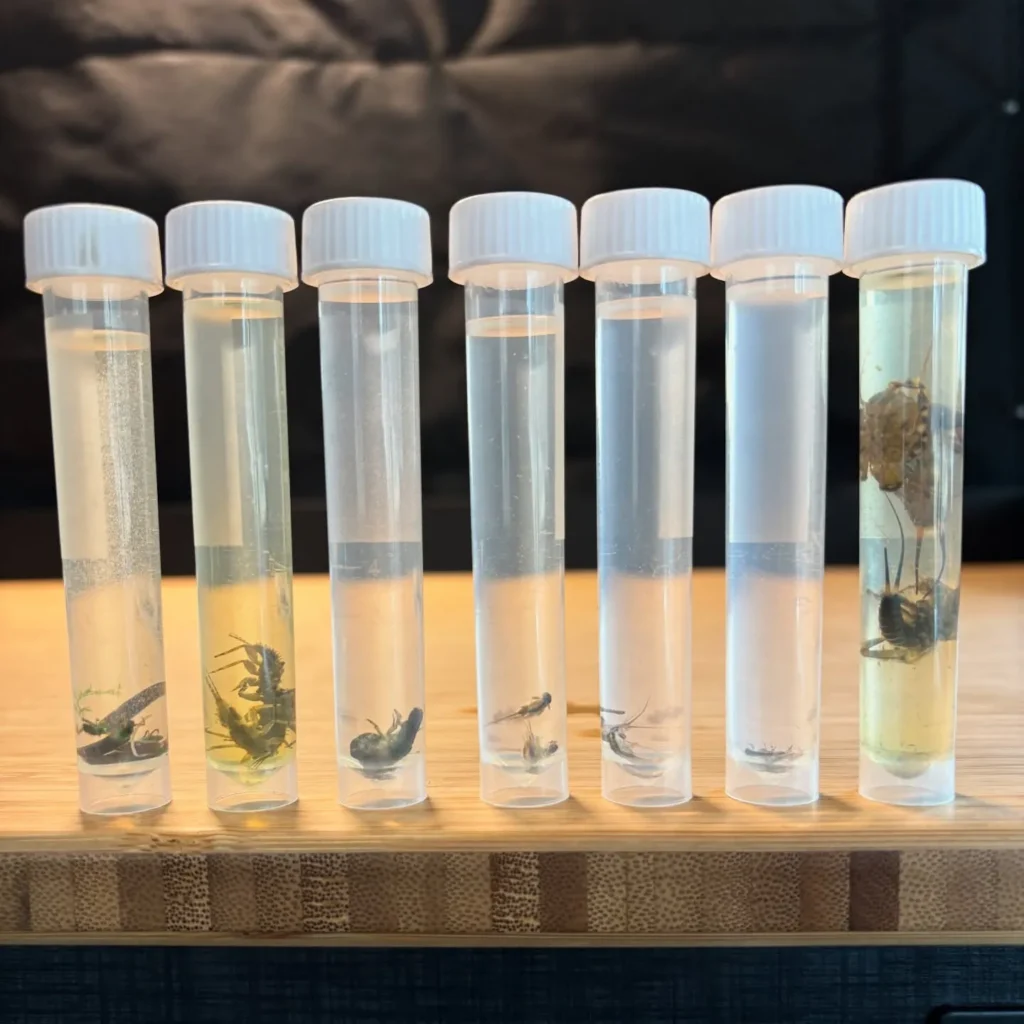
00:12:35 Jackson: It takes quite a bit of training. Um, we are collecting pretty specialized quantitative data. Volunteers are really important to our program. I don’t want to, um, you know, get away from that. All of our programs are volunteer assisted. Whenever James or I or, you know, whenever we have field techs out there collecting aquatic insects, volunteers are helping us and that helps us keep staff lower and also get people involved to educate the community. You know, it kills two birds with one stone. Um, and when we set these up, we get, you know, a couple dozen volunteers to help us over the week or two that we’re working on the river, but there is a lot of training involved and the equipment is semi specialized. So it’s not like anglers right now can go out and take pictures of the bugs or do something quite simple, uh, where they can identify themselves. But we are creating protocols that we hope will make training easier so we can streamline the actual data collection and make it easily scalable so we can sample in more rivers, rely on volunteers even more heavily into the future. And then they would send us the samples and we would, do you know, the insect ID under the microscope in our own laboratories? So I would say, yes, there’s a lot of opportunities to get involved with the Salmon Fly project. We also have education clinics and stuff like that. We could talk about that later if you want. But um, um, we do hope that there will be more opportunities going into the future for even more volunteer opportunities, if that makes sense.
00:14:09 Dave: Yeah, yeah. It does. So right now, it’s, it’s not like you can just give somebody a Hesse sampler and say, go out there and collect, give them a GPS point and go find that spot and do it. You kind of have to be there with them, helping collect the samples and making sure that it’s done correctly. And then when you get back, who does the like behind the ID? Because that’s a big thing too, right? It’s probably not a fast process identifying these bugs. Is that a major part of this?
00:14:33 James : Yeah, totally. The taxonomy and enumeration part. I mean, that’s what you know, our winter looks like, uh, about half of our projects we keep in house. And we do that ourselves. And then the other half, we outsource to Dave Stagliano, who’s one of our key partners. Um, he lives in Helena and is, you know, an industry leader who does this kind of thing. Um, I did just want to also follow up on your previous question about how people can get involved. I mean, anyone who’s listening who, um, this is exciting. And if you’re, you know, out in the Rockies, have a look at our website on the events page. I mean, we post, uh, volunteer opportunities there and feel free to shoot us an email if you want to, um, you know, volunteer with us. We’re always looking for help in the field. And so, um, I just encourage people to, you know, get involved if this is something that sounds exciting to them.
00:15:26 Dave: Perfect. And that’s the salmon fly project.
00:15:31 Jackson: Uh, no, no, the salmon fly project.
00:15:33 Dave: Oh, that’s what we’re. Yeah. So don’t know the. Right, right. So it’s just salmon fly project.org.
00:15:39 Jackson: Exactly. Okay. Exactly. And then going on top of that, if anyone’s involved that a lot of anglers are involved in Trout Unlimited chapters, watershed groups. We are not a standalone organization. All of the work we do is extremely collaborative, and we could not do it without our partners. So for those people that are already involved in those kinds of groups and are looking and excited about aquatic insect monitoring, that’s what really drives us forward. It’s really hard for us to move into a new area. Learn everything there is to know, answer the necessary questions, do the good work without those sort of partnerships. So that’s definitely, you know, certainly a higher level way to get involved, but no less important.
00:16:19 Dave: This episode is brought to you by AVC Rig Adventure Vehicle Concepts out of Colorado. These guys build next level adventure vans designed to help you explore farther and stay out longer. Are you dreaming of a full van build? Or maybe you just need the best aluminum cabinets and storage for your DIY rig. AVC rig makes it easy to turn your vehicle into the ultimate mobile base camp. You can check them out right now at avc dot com. That’s a v c rig dot com. Trout Routes by Onyx is built for fly anglers who want better Intel without spending hours digging for the information. You’ll get access to public land maps, stream access points, regulations, and even road and trail maps all in one place. It’s become my go to app for scouting new trips. You can check them out right now, go to Webflow Complex Routes and download the app today. And I think I’m just looking at your events page. I think when this episode goes live, it’ll probably likely be in April, but I do see one event, the The Bug Fest in twenty twenty six. Is that, uh, an event you guys have, uh, led in the past?
00:17:30 James : No, that’s, uh, glad you brought that up. This is a really exciting opportunity for us. We’re pioneering a new event out at three dollars bridge this summer. July twenty fifth. It’s going to be this epic angler entomology educational event, um, where, you know, we’re going to hopefully encounter tons of, uh, newer anglers and teach them about entomology and how to match the hatch and how to improve their angling through entomology will have fly tying clinics. Uh, it’s going to be a really, really cool event. We’re going to have three stations. We’ll look into the nymphs. Then we’ll also look at drifting bugs. So, you know, pupa and, uh, you know, insects in the drift. And then we’ll also have an adult identification station. Cool. Uh, all of this tied back to, to angling specific stuff. And then you’re, you know, you’re right there at, at three dollars. So go afterwards, you know, once you’ve had a good time, uh, learning from us, then you go out and put that to use and catch some fish.
00:18:32 Dave: Nice.
00:18:32 Jackson: And, and for those listeners that aren’t super familiar with our neck of the woods. Uh, that’s three dollar in, uh, on the Madison River.
00:18:39 Dave: Yeah. Madison. Perfect. No, this is great. I think this is, uh, it’s pretty awesome because I think we, uh, we had an episode recently with Maggie Human who I know you guys know she’s with t u and done some amazing stuff. She went into some pretty deep on some of the bugs, like the life history. So today we’re kind of hitting the surface on what you guys do and not going deep. But I’m hoping that eventually we can get into more of the nerdy stuff too, because I feel like it’s been almost a joke for me over the years. I’ve had. I don’t know if you guys know Rick Haifley. He wrote Western Hatches, and he was kind of a friend of the podcast and all that stuff, and he was like the only entomologist I really knew of, you know, out there. And it felt like there was nobody else. But you guys have run into you and Maggie and there’s feels like you guys are in a neck of the woods. Is that because of the university? That area just has a disproportionate number of bug people or what’s your take on it from your perspective?
00:19:29 James : Yeah, I mean, there’s great hatches. Yeah.
00:19:32 Dave: Right. It’s Montana.
00:19:33 James : Is really good. It’s amazing. We know Maggie so well that she is actually on our board and will be manning the adult insect station at this event. So anybody who who learned and is excited by Maggie’s course, you should come see her say hi at this Bug Fest event. Um, and yeah, and we know Rick as well.
00:19:51 Dave: You know Rick. Yeah.
00:19:53 James : Yeah.
00:19:53 Dave: Cool. Are there others? Are there. You guys must have. You’re in that world. Are there quite a few other. It seems like the entomologist mixed with the fly angler is the thing that’s hard. Are there some other people out there you know of that other than Maggie and yourself?
00:20:07 Jackson: Oh, for sure. Yeah, absolutely. I mean, compared to other industries, of course, aquatic entomologists are a rare breed, but not nonexistent, especially if you’re connected with the university system. There’s a lot of people that study aquatic insects. There’s a lot of fisheries biologists out there that also, you know, their secret love is actually aquatic insects. And they, you know, they do a lot of fish stuff too. We’re certainly out there, but there’s not a lot of organizations like us bridging this gap between angling, entomology, conservation.
00:20:40 Dave: Bringing it all together. This is cool. So we mentioned Bug Fest. Where do you guys take when, when you’re, um, you know, out there on one of your sessions, maybe we just take a bug fest. What is this going to look like as far as you must have a mix of people that are brand new people that have experience. How do you break this down? Maybe give us a high level of what it will look like and what people can learn here?
00:20:59 Jackson: Yeah, it’s a good question and it’ll be similar. We run quite a few smaller angler education events. So next week I have, you know, a couple, I have one on Monday and then um, a couple later in the week that’s out in Idaho and Wyoming. And Bug Fest will be a scaled up version of that. But these events, these clinics are geared towards especially beginner to intermediate anglers that aren’t as familiar with aquatic entomology. I know for folks getting into it, it. It seems like a black box. It’s a little bit. Impenetrable. There’s a lot of, you know, there’s a lot of words and some of the the literature out there doesn’t make it super easy to take that first step. You know, maybe it’s a little too deep. So we really try and boil it down to the nuts and bolts. Um, even in these clinics and especially in Bug Fest, we’re not even going to be teaching people how to identify your basic hatches. It’s really about learning to tell the difference between the major groups stoneflies, mayflies, caddis, your true flies like midges, and then understanding the basic life histories of those different groups. Because if you can know basically what you’re looking at and then pick a fly that looks like it, you don’t necessarily have to know what exactly what species it is. You don’t have to know that Latin. But if you know the life history, what time of day under different weather conditions that might come out, how those nymphs or larvae are going to emerge, whether they’re going to go bankside before a hatch where they’re going to come up quick or they’re going to come up slowly. Um, how the adults move around, that’s what’s really important, uh, when you’re first getting into it. James, I bet you have additional things to say though.
00:22:41 James : Yeah. I mean, the other thing is this is tied, you know, hatches are so closely tied to the seasonality of, you know, each year. So we’re going to be out there on the twenty fifth. So you’re going to expect to see a certain, you know, grouping of insects available. And that’s going to be reflected both in the insects that are in the drift and the adults that we capture. And I think a big thing that anglers, um, who are into fishing hatches, they start to develop this kind of like, almost like an annual calendar that they can, you know, attempt to set their watch to so that they can go out to known areas and encounter these hatches. And I think one of our goals is to help people get excited about that and understand that on the Madison and on other rivers.
00:23:33 Dave: Right? Right. Actually, the timing and we’ve seen that too. You know, like the salmon fly was a good example. You know, the, the salmon fly hatch now is that hatch around? Where does it you know, I know like the Deschutes, you know, in some of these bigger rivers have some pretty prolific hatches. Where do you not find the salmon fly? Or is there a specific type of stream where you find those prevalent?
00:23:54 James : Yeah. Salmon flies are, uh, pretty much just found in freestone rivers. Like it’s pretty rare to find them below, um, tail waters. And that has to do with the fact that they require a lot of thermal variation to get through their life history. So, um, areas, you know, let’s say the Missouri River right in Craig, there’s no salmon flies there because that stream is pretty stable and that’s because of the dam.
00:24:24 Jackson: There are of course, very, you know, exceptions to that rule. Because the very Madison River that we’re talking about is a tailwater. The Henrys Fork has an incredible salmon fly hatch. The Deschutes does as well. So there are exceptions, but generally the bigger Tailwaters think like the green River. Again, the Mo those really big tailwater rivers don’t have salmon flies.
00:24:44 Dave: Oh, the giant tail waters don’t have them.
00:24:47 Jackson: Yeah yeah yeah, exactly. Right. Polluted waters, you know, don’t. Uh, and then generally your smaller fisheries don’t have them, your little rivers. So they like these, these mid-sized trout streams that are cool, but still they get a little bit warm, just a tad in the summertime. And that allows them to grow. If it’s low and cold all the time, you generally don’t get big bugs like salmon flies, and it’s just too difficult for them to complete their life cycle under those constant cold kind of conditions.
00:25:21 Dave: Gotcha.
00:25:21 James : Yeah, they obviously they also require, you know, larger cobbles or you never find them in spring creeks either, where it’s just you have a sandy bottom that’s just not the right habitat.
00:25:31 Jackson: Yeah, they like to live there, big bugs. So they need big habitat to hide in.
00:25:34 Dave: And are they the. And we’re talking about the sandfly. Is that the the giant sandfly pteronarcys californica. Is that the species that we’re talking about? Yep. Yeah. And there’s only one.
00:25:46 Jackson: There’s only one pteronarcys californica, but there are several pteronarcys. So if you go out east, there are even salmon flies. I mean, I grew up in Massachusetts, and if you go to small creeks in Massachusetts, there are tons of giants. Um, you know, big salmon flies, but there are different species and there’s different species of salmon flies all over the place, including the, you know, the northwest. There’s, uh, a couple, but the hatch that anglers tend to fish in these rivers that we’re talking about, they’re almost always pteronarcys californica, but they look to the average angler. They look the, you know, the really similar. They look the.
00:26:23 Dave: Same. They’re big. They got the big fuzzy. Is that the gills? What the under. They’re kind of under their legs. Or describe. Describe how they look to somebody who hasn’t seen one of these things because they’re pretty unique looking and they’re big.
00:26:33 James : I love it. I love to talk about salmon fly gills because this is something actually Jackson and I like directly studied in our grad school.
00:26:41 Dave: Oh, cool.
00:26:42 James : Nice. And I’ll tell you a fun tidbit about their gills and their oxygen at the end of this. But yeah, they do have these very like plumose gills. Only the nymphs have this, right? The gills, the nymphs, they need to acquire oxygen from the water. So dissolved oxygen out of the water. And they do that using these, you know, uh, almost feather like looking gills that are on the underside of the abdomen. So they’re attached only on the underside of the abdomen for salmon flies. And, um, a really cool thing about salmon flies is they have this, you know, adaptation so that when they encounter low flow, because flow is what is ventilating their gills, right? It’s passive ventilation. That’s what’s pulling the CO2 out and delivering new oxygen to the gills. But if they encounter, you know, times when the flow is really low and that natural ventilation is reduced, they have this amazing adaptation. We call it the push up response. And what they do is they literally they swing back and forth and up and down and they’re self-ventilating those gills. It’s just a behavioral response. It’s basically like them, um, taking a huge gasp of air really.
00:28:01 Dave: So they underwater, they’re just moving back and forth getting more oxygen.
00:28:05 James : Yep. And if they’re doing that, you know, they’re really stressed out that that’s an indication that it’s an unfavorable moment.
00:28:13 Dave: Are they doing that like hanging on with their front legs going back and forth in the current or how does that look?
00:28:18 James : Yeah, I mean, it happens mostly in Stillwater, uh, are very close to Stillwater. Yeah, they just grasp on with their legs and shake back and forth, creating flow.
00:28:26 Dave: That’s pretty amazing. You guys must have a lot of these little stories about the life histories of these, all these critters. Is it pretty amazing? Could we talk probably for hours just on that sort of stuff?
00:28:36 James : Yeah.
00:28:36 Jackson: We have a lot of fun facts about bugs, right?
00:28:39 Dave: Right. That’s cool. Um, well, what do you think? So let’s keep it on, stoneflies. You got the salmon? What’s the next big. I guess golden stones are probably the next big one people think about. Is that, um. And then what are the top stoneflies that you guys are thinking about and your the work you’re doing or fishing?
00:28:55 Jackson: Yeah. Let’s go from uh, yeah, the most important ones in, in the trout streams in our neck of the woods from biggest to smallest, generally giant salmon flies. Then your true golden stone, which usually comes out just after salmon flies in the summer, and then a stonefly. That kind of the the entry level angler doesn’t hear as much about the nocturnal stones. Some people call them mutants or mutants. All stones. Yeah. So those come out later in the year depending, you know, on your river, August, September, that kind of time frame.
00:29:28 Dave: And is that a different species than what is the species of that one or the family? Is that how does that compare to the salmon flies or the Goldens?
00:29:35 Jackson: So the salmon fly is kind of its own beast in its own family. Um, and then golden stones have their own family, the true golden stone that most people think about that’s more midsummer is I don’t know if you want me to throw.
00:29:48 Dave: Yeah, throw it out. Throw out some names. We’ve been we’ve been talking.
00:29:50 Jackson: Hasbro, Perla, Pacifica and then the fall Golden is within that same family or nocturnal, whatever you want to call it. That’s sabulosa.
00:29:59 Dave: Okay. And what’s the family for that one?
00:30:01 Jackson: Technical name is Perla, but it’s the Golden Stonefly family.
00:30:05 Dave: Okay, so the golden stone. So the nocturnal is in the same family as the Golden Stone. It’s just the fall. It comes out in the fall.
00:30:11 Jackson: Yep. That’s right. Yep. Different species, same family.
00:30:14 Dave: And it’s and Maggie was telling us it’s not really technically correct to call them to remove the a day right off the family. You should technically call him Pearl a day.
00:30:23 Jackson: Well, that’s. Most people, uh, shorten it, you know? Yeah, just it’s a lot easier. But the real Latin word is Perla. But most people in regular day, you know, regular day, nerdy science talk. Chop, chop the chop it off.
00:30:38 Dave: So even the scientists, even the smart, the nerdy scientists call them pearls generally.
00:30:42 Jackson: Yeah.
00:30:43 Dave: Yeah. Okay. That’s good. Good. Okay, so we got the nocturne then. Are those the three big ones or what else would you add that to that?
00:30:48 Jackson: Those are the three biggest. Um and then Scala.
00:30:51 Dave: Scala.
00:30:52 Jackson: You know they’re not in as many streams.
00:30:55 Dave: Yeah. Why are squall and I for example Deschutes that’s kind of one of my kind of the home water. Why are they not in on the Deschutes and they’re in the other areas.
00:31:02 Jackson: Well, the Deschutes is basically outside of their range a little bit, but at least in the Rocky Mountains. And I gotta be a little bit careful because I’m. James and I are really familiar with everything in the Rocky Mountains.
00:31:13 Dave: Yeah, but not as much.
00:31:15 Jackson: And not not as much, I believe. Um, yeah, they’re just generally less common out there. I’m gonna be tempted to do a little search while I’m.
00:31:23 Dave: Yeah. Search it up. Get get us.
00:31:24 Jackson: Some on here. But but um, they tend to prefer slightly warmer water, you know, still like cold water, trout stream, but a little bit warmer and they tend to like slower kind of sandier water. So the lower Madison now it’s good. Sam. Uh, squally habitat, the Bitterroot is one, I would.
00:31:46 James : Say one of the best salmon. Ah, sorry, squally hatches around. It’s kind of the perfect habitat.
00:31:52 Dave: Where’s that?
00:31:53 James : The Bitterroot is, uh, it’s a tributary to the Clark Fork.
00:31:56 Dave: Okay.
00:31:57 James : Missoula?
00:31:58 Dave: Yeah. So the Bitterroot has perfect habitat for koalas.
00:32:01 James : Yep. I would say have all the places I’ve ever fished. Koala. Uh, they seem to be maybe the most abundant on the Bitterroot.
00:32:08 Dave: Perfect. Okay. So squalls and then then you get into some of the like the little black stones and some of that sort of stuff. Are there a few different of those that we’d be using for phishing.
00:32:18 James : Yeah, the early dark stones, the nimrods, the druids, the yeah, there’s these little group, we call them just early dark stones. They come out even before the squalor. And I think a lot of anglers maybe overlook this, this group of, uh, bugs and they don’t fish them so much. And they do kind of, they tend to overlap into squalor season a little bit. And I’ve had days where fish will key in on those smaller bugs and they’ll ignore the squalor altogether. So that’s a trick little a little hidden secret in here. If you’re, uh, if you’re interested in fishing those hatches, maybe throw like a size sixteen or fourteen little black stone.
00:32:59 Dave: There you go. Perfect.
00:33:01 Jackson: Yeah, we could go on and on. I mean, there’s three thousand five hundred species of stoneflies.
00:33:04 Dave: Is there. There’s three, three thousand. Yeah. Species of stoneflies.
00:33:08 Jackson: And I just looked it up. I gotta say, okay, because this just let’s hear it. So the main species of Scoala Scoala Americana is found in every Western US state and then into Canada.
00:33:18 Dave: Oh, so it is historically was. But maybe the Deschutes has changed. Maybe they are there. You just don’t see them as prevalent.
00:33:23 Jackson: Yeah, I guess I just have to say I’m not super familiar. I gotta, you know, say my speciality. But they they scoala exist in the Western United States, not just the Rockies.
00:33:33 Dave: Not just the Rockies. Okay. Yeah. Cool. So you got all the stoneflies. Well, maybe take us back to again, back to the program you guys have going. You know, people are listening. They can look at the events, they can connect on that. What would be the other thing that people can connect to help you guys out? Because it feels like you got a big, um, it’s a good challenge ahead of you to try to document all this. Is there something, you know, how do you guys see this growing over time? And how do volunteers or people listening? Is there are they going to have a big impact on helping you guys out?
00:34:01 James : Yeah. I mean, uh.
00:34:04 Jackson: We were waiting for each other there. James. Yeah.
00:34:06 James : We’re waiting for each other to answer. Um, I think, you know, we’re a relatively new nonprofit And I mean, frankly, right now, because we’re growing and we’re expanding rapidly. If people are interested in collaborating or if people have the capacity to help us, you know, in a monetary way, your dollars are actually going to, uh, make a big splash in a small organization like what we’ve got going on. Um, so, you know, direct collaborations and, and, uh, new membership is, is huge. And we try to give back to our members in a really holistic way. So we hold these quarterly webinars and we do a lot of education. We, we, you know, are so appreciative of our new members. Um.
00:34:51 Dave: Yeah, yeah, I see it. No, I just opened up on the page. You got the it’s great. You got the different tiers, the midge, the bluing doll of the Mother’s Day caddis, different levels of what people want to contribute. And when people actually help support the project, basically that’s going to directly support basically protecting the species because understanding what bugs are there and whether they’re going up or down can help people that are managing. Is that kind of the idea being if if you guys see, say, a stonefly start to disappear or change over a period of time, you can say, hey, you can kind of flag it. Is that the thinking?
00:35:24 Jackson: Yeah, exactly. So one of the main things that we do are called species vulnerability assessments. And we’ve been working on these a lot for salmon flies just as a starting place because they are widely declining. And I don’t know if a lot of your, you know, yeah, listenership is aware of this, but we and other scientists have documented salmon fly declines, local extinctions on fourteen blue ribbon and gold medal trout streams throughout.
00:35:51 Dave: Oh, wow. So you’ve documented complete extinctions.
00:35:54 Jackson: Well, yeah, that, uh, like local extinctions, that can mean from like a river, um, a segment of a river. Uh, or maybe it’s just a decline in population number. And those range from, you know, fisheries that people hear about. I mean, the upper snake, uh, below Jackson Lake Dam historically had salmon flies. The lower Madison historically had salmon flies. They’re all gone now. Even parts of the lower Yellowstone there was declines there. The the the upper Gunnison, the upper Colorado, the entire Arkansas. The almost the whole Provo, the entire Logan down in Utah. Just kind of, you know, dropping a bunch of names here. Yeah. So we do know that they’re in decline and we are trying to use existing conservation and management frameworks to, you know, do some good here and not not always reinvent the wheel if we don’t have to. So one of the things that we do is assess the declines in these vulnerabilities. And we provide that data to Fish and Game and all states in the western United States every ten years have to do these sort of vulnerability assessments. If the data exists, if the data allows. And if those species that are declining meet certain thresholds, if they’re declining fast enough, then they’re called a species of greatest conservation need. And that’s a state level designation or acknowledgement that there’s a problem with that species. And then there’s usually additional resources that can be allotted towards further research, further monitoring and conservation towards that that critter. So we, um, with our collaborative partners, uh, DNR in Utah, Utah State, we assessed salmon flies in Utah. That’s one of the places where they’re declining most rapidly. And we found a eighty four percent statewide decline since the year two thousand really, really concerning, really strong decline there. And, you know, that that met the threshold. And they’re now designated as this as this conservation species. Similar stuff happened, um, without our direct participation in Colorado, which is great to see that some, uh, states, some state fish and games are kind of doing this starting to. For the first time really on their own, but we’re currently assessing salmon flies and. Their, their state rank, their vulnerability in Montana. So yeah, we’re doing a lot of things like that, not just documenting. Decline for knowledge sake, but really trying to integrate them into existing management frameworks. And right now, because we are small, I mean, it’s nice to have large organizations and you can do a lot more when you’re large, but every dollar has a lot more of an efficient impact generally on small organizations because there’s less overhead. So every dollar really does go a long way for us. And it’s really exciting. It feels like a big lift whenever we get like a moderate donation, we celebrate, you know, we can charge a little bit harder on, on, right? Whether that’s on the Madison or the upper snake or the Provo or wherever we’re working, we can charge a little bit harder. We can do a little bit more.
00:39:01 Dave: Yeah, that’s so cool. So like if literally if somebody puts in fifty dollars today. That definitely moves the needle for you guys.
00:39:08 Speaker 5: Yeah it does, it does. Yeah. It all matters.
00:39:12 Speaker 6: On to Mark Lodge offers a world class experience with one of the finest rainbow trout and brown trout fisheries in the world. They’re family owned and operated. Missouri River Lodge offers comfortable accommodations, delicious home cooked meals, and personalized service that make you feel like family. Days on the water are capped off by appetizers, beverages, dinner, and stories on the back deck and around the campfire. Book your stay for an unforgettable fly fishing adventure where memories are made and the fish stories are real. You can head over right now to wet fly swing. That’s o n e m a r k on Denmark right now to book your magical Missouri River trip.
00:39:55 Dave: Yeah, and that makes sense on the conservation. Greatest conservation. Need all that. So you guys are actually doing something that is making an impact when you look at Utah. Once you understand that and it’s designated, then do you guys keep involved in the process of like, I mean, the big question is, what do you do? You know what I mean? Because it feels like some of it’s water quality, maybe climate change. Do you guys have a grasp of that? Do you know what you can do for these salmon fly populations that are declining?
00:40:21 Jackson: Yeah. It’s different from river to river. So it is a it is a complicated story. People ask us all the time, what’s the solution when they talk about insect declines? And maybe we should talk a little bit more about just our insect declines real and how bad and all that. We can go into that if you want.
00:40:36 Dave: What do you mean? Like, you mean like whether it’s actually like, like kind of fake news sort of stuff, you get some of that.
00:40:42 Jackson: Fake news, but anglers, uh, a lot of the, the talk about insect declines, the reason why the same, one of the reasons why the salmon fly project exists is there’s not much data to actually say how bad the problem is, what species, where, why, etc. most of it historically is based on angler anecdote, which is really important, but it’s not the data that’s needed to change.
00:41:07 Dave: No, because what happens with that is you see that people remember differently or they don’t remember quite correctly. Right. Your mind? Yeah. The good old days. It is always better back then. I mean, those are always. I remember my dad talking about that. He was like, man, back in the day, you know, whatever the year was, it was always better. But yeah, you got to have the data. That’s why this is so important because without it, you really don’t have a starting point.
00:41:29 Jackson: Exactly. But you asked that question. What do you do? You know, in a a lot of the impacts come down to water and it changes from River River. But there are rivers that we know about in, uh, in Utah, for example, that have experienced really quite recent salmon fly declines. And it’s because, um, of recent drought combined with water withdrawals and it’s a super easy fix. Some of the most abundant salmon flies on these stretches of river. I’m talking about, uh, the blacksmith fork River up in northern Utah, which is a tributary of the Logan. So one of the more important trout streams in that state. And one of the last that has a good salmon fly hatch. The most abundant place where you can find salmon flies is just above this stretch of the valley. You know, the river goes through the canyon and salmon flies get more and more abundant as you drop in the canyon, just because you’re getting this like, temperature sweet spot for their development. And then you exit the canyon and you go from gobs of salmon flies to none simply because you hit a ditch. And every summer over the last several years, most of that water just goes away. And that’s not, you know, pointing fingers necessarily super bad. But there needs to be practices in place to protect now this vulnerable species, whether that’s through, um, you know, people choosing to use less water, you know, um, different avenues we, there’s, there’s a lot of work to do there, but it’s different on every river and it often comes down to water temperature, nutrient sediment. And it’s a long conversation.
00:43:02 Dave: Yeah. It is, it is. It’s I there’s a book, I can’t remember the author, but I think it was called Water Wars. But it was, you know, basically that’s the thinking that, you know, it’s, I think there’s nothing more important than water. You know, I mean, we all need it, you know, and the more the larger the population gets of humans, you know, it seems like challenging. I think that’s what people get stuck on. They feel like it’s almost a negative, like, what do you do? But I feel like it’s these little steps. I mean, do you guys feel that way that there’s little things we can do that even if it’s minor, it can make a difference.
00:43:32 James : Yeah, absolutely. I mean, I think everybody has the ability to conserve water. I think that’s super important. I think every angler out there should be a steward of the river, right? Like, you know, how about when you clip your tippet off? Don’t throw that in the river. Yeah, there’s things you can do. Uh, you know, honestly, if you’re in a really crowded river and you’re fishing an area, think about maybe not walking through a really, you know, productive riffle. These are where we grow all of our insects, right? These riffles, if you can minimize the amount of trampling you do. Um, that’s going to help as well. I do want to also touch on, on one of these things you asked earlier about what anglers can do. And we do still have open on our website a, an angler survey. So if people listening have, uh, either experienced insect declines or, um, have details about hatches on their local streams that they’d like to let us know about. We have a survey open. It only takes about five minutes to fill out. And, um, that data will all go and get analyzed. And, um, we plan to, you know, turn angler anecdotes into more of a scientific finding and publish that for the scientific community. And we hope that that will make like an actual impact by giving anglers a real voice.
00:44:59 Dave: Nice. Okay, perfect. And this is. I see you’ve got Craig Matthews. He’s on. He’s got a video there. Is that Craig doing a little intro?
00:45:05 James : Yeah. We love Craig. We thank him so much for doing that. Big supporter of our work. And um yeah, that’s him on the banks of the Madison.
00:45:14 Dave: Yeah. That’s awesome. Yeah. Great. He’s definitely we had him on the podcast a couple times and it’s always fun. So we got this survey so they can folks can take survey. You’ve got we mentioned some of the events. I mean, this is pretty good. You guys have a lot going. What else should people know before you know we take it out of here today. Any other important. I know we haven’t touched on hardly you know any of the bug, the deep dive. But give us a heads up that you’ve talked about a number of good things. Anything we missed?
00:45:38 Jackson: I would say the we need to touch on just the general state of aquatic insects. Yeah, it’s we live in a tricky space nowadays where there’s a lot of information and it’s hard to sift through it and figure out how bad it is. So I just wanted to talk about insect declines in general. Um, because a lot of the time there’s kind of a sky is falling narrative.
00:45:58 Dave: Yeah.
00:45:58 Jackson: And I don’t think that’s necessarily productive. Um, there’s a lot of places that we work pretty much everywhere we work. We’re in great fisheries. There’s a lot of fish per mile. There’s a lot of bugs. And even if insect declines have occurred, people are still stoked on the bugs that are there. They’re stoked on the the fish that are there. And there’s a lot to preserve. And that’s what we need to fight for. It’s not necessarily about, even in my mind, always returning it to whatever the good old days was. We don’t always even have data on that. And if we can, you know, do restoration. I mean, that’s a part of our mission is doing restoration, surely. But I guess my point is there’s a lot to protect and there’s a lot of good that can be done. And that’s why we’re not only focused on collecting this data, but also, um, we’re using it to, to as these early warning signals, you know, because if we don’t do anything, there is this question of in twenty years and forty years and sixty years, are we going to have these great fisheries? If we just allow impacts to go unchecked and the bugs generally are the canaries in the coal mine, the canaries in the current, if you will. Right. And even more than the trout. So, um, I just wanted to say that at a nationwide perspective on average, yeah, the best available science does show that that aquatic insects are declining when you average everything together. Um, but that does not mean that insects have been decimated on your most, you know, productive trout streams. Um, generally we’re seeing quite subtle signals on the bigger name, more famous, uh, rivers and they’re big and they’re famous because they’re great, you know, and they’re still mostly healthy. So I just wanted to, to give.
00:47:44 Dave: That’s a great.
00:47:44 Jackson: Point. Talking about a lot of aquatic insect decline stuff and conservation. And I wanted to put it within that framework.
00:47:51 Dave: That’s a great I’m glad you did that. I mean, I think part of it and one river that comes up, I know we heard about the last few years is the the big hole. There’s been some challenges, right? Are you guys familiar with that? That’s kind of in the Upper Missouri Basin. Right. There’s been some declines in populations. Is that related directly to bugs? Have you guys studied that?
00:48:08 Jackson: We sure are familiar. Yeah, we definitely are.
00:48:10 Dave: Yeah. So that’s a similar I mean, not too much different than say what’s going on in the like you mentioned the Logan area, kind of similar bug declines and then fish follow that.
00:48:19 Jackson: That’s likely what could have occurred. It’s a complicated story there. And we are good partners with this awesome organization that’s trying to fix it and figure it out. They’re called Safe Wild Trout. They’re a fairly new organization, but they combined with some some local longer time entities like the Big Hole River Foundation, and they’re really doing the bug monitoring and habitat monitoring to determine what the problem is for folks that aren’t as familiar, the big hole and a lot of the Upper Missouri basin experienced a really, really tragic trout decline over a number of years. And it’s it’s since bounced back a little. Everyone’s been trying to figure out why. I’m not going to jump the gun and pretend I know exactly why. I imagine if we had been tracking the bugs really thoroughly for long before that, we would have seen some of those early warning signals before the trout decline, that’s for sure. My hunch, because that’s what aquatic insects do. Um, they decline before trout because they’re more sensitive. But I’m not going to, um, say exactly what I know is the problem. The lower big hole is pretty warm. It’s now too warm for salmon flies. Um, in some of the parts of the lower, lower big hole. There’s still epic catches of that bug for sure. And um, that’s definitely true, especially in like in the canyon. Dewey and, um, that kind of area. But, um, but yeah, the, the bugs are super relevant to those sorts of problems.
00:49:45 Dave: Nice. And, and how fast when you look at these bugs, I know there’s probably variation, but say salmon flies if they’re almost extinct in an area. Could you, if you change the water quality is because their life cycles are shorter, could they come back pretty quick?
00:49:59 James : So same applies actually have a really long life history. They can live in the water for three to four years, right? And then until they are fully developed and emerge as an adult. So that’s probably why salmon flies are more sensitive than a lot of other aquatic insects. Like for instance, if you think about a bluing olive that actually goes through its life history twice per year, right? You have a spring hatch and you have a fall hatch. And because they’re, you know, spending less time as nymphs, experiencing whatever stressors they’re experiencing in the water that can make them less tolerant or sorry. Yeah. You know, a little bit less sensitive, more tolerant. Salmon flies are super, super sensitive because they live for so long. But yeah, in general, aquatic insects, if given the right Uh, environmental condition. They can bounce right back. They’re very resilient bugs. You know, if you build it, they will. They will come.
00:50:55 Dave: They will. Compared to some of these other animals that take longer, say a fish or like you get into some of these fish, right? Sturgeon that are super old. Takes them a little bit longer. But yeah, so that makes sense. So these bugs and and who are the, are the stoneflies, the kind of the longest lived aquatic invertebrates out there.
00:51:12 Jackson: The big stoneflies that people are familiar with. Yes, but there are, I mean, all the little stoneflies, yellow Sally’s and um, even Scala, they’re fairly big, but they, they go through their life cycle in one year. But the big bugs Goldens, uh, the nocturnal they go, they take two years. Salmon flies take three to four as nymphs almost the whole year as an egg. So their whole life is really about four to five years. Um, if you even take an egg, they have a really crazy egg biology, some funky things going on. Um, but if as long as the aquatic insects, that species hasn’t been pushed out entirely, it’ll come back fairly quickly. So even these rivers that have undergone really drastic declines of some species, there’s still quite a lot of hope. As long as they hold on at low population levels, because as soon as conditions come back and are become more optimal for them, they will outcompete these generalists that have moved in. You know, um, Scuds, amphipods, midges. That’s why they’re, you know, they’re tolerant, um, uh, generalists really. And the sense of the books will come back as soon as conditions allow.
00:52:18 Dave: Okay. And is there a reintroduction of bugs? Is that something that’s ever been done or something that could be done or needed?
00:52:24 James : People have tried it. Uh, yeah. In Colorado, they tried to reintroduce salmon flies on the on the Arkansas River, and it was largely a failure. Um, there’s rumors that maybe a few have held on, uh, but no restocking efforts haven’t proven to be super effective.
00:52:42 Jackson: Yeah. It’s been done in a couple other places I can think of. But if you think about it, you know, there are experiments that show, you know, survivability of nymphs. And there’s a reason why every, you know, if you look at an egg sac of an aquatic insect, it’s pretty big. They’re not putting one egg in the water, you know. So essentially, to recreate that female and the male that she mated with their job is to make, you know, two more, you know. So for reintroduction efforts for aquatic insects, it can take a lot of bugs.
00:53:14 James : Right?
00:53:15 Dave: Yeah, a lot of bugs.
00:53:15 James : Understatement of the night.
00:53:16 Dave: Yeah. They put a lot. How many eggs just on average is a big salmon fly. Putting in the water.
00:53:23 Jackson: Oh, you know, I don’t know, um. Couple hundred.
00:53:26 Dave: Couple.
00:53:26 Jackson: Hundred, but but.
00:53:27 Dave: Not thousands. Because you look at fish, they’re in the sometimes thousands right. Of eggs. A similar life history I guess. Right. Put out a bunch and you get a couple that survive, right?
00:53:38 James : Yeah. I’m sure there’s at least one hundred on a salmon fillet. Exact, but I don’t know the actual number.
00:53:44 Dave: Yeah. Okay. Well. Give us. Well, let’s take it out of here with our fly fishing tips and tricks segment. Are you guys now? Are you guys angler wise? Are you like super, uh, high level pro fly anglers or what’s your story there?
00:53:56 Jackson: Cat’s out of the bag. Um, I came here for the bugs, and I am a very casual fly fisherman. I’m obsessed with all things bugs. I love talking about fly fishing because I like the bugs. Like, if I’m fishing hatch, I’m more excited about the hatch than the fish. So I think, I think James should really take it from here because he’s a good angler and super passionate about it. And that’s one of the reasons why we make a good team. We kind of come at it from, um, you know, why we got into entomology and went into schooling for it was from a different perspective.
00:54:26 Dave: Gotcha. Okay. And well, tell me this before we get into fishing really quick on your I guess you both had the masters. What was the project? When you look at the research you did, you were on a similar project or describe that really quick.
00:54:37 James : So I got my master’s. Jackson actually got his PhD. Um, I was studying, Um, how the physiology of salmon flies, um, sort of affects their, uh, performance. Right. So, um, one of the bigger projects that I did was trying to understand how temperature, oxygen and flow interact to influence like the thermal tolerance and survivability of salmon flies. Um, so I built these crazy mesocosm type, um, chambers where I adjusted temperature, oxygen and flow and then measured that push up response I told you about. And then also, um, when they basically pass out from, they can’t handle it anymore.
00:55:19 Dave: Oh, right. So you’ve seen them, what do you call that when they’re doing the troll to get more oxygen?
00:55:24 James : It’s called the push up response is what people it doesn’t in salmon flies it. To me it looks more like a jig, right? It’s like a little side to side wiggle. Okay. And some of the other species, um, it looks more like a push up going up and down.
00:55:37 Dave: Oh, a push up. Right. Okay. And is the just high level. I mean, you hear about the eighteen degree C, you know, for the impacts of that that’s bad for salmonids. Is is that a similar thing for salmon flies or is that what is there a temperature number range?
00:55:53 Jackson: Yeah, actually it’s really similar. Um, for instream survival for salmon flies. Um, it’s a little bit lower than for salmonids, but it’s in a similar range for temperature.
00:56:06 Dave: Perfect. Um, and then Jackson, what was your. So, um. Jackson, you have the master’s and the PhD.
00:56:13 Jackson: Yeah. Yeah. Well, I went straight from undergrad through PhD, which you can, you know, okay. Some people do, but, but yeah.
00:56:19 Dave: And what was your, what was your, what did you study? What was your focus?
00:56:22 Jackson: Really similar to James because we were in the same lab. So I also was doing this kind of eco physiology is what we call it, how physiology can inform our ecological views. And, um, looking at interactive effects among temperature, oxygen and flow to understand performance, which means growth, metabolism, things like that of aquatic insects, and then also survival. Just trying to really understand the why salmon flies live where they do and why they’re declining. I was thinking we call it like a mechanistic perspective, trying to understand the gears that make salmon flies work. They were my focal species. Um, some of the results were pretty generalizable to how most aquatic insects work. So a lot of different research projects within that theme, but that’s the gist.
00:57:15 Dave: Perfect. And well, let’s take it out. We mentioned the fish. So James, you’re more onto the angling are you? What’s your home water that you’re fishing there?
00:57:24 James : Well, I used to live in Missoula. Okay. I mean, I moved out to Missoula to go to school there, but my real reason I moved out there was because I wanted to fish more. Originally, I came from Maine, and, uh, we have good striped bass fishing there. Uh, the trout fishing leaves a lot to be desired. And so I, uh, I think I read in a magazine somewhere they called Missoula, like, uh, trout Mecca or something like that. And I said, heck, there’s the college there. I’m going to go to school there. And then I started studying bugs because I figured it’s a good way to increase my, you know, fishing knowledge. Yeah. Right. Help me out on the stream, which it does. It totally.
00:58:01 Dave: Does.
00:58:01 James : Yeah.
00:58:02 Dave: It does. So what would be your best when you mix the two as far as anglers listening now, what do you use with your bug experience that helps you on the water for fishing most? You know, what’s the biggest thing that helps you out there?
00:58:14 James : So to me, it’s all about trying to understand and predict what you’re going to experience out on the river on a given day. When I, you know, spend the day before I go on a fishing trip, I’m not necessarily thinking about where am I going to find the biggest trout. I think about where am I going to intercept a strong hatch, right? And understanding that hatches are totally driven by, uh, you know, temperature of the water, seasonality, weather condition, things like that. You can, um, make predictions about what you’re going to experience and you know, how long you want to drive to go and do that.
00:58:54 Dave: Right? So you can kind of know in any particular stream or reach based on, like you said, the temperature. And I’m sure you take some good journals, some field notes, you can kind of predict that. Like you said, July twenty fifth, do you have a good feel? If you look at that event coming up, you can kind of have a good prediction of what’s going to be coming off that time of year that week.
00:59:13 James : Yeah, absolutely. And I mean, it might be a little different this year with the crazy warm and dry winter that we’ve had. And that’s likely going to push our hatches forward, right? Because the main thing, like almost the entire thing that drives aquatic insect development and brings them to a hatch is the accumulated experience of temperature, right? Because these are ectotherms. Their life history is completely tied to temperature. So if we have a really warm winter and a really mild spring, and they’re experiencing a lot of what we call degree days, it’s like the accumulation of temperature. Um, they will hatch a lot sooner. So this year you might see, I mean, right now I’m living in Colorado right now. I’m seeing bluing olives out already on some of our rivers. And that’s early. That’s pretty early. I’ve been joking with some of my friends that March Brown’s in Missoula, actually are going to come out in March this year, which is normally an April thing.
01:00:18 Dave: Gotcha. Yeah. You hear a lot like the Mother’s Day caddis, right? Is that is that near Mother’s Day still or how does that fall out?
01:00:25 James : Yeah. I mean, historically that’s been around Mother’s Day. The thing with Mother’s Day caddis, I’ve always sort of found is their hatch almost always occurs with peak runoff, which is a total bummer. If you find a river where that doesn’t occur, you should go back there and fish that hatch because it can be pretty epic. Um, I’ve had good days on that bug on the Madison and on the Yellowstone, but some of the rivers, especially around the Missoula area, it just always tends to occur with peak runoff.
01:00:58 Dave: Yeah. Okay. So that’s a big part of it. So basically your, your advice would be to understand, you know, understanding the bugs is going to help you to know when the hatches are coming out and what to do. And then once you get on the water, you know, I guess that’s, it’s a lifelong thing, isn’t it, for I guess everybody. Right. Understanding and how deep you go into this, the etymology piece, do you find that a lot of people that get started and they just, they go kind of deep into it and, and kind of get lost in a good way.
01:01:25 James : Yeah. I mean, I think that’s what happened to me. And if I could give any sort of inspiration to some of the more beginner anglers that might be listening, Like, to me, this is really the exciting part about fly fishing. This is the heritage of fly fishing. And that’s, you know, going out there and experiencing the bugs, following the hatch and then imitating that hatch to full trout. And it’s you’re not going to do it very well in your first three, four or five years of fishing. That’s because you’re just you have to go out there and you have to gain your own experiences and write this stuff down like, like keep a good notebook because that’s going to help you in future years because it is pretty predictable, right? If you can say, okay, on, on this date, I saw a really good hatch. I’m going to go back, you know, to that particular river on that particular day, chances are you’re going to experience it again. And once you have a lifetime of fishing stories that are, you know, can that can you know that that’s your whole year right there. And that’s what I do. And, you know.
01:02:33 Dave: Do you take do you journal, do you journal when you’re out there after fishing and you know, everything?
01:02:37 James : Yeah. I mean, I don’t use a notebook so much, but I use my phone a lot. I take pictures of the bugs. I’ll write in my notes app. I’ve got a notes app that’s super top secret where I catalogue these things. Um, because like I said, that’s what gets me excited about going fishing now.
01:02:55 Dave: Perfect. Awesome, guys. Well, the cool thing is, um, well, when this goes live, we’ll talk to our future selves. This will probably be after we’re going to do the boot camp, but as we’re talking, the boot camp is coming up here next week. So we’re going to bring you back on and you’re going to present. And so when this goes live, people can actually watch that presentation. So we’re going to have a couple of resources for people. But if they want to follow up with you guys, um, Sam and fly Project.org. Um, and we talked about a lot of resources. Um, any other words of wisdom before we head out here today?
01:03:26 James : Lose the chubby and the Pentagon?
01:03:28 Dave: Oh, nice. Nice. No, chubbies.
01:03:31 James : Read some books from the nineteen seventies and get inspired and go find some interesting hatches.
01:03:37 Dave: Yeah. And how about you, Jackson? What’s your word of advice?
01:03:39 Jackson: I was going to say the same thing.
01:03:42 Dave: Yeah.
01:03:43 Jackson: Just because the world of entomology and it’s, you know, it’s just so cool this this interaction between trout and these bugs and to be able to interact with it, even though I said, I’m not like a hardcore fly fisherman. It’s just such a cool thing to be able to understand it and predict it. It’s so cool. And if we’re going to have, um, you know, hatches and solid trout fishing for years to come, we need people that get it. You know, if no one gets it and no one cares, it’s going away, man, because there’s going to be no one to fight for it.
01:04:13 Dave: That’s right.
01:04:14 Jackson: No, that’s really why, you know, beyond just, you know, why the Salmon Fly project focuses so much on education. We want people to be better anglers, but we also want people to be invested and be stewards. Because let me tell you, there’s not many weird entomologists like James and I are there. That’s gonna fight for the bugs. It’s you guys. It’s got to be the fishermen. It’s got to be the anglers. There’s nobody else in the world that’s going to take care of these ecosystems.
01:04:38 Dave: Amazing. God, that’s perfect. I think we’ll leave it there for the day. You guys. Um, like I said, I’m excited for the boot camp. Um, this is going to be a lot of fun to let you guys just present. You don’t have to. I won’t be bugging you with as many questions. I’ll let you just kind of do your magic. But thanks again. Like we said, Sam and fly Project.org, they can check in on all that and we’ll look forward to talking to you on the next one.
01:04:58 James : Thanks so much, Dave. This was fun. Thanks, Dave.
01:05:02 Dave: If you get a chance, your call to action today, if you choose to accept it, is to reach out to Sam and fly project.org and donate if you get a chance. If you have even. I think you can even drop down to as low as you want. But every dollar makes a difference. They’re a small, little tight knit group running this thing. So if you can do that today, that’s a huge call out. Uh, and you will be making your impact on protecting the bugs, the fish and the streams and water we all love every day out there. If you get a chance. We have a lot going on. We’ve got the shop. We just finished our first boot camp this year was amazing. Had a bunch of amazing guests. If you’re interested in taking that level and getting all the replays and hearing everything we have going there from the boot camp and the shop, go to wet fly dot com. Sign up there and then we’ll let you know when, uh, when we open up wet fly swing pro again, the shop, it’s our membership community. We’re doing good stuff. We’re hoping we’re going to be working with the Salmon Fly project more, uh, to get some folks into their world as well. So if you get a chance, please, uh, connect with me. Big shout out if you haven’t already. And if you’re not aware, I just want to let you know that you can reach out to me anytime, Dave at Netflix dot com and I will put together a podcast episode for you, but I just love to hear if you’re new, if you haven’t connected with me before, I’d love to get those emails every day in the inbox and let me know where you’re coming from and that you’re listening to the podcast. That keeps me going strong. All right. That’s all I have for you. Hope you are enjoying everything we got going. One shout out to on to Mark Lodge. We are doing the dry fly school to the same area, the Big Mo, the Missouri River this year. So if you’re interested, send me an email there as well. I’ll let you know. Inside Wet Fly Swing Pro is your best chance to get access to these trips. Uh, and, and that’s what I’m gonna leave it today. Hope you are having a good morning. Hope you have a great day. Or if it’s evening, hope you enjoy your evening and, uh, and kick back and, uh, and have a celebration beverage for me and we’ll see you and talk to you on that next episode. Talk to you then.
01:07:01 Speaker 7: Thanks for listening to the Wet Fly Swing Fly Fishing show. For notes and links from this episode, visit Wet Fly dot com.
If you get a chance, check out the Salmonfly Project and support what they’re doing.
Even a small donation helps. They’re a small, tight-knit team, and every dollar makes a difference.
Head over to their site and chip in if you can.