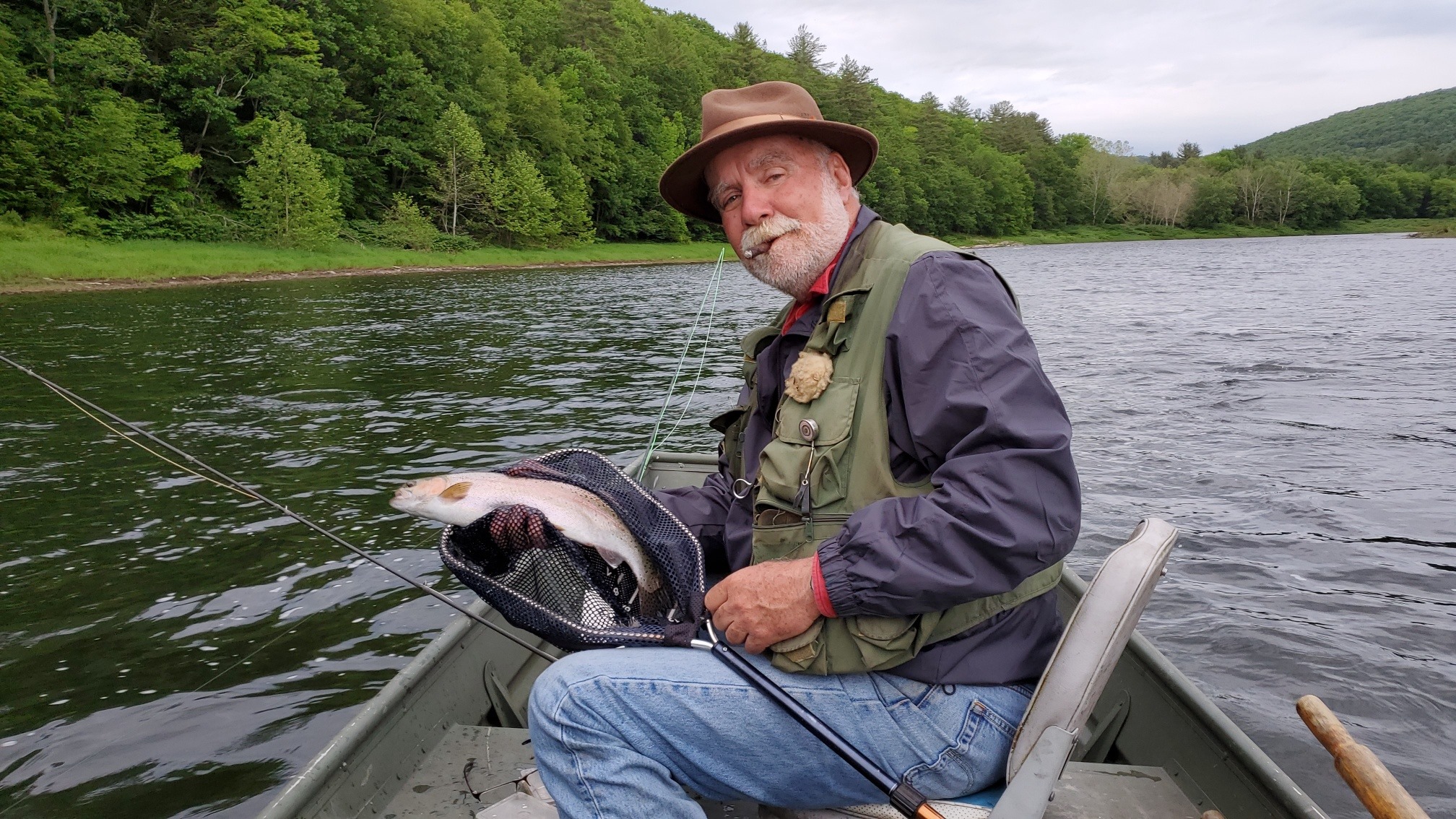
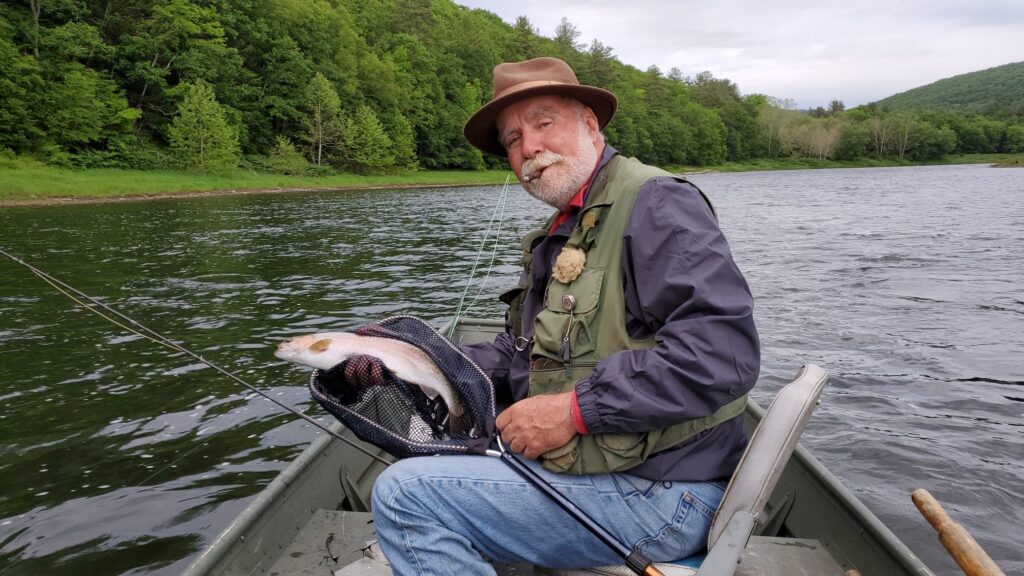
Mike Bachkosky has spent more than fifty years on the Delaware River, watching hatches, studying rise forms, and learning every detail of this legendary fishery. As a signature fly tyer for Umpqua and a dedicated dry fly angler, Mike brings deep knowledge of sulphur hatches, rise form reading, and the history of classic patterns like the Haystack and the Unusual. In this episode, he shares his simple one-minute fly approach, why presentation often matters more than pattern, and his personal philosophy on dry fly design. We also discuss his work with the Delaware River Labradors and how dogs and trout have shaped his life on the water.
Mike first came to the Delaware River in 1961. He was just a kid, and back then, most folks were bait fishing for walleyes, shad, and bluegills. Fly fishing wasn’t common. Inspired by Joe Brooks’ stories, Mike begged his dad for a fly rod and started catching bluegills on the fly. That early success hooked him.
Over time, Mike worked his way into trout. The river was warmer then, so smallmouth and panfish were everywhere. But with bottom releases from the dams, the river changed. Cold water boosted the trout population, while warmwater fish moved downstream. Today, the West Branch is the go-to stretch for summer trout, while the East Branch still shines in early season with higher flows.
Mike says the Delaware hatch cycle kicks off with Hendricksons in April, followed by a blizzard of caddis. After a short lull, sulphurs arrive and they can stick around as late as Halloween.
For Mike, the key is to slow down and watch. If trout refuse your fly, look closer at what’s happening. The water usually tells you everything you need to know.
When it comes to sulphur duns, Mike keeps his flies simple. He drew inspiration from Fran Betters’ Haystack and the Ausable Wulff, then added his own twist with snowshoe rabbit wings and an orange dubbed body. The result? A fly he can tie in about a minute.
Mike ties this same style in many colors—orange, olive, cream, yellow, even mahogany—and calls them true “guide flies.” They’re quick, effective, and catch fish. His advice: don’t overthink it. If trout are eating the fly, that’s what matters.
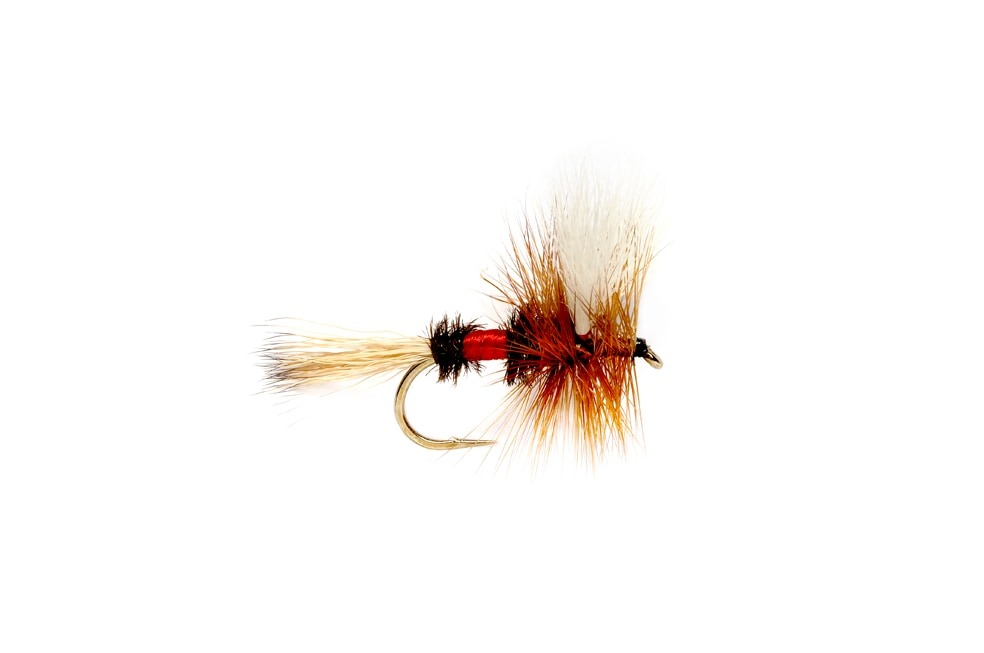
He laughs about how some thought these flies looked like “navel lint,” but they work and that’s what matters. Mike says he hasn’t fished a hackled dry in years, except for one classic: the Royal Wulff. When isonychias are on, a size 10 Royal Wulff still gets the job done.
Mike fishes it as a dry, keeping the wing treated so it floats in the film while the body rides just below the surface. His trick is to watch for subtle clues like nervous water or a dorsal fin breaking the surface. That’s a sign fish are feeding on emergers. He’ll cast a few feet above the fish, tug the fly under, then let the wing pop it back up.
This pattern has fooled countless Delaware trout, proving again that simple flies often work best.
Mike says the biggest mistake anglers make is rushing to cast instead of slowing down to watch. Not every rise means a trout is taking a dry. Sometimes it’s a nose sipping spinners, other times it’s a dorsal fin showing they’re after emergers just under the surface.
On the Delaware, you may only get one good shot at a rising fish—make it count.
Mike notes that hatches on the Delaware have shifted. Once-famous green drake and whitefly hatches are now just a shadow of what they used to be, especially in his home water near Callicoon. The reason isn’t clear, though upriver anglers still see them.
Even with changes, the Delaware remains one of the toughest and most rewarding rivers to fish. Its size, wild trout, and heavy pressure make it a true test of skill. Mike stresses that casting and presentation matter most. A sloppy cast or drag across currents will ruin your chances.
On the Delaware, success comes from slowing down, reading the water, and putting the fly in front of trout the right way.
Mike says each of these patterns is proven on the Delaware and beyond. They reflect his style—simple, effective, and designed to catch fish, not fishermen.
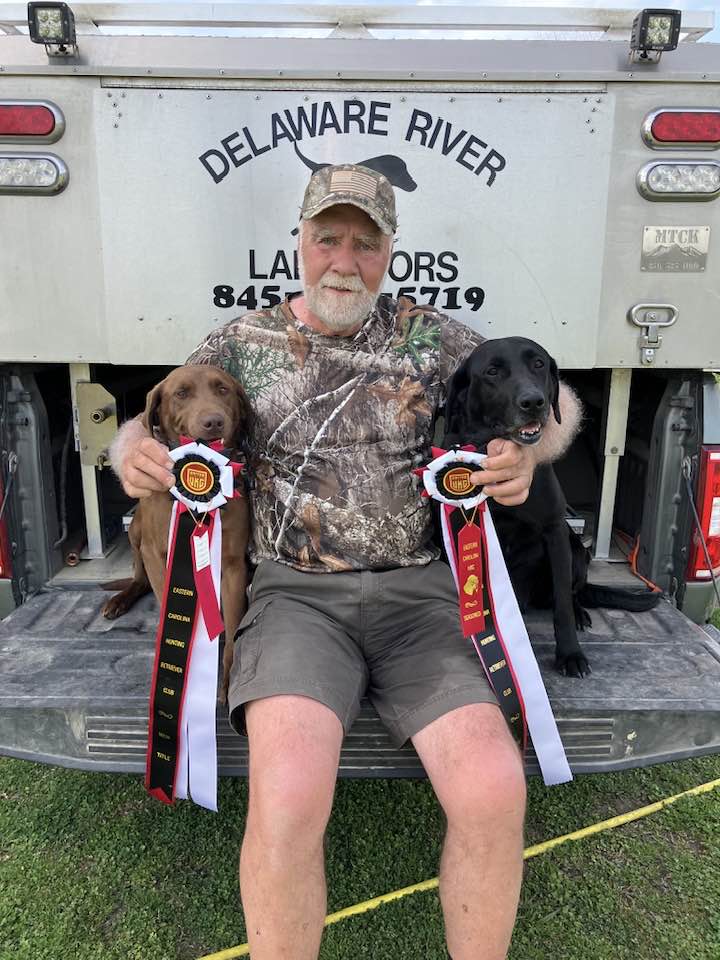
For Mike, it’s not about shooting birds—it’s about watching the dogs work. He loves seeing their instincts kick in: covering a field, catching scent, marking a fall, and bringing a bird straight back. He says labs are pure joy, always ready for the next ride or adventure.
Mike’s oldest dog, Satch, is turning eleven, and the two are “slowing down together.” Still, the bond they share is clear—it’s about fun, loyalty, and the simple joy of being outside.
Episode Transcript
00:00:00 Dave: Today’s guest has spent more than five decades on the Delaware River, learning every rise, form, hatch and holding rock along its banks. A signature fly tire at Umpqua, long time dry fly angler and trainer of Delaware River Labradors. By the end of this episode, you’ll hear why Sulphurs are our guests favorite hatch. How to read Rise Forms to know if trout are eating done, spinners or mergers, and the simple one minute flies he relies on when fishing gets technical. We’re also going to dig into the history of patterns like the haystack, the usual, and the unusual variation. Plus, why presentation often matters more than pattern. This is the Wet Fly Swing podcast, where I show you the best places to travel to for fly fishing, how to find the best resources and tools to prepare for that big trip, and what you can do to give back to the fish species we all love. Mike Bachkosky is here to share his approach to dry fly fishing with a focus on the Delaware. We’re going to get his philosophy on dry fly design and the joy he finds both in dogs and in trout. You can find his flies through Umpqua and follow his Labrador work at DelawareRiverLabradors.com. Here he is, Mike Bachkosky. How you doing, Mike?
00:01:11 Mike: I’m doing pretty well. How about yourself?
00:01:13 Dave: Not too bad. Not too bad. How’s, uh, how’s things looking out there this time of year? We’re kind of September. October range. Are you guys. Are you getting some fishing on the water some time in?
00:01:22 Mike: Well, I have unfortunately been unable to fish this year. Probably not what you want to hear. I’ve got a inconvenient torn right rotator cuff.
00:01:32 Dave: On your fishing arm. Is it your casting arm?
00:01:34 Mike: Yeah, yeah. Pretty left handed. I’m pretty. I’m pretty much useless. But right handed, I do pretty well. But, uh, I’ve kind of been impaired by that a little bit. So, uh, hasn’t been a year for me as far as fishing this year.
00:01:49 Dave: Yeah. This year. Okay. But you’re going to get back in the game. You’re not. You’re not ending your fly.
00:01:53 Mike: Oh no no no I’m not I haven’t sold my rods yet.
00:01:56 Dave: Okay, good. So we’ll get into more of that. And today I think what we’re going to talk about, you know, the Delaware River, which is, you know, really a famous river. We’ve talked about it a number of times on the podcast here. I haven’t been to it yet, but I’m hopeful here. Maybe in the next year I’ll be out there. Uh, we’re going to talk. You have some flies at Umpqua. You have been fishing it for a long time. So we’re going to get into a little history and maybe some on dry fly fishing with maybe a focus on sulphurs. And so we can help some people find some more fish, but, um, but maybe let’s just start there a little bit on the Delaware. Maybe you can bring us back to the history of the Delaware. What’s your history? How far does the Delaware go back for you?
00:02:33 Mike: I live on River Road in Callicoon, New York, which is about twenty, twenty five miles down from Hancock, where the confluence of the East and West Branch are. And fortunately, I had a neighbor who belonged to a camp across. That is the vagaries of life. I now have a house right across from the old camp I lived across there, and I see ghosts on that porch. but he brought me up here in 1961. So 64 years of experience fishing the same water. I’m a lucky guy.
00:03:04 Dave: There you.
00:03:04 Mike: Go. And, uh, in those days, we came up. We. Nobody fly fished. Uh, that gang, uh, they were all bait fishermen fishing for small wild walleyes. You know, shad. During the spring when the shad run was on. And at fourteen, I started fly fishing from, you know, reading the old Joe Brooks articles about these massive fish that he was catching on, flies around the country. And I begged my father for a fly rod. And I came up here and, uh, didn’t start with trout. The river at that time was full of schools of river bluegills, and I fortunately started fly fishing for bluegills. And when you’re a kid, you just want to catch fish. You don’t care where they are. And I was I was able to catch just tons of them. And I think any anybody who has a young guy or a young girl that was trying to going to teach how to fly fish. Don’t take them trout fishing the first time, you know, let them catch fish. I mean, it was a fortunate experience for me, but, uh, that’s how I started here. And then I, I started, okay, I’m going to buy some flies, and I did, and, uh, stumbled into a few trout. And the trout that were here then were, uh, it was a warmer river. The water releases hadn’t really been regulated yet. I was able to stumble onto a few trout, and these trout just fought so hard it was like, whoa, this is really different. And it started reading, asking questions. I’m a self-taught fly caster, so, you know, I was pretty crude there for a while until I started grasping the rhythms of fly casting and, uh, eventually evolved into reading books on entomology, trying to learn more. It grabbed me. It was a gradual, sometimes painful process, but I stayed with it, fortunately, and have had quite a time.
00:04:57 Dave: Right. So since you said nineteen, when you’re catching those bluegill, I was like early sixties, sixty one. What do you think is are the biggest? Has there been a lot more changes recently or what’s it look like over time?
00:05:08 Mike: Uh, we used to come up here to fish for, for smallmouth and, uh, bass and bluegills. Whatever we caught, I used to go out in the boat as a kid, and he’d look below you, and it was like it looked like a coral reef. There were fish underneath your boat all the time. Bluegills, rock bass, little smallies. Now you go out in the boat and you don’t see fish. They’ve moved down river. With the advent of the water releases, the main water temperature dropped. Uh, and we’re pretty far down. I mean, we reach during the summer, typically a six to sometimes eight week period where you don’t want to fly fish because the water’s too warm. So, you know, first thing you have to do is breathe. Everybody worries about what they’re going to eat. Well, they like cooler water. The trout started to population increase. And it seems to me that the water classified as warm water fish, the bluegills and many of the smallmouths, they move downstream where it was warmer. I think that’s what happened, you know, layman’s terms. It just they went to the more comfortable room in the old house.
00:06:15 Dave: And is that a good thing for the river that those bluegills.
00:06:18 Mike: Well, I you don’t see kids fishing here anymore. You see you see drift boats coming by, you know, when the water temperatures are, are suitable and people trying to fly fish. Uh. Now, are there smallmouths here? Yes. Not in the numbers we had, but still pretty good smallmouth river. Every now and then I enjoy trolling for walleyes. We’ve got a reasonable walleye population. Walleyes are different. Fishing. It’s trolling is kind of boring at times, but there’s some pretty good walleyes in here. and, uh, but mainly, you know, it’s become a trout river.
00:06:51 Dave: Okay. So. Yeah. So basically what you’re saying is, you know, back in before they changed the, you know, basically where they were taking water out. I mean, it used to be a warmer river and now the dams are they’re probably releasing like colder water. And that’s increased the trout.
00:07:04 Mike: Well, yeah, it’s a bottom release. It’s a tail water fishery. And the West Branch is, uh, that’s the hot spot now.
00:07:11 Dave: Yeah. Okay.
00:07:12 Mike: Yeah. They’re right right up near the reservoir. The water stays pretty cold year round now with the water releases. So, you know, during the time of the year, mid June to early August, most people are that are going to fly. Fish are going to the West Branch. The East Branch has got a minimal release of just a trickle so early in the year. The East Branch is a wonderful brown trout river, and when you have snow runoff, if we have winter with a lot of snowfall, you get a lot of snow melt. The tribs are higher, it gets a better flow. And there’s people that just love the East Branch. But access is difficult on the East Branch, so it’s kind of limited. And most people go to the West Branch.
00:07:56 Dave: Okay, let’s talk a little on the, um, you know, some of the hatches throughout the year. We’ve talked a little bit about this, but it sounds like, um, sulphurs are a hatch that are around. They’re around now and they’re around for a decent time. What is what is it throughout the year that you get excited about for dry fly fishing?
00:08:11 Mike: Well, I mean, it starts with the Hendrickson hatch here. Uh, the Hendrickson is still a very, very good hatch. And that, you know, you can argue about climate change, but things are happening earlier. It’s apparent. And, you know, now in April, we’re getting you may start seeing your your Hendrickson start, uh, depending on is it a warm spring, is it a cooler, more temperate spring, you know, can control weather. And from year to year, it varies a little bit. But when as soon as the, uh, hendrickson’s go away, there seems to be a part of the big Grantham hatch, which is the major caddis hatch. And that’s just a blizzard hatch. And, uh, I hate fishing that hatch.
00:08:54 Dave: How big are those granin’s like, size wise? How big are the granin’s?
00:08:56 Mike: Yeah. Fourteen.
00:08:58 Dave: Yeah, fourteen. Okay.
00:08:59 Mike: But there’s just blizzards of them, and, uh, that lasts for a few days. And, uh, after that, there’s there seems to be a lull. Oh, the old tire from, uh, Roscoe, New York, uh, Walt deti used to call it the dogwood doldrums. Uh, after the Grantham stay home, paint the porch, do all the little projects your wife wants you to do, and then come back in about ten days to two weeks, and then the sulphurs start.
00:09:26 Dave: And when do they start? When do the sulphurs start?
00:09:28 Mike: Uh, usually, uh, it can be early May, depending again on the year early to mid May.
00:09:34 Dave: And they go through. And when do they end?
00:09:36 Speaker 3: Uh.
00:09:37 Mike: I’ve caught fish on what are generically called sulphurs on Halloween afternoon. I used to come up here pheasant hunting, you know, with my dog, and I’d go on early morning to public land where they stock them. And, you know, I’d come back in the afternoon. It was. I remember one day it was Halloween and it was nice, sixty, sixty five degree late October day. And I’ll go fishing for a while. So I went up and I started seeing fish come up. I said, what’s going on? And I looked and I see these are sulphurs. I didn’t believe it myself. But, uh, you know, there’s there are more than several species of what are generically called considered to be sulphurs on the river. It’s not the same dorotheas that you see early in the year, but they’re called sulphurs and, you know, sixteen to eighteen. And, uh, right now we’ve got sulphurs on at this time of the year up here.
00:10:29 Dave: Yeah, right now and right now as we’re talking, it’s, it’s kind of mid September getting to October. So if in this episode probably will go live in October. So people could potentially still fish sulphurs when this goes out.
00:10:40 Mike: Oh, yeah. Sulfur’s Isonychia or the second brood of Isonychia are hatching now. I would imagine I’m sitting here looking at the river, so I do wander down every once in a while. Even though.
00:10:51 Dave: Yeah, you’re there, you’re there. How does that look for you? How do you approach sulphurs talk about that. Like if you’re going to fish them in the peak time, what does that look like? Are you trying early morning, late in the day? How does that look?
00:11:03 Mike: Depends on the day. You know, you can have uh, if you get a nice overcast and perfect there’s a slightly just misty, drizzly day. You can see him in the middle of the afternoon, but typically it’s later. And if you got a bright, sunny day, you know you’re probably going to end up fishing a spinner fall right near dark.
00:11:24 Dave: A spinner fall of sulphurs. Yeah, maybe. Talk about, do you know the life history of a sulfur a little bit? Talk about how that applies to.
00:11:31 Mike: Well, you know, they live in the riffles under the rocks and, uh, you know, they, they swim to the top. And there are times, Bob Lindquist that you know. Yep. You know, Bob loves fishing wets. Oh, okay. I’ve gone through the evolution that I think many fly fishers do. Where now I’m concerned at this stage of how I catch fish. So I now fish probably exclusively dry. I haven’t fished a subsurface fly in years. I may grease up what an a merger and but fish it in the film if I see rising fish that are being picky. But basically I’m dry fly fishing. And, uh, if there are fish coming up and taking Dunn’s. Well, okay, you do that, but typically, uh, later in the day, you’re going to get your spinner full. I could send you, uh, I took a really neat picture a couple of years ago with my camera, which is terrible. Uh, but I was sitting out in my boat. I have a fourteen foot John boat rigged up, and I dropped the anchor, and I’m sitting there, and I looked up river, and it had to be three hundred and fifty to four hundred four hundred yards away. I said, why is that cloud of fog up there? And I said, wait a minute, that fog is kind of orange. It was the biggest, most massive ball of sulfur that you’ve ever seen. Wow. And I could see them that far away.
00:12:53 Dave: They were spinners.
00:12:54 Mike: Yeah, they were spinners. Wow. At that distance, I could see them. I was amazed by that. That’s cool. They, uh, they typically, uh, when once they start hitting the water, you better have a spent wing on.
00:13:06 Dave: Okay. And what is the fly? What would a good fly? I know you have a couple Umpqua patterns. What would be a good spent wing pattern to fish on the fall?
00:13:15 Mike: I have I have become a big fan of one minute flies. Okay.
00:13:20 Dave: Yep.
00:13:21 Mike: Uh, nothing too complicated. Jeff, fly over is a friend. He’s the president. Umpqua. And I tell him the most. I look at the catalog and I say, this is the most. This is like fiction. And an old, old friend of mine, when I decided to become a commercial tire, told me, you can tie for fish or fishermen. Fish don’t carry wallets. That’s right. So, uh, you know, I’ve gone simple, and, uh, I just use a a a poly wing, simple poly wing spinner. Uh, and that works just fine with the spinner pattern. You don’t have to get complicated. You’re not dealing with hackle and ribbing, and, you know all the other things that that people are attracted to.
00:14:05 Dave: So what is the key on a on a poly wing spinner if you talk about it. So you have the tail, you have a thin body and the thorax.
00:14:14 Mike: Oh that’s just I just continue the body up and, you know, figure eight, the dubbing, you know, around to build up a thorax. There’s not a thorax for my pattern is not tied as a separate piece. It’s just a continuation of the body.
00:14:29 Dave: Yeah, that makes sense. So you figure eight, then you get your poly yarn on there or whatever. That’s usually white. Is that the color?
00:14:34 Mike: Oh, I just put white.
00:14:35 Dave: Yeah. Just white.
00:14:36 Mike: Yeah. The picture looking up and whether it’s, uh, it’s white or maybe a pale gray color. It doesn’t make a difference.
00:14:45 Dave: Just what about pink or something like crazy like that?
00:14:48 Mike: Well, you know, I mean, I remember reading in Fly Fisherman magazine, probably around nineteen eighty. George Harvey wrote an article.
00:14:57 Dave: Oh, yeah.
00:14:58 Mike: Right. Okay. And where he’s fishing down on Spruce Creek. Down near State College, Pennsylvania, on the limestone streams down there. And he’s talking about aging and being able to see his flies. And he wrote an article on upright wings in fluorescent colors, pink, yellow, and how it made no difference to the fish because their fish live in a backlit their whole lives. Everything’s backlit.
00:15:24 Dave: It’s bright. Yeah, yeah. So when they see a pink or purple, they’re not seeing the same colors we see. They’re seeing a shadow.
00:15:30 Mike: They’re looking up. They see black. I used to when I was giving demonstrations, uh, somebody would ask me about that, and I would hand them a flyer and I’d say, hold it up to the fluorescent light. What color do you see?
00:15:42 Dave: Right. So that’s not critical. It’s really making sure you can see it.
00:15:46 Mike: Size silhouette and presentation.
00:15:47 Dave: Size, silhouette presentation. Okay. And then if you think about the size we got that fourteen sixteen silhouette is just like you said getting the body and all that. Right. And then presentation.
00:15:58 Mike: Well we do have smaller sulfurs up here that can go down to eighteen. You know, I mean so it depends on on the time of year and what specifically is hatching.
00:16:07 Dave: Okay. How do you know when you’re on the river? Describe, um, say the duns versus the spinner fall. How do you know? You know, kind of what’s what to use on that day or maybe something more in the surface.
00:16:18 Mike: I look.
00:16:19 Dave: Yeah, just look to see what they’re.
00:16:20 Mike: Doing. I’m not trying to be snarky here, but your best source of information, after you’ve read every website and and talked to talk to everybody you can prior to your trip or your own set of eyes. I mean, just okay.
00:16:34 Dave: And spinners are just literally they’re kind of spinning down and dropping their eggs. So that’s real obvious.
00:16:38 Mike: They’re dropping their eggs. And, uh, if I’m fishing a done and I’m putting the fly over fish and they’re refusing it, okay, it’s time to slow down and take a look, you know, and just start watching the water. And, uh, usually all the information you need is right there in front of you. If you stop and look.
00:16:59 Dave: Check out Jackson Hole Fly Company today. Premium fly gear straight to your door without the premium price. Jackson Hole Fly Company designs and builds their own fly rods, reels, flies and gear, delivering quality you can trust at prices that let you fish more and spend less. Whether you’re picking up a fly rod for the first time or guiding every day, they’ve got what you need. Check them out right now. That’s Jackson Hole fly company, Jackson Hole fly Company.com. Discover Smitty’s Fly box for premium flies. Their monthly subscription service delivers expertly crafted flies and materials tailored to your fishing environment. Boasting over thirty years of experience, Smitty’s is your trusted source for a diverse range of flies. Enhance your fishing experience and make life easier with their carefully curated selections. You can subscribe right now at Smitty’s Fly Box.com and join a community of passionate anglers. What is the sulfur for a done pattern? What would be a typical pattern?
00:18:01 Mike: I have a fly that I’ve been using. It’s a takeoff on to a friend. Betters patterns. Uh, the old Adirondack tire. He came up with the haystack, uh, which was the first, uh, spread wing pattern. Deer hair wing, you know? Yeah. Like it? Well, the comparison is a takeoff on that.
00:18:19 Dave: Oh, it is. So the comparison comes from this person you just mentioned.
00:18:24 Mike: No, that was owl. Al Croce.
00:18:26 Dave: Oh, yeah. Al. Right.
00:18:27 Mike: All he did was take the haystack and split the tails. And he had a new pattern, that’s all.
00:18:33 Dave: Okay. And the haystack. And describe who was behind the haystack pattern.
00:18:37 Mike: Fran betters.
00:18:38 Dave: Fran betters. Okay. And that idea is that basically, you have this done pattern, and then you have the deer hair that’s split a split winged deer hair?
00:18:45 Mike: No. Well, what I did was he had the hay, and then he had the sable wolf, which had an orange body.
00:18:50 Dave: Oh, yeah. Sable wolf. Right.
00:18:52 Mike: Okay, so now you’ve got a haystack. And the au sable wolf is tied like a traditional wolf. Upright wings. You know, the hackle. And I looked at that and I said, gee. And I took some snowshoe, rabbit, small clump, and just lashed it to the hook with the tips facing backwards over the bend. And I spread, popped up the wing and built a thread dam and with my thumbnail displayed it, and I tied an orange dubbed body to it. After I’d done a couple of them, I figured out I could do them less than a minute and fifteen seconds, which to me is perfect.
00:19:31 Dave: That’s amazing.
00:19:33 Mike: Yeah. You know, I could sit down and in ten minutes, tie a half a dozen. I’m ready to go fishing that afternoon or evening.
00:19:39 Dave: That’s my style. That’s definitely my fly tying style, too.
00:19:42 Mike: Oh, yeah. You know, a lot of a lot of people in the industry call them guide flies. You know, something really, really simple that you can produce quickly and are effective. And I started tying that in. It was for the Dorothea hatch was kind of an orangey body, but I started using fluorescent orange dubbing and people would look at it and say, that’s too orange, it’ll never work until they used it. And, uh, I started tying olives. Same pattern. A light Cahill cream body, same thing. I’ve tied them in yellow. I think I’ve tied them in every color but black for my hendrixes. Yeah, okay. Mahogany body Anybody just tied on a size fourteen hook. A little bit bigger. And the fly is amazingly effective. And people ask me for years now, you know, do you think they they take it for an a merger or for a done. And I said you’re thinking way too much. What difference does it make if they take the fly. Do you care.
00:20:42 Dave: Right.
00:20:43 Mike: You know, stop thinking.
00:20:45 Dave: Is that the good when you come up to if you’re in the sulfur range and you come up to the river, are you starting with a done. Is that your first pattern you’re starting with?
00:20:52 Mike: I start watching, yeah. I don’t fish subsurface anymore.
00:20:56 Dave: Yeah. What about something that’s kind of not one of these like wolves or something sitting on top? It’s kind of down in, you know, that’s maybe not a wet fly or what’s the trend? When does it become a dry fly versus a wet fly? Because you hear these dry flies. A lot of people are talking about that. They sit way low in the surface.
00:21:11 Mike: Well, yeah, they sit in the surface. And that’s kind of what the unusual does, because it’s got no hackle to prop it up above the surface. It kind of sits in the film with the wing exposed, which means you can see it. And for those, by the way, I have tied them with orange and yellow wings. So.
00:21:29 Dave: And what pattern is that?
00:21:31 Mike: I call it an unusual third pattern was the usual, which was a snowshoe with a dubbed body and, uh, the wing extending forward. And, uh, I just propped it up and called it unusual. Oh, right. Based on the haystack wing.
00:21:48 Dave: Yeah, it’s a usual pattern. Just with the wing. That’s.
00:21:50 Mike: Yeah. So I combined a couple of friends patterns, and I years ago sent him a couple, and I said, why didn’t you think of this? And I don’t know, Fran Betters. I never had the pleasure of meeting the man, but, uh, he did respond, and he said I should have.
00:22:05 Dave: Huh? Yeah. So the usual? Yeah, the usual pattern is what’s the wing on? The usual pattern.
00:22:11 Mike: It’s snowshoe.
00:22:12 Dave: Yeah. Snowshoe. Snowshoe Hare. Yeah. So how does that pattern even float? It seems like it would sink a little bit.
00:22:19 Mike: Snowshoe is amazingly buoyant and, you know, a little whatever float you use, you know, in the dubbing it just after you catch a fish, it kind of helps it float after that better, you know, it stays up on top a little better so you don’t have to retreat it right away.
00:22:34 Dave: Wow, that’s so cool. What a cool fly. I mean, that thing definitely is not your typical Catskills dry fly, right? You’re talking. You know the opposite, right?
00:22:42 Mike: Oh, yeah. I mean, I used to give demonstrations up at the museum in Roscoe, and I do some of these things. And, you know, Paul Jorgensen sitting there one day, and he looks at me, he says, what the hell’s that?
00:22:56 Dave: God. That’s great.
00:22:57 Mike: I think he I think he described it as navel lint.
00:23:00 Dave: Navel lint.
00:23:01 Mike: Yeah. We put on a new sweat shirt and you get sweaty and you get a whole bunch of lint in your navel.
00:23:08 Dave: Or navel lint, right? Oh, my God.
00:23:13 Mike: That looks like navel. And I said, yeah, well, it’s got a hook in it and it works.
00:23:17 Dave: Yeah. So that’s the usual. Then you’re saying the unusual is just that snowshoe hare wing? What do you do differently with it?
00:23:23 Mike: It just prop it up like a the haystack type style.
00:23:26 Dave: Or.
00:23:27 Mike: Paradigm style wing. And I flare it.
00:23:29 Dave: And you flare it into two wings.
00:23:31 Mike: No. One wing.
00:23:32 Dave: When would you use the usual or the unusual versus, say, a different, more of a standard done style pattern?
00:23:38 Mike: Oh heck, I don’t know. The only the only hackled fly I’ve fished in probably two decades is and I’m not making this up is a royal wolf.
00:23:49 Dave: Yeah, the royal wolf. One of the classics.
00:23:52 Mike: I’ve just come up number ten, Royal wolf up here. When the isonychia on, they eat it.
00:23:56 Dave: Royal wolf. God, that’s a great. I’ve caught some amazing fish on the royal wolf. Sometimes those traditional patterns, I mean, they still work, right? That’s the great thing.
00:24:03 Mike: They still work. They really, really do. That’s why I told Jeff Fry over from Uncle Jeff this. Some of these patterns are so overthought. And, you know, No. He laughs at me.
00:24:15 Dave: Yeah. They’re selling. They’re selling. No. It’s good. Um, so this is awesome. I mean, there’s such a but it sounds like. So you don’t use hackled. So really, you’re fishing dry flies, like you said. But there’s a really fine line between, you know, when that when does that usually become, like, a wet fly or what would be the what’s a wet fly that’s most similar to a dry fly? I always think a wet fly is okay. It’s like traditional wet flies have that wing and it sits down like Davey Watson’s, you know, that sort of stuff. But there’s also like tied down caddis is a wet fly.
00:24:46 Mike: There’s well yeah that’s a that. Yeah. Okay. That’s a ten wing style fly. Something like that. Yeah. Well you know you’ve got plenty of plenty of cabinets, patterns uh that work and, and what I used to do when I, if I’m fishing a cat is dry because they’re taking caddis that day and they’re not taking them on top. I’ll just tug them under and let them swing.
00:25:08 Dave: Oh, tug. What? Like, what’s your caddis pattern you’d be using.
00:25:12 Mike: Just a standard elk hair.
00:25:13 Dave: Yeah. And just tuck it under and pull it. And then does it pull out and then does it pop back up.
00:25:17 Mike: If I put enough floating on it. And then one of my friends loves fishing. Wet. That’s all. He likes to fish. And he’s still trying to figure out how to get a wooly bugger to float.
00:25:28 Dave: So what do you think is the the number? We always joke about that. But the woolly bugger, the you know, you talk about the royal wolf. What’s the greatest if you had to have one fly pattern, what is the one you’d only use one for the rest of your days on the Delaware.
00:25:41 Mike: Uh, I tie a very simplified merger, and it’s nothing. This is another minute and fifteen second fly. It’s nothing but pheasant tail wrap forward counter wrapped, of course, with some very, very thin copper wire and a snowshoe wing just extending straight out over the eye of the hook.
00:26:04 Dave: How long? How far over the eye?
00:26:06 Mike: Probably two thirds the body length of the hook. Hook. Shank. And I just kink up the wing.
00:26:13 Dave: Yeah. You kink up the wing so it becomes a dry fly, essentially.
00:26:16 Mike: It’s floating again. That one is in the film. And that has been an amazingly, uh, effective pattern I gave when I came up with it, uh, a few years ago. I gave some to my neighbor here, and, uh, I came up where I was away, and I’d been away for a couple of weeks, and it was like the first week of June, and I had given him these things to fish the Hendrickson hatch. They were tied on size fourteen hooks, I guess. And, uh, he was out in his canoe and I went up my boat and his rod is bent. And I said, what you got on? And he says that, uh, Pheasant tail emerger you gave me. I said, you’re still fishing. That he says when they stop eating it, I’ll stop using it.
00:26:59 Dave: Nice.
00:27:02 Mike: And, uh, it’s just an amazing pattern when they’re being picky. They like that. They like that, uh, you know, there’s an element of truth to the fact that they’ll take even an emerging nymph before they’ll take a dry fly.
00:27:15 Dave: Oh, and how would you fish that pheasant tail?
00:27:18 Mike: That fly just as a dry fly.
00:27:20 Dave: You’d fish as a dry fly.
00:27:21 Mike: Okay, I see a fish. And. And you can tell when you’ve looked at enough fish, when you see what they call down in the bonefish. Last nervous water where the fish are just under the surface. You can tell that. Okay. Or you’ll see instead of a sip, you’ll see a dorsal fin that tells you they’re taking something that’s emerging just under the surface. You got a reading water, reading the fish, and you know that you drink up the put floating on the wing. Just the wing, not the entire body of the fly. You want that in the film? Oh, I’ll even hold it in my mouth and squeeze saliva into it to make it just a little bit heavier. So it does break the surface. And when it’s floating towards a fish, I will pull it under and just let the wing. Just bring it back to the surface and get some some fairly solid takes.
00:28:15 Dave: Right. God, that’s so cool. So you might be on the stream, you’re looking, you’re watching, and there’s something going on, maybe some nervous waters. And all of a sudden you see a a dorsal fin but nothing sipping. And then you’re like, okay, that’s definitely below the surface.
00:28:26 Mike: Okay, that’s a clue. Again, the information you need is usually right in front of you if you slow down and pay attention.
00:28:34 Dave: So you would know that is below the surface and you could have this pheasant tail fly cast it. How would you know? Would you kind of know where the fish is, is you cast like right near.
00:28:44 Mike: Well, you know, you’re watching, you’re if you’re watching, if you see the dorsal fin, you know where the fish is. And typically, even with a dry fly here on the Delaware, they’re very, very, very picky. These are really smart fish. And the optimum angle is to be slightly above the fish and fishing it down and across a little bit.
00:29:05 Dave: Oh down across. So if the fish was, if you’re on like river right. Fish is going. You saw the fish there, you would cast just a bit up above him.
00:29:13 Mike: two or three feet, you know, three feet above the fish and give it a tug under and just. And then as it approaches the fish, just give it some slack. And the, the kink on the wing will pop it right up and bang.
00:29:24 Dave: Dang, you’re doing your own. You’re creating your own hatch. So that’s a done. Getting ready to hatch is what you’re a nymph or, well, a wet fly.
00:29:31 Mike: Well, yeah. Most of the mayfly nymphs swim to the surface, you know, and they will crawl to the edge. You know, they’ll usually emerge on rocks where most of your mayflies swim up from the bottom.
00:29:43 Dave: Yeah, they do, and that’s what this does. The sulfur. Does it swim up from the bottom? Yeah, yeah. Swims up from the bottom and hatches. And then, um. Man, this is so cool how it works. And how do you set the hook? What does that look like? If it’s under the surface, you feel something.
00:29:55 Mike: Oh, just raise the rod tip. They’ll set the hook when they go down. Yeah, yeah. If you’re using fine leaders, if you’re using in five or six snippets. You don’t want to put too much pressure on that, right?
00:30:07 Dave: What else should we know about rise forms if somebody on the stream and they’re not familiar with it? You talked about a couple here. Any other to know what to do? What about these these fish that are eating, um, the eyes that are, you know, the spinners.
00:30:20 Mike: That you’ll see noses, you know, you just see a little, little sip or maybe you don’t see the nose, but it’s a very, very, very quiet, quiet take.
00:30:29 Dave: So. Yeah, I just want to. I know you’re kind of known for I like rise forms and stuff like that. So I’d love to help somebody understand more about rise forms. Have we talked about everything we need to know about understanding the rise forms of fish and how to know what to use?
00:30:42 Speaker 4: I mean.
00:30:43 Mike: Back, I guess, when I was a rookie, I mean, how many times? And it was more than several times I didn’t know what I was looking at. And, you know, about reading Rise Forms and how many times I fished through an amazing emergence of mayflies and didn’t catch a fish because I didn’t read the rise forms that they were taking themselves subsurface. You get in a frenzy. And you stop. You. You’re looking, but you. But you’re not seeing. Is that the right way to say that? You know, I mean, read the rise form. Is that a nose you’re looking at, or is it a dorsal fin, or is that disturbing? Is it merely a disturbance just right below the very surface? And that’s good information to have, because I can tell you I remember, yeah, I remember fishing a grey fox hatch up here one day, and I fished the entire thing, and I was so frustrated by it. And they were taking two mergers. I know now I didn’t then to me the disturbance was the fish was taking a dry fly. Well it wasn’t. I started after this happened several times. I started watching the water and I’d see a gun floating down and dones are floating right through all these. what I thought were rising fish. But they weren’t taking the Dunns. Well, what are they doing? Again, I think the biggest mistake that people make is just to not slow down and really, really take a look.
00:32:13 Dave: Yeah. If you’re on a stream, slow down, don’t make a cast. Look at what’s going on. If there’s bugs on the water, if you see Sulfurs or whatever, you’re like, okay, there’s some sulfurs. Are they spinners? Are they dunns?
00:32:23 Mike: Yeah. I mean, people tend to end up going casting instead of fishing.
00:32:27 Dave: Yeah. You want to wait? Yeah. Don’t. Because you might get you find that on especially on the Delaware rivers. They’re technical. You might get one cast out of fish a good fish. And if you miss it, you’re out of luck on that fish.
00:32:38 Mike: Rule number one is Miss Short.
00:32:40 Dave: Miss short. Okay. How short is, like, too close. When would you spook the fish?
00:32:44 Mike: If you cast beyond it, you cast two or three inches beyond it. These fish during. I’ve seen them where they see a leader and they’re done. So don’t show them a leader. That’s why I try to position myself slightly above and across.
00:32:57 Dave: Oh, right. Slightly above.
00:32:58 Mike: The first thing they see is the fly.
00:33:01 Dave: Gotcha.
00:33:02 Mike: And the downward drift. And put as much slack into the tippet. The leader and tippet that you need. But try to make it so the first thing they see is the fly. And you can. You can miss thirty five times short. You’re not going to bother them because you’re not showing them anything.
00:33:17 Dave: Right. So start short. What is your leader? Is that pretty simple? Like what is your leader setup look like? Is it always the same?
00:33:22 Mike: Oh, typically I use a I like to use a twelve foot leader with probably two and a half to three foot tippet.
00:33:29 Dave: Yep. And what type of tippet? Like a five x or four O?
00:33:33 Mike: It depends on the conditions. I mean Clearwater, I generally don’t go below five.
00:33:38 Dave: Okay. And do you always use one fly? Ever use more than one?
00:33:41 Mike: I argue this with Bobby Lindquist all the time. He’s into all this. He likes, you know, tie a tippet to the the bend of the hook of your dry fly and fishing a merger or a nymph underneath it? Nah. I fish one at a time. You know, you. If I’m trying to be precise, I’m not going to be as precise with two flies as I am with one.
00:34:05 Dave: Not many companies are building their own gear these days, but intrepid camp gear is changing that. Based in Boulder, Colorado, intrepid designs and manufactures some of the most rugged, technically advanced rooftop tents and aluminum cargo cases on the market. Their gear is built in-house, with patented designs that stand up to the elements and the miles. Whether you’re chasing elk deep in the backcountry, hunting for fresh powder, or heading out for your next fly fishing trip, intrepid gives you the confidence to go further. Their rooftop tents keep you warm, dry, and off the ground. Their cargo cases bomb proof, weather tight and ready for just about anything. So stop settling for flimsy, mass produced gear. Level up with the gear that’s built to last and engineered for real adventure. Go to intrepid right now to get started. That’s in R e p I intrepid camp gear get started right now. You’ve mentioned Bob a couple times here. He was on the podcast episode eight hundred and that was a little bit ago, not too long ago. But describe that. Tell us who who Bob is and how you connected. For those people that didn’t hear that episode.
00:35:12 Mike: Bob’s mother in law, uh, owns a house. Oh, about two hundred and fifty yards up the road from me. And we met up here many, many years ago. And, uh, the kind of a funny story. There’s a rock in the river that I’ve been sitting on since, what, nineteen sixty four? Fifty five?
00:35:32 Dave: The same rock.
00:35:33 Mike: Same rock. Uh, Bob’s father in law used to call it Mike’s Rock. And Bob would come down and he’d see me. We hadn’t met. He’d see me, and he didn’t want to bother me. So he’d wait across the river. And you know, the river is, what, sixty five, seventy yards wide? He’d wade across and fish from the other side so as to not disturb me, which I appreciated. it. And, uh, one day I was sitting on the rock, and he comes down and to talk to me. And that’s when he first met. And he says, uh, he said, why do you always fish from this rock? And I looked at him and I said, well, what don’t you see? He said, what? I said, what don’t you see? What don’t I see? Yeah. What don’t you see? And he’s thinking and thinking and thinking. I said, how about glare?
00:36:20 Dave: Oh, glare. Right.
00:36:21 Mike: The light was different. Yeah. Over where he was. There was so much glare on that side of the river at that time of day. And where I was, everything was perfectly visible. And he just went like one of those slap yourselves in the forehead moments, you know? Yeah. Oh.
00:36:39 Dave: So that rock. And is that rock still good? It still produces.
00:36:42 Mike: Fish. Oh, yeah. I caught one guy. I had it installed.
00:36:44 Dave: Yeah, right. Right, right. How big is this rock? Like, what’s the diameter?
00:36:48 Mike: Oh, it’s big enough for maybe two people to sit on. And, you know, there’s there’s no secret. There’s no it’s not a special place. The truth of it is I can sit down. Yeah. That’s it. And I can see.
00:37:02 Dave: Right. What’s that water look like from the rock? Are you looking at a riffle or run? What? What does it look like? What’s the water?
00:37:08 Mike: Um, looking at a run, the riff would be above me. It’s just starting to smooth out before it goes down into the eddy.
00:37:17 Dave: Into it. And there’s a pool down there below you. Yeah. Now, remind us again. Where are you at? Is that something we could let people and not. You know. Exactly. But we’re in the river system. Are you again?
00:37:25 Mike: Oh, I’m four miles above the village of Callicoon, New York. The biggest problem down here is access. I mean, it’s all private property. Pretty much. You have to access it with a drift boat.
00:37:36 Dave: Oh, you do. So you can legally float the river. That’s no problem. Yeah. Oh, yeah. So you’re on the. That’s why I didn’t realize the border of the Pennsylvania. New York is divided.
00:37:45 Mike: I ride across the river. I’m looking at Pennsylvania.
00:37:48 Dave: Yeah, you’re right there Pennsylvania. That’s really awesome. So okay, so that gives us in Callicoon. I see that now. Yeah. It’s a little pretty, uh, nice little small town there. Looks like.
00:37:57 Speaker 4: Um, a little village.
00:37:58 Dave: Cool. Okay, so we’re talking, um, you know, sulfurs today, I guess, before we’re going to start to transition out of here a little bit with our, uh, Fly Shop Friday segment. But, um, before we get there, maybe any other items you want to make sure we talk about here? If we’re thinking somebody’s preparing for, you know, maybe to fish the sulfurs. Have we covered a decent amount here? One thing we haven’t talked about is your flies, right.
00:38:20 Mike: Hatches have changed over the years. For instance, down here, we used to I used to plan vacations around the around the green Drake hatch. It was marvelous. We’ve lost them. Pretty much. They’re not extinct. You’ll see a few. But, I mean, I’m talking about blanket hatches. We don’t see them anymore.
00:38:38 Dave: Yeah. Is that just climate changes?
00:38:40 Mike: No, I don’t believe it is. Because they have. There’s green drakes just upriver of it now. I don’t know what happened down here. There’s no pollution.
00:38:48 Speaker 4: Huh?
00:38:49 Mike: I efforted this for a while, trying to call the Department of Environmental Conservation in New York, talk to their biologists. And I finally got the guy on the phone one day, and I said, look, you got you had hatches that are disappearing here. I think you got a problem. And he really didn’t want to talk about it.
00:39:08 Speaker 4: Yeah.
00:39:10 Mike: Okay. I guess asking a state employee to do his job is expecting too much. And that that kind of ended the conversation, so I can’t imagine why.
00:39:20 Dave: So you think there’s something specifically going on? You’re in Hankins, right. Was that the area you were kind of in?
00:39:25 Speaker 4: Oh, just below Hankins.
00:39:26 Mike: Hankins is two miles up river from me and just above Hankins. They’re telling me that, yeah, they’re seeing green drakes. And the further they get towards Hancock. Yeah, they’re getting heavier and heavier and up in the branches. They still have the old fashioned green Drake hatches, but not here. Now. Why?
00:39:41 Dave: And so you have no idea that we are stumped on that.
00:39:44 Mike: No idea. I mean, they’re they’re burrowers. They burrow in mud. The old mud banks are still here. To my view, nothing has changed. And I’m curious as to why.
00:39:54 Dave: Right. We’ll have to put a shout out to somebody who’s smarter than both of us. That can maybe have an idea on why that. Because it seems like. Yeah, such a small little segment of river.
00:40:03 Speaker 4: Well, here’s something.
00:40:04 Mike: Else about that is that there are three bugs that have pretty much the same thing has happened to them. One is a green drink, one is a brown drink. Okay. They hatched at the same time of year. But in August and early September we used to have huge whitefly hatches. Now, what are those three bugs have in common? They all burrow in mud. They don’t live in riffles. Well, and they they have lessened to the point where there are, like I say, they’re not extinct. But boy, it’s not like it used to be. And there’s no real reason the railroad didn’t dump a car, a hydrocyanic acid in it and kill everything that didn’t happen.
00:40:40 Dave: How big of a section are we talking about here that you think is doesn’t have them. And then the section that versus that does.
00:40:45 Mike: Oh heck, I don’t know. I know I don’t have them here. That’s it.
00:40:48 Dave: Yeah. So you’re a mile a few miles, whatever it is.
00:40:51 Mike: Couple. All my fishing is done right here. My, my trout rods haven’t seen the inside of a vehicle in decades.
00:40:56 Dave: Right. So you’re right there within within your hankins and down to the callicoon that that’s your area.
00:41:02 Mike: That was when in seventy six, when this became a national wild River area. Callicoon was established as the bottom of the trout area. Then when they started restricting the water releases, as is now the habit, the water started getting warmer and well, it’s no longer considered the bottom of the trout area. While there are trout here and below here, I mean there’s wonderful fly fishing down to Coshocton and all the way down to, uh, Skinners Falls, which is about, uh, Skinners is, what, eight, ten miles below me. But when the water is cool, wonderful trout fishing. But it’s not considered in the trout area.
00:41:42 Dave: Gotcha. You’re below it now. On a busy day, if you’re sitting on your deck there looking out, how many boats might you see on a busy day float by?
00:41:50 Mike: Well, right now, none, because the flows are greatly reduced in September. Everybody is up. And the hatches? The hatches have been marginal here at this time of the year. I’ve been sitting out here in the afternoon with, you know, with the dogs doing stuff, and I constantly looking and I haven’t seen much coming up lately. I think we’re in a kind of a lull hatch wise, except for the late, late, late evening where you might get a spinner fall, but I haven’t seen a lot of activity on the river at this right now. I think it will improve as it typically does the later we get into September. I think it will improve, but it hasn’t yet.
00:42:25 Dave: Hasn’t yet. Okay. And what is the on the Delaware? You know, for somebody who hasn’t been there, why would somebody want to go there and fish. What is it about the Delaware? I mean obviously it’s a famous river, but what makes it what it is?
00:42:36 Mike: The fish are truly special. They are. First off, they’re very, very difficult. This is a very technical river. It really is. I have friends over the years that have come up that have been good small stream fishermen over in Pennsylvania, and they get here and number one is the size of it. It’s like it’s not like fishing Bowman’s Creek over behind Wolfsburg where it’s, you know, twenty yards wide. Now they got all this water.
00:43:00 Dave: Yeah. Where do you fish? Right, a giant river. Where do you start?
00:43:03 Mike: Yeah. You know, they’re just looking at it like, how do I do this? That’s one thing. The other thing is, is that these fish are not stockfish like you see in the streams over there. These are smart fish, and it’s been fished heavily. They probably know umpquas fly pattern book.
00:43:21 Dave: They know it, right? They’ve seen every single fly out there.
00:43:24 Mike: They’ve seen them, you know, and you and you can’t make mistakes. Too many people. The biggest mistake I see is that people that don’t, don’t aren’t good casters. And I talk to the guides and they say I’ve been putting them on fish all day and they can’t hit one, right?
00:43:37 Dave: Casting is not easy. I mean, it can be. You can work on. But I think what I’ve learned over the years of doing this podcast is that, you know, this is a no brainer, but you have to practice. You know, you have to practice your casting to get good at casting.
00:43:50 Mike: Well, dry fly fishing is more you have to be more accurate and delicate with dry fly fishing than you do swinging weights.
00:43:57 Dave: How do you cast a delicate? What does it take to do a delicate presentation to a spooky fish.
00:44:01 Mike: Cast far enough above it? Don’t slap your leader, you know. Don’t slap it down. Let it come down delicately. The fly should come to rest, not splash. The fly should be allowed to come. To rest on the water is the best way I can think of saying that.
00:44:16 Dave: Yeah. And are you doing a lot of reach casts to put slack in the line?
00:44:19 Mike: Depending on the water you’re in? I mean, the big thing is, is don’t cast you far here, because if you’re going to try to make a seventy foot cast to a fish, which many, many people can do, but you might be casting over three or four different currents and the rocks aren’t always visible. It could be a boulder underneath that’s causing a minor swirl on top, and it’s going to put a bend in your presentation. And if that happens three or four times, by the time your fly gets to the fish, it’s immediate drag. And as I think Nick Lyons wrote in a book once about this, uh, if you had a pork chop on your plate and it moved, would you eat it?
00:44:58 Dave: Well, it depends on how hungry you are. I mean, I guess, but no, probably not.
00:45:02 Mike: No. But it’s kind of the same thing. You’re a fish. Think of it from a fish’s point of view. You’re sitting there and there’s a bug. There’s a bug. Here’s a bug floating freely, floating freely. And all kinds one comes dragging across in front of you.
00:45:15 Dave: Yeah. You’re not going to eat that one because it just doesn’t look right.
00:45:18 Mike: That’s why I say presentation is probably more important than than pattern. Absolutely.
00:45:23 Dave: What is the most important? What was your steps? Presentation is above.
00:45:26 Mike: Say silhouette presentation then. Then the colors should be the last thing, last consideration. I mean, how many million fish were caught on Adams.
00:45:34 Dave: Yeah. Does the Adams still work?
00:45:36 Mike: Of course it does.
00:45:37 Dave: What about the. Do you fish the Adams or the. What about the parachute? Adams?
00:45:42 Mike: If I’m fishing, the bigger bugs, uh, the marsh browns and isonychia dry. Or if I see a few drakes on the water and I gotta go really big, I choose to fish them in parachute.
00:45:54 Dave: Okay, so the big ones, you go, like, what would it be? Big. Like a size twelve or something.
00:45:58 Mike: Twelve. Ten.
00:45:59 Dave: Yeah. And why is that? Why would you fish the parachute with bigger.
00:46:01 Mike: Just the way they, they rest on the water. The fish get a good look at it and, uh, they sit right. And then, you know, with the parachutes, if it lands properly and is floating properly, you can get a good look at the wing. You know where it is.
00:46:15 Dave: That’s awesome. Okay, well, this is good, Mike. Let’s take it out of here. Like I mentioned the Fly Shop Friday segment we’re going to do, we’re going to give a shout out to, uh, the local fly shop if there is one nearby. Today this is presented by Patagonia’s Swiftcurrent Waders. We’ve been wearing Patagonia’s waders here recently. They’re a great company doing some great stuff. We have them on this year as a sponsor, so we’re super excited for them. So I want to give a big shout out to Patagonia and all the great work they’re doing. Let’s just start this off. First off, we talked about the fly shop. Do you have a local shop you go to when you need gear or products? No you don’t. There’s no shops up there.
00:46:47 Mike: Not until you get up to Hancock.
00:46:50 Dave: Wow. Okay. You got to go to Hancock to get a shop.
00:46:52 Mike: There’s not. No, uh, it used to be Joe McFadden had a wonderful fly shop in Hankins there. I supplied all his flies. Oh, yeah. I was doing twelve hundred to fifteen hundred dozen flies a year for him.
00:47:02 Dave: Oh, wow. When did Hankins when did that shop go away?
00:47:05 Mike: Oh, that closed probably. I can’t remember exactly ten, twelve years ago. That was a good shop I haven’t oh my God, I haven’t been in a fly shop in twenty years.
00:47:13 Dave: Right. Yeah I guess you I mean, you don’t need to. When you got all your gear and you got your flies, and.
00:47:18 Mike: You know, if I, if I need tippet or floating or things like that, I order it from Umpqua.
00:47:23 Dave: Yeah. You just get from Umpqua. That’s right. Umpqua. So let’s talk about that. You mentioned Umpqua. So you do have some flies on Umpqua. So what would you.
00:47:29 Mike: I don’t know if I’m still under contract or not.
00:47:32 Dave: Well, your flies are out there. I can still see your flies on their website.
00:47:35 Mike: Well, they’re not they’re not going to talk to fry over because he’s not sending me any royalties.
00:47:40 Dave: You gotta hit him up because you’re definitely still on there.
00:47:43 Mike: The only time I see fry over now is he has a really, really good young pointing lab dog. And I’ll see Jeff at an occasional test when I travel. Did you ever meet Jeff?
00:47:52 Dave: Uh, we haven’t had Jeff on the podcast, but we’d love to. That’d be awesome. We’ve done a.
00:47:56 Mike: Jeff is one of the all time good guys.
00:47:57 Dave: Oh, good.
00:47:58 Mike: And just do me a favor. Don’t tell him I said that.
00:48:01 Dave: I won’t, I won’t. No, we’ll get him. Where can I get him on? We have, um, Umpqua is pretty cool because we’ve had a couple of stories on the history. Umpqua because I’m from Oregon. That’s where Umpqua started. And they’ve got a really interesting history about how those guys used to travel around the West and just get on the road and sell their flies. The original founders, it’s a pretty cool story.
00:48:18 Mike: Oh, yeah. Well, hey, you know what? Look at Cabela’s.
00:48:21 Dave: Yeah. Did they do the same thing?
00:48:23 Mike: The two brothers were selling flies for twenty five cents apiece.
00:48:26 Dave: There you go. That shows you how long you know, you go back here. But I’m looking at on Umpqua right now. Signature fly tire shop. Mike’s batch flies right here. I’ve got the the ref, gray Fox, the ref. Isonychia merger, the parallel and the quill.
00:48:41 Mike: And I’m not. I gotta talk to fry. Over.
00:48:44 Dave: Well, what’s the talk about this? What’s the ah what’s ref? It says ref gray fox. What’s that?
00:48:49 Mike: Rainbows and flies. That used to be my. The name of my business.
00:48:53 Dave: Oh, okay. Yeah, yeah. Okay. So. So talk about this. I’ll let you catch up with Mike on the, the royalties. But as far as the flies, you have four flies up. There are those good flies. Those still catch fish.
00:49:03 Mike: Of course they were.
00:49:04 Dave: Those are all good. So the gray fox, the isonychia, the emerger. You got a you got the para. Is it the.
00:49:10 Mike: Paraleptophlebia? Adoptive is a fly species.
00:49:14 Dave: Oh, it’s a species. Okay.
00:49:15 Mike: Probably a small olive.
00:49:16 Dave: Yep. Yeah, it’s a small. And then you got the quill okay. So just shout out. Yeah. So we’ll we’ll definitely work on it when we get him on here. When we get Jeff on we’ll ask him what’s up with this.
00:49:26 Mike: But oh my man, I miss seeing Jeff.
00:49:29 Dave: Okay, well the more important thing is this is our random segment. We’ll let you get out of here in a second. But I got a couple random questions for you. You mentioned it before. Tell me about the dogs, because I think there’s quite a few people that are into bird hunting that also fly fishermen. Have you been doing the dogs for a while?
00:49:42 Mike: Yeah, I three years ago I bought a house in North Carolina because, uh, during the winter, if you’re I compete in AKC test, uh, UK HRC tests, which are retriever tests and then the American Pointing Labrador Association. And up here in New York during the winter GR water turns hard, uh, it freezes and it kind of limits your training. So three years ago, I bought a house in North Carolina, and I’ll be going down there soon so I can continue my training with the dogs in competition with the dogs, because they run their hunt tests down there during the winter months and up here during the summer.
00:50:18 Dave: So you’re training dogs. That’s what you’re. You have a business training dogs?
00:50:21 Mike: No, I don’t have a business. I train my own.
00:50:23 Dave: Oh, yeah. You just train your own for the love of it.
00:50:25 Mike: Yeah. I joined the train and compete. That’s, you know, a friend of mine, a neighbor of mine said, oh, man, North Carolina, you can play golf every day. It’s a golf course. I’m only seventy four years old. That’s where you old guys.
00:50:38 Dave: You’re not. You’re not quite there yet.
00:50:40 Mike: I’ll take up golf again.
00:50:41 Dave: That sounds awesome. I think the train, because you hear a lot about that with bird hunters especially. They say it’s all about the dog, you know? That’s why they love the bird hunting.
00:50:49 Mike: I go to South Dakota every year to watch my dogs on. I don’t care if I shoot another pheasant. I do not care if I squeeze the trigger. I just want to see the dogs work.
00:50:57 Dave: God, what is it? When you get a dog, what is it about for somebody that’s never hunted with a dog? When you’re hunting with a dog, what do you really love? What’s that one thing there that you just.
00:51:06 Mike: Just watching them work. There’s. If you’re training for competition, that takes a lot of formal training. But just watching the dog’s natural instincts and how they how do they cover a field? What do they do when they recognize they’re in a scent cone of birds? Then how do they behave themselves? How well do they mark the fall of a shot bird and and go out and pick it up and bring it directly back to you? And not to mention just the pure joy that dogs, dogs have to be the happiest animals on world in the world I know.
00:51:35 Dave: Especially labs.
00:51:36 Mike: Well, yeah. You know, and I mean, seriously, if I have sat out here, my my old guy, uh, I opened the door to the truck. He’s the first. He dives in like he doesn’t care where we’re going. He wants to go for a ride. Doesn’t matter where we’re going.
00:51:49 Dave: Yeah. How old is Satch?
00:51:50 Mike: Satch will be eleven in, uh, in December.
00:51:54 Dave: Yeah. He’s got some good years ahead of him still.
00:51:56 Mike: Well, he got he’s he’s getting like me. We’re both slowing down together.
00:52:00 Dave: That’s right. Yeah. Nice. So. No. Okay. That makes sense. So yeah it’s the dogs and just seeing because that that would be amazing because you train them. But then when they’re on they’re doing their thing. They they’re probably doing their thing and doing stuff. You’re like wow.
00:52:11 Mike: Oh my God. They’re having more fun than me. They really are.
00:52:14 Dave: But you trained them. That’s cool. Okay. So that’s dogs. People can if they want to see. How could they follow up more on the dog stuff?
00:52:22 Mike: Well, uh, you know, I have a Facebook page with Delaware River Labradors, and and I have a website, Delaware River Labradors dot com, and, uh, they can follow me there if they if they care. I am the dog’s biggest problem. It’s never the dog. It’s always the handler. I’m his anchor. I’m his handicap. If we’re going to do better, I got to get better. Yeah.
00:52:42 Dave: Nice. Nice. Mike. Well, I think we could leave it there for today. We’ll definitely, uh, try to get you back on down the line. We’ll talk more about maybe some other hatches, but this has been a lot of fun. Today. We’ll, like you said, send everybody out to Delaware River Labradors dot com if they have questions. And yeah, thanks for all your time today. Appreciate everything.
00:52:58 Mike: Dave. Thank you for the opportunity. Truly enjoyed it.
00:53:02 Dave: All right. You can find Mike’s flies. Like we said through Umpqua. You can go to Delaware River Labradors if you want to check in with him. Dot com Delaware River laboratories dot com. Let them know you heard this podcast. If you’re interested in taking this to the next step, you’ll want to check in with Wet Fly Swing Pro. Go to Wet Pro, and if you get in there, you can request some webinars and some videos that are going to take this conversation further. So check it out right now. Next episode we got a lot going on here. We’ve got the Trout tornado. If you want to find out what the Trout tornado is all about, check in with us this week. That’s the next episode. It’s going to be a big one. Uh, we’re right in the middle of giveaways, so we got another one of those coming out. We’re not even gonna announce that now. And we’re going to get out of here. So hope you’re having a good day. Hope you’re having a great afternoon. Great evening. And if it’s morning, uh, hope to maybe see you, uh, early morning having some coffee on the river sometime soon. Uh, and I hope you’re enjoying it. We’ll talk to you then.
00:53:55 Speaker 5: Thanks for listening to the wet fly swing Fly fishing show. For notes and links from this episode, visit Wet Fly.
Mike’s stories and lessons remind us that dry fly fishing is as much about careful observation and presentation as it is about the fly itself. From sulphur hatches to the history behind timeless patterns, his insights give anglers new ways to approach technical trout water. If you’d like to see Mike’s flies, check them out through Umpqua and follow his work with dogs. This conversation is packed with knowledge for anyone who loves dry fly fishing and the rivers that keep us coming back.










This interview is hilarious! Mikes dry fly fishing philosophy is basically if it aint a sulfure, its not for me, and his flies are so simple its almost insulting. The story about the green drakes disappearing is pure mystery – maybe the fish are on a diet? The advice to cast short and not spook the fish is gold, especially in a river thats known for its technical challenges. Dave asking about delicate casting is like asking a fish to do a cartwheel – it just doesnt compute. Overall, a great listen with some seriously funny and unique perspectives on fly fishing.đếm ngược ngày thi