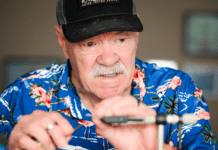
Today’s guest traded trout strains for silk thread vintage hooks, and the history-packed world of classic fly tying never looked back. From his first salmon fly at age 12 to becoming a leading voice in preserving old school craftsmanship, Tony Smith has spent decades chasing the perfect thread wrap. By the end of this episode, you’ll know what really defines a classic salmon fly, why wax silk and antique hooks still matter, and how tying flies helps Tony navigate OCD social anxiety and come out on the other side.
Tony Smith is here to share what it’s really like inside the quirky and passionate world of classic salmon fly tying, what the feather thief story got right and wrong, and why sometimes keeping it simple is still the most beautiful thing you can do at the vise. Plus, we’re going to find out why reaching out to your fly-tying heroes might be the smartest thing you do all year.
Episode Transcript
Dave (2s): Today’s guest traded trout strains for silk thread vintage hooks and the history pack world of classic flight time and never looked back from his first salmon fly at age 12 to becoming a leading voice in preserving old school craftsmanship. Tony Smith has spent decades chasing the perfect thread wrap. By the end of this episode, you’ll know what really defines a classic salmon fly, why wax silk and antique hooks still matter, and how tying flies help Tony navigate OCD social anxiety and came out on the other side. This is the Web Fly Swing podcast where I show you the best places to travel to for fly fishing, how to find the best resources and tools to prepare for that big trip And what you can do to give back to fish species we all love. Dave (44s): Tony Smith is here to share what it’s really like inside the quirky and passionate world of classic salmon fly tying what the Feather thief story got right and wrong and why sometimes keeping it simple is still the most beautiful thing you can do at the Vice. Plus, we’re gonna find out why reaching out to your fly tying heroes might be the smartest thing that you do all year. Here we go. Here he is, Tony Smith. You can find him at Feathers and Freud on Instagram. How are you doing Tony? So Tony (1m 12s): Far so good. Yourself? Dave (1m 13s): Not too bad. Not too bad. I think we’re gonna have a good chat today about fly tying a topic that I think, You know, a lot of people are interested in fly fishing. We’ve done a number of episodes, You know, in recent months here, talking about some crazy stuff with the Feather Thief. You know, we had the, the author of that, You know, Kirk was here, we had Spencer talked a little about it, but also just, I think we wanna get into some tips on tying, You know, and helping people maybe learn about tying some classic patterns and what you do, what you’re an expert in this space. But before we get into all that, maybe take us back. Are you more of a, did you get into fly fishing or flight tying first? What’s your story there? Tony (1m 50s): So, my family was pretty outdoorsy, You know, after dinner most nights when I was a kid, me, my mom, my dad, sometimes my, my sister and niece, we’d all head over to the river and hang out. Sometimes I’d come home from school and my mom would be bragging that she got a bigger fish during the day while we were at school than I got the night before. So it was kind of baked in that we hit the river, grew up, You know, drowning worms and using spinners. And when I was about 10, my cousin who’s about 15, 20 years older than me, my dad said he’s a fly tire. And I was like, I had no idea. Like he made it sound like it was connected to fishing. So I was like, ah, that’s kind of cool. Tony (2m 31s): I’ll go over and see Mark. And I didn’t really watch him tie flies, but he showed me what flies looked like and You know, he had some drawers full of materials and I got pretty wide-eyed about it. And my local library had a few books. One of them was Harder’s Professional Fly Ty and Tackle Making. And I just destroyed that thing, just like turning pages. And I tried using like my dad’s bench vice to, You know, hold hooks and my parents bought me a fly tying kit from LL Bean that year. So it was Christmas of 88 and 37 years later I never looked back. Dave (3m 7s): That’s it. So you get that kit and you start tying, what did you start, You know, probably started some of the basic stuff. When did you get into, did it like slowly evolve into these where you’re known for the classic patterns or did that happen more recently? Tony (3m 21s): It wasn a pretty distinct line. So I started off, there’s a Eric Lyer little booklet in there that showed you how to tie four or five little flies. And I dabbled at those and my dad found that there’s a, an old materials company called Universal Vice that used to be over in Westfield, mass here. They created like one of the original rotary vices and did materials and all. And they put on tying classes at a local Polish American club for like eight weeks every winter. And it dovetailed with when I got the kit. So my dad was like, hell, let’s do that. And so he, he tied a little bit alongside me, but I, You know, it became my thing. He’s a woodworker, but tying just consumed me. And so we did those classes like three winters in a row and You know, it was trout and some salt water. Tony (4m 5s): And then I saw Joe Bates’s Atlantic Salmon Flies book and the library and was just awestruck. I must’ve been like 12. And I, my parents still have the very first classic I some considered a classic, some don’t. It’s a classic Canadian fly. The lady Amherst was in there. I happened to have the feathers and I put one of those together at about 12. And when I was 14, a series of events happened maintaining my own sanity. And I really delved into the salmon flies ’cause it was just like the next level and I just couldn’t get enough. And that’s where it really took off when I was about 14. Tony (4m 47s): Yeah. Dave (4m 47s): So with the classic salmon flies, the, the highly dressed, the flies that take hours to tie and the materials that are hard to find and all that. Tony (4m 55s): Yeah, I mean every, well I didn’t care. It was like hair wings to Jock Scotts to whatever. Like I wanted it all. And I was just enamored by the Bates book. And Bates actually lived two towns over in Long Meadow and his wife was still alive and kindly corresponded with me a little bit and that just like put me over the moon more as a 14-year-old kid. Right. Dave (5m 14s): Wow. How many back then when you were 14 were, You know, were there a bunch of kind of to you famous, You know, Bates, you got Herb Johnson, were there a lot of those guys out there? Were there just a few? Tony (5m 26s): I’m gonna go by granted, You know, there’s no internet or anything yet. So this was what, 90, 92, 93, 94 I really got rolling. I mean, in terms of salmon flies, there’s like jorgensen’s book from the late seventies. There was Bates book. I had heard of guys like Kelson and Price Tannet, but I didn’t have their books. Dave (5m 46s): Oh yeah, right. Tony (5m 48s): And of course, like Dave Whitlock was a huge hero of mine. I had a couple of his books and jorgensen’s trout books. So those were my first real reads. And then it just, You know, books kind of took on its own thing for me after a while. Dave (6m 2s): Nice. Nice. Yeah, I I wanna talk about, You know, some more of that history and more of the people there and, and tying in tips too. I wanna get into that too, but I wanna just take it back, You know, because we, we have talked Feather Thief just for a sec here, Kirk, You know, Wallace Johnson obviously wrote an amazing book. I mean, the Feather Thief is like one of those books you don’t put down pretty much. Right? But it’s a crazy story about the fly tying and somebody who, You know, stole feathers like these classic birds from a museum and stuff just to tie flies. What’s your take on all that, You know, given that you’ve been in there? Is that, I mean, I know that’s kind of crazy, but there’s kind of a split right between people in there where some people have some of the materials probably of what were stolen and then some people that maybe are more like, Hey, you need to return those materials. Dave (6m 46s): Well, what’s your thoughts on all that? Tony (6m 48s): So I, You know, like most people, I was like, wow, what’s, You know, chatter and Indian Crow and Buster? And I had no idea. And I ended up through the Bates family getting in touch with a fellow named Phil Castleman, who’s mentioned in the book. And Phil was a local attorney and businessman amongst other things. And when I was in college of grad school, I needed a, a job and he was like, oh geez, please come work for me. Like, you can run the showroom, do the orders, I’ll just run the credit cards. He is like, I got so much going on. So I got to know Phil really well, and Phil was an attorney and he had had collectible firearms and fly fishing business since the late 1950s. Tony (7m 28s): And he did, we had fish and wildlife right in the building. He did things by the book, You know, if he was getting something, if he was moving something, he wasn’t just buying blindly. He knew that people were, You know, smuggling and being screwy with how they got stuff. And so he was really careful and I, I learned right away, like, if you’re gonna play with this stuff, You know, don’t go getting raptor feathers from people or, You know, question if something’s too good to be true because this stuff is pretty darn rare. Right. And so Phil became like the grandfather I never had and he, he died back in 2019 at the ripe old age of 92 and still fishing the summer before he died with his boys. Yep. So I learned a lot right there. Tony (8m 9s): But I also had raised birds when I was a kid, pheasants and, and whatnot. And I, I had a lot of connections in the bird world, So I had a lot of molts of stuff. It wasn harder to get, You know, parrots and pheasants and things like that. So I was, I was playing the materials field and I, I knew it really well. Fast forward, You know, I crossed paths with guys like Paul Schmucker and, and those people and You know, Indian Crow isn’t a protected species. One of the, one of the subspecies is on ces, but You know, Paul was known for, for distributing that in the day and it wasn kind of what everybody was after. So I of course, You know, got some crow from Paul and we’re still good friends. I dunno if you’ve seen a, if you’ve seen a recent issue of fly tire, but there’s a photo of him and I from this winter. Tony (8m 52s): Oh Dave (8m 52s): Cool. Tony (8m 53s): Yeah, yeah. He’s still going, still fishing, still shooting. Nice. And so fast forward a little bit more and You know, I got, I got better and better at tying and I, I started dawning on me. I was like, even the guys, the classic tires like Kelson with all of his exotics, he mentioned substituting materials like, You know, it’s, it, it wasn’t foreign, it’s why blow all your money on this stuff was just more readily available back then. And, You know, things, things were different. So I, I started subbing stuff early on and fast forward again, I knew the wrist kids, I would see them at shows when they got started. Dave (9m 30s): Oh, now who are these? Tony (9m 31s): The wrist kids? Edwin and his brother. Oh, Dave (9m 34s): Right. So yeah, Edwin. So these are the two, right. And I forgot about his brother. Yeah. So Edwin was the person who broke into the museum and then he had a brother as well, Tony (9m 40s): Correct, Anton. Yeah. And So I knew them. I mean there were kids that were just, they were homeschooled. Like you read it all in the book probably kind of really into the arts and cooking. And so this was another hobby that just put them over the, over the moon to get involved in. And they seemed like nice kids. His parents seemed cool and then like their appetite went through the roof and they got really well known. And I remember when Edwin went off to Flautists school or whatever in London, ’cause like he kind of dropped off the radar. He was posting flies and whatever. And then I remember seeing this list that he put out of like all these exotic materials and I was like, there is no effing way he’s been floating around the UK finding these garage sales. Dave (10m 26s): Right. Tony (10m 27s): Absolutely not. I haven’t seen this much stuff in the 15, 20 years. I had been tying at that point. Dave (10m 32s): It wasn the interesting book that I asked Kirk about the book. ’cause it seemed like, You know, he was a super intelligent kid, but You know, he was bound to get caught. Right. Because it was just so, it seemed so obvious, all this things. Right. So he I guess wasn’t that smart. Tony (10m 46s): I mean it was just brash and arrogant at one point, at some point. Right. And So I remember seeing that list and I was like, delete, not interested. And a couple of people had asked me about it and I, I had said, ah, you’re clear man. Yep. Dave (11m 1s): So you knew, so you being in, you obviously had a lot of experience because of Phil, You know, the connection there, but you were, it was clear this was not the on the up and up Tony (11m 11s): There was no way, there was that much availability of these things that some people probably never even heard of, You know, these different birds of paradise and, and all of that. So it was a surprise, no surprise that somebody had called me and said, Hey, did you listen to NPR tonight? Like off the BBC there’s this kid Edwin Wrist. I was like, here it comes. And so, yeah, I mean, a lot of people I knew they bought stuff from him and he was, I don’t know, apparently forging the CES things. And I don’t think most of the people that bought stuff from him were trying to be involved in anything nefarious. They were excited, they had a lot of money and he sold a good story. Tony (11m 50s): And most of the people I know that bought stuff from him sent stuff back. Dave (11m 55s): Oh really? Yeah. So people did, yeah. People did send stuff back. Tony (11m 58s): They never got reimbursed. No, not one of them. No. And Kirk, the la I mean, I haven’t been in touch with Kirk for years, but I, I remember back in 2015 or 16, he sent me a list of the stuff it wasn still missing that Edwin had sold and it was extensive. Yeah, Dave (12m 12s): It was a lot. It was Tony (12m 13s): Definitely. So yeah, there’s still stuff out there and Dave (12m 15s): Gotcha. So it’s, You know, that’s just part of it. You got this in the community. What is that community like? If you had to explain the classic fly tire community, like, I mean, I, I think it’s, it’s interesting because, You know, fly fishing just in general is so, we’re so passionate, right. And we’ve got these niches, it’s fly tying, it’s streamer fishing. Yeah. You know, and it’s like, there was some good stuff and some crazy stuff that happens in there. So it’s kind of not surprising, but is the classic fly tying community that much different than the other sector of fly fishing that, You know What I mean? Tony (12m 47s): I, I laugh just because how do I it’s it’s eccentric is the only way I could put it. Yeah. You know, I mean there are people who are like straight up nerds. There are people who are like, You know, straight up just like into feather art kind of stuff and call it salmon flies. There are people who nerd out on just keeping the classic, the actual classic flies front and center in, in maintaining old world craftsmanship because, and and that’s the, that’s the boat I’m in because I mean, this stuff was getting lost and I’m kind of a history buff. Dave (13m 20s): Yeah. Tony (13m 21s): It wasn all getting lost in the nineties when feather art came around. Oh, Dave (13m 24s): Gotcha. So that’s your style. Your style is the classics. I mean, you, you do a lot of different things, but you definitely have the history, You know, what those classic patterns were all about. Tony (13m 33s): Yeah, I mean I tie only with, You know, silk thread and wax. I don’t use any adhesives. I don’t use any tricks. Like I study antique flies, I have thousands of photos of ’em. I have a small collection. I am fortunate to have contacts with people who have huge collections. Like I, I wanna preserve the history and maintain the old world craftsmanship. And that’s what, that’s what we push on our couple of Facebook groups and like my Instagram page. Dave (13m 57s): Yeah. What, what’s a, what’s a couple of those groups, if somebody’s listening now and they really wanna learn more about this, maybe learn about tying these but also just get the history. Is there a couple Facebook groups you’re involved in? Tony (14m 7s): Yeah, definitely. So the two that I’m on and help run are Facebook vintage fly tying and then classic fly tying. Classic Dave (14m 20s): Fly tying. Okay. Yeah. And what is the, what was the group that Edwin was really involved when that went away? That there wasn’t there a group that’s gone now? Classic fly tying forum or something like that? Tony (14m 30s): I always remembered it as the fly tying forum, but I think you’re correct in that it was called like classic Fly tying forum. It was run by Bud Guidry back in the day. Dave (14m 39s): Yeah. And what happened to that one? Did that one go down just because it got old or was it part of that whole thing? Tony (14m 44s): To be honest, around that time, I probably in the mid 20 teens, I slid off of that ’cause it was a cesspool. I, I mean it was pissing contests about, You know, there’s a lot of ego. Dave (14m 55s): Oh yeah. Tony (14m 56s): You know, the, the feather artists versus the true classics versus the people who are, You know, wanted to talk about Edwin and the people who wanted to shoot it down and, You know, I mean, it just exploded and went sideways and I, I just got out of there. It was so, So I like the Facebook groups. They have much more focus and it’s kind of part of our, our mission to preserve the actual classic Dave (15m 16s): The classic. And what is that like if you just had, I know the history is obviously that we could talk for a long time on that, but how do you explain the history? Like on the, You know, we talked about a few of the people, but where would somebody start if they’re listening now and they wanna learn about the classic flight tying the classic whether salmon patterns or some of the other stuff, where do they start with that? Tony (15m 35s): You mean in terms of history or terms of how to tie? Dave (15m 38s): Yeah. In terms of history. First, maybe let’s start there. Like if somebody wanted to learn about that history, where’s a good place to start? Is there a person you could, let’s say take and maybe just blend that in? ’cause I’ve seen Herb Johnson mentioned a lot and, and talk about that a little bit. Tony (15m 50s): Yeah, well, herb Johnson was a, a streamer guy. He was more of a trout guy from North America. But if you wanted to get back into like, You know, vintage period salmon fly tying, I mean that goes back to pre Georgian England. And you, you’ll see a lot of that stuff on, on the Facebook Vintage Forum. There’s a collector named Jason Lewis over there who has a collection like nobody’s business that he shares very openly online that pre Georgian flies on up till now. Dave (16m 18s): And what are pre Georgian? What is the preor? Well Tony (16m 21s): They’re a little more primitive than the classics you see now maybe, You know, less less perfect per se, more more functional art, You know, but very gaudy. And it was kinda like the, the big stepping stone into the classics like the Jock Scotts and all that stuff people know now. And, but even that, those were, it wasn, functional art, those were fishing tools. They weren’t meant to hang on the wall and tied very daintily. So, but I think Bates, Joe Bates, the book that his daughter Pamela did posthumously with her father is probably a good start just to get a thumbnail sketch of the history from way back till up until now. And, You know, be acquainted with the names. And Dave (16m 59s): What’s the name of that book? The Joe Bates book. Tony (17m 2s): So there are a few Bates books. I am, it’s the one with Pamela Bates Richards, I think it’s it Atlantic Salmon Flies and Fishing was Joe’s book in the sixties. Dave (17m 13s): Yeah, I got it. I got it. Fishing Atlantic Salmon. Yeah. You Tony (17m 15s): Found it. The green cover. Similar title. Dave (17m 18s): Yeah. Fishing Atlantic Salmon, the Flies and the Patterns. Joseph Bates. Exactly. Kamala Bates. Yeah. Tony (17m 23s): Yeah. Actually my, my fall article on Fly Tire talks about some of the Bates books. I I rediscover for people a bunch of books from the last century that I feel they’re still relevant to all around fly tying. So, so they can get a taste. Dave (17m 40s): Grand Teton Fly Fishing is a premier guide service and fly shop that has access to some of the most coveted rivers and lakes in Western Wyoming. Their simple goal is to share their valued resource and have you experience a native cutthroat trout rising to a single dry fly in the shadows of the Tetons. You can check out Grand Teton right now at Grand teton fly fishing dot com. Let them know you heard of them through this podcast. Fish Hound Expeditions offers world class fly fishing right off Alaska’s incredible road system for monster Rainbow Trout to feisty arctic grayling. You’ll chase big species in the stunning landscape. Whether you’re a seasoned angler or just starting out their expert guides. Ensure an unforgettable adventure. Dave (18m 21s): Book your trip today before spots fill up and experience Alaska’s diversity like never before. Check ’em out right now. That’s fish hound expeditions.com. So you got, let’s just, if we had to say like four or five of those books, so you got the Joe Bates, this one with the green cover. What would be a few more of those books you would recommend? Tony (18m 39s): So, So I cover not just Salmon flies in the list. So you have like both of those Bates books. I have Sylvester, neem Soft Tackle Flies Art Flick, streamside Guide. Dave (18m 47s): Oh, art Flick. Sure. Tony (18m 49s): Whitlock and Boyle’s Fly Tires Almanac The first Volume. Oh, okay. Yep. There’s a couple others on there that are escaping me at the moment. Dave (18m 58s): Do you have that list somewhere where we can kind of take a look or maybe throw it in the show notes here? Yeah, Tony (19m 1s): We could definitely put it in the show notes. Show notes. Show notes. The, the article will be out for the fall issue. Dave (19m 6s): Okay. Okay, good. Tony (19m 7s): There’s, there’s just six titles, like big ones that I thought people should know about. Dave (19m 11s): That’d be great. No, I’d love to get that in the show notes. Then we can take a look and people can follow up on books. Yeah, definitely. So it’s gonna be in the Fly Tire. Where’s that gonna be published? Yeah, Tony (19m 20s): Fly Tire for the Fall edition. Dave (19m 21s): Okay. Yeah. And that’s where you do a lot. Is that kind of the magazine? I know a lot of magazines obviously have gone out since COVID. Is that one that’s still going strong? Tony (19m 28s): It is. Flight Tire’s going pretty well. You know, Russ Lumpkin came on as the editor a couple years ago and we, we struck up a good relationship. I, I like to to write a lot about more historical things or, You know, whether it’s the literature or technique or blend, You know, psychology with fly tying. And I, I’m fortunate to usually have an article in each, in each edition lately. But going back to the books that people might like, I think yeah, those Bates books to really get acquainted. And then going back to guys like Kelson and Price Tannin, they’re very popular but they’re kind of a little bit obtuse to learn how to tie. I think if they want classic books, You know, the, the big authors from back then to learn how to tie, I would go right to Tavern and Hail. Dave (20m 15s): Okay. Tavern and Hale. Okay. Tony (20m 17s): So Tavern’s Fly Tying for Salmon is a spectacular book and Captain Hale’s book, how to Tie Salmon Flies is really Good Instruction without all of the Fanciness of Kelson and sort of not good instruction from Price Tanic. ’cause he was only tying like two, three years when he wrote that book. Dave (20m 37s): Okay, cool. And, and another good book, which we talked off air a little bit is we’ve had John Chewy on who’s a friend of the podcast and he’s a great guy. He’s written some amazing books. Right on. Yeah, on classic. You know, I, I am trying to think now his his what what’s his recent, he’s done all sorts of stuff. Obviously he’s got the magazine as well. Maybe just give us that because we love, You know, John, what, what’s John shoey your connection to him? Have you guys been talking tying for a while? Yeah, Tony (21m 3s): I met Shoey for the first time back in 2004. I was invited to do the show out in Oregon when it used to be in Dave (21m 12s): Oh, and before Albany was in Eugene. Tony (21m 14s): In Eugene, correct. Yeah. And So I, I met Chewy there. We had corresponded via email. I was buying some feathers from him here and there. But yeah, we met there and kind of hit it off and we’d, You know, meet up once in a while when I was out there he had me do an article or two here and there for his magazines and then he asked me to do some flies for his books. And yeah, we’ve, I mean, it’s kinda long distance. Obviously he’s on the other side of the country from me, but that’s my connection. Yeah. That’s Dave (21m 42s): It. Yeah. Okay. And and are you, now, I know with the classic there’s the classic tires, there’s some people that don’t even fly fish at all. Are you more in that or do you do some fly fishing as well out there? And what’s your take on overall? Do you think it’s kind of a 50 50 people that are like real hardcore just fly tires? Tony (21m 57s): I think there’s quite a few of those out there. I I still do fly fish. I don’t have a lot of great fly fishing water around me here. Dave (22m 5s): Now where are you at physically? Where do you live? Tony (22m 7s): Western Massachusetts. Dave (22m 8s): Okay. Yeah. You’re ma So if you wanted to fish some of the classic, You know, maybe Atlantic salmon, you’d have to head up north to, You know, up Newfoundland or wherever up there Right. To get some of that water. Tony (22m 16s): Yeah. And that’s a whole lot of money and a whole lot of time for a big maybe, So I Dave (22m 21s): Yeah, right. For a big maybe. Yeah. Tony (22m 23s): I, I tend to bring my little freeway rod with me. I do a lot of backpacking, most mostly out west. Sometimes in New England, I was just up in the, up in New Hampshire in the White Mountains fishing for the little Brooks. So I’ll bring the rod. You know, I’m not, I’m not as graceful as some, but I, I just always enjoyed tying flies more. Yeah, Dave (22m 41s): Definitely. No, I think that’s what’s really awesome about it, You know, I think that, You know, I think fly fishing and fight tying is just so cool because yeah. You can nerd out on any of this stuff. Right. Whether that’s entomology and like yesterday we were talking about entomology, we were talking about some bug species on the south fork, the snake, You know, on hatches and we’re talking PMDs, You know, and you could, you could go in and just like, go into Mayflies right. And learn about the etymology of bugs and just be the total nerd or, You know, you could just grab a fly and cast it. Right. I, I think that’s what’s kind of fun. Is that what you’re on flight tying? Is that what, like what stuck with you? What was that thing early on when you were 14 and it just like hooked you? What was that thing? Tony (23m 18s): Pun intended with the hooking? Let’s see. So, well one, like I said, there’s not a hell of a lot of great fishing water around here. There’s a couple of local streams that are okay. And So I could tie flies whenever I wanted. And so when I was, when I was 14, I told this story in the recent edition of Fly Tire, I grew up pretty debilitated by OCD to the Tourette syndrome and oh, Dave (23m 43s): OCD is a obsessive compulsive Tony (23m 45s): Disorder. Obsessive compulsive disorder. Yep. Yep. And I also developed some pretty significant social anxiety. You know, I, I just felt like I didn’t fit in. Like being a teen isn’t hard enough. Right. Even though you got friends, they want you to hang out, you just don’t feel like you fit in. So I, I really kind became, You know, sheltered myself and I looked around one day and I was like, damn, I’m just gonna get good at that. And I tied flies like crazy when I was 14, 15, 16. And that’s when I really got into salmon flies because I mean, it wasn just a major attention getter and got my mind off stuff. And one of the things pop culture doesn’t realize about OCD is that it’s not just people who are like organized or like fearful of germs. Tony (24m 29s): A big component is, is these intrusive thoughts. They’re the nerd, the, the technical term is ego dystonic thoughts, meaning they’re thoughts way against any way you would voluntarily think. So you can get these intrusive thoughts like, oh my God, what if I just like got a knife and butchered myself out of the blue? Right. Dave (24m 47s): Or, or here’s a good one. I was just talking with my kids who are 11 and 13 and I struggle with this and I, and we’re going into this little psychology here because you do have a background, you’re clinical, but we could talk about that. But You know, I obvious, and I’m trying to explain this is just bigger picture, like trying to explain the whole like world, it’s like you got Nazi, the whole thing. You got all these like all sorts of crazy stuff, right? I mean, I, I believe the world is, You know What I mean? There’s all sorts of good, obviously great stuff, but trying to explain to somebody, You know, a kid especially like, wow, why is that person doing, why did that happen? Why did somebody slaughter millions of people? But we were just, because there’s this mountain nearby and I was talking about, we were, we were talking about going up to climb to the top and I just said like, Hey, I remember when I was a kid, this girl, it wasn basically about my daughter’s age, fell off that thing and died. Dave (25m 34s): And I threw that out there mainly just ’cause I like to throw stuff so they realize, hey, there’s danger and You know, don’t fall off sort of thing. Yeah. But I start to think of it as my kid, it’s like, wow, it’s death. You know What I mean? Then you start thinking like, okay, wow, I could die tomorrow. You know, and you get all these thoughts and I have the same thing. It’s like, I don’t know if it’s OCD, but yeah, you have these crazy thoughts like, gosh, what if I so and kids do that, right? Kids do commit suicide. So what what’s your take? I’m kind of going rambling a little bit, but I, I feel like OCD and those thoughts probably have happened to me or probably happened to a lot of people. Tony (26m 7s): I mean, a lot of people, most people have experienced some symptom of like most mental illnesses, right? Yeah. It’s, it’s when the symptoms become like pervasive and they really impede your ability to, to lead a, a, a, a productive life, right? I mean, people who have, I’m gonna stick with obsessive compulsive disorder, You know, it’s a chronic train of these intrusive thoughts of just like grotesque things that are completely against your normal way of thinking that jack up your anxiety that then they ritualize over. And that could be anything from having to think about it a certain number of times to make sure that they really don’t wanna do those things. Or it could be, You know, arranging things for what we call the just right experience. Like, You know, you see stuff have to be like tapped into place just right. Tony (26m 49s): So it’s not just being orderly, it’s being orderly, but they realize there’s no point to it, but they can’t not do it. Dave (26m 56s): Right. Right. Tony (26m 58s): So they’re compelled the compulsion. So, so there’s, there’s all these components and pop culture just, You know, doesn’t understand what it is. Yeah. Dave (27m 6s): It doesn’t understand what it is. But then it also don’t, you feel like some of that leads to, like your example, you’re an amazing fly tire, You know, I, I’ve heard that lots of professional athletes at the highest level have those things because, and they allowed them to focus very. Right. Do you see that too, where it can be a positive? Tony (27m 24s): Oh, definitely. Because it’s not only a distraction, but like I, I recently wrote in Fly Tire, there’s an article by a, a neuro a scientist, Kelly Lambert outta Johns Hopkins, when she did this research who basically discovered that when people use their fine motor activity, they’re engaging the effort driven reward circuitry in your brain. And, You know, big surprise fly tying is using fine motor skills just like knitting or doing whatever else. And So I think it was more than distraction for me. Like there was also that going on and it wasn part of what helped keep my head above water. You know, engaging the effort driven reward circuitry creates emotional resilience. Tony (28m 5s): And her research, actually the springboard for it was she discovered that back during the Great Depression per capita, a percentage wise, the population had much less depression than the modern era. And she’s like, this does not make any sense. What’s the variable? And the article that she wrote coming out of it, wasn called Depressingly Easy, meaning that nowadays you have to just push a button. You don’t have to walk or ride a bike, you don’t have to garden, you don’t have to prepare your food. Like your clothes are all made for you. You don’t wash clothes by hand. Like all of these things with fine motor activity have gone by the wayside unless you like play an instrument or a fine artist or, and so, You know, us fly tires I think have a natural, even if you are struggling emotionally, it’s probably a lot better than it would be if you didn’t engage in fly tying and use your fine motor skills. Dave (28m 53s): Wow. So there is, so there is some legitimacy to that, like the fly tying and all this stuff, anything like that can help you if you have some of those problem or whatever you call that. Some of those. Tony (29m 3s): Absolutely. And it actually got me out of, out of my shell because at 16 I was like, You know, f this like, I’m so goddamn lonely and like I wanna hang out with people. And like I identified with fly tying so much, I was like, I wanna get better at this. I knew about guys like Smuckler and stuff and Pam Bates told me on the phone, she’s like, I’ll introduce you to these guys, just come to the shows. And I was starstruck and I actually started coming outta my shell and talking to these guys at the shows and then Oh wow. Dave (29m 33s): So what did it take you to get that, to get outta that shell? It wasn literally you’re starstruck, you’re there and then you just broke out of it because you were in your world, you knew it well sort of thing. You knew those people and the tying and you were good at it. Tony (29m 45s): Exactly. I mean, it was kind of like asking a girl out for the first time. I wasn’t sure it was gonna happen. You’re afraid of rejection. Like these people are giants and gods in the fly world. Right. And they were so nice. Dave (29m 55s): And then they say yes that they take you in. Right. That is amazing. And so at 16, now, when that happened, did you break out of the OCD and did or did it slowly evolve? Were you kind of, or do you still have some of that to this day? Tony (30m 7s): I mean, it’s, it’s one of those things where a major inroad was made and I started socializing a lot more. I was, You know, feeling better overall. The, the OCD took into my, my twenties to really gain control of, and there’s a point where it becomes just sort of this nuisance, it’s a bit of a trait. You’re like, oh, that’s still there. Right. But overall, overall it’s really well under control. Dave (30m 29s): I agree. I agree. I had this thing for me, I think, again, we all have these things, but You know, I, I think I definitely had some sort of OCD what, whatever, what’s the other one that they say a lot of the kids have where they’re distracted? The Tony (30m 42s): A DH adhd. Yeah, Dave (30m 43s): A DH adhd, right? Yeah, I think I had that. I probably still have that, but I had this thing with reading and part it was, I probably didn’t, You know, read enough or my parents didn’t read to me enough, but I struggled with all the way up through college, You know, and, but eventually something clicked and I was also really shy partly because of that, You know, I didn’t, I wasn’t the one in front of the class ever, but after that something clicked and all of a sudden it’s like, whoa, okay, I can do all this now. And, and then I kind of excelled and that now I love it. Obviously I’m sitting here and I do all these conversa, right? So it’s kind of funny. I think that in some ways I don’t know how my story worked, but again, it, it worked out I feel like, but it doesn’t always right. Some people, some kids never probably pop out of that their whole lives. Tony (31m 24s): It really depends. And You know, I mean, there’s not a lot of reliable therapy out there these days. There’s many therapists as there are. Therapy has gotten really watered down. Mental healthcare has gotten really watered down. It’s hard to find people who know what they’re dealing with. You know, insurance companies want people run in and run out. So like it’s, it’s like, oh, let’s try to work on these three big symptoms and see you later. And they wonder why people don’t maintain stability. Oh man. And also like, You know, parents, they really want to help, but they don’t understand. And You know, thankfully my parents were like, were like pit bulls. I mean, I had a doctor say they should put me on disability and they basically told them where to go. And I, You know, who knows where I’d be if they didn’t, if they did something like that. Dave (32m 6s): No kidding. Or gave you medication Right. And all that stuff too. Yeah. Tony (32m 10s): I mean it has its place, but you don’t need to be on it forever. And you need a really good treatment team. And people also need to be willing to, it’s scary to step outta that. ’cause that’s what people know, right? And So I think exposing yourself, You know, there’s actually a thing called exposure therapy to the thing you, you fear kind like, You know, just taking a risk that the sky isn’t gonna fall if you don’t do this ritual or whatever, or ask the girl out or, You know, anything that you’ve never done before, you’re anxious about, You know, the change leads to, leads to better insight to keep yourself going. Dave (32m 41s): Yeah, no, I think this is a, a great conversation. And, and tell us about that, just so we know. So you have a background that’s kinda your day job as the psychol, or describe that a little bit. Tony (32m 51s): Yeah, So I have a master’s degree in, in psychology, an MS in psychology. And I worked in the forensic arena for most of my career. Well, all of my career really, it’s 23 years in a jail for about nine years. And now I do psych evals for court proceedings in the juvenile court, but I had a therapy practice. Insurance made me crazy, So I quit that. Dave (33m 14s): Oh, gotcha. Well, and that’s kind of the, You know, back to that story with the Feather thief, right? Edwin basically got off on, what was his thing? He got off, he, he didn’t even do any jail time right. For stealing millions of dollars. Tony (33m 26s): What was it? He, yeah, he got off on allegedly being autistic and that the theft was part of an autistic obsession, which yeah, Dave (33m 35s): Autistic and, and obviously autistic people. That’s, that’s real. But it wasn seemed a little farfetched, right? That kind of just everything came together. Tony (33m 43s): It seemed like a stretch to me and most other people that read it, You know, coming from a professional and a fly tire, it just, there is a lot of things that didn’t add up like Kirk talked about. Dave (33m 54s): Yeah. The autistic. Yeah. Okay. Well let’s, let’s jump back into, You know, on the flight tying and talk on just again, like maybe getting going on it, You know, somebody has some experience tying, what is a good place to start? You mentioned a few books. Do you recommend, is YouTube a good place go? What would you say if somebody wanted to tie some of these in, do you think it’s better to start with more of like Herb Johnson style, You know, or You know, or where would you start Tony (34m 18s): For, for like general fly tying or classics again? Dave (34m 20s): Yeah, more for classics. More for the, either the the streamer stuff or the classics or any, any of that. If you wanna tie some, let’s just say you’re going Atlantic salmon or steelhead fishing and you want to tie some beautiful stuff for that. Tony (34m 31s): Well, I, I think you can’t go wrong watching some Davey McPhail videos. Dave (34m 34s): Oh, McPhail, right. Tony (34m 36s): He does a really good job, obviously he has gazillions of followers and he’s like a god on there. He does everything from hair wings to spay and defies to more full dress stuff. And he doesn’t necessarily tie them 100% as they did in the Victorian era, but I mean, most of the skill and technique is there. He doesn’t, You know, use adhesives and tie things in very daintily that could easily fall off. I, I think that the most satisfaction comes from functional art. Like, it, it looks good, but it can be, You know, thrown around and, and catch something. Dave (35m 9s): That’s What I think for me, if I got into it, which I’ve tested the water a little bit, but I feel like it’d be cool to, to be able to tie the fly for the wall, but to fish it, right? And to catch something on that fly would be, I don’t know, that would be kind of cool to catch a salmon or steelhead on that or truck. Yeah, Tony (35m 23s): I had a, I had sent Chewy a bunch of flies back in the day. A bunch of classics tied on, You know, modern hooks and he was swinging ’em for steelhead and Oh, nice. It was kind of cool seeing those in the jaw of the fish, You know. Dave (35m 35s): What was the one, do you remember any fly pattern that that shoe got one on? Tony (35m 38s): Oh man, I wanna say it was this, I have the picture somewhere. I wanna say it was a silver AEA from Kelson Silver Fly with a gaudy wing and a a, a blue spay hackle on it. Dave (35m 47s): Yeah. Gotcha. Okay. Yeah. So you got McPhail. What about other, are there, is YouTube other channels out there, other people that would be good to follow to kinda look at some of these? Tony (35m 55s): Yeah, I mean, I think there’s a handful of other people out there. I, I don’t spend a heck of a lot of time on, on YouTube anymore, but let’s see, McPhail, I believe, like Long Noian who’s mentioned in the book. I mean, regardless of that, he’s very talented. I believe he has a few videos up on, on YouTube or you Oh, Dave (36m 12s): Okay. What what’s his name? What’s his name again? Tony (36m 14s): Longen. How Dave (36m 15s): Do you, do You know how to spell that? Tony (36m 17s): N-G-U-Y-E-N. Dave (36m 19s): Okay. Yeah. Okay. Yeah. Okay. Tony (36m 21s): But, You know, our group, the classic fly tying group I mentioned on Facebook, there’s a lot of tutorials on there. People can become a member and, and get really deep in it, or they can, You know, just kind of peruse and get more surface stuff. I think it’s, I think it’s like $15 for a year Robert charges Dave (36m 39s): Oh wow. 15 bucks for a year in the group. Tony (36m 41s): Yeah. And you get archives, You know, all kinds of old articles from the old fishing gazettes things he’s uploaded from books and tutorials and, and all of that. But I, I think it really got complicated in the nineties when people wanted to start tying 10 knot flies to look a very certain way with a big grizzly bear hump and perfectly preened, You know, and they would like tie flies with kid gloves on to not mus anything. And my friend Matt Bashaw, he’s fond of saying, you just slap it on and his flies look like really nice versions of antique flies. And so once I took that approach, it was just, it makes so much more sense. Your fly’s durable. It looks, it looks tastefully, antique. It’s all good. Tony (37m 22s): And I, I can’t stress enough tying flies with silk thread like Parasols or Guterman or YLI, it’s like a hundred denier it’s gonna take getting used to, and, and, You know, you keep it well waxed, but that is one, maintaining the old world craftsmanship. Two, it grips like nobody’s business. It doesn’t flatten out and slide all over the place, like a lot of modern threads. And people wonder why stuff won’t stay in place or their, their heads go all over the place. This stuff stacks like cordwood. When it’s waxed and you’re gonna get beautiful heads, it grips like crazy. Like two turns of that to six of a modern thread. Dave (37m 56s): Oh, right. Tony (37m 57s): So that’s another big, another big thing people, another big step people take in learning to really tie actual classics. Dave (38m 6s): We’ve heard many of the stories on this podcast. Togiak River Lodge is one of the great destinations for sw flies, for Chinook stripping for coho all day and unwinding in a lodge right on the riverbank of the Togiak River with access to all five salmon species plus rainbows, Dolly Varden and more Togiak offers a true Alaskan experience picture over 30 miles of river season guides, high quality boats and low fishing pressure. It’s fly fishing Alaska at its best. I’ll be heading up this summer. So reach out to Jordan and the crew to see what dates they have available this year. You can learn more right now at wetly swing.com/togiak. That’s togiak, T-O-G-I-A-K Alaskan fly fishing like you’ve always dreamed about. Dave (38m 53s): And what about hooks? Is that where, where, where do people get the, do you have to get a classic style hook? Where, where do you get your stuff? Tony (38m 59s): So the, the general, You know, stuff put out by Partridge or whoever they’re, You know, they’re okay for fishing. I mean, I think some of ’em are a little too ugly to show to a fish. It’s almost insulting, but Dave (39m 11s): Yeah, Tony (39m 12s): There’s still some really good hooks out there. Dave McNees, blue Heron Hook Dave (39m 16s): Oh yeah. Tony (39m 17s): Is good for, You know, space flies. They tend to come kinda long. They’re not made in smaller sizes unfortunately. Dave (39m 24s): Yeah. Tony (39m 25s): But there’s a lot of modern hook makers out there. Like say Garrin Wood out in Oregon, who, You know, he makes classic hooks for, I don’t know, between 10 and $25 a piece with, You know, real Japan finish on them and he’ll do custom stuff or he, he does runs of, You know, more popular like Harrison Bartletts or Phillips Jones and all those. So people freak out. Spencer and I talk about this a lot. People freak out about, oh my God, where am I gonna get this crazy exotic material to tie these flies, quote unquote Right. Yet they neglect the things that make the fly and give it its style. Those things are little accentual feathers easily subbed. Tony (40m 7s): It’s ironic that they don’t care what hook they put that on, whether or not they tie the fly very well or use high quality common materials, the stuff that makes or breaks the fly, like the golden pheasant feathers or the waterfowl or You know, the, the dyed goose and all of that. All of that can go by the wayside so long as they get these exotics and show them off, which is a waste of these expensive feathers because the rest the fly looks like trash. They’re so crazy to get these things, like, they feel like their lack of skill can be compensated for by slapping heavy duty, expensive feathers on, on flies. And that’s, sometimes people contact me and they’re like, oh, what do you think? What do you think? I was like, you gotta back off and get back to basics and screw putting on four pair of Indian crow on this fly just ’cause you can. Dave (40m 53s): Right. Tony (40m 54s): You know, it’s Dave (40m 55s): Yeah. It seems like, I mean, some of those Yeah, you got the extreme. I, I’m not sure what the most extreme pattern is, but You know, with all the materials. Right. But it seems like simplicity is kind of cool too, right? Like almost the more simplistic you could get. That’s kind of a cool fly too. Do you find that with some of these flies that there’s some that don’t have a bazillion feathers on ’em? They’re and they’re still like classics. Tony (41m 16s): Absolutely. And You know, that’s the other thing. People equate classics with crazy, You know, $400 worth of feathers on ’em. But that’s not true. I mean, most classics weren’t dripping with Indian Crow and Chatterer and, You know, golden Bird of Paradise. They, a lot of ’em had jungle Cock that’s not really exotic anymore. You know, the, the flies relied on good hackle, good tinsel, good silk, nice hooks and good quality basic material that really makes or breaks the fly. The other stuff can be easily substituted and it’s little accentual things usually that use Indian Crower chatter for, You know, so it’s, that’s one big mistake I see a lot of people make is just, oh, I have to, You know, blow my retirement account on all this to tie these flies. Tony (42m 0s): It’s just not true. Dave (42m 1s): Right. God, that’s great. Well, let’s take it outta here. We got, I got a few more some questions for you Yeah. And some random ones, but we like to start this off with our Wet Fly Swing Pro. You mentioned the group in your, the, the classic flight. We have our own kind of community here, wet Fly Swing Pro, and we’re basically connecting, we don’t have a huge fly tire segment in there yet, but we’re gonna be building that as we go. But today this is presented by Patagonia Swift Current Waiters and Patagonia is a great, obviously a great brand. I don’t think they’re selling fly time materials yet, but they do have some great products and, and we’re gonna be wearing the swift current waiters up in Alaska, So I wanna give a big shout out to them first. So let’s go to you on, as we get in this gear segment, this is what this is for us is kind of talking gear. Dave (42m 45s): So fly tying, we’re gonna stick on that a little bit. What’s your, I always like to start with vice, You know, what is your go-to vice that you’re tied on? Do you have a bunch or do you have one that you’ve used for years Tony (42m 55s): Before you say that? I wanna give my own shout out to Patagonia because I love my Patagonia jacket. Dave (43m 0s): Oh, nice. Tony (43m 2s): And I, I have the utmost respect for Y Yard, especially after reading, let my people go surfing and how he Patagonia helped out back in the 20 teens with the whole public land sale thing and all that. So definitely props there. Yeah. Dave (43m 16s): Yeah. We’re, we’re super excited to have them on as a, as a sponsor this year. And, and same thing, we had Yvan, we’ll put a link in the show notes that episode Right interview. Oh, sweet. And it was really cool to actually hear him one-on-one, You know What I mean? Well, Craig was there as well. And who’s, who’s an allstar too. But yeah, just to hear like the direct, the, You know, the, the man talking about all this stuff and yeah, his mind doesn’t veer too far from saving the planet, You know What I mean? That’s what he’s always thinking about. So, so cool. No, I love that. And, and what’s your jacket? So are you, is this a jacket, just like a Goretex jacket or you use it for like skiing or fishing? What, what’s your It’s, Tony (43m 52s): It’s actually just kinda like my general winter jacket. It’s one of the ones they, they call their, their sweater I guess because it’s casual, but it’s like the most comfortable thing ever. It’s, I get hot easily. Dave (44m 1s): Okay. And what is it, what’s the name? Just, is it something older? Is it something we could still find out there? Tony (44m 6s): Oh yeah, it’s the, the Patagonia, they just call it their sweater. Dave (44m 8s): Oh, the sweater. Tony (44m 9s): It’s the down sweater. Dave (44m 10s): Okay, so it’s, yeah, sweater, jacket, whatever. Yeah. Let’s see what pops up here. Okay. Oh yeah. And is it waterproof? Tony (44m 16s): Oh boy. I mean it’s, it’s a, I wanna say yes. Dave (44m 21s): Yeah, right. Is is it the better sweater Fleece jacket? Tony (44m 24s): Nope. No. It looks like one of their standard puffy jackets in a lot of ways. Oh, Dave (44m 28s): Okay. Yeah. Insulated. Is it insulated, like with down feathers in it? Tony (44m 33s): It does. It’s a down. Dave (44m 34s): Oh, okay. Yeah. Yeah. So it’s cool. Okay. I wanna look at that. Well, we’ll definitely, I’m always looking for new gear, so we’ll, we’ll check out that. Good? Okay. Yeah, the men’s down sweater jacket. Tony (44m 43s): Yes. Yes. That sounds right. Yep. It’s great for backpacking packs down to nothing like a turn around and use it for work. Dave (44m 49s): Oh, perfect. Okay. Good deal. Awesome. All right, so we got our nice shout out here and thanks for that on Patagonia. Yeah. And so, yeah, so what about Vices? Yeah. What do you got there? Tony (44m 58s): So I’ve, I’ve had my Regal Vice since I was 16 and I was tying commercially for Hunters and American angling. It’s literally from like 1994 and 1995. And then Phil Castleman was a rep for, he sold Regal Vices also, and when he passed away he had a small stash of ’em left and his son gave me another one. So I can, I can have two projects going at once now, but I see no need for any other vice. Dave (45m 23s): I know the Regal, that’s my go-to. And, well, same thing, I probably, I probably had it got in the eighties or nineties, whatever, but it’s so simple. Right. The clamp and it’s just like, boom, it’s one motion. You’re, it’s just, they definitely, I, I don’t think we’ve had Regal on the podcast. I’ll have to work on that, but yeah. Good. So we got the Regal shout out. What about some other go-to tools when you’re talking flight to anything else people should be having, other than the basics, You know, what’s that look like? Tony (45m 48s): Well, so if you’re a classic tire, that’s not gonna go back to tying in your fingers, which is becoming in Vogue again. I did an article on that in the Winter Edition to Fly Tire with Adrian Cortez who you’ve had on. Oh yeah, Adrian’s an old friend of mine and he, he did a step by step in photos and I did the article around Oh, nice. Art of tying in hand. And a lot of guys are doing it, but the Vice will help maintain sanity too. I feel like the Vice and Scissors are your two biggest friends. Yep. And so Scissors, Pierre Sino out of Italy, Piero Sino out of Italy has copter, K-O-P-K-O-P-T-E-R, scissors. And I really like his micro serrated blades for trimming up around the head area because it makes like these weeny teeny little steps that helps grip that silk thread and make a really nice tight head that doesn’t slide anywhere. Tony (46m 40s): I also have a pair of Miltech scissors I bought from Hunters 30 years ago that have never been sharpened. They paid $150 for them as a 16 or 17-year-old kid. They have never been sharpened, they’ve never needed to be adjusted. Very fine point. And You know, you, you don’t want lumps and bumps, obviously tying a tiny Catskill dry or one of these, it’s a very fine pointed straight bladed, scissors, also a must. Dave (47m 5s): Yeah. There you go. Love it. Tony (47m 7s): And go with German ones if you can. ’cause they have never blown up on me. Dave (47m 10s): Okay. Okay. Good. Tony (47m 12s): And other tools, I mean like a, a handy, You know, good old dubbing needle and a couple of, pair of tweezers and that’s about it. Dave (47m 20s): That’s it. It’s pretty simple. Right. That’s the cool thing about tying is that it’s, it is pretty simple. And then you have, but you got all the materials which aren’t so simple. Right. You could, do you, are you still, now, You know, it’s funny ’cause we started talking Feather Thief at the start, but are you still getting new materials or do you pretty much, since you’ve tied your whole life, have everything you need? Tony (47m 38s): It’s part of the addiction, man. Yeah, I know, Dave (47m 40s): Right. Another fly rod. Right. You need another piece. Tony (47m 44s): I mean, I have literally the fly tying room in my house. Of course my dad being a woodworker may be this stellar eight foot long bench with these drawers that fit specific boxes for Dave (47m 54s): Oh, nice. Tony (47m 55s): About a hundred of those boxes with everything I, I regularly need. And then I have shells with Tupperware, but I, I don’t buy like I used to, but if I see a nice dryly neck in a weird color or like there’s a flash sale on antique tinsel somewhere, I’m gonna buy it. Dave (48m 11s): Right. And are you doing all the shows too still? Or are you going out to travel around and doing all that? The tying demos Tony (48m 18s): I used to do, I used to go to like New Jersey and like the Marlboro Mass show was big, kind of out towards Boston and used to do the Oregon show. And then I was part of, Rocky Hammond is a great friend of mine and he was the president of the Northwest Atlantic Salmon Fly Guild. And when I met Chewy, I met Steve Brocko and Harry Lame, who told Rocky to have me out in 2006. And So I befriended that group and so Rocky and I got really close, actually our families got really close and back in 2012, he had me on his committee to do Atlantic Salmon Fly International. And we did that in 2014 and 2016. We had guys come from 20 countries each time and those were the, the last big shows I did. Tony (49m 4s): And it was, it was just phenomenal. We had like Sebastian la from, from Chile come up meeting all these guys you just knew online for 15 or 20 years and everybody just kind of converged and had a, it was quite a hoot, Annie. But I, I don’t do the shows too much anymore. I wanna remember ’em the way they were. Right, Dave (49m 24s): Right. Do you think it’s changed a lot? I mean, is that your guess? You think things are a lot different than they were 10 years ago? Tony (49m 30s): I feel it’s much more focused on people selling trips than people like hanging out and time flies together and You know, a lot of guys, I’m 47, but a lot of guys have either got disabled and don’t do it anymore or just gone, You know? And so it’s, yeah. And, and it ebbs and flows. So like the new crowd isn’t into the same stuff as the old crowd used to be. And it’s, Dave (49m 52s): Yeah. Are there still new, You know, like, well, like, You know, the kids coming up, are you seeing those still out there or is that Oh yeah. Tony (49m 59s): If you go on Instagram or Facebook, there’s this kid out in New York, Aaron Miller, I think he’s 17 or 18, he just graduated high school and he took to this like a bulldog ties, flies in his fingers, very traditional. So kids like him and some guys over in Europe, similarly, they’re, they’re taking up the torch, but it’s not with the same volume as we used to see for whatever reason. Dave (50m 20s): Yeah. Gotcha. Okay. Well what about, let’s get a couple of tips outta you on flight tying before we get outta here. So somebody’s getting, You know, on the vice they’re gonna be tying maybe one of these classics or something, You know, in the range. What are a few things you would tell them to have more success? A few, like high level fly tying tips Tony (50m 38s): For, for tying the, the classic salmon flies. Dave (50m 40s): Yeah. Either the salmon or, yeah, any of those. Fly. And Roy you mentioned Catskills dries too. I mean that’s another one that I’m always interested in hearing about, but yeah, what would be some just general fly time tips? Tony (50m 49s): Oh boy. Well obviously material quality like we, we’ve already touched on, but remember that you’re tying something that you, You know, the art of it’s cool, but you want it to function, you want it to be tied solidly. You want it to, You know, not fall apart. So I think focusing on that from the start is gonna be really important. And that could just be like, You know, making sure you use tight thread wraps or follow Davey McPhail lead and always have that piece of wax in your fingers and constantly be waxing the thread so stuff stays Dave (51m 18s): So you wax the thread. So when you’re using the silk thread, you’re always waxing that thing while you’re tying the fly Tony (51m 24s): Most often. Yes. Unless it’s going under like a silk body or something and it could bleed through. But yeah, everywhere else it’s, it’s wax, it’s wax. You use like the old, the heavy tacky cobbler’s wax. Dave (51m 34s): Yep. Yep. How do You know when you’re tying the thread that it’s so to get it tight enough but not to break it? Are you breaking your silk thread much Tony (51m 43s): Silk thread is a, a much lower breaking point, so that’s a little sense you develop, but You know, you, you don’t need to be Hulk Hogan on the thing. Just, You know, enough to be darn tight. And so yeah, that’s, that’s one tip. Another would be, I can’t stress this enough, learn from your heroes. If there are guys that you feel are just tops, and I don’t care if anybody else thinks they are or not, but if you think they’re great, reach out to ’em. I mean, people are often like, oh, I’m just gonna be bothering them. Everybody probably reaches out to ’em nine times outta 10. They’re glad to hear from me. It’s not like they have fan clubs, they’re flattered that people wanna learn from them. That’s What I did with guys like Schouler and Bill Wilbur. Tony (52m 25s): And, You know, I’ve always thought it was really important to reach out to people who inspire you and have your heroes and, and contact them because they probably are gonna wanna share and you’re gonna learn fastest from them. Whether that’s, I do that in my profession. I reach out to my clinical heroes and it’s opened a lot of doors. I’ve made a lot of great friendships and connections and had clinical growth and I’ve done it in fly tying and it does not disappoint. Dave (52m 50s): Yep, definitely. Nice. Well that gives us a little bit of juice to head into the day. Anything else you want to shed light on or talk about, You know, flies or anything we covered today that we missed on kind of what you have going? We didn’t get into Freud at All. Right. So that’s, that’s one big name we haven’t gotten into. But yeah, give us anything else we missed. Tony (53m 9s): Wow. No, it wasn it wasn quite a lot of stuff for 60 Minute Chat, various topics and all. But no, I I just think it’s really important that, You know, the tradition is always gonna be there in some ways and, and things change. You know, stuff evolves. I was recently talking to Tom Rosenbauer and You know, he really encourages people to experiment with new materials, but, You know, kind of improving on, on classic ideas with modern materials. So, You know, let yourself be creative and, You know, use it, use it as that outlet too. I mean it’s, it serves a lot of purposes more than just tying something that’s gonna reel in a fish. Dave (53m 46s): Yeah, definitely. Definitely. I think it’s, I think it’s exciting. I’m always thinking about, okay, what’s the next thing You know, the the next technique trip, You know, whatever the new thing is. Right. And, and then how do you, You know, how do you go in and kind of ma I don’t know if it’s mastering it, do you ever think of it like, are we, I guess you’re kind of mastering stuff, but that’s kind of a weird word, isn’t it? Like, ’cause we’re never really mastering everything completely, are we? Tony (54m 10s): It seems like ideals are always changing and when I started tying salmon flies, I just wanted to be able to get a semblance of something that looked like, You know, Meghan Boyd flies, I saw in Joe Bates’s books and then I was starstruck with the guys in the nineties. I was like, no, it has to be like that. And then when I started studying like actual classic vintage flies, there was something about them that made me think like, no, I’ve got it all wrong. Like, You know, there’s nothing wrong inherently wrong with feather art per se, but don’t call it classic salmon fly. Like, I wanna be like these guys, like I wanna make something again, functional art, You know, pretty and practical and, and, and know this thing can function. And I think it’s, it’s harder to, to pull that off than to sort of paint by numbers and, and You know, create this, You know, thing to just look at in a way, You know, that’s just, just my opinion on it. Tony (55m 1s): I know there’s gonna be people that vary, but it’s definitely evolved for me and even within What I think an actual classic should look like as I’ve discovered, You know, how things were tied in from, from pulling apart antiques and, and whatnot. You know, that’s always evolving and I don’t think the guys back in the day always did it one way and just stopped evolving. It’s kinda like whatever works so long as it looked good and was secure. Dave (55m 28s): Yeah, definitely. How long does your typical, what’s an average fly pattern you’re tying one of those classics take? If you had to say kind of on average, Tony (55m 36s): If I was to sit down and tie a moderately difficult pattern from start to finish, I don’t know, a couple of hours. Dave (55m 44s): Yeah. So a couple hours. Yeah, it Tony (55m 46s): Usually takes me a few nights. You know, I dabble on it for a half hour here and there and yeah. Right. Dave (55m 52s): Well it’d be a flight you could tie in say, You know, 45 minutes or under an hour. What would be a, a Roy popular pattern that, or what would be Tony (56m 1s): Like the spay and d flies? A lot of those, yeah. SD or You know, the, the simpler strip wing flies like thunder and lightnings or Dave (56m 8s): Oh yeah, thunder and lightning Yeah. Tony (56m 9s): Or things like that. But You know, a jock Scott or silver doctors and things like that. A couple, a couple of hours probably. Dave (56m 16s): Okay. And if you were gonna fish for Atlantic salmon, You know, well right now it’s, as we’re talking it’s June, it’s prime time. Yeah. What would be a fly you would fish with? What do you think would be the one if you had to pick one? Tony (56m 28s): Ooh. To be, to be honest, the people that I know that are actually really successful in Canada in the summer are usually using salmon, dry flies. Oh Dave (56m 37s): Real. Oh, dry flies. Like the, yeah, Tony (56m 40s): Like the Macintosh are like skaters and Yeah. And think or bombers, but Dave (56m 44s): Bombers. Right. The bomber, Tony (56m 46s): I knew Bill Wilbur, he’s in some of the books. He was sort of under the radar, but a fantastic tire. He had a shop here in Central Mass and he would hit up the moisey every year and he would swear by fishing with a Dun ke up there. Dave (57m 1s): A dunkeld? Tony (57m 2s): Yeah, it’s a, it’s a, the gold bodied fly that’s in most of the Victorian books. Dave (57m 8s): Okay. Tony (57m 9s): You know, fairly moderately complicated. Nothing crazy, but that comes to mind. Oh Dave (57m 14s): Yeah, the Dunkeld. Yeah, I’ve seen that. Right, right. That’s beautiful. Yeah, it’s got the silver tinsel body, all that. Tony (57m 20s): Yeah. That, that comes to mind for some reason, but I don’t know, my friends who fish for salmon tell me that it’s, pick something you’re confident in and and go and Dave (57m 29s): Go. Yeah. The Don Ke is really a cool fly. I’ve seen that one and heard about, yeah, I mean it’s got, is that your classic, You know, it’s very thin and sparse, which, which is What I like about my steelhead flies, right in sand, it’s sparse is kind of good, but it’s got a really thin body of what looks like tinsel and some hackle. But then the wings, it’s got red and red and yellow and blue under there. Now is that a pretty much, that fly is tied one way? You know What I mean? Like if you the patterns or can you mix up the variation of what’s on the wings, stuff like that? Tony (58m 0s): Well, I mean, if you go looking through antique flies, You know, through books, there’s a couple of books that came out by Martin Lanigan O’Keefe. He found the, the shop notes and the sample flies for Hardy and for Farlow. And if you look at those books, you’re gonna see these flies that are very well known, have all kinds of variation, whether it’s from customer request or just how Farlow or Hardy decided to do it, it’s still recognizable as that fly. But You know, they might have JC or not, it might be something in the Wing or not. And they’re also tied thinner or fatter or whatever, depending on conditions or the tire style or, or whatever. So there’s not, it’s not as hard and fast as, as I think beginners think that it is. Tony (58m 43s): Like, oh, well Kelson said it’s done this way and, and so that’s it. And well, not really. No, Dave (58m 47s): No, not, not really. Gotcha. Okay. Yeah. Either way that that’s a good fly. That’s one I’ll definitely have to work on. Tony (58m 54s): Yeah, bill had a fly, he called the Moisey Dunkeld, he, I’ll try to find a picture of it and send it to you. He varied it a little bit. Dave (59m 1s): Okay. Yeah. Yeah. This is sweet. Cool. Well I think Tony, we could probably leave it there for Today. We will send everybody out to Feathers and Freud on Instagram. They can track you down if they have questions and Sure. Yeah, this will be fun. Maybe we’ll follow up with you if time allows for you, You know, in the future and, You know, do a follow up. Maybe we’ll get you on for a flight tying session. That’d be, be fun to see some of this too as well, You know, I like that. Oh, good. Good, good. All right, well thanks for all your time. We’ll, we’ll definitely be in touch. 3 (59m 28s): Yeah. Glad we crossed paths. Take care. Dave (59m 31s): There we go. You can find Tony over at Instagram, feathers and Freud, where classic Flies history and occasional psychology come together. It wasn pretty fun today. Get a little bit of the, his social psychology and background there. I hope you enjoyed that. If you get a chance and you haven’t yet, please follow this show. You can do that really quick whatever app you use and just click that follow button. You’ll get updated when that next episode goes live. And we got good ones going all summer long. We’re midsummer, we’re loving it. It’s, it’s hot out, it’s good right now. So if you’re enjoying this, please check in with me anytime. I’d love to hear what you have going. If you haven’t heard of Wetly Swing Pro yet, you can head over to wetly swing community.com right now. Dave (1h 0m 14s): That’s wetly swing community.com, and you can check out everything we have going there. It gives a little summary of what Fly Swing Pro’s all about. Would love to have you in the shop. We’ve got a special bonus going on right now. If you’re interested, you can sign up to that page, learn more, and, and we’re gonna be closing the doors soon on that. And so we’re gonna be bringing in the next cohort of Wetly Swing Pro members. So if you have any questions there, as always, you can check in with me and, and we’re gonna be heading out all Summer, Montana is gonna be one of our destinations. If you haven’t checked in with on Demark Lodge, we’re sending up some pretty cool stuff with on Demark this year and next year, so please check in with them on Demark Lodge anytime. Dave (1h 0m 58s): All right, appreciate you. It’s super late in the night. I am getting ready to head out for North, I’m heading to Alaska in just a few hours and it’s late in the night. I’m, I’m not taking the red eye flight, but it’s early morning flight. I’m excited because I’ve got the TSA pre-check, which is gonna make things a little bit easier, but got that coming right around the corner and I’ve got some, hopefully some big stories to share when I get back of, of Chinook, Chinook salmon and all the species up in Alaska. We’re heading to Tok River Lodge, we’ve been talking about this for a while. And finally gonna get up there and fish with all the great guys and hang out on the Togiak River, which is interesting enough where we’re going on Togiak is a dry, a dry village, which means there’s no alcohol allowed. Dave (1h 1m 46s): Pretty exciting for me because I’ve been going on a series of my, what I’m calling my beer challenges, no beer break. And so this is a good chance to do that. If you’re interested in TOK as well and want a beer break or a a challenge, it’s the best way to do it. Go up to togiak, catch a giant king salmon, and start your journey on, on staying away from alcohol. All right, that’s What I got for you tonight. Hope you enjoyed it and, and hope you enjoyed this episode. And I appreciate you for stopping all the way till the very end. And I hope you have a great evening. Great morning, and if it’s afternoon, wherever you are, I hope you’re enjoying that day and we will talk to you soon. 4 (1h 2m 27s): Thanks for listening to the Wet Fly, swing Fly fishing show. For notes and links from this episode, visit wet fly swing.com.