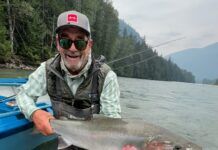
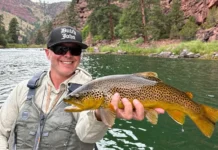
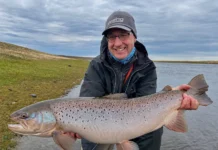
Nushagak River fly fishing is all about targeting wild leopard rainbow trout, working streamers through logjams, and deciding when to commit to a mouse fly. In this episode, we head to Outpost on the Nush with Sawyer Keener to talk about the fishing techniques that make this Alaska fishery so memorable. We get into the early-season salmon smolt run, the importance of fishing tight structure, and how to handle a big trout when it eats a mouse.
The average rainbow is around 20 inches, but larger fish are possible if you put your fly in the right place and stay ready for a strong fight. We also cover how to get to camp, which rods and flies to bring, and what the seasonal salmon runs mean for fishing. If Nushagak River fly fishing is on your list, this conversation will help you prepare for the water, the fish, and the remote Alaska experience.
Sawyer Keener works in the fly-fishing industry and, with his partner Dave Pishko, guides at Outpost on Alaska’s Nushagak River. After working at R.L. Winston Rod Company and later serving as geneon Alaska’s Nushagak River at Outpostral manager at Bauer Fly Reels, Sawyer found his way to guiding on the Nushagak River. We discuss the camp, travel logistics, seasonal fishing opportunities, streamer and mouse patterns, gear recommendations, and the importance of healthy salmon runs.
[00:01:32] Sawyer Keener started his career on the industry side of fly fishing, working at R.L. Winston Rod Company while attending the University of Montana Western. He later moved into a management role at Bauer Fly Reels before moving into guiding. He had wanted to fish in Alaska and Patagonia since he was young. After spending winters in Patagonia and summers in Alaska, he eventually found his way into guiding and the operation at Outpost on the Nush.
The camp has hot water, a shower, and incinerator toilets, but the setting remains remote and rustic. Beaver aircraft flew in most of the buildings and supplies, making camp logistics a challenge of their own.
[00:08:25] The trip starts with a flight to Anchorage, followed by a flight to Iliamna and a bush plane to the river. From there, a jet boat takes guests about 45 minutes to the camp. Because the operation is remote, review the travel details and packing list before departure. Nearby, McGarry Creek, a large spring creek, offers another option alongside the main river and its side channels. River levels and conditions help determine where the guides fish throughout the week.
[00:11:18] The main targets include leopard rainbow trout, Arctic grayling, Dolly Varden, and resident Arctic char. Chum, Chinook, sockeye, and coho salmon also move through the river, providing important food sources for the fish anglers pursue. The season generally runs from late June through the first and second of September, with the team waiting until trout have finished spawning before targeting them. Early-season salmon smolts can trigger aggressive feeding, while chum spawning later in the season creates opportunities to fish beads behind salmon redds. Sawyer recommends moving through these areas carefully rather than repeatedly working in the same spot.
[00:16:09] Covering water is a major part of fishing the upper Nushagak River. Guides drift while anglers work banks, current breaks, logjams, and ide channels where trout can ambush prey. Depending on water levels, the guides rotate through roughly 60-80 river miles.
Getting close to structure is important, even if it means losing a few flies. As Sawyer explains, if you’re never getting snagged, you may not be fishing close enough to the wood.
[00:22:19] Sawyer says the camp website includes detailed packing and fly lists to help guests prepare. Dave also discusses a photo of the cabins, boats, and channels behind the island. These resources give anglers a better idea of the setting and what they need to bring. The usual schedule runs Thursday to Thursday. Guests arrive Thursday, fish six guided days from Friday through Wednesday, and depart the following Thursday. Guides can adjust the plan to river levels and conditions throughout the week.
[00:31:54] Sawyer says rainbow trout commonly average around 20-22 inches, with fish measuring 27-28 inches representing trophy catches. He also mentions rare fish around 30 inches. For streamer fishing around heavy structure, he typically uses 15-pound tippet. His advice on the hook set is just as straightforward: hook sets are free, so be ready to set firmly when a fish takes.
For streamer fishing around heavy structure. Sawyer typically uses 15-pound tippet. His advice is simple: set the hook every time. Be ready to set firmly when a fish takes, especially when fishing close to wood, where a trout can quickly reach cover.
[00:36:37] Mouse fishing can work throughout the season, and Sawyer says early season can be productive. It may not produce as many fish as streamer fishing, so his advice is to commit a full day if you want to five it a proper chance. The reward is the possibility of drawing a large trout to the surface.
When a trout takes the mouse, wait until it turns and begins moving away before making the strip set. Keep the fly moving and target banks, logjams, and other likely holding spots. Casting perpendicular or slightly upstream allows the mouse to travel downstream with the current, while accurate placement helps cover likely feeding areas.
The Midnight Mouse, tied by Dave Pishko, is an articulated pattern roughly three to six inches long, with a beaver- or deer-hair head and a flexible-leg tail. You can fish it hook-up or hook-down. Sawyer also mentions the Morrish Mouse and Mr. Hankey.
[00:45:16] Sawyer recommends bringing 6-, 7-, and 8-weight rods. The 7- and 8-weight rods handle most streamer and mouse fishing, while a 6-weight is useful for dry flies and grayling. For anglers familiar with sink tips, he recommends a 250-grain, 10-foot sink in Type III or Type VI. Full-sinking lines can be harder work, particularly for beginner and intermediate anglers. Sawyer also discusses the Hardy Marksman Z and the value of durable equipment when fishing around heavy structure in a remote location.
[00:49:14] Sawyer says the camp dates back to around 1984 or the early 1980s and credits Dave Dorf with starting the operation. He suggests Dave Fisher as a better source for additional historical details.
The conversation then turns to salmon, commercial fishing, and bycatch. Sawyer explains that healthy salmon runs help support larger, heavier trout and compares Chinook return figures for the Nushagak system with trawl bycatch numbers from a broader region. Because those figures cover different geographic areas, they need verification before publication. His central concern is giving salmon populations and river systems the chance to recover.
Episode Transcript
00:00:00 Dave: If you’re willing to throw a mouse all day in Alaska, Sawyer Keener says you may catch fewer trout, but you might meet that fish you came all the way out to find. Today, we’re heading roughly eighty river miles up the Nushagak to a small camp on an island where leopard rainbows live around logjam side channels and miles of wild water. Sawyer Keener is here from Outpost on the Nush, and we’re going to find out how they fish streamers around tight wood. We’re getting snagged can actually mean you’re putting the fly where it needs to be. We’re going to talk about the early season smolt run and how this can put rainbows, char, and grayling on the hunt near the surface. We’re gonna get some details on these twenty-inch average rainbows up there. Plus what happens when a big rainbow eats a mouse, and why you need to wait before making the strip set. Lots of good stuff in this one today. You can learn more about Sawyer and their operation at outpostonthenush.com. All right, let’s get into it. Here he is, Sawyer Keener. How you doing, Sawyer? 00:01:01 Sawyer: Doing well, doing well. Thanks for having me. Dave. I really appreciate it. 00:01:04 Dave: Yeah, yeah, it’s definitely good to finally get you on the podcast here. We’ve got something exciting to talk about today: the outpost on the Nush. Is this camp we’re going to talk about today up in Alaska. But not only that, you have a bunch of things going on. You’ve been doing, uh, you know, this for a while. So we’re going to talk about a little bit of your background, a little bit of Alaska, the Nush, and all that. Maybe just take us back to guiding. How did you kind of first get into guiding, and how did it take you into the Nush? 00:01:32 Sawyer: Absolutely. Yeah. So I mean, I kind of took the opposite approach that most guides take in their career. You know, a lot of times you’re, um, able to get in a fly shop or an outfitter and work your way up, start getting a few days. Um, then after your guide career, you find yourself, um, you know, working in sales or, um, for a manufacturer. And that’s kind of how I started. So, um, I live in southwest Montana near Twin Bridges, Montana. And that was sort of my first job in the industry; I was just a customer service intern at R.L. Winston Rod Company, and I was doing that while I was in college. And I went to a little school in Dillon, Montana, the University of Montana Western. And it has the block system. So you have basically one class, um, a day, and that’s it. So it’s perfect. Yeah. It’s perfect. If you’re in sports. 00:02:23 Dave: I want to go to that school. That’s cool. I want to go to. 00:02:26 Sawyer: It’s great, you know, because I was originally playing football and it just gives you a lot more time, you know, to focus on school and extracurricular activities. So with that schedule, I was able to, uh, you know, get a lot of hours at work. And at the time at Winston, there was an opportunity to kind of rapidly advance through the company. And I saw that opportunity and really put my head down and grinded to, um, work my way up through the ladder and eventually became the general manager of Bauer Flywheels. And, you know, with all those jobs, they’re only, you know, mostly stuck to the sales side. But it just, you know, you talk to a lot of people in the industry. You know, I was talking to most of the fly shop owners that sold Winston and Bauer, you know, talking to the sales reps and basically just building connections. But, um, you know, I really owe the start of my guide career to one specific gentleman. Um, and his name’s Jack Porter. Jack now currently works for Yellow Dog, but at the time, Jack and I were working together at Winston. And, you know, he kind of asked me what I had in mind for just my career. And, you know, my, my biggest thing was travel. I wanted to get outside of little small town Montana and see the world. And Jack introduced me to this gentleman named Dave Pishko. And Dave is currently my partner in Alaska. And, uh, yeah, you know, after making introductions, Dave has a unique interview process where you’re not really hopping on a Zoom meeting or anything like that, you’re you’re going to go fish the Yellowstone for four days, and you’re going to live in a walled tent and you’re going to do dark to dark floats, you know, twenty to twenty five mile floats. And he just kind of wants to see what you’re made of. But, um, you know, long story short, Dave fell for my trick and, uh, allowed me to come up to Alaska, and I haven’t left since, so. Wow. Yeah, that’s, that’s kind of the quick story of, of, of getting led into guiding, but that’s always kind of had it in the back of my head, you know, growing up in southwest Montana, you know, around some of the arguably some of the best trout water in the world, it was always in the back of my head, you know, how can I make a life out of this? How can I make a career doing this? 00:04:35 Dave: That’s cool. So you’ve been thinking and it’s come to fruition, right? You’re doing it now. How does it feel now that you’re kind of in the middle of it? Does it feel about what you thought it would feel like with all the the travel? And I know you’re in the in Florida and bouncing around, is it kind of what you were expecting? 00:04:50 Sawyer: It is. Yeah. You know, I, I told my mom when I was a little kid, when I was nine or ten, I said I wanted to fish in Alaska and I wanted to fish in Patagonia. I didn’t know if it meant guiding. I didn’t know if it meant just going down there and living out of a tent. But I just wanted to get to those destinations and, you know, fortunate enough to do that, you know, before this Florida gig, um, I was spending my winters in Patagonia, um, and just doing the dual hemisphere seasons. So going from Alaska back to Montana for a little while, but then right down south. So just, you know, chasing summers and I can tell you one thing, I made the right decision jumping and going for it. And, um, you know, I didn’t think I would, you know, be maybe this far in my career as I am now. I’m very fortunate to have great, you know, just guides to work with mentors, leaders and, and, uh, just partners to work with that, that just kind of motivates you to keep, keep looking. 00:05:45 Dave: So keep going, keep going strong. I mean, and that’s the cool thing. And I’m sure it sounds like, you know, you put in the effort at Winston and Bauer to kind of get in a position right where people trusted you and were willing to, you know, like Dave, take the chance and, you know, jump in there. But I would love to talk more. You know, maybe if we have time as we go about Winston and Bauer, that experience. But let’s talk about the camp. You know, let’s talk about the news because, I mean, this is a famous river. Um, we’ve heard a lot about it. And I think you guys are in a unique part of the river. But talk about the outpost on the news. What is it? First of all, you know, when people hear outpost, you know, they think, you know, I’m not sure what they think. Right. It sounds like it might be a camp, but describe what what it is you guys have going, right? 00:06:26 Sawyer: Yeah. You know, sometimes I refer to it as a lodge. Sometimes I refer to it as a camp. But it camp seems to fit our operation the best, you know. So we are the furthest operation on the upper Nushagak, roughly two hundred and eighty river miles up. And kind of the layout of the land of camp. We’re on an island. The river splits above us and we have six cabins there, ten by ten. They’re, you know, small but cozy. We also have a lounge building. We use the word lounge pretty lightly because it’s it’s more of like a mud room drying area for your waders. It’s where we’ll tie. We have a big kitchen area where we’ll have breakfast and dinner. And then there’s the guide cabins in the shop. So, you know, not, uh, not your big fancy, high end lodge. And we keep things pretty small. So our, our crew is consists of three guides and a chef. And then we take up to six people. So it’s almost like you have the island to yourself, but definitely more of that rustic feel. You know, we do have hot water demand and a shower. So, you know, you can you’re not going to come out of the bush smelling like the bush. But, you know, we do have that. We do have incinerator toilets. That’s a wow. It’s yes, yes. Most people, you know, if they haven’t, um, talked to me or read the website about some of the features of camp. They’re stunned by these toilets and, you know, so those are a great addition. Most people are shocked when, uh, when they see that we have those things. But what, uh, what we tell people is everything you see when you get to camp has been flown in everything besides the boats. You know, years ago, they drove the boats up from the mouth. But the rest of the buildings, lumber, everything else, um, has been flown in on a beaver. So on a beaver? Um, yes. It’s a logistical nightmare sometimes for us, getting supplies and everything, but we make it work. 00:08:20 Dave: We make it, make it work. That’s awesome. So these are float planes. So you’re flying in landing in the Nushagak River. 00:08:25 Sawyer: And yeah. So basically to get to us, clients will fly to Anchorage, usually overnight Anchorage. And then on Thursday morning you will go to um Iliamna Air Taxi. And you hop on a jet that takes you to a little native village called Iliamna and near the coast from Iliamna. That’s where our package kicks in. So our bush plane pilots with rainbow River aviation pick you up. You have about an hour flight north and you land on the river. Um, and that’s where we first meet you. Um, after we pick you up, we unload you basically, clients fly in with the groceries that they’ll be having for that week. So we load you guys up, load the groceries up, and then we have about a forty five minute jetboat right to right to camp. So, you know, it’s really funny looking at people’s faces when they get off that floatplane, you know, they, they realize, okay, I’m in the middle of nowhere here, right? You know, and you’re not around anything. Our closest, um, civilization, if you call it, is this little village called cholinergic, which is roughly, you know, I would say eighty river miles from us. So. 00:09:31 Dave: Oh, wow. So you’re upstream of Coligny. 00:09:33 Sawyer: Yes, sir. Yep, yep. 00:09:34 Dave: Yeah. 00:09:35 Sawyer: So we are the furthest up. 00:09:37 Dave: Wow. So eighty miles. So you’re. And that’s the forty five minute boat ride from. How do you pronounce it again from? Yeah. And it looks like I’m not even going to say it, but it looks like there’s a there’s an airport there, or I’m sure it’s a smaller like a landing strip there. 00:09:53 Sawyer: You know, I’m not sure. I’ve actually, I’ve never been that low. And you don’t, you don’t even land near cholinergic. Basically, you just land on. You’re roughly fifteen miles below our camp. Um, and it’s just the deepest and straightest part of the river where our pilots can land. It’s very technical flying in that area, and there’s only a number of pilots that will fly for us. We’re one of their hardest, uh, just zones to drop into. 00:10:20 Dave: Yeah, I see it, I see it. This is really cool. Yeah. And like you said, the channel splits and you have like two forks coming together, like right above the camp. Is that is that the case? 00:10:31 Sawyer: Um, so camp is I tell people camp is on the big bend of the Nushagak and some maps label Big Bend, but it’s where the river takes, sort of a ninety degree turn and wraps around the mountain. It’s kind of tough pointing out where we are. 00:10:47 Dave: Yeah. Because yeah, you’re so remote. 00:10:49 Sawyer: Exactly. Um, another, another reference you can use is we’re at the mouth of McGarry Creek. And McGarry Creek is another sort of option that we’ll utilize throughout the week to fish. It’s a very large Spring Creek and you know, you’ll be fishing McGarry Creek as well. So. 00:11:06 Dave: Gotcha. Wow. So when you get up there, what are the species that people are thinking about? Because I know there’s a lot of different species. Salmon, trout. Um, you know, what can people be expected to find there? 00:11:18 Sawyer: Absolutely. So we do get four of the six Pacific salmon. You know, the first will see is chums, followed by Kings Sockeyes and then late in the season silvers. But you know, first thing I want to point out is we are not targeting these salmon. You know, we are so far up in the system by the time they reach us, they’re already starting to spawn kind of go through metamorphosis. So we’re, we’re just focused on fishing for the fish that are following the salmon. So that includes your leopard rainbows, Arctic grayling, Dolly Varden. And then there are some resident Arctic char that live in the upper Nushagak system too. But those are your four main species that we’re after. Every now and again, you get a bonus whitefish. Um, and there’s some different kinds of suckers up there, but, uh, wow. 00:12:03 Dave: That’s cool. So what is the, you know, I mean, I guess start with the rainbows. The leper rainbows. What’s that trip look like? Is it, uh, are you starting out there in June or maybe talk about your season there? 00:12:14 Sawyer: Absolutely. So, you know, Dave and myself, we get up, oh, a few weeks before the season starts. So we get there late May, early June. Because first off, you don’t really know what you’re flying into, right? Nobody’s watching the camp over the winter. You try to get there with enough time to fix things. If something goes wrong, you know, I can think a couple years ago, we had a moose go through a cabin where you had to fix a window, you know, so stuff like that. So Dave and I, I’ll get there early, but we don’t start fishing until about the third week of June is when we start accepting bookings. Now, the Alaska opener is that first week of June, but what we found is sometimes certain years, those rainbows are still coming off the spawn. Um, and we’d rather them finish that process before we start targeting them. You know, I’ve had years where, you know, you’re seeing trout reds and just like, oh, you know, we’re, we’re obviously we’re not going to target that. And that’s the last thing we want to do is hurt the fishery. So, um, we start late June, about the third week of June, and then we’ll operate until about the first to second week of September. And that’s when it starts to get pretty cold up there. The fishing slows down. But yeah, that’s our main operating window. 00:13:25 Dave: That’s cool. So basically it’s, uh, yeah, a nice little season, kind of, you know, late June, July, August, and then early September. And then you guys are out of there before it starts getting too nasty. 00:13:35 Sawyer: Yep, yep. Exactly. Exactly. And you know, the million dollar question I get is, well, when when do I come? 00:13:42 Dave: Yeah. Right, right. You gotta you got a short window. When is the best time. Right. It’s all good right. 00:13:47 Sawyer: All that’s usually the question is the answer is yeah, it’s all good. It just depends on what you’re looking for. And I can kind of break down our season. But basically that that early season, that third week of June till, let’s say the first or second week of July, you know, you might see some chums entering the system, but it’s it’s mainly streamer fishing, mousing, some dry fly opportunities for Grayling. But during that time of year when our. We will have a smolt run out. And that is when your baby salmon are getting ready to head to the ocean. And what we see is it’s almost like a mini version of saltwater fishing. You know, when you’re way out in, in the blue water and you see, you know, these balls of bait and tuna and marlin crashing. And we see a mini version of that. So you’ll see, um, you know, a school of smolt heading down river and then you’ll see char and, uh, rainbows and grayling blowing them up on, on top of the surface and basically cast it in there and strip as fast as you can and hang on. It can be really fun. But early seasons, one of my favorite times because you got to think these fish are just coming off the spawn. They’ve been under ice all winter and they’re hungry. They might not have the groceries that they do in September, but there’s still some really stout fish and they can be pretty aggressive with the streamer fishing. So really, really enjoy early season. And it’s, it’s tougher for us to book because a lot of people, when they come to Alaska, they want to see the salmon, which I. Which kind of leads me to the next part of the season is when our chums start to show up and that that’s, you know, they’re coming in. Each year is a little different. We’ll see some in June. Um, but they really start to spawn that that second week of July to mid-July, all the way to the end of July, and fishing behind the chums can be really fun once again. You know, we’re not targeting the chums, but once we get to a salmon red, we will beat it. Right? And you got to think this is the first salmon that’s laying eggs. So these fish are not as technical. You don’t have to get as technical with your beating. And the numbers can be pretty good. You know, once those salmon start to spawn those rainbows dollies and grayling know, okay, it’s time to chow. So the fishing can be very, very productive behind those chums. 00:16:01 Dave: Can you still catch when you’re fishing? When the egg is like full on? Can you still get fish on streamers or mouse when it’s going? 00:16:09 Sawyer: Absolutely. So, you know, there’s times when you come up to a salmon red and you’re trying different beads and it’s just not happening. And you know, there’s fish in there, you can see them. You know, a lot of times when we get to a salmon red, we, we sort of treat it as sight fishing. You know, we’re going to make it fun. We’re going to try to find that rainbow, find that dolly and let’s try to make the right drift for him. But there’s times when it’s just not happening with the bead. And it could be a number of reasons, but a lot of times it’s when that those salmon are just not laying eggs at that time. So yeah, you throw some streamers through there and those trout will get chase. But one thing I want to note is, you know, while the salmon, all the salmon are in. Yeah, we’re going to fish behind them on their redds. But between redds we’re back to fishing structure, you know, so basically I’ll say this when when I start my day and all the guides, this is how we operate. You know, we’ll jet to a certain point of the river, throw the oars in, and then we’re rowing that sled like a drift boat, and you’re fishing it like you’re fishing a river. And in western Montana it’s um, pound in banks, pound in structure, covering water. And then when we get to salmon red, yeah, we’re going to slow down, take our time, do some sight fishing, we’re going to catch some fish, but we’re not going to beat it up. Continue moving on. Right. I think it’s very important to to kind of cycle those reds and and not hurt your fishery. So, you know, each day you’re covering water, whether the salmon are spawning or they’re not, you’re going to be covering water. 00:17:35 Dave: So all right, so you’re motoring up and then you’re drifting a lot. It sounds like you’re drifting casting streamers and, you know, flies out of the boat. 00:17:42 Sawyer: Yep yep yep. So we split the river into three sections with three guides. So I have the upriver portion. So everything above camp is mine. Luke, our other guide starts at camp and he’s got about eight to ten miles below us. And then Dave starts below him. So we run a rotating guide schedule. You get to fish with us at least once, some of us twice. And that allows you just to see different parts of the river. You’re always fishing, you know, new fresh water you haven’t seen yet. And overall, we have roughly sixty to eighty river miles that we can access. Depends on the river’s level. But there’s mornings I jet two hours up, there’s other mornings I jet a half hour up. So you’re always seeing fresh water. It allows us to cycle different places and and just allow for for the best fishing. But yeah, like you said, just fish, you know, ninety percent of the fishing on the upper Nushagak is from the boat. Um, whether we’re rowing the boat or walking the boat, um, it’s just great to keep people elevated so that they can see better. But again, just allows us to cover more water. You know, the, um, you know, the upper Nushagak is a wild freestone river. You know, it is not a tail water where there’s, you know, a couple hundred fish in a short little section. Right. It’s you have to cover water to find fish. So. 00:19:03 Dave: Wow. So and how big is the upper Nushagak that you’re talking about here? Like, how would it compare to let’s pick a Montana stream out and what would be a comparison? 00:19:13 Sawyer: I always compare it to like a like a big Beaverhead granite. Beaverhead is a tail water, but as far as the look of the river and how much it oxbows and sort of width. It’s like a big beaver head, you know, especially the upriver portion. The further up the noose you go, the smaller it gets. 00:19:33 Dave: Oh right. And the more braided it gets right to. Is it, is it, are you guys taking these braided channels and going up and down? It seems crazy when you look at it on a map, right. There’s just channels everywhere. 00:19:44 Sawyer: Yes. We are taking all those little channels and braids and discovering new channels. The river changes each year and forms new channels, but yes, absolutely. Um, fishing a lot of side channels and um, little spring creeks that feed in and you know, just number one, it allows us to cycle things. You know, you could fish that same section, you know, that someone fished the day before, but we’re going to try a new channel now. We’re going to try this side channel. We’re gonna try this little, you know, so you, um, have the ability to mix up your program even if you’re fishing that same six to eight river miles, fishing different channels, right? 00:20:21 Dave: What is the on the streamers? We’ll talk about that setup a little bit. What do you fish. Let’s just say it’s that early June early or sorry, late June, early July. What are you guys using? And is this pretty standard setup? 00:20:32 Sawyer: Sure. Um, so you know, the I’ll say right now, the number one tried and true streamer in Alaska is the Dalai Lama. So, you know, most of your typical streamers when when you look up. All right, Alaska streamers. Yeah, we’re using them. We also are using a lot of articulated bigger streamer stuff. So a lot of sculpin in the river. Um, and one thing I want to point out real quick is, you know, those leopard rainbows, only thing they’ll eat is under the surface. The only actually, I’ll say this, the only dry fly they’ll eat is a mouse. So they’re very opportunistic. Um, there’s so much biomass in the upper Nushagak with, you know, just millions and millions of baby salmon, baby trout, baby dollies, baby char. Um, they’re big time streamer eaters. So a lot of, you know, well-known streamer patterns, like a lot of Kelly Gallop’s patterns, the sex dungeon, love those. A lot of sculpin in our river. So any sculpin pattern is great. Our main colors, you know, white, black and white, olive and white, of course, uh, black, you know, those are those are kind of your three or excuse me, three or four main colors we’ll use. But yeah, really any streamer pattern that you want to try, we’re down to try. Yeah. 00:21:46 Dave: And all it all work. 00:21:48 Sawyer: Absolutely, absolutely. That’s something we’re always trying to do is figure out new patterns. You know, something those fish haven’t seen and something that you can sort of use throughout the season. Right? You’ve got to be careful on what you show those fish at different times of the year. And it’s sort of a sort of a game. You’re always playing with those fish. It’s like, okay, I haven’t fished the black and white dolly in a couple of weeks. Let’s show it to him now. You know, stuff like that. You’re always playing mind games with these fish. But on our website, we do have a detailed fly list. If there’s any tires out there that are. 00:22:19 Dave: Coming due, you’ve got on your site. Okay, so outpost on the news dot com. 00:22:24 Sawyer: Yep, yep. We’ll have a detailed packing list and a detailed fly list because, you know, I think it’s fun when I’m traveling somewhere to fish. It’s fun to try new patterns. Something that you’ve worked on in the off season that you’re tying. And like I said, we’re always down to try something new. 00:22:38 Dave: Yeah, this is perfect. Now, now it’s great. I just yeah, I just clicked over on the website and, um, there was a photo of the camp that popped up here. Right? And so it really gives you a perspective of just that photo, that shot, you know, the fact that, yeah, I mean, you’ve got the cabins and you’ve got the boats, but you’ve got these channels back behind and you guys are on a. Yeah, I mean, you just see it right there, right? There’s actually a lot of forest. Right? You guys are. It looks like a decent amount of actual trees, not just tundra. Is that is that the case around there? It looks pretty forested. 00:23:09 Sawyer: Absolutely. Yeah. You know, it’s funny. You don’t realize where you’re at. There’s sometimes we’ll we’ll do a hike on one of those hills that’s near camp, and you can kind of get above the willow line and understand just where you’re at and where you’re going. But yeah, you know, while you’re fishing up there, you’re pretty much stuck to the river and you’re surrounded by willows. It’s never really open. You know, when you go up river with me, the view and the scenery kind of opens up and you’re able to look over the. Those are called the shotgun hills in that area. Yeah. See those hills a little more. But yeah, you know, you’re either in tight with the willows. There’s times you’re in sort of a like a bunch of blue spruce around or elms and cottonwoods are around. So it definitely changes, especially if you’re, you know, as you’re covering water, it’s just like you’re floating a river in Montana where, yeah, you’re, there’s times you’re going to be in a, in a river bottom surrounded by cottonwood. And then there’s times where it might be a little more open. Obviously, there’s no tundra here, but up there where you’re just looking over tundra. So definitely a different scene. Yeah. And not what everybody thinks of when they think of Alaska. No. Right. 00:24:17 Dave: No, there’s no tundra because you’re you’re far up the system. Up at a higher elevation. Is that why there’s no tundra? 00:24:22 Sawyer: No. You do see tundra. You do see tundra. You just kind of got to get off of the river to see the tundra. 00:24:28 Dave: Oh, I see. 00:24:29 Sawyer: And bringing up the tundra is is a great point right now. So the you know, like I mentioned, it’s a wild freestone. There’s no lake feeding this river. So you know, how this river gets its water is spring creeks and tundra runoff. So basically when it rains, that tundra sucks up the water, right? 00:24:47 Dave: It’s like a sponge, right? When you when you step on the tundra, you literally kind of sink down like a sponge, right? And that’s. 00:24:53 Sawyer: Exactly. Yeah, yeah. It just squishy. You can hear it below you. And then you’ll see different points of the river where the tundra is dumping in. It’s almost like a waterfall or a little creek coming in, but that’s all tundra runoff, right? So it that tundra soaks up the rain, and then it runs through a solid layer of ice, right? That permafrost that’s four to six feet under the tundra. So that water coming back in, you could say, is freezing. Right. It’s through ice. It’s going you know, it’s roughly thirty two to thirty five degrees coming back in. So it consistently keeps our river cool and at a good level when it rains. 00:25:28 Dave: Yeah. Wow. And you mentioned the trip or the plan. Where do you where do you find the flies? Uh, recipes on your site. 00:25:34 Sawyer: Should be under what to bring, I believe. 00:25:37 Dave: Yeah. There you go. Printable packing list. Fly list. There you go. Yeah, I love that you guys put this here because again, the packing list is always for any trip is great to have. Right. And then and there it is right there. Fly list. Awesome. You got a PDF that pops up streamers Dalai Lamas size two for black and white, all colors, sculpin patterns. And then you got dry flies and mouse patterns. Chubby Chernobyl of course, which is good everywhere. Okay. And then beads. So I mean, that’s a great thing is it’s pretty simple, but so we got the list so people could check that out as well. And the colors you mentioned there, black and white. So if you had to pick one for the Dalai Lama, what’s the one you’re going with color wise? 00:26:15 Sawyer: Absolutely. So I kind of live by the rule of bright skies, bright flies, dark skies, dark, you know. So if it’s cloudy, overcast, probably going to give them the, um, black and white or something darker. Now that’s a good rule of thumb to live by. But also it depends on, you know, the stage of the river and what’s happening, right. So throughout the season, different kinds of salmon smolt are going to start to run and move around and hatch and be more prolific. So you’re going to see chum Smolt and then you might even see a larger smolt. You’re like, hmm, what is that? It’s a king Smolt, right. And they have a different look than your chum Smolt. Same thing with like great examples of coho smolt when you start seeing those in the system, they have little orange bars on their fins. So we’re always trying to kind of, you know, match the hatch, right? 00:27:02 Dave: Wow. So you’re matching these Dalai Lamas to the actual salmon smolts that are migrating out? 00:27:07 Sawyer: Absolutely, absolutely. I think that’s, um, very important to do is, you know, you look in the river and you notice a sculpin that darts out. You notice, okay, he’s, he’s kind of got a, a brown back and a yellow belly. And then okay, maybe I’m trying to, maybe I’m gonna try a brown and yellow dolly and by golly, it works, you know, so little things like that. But on the topic of flies, you know, one thing I should mention is when you do come up to us, realize you don’t have to bring your own fly box. Um, we provide everything from the fly line down. So all your tippet material, all your split shot, um, all the flies, so and that that is included in the package. Um, because one thing I want to note with the flies is you’re going to lose them up there. You know, we’re, we’re, we’re fishing these flies. People kind of look at us like, you really want me to put that fly in there. 00:27:59 Dave: Right? Like, like towards some wood. Yeah, exactly. You lose a few flies up there, right? 00:28:03 Sawyer: Yes. What I always tell people if you’re not getting snagged, you’re not fishing right up there because the only current break for those fish is structure. There’s not a there’s not a rock bigger than my head on the upper right. Okay. So they’re, they’re having to use these pine trees as current breaks or these log jams, right. So I don’t want you fishing the edge of the log jam. I want you to get under that log jam. You know, like bass fishermen do really well. You got to get in tight. And our famous saying is you got to risk it for the biscuit. And yeah, so it can become frustrating because you are getting snagged. It’s tough to see sometimes where those snags are, just how deep they are. And it becomes frustrating for people. But like I said, we’re we have plenty of flies on us. You’re going to get used to the program. But, uh, yeah, like I said, if you’re not getting snagged up there, you’re not fishing, right? 00:28:53 Dave: Yeah. Fishing. Right. That’s right. Okay. So yeah, going back to the, the, the getting there, we basically fly into Anchorage. You take a charter out of Anchorage, drop into, a village or a town lower in the system. Is that is that the case? They drop you on a runway down lower, and then you hop on a float plane from there. 00:29:10 Sawyer: Yeah. So iliamna you fly, um, you fly southwest. It’s in Iliamna is near like Lake Iliamna is very popular. 00:29:18 Dave: Yes. 00:29:19 Sawyer: Yeah. Lake Iliamna right. Iliamna is not far from Lake Iliamna. There’s not much going on in Iliamna. You know, there’s, like, maybe a gas station and and, uh, the airport, so. Yeah. And then that’s where our bush plane pilots with rainbow River aviation will pick you up. Um, and then you have the flight into the bush, so. 00:29:39 Dave: Into the bush, right? Then you’re on the floatplane for up into the bush in that experience. And then once you drop down there, you hop in the sled and, and you get up and you’re ready to go. And is it typically you mentioned Thursday? Are you up there for a week at a time? Is that typically what it looks like? 00:29:54 Sawyer: Yep, Thursday to Thursday. So that, um, that. 00:29:56 Sawyer: Thursday when you get there, we’ll have once we get you to the camp, we’ll have lunch ready for you. Usually been a long day for most clients. You know, there’s it’s Alaska. You never know with weather delays and what’s going to happen. So there’s times when you get to the lodge a little later in the afternoon. Um, but we’ll have lunch ready for you that Thursday. We’re not guiding, but you’re more than welcome to fish around camp. Um, so you could walk, wait around camp for that evening. And then the first guided day starts the next day on Friday, and you’ll have six guided days. You’ll fish till Wednesday afternoon. And then that Thursday morning is when you’ll depart from the lodge. 00:30:34 Dave: Gotcha. So yeah, I guess that is the first day is always a lot, right? To get through the travel you get there, you’re actually at the cabin. You know, there’s probably a mix of people, but what does that feel like? You know, from your perspective, when you kind of get there and you got the, the clients for the week. Um, you know, are you pretty excited when you got the first group coming in? 00:30:54 Sawyer: Absolutely. I mean, one thing to realize is, you know, the clients we see are the only people we see all summer, right? So we’re always excited to welcome new people to our little island. And yeah, it’s a you know, the thing I like about a small operation is it’s sort of a family setting, right? And you really get to know people well by the time they end their trip and leave. You just you don’t want to say goodbye. You know, you just really get close with some of these people. And, uh, and it’s fun. But know that that first day is some people are a little shell shocked at first. You know, they’re just trying to kind of get their surroundings, realize where they’re at. Um, other people are just chomping at the bit with a million questions, which is to be expected and which is what I want. But it’s exciting. 00:31:37 Dave: Yeah. What is that on the expectation that that is one of those things you hear a lot about, right? The balancing expectations for people. If we were talking to you and we were telling us what to expect, you know, what is that? You know, like, as far as I guess fish size is one thing, right? How big do fish get? But describe that a little bit. 00:31:54 Sawyer: One thing I would tell people is, you know, the first thing I’d say is number one, hook sets are free. Don’t be afraid to set the hook right. There’s, uh, there’s times of the year when, when, uh, you know, you say you’re fishing, buying salmon reds and you know, you’ll have, you’ll watch that line dart and just, you know, somebody’s getting eaten and they won’t set the hook. And what I always, we always tell them hook sets are free. But, you know, it’s, it’s something we always kind of leave as a surprise. Yeah. We’re going to explain the program and what to expect for people. What I would say is just be ready for one of the hardest fighting trout in the world. You know, some of these the power of these leopard rainbows surprises people. Sometimes it they nearly take the rod out of your hands at times. And I would say the biggest shock for most people is how much pressure we’re having people put on these fish. So usually that our lightest tippet when we’re streamer fishing is about fifteen pounds. 00:32:49 Dave: No kidding. Wow. 00:32:50 Sawyer: That’s because of all the structure, right? So when you hook that fish under that logjam or under that pine tree. You gotta get him out. And that’s usually a shock to people on how much we’re having them, you know, pull on these fish. We always joke that, you know, that that reel that you have on your rod there, all that is this week is just a line holder. You know, we want people having constant pressure on these fish and you got to get them away from the structure. 00:33:16 Dave: Well, fifteen pounds is a big I mean that right there just shows you they’re not leader shy obviously. Right. That’s. Yeah. 00:33:22 Sawyer: No they’re not leader shy. The only time we really need to get technical with with our tippet is if we’re beating. And it’s a really, you know, if it’s shallow area, sure we might knock it down to twelve pound or eight at the most, but still quite a bit of pressure that you can put on these fish. And it’s they’re like many steelhead, you know, the way they fight, you just don’t know their next move. They could tail walk you downstream and then put the brakes on and come right back at you. And if you’re not on your toes, he’s gone. 00:33:51 Dave: He’s gone. What is a, you know, like average size fish for I mean, just in general in Alaska. What would you say people can expect from. 00:34:00 Sawyer: I would say an average fish would be twenty to twenty two for us. 00:34:05 Dave: Really? Yeah. So twenty inches in average fish up there. 00:34:08 Sawyer: Yeah. I would say, you know, twenty is about our average. It’s it’s changed what I’ve seen my this was my I’ve been up there for five seasons. And what’s really excited me in the last couple is I’m catching smaller rainbows. And my first couple seasons up there, I never saw those fish like the smallest fish I would see was maybe sixteen inches, which is, you know, anywhere is a healthy, healthy fish. Yeah. But the last couple of years I’m catching some, you know, ten inch fish, even eight inch fish, which I’m very excited to see. Um, but yeah, I would say twenty is a good average now, you know, everybody’s, you know, on the, on the topic of sizes, right? That, that thirty inch mark is what everybody wants to hit, right? 00:34:47 Dave: Yeah. The thirty that’s always the mark. That, which is, and we’ve talked about this quite a bit, you know? It seems like no matter where you are in the world, a thirty inch fish is very hard to find. You know, just because it’s like there at the end of their life, right? I mean, that’s an old fish. 00:35:02 Sawyer: Absolutely. Yeah. And, and, you know, there are there thirty inch fish in the upper Nushagak system. Absolutely. But, you know, we’ll have people hook them, but we rarely see them. You know, they’re these fish are there’s nothing like them out there. I think they’re different than even other places in Alaska. Um that’s it’s hard. That’s a hard take for me to say because I haven’t finished very other places in Alaska, but it seems like these fish don’t always grow, you know, horizontally. It’s more vertically, right? So they, you’ll catch a fish in June and then that fish in September might be three or four pounds heavier and two or three inches taller, you know. So it seems like they just grow into football’s more length more. 00:35:44 Dave: Than the length. That’s amazing. 00:35:45 Sawyer: Yeah. Like a trophy, you know, trophy fish for us once you’re in that two foot range and above that, you know, twenty seven to twenty eight anywhere in the world. That’s a hell of a fish. But up there, it’s definitely a hell of a fish. 00:35:57 Dave: Yeah. So that gives I mean, so basically, yeah, I mean, a twenty inch fish is amazing. But I mean, you’re going to get a chance, you know, probably to see some fish that are twenty couple feet, maybe even bigger. 00:36:07 Sawyer: Yep, yep. And you know, we just as a guide sometimes we want to see the fish more than that. Client wants to see the fish, right? 00:36:15 Dave: Yeah, yeah. 00:36:16 Sawyer: We love it. And, um, there’s fish up there that haunt me, you know, that you just, you see them roll or somebody hooks them and he does one jump and he’s gone. And it’s just like, wow, I want to see that thing up close. 00:36:28 Dave: Is there a, um, you mentioned the streams a little bit. Is there a mousing window or is there a time when people would want to come up for the mouse? Or is that kind of it’s, you can do it any time. 00:36:37 Sawyer: You can do it any time. 00:36:38 Sawyer: You know, and, and yeah, and it doesn’t matter where you’re at on the river, the whole thing looks mousey to anyone that has ever fished a mouse before. It all looks mousey. But you know, early season can be pretty good for the mouse just because those fish are really hungry. And, you know, a lot of, like I mentioned, the salmon smolt running out. They’re kind of looking up, right? Things are a little bit further up in the surf, in the water column, right? So whether it’s a fleeing smolt or they see a mouse, they’re kind of looking up. So, you know, early season can be pretty good for mousing. Um, like I said, we’re going to mouse throughout the whole entire season. It’s just depends if people want to commit to it. Now what happens a lot of times is let’s say someone wants to fish the mouse and his buddy is still fishing the streamer. The mouse isn’t always as productive as the streamer, right? And people sort of lose confidence and want to go back to fishing streamer, which I can understand. But what I recommend with the mouse is you got to commit a day to it. Yeah. 00:37:33 Dave: You got to commit a day. 00:37:34 Sawyer: Yeah. And what I love about the mouse is, yeah, it might not bring out the most fish, but it usually brings out the larger fish, right? 00:37:43 Dave: Yeah. I could see that as kind of a and that’s what’s cool about having a week. You know, you’ve got all this time to, you know, hit streamers to kind of do it all right and have a whole day or maybe even more of just mousing. So that’s your focus. And if you were to, I can’t even imagine, right? If you were to get a twenty four or twenty seven inch fish to come on a mouse, right. Describe that. What is it like when you see a big fish eat a mouse? 00:38:07 Sawyer: It’s tough for me to keep my cool. 00:38:09 Dave: Yeah, right. Is there a hook set? There is a hook sets free on that when that’s happening. 00:38:15 Sawyer: It’s, uh, you know, it’s like in in dry fly fishing. The old saying is, you know, God save the Queen. You got to say, God save the queen before you set the hook. And with mousing it, you might even have to say it three or four times because it just depends. Each fish is a little different, but there’s this very subtle take. So you’re seeing this rainbow come up from the depths. And it’s just it seems like slow motion at the time. And he just comes up and kind of just daintily sips it like a dry fly. And that’s when you, you really have to wait for that fish to turn like eat the mouse and start turning and going down in the water again before you crack them. And you know, one thing I want to note is we are strip setting. You got to strip set them out. 00:38:54 Dave: Oh, right. Right. Yeah. No, no trout sets. This is a strip set. 00:38:57 Sawyer: No. 00:38:58 Dave: Now is that the case just for mousing or are you doing strip sets for other techniques. 00:39:03 Sawyer: Strip set for everything up there besides dry fly fishing. And the bead set is sort of a strip set with it’s sort of the Bassmaster Classic. You know, you’re kind of with the lift and the strip set at the same time, but no streamer fishing and mousing. You got to keep that tip down and you got to strip and strip. 00:39:23 Dave: What’s the strip set? Is it like a slow strip or is it like a fast? What’s the strip set like for, say, the mouse? 00:39:31 Sawyer: It’s very similar to like when you were fishing. If you were fishing a streamer, it’s just, you know, you, you let that fish eat and then you crack him with a good one, right? It’s a longer strip, like you’re moving a fly just, you know, let’s say, um, foot and a half to two feet and realize it’s okay to give them more than just one. Right? There’s that strip set. And then once you have that, uh, you feel that weight, then you can lift that rod. Now when you lift that rod, that’s sort of another set, right? That’s sort of just embedding that hook a little deeper, getting rid of any slack that’s created there. But one thing I want to note, not only do we want a strip set because of the hook set, it’s a stronger hook set. But you got to think when you lift, let’s say you were going to trout set on a mouse or trout set with a streamer. When you lift that rod to trout set, look at how far you’ve moved that fly. As opposed to if I just did a foot long strip, I’ve only moved that fly a foot and I’m still in the zone, that fish can come back and eat it. 00:40:30 Dave: Oh, right. Yeah. As opposed to taking it out of the zone. 00:40:34 Sawyer: Exactly, exactly. I mean, when you lift it like a trout set, you just moved it potentially fifteen feet away from that fish. But if I just did a little foot long strip, I’m still in that zone. 00:40:45 Dave: Even if he misses it. So he might miss it first. But come back to it and hit it again. 00:40:49 Sawyer: Yes. Especially, you know, that’s one thing to note is compared to the lower forty eight, you know, when you hook a fish in the lower forty eight sting, um a lot of times he’s not going to come back. Right. It’s kind of one and done. But up there sometimes it just, it seems to just piss him off. And you put that fly right back. A lot of times that fish is just waiting for it. He’s darting around looking. And same thing with the mouse. You know, there’s times when, especially if it’s your first mouse eat. Guess what? You’re you’re most likely going to get excited and you’re going to pull out of his mouth. It’s it’s normal. That’s what we see. But if you put that same cast, put it right back down. You know, there’s I’ve had a lot of times when that fish comes back for it, you know, three or four times if they’re committed to the mouse, they’re going to come back for it. So yeah. 00:41:33 Dave: Amazing. Amazing. That’s so so that’s it. I mean, that’s the strip set with the mat. And then like you said, you just got to give it time. So if you see the fish, if you’re mousing and are you typically stripping just the mouse across the wire, maybe describe that a little bit. Are you casting towards wood and then doing a strip? What’s your typical action on the fly? 00:41:52 Sawyer: Absolutely. Um, yeah, like I said, targeting structure. It doesn’t have to be just structure. Even an undercut bank, same spots where you’re going to be fishing your streamer even there’s times I’m gonna have you throw it in a mid river trench. Biggest thing with the mouse is just constant movement, right? You know, fishing the mouse is exhausting. It’s tiring because you’re constantly wiggling that guy. And there’s times when I’m having you control it. You can do little pops like you’re almost fishing a little popper, you know, just kind of having him hop along other times where you can sort of incorporate a little wiggle into your strip, almost like, you know, if you’ve ever permit fish, like wiggling a crab when you strip it. So you kind of shake your hand with your, your opposite hand as you strip it. And it gives that mouse a little more action, but a couple key notes here. Number one, mice do not swim upstream, right? So we want to cast upstream and have him swimming down either. Either we’re either going to cast perpendicular to the bank or upstream a little ways, so that he’s coming with the current and hitting as many spots as we can. Right. We can’t do longer drifts like you can with a streamer sometimes. So a lot more quicker shots, right? We’re going to have them run along this log fish at three to four feet out. And then I gotta hit another spot. Right. So it is exhausting mentally and physically fishing the mouse. 00:43:11 Dave: Yeah, that sounds amazing. So the mouse. So that’s going to be a big part. And what do you have a mouse pattern. You know, I know there’s a bunch out there. Do you have one that you really love. 00:43:20 Sawyer: Yeah. So, um, it’s actually Dave Pisco, my partner’s pattern. 00:43:24 Dave: Um, okay. 00:43:25 Sawyer: Gentleman that you’ll meet when you come up to the beach, but, uh, it’s called the Midnight Mouse on the website, there’s a YouTube video on how he ties it, but essentially what it is is it’s an articulated mouse pattern, you know, usually about three to six inches long. And it’s tied mainly out of beaver and deer hair as the head. And then it’s got a little silly leg as a tail. But what’s great about that pattern is it doesn’t matter if it lands up or down, right? It’s the same both both ways. So that’s my problem with certain patterns like the Moorish mouse is if it lands upside down. 00:44:01 Dave: All right. 00:44:02 Sawyer: Looks like a pancake floating in the water. But the midnight mouse, it doesn’t matter if it’s hooked up or hooked down, it still looks like a mouse. And with that articulation, it wiggles a little bit. And one thing about mice patterns where we’re at, the more realistic it looks, the better. You know that the body is submerged and the head is out of the water. Think about when a mouse is swimming across the river. He’s not just floating, right? He’s his head is up, but the rest of his body is in the water. And that’s sort of how this fly, um swims so. 00:44:35 Dave: Right. Yeah. Because they’re not like super awesome swimmers, right? They’re just, they’re kind of, they’re trying to get out of the water they fell in. They’re probably not on purpose. Right. 00:44:43 Sawyer: Exactly. They’re struggling. They’re struggling. So the more that you can make that mouse look like it’s drowning or struggling, you know, the more realistic it looks. So, but other patterns like what’s listed on our site, the hanky, of course, Mr. Hankey, the Morris mouse, you know, feel free to bring those. They will work. They will work. But what we primarily focused on fishing is that midnight mouse. 00:45:04 Dave: Midnight mouse. And you mentioned at the start the the rods you worked for Winston. What is the the typical is it, you know, if somebody wanted to bring their own rod, is it a six weight or what would it be the rod you’d want to bring? 00:45:16 Sawyer: So, you know, if I was going to recommend bringing, let’s say you bring three rods, I would bring a six, seven and an eight. That’s a great quiver. Even two sevens and an eight is a great quiver, but definitely leaning more that seven and eight weight for our streamer fishing and for our mousing. The six wait is a good dry fly rod. You know, if someone’s looking to target grayling with dry flies, that’s a great rod. Is the six. Wait, even a five? Wait can get it done. You know, the six wait can also be used as a mousing rod. It’s a you know, some of those mice patterns are a little heavy for it. But, you know, we’ve had people bring them up. Works just fine. But the seven and the eight wait, is your bread and butter up there? And the reason is when we’re streamer fishing, not only are we throwing bigger streamers, there’s times when we have to have quite a bit of split shot on there. Um, and that’s just to get the fly down to those fish, you know, under, under the structure and down to their level. And it just depends on the stage of the river and how big it is and how much weight we’ll use. But one thing I will say for folks out there that are familiar with fishing, a sink tip, bring a sink tip, you know, if if someone’s new to a sink tip, I don’t really want them fishing it because it’s harder for us to detect a strike. But if you’re familiar with fishing, a sink tip that will save your arm on us having to add weight to the rigs. 00:46:36 Dave: Oh, right. 00:46:37 Sawyer: That is the biggest reason we want people bringing seven weights or eight weights is not only how hard these fish fight. 00:46:43 Dave: But casting. 00:46:44 Sawyer: Casting. 00:46:45 Dave: Yeah, yeah. Right. So the sink tip would be good. So some type of a kind of like a short kind of compact sort of, you know, style tip. Is that what you’re looking for or is this like a full sinking? What’s the recommendation there? 00:46:57 Sawyer: So you could, you could fish a full sink. 00:46:59 Sawyer: Line up there, but realize fishing a full sink line is a lot of work, and I wouldn’t recommend it for any beginner or intermediate angler, but a great setup is like a two hundred and fifty grain ten foot sink tip. Even a twenty foot sink tip isn’t bad, but a ten foot two hundred and fifty grain is perfect. You know, type type three is great. Type. Even a type six. Um, we can make work. So just it allows us to try different rigs, you know, try different parts of the water column too. 00:47:27 Dave: Right, right. That’s great. And are you guys on your program? Uh, as far as rods, do you still use a lot of Winston or do you kind of have all sorts of different rods there? 00:47:35 Sawyer: You know, it part of me hurts me to say, but, uh, no, we we really don’t use many Winston’s. 00:47:41 Dave: Yeah. I mean, Winston, that’s the thing about Winston, right? I mean, you look around at all the the camps. I mean, we were just at a lodge and you know Orvis, right? It was a great I mean, again, there’s there’s not a bad rod out there. Right. But you got some rods that cost more. And I’m guessing. Right. You’re a Winston rod to see it break would be a little bit harder than something less expensive. 00:47:59 Sawyer: Yeah. You know, it’s hard to, uh, to watch a break for sure, but we actually have a deal with, um, we’re a hardy endorsed lodge. 00:48:06 Dave: Oh, cool. 00:48:07 Sawyer: Yeah. And, and, you know, I’ve been really impressed with some Hardy’s newer rods. The, uh, we outfit people with the marksman. Z, the marksman. Z is their saltwater stick. But, um, number one, I just, I like the weight in hand. The durability has been proven with the tarpon in, um, you know, in the keys, all their product testing down there. And I also like just the action, the recovery speed. You know, it’s not a stiff rod, but it’s got a, you know, a quick recovery and it’s easy for people to learn on if they’re a beginner. But it’s also great for advanced anglers that need to get the fly in a certain place. That rod’s going to allow you to do it. 00:48:46 Dave: Yeah. Hardy. Yeah. Hardy’s got some good stuff going for sure. Cool. Well, this is great. I think, um, maybe just, uh, as we kind of take it out of here. Give me a little background on the history of the lodge. So you’ve been up there for five seasons, but it was. It’s been there a while, right? You guys didn’t build the cabins. Do you know a little bit of that history up there? 00:49:04 Sawyer: I do, I do know a little bit, you know, and and the next gentleman you’ll talk to Dave Fisher whenever that is. He can he can give you a lot more detail on that. 00:49:11 Dave: Yeah. Dave will have the whole the whole history breakdown. 00:49:14 Sawyer: Exactly. But yeah, I am familiar with, um with the history of the lodge. So, you know, the camp’s been up there since nineteen eighty four, I believe, eighty early eighties and was started by this gentleman named Dave Dorf, who you know, is an absolute legend. 00:49:32 Dave: Oh, is he a Dorf is a legend. 00:49:34 Sawyer: He is a legend. 00:49:35 Dave: Awesome. Is he still around? Is he still around? 00:49:38 Sawyer: You know, he’s still around. His his health is not great. He’s actually living in assisted living in Bozeman. Um, and, uh, unfortunately, I think his mind is slipping a little bit, but man, I just so much respect for that guy. Um, unfortunately, I have not really met Dave or got to know him very well, but from the stories I hear from clients and other guides and a lot of people in the industry, just an absolute legend. 00:50:05 Dave: No kidding. So he built that literally. That was his his baby. He built up there. 00:50:09 Sawyer: Yeah. So I, and I don’t want to mess up the story of it, but, um, I believe Dorf worked in the lower part of the Nushagak at a at a salmon operation. And Frankly, was just tired of watching fish get killed and was probably tired of. 00:50:27 Dave: Oh, right. 00:50:28 Sawyer: Probably tired of dealing with, uh, just filleting fish. 00:50:32 Dave: Is that still going on down there when you go to the lower noosh? Because the Nushagak is known as, you know, the lower right as the salmon, especially Chinook, right? It’s one of the places you can still get Chinook. But are they still, um, you know, kind of bagging lots of, you know, killing lots of fish down there. I guess Chinook maybe is not as much. 00:50:50 Sawyer: You know, I would, I would hope that it was a no on the Chinook, but it’s sort of the wild west down there in, you know, near that village. A lot of, you know, a lot of people are are putting their nets out. And I don’t believe it’s getting regulated too much. 00:51:06 Dave: Oh, right. Right. So there’s actually native, native, uh, groups up there are putting in, uh, just nets. 00:51:13 Sawyer: Absolutely. And, and definitely not, you know, calling anybody out here, but I just don’t think it’s regulated very well. 00:51:19 Dave: Right. 00:51:20 Sawyer: It’s really hard to say. I do know there’s still some operations that are, um, targeting kings on the fly. I believe they’re now with new regulations, forced to release those Chinook, which is great because, you know, they are struggling. But, um, yeah, I mean, unfortunately, we’re just trying to make up for what we’ve done in the past as humans, right? We, we’ve already took too much. 00:51:46 Dave: Yeah, exactly. Well, and that’s for you guys, you know, I mean, that’s the one nice thing about where you’re at is that, you know, you’re focused on, you know, these rainbows for the most part, your salmon isn’t really the I mean, they’re there, but that’s not your focus. So. Right. So you guys, you know, you probably don’t have see you you don’t see lots of ups and downs, right. I mean, the rainbows are going to be there right. Regardless. 00:52:05 Sawyer: Right. Yeah. I mean we are definitely directly affected by the commercial fishing and the netting that happens downriver because we’ll we’ll see it in the returns that we get. And, you know, the more obviously, the more salmon that you get in that part of the system, the more fish are going to follow them from the lower part of the river. So, you know, more salmon equals more rainbows for us and and healthier, just fatter fish too. But, you know, there’s times it’s different each year. I think I can think of last year where the chums beat the fishermen and they showed up early, they ran early, and it was a record chum year for us. Other times when, you know, the fishermen are on their toes and we see a lack of famine in certain areas where normal years we would have a big red there. And unfortunately this year they may have gotten netted, but it is hard to say kind of what’s going on in the lower part of the system and how much fish they are harvesting. So yeah, I hear you, but I we are directly affected from it. And, um, yeah, we just need all the fish we can. It’s just such a, it’s something I always mentioned to clients and I know this will never happen in my lifetime, but, uh, could you imagine if we just took one year off of commercial fishing? Could you imagine the reset all those river systems would get? I mean, it would just be wall to wall salmon. And, um, yeah, so I it’s, um. 00:53:32 Dave: That is the big challenge. The, uh, the, we’ve heard a lot about the trawlers too out there, right in the ocean that are, that are netting all sorts of fish, right? There’s all sorts of bycatch on Chinook and it sounds like that. That’s another big issue out there. 00:53:44 Sawyer: Absolutely. Yeah. That that was a big issue this year. Something I’m always looking at is the, you know, just the, the run numbers, how many salmon are entering the system and comparing it to, you know, years ago. And for instance, this year I, the Nushagak roughly, the whole system had thirty, roughly thirty five, thirty six thousand kings. And looking at the trawl bycatch numbers, they killed right around thirty thousand kings. 00:54:11 Dave: No kidding. Oh, wow. 00:54:13 Sawyer: Yeah. 00:54:13 Dave: Yeah. So literally the return was thirty five thousand and the trawl bycatch was about the same. 00:54:19 Sawyer: Yeah. Now, I don’t know that trawl, that trawl bycatch is probably covering a very vast area of Bristol Bay and other parts, but it just points to the issue that, hey, trawling needs to go away. And, um, you know, if, if we just give Mother Nature a chance, it will rebound. But we just got to give it that chance. You know, and, and right now we’re just human nature a little too greedy. 00:54:42 Dave: Right. Yeah, exactly. Well, we’ll be shedding more light on that as we go to. That’s the great thing. I think that, uh, having people get involved is always a good way to help, you know, support and, you know, protect what’s up there, right. 00:54:54 Sawyer: You’re exactly. 00:54:55 Dave: You’re in Alaska, right? You’re in that place, that man, if, if we lose that, you know what I mean? That’s, that’s kind of extreme. But but yeah, we’ll talk more about that. Let’s just grab I got one random one for you, Sawyer, before we get out of here, we talked rods. We’ll talk more about this as well as we go and chat with Dave. But you mentioned sports. I always love to kind of take it out of sports. It sounds like you were in college, you were playing sports. What was your go to sport in college football? I was a football. 00:55:21 Sawyer: Yep. 00:55:21 Dave: You were so so you actually played college football at the school you’re talking about. 00:55:25 Sawyer: Yeah, a little bit. You know, not not very much. You know, I have I had a pretty bum knee coming out of high school. And you know, I was growing up here it I shifted from, you know, when I was first learning to fly fish at like nine or ten. Um, that’s all I could think about, right? 00:55:42 Dave: It was football was your game. 00:55:43 Sawyer: Yeah, yeah. And, and, um, it got in the way of fly fishing. Right. So I was trying to balance both back and forth. And then when I got into high school, sports and football especially took over. And that was a goal I had in mind is all right, I want to make it to the collegiate level play at the collegiate level and ended up injuring my knee my senior year, lost all my offers and scholarships, and I’m like, okay, this is a this is a good decision here. Do I want to continue pursuing this football or do I really want to get, you know, going at what I want to do and be outside and, you know, fishing, hunting, whatever it is, and, you know, decided to take the chance and play again. And yeah, played just a year at University of Montana Western. Um, ended up tweaking the knee again. 00:56:26 Dave: Oh you did. 00:56:27 Sawyer: That’s when I decided, okay, you know, I don’t want to be forty years old limping around trying to get up a mountain. 00:56:33 Dave: You don’t want to be doing that. What was your what was your position in football? 00:56:36 Sawyer: I was inside linebacker. 00:56:38 Dave: Oh inside linebacker. Yeah. So you were, uh. So you were on defense. Uh. Is that. Yes, sir. Yeah. Defense. So you were basically. Yeah. I always go back to linebacker position. The, uh, what was it, Lawrence Taylor or there’s some of those guys that were back who were the who were the best linebackers of all time. 00:56:52 Sawyer: Boy, um, you know, I. Bobby Wagner is top of my list. Um, you know Fred Warner who’s still playing football now. 00:57:02 Dave: Okay. And what and what does the linebacker do? Are you sitting back. Um, what what is that position doing. 00:57:08 Sawyer: You know you’re as the inside or the middle linebacker, number one. You’re in a lot of defenses. You’re you’re sort of the captain of the defense. 00:57:14 Dave: That’s right. Yeah. You’re the captain. You’re you’re you’re. 00:57:16 Sawyer: Making the calls right? Yeah. You’re setting people up kind of getting a line. Right. Um, but yeah, you’re, you know, as, as the football field, if you’re looking at it like you’re watching TV, you’re the, the guys behind the defensive linemen and yeah, you’re sort of just center field and, um, yeah, you’re just trying to communication is the biggest thing, right? I’m, I’m personally I’m not a big guy. You know, I’m right now I’m five, nine, maybe one hundred and eighty pounds. So playing college ball, I was definitely undersized. But it’s football’s mental. Right? So I was big into the prep work, watching film, going over tendencies. And that’s how you can kind of beat people to the punch. So as an inside linebacker, if you’re really into the game, you’re able to sort of know what’s going on, right? You’re identifying possibly what play is going to happen that offense is doing and you’re calling it all out, right? You’re shifting people around telling people what’s going on. Runner pass, pulling guard, whatever it is. Yeah. You know, a lot of a lot of the weight falls on your shoulders if the defense is not doing well. So it. 00:58:21 Dave: Does. It does. Wow. So you’re have you ever been in a situation where, you know, I mean, you’re undersized. So, you know, you get hit and you’re kind of laid out. Had one of those those times. 00:58:31 Sawyer: Oh yeah. Absolutely. I mean you always everybody has like a welcome to like their welcome to moment. Right. And as, as a, you know, as a freshman in college, a lot of times you’re on, you know, the scout team or, you know, with the third string or the second string and you’re going against the starters. And I mean, I remember going against kids that were, you know, getting NFL opportunities and, you know, Western likes to recruit a lot of Samoans, just big, big dudes, you know, and, and I, like I said, being at the time, I was a little heavier, maybe like one ninety to two hundred, but, you know, going up against a three hundred, three hundred and fifty pound guy, you know, you’re going to get your bell rock. But, uh, you know, one thing about it is low man wins. And, and that’s right. Live by it’s being just a little bowling ball, you know. 00:59:21 Dave: Yeah. And that’s legal. Yeah. Right. Football. You don’t you don’t have to tackle you. You can take him out low. 00:59:27 Sawyer: Absolutely. Yeah. You know the bigger they are the harder they fall. So. 00:59:30 Dave: Right right right. That’s awesome. Yeah. So yeah no I mean sports is great, you know, for a lot of reasons. But you know, I was the same thing with my sporting, you know, basketball same thing. It was the knees. I mean, that’s the thing about about sports is that man you’re you’re you know and that’s why professional athletes are old at whatever thirty five, right. I mean, your body just isn’t meant to take that sort of grinding. Right. For a long time. 00:59:53 Sawyer: Yeah. No, absolutely. And like, you know, I have no regrets by no means, you know, some of the greatest years of my life and, and the camaraderie that you make with your teammates. But if I had to go back and do it again, man, I would probably just stick to the river a little more. Yeah. 01:00:10 Dave: Yeah. Stick the river. Yeah. If you look back on it, you would probably be maybe, maybe get out a little bit early and focus more on on the other stuff. 01:00:18 Sawyer: I think so. Like I said, I, you know, I don’t have any regrets, but I always think about the what if. You know, like, man, where would you be now if you had kind of just bought in a little quicker to get into fishing? But like, you know, I’m young man, I’m twenty five. I got a lot of time ahead. 01:00:34 Dave: Yeah. You’re still young. Yeah. You’re a youngster. That’s the great thing. It’s, uh. You got lots of time ahead, man. You’re I think you’re definitely ahead of probably a lot of people out there that want to, you know, would love to be where you’re at right up in a lodge. Spend your time, you know, guiding people on the river. And also, we didn’t even get into some of the stuff you’re doing with the salt, which, you know, maybe on the next one, we can do that as well. 01:00:54 Sawyer: Absolutely. 01:00:54 Dave: But yeah, any other last words before we get out of here? Um, you know, I know we did a high level today, but does this all sound good? And we’ll maybe send folks out to the outpost on the Noosh and they can kind of take it further. 01:01:05 Sawyer: Absolutely. Yeah. No, this this, this was fantastic. I can’t thank you enough, Dave, for having me on here. And, um, you know, one thing is one thing I want to point out, you know, for people that are listening is if you have any questions or you’re curious about the place or want to hear anything else, you know, my, my phone is always open. So call, text, email, you know, I’m always happy to answer any questions because it’s, it’s intimidating going to a new place that’s very remote with not a lot of, um, secondary options and, uh, yeah, no, I just want to make it the best experience for people. And another thing that I want to note is, you know, all of us myself, Dave, Luke, we’re not, you know, so we’re going to give it to you straight, you know, and, and if we don’t offer what you’re looking for, I’m going to tell you that we don’t offer that and just being as honest as we can. 01:01:55 Dave: Perfect, perfect. That’s great. Yeah. And I see it now on your website on the contact. And actually there’s a map with the point of where you guys are located. So you got that. They can see that right on that horseshoe bend of the river. And then there’s also the phone numbers. There’s a couple there. They can call you and pick your brain. And yeah, even if people aren’t, you know, maybe going to make it, you know, to the lodge right away, they could probably pick your brain just about Alaska in general. Any other questions? 01:02:18 Sawyer: Absolutely. Yeah. No, I’m more than happy to help out in any way I can just to get people outside, outside fishing, seeing somewhere new. And, and Alaska is one of those destinations. It doesn’t matter if you’re fishing or if you’re going on a cruise or if you’re skiing. It’s just one of those places to check off the list and to see, you know, you’re going to have a different experience anywhere you go. And, you know, I would say you’re going to have a great experience, wherever that is. 01:02:43 Dave: Sounds great. All right, all right. So you’re well until the next one. Thanks again for all your time and we’ll be in touch. 01:02:48 Sawyer: All right Dave, thank you. 01:02:51 Dave: If you’re interested in more mouse on the fly, Sawyer’s advice is simple. Just commit to it. Commit to the fly and you’ll get some action. All right. If you’re interested in joining us on a trip up to the Noosh, check in with me, Dave, at Wet fly swing dot com. If you’re interested in our boot camp. We got that coming as well. Uh, wet fly swing dot com slash bootcamp. This is where we’re going online. And we are listening to some of the best speakers around the country. Check in with me there anytime. Okay. I got to get out of here. Thanks again for stopping in and hope to hear from you soon. And I hope you’re having a great afternoon, a great evening or morning, wherever in the world you are. We’ll look forward to seeing you on the next episode. Have a good one. 01:03:38 Speaker 6: Thanks for listening to the Wet Fly Swing Fly Fishing show. For notes and links from this episode, visit Wet Fly swing dot com.
The Nushagak River offers anglers a chance to fish streamers around logjams, follow seasonal food sources, and commit to a mouse pattern for a big surface take. Sawyer’s advice is practical: cover water, fish close to structure, and give the mouse time when a trout eats. Would you spend a full day throwing a mouse for the chance at one big rainbow, or stick with streamers to keep the action going?