Scott Barrus arrived at Spinner Fall in 1998 as a 21-year-old shuttle driver, sleeping behind a couch and fishing every day. A year later, he spent his college tuition money on a drift boat and began his guiding career on the Green River.
Today, I sit down with Scott to explore the 30 miles below Flaming Gorge Dam in Utah. We cover the A, B, and C sections, blue-winged olive hatches in April and May, summer caddis, and cicada fishing that can bring trout looking for your fly.
Scott also shares why he usually fishes a 12-foot leader with 4X tippet, the story behind the Chernobyl Ant, and why seeing trout rise through the Green’s clear water can make you set the hook too soon.
Scott runs Spinner Fall in Dutch John, Utah, and ranks the Green among his top three dry fly rivers in the lower 48. We get into finding rising fish, choosing flies, reaching less pressured water, and timing a trip around the river’s major hatches.
When Spinner Fall offered him a guiding job for the following season, he dropped out of college and spent his tuition money on a drift boat. He bought a 1991 Slide-Rite fiberglass drift boat in 1999 and started guiding that year. He kept it for about four or five years before switching to an aluminum boat.
Red Creek enters halfway down B. Scott estimates 8,000 to 10,000 trout per mile in the 11 miles above it. Sediment from the creek changes the river below, where there are fewer bugs and fish.
They guide year-round, mainly April through October. Spring favors nymphing, midges, and April blue-winged olives, with olive dries best under cloudy skies. Warm May weather brings terrestrials, though Scott says a January cricket could still draw takes.
They offer full-day, half-day, and sunset trips, but stopped overnight trips because of logistics. Floating A and B in one day is more practical at higher flows, but requires skipping water and limits time targeting rising fish or pockets of fish.
He starts with attractors, then switches to smaller flies when pods refuse them. These pressured trout may offer only one good shot, so he leads cruising fish by about eight feet. Crickets, hoppers, and Chernobyl patterns can still work, and fish occasionally take an ant.
(10:33) Caddis are Scott’s favorite hatch because trout take them aggressively and chase skittered flies. Local caddis range from sizes 14–18, but he often prefers an 18, believing fish select the smaller pattern more readily. Many anglers fish double-dry rigs, and a perfect dead drift isn’t always necessary.
Caddis dries can work all day, with hatches arriving in waves. Switching between tan or gray caddis and yellow patterns for yellow sallies or PMDs can help. Many insects during this period are around sizes 14–16.
Scott places peak caddis and yellow sally activity from late June through mid-July. Caddis remain afterward in lower numbers, and he describes July as typically bringing few rainstorms.
(16:25) At recording time, Scott says drought-related releases to Lake Powell had the Green running around 2,800 cfs, above its expected 800 cfs base flow. He considers 1,600 cfs ideal for floating, with 1,200–2,200 cfs a good range.
Most visitors fly into Salt Lake City and drive about 3½ hours to Dutch John, Utah. Below Wyoming’s Fontenelle Reservoir, Scott describes windier conditions, fewer trout, and some very large fish.
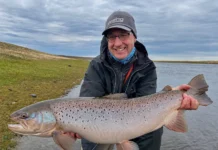
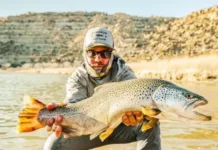
Browns dominate, with rainbows, cutthroat, and cutbows also present. Scott says browns were last stocked in the 1960s, while rainbows are stocked and reproduce naturally. He prefers today’s fewer trout averaging about 16 inches, up from 13 earlier in his career.
Scott says April probably offers the highest catch numbers, though it tends to involve more nymphing. He ranks the Green among his top three dry fly rivers in the lower 48 and fishes dries almost exclusively from May onward unless flows are high.
(24:33) Scott discusses the Chernobyl Ant’s development, describing Mark Forsland’s hackled version and Allan Woolley’s use of rubber legs. He also shares his recollection that Emmett Heath, the “Dean of the Green,” named the fly.
Scott says Flaming Gorge Dam was completed in 1963. Its selective withdrawal system allows operators to draw water from different depths to manage release temperatures. He says the water coming out of the dam usually gets no warmer than about 58°F.
For summer dry fly fishing, Scott recommends covering plenty of water with terrestrial patterns. The Green’s deep water and limited crossing opportunities make a drift boat an advantage, and he finds drift boats more precise than rafts.
(32:37) Scott calls June and July peak dry fly season, though also the busiest time. When cicada fishing is good, anglers can cast almost anywhere and draw strikes. He says it can feel too easy, taking away his advantage as a skilled rower.
(35:13) Scott mostly fishes downstream and ahead of the boat, occasionally having clients take turns approaching small spots upstream. Caddis can draw strikes when moved, while tricos and blue-winged olives need a dead drift.
He usually fishes one fly with a 12-foot leader, which he believes helps on pressured water by keeping the fly line farther from the fly. 4X is his most-used tippet. He rarely uses 6X except for tricos and does not use 7X. Clients bring 9-foot 3X or 4X leaders for guides to extend.
Scott favors barbless hooks for better penetration, less harm to fish and anglers, and equal landing success. He advocates moving away from lead, though his anchor contains lead enclosed in steel, which he says prevents leaching. He mentions all-steel anchors as an alternative.
(42:20) Scott advises against setting early when watching trout approach. He generally tells clients to let fish eat and drop about a foot before setting, depending on the rise. A light, recast-like lift allows quick recasting after a miss, though the same fish rarely takes again.
He recalls a client catching a 31-inch brown on a dry fly in 2008. He also describes a 29-pound fish caught below the dam on a Rapala in 1989 as the river’s biggest catch.
Scott describes A as the most popular and scenic section, with the cheapest shuttle and heaviest traffic. He favors B because its upper stretch resembles A and its lower stretch resembles C, offering different water after tough morning fishing. Spinner Fall’s A, B, and C guide has more details.
Scott prefers 10-foot 5-weight rods for clients because he finds the extra length helps with mending, line pickup, and longer casts. To find space during busy periods, he aims to be among the first or last boats out, skips stretches, or lets other boats pass. In June and July, they typically meet at 7 a.m.
(47:23) Scott generally tries dry droppers or streamers before nymphing. His typical April nymph rig includes:
He fishes across from the boat and often mends downstream to maintain contact with the indicator. He accepts a less-than-perfect drift to detect strikes faster, since trout can quickly spit the fly.
Scott says streamer methods vary by guide. A common setup uses a floating line, roughly an 8-foot leader, and a heavy streamer cast toward the bank and retrieved. Another effective option uses a sink tip to let the fly sink deep into a back eddy’s “hook,” then pull it up through the turn.
(49:55) Scott describes a trail along the first 10 miles below the dam, with two main access points:
He generally finds better fishing farther from access points. Boaters can cross to less-pressured banks and wade.
Scott cautions inexperienced rowers about B’s remote Red Creek Rapid. He describes A as Class I and II, generally taking its rapids on the right except Mother-in-Law, where he goes left around a boat-trapping square rock.
Scott warns that losing an oar, snagging an anchor, or hitting rocks sideways can sink drift boats. Distracted by two clients fighting fish, he hit a rock on Deadman’s tougher left route but rowed backward and spun free. He values drift boat handling but considers rafts safer in that situation.
Scott Barrus is a fly-fishing guide with Spinner Fall Guide Service in Dutch John, Utah. He guides anglers on the Green River below Flaming Gorge Dam, sharing his knowledge of seasonal hatches, dry-fly presentations, and the river’s A, B, and C sections.
Episode Transcript
WFS 1010 Transcript 00:00:00 Dave: Today’s guest arrived at Spinner Fall in nineteen ninety eight as a twenty one year old shuttle driver sleeping behind a couch, eating Top Ramen and fishing every day. A year later, he dropped out of college, spent his tuition money on a new drift boat, and started guiding the Green River. Today, we’re heading into the Flaming Gorge Dam section to talk dry flies, the river’s major hatches, and how our guests approaches pressure water and what more than twenty five years on this water has taught him. This is the Wet Fly Swing Podcast where I show you the best places to travel to for fly fishing, how to find the best resources and tools to prepare for that big trip, and what you can do to give back to the fish species we all love. Scott Barrus runs Spinner Fall and has spent his guiding career on a river he considers one of the top dry fly rivers in the lower forty eight. This episode, you’re going to hear about the A, B, and C sections of the Green River and which sections Scott loves most. We’re gonna find out why. April and May blue winged olives offer one of the most consistent hatches of the season. We’re also going to get into the cicada hatch. If you can hit this right. This is an epic hatch as well. And why Scott often fishes a twelve foot liter and four X, even on a river that gets plenty of fishing pressure. Plus, we’re going to get the story behind the Chernobyl ant, which was developed on the green. All right. You can find Scott at spinner dot com. You can also check him out on Instagram at Spinner Fall. Here we go. Scott Barrus how you doing Scott. 00:01:28 Scott: Hey doing great. Thanks for having me. 00:01:29 Dave: Yeah, yeah. Thanks for setting some time aside today to do this. I’m really excited. We we’ve heard a lot of, we’ve had a lot of requests from people about the green River. And I think there’s sometimes a little confusion out there because there’s probably more than just the one green, but we’re going to talk about the one you work on and your guide on today and maybe talk hatches. Dry fly fishing is also, I know, a big struggle for a lot of people, including myself out there. But but yeah, before we get into kind of the deep dive into it, maybe tell us how you came to be running Spinner Fall and kind of this operation. 00:02:03 Scott: Yeah. So I, you know, I basically, I started out as a shuttle driver for spinner fall back in ninety eight and, you know, sleeping basically, I would push the couch out in a trailer home and sleep behind the couch and shared the trailer with like five other people. And, um, basically just spent the summer, you know, eating top ramen and, and going fishing every day. And, you know, it’s twenty one, no bills. So. Right. 00:02:27 Dave: Living the dream. 00:02:28 Scott: Yeah. And then, uh, Spinner Fall offered me a job guiding the next season. So I dropped out of college and spent my tuition money on a drift boat and, and started guiding the next year. 00:02:40 Dave: No kidding. What was the first boat you purchased with that money? 00:02:43 Scott: Yeah, so I had a slide, right. Which is kind of a precursor to a clacker craft. 00:02:48 Dave: Oh, really? Okay. Slide right. A is that a classic craft boat or. 00:02:52 Scott: No, it’s a fiberglass boat. So I believe that Clark used the mold from slide right to build some of their original boats. I could be wrong. I could be wrong on that though. 00:03:02 Dave: So yeah, we’ll check on that. I know we were hoping to get, uh, classic craft on eventually. Talk more about that. So yeah, I’ll have to look at that. So slide. Right. That was interesting. I’ve never heard of that. So that would have been what year was that when you got that boat. 00:03:14 Scott: Um so that was ninety nine that I got the boat and the boat was a ninety one. 00:03:19 Dave: Ninety one okay. And what, uh, and did you have that boat for a little while? 00:03:23 Scott: Yeah, yeah, I had it for probably four or five years. And then, um, you know, moved up to an aluminum boat after that. 00:03:29 Dave: Oh, you did okay. Yeah. So that’s a good discussion here. I think we’ll dig into this a little bit today just on the boats, because I feel like there’s a lot of, um, a lot of fiberglass boats around the west, you know, and, but there’s also lots of aluminum in certain areas and that might apply more to where there’s whitewater potentially. But we can talk about that today, maybe describe before we get into some of the other, um, kind of side notes on this today, just like your program. Talk about first off, where the green is for those people that are brand new to it and kind of what your operation looks like. 00:03:59 Scott: Yeah. So we got the thirty miles on the green River below Flaming Gorge Dam in Utah. So we’re, you know, Flaming Gorge is like ninety one miles long. And we got the a lot of cool water to keep our water cold below there. 00:04:12 Dave: So you’ve got what, what is the, what is the run like? Um, is that pretty technical? Is that something you see a lot of people doing? 00:04:19 Scott: Yeah. So it’s, you know, the greens kind of made for drift boat fishing. You know, it’s we have every type of water. We got huge back eddies, pocket water, shallow riffles, you know, so we kind of have a little bit of everything out there. Um, and then the river is divided into three sections, the A, B and C sections. And each one’s pretty different. 00:04:41 Dave: They are. Okay. And what’s it look like for your program. When are you guys starting the season and when are you ending? 00:04:46 Scott: I mean we go year round, but it really, really gets going. You know, April through October is kind of our main season, so we have a longer season than most. 00:04:54 Dave: Yeah you do. Okay. This is great. So what does maybe describe that? Are you. I know obviously in the the name spinner fall I’m guessing there’s some good dry fly action. But what does that look like as far as the the river itself? And are you guys kind of doing all sorts of different techniques? 00:05:08 Scott: Yeah. Yeah, definitely. We do you know a lot more nymph fishing in the spring. It’s you know, there’s not quite as many dry fly opportunities in the spring. You know, you have midges. Um, but then, you know, starting in April, we get the bluing olive hatch that takes off. And then really with the blue wings, if it’s cloudy, they’ll eat the dry. If it’s sunny, it’s a little bit harder. But then once, you know, once we start getting into May, it really just depends on the weather. If it’s hot and sunny, they’ll eat dry. You know, terrestrial dry flies early. You know, the greens pretty unique in that if you if you fished a cricket all day, like even in January, you’d get a few opportunities. So there’s the fish will eat a terrestrial all year here. 00:05:49 Dave: Oh They will. Okay. Yeah. And I’m just scanning some photos online. I see I’m looking at one called, uh, running the green Red Creek Rapid. Is that one of the rapids down there? 00:05:58 Scott: Uh, so that’s about halfway down on the B section. And there’s a tributary there, Red Creek, that really changes the whole dynamics of the river. So the upper, you know, eleven miles above Red Creek is all, you know, high concentrations of trout, you know, probably eight to ten thousand trout a mile up there. 00:06:15 Dave: Oh, wow. 00:06:15 Scott: And then Red Creek blows in a lot of sediment and really just changes it. So there’s a lot less bugs down there and therefore less fish. 00:06:23 Dave: Oh no kidding. So you’re doing a lot of is the majority of the fishing in that upper section. Then you have to run the rapids to get down. Or are you breaking this up in the flow or is it just one float? 00:06:32 Scott: Um, no. So you know, the like I mentioned, Red Creek is halfway down. B so, um, you know, the A section seven miles, the B is nine miles and then there’s fourteen miles on the C section with several take outs. So, um, I mean you can do A and B in one day. If the flows are up, it can be good. But if you know you’re concentrating on, you know, rising fish or pockets of fish, it’s a lot harder to, to do an a B because you’re just got to skip so much water. 00:06:59 Dave: So yeah, I see. And are you guys doing multi-day floats? Is that mostly what it is or do you break it up like day floats? 00:07:06 Scott: Um, just day floats, you know, there. I think there’s one other outfitter on the river that offers camp over trips. Um, we used to do them, but they’re, you know, logistically they’re hard to do out here. So we stopped doing them. So we were just doing full day trips now. Or we also offer, you know, half days or sunset trips as well. 00:07:21 Dave: Okay. All right. Good. And what is the time? It sounds like you guys are out there throughout the year, but, um, is there, you know, if we were kind of looking at putting something together, um, you know, let’s take it to hatches. You mentioned a few, but right now as we’re speaking, it’s kind of September. October is right around the corner. What’s going on this time of year? 00:07:39 Scott: Um, so we have some tricos and some really small bluing olives. Um, the fishing, you know, small dry fly fishing is pretty technical, but you can also, you know, just throw a cricket or a hopper, Chernobyl and that kind of stuff out there as well. So. 00:07:52 Dave: Okay, so it’s pretty straightforward. What is the, you know, on the track? We just fished the tricos and, you know, didn’t hit it perfectly, although we had a little bit of action. What’s the Trico like if you were to describe that, you know, let’s say you’re fishing, you know, this week describe is it mostly an early morning thing? 00:08:08 Scott: Yeah. So the Trico spinner falls around ten thirty right now. Um, you know, so before that it’s most mornings have been a little slower as it’s gotten colder in the morning for the dry. And then once those bugs start falling, you can find, especially in the big back areas, you can find pockets of fish that are just right on the surface eating bugs. And you just have to, you know, you have to have delicate presentations to get them to eat it. And, you know, you’re fishing like size twenty twos. Occasionally they’ll occasionally they’ll eat your, you know, your ant pattern or something like that. But they’ve gotten a little pickier lately. 00:08:40 Dave: Are you guys how do you do that throughout the day? Are you Fishing terrestrials, and then you see some heads and you’re stopping or describe that, how you’re finding those fish in the tricos. 00:08:50 Scott: Yeah, yeah. Typically fishing just an attractor pattern, um, out there in the mornings. And then, you know, once you find those pods, you can try your attractor on them. And most of the time they’ll laugh at you. So you have to pull over and switch to something smaller to, to get them to eat it. 00:09:04 Dave: Yeah. They are. When you’re on those, let’s just say you’re sitting on a pool, you see some fish, some heads coming up and they’re getting refusals. Are you changing? Um, typically, how do you know whether to change the fly or the presentation? You know, first? 00:09:18 Scott: Yeah. I mean, it’s really, you really get like one good shot at them. You know, they’re pretty, they’ve seen a lot of stuff this time of year. So they’re pretty smart. So you’ve got to, you’ve got to lead them by, you know, eight feet or so. And the fish are kind of just like roaming in circles. It’s almost like lake fishing out there in these big back eddies where the fish are just kind of wandering. And, um, you’re basically just trying to lead them and hopefully they turned that way and pick your bug. 00:09:43 Dave: Okay. Okay. Awesome. Now, so. And Trichos is like right now, what are the what do you think is the, the big hatch? I mean, do you guys have all the hatches throughout the season there? And maybe describe that a little bit? 00:09:54 Scott: Yeah. So you know, I’d say overall our best hatch is the blue wing olive hatch. And you know, April into May. Um, that’s our most, most consistent. And, you know, if people are looking to come out wade fishing, I’d say that’s the best time of year to, to wade fish the river as well. And then, um, depending on the weather, we sometimes get cicada hatch, which can start usually like mid May and lasts for about a month into June. And then after that we start to get um, tri or sorry, not trichos we start to get PMDs, yellow, Sally’s and caddis like in late June and into July. And those are probably our peak hatches just because there’s so many bugs out there at that time of year. 00:10:33 Dave: What’s the caddis look like when those are hatching? How are you targeting those? What’s the, you know, the sort of flies presentation you’re doing? 00:10:40 Scott: Yeah. I mean, a lot of guys like to run a double dry that time of year with the caddis just because, you know, you can have them skittering and they don’t have to be drifting perfect to get the fish to eat them. Um, yeah, I’d say overall is my very favorite hatch, you know, even over the yellow Sally’s. 00:10:58 Dave: Do you fish that does the caddis hatch a lot different than fish in mayflies and some of the other, I guess yellow Sally’s are more like. Or is a yellow Sally like a stone or is that more of a mix? 00:11:07 Scott: It’s like one of the smallest stoneflies. Yep. So they’re like typically like a fourteen or sixteen on, on our river. 00:11:14 Dave: So what is it about the cats? Why do you love the caddis? Why is that your number one? Uh, hatch. 00:11:18 Scott: Um, it’s technical a little bit. You know, the fish can be a little picky. So usually I tend to downsize my fly a little bit smaller than a lot of the other guides fish out there. Um, I think, you know, the eighteen just gets picked out of the, out of the pod a lot more. You know, that time of year, there’s so many bugs out there that they can choose from. But I think, you know, In my opinion, caddis is a trout’s favorite food. 00:11:41 Dave: Yeah, you think so? And why is that? 00:11:43 Scott: I don’t know. It’s just the you know, you see the fish, like come out of the water more aggressively for him. You can skitter them and get them to chase it. And just it just seems like that’s the food they like the best. 00:11:54 Dave: Yeah. And so you’re using size eighteen and what size would the, the bugs be typically. 00:11:59 Scott: Um, I mean we have a range from eighteen to fourteen out there. So I just think they pick out the smaller ones just because they’re a little bit safer. So. 00:12:07 Dave: And is the pattern you’re using typically like what is that? Do you have one that’s kind of a go to? 00:12:12 Scott: Um, you know, I think the peacock caddis is a really good pattern out there. 00:12:16 Dave: Okay. Peacock and what is that now for those that haven’t seen that, what is the peacock. Is that like a, um, a big fly that sits on top or describe that. 00:12:23 Scott: Yeah. So it’s just got a, you know, like a peacock herl body and then little elk hair wing over it and then hackles in the front. So it’s, it’s pretty basic. 00:12:32 Dave: Yeah. Exactly. I’m looking at it now. Yeah. The peacock cats. It almost looks like a, um, a little like a stimulator style, I guess. Kind of. Not really. But, you know, I don’t know. How would you describe that? Because it’s not I mean, I guess that’s just the caddis style of fly, right? You’re kind of imitating that thing with the big bushy with the big wing. 00:12:47 Scott: Yeah. Yeah. No, it’s it’s very similar to a stimulator. It just doesn’t have the hackle through the body part. So yeah, you’re right there. 00:12:54 Dave: Yeah. It doesn’t and it has, you know, when I compare the peacock caddis to say, you know, the elk hair caddis, right. Which is this kind of standard, there’s a big difference there, right? You’ve got the hackle and the peacock that’s up front, a big hackle. And with the elk hair there’s really no hackle up front. It’s just kind of on the body. So it’s a little bit reverse. What’s the do you use the elk hair and what’s the difference between those two patterns. 00:13:15 Scott: Yeah. No the elk hair is definitely more buoyant. So it’s a great pattern, especially if you’re in, you know, roughly water, faster water stuff. So that fly definitely floats a lot better. And a lot of guides will use the, the elk hair as their kind of their indicator fly and then use, you know, a smaller fly as their second fly to that. The fish tend to eat a little bit better. 00:13:33 Dave: Okay. I’m just looking at some more caddis patterns that are popping up here. And, um, I’m looking at one. This is one I’ve heard about that I haven’t used, but I think it’s, uh, the corn fed caddis, which is kind of a similar thing, just a little bit bushier. Are you familiar with that pattern? I think that might be Lance Egan’s. 00:13:49 Scott: Yep, yep. It’s Lance’s bug. And yeah, I used that fly as well. It’s a great bug. 00:13:53 Dave: Okay. And what is that now describe that, that one. Because now you’ve got another pattern that is how is the corn fed different than the other two we talked about? 00:14:01 Scott: Um, you know, it has. 00:14:02 Scott: CDC, which I think is definitely one of the best materials you can use on a fly. It just looks really natural in the water. It looks really, really buggy and floats well. So yep. Yeah. I think the corn fed is a great pattern. 00:14:14 Dave: So we got a couple patterns to I’m loving this because the caddis hatch again, I think it’s one that’s a little misunderstood. You’ve got all these bazillions of flies flying around, you know, erratically and you see them hitting the water. But you know, that’s always the question. How do you fish the hatch? Is that something where you are targeting it kind of in a certain time of the day. Or could you fish these drys throughout the whole day? 00:14:38 Scott: Yeah, you can definitely fish them through the day. You know, the bugs will come in waves. You know as well as the yellow Sally’s come in waves too. So, you know, sometimes you, you do find where you need to, to change to, you know, like a yellow fly to, to get them to eat it, you know. Um, almost all the bugs that time of year, like a fourteen or sixteen. So if you have anything that’s kind of yellow or tan, that time of year typically will work for you. 00:15:02 Dave: Um, so yellow, just because that’s the typical, uh, the body of the caddis is typically yellow or tan. 00:15:08 Scott: Um, well, the body, the caddis or tanner gray, but the, the yellow Sally’s are obviously yellow and then. 00:15:15 Dave: Oh yeah. Yeah, yeah. Yeah, exactly. 00:15:16 Scott: And then the pmd’s are yellow as well. So. 00:15:19 Dave: Okay. Yeah. This is awesome. Yeah. So you’ve got the two going on like you said. So we’re talking summertime. So if we were in, when is the peak when you’re going to see the yellow Sally’s and the caddis. 00:15:28 Scott: Um, like late June to like mid-July. 00:15:31 Dave: And then after that, the yellow slowly start dissipating. Do you still see or the caddis still out there throughout the whole summer? 00:15:37 Scott: Yeah, yeah, we still have some. They definitely are a lot lower numbers, though, you know, after that peak time. 00:15:42 Dave: So if you were going to do a really try to hit that where you’re hitting the cat is strong and maybe and the yellow styles you’d want to be shooting for that late July or late June into July. 00:15:51 Scott: Uh huh. Yep. 00:15:52 Dave: Okay. What does it look like that time of year for the weather? Is that just the perfect time of year, or do you have a period where I’m not sure of kind of the temperatures and things like that? What does that look like throughout the summer there? 00:16:03 Scott: Yeah. It’s typically, you know, some of the driest times of the year. Um, you know, Utah is the second driest state in the country. So July is usually we don’t see many, many rainstorms at all. That time of year. 00:16:13 Dave: Is Arizona the first? 00:16:14 Scott: No, it’s actually Nevada. 00:16:16 Dave: Oh, Nevada. Right. Nevada. Okay. 00:16:19 Scott: Yeah. Because Arizona gets all those all those big, uh, monsoonal rains. 00:16:25 Dave: Pescador on the fly offers a full range of fly fishing gear for any angler at any budget, with premium rods delivered directly to you. The El Rey G6 is the most packable, high performance fly rod on the market, performing like a four piece rod but with unmatched portability in six pieces. And you can get ten percent off your next order right now if you use the code Wet Fly, swing at Pescador on thefly dot com. Never fly without your G6. Discover the El Rey series and more at Pescador on the fly dot com. Today’s show is brought to you by Visit Idaho and Yellowstone Teton Territory, a place that should be on every angler’s list, from the Henrys Fork to the South Fork of the snake, and all the hidden creeks and alpine lakes in between. This region is built for fly fishers who like a little room to roam. You can head over to wet fly dot com slash Teton right now for guides, lodges and trip ideas to plan your next adventure. That’s Teton t e t o n. So yeah, maybe just take it back to that. That late June into July, we’re kind of the Yellowstone and we’re talking caddis and just kind of getting people dialed in for that. And then also the water flow. You mentioned the the flows have been kind of flowing. Yeah. So maybe take us back to that. Summarize that again what the water flow is looking like this time of year with how things have been changing. 00:17:40 Scott: Yeah. So the right now the river we are in a drought and the river should be running at base flow, which is eight hundred cfs. But right now we’re running about two thousand eight hundred cfs as they’re sending water down to Lake Powell to try to put a band aid on it down there. So they’re taking about a third of our reservoir right now. It’s it’s probably the lowest I’ve ever seen it right now. So it’s, it’s a little bit scary. And we’re definitely have our fingers crossed that we get a get a big winter here. 00:18:07 Dave: Yeah. So you guys did have a light winter last winter. 00:18:10 Scott: Yeah. Probably the lightest I’ve ever seen. So. 00:18:12 Dave: Right. So basically things are getting low but you’ve got the tail water. So that’s still. So yeah, we’re hoping for the best. Hopefully a big a big wind. Does that come in. I mean yeah, you’re like snow right. That’s the big thing that you’re kind of at the same. You’re Colorado is right next to you, right? You guys get a lot of snow out there. 00:18:27 Scott: Yeah. So, you know, our water comes from the wind River range, which is just east of Jackson Hole. And, um, you know, so yeah, we’ve been definitely in a big drought. Um, you know, we’re, we’re fortunate that we’re one of the few rivers that, you know, you’ll always be able to float it. They, they always have to run eight hundred cfs out so we can always float it. But you know, the ideal float is about flow levels, about sixteen hundred cfs out there. So, you know, I’d say, you know, twelve hundred to you know, about two thousand two hundred is perfect out there. 00:19:00 Dave: So yeah, it is. And where would be if, if we were coming in there to, let’s just say we had a group coming in, we were going to meet up with you. What’s the town you’d be getting in or maybe even flying into and driving down to? 00:19:11 Scott: Yeah. So most people fly into Salt Lake City and then drive three and a half hours east over to us in Dutch John, Utah. And we’re, you know, we’re right in the corner of Utah. We’re like ten miles from Wyoming. Ten miles from Colorado. 00:19:26 Dave: Oh. You are? Okay. And what was the name of the town? The nearest town. 00:19:29 Scott: Dutch. John. 00:19:31 Dave: Oh. Dutch. John. Okay. Dutch John. Yeah. That’s awesome. All right. Yeah, I’m just trying to get a perspective because like you said, the green is you’ve got a few different these A, B and C sections. But are there other parts of the green that people are also efficient that are outside of this area we’re talking about. 00:19:44 Scott: Yeah, yeah. So you know, the green River up in Wyoming is amazing. Um, you know, up closer to the green River or the wind River mountains is, is awesome. You know, it’s all free stone up there. And then there’s another reservoir called Fontenelle Reservoir. You know, it’s about two hours from us here. And the fishing’s amazing below there too. It’s just, you know, less fish and a lot windier. But there’s some really big fish up there. And then below us, it really just gets muddy. And there’s not really any any other fishing downstream of us. So. 00:20:15 Dave: Oh it does, it changes. Yeah. Maybe describe that. So you just describe it a little bit. But the river starts the headwaters sounds like it’s in the wind river range and it flows. Does it kind of just flow south down through Utah and then keeps going? 00:20:26 Scott: It does. Yeah. It flows down to Utah. And then when it hits us it actually goes almost due east into Colorado and then kind of turns back down southwest again. 00:20:36 Dave: Oh right. Yeah. It turns southwest. And then yeah, it goes into Colorado and of course, and then cuts down south again through back through Utah all the way out. And then where does it eventually go? So where does it. 00:20:48 Scott: It meets up with the Colorado River. And some years it’s bigger than the Colorado, some years smaller. 00:20:53 Dave: Oh, right. So it hits the Colorado right now in Canyonlands, right? Is that correct down there or is that. Yeah. That. Right. Wow. Amazing. See, that’s the cool thing about it. As you look at all the connections, you realize, man, there is just some cool stuff out there. Canyonlands, which is a really amazing, I think. Yeah, it is a national park. Right. And then you’ve got down below. So so that puts us in perspective the green. And are there, is there another green or a few other. Another big green river out there that’s different, or is it. Usually people are just talking about different sections Wyoming or Colorado, that sort of thing. 00:21:25 Scott: Yeah. I mean, the Colorado is really there’s not really much of it in Colorado. It basically just makes a little dip into Colorado. So below the c section, you’re in the, you know, you’re in Colorado and there’s like probably twenty miles till it hits another big canyon called the Gates of Lodore. And, you know, through that Colorado section, that’s pretty much all sand on the bottom of the river. And there’s, you know, there’s maybe two hundred trout a mile down there. There’s not not many down there. 00:21:52 Dave: Yeah. Okay. Okay. And then what are the trout? You mentioned eight to ten thousand trout per mile. What are the species in there mostly? 00:22:01 Scott: Um, so it’s mostly browns, but we also have rainbows and some cutthroat and a few cut bows as well. 00:22:06 Dave: So okay, a good mix. Yeah. And that’s a lot of fish. I mean, yeah, eight thousand. That’s a huge amount. Are these fish that are how does all that work? Are they naturally reproducing out there or they’re Stockfish. How does that process work? 00:22:19 Scott: So there the browns haven’t been stocked since the sixties. So they’re you know, they’re pretty much wild fish. Um, there are some rainbows that reproduce naturally out there, but they also stock, um, when I first started getting the river, they used to stock twenty five thousand a year and we had, our numbers were way higher. We had probably, you know, like fifteen thousand fish a mile, almost double what we have right now. Um, but our average fish back then was more like thirteen inches, where now our average fish is like sixteen inches. So a lot less fish, but, but bigger. And I, I definitely like it better the way it is now. 00:22:56 Dave: So yeah. Well, and the numbers fifteen thousand just sounds like it sounds like a lot. I don’t know if I’ve ever heard that number before in any other river. It feels like most of the rivers you hear that are higher in the, you know, upper, you know, thousands. Right. But it sounds like, yeah, you guys are kind of off the charts. Is that what it’s like? Like, what is the fishing like when you’re down there? Is this pretty much fish all day long. I guess depending. 00:23:18 Scott: Yeah. I mean, I think the glory days of catching tons and tons of fish are kind of behind us because the numbers are down from where they used to be. But, you know, I think I’m catching as many pounds of fish, but just less numbers of fish now. 00:23:31 Dave: Yeah. 00:23:32 Scott: But it’s yeah, I definitely prefer the way it is. So we, yeah, we got them to, to cut back the stocking and I think it’s really helped out the river. 00:23:40 Dave: Yeah. What are most people, you know, are you getting a lot of people coming for a certain thing. Do you your clientele is it are they focused on, you know, a hatch or a bug or time of year or you get a lot of like new people? 00:23:52 Scott: I mean, we get we definitely get a mixture, you know, a lot of people. Yeah. You get regulars that come certain times of year. You know, some people come, you know, every year for April because it’s, you know, April is probably when you’re going to catch the most fish, but it tends to be more nymph fishing, you know, but you can nymph fish the river year round, obviously. 00:24:11 Dave: Um, yeah. 00:24:12 Scott: But the green, you know, it’s I definitely argue it’s one of the, you know, the top three dry fly rivers in the lower forty eight. You know. 00:24:19 Dave: It is. 00:24:20 Scott: Yeah. The Chernobyl plant was invented on our river and it’s. 00:24:23 Dave: Oh no kidding. 00:24:24 Scott: Oh. 00:24:25 Dave: And there you go. 00:24:26 Scott: Yeah. From basically after once may hits I, I pretty much throw a dry fly the rest of the year unless it’s high water. So. 00:24:33 Dave: So that’s it. So the spinner fall name is is makes sense because it’s dry flies are huge. And that’s cool on the Chernobyl because I mean I think about that as maybe maybe the most popular pattern in the country, you know what I mean? It’d be hard to pick one, but you hear a lot, especially for dry flies, just because that fly is used everywhere. What is it? Do you know, a little bit of the history? Like who invented that? 00:24:54 Scott: Yeah. So, um, it was kind of three guys that that kind of made it. Um, um, Emmett Heath is the one who, who coined the term, you know, this is back in eighty six, right after the, you know, the Chernobyl incident and over in Russia. 00:25:08 Dave: Right. 00:25:09 Scott: Um, so Alan Woolley’s the the guy who tied it. And then there was another guy, um, Mark Forslund. He tied one, but it had, um, it had hackles instead of rubber legs. And then Alan Woolly tied it with rubber legs instead of the hackle. And then Emmett Heath, who’s the dean of the green. He’s the one who named it. 00:25:29 Dave: Oh, really? The dean of the green. 00:25:31 Scott: Yeah. So Emmett named, you know, most of the spots out on the river. Um, and Fly Rod and Reel magazine. He was the guide of the year back in like ninety eight or so. 00:25:41 Dave: Oh, really? Oh, wow. I love that the Dean of the green. That really is a good title. Is he still around in the area? 00:25:48 Scott: Yeah he is. Um, he actually had a heart transplant, like twenty seven, twenty eight years ago, and he’s still around. Wow. Yeah, it’s pretty amazing. 00:25:57 Dave: Still going strong. Is he out there still fishing? 00:25:59 Scott: Um, he’s definitely he’s like early eighties now, so he’s definitely slowed down a bit. 00:26:05 Dave: Yeah. He’s slowed down. Wow. That’s amazing. Yeah. So there’s quite a bit of history on the river is the dam. Um, I’m just guessing that was put in the in the sixties or fifties, you know, when that dam went in there. 00:26:14 Scott: Yeah. So it was finished in sixty three. And then um, because the dam’s like five hundred feet tall though the water was really cold coming out of it for years. And then it’s one of the few dams where they, um, they have adjustable penstocks in the dam so they can withdraw or it’s like a selective withdrawal system. So they can, um, take the water from like the bottom or anywhere from like one hundred and twenty to forty feet deep. So depending on the thermocline of the reservoir, they can adjust where they’re taking the water from. So our water’s pretty much always a perfect temperature out here. 00:26:49 Dave: Yeah. And what is that perfect temperature. 00:26:51 Scott: Um so fifty five is kind of what I’ve been told is the perfect temperature for trout, you know, where their metabolism’s high enough and the water still has lots of oxygen in it. So, you know, most of the time the warmest it gets out, you know, coming out of the dams, usually like fifty eight or so. So. 00:27:08 Dave: Right. So it’s yeah, right there. Fifty five fifty eight it’s cool. I love the history on this. And you have and where you guys are located is pretty remote, right? You’re, you’re a ways from you’ve got a little town there, you mentioned, but there’s not a lot of big cities nearby is Salt Lake that you said three hours. Is that kind of the closest one? 00:27:24 Scott: Uh, yep. So yeah, you don’t just happen by Dutch John. You definitely come in here for a reason. 00:27:29 Dave: So yeah, that’s a reason, right? Yeah. As you look around, you sit, like you said, you’re at the corner kind of, uh, Colorado, Wyoming, Utah, right up in that corner, which is, which is pretty. And you’re essentially, you’re kind of just almost due east of Salt Lake, right? Pretty close. 00:27:45 Scott: Yep, yep. And then Dutch John’s just a tiny town of like two hundred people. You know, we don’t have, don’t have a grocery store. We’re actually the smallest county in the, in the US to where there’s only. 00:27:55 Dave: Oh, you. 00:27:55 Scott: Are. Yeah, there’s only three thousand people in the county. We don’t have a bank like in the whole county. It’s pretty small out here. 00:28:02 Dave: Oh, right. Does Dutch John have a post office? 00:28:05 Scott: It does. Yep. 00:28:06 Dave: Yeah. So it’s actually. Yeah. So it’s officially a town, right? Yeah. This is awesome. No, it sounds like a good place. I think any town that is, you know, what you’re talking about would be cool to check out. And and yeah, you have this flaming gorge, which is massive, right? I mean, I don’t know how many miles that stretches for, but it’s this huge reservoir dropping down from the north right into where where it starts. The tail water starts at Dutch John. Is that pretty much where the dam is correct? 00:28:29 Scott: Yep. So the Dutch John was a government town until nineteen eighty eight. So we were one of the last government towns in the country, and then they gave it to the county back then. 00:28:39 Dave: Okay. And are you throughout the year, is this pretty much your focus or are you getting out and guiding on other rivers, or is this the the green is where you’re at throughout the whole year? 00:28:48 Scott: Yeah, I have, you know, when I was younger, I guided a little bit in Wyoming and Colorado. But yeah, I’m focused on the green now. 00:28:54 Dave: So yeah. That’s beautiful. Yeah. Perfect. No, I love that we were, you know, chatting just on the caddis, like I said, because I think it gives us a focus to think about, you know, how do we improve that? We talked about some flies. Anything else you would be telling us if somebody is going to be there in that summer period trying to get some on dries, is this a big challenge? Or, you know, if they throw on the bugs that we’re talking about with, um, you know, a normal tippet, you’re going to probably find some fish. 00:29:18 Scott: Yeah. I mean, it’s pretty forgiving out there, you know, especially in the summer, you know, if you cover lots of water with the terrestrial, you’ll, you’ll definitely get some action out there. You know, it’s the greens. A huge advantage to fish from a drift boat. Um you know it is. Yeah. We have spots that are thirty feet deep out there. So you know there’s not many places you can cross the river unless it’s super low. 00:29:38 Dave: Okay. And is it more the drift boat versus raft, or do you see an equal amount of rafts on the river too? Or is there any benefit to having a raft? 00:29:45 Scott: No, I mean, we definitely get a lot of rafts out there to, you know, drift boats. I think you can just be more precise with the drift boat out there. So I think that’s what gives it the advantage. 00:29:54 Dave: Yeah, it is advantage. And what does it remind us again. What’s your current boat you’re running now. 00:29:58 Scott: Um so right now I’m in a boulder. I’ve loved it. I’m in a low side boulder, but I’ve, I’ve had a bunch of different boats over the years and there’s, there’s positives and negatives to all of them for sure. 00:30:08 Dave: So yeah. What do you love about the boulder? That’s one that we haven’t. And in fact, we just did a podcast with, um, somebody who was mentioning, who is friends with the Boulder founder, I think. So we’re going to hopefully get him on the podcast. But what do you love about the Boulder? Because it’s got a unique thing, isn’t it? A little bit of a mix. It’s got some really beautiful wood, but then it’s got fiberglass too. Or what is the boulder one? 00:30:28 Scott: Um, so yeah, it does have the wood. They have different versions. The one I have has the wood. Um, but it’s basically made out of like a cutting board material like. 00:30:36 Dave: Oh yeah, it’s kind of plastic. 00:30:38 Scott: So it slides over stuff really well and it’s super light, you know, so I’m, I’m almost fifty now. So having a basically a lighter boat is I did it just for my longevity out here so I can. 00:30:50 Dave: Right. So it’s lighter. 00:30:52 Scott: Yeah. I think it’s the lightest boat on the market if you ask me. Um, you know, yeah, all the companies are kind of weird about putting out their, their true weight out there. So. 00:31:01 Dave: Right. So what you’re saying is. And I wonder, you know, because I float in all wood boats too. And if you have one of those, is the wood now going to be lighter than or similar to this plastic type boat? Or how does that work? 00:31:14 Scott: Yeah, yeah, I would say that’s probably the closest comparison. You know, just the wood’s going to be to guide out of would be, I don’t know, it’d be a kind of a nightmare. You’d have so much maintenance at the end of the year. I think would be would be tough. 00:31:25 Dave: Right. Yeah. No you do. We’ve done some episodes on that and you got it pretty much once a year. Go through and you know, maintain it right re spar, varnish it or whatever. But yeah, no, I’m looking at it now. It’s like it’s sweet. So it’s pretty much all plastic, which makes it you could run into stuff. Have you hit some rocks in that thing. 00:31:41 Scott: Yeah. Yeah, a few and it’s yeah, it slides over stuff really nicely. So. 00:31:45 Dave: Right, right. Cool. Okay, so that’s your boulder. You’re loving the boulder and that is that your standard kind of a sixteen by like fifty four or what’s the size on that boat? 00:31:53 Scott: Yeah, I think mine’s actually I have the low side. So I think it’s more like a fifteen. It’s, it’s a little more compact. You know, I went from a I had a poverty before that and I loved that boat as well. Um, so I kind of went from like a, you know, having like a Cadillac Escalade to a little Ferrari. Kind of kind of a switch there. 00:32:10 Dave: Okay. And what now the poverty was that the one with the, the doors on the back? 00:32:15 Scott: So I had that boat originally. And then I also had the low side poverty, which I loved too. And then, you know, just this boulder kind of landed in my lap. A buddy was selling it and I, so I, I bought it. It was actually his dad is the guy who named Spinner Fall. And then he offered me to buy it. So it kind of just one of those things that I had to do. So. 00:32:37 Dave: Yeah. Right, right. Yeah. You couldn’t pass that up. Okay. So you’ve had a lot of the boats and, uh, you’ve got this boulder now, which is cool. Well, yeah, just take us back a little bit. You know, I want to again walk through. We’ve talked caddis, you mentioned that was kind of one of your favorites. Let’s say we were kind of putting this together with, uh, you know, a group coming out there, you know, what do you think would be a good time to put this together? And we wanted to really hit dry flies. Do you think focusing on that kind of June, July would be the best? 00:33:01 Scott: Yeah. Yeah, definitely. You know, that’s also the busiest time. It’s not really a secret anymore. 00:33:06 Dave: Um, yeah. 00:33:07 Scott: So I touched on the cicada hatch a little bit. Um, so that’s usually kind of peaks like in June usually. So a lot of people try to hit that. That’s the definitely the easiest fishing. If the cicadas are out, it’s, it’s kind of might be my least favorite hatch because it takes away my advantage of being able to row better. 00:33:27 Dave: Oh, really? So you just throw them anywhere? 00:33:30 Scott: Uh, when the cicadas are out, if it’s good, you can just throw them anywhere and the fish will come and hit them. So it’s, it’s fun, but it’s also, you know, from my perspective, it’s too easy at times. 00:33:40 Dave: So it’s too easy. Is the cicada something that comes out? Are you able to fish that every year? 00:33:46 Scott: No, it’s very hit or miss. There’s it’s not like the Midwest where they come every year or every thirteen years or seventeen years. Um, ours are just totally random. So it really just depends on on the weather and everything else. You know, sometimes we see them like five years in a row, and then we might not see them for four or five years as well. So. 00:34:05 Dave: So you never know. And what when does the cicada, when does that start happening. 00:34:09 Scott: So usually starts in mid-May and less into June. And then those are the the small normal cicadas. They’re like a size eight or ten. And then occasionally we get we call them mondo cicadas. Those are more like a size four. And if we get those, those usually come late June and last through July. 00:34:29 Dave: Okay. So yeah, so if we were to do pick that June into July trip, maybe early July, something like that, you potentially could have cicadas too, along with those dry flies with the caddis and stuff like that. 00:34:40 Scott: Correct. Yep. So that’s definitely, that’s definitely our peak dry fly time. 00:34:44 Dave: Okay. Perfect. And, and that’s like you said, you just pick a, I guess, are there some cicada patterns out there just throwing a Chernobyl, you know, pattern and or something like that. 00:34:53 Scott: Yeah, yeah, the Chernobyl definitely works. Um, one of my guides, Charlie Card, he has a, you know, a card cicada. That’s, that’s a great pattern out here. Um, love joy cicadas. Another really good one, Carl Boomer, Carl Stout. I can’t remember the exact name of his fly. I think it’s Boomer cicada or Carl Cicada. That’s another good pattern too. 00:35:13 Dave: So okay. And is the cicada Chernobyl all those? Is the foam the key with those patterns or what makes those. Is that what you want to really high floating fly. 00:35:23 Scott: Yeah, yeah. And just, you know, the bugs are they’re pretty fat. So you know, the, you know, the, the cicadas, they’re they’re big. They’re almost as big as your thumb. You know, they, they get pretty big. Oh, wow. Yeah. You definitely need a big profile for those. And those tend to have, you know, black and orange on those. And then the, the smaller cicadas can be orange or yellow, but mostly black. 00:35:46 Dave: Experienced the waters of Bristol Bay at Togiak River Lodge, where fly fishing meets Alaska’s rugged beauty. This is the place to complete the Alaska Grand Slam with all five salmon species rainbow trout, Arctic char and more. Where each day offers a new Alaskan adventure, you can visit Togiak lodge dot com right now to start planning your Bristol Bay experience with Togiak River Lodge. If Belize is on your bucket list for a trip. Take a look at Blue Bonefish Lodge. You’ll be fishing more than four hundred square miles of flats right along the Belize Barrier Reef. Clear water and endless opportunity. They offer all inclusive packages. Whether you’re focused on fishing every day or planning a trip with the family. You can learn more right now and start planning your trip at Blue Bonefish, Belize dot com. That’s Blue Bonefish, Belize dot com. Check them out right now. Do you guys do most of your when you’re drifting, are you mostly fishing out of the boat or are there places where you’re stopping getting out or is it all from the boat? 00:36:49 Scott: We fished, you know, mostly from the boat. But there are so many spots where you can just, you know, a lot of times I’ll just have one guy, one of my clients will sneak up a spot and fish back up like we’re wade fishing. So I’ll have the. 00:37:01 Dave: Oh, yeah. 00:37:02 Scott: Have the clients take turns, you know, sneaking up little nooks and crannies out there on the river. But then most of the time we’re, you know, fishing down and ahead of the boat to the fish. 00:37:10 Dave: Yeah. Right. Yeah. So you might find maybe a back pool or some spot where you can actually see the fish and then you’re getting walking them up to in the boat up to the fish. 00:37:19 Scott: Correct. Yep. 00:37:20 Dave: Okay. Yeah. And that’s part of the presentation. I mean, is that is the cat, which is the one where the presentation is that the trichos and that where you got to be really careful or caddis also, do you have to worry about presentation as much? 00:37:31 Scott: Not as much with the caddis because they’re, they’re bouncing around dropping their eggs and stuff out there. And so the fish will, you know, they’ll, when your client mends them, sometimes the fish will come up and eat them, you know, on that where. Yeah. With the trichos or Bluewings, it’s got to be a dead drift out there. 00:37:45 Dave: Yeah, definitely. Okay. Well, any other, uh, tips on that, I guess? Maybe talk about a little bit on the the leader. Is this pretty? Can you just grab one leader throughout, you know, throughout the season or what are you guys using there? 00:37:56 Scott: Um, so I typically, I like to use a long leader. I fish about a twelve foot leader most of the time. I think that just, you know, we, we get quite a bit of pressure. So I think that helps, you know, keep your, the fly line further away from the fly out there. Um, and definitely I think it helps. I, I use, I use pretty heavy tippet. You know, I don’t even own seven x. I rarely, rarely use six x unless I’m fishing, you know, this time of year with tricos or something. Um, so most of the time I, I’d say four x is my most used tippet size. So we have our clients bring either a nine foot three X or four X leader. And then the guide can build out the leader from there. 00:38:35 Dave: Yeah. So basically you get a nine foot and then they just then add on three feet of tippet sort of thing. 00:38:41 Scott: Uh huh. 00:38:42 Dave: Yeah. Okay. And then what are you doing when you put your in this, you know, when you’re fishing, the dries are you, are you doing more of like a dry dropper or a dry dropper with a dry or just one fly? 00:38:52 Scott: I fish, I tend to fish one fly a lot. Um, but if I’m doing a dry dropper, I’ll fish, you know, like a Chernobyl ant just on the the nine foot leader and then go three feet down to like a, a Frenchie or zebra midge, something like that. 00:39:06 Dave: Yeah. What are you doing? What’s your fly? How are you tying the dropper off of your main fly? 00:39:11 Scott: Um, so it just depends. I, I hate using barbs, so I sometimes I’ll tie the dry fly as a tag and then. So I’ll tie a triple surgeon and leave the, the bottom tag long and then tie the dry fly to that and then have the dropper down below. But then I’ll also just tie it off the hook sometimes too. 00:39:30 Dave: So yeah, it’s interesting on the barb, it feels like that. Um, you know, I think most people are using barb flies, right? And there’s barbless out there. I wonder why, especially with the fly hooks that there’s not just all. Bah bah bah. Do you think that’s going to ever be a time we get to where it’s just they don’t make barbed flies. 00:39:49 Scott: Um. I mean, I would like to see it that way. I’d like to see the regulations go that way, but it’s you know, I mean, I get why people like the barbs on there. It’s it’s definitely harder on the fish and harder on the humans when you have to pull it out too. 00:40:01 Dave: So yeah, it seems like there’s almost no benefit of the barbed hook. You know, like you hook yourself, you’re in trouble, you hurt the fish more. And actually, if you know how to land them, you know, which, you know, takes a little bit of experience, you can land probably. Would you say you’re probably equal? What about your clients? You’re out there. Do you think they can land as many fish with barbless as a barbed? 00:40:20 Scott: I do, and I, you know, the the barbless penetrates the fish better too, because it’s, you know, got less surface area to poke into them. 00:40:27 Dave: So yeah. So that’s it. So maybe we’ll, maybe that’s where the industry will be going eventually. I think we’re slowly maybe going that way. 00:40:34 Scott: Yeah. 00:40:34 Dave: And this is good. Yeah. 00:40:36 Scott: I’d love to see the industry go to, you know, no lead as well. You know I think it’s. 00:40:40 Dave: Oh no Lead. 00:40:41 Scott: Yeah. I think it’s terrible that people can have lead anchors and then, you know, just leave lead all over. You know, hunters stopped doing it years ago. And I. 00:40:50 Dave: Think, oh yeah. 00:40:51 Scott: I think fly fishing needs to catch up there. 00:40:53 Dave: That’s a good point. Yeah. Hunter stopped. Yeah. Why did Hunter stop using lead? Do you remember why? Why that happened? 00:40:58 Scott: I believe just because of the health of the, you know, the the lakes and streams and stuff that they’re hunting birds on. So, you know, the leads definitely, definitely bad for that. And then, but then you have people in a boat with a lead anchor and they drop it and it drops a little bit of lead off of the anchor. And then yeah, just I think that’s terrible. 00:41:16 Dave: So yeah, definitely. What’s the, uh, anchor you’re using there? 00:41:20 Scott: Um, so it actually has lead inside, but it’s made by Boulder, but it’s still on the outside, so it’s packed with lead on the inside. 00:41:28 Dave: Oh, wow. 00:41:29 Scott: But so none of the lead is leaching out, basically. 00:41:32 Dave: Sure. Is it a, is it like a triangle? Uh, what what’s what’s the shape of the anchor? 00:41:37 Scott: Yeah, it’s kind of a pyramid with the top cut off pyramid. But then, you know, there’s, there’s like tornado anchors and stuff that are all made out of steel. Those are great too. 00:41:46 Dave: So yeah, tornado. Yeah, we’ve used tornado. Those work pretty well too. Yeah. That’s a good reminder on the lead. Yeah. We don’t need lead because obviously, you know, in tungsten, um, it works so well, it feels like that a lot of people are just going to that tungsten beads. I mean, I guess if you have to get down you might need some split shot. What’s a split shot. You’d be using that isn’t lead. 00:42:05 Scott: Um, you know, Lynn makes some great products. So that’s typically what I like to use. 00:42:09 Dave: Yeah. There’s a lot of alternatives, I feel like. Yeah. Lead is just definitely probably the cheaper. I mean, it works right. It gets down. But I mean there’s plenty of alternatives now to lead that. We don’t have to go that way. 00:42:19 Scott: Yep. Yep. Exactly. 00:42:20 Dave: Cool. Well, anything else we should be knowing about this trip before we start to take it out of here and our kind of rapid fire round. Any, any other what would be a couple of, you know, maybe a big dry fly tip. Let’s just say we’re we’re getting ready for this trip. But what would you be telling somebody who’s going to be on the green this next year? 00:42:35 Scott: Um, so I mean, the green is very visual So you can see you can see the river bottom almost fifteen feet deep down there. It’s crystal clear. So you see, especially from the drip, but you can see the fish coming up to eat your fly before it happens. 00:42:49 Dave: Where, wow. 00:42:50 Scott: Where most of the time you don’t see the fish coming. And so you, you know, you set the hook as soon as you see it happen. Where out here you see the fish coming. So you’re almost to ready. So you have to, you know, you have to tell your clients to let them go down like a foot before you set the hook because they tend to eat it slow here. 00:43:07 Dave: Oh no kidding. So you see the fish coming. Maybe it’s a giant brown trout. It eats it, your fly goes away and you have to wait. How long do you wait before you set? 00:43:16 Scott: I mean, it’s tough. I, I typically just tell my clients, wait till they go down about a foot. Um, but, you know, every fish, you know, sometimes they come up super fast, sometimes super slow. So it’s, you know, it’s situational, obviously, but for the most part, you know, I’d say, you know, drunks and eighty year olds tend to do better than, than guys that are right on it. So. 00:43:35 Dave: Right, right. Oh it’s amazing. So take your time. Don’t rush it. But you do. When you set the hook, you do. What’s the set like? How should you be raising the rod. 00:43:43 Scott: Just recast basically, you know, not too hard. Just, you know, and then if you miss him, you can throw it right back in there. 00:43:49 Dave: So throw it right back. Yeah, that’s a great tip. Yeah. If you miss them. So if you miss that fish, but it sounds like they, if you plucked them or whatever, they’re probably not coming back. Or is that something or can you get that fish to come back if it misses it? 00:44:00 Scott: That’s very rare out here. So I’ve seen it a few times, but yeah, it’s pretty rare. They’re pretty much they’re pretty wise. 00:44:06 Dave: So crazy. What’s the largest brown trout you’ve seen out there on the river? 00:44:12 Scott: Um, so I had a lady in two thousand and eight catch a thirty one inch brown on a dry fly. 00:44:17 Dave: Yep. So there are some legit over thirty inch browns. 00:44:20 Scott: Uh, yeah. The biggest fish ever caught in the river is twenty nine pounds. That was in eighty nine on a Rapala, you know, right below the dam there. So there are some monsters in there. 00:44:31 Dave: So twenty nine pounds would be how many inches would that fish be. 00:44:34 Scott: It’s got to be at least three feet. You know, it’s super thick, but three feet plus. 00:44:37 Dave: So yeah. Okay. And does the water typically get you mentioned that upper a water. So that’s the most productive is that as you go down does it just get as water temperatures warm up gets less productive or is that a water the best? 00:44:51 Scott: Um, so a is definitely the most popular. It’s the most scenic. Um, the shuttle’s the cheapest. So it definitely gets the most traffic. Okay. I’d say B is my favorite because it’s kind of the upper parts, like A and the lower parts like C. So it’s kind of two different rivers. So sometimes you, you know, you’ve had a tougher morning on upper B and then you get below and it kind of resets almost down there, you know, so the fish population drops off as you go down river, you know, on, on lower, lower, lower C it’s probably, you know, only a couple hundred trout a mile down there where, you know, the B section, upper B is still probably eight thousand. And then, you know, right below Red Creek it probably drops off to around two to three thousand fish a mile down there, so it drops off pretty good. But that’s, you know, that’s still a ton of fish. 00:45:38 Dave: So yeah, still a lot of fish. Exactly. And the A, B and C was that the was that the dean of the green that came up with that number, the lettering system. 00:45:46 Scott: I believe so, but I I’m not one hundred percent sure. Yeah. 00:45:49 Dave: It’s pretty classic. It sounds like something, you know, it’s pretty, pretty basic. Right? Sometimes basic is the best. Just A, B and C, no reason to go bigger than or change anything. Like, you know, that makes sense to me. Um, okay. Good. Well, any, uh, any other items that it sounds like, you know, really pretty straightforward. You got a, what is it, six weight or five weight kind of in that range for rod weight. Yep, yep. Ten foot or nine foot nine or ten. 00:46:11 Scott: Yeah, yeah. You know, my client rods are, are ten foot five weights that I like to use. I just think it out of the drift boat. I think that having that longer rod helps you with mending and for clients to be able to pick it up and just cast further. 00:46:24 Dave: So yeah, how do you do it when you put on the river, you know, you hear some of these places around the West where, you know, there’s tons of people. It’s a backed up line. Do you ever get that period where on the river it’s feeling a little bit crowded. And if it’s like that, how do you how do you negotiate and find water and stuff like that? 00:46:40 Scott: Yeah. I mean. 00:46:41 Dave: Is that not an issue? 00:46:42 Scott: No, it definitely can be an issue. Um, so, you know, we typically like to be the first ones or the last ones out there. So, you know, like June, July, we’re meeting at seven a m and, um, you know, if it’s crowded, I’ll just skip a couple miles of river just to give myself space. And I don’t care if I’m the first one. I just don’t want to be surrounded by people. So sometimes I’ll just pull over and let people go by and just kind of try to find a gap out there. 00:47:07 Dave: Right, right. That’s the thing. Because so these fish, yeah, there’s, it’s not like, um, you know, boats going over them or necessarily putting fish completely down. You could, you could find some fish that haven’t been hammered and find those. Yeah. 00:47:18 Scott: Oh yeah. You can sometimes fish right off somebody’s anchor if the fishing’s good and. 00:47:22 Dave: Oh no kidding. 00:47:22 Scott: Mhm. 00:47:23 Dave: Oh, wow. Okay. Yeah. That’s great. Nice. Well, I’m glad we touched on this. Let’s kind of take it out of here. We’ve got a few little random questions and then we’ll pop out of here. Um, and first one, I want to give a shout out to Rick Dunn. I think he was one of the people that had mentioned, uh, connecting with your program and stuff like that. So big shout out to Rick, um, here. And you know, like I said, as we’re getting ready, um, you know, maybe talk about that a little bit. We talked about position, we talked about kind of timing. Uh, let’s just kind of touch on that nymphing really quick. So you are doing some nymphing. It sounds like when the dries aren’t on. So that’s kind of is that a like November through the rest of the season until the hatches start again? Or what’s your Nymphing program look like? 00:48:00 Scott: Yeah, I mean, I typically I’m kind of a snob, so I don’t like to nymph fish that much. Um, so yeah, you’ll find me throwing dry dropper streamers first, but in April, um, you know, I’m running just a, you know, typically like a nine foot deep nymph rig. That’s pretty, pretty standard among the guides, you know, have my indicator and then like a ninety degree with like four X straight down to, um, you know, like a usually use just like one BB and then, you know, maybe a weighted fly and then a little floaty fly behind that. Yep. And then, you know, just fishing, you know, with, with the nymphing you’re fishing more just straight across from the boat. And we tend to nymph or men downstream a lot on the river here. So keeping that indicator super tight just because the fish tend to spit it out really fast. So I’m basically hedging my bet that my drift is not going to be exactly perfect, but I’m going to detect more strikes so my clients will be able to react faster. 00:48:58 Dave: Nice. Yeah. So downstream men. So so when the fish hits, you’re on it, you’re tight and it’s, you’re getting a better set or it’s putting more speed on the fly. Is that what it’s. Or is that what it’s doing? Yeah. Yep. 00:49:08 Scott: Yep. Exactly. So it’s making that indicator tech stuff quicker. Um, where when you’re mending up, you’re probably getting eaten more, but you don’t even know it’s happening a lot. 00:49:17 Dave: Yeah. You don’t know it. That’s a good tip. Okay, so that’s your nymph setup. And then what about streamers? You’re also hitting streamers. It sounds like that’s something you’re doing through the year. 00:49:25 Scott: Yeah, yeah. No, the streamer, you know, it’s every guide out here is probably going to tell you how to do it a little bit different. So there’s not like a perfect way. You know, typically most people check it at the bank and retrieve it, but, you know, you can definitely use sync tips and get into some of the back eddies and throw it into the kind of the hook of the back eddy and let it get way down and then pull it up, up through that hook. And that can definitely be very, very effective out there. You know, most of the time people are using a floating line and, you know, about probably an eight foot liter to a heavy streamer. 00:49:55 Dave: Okay. Um, and the, the river itself, um, we’ve talked, you know, a decent amount about that, but if somebody had a, you know, got a trip with you, could they stick around and fish other areas if they wanted to maybe do a day or two with you and then stick around if they were there for a week and fish like walk and wade, or if they had their own boat, what would you recommend there? 00:50:12 Scott: Yeah, yeah. So there’s a trail that runs the first ten miles below the dam there. So there’s, there’s lots of access. There’s, there’s not a lot of access points there. So you have, you know, right below the dam and then little hole which is the bottom of the A, the top of B is a great access point. So it it little hole you could hike down, you know, three miles or so down onto the B section and work your way back up. Or you could hike upstream from there and, you know, work all of that water. So, you know, the typically the further you hike, the better the fishing’s usually going to be just because, you know, you’re just getting away from where everybody else fishes. 00:50:48 Dave: Right? And then where’s the takeout? If you’re putting in, do you put in right below the dam? 00:50:52 Scott: Yeah, yeah. It’s like maybe a quarter mile right below the dam. Yep. 00:50:56 Dave: Okay. And then where would be the first takeout? 00:50:58 Scott: Below that is Little Hole. So seven miles below. 00:51:01 Dave: That little. 00:51:01 Scott: Hole. Mhm. 00:51:02 Dave: Yeah, yeah. Gotcha. There’s a little hole. Okay. Yeah. And there’s a wreck area there. So so basically, yeah, you got a couple access points. And then people would put in a little hole that start a B and go down to the next put in or take out down there, huh? 00:51:13 Scott: Yep. And then if you know, if people have their own boats, it’s, you know, you can definitely pull over to the far side of the river and wade fish over there gets a lot less pressure. So that’s a great strategy as well. 00:51:24 Dave: Yeah. Is it? If somebody had their own boat, what would be your recommendation to know the river? Like how do they is it to stay safe and not flip their boat when they’re down there? 00:51:33 Scott: Yeah. So, you know, depending on their experience level, I might shy them away from the B section. Just because of Red Creek is pretty dangerous. And you’re kind of in the middle of nowhere. You know, if something goes wrong there, um, you know, the A section is just all class one and two rapids. Um, and then all the rapids on the A section you want to take to the right side except mother in law and mother in law. You want to go left side. 00:51:58 Dave: Oh really? That’s that’s awesome. So everything let me get that everything stay right except for mother in law and that one you stay left. 00:52:04 Scott: Yep. And and mother in law. There’s one big square rock kind of in the middle, and that’s just hit anything else but that that thing will trap trap your boat. 00:52:12 Dave: We had a we did a trip down the back in the day. We did a trip down the Skeena the Sabine River into the canyon section up in Canada. And we. This guy gave us this back of the napkin map of the river, and he was like, you know, stay, ride or die was his words. That was his quote. I think that was the name of one of the rapids was stay Right or Die. And, uh, we remember that one. But yeah, I think it’s cool. I think the running the whitewater, what it does is it adds an X factor into it. You know, I feel like for me, I’ve run some decent amount of stuff. I’ve never followed the Colorado that’s still on the bucket list. But, um, but I feel like there’s always a chance, you know, that, you know, for the most part you’re staying safe. But I mean, I’ve been in some sticky situations in a drift boat where I loaded up a bunch of water in the bottom, you know what I mean? What’s your have you ever had any time where you’ve been out there and you’ve kind of been close to maybe dumping a drift boat? 00:53:01 Scott: Oh, yeah. Yeah, definitely. I’ve been close a few times, you know, I mean, there’s a few easy ways to sink a boat would be to, you know, obviously if you lose an oar, you’re, you’re kind of a yeah. In that spot there, you know, if your anchor dropped down and And got stuck in some rocks. You’d be on the bottom of the river really fast. Um, hitting stuff sideways is probably the worst thing you could do in a drift boat. So yeah, if you’re going around a rock, just point at what you don’t want to hit and just hit it head on slow if you’re going to hit it right. But we, you know, we see like four or five boats sink a year out on the green. So it definitely, oh, you do. 00:53:36 Dave: Um, so you see four or five drift boats upside down or just down. 00:53:41 Scott: Uh, yep, yep. It definitely, definitely can happen. 00:53:43 Dave: So yeah. What was the, do you have one memorable one where you were pretty close? Uh, and what happened there? 00:53:50 Scott: Um, yeah, I mean, it’s, I had once where I was coming, there’s a rapid called Deadman’s and I told you to go right on everything. I was going left and you can’t go left on Deadman’s. It’s just a little tougher. But I had had two fish on at the same time, and I was paying more attention to my fish than what I was doing, and I ended up on top of that rock out in the middle of the rapid and kind of looked at my looked at my guys. I’m like, oh crap, oh crap, we’re going to sink. We’re going to sink. And they’re looking at me like they didn’t even know what was going on because I’m, oh, wow, I got fish on. And I just, I just hurried and, you know, rode through the rest of the rapid backwards and was able to spin off the rock and get out of there. But we were yeah, we were inches from sinking for sure. 00:54:30 Dave: So yeah. And you guys are pretty light, right? Because you’re doing day trips. So you just got a couple of guys and a little bit of gear. So you’re fairly light. Is that kind of how it typically works, correct? 00:54:39 Scott: Yep. 00:54:40 Dave: Yeah, yeah. That is, I think Wade is the other X factor for me. I know that sticky situations I’ve been in is where the boat’s been overloaded, you know, probably too much weight than on a multi-day trip and got in a situation where just, you know, that’s, that’s the thing you that’s what’s nice about a drift boat is they’re really responsive, you know, probably more than a raft for the most part. Right? You can you’re faster, you’re nimble. Is that, do you feel that’s a real advantage on the green. 00:55:01 Scott: Yeah. Yeah definitely. You know the overall the rafts are safer. You know, if somebody was in a raft in that same situation I was in, they would have been totally fine. But driftwood will sink where the raft will just, you know, peel off of it. So. 00:55:14 Dave: Yeah, exactly. Exactly. That’s awesome. Cool. Well, obviously I love the drift boat talk, and maybe we’ll follow up with you again on another one, but just one random one before we get out of here. We mentioned gear a little bit. Do you have any, um, you know, gear we could talk fishing a little bit, but what about outdoor gear if you’re any, any other item that’s non fishing that you got to have when you’re doing one of these trips on your boat there. Other than maybe other than a camera. 00:55:35 Scott: Um not really. I mean it’s pretty basic, you know, just good polarized sunglasses and you know, stay covered up and that’s pretty much it. Yeah. 00:55:43 Dave: What type of glasses are you, you working there? 00:55:45 Scott: Um, I like Smith’s. They’re a Utah company, so I like supporting the local guys. 00:55:49 Dave: Oh they are. 00:55:50 Scott: Oh. 00:55:51 Dave: Oh, cool. I didn’t know that. Yeah. So they’re a Utah company. That’s awesome. All right. Good. Well, um, well, just let us know. Uh, you have your you’re on a road trip here. Um, now are you in town? Are you locally? Where is your actual physical location? Nearby there. 00:56:05 Scott: Yeah, yeah, we’re right in Dutch John. So we, I actually just ran the business from a cell phone. So we don’t, don’t have a shop or anything. So we we meet at one of the local shops here and you know. 00:56:14 Dave: So you’re right in Dutch. So where do you drive when you want to get, uh, get a big day of groceries. 00:56:18 Scott: Um, so we got to drive about an hour to go get groceries. And so it’s, you can go to Rock Springs, Wyoming or vernal, Utah to, to get supplies. And that’s kind of the reason we don’t like doing camp overs because it’s kind of a, just a pain in the to logistically set it all up. 00:56:34 Dave: So yeah. And how did you first, when you that shuttle you mentioned at the start you got the shuttle driver. How did you first get hear about that job as that that year you were doing the shuttle driving. 00:56:43 Scott: Oh. So one of my buddies from high school, um, actually became a guide up here. And so he, he kind of got me on with Spinner fall. 00:56:50 Dave: Mhm. There you go. Okay. Cool. Scott. Well, I think we could leave it there and we can send everybody out to spinner fall dot com if people have questions for you or they can check you out now, are you on social media or is there any place out there we can track you down to? 00:57:04 Scott: Yeah, yeah. On Instagram, I’m spinner underscore fall. 00:57:08 Dave: Okay, good. Yeah. We’ll send everybody out there. And then if they want to connect with you or have questions. And yeah, this has been great. I appreciate all the, the knowledge and information on the trip here. And hopefully I still haven’t been to the green yet. So hopefully this next year will be the year that changes and we’ll connect with you. But thanks again for all your time. 00:57:23 Scott: All right. Hey, thanks so much, Dave. 00:57:27 Dave: All right. If you’re heading to the green, remember Scott’s advice. And if you see the trout coming up, give the fish time. Watch it eat. Let it drop and then make your set. All right. Hey, want to let you know before we get out of here? We’ve got the boot camp. We just wrapped up our live session of the boot camp. If you want to get access to the all access pass, you can still do that for the next week. We’re going to be providing this. You can go to swing dot com slash bootcamp, and you can get all of the recordings for a limited time. This is your shot. If you miss out, they’re gone. They’re gone for good. So check into that. Unless you’re a pro member. That’s our next step. Um, and if you are a pro member, you know, you’ve got access to all those as a wet fly swing pro member. But check it out right now. The boot camp wrapped up. We got another one coming up here. So as always stay tuned for that. And that’s going to be a fun one. Lots of trips we’re planning this year, including our trip to Colorado with Landon. If you’re interested in that trip for the following year, you can check in with me, Dave at Netflix dot com. And if you have any questions, as always, I’d love to hear from listeners who haven’t checked in in a while or anybody new. Send me an email and let me know you’re out there and you enjoy this podcast, and I look forward to talking to you soon. Hope you’re having a great afternoon, evening or morning and we’ll see you on the next one. Talk to you then. 00:58:41 Speaker 4: Thanks for listening to the Wet Fly Swing Fly Fishing show. For notes and links from this episode, visit wet fly dot com.
Scott Barrus has spent more than 25 years learning the Green River, from its famous blue-winged olive hatch to the summer caddis and unpredictable cicadas. Whether you’re planning a June dry fly trip, looking for a big brown trout, or learning how to fish pressured water, the Green has plenty to offer.