A good fish finder won’t catch trout for you, but it will help you understand the underwater world in ways that simply weren’t possible a few years ago.
In this episode, Wade Van Pelt and Phil Rowley dig into fish finder mounts, portable sonar systems, and how today’s technology makes it easier than ever to use your electronics no matter what watercraft you fish from.
Phil Rowley is joined by Wade Van Pelt, CEO of Fish Finder Mounts, to talk about the evolution of portable fish finder systems. We cover Wade’s journey from a float tube angler with an idea to building a company that now supports everything from float tubes and pontoon boats to rental boats, aluminum boats, and larger fishing rigs. We also get into battery technology, transducer mounting, portability, and why having your own sonar setup can completely change the way you approach Stillwater fishing.
(02:30) Phil answers a question from Peter in Colorado about whether a floating line can replace a midge tip once the indicator comes off. While fishing a floating line with a long leader (often called naked technique fishing) certainly works, Phil explains why a midge tip remains one of the most versatile fly lines for stillwater anglers.
Phil also shares examples from fishing Colorado lakes, shallow weed beds at Henry’s Lake, and deep bloodworm-feeding trout using a 26-foot leader, demonstrating just how versatile a midge tip line can be.
Looking for a side business a few years later, Wade realized there were very few fish finder systems designed specifically for float tubes and other small watercraft. So he teamed up with his longtime friend to build a better solution.
What started as a solution for float tubes eventually expanded to support a wide range of watercraft, including models from Outcast Sporting Gear and other popular fishing boats.
He explains how the first battery box was built around a 2.9 amp-hour sealed lead-acid battery before the company eventually switched to lighter, more efficient LiFePO₄ batteries.
The first design solved more than just mounting a fish finder. Wade wanted a system that protected the transducer too.
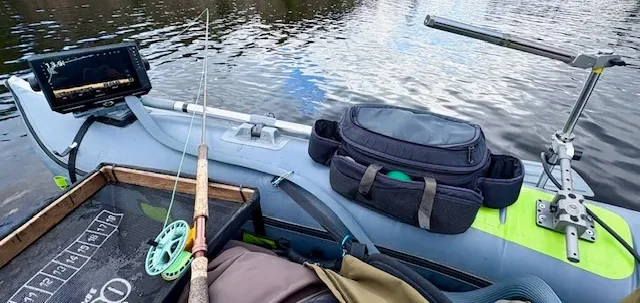
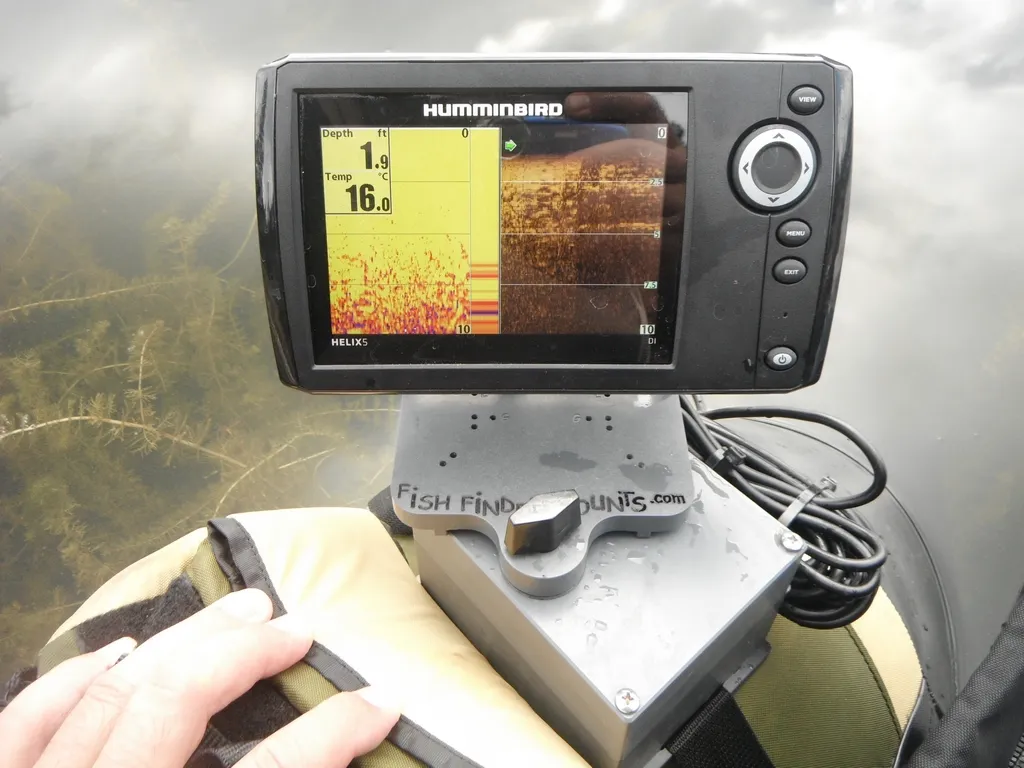
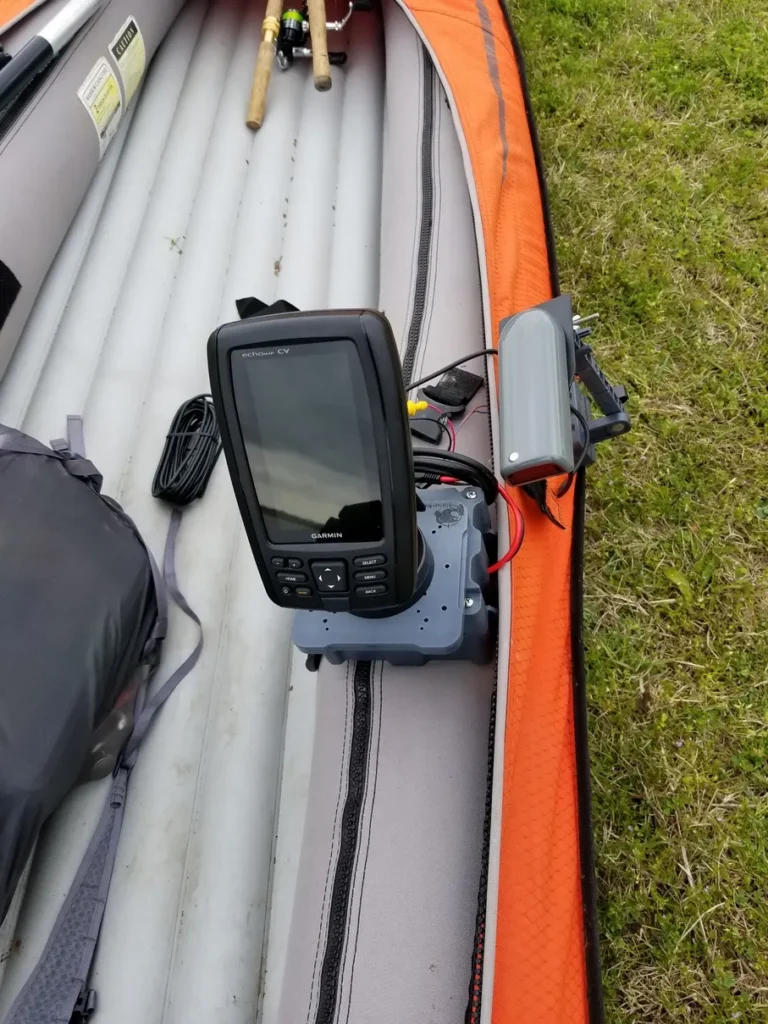
The transducer mounts to the same strap that holds the power box. A simple wing nut lets you tilt it out of the water when launching or dragging your float tube, helping prevent damage before you even start fishing.
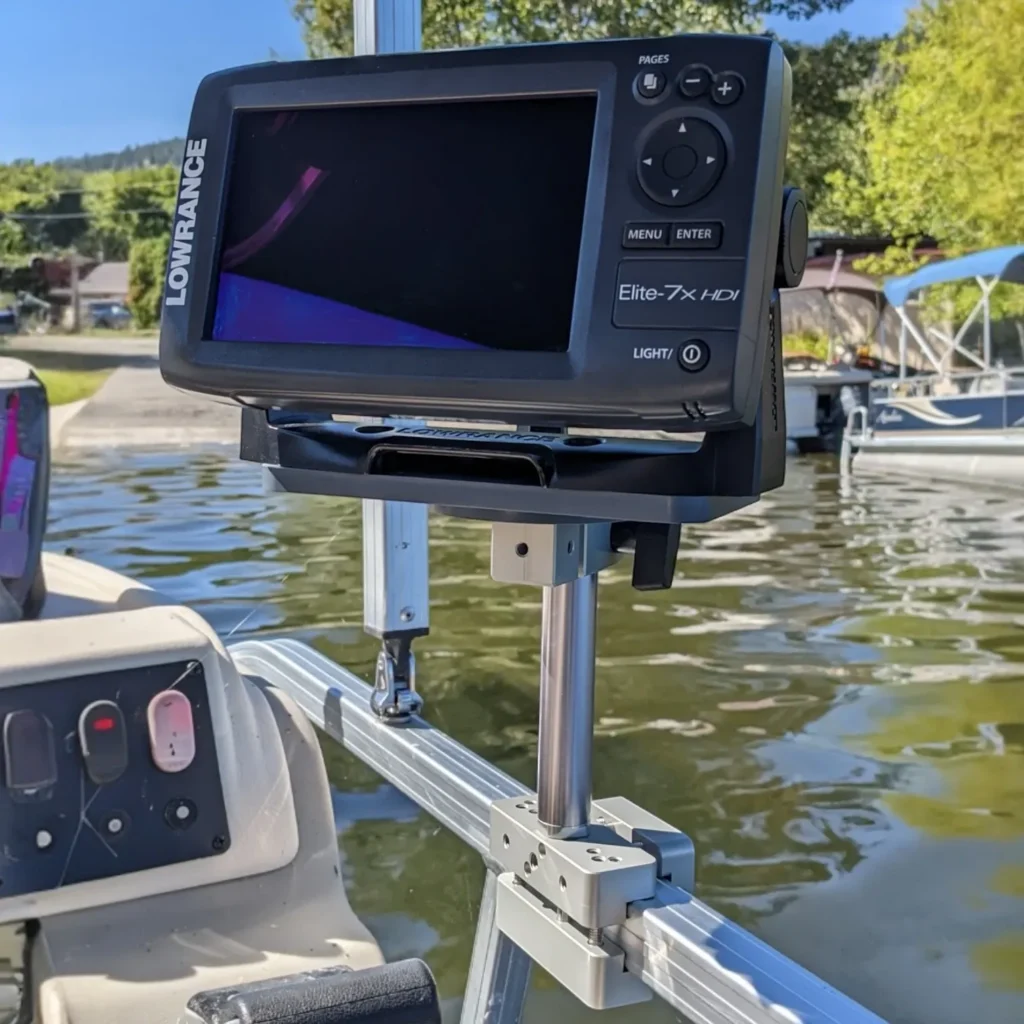
The mount also includes a rotating bracket, making it easy to adjust the screen on watercraft that don’t have a traditional dashboard or mounting surface.
Fish Finder Mounts evolved alongside the technology, supporting different fish finder brands and matching each unit with the right battery and power system. That means anglers can choose the electronics they want instead of being locked into one setup.
(32:12) When someone contacts Fish Finder Mounts, Wade says he only needs two pieces of information:
With that information, they can recommend the right mount and battery combination.
(33:09) One of Wade’s biggest innovations came from an unlikely place: a magnetic fish tank cleaner. That idea led to a patented magnetic transducer mount that replaces unreliable suction cups.
Phil recalls losing an expensive transducer when a suction cup let go. He says the magnetic mount solved that problem completely.
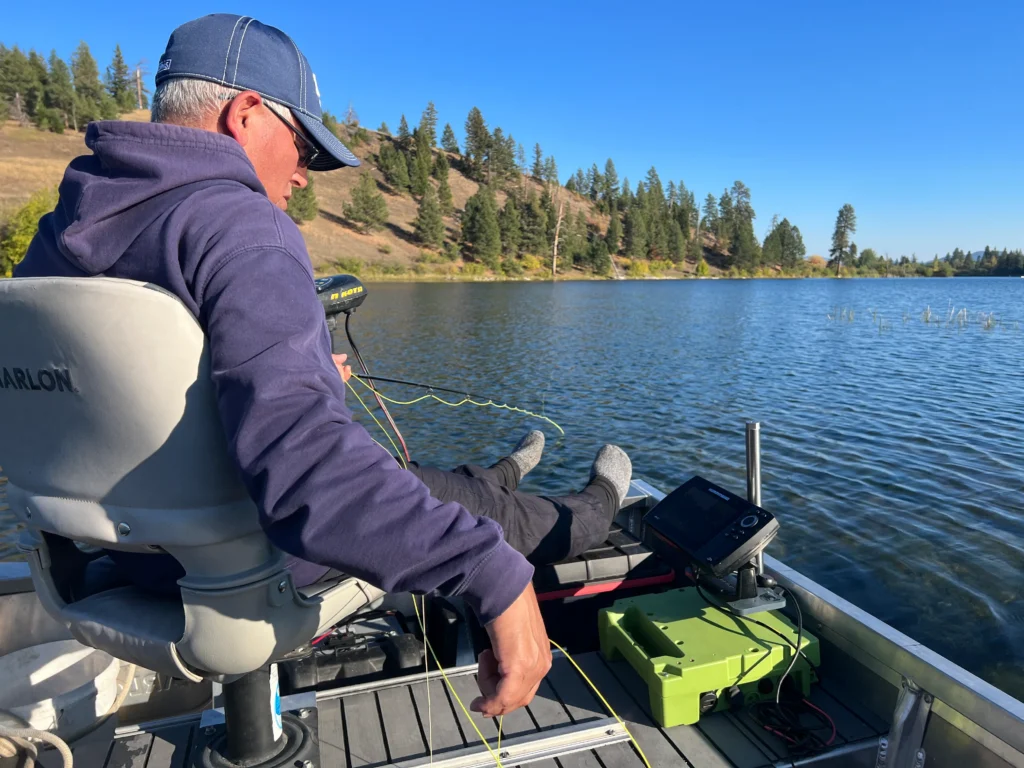
(43:40) As more anglers started using Fish Finder Mounts, Wade realized the system could work on much more than float tubes. Today, it’s used on pontoon boats, frameless boats, rental boats, and small aluminum boats, with quick-release mounts that make it easy to move electronics from one setup to another.
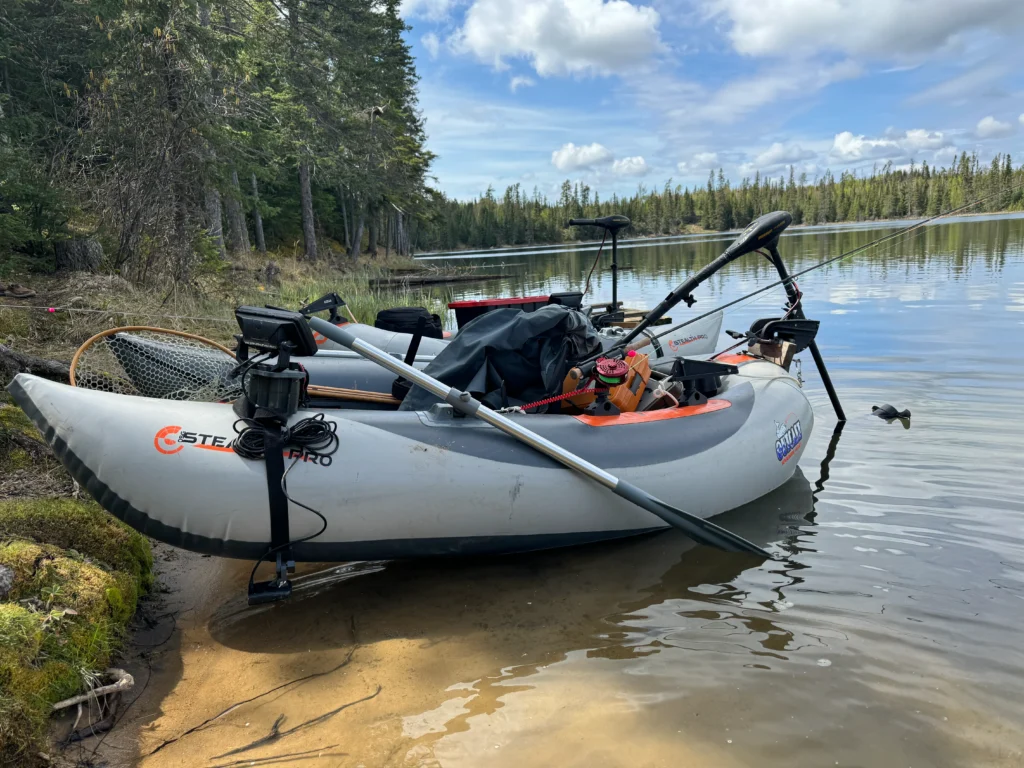
Phil shares how he uses the system on his Stealth Pro and why the quick-release design makes it easy to row without getting in the way.
We also talk about the benefits for traveling anglers. Phil describes bringing his own fish finder to Northern Rockies Lodge, mounting it on a rental boat, and using it to map structure, save waypoints, and quickly learn a new lake.
Wade says that’s one of the biggest advantages of a portable system: one fish finder can move between multiple boats while keeping all of your maps, waypoints, and settings in one place.
(52:00) Phil and Wade wrap up by talking about live sonar and how it’s changing the way anglers fish. Wade explains why he prefers the term “live sonar” over “forward-facing sonar” and compares it to shining a flashlight underwater, giving anglers a real-time view of fish and structure.
As the technology has evolved, so have Fish Finder Mounts. Wade explains that live sonar systems require larger batteries, processors, and more wiring than traditional fish finders, leading the company to develop a portable shuttle system that keeps everything organized and can be moved between multiple boats.
For anglers investing in live sonar, Wade says portability makes it much easier to use one complete setup across multiple boats while keeping all of your maps, waypoints, and settings together.
(58:30) As the conversation wraps up, Wade explains why portability has become the driving force behind Fish Finder Mounts. Instead of leaving electronics on one boat, anglers can move the same setup between float tubes, pontoon boats, rental boats, and aluminum boats while keeping all of their maps, waypoints, and settings in one place.
Phil adds that there’s another benefit: familiarity. Using the same fish finder every time means less time learning menus and adjusting settings, and more time fishing.
For Wade, the goal has never been to sell fish finders. It’s about making modern electronics easier to use, no matter what kind of watercraft you fish from.
Episode Transcript
WFS 953 Littoral Zone #26 Transcript
00:00:00 Phil: Welcome to the Littoral Zone podcast. I’m your host, Phil Rowley. The littoral zone or shoal area of the lake is a place where the majority of the action takes place. My podcast is intended to do the same, put you where the action is to help you improve your Stillwater fly fishing. On each broadcast, I, along with guests from all over the world, will be providing you with information, tips and tricks, flies, presentation techniques along with different lakes or regions to explore. I hope you enjoy today’s podcast. Please feel free to email me with your Stillwater related fly fishing questions and comments. I do my best to answer as many as we can prior to each episode, just before the main content. Thanks for listening. I hope you enjoyed today’s show. Years ago, when Saunders or Fish Finders first appeared, many fly fishers scoffed at the idea of using them as they believed using one was cheating. Over time, attitudes changed and we began to understand their use and value on the water. Using one didn’t produce a constant parade of fish to our flies, but it did give us an important glimpse into the underwater world we were trying to figure out. Today, we now use sounders to find and mark key underwater structures such as drop offs, weed beds, sunken humps and depressions where trout and other fish are frequently found. If configured and understood, we could also find and mark fish today. Not having a sounder with you on the water could be considered a significant handicap compared to other Stillwater fly fishers who do use one. Sounders were fine for boats, but how could the traveling angler who perhaps rented or used lodge boats, or the float tube or pontoon boat angler, take advantage of this technology to support their underwater efforts? Portable units such as Hummingbirds Fishing Buddy proved popular. These units had limited features and power and are no longer available today because of their age and advances in sonar technology. Thankfully, a small but visionary Canadian company called Fishfinder Mounts accepted the challenge of making all sounder units portable, no matter which watercraft you use. On today’s podcast, Wayde Van Pelt, CEO of Fishfinder Mounts, joins me to discuss how his unique products can help you use a sounder to make your on the water time more efficient, and how his company supports modern Stillwater fly fishers. But before we sit down to talk to Wade, let’s answer this week’s question about midship lines from Peter in Colorado. So let’s get to Peter’s question. Peter lives in Colorado, and he fishes from shore and his belly boat. He says he loves indicator fishing, but with our wind, it only lasts for a couple of hours before I have to switch lines. Peter has my ambassador series floating line for indicators. The clear head floating line for fishing from shore and a dead calm days, a full camo intermediate, and a full sink that sinks at three inches per second. A type three. People keep saying I should add a midge tip to help with the wind in the afternoon, but why can’t I take off the indicator and use that and just use this floating line without an indicator? Shouldn’t my leader without the indicator work just like a midge tip? My answer is Peter, you’re right. You can certainly remove the indicator and fish it on my ambassador series, Stillwater Floater. And thanks for picking up one the way I hope you enjoy it as much as I do. This is called naked technique fishing where we’re fishing long leader some weighted flies and just casting out, allowing it to sink and slowly bringing it back and hooking some fish. It’s a very rewarding way to fish. It’s how I first learned to fish chironomids before indicators became so available and popular, but amidst tip line is a very valuable addition and often misunderstood line because of its versatility. One benefit is the tip section bites into any Surface shop, helping you maintain contact with your flies and improve bite detection. This is especially true on windy days and in Colorado you’ve got them down there. Like many other areas in North America, and I’ve had the good fortune to experience those windy conditions in Colorado fishing lakes like Ontario and Spinney. The Rio Midge tip lines come in two sink rates, a clear intermediate that sinks at one and a half inch per second, and a hover tip that sinks at one inch per second. And within these two tip types or sink rates, there’s two tip lengths available to a three foot tip and a six foot tip. So there’s a total of four different kinds of midge tip lines you can get. Now, factors that determine which tip I use include how deep I’m trying to fish, the weight of the flies. I am using the wind speed and its impact on the current. It can create my retrieve angle and of course personal preference. Now when asked, I always suggest starting with the original three foot clear intermediate tip that sinks at about one and a half inch per second, and then add the additional mids tip lines as your personal preference, your desire, and of course, your pocketbook allows. Now, when I’m fishing flies very slowly, I often opt for a hover tip as it reduces leader sag between the tip and my flies because it sinks on a shallow angle. I use this approach with great effect on Henry’s late last fall to target trout feeding in less than four feet of water above and amongst weed pockets. Any other line, even a full hover line, just sank too fast and I couldn’t control the sink. Right? I was in the weeds too much. Now, if a fish rolled. One of the benefits of a midge. Tip two is because I have that short tip section in the water, I can quickly pick up and cover that fish. Any sinking line would require me to strip it in, get the head, perhaps roles. Cast the head section out of the water, get it up, make the cast. And by that time and all that’s done, your opportunity to cover that moving fish is gone. Now, if I’m fishing deep water and with some surface chop, I often use midge tips here as well because the tip helps me get down into deep water. And I might choose the faster tip in that situation to help get the flies down and keep them there. For example, last June I was targeting fish feeding on bloodworm that were twenty five feet down, cruising just above a muddy flat bottom. These fish traveled in small groups, cruising all over the place. I needed to cover water. My midge tip coupled with a twenty six foot leader. Yes, a twenty six foot leader allowed me to get down and track my flies just above the bottom covering the water. This setup worked incredibly well. In that instance, I was fishing from an anchored position. I used a twelve foot tapered leader to start. Then I added eight feet of Rio’s new ESP low stretch tippet. Love that stuff. Then to a small barrel swivel and a final six foot section of fluorocarbon tippet. And this all helped get down. Sink times minute forty five to two minutes. Yes, that’s a long time, but that allowed me to track my flies very slowly, just above the bottom where the fish were feeding. I was fishing from an anchored position, so that tapered leader used in the first section actually helps hold the flies up a little bit and control their sink rate, because I’m using incredibly slow retrieves and I don’t want to get down. If I was using fishing lock style, I would probably use more of a level leader setup because I have to have the leader sink a little quicker because I have to factor in the speed of the drifting boat, and we can have more about lock style in future episodes. Another thing you can do with a midge tip is also fish. A team of dries with them. Now, Stillwater dry flies are not your typical river and stream pattern that sit up on the water. As many. Stillwater River and stream insects have to compensate for that current. So they get swamped or swept into areas they don’t want to go. All that kind of thing. But on a lake, a lot of our bugs sit very low to the water. They don’t have to worry about that current or anything. So we use a lot of gangly looking flies that sit low on the water or in the film, or actually make passable wet flies or emerger flies when fish subsurface. So when using a midge tip in this situation with those kind of flies, you cast a fly out, you let those flies fish dry, you can dink them up and let them sit there. And eventually that tip will pull the flies underwater. The second that happens, you start a slow hand twist retrieve to track your flies through that feeding zone that the fish are in. In this case, just at or below the surface. It’s a deadly technique, and you get kind of a two for one presentation out of it where you get to fish dry for a little while, and then you get to fish an active, engaging us Um, retrieve presentation for emergers and catch a lot of fish. And a lot of times it’s those retrieve flies that do the business. They tend to catch more flies than those flies sitting on the surface in that dry configuration. So again, a midge tip is a very versatile line. I would recommend getting one. There’s lots of different things you can do with it, and I think this would be a good subject for a future podcast episode if you do, let me know. But let’s get on to today’s podcast on our discussion with Wade from Fishfinder mounts about how his products can help you use sounders no matter what watercraft you fish out of. All right. Welcome, Wade. Today we have Wade Van Pelt, CEO of Fishfinder mounts dot com. So wait, I guess the first question, my listener or listeners or maybe two or three of us would want to know is, how did you come to be the CEO of Fishfinder mounts dot com? What’s your journey, um, to your current position today?
00:09:49 Wade: Well, with my ugly mug on here, you’re going to have less than three probably fill. But anyways. Yeah.
00:09:54 Phil: Well we are an audio podcast so they won’t they don’t see my face either. So that’s a good thing.
00:09:59 Wade: Well that’s good. Hopefully my voice is a little bit better than than my looks. Um, but going back to that question you have here to get started. Um, I was the CEO of my own flow tube to start fly fishing out of it. Yes. Thinking about Phil Rowley and what he would do would match the hatch way. Match the hatch. Um, I’m sitting on my float tube there, and I was that years ago. I was at Rampart Lake and I was, uh, out there and there’s this guy that gets into a float tube and he has this fishing buddy thing. Uh, which is, if you guys don’t know, there, it’s it’s a fish finder on a pole stick, essentially. Uh, that hummingbird used to make. We basically kind of put him out of business with our way of doing things. Or.
00:10:45 Phil: I’m sure they love you now.
00:10:46 Wade: Yeah. And there’s funny because there’s a period of time where guys were like calling us looking for parts for that stuff, right? Yeah. And I’m like, no, we don’t sell that. We make a much better solution. But anyways, yeah, so I thought about like, I didn’t like the solution, but I thought, man, I’d like to have a fish finder my boat. And then later down the road, um, I went through the big D, the big D word, the divorce word.
00:11:10 Phil: Yes.
00:11:10 Wade: And I needed to accelerate my income. And I wanted to start a business to maybe help me do that, you know, on the side like side hustle. Right. And so I was looking around and I kept coming back to this idea, and I started looking around on the internet and like just doing some research because I really didn’t want, I didn’t have a lot of money. I didn’t want to take much risk with the money I had.
00:11:29 Phil: Mhm.
00:11:30 Wade: So I started looking around and I said there was really nothing out there serving, just that little niche. She flow to market, right? I have pontoon rafts, um, stuff that, you know, um, our friends at Outkast makes. Right.
00:11:43 Phil: Yep.
00:11:43 Wade: We love what they’ve done for our US poor fishermen over the years for our fishing vessels, right?
00:11:49 Phil: They do make a good product.
00:11:51 Wade: They certainly do. Yeah. So hats off to those guys. And we’re trying to follow suit, obviously. But anyways, so I just started looking and looking and it was really underserved. And I started going to trade shows and asking people at trade shows if there was anything to like, I was really, really working at it. And the only thing that was really out there, Scotty kind of had this little like kit and it was, it was GA sorry, Scotty, I love you guys too, but it was not good. You know, your your transducer had to be on the bracket at the very bottom of your float. So when you’re dragging on the beach or, you know, launching it, you’d just be scraping your transducer up all the time, knocking it around. So I thought, okay, at that moment when I’d done enough research, I could do this. I’m going to come up with a way better solution. And, um, you know, obviously Alex is my, um, closest friend and business partner of over most of my life. And so we started colluding And we came up with the flow tube stuff. So we were at first, as you were mentioning, you know, in an apropos way earlier that we started as float tube fanatics.
00:12:55 Phil: Yep, I remember that. And now it’s fishfinder dot com. So let me go back for a second because you meant I know the fishing buddy, um, that was originally made by bottomline, right? And then Humminbird picked it up. And for those that aren’t familiar with this sounder, this is a little portable unit. Um, the batteries on the original version were in the handle and then it evolved. Yeah. Was it one or two D cells I think or four double a s. Yeah. That’s what it evolved to. And then it went to a color version which was cool. Um, but it really you’re.
00:13:23 Wade: Right, the bottom line might have been a bit different than I’m.
00:13:25 Phil: Yeah, yeah. Because I had both. And the bottom line, the, I think there was two or three C batteries went into the handle and, uh, it worked. And the beauty of it was, is it shot out a beam of sonar out to the side and it’s fly fishing. Yeah. It was first generation Gen one side imaging. Of course, it’s come a long way right now. What didn’t you like? Because that was such a popular, um, fish finder. What didn’t you like about it?
00:13:51 Wade: It was the cumbersome nature of it. You know, like for a small fishing vessel. That’s a good question. Thanks for asking that, Bill. Um, because really our business, just to quickly speak to that is we found ways for all small fishing vessels, you know, all up to small aluminum boats. And we do big ones now to big boats and ocean faring vessels and stuff. But we really covered that small, very small. The smallest float tube, right, is really the smallest one you can be and all the way up. Um, that’s what we’ve, we got good at just being able to give everybody a solution and a good solution, not just this will kind of work.
00:14:25 Phil: Yeah.
00:14:26 Wade: Um, but going back to your original question, what was that again?
00:14:28 Phil: It was about why you didn’t like the, um, the fish.
00:14:31 Wade: Finder, the cumbersome nature. So like one of our, our big mantra is making all fish finders portable.
00:14:36 Phil: Okay.
00:14:36 Wade: And really, I just felt like for, for the smaller float tube, that’s where I’m going with this.
00:14:41 Phil: Yeah.
00:14:41 Wade: That was really not it wasn’t really a match made in heaven at all, you know, and I’m all about like getting the right tool for the right job. And, um, it worked, but it was just like you had to put it on your lap kick out first. Like, so I’ve been in some lakes, man. The shoal is so shallow trying to get on a float tube like Kid Lake or something like that.
00:15:00 Phil: Yeah, it’s in British Columbia.
00:15:02 Wade: On the road. Yeah. It’s it’s it’s you don’t even want to do it. Really. No. But like much less have a big, weird, kind of gangly fish finder thingy that you have to carry in and then try to put it on. And then a lot of guys would complain to you because you’d have the, um, holster mount that they made for float tubes, right? Yep. And it was just fabric with a strap and it would sway around. It’s moved around. So your accuracy wasn’t the best. Then the big thing, one of the other big things that always came to mind was the pull would go down like a foot, let’s say in the water.
00:15:32 Phil: Mhm.
00:15:33 Wade: So your depth is not nine or twenty feet. It’s it’s actually or twenty feet. It’s twenty one feet at that point. So you always have to, you know.
00:15:41 Phil: Factor in the adjust for the length of the pole. Yeah. Or the transducer at the time. Yeah.
00:15:47 Wade: So to be fair, it was less than optimal for a Wayde Van Pelt.
00:15:51 Phil: But it was what we had at the time. It worked. Yeah. Um, you know, it was low powered. Right. So the more power. Yeah, the more power you get behind a sounder, the better the returns you’re going to get the original bottom line, as I mentioned earlier, it had those C batteries in the handle. If you weren’t careful how you grab the handle, you could give it a little twist. Handle would come apart from that, right? Yeah. And when it went to the was it double or triple A’s? It went to whatever it.
00:16:19 Wade: Was double A’s. I think it was four in the back there, if I can recall.
00:16:22 Phil: Something like that. Anyway, it was especially the color version. It like batteries, it would barely. It wouldn’t even last a day sometimes. So although it worked, um, we needed a better solution and thankfully you came up with that.
00:16:35 Wade: So thank you.
00:16:36 Phil: So okay, so you’ve now seen the fishing buddy. It’s planted an idea in your head. You’ve done your surveys, you know, you’ve talked to friends, talked to other anglers at shows and things like that. What was the first sort of version you came up with?
00:16:52 Wade: Yeah. It was um, that’s a good question. Like, so we this is a bit of a felon story.
00:17:00 Phil: Oh, good. Um, I like a little.
00:17:02 Wade: Controversy because I got this idea and we started this business and we were actually kind of, you know, doing stuff while we were working. So we were naughty. Um, and it’s not a proud moment of my life, but like, I was just such a believer in it. I just had to do it. I couldn’t stop myself. Right. But we were making it out of PVC like, so we made a power box, right? Like I thought, I need it to be as portable and as non-invasive to that fly fishing environment and a float tube that it could be. So I selected a battery first. The smallest one I could get that could run a small four inch fish finder all day long.
00:17:37 Phil: Mhm.
00:17:38 Wade: Right. So I came up with the two point nine amp hour, sealed that acid battery, and I developed a box right around that, machined out a thick sheet of PVC, a box that would contain that battery. And it was very, very strong product. You can check it on the street and not break it, right?
00:17:54 Phil: Yeah.
00:17:55 Wade: Um, so we did that. And then, you know, the transducer was the biggest, biggest, uh, hurdle there because, you know, we wanted something to be universal. So we put it on the web and sold to everybody and nobody’s like, does it? G I don’t know if it’ll work with my g t fifty six or my, you know, X t this and that twenty from hummingbird. You know, like who wants to be dealing with that all day long, day after day after day? So we really worked hard on finding a solution to be universal for all the transducers from different manufacturers. Okay. So that was a bit of a hurdle.
00:18:28 Phil: Okay. So yeah, you’ve because you’ve created a box system that holds the power. Originally they were gel cells. correct? Now they’re lithium because that last longer cleaner battery.
00:18:42 Wade: Yeah. I wouldn’t say gel like that that but they there are sealed that acid gel style ones. But these are like general purpose. Like guys use them in alarm systems for their homes, like nice homes and stuff. They’re really sealed lead acid batteries like that are just like, you can put in a motor, but like a dual sport motorbike or what have you. Right?
00:19:02 Phil: Yeah. But they were heavy weren’t they. That made the the power a little heavier right.
00:19:07 Wade: Now we’re again you’re right. But we’re talking about a two point nine amp hour pack, right? Two point nine at twelve volts. It’s still only like I’d say two cigarette packs maybe and a half in terms of full mass.
00:19:22 Phil: But have you gone to lithium now in the power unit?
00:19:24 Wade: Yeah. So that I know you’re going there. Yeah. So lithium was it was an interesting thing. So when we started getting into lithium, lithium, iron phosphate and other chemistries were starting to Did come on mainstream into the manufacturing cycles, but lithium was still kind of at the end of its being the king of the castle for everything. Mhm. Like moving away from steel, that acid. So we did for a little bit have a straight up lithium. But the problem with lithium, straight up lithium water is if it gets water in it, it’ll burn.
00:19:54 Phil: Well, that’s not good.
00:19:55 Wade: It’s dangerous, especially in a flow tube. Imagine your flow tube going on fire while you’re out there fishing. That would not be a good sight.
00:20:02 Phil: No, and it probably wouldn’t be good for long term business either, would it? No.
00:20:07 Wade: So solid acid was cheap and it was the way we started. But then yeah, we’ve migrated now to lithium iron phosphate primarily. And everybody in the outdoor industry is using it.
00:20:17 Phil: Yeah. Because the risks now are you know mitigated. I would think that’s right. Significantly.
00:20:22 Wade: Yeah. And it’s by the way though, it’s called lithium. It’s lithium iron phosphate and it’s not as light as lithium. Yeah. So the same size pack. Let’s go back to that original pack. If I. I got a free app now that’s lithium iron phosphate for that. But if you had a straight up lithium, it’d probably be half the weight of that even. So really lithium iron phosphate is about one third lighter than steel lead acid technology.
00:20:47 Phil: Yeah. Yeah. They’re listed I think there because when you get a battery charger you’ll see it. You know the different they’ll have lithium and then they’ll have the l I p o four. Right. And that’s that’s right. You’ve got to know to charge the right you know, you know some battery chargers are getting better and better intelligent. They can tell what battery they’ve been hooked up to.
00:21:07 Wade: There’s a lot better out there and they’re not that expensive either. So that’s good.
00:21:11 Speaker 3: Pescador on the fly offers a full range of fly fishing gear for any angler at any budget, with premium raws delivered directly to you. The lre G6 is the most packable, high performance fly rod on the market, performing like a four piece rod but with unmatched portability in six pieces, and you can get ten percent off your next order. Right now, if you use the code Wet fly, At pescador on thefly dot com. Never fly without your G6. Discover the El Rey series and more at Pescador on the fly dot com. Fly fish with me. Utah discover year round blue ribbon trout fishing on the famed Provo River. Choose a guided walk and wade or a scenic float and experience big trout, stunning canyons and unforgettable days on the water. You can book your adventure right now at Fly Fish with Me, Utah dot com. World class water. Incredible fishing. That’s fly fishing with me Utah dot com.
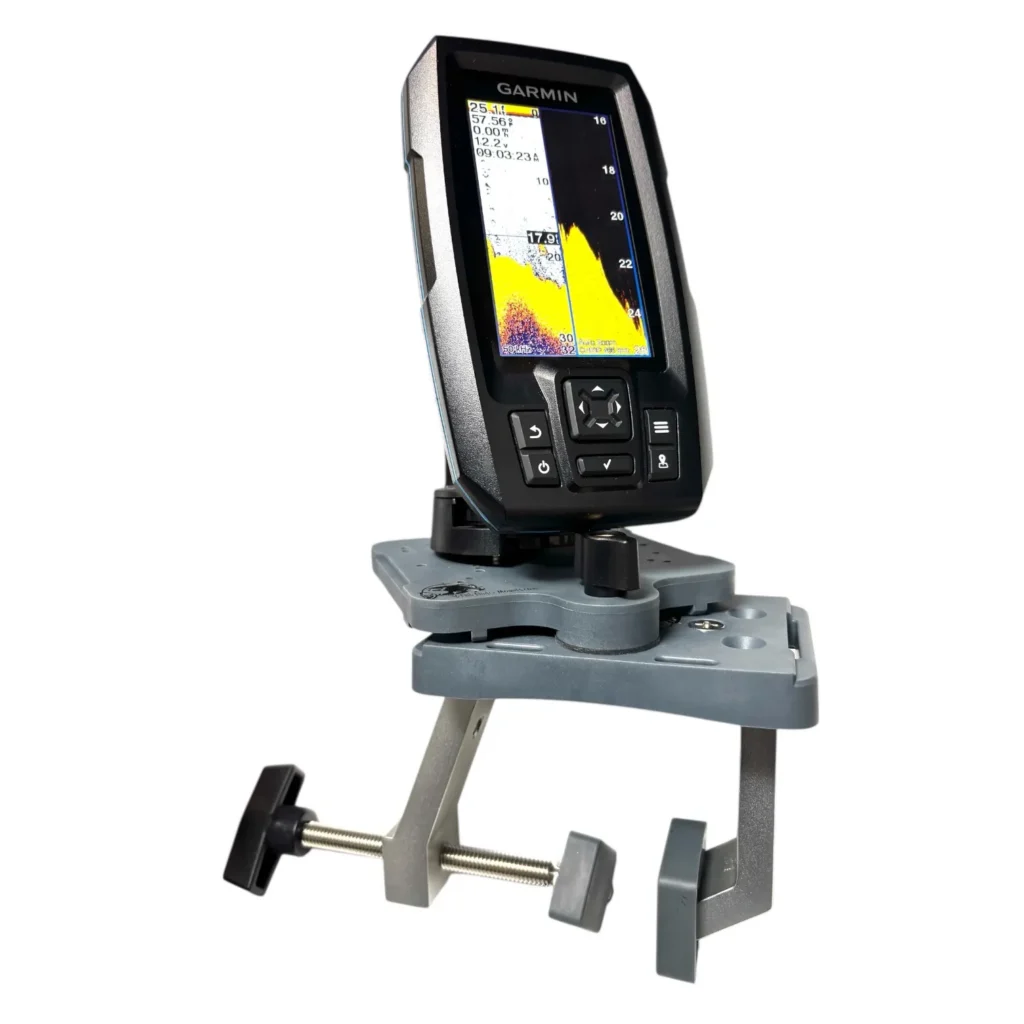
00:22:05 Phil: Okay, so you’ve built this box. Now this box strapped onto the float tube, correct. And on that strap, you were also able to thread through the strap a bracket that would attach the transducer as well. That’s right. So so you have this unit that the um I know it’s easier to see and we’ll have pictures in the show notes so people can see what we’re talking about. But basically this little rectangular box, um, that’s strapped onto the float tube. That strap also allowed you to attach the transducer, and then you had another bracket that you would mount on top of that box that the head of the sounder would fit in. So now you had a solution where people could attach and, and can attach to this day and going forward, um, any sounder they want, right? As long as they had the right power.
00:22:53 Wade: That was the.
00:22:53 Phil: Goal. Yeah.
00:22:54 Wade: Yeah, that was another part of it. Thanks for that. You’re, you’re very good with your thinking here. Very, I like it. No, I’m serious. Like it’s well organized thinking here, Phil and I really appreciate that. Um, because I can be a little bit go off the rabbit trail, so to speak. But you’re right. Like what were the criteria, right? What was the, um, product requirements, specifications when designing it? Well, you, you want it like a lot of these fishfinders, they don’t have swiveling capability.
00:23:19 Phil: Mhm.
00:23:19 Wade: Built into them by the manufacturer. They just think you’re going to just screw it down into your dash or your boat or whatever it is. Yeah. So on the flow tube, that’s not going to be the case. You’re not screwing it into an air bladder. So we needed something that you could rotate the screen if you didn’t have that capability inherent within the fishfinder from the manufacturer. So to get that viewing angle, that comfortable non-stressed viewing angle. And then also the next thing is like the power. We talked about that enough though. And then the next thing is going to be the transducer. We wanted to be able to drag your vessel up in the water without the transducer getting all, you know, scraped up and everything. So I came up with a way of being able to kind of just easily tilt it up out of the water when you don’t need it in the down position, right?
00:24:07 Phil: So yeah, because that’s a real risk bringing that float tube. You’ve, you provided me with pictures where you can, the transducer, um, bracket on the strap is just basically a simple wing nut that allows you just to loosen it, flip it to a vertical position, and then you can drag it around and you’re not going to, you know, bounce a very expensive and very important component to a sounder, right? Because if you don’t have the transducer working, you’re not going to get the information, the accurate information you need.
00:24:35 Wade: That’s right. Yeah. And like, just, just to reiterate or like kind of hone, focus in on the one issue is I wanted to be able to put any fish finder on my float tube if it was my desire to do so. Yeah. Now of course, float tube, you’re not going to put a nine inch screen on your flow tube. That’s retarded in my mind.
00:24:53 Phil: Somebody would though.
00:24:54 Wade: Maybe take that word out. But it’s just it’s, it’s, you know, I’m a nineteen seventies child, so sorry, guys, but, um, yeah, I wanted to be able to put like a five inch screen or whatever. And the hummingbird again, going back to that just for little, little screen. Mhm. Um, for battery life, that was another thing. We went from the poor battery life, maybe three or four hours of running that thing and then it’s dead. Hopefully you have a bunch of more double A’s with you. Well, I wanted to have something that wouldn’t have to think about the batteries, because when we’re out there fishing, you and I. Right? Mhm. Being the best fisherman out there in the world.
00:25:29 Phil: Yeah. Okay.
00:25:31 Wade: We want to just focus on fishing. We don’t want to be sitting there thinking about, oh, why is my batteries not working? You know?
00:25:38 Phil: Well, it was the most, you know, with back to the, you know, when we used the hummingbirds, especially when we got into the one forty seas with the color, it lit like batteries. You had that, you know, the color is always as sound has evolved. It was all black and white. Yeah. That’s right. And then it got into color, which gave us better, um, you know, a better picture of the underwater world, but it needs power for that. Right?
00:26:02 Wade: So and it’s interesting you bring that up. If I can just quickly jump in there. Yeah. It’s funny because when I came in that the color was just really starting to become popular in fish finders. So this was about twenty twelve. And like everybody had that to anyone that had brought black and white, everybody was like, oh, it’s good enough. But then they brought in down imaging, right? Remember that? Yeah. So then then now all those guys that had these, because there’s no going color from black and white to color was not compelling enough for the market, I think. Yeah. But once you started getting into color and down imaging and color was now like from a consumer, regular consumer, um, like middle class family buying a fish finder for their boat or their float tube, they could buy it. They had the dollars and cents, but now you have down imaging, which was compelling that you could see weeds as weeds and not just clumps. Yeah. Like your lower frequency scans. So I kind of came in just at the right time to, as the technology was evolving and guys were saying, okay, I’m done with this old fish finder of mine. It’s no longer it doesn’t. I want to see that down imaging.
00:27:07 Phil: Yeah.
00:27:08 Wade: And so everybody started buying fish finders again. So it’s kind of cool.
00:27:12 Phil: Well, and you adapted for that didn’t you? Because for each different fish finder it has different power requirements. And you have a solution because you’ve done a great job, at least that I can see for all the the various models out there. Hummingbird, you’ve mentioned Lawrence, Garmin. Um, they all have their own power demands, right? So you need a solution. Not only that, you’ve got the portability but has the right power in there. Um, that you can offer that too. So yeah, that’s great. So it’s not a thank you. It’s adaptable, right? Because you’re going to have a consumer call up and I’ve got, you know, brand X, Y, Z and all these features and you can go, okay, you need this power box with this battery in it, because if it’s underpowered things, that’s how to me, that’s how I know when my sound is getting low on batteries is things stop working. All of a sudden the down imaging isn’t there. I’m not getting the, um, you know, different readings on the screen. There’s no temperature, there’s no depth. All of a sudden it’s starting to slowly shut down and use. You can only power so much. So you, you offer that to. So you have that versatility.
00:28:15 Wade: Yeah. And I’d say if anyone calls us after this podcast, the questions I always ask them and like, we’ll always ask you guys out there, uh, Phil’s customers, our customers, our friends, our fishing friends, by the way, are all one breed here. Um, and we all want the tools to do that effectively and have a great time when we’re out there and be effective. But I’ll ask them what kind of make and model and years your boat that you have and what fishfinder do you have or do you plan on using? I need those two pieces of information. So please, when you guys call fishfinder dot com, try to remember that and let us know where you’re at and we can help you get there.
00:28:50 Phil: Yeah. Because float tubes have evolved, haven’t they? You know, starting back to your first one, they were the, you know, the round almost like an inflatable toilet seat. Yeah. That used a truck, a truck, inner tube tire. And now they’ve got urethane bladders. Um, you mentioned our friends at Outkast, the, their v-hull kind of boats or U-shaped boats. And they have a different mounting challenge than your traditional because of the pockets and all the things. So you can you’ve got a solution for that with the straps.
00:29:18 Wade: Yeah. Now it’s more like a lot of these, uh, these, these, uh, float tubes that are coming up with paddles on them now, right?
00:29:24 Phil: Mhm.
00:29:24 Wade: Yeah. So that it further decreases the opportunities from a space standpoint where you’re going to put things right?
00:29:31 Phil: Yeah.
00:29:31 Wade: So there’s some interesting challenges we’ve faced that way. But we’ve got solutions.
00:29:34 Phil: Yeah. So okay, so it starts with float tubes. And of course float tubes are probably the first portable watercraft, at least for me. That’s what I started in, because the next step up from a float tube was a boat. And where I was in my development and price bracket, that was a little unreal. And the vehicle I was driving at the time, um, because there is no perfect watercraft. That’s why I joke with my wife. That’s why I have so many because and it’s somewhat true, right? There’s, you know, lots of, lots of.
00:30:03 Wade: Issues. You sure it’s not arguing and not and.
00:30:06 Phil: No, I’m.
00:30:06 Wade: Joking.
00:30:07 Phil: They’re like, why would I? I’m not going to win anyway. So what’s the point.
00:30:10 Wade: Of I.
00:30:10 Phil: Know.
00:30:11 Wade: You can’t win.
00:30:11 Phil: No, no. Um, so now you evolved into what’s the difference now any differences when you’re stepping up into a pontoon environment now, right where you’ve got your framed pontoon boats.
00:30:23 Wade: Like you’re talking about like an inflatable raft style, like a larger. The next largest vessel.
00:30:28 Phil: Yeah. You’ve got obviously a pontoon boat, which I think we’ll categorize that into a boat. We’ll come to those. But I’m thinking of your frameless pontoon.
00:30:36 Wade: Boat I tend to.
00:30:37 Phil: Use. Yeah. Or the you know fish, cats um those kind of boats frame pontoons nine thousand or.
00:30:43 Wade: Yeah.
00:30:44 Phil: You row around. So is there any, any difference in um.
00:30:48 Wade: It’s the oars again. It’s the oars like so like some of these vessels, they have the oars where the, there’s not really a rise then some of them do. They have the frame on them. Yeah. They have, they’ve taken uh consideration in the designs, raised the paddles up. So you to your seating position. Yeah. So they’ve got like bars that come up. So it’s raised above the air bladder. Yeah. To some degree, like the Colorado XT pontoon, probably the most popular pontoon out there. Yeah. For a long time just because of the cost factor there largely. Um they’re fairly high up but there’s a lot of stuff that innovative stuff.
00:31:22 Phil: Um, yeah, your frameless pontoon boats now.
00:31:24 Wade: Are like, yeah, you know. Dave Scadden and, and the stealth from outcast and, uh, the scout, those ones. And then there’s, yeah, there’s a bunch of other ones, even oval style ones with floor without floors in them and all that, but those ones have the air or the paddle oarlocks right there on the bladder. So what we have is a quick release base. So you can, you can have your kid on there like so you’re not always using your paddles, especially in stillwaters, you know, right. You’re going to be sitting there casting. Yeah, sometimes just sitting there so you can actually have your fish finder mounted then. And when you want to use your paddles, you may want to eject the box off the power box with your screen on there, because you obviously need room for those paddles to move around right, forward and back, forward and back. So you got to get that power box out of the way. So we have a, you know, just pull a pin on a quick release, pop the power box off one second.
00:32:12 Phil: Yeah, I have, I have used your, um, I’ve got a five inch sounder that I put on my stealth Pro and it was a little tricky just trying to find a place for the strap that didn’t get too far forward, that slid off the table. You know, stay tight. Plus also was within comfortable arm’s reach to push buttons and turn heads. But I managed to get it in. But you do have to. Yes, you did have to compensate to make sure that the. Or your travel. So you didn’t a break your screen or your knuckles or just could operate that. So but it still worked. But that’s good because again, um, and we’ll have links to Wade’s, uh, site, the Fishfinder mounts dot com website where you can see all of the solutions he offers. Um, so as you’re going through this, we, you know, you’ve got a strap system for the pontoon boats and the float tubes, you’re getting angler feedback. Um, through this whole process, what were some of the memorable points of feedback you got from anglers that further improved your products?
00:33:09 Speaker 4: So like, it’s the old adage, guys.
00:33:11 Wade: You can’t catch a fish unless you put your lure in the water, right? Yeah. Um, and so we had a lure in the water called floating fanatics. And then what happens is, you know, aspects of that solution appeal to, you know, the next vessels up kayaks, canoes, small boats. So, you know, I just one day what happened was I’d actually been at a buddy’s house maybe months before this. Mhm. And I was hanging out. He’d just gone through the big D as well. Unfortunately, the divorce. And he had this fish tank in there and he had this scrubber on the fish. Fish. It was magnetic.
00:33:46 Phil: Yes.
00:33:46 Wade: Right. So one scrubber like you had the magnet on the outside of the tank and then in the water on the fish side, you know, the water side inside the tank, the interior of the tank, there was a magnet there. And you move this up and down and you could clean your, you know, glass.
00:34:05 Phil: Okay.
00:34:06 Wade: I thought, huh, okay. Anyways, it came to my mind later with transducers and they’re, you know, everybody’s like forever. They’re using these suction cups are not very good.
00:34:14 Phil: Uh, no.
00:34:15 Wade: And I thought, man, I could use that solution instead of the suction cup solution. So down I went into that journey and we patented that. And we have a US patent on that.
00:34:26 Phil: And yeah, I have to, I’ll give a little story just to drive what you said, because the common way to attach, because aluminum boats and small watercraft like that were portable, a lot of times we would either, you know, put them on a trailer or quite often put them up on a roof rack with some kind of loading system, or you just manually humped it up there yourself so that your whole sounder system came out. And we used to use the suction cups. Some manufacturers made specific suction cups, rubber suction cups. Other times you’d use a canopy suction cup. You could mount your transducer to that. And then for me, they never stuck very well to the rear of the boat. And I where I’m going with this is one day I was going out fishing and I was in a rush. I was going after work. So my time is limited. So that’s all on you. So I put the suction cup on there, and you used to have to really wiggle it, get the air out of it, and try to get it to suck as flat as you could to the transom. Play around with it so that it was set properly. So it would record and all that pace of doing that, getting ready, getting out, getting my friend in the boat. Phil forgot to plug in the other end of the transducer cable into the back of the sounder head. So I’m motoring along, get to the spot, turn this down, you know, got the sounder on. Why am I not recording anything? Why is nothing showing up on the screen? What’s going on? I look over the back of the boat and guess what’s no longer there? The suction cup has popped and of course it’s silently slips into the water and I have no transducer. And I have. At that time, this was this was twenty years ago. I had a two hundred and fifty dollars bill to get a new transducer because it’s gone. So when you came out with that magnetic solution, I was sold. So So describe that in detail. Now for our listeners, what you came up with. So you started with that. Kudos to you for seeing a solution that clean fish tanks and said, I think we can do this for transducers.
00:36:24 Wade: At least it was thematic, you know, fish tanks, fishing, right?
00:36:28 Phil: Yeah. Hey, you never know where it’s going to come from. So what is describe to our viewers what it is now because that’s a real game changer. Is this magnetic transducer.
00:36:37 Wade: Yeah. You know, like it’s it’s funny. It didn’t like, you know, obviously I only had so much money to market it, but over the years, it’s sort of silently taken off more and more and more people realized what it is. It’s and how good it really is. Like, if you ever own a boat anywhere from, you know, the smallest, you can get all the way up to sixteen feet, maybe eighteen feet. And you there’s a wall of the boat, which is only a credit card. You stick you in the like your problem is solved. And you’re like, you’re saying with that suction cup, that’s a very good point you brought up. Um, the magnet is it’s so easy to reset like anywhere you want, drag it around like, you know, like it’s so fast, so efficient, so portable. It’s as big as like it’s about the base, maybe even smaller than the suction cup solution. Really?
00:37:20 Phil: Yeah.
00:37:21 Wade: Um, so like when you’re going on like, this is where it really like, it shines in so many ways, but one of the ones that always comes to mind is going to resorts like a lake or somewhere. They have the low John boats or John boats like that.
00:37:33 Phil: You have boat rentals. Yeah.
00:37:34 Wade: Those boats sit in the water for so long and like some guys will say, the suction cups good enough. We just put peanut butter on there or something.
00:37:41 Phil: But I’ve never heard of that one.
00:37:43 Wade: I know like now you’re gonna put peanut butter on your boat. Like, what are you doing? Right? Like, I don’t know. And then some guys, they’ll take two by fours and you see clamps. It’s like, just spend the money, guys. Get the magnetic transducer, mountaineer, that category of boats that you’re using and you it’s worth the money. You’ll see if you are serious about fishing using a fish finder, just make your life way easier and it’s going to last forever. Magnets don’t, by the way, deteriorate power over your lifetime, you’ll never know degradation over your lifetime.
00:38:14 Phil: So you’ve got a system just again, just to describe for people, this is the transducer mount is two pieces. You’ve got a, a, a part of the transducer that comes apart, that goes on the inside of the boat and then the magnets, I can’t remember where. And both magnets, a series of earth magnets on the. So when they literally. I know when those magnets get within range of each other, the two just clap together. Be careful of. Do not get your fingers. Yeah, I. You’ve got warnings on there because I can speak that it hurts when they come together, but that thing is stuck on there and you can position it. You can somewhat, you know, you slide it around, get it to where you want and it just doesn’t come off. It’s a brilliant system because those earth magnets and you know this better than me, but when you recess them into a pocket, that increases the magnetism, doesn’t it?
00:39:02 Wade: No, I know, doesn’t it?
00:39:03 Phil: I thought it did.
00:39:04 Wade: The magnets are kind of interesting beasts. Um, you know, they’ve got polarities right north and south, as we know, maybe learning through elementary school or wherever it was you were when you learned it. Um, and like you can, the bigger the magnet and like, so you have different grades of neodymium, right? It’s rare earth, neodymium, that’s neodymium. I think it’s a scientific name or it’s another kind of, you know, trade term. Yep. And then super magnets people use all sorts of different terms. But neodymium is a scientific term. And um the bigger the magnet, like the rating like so we use like the highest rating, like n fifty two magnets of rating. And the bigger magnet, the more like just in like linear way, the more power it has. However, like magnets have like, um, fields to them. Like it’s hard to explain, but like layers of fields. Okay. And the only way you can kind of like get a magnet to be less strong is that you put it under a great heat.
00:40:05 Phil: Mhm.
00:40:06 Wade: Or you smash it with like, a sledgehammer smash like hit hit magnets hard, then that can misalign that those fields. Okay, the magnetic fields. And then no longer are they as good or as strong. So you have to hit them pretty good though. So anyways, I don’t know if I’m asking the question the best here.
00:40:23 Phil: No, just again, just, I guess all in summary, um, the way that, uh, transducer bracket works with the magnetic mount. And for me, the other thing I liked was, you know, other ways of mounting transducers on perhaps larger boats that you see, or you buy or you make a plate that you screw to the hull of the boat at the stern. And then you have to, because you’re drilling a holes below the waterline, which always makes me nervous. You had to use some kind of caulking sealant to stop, you know, around that the plate that you put on. And then you would attach your transducers to those by literally screwing them into the plate.
00:41:05 Wade: That’s right. Yeah. You know, believe the manufacturers don’t do it for you for some reason.
00:41:08 Phil: No. And there was I remember being on YouTube trying to figure out how you’re going to get a transducer on there. Yeah. Permanent. Um, but you didn’t want that because I found the other thing that your transducer mount offers in a trailered boat, which I have one, uh, is I can, you know, on a larger boat, a lot of people leave their transducers on. Right. And you can certainly do that with your magnetic solution, but you can just what I would do is if I was traveling typically short distances, if it was a long distance, the whole thing would come out because it’s portable. Um, but I would just slide it because the magnetic mounts on each would allow me to slide the transducer up. So it was high up on the transom, nowhere near going to work that way, but it’s out of range of rocks and things that go bouncing down roads, particularly secondary gravel roads and could take out your transducer. So your solution not only offered portability, but it also offered protection for short travel. So yeah, a really neat And thank you. Yeah, your bracket can attach any transducer. Works for it, correct?
00:42:10 Wade: Yeah. It’s it’s universal. Really like the biggest guys in the game for where we’re at. Um, is really like, it’s not like so much the salt water guys, but it’s Lawrence hummingbird and um, Garmin.
00:42:21 Phil: Yep.
00:42:22 Wade: Garmin. Obviously, you know, those guys also have their divisions of salt water like Simrad and all of that. But like really our market’s more the freshwater. Yeah, guys, we do do this all a lot of stuff too, but not as nearly as much.
00:42:35 Phil: So you’ve not only just where we’re going here, so you’ve got mounts for float tubes, strap mount system, a similar mount system for um, inflatable pontoon boats. You framed boats, your uh, yeah. Frameless boats. You’ve got adaptability in those mounts with your quick release plates. So if the oars are getting in the way and you need to get your, the transit, the, you know, the head unit and the battery out of the way, you can. Yeah.
00:43:03 Wade: Quickly.
00:43:04 Phil: You’ve also got those quick release plates will mount into a boat. Correct. Onto the.
00:43:08 Speaker 5: Seat. Yeah. That’s if you want. Yeah.
00:43:10 Wade: But just before.
00:43:11 Speaker 5: We go there, just.
00:43:12 Wade: Because you brought up an interesting point on the the other magnetic solution. So we have there’s another transducer solution. Everybody, um, where we call it our bolt on, but it really should just call it screw on. And what Phil is kind of pointing to there was we have the first mega we were talking about was where the one magnet goes on the in hall inside the hall, and it acts like an invisible clamp. And where the other magnet goes to the other side of the hall, the water side with the transducer mounted on it. They cling to each other through the hall material.
00:43:40 Speaker 5: Yep.
00:43:41 Wade: Well, there’s certain boats that the material of the boat is too thick. Of course everybody would, you know. Of course. Yeah. Right. A good example of this would be like something like um an inflatable um what are they like pontoon boats, I guess they call them too. But Stryker makes those boats, you know, like.
00:43:58 Speaker 5: Like.
00:43:58 Phil: A zodiac style boat.
00:43:59 Speaker 5: Zodiac style. Yeah.
00:44:00 Wade: Like it’s like Jacuzzi Zodiacs. Really the name, right?
00:44:02 Speaker 5: Yeah.
00:44:02 Wade: So that kind of a boat. So I have one of those and I just took. So we created this other magnet where you could screw it onto the outside of your boat because you still want that protection we were talking about. You want the portability, you want the quick adjustability. The other thing that the magnet and all of our transducers have is have a tilting arm capability as well. So that helping it set up perfectly, maybe you got to get around something even and the arms are even extendable. So we’ve really thought of it all. But yeah, that particular aspect or that other product, the magnetic bolt on transducer mount, um, that’s great for your inflatable zodiac style boats and other ones to fiberglass boats, things like that.
00:44:42 Phil: So you got lots of different solutions.
00:44:44 Speaker 5: So yeah.
00:44:45 Phil: And something just popped into my head here so that as I understand it, that the transducer mounts, you know, the arms and things like that and the, the battery boxes that contain the batteries for your float tube and pontoon boat, your inflatable, you know, your, your um, pontoon boat solutions. They’re all what? They’re made out of the same product, aren’t they. There is a composite or is it a what.
00:45:07 Speaker 5: That’s a PVC.
00:45:08 Wade: Um well actually now like not now. Sorry. Um yeah, it’s it’s a glass reinforced glass. Um like plastic. I don’t want, I don’t want to get into too many details.
00:45:19 Phil: No, but it’s and I’m just where I’m going here. It’s, it’s, it’s solid. Right?
00:45:23 Speaker 5: It’s oh.
00:45:23 Wade: Yeah. It’s it’s extraordinarily we have guys like every once in a while, they’ll lose their, um, magnet. Like so strangely, the ones inside the boat, not the ones on the outside. They drop it somewhere in the boat and they can’t find them again.
00:45:36 Speaker 5: Right.
00:45:37 Wade: Or maybe they like I had a guy that had like a weird kayak and it got into a crevice and couldn’t get it out or something. So he bought another interior magnet. That’s the inside of the hall magnet.
00:45:47 Speaker 5: Yeah.
00:45:48 Wade: Um, so this is like years later, years later, right? Like they’re so tough experience.
00:45:56 Speaker 3: The waters of Bristol Bay at Togiak River Lodge where fly fishing meets Alaska’s rugged beauty. This is the place to complete the Alaska Grand Slam with all five salmon species rainbow trout, Arctic char and more. Where each day offers a new Alaskan adventure, you can visit Togiak lodge dot com right now to start planning your Bristol Bay experience with Togiak River Lodge. Fishing Expeditions offers world class fly fishing right off Alaska’s incredible road system for monster rainbow trout to feisty Arctic grayling, you’ll chase big species in the stunning landscape. Whether you’re a seasoned angler or just starting out, their expert guides ensure an unforgettable adventure. Book your trip today before spots fill up and experience Alaska’s diversity like never before. Check them out right now. That’s Fishing expeditions dot com.
00:46:46 Phil: Yeah, that wasn’t the failure of the magnet. That was the the user error.
00:46:50 Speaker 5: Dropped.
00:46:50 Phil: It. Yes. Okay. So okay, so now you’ve evolved into boats, right? So what? And we’re talking, like you said, you mentioned rental boats or large boats that are provided for you, and now you have the ability to bring your sound.
00:47:06 Speaker 5: Your own fishfinder of your own choice.
00:47:07 Phil: And I have done that myself on trips, uh, most recently up to Northern Rockies Lodge. When I filmed for the new Fly Fisher, I brought my sounder, um, complete with the power base, and we’ll get into that in a second. Yeah. It fit on the plane, into the float plane and I put it on. And now all of a sudden, in the middle of nowhere, I have sounder information because I’m the sounder. I had, um, mapped create lake maps, uh, as well because so that was valuable information for the lodge owners. They learned the lakes and find out the little nuances where the shallows.
00:47:40 Speaker 5: All the spots, the shallows, the.
00:47:41 Phil: Drop offs, all that.
00:47:42 Speaker 5: Stuff.
00:47:43 Phil: And your system allowed that portability for a boat. Plus, um, I have a few boats as well, so I have a system that can transfer between boats.
00:47:53 Speaker 5: I don’t, you.
00:47:54 Phil: Know, what I found with other solutions is now that that sounder unit transducer, all of it is permanently mounted in the one boat. And if I want to use the other boat, I have to go get another sounder.
00:48:06 Wade: Yeah, that’s a very good point. You bring up like that. That is absolutely like you can. So you effectively what we’re talking about here is two things. But first, we’ll say the obvious. And you’re saving money.
00:48:15 Speaker 5: Yes.
00:48:15 Wade: If you get a mounting system like ours, you don’t have to keep investing for each boat that you may own. Uh, and if you go on a friend’s boat and you don’t like his finder, bring your own. Right?
00:48:24 Speaker 5: I’ve had that I know.
00:48:26 Wade: So we, we enable people to do that very, very effectively.
00:48:29 Speaker 5: Yeah.
00:48:30 Wade: Um, it’s not like cheese stuff. It’s very high end. But um, the other thing is, is like, and I really hadn’t thought about this before Phil but it’s obvious kind of, I guess to once you said this is you have a favorite finder.
00:48:44 Speaker 5: Mhm.
00:48:44 Wade: And you might have your GPS points saved on that finder for the lakes that you’re going to, and you want to use a different boat and what that one day, well, you want to take that same finder that’s got those, uh, points. Those waypoints, GPS waypoints, save for those boxes you make in that water with you.
00:49:00 Speaker 5: Yeah.
00:49:01 Wade: Right. So we boom. There you go. Fishfinder dot com, baby.
00:49:06 Phil: So you have the, you know, on the boats. We’re going to be using your magnetic mount for the transducer. And then you have your quick release plates that you can place in your boats if you want. These are flat with a little. What do you call that, a.
00:49:19 Speaker 5: Pull.
00:49:20 Phil: A pull pin.
00:49:21 Speaker 5: Uh, to lock spring.
00:49:22 Phil: Release pin to lock them in place. And you can, you can if you have three boats, you could put three plates in and then you just grab the power base, your head unit for your sounder and your transducer, you lock the power base into your bracket, put the transducer onto your transom or on the gunwale, its gunwale. Sorry, the the side of the boat, wherever you want to mount it, because that transducer mount allows you to mount it in sort of the traditional stern location, but you can also mount it through the the side of the hull. You can put it wherever you want it.
00:49:53 Wade: That’s actually a very another good point.
00:49:55 Speaker 5: Yeah, you could put it. Not only were.
00:49:57 Wade: We solving how to get the thing or like solving, you know, being able to do all transducers, but we, we made ways for people to do things in an unconventional way effectively.
00:50:07 Speaker 5: Yeah.
00:50:08 Wade: Um, like a lot of, we’ve even had guys where they’ve had problems because of the design of their boat. When they’re mounting the transducer off the back of the boat, maybe the hull has strakes and things in it, uh, rivets or things that interfere with the true like smooth trail of water that as you underway. Right.
00:50:25 Phil: Well, you just didn’t have access to it. Some of those rears of the boats are enclosed. You just can’t get to the transom.
00:50:31 Speaker 5: There’s a right.
00:50:32 Phil: It’s totally enclosed for some reason.
00:50:34 Speaker 5: So like maybe.
00:50:35 Wade: If cavitation issues. Well, you know what, guess what fishfinder dot com makes it you able to be able to put your transducer on the side of your boat or starboard, or even at the bow, wherever you really want.
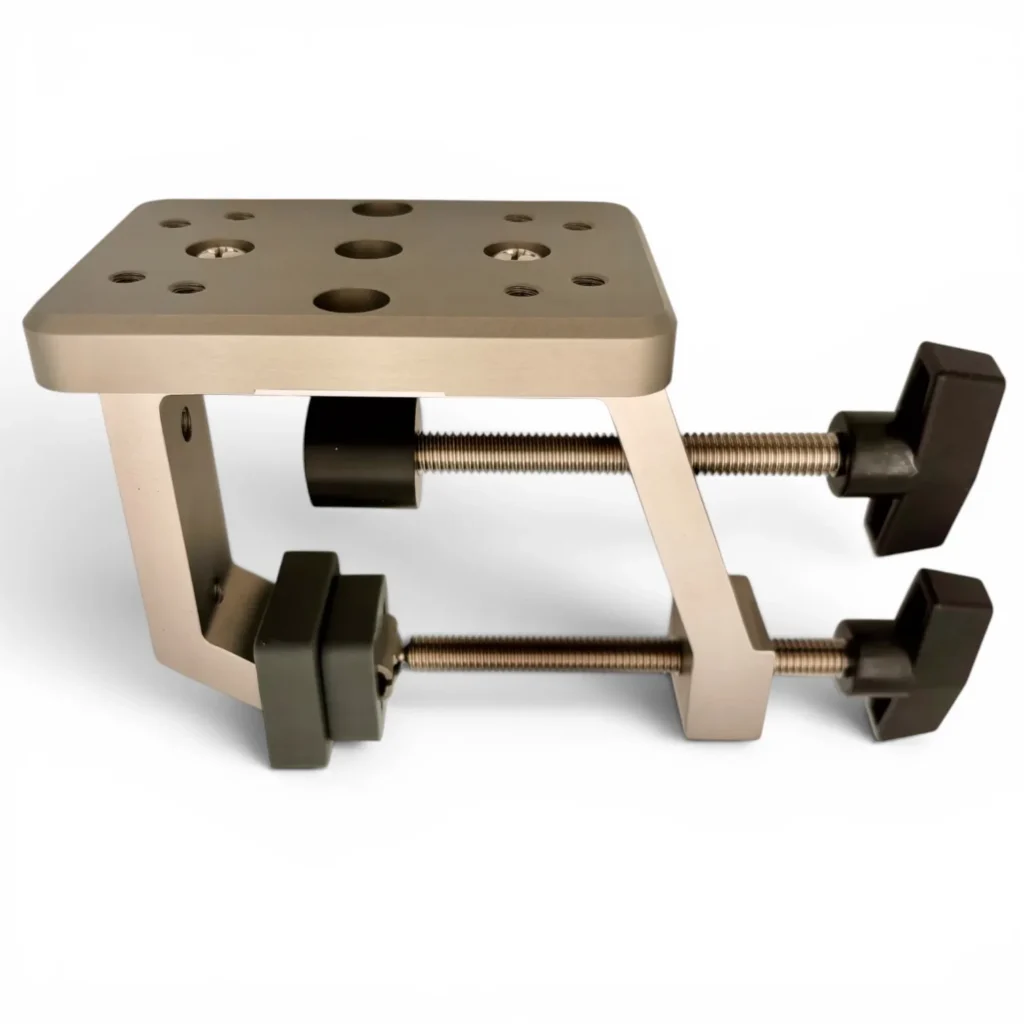
00:50:45 Phil: And you’ve also got mounts two, um, that you can clamp to the gunnels. Correct. So if you’ve got, you know, you’re on again, that large boat scenario or rental boat or what have you. This is just a simple clamp system that you screw onto the, you know, clamps it on the gunwale of the boat over, you know, basically like a C clamp kind of arrangement.
00:51:06 Speaker 5: Yeah. And then you’ve.
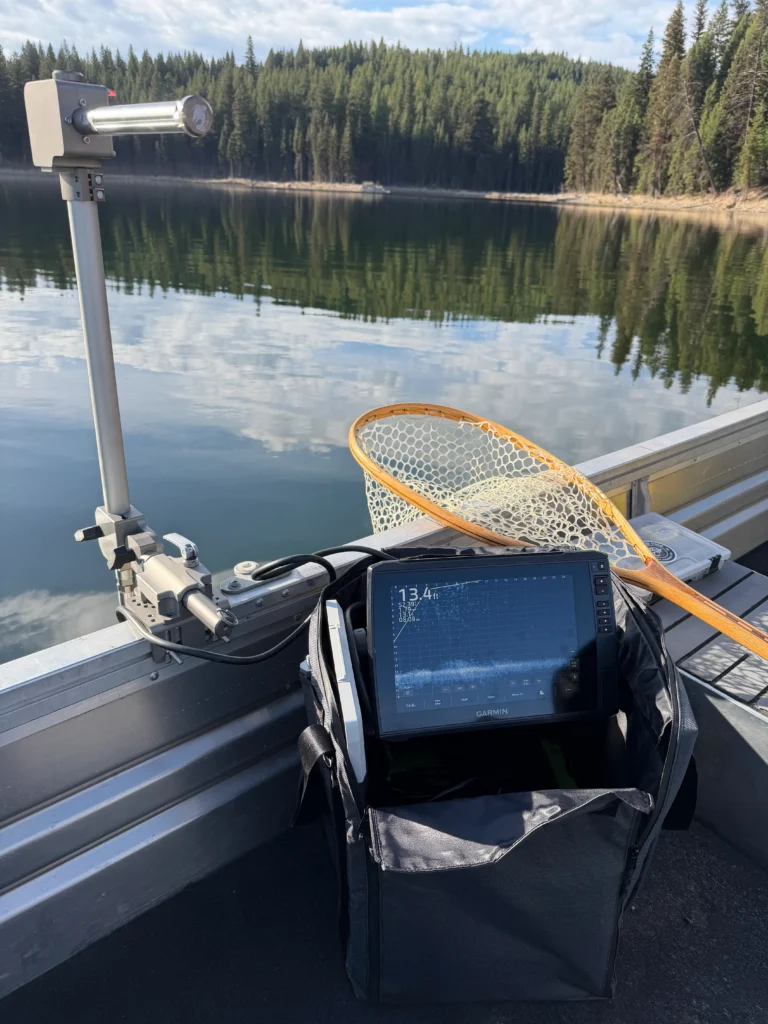
00:51:07 Phil: Got the plate on top that you mount the, the power unit. Um, you know, the battery pack and then of course, mount the, the sounder head on top of that as well. So all portable that you can do that as well. So you’ve got that, um, we’re not going to talk about forward facing sonar right now because that’s a discussion unto itself. But you also now have evolved that you have as forward facing sonar becomes more and more popular, not only with fly fishing, but obviously very popular in the conventional world, which you, uh, your products reach into as well. You’ve also got mounting systems for the pole, the directional pole that people use to aim that sounder wherever they want in the water to locate fish. So you’ve got solutions for that, correct?
00:51:54 Speaker 5: Yeah.
00:51:54 Wade: Like going back all the way to the beginning of our conversation, Phil brought up bottom line, fish finder with side imaging.
00:52:01 Speaker 5: Mhm.
00:52:02 Wade: Well, these are like live side imaging. Sonar, like your traditional sonar where histograms essentially.
00:52:08 Speaker 5: Yeah.
00:52:09 Wade: Um, but now with like, I don’t like using forward facing terminology. I like to say live sonar because that’s what we’re seeing. We’re seeing fish swim around on the screen, guys. No longer is it a banana shape, depending on how fast you’re going. Um, and a float tube or very slow vessel, they’re really not more dashes than, by the way, but live sonar man. Like it’s just changing the game in a lot of different, like, uh, sports fishing applications. Like we were talking earlier before we started here, like crappie fishing, bass fishing that have proclivity towards structure. Right.
00:52:42 Speaker 5: Mhm.
00:52:42 Wade: Um, brush piles, rocks, whatever it could be. So we had to come up with solutions for that. And guys want to move that around like a flashlight. I always like to use that analogy. You have a flashlight in your hand. You use it to see like a reptile slide down periscope or a submarine, right? This is what this technology is doing for fishermen out there. And it’s becoming more and more and more popular because it is changing the game.
00:53:03 Speaker 5: Yeah.
00:53:04 Phil: So you’ve got mounts for that.
00:53:05 Speaker 5: Describe as best you.
00:53:07 Phil: Can verbally how that mounting system works for a boat because these you haven’t developed it yet for a float tube or a pontoon boat yet, have.
00:53:14 Speaker 5: You? Well we.
00:53:14 Wade: Do actually.
00:53:15 Speaker 5: Have one for.
00:53:16 Wade: It’s the same thing. Yeah. We have flow tube one two.
00:53:18 Speaker 5: Okay.
00:53:19 Wade: We do. Um, the thing with Livescope though, like if you guys and you guys that are familiar with it out there for Phil’s audience here, you know, if you go with the Garmin stuff, the Lowrance stuff, it has a box, a power box and an interpolation box, which is called the GLS ten in Garmin’s case. I’m not sure off the top of my head what the Lawrence one is.
00:53:36 Phil: I just call it the brain.
00:53:38 Speaker 5: Yeah. So you not only.
00:53:40 Wade: Have your screen component and your transducer component, but you have this third tertiary component, right? That you have to power as well and mount really two. So, um, with a float tube, like you really like, I know from developing these products and like dealing with customers, like you said, we were talking that kind of about kind of about that where customers start calling and asking for different solutions. Well, like you need this cubic foot of space really for a Garmin live scope setup with a nine inch screen, a cubic foot.
00:54:12 Speaker 5: Yes.
00:54:12 Wade: And on a float tube that’s almost unmanageable. But there’s guys that are so fanatical out there, even more fanatical than you and I fell.
00:54:18 Speaker 5: They’ll believe.
00:54:19 Wade: It. Can you believe.
00:54:20 Speaker 5: It?
00:54:20 Phil: Yep. They will find a way.
00:54:21 Wade: Yeah, they they want to find a way. So like obviously here comes dot com.
00:54:26 Speaker 5: Right. So.
00:54:29 Phil: So how does your for the, um, you’ve got a, a shuttle system because that’s what I’ve seen with the, the live sonar is it’s a shuttle system that allows you to carry everything at once. That one cubic, uh, square foot that you talk one cubic square, one cubic square foot for the nine inch screen, for example, that contains obviously the battery, a lithium or the.
00:54:53 Speaker 5: Lithium.
00:54:54 Phil: Phosphate and lipo battery. Um, it’s got the brain box, I’ll call it. You had a much better term. And then the sounder head mounts on it too. And then you’re able to wrap the cord for the transducer because the transducer is this separate. Like you said, an inverted periscope is a good analogy. Um it’s got that look to it at least or it looks like a, it’s a big long pole with a transducer on it. And um, so, and so now they’ve got this one cubic square foot shuttle and then they’ve got their separate mounting bracket for that transducer. Correct. So you’ve.
00:55:24 Speaker 5: Got solutions.
00:55:25 Phil: For that.
00:55:26 Wade: Like the live scopes becoming so popular, but it’s also quite expensive, right? Like, you know, you’re probably looking with taxes in as a regular consumer guy out there, you’re looking at about probably three thousand five hundred dollars to get a head unit that’s compatible. If you’re starting from ground up, right. You don’t have a Garmin Echomap nine or ninety three or ninety five SV or whatever. So, you know, three thousand five hundred dollars. So and the guys have multiple bullets like you feel right to me. So unless you’re really affluent, you’re not buying a live scope. Although I have run across guys like that too. But you’re not buying a live scope for every boat. So now you’re very interested in making it portable. So going to your question, yeah, depending on what you’re doing, you might want to have, uh, like in the conditions that you’re fishing in as well, you may want to have a, like a good attached base, quick release base, those thing. And the shuttle will lock into this space. You can mount multiple, like one on one boat, one another boat, one on the other one. So every time you bring this power shuttle that you know has switches on it, a volt meter, all of that kind of fancy stuff, even like a USB plug to charge your phone off you want, or you can put a cigarette, you.
00:56:30 Speaker 5: Can I.
00:56:30 Phil: Run my GoPro off of it.
00:56:32 Speaker 5: Yeah, yeah, you can.
00:56:33 Wade: Do a lot of things.
00:56:34 Speaker 5: With it.
00:56:35 Wade: Um, but the main thing is of course mounting your fishfinder it doesn’t have to be livescope, but we’re talking about the livescope in this case, our live sonar. And, um, you can just take it. And just like other fish finders, we have those same, same conceptual solution for all fish finders still is like we find a very good way, but the cables going to your point there, that cubic foot, by the way, includes the cable mess.
00:57:01 Phil: Yes.
00:57:02 Wade: And if you’re in a little flow tube, you’re in a little aluminum boat. Well, you got way more capable than you’re ever going to need, unfortunately.
00:57:07 Speaker 5: Yeah.
00:57:08 Wade: So we had to take that into design consideration with the product, you know, to manage that part for you as well. But if you’re a big boat, yeah, you probably need the cable, right?
00:57:16 Speaker 5: Yeah.
00:57:17 Phil: Well, you can shorten the power cable, but the one cable you can never cut and shorten is the transducer cable because and that’s always a, you know.
00:57:24 Speaker 5: Impedance.
00:57:25 Wade: There could be impedance issues there. And once you start throwing that off, then you’re not getting the, you know, the right feedback.
00:57:31 Phil: That wire and that from my experience, that wire inside that transducer.
00:57:35 Speaker 5: Cable.
00:57:36 Phil: Is pretty thin. And, uh, trying to splice that back together would be for me a nightmare because I’m a, yeah, I’m a klutz when it comes to that stuff. So okay, so you’ve got solutions for float tubes. You’ve got solutions for inflatable pontoon boats, your frame boats, you’ve got solutions for small aluminum boats. You know, your magnetic transducer mounts, your transducers mount on the straps for the float tubes of the pontoon boats you’ve got now you’ve adapted to the changing world with live sonar, whether that’s Garmin, as you mentioned, Humminbird or Lowrance. They’ve all got those units nowadays. Um, and you’ve got all those supports. So you mentioned when somebody calls to you for a solution. The key thing is what are you putting it on? Right. And what’s your unit? And you’ve got basically something for everything because I’ve looked on your website and again, we’ll have links to that in the show notes. Um, there’s a lot of stuff you’ve got on there. So it really helps for them to reach out and get that.
00:58:36 Speaker 5: Yeah.
00:58:36 Wade: That’s why we have a one eight hundred number and real people, by the way, people. Yeah. Answer the phone.
00:58:41 Phil: Yeah.
00:58:41 Wade: Um, we’re the experts. We’re very good at what we do. So like we’ve seen it like you think you’re the only guy. Probably not. We’ve we’ve talked to thousands upon thousands of people over all these fifteen years, roughly that we’ve been in business.
00:58:53 Phil: Yeah.
00:58:54 Wade: And so like.
00:58:55 Phil: Well, I know in, in.
00:58:57 Wade: Almost for sure. I’ve seen your issue before.
00:58:59 Phil: Yeah. Because I know in seminars that I’ve provided, you know, at shows and schools and club presentations. And that’s always the question. They, they’re certainly, I think the, the fly fishing world’s attitude towards electronics has changed to how it was twenty five, thirty, forty years ago now. Is it is it forty? God, I’m getting old.
00:59:19 Wade: Um, probably.
00:59:20 Phil: Yeah, at least twenty five. Let’s go with that. Um, you know, when they first came out, it was considered cheating. And we used to hide them when we were kind of embarrassed to or worried that somebody would start chewing on us for having that fishing buddy. And nowadays, if you don’t have a sounder, you’re kind of not in the game. Right. It puts you at a disadvantage. And and so when your products came along, that was a real. Because frankly, that was a sounder was something that was common to a big, full size boat.
00:59:49 Wade: Absolutely.
00:59:49 Phil: There was no portable or the portable solutions that were out in the beginning were not great. Right. You mentioned that little holster for the fish and buddy, some of the other products people were trying to make. Now they’ve improved their products a little bit, but I don’t think they’ve taken it to the level you guys have with what you offer for portability. So when I do these seminars and I get that person who’s not aware of solutions, it’s really nice to say, well, you’ve got a float tube, sir or ma’am, we can put. There’s a solution for that because you can. What’s the biggest. Here’s a good question for you. It’s just some fun stories. Now, what is the biggest size sounder you’ve seen somebody put on a float tube, for example.
01:00:31 Wade: Uh, jeez, that might be hard to just zone in on that. Oh, oh, um, I’m gonna say probably ten or eleven somewhere in there.
01:00:42 Phil: That’s a big sounder screen anywhere, right?
01:00:44 Wade: It’s way too big. Like, um, I mean, if you’re a particular type of float tube, which is a frameless punch, like you call them, that’s the larger one.
01:00:52 Phil: Yeah.
01:00:53 Wade: Still, why would you ever do that? You’re very close to the screen already. Unless you have really bad eyes. And we do run across some guys that by necessity have to buy a large screen because they have really poor eyesight, but they love fishing. And so yeah, I understand that. But that’s very seldom anybody that has decent eyes or something that with glasses or whatever, your fish finder is always close to your head. But guys.
01:01:13 Phil: Yeah, the only analogy I use is, is like televisions. Nobody’s ever downsized a television that I ever it’s always starts with a twenty two inch way back when. And now we’re up to eighty five inch.
01:01:25 Wade: And it’s like that with the screens too, to some extent. But like, again, because of the application stuff, I got my voice out there when guys will say, hey, I want to get a big fish finder, seven inch screen. And I’d say, well, do you go for weekends? Do you go for long trips? Because you should think about getting a smaller fish finder in those cases, because the bigger the screen, the more capacity your battery needs to have. That means larger batteries, more weight. Yeah. Do you have the ability to charge overnight? Maybe don’t. So you want that battery to be big enough to last the whole trip? Maybe. So there’s a lot of things to consider.
01:01:57 Phil: Yeah. Your big power unit, the the green one.
01:01:59 Wade: What’s the thirty amp hour.
01:02:01 Phil: thirty amp hour again in that you’ve got your volt meter. So you know your status of the battery inside. You’ve got that cigarette lighter port you can use. You’ve got two I think two USBs in there, I think.
01:02:12 Wade: Well yeah, it’s one port that has two USBs. But I’ll just the volt meter. That’s an optional thing. But because your fish finder actually does have a voltage reading on it as well guys.
01:02:21 Phil: But you also the beauty of this unit is your charging system, right? You don’t have to disassemble.
01:02:26 Wade: Know.
01:02:27 Phil: The unit to charge the battery. It’s you’ve got a charger comes with a two point. It’s a two points charger system. You just disengage what you plug into.
01:02:40 Wade: Power power cable and stick to charger.
01:02:42 Phil: And away you go. And so it’s just convenient. So sweet and easy. Thank you. Have you got any other interesting customer stories about your products where they’ve taken it somewhere you didn’t think they’d go, which helped you, um, further improve your products?
01:02:57 Wade: You know what I like? There’s a lot, right? There’s a lot of different interesting stories I’d say, but like, you know, we do get guys like doing underwater surveys.
01:03:05 Phil: Mhm.
01:03:06 Wade: Like not just fishing guys, but guys needing. I actually, I just sold a bunch of, uh, our product to, um, the US Coast Guard yesterday.
01:03:14 Phil: Wow.
01:03:14 Wade: Well, we, we, it’s not just fishing. It’s like guys that need good solutions, even in a very industrial situation that speaks to how good our stuff is. And they’ve come back year after year. This is government.
01:03:26 Phil: Yeah.
01:03:26 Wade: Applications in the US. But um like, you know, I always just think about the portability of our products and guys going up flying trips and like finding us and just being on the phone would be breathing a sigh of relief. Like, I can’t believe you guys exist. I’m so glad that you do. I can’t believe this is out there and you solved my problem. Because like when you’re doing a fly in, usually you have like one hundred pounds weight you can take. That’s it.
01:03:48 Phil: If.
01:03:48 Wade: That’s all your stuff.
01:03:50 Phil: Yeah.
01:03:50 Wade: And our stuff is light to like light and strong. So um. Oh yeah. Ladders. Um the US there in Nevada I think it is that big lake.
01:03:59 Phil: Oh pyramid. Yes, yes. I fished that lake. Yeah.
01:04:03 Wade: I’ve sold mounts to guys on ladders fishing out of that lake.
01:04:06 Phil: Wow. Yeah.
01:04:07 Wade: Big cutthroat.
01:04:08 Phil: Yeah. Huge huge cutthroat.
01:04:10 Wade: That’s a, that’s an interesting there you go. If you have ladder, tell me your year make and model of your ladder so we can mount to it. Right.
01:04:16 Phil: Well, and you know, I’ve been down there and everybody’s, you know, I, I have to admit going off on a bit of a rabbit trail here, but the first time you go to pyramid, you see the ladders you made? Yeah. If you fish traditionally out of a boat or a float tube or a pontoon boat or stood on shore, it seems kind of what is that all about? But the times I have gone down there, you know, you can’t put those ladders up on every beach. Um you um and the water temperatures early season are in the low to mid forties. Standing with your waist in that water. You don’t last too long no matter what kind of layered approach you’ve got. Um, and it allows you to get out and, uh, reach the drop off edges that you just couldn’t wait. You’d be up to your chest almost with the ladder system. You can get out there. So you know, when you use it for the first time and put some of your just sort of you realize, wow, this is pretty good. And if people want more interest on, um, that, um, Pyramid Lake experience, I did have Nico Sunseri on talking about Pyramid Lake through Pyramid Fly Company. So I’ll put links to that. Very popular if somebody want is, you know, that spawned an interest in, uh, in Pyramid Lake and using that, but that’s great to see. So, um, just to sort of wind things up here, what are you seeing in the future? What things are you looking for? Uh, that you think your products may be able to help or where you see things going and what without giving away the. What’s new and up and coming. Is there anything more exciting coming out that the Portable Solutions offer right now?
01:05:42 Wade: Actually, Garmin has a product like that, by the way, guys, we don’t work with Garmin in terms of like any kind of financial beneficial partnership. Just just so you know, but I do out of all the different manufacturers that are kind of more of a Garmin fan just from a design standpoint, everything. Um, but anyways, they have this new spy pull three hundred sixty coming out.
01:06:02 Phil: Okay. What is that? What is that in base? What is that in basic?
01:06:08 Wade: It’s like the mega hummingbird Mega three sixty I think, you know.
01:06:11 Phil: Like, yeah.
01:06:12 Wade: Kind of idea. But I think it’s also live. I, I haven’t looked at it enough yet to really understand if it’s live or if it’s just like a mega three sixty competitor.
01:06:20 Phil: So this thing would now put a sonar and if it’s live, would put it out in a three hundred and sixty three.
01:06:26 Wade: sixty circle.
01:06:27 Phil: Around.
01:06:28 Wade: Your, your boat.
01:06:29 Phil: Boat or watercraft and you would see a live view of what’s. So if fish fisher? Because yeah, with the live, with the forward facing or the live stone or now you have to point that flashlight and where you point, you see, but you could be five degrees off and miss things. So this would allow you to see everything. Wow. So you’re developing mount solutions for that.
01:06:48 Wade: We already are. We’re on top of it. Yeah. Like this is I feel like this is going to be a like, you know, like, again, we’re going back to like when you started having down imaging and then side imaging, right? Was another layer to the history of sonar development and like how it’s changed things for fishermen. Now here is the live sonar. But then how do you apply live sonar? Do you move it around like we talked about? Or do you have a like that’s coming to the manufacturer, like having enough elements within their transducer? And is it transducer compact enough to like people don’t know, but there’s transducers that are as big as a car out there. Um, for certain applications.
01:07:23 Phil: Destroyers looking for submarines.
01:07:26 Wade: Yeah. Or whatever it could be. Right. And there’s, there’s mid-size ones too, like Aramark makes big, Aramark makes big ones, and there’s all sorts of companies you wouldn’t think of that are doing that stuff for military, um, coastal sort of other applications, bridge issues like in water, all sorts of interesting things.
01:07:44 Phil: Yeah, yeah. I’m sure, I’m sure search and rescue uses them to look for things. It’s not just, uh. Yeah. Because really probably all that technology that we get the benefit of is coming from other applications because the fishing industry is so small compared to those other applications in the world.
01:07:59 Wade: Yeah. I think in terms of capital expenditure, probably the big corporations are going to be fishermen, right? But I’m going to say this and new and upcoming we have, um, so for our livestock and stuff, if you guys are interested in livestock, hopefully Phil and I will get together here and talk more about it. I think it’s a very exciting thing. People want to pay attention to this. It’s really, really quite powerful tool for you guys. But, um, we have this new kick up, magnetic kick up system. So yeah, again, I’m using magnets to leverage our like, these are the pull downs that your transducer on for live scope. And guys are concerned about maybe hitting something while this magnetic kick up system here, you can. It will just automatically. Once you have enough force against. It will kick up to a horizontal position. Instead of being vertical in the water, it’ll just kick up into a stowed position automatically so you don’t wreck your transducer. Also, just if you want to take off, you don’t even have to get out of your boat, cockpit, or away from your tiller or whatever it may be. Just hit the throttle and it just comes right up automatically out of the water.
01:09:00 Phil: So it’s using the water pressure. That’s right to kick because that’s one of the risks you could aid. Um, I would think drive into some underwater obstruction.
01:09:09 Wade: Underwater stuff as an example.
01:09:11 Phil: Yeah. Or you leave it down and it’s like leaving your anchor ropes down and motoring away with an electric motor and sucking the ropes or, you know, doing some issue or leaving a fly line out. So same issue, you leave that down, you could damage the transducer or the pole. This is going to retract automatically.
01:09:28 Wade: Yeah. And these transducers are very expensive.
01:09:31 Phil: Yes. That’s a brilliant idea. So yeah. So thank you again. You accelerate and this instead of the transducer being locked down vertically and potentially damaging it, it’s just going to the water pressure will just gently push it up.
01:09:45 Wade: I’m going to say this though. We’re not the the, the forerunner of this idea.
01:09:50 Phil: Yeah.
01:09:51 Wade: However, I changed the spin on the idea and using magnets, there’s another guy out there that uses springs, which I think are dangerous. If you wound up a spring that tight, if something fails, you could hurt. You could I don’t know, I don’t I don’t have the product myself, but the magnetic solution in my opinion, is, I think better, much better. Okay. And you, all of our customers that have her stuff there already retroactively, uh, like able to be a component that you can upgrade to using your stuff from us already.
01:10:22 Phil: So, um, another thing here just to, again, as we wind down when people purchase your products, is there any common mistakes they need to think about? It strikes me that most of your stuff is pretty foolproof to set up, but are there any, um, sort of things you can think about? Just don’t forget to do this, folks, or make sure you do this folks. Anything like that with your, your, your.
01:10:44 Wade: This might like surprise guys, but guys read the manuals.
01:10:48 Phil: Yeah, yeah. Men are not known for that.
01:10:51 Wade: No. And like, I have quite a few guys, man. Like I just had one the other week where the guys like sent me pictures and said, hey, does this look good? Weighed right because not everybody has the same aptitudes, right? Yeah, to be fair, but the guy put the transducer backwards, right? Like on the Garmin bracket itself that like, unfortunately, Garmin didn’t really think like they have inherent within their product, offering a plastic bracket that you screw on top of the transducer, then you mount it. Yeah. Well, that plastic bracket was they screwed that onto the transducer backwards. So if he’s going to be getting like, first of all, transducers like at least conventional transducers, are supposed to be hydrodynamic, so they slice through the water like a boat.
01:11:33 Phil: Yes.
01:11:33 Wade: You know, if you have it backwards, it’s not going to be as good.
01:11:37 Phil: Yeah. It’s going to be that big face of the sounder pointing forward.
01:11:40 Wade: So we have we have stuff like that still. It’ll never go away likely because people just rush into things sometimes they don’t really read stuff. And that’s educate yourself. Just take a little time, educate yourself.
01:11:50 Phil: But you’ve got lots of videos.
01:11:53 Wade: Of all people. We’re the guys that learn about bug species. Oh, fly casting, you know, come on guys, read study.
01:12:01 Phil: Yeah, maybe it’s some of our bias. We had early years about Sounders and how they were bad things. So in addition, Wade, you mentioned your website, um, uh, fish finder dot com. Uh, you have a YouTube channel as well that you have great videos showing all of your products in use, how to attach them, how to put them together, um, their features, those kind of things. Um, you have social media channels to you.
01:12:26 Wade: You have yeah, we’ve got a Facebook. Like we’re not the best at um, that like I’m the best thing I handle in terms of social media, meaning like being at least somewhat regular, like maybe feels very good at it guys. But I, I struggled with it. Um, because it’s, we’re, we’re, we’re still, you know, relatively small business over the years. And like, you only have so many people that you can, you know, do you know as your horsepower to run the business? But the YouTube thing, I kept going good. And we’ve got like, you guys should subscribe because we’re always coming up with new cool stuff when there’s new solutions to be solved. But you look at stuff on YouTube dot com, that’s our main thing. But we do have a Facebook thing. We have Instagram. We’re trying to do better with that now. So yeah, definitely follow us that way. We do have some really cool, like I said, the magnetic kick up and deployment system there for live sonar, new products coming out that are very, very interesting and innovative and cool and unique.
01:13:17 Phil: Of course. And you did mention that you have live people answering the phone. Uh, we’ll have the phone number in the show notes, but here’s your chance, Wade, let’s give him your phone number.
01:13:26 Wade: That’s seven seven or one eight five five seven eight four three four seven four.
01:13:33 Phil: Yeah, that’s toll free.
01:13:34 Wade: Five five seven eight four three four seven for folks.
01:13:37 Phil: Okay. So that’s toll free. So Wade, uh, anything else that we you want to add or did we miss or, or anything? I again, I’m.
01:13:45 Wade: Hoping that we like, I think there’s a lot more like that we could do together. Phil I’m hoping that like, I know you, you podcast, you know, you don’t people might get tired here listening to me go on and on, but maybe if we break it up into smaller chunks, they might appreciate more.
01:13:58 Phil: So yeah.
01:13:59 Wade: Let’s, uh, try to hit some more here soon.
01:14:01 Phil: And yeah, yeah, my goal with this, uh, discussion today was to talk about, you know, a common, um, complaint that fly fishers have that don’t have the full size boats or anything like that, that they, they can get the benefits and enjoyment out of electronics on their float tubes or pontoon boats or kayaks, their canoes, their little tinny car toppers or ten footers or twelve footers or fourteen footers. And of course, if you’ve got a a big boat, a big full size Lund or Crestliner or sorry, Yamaha or whoever, I’ve missed whatever, you’ve got solutions for them as well and for any military contracts out there as well.
01:14:40 Speaker 6: So yeah, that’s right.
01:14:41 Phil: So wait, I want to thank you for joining us today. Hopefully everybody enjoyed that. And we’ll certainly have links to your YouTube channel, your Facebook page, your website, of course. Uh, I encourage people to go there. So the next time, um, they’re out on, you know, they’re looking at their watercraft and would like to take advantage of some of the electronic components, the Sounders that are out there nowadays, they can adapt them to their boat, not only the sounder itself, but the transducer. So Wade, thanks so much for joining us today. I really appreciate it. And I think you you guys have done a great job solving a problem that, uh, many in the fly fishing world and I guess conventional anglers have to.
01:15:21 Wade: Thank you, Phil. And I just want to say, guys, everybody out there. When I started fly fishing when I was twenty years old, Phil Rowley and, uh, I got his books as literature. I was doing everything I could to learn about fly fishing because I was a conventional hardware guy before fly fishing. And, uh, I was, uh, you know, kind of an acolyte, uh, acolyte of skills. He didn’t know it, but then I, I’d even meet him at trade shows just briefly, and he was like, kind of like, you know, like a celebrity really in the fly fishing world for me and my dad. And I’d be, you know, anyways, Phil has really helped me. Um, so full of knowledge and so much experience and so much energy this guy has and he’s so accessible. So keep going with Phil Rowley. He’s winning shot there for you guys learning, learning more and more and more about fly fishing.
01:16:10 Phil: Well thank you Wade. And that’s not a paid announcement by the way everyone. So anyway Wade, have a great day. And, uh, I’ll go on your website and see what other products I can get as I upgrade my sound systems. Almost annually it seems nowadays the changes are going on. So thanks again everyone, and we’ll look forward to seeing you on the next episode.
01:16:30 Speaker 6: Thank you Phil.
01:16:32 Phil: I hope you enjoyed today’s talk with Wade Van Pelt from Fishfinder Mounts. If you’ve been wanting to incorporate a sounder into your Stillwater repertoire but haven’t quite figured out how to attach one to your boat, float tube or pontoon boat, perhaps one of Wade’s innovative products might provide the solution you’ve been looking for. For more information on any of the Fishfinder Mounts products, please visit their website at fishfinder mounts dot com or give them a call toll free at one eight five five seven eight four three four seven four. That’s one eight five five seven eight four three four seven four. Be sure to mention today’s podcast. You can also follow them on Instagram, Facebook, and YouTube. Be sure to give them a follow and subscribe to their YouTube channel to keep up with new products as they become available. Please look for the links in the Show Notes section of this podcast. I also mentioned the Pyramid Fly Fishing Company episode in this podcast. You can also find links to this episode in the show notes. If you have any specific questions about today’s episode, any previous episode, or any other Stillwater fly fishing question or potential topic for a future episode, please reach out to me via email at Phil at fly fishing dot com or fly at Shaw dot CA. I’ll put links to these email addresses in the show notes section as well. Thanks for listening. If you can get out onto a lake soon, I hope you enjoy Stillwater fly fishing as much as I do.
Portable sonar has changed the way many Stillwater anglers approach unfamiliar lakes. Wade Van Pelt explains how Fish Finder Mounts grew from solving one simple float tube problem into creating portable mounting systems that now support nearly every type of fishing boat and today’s most advanced sonar technology.