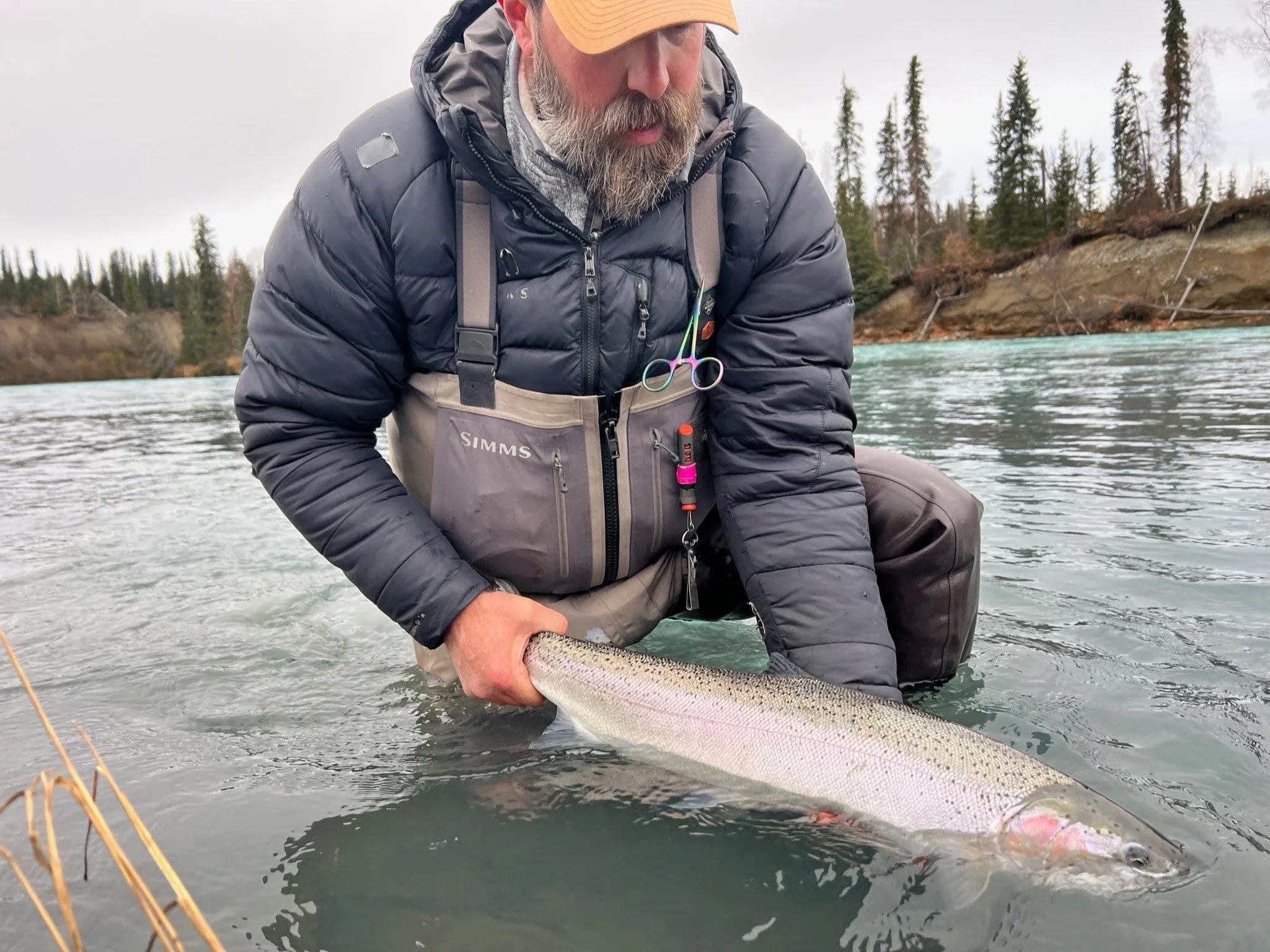
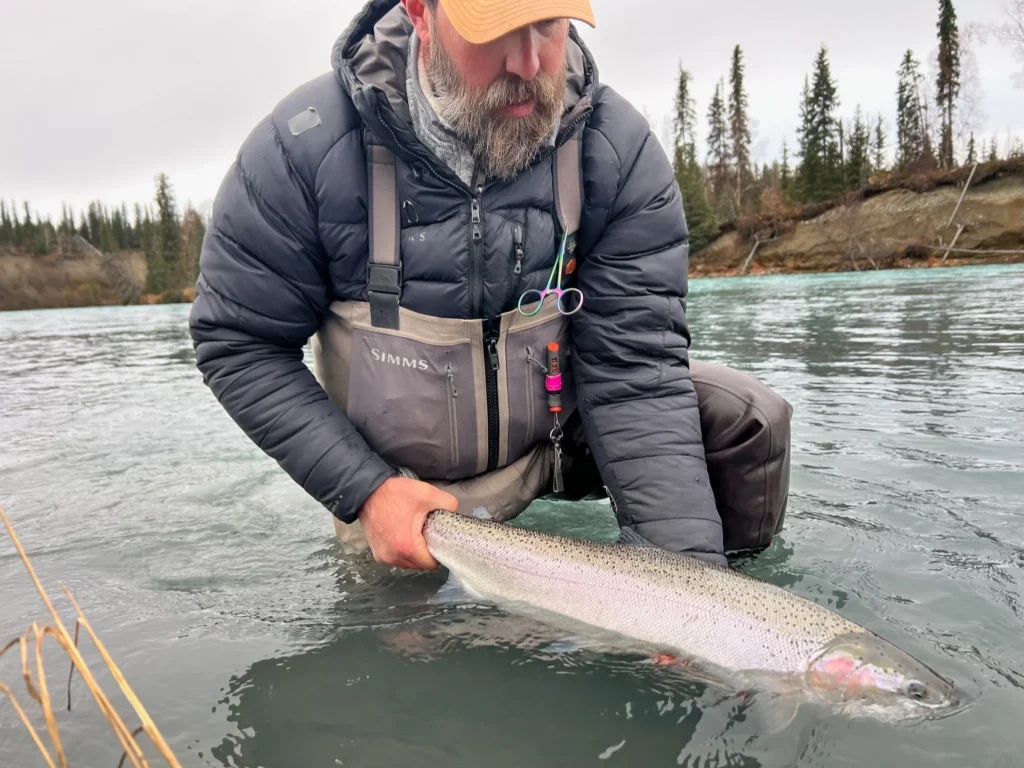
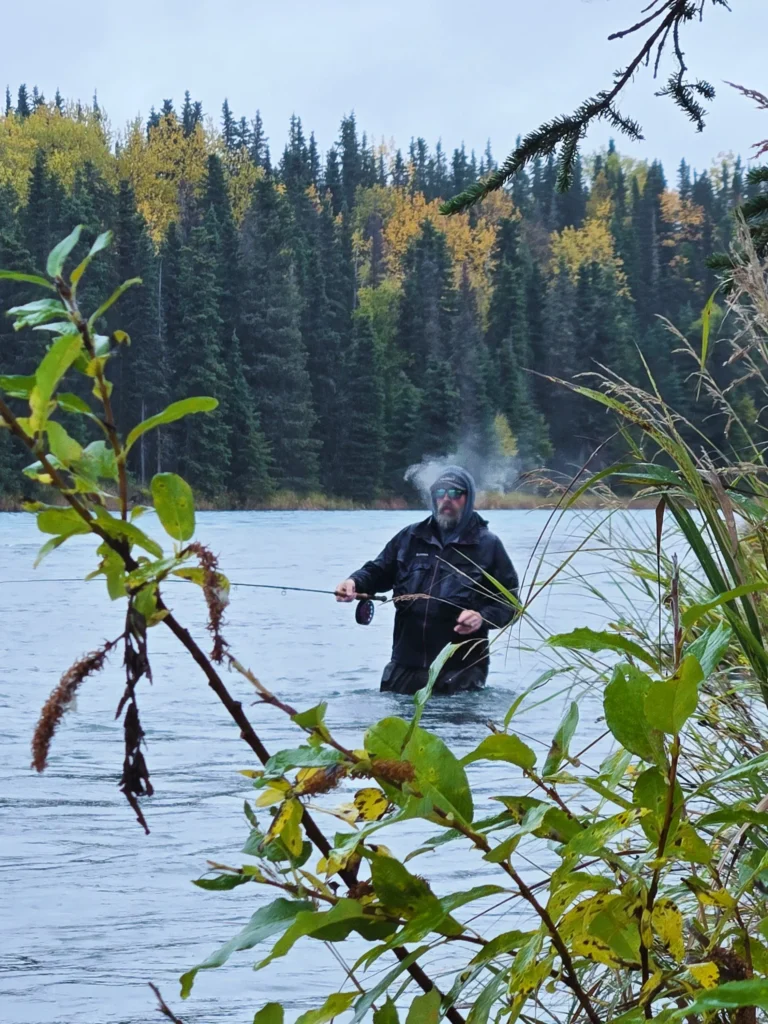
Jonathan Farmer from Midnight Sun Custom Flies shares how this camp blends the comfort of a lodge with the authenticity of a true Alaska steelhead camp. It’s built for anglers who want to fish hard, learn more, and experience Alaska in the fall.
From swing techniques to river behavior to camp life, this one is packed with insight for anyone chasing chrome.
This isn’t your typical lodge experience. Jonathan built this camp to sit right between rugged DIY trips and full-service lodges. You’re fishing hard all day, but coming back to a comfortable setup with real meals and a warm tent.
It’s designed for anglers who want immersion without sacrificing comfort.
This program is 100% focused on swinging flies. No beads. No bobbers. Jonathan isn’t knocking other methods, but this camp is built around the experience of the swing. Once you feel that grab, everything changes. It’s not about numbers anymore.
This is about doing it the hard way — because that’s what makes it unforgettable.
The home water for this camp is the Kasilof River in southcentral Alaska. It’s a short system, but incredibly consistent thanks to its glacial lake source.
Because of the lake, you’re fishing every day — rain or shine.
One of the biggest takeaways is how Jonathan approaches fishing a run. It’s not about bombing casts. It’s about methodically covering water. Think of each run like a grid.
This is where most anglers miss fish — moving too fast instead of fishing thoroughly.
The gear here leans toward power and control. These fish are fresh, strong, and close to the ocean.
Jonathan learned the hard way — lighter leaders don’t cut it here.
Because the river is short, fish movement becomes even more important. These fish don’t have far to travel, and they move frequently.
You might fish a run one day and find it completely different the next.
This is a 7-night, 6-day trip with a flexible schedule.
No rigid lodge timelines here.
If you want to fish hard all day, you can. If you want to take a break, that’s fine too.
The season runs from late August through October.
Each window offers something a little different.
By late October, you might even get light snow — which makes for a pretty special atmosphere.
One of the best reminders in this episode is that not every fish needs to be landed. Sometimes the ones you lose are the ones you remember most. Jonathan emphasizes:
When it happens, just hold on and let it play out.
This is a big part of the camp. In this region, it’s illegal to lift steelhead out of the water. Jonathan is focused on doing things the right way.
The goal is to protect these fish for the long term.
Episode Transcript
WFS 910 Transcript
00:00:00 Dave: Welcome to the show. Good to have you with us today. If you spend any time around rivers, you know, there are always a few people who seem to understand the water just a little bit better than the rest of us. Steelhead fishing has a way of humbling anglers. You can make the right cast fish, the right water, swing the right fly, and still spend an entire day wondering if you’re even close to what the fish want. And you can spend an entire day wondering if you were even close to a fish. Today, we’re heading north to Alaska to talk about a new kind of opportunity for Steelheaders, a focused steelhead camp built around swinging flies, covering water, and learning how these fish really move through a system. Today, we’re heading north to Alaska to talk about a new kind of opportunity for Steelheaders, a focused steelhead camp built around swing and flies, covering water and learning how these fish really move through a system. This is the Wet Fly Swing podcast, where I show you the best places to travel to for fly fishing, how to find the best resources and tools to prepare for that big trip, and what you can do to give back the fish species we all love. Jonathan Farmer is back on the podcast today, and we are going to find out about their new dedicated steelhead camp in Alaska. That’s creating a new kind of trip for anglers who want to focus on swinging flies. We find out what water types are holding fish up there in Alaska, how this winter summer run fishery is is a little bit different than other areas. We’re going to talk about Alaska and some of the species up there, including coho as well. We’re going to find out about why timing, river movement and fish travel windows might matter more than you think for anglers and what anglers should expect when planning a trip built around learning, covering water and chasing chrome in Alaska. All right, let’s get into it. You can find Jonathan Farmer at alaskasteelheadcamp.com and Midnight Sun custom flies. Here he is. Jonathan Farmer. How you doing, Jonathan?
00:01:52 Jonathan: I’m good. Dave, how are you?
00:01:53 Dave: Good, good, good. Great to have you on here today. We we’ve had some good stuff going last year I feel like it took a while to finally connect, but we put together some good stuff, including a trip up to Alaska to Togiak River Lodge. But the cool thing is to. Now you’ve got the Alaska Steelhead camp. We’re going to talk about today, Midnight sun custom flies. We’ve talked about the Graboid. I caught a salmon using. We’ll talk about that probably a little bit today, but you’ve got all your flies. But now you’ve got this steelhead camp going. Whenever I hear camp, I always get excited because I feel like that usually means something cool. So we’re going to talk about your new steelhead camp in Alaska and all that, but give us an update. Last time we really actually saw each other in person was Alaska. What’s been going on since the summer of last year?
00:02:35 Jonathan: It was, uh, I played some golf after after you and I got to do our thing. King fishing and then steelhead season rolled around and enjoyed, enjoyed that. You know, we’ve got, uh, really realistically, we’ve got about a three month window. Uh, but that first month in August is really hit or miss. So I typically don’t really, you know, bother with early August, but, uh, they’re definitely, you know, fish to be found in coho and, and that’s, that’s always a riot because we have some really good sized coho here. And then September, you know, the focus shifted to steelhead fishing and into October. And then I haven’t actually taken the day off since mid-October.
00:03:25 Dave: Every day, like seven days a week.
00:03:27 Jonathan: Yeah. I worked on Christmas. I worked on New Year’s. I didn’t work full days, but just trying to keep up with, uh, fly orders. And, you know, every time I start to begin to get caught up, I get slammed again. And I’m incredibly grateful for it. But, you know, it’s winter time. We’ve had a cold winter here in Alaska, so there hasn’t really been a whole lot to do, so you might as well.
00:03:48 Dave: So what is a cold winter in Alaska means what does that look like right now?
00:03:52 Jonathan: Uh, we were below zero, uh, like in the teens for three weeks, close to a month, which is not not typical. Given that we’re like a maritime climate.
00:04:04 Dave: In Anchorage, right? That’s where you’re at. Yeah.
00:04:06 Jonathan: And for anybody who doesn’t know maritime like climate terminology, it means that we’re a coastal, you know, climate. And we get typically warmer, milder winters with with more snowfall. But yeah, this one’s been a cold one. And we’re back down in the, you know, those lower temps again. So that’s really uncommon for March. The last time that happened, uh, was twenty nineteen, if I’m not mistaken. And we had a really warm summer, which produced a beautiful fall. So I’m hoping that we have some really nice weather going into fall this year.
00:04:49 Dave: Yeah. And that’s the key is now for steelhead. It is the fall. There’s no winner. There’s no like spring season there.
00:04:55 Jonathan: So really in South Central, our air quote, spring season. They’re mostly summer steelhead that have overwintered in that system. And they’re all in there. You know, prespawn stage. So I, I won’t, I won’t, you know, harass those fish that time of year. We, we do have a, a small winter run, but again, you’re going to be, you know, catching fish that have been in the system since August potentially. And that’s kind of a special thing about our fish is that they come in and they’re, they’ve got ocean weight and they’re healthy. And, you know, but I, I just typically won’t, you know, won’t steelhead fish in the spring? So yeah, we’re a summer steelhead, you know, fishery, but you’re fishing, you know, what you would find typically in a winter steelhead fly box.
00:05:53 Dave: So well, let’s just go to that right now. So the camp maybe describe kind of what it is. You know, who’s running it and kind of what people can expect because. And is it open right now if people as they’re listening, can they actually call you and be like, hey, we want to go steelhead fishing?
00:06:07 Jonathan: They absolutely can. Uh, websites up, uh, Alaska steelhead camp dot com. Uh, started a new Instagram page, Alaska steelhead camp. Uh, you can find links to the website in both the Midnight Sun Custom flies Instagram or Facebook page. I don’t know if the link is on Facebook, but Instagram is really where I do most of my social media content. And so you can find all the links to all of my stuff on Instagram.
00:06:35 Dave: So we’re looking at it now, Alaska steelhead camp dot com. People can check out the website. You’ve got a beautiful picture of, uh, of a steelhead eating, I’m guessing one of your flies. What’s the fly in its mouth?
00:06:44 Jonathan: Uh, that’s a Graboid. It’s an orange graboid.
00:06:47 Dave: And so talk about it. So give us the rundown. What is what is the program, maybe the back story and tell us about how maybe it’s different than some other steelhead operations.
00:06:56 Jonathan: So I’ve been doing a steelhead camp with with a couple of my best friends for years. And it first started off we went down in a motor home, an old motor home. I’ve spent an unbelievable amount of time in said motor home with with one of my really close friends that is pictured on the back of the book, Chasing Chrome that I wrote. We did a podcast on and that just kind of progressed over the years. And then, uh, we started going down in like a big camper, like a big one. And then transitioning throughout the years that the camp has kind of changed. And one of my other really close friends and I have just made it an annual couple month deal where, you know, we both have lives and he’s got kids, but we still make multiple trips down a year and stay for, you know, four or five days. And we try and set up a pretty comfortable camp. And then this fall, just after, you know, the book and, and I’m always trying to progress and, and give back to the steelhead community in some way, shape or form all the while, like making a living. I had the thought, you know, after talking with Marty and a couple other of my clients who go to a steelhead camp every year, uh, it’s not a, you know, thing like what I do, but they just set up camp, uh, and just thought, man, that’d be really, really neat to offer people to have a really authentic, you know, experience. You know, from, from my perspective, lodges are great. However, there’s something to be said about, you know, a comfortable camp because steelheaders in my purview are just a different breed of people. And it doesn’t matter if they’re, you know, a CEO of a fortune five hundred or just a normal dude like you and I? They want something a little bit different. A lot of the time. And so I started building this idea and ended up putting together a camp that will be extremely comfortable. So my aim was kind of something in between a lodge experience and just a rustic camp that you might set up with your buddies for a couple of days. So something that’s really comfortable. So we’re running a ten by ten lodge tents with a wood stove. And, you know, I even found portable sinks that can go in each log lodge tent. Yeah. So you can wash your hands, brush your teeth.
00:09:34 Dave: Cool. So this is like the canvas style, like elk tents.
00:09:38 Jonathan: Yeah, exactly. Found heated camping chairs on demand, hot water for a shower.
00:09:44 Dave: Heated camping chairs. So these are like camping chairs you plug in.
00:09:47 Jonathan: Yeah, you just run them off a battery pack.
00:09:49 Dave: Oh that’s cool.
00:09:50 Jonathan: Yeah. It’s got a camp chef lined up and a really good menu for the week. You know, because I started thinking if I’ve got somebody there cooking because at the end of a steelhead day for me, I’ve always fished until sundown. And the last thing that I want to do is go back to camp and make, you know, dinner. And so we’ve just usually ended up. Yeah. You know. Oh, yeah.
00:10:18 Dave: That’s so nice.
00:10:19 Jonathan: Eating whatever.
00:10:20 Dave: Eating a sandwich or maybe even not eating. I mean, that’s how dedicated steelheaders are, right? Sometimes they’ll just be like, you know what? I don’t have to eat tonight. I’ll just wake up early and get something.
00:10:29 Jonathan: Yeah, exactly. It’s just kind of a, you know, it’s a who’s making dinner. And then it’s like, well, I’m just going to make myself a sandwich and call it good. But you know, you can’t do that if you’re running a steelhead camp and you’re having guests and I want everybody to be fed well. So put together a really good menu. I’ve figured out how to even make waffles in the morning. Uh, in camp. So that’s pretty neat. And then fishing six days. So seven nights, six days of guided steelhead fishing and solely swinging flies.
00:11:05 Dave: So swinging. So that’s the key. So this is all swinging flies for steelhead.
00:11:08 Jonathan: Yep. We will not fish bobbers will not fish beads. And people can fish however they want to fish and whatever makes you happy. I’m a proponent of doing that. That being said, and steelhead fisheries and this may sound trite or snooty, but I genuinely think that, you know, swinging flies for steelhead, once you get that first grab ever, there’s nothing like it. But I’m not okay with steelhead fishing for numbers.
00:11:39 Dave: Yeah. No, you’re right on. Well, you just made me think of something. You’re going to love this one because this story is classic is I was just on the op fish the op for a day and had a steelhead. It was it was great. Wild steelhead caught it. It ran at me, you know, it was a good fish kind of. And I got it got close enough where I could see it and I was like, and it flashed. I was like, okay, that’s definitely a nice steelhead. And then it took off away from me, out of the water, jumped out of the water about the length of its body. And I thought it spit the hook and it was gone. And I was like, oh, but I felt good. I was like, you know what? That’s steelhead fishing. I mean, I feel like if I get the hook, if I get the hook up, you know, the tug, right? I’m, I’m okay losing that fish. Quick release, better for the fish. But the funny thing about this story is we got the fly it. And guess what? The fly. I won’t name the company, but it was tied by a company and the shank came apart and the only thing left was the top of the tight on the whole thing pulled off. Have you ever seen that happen before?
00:12:35 Jonathan: I have not.
00:12:36 Dave: I mean, do you know how that could happen? Because it literally the whole fly, the hook, everything pulled off, the shank pulled off or the only thing left was the top of the shank tied to the knot. Oh wow, isn’t that crazy?
00:12:47 Jonathan: That’s wild. I mean, I haven’t fished, I’ve fished a couple of friends flies over the years, but everything that I fish is of my own hand. So, you know, I use a stupid amount of crazy glue, as I’ve talked about in all my videos and stuff throughout the years. And that’s the goal anyway.
00:13:05 Dave: Your flies aren’t coming apart. So anyways, I thought you’d appreciate that because I thought that was a crazy thing that happened. But point being is that the tug was all I needed and I was like, you know what? I’m happy to see that fish go away and, you know, and all. And it was Barbless hook, so it probably popped out eventually.
00:13:18 Jonathan: There’s some fish that I’ve lost over the years that I remember more. And those memories are more fond than fish that I’ve landed, you know? And when you when you really work for one, and you have that ability to be creative on where you fish and you actually really work for it, those those memories are, are hard to replace and photos don’t even do them justice. And I’m at a point now where I wish I’d taken more photos of steelhead over the years, but most of the time, you know, you land them and you let them go. I’ve never been a big fish photo guy wishing I had been a little bit more now. But you know, just for the website and things.
00:13:58 Dave: Yeah. What is the, um, you know, on this area? Is this a secret river or is this a river that we could talk about here, where we’re going?
00:14:05 Jonathan: I’ve always been, uh, I’m going to quote one of my best friends and fishing partners of fifteen or so years now. There’s no secrets on the road system. And in Alaska, in Alaska, there really are no secrets. Everything can be found on on Google and, you know, social medias. I’m not going to say social media has ruined fishing, but it definitely takes people that are going to be good stewards of their rivers to promote them. And that’s where my M.O. is is respecting fish. And you know, I kind of have some rules based around that. And you and I kind of experienced like how I, you know, you and I fish together. It’s like you get first look at the first run, I get first look at the second. And we kind of trade off throughout the day. Um, so all things are fair and equal, but you know, if ever I have a three fish day, I’m personally kind of done. Yeah. That’s right. If you hook three steelhead in a day, you’ve had a great day. I know, or you at least go to the back of the line.
00:15:10 Dave: Yeah, yeah, you can screw around. You can smoke your stogie in the back. You could hang out.
00:15:15 Jonathan: Yeah. Have a cigar and and enjoy just where you are and, and take that in because I think a lot of times as anglers, we forget to appreciate where we are. But no, my, my home fishery is not it’s not a secret. It’s, it’s for the average individual. If they were to want to come to Alaska and fish it, you’d have a hard time without a guide of some sort. It’s accessible by boat. Uh, there really aren’t many walk in spots. There are a couple in the lower river, and I mean, like lower, lower river, but you can’t really access it by foot because you’re going to have to hike through Alaska Wilderness Area, essentially, and you’re going to have to go a long way, and you’re going to have to know where you’re going and make sure that you’re not crossing through private property. And then, uh, the native corp owns a crazy amount of land around the upper portion.
00:16:11 Dave: When it comes to high quality flyers that truly elevate your fly fishing game drift Hq.com is the trusted source you need. I’ve been using drift hooks expertly selected flies for a while now, and they never disappoint. Plus, they stand behind their products with a money back guarantee. Are you ready to upgrade your fly box? Head over to Drift Hook dot com today and use the code swing at checkout to get fifteen percent off your first order. That’s Drift Hook d r I f t h o o k dot com. Don’t miss out. Experience the waters of Bristol Bay at Togiak River Lodge, where fly fishing meets Alaska’s rugged beauty. This is the place to complete the Alaska Grand Slam with all five salmon species rainbow trout, Arctic char and more, where each day offers a new Alaskan adventure. You can visit Togiak Lodge dot com right now to start planning your Bristol Bay experience with Togiak River Lodge. And we’re not talking about Kodiak. We’re not talking about Kodiak here. Right?
00:17:10 Jonathan: Uh, no, this is this is on in south central Alaska. But Siri, the Cook Inlet region, they own a lot of land up there. So really your only access is by boat. And it’s not particularly an intimidating river or a super technical river, but there are some sections through there that if you’re not an experienced oarsman, uh, you might find fairly intimidating, you know? So it’s not one that I would suggest anybody just come up and rent a boat and, and row a blind.
00:17:42 Dave: But that is part of the camp. Is this something where you’re going to be drifting or is this walk and wade?
00:17:46 Jonathan: Yeah. So we’ll, we will float every day. I’m going to leave one day open. If people want to get out and explore and stretch their legs a little bit. I’m going to leave one day open throughout the week. Uh, that’s optional for a walk in day, uh, somewhere. And I’ll leave. I’ll leave those fisheries nameless, but the kasilof is, is our home. It’s our home steelhead River. And it’s, you know, it’s like fourteen miles long from the Sault to Tustumena Lake. So a lot of our fish are bright and they’re, you know, there’s a really good chance that throughout the week you encounter multiple fish with sea lice. It’s a really neat fishery, but it’s not it’s not a long river. It’s not, you know, you got like fourteen miles.
00:18:33 Dave: To the lake, Right. Is it? What’s the name of the lake that flows out of Tustumena?
00:18:36 Jonathan: And it’s absolutely massive. And it’s about a thousand feet deep. Uh, it’s on the list of thirty largest lakes in the world, so no kidding. It is. Yeah. Tustumena tustumena. There’s a big T at the at the end of the road. And so every time we drive by it, I yell T for tustumena. It’s pretty funny. It’s just a little, little joke with any of our guests. We’ll definitely hear that because I can’t help myself at this point. But yeah, it’s kind of a, it provides a neat insurance for our fishery because it’s impervious to blowing out. So every day that you fish is a guaranteed fishing day.
00:19:16 Dave: Oh, so it won’t blow out because of the lake. It stays clean.
00:19:19 Jonathan: Yeah. It can rain and.
00:19:21 Dave: Rain.
00:19:21 Jonathan: And rain and rain and rain. And you might see a little fluctuation in in water level. And I’m meaning inches, but you know, it’s fed by the Harding Icefield.
00:19:32 Dave: So yeah, the Kenai Fjords National Park, right?
00:19:35 Jonathan: Exactly. Yeah. And so it’s a glacial river. It’s got a bunch of big boulders in it. And it’s, it’s a really, it’s a really special river to me and it’s fairly unique. And all the, all the steelhead rivers that I’ve fished, it’s, it’s unique, uh, forces some creativity and I hold it very special, but it, it is really nice to have a fishery that no matter what the weather is doing, you know, you can fish it.
00:20:02 Dave: That’s huge. That’s huge. Yeah. Steelhead. That’s a big factor, you know, and if you only have one, usually I think steelheaders and they’re in the, you know, rivers blow out. So you have small rivers. You could fish medium bigger ones, right. If you’re lucky. But this is you’ve got one. You don’t have to worry about that. What is the, what is the gear look like on this rod rod length? What tips? What do you guys use in here?
00:20:22 Jonathan: I prefer and this is just per my, my casting style. I prefer something in the Twelve foot six inch range as far as a rod and and an eight weight. Uh, we do have some heavy water adjacent to our swing water. And if you end up hooking a ocean bright fish and they get out in that heavy current, you’re in for a real ride. So having that backbone of a at least a seven weight or an eight weight is, is pretty imperative. And I’m typically using the shorter Skagit heads. A lot of the places that I personally like to fish, you don’t have a ton of back casting room. But over the years, learning this river and and thinking about how, you know, I might fish someone that’s, you know, novice or new to our our sport. There are tons of places where you don’t have to be a technical caster. You don’t have to know, you know, every cast in the book. And we can take anybody that has barely ever touched a two hander before and and get them fishing.
00:21:31 Dave: Yeah, I think that’s the beauty of the Spey is that it’s really allowed everybody. You know, I mean somebody could probably maybe be their first time with the Spey rod and probably have a chance at a steelhead with you guys. Is that a true statement?
00:21:43 Jonathan: Oh yeah. Absolutely. Because there’s a ton of places where you don’t have to cast sixty feet. You don’t have to be a world class caster. I enjoy it, you know, you and I fish together. I enjoy fishing in those places that force creativity in my casting. And that are difficult because they make me think. But that being said, I can think of a ton of places that I could put a person who’s, you know, picked up a two hand rod for the first time or it’s their first year and give them really good opportunities throughout the week to catch fish.
00:22:17 Dave: And this is cool because this is a full six days on the water. So does that typically are these set where it usually starts on a Saturday sort of thing through the week, or does this depend on. and do you have shorter trips or is it always a, you know, set a week trip?
00:22:31 Jonathan: You know, if somebody could only do four days, we could figure something out with them. But the thought process was if, if I was, you know, working for a living and I could take a week off, you know, flying in on Sunday.
00:22:47 Dave: To Anchorage, right. Flying to Anchorage.
00:22:49 Jonathan: Flying to Anchorage and, and then flying into Kenai Airport, which is a super short flight from Anchorage.
00:22:55 Dave: You could drive, couldn’t you?
00:22:56 Jonathan: You could drive if you wanted to. So if somebody wanted to rent a car and drive down the Turnagain Arm and through Turnagain Pass. Turnagain pass isn’t as scary as it sounds. And experience that drive.
00:23:10 Dave: It’s a cool drive. I drove a long time ago. I drove all the way down to Homer. We did a Kenai Fjords National Park tour and it’s an amazing drive. I mean, I remember going, aren’t there some volcanoes as you’re driving down across towards the Lake Clark National Park? Are there some active volcanoes over there?
00:23:25 Jonathan: As you’re coming from, say, Cooper landing into Soldotna, you can see like three volcanoes. And so that’s pretty neat. The the Turnagain Arm is stunning. You know, it’s an absolutely beautiful drive. It’s got the second largest tidal surge in the world. So, you know, it’s it’s a neat place. So if you wanted to drive, you could, um, you know, I’ve tried to tailor the trip to be as affordable as as possible. So that flight from Anchorage to Kenai is, is the most affordable option. I don’t know what car rentals run these days, but, you know, if someone wanted to make that drive, they absolutely could. But flying in on, on Sunday morning into Anchorage and then hopping on a commuter flight from Anchorage to Kenai, and we pick pick our guests up on Sunday evening. That way you’re only taking, you know, five days off of work, you know, and then we fish Saturday and take everybody back to the airport on Sunday morning. And, you know, anybody who’s ever been on vacation has gotten back Sunday and gone right back to work on Monday. You know, it’s it’s not the first thing that you want to do. However, everybody can deal with a couple of days of, of getting back to work and, you know, doing that whole thing. So yeah, that was, that was kind of the thought process of, of trying to give, you know, our guests maximum value, you know, because a lot of lodges only do five days. And I know that I want, I want another day. You know, if the fishing’s been great, if the fishing’s been slow either way. I want another day on the water. So six days for me is typically about the longest I want to be away from home. And I’m at that point, you’re ready to go and you can make peace with leaving. I’ve actually got someone who wants to come up for two weeks. So yeah.
00:25:21 Dave: Uh, right. And those two weeks are going to be. You said September. Describe the season. Is it three months?
00:25:27 Jonathan: So we’re we’re doing two months. The last day of August through November first. So we’ve got nine weeks. And the first couple of weeks, the first really three weeks of our season is going to be a mix of coho and steelhead. We’re not necessarily going to target coho. We can. But you know, they’re those slow pockets that coho will pull into.
00:25:52 Dave: Yeah. Are you catching coho on the swing at all? Ever?
00:25:55 Jonathan: I’ve caught coho on the swing like mid swing. It’s not the most common thing. But you know, coho and steelhead will kind of share that that resting water.
00:26:06 Dave: Yeah. They look, they. Well, I remember the first. I haven’t caught a lot of coho on the swing, but I remember on the Skeena, which is again quite a ways, we’re not even in the same neighborhood from what we’re talking about. I always go back to Canada because. But yeah, you’re in South Central, you’re not in Southeast Alaska. We’re.
00:26:21 Jonathan: Oh, Yeah, we’re we’re in south central Alaska, so we’re.
00:26:24 Dave: Yeah. You’re in South central. So not even close to the Skeena, but I remember on the Skeena fishing for steelhead there. And I think one of the first fish I caught was what I thought was steelhead until I got it in. And I was like, whoa, that’s a beautiful chrome bright co-host. So all these coho pretty, pretty kromer’s too.
00:26:39 Jonathan: They are. And we have some pretty large coho. So that’s, that’s really fun. And it, you know, it’s entertaining, you know, it’s not the target species for, for a lot of people that are coming here for steelhead. However, I have never complained when, when I’ve hooked into it. No, I’ve hooked into a coho.
00:26:59 Dave: Nothing to complain.
00:27:00 Jonathan: About. Yeah. They’re a riot. And you’re right, it is hard to tell sometimes. Uh, between it’s hard to delineate between the two until you land them.
00:27:10 Dave: So you guys get in. So we get there Sunday, we get to the camp, and then Monday morning is it, uh, you know, are these drift boats, rafts? Are you getting in the boats and going.
00:27:19 Jonathan: We’re going to run rafts because as the river drops, as we come into October, it doesn’t get too bony for a drift boat. But I you know, I think rafts are a little bit stealthier and you don’t have to worry about low water at all. So that’s kind of my thought process on that. Just really the, the stealthiness aspect of it for me is, you know, you don’t have to worry about a drift boat clanging as you pull into a run and, and doing a lot of studying on steelhead behavior, uh, over the years. I, you know.
00:27:54 Dave: Yeah, it makes a difference.
00:27:55 Jonathan: Yeah, it does make a difference.
00:27:57 Dave: So you guys are getting down, so you’re basically in rafts get out there Monday and then is it a kind of hop out. Fine. Run. So talk about what the day that first day looks like.
00:28:06 Jonathan: Yeah. So so day one, you know, is clearly breakfast and I’m a, I love breakfast food. So, uh, that was, I took that into consideration when building the menu. And then we all head to the the boat launch. We’ll be running two boats for guests a week maximum. So keeping it as small, intimate camp. And then we start our day floating. And you know, we’re only using the boat for transport, so we won’t be fishing out of the boat as we’re not going to do what everybody else does and, and fish beads in this industry. I’ve always tried to do things that other people aren’t doing.
00:28:49 Dave: Do you see that on this river? Will you see some guys out there with like, fly rods and beads?
00:28:53 Jonathan: Yeah, a lot. And I don’t mean like a lot of anglers. I just mean like you’ll see a lot of that.
00:28:58 Dave: Percentage wise, right?
00:29:00 Jonathan: Yeah. You know, so that’s where I decided that there’s a place here for a swing only program. And, and my biggest thing is education and not lifting fish out of the water because it’s illegal in the state or in the, on the Kenai Peninsula to lift steelhead out of the water, though. I’ve seen people do it.
00:29:20 Dave: Oh, wow. So it’s illegal in just in Kenai. You cannot take fish out of the water.
00:29:25 Jonathan: Uh, in southcentral Alaska, you cannot lift steelhead out of the water. So, you know, just education on on good handling practices is something that I’m really passionate about. Uh, but anyway, back, back to the point. We’ll float down the river. We’ll use the boat as transportation. We’ll, we’ll get out in our spots and start swinging. That’s kind of the, you know, it’s kind of the program. It’s simple, you know, as, as one of my football coaches told me years and years ago, keep it simple. Stupid. That’s right. Yeah, yeah. Anybody who’s played sports knows that.
00:30:00 Dave: Oh yeah. Yeah. No, it’s I think it’s a good way to go. And and so this is pretty cool. So it’s basically yeah, get out swing, maybe hit depending on how the fishing goes. Like a typical day on the water, you might hit half a dozen runs, give or take. Right? Something like.
00:30:12 Jonathan: That.
00:30:12 Dave: Not more than that. So yeah, you’re hitting more than that.
00:30:14 Jonathan: In that fourteen miles and I’ve got a lot of water that I fish.
00:30:19 Dave: Nice.
00:30:19 Jonathan: Pretty much every bend I’ve got something, whether it’s, you know, one man spot and it’s, you know, you’re up because there, there are a couple that pose some challenging casting that, you know, really one man spots, but they’re not the majority, right? The majority we can spread out and, and get everybody in. And you kind of pick your spot and, and go and start fishing, whether it’s, you know, the top end or the bottom and you kind of rotate through because I think it’s important to, to fish water. Well, don’t just kind of blow through it.
00:30:56 Dave: Yeah. What does that mean for you when you’re saying fish water? Well, because I think that can be a struggle for people, right? Especially if you’re new to it. How do you fish a steelhead run?
00:31:03 Jonathan: Well, looking at at a like a grid pattern, if you can see a grid on the water through your mind’s eye, for lack of better words, that I try and cover every, square in that grid. You know, that’s that to me is fishing water. Well, and ensuring that your fly is getting an opportunity to be shown to fish. That’s that not just stepping out and ripping off, you know, your casting line. But but we start short and we work our way out slowly and fish it methodically. And, you know, I know that for me, over the years it has been difficult. And I can thank one of my fishing buddies for this. Really, you know, you float down or you walk in or whatever, and you just want to start hooking line. And that’s, in my view, one of the worst things that you can possibly do when.
00:31:57 Dave: Mega hooker, right? You just want to see how far you can cast.
00:32:00 Jonathan: You know, we work, we work our way up to that, you know, in three, five foot increments slowly. And, you know, I, I think that sometimes you’re just not feeling a run. You know, you and I have experienced that together where you’re just like, nah, I’m not feeling it. And you kind of got to trust your gut there. But really, you know, fishing those runs that were, that were feeling, uh, methodically and making at least one good pass with, with two guys through, I think is, is important. Uh, if not two, if you’re really feeling like, you know, that second pass may, may produce a fish, we’re not trying to force feed them, but you know, maybe go to the top, change tips, change flies, you know, whatever the situation calls for, you know, because you and I again, have experienced that together where someone fishes, you know, t eleven and then someone grabs a dredger rod. So yeah, that’s, that’s kind of the, the thought process. And we fish until our hearts are content. For me, that’s usually pulling boats out at sundown. I, you know, as far as the fishing schedule, I wanted to put something together that wasn’t stringent, like a lodge, right where you’re on the water at, you know, nine a m and you’re off by four thirty or five because dinner is served at six. I wanted to put something together for, for guys that, that want to come out and fish. They want to be off the river at three. Fine.
00:33:25 Dave: Right.
00:33:26 Jonathan: Your trip. Uh, but if you want to fish until sundown and we can barely see that that last rapid before the takeout.
00:33:34 Dave: You can do that.
00:33:35 Jonathan: Cool. Yeah, I’m into it. I know it, so I don’t have to worry about hitting that slide right and going into that last wave train.
00:33:42 Dave: So you’re flexible. What is the as you’re getting? Well, first off on the fly, since you obviously are an expert there, do you have a specific pattern? You love fishing just for these steelhead up there?
00:33:53 Jonathan: Uh, no. I fish flies a lot of the time by how I feel. And color certainly, you know, plays a role into that for me. But sometimes I want to fish a classic. Sometimes I want to go back to my roots in the industry and fish a Graboid. And sometimes there’s some nostalgia with the Beast of Burden and some fond memories with that fly. Or sometimes I want to fish something new that I’ve just kind of, you know, come up with, you know, recently. And so, you know, part of the trip package is if somebody wants to bring their own flies and their fly tyer, I’m all for that and will wholeheartedly, uh, encourage that. However, that being said, I’m providing flies for the entire season.
00:34:45 Dave: Oh, nice.
00:34:46 Jonathan: So if you want to fish my flies, you are more than welcome to at this stage right now. I think I’ve got about two hundred in my own personal collection. And I have, I don’t know, probably fifty classics tied up. Uh, currently I’ve got a box of married wings. I’ve got two flies, Graboids, Beast of Burdens, you name it.
00:35:09 Dave: That’s sweet. You got it all. Wait, is there a when those classic flies, do those classic patterns ever work better than the the Graboid style?
00:35:17 Jonathan: I fished the classic fly almost exclusively last season.
00:35:21 Dave: Nice. So they work just as well. Just as well as the bigger stuff.
00:35:24 Jonathan: I learned a good lesson this last season and I won’t ever fish sixteen pound fluoro again. We’ll be fishing twenty pound minimum.
00:35:34 Dave: Roy, you broke broke one off.
00:35:37 Jonathan: Yeah, I was fishing a Marty Howard cosmic shrimp in on a size one blue heron. And it was in red and orange. And I had a fish give two big head shakes and break sixteen pound fluoro like it was nothing. I couldn’t stop it. So, you know, it was either a steelhead that had come in fresh out of the salt and been in the river. I don’t know, you can’t really tell, but down, down in that zone I was in there usually dime bright or it was the late king because our kings have been showing up late.
00:36:12 Dave: Late King.
00:36:13 Jonathan: Yeah. So it could have been a late king. I don’t I never saw it. I just saw, you know, big thrash. And then two big head shakes and it broke sixteen pound fluoro like it was nothing.
00:36:26 Dave: There’s a place where every bend in the river feels like it’s been waiting for you. Where the air smells of sage and pine and trout. Rise beneath the shadows of the Tetons. That places visit Idaho’s Yellowstone Teton territory, the heartbeat of fly fishing in the west. From the legendary Henry’s Fork to the winding south fork of the snake. This is where big fish and bigger stories live. You’ll find endless waters welcoming towns and locals who still wave as you drive by with drift boat in tow. This is your starting point for world class fly fishing, year round recreation and wild country that stays with you long after you’ve packed up your gear. Check it out right now. That’s wet. Teton. T e t o n. Visit Idaho for yourself and support this podcast while you go. We’ve been here a little bit about Nom that they make a really strong leader that’s comparable, maybe even stronger than maxima. But the point is, is that there are some strong. I mean, I think Maxim has always been the standard in the steelhead. But nom what we’ve heard is that they make this leader that’s super, super strong and thinner diameter than maxima. So I haven’t used it yet. But we’ve just been here and I know Niska has been talking about it a little bit.
00:37:37 Jonathan: Yeah. Because maxima is like tying on, you know, cable cord.
00:37:42 Dave: Yeah, yeah. So you might check out, you might check out nom, but um, so that’s the steelhead program. And then, and then the next day. So day two would be hop back up and do the same run and fish some of that water. Where you hooked fish or are you doing different?
00:37:54 Jonathan: Do it all over again. Uh, you know, I approach every day as if if it’s a new day and, you know, steelhead move around and they get pushed around by boats floating over the top of them or just because they’re on the move and and they have somewhere to go. If they’ve only got fourteen miles to do it. But nonetheless, I believe that the majority of our fish go up to the outlet of Tustumena for the winter. Uh, as you know, the seal off in the wintertime, it drops and it actually fishes really, really well as it drops, uh, into the late fall. Just opens up more water. Uh, that’s weighable and, uh, I mean, you have a ton, a ton of water. That’s weighable it closes some stuff off just because it gets too shallow. But I really like it, you know, every time of, you know, every every part of the fall, I have places that, that I really, really enjoy fishing dependent on water height. But, uh, in the winter time, a large portion of that river freezes over solid.
00:39:00 Dave: No kidding.
00:39:01 Jonathan: So yeah, it gets cold. So that’s, that’s why like my, my season has been finished here in Alaska for months. Wow. Just because of how cold of a winter we’ve had, we’ve had slush flowing down the upper Kenai. Uh, which is not normal. Uh, the loft’s been frozen over at the bridge for months. So, you know, yeah, your your options are really limited.
00:39:28 Dave: Wow. That’s crazy. So it’s a big it’s a big river, right? I mean, size wise.
00:39:33 Jonathan: It’s not.
00:39:33 Dave: Small. It’s not small. I mean, these are big, nice big runs you’re fishing similar to I don’t know, I always compare it like what river would it be good down the lower forty eight. You could compare it to or it’s but it’s a good sized river. It’s probably not as big as the Skeena.
00:39:46 Jonathan: If I had to compare it to anything, I would say it’s kind of like the whole the ho and the Sol Duc smashed together, right.
00:39:53 Dave: Which are not small rivers.
00:39:55 Jonathan: And only because of the Sol Duc, because just how bouldery it can be. A lot of the places that that will fish, you know, are easily reachable, right? But there are a bunch of big boulders in it. And then, you know, it’s kind of the size of the ho. So, you know, or the tweets, if you’ve ever fished the tweets, it’s kind of, you know, same thing. But yeah, that’s, that’s kind of the, the size that you’re looking at. You could not cast across it.
00:40:23 Dave: No, no, this is like, yeah, this is not a small river. This is a major cause I think sometimes you get the picture of some of this pocket water and bouldering and you’re fishing this tight little section. But no, this we’re going to be swinging some cool, big classic steelhead runs. It looks like.
00:40:36 Jonathan: There’s a really nice mixture, right? Of, of kind of pocket water or what I would call creative water versus big mega Huck type spots.
00:40:48 Dave: Yeah, nice. This is sweet. So, so that’s a routine. I mean, this is amazing because now as I’m looking at some photos, I’m just, I just searched up the Kasilof River and saw actually a pretty random photo of this came in through Google. So it looks like some maybe fly anglers or maybe they’re fishing. Do you guys also get the what’s the rod there? The free spooling. That looks like a fly rod.
00:41:07 Jonathan: Oh. Center pins. Yeah.
00:41:09 Dave: Do you see center pin out there at all?
00:41:10 Jonathan: I don’t.
00:41:11 Dave: Okay. But this guy’s got I’m looking at this random. This is totally random, but there’s this random picture of a guy with. It looks like a fly rod. They’ve got a drift boat down below with a motor on the back anchored up, and there’s a guy netting a fish and there’s literally a stringer of looks like one, two, three, maybe fifteen or twenty. They might be salmon, but they’re big fish sitting there hanging up on a stringer.
00:41:31 Jonathan: Oh, sure. Yeah. It’s it’s a salmon fishery in the summer. And then that traffic drops off as, as you know, it’s a great sockeye fishery.
00:41:41 Dave: Oh. So of course sockeye. Yeah.
00:41:43 Jonathan: Yeah. You know, it does have a hatchery run of kings, uh, in the spring and early summer, depending on what the state does with our king salmon, you know? Uh, they’ve been kind of hemming and hawing about, about what to do about that, But. And given the state of of our kings in South Central, I just choose not to. But yeah, it’s a great sockeye fishery. You know, then we transition into to coho and steelhead in the fall. And the Kenai for sure has some steelhead, but it’s hard to differentiate. Uh, and it’s hard to target them specifically, right? Like the kasilof isn’t your typical Alaska trout fishery. Uh, it just, it’s not conducive for it. It’s fairly fast in a lot of places, but then you have a lot of that, you know, walking speed water. It just doesn’t it’s not a great trout fishery in my opinion. I’ve caught some.
00:42:40 Dave: But you’ve caught some. Yeah. Are these fish when you when you’re swinging are you catching fish kind of all the way into the bank. Kind of like the Skeena sort of thing. Or are they, are you out? Yeah.
00:42:50 Jonathan: You know, I’ve caught fish way out and I’ve caught fish holding tight to a cut bank or just close up in shallow. So really fishing, it’s taught me to fish a fly all the way in. As opposed to you feel like the swing’s kind of done and you just strip it in. Uh, I’ve gotten blown up really close to the bank and in shallow water. Just kind of startles you.
00:43:15 Dave: Fishing like a t eleven, something like that.
00:43:17 Jonathan: Yeah. You know, I fish anything up to, like, T fourteen, maybe even T seventeen in some spots. But yeah, I fish a lot of t t eleven t fourteen those those are your most common tips. If you really wanted to, to bring a Scandi line up here, I’ve got places for you to cast a Scandi line. Definitely in the lower river where, you know, it kind of starts to widen out a little bit and, and you have a little bit more room in some places to, to do that. But it’s not, it’s not a dry line fishery. It’s not skaters. No, it’s we’re, we’re fishing.
00:43:52 Dave: There’s winter steelhead, essentially. I mean, it’s fall, but it’s a kind of a mix. It’s kind of a, I guess. I always get that confused when Alaska and you got all these different systems. But are they are they kind of fall. They’re coming in the fall. So they’re they’re not summer though. They’re more like fall fish.
00:44:06 Jonathan: Well, as Marty put it to me, there’s only two different types of steelhead. There’s summer steelhead and there’s winter steelhead. So there’s summer steelhead that are coming in in the fall. So you’re really looking at winter steelhead conditions in the Pacific Northwest. Just a couple of months earlier with your with larger than what you will find in the lower forty eight, your typical summer steelhead, right?
00:44:32 Dave: Yeah. Larger fish and fresher too, because you’re right in the ocean.
00:44:36 Jonathan: Yeah. We’re, we’re real close to the salt. So I mean, I’ve seen, I’ve seen fish that are clearly have been in the system for a little bit that have some color to them all the way up to they are dime bright chrome with no color whatsoever and sea lice. And, you know, their scales seem to change a little bit from the saltwater scales to to freshwater scales. That that’s something that I’ve noticed is that there’s, there’s just kind of a difference. Like once I’ve been in freshwater, they seem to soften up a little bit. It’s kind of strange.
00:45:08 Dave: Is that the biggest difference? If you say between people that fish in the lower forty eight for steelhead versus, say, Alaska steelhead, what do you think is the biggest difference? That they’re kind of closer to the ocean or the type of fish or, or what do you think it is? Or is it a bunch of things?
00:45:22 Jonathan: I think it’s a bunch of things. I think there’s something to be said about coming to Alaska and fishing for steelhead. I think that it’s a treat to come up here. Right. And it’s not as difficult as as a lot of people might think. We’re not that far north. It’s a three and a half hour flight from Seattle. It’s a pretty mellow flight usually. Um, so it’s not that big of a deal. Maybe if you’re in South Florida, you know, it’s a to trek, but you know, and then for me, it’s it’s the fact that our fishery is much further north and those fish just have a different life. They’re, you know, they’re summer steelhead, but they’re overwintering in a very cold environment. So they, they have to have some weight. I mean, you’ll find, you know, twenty two inch hen, uh, it’s a first salt hen that’s come in all the way up to large bucks. And I’ve seen really large hens as well. So you have a wide variety of, of fish. And typically we get, you know, really good opportunities throughout a week to create some lasting memories in a beautiful place. And that, and it’s fall in Alaska. So the leaves are changing and it’s just a really special experience. You know, a lot of mornings, especially in October, you’ve got, you know, steam rising up off the water. And it’s just, it’s for lack of better words. Again, it’s magical. Uh, it’s really neat. It’s something that I’ve got some photos and some memories that I will never forget. Uh, fish in that river.
00:46:58 Dave: Nice. And the the winners as you get in the fall. They come quick, right? You got to be. Does it it can change or how does that look like as you get into October? Do you start to eventually get some snow spitting its way in there?
00:47:09 Jonathan: Uh, early October is typically still fairly mild depending on the year. I believe we’re in an El Nino now, which means the Nino.
00:47:18 Dave: Yeah. Nino. So I always get those confused. Are we in El Nino?
00:47:22 Jonathan: Uh, we are, I believe.
00:47:24 Dave: Which means more. What does that mean?
00:47:25 Jonathan: More rain below average temperatures this time of year. And then we should have a really warm summer. And it can it can be a wetter summer at times. But the last time we had a weather pattern like this, we had like eighty degree days in the summer, which feels like a hundred in Texas. And the fall was really nice. And then so September is, is if you’re looking for good weather and good fishing and potentially being in a t shirt during the day. That’s not guaranteed, but it’s it’s a potential, you know, September is your month, especially like that early mid September. And then once we get into like late September and early October, temperatures usually start to drop a little bit, but not frigid cold. And again, I’m not a meteorologist, but just going off of of patterns that I’ve seen over the years, the mornings can be, it can be brisk. And then as you get into the day, it warms up and gets nice. And then late October, you might get a little bit of snow spitting on you, which creates a really neat environment to, to steelhead fish in when it’s when it’s snowing just a little bit, but it’s not really accumulating that last week of October is, is really something special, but the whole season has has its own Unique things to it that. So for any angler that doesn’t want to be cold or doesn’t mind a little bit of cold and, and really wants to, you know, get the full Alaska experience, like you might say.
00:49:02 Dave: And get some steel, which is not easy. That’s the thing about Alaska is that steelhead are the one of the species that aren’t found everywhere. There’s a limit. Eventually you’re not too far from the limit. Eventually they end and you’re not finding steelhead, you know, up north of you, right?
00:49:16 Jonathan: Yeah, we’re kind of we’re kind of on the upper end of that. There’s some rumor that that they go up the Susitna. I can’t deny or, or confirm there have been documented steelhead in Westchester Lagoon and Anchorage and Glacier Creek and Girdwood. But you’re not going to fish those those places, right? Like Glacier Creek’s like a sidewalk.
00:49:41 Dave: Yeah. It’s not a giant, big river. Yeah.
00:49:43 Jonathan: No. And you know, you can’t fish it above the bridge, so you can only fish like. You know, quarter mile or so below the bridge. And I just, I wouldn’t waste my time doing that because it’s not like there’s a substantial run there. But yeah, we, we have healthy returns to fish. And, you know, September was really fantastic for me this year. Really one of my favorite months, late September.
00:50:08 Dave: Okay, cool. Jonathan. So we’re going to do our tips, tools and takeaway segment today. This is presented by a couple of great partners. So we got Stonefly at Stonefly nets and at, of course the Alaska Steelhead camp. This is going to be really simple. Everybody who’s listening now, if they follow at Stonefly nets and at Alaska Steelhead camp on Instagram, they’re going to be entered. And then we’re going to select over the next month one winner. And what they’re going to win is pretty cool. They’re going to get a box of flies, a few flies from you. Uh, some of your best steelhead flies. We’re also going to give out some swag from stonefly. And we’ve got some new patches, some new wet fly swing patches coming in. So we’re going to also throw some patches and stickers in there too. So this is a nice little mystery box. So we’re going to send out to everybody. So really simple. Just follow at Alaska Steelhead Camp on Instagram and at Stonefly Nets. And then you’ll get a chance to win our monthly draw. So this is going to be fun. So as we get into this, as we take it out of here, Jonathan, tell me this net wise, I think this is great. I mean, Stonefly nets actually does build steelhead nets. They do a lot more trout stuff. But what is the net? Do you guys use nets? I know some people don’t even use nets. What’s your go to for steelhead?
00:51:11 Jonathan: You know I’m a proponent for nets mainly because, you know, if you land steelhead in shallow water, uh, like, you know, anything really below the knee, they can end up with a traumatic brain injury, which then can in turn kill them because they don’t have any way to stop the swelling in their brain. Uh, so you end up with, with post release, uh, mortality. And so I’m, I’m a proponent of using nets when I can because I like to land steelhead knee deep water. It’s not always possible, but we do it every time that we can. So I think nets are a lot of the time safer for the fish because it keeps them from thrashing when you’re trying to tail them.
00:51:52 Dave: Or drag them into a shallow drive across the rocks or something like that.
00:51:55 Jonathan: Yeah. And I will not do that. I’d rather cut the line. I’d rather lose this gadget head than than potentially kill a steelhead. So yeah, I’m a fan of nets, but big ones.
00:52:07 Dave: Big ones. Yeah. Do you have a big one? What is the big net? Because there’s a and there must be bunches, lots of brands out there. But you know, because you see a lot of the trout nets, whether that’s like fish pond, you know, but none of them have a steelhead sized net. Is there like a steelhead fly fishing net out there? Or is it you more get a whatever salmon net you can get.
00:52:25 Speaker 3: You know, salmon.
00:52:26 Jonathan: Nets. Really. I’ve, I’ve used the biggest fish pond net that they make and still had fish not fit in them.
00:52:35 Dave: No, because you’re talking like you said, you’re talking potentially you could get some big fish here on this river like. Right. These aren’t small steelhead.
00:52:42 Jonathan: I’ve seen like mid high thirties.
00:52:44 Dave: Wow. So these are this is legit. So you’re talking twenty pound plus fish potentially.
00:52:50 Jonathan: Uh high teens I would say. I’m reluctant to ever call anything a twenty pounder.
00:52:54 Dave: Yeah. Well high teens, high teens, I can tell you that. That’s good enough. Yeah.
00:52:59 Jonathan: Yeah. Eight weight fish is that.
00:53:01 Dave: Yeah. I still to this day, my biggest fish ever of my life were steelhead. And I know lots of people have probably caught more, but I’ve got I think it was close to twenty, but it was probably in the eighteen pound range. And that fish was, you know, I don’t know what I would have done with anything bigger. Right. It was a massive fish.
00:53:15 Jonathan: Yeah. I’ve seen one that I would comfortably say was twenty five. And that was on the Skagit last winter and I. Oh, really? For my buddy Jordan. Yeah. It was like forty two and a half inches. The thing was. Absolutely.
00:53:28 Dave: Oh, wow. So you got one on the Skagit.
00:53:30 Jonathan: I didn’t I netted it.
00:53:31 Dave: No. But you were on the. And the Skagit is pretty amazing because it’s been like closed and open. Right. It’s been closed over.
00:53:36 Jonathan: Yeah. Last, last winter it was open and I got to fish it for three days with, with one of my really close friends. He’s actually coming up this year for a week. And I got to net up forty two and a half inch steelhead four inches, which is amazing.
00:53:51 Dave: What is this gadget? How does this gadget size wise compare to the Kasilof?
00:53:55 Jonathan: Oh, they’re two different worlds. You know, the Skagit at Low water is huge, but would kind of compare to the kasilof at low water. And then when that thing starts to swell up and get big, you know, there’s no comparison. Our river doesn’t do that. You know, we have really stable flows. So, uh, they’re just different worlds, you know, it can rain and those rivers in Washington can blow up overnight and it can rain for weeks here. And you don’t really see much of it because our lakes can absorb so much water and you have such a short distance to the salt. They flush really, really easily. So I, you know, I’ve only seen the upper Kenai Brown one time and it was because a tributary, you know, blue and there was a mudslide, and that only lasted for a couple of days, but the river didn’t come up exponentially. It was just, you know, due to a mudslide and a trip. So.
00:54:51 Dave: Okay, well, this makes sense. I think that, um, we’ve got a lot of good. Well, let’s take it out here. We mentioned the tips, tools and takeaways segment. So I want to get a couple of tips from you. So you know, we’re on here. It’s day one. Maybe it’s the night before we’re sitting in camp. I imagine we’re having a beverage, maybe a stogie at the camp. There’s probably a campfire going on, right? We’re on this amazing river on the kasilof. What are you telling us that night before? To have success the next day on the water.
00:55:14 Speaker 3: Camp briefing will.
00:55:16 Jonathan: Largely be about handling practices. And and we’ll kind of go into what we’re going to do as we’re floating down. You know, there’s a little bit of a row from from the outlet of the lake to really moving water. So we’ll just have that kind of conversation. I don’t want to give away like a whole lot of my, my methods or things I do. They’re not super different from anybody else.
00:55:38 Dave: But yeah, we’re swinging flies. There’s not too much. It’s like literally. Yeah.
00:55:42 Jonathan: Again, keep it simple.
00:55:43 Dave: And if you’re new to it, if you haven’t swung a lot of flies, let’s say somebody pretty brand new, maybe it’s their first time. What is the general advice you give to that person? Once they can kind of cast that head out there.
00:55:54 Jonathan: Don’t mend a whole lot and just hold on tight.
00:55:57 Dave: Don’t hold.
00:55:57 Jonathan: Right. Let them always be ready. Yeah. On the first cast, you know, or the last of the day, have that anticipation. You know, I’ve gotten caught with, uh, not being prepared, uh, plenty of times. And, you know, the, they’re occasionally startling moments when all of a sudden you just get blown up and line starts peeling and you weren’t, you weren’t ready for it. Uh, you know, and not to droughts that like, that’s my biggest just don’t do anything because that fish is gonna do it on its own.
00:56:29 Dave: So when you feel that tug, you do just don’t do anything.
00:56:33 Jonathan: Don’t do anything.
00:56:34 Dave: Just let it, let it hook itself.
00:56:36 Jonathan: Yeah. I like to let fish. You know, I like to hear that real turning before I ever even make a move to the inside of the bank. And that rod stays low. It doesn’t come up once we once we start to lift, we introduce slack into the system. And a lot of the time it’s game over. So I’ve had fish that have. As soon as they realize they’re hooked, they go straight upstream and you know that it’s usually a big fish when they start running upstream. But if your rod tips up, you’ve introduced slack. And the only thing that I’ve had hold fish is that Skagit head and that line laying on the water, creating that tension until I can catch up to them. So.
00:57:16 Dave: Oh, right.
00:57:17 Jonathan: Rod tip low. I mean, there are certain situations where you’re up against a high bank or something where you don’t have a choice, but you just hope for the best. And if you lose the fish, you lose the fish and they won, you know, but that’s something that will be heard out of my mouth repeatedly as don’t. Trout said.
00:57:33 Dave: Yeah, don’t. Trout said, yeah, Okay. Stay there. And then and we mentioned a little bit on the gear. We, we know the rod, the line, all the stuff there. What about, I mean, you mentioned the RAF and any other tools I always get to chat with with steelhead, there’s not much you need, right?
00:57:47 Jonathan: No. It’s simple waders.
00:57:49 Dave: Waders.
00:57:50 Jonathan: Yeah. No felt boots.
00:57:51 Dave: Yep. So it’s just rubber and just rubber boots is what you got.
00:57:54 Jonathan: Yeah. Like a Vibram sole. You know, uh, there’s a lot of companies out there making boots that don’t have felt.
00:58:00 Dave: Yeah. Which I can’t remember. What’s your for steelhead? What’s your. Are you a vest guy, a PAC? What do you use in for you to keep your, your tackle?
00:58:07 Jonathan: I’d usually stuff things in my waders.
00:58:09 Dave: That’s right. Yeah. You stuff them in your waders. Yeah. And you got a lot of stuff because you’ve got, you got some stogies there. You got some you got, you can get all that in your waders.
00:58:16 Jonathan: Uh, I mean, I’ll take a, you know, a bag or a backpack for the day, but as I’m, you know, as I’m fishing down the run, I might have a cigar in my pocket and, uh, I might have, you know, a fly box tucked into the top of my waders somewhere or in a jacket. You know, you don’t really need a whole lot, you know? And somebody could show up here without a single fly. And I’ve got them covered for the week, so no flight.
00:58:43 Dave: What about gear? Do they have to? What if they show up without. They need a rod. Do they need a line? Do they need all that stuff?
00:58:49 Jonathan: We’ll have them covered on that.
00:58:50 Dave: You’ll have that covered. Even somebody new to it. Okay.
00:58:52 Jonathan: Yeah. And I, I always, you know, I’m always a proponent of bringing your own rod, right? Because you’re familiar with it, you know how it cast, you know what it likes and steelheaders more often than not have their own their own rods. But if you don’t, it’s okay. We’ll get you dialed.
00:59:11 Dave: Yeah. And you have a you have some what’s your go to brand wise? You have a pretty nice some nice rods there, right? Just for yourself.
00:59:18 Jonathan: Ah, I mean, you know, I’m running a great rod for for the season. I don’t never really a fan of like promoting other brands that I’m not affiliated with, but we’re running nice rods for, for the season and I fish. Throughout the years I’ve fished. What? I’ve got a rod that’s been broken for, I don’t know, seven or eight years now. Uh, that I hockey tape it together.
00:59:43 Dave: Really?
00:59:43 Jonathan: Yeah.
00:59:44 Dave: Wow. So it’s broken. You fish a broken rod? Yeah. No kidding. Where is it? Broken.
00:59:49 Jonathan: Uh, first Feryal.
00:59:50 Dave: Oh, so it’s just in the. Feryal.
00:59:52 Jonathan: Yeah. It exploded. So, uh, I just tape it together with hockey tape.
00:59:56 Dave: No kidding. And hockey is hockey tape, like, similar to duct tape or what is hockey tape?
01:00:00 Jonathan: Uh, it’s just a lot stronger.
01:00:02 Dave: That’s pretty awesome.
01:00:03 Jonathan: I’ve used gorilla tape, too.
01:00:04 Dave: Oh, grill is good.
01:00:05 Jonathan: Yeah, they don’t give me any money. I wish they did, but, uh, I’ve used gorilla tape, but more often than not, it’s just hockey tape. And I’m down to, like, the very end of a roll now. It’s. I’ve had this roll for quite a few years.
01:00:21 Dave: So hockey tape is a good thing to have in the pack for fixing stuff.
01:00:24 Jonathan: Uh, for me. Yeah. Yeah. And I’ll have, you know, I’ll have those things. And in the event that someone blows up a ferrule or something like that, but we’ll have rods for them.
01:00:35 Dave: This is.
01:00:35 Jonathan: Awesome. You know, lines on rods and all the things. So if someone shows up with nothing, that’s okay. It’s encouraged that you bring your own. But yeah.
01:00:45 Dave: That’s it. Cool. All right, Jonathan, I think we’ll leave it there for today. We’ll send everybody out to Alaska steelhead camp dot com if they want to connect. And it sounds like you guys have limited spots. I mean for for anglers per week definitely that that narrows the window. So I think if people want to connect and learn more, they can do that now. Also midnight sun custom flies dot com. Um, if they want to get some flies. But thanks again, Jonathan. We’ll look forward to hearing more about the camp and talk to you soon.
01:01:10 Jonathan: Yeah, thanks so much, Dave.
01:01:13 Dave: All right. If you get a chance, please connect with Jonathan. If you’re interested in checking out their steelhead swing camp in Alaska, you can do that right now. Check in with Jonathan at Alaska steelhead camp dot com. It sounds like definitely they have limited spots available this year. So if you want to get in on one of those weeks, now’s the time. Uh, I also want to let you know we have our own trips going on here in the lower forty eight. The dry fly school with on demand lodge is back again this year. We’re going to be doing some cool stuff around conservation as well. So if you want to get on this one, I will be there. We’re gonna have a crew of people from the podcast. Uh, check in with me, Dave at Officework.com if you want to get access to this trip. It’s going to be a good one this year. Montana. Can’t wait to check it out and check out the Big Mo. The Missouri River doesn’t get any bigger than that. All right. I want to thank you for stopping by today. Hope you’re having a great evening. And if it’s morning or afternoon, I hope you enjoy this one and want to catch you on the next episode. We’ll talk to you then.
01:02:07 Speaker 4: Thanks for listening to the Wet Fly Swing Fly Fishing show. For notes and links from this episode, visit Wet Fly dot com.
This one really hits on what makes steelhead fishing special. It’s not just about catching fish — it’s about how you do it.
If you’ve ever wanted to experience Alaska while swinging flies and learning the water the right way, this camp is about as dialed as it gets.