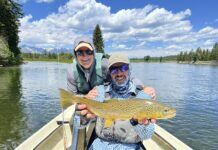
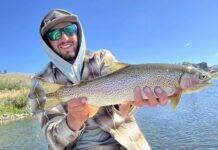
We head to western Montana with Jake Hensley to talk about Missoula fly fishing. With nearly 20 years of guiding experience, Jake breaks down the essentials of fishing the Bitterroot, Clark Fork, and Rock Creek – three of Missoula’s most iconic rivers. We cover how to rig for high water, why dry-dropper setups are so effective, and what makes floating Rock Creek such a game-changer. Whether you’re new to the area or planning your tenth trip, Jake’s got real tips to help you fish smarter and enjoy more of what Missoula has to offer.
Jake Hensley didn’t grow up fly fishing. He got into it later in life—thanks to A River Runs Through It. That movie still brings visitors to Missoula, and it’s what lit the fire for Jake too.
He grew up spin fishing with his dad in Wyoming, but once a college buddy took him up to Rock Creek, everything changed. Jake watched his friend catch 30 trout in one day while he tangled, struggled, and maybe landed three.
In spring and early summer, most of Missoula’s big rivers like the Clark Fork and Bitterroot run high and dirty. That’s when Jake turns to places like Rock Creek, where he can still find clear water and willing fish.
Even though Rock Creek looks small, Jake floats it in a full-sized drift boat when flows push over 1,700 CFS. It’s fast, technical, and full of rapids, so it’s not for beginners. But Jake says the reward is worth it, sometimes landing 40–100 fish in a day during salmon fly season.
Tip: Use high-strength tippet so you don’t lose flies in the bushes or fish in the whitewater.
Jake loves Missoula because it gives you options: Clark Fork, Bitterroot, and Blackfoot, plus side channels and creeks, all within an hour. Even in busy season, you can still find water to yourself.
Jake never pre-plans trips the night before. He checks flows, forecasts, and shuttle info the morning of to decide where to go. That flexibility keeps things fun for him and his clients. Some stretches he’s fished with people for years, and they’re still discovering new water together. That’s the magic of Missoula. It’s always got more to explore.
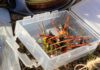
Jake says Missoula’s rivers are made for dry dropper rigs especially in spring and early summer. The rivers are mostly freestones, which means tons of stoneflies and shallow riffles where fish feed actively. Jake’s go-to rig are Chubby Chernobyl (size 6–8) and 3 feet of tippet to a nymph like Pat’s rubber legs, hare’s ear, pheasant tail, and frenchie or perdigon.
He rarely fishes deep nymph rigs. Most fish move into shallower water as temps rise and bugs hatch. The dry gets attention, and the nymph cleans up. It’s a perfect combo.
Jake breaks it down simply: find compression. That’s where water speeds up and pushes into structure. That’s where fish live. Don’t waste time in slow, featureless water unless you see a rise.
Jake calls it spot hopping. He floats 8–17 miles a day, skipping dead water and only fishing the best spots. Once he finds where fish are holding, he replicates that water type all day.
Jake says don’t sleep on August. While some anglers worry about heat and hoot owl closures (which restrict fishing after 2 PM), Jake embraces it. With early starts and a flexible mindset, the fishing can be incredible.
Jake isn’t just about fish counts, he’s all about the full experience. Missoula offers great food, music, and walkable downtown spots to relax after your float. Below are some of his recommendations:
Episode Transcript
Dave (2s): Today’s guest has been guiding fly anglers through Montana’s legendary waters for nearly two decades, floating high water on Rock Creek, dialing in the dry dropper, rigs on the Clark Fork, and adapting on the fly when the Bitterroot blows out. By the end of this episode, you’ll get practical tips for reading water, how to choose bugs during the stonefly season, how you can rig for high water, and how to fish Missoula like a pro. This is the Wet Fly Swing podcast where I show you the best places to travel to for fly fishing, how to find the best resources and tools to prepare for that big trip and what you can do to give back to the species we all love. Jake Hensley, the Missoula fly Guy joins us today to talk tactics. He talks about why a shorter rod might be a better choice in some situations, how to actually fish a chubby Chernobyl correctly and the mistake most anglers make wind mending. Dave (52s): We also find out why floating Rock Creek can unlock a lot more water than just hiking it. How to match your rig to pressure and depth and what Jake teaches his daughter that most adults miss entirely. Here he is Jake Hensley. You can find him at missoulaflyguy.com. How are you doing, Jake? Jake (1m 11s): Good. How are you doing, Dave? Great. Dave (1m 13s): Great. Yeah, this is really great to have you on the podcast. Today we are gonna talk about an area, I think we’re gonna talk Missoula, which is an area I’ve been to quite a few times, that part of the, the world in Montana. But also we’re gonna talk about just probably some techniques, maybe get into some rainbow brown trouts and brown trout fishing and all that. But before we get in there, real quick, let’s take it back to fly fishing. I always like to start there, you know, how’d you get into this? What’s your first memory? And then we’ll take it into your, your outfitting. You do there. Jake (1m 40s): I’ve been fly fishing here in Missoula, Montana for about 18 years now. Kind of got into it the way a lot of people do as far as seeing some videos or having a friend or a family member that was doing it. And I’d say my first look at it was living in Missoula. Obviously a river runs through it, the video mode, the movie, the book. Dave (2m 1s): It’s also to go back to the book because that has come up obviously a lot over the years. You know, we’ve had the, actually had the creative director of that movie was on the guy that actually was like, you know, stood in for Brad Pitt and some of the cha. Right. We, so we’ve covered a lot of, it’s been amazing and, and actually that was the time, right? 2005? No, when was, no, it was a decade before when that movie came out, I think. Right. Yeah. Jake (2m 22s): And I, I feel like the buzz is still around with that movie. You know, people that are getting into it or that come to visit in Missoula or have any know about it, still touch back on that movie. Dave (2m 32s): So you still hear from people that are coming through, like on trips or just in general around Missoula? Jake (2m 38s): Mostly the trips and the people that are still interested in the fly fishing or that I talk to. But the people that are visiting here, everyone ha kind of has something to say about it. A lot of people just think it’s a movie and don’t really understand how it all comes from a book. But just the whole aspect of that is was a great introduction to fly fishing and for people that had no clue what it was, I feel like, and for me, going to college, you know, sitting around in the, the dorm room popping that movie in after and then, you know, exploring the book a little bit too. It just seemed like it worked out great to kind of get me, I guess, fueled to go out into the, into the river and try it. And you know, growing up, I grew up in Wyoming and my dad took us out and we did a lot of spin rod fishing and at least, you know, touched the water and got involved with angling at a young age. Jake (3m 24s): But the fly fishing thing came later on in life and I would say when I saw that movie, it just kind of lit the fire for me. I got out and a good friend of mine who was born and raised in Helena, he kind of had the gear and, and just kind of showed me a few tricks and he took me up to Rock Creek and Rock Creek is just east of Missoula and it’s just a blue ribbon fishery. At the time I kind of still didn’t know quite anything about it. And he took me up there. We went up to the Dows walking bridge, which is a few miles up there on the dirt road. And we walked across the bridge and I watched him catch 30 trout on a fly rod. Wow. And I sat there learning, tangling, untangling, but it was just like the wow factor was there for me. Jake (4m 8s): I said I watched him catch him. I caught probably three or four fish, lost I think 50% of those and realized that man, this is quite the journey you can get into. And seeing him do it, you know, that just led me to continue to wanna do it more. And so I spent, you know, two years at least just learning and struggling with the fly rod. Not, not having a lot of success, but still getting out there and enjoying it and enjoying what comes with being in the river. And that’s kind of how I got, just got my hand on my first rod and got into it. Dave (4m 40s): That’s it. Yeah, I love, I love that you mentioned Rock Creek. ’cause that’s a place I’ve spent a lot of time. We, I went out there for my first time, I think when I was like 12 or 13. My brother, I was just actually talking to my brother just yesterday. But I went out with him, you know, him as an adult with my other brother and a friend. And we did this road trip and I was like the little 13-year-old kid that was tagging along. I hooked myself in the eye like three times on that trip. But I remember all that because rock, we, that’s where we fished. We fished Rock Creek that, you know, we went up to the the blast area above. What is it about Rock Creek? ’cause you’ve got all these other big rivers, these famous rivers, the Bitterroot, the Clark Fork. What is Rock Creek? How is it different from the others? Is it just smaller? Is the fishing as good there? Dave (5m 20s): Do you feel like it’s kind of not on the radar quite as much? I Jake (5m 23s): Feel like it is. It’s, you know, it’s off the grid a little bit. You’re up in the mountains, no cell phone service obviously. It’s been a pretty rugged road as far as I’ve always known. It’s getting better, they’re improving it, but it just, it’s kind of out there. And I think for the angler or person that wants to explore, if you want, if you’re willing to drive, hit a crappy road and go explore a little bit, it’s just got these hidden pockets. You can still find some quiet spots to fish by yourself and it’s got a high fish count, you know, I think that that’s a big thing. You get someone on there that if you get in the right spot you can catch the numbers. And I know above the dowels last, I, I haven’t checked for years, but last I checked, I think it was in the 1500 fish per mile range, which is in that upper stretch of river. Jake (6m 10s): And I think it drops the lower you get. But you go there And you kind of have some quiet fishing in a really pretty spot and the fish are there, the numbers are there. I don’t see a lot of size in there, but you know, you go out there And you, you can catch a lot of fish And you can get the rod bet and that gets a lot of people excited about fishing. Right. Yeah, Dave (6m 27s): It does. You know, another thing we want to touch on I want to today is gonna be a challenge because we’ve got a lot to talk about. You know, I wanna definitely talk about Rock Creek, I wanna talk about the Clark Fork and everything else you do there. But I also wanna talk about Pesco on the fly because you know, we’ve been working with Jeff and what he has going and I just got off the river on a trip. I was fishing and I was fishing mostly his rod, the five weight. And it’s just like a super awesome rod. Like I don’t know what it is exactly, you know, Jeff could probably explain better, but it’s light, it casts kind of super effectively for everything. We’re gonna get into that in a little bit later, but maybe just give us a primer on that. What’s your, what are you using for pesto? Are you kinda using a number of different sizes, weights or what’s your typical rod? Jake (7m 7s): You know, I’m rocking that l he a, which is his mid-range rod for a six weight right now. And he’s working on getting the l ray out I think in a four piece six weight as well. But, so for me, the, the l he a mid-range six weight is a rod I’m carrying for clients and myself. And then I’m also, for my main rods in the boat right now, I’m rocking the five-way L rays and they’re just, I like ’em. The main thing is about ’em that I’m noticing is how light they are. And sometimes people don’t notice that at first, but when you hold a rod all day And you got a guy like me that’s instructing you to kind of just beat the water and hit all these spots, you know, a full day of fishing, that extra weight starts to show off in the end. Jake (7m 52s): And I will say that L ray is light and it is, I do prefer a six weight in some scenarios, but what I’ve noticed is I like the fast action little stiffness with that L ray five and that rod will carry whatever I need it to. You know, I had clients throwing little streamers on it, slop rigs, which is a streamer nymph setup because I’ve just been wanting to, I’ve been wanting to rep that rod because I like it so much and everybody says the same thing. It’s like, man, it feels like I’m casting a feather. Dave (8m 20s): Yeah, that’s one of the big things. You’re right. It, it’s super light And you notice it right away because I was using a few different rods And you’re like, oh wow, this is, there’s that. And then, you know, I was fishing the salmon fly, you know, the giant salmon fly hatch. So I was casting big bugs all week and it was just super easy, you know, super smooth. So I, I’m excited And in fact at the end it was pretty cool for the trip because my daughter, who is almost 13, she’s been ca you know, she’s had a rod for a long time, but she’s never really gotten fully into fly fishing. And this trip she kind of, I think we did it and she was like, at the end, by the end of the coasta, I was like, hey, she was using this fiberglass rod, which I got her when she was probably seven, you know, which was great, right? It was recommended from one of our guests back then a few years back and it’s great, but she’s ready for the next level. Dave (9m 3s): And I was, and I was like, you know what, why don’t you take this rod? And I, and I gave her and she was stoked. So she’s gonna be using the pescado on the fly, that’s gonna be her new, her new rod, the five weight, same thing. Oh Jake (9m 14s): Yeah, that’s, that’s, I mean, what a great rod to get somebody into. And that’s what keeps fishing fun for me is seeing, you know, the future And you get these kids involved. I have two, two little boys and we’re getting there, but we’re not quite to the fly fishing part yet. We’re just getting the rod in the hands. But that’s what really makes it exciting. And you take a l ray and Jeff’s also got this four weight, I believe it’s the el ray four weight that is really impressive as well. And that’s probably gonna be one of the first rods my kids are rocking right there is that seven foot four weight, which is similar to what we’re on right now. Dave (9m 45s): Yeah, that’s it. The seven foot. Yeah, that and that’s, there’s something about that when they’re small, right? They don’t need a nine foot, actually the smaller rods are a good, a good way to go. Jake (9m 53s): No, and you know, as, as well as I do, when you, when you start seeing those kids get into fly fishing, that, I mean I feel like it rejuvenates my excitement for fly fishing. Yeah, Dave (10m 2s): It does. It does. I know my, my daughter was sitting in the boat in the drift boat, like going through all my fly boxes and like studying the flies. Right. And you know, as she had giant sand flies, in fact there was a, I’m not the best on theology, but there was also like some sort of a, a dray hatch. It wasn’t huge, but you know, you know it right. You notice it. Yeah. ’cause these giant mayflies and I don’t know, what would that be? What would be your guess? This was a, I’m not sure if you know the, the Deschutes are just in general, but what would be this time of year, what Drakes would you see potentially out there Jake (10m 31s): Just from comparing it to the Montana time of year? I bet Gray Drakes, that’s kind of like our big hatch that kind of happens the late spring is Gray Drakes March Browns obviously are, seem to be part of that Drake family. But the Gray Drakes have been popping off and we’re seeing some big bugs here right now too. I saw some big mayflies and you know, you’re, you’re branching into that PMD time of year. So, but I’ve seen, you know, June we get the Green Drakes Gray Drakes and which is which of the bigger the Mayflies. And man you sure know when they show up because they’re big, they fly right by you And you go, wow, look at that may fly. Dave (11m 6s): Totally. That’s awesome. Well that, that’s a perfect segue ’cause I wanna talk more about the areas you fish and kinda what you’re doing as far as techniques and things like that. So, you know, when this episode goes live, I think it’s probably gonna be closer to August, which is definitely a time of year where things get really hot and all that. But let’s take it to right now, you know, it’s springtime, it’s kind of, you know, may, June, what’s that look like for you? Are you fishing, you know, all these rivers? Are you focusing on more on, on one of them for your clients? Jake (11m 33s): You know, for us, June, may and June typically are our high water runoff seasons. I will branch over and fish the Missouri River a lot, which is a short drive. It’s two hours, hour and 45 minutes from Missoula. I was over there yesterday, you know, some nymphing, the PMBs have showed up over there. So the dry flying fishing can be fantastic over there. Dave (11m 54s): Oh right. And is that the only tailwater in that, in your area? Jake (11m 58s): It is. There’s some small tailwaters, but as far as like a big main Tailwater, that is it, I you branch further towards the Enni area and get to the Bieber head. And as far as close to Missoula itself, the Bitterroot has this small little tailwater, kind of a Tailwater I’d say, which is a damn Fed River, which is the west fork of the bid root. Now that meets with the east fork of the bid root. And there’s a lot of tributaries that pour into that as well. So it kind of eliminates what I consider like a true Tailwater. So as far as the Tailwater and main Tailwater, so you’re gonna just get the Missouri River with those, you know, Sal Bugs Scuds and stuff like that. But for rest of Missoula, we’re looking at free stones. Jake (12m 39s): And that’s why it’s hard to balance the time of year for the runoff, our water levels. Right. It’s, it’s very unpredictable. And right now, coming into June, speaking of salmon flies, which you were, you were talking about Yeah, it’s that time of year. And, and so when our, when our main rivers, like the Clark Fork, the Blackfoot, the Bitterroot are too, are too big and muddy. You start to get these tributaries around here that are really starting to punch and they have enough flow to some of ’em, you can get a boat down, for instance, rock Creek. Oh wow. Yeah. So Rock Creek is, if you’ve, you’ve weighed fished Rock Creek. Rock Creek, you look at it And you go, no way. You’re getting a boat down this, well, I think I checked today and it’s pushing at 1700 cubic feet per second. Dave (13m 20s): Wow. 1700. No kidding. Yeah. And Jake (13m 22s): I fished Rock Creek from the top end, about 2100 all the way down to about 700 is the lowest I’ve really floated it. Now there’s a stretch of Rock Creek that’s a special permit for outfitters and guides there. I think they only allow 200 a year, but the upper stretch of Rock Creek is not permitted for Oh wow. Outfitters and guides. And Dave (13m 41s): Are you floating it in like a small little like pontoon boat one man thing? No, Jake (13m 45s): I’m running, I’m running a full-sized boat through there. Dave (13m 48s): Wow. You can get a full-size, I guess my, it’s been a while since I’ve been out there, but I pitch a rock creek. I, I mean sometime, I guess in the summer, yeah, July. You can wait across it, but you’re talking Yeah. Water’s pushing and it, it’s not wide though, right? It’s not a wide creek. No, Jake (13m 59s): No. I would say it’s probably one of our most dangerous rivers to fish and float here too. You know, it’s one of those things you need to be on your, on your a game and know what you’re doing on the sticks and people get themselves into trouble. But it does, it goes from this 300 to 600 CFS of very wadeable water. And you’re looking at like, oh, this is the perfect walk and wade water other than the slippery, slippery rocks, obviously. But then all of a sudden you get this big push of water and it is like strap on and go for a whitewater fishing ride. Dave (14m 29s): Right. So why does the, why would the boat, it seems like access is pretty good from the road. What does the boat give you during those high higher water times? So just Jake (14m 39s): Typically with that high water runoff, you’re starting to get these fish that are living in the middle of the river. They kind of get conglomerated push towards the banks, I’d say, or into that pocket water that’s off the banks. And when you get higher water, you, you’re having a hard time getting a drift. You know, you know, when you’re getting a big push of water trying to fish it from the bank, you’re getting these lightning quick drifts, right? Dave (14m 58s): Yeah. Right. Jake (14m 59s): Small short seconds worth of drifts where when you’re from the boat, you still have the ability to make long drifts along those banks, kind of pinpoint your shots. Dave (15m 10s): Gotcha. So you’re drifting, so you’re pretty much not anchoring up, you’re kind of floating and drifting and fishing. Jake (15m 15s): It is float and drift. And I would say when it’s firing up there, I have clients, you know, I I I prep them, you do a safety spiel. You do a prep on, hey, 95% of the fish that my clients catch, we net, I net them, I do all the work, but man on that river, I’ve had multiple times I hand the net to my guy or lady and say, here it’s all you that you, you might have to net your own fish. You might have to pull a hook out. It can get sporting up there and it, and the guy or person rowing needs to be on their a game. And that might include you doing a little bit of your own work, even though you’re on a guided trip. But that’s how you keep everybody safe. Dave (15m 49s): Gotcha. Wow. That’s awesome. Yeah. This sounds cool. So, and so you could be doing that right now. I mean, when things are, when the bitter roots blown out, you might be able to head up to a rock creek or a trip to some of these bigger ones and do this or you know, or walk and wait it Yeah, Jake (16m 1s): For sure. I definitely think the Upper Rock Creek, middle Rock Creek is a play right now. A good friend of mine’s heading up there today. I’ve heard the salmon flies are buzzing around already. The West fork of the Bitterroot and the East Fork of the Bitterroot, you know, those are same things. Small kind of higher up tributaries that flow into the big rivers And you get a boat on there if you know what you’re doing. And man, I mean, big days on Rock Creek, the numbers are so good and the hatches are so prolific. Anywhere from Drakes salmon flies cadis to where on a big day on the Rock Creek. Man, I’ve had a hundred fish days, you know Wow. With clients, with friends with my wife. I’ve seen it all up there. And I, you know, running dry droppers and as the season progresses and the, the more years I’ve spent on these smaller rivers, I, I changed my tactics and, you know, depending on the expectation of clients and stuff, but you know, there’s many a days I’ve ran Upper Rock Creek later in June when it’s still high and just thrown single dry flies and man, what a blast. Jake (16m 58s): Go catch 40 fish. Maybe not the, maybe not, you know, 18 inches, but you know, a lot of nice 14 to 15 inch fish and catching ’em on single dry flies, obviously running pretty high, high powered tipt on that because you don’t wanna be breaking off in the bushes And you don’t wanna be, you don’t wanna be taking your time on a 14 inch fish that’s ripping 1700 CFS when a white water’s ahead of you. Dave (17m 20s): Yeah, yeah. And you got, you got rapid and, and there are some, some kind of like rapids and things like that in there. Jake (17m 26s): It seems like it’s a lot of rapids, a lot of white water mixed with strainers, a lot of boulders, a lot of, a lot of rock dodging. But you know, the, the thing that makes our rivers dangerous, any river to me is, is the wood, you know? Yeah, Dave (17m 38s): It is. Jake (17m 38s): Yeah. Put a life jacket on, fall in the river in, in a boulder section, you know, as long as you got your feet in the air And you, you know, swim and navigate the boulders. But man, those logs and strainers, that’s what makes things dangerous. And with our high water and you, you know, you, you go from 600 CFS to to 2000 ccf s you’re gonna see some wood being moved down the river and trees that have ever fallen or that got attacked by a beaver, they’re gonna make their way down to a place that might set you up for a, a gnarly scenario on the boat you gotta be ready for. So the people that are still guiding Rock Creek consistently, those, mostly it’s a young guy game. I do know some guys, some older guys are still up there getting it, but man, you, you gotta be in shape, you gotta be ready to go and that’s it. Jake (18m 19s): Yeah. It’s exciting. I will say it’s a very exciting trip up there. It’s like, like I said, you’re getting a kind of full mix of emotions when you’re running Rock Creek. Dave (18m 27s): That sounds awesome. It sounds like, you know what I mean, you’re talking, I mean I, like I said, I’ve been up there a number of times and never had done that, although I thought about it and I think one year I might even have brought up something, but I’ve always thought about that, like, yeah, this would be cool to float with a little pontoon boat, you know, or whatever. Something like that. Yeah. Jake (18m 41s): You know, the access is great up there, but still there’s plots that, you know, you would have to bush whack for miles to get to, to some really sneaky, I’d say holes where you get to ’em from a boat and pour over some spots, you’re knocking cross a river certain times of year up there, especially now. And, and when you have that boat and that access, man, you do have a, a big advantage. And to fish have fish that aren’t getting played at very often. Yeah. Dave (19m 5s): It separates you from, it’s just like anything, right? You kind of, if you’re hiking, hike a little further, you get away from the people. Here’s a way to do something that you can get away from the crowds in some other areas. Right, yeah. Because people either don’t have a boat, don’t wanna, you know, don’t have the experience and stuff like that. Have you been, have you been rowing a raft of drift boats or, I’m not sure. Have you, have you been doing this quite a while? Jake (19m 25s): I have been, I’ve been on Rock Creek doing the whole boat thing for quite a while with myself. I started off, my wife and I at the time were dating and I found a good deal on a boat and I think I was, man it’s, I have to go back, but it has to be about 14 years ago. Dave (19m 42s): What was your boat, the first boat you found? Jake (19m 44s): First boat was like a 14 foot air, Dave (19m 48s): Air puma or something like that. Jake (19m 49s): Yeah, no it wasn’t, it was like a, a d class, like a definitely a big whitewater overnight excursion boat. Got into the whole trailer, the whole setup was a great setup. But I think I paid, I wanna say we paid $4,000 for frame boom trailer. That was pretty good. Straight outta college getting set up. Dave (20m 6s): That’ll probably cost you 10,000 now, right? Jake (20m 9s): Oh, easily. You know, and, and it’s a big market, so a used boats don’t last long around Missoula, that’s for sure. And you know, we started just the Clark Fork and, and I’d say the middle, lower Clark Fork and the Blackfoot are pretty safe plays. And we started just kind of venturing there and making our way up to, we’ve even the Flathead River and kind of just doing all the rounds in Montana. And that’s what got me into the boating. And as I got more experience on the, on the sticks, I started venturing off and doing, I’d say more technical rivers. The Bitterroot is a sneaky river, you know, there’s, it changes every year, so you have to be ready to navigate new wood and, and fresh wood there. And then same with Rock Creek. You know, you don’t want to go up on Rock Creek unless you know what you’re doing. Jake (20m 50s): And I was at least smart enough, or was advised by mentors of mine to, you know, make sure you’re on your game before you get ’em branch off into these kind of more technical rivers than I was. And the more years I got under my belt, under the sticks, everything got easier. And I’d say, say that to anybody, you know, go, go find the river that’s easier to row. And once you start learning the basics, then branch off. And I also had a bunch of friends around here that were, you know, kayakers and whitewater specialists that they definitely gave me a, a heads up on how to row a boat at, at a young age. So That was beneficial to me when I started guiding, you know, I had that, I had that set of skills when I stepped in the boat with clients that, you know, I was safe. And that’s a big thing. Why are you taking people down the river, right? Jake (21m 29s): Is let’s be safe first. Dave (21m 31s): Yeah, safety’s for sure number one. Well, you know, obviously you have Missoula fly guy, you know, Missoula is in your, you know, in your brand. Talk about that a little bit. What makes Missoula so special? What are the, you’ve talked about all the rivers I think are, are there any other ones you’d mentioned here? Jake (21m 46s): I think what makes Missoula so unique and special is that those three rivers and our rivers are basically fishable for the most part year round. Obviously we have our inset seasons, which is usually March through October just because that’s when you are getting the bugs and the water temps are conducive to fishing. But Missoula just a little more, I used to kind of spurred out these numbers to clients, but I wanna say there’s like 60 boat ramps within Missoula. So what I kind of take from that is I take my clients out and a lot of times we’re not running into a lot of people still, you know, I would like to say that Missoula is still kind of a secret on the map as far as come to a place where you’re not gonna run into a lot of boats. Jake (22m 27s): If you have the right guide or the right friend that’s taking you down the river, you know, there’s three different main rivers around here, including these tributaries like Rock Creek or the Bitterroot West Fork of the Bitterroot East Fork of the Bitter. Like I said, you can branch off, but man, I, I definitely wake up in the morning and make my mind up where I’m going as I start making phone calls. I’ve never called or phoned in a trip the night before. Dave (22m 52s): Oh righty. So you wait till then that morning And you decide where you’re going? Jake (22m 55s): Yeah, and actually when I send, I send an email out to my clients to let them know, you know, our, our decision isn’t made. And if you, if you have a preference, hey, you know, my grandpa like to fish the Bitterroot, I’d like to get up there, you know, we’re gonna go do that. But man, I wake up the morning, I’m looking at forecasts, I’m looking at the water flows and the shuttle guys, these guys that run our cars around and make sure that our cars are waiting for us at the next takeout. These guys and girls, they hold the keys to our success as far as not putting on around a bunch of people. So I think what does make us unique is you can see a lot of different things in Missoula. You’re gonna see different types of fishing methods of fishing types of rivers. And then if you have the right guide, like I said, you’re gonna go out there and find a little hole and maybe have the whole river to yourself. Jake (23m 40s): And that is sometimes during our busiest times of year, I will find myself out there all alone with just our, me and my clients catching fish on a Montana River without seeing five other boats around you. Dave (23m 51s): Right. That is amazing. The Clark Fork, the Blackfoot, the Bitterroot, are they all kind of equal to you or do you have one that you kind of tend to fish more throughout the year? I try Jake (24m 0s): To look back on that every year. Sometimes I find that maybe one year I’m more of a Blackfoot guide than I, and one year more, maybe more of a bitterroot guide than I should be. But I, I tell people that hop in the boat, you know, we’re trying to stay nomadic, we don’t really want to make our mind up on a river. Certain years, like last year we kind of had a lower water year, the Blackfoot and the Bitterroot, they kind of drained out a little bit as far as our drought went. So I would obviously utilize those and, and bounce back to them at, on, you know, during a week. But I kind of stayed on the Clark Fork a lot last year ’cause they, we seem to have more water on there. So I’d say for last year for me the Clark Fork was a big play just because it did have the water. But that is like, once again, that’s what makes Missoula awesome is you wake up in the morning and you know there’s three rivers anywhere from 10 minute drive to an hour drive, you can find yourself doing something completely different. Jake (24m 53s): And I have clients that I fished a long time going on 10 years now that I swear I took a girl the other day. I bet I fished this lady 25, 30 times in the last eight years. And she told me we have never done this stretch of river. I mean that’s, that’s an amazing feat. Dave (25m 10s): So you’re able to fish a ton of different area. That’s what’s cool about it. I think that, you know, and it’s not, and we’ve heard this before from some rural experts, you know, guides and people that have been on is that that’s like, that’s the cool thing you can do. You know, you don’t have to fish the same exact stretch every week or you know, every year even. Right. You can find these different, it sounds like there’s plenty of new areas in your area every you can fish. Yeah, Jake (25m 32s): There is. And I, I would say that’s one of my selling points for clients as I, I tell ’em, you know, I’m not gonna bring you here every year and take you do the same thing. Obviously if that’s something you wanna repeat and do and see again ’cause maybe it was so awesome, let’s do that, but let’s go explore and let’s go do new things. And I, as you know, as a guide, that’s one thing that keeps me really interested in guiding and I don’t, I don’t feel like I’ve ever gotten burnt out or close to it. You know, I’m going on my 10th year guiding, not that I’m the most veteran seasoned guide out there, but for being 10 years into it, man, it’s still exciting to me because I get to go and do adventures. I I go, I never have a, a plan made up that week and, and most of my clients that hop in are all cool with going on an adventure. Jake (26m 13s): So That is one thing I’d say like, let’s go fish the upper Blackfoot tomorrow and then you might find me an hour and a half away on the upper bid route one day. And then on the very third day with like with Jeff dts Worth, yeah, we drove over to the Missouri just to go chase something different and he’s, he’s down for a drive and so am I. So let, we hopped in hour 45 minute drive and we cruised over and fished the canyon of the Missouri and yeah, he had a three day trip. It was just completely all over the board. Dave (26m 41s): Oh he did. So where’d where’d you guys start out? So when Jeff came up, where was the day one? Jake (26m 45s): So day one I, you know, Jeff comes down here the last week of April, which is a sneaky play because if we hold on to our lower water, you see some phenomenal hatches, fluttering, squalls and, and very, very low competition as far as other outfitters guides and recreational floaters tend to get off the river. So we started our, our first day on the lower Clark Fork there around like Superior Montana or St. Regis and we did catch the fluttering Squala hatch and a big march brown hatch the water was coming up so it was starting to get a little murky but we, we got it done. I think we ended like a nice 15 fish day and a couple heavy ones Dave (27m 22s): Are these mostly a mix of browns and rainbows Jake (27m 24s): That day was strictly rainbows and cut bows and cutthroat. You know, we get that hybrid cut bow in there. Dave (27m 30s): What are the cutthroat, are those West Slope Cutthroat? Jake (27m 32s): Yep, west Slope Cutthroat, you know those, those are our native fish here. The West Slope Cutthroat are the main stayers. They’ve been here forever. So rainbows and brown trouts were obviously introduced a long time ago, but you get that main, the cutthroats of what a lot of people wanna come here and fish. So, you know. And then to the next day with Jeff, we switched from the lower Clark Fork. Everything was starting to trickle out. The Bitterroot was kind of blown out and we ran up to the upper Clark Fork there I’d say around just like not too far out east of Missoula, I’d say around like the Clinton to Rock Creek area, kind of where Rock Creek pours in there. Dave (28m 6s): Does Rock Creek pour into the Clark Fork? Jake (28m 9s): Yep. Rock Creek flows into the Clark Fork, which makes it bigger. And then the Blackfoot flows in same thing, making it a bigger river and they all kind of flow into the Clark Fork. But you know, in the Upper Rock Creek you kind of get more brown trout fishery and the day with Jeff, I think we just caught brown trout. I think we ended the day with the same thing about 15 to 16 mm Dave (28m 26s): Where’d you fish on day two? Jake (28m 28s): The upper Clark Fork there. Dave (28m 29s): Oh, okay. Yeah. So you fished that upper area around Rock Creek. Yeah, Jake (28m 32s): Which is crazy ’cause the Clark Fork being one river, the upper Clark Fork is a vast difference in the lower Clark Fork. The lower Clark Fork is a huge river. You can run a jet boat down there. Oh wow. A big boat. Yeah, I mean, so it’s, you know, a very large river. You know at that point in the lower Clark Fork, the Bitterroot, the Blackfoot, rock Creek, the little Blackfoot, they’ve all, you know, converged into the Clark Fork making it the biggest river on the lower end. And then if you drive east on the Clark Fork, you go through Missoula And you go to where it is very small. I mean we’re talking the size of a, the interstate if not smaller, right like a two lane road at, at some points. And it turns from same thing rainbows, cutthroat and brown trout to more of a brown trout fishery. Jake (29m 17s): The higher you go, even all the way up towards Deer Lodge, it just becomes more brown trout, more brown trout. So with the, or the second day with Jeff, it was the upper Clark Fork and it was all, all brown trout. And we had the same thing fluttering squalls and the, actually our best bug that day was a a cadis. We got this Mother’s Day Cadis hatch that he kind of landed on the nose when he showed up and landed some big, big brown trout, which was cool. And then fast forward to day three, you know, Jeff’s always loving the Missouri, he likes to go And you can also branch off and use all of his different rods up there. So we’d loaded up the quiver. I think we had six rods ’cause he’s obviously doing a little RD. So we had all six rods in, in the Tailwater skiff there. Jake (29m 58s): And we fished the canyon of the Missouri to finalize our three day trip. And like I said, all over the board and same thing, I mean landed some big brown trout, consistent, great size rainbow trout. And yeah, we, like I said, high five drive home and Jeff, Jeff will probably be back to experience it all again. Right. Dave (30m 16s): Yeah, no it sounds like a great three day and diverse too. What’s your in, on your boat? Are you floating? It sounds like you got a drift boat. Is that what you’re mostly using out there? Jake (30m 25s): Yeah, so for the most part I run a drift boat and a wrap. I’d say the drift boat’s my Cadillac, right. Yeah, I mean I’m, I it’s comfort space, ease, you know, stand up a lot of room, we’ll cruise mostly lower bid route, lower Clark Fork and Upper Clark Fork in the Drew boat. And then I’m using my raft, which is my Jeep, right? Yep. The four wheel drive. Oh yeah. Rock Creek, west Fork of the Bitterroot, upper Bitterroot, same thing, it’s some diversion dams and stuff. You want to be, you wanna be pretty nimble and and mobile up there. I’d say so. And same with, same with the Blackfoot. The Blackfoot has a lot of white water and some tricky rowing spots. It just great to have the old four wheel drive raft with you. Jake (31m 5s): Yeah. Dave (31m 5s): Is that a row drift boat? Jake (31m 7s): Yep, I’m running the, the row drift boat, Tailwater skiff and then I’m running an NRS Otter, the 13 foot. And I like to keep everything really light in the raft, just so portages dragging around down trees, stuff like that. And then I do occasionally I got a jetboat, like a 18 foot John boat Jetboat style and I’ll run that around on the lower Clark Fork and cover some ground. Sometimes we do a little pike fishing around here too. Oh sure. Yeah. You can branch all the way down into like Plains area, which is way down on the lower Clark Fork And you can find yourself in the middle of some trout fishing, some bass fishing and some pike fishing down there. So Dave (31m 45s): Where does the Clark Fork eventually flow into? Jake (31m 48s): Flows into this Lake reservoir called Lake Ponder Array. Dave (31m 52s): Oh, ponder Array, right in Idaho, right? Yeah, Jake (31m 54s): It is in Idaho and that’s where it all kind of settles up there. And there’s a big dam there called Cabinet Gorge Dam and kind of flows and there’s a series of dams between Missoula and Lake Ponderer. You get Thompson Falls. So you get a lot of dam control in there, which is why the fishery changes a little bit through there. It kind of goes from this cool cold water fishery to almost a warm water fishery similar to the Missouri and the more dams that stack up, you get more bass fishing. You know, there’s another reservoir, Knox and Reservoir in the town called Trout Creek down there that has, it’s phenomenal for Pike bass, walleye, all that stuff. And that’s all still connected to the Clark Fork and then Clark Fork. Dave (32m 33s): Okay. Jake (32m 33s): Yeah, you branch your way east back towards Missoula And you run into just majority, just mainly rainbows and cutthroats and brown trout, so, Dave (32m 41s): Oh, okay. Yeah. So yeah, the Clark Fork and it is the Clark Fork, not the Clark’s Fork, right? It’s just Clark, no, Jake (32m 46s): Just Clark Dave (32m 47s): After Lewis and Clark. Right. Obviously the Yep, Jake (32m 49s): Exactly. And you know, if you had to ask me if, what kind of guy I’m a, I probably consider myself a Clark Fork guy, you know, it runs right through Missoula. I am miss a fly guy, so. Yep. Dave (32m 59s): I feel like that’s the, when I was starting to, you know, thinking about this, I was thinking the Clark for kept coming up to me. I just felt like, and I haven’t fished the Clark for, I really haven’t fished any of those big ones. I’ve mainly just fished Rock Creek, but you know, it’s the big one, right? Everything’s flowing into it and it’s diverse. And maybe talk, let’s go into this a little bit. We, we mentioned it and maybe we could just take it back to that day with you and Jeff on day two up near Clinton. What is the separation, is it Missoula that separates the upper from the lower Clark Fork? Jake (33m 25s): Yes. Yep. Missoula, basically I, I, I’d say the lower Clark Fork really builds below Missoula west of Missoula. And that’s mainly where the Bitterroot, which is a big river, flows into the Clark Fork. And when you have those two main rivers converging together, that’s creating that big, you know, the big body of water that consider the lower Clark Fork, the upper Clark Fork really too would be more above the Blackfoot. So east of Missoula, back towards Butte Anaconda, you have that upper Clark Fork there and it hasn’t really picked up all of our tributaries. Like Clinton, you’ve started to see where Rock Creek pours in, you get a little more water. But once you make your way up towards Drummond and these small little kind of ranch farm towns up there, the river’s really small. Jake (34m 10s): So the Clark Fork can be, you know, not much wider than 20 feet across at some points. Wow. And you could walk across the whole thing, walk and wade the whole entire, Dave (34m 20s): You can. So you can float it And you can walk and wade, there’s a lot of, are there a lot of access points, Jake (34m 24s): Lot of access points for the upper Clark Fork and you know, the numbers aren’t as high up there. The trout numbers are a little lower on the upper Clark Fork, but if you know where they’re at, you’re gonna get into ’em. And like I said, it seems to be predominantly brown trout the higher you go up there. So you can find quite a bit of brown trout and some big brown trout up there too. I think they’re trying to get the numbers in check. I think they’re running into issues with, they’ve had, you know, some old tail mine tailing issues. So we have basically the world’s largest Superfund site is all that area between Butte and like Deer Lodge where they’ve Oh wow. Yeah. Where they’ve had issues from, you know, bad mining years ago or just long time mining. Jake (35m 6s): I don’t even know if it’s bad mining. I just, you know, times have changing so they know how to do things a little better now, but, but that’s what makes the Clark for cool. It’s, I mean, one day you’re throwing hoppers on a 25 foot wide river, you know, you’re throwing big giant hoppers of brown trout and the next day, you know, drive 70 miles and you’re fishing a, a river that’s 150 feet wide and you know, in, in a drift boat, you know, chipping away at a little pod with Trics. Dave (35m 32s): Yeah, with Trics. Right. What did you guys do when you were talk about that day with Jeff on day two? Did you guys, guys, where’d you guys put in? Or what was the area you were, did you float it? Jake (35m 40s): Yeah, we, we were floating up there. I’d say we were, we were right there. It’s kind of like a, you’re almost not even naming off towns there. Yeah, just boat ramps. It’s kind of between Drummond and, and Clinton, the towns and it’s like beaver tail area we chipped away at like the hopper droppers seems to be pretty consistent for me. I call it the hopper dropper, even though that time of year we don’t have the hoppers, but I’m running like a, a chubby Chernobyl. Dave (36m 7s): Oh yeah. And when you’re running the chubby and that was a funny thing ’cause you know, it seems like that pattern is just so good for so many things. Do you think that if you had to pick one big pattern is, is that kind of the one Jake (36m 17s): Yeah, for Missoula, just because of the free stone, right. We just do have so many stone flies coming down the river. The chubby Chernobyl works great all year because you have that big section of diverse stone flies that are coming down the river. So yeah, it works great. And then you can also use it as kind of your indicator for getting your nymph down there. And so you get a two for one, right? You get the fish to kind of come up, possibly grab that, that big chubby Chernobyl and if not you’re running your nymph kind of shorter, I call it like a short leash nymph setup underneath your chubby. And a lot of times I’m running, same thing as stonefly a patch rubber legs, A hairs ear. Dave (36m 53s): Oh, okay. So you’re running a bigger, bigger bug may talk about that a little bit. What does that setup up that rig look like for your dry dropper? Jake (36m 60s): So my setup for that dry dropper is I’m running usually that chubby Chernobyl. I like a size eight, size six depending on what time of year it is. And then I’m going about three feet, depends same thing on time of year and stuff. But usually about three feet from the hook shank of that chubby Chernobyl down to my dropper. And a long time ago I learned from like one of my mentors that taught me to fly fishing, that Missoula’s a great dry dropper fishery. You know, we’re, we’re too shallow. It seems for deep nipping, you don’t need to run deep nymphs around here. It seems like when those fish are up and feeding and ready to go, they’re not in those deep holes. They kind of move into those shallower riffles. So, and when the time of year if it’s bright and sunny, you know you’re not really getting all of the dry fly each you, you might hope for. Jake (37m 42s): So you kind of get the best of both worlds when you’re running that chubby I call the chubby with that little drop off of it. And a lot of times, you know, I’m running pheasant, tail patch rubber legs, some sort of frenchy or tigon these days, which is really popular. And yeah, chasing those, those fast riffle seams and it’s, it’s awesome because I really enjoy, as the season progresses and our water comes warm water shows up with, with the bugs, you know, you’re fishing some fast water and people get shocked at how fast the water can be that we’re catching fish out of. Dave (38m 15s): Right. So you’re fishing could be fishing a faster water riffle and looking for the seam within that. What does that, what does that seam look like? Is this seam just like on a, a break of a rock or what, how do you find those, you Jake (38m 25s): Know, lower Clark Fork, you’re probably looking them where they’re gonna come off like a, a jetty rock point where you can see a riffle mending with the fast and slow water on the upper Clark Fork or the Bitterroot Man, you might be chasing a seam right off some really sneaky wood. It seems like when you’re fishing the bitterroot, you’re fishing those seams that just textbook what you would imagine fly fishing, right? You see the big root wad with a branch coming off and you’re throwing your dry fire, your whatever setup you have on right off that stick that leads into the foam. And that’s, it’s pretty, you know, I’d say textbook drift of what you can imagine fly fishing would be. And it’s, it seems like it’s interesting, every river has a different flow and a different type of setup that you’re gonna fish up there. Jake (39m 7s): And that’s what Missoula, I think that’s one of the things that makes it great. Right? One day you’re throwing hoppers on the undercut bank on the upper Clark Fork and then the next day you’re on the upper bitterroot throwing it right off the wood somewhere. So. Dave (39m 19s): Gotcha. When you guys are floating down on that day, what does that look like? Are you mostly drifting and Jeff’s casting to certain spots or are you anchoring up? How do you do that? Jake (39m 28s): Yeah, we’re always drifting with the boat. I mean the only time I’m, you’ll really ever see me drop, anchor or set up is if we’re chipping away on an up and in which I would consider like a big inside turn inside bank and you’re throwing it from the inside dead water up into the fast shallows and let it drift through the run like you would if you were wade fishing. Sometimes we’ll do that Dave (39m 48s): Now. You mean by up and in, you’re saying you’re drifting down and you’re coming down into a big bend. Jake (39m 54s): Yeah. So imagine just like the, the river taking a big loop to the left. You position yourself on that inside of that left hand turn. Just like if you’re wade fishing from the bank Dave (40m 3s): In the pool kind of in the more of the, in the eddy the slower part. Yeah, Jake (40m 6s): Exactly. And then chipping up into the fast water and doing a drift almost. If you were just standing there wade fishing, kind of that proper wade fishing technique, you’re doing it from a raft so we’ll, we’ll pull in and do that. The only other time I’m really fishing off anchors if we see a pod and we’re trying to chase some heads and headhunt, but for the most part it’s, I mean it’s really, I’d say conducive for beginner anglers or people that wanna get long drifts. ’cause I’m get, we’re getting to fly out there in the water that works for us and the rig that we have going and we’re doing these long drifts. So you’re sitting or standing in the boat and trying to get these, you know, I always say the longest drift winds, you know, the longer your drift, the more natural you can keep your drift going, the better chance you have of catching those fish. Jake (40m 46s): And I fish a pretty specific program once I get my clients to hop on board with what we’re doing and once they believe it all works pretty good. And I don’t fish everything, you know, I’m only fishing to the spots where I have memorized fish. You know, there are fish throughout the river. I try to hone in and zone in on where the fish I know live. And then we spend our time fishing to those fish. We don’t wanna waste our time fishing to negative space. Right. The there, needless to say, there isn’t a fish behind every rock. Dave (41m 15s): How do you find, is that typically, like if somebody’s listening now, you know, and they wanted to find those fish, is it just trial and error, get out there and fish it? Or how would you, what would be your tip to them? Jake (41m 25s): I’d say trial and error. Memorization is what’s got me, I’d say to my success on the river is just memorizing where fish live And you do, you go, you figure out, well man, I went through here three times, I never got one. And obviously you’re trying to read the build, right? So I start my day off with a rig, like a, a chubby dropper. And then what I’m gonna do is start throwing that rig in the water that I know it works in. And then once I know once I find the fish, I’m just gonna replicate that build of water all day long. Right? Every now and then I’ll switch rigs up to go, oh, we’re really shallow riffle here where they’re just heating dry flies, you know, I’ll switch over, either switch rod or switch the rig. But for the most part, once we get our rig dialed in for the day, like our hopper dropper or our N rig, we’re just gonna go and replicate the build of that water. Jake (42m 10s): And I find what it is is it just makes you, I’d say you’re kind of not wasting your time in the spots where the fish might not be, if there’s not a lot of compression, if there’s not a lot of water, pushing those fish to make ’em stay in a certain spot. I’m gonna skip those spots and kind of focus on the areas I know that we can be productive and catch the fish. You know, you get to a big lake, a big, big wide lake of section of the river, I call ’em lakes where it’s really dead kind of quiet water. Obviously if a fish rises he’s gonna show himself and we can go target that fish. But I’m looking at this, you know, let’s just say a hundred yard stretch of river that there’s not a lot of fast moving water and not a lot of boulders for the water to trickle around, which I call compression. Jake (42m 51s): I look out there, I see no compression, I go, man, where are the fish at? I know they’re in here, but are they 10 feet from the bank? Are they 20 feet from the bank? Unless they show themselves, I can’t really pinpoint and cash right at ’em and be highly effective with it. So I’m gonna go to where there’s a big bend in the wa in the river and find where all the water compresses into a a hard bank and there’s a soft inside. And that is where we’ll kind of spend most of our time during our days. And what I do is, I call it, you know, spot hopping and it seems like every guide runs a different program around here, but I try to do long floats, you know, anywhere from eight to 17 mile floats in a day and we’re just gonna pick our spots, you know, hot spot fish up to this spot. Jake (43m 31s): Right, Dave (43m 32s): Right. That’s a good way to do it. And you get to cover, see some country, right? You see a little more country during the Jake (43m 36s): Day. I’ve never had anybody complain about seeing more of the river. Dave (43m 40s): Yeah, more of the river. That’s awesome. So, and describe the, the leader. So you mentioned a little bit, so you have, you have your, say chubby is on your main, you got off of that, it’s a three foot liter down. What are you typically use in like what size tip it or on that dropper? Jake (43m 54s): So I’m running like six pound usually for like four X would be standard for most of the year. Honestly, a lot of the times I’m running three x ’cause I like to land those fish that we’re catching when you’re catching ’em around wood, when you’re catching ’em around, you know, obstacles or hazards in the water. You gotta be able to horse ’em outta there every now and then. So sometimes I, you know, I’ll, I’ll go back to fishing some lighter tip it if, if they’re being picky. But for the most part, running three to four feet droppers, sometimes a two foot dropper, anywhere from three x to four x to get it down there. You know, when you run a lighter tipper tip it too, some of those bugs drop a lot faster into the column. So I will, I have noticed like some, sometimes I have to switch up to Forex to get that little small nip to want to drop down into the column a little faster. Jake (44m 39s): When you have that thicker tippet floating around, sometimes you’re still wavering behind your, your chubby there and not getting into the column as fast as you’d like. But I will say I’d rather be geared up for the fish i, I want to catch rather than being geared up for the fish that we’re going to catch. Dave (44m 55s): Okay. So, so three or four x and then on your, from your chubby, what does your leader look like? Is that pretty standard? How long are you typically your leaders? Jake (45m 2s): I’m running about a seven foot liter. People are more beginners. We’ll shorten it up just to give ’em like a, a shorter casting style there, right? You don’t have to, you’re trying to flip big bugs over. It’s harder to do that with a nine foot liter. But for our little chubby hopper dropper setup, I think a seven foot liter, three x, same thing, seven foot, three x liter. Sometimes I’ll bring the last of that off with some mono to keep it floating if I want it to float a little better. But the fluorocarbon, just floral flex, seven foot tapered liter is a great way to go And you can always chop it back and add to it if you need to make some adjustments. Okay. Dave (45m 37s): And so that’s the hopper dropper sort of thing. And were you, on that day, were you guys fishing that mostly or did you do any other techniques? Jake (45m 45s): We did hopper dropper. We did throw a little single squala for a little bit. We had some fish look at it, but it wasn’t as productive as we were getting ’em on the nymph. We caught ’em. It seemed like that for the hopper dropper, our best bug that day was either a patch rubber leg because of the fluttering squalls. But we also was throwing this little mayfly cadis, it’s called a Duracell and it actually works great. It looks like it has kind of like that body, the slender profile of a mayfly. But then you know, you get kind of that CDC squiggly ski, you know, buggy looking stuff that makes it wanna look like a cadis as well. So we actually did caught our bigger fish on that. And then Jeff threw a streamer too. Jake (46m 25s): I like to throw JJ sparkle minow round up there, couple different colors in that. But yeah, a little cix as well. He stripped the streamer around, you know, trying to chase a couple, couple dragons outta some holes. But it seemed like our best fishing still came on that hopper dropper. And with the amount of stone flies we have around here, it’s hard to go away from a big stonefly. Dave (46m 45s): Yeah, the stone flies ’cause you have the, the everything, right. I mean the squa. And what is the squala, how does that compare to say a, a golden stone or the other stone flies? Jake (46m 54s): I’d say that the squala is the S smaller, it’s the first stonefly that, one of the first stoneflies that we get that kind of starts off our season. We get some numera and capias, which are the smallest of the stone flies that come first. But then it’s followed up with the squala. And then after the squala we get our salmon flies, which are giant, right? You’re looking at size four, size six for a dry or even your dropper for your, for your stonefly dropper. But then after that you get your golden stones, which the golden stones vary on, on the upper Blackfoot. You know, I’d say the, the golden stones could be a size 10 and up to a size eight. And then on the Bitterroot we have almost what I call bitterroot stones. Jake (47m 35s): And they can get really small, you can get these little golden stones that look like size twelves. So, and then our final stonefly that comes in usually is in August and late July it starts to kind of build up and it’s the nocturnal stoneflies and nocturnal stoneflies are big Dave (47m 50s): Now nocturnal. What are, what are the nocturnal, are those the ones that describe those a little Jake (47m 54s): Bit? So nocturnal stoneflies are almost the same size as salmon fly and the nocturnal stoneflies usually hatch. I think the water temps need to be a little warmer. So that’s why you start getting that hatching in July and August. And when those nocturnal stoneflies hatch, they’re big, they same thing, size six. And they seem to be more of swimmers I think. I don’t see ’em flying as much probably because they maybe are flying at nighttime when they’re most active because they are hatching in the middle of the middle of the morning or the middle of the night and you’re trying to pick up on that hatch when you put on early in the morning obviously. But it seems like when I see those nocturnal stoneflies, they’re swimming on the top of the water more than I see ’em actually flying through the air. Jake (48m 39s): And so I get a lot of clients, you know, we, when we’re met making mends to you know, continue our drift to be a longer drift and we’re mending it down river, mending up river, whichever direction I tell clients don’t be afraid to put a little movement on that stone, fly on that, on that chubby when you’re mending because you’d be surprised how many fish want to come up and attack that stonefly when you move it. And then a lot of times with our stone flies around here, the dead still perfect drift man. They’ve seen that. Sometimes you need a little, if you can teach the twitch, the twitch can, the twitch can add a little special bonus. Dave (49m 13s): What is the twitch, how would you describe the twitch? There’s Jake (49m 15s): Different ways I think the, I try to teach people this method. The rake mend is the way I was taught where you’re doing like a little zoro loop with the tip of your rod and you’re doing a small little articulated mend. And that mend is just gonna drag your fly down river without sinking it. Right? And so you get these little short drags of the squala stonefly, whatever, which one it is also tip up in the air with a little shake works. It seems like when people try to do that, it, it sometimes makes it harder to set the hook on those ’cause you’re kind of rod tip up in a little awkward angle and you’re, you’re giving a little shake on the tip. But the fluttering stonefly can be a very productive way to fish up here. Obviously our big stoneflies are definitely those flutters, right? Jake (49m 58s): It seems like the squala hatch on the bitter root’s kind of a smaller squala, they don’t really flutter as much as you would get on the lower Clark Fork in late April. Those squalls are a lot bigger and they move man and the fish wanna see ’em move the fish. You know, I tell people man, that all of a sudden you start twitching that fly, it makes that fly become real life and comes alive and those fish want to eat it. And same with Hoppers man. Yeah. Hoppers same thing. Dave (50m 21s): Yeah. ’cause we’re talking stone flies here. You mentioned, you know, the whole series like I guess six or seven different species. But yeah, you’ve got hoppers too. And that chubby Chernobyl also right, can imitate a hopper during the season. Jake (50m 32s): Definitely. It definitely can imitate a hopper you’ll find. I’d like to fish the hopper a little different too. And a lot of times in the, in the late summer and August, I’m fishing a single dry fly a lot, a lot more than you’d expect. Whether it is a no, a single nocturnal stonefly or I’m necking it down to just like a Moorish or a more or less hopper. And same thing, I like to run heavy tippet on those things because you get some aggressive takes and me, you know, making a move, the rake men seems to be the best with teaching people. It just mend it. I’m telling people, oh mend, you know, another mend mend it again and all of a sudden every time you mend it, that fly is just doing a little bit of the happy with that. Dave (51m 10s): Yeah. How do you mend, describe that a little bit. What’s your tip on mending? How do you, or does it matter if you mend and the fly goes down a little bit or you got different currents? What are your tips there? Jake (51m 20s): I’d say any men’s a good mend when people start mending on their own, that’s great. I’m always constantly reminding people to mend. I’m a talker on the boat. I don’t ever go quiet. I would say that I learned that, I learned that at a young age playing sports and stuff. When your coach stops talking to you, you know that you’re, you know, that you’re not doing, you’re like, man, I, I’m, he lost me. You know? So, right. I don’t ever stop talking. I got the gift of gab and, and I, I stay on my clients for the men. So I tell ’em, man, any men is better than no men. You know, if you’re getting a drag free drift, that’s what we want. Obviously there’s certain scenarios if you’re head hunting, you don’t wanna, you don’t want that fly to move. You know, you’re head hunting, you’re throwing slack, you gotta have this clean drift. But man, when you’re, when you’re talking about these big stone flies And you big giant size four hoppers that I like to throw fish, wanna see those things come live. Jake (52m 8s): So when you’re mending upstream, men’s downstream, men’s man bring that fly alive. You know, you don’t wanna move it four feet but you know, a couple inches every time. It, every time you mend it makes a difference, I think, on getting these fish to eat it. I think these fish are used to seeing that time of year, they’re used to seeing these dead calm drifts that everybody thinks that you wanna, you wanna fish. And I’ll throw a curve ball out there and say, Hey let’s, let’s put some movement on this thing. Let’s trick these fish. They’re used to the calm drift. They’ve seen everybody do that. Let’s bring this thing alive. So you know, a little two inches, four inches every time you mend it. If you get a little skate on the water, you obviously don’t want to go under, but I think you’re using the right float and and stuff. Yeah. Dave (52m 47s): Do you do that with your fly? I mean it’s got a lot of foam on array, but do you put some floating on it? I do. Jake (52m 51s): I run my own floating. I like that fly ara set up a lot and then I’m running like the, a gel loon for a top of a foamy for the most part. ’cause a lot of times I’m like, run a plan B fly or these little hoppers and they have this little foam post. Right. Well I also like that hopper body to lay low in the water. So I’ll only lube up the top of it just to get those posts riding above the water. And I think a lot of these fishmen, when they see that, that fly three quarters of the way or halfway down in, into the water, same thing that makes ’em think, oh this thing’s dead. You know, it’s, it’s time to eat this thing. So I I, I do use a little bit of the good lube. I like to make my own a little bit. Jake (53m 32s): I’ll use a little lighter fluid and Abilene makeup remover. Man, it makes some, it makes some good stuff. But it’s basically the same concept as as the fly agra. Dave (53m 41s): Oh really? So fly now this is to make your own fly foot. Gotcha. And, And you do that just because you like what is the, you know, why make your own, why not just go to fly agra? Jake (53m 50s): I use a lot of it and I also can control the viscosity, the thickness, my own recipe. I know some guys that like it lighter. I like to make it kind of thicker and heavier. I feel like you don’t have to reapply as much, but it all depends on what your day’s like. ’cause if you’re getting a lot of those eats, you’re reapplying all day. You know, the fish are drowning that thing. It’s time, it’s time to reapply and relo. Yep, Dave (54m 13s): Relo. Cool. And then it describe the, the, the take. What do you do when a fish hits on one of those big bigger bugs? Jake (54m 19s): Oh man. How exciting. Right? Because that is the thing you get, you fly all the way here to watch a fish explode on a hopper or just nuke a big chubby or a squala, you gotta wait. Right? You gotta wait. Everybody wants to give it the Olay. And I don’t blame ’em because you know all that, a lot of times we’re fishing in this clear water in that anticipation. You see the fish coming a lot of times, right? You see the big cutthroat and sometimes these cutthroat comes slow. It’s crazy. I swear they’re testing people. They’re like, I’m gonna come slow and let you see my body. Right? Or I even get to the surface and you’re gonna pull, I i’ll know if it’s fake ’cause you’re gonna pull that thing right outta there. I don’t have to worry about getting hooked. But yeah, I see the cutthroat tend to make this big slow takeoff at it. Jake (55m 3s): They look like a great white shark coming up. And if you can control your emotions, you know, the Canadians say God save the queen. I think some Canadian anglers, that’s their saying, right? For what? I don’t know what it be in the United States like one Mississippi, Dave (55m 16s): Right? So God save the queen is just, you basically say that before you set the hook. Jake (55m 21s): Yep. Let ’em put their mouth on it, man, I have had to pull over and like, let’s do some visualization guys. The the cutthroat are coming slow, but then you throw it on the undercut bank on the upper Clark Fork And you watch a 18 inch brown trout come out of there like a firecracker. You never knew it was coming. And all you see is the explosion on the top of the water. So it’s always different up here and which makes it, once again, makes it cool. You, you can get some different eats and see some different kind of explosive dryly eats And you see the sippers And you see all that stuff. But I’d say for most people, man, I gotta tame everybody down on the, the early hook sets. You gotta wait, you gotta let ’em clamp down on it and I’ll, I’ll pull over. I’ve, I’ve had to pull over lots of times with, with clients, you know, I’ll do some, some stuff like some techniques where we’re like, let’s close our eyes and think about this. Jake (56m 7s): You know, let’s think about the fish swimming up and eating your bug. Imagine the fish putting its mouth around the bug before you set the hook. ’cause a lot of people wanna say that. I don’t know if it really ate it. You know, that’s the saying. I think they’re mouthing it, Jake. Yeah man, these things might die if they just mouth all these bugs. I don’t know if they’d survive a winter. If, if they didn’t know how to eat that bug, they might not survive. So, Dave (56m 29s): So what are you doing when the, when the big, you got a big chubby on it rises And you set the hook too early, you’re just, just didn’t give it time to, to bite it is essentially what’s, yeah. Yeah. Jake (56m 39s): I’d say most of the time I would say I definitely will will side with my clients. I’m not here to hurt anybody’s feelings. There’s lots of times maybe the fish, you know, missed connection, right? There’s two people. There’s, it takes two to tango, right? Maybe we’re just off a little bit. Maybe the fish, the fish is just off. It’s a little bit, maybe we were a little early, but yeah, I’d say half. I’d say most of the time people are missing fish on those dry flies is that they are too early. Dave (57m 4s): Yeah, it’s too early. Jake (57m 5s): Yeah. And my experienced anglers show up, man, sometimes they, the experienced guys get me, I’m thinking, man, you should set. But they wait a one second longer set and a lot of them are, are nailing it. Jeff, Jeff had some good dry fly eats and he was letting them, letting him meet it when he was here on his trip. And it’s awesome to see it when it happens. And the dry fly bite is on up here. You see the right anglers making those moves. And I teach the anglers how to make those moves too. And being patient, you know, you drive a long ways, you fly a long ways to catch these fish. Let’s, let’s be patient and make sure it happens. Right. Dave (57m 36s): That’s awesome. Well, let’s, let’s start to take it out here with our fly shop Friday segment. Always love to give a shout out. I’m not sure, I know there’s a few shops, I’m not sure if there’s new ones, but let’s give a shout out to your local fly shop. Do you have a few out there in your area? There’s Jake (57m 51s): A bunch of good fly shops here in Missoula, but there’s one fly shop that I stand by. These guys are awesome. This guy Taylor from the Missoulian Angler Best fly shop in Missoula. These guys are pros. Everybody that works there, you go in there, they got a smile on their face, they’re gonna line you up anywhere from fly tying stuff, any gear you need for tying your own flies, they’ll tutorial. Dave (58m 13s): Oh, they have a bunch of, bunch of resources online and stuff too. Jake (58m 16s): Yeah, they do classes and the, they do some classes and stuff in the winter, but man, these guys, they got a variety of bugs. They have all the stuff for tying, they have the knowledge on the creeks and all those guys at the shop are out fishing, which I love, right? They’re all out there beating the water up themselves. So when you go into the Missoula angler, those guys are gonna give you some knowledge, they’re gonna be friendly and they’re gonna make sure you leave with the right bugs. You know, nothing but good things to say about those guys at the shop. I mean, they’re, they that guy that he actually manages some guides to. They, they have guides and they do guided trips outta the Missoulian angler and off all their guides are great and you know, he doesn’t like to put out a lot of boats. One thing I got a lot of respect for the OU angle and some of these outfitters like him, is that he’s not gonna go put 10 boats out on the river. Jake (58m 60s): And that’s a big thing in Montana. You got a lot of outfitters coming up, myself being one of ’em. But he’s limiting the pressure in which I, I have a lot of respect for that. He’s not gonna put more than five boats, six boats out on the water, even though I’m sure he has enough business to do lots of it. So hats off to the guys at the Missoula angler are always doing a, a professional job. Dave (59m 19s): That’s awesome. No, that’s a great shout out. And I wasn’t, I mean, I’ve heard of those guys, I just hadn’t chatted with them yet, so that’s great to hear. Well let’s, let’s start off with this as we kind of start to wrap it up here, just a, a few tips. So we’ve been talking, you know, the big bugs, but let’s just talk, let’s stay on the Clark Fork and just in general, if somebody’s either fishing, you know, summertime, let’s just keep it into the summertime into the fall, what are you telling somebody if they’re, they’re coming up there, what are some general tips you give ’em? Or maybe they’re on the water with you? How are they having more success? Jake (59m 47s): Man, I’d say let’s use August, right? Yeah. August is a, a downtime. Sometimes people think that August can be efficient in Montana if you show up, hey, ready to wake up early, that’s a big thing. You know, if you’re on vacation, sometimes it’s not easy to wake up at five 30 in the morning, but you know, let’s get going early. Let’s save these fish and, and get ’em when the water temps are cool, right? I always say show up ready and be adverse. Be ready to go somewhere else that you weren’t expecting, right? Like you might be ready to fish the bid root and your guide throws you a curve ball and says, let’s go up to the upper Clark Fork. And I’d say follow that guide. They, he or she’s gonna know where the fishing is that time of year. And I think if you can show up, like I said, being ready to go early in the morning and then adapting with the conditions, I’d say you’re gonna have a good time. Jake (1h 0m 34s): I think that being able to throw the small flies and being able to throw the hopper dropper is a big thing. You could run into some trico or some big fish ship. So if you can be diverse in your abilities to angle and and learn from your guide, I think you’re gonna have a lot of success. Especially in August. I love that time of year. Yeah, Dave (1h 0m 52s): That’s good to hear. So August is a great, And you, you know, people think of it, I think now because you hear a lot of the, what’s it called, the hoo hoo or what’s it called when they clo do the closures Jake (1h 1m 1s): Yep. Hoo out. Dave (1h 1m 2s): They do the hoo out stuff and that’s kind of, you know, August. But so August is still like even with the hoo out, are there places you can fish if you start early and all that? Yeah, Jake (1h 1m 10s): You know, Al’s a 2:00 PM off the water timeframe. But I mean if I, I get our clients out we’re, we’ll be hitting the water at 6, 6 30. You’re still getting a full day of fishing in. But just like most people, most people want to be off when it’s a hundred anyways. Dave (1h 1m 23s): Yeah, in some ways that’s a lot better because it gives you, the cool thing is it makes your day longer that way at 2:00 PM you’re like, man, I already got my fishing in now I got a whole half a a day to go. Jake (1h 1m 31s): Yeah. And Missoula’s got a lot to offer, man. We have a lot of good food around here. There’s always live entertainment, there’s street venues going on, there’s just a lot of stuff to do. So getting off the water early is not necessarily the worst thing because there’s a lot of things to do here. But I would say that August is a very underrated time in Montana. You’re gonna find a lot less competition out there, a lot less guides working, a lot less recreational floaters aren’t, aren’t wanting to go out there, but man, if you get the right day, Trico fishing, hopper fishing, it’s just fantastic man. And I like you took, from what I said, I like being by myself on the river. So it’s a good time to be doing that. Dave (1h 2m 5s): So that’s a, so Trico is hoppers, that’s a summer. So in the summer you’re definitely fishing And you could you also nymph do other types of techniques? Oh Jake (1h 2m 13s): Yeah, like I said, we’re still seeing a big push of those nocturnal stone flies, like big, big stone flies, size six stone fly. So we’re doing a lot of ni infant, I dry dropper more than just deep nipping, but dry droppers still at that time of year. And that’s also the best part about Missoula is there’s not just one way to skin a cat here, you’re gonna have a good time fishing and, and if your skills are high, well go out and head hunt with Trico. And if, if you’re just looking to put a couple fish in the net and enjoy the scenes man hopper dropper and go see some pretty floats. We definitely have a lot, we have the views and the scenic routes to go along with the fishing here too. Yeah, Dave (1h 2m 49s): Definitely. Yeah, you got the big sky country, right? Jake (1h 2m 52s): Oh man. Yeah, I could talk about it all day, man. Dave (1h 2m 54s): Nice. Give us a heads up before we head outta here on just some of the, anything with Pesco on the fly we missed? Anything you wanna highlight? You know, with Jeff, we talked about a couple things I asked him. I think the six piece rod is really, you know, I think there’s other six piece rods, but it’s kind of cool because his, his rod, that’s the one I was using was the six piece And you can’t tell it’s a six piece right? It feels just like a four piece. What else would you say, any other things on Pescador that, you know, as you’ve been out with Jeff A. Little bit? Jake (1h 3m 19s): You know, I like the straight to consumer, right? Direct to consumer. Yeah. I’ve, I fished all the rods. I have a whole stack of rods out here in my garage and they’re all, they’re all, I like the quality, you know, but the price point that Jeff’s giving that high quality rod for is hard to beat. And like I said, you’re going with this light action rod. I mean, it makes a big difference. If you are only fishing two hours a day, maybe you don’t notice that, but you hop in my boat and I’m, and I’m on you to fish a full seven, eight hour day, you’re gonna notice that, man, it’s nice to have a high quality rod that’s very lightweight. That goes a long ways. And I also like the fact that this is one kicker that Jeff came up with. Jake (1h 3m 59s): He throws an extra tip in there. Yeah, Dave (1h 4m 2s): I know Jake (1h 4m 2s): That is you many, I mean, whether it’s on the accidents happen, but I mean, a tip’s gonna get broken. The fact that you already, you’re starting your purchase off with a backup tip. I mean, right there, I I just love that, that part of the game because we’re breaking rods in my boat at some point. I don’t want to, but it’s just, it’s just the name of the game. If you have a rod long enough and you know, crazy stuff goes down on the boat when people are landing big fish and rods get broken or stepped on whatever. So I like the fact that he’s thrown in that extra tip. I like the light weight action of the rod. And the other thing, like you said, if you’re traveling with the six piece, that’s great, but he also has that four piece for my rod vault that travels just great. And then you also throw in that that man, the seven weight that he’s rocking right now for streamers. Jake (1h 4m 47s): So throw a streamer all day with that thing. Just ease of effort. I like the stiffness of that one too because you know, I feel like you’re not having to do a lot of hard casting to get it to where you want to go. So I think that’s one thing I like about all the Rod Jeffs making out is that the performance is high, but the product is great, you know, lightweight, so definitely, yeah. Exciting stuff outta that guy, man. He’s always got some new, something new coming out too, so every time, every time I hear from Jeff I’m always, I’m always waiting to hear what’s the next thing that he’s got lined up, man. It’s something new every time. Dave (1h 5m 18s): Yeah, definitely. Yeah, I love his, he’s also got, I think with the first podcast we did with him, he was talking about his morning routine, which is like, he’s got it, he’s got it dialed. I always love, because that’s a struggle for me, you know, getting the, the good morning routine. He’s, he’s kind of got his workout done, he’s got, he’s eating good, you know, he, he’s got his, he’s definitely got his game together. Right. Yeah, I think that’s inspiring. Jake (1h 5m 40s): He does, man. And gotta appreciate, he’s a, he’s a mentor of mine too, man. The guy sends me down the right path all the time, every time I got a question, he’s seems like he’s got the right answer for me. So it’s good to have out, have him on my side. Awesome. Dave (1h 5m 51s): Well a couple of random ones here and then we’ll take it out. So we talked about the boats a little bit. You mentioned Missoula. So Missoula is kind of a college town, right? University of Montana. Yeah. Give us a couple, if somebody’s coming through, they’re excited now, they’re gonna be maybe fishing Rock Creek, Clark Fork. Where should we be stopping by if we’re gonna get some dinner or some food at one of the evenings? Oh Jake (1h 6m 9s): Man, Missoula just, it’s on the spot. You know, back when fly fishing started getting big in Missoula, it was like fly shops or like a lodge, right? It was like, oh, you gotta have a lodge. And the hotels weren’t awesome here, you know, 15 years ago. It has everything, right? It’s a booming college town. Everyone wants to be in Montana right now. And so you come through, you want to do, you know, I want to go see where the, the book A River runs Through it was written about. Yeah. Dave (1h 6m 35s): Is and is that where it was? So was it the Blackfoot? What was the river? Yeah, it was the Blackfoot. Yep. Jake (1h 6m 40s): The big Blackfoot River. Right. So you come here, you see the big Blackfoot River, you poke all the way from there into Missoula And you go grab yourself a beer at the Kettle House Brewery. There’s an amphitheater where you can go see, I think the Black Keys were just there last night maybe. Oh cool. Yeah, right. So it’s a small amphitheater and then come into town, you know, you got your ice cream shop, big Dipper World class ice cream on a hot day you can go get dinner at the depot deck. Yeah. Just have everything. I would say back in the day, that was the thing is people were trying to pitch these lodges and stuff like that, but man, we got multiple hotels here at great price points. Jake (1h 7m 20s): Everything could be walking distance if you want it to be. So you could go get a hotel room at the AC Marriott downtown And you don’t even have to have a rental car. You can just walk to every restaurant. You can go see a live show and then be back at your hotel in five minutes. Oh, Dave (1h 7m 37s): That’s pretty cool. Yeah, because see it’s not a huge city really. You can walk, it’s a good walking city. Yeah, Jake (1h 7m 42s): I’d say everything’s kind of circulates around. Like downtown is kind of the scene And you have plenty of restaurants. The bar scene is great if people want to come here and it’s, you know, it’s not like a, a fancy nightlife, but man, you go there And you can go to the Missoula club, which is like a kind of a dive bar, but a really cool history dive bar And you can get one of the best cheeseburgers you’ve ever had and followed it up with a microbrew that is probably a local microbrew from Missoula. Yeah. So the diversity’s there, the cuisines there, they got plenty of good food. And then all summer long, like they, I think the Roots Festival where they have multiple bands coming in and playing downtown all over. I mean, nice. I mean my music here is great too. Jake (1h 8m 22s): So that’s the thing that’s changed in Missoula. It’s, it’s not just this quiet, this off grid fishing destination now it’s, you have a lot of BBOs, you have a lot of hotels and the food and the entertainment goes with it. And, and I’d say that’s, that’s what is putting us on the map big time right now. Not only do we have world-class vision here, but you just have all the amenities to go with it. Dave (1h 8m 44s): Yeah, definitely. No Missoula. Yeah. Is, is amazing. Excited to get back there for sure this year. Well I guess, you know, Jake, we could probably leave it there. I think we’ll be chatting more, you know, moving ahead. We could send, I guess everybody out to Missoula fly guy.com if they wanna check in with you on trips, availability, and just maybe pick your brain on anything. Does that sound like a good plan? Yeah, Jake (1h 9m 4s): I’d say send me an email if anybody wants to ever book a trip. I run Missoula fly guy on my Instagram that I, a lot of people get, see what I’m doing all the time. I, I try to post my pictures and videos of what’s going on there constantly. I would say, I’m like, man, I’m in the business of getting, you know, the, the guys that have fished all over the world. I take those people fishing, that’s great too. But I’m trying to get people in my boat that wanna, they wanna learn and they, I’d love to make new relationships and form new relationships with people that wanna learn and get into this fishing stuff. So if there’s anybody out there that you know is just trying to branch off and learn more and get more involved in fishing, send me a message, send me an email, let’s talk about it. Because just like your situation, man, you got a 13-year-old daughter Yep. Jake (1h 9m 48s): Who’s picking it up and man, I tell people I specialize in getting those, those little kids really into it. Nice. And people talk about bringing their wives fishing. Missoula’s great for that because you’re not just stuck out in this podunk town where there’s nothing to do after the fishing trip. You’re gonna go get some good food and man, I make sure the wives catch ’em too, man. Right. Yeah. Sometimes wives and a lot of times the wives end up being better anglers than, than any of us will ever be, so. That’s Dave (1h 10m 13s): Right. Love Jake (1h 10m 14s): It. I’d say tell your friends and, and, and definitely bring your kids man. It’s a very family friendly place to be in the summertime is Montana. Dave (1h 10m 21s): Yeah, definitely. We’ll, we’ll be, we’ll be seeing more of it this year for sure. So cool Jake, well we’ll leave it there and send everybody out. We’ll put links in the show notes to all that. And yeah, I just wanna thank you again for all the time today and definitely appreciate all the insight and look forward to keeping in touch. Jake (1h 10m 35s): Yes sir. I appreciate it. Dave (1h 10m 37s): If you’re fired up to Fish, Montana’s Iconic Rivers or want to see what it’s like to float Rock Creek like we talked about most people, you’re not seeing them do this, you can head over to missoula fly guy.com right now. We covered today from Technical drive, fly to the Clark Fork and everything in between. Jake’s gotta go on. If you’re thinking about playing a trip here And you want us to connect and, and get some more information for our Wetly Swing Pro community, you can check in right now. Go to wew.com/pro And you can find out more how to get inside Scoop on trips and everything we have going this year. If you haven’t yet, please subscribe to this podcast. You can do that really quickly on Apple Podcast, Spotify, wherever you listen, click that plus button, you’ll get the next episode delivered to your inbox. Dave (1h 11m 22s): And just wanna give one shout out before we get out here, the lodge at Palisades Creek, we’re gonna be doing a big event with them this year. If you haven’t checked out the lodge at Palisades Creek, the South Fork of the Snake, you can do that right now. Check in with them and check in with me. Alright, appreciate you for stopping in today. Hope you have a great afternoon. Hope you’re having an amazing evening, and if it’s morning, hope you have a beautiful morning and your day is a good one. We’ll talk to you then. Outro (1h 11m 45s): Thanks for listening to the Wet Fly Swing for Fishing show. For notes and links from this episode, visit wet fly swing.com.
Jake Hensley gave us a full run through of what it’s like to fish Missoula’s rivers, from timing hatches to reading water and choosing the right gear. His insights are perfect for anglers who want to step up their game, explore new water, or finally understand why that chubby Chernobyl isn’t working like it should. Be sure to check out Jake’s trips and reports at missoulaflyguy.com and follow him on Instagram for daily river updates. And if you’re heading to Missoula this season, don’t forget to start early, stay flexible, and always watch your mend.