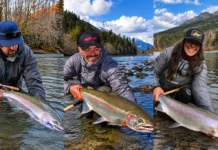
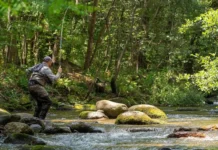
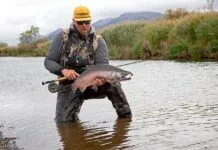
Trey Combs has spent decades documenting the people, rivers, flies, and techniques that shaped steelhead fly fishing. In this episode, Trey and his son, Mark Combs, take a close look at steelhead history, from classic fly patterns and early Spey fishing to grease line techniques and the stories behind some of the sport’s most important books and photographs.
The conversation blends firsthand experience with preservation. Trey shares stories from his years on steelhead rivers, while Mark explains how he is building an online archive that makes steelhead history accessible through books, photographs, fly plates, essays, and fly-pattern research.
[00:02:10] Trey explains that after his most recent book was published, his writing has shifted toward articles for the website Mark created. The website has become a place where Trey can continue documenting steelhead history while Mark works to organize decades of material. That connection between Trey’s firsthand experience and Mark’s work preserving it becomes a central theme of the conversation.
Rather than simply looking back, they are finding ways to make steelhead history available to people who may never have seen the original books and photographs. His continued writing gives readers another way to explore steelhead history through the experiences of someone who helped document it firsthand.
The photographs and classic steelhead flies also help illustrate the visual side of steelhead history, preserving patterns that might otherwise be difficult for modern anglers to study. The book remains an important resource for anyone interested in steelhead history and the development of classic steelhead flies.
[00:05:16] Mark explains that the website is being built more like a museum and archive than a traditional commercial fishing site. Chapters from Trey’s Steelhead Fly Fishing are gradually being scanned and added online, with plans to eventually make the complete book and fly plates available. This is one of the most practical ways to preserve steelhead history. Instead of relying entirely on aging physical books, anglers can eventually access the material digitally. The archive also gives steelhead history a permanent home where new generations can explore the techniques, flies, rivers, and people documented by Trey.
[00:06:49] Mark looks back at his first trip, which was a float on the Deschutes with Trey and publisher Frank Amato. That experience eventually became the foundation for Mark’s children’s book, Fly Fishing with Cotton Reed-Sides of the Deschutes. Although the book is written for children, the story connects directly to steelhead history because it comes from the same family experiences and fishing culture that influenced Trey’s work. Mark also explains how Trey contributed technical fly-fishing knowledge while Mark handled the dialogue and illustrations.
[00:07:56] One of the most fascinating discoveries in the conversation comes from the old fly plates created for Steelhead Fly Fishing and Flies. Harry Lemire tied the first four plates, while plates five through eight featured patterns from several important Pacific Northwest fly tiers. Mark discovered that a Steelhead Bee on plate five, originally attributed to Harry Lemire, was actually tied by Roderick Haig-Brown. The American Fly Fishing Museum now holds the original plates, and because the flies have become too brittle to scan, the museum provided photographs.
That discovery adds another remarkable piece to steelhead history. The Steelhead Bee itself becomes a physical connection to the anglers, authors, and fly tiers who shaped steelhead history decades ago. Discoveries like this show why preserving steelhead history requires close examination of the original flies, photographs, and records.
[00:10:48] Trey explains that he originally intended to write a much broader book about the development of fishing across the Far West, including Washington, Idaho, and California. The manuscript grew too large, so the publisher asked him to remove material that didn’t directly relate to steelhead. Editing the manuscript took nearly a year because Trey was working with a typewriter and carbon paper. That process itself has become part of steelhead history, showing how much work went into documenting the sport before digital editing and publishing existed.
The resulting book became an important record of steelhead history, bringing together information about rivers, flies, anglers, and the developing culture of steelhead fly fishing.
[00:13:16] Trey tells the story of meeting Roderick Haig-Brown at a fly-fishing banquet in Portland. Trey wanted to know whether Haig-Brown understood the action produced by some steelhead flies. Haig-Brown eventually sent Trey two Steelhead Bees. One had been fished, and its hackle and wings were positioned far differently from the upright, divided-wing version often associated with the pattern.
Trey believed the fly was designed to be taken while it was walking across the surface during the swing. That observation offers a fascinating piece of steelhead history because it connects a famous fly directly to how its original tier actually fished it. The Steelhead Bee story also shows why preserving physical flies matters to steelhead history. The pattern’s written description and its physical form can tell different parts of the story.
[00:16:29] Trey points out that fly patterns change over time. Even when anglers use the same name for a fly, how they tie and fish it can evolve through experimentation. This idea matters when studying steelhead history. A fly may have one form in a book, another form when tied by the person who originally developed it.
The Steelhead Bee provides a particularly clear example of how classic steelhead flies can evolve. Understanding those changes adds another layer to steelhead history because the pattern itself becomes a record of how anglers experimented with presentation.
[00:19:53] The discussion moves into waking flies and the development of surface-breaking presentations. They describe thinly dressed Atlantic salmon flies that could be hitched to create a small wake, as well as larger waking patterns that created more disturbance. This part of steelhead history shows the connection between Atlantic salmon traditions and Pacific Northwest steelhead fly fishing. Techniques did not develop in isolation; anglers adapted ideas from one fishery and applied them to another.
The history of waking flies is therefore also part of the broader steelhead history of experimentation, adaptation, and changing ideas about how a steelhead should see a fly.
[00:23:12] Trey compares the way steelhead and Atlantic salmon can respond to a fly. He describes differences in how quickly the fish may take the fly and how the fly behaves during the presentation. Those observations help explain why techniques evolved differently across fisheries.
In the steelhead history, the development of presentation methods is closely connected to how anglers understood fish behavior. The comparison also helps place grease line fishing within the larger story of steelhead history, rather than treating the technique as an isolated method.
[00:24:52] Trey explains the basic principles behind grease-line fishing. They greased the line to make it float, treated the leader similarly, and presented the fly near the surface while keeping the line under tension. He also describes an often-overlooked part of the technique involving the line and rod after a take. These small details are exactly the kind of information that can disappear unless you record them.
That is why practical knowledge is such an important part of steelhead history. Grease line fishing isn’t just a historical label; it represents a complete way of approaching a steelhead river. Understanding these details helps modern anglers connect more with the steelhead history behind traditional fly-fishing techniques.
[00:27:14] Trey describes casting across and downstream, keeping the fly under tension, and using an upstream mend to extend the drift. The conversation compares this style with presentations used in European salmon fishing. This is another example of how steelhead history developed through connections between fisheries. Ideas from Atlantic salmon fishing influenced Pacific Northwest steelhead anglers, who then adapted those ideas to their own rivers. Modern steelhead fly fishing still carries pieces of that steelhead history, even when anglers use very different equipment.
[00:29:27] The conversation turns toward early Spey equipment and the way anglers built or modified their own fly lines. Before today’s specialized commercial systems, anglers often created their own combinations of heads, tips, and running lines. This is an important part of steelhead history because today’s integrated lines and heads did not appear from nowhere.
Anglers were already experimenting with ways to control depth, distance, and presentation. The evolution from homemade systems to commercial products also shows how practical experimentation shaped steelhead history.
[00:35:10] Trey and Mark discuss the materials used in older flies, including rare feathers and other materials that can be difficult to find today. Some historic flies can even become sources of material for newer patterns. Materials are an often-overlooked part of steelhead history. The availability of feathers, fur, hooks, and other materials influenced what anglers could tie and what patterns became popular. Studying those materials gives anglers another way to understand classic steelhead flies and the period in which they were developed.
[00:38:15] Mark explains how organizing his father’s books, photographs, slides, articles, and fly patterns gradually turned him into something of a fly historian. His work gives steelhead history a different kind of preservation. Trey experienced much of the history firsthand, while Mark organizes the evidence so others can study it.
Together, their work connects firsthand steelhead history with modern digital preservation. His work makes steelhead history easier for anglers to explore and understand.
[00:40:47] Mark describes the fly pattern dictionary he is developing. The goal is not to simply create a list of fly names but to connect famous dressings with the people who tied them and the stories behind the patterns. That approach makes the dictionary especially valuable for steelhead history. A fly pattern becomes much more useful when anglers can understand who tied it, where it came from, and how it was used. The project also protects the connection between classic steelhead flies and the people responsible for their development.
[00:43:01] Trey discusses the colors that were associated with steelhead flies at different periods. White, red, and orange were important, while black and purple weren’t initially considered major steelhead colors the way they later became. That change is another small but interesting part of the steelhead history. Fly selection is not static, and patterns that seem obvious today may once have been unconventional.
The discussion shows how classic steelhead flies reflect changing opinions about color, materials, and presentation.
[00:49:04] When asked which river he would return to, Trey chooses the Dean River. He describes the lower and upper river, the difficult falls, and the powerful summer steelhead that move through the system. Trey recalls catching a 39 1/2-inch steelhead there, giving the conversation a firsthand connection to one of the legendary rivers in steelhead history. The Dean also represents the kind of remote steelhead water that has played a major role in steelhead history, particularly for anglers interested in large summer-run fish.
[00:53:42] The conversation moves to the Babine and the powerful takes Trey experienced there. These fish and rivers illustrate another side of steelhead history: the development of tackle and techniques capable of handling large, powerful steelhead. Stories from rivers such as the Babine help explain why steelhead anglers developed specialized equipment and approaches. The fish themselves pushed the evolution of steelhead fly fishing.
[00:57:21] Dave and Trey discuss how steelhead methods have changed, including the increasing use of beads and indicators and the continuing interest in swinging flies and fishing near the surface. The conversation does not treat one method as the only legitimate approach. Instead, it shows how steelhead history has always involved changing techniques and different ways of approaching the same fish. Understanding that evolution gives modern anglers a better perspective on where today’s steelhead methods came from.
[01:01:33] Trey discusses Great Lakes steelhead and distinguishes those fish from Pacific Northwest steelhead. He describes them as lake-run fish and acknowledges the fishery’s quality, while explaining his preference for fish that have spent time in saltwater. This part of steelhead history shows how the word “steelhead” can refer to different fisheries with different histories. Regional differences matter when discussing steelhead fly fishing. The Great Lakes discussion also adds context to the broader steelhead history of how anglers have pursued rainbow trout that migrate into rivers from large bodies of water.
[01:02:37] Trey names anglers such as Al Knudson and Syd Galasso when discussing the people he knew before his first books. Mark also mentions Zane Grey and his connections to the Rogue River. These names are important because steelhead history is not only about techniques. It is also about the people who experimented, wrote, fished, tied flies, and passed on information from one generation to another. The stories of these anglers help fill in the human side of steelhead history.
[01:04:20] Mark brings up Zane Grey, prompting Trey to recall the Rogue River as it was during an earlier period. Trey describes the fish that were present then and explains why Grey could write about relatively small steelhead. Trey’s account provides a firsthand recollection of how the fishery appeared during that period. This is part of steelhead history. It also illustrates how dramatically individual rivers can change over time. That Rogue discussion gives another example of why historical accounts are valuable when studying steelhead history.
[01:05:06] Mark explains that the archive includes high-resolution legacy plates that people can view and print. Some images come from Trey’s books, while others the archive received. Digital preservation is becoming an important part of steelhead history because many original photographs, books, and fly plates are difficult to access or physically reproduce. By making these materials available, Mark is helping keep steelhead history connected to the original photographs and artwork rather than relying only on descriptions. Making these materials available online gives the next generation a direct connection to steelhead history.
[01:07::08] Trey remembers asking John Ferraro what he considered the greatest breakthrough in steelhead fly fishing. Trey expected an answer involving a fly or line, but Ferraro answered with five-millimeter neoprene waders. The thicker neoprene allowed anglers to fish winter steelhead while staying warmer. It is a simple example of how equipment can influence steelhead history. Sometimes the most important developments in steelhead history are not glamorous. A better way to stay warm can make an entire fishing season more practical.
[01:08:00] Mark returns to the fly pattern dictionary and explains that the project currently contains about 175 flies, with the goal of reaching roughly 1,000. The entries will eventually be organized into categories, including classic steelhead and Atlantic salmon flies, as well as tube flies. The project could become an extensive reference for steelhead history because it connects patterns to their dressers and pattern histories.
Mark’s approach also helps preserve the stories behind classic steelhead flies, rather than treating them as anonymous recipes. The fly pattern dictionary is another example of how modern technology can preserve older steelhead history without changing the original material.
[01:12:00] Trey closes the fishing portion of the conversation with a simple idea: learn a pool or run extremely well. He compares it to having a beat on a European river, where an angler may know only a few pools but understands exactly how to fish those pieces of water. That idea fits naturally into steelhead history because knowledge of individual water has always been part of successful steelhead fishing. The equipment and flies may change, but reading a river remains important.
Episode Transcript
00:00:00 Dave: More than fifty years ago, Trey Combs received two steelhead bees directly from Roderick Haig-brown. And what those flies revealed challenged how people still tie and fish that pattern today. And today we’re going back through steelhead history, grease line, fishing, early Spey, classic flies, and a remarkable collection of books and photographs that is finding its way to a new home online. This is the Wet Fly Swing podcast, where I show you the best places to travel to for fly fishing, how to find the best resources and tools to prepare for that big trip, and what you can do to give back to the fish species we all love. Trey Combs is back on the podcast today, along with his son, Mark Combs, who has taken on the job of preserving and sharing much of Trey’s work over the years. Today you’re going to hear about grease line fishing and how it actually worked, and an important part of the technique that often gets left out. We’re also going to find out how Trey and other steelhead anglers were cutting and building their own fly lines back in the day. We’re going to get into some of that history on Spey. We’re also going to hear about the story behind steelhead, fly fishing and flies, and why editing the original manuscript with a typewriter and carbon paper took nearly a year. This is going to be a good one. The story behind some of these books, how they all came to be, and also the historic fly patterns and plates that are in the American Museum of Fly Fishing. And Mark is doing a great job. We’ve got a great resource for you today. You’re going to be excited to hear this one. All sorts of good stuff. We’re glad to have Trey and Mark on the podcast today. You can find all the work at Trey Combs flyfishing dot com. All right, let’s get into it. Here they are. Trey and Mark Combs. That’s how you guys doing. Good. Great. Great to have you guys both on the podcast. Trey. We’ve done some episodes in the past. Uh, it’s been, I think they’ve been some pretty amazing ones. And Mark, we’re going to get a little update on what you have going with the, the new website. And we’re going to talk about that and your connection here with everything. Um, but yeah, maybe we can just circle back. Maybe we can start with you, Trey, on, you know, what you’ve been up to. I know you know your name. I hear you still come up a lot on the podcast, so I know you’re still out there. What’s keeping you busy these days? 00:02:10 Trey: I’m trying to stay alive. No, I’ve been, uh. I was ill for a while. I’ve been, uh, after the book was published, which was the last one, and Tom Ferro was the publisher. That was a huge undertaking, especially given my age. And, uh, Mark came up with this website, which has been really become a driving force. I’m amazed at what he’s created, but I’ve been writing articles to post on the website. So my writing has been confined to that. I haven’t written for any publication, but I’ve written some articles for Mark’s website. 00:02:50 Dave: That’s great. What was the Tom Perreault book? What was the name of that book? 00:02:54 Trey: Prize for Atlantic salmon and steelhead. 00:02:56 Dave: Yeah. That’s right. And is that book out there still? Is that something people can find? 00:03:02 Trey: Marks handling the sales of that book. And Mark, you can step in and explain what’s going on there. Yeah. 00:03:08 Mark: The book is magnificent. It’s a large, oversized thirteen-by-eleven hardback book that has over a thousand images in it and some of the most stunning fly plates and fly images from the top fly dressers in the world. Will Bush, Dave McNeese and there are, um, it pretty much goes through starting with Atlantic salmon flies all the way through, you know, the movement in the sixties and 70s with the, with the steelhead flies and that whole culture that Trey documented in the, in the seventies moving into, you know, uh, the flies from today and then some stunning, stunning fly plates, um, from Michael Freuden of two flies that they use in Norway and Sweden and some of the European rivers. And so it’s just every kind of fly that you could imagine. And it’s just, it’s really an interesting book. The, the photography, especially the work in the book by, uh, Will Bush, who’s fly a jock. Scott is on the cover. 00:04:20 Dave: Oh, it is, that’s shock. Scott. Right. 00:04:22 Mark: Yeah. And it’s available. You know, they only did one thousand five hundred copies of this. So we, we have about four hundred of these copies left. I don’t anticipate that we’re going to do this again. We may do a smaller hardback version of it, but it’s also available in a a digital replica through Amazon. Yeah. And what that means is, is that when you buy the replica, because it has a static layout, you would read that on an iPad, you’d flip the iPad sideways. It would work on a laptop too, and then you’re going to see the pages exactly the way they were laid out in the original limited edition book. 00:04:58 Dave: That’s cool. So you can get that digitally. 00:05:00 Mark: Yeah, you can get it digitally. And you can get the hardback on both on Amazon and you’re buying it directly from us. 00:05:06 Dave: Oh that’s amazing. Now, are any of the other books this is probably more of a challenge. Is that because there’s a, you know, half a dozen more books on the website or any of those available digital digitally, or are they all hardback? 00:05:16 Mark: No, we’re planning to do some things with that, like for the Bluewater book. Um, we’re going to actually, uh, put that up as a, as a book that people can read for free. And we’re going to probably have like a sponsor inside the book. And so we’re trying to keep it clean. But more importantly, uh, on the website, if you go into like the book things, if you look at steelhead Fly fishing, which is Trey’s book from nineteen ninety one, I’ve been slowly rolling those chapters out online on the website. So the website is, by definition, set up like a museum, like an archive. You’re not going to find you. Come to our website. You don’t have to sign up. There’s no flashing ads. None of that. It’s really, really clean, like a museum site. And so I’ve been I’m going to eventually have every chapter and all the fly plates from that book. It’s just taking a while because we have to actually scan the pages in and get them ready for online on the web. But people can read those chapters now. Free online. 00:06:18 Dave: Oh, this is awesome. We’ll have a link out to that. Trey Combs fly fishing dot com and they can check all this out. This is great. And I know, you know, the steelhead fly fishing and flies that, you know, that book is still on my shelf. I’ve had that since I was a little kid, basically. And that’s kind of been one of the books. Another one I see here that I didn’t know about was fly fishing with cotton read sides of the Deschutes. That one looks interesting. What’s. Maybe, Trey, you could tell us about how that book is that one you wrote. 00:06:44 Trey: Well, that’s my son’s, uh, children’s book. 00:06:47 Dave: Oh it is. 00:06:48 Trey: Yeah. 00:06:49 Mark: Yeah. So, you know, I, uh, admittedly, uh, as a kid, uh, may trade a little crazy. He just wanted to fly fish all the time. And all I cared about was baseball and baseball history books. 00:07:01 Dave: Oh, nice. It’s amazing. 00:07:02 Trey: Yeah. 00:07:03 Mark: But I did go fishing with him, and. And it’s funny, at the time, it was not exactly something I wanted to do. But now I look back, you know, nostalgia is a place that we can’t get back to. And I look back on it now and it’s, it’s these are great memories. And so as a kid at the time, I didn’t appreciate it. You know, most kids get taken down to the lake and they throw a lure in. My first fishing trip was floating the Deschutes with Trey and Frank Amato, the publisher for salmon, Trout, steelhead. 00:07:33 Dave: Oh, wow. That was your first trip. That was your first trip was it was on the Deschutes with with. Wow. 00:07:39 Mark: And so that book is, you know, caught in my middle name is cotton. And so that’s about kind of that trip. But it’s, it’s made to be a book that’s funny for kids. It’s not completely factual, but it’s based on that. 00:07:52 Dave: Yeah. And did you write that or did Trey or you guys both wrote it together? 00:07:56 Mark: We both worked on it. He helped me with some of the the fly, uh, you know, so it’s going to be a series of books. I’ve got so much to do here. There’s so much content that Trey has that I’m trying to balance all the content that we’re putting up. So I want the book to be a thing that that, you know, ten, eleven, twelve year olds can read and it teaches them how to fly fish and how to tie flies. And so he kind of served as a technical role on the different flies that we would use on the Deschutes and things like that. And I wrote the dialogue and did the illustrations. So originally, when you had contacted us, kind of an interesting story, you talked about the steelhead fly fishing and flies that you still have on your shelf. So when Trey wrote that book in the in the seventies, he went down in Port Townsend to like the local photo shop and had those fly plates made. And there were there were eight fly plates in the book and the first. The first four plates. Harry Lemaire tied all the the fly plates, all the flies on those plates, and then on plates five through eight. They had like a who’s who. There’s Sid Galasso and Wes Drain and Tommy Brayshaw and some really heavy hitters of the Pacific Northwest. And on plate five. And there’s an article about this on the website. On plate five, there’s a steelhead be there that was attributed to Harry Lemaire, and Harry wanted all the his flies back. So dad sent him back plates one through four. But plates five through eight he sent to the American Fly Fishing Museum and they still have them. And so now flash forward, all these years, I started putting these fly plates up onto the website for people to look at and, and doing a write up on them. And I was talking to Trey and we suddenly realized that on fly plate five, there’s a steelhead be there that Harry didn’t tie. It was actually tied by Haig-brown. Oh, wow. 00:09:59 Dave: There you go. 00:10:01 Mark: And so what I did is I actually contacted the American Fly Fishing Museum and the flies. Now it’s, you know, fifty years later, they’re too brittle to lay on, on a scanner. So they sent me some photographs of the original plates. And so I have that image, you know, fifty years later of that steelhead be that haig-brown died. 00:10:24 Dave: Wow. That’s pretty amazing. And that was steelhead fly fishing and flies. And that was published in nineteen seventy six. Is that right? 00:10:31 Mark: Yes, yes. Yeah, yeah. 00:10:33 Dave: All these. Yeah. I mean, that is so cool. I mean, all in the cover is amazing too, because it’s an old fly wall with some patterns on it. Maybe take us back there a little bit. Trey, do you remember why you wrote that book? It seems like that was your first real big book on steelhead, right? Or one of them? 00:10:48 Trey: Yeah. I had decided to write a book about kind of the development of fishing on the on the far West coast. You know, Washington, Idaho, California. The book became unwieldy and huge. And the publisher, who was the same person that published Frank’s magazine. 00:11:06 Dave: Yeah. Amato. Right. 00:11:08 Trey: Yeah. He said that he’d published this as a book. If I cut out all the esoteric material that didn’t pertain directly to steelhead. So I edited the book and editing that book and getting that material out today with computers would have taken a couple of weeks. You just go through and delete stuff and pull the stuff that you want. And it took me almost a year to do it with an Olympic typewriter and carbon paper, so that I could have a spare copy for myself. Boy, when you make a typo mistake with carbon paper and to go back and correct it. What a pain in the ass. But. But anyway, so I edited the thing down and we got ready to turn it over to the publisher. But Frank had changed printers. He had a better price from another printer. And that guy who was lost his business had no interest in doing the book. So that’s when Frank decided to do to do the book himself. And he’d already done steelhead. The steelhead trout. 00:12:15 Dave: Oh, right. That was your book to steelhead trout. 00:12:18 Trey: Yeah. So these two books got Frank in the in the publishing business, which really ran his company for years. 00:12:24 Dave: Oh no kidding. 00:12:25 Trey: He was, uh, he was the biggest name in Western publishing of steelhead material and trout material and stuff for years and years for a generation. His list of books that he published was huge. And, uh, but if you permit me for a second and Mark can chime in here. But yeah, the flying question. I’ve got into a number of discussions by email with Canadians. I had dinner with Haig-brown years ago at a, um, a fly fishing banquet in, in Portland, Oregon. And I was fascinated by whether this gets in really in the weeds, but I wanted to know whether Haig-brown was familiar with, uh, with waking flies that was just hitting the scene. 00:13:16 Dave: That was. 00:13:16 Trey: Just appearing among American anglers where the fly broke the surface and create a little wake. And it could be, uh, you can take a thinly dressed, low water Atlantic salmon fly and hitch it. And it would create this nice, neat little wake in the surface film, barely breaking the water. Or you could wake a murderer behind the head or in the head, and it would create a big wake. And they called us dry fly fishing, which it was, and it wasn’t, but. But Harry Lemaire advertised the fact that he’d gone into Canada to a river I’d never heard about. The river was the dean. I was interested when I was talking to Haig-brown. I asked him whether he’d written about in his books about how he’d cast this dry fly upstream, and steelhead would see the fly and drop back, and then as the fly got on the swing and it would start to wake. And he didn’t use the word wake. The steelhead would rise and take it down. And I was curious as to whether he was aware that the fly was waking in that period. And he didn’t use the word waking. And maybe the term was new to him, and maybe it wasn’t, I don’t know, but I asked him if he could send me a couple of his steelhead B’s or send me a steelhead b. We sent me two and one had been fished and David was flat as a pancake. 00:14:50 Dave: Really. 00:14:51 Trey: The hackle was pulled back, the wings were splayed out. They were forward, way forward. So on the water the fly looked like a Y and it floated downstream. But on the swing it really broke the surface. The wing started wobbling back and forth, and so clearly Haig-brown was fishing that fly to be taken on the swing, and he was waking the fly without calling it waking. I was fascinated by this, and I’ve seen so many illustrations of the steelhead be with the wing straight up upright and divided, as if the fly was fishing as a dry fly. The other fly he sent me in the same package was brand new. He They just tie it. But the wings were set so far forward, it was really easy to see that as soon as this fly got wet, the hackle wasn’t tied to float the fly or to be on the hackle points or anything like that. It was clearly designed to wake on the swing. So this is invited a lot of, uh, input from Canadians who still tie that fly upright and divided as if it’s a dry fly. And, and haig-brown in his later days, uh, was fishing that fly. And, uh, he was fishing it as a, as a waking fly. 00:16:15 Dave: As a waking fly. So you’re getting to the point that like, I think of a humpy, right? That style of hackle, right? Where it’s sticking straight up, it’s split. But what you’re saying is the steelhead be really wasn’t when Harry was fishing. It was not like that. It was it was actually splayed forward. 00:16:29 Trey: Yeah. Yeah. No, it, uh, it was never designed to maybe in the early days when he first tied that fly. You know, flies are I mean, they go through all kinds of stages. Even if it’s your favorite fly, you tend to make changes in it. And every time you tie it. And this fly may have started off as a typical dry fly, a steelhead be he thought about, you know, a hornet or a bumblebee or a bee landing in the water and being taken by steelhead. It was kind of a catchy name for fly steelhead. Me, I liked it. So, um, whatever he did at the start, at the end, I know what the fly looked like at the end because he’d sent me a couple. 00:17:12 Dave: Oh he did? 00:17:13 Trey: Yeah. And those are the flies that I that illustrate are illustrated in that. That’s one of the flies that are illustrated in steelhead fly fishing flies. And that’s the fly the museum presently has is a haig-brown fly. Uh, the other fly that I had, I gave to, um, I sent the new fly to the museum and the other fly I sent, I gave to Frank Amato, which he cherished. I mean, I told a story that Mark just put up that at the dinner after dinner, Haig-brown lit up a cigar, and in those days it was still permitted to smoke after dinner. So Haig-brown puffed on his cigar until it was about two thirds down. Then he tamped it out as he was leaving, and Gail Amato, Frank’s wife, was looking at everybody, and she opened her purse at table level. You know, she just kind of scooped the cigar up and into her purse, and she had the cigar, but set in a block of plastic at their house as this was the cigar that Haig-brown smoked. Gives you an idea of the the depth of prestige. 00:18:26 Dave: Right. He was a big. And this was when it was this in the mid seventies? 00:18:29 Trey: Yeah. Actually, the book came out in seventy six, so this would probably be seventy three, seventy four, probably in their. 00:18:39 Dave: Outpost on the Noosh is remote even by Alaska standards. They give you access to one of the most unique river systems in Alaska. Every day starts with cold mornings, endless daylight in the land of the midnight sun, and a maze of channels that invite exploration around every corner. What I love about this place is it doesn’t try to be easy. The fishing isn’t about racing from spot to spot. It’s about slowing down, reading water, and making the cast that counts. Beautiful, stubborn, and a little weird, the Noosh attracts anglers looking for something beyond the typical lodge experience. If you’re thinking about your next adventure to Alaska, check out outpost on the Noosh dot com. That’s outpost on the Noosh n u s h dot com. Check them out today. Trout Routes by Onyx is built for fly anglers who want better Intel without spending hours digging. For the information, you’ll get access to public land maps, stream access points, regulations, and even road and trail maps all in one place. It’s become my go to app for scouting new trips. You can check them out right now. Go to webflow dot com slash routes and download the app today. So Haig-brown at the time was the was one of the biggest names in steelhead fishing in the world. 00:19:53 Trey: Not in all of his books. I mean, the river that he fished was a tail water. And it had a small number of Cimarron steelhead in there. And he loved to go in there and fly fish for the summer on fish. And these were two year ocean fish. And, uh, Mark, what’s the name of the river up there that I’m thinking about? It’s the name of this town. Oh. Campbell River. And, uh, it had been dammed. And so this was a tailwater fishery, and he made the most of it. So this is the earliest time in in, uh, where we got into wicking flies. And Then there was damp flies and all kinds of nonsense. But essentially it was the start of flies that broke the surface. And they are so much more effective than flies that just stay just below the surface. Let’s put it that way. 00:20:43 Dave: Yeah, yeah. No, we we had a great trip this year. I fished for Atlantic salmon for my first time actually in Newfoundland, and we fished Portland Creek. We fished Portland Creek, right. Which is where the famous, you know, Lee Wolf and the Portland hitch is what they call it. But essentially it was a riffle hitch was kind of, you know, the Portland hitch was kind of invented. 00:21:00 Trey: That was boring. 00:21:01 Dave: You. Yeah. They said it was it started there because at the time they had the hooks with, you know, they didn’t have the eye on the hook. So they had to do that to hold. I guess it had something to do with the hooking of the fish, right. Or something like that. 00:21:12 Trey: But ah, I think it was that the. 00:21:15 Dave: Yeah. What was that story? 00:21:16 Trey: The British Navy were in their ships. They were anchored off the mouth of the coast and Portland Creek, and they had brought along their fly fishing equipment and the flies got all busted up and they couldn’t replace them. So these were blind eye hooks. There was no eye on them. So the sailors or the officers, they had to hitch the fly so that it was secured again. And, uh, because the gut that was part of the head of the fly, which was lashed down, had broken off and gotten brittle. 00:21:50 Dave: That’s right. 00:21:51 Trey: So they just clipped it off and put a hitch in there and went back to fishing the fly. 00:21:55 Dave: Yeah. 00:21:56 Trey: That’s it. You got that’s it. That’s. How did you do? 00:21:59 Dave: Uh, it was good. Well, we well, like fishing is, you know, we get there and the water is high and the conditions weren’t quite right and fish had moved through and stuff. But we all had opportunities, you know, um, you know, for me, it was just really just getting out there and fishing the hitch, you know, we fished the hitch the whole time and I had yeah, I mean, it was, uh, it was good. We actually went and fished a couple other rivers in that area and had more action on some of the other ones. But, um, but yeah, just being there. 00:22:24 Trey: So were these, uh, growths or these two year fish. 00:22:28 Dave: Yeah, for the most we caught a lot of grills. There were some bigger fish that we got into, but I didn’t land any of the of the full, you know, adults. But but even for me, I mean, the grills catch a six pound grill. So it was still pretty spectacular. You know, just seeing the fish come to the surface, right. Just seeing it come to the hitched fly because they come to it. It’s amazing. If you’ve never done that right, it’s you’re seeing these basically steelhead like fish, right? Come up and they’re taking it on the surface, right? And it’s just this, it’s different than, I mean, you’ve probably done a little bit of that. Do you think that’s a lot different than swinging a hitch fly for steelhead summer steelhead. 00:23:02 Trey: The big difference is the steelhead and the Atlantic salmon take the fly differently. 00:23:07 Dave: Yeah. How does the steelhead take a riffle hitch fly differently than how Atlantic would. 00:23:12 Trey: A millisecond the steelhead comes up, grabs the fly and takes it down. Then if they’re hooked and they usually are, they can be hooked anywhere in their mouth, but they turn around and run downstream, usually clear the pool if they can. Where? The Atlantic salmon is closely related, of course, to the brown trout. But Atlantic salmon sucks in the fly, which is why grease line fishing works so well for Atlantic salmon and didn’t work as well for steelhead. Atlantic salmon sucks the fly in and holds it and the fly will actually go through there, will be sucked in and actually goes out through their gills sometimes. The first really big Atlantic salmon I ever hooked and landed was on the Rasina River in Russia. And that fly, the fly went through its gills, and when we were netting it, it tore one of the gill rakers out and the there was a huge flush of blood, and the fly died. The fish died instantly within 20s. It was dead, but, uh, it was, uh, Side ten kilos. So was twenty two pounds or so. It was a magnificent female. 00:24:27 Dave: Yeah, well, tell me this. Tell me this. Trey. I want to hear the the grease line fishing comes up a lot. And in fact, there was a book written by, you know, it’s called Grease Line Fishing by was it? Who was it? You remember the author of that one? Yeah. Was that Jock Scott? Yeah. And it was a classic book that I read. You know, it’s been out there. What is the grease line? How would you explain greased line fishing, that technique back then? What was that and how is it different from how people fish summer steelhead today? 00:24:52 Trey: What made Greased Line fishing different was they greased the line. They used a, um, a lanolin based solvent or something, but they had greased their lines so the line would float and then they greased the leader as necessary. And what they wanted was the fly up in the surface film. And the fly could break the surface and the fish would rise up and suck in the fly. And there would be a belly. There was time. This was kind of in slow motion. But a belly would form a line that went past the sound and created drag. And that drag pulled the fly into the corner of the fish’s mouth without trying to yank it into the corner of its mouth. And at that point, the angler. They don’t say this. People who practice greased line fishing in the. Priscilla had never read the book far enough to know that. The guy laid the rod down and actually pulled the line forcefully in the opposite direction. The fish had taken the fly, but the fish was hooked in the corner of its mouth every time it was really secure. But this whole method depended on the slow motion take of an Atlantic salmon. I fished greased line on that in Russia in later years on the River rural Kanga and I watched ten or twelve pound salmon rise up and taking a little number, I guess, would be at number ten fry. That was um, black and white and it sucked it in just. It was picture perfect. The fly was almost perpendicular to the water. The salmon actually had watched the fly coming. And as the fly started to go past the salmon, the salmon rose until it was almost straight up and down, and it sucked in the fly and was hooked. But, uh, still had. I’ve never seen a steelhead ever do that. Steelhead comes up and hits the fly in a in a microsecond. And then he’s gone. 00:27:03 Dave: Oh, right. Yeah. How is swinging flies for, say, summer steelhead today? How is that different. Like with the dry line different than the grease line fishing of what you’re talking about. Of yesteryear. 00:27:14 Trey: Yeah. I think it’s changed today Dave. But when we fished Back in the day we were. We were casting across and down, and then the fly was under tension the whole time. And to increase the length of the presentation, we would. Sometimes we could throw a mend upstream and get a little more mileage out of the drift. But the fly was under tension the whole way. The Europeans never fished for salmon that way. They would throw a loop downstream and the fish would fly, was broadside to the salmon. So the fly came downstream broadside, and when the salmon took it, it was almost invariably in the corner of their mouth, because that’s the only place they had to go, was already across the mouth. 00:28:03 Dave: It was swinging. Yeah. 00:28:04 Trey: Where did caught it? From? Behind. Now, I’ve stopped fishing many years ago with a tight line. I made my fly. And even though steelhead and Atlantic salmon are different, It’s deadly for steelhead and it’s the only way you can fish in the winter. For winter, steelhead is strongly leaving your fly. Otherwise the fly won’t get down. 00:28:29 Dave: Mhm. Right. Do you still get an out for winter steelhead? Summer steelhead. Are you still. 00:28:34 Trey: No. No I haven’t. Not in, uh, four or five years. The last time I fished winter fish, uh, was I had some Japanese clients. A friend of mine is a Japanese national that I met many years ago, and he came aboard a charter I was running for, uh, striped marlin on a fly. He was twenty nine years old, and he emailed me the other day, and he just celebrated his, uh, I think his fiftieth birthday. That was two or three years ago. So he’s in his early to mid fifties now. And, you know, I first met him when he was twenty nine years old. So that goes back a ways. But the everybody today is much more sophisticated at the get go than they were back then. 00:29:16 Dave: Yeah. With the spay. Right. That’s is the biggest. What do you think the biggest change is from the seventies to like today, fifty years later. Is it the spay rod. Is that do you think the biggest thing. 00:29:27 Trey: Oh, the spay rods were making their we were picking up rods and fishing back in the seventies. And we made our own lines back then. And the lines that we were chopping up and making by hand was absolutely like the wind cutter. We had way forward lines with sink tips and then on a thin running line and we cut those to. So we had about a thirty three ten meter head and the wind cutter came along. And that was kind of a well, it couldn’t be anything but a best selling line because it made a factory version and a better fishing version of the very lines that we were creating by hand. 00:30:09 Dave: So you were fishing, so you were using some space rods, some longer stuff in the early days, day back seventies 80s. 00:30:15 Trey: Yeah, the first run I ever had was enormous. A two handed rod. Absolute crap. 00:30:21 Dave: Yeah. 00:30:21 Trey: Terrible rod. But I, um, sage was just down the street from me and I got on their, uh, their, uh, pro staff and got into their, uh, spey rods and, uh, they were good rods. They were a light in the tip. They were definitely tuned for a steelhead fly fishing. And the Europeans who are fishing, um, double taper ones in the winter with, uh, and just naturally sinking them. They might have gloves on their fishing rods that were very heavy in the tip because of its lifting power. And my sage rod, I fished it in the when I went to Finland, was there a couple times and fishing for salmon in the rod just was just didn’t measure up. Uh, then I got into with TNT and I had a, a fourteen foot eight weight for TNT. That was absolute cannon. And, uh, I fished that rod for many years until I joined, uh, Berkheimer air more recent years. 00:31:36 Dave: Oh you did? 00:31:37 Trey: Yeah, I, when I went to Norway, I fished Berkheimer rods. 00:31:41 Mark: Are you on our website now, Dave? 00:31:43 Dave: Yeah. 00:31:44 Mark: I’d love to show you something if, uh, real quick. 00:31:47 Dave: Yeah. 00:31:48 Mark: Yeah. If you go up in the top menu, if you click on recent and you’ll see all like the recent blog stuff. 00:31:53 Dave: Yep. 00:31:54 Mark: And then go down to the bottom and click on older posts. 00:31:58 Dave: Older post. Yep. 00:31:59 Mark: And now you’ll come to this new page. These are all ordered based on when I post them, but I think this second page here is a really good example of what we’re doing in that first line there you can see the Britannia. That’s that’s a Satoshi Yamamoto, right? Who’s one of the best in the world? The other thing that I’m really excited about that we’re doing is we’re approaching these unknown fly dressers on Instagram. And so you can see this, the shoulders and the katana there. That’s a guy that is on Instagram, uh, named Mitchell Roberts that people didn’t know about. And so it’s, you know, similar to the, you know, what Trey did in the seventies, finding, you know, Syd Glasgow and all these names, Enos Bradner and all these different names, guys that were time flies. That’s kind of what I’m doing on Instagram. But what’s nice about this is if you look at the same page in the second and third line, you can see two flies that were tied by Sid Galasso. 00:33:04 Dave: Oh, really? 00:33:06 Mark: Yeah. 00:33:06 Dave: Which ones are those. 00:33:07 Mark: Yeah. That the the transformation. Sid Glass shows that part two and part one, those are both glass flies that were tied. And then down in the third line you can see a fly tied by, um, the green Highlander that’s tied by Will Bush. But I wanted to show you one image that I think, and you can actually click on it if you go into fly pattern plate five, Jock Scott three classic dressings and click into that in my opinion. Now I’m a bit of a fly historian. I think this image that you’re seeing and you can right mouse click on that and blow that up into a new tab. And you can, you can really see a blown up version of this. That’s really nice. That image, Dave, in my opinion, is one of the great fly tying images of all time. This is Will Bush, who’s tied three different versions of the Jock Scott, according to Francis Francis, Francis Price, Tenet, and Kelson. I, I just think, and this is an image from the new book, and we are so lucky to have Will Bush that tied these. He’s just all original materials. 00:34:16 Dave: Yeah. Now, are these are these materials, uh, you know, because we’ve had this conversation before about the Atlantic salmon flies. Are these all substitute or are these the original? 00:34:25 Mark: No, no. 00:34:26 Dave: Because that’s it’s really interesting because we had this whole you guys probably know it, the the feather thief. Right. You’ve heard that whole story, right? The feather thief. I mean, it’s a really bizarre story, right? Because you’ve got this kid who’s probably was one of the great fly tyers at the time. Um, tying these types of flies literally broke into the Natural Museum in England and stole millions of dollars worth of birds. And, you know, for like a you imagine the impact, right? Just the fact that some of them were like Darwin’s birds. There was a very, you know, but but it shows you the passion of how crazy this thing. And I think that when I’ve talked to Shuey and others and I’ve asked them about that, like, do you substitute. I feel like a lot of people definitely. There’s no problem substituting. Right. But what’s your take on all of that? Because it sounds like you’re deep in it. 00:35:10 Mark: Um, well, if they can tie and not have to substitute, then I think that’s great. So like for instance, on this page that we’re looking at, the Britannia that you see there is that Satoshi Yamamoto tied. He uses substitutes, but Will Bush does not. And so like in this page you’re looking at like that green Highlander that he tied. That’s just a magnificent fly. And it’s all. And he and the one down below that the Rob Roy that he tied. I’m a Will Bush fan boy. 00:35:40 Dave: Yeah I gotcha. Do you think there’s any I think there’s an interesting conversation because it ties into the conservation. Do you think there’s a a struggle here where, you know, it’s impacting native endangered species of birds out there? Or is that not. 00:35:54 Trey: No, I don’t believe it is. 00:35:56 Dave: No, because I know some of the story on that feather thief. You had people still, they haven’t got all the birds back. There’s still fly tyers that have those stolen skins that are out there, right? 00:36:05 Trey: Yeah. That that kid who did that, it was a lot of times he was selling the feathers online, but by the feather. But, uh, fifty years ago, um, Dave McNeese was taking certain feathers and dyeing them certain colors that were a perfect substitute for the real thing. And the whole esoteric nature of these rare feathers came out of the millinery trade. And the British were going up these jungle rivers and shooting all these birds, putting some salt on the on the skins and shipping them to hatters in London and New York. And the fly fishermen began getting these feathers and putting them in their fancy Atlantic salmon flies. But I think that some of these feathers. Today, unless you buy an Atlantic salmon fly and take it apart and rescue the feathers, uh, I don’t think some of those materials are possible to get today. Not certainly not legally. And the birds themselves are, uh, they’re not all in danger by any means, but they’re all protected. And you’d have to smuggle the feathers in the United States from South America or something to get those birds today. 00:37:20 Mark: And dad Will is tying. He buys old flies and then tears them apart for the feathers. Isn’t that correct? 00:37:25 Dave: Oh he does. Oh. That’s cool. 00:37:27 Trey: Yeah. And I think Mark, I think he’s going to run out of opportunity to do that. If it costs you three or four hundred dollars to tie a single fly, you’ve got to get a thousand dollars for the fly to justify the use of those rare feathers. I think that these guys are all having to go to a perfect substitutes for the real thing. I say perfect, it’s there’s always going to be a little bit of a difference. But, um, anyway, that’s my thoughts on it. 00:37:57 Dave: Yeah. Makes sense. No, it’s it’s cool. I love the obviously I love the history. I think that’s what’s cool about what you guys are doing, Mark, and what you have going here. It’s like you’re, is that part of this? Like, how did you get into this project? Because I’m not sure what website you had before, but you know, it’s cool to see all this history. How did this start? This whole thing of, of the upgrade? 00:38:15 Mark: Well, so I’m a, I’m a college professor and I’m going to, you know, so I actually teach research methods. And so I’m a fascinated by people that have spent their life researching a certain subject. And my little one just left home. She just she’s a freshman at Berkeley this year. And I’m getting close to, you know, I can see where I’m not going to be teaching anymore. I’m looking around for projects in about three years ago, I just started realizing how much content that that dad had. It’s just amazing. Dave. I mean, just boxes of thirty five millimeter slides, hundreds of articles in magazines, seven books. And then, you know, these new blog entries that he’s writing. And so I thought, let me just let me start collecting some of this information. We also have, you know, five hundred of the four to five hundred of the, the new books that we’re selling through Amazon. So this was just a logical thing. And so I started to get into this. I’ve always loved the flies anyway. I mean, I grew up listening to him in the other room. Talk to Harry Lemire and these different fly dressers. Right. And he out right outside my door, there was a little closet where he used to tie flies. And so I just once I got into this and really started looking at the, the history, I really started to embrace like looking at Kelson and these old books. And I especially love the work that Martin O’Keefe has done with his two big, pretty much encyclopedias, his book on the Hardy catalogs that spans almost a hundred years of the Hardy catalogs. It’s just a masterpiece. And so I really got into just the different flies. And and this is this is kind of my contribution to this whole thing is, is just this fly pattern dictionary, right? 00:40:06 Dave: The dictionary which I want to hear more about. And, and so you that sounds like, are you into more of the research and kind of what you’re doing here? Or are you also just as big into the fly, you know, swinging flies in the fly fishing. 00:40:18 Mark: Yeah. I’m the, I’m the fly historian and dad is the angler. 00:40:22 Dave: That’s interesting. That’s really cool. That’s what I love about I think fly fishing is cool that way. And fly tying is that, you know, there’s lots of different ways to do it. You know, you can you’ve got the people that tie flies and don’t even fly fish, right? These Atlantic salmon tires, some of them don’t even fish at all. And they’re just, they love the history. And I think that’s a really cool thing about it. Um that’s awesome. So so your plan here is just to really. Yeah, document. I’m looking at another plate three there towards one of your posts from the book. 00:40:47 Mark: Yeah. So if you click on flies up in the, in the menu up there, I’m going to give you an example of something that’s kind of cool here. So you can see that it’s like an alphabetical order here. 00:40:57 Dave: Yeah, the admirals first. 00:40:58 Mark: Yeah, yeah. And so if you click on any of these first ones, like just the admiral, if you click that on, you’ll see it takes you to the fly plate from. 00:41:06 Dave: Oh yeah, it’s got the fly plate, right? 00:41:08 Mark: Yeah. That’s from the, from the, from the book. So in this, in this section you’re going to get fly plates. But then if you go down, I’ll show you a like let me look at one that’s got a bunch of different stuff. Yeah. So if you go down to Brad’s bat. Yeah. 00:41:20 Dave: Brad’s right. 00:41:21 Mark: Brad’s Brad. You can see that there’s two plates from the seventy six and the ninety one book, and then you can see the individual fly image dressed by Dave McNeese. And then you can see there’s a pattern history. So you’ve got like five different things here all about that, that fly dressing. 00:41:41 Dave: Yeah, there’s McNeese and he’s obviously got his that style, which is amazing. 00:41:45 Mark: Yeah, yeah, yeah. And so we’re finding that, you know, I can tell from Instagram what our demographics are and the images that we post on immigrant, I can see, you know, what gets the most image, the most, you know, attention. And our demographic, our followers love these old pictures of Al Knudson and these different people from the sixties and the 70s with big steelhead. 00:42:11 Dave: Right? 00:42:12 Mark: I posted on Instagram a while back an image of, um, a George George McCloud who developed this guy Gnomish Sunrise. 00:42:22 Dave: Yeah. Skykomish. 00:42:23 Mark: And we, we got on that post. We got, um, we got almost forty, zero zero zero views. 00:42:29 Dave: Well, I’m looking at one of these plates and I remember this from the book because like I said, I got it right here. It’s, uh, you know, and I’ve got my favorite steelhead flies. If I had to pick one fly right now, it’d probably be a little black and orange, a little tiny. But you know, I’m looking at these plates, you know, the admiral, the Alaska Marianne, the Alaskan, the, um, I mean, there’s a ton of flies here that are just, I mean, a bunch of different. Now, Trey, on these patterns, how did you select all these patterns? Brad’s were at the bloody butcher. You know, it seems like a lot of patterns. Probably a lot of people never heard of. How did you originally select those? 00:43:01 Trey: I didn’t, the patterns just came to me. There were back then there were a list of steelhead flies with no origin attached to each to any one of the flies. And as I was researching the book, I came up with the people. Oftentimes the people who tied certain flies. But there was no, um, there was no widely held opinion as to what colors worked best except bright. I mean, uh, white and red and orange were really big. And, uh, back then, black and purple were not considered steelhead colors. And of course, today, black and purple are the two best colors for steelhead ever that anybody ever came up with. Or black and dark blue. Interesting story. of one of the guys in camp caught a beautiful salmon when I was there, and I asked him what. Why it was still attached to his rod. And what. What fly did he fish with? He called it a Nordic something or another, and I went and looked at it and it was a tube fly. It was black over dark blue. And I thought, you know, that fly would fish the hell out of steelhead right here in the Klickitat. I mean, that’s the perfect steelhead fly for summer fish. Thinly dressed black over dark blue or black over purple reds. 00:44:30 Dave: Flies is built for anglers who don’t want the same fly box as everyone else. Premium patterns, upgraded hooks and flies selected to show pressured fish something different. And every order also helps support conservation. With ten percent of profits going back to protecting the waters we fish. You can check in with reds flies right now at reds flies dot com. That’s reds r e d d s flies dot com. Check them out today. Let on to Mark Lodge. Give you the Montana fly fishing experience you deserve. The gin clear waters of the Missouri River offer a world class experience with one of the finest rainbow trout and brown trout fisheries in the world. Whether you’re a seasoned angler or new to the sport, their family of guides will tailor a trip just for you. You can head over to Onda Mark lodge dot com to fish one of the great trout streams in the country. I mean, there’s a bunch here too. I mean, I’m looking at some of them from that plate, the black prince, the black spook, the black gnat, Bucktail, the black diamond. Do you remember how many of these flies do you remember? Do all those like ring a bell or are those just some names? They’re just. 00:45:33 Trey: Oh yeah, they do ring a bell, but you get some flies like the Alcan or something. I don’t know where that came from. 00:45:39 Dave: Yeah. The Alcan right. It’s like a fly. I mean, most of these flies I would imagine most of them, nobody has ever. We’ve never heard of them. A lot of them are just like. Right. And it’s funny because really it’s not the pattern necessarily. It’s it’s just like steelhead fishing. You could throw any pattern on there, right? Any color. 00:45:55 Mark: Dave, one thing that’s interesting about this is that, uh, that dad didn’t mention is that in his, and this is where I got the idea for the fly Pattern dictionary in his very first book. In the back of this, there is a section in chapter twelve that’s called Steelhead Fly Pattern Dictionary. This is the book that was published in seventy one. The first one. This is the very first book that he wrote. And in the back of this book, he’s got quite a few of these flies that you see here that were then tied and pictured in color in the seventy six book and in the and I don’t have them all up yet. I’ve got, I think, plates one through three. But like I said, plates one through four were all tied by Harry Lemaire. So most of these, like you’ve got an owl special. You’ve got, you know, the flies that we were talking about. Most of these here in this first book, Harry tied in the seventy six book and we saw those in color color plates. 00:46:54 Dave: Yeah, the color plates, which was in seventy six. Those color plates were a revelation, right? There wasn’t much of that going on in seventy six. Is that true? 00:47:02 Trey: Yeah. 00:47:03 Dave: Yeah. It’s beautiful. Right? I mean, that that must have been people must have picked that book up and just been like, oh my God, this is amazing. 00:47:09 Mark: Yeah. I’m, I think about the way that we write and do research today. And I look at what he did in seventy six and I’m just remarkable. It’s remarkable. Not only did what was it the technique and everything, but he, you know, with phone calls and letters, he sought out Glass and Al Knudson and all these different people. And not only documented, you know, the steelhead and the rivers and the flies, but the whole culture and the movement from the the Atlantic salmon flies to these new type of flies that people were using in the Pacific Northwest. And that’s why the book was in print for twenty nine years. 00:47:47 Trey: Mark mentioned the use the word culture. 00:47:50 Dave: Yeah. 00:47:51 Trey: Yeah. And that was I got to jump in just for a second that that book. I didn’t do it. I didn’t think along these lines back then. But that book captured the culture of steelhead fly fishing. It, in effect gave steelhead fly fishers a home that here in print was a book that described what they did. And, uh, and it gave some tip of the hat to the areas of steelhead fly fishing. I mean, there was this Skeena, there was a Puget Sound rivers, uh, the, the Deer Creek steelhead and so forth. And, uh, it was Mark said that right on. I mean, that was spot on. That was describing the culture of steelhead fly fishing and that the book sold way more copies the third or fourth year it was in print than the year it came out. People were just getting on to it. 00:48:50 Dave: That’s really cool. If you could look back. Trey, you’re let’s just say go back fifty years. I know a lot has changed in fifty years, but what would be that, that one river that you would love to walk back into that you know, from fifty years ago. One steelhead river. 00:49:04 Trey: Well, in patient fifty years ago. But I’d fished the dean tomorrow. 00:49:08 Dave: Yeah. The dean. Yeah. The dean has some similarities to and we’ve talked about the dean recently. Right. It’s just this unique river because it’s so close to the the ocean, right. And it’s got these fresh, basically summer steelhead that are coming in there. Or maybe describe the dean a little bit more. 00:49:23 Trey: Well, the dean, there’s a lower dean and an upper dean. And a short distance upriver from the mouth of the dean is a falls that is very, very hard for the fish to get up. In fact, the pink salmon can’t even make it same dry. 00:49:41 Dave: Oh, wow. 00:49:42 Trey: But the steelhead can fight through those rapids and the. The dam falls. Seems like in places almost up and down. But they. Somehow they get through it. In fact, if you catch a steelhead right after he’s gone up river and through those falls he’s wiped out. There’s no. There’s nothing to the fish. But in the upper river the race of James River steelhead itself are. They’re magnificent fish. Uh, they’re typical three. The males are typical three solid steelhead. And when you catch one, it looks like it just came out of the ocean. Uh, I caught a thirty nine and a half inch steelhead late one day. And, uh, we all said, you know, I had a couple of buddies with me, Jimmy Hunnicutt, John Ferrari, and they said, well, it looks like a hen fish. You know, it had a massive body and a small head was more like an Atlantic salmon. And then we looked closely and I said, no, it’s a buck. and it was it was a buck, but it’s a different breed of cat. It looked like it looked like the fish had gone to the gym a lot. I mean, it was so muscular. 00:50:53 Dave: Right? 00:50:53 Trey: It’s so beautiful. 00:50:55 Dave: Right? Just to make it up, the falls like to be big enough to make it up. 00:50:58 Trey: Yeah, well, it had to have been a week after the falls, but it maintained its, uh. There was no sea lice on the fish, but there might as well have been. It was the most beautiful thing you’ve ever seen. But those are Dean fish. A female hen fish. Uh, in the Skeena system, travels more than three hundred miles to get to a river. And when it gets there, it looks as bright as a dime. I’ll tell you a quick story. Um, testing Mark’s patience here. But what? Mark was a little kid, uh, through Orvis, I bought a series of reels, and I bought him with a credit card. I couldn’t afford to pay for him. They were so expensive. And I bought all three of these little reels that were jet black. They’re made in the Junin de Los Andes on the mouth just opposite the river in Patagonia. And gosh, they’re gorgeous rivers, a gorgeous, a gorgeous river. But but anyway, so I was fishing up in the, um, the baboons and I hooked a hand steelhead. And the take was so violent that it blew the poles out and they stood straight up and put the reel in freespool. So the fish ran downstream and cleared the pool and went down into the next pool. And they typically will pause there. And when they did, I opened up the pole, the reel spool off, and put the poles back up and and put the reel back together again and walked downstream and eventually got the fish in. It was about a twelve pound hand fish, incredibly bright, but this happened a few times with the fish. So when I got home I put the reels up for sale and sold them. And, uh, I was with the sage at the time, so I contacted George Cook and asked, I want to come in and talk to him. So I told him my experience on the Barbie. And that was not just from one trip. That was a couple trips. And George, while I was telling him this story, he reached behind him and grabbed a couple of boxes and slammed him on the table. And he says, here’s two sage reels and they won’t override them. You won’t get you’ll never have that experience with this real. So I got I had a couple, nine and a half foot. First I had a couple ten foot rods, which are too much leverage, but anyway, not part of the story, but I had a couple nine and a half foot sage rods and a seven and eight weight, and I’ve usually fished in seven. And I went back up and I was fishing with Lenny Waller in the cabin. I swear to God, I had a hen fish about twelve thirteen pounds and blew the pole straight up. The shock of the sudden impact. 00:53:40 Dave: Was that one of those stage reels that blew. 00:53:42 Trey: Yeah, yeah, yeah. And I had to laugh. 00:53:45 Dave: So it was, it wasn’t. 00:53:47 Trey: It wasn’t. My beautiful Orvis reel was made in South America. It was wrong. The steelhead just were that violent. 00:53:53 Dave: Yeah. What year was that when you were fishing with Lonnie on the Babine? 00:53:57 Trey: Oh, it would be, but it would be in the early eighties. Mid eighties. 00:54:03 Dave: That’s right. Because Lonnie was doing some stuff out there. He had a still had some videos, right. Did some stuff with scientific angler or three m I guess. Right. Yeah. 00:54:10 Trey: Three M yeah, those were just, uh, that changed. Uh, I mean, everybody was going visual. Uh, that was the, everybody was transitioning from books and Lonnie did that three M series so popular. 00:54:25 Dave: Yeah. Still out there. 00:54:27 Mark: An interesting sidebar to, uh, what Trey was telling you on that page that I had you look at on the recent with the second page of articles. Uh, huh. Dave. Yeah. Uh, there’s a picture there. There’s a blog posting there called Father’s Day twenty twenty six A Life Well Spent. And there’s my favorite picture of Trey. And the picture that we’re looking at here is the picture of the fish he just described on the dean. 00:54:49 Dave: Oh really? It’s there. 00:54:52 Mark: And even better, underneath that picture is another blog entry that we did called Modern Anglers and Their Fly Patterns. And it’s a picture of Jeff Hickman, who probably has one of the great steelhead lodges in the world on the Dean. And there’s a picture of him with a with a steelhead on the dean. Right. So. 00:55:08 Dave: That’s right. 00:55:08 Mark: I love that picture of Trey. It’s one. It’s my favorite. 00:55:12 Dave: That’s great. 00:55:13 Trey: Mark, I gotta say thanks for putting that in because Jeff Hickman has a lodge on the lower Dean. And it’s the only place in the world where you can hook Chinook salmon to turn around and decide to go back to the ocean. That’s the Dean channel, which is a long, narrow. These are this is in the fjord country of British Columbia. So there’s a long, narrow channel. Deen channel. It goes up into the Dean River. So part of that on the Lord Dean is, is intertidal. So salmon will come in on the tide. And, uh, I’m trying to remember what’s mark, what’s Hickman’s lodge name? It’s uh, uh, kis miyama or. 00:55:53 Mark: Yeah, it’s, uh, I’m looking at it now. There’s, we, we actually have a whole article on it. It’s the. Yeah, it’s the, it’s the Kim’s Bay Lodge Kimsquit. Yeah, yeah. And we’ve got a that article on Jeff Hickman. It’s got pictures of his lodge and, uh, for your readers, just as a sidebar here, Dave, I don’t know if you’ve ever seen it, but, uh, Patagonia did a video that literally when I tell you this, when I watch it, it makes me cry. The name of the video was called Ollie’s Dean o l y, and Ollie is Jeff Hickman’s son. And this video is about him learning to fly fish on this river during the summer. On this at this lodge that they run. And he’s like eleven or twelve years old. And there’s it’s just a remarkable video that Patagonia did. 00:56:42 Trey: Yeah. It is. 00:56:43 Mark: Yeah. And it’s just cool. And there’s a picture of him, a video of him hooking his first steelhead and. Nice. He likes to chase frogs and and, you know, look at the bears. And it’s just a remarkable part of the world. That’s cool. We get a lot of complaints on Instagram about, you know, the conditions of the various rivers and that, you know, the dean is still pristine and beautiful and lots of fish. 00:57:05 Dave: Oh, yeah. What do you mean by complaints? 00:57:07 Mark: I get a lot of, you know, I put up pictures of, of, um, you know, flies and things like that. And, you know, I just got one yesterday they said, you know, oh, these are beautiful flies, but there’s no fish left in the rivers to catch them, which obviously isn’t true. 00:57:20 Dave: Right. But no. 00:57:21 Mark: You know, we look at the rivers there, there has been some strain in the rivers. Yeah. You know. 00:57:26 Dave: Yeah, definitely. No that’s great. 00:57:28 Trey: Let me just quickly jump in here with something what Mark is talking about the fly fishing for steelhead changed because of guys fishing this bobber and be right. You know people can fish any method they want. It’s it’s a free country. But please don’t call it fly fishing. And my friend behind me here, uh, up in the flats, Jack Mitchell has a steelhead lodge, does a huge business in the fall. And eighty percent of the clients, this is a fly fishing lodge and eighty percent of the clients Bishop bobber in a bid because they want to get steelhead, they want to catch a steelhead. So the guy doesn’t have to know a thing about fly fishing. And the guy does all the fishing with a bobber and the it’s also called nymphing. 00:58:19 Dave: Yeah. Nymphing. 00:58:20 Trey: And, uh, there’s a fish egg at the bottom of this thing, an artificial fish egg. And, uh, they just the, you know, they got a split shot and they adjust the height depending on the water they’re in, and the guide does the fishing and he’ll tell the client strike because the bobber just went down. And, uh, you know, guys who couldn’t swing a fly and couldn’t catch a fish at one hundred trips, we’ll catch and release two or three steelhead in an afternoon and come back and, and feel great about their day. And I don’t blame a jack for doing this, but this method literally dredges the river. And by November, these fish in the Klickitat are really beat up, most of them that are still there, which are wild fish. Uh, all the hatchery fish haven’t been caught out. They got lockjaw. Uh, they’re not going to rise to the fly. They don’t particularly want to. 00:59:19 Dave: They’ve been hammered. They’ve been hammered. 00:59:20 Trey: They’ve been hammered. 00:59:21 Dave: And yeah. 00:59:22 Trey: And the the method is deadly. 00:59:24 Dave: Yeah. It works, it works. I’ve done lots of that style. I mean, I feel like my take on it. I totally agree with what you’re saying. I think, you know, my take is, is that we’re all in this evolution of fishing, of fly fishing, right? We start out as some place like right now today, somebody might be listening to this right now. And they’ve never they just got into fly fishing and they’re like, man, I just want to catch a fish. You know, I don’t care what it is, you know, and, and that person, you know, might start nymph fishing because it’s a really effective way. But I feel like over time, what happens is people evolve and they’re like, okay, I got that figured and I evolved. I remember when I did a lot of Nymphing and I, and I don’t do it anymore. And now I do a lot of swinging flies and now I’m getting into more of the surface stuff. I feel like, you know what I mean? But I think it’s good for some of the beginners, especially because if we can hook them, right. I feel like, you know, there’s, there’s a lot of people, but if we can hook them, they’re probably going to be conservationists eventually. Would you agree that you think most fly anglers kind of become into the conservation field or understand or appreciate it? 01:00:20 Mark: Yeah. And there’s also there’s also a division here in terms of, you know, having, you know, being affluent and being able to fish if you wanted to go fish at Jeff. Jeff’s Lodge in the Dene, or you wanted to fish off Langara Island, or you wanted to go to, you know, some of the rivers in Norway. That’s that’s not accessible to most anglers. You know, if you wanted to to be able to go to fish, some of those big rivers in Norway, like the Alta, I posted a, you know, some pictures of the alt and some of the salmon that you can catch there. And I got several comments like, I’ll never be able to fish there. Right. 01:00:58 Dave: But there are lots of places you can fish. 01:00:59 Mark: Oh, absolutely. Sure. That’s how I, that’s what I tell people on Instagram. It’s like, that’s not true. There’s you, there’s places that there’s, there’s lots of rivers in the Pacific Northwest that are still working. 01:01:09 Dave: We fished the south shore of Lake Erie, Erie for steelhead with Jeff Lisk and, and he’s fished everywhere. Right. He fishes the Dene with Hickman. He fishes all around the country, but he also fishes that South Shore, Lake Erie, the Great Lakes. Right. And there’s a whole thing there. Right. Are those steelhead? Well, Trey, let me ask you this. What’s your day? You know a lot about steelhead. What do you think of those Great Lakes? Steelhead. Have you ever tried that over there? What’s your take on that? 01:01:33 Trey: That has not been a pleasure I’ve enjoyed. I wish, I, I wish I had. Uh, but those are lake run fish and the rainbows like that I caught in Lake Iliamna in Alaska. They’re magnificent. And so same thing. You know, I don’t knock those steelhead. Sometimes they come in so, so many that they choke the river. 01:01:54 Dave: Yeah, yeah. They don’t have a problem there. 01:01:56 Trey: It’s a different, different thing from the Pacific Northwest. I like the fish that have been to the salt, but I don’t certainly don’t knock guys going out and fishing for steelhead that come out of the Great Lakes. The fish are dying bright. They’re beautiful. You know what’s not to like? 01:02:11 Dave: Yeah, definitely. Definitely. That’s awesome. Well, Trey, tell me this. We’ve mentioned a few anglers. Let’s just say, you know, back to your day, you’re getting started in steelhead before you write your first book, which what year was that when you did the you mentioned seventy six was the steelhead fly fishing. What was the steelhead trout or when was that one published? 01:02:28 Trey: Nineteen seventy one. 01:02:29 Dave: Yeah. Seventy one. So go back seventy one. So before seventy one, who was the person who was the greatest steelhead angler at that time that you thought of, that you looked up to? 01:02:37 Trey: Oh, there was some old timers that I knew about Al Knudson. 01:02:40 Dave: Okay. Yeah. 01:02:41 Trey: He’s one Glasgow. 01:02:43 Dave: Glasgow was there. Yeah. 01:02:44 Trey: These were guys using Leadcore trolling line to try to get the fly down. 01:02:49 Dave: For winter steelhead. 01:02:51 Trey: Yeah. The best fishing. Now Puget Sound has got a race of one salt fish. That was the Deer Creek steelhead. But there were other Puget Sound rivers that had the same thing. These were one salt fish in Puget Sound. And, uh, the big steelhead were all winter fish. And, uh, back in those days, the Skagit was pumping out, you know, tens of thousands of steelhead. It was just an amazing river. The catch records back then from the Skagit guy. I wish I’d been able to fish the sketch back then. 01:03:24 Dave: What’s happening? The Skagit. There’s been obviously some changes in the Skagit. What do you think is the biggest? What’s been going on in this gadget? Why has it been closed? Is it just ocean conditions or in overfishing? Yeah it is right. Just overfished. So it’s fishing. 01:03:36 Trey: And also it’s a it’s an Indian river. So the Indians get a net and they get a crack at it. But I think it was just overfished. The winter run that I fished for on the Skagit, that was a very sparse run. You know, I’ve been there where we fished for five days and I would be lucky to hook a steelhead. 01:03:58 Mark: Dave. One name that Trey forgot to when you asked him, like back, you know, before he wrote seventy one, you know, so there’s been so much information, so much content in there. When I give him this name, he’s going to go, oh yeah, that was one I should’ve. Yeah. 01:04:11 Dave: Right. 01:04:12 Mark: Remembered. Right. So you ready? You know who you left out when he asked you that question, dad? 01:04:17 Trey: No. 01:04:18 Mark: Zane Grey on the rogue River. 01:04:20 Trey: Oh, yeah. 01:04:21 Dave: Yeah. Zane. 01:04:22 Trey: Yeah. Of course. 01:04:23 Dave: Yeah. The rogue is a different. The rogue in that Northern California stuff was like a different world, wasn’t it, compared to what was going on in the the other winter steelhead rivers. 01:04:31 Trey: The rogue River. When Zane Grey fished it, they had two year ocean fish and they had honest to God, Grilse coming up the river, which is why Zane Grey could write about twenty eight and thirty inch steelhead. That racing fish are gone. They were fished out of the rogue. It’s a pity. 01:04:51 Dave: Yeah. Zane Grey Well, we did a we did an episode on Zane Grey a few years back and, uh, there was a whole Zane Grey’s Society. Yeah. So we’ve got a whole episode on it. It’s. He’s one of the biggest names out there, right? Him. Ernest Hemingway. Many, many writers were big. 01:05:06 Mark: Yeah. On our website, one of the things that we’ve started to do, uh, Dave, is up in the menu. There’s an option up there that says archive. And if you click on that, what these are are actually full resolution plates that people can print out and put on their wall. 01:05:23 Dave: Oh, really? 01:05:24 Mark: Yeah. If you click on archive, I’ll show you something really cool. And if you go down where it says legacy plates, okay. And you’ll see that down in the first one, they’re saying gray. Yeah, click on that and. 01:05:36 Dave: Save. 01:05:36 Mark: It. That’s quite the image of him on the North Umpqua. 01:05:38 Dave: There he is. So that’s North Umpqua. Yeah. 01:05:40 Mark: And see if you scroll, if you scroll down to the bottom of this page, you don’t need to click on it, but it’ll say download high resolution legacy plate. 01:05:48 Dave: Oh cool. You can. 01:05:49 Mark: That’ll actually pull down a six hundred dpi, I, c, m y k photograph that people can print and put on the wall and it’s all free. 01:05:58 Dave: That’s cool. How do you get the is there like on the right stuff there? Is that something that’s just public? How can people do that? Is that not a thing? 01:06:06 Mark: This, this image that you’ve got here is from dad’s book, the last book that he wrote. 01:06:11 Dave: Oh, gotcha. 01:06:11 Mark: So we have the rights. We were able to do that. And everything that you see here on this page or this archive page are all things from his book or images that people have given us. 01:06:21 Dave: Yeah, I’m looking at his that Zane Grey photo is great because he’s obviously a little older. He’s wearing waders with, uh, with it looks like he’s got Danner boots on. So, I mean, this is probably a little bit later, right? I mean, do you remember or you probably remember the what were those rubber waders they had back the first waders. Chest waders. Uh, do you remember those, uh, Trey, what you were wearing back in the day? 01:06:41 Trey: They’re just rubber waders. 01:06:42 Dave: Yeah. They just had whatever they call them seal skins or something like that. 01:06:45 Trey: But they were, they were insulated. 01:06:47 Dave: No, but that was the timing. Things had changed a little bit on the, the, uh, the quality of the gear too. Right. It’s made it easier for well, not easier. It’s just we’re not as we’re a little bit, uh, what’s the word? Were they tougher? Were you guys tougher back then in the seventies. Fishing for steelhead? 01:07:01 Trey: No, we were even back then. We had neoprene waders. 01:07:05 Dave: Oh that’s true. Yeah. Neoprene were great. That’s true. 01:07:08 Trey: But, um. Yeah, I remember John Ferraro. I asked him one time, what’s the biggest, uh, the greatest breakthrough in steelhead fly fishing, and I thought he’d tell me about some line or fly or something. And he said, five millilitres. 01:07:22 Dave: Yeah. The five mil neoprene waders. 01:07:24 Trey: Yeah. And we were able to buy neoprene waders over five mil and fish. Winter fish and stay uh stay warm. 01:07:31 Dave: Yeah. I love neoprene waders. I mean, I’m old enough to remember that too. It’s they were kind of safe too, in a lot of ways. Right. They were tight. So if you fell in the water, you were like wearing a wetsuit. It was kind of a sure. Right. Nice. Well, guys, this has been great. I think obviously I could keep talking to you, but I want to respect your time. Yeah. Anything else you want to highlight? Maybe we should talk before we get out of here. Mark. Maybe we could talk about this fly pattern dictionary. I mean, I know we mentioned it. Give us a a heads up on what’s coming and why people would want to check out what you have coming here. 01:08:00 Mark: Okay. Yeah. So my, my big thing here with this is that I want to match these famous fly dressings with famous fly dressers. And that’s the thing. And so it, it, I’ve gone through several iterations of what this is going to look like. But when you look at it now, if you like, go down towards the bottom of this, you’ll start seeing like the childers and you’ll, you’ll see the, the actual image with the person that actually dressed. 01:08:30 Dave: And this is just, if you go to your website and go to flies, that’s the fly pattern dictionary. 01:08:33 Mark: Yeah. You just go to the website, click on flies. And so here’s here is what’s coming. So right now it’s just a big alphabetical list. And we’re at about one hundred and seventy five flies. My goal is probably to get to about one thousand flies here. But then what I’ll do is up at the top, there’ll be some links where you can like there’ll be a link for classic steelhead Atlantic salmon flies, tube flies, and I’ll and I’ll break that up to where you can, you can go through the whole list, but you can also, you can also just break it up and look for, for certain type of flies and, and so, uh, you can like if you go down towards the bottom, I’ll show you one that I just recently did that I really, really like. If you go down and look at, uh, the canoe, it starts with c c a n u e l. 01:09:24 Dave: Okay. 01:09:25 Mark: You can see where that says fly image dressed by still, uh, Steve silver. Silver Rio. And you click on that image. 01:09:32 Dave: Okay. 01:09:33 Mark: And he’s an expert on bombers. 01:09:35 Dave: Bombers, right? 01:09:35 Mark: He wrote a chapter in his book on bombers. And so I’m trying to match dressers that are famous for certain types of flies with those dressings. And so people can come in here, see the dressing notes in here. What you can do is when you go back to the pattern dictionary, you can see where it says pattern history for that. You click on that and you can see this whole, this whole thing that that he wrote on bugs and bombers, this bugs and bombers, uh, thing that you see. There’s a couple of chapters in Trey’s book that other people wrote. There’s a section that she wrote. This is because Silverio is the master of bugs and bombers, and if you. I want to show you just the last picture I’ll show you. If you actually go back to that channel and then click on the pattern history. That image that you see there of the two bombers sitting on the river, it’s the, uh, what river is. Oh, it’s the Bonaventure. 01:10:32 Dave: Okay. Yep. 01:10:34 Mark: Dave. I think that’s a magnificent image. 01:10:37 Dave: That is a great well, the great thing about the image is it’s kind of a little bit of a cloudy day, and you got these bright red and blue and flies and I mean, those bombers, we fished the bombers up there. That was my first time really fishing bombers. And it’s, it’s a crazy thing, right? You’re literally just float dead drift in these bombers. On the surface. It’s really. 01:10:53 Mark: Amazing. Dry fly fishing. It’s just it’s, you know, the take is so much more exciting. 01:10:58 Dave: Yeah. 01:10:58 Mark: And I just, I think when I saw this picture, this is, you know, there’s about four or five pictures in dad’s book. There’s over a thousand images. It’s just, it’s the most incredibly illustrated book. and I’ll show you one more image. That’s maybe my favorite image in the whole book. If you just click on home. 01:11:17 Dave: Home, okay. 01:11:18 Mark: And then go down to the very bottom. 01:11:20 Dave: Okay. Yep. 01:11:21 Mark: Look at that image. 01:11:22 Dave: Yeah. The bottom one is that tree. 01:11:24 Mark: That’s that’s, uh, Ken, I think is his last name. That’s the that’s the North Umpqua. 01:11:30 Dave: Umpqua. Yeah. That’s north. That’s a great shot. And there’s a fish on it. Does he have a fish on in that one? 01:11:35 Mark: I don’t believe so. 01:11:36 Dave: No. There’s a okay. 01:11:37 Mark: But it’s just, you know, you got the the maple trees ablaze here. It’s just a magnificent image. 01:11:42 Dave: Yeah. Yeah. That’s it. That’s it. Really cool. Yeah. Well this has been great. And, and Trey definitely appreciate, you know, obviously all of your time here today, we’re hoping to maybe follow up with you and get another one of these in. But yeah, any, any last words, any, anything you want to leave people with today that they should be thinking about as we head out? 01:12:00 Trey: Just this, we were talking earlier about the fact that there’s no steelhead in the rivers or people are fishing, uh, beads and, and whatnot all over the river. But if an angler knows a single pool and knows it really well exactly how it should be fished, he can get up and be on that pool before long before any boats get down and are swinging beasts from there. And he can name that for himself. I mean, that’s his water. No one has been on it. No one has fished it. And, uh, whether he catches a steelhead or not, likely he’ll get a rise or something. But, uh, late summer, this river is full of fish. It really is. And these are such free rising fish. These are. These are wild steelhead. Uh, the, uh, Yakima Indians have a hatchery program. So there’s hatchery fish where the caudal fin has been clipped. But, uh. Jeez, you pick a really good pool. Know it like, you know, when you’re in Europe and you and you have a beat. It might only be a couple pools on the beat and you’ll alternate with a friend. He might go to the upper beat and lower and you’re down lower, and then you guys switch at noon and whatnot. But that’s your water and that’s all you’ve got. So you’ll be pounding that all day long. And, uh, we can do that for free. You’re on the Klickitat. You just need to pick a pool out that really fishes well and, uh, and learn it really well. And then. And get there before anybody else goes through it. 01:13:37 Dave: Yeah. That’s it. That’s a good tip. 01:13:39 Mark: He wrote an essay that’s on our site basically describing what he just said. And very simply, the essay blog is called Learn the Run. 01:13:48 Dave: Yeah. Learn the run. Yeah. Is there a is there a search bar on your website so we can look at that? 01:13:54 Mark: Yeah, yeah. The way the, the way to do that is, is you just click on recent and it’s going to show you the twenty most blogs, but then you can also click on essays. And essays is going to show you pretty much everything on the site that’s written. 01:14:08 Dave: Okay. I’m just thinking if you’re if you like to search that exact one, if there was a search button, we could easily find it, right? 01:14:15 Mark: Yeah. You know, that’s a, it’s I’m a, I’m, I’m a web guy. I’m techie, but I haven’t built that in yet because it’s just organized really nice. 01:14:22 Dave: Yeah. It is. I’m just thinking as it gets bigger, like our, our blog has, you know, two thousand posts. 01:14:27 Mark: Yeah, I know, and this is, this is why I’ve created this, this, uh, essay page that’s got everything on there because the flies, the fly dictionary, which is something different. Those are going to have every one of them, you know, not all of them, but maybe half of them have a pattern history blog. So I’ve got pattern histories and blog entries all put together in as a as blog entries. And so I’m separating them out a little bit by creating that essay page, and they can just click on essays and they can quickly scan all the stuff that we’ve got in there. 01:15:01 Dave: Yeah, I see it. No that’s beautiful. I mean, the photos in here are worth just that. Seeing I’m looking at one now, it’s just like, wow. 01:15:08 Mark: Yeah, it’s and it’s, you know, I do this all myself. And the thing that I’m most proud of, I think, is that there’s not junk. There’s no flashing icons. We’re not asking you for ID or anything. It’s like a museum and it’s just, you know, I want more than anything. Uh, you know, I this blog entry that I wrote about my dad for Father’s Day, I just, it was called the life was a life well spent. And as a researcher, I’m just, you know, he spent his whole life doing this. 01:15:34 Dave: Tell me about that. Mark a little bit. I’m interested because my dad actually just passed away this year. He was eighty seven years old. And, you know, and I’m kind of going back and doing the same thing. I’ve had some podcasts. I’ve actually interviewed some of his old friends and we’ve been talking about it, but, you know, so I have that part. What is it for you? What is that part of it just is that the big part? 01:15:53 Mark: It’s just, you know, as a as a kid, you know, we, you know, I would fish with him and that was okay. And then as an adult, I kind of went on my way and we were still talking and things were fine. But, you know, we weren’t really connected. And then when I got towards the end here, you know, towards the end of my academic career, I probably have another three or four years. I just I realized what he had done and the accomplishment of this, you know, all these books and all this people that knew him. And as I started to put this together, it was just this amazing way for me to kind of restore his legacy, to make sure that it lasts because he spent his whole life doing this. He was an angler first and a businessman second. And, you know, it wasn’t about the money for him and for me, it was it’s been a remarkable way for us to kind of reconnect and talk about flies. I mean, we would go six or seven months sometimes and not talk. We talk four or five times a week now. 01:16:50 Dave: Yeah. That’s the cool thing. 01:16:52 Trey: Or a day. 01:16:53 Dave: Or a day. 01:16:54 Trey: Yeah, yeah. 01:16:54 Mark: I’m just, I’m, I’m, you know, there’s, it’s, you know, that picture that I showed you of him on the dean. There’s another picture, um, that I saw just a it’s just one last little anecdote here. So he wrote a book called Blue Water Fly Fishing. 01:17:09 Dave: Yeah, we talked about that on the last episode. 01:17:12 Mark: Yeah. It’s just that’s just remarkable. And he was, he was gone a lot when I was a kid fishing. And that was fine. But in this book, there was a two page spread and it’s him fly fishing for tuna off the coast in Mozambique, Africa. And when I saw this, I was like, okay, dad, I get it. 01:17:37 Dave: Well, that’s good to hear because I, I was going to ask Trey about that. Trey, when you look back on it, do you feel like there were times where you were you were gone? I think about, you know, some of the greats. Like I always go back to this LeBron James podcast that I was listening to and LeBron was talking about, you know, he’s one of the greatest basketball players of all time. And he was talking about how he couldn’t have gotten where he is without giving some. And his family was one thing he gave like he wasn’t there a lot for them because he had to become the best basketball player. Do you feel that at all and you’re getting to where you were at? 01:18:05 Trey: Well, there was a period of time when I was doing a blue water fly fishing and also had a fly fishing, an offshore fly fishing business that specialized in striped marlin fly. I’ve seen over a thousand striped marlin hooked on flies. So it’s kind of like been there, done that. But, um, yeah, I was gone a lot. Too much rowing. But, uh, it was, I recognized the fact that I had a key to get to these various places and do the fishing without having to pay much for it. And, uh, like getting to Australia, I wrote the Australian Department of Commerce and asked them to pay for my flight to Australia. And they did. It was first class, I mean, business. And, uh, uh, I knew the president. I fished for the president of Avianca and Colombia, and I never had to pay for a ticket after that. I flew everywhere in Avianca to Colombia, so it was just a period of time where everything clicked and the fishing clicked. It didn’t almost always. And I couldn’t go back and do that for any amount of money today. So it was just it just broke that way. Dave. And yeah, I regret, I regret the, the missing my kids especially, uh, but, uh, I’m pretty close to the kids today, uh, especially Mark and Travis. But, uh, yeah, no, it’s, it’s been very rewarding. And the fact that Mark has picked up this, he’s a brilliant guy and picking up the fly thing and creating on his own. It’s very gratifying for me. 01:19:49 Mark: Yeah. I’m if I was going to say something in closing about, you know, the website, it’s more than anything, I’m just remarkably proud of what he’s accomplished, Dave. 01:19:58 Dave: Yeah, that’s good to hear. No, I appreciate that because I think of myself, I look back at my kids who are young, you know, they’re in school still not quite at your your kids age Mark. But I’m like, I’m starting to do more of this traveling because it’s a similar thing, right? There’s these opportunities and, and I’m trying to figure out ways I can bring them with me, you know what I mean? But it doesn’t always work. And I feel like, but I plant the seed, you know, I feel like I’m planting the seed like we do, right? I feel like. 01:20:22 Mark: Yeah. 01:20:22 Dave: Maybe eventually they will stick with it and understand. Right. But, um, but cool guys. Well, I think we can leave it there until the next one. I appreciate all your time today. We’ll send everybody out to, uh, Trey Combs fly fishing dot com if they want to get all this information. And, uh, yeah, Trey. Mark, thanks again for all your time. 01:20:37 Mark: My pleasure. 01:20:37 Trey: Thank you. Dave. 01:20:40 Dave: All right. What is one takeaway from this episode? Uh, it could be to go back and look at some of the techniques that you used today and look at where they came from. There’s always some classic stories behind that. Uh, think about that on your next day on the water. Want to let you know wet what Fly Swing Pro is, where we’re going. We’re going big here this year. Uh, we’re also going to be kicking off the fly fishing boot camp. Can’t wait to share this with you. Uh, it is right around the corner. We’ve got some of the best guests in the country come to present. And and we’re going to help you elevate your game this year. Got all sorts of bonuses as well. The fly fishing boot camp. You don’t want to miss it this year. Yeah. And if you’re still interested, you can check in on our dry fly school with on the Mark Lodge that is going right now. Check in with me if you’re interested in hearing more about the Dry Fly School Dave at Wet Fly swing dot com. And as always, I’m glad you’re here today. Hope you’re having a great afternoon, a wonderful evening or morning, and I look forward to hearing and talking to you on the next episode. 01:21:38 Speaker 4: Thanks for listening to the Wet Fly Swing Fly Fishing show. For notes and links from this episode, visit Wet Fly swing dot com.
Trey Combs and Mark Combs offer a detailed look at steelhead history through the files, rivers, books, photographs, techniques, and people that shaped the sport. From the Steelhead Bee and grease-line fishing to early Spey tackle, classic steelhead flies, historic rivers, and Mark’s growing digital archive, the conversation connects the past with modern steelhead fly fishing. The real value of steelhead history is that it gives today’s anglers context for the techniques they use and the rivers they fish. The stories behind the flies, the evolution of tackle, and the people who documented the sport all become part of the larger steelhead history.
The next time you step into a steelhead river, will you think about the fly, the technique, the piece of water you’re fishing, or the steelhead story behind it?