This one goes deep into tactics, from leader setup to retrieve styles, along with a better understanding of how leeches actually behave in the water.
If you’ve ever wondered why a simple leech can outfish just about anything else in your box, this episode lays it all out.
Leeches are one of the most consistent food sources in stillwater. They’re always available, easy for fish to catch, and they can imitate a wide range of prey.
But before we get deep into leech tactics, we kick things off with a great listener question on early-season water temps and where fish are holding.
Phil answers Cooper’s question about water temps and where to find fish early in the season.
Inflow areas are always worth checking. They bring oxygen, food, and structure, but they can also swing too cold or too warm depending on runoff.
Fish are also transitioning this time of year. After winter, they slide out of deeper water and move into the shallows where food becomes more available.
If you haven’t listened to the first episode with Phil Rowley and Landon Mayer, go check out Littoral Zone #10 – Shoreline Strategies and Tactics. Give that one a listen because it’s packed with tips on fishing lakes from shore.
Landon grew up in Colorado Springs and spent a lot of time fishing the South Platte and places like Spinney and Eleven Mile. That’s where he really got into stillwater fishing.
Fishing those waters, Landon said, one pattern kept showing up again and again.
Leeches.
Landon and Phil kick off by talking about their first real experiences with leeches.
Landon describes seeing a large leech at Spinney moving just under the surface, fast and fluid, almost like a baitfish. That moment flipped a switch and showed him how active leeches really are.
That realization carried into fly design.
A broken slump buster led to what became the mini leech. The rabbit strip shifted forward, and suddenly the fly had a different movement profile that fish couldn’t resist
Phil had a slower start with leeches. He knew they mattered but struggled early on until one night in British Columbia when everything lined up and fish wouldn’t stop eating simple leech patterns.
Leeches are an easy target. They move slower than baitfish and don’t require much energy for fish to chase down.
At the same time, they’re a bigger meal.
That combination makes them efficient feeding opportunities for trout. As Landon puts it, it’s more bang for the buck. They’re also always present. Unlike insects that hatch and disappear, leeches live for years and remain available year-round.
That versatility is a big reason they’re so effective.
Leeches produce all season, but there are key windows where they really stand out:
This is also when you’ll run into those windows where fish are locked in on leeches. There may not be anything obvious happening on the surface, but fish are cruising and feeding steadily below.
When that happens, it can feel like a leech bite where nearly every good presentation gets attention. In those moments, focus less on changing flies and more on dialing in depth and staying in the zone.
If you want to understand more about how lakes work and where this all fits in, check out these episodes with Brian Chan:
Start shallow, especially near drop-offs where fish move between zones. But don’t ignore deeper water. Leeches live in the substrate, so they’re just as relevant offshore, especially in summer.
Wind actually improves your chances. It creates cover and adds subtle movement to your fly.
There’s really no wrong place to fish a leech.
From shore, versatility is key. Mix retrieves and cover water until you find what works. A simple lift-and-drop retrieve that kicks up sediment can trigger fish quickly.
From a boat, it’s about mobility. Drift to locate fish, then anchor when you find them. Wind helps push food and concentrate fish, making positioning even more important.
Landon prefers longer rods in the 10 to 11-foot range for better control and lifting power.
In shallow water, Landon sticks with a dry dropper, usually around 3 to 6 feet, and he mentions that six feet is about his limit, so he can still cast and stay in control.
Once he needs to go deeper, he switches to an indicator setup, and if it gets really deep, he’ll either use a slip indicator or start counting it down. He’ll adjust in about 3-foot increments to figure out where fish are sitting in the column, high, middle, or low, and sometimes he’ll count it down in seconds, like 10 or 20, then start retrieving to dial it in.
When fish are aggressive, he runs a two-fly setup. A bigger fly leads, with an unweighted leech trailing behind. It can look like a baitfish chasing the leech. Fish might come over for the big fly, then eat the leech instead. He connects it with a loop knot to give the leech more movement.
Phil focuses on keeping everything vertical under the indicator. That vertical presentation keeps the fly in the strike zone consistently.
He avoids tapered leaders because they create an arc, pulling the fly out of position Depth control is everything, and even small adjustments matter.
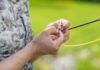
Landon gets into retrieves, and one of his go-to methods is what he calls the “Johnny Cash.”
He says shorter movements make it easier for anglers to stay in control and adjust speed without overdoing it.
Phil adds that the hand twist helps keep the fly moving without going too fast, giving that ribbon-like swim with a lift and drop. It comes down to matching what leeches are doing. Sometimes fast, sometimes slow.
At the end of it, it’s less about having everything and more about knowing what works and sticking with it.
Landon adds that you should always have both a Landon adds that you should always have both a matching leech and an attractor leech in your box. Don’t rely on just one.
They also mention not every situation needs heavy flies. Sometimes unweighted leeches are key, especially in shallow water or around weeds where you need a slow, controlled sink.
One last tip is line choice. If you don’t have multiple lines, you can use leader tip systems to change sink rates without buying a whole new setup.
You can find the full tour and updates on his website and social channels, and he encourages people to come out and connect in person at events.
Here are the pattern recipes for Landon’s original Mini Leech and all of its variations from his Guide Flies Book.
Episode Transcript
913 Littoral Zone #24 00:00:00 Phil: Welcome to the Littoral Zone podcast. I’m your host, Phil Rowley. The Littoral zone, or shoal area of the lake, is a place where the majority of the action takes place. My podcast is intended to do the same, put you where the action is to help you improve your Stillwater fly fishing. On each broadcast, I, along with guests from all over the world, will be providing you with information, tips and tricks, flies, presentation techniques, along with different lakes or regions to explore. I hope you enjoy today’s podcast. Please feel free to email me with your Stillwater related fly fishing questions and comments. I do my best to answer as many as we can prior to each episode, just before the main content. Thanks for listening. I hope you enjoyed today’s show. Leeches are a key Stillwater food source not only for trout, but for other fish. When I fish lakes, leeches are one of my go to patterns and presentation options, especially early in late season or when starting out on the water for the first time. Fish seldom pass up a well presented leech pattern. Good friend, author, fly designer, and fellow leech addict, Lindenmeyer joins me once again on my podcast to provide what we hope is the ultimate Leech guide. Landon. Join me. Previously on episode number ten where we discuss shoreline strategies and tactics for Still Waters. If you haven’t had a chance to listen to this episode, I recommend that you give it a listen today. Landon and I will be discussing all aspects of using leeches, including when and how to use them. Our favorite presentation tactics, leader configurations, life cycle, and why leech patterns consistently perform well on our local lakes and other lakes across both North and South America. But before landing and I sit down in his Colorado home to discuss leeches, let’s answer a great question from Cooper Mnowak about early spring water temperature and finding trout. Today’s question comes from Cooper Mnowak in regards to early spring water temperature and finding trout. Here’s what Cooper had to say. He starts off, Hey Phil, I’m a huge fan. I listen to your podcast, and when new episodes come out and I’ve been watching videos of you on YouTube for years now. Thanks, Cooper. That’s greatly appreciated. Now, Cooper’s question there is a high mountain lake I like to fish. That was really productive for me last year. I had one day where within a three hour session, I caught over one hundred fish. Nothing over eighteen inches. I fished it later in May, but saw that it didn’t freeze over this year and I was hoping to fish it in a few weeks. When I look at water temperature, am I looking to fish areas that are over fifty degrees for the best chance of finding fish more schooled up? So long as the lake didn’t change much. I have an area with an inlet creek that is between three to ten feet of water. Are those the types of areas trout are going to prefer to be in when the water is colder. I hope that makes sense. I’m just trying to figure out exactly what to look for. All right. So Cooper well, first of all, the fifty degree water temperature is one of the key water temperatures in trout fishing. If you listen to the podcast episodes I did with Bryan Chan on how lakes work, we talked about these key water temperatures. And fifty degrees is key in the spring because once the temperature reaches fifty Fahrenheit, that’s sort of the key trigger point for hatches to start really hatching in earnest in the fall months when temperatures. Sorry, temperature drops below fifty Fahrenheit. That’s usually the trout’s polite kick in the pants to strap on that feed bag and get feeding aggressively before the lake freezes up. And pickings are a little lean for a few months. So my response to Cooper was again thanking him for the kind words, and I said, water temperature is an important factor and I always check whenever fishing. When fishing for trout, I look for temperatures between fifty Fahrenheit and sixty five Fahrenheit, as this is when trout’s metabolism will be running efficiently. They can extract oxygen, feed and digest, which keeps them constantly feeding. That’s always a good thing for us as fly fishers. Inflow streams such as the one you described are good areas to explore because they bring not only cool oxygenated water, but also food and if flowing fast enough, surface cover which give the fish confidence to feed as the rippled surface makes them feel more protected. If the inflowing water is too cold or warm, trout can also avoid these areas. However, on average, inflow creeks are a good structure to focus on. Along with my other favorite structures drop offs, points of land, weed beds and sunken humps or islands. So Cooper, I hope that helps out. Um, again, I would certainly, you know, whenever you visit a lake, you always want to probably go back to where you last had your great success. If it was the right time of the year, typically after ice off as well. Those fish are going to be shallow because that’s where the. The water has um is the coolest and most oxygenated. Now, you mentioned. That it didn’t, uh, have a chance to freeze up. So those fish probably moved out into the deep water to sort of get through winter. And then as the shallows start to warm, they’re going to flood those shallows to feed because that’s where food is located. And structures like that creek are also going to bring food in as well. So always good places to try in those scenarios. So again, I hope that answers your question, Cooper, and is also helpful to everyone else that’s listening. And again, if you have questions at all, just send me an email to Phil at Phil dot com and I’m happy to feature them because these are great ways for all of us to learn more about Stillwater fishing and fly fishing in general. Now on to our podcast. All right, Landon, you’re back here again. 00:05:46 Landon: It’s like yesterday. We were right here. Yeah, yeah, it was really good. 00:05:50 Phil: Really good. It’s good to have you back. Now, for those of you who haven’t listened to any of my episodes before, well, first of all, shame on you. But no. I’m kidding. Um, Landon has joined us before. We talked together about Stillwater strategies for fishing lakes from shore. That’s episode ten. I’ll be sure to put a link to that episode in the podcast. But for those who haven’t been here before. Lynn, why don’t you tell us a little bit about yourself, how you got into fly fishing and, and maybe a little bit of relation, how you like to fish lake so much? 00:06:16 Landon: Absolutely. So born and raised in Colorado Springs, was very fortunate to be exposed to the South Platte River. And the plateau Basin of South Park is where I fell in love with Stillwaters. We’ve got twenty seven miles of the South Platte and Tarot, spinny and eleven mile Canyon Reservoir. Super cool fishery is what you’ve experienced with me. A lot of fat, hungry, healthy fish with big paddles that, like you, take you into your backing. 00:06:42 Phil: Yeah. And one of the things that’s common to your lakes and many of the lakes, I fish in North America and my home waters in South America is trout and lots of other fish like leeches. 00:06:53 Landon: They love them. They love leeches. 00:06:55 Phil: And we love them too. 00:06:56 Landon: Oh we do. 00:06:57 Phil: So tonight, Landon and I are just going to have a rambling session about leeches. Talk a little bit about their biology. We talk about some of the presentation tactics we like to use, where we like to fish them, why we like to fish them, the rigging and talk about some of our favorite fly patterns too. So why don’t we kick this off? Tell me about your first memorable leech experience and I’ll talk to you about mine. 00:07:20 Landon: Sounds good. Well there’s two. The quick and short is the first time I’ve witnessed a leech in Spinney Reservoir and traveling abroad. South America as well, and other fisheries. Realizing there’s just as many, if not more, especially when they’re bigger fisheries. But being that I was on the Spinney Reservoir and I felt like the Stand by Me movie when he experienced his leeches. Hopefully it wasn’t going to get anything near this, but watching something swim in the water at a fast, rapid rate. I looked close and first thought was, oh, it’s a swimming baitfish or something zipping around. Then once it came closer to shore, just below the surface, coming up just below the surface like a ribbon moving full speed, I realized it was a five inch long leech. And being my first exposure, not only was I surprised at how big it was, how fast it moved, and then realizing, oh, this thing can’t detect if a fish is swimming towards it. So realizing that this is going to be something fish will pursue. And it was quite interesting to see that firsthand. And then after that, when I was on the North Platte River with John Barr and the Hamrick brothers, we were fishing as slump Buster. And this was the birth of the mini leech. His slump buster broke at the bend. The wire came loose and all of a sudden the rabbit was attached to the eye of the hook, and the hook set ratio went up tremendously. We were crushing fish and I’m like, what is going on? We brought it in and realized after a few fish, oh, it broke. And we continued to fish it and fishing and fishing. And Jason Hamrick said, hey man, I’m. I received so many boxes full of micro pine squirrel and you should take some home and try to replicate this and I’ll do the same on the North Platte. And being that I twist it up, took some time to develop the fly. But then there’s Mini Leech and from there it was game on. Ever since. I just can’t believe how not only effective simplistic the ties are, but how much fish really do pursue them. 00:09:09 Phil: Exactly. It’s amazing. We’ll talk more about your mini leech and some others a little bit later on in the podcast. You mentioned something there about Stand By Me. If it’s one thing I said about leeches, their marketing department sucks. Yes, movies have, you know, stand by Me, the African queen. Um, I’m sure there’s a few others that basically, if a leech latches onto you, it’ll drain your blood in under two seconds and your boss’s little transparent thing lying and quivering on the bank. 00:09:35 Landon: You’re looking pale. 00:09:36 Phil: Yeah. My first experiences. Well, when I was starting, you know, in my formative years, um, whatever that term really means. Um, There’s a book in British Columbia called The Ghillie that was put together by. It’s a compilation of many anglers in British Columbia, and it’s primarily Stillwater focused. So it had a chapter on leeches. So after reading and studying that and of course studying other books, I knew leeches were important. But man, I couldn’t catch a cold with a leech. And then I was fishing Island Lake, which is in the central part of British Columbia, near the town of Logan Lake. And we had been fishing all day. And it’s a lake just traditionally, and I think it still is known for. It’s really good. Caddis hatches those big Stillwater traveling sedge or motorboat caddis big, you know. 00:10:23 Speaker 3: Eights and sixes. 00:10:24 Phil: Yeah, it’s a big caddis. But anyway, we’d gone in for dinner and decided this was our my float tubing days. We’d go out and fish and leeches were always a pattern. You fish at night. You know, they come out, they’re nocturnal in their habits, like a lot of invertebrates and insects are. And we were sort of, you know, kicking twitch. I think it’s Cheech from fly fishing food calls it, uh, kicking around. And I had never done well on leeches. I really didn’t have any confidence in them. And we were just fishing really simple mohair leeches at the time, basically a, you know, a way to number eight hook with a little few turns of lead at the front and wrap some mohair yarn on it and brushed the heck out of it and real simple things. And we had a night. Oh my God. We started probably about eight o’clock, just as the sun was starting to go down. And I don’t think we came in till two in the morning, and there was other campers in there and they could hear us hooting and hollering. We were just kind of paddling around in the camp Bay in this little circle. And we were, you know, the lake is reputed to have big fish, and we hadn’t seen much of those during the day. But at night, those big boys came. 00:11:25 Speaker 3: Out to play to play. 00:11:26 Phil: And I remember two guys come, I think they’d had a few beers come stumbling down the lake. What are you guys doing? Catching them on leeches. Oh that’s great. And you hear him walk back. What’s a leech? So. 00:11:36 Speaker 3: Exactly. 00:11:36 Phil: So I guess part of this broadcast or episode, we’ll be talking about that as well. So that’s my first memorable leech experience. But Landon, you touched on it. What do you think? Trout and other fish that feed on leeches? Bass, walleye, pike. I think anything that swims and eats will take one. What do you think they see when they see a leech? 00:11:56 Landon: My personal opinion is the fish refer to leeches as a large food supply. And more importantly, a non escaping food supply. They’re willing to expend energy to chase. It’s found in still waters, rivers numerous depths. High low in the water column. And it’s more bang for their buck. You know fish is going to chase a bait fish to the shore. A big crayfish hopping, stopping and dropping. It takes a lot of effort and energy. I think with leeches, because it’s available most of the time near the surface or mid column, it’s an easier snack to obtain, but it really is more bang for their buck and the nutrients they receive is tremendous. 00:12:32 Phil: Yeah, it’s a I think they just hey, that’s lunch. 00:12:34 Speaker 3: That’s lunch. Let’s go get that steak. 00:12:36 Phil: And they, you know, from a lifecycle perspective, they’re pretty long lived. Most of the other food sources we deal with on the trout side of the ledger and lakes, you know, have life cycles measured in, you know, chironomids can be days to months to years, but not very long, whereas leeches are long lived. 00:12:53 Speaker 3: Exactly. 00:12:54 Phil: Lifespan measured in years. So they’re around all the time there. You know, I refer to them as a a bread and butter or staple food source if nothing else is hatching. Whether that’s there’s no hatches for the day early in the day, late in the day, that’s when leeches really come into play. 00:13:11 Speaker 3: Absolutely. 00:13:11 Phil: I haven’t had a fish yet that won’t refuse a leech. Even if they’re focused on other things, they’ll often find a little bit of room to slide one of those down. 00:13:19 Speaker 3: True. Yeah. 00:13:20 Landon: Yeah. And respects to what they feed on, too. It’s. You know, if there are no leeches available in the waters, you’re fishing and you’re doing well on the leech. They’re incredibly versatile. The mimic can match other food supplies bait, fish, crayfish, nymphs, you name it. So not only is it a win win in the sense that the fish will have a bigger meal, more bang for their buck. You’re being versatile in covering numerous menus and food supplies at once. 00:13:43 Phil: Yeah, they’re just, you know, really relevant. Have you found anything in your experiences seasonally, daily, when they stand out more to give them a shot? 00:13:52 Landon: I personally think it’s the low light evening hours seem to be the best, as you’re referring to the evening bite, where you know a lot of your large trout are predatorial as well. But in addition to that, I find if there’s disturbance in the water for stillwaters where it gets choppy, murky things are stirred up. And then in addition to that, if there’s wind, anytime there’s wind and things are turned around and the fish get close to the surface and they’re more apt to eat because they don’t feel as nervous, that seems to be a key time. But realistically, as you mentioned, it’s all day. Yeah, it’s just the prime times when the bigger predatory fish come out, or even in the river setting where you have them hiding around structure, that’s usually what’s going to lure them out. And even if they don’t take it, you’re attracting them and getting their attention to where they’re going to feed on something. 00:14:34 Phil: Yeah, yeah, we’ve, we tend to use, I know early spring right after ice off is good each time because, yeah, you know, they’re just coming out of their winter slumber. They’ve been that’s a food source. They’ve seen under the ice all the time. They see one of those scooting by. They’ll write, you know, they’re still kind of you know, the water is cold. They’re not moving that much, but they’ll move. 00:14:52 Speaker 3: For that. 00:14:53 Phil: Evenings. It’s kind of funny, though, that leeches are technically blind, so it makes you wonder how they know that coming out in bright daylight is not a, you know, a long lived exercise and how the evening they’ll come out and move around and. 00:15:09 Speaker 3: Find. 00:15:10 Phil: Interesting food source again. Evenings, spring, summer, when trout slide into deeper water. They’re one of the few food sources that can survive at depth. Most of your food sources at trout feed upon lakes and other fish are generally shallow in that shoal area or littoral zone. 00:15:27 Speaker 3: Um. 00:15:29 Phil: Um, so they’ll be out there as well. Um, yeah, so again, a real key food source. Um, I just don’t think, and I think when somebody is getting into Stillwater fly fishing, you know, a lot of the other bugs we fish damsels, chironomids are probably the pinnacle of that. Or it can get real fancy and fidgety. One hundred percent you. It’s tough to fish a leech. Wrong. You can. 00:15:51 Speaker 3: Exactly. 00:15:51 Phil: Drag it. You can hang it. You can go fast with it. You can go slow with it. You can fish it shallow. You can fish it deep. It’s a pretty forgiving fly, isn’t it? 00:16:00 Landon: It’s amazing. Yeah. You know, talking in terms of, you know, ISAF and early season chironomids, it’s now to the point where in the past and I know you’re the same, you wait, your chronometers go down two to three flies, find the right depth. I’m now such a fan of leeches. It’s my anchor fly while I’m doing the Corona mid-bite. Yeah, I mean, it’s incredible because it’s found in depths with Chironomids. It’s, as you mentioned, found all year. Hide low, dirty water, clear water. And that really is the attractant. And I, I tell people there’s two key important food supplies. It used to be just midges, now it’s leeches. Those are your year round food supplies. And if you and I needed survival where we had to catch fish to live. Those would be my two go to’s. 00:16:43 Speaker 3: It’s funny you. 00:16:44 Phil: Mentioned the relationship of chironomids and leeches. Um, good friend Brian Chan, who’s been on this podcast a couple of times. I’ll make sure to put links to his podcast as well. He spent many years as a fisheries biologist, and they’d often do net samples on lakes. And part of that process was unfortunately, the fish was killed during that, but they’re just checking spawning rates and other things like spawning success, stocking success and things like that, and just overall health of the population. And obviously, they would dissect the fish. And also when we start using throat pumps, it’s common after a heavy, heavy feed acronyms late in the afternoon that the trout will switch on leeches almost like it’s dessert. Or maybe it’s some kind. 00:17:25 Speaker 3: Of throat stopper to. 00:17:27 Phil: Keep all that food. 00:17:28 Speaker 3: In there. So they’re also. 00:17:29 Phil: A very good thing to try after acronym attach, which naturally dovetails into that evening bite, as you mentioned. 00:17:36 Landon: Absolutely. 00:17:39 Speaker 4: Fly fish with me. Utah discover year round blue ribbon trout fishing on the famed Provo River. Choose a guided walk and wade or a scenic float and experience big trout, stunning canyons and unforgettable days on the water. You can book your adventure right now at Fly Fishing with Me Utah.com. World class water. Incredible fishing that’s fly fish with me. Utah dot com. Experience the waters of Bristol Bay at Togiak River Lodge, where fly fishing meets Alaska’s rugged beauty. This is the place to complete the Alaska Grand Slam with all five salmon species rainbow trout, Arctic char and more. Where each day offers a new Alaskan adventure, you can visit Togiak Lodge. Com right now to start planning your Bristol Bay experience with Togiak River Lodge. 00:18:28 Phil: All right, let’s talk about where we like to fish them. I know we talked about when, which is pretty well anytime Yeah. Morning through morning. Through evening. Night. Spring. Summer. Fall. Um, yeah, it’s definitely a mention as well. Definitely. In our neck of the woods, we fish leeches right up until ice off and very shallow. But we tend we’ll talk about it more in the fly patterns, but a lot of mini leeches, the small ones you mentioned the big. You know, those big ones. 00:18:52 Speaker 3: Oh, yeah. 00:18:53 Phil: You’re afraid they’re going to come in the boat. 00:18:55 Speaker 3: Or the float tube or up on the bank. 00:18:56 Phil: And drag you in. But I think most times I found the trout like the smaller ones. I think, you know, Pike, I’ve, you know, I’ve done, you know, for a pike, a big bunny leech is one of my go to flies when, believe it or not, Pike seem off the bite and just not willing to chase is usually more aggressive, flashy stuff we throw at. 00:19:14 Speaker 3: Them, right? 00:19:15 Phil: They have a hard time resisting that sultry jig of a slow strip bunny leech that’s about four inches long, just going through the water. 00:19:23 Speaker 3: So. Exactly. 00:19:23 Phil: Great fly. All right, let’s talk about locations. Um, where’s your favorite place to fish them? 00:19:28 Landon: One of my favorites, to be honest, is I like the shallow water zone transitioning deep, whether it’s Pyramid Lake, you know, eighteen inches to fifty. 00:19:38 Speaker 3: Yeah. 00:19:39 Landon: Watch out. You might float your hat. South America similar to a lot of the western waters where you go four to eight feet, eight to twelve. And it’s I’ve become such a big fan as well when it is shallow to do the dry dropper. It’s just something I love because it represents, you know, the attractant of getting the fish to look up at a large dry fly, which is awesome. And then you’re intercepting them. They come up to look at the dry. They may not take it. And then all of a sudden, bang, they hit the leech. What you folks can’t see at home is my Maine Coon cat fin is up here checking out the podcast. She hears leeches, and she’s like, I’ll try one. 00:20:14 Phil: I’m looking at all that fur. 00:20:15 Speaker 3: Yeah, we could make up some bugs out. 00:20:18 Phil: Give you a haircut later. Um, yeah. Um, generally shallows, as we mentioned earlier, are always a good spot to fish. Leeches. 00:20:25 Speaker 3: Absolutely. 00:20:26 Phil: The deep water, um, they can burrow into the mud. So muddy bottoms. So there is just. I don’t think there’s a bad place. 00:20:32 Landon: It really. 00:20:32 Speaker 3: Isn’t. 00:20:33 Phil: You can fish. 00:20:33 Speaker 3: A leech and. 00:20:34 Landon: It’s incredible. 00:20:35 Phil: Yeah. And they are, you know, again, deep water. It’s I, I’ve had lots of success in, you know, during the summer months or fishing less productive lakes or, you know, I fished some of the lakes back east, uh, eastern Canada, eastern United States that are mixed fisheries with bass and panfish and trout. And the shallow areas tend to get dominated by the bass and panfish and the deeper areas, the drop offs, those transitions are dominated by. That’s where the rainbows go. They sort of find their own places to live, right. And leeches out in that deep water. 00:21:08 Speaker 3: Oh, it’s lights out. They love that stuff. 00:21:10 Phil: So whether I’m fishing loch style or, um, um, you know, anchored up or not really anchored up or just fishing under indicators as well. So, um, you mentioned wind. 00:21:20 Speaker 3: That’s a. 00:21:20 Phil: Good time to fish just about anything, but. 00:21:23 Speaker 3: It really is. 00:21:24 Landon: It’s roof on the house. I mean, it’s a lot of people are intimidated. I was myself early on where wind would pick up and you think, man, you can’t you don’t maintain the same visual of calm water. You don’t see the rise forms. You don’t see through the surface of the water as much. And it’s a guessing game when you’re not realizing what’s happening. And that is it’s a roof over a house. It’s cover and protection. And that’s the most important thing trout need. And once that happens and you’re doing indicator style and even dry dropper with a big hopper dropper, it’s so beautiful because you’re not even moving, you’re casting, letting it sit, and you’re just riding the waves and the jigging action to follow with especially balanced leech imitations, it’s almost not even legal because when when that’s taking place, it’s a matter of, you know, we’ve both been there. It’s it could be one after another after another. It’s almost a similar take in activity that you get from Chronemics. It’s always active. 00:22:15 Speaker 3: Yeah. 00:22:16 Phil: That basically that surface job, if you’re using any kind of suspension devices, you like to call it, whether. 00:22:21 Speaker 3: That’s a. 00:22:22 Phil: Traditional indicator. 00:22:23 Speaker 3: Or. 00:22:24 Phil: A dry fly. Um, and of course, we’re legal to my listeners in British Columbia. Um, you’re not allowed to fish multiple flies. So we usually use indicators there when we’re fishing those waters, but that surface chop just I always say Mother Nature, just let Mother Nature fish the fly for you. 00:22:40 Speaker 3: Exactly. Right. Exactly. 00:22:41 Phil: Just wait if it come down. 00:22:42 Speaker 3: Now, were you fishing. 00:22:44 Phil: Your local waters? You have a lot of shoreline opportunities. So, um, you know, I tend to fish more boat stuff because I just don’t have the stable shorelines or lack of trees or the public access to those areas. 00:22:58 Speaker 3: Sure. 00:22:58 Phil: So what’s some of your recommendations for and suggestions and favorite things to think about when you’re fishing leeches from shore. 00:23:06 Landon: I think they’re the key is to be open to any opportunities that present themselves. The best example I can give is if you’re doing an indicator dry dropper. That’s a pretty simplistic way to fish. If you have a lot of fish that are coming in shallow, extremely shallow, then you can start to do, you know, a presentation where you’re bouncing it off the sand. You can do fast. Slow retrieves. One of the things that leeches are not commonly known to fish as well, which I believe is simply not true, is the stripping method, you know, presentation being like anything you would do with the streamer. Yep. Fast, slow, finger over finger retrieve. And it’s amazing because if you do lift and drop and let’s say you’re lifting up and you’re in three feet of water, you bring it up mid column a foot and a half, move it, let it drop, hit in the sand, create a puff. When those fish come over to investigate. The beauty of it is they can identify where it is because you just strip it one more time. That puff of sand comes over and they just hoover it up like a vacuum. Yeah, it’s incredible. And it’s the difference there too, is just finding confidence that you can deliver it. And because it’s not as big as a streamer, doesn’t create as much disturbance on the surface that can help in in many ways. And I think the other positive way to fish them is if you can double up, do the unweighted and a weighted version to where they’re jigging at the same time, but different directions in different movements. That can also be a key factor. And if it’s just a simple solo fly one single fly rig, I think adding the strip to the actual balance position where the waves are doing the work for you. Movement can be key. 00:24:40 Speaker 3: Yeah. Well, that’s. 00:24:41 Phil: How we use, you know, I always mention in seminars and schools I do. And if you were to list all the presentation techniques on lakes indicator fishing is on the. If you put them on a timeline is the newest. 00:24:54 Speaker 3: Yes. 00:24:55 Phil: You know, we started stripping, you know, we were trolled, but then we started stripping and that’s how we did it. 00:25:01 Speaker 3: And then. 00:25:02 Phil: And I’m going to tell you a little story. So other memorable stories we’re talking about indicators under leeches under indicators. So I don’t know how you first discovered it, but mine was I was fishing with my oldest son, Brandon, who’s now in his early thirties. He must have been about seven or eight years old. We were fishing Roche Lake, just southeast of southwest of Kamloops, and we were it spring. We’re hanging things under indicators. It’s chironomids because that’s what you did. That was the first reason we started to use indicators because sure, trout can get so fixated, such a narrow feeding zone when they’re really gorging on those things because they’re like Pac-Man down there. They just swim up one level and just turn their heads slightly left and right and get all the food they can handle. You mentioned the the whole calories thing. That’s about the most efficient feeding method there is. So anyway, we’re fishing this for a while. We’re getting a few fish. And then he says, I’d like to change my fly. So I said, oh, fair enough. Uh, here’s the fly box. Pick one. And he goes, nope, don’t want any of those, right, I want this. So he’s holding a real simple bead head leech, you know, just a bead head, crystal, chenille body, black marabou tail. I’m saying no, we don’t fish those under indicators. It’s only chironomids. We strip those because that’s how we fish leeches. We strip them. And, uh, so anyway, um, I’m arguing with an eight year old and getting my butt whooped. And like any good parent, I caved. So I said, fine, whatever. Put the thing on. Cast it out there. It’s settled. Bobbed around for I don’t know, 10s went under so hard. Right. And of course, fish are stupid, man. Anything thankfully stripped it in, let it go and flopped it back out there again. And he’d done this about five times in a row. And I’m like, maybe the kid’s onto something. So that’s how I started fishing. That’s cool. Leeches under indicator. So I often joke sometimes if people were seeing me having a good day, you know, back in the late eighties, early. No, it would have been Brennan was born in ninety two. So it would have been the mid nineties. It would have been early two thousand. God. I’m old. Um, uh, and I was catching fish under indicators. Everybody assumed it be to Karamanids might have been fishing some leeches as well at that time. 00:27:04 Landon: Oh, yeah. It’s a great method. 00:27:06 Phil: Well, so so, you know, we tend to fish them a lot from boats. We just don’t have the shoreline access. Um, although when I go down to Argentina, it’s all from the shore because. Oh yeah, people ask if you know, why don’t you use boats down on Jurassic Park. Well, when you’re fishing in forty to seventy miles an hour wind, there’s not five foot swells. It’s like you’re not going out in a boat there. And the food, the the one thing about fishing from shore is that wave action just churns food out. 00:27:33 Landon: Oh. 00:27:33 Phil: Like you said, it’s that roof over their head. They feel very safe with that rippled, textured swirly water over their heads. Foods being pulled out of the rocks. Yes. And they come in and feed. The ironic thing about Jurassic Lake is it has a bit of a bug guy. I have never seen a leech. I’ve seen lots of scuds down there. But that’s another example of why you want to fish leeches. Because even if fish don’t see leeches in their everyday life, it looks like something good to eat. It’s amazing. It’s it’s got life. It’s got all of those things. 00:28:04 Landon: It’s representing anything that may get their attention. And they’re predators. You know, they’re going to move. They see it and they’re. 00:28:10 Phil: Well, they’re not swimming around with flash cards. 00:28:12 Landon: No. 00:28:12 Phil: Wait a minute. That’s I the hats chart for Jurassic Lake is Scuds, snails and zooplankton. So I don’t eat leeches? No, they eat them. No, we fish a lot from boats, float tubes, pontoon boats, you know boats. Do you know there are. It’s nice sometimes to be able to get around. Oh. Big time, you know. And sometimes target structure a little differently. We also fish them Loc style, which is a very popular method of fly fishing in Europe and in competitions. Um, because you can’t anchor up in competitions, everybody gets, you can’t hog the water. So everybody gets a shot at it and Loc style, if you’re not familiar with it, that’s an episode unto itself that I promise I will do in the near future. Is fishing from a drifting watercraft, typically a boat or a pontoon boat. My two favorites with an underwater parachute deployed upwind. It opens, it slows and controls the boat. Because the one thing about fishing on lakes is you have to have boat control. Whether you’re trolling, you have control of the boat by where you drive it. When you anchor, you have boat control. When you lock style, the boat’s not spinning and drifting all over the place. Because if you’re not in control of what you’re fishing out of, basically we’re trying to turn our watercraft into the dry land, which you get to fish from on your lakes. Because if you can’t control that, you’re getting frustrated really quickly about because you can’t fish properly. Because as soon as you make the cast now the boat’s spun around and it’s behind you and it’s all over the place. So very frustrating. But yeah, we fish a lot of boat stuff, a lot of anchored, anchored fishing is very popular in Western Canada, Western United States that I’ve seen, you know, sitting down, picking a spot. It works really well if there’s fish in the neighborhood. But if you need to cover an expanse of water to find fish, you know, obviously that anchor, you know, there’s nobody in the neighborhood, you got to go find them. So that’s where drifting comes big time. You as a healthy guy, you are you just walk five miles down the shore. Yes. With me whining and complaining behind you. 00:30:02 Landon: And the boat thing is important. I mean, we I do a lot of rafts. I’ve owned every boat, Lund Flats, boat, you name it. But the rafts are very important and it’s interesting. The lock style to fill is we’ve done. I’ve done really well and there’s situations where it’s similar to Loc stuff. For example, this is a unique one. We have heavy vegetation with deep pockets around it. Late summer. What we end up doing when the wind picks up is we go to the top of a huge vegetation clump. You’re in a belly boat, you’re in a pontoon, and you set up at the top of the clump. You fish at the very edge of the weed line, and you’re blowing over the top of the vegetation slowly, while you’re drifting on the side of these weed clumps, or even situations where we can’t carry a heavy anchor in the flow of the raft. You know, any vessel that you have that’s floating like a marshmallow, you try to anchor up? Yeah. And you can have a twenty five pound anchor. It’s going to slow your roll, but it’s still pushes and pulls. And a lot of people don’t realize it’s similar to Loc style where we’re slowly drifting while that’s pulling on the sand and it’s causing us to cover more ground. So there’s situations where we’re forced to have to move or the wind is forcing us to where we have movement with the drifts. And it’s amazing how well that works. 00:31:15 Phil: Well, you just cover so much water. 00:31:16 Landon: It’s incredible. 00:31:17 Phil: Yeah. All right, let’s talk. Let’s get into rigging lines. So when you’re fishing from shore, describe to me your setup. You talked dry dropper from reel to fly. What do you got going on? 00:31:29 Landon: Yeah, I’m a big fan of five way ten foots I do for weight, eleven foots. The one thing that is not included in the arsenal for me anymore is five six weight, nine foots. I’m such a big fan. As you know, when you hook and fish big Stillwater scenarios, you want that lifting power. You want line control and vertical connection when the fish take off. So I’ll do Bauer reel Winston rod the new reach ten foot sweet stick. Um, in addition to that, I’m usually floating lines. I’m a big fan of MPC’s longer belly weight forward transitions. Well, in the wind. I’ll do that with the dry dropper setup and the indicator, and I’ll usually set it up where I have nine to twelve feet. If I need to add to that, I’ll use a slip indicator, but I like to set up my drop lines where. If it’s really shallow, I’ll do dry drop or three to six feet and six is about my limit with a dry dropper because I want to make sure I can get a proper cast, have control. I think at that point your fly. There’s a good chance with wind speed or drifting speed, you can sink your dry. Then I’ll do indicator style, but I separate them by three foot increments to see where the fish are high in the column, middle column or low. And then if I’m doing deep water, the slip indicator is great, but I’ll also count it down just like we’ve done at pyramid or the Great Lakes, where you can count down and just determine, start at ten second counts, twenty second counts, and start to retrieve, like we talked about the leech. That’s great because then you find out what depth they’re at. If you have a fish finder, of course, using the fish finder technique works well. And then the other thing I’d love to do is when there’s setups to where I can have a two fly rig, I’m a fan of Double trouble rigs, where if there are really big aggressive fish, you can lead or trail a streamer with an unweighted leech. And the beauty there is it looks like a baitfish chasing a leech. Or let’s say a big fish comes over and is attracted to the larger streamer and then trailing off behind that connected by a loop knot. You’ve got an unweighted leech, so they’re coming over. They see the big food supply I’m not willing to take and bam, they’ll take the other one. And I, in the last class we taught in Denver, somebody asked a really valid question. I don’t get this often, but it should be a question or it’s something everybody should be thinking about is the knot selection for how you’re fishing. So whenever I’m fishing a balanced fly, I’m a fan of using clinch or seated knots, and whenever I’m stripping my leech. As far as the mini leech jig goes, I’m a fan of loop knots when I’m stripping. Now you can connect to the leech to where you have more of a lift and drop a jigging scenario. But I’ve also found that if there’s a little bit more freedom of motion when I’m setting up the rig, going to a loop knot and I’m stripping and there’s heavy wind. I just get more action out of the fly itself. And then in between there, I know that you’re a fan of this as well. And that is micro swivels are a must just to add freedom of rotation in the cast and all of that combined. But it’s really a matter of determining depth control, I think is the most important part. And I like to start high and then work my way down. Even in deep water settings, like some of those fish, when they start to cruise. 00:34:34 Phil: A little different, I’m using the other brand of line. So I’ve got my ambassador series lines, my Stillwater floater with the tippet ring on, and this comes from fishing chironomids when you’re fishing small bugs under indicators, for me, the most critical thing is level leader from whatever suspension device you’re using. So it hangs vertically straight down. If you use a standard nine or a twelve foot tapered leader, they’re built like a fly rod, thick at one end, thin at the other. So you have a leader system that doesn’t sink at the same rate along its length. So even if you’re fishing ten feet away from the leader, if you’re using a twelve foot tapered leader as your foundation, it’s going to come off in an arc. So even though set same distance, it’s not getting there. And we found when fishing smaller bugs, chironomids, mayfly nymphs, things like that on our indicators, that little four inch difference, six inch, maybe a foot in extreme circumstances is all the difference. 00:35:27 Landon: Between. 00:35:28 Phil: Some fish and sunfish. I remember the little knot leech topic, but a couple of years ago my wife and I were fishing chironomids under indicators. Same rigging, everything going steady toe to toe, and then all of a sudden she kind of went quiet for a while. And, you know, you start to wonder what’s going on because our indicators are hanging, you know, five feet apart. So there’s no way. One, I just don’t believe that, you know, they’re coming in, they’re cruising around. We did we rechecked the depth. She was four inches off. 00:35:54 Landon: Oh yeah. 00:35:55 Phil: Reset. Bang bang bang all. 00:35:56 Landon: Over. 00:35:57 Phil: The place. Four inches. 00:35:58 Landon: Yeah. And it’s I think for us too, we do have depths eleven miles extremely deep. We do ninety degree drops from indicators. And that’s exactly right. Having the same size, usually two x three x four x, whatever it is, straight down to the first floor is key. And we do loop to loop. We also connect sometimes to the indicator depending on the strength of the fish. 00:36:19 Phil: I think the system I’m using Rio’s got the indicator. I know SAS got their indicator leaders as well. Those leaders. Um I said don’t use tapered and you look on the package. Hey, Phil Landon you lied to me. It says tapered on there. But but the but section is only about three feet long and. 00:36:34 Landon: The. 00:36:34 Phil: Rest of the leader is level. So my leader system is built into thirds. I have that leader. I have a midsection to a swivel, a swivel. You know, if the winds up a bit, I’ll increase the swivel size to keep it anchored in calm conditions. I’ll go really small, and I’ve had situations where I’ve got fish on leeches and crystal clear water. Bright sunny day light winds. Arguably the toughest Stillwater situation you’re going to face. Um, no swivel, not even a fly with a bead on it. They didn’t want that. They could see any sort of little flash. They were just spooky as heck and wouldn’t go near it. 00:37:09 Landon: Absolutely. 00:37:09 Phil: And then from the swivel, I like about two, maybe three feet difference. So the way I teach this to figure out the depth you want to get, because we’re typically in our neighborhood, we’re always trying to keep our flies within one to three feet of the bottom, usually in deep water because most of our lakes. Again, I mentioned we don’t get the opportunity to fish shallow. So we’re typically fishing ten feet or more down. Um, so those fish are going to be near the bottom where the food is and it’s safe down there. So we’re fishing in that range. So let’s say I want to fish twelve feet down. If I just fish that radio indicator leader with three feet of butt section, I put the indicator right on that transition from taper. I like to keep my indicator close to the fly line. It makes it an easier cast. You don’t want to get that weight source way out on the end of a skinny leader. You end overpower it tailing loops, frustration rods and get ready for it. Tip it in. Leader sales are off the dial. Yeah. Um, but, um, so you got to add, so out of the package, it’s a ten foot liter, three foot spot section, seven feet level. I can fish seven feet down if I’ve got two feet from my swivel to my fly. And we like to keep the swivels. This comes again from kiranm and fishing, keeping that swivel and that weighted fly close together because in windy conditions you get, you know, the wind will create current sachet as it’s called. And if you have those weight sources too far apart, you get this kind of pendulum effect where that fly will be in the zone, out of the zone, in the zone, out of the zone. So by keeping those compressed, you don’t have as much swing going on beneath the the swivel. So if I keep that at, let’s say two feet and I’ve got seven feet off that main leader, I can fish nine feet down. But what if Phil wants to fish fourteen feet down? All I do is take that number nine and subtract from fourteen, which is five. Right? It hasn’t changed. And I had a section of fluorocarbon tippet from the indicator leader to the swivel. And I in my book I called it the adjustment zone because that’s where I ebb and flow the leader length. If I need more, if I go deeper, I need to add. If I go shallower, I need to remove. Because you never want. You only fish. I’m sure you agree with this. Don’t fish a litre any longer than you need to. And oh, and that’s one of the differences. Just still, water fishing in general is litre lengths are longer right. It’s you know. 00:39:17 Landon: Yeah it’s huge. I mean litre length is key. And the one thing you touched on too that is important and a lot of people when you’re transferring bigger leaders and rigs, it is the butt section on the essay or Rio, whatever you prefer your brand to be. And with the essay it’s the same. The butt section turns over to the indicator and the swivel being the transition point. It’s from there building down. In addition to that, you can also use the top ring on that swivel as an extension of a fly. So that can be a tag so it doesn’t interrupt. You don’t get tangled. I think if you tag the bottom, people just need to be careful of getting tangles, especially when it’s drifting because you’re going to have those currents. Subsurface. 00:39:55 Phil: Yeah, I tend to put my I like fishing off dropper tags. Um, I like flies to move independently of each other. You know, I know a lot of people tie off the bend and fish tandem style. I don’t like it because if I want to make changes, I got to pretty well take everything apart. Yes, you can have, um, the bottom fly and a barbless world. The whole bottom section come off. And again, back to the mobility of the fly. The analogy I use in my seminars in schools is it’s like putting a U-Haul trailer on a porch. Oh, that car don’t produce nearly as well. No. And I’ve had situations, probably more when fishing caravans or midges is when those flies are hanging vertically. That upper fly has a section of leader coming off the I in a section off the bend. When that fish comes in and opens its mouth to take the fly, it either touches those and doesn’t like it and swims away or pushes actually pushes the fly, which gives you the the take because the fly moved and you set and there’s nothing there. Right? 00:40:49 Landon: Exactly. 00:40:50 Phil: So. And how I often do it now is I take a section of eight inches of tippet and I put a perfection loop in one end and I loop that section of Tippit around the main leader above on the fly side of a swivel, a tippet ring, um, blood knot or surgeon’s knot. And that those three things are designed to be a stopper to stop that loop tippet from sliding all the way down on top of the bottom fly. So I have a, a leader that spins around. I can change it easily. And we actually snug it tight an inch and a half to two inches above that stopper. So if you get that take and you miss it, the tension of that mistake will pull that upper dropper down tight to the stopper. Whether that’s the triple surgeon’s knot your blood, not your swivel, your tippet ring. You know which fly got the grab, right? 00:41:37 Landon: Oh yeah. Absolutely. Yeah. 00:41:39 Phil: Very versatile. 00:41:40 Landon: That is important. So the way and you describing that, the way the food supply is positioned in the water. Let’s say I’m fishing two to three chironomids the trailing my border anchor Chironomid I tie with the loop, not the one above that I tie with a tag, or I do eye to eye because I do want it to be instead of it being vertical. Horizontal. Absolutely. And then when that happens to that loop, not flies, moving up and down gives it a chance to give a little bit more traction. And the other thing too is when the fish are taking and they’re on the feed and you see the indicator move, it is important to time. A lot of times I find that indicators when they start to quiver or move, if anglers set too fast, they’ve missed or they don’t set fast enough, you really need to base that for the fishery you’re on for that day, especially at depth. Yeah, because in the Great Lakes, when we’d go there and we’d fish deep or pyramid and some of the spots in South America, the takes were incredibly aggressive, where you’d go back, you know, to another section of water, you’d hit a different zone, and they’re not as aggressive. And you really have to time that just like you would anywhere else. And, and the last thing I’ll mention with Clearwater, this is the biggest challenge in my opinion, in Stillwater settings with leeches. When you’re fishing three to six feet of water and you’ve been there with me on spiny waters. Gin. Clear. The other thing that’s an advantage and I started using these a lot. And this is Brad Beifuss, the president and CEO of Scientific Anglers, helped me out with this knowledge. And it’s been a game changer that is using the camo line connected with fluorocarbon tips to leeches because you can fish the camo line, retrieve an incredibly clear water, and it doesn’t cast a shadow. 00:43:18 Phil: That’s the big thing. 00:43:19 Landon: That’s the biggest thing. And if it casts a shadow, if there’s a glint of light, as you mentioned, anything that gets those fish wary, they’ve known from all their predators, hunting them over time. Boom, they’re right in deep water. Yeah, that’s a great line to use. 00:43:31 Phil: Yeah. Because we use you know we talked about floating lines a fair bit. We talked, you know, fishing without indicators call it the naked technique. We do that a lot in the fall months and early spring when trout are in the spring, they’re in the shallows because that’s where the oxygen is and the fall they’re in. They’re foraging aggressively to, you know, build up the refrigerator for the upcoming winter. So we’re fishing a lot of, you know, floating lines with in that situation you know, where accuracy and um presentation. I will use a tapered leader as a foundation, maybe a seven and a half footer and ad tip it from there. Right. Just to get a little bit more of that leader taper working for me to get the delicate presentation because those fish are spooky. So you see a fish swirl with a floating line in that setup and a single leech pattern, because oftentimes I’ll fish single leeches in that situation because as you mentioned, it’s weed choked. And that second fly becomes a liability because you hook a fish. And now that other fly is just a big grappling hook, causes you to lose some pretty big fish. 00:44:26 Landon: Oh, it’s amazing. 00:44:27 Phil: That setting with that setup and a midge tip works well. Or the merger tip with s-a-r lines. You’ve got the ability, you know, you cast one direction, you’re retrieving that fly casting, retrieving fan casting, covering as much water as you can, and then that fish rolls off to your right hand side. I can pick up and cover that fish. Was any kind of sunk line from a hover to, oh, anything simple, you got to strip it in, get the head in, get it out of the water, get it recast. You miss the opportunity. 00:44:52 Landon: Yeah, it plays a huge part. And one thing I haven’t shared before, I’ll share it on our podcast and this is something interesting. And a gentleman asked this a few years back at a show. He was a big fan of fishing Bubble and Fly. And at some point in your life, you’ve seen somebody doing it or you’ve tried it yourself a big, you know, you’re using the bubble, which is filled with water, basically casting the bubble out, which makes a huge explosion on the surface and behind that is trying to fly. When I watched this happen and I watched people on Stillwaters, when they’re casting out conventional, you know, one hundred and fifty feet seems like. And then they bring this massive bubble in with flies behind it and they’re crushing fish. That fill was the starting point for me to use clear indicators. So when I started casting clear see through thingamabobs towards the bank in mediums, my leech can be two feet below that. And because it’s a water bubble on the surface that doesn’t cast a shadow, fish don’t spook. Yeah, and that is the origin of how I started fishing. Clear thingamabobs. and from there into Rivers and Stillwater settings, especially shallow presence. It’s a game changer because they don’t even see it. 00:45:59 Phil: The only drawback to that method. Those clear thingamabobs aren’t easy to find. 00:46:03 Landon: No they’re not. Those will be available on the website. They’re not easy glow in the dark. It’s definitely a thing, but I’ve noticed. And I want to make this, you know, important information clear for anglers because there is a time and place for everything. But just remember, if you’re fishing yarn, if you’re fishing a black indicator, colored indicator with fish looking up for natural food supplies. Ice cream cone vision on top of their head. Natural for them to lift and drop. Yeah, that is a shadow. Yep. And any shadow that’s above you. And I have seen it over and over again. An eagle flies by. Heck, even a small little bird flies by. It’s enough to spook them. 00:46:43 Phil: Yeah. Overhead casting. 00:46:44 Landon: Oh my gosh. Yeah. 00:46:47 Speaker 4: Golden Fly Shop isn’t your average fly shop. They have a twelve foot shark painted like a cutthroat, hovering over a huge selection of the best rods in the business, a massive assortment of tying materials, and their famous steakhouse streamer display. And it’s the hub for a community of anglers who never stop tinkering with new ways to catch fish. Sometimes the conversation behind the counter includes what hatches are going off and what techniques are working best. Then tales of destination fishing adventures, sought after species, or a good old congratulations. When a customer brings stories of finally connecting with that fish they’ve searched for forever. With a growing online store and a budding YouTube channel, you’ll be able to follow along with their fun antics, international adventures, and helpful fly fishing tips. Golden fly shop where the community is hanging out even if they’re supposed to be working. That’s Golden Fly shop. Check them out right now. 00:47:39 Phil: Well, it’s funny because you mentioned the clear intermediates. You know, other lines to use are the slow sinkers. The hovers links at one inch per second. You’re clear, intermediate sinking, depending on the line type within a manufacturer. The manufacturer about an inch and a half, two inches per second. Right? I think we both like those lines because it allows you such presentation control. You can go fast, you can go slow and just let those lines sink and. 00:48:02 Landon: You’re not snagging. 00:48:03 Phil: It’s not a race to the bottom right. It’s about choosing a balance between the sync rate of the line and the retrieve, the horizontal retrieve you’re using to move it so you’re not dredging bottom, turning your system into into a rake, right? I remember one day fishing a, you know, back when clear intermediates were just starting to come out. And, you know, we used to use like a type two line with traditional colored lines. 00:48:25 Landon: Yeah. 00:48:26 Phil: And I remember one day watching my line sync and it was a crystal clear lake and a little bit of ripple, but I could still see into the water and I looked and I swear to God, it looked like a tree lying on the bottom or like a, you know, a young tree, a trunk or something. Yeah, about two to four inches in width, dark. And then I realized it was the shadow of my line. Yes. Right. And that’s like, holy smokes. That’s, you know, it’s not just the shadow. You think the shadow coming off the line is as narrow as the line, but it sun above it comes off kind of a cone and it just gets wider the deeper it is. And of course, that movement that trout goes, I am out of here. 00:49:04 Landon: I’m not touching. 00:49:05 Phil: That. So yeah, those clear intermediate or camel lines, that’s where they come in because the light can pass through them and doesn’t keep a shadow. We also use sinking lines. Um, you know, deeper water. I fish type threes type fives. I fish sweep lines, which I really like when I fish deep water because I find those trout. You know, I’ve had situations where trout have slid off the shallow littoral zone area and, uh, you know, they suspend. I think sometimes people think, oh, the lake sixty feet deep and those fish literally go off the drop off. 00:49:35 Landon: That’s right. 00:49:36 Phil: Down the. 00:49:36 Landon: Slope. Yeah. 00:49:37 Phil: And sit belly tight to the bottom right. They usually there’s not a lot of oxygen down there for them. So they’ll slide out and you know, they could be like airplanes. LaGuardia five ten feet down, all the way down. And those sweep lines with their. And if you’re not familiar with the sweep line out there. They are lines designed with differing sync rates along their length to give you this kind of U shaped sync pattern with your line. So your fly sweep through the water from shallow to deep back up to shallow again. They’re just great lines for that deeper water to where you’re, you know, the fish can be stacked up and be anywhere and you learn, you know, I’ve used these lines to figure out where the fish are in the column and then adjusted my techniques after getting a few fish to where the where they are. So typically if you’re getting fish early in the retrieve when that fly and that light, typically the lighter tip section, the line is up in the column. They’re higher up if they’re midway through the retrieve or towards the latter end before everything sweeps back up to the fly rod to cast again. Then they’re deeper. So if they’re deeper, maybe you go at them with a type five, type three, type seven, and consistently explore that deeper reach. Or if they’re up high, you’re going to hang under an indicator or fish that clear intermediate or hover line. 00:50:46 Landon: So it’s a great scouting line. Yeah. Sweep line scout and let you know. Depth control big time now. 00:50:51 Phil: I don’t know about your leaders but I like on my sinking lines now. Level leaders or very close to I might have a five foot but section that’s like three feet of fifteen in a one x two feet of zero x no zero x, then one x to a tippet ring and then straight three x. So I get. We spend a lot of money for these lines that sink at a set rate. And if you. Oh yeah, if you’ve got a standard tapered leader on. Which will give you some ability to control a long leader and cast because I think people get intimidated by it, but you need to have everything more or less on the same plane. Yes. So you don’t have that inexpensive part of your system, the leader, and fly off like a runaway dog or cat or kid doing something else. And your fly line, because we’re counting those, we’re using the sync rates to count those flies down. 00:51:42 Landon: It’s true. Yeah. Separate them. Usually I separate it. Middle. So four foot to the sinking line. Even two feet where it’s one micro swivel, one foot. Then if it’s four feet, it’s two feet. Level. Micro swivel level. And you can downsize the front of the Fisher particular. But if they’re deep, we’ll find in most anglers. That’s the beauty of it out there is the deeper the fish is, the more you can get away with the X factor. Bigger, heavier Tippets. 00:52:09 Phil: We do that fishing, bigger bugs, more. They seem to be less cautious. I sometimes I think I’m not always convinced that we give these fish this acute visibility, you know, the ability, the ability to see, you know, you hear all these discussions and I gotta keep I know it’s a leech presentation going back to Chironomids where you got to have five ribs and you got to have contrasting ribs with ribs for attraction to imitate the gases and all this stuff. And leaders got to be fine diameter, right? Why don’t they see the hook? I think maybe the leader, if it’s too stiff, maybe it inhibits the movement of the fly. But sometimes I don’t think a fish sees a line of a sinking line. No, a clear space, a couple of sexy bugs and goes connects those dots and thinks, not. 00:52:55 Landon: At. 00:52:55 Phil: All. No, I’m not doing yeah. No, no. 00:52:57 Landon: Yeah. Definitely not. We’re giving him too much. 00:53:00 Phil: So you mentioned knots. Uh, a little bit. Um, I’m like you, I use non-slip loop knots for almost everything when I’m pulling for sure. And hanging under indicators with balance flies. So they have that freedom to move and jig. But when I’m tying flies like your mini leech jig or any fly on a jig hook with a slotted bead, or you knew tungsten, uh, we call them tungsten head turners or inverting beads by. If you cinch a clinch knot or improve clinch not tight to that I. And I like to even give it a little cock back towards the bend that fly. You can encourage it to hang balanced. 00:53:36 Landon: Oh it’s balanced yeah. 00:53:37 Phil: Those beads have been a huge. 00:53:39 Landon: It’s a game changer. 00:53:40 Phil: Because you can balance a Scud hook nowadays. 00:53:43 Landon: Oh, you can balance so many things. I mean, you’ve you’ve shared that with me and visiting some of the clubs when we were spending time with anglers in Washington, where they build the thread ramp to make it appear as if it’s the extension of a pen. But it’s the bead itself coming off the front side of the hook just enough. But if it’s cinched, you have a seated knot and the mini leech jig. That is one of the main factors when I designed it was that it’s balanced. Yeah. And it doesn’t have the pins. So at times you don’t feel like you’re pulling up a saucer plate out of the water where you hook a hook, a tuna. 00:54:14 Phil: It’s an extra tying step too. 00:54:15 Landon: It is one hundred percent. 00:54:16 Phil: It just I find those beads now. You know, I still tie traditional on the sequin pin, you know? Um, we’ve had the originator, the battles fly on the podcast before. Jeremy McBride will be sure to link to his two programs. We did. It was going to be a single episode, but it became apparent that just the design process was one episode. And then how Jerry likes to fish them is another. But, you know, he was also a Proponent. He likes those jigs as well because you get the versatility. You’ve got to fly. You can strip and you’ve got to fly. By just changing how you tie it to your tippet, you can hang balanced, right? 00:54:48 Landon: Oh yeah, one hundred percent. And you know when you clean a big point too is let’s say you’re fishing and your flies are getting dirty every there’s vegetation in the water lakes turning over. You want to clean your flies every. You want to look at them at least every three to six presentations. I recommend all anglers if they’re seating leeches to make them balanced. Check your knots at least every dozen every dozen presentations so that you can seed it again to make sure it’s level. 00:55:17 Phil: Well, I think sometimes if you’re an aggressive caster. Oh, yeah. Right. You can knock those out of position, right? Oh yeah. Now it’s funny with all this balance and I was this was um, down in Argentina, not this past trip because believe it or not, we had four and a half days of flat calm on Jurassic Lake. Now, if anybody’s ever fished there, I show pictures of that. They are like blown away by that. Even the guides had never seen it. Right? That was a totally different fishery. We caught fish, but things had to change a little bit, a little longer, a little finer, a little smaller, a little less smack in the water. Because usually it’s. And it was ironic. I checked windy the following week. It was one hundred mile an hour winds for three days down there. 00:55:57 Landon: Well, that’s leads to exactly the key point. It’s it’s like transitioning light in skies. And whether you are going to run into, I don’t care where you fish anywhere in the world, you’re going to have situations, whether it be daily, seasonally or yearly when it’s calm and you don’t have the option but to deliver the mail and they can see everything you need to be doing dry dropper because that is a natural way to deliver and any disturbance on the surface and dry flies, meaning, I mean, folks, you can be fishing six to twelve hoppers with number six hoppers are freaking mothership. Yeah, you can drop a lot. 00:56:31 Phil: Well, we were. 00:56:31 Landon: Fishing with that. 00:56:32 Phil: Big chubbies and. 00:56:33 Landon: Yeah. 00:56:34 Phil: Fat Albert’s and you get that benefit to them coming up and eating? 00:56:37 Landon: Well. It’s just the similar situation like my mini leech jig damsel. The reason I designed the chubby damsel is that is the mothership. And when those damsels are swimming to shore early morning, it’s hardly ever windy. So you have to have that natural presence, and you have to have a big enough fly to skate to move the bottom drop or the top fly. But that is one thing that I encourage everybody to do. Don’t get stuck with just having the nymph rig set up in the boat or in the vaults, and you pull it out and you’re nymphing. If it’s calm, switch it up. Yep. Strip use the retrieve like we’re talking about with camo or intermediate slow seeking lines, the hover lines or go straight natural dry dropper and it’s going to change the way the fish will look at your rigs. 00:57:17 Phil: Just to finish this up, the only thing I’ll say about balanced flies in Argentina’s taught me this. When the chop is big enough, it doesn’t matter if it’s balanced. That poor little fly is being somersaulted all over the place and it’s moving in the trout light. 00:57:30 Landon: Yes. 00:57:31 Phil: Yeah. Okay, let’s move on to retrieves a little bit because in Stillwaters we. Other than wind induced current, we really don’t have any current to help move the flies. It’s all what we do with our hands to manipulate the fly. So true. What are your favorite retreats for leeches? 00:57:44 Landon: Yeah, and this is what I love. I call it the Johnny Cash. 00:57:47 Phil: The Johnny Cash. 00:57:48 Landon: The Man in Black. So it’s, you know, as a teacher and realizing that so much of the public are visual learners, meaning and visual learner is not that you learn by everything you see. It’s also creating a visual for the person you’re teaching. So you have to be able to say something to them that automatically in the back of their mind, they’re like, oh yeah, I know what that looks like. So Johnny Cash, being that he’s strumming the guitar, playing music, and at some point in your life, you strum the guitar and if not, felt like some of us, you’ve rocked out to the air guitar, right? We’ve all been there. But I’d love to retrieve based on that terminology because it’s picking a guitar. It’s six to twelve inch movements of the wrist flicking down. And what I found with anglers is not only is that effective to where it’s not long, slow, monotonous poles. They can go slow and they can go fast. Easier because it’s a shorter distance, a line. And then if you need to switch that up, you can also from that point, it’s easier to teach them how to do finger over finger retrieval, which is the hand twist. 00:58:51 Phil: Right hand weave. I love that retrieve. 00:58:52 Landon: And the hand weave and hand twist is easier when they’re only using their fingers and their hand to manipulate a flick for a strip or the retrieve with their fingers. And that, for me, has been the key. There are times where you need longer, slow poles, but in those scenarios, you just need to make sure that you have enough line out that you’re not pulling it out of the feeding zone. Yeah, and that’s been one of the bread and butters for me. 00:59:17 Phil: Yeah. You mentioned that guitar strum. We used to call it the thermometer flick. Yeah. Like you were shaking at the monitor, but always like the hand twist because it’s busy. Um, you can involve your pinky to make that pull your, your ring finger, your middle finger. And what I like about it is, you know, most times in lakes, I think people can’t. The drawback with the strip retrieve is they can. If they’re not used to it, they can go very fast. And some days that works. But a lot of times it doesn’t. The hand twist is is busy because your brain is tricked with your. The way your hands going, oh, I’m rocking and rolling here and I can keep things going. Exactly. And that hand twist gives that I think with all Leech retrieves. We’re trying to get that ribbon like swimming motion out of the fly. As you strip it up, it pulls up. It follows the pull as you pause it, nose dives. And when you’re using like marabou tails, your pine squirrel on your leeches, those things just undulate and give that, you know, and sometimes you’ll see leeches talked earlier. It’s, it’s kind of a low amplitude. Is that the right? You know, the leech is trucking, right? It’s moving probably somehow senses like this isn’t a good place to be. Yes. And in some days you’ll see that lazy sort of they’re almost rising and falling four to six inches. Is it just Undulate like cool as ice and nothing’s bothering them. 01:00:33 Landon: It reminds me when I watched the leeches for the first time on the surface. It reminded me of because at the time I was fishing like a madman, going for broke and having buyer’s remorse, but doing trips for tarpon when tarpon would come up slow rolling for air. Yeah. Happy tarpon. That’s it. Looks like those leeches are slow rolling for air in the surface. It’s incredible. And they’ll dip and come down. And like you said, they’ll move. Which before we move on, always remember to match the speed and the movement of the food supply. The more that you’re situationally aware and investigating what’s happening around you. Geek out on the leech. Do everything you can. And if you’re braver than Phil and I, eat a leech, see what it tastes like. I asked that question like I have not come to that yet, but I. You know what, folks? If we see one tomorrow, maybe Phil and I will do that and we’ll definitely post it. 01:01:23 Phil: Head out and maybe hit the dream stream. Um, one of the best ways to find leeches too, and is rolling over rocks and logs along shore. 01:01:31 Landon: They one hundred percent. One hundred percent. 01:01:33 Phil: And one thing we’ll get into a little ahead into. We’re just about to head into flies here. But you know, you mentioned those big leeches, but most of the time for trout, we fish the small stuff. 01:01:43 Landon: Small. 01:01:43 Phil: Because they are, um, you know, different species out there. But most of them, you know, I used to use back in the cast and retrieve no balance flies, no indicator. Days before those things were on the scene, we used to use like a six, three X was a big leech pattern. We use a lot of eights and tens when we’re stripping. 01:02:01 Landon: Oh yeah. 01:02:02 Phil: Just nothing big at all, right. 01:02:04 Landon: Small like even all the way down to half an inch. I mean, there’s so many tiny leeches. I have a great photograph that I’ll share with you, and we can even put it up on the podcast, but I’m at a high alpine lake with Madeline and River and it’s those. 01:02:17 Phil: Are Brandon’s, those are Landon’s kids, Brandon’s my son Landon. 01:02:21 Landon: My kiddos. And at the time with their mother, Michelle. And we were all doing high mountain Lake, you know, family getaway retreat. and we rolled into this lake, not even named Small Little Pond. It basically, you could call this a pond. And I remember going over to the inlet where there was a little spring creek coming in, and I was staring at the bottom fill, and it was three dimensional, like it was moving. And I went, that is crazy. What is going on? I look further and there are so many leeches. The bottom, it looks like it’s moving. So then as a reference, I found Scuds in the vegetation size sixteen and right next to those scuds I just put a clump of leeches. They’re the same size and there were so many of them all over the place. And we ended up getting some really big cooties. But that was the determining factor is the size. Yeah. And you know, we’ve our industry, you know, because, you know, Kelly and others that are great streamer master designers and great anglers. I love fishing streamers too. The tug is the drug craving chocolate, all of them. Tommy Lynch, the list goes on. There’s so many great anglers designing these bigger food supplies. And it’s for a purpose. They eat those. Yeah, but they snack in between. Yeah. And that’s how they get big. 01:03:31 Phil: And I think in lakes too, particularly trout lakes, their food sources are small. Oh, yeah. And you mentioned those pictures. I my, my addiction with bugs. I actually had thirty gallon aquariums, uh, in the garage when I lived on the west coast of British Columbia because my wife Patsy wouldn’t let him in the house because I used to have some of the greatest damsel hatches in the middle of February. I had house spiders the size of tarantulas. Oh, gosh. But I had I’ve got a picture of it, and I’ll be sure to include it too, is of a leech. Uh, because they, they have almost some species have the ability to almost parent their kids. So this is a leech, right? With all the babies on the underside. 01:04:12 Landon: Isn’t that incredible? 01:04:12 Phil: And they will stay with the parent because they’re, uh, um, asexual. Um, and, um, they will stay with the parent until the first blood meal because yes, that’s what most leeches eat. Um, they do eat carrion and other things, and they do eat each other. And some. 01:04:27 Landon: Species. 01:04:28 Phil: Eat snails. Yeah. Um, but they stuck with so many leeches have become hugely important. Um, where I fish, particularly in the fall months. Oh yeah. And you got all those little babies around and that’s. 01:04:41 Landon: All over the. 01:04:41 Phil: Place. I was doing a school on Stoney Lake Ranch last, last late June, and we’d had one week, we’d do two back to back weeks. We had one week. It was a show. Great fun. Then the fish stopped eating. Those got off and went back into the shallows and we had a, a fish eye throat pump that had like just stuffed with these light gray leeches that were barely three eighths of an inch long. 01:05:06 Landon: Tiny. 01:05:07 Phil: Stuffed. 01:05:07 Landon: With tiny, you. 01:05:08 Phil: Know, going into the weeds. It was pretty windy. Those little guys were getting blown out into the, the open places and paying the ultimate price. 01:05:15 Landon: Oh yeah. 01:05:16 Phil: That’s awesome. Just to finish up one other thing, I don’t know if you’ve ever done you probably have is when the wind is not crazy, but light is actually chucking a leech under some kind of indicator dry fly prop indicator upwind and just letting it drift back towards you. Slow fish swim upwind into the current. Yep, you got that nice food source drifting lazily back toward them. It’s a great. Obviously you don’t do this in twenty five mile an hour winds because everything will be blown into your face or behind you, but it’s just a great way to chuck it up on a cute angle up and just gather it’s upstream Nymphing basically just gather it back. It’s deadly. 01:05:54 Landon: Always face the wind. Alright. 01:05:56 Phil: Let’s talk about takes, particularly with stripped flies. You’ll get, you know, I heard often anglers talk about short takes where they’re being, um, you know, plucked at or grabbed and move away. What are you doing when you run into those situations? I got a couple things I do. Let’s see. 01:06:11 Landon: Sure. So I do two things. First, adjustment I make with any anglers, when they’re getting short takes, I immediately have them add an extra pause to the retrieve to give it the drop, or the ninety or the kick where the food supply is kicking, ninety kicking up or dropping. So there’s more pauses where they’re forcing the fish to almost have a better chance of taking a non-moving leech. Non-moving food supply. The other thing is, it’s huge for me. It’s what I call the pension lift. So many anglers, when they’re stripping, what I like to teach them is when it’s finger over finger. Johnny Cash big long strips, it doesn’t matter. Most of the time this is happening behind the trigger finger. And when that’s happening behind the trigger finger, many anglers get excited and they immediately think of the term strip. Set, like many terms in our sport, are used and overused at times. So if you strip set, you’re going to pull it out of their mouth. If the minute you feel tension, if you pinch and elevate up with your arm as an extension of the rod, it prevents the short strike because you’re not pulling. So the fly is not pulling away from the fish. Instead, it’s helping project the fly up. And if it really fails, Then let’s say I’m fishing the mini leech. Then I’ll one hundred percent go to jig style hooks with that pinch and lift. And believe it or not, for us, example of that is when we fish for pike. Pike are known to T-Bone to come up and almost like they’re eating blind. Like they come up and they’ll miss your fly so many times that pension lift. Not only is it effective, but leeches have been one of the huge factors for us. Landing more pike instead of dealing with the big streamers. We’re allowing them to come over and take the snacks because that’s how they got so big in the first place. But that pension lift, and then adding extra pauses to the movement and activity has been huge. 01:07:55 Phil: Yeah. Something similar to I, I use two primary. If I’m getting bumped, I can some and then we’re talking stripping flies here. Um, I’ll sometimes I’ll pick up the tempo and just because I think sometimes those fish are coming up behind the leech and they just flare their gills and that leech just goes backwards down and all of a sudden they’re trying to get at it. And every time they flare or it moves away. It moves away. So by stripping a little faster, I trigger that aggressive predator and they clock it. I think in Randall Kaufman’s Fly Fish the Lakes book, which I don’t think is no longer in print. But if you can get a copy, it’s a great resource. He talked about, you know, keeping the strip up. And then he believed that those fish would change their attack angle. Okay, I’m going to come out of this perhaps more perpendicular or more of an angle and then just drive it. 01:08:44 Landon: Yeah, the lift angle. Absolutely. 01:08:46 Phil: The other thing I’ll do sometimes if that doesn’t work is I’ll just stop the fly and let it drop. Oh yeah. Because one of the things, if you’ve ever seen a natural lights and you touch its back end, it curls up into a little ball and defends itself. So by stopping the fly, if you’re using marabou and blue pine, squirrel, rabbit, whatever soft tail material you’d like when you stop the fly, everything tends to all fold up and and just freefall down. And then that trout can just inhale it in one, one bite like that. So just a couple of things. 01:09:18 Landon: Simple but effective. Yeah, yeah. Reading the retrieve is everything. 01:09:22 Phil: And the, the last thing I’ll say. I’ll be in touch on it is when you’re fishing subsurface lines and even. Floating lines without indicators always hang the fly at the end of the. Retrieve. Because so many times those fish in that retrieval latch on, they’re interested. You go to cast the rod that changes the angle and the speed of the fly, and they grab it. You miss it, but if you slowly, you know, you play with the what we’re playing with is we lift right at the end of the retrieve with about fifteen twenty feet before the line hits, go into this rod, raise up and then pause or hang the fly just at or below the surface and you can do a long hang, you know, ten 20s five seconds, a slow rod raise. You play around, but you’ll turn those fish. And this is anytime you’re stripping flies, you’ll turn twenty, thirty percent on your catch rate just because you’re going to let that fish accelerate after and then stop it. And he goes, oh, cool. And eats it. And it’s, you know, it’s exciting because you see it all happens right in front of you. Probably you probably all had clients he’s following and he’s following. Oh my God, he ate it. 01:10:23 Landon: We call him no looks. Yeah. They’re casting. They’re not looking. And it’s bam. 01:10:27 Phil: Yeah. 01:10:27 Landon: It’s good. 01:10:28 Phil: All right, let’s talk flies. Right. Because retrieving is all good. But there is some pattern considerations to talk about. Flies. Yes. Um let’s talk about. Well I think if there’s one thing, if the flies we mentioned, they’re all pretty simple, aren’t they. There’s no need for complexity I don’t think with a leech. 01:10:46 Landon: No. And you know, for me, flies the origin of flies based on my mentorship and fly design, which was John bar flies were tied for me before he even turned in or submitted as tools for guiding guide flies are key. Three things that my flies have to have, and I refer to them as my guide flies. And that is as to be realistic, it has to be durable and it has to be versatile. And most of the details is not in the number of steps, it’s in the production of the tie, where every material matters, every step matters, and leeches fifteen years into guiding. The reason they became so valuable for me is I got sick of not having a confidence fly, and I had to design something that I could use year round. All water conditions, all waters and all over the globe. And once I found the confidence in it, it’s just grown from there. And I think for both of us it’s a big factor. But I call it my leech family. Like my flies were designed. Started out with the mayor’s mini leech unweighted. And then instead of just adding a bead, which I do have, that it’s the hothead mini leech, and you can just add a bead to the front. Make it an egg sucking leech, the mini leech jig, which instead of just adding the bead, it was a sixty degree jig hook with a slotted bead. And then that birthed the mini leech jig damsel, which you can rock and jig hook in shallow water below a dry that doesn’t snag. And then next to that was the booby leech, where it’s a suspended leech that’s lifting up. And that also played a big factor for me. But the leeches for me, those specific flies in addition to your flies when I was younger, fishing your bugs with Brian’s bugs and the balance leeches that you represent and fished. And we still well, one of my best friends is one of the best customers of Phil Larry Meyer. 01:12:31 Phil: Thank you Larry. 01:12:32 Landon: He loves the. I believe it’s the. 01:12:35 Phil: Olive pumpkin. 01:12:35 Landon: Olive pumpkin. That’s it baby. And that is a rock and fly. And the balance leeches are a huge part for me. And I know you’ll list your flies too. And I think the biggest thing for flies and I. This is how I approach it because I have so many clients show up, feel that they’ll have an entire fish pond bag, a full of two hundred boxes, and we spend. And I’m happy to do it with them because they’ll learn from this, but they’ll spend an hour deciding what flies are going to come out of that box. And let’s say you do have the two hundred. I recommend everybody have a baker’s dozen box, a box of thirteen flies that they have confidence in that work. And I bet you out of that box, including your patterns, my patterns and others, they’re going to decide that leeches are probably filling half of that thing. Yeah. You know, it’s amazing. 01:13:21 Phil: Yeah. I’m similar. I look, you know, I look at traits I look for in a fly are its size, its profile or shape? Mhm. The color and its behavior. For me, behavior is twofold in the materials we choose to make this inanimate collection of stuff come to life and how we fish it, how we make that thing come alive. So right looking at that. But yeah, you know, you mentioned the balance leeches, big influence on those. Um, you know, just seeing, you know, years ago, Brian and I were doing a school at Salmon Lake in British Columbia. And when balance flies were just starting to get on and we were, we both decided to do an experiment. We had two flies tied exactly the same way, fishing them under indicators. And just we were fishing in a boat together, swinging the flies in the wind. So the five six feet apart, that bounce fly outfits the traditional bead head hanging vertically ten to one. It’s amazing right? 01:14:15 Landon: It’s just. 01:14:15 Phil: You know, it’s just unbelievable because the bounce fly gives you that horizontal profile because body, you know how the fly hangs in the water. Just like the naturals move. They move east west not north south. 01:14:25 Landon: So exactly. 01:14:26 Phil: That’s still a big influence on my flies. And that olive pumpkin is just an olive body, olive marabou tail, olive, Arizona semi seal dubbing and a little bit of orange dubbing behind a gold bead. Mhm. Um, I like you. I’ve also started adding fluorescent beads. Probably my favorite color for elites is my bruised the black marabou with the semi seal black blue, hence the bruised and it was originally a gold bead. Now we tie it with, uh, fluorescent pink beads with chartreuse beads and hot orange beads. And that fly is just money for me. Yeah, that’s that’s one of my. 01:14:59 Landon: Color. 01:15:00 Phil: Combos. It’s just, you. 01:15:01 Landon: Know. 01:15:02 Phil: Well, you get leeches. I’ve seen them black. I’ve seen them brown. I’ve seen them olive with like an orange racing stripe down them. Mottled colorations. You know, one of my other leeches I like to use is called a waste roll leech because it looks like all the fluffy stuff. You trim off feathers and throw in the waste roll at the time. Yeah, and it’s just grizzly. Marabou. Um, for the tail. And then I take either grizzly marabou plumes or a grizzly hackle that’s dyed and put it in like a magic tool or a Swiss CDC tool and insert those that flew off the base of the feather into the loop and spin it. And it just looks like a feather duster. But when it gets wet, it just slims down to nothing and it’s just alive when that fly is falling. It’s just. 01:15:46 Landon: It’s. 01:15:47 Phil: Got a life of its own. 01:15:48 Landon: So it’s and. 01:15:50 Phil: And then I’ve got a, an old favorite of mine called the pitching leech that, um, you know, Montana Fly company ties both our flies. We just redid it with those, uh, head turner or inverting beads because now it’s tied on a scud hook. So I have a fly that’s just a long marabou tail, some straggle strings, Semper fi straggle string for the body. A little two turn hackle that I think I put in more for me than anything. It just seems to want to have a little hackle for movement. Sure. And that bead and that fly, you can strip so it pitches and gets super undulation with that long marabou tail. Yeah. And then use that clinch. Not like we talked about. And she hangs. You get a two for one deal. It’s tight all white. It’s a great suggestive mineral pattern. 01:16:30 Landon: Yeah. And you know the key thing too with color. So my mini leech. And that’s a big topic now too. I would the big questions come up Phil and I’ll mention it now. There was a change for me for sure. It was with Umpqua for many, many years and made the switch to Montana Fly Company. And the reason for the switch, which many people have asked. Most importantly, having flies available in anglers hands. Price point. Because when I was young I was thirteen. I remember starting out. Flies can get expensive and also the ability to add versatility and color and design. And you know the thing I teach my clients the mayor’s manual, which is in brown, olive and black. And what I encourage everybody to do with black, ostrich, black, micro pine, squirrel and flash. And the same for the assorted colors. I fish all three colors every day and then adding color to that. I did it for seasonal basis wear. Orange and black was an egg sucking leech. Deep water spectrum. It was purple with black. The one that Montana fly now does carry, which is my go to. And I love this fly because I’m also a fan of the show back in the day. Michael Michael, it’s the Knight Rider, red and black. 01:17:37 Phil: Oh yeah. Red and black is a great color, great color. 01:17:39 Landon: And then in addition to that, we have chartreuse and olive as the trigger color. It was olive and olive before, but now that we have more SKUs available, meaning colors available, and the one I’m very excited about as well, and that is pink bead bone white. Yep. Not the white because white and micro pine squirrel bleached skin will crack. This is a cream ginger color, so pink and bone and, and like you said, it’s the coloration and the variations of colors. But it it really is a key factor. And yeah, it’s an honor to be with you in Montana fly Company, brother. 01:18:11 Phil: Thanks. I don’t own the company. No. 01:18:14 Landon: But you’re a huge influence there for sure. 01:18:16 Phil: Well, it’s, um, and another color that’s a real sleeper is. And we use, um, after shaft feathers off a natural pheasant, ring necked pheasant rim, that secondary feather and take you. It’s gray. Yeah. All gray. We used to also tie leaches out of beaver fur. Mhm. 01:18:34 Landon: Natural. 01:18:34 Phil: Natural. That natural gray color. And every year I’m more amazed at like those those natural gray leeches. Everybody goes for the, you know, the blacks, the olives, the browns because they’re out there. But sometimes that gray coloration you mentioned those sample of the mini, the little mini leeches, the baby leeches we had. Yeah, they’re great in that. They were gray. 01:18:52 Landon: They’re great. Yeah. And natural micro pine squirrel. That’s yeah. That’s the. Yeah. And olive black, brown. And with Montana flying out we have that in gray. And then for the waited for the natural micro pine squirrel. We have gunmetal bead with gray. Yeah. No, those are great. 01:19:09 Phil: No beads have just opened it up because. 01:19:11 Landon: Oh gosh. 01:19:11 Phil: The bead not only provides weight, of course it helps jig the fly, but it’s that little trigger point. Oh, because we got to make those flies stand out. Sometimes I, I joke with some tires that they’re gorgeous tires, but we’re trying to get fish to eat these things, not play hide and seek and hide them amongst twenty thousand natural flies. Exactly. Not that I think whenever you look at the way humans see things, when we look at the natural and put our flies beside it, it’s pretty easy to determine what’s fake and what’s real. 01:19:38 Landon: You know what would be helpful, Phil? And I think we could do this for the listeners for this podcast specifically, is why don’t we make a core dozen leeches that you prefer that you have that are your bugs with Montana flying? I’ll do the same. And let’s give the listeners the visual reference. 01:19:55 Phil: Because I’ve started playing with in recent years, is a new pattern in the inventory is inventories of feather leech. And, um, this came about seeing schlop and feathers. Bigger feathers, you know, come from the base of the tail and a chicken rooster. And they have wonderful fibers off. 01:20:12 Landon: The big time. 01:20:13 Phil: The base stuff you strip off and throw away. It’s it’s thin, it’s marabou like. And I use those for tails a lot on many leeches. But what I also started doing is building a body with flash about just going, tying it in behind the bead, four or five strands, six strands going down and back, coating that body with some resin to protect it. Don’t trim the ends off. Leave the tag ends deliberately long, put a few more strands of crystal flash, and then all tied on a jig hook with either a slotted bead or the head turner beads and take that slappin and find, if you can, a thin stemmed one. If you can’t, then you have to use like a magic tool and fold the feathers in and remove the stem and tie that on as a collar like it looks dry. It looks like a big feather duster, but when it gets wet, those they just collapse. So you’ve got this fly that when you strip it, it’ll again, being on that jig hook, it’ll hang under an indicator with a clinch knot. But if you strip it with the non-slip loop knot, it’s jigging all over the place. And that fly is opening and closing and opening and closing. So when it when you strip it, it slims right down and it’s natural colored. And when you pause, it flares open and displays all that flash on the inside because we didn’t talk about that. But there is a time and a place for some flashy flies, isn’t there? 01:21:28 Landon: Oh there is. Yeah. It’s especially, you know, for fish when they want that attractant, when they really want something that’s just a little bit extra. And I like to use flash flies in low light. I like to use flash flies in dirty water. And most importantly, I find once that wind picks up clear dirty, you know, early in the day, late in the day, that triggers color reaction. Yeah, in a big way. 01:21:55 Phil: It provides contrast. 01:21:56 Landon: Exactly. 01:21:56 Phil: I’m saying. 01:21:57 Landon: Pyramid of light. 01:21:58 Phil: And deep water as well, which is low light conditions. Mhm. Um, and of course, there’s the complete opposite where you fish. If there’s any flat, even a wire rib on the fly in there. 01:22:08 Landon: Oh, they won’t touch it. 01:22:09 Phil: They won’t. 01:22:09 Landon: Touch it. No. Right. 01:22:10 Phil: Because that just puts them right off. 01:22:12 Landon: Right. 01:22:13 Phil: So yeah, the flashy stuff and you know, you mentioned hanging out. One, one technique I didn’t talk about was the washing line. Mhm. You know, using, um, a buoyant fly. You mentioned a boobie earlier. Put something buoyant on the point and hang a leech or other. Fly off an independent dropper and it gets its name because the leech and the fly line you choose causes those other flies to hang like clothes off a washing line. 01:22:37 Landon: Exactly. 01:22:37 Phil: It’s a horizontal approach to depth control, like an indicator or a dry fly is a vertical approach. Well in depth control. 01:22:45 Landon: And we love pyramid. That’s where it’s key, you know? 01:22:48 Phil: Yeah. It keeps the fly off the bottom or tracks through a zone. Yes. So a deadly method thanks to the English again for coming up with that. 01:22:55 Landon: Thank you, thank. 01:22:56 Phil: You, thank. 01:22:56 Landon: You. And finger over finger retrieve. When you’re close lining like that. Make sure that it’s slow rolling. Yeah. Let that thing. And then like you mentioned and I mentioned as well where we’re reading retrieves pause, slow roll pause. 01:23:08 Phil: So common mistakes, fishing leeches just to wrap this up. Sure. I think we’ve touched on fishing too fast is one, you know, there is a time and a place that ripping and stripping works because yeah, trout don’t always eat our flies out of a feeding response. They’re predators. They’re curious. They’re territorial. So you strip something close to them fast. Yeah, they just snap at it. Sure. Out of reaction. But most times I think we I think it’s pretty common. We like fishing them slow, either letting the wind drift them under an indicator or a dry fly or just that slow, long, slow strips. Oh yeah. Johnny Cash or thermometers pop. 01:23:42 Landon: Absolutely. 01:23:43 Phil: That hand weave or finger weave retrieve. 01:23:45 Landon: Yes. 01:23:46 Phil: Um overweighting the fly. I don’t um, most of the times we’re waiting our leeches. 01:23:50 Landon: Now, I think that’s valid though, with how important tension in euro fishing is for anglers that are in the river. Just remember, if you are in the lake, have a purpose for going deep where you’re justifying the depth. And as you mentioned, chironomids and we’ve all done this before, don’t hit it on the bottom. Be suspended above the bottom, you know. So make sure you control your depth there. And you know, it’s, I think for leeches too. When people are fishing, leeches don’t get stuck in the rut of believing that one specific color is going to work. And we both hit on this during the podcast is matching food supply. Yeah. So I think you need a matching leech and an attracting leech. You have to have two available in your box. 01:24:32 Phil: Yeah. And I don’t know about you, but I fish. I always have a stash of unweighted leeches. Mhm. Um, this past fall, I was on Henrys Lake, and we were moving out from the county boat launch. And we’re going with a purpose to one the creek miles. It typically holds fish at that time of the year, and we’re scooting through four or five feet of water and weeds everywhere and pockets, and all of a sudden it’s like bonefish. There’s just these big hybrids scattering everywhere. We slam the brakes on, let things settle down. And we were fishing hover lines or midge tips with hover tips and little crystal buggers. Very leech like. Mhm. I was fishing with, uh, Darren Huntsman, who’s got an episode on the podcast as well. Fishes. Henry’s a lot. He’s definite source of knowledge on that lake. Been fishing it since he was a kid. Um, he fishes these little crystal buggers. Very sparse marabou tail, very thin, slender crystal chenille bodies. Partnered with a hackle like a bugger, but he likes a hackle that’s two sizes smaller than the hook size. So if he’s fishing a twelve, he’s fishing like a size sixteen hackle on these things helps provide little segmented look because leeches do have a little segmentation, but that whole fly sinks so slowly because any bead you were in the weeds. 01:25:43 Landon: It has to be unweighted. 01:25:44 Phil: And they were only eating them slow, long, slow pulls or real slow hand twists. And you needed a presentation technique and a fly that would allow you to fish in that four or five feet, or maybe it’s five feet of water, but three feet of that water is wet tops, right? So you’ve got a little two foot corridor to fish in. So it’s huge. Yeah. I don’t think you got to wait them like bricks all the time. 01:26:04 Landon: No, I did for sure. 01:26:06 Phil: You got to make sure you got the right line choice right for the situation. Um don’t I think a lot of times people just default to that fast sinker and don’t give those. I love the slow sinking lines. 01:26:17 Landon: And on that note, question came up during show season that Phil and I are on right now at the fly fishing shows and also independent clubs. What if I can’t afford to buy rods and reels in lines to replace? And that’s a valid question for people getting into the sport. You don’t want to dump a bunch of money if you’re not familiar yet, you want to build confidence. We get that. We all started there. You want to use for scientific angler the sonar leader tips. Yep. You have tips that you can replace from floater to intermediate to three. Second six second nine second sync rates. Get the leader packages that attach to the fly lines, and that’s how you can switch up to match what we’re discussing. 01:26:54 Phil: Rio has diversity tips too. 01:26:56 Landon: Exactly. 01:26:56 Phil: We’ll put links to those as well. 01:26:58 Landon: Yeah. 01:26:58 Phil: Very important in the show notes to the tips because um, you know, I’ll be honest, I’m not a fan of the loop to loop connection, but when you’re on a budget, it works. And when I travel, I bring them with me all the time because airline baggage waits. You can’t be hauling. No, there’s no room for underwear when you got thirteen. 01:27:13 Landon: It’s a it’s a quick switch. And you know what it is an adjustment loop to loop connections can be an adjustment to make, but it’s worth the effort to make sure that the loops don’t go past the rod tip and the first guide because you’re switching quickly and you can make that adjustment without having to, you know, pull out an entire another rig or rerig. Yeah. 01:27:33 Phil: Okay. Um, we talked about the conference flies. We’ll have links to those and put those in those assortments in. Um, hopefully everybody’s, um, enjoyed the podcast getting together. Lyndon. Where can people get Ahold of you? 01:27:45 Landon: Yes. So you can reach me while I’m excited to announce and when Phil is at the house, we’re all friends here. We all fish together. That’s the beauty of our industry. And Phil and I become great friends over the years for many reasons, not only fishing, but personally and feels a great guy and a good person and respect his knowledge. And right now I’m on a crazy tour. I’m celebrating recovery, meaning back injury from last year, but most importantly new family with Montana Fly Company, new excitement and I’m. I’ve launched the beginning of the year, the Leecia tour, which I’m now five shows in. You can find this on my website. You can find it on Instagram, YouTube, Facebook. But I’ll be traveling to fifteen more clubs and shows, which is fun. So the tour is great and obviously with myself and you at shows, reaching out for trips, landing, fly fishing. Com yep, both of our YouTube pages. You have a great YouTube presence and Phil’s got awesome knowledge there with the videos. And Instagram is some great reels and tips and of course our newsletters and, and if anybody has any questions, don’t hesitate to come out and see us in person at the show. It’s great. One on one. 01:28:48 Phil: Yeah. Contact Lennon through his email address. I’ll have links to all of his social pages YouTube, Facebook, Instagram. We’ll have his London Mayor fly fishing page. Book a trip with London. Go experience some of these quality lakes he has within a short drive of his home with some real good fishing there. Loves to fish from shore. He’ll take you out in the outcast float tubes as well. Um, but, uh, thanks for joining me and talking leeches. We could go for hours about this, but I think people will listen to this on long drives. The drive’s got to end sometime, so. That’s right. Thanks, everyone, for listening, and we’ll see you on the next episode of The Littoral Zone. Thanks for joining us. 01:29:25 Landon: Thank you. 01:29:27 Phil: Thank you for listening to today’s episode, Landon. And I hope that if you weren’t a fan or confident using leech patterns in still waters, you might be inspired to give them a try more often. If you are a Leech fan. As much as Landon and I are, we hope that there was something in this episode that you can use on your next trip. Most of the patterns landed and I mentioned in this episode are also available through any Montana Fly Company dealer. You can also purchase my specific leach patterns through mine and Brian’s online Stillwater fly fishing store. Please visit Stillwater Fly Fishing Store.com to learn more. Don’t forget to check out the Show Notes section of this podcast for links to the products we mentioned, including Landon’s books Indicator and Versa Leaders, and Head Turner Beads. If you enjoyed this episode, please tell your friends and share it. If you’re looking for patterns to try or to perhaps inspire your tying efforts, please check out my YouTube channel and in particular my Leeches and Streamers playlist. Finally, if you have any possible ideas or specific Stillwater challenges, you would like me to base an episode on, please don’t hesitate to let me know via my fil at flyfishing dot com. Email address. We’ll see you on the next episode.