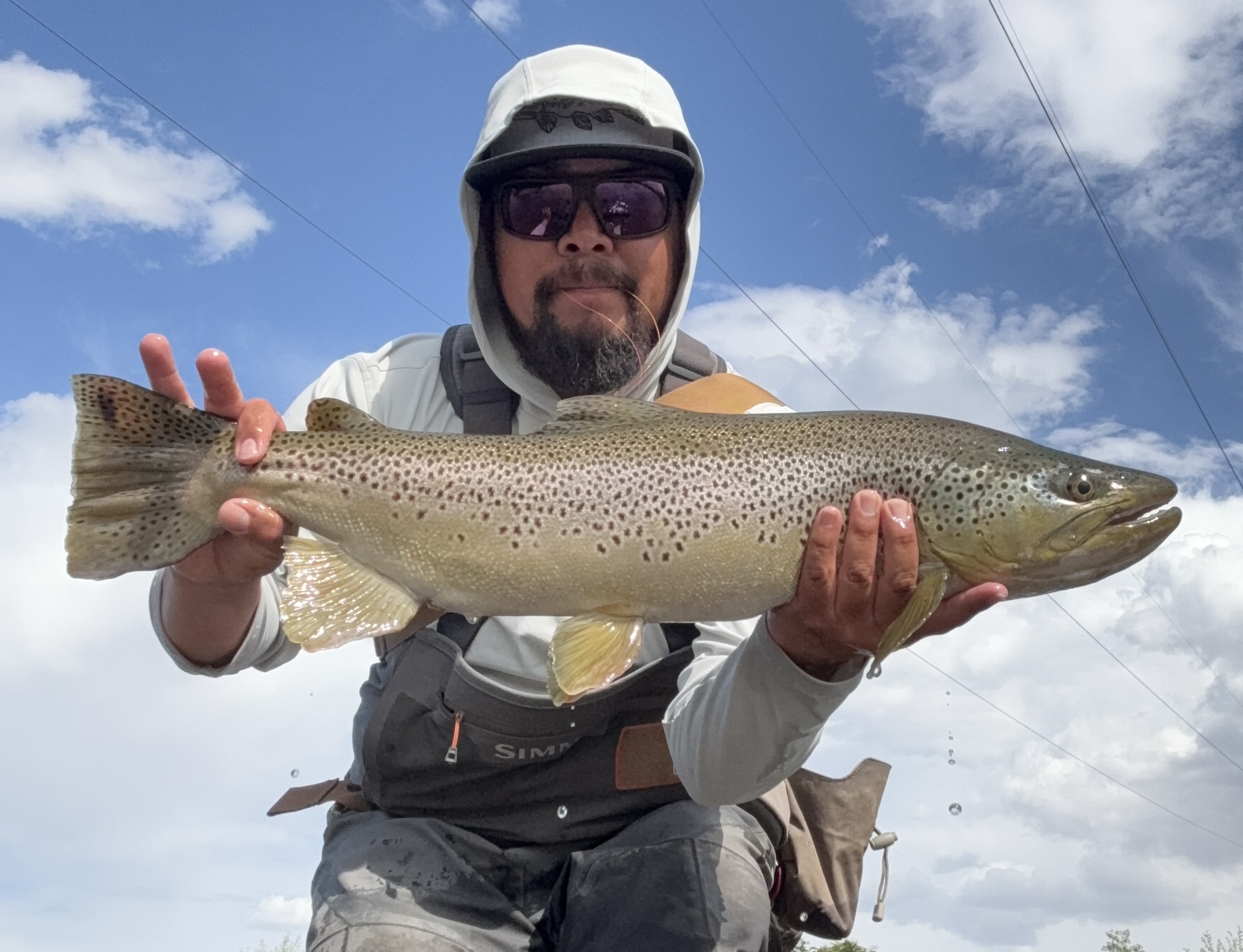
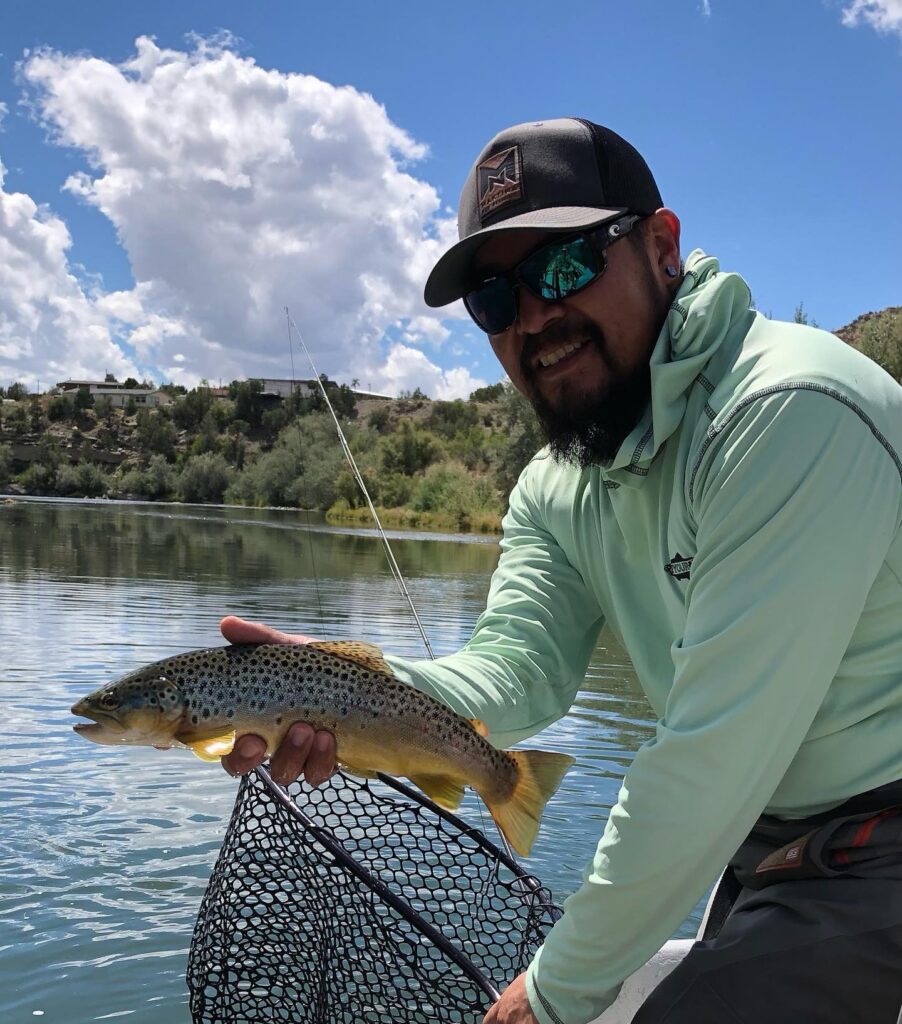
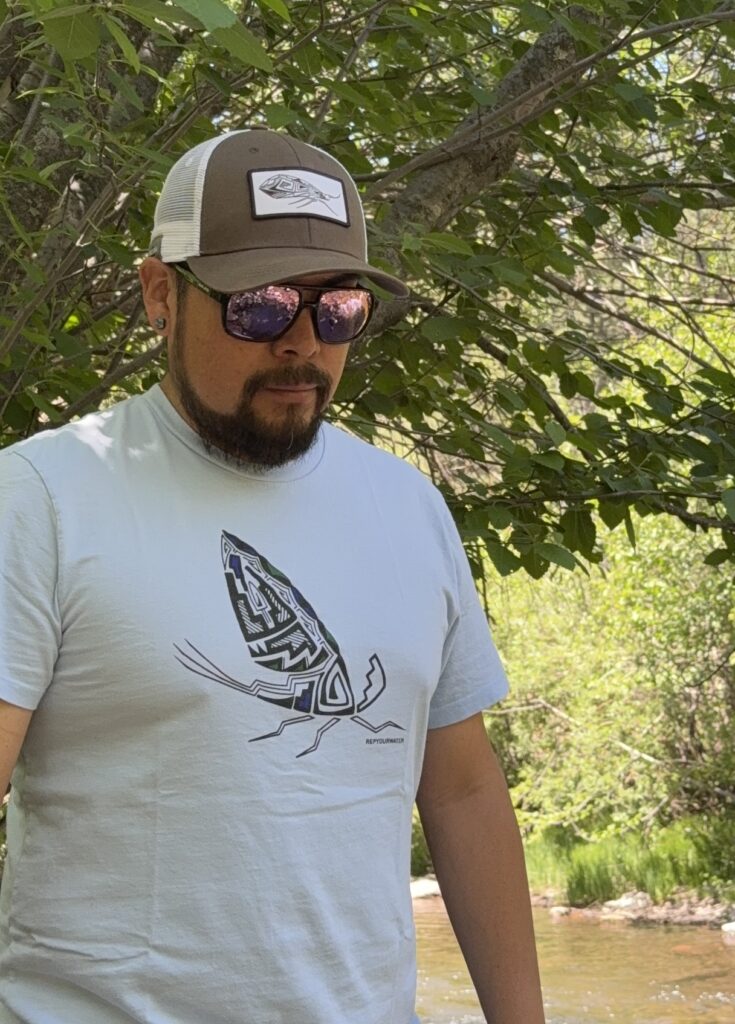
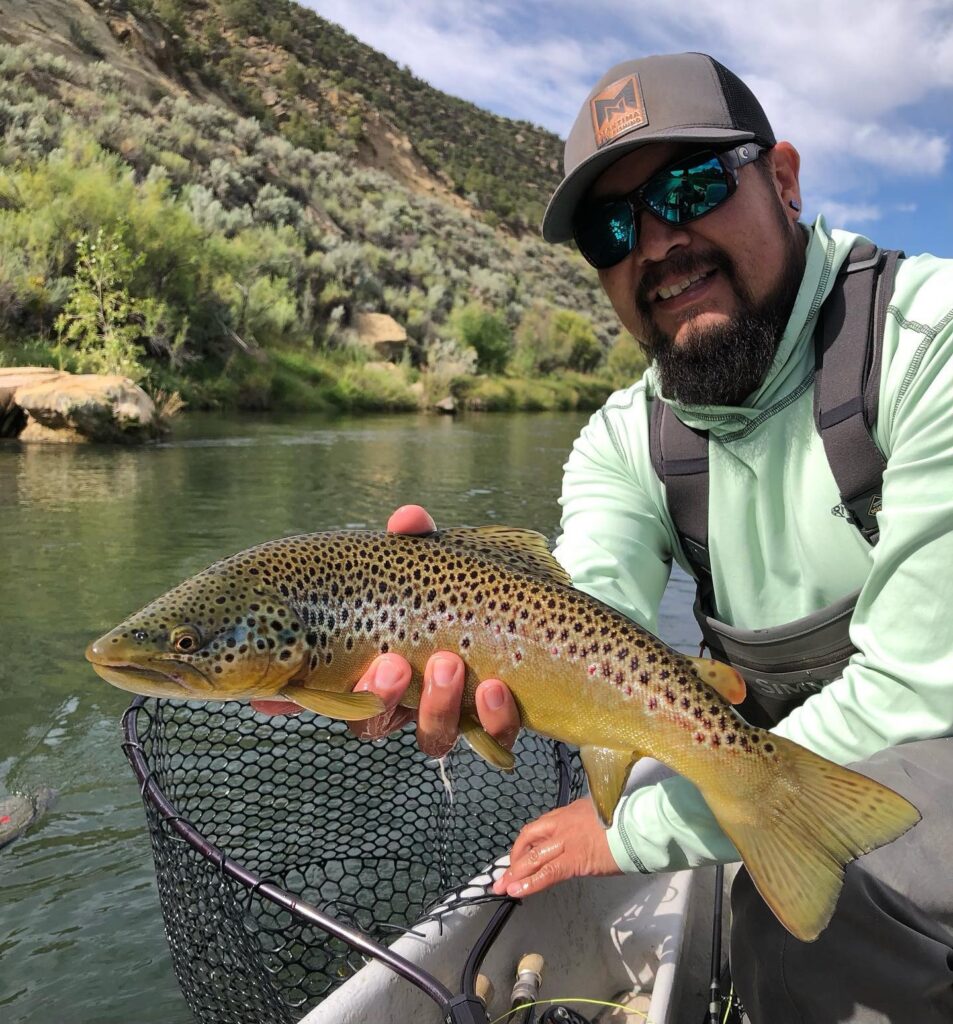
Today we’re hanging out with Norman Maktima: world champ fly angler, guide, and all-around fishy guy. Norman grew up in Pueblo tradition, fished his way onto the international stage, and knows how small details can make a huge difference.
In this episode, he shares tips on reading water, watching for subtle changes in water levels, and selecting flies that work well in both competition and everyday fishing. We also get into how to stay sharp when every single cast might be the one.
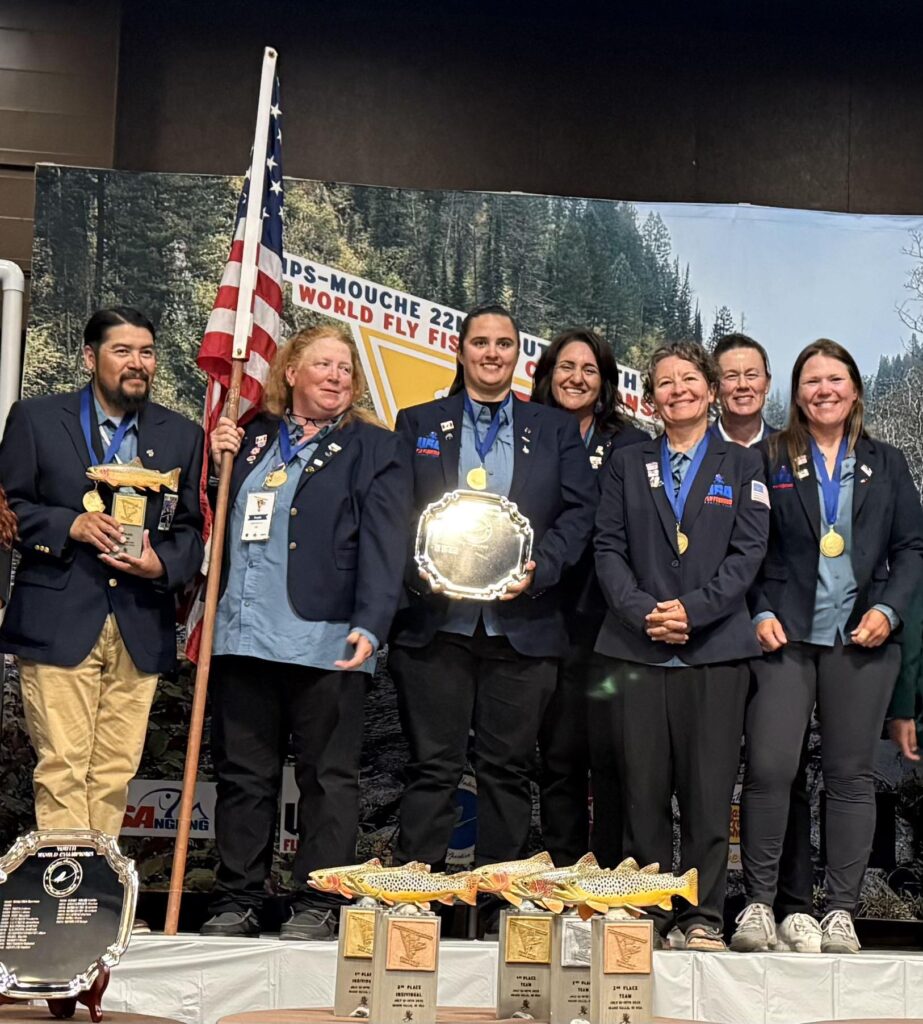
That team just crushed it in Idaho, sweeping gold in both team and individual spots, plus a silver and bronze. The Youth Team also grabbed gold and a bronze. Norman says the keys are teamwork, adapting to tough sessions, and leaning on each other when things get rough.
Norman says it wasn’t about one magic fly or one secret trick. The big factor was time management and strategy. On rivers like the Warm, with clear water and long beats, every minute counted. As captain, Norman could coach during river sessions, and his role was to keep the team calm, focused, and efficient. Here’s how that played out on the water:
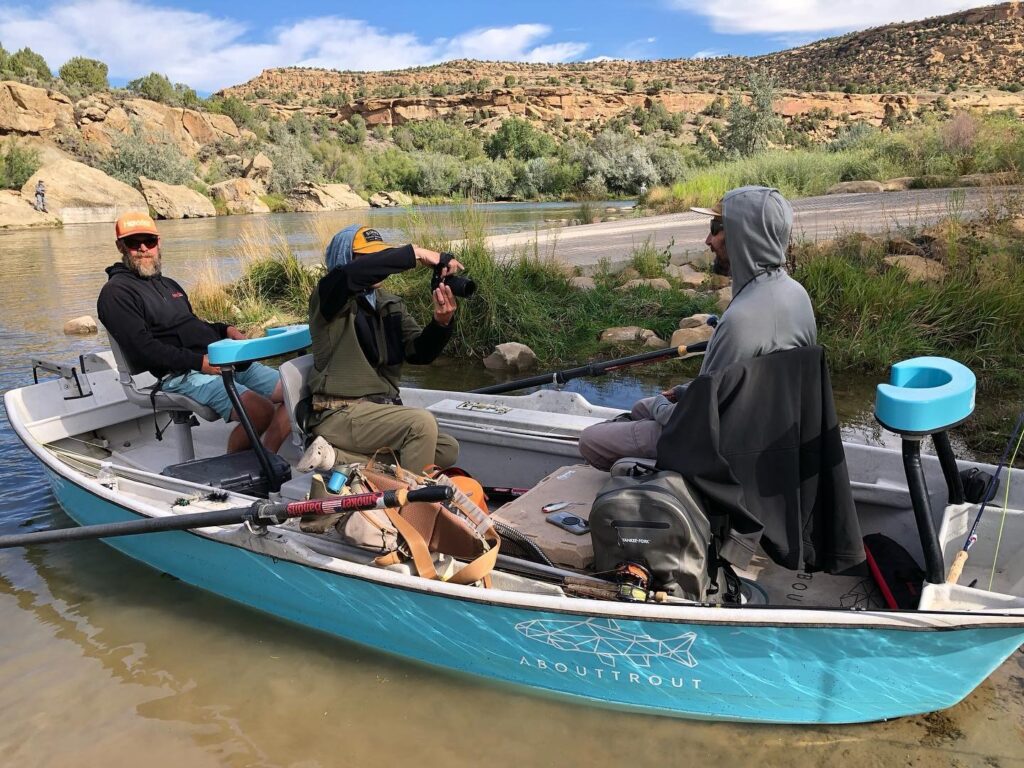
Norman shared how he splits his time between working at Los Pinos Fly Shop and guiding on the San Juan with his buddy James Garrettson of About Trout. He mainly teaches euro nymphing, but says he can work with anyone on any style.
Norman talked about breaking the old idea that euro nymphing doesn’t work on tailwaters. On the San Juan, trout eat year-round thanks to steady flows and abundant food, so it’s all about presentation and adapting flies to the conditions.
The San Juan stays fishable all year thanks to steady tailwater flows. Each season has its own rhythm, with shifts in weather, crowds, and hatches. Here’s what Norman says about each season:
Norman Maktima says most people come to him wanting to learn Euro nymphing, especially for technical rivers like the San Juan. But every trip is different. Some anglers had a rough go the last time and just want to catch fish, while others bring their own gear and he teaches them how to use what they already have.
If someone doesn’t have a Euro setup, he shows crossover tricks with indicators and droppers that still work well. And then there are days when the river sets the tone.
Norman talks about how he rigs his leader so he can fish almost any style without switching rods. By building a leader that works across techniques, he can move from nymphs to dries, add a dry-dropper, or clip on an indicator when needed. This keeps him efficient and confident, especially in competitions where time matters.
He shares more about this system and how he fishes it on his YouTube channel. Check out NMaktima Fly Fishing on YouTube.
Norman says he runs two sighter sections. Right now, he’s using three feet of Rio two-tone tip in 1x, then two feet of tricolor sighter in 2x, tied to a tippet ring. The 10 feet of Maxima above that cuts down on knots sliding in and out of the rod tip. When he feels that sighter knot touch, he knows he’s close to netting a fish.
The two-foot lower section also makes counting depth easier since each color block is about eight inches. If he has to dip the sighter, he can track how far down it is just by subtracting segments. On cloudy days with glare, the longer three-foot section helps him pick it up higher and track it back down.
From the tippet ring, Norman builds out tippet depending on the depth. He usually runs two flies and keeps about 20 to 24 inches between them. His dropper tag is six to eight inches, tied with a triple surgeon’s knot. Even if it twists, it still hangs away from the leader and gives the fly the presentation it needs.
When he pulls tippet off the spool, he adds that extra six to eight inches for the dropper. For the point fly, he uses about 30 inches, which keeps his spacing right.
Norman says the sweet spot for him in the Shadow X series is the 10.5 ft 3-wt, and that’s what he fishes everywhere. He says it’s light in hand, with a soft tip and medium-fast action that makes it easy to cast dries, nymphs, or a dry-dropper without needing to change setups.
The backbone provides him with power for distance and solid hook sets, while still being versatile enough to accommodate different water types. Norman also shared that the rod was developed with input from him, Pete Erickson, and Tim Rajeff.
Casting long mono leaders isn’t the same as casting fly line. You need to keep your stroke wider and more open so the flies don’t tangle. Norman Maktima uses an oval path on the back cast instead of a straight line, and sometimes relies on water loads or what he calls the pendulum swing when space is tight.
These tricks help him keep flies moving clean and forward. When he switches to a dry fly, he goes back to a traditional cast with some fly line out, pairing his setup with a double taper 2-weight instead of the usual euro nymphing lines.
The Flash Fav was released last fall, built upon his earlier HDA Fav Variant from his High Desert Angler days. His newest design, the May ICU, is already on Umpqua’s site and will be in shops by spring 2026. It’s a CDC perdigone-style fly with pearlescent cheeks, giving just the right flash while keeping a natural profile.
Norman shared how Pueblo culture is still a big part of his life. He respects his family and heritage every day, even when out fishing. His dad grew up hearing stories from grandparents about the old ways before big changes came with jobs and schools.
Pueblo people were mainly agricultural and had to adapt through Spanish, Mexican, and US rule. Norman also explained how Pueblo leaders carry ceremonial canes given by Spain, Mexico, and the US. Did you knwo that Abraham Lincoln was the first US president to recognize their leadership? Even today, Pueblo people keep traditions and prayers alive for their land and the world.
Watch your rod as it moves and keep it in the same plane. Small wobbles waste energy, so step aside to see your rod’s path.
Stop points matter too. Make sure the rod tip comes to a full stop. Don’t try to force the cast.
Less is more. Let the rod do the work for you.
Episode Transcript
Dave (2s):
In today’s episode, we dive into the space where tradition meets competition, exploring how a Pueblo upbringing world championship in fly fishing and a life spent guiding have shaped one of the most well-rounded fly anglers in the game. By the end of this episode, you’re going to understand the mindset that wins on the international stage, how indigenous knowledge can deepen your time on the water, and why small little adjustments on the water and in technique can make massive difference when it counts. This is the Web Fly Swing podcast where I show you the best places to travel to for fly fishing, how to find the best resources and tools to prepare for that big trip, And what you can do to give back to the fish species we all love. Norman Tima is back on the podcast and he’s going to give us some big tips on reading water, subtle changes in water level, how you can fish them, choosing flies that hold up both in competition and in regular settings.
Dave (54s):
Out there, we’re gonna talk about dialing in your presentation when you’re fishing for pressured fish and how to keep your head in the game when you know that every cast can count. It might be that one cast, the next one that’s gonna be that trophy fish. All right, let’s get into it. Here he is, norm Tima. You can find him at n mock tima fly fishing dot com. How you doing Norm?
Norman (1m 17s):
I’m doing good. How are you?
Dave (1m 19s):
Good, good. You guys are just coming hot off some pretty big stuff in, in eastern Idaho with the World Championships team, USA. We’re gonna, we’re gonna get into that for a summary. You were on the podcast back in, I think, a summer of 2022, so it’s been a few years. I wanna get an update on what else you’ve been up to and then we’ll probably talk
Norman (1m 36s):
Some Oh, long ago. So
Dave (1m 37s):
That was a while ago, wasn’t it? Well, well just take us back here to, you know, the last few years, what’s been going on? Anything new? I know you’re still guiding out in kind of New Mexico, what else has been going on?
Norman (1m 46s):
Yeah, man, some changes. I think from the last time, actually I, I had re-listened to that episode, kind of see where everything was, but oh yeah. Now since then, you know, I am at Los Pinos Fly Shop these days in Albuquerque. Kind of had some life changing moments and at the same time guiding part-time on the San Juan River. So actually that’s where I’m at right now, currently as we speak. Yeah, gonna be out in the water later today. So those are some big ones. And yeah, at the same time, started coaching the US women’s fly fishing team as of last year when we were in Czech Republic. And yeah, we just got back from Idaho about a week and a half ago, two weeks ago, something like that.
Dave (2m 30s):
Yeah. And how did that event go? The world championships there?
Norman (2m 33s):
Pretty good. The ladies rocked it. Team USA swept gold medals team and individual as well. We had a silver individual, so Tess Wagon took gold. And you had Melissa Smith on? Yep. She took silver, so yeah, that was great. Wow.
Dave (2m 51s):
Wow. So test took gold. And so Team USA is the, took the gold overall in the world championship This
Norman (2m 56s):
Year? Yep. Oh yeah. Yeah. Wow. So at the same time we, it was the Women’s World Championship was in combination with the Youth fly fishing championship, and the same thing with the youth. They took in Team Gold and Individual Gold, along with an individual bronze. So yeah, it was great. Yep.
Dave (3m 14s):
That is crazy. So that, and then you have the men’s coming up next year, right? In the same area? Correct.
Norman (3m 19s):
Correct. Yeah.
Dave (3m 19s):
Yeah. So it could be potentially, we’ll see how that goes. No pressure on them, but Right.
Norman (3m 24s):
Yeah, no, they, I think they’re filling it a little bit, but yeah. You know, if they can just meddle Yeah, seek that podium, that’s always the goal. Yeah.
Dave (3m 34s):
It seems like this is just getting, you know, better, better, more, you know, I hate to say words like domination and stuff, but what do you attribute this to? You’re back, I mean, obviously coaching is a big part of it, but how do we get there? Because the women’s haven’t even been out there that many years, right? Compared to the rest of the world.
Norman (3m 48s):
Right. So this is the fourth Women’s World championship, and so, you know, with all this, it’s just that team comradery, the team building. But at the same time, you know, having a little bit of home field advantage is present. Although I will say we did have a rough start and a lot of it at the same time is making the most outta your beats and your session, how do you progress through and, you know, get through those challenges that are presented at the same time leaning in on your team to support you and help you push through when the sessions get rough. Yeah. So, you know, that’s something that I’ve always experienced in the 23 years of competition that I had.
Dave (4m 27s):
Right, because you were in, and now are you still doing the, the men’s or, or is that at
Norman (4m 32s):
No, I haven’t competed since 2018. That was when I won the national championship and kind of backed away from it just to accomplish some other goals. But yeah, somehow I got roped back into it.
Dave (4m 44s):
Yeah.
Norman (4m 45s):
But on the other side, yeah, so it’s been interesting. I had a, actually, one of our practices in June, we had a mini comp on the waters, on the Henry’s Fork, actually. And so that was actually the first comp that I got back into since I had a pseudo retired.
Dave (5m 2s):
Oh wow. So you retired in 2018 and then you had a, there’s just a mini comp that was like a national comp or something you guys did? Yeah,
Norman (5m 9s):
It was a, it was a, an idea that we had as for to have as a practice on the waters that we were competing on for the worlds. And so, you know, it was just a thought that I would compete as well in that little mini, I, I think there were 12 individuals or something like that.
Dave (5m 27s):
So, and was this individuals, was this a mix of women, youth and the other league or what, what, who
Norman (5m 32s):
Was it? Right, exactly. Yeah, so just a mix of a variety of people. So, yeah.
Dave (5m 36s):
Gotcha.
Norman (5m 37s):
You know, it was good at the same time, stuff like that where you put yourself in the situation and just see how you’ll do. And again, it’s all practice at that point. So even though we’re getting points for, you know, the fish, we catch time sessions, it’s competitor controlled in this one. So, you know, you’re going for an hour and a half another competitor’s there marking and keeping track of your score and all that. But at the same time it’s how do you flesh out, you know, your setup, your rig, your technique, your approach on the water, getting comfortable with the waters you’re gonna be on. So, you know, that’s all part of it when we’re, even when we travel to another country and are, you know, practicing on, on the waters that we can practice on there, you know, so it’s all part of that building experience.
Norman (6m 25s):
So yeah, that way we’re, you know, there’s always surprises, but you know, we try to eliminate as many of those surprises you can during the practice sessions.
Dave (6m 32s):
Oh, gotcha. And now remind me on the team USA, is this every year the world championships every year for everybody? Correct.
Norman (6m 39s):
Yeah. Yeah. So yeah, every year is a world championship.
Dave (6m 42s):
Yep. So I mean, that seems, I mean, I’m guessing that was part of the challenge for you is it seems like you’re in this, you know, I’m not sure how long an average people stick with this stuff, but that seems like pretty challenging ’cause you get done with one, we just won the gold and now it’s like, well, you’re probably turning around getting ready for the next one. Is that kind of how it works?
Norman (6m 58s):
Pretty much. Exactly. So last weekend there was an inner regional competition in southern Colorado, in Durango area. So, you know, that’s a kind of a accumulation of some of the regionals and the mini comps. And so, yeah, it’s just right back into it. And that goes into the two year cycle for both women, men, youth, all that stuff. So
Dave (7m 20s):
Getting ready for it. Yeah.
Norman (7m 21s):
So it’s continuous.
Dave (7m 22s):
It’s continuous. And the other challenge is, is the kind of the monetary piece, right? Because you’ve got, I imagine, you know, you’ve got all this travel, so you gotta kind of go around the travel and then also around the world. Is that, is that one of the challenges getting enough funding to cover that? Especially I’m guessing, you know, for It
Norman (7m 38s):
Is. It is for sure. Yeah. You know, that for as long as I did it, it was a little bit different format or organization when I was on the team. However, it’s still the main challenge, you know, how do we get the funding to get the team there two worlds. And usually that’s what the team covers. However, individual going to minis, inter regionals, regionals, that is all on our own personal pocket. So, you know, and, and for me, I’ve done that for 23 years. I don’t know how I managed it, but Yep,
Dave (8m 10s):
You did it right.
Norman (8m 11s):
Scrap by. Yeah, exactly. And can’t say, you know, I, I was just more broke than anything.
Dave (8m 18s):
Right. It wasn’t easy.
Norman (8m 19s):
Right.
Dave (8m 19s):
And you were doing that while you were guiding, or most people kind of doing like the guiding thing as the other half of their time? Or is it a mix?
Norman (8m 28s):
It’s a mix. You know, some people actually have a well paying profession, which, you know, that’s those people the way you should do it. Yep. And then there’s the rest of us that are just trout bums, you know, or fish bums. So we do what we love and follow our passion and yeah. So just That’s cool. Kind of. Yeah. Just save the ends to get to these competitions.
Dave (8m 47s):
Well, it’s pretty cool. I, I actually didn’t listen to that last episode. We did, but again, I mean obviously I listened to it the first time we did it, but it was one of the most listened to podcast episodes and we’ve got over 900 and I’m not quite sure why. It must be a tribute to, I’ll, I’ll have to re-listen to it now. Your, your style and what we covered. But I mean, that’s pretty amazing, right? I mean, you right,
Norman (9m 6s):
Yeah.
Dave (9m 7s):
That
Norman (9m 8s):
To it a couple times. Right. And I, I was like, I don’t know why
Dave (9m 11s):
It was just a normal episode,
Norman (9m 13s):
I guess. Yeah. Just a, you know, a dude from the desert talking about fly fishing. So I guess that intrigued some
Dave (9m 19s):
People. Yeah, it might be part of the area. I mean I’m, it’s definitely part of the euro nphi, ’cause we had that in the title. I think anytime we have Euro nipping in the title, it kind of hits home. But we also talked Stillwaters. Yeah,
Norman (9m 29s):
I believe too. That was kind of early on as well. Fin competition Stillwater. It was early on when all that was, in a way gaining some traction, I believe. You know? Yeah. So especially following team USA meddling in 15 and 16 and yeah. So I think a lot of people were getting a little bit more pumped up on what was happening with the fly fishing team, you’ll say. Right.
Dave (9m 52s):
Yeah. That’s probably it. And then, and so you mentioned a little bit before about the rig, the techniques. What was it like in when you guys were get, let’s just take it to the women’s, you know, you obviously you were right there. Was there a certain technique that was really the thing to use out there? Describe that a little bit. How you guys came to get to the winning podium.
Norman (10m 10s):
Not really in particular, you know, being in Island Park, Western Wyoming, GaN Lake, so the river venues whitefish was definitely a targeted, Hmm, excuse me, if you could find whitefish. Hmm. Those countered in, in the world championships. Oh, nice. So if you could find pods of whitefish, you’d maximize on ’em. But at the same time it was really time management. And you know, so during that competition I spent the whole week on the Warm River venue. So as captain I’m allowed to talk to the competitors during session on the river venues. Not allowed to do that on the lakes, which is kind of interesting. So, you know, for me to, to go to the lakes, there’s no benefit to that for the team, since I can’t talk or say anything.
Norman (10m 56s):
And usually we’re on, and Sheridan was the other lake, you know, big water. So you can’t really do anything. ’cause you know, everybody’s so far away. So I spent most of my time on the Warm River, small creek, spring Creek conditions, crystal clear water, low flows. And really it was just a matter of having that external view, if you will, or set of eyes just because you really had to lock down your strategy, how you work through the water, your target water. So, you know, there was a lot of water in those beats and they were fairly long beats that just were not gonna produce anything. So how do you work through that? And then, you know, what little pockets and buckets you had that did produce, how do you manage your time through those where you’re just not focused entirely on one little section, but let it rest and then come back and you know, work through it again.
Norman (11m 47s):
And so that was a big part of it. But also, you know, just keeping track of how the competitor was working with their weight management, if you will. Meaning how they’re switching between bead sizes to get sync rates and varying in those buckets. And even from the tail out to the middle to the head of the bucket. Yeah. You know, so it was just kind of reminders of what’s going on. And at the same time, you know, just helping the competitors keep a cool head. You know, we are in competition and honestly, you know, you’re not able to necessarily keep track of competitors upstream or downstreaming. You could see ’em. But that’s kind of my job is I’m keeping track of everything upstream and downstream as well.
Norman (12m 28s):
And if the competitor starts to feel a little flustered, you know, and they’re doing well, I can just tell ’em. Or even, you know, maybe it’s a slow start or the struggle’s happening. It’s like, all right, just stay calm. You’re doing great. You know, just keep doing what we’re doing and you know, just be that voice of support. Yeah. While on the water. So it wasn’t really down to one fly, one technique or anything like that. We’ll say, you know, the more techniques you have, you know, in your quiver, the better off you’re gonna be able to kind of work through some of that water, even if it’s marginal or not great. You know, that’s what you’re gonna see in a world championship is how those techniques are utilized, you know, throughout an entire session or just even on a single body of water.
Norman (13m 10s):
Right. How do you work through all that stuff and Yeah. How efficient you can be doing it too.
Dave (13m 15s):
Exactly. Yeah. ’cause it’s all about the time, right? The way it breaks out is you have a certain beat and then, is that what it is? You have like two hours on that beat.
Norman (13m 22s):
So in the world championships, yeah. You have three hours to work a designated section of water. So Warm River, it varied from I’d say maybe a hundred and 150 yards to a couple of beets. Were almost, you know, 250 yards. So they’re pretty long versus you get on Henry Spork and I think those were all about a hundred yards long. They’re definitely a little shorter, but such a bigger section of water. Yeah. I didn’t get to watch anything on the Henry Spork. So we were below the Falls, Mesa Falls area, which is, you know, steeper gradient, a lot of pocket water. And I forget what the flows were really high.
Norman (14m 3s):
So the physicality of getting out to water that held fish, you know, ’cause everything against the bank gets beat up pretty quick. Oh. And on that river, it was definitely dealing a lot more with trout than whitefish, you know, so it was kind of a, you know, a little bit more of a balance. So the trout definitely don’t recover Oh. Near as quick as the whitefish. So it’s understanding the fish behaviors you’re targeting as well, and how you basically work and, and the techniques utilized to catch either of those species.
Dave (14m 33s):
Right. Are you catching all the, the whitefish versus the trout? Is, are there different techniques you’re using to catch one or the other?
Norman (14m 39s):
There are, you know, whitefish definitely hug the bottoms of the rivers a little bit more. They stack into those little buckets that have the calmest water. So you know how you’re able to stall your flies in those buckets. Meanwhile, you know, like on Henry’s fork, you can’t really see the buckets necessarily, especially at the flows we were seeing. So having looked at that water in June when the water was lower, we had to just go back on our own recollection of what that river bottom possibly looked like, you know? So yeah, that was a, a benefit. But also, you know, Google Maps, just really looking at details on the water. Warm river.
Norman (15m 19s):
Definitely a little more obvious ’cause that water was clear. Mm.
Dave (15m 23s):
Is the Warm river a trip to the Henry’s fork?
Norman (15m 25s):
It is, yep. So it pretty close, not too far downstream is where they, it confluences with the Henry Sport. So, and then the Grays River was another venue, which was just on the other side of the Wyoming border. Clear waters for those. So you could see the depressions, the buckets and you know, really isolate where those fish were gonna be holding white fish, in particular, your trout, you know, they were scattered here or there, you know, holding a typical trout water type stuff. Yeah. But again, getting them to come back after a session can be a little bit tougher. Trout. Trout definitely get a little more spooked and Oh, right. Leery of, of techniques or movement.
Dave (15m 58s):
Yeah. So you get in there and they get a p, somebody goes through for three hours, they get kind of kicked, is that, then the next day they’re a little off. Those trout aren’t
Norman (16m 5s):
Quite Exactly. Yeah. So again, you know, modifying or switching up techniques slightly just to get ’em, you know, to eat again, that’s, you know, again, how big is that quiver? You got a technique, so to dig into it.
Dave (16m 18s):
Yeah. You, you mentioned on the, one of the, the stalling the fly, is that typically what you’d be doing, like euro nipping? Or is that with another technique pretty
Norman (16m 26s):
Much? Right, right. So you know how you read the hydraulic from where you make it start your cast, how you read it, or how you read the hydraulic as it moves over structure and that sort of thing. So, you know, paying attention to subtle brakes in the current, you know, even your rod position, a lot of times you can hold it back a little bit and let it just fall right into a bucket. So, you know, there’s a lot of, a lot of nuances to get that flight to stall. And again, like I was mentioning, playing with bead sizes, which is, you know, we’re dealing with ts and slot of beads switching pattern or switching flies. Not, not necessarily patterns, but bead size also affects your sync rate and how well you’re able to hold it in the zone.
Norman (17m 10s):
It’s difficult to describe because every situation is different. Right. Every kind, you know, when you’re, yeah. When you’re dealing with a multi fly setup. So, you know, Idaho and Wyoming, I believe we could use three flies. Montana was only two flies, but you know, we’re on the lake anyway. But how do those flies influence your syn rate? You know, I always describe it as a combination of weight. So if you’re running two, that’s two beads and they facilitate or help each other in their descent and through the water column. So only a few occasions where three flies necessary, two flies did the job for most of the sessions, you know, and yeah, again, when you’re dealing with three flies, once they get tangled, that’s a nightmare.
Norman (17m 54s):
So
Dave (17m 54s):
Yeah, that’s a nightmare.
Norman (17m 55s):
Again, trying to reduce or maintain efficiency. Yeah. So yeah, two flies or single flies definitely was,
Dave (18m 3s):
Is better. Yeah.
Norman (18m 4s):
The way to go. Yeah. Just in general, I’ve
Dave (18m 6s):
Always felt like that, that it’s like, okay, I could do three flies, but two just seems to be enough of a thing to keep under control. Right,
Norman (18m 13s):
Exactly. Yeah. Yeah. I mean, even in some situations it’s, it’s, you can hardly keep two flies under control.
Dave (18m 19s):
Yeah, exactly. There’s places where two flies isn’t good, it’s like, I’m just going one. Right,
Norman (18m 23s):
Exactly. Yeah, exactly. So,
Dave (18m 25s):
And you mentioned the, you know, those areas that are not producing, you go through an area, how would you describe that if somebody was, or how’d you guys do it? You could, you’re looking at the water, how do you know where to, you know, figure out, okay, that’s not gonna produce or what’s that look like?
Norman (18m 38s):
So again, most of my time was spent on that, on that warm, warm river. But you know, as you practice, that is one thing you’re trying to key in on. You’re paying attention to that. So things that don’t have much feature shallow water, it’s kind of what you would expect. You know, your deeper waters definitely held more fish. But even then, breaking that down had a lot to do with your success in a, in a session. You know, you take a look at the Henry spo, you know, it was just finding those nicer, deeper buckets. But at the same time, like I mentioned, you had a lot more flow. So what you saw on the surface didn’t really reveal what was subsurface, you know, so having time spent on the water, so, and I know you had Lindsay on the show.
Norman (19m 25s):
Yeah, so Lindsay Tess, our alternate reserve, Katie, they live in the Montana area, so they were able to, to have some time on those venues a little bit more in the prior year as well. We had the women’s national championship was there last fall.
Dave (19m 42s):
Oh,
Norman (19m 43s):
Okay. So, you know, seeing the river at different water levels, especially at low flows, you know, if you can mentally map out that river and just take note of what water type you’re looking for, you know, then that transfers later on down the road to help you find those spots. Yep. Where those fish are gonna be
Dave (20m 2s):
Holding. And then it’s just a matter of seeing the area that’s like, okay, that’s definitely not the right water. And just time management, like you said, working through Exactly. Covering yeah. The best places.
Norman (20m 11s):
Yeah. So, you know, you’re, you’re just picking and choosing and cherry picking what you got, what’s the best water. And then yeah, if you burn through those, go hit the marginal stuff, you know, so you’ll hear a lot of videos. Other competitors talk about A, B, C, D, water, you know, so you’re taking your best water in theory, a lot of times, you know, your C water could be your a water just depending on flows and how the hydraulic behaves. So it’s an assessment made during your time on the water at that moment. So, yeah.
Dave (20m 43s):
Yeah. Wow. And when it came to it, was this with the women’s event? Was it a, a kind of a last minute nailbiter? Or was it clear who was gonna win? Oh
Norman (20m 51s):
No, it, yeah, it was totally nail biter. It was, so session one, we had a rough start. Agan did not play nice. Hmm. And on top of that, I, I think there was a, I think Henry Spor was, no, Sheridan was a little rough too, so, okay. We had a couple low finishes. So we were in third place again, I was with Tess on the one river. She won her session. So that kind of kept the team in that medal standing from the beginning. And then it was justly our way back, I think by the fourth session we had moved into first and, but we were a couple placing points, you know, from second. So Czech Republic was right behind us.
Norman (21m 33s):
South Africa was on third, you know, so going into the final session for the team, it is really a matter of just keeping that second place team or individual in check, if you will. You know? Yeah. The checks being the check team being right behind us. So it was, how do you ensure that, you know, you’re still placing higher than they are overall. I mean, individuals could have placed second or third, but as long as the check was below them, that added to their points and, you know, so, but yeah, the last, last session, everybody, we have four first place finishes in the session and one second or third, I believe, which was plenty to keep us in the gold and actually jump ahead and with that too, I think South Africa drew some great beats and, and made the most out of those beats or sessions and they jumped into metal finish as well.
Norman (22m 27s):
Okay. So that was pretty awesome. Yeah. So no, it was a nail biter. Obviously as competitors you’d hope to not be in that situation, but as you know, spectator, it’s pretty exciting at that point. Right.
Dave (22m 41s):
That’s cool. And were there some people like, ’cause it’s not, it’s challenging right? To come see the event, but were there some people out there seeing some of this happen?
Norman (22m 49s):
Yeah, we, we did have a few, you know, the Henry for Section was probably the toughest to get down to, so I don’t know that too many people went down to, yeah. To spectate. Warm River wasn’t too bad. There’s an old railroad trail basically. Mm. That you could walk and it’s pretty easy access through there. So, you know, we had lots of family friends that came and visited, obviously being in home country. Yep. You know, a lot of people come to support 10 USA and quite a few people from the local area, whether they knew there was a world championship going on or not, but you know, just utilizing the trails. So yeah, head gun was tough. Such a big lake, big area. It was on the Madison arm and, you know, so just to see where competitors were, a good pair of binoculars was a must.
Norman (23m 35s):
Oh yeah. Right. Yeah. And Sheridan, you know, being a private property section, you could only watch from a certain area. So I think a few people were able to get out there and, and spectate that one too. So. Yeah. But no, we had, we had a pretty good crowd of people coming through and checking out the competitors, so
Dave (23m 52s):
That’s cool. Well, we’ll hopefully get somebody on from the youth to hear about how that went, but I’m sure you guys, yeah. You’ve all the stories are there. So we’ll kind of touch on that. But what about, thank you, the rest of your year. So you’re doing, you know, this with team USA, talk about your guiding, I know we covered that in the last one, but just tell everybody kinda what areas you’re covering and what your focus is out there. Yeah,
Norman (24m 14s):
So right now actually I’m linked up with a buddy of mine. He’s pretty much based out of the San Juan River area about Trout is Oh yeah. The name of his company. So that’s James Garretson. If anybody, you should, you know, give him a shout and see you and get him on the show here too. Yeah.
Dave (24m 32s):
I actually just heard somebody was telling me about that. Yeah. James is a good guy to check in with. Yeah,
Norman (24m 36s):
Yeah, definitely. So about Trout, if anybody wants to book hit us up. But yeah, so I, I linked up with him about a year and a half ago. So been working on the San Juan, it’s still part-time, like I, I mentioned earlier on, I, I work at Los Pinos fly Shop four days of the week. And on my off days, those are available for guiding on the San Juan where I specialize pretty much in urine infant techniques. However, I can work with anybody on anything. You know, that’s kind of one thing that it’s been kind of wide open for me in that regard is, you know, utilizing ING techniques, dialing it in, obviously with my history, but on a tail water in particular, you know, there’s always been a, a stigma that ING doesn’t work on a tail water.
Norman (25m 21s):
Mm. I just assume, you know, we’re throwing big little size eight bomb check NIS or whatever and you know, right. Truthfully, sometimes that works on tail waters, but you can adapt and adjust to single or like we were talking about a mid type flies or patterns. So yeah, it’s just kind of unlocking some of that and revealing a little bit more to a Tailwater than just, you know, indicator weights and size 26 midges. Oh right. That’s
Dave (25m 47s):
What that technical tailwaters Right. You gotta go super small and the all that stuff. Exactly. But that’s not the case necessarily on this one, on the San Juan.
Norman (25m 55s):
Right, right. Yeah. So, and I, I honestly in most tailwaters that I’ve been to, you know, the food base, their trout or trout they’re going to eat, you know, and it something that’s presented well that’s always kind of the, the, the underlying message there is, you know, as long as you got great presentation dialing in your bugs a little bit more. But you know, again, just like with everything that I had mentioned in or during the competition, how do you dial all that, all those factors in to get those fish to eat, so.
Dave (26m 26s):
Right. How similar was, and I’m not sure, did you guys fish any tail waters in Idaho?
Norman (26m 31s):
Henry SPO I guess is somewhat of a tailwater. There is a release, but we’re so far downstream, you know, that it does behave more like a, a Freestone River and that’s pretty much it. Grays River I believe was a Freestone and Warm River Spring Creek, so, you know. Yep.
Dave (26m 48s):
So there is a, like between the san, because you hear a lot about the San Juan for, I guess it’s known for kinda big fish. I always get those confused. There’s a lot of big names out there, but how is it, is that a pretty big difference to San Juan versus those Idaho streams you’re fishing?
Norman (27m 1s):
Oh, definitely. So for the Henry’s Fork, grays River, there was some rainstorms that came through. Henry’s Fork had some turbidity and color to the water. So that made it difficult. It seemed like daytime or when the light was present on the rivers on some of those other ones, it got those, whether it was the fish or, or got the bugs more activated, which in turn gets the fish a little bit more up in the water column feeding, you know, some of these tail waters, these fish are just on the go from, from, you know, nonstop. So
Dave (27m 33s):
Oh really? Because just it’s abundant food and perfect conditions, abundant
Norman (27m 36s):
Food and consistent conditions. Right. Temperature doesn’t fluctuate too much, you know, so they’re always feeding throughout the entire day. It’s how well you’re able to, you know, switch or adapt. And one thing with San Juan is you do have like the upper middle and lower sections or that’s what we would refer to. So I think Drew Bone had dialed that down a little bit for you on the last episode. So yeah. But yeah, that’s, those are kind of some really interesting characteristics to San Juan. And you know, it can be great for ing the dry fly fishing there can be pretty insane, especially when you have the Bluing olives in the spring and in the fall. That’s always my favorite time to chase heads on that one.
Dave (28m 18s):
On the San Juan,
Norman (28m 19s):
The anywhere, honestly. Yeah, anywhere in the fall. Yeah, the spring of, yeah, spring of fall Blueing olive patches are usually pretty epic, but, or at least in the west when you’re also looking at streamer fishing on the San Juan and you know, you get a lot of the Freestone streams where it’s a little more seasonally dependent when you’re throwing streamers. Again, however, with the San Juan being a consistent environment, at times these fish just trigger on, on the streamer, you know, anytime of the year. So that can be pretty exciting as well. So you get a, a really good variety and diversity of techniques you can utilize on the San Juan.
Norman (28m 59s):
What you end up having to really take into consideration is gonna be the flows being released out of the dam. So right now I believe it’s about 800 CFS. They just had a bump and flow last week and the week before it peaked at 1550. So for the walk away guy, I don’t do any float trips as of now, but for walk away guys, it can make it a definitely challenging when you have higher flows. So now getting back to 800, a lot more accessibility and, and some of that water. Yeah. You know, so that’s kinda what you look for. You know, and again, depending on whether you have a high snowpack year or an average snow back year, you may see those bumps, you know, your typical runoff timeframe late May, June timeframe, but Oh, right.
Norman (29m 45s):
The San Juan mountains in Southern Colorado, apparently were well below their average snow packs. So, you know, we didn’t have a big bump. But what this bump was for is it supplements the animus river further down river, I think to continually provide a good flow for some endangered species further downstream.
Dave (30m 4s):
So, oh, and which are those, what are the wild fish that are there in the San Juan?
Norman (30m 9s):
You know, I, I was thinking about that. I was like, I can’t remember what they’re Yeah, they’re, but they’re native more of a warm water species. Oh,
Dave (30m 15s):
But they’re, they’re there’s a native rainbow there, right? Or some,
Norman (30m 18s):
No, these are like a sucker or something like that.
Dave (30m 21s):
Oh really? Oh wow. So
Norman (30m 22s):
Yeah, further down, you know, as you get into Arizona or or the western border of New Mexico and you get further into Arizona. So yeah, I love that. It’s just to keep those native species around, you know. So
Dave (30m 32s):
Yeah, it’s so cool. We’ve been in our group, we have a wet fly swing pro, you know, or shop. We have some people in our paid membership. It’s pretty awesome ’cause we’re chatting about the, like there’s a western native trout challenge, you know, and there’s some of these things that it’s cool because it gets you out, you know, and seeing some of these fish, even some of ’em are only like three inches big, you know, long. Right. But it’s kind of cool, right. ’cause there’s all these diverse native fish all around. Definitely
Norman (30m 55s):
New Mexico has a similar challenge. The New Mexico trout challenge. Oh it does. But it’s catching all the trout species that are available in the state. So the two native species would be your Gila trout and your Rio Grande cutthroat.
Dave (31m 7s):
Oh, Rio Grande Cutthroat. Yeah. So there’s a Cudi in the Rio Grande in that area. Right,
Norman (31m 11s):
Right. So that’s the Rio Grande Cutthroat is obviously within the tributaries that flow into the Rio Grande itself. But you have ’em pretty much southern Colorado and northern New Mexico. So
Dave (31m 22s):
Yeah. Yeah. I’m just looking here. It says San Juan River’s home to several native species, including imperiled, Razorback suckers. The Colorado, that’s the one Pike Minow. Yeah. Other native species like the flannel mouth sucker, blue head sucker, speckled D.
Norman (31m 36s):
So yeah, those are all pretty much further down river as it warms up. Yeah.
Dave (31m 40s):
Gotcha. And then, then you have trout, of course you have what it’s known for is these like big fish. Right. You see some big fish in San Juan? Yep.
Norman (31m 47s):
Oh yeah. You know, in recent years the brown trout moved up, although, you know, I remember seeing Browns way back, but they seem, they tended to be further down river where it got a little warmer. But they have adapted and moved up to the base of the dam and they’ve definitely taken advantage of the stocking program. Yeah. Oh right. The game and fish has where they’re just throwing in these fingerlings and rainbows take advantage of that too. So they’re just, you know, gorging and eating on little tiny stock rainbows and growing big, you know, a lot of browns in that upper twenties range, if not thirties or low thirties.
Dave (32m 22s):
No kidding. Your
Norman (32m 23s):
Rainbows for some reason, you know, they kind of just stick to that upper twenties that I’ve not seen too many rainbows break that 30 mark. Like the Browns
Dave (32m 31s):
30. So the brown, you’ve seen some browns that are in the 30 of broken 30.
Norman (32m 35s):
I’ve seen them, yeah. Not caught any yet. Right,
Dave (32m 38s):
Right. Yeah. The 30 is, it seems like it’s that one range where you probably hear a lot more people saying they caught ’em than maybe they did.
Norman (32m 45s):
Right, right. That’s the quest when you go to the San Juan for a lot of folks.
Dave (32m 48s):
Yeah. Have you seen that little, I can’t remember the name of it. We just saw, we were on our trip up to Alaska and I think Brandon or we had, it was like, hey, this little orange ball that you put in the photo. Oh right. And they use the AI and it tracks and it knows exactly. I haven’t used it, but it sounds like it’s pretty accurate.
Norman (33m 4s):
Somewhat. I had a buddy, he had one the other day and I was like, how, how accurate is that thing? So he tested it on, you know, some, some replicas he had and he was like, it’s, it’s pretty close, but it, it’s about an inch, you know, so an inch off.
Dave (33m 22s):
Oh. So see then that could be substantially. ’cause that’s the whole like, oh it was 29 or 30 or 28. Right,
Norman (33m 27s):
Exactly. So I’m like, so it’s just feeding the angler, the angler lie. That’s
Dave (33m 32s):
Funny. Yeah. It’s all, it’s called the fish techie orange proof ball.
Norman (33m 35s):
Right, right, right. So, but I mean, who knows what you need to do to calibrate it or I don’t know. So, yeah. Yeah. Right. I I, yeah, I don’t have one. It, it just kind of looks funny. Yeah. When you see people holding up that fish and it’s got that orange ball in the photo kind of detracts. Detracts
Dave (33m 49s):
The pick. Yeah. Yeah. When you gotta an orange ball in there, it looks, that’s why you gotta get two picks. You gotta do it quick. Gotta pick with the orange ball and the pick without keeping it in the water.
Norman (33m 57s):
Exactly. But you know, whatever it takes to keep these, these anglers, you know, truthful.
Dave (34m 2s):
Yeah, right. I know, I know. It’s pretty funny. Chad Johnson on our, he’s been doing the, this stuff down Real Chad’s real Southern podcast down there in, in our network here. But he’s been talking a lot about that. Like the fact that it’s helpful for especially the guides and everybody to know the actual size of what fish. Right, right. Fisher, you know what I mean? ’cause and
Norman (34m 22s):
Two, you’re not having to lay ’em down on a measuring board, you know, more handling of the fish than anything. Yeah. You know, so quick reference is always great as far as preserving the, the health of the fish and you know, if you catch on a lease, catch ’em again. So,
Dave (34m 37s):
Yeah. So that is why Yeah. One reason that it’d be awesome to have is just quick. It’s there, you have to mess with it. Exactly.
Norman (34m 42s):
Yep.
Dave (34m 44s):
Step into the world where the river whispers and the fishing is nothing short of legendary. This year I ventured into the heart of Eastern Idaho’s Yellowstone Teton territory where the fish were larger than life and the waters held the secrets of the best fly fishing out West Yellowstone Teton territory is not just a location, it’s a gateway to adventures that will etch themselves into your memory with crystal clear rivers like the Henry’s fork and the South Fork of the Snake and enough lakes to keep you going all year long. Make your way to Yellowstone Teton territory and embark on a journey to one of North America’s finest fly fishing destinations. Whether you’re planning your trip now or just dreaming it up, the YTT is where those dreams turn into reality.
Dave (35m 27s):
Remember Yellowstone Teton territory, that’s Teton. T-E-T-O-N. It’s time to experience eastern Idaho for yourself and support this podcast at the same time. You mentioned the fall. So the fall is a a good time. Let’s talk about that a little bit. If we were thinking of coming down to, you know, put something together with you fish down there. So the fall, how long does it down there? Are you guys fishing way into the fall? How does that look? So
Norman (35m 53s):
Again, being a tailwater, it’s consistent throughout the entire year. Just your external weather conditions might dictate, you know, whether you want to get out there or not. But we fish year round, but the fall is a great time. So right now, you know, we’re dealing with some heat summertime, obviously, but also this is, should be our monsoon season. So isolated thunderstorms, that sort of thing. So you have some inconsistencies.
Dave (36m 17s):
So, and it’s August right now, it’s almost right. We’re coming up to like mid-August here pretty quick.
Norman (36m 20s):
Yeah, exactly. So you know, you’re seeing some thunderstorms roll through every now and then winds pick up with those. But as you progress into the fall, so October is really a great time and usually that’s when those blueing oils really kick off. But you have a lot more consistent weather, calmer weather, the temperatures start cooling down. So, you know, now in the San Juan area we’re, you know, 5,000, I think sub 5,000 feet. 4,500 somewhere in there. So it gets hot here. You know, it’s definitely desert sandstone mesa. So you know, you’re, you’re out there, the water’s always a 42 to 44 degrees. Hmm. So your feet are frozen or numb, you can’t fill ’em ’cause you’re waiting and then your upper body out of the water’s just sweaty. So it’s, it’s really weird.
Norman (37m 1s):
Right. But that’s the great thing for having that tail water situation is, is it maintains that water temperature and that and you know, and where the trout are thriving. But you get into the winter, you know, you could have the opposite effect where the water’s warmer than the air. So you feel a lot better standing in the the yeah. The warmer water.
Dave (37m 20s):
When does that start? Does that, does November when you first get your first big storm, does that vary quite a bit.
Norman (37m 24s):
Typically however, like I mentioned, being in this area we’re kind of, I would call like in a, a shadow, a weather shadow if you will. So, you know, you don’t get a ton of moisture here when you do. It’s not very
Dave (37m 40s):
Yeah. Like stacking up like feet of snow or stuff like that.
Norman (37m 43s):
Exactly. So, and it or it melts pretty quick. Yeah. So you know, you get shifts and changes in the weather pretty fast. So whether it, you know, goes from cold, it’ll warm up pretty quick. Wind is kind of the variable out here that can make your day enjoyable or, or not, you know, just being exposed and you have canyons so you get a lot of thermal shifts and whatnot. So that just kind of changes or shifts the wind. So yeah, that’s pretty much what you’re looking at, but yeah. Yeah,
Dave (38m 10s):
So it’s pretty, it’s
Norman (38m 10s):
Pretty open year round fishery. Yep.
Dave (38m 12s):
Year round. So you got a fall, I mean really it’s just, yeah you might get a cold snap or you get a teens or super even colder temperatures where maybe you’re, you know, not planning. So I mean if you were planning a trip a year in advance, probably you’re looking at what October might be a good time for the fall. September
Norman (38m 27s):
I would say, you know, barring your winter time, although like I said it, it’s usually not bad. Winter time can actually be a great time of year ’cause you’re not dealing with people, but Oh, right. Springtime, March, April, early May, those are great times. Again. You get that spring hatch of bluing olives, that’s, that’s typically in April for us down here. So again, we, you know what, in a lot of Colorado northward you’ll see that hatch as well. So we just follow with it too. So yeah, summertime obviously can get pretty crowded down here just with vacationers, you know, people booking trips. But still a great time to fish. You know, you still have a lot of opportunities.
Norman (39m 8s):
The water’s usually clears up really nicely. The flows bump up just a bit more in the summer. So you know, it’s in, in the shoulder timeframes you’re looking at probably 300 CFS and then summertime it’ll bump up to, you know, depending on runoff situations. But you might see it hit 2000 if not higher. But most of the summer it’s gonna hold probably in that five to 600 range. So you know, you got a really good flow, keeps that water temperature down or cool. And again, the consistency of that keeps those bugs moving around. Yeah.
Dave (39m 40s):
It keeps ’em going.
Norman (39m 41s):
Keeps the fish happy. And then yeah, going into the fall, that’s when you just got a little more stable weather again another bump of bluing olives there. So that’s kind of a great time. Yeah. And then usually, you know, the crowds die down again. They
Dave (39m 53s):
Do. Right. So once you get towards people or kids are back in school, all that stuff, it’s not as many people.
Norman (39m 57s):
Right, right.
Dave (39m 58s):
And it sounds like people are coming to you for obviously the euro nipping. I mean that’s definitely a big thing people want to get better at. Is that, do you spend most of your time kind of teaching that with new clients or what does that look like?
Norman (40m 9s):
Most of the time, although, you know, anymore I’ve gotten a few clients that they just either really had a bad experience the last time they’re here and want to get into fish and so, you know, whatever it takes and Yeah. And a lot of times too, if they have the gear and equipment, I usually try to teach people with what they have in order for them to utilize it on their own. If they do go out again, you know, they may not have a urine up setup or anything like that and do the best, but I have some crossover techniques with an indicator with a dropper system type setup. So it translates well for ’em. But at the same time, I had one trip where I think we spent, you know, 80% of the day throwing dry flies, I think it was pretty much all day.
Norman (40m 51s):
Yeah. Throwing dry flies at fish that were rising and just had a blast. You know, so, and like I said, you know, so again adapt to the situation. But I do get a lot of clients that want to learn how to crack that Euro NF code on the, on the San Juan River or, or in a technical fishery, you know, so Yeah.
Dave (41m 12s):
’cause that’s where the Euro sniffing shines right? Is that you can get down to the fish Right. At the Well if you just, it’s easier right. If you do it right. Exactly.
Norman (41m 20s):
Yeah. Yeah. So you’re able to, you know, adapt and adjust depths through the drift without having to, you know, stop, move the indicator up or down or whatever. Or you know, even just how you position your rod in order to slow the drift down so it gets down to depth or raise it up. Yeah. If you see a fish feeding midco bring that dropper or those flies up into their feeding zone. Right. And then even switching out, you know, the way I have my, my setup, I can adapt and switch out to a drive fly fairly quickly or even throw a light streamer setup if I need toa.
Dave (41m 53s):
Oh you can, right. So without changing to a major change, you can just switch up a fly pretty quick and,
Norman (41m 58s):
Exactly. Yep. Yeah,
Dave (41m 59s):
Yeah, that’s right. ’cause you do kind of a, everything you are doing, whether it’s dries and are you kinda using a similar leader setup? Is that how it works? Or, ’cause the rods are different too, right? The rods are a little bit different.
Norman (42m 10s):
They can be. So,
Dave (42m 12s):
Or is there a good all around, is there a rod? You know, like there
Norman (42m 15s):
Is a good all around rod. Okay. And I had a little bit of input on this rod, the shadow X from Echo. Oh yeah, yeah, yeah. So yeah, that’s, yeah, Pete, you know Pete,
Dave (42m 25s):
Yeah, totally. We’ve been doing the, we have, we haven’t connected with Pete on This year, but we’re, we’re actually looking at, we’ve, I’ve been talking to Josh Miller where we’ve got a lot of people in the eastern part of the country Oh yeah. That are interested. So we’re thinking about maybe eventually doing something on the east side, you know, but yeah, the shadow X.
Norman (42m 39s):
Yeah. So with that Rod, you know, I’ve tried to create a leader formula that’s been the most efficient for me. And again, you know, my personal preference on how I built out this leader, but I can transition ’cause I hate carrying multiple rods with me. They’re always in the way. And in a competition scenario, it’s one more thing that detracts my focus on what I need to do, which is fish. Right? Yeah.
Dave (43m 1s):
I’m a hundred percent, I mean I’m, no, I’m not even near your level, but I’ve never liked carrying two rods, like setting one in the bank and then you’re just like, oh, I gotta go get my rod. Yeah,
Norman (43m 9s):
Exactly. Yeah. And then you move down, you’re like, oh crap, where’s my, exactly, where’s
Dave (43m 12s):
My rod?
Norman (43m 13s):
You know? Yeah. So you have to go scramble and find it again. So try to figure out how I can create a leader that is sufficient or efficient enough to nu with, but also that I can just clip my nymphs off, tie a dry on the point fly and deliver the cast, you know, at the same time punch it through wind, run a dry dropper and you know, on, on the recreational basis, like I can actually put an indicator on it if the wind’s too gnarly and crazy and I don’t want to deal with it, I can just put an indicator and let it ride in that way too. So it’s funny because, you know, in a lot the, the competition scene that I actually have quite a few people message me about this is ’cause I, I do have a YouTube channel where those of you out there, I kind of go through a lot of this on my YouTube channel.
Norman (43m 59s):
Yeah. What’s
Dave (43m 60s):
Your channel
Norman (44m 1s):
End M Tima fly fishing. Yeah.
Dave (44m 2s):
So everything’s Tima define you. Yeah,
Norman (44m 4s):
Exactly. Yeah. So website, Instagram, social media stuff and my web YouTube channel. So, but I break it down and just utilize that leader formula for everything that I do. But it is funny because I do get a lot of people questioning or asking me why I don’t use a microliter, like what a lot of competitors use, you know, going Forex or, or lighter. Sometimes I’m like, I can’t do a whole lot of what I wanna do when I need to do it in that moment, you know? So I’ve had those experiences in world championships where, you know, I was on the other side of the river and didn’t have another rod, but I had the num with the microliter and I couldn’t throw a dry or that rod was too soft.
Norman (44m 45s):
I, you know, it when I could get the dry there, set the hook. It wasn’t a good hook set because of the softness of the rod and I, you know, would lose fish. So I really had to sit down and think of that, think how I could develop that leader formula for myself. So, and just for everybody to know, it’s 10 feet of 12 pound maxima chameleon. I do run five feet of cider material. So going from two, or sorry, one x to two x to terminating in a tbit ring there and then I can build out the rest of my tbit. And this, this is all within the Phipps moosh? Yeah. Oh, it’s rules of twice the rod length.
Dave (45m 24s):
Did any of the women use the similar leader setup in the comp? No.
Norman (45m 28s):
And that’s the one thing is, you know, don’t force anything under whatever you’re comfortable with. Right. You know, have confidence in what you’re doing, you know, whether they adapt it later on or not. But you know, that’s one thing is don’t try new techniques in world championship. Oh
Dave (45m 45s):
Yeah.
Norman (45m 46s):
’cause you’re not, you’re not familiar with it, you know? No. So you end up scrambling,
Dave (45m 50s):
Do what you know, do what you, you you’re master. Yeah, exactly.
Norman (45m 53s):
Yes.
Dave (45m 53s):
What is the video? If we had to search it? What’s it called? The leader video?
Norman (45m 58s):
You know, I don’t know that I have a specific video on a leader build.
Dave (46m 2s):
Yeah. Okay.
Norman (46m 3s):
So I had to kind of, for music copyright stuff, I had to eliminate a lot of videos. Oh, you did? So I’m kind of, I’m rebuilding some of the Yeah.
Dave (46m 11s):
Oh right. ’cause you had the music on your videos. Yeah.
Norman (46m 14s):
So I had to look for royalty free stuff and so I had to scrap a lot of videos that were
Dave (46m 18s):
I gotcha. I’m looking at, yeah, easy switch from Euro ing to dryly. There’s a bunch of videos in here.
Norman (46m 23s):
Yeah. Yeah. So I just go through, my videos are basically in situ type videos where this is what’s going on, what I’m seeing, and I’ll kind of explain it and then go through my rig, you know, and see how that adapts for the day. So
Dave (46m 37s):
This is perfect. Now we’ll put a link to the show notes to your channel. This will be a super awesome resource. It’s always nice to have the follow up, you know, so people can take it to the next level on this conversation. So good. Okay. Well, well we have that resource and you mentioned, so it’s 10 feet of 12 pound just for your top of your leader from the fly line. And it’s down to a cider. And what’s the cider? What is that? So
Norman (46m 57s):
I use two different cider sections. So I’ll, I’ll have three feet of, in my case right now I have the Rio two-tone tipt. So I’ll have one x three feet of that. And then I’ll have two feet of qua tricolor cider material and that’ll be in two x. And then my tipt ring tied to that. So the 10 feet of maxima is to reduce nottage in the liter. I don’t want that leader going in and outta my tip top hitting a bunch of knots. Mm. So when I do hit that, not with the cider, that actually gives me the cue that I’m pretty much there and ready to, to net a fish if it’s on the point fly.
Norman (47m 40s):
So, you know, I might need to strip in or out just depending on the weight or the current of the fish, you know, if I need more leverage. But that gives me the cue that I, I’m about ready to net the fish right there.
Dave (47m 50s):
I see. So
Norman (47m 51s):
Those things are built in, but having that shorter two foot section below the three foot gives me less segments to count. So both of these cider materials have basically eight inch increments for the colors. Yep. So if I only got that two feet down below, that’s only three segments I gotta count. So if I have to dip my cider down, I know how far I am because all I have to do is subtract, you know, whatever segments I have out of the water and I know how far down I am. On the flip side, if you’re in the high glare or low visibility situation, cloudy days can be really tough just ’cause you have all that diffuse light and a lot tons of glare in the water.
Norman (48m 34s):
Having that extra three feet higher, I can look off my rod tip or just look up a little higher and find that cider material and then track it back down. So again, it’s the versatility and adaptability of that leader in varying conditions. And like I said, it terminated to a one and a half millimeter tippet ring. And from there, you know, I build out my tippet section according to depth or or whatever technique I’m wanna run. But it all stays within, again, the Phipps Moosh rules, which is your leader isn’t allowed to be more than two lengths of the rod. Oh, right. So, you know, with a 10 and a half foot rod, I can have a 21 foot leader, basically.
Norman (49m 16s):
So,
Dave (49m 17s):
Gotcha. 21. So basically, and you’re at 12 plus the five puts you at 17 base
Norman (49m 23s):
Leaders. 15 feet. So 15. 15 foot base leader. Yeah. 10 feet and five feet cider. Yeah.
Dave (49m 29s):
Oh yeah. 10 feet, five. Yeah. Yeah, yeah,
Norman (49m 30s):
Yeah. So at that point, I have six feet of variation on my tidbit section. There
Dave (49m 36s):
You go. So you got six feet. So you can go down to, in a deeper spot. And then how would that work? Let’s just say you’re doing the euro, so you might have typically one fly on the end there with at the right weight that you’re fishing, you’re ing with that.
Norman (49m 48s):
Yeah. Or two. I, I tend to run two in most situations. Yeah. But, you know, one fly is great for shallow pocket water type situation. Two flies definitely to allow better coverage of the water column and sink rate. So it just depends on the situation. But you know, again, I, in a lot of these videos, I do explain that the variable I adjust is between the tip of ring and my dropper. Usually between flies, I always keep about 20 to 24 inches apart. Oh
Dave (50m 17s):
Yeah. And where’s your dropper coming in? Where’s your dropper coming in on your leader setup?
Norman (50m 21s):
It depends, again, most of the time in Northern New Mexico, two feet, so from my tippet ring to the knot is about two feet. And then my dropper is gonna be about six, eight inches. So that allows me for, you know, switching out flies. I know a lot of folks run shorter tags, assuming that it doesn’t twist up near as much, it always twists. Yeah. And having a little bit longer dropper, even if it twists, it still hangs away from the leader and it gives the fly it, the presentation it needs. So.
Dave (50m 49s):
Okay. And the dropper you’re using off, that would be a, what’s the knot you use on the dropper?
Norman (50m 54s):
It’s a triple surgeons. Yeah.
Dave (50m 55s):
Triple surgeons. Right.
Norman (50m 56s):
Yeah. So when usually I build that out, you know, I take whatever depth and then I add six, eight inches. So when I’m taking the tip it off the spool, if my average depth is gonna be, you know, two feet, three feet, that’s what I’ll take off the spool plus six eight inches. So that factors in my dropper when I tie. Yeah. So, and then when I take off tipt for the point fly section, it’s usually about 30 inches. And that factors in that six eight inch. So I want, as the flies hang, I want that distance to be about 20, 24 inches between the flies.
Dave (51m 30s):
I see.
Norman (51m 31s):
So, yeah, pretty simple build nothing too crazy. Right. You know, there’s a lot of leader formulas out there, like, man, that’s, that’s a, a lot on knots and moving parts.
Dave (51m 40s):
But the cool thing about this one is, is that you’ve made it so you can fish, like you said, one setup. So you can go euro or you can switch to a dry, or you can switch exactly to other. And what is it in the shadow X? What would be the rod that you would typically be fishing on the San Juan? Like length and weight?
Norman (51m 56s):
I, and I’ve, the sweet spot in the Shadow X series for me has been the 10 and a half foot three weight. So I fish that everywhere, anywhere.
Dave (52m 4s):
So if you did that through that and then had this set up, you could, I mean obviously everything’s changes out there, but that would be something you might be able to use one rod for multiple situations. And there is, is there other thing, like let’s say you’re switching from this to a dryly. How would you cast, you know, how does the casting work when you got that with the dryly? So
Norman (52m 22s):
The shadow X is, it’s got a nice soft tip, but it’s, you know, about a medium fast action in the mid, maybe a little bit touch softer, but it still has enough backbone to generate speed and deliver a cast like that. So with that 12 pound chameleon, that stiff enough material and that slight taper down from one x to two x on the cider, you know, my tbit section, if I just ran a single dry, I might just cut right at the knot where my dropper would be and tie the dry fly on. I have done it too, where I’ve just cut the knots off and just tie the dry to my terminal in if it’s like five x or for X, if I’m fishing kind of heavy, I can turn that cast over pretty easily.
Norman (53m 4s):
So that’s really all it is, is just kind of learning how to false cast with that 10 and a half foot rod, which is super easy. I mean the shadow X is a really light in hand rod, but you can definitely dig down into the mid and, and generate that speed. I had issues with that with some of the other, you know, rods that were more Euro specific. So they were softer in the middle and it was very hard to generate and maintain that power transfer from the rod down the leader. Right. But even still, if you’re at distance, you know, more than, so I can cast 30, 40 feet with this, but if you go to set the hook, you need something that has a decent backbone again to lift and get hook, good hook penetration.
Norman (53m 48s):
Hmm. So that’s kind of where it all comes into play. And I mean, you know, me, Pete, and Ray, Jeff, we spent quite a bit of time going back and forth on what we’re looking for in this rod. So
Dave (53m 58s):
Yeah. That’s awesome. Yeah. So that, that’s, and that’s part, so the shadow X was obviously not just one person. You had, you know, obviously Pete and then Tim, which is this, he’s the Oh yeah. He, you know, the, he’s, I always, always think of as like the mad scientist, the the guy who’s smarter than everybody. Right. Right. But you have, and then you’re there too. Were there other people involved in that process of making that?
Norman (54m 17s):
I think there was, and I, I totally terrible with names, but there was one more individual from the UK area who Oh, okay. Definitely had a, a lot of insight into that. Yeah. But yeah, so it was a team effort on that one too. And I think, you know, echo knocked that one out of the park for Yeah. You know, what I wanted to see in a rod. Right.
Dave (54m 34s):
They’ve done some cool stuff that’s like, it’s a really awesome story because of mainly ’cause you got, well there’s a number of reasons, but Tim being there and or at least, and he’s not even there fully anymore, but Right, right. But like the glass, right. We were on a trip recently and the, and the badass glass came out and Right. And it feels like they’ve nailed a few of those rods. You know what I mean? Those different things.
Norman (54m 53s):
Oh yeah.
Dave (54m 53s):
But what about the casting? So the casting is another thing. Right now we are actually getting ready, we’re doing a casting challenge trying to help people ’cause it is Right. One of the biggest things with fly fishing and it’s the thing that still keeps new people outta it because they see it. They’re like, oh my God, I gotta do this thing. Right. But what is your tip on, because you’re casting a lot of leaders, it sounds like a lot of mono on your setups. Is that true? And are, you know, are you ever casting the fly line?
Norman (55m 16s):
Yeah. So you know, when you’re dealing with ing casting, obviously keep your stroke wide open. You don’t really go into your traditional back cast, forward cast where your rod is parallel or staying within the same plane as your Ford and backstroke just because your leader is much lighter. You don’t have the same energy transfer at the same time. You’re dealing with those weighted flies and they, they’re not heavy. But still, when you are keeping that rod moving in the same plane, your flies have a lot more opportunity to collide with themselves. You know, so when you’re urine feeding, usually it’s on the back cast, you start low, you know, just angled down a little bit.
Norman (55m 58s):
And then as you come back, you come over the top. So it’s more ovaled out as far as the path of the rott. You could also do a lot of water loads. Or another one is what I call the pendulum swing. If you have a lot of vegetation or you know, you don’t have room to really open it up on the back there, you can just kind of lift your flies up outta the water with your rod at your side, basically the Ford portion of a roll cast. But you had your flies outta the water. Yeah. With the slight amount of weight you have in those flies, it’s enough to cause the rod tip to flex or you know, to get held back enough to where you can kind of slingshot those flies forward. So, oh, so, and again, you know how clean your leader is, gives you that opportunity to shoot flies forward.
Norman (56m 41s):
Now if I switch to a dry fly again, I eliminate those nymphs off of there, I can go back into my traditional cast, you know, keeping that rod and trying to generate the energy transfer from the rod down the fly leader, fly line leader. ’cause at that point I do have some fly line out. So that being said, I pair my nu set up with a double taper two weight. I don’t use the traditional Nu Fing fly lines you see out there.
Dave (57m 10s):
Oh, you don’t? So you use actually a double taper I regular fly line. Right.
Norman (57m 14s):
Again, ’cause I’m trying to get energy transfer from the rod down the fly line. Especially if I’m casting past my leader traditional euro nipping lines, they don’t quite have the mass to turn over No. In conditions that you typically find yourself with. Oh,
Dave (57m 30s):
Right. And a breeze. And what would be, and what would be that euro nipping traditional line like it would be, is it pretty much like a mono? How is that different from say your double taper line?
Norman (57m 39s):
Some of ’em are braided cores, some of ’em mono cores, but they’re, the diameter is basically like a one weight or zero weight. Oh, I see. I forget what the diameter 0.022 or two four or something like that. Yeah, a little bit longer. So it’s a thin, thin line. You know, again, in urine ing you’re trying to reduce as much of the line sag, so your drift stays out away from you. Mm. However, like I mentioned, you know, I’m trying to find that median that does it all efficiently. It might not do it great, but it does it well enough. Right.
Dave (58m 7s):
Yeah. You’re kinda the jack of all trades. Your setup is covering everything so you don’t have to have three, four rods.
Norman (58m 12s):
Yeah, exactly. So with that, having that double taper line, I can, it still has the mass in the line to push a cast forward. Yeah. So, you know, that’s the, the benefit with that. So, but yeah, so casting and like with anything, you know, people who are getting into it, whether they want a nu or not, I will say learn how to cast and learn how to utilize that rod in the way that it’s designed to be utilized. And you know, so your mechanics, how you grip the rod, you know, your start and stop points with the rod tip in the cast stroke itself, you know, they’re all beneficial. That way you’re able to be that more adaptable in those changing situations.
Dave (58m 52s):
That’s it. Where could somebody on your channel, on your YouTube channel, do you have some videos of like casting any of that stuff there where they could see some of this?
Norman (58m 59s):
Actually, no, not in particular. Yeah, I need, I, yeah, there’s a whole list of things that I been meaning to to get out there for people. Right. So, and at the same time, trying to boost my fly tying videos as well. So,
Dave (59m 11s):
Oh, and the fly tying too. Right? Right.
Norman (59m 13s):
Yeah. Oh, and that’s another thing. I’m a signature designer for unco feather emergence, so Oh, nice. I had a new pattern come out last, last year or last fall, and I got a new one coming out in 2026. Oh,
Dave (59m 26s):
Cool. What was the last fall pattern
Norman (59m 28s):
That was called the Flash fve? You know, it’s a pattern that I developed and evolved out of a, a custom tie for High Desert Angler when I was still there. Oh. So that was the HDA Fve variant. And then this one, the flash fig again, is another evolution of that pattern comes in three different, or comes in a few colors. It’s basically a iced up body, black, purple, and orange, you know? Yeah. Varying B types. And then the May I see you is coming out, or it’s actually on the website now. Oh, it is. Okay. For qua. Yeah. And that’ll be definitely available in shops by next spring. But again, the CDC Perone style, but, you know, there was another pattern I had called the, the ICU mid and it has these pearlescent cheeks a lot.
Norman (1h 0m 16s):
Like, you know, you’d see wing buds on Chrons or buzzer patterns. So actually factor that into this May A CU, which gives it, again, just a, a subtle glint of flash in the thorax area, but, you know, maintaining that round or, you know, round profile. So as it drifts, you’re, you’re, you’re seeing it in its entirety throughout the drift as it spins or turns or tumbles or whatever. So.
Dave (1h 0m 40s):
Nice. Awesome. So you got the quad going, which is one of the best out there. We’ve definitely done some podcasts with, with that story as well. Yeah,
Norman (1h 0m 48s):
Yeah.
Dave (1h 0m 49s):
It’s a good one. Yeah.
Norman (1h 0m 50s):
And you know, they’re, they’ve been pushing the 2026 flies, new flies that are available, so yeah, I might as well throw that out there.
Dave (1h 0m 58s):
Yeah, definitely. No, we love, yeah. The, the story, the Umpqua is like, you know, put a link if we can in the show notes, that episode, I mean, it’s a crazy story because it started back in the seventies with Right. The two guys, I can’t remember the two names with two big name guys were Yeah. Basically just traveling around to the western states selling their flies. Right,
Norman (1h 1m 16s):
Right. You did that with Russ, right?
Dave (1h 1m 18s):
Yeah, I think it was Russ. Yeah, Russ.
Norman (1h 1m 19s):
Thats right. Ru Rus
Dave (1h 1m 20s):
Miller. Yeah. Yeah, yeah. Russ. Yeah, he told that story.
Norman (1h 1m 22s):
He’s a great storyteller. So yeah, he knows all that.
Dave (1h 1m 25s):
He is. Yeah, we’ll get that. That’s right Russ. We’ll try to get that in the show notes as well. Oh, and
Norman (1h 1m 28s):
I guess, you know, while we’re kind of shouting out, everybody that I’ve been working with, I’ve also collaborated with Rep Your Water. Oh, cool. So yeah, with some of my traditional designs, again, me being a public descent, I created, and I do a little bit of artwork on the side, not in the same level as Garrison, but
Dave (1h 1m 46s):
Oh, Garrison’s the founder of Rep Your Water doctor,
Norman (1h 1m 48s):
Right? Yeah, Garrison doctor. So, but him and Corrine reached out to me to collab with them and utilize two of my art pieces. Wow. A mayfly design and a CAS design on some sun hoodies and hats. So sweet. That was a new one for This year. Oh, that’s cool. That came out. So, you know, I’ve been working on some stuff with some folks in the industry and having a good time, so
Dave (1h 2m 12s):
That’s great. Is, and that’s out there. You could find that at Rep Your water, your sun. Where could we find those Sun hoodies?
Norman (1h 2m 17s):
Any of your Yeah. Rep, your water dealer, their website. Yeah, I see it now. Rep water.com and then also on my website. But yeah, I got a local rep. Your water dealer.
Dave (1h 2m 27s):
I see it. Yeah. Norm Tima collab. You got the trucker hats and you got the sun hoodies. I mean, those are my two favorite things right there. The sun hoodie and the trucker cap. That’s
Norman (1h 2m 35s):
Too,
Dave (1h 2m 36s):
There go. That’s a sweet. So that may fly is something that you just designed out of your, just, that’s your art.
Norman (1h 2m 42s):
Yeah, yeah. So the influence is definitely from my Pueblo heritage, you know, in our culture. So one of the big functional artworks in our history is pottery. And so with that, you know, obviously pottery, there’s a lot of ornamentation that goes on to him painting in particular. So, you know, that takes a lot of the traditional motifs that we have that signify, you know, elements that we’re trying to talk about, basically with those designs. So that may fly being a water, an aquatic insect, there’s a lot of motifs in there that deal with water and the semblance of rain prayer, that sort of thing.
Norman (1h 3m 22s):
So it carries a meaning, you know, and for what we always, what, as far as Pueblo people we’re always praying for in our environment as well as for the world. So, yeah. Yeah. So it carries a lot of
Dave (1h 3m 34s):
Meaning. Is that your, that’s your history. You have some of that in your family, kinda the Pueblo, is that, were those the native people in that area?
Norman (1h 3m 40s):
Yeah, for New Mexico. So 19 Pueblos, there were more prior to the Spanish contact era, but then the one Hopi or the Hopi Pueblo, which I’m part Hopi as well, they’re in Arizona. But yeah, we have 18 of the 19 Wow Pueblo’s in New Mexico.
Dave (1h 3m 58s):
Wow. Yeah. Are in New Mexico. That’s really cool. Yeah, I’m looking at the design now. It’s awesome. It’s got some, a little bit of color blue, a little bit of green, but it’s got the Mayfly silhouette. Right. But within it, you got these designs, and those are the designs, the pueblo,
Norman (1h 4m 11s):
All those designs and motifs, they make up the body of the May flights, not just your straight out outline. So you had a little bit of, bit of a creative moment when they did that, as well as the caly. So you’ll see on one of the truckers, there’s a Cadis supply pattern too. Yeah, yeah.
Dave (1h 4m 25s):
Oh good. Yeah. The CADs is my favorite. That’s my, there you go. Yeah. I go back to the CADs. Oh yeah. That’s really awesome. Yeah. Okay. Yeah. So, and, and of course Rep Your Water is awesome because they can put all this together and make it really easy.
Norman (1h 4m 37s):
Oh, exactly. For
Dave (1h 4m 37s):
People to get the, the stuff. What is, so just sticking on that a little more, I’m always interested, I’ve been watching a little history of the US of recent, you know, and it’s interesting because there is some, lots of, you know, all sorts of crazy stuff that’s happened. But I mean, you’re still out, right? Some of the native, and we hear folks out in our area that they’re still going strong. What does that look like for you? Do you, is that a daily thing where you’re thinking about your, the history of that area? It must be pretty powerful because it’s such an outdoor community as well.
Norman (1h 5m 7s):
Yeah, it is. You know, and I mean, obviously me being native and growing up, learning about my culture, you know, I’m not totally immersed in it, but definitely carry respect my family. We live that culture pretty much every day. You know, whether it’s through just, you know, us being us, but also when we go out into the outdoors, there’s always been a lot of influence. So my dad growing up as a hunter, he got to know his grandparents really well that we’re on, that we’re with within that timeframe where they saw a big change from like really traditional lifestyle into progressive, you know, getting jobs and going to college and that sort of thing. So they saw a lot of that change.
Norman (1h 5m 48s):
And so, you know, my dad had some great stories talking with ’em about what they used to see growing up as back in the day to, you know, how we’re able to live and survive right now. But the one thing with Pueblo culture is, you know, and I own this, owe this to our ancestors that fought as much as they did to preserve our culture, but at the same time, we were sedentary, so we couldn’t go anywhere. We were agriculturalists. Oh, right. We did a little bit of hunting gathering, but, you know, so when the governments came in, our lifestyle was already pretty much set. So it was just a matter of, of negotiating and dealing with, or, you know, dealing with all the,
Dave (1h 6m 30s):
All the stuff.
Norman (1h 6m 32s):
Yeah. All the crap that we had to deal with.
Dave (1h 6m 33s):
So, and that was probably, when was that, like in the, when that kinda, that range? Was that in the 18 hundreds? The early, was that before
Norman (1h 6m 40s):
The Civil War or after? Oh yeah. So Spanish colonial or con qui stores when they showed up. That was in 1592. Yeah,
Dave (1h 6m 49s):
That was the fifteens, right? 92.
Norman (1h 6m 51s):
Yeah. So 1500 late 15 hundreds. And actually yesterday we did celebrate the anniversary of the Pueblo Revolt. So it was a Oh wow. Timeframe where Pueblo people’s g you know, all came together throughout the area and kicked out the Spanish for about Oh kidding. 12 years. Yes.
Dave (1h 7m 8s):
Oh, and that was in the 1590s in that range.
Norman (1h 7m 10s):
1680, 1680s when that happened. Gotcha. So they were around for almost a hundred years before we, you know, couldn’t take any more of their crap and kicked them out.
Dave (1h 7m 19s):
Right. You did that. So you had the That’s just amazing. Yeah. And that was a a hundred years about before the founding of this country. Exactly.
Norman (1h 7m 25s):
And then, so, you know, when that transition, it was Mexico, and then US took over the territory from Mexico, and then, you know, ultimately New Mexico became state, New Mexico, Arizona. So, so yeah, we’ve worked through several regime changes, if you will.
Dave (1h 7m 43s):
Yeah, I know. I, I’ve, I’ve just, I’ve just been honest. I’ve been watching like the Abraham Lincoln, the history of that.
Norman (1h 7m 49s):
Yeah. And so, yeah, part of that, you know, Abraham Lincoln was the final one that acknowledged our Pablo leadership. And so every governor for the Pueblos has a cane that represents their position in power, given we’ve had it traditionally prior to that. But the Spanish gave our leaders cans, Mexico government gave our leaders cans, and then the US government gave our leaders cans. So those have been carried for each governor. When they take their position or office in the Pueblo, they carry those cans with them. Oh.
Dave (1h 8m 21s):
So, oh, wow. And what, and those canes come from, where are those coming from again?
Norman (1h 8m 24s):
Either Spanish, Mexico or US Presidents, basically. Yeah. Oh, no kidding. Power. They, they, that’s a, that was basically tos or acknowledge, you know, our presence in In Yeah. In the area.
Dave (1h 8m 37s):
So, right. And that was Abraham Lincoln, who was the first one for the US to do that.
Norman (1h 8m 41s):
Right, right. All right, well, the only one really. The
Dave (1h 8m 43s):
Only one. Yeah. It’s pretty awesome because I, that’s the thing I didn’t know about Abraham Lincoln. I always, I’ve always thought he was my favorite president. But going back and watching and seeing that whole thing, you realize that he was against slavery from the start, but he, just because of the politics, he never expressed it until he had the moment. Right, yeah, yeah. During the Civil War, which is when the Emancipation Proclamation came out, you know? Right, right. I mean, that was the whole thing. But yeah, that’s the cool thing about him. He’s always been for this country is equal, everybody’s equal.
Norman (1h 9m 9s):
Yeah. So anymore, you know, with indigenous people, public people in particular, you know, we’re, we’re trying to pull all the prayers together for everything going on in the world these days. It’s a little tough out there. It
Dave (1h 9m 21s):
Is. It is tough. Yep. But you have your still your connection. Yep,
Norman (1h 9m 24s):
Exactly. So cool.
Dave (1h 9m 26s):
All right, well we got a little history segment. We always love to get that in. Well, let’s take it out here really quick. We’re gonna do our, kind of our shout out to, we mentioned it before Wet Fly Swing Pro. We’ve got some people in there. This is kinda our segment where we transition into kind of a few tips to get, you know, from what we talked. I wanna stick on casting here a little bit. But first shout out to Wet Fly Swing Pro. We’ve got a bunch of people in there, Mike Willis, I wanna give a shout out today. He’s been in there, we’re basically building trips together, connecting to people, and it’s kind of a paid membership. So it’s an easy place to have a safe place to kind of hang out and chat and build trips. So I wanna give a shout out to Mike and everybody in there first when we get into this, you know, the casting, again, going back to that, do you have a few tips that you could, you know, if you’re gonna tell somebody short of doing a clinic, what would be your tips with the setup you talked about today, or somebody who’s doing one of those harder mono setups, what are your tips there on casting?
Dave (1h 10m 16s):
Getting better at it?
Norman (1h 10m 17s):
So I would say definitely watch your cast as your rod progresses. Again, keeping that rod traveling in the same plane. So as your rod comes back, comes forward. And this is just your traditional back cast technique. Always try to work on keeping that rod traveling in the same plane when it deviates out. Or, you know, wobbles side to side. That’s energy lost to a different direction, if you will. So, so you can always kind of step sideways and watch how your rod travels, but also keeping track of your stop points and make sure your rod’s rod tip comes to a complete stop. You get a lot of people that, you know, somewhat pause the rod tip, dips down a little bit, even though the rod hat position is great.
Norman (1h 11m 2s):
Really keep track of those things. And that should make, make your cast a little more efficiently. And you know, again, just don’t try to hammer the cast out there. A lot of times less is more
Dave (1h 11m 15s):
Right? Less is more. Okay. Let
Norman (1h 11m 17s):
The rod do the work for you.
Dave (1h 11m 18s):
Yeah. And is that same if you’re doing the pendulum or oval cast? Are you still trying to keep that rod in the same plane? Or how does that look?
Norman (1h 11m 25s):
So with the pendulum type swing, where the flies are what I call the pendulum swing, where your flies are at a standstill, they, you have your rod tip typically high and off your casting shoulder, left or right side, depending on what side of the river you’re on. But you got it angled away from you just slightly. Your flies are in front of the vegetation, they’re at a standstill and they’re out of the water. They’re just hanging off the rod tip, if you will. And from there, all you’re doing is just pushing forward with the cast. Now when you push forward, it’s not pushing down, it’s pointing your rod down and out in the direction you want it to go. If you go straight down, a lot of times your flies just, you know, come over the top in a full circle and just end up right in front of you.
Norman (1h 12m 5s):
If you want ’em to go out away from you, push forward slightly. And I’d say that’d be the same thing for your traditional back cast too, when you deliver the flies is if you push forward or out away from you, that’s kind of a good one. Not too many people talk about that. Even in the roll cast, you push out away from you point your thumb in the direction you want your cast to go. And usually that causes or allows for the line to carry out away from you rather than just straight down.
Dave (1h 12m 33s):
Gotcha. So you’re not just using your arm stroke, you’re actually using your thumb to push out to where, where you want to go. Yeah. Oh, I see.
Norman (1h 12m 41s):
So yeah, a couple tips for you’all. That’s
Dave (1h 12m 43s):
Awesome. And that becomes even more important, especially when you are using like these light setups because Right. The rod stroke in itself doesn’t necessarily do all the work. You need that extra punch.
Norman (1h 12m 52s):
Right, right. So yeah, you’re just creating a slingshot effect with the rod tip.
Dave (1h 12m 55s):
Yeah. Okay. Nice. Well that’s good. Yeah, those are some awesome tips. Like I said, we’re doing kind of this fly casting challenge, so I’m working on getting as many bonus tips out as we can. Good. Well, I, yeah, and I guess circling back on the, you know, the world championships, anything else you wanna highlight there? Looking at that with the women This year? I mean, it’s amazing to think that they went in there and took the, took the gold, like the experience. What was it like for you being, was this your first time coaching in a world?
Norman (1h 13m 22s):
No. So I had coached last year in Czech Republic and you know, it was definitely more of a challenge being in a foreign country relearn, although I had been there before. But, you know, getting everybody familiar with like GH Grayling in Czech Republic, multispecies counted in the world championship, you know, so it was just getting that one, the team cohesion, everybody kind of on the same thought, plane meetings and all that, you know. So the hard part is always like when people describe something that’s typically not how it could be regional, how another person describes what they’re doing. So it’s just kind of understanding what we’re talking about more than anything.
Norman (1h 14m 3s):
So coming into this one, we had two new team members, however, you know, with three prior team members, they’ve been together, I think for at least two, three years. They kind of helped the new team members come in and understand kind of what was going on. So it was really great. Or four, sorry, four. Four prior team members. Yeah. So that was great. But now, next year slated to be in Norway for the 2026 there go Women’s World Championships. So they had been there, I think that was the first world championship they had was in Norway. Oh
Dave (1h 14m 38s):
It was? Okay.
Norman (1h 14m 39s):
Yeah. So I’m assuming it’s gonna be in the same area as well. So,
Dave (1h 14m 43s):
So back to Norway. So we’ll
Norman (1h 14m 44s):
Have some, or they’ll have some familiarity.
Dave (1h 14m 46s):
Yeah, they will. Are the cha, are you involved in that? Like how are the places chosen each year to, you know, where they’re going?
Norman (1h 14m 52s):
Essentially it’s the country’s put a bid on it. Oh, okay. And yeah, so, you know, and it gets approved by the, the Smoosh committee.
Dave (1h 15m 1s):
Okay. Like a bid as in we wanna bid, we will like, they do their argument of why it should be here. Yeah,
Norman (1h 15m 6s):
Exactly. And you know, it’s a big event and you know, at times I don’t think too many BS are put in, so it’s just whoever’s able to do it at that year.
Dave (1h 15m 16s):
Oh sure. Yeah. Right, right, right. Yeah. Gotcha. So what was that for you? You know, so you guys take the goal. What is that experience like for you being there, being part of that? It’s for somebody who hasn’t been in it. Oh,
Norman (1h 15m 26s):
It’s amazing. Especially, you know, being in our home country, obviously we spent so much time and effort putting in the work to represent our country and yeah. To win on, on, you know, within our country has been was, was amazing. And what’s interesting too is I’ve been a part of that, you know, with the team, USA, the seniors team. But starting in the World Youth Championship in 1998, I was the first individual world champion ever for the world, the youth. Oh, you were World championship, you were, yeah, so that was 1998. I won the very first one. Yeah. Oh,
Dave (1h 16m 2s):
You did?
Norman (1h 16m 3s):
It kind of relived that experience again, you know, just like blown away, kind of in awe. But I guess I had really good, a really good feeling about it, just seeing how our team was working together and how well they were just kind of tuning in that water type. Especially during our meetings, you know, challenges, like I said for sure. But you know, the positivity and them working together to pull each other through, you know, gave a lot of confidence to me and, and those around us that, that were observing. So, you know, they did most of the work. I just, like, I was telling people I just was the Uber driver and brought ’em water and snacks when they needed it. Right. Tied a lot of flies for ’em too. But yeah, no, it was phenomenal.
Dave (1h 16m 43s):
Totally. Well, like any great coach, you know, I think, I think the great people you always hear, they’re always just like you. You know, they play down their role, you know, if you go to any of the greats, I’m sure at any sport it’ll be the same way. The coach is a big part of it. Although, you know, they’ve put together this amazing team. Right. And they’re part of bringing it all together, you know, and I’m
Norman (1h 17m 4s):
Trying to think. Yeah, I appreciate that.
Dave (1h 17m 5s):
Yeah, totally. Well what are, what are your, do you, are you a sports fan? Do you have any other sports you kind of follow?
Norman (1h 17m 11s):
Not really. Yeah. You know, I’m always out, you know, just fly fishing. That’s kind of been my world forever. That’s everything forever, everything, so, yep. Yep.
Dave (1h 17m 19s):
Yeah, 27 years, right? I mean, yeah. Since you won, you’d been 27 years. I mean, that’s a full career for most people, right? You’re close to 30 years,
Norman (1h 17m 26s):
Right? Yeah.
Dave (1h 17m 27s):
Yeah. What, what’s your, like, just before we get outta here today, what’s, as you look out, it sounds like you’ve had some big life changes you mentioned at the start recently. I’m not sure what those were exactly, but how do you look out over the next, say, few years, five years? Are you, do you kind of have a plan of where you’re going? Or is it more kind of just kinda taken as it gets thrown at you?
Norman (1h 17m 46s):
A little bit of both. You know, I’m still working on my, my website videos. You know, I, I definitely, I’ve always pushed and worked to, to give back the knowledge that I gained throughout the years. Whether it be in competition, just fly fishing in general. So, you know, always just plan to stick and, and be within the industry, continue to develop fly patterns. So, you know, still working within the fly fishing industry as much as possible. But nothing really holding me back as far as working or collaborating with other people. Yeah, that’s the big thing is you know, again, being the representative, not only for the US but also for my people, public people, you know, trying to get more of the community out there, fly fishing and taking advantage of the opportunities to get outside and the outdoors.
Norman (1h 18m 33s):
So that’s pretty much it. But again, at the same time, you know, if opportunities pop up, they’re great opportunities. Not one to turn ’em down.
Dave (1h 18m 41s):
No, definitely. Okay, well that’s a good shout out to anybody listening. And then if, for somebody listening now, is there anything we could do that this person could do to help the Pueblo, you know, your people and all that stuff? Is there something that other people that aren’t involved in it could do? Or is there knowledge or what’s,
Norman (1h 18m 54s):
You know, there’s actually a couple organizations throughout the area and one in particular, actually a buddy of mine is name Al. We might look into interviewing him. Okay. Bal. But he has a nonprofit which takes Hispanic youth and indigenous youth out on fly fishing trips. Oh cool. So he’s teamed up, paired up with one of the New Mexico Trout unlimited chapters. And so they’ve been doing a lot of work trying to get people of color, youth of color out on the water. So amazing. He’s a good dude. So, you know, so stuff like that is always, is always a push. But yeah, so that’s kind of a big thing. And you know, I’ve been working with, you know, just consulting and talking with people who are interested in building, you know, little fly fishing clubs and stuff like that within the public communities.
Norman (1h 19m 40s):
And you know, it’s just giving them the support, you know, and encouragement to do it, you know, and having them do it on their own so they have something to own, you know, basically. So. Right. But yeah, that’s pretty much it. I mean other than that, you know, it’s gonna be, you know, support fly fishing team, USA as well. Yep. You know, ’cause hopefully we can see some of those indigenous youth or youth of color try to make it onto any of the youth or any of the US teams, youth, women’s men, seniors or, or the seniors. Not the, it’s not just men and that one or the masters. So yeah. Represent our country.
Dave (1h 20m 18s):
Yep. More diversity is better. Always, always better and, and yep. And Phish and in humans. Right. It’s always better.
Norman (1h 20m 24s):
Oh yeah. Cool.
Dave (1h 20m 25s):
Well it’s been awesome. Norm, I think we could probably leave it there today. We can send everybody out to N Tima at fly fishing dot com or on Instagram, same thing. And check out everything we talked about today. This is gonna be great. I hope to keep in touch with you and maybe, I mean, we’ve been talking New Mexico for a while, but I’m hoping this will be the year, you know, maybe we can put something together and we stay in touch with you, but appreciate all your time. Oh
Norman (1h 20m 46s):
Yeah. Oh, thanks. I appreciate you having me on again. Take care everybody.
Dave (1h 20m 52s):
So if you ever thought about blending what Norm has going here, everything, whether that’s Euro, whether that’s fishing in your neck of the woods, norm can bring some serious edge to your fishing. So check in with him. We mentioned before, n tima fly fishing dot com. Also on Instagram. If you haven’t yet, follow him and let him know you heard this podcast. Wanna give a biggest shout out, we mentioned it here on the podcast, wet Fly Swing Pro. If you go to wet fly swing.com/pro, you can sign up and get in on our next cohort. This is our paid membership. We’re connecting you to listeners that want to up your game, build fishing trips together and just connect and have a good time in the shop.
Dave (1h 21m 33s):
wew.com/pro. If you haven’t already, check out Yellowstone Teton territory. This is where you can visit Idaho and explore these waters. We talked about it today on the podcast, the Henry’s Fork, some lakes, they have unlimited lakes out there. If you want to get more information on this, go to Yellowstone Teton territory right now and get more information. You can also go to web fly swing.com/teton and you can get a direct link to all the great resources there in this part of Eastern Idaho. Alright, we’re heading outta here. Just wanna give a shout out the big NSCA Steelhead School. This is Brian Nsca. We launched@weflightswing.com slash giveaway. You can join for a chance to win a trip to the Ski of Spay Lodge. And that’s all I have for you today.
Dave (1h 22m 14s):
I want thank you for traveling. I wanna thank you for checking in and listening to this episode, and I hope that you can live that dream trip This year or just get outta your neck of the woods and I hope you can explore that road less traveled. We’ll talk to you soon.