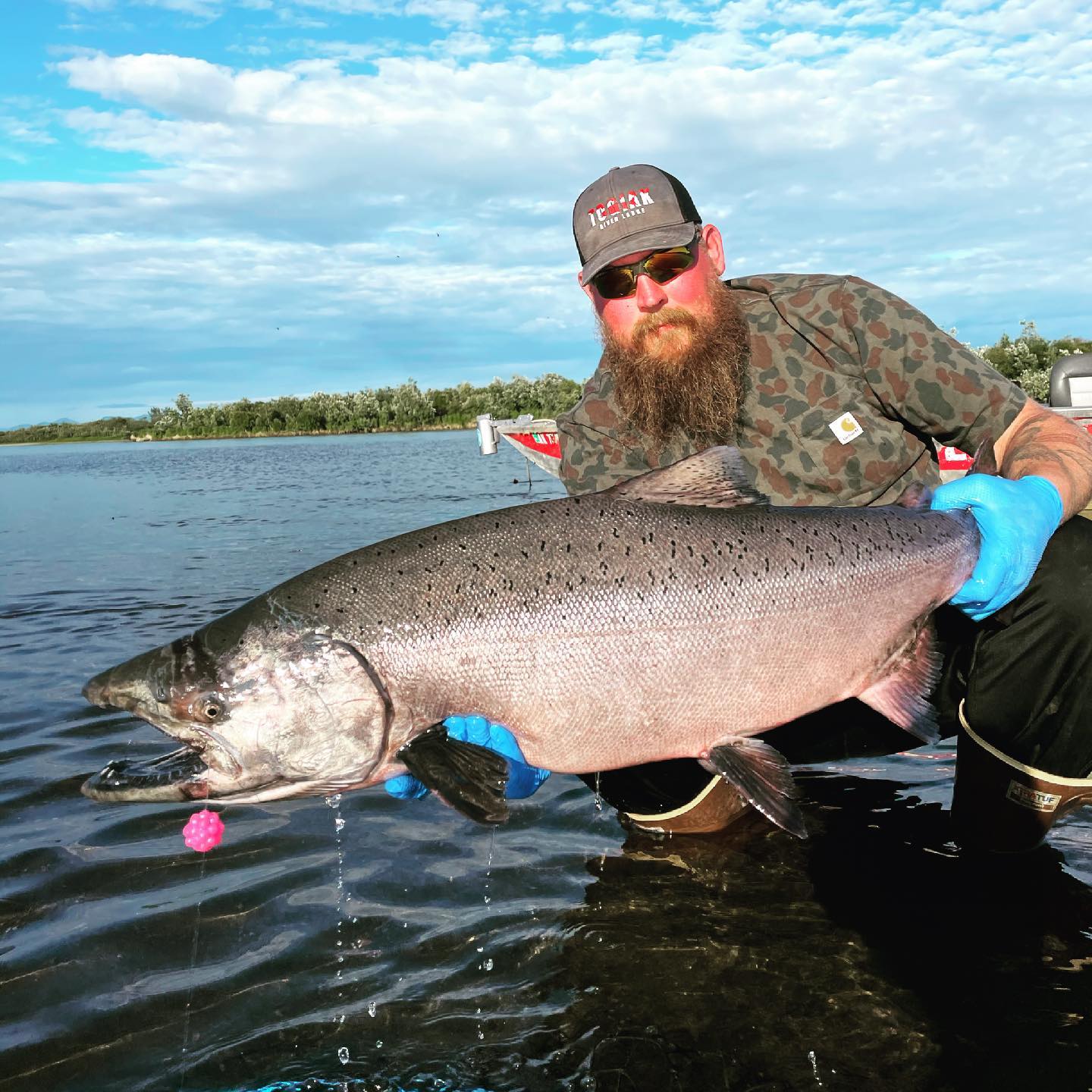
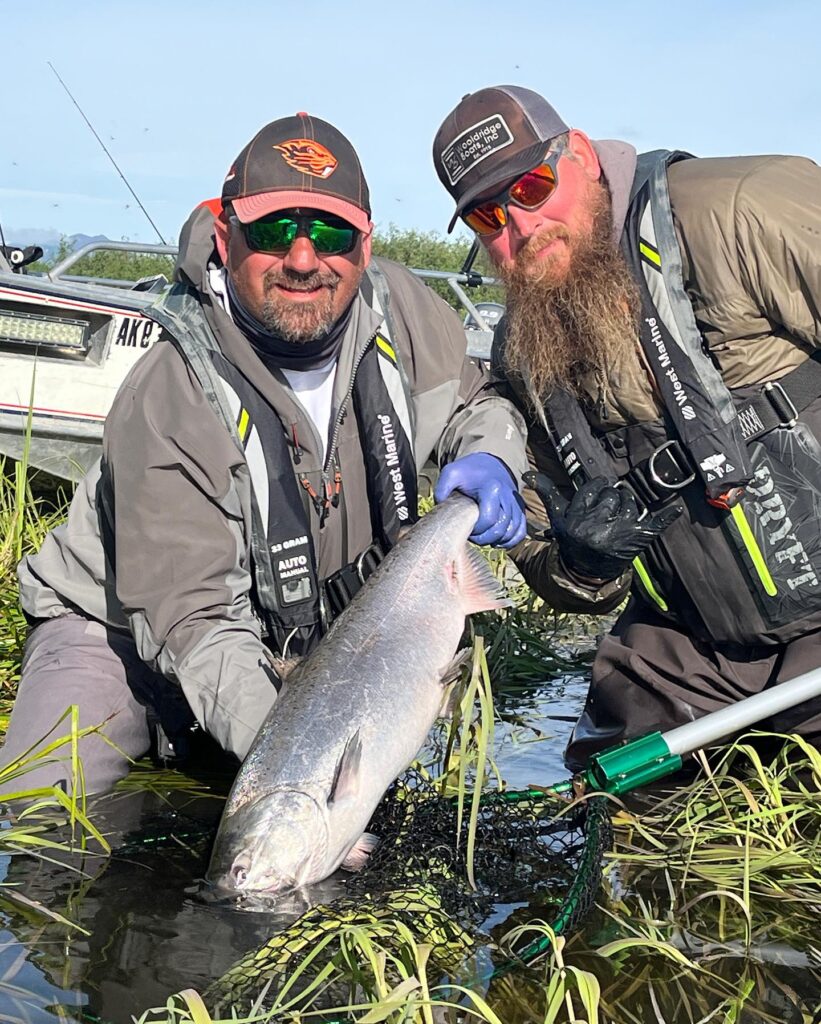
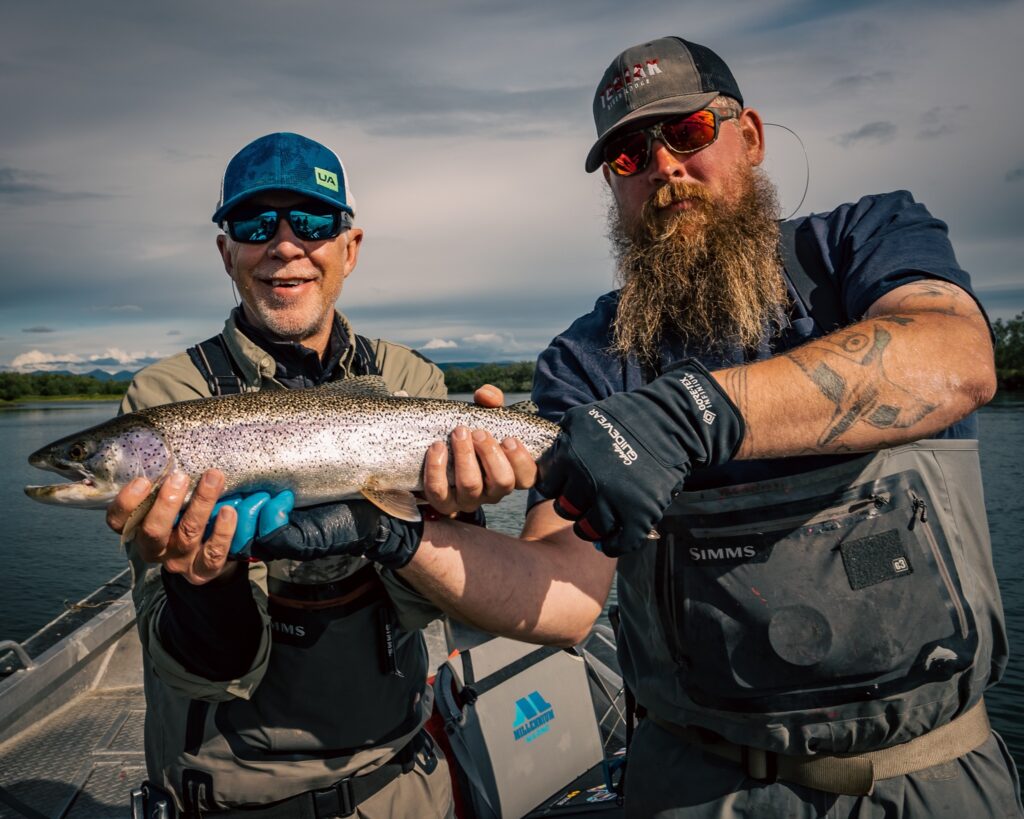
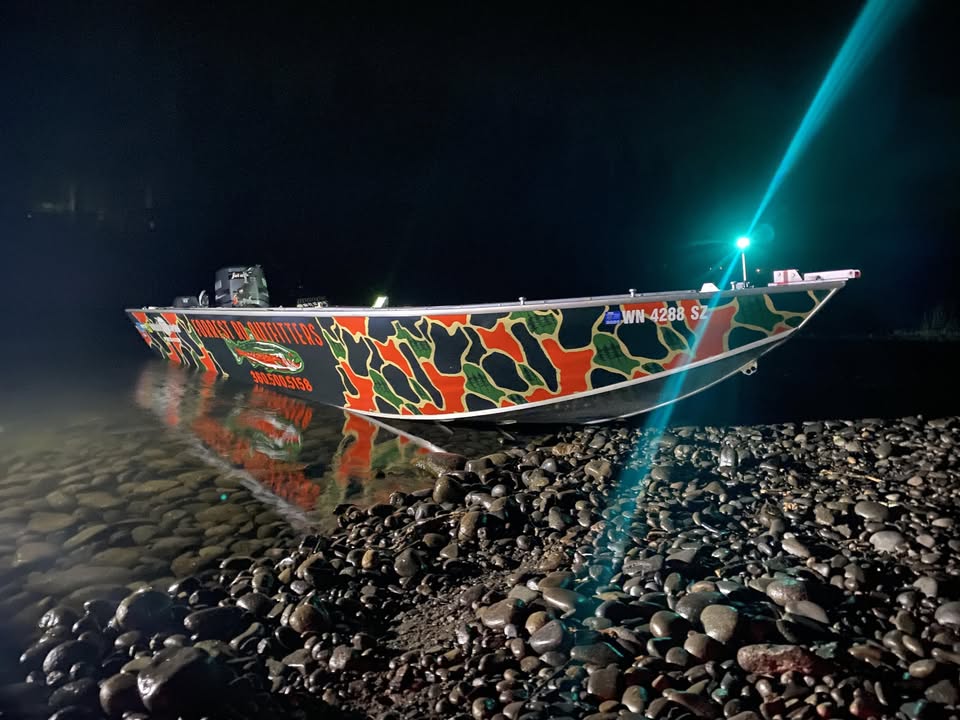
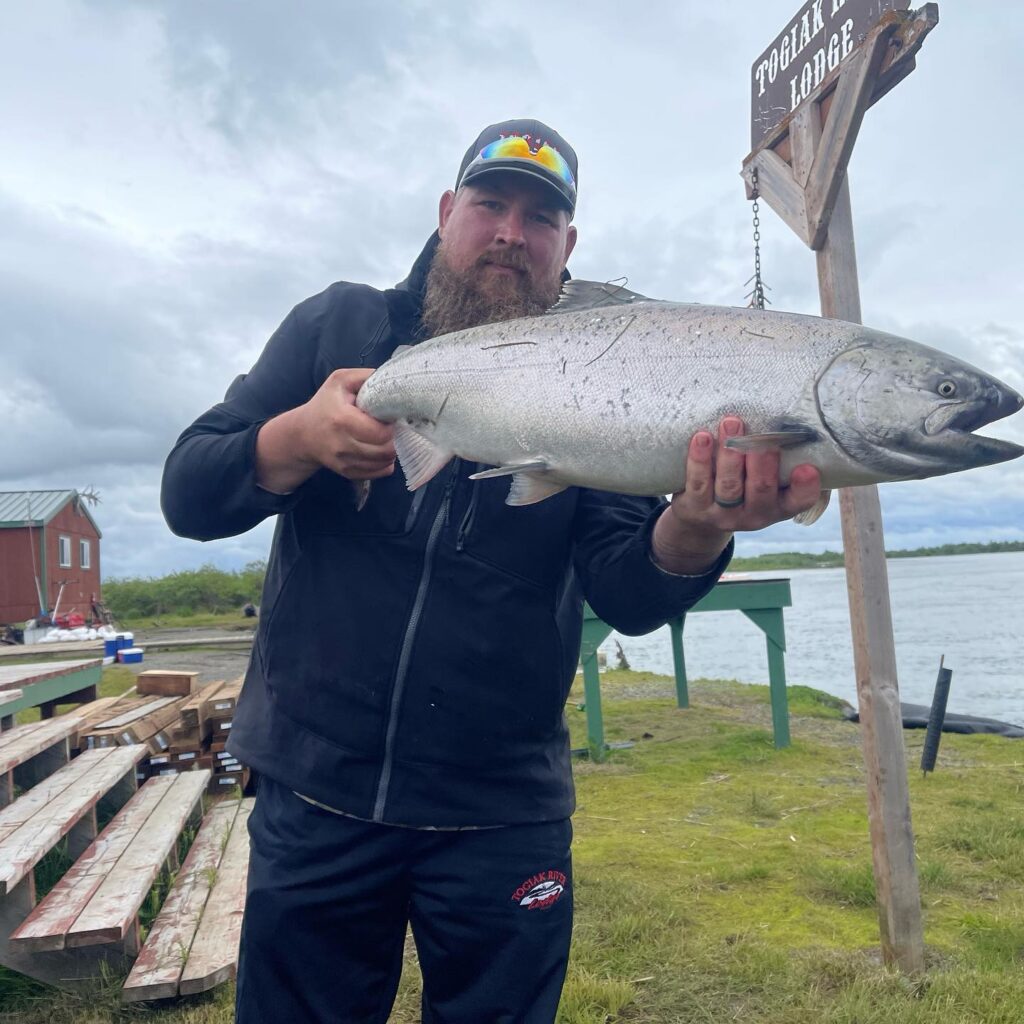
For most of us, the spark that leads to fly fishing is a fish, a mentor, or maybe a trip. For Aaron Berg, it was a fire. When his house burned down, it forced a choice: keep welding or go all-in on guiding.
In this episode, Aaron shares how that turning point led him from fixing boats at Togiak River Lodge to running them, what he’s learned chasing kings and silvers in Alaska, and how spey casting reshaped the way he fishes back home in Washington.
If you’ve ever wondered how passion turns into purpose—or how swinging a fly can shift the way you see fishing—this one’s for you.
Fishing and hunting were always part of Aaron Berg’s life. His dad took him out fishing as soon as he was old enough to sit in a car seat. However, for years, Aaron worked a nine-to-five welding job to support his family. In 2021, he began to consider that guiding could be a real career.
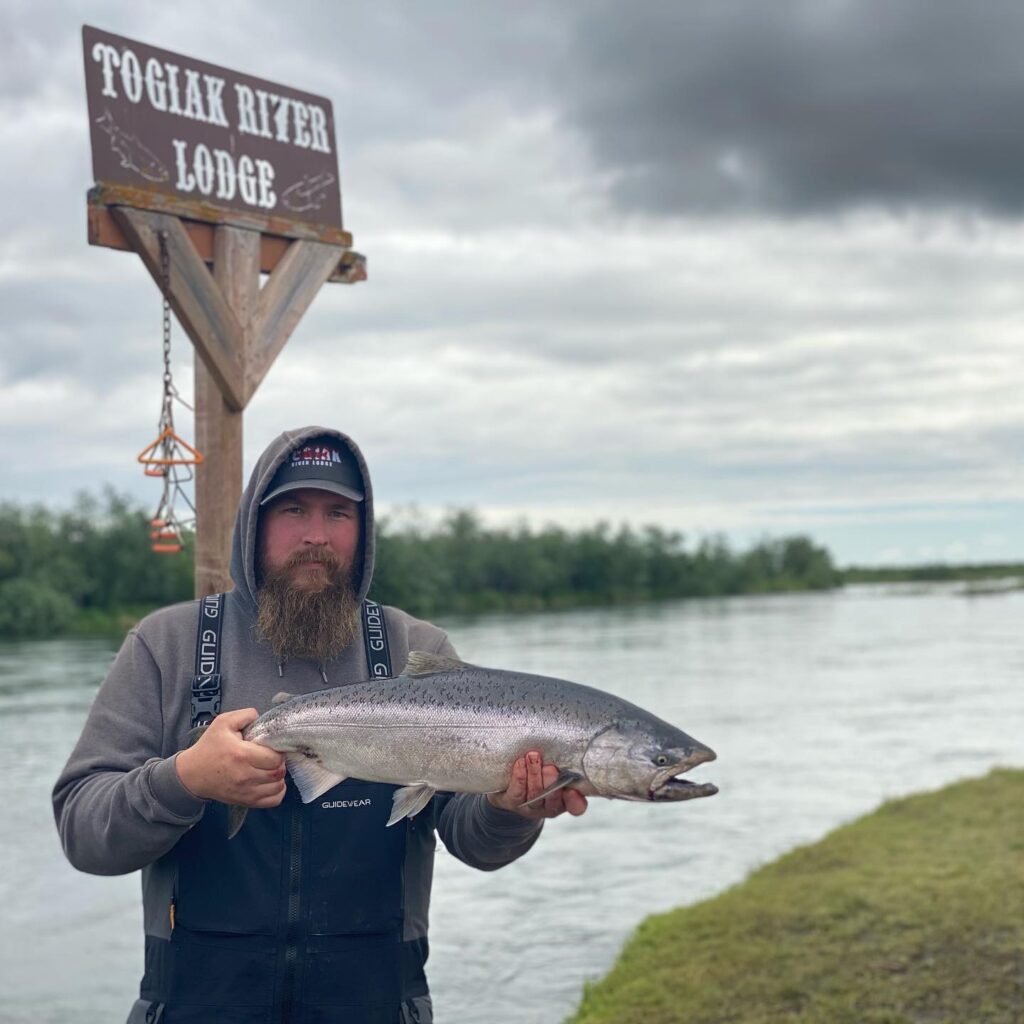
Aaron got his start at Togiak River Lodge doing maintenance and boat work, spending the summer around professional guides. Seeing their lifestyle — one that included fishing, guiding, raising families, and enjoying the outdoors — inspired him to make the leap.
With encouragement from his wife and the guides he worked alongside, Aaron transitioned into full-time guiding, earned his captain’s license, and began chasing his dream on the water.
In the summer of 2021, Aaron got his captain’s license and planned to balance welding and building a fishing business at home. But just hours after returning home one night, his house caught fire and burned down. While tragic, the fire changed his path. With insurance covering living costs, Aaron sold his welding business and decided to fish full-time.
He finished the silver season at Togiak, and though rebuilding the house was a challenge, the family is back in their home and Aaron continues chasing his guiding dream.
After the fire, Aaron went all-in on guiding. His wife told him to go for it, so in the fall and winter of 2021 into 2022, he fished every single day. If clients weren’t paying, he still took people out just to stay on the water. He went from being a weekend warrior to chasing fish full-time, exploring new rivers, trying new tactics, and learning the water inside and out.
Aaron says guiding isn’t just about fishing. It’s about knowing where to go in different situations, and that only comes from time on the water. That first year, he made sure to put in the hours so he could stand alongside guides with decades of experience.
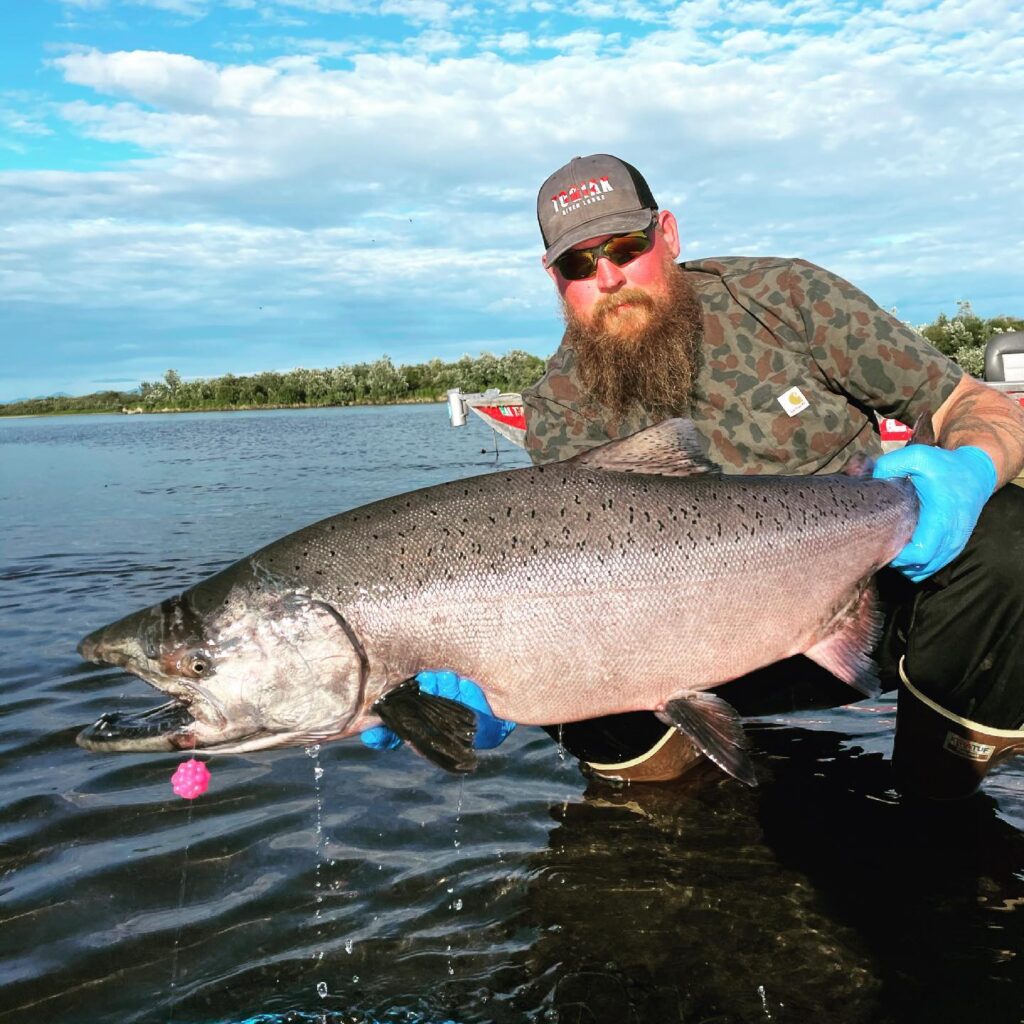
Aaron started guiding full-time on the Togiak in 2022, jumping in halfway through king season. King season runs from June 21 to about July 24, and back then harvest was still open. During that stretch, the river is packed—kings, chums, sockeyes, pinks, rainbows, and dollies. You never know what’s on the end of your line.
After king season, there’s a short break before silver season kicks off from August 10 to September 16. By then, it’s mostly silvers, with a little trout and dolly fishing mixed in. Early August still holds a few leftover kings and sockeye, but once that fades, the river fills almost entirely with silvers.
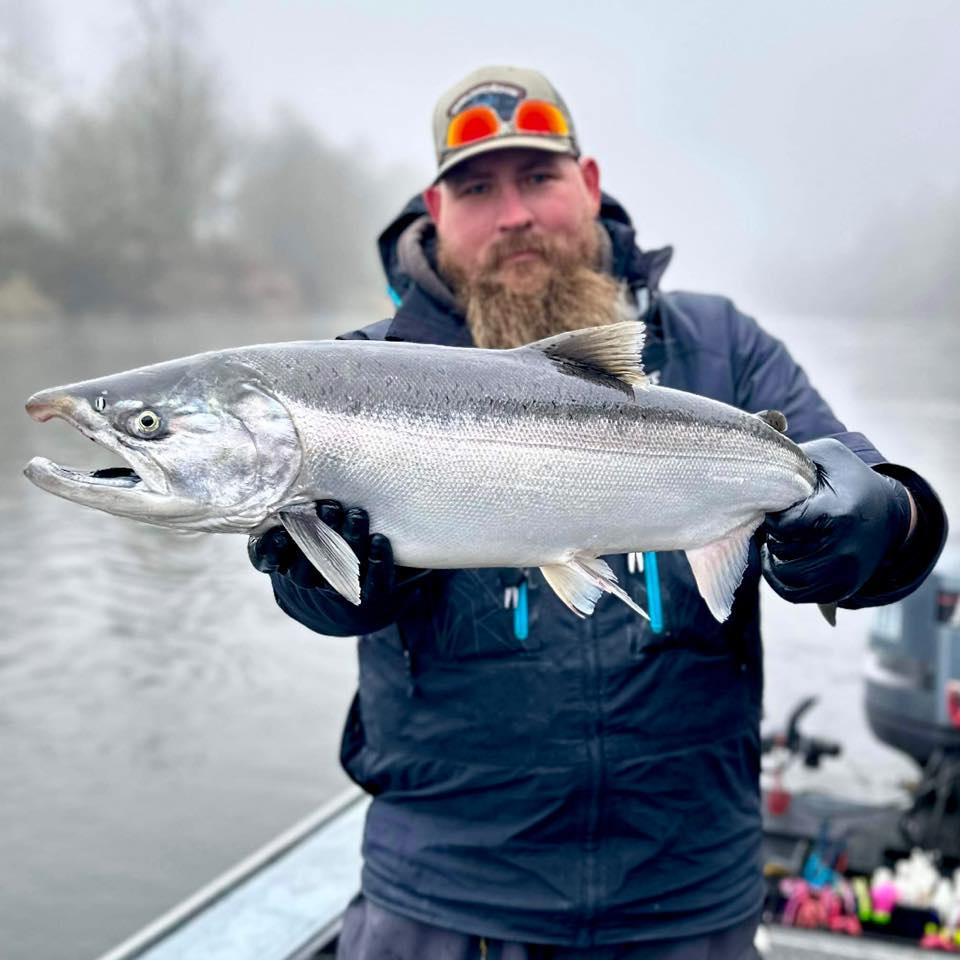
Aaron comes home from Alaska on September 20 and is back on the water just four days later. He fishes the Chehalis system for coho, moving between rivers like the Humptulips, Wynoochee, and Satsop depending on water levels. Coho season runs until December, then he takes a short break with his family before steelhead season starts right after Christmas.
The Wynoochee is his home water—narrow, canyon-like, with clear green pools. It’s mostly drift boat fishing, though low water can make it tough. Aaron runs bobbers, jigs, and plugs for clients, but he’s also started swinging flies and is excited to add more spey into his guiding.
Aaron grew up fishing to put food on the table. If they caught salmon or steelhead, that meant less money spent at the store. Harvest was the goal. But he said guiding at Togiak River Lodge changed how he looked at things. He saw the decline of king salmon and started thinking more about conservation.
That’s where spey fishing came in. It’s less about filling the cooler and more about the experience. For him, it’s no longer about limiting out but about being outside, seeing eagles, laughing with kids, and making memories.
Aaron’s first taste of spey fishing came at Togiak, watching Jordan and the other guides cast while he was stuck on maintenance duty. One day at a shore lunch, Jordan handed him a rod, gave a quick lesson, and on his tenth cast, boom, a big chum crushed his fly. That was the spark.
From there, Aaron practiced every night off the dock and later got serious when Jordan and Zack set him up with casting lessons from Floyd Carter. Four days of focused work with Floyd gave him the foundation he needed.
He even practiced alone during steelhead season, running the boat back out after guiding gear clients just to work on his casts. Now, Aaron feels confident enough to teach others the basics and help them improve.
👉 Want to hear more about Floyd, the guide who helped Aaron level up? Check out our episode with him:
Aaron says the biggest mistake people make is rushing. Whether it’s spey casting or bobber and jig fishing, slowing down changes everything. Don’t power your cast or throw right on top of the fish.
Instead, think about where the fish are and set up your drift above them. A smoother, slower presentation puts more fish in the net every time.
The rod was handmade by Jordan’s dad and it’s a beauty.
Episode Transcript
Dave (2s):
There’s a difference between chasing fish and chasing meaning. And today’s guest knows both sides, from fishing Alaska to rowing drift boats through the canyons of southwest Washington. Today we hear of the journey that didn’t follow a usual script. It took a house fire, a leap of faith, and a whole lot of time on the water. In this episode, we hear how a welder turned guide found his place among kings, literally and figuratively. We dig into the gear to spay transition, what it means to slow down and why swinging a fly might just change the way you think about fishing. This is the Wet Fly Swing podcast where I show you the best places to travel to for fly fishing, how to find the best resources and tools to prepare for that big trip.
Dave (42s):
And what you can do to give back to fish species we all love. Berg’s story is proof that guiding isn’t just a job, it’s a calling urn through a lot of work and perseverance, both on the water and at home. Whether you’re thinking about drifting the Ucci, chasing silvers up in Alaska’s tundra, or watching a King salmon grab a mid-swing fly on the Togiac. This episode’s got a little bit of everything for you. If you wanna check in with our guest, Aaron Berg, you can find him@forestroadoutfitters.com and on Instagram at the same name. All right, let’s get into it. Here he is, Aaron Berg. How you doing, Aaron?
Aaron (1m 18s):
I’m doing great. How are you?
Dave (1m 20s):
Good, good. I’m looking forward to this conversation because you’re kinda near kinda my home waters. And we also connected up in Togiak this year, Togiak River Lodge. We had, I didn’t actually fish with you, but we chatted there a little bit and connected with Jordan and all that. So we’re gonna talk a little about the Togiak, you know, operation up there. We’re also gonna talk about some of the rivers you fish down in southwest Washington. I know the Cowlitz and Ucci are a couple of those, so we’re gonna talk about that. And the cool thing is, is that you fish, which is unique, is you do a lot of gear fishing and I think a lot of which I’ve done as well. We’ve got about, you know, my guess is half of our audience probably does some conventional fishing as well. Although we talk a lot about fly fishing. There’s a good crossover.
Dave (1m 60s):
So today we’re gonna get your background and get a little bit about that. Does that sound good to you? Just kind of dig into both fly and gear. Yeah,
Aaron (2m 6s):
I’m swinging both ways.
Dave (2m 7s):
All right, good. Yeah, and I think that we had Jordan on here and we talked about his transition into spay And it was a pretty passionate episode because you could hear it in Jordan’s voice about how, you know, just that transition getting into it, what it was for him. And so we’ll get a little bit of that on you as well. But before we get into all that and get into maybe some tips and tricks on catching steelhead, maybe Chinook, what’s your background fishing? Have you been doing this forever or you just get into it? How’s that look?
Aaron (2m 31s):
Yeah, I mean, I’ve been fishing since I was old enough to get into a car seat. Yeah, literally my dad took me fishing the first time and I was probably about five days home from the hospital. But that’s just what we do. I mean, hunting, fishing is what my family does, what I’ve done forever. It was always something I wanted to make into a career. But I’ve got a family and for the longest time wanted to be responsible. And you know, the nine to five job was what paid the bills and get everyone fed and stuff. So I didn’t really know, I didn’t really know if this was an option.
Dave (2m 60s):
When did you find out, like, I’m sure you saw some guides out there, but when did you feel like it was an option?
Aaron (3m 6s):
Probably 2021 was the first time. It was always in the back of my mind. But you know, I got hired up at the lodge. I, as a welder, I’ve been on welder for over 20 years and that was my first kind of, you know, look into the outdoors and the career path of the outdoors and that kind of stuff up there was, was hanging around with a bunch of fishing guides up there and all those guys are telling, you know, Hey, you can do this. Hey, you can do this, or whatever. And, and so in 2020 I went up there as a welder welded on some boats for Zach and Jordan for the first time, 20 to 21 I offered to, to be up there for the summer and a maintenance role. Just, you know, wrapping fish at the lodge and working on boats and doing power and water and that kind of stuff.
Aaron (3m 52s):
And then when you spend a summer with 20 fishing guides that do it for a living and a lifestyle, and they have families and kids and dogs and, and they’re saying, you can do this, and this is how I did it, you know, I transitioned into, into guiding full time, got my captain’s license, and I mean, I have the most supportive wife in the whole entire world. So it was pretty easy when you got, you know, a person you’re foreign telling you can do this and this is what you should be doing.
Dave (4m 16s):
That’s cool. Wow. Yeah. That’s awesome. I mean, that makes sense. Now you basically jump up there and Jordan and, and Zach, I mean, you can’t have two better guys, you know? I mean, that’s the cool thing they, but they bring you up here as kind of maintenance up to Togiak and then you just basically immersed around. And that’s the other thing about the experience is that you’re there and the clients are there too. Everybody’s eating together. Yeah, hanging out. You know, Togiak is a really, I don’t know if it’s unique ’cause I haven’t done a ton of lodges in Alaska, you know, but it feels like Toks unique. I mean, what’s your take on it? Did you talk to some of those guys up there about different areas around the, the country? The Alaska?
Aaron (4m 52s):
Yeah. Yeah. I mean, a lot of the guides, you know, I mean, for one fish all over the, you know, the lower 48 for themselves, they’re all, you know, private businesses for that work for themselves. And then a lot of us spend the summers in Alaska just ’cause there isn’t a lot to do at home. And a lot of the guides, you know, we always have new guides coming in annually. People, you know, life choices and stuff like that change. And so we we’re constantly getting new people and, and you know, people have been on the connect talk and they lag neck and you know, the wood river ranges and that kind of stuff. And talking about different lodges And it all comes back to family. Everyone feels like the to is family and the way that they talk about other places. It sounds like a job.
Aaron (5m 33s):
And the toga, it feels like you’re working for family in a family setting with, you know, clients that are family. So I, it definitely is different at the toga. Yeah.
Dave (5m 42s):
That, that’s my experience. I think being up there is, we were just up there during that Chinook season And it was, it was amazing. You know, I had never, and then it’s got me into, that’s why we’re having this conversation because I’m, you know, thinking now, man, there’s gotta be some other places around where you can track down that same chinook feel. You know what I mean? But yeah, that was just the experience of being up there at the lodge and not only getting a chance at Chinook, but just yeah, hanging there on the back deck on the dock and just getting that whole, yeah. You’re just kind of immersed into it. So we’ll talk more probably about some of the guides and all of that as we get into this, but, so that’s kinda where you’re at now. Did Jordan basically say, Hey, you want to test out, see how this guide thing works, and then you had an opportunity to actually guide for doing some of the gear stuff?
Aaron (6m 26s):
Yeah, I mean, I, I kind of had the inclination like, Hey, I’m gonna go do this full-time. So I finished 2021 as a beat check maintenance guy that fall. I got my captain’s license. I already owned a boat for myself at home. And mind you, I’m, I’ve, I’ve only ever been gear. So that was the only, you know, that was a stepping stone, was I’m just gonna be a gear guide. Right.
Dave (6m 47s):
Which is perfect for tok, right. Because TOK is going through this transition of its own where it used to be mostly gear and now for, at least for Chinook and now for Chinook, right. It’s changing a lot more into the swinging for flies.
Aaron (6m 59s):
Yeah. And so initially at home, I, I, I got home in the fall of 2021, got my captain’s license, and I told the wife, I, I owned my own welding business at the time, so I told my wife, I’m like, Hey, I’m just gonna weld Monday through Friday, you know, start kind of building an inventory and buying rods and, you know, building a clientele at home and, and that kind of stuff. And then I’ll work to, in the summertime, and if it takes five years to go full-time guiding, then that’s what it takes. If not, if it goes faster than great, you know, that was the initial plan. But in 2021, as I was doing that before I got my captain’s license and all that kind of stuff, halfway through the season, we, we have a break between our king season and our, our silver season.
Aaron (7m 41s):
So I had flown home 30th of July, and after being home for about 11 hours, my house caught on fire. Oh, Jesus. And burned down
Dave (7m 49s):
What?
Aaron (7m 49s):
Yeah. And although tragic and really inconvenient, it was kinda almost a blessing. I get a little emotional thinking about it.
Dave (7m 59s):
Wow. What year was that when it burned down?
Aaron (8m 1s):
21.
Dave (8m 2s):
Holy. Now that, I mean, I just gotta stop there for a second because my worst nightmare, I mean, every day I go in, even yesterday it’s like burning the house, burning down. I literally check the stove before I leave ’cause it’s this weird thing. You know what I mean? But yeah. What was the, what happened there?
Aaron (8m 21s):
It was, it had something to do with the furnace, which, yeah, we don’t know. The fire department investigators, all that kind of stuff. They didn’t know if it was the furnace itself or maybe electrical wires running to and from maybe going to a bathroom or something in that area. That was obviously the hot spot. Mm. It was in that area, but they don’t know exactly. I mean, it was the middle of July, the furnace wasn’t on. Geez. You know? Geez, it was hot here. Yeah. So, I mean, I had been home. I, I had brought my oldest son up for a friends and family week to experience the toga. It’s something that the boys do. And so him and I had gotten home at, at midnight and at 1130 the next morning, wife and I were sitting on the couch telling stories about our summers and, and what we had gone through.
Aaron (9m 2s):
And she smelled smoke. And next thing you know, we’re living in a fifth wall.
Dave (9m 6s):
Jesus.
Aaron (9m 7s):
And So I, I ended up having to take about five extra days. I was supposed to go back up around the 8th of August to go back up the TOK to work for the silver season. And I, you know, had to call Jordan and say, Hey, I’m, you know, I’m, I’m gonna be a little late, you know, but I had to figure some stuff out. And so we got everything settled. There’s not a whole lot you can do. You, you know, there’s investigations and insurance and all this other stuff that goes on that, that there’s not a whole lot you can do other than wait. Right. So I told, you know, got the trailer set up, got the wife and kids and everybody settled in and, you know, we had to go out and buy all brand new stuff. ’cause we had no clothes, we had no toothbrushes, we had no shampoo or anything. Geez. Like, everything that we owned was gone. And so we, we went through that.
Aaron (9m 49s):
I go back to Togiak. I, I finished up the silver season. The main part about that is I kind of always lived my life below my means. I’m very deliberate. I was, you know, when I, you know, had my business, you know, we had a lot of savings. We had a lot of pre-planned, you know, finances and that kind of stuff. And I would never bought things that I couldn’t afford or, you know, didn’t need or any of that kind of stuff. And so we had a very low cost of living. Yeah. And when you’re going through an insurance process, like a house fire, they assume that you’re gonna rent a house to live in. And so they kind of do like a, a an assessment of what the rental rates are in your area and what it would cost to furnish a house for a family of six.
Aaron (10m 29s):
And they, they give you a check. Hmm. And so they say, Hey, this is gonna co, you know, ’cause we still to pay our mortgage while the house is being rebuilt or whatever. Oh, right. And so they say, Hey, this is gonna cover your rental until, you know, the house gets built or whatever. And so we were getting a, a large enough check at the time that I didn’t have to work, you know? And so, you know, my wife just says, Hey, like, you know, we can pay all our bills. You can still go fishing. Just do that. And so instead of the, Hey, I’m gonna work in my welding shop five days a week, I sold the welding shop, got rid of it, and just started fishing full-time. Wow. I was a fish bum. Yeah. And so, like, you know, the fire was definitely a tragic event for my kids.
Aaron (11m 10s):
You know, they had, looking back on it, you don’t ever think about the stuff that you have.
Dave (11m 15s):
No.
Aaron (11m 15s):
But when you’re five years old and that’s the only stuff you’ve ever had. Yeah.
Dave (11m 19s):
That’s tough.
Aaron (11m 20s):
It is different.
Dave (11m 20s):
I hear that. Yeah. I have two little kids and 11 and 13, you know, I’m not sure how old your kids are, but that would be the worst thing ever. ’cause it’s, it’s everything they have. And so you guys basically kind of recovered, I mean, you’re probably still recovering to a certain extent, right? Is that something
Aaron (11m 36s):
Yeah, I mean, the house has been completely rebuilt. We went through some trials and tribulations with builders and all that kind of stuff. Yeah. That was a, I mean, the, the actual rebuilding part of it was a nightmare. I learned a lot. But we’re back, you know, we’ve been back in the house now for a couple years and everything’s good. You know, we’re still still fishing, but
Dave (11m 54s):
Yeah. So you had this traumatic event, which in retrospect you see it as Yeah. Helped with your guiding, basically getting you in full. Did you, once you started going, were you now full in guiding in the, not only Tok, but down in kinda your southwest Washington? Is that where you lived down there? Yeah,
Aaron (12m 11s):
Yeah. Just south of Olympia a little ways. Yeah. Yeah. Once that happened, the wife, you know, she just said go. And so like that, that first winter, fall, winter, spring of 2021, going into 2022, I fished. And if I didn’t have people that were willing to pay me, I took people that weren’t. And I fished every day. I mean, I’d fished a lot anyways, but it was always kind of the weekend warrior and, and the drought pond and that kind of stuff. And then, you know, me and the me and some buddies of mine would go salmon, steelhead fishing for fun. And, but when you’re doing it for a career, you know, accepting money from people, you know, there’s a different kind of level of requirements. You know, knowing the water, knowing the fish, knowing where to go in certain situations.
Aaron (12m 50s):
And, and that’s only learned by time on the water. So you have to, you know, I mean, you have to just spend as much every waking minute, every single day. So that first, you know, fall, winter, spring here, I fished rivers or that I’d never fished before. Tactics I’d never fished before. Just trying to learn as much as physically possible to make sure that, you know, coming into the following year that I’d have just as much of a chance of catching fish as anybody that’s been on the river for 20 years.
Dave (13m 17s):
Nice. Well that’s awesome. And I want to hear more about some of the rivers down there. We mentioned them at the start, there’s a bunch of kind of famous rivers if you’re out in the northwest, that are in that area, southwest Washington. But, but I wanna take it back to Togiak because you’re also guiding up there and that’s a big part of, you know, kind of the summer may maybe talk about that. What has been, you know, I guess you started full-time guiding up there, you’ve been doing that a couple, a few years now. Yeah. What is the rest of the season? So you’ve got the Chinook season, which is kind of the spay fly stuff, which ends sometime what, in July period? When, when do you start your stuff there?
Aaron (13m 49s):
Yeah, so initially in, in 2022, we started gear fishing for Kings in June 21st. Okay. And we go till about the 24th of July. At that time, you know, harvest of Kings was open.
Dave (14m 0s):
Oh, it was open, right?
Aaron (14m 1s):
It was. And so my first year, a guy by the name of Chris Sessions guided it for us for a long time. He retired halfway through the king season 2022. So I took over for him once he retired. So I started halfway through. He finished about three rotations, about 15 days of Kings, which is primarily silver fishing when you get towards the end of it. Mm. Yeah. Or not, excuse me, it’s not silver’s, sockeye fishing. Oh,
Dave (14m 26s):
Sockeye. Okay.
Aaron (14m 27s):
And, and then about the 24th through the 28th of July, we’ve kind of changed some things around the last couple years as far as when our, our last king season dates are. But once that king chum sockeye season ends, we have a break for about 10 days to go home. And then we go back out for silvers. And during silver season, it’s August 10th through September 16th. At that time, it’s primarily silver season. It’s silvers. And we will go on some trout, trout and dolly bar and Oh yeah. You know, stuff. But, and nice thing about king season is everything’s in the river. You know, there’s pinks and chums and sockeye and kings and, and rainbows and dollies, and you don’t know what you’re gonna catch every time you throw a fly or a lure in a water.
Aaron (15m 12s):
Yeah. It’s always something
Dave (15m 14s):
Different during king season. During
Aaron (15m 16s):
King season, yeah.
Dave (15m 17s):
So as you get into August, you lose the kings and do you start to lose some of the other species too?
Aaron (15m 21s):
Yeah. Yeah. The, you’ll have residual kings and sockeye for the first couple weeks or whatever, but after that it’s the river’s completely stuff full of silvers.
Dave (15m 29s):
Oh it is. Yeah. So that’s what I loved about the, the sh you know, because we were there, I can’t remember the exact date, but you know, right in the king time. And, you know, we were going for kings. I mean, there’s nothing better than getting a king on because it’s absolutely crazy. You know, it’s the fish, you can’t, you can’t even move it. Barely. But it was fun catching the other fish, you know, the chum and catching the chum because you hook it and it’s got a, you know, they, they take hard. And then also, you know, the sockeye, I think I caught a sockeye and I can’t remember on pink’s what we caught there. But yeah, it was a good mix of stuff. Right. It keeps it interesting. Seems like a, a good part of it.
Aaron (15m 60s):
Yeah. Yeah. I mean you’re, you’re feel, you’re, especially when you’re swinging flies now, I mean, you’re feeling the eat and instantly you go, oh, that’s the king. And then you let him have it. You fight him for a little bit, go, oh, that’s a chum. Right.
Dave (16m 10s):
Exactly. Yeah. That happened a lot. Yeah. That happened a lot. But when it is a king, that’s the cool thing is that you’re like, yeah, okay. Yeah. That’s definitely a king. Yeah. What is it about the schnuck? Because it can’t be just the size ’cause chum are pretty big too. Why are those things so just, I don’t know. Right. You can’t move them. Sometimes
Aaron (16m 26s):
They’re, yeah, they’re, I mean, they’re just aggressive. I mean, I don’t know. I mean, I’ve never fished anywhere else in Alaska for kings, but I mean, even gear fishing, ’em, they’re, they’re mean, they are. I mean, our fish are mean, they like to bite and they like to fight. Yeah. There is no doubt. I mean, even when we’re gear fishing, I’m like, I’ll, I’ll have a plug out and I can tell in 30 seconds whether it’s a king or a chum or a trout or whatever. I mean, there’s no doubt when a Chinook grabs anything. And I mean our, the king’s up there are a lot meaner than the ones that are, are down here in the lower 48. Oh they are.
Dave (16m 59s):
So the king’s up there are. Yeah. And that’s just because it’s Alaska, they’re coming right outta the bearings or the Yeah, the ocean, whatever, right there. Right.
Aaron (17m 6s):
Yep. Yep. Bristol Bay. Bristol
Dave (17m 8s):
Bay. Yeah. Bristol Bay, not the bearing. Yeah.
Aaron (17m 10s):
Yeah. And then, you know, I think a lot of it has to do with pressure too. I mean, we are the only lodge on the river. There is a couple other flying camps since the King regulations have changed last couple years, going to no retention. The other camps aren’t there. Oh,
Dave (17m 25s):
So they left. So the other camps left.
Aaron (17m 27s):
Yeah. They have, I mean, they fly into all different river systems. Yeah. And so like the no is open for retention. And so they primarily focus all their clientele there. You know, there is no retention for kings on the toga, so No. So we have the whole place to ourselves. You know, we got 20 plus miles of river to ourselves.
Dave (17m 42s):
Yeah. Yeah. We do. And that’s, it seems almost now that I look at, it’s only been a couple months, whatever, but almost like a dream as I think about the week there. ’cause you’re just in this boat, right? You get up early in the morning, breakfast is going, it’s this ama great breakfast hop in the boat, and then you’re, you got this nice jet boat ride up to your spot. You know, that might be a mile, well it could be right near camp, but you know, a lot of times you drive up, it might be a ways up there. And I don’t know the sled, I’ve always loved a jet boat ride this, you know, that ride because it’s kind of cold. You can’t really, you’re just going for it. And then you get to your spot and it’s quiet and you’re literally looking around. You’re like, oh my God. This is like, we are out here. And there’s nobody, you’re not hearing a bunch of other, mostly the other boats you’re hearing are probably other in the group, right? For the most part in our group.
Dave (18m 23s):
Yeah.
Aaron (18m 23s):
Yeah. Up there. That time of year, if you hear a boat, I mean, there is some, some locals that are subsistence netting and stuff on the river and stuff like that. But I mean, even at that time when we’re operating with clients, the locals are pretty much commercial fishing in the bay. Yeah. There’ll be a few people coming up in the river to get the last of what they need for their family for the year. But it’s, it’s us. I mean, if you hear another boat, it’s toga River Lodge
Dave (18m 46s):
Boat. Yeah. It’s, and the, and again, I, I keep going back to these spears. ’cause I think the fishing and fly fishing is just, it’s so much more than catching fish. Yeah. You know, that’s what’s amazing because Tok, you fly in, you know, you start in Anchorage, you know, I met up with Jonathan, you know, farmer, and we were kind of coming in there and then you hop on that plane, man, you go to the north side of the airport, north Gate, whatever, and you hop on this plane that holds whatever it is, 20 people. And I’ve never been on a plane like that. And it’s tight. You know, I mean, especially for you, you’re a big guy. That plane must be a little, a little tight.
Aaron (19m 13s):
Yeah, definitely a tuna can.
Dave (19m 15s):
Yeah. But you get in there and you’re like, oh man, this is okay. This is not, not as, you’re a little puckered up, you know, because you’re kind of wondering. And it was funny because when we came in to the shout out to Jonathan, because when that plane banked over the water Oh yeah. It felt like we were dropping into the water. And I know Jonathan was thinking that at the same time. So, but then he turns out we drop on the gravel landing pad and all of a sudden we hook up. And it’s funny, ’cause I think you were there, I think we opened the hopped off and you guys, all the Togiac crew were sitting out there with trucks ready to go. And you guys loaded up the gear and, and the excitement is no bigger. You know what I mean? It just keeps building up because then you go down to the water, the jet sleds are ready, and then you guys take us up to the camp and we’re there.
Aaron (19m 53s):
Yeah. I’ve never done that trip as a client, you know, where I’d planned for, you know, a year or two and talking to buddies and Okay, how are we going, where are we gonna get there? What hotels are we gonna stay? And I can only imagine what you guys feel when the plane touches down on the gravel and togiak. Yeah. But it, it’s pretty cool. I mean, even for me, I mean, I get butterflies. Yeah. I was thinking about, you know, hey, you know, I’m going to work, obviously, but I mean, I get butterflies every time I’m loading boxes and suitcases and everything getting ready to head north, you know. That’s
Dave (20m 22s):
Cool. That was really awesome. So, yeah. So the fishing we mentioned, so Chinook and then you get into August. So when do you guys, so when do you wrap up the season up there? When are you heading back home?
Aaron (20m 31s):
So I, I am generally there longer than most. All the other guides. I do all the startup stuff before season. So I get there a month before anybody else gets there. With the boys. I do king season, we do silver season as of the last couple years, we’re doing a casting blast.
Dave (20m 48s):
Oh, you are? Oh yeah. Yeah. The casting blast some. Yeah. Is that duck hunting?
Aaron (20m 51s):
It’s duck hunting, yeah. So we do morning duck and or GaN hunts in the mornings and then afternoon silver trips. It’s a very skeleton crew of clients. So I think there’s only eight clients at a time that come in for that. So our normal silver only season ends on the 16th of September. Then we have four days of cast and blast. And then I fly home on the
Dave (21m 12s):
20th. Oh, okay. Right on the 20th. Gotcha. And the cast and blast. That sounds all this sounds awesome to me. Pretty interesting. So you have that going as well. And then I guess just to a little touch on that, so that is something that you can get coho. What is the ptarmigan? I know that species, but what is that?
Aaron (21m 29s):
Yeah, it’s very similar to a grouse. Okay. You know, any, any kind of, you know, sharp tail or sage grouse or something like that. But in Alaska they actually change colors. And so in the summertime they’re brown as they start transitioning into, you know, late September they will start to turn white. Okay. You know, assuming the snow is coming. And so when we’re harvesting ’em, they are like kind of calico. Oh
Dave (21m 54s):
Yeah. They’re
Aaron (21m 55s):
Half brown, half white. Yeah. You know, we, we take the dogs out there, we take Fletcher boy and, and a buddy of mine, Travis that, that guides with me up there, has his dog. We go out there and walk the tundra looking for brush piles and that kind of stuff. And the dogs will push the TMI again up and shoot ’em with scatter guns and Oh yeah. They’re delicious.
Dave (22m 12s):
They are. Are the t Yeah. That’s why they’ve heard they’re pretty good tasting. That’s it. What is it like on the tundra when you’re walking? So you guys are just, because I, I’ve, a couple times when we were at the lodge, I looked at, I was like, man, it’d be fun to kind of walk across this. But then you realize it’s kinda like this spongy buggy thing. What is that? Like? Can you just walk out there as far as you want?
Aaron (22m 30s):
You can, it kind of depends on what the actual elevation is. You know, if you were to walk out the back of the, the lodge with, there’s a pike pond back there Yeah. That we, we talk about or whatever that is like walking on a sponge, floating on water.
Dave (22m 44s):
Oh. So that’d be tough.
Aaron (22m 46s):
It’s tough. I mean, if you don’t move it’s, it’s almost like quicksand kind of stuff. Oh. Oh wow. Like if you’re standing in one spot, you’ll end up, you know, need to waste deep and water in no time. Oh, no kidding. If you continue to shuffle your feet and move and move and move, you stay up on top of that, that musk egg, that moss. Oh, essentially Pete Moss, where we’re actually tartman gun hunting. It’s, it’s more of like a hard sponge. And so the ground is lumpy, a lot of hills and mounds and stuff. And uneven and it’s, it only has, you know, maybe three to five inches of squished to it when you step in it. Yeah. And then the farther up the river you go, it gets harder, you know, rockier and harder. But like where we’re hunting, Tarin is that kind of mid-level, you know, it definitely is squishy.
Aaron (23m 26s):
You’ll go, you know, there’s cricks and drainages and stuff everywhere, so you’ll cross some really squishy stuff. But primarily we’re hunting that higher elevation stuff.
Dave (23m 34s):
Okay. So yeah, it sounds like you guys have a pretty diverse, and then you also have like the ocean boat and I mean, kind of everything, right? Like whatever you want. Yeah. It’s all there. Yep.
Aaron (23m 44s):
Yep. We can do some halibut trips. Trips and stuff too. And, and which is, it’s kind of few and far between weather dependent. Right. But we do, we do a little bit of everything. Yeah. A
Dave (23m 52s):
Little bit. Cool. Well, now I want to kind of, again, we were talking Washington. I wanna hear a little bit about that because that is something kind of the transition, right? So you, September 20th, do you come back after that and hop in? Are you getting ready? Like what is your home? What, talk about that, your guiding there when you drop back to Washington.
Aaron (24m 8s):
Yeah, So I mean, I, I land at home on the 20th of September. I start fishing on the 24th. So I’m home for three days getting my boat. I, I’ve had it all, I call it summarized ’cause it’s, I don’t winterize my boat ’cause I fish it All right. But yeah, So I gotta put everything, gotta put everything back in it from, from not being here during the summer. But yeah, I get everything ready, ready to go. Generally speaking, I’ll take the kids and wife out for a day or two, kind of do my pre fishing and then do some family time since I’ve been gone at the same time. So I start fishing the Shahala system, which is my home system. And you know, out towards Aberdeen. And it’s only coefficient. We don’t have any, any king fisheries up here.
Aaron (24m 48s):
And so we, I coho fish the chalos, then we have the tributaries off of the chalos, which is the hump tulips, the ucci and the SATs up. Hmm. So depending on water levels and time of the year, I’ll either start taking the jet boat up to Wynn or the SATs up for coho and or the drift boat. And then from there I usually end up kind of shutting that coho season off somewhere around the 1st of December. I’ll take, you know, two to maybe three weeks off and just be a bum. The kids I got, I have four kids and so they’re all outta school during Christmas break and stuff. So I like to spend some time with them. And usually a day or two after Christmas is when my winter on steelhead season starts.
Aaron (25m 30s):
And that’s the last four years, five years, the state has shut down our coastal rivers for steelhead. All right. So I had been fishing the, the cows outta my jet boat exclusively, but last year we actually got our Wyn Nche River back open again. So it was nice to be back on the home river and, and fishing the nu Right.
Dave (25m 51s):
So that, that’s the thing. Yeah. We’ve heard about that because you’ve had the, you know, up by forks, all the Olympic peninsula stuff. But you’re, you’re right there. You’re basically on the south. I mean, it’s not the Olympic peninsula right. Where you’re at the Jli, but it’s close.
Aaron (26m 3s):
It’s close. Yeah. I mean we’re, we’re, you know, encapsulated in, in the coastal rivers of Western Washington. But we are quite a ways south from, from Forks area, the op and that kind of stuff. So about three hours south.
Dave (26m 16s):
Okay. And the, the mnuchin. The uch, I like that. I mean that’s one I’ve heard about it. Is that kind of a small river? Maybe describe what the fishing, what that river looks like. Yeah,
Aaron (26m 25s):
It’s small trip and it’s, And it was really small this last year ’cause we didn’t get any rain. But yeah, I mean it’s small drift boat only in the upper section. There’s 20 ish miles of river that is drift boat only or raft the bottom probably nine miles of it you can access with a, a power boat, which this last year was really difficult ’cause it was so low. Yeah. But yeah, it’s small, private, you know, and, and the widest parts is probably 120 to 150 feet wide. You know, big D pools still a green water. It’s big canyon. It’s beautiful. Oh,
Dave (27m 1s):
It’s a big canyon. Nice. And and and you’re typically, is this like bob or jig sort of stuff?
Aaron (27m 5s):
Yeah. Yep. Yep. And I mean, you know, I started this whole, this faith thing, you know, last year. And so as I was, I was, I was, you know, Bob and jig and, and you know, running plugs and doing all that stuff with clients. I’m, I’m now starting to notice swing runs. Right? Yep. And so I’m, you know, I, I’d taken Zach and Jordan fishing in the boat one day and, and Oh nice. You know, Jordan’s just like, we could swing that. I’m like, oh yeah, we could, you know, like, and we’re gonna, you know, so I’m, I’m, I’m really excited to kind of open up the arsenal of tactics and throw a spare rod in there and, and as we’re, you know, letting, letting clients throw bobbers and jigs or, you know, whatever they want to do, I’m gonna be off in the corner swinging flies.
Dave (27m 45s):
Yep. Nice. Yeah. ’cause that there is some overlap there. Yeah. There’s probably lots of bobber and jig water that would be good for swinging. Yeah,
Aaron (27m 52s):
Absolutely. Yeah. Yeah. Yeah. And
Dave (27m 53s):
That’s kind of what you’re in. I mean, that’s a cool thing. You have this transition going, which we’ve kind of been hearing about from, you know, first getting into guiding, you know, And it sounds like you’ve got that, you know, going strong now and, and now it’s this transition to maybe more of kind of the spay, you know, which Jordan talked about too. So, and are you now at Togiak, is that something where you’re gonna be doing potentially more of that as you go up there on at the lodge?
Aaron (28m 18s):
Absolutely. Yeah. Yeah. So I mean, I, you know, backtracking my family, we were never like, you know, we have to kill stuff to eat or we’re gonna starve to death. Right. Like yeah. You know, my parents grandparents, we all had, you know, jobs and stuff. We could buy meat and whatever from the store. But the more that we were able to harvest, you know, growing up, the less we had to buy and, and the, the more money we had for other things. Right? Sure. And not to mention we just love the outdoors and so harvest for me is, is, is a big deal and still is a big deal. So it’s been nice, you know, doing the gear stuff, you know, I can, you know, harvest some fish and feed the family and that kind of stuff. And, but you know, the spay fly side of things is more conservation.
Aaron (28m 58s):
Yeah. Driven. Yeah. And you know, growing up, you know, we never went bass fishing ’cause you don’t kill ’em. Right, right. Like, you know, we, we, it was Sam steelhead sturgeon, you know, we didn’t go fishing for fun. We went fishing to harvest. You know, starting to work up at the toga and seeing the decline of king salmon up there really has me second guessing, you know, a a lot of things, you know, getting into this, you know, swinging fly stuff, talking to those people and just how happy they are with catching or with just fishing. Not, you know, whether they catch something or not. Like it’s still the experience like in the last couple years, that’s where I really kind of try to drive my clientele.
Aaron (29m 43s):
’cause I don’t, I mean, having a four fish, you know, retention season for coho at home sells a lot of seats. I mean, the people that you know are around here, you know, if they only have a one fish limit, it’s a lot harder to sell seats.
Dave (29m 56s):
Yeah. Just like it did at tok. Right. Yeah. I mean, just like I to you, I mean the Chinook was that sold seats until you couldn’t do it, you know, and Right. And so I’m guessing that on the ucci, you know, probably you could probably find clientele that would be up for just maybe not re you know, re retail.
Aaron (30m 13s):
Absolutely. Absolutely. And So, I mean, even just to my clientele, I’m trying to sell, and in my guide business I’m trying to sell experiences like even to my gear clients. Like I don’t want it to be, you know, if we don’t limit the boat out, then it wasn’t a successful day. Yeah. ’cause I feel like that, you know, the first couple years that I was guiding, that was the goal. Like, I, I was disappointed if we didn’t catch all of our fish And it wasn’t disappointed, but I was overlooking the fact that, you know, we’re on a beautiful river in a beautiful place, you know, looking at eagles and birds and people and, and laughing and giggling and making memories with kids and all that kind of
Dave (30m 46s):
Stuff. Yeah. And just being outdoors. I mean, literally just being outdoors. And
Aaron (30m 49s):
So, yeah. Yeah. So the more I get into this, you know, I mean, and this year was probably the most prevalent because this my first year guiding spay trips up in to Gak. And it was incredible to me the difference in people, you know, life. I mean the most, everybody kind of has the same kinda life. You know, I’m a, you know, a business owner, I’m a successful person, or I’m a father or whatever, you know, at the end of the day they’re still fishermen. Yeah. But the spay guys, you know, like I didn’t realize that, you know, you would get and eat or, you know, maybe land a fish. And a lot of my clients this year, like they would hook a fish, they would land a fish, we’d take some beautiful pictures, they would sit in the boat. Yeah. Right. Like they, I mean, they would, I’m not, it’s like, yo, hey, you know, jump back in here.
Aaron (31m 32s):
Like, there’s more, you know, like Right. And they’re like, no man, I’m just, I’m just gotta take it in.
Dave (31m 36s):
That’s awesome.
Aaron (31m 37s):
And it took me a, a couple days to kind of figure, you know, out what, what was going on. ’cause you know, my whole life, my whole guiding career, you know, all the clients of the lodge, like if I’m gear fishing, you know, we put a fish in the net, as soon as that hook comes outta that fish, they’re casting again. Right. It’s the next one, you know, we gotta get more. Right. You
Dave (31m 54s):
Know, and more, more, more.
Aaron (31m 55s):
Yeah. And just that whole transition for me personally, like seeing, you know, this kind of fly, you know, I don’t ever really know what the word for it is, but this fly type, you know, clientele versus the gear and, and has really made me understand like it is about the fish. We’re there to catch fish. We’re there to, to try to get a trophy obviously. But at the same time, maybe it takes one. Yeah. You know, maybe it takes one good one, maybe it takes one little one. You know, everyone’s at a different stage in their life as far as spay and all that kind of stuff. And some guys are looking for that 30 pounder and some guys are looking for their first one. Yep. But regardless of what they catch, they’re gonna remember the eat, remember the cast, you know, remember where they were standing in the water,
Dave (32m 37s):
Everything,
Aaron (32m 38s):
You know how the birds sounded, how the sun, where the sun was in the
Dave (32m 41s):
Sky. Yep. Where the water, what the run was. Like everything,
Aaron (32m 44s):
All that stuff, you know. And gear fishing for me has never been that. I mean, it’s been, you know, we get one and we’re on ’em and we gotta fill the boat.
Dave (32m 51s):
You gotta fill the boat. That is interesting. You know, I don’t think about that very often, just ’cause I, yeah. Most of the people and the fishing I’m around is more of the fly, you know. But, but it is that mentality change of like, you know, you’ve gotta, you gotta fill, you know, the, you gotta fill the, and I’ve been there, I mean I’ve been on the Deschutes when there was, back in the, you know, the 2010s or whatever, when there were just so many fish out there, tons of everything, hatchery fish. And we were loading the cooler with hatchery fish. And it, you got in that mindset, it was this really crazy mindset of like, yeah, we gotta, you know, same like you’re saying, get food for the family. And we were just killing fish because Yeah. And they were hatchery fish, but it was still, you know, So I guess everybody can get into that mode. I feel like once you get, I don’t know what the difference is maybe, and I can just tell my own experience.
Dave (33m 31s):
’cause when I was at Tok, I mean, you probably didn’t realize it, but I was sick. I was pretty sick that whole trip. Okay. Yeah. And So I was trying to do my best. And one, I think even the Grens guys, I think one of ’em didn’t even get out one day because he had something, had that thing that was there. Yeah. But the one day I felt like crap, I, and I had a really rough day with Floyd. It wasn’t, wasn’t Floyd’s fault, it was my own fault. I just struggled with my cast and I, I just, I lost a, a really nice fish And it was just a tough day and, you know, like it is. And I was just, I felt, and I was also sick at the same time. And I remember the next day I was like, man, God, can I make it one more day? And I got out in the water and we got out with Larry and I landed, you know, one of my best fish that morning.
Dave (34m 11s):
And it was in this really slow pool and I was down there by myself, you know, and everybody came down. And, and after that I was just like, I’m good. Yeah. And I, and I looked at Jonathan, I was like, dude, it’s all you man. And you know what I mean? So that’s what it is. Right? You’re good. One fish is all it takes, especially when it’s like a, a chinook salmon on fly. Yeah.
Aaron (34m 29s):
Yeah. It’s, it’s definitely different for me, like experiencing, you know, ’cause I, I had never fly fished or, you know, cast a fly rod or anything until Tok, you know, until 2021. I mean, I had kind of messed around with it. My grandparents had had some, you know, old antique, five weight bamboo rods and we’d messed around some cricks at the house and whatever, you know. But it was never a passion or something that I really got into or whatever until I was, you know, in my mid thirties. But it’s definitely something different, you know? Yeah. And it’s definitely right up my alley as far as what I want, you know, to give to my clients. And even for myself, I mean, I, I feel like when I’m in my power boat at home or, or even gear fishing at the lodge or whatever, it’s just go, go, go. We’re just, you know, next spot, next fish, next spot, next fish never set, you know?
Aaron (35m 13s):
Right. And then being able to, for me personally, to experience, you know, the spay and you know, we’re out there 10 hours a day most times when we’re spay fishing. And that was like a dread for me gear fishing because I was like, man, this is exhausting. I, I gotta do this for 120 days, you know, in a row. And, and if I got gear guys that want to go, go, go for 120, I’m gonna die. Yeah. Right,
Dave (35m 34s):
Right,
Aaron (35m 35s):
Right. But it’s like, you know, when when, when we have the spa clients out there, they’re, it’s, you know, slow. It’s methodical, it’s relaxing. And
Dave (35m 42s):
Do you think you could transfer, it’s interesting ’cause you have this, I mean, it’s more of the mentality, I think people, you, the gear, but I mean, could you take some of those guys with the, the gear fishing and have that same mentality where it’s like, well, maybe we don’t even have to kill fish. Maybe you can slow down. I hope
Aaron (35m 56s):
So. Yeah. I mean, that’s gonna be my goal personally. I, you know, I want, you know, more so for Togiak because of the place that it is and the geographic location, all that kind of stuff is, I want all of my gear clients that I fish. Like I’m coming into silver season now to slow down. Yeah. Right. And, and even if people have been there before or, or you know, clients have been there before with, you know, different family members or whatever, and they have new family members, I, you know, I just want ’em to slow down.
Dave (36m 21s):
Yep. Slow down, take it in.
Aaron (36m 23s):
Yeah. I mean, we’re gonna harvest fish, like, you know, most of the time that’s the goal is to take home 50 pounds of flas or whatever. And, and, and that’s relatively easy to do. We’re the only boats in Alaska, you know, really that are doing it. So it’s not hard.
Dave (36m 35s):
No, it’s not hard. Well, and you’re up there right now, so, or you’re maybe Yeah. Let’s take it. Because right now, you know, we do these episodes and we usually, you know, have a month or so before they go live. So right now as we talk, it’s August 4th, this episode probably will go live, I’m guessing in September, maybe mid-September. But right now, take us back. Where are you right now? What are you getting ready for?
Aaron (36m 54s):
I’m getting ready for, to fly back to Alaska. Yeah.
Dave (36m 56s):
So you’re right in the middle of it. So you’re flying back for co-host season?
Aaron (36m 59s):
Yep. Yep. I’m gathering gear and getting boxes ready and stuff. And I brought home all my king stuff that I took up there initially. And then now I’m, I’m reloading and taking all my co stuff up
Dave (37m 8s):
There. Oh, this is awesome. This is great. And then by the time this episode goes live, it’ll probably be somewhere in the mid-September or later and that’ll be, you’ll be done with, remind us again. Will you be done with Togiak?
Aaron (37m 19s):
We’ll be winding down. So yeah, I mean, I’ll be flying home from Togiak on the 20th of September, so. Yeah,
Dave (37m 24s):
That’s right. And then the cool thing about the podcast is that this episode will live out there for a long time, so people will be listening, you know, not only then, but next year, getting ready for the next year, thinking about, you know, so let’s take it there on that. So, you know, we’ve been bumping around a little bit, which has been great, but, you know, it sounds like you can continue to transition on your space stuff. Who was the person, I’m kind of curious on that. How’d you learn? Did you just pick it up and teach yourself or did you have one of those guides helping you out?
Aaron (37m 47s):
A little bit of both initially last year up there at, at Togiak, you know, Jordan had gotten more into it. We had Floyd and Larry and all the guys up there. Yeah. That, that had done space season while they were doing space stuff. I was in the, the maintenance crew kind of, you know, getting lodge ready and doing some maintenance stuff there. Yeah. While they were on the water during our gear season, shortly after we had a group that, we did a, a group wide shore lunch. And so we, you know, brought some fish and some steaks and that kind of stuff. And we ate a, you know, big giant meal for lunch on the, on the gravel bar. And Jordan had boughten his own spay rod and stuff. And so while, you know, while the food’s cooking, we’re kind of standing on the scout bar and he starts hucking this bug out there.
Aaron (38m 28s):
And, and I had seen, you know, Stevie and all those guys do it off the dock. And I was, I was always very intrigued. I mean, it’s a beautiful process and I’m always kind of looking at efficiency and just in, in fishing in general is like, how can I be the most efficient? And the efficiency of a swung fly is unlike no other, right. Like it’s, you know, in all, in all the facets of it. And so he is whipping this bug out there and, and So I kind of walk over there And it, Hey, can I give that a shot? And he, he’s like, ah, sure. And he starts kind of giving me some lessons and, hey, this is the roll and this is how you hold it, and all that kind of stuff, you know? And, and So I started her kind of terribly whipping this bug out there. And I about, I don’t know, maybe 10 cast in or whatever.
Aaron (39m 9s):
I got one that felt right. You know, I’m like, and I kind of turn around, I look at Jordan, I’m like, well that wasn’t terrible, you know? And he is like, yeah. And, and so the fly’s coming around a wham big e really, right? Oh yeah. I mean, it just about jerked the rod on my hand. I Oh wow. You know, had a little min minor heart attack. Yep. You know, And it was a big chum, right. Yeah. And so that’s, it
Dave (39m 29s):
Was, but that’s great though, right? I mean, you’re, you’re out there. Yeah.
Aaron (39m 31s):
That’s as good as anything. I mean, the light bulb went off and I’m like, alright, it’s on now. And so, like throughout the rest of that summer, we always had a, a spare rod sitting there at the end of the boardwalk. And so, you know, every night I kind of go out there and, and just try to get a little bit better and try to get one more pull and, you know, it was, try to figure out the logistics and the, and you know, the technique and stuff like that. And I didn’t, at the time, I didn’t really have a teacher per se. And so I’m just kind of, you know, doing things decently terrible. Right. And, and so, you know, coming into the next year, I mean, you know, guiding financially, it, you know, that’s how I feed my family, right? Yeah. And so anything that I can do for myself to maybe increase revenue or, you know, whatever, or, you know, a different demographic of clients or whatever, like that’s, you know, as a businessman, like that’s kind of, I’m down to learn everything.
Aaron (40m 23s):
I want to be the best at everything. And So I kind of mentioned to Jordan like, Hey man, like do you think I could guide spay? Hmm. And he’s like, well, I know you can, but like, you really need to be able to know what you’re talking about. Yeah. You know, be able to, you know, coach these people or whatever. Right. And so we kind of started talking back and forth about it and, and so he called me, man, I don’t even know what, what last October I think it was. And he goes, Hey, he goes, is this something you wanna do? And I said, absolutely. I, you know, I’m in. And he says, okay, I’m gonna pay for you for casting lessons. Oh, nice. And which was, you know, completely outta the blue. And like, I mean, if it wasn’t for Zach and Jordan, I would never be anywhere close to where I am right now. Right. I owe everything to them.
Aaron (41m 4s):
They’ve helped me in more ways than you can count. And so what they ended up doing was they, they got ahold of Floyd, who’s a, one of the guides at the lodge who, who guides up on the op Yep. And they booked four days with Floyd, you know, not so much as a fishing lesson, but as a casting lesson. Yeah. And so for two days it was Jordan and I up there learning, and then two days, a little bit later in the spring, we, Zach and I went on the callus and, and did two more days of, of casting lessons and stuff. And it was perfect. I mean, it was, you know, Floyd can be a very intense individual. Yeah. You know? Yeah.
Dave (41m 38s):
Floyd is amazing ’cause he is the guy you, you definitely love, but he’s like a family member almost. Right? Yeah. Where you can kind of have those things with your family and, you know, because he, he’s, he’s got the passion. I mean, he’s got more passion than anybody you can imagine. Yeah.
Aaron (41m 51s):
And so it was, I mean, it was perfect. I couldn’t have picked a better teacher for me of, of all the guides that work up there and, and you know, people that, you know, I now know that spay fish and stuff like that, Floyd was perfect and he did the job very well. And so, yeah, I mean, I, I kind of, you know, learned the ins and outs, the casting, I, you know, I, I got still kind of pretty decent. I think I got my own eight weight this little re redington Claymore. Yep. And got it set up. And then, so during my winter run Steelhead season, I was doing it at home, which goes till the end of March. Okay. I’d gear fish clients and then when I’d, you know, they’d leave for the end of the day and I’d run the boat back out to a gravel bar and Oh, nice. And go with the bag my, just by myself, you know, just to kind of get a little bit better and understand different sink tips and different heads and you know, all, all this kind of stuff.
Aaron (42m 37s):
And, you know, got to be pretty confident in myself that I could teach somebody if need be. I could, you know, understand like, Hey, this is kind of where you’re going wrong in your cast, and be able to give some direction. I by no means I’m an actual professional. I mean, you know, there’s, there’s guys out there that have been doing it way longer than I have, but Yep. I could get my way through it, but,
Dave (42m 55s):
And you’re good enough. I always feel like this is the same thing with the teaching, you know, that, you know, you don’t have to be the super greatest caster in the world. It almost is like, you know, if you’re just a few steps ahead of somebody, you can teach them a lot in a lot of ways. You’re already, you’re still in that zone. You know, you’re already, you know what they’re, you know where they’re at because you were just there. Right? Yeah. So in some ways it’s easier for you to teach.
Aaron (43m 15s):
Yeah. And I, I mean, I’ve, you know, my grandpa was one of the best teachers in the world, and I hope that I’m half as good of a teacher as he was. I feel like I am a good teacher. I mean, that’s probably one of the greatest gifts of my job is that I’m generally speaking, people that are hiring me for whatever are new. Like, you know, they’re, they’re not professionals. Most of the professionals have their own boat and they go themselves, you know? Yeah. And so, like my, you know, 90% of my job is teaching a technique or teaching something. And So I felt like I was good enough in that facet to guide, you know, Jordan and Zach were, felt like I was there. So I did spend the first five days of, of our space season up there. I had Stevie Morrow on the boat.
Dave (43m 53s):
Oh, you did?
Aaron (43m 54s):
With me. Nice. And a couple clients. And so he was just kind of there as like the, Hey, you know, am I, am I thinking the right way? Am sure. Am I looking at this water the right way? And, and, you know, ’cause even like even at home it was, I was just casting, So I didn’t really need to be in spade type water. And So I was, you know, constantly bouncing things off of Stevie. He was like, Hey, like I’ve caught kings on gear here. Can we swing this? And he goes, oh yeah. Right. And he is like, well, we need, you know, we need to change this, you know, sink tip. Let’s go ahead.
Dave (44m 24s):
Yeah. Now, did you have Steve Morrow in your boat now at TOK or on the at
Aaron (44m 28s):
At Togiak.
Dave (44m 29s):
Yeah. At Togiak. Yeah.
Aaron (44m 30s):
Yep. And so, you know, after about a couple days, Steve’s like, dude, you got this. You know, like there’s no reason for me. Like he was kind of there as a mentor, you know, just making sure that the clients were getting what they needed. Sure. And ’cause, you know, nobody really knew how I was gonna do, you know, but I mean, I guess the difference that I had up there is I’d already fished that river, you know, 700 days. Right.
Dave (44m 51s):
You knew the water.
Aaron (44m 52s):
Yeah. And I know where the fish live and I know how to get to ’em. It’s a little bit different when you’re trying to get to ’em with flies and, and get, you know, getting people in the water. ’cause generally we’re always in the boat, you know, when we’re gear fishing and stuff.
Dave (45m 3s):
It’s interesting because we’ve done, you know, lots of podcasts, 800, 900 episodes with interviews with people and some of the greatest fly anglers. And you know, I’m not sure if you know all of ’em, but you know, there’s the Kelly Gallops and there’s all these people out there that are pretty much top of the fly game. And most of those guys, if you ask them, you know, Mike Schultz and you know, Jeff Lige, they’re all experts, the best fly anglers out there. But all of ’em attribute a lot of their success to their background as gear fishermen starting out, because they learned, they got a lot of feedback, especially for steelhead. You know, you get more feedback. So I feel like you’re just in that same zone. Right. You’re just a little bit earlier in the, in your transition process.
Aaron (45m 39s):
Yeah. Yeah. And I, I, you know, I feel like maybe the other guides that I was guiding with up there we’re apprehensive, you know, they’re like, you know, this guy’s never, you know, swung on fly before. He’s, you know, I mean, I, I, yeah. Aside from a chum and, and a, you know, a grab on a steelhead, I’d never, you know, really landed anything on a spare rod before. And now I’m guiding for it. So it kind of seems a little bass backwards. Yeah. Sometimes. But, you know, I get it. So they were like, you know, we can help you. We’ll help you. And I mean, everybody was great.
Dave (46m 4s):
Yeah. Who was there? Who were the guys? So that was it, Larry Floyd, Chris, who were some of the other guys I’m missing up there?
Aaron (46m 10s):
Ryan Pitcher.
Dave (46m 11s):
Yeah, Ryan. Yep. Of course.
Aaron (46m 12s):
He was a, a gear guide, you know, and, And it has been Swing on Fly since the late nineties. And then Chris Childs me, Bailey Bailey was there. Adam Vic, he’s, he’s from Wisconsin.
Dave (46m 25s):
Okay. I
Aaron (46m 26s):
Dunno if you gotta fish with him or not. Oh
Dave (46m 27s):
Yeah. Yeah. Bailey. Yeah, we fish with Bailey. Yeah, definitely. Yeah, Bailey was awesome. Bailey, I think we had one of our best days with Bailey.
Aaron (46m 33s):
Yeah. Yeah, he’s great.
Dave (46m 35s):
Yeah. Cool. So good. Well, let’s you know again, like always we can chat for hours. I want to kinda respect your time and get us outta here. You know, not too long. I wanna take this outta here with our fly casting challenge. This is pretty exciting today because we have this, it’s actually a custom rod. Again, going back to Jordan and Zach that Jordan was like, Hey man, I got this custom rod my dad made. It’s beautiful. Let’s do a giveaway for this rod. So we’re actually doing a, a fly rod giveaway right now. People can go to wet fly swing.com/fly rod giveaway, and they can enter to win this amazing custom rod. The other cool thing is, is that we’re doing a, at the same time, a fly casting challenge. So I’ve got actually people at f when they enter, as long as they do, one of the challenges in this challenge for this 30 days, they get a chance to win the rod.
Dave (47m 19s):
So that’s the one thing you do one little exercise and then you get a chance to win. And we’re gonna be doing some live events as well. We have a spade casting expert, Jeff Putnam is gonna be doing a live webinar. We’ve also got a single hand, a couple of single hand experts doing. So we’ve got this amazing September going on in our fly casting. So I first wanna give a shout out to Tok River Lodge. We’ve talked a lot about them today, but that’s where the giveaway’s happening. The question for you is, this is kind of our random segment, take it outta here, and I wanna get some tips as well. So let’s start on TOK and then we’ll move over to the ucci in the other areas. So as you’ve been out there thinking tips and tricks, what do you think is the biggest, you know, word of advice either you received or you tell your clients when you’re out there getting ready to catch, you know, a Chinook, is there something that comes up regularly that you’re thinking that could help somebody?
Dave (48m 2s):
You know, and I’m not sure, would this apply also potentially to Southwest Washington down there?
Aaron (48m 7s):
Yeah. I mean, I think the biggest tip that is gonna apply everywhere is slow down. I mean, just in general. I think that every, you know, everybody tries to power a cast or tries to jump outta the boat and not see where they need to be standing or, or whatever. And everyone gets in a hurry. Yep. And that goes for everything everywhere. Just slow down.
Dave (48m 25s):
So slow down. Yeah. And so for sure in spa casting, like slow down your cast, you hear that. But also if you were like, jig fishing, let’s talk about that. Barbara and Jig is slowing down there beneficial.
Aaron (48m 35s):
Absolutely, it is. I mean, ’cause a lot of times people, you know, you have to think about where the fish are and how you’re gonna present. Right. What I get a lot of times with my clients is they, you know, I say, Hey, you know, cast over in that pool on the left hand side or whatever, nine times outta 10 will land their bobbers and jigs on top of the fish, right? Yeah. So if they can slow down a little bit and say, okay, I think the fish are gonna be there. I’m gonna drop this in, you know, 30 feet or, you know, 20 yards or whatever above it and present it in a, in a finesse fashion. Yep. Your success rates are gonna go up a hundred times.
Dave (49m 8s):
That’s right. And Bob and Jig is, I mean, it’s gotta be one of the most effective methods out there, right? Because you can get to any level, you don’t snag up as much as say, drift fishing. Do you still do some drift fishing? Is that still a pretty popular way to do it out there?
Aaron (49m 20s):
I personally don’t. We’re, we’re in the boat. I, I mean, I do a, a variation of drift fishing. I call it bob dogging.
Dave (49m 26s):
Oh, Bob do, right?
Aaron (49m 27s):
Yeah. Which is, you know, out of the boat and we’re moving and dragging, dragging LEDs and beads and that kind of stuff. But not your, your typical, you know, side drifting or, or drift fishing that a lot of people use back in the day.
Dave (49m 38s):
Yeah. Not that. So you’re sticking with mostly the, with the gear, the, the jig fishing. And what, what other techniques might you be doing out there? Or what are you guys doing? Is that the same thing? Togiak and Washington? Similar techniques?
Aaron (49m 49s):
Yeah. I mean, it, it kind of all translates to everything. I mean, we, Bob dog, the gear itself changes, but the tech technique stays the same. So, you know, we’re bobber do and beads be our soft beads. You know, when, when I’m doing at home, I’m using 14, 16, 20 mil beads, small bobber do, and bobbers and, and light tackle. When I go to Togiac, it’s heavy rods, you know, big bobbers and 32 millimeter beads. Everything just kind of increases in size. But yeah. You know, and then the same, you know, same thing that we’re, we’re bob and jig fishing for sockeye and Tok. It’s the same way a bob and jig fish for for steel. Yep. Yep. It’s exact, the exact same setup, you know.
Aaron (50m 30s):
And then, you know, we got, we’re back trolling plugs, you know, we’re casting spinners, we’re twitching jigs, which, you know, twitching, a twitch jig will catch every fish on the planet when done properly.
Dave (50m 42s):
How do you twitch a jigs? So the jigs flow down, you get to the right level, and then you just like twitching your rod tip.
Aaron (50m 47s):
Yeah, yeah. So I mean, it’s, you’re, you’re elevating the jig and letting it free fall. And so you would cast out like, you know, primarily when people think of twitching jigs, they’re thinking of catching coho, which are aggressive chasing type fish. But you can, you know, catch steelhead on ’em. You can catch, you know, kings on ’em. We, we caught a lot of kings on the last few years in high water. But yeah, I mean, you, you cast out, you let a free fall close to near the bottom. You give it a hard upward lift almost as if you’re setting the hook, but not that extreme, which pops that jig straight up into the water column. And then you bring your rod tip back down slack line and that jig free falls back down close to the bottom. You might take a, a crank or a crank and a half on your reel to gather up some extra line and you work that jig all the way back to you.
Dave (51m 32s):
Oh,
Aaron (51m 33s):
Right. Yeah. And So, I mean, every fish that, that, you know, any, you know, any predatory fish or aggressive fish will eat it. And they always eat it on the drop. And so when you go to make your next twitch, they’re there.
Dave (51m 43s):
No kidding. Yep. They’re there. What is now in the Ucci? The chalis are there, is there Chinook fishing? Is it open anywhere? Is there any opportunities there?
Aaron (51m 53s):
There is Chinook fishing. It’s not open. My Chinook game is in the spring for Springers. And so primarily I’m, I’m trolling on the big Columbia River.
Dave (52m 4s):
Oh, right. So yeah, Springers. So you’re not catching springers. It’s not, you’re not gonna be swinging flies necessarily for them.
Aaron (52m 9s):
I’m going to now. Yeah.
Dave (52m 11s):
So there are some opportunities.
Aaron (52m 13s):
Yeah. I haven’t yet. So I, I got the drift boat now, which is new to me here the last winter.
Dave (52m 18s):
Are those the on the tok? I always kind of get this confused. Are those spring or fall Chinook coming in there?
Aaron (52m 24s):
Those are falls,
Dave (52m 25s):
Yeah. So those are falls.
Aaron (52m 26s):
Yeah, those runs are always timed earlier because of the ice up. Oh,
Dave (52m 30s):
So that’s what’s different, right? Yeah.
Aaron (52m 32s):
The winters earlier, the, the, the Togiak River freezes solid. Oh
Dave (52m 36s):
It does. And there’s no spring Chinook in Togiak.
Aaron (52m 38s):
Correct. Yeah. They come in, you know, early, early June. It’s too
Dave (52m 41s):
June. You couldn’t come in in the spring. ’cause it’s too, it’s frozen.
Aaron (52m 44s):
Correct. Yeah. Yeah. So those are all fall, technically fall fish. We just happen to catch ’em in June to August.
Dave (52m 50s):
Yeah. And so on the spring, Chinook on say, would this be like a ch Hali potentially where you’re fishing them for
Aaron (52m 56s):
Swimming? I’m gonna fishing for on Thema.
Dave (52m 59s):
Oh, on Thema.
Aaron (52m 60s):
Yeah. I fished quite a bit on Thema out of my drift boat gear fishing for, for em, you know, but there’s nobody there that swings, flies.
Dave (53m 8s):
Okay. And Thema is, how far is that from where you’re out there in
Aaron (53m 11s):
It’s about an hour south of me. Yeah. Halfway between me and Portland.
Dave (53m 15s):
Gotcha. Yeah,
Aaron (53m 16s):
I mean we, I mean it’s the, the life of a traveling guide, I guess.
Dave (53m 20s):
Yeah. So, yeah. But that’s Thema the clam is, has has a spring chinook run and you can definitely get in there and target ’em.
Aaron (53m 25s):
Yeah. A small trip, small pocket water. And I mean, just like, again, you know, being new to spear fishing, I’m, I’m looking at everything through different eyes. And so like when I was fishing the Clma this year, it was like I could swing that. And you know, there’s a lot of pressure on the clma and you know, a lot of guys that are, you know, back bouncing eggs and, you know, bobber fishing eggs and sand shrimp and that kind of stuff. And, but there is nobody that swings, flies. There you go. I think it’s gonna be really fun to, for, you know, I’m gonna spend probably a year, maybe two years, you know, dialing it in. And then I, I really wanna offer, you know, swinging trips for springers on the clma here in the next couple years.
Dave (54m 2s):
That would be sweet. Sounds like a great program. So you’ve got your steelhead going strong and you know, even though we’ve had closures, you know, like you felt and, and around, I mean, there’s, there is still the chance things can keep potentially getting better, you know? I mean that’s, we saw that in the early, the late mid nineties, early mid nineties when things tanked, you know, around for steelhead and things came back up and, and so you came in those 2000 tens and things were really big and now we’re on another end of the bottom of the trough, you know? And so hopefully we’re swinging back around. And if that’s the case, you know, maybe these chinook fisheries and steelhead will see open more often. Right. Yeah. That’s the hope.
Aaron (54m 40s):
Yeah, that’s the hope. I haven’t been able to harvest kings or, or I mean, because I can’t harvest kings. I don’t target kings on my home river. Yeah.
Dave (54m 47s):
Now, which in your river, but could you, if you can’t harvest them, could you, is there a potential catch and release for ’em?
Aaron (54m 53s):
There is, but morally for me, I, I would rather not. Yeah. I would like to, I mean, I see so many guys down there, you know, bang fish and bobbers and eggs and their, and they’re gut bombing kings and for nothing, right? No. Like you can, you know, we can catch coho without bait. We can catch ’em on twitching jigs, we can catch ’em on spinners, bobbers and beads, you know, artificial beads. We can catch ’em to fish bait in my river. And I’ve, I’ve tried to get the fish and wildlife to shut bait down on my river entirely to save ’em. I mean, at some point in my lifetime or my kids’ lifetime, I’d like to be able to go down there and harvest the king. ’cause it’s, that’s what I did when I was a kid. Yeah. But if we continue to kill ’em, you know, for no reason, let ’em go with a leader hanging outta their mouth.
Aaron (55m 36s):
It’s not doing anybody any good, you know? No, we have a pretty large Jack Chinook and Jack coho fishery on that same river. And so they feel that eggs and bait is, is required to catch those. And so they, they kind of, you know, shut us all down pretty quickly about, you know, shut bait down, but, which, which is fine, but, and I just hope that at some point people understand like, we don’t need a egg fish for coho in our river. If you’re catching a bunch of kings or whatever, stop. Yeah. Right.
Dave (56m 6s):
You know? Yeah. I was saying, yeah, they don’t need to be harassed
Aaron (56m 8s):
The water. I mean, generally when we’re catching ’em, it’s, you know, end of September, early October, the water’s low, it’s hot,
Dave (56m 15s):
It’s hot, right.
Aaron (56m 16s):
You know, any kind of pressure on those fish or you know, the fight or whatever is not good for ’em. Let’s just let
Dave (56m 20s):
Em, no, we need, let them go leave,
Aaron (56m 22s):
Leave them be and let ’em go do their thing. And hopefully in, you know, five or maybe 10 years, something like that, there’ll be enough of ’em that we can actually go out there and play with ’em.
Dave (56m 28s):
Yeah. That’s the long term play I think that we gotta look at that. This isn’t gonna take a year to turn around. It’s gonna take, you know, extended so Well, this has been awesome Aaron. I think that, you know, we could leave it there for today. Appreciate all the, it’s been pretty cool because we’ve had this, you know, I feel like we’ve had some episodes where we talked about, you know, becoming a guide and stuff and, but this is the ultimate because you’re in this, you know, right in the middle of what, you know, you got tons of experience fishing, you know, but you’re slowly transitioning into doing some more fly and spay, right? Yeah. And you’re, and you’re thinking too bigger. Like you’re thinking about your home waters and potential there. And potentially, you know, in a few years we might be able to call you up and say, Hey, let’s go fishing for Chinook down on the southwest Washington.
Dave (57m 8s):
Yeah’s, when it flies. So, awesome. Well, I got a few ideas. I’ll, I’ll check back with you for sure on this and as we move ahead. But we’ll send everybody out to forest road outfitters.com. They can also find you on Instagram, forest Road Outfitters. And yeah, man, I appreciate you shedding some insight on Togiak and more of what you do. And thanks for all your time. We appreciate what you do out there. Yeah,
Aaron (57m 30s):
Thank you for having me.
Dave (57m 32s):
You can connect with Aaron if you want to dig into a trip, whether that’s TOK or Southwest Washington, check in with him right now. Forest road outfitters.com. If you wanna get a chance to learn more about any of these trips, go to wetly swing.com/pro and this is your chance to sign up to our community, get more information on what we have going and connect with some of these trips that we’re gonna be putting together. And we are hopefully gonna be doing this with Aaron too. So if we hear enough feedback, we’re gonna be putting that together very soon. We mentioned on this episode, we fly swing.com/fly rod giveaway is where you need to go to enter to win that custom togiak rod right now. And it’s also a way you can up your fly casting game because we’ve got a little challenge for you as well.
Dave (58m 12s):
All right, that’s all I have for you. Appreciate you for stopping in all the way here today. Hope you have a great morning, hope you have a great evening. And if it’s lunchtime, if it’s afternoon and you are just on your stroll, listen to this one. I hope you enjoyed it and looking forward to seeing you on the next episode. We’ll talk to you soon.
If Aaron’s story got you fired up, now’s the time to jump in. You can connect with him on Instagram or Facebook. Check out Togiak River Lodge on their website and Instagram for more on the fishery that helped launch his guiding career.