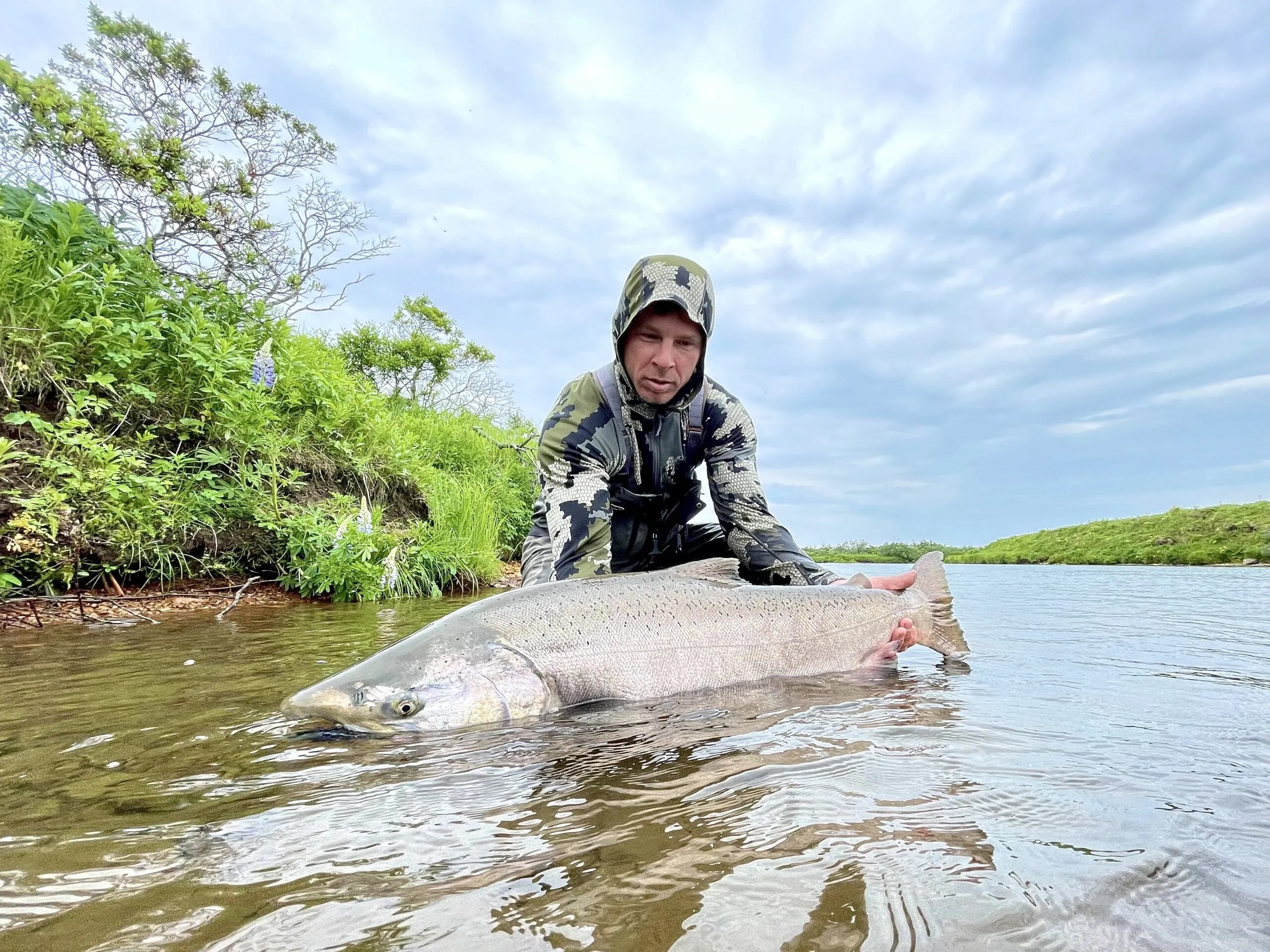
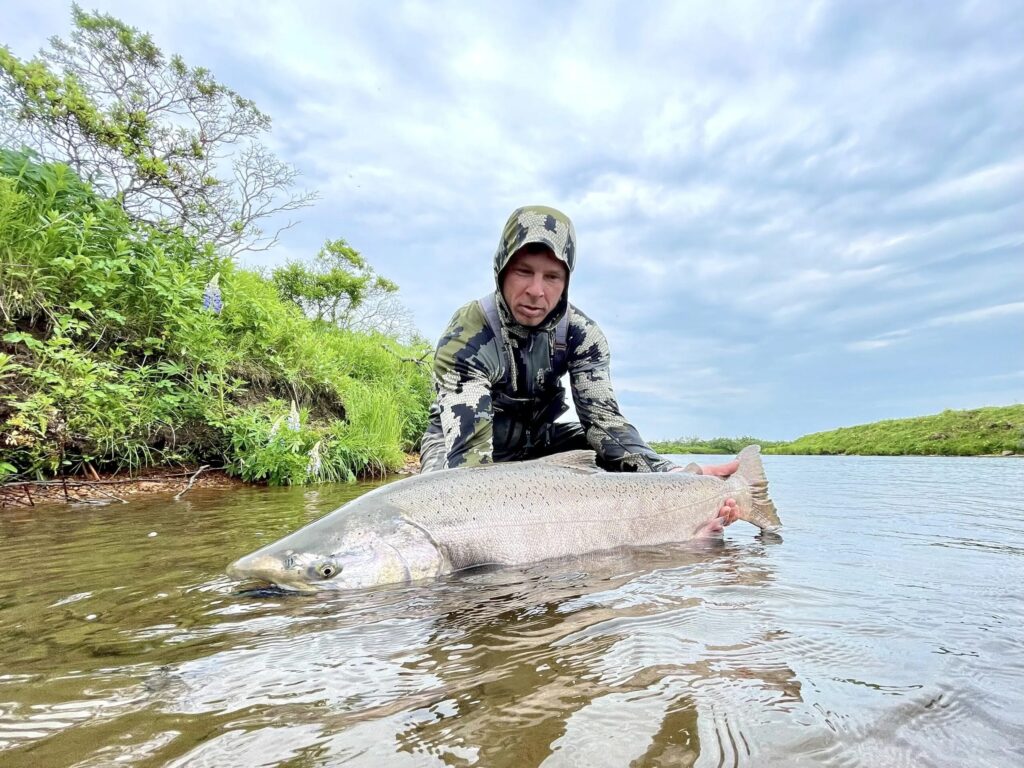
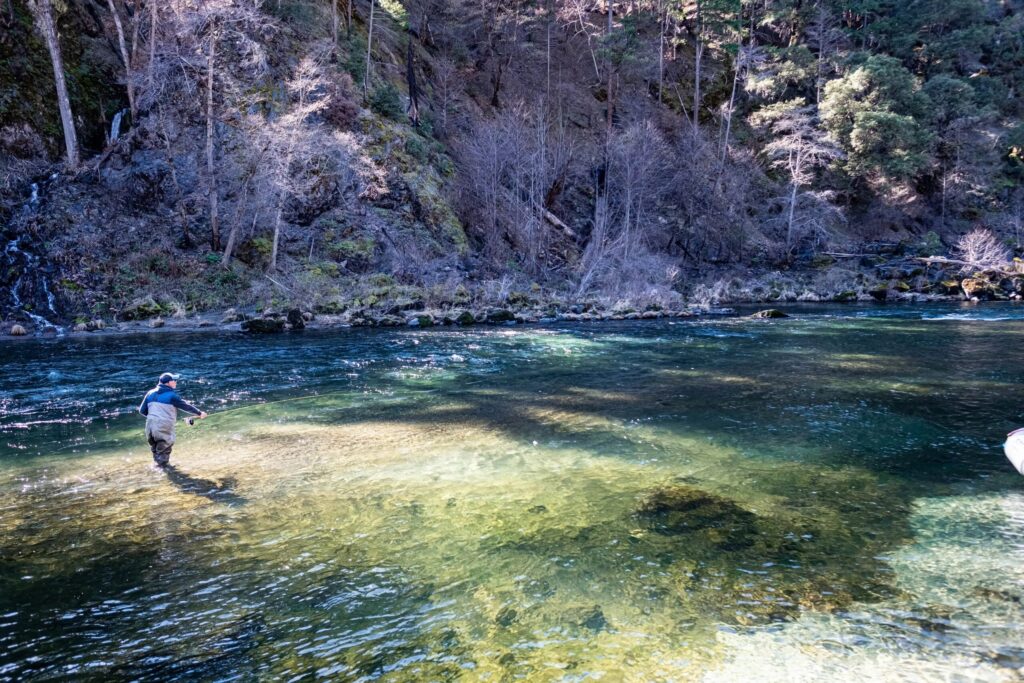
Fly fishing Northern California means stepping into rivers rich with history and wild steelhead, and the Trinity River is one of the crown jewels. Tom Mahan of Swingwater Fly Fishing has built his career on these waters, chasing steelhead the classic way—on the swing. In this episode, Tom talks about why he loves transitional seasons, how grease line presentations and custom furled leaders move fish in clear water, and why the Lower Trinity feels like a “mini BC” when the fall fog sets in. If you’re curious about targeting spooky steelhead in light flows, this is a must-listen.
Tom Mahan spends most of his guiding time on the lower and middle parts of the Trinity River. While many anglers head to the well-known upper section near Redding, Tom likes the less-traveled stretches downstream.
The Trinity River has fish almost all year. There are summer runs in July and August, fall fish in September through November, and winter steelhead that show up in December and January.
For gear, Tom leans on Scandi setups with custom furled leaders, small swivels, and stout tippet. His go-to is a 13-foot Burkheimer rod, which handles both short and long casts with ease. He says it feels lighter than its length, but still powerful enough for big fish.
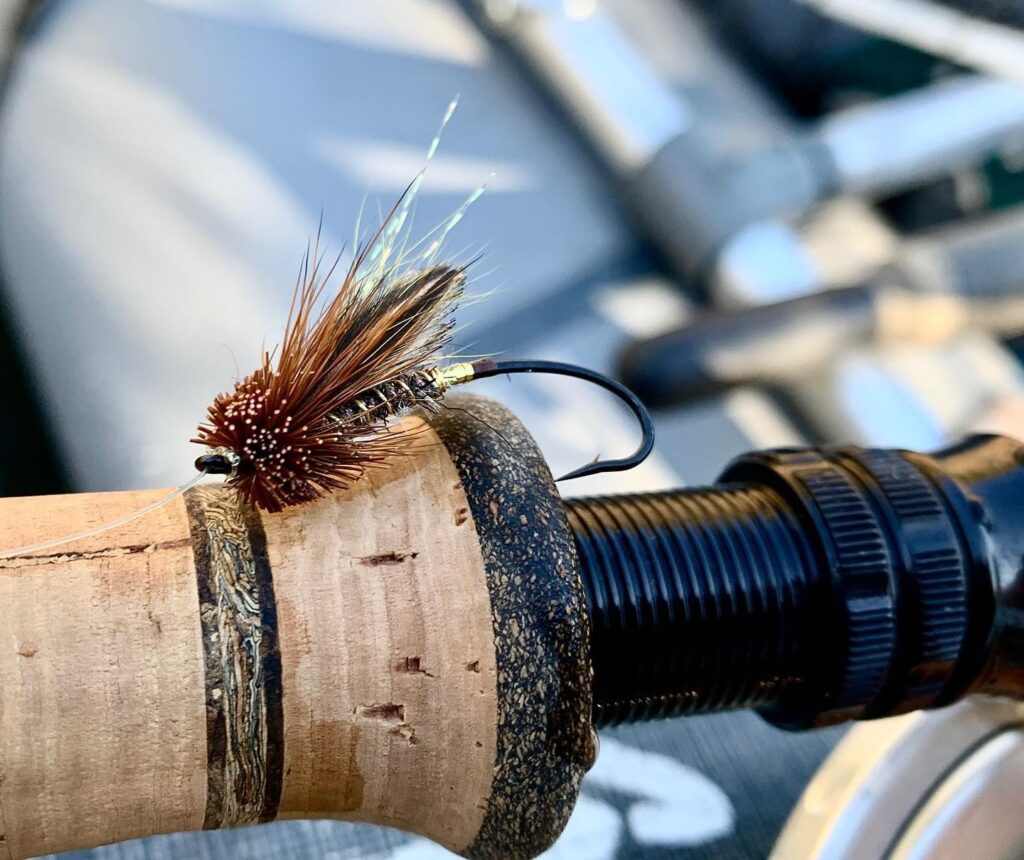
Tom often uses muddler patterns for this style. He likes how a muddler shows a strong side profile, giving steelhead a bold silhouette to chase. By keeping slack in the line and using soft mends, he lets the fly drift naturally. The result? Fish rise to the fly, hit broadside, and often hook themselves.
That said, Tom points out a limit. On rods over five or six weight, once you pass 390 grains, the Rage doesn’t hold well with tapered leaders. There’s just too much mass for a clean anchor and D-loop. For him, it shines on lighter setups like his Berkheimer 5- and 6-weights, paired with muddler flies and furled leaders.
Tom takes it a step further by tapering his leaders. He starts thick near the fly line, then steps them down smaller toward the fly. This taper carries energy smoothly from the cast, helping the line turn over cleaner especially on long casts.
He finishes with a tiny swivel or tippet ring, then ties on the final tippet and fly. The result is a leader that feels balanced, casts tight loops, and keeps presentations soft in clear water.
Tom isn’t just a muddler guy. He also ties marabou tube flies that mix simplicity with movement. He builds a shiny body, props up the marabou with dry fly hackle for shape, adds just a touch of flash, and then finishes with a small clay bead disc on the front.
Unlike factory-made coneheads or sonic discs, these flat clay discs push water in a way that makes the marabou pulse, kick, and dance with every microcurrent. The flies stay light, easy to cast, and full of life in the water. Tom often fishes them right in the surface film with the grease line technique, and steelhead crush them.
Tom began fishing at a young age on a small creek near his home in California. The stream flowed into the Sacramento River and gave him access to world-class smallmouth bass. In spring, trout moved in to spawn, adding even more variety.
His love for rivers grew stronger thanks to trips to Alaska as a kid. Visiting family near Anchorage and fishing the Kenai Peninsula left lasting memories. For Tom, moving water—whether creeks or big rivers—has always felt like home.
These multi-density heads let him fish structure without getting buried in rocks. He pairs them with short chunks of T-7 in 7-, 9-, and 11-foot lengths. For bigger rivers like the Smith or lower Trinity in winter, he’ll also carry T-10 in 8- and 12-foot pieces.
Tom prefers level Airflo sink tips over MOW tips because they’re thinner, cut water better, and keep flies moving naturally.
For him, this system works not only on the Trinity but anywhere he needs to swing flies deep and still keep control.
Episode Transcript
Dave (2s):
Today’s guest has built his life around the wild rivers of Northern California. Guiding on the Trinity, Tom Mahan has carved out a reputation for chasing steelhead the hard way on the swing. By the end of This episode, you’ll hear why he prefers transitional seasons when the crowds disappear, how he uses grease line presentations and custom furled leaders to move fish in clear water, and what makes the Lower Trinity feel like a mini BC in the fog of late fall. This is the Wet Fly Swing podcast where I show you the best places to travel to for fly fishing, how to find the best resources and tools to prepare for that big trip, And what you can do to give back to the fish species we all love. Tom Mahan is here from swing water fly fishing to share his story on fish in Northern California.
Dave (46s):
We’re gonna find out what his approach looks like for steelhead, and we’re gonna dig deep into the trinity and especially in the fall fishing. This episode is gonna be primed right now. If you’ve ever wondered about fishing spooky fish, some areas and, and light flows and all that we’re gonna talk about today. So let’s just get into it. Here he is. You can find him at swingwaterflyfishing.com. Tom Mahan, How you doing, Tom? Good.
Tom (1m 14s):
Thanks for having me on, Dave. Yeah,
Dave (1m 15s):
Yeah. Thanks for, thanks for putting some time aside today to put this together. We’re gonna be chatting, obviously, swing water, fly fishing. It’s in your URL of your website, you know, wet fly swing. Obviously we have a lot of overlaps. I was just on the river last week fishing for steelhead. I know that’s what you focus on. The cool thing is you’re in Northern California, the Trinity. I know we’ve had some listeners recently that have talked about, you know, that those rivers, the Smith, the Klamath, there’s some really famous rivers, really, that’s kind of where the start of steelhead fishing, I think, in the whole country began, at least with the fly. So we’re gonna talk about that and all there. But to maybe let’s start on the history piece. Are you a big history buff? Do you know a little bit of that history on, on kind of fly fishing and, and all that?
Tom (1m 57s):
Well, I think so. Of course. I, I feel like I’ll, I’ll probably say this and there’ll be some guys that are making me feel like I don’t know much at all. Yeah,
Dave (2m 4s):
Right.
Tom (2m 5s):
But, you know, I’m, I’m, so, I’m 42, you know, I’m very proud to say that unless I’m shown some history. Otherwise, I do believe that at least swinging flies for salmon and, and steelhead in the Pacific Northwest actually did start right here on the coastline that I guide. And there was, you know, I think a very, most people probably know a very popular documentary made about it. And, and if, and if anybody hasn’t watched that man and they’re into swinging flies, it’s definitely a good one to watch.
Dave (2m 34s):
Yeah. What was that? Do you remember the name of that?
Tom (2m 36s):
I think it’s Rivers of the Lost Coast.
Dave (2m 38s):
Yeah, rivers of the Lost Coast. Exactly. Yeah,
Tom (2m 40s):
It’s a pretty cool story. And here in Northern California, you know, if, if you’re out there on the rivers a lot and you’re talking to people, you know, there’s still a lot of a strong network from people that either knew or related and had relationships with those guys that kind of, you know, made this whole thing popular and what they made that, that documentary about.
Dave (3m 0s):
Yeah. Yeah. No, this is great. I’m gonna have to watch that again. I can’t remember. And, and it’s Tom TomKat who is the, I guess he’s the guy narrating it and he’s from a river Unru it, right? I, I don’t remember. Yeah. Do you, do you like when you’re out there, I, I guess first off, on the Rivers we’re talking the Trinity, we talked, we mentioned which ones are the one for you? Where are you spending most of your time throughout the year?
Tom (3m 22s):
Oh, definitely the Trinity. I’ve been on the Trinity a you know, a really long time and, but I think I spend most of my time, you know, if you’re not somebody who knows me or fishes with me, most of my time is spent on that lower middle section and the lower section, which is a very unknown portion, you know, relative to the very well known portion of the Upper River. You know, a lot of people know about that from like Lewiston, the headwaters down to like Junction City or something that top, you know, 40 to 50 miles. But yeah, I, I spent a lot of time on the Trinity, mostly on that lower section, but, but yeah.
Dave (3m 58s):
Yeah, yeah. What’s the, and why are people not spending as much time in the lower section? Is swinging flies not as popular as say, you know, some of the nipping and other tactics? Or, or why do you think that is?
Tom (4m 9s):
Well, I think there’s a little bit of a few things. You know, the indicator phishing is, you know, a very popular thing in Northern California. I know it’s popular elsewhere, but, and I, I think, you know, just kind of a systemic cultural thing with, with indicator fishing, it lends itself that Upper river lends itself really well. Not only does it lend itself the way the river lays itself out, the characteristics, the predictability of it year after year, you know, for many things the way the river lays out and also the, you know, the flow regime coming outta the dam. And it’s also, you know, not too far from Redding. Oh, okay. And a lot of people, as you know, you know, lots and lots of people come to Redding to fly fish and indicator fish the, the lower Sacramento River for trout.
Tom (4m 57s):
And so it’s, it’s a stones throw from there. And, you know, over the last, you know, 10, 15, 20 years, you know, some of the, some of the, the roads that used to keep people from going over there very windy, could be treacherous at times, especially in the winter, have been straightened out. You know, there was, you know, Buckhorn Summit is one of the main stretches coming from Redding going to the river and, you know, you, you had to really think about Whether you wanted to go up there in the wintertime or not. It was a 25 mile per hour road, and now you could do, you know, anywhere from 45 to 60 mile per hour going straight over there. So, yeah. So it’s, it’s a little bit more accessible for most, most folks than that Lower River.
Tom (5m 40s):
And then, you know, there’s an Indian reservation at the bottom end of the river, and I think, you know, there’s a little bit of stigma attached to that, whether it’s true or not. I think it depends on who you ask. But that, and it’s also really hard to get to. It’s, you know, it’s a few hours away from, or it’s a couple hours away from reading and it’s, you know, also you go through several stretches of more treacherous road and that stuff has not been straightened out, nor will it ever be because of the way, you know, you’re driving through really steep mountainous terrain, some of the nastiest terrain in the, in the country actually.
Dave (6m 11s):
Oh, really? So, and this is in the, this is the lower section. This is kind of getting to the area where you’re fishing?
Tom (6m 16s):
Yeah. That’s kind of on your, you know, what you gotta go through to get down to where I am spending most of my time guiding at on the Trinity.
Dave (6m 22s):
Okay. And are you mostly guiding, it sounds like it’s a fairly large river. Are you floating the river? Are you walking away? What does that look like?
Tom (6m 30s):
Usually on that lower stretch, it’s always a float for the most part. If it’s a half day single angler, you know, we’ll, we’ll go and we’ll do our thing. We’ll hit the, the greatest hits and call it. But you know, as long as the boat gives me an advantage and gives my anglers an advantage, we’ll be in a boat. But there’s a lot of water also in that middle stretch, depending on where the flows are at, of course. Where a boat doesn’t necessarily give you an advantage. And so we will definitely spend a full day, you know, hitting all the runs within a 20 to 30 mile stretch, which is kind of cool, you know, because you’re not locked into four or five, six miles on a float.
Dave (7m 8s):
No. So, yep. That’s great. So that’s it. So you got a 20 or 30 mile section to float down there. And, and where is the, is there, are there multiple Putins through here? Are people doing, is this like rafts drift boats? How does that look?
Tom (7m 20s):
Yes, they are, but they’re just as, you know, can be just as treacherous as, as the roads, maybe even more so going down there. I mean, there are some folks that came from out of town last year and, or maybe a couple years now, but they tried to put in at one of these spots in a very steep, you know, dirt road. And you got about a foot on each side of you, and if it’s raining, it’s really steep. The first time you tap the brakes, you’re gonna go over the edge. And so, yeah, he got, you know, his truck went off the hills, boat went off the hills. Clients didn’t even get to fish that day and Oh geez. So it’s, yeah, it’s, we, we are using Putins and takeouts, but for the most part, I, they’re definitely not improved by any means.
Dave (8m 0s):
No, they’re not. Yeah. That is inter, that’s the cool thing about it, you know, I think that, I mean, sometimes people think California with as many people that everything’s improved, but yeah, it’s pretty remote in that section of the, of the state. Right. That trinity, the whole area. ’cause you’re, you’re within, you’re closer to the coast than you are Redding or maybe you’re in the middle, right? You’re out there somewhere.
Tom (8m 19s):
I’d say you’re a tiny bit, you know, tiny bit closer. You, you know, you’re about an hour closer to getting to like say the, about the e you know, so over on the coastline, whether it’s the E River or the Smith or whatever. But you actually are a little bit closer. But, but I think, you know, I’m always trying to, to look for that region or area of the river that, you know, does it fish well? Can it fish well? And have you not be around, you know, a bunch of other human pressure. And I think because of what you have to go through to actually have a program or just fish down there in general, and the same thing on the Klamath, I think that has a tendency to keep most people away. And that, that’s my opinion anyways.
Dave (8m 58s):
Yeah. Just ’cause it takes a little, a little more effort to get there. The fishing is, I mean, it’s harder, obviously you’re swinging flies too, right? Versus nipping, everything’s a little bit harder.
Tom (9m 7s):
Yep, exactly. And you know, there’s, there’s mostly no cell phone service down there. And sometimes you gotta hang a raft off a bridge by a rope to get it into a spot or, you know, you’re maybe some spot you’re doing like a a 45 to an hour and a half minute turnaround for a shuttle if you’re floating that day. So yeah, a lot of work goes into to going down there. But it, it is rewarding. There’s not a lot of people. It’s very beautiful. A lot of my clients call a mini BC in the late fall, early winter. Yeah. The way it sets up big, big mountains, rivers, just going through micro valleys that are flat meandering. Yeah. Just really unique. And, and when most people see it for the first time, ’cause you know, they haven’t fished there or whatever, they’re really blown away.
Tom (9m 50s):
They’re more blown away by the landscape and the valleys and the fog and the, you know, the size of the river. It’s not the small trinity that people know and yeah.
Dave (9m 59s):
Oh, people know of the upper river more. That’s what they think of. It’s a lot smaller up there. Yeah.
Tom (10m 3s):
Smaller goer, hard pan. We’re down there, it starts to get into gravel and flat, big long runs.
Dave (10m 10s):
Right, right. That’s cool. Yeah, big river. So, nice. Well, and we’re gonna chat a little on the, you know, kind of the fishing, getting into that. Let’s talk fish runs a little bit. What is, you know, timing and is steel had the focus? Are there are some other species in there that you’re targeting? Yeah,
Tom (10m 26s):
There definitely is. And so the timing part is, you know, I think like most rivers it’s got, you know, a little summer run some fish coming up in the summer. It’s got a, you know, pretty big fall run if you ask me. I think the winter run for as short as it is, I think it’s probably got more fish in it right now than the fall run, believe it or not. Obviously it doesn’t last long. Those fish are genetically tuned a little bit different than the fall fish, so you don’t see ’em as much, but man, there’s a lot of them there. So like most rivers it’s got that summer, fall, and, and winter. But yeah, it’s, it actually is a 365 day a year fishery.
Tom (11m 7s):
And there are some, I mean, I call ’em transition seasons because there are some consistent pulse flows that get let out of the dam after the wintertime and before the fall run where it’s been fairly consistent. I’m not saying exactly consistent as far as how much water’s coming out per week or per day, but there is higher flows, colder water coming out in hotter months. And what I’ve seen is when I was smart enough to start figuring out like, why wouldn’t this trigger some fish to come up that maybe otherwise wouldn’t be, I’ve literally watched these fish on these transition runs kind of evolve and just get a little bit bigger every year and more and more show up where, I guess a good way to explain that is, is a basic way to explain that is when I first started doing it, and I fish a lot on these transition runs, I, I probably fish just as much, if not more during these short seasons as a guide and with my anglers.
Tom (12m 5s):
And I do during like, the main well-known runs.
Dave (12m 8s):
And would the main be, if, if you break it out, let’s just say summer runs, so you’re out there, are you fishing kind of the summer, you know, July, August, September, and then the fall is kind of October, November, December, and, and then the winter is like January. Is that kind of how it is? And then, and then there’s like a transition run in between those?
Tom (12m 26s):
Yeah, So I would say, you know, if I had to categorize it and I, it’s getting harder and harder to categorize ’cause these fish we’re finding do what they want and they time what they wanna do when they want. But I would say, you know, late July and August you’ll see a few really good summer fish coming up, regardless of the flows. Obviously if there’s some cold water and some higher volume, there’ll be a few more. So that’s what I would call the summer fish. And then, you know, September, October fall, just like most rivers, but on the Trinity you’ll get a really cool overlap of, there will still be some fall fish coming in in November, middle of late November. And then you’ll start to see based off of weather of course, you know, you might see that first push of those thicker, whiter, clear, fend winter fish coming in.
Tom (13m 13s):
And that’s a really good time to, to be on the river when you hit it. Right. So I would say that is those three popular seasons. And then what I call a transition season isn’t, and is, you know, I’m not sure if I should say this or not, but there, there’s some flows coming out that I think emulate, you know, snow melt, right? That starts coming off in May, may and June. And depending on, you know, how much water we have based off of, you know, how full the lake is up there, they will, you know, douse it, they’ll douse the river. And, and during that time, you know, there is legitimate world class German brown fishing, I mean, I’m talking world class.
Tom (13m 53s):
There’s fish in the upper teens stories of when guys used to really fish for ’em with conventional gear and bait, you know, more than enough Oh really? Stories of 20 pound steel or browns to make you start believing it.
Dave (14m 6s):
What does that look like? I, I haven’t heard about that run. I mean these are, what’s the life history of these brown trout?
Tom (14m 12s):
So just like, you know, the, they’re lock levins, they came over, you know, we have original documentation of, gosh, I’m gonna be off on a year. But it was, yeah, it was the late 18 hundreds, early 19 hundreds. Back then they didn’t, they didn’t call hatchery, at least on, on the, in this region, they didn’t call hatcheries hatcheries, they call ’em hatching stations. And they were far less complex than they are now. Of course,
Dave (14m 38s):
If you’re looking for a world class fly fishing experience, it’s time to check out Mountain Waters resort. Nestled along Newfoundland’s, legendary Portland Creek. This spot has a history that runs as deep as the Atlantic salmon, they call it home once they fly fishing retreat for the great Lee Wolf. Today. It’s your turn to step into these historic waters and swing up your salmon this year. You can head over to wet fly swing.com/mountain waters right now and make it happen. That’s wet fly swing.com/mountain Waters. Let’s get out there today, San Juan Rod works started with a simple belief, great fly rods and gear shouldn’t cost a fortune as a family run company. They focus on building high quality fly fishing products that perform on the water without the premium price tag.
Dave (15m 23s):
You can try San Juan Rod works for 30 days risk free right now, and if you’re not satisfied, send it back for a full refund. You can go to san juan rod works.com. That’s S-A-N-J-U-A-N rod works.com. The browns going out to the ocean,
Tom (15m 42s):
So you know, it’s up for a debate. Right. You know, you’re, you’re gonna ask 10 guys, they’re gonna tell you this No, that you ask another 10 guys, they’re gonna tell you yes. But what I can tell you is this, we’ve got original and I’ve seen it with my own eyes, I’ve held it in my hand, original documents that down in Hoopa, which is, you know, just a few miles before it runs into the Klamath. And that puts you, you know, I think the mouth of the Klamath is 40, 30 or 40 some miles up from the, from the salt of, you know, 30 plus inch browns being trapped in the hatch, what they called then the hatching station. So, you know, what are they doing down there? I don’t know. You know, so, so we’ve got that and you can, you know, interpret that however you’d like, but
Dave (16m 25s):
Well, and if they’re that big, I mean, how would they grow that big other than going out to the ocean because they’re not east side, aren’t these west side kinda, you’re on the west side, right? It’s not like you’re in the, you’re in the places where there’s not as much food in the freshwater, right?
Tom (16m 37s):
Yeah, I would say definitely. I mean, you could make a strong argument, at least on the surface, that, you know, back then we didn’t have the, the fish hatchery that’s up in Lewiston that wasn’t there. And so, you know, if, if you didn’t know that, you could say, well those guys are just feeding this river, you know, hundreds of thousands of salmon smolt and still had smolt and that on top of the fish that are sping in the river and the tris and those fish, like the stripers in the lower sack right now are just crushing Oh right. Factory. But that didn’t exist back then. Those fish were getting, you know, documented as being very large tend to, I think I did a formula one time and they, they measured ’em in centimeters back then.
Tom (17m 18s):
I think they still might actually. But I think it was 17 pounds was the biggest one that I did the formula on if, and I use the steelhead formula. But, so that’s, you know, that’s a large fish. So yeah, there’s that. And going back to it, the original question,
Dave (17m 32s):
So when you focus on these transition seasons because, and now why is that, why even separate as a transition, you know, is it a different fish that’s in there? It’s
Tom (17m 40s):
A philosophy of mine. I, I think, you know, and I talked to this with my, ’cause we’re sw I swing, right? Yeah. I do a lot of swinging. If I’m not swinging, I’m casting some streamers and stripping streamers. I don’t think I’ve done an indicator trip for steelhead. I’ve never done an indicator trip. So it’s a lot tougher for us to run into fish I think if you’re looking at it from that perspective. But I feel like when you’re in a system for a long period of time and you, and you start to become very familiar and you’re very comfortable and you start to kind of feel like you’re part of that system. And what I mean by that is, you know, I guide the, you know, whatever this stretch of the trinity this time of the year, you just start to really get a feel for, you know, what the birds are doing, how the deer are looking, are they happy?
Tom (18m 21s):
Is it curious, you know, the pressure of the day.
Dave (18m 24s):
Yeah. You’re seeing that stuff that other people aren’t really noticing ’cause you’re out there every day.
Tom (18m 28s):
Yeah. And when, when you get that comfortable with something in nature, I feel like things that come into play that aren’t normally there are very noticeable. And for me, one thing I tell my clients a lot is if you give me 10 miles of river with, with three steelhead and no boats, no guides, no anglers, I’ll probably show you three steelhead. Or at least we’ll encounter ’em, gimme that same stretch of 10 miles and put 55 steelhead in there and and put seven guide boats and a couple bank anglers. Maybe we’re lucky and we might run into one. Right. Right. I’m saying this from a perspective of a swing guy and a swing guide. And so going back to that, my philosophy is, is I just have proved to myself that there is far fewer fish in these transition seasons, but far more connections because of the lack of pressure.
Dave (19m 21s):
Right. So, so this section where you’re fishing still gets pressure, there’s still people fishing down and it’s not like you’re the only boat out there
Tom (19m 27s):
99% of the time on these transition seasons, I am
Dave (19m 30s):
On your transition, but not in the main, not like the peak,
Tom (19m 33s):
Not in the main seasons. Definitely not.
Dave (19m 34s):
Okay. So, and then what would it be if we were talking to you thinking, I mean now as we talk it’s September, you know, this probably will go out in October. So let’s take it to that time. If it’s October in that range, what does that look like? Is that, would that be considered more of the fall? Talk about that. If somebody was thinking about doing a trip out there, what would they be? Is that a good time to go for it? Yeah,
Tom (19m 55s):
I think so. The river is at what we call a summer base flow, which is 450 CF s coming outta the dam. But the lower you get on the Trinity, just like any river or most rivers, you have influences from tributaries. There’s not a lot of preci, not a lot of rain right now. So those tributaries aren’t increasing the volume of water as much as they do in the wintertime. But the river starts to get a little bit bigger, a little bit bigger, a little bit bigger. The farther you go down, you’re really hunting at that point, at least when you’re with me, we’re probably gonna be hunting steelhead in the middle section. We might be on the lower. I don’t really like to lower that time of the year because it’s so flat down there.
Tom (20m 36s):
It’s a lot of calm water that you can’t really swing through. Mm.
Dave (20m 39s):
Is the lower, like down to the confluence with the Klamath? Yeah,
Tom (20m 42s):
This is down in the, in the Hoopa Indian reservation area, Willow Creek that I was talking about earlier, where it’s really nice, nice to fish in the late fall and early winter when there’s more flow. But October’s a great time ’cause there’s big fish in there and you know, if you really have that hunter’s mentality and you’re willing to go do what it takes, you know, the trinity produces some, some world class fall fish in the fall, you know, in that month. And you can get it done on a, you know, a dry line of course, so
Dave (21m 10s):
Oh, right. And dry lines. Yeah, because it’s low and clear basically. And you’re hunting because are you spotting the fish? Are you actually seeing the fish?
Tom (21m 17s):
No, we’re just, we’re starting early really taking advantage of low light, you know, and I take a huge priority every time I walk an angler into the run. You know, I, I’m not gonna let you, if you have a waiting staff, which I, I prefer you do for safety if you’re a little bit older on the older side. But if you don’t have, you know, I don’t let you walk into a run if, if you don’t have a rubber tip or tape on it. That’s just one of the noisiest most ineffective things you can do when you’re clanging metal on rocks. But we’re really approaching these runs with, with a hunter’s mentality. Like almost like you were spot in stock in an elk or a bear or a deer with a bow. Because I think, you know, spay man’s number one disadvantages is you’re standing at the top of a run this time of the year and you know, crunching on rocks, kicking up stuff and those fish fill you, dude, like, make no mistake about it.
Tom (22m 5s):
They feel you, they hear you. And so the less pressure you put on these fish as you’re, as you’re hunting them, the more curious they’re gonna stay. And you know, that’s just not me giving a philosophy. I’ve literally watched that, you know, noisy, noisy, clumsy anglers will catch the players, but stealthy hunters will run into fish that otherwise probably won’t move to your fly. And so, so that’s kind of what we’re doing in October. But it’s, it’s really fun. You learn a lot depending on how, you know, advanced you are as an angler, but yeah.
Dave (22m 37s):
What’s that look like for the gear in, you know, in October? So it’s kinda light you are using scandy? Or maybe describe that, what are the fly lines you’re using out there?
Tom (22m 46s):
Yeah, so depending on the angler’s ability, it’s, I mean it’s always some type of scandy at that time of the year in October, at least most of October. But yeah, I mean it’ll be anywhere, you know, if a guy’s, you know, just learning how to caster is not the greatest caster. We’ll you know, we’ll fish like a, a short, like a shortened like condensed scandy, like a 23 footer or 21 footer. And there’s tons of these from any line company you can think of right now.
Dave (23m 12s):
Yeah. What would be one that you guys use or is that a line that you commonly use out there?
Tom (23m 18s):
I would say the most common is like a 30 foot range scandy short with, I do these custom step down furled leaders for the, the front of that scandy head. And then, you know, from there we’ll do a tipt ring, a stout tipt ring or a micro size 14 titanium barrel swivel, I mean a meniscule barrel swivel on the front of that, that taper or that Ferd leader. And, and then we’ll tie, tip it from that to the fly of, of course, but, but it’s a five way, you know, I’m, I’m a berkheimer, you know, I represent berkheimer rods. So yeah, I’ve, I love the 51 25 Berkheimer that time of the year. You know, I’ve been fishing it lately, but we ran into some fish last week where probably we’re hoping we would’ve had a, you know, could have had a six weight there and felt a lot better about it, fish in the double digits, but, but yeah, that are, that are, you know, six weights.
Dave (24m 8s):
Okay. And what’s your length like 13 something?
Tom (24m 11s):
Yeah, I think, you know, in that 13 foot range, me personally, my favorite rod of all time, not just for summer and fall fishing is the 61 39 berkheimer. I don’t just think that’s the best six weight. I personally think like that’s the best spay rod that’s ever been designed and built. It just performs at the highest mark across the board and it’s very rare to find a rod that, that you can say that about.
Dave (24m 34s):
Yeah. So that rod, you can use a lot of, like, whether that’s a skat or scan, you could put anything on that rod for the most part. Fish it.
Tom (24m 40s):
Yes. And it, And it does really, really well. And I think the one thing that’s most noticeable about it is Carrie built that rod, you know, it’s basically a 14 foot rod, it’s 13 feet, nine inches. But man, you know, when you’re, when you’re casting that thing and fishing it, it feels like you’re fishing a 12 and a half foot rod or casting a 12 and a half foot rod.
Dave (24m 58s):
Yeah. And what is the advantage of doing the, I know if you’re casting, I guess that is the advantage, right? If you’re casting bigger winter stuff, the extra length is good. What, why would that be better than say a 13 foot or something like that or 12 nine for say, summer, summer fish? Or is it just the way, it’s just the perfect, I guess That’s a hard question ’cause it’s just the perfect fit, right? It’s like, well
Tom (25m 16s):
It is, but no, there’s, there’s a lot of, I mean I could go on and on about that, but I could talk for an hour just on that. I think the biggest thing is one that specific rod is a very hearty rod, that’s the best word that I can use to describe it. And what I mean by is, if I get a guy that is just, just not doing a good job casting, I can hand him that rod, I can put like a 390 grain rage on it with a, you know, a custom 11 foot tapered leader in a muddler. And I get him to slow down and he’ll turn that head over every time and he’ll be fishing. But outside of that, I just feel like, you know, you feel like you’re fishing a shorter rod even though you’re not. But it makes, makes big casts and maybe you don’t always need to make big casts, but when you do need, and I do a lot of situational fishing, right?
Tom (26m 0s):
I’m really into fly presentation, but that 13 foot nine inch rod can just move line so well and manipulate your angles so well, even for beginners. And I think that’s important because if you can really figure out how to present your fly a little bit better, you’re gonna start running into more fish. So I would say line manipulation and castability make it the best.
Dave (26m 22s):
Yeah. And, and we will, I wanna talk more about some of the fly lines, but go on that fly presentation a little bit. ’cause I think that is an important part. Describe what are your thoughts there, you know, on fly presentation, how are you presenting that versus say what other people might be doing out there?
Tom (26m 36s):
You know, going back to like what I talked about earlier, I just gotta touch on this because I, I think this is kind of what gives me the vehicle of, you know, making the intuitive decision on how I’m gonna present. First of all, each run is, is its own run. And it’s very situational. And I think you gotta kind of, you know, for lack of a better word, edit or find the water for what you’re trying to do. But for a certain water, you know, I, I’m really big into the old, you know, really old school, old fashioned grease line technique. And I’m just talking about fall fishing right now in October. I love fishing muddler, I love fishing muddler, but I, I like to cast slightly upstream in most runs.
Tom (27m 16s):
Now, this is not every run, but in the fall, given the win, you know, the water’s situation that I have both on the Klamath and lower Trinity or Middle Trinity, I like to cast slightly above 90 and I teach my guys to make mends to where there’s a slight bit of slack in the line.
Dave (27m 32s):
So make an upstream mend a little bit.
Tom (27m 34s):
I wouldn’t call it upstream, I would say more. You’re, you’re making the up slightly above 90 degree cast and then you’re almost pulling it back to you to create slack where you can then use your rod. And this is where the 13 foot nine inch rod is really good to create, you know, little s’s in the line, little slack, right? And what that does is it allows that fly to just kind of get in that film line or just below the surface and come down in a very natural presentation. But broadside and I try to get that to fish broadside as far down my swing as possible. At a certain point, you know, it, it straightens out, kicks, transitions and turns. And then we’re at the, you know, old school wet fly swing, right?
Tom (28m 14s):
Tight line swing. But the reason that I love it is when you’re fishing in the surface, obviously inherently a fish has to come up and to move to that fly and they don’t just stay there, right? The fish comes up, smashes it and goes back to where it came from or tries to swim away. But when they come up and grab that fly broadside, you know, it’s such a beautiful hook set. Nine times outta 10, it’s hooking itself. And I’m a big fan of the grease line technique. Now that was a very surface depth overview of, of that. I mean that you could, I’m really deep into the, the, the grease line technique, but that’s kind of what I do with muddler. That’s
Dave (28m 49s):
What you do with mud, is that the grease? Now describe that. What what is that grease line technique exactly for those that don’t know. So
Tom (28m 55s):
That’s the actual technique, the grease line. And this comes from back from in England, from Europe, you’re just using a floating head and a, a floating leader and it’s grease because back then they greased them to keep ’em up high in the water column. And that’s, you know, the word is the name is just kind of stuck with it through time. There’s very, very, very few people that I, at least in my network that I’ve talked to that really even have, have researched it. But that’s what it is. It’s a dry line with a wet fly and you’re just kind of presenting broadside as far as you can before that thing straightens out and turns and now you’re fishing a tight line.
Dave (29m 32s):
So that’s what it’s, so the grease line is more focused on that broad side presentation? Yes. And on dry and not, not necessarily fishing muddler or is it you could fish any fly Roy with the grease line?
Tom (29m 42s):
Well, you know, I fish the muddler because I’m just a, a huge Muddler fan. I tie muddler, I’m really obsessed with tying muddler, but they actually, the original was, you know, there’s a specific grease line patterns from, from the 18 hundreds from Europe that they used. And, and the idea is, is it’s a bug that’s trapped in the film line And it just being brought down the river at the natural speed of the current and fish are, you know, fish are keyed in on that. So that’s why they do
Dave (30m 8s):
That. And is it almost a, it’s a little bit, not necessarily a dead drift, but you’re not really putting the fly isn’t whipping across at the start. You’re not, not swinging across. It
Tom (30m 17s):
Kind of is for, you know, for lack of a better term. I mean it kind of, when you make that initial man and you get your line right, there’s no tension on the line. So it kind of is just a dead drift, but it’s a broadside dead drift. And if a fish grabs it, they’re probably gonna get hooked, you know, because of that. The reason I love it with Muddler and I tie muddler for side profile ’cause I don’t fish a ton of vertical tight line swings even when I’m fishing sink tips. But I really like the idea of, of letting that fish, you know, if you go down to the the fish’s point of view, you’re looking up at a muddler broadside with the horizon, you know, you kind of just see the, the silhouette of that thing, right? And so, So I tie for silhouettes, big barrel heads, something buggy poking outta the ass of that thing.
Tom (31m 1s):
Oh, okay.
Dave (31m 2s):
Yeah.
Tom (31m 2s):
And I, I like to give it to ’em broadside and you know, maybe that’s the reason, maybe it’s not, but,
Dave (31m 7s):
So the muddler, you’re ty how is that different from say a typical, if you’re gonna just go look up a, a muddler that you’d fish on on more on the swing? How is yours is just a little bit bigger?
Tom (31m 16s):
Well, I wouldn’t say bigger, it just, I would say it’s more, the head is very barrelhead. So it’s very pronounced.
Dave (31m 22s):
Yeah. So barrelhead not, it’s not like carved down really thin or any of that,
Tom (31m 26s):
Right? But it does have characteristics of like, you know, the old school steelhead cadis or Thompson Cadis, whatever. But I mean, I, let me digress a little bit. First of all, yeah, the, the muddler, the muddler evolution has, has really, really evolved. And there’s some people out there that are tying some sick muddler and for whatever reason steelhead just absolutely hate those things. Some of the best takes I’ve ever had are on Muddler for steelhead.
Dave (31m 54s):
There you go. So muddler muds are good. Good. Well we mentioned a little bit, so that’s a law on presentation, the lion, let’s go back to that. So you mentioned the rage, why not just fish that rage? And that’s the airflow, right? Airflow, yeah, the the rage. Why not fish? That one? I mean you could you fish that one throughout the year, October throughout all the seasons.
Tom (32m 13s):
So here, here’s what I found about the rage. First of all, I mentioned the rage because that’s what I will put on the 61 39 when a guy’s either new at casting or he’s Yeah, he’s really struggling with
Dave (32m 22s):
Because it’s easy, right? Yeah. The rage is, it makes it, I mean I think Larimer he did, he was thinking about the wind and conditions where they weren’t perfect to make an easy casting line. Yeah.
Tom (32m 31s):
Yeah. So the story I actually heard, I won’t say any names here, but yeah, let’s
Dave (32m 34s):
Hear it, let’s hear
Tom (32m 35s):
The range from the story that I heard. And I’m not saying I was there for, this was a scandy long that was chopped because of its inability to finish strong in a long cast in the wind on the CHS was chopped back, chopped back, chopped back a few times over, you know, however much time. And, and man, we got this crazy cool head now and I think it ended up at 29, 30 or 31 feet. But anyways, so that’s what I do. But, so here’s what I found about the rage. Let’s just say, I think when, when it comes to fishing, like we’ll just call it a, you know, tapered steelhead leader, right? A 12 foot tapered steelhead leader or a nine foot or whatever, I feel like with a full length rod.
Tom (33m 16s):
And that’s important because shorter rods are not part of this. What I’m gonna explain here, yeah, when you get over 390 grains on the rage with just a monofilament liter and a traditional fly, hopefully you’re not fishing weighted intruders on those, that’s not gonna work well. But there’s so much mass which creates so much momentum from the kinetic energy that it just cannot hold it down once you go above three. So once you get into the 420 grain rage, you know, a tapered leader outside of going like really long with it, is not really gonna anchor you down and keep your D loop intact for you to, you know, create rod load and whatever, go into your change of directions,
Dave (33m 57s):
Right? So there’s a certain limit. So there’s a limit to some of the,
Tom (34m 0s):
Yeah, so, so my five weights and my six weights, I will, you know, at 390 and 360 grains. And of course anything below that of course. ’cause you start getting lighter and lighter, less mass et cetera. Less length with full length rods relative to six and five weights. It’s really a highly functional head. Everybody knows that already, but I think most people are probably say, oh yeah, you can fish a poly leader or you can fish a floating universal leader, which I’m not huge fans of the floating ones of those anyways. I don’t think you need those. But no man, they’re, they’re really great. In fact, I think this year I made the decision, at least with my 51 25 berkheimer, which is just a fantastic summer steelhead rod by the way that the 300 and 330 grain rage was probably my favorite way to fish.
Tom (34m 46s):
Muddles on the trinity.
Dave (34m 49s):
Pescador on the fly offers a full spectrum of fly fishing gear for any angler at any budget. By bringing high performance rods directly to the angler, they eliminate the middleman markups, saving you time and money. The top tiered El Ray series is designed for serious anglers with the El ray G six being the most packable high performance rod on the market. And most anglers who try the G six can’t believe it is a six piece rod. It performs just like a four piece. There’s no difference in performance. Whether you’re fishing local streams or embarking on your next adventure across the world, the G six delivers precision and power wherever you go. You can get 10% off your next order right now if you use the code wet fly swing at checkout, that’s pescador on the fly.com.
Dave (35m 30s):
Use the code wet fly swing for 10% off, never fly without your G six. Discover the L Race series and more at pescador on the fly.com. Fish to Fly Guide service is passionate about sharing Jackson Hole’s world-class fishing from its iconic rivers to hidden backcountry waters, the legendary mutant stone and other fantastic hatches. Bring explosive top water eats during peak season. Backcountry creeks hold hidden gems where every bend offers something new and wild trout rise in untouched waters. Jackson Hole sits in the golden circle for trout home to the headwaters of three major river systems, the snake, the green, and the Yellowstone. Here you can chase native cutthroat trout, big browns, wild rainbows, and even K on the fly.
Dave (36m 13s):
If this is your kind of fishing fish, the fly guide service is ready to take you there. Book your trip right now@fishthefly.com. So that’s what it sounds like. And I have a, I have like a a six weight or a, what is it? I think it’s six weight echo that it’s just an older rod, but it, it’s great with the rage, you know, and I feel like I’ve never cast the rage on any other rods, So I don’t know. But so what you’re saying is it the rage is a better line for those lighter steelhead type rods? It wouldn’t be good on say a eight or nine weight necessarily.
Tom (36m 43s):
Not with tapered leaders. Yeah, no way. Now again, that comes down to taste, right? Like what do you want? You know, some of these guys are just like, you know, I’ll only fish a double tapered silk line. They’re not gonna fish a rage. Right?
Dave (36m 54s):
Yeah, yeah. That’s totally different. Yeah, that’s right.
Tom (36m 55s):
Not it’s in my, I mean I think the rage is probably the most utility.
Dave (36m 59s):
Yeah, it is. If you’re gonna get one line, yeah. Especially if you’re new, that’s a good line to grab out of the box and just go for it. That’s gonna help you. Yeah, for summer steelhead especially. Yes. Okay, so, so that’s a little on the line. So talk about the leader. So let’s just stay with that. Let’s just say we have this rage set up on a five or six weight. You mentioned the furled leader. Talk about from the fly line down to the rest of your terminal tackle. How do you do that again?
Tom (37m 22s):
Okay, so we’ll just talk specifically about my furled leaders. Yeah. And what
Dave (37m 25s):
Are fur leaders remind again, what furled leaders are?
Tom (37m 28s):
So a ferral leader is basically you take, you know, a long piece of line, you double it, you twist it, and you, you have a consistent twist all the way down. I, I’m not gonna say anything like, ’cause it doesn’t matter. Furrowing is furrowing and because of the tension of that, when you double it back, it will just twist back on itself, right? So you’ve just basically got it’s twisted line under tension. And so what I do is, and this just, you know, funny, I just, there was a company, one of my clients told me this last week, there was a company that was making furled leaders on machines and they went outta business. And so he bought a couple of ’em, two or three or whatever, and he brought ’em on the boat and they looked beautiful, but they were not tapered, meaning there wasn’t, you know, a mass going from larger to smaller coming from the shooting head going to the fly.
Tom (38m 16s):
And So I was like, man, they look super good. They had built in either tip it ring or a micro swivel, whatever it was. So we put it on the end of actually a 330 grand rage on his 51 25. And I’m sitting there and I fish with this guy. I mean, I guide this guy quite a bit and I’m looking at him like, well, he is having an off day, he is just not casting. Well, that’s okay, whatever happened, you know, fast forward I, I pick up his rod and I go to make a cast for whatever reason. And I was like, oh, maybe I’m having a bad day. I cast again, I cast again. And I’m like, no, that’s the leader. And what I found was, and this is pretty cool because I, I taught myself something here is that for real, leaders are cool, but on a spay rod, when you’re trying to make, you know, really nice big casts or efficient casts, having a tapered leader, not just a tapered leader, but a tapered furrow leader is legitimately 10 times better than having just a straight taper or referral leader.
Tom (39m 12s):
And so here’s what, here’s what I do with mind is I’ll take, you know, depending on what length I want, I’m just gonna use 20 feet as a, as an easy number to think of, right? I’ll take 20 feet of 12 pound fluorocarbon or 12 pound mono, whatever you wanna do. And I will make the back section of it to where it has a quadrupled furled section that’s the thickest part of it. And that is with a loop that goes onto the end of the shooting head and I come down, I tie a, a knot and I trim that tag in really close to it. So it’s knotted there. So the next section is only a single, a double furled portion of the liter. And then I tie a knot at the end of that and say the top section is, you know, three feet long.
Tom (39m 54s):
The middle section of just the double tapered or furled portion is maybe two and a half. So it’s smaller and mass, but it’s also slightly smaller in length. So it’s, it’s tapered both elements length and, and mass. And then from the front of that, I’ll just have, you know, I’ll leave like, I think I leave like two, two and a half feet of just whatever pound, like in this case 12 pound test tied to a micro, a spro, micro swivel, titanium swivel. And then from that swivel I will tie whatever length of tip it is necessary or liter necessary to a muddler or a fly and fish it like that. And so what we found was is that, you know, on long casts, you know, that loop was able to hold its stability and transfer energy throughout the entirety to that either swivel or the fly much greater distances and hold much tighter loops with the furled taper instead of just the straight furled.
Tom (40m 47s):
Hopefully that made sense.
Dave (40m 48s):
Yeah, it does. So that’s why you do the furled leader because it’s gonna help you, especially with a long cast, to actually keep a, just make a better cast overall versus, say you’d have on just your normal maxima whatever without a furled leader.
Tom (41m 0s):
Exactly. And you know, I have to be fair here, I was a part of a airflow team when Tim Ray, Jeff was
Dave (41m 9s):
Oh yeah, sure.
Tom (41m 10s):
Yeah. And you know, I learned that guy is, he’s something else. Yeah. And you know, he taught me a lot about energy transfer, you know, relative to, to fly casting. And you know, that is one of the things that got me on these world leaders that I build for my, my clients. What happens is, is that basically, you know, the surface depth of this energy transfer thing is there’s a ton of energy coming through that shooting head, right? A ton. And the more you can harness something efficiently to hold onto that energy, instead of it just like hitting a piece of mono And it disperses to me the idea of having a really thick furled, you know, 12 pound test leader back there, I’m gonna carry a lot more energy through that.
Tom (41m 52s):
And then I wanted to taper as it gets closer and closer to the fly for efficiency. And that’s, that’s why I, I went with, I call a stepped down pro leader. And maybe I’m wrong, maybe I’m right about that. But the important thing is, is it works really well and I got lucky there.
Dave (42m 7s):
That’s cool. Yeah. What, and, and how do you, for those that haven’t done the ferral leader, what is the knot, how are you tying the ferral leaders together? Describe that process or how could somebody see that? What does that look like?
Tom (42m 18s):
If someone can do this over listen to me to explain it, that’d be impressive. Yeah, that’d be hard. So when I get down with the top section, it’s furled and then twisted over itself again. So it’s got, you know, basically four strands of 12 pound tests. It’s quadrupled. I just tie a surgeon’s knot right there. But I make sure I make sure that that surgeon’s knot is, when I go to pull tension on it, it’s got a little bit of chapstick on it so everything pulls evenly. And then once it’s seated, I put a lot of pressure on it to, to really make it small because I don’t want big knots, you know, creating disturbances that I don’t want there when I’m swinging flies, especially in quiet water. And then I just nip it off really close to that knot. So it’s just a surgeon, an overhand knot really. But I’m very careful to make sure it seats right because I don’t like, I mean, I don’t want any one of my twists to even have a little bit of a gap and not be consistent with the, you know, the 30 other twists drives me crazy.
Tom (43m 10s):
So.
Dave (43m 10s):
Right, right. That’s, so if somebody wanted to get some of these fer liter, could they go get one or do you have to kind of build ’em yourself?
Tom (43m 17s):
I’ve never, yeah, I’ve never,
Dave (43m 19s):
There’s not much out there. It’s kind of a, it’s a little another one of those little tiny niches in fly fishing. Right. It’s these little, and I’ve heard of this before, I’ve, I know there’s some people in trout fishing that love the furled leaders. I’ve heard about ’em before and I’ve, I’ve never really fished ’em. So it’s, but it’s interesting to hear that for steelhead. I mean, do you hear, I haven’t heard that for steelhead many people doing this. Sounds like you’re doing something pretty unique. Yeah,
Tom (43m 38s):
I, exactly. No, I haven’t. I mean, why when you could just go buy a, a 12 foot Rio salmon steelhead leader and you know, go to work ’cause they work great. Right,
Dave (43m 48s):
Right, right. But you, like you said, I mean the thing with steelhead is, you know, like we know sometimes you don’t get a lot of opportunities, so why not stack it the deck in your favor a little bit more. Right. Every, every little thing it feels like you’re that type of person that you’re thinking every little thing from walking up to the stream to, you know, you’re thinking about all of that. Yeah. Yeah.
Tom (44m 4s):
Just
Dave (44m 5s):
It’s not easy. Right. Steelhead and the trinity, would you say is not easy like most places for steelhead fishing? Well,
Tom (44m 11s):
I, I would say, you know, let’s just say where I’m fishing is maybe 550 to 650 CFS and it’s dead quiet except for the deer and the, and the birds. You know, I don’t wanna pile a cast up on my, you know, if I gotta make, I mean you always start short right. When you’re working a run. Yeah. But sometimes you don’t, sometimes you gotta get to a spot and stand on a rock and your first cast has to be 67 feet and if you pile that up And it doesn’t turn over your bug, you know, that’s that fish, you know, situation might just swim behind a rock and you won’t see that guy again until the evening. So I don’t fall into the camp of well it works well cool, but like, can you get an advantage because I’ll take a half a percentage point if I can, you know, and it’s realistic, so Exactly.
Tom (44m 55s):
Yeah. That, that’s, that’s the way I view it. Totally.
Dave (44m 57s):
No, it makes sense. I think, and we’ve been focusing on this October, you know, period where it’s low and, and obviously there’s more of the trinity, but you know, it’s kinda interesting ’cause I, I I agree. I think that any little advantage you can get right. Is gonna help you, especially in those conditions. Yes. What is the, you mentioned the swivel, why the, the micro swivel. Why not just do a blood knot there at the end? This is right above your tipt.
Tom (45m 17s):
Because once I build those things, it’s like I put so much like effort into having them be perfect at a certain point. If I don’t tie a swivel on there, this is really why I do it. I’ve never had an issue with line twists. I know a lot of guys are like, ah, twist this twist. I don’t know what I’ve been doing differently. I’ve never had a fly come outta the water and start spinning. But for me, I just, over time, you know, you start to get to the point where you gotta tie another one because you, you bite off this blood knot. ’cause you know, a guy put a, a wind knot or two in this, or you had to chop it off and tie another one. And I just don’t, I don’t wanna tie ’em, man. Those things are really durable and I have not seen a drop off from not, you know, you could argue at 12 pound test being connected, 10 pound test, you know, that connection is probably a, the same size, if not bigger than one of those size 14 spro, micro barrel swivels dude.
Tom (46m 6s):
Like
Dave (46m 7s):
Mm. That is, you
Tom (46m 8s):
Know, so it’s not a disturbance if you tie your knots and take your time to tie ’em. Right? Yes. You can argue that there’s a little bit more of a, a weak point, but dude, I’ve, I’ve caught really big fish and if we ever get into the, the dry line for Kings up in Alaska today Yeah. It’s proven right. So
Dave (46m 25s):
Yep. Right. You can land kings with lighter stuff too. You don’t have to have whatever they use up there, 20 pound. Yeah.
Tom (46m 31s):
Yeah. So yeah, that’s why I do it. I honestly, just because they’re durable, they’re hearty, they turn over better than anything else out there on the end of a, if you’re fishing a dry line. And I just don’t wanna tie a bunch of ’em. So I just, I put a barrel swivel on ’em. Yeah.
Dave (46m 44s):
Okay. That makes sense. So that’s kinda stuff. And, and give us a little quick on, on the fly. So you mentioned the muddler. Sounds like that’s one of your favorites. What are your, if you had a wet fly you were gonna throw on there with this setup, what would it be? Are you exclusively muddler?
Tom (46m 56s):
No, I’m not exclusively muddler. I actually just a couple years ago, so as you can tell, I, I tinker with a lot of stuff. I’m always, my mind’s always racing to try to, you know, as you go through a season, you progress and you learn. At least I’m always trying to learn regardless of how long I’ve been doing it. And, you know, you try something and you’re like, eh, it worked. Well, maybe it worked ’cause there was a fish there and maybe it didn’t work and there wasn’t a fish there or whatever, you know, and still had, you could never recreate any situation. Right. But a couple years ago, I’m like, first of all, to answer the first part of that question, I’m a real big believer in fishing marabou for steelhead, like big time. And I tie mine on two flies and mine is like this, you know, it’s like this evolution of like 30 different flies.
Tom (47m 39s):
Like I’ve just, there’s so many fly tires that I love their flies and I’m like, oh, I’m gonna steal that. I’m gonna steal that. But I also believe that less is more addition by subtraction. So I, I tie these really cool tube flies on pro tubes, you know, they’ve got, you know, kind of a minnow ish shiny body with a, a dry fly hackle palmer up it at the top of that, Palmer, I’ll, I’ll stack like six to eight to 10 wraps depending on what I’m trying to achieve as a shoulder, right? A continuous I’ll palmer up make the body so it never shrinks down to skinny. And then at the top of that, Palmer, I’ll, I’ll stack like, you know, up to 10 wraps of, of this dry fly hackle. And then that’ll be my shoulder and it’ll help prop the bu up and I’ll put like maybe two, sometimes four strands of flash and then no more than three wraps of bu maybe I’ll do a full wrap of whatever this color bu.
Tom (48m 32s):
But I always got some type of black in there for the most part. But, so anyways, I tie those and then I’ve, I, I’m gonna get off on a tangent here ’cause I’m, yeah, I just really think this is the most effective fly. Like we talked about how fun the muddler is and how much I use them, right? This is the most effective fly that I’ve ever used. My daughter made these bracelets when she was young and they’re, you know, they’re these clay bead bracelets and you could buy the whole kit with like a thousand pieces from Amazon for like five bucks. And I’m looking at this bracelet she made me one day and I’m going, what? That is a really fishy little steelhead, kingfisher blue color you got there. Let me see that. Where’d you get that? And, and anyways, I was like, I grabbed one of my pro tubes And it was just the snugs most perfect fit in the world, man.
Tom (49m 18s):
And I’m like, why do they call these clay beads honey? And she didn’t know, you know, I’m like, I don’t, I still don’t know why they do, why they call ’em clay beads. I haven’t looked into it, huh. Nonetheless, of all of the cones and things you can buy for these, these tube flies, these weightless tube flies. I’m telling you, dude, there’s nothing better. This is it than the effect that these perfectly flat clay disks and, and they’re only a, you know, they’re, they’re not huge. Yeah, but they’re not small either. Perfectly
Dave (49m 45s):
Flat. So clay disks. So how is this different than, and this is going on the front of the fly.
Tom (49m 49s):
This is going on the front of the fly. So I’ll finish that with just a, you know, two, maybe three wraps of bu very wispy, like I said, addition by subtraction. I like, I like flies with bu at least that look subdued. And as they pulse or kick, you might get a glance of that little sexy body underneath. Right? I, yeah, I just feel like that might trigger a fish, right? With just a couple pieces of flash extending to the stinger hook and, and I’ll run like, you know, a loop. I’ve got a whole system that I tie with my two flies too. But, but anyways, I put this, So I talked about how I build up that body or that shoulder with the, with the same hackle that I used to palmer up to keep a little bit of a profile, right? And so the BU is already standing out like it is.
Tom (50m 30s):
This thing will not suck down in fast current because of, you know, the, the thick amount of stacks with that dry fly hackle. And then you put this clay disc thing on there, this clay b disc thing on there And it just makes it perfectly flat pushing against water. And every time that bu hits a little, you know, piece of microcurrent, it just dances. It just kicks, it moves, it darts, it pulses, it does whatever you, you know, whatever the water’s doing it does. But because of how little material I’m using and still having the ability to carry a really badass looking profile in the water, going back to the original question, you could cast these things on a three weight spay route or a three weight single hand rod because they’re so lightweight.
Tom (51m 15s):
So going back to the question, am I exclusive muddler? No. One of the other things that I will use the grease line technique with is I will fish these marabou flies in the film line on the surface and still had absolutely crushed them. And I’ll fish ’em the same way I fish ’em on sink tips, you know, with the stinger hook, you know, whatever, three inches, a three inch monofilament doubled loop to keep that stinger hook, you know, from falling down not below the fly, it’s sticking straight outta the, the back of that fly. You know, I’ll just grease line, I just call it grease line, you know, just drive fish and leeches on the grease line and I fish it just like you would’ve a green butt skunk, a muddler, you know, a lady Caroline, whatever. And steelhead will come up and smack those just as much.
Tom (51m 57s):
Yeah.
Dave (51m 58s):
So yeah, what I’m trying to get to is just picture that disc, and I know there’s some different discs people love using that. You know, you put on the front of the fly that kinda, sometimes people, I don’t know, think maybe it pushes water or maybe it doesn’t, but is this, it’s kind of a flat disc. I’m trying to think of the name of those ones that I’m picturing, but
Tom (52m 13s):
I think they’re called the pro tube Sonic discs.
Dave (52m 14s):
Exactly. Yeah. So is that kind of what we’re looking like here? Yeah,
Tom (52m 17s):
It’s, it, I would say it’s the same diameter, but if you look at the same, you know, it’s, it’s the same size except for if you look at the, those sonic discs, they’re actually slightly conical, right? Yeah, they are. And they also have port holes in them, which water flows through. Yeah, that’s right. And what I’ve found is, yeah, you know, you still get your bu fly will still get movement. I, and I learned this on the Olympic Peninsula when I was guiding up there quite some time ago. And I would watch this thing in the water. Those port holes are literally shooting water through there. And what I found is it actually keeps that bu almost lifeless because it forces it to kind of stay, you know, I think it’s got like, they either got like four or six holes in it and they’re perfectly symmetrical holes made in a factory.
Tom (53m 1s):
And so you’ve got four little jet streams of water kind of almost making a, a cocoon, if you will, over that mbu. Does it still look killer? Yeah, it does. But you know, for me, I want the profile to maintain itself and I don’t really care about my fly being straight. I want my fly to dance and move and kind of make fish feel comfortable. So yeah. Yeah, that’s kind of where I’m at with that. But that’s what those disks are. If you just get on Amazon and look up clay disks, I mean there’s, gosh.
Dave (53m 32s):
Okay. That’s it. Yeah, I can find ’em on Amazon. Okay, cool. So, well this is great. I mean, I think this conversation has been awesome. We’ve been really focused, which is cool. I wanted to circle back really quick and just ask, you know, we didn’t get into this, but you know, you’ve been doing this a while, right? What’s your, you know, first, how long have you been doing this and when did you first get into fly fishing? What does that look like for you?
Tom (53m 52s):
I got into fly fishing really young. I don’t know what age, but it wasn’t just fly fishing. I grew up in an area where I had, you know, moving fairly, you know, small to medium sized tributary depending on the size of the year.
Dave (54m 4s):
And was this California? Yeah,
Tom (54m 5s):
This California that flowed into, it was a warm water tributary most of the year that flowed into the Sacramento River. And it was walking distance from me. So I, I grew up fishing for literally, I mean, you know, unless you lived here and knew about this creek world class, small mouth, at least relative to the world record, right. And moving water, I would fish for those. And then in the springtime, trout would, would come up in the springtime to spawn. And of course I was already close. So, you know, it wasn’t just fly fishing, it was, it was every just moving water, creeks, rivers, whatever. But I also was fortunate that my mom, my mom’s side of the family is from Alaska, well not from Alaska, but they all moved to Alaska a long time ago.
Tom (54m 45s):
And I was able to go up there as a kid.
Dave (54m 48s):
Oh wow. What part of Alaska?
Tom (54m 50s):
When I was a kid, it was just around the Kenai Peninsula. They lived in Anchorage, but we drove down to the Kenai Peninsula world. And that really had a big impression on my life. You know, very vivid impressions of just how fun it is to fish for fish in a river. Not that I don’t enjoy still water or you know, whatever, but I, I just like fishing in a river or a creek.
Dave (55m 8s):
Right, right. That’s cool. Wow. So yeah, so you’ve got all that, that whole history and then obviously you’re on, on the Trinity and the trinity flows into the Klamath, like we talked, where’s the, in the Smith, without going too deep, the Smith’s down, it’s its own system, right? Yes. It, it’s flow into the ocean down. Is it, where is it from the Klamath where the Klamath flows in? Is it north?
Tom (55m 26s):
Yeah, it’s north. About 40, 43, 44 minutes. I think before you actually, before actually hit the 1 0 1 bridge that goes over the main body of the smith. Yeah, you gotta go north. Gotcha. Okay. North. Sorry,
Dave (55m 39s):
You gotta go north a little bit. Yeah. Okay, perfect. Well no, this has been good. I think that, you know, it’s always tough on these, ’cause I think we got real detailed on this. We didn’t talk about the other seasons. Maybe describe that just real quick before we get outta here on, you know, we talked about that October, if you’re a fishing winner, do you change up your game, all that? When do you start changing up from what we talked about into more of that heavier sink tip and all that stuff?
Tom (56m 0s):
I don’t wait for it to get cold If the water volume gets bigger. I love, love, love, love fishing, sinking lines. You know, I, I love outside of fish and dry lines, well I guess there’s not many more options, but I love the game changer from Rio, the game changer body. I love the densities that it comes in. I love that it gives you the ability to fish a sink tip. I love that it gives you the ability to get as deep as you would be fishing with like a floating Skagit head in T 14, but now you’re talking, you can throw on, you know, instead of 12 foot of T 14, now we’re fishing, you know, maybe 11 feet of T seven, you know, level sink.
Tom (56m 40s):
Yeah. On the end of it. Not only that, it just really allow, you know, these sinking heads really allows you to fish structure so much better. Because I think people are kind of, it’s kind of a counterintuitive thing. Like I think a general consensus is why do you fish T 14? Well, I need to get down. Well, true, but what about the time that your, your line’s out in the, in the current swinging? Right. For me, I look at it as the longer my head can be out there or my line, the longer I have for my sink tip to do its job. And so for me, I really like backing off the floating skagit heads, getting into the, the game changers and all the densities and fishing lighter tips.
Tom (57m 23s):
The other thing it does, and I, I don’t, honestly, we’re at a point in this, we’re at a really cool evolution in, in lines right now, you know, with multi density sinking heads that, you know, the days of having to fish 12 foot of, you know, T 14 or whatever, 12 foot of T 10 on the end of a floating Skagit head are, are kind of, you should be thinking about better ways because I don’t know about everybody else out there, but for me, I catch a lot of fish when I’m on a sink tip anyways. I, I catch a lot of fish in that last 30% of the swing lots, like way over 50% of my fish come in that last 30% of the swing. But if you think about like what your fly and your sink tip are doing when it’s that heavy, typically it’s slower water when it starts to enter that area, right?
Tom (58m 6s):
The seams, the boils, this hang down, whatever it is that sink tip, you know, T 14 is just, is you’re asking to get buried into a rock, you know? And yeah. Right. I’ll tell you one thing. When I started fishing these sinking heads in like, you know, longer lengths of T seven just in these weightless maroo tube fly systems, you know, I started catching a ton more fish in the last 20%. ’cause I, and one I’m not getting hung up, right? And I think that fish is, is you’re not as heavy. So you’ve got a lot more lifelike ability in your line system versus like if you were, you know, a big heavy T 14 and really heavy fly, just kind of a straight line stick swing, right? If you think about, you know, you’re giving the water a chance to kind of move your stuff around a little bit, but still stay tight so you can have some feel.
Tom (58m 51s):
But I, I like the idea of being able to fish really good deep into my swing and maybe even hang there for a few seconds like the European guys do and you know, give it some action and see if a fish might be tempted to come up, especially in high off-colored water, right? Like that’s where they’re at anyways. And furthermore, I think, I think people are thinking the opposite. Like now that I’m talking about it, like if it’s high and off colored, you should be fishing lighter, you should be fishing really, really effective and shallow water in the hang down and don’t worry about that really fast dirty stuff with debris in it out there. It’s only gonna cause more problems. And I think the biggest thing is with this sinking line and lighter sink tip thing is, is that, you know, anytime you gotta walk out into a run to dislodge a fly that’s, you know, in four foot of water or whatever, you kind of just kiss that run goodbye for a little bit anyways.
Tom (59m 40s):
Right? So, right. Yeah. Yeah. I’ll start getting into those when I have the, the water volume. I think if you fish sink tips and you know, water where it’s kind of quiet and stuff kind of a disadvantage there.
Dave (59m 52s):
Okay. And is, what is that on the, you mentioned the 500 CFS on the Trinity, what would the levels be where you’d start switching to sink tips?
Tom (59m 59s):
Right around 800 to 900. And I won’t switch to ’em, but I’ll just have ’em, I’ll have a rod rigged up with maybe eight to 11 foot a T seven and a weightless fly and
Dave (1h 0m 7s):
Okay. And what was the, so on the game changers, there’s a bunch of different sink rates, right? Yeah. What would be your, what are you using there? Do you have everything or what, what would be one somebody should get for the trinity?
Tom (1h 0m 18s):
Intermediate?
Dave (1h 0m 19s):
Yeah. Intermediate. That’s the FHI or whatever.
Tom (1h 0m 21s):
Exactly. No, I, I would say the, the intermediate, if you really wanna be able to fish or fly really well and really far into these, there’s a lot of Bucky Likey cut bank rocky stuff, the intermediate sink two, sink three, and then the FHI. And then I, you know, I, I always go and I just put these in my pockets. I’ve got a a seven foot piece of T seven and this is for like, you know, until we get into the, the big water, right? Yeah. I’ve got seven foot, nine foot and 11 foot of T seven and I’ll run that and if, if that head might be a little bit too much, the float hover intermediate is, you know, about as good as it gets. Yeah.
Dave (1h 0m 59s):
Okay. So the inter, I’m looking at the one, it’s intermediate slash s two slash S3. So that fly line or that head basically has intermediate that describe that. What is the, what is that numbering system? Yeah,
Tom (1h 1m 11s):
So starting from the back to the front, meaning that the portion of the head that’s closest to the rod tip, the back portion of that is gonna hover just below or not hover because that’s actually a density. It’s gonna be intermediate, which is a, you know, basically a one and a half inch per second sink rate just below the surface when you have a tight line swing and then it tapers or that intermediate rolls into a little bit faster sink at sink two inch per second, and then that two inch rolls in at the, the front of the head going towards the liter or the sink tip at three inches per second. So it’s a really nice gradual tapered density And it allows you to fish a much lighter sink tip and still be just as effective as you would be with say like a, a floating skagit in T 10 or T 14.
Dave (1h 1m 58s):
Right. Gotcha. So that’s why it’s cool. Could you also on that put a, just if you had to put a dry line tip on the end of that or what would you do, what game changer would you get if you wanted to float all just dry line?
Tom (1h 2m 10s):
So, believe it or not, that game changer is, is an actual scandy taper. It’s a continuous taper, very similar to scans. It is a scandy taper, however, they don’t make it in floating. But let’s just say for example, if they did make it in floating and you bought like a 15 foot Rio replacement tapered tip or a 10 footer, excuse me. Yeah. You would turn that 23 foot head and then now you’ve extended 10 feet off of a tapered tip, regardless of what that is. Now 23 feet turns into 33 feet, but because you’ve extended the front taper of that game changer, now you’ve essentially got a scandy head, if that makes any sense.
Dave (1h 2m 44s):
Right. You’re changing a little bit. Yeah.
Tom (1h 2m 47s):
So it’s, it kind of gets convoluted there. Basically what they did is they, they cut a scandy head off and they’re saying instead of maybe your six weight takes a 390 green scandy, they’re saying we cut the tip off of this scandy and now we’ve got the center mass theorem working for us. It loads the rod much better and it’ll, it’ll handle tips. But because of this, you need to go to a 4 25 or a four 50 instead of a three 90. Yeah,
Dave (1h 3m 10s):
Yeah. A little bit heavier. Yeah. To
Tom (1h 3m 11s):
Control tips and load your rod. Yep.
Dave (1h 3m 13s):
That makes sense. So not to, I mean we, we mentioned the rage before, but that was a, like you said, a longer scandy that was cut down. This is sounds like this game changer is a similar deal. It
Tom (1h 3m 22s):
Is, but it’s cut down a lot more and, and you’re not, you’re not increasing the grains as much as you are right. Like as you are on the rage Yeah.
Dave (1h 3m 30s):
And the floating. Yeah. And the FHA is floating hover intermediate, is that what that stands for? Yep.
Tom (1h 3m 34s):
Float, hover intermediate. Yep.
Dave (1h 3m 35s):
This is cool. So those are the two. So for the Trinity, FHI and then this IS two S3 is what you would have there.
Tom (1h 3m 42s):
Yeah. And that’s not just for the Trinity man, that’s anytime you want to fish sink tips, that’s my go-to Smith River, you know, winter spring.
Dave (1h 3m 50s):
Oh, right. So this is a good all around sync if you’re efficient. And then have you, like you said, have a, have a T seven, what, what were the links? What were the tips you’d have with you there? So
Tom (1h 3m 58s):
I, I carry a bunch of ’em in my, in my guide box, but I usually have on a seven, a nine and an 11 foot chunk of T
Dave (1h 4m 5s):
7 7 9 11. So you don’t have to use the mow or any of that stuff for this?
Tom (1h 4m 9s):
I don’t, I just like the airflow level sink. ’cause it’s got a thin coat. I think it cuts through the water a little bit better because it’s thinner diameter. You are gonna wear it out a little bit faster, but I think it’s worth it for what you’re gaining. And then I also, you know, like say if I was on the Smith or the Ill or you know, the lower Trinity in the winter winter time, I’ll carry like a eight foot chunk of T 10 and a 12 foot chunk of T 10 too if I really need to do some damage.
Dave (1h 4m 32s):
Awesome. Well this has been good, Tom. You know, like these always are, they’re tough to get out because there’s a bunch of stuff we could be keep picking your, your brain on. So we might have to swing back and get you back on here down the line. So I guess, yeah, we can leave it there. We’ll just send everybody out to swing water fly fishing.com or on Instagram. I think it’s, they can just look up Tom Mayhan swing water. But yeah man, this has been good. Any, any last words you wanna leave people with if they’re thinking about, you know, heading to Northern California, you know, for some fishing? Yeah,
Tom (1h 5m 0s):
I mean I just, I just feel like if you’re listening to this and, and you’re into spay or swinging flies, don’t let what’s out there on the internet and the masses steer you away from what the trinity actually is. There’s, you know, two thirds of that river that is very unknown is some of the best swinging that the Pacific Northwest has to offer. And I say that as a guide who’s guided, you know, the, the coolest anadromous fish all the way from Alaska down into Washington on the Op, Oregon on the rogue, et cetera. And now obviously my home waters and I’m not biased. Right. I’m fair. Yeah, not only that, you know, those transition seasons that we talked about earlier, there’s world class fish that are coming up, they’re short seasons, the fish aren’t everywhere, but if you know how to locate ’em, it’s really trophy hunting with a spay rod at its finest.
Tom (1h 5m 47s):
It’s really a, a cool program.
Dave (1h 5m 49s):
That’s amazing. Yeah, I I feel like, you know, you said it, California, Oregon, Washington, I mean all the way up BC, Alaska, I mean there’s steelhead all over the place, but I feel like, you know, it’s kind of, you know, the further you go south especially, you know, I mean really this, I guess getting back into the historic runs, right? Like there aren’t steelhead in, in southern California really anymore, right. Or, or Mexico. But it sounds like the steelhead runs in, in your part of the world are still doing good. Although we’ve had ups and downs all over the place. Maybe give us that little rundown. Have you seen some of those ups and downs too, like everybody else has where Yeah. The run, yeah, you’ve seen those? I
Tom (1h 6m 23s):
Have. I, and I would say, you know, back, you know, some of the guys that were, were very influential to me and when I was young, you know how it is, you just kind of, not that you discredit them, but you just kind of, you know, in one ear and out the other when they say it’s cyclical. Man, I, I, I do believe that. I, I think it is, when I first started getting serious, I think the first person I took out on the Trinity was 2009 and actually got paid for it. You know, the fishing was on the, that was like, of course I was fishing before that, but that was, that was on the heels of an unbelievable stretch of like, you know, you’d go down in a junction city sometime and you’d see three, 400 adult steal it in a single pod in a single piece of water, you know, and then it went to, man, what is going on?
Tom (1h 7m 5s):
Maybe it’s the end of times and you know, in these last two, three years have started to prove that, well no, we’re still here.
Dave (1h 7m 15s):
We’re still here. Yeah, it’s, that’s right. Yeah. I mean the same thing, you know, up here and I mean the Columbia, you know, numbers are definitely have bumped up this year again and, and I was just on the river And it wasn’t, it wasn’t like, it was like you’re saying 2010, but I mean there’s definitely fish out there to be caught. Yeah.
Tom (1h 7m 31s):
Yeah.
Dave (1h 7m 32s):
So cool. Awesome Tom. Well I think we can leave it there. Thanks again for all your time and yeah, looking forward to keeping in touch with it as we go. Alright
Tom (1h 7m 38s):
Dave, I appreciate you man. Thanks.
Dave (1h 7m 41s):
All right. You can find Tom any of these guide trips at swing water fly fishing.com. You can also find ’em on Instagram as well if you’re interested in putting together a trip down here. If you haven’t checked out Wetly Swing Pro, you can go to wetly swing.com/pro sign up there and we open it back up. We can provide some information there. This is our chance where we’re building trips together, traveling around the country and would love to hear from you. And Wetly Swing Pro, we’ve got a big giveaway, sche that we mentioned it today, kind of bc, the Chena spay trip, and the giveaway is going right now. You can go over to wew.com/giveaway and you can sign up to enter to win that big trip. And if you want to go on this trip next year, you can send me an email, dave@weflyswing.com.
Dave (1h 8m 25s):
And again, we fly Swing Pro. If you connect, there is the best chance to get your name in the hat for all of our upcoming trips. Thanks again for checking in here till the very end. Hope you enjoy that episode and hope you’re having a good morning, good afternoon or good evening, wherever in the world you are and I’ll look forward to talking to you on that next episode. We’ll see you then.
Outro (1h 8m 45s):
Thanks for listening to the Wet Fly Swing Fly fishing show. For notes and links from This episode, visit wet fly swing.com.
Fishing the Trinity on the swing isn’t just about hooking steelhead—it’s about the experience of reading water, adapting to conditions, and connecting with a legendary river. Tom Mahan’s insights into seasonal tactics, leader design, and the subtleties of presentation give us a deeper look at what makes this fishery so special. Whether you’re planning a trip to Northern California or just want to sharpen your approach to steelhead, Tom’s story is full of lessons you can carry to your own waters.