Home Blog Page 9

836 | Stillwater Fly Fishing in Alaska with George Krumm

Stillwater fly fishing in Alaska is one of the state’s most underrated experiences — and George Krumm, editor of Fish Alaska Magazine, wants to change that. In this episode, George joins to share why Stillwater Fly Fishing in Alaska holds massive potential for trophy trout, and how understanding the lake’s ecosystem can help anglers unlock consistent success throughout the season.

From post–ice-out timing and hover-line techniques to identifying scud-rich lakes and choosing the right presentation depth, George breaks down the essential strategies that make Alaska’s stillwaters so rewarding. You’ll also hear how local anglers can use stocking data, structure maps, and a little patience to find fish that rival the best rivers in the state — without leaving the road system.

Hit play to start listening! 👇🏻🎧

apple podcasts

Find the show:  Follow the Show | Overcast | Spotify

Subscribe on Apple Podcasts

Subscribe on Android

Subscribe via RSS

(The full episode transcript is at the bottom of this blogpost) 👇🏻

Sponsors and Podcast Updates

Trout Fly Fishing Alaska

Show Notes with George Krumm on Stillwater Fly Fishing in Alaska

1:42 – He describes how lake fishing in Alaska becomes highly productive once anglers learn to read the structure, vegetation, and insect life beneath the surface. Many lakes contain both stocked and native trout, frequently exceeding 20 inches.

3:10 – Krumm points out that numerous productive lakes lie within a short drive from Anchorage. Early in his career, he experimented with float tubes and found that lakes rich in aquatic vegetation and scuds provided incredible action for large trout.

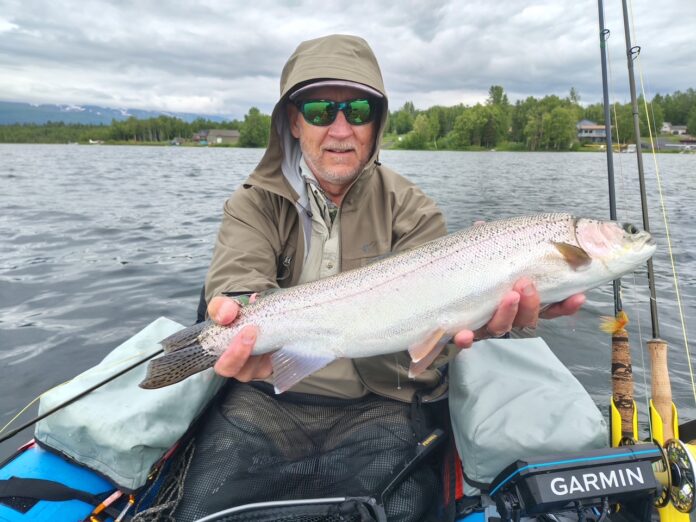
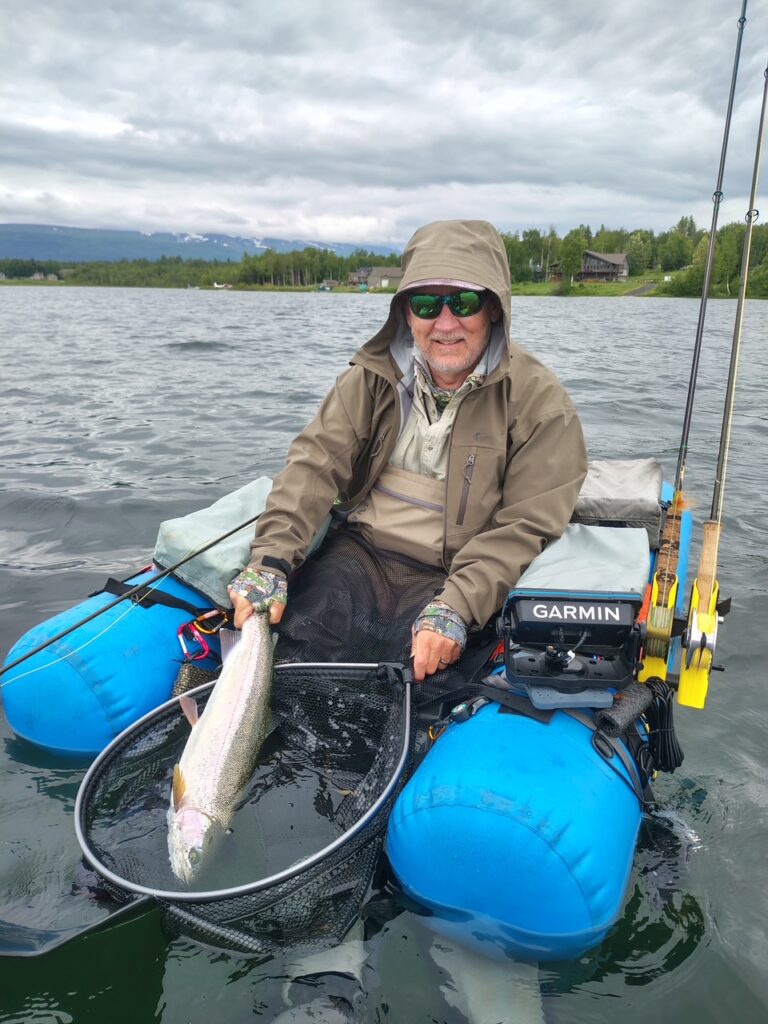
George Krumm Holding a trophy rainbow trout caught while Stillwater Fly Fishing in Alaska

5:07 – Krumm identifies the main food sources in Alaska’s stillwaters—chironomids, scuds, damselfly and dragonfly nymphs, and sticklebacks. He emphasizes that the presence of scuds is often a reliable indicator of a lake’s productivity.

7:12 – According to Krumm, mid-sized lakes ranging from 50 to 200 acres offer the best balance of weed growth and depth. Smaller ponds may freeze too deeply in winter, while large lakes can be difficult to cover effectively.

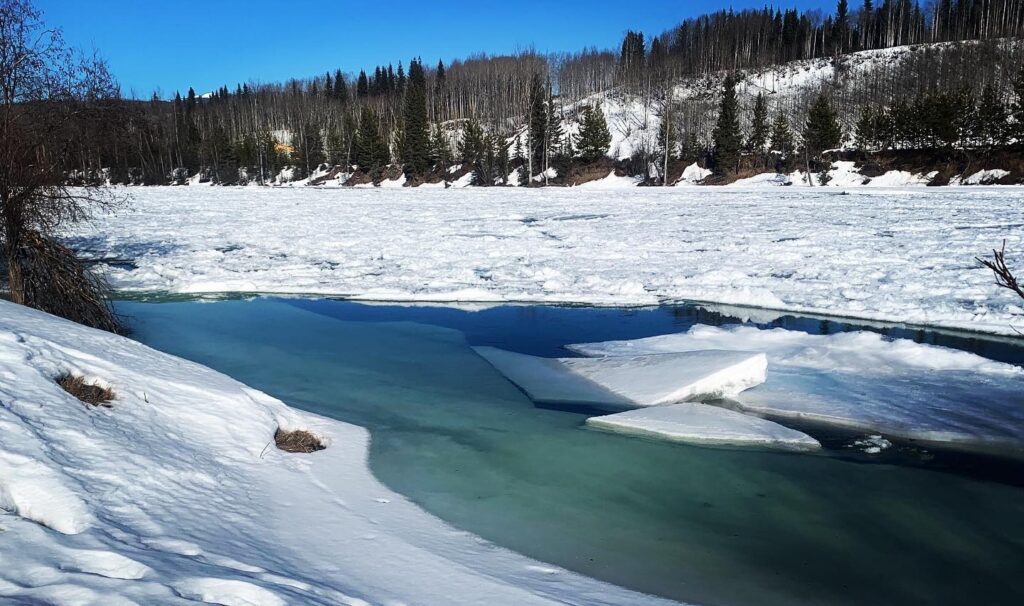
9:25 – Ice-out usually occurs in early May, but Krumm finds that the best stillwater fishing begins roughly two weeks later when water temperatures rise and insect activity peaks. Early season fishing should focus on shallow shoals and vegetated flats where trout feed actively. To find more, click here.

11:33 – Krumm recommends hover or intermediate lines to maintain consistent depth. He explains that these lines allow anglers to keep flies in the strike zone longer without alarming fish.

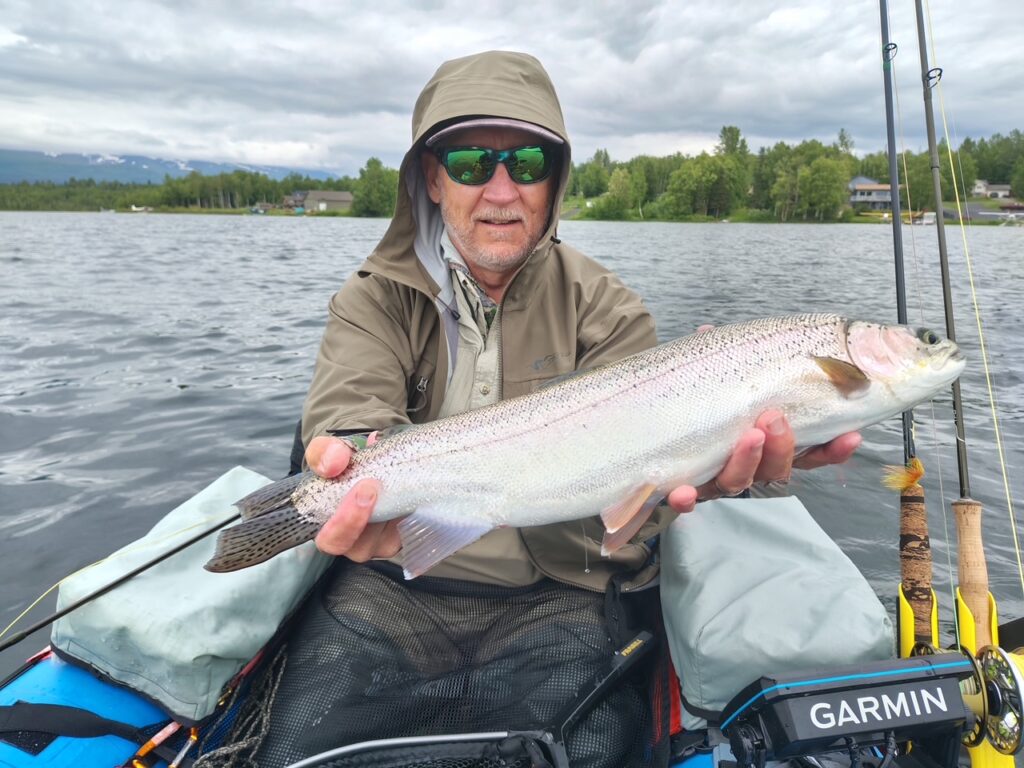
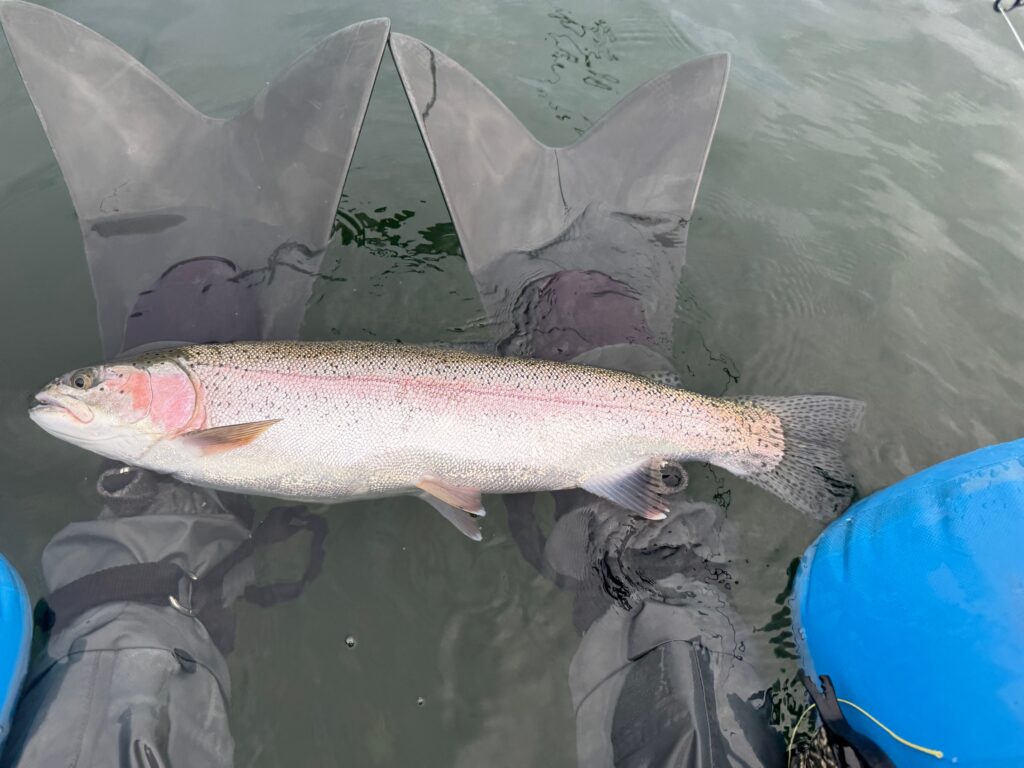
A rainbow trout rests beside a float tube after a successful catch while Stillwater Fly Fishing in Alaska.

13:08 – Among Krumm’s favorites are snow-cone chironomids, olive and brown leeches, and suggestive nymphs. Matching the coloration of local scuds and chironomids is more effective than relying on generic patterns.

15:19 – Krumm typically fishes with a 9-foot, 6-weight rod and a 12-foot fluorocarbon leader. While he occasionally anchors, he prefers wind drifting to present flies naturally across the shoals.

17:48 – He focuses on weed edges, points, and subtle drop-offs, especially where depth transitions from 4 to 10 feet. Krumm adds that anglers should pay attention to wind direction since it pushes insects—and therefore trout—toward the windward shore.

19:56 – Krumm concludes that success in Alaska’s stillwaters comes down to understanding insect life, structure, and patience. Anglers who observe before casting tend to outfish those who rush.

20:12 – Krumm stresses that depth matters more than pattern choice. Trout often cruise within a foot of the weed tops, so maintaining that level with slow retrieves produces more consistent results.

22:28 – Overcast skies and light wind provide better conditions than calm, bright weather. Krumm uses wind-driven chop to disguise movement and break up reflections that might spook fish.

24:36 – Water temperature heavily influences trout behavior. When surface temperatures exceed 60°F, Krumm shifts focus to deeper areas or shaded sections of the lake.

26:41 – As summer approaches, Krumm switches to intermediate or sink lines to reach 10–15 feet. He finds early mornings and evenings most productive when trout feed along cooler edges.

28:59 – Krumm explains that chironomid hatches peak after ice-out and taper by early summer. Matching natural ascent speed with indicators or slow retrieves is crucial for success.

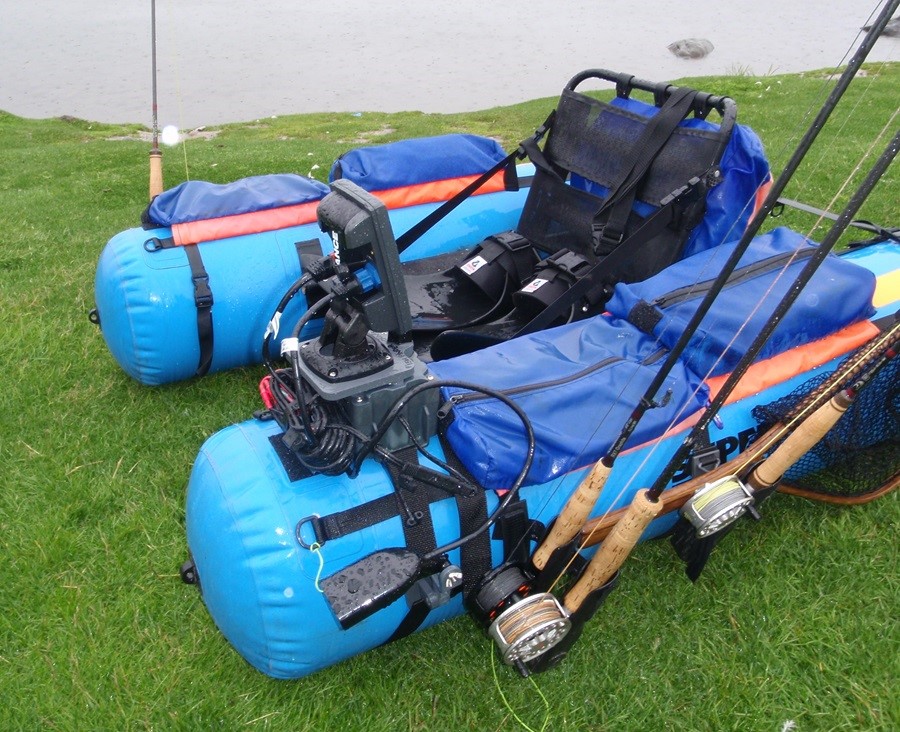
31:17 – He employs portable sonar and bathymetric maps to identify hidden shelves and deep bowls that retain trout through the warmer months.

A float tube rigged with sonar and fly rods—essential tools for precise Stillwater Fly Fishing in Alaska.

33:42 – Krumm highlights how noise and vibration easily spook trout in clear water. He moves quietly, uses fins gently, and minimizes anchor splashes.

35:19 – When hatches slow, Krumm relies on natural-colored leeches, fished slowly and steadily. Their lifelike undulation triggers strikes from inactive fish.

37:46 – Krumm mentions that, beyond trout, several Alaskan lakes also host Arctic char and grayling populations. He recommends exploring multi-species fisheries listed in the ADF&G database. Click here.

39:50 – He concludes that Alaska’s lakes rival the best trout fisheries in North America. Patience and knowledge of ecology distinguish successful stillwater anglers.

40:22 – Krumm identifies several productive lakes across the Mat-Su Valley and Kenai Peninsula. Many are stocked and sustain multiple age classes of trout.

42:36 – He emphasizes the importance of studying vegetation, insect density, and temperature. Lakes with healthy chara beds and scud populations often yield consistent results.

44:18 – Krumm recommends seeking out clear lakes with visible weeds and observing surface movement. Productive lakes often feature shallow coves paired with steep drop-offs.

46:55 – For those new to Alaska stillwaters, Krumm suggests starting on accessible lakes and logging conditions, such as water temperature and insect activity. Consistent note-taking accelerates learning.

48:39 – Krumm reminisces about mornings spent casting into mist-covered lakes and watching trout break the surface. For him, the serenity of Alaska’s stillwaters equals the thrill of catching fish.

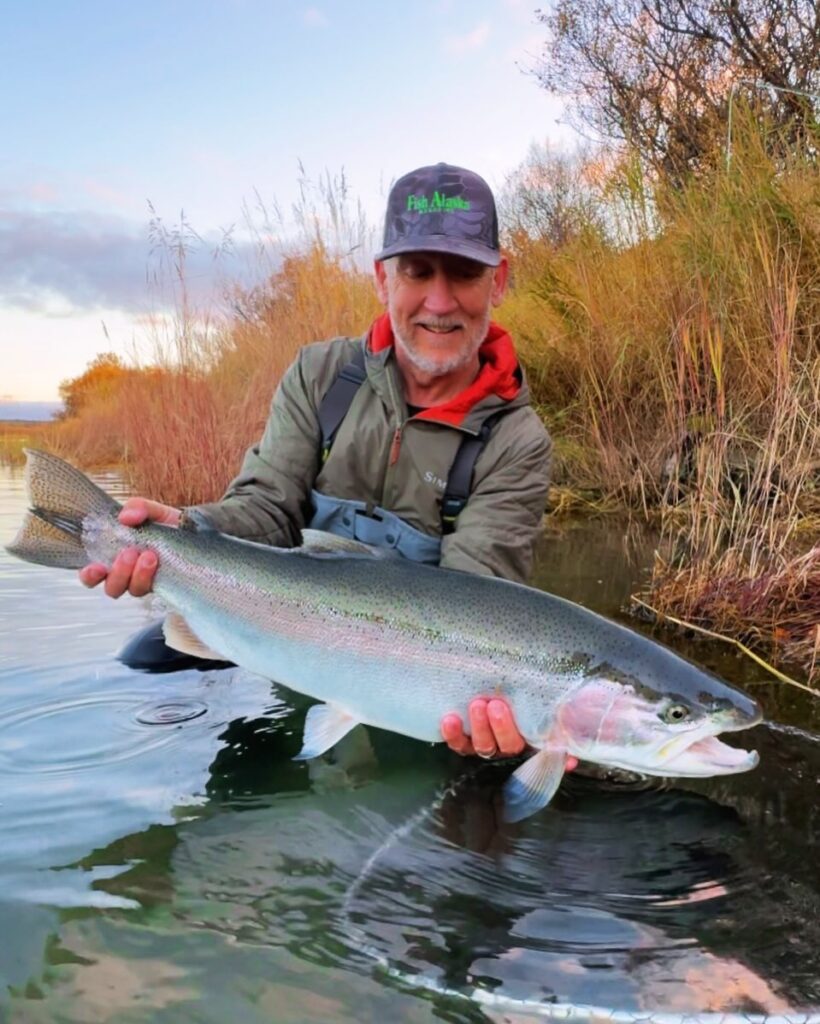
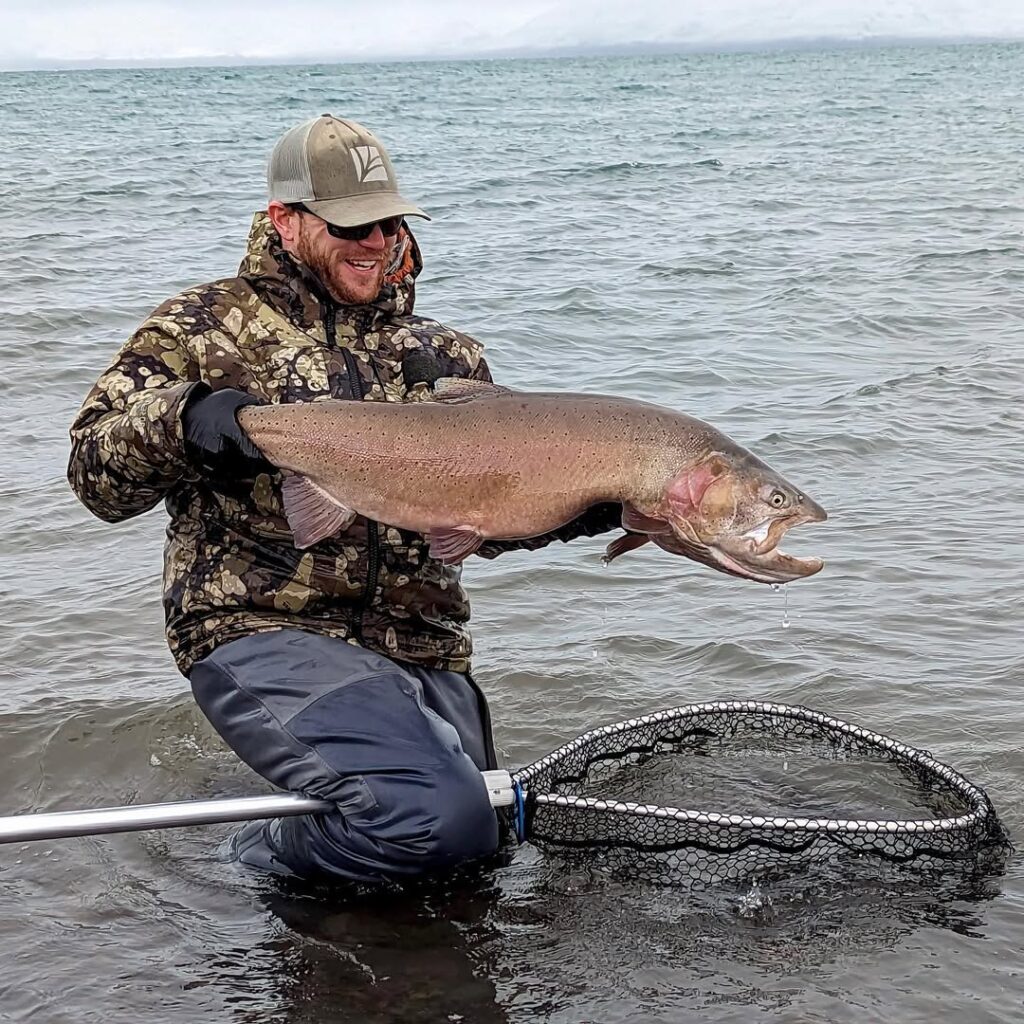
George Krumm nets a rainbow trout during a calm morning of Stillwater Fly Fishing in Alaska.

50:22 – He urges anglers to handle fish responsibly and pack out all trash. Respect for public access and landowner boundaries preserves the future of these waters.

52:03 – Krumm commends the dedication of local fly-fishing clubs that maintain access points and promote ethical angling.

54:37 – Krumm concludes by reminding anglers not to drive past Alaska’s lakes. “Stop, fish them, and you’ll be amazed at what you find,” he says.

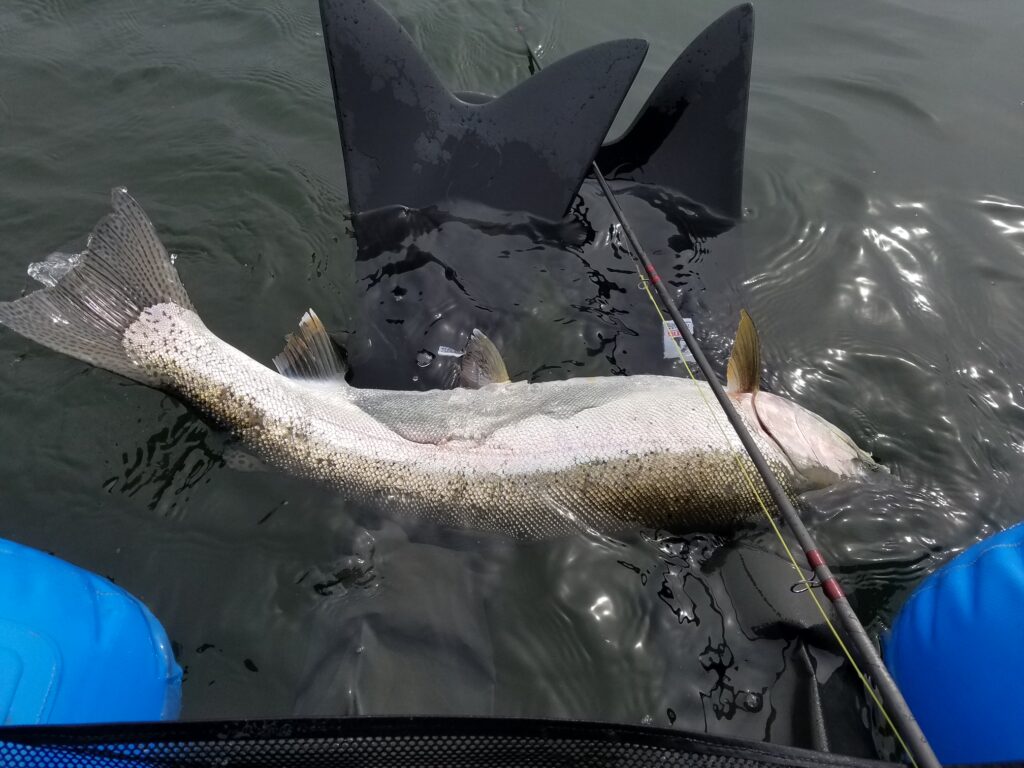
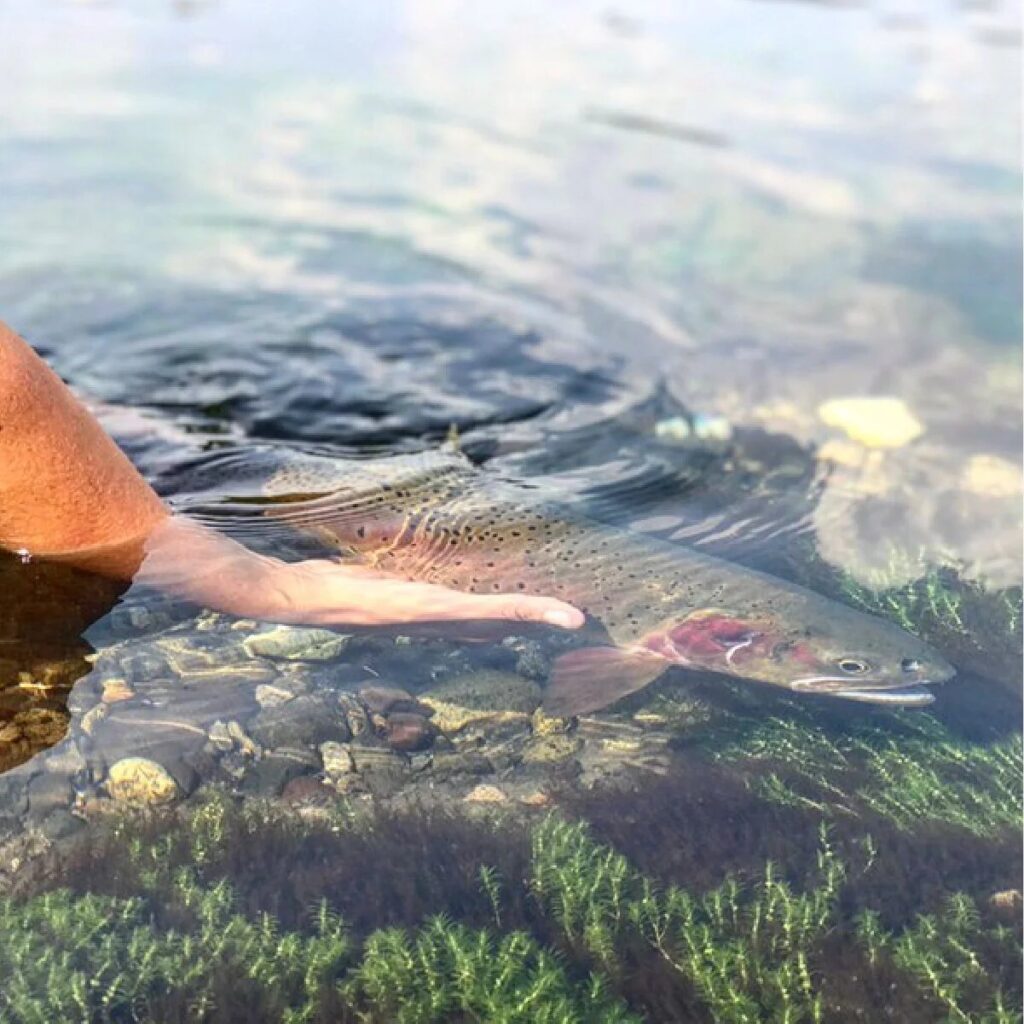
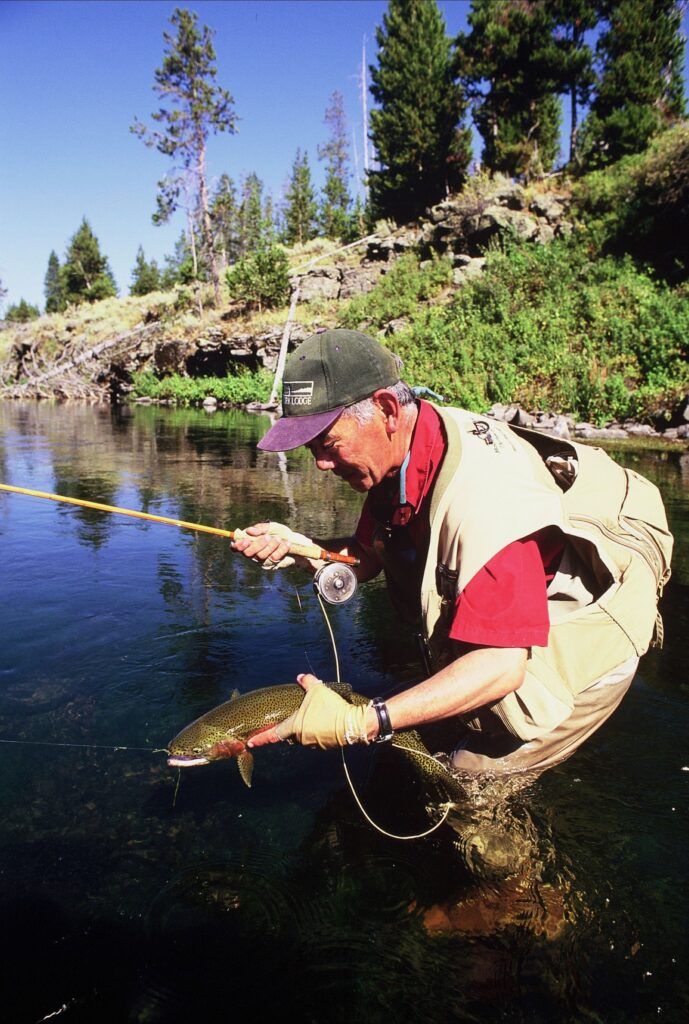
A vibrant rainbow trout rests in the water after a successful day of Stillwater Fly Fishing in Alaska.


You can find George Krumm on his Instagram here.

Top 10 tips

  1. Don’t overlook Alaska’s stillwaters.
  2. Understand what trout feed on.
  3. Focus on timing after ice-out.
  4. Prioritize depth over color.
  5. Retrieve slowly and consistently.
  6. Adjust to seasonal temperature changes.
  7. Use maps and electronics for precision.
  8. Turn to leech patterns when hatches slow.
  9. Practice stealth and patience.
  10. Protect Alaska’s stillwater resources.


Related Podcast Episodes

Full Podcast Transcript

Episode Transcript
WFS 836 Trancript – October 25, 2025 00:00:00 Dave: Today we’re diving into Alaska s hidden frontier. It’s still waters. Today you’re going to find out how to approach still waters across the state, why so many anglers overlook them, and how to find trophy trout in places most people drive right past. By the end of this episode, you’re going to get a roadmap for fishing. Alaska’s still waters like a local, and you’re going to get a new appreciation for why lake fishing might be the next big thing up north. This is the Wet Fly Swing podcast, where I show you the best places to travel to for fly fishing, how to find the best resources and tools to prepare for that big trip, and what you can do to give back to the fish species we all love. George Crum, editor of Fish Alaska magazine, joins us today to break down his background and experience fishing still waters across Alaska’s south central area. You’re going to learn how to find and use digital mapping to find big trout, why trout respond differently in cold northern lakes, and how it’s different from down in the lower forty eight, and what setups George trusts when he’s hunting giants across the Mat-su Valley. Plus, we’re going to dig into why lake fishing deserves more attention from serious fly anglers and how it’s shaping Alaska’s future and fisheries. Here we go. Let’s dig into it, George Crumb. You can find him at fish Alaska Magazine.com. How’s it going, George? 00:01:17 George: Oh, it’s going great. Good to be here, Dave. Thank you. 00:01:20 Dave: Yeah. Thanks for coming back here. We, uh, had you on. It’s been about a year, I think episode six hundred seventy four, where we kind of did a little bit of an overview of, uh, kind of the Grand Slam. We talked about catching, uh, some different species around Alaska today. We’re going to get into one of my other loves is Stillwater fishing. And, um, you know, I think that’s maybe something that gets left out a little bit. I think a lot of people are thinking about salmon. Maybe they’re thinking about catching a big fish on the NAC, NAC or something like that. But lakes have big fish, too. Is that true? Maybe. Tell me that. Do you do a lot of Stillwater and stream fishing? 00:01:54 George: I do, and I have to tell you, man, the best way I can describe the lake. Fishing in south central Alaska is Alaska’s best kept secret. It’s really good. And you’re right, people, both tourists and Alaska residents, are hyper focused on salmon and bottomfish. And they they drive right past all these lakes. And it’s it’s a real shame. And and there’s I have so much I can tell you. I started fishing in the lakes in nineteen ninety four, and I really started fishing them a lot around two thousand or so, somewhere in there. And part of the reason was I, you know, when I moved to Alaska, I thought I was going to find something akin to Ralph Wahl’s Shangri-La in the streams in Alaska. But that was not the case. It really wasn’t. I mean, the really good ones, aside from the Kenai, of course, are hard to get to, and the road system only gets you to so many places. And they got discouraged with all the salmon allocation battles and the declining runs and that sort of thing. You know, with lakes, you don’t have any of that stuff. There’s a whole bunch of them in south central Alaska. I think in the Wasilla area, what we call the the Mat-su Valley, there’s roughly eighty five lakes that are stocked by the Alaska Department of Fish and Game. There are at least fifteen or so wild fish lakes that are not stocked and just have self-sustaining wild populations of fish. Many of these lakes you can drive right up to, there may be houses all the way around the lakes. You go out there and nobody’s fishing. There’s nobody fishing. I’m out there on my float tube by myself. And what’s really cool about it is, uh, in most of these lakes, it’s not like the lower forty eight where if you go to Washington or Oregon and you go to a popular fishing lake on opening day, it’s crowded. Three weeks later, there aren’t many fish left because they’ve all been harvested. And these lakes in Alaska, you’ll have multiple age classes of fish in virtually all of them. And some of these lakes are productive enough to to produce fish up to that holy grail. Thirty inch size range. So it’s it’s fantastic fishing. 00:03:59 Dave: No kidding. So you can get something. That’s always the interesting thing because with Alaska, you know we’ve talked a lot about this that these rainbows especially get giant because they’re eating meat, you know and all that stuff. But but in the lakes you know in lakes I guess down maybe in the lower forty eight, some of these lakes in the desert and stuff, there’s tons of food. But how are they getting big? Is there lots of food or how is that working? How are those big fish getting big up there? 00:04:22 George: That’s a really good question. I’m going to tell you. I’m going to answer that from a couple different angles. First, I will tell you that the lakes in which I catch the biggest fish tend to be stocked lakes. And of those stocked lakes, the lakes where I catch the biggest fish, they tend to stock them as fingerlings. So they’re, you know, two and a half inches long, two inches long, something like that. They’re very small. They grow up in the lake and the school of hard knocks and the ones that survive end up acting very much like a naturally produced fish and they are difficult to catch. They’re sensitive to their environment, and you can’t just go plowing through there and expect them to bite. They’ll just stop biting. If if they know that you’re around and you’re making a bunch of noise and that sort of stuff. So first, stock lakes are producing the biggest fish, particularly those that are stocked with fingerlings. The second thing I’ll say is these lakes are not all the same water chemistry wise and productivity wise, and they’re not exactly like the lakes of the high desert that produce big fish in the lower forty eight. The food sources are very similar. And I will say this as far as food sources, if you find a lake in Alaska that has gamma ray scuds, it tends to produce very large fish faster than other lakes. And that’s a clue for you. I won’t tell you which ones those are. You can go out and stain them yourself. 00:05:46 Dave: We’ll figure it out. Yeah, Scuds. But Scuds are a key food item in the lake. 00:05:51 George: For for the lakes that have very large fish. They also tend to have gamma ray scuds. Now, all the Stillwater foods that you see in the lower forty eight are are common up here. You’ve got a lot of chironomids. Um, what you don’t have up, you have damselfly nymphs, dragonfly nymphs. You have, uh, sticklebacks, which are forage fish that can be confounding at certain times of the summer, like August. Uh, what you don’t see up here are many mayflies. Very few. You won’t see a giant callibaetis hatch up here over the course of a summer. Uh, even back when I was fishing, there was a period of my life where I was doing commercial real estate, and I think I was fishing more than I was doing real estate. But even back then, when I was on the lakes every other day, it seemed like you rarely saw mayfly. You might see one or two pop up during the course of a day, but very few. It’s a, you know, the other food sources that are common to Stillwater. These fish tend to key in on. 00:06:44 Dave: Gotcha. So it’s those other ones. And and do you have just kind of checking in here? We, uh fish Alaska magazine is the magazine that you’re the editor on, right? We talked about that in the last one. What is there? Do you have any content there where people could follow up after this episode where you talk about Stillwaters? 00:07:02 George: Sure. You can go to our website and do a search for articles, and if you’re a subscriber, you can view every article that we’ve ever produced. I think if you’re not a subscriber, you can view a selection of them. And if you do a search on Stillwater or something like that, you should be able to get something to pull up. But I’ll also add that I actually wrote a column in the magazine called Stillwater for nine years, basically starting in twenty twelve. And, uh, since then, you know, you can only do something like that for so long before the material starts to get old and you’re going to be rehashing the same stuff. So we switched it to just fly fishing after that nine year period. And I still write that one. 00:07:41 Dave: There you go. So that’s it. So and then also so let’s just take it back a little bit to uh, step back in south central Alaska. Can you describe the boundaries of where South Central is. 00:07:51 George: Sure. South Central Alaska is basically the Anchorage area. I think the most populated area, the area with the most roads. And um, if you were to try to define it, I would put the northernmost boundary somewhere up near Talkeetna, probably not quite that far. And to the south we’ll go all the way down to Kenai Nikiski area. 00:08:15 Dave: Okay. That’s it. And then and then pretty much if you go east or west, you’re running out of roads, right? Or. Well, if you go west, there’s not a lot of roads that go that way. Right. 00:08:23 George: Yeah. There’s there’s water. 00:08:25 Dave: Yeah. It’s just water. 00:08:26 George: At least in the Anchorage area it’s water. And uh, you know, as you as you get farther north past Wasilla, then, you know, you can go west and there are some more lakes over there that are still part of the same area that I’m talking about. It’s a big area, you know, there’s a lot of lakes and it’s easy if you have the energy. You’re a young guy, you can fish three or four lakes in a day. Now granted, some of these lakes are big enough that you’re not going to fish the whole lake and you’re not going to figure the entire lake out. Figure it out. Lakes is tough, but you can drop into three or four lakes in a day because they’re pretty close together. 00:08:59 Dave: And when you let’s just take a lake. I mean, are there lots of different sizes? Do you have a specific size of lake that you like to fish out there? 00:09:08 George: Um, I don’t fish the really tiny lakes very much because I think that they’re limited from a productivity standpoint and can only produce so many fish. And the chance of getting a real whopper out of some of the tiny lakes is pretty slim. I’m looking at lakes that are basically fifty acres or bigger. Uh, some of these lakes are much bigger than that, but, uh, a lot of them are in the, I don’t know, one hundred and fifty, two hundred acre size probably. 00:09:33 Dave: Yeah. Gotcha. And what is it like maybe talk about the fishing you mentioned a little bit Chironomids. What is the technique you’re using most often? We were just talking to somebody there or somebody on another episode that was talking about fishing. We didn’t get into it real deep, but he fishes. mouse patterns and just stuff on the surface and he says, man, you can do awesome with stuff on the surface. But I hadn’t heard about that. But what are you doing out there in Alaska? 00:09:55 George: That’s a good question. Um, I like to catch big fish. I like to catch a lot of fish too. But more, I like to catch big fish more than I like to catch a lot of fish. I think if you were to fish. I know for a fact that if you fish some of these lakes, especially the ones that are heavily stocked with catchable with dry flies, you can catch a bunch of small fish. But the big fish don’t show themselves very often. Every once in a while you’ll see one role, but I don’t think it’s a feeding behavior. I think maybe he’s trying to capture some air for his air bladder or something like that, but they just you don’t see the big fish show themselves? Very much. So. I’m fishing subsurface about ninety nine percent of the time, sometimes close to the surface, but not usually. Usually I’m down there a ways, and what I’m using for fly lines, um, and flies changes throughout the seasons. lakes are really dynamic. Most people don’t think about that. I mean, the lake is not moving. There’s no current seams or any of that stuff. But underneath, things are changing daily, day by day. So early in the season, the ice goes out. A lot of people blindly state that, oh, right after the ice out, that’s the time you want to be there. Well, not in my not in my experience. What I have experienced over years of fishing these lakes up there is it takes a few weeks for the food chain to really get ramped up, and the water temperatures to come up enough for rainbow trout metabolism to really kick into high gear. So I like the period from about two weeks after I saw it on. And when I start, I’m using usually fishing fairly shallow, shallow water from four to maybe seven feet deep. I’m looking for Potamogeton weed beds, chara weed beds, which tend to provide a good habitat for food sources, and oxygen, of course. And those weed beds won’t be very tall. There will be some leftover strands from the previous year, but they won’t be very tall early in the season. But the fish will be there, and I’m usually fishing a hover line or a floating line with a small generic buggie nymph, or a booger, or an indicator Necron. Early in the season, and I’ll do that from when the ice goes out, which is which averages in this area of the state that we’re talking about, the ice goes out on these lakes on average about May six, may seven. Sometimes it’s two weeks earlier than that, sometimes it’s a little bit later than that. So if I were planning a trip, if you’re thinking you want to do this, this is a great do it yourself trip. I would plan for May fifteenth or later. Make sure the ice is off. 00:12:25 Dave: Yep. Perfect. So May fifteenth. So ice is off and then you start getting some action. And then, um, when do you think is is there a prime time or talk about the rest of the season? 00:12:35 George: May fifteenth to June tenth is a really hot time period. Uh, after June tenth, things are changing. The chironomids the big push of corona. And not all lakes up there get big chironomid hatches, but the fish know what they are in all the lakes and they rarely pass one up. But the big chironomid hatches will taper off dramatically by the time you start getting into June. And what takes their place are damselflies. Damselflies start migrating. In early June, water temperatures begin to rise and the fish spend less time in that four to six foot range. They’re starting to patrol out, more like the five to nine foot range. And those fish, they’re not always in one place, and not every fish in the lake is doing the same darn thing, so you can catch them a variety of different ways. I tend to fish areas that I think are good feeding areas for trout. I’ll call it the fishes dining room and I try not to go plowing through there. I try to approach it from the perimeter and I cast into it. Those areas are hard to learn. If you don’t know them, you’ll have to find them somehow. And you do that by time on the water. Sometimes you’re trolling through it and you start noticing that you catch certain fish in certain places, but you have to find those areas anyway. If I, you know, five to seven feet, five to nine feet, when we start getting into June, watch for the damselfly migration. And the damselflies in most lakes in Alaska act a little bit differently than they do, um, say in the high desert areas and some of these high desert areas. The damselflies will swim to the surface, then they’ll swim towards shore. Oh, here you’ll see some swimming around near the surface, but most of them swim near the bottom, or crawl along the bottom and crawl out on vegetation. So it’s a little bit different, um, behavior in my experience. 00:14:19 Dave: Yeah. Okay. And what is the maybe what’s a damselfly pattern you’re using. And talk about how you might fish that one. 00:14:26 George: I tie most of my flies that I fish and, uh, any commercially tied damselfly will work, but what I typically use is tied on a short shank hook. Fairly small, like a ten or twelve. Probably a twelve. It has a marabou tail, a dubbed body with a rib, and it has eyes. 00:14:44 Dave: Right. And this is a nymph. This is kind of a nymph pattern. 00:14:47 George: This is damselfly nymph pattern. And it’s very simple, very suggestive. It’s not an exact replica. The color is kind of important. Damselfly nymphs vary from body of water, but amberish green sort of ginger colored is a good color up. In Alaska you see a lot of ginger colored. We also have some damselflies that are very dark in color. In the water they look almost brown or maroon, but when you pull them out of the water, they look a little bit different. They don’t look quite that dark. But there are some of those. 00:15:16 Dave: Okay. Yeah, damsels are interesting. Not a pattern. I fished a ton because they’re not really that frequent in streams, right? They’re more known as a lake pattern. 00:15:25 George: Yeah, they’re a lake pattern and they are an important one. They’re a good source, you know, they’re pretty good size nymph. And and the fish like them. 00:15:32 Dave: So if it is in that June period and you’re fishing damsels talk about how you’re efficient. So you’re looking for kind of the shoal area those kind of shallower. 00:15:42 George: Yeah I’m definitely looking for the shoal areas and in some cases the shoreline areas. I’m looking for clues like in the lower forty eight when there’s a heavy damselfly migration in progress. Because a lot of those lakes, the damselflies come to the surface and then swim towards shore. You’ll see a lot of surface activity, fish boiling and and eating them. We don’t see quite as much of that. Like I said, in Alaska, the fish tend to stay below the surface of big fish. But I am watching for that. And I mean in lakes, because you don’t have current streams and spawning sockeyes, you need every clue that you can get. And if you do happen to see a big fish role, say, you know, forty yards over that way, well, that fish is there. He’s there for a reason. If it was me, that’s that’s my clue. It might be the only clue you get that day. I’m probably going to go over that way and carefully fish that area. Because if I don’t disturb that fish, I can probably catch him because fish and lakes are opportunistic, and one of the really cool things about Alaska in these lakes is they get so little fishing pressure that the fish are not extremely educated. You know, when you start talking about the Kamloops area, BC or these lakes in eastern Washington, eastern Oregon, you go to Lake Louise in eastern Washington, and there’s twenty float tubes out there. The fish start getting smart, not in the lakes on fishing up in Alaska. I mean, you could use any generic Chironomid pattern during acronym, acronym Hatch, and you’re probably going to catch fish. In fact, I’ll elaborate on that. The chironomid pattern that I use the most in Alaska is a simple snow cone ice cream cone, black with a red rib white bead that’ll catch fish in any chironomid hatch in Alaska because they’re just not that sophisticated. I’ll add this if the average size bug that’s coming up is a size fourteen, I’m going to use a size twelve every time. It’s not a good match, but it stands out from the crowd. 00:17:37 Dave: Right, right, right. That’s a good tip. So okay, this is good. And you mentioned Kamloops, which is always good because we’re doing some some stuff down there. And I always think of Kamloops and some of that areas as places that have some of these trophy fish. But you also sounds like in Alaska you have some of these. So your best method for finding some of these bigger fish is you’re looking for them. If they’re making if they’re showing themselves, is that the most effective way to find some of these big fish? 00:18:02 George: Once you’re on the water, it’s important to keep your eyes open and to do that. But before you ever get to the water, there are things that you can do to help yourself. Like if I was down in the lower forty eight and I’m planning, I think, you know, I heard George’s podcast, this sounds really good. I want to do it. Yeah. Well, go to a website called the Alaska Lakes Database. It’s put out by the Alaska Department of Fish and Game. They call it all that for short. Aldi Alaska Lakes database. In there you can see all the lakes that are stocked, all the lakes that are not stocked. You can see some lakes that were previously stocked. If you pull up and click on that particular lake, you can get some additional information like when it was stocked, what was stocked, what was the average size fish that was stocked, how many were stocked? And in addition to that, a lot of these lakes have granted they’re relatively crude, but they have bathymetric maps that you can look at. And if you look at these bathymetric maps with just a little bit of experience, you can figure out where the weeds are going to be in these lakes. You can see the shoal areas by the, you know, wide spaced out, um, contour lines. And those contour lines are important. I like to see I like to see a fairly wide, broad shoal area with a drop on the edge of it. And most of the time when I’m fishing these, I’m going to be out there over the drop somewhere, and I’m casting towards the shoal. When you get on the water, you may have to modify that approach depending on which way the wind is blowing, but blowing. But that’s what I’m going to do. And I tell you, learning lakes is very difficult. I, I, I don’t know how many thousands of hours I’ve spent on, on these lakes and I’m talking about. But it’s a lot. And learning them, I gotta tell you, when I was first starting to do it, I was trolling a lot. I put on a booger and I just start trolling. 00:19:49 Dave: That’s right. Old trolling method. 00:19:51 George: Yep. 00:19:51 Dave: And which which works, right? Which can work. 00:19:53 George: But yes, you will. You will catch fish, especially in Alaska. And you can catch some big fish. Tuna. I can remember this one lake I’m trolling along the shoreline, the waters between five and seven feet. I’m using a floating line. And at the time, because there were some rather large leeches in some lakes, I was using a booger pattern that, although it was tied on like a size six hook, it was probably three inches long. I mean, it was a big booger, and, uh, I caught some giant fish doing that. It wasn’t so much that I was a great fisherman, but what that pointed out to me is I noticed I was catching these fish over and over again in the same general locations. So I began to learn where those dining rooms were, if you will. And at certain times of the year they go to different dining rooms. But, you know, if you take good notes, you’ll know that in this lake I need to be in this area at this time of year, and the fish are going to be in five to seven feet of water, and then you don’t have to troll through them. You can be out there on the perimeter and cast them. I will say this once I started locating some of those areas and I stopped trolling and I started casting to cover the water and quit moving through where the fish were, I started catching many more fish and bigger fish. 00:21:01 Dave: Yeah, that makes sense. I mean, I think that’s the challenge with trolling, is that you’re a lot of times kicking. Well, if you’re in a or rowing through the water where the fish are before your fly gets there. 00:21:11 George: That’s true. And they move. And I don’t think they fish. Like I said, these fish don’t get the pressure they get in other places, but they’re they’re still sensitive to their environment. And when they get disturbed, everything stops for a while. They don’t necessarily leave that zip code, but they stop doing what they’re doing. They move away from the disturbance and the chance of getting bit goes down a little bit. 00:21:30 Dave: Okay. So go back on the damsel. So when you’re fishing that damsel you got your pattern. You got your sounds like hover dry line. Are you casting out letting it sink. Talk about that how you’re fishing those. 00:21:40 George: Yeah. If I’m fishing a damsel and let’s say, you know, depending on water temperature, it could be as shallow as four feet. I could, you know, the water that I’m targeting, or it could be as deep as six or seven feet. I’m going to cast it out with that hover line, and I am going to let it sink. And my damsel patterns are not heavily weighted. They’re usually unweighted or barely weighted. I don’t want them sinking faster faster than my fly line. Ideally, if I could make my fly sink at exactly the same rate of my fly line, that’s that’s what I would want to do. Because then everything is straight. And if a fish breathes on your fly, you can feel it. I’m going to cast out. I’m going to let it sink the appropriate amount. If I’m really being technical, I’ll actually count in seconds in my head how long I’m letting it sink so I can keep track. Then I’m going to begin to retrieve and retrieve should be slow. Slow? These critters in the water are not. They’re not racehorses. Most people retrieve far too fast, and you’ll still catch some fish with a fast retrieve. You’ll get a fish that is in the mood to chase, you know, and you’ll get a reaction bite. But generally, these fish, these bugs are moving very slowly. And that’s why I like the hover line. It just kind of melts into the water, and it takes forever for it to get to the bottom in five feet of water. That’s what I want. I want that thing sinking so slowly that I can fish. You know, let’s say I made a fifty or sixty foot cast. It might take me a minute or more to get that fly back to me, and I won’t catch the weeds. That’s what I want. Because I will say this. Although these fish are not pressured, you get just a little bit of weeds or debris on your fly and they won’t bite it. 00:23:14 Dave: That’s right. Yeah. How do you avoid that? That seems like a challenge of. And how do you know? I guess you know when you get something on. But how do you avoid getting the weeds on your fly? 00:23:22 George: Well, fishing with that hover line in that shallow water helps a lot. Fishing with an unweighted fly house a lot. It’s better that for the fly to be in the water column doing nothing than it is to be winding up in the weeds. 00:23:33 Dave: Yeah, I guess that’s what you could do. You make your cast and you kind of trial and error. So. So you make your cast out there, um, into the shoulder where you think the fish might be, and then you slowly. And is the strip kind of like, um. Describe that. It’s like about as slow as you can pull it, just like slow, you know. How would you describe it? 00:23:51 George: Yeah, it’s pretty slow. And if you watch a damselfly, uh, nymph swim, you cannot imitate that very well. Okay. They they wiggle side to side and you can put a bead head on it, and that’s going to make it wiggle up and down, but you’re going to have to fish it a little faster because that bead is going to make it sink. And again you don’t want to catch weeds. Your downtime is your enemy. So um, when I’m typically doing is I’m doing a hand twist retrieve, uh, kind of slow. And, uh, every once in a while, I’ll give it a quick snap. It’s not really a strip, it’s I’m using my fingers to instead of hand twist it slowly, I’m doing a quick one or two hand twists. I mean, it’s a very quick one, two. 00:24:32 Dave: Okay. 00:24:32 George: And that’s basically just me trying to make the fly say, look at me. 00:24:37 Dave: Yeah. So you’re doing so you’re doing some slow, mostly slow retrieves, but then you might switch in a little quick twitch to make it give it some life. 00:24:43 George: That’s right. And it’s just saying, hey, look at me, look at me, you know. And then back to the normal, slow retrieve. Efficient Stillwater. You know, they have all the time in the world to inspect your fly. And I think I think that they do sometimes. And if you start moving it too fast, they just turn away and look for the next bug to eat. So we want something to get their attention, but then we want to go back to very slow. And I’m telling you, I wrote about one time a retrieve called the Do Nothing retrieve. I was using an unweighted fly. It was basically a mini leech of sorts of sorts with a floating fly line, and I was fishing a similar type of water that we’re talking about. I would cast out. I’m holding myself in the wind. The wind is blowing on me. And I’m just using my fins to to hold myself as best I can on the contour line that my depth finder is telling me I’m at. And then I’m basically just trying to keep the line straight. And sometimes the fly just sitting there is all you need. It’s just like sitting under a bobber. I mean, if it’s in the area that, you know, at the level that the fish are at on the contour line that the fish are at and it looks like food, they’re probably going to eat it. 00:25:48 Dave: That’s right. Okay. Perfect. So and you mentioned depth finder. Maybe. Let’s hear that on a little bit. You mentioned float tubes. Are you also fishing boats out there. And talk about your sonar depth finder. Whatever you use in there. 00:26:01 George: And some of the lakes a boat can be an advantage. And I’ll give an example of a fairly popular lake in South Central that has rainbow trout, Arctic char, burbot, and some other species too. But it’s called Big Lake and it’s in the Wasilla area. I used to ice fish it a lot as well. For Arctic char. It is a big lake and it’s got a couple public accesses, and you can go out there and catch some fish in a float tube in those areas. And I don’t feel handicapped doing that because nobody else is out there doing it. It’s the weirdest thing. But if I was serious about chasing Arctic char in that lake, and I’m saying I’m going to use a type six line and I’m going to fish water from fifteen to twenty five feet deep, you can catch them. I have done it both in my float tube and a boat. A boat would be helpful because you can simply go to more structure during the course of the day with a float tube. You’re very limited on your range. 00:26:53 Dave: Yeah that’s right. But it sounds like you do use a float tube quite a bit out there. 00:26:57 George: Almost exclusively. 00:26:58 Dave: Yeah. Maybe. Describe that. What’s your. There’s a ton of floats. In fact, we have Chris Callahan from Outkast. We’re going to be talking to him again soon. But what’s your. Are you using, like, a pontoon or what’s your style? 00:27:10 George: Yeah, it’s a good, good question. I fished in several different ones. The Outcast Prowler was one of my favorites. It’s a big float tube. It’s pretty comfy. It’s more comfortable than, say, the fish cat, for which I’ve spent lots and lots of time in. Both of those are not bad float tubes. But, you know, I’m I’ve got an addictive personality, and I might go out there and I might be on the water for ten or twelve hours if I have the time. I mean, I’m going to learn. I’m going to I’m out there to learn. And I have spent that much time out there. More commonly, it’s, you know, it’s probably my average trip, probably more like six hours now. But I can tell you this if your float tube is uncomfortable, six hours, you’re going to your butt’s gonna be sore. Your back might be hurting. 00:27:52 Dave: Yeah, that’s not good. 00:27:53 George: That’s not good. So the most comfortable float tube that I’ve used is they’ll call it a pontoon boat, but I call it a float tube. Is a supercat made by New World Manufacturing. It’s the same tube that Danny Rickards promoted for a long time. 00:28:08 Dave: Yeah, yeah. Danny Rickards. Okay. Yeah, I got you. And this is the. I’m looking at it now. Yeah. The supercat and it’s kind of a pontoon. 00:28:16 Speaker 3: Yeah. It looks, it looks, it looks like two Vienna. 00:28:19 George: Sausages. 00:28:19 Speaker 3: That are blue. 00:28:20 Dave: Yeah, it’s really unique. Yeah. This does not look like your your other outcast boats. It looks like two tubes that are kind of like sausages put together. And then you got a chair in the middle. So why is that one more comfortable than, say, some of the other ones out there. 00:28:32 George: It’s not only more comfortable, it’s more functional. The frame in between those two sausages is is basically a backpack frame. And the seat is mesh. It’s a heavy duty mesh. It’s very form fitting and comfortable and you can raise your elevation, I think. I think up to two or three inches. You can vary the elevation that you’re sitting, which is helpful when the water is cold or you’re fishing late in the season or really early in the season because less of you is in the water and you’ll be more comfortable. But that’s only part of it. Um, it’s really comfortable. That mesh seat is the most comfortable float tube seat I have ever sat in by far, but that’s only part of the story. The other part is, see those big, long, straight pontoons? Yeah, they provide a huge amount of space to add things like your sonar rod holders and all that stuff. And when I go float tube fishing out in these lakes, I usually have at least three fully rigged rods on my float tube. Wow. Sometimes four. So we talked some about, you know, lakes being dynamic and fishing during the seasons. Early in the season, I’m going to go out there with a floating line with an indicator on it. I’m going to have a hover line and I’m going to have a standard intermediate clear camo type line for sure. Early in the season, that’s what’s going to be on my tube. And I’ve got to have a means. I don’t want to change spools on the water. That’s too much downtime. I’d much rather just grab the next rod if I’m going to change the presentation. 00:30:00 Dave: Right. And on that boat, you would have your rods be broken down and you just put them together? 00:30:04 George: Nope. They’re full length. 00:30:05 Dave: Oh, they’re full length. So you got full length rods all set up? Ready to go? 00:30:08 George: That’s right. I have to send you a picture of it. 00:30:10 Dave: Yeah. You have to send a picture. Yeah. So so that’s interesting. I really I mean, I’ve heard these boats, but I wasn’t aware they had so many features and and so I guess the difference between again back to the boat. So this versus I mean, if you had a boat like a John boat or whatever out there, you would have more room and all of that. But what is the disadvantage of a boat? It’s just harder to get into some of these lakes. 00:30:29 George: Well, um, most any lakes that stocked is required to have public access, but that public access is sometimes a narrow, bumpy dirt road that goes straight to the water with very little parking, no facilities. So a little John boat is okay. They’re pretty easy to launch, but they’re noisy. I would recommend putting indoor outdoor carpeting, astroturf, something on the bottom of them for sure. I would suggest getting two anchors, uh, with good systems, to quietly deploy them, because you go to these areas once you start learning the lakes and you know where the fish are, you want to get within casting range, but then you want to slowly anchor or carefully quietly anchor your boat so that you’re in position to fish those fish. Some advantages of the boat. Or you can stand up and cast. 00:31:15 Dave: Oh, wow. You can stand up in that boat. 00:31:17 George: Well, not in this float tube I’m talking about. But if you’re in a boat, like a John boat. 00:31:21 Dave: Yeah, yeah, that’s that’s one of the advantages. Yeah. You can stand up. 00:31:23 George: Yeah, you can stand up and cast. And it’s a lot easier to cast, you know, fifty, sixty, however far you want to cast standing up than it is when you’re, you know, but deep in the water for me, you know, I can grab that float tube and carry it fifty yards to the water or twenty yards to the water or ten feet to the water, whatever I need to do very easily. The boat is just a little bit harder to do that with and in. And another thing is some of these lakes, uh, there is no actual boat launch. You have a trail that goes to the water that might be, like I said, forty yards long, fifty yards long, or it might be a third of a mile. So you’re going to have to walk in. 00:32:00 Dave: Yeah. That’s it. No, it makes sense. And I’m just looking at the website now too on uh supercat dot us and it says lite, lightweight, rugged, ready for the wild. Right. I mean that that’s the advantage. You could take this thing and I’m guessing that you could even. What if you had to pack it? Is this a packable thing? If you were really going on a longer trip? 00:32:17 George: Yes. The seatback folds down flat. It becomes essentially a backpack frame. The straps. I don’t know if you were looking at the picture, but the straps that hold the seatback upright become your backpack straps and you can actually rotate the T tubes closer together if you want, and hold them together with a strap that’s behind the seat. Um, I when I, when I usually do that, I’ll put the tube, I’ll put the backpack straps on. So I’m carrying the tube, my sonar, which is strapped on with a wide piece of web belt. I’ll basically loop over my shoulder so it’s not on the tube when I’m when I’m hiking in, my rods will be in my hand and I can, I can, you know, if I have to. There’s a place in the Matanuska Lake State rec area called Long Lake, which is a supposedly a quality fishery where you can’t use bait. You got to walk to get to that thing, and you can walk down a really steep hill or you can walk an easier but longer path to the other end of the lake. And that’s that’s how I would do it, as I would, just like I described. So that that capability is helpful. 00:33:23 Dave: Yeah. That’s awesome. Okay. I’m glad we went down this track on the boats because this is a killer boat. I mean, in the price, actually, I’m not sure what it cost with all the features, but I mean, you’re talking under a thousand bucks for the boat, which sounds like this is a killer boat. 00:33:35 George: They’re also very, very, very durable. 00:34:27 Dave: It looks like they have the same pontoon like material you would have on a raft. 00:34:31 Speaker 4: That’s correct. 00:34:32 Dave: Yeah, it’s like the actual I don’t know what it is they’re using, but it’s it’s real, real deal stuff. Yeah, yeah. Okay, good. And, um, let’s go back to the time of year. So you got June. What happens after the dams into July, August. Talk about the change there. 00:34:46 George: There’s some overlap that happens in June. In the early part, you still have some chironomids popping up in decent numbers in some of the lakes. You got the damselfly thing happening. By the time you get to mid-June, the dragonflies are starting to migrate towards shore. And uh, all through the latter half of June and July, you’ve got dragonfly migration going on. Some of these lakes have the little stubby, spider like looking dragonfly nymphs. Others have the great big darner type dragonflies that you know wind up being four inches long as adults. The fish like those things and I tell you, I’ve been. I’ve caught a lot of fish in my life and I don’t break very many fish off. But when I do, it’s a lot of times it’s while I’m fishing dragonfly nymphs in the lakes because they pound those things. Sometimes it’s like they know they can get away because the dragonfly can, you know, kind of use jet propulsion to spurt forward a couple inches. The fish know that. So when they bite it, sometimes they do it with authority. Wow. I use I use three x tippets most of the times in Alaska’s lakes. Sometimes I’ll go down to four x, but I don’t think you need to. But with dragonfly dragonfly nymphs I’m usually using two x two x. 00:35:53 Dave: Okay. What’s your typical leader setup? If you’re fishing, uh, you know, dragonflies, damselflies. What are you using there? How long? 00:36:00 George: Well, with dragonflies, I’m going to use a leader that’s twelve feet long. Most likely tapered to three x on that hover line. Most likely, maybe on a regular intermediate line if I’m fishing a little bit deeper water with dragonflies early on, I’m going to fish probably a little bit deeper than I would say in mid-June. I’m probably going to fish a little deeper with dragonfly nymphs than I would in early July, but I have a preference for two styles of dragonflies and what fly line I use and what leader I use depends on which fly I’m using. A carry special type pattern is a dragonfly nymph imitation. 00:36:35 Dave: Oh yeah. Carry special go classic. 00:36:38 George: With that I’m probably going to use an intermediate line and my leader will be probably nine feet long, ten feet long, eleven feet long somewhere in there. The challenge with fishing that style is dragonflies like weeds. And you’re going to be fishing around weeds. The key, of course, is to get it down close to the tops of the weeds without catching weeds. So you’re going to have to count down and pay attention to how long you’re letting that sink in time. I went to the easy button and that is regardless of the depth that I’m fishing a dragonfly nymph, I’m going to use a sinking line. It will be a tight three or even a type six. Type six has advantages and then it gets to the bottom faster. I’m going to use, um, a trick out of Randall Kaufman’s playbook from his book Love Fishing With a fly that I think he wrote with Ron Cordes in two nineteen eighty four. Maybe. 00:37:30 Dave: What was this book on Randall Lake? 00:37:32 George: Fishing with a fly. 00:37:33 Dave: Oh, yeah, Lake fishing with a fly. Okay, perfect. 00:37:35 George: It is the first most authoritative book on the on the subject that I found. It was a great book, but he has a pattern in there that he called a floating dragonfly nymph. I use floating dragonfly nymphs and fast sinking fly lines, and when I use that setup, I’m not using a long leader. I’m using a leader that’s four or five feet long. Four or five feet is all you need, because I want that fly line to get down to the bottom. The fly line is essentially sliding over the bottom or sliding on top of the weeds, the dragonfly nymph enough as it begins to be retrieved, winds up just a little bit higher in the water column than that. It is deadly. Deadly? Deadly effective during the dragonfly migration. 00:38:14 Dave: Gotcha. So? So your fly’s kind of down in the weeds. And then are your your lines in the weeds, but your flies above the weeds. And then are you still doing a, some sort of a strip retrieve. 00:38:23 George: I’m doing the same retrieve that I described with damsels. I’m doing a hand twist slow, and every once in a while with a dragon, because they’re bigger and they’re they do move faster when they’re startled. I’ll give it two short strips, like four inch to six inch strips, strip strip, and then back to the hand twist. And, uh, like I said, they clobber that thing sometimes. I’ll add that you can also use that same setup to fish a booby, if you know what a booby fly is. 00:38:50 Dave: Yeah. The boobies. Same thing. Yeah. The boobies, the same idea. It’s a, it’s a floating fly that. 00:38:54 George: Absolutely. Yeah. If you tie that booby in natural shades like black, olive brown instead of the fluorescent colors that you see, it actually makes a decent dragonfly nymph imitation. 00:39:06 Dave: Nice. So yeah. So that’s damsel. So you’re fishing similarly or dragon similar to damsels, but you got this floating fly with a sink tip heavy sinking line. And then and that’s July. And then talk about more on the summer as the summer goes. What other patterns are you using out there? 00:39:21 Speaker 4: Okay. 00:39:22 George: All summer long, all summer. A booger is a good pattern. And, uh, many, many years ago, it was probably in the mid to late eighties, late eighties. I was going to college in Ellensburg, Washington, skipping school more than I was going to school so that I could hunt, hunt elk or, you know, fish. Uh, I started tying my boogers back then with dubbing because I thought dubbing looked a lot better in the water than chenille. Spikier a booger is always a great choice in Alaska’s lakes. If I had to pick one color, it would probably be black. 00:39:55 Dave: Black, black with just straight black. Or do you put some flash in there? 00:39:59 George: I’d put a little bit of subtle flash in there, but not real bright flash. I like the Mirage type flashes. I like the pearl flash, which tends to change colors depending on the material that it’s with. 00:40:10 Dave: Pearls. Great. And are you thinking, are you waiting those flies at all? 00:40:13 Speaker 4: I do wait, my boogers! 00:40:15 George: And uh, another one that I’ll say is a good one is Brown. 00:40:19 Dave: Oh, brown. Yeah. 00:40:20 George: Brown is greatly underrated. Very few people fish it, but I do wait it. And I usually, if I remember right, my boogers are sizes eight and ten primarily. You can make them bigger, but I don’t want to damage small fish. So I use size eights and tens and the big fish will eat them. Trust me, it doesn’t take a very, very big fly to make these big fish eat. Um, I’ll weight them with like ten wraps or maybe fifteen wraps of oh point zero one five lead, uh, or a bead. But I don’t like tungsten beads for the legs unless I’m really trying. If I was fishing Arctic char in twenty five feet of water. Yeah, maybe I’d put a tungsten bead on there, but for for the legs, I just want that thing to sink at about the same rate as the fly line. Again, I want everything to be as straight as possible. Straight is good. Rod tip should be in the water during your presentation. Not four feet in the water, six inches in the water, something like that. If your fly line is straight and your rod tips in the water like that, if that fish comes up and even breathes on it, you’re going to feel it. And with boogers, you’ll feel something every once in a while. But nothing connects. If that happens and you have a question mark in your head, you need to look at your fly because very common you’ll you’ll look at your fly and find that the tail is wrapped around the bend of the hook, which is a sure sign that a fish took your fly. But spit it out before you had a chance to do anything. When they do that, almost invariably the marabou tail will get wrapped around the bend of the hook. 00:41:40 Speaker 4: Yeah. 00:41:41 Dave: What are the the wooly buggers imitating. 00:41:43 Speaker 4: Leeches. 00:41:44 George: Primarily. But I will add this when it comes to fishing lakes or probably fishing anywhere, these trout are opportunistic. Anything that looks like food, if they’re hungry, they’re going to eat it. So a booger, it just looks alive. We want our flies and lakes to look alive. That’s why marabou is so important. And soft dubbings things that move with the slightest input from us, or the thing, or the slightest input from waves for that matter, help. And that’s why with virtually all the flies that are using lakes in the same idea of trying to be lifelike, I use a non-slip mono loop knot, and I tried it tie that loop fairly small. 00:42:24 Dave: Oh you do. So that’s a question I always have. I find that when I’m time and this is more for steelhead, but I try to make them, you know, I don’t go super small. I feel like I don’t want them too long because they might get hooked into the hook shank. But why do you like them? Really small? 00:42:37 George: Well, not really small. Pretty small. Yeah, on a small fly, like a size twelve chironomid pupa. If I can get that loop to about an eighth of an inch in three x tippet, that’s big enough to provide plenty of freedom of movement for that fly with a size eight booger, my loop might be closer to a quarter of an inch, but generally it’s going to be less than a quarter of an inch for these lake flies. Yeah. 00:43:02 Dave: Okay. Nice. So, uh, and I mean, there’s tons here, uh, you know, definitely want to keep going on this, but maybe just take us through the rest of the season. When when do you stop fishing? When’s the latest? You might be able to fish the lakes up there. 00:43:13 George: Well, I consider summer in Alaska to be when the ice is off the lakes enough for me to fish. And winter starts when the lakes begin to freeze and I no longer can put the float tube in the rest of the time of summer to me. 00:43:26 Dave: And when is that in Alaska? That’s the one challenge with Alaska, right? Because you’re up north. Yeah. The winter comes in sooner. When is that? When’s the latest you’ve been out there fishing? 00:43:34 George: Well, a lot of people have put away their fishing gear by this time of year right now. But I’m telling you, it’s still happening. And it varies from year to year depending on how soon it gets cold. But, uh, it’s it’s still happening right now. 00:43:46 Dave: It’s still so, so mid-October, which is when we’re talking now, it’s still probably in Alaska. You could probably still fish lakes this year. 00:43:52 George: You can for sure. Most years I would say you’re safe until the middle of October, but after that it gets sketchy and it’s going to be cold, and you’re going to have to bundle up. And if you have neoprene waders, you know, from October is not a bad time to have neoprene waders on. 00:44:08 Dave: Yeah. Oh, neoprene. That’s that’s a good point. So do you still use neoprene? 00:44:12 Speaker 5: I do. 00:44:12 George: But only when it’s really cold. Most often I still use breathable nowadays because they have enough room in them that I can layer up underneath them and still be comfortable, and that’s preferable to me than wearing neoprene. Neoprene is definitely effective when it’s cold out though. 00:44:28 Dave: So you can still get. Yeah, and that’s the thing. I was just in the store recently kind of superior because they’re, you know, you can use them throughout the year. Right. And you can just layer up. But but neoprene is are kind of I always love neoprene because yeah, they’re warmer or they’re warm. And then also the safety thing, they feel like they’re tighter. If you were to have to swim in neoprene, they’re kind of nice, right? Have you ever had to do that at all? 00:44:47 George: Um, not from my float tube. I think about it sometimes. And, uh, one of the things I look for in float tubes is I want at least two air bladders. So if one pops, I still have flotation to save my butt. 00:44:58 Dave: Yeah, yeah, that’s another good reason. On that boat we talked about is that it’s got those bomber tubes that you’re probably not too worried about. Those things. 00:45:06 George: Those things are tough as nails. My current one that I’m using, I think I’ve had it since twenty twelve, something like that. They last a long time. If you’re taking care of them and they don’t, they don’t require a lot of care. 00:45:20 Dave: Yeah. Nice. Well, I guess in talking about the big fish again, any other tips on that? If somebody was thinking, okay, they go to the website, they find some lakes they think are going to be good. Now they’re um, they’re on a lake where they think there might be some big fish. How are they finding them? Is it kind of still. Do you have any? Give us a few more tips or something we might think about. 00:45:38 George: Sure. First, like I mentioned before, look at all that and look for the shoal areas, particularly shoal areas close to deep water. Your big fish will go up onto the shoals to feed, but they don’t like to stay there that much because there are ospreys and things like that that want to eat them. So they’ll, they’ll feed sometimes if it’s if you have wind cover, you know a lot of people don’t like wind, but wind is your friend in these lakes. It provides cover for you and the fish seem much less picky. It’s like they can’t see as good when there’s so much refraction coming from the surface. They’re easier to fool. They bite better, and they’ll stay in shallow water longer if they have wind cover, because they seem to know they’re protected from above, birds can’t see them. So, um, look at all that. Find those shoal areas, find those drop offs that are nearby. Then once you get onto the lake, you’re going to go towards those areas, keep your eyes open and be looking for signs of fish. Granted, the big fish don’t show themselves much, but like I said, if you see one big fish roll, he’s there and there may be more of them there and they’re there for a reason. You want to fish that area slowly and methodically. If you want to catch big fish, be slow and methodical and be resigned to the fact that you’re not going to catch twenty of them in a day. I have, but that is like the very, very much an unusual situation. It’s, uh, you’re fishing for a few big ones. 00:48:04 Dave: Yeah, cool. So slow, methodical and uh, and just cover the water. This is good. And the point on the deep. Yeah. Finding those deep drop offs which you can find on probably a Google map. 00:48:15 George: That’s right. 00:48:16 Dave: Sometimes. And then with the shoal area. 00:48:18 George: Yep. And then if you’re out there, you’re fishing from a float tube. And I know not everybody has a small sonar that they can take. But if you’re serious about the Stillwater fly fishing game, you have to have a sonar on your float tube, period. 00:48:30 Dave: You do. Now describe that because I know this sonar versus save fish finder, all these other things. Now is this because you have some that are higher tech? Is that is this a fish? What is this exactly? 00:48:40 Speaker 5: It’s a fish. 00:48:40 George: Finder. Chartplotter. Yeah. You know the things that we use on our boats? Only small. You want the smallest one you can get. And I tell you, my favorite ones were the simplest ones. There were black and white. There weren’t a lot of bells and whistles. There weren’t a map feature. I don’t need the map feature. I don’t need to drop waypoints. 00:48:58 Dave: Yeah. So you’re not looking at. You’re not these things aren’t you’re not seeing like the fish on the actual thing. 00:49:04 George: You can it depends on how deep the water you’re in. You’re not going to see fish if you’re sitting in five feet of water. They’re simply the cone angle is too low and they’re not going to swim underneath you. But if you’re in, say, thirteen feet of water or more, the deeper it gets, the more likely you are to see some fish. Okay, but I’m not really concerned about that. What I’m concerned with is when you’re out there on the water, the wind’s blowing a little bit. You look off to the side, down into the water. And what do you see? You see black. You can’t tell where you are. And if you’re one hundred yards offshore, I mean, some of these shoals and things that I’m fishing, there is no tree right there on the bank that you can use for a reference point. You’re way the hell out there in the middle. You have to have some means to know what depth you’re sitting in, and you need to try to stay there. You’re fishing contour lines. So with the depth finder what I need is I need to see temperature. I always want to keep track of temperature. I need to see water depth, and I need to have a reasonably good picture so that I can see what’s on the bottom, meaning weeds or rocks or that sort of thing. That’s all I really need. I wish they would make a simple black and white sonar that just gave you those things. And if it can see the weeds and determine, you know, distinguish bottom types, it’ll be able to see fish too. But that’s not my real concern. I want that depth so that I know that I’m still on the nine foot contour or whatever it is I’m trying to do. That’s because looking into the water, you just can’t tell. It just looks black unless it’s dead calm and there’s no wind, you’re just not going to be able to tell where you are. 00:50:31 Dave: Yeah, because you’re not out there necessarily fishing the deepest of the deep water unless you’re going for, um, lake trout or something like that. Right. Is there a max like what would be the deepest water you fish for? And we’re talking rainbows mostly, right? 00:50:43 Speaker 5: I’ll tell you a story. 00:50:44 George: One time I remember I went out to the valley. It was in the middle of summer, probably late July. It was hot for Alaska. By hot for Alaska, I mean eighty degrees. I stopped in this tavern on the way out there. This was back in the days when I still drink, and I had a few beers and I was thinking, do I really want to go out there because I was going to fish that long lake, um, that I told you you gotta hike into? Well, I did, I went out there and I started to fish and I fished the shoulders and it was deadsville. Man, there was no wind. It was hotter than crap. And out of desperation, I started trolling and I was trolling from one side of the lake where the trail comes down to the other side and you’re going over a stretch of water that’s like fifty five feet deep there. And I saw a fish suspended like twenty five or thirty feet down and a light bulb went on and it said, ha, those fish are out here suspended at that depth because it’s too bright and warm in the shallows. So they’re just loafing around out here. Well, I took the time to actually change reel spools and I put on a teeny, teeny three hundred line which, if you know, sings pretty dang fast. And I put on a pretty good sized wooly booger, and I cast it about as far as I could cast it, which was, you know, I don’t know, but that set up probably sixty feet, and I let it sink until it was almost straight up and down, and I kicked my fins about three or four times. Fish on. And I repeated that for the next hour. Uh, it was amazing. It was very deep. But that’s not something I normally look to do. That was just something I stumbled upon. Usually I’m fishing water that’s twenty feet or less. 00:52:18 Dave: Yeah, twenty feet or less. 00:52:19 George: Sometimes a little deeper than that, you know. But there’s some times when I’m fishing a vertical presentation that’s with a fast sinking line. Short leader, you know, four feet. I’m basically anchored in, say, twenty feet of water. I’m going to put a heavy weight on the fly, and I’m going to drop it down to the bottom with my rod in fishing position. I’m going to wind in any slack line that I have. Then I’m going to strip all that line back in and take one real turn so that my fly doesn’t go all the way to the bottom. I’m going to cast out. I’m going to let it sink till it’s straight up and down, and then I’m going to retrieve it at about one inch pulse, stopping every once in a while to let it sit. And, uh, I, you got to have deep water for that to work. If you try to do that in seven feet of water, no fish is going to swim under you. But at twenty feet, they will. And it can be remarkably fun. I mean, when you’re fishing that particular presentation, a lot of times it feels like they’re trying to take your rod from you when they bite. 00:53:11 Dave: Right. And what fly would you be using on that snow cone? 00:53:14 George: Chironomid pupa. And what do they bite so hard like that? I don’t think they’re biting hard. I think what’s happening is they’re seeing the fly above them. They swim up to grab it and turn immediately to go back down to the level they were at. So you get a big pull on the fly rod, okay. 00:53:28 Dave: That’s your deep. That’s kind of a deep, uh chironomid technique. 00:53:31 George: That’s correct. 00:53:31 Dave: Without an indicator, no indicator. 00:53:33 George: Fast sinking fly line. You’re basically fishing by. Feel straight up and down. 00:53:37 Dave: Right. Okay, nice. Well, let’s, um, let’s kind of start to take it out of here with our, this is our conservation corner segment. We’re going to talk. I want to hear kind of some of the stuff going on. I know I think you guys talk about some of that in the magazine. But today this is presented by Patagonia, Patagonia, Swift Current waders. We’re big fans of Patagonia. They’re awesome on the conservation end I’ve been wearing their waders a ton. Um, you know, again we talked about neoprene. Well, these are the ones I’ve been wearing are kind of the, the the with the zip, you know, they’re Gore-Tex kind of all the good stuff. So first shout out to Patagonia. Now let’s take it back into a little bit as we take it out of here on the magazine. Are you guys do you have a conservation piece in that and maybe talk about an issue or two or something that you guys have been working on? 00:54:20 George: We do. Um, there’s actually a column called conservation and it’s sponsored by Trout Unlimited. So in every issue they sent us a new topic. Basically, a lot of times it’s about stream restoration. Um, some of the ones that are on, you know, in my memory are ones related to reclamation from mining, damage from, you know, a hundred years ago. Um, Trout Unlimited is doing a lot of good work in Alaska. I’m a big fan of what they do. You know, we have our own little conservation piece going, and it’s I don’t know if I’d really call it a conservation piece, but in general, the trawl industry, we feel, is creating big problems for a number of species in the North Pacific, including Chinook salmon and chum salmon, plus doing habitat damage and, uh, minimizing forage food base with atrocious and we think unsustainable amounts of bycatch. 00:55:11 Dave: Yeah. These are the giant nets right there just kind of taking in everything. 00:55:14 George: Yeah. They basically scoop up everything that’s down there and they drag them on the bottom. So they tear up the bottom too, which creates new problems and releases much carbon dioxide gas. We’ve started something new. It’s basically an evolution of our recipe page and we call it call it Troll Feet Free Table. So we’re talking about, uh, using fish that weren’t caught in trawls for our recipes nowadays. 00:55:38 Dave: Gotcha. Yeah. So there’s. So now describe that again. What is the troll free. What is that segment or the piece you guys. 00:55:44 George: Troll free tables. Basically. Uh, an evolution of our recipe column. We used to have a recipe column and we had a sponsor for that. But a lot of the recipes that we were getting were based on fish that were caught via troll, and we didn’t like that. So now we’re doing trophy table. It’s basically still a recipe column, but it’s focused on using fish that are caught with more sustainable means rather than troll caught fish. 00:56:11 Dave: And what would be a sustainable, more sustainable than troll caught. 00:56:15 George: That would imagine. That would depend on who you ask for me. First and foremost, a sport caught fish is by far the most sustainable of all. As long as that particular run of fish or stock of fish can, can handle the harvest. Um, there are some others. I mean, the more terminal a fishery happens to be Prosecuted the the less mixed stocks are involved, the better I like it. That’s kind of what we’re talking about. And if we you know, there are lots of different ways of commercial fishing. The gillnetting I’m not a big gillnet fan, even when they are used in terminal areas because they catch everything a gill, a gill net has no conscience, I like to say. So you may be targeting those bazillions of sockeyes, but you’re going to catch those few chum salmon. You’re going to catch some king salmon that might be headed to the same river or even other rivers. And that’s no good in my in my mind, I would much rather see fish traps come back. In Alaska, they were banned because people were putting fish traps across streams and basically harvesting everything but a fish trap. Used properly, you can harvest one hundred percent of what’s been allocated on paper, yet release one hundred percent of the non-target species to continue upstream to spawn. 00:57:32 Dave: Yeah, totally. Yeah. I’m looking I’m I looked at, uh, our website. We have a few articles or a few podcasts we’ve done with on the bycatch on the trawlers. Um, in the last year, uh, we had, uh, salmon stayed on. We had Adam from Fishtown talked about, uh, the trawlers, the problems there. And then, uh, we also had one with Rick Williams, who talked more, I think more lower forty eight he has a book out there, Managed Extinction. Um, so but you guys have I’m looking at your page too, so you can actually get on this trawl fishing. You got a article on it here. So some of the talk about that on your website. Can people read some of this online even if they’re not subscribed. 00:58:09 George: They can. And I would expect that as time goes on. And this, um, concept of troll free table and our support of banning trolling continues, there will be more available to view. 00:58:22 Dave: Okay. Yeah. Because I’m reading something cool. You have an actual table here, Chinook trawl fishing bycatch and you’ve got the NOAA fisheries table. So I think this is important. We’ll put a link out to this one. Um, this article trawl fishing wanton waste on the high seas is that one that was done by two or three, I guess. Josh Leach. 00:58:40 George: Josh Leach, one of our writers. He’s also a charter captain out of Kodiak. 00:58:44 Dave: Oh, cool. Talk about that a little bit, because I know on the last episode we talked about your background, how you got into the amazing. I think you started with your you weren’t this wasn’t your career field. Then you found yourself, you know, in it. Talk about fish. Alaska magazine. How does it work? How many editors? How many writers? What do you guys have going? 00:59:01 George: Oh, gosh, that’s a good question. Um, a brother and sister started the magazine back in two thousand, two thousand and one. Um, their names are Markus Wiener and Melissa Norris. They are the publishers as well. There is one editor. That’s me. We have what we call contributing editors. If you look on the masthead of the magazine, but they’re mostly just people who write for us and have contributed for a long time. They don’t actually do any editing. We have six staff members besides me that do a variety of things, from layout and graphics to administrative tasks and our website and our social media presence, those sorts of things. 00:59:42 Dave: Yeah. And you guys have a lot going. How many how many articles are you or magazines are you publishing? Because this is actually a physical magazine still too, right? 00:59:49 George: It is both. It’s both a print and a and a physical. And we found that our subscribers tend to like the print version. They like to have it in their hands. Um, ten issues per year. We we combine the months of August and September into an issue in October and November into an issue. And what that does, there’s a couple reasons for it. Uh, the main reason is it allows us to get into the field so that we can generate more content during the, you know, the latter half of summer and fall because we like to. 01:00:17 Dave: Yeah. That’s right. You’re. This is the time. Yeah. September. October. I mean, this is hunting fishing time and and it is fish Alaska. But is there a also a fish or a hunt? Alaska. 01:00:27 George: There sure is. We started Hunt Alaska in two thousand and eight. And, uh, you know, it hasn’t been around a lot, but I think it’s a high quality magazine. And you had asked about writers. You know, I kind of manage our writers list. And every year I put out a call for queries, for new articles for each magazine, and I’m sending that to approximately. I haven’t looked at my spreadsheet lately, but sixty, sixty different writers that are from all over the world, not just Alaska. 01:00:55 Dave: Yeah. So and hunting seems to be I mean, there’s a lot more hunters, right, than fly or fishermen. Is that the case, or is fishing? If you look at all fishing, conventional everything, is it kind of equal to hunting or is hunting just way bigger? 01:01:07 George: No, there’s more anglers than there are hunters visiting Alaska. I’m convinced of that. And in roughly two thirds of Alaska, fishing license sales are actually nonresidents. 01:01:19 Dave: Right. Two thirds. 01:01:20 George: Yeah. The hunting population is smaller, but the hunters are much more willing to invest money into into their activity, you know, and if you think about it, it kind of makes sense if you’re I hate to say it, but if you’re a non-resident and you want to hunt a brown bear, you better have about twenty five thousand dollars because you’re going to have to go with a guide. And that’s what they’re going to. That’s what they’re going to charge you. 01:01:43 Dave: Wow. A guide is twenty five K. 01:01:45 George: For brown bears I would say that’s probably average. Some are probably more. You might be able to find one for less. Prices have definitely gone up in the last few years. So fishing can be done much more affordably. And that’s why I believe that there’s quite a few more fishermen than there are hunters visiting Alaska. 01:02:01 Dave: That makes the Alaska lodges look like a steal of a deal when you compare that. Geez. 01:02:05 George: Yeah, the lodge prices have gone up quite a bit in the last few years too. 01:02:10 Dave: Yeah, everything. Everything’s gone up, you know what I mean? It’s like the pickup trucks. I mean, you name it, everything’s more expensive. 01:02:16 George: Yeah. 01:02:17 Dave: But. Okay, cool. Well, this is this has been great, I think. And I’ll highlight one more. Marcus. Uh, we had him on top seven Alaska fish species. So we kind of went through his top seven. I can’t remember what he had as the top. I’ll have to relisten to that one. But Marcus was on who was. That was a great episode as well. 01:02:33 George: Can I add one more thing about somebody who might be interested in doing a do it yourself trip for Stillwater in Alaska? Yeah, the easy button. Fly into Anchorage, get a rental car or rental SUV, bring your float tube with you, or buy one at Three Rivers. Fly and tackle Mossy Fly shop, Sportsman’s Warehouse. Buy one. You can sell it later. If you want to go up to Wasilla and stay at a place called trout House. It’s also sometimes referred to as the Windbreak Cafe. It is a bar, a restaurant, and a hotel. It’s very affordable by Alaska standards, and it’s at ground zero for the Mat-su Valley Stillwater game, which I kind of refer to that area as Kamloops of the North. Go there. The owner of that place I fished with many times is avid fly fisherman. There’s pictures all over the walls of of him and his friends with big fish they’ve caught both in the lakes legs and in the rivers. Stuffed fish on the walls. Good prices. Good food. And from that location, you’re within forty five minutes. Of all those eighty five lakes that I talked about, it is a great way to go. 01:03:38 Dave: Wow. Perfect. No, that’s. That is easy. But that’s perfect. So we got so somebody could listening now could put together this trip literally, you know, get a ticket to Alaska, get your car, get that float tube and then you have stay I mean and that probably I’m guessing is quite a bit less than maybe a lodge up there. Right. Some of these. 01:03:54 George: Way less, way, way less. It’s very affordable. And I can tell you I could set you up. I could give you instructions on how you could go catch rainbow trout, Arctic char and Arctic grayling all in the same day. 01:04:05 Dave: In lakes. 01:04:06 George: In. 01:04:06 Dave: Lakes. So in what we talked about, we kind of did a high level. But if people want to take this further, what would you recommend? What would be a good next step if they really want to dig into anything we talked about today? 01:04:16 George: Well, I visited that all that lakes database. They’re welcome to call me and ask questions or email me and ask questions. I’ll answer them. I tend my favorite lakes. I tend not to say the names of, but I can. I can get you close. 01:04:30 Dave: Sure. Yeah. You don’t have to spot burn. Yeah. And what’s a good email for you. 01:04:33 George: George at Fish Alaska Magazine.com. 01:04:37 Dave: Okay. All right. George. Well, uh, I just got a couple of random ones, and I’ll let you get out of here. Um, you know, gear, lights, gear. And you mentioned, uh, hunting. So are you hunting? Are you still doing as much hunting as fishing? What’s that look like for you? 01:04:49 George: I still hunt, I’m really avid. Uh, I’ve shot in three NRL hunter matches in the past year and a half or so. Uh, I did travel to Sitka, Alaska this year to do a conventional gear fishing trip with my kids. My daughter left after the fishing, and me and the boys went up in the alpine, and I shot a blacktail deer up there. 01:05:07 Dave: Oh, wow. And what’s the NRL. 01:05:09 George: National Rifle League? 01:05:10 Dave: Oh, League. Okay. Yeah. So this is like a, um, like sharpshooting or hunting. 01:05:14 George: It’s a competitive hunting game, I guess you could say. Or a match where you have to first find the targets and then engage them from a variety of different shooting positions in natural terrain. So it mimics the kind of situation you’re going to have in hunting, and your time on a stage is timed. You only have a certain amount of time to find the targets and then go engage them. Wow. It’s challenging. 01:05:39 Dave: Are the targets like a big game or what are the targets? 01:05:43 George: There are silhouette steel targets. They’re usually not real big. They’re not real small either. It’s hard to find them, and the targets range in distance from about two hundred yards out to over nine hundred yards nine hundred yards. 01:05:56 Dave: Wow. 01:05:57 George: So it is challenging. 01:05:58 Dave: And I’m not a master hunter or anything. You know, I’ve still, um, you know, but I love I love hunting. What’s a what’s your rifle like. Do you have a specialized rifle. What are you shooting for that? 01:06:08 George: Well, I started building rifles in the last few years to try to get exactly what I want. And for NRL hunter and deer sized game, I like the six point five PRC cartridge. 01:06:19 Dave: Now describe that for the like. What is that compared to say if you had a thirty six or something else. 01:06:25 George: It’s very similar in performance to a two seventy Winchester out to five hundred yards after five hundred. After five hundred yards, it outperforms a two seventy and the thirty oh six oh it does. 01:06:37 Dave: So it’s a and I always think of the two seventy as a a great kind of deer straight shooting uh right. 01:06:43 George: Rifle it is. 01:06:44 Dave: Yeah. And but but you lose the power out. So with a seven like a how would a seven millimeter mag compare to say, a two seventy or what you’re talking about. 01:06:52 George: seven millimeter Remington Magnum has, uh, quite a bit more power than a two seventy shoots flatter for father. And there are a lot of really good high ballistic coefficient bullets available in the seven millimeter cartridge. The two seventy bleeds off energy very quickly after about five hundred yards, mostly because of its barrel is designed with a relatively slow twist rate, and there aren’t very many high BC bullets. Or traditionally there weren’t. They’re starting to be some now, but it’s just not set up well for long range. 01:07:20 Dave: If you were shooting at something that’s rarely do you go over three hundred yards. Probably the two seventy would be maybe better than a seven. 01:07:27 George: If you’re shooting deer sized game. Yeah, I think most people would be able to shoot the two seventy better because it has far less recoil than the seven millimetres Remington Magnum. 01:07:35 Dave: Yeah, but the seven is cool because you could use it for elk and even bigger game. 01:07:39 George: That’s right. And you can use the two seventy for elk too. You just have to be a little bit more careful with your your shot selection and your bullet selection. You’ll want a broadside shot, and you’ll want a bullet that stays together and penetrates well. 01:07:52 Dave: Oh right, right, right. And you’re building rifles. Now that seems like a whole nother level. Like what is that? What does that mean? Building. 01:07:59 George: Let’s just say assembling. I’m buying. I’m buying a high quality components and I’m putting it together myself. And nowadays we have a plethora of custom actions. You know, the receiver and the bolt that are available on the market. You have a custom of match quality barrels, barrels, you know, that are designed for shooting in competitive shooting arenas that you can make to these actions to give you a hunting rifle. That’s very accurate. Then you have things like carbon fiber stocks or chassis that are very light or not so light, depending on what you want to do. Like I’m my next rifle build is going to be a three hundred PRC. It’s kind of like a modern day three hundred win mag. That thing’s got some recoil, so I don’t want that rifle to be very light. I want it to have some weight to it so I don’t get beat up. Too bad. 01:08:49 Dave: That’s right. 01:08:50 George: But but you can do that when you’re putting it together. You can decide on all these components to get exactly what you want. 01:08:57 Dave: Yeah. That’s cool. I think hunting is I don’t know, I think of getting into, you know, fly fishing. You hear a lot of people like newbie, you think about new people. They’re challenged with the casting. They see. It seems like it’s too hard hunting. It seems challenging to, you know, because it’s like, what do you think is the harder one for a new person who’s never done either to get into fly fishing or to get into like big game hunting or any hunting? 01:09:17 George: That’s it. that is a tough question to draw from. I mean. 01:09:21 Dave: Yeah, they’re both hard, but I feel like fly fishing because, well, it is a tough one, right? I feel like fly fishing would be my answer, but I don’t know if that’s true. 01:09:28 George: I kind of think so too. There’s a lot of nuance, nuance involved. And if you’re a guy, let’s say that you live in the South or the Midwest and you’re going to hunt whitetail deer, well, you get a rifle that can shoot for two hundred yards, which most people can shoot to two hundred yards pretty well. You’re going to be sitting in a bind a lot of times, and it’s not that complicated. But you you want to go to let’s say you want to fly fishing, you’re going to go to Alaska and you’re going to fish some streams on the Kenai Peninsula. But you also want to fish some lakes. There is a whole lot of stuff that goes into those that are quite different from each other. 01:10:01 Dave: That’s true. Although you could start, like we say, you know, if you’re in the Midwest, you could find a little lake, little pond and go for some bluegill or, right, some sunfish. And you could start easy like that. 01:10:12 George: And it’s some of my more enjoyable times. A long time ago, I was in the Air Force and I was stationed in Oklahoma. And I fly fish with little, little tiny poppers and some of these reservoirs. And I would catch largemouth bass and bluegills and whatever other kind of bream like fish there were. There was a lot of fun. 01:10:29 Dave: That is awesome. Cool. All right, George, well, we’ll send everybody out to fish Alaska Magazine.com if they have questions for you. Also get a link in the show notes that last episode we did. And yeah, I just want to thank you for all this time. Again, another great episode and hopefully we’ll get you back on and dig into more Alaska. Thanks. Thanks again. Yep. Sounds great. All right. Perfect. All right. You can find George we mentioned at Fish Alaska Magazine.com. You can go there right now. Check in with him. Uh, check in and let him know you heard this podcast and, uh, and also follow them on social media if you’re interested in putting together a trip for Stillwater. Check in with me. Dave at Wet Swing. Would love to get you into Wet Fly Swing Pro as well. You can go to Wet Fly Swing. This is our inner circle of people that listen, that want to take it the next step further connect, build relationships, and go on trips around the country. All right. On that note, we do have a big shoutout right now. If you’re interested in this trip, we should have a spot or two available still. Uh, send me an email. I mentioned it before and I will get back to you on availability. That’s the best way to get started and and find out more. All right. That’s all I got for you. I hope you have a great afternoon. If it’s evening. Hope you’re enjoying that evening. And if it’s morning. Hope you have a great day. We’ll see you and talk to you on the next episode. 01:11:57 Speaker 6: Thanks for listening to the Wet Fly swing Fly fishing show. For notes and links from this episode, visit Wet Fly com.


Conclusion with George Krumm on Stillwater Fly Fishing in Alaska

In this episode, George Krumm shares his decades of experience uncovering the overlooked magic of Stillwater Fly Fishing in Alaska. Through patient observation, careful depth control, and a deep understanding of lake ecology, he shows that Alaska’s stillwaters can rival its most famous rivers for both challenge and reward.

Krumm’s insights reveal that success comes from slowing down, matching nature’s rhythm, and learning how each lake’s unique ecosystem shapes trout behavior. His advice encourages anglers to treat stillwater fishing not as a backup plan — but as an adventure of discovery and connection to Alaska’s wild landscapes.

Have you tried stillwater fly fishing in Alaska yet, or are you planning to test it on the fly this season?


Traveled #34 | Fly Fishing Henry’s Fork Lodge with Nelson Ishiyama

Nelson Ishiyama, owner of Henry’s Fork Lodge, has spent over 50 years studying trout, bugs, and water, from the casting ponds of Golden Gate Park to the legendary pools of the Henry’s Fork.

In this episode, Nelson shares how the lodge came to life with the help of a world-class architect and why he believes service and conservation should always be at the heart of a great fly fishing experience.

We also talk about:

  • What it takes to build and protect a true fly fishing legacy
  • His love for sight fishing on the Fork
  • The flies he trusts most

Hit play to start listening! 👇🏻🎧


apple podcasts

Find the show:  Follow the Show | Overcast | Spotify

Subscribe on Apple Podcasts

Subscribe on Android

Subscribe via RSS

(The full episode transcript is at the bottom of this blogpost) 👇🏻

Sponsors and Podcast Updates


Henry's Fork Lodge

Show Notes with Nelson Ishiyama on the Henry’s Fork Lodge

The Henry’s Fork Lodge just wrapped up its season, and Nelson’s back home in California after spending five months in Idaho. The lodge runs through early October, right when the colors change and the river slows down.

About Nelson Ishiyama

Nelson’s fly fishing story started way back as a teenager, thanks to a Field & Stream subscription sent by a family friend. Reading writers like Ted Trueblood, who is a Western angler from Idaho, got him hooked on fishing before he ever picked up a rod.

Growing up in the Bay Area, he found his way to the Golden Gate Angling and Casting Club in San Francisco. It was there he learned from some of the best, like Mel Krieger, Andy Puyans, Jim Adams, and Mike Fong.

Those years spent around skilled casters, tiers, and storytellers shaped how he saw the sport and eventually inspired what would become Henry’s Fork Lodge, one of Idaho’s most admired fly fishing destinations.

🎧 Want to hear more about the Golden Gate Angling and Casting Club?
Check out episode 598 with Jim Dawson.

The Golden Gate Casting Club Connection

The Golden Gate Casting Club has been a fly fishing hub since the 1930s. Built by the federal government inside Golden Gate Park, the casting ponds quickly became the gathering spot for some of the best casters and fly tiers in the country. Northern California was already a hub for trout, steelhead, and salmon fishing, and the club just brought all that energy together.

Nelson still heads there on most Saturdays. He meets up with friends, casts a few rods, and talks fishing. The group often trades rods to test new gear.

🎥 Watch Nelson Ishiyama of Henry’s Fork Lodge show the smooth and efficient Golden Gate style of casting:

The Henry’s Fork Lodge

The idea for Henry’s Fork Lodge came to life in 1990. Nelson wasn’t looking to build anything at the time, but when a friend showed him a piece of property on the river, he knew right away it was the perfect spot for a lodge.

The Henry’s Fork area was already well-known among serious anglers, but far less crowded than today. Now you’ve got outfitters like Henry’s Fork Anglers, TroutHunter, Big Sky Anglers, and a bunch of South Fork guides nearby. The lodge sits right in the middle of it all, with easy access to great fishing from Yellowstone Park down to the Teton and South Fork.

The lodge itself sits right on the riverbank, about thirty feet above the water. Guests can literally step outside and fish, surrounded by 25 miles of untouched Forest Service land on the opposite side. No buildings, no people, just the Henry’s Fork flowing by.

Henry's Fork Lodge
Photo via https://www.henrysforklodge.com/

Henry’s Fork Lodge Season and Best Time to Visit

Henry’s Fork Lodge runs from Memorial Day weekend, which is the official start of trout season in Idaho, until early October. That’s when the weather and the fishing are at their best.

Nelson says Memorial Day marks the kickoff of salmon fly season, which really gets things going. While parts of the river remain open throughout the year, most of the action happens during this stretch.

If you’re planning to book a stay, Nelson recommends locking in dates early, especially for June through mid-July. Although he says many guests rebook before they even check out. Still, there are often some openings as people rotate in and out, so it’s worth checking for a spot.

The Story Behind the Henry’s Fork Lodge Design

When Nelson Ishiyama set out to build Henry’s Fork Lodge, he wanted a place that felt first-class but still fit the Idaho landscape.

The architect behind it, Joseph Esherick, was a member of the Golden Gate Casting Club and one of California’s most respected architects. He served as dean of architecture at UC Berkeley and was known for his love of fly fishing, but had never designed a fishing lodge before.

Esherick visited the site, studied local barns and old buildings, and then came up with a beautiful design that captured the spirit of the Henry’s Fork. The result? A lodge so well-crafted it was featured in architectural magazines.

And it’s not just the design that stands out. With three chefs and a breakfast cook, guests remember the food just as much as the fishing.

Fly Fishing the Henry’s Fork River

The Henry’s Fork River isn’t just a technical spring creek; it’s a mix of everything. It starts in the fast, rough waters of Box Canyon, where anglers drift with nymphs or streamers.

Below that is Harriman State Park, known as the Wimbledon of fly fishing, where big, selective trout test even the best anglers.

Then the river drops into another canyon, which is tough to reach but worth it, before flowing through farmland where you’ll find more easygoing dry fly and streamer water.

That’s what makes the Henry’s Fork special. Whether you’re brand new to fly fishing or have years under your belt, there’s a stretch of water here for you. Even first-timers can have a great day on the river with the right guide and a little help from the crew at Henry’s Fork Lodge.

Photo via https://www.henrysforklodge.com/

What makes Harriman different is its spring creek character. The water is smooth and slow, the hatches are constant and varied, and the fish are selective.

It’s beautiful but demanding and not everyone’s cup of tea. Even the most experienced anglers get skunked there sometimes.

Hatches on the Henry’s Fork River

Nelson says the hatches change through the season and even from river to river. He first learned about entomology at the Golden Gate Casting Club, where a UC Berkeley professor taught a class full of fly fishers. That’s where he got his start, then he dove into books on fly fishing and fly tying to learn the rest.

Some of the most famous hatches on the Henry’s Fork include:

  • Green Drakes (late May)
  • Brown Drakes
  • Salmon Flies and Golden Stones – found in Box Canyon and the Lower Fork around late May to early June.
  • By mid-October, it’s all about the Blue-Winged Olives and Mahogany Duns, with midges hanging around all year.

You can technically fish year-round, but Nelson says once it drops below 40 degrees, it’s mostly just the locals braving the cold.

Henry's Fork Lodge

Fishing Conditions and Conservation Efforts

Nelson still fishes while running Henry’s Fork Lodge. He spends mornings and evenings with guests and heads out to the river a few days a week. He also supports conservation groups like the Henry’s Fork Foundation and The Nature Conservancy.

Nelson says Mayfly numbers have dropped over the years, possibly due to climate change, but main hatches are still strong. Fishing varies by location.

It can be slower at Harriman Ranch, and better in Box Canyon and lower river sections. Trout grow fast, about an inch a month. Most anglers target fish between 16 and 18 inches.

Nelson recommends supporting local organizations to help protect the Henry’s Fork watershed. These groups work to prevent unwise development and preserve wildlife corridors.

  • Henry’s Fork Foundation – Focused on river and habitat conservation.
  • Nature Conservancy – Protects large tracts of land and migration paths for wildlife like grizzlies, wolverines, and pronghorns.
  • Western Rivers Conservancy – Supports sustainable river management and habitat preservation.

Things to Do at Henry’s Fork Lodge Beyond Fishing

Henry’s Fork Lodge isn’t just about fishing. Guests can explore Yellowstone Park, which is just 45 minutes away. The area is full of wildlife, including moose, bear, elk, and deer. Bird watchers will love the bird sanctuary on the Railroad Ranch.

Fishing guides set expectations, so visitors know it’s not guaranteed to catch big fish every day. Sometimes you might not catch any. The combination of the lodge, wildlife, and the river makes for a full experience.

Nelson’s Top Fly Patterns for the Henry’s Fork

Henry's Fork Lodge
Photo via https://www.instagram.com/henrysforklodge/

Nelson shares his go-to flies for the Henry’s Fork and how he approaches fly tying. He mostly fishes dry flies but also uses nymphs just under the surface to target feeding fish.

  • Sparkle Dunn – Most used fly for dun hatches.
  • X Caddis – Great for surface action, developed by Craig Matthews and his wife.
  • Custom Flies – Nelson ties his own patterns that aren’t found in shops, especially for tricky fish or flat water conditions.

He emphasizes that fly fishing is always evolving. New materials, better hackle, and observing fish behavior keep the challenge fresh. Even after decades, there’s always a new fly to invent or improve.


Planning your Henry’s Fork Adventure?

Check in with Nelson at Henry’s Fork Lodge.
Follow them on Instagram and YouTube.

Related Podcast Episodes

Full Podcast Transcript

Episode Transcript
00:00:00 Dave: Today’s guest has spent more than five decades studying trout, bugs and water, from the casting ponds of Golden Gate Park to the legendary pools of the Henrys Fork. In this episode, we’re going to dig into the history and design of one of the West’s most iconic fly fishing lodges. How a world class architect and lifelong angler helped shape its vision, and why. Today’s guests believe service and conservation belong at the heart of every great fly fishing experience. This is the travel podcast series where we bring you to some of the greatest places in the West to fish the tools you need to prepare for that big trip, and the mindset to make every trip count. Nelson Ishihama, owner of the Henry’s Fork Lodge, shares his story from San Francisco’s casting ponds to building one of Idaho’s most iconic and admired fly fishing lodges. We’re going to talk about his love of sight fishing, his favorite flies, how he gets into it there on the Henry’s Fork, and what his ongoing work to protect the waters all depend on. This episode is presented by Visit Idaho and Yellowstone. Teton territory, home to some of the most diverse and wild trout waters in the West. All right, let’s jump into it. Here he is, Nelson Nishiyama. You can find him at Henry’s Fork Lodge. Com. How are you doing, Nelson? 00:01:12 Nelson: Very well. Dave. Thanks. Nice to meet you online. 00:01:16 Dave: Yeah, definitely. Yeah. It’s great to meet you. Um, you know, you’re in a place that we’ve talked a lot about. The Henry’s Fork is a famous river. You’ve got a lodge there. We’re going to talk about the Henry’s Fork Lodge, everything you have going. And you have a long history in fly fishing. You know, I know you have some of that in your background. The Henry’s Fork is known as a very technical fishery. So we’re going to talk about that as well. But first off, um, you know, how are things going this time of year? We’re kind of in the October, you know, fall range. Are you guys pretty busy this time of year? What’s that look like? 00:01:45 Nelson: Well, ordinarily we go till about the first week of October, which is right now. So we’ve just closed the lodge and I’ve just driven back home to California, where I really live, but I spend five months of the year up in Idaho at my lodge. 00:02:01 Dave: Yeah. And so maybe just for clarifications on the lodge, because there are a few lodges out in that area. Maybe describe that. What is the other? So you got the Henry’s Fork Lodge and are there some other ones nearby you. 00:02:13 Nelson: There are. There’s one on the South Fork called the South Fork Lodge. That’s Jimmy Kimmel’s place. Uh, there’s Three Rivers Ranch, which is an old time lodge on the on the river. And, um, there are several others. Yeah. Farther away. But ours is one of the prominent ones, I’d say. 00:02:32 Dave: Yeah, definitely. Definitely. Well, we’re going to talk more about some of your staff there, and we’re going to talk fishing. Like I said, get into maybe some fly tying stuff like that. But let’s take it back. I always love because you’ve got some years behind you. And, uh, and I’d love to hear how you first got into fly fishing and really. And then how the lodge came to be. 00:02:49 Nelson: Sure. It’s a bit of a story, but, um, I started fly fishing when I was, Oh, a teenager. A friend of my dad’s sent me every Christmas a subscription to Field and Stream, so I read. Al McLean and Ted Trueblood and Ted Trueblood in particular, was a Western guy from Idaho, so he got me interested in fishing via his columns every month. And, uh, so I just learned sort of in the backyard how to cast and that sort of thing. And by reading the stuff in field and stream and, um, luckily, I live in the Bay Area of California, and there’s the Golden Gate Angling and Casting Club in San Francisco. And there were all these really prominent, knowledgeable, famous guys who were members there. And by hanging out there for a few years, I really got into fly fishing and kind of all its aspects fly tying, casting, travel, the whole thing. And, um, so I was very fortunate to hang out with some really prominent, fly fishers Mel Krieger, Andy Johns, who was a fly tiger, Jim Adams, who’s a collector of old tackle, and many other just ordinary guys who were members of the place but who were really, really good casters, really good fly tires, really experienced fly fishermen. There was a fellow named Mike Fong, who was a writer for most of the outdoor magazines, and he and I became good friends and fished together as I was sort of growing up in fly fishing. And I learned a lot from him and from all those other people at the Casting Ponds and in the Bay area of San Francisco. 00:04:35 Dave: Wow. And we’ve talked probably, maybe as much with people who have been connected to the casting club as anything else because, you know, you do lots of famous people. You mentioned a lot of them. Then you’ve got the Rajeff brothers, of course. Yes. You know, and we’ve had Tim on the podcast multiple times. And it’s just it feels like. I’m not sure why that, you know, I know we’ve talked about some of the stories, but that area, what made you know, is that what it was the casting club, just because there were so many famous people there, why was that the place? Why was that the hub of really the hub of a lot of the tech, the improvements and fly fishing too. 00:05:09 Nelson: Right. Well, Northern California was a hub of steelhead fishing. Mhm. Pacific salmon fishing. And Northern California generally was a great trout fishing area. And uh, somehow back in the nineteen thirties, the federal government built casting ponds in Golden Gate Park in San Francisco. And that was sort of the headquarters. That was the attraction, the magnet that caused all these people to gather in a club, a public club, right? 00:05:38 Dave: Public. Yeah. Anybody can go still this day. Right? This is not it’s never been a private club. Anybody can go there and cast. 00:05:43 Nelson: Yes and no. Originally there was a club that was both, um, it split into two in the. The ordinary people stayed in Golden Gate Park at the casting ponds when they were built. And there’s another group that went off on their own and formed a private club. The wealthier members, and some of them were also members of the of the Golden Gate Casting Club. 00:06:07 Dave: Okay. 00:06:08 Nelson: The public one. So it really gathered a huge number of really experienced and knowledgeable anglers. So it’s a place where if you were serious about fly fishing, you just wanted to join. Yeah. And even now, I mean, I think it costs forty dollars a year to join. So it’s not a very exclusive club. 00:06:26 Dave: No, no, it’s that’s well worth it. And do you still ever go there to the casting club? 00:06:30 Nelson: As soon as we get off this podcast, that’s where I’m going. No kidding. Saturday morning I go. 00:06:35 Dave: That’s amazing. So when you go back there, what do you do when you go back to the casting club? 00:06:39 Nelson: Well, we always do a little casting. That’s our excuse for going. But we talk about fishing and I just got back from Idaho, so I’ve got a lot of stuff to talk about, and I’ll hear from other friends of mine who have been doing other fishing trips. So they hang out, have coffee. 00:06:55 Dave: Yeah. Do you just hang out? Because it’s not like a giant building. There’s a little lodge there, which is really cool with the photos and and all that. We actually had a podcast with the gentleman who is kind of running things up there, but he, um, but it’s a small little area. Are you hanging out in the lodge or are you just hanging out outside? 00:07:11 Nelson: No, outside. We’ve got rides. Everybody brings a few rides and we try each other’s rides. And luckily, you know, there’s some guys who make rides who bring their new stuff for us to try. Larry Kenny, who makes fiberglass rods, and several others who make bamboo rods. And of course, we all have our own graphite rods as well. Yeah. So we get to try everything. 00:07:32 Dave: That’s so cool. And so yeah, that makes total sense. Just like fishing, right? Just it’s a place to hang out, talk to old friends, chat about, you know, trips, um, all that stuff. So, you know, it sounds like. Yeah, you’ve been doing this a long time. When did the lodge, the Henry’s Fork Lodge, one of the most famous lodges out there. When did that idea or possibility come to be? 00:07:51 Nelson: Well, that’s I started that in nineteen ninety. So thirty five years ago. 00:07:55 Dave: Mhm. 00:07:56 Nelson: Um, I didn’t have a plan to do that, but a friend of mine showed me a piece of property on the river, and I took a look at it and I, I wasn’t in the market to do anything, buy a lot for a house or anything. But when I looked at it, I thought, man, this would be a perfect place for a lodge. And that sort of started the whole process. 00:08:16 Dave: There it is. So at the time, nineteen ninety, which is a great time, right? That was just before A River Runs Through. It came out all that stuff. What was what was what did that area look like then? What did it look a lot different. 00:08:28 Nelson: It did look a lot different. It was always a well-known fly fishing place, but it wasn’t, you know, heavily populated to begin with. And even during the summer, there were, you know, the avid, avid anglers were there, but there weren’t it wasn’t super crowded. but it’s changed considerably since then. Now there’s an additional fly shop or two. There was Henry’s Fork Anglers. Now there’s another one right across the street called trout Hunter. 00:08:55 Dave: Oh yeah. 00:08:56 Nelson: And so there are, you know, twenty, thirty guides working every day. And, um, we benefit from that, from, uh, we use their guides. 00:09:05 Dave: Oh, right. Gotcha. Yeah. So you’re mainly a lodge, and so all the guiding service people can go through. Which guide outfitter are you using? 00:09:12 Nelson: Well, we use for guides for outfitters, I should say. Um, we have Henry’s Fork Anglers and Trout Hunter. And then up in, uh, West Yellowstone, we’ve got big sky anglers, and then we’ve got an outfitter also down in the South Fork that guides the South Fork. 00:09:30 Dave: So, okay. 00:09:31 Nelson: The guests at the lodge can go in every direction. They can go into Yellowstone Park with big Sky. They can go to the Henry’s Fork and the Madison and with the Henry’s Fork Work. Anglers, trout hunter and anglers. Then down on the South Fork. We send people down there to fish the Teton and the South Fork. So we’re pretty well diversified. So no matter what the season or the conditions, we’ve got some pretty good places to go. 00:09:57 Dave: Amazing. And where the lodge is located, which is just a stone’s throw right from the Henrys Fork, is can you fish? Can you just walk out there and fish from the lodge? 00:10:05 Nelson: Yeah, literally you can’t. The water with the stone with the stone’s throw. 00:10:10 Dave: Right. Wow. 00:10:11 Nelson: We’re right on the bank, and we’re elevated about thirty feet above the water. So you can get a vista of the river. And the other side is twenty five miles of Forest Service. So there’s there are no other buildings or people on the other. 00:10:25 Dave: Oh, wow. So it’s all Forest Service? Yeah, yeah. So basically, yeah, you’ve got the come in on the road on the highway there, drop into the lodge, and then you’re just looking out at whatever thousands of acres of Forest Service land. 00:10:37 Nelson: Exactly. 00:10:38 Dave: That’s amazing. And then the Henry’s Fork itself. You know, it’s kind of known as a technical fishery. What really took you draw, you know, kind of got you excited when you first were in that area. 00:10:49 Nelson: Well, I, you know, I’d read about the Henry’s Fork and it sounded really interesting. Fascinating. But it’s not just the technical Spring Creek type of fishery. It starts out in a canyon, the Box Canyon, which is three and a half miles of fairly fast, turbulent water. And that’s a basically a boat fishing proposition with nymphs or streamers occasionally when the salmon flies are out. There’s some dry fly fishing there. And then below that there’s eight miles, seven to eight miles of Harriman State Park. And that’s the sort of Wimbledon of fly fishing or the Yankee Stadium of fly fishing. And if you want to challenge yourself to catch some of these large, selective fish, that’s the place to go to school. 00:11:36 Dave: That’s it. Harriman. So that’s below the box canyon and above you guys a little bit. 00:11:40 Nelson: Exactly. And then below Harriman, the river quickly goes into a canyon. That’s. Oh, I can’t recall exactly how far it is. Eight or ten miles of canyon water. That’s pretty hard to get to, but you can do it in a drift boat and a sort of a hairy climb down into the canyon, and then it goes down into the farm country about fifteen hundred feet in elevation, down below, and for about another at least twenty miles. The river is fished primarily by drift boats, but also by wading, and that is both dry fly fishing and fishing and streamer fishing. So you’ve got all the various kinds of and styles of fishing and the levels of experience you might need to fish at all. So being in the fishing lodge business, you need waters that are suitable for beginners and waters that are suitable for were sophisticated anglers and pretty much everything in between. And luckily, the Henrys Fork in one river gives you the whole spectrum. 00:12:43 Dave: Oh it does. So that’s the cool thing. It gives you everything. So if you’re a brand new person to fly fishing, you’ve never casted a rod. You could find a spot in the Henrys Fork and have a chance to catch a fish there. 00:12:53 Nelson: Absolutely. So I should probably, you know, or should probably be made known that it’s not just a technical right, you know, place. It’s a very open, wide ranging kind of place. 00:13:06 Dave: Because that’s what it’s known for. If you don’t look into it too far, you might think like, oh, man, I’m not ready for the Henry’s Fork yet. It’s too it’s above my level. Right. But you’re saying that’s not true? That’s not true. 00:13:15 Nelson: Definitely not true. I mean, we have some groups that come to the lodge like a corporate group where. Yeah, maybe the head person is a fly fisher, and he wants to invite a bunch of his business colleagues, and they’ve never fished before. Yeah. And we can get them outfitted and send them fishing, and they’ll have a fantastic time, even if they’re complete beginners. 00:13:36 Dave: Wow. But you do have the other levels. And. And what separates? Why do you have, like, the Harriman State Park? Why is that one so technical? Is it just because there’s bigger fish there and more people fishing for them? Or what makes that different than, say, the easier sections? 00:13:51 Nelson: Um, it’s a spring creek, and so it’s very placid and the fish are pretty wary and selective. And the hatches in that sort of meadow type of stream are very prolific and varied and changing all the time. So that’s what separates it from the rest of the water. That’s maybe a little more turbulent, a little more forgiving, and maybe prone to having, uh, more nymph fishing as opposed to rising fish. But, um, it’s not crowded because it is technical and it’s not everybody’s cup of tea. 00:14:27 Dave: Yeah, you might go in there and you might get skunked. Is that kind of the case? In some days you might. 00:14:31 Nelson: Not unusual at all. I mean, for even experienced anglers. But it’s such a magnificent, beautiful place. It’s, uh, sixteen thousand acre state park. Um, the main activity is fly fishing and, uh, in a spectacular setting in a giant caldera. A volcanic caldera. So. Wow. 00:14:53 Dave: That is cool. Yeah. And then, and so that’s kind of the Harriman State Park. And that puts us in the, you know, our geography of where you’re at kind of right in the middle of it. Talk about your fishing a little bit. I know you’re interested in a bunch of different things. What’s your are you more kind of dry fly. Do you do a little bit of everything? 00:15:09 Nelson: I’ve done a little bit of everything quite a bit. But my favorite is dry fly fishing and um, and sight fishing in particular. I mean, I like to fish for fish that I can see and target. So I fish in places like New Zealand where you see the fish in the water, it may not be rising, may be nymphing for the fish, but you’re intentionally Targeting a particular fish, and that’s kind of the most fun for me. And you know, when it goes saltwater fishing, I like to go bonefishing where you’re sight fishing or tarpon fishing. That kind of fishing. 00:15:42 Dave: Yeah. Seeing the fish, it seems like that’s the you know, I don’t know if that’s the top, but that’s not easy. Right. But it’s also being able to see the fish take a fly. It’s hard to beat that right. 00:15:52 Nelson: Yep, yep. 00:15:53 Dave: Huh. All right. And and so and also now etymology. Talk about that a little bit. Have you been, uh, done some studying? Do you know the hatches really well out there? I saw some of that in your bio. 00:16:03 Nelson: Yeah. I think if you fish the Henry’s Fork, you have to become somewhat familiar with bugs because they change through the season and they change, of course, from river to river. Um, but when I was at the Golden Gate Casting Club, I don’t know, thirty years ago, there was a professor from UC Berkeley who was an entomology professor, and he gave a course at Cal on entomology. And most of the people who took that class were fly fishers, and there were some undergraduate students who were also in it. So I got a pretty formal start in learning about entomology. And then I just read all the fly fishing, uh, entomology books and fly tying books and learn about it that way. 00:16:47 Dave: Right, right, right. So you have that background and then what are the big hatches that are out there? What if somebody was going to pick one big hatch? What do you think would be a good one to shoot for? 00:16:57 Nelson: Well, I guess on the on the flatwater, on the Henrys, on the Harriman Park section, it would be the green Drake that happens in late May. And at the same time, there’s an evening hatch called the Brown drake. And so the green drakes are maybe size ten mayflies and the brown drakes even slightly bigger, maybe a size ten. Yeah. So they’re easy to see. Um, and the fish obviously get all excited when those big bugs come out. So that’s two of the most prominent ones, but on the, um, on the faster water, like in the Box Canyon and the Lower Henrys Fork, we’ve got the salmon fly and the Golden Stone, and those are late May, early June hatches. So that first month or so has the most prominent big, big bugs. But then we’ve got other insects that fill up the dance card for the rest of the rest of the. 00:17:55 Dave: Year, the rest of the time. What about this time of year? So right now we’re talking it’s mid-October. We’re going to be going into November. Are there any hatches going on there now? 00:18:03 Nelson: Sure. This time the most prominent hatch is probably the batus, the blue wing olive, the size eighteen or twenty. And then there are some, uh, mahogany duns which are dark brown mayfly that’s about a size sixteen or eighteen. Um, and then of course, all year round there are midges. 00:18:22 Dave: Yeah. That’s right, the midges. So, so yeah. So you can fish. I mean, I guess eventually you get the snow and things shut down. Or is it because of the Spring Creek? Can you fish that year round? 00:18:32 Nelson: Well, theoretically you can fish it, but it’s, uh, you know, it gets quite cold at six thousand two hundred elevation. So there’s not a lot of people fishing up there, but down in the farm country, it can be fished kind of all year round. And any time the the air temperature is around forty degrees, you see people out there fly fishing, the locals. Nobody’s traveling to fish in forty degree weather, I don’t think. 00:18:56 Dave: Right, right. So you’re. And so you shut down the lodge early October, you said. And then when do you open it back up? 00:19:01 Nelson: Uh, Memorial Day weekend, which is the official opening day of trout season in Idaho. 00:19:06 Dave: Oh, it is okay, so Memorial Day. So basically it’s closed for a decent amount of time through the. It is. Yeah. And then Memorial Day, that’s because yeah, the Henry’s fork is closed until that time. So it’s open. 00:19:17 Nelson: It’s actually the parts of it are open but a good part of it are open. But um, as a practical matter, it’s the salmon flies and Memorial Day and the opener that really kicks off the activity, right? 00:19:29 Dave: God that’s great. Okay. So if you’re planning a trip here and want to go to the lodge, then, um, yeah, between Memorial Day and October is your time. Is that something? Getting a spot at the lodge? Is that, um, you got to do that in advance? Quite a bit. Or do you guys have, like, last minute openings, stuff like that? 00:19:46 Nelson: Oh, no, we have last minute, not even last minute openings. We have openings, you know, but not during the, the primest of prime time, which I’d say would be, oh, June and mid-July. I mean, people, when they walk out the door already have made a reservation for the following year. Yeah. So that’s a pretty hard nut to crack. But there’s still openings during that time. People cycle out and new people come in, but that’s the busiest time. 00:20:16 Dave: Maybe describe the lodge a little bit for somebody that hasn’t been there. I mean, it looks obviously amazing. You’re a stone’s throw from the river. Maybe talk about your original concept or your design and is it exactly what you envisioned, or was this something that kind of evolved over the years? 00:20:31 Nelson: Yeah, no, I think it’s a combination. Luckily, one of the members of the Golden Gate Casting Club back then was a man named Joe Esherick, Joseph Esherick, and he’s probably the most prominent architect in California history. And he’s been in the, you know, the Hall of Fame back in Washington, D.C., for architects. 00:20:50 Dave: No kidding. What was his name again? 00:20:52 Nelson: Joseph Esherick. 00:20:54 Dave: Okay. 00:20:54 Nelson: He was the dean of the architecture school at UC Berkeley. Wow. And he’s won every award you can win for architecture in California. And he was a fly fisherman, so he was the perfect, perfect choice. Um, he was a really avid fly fisherman. He had a weighted fly rod, but by his telephone in his office, and when he’s talking to somebody on the phone, he’d be exercising his forearm by casting this weight. It’s like a fungo bat in baseball. 00:21:27 Dave: Right? 00:21:28 Nelson: Yeah. And so he would use that to strengthen his forearm for his casting. 00:21:32 Dave: Oh, my God, that’s so good. 00:21:34 Nelson: So he was the natural guy to design the lodge, and I was just lucky to run across him. And I was actually too intimidated to even call him up to ask him for an appointment. So I had a friend who knew him better than I did or knew him at all, and I asked him to sort of give me an introduction. And of course, Joe was very welcoming, and he jumped at the chance to design a fishing lodge, since he had never designed one. He designed nice houses and all kinds of other wonderful buildings, but had never worked with a fly fisherman on a lodge. So it was a great marriage, actually. 00:22:13 Dave: Yeah. And did you just meet with him and say, hey, this is yours, design something? or did you give them some thoughts or some ideas on it? 00:22:20 Nelson: I gave them some thoughts. I wanted it to be a very first class place, and I wanted it to be a particular size. And, you know, the first time we met, I said, we have to just go up there and I can show you what I’m looking at and looking for. And, uh, so he immediately got some ideas, but he wanted to go around the area and look at barns and look at other rustic buildings in the area to get a feel for the sort of the the environment in which he was going to be designing a building and being a genius. He came up with a fantastic building that, um, got some notoriety in architectural magazines. 00:23:03 Dave: Oh it did. Yeah. And you guys have, uh, dining. Is that all included, or do you have that at the lodge? 00:23:09 Nelson: We do. We have three chefs and a breakfast cook. So we’re well covered in the, in the food business. And, so people come to the lodge, and that’s one of the things they, they take away from their stay is that it’s the food. 00:23:24 Dave: Yeah. 00:23:25 Nelson: It’s like top restaurant in a city. 00:23:28 Dave: Right, right. Exactly. Yeah. And that seems to be, you know, we’ve done some traveling and it seems like the food is one of those, you know, kind of X factors or whatever. It’s, you know, you get good food and amazing food and you sometimes, you know, even when the fishing can be tough, you know, you go back and you have a nice dinner or, you know, whatever you’re feeling, you’re still it’s a good day. Right. Yeah. Having that amazing, um, good. And so you mentioned a little bit any, you know, we’re kind of covering, you know, high level stuff here. I, I really want to talk a little bit about, you know, maybe some on patterns, you know, like if you were going out there, do you still get out there when you go there, you’re there for five months. Are you doing any fishing? Are you working? What are you doing there? 00:24:06 Nelson: Well, why would I have a fishing lodge if I didn’t fish? 00:24:11 Dave: Exactly. Well, the funny thing is, is you hear. It’s funny because we talked to a lot of fly shop owners especially. And you hear sometimes that they, you know, you buy a fly shop and then you end up being stuck in the fly shop. And it’s interesting though, because when you talk, I know you mentioned off air that, you know, Yvon Chouinard and we’ve had him on the podcast and you actually sound a lot like Yvon. You know what I mean? Your voice sounds a lot like him, but I know it’s obviously all about the fishing. So you get out there and do a little bit while you’re there. 00:24:37 Nelson: I do. Um, I’d like to get to know all the guests in the lodge individually, so I’m there every morning when they’re at breakfast, and I’m there every evening when they’re having dinner. And while they’re out fishing, they don’t know quite what I’m doing. But often that means going out and fishing. Although lately I’ve been doing more, um, other things. Uh, I’ve been trying to deal with some issues of unwise development in places nearby and. Sure, so but I but yeah, I fished there a lot. I wouldn’t be seven days a week, but a few days a week anyway. 00:25:15 Dave: Yeah. You’re getting out there. Awesome. Yeah. So you’re so you’re also there still? Yeah. Like anywhere there’s some, uh, conservation issues and things that you’re aware of. And that’s one of the things Yvonne and Craig, obviously we talked a lot about on that podcast we did, I think I think everything Yvonne talked about was focused on, you know, protecting our home planet. Right? I think that that’s always his mind is that sounds like you’re into that that field or you’re thinking a lot about that as well. 00:25:39 Nelson: Very much so. Yeah. Um, we’re supporters of of course, the Henry’s Fork Foundation, the Nature Conservancy and a lot of other organizations and trying to help them out both financially and by, you know, being an activist. 00:25:55 Dave: Yeah, definitely. Definitely. No. I think that it’s a it’s an interesting time because of some changes. Right. And, you know, not only development but you have climate change. There’s things going on and, you know, all that. Do you find, um, you know, have you seen some changes in hatches and things like that in the area, you know, since you’ve been out there over the years. 00:26:14 Nelson: Yes. The hatches have changed. And as you may know, there’s a fellow who’s been writing about the decline in mayflies generally and, um, that’s worldwide. And I suspect it has a lot to do with climate change. Yeah, but I’d say in the Henry’s Fork, the prominent hatches are still there. They’re still on the same timetable, whether they’re quite as prolific as they used to be. Hard for me to say, because from year to year, you know, the trichos may be fantastic. One year and the Green Drakes fantastic another year. It’s it’s kind of hard to know in a bigger, larger scale. 00:26:53 Dave: Yeah. That’s right. Okay. So and who do you know who that person is that’s been tracking the decline in mayflies or writing about it? 00:27:00 Nelson: Um, no. And he called me up. 00:27:03 Dave: Oh he did. 00:27:04 Nelson: Out of the blue. I have no idea why he found my name, but he did call me up, and he asked me some of the same kind of questions you’re asking me, and I gave him the same kind of answer that I, you know, that I have to be honest, that I’m not sure why, but I do detect that there are probably fewer mayflies than there used to be. Not species, but particularly just numbers of particular species. So anyway, um, so mystery to me, but it’s definitely happening. 00:27:36 Dave: It is. Yeah. We’ll try to look that up and maybe find some information on that and put that in the show notes and, but yeah, but if you were to go there, like we said, the times that we’re talking about, you’re likely going to see plenty of bugs out there. And so how was this year? So you were out there now or like you said, we’re talking it’s October. Um, was it pretty good fishing? Did you have any any stories from the year that you are thinking about? 00:27:57 Nelson: Yeah, I’d say the fishing on the Henry’s Fork. Um, varied, depending on where you are in the part on the Harriman Ranch, I’d have to say was very slow compared to normal years. And the lower river in the box canyon, which are the faster water, which is, you know, faster, more broken water. That was quite good. But I’d say that maybe it’s unknowable what the cause is, but I suspect it was poor spawning four years ago. So the. 00:28:28 Dave: Oh. 00:28:29 Nelson: The senior class is sort of missing or diminished. And, um, hopefully that won’t be true this coming year where the the juniors will have graduated and become, oh, sixteen to eighteen inches or whatever. 00:28:44 Dave: Okay. Yeah. Describe that a little bit. So our fish spawning, um, you know, it’s a spring creek. So are they spawning all over the place or are there certain areas they’re going to to spawn? 00:28:53 Nelson: No, I’d say on the upper part of the Henry’s Fork, they’re spawning primarily in the Box Canyon. The fish from Harriman Ranch will migrate upstream into that more, faster water. More suitable for spawning. 00:29:07 Dave: Yeah, right. 00:29:08 Nelson: And, uh, so I called your classes, you know, freshmen, sophomores, juniors and seniors. And I’m always looking for the fifth year seniors to write. And there are a fair number of those still around there to be the twenty inch plus fish, which are quite a challenge. 00:29:26 Dave: Yeah. So you might if you take it back, you might have a couple of fish that spawn, say in twenty twenty, and then the progeny of those fish that could be thousands go out as fry and then they are in there and then, you know, two years later I guess. Yeah. How long does it take? They’re probably growing pretty fast because there’s a lot of food there. Is it. 00:29:45 Nelson: They do. They grow fast. And um, one study um, long ago said that those fish grow an inch a month. 00:29:54 Dave: Oh, wow. 00:29:56 Nelson: So that’s pretty fast. I mean, I think they have to get up to a certain minimum size before they can put on that much length and weight, but once they get sizable, they grow fast because of the prolific bugs. 00:30:08 Dave: Okay. And what is a large fish? I mean, what’s the largest fish you’ve heard of that’s been caught out there? 00:30:14 Nelson: Oh, I mean, on the ranch, I’d say a two footer would be the max that I’ve ever seen. Um, but there are a lot of sixteen to eighteen inches, and those are the ones that most people are hoping to catch. 00:30:28 Dave: Yeah. I always feel like the sixteen to eighteen or even the maybe it’s the fifteen to seventeen that range. They’re the like you said, the they’re the prime. You know they’re probably they’re not the they’re not the, the you know, the seventy year old or not the twenty year old. They’re right in the prime, whatever that age is. And they do. They do. You get a lot of fish that are jumping. They’re very active and all that. 00:30:47 Nelson: Absolutely. Yeah. They’re in great shape. 00:30:50 Dave: Okay. What about you know, you mentioned, um, you know, we talked about different levels of people there for a beginner. What sort of advice would you have? Let’s say somebody was listening here and they’re not super. You know, maybe they’re they can cast the rod. But before they get there, what would you be telling them? Advice if they’re staying at your place? 00:31:07 Nelson: Um, well, listen to the guide. Yeah, take a guide. It’s pretty tough to go out on the Harriman Ranch all by yourself the first time and expect to catch a lot of fish. Nobody catches a lot of fish on the ranch. But, um, the other thing is, you don’t need any specialized equipment. A five weight rod, eight and a half. Okay, just the standard stuff. But paying attention to the guide and paying attention to the fish or the primary things. Um, and my advice actually goes not so much to the guests. I figure that’s kind of the guide’s bailiwick. That’s what the guide is there for. But I try and coach the guides. I shouldn’t say that out loud, right? But I try and meet the guides and understand what they’re like. And if I give them any suggestion. I hate to call it advice, but yes, it is is to figure out what’s going to make the individual guest’s day. And that varies from person to person. Some people are expert. They don’t need a lot of technical help. They need transportation and they need, you know, um, they don’t need anybody to tie their flies on. But with beginners, they need all kinds of help, both in the fishing part and also in other respects. Um, some guests come and they want their son or daughter to love fly fishing. And so I asked the guides to figure out what’s going to make that individual client and partner what’s going to make their day. And it varies from person to person. And I would say with a lot of women anglers who are learning because their spouse is already an avid angler, they want to learn about casting and bugs and things like that, and they don’t necessarily need to catch a ton of fish. And that’s what the guide needs to figure out and guide to is whatever’s going to make that particular anglers day. And it varies from person to person. And so guides can’t be sort of a one trick pony. They have to be able to adapt. And so it’s more, in my view, about how the guide can help make the client’s day. And the client needs to express whatever they want to do. But it’s really up to the guide to be a bit of a mind reader. 00:33:36 Dave: Step into the world where the river whispers and the fishing is nothing short of legendary. This year I ventured into the heart of eastern Idaho, Yellowstone, Teton Territory, where the fish were larger than life, and the waters held the secrets of the best fly fishing out West Yellowstone. Teton territory is not just a location, it’s a gateway to adventures that will etch themselves into your memory. With crystal clear rivers like the Henrys Fork and the South Fork of the snake, and enough lakes to keep you going all year long. Make your way to Yellowstone, Teton Territory, and embark on a journey to one of North America’s finest fly fishing destinations. Whether you’re planning your trip now or just dreaming it up, the white is where those dreams turn into reality. Remember Yellowstone, Teton territory? That’s Teton t e o n. It’s time to experience eastern Idaho for yourself and support this podcast at the same time. Yeah, the good guides. You find that it’s like the guy that, you know, he can figure out whether he needs to be right up in the pocket of the client, you know, and, you know, talking to him all the time, or if he can sit back and just. 00:34:42 Nelson: Exactly. 00:34:43 Dave: Right, let that person just enjoy the day without, you know, like, yeah, yeah. You find that we we have we’ve been lucky enough to do some traveling through our, with our program and with listeners of the podcast. And, you know, we’ve run into a number of those great guides. You know, we always go back. I like to go back to Jeff Linsky, who’s kind of our steelhead out in the Great Lakes. And, um, and he’s just one of those guys that, you know what I mean? He kind of knows what you need. And also there’s also the expectations, I think just write a guide asking you at the front, like making sure you know the expectations of what you’re getting and you’re not going to come in there and just catch like twenty fish over twenty inches. Right? It’s like knowing that, hey, you could get skunked. It’s almost like steelhead fishing, right? I mean, that’s the same thing. It’s like, hey, you might not touch a fish today. And understanding that, it sounds like, you know, I mean, I’m guessing, like you said, that happens sometimes, but, you know, what is it about? So you have the fishing. Obviously that’s a big part of it. You have the lodge staying at your place. What other factors are in the whole process of making somebody’s trip amazing up there? Is that pretty much it, staying at your lodge and catching a few fish or what are your thoughts there? 00:35:45 Nelson: No, there’s you know, Yellowstone Park is forty five minute drive away. So there’s that and there’s, uh, you know, there’s so much to learn about the the area and the. We’ve got animals, we’ve got moose, we’ve got bear, we’ve got buffalo. Elk. Yeah. Well, buffalo in the park, but just around the Henry’s Fork, we’ve got elk and deer and moose and bear antelope. So there’s a lot to see. And if you’re a birder, there’s a, you know, spectacular array of birds around, uh, the Henry’s fork. Um, as a matter of fact, part of the Henry’s Fork, the railroad ranch, the owners, when they donated their sixteen thousand acre ranch, set aside a certain part as a bird refuge. And that’s why the ranch opens about two weeks later than the rest of all of Idaho. Is because the original donors were trying to protect the nesting birds. So it’s a sanctuary for for wildlife and birds and, uh, a great place for birders. 00:36:46 Dave: Wow, that’s so cool. Do you find do you think about that sometimes? Um, you know, you still got plenty of years ahead of you. But you know your legacy. Like how you leave the area, what you leave the lodge like or because I know you’re into the we talked about the conservation. What are your thoughts there? 00:37:02 Nelson: Yeah. No, I hope one of the legacies is conservation. Um, because there’s a lot of pressure for development in our area because it’s so beautiful and unspoiled, I’d say. And, um, there are a lot of people who would like to make some money by developing it. And that’s a constant pressure. And I’d like to think that some of the things I’ve been doing is to try and preserve the, the nature of the, the area. 00:37:28 Dave: Right. Yeah. It’s interesting because it’s kind of a, you know, a real the development thing is kind of interesting because like, if you look at your lodge, right, at some point you go back. It was built in the nineties. Right. 00:37:38 Nelson: So built in nineteen ninety. Yep. 00:37:40 Dave: Yeah. Before that you had to develop the lodge. Right. Right. And so there was some. So it’s kind of this interesting thing that but you know, it’s what’s there. You know what’s there now. And there’s some level of development, right? That’s the thing. Like you can’t. I always go back to the Great Lakes or the, sorry, the Grand Canyon thing where I heard this story of they were trying to build like a I think it was an elevator or something into the Grand Canyon so everybody could go into it. And it’s just like, right, there’s some level of natural that you got to have. 00:38:09 Nelson: Of course. 00:38:10 Dave: You know what I mean? And so is that how you feel like what’s your take on that? Because there’s some level of development. But how do you where’s that fine line of development. 00:38:17 Nelson: Well, a lot of it has to do with the local people. You know, they they have their needs for agriculture and water. Yeah. And um, then there’s those of us who are recreation, people who want it to be preserved as well as possible. And there’s a sort of a delicate balance between, especially the agricultural community and the sportsmen community. And fortunately, we have the Henry’s Fork Foundation, which is a really top notch conservation group, and they really have been able to sort of moderate and strike the balance so that AG doesn’t overwhelm the recreational opportunities. And they’ve done a great job. And, um, one of the things I’ve done is helped the Henry’s Fork Foundation get some summer interns from Stanford, particularly kids who are interested in biology, not so much fisheries in general, but biology and conservation. And they’ve become interns for the Henry’s Fork Foundation and really helped the Foundation become a top class conservation organization. So that’s something that I, I’m pretty proud of initiating. 00:39:27 Dave: Yeah, we had, uh, the Henry’s Fork Foundation on the podcast, and we talked about all the great stuff they’re doing. That was a big part of it is that that water, you know, obviously water is the you know, there’s nothing bigger than water. You know, having it for fish, for us, for everything. And that is the thing that they’ve done a great job of building partnerships. I think that’s what it comes down to. I feel like, you know, you can, you know, basically not listen to somebody who has different ideas than you. Or you could go to the table and be like, hey, let’s find some common ground that we can agree on. And I feel like that they’ve done that, right. 00:39:59 Nelson: Yeah. I mean, water is the big issue in the West. The entire West. And so that needs some thoughtful balance between the needs of agriculture and. Yeah. And recreation as well as, you know, human needs. So. 00:40:15 Dave: Right. That’s that’s cool. What about when you go back so you actually spend more of your time in California when you’re. What are you doing over there? Are you kind of traveling for fish? Are you hanging out in the, um, you know, in the Bay area a lot? 00:40:27 Nelson: Um, well, I’ve been part of several nonprofit organizations, and also we still have some family businesses that I work on. Um, but I also try and go fishing. And then I’m going to New Zealand for three weeks, uh, in February. And I’ve been going there for the last fifteen years. Probably. Wow. For two or three weeks in the same cast of characters that go every year, we usually. There are three of us that go every year, and we usually invite one other person to go with us. And so we’ve taken Yvon Chouinard a couple. 00:41:02 Dave: Oh, he’s been there. 00:41:03 Nelson: Oh, yeah. Yeah. 00:41:04 Dave: What did he fish? Because I know Craig was talking about their new book, the Pheasant Tail book on fish and the Pheasant Tail flies. 00:41:10 Nelson: Yeah, he had a he had a little, I wouldn’t say a tough time. It was a fun time. But he and the guides had different ideas about how to catch fish. And the one, you know, one fly pheasant tail only doesn’t work in New Zealand. 00:41:27 Dave: Oh it doesn’t. 00:41:27 Nelson: Well, Yvon would tell you it does, but it doesn’t. And also he likes to fish downstream. And in New Zealand the water is so clear. If you try and get in above a fish, This, you’re going to likely spook it. And so that casting across and down or casting down is not a very effective technique. And, uh, Yvonne insisted on trying it, and he had a difficult fish. 00:41:58 Dave: He didn’t catch as many fish. 00:42:00 Nelson: He caught a beautiful fish, but an eight pound brown trout on a dry fly. So, I mean, he did fine. But yeah, it was much more effective doing it than New Zealand. The Kiwi way than. Yeah than downstream. 00:42:13 Dave: Yeah. He seems like the type of guy. Well in fact he said it on the podcast. He said that he’s done in business. He’s done everything the exact opposite of what everybody else has done throughout his career. And it’s always it’s always worked out. 00:42:25 Nelson: It’s worked out well. Yeah. 00:42:27 Dave: Yeah. So no that’s awesome. And yeah for you. But yeah. So you guys get out there, do a big trip and then, um, are you also chasing other species. Sounds like you’re into some saltwater species. Are there other any any kind of big trips in these species you haven’t hit yet that you want to still do. 00:42:42 Nelson: Yeah, I’d really like to go to the Seychelles and fish for all those, the variety of fish there. But I’ve fished a little bit for everything I went in September, I went for Mako sharks down in San Diego. 00:42:53 Dave: Oh, with Conway. 00:42:54 Nelson: With Conway Bowman. 00:42:55 Dave: Yeah, yeah. 00:42:56 Nelson: Nice. I’ve been with him three or four times. The first trip was fabulous. 00:43:00 Dave: Did you guys get some? 00:43:01 Nelson: Oh, we got lots and lots of them. And up to about one hundred and forty pounds. And I’ve had other trips, including this last one where we didn’t land any. But, um, it’s always exciting just to see the. 00:43:16 Dave: Wow. Is there any similarities between fishing for mako sharks with a fly and fishing the Henry’s Fork? 00:43:23 Nelson: Yeah. It’s visual. 00:43:24 Dave: It’s oh, it’s visual fishing. 00:43:25 Nelson: Yeah, yeah. They chum the fish up and, uh, you could see the fish right on the surface and we throw big, usually an orange colored fly. And I asked Conway, why were you using orange? he said. So you can see it. 00:43:40 Dave: Right? 00:43:40 Nelson: So it’s all very visual. You watch the fish stalk your fly. A lot of times you play cat and mouse with them. You take the fly away when he looks like he’s coming for it and get him all riled up. And then eventually, hopefully, he’ll attack it. And then the fight is on. But yeah, I fish for a little bit for Makos. I’ve fished a little bit for, uh, sailfish down in Panama, and I’ve done a little bit of fishing for, you know, the flats, fish, bonefish and tarpon. So, yeah, I like to fish for anything that’ll take a fly. 00:44:14 Dave: Yeah. Sounds like it. That’s really cool. Nice. Well, um, I wanted to get a few, uh, you know, top kind of your patterns and a few, maybe before we get out here, maybe a couple of resources. We. I did have a segment. I was going to talk about our kind of conservation corner. We’ve already really covered that, uh, today. But are there anything else you would recommend? Like, if somebody really wanted to help, um, get involved in some of the stuff to protect that area. Do you think it’s just talking to the Henry’s Fork Foundation, or what would be the best action today for them? 00:44:42 Nelson: Well, for the Henry’s Fork, clearly the Henry’s Fork Foundation. And second, I’d say most second most involved is the Nature Conservancy. They’ve purchased pretty big chunks of land to protect it from development, and they’ve been heavily involved in helping protect the land against unwise development. And that’s an ongoing current activity. But they have a huge chunk of ranch on a place called the Henry’s Lake Flat, where animals migrate out of Yellowstone in the winter into the Henry’s across the Henry’s Fork watershed to get to lower elevation where it’s not so cold. So get grizzlies and wolverines and pronghorns and all kinds of animals migrate through the Henry’s Fork watershed. And so it’s important to keep that corridor, that migration corridor, open as opposed to subdivided or developed. 00:45:41 Dave: Yeah, right. Because that area is if you look at Idaho, obviously it’s not as populated as California, right. You’ve got but I mean, the the big hub is I mean, it’s uh, what is the biggest city nearest to you guys? 00:45:54 Nelson: Well, Boise is the biggest city in Idaho. It’s on the west side, and the biggest city near us is Idaho Falls, which is about sixty five miles south of the Henrys Fork. 00:46:04 Dave: Yeah, and Idaho Falls isn’t huge, right? It’s a no. Population wise. 00:46:08 Nelson: It. No. Yeah, but, um, AG is the big activity. Agriculture? Yeah. 00:46:13 Dave: Yeah, yeah. AG well, Idaho potatoes, right? Or you know. 00:46:17 Nelson: Yes. And grain potatoes and grain. And they’re big consumers of water which is the big issue in. Yeah, all of the West and especially in places like the Henrys Fork. 00:46:28 Dave: Yeah. It’s really cool because it’s, um, you know, you think California, Idaho, they’re quite a ways apart, but it’s all kind of connected. And as I’m talking here in Oregon, we’re almost kind of in between where you’ve got the Columbia River, which is actually tied to in some ways to where you’re at. Right? 00:46:42 Nelson: Everything’s absolutely. 00:46:43 Dave: Down. But you’ve got all these dams, you’ve got, um, power. Right. Is going to California. Power from the hydro is going. But that’s impacting salmon that are migrating up because of the dams and right. And all this and again but but at the end of the day we’re humans and we’ve got to have food. So it’s this like we said it’s this this balancing thing. What’s your staying on that conservation piece. You know, what’s your ethos. Are you staying positive? I know I think I asked this to Yvon, but looking at where we’re at, do you feel like we still have some good stuff we can do to protect everything? 00:47:12 Nelson: Yes, I do, I you know, I wouldn’t call myself a pessimist or an optimist, but I think I’m an activist. And, um, by supporting the Henry’s Fork Foundation, the Nature Conservancy, uh, Western Rivers Conservancy and other organizations were trying to, you know, strike the balance to not overwhelm the environment with development. And, uh, so we’re doing what we can and not just financially, but by, you know, testifying and commenting on various projects and things like that. So. Exactly. That’s a big part of what I do. 00:47:50 Dave: Good, good. Okay. Perfect. Well, let’s talk on some of your flies. We mentioned, like we said, we were talking to Yvonne about the Pheasant Tail stuff. But if you had to for the Henry’s fork, if you had a few patterns, it could be nymphs. You know, whatever wets dries, do you have a few that are your ones that you’re using throughout the year? 00:48:05 Nelson: Yeah. I think, you know, knowing Craig Matthews, a lot of his flies that he developed are perfect for the Henry’s Fork. The Sparkle Dunn is the single most used fly for me as far as Dunn’s are concerned. But I have a lot of flies that I just made up on my own, and they don’t really have names, but I have some flies that I think are extra effective that don’t appear in fly shops or magazines. 00:48:34 Dave: Right. It’s because you’re tying, right? Do you still you’ve tied flies. Do you still tie flies? 00:48:39 Nelson: Yeah, I’ve tied flies since I was in high school, so that’s been like fifty years worth of fly tying. 00:48:44 Dave: Yep. 00:48:45 Nelson: And, um, but I mostly tie dry flies because that’s what I use on the Henry’s fork. But I also tie a lot of nymphs when I go to New Zealand. That’s the primary weapon is is the nymph. Um, but, uh, you know, having learned a little bit about entomology, it’s fun to try and mimic the various stages of the various bugs that you see that the fish are taking. And so it’s kind of a never ending process of inventing new flies. And I keep thinking, okay, now I’ve got the figured out, or now I’ve got the the salmon fly figured out, but you never do get it completely figured out. And you see somebody else who’s got one. Even better. That’s kind of annoying, but it’s. Yeah, as part of the process. Oh, that guy really figured it out. I’ll have to copy his, but that’s part of the fun. I mean, it’s never ending evolution of flies. And they’re getting better and better, and materials are getting more sophisticated and better. And even natural feathers, you know, the the breeding of chickens has developed better. Hackle. 00:49:51 Dave: Oh, yeah. Yeah, definitely. All the tools are it’s like it’s amazing the fish even have a chance, right. With all the all the new rods and gear and materials. 00:50:01 Nelson: Yeah. The fish always beat us though. 00:50:02 Dave: Yeah, they will, they will. That’s. That’s a good thing. Well, the X caddis is one I know is one of Craig’s. I think his wife came up with that, you know. And that’s a great one. I mean, I always recommend the x the sparkle done. Um, and I guess the x, those two are both those flies kind of sit down in the surface a little bit right there. Kind of a dry fly, but it’s almost a hybrid. Do you fish wet flies or things down in the surface much. 00:50:24 Nelson: I do. A fish, a fish, nymphs just barely below the surface. Usually because I’m trying to target fish that I can see feeding. And that means if they’re down four feet down, I’m not usually trying to blind fish them. I’m trying to get the fish that are taking emergers or nymphs just under the surface. But dry flies are kind of what I like to use. So I’ve developed quite a few of those, and I’ve got some that I think are better than the ex caddis. 00:50:50 Dave: Oh you. 00:50:50 Nelson: Do. 00:50:51 Dave: You do. You got some. That’s right. Nice. 00:50:54 Nelson: I can’t describe them exactly, but I think the caddis is a wonderful fly, and I do I do use it, but when the fish are really tough, I’ve got some flat water flies for, you know, places like the Henry’s Fork and Spring creeks that I think are even better. 00:51:09 Dave: Yeah. 00:51:09 Nelson: Yeah, right. Of course. That’s all part of the game. You know, I’m sure if you ask Craig, he’s got some that are better than mine for sure. 00:51:15 Dave: Oh, yeah. Yeah. No, that’s a great thing. It’s a that’s why we all love the fly fishing. You know. Fly fishing is that. Yeah. You never totally have it figured out, you know? 00:51:23 Nelson: Absolutely. Yeah, that’s the fun of it. You’re always learning and always doing new things. 00:51:27 Dave: Exactly. Cool. Well, any other things? Anything we missed about the lodge or what you have going? You want to make sure people are aware of? Um, you know, before we head out here today. 00:51:37 Nelson: Uh, no, I’m not here to tout the lodge, although I think it’s, you know, we have, I think, service at the lodge. That’s the best I’ve ever seen. I mean, we have. I hire a woman who trains the staff at Four Seasons Hotels around the country, and I have her come to my lodge at the beginning of the season and train our staff in personal service. And so I think it, um, it shows. I’ve been to probably one hundred fishing lodges in my life. And I like to say that I think our service is as good or better than any I’ve ever been to, and that’s kind of my intention. 00:52:16 Dave: Yeah, that’s part of your you know, it’s still it’s a business, right? You own the lodge and traveling to check out some of these other lodges, you can kind of compare and say, hey, we’re doing pretty good here. 00:52:25 Nelson: Yep. And for a short time after my dad passed away, um, I ran some hotels, uh, three hotels. And so I had some background in, no kidding. In running hotels. 00:52:37 Dave: Was that a little. I’m guessing that was challenging, running a. 00:52:41 Nelson: It was because I didn’t. Well, actually, I, I knew from the lodge what I thought service ought to be. And I tried to improve the service in the hotels by copying the lodge service, but they were in Australia and New Zealand. 00:52:55 Dave: Oh, okay. Wow. Was your dad into it? Sounds like he was into, uh. What the devil you know in that field, like hotels. 00:53:02 Nelson: Well, he had all kinds of businesses that he did. Yeah. 00:53:06 Dave: Is that where you got most of your, um, you know, kind of knowledge? I can’t remember your. You were before you had the lodge. What field were you in? 00:53:14 Nelson: I was a lawyer. 00:53:15 Dave: Do you still do some of that, or is that something you’ve done? 00:53:17 Nelson: No. No. I used the training when I’m fighting against the developers. 00:53:22 Dave: Right. I was going to say, yeah, that’s good. A good skill to have. Yeah. 00:53:25 Nelson: Yeah. So I gotcha, you know, I have to write up things or appear at hearings and that sort of thing. So it’s handy to have the legal background. 00:53:34 Dave: Definitely. Cool. Well, this has been great, Nelson, I really appreciate getting some background here. We’re hopefully I mean, we’re definitely going to be out in your neck of the woods. Um, you know, we’ll be checking in with you. And I guess if is it better to do book your place. You know, your logic, you know, a spot at your place and then check in with the guides? Or how do you make sure to track somebody, that you’ll have somebody there if you need a guide? 00:53:58 Nelson: Um, usually we’re in contact with guides, the guide services pretty much daily. And um, so if somebody calls up to make a reservation and we say, do you need a guide? 00:54:08 Dave: Okay. 00:54:08 Nelson: The answer is usually yes. And so then we arrange the guide. And luckily I think I may have mentioned with those four for services. We have guides that can go in all four directions. Everything and, uh, sort of suit whatever the client wants. 00:54:26 Dave: Right. That’s perfect. If we were doing putting together a trip, say, with, you know, a half a dozen listeners of the podcast, and we were heading there. Um, you know, what do you think would be a good time to go there? It sounds like the June July is busy, but it is busy. Yeah. 00:54:41 Nelson: And that’s the most popular time. So it’s, you know, we have people who come year after year, twenty years in a row. They just. So we have a lot of pre-booked, um, times. But because of where we are, any time of the year, you’re going to have some pretty good fishing. Another prime time that I think of is late September and early October. The kids are back in school. The tourists are mostly. 00:55:08 Dave: Back. 00:55:09 Nelson: You know, back home. And, uh, the fish really get going, I think, before winter putting on putting on the food. And so last week I had some of the best fishing of the entire season up in, um, in Idaho and Montana. 00:55:27 Dave: Oh. You did. 00:55:28 Nelson: Yeah. 00:55:28 Dave: Nice. Was this some dry fly stuff? 00:55:31 Nelson: It was all dry flies. Trichos and. 00:55:34 Dave: Oh, trichos. 00:55:35 Nelson: Late September, early October. Nice. Yeah. 00:55:38 Dave: That’s great. Well, this has been awesome. Like we said, we will send everybody out to Henry’s Fork Lodge Comm. And if they have any questions or want to connect with you guys. And yeah, we’ll definitely looking forward to keeping in touch and, uh, hopefully getting back out in your neck of the woods and fishing the Henry’s Fork. But thanks for all your time, Nelson. 00:55:54 Nelson: Well. Thank you. It’s been a pleasure. 00:55:57 Dave: There you go. If you want to connect with Nelson, you can find out Henry’s fork Lodge dot com. Check in with them and look for availability. Uh, this is your chance to get an amazing experience. Get on the water and be a stone’s throw away from the Henry’s Fork. And if you’re planning on heading out there, check in with me. We’d love to hook this up for you through Wet Fly Swing Pro. Um, that’s our best way to connect on the inside in our community. Uh, just want to give you a heads up before we get out of here. We are heading out for Atlantic salmon. The big trip is, uh, is launched right now. So if you’re interested in getting a spot, send me an email. Dave at com. Uh, this is where we’re putting together, uh, this great trip for Atlantic salmon to the area where Lee Wolf, uh, the area Lee Wolf made famous. We’re actually going to the exact lodge where Lee, uh, spent his time, and we’re going to be fishing some of the runs where he fished. All right, that’s all I have for you today. I hope you enjoyed that one. And hope you have a chance to get out and experience that road less traveled.


834 | Night Mousing for Trout with Kyle Glass – Trophy Trout, White River, Trout Trap Flies

Episode Show Notes

Kyle Glass (Trout Trap Flies) walks us through the strange, rewarding world of night mousing and trophy brown trout. He explains why big browns often feed at night, how tiny mouse imitations (the “Minnie Mouse”) can out-fish giant patterns, and why glow tabs and glow lines are mainly tools for the angler—not bait for the fish. Kyle also breaks down his typical gear (6-wt setups, 9-ft rods, Maxima leaders), the logistics of night guiding on the White River, and how to present mice for the highest conversion rates (dead drifts with fast retrieves and deliberate pauses).

Hit play to start listening! 👇🏻🎧

apple podcasts

Find the show:  Follow the Show | Overcast | Spotify

Subscribe on Apple Podcasts

Subscribe on Android

Subscribe via RSS

(The full episode transcript is at the bottom of this blogpost) 👇🏻

Sponsors and Podcast Updates


Episode Recap

00:00 – 05:03 — Intro: who Kyle Glass is, where he guides (Idaho Falls, White River), and the episode focus on mousing and fly design.

05:03 – 12:18 — Kyle’s background: guiding seasonality (White River, Pyramid Lake opener), scaling his fly business, and avoiding burnout through collaboration.

12:18 – 19:00 — What creates trophy trout: food availability, stable growth conditions (why the White River is special), and the role of temperature/flows.

19:00 – 25:50 — Night feeding ecology and where to look: banks, flooded trees, bridges, and “special situation” pockets that produce big fish.

25:50 – 32:50 — Boat platforms and safety: Stealth Craft drifters, custom boat lighting, and the absolute necessity of red/green navigation lights at night.

32:50 – 39:20 — Gear primer: rod lengths (9-ft preference), leader choices (Maxima), and why Kyle often fishes 6-wt instead of larger rods.

39:20 – 46:10 — Mouse flies: the size spectrum (Minnie Mouse → Trap Rat), foam construction, glow tabs, castability, and how small often beats big.

46:10 – 52:30 — Presentation tactics: creating repeated dead drifts, fast retrieves with pauses, and why dead drifts convert better than swings in many brown trout fisheries.

52:30 – 59:00 — Hookset & strike management: wait for the glow tab to disappear before setting, trout-set advice, and why timing matters in the dark.

11 Top Tips on Mousing for Trout

59:00 – End — Big fish stories and miscellany: Pyramid Lake anecdotes, largest client fish (20+ lb white River brown), closing thoughts on learning and experimentation.


🔗 Guest resources

  • White River (Arkansas) — white river mousing & trophy brown fishery notes discussed.
  • Trout Trap Flies (Kyle Glass website / shop) — trouttrapflies.com.
  • Pyramid Lake (ice-age lake stillwater noted in episode).

Mentions

  • Stealth Craft Power-Drifter (Kyle’s go-to boat for night mousing).
  • Scientific Anglers – Magnum Glow Line

Related Videos

Related Episodes

Full Podcast Transcript

Episode Transcript
00;00;02;12 – 00;00;23;25 Dave He’s an Idaho guide who spends his nights designing flies that push the edge patterns meant for fish that feed when most anglers are asleep. His creations have shown up from the still waters of Pyramid Lake to the flooded banks of the White River, each one refined through countless late night tests and broken leaders. In this episode, we get into the mindset behind hunting trophy brown trout. 00;00;23;25 – 00;00;42;20 Dave Why mousing Fish is more about precision than luck, and how turning fly design into a business can stay fun without burning you out. This is the Wi-Fi Swim podcast, where I show you the best places to travel to for fly fishing, how to find the best resources and tools to prepare for that big trip, and what you can do to give back to the fish species we all love. 00;00;43;06 – 00;01;02;28 Dave Carl Glass is here to share what makes a fishery produce giants. Why the smallest fly can be sometimes the deadliest. Why you don’t have to go giant always on the mouse patterns and how glow lines and foam tabs that glow in the dark are a game changer for Kyle. All right, let’s get into it. You can find him at Trout Trap Fly XCOM. 00;01;02;28 – 00;01;07;17 Dave Here he is. Kyle Glass. How you doing, Kyle? 00;01;07;27 – 00;01;09;17 Kyle Hi, Dave. Happy to be with you this morning. 00;01;09;23 – 00;01;29;05 Dave Yeah, Yeah, we’re. We’re always excited to talk big flies. Today we’re going to check in on, you know, kind of mousing, tying some flies. Talk about where people can pick these up and just maybe talk about how somebody might be able to find a trophy fish or even a decent sized fish on a mouse. So. So, yeah, man, does that sound good? 00;01;29;05 – 00;01;33;14 Dave What are you up to this time of year? We’re in that October, November range all over it? 00;01;33;14 – 00;01;54;02 Kyle Yeah. This time of year I’ve completed my guiding for the year, which is mostly a summer thing over there in Arkansas on the White River. I just got recently, got back from a trip actually doing some conventional fishing for tuna in San Diego. And before that I was fishing Pyramid Lake. I’m the opener there, so. 00;01;54;03 – 00;01;55;22 Dave Oh, when was the opener? 00;01;55;22 – 00;01;57;01 Kyle It’s the 1st of October. 00;01;57;10 – 00;02;05;14 Dave Oh, wow. Yeah, 1st of October. It’s a different opener. You hear a lot of trout for openers, a lot of time during the spring. So in now why is that? Why is it the backwards there. 00;02;05;23 – 00;02;19;15 Kyle So it’s water temperature, bass, they close it from, you know, July 1st through the end of September because the water temp at the surface gets over 70 degrees and releasing the trout gets really hard. So, yeah, it’s protecting those fish. 00;02;19;25 – 00;02;43;18 Dave Yeah. Okay, cool. So this is going to be good. I think we’re going to cover that. And then also your home water where you are now, at least is Idaho Falls and kind of all the, you know, big waters there, big and small but kind of famous water. So we might check in on that as well today. But I think the focus is going to be just yeah, helping somebody understand how you do what you do, maybe how to fish, you know, and all that with with the big stuff. 00;02;43;18 – 00;02;55;01 Dave But maybe let’s start there on the flies. First off, brewing. You talk a lot about flies. We might not get in deep into the flight tying, but if somebody wanted to check out your stuff, where’s the best place to go? If they want to, like, pick up some of your flies just off the top. 00;02;55;11 – 00;03;26;02 Kyle Yeah. So my flies. I’d sell them exclusively on my website and that’s trout trap flies dot com. That is. It’s honestly been a really cool project. Dave I, I started out selling my flies kind of as a in between jobs situation. I had planned to become a fishery biologist and my internship fell through. It’s like, okay, well I need a job and started selling some flies and one thing led to another and here we are. 00;03;26;14 – 00;03;30;05 Kyle Wow, it’s my only source of income. And that’s. Yeah, that’s great. 00;03;30;12 – 00;03;46;10 Dave That’s cool. Yeah. We’ve talked to a number of people over the years that have you know, the one reason I always go back to Jonathan Farmer because we finished up in Alaska together this year, But yeah, he’s doing the same thing. He’s up in Alaska just tying a lot of steelhead flies and, you know, stuff like that. But yeah. 00;03;46;10 – 00;03;47;02 Kyle I love the stuff. 00;03;47;06 – 00;04;06;10 Dave Yeah, yeah. He’s, he’s full on just like you. It’s pretty cool to think, you know, in this day and age, you can, you know, you can make a living. Dying flies, right? Which is, which is pretty cool. Is it? How does that feel for you? Because it seems like I remember when I tie it a lot for my dad in the old shop sometimes I guess I never got burned out when I was a kid, but eventually I did. 00;04;06;12 – 00;04;07;20 Dave You How do you avoid the burnout? 00;04;08;08 – 00;04;20;17 Kyle Well, I’ll be honest with you. I’m not in full time production tying anymore. I’ve got a lot of friends that are tying for me most of the flies that, you know, I sell on my website. I actually don’t tie. 00;04;20;18 – 00;04;21;01 Dave Oh, okay. 00;04;21;06 – 00;04;45;02 Kyle Yeah. They’re tied by other fishing guides. I’ve got a lot of, you know, you know, like my my buddy Logan, that ties a lot of the mice and my buddy AJ that ties some of the mice. And it’s just it’s a little bit here and there from a lot of different people. And also expanding right now, trying to get a little bit of overseas production going on, some of the patterns that are a little bit simpler, you know, not as as precise. 00;04;45;02 – 00;04;55;16 Kyle That won’t be the mouse flies, right? Some of the Pyramid Lake stuff, you know, some leach patterns, things like that, that getting an American tire to do. It’s just so monotonous and it’s hard. 00;04;55;24 – 00;05;07;03 Dave Yeah, definitely. So that’s cool. Well, that was a perfect answer to the question is that yeah, you’re smart and you’ve actually figured a way to kind of scale it a little bit, right? So you’re not. Yeah. In doing all the work. 00;05;07;18 – 00;05;37;05 Kyle Well, you know, honestly, like for me doing this thing, it’s a dream come true, right? Like for a lot of people, this would be a dream come true. And it definitely is for me. But my the biggest part of my focus is trying to keep it the dream, right? Don’t let the dream become a nightmare. Right. And for me, that means, you know, not production tying 70 hours a week and it means focusing on the parts of this that I actually really love, you know, which is flight design. 00;05;37;05 – 00;05;51;21 Kyle That’s what I’m passionate about. I’m not passionate about, you know, winding thread around a hook shank as fast as humanly possible. I’m passionate about trying to solve on the water problems, off the water at the vice and I just think that’s cool thing in the world. 00;05;51;27 – 00;06;09;04 Dave Yeah that is that is awesome. So so we’re going to talk about fly design for sure today. You know, kind of how some of this came to be. I also want to hear, you know, the White River. So that’s a place that we’re going to be going to next year. We’re doing an event with Project Healing Waters, and we’re going to be out there fishing the white for my my first time. 00;06;09;04 – 00;06;13;23 Dave How did you how did you come to connect with a white It’s kind of on the other side of the country from where you are. 00;06;14;04 – 00;06;32;13 Kyle Yeah. I mean, growing up, you can’t live in the fly fishing world without hearing the, you know, the stories and all the all the things about the White River and this giant brown trout. There’s a lot of media out there. So I always knew it was a thing, you know, And the world record was from there for a while. 00;06;32;13 – 00;06;41;10 Kyle I remember when that fish got caught, you know, just thinking that this is this unbelievably large fish. It was, you know, just under £40, which. 00;06;41;10 – 00;06;43;13 Dave Is £40 brown trout, 40. 00;06;43;13 – 00;06;44;10 Kyle Pound brown trout. 00;06;44;16 – 00;06;45;04 Dave On a fly. 00;06;45;14 – 00;06;46;14 Kyle Not on a fly. 00;06;46;14 – 00;06;47;15 Dave Not on a fly. Right. 00;06;47;20 – 00;07;06;03 Kyle Almost on fathomable size. You know, and for a while there people were catching a lot of big fish on streamers. In the wintertime, they had a run, a big water, and there were a lot of shad coming through the dam. And so when people first kind of cracked the code on the wintertime streamer fishing, there’s a lot of big fish being caught. 00;07;06;13 – 00;07;30;12 Kyle Well, I had never even gone there. I just that’s kind of the that was kind of the impression I had. I had a I had a guy buddy, Eric Peterson, who is from Michigan, and he and I guided together in Alaska. Well, he had been going out there. My brother went out there with him. Eventually I went out there with them and, you know, my brother and I started doing this mousing deal. 00;07;31;02 – 00;07;34;01 Kyle And, you know, it’s kind of a kind of a niche thing. 00;07;34;09 – 00;07;35;01 Dave It’s pretty cool. 00;07;35;03 – 00;07;36;23 Kyle I never would have guessed. 00;07;36;23 – 00;07;56;15 Dave I’ve done a very little if I did a little bit up in Alaska. And it was just so cool to see the reaction. You know, a fish, you know, this thing coming across the surface and stuff. So, you know, that’s really cool. So you have the way you’re down there and but you’re also in Idaho Falls. Talk about that a little bit, what you’re, you know, out there. 00;07;56;26 – 00;08;08;15 Dave Is there some places you can find some trophy? These I mean, I guess trophy fish, that’s always the question. What is a trophy fish? Depends on where where you are, what size the fish are. But I’m assuming are some trophy fish fishing around Idaho Falls. 00;08;09;02 – 00;08;46;08 Kyle Yeah. You know what’s interesting about the Greater Idaho Falls area, it is unbelievable for fly fishing, right? Like you can catch virtually unlimited amounts of 20 inch trout. Like it’s a it really is a fantastic place, blessed to grow up here as far as, you know, just having access to great fisheries, as far as, you know, for me, cracking into that next level, you know, trophy fish trying to catch a 30 inch fish, you know, we had a run of years about 5 to 10 years ago, where we had a lot of trophy fish in the Snake River Valley due to water and things like that. 00;08;46;14 – 00;09;03;12 Kyle The population of big, big fish here is actually not as good as you might think. Now, I say that the caveat is if you want to catch a 20 to 24 inch trout, there might not be a better place, you know? But if you want to really try to crack into that, that next level fish. 00;09;04;04 – 00;09;05;00 Dave Gotcha. 00;09;05;00 – 00;09;16;28 Kyle You know, it’s funny because I have a I have a lot of friends and clients from Utah and they’re like, Oh, man, there must be so many big fish up there. I’m like, Dude, you’re driving the wrong direction right from Salt Lake. If you’re coming. 00;09;16;29 – 00;09;19;24 Dave Over here, what’s the what’s the big river down in Utah that has those. 00;09;19;24 – 00;09;22;28 Kyle Fish? Well, I mean, it’s there’s there’s all those stillwater’s. The Green River. 00;09;22;28 – 00;09;24;12 Dave Has big fish. Yeah. 00;09;24;12 – 00;09;32;02 Kyle You know, so it’s funny because you got all these really, really, like, trophy trout. For the most part, it’s a Stillwater game. 00;09;32;09 – 00;09;33;00 Dave Oh, it is. 00;09;33;11 – 00;09;59;03 Kyle You know, if you want to catch a 30 inch brown trout. Now, that being said, that’s why the White River’s so special. It’s one of the only fisheries I know of that regular Lee and consistently has a fishable population, not just a couple of individual fish, but a population of browns that are into the 30 inches not just like, Oh man, he edged up to 31 like there’s. 00;09;59;04 – 00;10;01;06 Dave Right or it was 36 inch. 00;10;01;07 – 00;10;02;02 Kyle Trout in there. 00;10;02;02 – 00;10;12;21 Dave Yeah, yeah. So there’s some big fish too. And really like you said, I mean you can I think a lot of people, myself included, I’d be happy with a 20 inch fish, you know, or 24 inch fish on it. 00;10;12;22 – 00;10;15;22 Kyle Yeah, well, and I think if you’re not like you’re, you’re missing out, you know. 00;10;16;00 – 00;10;33;16 Dave Yeah, that’s it. So. Well let’s get into that a little bit. Just on the, on the patterns and the I always like to take it to a water body, but if you were in, we’re going to talk plenty of trophy fish. But let’s just say you were fishing. You were heading out of your door there, Idaho Falls, and heading out to fish, something where you can maybe catch one of those toes. 00;10;33;16 – 00;10;34;24 Dave Is it like South Fork? 00;10;34;24 – 00;10;45;01 Kyle Yeah, South works it. I mean, that’s the first river I really guided on, and I’m still kind of consider it my home water. It’s where I learned to row adrift Boat when I was a little kid. Oh, so, yeah. 00;10;45;12 – 00;10;58;09 Dave Out south for what does that look like for the maybe. Let’s take it into the patterns of I mean can you at what we’re going to talk about today with the mousing and the flies and everything, Is this can this apply pretty much in any place around the country? 00;10;59;01 – 00;11;27;05 Kyle Mousing Absolutely. Yeah. Yeah, you can. You know, and it’s funny too, because after doing mousing and in a variety of places, and especially like one of the greatest things about, you know, the selling the mouse flies is I have this built in network of all my, all my customers that are just that are out kind of, you know, breaking ground, so to speak on mousing is a is a very I want to call it new. 00;11;27;05 – 00;11;54;20 Kyle Maybe not new. It’s not new. It’s just it’s a poorly understood and not well explored facet of fly fishing. What I’ve realized over the last, you know, seven or eight years that I’ve really been full speed ahead doing this is that it varies so much from place to place, you know, but but that it is almost universally productive and any place that has brown trout. 00;11;55;02 – 00;12;00;22 Dave Oh, okay. So so it’s the species is the big thing. You’re not going to do the same thing with a rainbow trout or a brook trout. 00;12;01;03 – 00;12;12;03 Kyle You know. Yeah. I mean, you can, you can definitely get them. But for me, the targets browns, I just I’m not I’m not motivated to stay awake all night to try to catch a rainbow right? Oh, yeah. 00;12;12;03 – 00;12;21;22 Dave So yeah, so. And that is, that is so let’s just stick on that and we can talk rainbows as well. But so for Brandon, I mean, why is that, Why are the browns the ones. Just because they’re more aggressive, they’re bigger. 00;12;21;22 – 00;12;45;14 Kyle I just, I mean, man, they’re so hard to catch. They’re so hard to catch. They’re so beautiful. There’s so much nuance to the pursuit of brown trout. They will undergo this transformation from a fish that eats, you know, these little tiny beats, nymphs to this fish that will literally eat anything that swims across the river. And what a fascinating fish. 00;12;45;14 – 00;13;00;06 Kyle They’re they’re able to live and in some shocking places, you know, inside of some little culvert tube in a city and some brown will get over 20 inches, get into the mid 20 inch range in a place that you don’t even think a trout should be able to live. 00;13;00;06 – 00;13;00;21 Dave Right. 00;13;01;02 – 00;13;01;13 Kyle So. 00;13;01;29 – 00;13;03;25 Dave Wow. So they’re pretty, you’d say. 00;13;04;03 – 00;13;05;00 Kyle Yeah, they’re cool fish. 00;13;05;07 – 00;13;18;18 Dave And they’re cool. What is that? So is somebody thinking here? Okay, I want to I have some browns in my stream or I’m going to this place with Browns. What are they thinking? How do they know how to set up for, you know, fishing and maybe get the trophy fish with the mouse? 00;13;18;27 – 00;13;35;24 Kyle Yeah, You know, so this is something that I’m really big on as far as like, how do you approach trying to find that trophy fish? And let’s see if I can explain it in a way that makes sense. So a lot of times I think people people will say, well, where do the big fish go? What kind of hole are the big fish looking for? 00;13;36;04 – 00;13;36;21 Dave Right. 00;13;36;23 – 00;14;11;13 Kyle It’s totally wrong question. I think the right question is where is a big fish going to be created? Right. What sort of conditions are going to to be predisposed to making a big fish? Right. And so that would be instead of trying to find a hole where a big fish can feel comfortable, right. Like how deep water and access to food and all these things, it’s like, where is a spot on a river or a lake or whatever where they’re just going to just inherently be big fish because they can’t help it. 00;14;11;23 – 00;14;30;15 Kyle They just grow up there, you know, over 6 to 8 years. Like there’s just going to be another big fish there. And then and then he’s going to be replaced by another big fish and another one. And they just they can’t help themselves because of the food source and because you know, the growing conditions. And I think those are really the two biggest things. 00;14;31;01 – 00;15;02;09 Kyle It’s the the food availability, the type of food. And you know what the year round growing conditions look like. One of the challenges here in eastern Idaho is that we have wild temperature swings in our rivers, Right. So, you know, you take the you take the Snake River flowing through Idaho Falls and for about two or three months a year, we have slush, ice and anchor ice, meaning the water temperatures within a degree of freezing and there’s zero growth going on. 00;15;02;13 – 00;15;07;03 Kyle And and it’s also it’s a stressful time for trout. It’s hard for them to to get through that. 00;15;07;09 – 00;15;08;09 Dave Right. To survive. 00;15;08;10 – 00;15;10;02 Kyle You know, So they’re just trying to survive. 00;15;10;12 – 00;15;10;24 Dave Yeah. 00;15;10;25 – 00;15;19;13 Kyle You also have probably two months a year, all of July and August, pretty much that the water is if it’s not 70 degrees plus, it’s really close. 00;15;19;21 – 00;15;21;16 Dave Oh, wow. Yeah, it’s hot. Damn. 00;15;21;19 – 00;15;41;29 Kyle You know, so you end up with. All right, so you got four months off the year right there. That’s not growing time. And then you’ve probably got a month on either side. You’ve got you got maybe four months of perfect growing conditions. And so the growth pattern that trout tend to undergo in that and you see it in a lot of our fisheries out here, they get really fat. 00;15;42;24 – 00;16;04;19 Kyle Well, what is a fat trout is is a trout that’s storing energy, Right. Well, on the White River, this is the crazy thing about that. You would you would not think that some tail water in Arkansas is the place with the most steady water. No temperature, but it absolutely is bushels lake. It stays, you know, hundreds of feet deep and it’s shallow this point. 00;16;04;19 – 00;16;09;01 Kyle They never draw down for irrigation like our reservoirs out west. 00;16;09;05 – 00;16;09;22 Dave Right. 00;16;10;04 – 00;16;33;28 Kyle You know, so the Tempus, it’s stable, right? So like they they’ll drop down into the into the mid to high forties, you know that’s really cold. Well mid to high forties, a trout still growing like crazy in the water there never really gets above 70 degrees. It’ll dip up into the you know mid to high sixties ironically right now is the warmest water of the entire year. 00;16;33;28 – 00;16;34;14 Dave Oh it is. 00;16;35;00 – 00;16;44;20 Kyle It’s because they have like this you know they’ve got this giant reservoir and it just takes so much time to warm up the entire body of that lake that. 00;16;45;16 – 00;16;45;25 Dave There’s like. 00;16;46;03 – 00;16;48;19 Kyle A temperature lag. Yeah, there’s a temperature lag, say. 00;16;49;04 – 00;16;49;23 Dave Oh, wow. 00;16;50;00 – 00;16;51;01 Kyle From the seasons. 00;16;51;01 – 00;17;02;29 Dave So yeah, so it’s there. So that’s the difference is that and I mean there’s other tail waters all around the country, but that one, because it’s not used for irrigation, it’s just used for what? For water, For city water. Is that kind of what it is. 00;17;03;11 – 00;17;17;20 Kyle Yeah. You know, there’s a couple of reasons they built those dams. The main one is power generation, you know, So you’ll see the crazy daily fluctuations for power peaking in that reservoir. But the other one is flood control. You know, they have. 00;17;17;21 – 00;17;19;05 Dave Flood control, right? They got a lot. 00;17;19;05 – 00;17;40;24 Kyle Of water going through that system. So there were some there’s some historic floods that are just unbelievable. If those dams weren’t there, I mean, the water level will go up by like literally 30 feet. Like it’s it’s insane how compared to what way? Compared to what I, you know, grew up used to out west like the amount of water is it’s pretty impressive. 00;17;40;24 – 00;18;02;01 Dave Check out Jackson Hole Flight Company today premium fly gear straight to your door without the premium price. Jackson Hole fly company designs and builds their own fly rods, reels, flies and gear, delivering quality you can trust at prices that let you fish more and spend less. Whether you’re picking up a fly rod for the first time or guiding every day, they’ve got what you need. 00;18;02;13 – 00;18;26;04 Dave Check them out. Right now. That’s Jackson Hole Flight Company, AECOM, Jackson Hole. Flight Company, AECOM, located in Boulder, Colorado. Intrepid Camp Gear is dedicated to designing and manufacturing the best and most highly engineered automotive camp gear on the market. Intrepid Camp Gear specializes in rooftop tents and aluminum cargo cases designed for skis, rods, hunting gear and any other gear you may be hauling. 00;18;26;16 – 00;18;50;03 Dave Elevate your adventure with intrepid camp gear right now. Head over to wet fly swing dot com slash intrepid right now that’s intrepid i n t r e p i d intrepid camp gear. Well, so I guess yeah. On that track. So when you’re talking fish, you’re on a stream, you’re looking for places where they can grow the food, the temperatures, all of that. 00;18;50;03 – 00;19;00;03 Dave So if you were just walking up a stream or river, you know, where do you start? Or if you’re on a sand new stream and you’re thinking, okay, I’m I’m going to find the biggest fish in this river. What are you looking for? 00;19;00;16 – 00;19;20;02 Kyle Yeah, I’m just looking for food, you know, food. And that’s going to take a lot of different forms I talked to. It’s. It’s so fascinating to think about how it’s. It’s different from from place to place. But one of the common trends is like, if you’re walking up a small stream, you know, assuming you’re walking up, it, it’s probably a small stream. 00;19;20;26 – 00;19;45;28 Kyle Small streams have a lot of nighttime feeding opportunities for a big fish. They really do, you know, because the smaller the stream, the more it is a trout that is existing in a terrestrial habitat, if that makes sense. You know, the more the more opportunities they’re going to have for actual mice and just all kinds of different things, frogs, bats, just who knows? 00;19;45;28 – 00;20;07;02 Kyle I mean, terrestrial insects. One of the fascinating things that I’ve learned at night is just spending a lot of time out there. There are just so many more large terrestrial insects available at night, you know, big moths and beetles and tiny creepy crawlies. Well, the trout don’t think they’re creepy crawlies. 00;20;07;02 – 00;20;13;24 Dave So it’s tasty that all this is at the time. So is that usually are you shooting for night versus daytime? 00;20;13;28 – 00;20;32;25 Kyle Well, not necessarily, But I mean, I think that the conversation of like what is what is good night habitat enters into the conversation. Right? Because my assumption is like if a if the trout’s getting big, there’s a really if a brown is getting big, there’s a really good chance he’s doing a lot of feeding at night. So that’s part of it. 00;20;33;09 – 00;20;51;11 Dave Yeah. So that’s it. So basically you’re I remember when we first had Kelly Gallop on who’s, you know, definitely known for the same stuff we’re talking about. He was saying, you know, fish where people are walking, you know, don’t look at the deep pools, look at those inside seen or inside corners, stuff like that. Does that resonate with you? 00;20;51;11 – 00;20;53;14 Dave Is that kind of the same sort of thinking or, you. 00;20;53;14 – 00;21;21;22 Kyle Know, Yeah, I don’t know. Probably not. I think I’m just looking for maybe the sticky point behind that comment is, look, in places that aren’t being looked in, you know, and maybe that means it’s literally a stream flowing through town that everybody’s driving past to go fishing. Well, maybe there’s a maybe there’s a bridge, right. That that goes over it and there’s no deep water around. 00;21;21;22 – 00;21;47;10 Kyle But there’s deep water in this spot. And, you know, there’s all this crazy stuff happening around it and it’s like, oh, yeah, there’s there’s only room for one big fish. Well, that’s that’s going to be a lot of your situations for big fish. It’s going to be a special situation every time. Maybe there’s a spring, maybe there’s, you know, a maybe there’s like a, a drip of like a wastewater treatment plant that dumps in. 00;21;47;10 – 00;22;10;05 Kyle Right. And so there’s warm water all winter in this spot where normally, you know, it’s going to be it’s going to be too cold or I mean, there’s so many little special situations. But I think if there’s one thing I’ve learned about those fish, it’s that it’s going to be a special situation every time. You know, if you’re going to go to the Madison River and just start casting a streamer, you’re not going to catch a big fish. 00;22;10;15 – 00;22;17;13 Kyle You’re not going to catch a trophy next level fish. You got to do something special. If you want to find something special. Yeah, yeah. 00;22;17;25 – 00;22;31;08 Dave That’s a good point. That goes back to like any species, Roy still had the kind of the same way, or you’re not going to you just cast an swinging cast and swing, do the same thing. You’re probably not going to do as well as if you’re thinking about kind of how you’re fishing it, right? Fish in that fly. 00;22;31;14 – 00;22;32;24 Kyle Yeah. You got to do it on purpose. 00;22;32;24 – 00;22;44;21 Dave Yeah, exactly. So if you’re on the water, you have a spot. You think there’s a likely one of these? Could be a big fish here. How are you setting up. Talk about that. Like, what is your your gear set up to fly. Describe that a little bit. 00;22;45;15 – 00;23;06;28 Kyle Yeah, well I’ll, I’ll dig in a little bit on the White River side of things here. So my mouse fly selection in Velocore, it’s definitely changed over time, which, you know, I hope it never stops changing because I think that means I’ve stopped learning, but I actually use a six weight way more frequently now than I used to. 00;23;06;28 – 00;23;39;15 Kyle I, I used to fish with eight weights a lot. You know, the thought process was like big flies and big lidar and all this stuff. And yeah, you know, the fly selection has changed. I’ve refined the fly patterns a little bit to be easier to cast. So even the flies that are on the bigger end of the spectrum, you know, they cast they cast well with the fast action six weight whereas you know, the previous the previous stuff I was throwing it’s like, man, that fly getting it 50 feet away from the boat with an eight weight is you’ve got your work cut out for you. 00;23;40;17 – 00;23;58;20 Kyle You know I don’t think that the fish are lidar shy in that context. I could change my mind on that. I hope. I hope I change my mind because it means that some some interesting data has come to light that I was unaware of before. But so are you like £12 maxima a lot, You know, lean pretty heavily on that stuff. 00;23;58;20 – 00;24;03;18 Kyle It’s it’s such a great it’s such a great leader material. I mean you probably use a swinging and Yeah. 00;24;03;24 – 00;24;04;16 Dave It’s yeah we do. 00;24;04;29 – 00;24;24;06 Kyle Just so dependable. Yeah I know what I can get away with and it’s a lot you know for me that’s a, that’s a big part of it. When I tie something on the end of my clients line, like, I just want to know we’re going to be able to get away with some, some pretty serious mistakes, you know, line rubbing against the side of the boat or, you know, going under the motor. 00;24;24;06 – 00;24;40;25 Kyle And I mean, all kinds of crazy, chaotic things happen in the dark. So you need to be prepared for that. But, you know, I was using £20 liter before and, you know, that’s all fun and games until you hook a flock of geese and it starts taking off. Now you have to break off. Yes. 00;24;41;13 – 00;25;02;06 Dave At £20, a little bit. Yeah. It’s a little aggressive. Yeah. That’s what they use up in on the skeena for the steelhead. And I think, you know, for two reasons. Like you said, the big fish you had a chance to catch a 3040 pounder, but then also all the rubbing on rocks because these fish are taking. Yeah, you know, they’re jumping here, taking a right turn and just scraping rocks. 00;25;02;06 – 00;25;04;29 Dave And then Maxima seems to be the the best that’s out there. 00;25;05;12 – 00;25;10;01 Kyle It’s good, you know, it’s got that built in stretch. It ties great knots. It’s good stuff. 00;25;10;13 – 00;25;18;21 Dave Yeah, it does. That’s cool. So coming in, you’re talking like name is typically or you just go a nine foot or rod nine, four, six. Wait. Or do you go a little bit longer? 00;25;19;01 – 00;25;38;24 Kyle I like nine foot rods. I really do. You know, everybody’s got their preference. I’m not going to try to change your mind on on what length of rod you should use. You can make an argument for short ones. You can make an argument for a long ones. One of the reasons that I like nine foot rods is, you know, let’s say you’re, you know, some rod manufacturer. 00;25;38;25 – 00;25;43;15 Kyle Which rod are you going to put the most resurgent development into designing a good rod. 00;25;43;18 – 00;25;44;02 Dave Right. 00;25;44;07 – 00;26;15;22 Kyle The nine footer. Yeah. You know, we act like some line of rods. There’s like 25 different models for which ones are they putting the most energy into the nine foot five, the nine foot six in the nine foot eight, Those are the three rods they’re working on. Everything else is kind of an afterthought. You might buy a flagship rod from Sage if it’s the eight foot six, you know, seven weight, there’s not nearly as much, you know, time and energy being put into designing that rod as the nine foot version. 00;26;16;06 – 00;26;19;14 Kyle So for me, I just stick to the nine footers, okay. 00;26;19;14 – 00;26;26;07 Dave And so nine, four, six, we’ve got the leader. And the what about lines Are you and your fish in these? Are you fishing mostly dry lines or are you doing some different stuff? 00;26;26;22 – 00;26;48;04 Kyle Yeah. When it comes to night fishing, I pretty much stick to dry lines. I like using there’s a there’s a line from scientific angler that glows in the dark. Full glow in the dark. It’s called the Magnum glow. So they also have like the glow tip. Not a fan of that. For me, the most valuable part of the glow in the dark line is actually just like the head and the running line glowing. 00;26;48;13 – 00;26;57;15 Kyle And the reason for that is like, I don’t need to be able to see the line on the water as much. I just want to be able to manage it right. The line that’s at my feet, the line that’s wrapped around my neck. 00;26;57;24 – 00;27;05;25 Dave So keeping track of water, is that so for you? Is it on the white or, you know, mostly night time or can you do this in the daytime, too? 00;27;06;02 – 00;27;11;04 Kyle Oh, sure. Yeah, sure thing. I mean, mousing is not effective in the daytime down here very much. 00;27;11;04 – 00;27;12;01 Dave It’s not okay. 00;27;12;10 – 00;27;40;01 Kyle It really is not. And that’s because the whole philosophy of mousing really, Like, if you were to boil it down in a nutshell, what we’re trying to do is we’re trying to find a fish that is unavailable in the daytime because he is predatory. And I say he because more often than not, this fish is going to be an alpha male trout with a lot of testosterone that is, you know, just aggressive, predatory. 00;27;40;01 – 00;28;16;08 Kyle And that behavior is contingent upon conditions. And so, you know, if you are going to catch that fish in the daytime, you’re going to catch him during a storm system when the barometric pressure has plummeted and your fish and usually a big streamer, right. Like that’s your daytime opportunity for this fish or, you know, like there’s some crazy hatch going on where there was a flood and there’s literally a bunch of earthworms washing right in front of his face or there’s a crazy you know, there’s a salmon fly hatch going on and the fish is just on the bottom, just sucking nymphs off the bottom every 3 seconds, you know. 00;28;16;08 – 00;28;44;03 Kyle So those are kind of your opportunities in the daytime. It just has to be a special opportunity. But the easiest special opportunity is that it gets dark every night. You know, like the nighttime is is an opportunity to get that fish more comfortable, to show him something that is a big food item and and truly to imitate a food item in a way that he is used to feeding, which is, you know, chasing something down at night and eating something big. 00;28;44;18 – 00;28;48;20 Dave Wow. And are you doing this? Are you guiding guys in the night? 00;28;48;20 – 00;29;00;06 Kyle Yeah. So my guide business is primarily a night is shifted a little bit. I do a lot of daytime dry fly fishing as well on the way because, I mean, that river’s just got. 00;29;00;13 – 00;29;01;05 Dave It’s got it everything. 00;29;01;12 – 00;29;34;08 Kyle Oh, my gosh. Like the hatches, the sulfur hatch specifically, you know, the Thornburg fishing mean here in Idaho. Like if I was guiding to put my client on a 24 inch trout on a dry fly in the daytime is a very serious accomplishment. Right? Like, that’s not happening very often in guided fishing trips here in Idaho. On the White River, I had 11 browns this last summer that were 24 inches or better hit my net in a under two month period. 00;29;34;26 – 00;29;55;15 Kyle Andre’s in the daytime and that’s like not even not even counting the night fishing. Wow. Right. So it’s like it’s it’s a really cool thing. But yeah, like, most of my clients come out because they want to catch a big fish. A big, big fish, right? A 30 inch fish at night. And so, you know, we, we target those fish in the in the dark hours. 00;29;55;15 – 00;30;05;17 Dave Yeah. Same. So talk about that. How are you getting started. Is this, you know, wait till the sun goes down before describe the you know what that’s like getting ready for for the evening. 00;30;05;25 – 00;30;21;02 Kyle Yeah. So we mean, we’ve got this. We’ve got a little rental house that’s Riverside, a private boat ramp, and we’ve got a little stairway where I can park the boat in the river, which is super convenient. I mean, the White River fluctuates. You said you haven’t been out there. 00;30;21;02 – 00;30;22;00 Dave You know I haven’t. 00;30;22;05 – 00;30;26;11 Kyle Yeah. So it’s like it’s going to blow your mind to see how much it fluctuates. Yeah. 00;30;26;11 – 00;30;29;11 Dave You can go from like. Right. 70,000 CFS down to. 00;30;29;15 – 00;30;46;22 Kyle I mean, it’s okay. So this is the, this is the daily typical flow range, right. 700 CFS is the minimum flow. They really don’t drop it below that unless there’s something crazy going on. So 700 CFS, it will come up to 21,000. 00;30;46;22 – 00;30;47;24 Dave 21,000. 00;30;48;04 – 00;31;11;24 Kyle Right? So that’s a nine foot vertical shift. You know, in some spots it’s like ten feet and that’s like when you see that in person, it is actually kind of hard to believe. So the point is, you know, that’s a digression, but the river requires you to be willing to adapt to the conditions, you know? So a lot of people are like, Well, I just want to book a day. 00;31;11;24 – 00;31;27;20 Kyle It’s like, Well, hold on, you know, you need to be staying with me so that we can adapt to the conditions we might need to. We might need to hook the boat to the trailer and drive downstream because we don’t have the right water conditions here. We might have to go, you know, do this whole deal. Sometimes they have to launch up high. 00;31;27;20 – 00;31;37;02 Kyle Even though I’m running a jet boat, I can’t take out in the spot where I launch because I can’t get back there because the water is literally too low. Oh, wow. You know, so. Yeah. 00;31;37;11 – 00;31;43;25 Dave So it’s fluctuating. How does it fluctuate during the day? Does it is it like a a slow drawdown or dry up throughout the day? 00;31;43;28 – 00;31;48;13 Kyle Yeah. Typically they’ll they’ll raise the flow. So it’s kind of air conditioning related. 00;31;48;23 – 00;31;49;16 Dave Yeah. Gotcha. 00;31;49;24 – 00;31;55;29 Kyle You know, so power generation, air conditioning, you know, but there’s no I wish. 00;31;56;19 – 00;32;01;10 Dave There’s no rhyme or reason. Yeah, this could be it could just happen. You could be out. Your son is changing. 00;32;01;20 – 00;32;08;10 Kyle Yeah. You’re just cruising along at oh, 2000 CFS. Well, that wasn’t part of the plan. That wasn’t part of the schedule they released. Okay. 00;32;08;12 – 00;32;16;12 Dave Oh, wow. Yeah. So within a short time, you can see this thing just go from you can drop feet as you’re on the water. 00;32;16;16 – 00;32;38;12 Kyle Oh, yeah, Yeah. I mean, a lot of times we’ll start out the night and typically at the beginning of the night the water will be higher because they were generating in the daytime. We’ll start out, we’re mousing, we’re mousing banks casting into the trees on flooded banks that are in the mid-teen range. And, you know, by the end of the night, we’re floating in the middle of the river. 00;32;38;12 – 00;32;45;19 Kyle I’m trying not to touch the water with the oars, and we’re trying to cast as far as possible because it’s two feet deep all the way across the entire river. 00;32;45;26 – 00;32;46;05 Dave Yeah. 00;32;46;22 – 00;32;48;22 Kyle You know, so it’s wild. 00;32;49;04 – 00;32;54;14 Dave And so you’re doing this and the boat you’re using is this one of those White river skiff boats or whatever? 00;32;54;15 – 00;33;01;15 Kyle So, you know, I mean, I think people like those. For me, the stealth craft powered drifter is a better platform. 00;33;01;21 – 00;33;03;13 Dave Yeah, Stealth craft. That’s right. 00;33;03;13 – 00;33;21;26 Kyle There really are. There really are a lot of advantages to that boat. Yeah. You know, there’s so many little things. I’ve got a lot of customized stuff. I did all the electrical myself, so I got special lights to turn on for a variety of different things. I’ve got lights under the boat, so when I’m driving, you know, I’ve got a remote switch. 00;33;21;26 – 00;33;32;15 Kyle I can turn the lights on and see the water is crystal clear in that river notice, so I can see where I’m going. You know, even when it’s foggy, I can turn the lights on and see at least where I am in the river. 00;33;32;15 – 00;33;34;20 Dave So you turn the lights on the bottom of the boat on. 00;33;35;02 – 00;33;52;18 Kyle I can turn them on when I need to. You know, I always run with my running lights. And honestly, the big thing that I want the listeners here to hear is I want you guys to know that you need to have your red green navigation lights on. If you were motoring in a river in the dark and. 00;33;52;18 – 00;33;56;01 Dave The dark red green, which is what’s the red green. The red, which ones which. 00;33;56;10 – 00;34;14;11 Kyle Yeah. So I mean they’re just you’ve got your starboard and your port, you know, you’ve got your green on the green if you’re driving the boat, if you’re looking forward the green is going to be on your right side. The reds on the left. Okay. But the world of the story is sometimes people think, oh, I can see better without the lights on. 00;34;14;11 – 00;34;19;29 Kyle Well, that’s true. It is true. You can see better without the lights on. But what if there’s another guy like you? 00;34;19;29 – 00;34;24;17 Dave Yeah. Yeah, he. That’s not a good it’s not okay. No. So I’ve had. 00;34;24;17 – 00;34;36;20 Kyle Some I’ve had a handful of close encounters in the last five years where it’s like, yeah, nothing makes me more mad than somebody who’s taking my life into their hands by driving around in the river without. Without lights on. 00;34;37;03 – 00;34;40;10 Dave And you’re cruising up the river. You’re not just drifting. Sometimes you’re at outboard. 00;34;40;10 – 00;34;56;09 Kyle Oh, yeah, yeah. I mean, we’re going 25 miles an hour and somebody. Yeah, yeah, that’s ridiculous. Well, so if you do it, I mean, it’s a really rare occurrence to see somebody do that. But if you have plans to go out on a river in the dark, you better have those lights on. 00;34;56;21 – 00;35;01;00 Dave Yeah. So as on the way, you’re mostly fishing out of the boat. Is that the. 00;35;01;13 – 00;35;10;14 Kyle Yeah. Exclusively. Yeah. You know, from a guiding perspective, I can control variables. If I’m in a boat, I can’t control variables if I’m on foot. 00;35;10;25 – 00;35;14;27 Dave Yeah, right. You’re. You’re getting in the right spot. Getting the person ready to make the cast. 00;35;14;27 – 00;35;28;23 Kyle Yeah. Your feet are going to be in the right spot 100% of the time. If we’re waiting. You know, I just. It’s hard for me to. It’s hard for me to do that. I remember when I was guiding on the back deck in Alaska and you know you’ve been there. Dave. 00;35;28;28 – 00;35;33;18 Dave No, I haven’t been there. We’ve done a few episodes on and I know it’s got these the giant rainbows there. 00;35;33;18 – 00;35;53;17 Kyle Yeah, I mean, it’s a swing fishery that ruined steelhead for me. Yeah, well, the thing is, like when I was guiding there, you know, it was I loved it and I hated it because you have to cover water to catch fish swinging. You can’t just stay put. These aren’t migrating steelhead. They’re. They’re trout. They’re. They’re eating. They’re just sitting in pockets, eating. 00;35;53;17 – 00;35;54;18 Dave Eggs and everything. 00;35;54;26 – 00;36;12;17 Kyle Well, if you’re not moving, you’re not fishing. Right? And so, like, my job as a guide was to convince my clients to keep moving. Well, they don’t want to. They just want to cast their spare rods. So it’s like they want to work on their cast. Okay, that’s great. Like, if you want to Do you want to practice your snake roll, go for it. 00;36;12;17 – 00;36;12;26 Kyle But. 00;36;12;28 – 00;36;16;12 Dave Right. That’s not the place to do it. It seems like when you’re on the Mackinac, you should have all your practice if you. 00;36;16;12 – 00;36;19;13 Kyle Want to catch a trout. He’s three steps downstream from where you are. 00;36;19;13 – 00;36;28;01 Dave Yeah. Yeah. I’m imagining the trout is one of those rivers where I would be practicing for a lot of hours before, so I don’t have to think about practicing when I get there. 00;36;28;08 – 00;36;30;17 Kyle That’s right. Yeah. No, that’s totally true. 00;36;30;22 – 00;36;37;15 Dave Yeah. Okay, so you’re on the water. What is the talk about a few of your flies that you’d be using? Are there a bunch of patterns or could you just pick one? 00;36;37;15 – 00;36;53;27 Kyle You know, there really are. What I realized about mousing is it’s an entire discipline, right? Like, there’s a whole different range of conditions, just like streamer fishing, right? It’s like if you were to ask the question, like, is there one streamer? There’s definitely not just one right condition based. 00;36;53;27 – 00;36;58;03 Dave And there’s big there’s big ones and there’s small ones, right? Lots of different sizes too, right? 00;36;58;03 – 00;37;15;16 Kyle And there’s different ways of retrieving them, you know. So yeah, I mean, I have, I’ve got a lot of different mouse flies. The other thing, the other part of my deal is that I sell all my mouse flies. They all have glow tabs that we use to tell where the fly is. We use it to tell when we get a strike. 00;37;15;16 – 00;37;19;19 Kyle I mean, there’s a ton of information that that GLOW tab provides. 00;37;19;26 – 00;37;22;27 Dave The GLOW tab is describe that a little bit. That is that little all flies. 00;37;23;04 – 00;37;40;28 Kyle Make them out of foam. It’s about, you know, a half an inch tall and a quarter inch wide. And I charge them with a, you know, U.V. torture. I have a laser that I keep in my pocket when I’m guiding a little purple laser and like I can shine my laser on the fly and recharge it for you. 00;37;41;08 – 00;37;46;06 Dave So that’s for you. Like the line, that’s for you, that’s for the English. Not necessarily the fish eating it. 00;37;46;15 – 00;38;08;06 Kyle They don’t like it, honestly, they don’t like the glow. I think there are times where cutthroat actually like the glow and sometimes where brook trout might like the glow. Browns don’t like it. It’s for you. And so I think the the balance there is like, I don’t want the fly to be glowing too brightly. I want it as little as possible, as much as I can get away with, you know. 00;38;08;06 – 00;38;20;14 Kyle So that being said, being able to see where your fly as and see how it’s moving is a lot more of an advantage than having this, you know, perfectly stealthy fly. I don’t think it really deters them that much. 00;38;20;29 – 00;38;40;10 Dave So stone fly nets makes nets with sole each one handcrafted to stand out and built to last. When you spend time on the water, your gear matters. And these are the kinds of nets you can pass down for generations. I know myself still flying that goes with me everywhere and has seen the abuse, but it seems to get better each day. 00;38;40;10 – 00;39;05;02 Dave I’m on the water. Every night is shaped from premium hardwoods, balanced by hand and finished to handle a lifetime of use. We all love a big fish story, but it’s the moments around it that stick stone Fly helps turn every one of those into something you’ll remember. Head over to stone fly nets dot com right now to see what stories you can create with this beautiful custom landing that that stone fly nets icon. 00;39;05;02 – 00;39;10;17 Dave How do you want that fly. Let’s just let’s pick a pattern like what would be a pattern that you have one of your big sellers. 00;39;10;26 – 00;39;30;13 Kyle Yeah. So I mean on the small end we have my Minnie Mouse, right. Which is basically no more that it’s not a mouse imitation. Realistically, it’s so small is smaller than your average chubby. And then on the large size, we have, you know, the trap rat, which is a very large mouse pattern. And then, you know, like the medium trap mouse would be kind of in that middle range. 00;39;30;21 – 00;39;36;18 Dave So yeah. Okay. And are these fly some of these out there, are they all on your website or can you find these other places? 00;39;36;18 – 00;39;38;03 Kyle They are, yeah, all of them are. 00;39;38;13 – 00;39;47;01 Dave Okay. Yeah. So the Minnie Mouse is, is a little bit of a smaller fly. What does that one look like? Describe how that’s designed so it fishes how you want it to. 00;39;47;12 – 00;40;11;21 Kyle Yeah. So that fly is a single hook. It’s a size two, kind of a stinger style hook. It’s got a flat piece of foam on the top and the hook kind of dangles down into the water. So the foam will float flush and then it’s got a, you know, eight legs. It’s got a lot of rubber legs going on that create a visual profile and have a lot of movement that flies really all about the profile on the surface. 00;40;11;29 – 00;40;29;14 Kyle They see that silhouette, the legs sticking out. Great thing about the Minnie Mouse is it’s a small target, you know, So people will be like, which fly is the best for a big fish. The answer to that question is whatever the smallest mouse you can convince the big fish to eat, that’s the one you should use. 00;40;29;20 – 00;40;30;13 Dave Oh, okay. 00;40;30;26 – 00;40;43;20 Kyle Yeah, right. Because unfortunately, I don’t know if you’ve ever seen, like a big trout eat a fish or something like that. Like there’s some videos I see on Instagram and stuff of like a, a bull trout eating a cutthroat or something. 00;40;43;21 – 00;40;44;04 Dave Right. 00;40;44;20 – 00;41;07;06 Kyle Well, these browns we’re targeting, they do that. But if you watch that process, a trout, unlike a lot of predatory game fish, it just does not have a mouth that’s designed for swallowing big food items whole. So he’s going to swim up to it. He’s going to kind of chew on it. He’s going to nip at it, chase it around, bite it, let it go, bite it, let it go, fight it, let it go. 00;41;07;06 – 00;41;28;02 Kyle Well, is the fish does that to your fly? All you do is get a strike and you don’t catch the fish. So the smaller you can convince a big fish to eat, the better. And that’s why the mini mouse is an amazing tool. I mean, if you let’s say you have a stream or you have a lake where you know where a big fish is, if your question is what should I throw at him, start small, right? 00;41;28;02 – 00;41;31;12 Kyle If he eats the mini mouse, guess what’s going to happen here? You catch the fish. 00;41;31;27 – 00;41;32;07 Dave Yeah. 00;41;32;20 – 00;41;39;26 Kyle Right. Like there’s no guesswork on the hook set. They don’t miss. They just swim up to the surface. They it in their mouth. They closed their mouth and you got them. 00;41;39;26 – 00;41;43;10 Dave You got it. And what is the smallest mouse you might start with? 00;41;43;23 – 00;41;45;27 Kyle Yeah, that’s. That’s the smallest when I use it. 00;41;45;28 – 00;41;47;28 Dave So size two is that is how small. 00;41;48;00 – 00;41;57;12 Kyle You too. I mean it’s like the fly is less than two inches long and yeah, that’s really like an inch and a half. Gotcha. You know, like if you were to compare it to a salmon fly smaller. 00;41;57;12 – 00;41;58;12 Dave So on the salmon fly. 00;41;58;12 – 00;42;05;28 Kyle A little smaller, Yeah. It’s more like round bulk, but smaller, easier to cast than your run of the mill. Fly sharp, chubby. 00;42;06;04 – 00;42;12;10 Dave Yeah, I gotcha. The chubby. Right. And then, And then when would you go up to a larger fly and when do you fish the bigger stuff? 00;42;12;19 – 00;42;33;12 Kyle Yeah. So, like on the White River, I will frequently use bigger flies in that, and it’s typically related to flows. The higher the flow. I’ll frequently use bigger flies and that holds true. Like if I were to be mousing in Idaho, I tend to fish bigger flies because we have less water clarity in a lot of places and faster flows. 00;42;34;00 – 00;42;47;16 Kyle Also, the less pressure to fish is, the more likely they are to eat big. And I do think I do think there’s a case to be made for using large flies to target large fish. That’s not a off base. 00;42;47;20 – 00;42;48;05 Dave That’s not a. 00;42;48;05 – 00;42;58;12 Kyle False. No, that’s right. I mean, that’s right. There’s a lot of times where like if you want to catch a giant fish, you need to use a fly that’s big enough to motivate him to move up off the bottom. Yeah. And to chase it. 00;42;58;20 – 00;43;12;15 Dave Yeah. Okay. So. So you’ve got, you know, a fly on. Let’s just take the mini mouse. And then when you make that cast, it sounds like you’re casting into the trees or near banks wherever you think the fish might be. What’s the cast look like? And then what is the strip and all that look like? 00;43;12;23 – 00;43;34;19 Kyle Yeah, so really there’s a lot of different ways of retrieving the fly, but it’s always going to. For me, mousing is always going to follow. One key rule in that is you need to try to get all of your strikes on a dead drift. Everything else is secondary to that goal. The reason for that is based on conversion rates. 00;43;34;28 – 00;43;40;25 Kyle So a lot people swing mice, you know, that’s what you do in Alaska. Yeah. I mean, what was what was your experience like? 00;43;40;25 – 00;43;54;19 Dave Yeah, that’s what we did. Yeah. It was a we were casting towards, you know, we were getting fish and other stuff and but I was like, All right, I’m going to get, I’m going to try this mouse thing. And yeah, we were kind of swinging it across a little bit casting and they were hitting it, but they were missing it a lot of times. 00;43;54;27 – 00;44;18;27 Kyle Okay, so there it is. Right? And think about like if you think about why that is, when you catch a fish on the swing subsurface, the reason it works so well is because the fly is in the water, right. Like it doesn’t push to the side. Well, you’ve got a swinging fly now. You have you’ve got all this buoyancy, you’ve got all this surface tension and that is fighting the fish while he’s trying to get that in his mouth. 00;44;18;29 – 00;44;19;26 Dave Yeah, exactly. 00;44;19;28 – 00;44;22;22 Kyle Know, so like those Alaskan rainbows, they’re voracious. Yeah. 00;44;22;27 – 00;44;23;24 Dave Crazy, right? 00;44;23;24 – 00;44;26;15 Kyle They will come up and hit that mouse like, six times. 00;44;26;15 – 00;44;32;27 Dave Yeah, that’s exactly what happened eventually. Yeah, You would catch some. We were getting some, but it was a Yeah, you’re right. They’re just voracious predators. 00;44;33;11 – 00;44;36;11 Kyle Well, so brown trout are going to hit it six times now. 00;44;36;12 – 00;44;36;23 Dave Right? 00;44;37;05 – 00;44;38;16 Kyle This time you got one shot. 00;44;38;17 – 00;44;40;21 Dave They’re not going to work that harder. They’re smarter than that. 00;44;41;08 – 00;45;02;10 Kyle So then the question becomes like, do you really want to take your chance? You’re one in six chance at a swing. And so like, yeah, I mean, you can catch fish swinging mice and sometimes it works. Like sometimes you’ll get them on the hang or, you know, in a certain spot. But for me I am creating dead drifts in my presentation at frequent intervals. 00;45;02;10 – 00;45;25;08 Kyle Regardless of what the presentation is, the glow line helps with that. The glow tab helps with that. I want my fly. I’m almost like mending, right? Lifting whole line up, setting it down so I get a nice little clean dead drift so that if I were dry fly fishing, I’m getting a dead drift. The presentation is like you’re retrieving it like a streamer, but you, you want to get all of your eats like your vision to dry. 00;45;25;22 – 00;45;32;11 Dave Yeah. So the retrieve could be a Is there a reason why you would do a fast retrieve and then stop versus slower retrieve and stop? 00;45;32;22 – 00;45;55;10 Kyle Yeah, I fast retrieve. Lot of the time the fish are attracted to the wake of the fly. They’re attracted to the movement, they’re attracted to the silhouette, you know? So a lot of times it’s like, you know, I’ll. I’ll move either with the rod tip, you know, big lift, big high lift with big super fast strips as you’re going in or you know, kind of fluttering it across the surface. 00;45;55;10 – 00;46;16;08 Kyle Sometimes we’ll put it in our armpit, the rod in our armpit and do the fast like saltwater hand over hand. You know, really the crazy thing about mousing is there are frequently times when there is no such thing as too fast of a retrieve. You just got to be pausing. You’ve got to be killing that fly for, you know, two, 3 seconds to let that thing soak long enough. 00;46;17;01 – 00;46;18;25 Kyle So yeah, it’s it’s interesting. 00;46;19;03 – 00;46;19;28 Dave That makes sense. 00;46;20;08 – 00;46;33;11 Kyle If you were to compare trout to other game fish, too. I mean and a lot of those a lot of fish, you’ll hear people talk about, oh, yeah, don’t kill it, don’t kill it, don’t kill it. Like it’ll turn them off, not trout. You can kill it. 00;46;33;11 – 00;46;35;23 Dave You can. Right. They like it. They like that. Yeah. 00;46;36;02 – 00;46;46;29 Kyle They’re not as keyed into that predator prey reaction of, of like, food items stopping. They’re like, oh, what a cool opportunity. This mouse that was swimming is now stopped by Eat him. 00;46;47;04 – 00;46;55;29 Dave Yeah this is it makes it easy for me Yeah. So and then once they do eat it what do you do. What’s your first set? The hook. What does that look like? 00;46;56;10 – 00;47;16;20 Kyle Yeah. The hardest part, honestly, of mousing is the hooks. Absolutely is the hardest part. And the most important thing, regardless of how you set the hook, is that you have to wait for the fish to eat the fly, which is easy to say when you’re you know, talking on a podcast. It’s hard to do when it’s dark. You haven’t had a bite for 3 hours. 00;47;16;20 – 00;47;33;22 Kyle It’s 2:00 in the morning and this fish catches you off guard. You hear the splash and your body just reacts, you yank. What you need to do is you need to wait for that fish to completely take the glow tab. Under the glow tab just needs to be gone. And that’s part of the reason the glow tell is so helpful. 00;47;34;11 – 00;47;54;27 Kyle You know, it’s with some of the larger flies. I guess it’s possible for the fish to actually eat the fly without the glow tab going away. But I’ll hear people say, Oh, well, I wait till I feel them or, you know, I wait really? Like if you have the presence of mind, if you watch that glow tab, it will tell you 100% of the time when you should set the hook. 00;47;55;19 – 00;48;14;05 Kyle The other thing that’s fascinating, what the glow tab you’re going to have a lot of times where you’re going to see that glow tab. You’re going to hear a splash and nothing happens. And you can either set the hook or you can not set the hook. Regardless of what you do, you’re not going to hook that fish. And it’s because you heard the splash. 00;48;14;05 – 00;48;34;06 Kyle But he didn’t need it, right? Like trout are curious. They don’t have they don’t have hands and they come and they’re messing around with it. They’re doing their little refusal thing or splashing around. And if you don’t have a glow tab, you think you’re just missing fish. Well, you’re not. They’re not eating it. And so, you know, that’s valuable data. 00;48;34;06 – 00;48;51;14 Kyle That’s maybe you need to speed to retrieve up to get the fish more fired up. Maybe you need to change the angle of your presentation. But ultimately, you know, man, I think there were there were a couple of years where I was convinced that it had to be a strip set. 00;48;51;28 – 00;48;52;13 Dave Oh, yeah. 00;48;52;26 – 00;48;57;29 Kyle And the amount of trauma and gaslighting that I did to my clients is bad. 00;48;58;07 – 00;49;01;09 Dave Right? You figure that out. So it’s not a strip set? Definitely not. Is. 00;49;01;09 – 00;49;17;09 Kyle I mean, it can be. It can be. Yeah. The challenge with a strip set in the dark, it’s the timing. It’s the timing that’s the most important thing, you know, the timing and the pressure. So like, if I have a good angler that wants the strip set and knows how to manage their line so they’re not going to have too much slack. 00;49;17;09 – 00;49;39;22 Kyle So when they get up, when they get a strike, they can strip the. Oh, go ahead. The timing’s got to be right, though. And then when it comes to trout sets, like if you just jump in my boat and we’re fishing and you ask me how you should set the hook, I just. Just trout set. Because if you have to pick one 100% of the time, you can always take out a lot of slack with a trial set. 00;49;40;15 – 00;50;03;11 Kyle You know, the hooks on my flies are really not that big, and a trout mouth is not that hard. And so you can drive a hook home if you can get a size two salmon fly hook in the fish, you can also get a mouse into the fish. So, I mean, it’s a pretty hard hooks up, delayed, right, to wait for the fish to eat the fly ball but hard so yeah. 00;50;03;17 – 00;50;07;22 Dave Okay. And are most of your flies, do they have foam on them somewhere. 00;50;08;02 – 00;50;09;08 Kyle Yeah, they’ve all got foam. 00;50;09;08 – 00;50;09;20 Dave They do. 00;50;09;24 – 00;50;17;07 Kyle Yeah. Yeah. Bunch of foam. So they hopefully just barely float. You don’t want too much foam because then it makes it harder for the fish to eat it. 00;50;17;15 – 00;50;32;04 Dave Okay. Yeah, a little bit. And I’m looking at some of your flies now. I’m looking at the Ninja Mouse fly. It looks awesome. You’ve got a bunch to talk about that. What is, you know, just on the fly design. How did you go into creating these things and are there more similarities or differences between your patterns? 00;50;32;13 – 00;51;02;03 Kyle Yeah, So I mean, they’re they’re all it’s all what I mentioned earlier, which is problem solving on the water problems off of the water. You know, the Ninja Mouse is a response to wanting to create a fly that has an enormous profile in the water, but yet it’s easy to cast that fly is a horrible, painstaking process to tie using a ridiculous amount of really high quality slop and feathers to make flopping. 00;51;02;10 – 00;51;02;21 Dave Yeah. 00;51;03;03 – 00;51;25;06 Kyle But it casts really, really well, you know, it feels like a much smaller fly. It’s like over two inches wide in the water and over four inches long. And it casts pretty well, you know, So, like, that’s a fly that I actually like one a lot for Idaho stuff. Black seems to work pretty well A lot of our Western streams and places with murkier water. 00;51;25;23 – 00;51;38;19 Kyle It’s a really good fly for casting underneath bushes and trees because it doesn’t carry as much weight in the air. And so it’s easier to get the like normal casting mechanics of fly casting to go underneath stuff. 00;51;38;26 – 00;51;47;08 Dave Right, Right. Gotcha. Okay. And it looks like most of your flies also or they have foam, but there are their deer hair on some of your flies or no deer. 00;51;47;13 – 00;51;47;21 Kyle Yeah. 00;51;47;22 – 00;51;48;24 Dave No deer. Yeah. You don’t do the. 00;51;48;28 – 00;51;50;20 Kyle Deer at all. Synthetics. 00;51;50;20 – 00;51;51;07 Dave That’s cool. 00;51;51;21 – 00;51;56;00 Kyle Except for the slop and mouse which uses, you know, the ninjas is flopping. 00;51;56;09 – 00;52;03;29 Dave The actual chopping, right? Yeah. Everything else is synthetics. The trap. Well, the trap, Chubby. I guess that’s not necessarily a mouse, but it’s not even. 00;52;03;29 – 00;52;23;07 Kyle Yeah, but, I mean, at the same time, like, really? Is it a mouse? I mean, at some point, it’s not really about the mouse, right. Like these flies are they do imitate the profile of a mouse for the most part. But we’re not imitating mice. I’m not in the business of imitating mice. We’re in the business of pushing a trout’s buttons. 00;52;23;26 – 00;52;49;05 Kyle I think that’s one of the one of the biggest you can make going into mouse fishing is start thinking about mouse behavior. Just forget it. Forget about mice, right? Forget about mice. And honestly, even forget about the frogs unless the fish are super keyed in on them. Right. Which they would frogs would be the other thing that, that the trout are really, you know, if a trout is is keyed in on your fly, it’s probably from frogs or mice. 00;52;50;01 – 00;53;00;15 Kyle But it doesn’t matter. Right. Like think about the fish. Be thinking about the fish’s behavior, what the fish wants to see, not what his food does, what he wants his food to do. 00;53;00;27 – 00;53;03;13 Dave Yeah. Which is run and then stop for him to eat. 00;53;03;13 – 00;53;15;22 Kyle Run and then stop. Yeah, that’s it. Right in front of him. Oh, look at me. I’m dangling. Oh, sometimes it’s like a straight up stream retrieve. Just like, be creative from the perspective of don’t limit yourself to imitating a mouse. 00;53;16;03 – 00;53;17;13 Dave Yeah, Yeah. Gotcha. Okay. 00;53;17;19 – 00;53;27;21 Kyle Okay. I had a conversation frequently. It was like, this is an interesting one. People would be like, Well, yeah, I don’t want to cast out into the middle of that big deep river because there’s no there’s not going to be any mice out there. 00;53;27;22 – 00;53;28;07 Dave Right? 00;53;28;13 – 00;53;32;00 Kyle That doesn’t matter. It really doesn’t. Right. It’s all about the fish. 00;53;32;12 – 00;53;49;02 Dave Yeah. Okay. So if you were fishing, let’s say you’re on a river. There could be any river. Big water. You fished the banks a lot in the daytime. You’ve seen some big fish. You go up there at night with, you know, the mouse pattern here. Would you be, you know, let’s just say it’s a fast water out there and you’ve got a pool upstream. 00;53;49;02 – 00;53;55;20 Dave Could you just cast upstream against the banks and then slowly let it strip down to you, talk about that some different water types? 00;53;56;03 – 00;54;18;10 Kyle Yeah. I mean, so it’s they’re waiting. Typically my waiting approach is going to be a mostly downstream fishing and that that could be like I’m standing in the middle of the river casting to the bank and like doing short casts, casting it in, wiggling it out, doing one pause, letting it sit for 4 seconds, picking it up and going back in. 00;54;18;26 – 00;54;38;09 Kyle Maybe I’m standing on the bank, I’m casting out, I’m doing kind of a swing, right? I’m swinging the fly, but I’m interrupting my swing by lifting the rod tip and dropping it so that I create a short dead dress, which are opportunities for the fish to get the fly in his mouth for the waiting. Angler That would probably be the that would probably be the tactic I would recommend. 00;54;38;18 – 00;54;43;22 Dave Yeah. Lift the rod tip to kind of kill it and let this land drop it slowly to make it just dead drift. 00;54;43;22 – 00;54;48;07 Kyle Yeah. Drop it at this speed or slightly faster than the water’s taking the water. 00;54;48;11 – 00;54;54;25 Dave Okay. And are you fishing? Could you fish these in all water types? Pools, riffles, guides, everything. 00;54;55;04 – 00;55;11;24 Kyle Really? You could. I mean, it’s going to be so spot specific. There are places where the fish really are like inside bends. That’s the spot. But that’s not a hard, fast rule. I mean, your stream, it might be that they’re on the cut banks like they would be in the daytime. So who knows? I mean, you kind of have to. 00;55;11;24 – 00;55;24;01 Kyle That’s part of the fun, right? Is it’s like, well, this you might know the stream intimately well and you turn the lights off and it’s going to look completely different. It’s going to feel completely different. The fish behavior is different. It’s a cool thing. 00;55;24;12 – 00;55;44;09 Dave Wow, this is cool. Well, I want to get a few more tips from you here, but I’m going to slowly start to take it out of here with our fly shop Friday segment here today. And I want to hear well, first off, let’s give a shout out to Patagonia, today’s sponsor here. They’re swift current waders. We’re going to give a big shout out to them today because they support the podcast. 00;55;44;24 – 00;55;57;16 Dave I just want to say first and the Fly Shop Friday have a couple of things I always say first, like what is your closest fly shop? And then for you we’ll talk gear a little bit as well. But what is that for you? Do you have in I guess you got Idaho Falls and we’re talking the White River. 00;55;57;16 – 00;55;59;29 Dave Are there a couple of good shops in both locations? 00;56;00;14 – 00;56;05;24 Kyle Yeah. I mean, I the shop that I grew up going to was Jimmy’s All Seasons and Jimmy. 00;56;06;10 – 00;56;07;21 Dave Which is five fish food now, Right. 00;56;07;22 – 00;56;17;08 Kyle Whitefish. Food now. Yeah. Those guys are great. Honestly, I don’t know of another fly shop that I’ve ever been to that is as likely to have what I’m looking for. They just have everything. 00;56;17;10 – 00;56;30;12 Dave Yeah, that’s the perfect right. That’s the cool thing about when we did an episode with I think it was Curtis he mentioned. I asked him about that, like what didn’t Jimmy’s and he’s just had the it was the Great Flatiron Fly shop, right? Lots of materials, that kind of thing. 00;56;30;12 – 00;56;46;18 Kyle Yeah. Cheech and Curtis have even expanded on. Yeah. They have been maybe doubled, maybe more. Yeah. My buddy AJ is one of the guys over there and he’s. It’s great. It’s the shop’s awesome. They’re super nice, super helpful. They’ve got what you need. So yeah, that’s great. 00;56;46;20 – 00;56;54;13 Dave Okay, perfect. So you got Jimmy’s and then and then the other end are there. I know there was one big shop there on the white that’s gone now, or is there still one? 00;56;54;13 – 00;57;01;23 Kyle Yeah. So there was a shop called Delis that shut down. It’s kind of been replaced by a shop called Diamond State. 00;57;02;01 – 00;57;03;19 Dave Flaco Yeah, Diamond State. 00;57;03;20 – 00;57;18;00 Kyle They’re really nice. I like them. Yeah. They are still expanding their new fly shop, but one of the great things about a new fly shop is they’ve got all the energy, they’ve got all the excitement, you know, they’re not, they’re not burned out on those guys. So super nice. 00;57;18;14 – 00;57;29;25 Dave That’s awesome. Okay, great Service shop. There’s our fly shop Friday. Shout out on that. And then on the gear. What’s your gear? Let’s just talk a waiter. Are you wearing waders much on the boat? Are you a big waiter guy? What would that look like? 00;57;29;29 – 00;57;41;24 Kyle Yeah, I am. And that’s on the way. It’s because even though we’re not getting out of the boat so foggy and wet, you know, you’ve got to stay dry and we’re ready to jump out of the boat to take pictures. We big fish. 00;57;42;04 – 00;57;42;25 Dave Right? 00;57;43;07 – 00;57;44;13 Kyle So. Yeah. 00;57;44;13 – 00;57;50;15 Dave Okay. And, and are you a are you I’m guessing there’s a few different waiter types. What’s your go to Waiter. 00;57;50;27 – 00;57;52;23 Kyle I’m wearing Orvis these days. 00;57;53;01 – 00;58;14;08 Dave Yeah. Or a perfect Yeah there’s there’s a bunch of great that’s a cool thing right like all products, there’s great brands that are doing great stuff. And Orvis is another great company as well. So. Well, let’s get a couple of tips here. So we’ve been talking, you know, now seeing you don’t have to have necessarily you have to think mouse, but what would be a few tips you give somebody they’ve listened today and they’re thinking, okay, I’m going to go out in the water. 00;58;14;17 – 00;58;18;11 Dave I’m going to try to get my first fish on a mouse type of pattern. What what are you telling them? 00;58;18;28 – 00;58;47;05 Kyle Yeah, I would say just go into it with an open mind, you know? I mean, it’s a totally different process than your daytime fishing, so go into it with an open mind. The other thing I would say is really just try to wargame the situation, pick this water apart, create something, create a plan that makes sense. And what I mean by that is like find a spot where it’s like, okay, well, like I already know there’s these fish here. 00;58;47;22 – 00;59;08;04 Kyle I already know there’s fish. I’ve caught fish in the daytime in the spot. I know there’s a lot of nice fish. I know they hang out in the shallow water where it’s crystal clear and da da da da da. Like, create that plan. Don’t just go out. And just what I would not recommend is don’t just jump in the drift boat and do a float hoping to catch fish on mice. 00;59;08;28 – 00;59;28;24 Kyle Be really methodical about it. You know, like pick that water apart, try three different flies and try three different presentations with each one. And what you might find is the fish want you to be retrieving that fly straight back upstream, doing a long course downstream that does not make sense. But that’s what they want, you know. 00;59;29;04 – 00;59;31;19 Dave Like actually going against the current, like it’s swimming upstream. 00;59;31;28 – 00;59;45;23 Kyle Maybe that’s what they want. Maybe they want a long dead drift. You know, I’ve I’ve been fishing in some spots for like, oh man, they literally just cast the mouse and just let us. It sounds dumb. Yeah, right. This doesn’t think so. 00;59;46;02 – 00;59;52;07 Dave No. And they can see it, right? That’s a cool thing about nighttime. Even on a dark night. Do you find that fish can still see everything? 00;59;52;14 – 01;00;10;14 Kyle Man, As long as the water’s clear. It’s amazing how well they can see. And then that would. Maybe that would be the other tip is mouth fish. Clear water. If your water clarity fluctuates a lot, just fish it when it’s clear And if it’s a river, that’s not clear. Chances are it’s not going to be very good. Lake River. 01;00;11;01 – 01;00;16;02 Kyle If it’s not clear your odds of being super successful on a mouse are very low. 01;00;16;11 – 01;00;25;04 Dave Very low. Okay. And are we talked a lot I mean, we were thinking today streams, but are you could you would the whole thing be different if we were fish in a lake as far as what we talked about today? 01;00;25;19 – 01;00;36;22 Kyle Yeah. I mean you have more flexibility because the currents not fighting you as far as your presentation goes. But yeah, truthfully, Dave, I think most of the best mouse fishing in the entire country is and still waters. 01;00;37;03 – 01;00;57;06 Dave That is got and its mouse too. And like you said, it doesn’t have to be necessarily exactly imitating a mouse, but. Right. Something on the surface and you don’t think about Stillwater as much as surface because there’s not as many of chaotic insects that are hatching there. There are a lot of stuff we’ve talked about is below. But you’re saying that you can fish these big guys just like we’re talking today and catch them on the surface? 01;00;57;14 – 01;01;15;19 Kyle Totally, Yeah. What’s interesting is fishing still waters. I found more more mice like in Stillwater, either swimming or floating dead on the surface or around the bank. They’re all over them, you know. So like, if you want to find a trout that’s actually keyed in on eating mice, you have a pretty good chance of doing it at a stillwater. 01;01;16;03 – 01;01;24;04 Kyle You know, you can cross a lot more fish too, right? Like you go fish a lake, you can cover a little bit of water and your flies crossing a lot of fish. 01;01;24;20 – 01;01;25;04 Dave Right. 01;01;25;11 – 01;01;33;10 Kyle Makes total sense, you know, So you’re stacking the odds compared to fish in a stream where, like, you’re you’re huffing it. Yeah. You’re beating your feet to try to cross a fish. 01;01;33;13 – 01;01;43;01 Dave Right. So if you’re out west, I mean, there’s lots of, like you said, like Stillwater finding a good stillwater. And like you said, Idaho Falls has tons of Stillwater. Do you think you could do this out there Pretty. 01;01;43;01 – 01;01;43;27 Kyle Totally, yeah. 01;01;43;27 – 01;01;49;26 Dave Yeah. So that might be a better bet instead of start in the South Fork Snake, maybe start finding Stillwater and give it a shot there. 01;01;50;04 – 01;01;55;24 Kyle Totally. And you’re way less likely to be you know, gored to death by a moose or eaten by a mountain lion or the stillwater. 01;01;56;02 – 01;02;00;02 Dave Right. During the night. It’s still during the night, though, right? Stillwater still during the night, Yeah. 01;02;00;05 – 01;02;06;19 Kyle Yeah. There are situations where you definitely could get him in the daytime, but it’s really for me, mousing is a nighttime endeavor. 01;02;07;00 – 01;02;16;09 Dave Yeah. Where would you if somebody is listening, where would they take this further? You know, like, so we didn’t talk about Stillwater in depth. Are there do you have resources out there? What do you tell somebody? 01;02;16;20 – 01;02;32;05 Kyle Man, I, I wish there were better resources out there. I’m in the very beginning stages of, of working on creating some media, whether it’s a book or a nice, you know, stuff like that. But, but really, I think part of the fun of this is that the information’s not out there. 01;02;32;12 – 01;02;32;25 Dave Know. 01;02;32;28 – 01;02;37;26 Kyle Right? Lewis and Clark it up. You know we’re canoe upstream and start paddling. 01;02;38;00 – 01;02;44;23 Dave That’s right. Yeah. Go over here as follows and let all the Native American watch. They’re laughing. Those Are you going over? Just go. 01;02;44;23 – 01;02;56;00 Kyle For it. And that’s what’s so fun about this. Find somebody that shares your passion enthusiasm and go out there and do something nobody’s done before, which is such an awesome experience. 01;02;56;06 – 01;03;06;11 Dave This is exciting. No, I think this is really cool because like I said, I mean, we we’ve talked a lot to Stillwater’s and this is the first time this has come up, I think, that I know of on mousing and the Stillwater’s, right? 01;03;06;11 – 01;03;06;27 Kyle So yeah. 01;03;07;13 – 01;03;12;14 Dave And there’s not necessarily going to be a big book out right now. You know, you can’t go out and just find, you know, deliver. The book is on it. 01;03;12;21 – 01;03;29;29 Kyle All The information’s not out there and there are people who are doing it, but they’re tight lipped about it. You might be able to find someone on social media if you find pictures of fish that you know are at night and look like they’re from a Stillwater. Yeah, you might be able to steer them into giving you some tips, but yeah, yeah. 01;03;30;00 – 01;03;33;11 Kyle I mean, pyramid Lake even, right? Like it’s closed night. We can’t night fish there. 01;03;33;23 – 01;03;34;25 Dave So you can’t night fish. 01;03;34;29 – 01;03;56;11 Kyle We have an hour before sunrise to an hour after sunset. And I caught fish from pyramid on mice in that time frame. You know, the one I was really excited about. I got a £12 lawnton on a mouse right at dark. It was. It was a rainy day, so it was raining and the fish were on the shoreline. 01;03;56;11 – 01;04;17;03 Kyle It was I think it was January. I was actually I was dragging my fly behind me. I was trying to cover water. Right. Because it’s like I have this 25 minute window. I need to just be feed and cover as much water as possible. I was walking down the beach. I jumped off this rock. I’m dragging my rod behind me and just got destroyed. 01;04;18;03 – 01;04;19;08 Kyle Yeah. So, yeah. 01;04;19;15 – 01;04;20;07 Dave So you never know. 01;04;20;08 – 01;04;29;15 Kyle I mean, yeah, all bets are off. The fish was five feet from shore in a place you would never fish in the daytime. Yeah, but he was there and he was hungry. 01;04;29;15 – 01;04;35;13 Dave What’s the biggest fish you’ve kind of caught or seen out there? Caught on this, on the mouse, sort of on your stuff. 01;04;35;20 – 01;04;41;24 Kyle So the biggest fish I had a client catch was a £20, three ounce brown out of the white. 01;04;42;02 – 01;04;42;18 Dave Of the white. 01;04;43;01 – 01;04;43;11 Kyle Yeah. 01;04;43;21 – 01;04;46;23 Dave £20. So you broke that in How many inches it was that 20 pounder. 01;04;46;23 – 01;04;54;19 Kyle You think it was 33. I mean that fish was, you know, morbidly obese. Yeah. I mean and yeah, yeah, it was insane. 01;04;54;19 – 01;04;55;19 Dave And what fly to take. 01;04;56;05 – 01;04;58;28 Kyle That one ate a variation of the ninja mouse. 01;04;59;08 – 01;05;04;12 Dave Okay. Variation the ninja. And how were you fishing. What was your were you fish in a pool or what was that. 01;05;04;15 – 01;05;14;11 Kyle Yeah, it was the fish was in front of a big rocky sort of a tail out where it was just hiding from. The current flow was dropping. Yeah. And so the fish was between spots was right. 01;05;14;12 – 01;05;15;23 Dave And you were where you did drifting it. 01;05;16;10 – 01;05;31;09 Kyle No, it was, well essentially it was the client was my good friend Nate. He had cast the bank and pull this fly out. One pause and glow Tap went away. Sounded like a regular little fish. Set the hook and yeah, it was pure chaos. 01;05;32;04 – 01;05;39;02 Dave All right. So nice. And is casting your flies or big flies? This is a challenge, really. Any any tip there on the casting? 01;05;39;28 – 01;06;10;11 Kyle Just slow down. Yeah. Yeah. I mean, mouth flies are it’s like they have a it’s like the speed limit is governed on them as far as line speed goes. Yeah. We have this tendency with a lot of guys, the streamers especially like they want to just really accelerate their cast and shorten their casting, stroke the mouse fly like it’s only going to go so fast if you just slow down, let the rod load, you can actually shoot a lot of line, but you can’t force it to go any faster. 01;06;10;22 – 01;06;22;11 Kyle You just have to wait a long time for that thing to turn over because they’re just they’re, they’re flies that inherently it’s a big fly that floats. It’s a density issue, you know? So yeah, a lot of buoyancy. 01;06;22;21 – 01;06;39;15 Dave Nice. Well, I think definitely there’s more we could chat about here. We might have to leave that for maybe next episode or if we can get you on, on doing a webinar or something like that, we could talk more. But I think I think we can leave it there and send everybody out to Trout Trap fliers dot com if they want to follow up with you on your trips or your fliers. 01;06;39;28 – 01;06;43;23 Dave Does that sound good for next steps and any other last words before we hop out of here? 01;06;44;02 – 01;06;56;14 Kyle Yeah, sounds good. I mean, my 2026 calendar is open. I’ve got quite a few good openings still for somebody who wants to come out and learn it all from me. I mean, there’s a lot more than you can cover in an hour podcast. 01;06;56;14 – 01;07;05;04 Dave So Doit now is on the way. Or if somebody calls you if they were in Idaho or around the country, or is it where would they be fishing or how does that look? Yep. 01;07;05;04 – 01;07;06;06 Kyle I only guide on the way. 01;07;06;11 – 01;07;13;24 Dave Yeah, on the on the way. Yeah. Gotcha. So they can connect with away in the best time on the way it is because you can fish it around. Is there, is there a best time or. 01;07;14;02 – 01;07;15;01 Kyle June to September. 01;07;15;13 – 01;07;16;11 Dave To in September. 01;07;16;11 – 01;07;20;05 Kyle Yeah that’s my season. I keep it short. I’m not trying to burn myself out. 01;07;20;09 – 01;07;30;06 Dave So yeah, June to September and then what are you doing after September You’re back. Well, you’re not doing as much tying, but what are you doing where you fish in the rest of the year? 01;07;30;15 – 01;07;44;15 Kyle Yeah, I mean the fly business, it’s a lot of I mean, it’s more work than you would think. It’s a lot of production oriented things. I do fish a lot. Nice. I am very fortunate. I get I get to spend a lot of time with my weight in blood sweat. 01;07;44;22 – 01;07;52;20 Dave Yeah. Still. Yeah. Perfect. Okay, Awesome guy. Well, thanks again for all the time. And yeah, we’ll be in touch and looking forward to getting some of those supplies on the water. 01;07;53;01 – 01;07;55;18 Kyle Thanks a lot, Dave. 01;07;55;18 – 01;08;10;22 Dave We mentioned it right there. You go to trout. Trout, Flygskam or head over to Instagram trout underscore trap right now. Check in with Kyle. As you heard it, you can’t find a ton of these resources out there right now. At least he doesn’t know of them. So check in with him if you have any questions about taking this further. 01;08;10;22 – 01;08;33;03 Dave I think Stillwater is one definitely I would love to hear more about. Maybe we’ll check back if we get enough feedback on this one. Let cow know you heard this podcast as well. And if you want to get some more information on this, you can check in with me anytime. Dave will place Wycombe. Next episode is amazing. We’ve got tomorrow Nelson is Shyama is here to talk about Henry’s Fork angling. 01;08;33;03 – 01;08;51;08 Dave He’s the owner of the Henry Fork Lodge and we get into a great episode tomorrow, so stay tuned for that. And also just want to give you a big heads up the Atlantic salmon fly the Atlantic salmon fly fishing trip is going on right now if you’re interested. If you wanna check with me, if we have any spots available, send me an email. 01;08;51;08 – 01;09;11;00 Dave Dave. I will face Wycombe. I already mentioned it. This is the big trip to Newfoundland where we’re going to be fishing the famous waters that Leigh will fished. I’m going to be flying in to the same area and hopefully getting into a bunch of great fish for Atlantic salmon. One of the bucket list trips on the swing. That’s Newfoundland Mountain Waters Resort. 01;09;11;23 – 01;09;31;17 Dave Check in now. And Emily, get out here. Hope you’re having a great morning. And if it’s afternoon, I hope it’s a great day for you. And if it’s evening, enjoy it and we’ll look forward to seeing you on the next episode. We’ll talk to you then. Thanks for listening to the wet fly Swing Fly fishing show for notes and links from this episode, Visit Wet Fly, swing, Dotcom.

Conclusion

Kyle Glass reminds us that trophy hunting often means thinking small and fishing with intention. Night mousing is equal parts presentation and patience—built on well-designed flies, careful boat work, and knowing when to wait for the glow tab to vanish. Whether you’re chasing Pyramid Lake monsters or White River bruisers, the lesson is the same: study the fish, build for the conditions, and make the angler’s job easier. If you want big fish, sometimes the smallest fly and the quietest drift are your best bet.


833 | The Skeena Spey Experience with Jeff Liskay

skeena

Episode Show Notes

Fresh off hosting our Steelhead School at the Skeena Spey Riverside Wilderness & Lodge, Jeff walks us through what makes the Skeena River such a magnetic place for traveling anglers.

We dig into the small details that make the biggest difference like how shorter sink tips can unlock big water, why swing speed and fly angle matter more than you think, and how Great Lakes techniques translate perfectly to the wild rivers of BC. Whether you’re new to two-handed casting or have been chasing chrome for years, you’ll find plenty of tips and stories to level up your next swing.


Hit play to start listening! 👇🏻🎧


apple podcasts

Find the show:  Follow the Show | Overcast | Spotify

Subscribe on Apple Podcasts

Subscribe on Android

Subscribe via RSS

(The full episode transcript is at the bottom of this blogpost) 👇🏻

Sponsors and Podcast Updates


skeena

Show Notes with Jeff Liskay on the Skeena Spey Experience

Hosting at Skeena Spey Lodge

This year, Jeff returned to Skeena Spey Riverside Wilderness & Lodge not just as an angler, but as a host. His group came from Kamloops, most brand-new to two-handed casting. With help from Brian Niska’s expert instruction, they picked it up fast, landing pink salmon and even a few steelhead. Jeff said the best part was seeing beginners gain confidence with each swing.

The group explored multiple sections of the Skeena, from near the saltwater to upriver stretches. With four distinct zones to fish, every day brought a new challenge and new scenery. For Jeff, guiding meant teaching, mentoring, and sneaking in a few casts between lessons.

skeena

Tips for DIY Skeena Anglers

The Skeena can feel massive, but Jeff says success comes down to finding where fish slow down. Look for:

  • Tailouts after fast runs
  • Soft edges or side channels
  • Spots where fish rest before moving upstream

Google Earth is your best friend. Use it to find gravel bars and access points. But remember, much of the riverbank is private, so wading access can be tough. That’s one reason guided trips or lodge stays make a big difference.

skeena

Chasing Giants

The Skeena is home to some of the biggest steelhead on earth. Jeff shared stories of 20-pound fish that test every skill and even a 34-pounder caught this season. He says using 20-pound tippet is the key. Lighter leaders often break when fish wrap around rocks or charge upstream.

skeena

The Role of Pink Salmon in the Skeena

We dive into how pink salmon affect steelhead fishing on the Skeena. Early in the season, pinks flood the river and hit flies hard—sometimes when you’re really aiming for steelhead. As they move toward spawning in late summer, their bite slows down, giving steelheaders a better shot at chrome fish.

Jeff notes that warm summers can shorten the Skeena’s main season, but the upper tributaries keep fishing well later. Early-season runs are especially fun since some steelhead will still take dry flies, a rare treat in such big water.

Lessons from the Skeena and Beyond

Even with lower numbers, Jeff had his best Skeena season ever. Years of fishing taught him how to adapt when fish are scarce just like I do on the Deschutes River. The secret?

  • Keep backup plans (“A, B, and C”) for when a run slows down.
  • Be ready to adjust sink tips, flies, or locations.
  • “Fish with your feet” — cover more water and find the willing ones.

When the crowds show up or conditions shift, Jeff says it’s simple: move, explore, and keep swinging.

skeena

Sink Tips, Dry Lines, and Simple Setups

Jeff keeps it simple. For the Skeena, he likes 12-ft T11 most days, and T14 when the front of a run is heavier. The longer tip gives better line stick so you can cast in the wind. For dries, he runs a full floating Scandi with a nylon leader a bit longer than the rod, and small foam skaters (even size 10) when the water is low and clear. He rarely uses poly/versa leaders for dries, but will add a sink-3 leader on a Scandi with a wet fly to break the surface film. Thin leaders stay at depth longer, and a sparse fly can still get 4–5 ft down in walking-speed water. Steelhead may sit just off the bottom or rise near structure—so adjust your depth and keep the fly moving right.

skeena

Patagonia on the Water

Jeff has been a Patagonia ambassador for over 20 years, helping test gear that often won’t hit stores for another three to five years. He’s currently working with the new Swiftcurrent wader line, built around Patagonia’s balance of durability and sustainability.

He says the Swiftcurrents are the real deal — comfortable, tough, and built to last through wild Alaska weather swings. “It’s hard to make something eco-friendly and bombproof,” Jeff admits, “but Patagonia’s close.” He also highlights their unmatched customer service, noting that anglers regularly get full replacements even after years of use.

As for field testing, Jeff laughs — “I just take them out and wreck them.” From freezing rain to sliding down banks, he puts waders through real-world abuse, then reports back to Patagonia’s design team.


You can find Jeff Liskay on Instagram @greatlakesdude.

Visit his website at greatlakesflyfishing.com.

Check out his podcast The Great Lakes Dude Podcast.

Jeff Liskay

Full Podcast Transcript

Episode Transcript
WFS 833 Jeff Liskay 00:00:00 Dave: Today’s guest has spent a lifetime chasing steelhead, from the Great Lakes to British Columbia, teaching, guiding and living the two handed life every step of the way. Jeff Liskay just wrapped up hosting our Steelhead School and Skeena Spey Lodge, where anglers swung through legendary waters under the shadow of the coastal mountains of BC. By the end of this episode, you’re going to hear what makes the Skeena such a magnetic river for traveling steelheaders. Why fishing Shorter sync tips can be the key in big water and how small adjustments fly angle, swing speed, or depth can make or break your day. This is the Wet Fly Swing podcast where I show you the best places to travel to for fly fishing, how to find the best resources and tools to prepare for that big trip, and what you can do to give back to the fish species we all love. Jeff Liskay is here to take us inside the Skeena Spey experience, from beginner breakthroughs to twenty pound kromer’s, and to share why this trip continues to redefine what’s possible with the swung fly. We’re going to discover the mindset it takes to fish moving water. What Jeff learned from Brian Niska and the Skeena Spey crew, and how lessons from the Great Lakes translates perfectly to one of the wildest steelhead systems on the planet. Here he is, my man, Jeff Liskay. You can find him at greatlakesflyfishing.com and GreatLakesDudePodcast.com. Let’s get into it. How’s it going, Jeff? 00:01:20 Jeff: Great. Dave, how about yourself? 00:01:22 Dave: Good, good. This is awesome, man. This is really cool to to have you back here and doing. We’re doing a cool thing here where we’ve got video going. Usually we do audio only and usually I’m just looking at a screen. I’m looking at my notes. But now we’re looking at each other. We’re going to have this video out on YouTube, probably so people can take a look if they want to. It’ll be more of a probably a not as edited version. But first off, I want to check in with you on the trip. We’ve got the Skeena Spey school. That whole trip you did. I heard it was great, I wasn’t there. You were hosting it essentially, and doing great work. But but yeah, maybe give me an update. What’s been going on? I know you’ve been busy all around the. Does it feel like you’ve been traveling, like, for all summer here. 00:01:59 Jeff: Yeah. You know, I closed my season up, um, warm water. Right? And the end of July. Then I got an invite to the dean with, uh, Hickman got home from that, and, uh, early August, I had a couple trips to run. And then I headed to Skeena Country to see and meet Brian Niska for the first time. An unbelievable in the whole two handed world. You know, he’s probably one of the best in the world. So it was really, really great to meet him. And then I stayed there all the way till the end of September. Got home for two or three days and just got back yesterday late from an Alaska swing trip up on the NAC NAC River. So I’ve been like you, I’ve been pretty busy, you know. Got the fish actually. 00:02:40 Dave: Yeah. You got the fish right. Yeah. So that’s cool. So and actually I did hear from, um, Raphael in our wet fly swing pro community. He was on a trip with you. He just. I didn’t even know about it, but he went out. He said, I guess the steelhead fishing wasn’t quite right. So you took him out on the water, and he had an amazing trip. 00:02:54 Jeff: Yeah. You know, Raphael came in for a bridge engineering project in Cleveland, and I swung by like you picked him up with the boat, and, uh, we fished at Cleveland Harbor. Excellent angler. Yeah, he’s awesome man. Yeah, it was really good, man. Cool. Passionate. It was really cool. 00:03:08 Dave: Yeah. He is. I know we’re we’re kind of building up our community, and part of the stuff we’re doing here is, is part of it, you know, because, Calvin, I think we’re probably going to talk about today and there’s a few people that are well, I think we’re all hardcore. Right? If you’re in the fly fishing, it feels like it just sucks you in and you know, it doesn’t let you go. We’ve got that passion. But but I want to talk about the trip today because, you know, I haven’t been up there for a little while. You know, the steelhead numbers have been up and down. But I really wanted to talk about not only the trip, but what it’s like going to a big water like the Skeena versus, say, the home water. Like when we fish your home water on the south shore of Lake Erie. We’re fishing small rivers. Do you change a lot when you get into these? Bigger is the Skeena, that whole thing, especially fishing. The main stem does that a lot different than everything else you’re doing. 00:03:50 Jeff: I think it’s a mindset, but I think the value, um, if any true migratory species angler that wants to chase fish. The Skeena has to be on your bucket list. Because what’s unique about the Skeena system is that you’re getting an opportunity to catch these fish fresh from the salt, but you are getting an opportunity. These fish that are migrating up to all the natal rivers of the Skeena system. You have a chance to catch a bright chrome fish heading to the Babine. The Sustut, you know, Chloe tan tan. So you have this shot at world class fish right there that are coming from the ocean, rather than targeting them up in their natal home waters where they’re getting a little more stale. They still fight really, really well, but there’s nothing like tangling with a fresh salt fish in the Skeena. So that’s the major comparison I’ve seen. But you do have to have a mindset, Dave. I mean, as you know, this is one of these things that these are, you know, moving fish and here today, gone tomorrow. So there is a mindset of being prepared for fishing for fish that are not in that location at the time. That’s all. 00:04:57 Dave: Okay. So a lot of the things you’re doing, whether it’s on maybe up on the Bulkley or even on Lake Erie, you’re some of that stuff is applying to what you guys are doing out there on the mainstem Skeena. 00:05:08 Jeff: Absolutely. I think fishing the water’s surprisingly. You have this huge Skeena system, but the fish are fairly shallow, right? They’re not out in the super big deep middle of the river. So you’re actually fishing lighter sink tips. You know, you don’t have to cast far because these fish are migrating near the shore, where a lot of times when you were with me, the water’s up. It’s gritty. We’re fishing some pretty heavy sink tips and some pretty big flies just to get in there. You know the wheelhouse of the fish. So I think it’s unique that sometimes you’re like, oh geez, big rivers. You know, you think you got to use all this big stuff and it’s not the case on the Skeena. 00:05:47 Dave: That’s interesting. So and on the trip we had some anglers there. And actually John McMillan was he did he arrive for the event? 00:05:55 Jeff: No, he never did. He had some passport issues. Oh, wow. Yeah. So he never arrived. But, um, everything worked out great because of all the great people that came. And we also had some other anglers that were at the lodge at the same time. And we all it’s just a very unique experience when you get that many people passionate about, you know, the steelhead, it just it was a great trip. 00:06:17 Dave: Yeah, definitely. And I know one of the we mentioned Calvin who we’ve talked to, um, we did a Atlantic salmon episode, which is out, uh, with Calvin. He had a great trip on. I mean, he’s he’s kind of on fire. I feel like Calvin’s on fire. He’s on, uh, you know, Newfoundland going crazy with Atlantic salmon. Now he’s over on the Skeena. And he had a good trip, right? He got some fish. 00:06:37 Jeff: He did. Calvin stayed an extra few days, but Calvin, of course, was our star angler. This was his third time at Brian’s lodge, and he sort of knows the program. He has his flies and he’s confident in. But I think what really makes Calvin, um, an extraordinary angler is that when he gets done swinging a run, the guides will recommend, you know, hey, use this sink tip or use these flies. You would present a fly or sometimes they just, you know, give them one of your, you know, their flies. But he’ll run through a run and he’ll say, you know, that just didn’t swing right. And I think that’s the difference between someone who’s just getting started. I think, as you know, I mean, you know, like what sink tip how deep are were Calvin would run through a run and say, you know, that just didn’t we call it like, did I fish that run. Well, yeah. Where he’s like, I didn’t fish it the way I wanted to. He would go back, change out his sink, tip or change out his fly and then go through again in multiple times. 00:07:32 Dave: Oh, wow. 00:07:32 Jeff: That minor adjustment paid off. Big time. 00:07:35 Dave: No kidding. There you go. So that’s huge. So it’s not just one run through the run. Well we talked about right. Sometimes you’ve got multiple people going through. You might if you’re a guide and you’ve talked about this on the Great Lakes Dude podcast, right where you you might have somebody come in with a lighter line or a different fly, and then the second guy comes through with something different, right. To cover. Is that kind of the same thing? And Calvin’s basically doing that on his own essentially. 00:07:57 Jeff: Yeah. He is he has his like I say, you know, he has his control flies that he really relies on. But you know, sometimes, you know, we’re too high in the water column a little bit. These fish aren’t quite as they’re, you know, active and they’re going to come up no matter what. Then other times it’s down and dirty. I had an experience in Alaska that the fish are so full, um, and it’s big water like this that they just, they just won’t come up with it. And we just made a slight little adjustments to how fast it was moving. And then the fly not dredging, but just, you know, moving a little faster. And we went back in the run and within, you know, you do the right thing is when within like the next half a dozen casts it’s on. So that’s adjustment was like, oh my. That that adjustment really paid off. 00:08:42 Dave: Yeah definitely. Do you notice on the Naknek because that is a different system. You’re actually it’s really unique and interesting because you’re up that John would be a great guy to have here to talk about this because, you know, he’s in that realm a lot more. But you’ve got these trout, right? Essentially they’re trout, but there’s the size of steelhead. And so is it a lot different than fish in the NAC NAC versus say the Skeena other steelhead stuff? 00:09:02 Jeff: I think it is because I think in the NAC nac um, yes, they are migratory fish, but they are more in a holding position, right? They come up and then, you know, you have this captivated audience now day to day they move around to find and adjust to the water speed they want. And, you know, the angling pressure, getting away from angling pressure. But in general there are captivated audience. And you can they’re not moving through. It’s a day to day thing. But um, that’s Skeena system. I think a lot of the, you know, thought process with is that depends on the pink salmon run. Have you heard any correlation with like the amount of pink salmon to migratory steelhead? 00:09:42 Dave: Um, not, you know, not real I know Brian’s talked with John again about the the impacts of pink salmon out the billions of fish in the ocean that are affecting all the they think, right. But no, I’m not sure about how that affects in in the stream. I mean, other than you’re catching them, sometimes you’ll catch a pink where you’re hoping to catch a steelhead maybe. Right. 00:10:00 Jeff: Right. Yeah. I mean, that’s what we’ve encountered during our week was, uh, there was no shortage of pink salmon from the bank out even into the run. So multiple engagements with the pink salmon. And I think in the correlation of, like when they enter the river, if later as they get more towards the spawn, they don’t get as grabby. So I think you have a little more opportunity to get the the lesser populated steelhead that are in the river. What I noticed on the bark is like, well, when the pink salmon first come in, they’re pretty grabby and it’s I wouldn’t say a nuisance, but I think they’re moving to the fly better because there’s higher numbers more than the steelhead. So, um, but once they started getting spawning and they started to set up their their deal. At that point in time, you might just get a little nip, but they were intent on in the boom boom room and then the steelhead. It seemed like the steelhead increased for engagement once they started getting closer to spawn. 00:10:56 Dave: So that’s how. So basically these pinks are coming in in huge numbers sometimes. And then early they’re hotter and they’re biting. But as the season goes on, they get closer to spawn, which I’m not even sure the spawn time. I think it’s August September, right. Something like that. But as they get closer, that tails off less biting pinks, so you have a better chance to maybe get some of those steelhead. But is there lesser numbers of steelhead as you go later in the season? 00:11:16 Jeff: Two I would say on the Skeena, um, depending on Mother Nature, we had extremely warm summer. Their season ends a lot sooner than the upper stream tributaries of the Skeena System, for sure. The allure of going early is that you’re getting these fish that are genetically heading way upstream into the Morris and the upper Bulkley, and they are really actively chasing dry flies like it’s not. You know, if you really wanted to target a fish on the skin with a dry fly, you could. If you wanted to chase steelhead on a dry fly on some of the early run steelhead into tributaries. It’s a thing like it’s time come towards Halloween or maybe a little bit before Halloween. The water temperatures are not quite ideal. 00:11:59 Dave: Yeah. Were you doing some of that because you’re up on the Bulkley this year as well? Were you doing some dries? 00:12:05 Jeff: Yep. I would say at least fifty percent of the day that we would do the dry fishing was a lot tougher than it normally is, but we sort of figured out the game starting with the Skeena. Everybody sort of week one in Skeena system. I think the guides and the lodges sort of figure out that, hey, the numbers are a little lower, but this is the water they’re using and within a week or two, that’s one nice thing about not do it yourself. And going with an outfitter is that they have this communication network with multiple guides spread out through the whole system, and they sort of get an idea. Brian talks to, you know, Whitey and talks to Jimmy Allen and they’re like, hey, I’m catching fish up on the, you know, the kispiox or the water’s low, but they get a vibe of like where the fish are, you know? Yeah. And you get a vibe of how many fish really came in. There was plenty of fish to catch this year still. 00:12:50 Dave: Yeah, that is it. Now that’s cool. Yeah. Brian’s got his finger on the pulse. Not only in his main stem, but the whole river because he’s into it, right? He knows exactly what’s going on. 00:12:59 Jeff: Oh, yeah. You won’t find anybody better than Brian. His demeanor and his knowledge from back in his days in Whistler. Up to there. I think he was one of the very first to get, you know, certified in his two handed lessons too. So just not only his certification with casting is a world renowned caster, it’s his knowledge of how that system works. 00:13:21 Dave: Yeah, exactly. And so for you, you were up and you mentioned Whitey because you had a podcast you did on the Great Lakes Dude podcast with Whitey, right? Where you guys talked about that. And he I listened to that one because I listened to all the podcasts. And it was great because he talked about his history there and the dry flies and how they’re really surface oriented and how he didn’t even realize at the time that’s all he did, right? Early on he was just fishing. But is that the boat? Is that what they. There’s probably a time when maybe surface flies aren’t working as well, but you guys are going for it up there whenever you can. 00:13:49 Jeff: Yeah, I think that’s the individual anglers goal. Right. Would be to say, you know, hey, I want to catch a steelhead for sure. So I think you would use what the guys recommend, a lighter sink tips. And you know, uh, and you go for, you know, get engage with a few fish, but then maybe in the afternoon you’re like, hey, you know, I caught a fish today. Let’s, let’s try this dry fly thing or vice versa. Have one angler do a dry fly, um, and then come through with, you know, a sink tip behind you angler to check your work to. 00:14:17 Dave: Discover Smitty’s Fly box for premium flies, their monthly subscription service delivers expertly crafted flies and materials tailored to your fishing environment. Boasting over thirty years of experience, Smitty’s is your trusted source for a diverse range of flies. Enhance your fishing experience and make life easier with their carefully created selections. You can subscribe right now at xbox.com and join a community of passionate anglers. And you did on the with Brian at the lodge you were essentially hosting, you know, which is cool because the first year that we went up there, I was up there. It was great, had a great experience, but obviously time is limited. We’re all trying to do these trips and get new trips in and stuff. So you went up this year as a host. What was that like doing that? Because I know when I went up there the first time, it was great because I was out there. I did get some fishing in, plenty of fishing in, you know, but you also are letting the clients kind of go and you want to make sure they get some action. How does that feel for you? Because you’ve done a little bit of this. Did you get any fishing in? First of all, there’s the question, I guess at the top. 00:15:20 Jeff: I absolutely did. It was unbelievable trip because the four anglers that they all were knew each other, all came from Kamloops and they basically were pretty new or beginner level of two handed. One who was the Kevin who was, uh, he was basically the ringleader who got him all involved. We actually had a six month year old baby with us in that group. 00:15:44 Speaker 3: Oh. That’s right. 00:15:45 Jeff: And it was so cool because they split their time. They’ve never, you know, even engaged with it. You know, they had some experience with some trout around Kamloops, but, um, it was unbelievable. They caught some pink salmon. Everybody hooked a steelhead. Some didn’t land one. But I think when we started out, Brian did an awesome job. Uh, probably the best demonstration of a beginning Spey cast I’ve ever seen. And that’s one of the key things about, you know, everything we do, Dave, is just having that school. Yeah. You’re going to catch fish, but you’re surrounded with three hundred and sixty five day a year anglers who spend it using the two handed rod or that method. So we we spent the whole afternoon doing some casting and into the evening. And then the next day jump into boating, go and then work on your skill set, right, like, hey, let’s catch a pink because that’s a grab how to feed them line. So that worked out really well. But we’re super cool. You know, I fished in the pockets of a few of the guys and we like stepped down the run and said, hey, this is sort of where you want to be, you know? And when you were up there, did you do all four sections of the Skeena? 00:16:49 Dave: Uh, let’s see here. We did. So the first day we did the same thing, we went out was great. Day one, I think because you kind of get Brian the way we do it, it’s three full days and then like a half day bonus, you get there early. And then I think we went out on the water that first half day with everybody. And Brian did his session. We were out there on the bar right across, like you could almost walk out there to that first little bar. We did that and then I think we covered. Yeah, we covered everything around there. We went upriver and then we did go way down below through that. The, you know, the, I don’t know, the ridge or whatever, it went down below. So I think one day we did get down below, I’m not sure. Is that covering everything? I think we did. 00:17:22 Jeff: Yeah. So they have a which is unique about Brian’s Lodge and unique about the, you know, that, uh, our school is that we just don’t fish the home waters, which that’s one of the draws of this, is that they have this great home pool, like you said, that you could literally walk to or take a small little raft. We had this small little paddle raft paddle across us. You paddle across the channel and then you have these options that fish these three great home pools. You know, if you want to do it super early in the morning, if you wanted to add on a day, you just do it yourself or even after dinner, go over there and pop over for an hour or two. So that’s the allure there. But then we would have a boat that would leave the lodge and go down and fish. Uh, Shayna three up and down. And then Mikey, you know, he’s probably the most craziest guy who fishes and guides in blue jeans, right? 00:18:13 Speaker 3: Right. 00:18:14 Jeff: Yeah. 00:18:14 Speaker 3: He’s old school and. 00:18:16 Jeff: Yeah. And then he went up and he fishes the upper section of the skin and skin of for. And then we would actually get in a boat in a trailer. You probably did that where we trailer about forty five minutes away and we go all the way down towards the salt in Skeena, too. So you have these four sections to use. We didn’t use Skeena one, the lowest section, but we fished all three other sections, which was it was crazy, you know, very diverse. 00:18:39 Dave: Yeah, yeah it is. It’s a big river. I was talking to Brian about that when we did the last podcast. Is just the size and magnitude of the Skeena. I might have been wrong on my CFS numbers, and in Canada they don’t talk CFS. You know, it’s. 00:18:51 Speaker 3: Oh, but. 00:18:52 Dave: It was I think it was like at some it runs at like sixty thousand cubic feet per second in some flows and probably gets bigger during floods and stuff. But I mean, that’s massive. The Deschutes runs at like four thousand, five thousand. So we’re talking the Skeena is a gigantic river. So you think, you know, it would be daunting to say, man, where am I going to catch a steal in this giant river? And it is broad, right? But like you’re saying, if somebody was going to fish the Skeena, you know, what is your advice for somebody listening now who maybe isn’t going to be at the Skeena Lodge but is going to be up there on their own, what would you tell them? 00:19:20 Jeff: So that’s pretty interesting because I fished a Skeena on foot multiple times, even this last year. My last week there was founded running around with a buddy. When it comes down to migratory fish, you have to find a feature that slows them down. I think that’s the key. You know you’re not going to find waterfalls, but you’re going to find a feature that once they start navigating up this river that they’re like, hey, this is this is something I’ve got to navigate through. It slows them down just enough so they might even have to rest. So like if you see a really long section of, you know, fast water, once they get through that, they’re probably going to dump into that tail out and rest for a little bit. Sometimes what you’ll notice is like the elevator pools, like in a lot of Skeena situations, you’ll see the front that has a little bit of like it’ll drop a little bit, drop a little bit, and then it’ll run into this big long bar. Sometimes they lay right up on that very, very front before they progress up the river. You know, it’s not and they’re not really big sections. It’s, you know, maybe fifty foot by twenty five foot that these fish rest because we’re only fishing for a handful, right? That are migrating through a time. It’s not like a salmon. We have hundreds. But that’s sort of what I like to do is look at those areas. And the best suggestion to, you know, I could have any would be like, Google Earth is your friend, right? 00:20:38 Dave: Just look for a Google Earth. And yeah, you could zoom in and see I was just doing that on the Deschutes because we were down there and we’re doing some, you know, some cool stuff and looking. But yeah, you can zoom right in, you can see bars and you can see all sorts of stuff. So that’s it. And you’d be looking for those things, whether that’s a, a riffle like you said above to a tail out above, or maybe there’s a giant boulder or something like that. 00:20:58 Jeff: Yeah, right. Just any feature. And when you see it straightened out you’re saying like that. And what’s unique about the scheme is the road follows it a lot of its journey. So as you’re driving along you’ll be saying, oh, look at that. There’s a big bar there, and there’s river right and river left, but you then you have to sort of figure out how to get in. Right. That’s one thing. Sometimes it’s like unachievable to get in with a walk in. Wade. 00:21:23 Speaker 3: Right. 00:21:23 Dave: Because it’s private property. You still have the private property. You can’t just. I’m not sure even what the regulations are up there, but there’s. You got to find the access points. 00:21:30 Jeff: Correct. And some are not accessible. That’s what makes getting in a boat at a lodge very alluring, because, you know, you could travel four or five, six miles on a boat, and then all of a sudden that’s been a higher productive bar. So that is the allure of going to a lodge and being guided over do it yourself. 00:21:49 Dave: Yeah, I think it is. I mean, steelhead is is one of the ultimate species because it can be, you know, you can get skunked at any day. You know, we all get skunked. And so it can really put you down. But you know that one fish can be all. And I was looking at another Carlo, who’s also I’ve known since I started this podcast, and he was actually on one of our first steelhead trips we did way back in the day. I just saw a picture Brian sent me that he got on the Skeena. It was a twenty three pounder. 00:22:13 Jeff: Sure, man. 00:22:14 Dave: Just a beautiful fish. Right. And and Carlo, I heard him. He just sent me a text. He’s like, man, words don’t even describe it. Right. And it’s not just about having a giant fish, but, you know, you work so hard for so many years, ten years, and you know, you’ve been dreaming about. I’ve never caught a twenty pound steelhead, you know. You know, my dad has. I haven’t been the biggest fish still in my is upper teens, which is great. You know, I’m happy with that. But what it for you because you’ve done a lot of this. Do you have a goal, do you think, like, oh man, I would love to get that thirty pound or the twenty pounder? How do you look at it. 00:22:43 Jeff: Yeah, thirties were my goal is now during that course of a month up there, I had a friend that took a thirty four pounder out of a four. 00:22:51 Speaker 3: G’s. 00:22:51 Jeff: So that was either heading to the Kispiox or the Babine, or one of those upstream rivers. 00:22:56 Dave: You saw that? You saw that fish? 00:22:58 Speaker 3: Oh, yeah. 00:22:58 Jeff: I saw a picture of it. Yes. 00:22:59 Dave: Dang, thirty four pounds. 00:23:01 Jeff: Is it thirty? Guessing it. Yep. They’re guessing at it. They did the math on it. So. But give or take, it was one of the largest fish I’ve seen, you know, over the years in the Skeena because there’s always a couple thirty pounders caught a year, you know, from spring skiing to Brian’s, but twenty pounders, very achievable if you can land it. 00:23:19 Speaker 3: That’s right. If you can land it. Well, let’s let’s talk about that. 00:23:22 Dave: So you get one of these fish on it. And I was just talking to somebody because I was fishing the Deschutes. You know, this is prime it’s prime time for steelhead a lot of places. But, you know, I love going light on the leader, you know, and I’m probably a little weird, but, I mean, I sometimes go down to eight pound, but even ten pound is pretty common. But the Skeena there, you know, you guys are using twenty at least Brian loves twenty pound. Do you think you know the gear? Does that matter at all for you when you think about tippet size. 00:23:45 Jeff: Absolutely. So I don’t think it’s the angler skill set or the drag systems or the rod. These fish will get so far from you that they’re going to abrade your leader system on the boulders. I’ve seen countless times where the anglers facing downstream and the drag is peeling out. I’m sure you’ve seen it. They’re facing downstream and the drag is peeling out, and you see this fish jumping upstream, if you like. What’s that? Fish? And then you realize that it went downstream, did a buttonhook around a big rock and it’s heading back up, and now you got to drag it through the rocks. Every guy that I’ve ever seen on the Skeena, because of experience and losing trophy fish, they have one word. 00:24:28 Dave: Twenty pound and twenty pound is good, say, versus fifteen or even twenty five or thirty, because it must be just that sweet spot if it’s not too super thick, right? Not too light. 00:24:39 Jeff: I guess we have a point in time where I guess twenty five pound wouldn’t fit through our eyes of our fly, right? 00:24:46 Dave: Well, that’s cool because you also have this the loop, the open mono loop, right. Which is a game changer. And that’s where it gives you you know, I used to think back in, you know. Yeah. Lighter gives you more movement. But with the open loop the twenty pound is great. You’re still getting all the movement you want on your fly right. 00:24:59 Jeff: Right. But so this is the debate right. So the interesting thing is is that I use tube flies. So there’s no movement. I go straight through that eye of that small tube. And twenty pound barely fits through the small tubing that I tie on. And then I have another guide friend, if you know, in Michigan, Kevin Feenstra, he ties direct. So interesting. I asked George Cook this information when I was up in Washington. He ties direct to ties direct. 00:25:25 Dave: So with a mono loop or something like that. 00:25:28 Jeff: No, just straight clutch. 00:25:29 Dave: Not oh, just a clinch not they do a straight clinch not yeah. 00:25:32 Jeff: Just because they feel there’s no animation of you stripping. They just it’s always under tension. And when I’m fishing a tube fly and Mike up a ski lodge and Adrian they both in uh they all just if you’re using a tube fly there’s no loop. They we’re catching just as many fish. So that is the debate, right? 00:25:50 Dave: Right. Do you need the. Yeah. My thing is and I’ll shout out to Jay Nicholas, some people probably know Jay. He’s a he’s an awesome dude. The first time on the chutes I fished with him. I was just using the clinch knot back in the day. But I remember always I was checking my fly a lot because that clinch knot would and I these were talking traditional wet flies right. But that that thirty six eight nine zero mustad hook style right. Would would get on a right angle because it would be tight and then the hook would be at a right angle right from off the hook. And so I was always checking and I checked my fly. Oh, dang. And then Jay was like, man, I use this mono loop. And as soon as I started using the mono loop, I don’t check my fly almost ever because I just know it’s going to be good to go. So it saved me a lot of time of stripping in the fly. Checking. But what you’re saying is, some of these other people are using the clinch knot and they’re not having that problem. It sounds like at all. 00:26:38 Jeff: They are not. 00:26:39 Dave: It might be my casting. It might be my. It’s probably my casting. 00:26:43 Jeff: So I do use the mono loop with the wet fly myself. So I guess in my situation, because I use very little shank flies, I’m just using that tube fly. Right. So it’s like, hey, it’s a straight pull. I don’t have to worry about it following a whole lot and then I don’t have to worry about, you know, I can change a hook out or whatever too. 00:27:00 Dave: Yeah. So there’s lots of ways to do it, but that’s that’s one part of it. You got the leader and the gear and then. So what do you guys talk about a little bit on the gear? I always love to hear this because I think when I was up there, we were fishing on Lake Erie. You were in my pocket two a couple times and you gave me a couple tips that really changed the game. You probably remember that day I hooked that brown trout and then got a steelhead. I think I got a steelhead that day, I can’t remember, but it was awesome. And it was in that long run. We were casting towards the far bank, swing it down. Just one of those memories I’ll never forget about. You know, again, we’re talking about the Skeena, but you on the other side of the country, you know, Lake Erie, have a pretty spectacular place yourself. Maybe. Let’s take a little tangent on this for a little bit. I want to hear have things change much there? Are you doing the same game as when we were there a few years ago? 00:27:40 Jeff: Oh yeah. I think we are in like any fishery, we’re in a decline of population, even though it’s an artificial trout fishery. You know, it’s a migratory trout. They’re coming up. Well, Covid sort of put a little bit of a hiccup into the stocking program. And because as you know, it takes a couple two, three years for it to cultivate an hatchery program. So we had definitely with the warmer falls, our spring fishery was pretty much as slow as I’ve seen it in twenty five years. Fall fishing was still okay, but we’re dealing with drought conditions like you guys are in areas so. 00:28:14 Dave: And these are fall. So we fished at the fall. Now are these fish. Because they do have some Great Lakes fish that are wild. Do you have or is it all hatchery or are there some wild fish returning. 00:28:23 Jeff: Well, thanks to the Canadian ministry, they believe in more natural reproduction. So they have a pretty good self-sustaining populations on Lake Erie, Tribs and up, of course, on Lake Huron and Superior. But in Ohio, it’s undocumented. But New York does have reproducing, you know, stock on the Cattaraugus Creek, which has a clear creek. But there is minor. And I think if somebody did a study, I don’t think it would be every year, but I think we’d be a very low percentage of self-sustaining trout that migrate up my home rivers year to year. But we’re on a definitely a downturn, which is actually it puts it in more of a realistic numbers game rather than, you know, like I think when you came, that was pretty a pretty good fishing, pretty good average, what I call peak fishing, where you’re encountering, you know, maybe one to three on a on a swung fly. Five would be a good day. We would struggle now to get three on the last fusion. So we’ll see what this season brings here in the next couple of weeks. 00:29:21 Dave: Interesting. Yeah, it’s kind of interesting because the steelhead on the West Coast, which is what we’re talking about here. You know, we’ve seen those natural fluctuations as well and we’ve seen some downturns and similar numbers. You know I guess I think we had a little bit of a bigger year this year, you know, in the system, which I think the Skeena, you guys obviously caught some fish. So there’s fish to be caught out there, right? 00:29:40 Jeff: Absolutely. You know, they said that the numbers were really low because they had used that tie nets. But I talked to Brian about that. And it he doesn’t use any of those deciding factors. I feel that if you just go steelhead fishing and skiing a country or just go fishing on the Deschutes or even in a Great Lakes, and you give yourself a three day window or four day window, you will encounter a steelhead or more, right? That’s the goal, right? We’re going to do it. And then as you learn the fishery, you know, I had my best year ever in Skeena Country this year. 00:30:10 Dave: Oh. You did. 00:30:10 Jeff: Yeah. So I mean, I had some spectacular days, but sort of figured out the program. And because I’ve been going up just, like would be you on the Deschutes, you know, that water. And when the wheels fall off, like, we had this podcast, it’s like, Dave, you can adjust it to Deschutes. I’ve been learning how to adjust to the Skeena System in my home rivers, to just that little adjustments when there’s not as many fish like on the Deschutes, there’s not that many fish. You probably have backup A, B, and C, right? Yeah. Like when there’s no fish around. What do you concentrate on? The Deschutes when the numbers are low. 00:30:41 Dave: Oh, you mean A, B and C for other rivers. The Deschutes are different or within the Deschutes? 00:30:45 Jeff: No. Like if you’re on the Deschutes and, you know, let’s just say a couple years ago and was super tough, are you looking are you looking to change your program or what do you do to change when it gets slow on the Deschutes? 00:30:56 Dave: Yeah, the Deschutes is unique because you have this section of in the Columbia system. You’ve got Deschutes fish that are coming into Deschutes going all the way up. Then you’ve got these B run fish that are turning into Deschutes, the lower river, and they’re chilling out before they have to clear water and some of these other places. So the lower you get on the Deschutes, the more fish you’re going to encounter. And like you said about where fish are holding, there’s a couple of areas there in the lower river where pretty much you’re going to find fish. So that’s typically what I tend to do is go down lower as we get, you know, less fish, you know, and that’s but I mean there’s, you know, again and I’m not the super I’m not a guide. So I’m not like these guys. You talk to some of the guys that are on the river every day. It’s been interesting because one of those areas, it’s kind of this is my, I guess, my complaint about some of the guides. And, you know, obviously it’s pretty minor, but there’s this one area that’s just known for its combat fishing. You know, like everybody could be down there. It’s a zoo. It’s a wild, wild west. My dad’s got stories of being down there and some crazy I mean, you name it, it’s happened because people can you can literally walk up there, you can bike, you can float. And for the most part, I don’t remember ever seeing guides down there, you know, because it was just so crazy. You know, I like I’d see guys almost getting fights down there. And but now you’re seeing on a certain side of the river a giant guide camp. And they kind of monopolize it for a lot of the peak of the season. So it kind of feels like, man, what used to be that Wild West of now it’s like half of that. That spot is not fishable unless you want to go battle with the guide and say, hey, I’m going to jump in here and you know what I mean? So I’m kind of going off on a tangent, but I feel like, um, fishing, you can get caught up in a messy, you know, it can kind of get ugly, right? If you don’t. What’s your take on that? Maybe pull me out of this. What’s your take when you get really pressured areas and I know the skinny you guys probably don’t have it because of the you know what that’s like. But how do you deal with that? 00:32:46 Jeff: So when you get pressured areas like that I always say, and this is back from tournament days, is that you have to split those fish up with other anglers. So if even though that run might have twenty fish in it, people are going to catch them, but you still got to split it up with other anglers, so you’re better off. I usually just say, heck with it, I’m going to fish be water, but I just have to cover more water. I call it fishing with your feet. Right? Just move through water. Eventually you’ll find areas that the fish will say. You know, there might be fishing for one. You’re a hunter. Fish for one on a weekend. It’s almost impossible to get an A run. It’s almost impossible. So we just concentrate on moving on. 00:33:26 Dave: You get out and. Yeah. So I mean, in this situation, I feel like again, it’s it’s me complaining about small stuff, but it’s like, you know, you got an operation down there. They’ve got jet sleds. The other thing, you know, so it’s tough when you see somebody that’s got this amazing water and then they head up river to go fish some other water. And that’s where I feel like I guess that’s my point here. I’m getting to the guys. The guys are really good at finding those little buckets. They know every little nook and cranny, and I actually don’t because I’ve been really I fished the river, but I don’t know it as well as the guides, you know, and these guys, they can go to these little tiny buckets, drop a guy off here, drop a guy off here. And that’s what they do with the sleds there. Boom, boom, boom covering the water. But you know, and then also in this area they got this giant run, which is like four main long runs, you know, just this huge area of beautiful water. And it’s been out of touch for me this year, to be honest with you, every time I’ve gone down there, there’s been a huge guide camp on it. So, you know, I haven’t really and to be honest with you, the last few years I haven’t been fishing as much down there because the runs have been down. So I’ve also been taking a little bit of a break. It’s interesting. I find myself, you know, and I’m trying to get my kids in it. That’s right. Right now my girls are eleven and thirteen. They got the Spey rod, which is another amazing thing about the Spey rod. They’re out there casting and they’re you know my eleven year old she’s she’s booming it out there. You know what I mean. It’s so for me that’s my focus I guess I shouldn’t get too caught up in all this, this other stuff and just focus on the kids. But I do want to bring it back to the gear, because that was a question I had for you on the Skeena. Let’s talk about that a little bit. What was your perfect setup? Do you have one you use for the Skeena and what’s your line, rod? 00:34:54 Jeff: You know, I think on an average in Skeena Country’s eight weights for sure. I don’t think it’s a power thing. I think a lot of times the Achilles heel is when the wind blows. Not that a seven weight can’t handle the fish when the wind blows. You need that extra grain weight just to get the darn thing out. As a beginner, as you get, you know, advanced casting, um, you can start getting, you know, that mid four hundred grain outfits to high four hundred seconds and maybe five hundred. That’ll work. But in general, when the wind starts cranking and working its way up through the Skeena Valley, it’s nice to have that eight weight. Some anglers even go nine weight when it’s really windy. I usually like to take two heads. I like to have that head that’s more pleasurable to cast, you know, on an eight way, a little bit lighter than when the wind starts up. I’ll just bump it up one window, class a couple twenty five grains. It just gives me a little more. My casting might not be the best, but at least I’ll get it out there one way or another. And I think that’s the key. It’s not a far cast, but as you know, You know, you get twenty mile an hour gusts or thirty mile an hour gusts. It’ll even knock a Skagit head down. 00:36:05 Dave: Yeah, and that’s pretty much what you’re talking about using here because we had you know, there’s a lot of lines out there now. And to simplify it for somebody listening now let’s just take somebody who’s kind of new to it. They’re going to be fishing the Skeena because you’ve got, you know, you’ve got the rage, you’ve got the fist, you’ve got all these different things. Talk about what somebody could pick up or what you’re using there. 00:36:23 Jeff: Yep. I think just a standard Skagit Head brand doesn’t matter. I use you know I’m with SA but we have the standard Skagit head. We use the SA products, but they all have it. I think then at that point in time you should have a fairly a fairly good selection of sink tips. I know a lot of the guides there like the float sink because it can work into the bank. So it’s amazingly, it’s difficult for me to accept the fact that when you’re going to the Skeena that the fly has to go right to the bank. So it’s not like, oh, by the way, we need T14 to get them out there in that deep green water. We need a fly sink tip that’s roughly going to get you fishing within the water column right to your hang down. It’s a crazy mindset compared to like sometimes in the Great Lakes, where we’re always out in the middle where the water is, you know, we don’t have any flow against the bank. So, you know, a fishing, a very light sink tip is is very key on the Skeena. I will say, Dave, though that was interesting, is that some of my largest fish, those twenty pounders, do lay a little farther off the gravel bar than the average sized fish. So my go to is when I’m trophy hunting. There is that, of course, we have one angler working down the inside, but I prefer to fish that next level of depth in current out. And then when I get into the super skinnies I don’t even care. I just drip in. I mean, just because of what I feel like there’s those fish are just like the king salmon. They have no problem holding in heavier current in that, you know, just at least heavier current. 00:38:04 Dave: Some places are just different. You feel it the second you step into the water. Mountain Waters Resort sits on the legendary Portland Creek, a place where Atlantic salmon runs strong and where fly fishing history was written. Lee Wulff himself fished these waters, and now you get to experience the same world class fishing in a setting that feels untouched by time. Whether you’re swinging flies for fresh chrome or kicking back in a cozy riverside cabin, this is the kind of trip you’ll be talking about for years and years to come. And guess what? I’ll be there this year as well. But here’s the deal Prime time season fills up fast, so don’t wait. Check in now and join me on this historic river. This year. You can head over to Wet Fly Waters. Right now that’s Mountain Waters Resort. You can go to Wet Fly Swing. Waters right now and save your spot for this epic Adventure. What would be the sink tip you’d be using for that little bit out a little bit further? 00:39:01 Jeff: Um, you know, you’d be talking now like T11, you know, stuff like that. I match, you know, twelve foot with an eight weight over twelve foot. You know, I always use twelve foot tips or, you know, rather than a short ten. They like ten footers there because they fish. They fish into the bank bar. But what I found with me is that when I get, uh, too shallow, it’s really hard to keep a anchor system on the water. You prefer ten foot tips yourself or. 00:39:26 Dave: Uh, you know, I’ve just been experimenting with that. I feel like I feel like I do lean to the ten, although sometimes the fifteen. I even have some fifteen foot like, dry tips that I put on. I’ve been putting on some of these other lines. Yeah, I probably am closer to the ten, ten and twelve range. 00:39:41 Jeff: Okay, so there’s a good thing just spending a whole week with Timmy Arsenault up in Alaska and we chat about it a lot, is the line stick? Like with a Skagit system, you have a sink tip. You have to have something to pull against. So if you don’t, if you have a ten foot tip and a big eight way, thirteen and a half foot eight weight and you start yanking on that thing, a lot of times if you’re looking to fight the wind or whatever, you don’t have enough stick to really pull on and it goes fine. But to take it to your next level of thought process, you know, I’m using twelve foot tips and I’m able to really get a good line stick so I can really have something to put tension on and really launch it out there, or at least fight the wind. 00:40:23 Dave: Yeah, right. So a little longer. Yeah. And that’s so you go T11 twelve foot, just T11 and then you add your leader on to the end of that I do. 00:40:30 Jeff: Yep. And I, I’ll go as much as T14. Like a lot of times I was using T14 and some of those fronts of the runs where I had to get right into the heavier current. But hopefully you have a fishing partner, right? Right. You know, it’s like, hey, mix it up, let’s see what works. 00:40:46 Dave: Yeah. Okay. So that’s your thing. And then you’re also doing some dry. What was your dry line setup like? 00:40:50 Jeff: I actually used just a normal Scandi, you know, full floating. Then I always run just a nylon leader the length of my rod, but I usually lengthen up at least a foot or so longer than my rod. And I’m always using, you know, I did use deer hair in that, but the foam’s nice because you don’t have to dry it off, right. So I usually use some foam skater, you know, pom pom or something in that neighborhood. And it was interesting this year that you had to scale way down, way, way down from size wise. The waters were lower, they’re clearer. You know, I’m using dry flies that were substantially probably more like your Deschutes dry flies. Really small. 00:41:28 Dave: Yeah. Small like size eights or. 00:41:30 Jeff: Yeah, really small. This year. Um, I think they were, you know, I even went down to a ten because I don’t know if it was just because of low or what it was, but that seemed to be one of the key adjustments. 00:41:41 Dave: Wow. That’s cool. Okay. Yeah. And there’s a lot. And I was also thinking poly leaders. Right. Which I think is, uh, Rio. Right. Has the poly leaders which are kind of clear dry tips that you. Well, they could be sinking too, but you put those on the end of a. I don’t know if you put them on the end of a Scandi or a Skagit, right. But they just give you that extra length to balance out your setup. Do you know much about the poly liters? 00:42:00 Jeff: Yeah. So anytime you have a leader system, regardless if it’s the, you know, the versa leader, the poly I think the poly leaders airflow and then Rheo is versa leader and then say is sonar leaders okay. 00:42:11 Dave: And those are all the same thing. It’s a clear. 00:42:13 Jeff: There’s a normal leader that’s coated right. That gives you more stick in that. So it’s still tapered. 00:42:19 Dave: So do you ever use those. 00:42:20 Jeff: I usually don’t when I’m dry fly fishing. 00:42:22 Dave: Yeah. Because you have the Scandi. You don’t need to put anything on the scandies. Just add your leader. 00:42:26 Jeff: Yeah I mean if I did so a lot of times what I did was I would use like a sink, three liter, twelve footer on top and on my Scandi with a wet fly just to break that surface down. 00:42:37 Dave: Just to get down a little bit. 00:42:39 Jeff: Just a little bit. Yep. 00:42:40 Dave: All right. And not a so a sink three in the next lighter would be what intermediate or what’s less than the sink three. 00:42:46 Jeff: So the next might be a sink three. And then and need to have intermediate. And then you would have a hover, then a float, and you won’t need a float. 00:42:53 Dave: So sink three. Sink five three seven is three inches per second right is on the. How does that compare. Remind us again on the T11, T14 all that stuff. 00:43:01 Jeff: Yep. So basically the sink rate of a sinking leader is at the butt section. So if you throw it in a swimming pool because there’s less tungsten or coating on towards the tip, it won’t sink as fast, right? So the sink is always at the butt section. But generally like a I would say I compare it in my home waters that if I’m using T, say T10 or something like that, I would compare that to like a sink leader, sinking leader, you know, something like that. And it’s pretty comparable. A very interesting thing is, is that you probably have more because you do a lot more fishing with sinking leaders than I would, but the thinner diameter, it stays at fishing depth longer the diameter of that sink tip. I mean, when you’re fishing your wet flies and it it shoots you, you can maintain with a heavy iron a fairly decent depth, right? 00:43:49 Dave: Yeah. I mean, I’m usually using small stuff, pretty light. I’m trying to keep it light, but yeah, I mean I’m not exactly. That’s always a question I have is like, how deep am I down there? Right. I mean, fish are definitely coming and they’re moving a lot. So I don’t think I’m that deep. And I use small stuff. Size sixes for the most part. Size eights, light stuff very sparse. So I’m I’m imagining I’m right in the below the surface film a few inches or, I don’t know, maybe six. 00:44:14 Jeff: You’re right. I mean, imagine a current, but I know I have one run on the Berkeley and I’m in my home waters that it’s just a nice walking pace. Steelhead stream with a twelve foot liter nylon leader with a heavy iron, sparsely tied fly. I can get around four or five feet. 00:44:30 Dave: Oh, wow. 00:44:31 Jeff: You can they sink like a rock? 00:44:33 Dave: Four or five feet. So yeah. So? So I might be totally off. Maybe these little flies I’m using are getting down a lot further than I’m thinking. I mean, that would make sense because they’re definitely the fish are not up at the surface. They’re down somewhere I mean, maybe let’s answer that. So do you think steelhead summer falls skiing of steelhead? Do you think they’re in column lower up. Where do you think they’re hanging? 00:44:54 Jeff: Um, I think if they have a major structure that they can utilize, they could be up off the bottom a couple feet. But it all depends on the structure. I mean, if you find going back, like you said, the guides on the Deschutes, they have the spot on the spot. They have three rocks out of one hundred yard run. And that’s like that’s where they live. And those fish could be up, you know, up off the bottom a little bit there because it’s got the current break. And then if they the farther back you get from that structure or whatever, they could start hunkering down near that, you know, nine inches to twelve inches off the bottom. But the nice thing is, is that they can come up off the bottom, right? 00:45:30 Dave: Yeah. They can exactly. They can move. They’re going to move a lot more than a winter. Winter fish. Yeah. 00:45:35 Jeff: Yeah. 00:45:35 Dave: That’s awesome. Yeah. There’s so much here to we could chat about because it’s really interesting. Like what are these fish doing under the water. Did you guys get when you were swinging when you’re there were people getting little plucks, little tips and taps and stuff before a hookup. Did you see that? 00:45:50 Jeff: You know, the pink salmon? That was their M.O., right? You sort of get an idea that they would peck at it, peck at it, and then get it. The steelhead. Um, we did have a couple where they showed themselves and then like three seconds later, they just climbed all over it. And then depending on the speed of the current, I think a lot of times they it’s that cat and mouse game and the slower pools, you know, where you were trying to fish in that, that singer, they weren’t that aggressive. They might like peck at it and then they start progressing towards that super skinny. Then they would have to commit either let it go to the bank or just climb on it and then vice versa. A lot of times if they’re in the fast water and you’re down there, they have no choice but to grab it instantly and just hook up. Better hook the landing ratio. I noticed in a faster water for sure. 00:46:34 Dave: Oh it is. Yeah. Okay. 00:46:35 Jeff: Yeah, just they grab right on it than right on it. 00:46:38 Dave: Yeah. That’s so cool. Well I think, um, you know, we’ve definitely covered Chunker. I wanted to give a shout out to people who are listening now, because we’re going to be we do as we’re talking, have a few spots available. I’ve already been talking to some people that are interested in this Skeena trip, but what we’re doing is we already have somebody who won the trip. And so as we’re talking, it’s twenty five, but this trip we’re going to be doing next year is twenty twenty six. I think we’re going to do about the same time end of August, early September, maybe first. On that. On the timing. I feel like that’s a really good time because it’s not too early, not too late. What are you thinking? What’s your thinking about that late August period? 00:47:10 Jeff: It’s still the best time there is if you wait longer. A lot of these upper Skeena River tributaries, those fish are already moved through this system this year. I think we sort of hit it right on the nail on the head, give or take a week or so, but we had just extremely warm temperatures, right? Which is sort of unusual. Like all of us are experienced this climate shift stuff. But when I got there, there were fish already up in Skeena for and there was fish down in that Skeena three seemed to be fishing the best water seemed to be fishing right in front of the lodge, which is a pretty good chunk. So I feel where the where Brian’s lodge is is like the focal point. It’s right by the copper River. It’s unbelievable. You know, there’s fish going up that so right now. 00:47:52 Dave: Yeah. The copper is just downstream. River left. Right. 00:47:54 Jeff: Yeah. Just downstream. And it’s really amazing that, you know, if anything is coming up, it’s you got a shot at it. So I don’t think you could get a better week. I would call it peak peak, you know season. 00:48:04 Dave: Definitely. Yeah. And that’s so that’s the plan this next year. So we got the same dates. We’re going to be shooting roughly about the same time. So if people are listening now they want to get on this. I’ll just put my email Dave at com. They can check in. And this is like um again I wish I could be up there every year, but I think you’re going to be able to do it again, which is actually the way I look at that. It’s even better than me being there, because you know what I mean? Because you’re, you’ve got you could sit there in the pocket of somebody and like, um, you know, we talked about Kevin and, uh, and it was like, man, he just loved fishing with you and the whole experience. I was like, hey, so how’d it go? And? And he’s like, man, unbelievable. And you know, and it just shows you. I mean, he didn’t land a ton of steelhead, right? I mean, it’s like, didn’t land any steelhead, but he had some fish on, so but he learned a lot. Right. And so that’s what’s cool about having you up there is not only do you have Brian, but they’ve got you on there and you bring this whole nother you just elevate it. So I feel like I’m excited to hear about the next trip. Who’s going to go? Because I think anybody that goes on is going to at least learn a ton, right? They might not hook that twenty pound steelhead or maybe not land one, but they’re going to have a shot, right? That’s what the seed is because you do have a legitimate shot at a twenty plus pound fish. 00:49:11 Jeff: Oh my goodness. Yes. Absolutely. Have a shot at that. Plus some pinks and the cohos. And then the guiding staff that Brian has acquired is you won’t find any better. They can help you with your casting. Just everything in general. So not only you know me, I’m just I’m like you. It’s like that’s their water. You know, they’re intimate with it. They’ve. They’ve forgot more than I know. But the guides and then having Brian on there as the head coach and leader, It’s it’s a must do steelhead adventure for sure. 00:49:41 Dave: Yeah it is, it is. Yeah. And I always go back to my on that year that I was there with the coho that I hooked. I was with Adrian. We had the client. I can’t remember who it was, was down below in the run. I walked up above, she said, hey, go up to that high bank and fish that. And you know, I just hooked this great fish. It tore me up. And I was just, you know, thinking steelhead the whole time. I got that thing in there. And those, it was so chrome bright, you know, because I’m not used to chrome bright coho. I’m used to seeing lots of red. But, I mean, it was just like, wow, that’s a coho. That is coho. And I was as stoked as I could be, you know, of course we’re all there for steelhead, but. And same with the other stuff, right? Pink’s the one thing that’s unique about the the Skeena is that, you know, it used to have the Chinook fishery, right. Which again, we went up to, you know, you’ve probably done some of this. We were up at Togiak Lodge chasing Chinook on the swing. The Skeena. I can’t even imagine adding that to the, you know, the week. But that’s not happened because the runs are down, right. 00:50:33 Jeff: The runs are down. And I think we’re at the tail end of that. You know, they’re going up to their neighbors, but, you know, so you’re at the peak pink season. The cohos this year were a little slower because it was just warmer. They came in right behind us. But you have that opportunity to both. But it’s just the fishes, um, meaningful to just kill your fly. Yeah. 00:50:53 Dave: That’s right. 00:50:54 Jeff: They’re just going to kill it. They’re not going to peck at. They’re going to kill your fly. 00:50:57 Dave: Right? Yeah. That’s it. Nice. Well, let’s take it out of here. Um, I had I was kind of thinking about a segment. I always love having a segment to take it out, you know? And I was thinking conservation. I was thinking, you know, some things. But I really want to go back to the podcast because we are talking on the Wet Fly Swing podcast, but you’ve been doing this Great Lakes Dude podcast, part of our it’s kind of been a hybrid approach, right? Because you for those that haven’t heard it or don’t know if you’re brand new, it’s kind of like a network, but you’re actually within the feed of the wet fly swing. So everybody that listens to this will also get this same year episode. So how has that been going for you? I know the last one we put, I don’t have the title, but I know one of my assistants who wrote the title. It was like a skunked anglers. I don’t know if you saw it, but it was like a skunk angler or something, right? It was like, what do you do? You know, talk about that last episode you did because was that a solo? 00:51:42 Jeff: Yeah, I did, um, I did a solo episode of like, When the Wheels Fall Off the Bus, which I think every guide. We are very simple creatures of habit. If we catch a fish that evening, we are going right back to that run in the morning. Hence why your Deschutes camp, right? And hopefully when a lot of times though, Dave, when you get to that home pool, you go to that water where you had and you’re the first fifteen, twenty minutes. It’s like nothing, right? 00:52:07 Dave: Yeah. You’re in the you’re in the best spot, the place, you know, that you’ve caught lots of fish and all of a sudden you go through it. Maybe you do the whole run and you get nothing. Like now it’s like, oh my God, I just fished the best run I can imagine. What the heck do I do? 00:52:21 Jeff: Right, exactly. That’s sort of what that was about. And making those adjustments and learning how like, you know, getting skunked is just a really good day. But I thought that was a pretty good one. And then I broke out of the box and interviewed two one of Zeno, Whitey. But then we have another one coming up is the head guide out of Bulkley River Lodge and the Dean, Pat Behan, and he is probably the most analytical steelhead guy that ever fished with. So it was pretty good to interview him. He gave a lot of these questions that we asked, but he breaks it down to the nano detail of why. 00:52:53 Dave: That’s cool. Yeah, and I do love when you do the solo everything I love. But those solo episodes, because we get you, we get you for an hour breaking something down. And that skunked episode was so awesome because it just gets your mindset thinking exactly that. Like, okay, what’s plan B, what’s plan C? And you as a guide, you know, you’ve been tweaking your program, right? The steelhead numbers have been a little bit down. So you’ve been going out to Lake Erie and doing some creative stuff, right? 00:53:17 Jeff: Yeah, I do the and even the warm water stuff. The challenge has been just the changing weather patterns and learning. I think the key is putting the the client or the angler and matching their skill set with expectations, right? It’s one thing to be taking a world class two hander that can cast fire and understands how to present the fly, but I think the most favorite thing I enjoy is like when we had at The Skin of Spade was watching an anglers skill set progress over the day’s course of the host event, or even during the course of the day we start out. Casting is not the best. We take a little lunch break and man, by two o’clock we’ve made adjustments that we are going to catch fish, and then they feel they feel good about themselves, right? Yeah. And then I can put him in the hot seat so I can put them in, you know, a little more difficult waiting. I can see that they can I can put him in the hot seat, um, and use him as a crash test dummy. So some of my clients that have been with me for a long time, I can fish them in some pretty aggressive, challenging positions. It would be like fishing you and your crappiest waiting position in a Deschutes. 00:54:25 Dave: Yeah, with something a tree behind me, I’ve got to make a different cast that I’m not very good at and I’m trying to how do you get it out there? And you got to hit that rock that’s out there a little ways, right? 00:54:36 Jeff: That’s what we we strive for as anglers is to be able to do that. 00:54:39 Dave: Yeah. That’s it. I mean that’s the cool thing about the Spey, you know, I mean you’ve been in it, you know, longer than I have. And it’s just it’s been cool because it’s just opened up a lot of this more creative stuff. You know the single handed rod was had and it still is good. You know, it still is awesome. But there’s limitations to what you can do with that rod for steelhead at least, right? I mean, did you ever have a single hand steelhead day? Do you remember those days? 00:55:02 Jeff: Absolutely. So I was on the Deschutes, being guided with the single hand rod. I in the wind kicked up, as you know, at nine thirty, I might as well went to the farm pond somewhere near. Yeah, because I was incapable of making the cast at the guide asked. It was, um, hey, by the way, if you could get off that ledge. Well, the ledge was sixty, seventy feet away. Yeah. I’m like, I couldn’t do it. And I was like, hey, I wasn’t the greatest, you know, single hand caster. But I felt like with less experience now that two handed rod would put me in that wheelhouse. 00:55:34 Dave: Yeah, you could have done it right. Well, who was that when you did that first trip? Was that a guided trip on? How did that come to be? The Deschutes trip back in the day? 00:55:42 Jeff: Um, that came through the gorge anglers, you know. Yep. So that came there, and it was just, uh, I forgot the guy. It was Mike Duffy, I think. 00:55:49 Dave: Okay. Yeah. Duffy. Right, right, right. 00:55:51 Jeff: Yep. I think it was. It was a long time ago, but it was pretty cool. 00:55:54 Dave: Yeah. Nice. Yeah. Well, good. Well, I think that we can leave it there. I do want to get. I want to talk Patagonia just a little bit because they’re awesome. We just had an episode I did with, um, a lodge out in Idaho, and he was talking. He’s good friends with Yvon Chouinard, and I always love getting a a Patagonia. You’re I want to talk about that because we’ve been using the Swift current waders. That’s the waiter’s I’ve been wearing. I had never used any Patagonia waders, although I love Patagonia gear and my R2 and stuff. But man, the swift. I mean, again, you hear horror stories about some waders. I really love these waders for a number of different reasons, but talk about that for you. What are you doing for Patagonia? And, uh, you know, what have you been doing for them the last few years? 00:56:32 Jeff: So it’s been twenty some years I’ve been, um, I’ve been currently an ambassador for them. I do a lot of field testing where we are testing the product three to five years out, and then eventually it comes to fruition. I am now currently just brought up the new SST material super tree hugging friendly. During those heavy rains in Alaska, we are evaluating the new materials, those basically all the Swift current line was a formation of durability. Sustainability met in a perfect a perfect nest, right? It’s really hard to expect us to wear raincoats underneath these waders. Like that’s all they are and get durability out of them, right? 00:57:14 Dave: Right. 00:57:15 Jeff: You know, climate change from going from twenty five degrees out to fifty degrees ice on it, but between comfort level and durability Stability and matching the sizes with more increased sizing. I mean, I’m super stoked that I’m involved with them. I think we did a really good job. And their customer service. Dave, let’s face it, I know you know and I know that every breathable waiter is going to get returned, right. Exactly. And I don’t think there’s a platform for customer service that anybody can touch over Patagonia. That’s it. You know, that’s huge. 00:57:47 Dave: And at the end of the day, of course, a good product, a great product is huge. But service when you know you have to serve. And I heard somebody talking about Patagonia, I can’t remember who it was, but they were talking about how and there’s some way to do this, I guess. But literally they haven’t bought a new pair of waders because Patagonia has either fixed their waders every time or they’ve just given them a new pair. And I don’t know how all that works, but like people, once you get in that world, you realize, wow, the service is what maybe is the biggest thing of everything. 00:58:16 Jeff: There is no bad waiter, there is no bad waiter. The thing you have to or a bad ride. You just have to tell yourself that it’s going to go bad. And then do they have your back or not? The joy for me is seeing other anglers going to a consumer show, and I have never once in my entire career have anybody said that. Patagonia sort of said, oh, by the way, they didn’t replace it. Usually the answer is, oh, I feel guilty. Return it because it’s seven or eight years old. 00:58:42 Dave: That’s exactly what this person was saying. Yeah. 00:58:44 Jeff: And I say, no, return it. And so I see him the next year. They said, you won’t believe me. They gave me a full credit. And I’m like, that’s what they do. 00:58:51 Dave: That’s cool. And that’s what I’m learning, you know? And that’s what I really love, the fact that, you know, I’m kind of working with Patagonia this year now and just learning about all this stuff, right? It’s really cool. And the waiter’s like I said, I’ve been wearing those, you know, all season, super comfortable. They got some features that are kind of unique, aren’t on some of the other waders I think. So that’s been cool. What’s your take on I heard, um, Kelly, maybe you don’t have a take on this, but I heard Kelly Gallop, some other people out there on the Sims thing because I have worn Sims for years to love Sims. Great waders, and I think he was saying something about the fact that there’s been some changes in ownership or whatever, and there’s some folks going away from some of that. Right. Do you get caught up? I guess you’ve got your brand you work with. You probably don’t have to think about any of these other brands out there. 00:59:34 Jeff: I’m so confident that even if I wasn’t professionally involved with Patagonia, I would still use their product. I’ve been using it for mountain climbing when I’m in younger days and early. And the washability. I mean, I’ve got fleeces and stuff I’ve wore from thirty years. You do? I mean, yeah. So I mean, it just I don’t I mean, I think Sims is a great brand, but I mean, I usually judge the temperature of the culture by people knocking on the brand door. Other pros asking me, can I get on? 01:00:05 Dave: Um, right. So you’ve had people hit you up for that? 01:00:09 Jeff: All my brands are like, hey, can you hook me up? I go, what’s wrong? 01:00:13 Dave: Yeah, right. 01:00:15 Jeff: And they don’t say much, but I says, oh yeah, let me see what I can do. 01:00:17 Dave: Right. That’s awesome. Yeah. That’s so good. Yeah. Good. Well, and I and I always go back. I love going back to the Yvon Chouinard podcast because that was such a high point for me with this podcast is having him on and looking across, doing the same thing, you know, with him and just trying to ask him questions. Man, he is just he’s just so on the conservation piece and the fact that, yeah, I can’t remember if I asked him about being pessimistic because we do have these climate change, we have stuff going on and but he is just all about making the product better to help save our home planet. Right? I mean, he’s all about that’s like his number one focus. 01:00:49 Jeff: Yeah. I mean, the hardest part for us is when you try to put durability and sustainability in the same sentence. A lot of times I will say, Dave, that we fail, right? Because we’re going to we tested as much as we can and but b learn from those like the different glues and things that we have to we have to do with the diverse, you know, climate changes and weather conditions that allow the pros are using and anglers are using. But we it doesn’t take us long to adjust. Right. That’s the key. 01:01:16 Dave: That’s the key. Okay. And And what are your wares that you wear now? What are the Patagonia? Where are you testing new stuff out. Are you still using older? What have you got there? 01:01:23 Jeff: I am currently using the zip and unzip swift currents. I am working on a new project with the ultralights and they don’t tell me. The cool thing about it is they don’t tell me what they’re doing to me. They just say, take these out and wreck them. 01:01:38 Dave: Oh, they do so they don’t. They just like, here you go. Just go for it. 01:01:41 Jeff: So, you know, it’ll be like a one booty will be one material, the other will be another material. 01:01:46 Dave: Oh, wow. No kidding. That’s cool. 01:01:49 Jeff: And then, you know, I turn in like my, you know, I turn into spreadsheet. The spreadsheet says, oh, one hundred and five days. This is what happened. And they’re like, oh. And then I ask them what they did and eventually they will tell me, but not until the actual introduction of the new product. 01:02:04 Dave: That’s crazy. How do you reckon? Do you just do your normal stuff? Because I could imagine, you know, there’s different ways you could trash on gear, right? What do you do there? 01:02:12 Jeff: What do I do? I beat them against trees and knock the ice off. 01:02:14 Dave: Yeah. Oh, right. 01:02:15 Jeff: Yeah, I leave him, I leave him in the truck, as you know, because sometimes you can’t get to dry them out there, wet the boots, never dry. Starting here in about two weeks. They’ll never dry out. Go through shoelaces. I mean, you name it. Slide down hills, right? 01:02:30 Dave: Everything. Yeah. You’re just everything. You’re normal. Just you as a guide on the water. You’re getting it abused. 01:02:36 Jeff: And I think it’s. I think, as you know, a drift boat angler or a jet sled angler will the durability has to be more of in a few different unique features, right, compared to what a walk and wade angler would do. Right? So I think they weigh both of those criterias out and try to split in the middle to keep everybody happy. 01:02:55 Dave: Yeah. Do you like the I find myself I’ve always been a regular waiter. Not the piss zip, you know, not with the zip but just the straight. I’ve always loved those for a number of reasons, but the Patagonia, the ones that I have now are the zip, and I do. I’m actually I’m learning to love them, you know, I’m learning to love them. But what’s your take? Do you like either one or. 01:03:13 Jeff: Well, I am sixty five, so you can imagine how many times I take a pee. 01:03:16 Dave: Yeah. You like this? You like this? I know. And that’s the biggest. That’s why it is awesome, right? Because you have that. So I guess you can’t. You can’t beat that. Yeah. 01:03:25 Jeff: We struggle with how low the zipper goes, right? 01:03:27 Dave: That’s true. That’s what they could go a little bit lower. 01:03:31 Jeff: But we’re short right. 01:03:32 Dave: Yeah. Exactly. 01:03:33 Jeff: Yeah. So we struggle with that with the way it gets down there. But other than that I like not taking my raincoat off when I have to take a, you know, relieve myself. 01:03:41 Dave: Yeah. That is huge. Yeah. Not having to go through all that so good. Well I’m glad we ended on that, uh, that prime perfect, uh, part of the gear. So I just want to say thanks, Jeff, for doing, you know, what you do out there and everything. This has been awesome. The fact that you were able to go up to the Skeena Country and kind of, you know, work with the, you know, the anglers that were there, meet Brian. I mean, it’s been awesome and and the Great Lakes dude Podcast.com like right now people can go to the Great Lakes Dude podcast and they can see all of your episodes and they can listen to everything you have there. So, yeah. Any last words you want to leave people with today as they start thinking about steelhead in the future? 01:04:15 Jeff: Yeah. You know, I think it’s, uh. I really appreciate you, Dave, allowing me to share, you know, some of my experiences with everybody. I say, you know, feel free to reach out to you or myself with any questions. Really looking forward to hosting this next trip, I think would be super fun. And, uh, just thanks for the listen for me and you both. The support is just great. 01:04:34 Dave: Sounds great. All right, we’ll, uh, we’ll keep in touch and see you soon. 01:04:37 Jeff: Thanks, Dave. Bye bye. 01:04:40 Dave: There you go. You can check with Jeff right now. We mentioned at Great Lakes, dude dot com. You can check out the podcast with the same name as well. Uh, we were up to, I think, fourteen episodes as we speak right now if you want to fish Lake Erie Tribs we talked about today, Jeff’s got it going coast to coast. And, uh, we’re excited to have another Bay Riverside wilderness and lodge trip coming up with Jeff as the host. Amazing stuff. If you want to get involved in this trip, the best way is to go to Wet Fly. And if you join Fly Swing Pro, you get first access to some of these upcoming trips that we’re going to be doing here and some other areas around North America. All right. Uh, I just want to give a shout out, uh, like we said, if you want to get in on this trip, we’ve got a also the Atlantic salmon trip. Atlantic salmon right now is, uh, is going on. If you want to get information on that, check in with me, Dave, at com. And I want to thank you for stopping in today and listening all the way till the end. And I hope you have a great morning. Uh, maybe it’s afternoon or maybe it’s evening. Wherever you are in the world, I appreciate you for stopping in and listening, and we’ll see you on that next episode. Talk to you then. 01:05:47 Outro: Thanks for listening to the wet fly swing Fly fishing show. For notes and links from this episode, visit Wet Fly com.

great lakes

 Conclusion with Jeff Liskay on the Skeena Spey Experience

Jeff Liskay has spent a lifetime teaching anglers how to read water, refine their casts, and stay connected to the heart of the swing. His time at the Skeena Spey Lodge proves that the lessons learned on home waters can open doors across the world.


Traveled #33 | Mike Komara on Competitive Fly Fishing – Team USA, Euro Nymphing, Innovative Angling

Episode Show Notes

Mike Komara walks us through the mindset of a competitor — and how that mindset makes you a better everyday angler. From hand-me-down rods in Pittsburgh to medals with Team USA, Mike explains why simplicity wins: a single-fly approach, smart microleader setups, and a handful of adaptable rods. We talk translating spring-creek precision to big western rivers, reading water and bugs the moment you step out of the car, and the small technical moves (tuck casts, inverted drifts, matching bottom speed) that turn drifts into fish. It’s part practical how-to, part origin story, and a reminder that good fishing usually comes from thinking less about gear and more about the water.

Hit play to start listening! 👇🏻🎧

apple podcasts

Find the show:  Follow the Show | Overcast | Spotify

Subscribe on Apple Podcasts

Subscribe on Android

Subscribe via RSS

(The full episode transcript is at the bottom of this blogpost) 👇🏻

Sponsors and Podcast Updates

Episode Recap

00:00 – 05:03 — Dave introduces Mike Komara, setting up his journey from Pennsylvania spring creeks to Team USA and the World Fly Fishing Championships.

05:03 – 11:28 — Mike shares his background in competition fishing, early mentors, and how the Youth Team USA program shaped his approach to water and mindset.

11:28 – 18:15 — Comparing fisheries: how he transitioned from delicate eastern streams to the powerful western rivers of Idaho, Montana, and Wyoming.

The 10 Best Fly Fishing Books of the 21st Century

Click here to see Mike’s full blog post

  1. The Orvis Fly-Fishing Guide – by Tom Rosenbauer
    A foundational modern manual for learning and refining all aspects of fly fishing.
  2. Perfecting the Cast – by Ed Jaworowski
    A technical deep dive into casting mechanics and efficiency; often considered essential for serious anglers.
  3. Fish On! A Guide to Playing and Landing Big Fish – by Floyd Franke (forward by Joan Wulff)
    Mike called this one his favorite because it comprehensively explains the mechanics and strategy of fighting fish — a topic he said is often overlooked.
  4. Dynamic Nymphing – by George Daniel
    The cornerstone book on modern nymphing strategies; a must-have for Euro-style anglers.
  5. Euro Nymphing: Techniques and Fly Tying – by Josh Miller
    A modern complement to Daniel’s work, covering competition-tested techniques and patterns.
  6. Tactical Fly Fishing: Lessons Learned From Competition for All Anglers, Devin Olsen
  7. Tying Euro Nymphs & Other Competition Favorites, Tim Cammisa
  8. Dry Fly Strategies, Paul Weamer 
  9. Strip-Set, George Daniel
  10. Stillwater Fly Fishing with Devin Olsen

18:15 – 24:47 — Inside Team USA: travel routines, minimalist gear setups, and how practicing under pressure translates to better everyday fishing.

24:47 – 31:32 — Euro nymphing deep dive — why Mike fishes a single-fly 80% of the time and how that improves efficiency and drift control.

31:32 – 37:51 — Adapting to conditions: how he reads bugs, birds, current speed, and bottom contour before making a cast on unfamiliar water.

37:51 – 43:49 — Technical lessons: micro leaders, matching bottom speed, side pressure, and why drift speed beats perfect fly choice.

43:49 – 50:37 — Fishing smart with less: how simplicity leads to more focus, better decisions, and fewer tangles on the water.

50:37 – 56:19 — Stillwater and boat tactics — applying Euro-style drifts from foot to float and finding consistency across different fisheries.

56:19 – End — Final reflections: staying curious, fishing light, and learning from the current every time you wade in.


 Resources Noted in the Show

Related Videos

Related Episodes

Full Podcast Transcript

Episode Transcript
00;00;01;29 – 00;00;23;18 Dave Today’s guest has spent decades learning how to adapt from gin clear spring creeks of the East Coast to broad powerful flows of the Yellowstone Teton region. In this episode, we’re going to dig into what it takes to prepare for a world fly fishing championship and how fishing under pressure sharpens your skills for everyday anglers. By In this episode, you understand how to scout new rivers with intention. 00;00;23;25 – 00;00;55;24 Dave Why seasonal shifts in the Tetons can completely change your game plan and what separates comp ready anglers from weekend explorers. This is the Travel podcast series where we bring you new places to fish, new tools. You can prepare for that trip and the mindset you need to make every trip count. Today’s guest, Mike Kamara, shares his process for fishing big western waters versus the intimate spring creeks of Pennsylvania, his go to routine and prep for the world championships and tactics he trusts in the drift counts most. 00;00;56;13 – 00;01;13;21 Dave This episode is presented by Visit Idaho’s Yellowstone Teton Territory, home to some of the most famous and diverse waters in the country. All right, let’s jump into it. Here we go. This is my camera. You can find them at innovative angling. Com. How you do? Mike. 00;01;13;29 – 00;01;15;09 Mike Hey. Good. How are you doing, Dave? 00;01;15;17 – 00;01;38;23 Dave Not too bad. Not too bad. This is going to be a fun episode. I always love some of the episodes we deal with. You know, competition and talking about competition, you’re nipping. Team USA. We’ve done a number of them over the years where I think the exciting thing now is that it’s all back to the home waters. So I think the youth team, the women’s were in eastern Idaho fishing this year and now you guys are going to be back for the men’s. 00;01;38;23 – 00;01;52;28 Dave But you’ve also got a big history. I think you’ve got a number of medals under your belt. So we’re going to talk about that. But before we jump into, I want you to give us a background, you know, kind of what you got going now where you’re at and, you know, kind of how things got going for you. 00;01;53;08 – 00;02;26;13 Mike The after thing. So I’ve been competing since about 2014. So pretty much all of my my childhood and all my adulthood so far has been been spent in competition and learning competition tactics. I also love fishing for pretty much anything outside of trout. Too big Muskie. But yeah, so that’s my main fly fishing background has been competition here in the eastern U.S. I’ve been on the world team. 00;02;26;13 – 00;02;58;13 Mike I started with the youth team in 2016 when I was 16 years old, went to three worlds with them over the next three years in Slovenia, Poland and the Czech Republic took a little break for college, slash covered and then got back into it when I kind of graduated and with the men’s team kind of overhauled their like application era qualification process. 00;02;58;28 – 00;03;23;06 Mike And so it was a whole new way of doing it. And I got involved in that, ended up doing pretty well, and I was added to the worlds team for 2024, 20, 25, and that was France in 2024 where we got a bronze and then actually back to the same waters that I fished in the Czech Republic for the Youth World Championships this year. 00;03;23;10 – 00;03;25;09 Mike That got another bronze there. 00;03;25;10 – 00;03;28;09 Dave Oh, you did? Yeah. So you guys have another bronze this year? 00;03;28;19 – 00;03;29;16 Mike Yeah. Yeah. 00;03;29;20 – 00;03;39;08 Dave Which is pretty big, right, For if you look at the history of the adults is that it’s been it’s pretty challenging. Getting any sort of a medal in that arena is pretty tough right. 00;03;39;08 – 00;04;05;24 Mike Yeah it’s definitely the, the senior championships are the stiffest competition out there. You have, you know, pretty much all the all the best anglers in the world in that at the moment. So it’s it’s always been tough. We’ve definitely evolved as a country really well over the past couple of years. And, you know, we’re we’re feeling pretty confident now, but we’ll we’ll see how things go. 00;04;05;27 – 00;04;12;22 Dave Right, Right. It’s coming up now. Did you see I’m sure you kept up a little bit with it the how the women and the youth did this year out there. 00;04;13;02 – 00;04;25;12 Mike Yeah. Yeah, for sure. It was really awesome to see them out there dominate on the on the home field. And I keep even in touch with everyone as it was happening. So great live updates. 00;04;25;20 – 00;04;36;06 Dave Nice. How is that look now is your thinking are you already kind of preparing? Is that how that works for getting ready for, you know, what that’s going to look like? I guess is that going to be kind of in July and 26? 00;04;36;17 – 00;05;03;01 Mike Yeah, for sure. It’ll so ours will be in September. Oh, okay. So it’s going to be sometime around the middle of September there. But so we actually had we’ve had a few larger competitions out there over the past year, some regionals and into regionals to kind of get a handle on the venues and then just like three, three weeks ago now, we had our national championships on the same waters. 00;05;03;01 – 00;05;29;21 Mike So we’re kind of using that as a practice for and to to gain some intel on that water before we get to worlds. And I think it’s worked out really well. I think we’re all going in and feeling pretty confident about our ability to fish that area. And it’s, you know, really, really nice going into the world Championships, actually having some recent info on on what you’re going to fish, you know, prior to a week before. 00;05;30;01 – 00;05;41;05 Dave Right. Do you guys know at this point it’s like basically a year from now or do you know kind of what streams or what areas or just kind of in general that area, You know, what you’re going to fish. 00;05;42;01 – 00;06;09;14 Mike Just in general kind of for that area. So we’ve, you know, tried to maintain similar to what the the youth and women’s was, and it should be pretty similar to that. But as far as specifically, we’re still still looking into that. As things evolve, it’ll make a difference how many teams actually sign up to come over. You know, if we get a ton of teams, it’ll be harder to do it on some certain venues and it might have to change. 00;06;09;14 – 00;06;11;11 Mike So it’s going to depend on that. 00;06;11;20 – 00;06;21;14 Dave That’s right. And now how many have you done? So you’ve done two now and they both. So this will be your first on your home ground, right? Your first one with the world. With the with the adults. Seniors. 00;06;21;26 – 00;06;34;21 Mike Yeah, Yeah. First first one on the home ground. I missed it in the youth by a year or two. So looking forward to it. And it’s going to definitely be a lot more comfortable if nothing else. 00;06;35;00 – 00;06;51;24 Dave Yeah. Is it when you’re you know, you look at your home waters where you’re fishing, guiding kind of in Pennsylvania, all the famous creeks out there. Is it a big change when you’re, you know, fishing that versus heading over to maybe some of the bigger stuff or just that waters of kind of, you know, Yellowstone area? 00;06;52;05 – 00;07;14;25 Mike Yeah, Yeah. It’s it’s a massive change, you know, especially the really clear high gradient rivers over there. And just, you know, I don’t really have many streams in Pennsylvania where I’m going to fish and he and he flies heavier than, you know, three go on on a regular basis. So pretty big difference as far as, you know, set up and how you’re fishing it. 00;07;15;10 – 00;07;21;26 Mike You know, obviously the fishing itself resonates, but you got to adapt a little bit for that kind of stuff. 00;07;22;05 – 00;07;41;22 Dave Yeah, just conditions. It’s higher gradient. So you’re using I mean, is your rig I mean, we talk about that a little bit. You know, we’ve heard a lot about different methods, you know, especially from competition anglers on, you know, rods and set ups. What is yours look like? Are do you have a certain rig you use kind of anywhere, everywhere. 00;07;41;22 – 00;07;42;13 Dave What does that look like? 00;07;43;01 – 00;08;06;04 Mike So I’m a I’m a big single fly guy kind of fish that is probably 80% of the time out here in Pennsylvania. So I like to try and stick with what I’m comfortable with wherever I’m on fishing. And, you know, you can be a lot more efficient with one fly than to get less tangles, less break offs and trees and that kind of stuff. 00;08;06;17 – 00;08;24;11 Mike So try and stick with that and just adapted to the different conditions. You know, sometimes you you have to change up based on what the fish are doing and what they want. But I’m big on, you know, taking what you know and adapting it to whatever you come across. Yeah. 00;08;24;11 – 00;08;33;00 Dave So single flies and is are the techniques diverse? And what you do is you kind of I’m sure you kind of do a little bit of everything, but you know, anything is a big part of it. 00;08;33;15 – 00;09;00;03 Mike Yeah. Yeah. So you’re anything is, you know, definitely probably the biggest of the techniques we use. You know, it’s a lot broader set of techniques than it kind of started out as originally. So we’re doing all sorts of stuff, you know, from floating the cider to dry droppers and you know, for a lot of places there’s a lot of actual single dry fly fishing. 00;09;00;14 – 00;09;13;16 Mike So just always just trying to meet the fish on their terms. You know, they, they dictate what they want and it’s up to us to abide by that. So, you know, just got to be really dynamic with it. 00;09;13;16 – 00;09;22;21 Dave Well, maybe tell us those take us back to kind of what you’re doing there. And are you in the kind of Pennsylvania most of the year and unless you’re traveling, is that kind of where it looks like. 00;09;22;21 – 00;09;44;01 Mike Yeah, yeah. So I’m in well, right now, southern Pennsylvania, so kind of around Harrisburg in about a week, moving up to Belmont, which is right around State College, kind of the central fishing area, you know, all the famous central limestone streams and that’s where I spend most of my time. 00;09;44;09 – 00;09;55;06 Dave Okay. And what are the is that a pretty you know, if you just look at Pennsylvania in general, where are you living now to where you’re traveling or there are some big changes there or is pretty much similar deal? 00;09;56;04 – 00;10;23;24 Mike It’s similar just a lot more water around that that central region. I have some cool stuff around me. I live on the little court, which is obviously really famous Spring Creek for the East Coast. And then the yellow breaches is is near me as well, and I’ll still continue guiding those. But for the most part, the, you know, really abundant fishing is right around that like Central Park area. 00;10;23;24 – 00;10;33;17 Mike You got the junior out of Spring Creek, Penns Creek, Fishing Creek, and just a whole bunch of other less famous stuff that’s just as good, if not better. 00;10;33;25 – 00;10;45;04 Dave Right? Right. There’s tons. And that’s and that’s the unique thing. Is it all I mean, you have all these spring creeks, which are what it kind of is known for that area. But are there other diverse kind of stream types out there? 00;10;45;18 – 00;11;19;17 Mike There definitely are. Pretty much all of them do have at least a little bit of spring influence in in the upper parts. You know, that whole valley is just a geologic anomaly and you get springs popping out of all sorts of different places. But as you start going a little bit north of that, it does become a little more and more kind of freestone character to a lot of the rivers, you know, a little bit less limestone, but there’s great fishing pretty much all through kind of depending on what you’re looking for. 00;11;19;28 – 00;11;36;21 Dave Okay, then now so you’ve got all this going. How do you maybe just think about that a little bit on preparation. So as you get ready for, you know, a year from now, what does that look like for you? Or maybe it’s not even maybe it’s a month from now you’re going somewhere new. How are you kind of preparing for that? 00;11;36;21 – 00;11;39;08 Dave What does that look like? Or maybe you can use the world as an example. 00;11;39;20 – 00;12;05;16 Mike Yeah. So, I mean, I like to say that fish or fish, and especially when you’re talking about trout, pretty much everywhere I fish for them, they have more in common than they they don’t. So I try and keep things like I was talking about pretty consistent with the way I fish in, in central Pennsylvania during a lot of a lot of them thing being prepared for if they decide they want something else. 00;12;06;03 – 00;12;31;27 Mike But I try and keep it simple. Try and keep it as I condensed as possible with the gear I travel with, especially with the price of airline baggage these days. So yeah, so I have, you know, my, my set of rods and rails that I bring. I’ve got my ten and a half foot limping rods that I use for nothing for dry flies. 00;12;31;27 – 00;13;13;20 Mike They’re very adaptable pieces of equipment. And that’s kind of what I’m fishing the majority of the time. You’ve got your lines off of that, which I can use depending on the leader, a microliter system or a, you know, more tapered style leader. And through dry eyes and dry dropper out to 250 feet on it. So just trying to really use that gear for the majority of my fishing and then got standard dry fly rods for, you know, bigger rivers casting flies far away and, you know, late gear for fishing streamers and rivers and and lakes. 00;13;13;20 – 00;13;37;09 Mike So ten foot seven weight rods and a plethora of singing lines. But it’s you know, a lot of people think that competitors must have just a crazy amount of equipment later on. But I really, you know, four trout rods. I only have probably six rods that I really use and maybe one or two others that are sitting around as backups. 00;13;37;14 – 00;13;37;27 Mike So. 00;13;38;03 – 00;13;52;25 Dave That’s right. Okay. So that’s that’s it. So on the Nifty, maybe let’s jump into that a little bit. What do you think? You know, maybe that’s there’s overlap here, but as you get ready for this, the World’s End 26, what is that rig? So you missed a ten and a half foot. Is that kind of a three weight? 00;13;52;25 – 00;13;58;16 Dave And what is your kind of leader set up and rig look like there for that or what do you what do you think you’d be starting with? 00;13;58;26 – 00;14;22;24 Mike Yeah, so I’m fishing ten and a half foot rods. You know, that’s a personal preference. A lot of people like ten footers. I like a little bit extra reach, especially for the way I’m fishing here in Pennsylvania. What it’s, you know, kind of flipping flies out there under bushes and stuff like that. And then when you get over to some of the bigger rivers, the extra, you know, six inches helps you get across some of those currents a little easier. 00;14;23;11 – 00;14;48;03 Mike So fishing that I having to abide by its rules use a euro line on my real. If I didn’t, I would be using just straight monofilament for probably 50 feet and then I fish a microliter system for the vast majority of my nymph thing. They’re really effective systems. Once you get the hang of it and they can be really versatile. 00;14;48;16 – 00;15;12;26 Mike But I’m just fishing the Pierre Samba material, which is probably the most popular or one of the most popular liter materials in point 12 or point 14. Mm. Depending on the situation. Okay. For me, that’s double the rod length, you know, as a competitor. But for just a a regular angler, I would sport up as, as much as you want to cast. 00;15;13;05 – 00;15;23;23 Dave Yeah. Okay. Yeah. And is that I’ve heard of the pure simply is that something that you can kind of go out there and pick up or is that something that you got to have some connections? 00;15;23;23 – 00;15;28;09 Mike You can get it on my teammate Devon’s store tactical fly fishing. 00;15;28;10 – 00;15;29;00 Dave You can. Okay. 00;15;29;16 – 00;15;36;10 Mike I think he’s the only person in the U.S. that sells it, but he has a whole bunch of it. So it’s, well, attainable. 00;15;36;15 – 00;15;49;16 Dave Yeah, it is. Okay, good. And and so you said the the euro. And how is the euro lane different from just do like you said if you could go mano like leader like what’s the difference there. What is the euro line is it just tapered a little bit or how is that different. 00;15;49;27 – 00;16;11;14 Mike So the euro line is pretty much a work around from the FIPS rules to limit the weight of the line while staying legal. So it’s a point to two inch level diameter fly line thing. It’s it’s an £8 core with just a coating over it. So it’s as small as you can go with that with being FIPS legal. 00;16;11;29 – 00;16;39;18 Mike So it works fine for what we need it to. But the disparity between the leader eyes and the fine line size now is pretty massive as far as weight goes. So if you’re, you know, going to be fishing one of those microliter systems, it’s much better to just have 50 feet of that so that you never have to deal with any SAG as opposed to a big heavy line kind of hanging out of your guides when you get any distance out there. 00;16;39;24 – 00;16;47;10 Dave Right? Right. And then you said so with that rig you can cover, how far can you cover or would you cover? I would say if you’re limping. 00;16;48;05 – 00;17;28;19 Mike You know, it depends on on the tactic for kind of the site or floating type tactics. You know, you can cast the whole leader, which is 21 feet or so, and then another ten feet of line or so out. And, you know, with the rod length that’s about 40 feet and cover all that water above you or out a little bit with regular got a new thing the standard way holding the leader off the water you’re usually trying to keep the line within the guides so somewhere around 30 feet with that leader extended 2530 feet is where we’re fishing primarily. 00;17;29;00 – 00;17;30;13 Mike But on the average. 00;17;30;13 – 00;17;41;13 Dave Yeah, on the average. And describe that a little bit on the site or the floating site or rig. Is that how are you doing that and how is that different from just your typical euro kind of sniffing set up? 00;17;41;13 – 00;18;19;25 Mike So that’s something I do a lot here in Pennsylvania with our kind of slower Spring Creek waters. And it’s, you know, people like to call it tight line them thing, you know, to refer to all these tactics. But it’s not really fishing on a tell line. It’s casting up and using the leader as your strike indicator still, but it’s on the water kind of floating with the current and you’re just watching that for movements similar as you would to to holding it up but you can fish really light flies far away from you with with that method because you’re not influencing them at all. 00;18;19;25 – 00;18;26;02 Mike It’s just letting the current do what it wants with the fly and the leader and you’re just watching for any little movement there. 00;18;26;09 – 00;18;31;28 Dave Okay. Is it kind of like similar to like the dry dropper if you had a that sort of set up on there? 00;18;32;11 – 00;18;50;17 Mike It’s sort of similar. But the the leader isn’t really acting as the suspension device. Everything’s kind of flowing down at once. So your your leader of flow there is the fly is sinking. But then as soon as that fly, it touches bottom. You know, that kind of leader insider will dip under the water and you can still continue fishing. 00;18;50;17 – 00;19;07;26 Mike It you just kind of watch further back on the slider as it sinks further and further. And that’s that’s how I like to fish a lot. You can get some very, very finessed presentations in areas that you really wouldn’t be able to with the standard type line tactics. 00;19;07;29 – 00;19;23;15 Dave Okay. And as all of this today, I think you mentioned everything we’re talking about here, this could apply to what you’re going to be doing in Idaho next year. Is that is that the case? Just maybe a heavier how would you change that from what we’re talking about now as you get into some of these different larger or faster streams? 00;19;23;28 – 00;19;44;12 Mike So for sure it could apply. It’s just kind of within the Pacific areas on on those rivers. So when you find some of those longer flights that will have, you know, on any river, really, it can can definitely play a role. You will usually be fish and a little bit heavier, a little bit longer tippet and those bigger rivers. 00;19;44;12 – 00;19;49;14 Mike But it’s the same tactic just kind of adapted to the situation. 00;19;49;22 – 00;20;08;18 Dave Okay. And one of the streams that, you know, there are some famous streams on both sides, west and east. You have a bunch of them there. You mentioned the Henry’s Fork is one. I’m not sure. I’m guessing you guys will be fishing that. Have you fished that before? And how different is that stream versus some of those spring creeks that you’re fishing back, you know, in your neck? 00;20;08;27 – 00;20;12;20 Dave Because I know that the Henry’s Fork is known as a pretty technical stream, right? 00;20;13;04 – 00;20;33;06 Mike Yeah. So the the Henry’s fork is pretty different from from the streams we have out here. I did fish it during our national championships a few weeks ago, but that was my my first experience. But I will kind of refrain from giving any specific info on it to maintain whatever competitive advantage we have. 00;20;33;12 – 00;20;52;04 Dave Yeah, definitely. Definitely. You know, I think that and we’ve talked a ton about it, you know, from a number of different guests. But yeah, I mean, it sounds like it’s just it’s technical for a number of reasons. I’m sure it gets a lot of pressure, But are the species that you’re focusing on, are they going to be the same species? 00;20;52;04 – 00;20;57;07 Dave Are we talking about it’s, you know, rainbow trout? Is that kind of the focus of both areas? 00;20;57;07 – 00;21;20;08 Mike So over in my neck of the woods were mostly fishing for wild brown trout. That’s kind of the main draw for our our streams. We do have a very small amount of wild rainbows. And then obviously stock rainbows are a big deal out here, but over there it’s kind of flipped. They have a lot more rainbows on average than they do brown trout. 00;21;20;18 – 00;21;36;28 Mike And no, I don’t think any stock or maybe a little bit of stock in some of the watershed, but mostly wild fish. So same species, different proportions. And on some waters we’ll have cutthroat and white fish as well, and whitefish. 00;21;36;28 – 00;21;47;07 Dave And like you said, they’re trout, so they’re not that much different. You know, the things that you’re using for one species are applying an across the board, right? That’s whether it’s brook trout or any of these trout species. 00;21;47;18 – 00;22;06;22 Mike Yeah, for sure. Yeah. Like the first time I fish, the Henry Fork fish did pretty much the same as I fish. Some of our smaller high grading of rivers out here. And did you know perfectly well and different species, you know, different water type but eat the same fight the same. 00;22;07;05 – 00;22;26;23 Dave That’s right. That’s right. Nice. Well, I want to get into more of some on the technical side of it, but I want to take it back real quick to, you know, kind of you mentioned 2014 getting started. How did that start for you? Were you fishing? You know, fly fishing well before that or that seems like there’s such a small amount of people that are in that in the arena where you guys are with Team USA? 00;22;27;00 – 00;22;28;16 Dave How’d that all kind of get started? 00;22;29;00 – 00;22;41;03 Mike Yeah, So I started fly fishing when I was around eight. I was gifted the intro set up from a relative and I’ve always enjoyed fishing in general. 00;22;41;03 – 00;22;47;20 Dave So you had a relative? It was a relative, like an uncle that was a big fly angler and said, Hey, this eight year old kid should check this out. 00;22;48;03 – 00;22;53;09 Mike Not quite. There was an aunt that bought the equipment and then decided she didn’t like it. 00;22;53;12 – 00;22;54;05 Dave Oh, there you go. 00;22;54;10 – 00;22;58;28 Mike So I got her her hand-me-downs and did not really have much. 00;22;59;07 – 00;22;59;20 Dave As far. 00;22;59;23 – 00;23;01;19 Mike Tutelage for the first couple of years. 00;23;01;19 – 00;23;07;14 Dave Was this aunt on your your mom’s side or your dad side? Mom’s mom’s. Okay. So little more. 00;23;07;14 – 00;23;28;12 Mike Of a more of an aunt by proxy. Okay, friend, that is. You’re very close. But so got the equipment from her. But no, no real mentorship there as far as how to do it. So I think for the first couple of years, I thought you had to you know, bounce the fly off the top of the water is to get the fish to come up and eat it. 00;23;28;28 – 00;23;49;20 Mike So I didn’t have too much success till I was about ten, but I had a local L.L. Bean store that offered fly tying and fly fishing classes, and I got into some of those and that really kind of started it off for me with some success on on Pan Fish and that kind of stuff. Yeah. 00;23;49;22 – 00;23;50;21 Dave Was that in Pennsylvania? 00;23;51;01 – 00;23;54;17 Mike Yeah, that was in Pittsburgh. Where? Where I grew up. So yeah. 00;23;54;17 – 00;23;57;04 Dave Pittsburgh. A little bit different than where you are now. 00;23;57;16 – 00;24;17;01 Mike Pittsburgh is is very different from where I am now. Not too much in the way of trout out that way. We have some, some stock streams but they’re, they’re not great. I had good places to practice with that get to get a feel for it. And obviously when you’re a kid, any fish is is super awesome and is good as any other one. 00;24;17;23 – 00;24;43;13 Mike So that’s kind of how I got really started into it. And then the youth team is based in State College, Pennsylvania, and my parents took me up there as a summer trip, a little vacation type deal, and I just kind of learned about it through the fly shop up there. I think I George Daniel was still still working there at that time. 00;24;43;13 – 00;25;10;07 Mike And his this was circa 2011, 2012. So his book was at the height of its popularity and thing and so they heard talk of it in there and saw somewhere. I’m not sure where that the youth team was holding a clinic in on Fish and Creek. And so I went to that when I was 13. I think my celebrated my birthday there. 00;25;11;05 – 00;25;22;07 Mike So 13 and 14. And then I did my first competition. I liked what I saw, did my first competition a week later and have been doing it pretty hard ever since. 00;25;22;07 – 00;25;25;29 Dave Yeah, that’s right. Well, it was that first competition. Was that do you remember that pretty well? 00;25;26;05 – 00;25;50;19 Mike I do, actually. It was on a stream called Sandy Creek in northwest Pennsylvania, about an hour north of Pittsburgh, 2 hours somewhere in there. And it was terrible. I think the winner caught like four fish. I caught one, but for some reason I liked it and I kept coming back and yeah, it got got better from there. 00;25;50;27 – 00;26;11;17 Dave Nice, nice. And then it just kind of rolled into eventually. Well, when you first got going, you were kind of for it, I think You said you’re 16 when you first got onto the youth team, correct? Yeah, Yeah. 16. So at that time, things were they had they evolved or they had a good system for the whole selections is or it was, is it different than it is now. 00;26;11;17 – 00;26;35;28 Mike I’m not totally sure how the youth team still does it now. At that time it was mostly coaches choice and how are you did in, you know national championships That’s the only only competition we had that was youth specific and I think it’s still relatively similar. But we we usually only had, you know, 25 kids to 30 kids competing at any time. 00;26;35;28 – 00;26;39;21 Mike So about half of everyone that wanted to got on the youth team back then. 00;26;40;12 – 00;26;47;04 Dave Yeah, there’s a lot more a lot more now. And that’s part of the reason why it’s such a great a good team. There’s just more competition and higher level. 00;26;47;17 – 00;27;01;06 Mike Yeah, Yeah, for sure. Some of the kids these days are just crazy, crazy good. I work with a lot of them, you know, for lessons they would far outpace me if if we were both there back in the day. Yeah. 00;27;01;16 – 00;27;20;02 Dave The competition. That’s always the funny thing. I always love to go back to the sports analogies and like basketball, you know, I was just actually just, I was YouTube and out yesterday and I was watching all Dr. J videos on YouTube and man, that guy was spectacular. But, you know, you bring in Jordan, right, LeBron? And it’s like a different game, right? 00;27;20;02 – 00;27;31;06 Dave Things have changed or even Stefan Curry shooting these shots from half court Is it kind of same and fly fishing that the level like is that that things change and things are just a whole another level higher than they were. 00;27;31;14 – 00;28;03;17 Mike Yeah for sure it’s the access to information and good equipment these days is 100 times what it was when I started. And then the techniques have progressed. You know, the Microliter systems are popular now. The casting is much better than than when I started just in the general angling population. So it’s a big mix of that. And just these kids really, really enjoy it. 00;28;03;18 – 00;28;13;04 Mike It’s it’s not even as common these days to get out on the water is is a kid then when I started so the kids that are out there really just loving. 00;28;13;04 – 00;28;22;07 Dave It Yeah definitely nice and and you had a couple you had some medals right under your belt. It was that with the youth romance again on that. Did you have some there too? 00;28;22;18 – 00;28;58;26 Mike I did, yeah. So I got team Silver in Slovenia or. I’m sorry, Team bronze in Slovenia and a team silver in the Czech Republic. So it was definitely a big learning experience for me through the years and growth is a team just the way the youth team operates and how things go by. Definitely prepared me very well for what I’m doing now with with the men’s team in the way that we we worked as a unit and really put an emphasis on on the team aspect of the sport. 00;28;58;28 – 00;29;14;05 Dave Yeah team is that’s the huge that’s the huge game changer for you guys it sounds like. So what is let’s take it back again. We don’t have to get into super specifics, but let’s just think a new water, right? You’re getting ready for something or somebody listening is getting ready for that. What is that? What do you think? 00;29;14;05 – 00;29;29;00 Dave And as you’re so you got all the prep to get there before you get there. But as you get on the water, say you’re going to new area. What are you you know, how should some be preparing as they kind of walk up to the stream? They’re in their car. They haven’t ever fished this stream before. Well, what would you tell them for advice? 00;29;29;12 – 00;29;51;29 Mike Yeah. So, I mean, the first thing that I look at is and walk after the stream. Any bugs flying around, any bird activity that may indicate there’s some dry fly action possible? Obviously, any rises that are visible from from just walking up probably most of the time that’s not the case. But when it is, it’s it’s a lucky day. 00;29;51;29 – 00;30;13;08 Mike And I’ll run back to the car and grab my my dry fly rod and spend the day doing that. But when it’s not the case, then I second thing I look at is water temperature. You know, how cold or warm is the water. And that’s going to really dictate what the fish are doing. And what I kind of start out with as far as tactics and flyweights go. 00;30;13;22 – 00;30;38;26 Mike So when the water is colder, going to start lower and heavier, when it’s kind of that nice, like 63 degrees range 60 to 63, get it probably start out a little, little higher and faster because those fish are more active and then usually more fast or roughly water when the warmer the water gets up until that kind of cut off point where you don’t want to fish anymore. 00;30;39;21 – 00;31;11;15 Mike So going to take that into consideration rig up. I usually start with kind of the same length a tip at right around 4 to 5 feet. If the water’s really on the shallow side, I’m going to tend towards four of if it’s on average three or less, and if it’s on a little bit of the deeper side of that four foot to six foot range on average that I’m going to start with kind of that five foot and like two to keep it pretty consistent just to have a really good idea of where that fly is at all times. 00;31;11;28 – 00;31;41;23 Mike If you’re changing your tip it to match a lot of scenarios. Exactly. It gets hard to have an intuitive picture of of what’s happening under the water. So I usually adjust that by holding my slider slash leader a little more above the water for shallow water or sinking it in in deeper water. That’s definitely the benefit of these smaller leaders, is that you can sink them pretty well without affecting the drift too drastically. 00;31;42;07 – 00;32;02;06 Mike And so starting out with that, and I’ll start with I have three drifts that I do pretty consistently. One is high and a little fast, and I always like to start with that one because there’s any fish that are extra active, they’re going to eat fast and if you give them too much slack on the first drift, you’re going to miss them. 00;32;02;23 – 00;32;07;04 Dave And high and fast is kind of like within the first foot of the below the surface sort of thing. 00;32;07;13 – 00;32;30;28 Mike Yeah. So that kind of first 6 to 18 inches depending on the water depth, you know, kind of relative. But it’s going to be a low side or angle. So slider off the water is going to be 15 to 20 degrees or so and leading about the water speed, if not a little bit faster depending on the temperature and the bug activity. 00;32;30;28 – 00;33;10;12 Mike And what it may seem like the the fish activity is going to be. And then after that or kind of go a little deeper, a little slower with a kind of mid column drift side or angle around like that, 45 degrees, kind of the more classic drift. You see nothing there that I’ll go a little bit deeper kind of at the bottom bouncing that a lot of people associate with with the tight line tactics and that kind of steeper side or angle, slower drift with, you know, matching the bottom current speed and usually one of those is going to put up, you know, if you do it in enough places, do it enough times, starting 00;33;10;12 – 00;33;34;20 Mike out in some some good looking water, one of those is going to result in some action. And if not, then I’ll start trying different things like stand further back in sight or floating some really light flies to, you know, see if they want a a little bit more finesse, drift dry, some some junk flies out and see if they’re just being a little snotty and need a good reason to eat. 00;33;34;20 – 00;33;46;23 Mike But just really situational as far as you know, what the progression is going to be kind of got up, play off the conditions and meet the fish where you expect them to to be. 00;33;46;29 – 00;33;57;26 Dave Yeah. Can you do that technique? I’m picturing like the South Fork, the Snake, a big river. Could you do that same technique? And how would you find, you know, the fish on such a big river like that? 00;33;58;09 – 00;34;38;04 Mike So when I’m fish in a bigger river, I try and break it into a smaller river. At least to start out to get a picture of of where those fish might be for really big river that’s usually going to be fishing some of the bank water where it’s kind of most defined. So I’m going to find some some bigger rocks off the bank or some blow downs, drop offs, some sort of obvious structure there and just start there with the same kind of progression, you know, adjusting the Flyaway to meet whatever the the water depth or condition may be and just kind of work work that stuff until I get into some fish and gain 00;34;38;04 – 00;35;10;21 Mike a little confidence about type of water. They’re sitting in speed of water, depth, all that. And once I have that then I’ll probably work a little bit into some of the main water if it’s accessible. You know, the south fork of the snake really can’t take too many steps off the bank there. But, you know, with some of the bigger but still manageable rivers, you can can weight around a little bit and I’ll just kind of pick through that water until I have just a really good idea of where they are with, you know, massive rivers like the South Fork. 00;35;11;01 – 00;35;36;00 Mike Usually you’re going to be kind of stuck fishing up the bank. And in that case, it’s much easier because your options are limited for you. All you got is that bank water and you should be able to kind of pick up where they are, what they’re sitting in and how they’re feeding relatively quickly because rivers like that can honestly have less fishable water than a small stream if you’re, you know, really on on high water. 00;35;36;08 – 00;35;48;27 Dave Right? Right. That’s true. And now these techniques out there, especially in the West, is lots of people are fishing out of boats. Can you do that? Is that something you’ve done before with this style of, you know, kind of, you know, your sniffing? 00;35;49;06 – 00;36;10;04 Mike Yeah, Yeah, you certainly can. It depends on, you know, what the the water is specifically out here in Pennsylvania with our rivers are pretty well defined even through the middle. They’re not crazy deep or crazy fast. And we do that a bunch, I know, out west with some of those really big deep rivers that would be a little bit harder. 00;36;10;04 – 00;36;34;19 Mike But the good thing about this technique is you can always throw an indicator on the end and get some really awesome, massively long drifts fishing. That kind of style. You know, you’re a new thing has kind of been pigeonholed into a relatively small set of tactics, but the real mindset behind it is being adaptive and meeting the fish on their terms. 00;36;34;19 – 00;36;53;15 Mike And if you’re not following a set of rules like like in a competition, you can adapt that whatever way you see fit. So fishing it out of a boat with an indicator is something I do relatively often and it’s probably the most effective way to throw them from a boat. 00;36;53;19 – 00;37;11;07 Dave Yeah, to cover. And, and you mentioned the kind of the three drifts the in depending on water temperature high and fast mid them deeper on the deeper you said matching the currents the bottom speed of the current. How do you do that when you’re fishing down and what speed is the current going out at the bottom versus say, top or in the middle. 00;37;11;18 – 00;37;34;00 Mike Yeah. So the the current is always going to be stratified with kind of the fastest current near the surface, assuming there’s nothing breaking it up and get slower as you get towards the bottom just because of the friction and turbulence against the bottom substrate. There. So the bigger the substrate you have on the bottom, the slower your current speed is going to be. 00;37;34;10 – 00;37;59;07 Mike So in a river with a really heavily rocky bottom, you might have a current that’s barely crawling by and on a river with a silty or got a gravel bottom. It may just be ripping through there almost at the same speed as the surface. And fish usually don’t really like that. They can still find some some little depressions sit in in there. 00;37;59;19 – 00;38;21;25 Mike But why kind of look for bottom structure that offers a little bit, but are your bottom currents going to be relative slower compared to the top? You’ve got to get your fluid down there so that it can kind of anchor up in that turbulent bottom section where it has a chance to by the fish at a pace that they can actually jump out and eat it. 00;38;22;11 – 00;38;45;07 Mike So you’re going to want to a little bit heavier fly usually to reach that bottom and stick it down there in a really big river like the snake, I’d probably be fishing for male fly, so fly with a formal tungsten bead or potentially even to the same size, depending on just how fast the surface current is is ripping through there. 00;38;45;21 – 00;39;12;23 Mike And then in the cast itself, you have to have some slack to allow those flies to actually sink down. If you start out with tension, they’re never going to be able to really break through that kind of faster surface and middle layer. So doing what we call a tuck cast, which is basically a little bit of a higher angled cast that’s going to drop to the water and add some slack in there, give the flies a chance to sink down. 00;39;13;06 – 00;39;40;04 Mike And once they get down there, you’re going to see a little bit of a slowdown in your slider. And that’s just because the flies are have enough that they can anchor in that bottom current and not be pulled back up if you’re leading them downstream and you’re going to be able to actually watch your slider kind of slowly move through water with the surface current and the bubbles on top kind of sliding past it. 00;39;40;20 – 00;40;00;18 Mike And the key there is that you don’t want to lead your flies so fast that you’re pulling them downstream. You kind of want to let the flies dictate the speed so that you actually know how fast that bottom car is moving. So it’s good to kind of start out moving a little bit slower than you think you need and just kind of see what the slider angle is doing. 00;40;00;18 – 00;40;27;14 Mike If it’s kind of pointing downstream, that would indicate that the flies are moving a little faster than you are. You might be pulling them up or a little bit out of contact. And if it’s pointing kind of back upstream in a really tight angle, then probably means you’re pulling them downstream a little too fast. So you want a nice 45 ish degree angle with a little bit of a belly in there, not a super laser straight slider. 00;40;27;29 – 00;40;31;24 Mike And just that’s how you kind of match that bottom current speed, Right? 00;40;31;24 – 00;40;41;19 Dave And then you see what’s going on and then you you match and then could you adjust it from there a little faster or a little slower? Are you just trying to really match that speed of wherever the flies are every time? 00;40;41;29 – 00;41;03;01 Mike Yeah. When I’m down on the bottom kind of fishing in that, that way I’m usually letting the current dictate the speed. When you start pulling in faster, you’re going to start pulling them up into kind of the mid currents. That’s just the way the force works. On the tip it if you’re pulling it downstream, you’re also pulling it upstream a little bit further up in the column a little bit. 00;41;03;25 – 00;41;28;21 Mike So usually don’t pull them any faster. I will try and add some more slack into the presentation and do what we call inverting the drift. So inverting that slider upstream and that kind of helps them slow down a little bit more, then you’re just kind of leading them through the drift. So that’s especially in like winter fishing or when the fish are really just walked down the bottom because they’re unhappy. 00;41;29;01 – 00;41;31;10 Mike That kind of inverted drift comes into play a lot. 00;41;31;16 – 00;41;45;22 Dave Okay, So that’s what the fish are doing. So when it gets really cold and you’re, you know, closer to 30 than 60 degrees or something like that, the fish or they’re just kind of hunkered on the bottom because it takes less energy. It’s slower. Is that kind of what they’re doing? They’re not as active. 00;41;46;02 – 00;42;10;24 Mike Yeah. Yeah. When they’re cold metabolisms, low, just not really happy. They’re trying to conserve energy. They’ll definitely lock into that current on the bottom. Usually, usually try and find some deeper, slower kind of runs and pools where they can still have food coming by them. They don’t want the slack water, you know, but they want something. They’re not going to have to expend too much energy in. 00;42;11;04 – 00;42;17;29 Dave Yeah, perfect. And describe that again on the inverting. What is that again? How are you doing that as you’re changing the fly speed? 00;42;18;12 – 00;42;33;24 Mike So it’s a little bit hard to describe, but basically what you’re doing is making a pretty high slack cast, allowing those flies or single fly to hit the bottom, get into that slower ribbon of grass. 00;42;33;27 – 00;42;37;17 Dave So actually feel you feel a tip that you feel that fly touch the bottom. 00;42;38;04 – 00;43;04;16 Mike So you don’t necessarily feel it, but you’ll see kind of that initial slow slow down in the movement. Your slider some people call that like the downshift so that slowing of the slider show that your flies are anchoring on the bottom and then instead starting to lead them through the drift, you know, with that slider pointing upstream like a rod tip below the fly, you’re going to basically let the current take the slack out of the system. 00;43;04;26 – 00;43;27;21 Mike And when you do that, you’ll see kind of a second downshift in speed. So you’ll see the indicator and leader kind of flow downstream. And then it will get to a point where it has a nice downstream bow in it and it’ll just kind of slow a little bit more. And at that point you start leaking it down or following it downstream at a relatively slow angle. 00;43;27;21 – 00;43;49;08 Mike You’re just trying to maintain whatever angle. And and Bowe, that slider decided it wanted when the current pulled the slack out. And it sounds counterintuitive because you’re letting the current take the slack, but any time you’re slider is downstream of those flies, any time you’re leading them downstream, you’re imparting a little bit of extra force on the flies. 00;43;49;19 – 00;43;58;16 Mike Whereas with an inverted drift like that, kind of allowing only the current to do the work instead of you and the current, if that makes sense. Yeah. 00;43;58;22 – 00;44;16;00 Dave Yeah, it does make sense. Nice. Okay, well, this is great. I think I want to touch base a little bit back, circle back on the dry fly set up. But before we get in here, I just want to kind of start to take it out on our Fly Shop Friday segment. You mentioned before, you know, you’re talking about George Daniel back in the day and the fly shop. 00;44;16;15 – 00;44;33;25 Dave First, I just want to mention this segment is presented by Wet Flight Swing Pro. This is kind of our community of listeners in the podcast, so we’re kind of taken to the next step. They’re traveling there, chat, and together we’re trying to build some other webinars and stuff at West by Swing Pro. So first we get a big shout out there, but on the Fly Shore, maybe talk about that. 00;44;33;25 – 00;44;40;18 Dave Who is your what was first off, what was that fly shop that George Daniel you mentioned had worked out and then what is what is your home fly shop now? 00;44;40;29 – 00;44;52;09 Mike So that fly was was TKO in state College pretty pretty well-known fly shop pretty big one and actually there are still my my home fly shop There’s a Tesco here in. 00;44;52;23 – 00;44;56;10 Dave There because there’s a few right. There’s a few shops in in Pennsylvania Tequilas. 00;44;56;18 – 00;45;09;08 Mike There is I think they’re up to four now, four or five off. So I have one 8 minutes down the road from my place now and I’ll have one pretty much 8 minutes down the road from my place. No kidding. I move up to Belfast. 00;45;09;08 – 00;45;14;26 Dave Are there more? Are there more tico fly shops or Avis and fly shops in Pennsylvania? You know. 00;45;14;26 – 00;45;24;19 Mike Of all that’s I only I only know of of one or of a shop. Okay. So yeah there’s one in Pittsburgh but I know there’s at least four Tescos. 00;45;24;19 – 00;45;27;11 Dave That’s cool. What is it. What’s the and what does TCO stand for. 00;45;27;27 – 00;45;44;08 Mike It’s effort to Hawk and Creek Outfitters. So they started out on a creek in eastern P.A., called to BLOCK and Creek. It’s a really long name so they shortened it down to two TCO and they’ve expanded significantly since since then. 00;45;44;12 – 00;45;53;05 Dave That’s cool. So that’s your shop and what has been, you know, their success? What do they do really well out there? Have they become kind of one of those leaders out there? 00;45;54;00 – 00;46;18;25 Mike They’re just all really great guys there. You know, it’s an awesome fly shop. They really were super nice to me when I was a kid, starting out, you know, with offering advice, offering where to fish. And I’ve become really good friends with pretty much everyone that works there over the the years, even though, you know, there’s some turnover with they employ a lot of college students. 00;46;19;14 – 00;46;30;13 Mike So everyone that works in there through it is is just an awesome person and they’re always going to steer you in the right direction. If you go out there and ask for some some inside info. 00;46;30;22 – 00;46;50;15 Dave That’s cool. Right on. Well, that’s our shout out our Fly Shop Friday segment. Shout out here. Let’s take it back. We’ll just touch a little bit the dries and then but I do want to hear about you mentioned as you as a new angle. Let’s say somebody is listening now. Maybe they’re new to some of these ideas we’re talking about or just new in general, the fly fishing. 00;46;50;15 – 00;46;54;23 Dave Well, what sort of advice do you give to that newer angler on having success? 00;46;55;11 – 00;47;24;16 Mike My biggest piece of advice is absorb a lot of info. You know, we live in just such an information rich age, especially in this sport, that you can buy a a book or two that has the entirety of what it took 18 years to learn. You know, when I was getting into college and you know, thought I knew everything and then more stuff always comes out. 00;47;24;16 – 00;47;42;27 Mike But you can you can find so much good info and figure out so much on your own that just even ten years ago you absolutely couldn’t find anywhere. So I’m big on reading. I read a lot of books, so there’s so many good ones out there from really good anglers. And yeah. 00;47;42;27 – 00;47;51;03 Dave What do you think are your if you had to say look on your desk, kind of your top, those books that are just maybe one or two that kind of standards everybody should have on their shelf. 00;47;51;17 – 00;47;58;01 Mike So actually I wrote an article about it just a couple weeks ago, my ten books that are going to teach you pretty much every now. 00;47;58;01 – 00;48;00;08 Dave There you go. Well, what’s the title again? 00;48;00;16 – 00;48;18;29 Mike It’s the ten best books of the ten best fly fishing books in the 21st century oh nine and all informational books. I kind of put in a way that if you never heard of fly fishing before and you bought all ten books, if you read them, you’d have pretty much the entirety of the information. 00;48;19;08 – 00;48;20;11 Dave Oh, that’s right. 00;48;20;12 – 00;48;21;10 Mike Become an expert. 00;48;21;20 – 00;48;36;28 Dave This is great. Yeah, I’m looking at it now. We’ll put a link in the show notes will have a blog post to go along with this and I see. Yeah. I’ll just name a couple. You got an Orvis fly fishing guy and of course, Tom perfecting the Castle Edge. Ever ask you who we’ve had on as well? You got number three fish on it. 00;48;36;28 – 00;48;41;01 Dave Guide to Playing Lenny Big Fish. I’m not familiar with Floyd Fry, is it? 00;48;41;01 – 00;49;09;12 Mike Frankie I’m not sure how to pronounce his last name, but that’s probably my favorite book on the list because fighting fish is is always a little bit of an overlooked skill, but that book really just encompasses all the knowledge you need to to land of any size that really I’ve not seen written or shown anywhere, you know, in in as much detail with is as good an explanation. 00;49;09;21 – 00;49;25;14 Dave That’s amazing. Yeah. And there’s a foreword by John Wolf who we’ve also had on here and this is great because I think landing a fish is a challenge both new and experienced anglers right. Especially you know, you’re fishing lighter gear and you got this giant fish on like what do you do? What would be your tip on landing fish? 00;49;25;14 – 00;49;31;25 Dave I know there’s different things out there, but is there one quick one you’d give on advice to somebody who does get that trophy fish on? 00;49;32;06 – 00;49;51;19 Mike Yeah. So the biggest thing with fighting fish, I’ll give give two pieces of advice. The first is to keep it above you. As soon as the fish gets below you, you’re fighting the fish and the current. If you keep the fish above you, it’s fighting you in the current. So the more you can keep it above your position, the better the chance you have to land it. 00;49;52;00 – 00;50;13;27 Mike So when I hook officials, you know, any size and I’m not going to be able to flip it in in the net immediately, I’m already headed downstream, trying to keep it as far above me as I can. So that’s the number one. The number two is don’t keep the rod straight up. You got to move it to one side or the other so you can have some control over that fish’s head. 00;50;14;04 – 00;50;21;14 Mike And it can’t just run wherever it wants. So we call it side pressure. Side pressure is is key to landing fish of any size. 00;50;22;00 – 00;50;41;07 Dave Perfect. Perfect. And I’ll just run through a few more of you because these are all some books you’ve got. You mentioned that George Daniels dynamic sniffing. You’ve got your sniffing. This is Josh Miller who we’ve talked to recently, Tactical fly fishing. I mean, yeah, you’ve got the list of I mean, a pretty amazing. Yeah, you’re right. All these things are pretty much recognized. 00;50;41;07 – 00;50;58;16 Dave I don’t know. I never heard of Paul Wimmer. I haven’t had him on the podcast. And then George, another George and then Devin Olson. Stillwater, Right. And that’s one thing we haven’t talked about today is still waters are huge for Carp because you guys do you always have a Stillwater whenever you’re fishing the championship. 00;50;58;25 – 00;51;21;05 Mike There is pretty much always a Stillwater it world’s. I can’t think of any in recent memory that didn’t have one. But yeah, Stillwater is are what we kind of call the the turning point. You know when you get on there it’s equal for everyone and everyone has the same opportunity to, to get in to fish. They can go wherever they want, fish however they want. 00;51;21;19 – 00;51;36;00 Mike So if you are good at Stillwater fishing, then you’re going to do well. And if you’re you’re not, then you’re going to do poorly and that’s going to going to hurt your placing. So Stillwater is really are the determining factor of of a lot of world championships. 00;51;36;11 – 00;51;53;22 Dave Nice. No, this has been great. Mike. I think one more question won’t take too long and then we’ll jump into a couple of quick random ones and get out of here. But the dry fly, I want to bring it back to that. So you’re on the water. We talked about the nipping and how you cover everything there. Let’s say they are sipping some bugs or you’re seeing heads on this. 00;51;53;25 – 00;52;10;00 Dave Let’s take it back to that stream, the big stream, your fish in a big water like the South Fork. What do you do? You see some bugs? Maybe there’s mayflies, Maybe there’s some October cats, you know, whatever. How do you decide what that first fly is? Or do you have one? You’re always is like your go to that kind of imitates a lot of things. 00;52;10;10 – 00;52;36;02 Mike Yeah yeah so I. I love dry fly fishing much as people wouldn’t expect it. I’m pretty much a dry fly purist from April to June out here so it’s definitely if I can do it, I’m going to do it. Usually you kind of have an idea of what’s that? What’s you could see on the water, you know, the local fly shop or a guide is going to tell you at least for what month you’re there, what you can expect to see. 00;52;36;11 – 00;53;02;00 Mike And that’s a good place to start. So you definitely want to have the range of flies in kind of whatever aspect is going to be out there. Cats, mayflies stone flies or terrestrials, and I use called a Spanish system or a kind of a competition specific dry fly system. I think you you had Jack on and he was talking about that for a while. 00;53;02;00 – 00;53;24;06 Mike So going to usually try for for lighter tip it’s for really long really kind of finesse drifts blind dry or, you know, fishing to specific fish depending on what’s what’s going on. But as far as fly, you definitely need to be a little bit more discerning with dry flies. The nymphs, you know, at least get the the stage kind of right. 00;53;24;06 – 00;53;48;04 Mike You know, for spinners, you’re going to want something that’s sitting a little bit lower on the water, usually something it has that kind of similar wing profile for, you know, a mergers and and runs. You kind of want something that’s going to have a good bit above the water, but also sits low enough that it could be either that’s kind of what I do is I try and get something in between in merger and a done. 00;53;48;04 – 00;54;02;28 Mike So I fish a lot of shuttlecocks, a lot of just really low riding kind of seeds patterns. So I try and try and cover as much as I can with with one fly. But you definitely can’t get away with it quite the same as you can do in thing. 00;54;03;06 – 00;54;21;13 Dave No. Yeah, you got it. You got to match the hatch a little bit when your fish and dries. Although there’s a few flies out there like, you know, I go to like the missing link, maybe the cat cats. There’s some that kind of work, you know, of the parachute. Adams Maybe. What what are your do you have a few that you just say more generalists patterns that you really love? 00;54;21;18 – 00;54;22;26 Dave Maybe a few dry flies. 00;54;23;07 – 00;55;03;23 Mike Yes. I fish, like I said, shuttlecocks a lot, which is basically a CDC pattern that kind of hangs under the water. But if you kind of put some floating on the main body, it’ll sit on top looking pretty similar to done good enough that, you know, for the most part I just fish that for for both and and usually get away with it for cat is just little CDC CDC wink at us and for spinners yay like an EP spinner and just kind of matching the body size and color to whatever is out there. 00;55;04;03 – 00;55;27;26 Mike But those are really the, the only like patterns I fish and they’re just adapted to match whatever bugs on the water. I rarely see any stone flies or anything out here. So mostly on those kind of mayflies cats midges and a couple of terrestrial CDC aren’t is is one that I fish a lot all over because ants exist pretty much everywhere in the world. 00;55;27;26 – 00;55;38;28 Mike So a great kind of universal fly, but very simple patterns, mostly CDC you know not a lot that actually have like names to them, but. 00;55;39;12 – 00;55;57;18 Dave Yes, but not all of the right materials. CDC is always is that is that kind of your one material if you’re thinking on a dry fly or just fly in general at your go to I’ve we were talking to Craig MATTHEWS who was talking about their new book where you know it’s all peacock are not sorry it’s not peacock it’s pheasant They’re using pheasant tail for everything. 00;55;57;18 – 00;55;59;13 Dave But what’s your material? 00;55;59;20 – 00;56;19;11 Mike Yeah, definitely. CDC. It’s a it’s a wonder. Material. Collars on nymphs, wings on dry flies, even got some extra movement on some some lake flies and streamers like that. It’s just a great material. And then close second would probably be pheasant. So. Yeah, pheasant. 00;56;19;18 – 00;56;23;08 Dave But yeah. What about Peacock? What about Peacock? Is that in any of your flies? 00;56;23;19 – 00;56;26;15 Mike I don’t use Peacock in any of my flies, actually. 00;56;26;15 – 00;56;35;20 Dave Yeah, I think stinks a little bit. Right. What is the peacock? I mean, it’s got the good coloration, how it reflects, but there’s probably other materials, the body materials that work just as well. 00;56;35;27 – 00;56;43;23 Mike Yeah, I mean, it breathes really nice, you know, kind of those, those little fibers move around, but it’s a little, little fragile. And yeah. 00;56;43;23 – 00;56;44;13 Dave It is fragile. 00;56;44;27 – 00;56;54;03 Mike Little annoying to work with. So yeah, dubbing usually works pretty much as well. And I’ve never, never missed it personally. Yeah. 00;56;54;03 – 00;57;10;03 Dave Yeah, definitely. Nice. Okay, well, just a couple of random ones here on end. I want to take it out of here with some gear you mentioned earlier. I always love the vest or not even the vest, because that’s not really a conversation. But the packs and what you’re using, it sounds like you’re traveling a little bit lighter. What’s your first? 00;57;10;03 – 00;57;18;21 Dave Let’s talk about what you’re wearing for your, you know, your your pack, your vest or whatever. And then and then talk about kind of a net like what’s your gear there? 00;57;19;04 – 00;57;42;11 Mike Yeah. So for a pack, I actually I’m using an $18 concealed carry just pack from from Amazon. So yes, it’s it’s pretty small. It fits about a box, a big, you know, double page box and then a slim box. That’s that’s all I carry with me. I can send you the name to throw in the show notes, but. 00;57;42;20 – 00;57;48;07 Dave That’ll be great. So you’re light. So you go, you basically have your boxes, You have what else do you have in your vest? 00;57;48;10 – 00;58;17;17 Mike I got my boxes. And then so I’ve got, you know, my nymphs and dries in one box and then some junk flies and streamers in the slim box. I’ve got hemostats on me for when you know the fish. Take it a little deep, tip it and a small of leader material for if I break off a microliter and that’s about it some floating and grease or floating the cider and and dry flies and paint pen or paper. 00;58;18;02 – 00;58;20;03 Mike Yeah. Marking up that side a little bit. 00;58;20;03 – 00;58;33;03 Dave But yeah. So pretty simple. You simply don’t you really don’t need I mean this is dry flies and nipping like you don’t need some crazy giant pack to carry all your stuff. It’s it’s really pretty streamlined. 00;58;33;03 – 00;58;50;25 Mike Yeah. Yeah. That’s, you know, dry flies, nymphs and streamers, you know, pretty much every tactic under the sun I can do with. With what I got in there. It’s great for competitions when, when you got nothing extra. If you want to carry a sandwich and a phone with you when you’re fishing for fun, it’s a little bit small. 00;58;51;07 – 00;58;56;21 Mike Might for for what I deal with with competition fishing. It’s about perfect for me. 00;58;56;21 – 00;59;01;29 Dave Okay. And what about in net? How are you? How is your net? Yeah. What are you using and how is it attaching and all that stuff. 00;59;01;29 – 00;59;34;28 Mike Yeah. So I have a net called AM a Vardy competition net. It’s from the Czech Republic. It’s got really nice like micro mesh bottom so your fly won’t fall through and it’s just super light net so you really don’t notice it’s there half the time and got it shoved into a free bill net handle. So it’s a little bit of a Frankenstein net, but just trying to keep it as light as possible and got it connected by so I have mine set up a little differently than a lot of people. 00;59;35;12 – 01;00;00;14 Mike There’s a magnet that hangs off the side of the hoop that gets connected to the middle of the pack and kind of my mid back and then gear keeper retractor kind of tied off so that it’s a set length hanging off the the left side of me. So the handle kind of hangs directly where my, my left hand would reach back so I can get to it really fast. 01;00;00;14 – 01;00;10;14 Mike And it took me a long time to kind of settle on, you know, that set up for the net and the pack. But it’s really kind of fine tuned for for my style. Oh. 01;00;10;28 – 01;00;18;00 Dave That’s awesome. Could we see that or that set up? Is that on your website? I know you have great blog and all that you do. You talk about the gear at all. 01;00;18;29 – 01;00;30;01 Mike It will be for sure at some point. I haven’t had the chance to to write about it yet, but it’s definitely on the list. I do have a couple of Instagram posts with it going through. Okay. Yeah. 01;00;30;01 – 01;00;30;19 Dave Yeah. Perfect. 01;00;30;25 – 01;00;32;23 Mike Nothing on the on the blog itself yet. 01;00;33;01 – 01;00;49;01 Dave Okay, good. And last one for you here. You mention at the start the rafts. I’m in the market now for a new raft. I’ve been looking around. I don’t know if I’m going big or small. You mentioned you’ve got a couple of rafts as you’re off the air. When we got started, you’re you’re moving here. What is your what are those rafts you use? 01;00;49;01 – 01;00;50;07 Dave And most of the time, yeah. 01;00;50;08 – 01;00;59;13 Mike Yeah. So I have two rafts right now. They both live in my very small townhouse. We’re moving and it’s it’s not fun ones at the moment, which is kind of nice. 01;01;00;05 – 01;01;01;08 Dave But that’s cool. 01;01;01;26 – 01;01;26;19 Mike A fly craft to man the the older stealth model from like 2021, which is I think it’s 12 by four feet. So gets in gets into some natural spaces. Yeah it’s a it’s a narrow one. It’s really good for some of our smaller rivers around here. We don’t have, you know, quite the water size they have out west in some other places where, you know, boat fishing is popular. 01;01;27;04 – 01;01;41;18 Mike So I’m using that for probably the majority of my fishing out here. And then when we get some big pushes of water in the spring and the late winter, I’ve got a 14 by seven foot Rocky Mountain. 01;01;42;08 – 01;01;43;27 Dave Oh yeah. Rocky Mountain. Yeah. I boats. 01;01;43;28 – 01;02;05;15 Mike Yeah. It’s, it’s a massive boat for, for our rivers. It’s probably Yeah, it’s one of the bigger ones I’ve seen rocking around out here but it’s got, it’s nice like a drop floor so it’s got a heart hard for it’s custom framed so it’s great for two anglers or six people if you’re just having a good time. Yeah. 01;02;05;27 – 01;02;27;09 Dave Have a good time. Awesome. So yeah, I think you mentioned I love the boats. We had a whole season we did on kind of boats on the podcast here. I just talked to the guys out at Saturn Rafts and they have actually they told me I didn’t even realize this, but Fly Craft, I think when they first got started they were using the Saturn was making their boats initially, and I think they’ve probably maybe have their own infrastructure going now. 01;02;27;09 – 01;02;45;05 Dave But yeah, there’s a lot of connections in the raft and where you’re going, actually, Idaho, you know, you guys are heading next year. I mean, that’s especially, I think towards Boise, huge, you know, NRC air rafts are huge. You guys have rafts. Are there companies out there? I know there are some drift boat companies out east. Are there any raft companies out there? 01;02;45;23 – 01;02;47;29 Mike We’ve got stealth craft. 01;02;48;06 – 01;02;49;27 Dave Oh, yeah. Stealth, right. They do around. Yeah. 01;02;50;19 – 01;02;57;11 Mike That your ass. That’s the only one I know of on the East Coast. And then I think I think that’s about it. I don’t think we. 01;02;57;11 – 01;03;06;21 Dave Have any other. That might be it. Yeah. It’s just not as much of a need early right out there. You don’t have as much big water and all the need for kind of crazy whitewater and stuff like that. 01;03;07;04 – 01;03;21;22 Mike Yeah, it’s, it’s not as popular out here, but we have some just really awesome floats available to us in in and the surrounding states that are under-utilised for for how awesome they are is perfect. 01;03;22;06 – 01;03;38;12 Dave Okay. Mike. Well, you know, as always, I struggle to get out of here, but I want to respect your time. We’ll send everybody out to innovative angling dot com if they want to follow up on anything. We talked about it. Like I said, it’s great. You’ve got articles there. You’ve got virtual lessons, presentations, lots of stuff. So hopefully in the future will be staying in touch with you. 01;03;38;12 – 01;03;57;16 Dave And, and I’m excited because next year when you guys head out that way, I’m hoping I can connect and be there in person and see you guys maybe take home a gold. What do you think of that when you think of next year? I know you can’t. You guys take the bronze? I mean, there’s always a chance. Is it just kind of like because the guy everybody is so good. 01;03;57;28 – 01;04;00;21 Dave I mean, I know we’re on our home waters. How are you feeling about next year? 01;04;01;10 – 01;04;21;17 Mike You know, before nationals, I was feeling a little shaky just because I’d never seen the water out there. You know, even the guys that live out west, it’s still kind of far from them. So they hadn’t fished a ton either. But after fishing it it nationals spending a lot of time on it. Confidence kind of skyrocketed. It’s really up our alley. 01;04;21;17 – 01;04;33;20 Mike We really have a lot of kind of insider knowledge on on those venues. So we’re we’re pretty confident or at least pretty hopeful that we’ll bring home something. 01;04;33;20 – 01;04;47;14 Dave I asked that, too. I didn’t want to jinx the youth when I was talking to you. I can’t remember who I was talking to there, but because they were there already, one to the last two worlds, and this was it would have been a three peat. And I was like, All right, I’m not going to jinx you about what are your chad? 01;04;47;15 – 01;04;57;28 Dave I mean, but they did it right. They took home their like three peat. So which is kind of kind of a dynasty almost. Does that seem like three in a row? Seems crazy. Has that ever happened in any level? 01;04;58;12 – 01;05;19;24 Mike I believe it happened to the youth team in like 2014, 15, 16. I could go wrong. I know they I know they took three medals in a row. I can’t remember it. Okay. Three golds. I know at least two were golds. So our youth team has always been, you know, really, really awesome because the kids are just so into it. 01;05;19;24 – 01;05;33;01 Mike They love working together. I think our coaching staff are just really awesome and organized compared to to a lot of places. But yeah, Josh has done an absolute Oh yeah. 01;05;33;01 – 01;05;34;03 Dave Josh Miller Of course. 01;05;34;06 – 01;05;44;24 Mike Yeah. Yeah. He’s, he’s done an awesome job coaching in the last couple of years. He was actually, he was my coach when I was on the youth team as well. Oh, no kidding. Sorry. Wow, he’s super old, so he’s a grandpa. 01;05;45;11 – 01;05;46;23 Dave He is is. 01;05;47;00 – 01;05;59;27 Mike Usually the assistant coach back then, but so he got to learn a lot during that time. And he’s really put it to good use. He’s doing just the best job ever. He’s just an amazing coach with the kids. 01;06;00;09 – 01;06;08;10 Dave Yeah, that’s awesome. Is awesome. So cool. Michael, thanks again for all your time. Like we said innovative angling dot com and yeah looking forward to keeping in touch with you. 01;06;08;22 – 01;06;11;15 Mike Yeah you too. Hopefully I’ll see you out west there. 01;06;13;12 – 01;06;33;00 Dave If you want to connect with Mike. We mentioned it there. Check in with him. You can go to Team USA, fly fishing or find him at innovative angling AECOM If you’re interested in connecting with Mike or want to get a virtual lesson, please check in with me. Go to where fly swing pro that’s what fly swing dot com slash pro and we can get you more information on how to connect with one of these virtual lessons. 01;06;33;12 – 01;06;55;29 Dave And please let Mike know you heard this podcast we’re getting ready for a big one next week. We mentioned Stillwater’s briefly. We got the lateral zone. Phil Roy is back next week. This is going to be a great one as always. Get ready for this and we’ve got a big trip going right now. If you want to get access to our Steelhead school ski A.P. style right now, check in with me Dave Atwell fly swing dot com. 01;06;55;29 – 01;07;13;27 Dave I’ll let you know what I have your best chance for getting on these trips is to join wet fly swing pro our community are paid community where we’re connecting and we’re building trips together and whether you’re brand new to fly fishing or have some experience, this is the best place to take it to the next level and in flattening that learning curve. 01;07;13;27 – 01;07;37;10 Dave Okay, hope you enjoy this one. I hope you enjoy your next travels. I hope you enjoy all of your travels and I hope you can experience that road less traveled. We’ll talk to you soon.

Conclusion

This conversation with Mike Komara dives deep into the mindset of a competitive angler who’s mastered both small-stream precision and big-river adaptability. His lessons blend technique and philosophy: fish simply, think intentionally, and let the current teach you. Whether you’re chasing a medal or just chasing better drifts, Mike’s message is clear — stay a student of the water, and the fish will do the rest.


831 | Inside Moccasin Fly Club’s Double Haul Tournament and Baja Blast Program with John Hunt

Episode Show Notes

John Hunt of Moccasin Fly Club is back, and this time he’ll walk us through two upcoming saltwater programs: the Double Haul Tournament in Xcalak, Mexico, and the Baja Blast in El Sargento, Baja California Sur.

Hit play to start listening! 👇🏻🎧


apple podcasts

Find the show:  Follow the Show | Overcast | Spotify

Subscribe on Apple Podcasts

Subscribe on Android

Subscribe via RSS

(The full episode transcript is at the bottom of this blogpost) 👇🏻

Sponsors and Podcast Updates


Show Notes with John Hunt on The Double Haul Tournament and Baja Blast Program

Moccasin Fly Club has been connecting anglers with unique destinations since 2018. John’s focus has always been on making bucket-list trips more accessible while ensuring they give back to local communities. The program covers a wide spectrum from affordable hosted weeks in places like New Orleans to high-end liveaboards in the Amazon and expeditions in Mongolia and the Galápagos.

Hunting Season and Cast-and-Blast Options

John gave us the lowdown on how September kicks off a busy run of hosted trips that go straight through January. Both their Colorado and New Mexico lodges are almost fully booked for hunting this season, with tags and outfitters lined up months in advance.

Waterfowl is also a big deal, especially geese on the Colorado Front Range around Fort Collins, Denver, and Colorado Springs. Groups of 4–10 can book hunts, sometimes just days before heading out. For bigger hunts like moose in Alaska or red stag in Argentina, you’re planning years. 2026 is already in the books for some trips.

And yes, they do get into cast-and-blast trips. New Mexico’s San Juan is a hot spot for fishing and bird hunts in the same stretch. Colorado has a few options, too, though not as common. John even mentioned New Orleans, where waterfowl hunting is another twist anglers sometimes mix in.

The Double Haul Tournament in Xcalak

The Double Haul Tournament and Baja Blast Program

The Double Haul Tournament is not your typical high-pressure, celebrity-filled event. Instead, it’s a hosted trip with a tournament-style format that’s all about fun, community, and good fishing.

For $3,400, you’re getting a full week of fishing, lodging, meals, airport transfers, and even a 4–8 PM open bar at Casa Cangrejo. The only things not covered are your flight, rods, and maybe a few of your favorite drinks. Here’s how it works:

  • You’ll arrive in Cancun or Tulum, get picked up, and settle in for six nights at the lodge.
  • The first two days are training and warm-up fishing, then the next three are tournament days.
  • You’ll fish for permit, tarpon, and bonefish, with points for each species and a little extra for the biggest catch.
  • It all wraps up with a beachside awards night, trophies, raffles, and plenty of stories.

A portion of every angler’s fee goes straight back to the local community in Xcalak, supporting schools and infrastructure projects. It’s part of how Moccasin Fly Club ties every trip to a good cause.

John said they’ve already lined up five local guides from Xcalak and locked in the dates: September 13–19, 2026. A few teams are already signed up, but there’s still room if you want in.

If you can’t make that week, John said they can book custom dates at the same lodge with the same guides. The price might change, but the experience stays just as good.

There’ll be prizes for the biggest tarpon and biggest permit, plus awards for top-scoring teams. He says every trip since 2018 has had a fun, friendly competition like this, complete with wooden plaques that say “Biggest Fish Winner” and the fish photo to go with it.

He’s still working out the scoring system, but here’s the idea:

  • Every fish landed earns points.
  • Bigger fish might be worth extra.
  • Teams that rack up multiple fish — like five tarpon or five permit in three days — will be hard to beat.

Baja Blast in El Sargento

The Baja Blast is Moccasin Fly Club’s brand-new program centered around roosterfish and dorado, with all the sunshine and beach-town energy you’d expect from Baja.

  • Basecamp is in El Sargento, just over an hour from Cabo San Lucas.
  • Packages are $2,800 and cover lodging, meals, drinks, three days of guided fishing, transport, and even a Moccasin gift bag.
  • Most of the action is boat-based, sight-casting into bait balls, but beach sessions are an option if you want to chase roosters from the sand.
  • Trips kick off in March 2026, with more dates on deck for 2027.

Budget to Bucket List Trips

John talks about how Moccasin Fly Club is all about getting more people on the water, without the crazy price tags. Here’s a list of some of the trip options available:

  1. New Orleans: around $2,500 for three days of fishing.
  2. Baja Blast: $2,800 for a five-day trip with three days on the water.
  3. Patagonia (Bariloche, Argentina): $4,000 for big trout.
  4. Mongolia: about $5,000, which is rare for a trip that far.
  5. They’ve also got higher-end adventures like Brazil. A liveaboard yacht trip for peacock bass with a Michelin-star chef, A/C, Wi-Fi, and your own room for about $5,800.

Pro Tips for Target Species

John dropped some practical advice for anyone targeting these bucket-list fish.

  • Permit:
    • Spotting the fish is everything.
    • Trust your guide and don’t waste casts.
    • Polarized sunglasses and patience are key.
  • Roosterfish:
    • Check your drag before the cast. Too loose or too tight, and the fight is lost before it begins.

Follow Moccasin Fly Club on Instagram: @moccasinflyclub

 Visit their website: Moccasin Fly Club


Related Podcast Episodes

Full Podcast Transcript

Episode Transcript
00:00:00 Dave: Today’s guest has built a fly fishing and travel program that blends adventure, affordability and community impact from Colorado and New Mexico lodges to saltwater destinations in Mexico and Baja. John Hunt and the team at Moccasin Fly Club are creating experiences that make bucket list trips more accessible. By the end of this episode, you’ll hear how their double haul tournament in Mexico is giving anglers a fresh way to chase permit tarpon and bonefish. Why offseason trips sometimes deliver the best fishing of the year, and how Baja’s Baja Blast program is opening up new opportunities at Roosterfish and Dorado. This is the Wet Fly Swing podcast, where I show you the best places to travel to for fly fishing, how to find the best resources and tools to prepare for that big trip, and what you can do to give back to the fish species we all love. John Hunt at Moccasin Fly Club is here to share what he’s building in travel around, fly fishing, community and all the unforgettable destinations they’re hitting. We’re going to find out how John does it at Moccasin and all the great stuff they have for affordable trips and experiences around the planet. That’s planet. All right, let’s get into this one. Here you go. You can find him at Moccasin Flyklubb dot com John Hunt. How you doing, John? 00:01:10 John: Good man. Been traveling, but things are good. And it’s finally cooling down here in Colorado. 00:01:15 Dave: Nice. Nice. Yeah. You’ve been out. Uh. That’s right. It’s September as we’re chatting here kind of mid September. So are you are you starting to think about the transition to your kind of hunting, or are you still fully fishing right now. 00:01:26 John: Uh, I mean, it’s full go fishing. Uh, as soon as August ends. I mean, we start off with a lot of our hosted trips and pretty much every month September, October, November, December, January, we have fishing going on. Uh, this hunting season for us has already been pretty booked up. We have both of our lodges, Colorado and New Mexico have, I think out of the total of like eleven weeks or something, I think we have nine or ten of them already booked. So we have hunters in both places that already either have OTC tags or, you know, drawings and etc. that they’re getting into in the hunting outfitters have already booked week blocks. Um, we did have a couple people that were inquiring about Alaska and Argentina and some of the other hunting options that we have. Those didn’t get booked, but I mean, for our hunting season, we really focused on getting people into the lodges for whatever tags they have. And then once that happens, we’re kind of in like a relaxed state because it’s rinse, wash, repeat type of thing with our guests. But, um, in the hunting world, the biggest one that I would say is, you know, kind of the focus outside of fishing right now, uh, would be waterfowl and everything that’s happening in Colorado. So we will have people, you know, for the next two months or so, uh, for all of November and December booking days here or there to get out for waterfowl, for waterfowl. 00:02:47 Dave: So waterfowl is as big or it’s, it’s big there. Just like big game. Like we’re talking like ducks and geese or. 00:02:53 John: Yeah, uh, geese. we we do have some great duck options that happen in Texas. But yeah, here in Colorado, specifically on the Front Range, like Fort Collins, Denver, Colorado Springs, uh, it’s mostly geese, but we do have a lot of small groups, you know, groups of four, five. I think we can hold up to like ten in certain pits in certain areas. Uh, but the geese is a big thing that is more of, like, a real short kind of, you know, we may get called on a Thursday and they want to go the next week to. Oh, yeah. Um, for a morning or a day. The big game stuff is definitely more of a, a thought out process and further in advance. So I mean, like if you’re trying to get up to do a moose in Alaska right now, we’re talking to people about twenty twenty six. Yep. If you’re trying to do red stags or, um, birds or anything down in Argentina, that one is usually about a year out as well. But I mean, for our like same season type thing, like all of our hosted trips for fly fishing are booked from now until January. Yeah. So those are just, you know, us working on the details and getting everything done and everybody paid in full and etc. we do get a lot of bookings though, for waterfowls that happen this whole entire season of twenty twenty five hunting season, but the big game stuff is kind of already locked and loaded and ready to go. 00:04:08 Dave: Okay. And are people doing kind of the some of the cast and blast stuff? So they’re doing, you know, birds and fishing in the same trip. Do you get much of that? 00:04:15 John: Oh, we have some of that for sure. We have that in New Mexico. There’s a cast and blast option during the hunting season. And then we also have some in Colorado, but not a ton on the casting blast. A lot of it is just once it gets cold enough, there are people that don’t want to go stand in water and they want to go shoot birds. And so we’ve helped out that transition since, uh, twenty twenty one. We used to have like specific dates that we would book our guys and clients for the waterfowl. Now we work with, uh, two different outfitters where it’s kind of, you know, whatever date they want, we’re able to put them in with a group or have them go as their own group. The Colorado River allows for some cast iron blasts further on the western Slope, but New Mexico would probably be an easier one. Around and on the San Juan, they have a lot of cast and blast options that occur. Oh yeah, and the last one that’s always a funny one to bring up is, I mean, there’s a lot of not so much cast and blast. It’s either cast or blast. Um, but down in New Orleans, there’s a lot of waterfowl hunting that happens. 00:05:17 Dave: Oh, yeah. Nice. Nice. So that’s something we talked about that in one of the last episodes. We did the kind of the redfish trip, so we’ll get a link out in the show notes to that as well. Um, and maybe we’ll talk more cast and blast as we go here. But I wanted to touch on today. Focus on Mexico. You know, you’ve got a couple of big trips coming up, the double haul tournament, which we talked a little bit about on the last episode. We’ll talk about that today. And then also Baja. I think Baja and Roosters is also a big topic. And it would be cool to to check in on. So yeah. So let’s start there. Let’s first start with um, maybe we can go to the double haul. I know you’ve been planning some of that. Let’s just break that out a little more for those folks that didn’t maybe catch the last episode, what is the double haul and how is this tournament maybe different than some of the other things out there? 00:05:59 John: Yeah. So, um, when was that twenty twenty three? Uh, we started kind of brainstorming around having to host a trip, but, you know, there are many different options on hosted trips. Some of them, you’re going on a fishing trip with a host that is a well-known fly fishing guide or, or some sort of, you know, I wouldn’t say famous, but. 00:06:20 Dave: Yeah, famous in the fly fishing world, you’re going with a yeah, you’re going with a land and or, you know, you know, like Colorado or um, who else would be some of the famous, you know, any of those names? Phil Rollie. Right. Some of these people. 00:06:30 John: Yeah. Yeah. So you’re going to go out fishing with somebody and they bring people out. And I mean, during that trip they’re fishing, you’re fishing, etc.. What we consider more of a hosted trip with us is that there’s not necessarily somebody that’s the focal point of it, but we actually have a, you know, a concierge and a host that’s on the trip that’s making sure things are going right. Also may not be fishing as much, but knows the fishing and the area and all that stuff. And then there’s another aspect where we’re trying to add a little bit more flavor. Fun. Um, and a lot of the trips we have, you know, small little competitions, it may be a group of of anglers that know each other and they’re betting on who’s going to get the biggest fish, or we have people that are coming from all over and there’s, you know, throw twenty dollars in the pot and see who catches the most fish, whatever. Yeah. Um, so we’ve always tried to come up with, you know, how do we have something slightly different that draws people in, and also not just for single anglers, but could be for, you know, filling a whole boat. So most of these trips, you have two people in a boat, and sometimes those trips you have to put two people that have never met in a boat. And it works out great. Yeah. Other times you may have to put two people in a boat in the next day you switch it and put other people in a boat and whatever. Um, so we came up with this idea for the double Hull tournament, which is down in Mexico, and we have an unbelievable lodging partner at Casa Cangrejo that we’ve worked with. Um, I was just there three weeks ago, uh, for the week, kind of ironing everything in with Eduardo and the team and getting things going. And this isn’t a tournament necessarily that’s trying to draw in, you know, those big names of the celebrities are come in and win a five thousand dollars check and sort of crazy. This is more of a hosted trip that is formatted around a tournament aspect. So there’s points given for permit and tarpon and bonefish. And the bigger they are, some extra points or the biggest one on tape may get its own, its own single award. And just having something that we were able to kind of brand set up structure but still have the aspect of there’s a host on site, which will be myself. We’ll have ten anglers, so we have five boats, two people per boat. You can come on your own and we can place you with somebody else or you and your fishing buddy, whoever he or she is, you can come down and have your own boat and kind of bring your team to the event. You get two days of fishing with your guide as training, and then the last three days are what we’re structuring as the actual tournament. So you get five days of fishing, six days of lodging. There’s a big closing ceremony where we’ll give out some plaques and trophies and, you know, thank everybody for being there. Uh, and a big part of this is, is like we do with our Brazil trip and our other trips, we’re trying to tie in some sort of local impact. So this one will be working with, uh, the town of Xcalak. I know there’s talks about the elementary school that’s there. There’s also talks about the infrastructure and what’s going on in Xcalak. Uh, so the direct destination of that donation is not necessarily as ironed out as I would like, but it is happening. And Fly Club Casa Cangrejo will both be making a donation from this week and this event to give back to the local community. And that’s always like kind of the the little icing on the cake that we have going on, no matter where we’re at, whether it’s biological research in Argentina with golden Dorado or it’s in Brazil with the nets, and kind of educating guides on how to conserve the fish and not have the pink dolphins eat all the fish that they’re catching. So the double hull has that spin on it. But I mean, the the attractive part in the way that we’re letting people know about it is that it is it is a tournament. It’s not necessarily a crazy over the top tournament. 00:10:08 Dave: There’s not going to be a thousand people out there with spectators and no, no, no. Yeah. 00:10:12 John: And especially the time of year in September when we do it is considered the off season. So the rate is unbelievable. Um, I doubt you’ll be able to go fish for a permit or tarpon anywhere in Mexico for five days for cheaper than our three thousand four hundred, which is the the cost? It is. So that’s your transportation from the airport, all the meals. We now have, uh, an open bar every day from four pm to eight pm. 00:10:37 Dave: Oh, wow. There’s a bonus. 00:10:39 John: Yeah. The Casa Cangrejo, Home team has decided that that’s another thing that they’ll be doing. So I mean, their rate in twenty twenty six for that is thirty four fifty. You know, we all came together and it’s three thousand four hundred plus out of that four hundred per angler. Some of it’s going to go to the local community. You also will have, you know, all the fun and everything else that’s going down. We’re going to have, um, you know, special tapes and little fly boxes and all kinds of stuff that’ll go for every team. So every boat will have that. But we were able to get, you know, the guides locked in on the dates. We were able to talk the Delgado and get everything kind of situated with the town to make sure that’s going to be okay. And I mean, the biggest part, obviously, is that we want to make sure that we’re supporting the local community and helping out the guides and the business down there, but also we want to have an aspect for our clients that is the best price, the most fun, the least amount of pressure on those fish. And that all kind of comes together with it in general. Um, being that place that, I mean, we’ve known about it for years and have gone there and had a great time. So now it’s, you know, it can be somebody’s first time fishing for permit or tarpon and you’re going to have shots, you’re going to have the availability to try to get on fish. And that’s what we wanted. It’s not necessarily like, you know, Island or or the Del Browne tournament or anything that’s crazy. Like you’re saying where there’s yeah, seventy boats out and everybody that has done it before and it’s, it’s the biggest and the baddest. We just wanted to have a hosted week for Moccasin that also had a brand and a name and some sort of aspect behind it. Now, in the future, I’d love to be able to say that, you know, we’re going to have a double haul in Belize and a double haul at Xcalak and a double haul in Honduras. And, you know, like we can take the permit Tarpon brand of the double haul almost anywhere if and when it comes to that. Yeah. But just to get it off the ground. We worked on it for two years. Uh, we had a, a different, uh, fishery in different locations that we were going to work with, timing and pricing and everything just didn’t work out for this year was actually supposed to be the first one. Now we found a better partner and find a better aspect. That is Skylark and Casa Cangrejo is where we know we need to be. And after being there for, you know, four or five days, we had some bad weather for me fishing personally, but we were able to get everything done that we needed to get done. The lodging facilities are amazing. There’s air conditioning in every room, the food is all homemade and unbelievable. You’re right on the beach. It can’t get better than what you want that to be. For anybody’s first permit trip or for anybody that is really, you know, chasing permit and tarpon in general. Every aspect of skill level will have a great time. 00:13:14 Dave: Right. And what is the name again? How do you spell where the where you’re going there. The lodge. 00:13:19 John: The lodge is Casa Cangrejo, which just means crab house. Okay. And Eduardo is is a good friend of ours. Lives here in Boulder, Colorado. Um, so we I mean, we work back and forth on a lot of stuff with Eduardo and the lodge down there, and after spending the time down there for the week, you know, it’s better than anywhere else that you can stay. It’s newer. Uh, the food is unbelievable, as I’ve already stated, because I’m a big food person. Yeah. But, uh, it’s also just the fact, like, you walk out right on, you know, to the coastal aspect of it. Yeah. And you’re, you know, you’re a ten minute boat ride to Chetumal Bay and and where everybody wants to get on the schools and the talent aspect. Plus you have the whole coastal side. So, you know, the week before I was there, uh, some clients were down in that area and, and hooked into, you know, what they thought was a ninety or one hundred pound tarpon on the coastal side. There’s big perms on the coastal side. Plus you have a, you know, an array of stuff in the bay that’s moving everywhere. So that’s kind of the, uh. 00:14:16 Dave: Right. So the. 00:14:16 John: Big part of. 00:14:17 Dave: It, you got both things. And so, yeah, the price is unbelievable. Three thousand four hundred for a week, a full week of everything. Kind of. And is this all inclusive if people show up? Talk about that a little bit. 00:14:27 John: Yeah. So it is I mean we consider it all inclusive. All your meals involved, your drinks from four to eight. You know, there’s always a point. If people want a specific beer that maybe they don’t have on site, or if you want to have your own tequila or your own Habana club or whatever it needs to be, all of that stuff would be separate. But yeah, I mean, you’re going to get picked up at either Cancun or Tulum, depending on where you fly into. Yeah, you’ll be brought down that ground transportation is all handled in the three thousand four hundred you’ll get on site. You’ll probably get in late the first night. The first morning. Wake up, have breakfast. You know, we can draw names for the guides, but we’ve also been talking to a lot of people that already have a specific guide down there that they want to use, which is is completely available also. So give it to your guys your first day, uh, training. And so that has your lunch involved, your dinner and etc. the second day training. Then the third day opens up day one of the tournament. You’ll have day one, two, three. And on the third day tournament ends, we’ll calculate all the scores. That night we have a nice big thing set up that’ll be right on the beach at the lodge. And then we’ll give out the plaques, talk about everything else, do some raffles, etc. and then all of your transportation back to the airports on the, uh, the last day as well to Tulum and Cancun are part of that. So I mean, for us, it’s as all inclusive as it gets outside of your flight. Yeah. And rods and flies or whatever. We are working, um, to have a little fly box that’ll have some of the flies that have been working the month leading up to what’s been going on down there. We’ll have a specific tape and little card for all the teams to take photos and use for the scoring system. Um, we’ll have the scoring system come out kind of next year closer towards the event. But I mean, for everything that you need to do, you will be able to go catch, you know, any bycatch you want from ocean or bay bone permit, tarpon, uh, juvenile tarpon all the way up to if you really want to go out to the edge of the reef and try to get after some of the big the big girls, all of that’s available, and that three thousand four hundred price, you know, is kind of ridiculous compared to the pricing that is this year. And then already the pricing that’s coming out from a lot of the places, you know, whether you’re blacksmith’s at nine thousand, uh, a week for Espiritu Santo or you’re in Ascension Bay, you know, usually that’s probably anywhere from like five to six, depending on what you’re going to do. Um, so, I mean, for us, it’s again, trying to have that introduction to salt or, you know, just our clients that fish a ton and want to get another five days on permit. You know, you can come down there and do that. We do have five guides already lined up for those dates. Um, I, you know, met and talked with everybody while I was down there. Yeah. They’re guys that everybody knows from Xcalak. 00:17:11 Dave: Right? And what are those dates? What are those dates you guys are doing again? 00:17:14 John: Uh, so it’s September thirteenth to the nineteenth of twenty twenty six. Um, if you go to Mox and Flyklubb. Com, you can just click on the double haul. It’ll be right on the homepage. There’s a little, uh, up on the, uh, the. 00:17:27 Dave: Header. 00:17:27 John: There. 00:17:28 Dave: Yeah. 00:17:28 John: Yeah, you can click that. It’ll get into all of that information and kind of, you know, cover what’s going on. And obviously, as always, you know, you can reach out to us directly, talk about it. We do have, I think already two, we have one team of two anglers already secured that are coming. Um, so that leaves us another like eight. Technically, we have some soft yeses. And the great thing is that, I mean, we’re literally, as of today, I think, uh, you know, we’re one year away from it. 00:17:55 Dave: Yeah, exactly. Yeah. Today as we’re talking, we’re it’s literally September thirteenth. So we’re exactly a year. That’s amazing. 00:18:01 John: It’s cool that we have a lot of, you know, planning ahead. Planning is already done. But we have a lot of time for people to decide what they want to do, talk about it. Um, and that’s the benefit of us trying to have this kind of situated in the spot every year that people can come down and do it, and then if they want to repeat it, they repeat it. If they don’t, you know, we’ll probably have a hopefully we’ll have a list of of people that are waiting to either do the double haul or get down for that week or want to do a different week. And I should say that, you know, we book people to go down and stay there whenever they want to on custom dates. So if you’re already doing something on September thirteenth and nineteenth and don’t want to do it, we can do different dates and have you at the same place with the same guys. It just won’t be the same price, but it’ll be the same experience and all of that stuff. So I mean, I don’t want to deter anybody if you can’t make those dates, we can still get you dialed in, uh, and have you at a place that we know is unbelievable to stay at, and we know the the guides you’ll be with and etc.. This is just our week to kind of yeah. You know, go. 00:19:00 Dave: Off the branding the tournament. No it’s great. I think it makes sense. I think the price is amazing. And having that tournament atmosphere is kind of a cool thing to add and really. But you know, you guys are just fishing. I mean, there is a chance out here that people like talk about that a little bit, permit the species is there. You know, obviously it’s fishing, but people have a chance to catch some permit down here, right? 00:19:20 John: Oh, I mean one hundred percent. There are some people that are attracted and drawn to the challenge of catching a permit. There are other people that are totally deterred and don’t want to have anything to do. 00:19:32 Dave: Yeah, well, there’s probably some people that are thinking, um, wow, do I want to go down to a place where I might not catch a single fish, you know? Right. And I mean, you hear some of those stories, but, I mean, that doesn’t sound like this is the place. Like there’s other species there, too. Are we talking bones to potential? 00:19:49 John: I mean, yes. I mean, you have permit. Tarpon and bone are prevalent all over juvenile tarpon. Uh, kind of teenage middle tarpon. And then there are some big, you know, full grown tarpon, uh, in that whole zoning area. Um, you have the lagunas that you can fish, you have a bay, you can fish, you have the coastal side of, of the ocean that you can fish. So, yeah, I mean, you know, we were down there for four days. We got two, you know, good days of fishing. Yep. Got into some tarpon, had a blast, caught some bonefish. Uh, and there are some nice sized bonefish in certain areas. Uh, we didn’t touch a permit, though, on those two days, and we definitely went out and had shots, I would imagine. 00:20:23 Dave: Oh, you did. So you saw some. 00:20:25 John: Oh yeah. Yeah, yeah. So in the two good days we had, I would imagine we probably had, you know, ten to twelve real nice shots. 00:20:32 Dave: Oh wow. See that’s where it comes back to you know again you can’t be too disappointed there because you guys are in an area. You had shots. I mean that’s the thing about permit. That’s why they’re so sought after is that they’re a freaking hard fish, right? I mean, that’s what it comes down to. 00:20:45 John: Yeah. I mean, I think it’s a it’s an analogy, right? Like, you know, with the trout. 00:20:49 Dave: Yeah. 00:20:50 John: You gotta have a night. There’s like four or five boxes, you gotta check. And even if you miss one of those boxes, the trout still may put it in, eat it right. Like you gotta have a nice drift. Yep. You gotta be able to have a good mend. You gotta have a hook set. You gotta know how to fight the fish. Even if you mess one of those four or five up, you still will probably have a trout in the net or to hand. Yeah, with a permit. There’s like ten boxes. And if those ten boxes aren’t all checked, it’s not happening. And even in my experience, in my situation, like this last trip, you know, fed a couple Nothing. Got shots. You know, at one point you’re standing thigh deep in water watching, you know, fifteen permit schools chase up and down and they move fast. They eat fast. If you can find them tailing, that’s awesome. If you can’t. 00:21:34 Dave: Oh yeah. 00:21:34 John: You’re trying to do other stuff. And I think it’s also the the aspect of people being like, if you haven’t gone in permit fished and you think you can catch permit, you should go try it out. It’s not necessarily as easy for everybody. But, you know, I’d always rather be lucky than good any day of the week. And people get it done, even if they’re not necessarily sure. I think there’s a lot of good beginner’s luck with not knowing how to do it, but a slow strip for a crab and how to present it, where to cast it, and if it is sank, if you can see it when you feel it, you know, do they eat it? Do they not? There’s just so much stuff on the permit. 00:22:08 Dave: Well, take us to one of those. Take us to one one of your closest out of those fish that you had shots at. Is there one that you almost or were they all about the same? 00:22:16 John: No, no, there was definitely one that I mean put in its mouth. 00:22:19 Dave: And. 00:22:20 John: Spit it faster than I could get the hook set on it. 00:22:22 Dave: Oh, man. It actually put it in its mouth. What was the fly? So it touched it. And it what just didn’t. 00:22:27 John: It’s just a little, uh, like a little brown rag head. You know, you look at all these crazy, super realistic crab things. And when it comes down to it, you’re in the zone that, you know, you got to get it to the right place. It’s got to sink. It’s got to move the right, you know, uh, speed. Yeah. All of this stuff, I mean, it all happens in milliseconds. And sometimes it’s not necessarily the most, uh, fancy, detailed, whatever. Sometimes it’s, you know, those little ragheads are unbelievable, and they work almost anywhere that you go, whether it’s a white or a tan or whatever. But even in those situations, like, you know, being able to be somewhere and you’re I mean, I at one point I was standing there waiting and it’s like, you know, we’re going to see what happens. They come back this way, they’re going right from left. It, you know, forty feet, they’re going left to right at thirty feet. They’re moving this way. They’re going that way. Like there’s all this stuff with just being able to watch the permit. And even if you can see the fish or not is the cool thing. Once you start to get, you know, more advanced into it. It’s not necessarily like tarpon where they’re going to swipe at it, hook themselves, and blow up into the air. A lot of this happens that the permit are tricky and people like that and other people hate it. And it’s, you know, to each his own. I think every angler should at least at some point in their saltwater journey, you know, try to go see what they can get after. It’s, you know, if you always play the par three at your local golf course, you’re probably good at it. But as soon as you go over to Scotland and you try to play in the love grass and get it on a on a different course, it’s a different, uh, experience. And that’s part of why it is so great is that there’s availability and shots at permit, and there’s also tarpon and bones and everything else that you can get into. So I mean, yes, there are people that go down there and spend four or five days focused on permit and may not hook anything or catch anything but have shots. There’s other people that go down there and are like, look, I want to catch as many things as possible. And if we run into permit, then I’ll cast that right. The real question I always ask people, I’m like, so do you have a nine weight with a crab or a shrimp on it the whole time you’re on the bow? Or do you have a tarpon rod or something else? And that’s how you can kind of filter through the angler. 00:24:30 Dave: Filter through what. So there are so there are anglers that are going to be down here that are going to have the permit set up on the whole time. And that’s what they’re if they see a bonefish and be like, no, I’m just going to wait for the permit. 00:24:40 John: Yeah. They’re going to stand on the bow with a nine weight and a crab. And when they see permit it’s on. And if they see anything else that it’s just considered a bycatch at that point. And there were so I was down there and there were two other clients, uh, at the lodge doing their own thing, and their focus was tarpon, the twenty twenty four, um, one of the guys had had caught like a ninety five pound tarpon off the coast and was stoked. And he had his buddy Jeff down, and that’s what they were going after. They don’t care about permit if they run into him, cool. But to run into a permit, then you got to change a rod and get ready and cast and anybody that fishes for permit will tell you that by that time the permits gone or you’re not in the right situation. So, I mean, you can get into all that kind of stuff or, you know, you can go out. There’s certain places you can get into some really big bones that are awesome. Um, you see bonefish moving, you can stock bonefish just like you stock the permit. Um, so, yeah, I mean, that’s the availability of the double haul is that you don’t have to just go down there and get a permit to hand one to win anything, or two, if that’s what you want. There’s a good chance that that could happen. And I don’t want to deter people from if you’re thinking about going out and you don’t know if you can or can’t catch permit, you don’t know until you try. So you might as well start getting days in. 00:25:54 Dave: Yeah, yeah. Get your numbers in. That’s what it sounds like. A good thing to do down there is that there’s definitely going to be permit down there to fish for. So you could go out. And the tournament is great because it’s you know, it kind of adds a little spin on it. But you could do whatever you want. Day one of the tournament, you could have your permit rod all day if you want, and then the next day you could maybe go for whatever. Go for bones, right? So. Yeah. Yeah. Is that kind of the idea with tournaments, more about having fun and just fishing and still doing your own thing? 00:26:19 John: Yeah. And if you want to go out and anchor up on the side of the reef and start casting it some, you know, massive tarpon and do it that way, you know, you go do that way. They’re all available. Yeah. And there’s also a mix and match like, you know, you see something that’s good. You know, cast it that one. You have the opportunity to cast it at a school of perm that are coming at you and that are eating. Take that one. Those are all, um, part of it. But, I mean, I think a lot of it too, is that trying to attain any type of trophy fish takes days. And you don’t, you know, maybe day one you get a thirty four pound golden dorado. Maybe it’s day thirty seven. You never know what day it’s going to be. You just got to put days and same thing with permit, same thing with big tarpon. You know, you may hook a bunch of big tarpon and never land one. 00:27:00 Dave: Until. 00:27:01 John: Yeah, later on. And you may never hook a big permit, but then one day you hook one and it all comes together. 00:27:06 Dave: That’s so cool. So who’s gonna win? So what’s your estimate? What’s going to take home the number one. Is there a is the person that comes in with a ninety pound tarpon. Is that a winner? 00:27:16 John: I think, uh, there’s going to be one award for biggest tarpon, and there’s going to be an award for biggest permit. Um, you know, rewarding the rewarding the trophies is every trip we’ve ever done since twenty eighteen has had a little wooden plaque. Uh, and it says, you know, biggest fish winner. And it’s got a picture of the fish and whatever. So we’ve done the biggest fish since forever, and it’s always a fun competition in and of itself. So I think biggest, permanent, biggest tarpon will get something, you know, best scorer best team placement. You know if if some team puts five tarpons in the boat or five permit in the boat in three days of a tournament, I think they got a great shot at it. If somebody has a couple big, big tarpon, I think that’s also a big shot. Uh, you know, there may be some sort of strategy to go out and just catch as many bones as possible to get a bigger score. Yeah. You know, I don’t I don’t know, I think we’re trying to figure out the scoring system so that it awards not only how many you catch, but something of size. Maybe you know, an extra. You know, every fish handled is one and then a bigger size fish. Maybe that’s two, but I think we’ll figure I, you know, there’s going to be a boat in this tournament that goes out in probably in the three days, the last three days. You know, I would hope they get to touch three perms and a couple juvenile tarpons. And that I would assume is going to be a hard score to beat. Yeah. 00:28:33 Dave: That’s right. Okay. Cool. Yeah. Anything else on uh, I know there’s a lot more to this, but that you want to just give a shout out on this trip coming up that people should know about that we haven’t chatted on? 00:28:43 John: No, I mean, I think, uh, the price at three thousand four hundred, I think is a big bullseye for a lot of people. I will also say that, you know, it’s not like you got to do crazy numbers either. We have some people that will put down a five hundred dollars deposit and do a payment plan. We have other people that put down one thousand. We work with everybody. We know that it could be the first saltwater trip for certain anglers. So let us know if you are interested. Reach out. We can talk about it. We can, you know, get you. There’s photos of some of the lodging. There’s stuff all over our Instagram. Perfect. You don’t have to worry about being remote and lodging remote. It is very comfortable. It’s very fun. It’s a very large kind of lodge for that type of area and safe. 00:29:21 Dave: Right? Everything, it’s kind of it’s all safe and everything’s good to go. 00:29:24 John: Yeah, everything’s good and safe and it’s what it is. So I mean, reach out to us and let’s talk about it and ask us questions about what you have going on or the timing of the travel. We can help you out figuring out, you know, if you want to get to Tulum and have a shorter drive, but make a connection to get down if you want to go Denver to Cancun direct, is. 00:29:42 Dave: That pretty easy? Is that pretty easy? Just Denver. That’s direct to Cancun. And then from Cancun, how do you get down there? 00:29:47 John: Yeah. So I you know, I like direct flights. I go Denver to Cancun direct. It is a five hour drive. So you go through Playa Carmen and Tulum and all these places that, you know, I usually stop at the Santeria and the Supermercado and get some stuff or get tacos Hawkins. Either way that you come in or out, you usually don’t get in the first day until the evening, because even from Tulum, you’re going to have a two and a half three hour drive from Tulum Airport to Xcalak or five, uh, from Cancun. With Tulum, you usually have to do a connection through Dallas or Houston or something. So like, if I go from Denver, I gotta go Denver to Dallas, Dallas. And then when I’m coming back, I gotta go Tulum to Dallas, and then I gotta pick my bags up, go back through customs, wait in the line, recheck my stuff. So it’s technically a faster travel day for me to go Denver Cancun, direct and do the five hour drive each way. A lot of people don’t like five hours of driving no matter what, and I get it. So we can help you figure that out. If you are in the South, you may be able to get direct to Tulum with American or United. Everybody can get to Cancun. Um, so we have ways to help you figure that out. But, you know, yeah, you can get in early and stay a night in Cancun or get in early and stay a night in Tulum, like, you know, you can do however you want to do the travel stuff, but it’s very easy. The shuttle transportation is great. You know, you’re in a C in a shuttle having Coke zeros or Cervezas or whatever you want to have while you’re doing that as well. So it’s not necessarily comfortable. Yeah. But I think, you know, the pricing is good, the lodging is great. The fishing is going to be good. There’s going to be less pressure that time of year. Overall, I would just say that if you have questions ask them. Let us know what’s up. 00:31:29 Dave: Just ask questions. Yeah. And what about that on the time of the year. So that September mid September, why is that time not the busiest. Because I mean pretty much you could fish year round out here right. But what’s the deal with September. Because you’re still getting shots. How is it different than say you know I don’t know. What is the peak. Is there a peak time? 00:31:44 John: Uh, yeah. So the peak is usually going to be like February June type of time. Um, one. You got high hot sun, great visibility, low clouds and things that make permit fishing better are sun and low wind. Right. Because you’re casting. and your casting far. And you also need to be able to see the fish. In September, we do get into the start of what they call the rainy season. Yeah. While I was down there, there was, you know, one day or whatever. Doesn’t mean the shots aren’t there. Doesn’t mean we we still go out and fish every day as long as we can. Yeah. So I think the biggest thing is that there’s August and September are like that shoulder to off season, that there’s way less boats out. So instead of seeing twenty five boats you may only see three. 00:32:28 Dave: So it’s kind of better in that way right. It’s kind of better to actually. 00:32:30 John: See. 00:32:31 Dave: Less. 00:32:31 John: Less pressure on the fish also just mean the fish aren’t seeing a ton of boats and people every day like, you know, uh, Ascension Bay, you may see sixty boats out in a day in the peak season, and it’s like a peak season day, maybe twenty, but in September, fish have less pressure. Yeah. So the permit aspect of it is less pressure is always good. Fish may eat a little bit easier. You may run into some aspects with the weather. And that’s why the pricing is how it is. But we also know that having less pressure and less boats out gives our our group and our crew, you know, a better aspect of what it’s going to do. And you can always fish the ocean and the coastal side too, whether there’s high clouds or low clouds or whatever, Tarpon are still eating bonefish or still eating. Yeah. So that time of year is just, uh, personally for me, more advantageous than you go down there in peak season and it’s, you know, slightly crowded. There’s more people, there’s more boats, the fish have more pressure, they’re smarter, yada, yada, yada. Yeah. Those things I don’t like as much as having a great price for something that has a great potential. 00:33:33 Dave: Right. Exactly. No. That’s huge. So we’ll leave that one there. People can check that out at your website. Like we said in the menu, they can check that. Um, let’s swing around. Let’s go over to the other side of the country or the of the I guess you know the. Well, where are we at? We’re kind of going from let’s just break that down because this is really interesting where we’re at, the what we’re talking about is kind of near. Yeah. How would you what would you describe? You just call it the Caribbean because it’s Yucatan. All this famous places are there. 00:33:58 John: Yeah. So, I mean, like, I think the like Cancun being the, the northernmost of the Caribbean or the Caribbean, you come down Cancun along that line, you’re going Cancun. So the first one you would hit is Tulum in Ascension Bay. Then the next is Espiritu Santo or ESB Bay. Uh, and then the last one, uh, is sits on a little peninsula that is on Chetumal Bay and, and the, the ocean. And as soon as you leave that, you know, while you’re on the water fishing in the bay, you’ll be in Belizean water and in Mexican water. So you’re on, you know, the southern most east coast like tip of Mexico where. So that’s all Caribbean side. 00:34:40 Dave: That’s all Caribbean. So and essentially yeah, this is I don’t even know. It’s not even really Central America yet. Right. You’re just it’s. 00:34:46 John: Yeah. I mean yeah, technically. 00:34:48 Dave: Maybe it. 00:34:48 John: Is technically Central America because it’s Mexico. But I guess if you look at a map, there’s the Gulf. Yeah. Which, you know. 00:34:55 Dave: The golf I’m looking at now, the Gulf of America right there. Yeah. 00:34:58 John: So they we called the Gulf of America. They called the Gulf of Mexico. It’s whatever. Uh, so the Gulf comes around and where the Gulf ends. And that Cancun tip is right by, like, holbox. All of that would be the Caribbean side down to Belize. Then if you go on the other side of the country, you’re talking about California, Baja, you know, the sur, the South and the north and etc. and that’s where our new program is, uh, in a little town called El Sargento. So you fly into Cabo San Lucas, you got an hour drive to El Sargento. We have a, uh, beachfront property right in El Sargento that we’re able to have people stay at. They have a restaurant on site. They have food and liquor and everything on site. And then it’s a short drive every morning to get to Bahia de Ventana. So window Bay, which is like the southern tip of that Baja Peninsula that. 00:35:48 Dave: It comes. 00:35:49 John: To, uh, and there’s big roosters, there’s Dorado, all of that whole aspect. It’s not the mag Bay and and other aspect of it. This is going to be on the not coastal ocean side, but on the bay side. Um, and we’ve just we’ve had a couple people go down there and check it all out. 00:36:09 Dave: Yeah. Well take us back there again on that real quick. So we’re going from where we were, which is the east tip of Mexico East. And now we’re going all the way basically to the other side of Mexico and a little bit north. Correct. And describe that again. So we’re first on the Baja because you have Baja California. Um, how does that work with California. Maybe talk about that for somebody who isn’t familiar with Baja. 00:36:28 John: No worries. Yeah. So if you if you hit the southern border of the state of California, you’re going to be in the Tijuana area, which is the northwest corner of Mexico, where we were just talking about the double haul tournament is the southeast corner of Mexico. So we’re literally furthest point diagonal from one to the other. Yeah. Uh, so you get to Tijuana and that’s, uh, Northern California. Baja. So there’s two states in Mexico. One is Baja California Norte and one is Baja California Sur, which is the south. 00:37:00 Dave: Okay. 00:37:01 John: We’re talking about the southern tip of the south part of that peninsula. So when you look at a map, you come down the coast of San, like California where San Diego is. Then you get into Tijuana, then you keep coming down that whole entire piece to it looks kind of like looks like a knife. And at the tip of the knife is where the ocean and the bay kind of start. If you go up the bay side a little bit, that’s where El Sargento is. Or La Paz is the biggest city that most people know of. Oh, yeah. Uh, and La Paz is well known because it’s kind of one it’s in the, the, the line of this big hurricane that everybody talked about this past week. But it’s also kind of safe and secluded in the bay on a little point of the bay, if you come out of La Paz and you go south east a little bit, that takes you to El Sargento is, and El Sargento is just a beach town, more of a resort town. But that Bahia de bandana, or Window Bay in English, is where a lot of people, uh, are finding big roosters and a lot of roosters. Uh, and dorado or mahi mahi, uh, that really covered up kind of blue, green or yellow fish that people are catching. Uh, it makes unbelievable tacos. Most of the tacos you eat that are mahi mahi tacos are that fish. Um, so that’s a new program that we’re just starting. Like our first trip will be March of twenty twenty six, and then in twenty twenty seven, we’ll have two in February and two in March. But that trip is a whole new thing, kind of devoted to the people that want to catch roosters, which now you’re fishing a ten weight or an eleven weight, um, you’re out on a boat. The roosters stay super deep and in chaotic. 00:38:42 Dave: So you’re on the boat, you’re not on the beach fishing for roosters. 00:38:45 John: You can be on foot on the beach if you want. It’s hot. It’s physically exerting. You’re going to be running around, chasing shadows, casting whatever you can. 00:38:53 Dave: It’s it’s much harder to catch them off the beach. 00:38:55 John: Yeah. I mean, it’s much hotter. It’s much it’s slightly more difficult, but it is completely possible. Uh, the biggest ones are more of the trophy roosters that we’re finding are off the shore a little bit in a boat. And I will say, for the purists out there, you’re not going to like some of the stuff I talk about. But to get the roosters up from out of the, the, the deeps and the chaotic water, there is some chumming and some stuff that’s used to kind of entice them up. Then you’re sight fishing them with a streamer to try to cast and do it. It is not as easy as it sounds, just talking it out loud. I mean, you’re going to catch some jacks, you’re gonna miss some roosters. It’s not like they come up and they eat whatever you throw at them. They’re they’re coming up in a bait ball to try to hit whatever they can find. The bait ball may be artificial, or it may be natural, but you’re casting it what you can see. And the roosters are another part of the Jack family like Jack’s and permits or whatever. They’re super fast, they’re super strong and they’re real headstrong. So most of the muscle is like right behind their eyes and up in the body. The tails are huge, but they’re able to, you know, really move some force and some mass. So that hit is big. The fight is big. Wow. You’re on a ten weight, which is what’s recommended. Uh, new program is us trying to figure out there is Meg Bay. There’s nothing against what they do down there. It’s a great program. It’s just kind of crowded. And there are other places to go. Like, you can go down to Panama and try to catch roosters, the western coast as well. So, you know, like Mexico, Costa Rica, Panama, all of that stuff in the Central American range. You got to be on the West Coast for the rooster and the mahi, much like people tend to go to the East Coast to get after the permit and the tarpon and etc. but this new program we have coming out, we’ve named it Baja Blast because that’s everybody’s favorite Taco Bell drink. Um, so we have the Baja Blast program, which is you fly down on day one, you fish day two, three and four. So you get three days fishing. 00:40:49 Dave: Yeah. And where are you flying into? 00:40:50 John: So you fly into Los Cabos or Cabo San Lucas. You can get direct flights from all over the West coast, San Francisco, LA, uh, Denver. Uh, if you’re coming from the east, you’ll probably have a quick layover, but you can get there kind of fast. You fly right into Cabo San Lucas. We have a one hour drive to El Sargento. That first day, you’re having dinner, hanging out beachside pools and hot tubs and all of that stuff. Then the second, third, and fourth day, we wake up early, we get out fishing, come back to the resort, and on the fifth day we do the hour drive back in the morning. You have a little bit of time in Cabo San Lucas and then you catch your flight out. So it’s a five day trip with three days fishing. We’ve modeled it after our New Orleans trip, but because of the flight times, we can’t fish the fourth day. Do an hour drive and fly out the fourth day from Cabo San Lucas. It’s just not available. So we got everybody taking care of two thousand eight hundred, which includes all your lodging, all your food, all your drinks, all your fishing and your ground transportation, plus a little gift bag for moccasin with a hoodie and some other stuff. Two thousand eight hundred gets the whole trip done and that gets you there fishing three days and back. 00:42:01 Dave: So you get your flight to Cabo San Lucas and that and then that. Everything else is covered, correct? 00:42:07 John: Everything else is done other than that. 00:42:08 Dave: Amazing. Yeah. I mean, that’s the that’s the beauty of what you’re doing here. You’re basically putting together we’ve talked about a couple of these trips now and the, the, the one in, uh, that we’re talking about for redfish that you’re getting this price point, which is super low, super affordable. You know, it’s affordable for, for not everybody, but for a lot of people it’s not ten thousand. You know, it’s not six thousand. It’s these. So you’re able to do this and get the experience of going to these remote amazing places. So has that always been your your focus with Moccasin? Have you always been has that been a key thinking about and have you done some other stuff that’s like the more higher end, like real high end stuff. 00:42:42 John: Yeah. I mean, we do. And I mean, for us, when we say high end, you know, we’re talking about over five thousand dollars. You know, we have stuff on our website like if you want to go to the Galapagos Islands and hit Blue marlin for ten thousand dollars a head, you can get down for a whole week. But it’s, you know, much more expensive. It’s a shorter season. Uh, if you want to get out to some super remote permit areas for fifteen thousand dollars for a week, we have all of that available. Like even our Mongolia trip next August is five thousand. 00:43:11 Dave: Oh, wow. 00:43:12 John: That’s very affordable for going to Mongolia, but the flights are more expensive. Yeah. I mean, since the start, our focus has been how do we introduce people to travel outdoors? So whether you’re traveling to fish or traveling to hunt, how do we introduce people into that? And a lot of that is the price point. Yeah. And then the other part is them having the experience that should exceed that price point. So we want them to have a great experience where it’s like, yeah, you know, we paid two thousand five hundred dollars to go down to New Orleans. And it was awesome. And we know that it could have been four or five grand, but doing it this way is possible. And we have the other, you know, like if you want to spend nine thousand dollars and go down into Argentina and spend three days at this place and three days at that place, we have all of those and some of our clients love that aspect of the business. Yeah. But I mean, I think, you know, from the start, we want to be able to get people to enjoy what’s happening at an affordable price. That also gives them an experience that is, you know, second to none. And that’s what happens with all, you know, two thousand five hundred dollars to New Orleans for three days of fishing. Two thousand eight hundred to Baja, you know, three thousand four hundred to Mexico. Or, you know, like our Argentina Bariloche trip is four thousand. And that puts you, you know, right in Bariloche, in Patagonia, fishing for ten pound trout for four days. And some of those things is that we for our hosted aspect in getting new clients involved, that that’s what we look for in some of our clients have dubbed it, you know, like, you know, everyday man’s working price and all these other things. For us, a lot of it is just making sure we have a product that is affordable and the experience is. 00:44:48 Dave: And the experience is still. Yeah, it’s not like you’re getting some, you know, affordable trip and then you’re going down there and you’re not getting a chance to catch any fish or it sucks, you know. 00:44:56 John: Yeah. And that’s unfortunately what the stereotype was. You know, they’re like, well, why are we paying less? Are we going to. It’s like, yeah, the same fish. It’s the same technique. It’s just a different time of year or it’s the same type of year. But you know, I tell people all the time, if you want to spend, you know, twelve thousand dollars and go to the Seychelles and get a GT, we can make that happen for you all day. That’s technically a little bit easier of a trip for us because. 00:45:16 Dave: Yeah, you don’t do any. 00:45:17 John: Legwork to host with you. We can get you booked. It’s all great. We know how it goes, but when you’re going to be with a representative from OCS and Fly Club on a trip, usually in another country, you know, there’s a lot of things that we want to make sure go the right way. And all of it happens. I mean, like, right now I’m gearing up. Uh, we have our Brazil trip next month, so on October sixth, I fly to Brazil. We have eight clients down there. We’re on one hundred and twenty foot mega yacht. Everybody’s got a room. We’re fishing for Peacock. There’s a two star Michelin chef on the boat. You fish every day in the Amazon. You have Wi-Fi, you have AC, you have fresh water. I mean, like, those are the things. And that is, you know, fifty eight, fifty is the price tag on that one. But that also includes a lot of other stuff with a liveaboard. And I mean, we have a liveaboard with, you know, fifteen tracker boats behind it. You’re on a boat in a special part of water every day. You’re trying to catch trophies. That’s cool. We do those and we love those, and our clients love those, but that doesn’t mean that everybody can do that. So we want to have options that allow for other stuff. For me, we’re starting to you know, the New Orleans program is awesome and it’s developed. And now we’re trying to do that same thing with Baja. 00:46:30 Dave: That same plan. That’s awesome. No, I mean, that’s good to hear. Yeah. Because the the New Orleans program is going to be great. I think that’s definitely exciting. And you’re just kind of not rinse and repeating because I know it takes a lot of work, but you’re following something that’s already worked. And I the first time we talked, I knew when you were mentioning some of the price, I was like, yeah, that sits well, because I feel like, you know, even though it’s still a lot of money, it’s more doable, you know, for people and they’re getting the experience. Plus you can break up some of the payments, things like that. But but let’s talk about a little bit on the before we get out of here in a bit. Just again back to the Roosters. So you’ve got the Roosters. You’re out in the boat doing that experiment. What are some of the other species you might be catching on this trip? 00:47:08 John: Uh, you’ll get into, I mean, the roosters and the dorado or the mahi mahi are the two target. Yeah. You also get into snappers. You can get into. Uh cuberas. You can get into a lot of other things. I can’t necessarily say offhand that there may be marlin in that exact area. Um, but there’s a lot of stuff that’s going to be not considered bycatch, but also could be an unbelievable fish that you pull out of there. their and I mean, that’s kind of the thing, right? When you’re sight fishing on flats, you only see what you can see when you’re pulling fish up and you’re casting it. Bait balls, you’re not always going to see what’s there or what’s moving. And so that’s a cool thing to see what you can get into and how strong that fish can be and and how it happens. 00:47:48 Dave: Yeah. So that’s what it is. So you got the the bait, you chum it up and then you just cast out into that area and then strip or talk about that a little bit. How are you hooking up. 00:47:56 John: Yeah. So you’re going to be watching. They’re going to be feeding some bait. They’re going to be looking for bait balls and explosions and blitzes and everything else. You get into those and then you’re, you know, either putting it right into the middle of the blitz or the bait ball and stripping it through, or you’re trying to sight fish and actually land that streamer. In my personal opinion, if you really want a rooster, you got to put it in front of the rooster because the jack is going to come as fast as possible to steal it out of a rooster’s mouth, which is my experience for like five or six of my days trying to catch rooster. Every time I thought I put it in a rooster, it turned out, which is also a great fight. Yeah, but it’s not a rooster, right? 00:48:33 Dave: Yeah. Roosters are just that unique. Uh, the fin and just they’re like, yeah, the difference between a jack and this is the what’s the full name of the Jack species is that the trevally. 00:48:42 John: Jack crevalle would be the one that I’d. I mean, there’s jack jack trevally. Um, the jack trevally is the big badass one that is always pulling on stuff. The rooster just has a real big, uh, for that. Kind of looks like. 00:48:56 Dave: Looks cool. 00:48:57 John: Yeah, I mean that that’s why they’re named that way. They also have some stripes. They got great coloration and yeah, other parts of it. So that’s the other side. 00:49:04 Dave: That’s the other side. No. But for me, and I think a lot of people that are going to be going on this trip, I mean, especially if it’s one of their first times, it’s like any species is going to be great. You know, if you get the rooster for sure, it’s going to be a icing on the cake. But yeah, catching a jack or, you know, anything else, it will be really cool. Yeah, man. Yeah. Cool. And then like you said, so if somebody went down there, could they also be like, hey, I want to take a day and go on the beach and go for roosters. 00:49:28 John: Yeah. Every pretty much we we start early in the morning and late afternoons. You can walk right out onto the beach from where we’re at and start casting Adam if you want to. 00:49:36 Dave: Okay. You could do that. Good. Yeah. Okay, so I know this one. You’re kind of still building out. I mean, it’s going to be ready to go next year, but, you know, anything else on this one people should be thinking about? It sounds like again, it’s pretty straightforward. You get your flight down well in Cabo. Is that a place where you might want to be hanging out? Where would you go if you want to experience that you had a day or two to experience more of Mexico, you know, after there, before the trip. 00:49:58 John: I mean, if you want resorts and all inclusive and that stuff, Cabo San Lucas is the vibe for sure. If you want to just spend another, uh, in the area and have another day somewhere, La Paz is is another great one. 00:50:09 Dave: Yeah. What if you wanted that? Like you wanted to get maybe not as much of the tourist. You wanted more of the Mexican feel of the culture. 00:50:15 John: La Paz for sure. Yeah. Going up to La Paz for a day, grabbing a hotel or an Airbnb, enjoying the food, uh, all that stuff would be La Paz, which is like a twenty minute drive from where we’re at in El Sargento. Or you can do the hour drive back to Cabo San Lucas and grab a spot there and spend a day or two or or do what you need to do. 00:50:33 Dave: Yeah. Okay. Well, this sounds great, I think. I think we’ll leave it there. Well, let’s leave it there for the fishing. We’ll be following up with you more on this, but let’s do a couple of random get a shout out here. Um, you know, and I wanted to give one shout out in our wet fly swing pro community. We’ve been chatting with Rey, has been there for a while, so I’m gonna give a shout out to Rey. He’s he’s been chatting. You know, I think we’re going to get some assault trip here with him soon. So first a shout out to Wet Fly Swimming pro our community. And obviously today Marks and Fly Club is kind of sponsoring this. Um, here my questions for you. I get a couple random ones and a couple of tips. So so first let’s go to the tips. We’re out there fishing. Let’s go back to permit. We’re on this trip. We’re doing the double haul. We’re sitting there the day before thinking about, okay, how do I get ready? What are you telling somebody? Is there a one big tip you’re going to tell us to be ready to get a shot at a permit. 00:51:19 John: If you can’t see the fish, ask him where it is. Try to have eyes on the fish before you cast. 00:51:24 Dave: Mhm. Okay. Yep. Good eyes. So don’t just don’t ruin that one. Maybe that one cast you get without knowing. Exactly. 00:51:30 John: If you only get one, make it a good one. So you know make sure you can find the fish. You’re always going to have to lead the fish. But like if you can’t see it, you know them telling you that it’s thirty or you know, get I fish is going to be a great one. 00:51:42 Dave: Okay. And how do you do you get that as you’re out there. Do you kind of get better at seeing the fish. Does that take a day a week. What does that look like? 00:51:49 John: Yeah. If you got fins sticking out of the water it’s easy. If you can understand what nervous water looks like, it’s even better. Yeah, but a big part of it is just, you know, asking. Looking polarized glasses. Yep. Looking through the water. That gets easier as you do more of it for sure. 00:52:04 Dave: Okay. And then back to the other side on the west. So Roosters what is your one tip for Roosters if the day before we’re getting ready for them. 00:52:11 John: Uh check the drag. 00:52:13 Dave: Okay. So they’re gonna tear you up. 00:52:15 John: Yeah. If the drag is too loose, it’s going to turn into a bird’s nest. If the drag is too hot, it’s going to just pop the fly right off the line. So you want to make sure that drag is is smooth for when you get the line out of your hand and it hits the drag, it’s not too loose and it’s not too hard. It’s always going to happen to somebody on any trip. It’s going to be too tight or too loose, and then mayhem goes off. 00:52:35 Dave: Yeah. So just check with your guide and have them set it for you usually. 00:52:38 John: Yeah. Make sure you give it a couple pulls or ask them and be like, you know, what do you think it should be at? They’ll check it. You can always check it. I mean, if you’re pulling it off really easy with your arm, a rooster’s going to pull it off ten times faster. 00:52:49 Dave: Right. And do you have a what reels do you like to use? Do you use a lot of different things? 00:52:54 John: Uh, I use the, uh, red truck stuff out of Sacramento. 00:52:58 Dave: Yeah. 00:52:58 John: Red truck. Uh, I use all his stuff. I think the sage spectrums are great. I think the reddington’s are good. I can’t really tell you that. There’s a reel that is as bad as long as it’s a good reel and it works. Yeah, shut up to it. 00:53:10 Dave: Yeah. So is that the case with the reel? The rods you hear a lot about? Like, you know, there’s not a bad rod or the reels. The same thing, is there? Pretty much. Or are there some reels you got to be careful of. Drag. Is the key here right? 00:53:21 John: Yeah. Drag is the key. I mean, you just need to have a sealed reel for saltwater that works. Having it be strong enough. You know, a ten or a nine plus. Something that can hold up to the fish. I mean, I’ve seen old reels fall apart. I’ve seen new reels not work. Yeah, it’s all kind of hit or miss, but I think if you keep it in good maintenance and keep it clean and give it the bath when you need to have it ready to go. And I guess the easiest thing is test all of it before you leave your house. If something’s not working when you leave your house, you probably don’t want it on the boat. 00:53:48 Dave: Yeah. Gotcha. Yeah, I’m looking at one. I’m not sure if this is. This is probably just one of them. But the red truck diesel game. Fish seal drag, seven ten. That looks like a pretty meaty reel. 00:53:57 John: Yes. For sure. 00:53:58 Dave: Okay, good. So we got that. So a couple of random ones here and then we’ll let you get out of here. We mentioned when we were talking off air about the kids. I guess your kids are into soccer. Are you? I can’t remember if we asked you before. Are you into the sports? Do you have have you has that been part of your life over the years? 00:54:11 John: Yeah, I played, uh, I played collegiate lacrosse at Towson University. Played goalie. Oh, wow. Played a little bit after after college as well. But I’ve been, uh, involved in lacrosse for a long time. I played football and lacrosse in high school. Uh, now, I don’t coach any of the soccer stuff because my kids are still really young. But I will eventually be coaching lacrosse again once they get older. Probably third or fourth grade or something like that. But yeah, I mean, I’ve I’ve been involved in sports, uh, forever. That’s how I got to go to college and and how I might agree. 00:54:42 Dave: That’s really cool. And so your kids, are they in lacrosse or is it soccer? 00:54:45 John: Uh, they do. They’re pretty young, so they do lacrosse in the summertime, but we play soccer and, uh, basketball almost year round. 00:54:53 Dave: Okay. In basketball. Right. So you got they’re going strong in the sports. And how what are the ages? 00:54:57 John: Uh, six and four. 00:54:58 Dave: Okay. Yeah. Yeah. That’s right. So they’re super young, but they’re into it. Is that something. Yeah I guess what do you see about the sports for you? You know, it sounds like it was huge. Got you into college. Is that the same thing? What do you see as the big bonus for sports with kids? 00:55:10 John: Uh, learning defeat, learning, uh, team skills, being involved with other individuals. I think all of it builds character and builds being, you know, well-rounded. But I also think that whether it’s sports or music or art, you should always be doing some sort of extracurricular just because you got to fill up time. So you got to be doing something. 00:55:29 Dave: That’s right. You can’t be sitting there letting them get bored and getting in trouble on on stuff. Right? That’s always that’s always. I always think about that because that was my case as a kid. I basketball was my thing, you know, it kept me out of trouble. And and I loved it. And I did it since the same thing, since I was like five years old and and so it’s important, but but cool man. Well and then golf is that also something that you mentioned? Golf. Is that something you, uh, work on? 00:55:52 John: I don’t, I don’t play a lot anymore. Our, our, our kids like hitting balls and going to the driving range, which is cool. I think it’s, you know, great for hand-eye and some other stuff. It’s, uh, the solo individual sports I think are hard mentally once you get older. But for right now, anything they want to try to do, we try to get them at least to have a little taste and see what they think about it, because, I mean, you never know. I’ve, I was from Saint Louis, Missouri. So in nineteen ninety three or whatever, when I wanted to play lacrosse, it wasn’t big there and there weren’t a lot of kids doing it. So, you know, it was very foreign. Yeah, to my community. But because I got to play lacrosse, you know, I played through grade school, high school. 00:56:30 Dave: And how did you get into lacrosse? Well, it seems like. Yeah. What got you into it? 00:56:34 John: I just there was a family that moved from the East Coast, and, uh, the younger brother was in my class in grade school, so they played it. And then we started playing it, and, uh, eventually had a youth team that got formed because of it. But, I mean, without them coming from the the East Coast and bringing it there, I would have never known. 00:56:51 Dave: And lacrosse, how would you explain? It’s like a mix between what sports or if you had to throw that out there. What is lacrosse? 00:56:57 John: Uh, yeah. I mean, it’s like uh, so it’s ten on ten, like soccer, but you have sticks that carry the ball. There’s a penalty box like hockey. A lot of set offenses, like basketball. 00:57:09 Dave: Oh, wow. 00:57:09 John: Originally came from, uh, the, the Native American culture. No kidding. It’s a super old game that’s kind of been adapted over the centuries. 00:57:18 Dave: And oh, wow. So lacrosse comes from actually Native American culture? 00:57:22 John: Yeah. The original game that was played a long time ago was like, kind of like a substitute, uh, for war and, and and things like that. We’re trying to play against each other. And then it has evolved through the years. And now you can find a lot of colleges with it. Uh, the professional championship for the outdoor stuff is going to come up the World Games. It’ll be in the next Olympics. 00:57:43 Dave: Oh it will. 00:57:44 John: Yeah. So it’ll be in the LA Olympics for sure. 00:57:46 Dave: Amazing. Yeah. It seems like there’s these sports. Definitely. This isn’t a fad. You see him sometimes like I think pickleball, right. I think is one that maybe, maybe is a fad. Have you played any pickleball? 00:57:55 John: My in-laws do, but I haven’t yet. Unfortunately, with all the travel, I get less and less time to do seasonal stuff because it’s in and out and trying to keep on it. But, uh, still working out and running. I play lacrosse every. I don’t think I’ve played lacrosse in like over a year, but hopefully we’ll play again. And yeah, every day playing in the backyard is probably the biggest thing. 00:58:15 Dave: So yeah, yeah, I know you’re busy for sure. No that’s cool, I love it. I think lacrosse is a sport I’ve never played, so it’s interesting to to hear about it, but cool man. Well I think we’ll leave it there and we’ll send everybody out to Moccasin Fly Club.com. And it’d be real easy to check out anything we talked about today. And we’ll be keeping in touch with you on this because it definitely, you know, I think getting down to saltwater is something that we’re interested in. So so cool man. Well, John, I appreciate all the time today and we’ll be in touch on the next one. 00:58:40 John: Sounds great guys. Have a good one. 00:58:43 Dave: There you go. If you want to check in with John head over right now. Moccasin flyklubb dot com. Connect with him. Um, if you’re interested in connecting on some of these trips as well with our Wet Fly Swing program, check in with me. You can go to Wet Fly. Com. Sign up and you can get access to our next round where we open up Fly Swing Pro as the best chance. If you want to get access to some of the trips we’re doing and some of them are going to be with John, we’ve got a trip to New Orleans, and this trip in the Baja and the double haul both sound amazing, so I’d love to hear from you if you’re interested. As always, you can send me an email. I want to give you a heads up. We’re also right now we just launched the Atlantic Salmon School. This is Atlantic salmon in Newfoundland. The big trip there. I’ll be there this year. Uh, go to Wet Fly giveaway if you want to get more information on entering the giveaway this week. And, uh, and if you want to get information on this trip, send me an email Dave at com. All right. That’s all I have for you. Thanks for tuning in today. Hope you’re enjoying everything. Hope you’re having a good morning. I hope you’re having a good afternoon. If it’s evening. Hope you’re having a great evening and we’ll catch you on the next episode. Thanks for stopping in. Talk to you soon.
         

831 | Newfoundland Fly Fishing with Kastine Coleman from SPAWN and FCAS – Atlantic Salmon, Conservation

newfoundland fly fishing

Episode Show Notes

We’re diving into Newfoundland fly fishing with Kastine Coleman, a professional fly fishing guide, certified casting instructor, and leader of the Salmon Preservation Association for the Waters of Newfoundland and Labrador (SPAWN). She’s also a board member with the Foundation for Conservation of Atlantic Salmon (FCAS) and has spent years balancing life on the water with hands-on conservation.

In this episode, Kastine shares how she’s helping protect salmon runs through fish ladders, counters, and habitat restoration projects. We also dig into what it’s like to guide across more than twenty salmon rivers in Newfoundland, her approach to teaching fly casting, and why late June is her favorite time to chase Atlantic salmon.


Hit play to start listening! 👇🏻🎧

apple podcasts

Find the show:  Follow the Show | Overcast | Spotify

Subscribe on Apple Podcasts

Subscribe on Android

Subscribe via RSS

(The full episode transcript is at the bottom of this blogpost) 👇🏻

Sponsors and Podcast Updates


newfoundland fly fishing

Show Notes with Kastine Coleman on Newfoundland Fly Fishing

Conservation in Newfoundland

Kastine Coleman is part of SPAWN — the Salmon Preservation Association for the Waters of Newfoundland and Labrador. It’s a small but mighty group of about a dozen volunteers working to protect Atlantic salmon on Newfoundland’s west coast. While bigger groups like the Atlantic Salmon Federation (ASF) and the Foundation for Conservation of Atlantic Salmon (FCAS) handle funding and large-scale support, SPAWN is all about hands-on work.

One recent project hit close to home for Kastine — fixing up a salmon ladder and counter on the river running through Corner Brook. The team made it safer for staff, easier for fish to move upstream, and even added a live camera so locals can watch salmon (and sometimes trout) making their way through. About a hundred salmon now pass through each year, a small win that shows a big impact in local conservation.

Guiding, Teaching, and Protecting Salmon

Kastine grew up fishing in Newfoundland and started fly fishing at age 10. By 16, she had her guide’s license and began taking people—especially women—out on the water to learn. Over time, she fell in love with casting instruction, earned her Fly Fishers International certification, and now serves on multiple conservation boards, including SPAWN, FCAS, and ASF.

She guides across roughly 20 salmon rivers within a few hours of Corner Brook. The runs vary by river. Some see salmon in June, others in August, so she stays on the move. Recently, she’s added a couple of new guides to her team. Still, she keeps things balanced with a catch-and-release focus, respecting the fish and the tough seasons they’ve faced.

While Newfoundland’s salmon populations have struggled the past two years, this season brought hope with stronger returns. Kastine continues to guide, teach, and protect these wild fish, always choosing to release them so they can return and spawn again.

Single-Hand Precision for Atlantic Salmon

Most of Newfoundland’s salmon rivers are small, which makes a single-hand rod the go-to setup. Kastine says it’s perfect for the province’s favorite style — dry fly fishing on a dead drift. When an Atlantic salmon breaks the surface, you’ve got to react instantly. That quick strike is tough to do with a two-hander.

Still, a spey rod has its place. On larger rivers like Portland Creek or the Humber, where there’s more room to swing, a two-hand setup can help when the banks are thick with trees or the water’s wide. Kastine uses both but admits she fishes single-hand most of the season — usually a 5-, 6-, or 7-weight rod, depending on wind and river size.

Salmon in these rivers can range from tiny one-pound grilse to giants over 40 pounds. The biggest ones are often repeat spawners, fish that return to the same river two or three times. You can even read a salmon’s story by its scales, each ring shows a year of life, like the rings of a tree.

Challenges and Hope for Atlantic Salmon

If you want to learn more about Atlantic salmon, Kastine recommends checking out the ASF for research and species info, and the FCAS for local, community-based projects.

Salmon face a mix of ocean and freshwater challenges, including:

  • Seals feeding on salmon as they leave and return to rivers.
  • Sea-cage aquaculture, where migrating fish risk exposure to disease.
  • Warming rivers and less snowmelt, reducing cold-water refuges.
  • Habitat issues like tree cutting near streams, which affects runoff and water temps.

Despite all that, Kastine stays optimistic. She says it’s important to keep pushing forward, especially with so many dedicated people and groups now focused on restoring wild Atlantic salmon. As she puts it, “You have to stay positive. Otherwise, you’d give up and find a new sport.”

When to Visit and What to Bring

If you’re planning a salmon trip to Newfoundland, late June is prime time. Kastine says it’s when rivers across the province fill with fresh grilse and salmon — the fish are moving, and the action can be nonstop. Still, like all fishing, some days are tougher than others.

She recommends being flexible:

  • Stay put if fish are in, but don’t be afraid to explore new rivers. Each one fishes differently, and part of the fun is figuring out fresh water.
  • Bring a 7- or 8-weight rod, especially for places like Portland Creek, where the wind can howl.
  • Use floating, weight-forward lines and single, barbless, unweighted flies — that’s the rule in Newfoundland.

Flies and Tactics for Newfoundland Salmon

When Kastine hits the river, she usually starts with a wet fly. Since most Newfoundland rivers run dark, you can’t see the fish, so she uses a search grid approach. Cast short, let it swing, then add a foot of line and repeat. This helps cover every inch of the run until a salmon shows itself.

If a fish rises, it’s time to switch to a dry fly and be ready — the strike happens fast.

  • Casting angle: Adjust based on current speed — not too fast, not too slow.
  • Top fly choice: The classic Blue Charm, famous for its endless variations. Kastine’s favorite? The White Wing Blue Charm, tied with a touch of red or green floss at the butt.
  • Evening favorite: The Muddler Minnow, messy and perfect when the sun starts to drop.

For gear, Kastine runs a 9-foot rod with a 9–10 ft leader, usually hand-tied from 15 lb down to 8 lb test, or a fluorocarbon tapered leader from Airflo (1X, ~13 lb). She says it’s the only pre-made leader she trusts not to lose fish. Water speed changes fast on Newfoundland rivers, so she adjusts her casts.

Looking Ahead for Atlantic Salmon

As our conversation wrapped up, Kastine shared a few exciting updates from the conservation world. The ASF recently released a film called Rock | Plastic | Salmon, highlighting the impact of plastic pollution from open-pen salmon farms along Newfoundland’s coast and pushing for greater accountability from the industry.

Meanwhile, the FCAS is reviewing new community project proposals across Atlantic Canada — from Newfoundland and Labrador to Nova Scotia and Quebec. Each year, local groups submit ideas to restore habitat, improve fish passage, and strengthen salmon populations. Kastine, a director with FCAS, says this is one of the most inspiring times of year because it brings “fresh ideas and energy into conservation.”


You can find Kastine on Instagram @kastine_c.

Visit SPAWN’s website at SPAWN1.ca


Full Podcast Transcript

Episode Transcript
00:00:00 Dave: Today’s guest has spent her life on the rivers of Newfoundland, balancing guiding with hands on conservation. Kastine Coleman is a fly fishing guide board member with multiple salmon foundations and leader of spawn, the Salmon Preservation Association for the Waters of Newfoundland and Labrador. By the end of this episode, you’ll hear how Kastine is helping protect salmon runs through fish ladders, counters, and habitat projects. While Atlantic salmon are so tied to their home rivers and what it takes to guide anglers on over twenty salmon rivers across Newfoundland. This is the Wet Fly Swing podcast, where I show you the best places to travel to for fly fishing, how to find the best resources and tools to prepare for that big trip, and what you can do to give back to the fish species we all love. Kastine Coleman is here to share the story of guiding conservation and life with Atlantic salmon in Newfoundland. We’re also going to dig into her work with Fly Fishers International. We’re going to find out about her approach to teaching casting. She’s a certified casting instructor as well, and why she calls late June the best time to chase salmon. Here we go. Let’s get into it. You can find Castine at Spawn one dot or connect with her at tight loops. Tight lines dot com. How are you doing, Kastine? 00:01:12 Kastine: I’m good. Thank you. Dave. 00:01:13 Dave: Yeah. Just checking in with you today. We’ve got a big, really cool event we got going today. We’ve actually got a giveaway going on. We’re working with Mountain Waters West or Mountain Waters Resort, and we’re doing a bunch of cool stuff today. We’re giving away not only that, but a trip with you and a bunch of products and everything. So we’re going to be talking about that a little bit today. But also the important part is the group that you work with is spawn. And we’re going to talk about some of the good work you’re doing out there and also in your guiding. So does that sound like a pretty full program today? 00:01:44 Kastine: It does. I don’t know how much time you have, but, uh, let’s get in it. 00:01:49 Dave: Nice, nice good. So let’s just go back to spawn. Let’s just jump right back into that. I’ve been, you know, in all these events, I always try to have a conservation group that we can focus on. And and, you know, I think that this is really important. Maybe you could start there. What’s your connection there? How did you come into the role. And maybe talk about what your role is there. 00:02:09 Kastine: Okay. So spawn stands for the Salmon Preservation Association for the Waters of Newfoundland and Labrador. And we are a conservation group here on the west coast of Newfoundland, so east coast of Canada, but west coast of the island. And I got involved with spawn maybe maybe ten years ago now, just on a volunteer level, uh, joined the board and sat in on meetings. And we basically are a conservation group focusing on Atlantic salmon. And we are you’re a very small organization. There’s about a dozen of us on the board, and we just kind of give whatever time and whatever effort that we have. Um, so most of that happens during the summer months because our season runs from June first until October seventh. Here. 00:03:01 Dave: Perfect. Yeah. And so that’s obviously where we’re going Newfoundland. And it is a area Newfoundland and Labrador. It’s pretty when you add both of those together it’s a pretty giant area. We’ve talked a little bit about that. And you mentioned I know off air we were talking about another group. What is the other group you’re affiliated with kind of the I think there’s a larger conservation group out there. 00:03:22 Kastine: Uh, there’s a couple actually that have Atlantic salmon on the on the forefront of their minds all the time. So one of them is the Atlantic Salmon Federation, which is ASF, and the other one is Fcas, which is the foundation for conservation of Atlantic salmon. 00:03:38 Dave: Gotcha. And are the the roles um, talk about that how spawn is maybe different than some of these other groups. Um, you know, are they all doing similar things? Different things. What does that look like? 00:03:49 Kastine: The Foundation for Conservation of Atlantic Salmon, as well as the Atlantic Salmon Federation. They’re both, a mouthful, but they’re basically the larger organizations that have the funding available for salmon conservation projects. And then span is more of people on the ground or definitely boots on the ground in this case, as we always have our waders on. But we are the group that kind of gets in there and does the work as we, you know, other people that see it and just kind of identifying different projects that need to be done around the local area. 00:04:26 Dave: Okay. And what are some of those like with spawn? What would be a describe a project that you’re doing out there, maybe that we can get a feel for. 00:04:33 Kastine: One of the recent ones that we just finished was we have there’s a salmon river that runs through the center of the town where I live, which is corner Brook. And on that river there is it’s it’s been dammed to make like a little swimming area and a place where the swans hang out, and it’s a really pretty walking trail. So in order for the salmon to get up that river, there’s now like a salmon ladder. And so we have a counter at the top of that ladder. And that needs repairs. And you know, it needs a little bit of work. So our most recent project was bringing that up to standard so that it was it was safe for our staff going in there and an easy access for the salmon. And we’ve also installed a camera in there so that we kind of have eyes on the fish that are coming through. 00:05:23 Dave: Oh, wow. Yeah. That’s cool. And how does the camera work? Is it, uh, just run twenty four over seven? 00:05:29 Kastine: It does? Yeah. So it’s, um, Rogers, which is the local TV network here. They’ve been able to help us out with that, and they just got a camera installed. So it’s basically just a live feed of the salmon’s. You see them when they come in the counter and they kind of swim around. And every now and then you’ll get trout in there feeding. And it’s a pretty it’s pretty neat thing to watch. 00:05:50 Dave: Wow. That is cool. And are you counting. Is that the way you you pretty much count every single fish that is coming through there. 00:05:56 Kastine: We do? Yeah, the salmon in the river were basically eliminated. And so we’ve just been trying to get them back up. Now it’s a it’s a pretty small system and we might be at the max, but I think we get about one hundred and some odd fish through every year. So it’s a pretty fun little small project that just helps to engage the community and provide a little insight on species. 00:06:19 Dave: That’s awesome. Yeah. So that’s, uh, and the cool thing is, is that. Yeah, I mean, probably every single stream out there matters, right? Whether it’s one hundred fish or, you know, or a thousand. I mean, right, they’re all they’re all part of the same, I’m guessing maybe describe that a little bit. I’m not sure if, you know, kind of Atlantic salmon life histories is this are all the fish that are swimming into say, because we’re going to be fishing Portland Creek. That’s going to be one place we’re fishing with Mountain Waters Resort. But are those fish similar? Are they could they be turning into this stream you’re talking about as well? 00:06:50 Kastine: No, actually. So they’re all similar. But the Atlantic salmon returned to the rivers that they were born in, and a lot of the times they go back to the exact pool where they were born or a very similar location. So they don’t generally change their rivers unless something happens that could force them to do so. So save a river was dried up and they needed to spawn. I’m sure that they would adapt and go into another one, but for the most part, they’ll always return to the river that they were born in. 00:07:20 Dave: Gotcha. Okay, so and how far is the stream you’re talking about? Or maybe you’re the it was corner Brook where you live. How far is that from, say, the Portland Creek area? 00:07:30 Kastine: It’s about an hour and a half. 00:07:31 Dave: Okay. Hour and a half. Yeah. And you’re maybe describe that a little bit for somebody who hasn’t been there. Maybe. Let’s take it back a step. Maybe for Newfoundland. Let’s go go back there. So maybe describe that Newfoundland. You know the area, the towns. You know, what is the biggest town there and kind of and where are you at? 00:07:49 Kastine: Okay. So I am on the island portion of Newfoundland in Corner Brook, which is on the West coast. We’re probably around the second largest community in the in the province, the largest being Saint John’s, which is on the East coast. It doesn’t seem like a very big island, but it’s about seven and a half hour drive. 00:08:07 Speaker 3: Oh, wow. 00:08:07 Kastine: Yeah. 00:08:08 Speaker 3: So that’s big. 00:08:09 Kastine: It is. It takes a little while to get across. 00:08:11 Dave: And Deer Lake is, uh, is where I think we’ll be flying into. Right. Is that kind of a hub as well? 00:08:16 Kastine: Yeah. So Deer Lake is about forty five minutes from corner Brook, and it’s the airport that we have over here on the West Coast. So you’ll be traveling up the northern peninsula from there, which is the most amazing drive. 00:08:31 Speaker 3: Oh it is. 00:08:32 Kastine: Yeah. You pass right through Gros Morne National Park. 00:08:35 Dave: Oh, nice. There’s a national park in there. 00:08:37 Kastine: Oh, yes. It’s amazing. 00:08:39 Speaker 3: Cool. 00:08:40 Dave: I’m excited. I’m already. I’ve already been excited. But this is even better. So. Yeah. So you go through a national park and is that just like a the terrain, is it kind of mountainous or what makes it a national park. 00:08:50 Kastine: It has. There’s one section there called, um, the Tableland Mountains, and it’s actually a place where the Earth’s mantle is exposed. So it’s bright orange, like rust colored rocks. And, you know, it’s a it’s a really special place to, to visit because it’s not every day that you get to walk on the Earth’s mantle. 00:09:11 Dave: No. Yeah. No, that sounds pretty cool. Okay. And. Yeah. And obviously it’s this is a giant, um, you know, it’s seven and a half hours across, uh, in Saint John’s, you know, from, I guess that’s the thing across from west to east. But you can drive it, right? There’s plenty of there’s a main highway that. What is the highway that goes across the. 00:09:29 Kastine: Yeah, the the Trans-Canada highway goes right across from port aux Basques, which is if you’re driving to the province, most people take the ferry and then go to port aux Basques. So the only way in here is to take the ferry or to fly. 00:09:43 Dave: Yep. That’s it, that’s it. I think there might be some people that are doing the ferry and flying on this one, but cool. Okay, so that’s a little bit of getting our perspective here. And so back to spawn. So spawn you mentioned the project of the the fish counter which is important because knowing how many fish you have right obviously is big. So do you have a good feel for, you know, just in general on the creeks and rivers, streams on Newfoundland, how large the ups and downs of the populations or this kind of like a one off counter? 00:10:14 Kastine: Uh, there are a few rivers that are counted in the province, and I find there’s probably not enough places that are being counted, but it’s one of those things where you kind of like the information is important, is just getting the resources and being able to track the different rivers. So there’s a a list on the DFO website of all of the rivers that are currently being counted and the returns for each year, um, and then like, um, basically like an average over the years that that they were counted. So like the exploits River in central is a pretty, pretty large one. Those are counted. And then there’s, I don’t know, there might be a dozen rivers on the island that are counted, or a couple more and a few in Labrador. 00:11:05 Dave: And few in Labrador. Okay. And what was the website, the DFO, what is that website? 00:11:08 Kastine: I can send you the link for it, but it’s the Atlantic salmon Fishway counts. And actually you can access it from the spawn website. Spawn one. If you go down like probably on the homepage, you go to fishway counts. 00:11:22 Dave: Good. We’ll go do that. Go down. Oh yeah. You got tons of stuff here. I see it now. And so this is a good resource here. People can take a deeper look. I see the corner brook stream and everything. Okay. This looks like you’ve got some good stuff. So this project with the fish counter isn’t the only thing you have going. It looks like you’ve got some other things going throughout the year. 00:11:40 Kastine: We do? Yeah. We’re actually working right now with the Atlantic Salmon Federation on the lower Humber River, and we’re putting up some markers to kind of protect the spawning areas in the river. Um, so we’re they’re ordered in and we’re just waiting for them. We’re hoping to get them up before the spawning season starts. And that’s just to basically eliminate some of the, uh, the high speed water, uh, boat traffic that goes over those areas because we’re the our rivers here on the island, the most of them are fairly dark water. We have a lot of tannins in the water. And so you can’t see fish. So nobody would ever know they were going over spawning habitat. 00:12:23 Dave: Gotcha. Okay. Right. So they’re just zipping and these fish are spawning. Are they spawning in the big rivers, the small rivers, everything in between or what’s their prime spawning habitat? 00:12:33 Kastine: Uh, every single river that they enter is one that they’re going to spawn in. So. And they spawn right in the rivers, they may go into lakes, uh, just to kind of get a bit of a break from the temperature, but they’ll drop back down into the rivers to spawn. And that usually happens when the water temperature gets to about five to seven degrees Celsius. 00:12:53 Dave: And so and that’ll be typically in the what is the prime peak spawning time. 00:12:57 Kastine: I would think around November. 00:12:59 Dave: Yeah November. That’s right. And so we’re going to be there fishing I think in June. Well the the fishing time right. Is uh I guess they, it starts in June and goes through all the way. Until when do you stop. When’s the last the latest. You’re fishing for them? 00:13:13 Kastine: Uh, most of the rivers are closed now, but the lower Humber River is open until October seventh for catch and release only. 00:13:19 Dave: Okay. So. Yeah. So as we speak now, it’s September fifteenth and today is actually I’m talking in the future in the past. But essentially we’re recording this now September fifteenth, but we’re also launching this October twentieth as we speak. So the the season will be closed for everything at that point. And, and you’ll be waiting for back into June before you’ll be fishing again. 00:13:43 Kastine: It’ll be June first. Yep. 00:13:45 Dave: June first. Okay. Awesome. Well, this is already getting started. Good, because there’s a ton of information I love when I’m overloaded with information, including everything with spawn and the conservation, but also the fishing and I. And for you, you’re also guiding out there. So maybe we could talk a little bit about that. What? Um, let’s take it back to a little bit to the start here. Have you been guiding out there for quite a while, or what’s your experience around the fly fishing? 00:14:06 Kastine: I’ve been involved for quite a while. I started fishing when I was a little kid. I mean, you’re growing up here in Newfoundland, so that was kind of the norm. Um, started fly fishing when I was about ten, and when I turned sixteen, I got my guides license, basically just because I had everything that I needed at the time I was involved with biathlon. And so you need to have your firearm certificate and your, your boater safety course and your first aid. And I was like, well, I could be a guide too. And I remember my mom at the, the start of it was, uh, you know, of course there were no cell phones or anything like that. So she said, I don’t want you going into the woods with strange men, which is a legitimate concern. 00:14:50 Dave: Right. That’s legitimate, old girl. Yeah. 00:14:52 Speaker 4: And so I said, all right, well, I’m. 00:14:54 Kastine: I have it, but I may never use it. And after a while, I realized that I could kind of pick and choose when I went and I, I started, uh, guiding with women, mainly, um, just bringing people into the sport and trying to get them involved. Then I fell in love with the casting and the instruction side of fly fishing. So I pursued my casting certification with Fly Fishers International. So I added that to to my little list and just it’s been it’s been an amazing journey actually. So I’m on the the board for Fly Fishers International now as well. And just always trying to stay involved. 00:15:38 Dave: If you’re looking for a world class fly fishing experience, it’s time to check out Mountain Waters Resort, nestled along Newfoundland’s legendary Portland Creek. This spot has a history that runs as deep as the Atlantic salmon that call it home. Once a fly fishing retreat for the great Lee Wolf, today it’s your turn to step into these historic waters and swing up your salmon this year. You can head over to Wet Fly. Waters right now and make it happen. That’s what. Waters. Let’s get out there today. Experience the waters of Bristol Bay at Togiak River Lodge, where fly fishing meets Alaska’s rugged beauty. This is the place to complete the Alaska Grand Slam with all five salmon species, rainbow trout, Arctic char and more. Where each day offers a new Alaskan adventure, you can visit Togiak Lodge right now to start planning your Bristol Bay experience with Togiak River Lodge. You’ve got a busy schedule, you’re on the board of Fly Fishing and spawn. And then are you also affiliated with the other larger conservation groups as well? 00:16:46 Kastine: Yeah, I’m on the board for the Foundation for Conservation of Atlantic Salmon, and I’m a volunteer with Atlantic Salmon Federation. 00:16:54 Dave: Amazing. So how do you do it? That seems like being on the board for multiple groups and and then everything else. How do you balance all your time and all that stuff? 00:17:03 Kastine: It is a lot of work, but it helps me to stay involved. We live in a very small province. Um, we are, you know, disconnected from a lot. And you could be if you wanted to be. But in this day and age, with all the zoom transformations, it’s been absolutely wonderful. So a lot of my some of my meetings are in the mornings, but most of them are in the evening. So most of the the fly fishing ones with the Fly Fishers International, they’re on the West coast primarily and down in the US. So our meetings well for me, they don’t start till nine thirty in the evening. So there’s always lots of time. 00:17:39 Dave: Yeah, so tons of time. And you have the guiding is keeping you busy as well. What is. What does that look like? Maybe talk about that this year. Have you been out a decent amount going for it this year. 00:17:50 Kastine: Yeah. So our guiding season. So we have uh from in corner Brook where I am, there’s about twenty rivers that were are within a two and a half hour drive. So the Atlantic salmon enter those rivers at different times of the year. So you could have two rivers that are less than a kilometer apart from each other. And one river, the salmon enter in June. And the other one, they don’t come in until August. So we base our guiding off of whatever rivers are showing fish at that time of year. So it kind of keeps me on the move. Uh, basically just picking rivers the day before or two days before and driving to that river, fishing for the day, and then coming home again at the end of the day. So it keeps me on the road a lot. I enjoy it, I love it, and I’ve been able to hire a couple of guides this year to help me out with that. 00:18:41 Dave: So it’s oh, wow. 00:18:42 Kastine: Yeah. It’s nice. 00:18:43 Dave: There you go. So you’re kind of getting into more of like as an outfitter, right? You’ve got some other people coming on some other guides. Is is there enough work there that it looks like you could kind of, um, keep scaling up the operation there? 00:18:57 Kastine: I don’t know, it’s, uh, I find it really hard where, like, our Atlantic salmon population is declining. So we just had, uh, two of the worst years in history for Atlantic salmon returns. And so recognizing that is really important. You know, I don’t want to I don’t ever try to drag people here to make money when the fish are struggling to survive. So this past summer was well, it was way better than the last two years. So we had lots of fish returning and that was a really, really good thing. So yeah, I don’t know. It really depends. It’s a it’s going to change every year. And it’s a it’s a great province for tourism. So we get a lot of some people are just coming for like a week because they really want to come fish, fly fish for Atlantic salmon. And other people are just here for like a day or two on vacation. So it’s a it’s a mix of both. 00:19:53 Dave: And I could see the, you know, I think for me at least, and I think a lot of people are similar, is that the fishing is definitely a part of it. That’s why we’re all coming here. That’s why we’re all listening. But, you know, the travel and everything else is cool, you know? I mean, it’s like depending on where you are in the, in the world, every place has a special, you know, thing about it. Right. And so it feels like that, you know, that you also have that there. And it’d be cool just to see, like you said, the national park and just to learn about the area and the culture and all that stuff. Right. It sounds like it’d be pretty amazing. 00:20:23 Kastine: It is an amazing province. 00:20:26 Dave: Nice. So you mentioned at the start we were talking about the run. So did you say that the runs were gone completely at with Atlantic salmon in Newfoundland at some point or no. 00:20:36 Kastine: The last two years were. Yeah, they were scary. 00:20:39 Dave: The last two years were scary. But the runs have never gone like extinct on the island. They’ve always had runs there. 00:20:44 Kastine: No, that’s that’s right. Yeah. They’ve gone extinct. 00:20:47 Dave: Yeah. Because I know there’s some areas I think if you go over to Europe you could see these places where they have had that happen. They’ve reintroduced them, you know, and you see some positive signs. We’ve heard those stories. Right. But but yeah. No, that is a challenging thing. So runs are obviously up and down. And we’re seeing that with steelhead too. Like we mentioned. You know we’re doing some stuff in British Columbia. But on the other side of the continent you know you see steelhead runs that are definitely have been drastic declines as well. And we see some years it looks like maybe there’s they’re bouncing back decently this year in some areas. So you know we’re excited about that. But but I guess that’s why it’s so important to do the tracking of fish and knowing how many fish are there. I’ve also heard that you can actually keep Atlantic salmon. What’s your take on that. Is that still can you actually still kill Atlantic salmon? And while these wild fish in most of the areas. 00:21:36 Kastine: Where actually they changed the regulations almost every year or every second year, depending on. I believe we’re on a two year management plan right now, but we are still allowed to keep two Atlantic salmon per angler per year. So I actually run a catch and release guiding business. Um, so we let all our fish go. But and as myself as an angler, I don’t keep fish. I don’t have a problem with people that do keep fish, but I just choose not to. I’ve seen the population struggle and I just have such a love, such a soft spot for these fish that I just. I like to let them go and and see what can happen. 00:22:16 Dave: See? Yeah. See him? Let him go and let him make some babies. Right. They come back. So are there hatchery fish at all in that area? 00:22:24 Kastine: Not over here, no. Uh, the exploits has, uh, they did a restocking program years ago. Uh, but, no, none of the fish here are hatchery. It’s all wild. 00:22:36 Dave: So that is the the interesting thing I think in some areas where there are hatchery fish, it would make complete sense to take some fish because their hatchery fish and you know, and all that stuff. But so I guess I’m guessing that is probably a little bit of a, you know, some people probably controversy maybe. Right. Whether you need especially in the lower returns, you know, because every fish is probably super critical, but sounds like you’re running a pretty awesome operation there. Well, what else as we look at we’ve talked about spawn a little bit there. Do you want to highlight just maybe a couple more projects or something else we could look at, maybe that might be coming ahead in the future up there? 00:23:10 Kastine: Yeah. So every May we run an auction online and it’s basically a fundraiser for the organization. And we’ll people donate flies, fishing rods, trips and really random objects that have nothing to do with fishing but are still fantastic. Um, you know, sometimes there’s there’s heat pumps and there’s. 00:23:33 Speaker 5: Oh nice. 00:23:34 Kastine: Chainsaws. Like, it’s a it’s pretty awesome. Yeah. So it’s just a lot of the local businesses that, uh, see the value in what our organization is doing. And they donate little items and we have an auction online every year. So that’s our main fundraiser for the group. And then we just use that to do some of the smaller projects that were the day to day operations. 00:23:57 Dave: Okay. And if somebody was listening right now and they wanted to contribute, what is the easiest way? What would be the action? You would you would give them now to help support the spawn? 00:24:07 Kastine: Uh, shipping is usually a little bit of an issue on the island. A lot of times when we have donations from outside the province, it’ll just be money. And then you could say, like, I would like to donate this object, can you go get it? And then so it kind of makes it, then we get to support local businesses at the same time. So just like money for our group would be a great thing. And then we could pick something up and put it in the auction. 00:24:33 Dave: Okay. And how would they contribute the money there? 00:24:36 Kastine: On our website. On spawn oncaea. You can, uh, there’s ways to donate. 00:24:41 Dave: Yeah. Support. Spawn. Perfect. Okay. Good. Well, we’ll put links out to that. And I also see there’s some volunteer times. So you’re always looking for volunteers as well out there. 00:24:50 Speaker 5: We are. 00:24:51 Dave: Good. Well that’s a good rundown there on that. And then let’s jump into a little bit on the fishing because I think that’s something obviously we’re all coming there to fish. I think one of the cool things here is that the fishing, you know, we do a lot of, uh, Spey. I’m no expert in the Spey casting the two handed rods, but, you know, we’re all getting better at it and stuff like that. And so for steelhead, that’s a big part of it. And Atlantic salmon. I know that the single hand rods are still pretty popular. Are you running mostly single hand or are you doing double or what does that look like? 00:25:20 Speaker 5: A lot of our. 00:25:21 Kastine: Rivers are smaller. 00:25:23 Speaker 5: So. 00:25:23 Kastine: Single hand is ideal also because the salmon here really love taking a dry fly on a dead drift. So single hand is pretty key for that. And just being able to get it exactly where you need it to go and, and be ready to to strike. So it has to be the hook has to be set the second the fish breaks the surface. 00:25:47 Dave: Oh, right. 00:25:48 Kastine: Which can be a little bit of a, a little bit of a longer process, maybe on a, on a two handed rod. But there’s a time and place for everything obviously. So some of the larger rivers, you could probably get away with it at Portland Creek, uh, the lower Humber, the upper Humber, depending on the time of year, if there weren’t too many people around. And, and then there’s a few other rivers where it’s, uh, it would be great, especially because there’s a lot of alders and trees that are along the riverbank. So having that two handed setup is, is pretty nice to have in your back pocket. 00:26:23 Dave: Oh, so the two handed setup is is a nice tool to have out there. 00:26:27 Kastine: Absolutely. And it’s getting more popular every single year. 00:26:31 Dave: It is. And do you do a little of both? 00:26:33 Kastine: I do a little of both. I’m not awesome. I’m not gonna lie. 00:26:37 Speaker 6: But I’m getting better. 00:26:38 Dave: No, exactly. No, it’s funny because we have. I mean, like I mentioned, Brian is out in the bay. He’s an expert spey caster. I’ve talked to, you know, champions, casting champions and stuff, and I’m not even close. Right? I’ve just been, you know, I do it well enough to get the fly out there. 00:26:56 Speaker 6: Yeah. 00:26:56 Dave: You know, and I’m learning. But it’s interesting because when I started steelhead fishing there’s a lot of similarities. This is one of the reasons I love I’m excited about doing this trip because I’ve been fishing for summer steelhead. You know, with steelhead there’s two kind of there’s winter. There’s summer for the most part. And summer steelhead are way more active because the water is warmer and they’re a lot like Atlantic salmon that I’ve been told. I’ve never caught Atlantic salmon, but even some of the books that I’ve read as a kid were Atlantic salmon books that I learned from, you know, and but they’re the same techniques that we use for steelhead. So it’s going to be cool to see what that’s like. The similarities. But the cool thing is, when I started fishing and we were fishing a big river, our home water, you know, the Deschutes is a large river. We fished all single handed. This was before there were double handed rods, like back in the, you know, eighties 90s, you know, sort of thing. And but the Spey revolution started in the late nineties and then got going as we and I just never I jumped on late. Right. And but my dad was like anti he was like anti sp-a rods. He was a guide and he loved the single. But the challenge with the single hand rod on those big rivers is casting, especially when the wind comes up. We got an eight or nine foot eight weight and it’s you know, casting with that and trying to cast far as hard, are you pretty much using the, um, single hand rod until the conditions change and then you break out the two hander? Is that how that works? 00:28:14 Kastine: Not really. I pretty much fish a single hand all year. Unless I, uh, there’s just a couple of places I go where I would prefer to use a double handed rod, and I primarily fish. Uh, five weight, six weight. If it’s windy, I’ll go to a seven. 00:28:31 Dave: Yeah. So you’re using a five or six or seven? The two handed rod? 00:28:35 Kastine: No. Single. 00:28:35 Dave: Oh, wow. So you’re using a pretty light lightweight rod. 00:28:38 Speaker 6: Yes. 00:28:38 Dave: Gotcha. That’s interesting. So how do you if you get, let’s say, a big fish, right. Because some of these salmon get pretty decent. Is that a challenge on a five or six weight? 00:28:48 Kastine: Uh, if I’m fishing somewhere where I know there are big fish, then I’m usually at a six or a seven, but it’s basically just to, you know, drop the tip and play that fish off the reel instead of cranking on it hard from the tip of the rod. 00:29:01 Dave: Okay, so yeah, you pretty much know if you’re in an area that’s going to have large, larger salmon, what is the the size range? What would be a on the lower end salmon that have migrated out to the ocean. How big are those fish. 00:29:13 Kastine: Sometimes we have some micro grills returning which is just a really small grills, um, because of food availability in the ocean. And uh, those are down to about a pound and a half. And then the I would say the majority of the like first year returning grills are maybe three to five pounds and then they go all the way up to forty pounds. 00:29:41 Dave: Forty. Yeah, right. Which is crazy. And those forty pounders, I’m not sure if you know the life history, are those fish that are out in the ocean for like, you know, like five years. Like how long are, like those big the biggest ones you’ve seen or heard of? How long have they been out there? 00:29:56 Kastine: Uh, they are most likely repeat spawners. So they’re probably coming back for their second or third time. Back to the rivers. 00:30:04 Speaker 6: Oh, wow. 00:30:04 Kastine: Um, yeah. And so you can actually take a scale of a salmon and look at it under a microscope, and you can see the growth cycle, um, almost like rings on a tree. So the years that the fish are in the ocean, they’re feeding and they have a larger growth ring. And then the years when they come back into the rivers to spawn when they’re in fresh water. Atlantic salmon don’t eat. So there’s very little growth that happens on the years they return. So when you take a salmon scale, you can actually see, uh, like how many times it returned to fresh water to spawn. 00:30:38 Dave: And it’s really interesting because the repeat spawners, you know, again, another similarity to steelhead, which is really interesting because when you look at Pacific salmon, you know, we were up at Togiak River Lodge fishing this year for Chinook salmon. You know, all those fish are dying. All the Pacific salmon die. They don’t repeat spawn. But steelhead do repeat and so do Atlantic salmon, which is interesting. There must be more similarities than just the fishing of these species. 00:31:02 Speaker 6: I would say. 00:31:03 Dave: That is cool. Okay, so you have some of these larger fish. And I mean for me, you know, and I think probably a lot of people who haven’t caught one, I would be happy with anything. You know, I would, you know, just catching Atlantic salmon. And I think a lot of actually listeners aren’t necessarily in the trophy hunting, you know, category. Like, of course we all love catching big fish. It’d be great to get a big fish, but I’d love catching whatever. You know, just seeing that fish would be beautiful, right? It’s, um, with their colors. When they come in, they’re into, um, into these streams. Are they chrome bright, or is there a lot of diversity on coloration? 00:31:34 Kastine: So they’re always bright silver when they first come in out of the ocean. And then as they spend time in the freshwater, they’ll start to darken. So right now, so on the lower Humber there’s still fresh fish coming in. Um, I had a friend yesterday who caught a bright silver fish, which means it’s only just recently in. And then a guy this morning at the grocery store stopped to tell me that he hooked one last night, and it was. I asked him the color, and he said it was really dark. So you have a good mix of fish that are coming in right up until long after our season closes. So right now the small males are in the system already and the large females are in the system. Small females as well. And then the large males don’t enter until sometime after our season closes on October seventh. So here we don’t ever get to see those big males coming in all colored up with the big Jack there where their, uh, jaw drops away. You know that hook? But other rivers, you do like, uh, flowers river up in Labrador. They’re already in the system. They’ve been there for a while, so it just depends on the river and the time of year. 00:32:48 Dave: Gotcha. So the fish are. So you’re saying the males come in a lot later than the females are already in there, and the males come in later. 00:32:55 Speaker 6: And. 00:32:55 Kastine: The females are still coming in. So we have fish entering on most of the tides still. Uh, but yeah, on the lower Humber River, the larger males don’t come in until later in the season. 00:33:06 Dave: Oh, cool. Yeah. This is really interesting. You mentioned a couple of the bigger groups you’re working with there. Where would you go to find more information on kind of that stuff? Life history, just to learn about the fish species and things like that. 00:33:18 Kastine: So the Atlantic Salmon Federation has done a great job on putting out some of the actual details on Atlantic salmon, and so their website is ASF. And then the Atlantic Salmon Conservation Foundation, they focus more on like community driven projects. And so you’d you’d have a lot of findings there about just like local communities local streams and and things that are kind of driving the reason for the projects, I guess, which give you some better insight into the fish as well. 00:33:52 Dave: Yeah. And what are the you know, I could probably guess some of the challenges, but, you know, the numbers are up and down and you have ocean conditions, things like that. Do you have a finger on do you think it’s more ocean conditions that are impacting them, or is this a mix of fresh and salt water impacts? 00:34:08 Kastine: There’s a couple things. Uh, we have a crazy number of seals off. 00:34:14 Speaker 6: The coast. 00:34:15 Kastine: Of Newfoundland. So they are feeding on the kelp as they’re exiting the rivers in the spring, and then they’re feeding on the fresh fish that are entering back in the rivers. So that definitely is having an impact on our stocks. And then you’ve got some of the ocean, the sea cage, aquaculture au aquaculture. 00:34:39 Dave: Right. 00:34:39 Kastine: So they’re just off the coast. And some of our fish passed by those farms on their migration route. So they’re susceptible to some of the diseases and all that fun stuff that’s associated with those. So that has had an impact in my opinion. And then it’s just food availability in the ocean, which is, you know. 00:35:03 Dave: Fish fly guide service is passionate about sharing Jackson holes, world class fishing from its iconic rivers to hidden backcountry waters, the legendary mutant Stone and other fantastic hatches bring explosive top water eats during peak season. Backcountry Creek’s hold hidden gems where every band offers something new and wild trout rise in untouched waters. Jackson Hole sits in the Golden Circle for trout, home to the headwaters of three major river systems the snake, the green, and the Yellowstone. Here you can chase native cutthroat trout, big browns, wild rainbows, and even kokanee on the fly. If this is your kind of fishing fish, the Fly Guide service is ready to take you there. Book your trip right now at Fish Thefly.com. So you guys, when they come into freshwater, it sounds like there are some dams, but for the most part the habitat there is in pretty good shape. In Newfoundland. 00:35:53 Speaker 6: It is. Yeah. 00:35:54 Kastine: I mean, we probably still have some work to do. Um, just being able to keep those cold water, uh, refuges available in the rivers for when the salmon do come in, because our rivers lately are much warmer than they have been in the past. Um, probably there’s some cutting alongside of the rivers, which would have an impact on just water runoff and snow melt and that sort of thing. And we’re getting less snow than we normally do, so we don’t have a whole lot of cold water going into the rivers in the spring either. So there’s a lot of things going on. 00:36:30 Speaker 6: But yeah. 00:36:31 Dave: There are a lot. Yeah. No, I see it. I’m on the Atlantic Salmon Federation site. And you know, one of the top stories is investigation reveals extent of a salmon farm plastic pollution in Newfoundland. Right. So there’s all these things. But but you mentioned it. Yeah. The big climate change seals aquaculture. That’s the challenge I think. Right, is that none of these species have it easy. There’s lots of things that, you know, a lot of them are human influenced. But I feel like, you know, there always is I think there can be a negative thing, but I feel like I stay positive on it. Maybe because that’s the only way, you know, the best way to do it. But what’s your thought on it? Do you feel like, you know, we can make some changes here and have turn things around a little bit and keep seeing maybe some larger runs? 00:37:14 Speaker 6: I think you. 00:37:16 Kastine: Have to stay positive on it. Otherwise you would give up and go find a new sport. But, you know, yeah, there’s a lot of really good people that are involved and there’s some great groups that are, you know, everybody seems to have conservation and restoration of the wild Atlantic salmon at the forefront right now, more so than in the past few years. So it’s really nice to see that you’ve got other people on your side. So it’s really it’s a great time to be here. 00:37:45 Dave: Yeah. That’s awesome. No we’re excited I think that and the fact that there’s definitely still some salmon there to check in on is going to be cool. Well let’s get a couple tips. We’re going to take it out of here in a bit. But I want to talk. You know you’re on the river. We’re getting ready. We mentioned you know, Portland Creek, which we’re going to be at, but I’m sure there’s going to be some people that are going to want to hang around or come early, maybe check out some other stuff as well. But what does that look like? So if we’re on the water for you, if we were calling you, you would probably would you say, you know, if we were planning a trip a year out. Do you kind of say, well, let’s wait until, you know, we get there to decide where we’re fishing? Is that kind of how you take it day by day? 00:38:21 Kastine: We know the general area where the fishing will be good based on dates. So, you know, usually if somebody is booking the beginning of June, we’d be fishing in a specific area which is the middle or, you know, middle of July would be completely different. 00:38:36 Dave: So yeah. Gotcha. So what would be the place if we were let’s just say we were coming in that kind of late June. What would you be thinking about late June? 00:38:43 Kastine: That’s the best time. 00:38:45 Dave: Nice. 00:38:47 Kastine: There’s a there’s a lot of rivers at that time of year with, uh, with Grilse coming in, so. Yeah, it’s pretty awesome. You can’t really mess up on the rivers then. Now, I shouldn’t say you can’t really mess up, because there’s always factors that, you know, you could fish for a month and not catch a fish. Right, right. So it just depends on what the salmon and how they’re feeling on that day. And, you know, it just it gets exciting. And as long as you come here knowing that it’s about the opportunity to fish and the places that you’re going to get to see and visit along the way, that’s what makes it the best trip. 00:39:25 Dave: I think definitely just being open and checking things out and trying new areas, would we? If you’re going to be there for a few days, would you typically be sticking on one water or would you be mixing it up a little bit? 00:39:37 Kastine: If there’s fish there, you’ll probably stay. Although I do love changing rivers because it just it’s so nice to fish brand new water and try to figure out the pools and, you know, see where the fish are. And yeah, I really like changing rivers. 00:39:53 Dave: Yeah. Me too. So and you mentioned as far as the gear. So five six seven. So if we were going to be bringing some rods what’s your recommendation. So would we bring one of each or should we bring just a six. What will we do there. 00:40:04 Kastine: Most people will fish a seven or eight weight here in the province, Portland Creek. That’s where they make wind so windy. Yeah. 00:40:16 Dave: Why is Portland Creek? Because you have all these other things that are on the coast. Why is Portland Creek can be so windy? 00:40:21 Kastine: Uh, I don’t know. It’s just. It’s right. You know, we’re you’re close to the ocean, and you’re on the northern peninsula, so you can get some pretty windy days no matter where you are. But that’s just always the joke. We say that they make wind in Portland Creek. 00:40:36 Dave: There you go. 00:40:37 Kastine: Yeah. So Portland Creek, you’ll definitely want a seven or an eight. Uh, just because of the wind. And then the smaller rivers. Yeah. So you can get away with a seven weight on most rivers. 00:40:49 Dave: Yeah. You can. Yeah. Okay. So a nine foot seven weight. 00:40:51 Kastine: Yes. 00:40:52 Dave: And just, uh, bring sink or a dry line. That’s. Is that all you need? Just a regular, like, weight for just a dry line. 00:40:57 Speaker 7: Yeah. So we use. 00:40:58 Kastine: Floating fly lines here. Weight forward and single hooked flies. Uh, they can’t be weighted. 00:41:06 Dave: No weight. So you can’t use weight at all? 00:41:08 Kastine: No. And your barbs have to be pinched. 00:41:10 Dave: Yep. And pinched. Awesome. Well, those are all good regulations. 00:41:13 Kastine: Very good. 00:41:14 Dave: So. So there you go. And then when you’re on the water, maybe talk about that. Let’s say you’re in. We’re fishing. What should we be thinking about? What does that look like when you’re on the water? I know they’re coming to the surface. So are you fishing? Mostly. Talk about the fly that you would be using there. 00:41:29 Kastine: I usually start with a wet fly, unless you can. Like if a fish comes up and you know, you think you know exactly where it is, then you could use a dry fly. But for the most part, when you’re just walking into a river, you’re going to want to put on a wet fly and create this grid pattern to search for the salmon. Because I mentioned earlier, most of our water here is really dark, so you can’t see anything. So you’re basically starting with a super short, like just the tip of your leader out, and you’re going to work it out six inches to a foot at a time and let that cast swing all the way downstream. And you’re going to add on six inches or a foot and cast again. And so you’re creating this grid pattern as your fly swings through the water just as a searching tool basically. 00:42:18 Dave: Yeah. Searching tool. Okay. And then and is the cast like forty five down or is it straight out or were you how are you casting? 00:42:25 Kastine: It’s going to depend on the speed of the water. Uh, fly speed is really important for Atlantic salmon. So you don’t want to have it too slow. Obviously don’t want it too fast. Um, because Atlantic salmon are not feeding in the river you’re just looking for. I guess it’s like an instinct strike or you annoy them. We don’t really know what it is, but you’re just happy it works. 00:42:51 Dave: And what is the common fly? What’s one of your favorite? I know flies aren’t necessarily, uh, the game changer, but what is one you would start with or you like? 00:42:59 Kastine: I think one of the most popular wet flies here is probably a blue charm. 00:43:04 Dave: Oh, a blue charm. 00:43:04 Kastine: Yeah. And it would probably catch a fish with it on any river. 00:43:09 Dave: Yeah. Blue charm. Yeah. And that’s a it’s interesting because it’s got the yellow which is a cool color. Then it’s black and then but it’s got that really blue. The what color blue is that, that it’s got on. It’s kind of a super blue. 00:43:21 Kastine: Uh, well I guess here everybody changes the colors because it’s probably not a whole lot of material available. So it’s basically whatever you can. 00:43:31 Dave: Whatever you got. 00:43:32 Kastine: Yeah. And so the color blue is going to change on everybody’s fly. Uh, the but color is going to change. So sometimes it’s a, a green but blue term or you got a blue term. And then there’s the dark wing and the light wing. So that is probably the reason why it’s such a successful fly is because there’s so many variations of it. 00:43:53 Dave: It’s so diverse. Right. Because you could have you could have the wing, a squirrel, you could have the wing as whatever. Right? 00:43:59 Kastine: Yeah. Calf tail. 00:44:00 Dave: And yeah. What’s your what’s your favorite color? Do you have one that you really love as far as Dark Wing and all that stuff? 00:44:06 Kastine: Uh, white wing, blue charm. 00:44:07 Dave: Okay, so white wing. And then what would the tail on that be? 00:44:11 Kastine: Probably you could put like a little bit of red floss or green floss on the butt of it, or even two colors if you’re feeling up for it. 00:44:19 Dave: Yeah. Okay. And are these flies? I know I love flying. In fact, I was there last night with my family. We were tying steelhead flies and getting ready. It’s really cool because my kids are, you know, they’re nine and eleven or. Sorry. I say that every time. They’re they’re thirteen, they’re thirteen and eleven and they’re really getting into it. In fact, I was giving them a little incentive. I says, all right, so for every fly you tie, I’ll pay you, I’ll give you some money. 00:44:41 Speaker 8: Oh that’s awesome. 00:44:42 Dave: Yeah, I’m kind of, but they’re really awesome. They’re super like because I started them really young, but they never got fully into it. But they’re good enough now where they’re pumping out these wet flies like, like the blue charm is one we got definitely Add because I’ve never fished that one. But what is the are you tying these really sparse or are they kind of fully dressed. What does it look like? 00:45:02 Kastine: I’m not a super particular fly tyer. Like I throw anything on there. Whatever. My the muddlers are probably my favorite because they’re so random and messy. 00:45:14 Dave: Mothers are great, and they’re kind of a different fly to right, because that’s not necessarily wacky or that’s not like a wet fly, right? It’s kind of making some commotion out there. 00:45:22 Speaker 8: Yeah. 00:45:23 Kastine: You’re great. The sun starts to set. 00:45:25 Dave: Okay, so muddlers in the evening are good. 00:45:28 Kastine: Um, I’m giving you all my secrets here, Dave. 00:45:30 Dave: Oh, man, these are amazing. No, I’m taking it in because the blue charm. I would love to catch a fish on a blue charm. The muddler is one that I know. I’ve talked to a lot of anglers. Steelhead anglers who have said, like they love the muddler. It’s their favorite fly. Purple muddler. That’s awesome. You know, so if you haven’t used purple bed purple muddlers. Um, but I feel like there’s also we’ve talked to, you know, we mentioned the crew at the Portland, you know, at Mountain Waters, they say the, the Portland hitch. Right. Which is this. Describe that a little bit is the Portland hitch. Do you do any of that hitching stuff? 00:46:00 Kastine: You know, it’s funny because there are very few rivers that I hitch my fly on grey River is one of them and Portland Creek is the other. 00:46:08 Dave: Why is that? 00:46:09 Kastine: You just have to. 00:46:10 Dave: You have to write because that’s the, well, Portland Creek. And I think that’s again, another reason why it’s so cool to be going there. Is that Lee Wolf. Right. Obviously, you know, he’s this famous fly angler who, uh, that was his lodge right back in the day, I think. I’m sure you’re you’re much younger, so you probably don’t remember those days, but do you still hear about that a little bit? The Lee Wolf and the fact that it was this place that used to fly into and all that? 00:46:32 Kastine: Yeah, yeah, there’s still a lot of talk about Lee Wolf. I mean, he was a wonderful influence on Newfoundland and fly fishing on catch and release. And so we have a lot to be, uh, to thankful for, for his, uh, for his work here. 00:46:46 Dave: Yeah. Definitely. Nice. So, so. Okay, well, there’s a little bit on the fishing, and like you said, it sounds like it’s pretty easy. So put on a wet fly. You’ve got your your line. What is the leader look like for you. Are you a short leader? Long leader. What size leader should we be building. 00:47:00 Kastine: On a nine foot rod? You’re going to want about Vote nine to ten feet of leader. 00:47:04 Dave: What’s your leader build look like? Are you building it or is this. Just grab one out of a package. 00:47:08 Speaker 8: Well, I’ve. 00:47:09 Kastine: Always built them. So going from maybe, you know, fifteen pound test down to eight pound test probably, and just tying them with, with blood knots in between the sections. And then this year I started experimenting with, uh, it’s a tapered leader from airflow, and it’s the only one that I’ve never lost fish on because the majority of those tapered leaders will taper down too thin for Atlantic salmon, and you lose a lot of fish on them, which is why I’ve always built them out. But, uh, yeah, it’s it’s pretty cool. 00:47:45 Dave: Nice. So airflow leaders, that’s a good tip there. 00:47:48 Speaker 8: They do a really good one. 00:47:49 Dave: I was just looking at actually, I just picked up some new, um, a couple new lines and some flies, floating tips, and I’m just in the market, so I’m kind of thinking like, what would be a good one to grab and be all ready to go? 00:48:01 Kastine: Okay, so it’s a fluorocarbon taper leader, nine feet long and it goes down to one x oh one x. 00:48:08 Dave: Yeah one x okay. 00:48:09 Kastine: Yeah. So that’s about thirteen pounds. 00:48:11 Dave: Perfect okay. So we got that in. So that’s pretty much the setup. And then like you said depending on the speed. So if you’ve got an area are you fishing the water. What’s your typical speed of the perfect speed of water and depth. Is it because these fish hold a little bit heavier water? Is it kind of that walking speed water that you’re looking for? 00:48:28 Kastine: You know, the rivers here are really interesting. Uh, you’ve got some the sections change really quickly. So you might have a section that’s about say, I don’t know, fifty feet long where it’s fast water. And then just down below it you could get into something completely different. So if you’re going into a river and fishing your way down through, then you’re going to be changing your your technique and your fly speed. And based on the water speed the whole time that you’re going. 00:48:59 Dave: That makes sense. So you’re going to be so yeah, you might be a section where it’s slower and then you jump in, it’s faster. So you’re not always just doing the straight forty five down. You’re adjusting it. And when would you. So if the water what happens slow versus when would you go kart straight out versus say down more downstream. 00:49:16 Kastine: If the water is running pretty fast, I’m going to cast at about a forty five degree angle and maybe make a an aerial bend, an upstream aerial mend, and every other time, probably I’m casting about ninety degrees and and making men’s just to get my fly to do what I think it should be doing. 00:49:37 Dave: What you want. So if it’s so, if it’s slower water, you’re going to be casting more at a ninety and then adjusting. 00:49:44 Kastine: That, going to make some downstream men’s to speed up that line. 00:49:47 Dave: I see. And then if it’s really fast you wouldn’t want to. Yeah. So that’s what you’re saying. The difference is if it’s really fast then you’re just casting it forty five and letting it go. 00:49:55 Kastine: Yep. And sometimes maybe an upstream men to slow it down if it’s too fast. 00:49:59 Dave: Gotcha. Okay. Well and that’s the cool thing about the the guided. It’s always we always recommend it’s always a good idea. You go to a new place, get a guide, at least for the first day. You know, just to kind of get some of that dialed in because that’s that’s stuff. Those are those little nuances that you might not know about. 00:50:12 Kastine: Yeah. Actually, in Newfoundland and Labrador, you have to have a guide with you. 00:50:16 Dave: Oh, and you have to have a guide. There you go. 00:50:18 Kastine: Yeah. 00:50:20 Dave: There’s no there’s no way around it. Yeah. You got the guy. This is great. 00:50:23 Kastine: And now unless I think if you have an immediate family member that lives here, you can fish with them. Uh, but there’s regulations on that as well. But, yeah, you you need to pick up a non-resident salmon license in person is not an online thing. And you need to fish with a guide. 00:50:40 Dave: And so you get your guide. But there is no are there restrictions on, you know, like what’s the system in Quebec. Right. You have the ZEC. Is it the ZEC system where it’s like a limited entry draw sort of thing? 00:50:50 Kastine: Yeah. We don’t have any of that here. You can. There’s one river that limits the number of rods, and you have to go in on a draw for it, but everything else is public water? 00:50:59 Dave: Yes, public. And do you find that that is not a challenge? We talked about some of the impacts. Do you find that the pressure isn’t bad? You know, as much as Quebec where you need that sort of system? 00:51:09 Kastine: No, it’s, uh, there’s a lot of rivers here, and it’s we don’t get the number of people that they get. So it’s it’s always pretty easy to go and find somewhere where you’re not fishing with anybody else. You might need to to walk a little bit, but it’s. Yeah, it’s a pretty it’s a great place to fish. 00:51:27 Dave: Okay. Another big bonus of, uh, making the journey out there, right. Is that it’s just you’re on an island and it’s going to be a little more remote. Well, good. Well, this has been awesome. Let me let’s just leave this today with some of the things you have going, the events and things there. Anything else we left? You want to give us a heads up on what you have going, what we should know about maybe Atlantic salmon. Anything going there? 00:51:46 Kastine: The Atlantic Salmon Federation, we just finished up a tour with the film that they just put out, which is called Rock Plastic Salmon. Um, that just talks about some of the garbage that was is left behind on the shorelines of Newfoundland from the open pen salmon farming. 00:52:02 Dave: And. 00:52:03 Kastine: Just kind of encouraging the organizations and the businesses to take responsibility for for their garbage, which is, you know, pretty important. That’s probably it. You know, it’s yeah, it’s an ongoing with the Foundation for conservation for Atlantic salmon. This is the time of year where all of the new proposals come in. So right now we’re just reaching out to all the communities and the conservation organizations, and they do a proposals and submit them to the foundation. And then they’re they go through a board process. So there’s a board in every province that looks at all of the proposals that have been submitted, because that one is for New Brunswick, Quebec, Nova Scotia, P.E.I. and Newfoundland. And so then they just kind of take all those projects, they look at them and decide which ones are going to get the funding for this year. And, uh, yeah. So that that’s always an exciting time of year because it’s like new, fresh ideas coming in. 00:53:04 Dave: Oh, right. So you got ideas coming in from all over and then. And are you on the board. Are you part of the review process on those? 00:53:11 Kastine: I’m a director with the Foundation for Conservation of Atlantic Salmon. So I’m not on the board that decides, um, kind of on the ground level with these projects. Those are more, you know, we’ve got biologists on those teams, uh, scientists and people that are kind of next level. Yeah, yeah, really, really great group of people that get to look at these projects first and see what’s really important for the for the fish. 00:53:38 Dave: Nice. Great. Well, this has been awesome. I think, uh, you know, like we said at the start, this is I was excited about this one. I think there’s a lot we can probably follow up on, like you said, that some of the scientists maybe dig more into some of these topics, but, um, yeah, I think we’ll leave it there today. We’ll send everybody out to tight loops. tight lines. If they want to check in with you and find out about availability on trips and everything else you have going. But yeah, I wanted to thank you for all your time today and appreciate you for coming on. 00:54:04 Kastine: Thank you Dave. Now don’t go sharing my fly tips with anybody. 00:54:08 Dave: Yeah. No nobody’s going to hear these today. Between you and me, we got it covered. All right. We’ll talk to you soon. 00:54:15 Speaker 9: All right. Thanks. 00:54:17 Dave: You can find Castine right now if you head over to tight loops. Tight lines, dot com. You can learn more about all the work she’s doing with conservation, with all the great foundations and groups we’ve talked about. And if you want to connect on this trip, the best way to do it right now is go to. Sign up there and get access to Wet Fly Swing Pro, our members community, and make sure to send me an email Dave at com if you’re really interested in this trip. Uh, we haven’t announced it yet publicly. It’s filling up fast. So if you want to get in on this, I know, uh, there’s been some good fish runs. This last year was a great year, so we’re hopeful for another big year if you want to get in, get on that right now. Obviously, as we mentioned, we’ve got a bunch of episodes coming out here. If you’re interested in anything we have with new with Mountain Waters Resort as well. Check in with me. We’re going to be doing this stuff all year long. Want to appreciate you for sticking in all the way till the very end. Hope you’re having a great afternoon. Hope you have an excellent evening. And if it’s morning, maybe it’s first thing in the morning. You’re just getting out the door and you’re listening to this one as you’re cracking open a cracking open that car door and getting ready to jump in. I hope you’re getting thinking about fishing and getting out on the water. And I appreciate you checking in with me anytime, Dave. I wet fly swing. Would love to hear from you. We’ll talk to you then. 00:55:31 Outro: Thanks for listening to the Wet Fly Swing Fly Fishing show. For notes and links from this episode, visit Wet Fly. Com.


newfoundland fly fishing

Conclusion with Kastine Coleman on Newfoundland Fly Fishing

Kastine’s story is a powerful reminder that conservation and fly fishing go hand in hand. From guiding anglers on wild salmon rivers to working behind the scenes to restore their habitat, she’s helping ensure that future generations can experience these incredible fish. You can learn more about Kastine’s work at spawn1.ca or find her through tightloopstightlines.com.


830 | Calvin Tull on Fly Fishing & Spey Casting – Atlantic Salmon

Few fishing experiences compare to the thrill of pursuing Atlantic salmon on a fly rod. In this episode, Calvin Tull shares his passion for Atlantic salmon fly fishing and the art of Spey casting, offering a glimpse into the patience, precision, and technique that define this timeless pursuit.

From scenic rivers to unforgettable encounters on the water, Calvin reflects on the lessons learned through years of fishing adventures and the subtle details that turn a good cast into a great one. Whether you’re an experienced angler or just beginning your fly fishing journey, you’ll find inspiration and practical insights in this conversation.

Hit play to start listening! 👇🏻🎧

apple podcasts

Find the show:  Follow the Show | Overcast | Spotify

Subscribe on Apple Podcasts

Subscribe on Android

Subscribe via RSS

(The full episode transcript is at the bottom of this blogpost) 👇🏻

Sponsors and Podcast Updates

Show Notes with Calvin Tull on Atlantic Salmon Fly Fishing

02:47 – He talks about how he transitioned from conventional gear to using fly rods and why that change completely reshaped his fishing journey.
05:28 – He recalls the moment he realized the power of the swing while learning to chase shad, describing how it sparked his obsession with fly fishing.

Fly fishing Photo Provided by - Calvin Tull
Fly fishing Photo Provided by – Calvin Tull


07:54 – He shares memories of his early mentors and how their patience and instruction helped him refine his casting and reading-the-water skills.

Watch How to Read The Water here.

10:36 – He discusses the excitement of planning his first major salmon trip and the nerves that came with trying something entirely new.

13:12 – He explains how preparation—fly selection, line setup, and practice—can make or break a trip before you ever step into the river.

Rifle Hitch Atlantic Salmon Tubes Photo Provided by Calvin Tull

15:47 – He tells a story about catching his first Atlantic salmon and the pure adrenaline that came with landing that unforgettable fish.

Atlantic Salmon photo Provided by Calvin Tull

18:34 – He laughs about the challenges of learning Spey casting and how it took dozens of tangled lines before things finally started to click.

Watch a 7-minute Spey Fishing Lesson for you! Click it here

21:05 – He opens up about the mistakes most new anglers make and how trial and error taught him lessons no book could ever explain.

24:02 – He shares his favorite types of flies, explaining why he prefers simple, durable patterns that hold up against powerful fish.

A hand holding a collection of handcrafted streamer flies for Atlantic salmon fly fishing."
An assortment of expertly tied streamer flies, perfect for targeting Atlantic salmon in fly fishing

26:48 – He reflects on fishing local Pennsylvania waters, explaining how each season brings new species and fresh challenges to chase.

29:37 – He talks about how patience and rhythm matter more than technique when you’re learning to feel the water’s flow.

32:10 – He recalls one of his toughest fishing days when nothing went right—and how those experiences often teach more than perfect ones.

Calvin Tull casting his line in a serene river, surrounded by lush forested hills in the background, showcasing the art of fly fishing in a peaceful natural setting
Fly fishing in a pristine river surrounded by scenic wilderness — an unforgettable outdoor experience.

38:09 – He opens up about the community aspect of fishing and the importance of sharing stories, tips, and time on the water with others.

41:03 – He explains the subtle connection between casting and mindfulness, saying both require focus, timing, and presence.

Tips on How to Focus and See More Fish – Click here!

43:57 – He shares his love for exploring new rivers and the excitement of not knowing what each cast might bring.

46:44 – He gives practical advice to beginners—keep your gear simple, watch the water, and don’t rush the process.

49:22 – He tells a story about mentoring a young angler and how seeing others grow reignited his own passion for teaching.

52:15 – He reflects on how fishing has evolved for him—from catching fish to appreciating the journey, nature, and the friendships built along the way.

Calvin Tull holding a freshly caught Coho salmon in the river, showcasing the fish's sleek, silvery body and vibrant tail, surrounded by a scenic forested backdrop.
stunning Coho salmon freshly landed during a fly fishing adventure

52:15 – He reflects on how fishing has evolved for him—from catching fish to appreciating the journey, nature, and the friendships built along the way.

55:03 – He wraps up by sharing what keeps him returning to the water year after year: the peace, the challenge, and the endless lessons the river offers.

57:36 – He ends on an inspiring note, encouraging listeners to find their own rhythm, stay curious, and never stop learning from the water.


Top 10 tips from Calvin Tull on Fly Fishing and Spey Casting for Atlantic Salmon

  1. Focus on building strong foundations. Whether it’s casting, reading the water, or tying flies, mastering the fundamentals is key to successful fishing in the long run. Calvin emphasizes that patience and practice are everything.
  2. Calvin stresses the importance of having the right gear before heading out. This includes the correct fly rod, line, and flies. Don’t go into a fishing trip without properly preparing your setup, as it can make or break your day on the water.
  3. Reading the water is one of the most critical skills for fly fishing. Look for areas where fish are likely to be, like near rocks or undercurrents. Calvin mentions how the river teaches you to observe and adapt.
  4. Fly fishing is all about experimenting with different flies and casting techniques. Calvin recounts how he experimented with various setups, including switching to Spey casting and trying different fly patterns, to find what worked best for him.
  5. Spey casting is a game-changer when it comes to fishing for salmon. Calvin shares how learning to master this technique, especially the sustained anchor, helped him cast longer distances with ease and efficiency.
  6. Fishing is a journey, and Calvin stresses that learning never stops. Find a mentor who can guide you through your fishing experiences, just as Calvin was mentored in his earlier years. Fishing communities and mentors play a huge role in developing your skills.
  7. Conservation is at the heart of good fishing. Calvin emphasizes respecting nature, understanding local regulations, and releasing fish safely. This is especially true for species like Atlantic salmon, where populations are fragile and must be protected.
  8. Fishing isn’t always predictable. Calvin talks about how things don’t always go according to plan, but this is part of the experience. Be prepared for both success and setbacks, as each fishing trip teaches something new.
  9. Patience is one of the biggest virtues in fishing. Whether it’s waiting for a catch or perfecting your cast, Calvin reminds anglers that good things take time. Every cast, every miss, and every success is part of the process.
  10. At the end of the day, Calvin reminds us that fishing is about more than just catching fish. It’s about the joy of being outdoors, connecting with nature, and sharing those experiences with others. Keep your passion alive and enjoy every moment on the water.


Atlantic Salmon Fly Fishing Videos Noted in the Show

Related Podcast Episodes

Full Podcast Transcript

Episode Transcript
00:00:00 Dave: What does it take for an angler from Pennsylvania? S farm ponds to build a life around two handed rods and anadromous fish, and a hundred days a year on the water? Today’s guest went from chasing bass with a fifteen dollars K-Mart rod to swinging flies with Jay Peck on the salmon River, and even turned Shad on the Susquehanna into a casting classroom. And what it feels like to land one of these fresh Atlantic chrome from the ocean. This is the Wet Fly Swimming podcast, where I show you the best places to travel to for fly fishing, how to find the best resources and tools to prepare for that big trip, and what you can do to give back to the fish species we all love. Calvin Toll is here to talk about mountain water resort in Newfoundland and the difference between the riffle hitch, traditional fly and modern tube flies. You’re also going to find out what you need to know before booking your next Atlantic salmon adventure. We’re going to talk about the area, the trip, what it takes to get up there, and what you need to know before entering this epic journey. Plus, we’re going to get a little update on the Skeena Spey Lodge how that trip is going. He’s going to be out there on the other side of the country as well, chasing steelhead. So we’ll be talking the difference between steelhead and salmon but focusing today on Atlantic salmon. All right. Here he is Calvin Toll. You can connect with him on Instagram at and here we go. How you doing Calvin. 00:01:23 Calvin: Doing good Dave. 00:01:24 Dave: Awesome to have you on here. We’ve been talking about this one for a little while. You’ve been on some of the big trips that I’ve been on. Well we’ve kind of been connected, you know, for quite a while actually, now. And we’re going to be putting one of these trips together soon. It’s hopefully going to be Mountain Waters Resort next year. So, um, so I want to check in with you on that because I know you’re just there. You had a good trip. You’re also heading up to, uh, Brian Niska’s the Skeena Spey Lodge. We’ll probably touch on that. It’s kind of Atlantic salmon. It’s steelhead. It’s swinging right. Your thing is swinging. You’re pretty much anything on the swing is what you’re about. 00:01:56 Calvin: Yeah, it’s it’s not to say I don’t do some Euro nymphing every once in a while for trout, but I mean, if you break down the season, I’m probably easy. Even though I have a full time job doing something else, it’s easy that I’m one hundred days on the water and then after that I’m easily one hundred days at the bass. Time flies. So it’s basically two hands or no hands. 00:02:18 Dave: Right. There you go. So this is great because I think we have a lot of people and you know, obviously listening that are into they’re fully into it like you or they want to learn about it. You know, the two handed game and all that. And Atlantic salmon. Well you got Atlantic salmon, you got steelhead. But there’s other species that you’ve swung for, right? 00:02:35 Calvin: Absolutely. Um, so I pack up in Pulaski, New York. The first time that I got a spey rod in my hand, we went to a particular stretch of Douglas and Salmon Run. I had a conversation with him about two days prior, and he said, look, bring a ton of egg sucking leeches. And when I say egg sucking leeches, it’s just the basic woolly bugger and some sort of bead head on there, whether it’s, you know, a star or whatever the case may be. But, uh, I had thirty six flies that I counted, and he was in my hip pocket when we swung this particular stretch of run. And I left that day with six flies left. Just learning, you know, blowing cast, you know, snapping flies off. And we encountered a a lot of hot steelhead. I’ll never forget the first one I landed fresh out of Lake Ontario, thirty one and a half inch buck. So it was an experience, no doubt. I actually got the rod taken away from me three times for bad swings, and he hooked the fish all three times. 00:03:33 Dave: So now what? Now what happened there? What do you mean by bad swings? 00:03:36 Calvin: Just the swing wasn’t straight. It had crooks in it. Your flies. Not your lines, not tight. You got goofy layout of line. It’s not swinging properly. It’s not fishing. So, uh, that’s what I learned that whole day. And interestingly enough, I went to the same run by myself two straight days later and caught fish. so it was a good experience. But on the five hour ride back home, you were talking about Shad. That was that was my thought. You know, I get up to the salmon River and I’m doing about two, two and a half, uh, weeks. And I went, you know, to really get good at this Bay game. I gotta find other fish that I can get involved in that. And I had fish for shad with conventional gear, probably about twenty years. And I picked up a small switch rod, a five weight, and, uh, I started swinging flies for shad, and that got productive. But I started tweaking it and getting into things like, uh, triple density lines because the river that I fish on the Susquehanna River, depending upon what they do below the Conowingo Dam with hydroelectric generation, it could be eleven thousand cfs at two small units, and then they turn seven small and four large on. And it’s coming ripping down at seventy five zero zero zero cubic feet. 00:04:51 Dave: Oh, wow. No kidding. Seventy five thousand. 00:04:53 Calvin: Yeah. it changes quick. And, uh, you know, I have a army of Spey rods that I’ll take down there in that river, depending from, you know, trouts, bass from three, raid on up to Spey, rod to six weight. I’ve gotten to the point where they turn the water on. I know what I’m doing. And, uh, you know, I have a reasonable expectation of getting into some fish on that. So. And then not long after that, that’s when the trout spey stuff really started kicking off. So got into some lightweight trout spey and say that I’m checked out on Spey completely. When I took that first trip with Jay, I had one thirteen, six, eight weight, and now I’ve got a spey rod in the quiver anywhere between one one weight right on up to ten weight. 00:05:38 Dave: Oh you got you got them all. 00:05:39 Calvin: Got them all. 00:05:41 Dave: Nice. This is great. Well, and you’re actually where are you physically located? Where’s your hometown? 00:05:46 Calvin: So I live in a town called Felton, Pennsylvania, in southeastern, uh, Pennsylvania. I’m about nine miles from the Maryland line. So a lot of my fishing, uh, whether if it’s trout, it’s it’s probably about an hour away. Wherever I decide to fish, if it’s for trout, it’s going to be up on the yellow breeches. And if it’s for shad, it’s going to be below the Conewago Dam in Maryland. And it’s a stone’s throw from the Chesapeake Bay. So when those things, when those shad come up into that river, it’s a stone’s throw from the Chesapeake Bay. 00:06:15 Dave: That’s so cool. Yeah, you’re in this area. Every time I do a podcast, it’s pretty amazing because, you know, I’m on the other side of the country and I just don’t know it as well. But there’s all these famous, you know, everything you’re talking about, like not only famous waters, but famous states and towns and all the names and the history. You know, that’s what’s amazing about it. You got this amazing history of the country, the whole, you know, that’s where it all started. What’s that? I always love to hear that. What’s that feel like for you? Do you think about that much the where you’re at and the fact that all the history and the amazing people that have been through there. 00:06:44 Calvin: Yeah, I do, uh, when I first got into fishing, I was an only child. So I grew up on a twenty acre farm, And mother was looking for me. She knew I was in one of three places. I was either in the stream below the house or over at the two neighbor’s pond. And that’s how I got into fly fishing. I started out like everybody else, you know, conventional gear. And then I saw, you know, we had three channels when I was growing up. Two of them were the same. They actually put a program called Sports Afield. Lasted about a half an hour. I saw a guy catch a largemouth bass on a fly rod, and that was it. 00:07:18 Dave: Oh, wow. No kidding. Sports afield was the show. 00:07:20 Calvin: Yeah, I went into Kmart and they had a fifteen dollars fly rod, and within a couple of weeks, I’d done enough chores around the house to buy that fly. Rod came home and very rudimentarily rigged that thing up. I still remember my father just trying to direct, not with a fly line right onto the arbor of the reel. No backing up anything we caught. Uh, you know, I caught a bunch of bass, crappie and bluegills out of the pond, but my fly fishing career kind of really got underway and started getting good at it when I picked up Joe Humphries Trout Trout Tactics book. And he’s he’s a Pennsylvania guy too. So, I mean, I picked that book up and I’ve read it so many times, the binding’s coming apart and I, I would tell anybody, you know, if you want to figure out how to locate trout, catch a trout on anything fly rod related. That is the book to pick up. 00:08:10 Dave: That’s the book. What was that one called again? 00:08:12 Calvin: Joe Humphries trout tactics. 00:08:13 Dave: Trout tactics. 00:08:15 Calvin: Yeah, yeah. Great. 00:08:16 Dave: Okay. We’ll get a link to that in the show notes for sure. And everything we talk about today, we’ll have some good stuff, including we had Jay Peck on episode four hundred thirty seven. Yeah. So we chatted with him about brown trout. It was awesome. Yep. So yeah. So you’ve had some good mentoring. So in that kind of segues us into what we’re going to talk about today, a good part is not only the Bryansk is at the skin of Spey, which you have coming, but the Mountain Waters Resort. That is something that’s been on my mind, and we’ve been talking a lot about it lately, you know, and there’s a lot of fly tying there too, because of all the history of Atlantic salmon and kind of fly tying and stuff. 00:08:47 Calvin: Absolutely. 00:08:47 Dave: Tell us about that. Where did you. because you’re then actually the person that, you know, kind of, uh, made me aware of this. And it seems like it’s a pretty amazing spot. So talk about Mountain Waters Resort. How did you first find it and what’s been your recent experience up there? 00:09:01 Calvin: So it’s interesting, uh, again, with all these spey rods and stuff, I’m, you know, looking for, you know, different things. And, uh, I had actually called a guy named Tim Pants, and, uh, Tim owns Paco Reels and, uh, called Tim up about a reel as I’m driving home from work. It’s late at night. I think it’s about November and it’s cold. And, uh, talking to him about this reel. This is what I’m thinking about. And all of a sudden, he just says, have you ever fished for Atlantic salmon? And I said, no, it’s on the bucket list. He said, well, I got a spot that’s just opened up at Mountain Waters Resort. And I went, okay, it was just about to buy reel. And then all of a sudden, next thing I know, I purchased a trip. So that’s how I ended up there. And, uh, yeah, actually bought the trip before I brought the real. Had several conversations with Ryan and I did a whole bunch of research. Uh, usually I do a ton of research before I go on a trip, so that was a little bit backwards in that I bought a trip, and then I’m trying to find out as much information as I can about Atlantic salmon. So. 00:10:05 Dave: Right. We’ve done a few episodes now, and with the guides that I know you’ve been up there with, the unique thing is, is that it’s well, it’s amazing because it’s the history. Again, going back to the history is that, uh, Lee Wolf. Right. You’re fishing the waters that the famous Lee Wolf, that was his lodge right back in the day. He used to fly in with his plane. And so you’re on those historic waters, but then it’s also like single hand, right? They do a lot of single hand. It’s not a huge spey thing. So if you want to do Spey, you know you can kind of bring yourself. So talk about that. It’s a lot of people doing the single handed right for Atlantic salmon. 00:10:37 Calvin: Absolutely. And I’ll tell you the first day that I had got there, it actually gotten in early. And I was prepared to just really relax. And because traveling from, you know, PA, you’re going to go from PA, you’re going to get into Toronto, then you’re going to go to Toronto to Deer Lake. So it was a long day. And you know, yeah, I’m not going to turn down an opportunity to get out on the water. So, uh, you know, we go out there, I’ve got my spey rod, and rod walks out and he locates this fish and he said, Bring Calvin up here, see if he can catch this fish. So I go up with rod and he says, I got the right amount of line out. Go ahead and try it. He’s got a single hander. So I flop a cast out there and it’s swinging. And by the way, the flies riffle hitched and I cannot pick this fly, this riffle hitch fly up to save my life I take three more casts. Nothing happened. I pulled twelve inches of line off. I lay this cast out here, and next thing I know, this arm’s coming across and sets the hook. And the rod is just screaming out across the river. And that is one of the things that I would tell someone if, if you go after These, you know, Atlantic salmon in Newfoundland, unlike steelhead, when they come up to the surface to grab the fly, you do not wait for the weight of the fish. You see the fish take. You better set the hook. 00:11:57 Dave: Oh, really? You need to set the hook. 00:11:59 Calvin: Do not set the hook. They’re gonna expel the fly. 00:12:02 Dave: Oh, wow. Okay. 00:12:03 Calvin: Long story short, we’ve got this fish on. I go down to try and reel the fish in, and rod fish is left handed. I fish right handed. So the reels on the opposite side. And by the way, they’re filming this whole thing. So I’m thinking, please do not lose this fish. I’m not going to be able to live this down. So we get the fish in. Uh, it’s about ten, twelve pounds. Uh, reaching the net, we try and get a photo and it slips out of my hand, so no big deal. But, uh, I go back to the cabin and I call home immediately. I said, well, I’ve got my first Atlantic salmon, but I think I’m screwed the rest of the trip. And the comment was, well, why? I said, I can’t find the damn fly. Skating across the. Eventually towards the end of the second day, I’m now starting to see the fly. That’s a whole ordeal. And by the way, this is not the tube flies. 00:12:51 Dave: Okay? This isn’t the tubes. 00:12:53 Calvin: These are the traditional, you know, your traditional Atlantic salmon fly. Such as, you know, an undertaker. 00:13:00 Dave: Okay. Tie down like a what? Like a size four. Traditional up by steelhead hook. 00:13:05 Calvin: Exactly. Size four, size six. And, you know, obviously if you talk to rod or less, they’re going to tell you, hey, you know, as it’s earlier in the season those bigger flies are better. They get towards the tail end of the season. You know you’re fishing ten and twelve. 00:13:18 Dave: Oh you are. And why is that now. Why is the smaller stuff towards the end of the season? 00:13:22 Calvin: I think it’s just because the fish have been in there so long and they’re more apt to, you know, just nip, you know, nip at something that’s that’s small like that, walking across the surface. We didn’t get anything that morning session. And we come back from lunch and I start a little bit higher. And I am using a spey rod at this point on my own. And I’m picking the fly up as the fly is skating across the surface. I see a boil and I’m frozen because I’m waiting for the the weight of the fish. There no weight and I’m cussing myself because I just blew this. I just completely blew it. 00:13:55 Dave: So on that take, you’re not feeling anything from the fish. You have to see it and set it you. 00:14:01 Calvin: Exactly. You do have to feel. I’m not saying that every once in a while you won’t get one that grabs it and the rod just starts screaming and all you gotta do is hold on. But I find it common with those larger fish. As soon as you see either a boil or you actually see the fish out of the water, if you don’t have the slack out of that line, by the time you see the dorsal fin, you’re not touching them. You are not getting the hook set. So, uh, I went right back at this fish again. Nothing. And I thought, well, that’s that’s done. I and actually I took a step down the run and the next thing I know, fish comes back, I do set the hook and we get them. And that’s actually the fish I think that you’ve had on, uh, several of the that you’ve had. 00:14:45 Dave: Oh, right. That’s the fish. 00:14:47 Calvin: Yeah. Where, um, Ralph’s holding the fish, and I’m kind of sitting there. Uh, so that was my first Atlantic salmon that I had caught by myself. And and by the way, what a rush. 00:14:59 Dave: Wow. What is the fight of an Atlantic salmon? You’ve caught some in that ten to twelve pound range versus a steelhead. 00:15:05 Calvin: Totally frank. And I think they’re worse than steelhead. 00:15:08 Dave: Easy or harder? 00:15:09 Calvin: They’re harder. I mean, once you get one, it’s it is just pandemonium, really. I mean. 00:15:17 Dave: So they’re screaming. I always make the now that I’ve fished for Chinook and I’ve caught some nice Chinook salmon, you know in Alaska the comparison. Right. Chinook versus steelhead. It’s crazy because Chinook are just sometimes you can’t do anything. You have no control. Exactly right. And with steelhead for the most part you can kind of you know, you have some control. But so you’re saying Atlantics, they can kind of be crazy like a Chinook. 00:15:41 Calvin: Yeah, I mean, it’s there in the water. They’re out of the water. Uh, you know, you’re trying to stay tight to the reel. Sometimes you can’t stay tight to the reel, and you just gotta start stripping, stripping, trying to keep the keep the line. 00:15:53 Dave: Because they’re running at you. 00:15:54 Calvin: Yeah. And the other part about that, you know, that particular stretch, uh, that we’re fishing in there in Newfoundland, you’re a mile away from the ocean. These fish that are coming in, they are fresh out of the ocean and they are hot. Most recent trip that I was up there last year, as, uh, les had said, I hooked seventeen fish on a tube fly in a week. I can’t tell you how many fish turn right around. Large ones. Uh, we saw. I didn’t have a chance. 00:16:22 Dave: No kidding. 00:16:23 Calvin: Right back towards the ocean. 00:16:25 Dave: Oh, really? So you couldn’t even stop? You just. They just ran and you just broke them off? 00:16:28 Calvin: No, you’re holding on. You’re holding on. Uh, we actually had one that we got in. I would estimate that was probably in the high teens, maybe twenty years ago. We took another pass at it with the with the net and it just pulled. But, you know, at that point you created the arc. You know, you’ve made something that is wild. Grab a fly and it’s just awesome. And I’ve had, you know, that’s a thirteen, six, eight weight. And I’ve had grills get me into the backing. So it just tells you what, you know, the strength of these fish being that fresh coming in from the ocean. And yes, you’ll see sea lice on them. 00:17:06 Dave: You will. 00:17:06 Calvin: Yes. Absolutely. 00:17:08 Dave: Okay. What is the when you’re out there on the water, there’s, um. Tell us again. What what time were you there? What was the dates? 00:17:15 Calvin: Very tail end of June. So that’s the first week. And, you know, as they tell you, very unlike steelhead, you’re not stepping down to run. Uh, you know, you are just working an area, and you may only pull a foot of fly line off. Uh, and a foot can make a difference is whether or not that fish takes that one particular fish that I was speaking of. I had actually missed. I was late, uh, wasn’t that I wasn’t paying attention. I had a fair amount of line out fish took, and I couldn’t get the slack out of line. Never felt the weight less. Said, you know. Did you see him? I said, yeah, I saw him and I missed him. He said, did you, did you prick him? I said, no, I did not. He said, go right back at him again. So strip in line, take a breath, relax, throw a cast out fish. Hit very next. 00:18:07 Dave: Oh. 00:18:08 Calvin: Did um. Now sometimes that will happen, that they’ll come back immediately. Sometimes they won’t. They’re just very, very finicky fish. Um, and you and I can understand why people get addicted to them. 00:18:20 Dave: Right? I feel like the fish that get people get addicted to. I mean, we get addicted to it, any of them. But especially the more you’re in this fly fishing, the harder ones. It seems like those are the ones that because they’re. You know what I mean? There’s more pain. You know, you’ve got the steelhead, the muskie, because if it was easy, it wouldn’t be as fun. So Atlantic salmon is not easy, right? It takes some work. But. But the reward is amazing. 00:18:42 Calvin: It is amazing. And the fact, for whatever reason, those fish in Newfoundland are so surface oriented. So you have, you know, what’s any better. And catch a fish on surface skated fly. Not not much. 00:18:58 Dave: Nothing. You’re seeing it. You’re basically it’s like dry fly fishing. You know. 00:19:02 Calvin: It’s exactly what it is. 00:19:03 Dave: Well, this is cool. And you’re into the fly is interesting too, because, you know, last all the guys, they’re using the traditional stuff, single handed rods like probably, what, nine, ten weights or something like that. 00:19:13 Calvin: Yeah. 00:19:14 Dave: See, you know, traditional hooks and flies. But you come up there with Spey and the two fly. So so talk about this two fly. I want to hear about the history of this. How did you have you been fishing tubes. Are you like with your steelhead. Are you a fifty over fifty tube guy versus a shank, or are you both or are you kind of one? 00:19:30 Calvin: I’m both. I think you’re like any other fisherman. You you You have way more stuff than what you need, but it seems like a lot of times. Well, I don’t have that in the box. 00:19:41 Dave: Right? Yeah, exactly. 00:19:42 Calvin: Sometimes that happens. But, um, after the first trip, uh, usually that’s when my mind really starts kicking in and thinking, okay, what was successful on this trip? And you know, what else can we add into the tool belt? And, uh, when I came back, I got on a site called Fish Madman. And it talks about how with also steelhead and Atlantic salmon, it talks about these riffle hitch tubes and how these things evolve. And a lot of people in Europe are using these riffle hitch tubes. And the tube that I used was only it’s some of this proprietary tube that fish madman has. It’s, uh, three point two millimeter outside diameter tube, no junction tubing on this whatsoever. So the tube is actually about I think it’s twelve millimeters long and you can cut it into sections. Well, the tube that I’m using is only a half inch long. There is no junction tube on it, and I just inserted a small number eight salmon Stinger Patriot hook in the back of that. The twist on the tube was I made it into an undertaker body. You know you’ve got the chartreuse, but the red but little peacock herl all the way. You know the rest of the way up. And really, it’s, to be honest, it’s a no tie tube. Meaning I’m not putting, you know, any whip finish on any of the stuff. I’m just using super glue. It’s all super glued together. And by the time it’s finished, when I take it off the tube adapter, I’ll take a needle, hit that needle up and burn a small hole right behind the thread head. And that’ll be, I would say, probably about, oh, maybe an eighth inch back from that head to which you insert your leader in. I’ll go through the back of the tube, tie your hook on, pull your hook in snug. And that’s what causes that little tube to riffle hitch across the top of the water. 00:21:37 Dave: Oh, wow. So you’ve got a tube. So you’re not using the, um. What did the Portland hitch on that? 00:21:43 Calvin: Well. No, they’re you’re not using the hitch. The actual hole is in the bottom of the tube, and a lot of these tube flies, people will insert it right through, you know, at basically that spot behind the thread, but it’s on the left side and the right side. And the reason for that is different, you know, different sides of the river. River left for river. Right. 00:22:04 Dave: Oh, wow. Wow. This is cool. 00:22:06 Calvin: Where you want to hitch. But you know, rod will even tell you when he does his traditional Portland hitch on a, you know, a regular hook. He puts it on the bottom. That way you don’t have to worry about, oh, what side of the river I’m on and change the hitch. 00:22:20 Dave: Right. Wow. 00:22:22 Calvin: And you don’t have to do that with these tube flies either. And it was kind of funny before I had come up the year prior, I guess somebody had brought some tube flies up and they showed them to rod and they said, we use these all the time. And Rod’s comment is, well, you must not want to catch any salmon because I’ve never seen anybody use these things before. 00:22:40 Dave: Right. 00:22:40 Calvin: Yeah. It was uh, it was extremely, uh, kind of, uh, you know, investigative. 00:22:47 Dave: Oh, yeah. No, it sounds like high level. The riffle hitch in itself is pretty, you know, high level. So you’ve got this fly that if you skate it or if you not skate it, if you just swung a normal wet fly, just the undertaker essentially what that does or the Portland hitch gets the fly kind of waking. Right? Is that what it’s doing? Creating a disturbance. So that’s a big reason you do it. 00:23:05 Calvin: It’s getting awake and more more than awake. It’s a small V, and, uh, you know, everybody will tell you, you know, the narrower that V is, for whatever reason, it that is productive. And when fish get really picky that Portland hitch seems to to do the trick and I would say probably doesn’t matter if you’re fishing Spey or you’re fishing single hand. And less brought this out when he talked about it on your last podcast. You have to make one hundred percent sure when you lay that cast out, that leader is straight because you want that flight up the water and start swinging immediately. You do not want, you know, you don’t want slack in there, because if you got slack in there, the thing’s not hitching, especially if you’re using a traditional wet fly. 00:23:50 Dave: Yeah. That’s huge. So is your cast. And for me, sometimes that’s a struggle, right? Because my spade isn’t always perfect. But how are you feeling about your spade cast? Are you kind of at the upper level or are you pretty much, you know, get lining out straight casts? Or how does that look? 00:24:04 Calvin: Not even close. So my my spade casting I’m pretty good on the sustained anchor. And this is something that I’m starting to really, you know, try and hone in and work on. And this is why I do a lot of stuff with trout, because it gives me the opportunity to work on touch and go casting and get some feedback. I’ll tell you if you can cast these trout spades, because everything has to be so tight and concise. You cast well on a trout spey. You’re going to do well with a full size spey. 00:24:32 Dave: No kidding. So the practice you go out there with a whatever, two, three weight or something like that. If you can do that. It’s the turnover to fish in a eight. Weight is going to be the same. 00:24:41 Calvin: Yeah it’s George Cook really gets in there. Says it’s you know akin to you know his quote is trout is casting in a phone booth. Everybody everything has got to be tight. Um, and you really have to be precise with that. And, you know, he’ll actually he has actually said these are not easy to learn on better off with a, you know, full spey. It’s it’s a lot easier. But if you can do it on a trout spey you’re going to have no trouble on a full spey. 00:25:08 Dave: So that’s your spey. You got your setup, your leader, you’re out there fishing and you’re in the the late June. So that period is the start of the run. When is the because we’ve had some people asking about brook trout right. There’s brook trout. Is that brook trout in there. Is that when are they in there. 00:25:22 Calvin: They’re actually in there. When when I’m up there in June. It’s not uncommon. You know, that you’ll you’ll catch a pa, you know, an a pa is a a salmon that that is in there. Part of the reason they don’t want you using barbs on the hook. Because if you do hook a PA, the barbs just going to be detrimental to fish. It is not uncommon to start reeling a PA in and, you know, see a huge brook trout inhale a PA. 00:25:46 Dave: Oh no kidding. 00:25:47 Calvin: Uh, when I say a huge brook trout, we’re talking six pound. 00:25:50 Dave: Wow. 00:25:51 Calvin: They’re in there. 00:25:53 Dave: And probably I’m guessing the challenge is, is just like when we were up in Alaska, we were focused on Chinook, although there were all these other species, including giant rainbow trout. And we ended up not fishing for rainbow because we were so focused on Chinook. Is that kind of how it works? 00:26:06 Calvin: That is exactly what happens. And I would say there are people that do want to do that. I would say bouncing back and forth in a day is is not a good idea. Just stick with one. And if you decide, hey, I want to take a, you know, I want to take a day out and I want to go for I want to go for brook trout. Yeah, you can do that. Uh, and I know another thing that they will offer to, um, they actually offer to me while I was up there. If you wanted to try and go catch cod out in the ocean, that’s an opportunity that’s available to you, too. 00:26:37 Dave: Oh, Cod. Atlantic cod. 00:26:39 Calvin: Yes. Absolutely. 00:26:40 Dave: No kidding. Atlantic. And that is just like that. Just a giant ocean fish. 00:26:44 Calvin: Yeah, right. And actually, at one point, I believe, uh, Newfoundland may have been the cod capital of the world. 00:26:52 Dave: No kidding. 00:26:53 Calvin: Yeah, they’re like a lot of things that had gotten decimated, but it is starting to come back. Um, and actually, Newfoundland now is the lobster capital of the world because of the just the way that the the temperatures of the ocean are going, all these lobsters are starting to go north. And oh, by the way, if you do get a trip with mountain waters or you’re going to eat some lobster the last, last day there, you get lobster, no problem. 00:27:21 Dave: Yeah. That’s why I want to hit on two a little bit here. Just the experience because, you know, obviously the fishing is you know what we’re all kind of coming here for. But there’s everything else and yeah, the food, you know, the atmosphere. So in Newfoundland, just the place right where it’s at. What is it. So describe that a little bit. Let’s, we’ll circle back around on some of the fishing. But you know so your trip when you jumped in there tell us that like what is the what day did you arrive. How did that look on the logistics. 00:27:46 Calvin: Yeah. So um, again, living in, you know, southeast PA, I had flown out of Philadelphia into Toronto, um, and then Toronto into Deer Lake. And, uh, Ryan or somebody else will be gracious, grateful enough and gracious enough to pick you up at Deer Lake Airport and from Deer Lake into, uh, you know, into the lodge is about an hour and a half. Um, and you’re going to see some absolutely breathtaking scenery as you’re driving in. The ocean’s going to be on your left hand side, and on the right hand side is the mountains. 00:28:23 Dave: No kidding. 00:28:23 Calvin: Yeah. So you’re gonna you’re going to see some really breathtaking scenery. So it will not be one of those things where, you know, you’ll be having a conversation with Ryan if you’re driving in, but, you know, you’re also going to be looking around. And I took numerous cell phone pictures and, you know, he asked, hey, do you just want to stop and get out and take some pictures? And I’m like, no, I’m fine. But I mean, it is, it’s it’s breathtaking. 00:28:46 Dave: You could. 00:28:47 Calvin: Yes, you absolutely could. 00:28:48 Dave: Yeah. So you’re in the so you got the mountains, you got the ocean. And what is in the ocean is. Yeah, the Gulf of Saint Lawrence I guess. But it’s. 00:28:55 Calvin: Yes, that is correct. 00:28:57 Dave: Gulf of Saint because you’re right across Newfoundland is part of Labrador, Newfoundland, Labrador. It’s the island out there. But you’re north of Nova Scotia, you know, kind of northeast of Maine, right? Yeah, you’re out there. There’s not much else. When you look at a map, you’re like, you’re pretty much about as far as you can get out there. Although it’s not too bad. You can get out there in a day from from the East Coast pretty easy. Sure. 00:29:16 Calvin: Yeah, absolutely. You can get out there today. 00:29:18 Dave: Okay. So and then you did you guys arrive on like a Sunday Or what day was that first day you got there? 00:29:23 Calvin: I believe I got in on a Saturday and then, you know, I the package usually starts on on Sunday. Uh, and you’re wrapped up now, one of the things that they will tell you, I believe if you get in after six pm and Ryan can get into this more, they, they want you to get a hotel overnight because just the the danger of driving at night and moose the potential for moose impact. Those do not go well if that happens. Uh, we had actually saw a vehicle on our way back, uh, sitting on the side of the road. No doubt it was a moose involved. And it was. It was demolished. 00:29:59 Dave: So there are moose on on Newfoundland. 00:30:01 Calvin: Oh, yeah. Yeah, absolutely. Rod, actually. And that’s that’s something else about rod. You know, he shoots a moose by himself every year. 00:30:09 Dave: No kidding. 00:30:10 Calvin: Quarters it up and carries it out. 00:30:12 Dave: So that guy’s an animal I love it. 00:30:15 Calvin: That’s another opportunity that they actually offer to, you know, if you do want a moose hunt? I don’t know if it’s directly through them. They approach somebody else. So if somebody’s looking for a moose hunt, they could engage them about that as well. 00:30:30 Dave: Yeah. Moose, I’ve heard, you know, they’re really good tasting. I didn’t realize that. But, yeah, moose are awesome. 00:30:35 Calvin: We actually had it when we came in for lunch one day, and it was fantastic. 00:30:39 Dave: Yeah. There you go. So. Okay, so you get there on Saturday. You’re fishing. Um, you know, Sunday. And then is it kind of like fish, like five days out there and then. Or how many days were you fishing? 00:30:49 Speaker 3: Yeah, I think it was five days. 00:30:51 Calvin: You’ll get up, you’ll go into the, uh, you know, the the lodge there, the I call it the community lodge. And you’ll have your, you’ll have your breakfast. Uh, you know, some people go in there all suited up, ready to go. Some people go in there and, you know, jeans, t shirt, sneakers, whatever the case may be. Have breakfast, go back, use the facilities, get it, get all geared up. And it’s a short trip down, down to, uh, Portland Creek. 00:31:17 Dave: Is it is it like a drive down to the creek? 00:31:20 Calvin: Uh, it’s it’s either a drive or a very short ATV ride, depending upon who your guide is to even just walk down. Uh, it’s not it’s not far at all. So, uh. Yeah, you’re you’re there. You’ll fish till lunchtime, go back, grab a sandwich, uh, relax a little bit, and then, uh, go back. Have a nice meal. Whatever. Whatever they’re cooking. Get a good night’s sleep and go back at it the next day. 00:31:48 Dave: If you’re looking for a world class fly fishing experience, it’s time to check out Mountain Waters Resort, nestled along Newfoundland’s legendary Portland Creek, this spot has a history that runs as deep as the Atlantic salmon that call it home. Once a fly fishing retreat for the great Lee Wolf, today it’s your turn to step into these historic waters and swing up your salmon. This year, you can head over to Wet Fly Complex Waters right now and make it happen. That’s what. Waters. Let’s get out there today. Yeah, and you’re ready to go. And did you guys fish? Is it like Lee Wolfe’s waters? Did you know kind of some of the pools he fished? I mean, because the cabin, it’s in the same spot, right? I think his cabins have all been. They’re not there anymore. But did you talk about that a little bit? 00:32:34 Calvin: Oh, yeah. Well, and that’s, that’s one of the things it’s a reality that sets in. You’re like, well, I’m, I’m fishing on an area that, you know, Lee Wolfe fish pretty pretty amazing. And actually one of the, the areas where one of the strings of the cabins are the road, this area was the actual original landing strip, uh, when Lee Wolfe used to bring his clients in. So, you know, that’s that’s interesting too. 00:32:59 Dave: Yeah. It is. 00:32:59 Calvin: Yeah. All that stuff is there. And it’s kind of a cool experience that you’re sitting there going, yeah, I’m fishing some water. That was, you know, Lee Wolfe found. 00:33:07 Dave: Yeah, I know it’s I mean, you talked about Joe Humphries, you know, Joe Brooks. I mean, Lee Wolfe is definitely up in that. Those names of all the famous fly anglers of the twentieth century, right? 00:33:18 Calvin: Absolutely. 00:33:19 Dave: The wolf, of course. Right. I mean, the wolf, that’s what somebody was saying. Is that the wolf pattern he made that actually for those trips up there, he did. You know, and it makes sense because it’s a it’s a fluffy, you know, that thing would kind of skate across the water, right? 00:33:31 Calvin: Absolutely. 00:33:32 Dave: Yeah. Okay. So so that’s a little on the trip. And it’s like like any trip, you know, um, any great trip, you’re going to have awesome food, you know, lobster, you’re going to have everybody there. And I’m hoping, um. Well, do you think are you is this something you’re going to be maybe going back to again, or what’s that looking like for you? 00:33:48 Calvin: Well, I’ve already had the conversation with Ryan. Unfortunately, I didn’t make it this year. Um, the reason I didn’t make it this year is that, you know, some family, some family issues. And there was another trip. I just had competing initiatives with that trip, uh, because that would have been something very interesting to talk about, the logistics from the previous trip and trying to get over the mountain waters. I could not get it figured out because what would have happened and been interesting was I’d have caught a king on the West Coast, and a week later I’d have caught a, you know, hopefully an Atlantic on the east coast of Canada. 00:34:25 Dave: That would be awesome. 00:34:26 Calvin: So it just, you know, money was a little tight and the travel logistics just did not work out. But that is in the back of my mind that I’m going to try and do that at some point. But yes, absolutely. I’ve already talked to Ryan. I will be, uh, their usual time at first week of the opener. Also on another point, a month before that, I’ve actually got a trip booked to the Restigouche too. 00:34:51 Dave: Oh, really? Now the Restigouche. And where is this? Uh, where is this located? 00:34:56 Calvin: That is in Quebec. 00:34:57 Dave: Oh, in Quebec. Right. 00:34:59 Calvin: Uh, and is noted for, you know, some of the biggest salmon out there going. 00:35:05 Dave: Yeah. And it’s got the the ZEC system, right. The ZEC system is out there. 00:35:09 Calvin: Exactly. So I will be at Restigouche Lodge. I believe it’s the last week of May. 00:35:17 Dave: Oh, wow. 00:35:18 Calvin: Actually, be really good. It’s the potential for catching a large fish during that time, because the larger fish do come in earlier. Earlier they ride those high water in. So very hopeful that, uh, you know, I could connect with, you know, one of those Restigouche giants or thirty pounds. Get to write your name in the book of what pool you caught it on and what fly you caught it on. So, uh, that’ll be something that’ll be interesting in twenty. 00:35:47 Dave: That will be something. Do you know? You already know what fly you’re going to be using for those Restigouche fish? 00:35:52 Calvin: I have no idea. I’ll be trying the traditionals. Um, but, uh, you know, also listening to your podcast and some of the stuff that that Topher said during those high water conditions, you know, you might be using more larger flies, tube flies type deals. The thing is, the water never stays static. It’s always constantly changing. So yeah, you know, I think he even talked about on one of one of your podcasts, he said during the early part of the trip to fly was was the ordeal. And towards the latter part of the trip, a size four was the ordeal. So it’s, uh, you gotta be flexible. 00:36:29 Dave: Yep. You gotta be flexible. This is cool. So, yeah, you got a good year. And I think that this will be a time where we’re going to be able to, uh, to hook up finally and, and chat over, you know, some evening, uh, beverages and all that stuff and hang out with the crew because I’ve been talking a lot about it and it’s just one of those species. Again, it’s just kind of that bucket list. We we talk about that, you know, quite often, but you kind of kind of have to do it before. And I feel like the, the cool thing is that you do have those brook trout because there are some people that fish a lot, you know, shout out to Brandon, I know he’s he’s in our wet fly swing pro group. He’s he loves trout fishing. He fishes those little tiny, you know, brook trout which are amazing right. Those small fish out and out of Virginia. Um, but you know, for him, I think catching a six pound or anything bigger would be cool. A brook trout. So there are those options, right? He could go out for a day and try to track one of those big brookies down. 00:37:17 Calvin: Absolutely, absolutely. And I mean they’re very flexible, you know. Yeah. What do you want to do. Some people are up there to get salmon, but I mean brook trout are on the if that is something that you want to do it’s there. 00:37:29 Dave: Yep. Did you when you were there at Mount Waters, did you have the same guide all week? 00:37:35 Calvin: I was so the first week I had went up, um, the first time. Excuse me, I had gone up, um, I started with, with Ralph. Um, and then the second time I had gone up, um, it was a combination of, of both less and rod. So I had yeah, I had about the best knowledge that I could have had. So, uh, those guys were instrumental in getting me in the fish. Usually that is the way it works. When you come in, they’ll say, hey, this is who you got for the week. You know, that’s usually the way it works and you’re going to be around some really fishy people that, hey, they know where these things live and pay attention to them, right? 00:38:17 Dave: So you’re on the river and, uh, and listening to your guide, obviously they know where these fish are holding. Are they kind of describe the the run a little bit. Is this your typical. I think it’s a bit a good size river. What is the water. Is this like a gravel bottom. Talk about the runs a little bit. 00:38:31 Speaker 3: Yeah. So it’s it is sort of a gravel. 00:38:35 Calvin: Bottom mixed in with some some large boulders. I will sit here and say, you know, the the waiting is relatively easy. It’s not treacherous. Yeah. You know, but if you are somebody that’s getting older and you know, the guide’s going to be right there with you, so you don’t have to really worry about that. Staff may be recommended, depending upon, you know, how well you can navigate the bottom. But as I said, you know, they’re going to put you out there in a spot and they want you to fish that spot for an hour or two. And if they think there’s another spot better, they’re going to move you. So it’s it’s as he said, it is not like steelhead where you’re casting and stepping through the run. You’re going to put you, you’re going to be fishing every type of fish. That is the part, you know, be present because you could be swinging every type of fish the whole time and never know it. Like I said, the ocean is a mile away and they’re they’re constantly coming in. 00:39:32 Dave: So that’s the thing. So you hook a fish in the evening or maybe even in the morning. There could be a new batch of fish coming in later that day. 00:39:39 Calvin: Absolutely. One hundred percent correct. Um, and the one thing you better be prepared for is the Newfoundland wind. 00:39:45 Dave: Oh, right. 00:39:46 Calvin: It is windy. I have heard you know, they don’t say it for any reason. For no reason. But good casting goes and dies at Portland Creek. 00:39:54 Dave: Yep. How do you battle the, uh. What’s your tips on the wind? How do you get the thing out there? 00:40:00 Calvin: I I’ve taken some time and I’ve watched rod and less that are really good at that. That loop is incredibly tight. It is very tight. It knifes through the wind and it it goes out straight. When it lands, it is straight. Um, and that’s part of the reason they talk about oversizing the line. So you can deal with that wind, the miserable wind condition blowing up river and in your face. And you hate it. They they will swear and declare those fish come in on that wind. That’s what you want. Yeah. 00:40:32 Dave: You need the wind. The wind isn’t that bad. I mean, it’s tough to cast, but it’s actually doesn’t doesn’t take away from the fishing. 00:40:37 Calvin: It does not. I mean, we’ve had some wind out there where there have actually been whitecaps on the river. 00:40:42 Dave: No kidding. 00:40:43 Speaker 3: Oh, yeah. 00:40:44 Dave: And you’re still catching. You’re still hooking fish. 00:40:46 Speaker 3: And you’re still. 00:40:47 Calvin: Catching fish. It it’s tough to see that darn fly riffle hit you. And you would go, why does this even work? Because I can’t even see the fly. Really? Riffle hitching across. You have to tune your eyes that you may not see that fly. But if you’re casting straight, your leaders laying out straight, use your peripheral vision. and by God. If you see any type of boil, set the hook. 00:41:09 Dave: Yeah. I mean, the wind is cool because I’m used to the wind. I fish the Deschutes, which is known for the wind coming up the Columbia River Gorge. And it can it can rage in there, you know. And so and it’s not easy, you know, especially if it’s it’s in your face. Oh, yeah. You’re trying to punch it. But but I feel like this is, you know, we’ve had a lot of saltwater episodes and the wind is something with saltwater, too, and you just keep it, you know, like you said, keep it low, tight loop, and you just punch it through. And the double haul, right? Especially single hand is what you’re using when you’re doing the spey rod. And how are you keeping a tight loop. And you can’t double haul. But describe that a little bit. How are you punching it out if the winds stay in your face? 00:41:45 Calvin: These things, you know, these spey rods nowadays. And I think this has been talked about numerous times by people much better than me. It really isn’t a bad rod out there anymore. And you know, if if you get the thing lined properly, literally, it casts itself. If you hit if you hit everything proper, it’s going to go. And. Really, it’s it’s counterproductive to try and muscle that thing. You just don’t need to do it. A lot of these lines, they you do everything proper, it will cut through that wind. It is kind of hard. You just feel like with what it’s blowing, I gotta punch this harder. And really it’s it doesn’t work that way. Yeah, it really doesn’t work that way. Just your marks and it’s going to go. 00:42:32 Dave: Just do it. Cast normal, like stay calm and do your normal cast. And and I feel like with the, uh, the Spey, that’s one of the big advantages because, you know, again, I grew up fishing for steelhead on the Deschutes with a single hand rod, you know, nine foot eight weight. And it was not easy. You had to be a really good caster at times. But I feel like the Spey rod gives you that opportunity to even in wind to have, you know, kind of some benefits. Do you find I mean, I feel like Portland Creek could eventually evolve into more Spey rods out there. Do you think that’s the kind of a bonus for you fishing that versus the single? 00:43:02 Calvin: I would say this even when you go on your trip, if you take a spey rod, take a single along because you may want to fish your eyes. You may want to fish some dries, or if you know you, if you get to a point where, like, I’m just not comfortable Spey casting use your single hander. 00:43:18 Dave: Yeah, use your single. Because if you’re not totally on your Spey game, then the single hand is actually could be a better tool. 00:43:25 Calvin: Oh yeah. No. No doubt. 00:43:26 Dave: I was thinking about that. I think that for me I’m just as much. Well, probably not just at the level of Spey as you or some other guys, but I feel like I, you know, I love it, but I’m also out there and I’ll listen to, hey, I would love to catch one on a single hand rod. That’d be fun. And then there’s going to be some people going, I know that don’t Spey cast. So this is a good opportunity to actually you could do both which is cool, right? 00:43:47 Calvin: It is. And I think the other thing, you know, with those leaders, like they were talking you were talking about it, uh, the Belize episode about, you know, practice your casting. I know that a lot of times rod will just use a twelve foot straight mono leader, um, and part of the no taper. And part of the reason for that is if you start putting knots in there, those knots are effectively pushing V’s across the water. We’ve had salmon come up and eat knotted leaders. 00:44:19 Dave: Oh my gosh, this is so crazy. 00:44:22 Calvin: Yeah. 00:44:23 Dave: These fish are just it’s, uh, it’s hard to figure out, right, with this because they’re so surface oriented. Right. They would they take would they take, um, that’s the thing. If you sunk something down, I guess nobody’s doing it, but. Right. They they’re just not down there. I guess they’re looking up, right? 00:44:38 Calvin: Yeah. I and I, you know, I think a lot of people feel that, you know, they harken back to, you know, when they were a PA in the river, probably eating caddis that that’s somehow imprinted on them. And rod talks about Lee Wolf going in after or somebody else going in after him. And Lee Wolf’s comment was, well, they’re not going to catch anything. They’re not using Portland Hitch. and they didn’t catch anything. 00:45:03 Dave: Right. Love it. Yeah. The Portland hitch is cool because it’s it’s a famous you know, for that area. It’s it’s Portland Creek, which is awesome. Okay. So and then what are on your ride. So just give us the breakdown there. So with the Spey what do you use in there if people are going to bring their setup. What gives the rod reel and or rod line sort of set up? 00:45:19 Calvin: I’ve heard people taking, you know, six weights and seven weights. I really I feel like a thirteen six. That’s what I use, a thirteen, six, eight weight. And you know, there are I still I still take a six along. Uh, I, I stick with the eight just in case you get one of those, you know, fifteen pounders, you want to have something where you can try and wear them down. It’s not uncommon that, you know, I have not. I don’t think I’ve gotten anything over fifteen pounds yet. I’ve had them on the line, no doubt. But in the blink of an eye you’re down to your backing. So it’s a thirteen. I’m using a thirteen, six, eight. Uh, unfortunately, Rio does not make the Scandi short, but that’s what I’m using to Rio. Scandi short at five ten. And the other thing that I did use also was a airflow ten foot poly leader. And then off that poly leader, I was either running ten, ten pound or eight pound maxima to do the tube fly. So I and and that’s maxima ultra green. Now they they kind of like chameleon up there. Uh you can get that brownish stain that, that tea stain so that, that chameleon kind of blends in uh, from that perspective. But yeah, I’ve used I’ve used ten and eight pound ultra green with great success. 00:46:44 Dave: ten, eight pounds. And is that just straight? Just a one long section of like, like seven foot. 00:46:50 Calvin: Yep. It’s it’s probably about six foot from that, uh, airflow poly leader. 00:46:57 Dave: Yeah. From the poly right. 00:46:58 Calvin: Yep. So yeah, sixteen foot might sound a little long, but that’s that has been what I’ve used. 00:47:05 Dave: Yeah. And on the poly leaders give us a rundown on that. How is the poly leader work in your system. Uh airflow. Do those, do those kind of work with any any line setup? 00:47:13 Calvin: Oh, yeah. You just, you know, loop it on your, you know, your Scandi head, uh, you know. 00:47:18 Dave: It just gives you a more it gives you a, uh, kind of a transition. It’s like still having a fly line that’s, uh, getting down. So it’s a better, um, transfer of energy. Is that kind of the idea? And it’s clear? 00:47:29 Calvin: Yep. It’s clear. And it’s a floating poly leader, too. And it also back to the point of, you know, tapered leaders and knots in there. Um, you don’t want fish coming up eating, eating your knots. 00:47:39 Dave: And then it’s all dry line. So there’s no, um, you know, triple density. None of that. This is just dry lines. 00:47:45 Calvin: Yep. For whatever. Again, for whatever reason, there’s fish just extremely surface oriented. 00:47:50 Dave: Yeah. Sweet. Okay, so that’s it. And then fly wise, it’s, uh, did are people using pretty much any fly out there kind of works. Or do you have to have a, you know, a green butt or something like that or a hot spot? 00:48:01 Calvin: I think, you know, you get kind of addicted to whatever. Yeah, whatever you get your first win on. Uh, but, I mean, an undertaker is really hard to beat. And, you know, rod talks about this and, you know, the podcast where you had him on, they have some of their own special flies that, you know, they make specifically for the river. So if you do engage them for a trip, the opportunity is there to, hey, I need you to tie some flies for me and they’ll tie the traditionals, but they’ll also throw some, you know, flies in very, you know, very much geared towards Portland Creek. Um, so however many you want, they’ll time you’ll pay for them. And, you know, you got a little can of little can of flies. But, you know, as long as you have, you know, your undertaker’s probably going to be a good one. Your, your blue charm’s going to be another one. That’s, that’s very highly thought of green Highlander. Just your basic traditional salmon flies. 00:48:57 Dave: Could you also, we’ve been doing some of this on the Atlantic salmon stuff, which has been pretty interesting. Right? The The Feather Thief and this whole story about this, this kid stealing the feathers. But these are these really super traditional, highly dressed flies. Could you is that something where you could actually fish one of those out there? Do you think those would catch a fish? 00:49:15 Calvin: I’m sure they would. You’re talking about the traditional stuff. Mine. I’ve tied mine. They’re not they. 00:49:22 Dave: They’re not that level. 00:49:23 Calvin: They are not in any fly tying contest by any stretch of the imagination. So if I tie, let’s say we tie a green Highlander. My green Highlander, it’s, you know, going to be the traditional yellow green a little bit of usually what I’ll do is I’ll have some slopping laying around the house, a little bit of slop and yellow and green mixed that together, kind of throw it in. The hair wing is actually squirrel tail. That’s it. 00:49:49 Dave: Oh, squirrel. 00:49:50 Calvin: Yeah. 00:49:51 Dave: And sparse right is sparse flies. Is that better out here. 00:49:54 Calvin: Yes. Do not. And I think that’s the thing with any traditional Atlantic salmon fly, you don’t want that thing overdressed. Sparse is good. And I will also say on that tube fly, it’s amazing how much a sparse pattern actually works in that. So that tube flies probably inch and a quarter long with maybe twenty hairs. A squirrel in there. 00:50:16 Dave: Really? Yeah. 00:50:17 Calvin: Very very sparse. 00:50:18 Dave: Yeah. Sparse. That makes sense. Okay, so that’s the fly. Well, let’s, uh, let’s take it out of here. We love to, uh, have a segment to kind of wrap things up, or we were right around the corner. I’ve been talking a little bit about this, but we have a fly casting challenge coming up here. And actually, when this episode goes live, we should be right in the middle of it, which is we’re going to be bringing on a, um, we’re doing a couple of, um, live events with a single hand casting, uh, some gurus, Marty and Caitlin. And then we’re also bringing Jeff Putnam on to talk Spey casting. He’s kind of a West Coast guy. So we’re going to help people really just improve their game. I think casting is a struggle for me. I think everybody can probably improve their casting. So we’ve got this big challenge going, which is which is going to be cool because we’re going to give away a a custom rod as well as we go. Um, but on this casting challenge, I want to say, first off, we mentioned that Wet Fly Swing Pro, you’re a member in this group, which is really just still at the founding level. We’ve kind of been trying to kick this off. And and the casting challenge is our way of kicking it off kind of more out to more people out there. And and so I want to give a shout out to Wet Fly Swing Pro. People will be hearing more about that as we go. My idea for For the Shop, you know, which is what we call it in there, is to have a community for people to engage, interact, maybe learn more about trips and kind of have a safe place for you. You know, even though we’re still kind of early on it. Um, what is it for you, Calvin, when you think about coming into a group like that, that is like a benefit. What would you say in the, you know, perfect world? 00:51:39 Calvin: Yeah, I think the benefit of it is you’re going to talk to people that have actually taken a trip and they can talk about their experiences. And I think that’s another thing, you know, kind of a segue way that that I would have into that is I just really started taking these trips post, post Covid. 00:51:58 Dave: Oh, really? 00:51:59 Calvin: Yeah. And I think what really put a point on that. My father was a union carpenter for many, many years, and he he bird hunted a lot and he really wanted to do a bunch of stuff when he retired. And he finally went on one of these bird trips and they were walking about eight miles a day, and he said, I can’t do it. So he he had all this, you know, he finally amassed the money. Um, and then, you know, physically, he just can’t do it. And that would be that would be my comment, you know, kind of a to everybody if, if the excuse is I don’t have the time, you better make the time because, you know, at my age I’m not getting any younger, my age I’m not getting any younger. Um, so do them while you can. But, you know, again, the benefit is I think you’re going to be talking to like minded people that may have gone on these, and they can tell you about their experiences. And I would also say on these trips, I think everybody wants to catch a fish. That’s why you do it. But before you say, ah, I didn’t catch any fish, it was a waste. Be honest with yourself. The first time I went out with Jay was August. Salmon just started coming into, uh, New York, and, uh, we had a heat wave. Didn’t catch anything, and I could have said that was a total waste. But what I learned on that trip was how to do a proper snap tee. And I learned how to manage running light. Well, how many times do you think that skill is paid off? Winging flies. So I, you know, be honest with yourself when you come back from a trip, you know, what happened? Did you evolve as an angler? Did you learn a skill, uh, that is going to probably pay off more than catching a fish? Um, so I would say be honest with yourself about that when you do take one of these trips. 00:53:47 Dave: Yeah. No, those are all awesome points and I agree. I think that you can’t. You can’t wait because you never know. You know what I mean? In this world, this life, you never know what’s going to happen. So you might as well if you’re into it, you know. And again, these trips are you know, they cost money and time is money and all that stuff. But but it is pretty, pretty sweet. And, um, I think something that I’m excited to hopefully, you know, this will be the year, Calvin, that we could, uh, connect and, uh, you know, kind of in person, have that whole thing going on, like, with the full trip. So, so I think we got that going. Um, and then, um, so let’s just take it out here a couple tips. So we, we talked about the fly casting challenge. So if somebody is doing this mountain waters trip, uh, for Atlantic salmon, what are a few things you’re telling them that you haven’t mentioned already? Getting ready for this? What would you what would you tell me as I’m getting ready for this trip? 00:54:34 Calvin: Obviously, I think, you know, make sure you get, uh, you talk to somebody about travel schedules, plane flights. Uh, I am a firm believer. If somehow you can get a single flight without having a connector. That’s great. That’s going to be really hard to do with this, because you’re probably going to have to get into Toronto and you have to go Toronto to Deer Lake. Uh, I would also maybe, maybe say bake an extra day in there for, for layover purposes. Um, I would say at least make sure you got a three hour layover just in case. Bags don’t make where they need to get to and delays and so on and so forth. So I would say bake an extra day in those in that travel. Uh, just just in case. 00:55:20 Dave: Just in case I agree. I think that if you can that’s huge because stuff happens. I’ve had my bags, um, lost now twice, one one on the front end when I didn’t have my bag there that first, I think it was with Jeff, with the list. And then on the way back on this last one from Alaska, they lost my bag. And, uh, and it was gone for like five days. No. And you know what I mean? I was like, okay, what’s going on here? So I drove back to the airport because I wasn’t getting any through for the phone system. And and I went there and I’m like, hey, you know. And I was like, I had an Apple AirTag in it. So here’s another reminder. You know, have an AirTag in your bag. I was like, it’s showing it right here. Yeah. And they said, oh, and they were looking. They couldn’t find it. So I literally walked over there, crossed the you know, it was only like, you know, five hundred yards away. And I went up to I flew Alaska Airlines and I went up to the it was a Delta area. And I was like, what? And so I went up this guy was there, looked in the back in this room in the very back was my bag tucked in the Delta airline. The wrong airline, you know? Yeah. Without the AirTag I think could have been there for for forever. You know what I mean? 00:56:20 Calvin: Oh yeah. I had that actually happen to me when I came back from mountain waters. Uh, thank God I had the AirTags in there because I was actually telling them, you know, when I called in about my luggage, I was telling them, hey, this is where it is. So I that I think that’s a great piece of advice to tell everybody, you know, it put the AirTags in your bags. 00:56:41 Dave: Yeah. When I was thinking at first, I was thinking maybe the AirTags were going wonky with something and they weren’t showing because when I first got there, it showed it was there, and I even asked the person, I said, hey, it’s showing my bag right here. And they went around and looked for it, but they were looking on the back side of, you know, whatever. It just didn’t it was just it was confusion. So, um, so yeah, AirTags work. Definitely. They work really well. So cool. Calvin well, I think that we could probably wrap it there until, um, you know, the next time we chat, which is uh, which is going to be fun because hopefully, you know, we’ll be doing some of these trips. And I also want to hear, actually, before we get out of here, give me one on. Um, you’re also heading up to the skin of space. I didn’t want to miss that. Just real quick. You’re going up there to fish with probably one of the most epic trips ever, because you know you’re going to have not only Brian, you know, he kind of runs the, you know, is the lodge lead and, you know, in the bucket and all that. But you’ve got Jeff Linsky is going to be hosting it this year for us. He’s going to be there and John McMillan’s going to be there. And Eric Leininger, yes, are all going to be there while you’re there. Like, what is what are you thinking about that that’s pretty much like all star cast. 00:57:42 Calvin: Yeah, I don’t know. I’ll be doing a lot of talking. I’ll be doing a whole bunch of listening that’s sitting around either the the table or, you know, the bar in there. Uh, but you know, yeah, that’s being exposed to those type of people. And I think another interesting person in there, uh, is going to be Zach Caruthers. 00:57:59 Dave: Uh oh. Zach’s going to be there. 00:58:02 Calvin: Zach. Yeah. Zach. For those that don’t know, Zach was actually a drummer in a band called Portugal. The man. And, uh, he just decided one day he’s not, you know, he’s not drumming anymore. He’s going to be a full time fishing guide. So, uh, yeah, it’s, uh, it’s going to be interesting. 00:58:19 Dave: Now, in Portugal, the man isn’t just like a, uh, you know, kind of a band in the bar. I mean, they want, I think a whatever, a Grammy or something. Huge right there. 00:58:29 Calvin: They want a Grammy. Uh, actually, Zach talks about that. Zach and Eric talk about that with the, uh, in the Bucket Project, uh, podcast with Brian. So. 00:58:38 Dave: Yeah. 00:58:38 Calvin: Yeah, it’s it should be a very interesting trip. And, uh, I always look look forward to that. Um, no you don’t. You’re not. You don’t necessarily catch a lot of fish, but you catch quality fish and, you know, just absolutely breathtaking part of the country to be. 00:58:54 Dave: And you got a chance there to catch, you know, at any point. Brian just sent me a photo of this Cromer somebody caught that was just like thick. It was like a slab. But you have a chance to get a giant fish. I mean, that’s the cool thing about that. There are twenty pounders even even bigger out there, right? 00:59:10 Calvin: I’ve heard, you know, people getting crabs and never seeing it. 00:59:15 Dave: Yeah. Same thing. 00:59:17 Calvin: And that’s that’s what keeps you coming back. 00:59:20 Dave: Yeah it does, it does. Good. So, so that’s that’s that trip which is again I feel like, you know, I can’t be there for, you know, all these. So that’s the thing I’m thinking, well the only way to make it better is to have a crew like that there. And I’m kind of thinking I’m going to be there in mountain waters here this year and hopefully we’ll be there with you. But in the future, if I’m not there on the trip, we’re going to try to put something together. Similarly, you know, I’ve been chatting with some people and I think hopefully, like Rick will be able to make it up there. We’ll have some people that are sp-a gurus, you know what I mean? So they can actually be there to do an even better job at the hosting thing. So. So I’m working on some of that. Um, and you mentioned Topher Brown. Of course, he would also be awesome person to get out there. It’s, uh, everybody’s got limited time, so it’s hard to track some of these, some of these guys down, but, uh. Yeah, man. Well, anything we missed today on on mountain waters or Atlantic salmon. Do you feel like, um, you’re preparing or. I’m ready for the trip at this point? 01:00:14 Calvin: Yeah. Uh, then, uh, you know, I’ll be at device probably the first, first part of the year be tying flies for, you know, the Newfoundland and probably also the Restigouche. So, uh, you know, we might have to touch base after after that trip, too. 01:00:28 Dave: We will for sure. Yeah. We’ll, uh, we’ll keep in touch and, uh, and go from there. Cool. Calvin. Well, we’ll send everybody out if they want to check out in with you on Instagram, Calvin. And on Instagram, they can follow you. And if, uh. Yeah. Anything else here? You know, we’re just going to keep in touch in the shop, in our group there. And also just kind of as we go on these trips, I’m excited to hear about this trip. Um, and all that. So thanks again, Calvin, for the time. 01:00:51 Calvin: No thank you. Appreciate it Dave. Have a great day. 01:01:15 Dave: If you get a chance, follow Calvin at Calvin on Instagram. Uh, you can also find him on Facebook as well. If you’re interested in an Atlantic salmon trip or steelhead, check in with us anytime you can go to. Just as Calvin has wet fly dot com slash pro. Sign up there and we’ll get you some information on how to connect and get into our community. Our paid wet Fly Swing Pro community, where you’re building trips together and you’re not doing this alone. We are giving away a trip right now. This Atlantic salmon trip. If you go to Wet Fly, swing away. This is your chance to win a huge trip to fish with Calvin and myself for Atlantic salmon. If you want to get in on this, now is the chance. Wet fly Swing giveaway. It’s a big week. We’ve also got spawn coming up later in the week to talk conservation about this area in Newfoundland, and we’re going to be going deeper there. So please check with me. I want to thank you for stopping in today. Hope you’re having a great morning. Hope you’re having a great afternoon. If it’s evening, hope you’re enjoying that evening. And it’s nice and cool wherever you are. And and we hope to see you and talk to you very soon.


Conclusion with Calvin Tull on Atlantic Salmon Fly Fishing

As Calvin Tull shared throughout this episode, Atlantic salmon fly fishing is not just a sport — it’s a journey. From the early days of fishing in small ponds to mastering the art of Spey casting, his experiences remind us that success on the water comes from patience, practice, and a deep connection to nature. Whether you’re a seasoned angler or just starting out, Calvin’s insights offer valuable lessons that can enhance your fly fishing journey.

Remember, the key to becoming a better fisherman is to embrace the learning process and enjoy the adventure. Keep casting, stay curious, and above all, respect the river and its fish. As Calvin says, every cast is an opportunity to grow.

If you enjoyed this episode, be sure to subscribe for more expert tips and fishing stories. Have any fishing adventures or questions to share? Drop them in the comments — we’d love to hear from you!

What’s one tip or lesson that helped you improve your fishing skills, and how did it change your approach?


GLD #15 | Bulkley River Fly Fishing with Dave Whitey Evans – Great Lakes Dude Podcast

bulkley river

Episode Show Notes

In this episode, host Jeff Liskay and Dave Whitey Evans takes us into Bulkley River Fly Fishing. They dive into stories from the Bulkley River system, talk about what makes this water so special for steelhead, and share what life is like running a world-class fishing lodge in British Columbia. With Dave’s humor and deep experience, this episode is a mix of laughs, wisdom, and a genuine love for fishing and community.


Hit play to start listening! 👇🏻🎧


apple podcasts

Find the show:  Follow the Show | Overcast | Spotify

Subscribe on Apple Podcasts

Subscribe on Android

Subscribe via RSS

(The full episode transcript is at the bottom of this blogpost) 👇🏻

Sponsors and Podcast Updates


bulkley river

Show Notes with Dave Whitey Evans on Bulkley River Fly Fishing

How Whitey Found the Bulkley

Dave “Whitey” Evans didn’t plan to be a fishing guide. Back in the mid-80s, he was a whitewater rafting examiner traveling around British Columbia testing river guides. One day, he met a lodge owner named Colin Shadrach from Smithers who needed help on the Bulkley River.

Dave had never fished before and thought fly fishing “looked boring,” but the job sounded good—catch-and-release, rowing dories, and steady fall work. He took the job and ended up falling in love with the fish, the river, and the valley.

Over time, he learned from other guides, shared his whitewater skills, and picked up steelhead knowledge fast. That mix of teamwork and river sense helped shape the guide he is today.

Building a Dream on the Bulkley

Now called Bulkley River Lodge, it’s more than a fishing spot — it’s a tight-knit crew of passionate guides and loyal guests who return year after year. The river itself is legendary, stretching nearly 90 miles of prime steelhead water, from slow freestone runs to rocky canyon pools. With strong steelhead runs, crisp fall colors, and a team that feels like family, it’s no wonder the Bulkley has become a bucket-list destination for anglers across North America.

bulkley river

The Bulkley River Experience

At Bulkley River Lodge, every trip is built around the angler. Dave and his team guide across 50–60 miles of prime steelhead water, tailoring each beat to skill level. Newer anglers fish the easy gravel runs. Experienced casters tackle the canyons.

With two guests per guide, each trip is personal, focused on learning and improving every cast. The goal? To make you a better steelheader while enjoying one of the most beautiful rivers in British Columbia. Whether you’re swinging flies or fine-tuning your presentation, the crew makes sure every day on the Bulkley counts.

Keeping Steelhead Rivers Alive

Dave knows that fishing the Bulkley River isn’t about one perfect day — it’s about a lifetime on the water. Some years are full of fish, others aren’t. That’s just steelheading. He explained how changing water patterns and melting glaciers are already affecting the rivers. As glaciers shrink, rivers will see:

  • Big spring floods
  • Low summer flows
  • Warmer water until fall rains return

To protect the future of steelhead, Dave and other guides focus on catch and release and push for better management. He says the key is simple — “Just get out of the fish’s way.” When salmon and steelhead run, they feed the whole system: trees, bears, and everything in between.

The Dry Fly Game

For Dave, nothing beats watching a steelhead crush a dry fly. Most days on the Bulkley River start with dries—there’s just something special about seeing a big fish rise to the surface.

He says old-school guides used to fish deer hair patterns like the Bulkley Mouse, keeping them tight and moving with tension. Today, foam flies make things easier. They stay on top and keep waking with less effort. When fish go deep, Whitey keeps it simple: “Can’t go wrong with a wiggly fly.”

His best advice? Don’t rush the hook set. When a steelhead eats, give it a second to turn before tightening up. Steelhead move through, not stay put like trout, so patience and timing matter most. As Whitey says, “The tug is the drug.”

bulkley river
Photo via: https://littlefort.com/product/bulkley-mouse

Enjoy the Process

Dave says fly fishing isn’t just about catching fish — it’s about the process. Every cast, every missed take, and every new skill you pick up on the river is part of what makes it special. He reminds anglers to slow down, learn from others, and soak up the quiet moments between fish. Everyone wants the biggest steelhead, but the real reward comes from time spent on the water.

As Whitey puts it best: “Everything I’ve learned about steelheading in 35 years can be summed up in one word — sometimes.”


You can find Dave Whitey Evans on Instagram @bulkleyriverlodge.

Visit their website at steelheadbc.com.

bulkley river

Full Podcast Transcript

Episode Transcript
Jeff (2s): Hey, hey, this is your Great Lakes dude, Jeff Li K coming to you on the Wet Fly Swinging podcast where we’re gonna be going Rage angler on all things Great lakes from gear fly big water and swinging flies. Of course, if it concerns the Great Lakes, we’ve ve got you covered. So stay tuned to this next episode. Welcome to the Wetly Swing Great Lakes podcast. I’m your host, Jeff Liske, AKA Great Lakes dude. Well, we’re gonna do a little spin on some great lakes and we are going to be in British Columbia. That is where I am at right now. Jeff (42s): I am sitting next to a really good friend at his lodge, Dave Whitey Evans. He is the owner of Bulky River Lodge and I’m blessed to be here for this week. I was with Brian Ska down at Skiena Spay and I’m with my Canadian friends and I can’t think of a better interview to do. Super nice guy. But overall you’re gonna get a lot of good information about the Bulky River system. You’re going to be impressed of how long Dave has been doing this. And I will go on record that Dave is one of the most contagious, funniest, and when you get along with him or you get out in the water with him at the lodge, all your troubles go away. Jeff (1m 30s): So Dave, I’m gonna call you Whitey and welcome to the show. Dave Whitey Evans (1m 35s): Cheers, everybody. It’s nice to be here and sitting in my home chair and spending some time with Jeff and Crew. And yeah, it’s gonna be a fun little chat talking about my life and times here on the bulky. Jeff (1m 49s): Nice. Well, Dave, I we’re gonna call you Whitey from now. And so how, where did the nickname Whitey come from? Man? Dave Whitey Evans (1m 55s): Well, it’s kind of funny ’cause sometimes nowadays they get to the airport and they see my white hair and they go, oh, Whitey, no. Or they hear, I did some work with Sharks. And they go, oh, that’s where, no, it actually started when I first became a fishing guide and they were trying to figure who the new guy was. And I came from a, a whitewater rafting background, so I was the whitewater guy. So who’s the new guy? Oh, he’s the whitewater guy. So that nickname changed over time and now it’s stuck with Whitey. For a long time people just knew me, only in the fishing world is Whitey, but now seems to be following me around everywhere I go, you know? Dave Whitey Evans (2m 37s): So you’ll have to refresh my memory, but you started in the mid eighties, right? This, the guiding up here on the bulky system. Kind of bit of a funny story. I was one of the provincial examiners of the province for Whitewater. And so I was touring the province, you know, basically testing guides to get their license. 0 (2m 56s): And I was in a place called Kunal, which is close to here, and there was a fellow here from Smithers and he had a lodge on the bulky, and his name was Colin Shadrach. And him and I got chatting and oh, it sounded very interesting. Oh, it was catch and release was rowing Doris on Rivers. It was in the fall time, which was right. My downtime, the money sounded pretty good fly fishing. I didn’t know what the hell that was and I didn’t know what a steelhead was. And basically I said to him, yeah, it looks Denver fished a day in my life, looks like the most boring thing in the world, but I’m interested. 0 (3m 44s): And he hired me and I came up and worked for him. And that started this, you know, long journey of falling in love with the fish, the river, this incredible valley. And yeah. So then around 2000 you took over then, correct? Yeah, I, I worked for Colin Shadrach. He was, he had a lodge in Telco. He had a satellite lodge, which I went to and worked out of there. And that was kind of in the more of the canyon stretches, so it had a little bit more white water. Another funny story there. 0 (4m 24s): So all the guides were super excited to show me the rapids that they were having to, to navigate. And what they were doing was they would line them through some of the rapids and lining’s a technique where you tie your, you have a line on your boat instead of rowing it through the rapid people walk around it and then you line the boat down through the Rapid. So they were super excited. We get in and we go down to Driftwood and they’re all excited to show me this big rapid and I get out and have a look at it and then I said, okay, let’s go. 0 (5m 5s): And they were not used to rowing it and it wasn’t like I was that it was because it was so hot, it just wasn’t that hard. Right. So then, then we just jumped in and off we went. Then after that we just started to row that stuff. So, well, it looks pretty hard to me when I’m in the boat. You make it do make it look easy. Yeah, maybe. So how many canyons are on the Buckley? Well, there’s a bunch of different ones, and it was, some of it’s because the way we broke up beets or sections, we kind of designate two areas of canyons, right? So Collins operation was set up that we had these river camps, which was pretty cool. 0 (5m 48s): So there was a stretch between basically town and TR Creek. There was a camp in there. And then down below Morristown there was another camp, which was kind of a really unique situation where you would stay in the main lodge and then every second night you would go stay in one of these river camps, which was kind of cool, right? ’cause you’re right on the river, you could fish late into the day. And yeah, it was always very memorable for people. And Of course lots of stories of snores and pack rats and porcupines waking people up and scaring the out ’em in the middle of the night. 0 (6m 30s): Yeah. So it’s pretty remote down in there. I will say it’s a special place. Yeah. And especially back then, right? You know, that’s quite a few years ago that when we first started and or when I first started working for Colin and there was not a lot of people here. Right. And the interesting thing with Colin, I mean, the bulk Lee is noted for being some of the best dry fly fishing, you know, in the steelhead world. Right. So these fish definitely are looking up and definitely will come to the fly. And so for the first two years that I guided, we were only allowed to use floating lines. 0 (7m 11s): Oh. Down even in the canyon. Oh yeah. Oh my goodness. Right. And so then I didn’t really know any different as I, I wasn’t from the fishing world, so it was, it was cool. It was like, okay. And that’s what we did. We did that from the start of the season to the end. So in very cold weather. And even today when some of the guides I hear them talk about that runs not a drive fly run back, back in the day we just fished everything with dry lines, even big tanks, low tanks, all that stuff. So it was quite a, an education and where fish were steelhead pulled on this, on this particular system. 0 (7m 51s): Right? ’cause you can cover all sorts of water. Took a little while to figure it out. A couple years to start really getting a feel for it. Right? I bet. Yeah. And it was interesting that even though I had not really any fishing background, I had a bunch of crossover skills. So my learning curve was quite steep because when we first started training, I didn’t really have to worry about how to row a boat. I already knew that. And even simple stuff like trailering and all that stuff. So I didn’t need to worry about that. And I could just focus on, okay, what type of water these fish hang out in? And because I could read water fairly quickly into it, I started to realize that these fish hold in a certain water speed. 0 (8m 36s): Right? And so then all of a sudden it’s like, oh, you guys give or catch fish over there? No. And then I go over there and catch a few. It was pretty cool. And when I first started the, the guides kind of had open arms towards me because I could share a bunch of whitewater knowledge and they were more than happy to share all their steelhead knowledge that they have gained over the years. Right. So it was, it was a real open, you know, communication amongst us all, just sharing a bunch of knowledge. So you could learn pretty quickly. Yeah. The networking, you know, maybe you should tell the listeners, like the whitewater experience you have is just, just not on level one. 0 (9m 17s): It’s the level five. So once you, the ecotourism stuff you do up in the Arctic, just to let everybody know, like when you go where you’re going and you’re doing those up in the Arctic, what it is compared to like the canyon, why it made it look so easy. Why don’t you tell us a little bit about that too? Yeah, I, I’ve been running expedition rafting trips for, I’m gonna have to date myself, but for, you know, 40 years and every summer, that’s what I did. And you know, I started off doing day trips and then that morphed into do the multi-day expedition stuff. Most of those are, those rivers are in the Yukon. So big river systems, really some of the most wild places in North America and yeah. 0 (10m 0s): With a bunch of big white water on it. So that’s what I do and have been doing for 30, 40 years. Isn’t there like a reindeer migration or something like that? It goes through there. You tell me about one time. Yeah. So like the last number of years I’ve been running a, a river called the Firth River. And it’s in a Valic National Park, flows into the Arctic Ocean, actually starts in Alaska and then hooks around and goes north and dumps into the Arctic Ocean. It is one of the wildest places in North America, and it’s a really unique part of the world. It’s a non glaciated river. I think it’s like one of the oldest rivers in North America. So, you know, most of North America is shaped by ice. 0 (10m 45s): 20,000 years ago when we were outta that continental glaciers. And so that this particular river was in that ice free corridor. So it’s really kind of unique land forms for Northern River. It’s not just a tundra river. We try to intercept the porcupine caribou herd. It’s like 240,000 caribou across the river after, after calving on the north slope. And yeah, spectacular, unbelievable muskox, northern breeding ground and doll sheep, peregrines, Jer Fal cans, Of course grizzly bears. There’s, there’s grayling throughout the whole system. And then there’s darval and char that come up the river, migrate up the river spawn and then head back. 0 (11m 28s): So, but it is not a fishing trip, it’s a sightseeing trip that people go on and it’s like mind blowing. People are changed forever after going on those things. Yeah. Spectacular couple of great places in more than more than that, including the broccoli. Even on the Barkley today we saw, you know, we saw a deer across the river with a wolf follow it right outta the woods. And then we got to the water and we just, the fishing was secondary. Once you see stuff like that that he’s like, Hey, it didn’t wanna cross to pursue the deer across the river. It stopped to the water, went back in the woods. But just the fishing goes away and you just observe what’s really goes around the settings. It’s pretty cool. Yeah, it’s, I think lots of our listeners are probably fishermen, you know, and If you think of all the different environments that these that go with the fish that you pursue. 0 (12m 15s): And I had a 80-year-old woman sit at the table next to me one day and she said to me, I always remember the quote was, one of the cool things about fish white is they all live in beautiful places, you know, and with each species it has that unique ecosystem, right. That resonates with you, which matches the fish. Which Of course a big part of steelhead is big rivers, mountainous regions in the fall time. Right. So all these, yeah, just natural part of the steelhead world. We’re pretty lucky to be hanging out in, they do live in some beautiful places. 0 (12m 55s): So, well, let’s dig back into the fishing and the lodge. What drives you to run a steelhead lodge? Yeah, hard, hard to say. You know, I, when I first started rafting, I just didn’t wanna just be a guide. I wanted to lead the trips. And then when I started to get into the fishing, same thing, I was like, okay, yeah, I’d like to do that too, for sure. But then the opportunity for a fishing lodge, when I first got into it, actually my dream was like, oh, okay, cabins on a lake and float plane. I went, even got, went and got my commercial pilot’s license and had that vision in my head. 0 (13m 36s): And so, kind of always wanted to eventually want to do that. And like an incredible story for me was, I had a client, a guy named John Woodward, and him and I fished together for a long time at Collin’s Place. We hit it off, we were always chatting and we always talked about how we could do it better. And Collin was doing, and one time he came up to me and he said, Hey, why do, If you ever want to buy a fishing lodge, I’ll put the money up and you can work it off. Right. Which is pretty incredible opportunity. 0 (14m 16s): Super generous to kind of, yeah, I think he saw that I had a dream and he wanted to help fulfill that for me. Like it’s a, it is an incredible story. And hence in 2000, this one came up for sale, we bought it. And that was in 2000. It was owned by Jimmy Isman, Northland Steelhead Lodge, it was what it was called. And we bought that thing and here we are, whatever, 25 years later, still going strong, you know. Well, I think he picked the right man for the job. Yeah, maybe. I don’t know. I’m just gonna say that there’s probably not, there’s a lot of great lodges, but this is, it’s like family and like with your personality bigger than life and the whole crew and the great guide you have here, I don’t think there’s anything that a person going still head fishing with a check the box list wouldn’t get here at this lodge. 0 (15m 12s): The fish have to be there. But guess what? Sometimes, you know, there are not as many, but overall, if there’s fish around, your crew’s gonna find them. Yeah. I mean, no doubt that blessed in many ways, obviously bulky is, you know, one of the greatest steelhead, rivers, rivers in North America. So you have that, the bulky valley, one of the stunning beautiful valley in the fall with all those leaves turning as the land of the valley of gold. Right? And then you have these credible numbers of steelhead coming up here, right? And you’re gonna over winter spawn in the spring, go back, and then you put that with this kind of cool little spot at the side of the river with some cabins. 0 (15m 56s): And then have stable staff. Some of my guys have been, they’ve been working for these 16 years, right? Same guys. Same people. Yeah. So it’s this vortex of really, really good, passionate people coming here every year to kind of share a passion and a pursuit. You know, it’s pretty magical Dave (16m 17s): Experience. The waters of Bristol Bay at Togiak River Lodge where fly fishing meets Alaska’s rugged beauty. This is the place to complete the Alaska Grand Slam with all five salmon species, rainbow trout, arctic char, and more where each day offers a new Alaskan adventure. You can visit togiak lodge.com right now to start planning your Bristol Bay experience with Togiak River Lodge. Trout routes by Onyx is built for fly anglers who want better intel without spending hours digging for the information. You’ll get access to public land maps, stream access points, regulations, and even road and trail maps all in one place. It’s become my go-to app for scouting new trips. Dave (16m 58s): You can check ’em out right now. Go to westly swing.com/trout routes and download the app today. Jeff (17m 7s): So let’s dig in a little bit, maybe a little bit about the bulky river history. Right? And we know it’s one, you know, it’s still absolutely fantastic fishing. It has been this week. So let’s just, maybe a little history like from the canyon time and up to now, and just, just a brief little history of like the fisher itself. Dave Whitey Evans (17m 24s): It’s a big river, right? I think it’s like 90 miles of river that we are fishable water. So that’s, there’s a lot of water we can fish. It is probably one of the rivers that has the most singable water, water on any river that I’ve been to, right? All these sections of just endless runs that could hold steelhead and super diverse from the upper part of the rivers that are more classic slow Freestone River. And then as you go further down towards the Skeena, we get into canyon, more ledge, rocky pools, and just this kind of incredible diversity of it. Dave Whitey Evans (18m 6s): So you have that going on. You have really healthy populations. So our, our base level of steelhead is pretty high. You got steelhead that are looking up. So you have dry fly fishing, right? So, and we have a short window of opportunity to intercept those fish, which is in the fall. Right. Jeff (18m 27s): But you have the, a lot of the, a lot of the bulk of the flow comes in from the Maurice too, right? Dave Whitey Evans (18m 32s): So, so the upper reaches of the bulky is the Maurice. So the Maurice Lake outflow into the Maurice. And in that, in a town of Houston, the river changes its name and it turns into the bulky, but If you looked on a map, it is basically the same watercourse, right. But then just they arbitrarily changed it to the bulky, right. So you have these Maurice River, bulkly river heading down to the Skeena, the bulky river’s, the largest tributary of the Skeena. And the Skeena is a massive river system that drains kind of the northwest of bc. Dave Whitey Evans (19m 13s): And the Telco river is the largest tributary on the bulky, Jeff (19m 17s): so correct me if I’m wrong, the bulky system gets close to 50% or more of the s skinner run, correct? Dave Whitey Evans (19m 26s): Yeah, yeah. It’s by far the, the largest tributary as far as numbers too, right. Of fish returning. Okay. Jeff (19m 34s): Yep. I don’t think, I can’t fish at ta. I see it where it comes in. But is there steelhead that run up aqua too? Yeah. Okay. Dave Whitey Evans (19m 41s): And what they’ve done is some of the, some of the tributaries, they’ve, they are closed to guiding and then some of the rivers are closed to non-residents. So they have an attempt to kind of have some kind of almost private water for Canadian residents. So, and I think the tel was one of those, I didn’t spend a bunch of time interesting exploring the telco. ’cause I thought, oh, maybe that’s like an un, I didn’t really know of any very many people fishing it, especially up high. And so I thought, oh my God, maybe there’s, yeah, maybe there’s a bunch of them going up there. Right? And so I spent some time in there and even hiked in there in the middle of the winter to the lake. Dave Whitey Evans (20m 23s): I was like, yeah, I’m gonna go do some ice fishing and maybe that’s really over winter. Got my ice auger in there, open it up. Oh it was frozen to the bottom. So no steel head up there. So. Jeff (20m 38s): So you, we’ve talked a little bit about you setting up the camps. We’ve talked a little bit about that. So I think overall as a steel header, and I am a full on steelhead bomb, I would say the program you have here on the bulkly is my most appealing that I’ve ever anywhere on a steelhead lodge type basis. Maybe you could just tell how, what your program involves and why, why it’s so alluring to, you know, a steel header. Dave Whitey Evans (21m 4s): Yeah. We, we once again, we’re blessed with having so many sections, right? You know, or beets that we can fish and we have the ability to kind of tailor them towards angler’s ability, right? So you, If you are not a strong waiter, we have sections that you can go up and it’s more pe gravel, you got more sturdier on your feet waiters than we got canyon that we can challenge the best of them. And so you have, you have that going for you. And we have four cabins. So that’s, we have two guests per guide. So they get a lot of personal service and attention and we kind of take the approach that we are going to try to make you the best steel header that you can be. Dave Whitey Evans (21m 53s): And so a lot of effort goes into teaching and explaining and that goes from just tuning up your casting, but also to trying to get your head into the game of what we’re looking for, what type of water you’re looking for. And one, it makes it way more enjoyable for you ’cause it’s an, a massive amount of education you can get in a short period of time. But you know, ultimately you’re gonna be a more successful steel header, which then makes our job easier. ’cause you’re happier catching more fish and hey a guy’s most happy when you got guest catching fish. Yep. Right. So Jeff (22m 30s): we’re not looking for a boat ride, I guess. Dave Whitey Evans (22m 32s): No, no. And then, like I said, so basically we have four guides going out through it a day and we have jet boats, but we also have RAFs. Jeff (22m 43s): Yeah. It’s amazing to me every night in dinner when you, everybody comes back and give the report, it’s how many miles we’re apart. Dave Whitey Evans (22m 52s): Yeah. Right, right. Jeff (22m 53s): I mean, what that would be, what is that about? Dave Whitey Evans (22m 55s): Well, it could be easily 50 miles. Oh yeah. 60 miles right from one section, the lower section to the top section. Right. Even, even maybe even longer. Jeff (23m 6s): Two days ago we caught fish 50 miles apart from the the top end guy. Oh yeah. That’s crazy. Easily. Yeah. That’s crazy. I was like, wow, that’s pretty amazing. So let’s talk, you know how the fishery is now, maybe when you started, let’s talk a little bit about, maybe you can elaborate a little bit about maybe how’s the management going on the fishery? You know, something like that. So people have an awareness of, you know, what’s going on with the ecosystem with it, the management, how they do the fishery, and then just in your eyes, like is it getting better, worse or, or how could it get better? Dave Whitey Evans (23m 40s): You know, back in the days we, we ran the whole, the river in indoor. We didn’t, oh we did, Colin chose to row Doris. Right? Not jet boats. There were jet boats on the river. But we did his, you know, his philosophy was he wanted to row and drive fly, right? Sure. And back in the day it was all single handed casting and we were getting a lot of people that came from routing background. Well, casting for steelhead and casting for trout is a much different game, even though it is with a single hand rod. And so there was a lot of teaching that went on there and you know, the game there was to try to steelheading, you’re making a lot of casts, right? 0 (24m 28s): And long casts are beneficial. Not always, but overall. So being able to pick up a lot of line with very few false casts and then do a directional change and lay it out there. Right. And that was an art and that was also a skill that took a while. Right? So there was, back then If you were expert single-handed caster, that means you probably had to put a lot of time in that. Right. And the good guys that could do that caught more fish for sure. And there was always runs that only expert casters could do. One that’s tight banks, overhanging trees. 0 (25m 10s): That was really good to be able to pick up that line and lay it out there so that, that I would say 99, it would be rare back then to see us two handed rod rare. Wow. Right. So 99.9% of the anglers back then were all using signal added and you’re talking 7, 8, 9 weights. Yeah. You know, my drive setup was a 7, 8, 10 foot. Right. So you could pick up lots and layer down there. Then after we got away from only kind of being allowed to, to use dry lines, then we started getting into sink tips. Right. 0 (25m 50s): And our line of choice was a teeny 200. Oh right. And trying to learn how to cast that effectively. Effortlessly. And yeah, it was pretty cool. You could fire that thing across the river once you got to hang up it seeing pictures of you holding the shooting line in your teeth. Yeah. Right. Because you’re waiting up to your neck. Yeah. Right. Because I came in with no, no fishing background. So it was like, oh, why you trying to hold your hands? And all these loops, it’s like, just stick it in your teeth. Yeah. So that teeny line was, how long were the, were the sinking of 25 foot or so? Yeah, 24 feet. 24 feet. Okay. I wonder how that would equate to a sink tip with a spay rod, because that seems like quite a bit. 0 (26m 32s): Yeah. Heavy. So did you, like you had to actually keep it moving. ’cause otherwise it would just always tank, right? Yeah. You had to be on detention for sure. Okay. Right. But it would slink in there pretty good. Oh, I bet. Okay. But once again, it took a while to learn that. Right. So that learning curve, you know, back then was a journey. Right. You had to put your time in to get really good at it. Right. You know, and you could be proficient tr fishermen, but that did not equate to being a proficient steel header. Right. As you know. Right. And then eventually we started seeing bay casting come into the game. Right. And I remember Colin, he got a bunch of rods from Bruce and Walker, but they were like 14 foot 10 weights. 0 (27m 16s): And we, the first time we saw those was like fishing with a telephone pole heavy. Oh my god. Right. And you’re used to whipping around a, you know, seven weight, 10 footer, you know, and then all of a sudden get this thing and it’s just like, oh, this is who would wanna fish with this? So, but slowly over time people started to use them and realized that for this game Yeah. With the amount of casting that you do, that’s really the technology that works the best. You can still do single-handed casting for sure. That doesn’t stop you from catching a fish, but it’s just easier. Right. Learning curves steeper. 0 (27m 57s): You, you don’t have to be a proficient caster to have overhanging trees with a spay rod in some ways, in a very short time. You can get a lot of line out. You may may not look pretty, but it can flop it out there. Right. More so than you could with a single handed rod. For sure. I can’t even imagine. Like I could barely handle those fish in the canyon on this river with a seven or eight weight, two handed rod and you’re fishing in a single hand, seven weight and, and you get anything over 14 to 20 pounds. I can’t imagine what that was like. Yeah. Battle right. Battles like you were never in control. No, no, no. 0 (28m 39s): Yeah. They were, they they were in charge. Right. Absolutely. And, and the contest today, it would be rare to see a single Lancaster. Yeah. I haven’t seen one for a while unless you sneak out. Yeah. You see the odd one out there. Right. Every once in a while I dust off mild set up and go out there. You realize how inefficient it is. Right. How stripping in more line put ’em all on your teeth and off you go. So, but clearly, so that’s one of the other big changes. And then the other one to is way more boat jet boat traffic. They become more available obviously for a long time now, but we’ll see way more jet boats and the bulk creek’s a big river too, so. 0 (29m 25s): Right. I’ve seeing a lot of inflatable jet boats and stuff. That’s what I’ve been seeing buzzing around. Even on the skiing is like, oh, that’s, those weren’t around, you know, a little while back. Yeah. That’s definitely a change. You know, more people. Right. So I think the boat traffic, probably the, the dry fly fishing was better back then, I would think. Yeah. Less people, less things flying over their heads. And it’s not like you can’t get ’em on the dry fly here definitely can Dave (29m 52s): Step into the world where the river whispers and the fishing is nothing short of legendary. This year I ventured into the heart of Eastern Idaho’s Yellowstone Teton territory where the fish were larger than life and the waters held the secrets of the best fly fishing out West Yellowstone Teton territory is not just a location, it’s a gateway to adventures that will etch themselves into your memory with crystal clear rivers like the Henry’s Fork and the South Fork of the Snake and enough lakes to keep you going all year long. Make your way to Yellowstone Teton territory and embark on a journey to one of North America’s finest fly fishing destinations. Whether you’re planning your trip now or just dreaming it up, the YTT is where those dreams turn into reality. Dave (30m 35s): Remember Yellowstone Teton territory? That’s Teton. T-E-T-O-N. It’s time to experience eastern Idaho for yourself and support this podcast at the same time. Do you think you need a bush plane to fish Alaska’s legendary waters? Think again. Fish Hound Expeditions specializes in road accessible adventures that don’t skip on excitement. Picture yourself fishing for massive rainbow trout, arctic grayling, and plenty of salmon species all within Alaska’s epic road system. It’s doable. I fished the road system on our first day with Adam and the crew and it did not disappoint. The largest leopard rainbow I caught and landed was right off the road system. Dave (31m 15s): And we’ll be driving up again this year heading up from the lower 48 all the way up to Alaska to hit those streams again. You’ll experience the breathtaking beauty of Alaska’s wilderness from mountain streams to hidden rivers. Perfect for anglers of all levels. Fish hound expeditions makes it easy to explore Alaska. Why wait? Your Alaska adventure is just a drive away. Book your spot now before spaces fill up. That’s fish hound exhibitions.com. F-I-S-H-H-O-U-N-D expeditions.com. Don’t miss out. 0 (31m 48s): So we say, okay, the two handed sur are taken over the techniques, which we all love, right? We’re all, it’s great casting, it’s fun crane to learn, but does as far as the fishery, the health of the fishery, what’s your thoughts on the management? Or do you think, where do you think this fishery could be? Give us a little thoughts on that. I think anybody that’s steel heading understands it’s your steel has experience is not measured over a single event, it’s measured over a lifetime. So you’re gonna have years where you have tons of fish and lousy water conditions, no fish with really good water conditions. So you have weeks where the fish aren’t there, you got weeks that are high water, low water, all these things, right? 0 (32m 29s): So some of the challenges that you have as a steelhead angler is conditions. So lots of times people talk about the good old days and we for sure had good old days, but there weren’t good old days every day. Right? They were the same as what you do now. Some days you get ’em, some days you don’t. You get big ones, you get small ones, you get your ass kicked. That’s steelhead. So that is consistent, right? So, you know, wasn’t like, we had huge numbers every year back then. So we have massive fluctuations in survival rates of them in the ocean and the, and in the rivers environment. And the last number of years we’ve had some low returns and then last year like had record breaking year, right? 0 (33m 14s): So it’s kind of all over the place. You know, lots of environmental factors, right? One of the, the reality of the world of steelheading and glaciated environments is we’re losing our glaciers, right? So the predictions will be that we’re gonna get a rivers now which are filled with melting glaciers, right? That gives us the volume and the temperatures that’s stable throughout the whole season till winter, you know? Now what we’re gonna happen is as those glaciers recede and we have less of cold water reserves, we’re gonna get big volume increase in the spring, low volume flows in the summer, and then wait for the fall rain. 0 (34m 1s): So we, we started to see some of that now. But predictions are, you know, that’s, that’s where we will be heading. You know, we’re as steelhead operators, you know, we’re in it for the long haul, right? We try to do all sorts of things to make sure that we have fish coming back for generations and generations. Hence we do catch and release. And I think what we’re lacking as far as conservation is just a lack of solid overall plan that makes sure that we have steelhead coming to the upper reaches and other species too. 0 (34m 41s): Right. And the province who manages that, they don’t really do a good job at that. Right? So we’re trying to put some pressure on government to let’s make a good solid plan to make sure that we get fish coming to the upper reaches to be able to spawn and continue this amazing life cycle, right? That so many things species and people can enjoy for recreation, for food, for, you know, just the pleasure of seeing them. You know, so we’re, we’re trying to put more pressure on our provincial government to, to make sure we have that. And we certainly are missing that, but hopefully we’ll make some headways with those guys. 0 (35m 22s): I’m sure you will if you’re in Raf. Any part of that for sure. Yeah. Right. Okay. But you gotta, you gotta push hard for it. Right? Right. Sometimes they don’t like the bend, you know how it’s, it’s politics but Right. Hopefully that it will, like you said. And if they, if we just leave ’em alone for a while or dos, we don’t let it do their thing, the fish will be just fine. Yeah. I always, I always say that all we need to do is just get outta their way. Yeah. You have this massive influx every season of steelhead and salmon that come up to these rivers. It’s really a transfer of nutrient from the ocean to the river in salmon where they come and die. Right. 0 (36m 2s): And inject interior. Right. All that nitrogen base, it’s kind of a wild Right. And everything benefits from that. So it’s like a huge biomass that kind of gets taken from the ocean swim, upstream dump and die there. Trees get bigger, bears get fatter, right? Yeah. The pinks are in here pretty good. So yeah, it’s very good for the system. 100%. They’re the fertilizer, right? We talk about that. The sound being the fertilizer of our reverse. So just start wrapping up a little bit, but we should always touch a little bit on the dry fly game and your technique. I know you started with a single hand, you got a little two handed, now you started out with the dry fly and I’m sure that’s still your preferred way. 0 (36m 44s): A lot of us usually fish at least half the day with a dry fly. What’s your thoughts on the dry fly? Do you have a few favorite flies? If somebody could try? In general for steelhead, doesn’t have to be for the bulky, but in general, steelhead the steelhead, right? Yeah. Yeah. I mean here we wanna, we’re trying to fish them under tension and they are waking right and swinging right. And that waking fly, you know, definitely gets their attention and yeah. So our program here, you know, most days we’re starting off with the dryly Right. And see what’s happening and, and you know, just to see that thrill of the visual thrill of, you know, these giant, giant trout coming up and eating that bug. 0 (37m 27s): Right. You know, so back in the day we used to use the, you know, the bulky mouse, you know Oh yes. Designed and, and tied by Andre LaPorte, right? Yes. And it was a deer hair thing and you had Yeah. All sorts of techniques to keep it up on the surface and always had to be under tension and just an art to get that thing awakened. Nowadays, hey foam, it’s a magical thing. You don’t have to do anything, just wing it out there and it starts to wake. Right? So if you’re not dry fly fishing and the fish are a little doward down, do you have a certain type of fly that you is like a go-to? Wily, can’t go wrong with a wiggle, right? I think I talk to every steel header, it’s like, yeah, you do all this fancy time, but it’s like, as long as it’s wiggly, it pisses ’em off and they’re gonna go for it. 0 (38m 14s): Yeah. I always say too, with steelhead, they’re harder to find than they’re to fish. Right. Or to catch. Sorry. Yeah. It can shut down on you at times. But you know, it is, it’s the search for them, right. And, and getting into the process. Right. Just enjoy the process of looking and hanging out in the river and trying to perfect the cast, trying to perfect your knowledge of what kind of water they live in and Yeah, the tug is the drug, as we say in this game, right? Oh yeah. Sometimes it can go days and you don’t think you’re, you don’t think you’re doing anything right. It’s just a fish. They’re just like, you know, not having it. Right. They’re, they’re not in the runs ’cause air migratory. Right. And sometimes they’re just like, no, they’re just, yeah. The other day we had that all bright, sunny daylight. 0 (38m 56s): Super windy, high pressure. They were a little tough. Yeah, A little tough. That’s for sure. You know, we ended up getting some of the shades, so you know, the guides, you adjust, you adjust and you’re like, oh, we’re gonna scale down and sure enough, boom, bang, crash, we connect with a few. No that is the steel heading. Yeah. And they’re not residents, right. They’re traveling through. Right. So they’re, you know, and like Johnny, the brown trope behind that rug and he lives there and if he’s hungry and you do the great job and put the right food in it, he’s gonna eat it. Well Sammy, the steelhead doesn’t live there. He is just passing through. Maybe stop and rest for a while. But he’s, he doesn’t live Here. He is all simple thing guides like myself. Were like, oh we got him there yesterday. We’re gonna go back and start there and you make a few casts and you’re like, crickets. 0 (39m 40s): I was like, listen, they do move. Right. They do move. But yeah. And it’s a interesting, fun game, right? It does. I think you either like it or you don’t. Right. It seems like people very rarely do we get some people that, oh, it’s kind of okay. It’s either like, oh that’s too much work for me, or oh my God, I’m hooked. Right. I’m hooked. Cut me in next year. Right, exactly. Cut me in next year before they leave the lodge, you take ’em to the airport. You don’t even have to ask them. They’re just like, yeah, pencil me in. I joke with them all the time. There goes your TROs fishing, hey. Exactly. Yeah, yeah. Once you this, these are home records. 0 (40m 21s): Let me tell you, once you come up one week, one year, you’re like, man, I got I, I gotta come again. Yeah. So I will have to ask you. Everybody has this thing. It was like, and we had this conversation over the fire the other night, a little bit of tequila and when Whitey speaks or one of the guides speak around here, we all listen ’cause they’re just, their finger is plugged in the a steelhead pulse machine. When a steelhead engages to your fly, what do you do Whitey? Do you like hold loops? Do you feed them? Do you let the drag go? But give us your skinny on like once a steelhead is engaged to your fly. Yeah. There’s a bunch of different theories, right? Every guy’s got a theory on how, how you do it. 0 (41m 2s): I think the commonality is would be, don’t quite set the moment you feel it. Just kind of give it a, you know, not wait too long, but don’t like a trout. Don’t nail it as soon as you know, give it a chance, stick it in a mouth and turn. Okay. Yeah. The whole turning thing, right? Yeah. You were saying something like you even like some, you even bow the rod a little bit. Some guys, I don’t hold a loop. I don’t know a lot of Steelers that hold a loop. I think it’s an lack of salmon thing, but somehow you gotta let that fish get a little bit turned away from you. Yeah. Especially, especially dryly. Right. You have to, you have to definitely do that. Okay. Exactly. Because they’re not eating it sort of right. 0 (41m 43s): In a way. Right. So if they engage the dryly, most of the time people just pull away from, but once you get the, the nerve and the patients, you wait till you feel the weight. Is that sort of the way that you do it? Yeah. Yeah. Okay. So he’s got it. He’s turned down, he is moving. You got a little bit of slack in your system, the rod starts bending down, then you, then you go ahead. Okay. Is there anything else? I’m gonna ask you to tell me your favorite story, but is there anything else you wanna chit chat a little bit about? Yeah, there’s so many reasons why we should be going efficient. Right. It’s a process, not a goal. And so when you immerse yourself in that game, enjoy every step of the way, right? 0 (42m 23s): Of all the learning that you’re gonna require to become a good steel header. And yes, we all have the goal ’cause we want to get them and we wanna get the most, we wanna get the biggest that’s a given. Okay. Once we’ve realized that’s what everybody wants, you know, really try to just enjoy the process, right. And yeah, enjoy the ride, right. Of all these different things that you can learn from ’em. And Of course just that quiet time on the river is good too, right? Yeah. Each one of the each, each individual guide, each individual steel header, we all learn from each other. It’s amazing. You know, it’s like I probably learned five things today and you’re just like, put that in your cache memory and you’re like, all all right when I get my teeth knocked out, going up that bumpy road. 0 (43m 7s): Yeah. It’s like I should probably have a like that. A few of those smaller flies. Right. Well I, I always say too, everything that I’ve learned about steelheading in the last 35 years can be summed up into one word. Sum times. Exactly. Yeah. And when somebody tells you this is exactly how you do it, you realize you don’t really know what he’s talking about. That’s exactly. Yeah, exactly. But alright, well I’m gonna ask you, give me a favorite story. I don’t wanna put you on the spot, but If you have one In my other life I used to ride horses and jump horses and breed horses and we had a stallion that we were using for breeding and they’re valuable horses. 0 (43m 56s): So you collect the semen and then you super cool it and then you inject it into the marere. ’cause you don’t wanna have live cover as we call it, because you’re both horses, which are valuable could get hurt. So we were new to this and so it was like a big learning curve and I built this mounting dummy for the stallion. And because it was the first time that we were doing this, we had a bunch of experienced people there and I built a teasing wall, which is a T-shaped wall that you could put the mirror on the other side of the wall and you bring the stallion up to the wall and he sniffs the mirror, gets excited, you walk him around to the mountain dummy and then you collect them. 0 (44m 42s): So you, you’ve kind of got all these people around, you’ve got all the safety measures, you’ve thought it through a million times. And it’s not like you walk a stallion with a breeding mare and it’s just a walk over to the wall. Anyways, he kind of drags you over there and the wall is there to protect the ma and me the handler. But my guy decided he’s gonna jump the wall to get at the mirror and he does, but he doesn’t get quite all the way over. Oh right. So now he’s high centered and now he can’t get off and I look over there and he’s stuck on the wall and I’m thinking, oh, how am I gonna get him off? 0 (45m 28s): And now, now I’m thinking, oh, okay, now he is caught on the fence. This is an expensive. Exactly. Then okay, how am I gonna get him off? I try to push him off, pull him off. Right now everybody’s standing around like, oh my god, what are you gonna do? Run into the barn, grab the chainsaw and cut the boards off and kick it off. Normally he was always trying to kick me, bite me every minute of his life. And so kick the boards off, he gets off and all of a sudden for the first time in his life, he’s thankful. 0 (46m 9s): So he’s coming in, he is nuzzling me. I’m like, okay, what’s wrong with you? Anyways, look back. Oh, he is still excited. So I take him around to the mountain dummy, off he goes, jumps on there, we collect him and we breed the mare. And so that was my, yeah. My journey into the world of horse breeding and chainsaw work. Yeah, exactly. Well that’s a good one. ’cause that was, I didn’t know that was your past history of your livelihood. Glad you turned into a steelhead lodge owner, right? Yeah. Safer. Way safer. I don’t see any stallions here, so I think we’re good. But Well I can’t Thank you enough to coming on. I highly recommend if anybody will be giving out Whiting, his lovely wife Missy, who runs it and is his right hand wife and unbelievable woman that just keeps the place together too. 0 (47m 1s): We will love sharing all of your, your knowledge in the 35 years of steelhead and we can’t appreciate and your passion for protecting the river too. Super cool. Yeah. Well Thank you. Appreciate having the opportunity and hi out there to everybody and happy fishing. Dave (47m 19s): That is a wrap. You can grab all of the show notes@wetflyswing.com and please follow us on Instagram and share this episode out with someone you love. Please send me an email, dave@wetlyswing.com If you have any feedback or want us to put together an episode on this podcast for you. Check in anytime. I hope you enjoyed this podcast and would love to meet up with you on the water. We have new fly fishing schools going all year long and all around the country, so If you want to connect, let’s do it right now. All right, time to get outta here. I hope you have a great evening. I hope you have a great morning or great afternoon wherever in the world you are and I appreciate you for stopping by and checking out the show today. Dave (48m 1s): We’ll talk to you soon.

bulkley river

 Conclusion with Dave Whitey Evans on Bulkley River Fly Fishing

Whether you’ve dreamed of chasing steelhead in British Columbia or just love hearing from passionate guides who live the fly fishing life, this episode delivers. Dave Whitey Evans reminds us that great fishing is about more than hookups—it’s about the people, the stories, and the river that brings it all together.


828 | Fishing For All with Evan Griggs – Fly Fishing Minnesota, Saint Croix and Mississippi River, Warm-water Species

Episode Show Notes

Evan Griggs, founder of Fishing For All, walks us through Minnesota’s surprising, varied fisheries — from tight spring-fed trout creeks to the big, free-flowing Saint Croix and the Mississippi in the Twin Cities. He explains why smallmouth migrate up to 80–100 miles each season, how guide days look (drift boats, 8-wts, mice and popper windows), and why locals are seeing epic multi-species opportunities — muskie, pike, carp, native sunfish, and big smallmouth. Evan mixes practical trip planning, conservation wins (catch-and-release protections), and stories about teaching new anglers and building a guiding business that shows people how close great fishing can be.

Hit play to start listening! 👇🏻🎧

apple podcasts

Find the show:  Follow the Show | Overcast | Spotify

Subscribe on Apple Podcasts

Subscribe on Android

Subscribe via RSS

(The full episode transcript is at the bottom of this blog post 👇🏻)

Sponsors and Podcast Updates

Episode Recap

00:00 – 05:03 — Dave introduces Evan Griggs and Fishing For All, covering Minnesota’s overlooked fly fishing scene and the Saint Croix River’s wild character.

05:03 – 12:18 — How Evan started guiding, his passion for teaching beginners, and the growth of fly fishing in the Twin Cities region.

12:18 – 18:49 — The Saint Croix River: its wild and scenic designation, species mix, and why it’s a perfect guide’s classroom.

18:49 – 25:50 — Smallmouth bass patterns, migratory behavior, and prime topwater windows on the Saint Croix and Rum Rivers.

25:50 – 33:15 — Float trips and watercraft: how Evan uses rafts, drift boats, and canoes depending on season and water levels.

33:15 – 39:44 — Multi-species opportunities: chasing muskie, pike, carp, and warmwater species during slower smallmouth windows.

39:44 – 44:58 — Conservation progress: Minnesota DNR’s smallmouth catch-and-release rule and how guides helped make it happen.

44:58 – 50:41 — Community and outreach: schools, casting clinics, and Fishing For All’s education programs for kids and families.

50:41 – 57:13 — Gear talk: 7- to 8-weight rods, sink-tips vs. float lines, and streamers that move fish in stained river systems.

57:13 – End — Reflections on guiding in Minnesota, gratitude for accessible fisheries, and how Evan’s building a legacy that’s bigger than fishing.


 🔗 Guest Resources & Links

  • Fishing For All (Evan Griggs / outfitter)fishing-for-all.com
  • Instagram@fishingforall.mn
  • Saint Croix River (National Scenic Riverway)nps.gov/sacn
  • Minnesota DNR (River and species info) — dnr.state.mn.us/fishing
  • Local conservation note — Saint Croix smallmouth catch-and-release initiative (MN DNR partnership)

💼 Mentions / Partners


Related Episodes

Full Podcast Transcript

Episode Transcript
00;00;01;29 – 00;00;24;05 Dave Today’s guest has built his life around fishing. Minnesota’s diverse waters from spring fed drifters creeks to the broad wild stretches of the Saint Croix and the Mississippi rivers. By the end of this episode, you’ll know why Minnesota is more than flyover country. What makes the drift list? Trout Fisheries such a hidden gem? And how smallmouth bass migrate more than 100 miles each season and how to chase them. 00;00;24;19 – 00;00;46;27 Dave Evan also shares his philosophy on teaching new anglers the gear and flies he trusts and what it’s like guiding on rivers where you might see black bears swimming across or £30 buffalo slipping on the surface. This is the Fly swim podcast ratio of the best places to travel to for fly fishing. How to find the best resources and tools to prepare for that big trip and what you can do to give back the fish species we all love. 00;00;47;18 – 00;01;06;07 Dave Evan Griggs is the founder of Fishing for All and Outfitter. That puts anglers on everything from trout to smallmouth bass to carp pike muskie right in the heart of the Midwest. All right, let’s get into it. You can find Evan at fishing for all. Here he is. Evan Griggs. How’s it going, Evan? 00;01;06;18 – 00;01;08;00 Evan Very well. How are you, Dave? 00;01;08;10 – 00;01;18;26 Dave Not too bad. Not too bad. We are getting a little bit of rain out here. How’s? It’s kind of weird going into that October period. What’s going on for you guys this time of the year? What’s keeping you busy? 00;01;19;05 – 00;01;37;15 Evan Oh, man, I wish we were getting rain and some cold. We’ve hit our second summer for the year before. It’s about 90 degrees all week. So, yeah, hopefully, hopefully we’ll have some fall here soon in the north land of Minnesota. So. 00;01;37;16 – 00;01;46;11 Dave Yeah. So you get a longer summer. How often do your summers now go? Like when is it change? Because you guys get some cold weather too. When does that typically change? 00;01;46;21 – 00;02;04;03 Evan Oh yeah. You know, normal years. We’ll see it mid-September. You’ll really start to feel the chill. But boy, the last three weeks have been super hot. I’m not complaining. You know, we’re doing a lot of smallmouth bass trips and they like it hot. So bass fishing has been really epic. 00;02;04;03 – 00;02;09;09 Dave This fall. They do. So the drift less and the trout stuff isn’t quite as hot this time of year. 00;02;09;19 – 00;02;23;00 Evan Yeah, it’s it’s good for good for terrestrial fishing for sure. With our hot weather here, the grasshoppers are still going slow and they’re all spring fed creeks. Dominance of water temps an issue. 00;02;23;03 – 00;02;48;09 Dave Oh, right. Yeah. Gotcha. Okay. Well, we’re going to dig into some I think we’re going to keep it fairly general on Minnesota and your operation down there. You cover a number of different species. So we’re going to kind of keep it open today, but maybe we could just walk through, you know, your season’s a little rhino. You know, we’re talking about right now, September, October, what’s the shut off point when you guys or what do you do once things hit and you got some snow coming in? 00;02;48;22 – 00;03;14;06 Evan Absolutely. Yeah. So we’re kind of in the tail end of our season right now. We depending on before things freeze or before snow starts to fly. Most years we’ll get our first snow around Halloween and we’ll depending if anglers are super hardy and want to keep targeting big trophy Muskies and Pike, we’ll go into November. Even our season closes early December for those guys. 00;03;14;06 – 00;03;24;11 Evan So if you want to fish in your full parka and yeah, dodge ice birds down the river, we’ll keep going. But generally we’ll wrap up at the end of October. 00;03;24;13 – 00;03;32;11 Dave Okay. Okay. And are you are you doing is it kind of equal Pike and Muskie for trips out there or whatever? Sure. Yeah. 00;03;32;21 – 00;03;46;19 Evan Yeah. Here. UPS of all times are Prime Muskie prime type times, especially for the bigger fish they need to up before the great freeze comes. So they’re all getting really bitey this time of year. 00;03;47;02 – 00;04;03;13 Dave Yeah. So it seems like, you know, just in general and fly fishing, you know, trout still is the dominant rate. I think a lot of people, depending on where you are, you know, trout fishing is still the big thing. But, you know, all these other species that you mentioned, pike, muskie, carp, some of these other ones are kind of growing. 00;04;03;14 – 00;04;11;22 Dave Do you find that out there? You’re getting more those are getting the equal of the trout stuff or what’s like if you look at the whole year, well, what’s the distribution look like? 00;04;12;04 – 00;04;36;02 Evan Yeah, that’s a great question. I would say our bread and butter for our operation at fishing for all is our smallmouth bass floats on the Saint Croix River or the Mississippi rivers or various of their kind of backwoods tributaries. It’s really easy access to our less trout streams here, which is a major blessing compared to a lot of Western states or even eastern states. 00;04;36;18 – 00;04;54;04 Evan How we’ve kind of structured our trout trips is we’ll teach people how to fly fish on our trout streams and encourage them to go back to the spots that we guided them on. And once they kind of hone their skills, then it’s like, Okay. Yeah. And the drift boat, let’s go catch some fish now, you know? 00;04;54;18 – 00;05;08;23 Dave Gotcha. Yeah. So you get them started understanding the drift. Less fishing, getting some fish, but then step it up to some of the bigger fish. Right. Because the the drift loss has it does have some brown trout or decent size. Right. But for the most part they’re smaller and some of those streams. 00;05;09;03 – 00;05;37;24 Evan Absolutely. So we’re mostly seeing average trout, I don’t know, 8 to 10 inches. We do get some big 20 plus inch rounds, not in huge frequency, but they’re out there, especially if you’re willing to throw big articulated streamers or things like that. But yeah, for our bass, you know, or rather for our trout, we’ll be throwing 3 to 5 weight rods, six, six tippet little tiny nymphs or dries. 00;05;38;21 – 00;06;05;04 Evan It’s all 30 foot casks or less because their streams are very narrow and overgrown, a little bit technical compared to our small mouth streams or our small mouth floats where we’re throwing eight weeks, seven or eight intermediate lines or huge your hair poppers or wood poppers or big old streamers. But from the drift boat, you can you don’t have to worry about getting snagged behind you as much. 00;06;05;19 – 00;06;24;09 Evan And you know, it’s hard to complain with a with a fish that will hit a popper that’s blaze orange on top of the water. And then we’ll pull line off of you and we’ll have to try to sit down with the drift boat. So it’s you know, we get a lot of out of town travelers, especially from the west. 00;06;24;09 – 00;06;37;10 Evan They’ll come into Minneapolis for business or something and it’s like, oh, let’s go trout fishing. Like, now let’s, you know, our crown jewel here is our big rivers in our in our brown bass. Let’s let’s show you something really cool, right? 00;06;37;10 – 00;06;37;20 Dave Right. 00;06;37;21 – 00;06;39;28 Evan And he always gets a pretty mind blown. 00;06;39;28 – 00;06;49;28 Dave Yeah, well, it’s a and yes. And it’s all pretty much you guys are floating. What’s the the river is the Saint Croix. Is that is that your big one. Do you have a few different rivers your fishing for bass For sure. 00;06;49;28 – 00;07;14;16 Evan Yeah. So the Saint Croix is, is what we work on the most. It’s also my backyard it’s the Sinclair way was one of the first eight original rivers to get designated wild and scenic with the Wild Rivers Act in 1968. And so it’s you know, National Park for most of its 250 mile length course. There’s very, very little development. 00;07;14;16 – 00;07;26;11 Evan It’s all natural shorelines. You’ll see black bears swimming across the Eagles and Ospreys and all that. So even a few wolves that pick it up way up on the headwaters. 00;07;26;19 – 00;07;27;04 Dave Crazy. 00;07;27;12 – 00;07;51;01 Evan It’s kind of and you know, and it’s only an hour from downtown Minneapolis and a few million people in the metro. Wow. So the Mississippi would be our other one. And that one’s probably more well known for especially its bass fishery. But interesting juxtaposition that one is a wild and wild scenic state designated, but that designation is a lot lower than the federal. 00;07;51;01 – 00;08;01;08 Evan So we have lots of buildings and lots of developments along the shoreline. And it’s not necessarily impeded the fishing, but it, you know, very different vibe. 00;08;02;00 – 00;08;06;07 Dave Yeah, Yeah, definitely. And does the Saint Croix, does that flow into the Mississippi? 00;08;06;14 – 00;08;19;02 Evan Correct? Yep. It’s a big, big main artery of the Mississippi. It forms the Minnesota and Wisconsin border for much of its course. And then it hit the Mississippi River just south of metro area. 00;08;19;10 – 00;08;27;06 Dave Just south. Okay. Yeah. So and then the Mississippi and it heads up into the headwaters release. It goes north. Right? That was just somewhere in Ontario, up in Canada. 00;08;27;16 – 00;08;56;14 Evan Almost. Yeah. Yeah, it’s in northern Minnesota. Kind of makes a funny question mark. Sheep after a whole bunch of various glacial movements, but it starts up by Bemidji, Minnesota, and this little swamp, which is now protected by the state’s largest state park called Itasca State Park. And you can most people don’t sit up there, but there are lots of people who will start out of that little swamp and canoe all the way to New Orleans. 00;08;57;25 – 00;09;00;18 Evan Over along that course is takes a few months. 00;09;00;18 – 00;09;05;18 Dave Usually people put in at the very much the headwaters and float all the way down into the Mississippi and down. 00;09;05;18 – 00;09;16;16 Evan Yeah you know a fair number of them we’ll see them when we’re out guiding we’ll see them paddling through on the sections that we guide closer to Minneapolis. And they’re always looking pretty to shuffle. 00;09;17;04 – 00;09;21;02 Dave Right right there on a what’s that take up? I take months probably that it. 00;09;21;21 – 00;09;25;24 Evan Takes like I think it’s like three months at least to do the whole river. 00;09;25;24 – 00;09;27;09 Dave But see that would be great. 00;09;27;26 – 00;09;29;11 Evan Yeah but because the. 00;09;29;26 – 00;09;48;21 Dave Okay so yeah you have, you have this I mean the Saint Croix is definitely I mean obviously you still have the Saint Croix rise. I always go back to that, you know the brand there which. Oh sure. Going out there strong. Right. But but yeah it’s a I didn’t realize it was a federally designated river. And did you also say it’s a national park. 00;09;49;04 – 00;10;01;03 Evan Yes. The National Park Service manages the wild and scenic river way. Yep, yep, yep. So it’s a separate designation than like a Yellowstone. But yeah, the National Park Service maintains it all. 00;10;01;13 – 00;10;13;18 Dave Okay. Okay, good. And and so at the small mouth fishing, is it kind of I mean, you got a pretty decent season, right? Because you get hit in lake in the spring early and then all the way through the summer into the fall. What’s the season look like for you guys? 00;10;13;25 – 00;10;38;08 Evan Yeah, correct. Yep. So our base season in Minnesota starts in May, mid-to-late May. And what’s really cool about the Saint Croix fishery, because there is a lack of dams, which is why it was federally protected to keep to maintain its free flowing nature. Our bars do a11 up to a 100 mile, make reason one way every spring and then all the way back down in the fall. 00;10;38;22 – 00;11;05;04 Evan Wow. So there’s one only one dam on the kind of the lower Middle Saint Croix and Taylors Falls that produces a little bit of hydroelectric. But back in the eighties or early nineties, they did a radio tag study on these fish and they would netted them tagged them in the in the fluids above the dam and throughout the season they would catch them further and further up the river. 00;11;05;28 – 00;11;22;14 Evan And some of the largest fish that were found in the study were tagged in the study were also found the furthest up river and and some of those were reaching 80 to almost 100 miles upriver. Wow. We’re I don’t think anyone thinks of bass as a migratory. No. 00;11;23;00 – 00;11;25;02 Dave No. What is that? What are they migrating for? 00;11;25;25 – 00;11;52;12 Evan So they’re swimming up from the lake all the way up to some really rocky sections. Fast, rocky water up, some tributary trees or just vast sections of the Saint Croix and further spawn. So kind of the trigger in the spring would be this the high water push of snow melts and ice off. And they they hit that high water usually late May or sorry, early May, late April. 00;11;52;20 – 00;12;06;29 Evan And they will just truck nonstop up river. So our early season, May and June we are fishing like really cool Northwoods rocky fast cascading sections of the Croix and its tributaries. 00;12;07;07 – 00;12;09;17 Dave So you’re kind of following those fish up to fishermen. 00;12;09;18 – 00;12;30;08 Evan Yeah. Yep. Yep. Exactly. So we start up high and then throughout the season, as the waters drop, those fish will slowly spread out. And eventually by September for sure, early October on most of those fish, you’re back down in the lower river, back in that flow and Taylors Falls. 00;12;30;18 – 00;12;41;08 Dave Is falls and and what do you if we were, you know, calling you to say a trip we had an open you know, time we can go any time. What do you typically recommend? Is there a better time that you like out there? 00;12;41;12 – 00;13;17;21 Evan Oh, man. Yeah. Yeah. Our my favorite time would be that late May through through June, that high water time where all the fish are, all hot and bothered. And that fast, fast, really cool water, very woodsy wilderness feel to it. You know that these are fish are compared to our Mississippi fishery where there’s many many dams. They did a comparable to radio take study on the Mississippi where those fish move three miles at three miles in a year compared to 80 to 100 miles. 00;13;17;24 – 00;13;20;25 Dave And where are those fish spawning if they’re not going to the cold. 00;13;20;25 – 00;13;50;24 Evan Those fish, because they’re so limited? There is like gravelly sections and riffles. So many people envision the Mississippi, like lower down where there’s huge barges and stuff and Mississippi and much of Minnesota is comparable to like, I don’t know, say, the Yellowstone River through Central Montana. It’s very broad water with older gardens and riffles and braided channels. So it’s a it is a really cool fishery to explore in Minnesota. 00;13;51;06 – 00;14;07;14 Evan Like I’ve had a couple from Alabama come up years ago and they were expecting to see barges and all sorts of trash and stuff is like, wow, this looks like, uh, Montana trout rivers like, Yeah, yeah. But we’re using eight weights and poppers. It’s great. 00;14;07;27 – 00;14;18;02 Dave Right? Right. That’s awesome. And so you guys are going so upriver when you target them, what’s the closest town to some of those upper areas where you’re going in May and June? 00;14;18;20 – 00;14;19;23 Evan Oh, boy. 00;14;20;25 – 00;14;21;28 Dave There’s not a lot of towns up there. 00;14;22;07 – 00;14;51;01 Evan No, not a lot of major towns. The closest town that would be big enough to recognize would be Saint Cloud or Brainerd, Minnesota, where we normally guide. We’re up in the Monticello section, which is kind of in between the metro and Saint Cloud. And that section is really cool because back in the nineties after that radio tag study and they found that those fish don’t move and they were getting over pressured. 00;14;51;14 – 00;15;11;04 Evan Back in the day we had a small mouth alliance and a conservation group and they were able to get legislation and protections passed for a catch and release slot for all Bass 12 to 20 inches. And right now we’re seeing the fruits of that labor with some really awesome, awesome fish. 00;15;11;12 – 00;15;14;16 Dave So and that’s the cool thing because these are native to this area, right? 00;15;14;22 – 00;15;19;24 Evan Yes. Yep, yep. They are native to our to our watersheds here. 00;15;19;24 – 00;15;25;23 Dave And is that the one end of the species you guys fish? Is the bass the only native one or the Muskie. 00;15;25;23 – 00;16;02;04 Evan Also Muskie are also native hiker, also native. Okay. Yeah, we run we run guided trips in downtown Minneapolis on the Mississippi as well. And we’ll target you know, everyone’s favorite invasive the common carp. All right they’re awesome and but we will also see native native rockfish like largemouth buffalo or quill back suckers, red horse suckers. So even in downtown, yeah, it’s littered how there’s, you know, concrete jungle right up to the water’s edge. 00;16;02;04 – 00;16;05;08 Evan But there’s still a really cool, interesting fishery as well. 00;16;05;20 – 00;16;11;16 Dave All right. Yeah. The cool back sucker. That’s interesting. It’s got a cool dorsal fin with a big gray ray off the top. 00;16;11;16 – 00;16;15;19 Evan Yeah, They’re like the the Midwestern permit. That’s pretty cool, right? 00;16;15;28 – 00;16;18;24 Dave Is that pretty similar to fishing? Like a carp? 00;16;19;16 – 00;16;33;29 Evan Yes, very similar. The quill backs are way spookier, though. If you’ve ever gone fly fishing for like redfish and Louisiana. You know, the sheep head. The sheep head are ridiculously hard to catch. That’s right. 00;16;34;10 – 00;16;35;01 Dave Yeah. They’re tough. 00;16;35;05 – 00;17;09;10 Evan Yeah. And the quill backs act very similarly. You’ll see them. They kind of like hop around feeding on the bottom. If you splash too close to them, they’ll spook. Our carp in Buffalo are both sort of bottom feeders and filter feeders. So often we’ll hop on some old factory ruins on the river and there’ll be a big scuzzy eddy right behind some of the infrastructure, and you’ll see carp and buffalo, kind of just slurping on the surface all the scores and slurping off of flip flops or old Styrofoam cups. 00;17;09;10 – 00;17;24;26 Evan And so we’ll like throw big terrestrial patterns and try to land them right off of that flip flop. And almost like Whac-A-Mole, I’ll try to get these big, big, big fish on on dry flies right in downtown. It’s awesome. 00;17;24;26 – 00;17;25;25 Dave How big do those get? 00;17;26;14 – 00;17;39;28 Evan The buffalo will get up to £40. Our biggest carp we’ve landed was about £30 on average. We’ll see, you know, 10 to 15 or £18 is really, really regular. 00;17;39;28 – 00;18;12;12 Dave Discover Smitty’s fly box for premium flies. Their monthly subscription service delivers expertly crafted flies and materials tailored to your fishing environment, boasting over 30 years of experience, Smitty’s is your trusted source for a diverse range of flies. Enhance your fishing experience and make life easier with their carefully created selections. You can subscribe right now at Smitty’s five Vox.com, enjoying a community of passionate anglers since 1972, For Real Campers has been building a rugged, lightweight campers designed to fit almost any truck in every kind of adventure. 00;18;12;23 – 00;18;32;17 Dave Whether you’re keeping it simple like me with the project AM or gearing up for full time off the grid travel. There’s a four wheel camper built to match your lifestyle. You can head over to four wheel campers. Com right now to use the builder tool to find your perfect topper slide in or flatbed camper for your next journey. 00;18;32;17 – 00;18;46;07 Dave And then and we’re here. I mean I guess we’re talking kind of native species here or there if you were going up there in that May June Irwin would be the best time to get here. If you want to catch a few different of the native fish you guys have won would be the best time. 00;18;46;17 – 00;19;21;10 Evan Yeah. Like doing a grand tour that this sweet I would come June or July for all the species probably June because the drift was trout streams. We have epic carries hatches, brewing olives kind of tapering off by June. The Somalis are prime in both the Mississippi and Saint Croix watersheds. And then you could also get on to some metro swamps or or along some lakes or streams in the in the spring in the city and go get some huge carp, too. 00;19;21;20 – 00;19;31;14 Dave Okay. So June would be a good time for that. And could you do it? Would it be doable that you could catch maybe. I mean, how many species do you think you could catch if you’re out there for a week? 00;19;31;29 – 00;19;40;23 Evan MAN Well, we have 160 DNR, Department of Natural Resources, Classified Species Game, species of fish. 00;19;41;13 – 00;19;47;07 Dave Oh, wow. Wow. How many of those do you think are native, or what about ones that are native to your area? Is that most of those? 00;19;47;07 – 00;20;06;22 Evan Yeah, most of them are native. Most of them that are non-native would be a lot of our cold water species. Oh really? Only native cold water fish are brook trout in our lake. Trout. We do have brook brown rainbow. We’ll stir the pot and call them Great Lakes Steelhead. 00;20;07;05 – 00;20;09;02 Dave Yeah, yeah. You got those the brewer, right. 00;20;09;02 – 00;20;33;23 Evan The brewers in the Brule in the north shore of Lake Superior. Yep. We have very small salmon runs as well. Cohoes and pinks. So there there’s that. Otherwise most of our warm water fish species are all native, which is pretty dang cool. One of the local fly shops used to run a tournament called Grand Slam and it was literally like the winter. 00;20;33;23 – 00;20;44;27 Evan You have a weekend or a week or something and whoever catches the most species of fish wins. And I think one of the winners one year cut 39 different species. 00;20;45;08 – 00;20;46;01 Dave That’s cool. 00;20;46;02 – 00;20;46;28 Evan To fly. Yeah. 00;20;47;06 – 00;21;08;24 Dave Man, that’s great. Yeah, that’s the we’re starting to get into that a little bit. We’ve been talking a lot about some of the there’s like a Western trout channel native trout challenge and there’s some different ones. But I think just having a fish species challenge, right, native fish species would be kind of cool because no matter where you are, you could find your, you know, sometimes I mean, trout obviously are kind of everywhere. 00;21;08;24 – 00;21;17;05 Dave But yeah, I think it’s more unique to find those ones sometimes the smaller fish, right? You guys, probably they’re not all £40, right? You have a mix of no small. Right. Yeah. 00;21;17;15 – 00;21;41;10 Evan You have like a lot of our, a lot of our sunfish. Our sunfish family has like ten different species in it alone. And even our largemouth and smallmouth bass are in that camilli capiz, bluegills, green, sunfish, rock bass, all sorts of different stuff. So something we really like to highlight with fishing for all is like fish, local fish. 00;21;41;27 – 00;22;14;22 Evan So we’re in flyover country. You know, we, we acknowledge that, I acknowledge that. But man, we have such cool fisheries not that far away from us or even right in a major metropolitan area. Whether you want to drive an hour and legit see black bears swimming across the river while you’re catching bass and muskies on the Saint Croix, or if you want to drive up to the Mississippi, catch huge bass and Muskies there, or drive an hour down to the drift less or drive 10 minutes to the Gulf Park pond behind your house. 00;22;15;07 – 00;22;22;14 Evan You know, it’s it’s been a pretty amazing opportunity for flying colors if you’re well into the catch more than just throughout. 00;22;22;26 – 00;22;39;04 Dave Hey, you have some options. Well, let’s get back to the and the bass that we were talking about there a little bit. Let’s say we were coming in June, maybe break that out. What does that look like on your trips? Were you guys kind of sounds like you have drift boats. Are you guys fishing? Kind of, you know, talk about that a little bit. 00;22;39;04 – 00;22;40;08 Dave What would that first day be like? 00;22;40;14 – 00;23;05;20 Evan Yeah, absolutely. So our average day, eight hour day, we would start probably 8 a.m. We’ll meet you at the boat ramp, will loads everything in. We’ll be throwing probably eight weights that time of year with the higher water. And depending on the water temperature, if it’s mid-sixties or above, we’ll be throwing the top water flies right at this lot of grass. 00;23;06;07 – 00;23;36;24 Evan A couple of years ago we had a really mild winter and there was a lot of mice that survived over winter. So come May we had a super wet spring, so it was very flooded and there were mice everywhere in the water. It was like fishing in Alaska. We were fishing. A big old mice flies in the middle of the day, just slamming them right along this banks in these shoreline eddies and these respond bass coming up, inhaling these mice flies. 00;23;37;26 – 00;23;42;20 Evan So they’re they’re just kind of dominate aggressive, especially pre spawn. 00;23;42;25 – 00;23;45;20 Dave And pre spawn as before. What’s the response time. 00;23;46;00 – 00;24;07;08 Evan Depends on water temps typically like a mid mid-May is pre spawn for most of our fish will be spawning by a early June and it will kind of give them a little break and then we’ll hit them hard again. Post spawn, which is like mid-June that to the rest of June. Yeah. 00;24;07;16 – 00;24;14;05 Dave The rest of the June. Okay. And then this is up in the upper the water. So you’re floating the upper to the, you’re talking about the upper river. 00;24;14;08 – 00;24;45;10 Evan Right. So. Yep. Yep. This is on the Upper Saint Croix or the upper Mississippi, especially with higher flows we can get on some really on Crescent tributaries that have really crummy like boat access. But we just shove our rafts or our drift boats in right below a road bridge, and we can get into these really cool rivers that are really rocky and definitely where some of the only flies and lures that these these fish see. 00;24;46;05 – 00;25;08;16 Evan But yeah, they’ll they’ll swim up some really cool rivers for us but yeah otherwise it’s giant top waters and really big streamers. These fish are kind of fattening up again after a long, cold winter, especially if they’re in the Saint Croix. They’re just getting done swim in 100 miles there. They’re angry in there and they’re hungry. 00;25;08;16 – 00;25;14;10 Dave They’re hungry and they’re hungry. And what are the typical if they’re not on mice, what other top water flies? 00;25;14;10 – 00;25;39;13 Evan Sure. Frogs we have up here created by Larry Dahlberg. Larry, during the famous hunt for big fish. He’s a Saint Croix River legend up here. All right. We still see him a couple times this summer up on the water here. But he invented, that’s all, bird diver, which is kind of a deer hair frog pattern. So that’s super effective. 00;25;40;13 – 00;25;54;12 Evan Also just big like bugle bud poppers, yellow or white or black, all easy to see colors. Otherwise for streamers will do big like Murdock minnows or team changers, things like that. 00;25;54;20 – 00;26;01;20 Dave Yeah. Okay. And in the Dahlberg diver, describe that pattern a little more of such a pattern. Yeah. 00;26;01;20 – 00;26;32;14 Evan Yeah, It’s so it’s. It takes like, 2 hours to tie. It’s. It’s all pain in the butt, but they look super cool. They kind of have some hair coming off the back of this. Yeah. Big wide gaps. Passbook with some tinsel and rubber legs, and then you jam the front of the hook super tight with this spin the deer hair and you take a razor blade and you kind of shave it into almost like a cone from the hook eye to the middle of the shank. 00;26;32;14 – 00;26;57;17 Evan And then you leave a little sliver of deer hair behind that cone and essentially that shape, when you strip it in the line, we’ll help that fly dive under the water a couple inches. And then thanks to the deer hair being so buoyant, it slowly floats back up to the surface. So it makes this cool, kind of like, boy, maybe even like a pencil metal popper kind of thing. 00;26;58;01 – 00;27;21;24 Evan But it’s a diving action with a sweet bubble trail behind it. And then it’s like a very slow natural flow back up. That’s usually where we’ll get the bass to come up. And they’ll either just destroy it and inhale the saying where they’ll be. Sometimes that they’re feeling a little more data. They’ll just slurp it like a little little tricot or something that’s kind of cool. 00;27;21;29 – 00;27;31;28 Dave Oh, wow. Yeah. So describe that. So you have your fish and for the most part, you fish in, you know, riffles, runs pools. Like what? What are those banks looking like? How are you? 00;27;32;06 – 00;28;10;05 Evan So, yeah, especially early season, May, June, even early July, we’ll be hitting water deep eddies typically on the outside bands of fast, fast, older water. The deeper and more bubbly, the eddy is, the better. So you’re you can kind of visualize it. We’re we’re rolling like hell through this fast water and we come up on this big scuzzy eddy and you throw your big your hair frog in there and you can see it kind of part the bubbles on the surface of the eddy. 00;28;10;05 – 00;28;29;17 Evan And then all of a sudden it’s like a toilet bowl flushing. It’s a giant 20 inch, £5 small mouth on the end of your line. And then we have to chase it down the rapids. It’s just so, so cool. Yeah. So we’re we’re fish in very, very similar water to, like western trout rivers for sure. Yeah. 00;28;29;23 – 00;28;38;28 Dave Yeah. So it’s similar water. So it’s kind of so they’re in different times, pools are kind of in everything. But it is the thing is you want to get it to that bank because of the undercuts and things like. 00;28;38;28 – 00;29;02;15 Evan That, right? Yep. Undercuts. They just don’t love fighting currents so they want to be close to it, just like a big, big trout. But they want to be sitting in that slack so they don’t have to burn all that energy. Yeah, it’s so we’re looking for. I think that’s why, like when we do get western trout anglers out here, they feel pretty comfortable with the fishing. 00;29;02;15 – 00;29;11;14 Evan It’s because we’re hitting the same spots that you would for big brown trout out west. You know, same so same sort of holding water. 00;29;11;14 – 00;29;21;14 Dave So I gotcha. Yeah. Yeah that’s And when do you guys trend is it transition from the top stuff is that just water temperature if the water cools down or describe that when do you go to the streamers. 00;29;21;19 – 00;29;57;22 Evan Yeah. So we we always start with top water because if they are hitting top water, it’s going to be an epic day. Typically, if we don’t get pretty consistent action right away on top water, we’ll switch to a unweighted streamer like a murdoch minnow and we’ll see if they’re active in that mid-water column. If we’re not hitting there, then we’re going to put on like a really big game changer or a claw dad or or other big heavy streamer patterns, sex dungeons or things like that. 00;29;57;22 – 00;30;02;16 Evan So yeah, we kind of let the water temps depend or the fishes behavior depends. 00;30;02;24 – 00;30;08;01 Dave Okay. And what is and is it 60 degrees? Is that kind of the big thing or what would be what are you looking for? 00;30;08;01 – 00;30;50;02 Evan Yeah, I think it’s 65 and above. They really get turned on and especially the warmer the better for them. You know, if it’s 70 to 75, it’s going to be a really epic day for a smallmouth bass float. 65 to 70. It could be good that we might not get a lot of like really explosive hits on top water, but we’ll get more subtle, kind of trout Slurpee kind of hits, which is kind of cool, but we’ll probably be like mid column flies or or dredging the bottom with heavy stuff if it’s less than 65, we’re definitely dredging the bottom air. 00;30;50;03 – 00;30;56;28 Dave Okay, So that’s the so so 68 again. So the one the top one, you know, top water is going to be on what is that temp. 00;30;57;06 – 00;30;58;22 Evan You have like 70 plus. 00;30;59;04 – 00;31;10;05 Dave 70 plus. Okay. And then you guys mix and there’s that the case throughout the whole year is is it kind of could you get top water as easy early spring as you can later in the fall. 00;31;10;17 – 00;31;37;28 Evan We’ll have a shorter a shorter top water window per day, depending on the spring or the fall. And it, you know, climatically. It’s so weather dependent. And we could have like this last spring we had snow. We still had ice on the lakes in late April, entering early May. So that kind of set us back a little bit this season. 00;31;38;09 – 00;32;02;19 Evan So yeah, there’s some variability, but between spring or fall for top water, I think we’ll get more consistent action on top water in the spring. They’re just a little more aggressive that time of year come the fall of we can get some top water, but we have fewer frogs out in about. We have fewer dragonflies or dams or flies zooming around. 00;32;03;13 – 00;32;07;21 Evan So there are more keyed in on like big crayfish or big minnows in the fall. 00;32;08;02 – 00;32;29;08 Dave Yeah, but okay. And I’m looking at the app. So we had an episode with Larry Dahlberg back in after week 241 and we talked about the hunt for big fish and everything he has gone. So I’ll put a link out in the show notes to that one so people can check that out. Yeah, okay. He’s definitely got some more where he’s kind of famous because of I know the Dahlberg diver, but did he ever show or what was his. 00;32;29;15 – 00;32;32;09 Evan Yeah. Yeah. Because his hunt for big fish. Yeah. Yeah. 00;32;32;11 – 00;32;32;20 Dave That was. 00;32;32;20 – 00;32;34;15 Evan This was like Saturday morning. 00;32;34;16 – 00;32;36;18 Dave Did you watch that show when you’re when you’re younger. 00;32;36;26 – 00;32;37;06 Evan Yeah. 00;32;37;13 – 00;32;43;08 Dave Yeah. Is that when you watch your. Did you get into fly fishing kind of earlier. What, what’s your head. 00;32;43;09 – 00;33;22;09 Evan Yeah I was, I was fortunate to grow up in a outdoorsy family in the city. So every Saturday my dad would drive me down, which was trout stream near Redwing, Minnesota. And we would. We just started with, like, spin gear throwing rooster tails, spinners or crappie minnows or something. But my dad watched a river runs through it and then, you know, like so many others, try to take up the sport and I remember being around ten years old and watching him flail around and it’s like, I got to learn how to do this and see if you can actually catch a fish on it. 00;33;23;03 – 00;33;42;20 Evan That’s cool. So I borrowed is Throw Me Cortland set up that he had at the time and put my back against our fence. So my rod swing when go too far behind my my shoulder. I knew if I could hit the hedge on the far side of the yard. That was like a 40 or 50 foot cast and that would be good enough. 00;33;43;07 – 00;33;59;03 Evan Yeah. And then, you know, every second I could, I’d hop on my bike and bike to Lake Harriet or Lake Calhoun or Minnehaha Creek or the Mississippi in downtown. All, you know, all natural waters catching bluegills and large mouth and pike and stuff. 00;33;59;03 – 00;33;59;24 Dave And that’s cool. 00;34;00;05 – 00;34;19;00 Evan And it took me three years to catch my first trout on the fly. And I remember we were on this little stream we would go to in Redwing Co Hay Creek, and it there was just this shallow little run with this school of fish. I sat in that bank throwing random dry flies at him for what seemed like hours. 00;34;19;08 – 00;34;42;10 Evan Finally, one of them took pity on me and zero 180 slammed the fly just to get me out of there, set the hook and brought it in. And it was a little six inch brownie. I remember that like it was yesterday. Wow. They were like, Oh, Lord, yeah. We bring it home and eat it right? So when I did, I brought it home. 00;34;42;10 – 00;34;42;25 Evan I made them. 00;34;43;08 – 00;34;54;01 Dave Yeah. So, yeah, that’s cool. That’s really awesome. Well, when did the and then eventually how did the kind of the guiding that started was that did you always see that coming up or. 00;34;54;25 – 00;35;20;27 Evan I was about I was after that fish I was addicted to fly fishing and probably when I was 13 I was a terrible student in school, but I had a notebook full of like, like large design signs or fly shop designs. I would peruse topographical maps and be like, Yeah, I want to lives right on that creek or that lake, you know? 00;35;21;13 – 00;35;48;12 Evan And I finally went on my first backpacking trip when I was 16 to Yellowstone. And there are two two cool dudes who I’m still friends with today leading that group. And it was like, Wait, you’re getting paid to go backpacking. That’s fishing in Yellowstone. I want that job right? So I just just decided from then in there that that’s going to be my lifestyle. 00;35;48;12 – 00;36;04;02 Evan Graduated Minneapolis Public High School packs my car three days later and drove to Montana for the first time. I’d never had been. I drove the closest good trout fishing in Montana to us is the Big Horn River. 00;36;04;10 – 00;36;06;12 Dave Oh, the Big Horny. I live on the Far East Side. 00;36;06;22 – 00;36;30;08 Evan Nice. Yep, yep, yep. On the east side there. So I rolled up to Cottonwood Campground near three Mile Access and walked into the little shop, and there was an old timer sitting behind the desk and I said, I want to be a fishing guide. And he just laughed at me. But he saw my Minnesota license plate and said, Where are you from in Minnesota? 00;36;30;17 – 00;36;39;28 Evan Said, Oh, Minneapolis. He said, Oh, what blocks is like, oh, 51st beer? He’s like, I used to live on 48th and Queen just a few blocks apart from each other. 00;36;40;04 – 00;36;40;22 Dave No way. 00;36;41;09 – 00;36;54;13 Evan So he took pity on me and let me live in a cat infested camper in the back of the property and pay me eight bucks an hour to work 16 hour days and do all the grunt work. And I absolutely loved it. 00;36;54;22 – 00;36;55;15 Dave And the fly shop. 00;36;55;24 – 00;37;03;26 Evan App in the shop and managing the lodge grounds, running shuttles, running school oats. 00;37;03;26 – 00;37;21;24 Dave Some places are just different. You feel it. The second you step into the water. Mount Waters Resort sits on the legendary Portland Creek, a place where Atlantic salmon runs strong and where fly fishing history was written. Lee Wolf himself fished these waters, and now you get to experience the same world class fishing in a setting that feels untouched by time. 00;37;22;01 – 00;37;38;26 Dave Whether you’re swinging flies for fresh chrome or kicking back in a cozy riverside cabin. This is the kind of trip you’ll be talking about for years and years to come. And guess what? I’ll be there this year as well. But here’s the deal. Prime time season fills up fast, so don’t wait. Check in now and join me on this historic river this year. 00;37;39;05 – 00;38;02;09 Dave You can head over to whet fly swing dot com slash mountain waters right now that’s Mount waters resort you can go to whet fly swing dot com slash mountain waters right now and save your spot for this epic adventure. So there’s a whole they had a whole fly shop and lodge and unbelievable. Who is that. Who is that person. 00;38;02;22 – 00;38;25;14 Evan Cottonwood Campground. The Dude, I first met was named Roger. He. I don’t know if he’s still there or not, but that was a long time ago. Now, after 15 years, my 15th year guiding and yeah, it’s it’s cool from coming from going to Montana not even knowing how to row a boat or back up a trailer at all. 00;38;25;14 – 00;38;27;12 Dave There you learned all that learned it all there. 00;38;27;12 – 00;38;39;11 Evan And now I own my own outfitter here on my home waters and have a team of eight fly fishing guides in for me. And yeah, so it’s it’s been a it’s been a labor of love for sure. 00;38;39;13 – 00;38;51;14 Dave That’s really cool. Has it been you know, is it been cool? I mean, has it been kind of a slowly adding guides over the years, over those 15 years? Is that been our I guess you had this master plan, right? So you’ve kind of already seen it. 00;38;51;28 – 00;39;17;07 Evan Yeah. It’s so most of because Minnesota doesn’t have a big fly fishing community. We’ve had to like we’ve had to build our clientele first off. So most of our clientele aren’t fly fishers that are one on one class or something. And now, you know, we’ve we’ve kept growing their skills. That’s a big thing that we’re all about is growing anglers skills. 00;39;17;09 – 00;39;32;17 Dave Oh right. So you’ve actually instead of I mean you do get people that come in from out of state, but you’ve a lot of this has been like people in Minnesota who don’t even know about fly fishing. You start with fly fishing one on one and then eventually they keep growing their skills and then maybe they’re even traveling with you guys eventually. 00;39;32;25 – 00;39;43;16 Evan Yeah, absolutely. Now we have people that travel to us on hosted trips for redfish, or we’re next week we’re going to run a muskie camp on the Upper St Croix here. So. 00;39;43;18 – 00;39;45;22 Dave Oh, you are. So you’re doing Muskie there, too? 00;39;46;03 – 00;39;46;26 Evan Oh, yeah. Yep. 00;39;46;26 – 00;39;56;21 Dave Big time. Yeah. Wow, man. So the Sea Crew is pretty amazing. I mean, it has one of the species there you talked about the hundreds of species, but the big ones are. It’s got Muskie and Pike. 00;39;57;01 – 00;40;24;20 Evan Yes, the Muskie, pike and smallmouth bass. We also also have the opportunity to catch walleye. We see sturgeon all the time. They’re big, six footers jumping out of the water. They don’t eat flies, but we see them. Yeah, we catch random bluegills. It’s tons of those suckers rent horse suckers. And there’s various species of those up here that are all native. 00;40;25;18 – 00;40;28;15 Evan So, yeah, it’s it’s an amazing ecosystem. 00;40;28;23 – 00;40;38;22 Dave What is the if somebody is there and they fish, they’ve never fished for Muskie or Pike, what do you tell them if they have one trip to do it, you say you should go for Pike or Muskie or what? What do you say? 00;40;39;19 – 00;40;44;01 Evan I am going to have to say they got to go between just those two. 00;40;44;08 – 00;40;48;17 Dave Yeah, just those two. I mean, because Mike is known as the one that you’re going to have a better chance, right? 00;40;48;25 – 00;41;01;08 Evan Yes. The pike are there, so they’re in the same fish family. I like to describe Pike as the drunk cousin no one likes to invite to the holiday party because he’s. 00;41;01;15 – 00;41;05;03 Dave Why is that? Just because it’s so. Well, they’re just so aggressive. 00;41;05;03 – 00;41;13;23 Evan Yeah. They want to fight all the time. They don’t care what you throw at them. It’s just like, God, Terri’s here or God damn it. 00;41;14;08 – 00;41;19;19 Dave That’s right. Is it harder? I mean, I’m guessing bass is the easier one, but between bass and Pike, are they both. 00;41;20;03 – 00;41;51;14 Evan Bass? Bass? They’re the most forgiving to start with, for sure. Yeah, But if you want to go for, like, those upper echelon, more apex predators between Pike and Musky Pike is the better way to start. If you have to attack Muskie like you’re going on a trophy, elk or moose hunts. Like we’re going out there throwing a 12 weight flier odds, 500 plus grain sinking lines, our flies are 12 to 15 inches long. 00;41;51;26 – 00;42;06;16 Evan You just use most of a buck tail and fly. Wow. So it’s going for the muskies are your best shots is this time of year October, early November. But we are going to be working. 00;42;06;24 – 00;42;10;05 Dave You are? Yeah. You’re going to be working for a fish sometimes, right? That’s. 00;42;10;05 – 00;42;46;03 Evan Yes. Yeah. Yes. Well, I mean, we’ll see multiple fish in a day, but they just wear Cousin Terry is super extroverted and crazy and willing to kill stuff. Muskies are like the introverted weird cousin. Yeah, that’s a legit study. Study their food before they eat it. And they will always for tens of feet, all way to the boat and they will follow it into a circle next to the boat, multiple whacks and for some dumb reason they will be like, Nah. 00;42;47;00 – 00;42;47;23 Dave No. 00;42;47;23 – 00;42;48;02 Speaker 3 Yeah. 00;42;48;28 – 00;43;02;12 Dave Yeah. It is really interesting because they’re so closely related. Yeah. The other the Muskie or just I don’t know if they’re smarter, you know, but they’re there’s something about them that they just they are sometimes they don’t take as readily for some reason. 00;43;02;18 – 00;43;05;08 Evan Yeah. Yeah. If you can figure it out. Know. 00;43;05;14 – 00;43;16;07 Dave Yeah. You don’t know. Yeah. Well what about let’s take it back on the class. So you do for those people that are brand new. What is that one? Okay, one class look like for you guys. So you have somebody coming in. What? What do you. What’s that look. 00;43;16;07 – 00;43;35;07 Evan Like? Yeah. So we really specialize in our beginner anglers. We’ll either start people out on a two and a half hour lesson on a lake for Bluegills just to get the basic mechanics down to gills. Or like the best self-esteem booster there is especially. 00;43;35;08 – 00;43;38;04 Dave Easy shows are the easiest fish to catch on the fly. Yeah. 00;43;38;07 – 00;44;08;15 Evan Yeah. They’re like midwestern piranhas, man. They will eat anything. Yeah, as great. So we’ll start a lot of them out of that and then they’ll usually get addicted and come back for tribulus trout because they everyone visualizes or associates fly fishing with trout. We’ll go do that with them next. Usually a four hour trip and then they’ll get really addicted and they’ll sign up for some of our camps with you. 00;44;08;19 – 00;44;19;14 Evan We have a lot of local hosted trips that we do on the Saint Croix or the Mississippi or things, so they’ll come back for a camp or a bass floats. 00;44;19;25 – 00;44;23;14 Dave And what is the camp? What is the camp is that we’re like, oh, a group of people over there. 00;44;23;22 – 00;44;37;28 Evan Yes. So it’s a group of people. We own a little dental cabin up here on the Sink Croix. So we’ll get a group of six people up for all inclusive, right on the water, all, all skill levels. Welcome. 00;44;38;06 – 00;44;42;10 Dave Oh, wow. So this is your lodge. So you’ve your your your dream. Early on, we did it. 00;44;42;14 – 00;44;44;16 Speaker 3 We did it. 00;44;44;16 – 00;44;45;29 Dave You did it. You got the lodge. 00;44;46;11 – 00;44;53;01 Evan Yeah. Yeah. So it’s not full blown lodge yet, but it’s just a little fishing shack to start. 00;44;53;01 – 00;44;54;11 Dave Yeah, that’s great. 00;44;54;21 – 00;45;09;09 Evan But yeah, we’re just all about building community. That’s just been the biggest secret to our success here in a place that isn’t known for fly fishing. Everyone here associates, walleye or lakes Walleye. 00;45;09;09 – 00;45;30;05 Dave Yeah. It’s interesting for me, and I’ve been there. I, you know, I fish the drift less, but I haven’t been there a ton. And for me it’s always like just because we’re in the fly fishing world, it feels like everybody’s fly fishing in Minnesota, you know, just because we’ve done interesting, you know, because we’ve talked about so much from steelhead to salmon, all these species, I just it kind of feels like, man, it’s no different than any of the western states or the eastern states. 00;45;30;15 – 00;45;45;24 Dave It just seems like you guys have as much diversity as anybody else, maybe more so. But I think that I think it is what it is there is that you’ve just got to also a strong conventional, you know. Right. And probably if we come back and talk to you in ten or 20 years, my guess is there’s going to be a lot more fly anglers. 00;45;45;24 – 00;45;46;18 Dave Would you agree? 00;45;46;28 – 00;46;14;18 Evan Yes, I would. I would agree. I think you’ll see a lot more trout fishers, especially in the drift less because their access is so easy. Here we have a ton of public easements as well as like our water access laws you can access or many bridge crossing or public lands spot. And even if it’s not easements it, as long as your feet are wet, you can go anywhere you want, which is that’s. 00;46;14;18 – 00;46;20;04 Dave Awesome is Wisconsin do you probably don’t go to Wisconsin much but the surrounding states do they have the same law. 00;46;20;15 – 00;46;41;28 Evan Yep Wisconsin is very similar. They actually allow you to get out of the water. If there’s an obstruction in the way through on easement, it lands. So Minnesota and Wisconsin have really epic water access laws. But we’ve seen even since COVID, I mean, COVID was the biggest boom for the outdoor world in general. 00;46;41;28 – 00;46;42;16 Dave Yeah, was. 00;46;42;25 – 00;46;56;17 Evan But even since COVID, we’re seeing a lot more trout anglers on some of the bigger systems. I think bass fishing on my big rivers will be a little longer just because you need a boats in order to get to it. 00;46;56;27 – 00;47;03;28 Dave Yeah, you need a boat. That’s right. And what you and you guys are fishing. It sounds like drift boats or rafts, depending on the water. Yeah. 00;47;03;28 – 00;47;05;04 Evan Yep. We have both. Yeah. 00;47;05;13 – 00;47;22;11 Dave Nice. Well, this is very cool. I think we can start to take it out of here. We’ve done a good little high level, you know, kind of summary of what you have going here. I was going to do kind of. We have like a product spotlight segment where we talk about some products. I’m always I love the gear talk today. 00;47;22;11 – 00;47;38;27 Dave This one’s presented by Patagonia Swift Current Waders. They’re a big partner for us this year. We’re excited to have them. I was just I was just doing an episode the other day, actually, it was this week, I think. And I was talking to a guest in Denmark who was fishing for Atlantic salmon, and I asked him the same or I was talking about the same segment. 00;47;38;27 – 00;47;57;26 Dave And I mentioned Patagonia and he knew Yvon Synnott. He was like, Oh yeah, I know Yvon. I, we, you know, he sent me some fliers the other day and stuff and but I love Patagonia is because of their, you know, their conservation ethic and things like that. But they also have some good products. And the swift current waders are a set a pair of waders that I’ve been wearing have been pretty awesome. 00;47;58;11 – 00;48;11;12 Dave So first, we will start with that. That’s our product. Shout here for Patagonia for you. What is it? Do you have a few products? We talk boats. Are there a few things out there you kind of don’t leave home without on the on the gear. The gear and oh man. 00;48;11;23 – 00;48;21;03 Evan I never leave home without my tfo flier rods. We use the mangroves out of the drift boats. Seven weights for the generally. 00;48;21;03 – 00;48;21;17 Dave Okay. 00;48;21;25 – 00;48;31;01 Evan SC Fly lines. Yeah. Orvis Boat bags for the waterproof ability. Fish pond waterproof bags. So. Oh, yeah, yeah. 00;48;31;02 – 00;48;34;22 Dave Oh, those are of a spot, right? Yeah, they’re 100% waterproof. You can just throw them in the bottom. 00;48;35;00 – 00;48;40;15 Evan Yeah, absolutely. Yep. So we’re going through those big rapids. It’s like, problem. 00;48;40;29 – 00;48;45;22 Dave No problem. Well, what are you guys as we’ve talked drift boats quite a bit. What are the drift boats you guys are using there. 00;48;46;00 – 00;48;57;23 Evan Oh, yeah. So I’m a big Clark, a craft guy. Always have been, always will be. Few of my other guides have, Clark does, and the other half have adipose and adipose. 00;48;57;23 – 00;49;04;12 Dave Yeah. Yeah, definitely. In adipose or the or the adipose. The. What are those made out of fiberglass too. 00;49;04;22 – 00;49;10;25 Evan Yes. Yep. They’re all fiberglass boats. I think adipose is made in Kraig, Montana. 00;49;11;07 – 00;49;11;18 Dave Okay. 00;49;12;00 – 00;49;23;20 Evan Because obviously in Idaho and Oregon. But yeah, we we rock those them in our rafts. We have Saturn with an inner rowing frame with two leg bars. 00;49;23;24 – 00;49;24;20 Dave Saturn rafts? 00;49;24;29 – 00;49;35;21 Evan Yep. Saturn raft. Yep. Yeah. And we also have a couple fly crafts on the team and a couple of river rats on the team. So those are all rafts. 00;49;35;29 – 00;49;45;21 Dave There you go. Yeah, I’d say, yeah, Rafts are awesome. That’s one of those tools that when you can’t get the drift, but in right there, the raft can pretty much go anywhere. Throw off the bridge, do whatever you need know. 00;49;45;25 – 00;49;49;19 Evan There. There’s the Swiss army knives for sure of our of our flotilla. 00;49;49;19 – 00;50;07;22 Dave So nice. That’s it. Cool. Well, that’s our that’s kind of our gear segment here. And as we take it out here, I want to get a few more tips. We talked about bass, small mouth. I want to stay on that. So if some of these out there, they’re in your area, maybe they’re fishing their first time or they’re hitting smallmouth, what are a few things you’re telling those people, a few tips to have more success? 00;50;08;02 – 00;50;39;01 Evan Absolutely. A lot of times our bass are known for being super aggressive, but there are days out there where it’s like, what the heck is going on? And they do require more finesse tactics. So a really popular thing we’ll do, especially like July and August. We didn’t talk about those months, months, but with our really low, really clear water, pretty warm water that time of year, sometimes our bass can get a little finicky. 00;50;39;23 – 00;51;10;23 Evan So you can use a fly called a mr. Wiggly. One of the guys are tight lines. Fly shop in Wisconsin came up with it and it’s become a staple on our arsenal. It’s just like a big grasshopper with super long rubber legs. And so if you drift that through even like water, you wouldn’t think there was fish in like super slow, weedy froggy water or really shallow gravelly water, just fish it and switch it like a grasshopper out west. 00;51;11;20 – 00;51;15;06 Evan And these fish will come up and slurp it like a like a dry fly. 00;51;15;13 – 00;51;19;17 Dave So twitch what’s that twitch look like when you guys are doing the twitch for those with the Mr. Wiggly. 00;51;19;17 – 00;51;27;27 Evan Yeah, just like, almost like a skates on the surface. Little skates or a little. Just little kind of shaking. The rods hit side to side a little bit. 00;51;27;27 – 00;51;33;07 Dave Yeah. So you just kind of go side to side, a little bit of wiggle the tip wiggle off. Yeah, the side. Yeah. 00;51;33;18 – 00;51;34;29 Evan Exactly. Skittering. 00;51;35;05 – 00;51;37;14 Dave Skittering. Is that skittering. Is that what’s skittering? 00;51;37;14 – 00;52;03;15 Evan Yeah. That’s a good way to do it. Yep. Yep. So, so that, that’ll get them jazzed up. Same thing with this late season. You can almost tight line with really big heavy crayfish because our waters are usually kind of tannic stained or kind of brown stained, but they will get clear enough to see the structure on the bottom and sometimes even the fish. 00;52;03;27 – 00;52;26;05 Evan Yeah, so you can kind of tight line with a big heavy claw dad fly that’s my go to and just kind of like pickpocket these holes as we’re drifting through and you know, same sort of deal just really little movements. And so that’s always been a really good tactic when the bass aren’t being their usual super aggressive cells. 00;52;26;16 – 00;52;40;22 Dave Yeah, there you go. So that’s a few awesome tips there in the Clyde ad is one we’ve heard about and we did have you mentioned the Mr. Wigley, I think with Tim Land, where we had him on the podcast to 73 was Tim and he’s up in your neck of the woods right near you. 00;52;41;00 – 00;52;43;06 Evan Yeah, see up he’s in northern Wisconsin. In northern. 00;52;43;06 – 00;52;43;18 Dave Wisconsin. 00;52;43;18 – 00;52;44;23 Evan That’s right. North of Green Bay. 00;52;45;04 – 00;52;59;22 Dave Yeah, yeah, yeah. So we’ll put a link out to that one as well. I think we did talk about small mouth that that’s a cool thing. There’s a number of, you know, depending what state you’re on it seems like there’s always some big small mouth guys out there, right? Tim’s one you got. Oh yeah. At Schultz down in Michigan. 00;53;00;04 – 00;53;13;09 Dave Who’s the do you have a small mouth person shot down if you think you know you got that Minnesota, Wisconsin missing. What about Iowa or what about I guess the Iowa north go south so you don’t really see small my third. 00;53;13;09 – 00;53;32;01 Evan Year there’s Iowa’s kind of like Minnesota’s Mexico. Oh, it is you. That’s awesome. Yeah. Yeah. They’ve got the drift list. Region extends into the northeast corner of Iowa and some of their warm water rivers do have some pretty epic small east. 00;53;32;05 – 00;53;32;14 Dave They do? 00;53;33;14 – 00;53;50;00 Evan Yeah, there is I think it’s the Cedar River. Yeah. And kind of central. North central Iowa. Okay. It’s pretty well known for its Somalis, but I don’t think to my knowledge there’s not much not much guiding or targeting going on for them. 00;53;50;00 – 00;54;03;22 Dave Yeah, there’s just not as much water. And then you got that vertical state, you know, North Dakota, South Dakota, Nebraska, Kansas, right where it’s just I think it’s just What is that? I mean, what do they call that or is that kind of the high? There’s just not as much water, right, The high plains. 00;54;03;22 – 00;54;04;05 Evan Or the Great. 00;54;04;19 – 00;54;05;01 Dave Plains. 00;54;05;01 – 00;54;30;25 Evan Yeah, yeah, yeah. So we have there’s not a ton of Somalis in South Dakota. You could maybe find some in the Missouri River or some of the tributaries out there. I know in western Minnesota, which flows in this and South Dakota rivers, there’s the Otter Tail River and that is an amazing small mouth stream that’s very easily way able. 00;54;31;18 – 00;54;38;18 Evan But yeah, otherwise the narrows that topography is rolling hills and yeah, tall grass and yeah. 00;54;38;27 – 00;54;48;17 Dave That’s it. Yeah. And you guys up for I mean you’re on the other side of Minneapolis, it’s kind of the east side of Minnesota, but driving like you said, the Montana, that’s where you can do that in a day, right? Pretty easy. 00;54;48;17 – 00;54;50;29 Evan Yes. Yeah. You have 12 hours. Yeah. Yeah. 00;54;50;29 – 00;55;06;24 Dave So you’re not I mean, that’s not too bad. If you want to shoot over to Montana or Wyoming or really any of the Western states. Right. You’re not you’re absolutely. You’re kind of in a good spot, right, for traveling for the drive, because you can drive south, you can go hit the Arkansas know White River. You can get to the East Coast. 00;55;06;24 – 00;55;17;02 Dave Yeah. You know, and even up in Canada, it feels like you guys are actually the everybody talks about Denver, Colorado. Right. Being the central hub because of all that. But I feel like you guys were kind of there, too. 00;55;17;11 – 00;55;27;15 Evan Yes. Yeah. In terms of like if you’re willing to catch other stuff than trout. Yeah, you can throw a rock and probably hit a pretty epic fisheries fishery. 00;55;27;15 – 00;55;39;29 Dave That’s so nice. Or just as we take it out of here. You mentioned some of the hosts of stuff. Are you guys is that something you do? It sounds like you’re are you taking groups out, traveling around? Do you have any trips you’re thinking about maybe traveling to outside of your state? 00;55;40;08 – 00;55;57;26 Evan For sure, yeah. We have a DIY float fishing trip on the Bighorn River this winter. There you go. It’s kind of one of my favorite times to fish out there. There’s no crowds and it’s the best time to throw huge streamers for big brown trout. 00;55;57;26 – 00;56;00;09 Dave That is just like October, November. 00;56;00;27 – 00;56;02;07 Evan This is going to be in January. 00;56;02;08 – 00;56;02;22 Dave Oh, wow. 00;56;02;22 – 00;56;04;13 Evan So every 1 to 10. 00;56;04;22 – 00;56;12;08 Dave Yeah, that’s amazing. So I would think that January in Montana would be really cold and snowy and maybe not fishing. 00;56;12;20 – 00;56;13;14 Speaker 3 Yeah, it does. 00;56;14;01 – 00;56;38;24 Evan And that’s why the crowds are there for sure. You know, we’ve been out there where there is. You’re we’re kind of on the foothills. You’re not quite in the high elevation yet on the Bighorn. So we’ve had days where it’s forties or fifties and sunny and that’s pretty epic. We’ve also had days when it’s zero degrees with 30 mile an hour winds and sleeting sideways. 00;56;38;24 – 00;56;42;05 Dave And then what are you guys doing? What is doing that? What do you where do you stand? 00;56;42;10 – 00;57;00;10 Evan Where stay? And we’re renting a cabin right in Fort Smith. They’re okay. We’re going to thankfully, it’s a damn fed river. So if you hop in the hop in the water, it’s probably 50 degree water, which is a lot better than zero degree air temperature. Oh, yeah. And you know, us being crazy, Minnesotans are we’re used to cold. 00;57;00;10 – 00;57;04;03 Dave No big deal. Yeah, they call they call in the bugs, right, You guys, that’s a no problem. 00;57;04;03 – 00;57;04;24 Evan Oh, yeah. 00;57;06;05 – 00;57;22;07 Dave Yeah, that’s that’s the thing. We we were I did some Alaska stuff this summer and we had one trip that was up to Togiak was great, but the bugs, man, you just realize you’re you’re like, but you guys have the bugs in your place. Can get really like, what are the where are the mosquitoes? What what do you think is the worst bug you have? 00;57;22;07 – 00;57;48;10 Evan I can I’ll lay it out for the whole season for you. So first we’re going to get ticks in the spring and then a late spring through July. It is mosquito heaven and then July through early September, it’s biting flies, horse flies and deer flying. Yeah. So unfortunately, the best fishing of the year happens when there is the worst bugs. 00;57;48;10 – 00;57;54;05 Dave So we’re supposed. Do you ever I’m guessing you don’t. Do you ever see anybody wearing the head, the head net things out there. 00;57;54;15 – 00;58;01;09 Evan Oh absolutely, yeah. Where do you have one. I don’t I, I just grin through it. 00;58;01;09 – 00;58;02;01 Dave But yeah, there’s. 00;58;02;01 – 00;58;03;15 Evan Something about that. So aware of that. 00;58;03;15 – 00;58;18;11 Dave That’s the same way with Alaska. As I went up to Alaska and I had my head and I was like, Right, I’m probably I’m going to try not to wear this, but it got so bad. There is one hole they called it was just called Mosquito was the whole the whole, you know, But I put mine on in mosquito and we were sitting there and I was I was super happy. 00;58;18;11 – 00;58;31;13 Dave I had my gloves on. There were bugs are thousands of bugs around my head, but the guides and everybody else wasn’t wearing it. It was like a you know, I mean, a badge of honor, like, no, they don’t. Yeah, yeah. Right. So it’s kind of what that’s what it is, right? You just say kind of your your Minnesota. 00;58;31;13 – 00;58;32;09 Dave So you going to deal with it. 00;58;32;17 – 00;58;36;09 Evan Yep. Their mosquitoes are our state bird. So. 00;58;36;11 – 00;58;38;05 Dave Yeah that’s right. Nice. 00;58;38;21 – 00;58;39;28 Evan We have we got to love them. 00;58;40;06 – 00;58;47;06 Dave Well this is this is cool. Anything else you want to leave us with about you know, what you have going with your operation that you want to make sure people know before we get out of here? 00;58;47;14 – 00;59;04;25 Evan Absolutely will open invite everyone and anyone. You’re coming to Minnesota, Minneapolis, Saint Paul, bring a fly rod. Give us a call at fishing for all. And we’d love this. Show your home water and gets you on some big bass or carp or whatever you want to catch. 00;59;04;25 – 00;59;05;02 Dave Yeah. 00;59;05;08 – 00;59;18;13 Evan Awesome. Yeah, Yeah. We’re we’re. We’re here for a good time. We cook lunches on all of our day trips. There you go. And, yeah, we’re we’re here for fun. We’re here for the community and repping our local waters. 00;59;18;13 – 00;59;35;22 Dave Sounds perfect. Yeah. And I think the Saint Croix, for me, it would be really cool. I love getting the different species, but also the rivers and lakes is like, it’d be cool if it’s the Saint Croix just because it’s one. It’s kind of a famous it is a famous river, you know, And then to see it and to drift it and it sounds like, yeah, it’s amazing with the national park. 00;59;35;23 – 00;59;43;23 Evan So it’s that it’s kind of akin to like the old Sable River in Michigan. You know, it’s got a lot of lower to it for sure. 00;59;43;29 – 00;59;52;27 Dave It does. Good. Well, hopefully we’ll stay in touch with you here even as we go and we’ll maybe get out on the water eventually. And looking forward to keeping in touch. Thanks again for all the time. 00;59;53;08 – 00;59;54;20 Evan Thank you. Appreciate it. 00;59;56;18 – 01;00;13;29 Dave There you go. Check in with Evan if you get a chance fishing for all, let him know you heard this podcast. That would be amazing. If you’re interested in heading out to this neck of the woods, check in with me, Dave. I will fly. So income, we’ll get you in touch with our Web fly swing pro community. This is where you can build trips together and connect with anglers around the country. 01;00;14;19 – 01;00;30;17 Dave And we’ve got another big one come up next week. We’re kicking off our Atlantic salmon Week. If you’re interested in checking into that, send me an email and I’ll let you know. We have a few spots available. We’ve already got some spots that have been taken, but we do still have a few spots available for the Atlantic Salmon School. 01;00;30;17 – 01;00;49;04 Dave This is going to be a big event. We’re heading out to Newfoundland and to chase the trophy waters of the Atlantic Salmon. You can also hit our giveaway. What flightaware.com says giveaway. All right, I’m going to get out of here. Thanks for your time today. Enjoy. I hope you enjoyed it. And you have a great morning. Great afternoon. 01;00;49;04 – 01;00;56;25 Dave Or if it’s evening, I hope you have a good evening. We’ll talk to you on that next episode. Outro 01;00;56;25 – 01;00;57;25 Thanks for listening to the wet fly, swing, fly fishing show for notes and links from this episode, Visit Wet Fly Swing Dotcom.
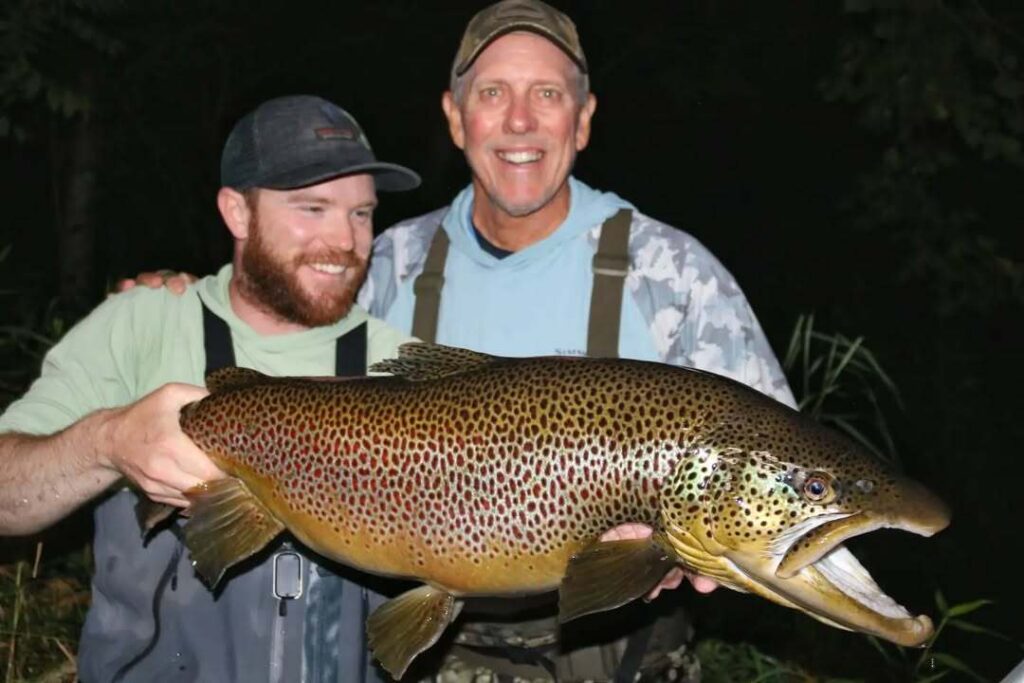
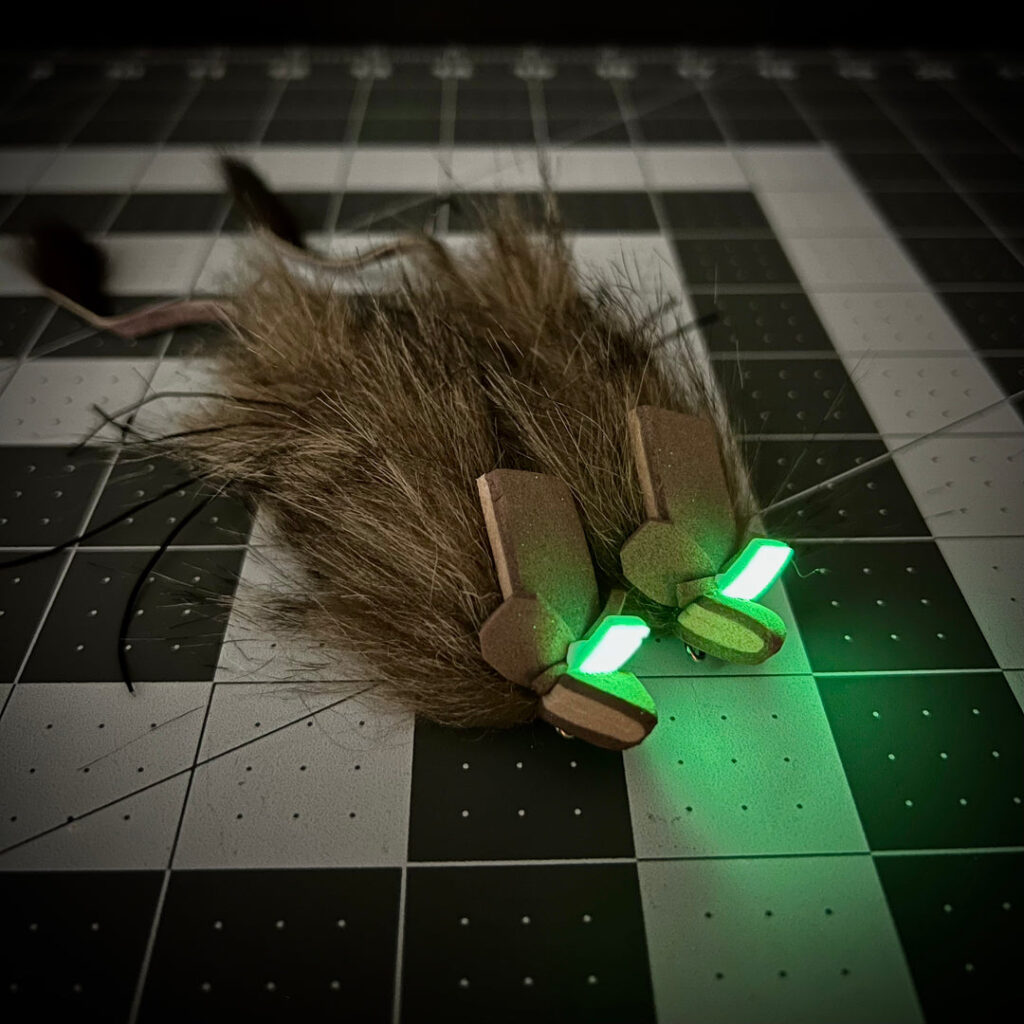
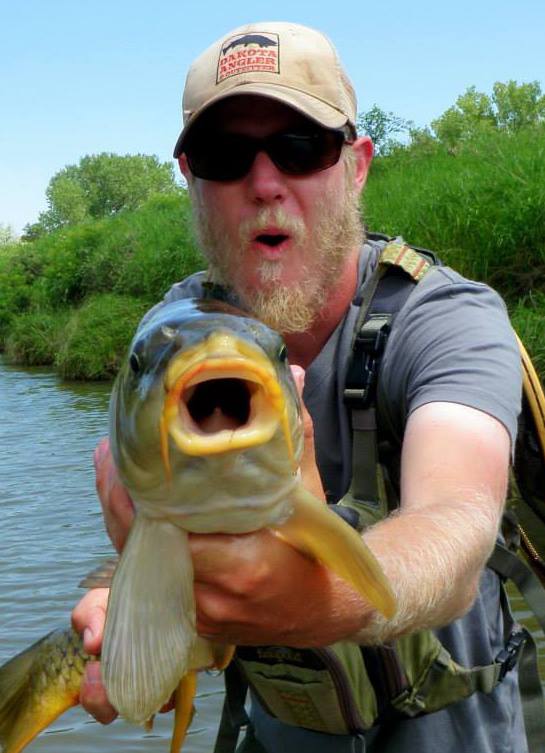
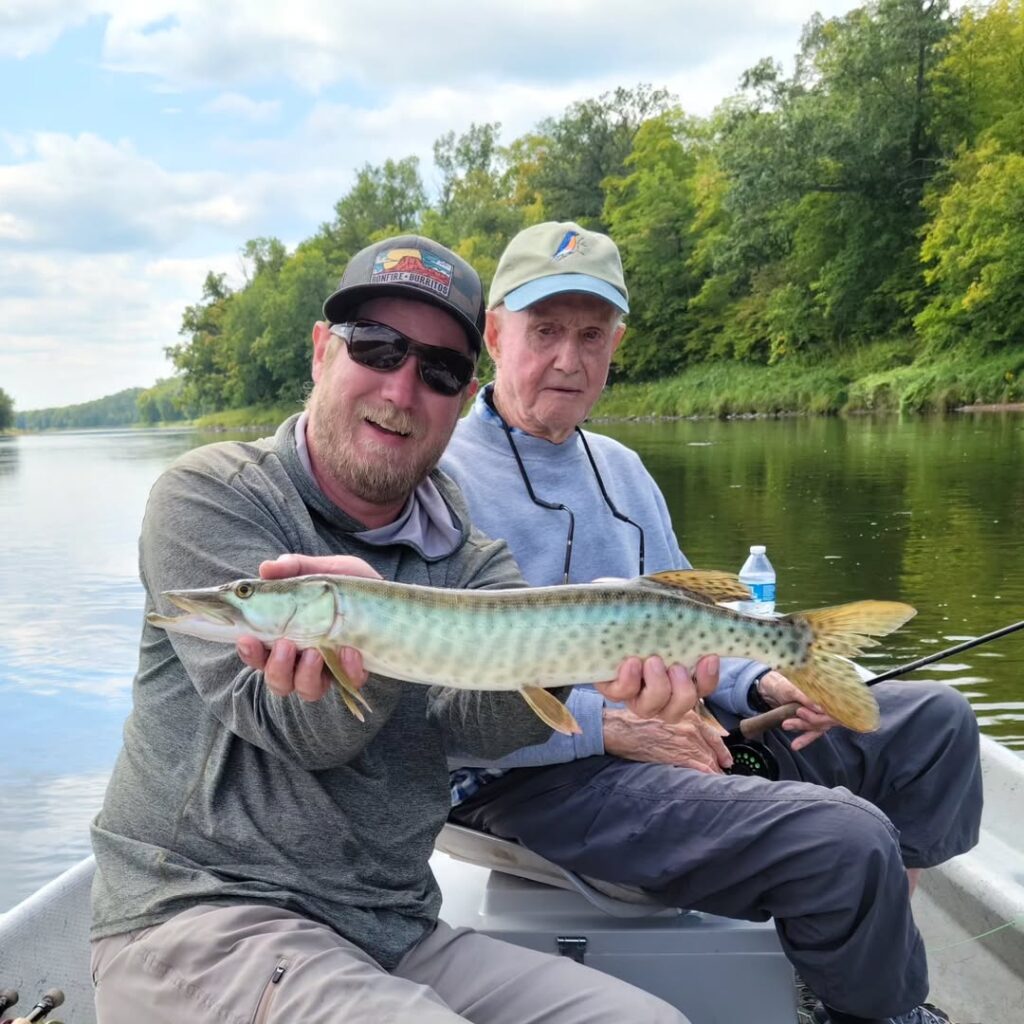
Conclusion

Evan Griggs shows that fly fishing doesn’t have to be complicated — just close, clean, and community-driven. The Saint Croix and Mississippi rivers aren’t just fisheries; they’re classrooms, connecting people to water and each other. Through Fishing For All, Evan’s proving that great guiding is really about giving — time, knowledge, and access. Minnesota might not be the first state people think of for fly fishing, but after this episode, it just might be.

         
Support Our Podcast Sponsors         
Support Our Podcast Sponsors       
Support Our Podcast Sponsors         

Support Our Podcast Sponsors

         
Support Our Podcast Sponsors         

POPULAR ARTICLES