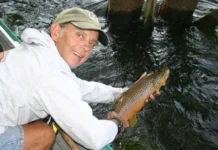
A trout can take a wet fly and turn before you ever feel the pull. Davy Wotton joins us to explain how a little slack, the right rod position, and a steady lift can help you connect with fish that are easy to miss.
We get into soft hackles, winged wet flies, and how to choose between upstream, across-stream, and downstream presentations. Davy breaks down his leader system and explains why fly spacing, line diameter, and casting pace matter when fishing multiple flies.
Davy Wotton is a fly fishing instructor based in Arkansas whose fishing experience reaches back to the late 1950s. In this episode, he draws on decades of fishing and teaching traditional wet fly methods.
His instruction connects fly choice with insect behavior, water conditions, and line control. Away from fishing, Davy also plays banjo, which he says he began learning around age 17.
Davy divides wet fly presentations into three broad areas: upstream to slightly across, across-stream, and across and downstream. Each gives an angler a different way to control depth, drift, and movement.
When trout are feeding on emerging mayflies, he generally favors an upstream or slightly across-stream dead drift. The goal is to bring the artificial flies toward the trout at a pace that resembles the natural insects.
Caddis give him more room to add movement. Their activity during emergence and egg laying can make an animated presentation useful, including working a fly on and off the surface.
Davy uses soft hackles, also called spiders, close to the surface when trout are feeding on emerging insects. He wants the flies in the surface film or just below it, where the fish are seeing their food.
Winged wet flies have a place in the same water. Depending on the pattern, they can suggest a drowned or stillborn winged insect. He makes clear that both styles can work with upstream presentations.
A single fly can also be the right choice. When targeting a specific trout feeding on small insects, Davy may use one soft hackle so he can place it accurately without other flies affecting its drift.
A good transition from fly line to leader helps turn over a long system carrying several flies. Davy describes a clear Amnesia butt section built in three steps:
He then adds about two feet of the finer line used for the fly-carrying section before the first dropper. Its diameter and breaking strength depend on fly size, presentation, and the fish he expects to encounter.
A manufactured tapered leader is another option. Davy discusses starting with a 7½-foot 4X leader and shortening it before adding the rest of the system.
For a size 14 soft hackle fished upstream during a mayfly hatch, he gives 5X as a likely choice. With sizes 16–18, he discusses moving to 6X. These are examples from his approach rather than a fixed formula for every river.
Davy uses a three-turn surgeon’s knot to create detached droppers. For a three-fly system, he describes spacing of at least 25–30 inches between the top and middle dropper, with similar spacing between the middle dropper and point fly.
The top dropper should be at least six inches long. That extra length helps him work the fly through the surface while keeping the main leader above and below it from dragging across the film.
He describes an overall system of roughly 12 feet and may extend it toward 16 feet for particular situations. A longer leader puts the flies farther from the fly line and gives them more freedom to move.
Davy also discusses local differences in how many flies anglers may fish. Check the current rules for the specific water before publishing a rig recommendation.
Pointing the rod directly at the flies can create a straight, tight connection. When a trout takes, the angler feels it and may react by pulling the fly away.
Davy favors allowing the fish to take and turn, then tightening with the rod. For across-stream and downstream presentations, he explains how feeding small amounts of line helps maintain control while preserving that margin of slack.
Knowing where your flies are is central to Davy’s approach. He watches the water around them for a slight disturbance that may show a trout has taken a fly near the surface.
He also watches the visible line. The hanging line below the rod tip can move before the angler feels a pull.
Upstream fishing requires particular attention because the flies are coming toward you. A fish may take without creating the obvious tug anglers associate with a downstream presentation. Davy describes raising the rod when a surface change indicates a take.
Bright light and glare can make those signs harder to see. His response is to shorten the fishing distance so he can follow the presentation more closely.
A mend needs enough slack to reposition the line without dragging the flies. Davy sees anglers lift the rod to mend while the line is too tight, disturbing the drift they were trying to improve.
With short upstream presentations, recovering line and holding the rod high may provide enough control. Longer casts bring more current between the angler and the flies, making careful mending more important.
He also avoids sending a team of flies directly upstream in a straight line. An angled presentation lets the flies travel in separated positions as they drift toward him.
For across-stream fishing, he describes an L-shaped mend that gives the flies more time to track before the current takes control.
During a caddis hatch, Davy may cast across or slightly downstream, move the rod upstream, and retrieve the flies across the current toward himself. This lets him work the top dropper on and off the surface.
The figure-eight hand retrieve gives him steady control of the line. He can vary it with small draws, changes in pace, and rod movement to animate the flies.
His advice starts with observation. Spend time watching where trout are feeding and what the insects are doing before stepping in and casting. That information helps him choose both a fly and a way to fish it.
Davy discusses familiar soft hackles such as Partridge and Orange and Partridge and Hare’s Ear. His winged wet fly examples include March Brown, Silver Invicta, Wickham’s Fancy, Alexandra, and Peter Ross.
During a hatch, he starts with patterns that relate to the insects trout are eating. When prospecting, traditional attractor patterns can also bring a response.
Color, light conditions, depth, and the fish’s experience with natural food all influence his choices. He also stresses consistency at the tying bench: changes in body thickness, hackle size, and proportions can affect how trout see a fly.
Some historical tying materials are difficult to obtain or come from protected species. Davy discusses alternatives rather than assuming every original material is available.
Davy favors a rod with a softer tip and mid-flex action for trout wet fly fishing. He discusses lengths around 10 feet and often uses rods in the 10½- to 11-foot range for line control.
A softer tip helps transmit movement through the line and leader to the flies. It also suits the slower casting stroke he recommends for reducing tangles.
He identifies a double-taper floating line and an intermediate line as important options for his fishing. He prefers the control of a double taper over a heavily weighted front section and also discusses a long-belly line as an alternative.
Leader design helps, but Davy keeps returning to casting skill. Slowing down and tracking the rod in a straight path can make a team of flies much easier to handle.
Davy looks for places where trout can intercept food, including the slower water beside a riffle. On unfamiliar water, reading those feeding areas helps him decide whether to fish upstream, across, or down.
He often starts with an upstream presentation, then may turn and work back downstream. He also warns against repeatedly showing the same flies to the same fish from one position.
If a near-surface presentation brings no response, consider depth as well as fly choice. In slower, deeper water, he may give the flies more time to sink before bringing them across the current.
Davy teaches wet fly fishing in Arkansas and has adapted his techniques for fishing from a drifting boat when flows do not suit wading.
He says students should arrive with reasonable casting skills. Without that foundation, a long leader and multiple flies can lead to frustration and repeated tangles. He discusses spring schools, fall fishing, and instructional DVDs covering wet fly fishing and tying.
Episode Transcript
WFS 1006 Transcript 00:00:00 Dave: A trout takes the wet fly turns and often does most of the work for you. Davy Wotton explains why a little slack, the right rod angle, and how resisting that instant hookset reaction can put more fish on the line for you. Today, we’re getting into the details of wet fly fishing. From fishing upstream, across and down to building leaders, controlling multiple flies, detecting subtle takes, and giving your flies. The movement, Davy says, can make a big difference. This is the Wet Fly Swing podcast, where I show you the best places to travel to for fly fishing, how to find the best resources and tools to prepare for that big trip, and what you can do to give back to the fish species we all love. Davy Wotton is back, baby. He’s back again. And today we’re gonna dig back into what he knows best wet fly fishing. We’re going to talk about soft tackle spiders and winged wet flies, including when Davy wants his flies riding just under the surface to imitate the mayfly emergence. We’re going to talk about how Davy does his leader system, including his three foot, two foot, one foot amnesia, but section build out and all the way up to the tip it. We’re going to get his angle the hang. Figure out what the angle the hang is and how you can do this right so you can hook more fish. Plus, we’re going to hear how he detects subtle strikes and how knowing where your flies are watching the surface. He brings it all together so you will miss less fish this year. Dave also explains his figure eight retrieve. It’s all on it today. This is a big one. You can check in with Davy at davywottonflyfishing.com And here he is. Let’s get into it. Davy Wotton. Welcome, Davey. How you doing? 00:01:31 Davy: I’m doing fine. And yourself. 00:01:33 Dave: I’m doing great. I’m doing great. I’m excited to talk wet fly fishing today and and jump into this. We’re going to have a good conversation. This is part of the fly fishing boot Camp, our new series we’re doing, where we bring on some of the best speakers around the country. And we’re going to be talking about this. We’re going to allow people to ask questions today. When they’re watching this, they can actually go into our private Facebook group and they can ask questions there. We’ll have you in there to answer them. And we’ve got some already, some questions that listeners had up front. So we’ll be getting into that today. But yeah, are you ready to jump into this and, and take us away with the wet fly fishing? 00:02:08 Davy: Certainly am. 00:02:09 Dave: Okay, good. Well, maybe take us off the top on just, I think a common thing people, you know, struggle with is just kind of what is wet fly fishing. So maybe give us a quick heads up on how you describe that to people that are new. When you have somebody on, on your home water and you’re kind of trying to describe that, what would you tell them? 00:02:25 Davy: So the simple answer to that is wet fly fishing, by definition, has its traditions in the United Kingdom and Europe for that matter. And so the main difference is if that’s the way to explain it, are this the flies. So are you using wing wet flies or are you using the typical North Country style? What are defined as soft tackles or spiders? It’s the same thing really. So that’s a big part of it. But by definition Traditional wet fly fishing has its originations from Europe. If that’s the way to explain that one to you. And there are means and methods of how those specific flies to fish, bigger fish and lakes, still waters and natural rocks, whatever the case may be, different kinds of moving water systems. It could be the real fast, shallow waters. There could be the big flat waters like here in Arkansas or, you know, the rivers out western Montana, Wyoming, whichever. So there are differences insofar as techniques, shall we say, and choices of flies. And a lot of that is also based on the abundance of natural insects that the fish see, not necessarily on a daily basis, maybe periodically during different hatches. So there’s a lot to it and much more than people really realize. If you really want to understand it and get really good at it or the techniques of fishing advice. So that’s really a good kind of summary. 00:03:48 Dave: Yeah. How does it differ from, let’s say, swinging wet flies, right? You could swing a fly cast down across a swing. How is what you do different than that? 00:03:57 Davy: Okay, so you’re talking about the aspects of techniques in fishing those flies. So the way I look at it like this, if, for example, you’re looking upstream and reverse to your right, you’re dealing with, the easiest way to explain it to is three one third sections. So you’ve got more upstream to slightly across. You’ve got more slightly across to midstream across, then you’ve got midstream across and down. So that’s not to say that the same flies won’t work in all of those three thirds, but there’s a difference insofar as the presentation values are concerned. So for example, the easy way to explain that is for most people, they generally fish wet flies across and downstream, which is really in real terms, to be perfectly honest about one of the easiest ways to connect with fish. Whereas the upstream dead drift Techniques or slightly across, require a lot more technique and skill and control of fly line and various things like that. So one also has to take into consideration, you know, what are the fish doing? So for example, if they’re eating, shall we say small mayflies. Well they differ insofar as how caddis react in the stages of emergence or as adults. And the relationship of flies using the techniques that you use should have some relationship to what the fish are seeing and what the insects are doing. So typically if we have, say, for example, mayfly hatch of some description, it doesn’t really matter what it is, you know, it could be sulphurs or whatever those fish are seeing those natural flies coming down pretty much at the same pace as the natural stream drift. There may be some variants, you know, in our current smooth them around, and the logical approach is through fish or artificial flies in a manner which is more, shall we say, closer to how the trout would see the natural flow. Now in a case of caddisflies. That’s still largely the case. But as we know, caddisflies do stages of emergence and as winged insects or for that matter, ovipositing females coming back. They’re much more erratic in their movements. And that being so, you can coordinate specific flies and fishing techniques that are more closely related to how those fish see those natural caddisflies works. That is a little more conducive in that respect to fishing more. So we say across and down with certain control of how you work those flies on and off or through the meniscus. And depending on what lines you use, whether you use dry lines or intermediates, which are the two most important lines you need as far as wet fly fishing is concerned. So a lot of it is also, as I said, related to the at that particular time, the species that are of interest to the fish, how the fish see them, the flies relative to those specific insects and the techniques of fishing those flies. If that’s the way to explain it. So I would tell my students this, that if fish are taking emerging or dry flies with done so to speak, try to fish out the fish with flies in a manner that’s conducive to how the fish see the natural flies. That’s it. And so the choice of flies you would use would have some relevance to those specific species. Now, that said, which I know is somewhat confusing to people, why do I use soft hackles or wing wet flies? You can use either. The general approach is that if fish are feeding on or close to the surface. In other words, in the meniscus to the, you know, within an inch the most effective way, generally speaking, but not always, is to use spiders or soft tackles because they’re more representative of the stages of emergence, so to speak. But that’s not to say, for example, if I was fishing, which is very common here at sulphur hatches, winged sulphur patterns. In other words, the winged fly, if you look at it in that respect, is a little more related to, say, a stillborn or a drowned winged insect. Assuming you’ve got the right fly, that’s part of it. But I wouldn’t generally fish a hatch like that across and down. I’m not saying you won’t catch fish, because the only method we know at some point or other will catch a fish. But where caddisflies are concerned, yes, I would be more inclined to fish somewhat more across and down, but with a control method of how I fished those flies. It’s not just a question of chucking it out as to what a lot of people do, and then start stripping the players, but because you’re actually putting flies back upstream and that’s really, to some extent unnatural, at least so far as our fish is fly subsurface caddisflies skating on the surface is a different thing, but we can use techniques to imitate how that fly is working on and off the surface by use of what we call droppers or detached droppers that that flies attached to. So you can imitate that movement on and off and through the surface film. And if you do it right, it can be one hundred percent deadly. Whereas if you fish more downstream and just strip the flies back, you’re pulling the flies back. And in a manner that’s totally, usually unrelated to how a natural insect bite, even though I know it will catch fish. If that’s the way. The easiest way to explain that one to you. 00:09:20 Dave: Yeah, that explains it. So basically you mentioned the thirds up across, down. So there’s all that is in your repertoire, right? You can do anything. But what you’re saying is it really depends on the insect you’re trying to imitate. So if it’s a, if you’re trying to get into the meniscus, probably a soft tackle works better. What would be a winged wet fly? When would that work better than a soft tackle? If the. If the soft tackle is good and the meniscus. When would you use a winged wet fly? 00:09:44 Davy: Well, you can do so at the same time. The thing about soft tackles or spiders, and essentially you’re talking about the same thing, is that those flies should be presented really close to the surface. That’s it. I’m not saying they won’t work. Fish down deeper because they will. But insofar as the presentation value, when we’re dealing with an emergence of mayflies, regardless of whatever species they are, our objective is to fish those flies where the fish are seeing the naturals. That’s it. So the consequence of that is obviously you’re going to use a dry line. You’re typically going to use a fairly long leader system. Where do you fish one fly two fly three flies or four flies. That’s your choice based on the legality of it. Because some states like Montana, you can legally only use two flies, whereas here in Arkansas we can use as many as they want. 00:10:39 Dave: Oh you can. What’s the most you’ve ever used? 00:10:41 Davy: Oh six. But not on the river. On on the lakes. Natural lakes. And the reason being is this. Would you believe it if I did that kind of stuff here on, for example, my local river. Frequently you’re going to hook two or three fish rainbows at the same time. 00:11:00 Dave: Oh, wow. 00:11:01 Davy: Right. That’s not normal when you’re fishing on natural lakes or stillwaters, particularly where you’re dealing with, you know, natural, wild indigenous brown trout. It can happen when you’re fish in the still waters that are stocked with rainbows. You might get two, but you’re also dealing with fish that are fairly sizable. That’s another thing. So the answer to the question is this. If you find it easier to control one fly, do it that way because fishing three flies technically more difficult. And for the majority of people, they end up getting tangled. And that is the result of casting technique one hundred percent. Well, two things actually. One is not not building the LiDAR system with it correctly. And the second one is casting technique. But for the most part, if you are getting tangles, it’s related to your technique of casting and maybe the fact you’re using not quite the right rod and line combination, that also would maybe cause you problems. So that’s it. So at times, Dave, I still prefer to fish a single fly. And the reason being is that I can be much more where I place that fly. In other words, even though you’re fishing a sunflower, look at it like a dry fly. So one of the things I tell some of the students is this, you know, how efficient do you think it would be for you to control three dry flies? The only difference is you’re fishing three subsurface and you don’t see them. So if you fished three dry flies, which are on detached droppers, which are approximately Twenty five to thirty inch spaced apart. Do you think you could control those flies efficiently? Because if you have a problem to do that, you would have a problem fishing two or three soft hackles or wing wet plates. But you the question you asked me was about wing flies. And do I use wing flies in upstream to slightly across methods of presentation? Yes, one hundred percent. You know, so you have fly patterns like blue winged olives and stuff like that, or typical classic flies, you know, like Greenville glories and pine blue duns. Those flies work very well as wing flies. 00:13:12 Dave: Like a coachman. The coachman. Right. 00:13:14 Davy: No, that’s not a fly I would use because that flies more of an attractor fly. It doesn’t really represent a natural insect. That’s what I would call an attractor fly. More than anything else. That fly, ironically, can work fished upstream, but is generally fished more so across and down, and it’s a good flight to use late evening hours. 00:13:36 Dave: Why is that coachman better fished across and down versus, say, fishing it up and out? 00:13:43 Davy: Okay, let me just say this without complicating the issue. First of all, I take into consideration, aside from a hatch, the nature of the water. So if I’m fishing a fairly shallow, fast, roughly kind of water, I know that those fish are going to be pretty much looking upstream and grabbing what they can as it comes down towards them. Therefore, I would tend to fish more than upstream to slightly across my. And the reason being is because that’s the way I know those fish are seeing the natural insects. Even if they’re there or not, they’re still looking. If you’re fishing deeper water, that’s much slower and there’s not a hatch going on. Well, I’m not saying that fishing more upstream and across is not effective because if done well, can be at times. But bear in mind, the fish at the time are not really looking close or near to the surface. They’re going to be mid column or somewhat deeper. Therefore, the consequence of it is your flies need to be where the fish are. That’s it. So that’s another way to look at it. You know, on any given day and the water or the nature of the water is shallow and fast, swiftly water, which is really I like a lot, to be honest about it, because you always find fish in that kind of environment, whereas if it’s much deeper and slower, those fish can be spread around. They’re not more concentrated in whatever considered to be feeding zones, therefore. So then I would opt to fish flies deeper, and I might do that by fishing more at the mid third. In other words, not the first, third, the mid third. And even though I cast across those flies, I’ve got time to sink. Which in that kind of water, which is slower and deeper, they will. But if it’s fast moving water, well, they’re going to get dragged downstream. That said, with technique and fishing, you can control the drift of those flies by essentially obviously using means in your line and you can allow the flies to sink without them being interrupted by or being pulled back by current. And that’s just the technique obviously requires practice. And interestingly enough, you can actually get, you know, flies like that out a fairly considerable depth with a dry line, as long as you give the flies time to do it and are not influenced by drag or drift or movement of water surface. That’s it. So you may find a situation you know where, and I know this happens a lot to people. Yeah, well, I went wet fish and I never caught nothing. Well, the obvious answer would be, well, yeah, maybe you were fishing and there weren’t no fish there in the first place. But you don’t know that because you can’t see. You assume fish are always there, right? So there’s techniques that would, if you like to put that into terms, allow you to go through a series of different ways of presenting those flies. You may have the right flies, but the fish are not seen and where they want to see them. So if you’re fishing in the surface and get no response, but you’re pretty confident in your mind, know there’s fish there, then you’ve got to get the flies. So that down to a level where the fish can see them. And that’s the same as we well know where nymph fishing is concerned. You’ve got to get the flies down to where the fish are likely to see them. When you’re dealing with stages of emergence or whatever the case may be, that’s a different thing. You know why? Because they’re visual. You can see those fish feeding actively on or near the surface, but you can’t see that fish in deep. So my answer to that is that even though you have fished and had no response, yes, you may be fishing in an area where there are no fish, you may well have stood too damn long in the same place like a heron and wised them up. And one of the other things you know about fly fishing is you never stay in the same place too long. What you’re doing, you’re always looking for new water, not fish that are consistently seen what you’re doing over and over and over again. And that’s also one of the consequences, more so of the differences between upstream and downstream fishing. When you’re upstream efficient, you’re generally going to progress in an upstream mode like you would be if you were dry fly fishing upstream. If you are fishing downstream, you’re frequently covering the same zone over and over and over again. Fish will chase that fly. You may catch a few. It won’t be too long before you get no response. Why? Because those fish have seen what you’ve been doing too many times and they’ve lost interest. So the same thing really applies when you fish upstream, you progress upstream, covering three or four cars in this zone. Three or four cars further up, further up, further up. Same thing when you wet fly fishing and you’re progressing across and downstream. Don’t stay in the same place. Just keep moving. And that’s not always possible, obviously, because the way you are, you know, you can’t walk downstream or whichever the case may be, but I’m just making a point that, you know, if you persistently fish in the same zone, doing the same thing, you lessen by time the chances of those fish responding to what you’re doing. And I think I learned a lesson years ago, you know, in the nineteen sixties on my local rivers. That was absolutely the worst thing to do. Stay in the same place. You’ve got to keep moving and covering fish have not seen what you’ve done before. 00:19:17 Dave: If Belize is on your bucket list for a flats trip, take a look at Blue Bonefish Lodge. You’ll be fishing more than four hundred square miles of flats right along the Belize Barrier Reef. Clear water and endless opportunity. They offer all inclusive packages, whether you’re focused on fishing every day or planning a trip with the family. You can learn more right now and start planning your trip at Blue Bonefish, Belize dot com. That’s Blue Bonefish, Belize dot com. Check them out right now. Check out Montana Fly Fishing Lodge, a twenty twenty four Orvis endorsed Lodge of the year finalist, where luxury meets adventure on one point five miles of private, wild and scenic East Rosebud River frontage. Experience world class fly fishing on numerous Yellowstone Basin streams, gourmet cuisine made from locally sourced ingredients and rustic luxury accommodations surrounded by breathtaking wilderness. You can book your all inclusive Montana fly fishing adventure today and discover why they are the premier destination for unforgettable fishing experiences, head over to Montana Fly Fishing lodge dot com right now. Let’s take a question. Purva had a question on this today. And here’s one I think you can shed some light on. He wanted to have you explain the LiDAR system a bit more like specific lengths and diameters. He says he’s watched wet flyways but doesn’t think. Not sure he saw exactly what he’s asking here. Also, any tips on strike detection and hook settings when not on the dangle? I know to watch for unnatural movement. Maybe start with the lidar. Why don’t you start with the lidar? Describe that a little bit. 00:20:51 Davy: One thing I learned years ago, in my early years back there in the sixties, and of course, back in those times, there was people think today that things were more uncomplicated. And so typically what you would do, you would actually fish a straight system off the fly line would be breaking strength, strength. So you would fish for pounds, six pounds, you know. There wasn’t really the relation of X factor, so to speak, which is diameter related issue. However that said, I will tell you this, that insofar as dry line fishing is concerned, you need a butt to that line that gives a better transition of turnover to those flies. So and there’s a couple of ways I do that. And it’s your choice, I guess. So you can either use a factory manufactured taper leader, which typically most times is about nine foot. But of course we can get them down to seven foot six. Other than that, I built my butt sections, which pretty much allows me. Oh yeah. And I do that by increments of three foot, two foot, and one foot. And I use amnesia to do that. And the reason I use it is because it tends to stay straight. You’re going to start off depending on your maybe three weeks at six. But as a general rule, I use clear amnesia, not the fluorescent stuff. I’m not so sure whether or not that at times spooks fish. I can do it, does. It doesn’t. I just don’t feel that you need it. Let’s put it like that. So I use clear amnesia. So typically I’m going to come off, say for an average four or five rate line, three feet of twenty pound. I had two feet of fifteen on a foot or maybe two feet of ten or twelve pound. Clear amnesia. Uh, some of my friends prefer to use maxima, and that’s okay too. Maxima is pretty damn good line as well. But you know, by the same definition, and this is for a general leader system to that, you’re going to add the breaking strain of line that you’re going to use for the rest of the system. In my way of thinking, it’s not so much the X factor, although it has a relationship to diameter, of course, it’s kind of like the breaking strain that is a concern to me more than anything. But the diameter, of course, is also relative factor to the sizes of the flies are going to use. So typically you’re not going to tie like small flyers on forex because it’s just not conducive to allow those flyers to animate. And that’s a big part of workflow fishing animation of your flies. It’s not a question of just stripping to it than that. So anyway, to the end of that, um, ten or twelve and amnesia, I had about two foot. And that is the position where I tie my first dropper. In other words, a detached dropper on the top cover should be at least six inches, if not more. And there is a reason for that in the technique where you actually use that top dropper to work in and out through the surface. And if that drop is too short, you efficiently cannot do that because what you want is the detachment of your line, your leader above and below that fly. And if that drop is short, I will tell you that your line above and below that dropper will drag the surface and you don’t want that. What you want is just the visual to the fish that fly and no line above or below it. Just that dropper. Anyway, so that’s we make a dropper and I use a three turn surgeons. Believe me, I’ve used every knot you can think of in my lifetime to create droppers. Some people argue, oh yeah? Well, if you use a blood knot, the dropper stand out more. I’m telling you, it’s nonsense. Because when those flies are being moved in the water, they will pull back regardless of whether you argue against that or not. And I did experiments in tanks, you know, with moving water to see how things happened and that. So I will tell you this, that in my opinion, the most consistent use is returned surgeon’s knot. And I’ve caught some huge fish like salmon. Same thing. The next is the separation from the top dropper to the mid dropper. We’re assuming you’re using three floats, right? Minimum twenty five inches, if not more. If those flies are too close together, you’re more likely to get them tangled. Strangely enough, if they’re separated as that cast turns over like this, there’s a visual separation of those flights. It’s the turnover takes place. So minimum twenty five to thirty inches and the same from the dropper to the point or the tail fly. So essentially you’ve got sixty inches from the top dropper tail fly and at least about two feet or shall we say five, six, seven foot from your fly line to that top dropper. You may consider that to be a long lead assistant to handle. It really isn’t. If your casting technique is good. If it isn’t, you’re going to get issues. Now that said, there may be situations where, for example, we’re dealing with fairly slow water and the fish are taking small bugs, you know, trichomes or midgets or something like that. So just slipping in the surface, they’re not going to like this, you know. And so we want to fish fly patterns that fish exactly the way those fish are see in the naturals. And as I already said, I may not bother with three or four fights. I may just fish one fight. And the reason I would do that is because I can cast that fly one hundred percent accurately to that fish. I don’t have to worry about that. Other flies causing drag or disturbing that drift of that individual soft hackle fly. Above all, I may well extend overall that leader length and by definition of a reduced reduction in taper. So for example, I might come off the end of the ten or twelve pound, just say with um four x if that’s the way to explain it to you. And I may run that through five or six feet, but I would terminate that with in the case of fishing, really small flies six and sometimes seven X. What you want, of course, is, is those flies to remain within the meniscus for the longest periods of time as possible. And so the finer diameter line and it doesn’t really matter as far as I’m concerned whether it’s nylon or fluorocarbon, although nylon has a little more benefit in that respect, I would say it lessens the amount of drag, assuming you control your drift. That’s the right way. And I may go to two. The other thing is this. Bear in mind, though, that if you’re fishing six, six, or maybe seven X line and two fish hit you, the odds are you’re going to lose them. Whereas for obvious reasons, because they’re pulling themselves apart on the connection of your right. And fly is probably a more acceptable thing to to use in those situations. If I use two flies under the scenario we just talked about, I would have very well separate. I wouldn’t have them that close together because I wouldn’t want to be shaking that because I’ve had that happen. I’ve had the same fish take the two flies through it, grab up, and he says, I don’t want to close. You take this and you take that. Whereas if you keep them well separated at least two to three feet, the odds are that of the same fish doing that are pretty remote. But that’s not to say two separate fish may take those flights, because I’ve had that happen so many times. I also learned my lesson a lot that when you’re dealing with fairly sizable trout, you’ll get passed off if you’re not careful. So overall, the question was the leaders. So generally speaking, you’re going to use five feet of bite section, be it you build your own or you use a tapered manufactured leader. And you cut that back at seven for six liters. That’s a good leader. And you’ve cut that back maybe eighteen inches or whatever, and you’re out of line. 00:29:04 Dave: You’re just getting a seven and a half foot leader of, of like, uh, what’s the ex do? They typically are coming in. That would be like a forex leader or how would you, what would you buy? 00:29:12 Davy: Yeah, that’s, that’s what I would choose to run and terminate with sometimes five x. But generally, yes, forex. 00:29:19 Dave: When you see a seven and a half foot leader and it says four x, does that mean the forex is what it terminates at where you tie your fly? Is that or and five x would be a little bit smaller. 00:29:29 Davy: Yeah. When you ride your debit. But what I’m trying to explain to the listeners is that you need a really good but section to get that fly line to that longer length of continuous line that you’re using to attach your flies to. And of course, as you know, a lot of the Euro guys now, they pretty much don’t use no fly line. They use just straight through line of finer diameter wires, less resistance than the fly sink quicker and all that kind of stuff. And that’s also somewhat related to what we discuss in here, you know, Finite diameter line is less resistant in that respect and doesn’t fly. And when we’re dealing with emergence of insects and we’re fishing spiders or subcycles or small wing weights, that’s what we want. We want those flies to stay in the meniscus and not get pulled down. And that is more related to an upstream to slightly across technique. Now that said, one of the questions I always get asked is, oh yeah, I keep getting bounced off all the time. Or, you know, these fish grab my flies and I don’t get them. Well, there’s one answer why that happens is your tight lining. In other words, you have a tight line connection to those flies, and very likely you’re pointing the rod at your line. There must always be a degree of angle. In other words, from the end of the fly rod as the line comes down like this. So it’s kind of like an absorption factor. So if your straight line like this. As soon as the fish takes the flight, boom, you feel it. And guess what? Ninety nine percent of people will react by that fact. And he pulled a fly out the trout’s mouth and you lose it. If you have this angle of hang from your fly line and it’s like a small loop like that, there’s always, if you like to put it a margin where the fish can take the flight but not feel instant resistance. That’s the key. Absolutely. The other thing, most importantly is that your focus. I think a lot of wet fly fishing requires focus. You’ve got to watch what’s going on. You should know at any point of time, regardless whether you’re fishing upstream, across the slightly or down where your flies are. If you don’t know where your flies are, you’re anticipating, well, this you should react to visual of the take when the fish takes the flies and by using that angle of. Hang in not having a line directly tied to your flies. Two things I do. I know where my flies are. One hundred percent. I watched the area where I know those flies are. But I can also, in my peripheral vision, see the drop of my line off my rod tip and as such, any indication of movement. I do not do that. That is the worst thing to do. And people say, oh well, how you hook a fish. I tell you, if that fish can take that fly in turn, ninety percent of the time he hook it up. What are you going to do? Just tighten up with the rod. That’s it. And it’s the same principle of fishing for Atlantic salmon. If you ever did that. 00:32:41 Dave: Yeah. So you’re not you’re not doing a big trout set. 00:32:44 Davy: No, you’re not nymph fishing with an indicator. And pop this that and the other. And I think that’s one of the hardest things that I find my students have to overcome is this instant reaction to feeling a fish as opposed. Now, I’m not saying for one moment that there are times when a fish will hate you so fast. That’s what will happen, okay? Because it does. But on the other hand, what I’m trying to explain to you is if you have the angle of hang and there’s always the margin of slack line, even though you’re fishing downstream, you say, well, how do you do that? Well, it’s simple how you do that. You feed line as you track those flies across stream, you just feed relatively small amounts of line. You also make men’s. So if you’re example, fishing across stream rivers in front of you, you’re mending your line across toward the far bank. 00:33:40 Dave: Oh, you mean like like slack, like stack men sending stack men’s into it? 00:33:44 Davy: No no no no no no no no no. It’s small increments of line that you feed out the rod tip. So you’ve always got control. 00:33:53 Dave: Are you feeding line like side to side or doing like this. How are you getting the line. Giving it more line. 00:33:57 Davy: Oh I’m sorry if I’m on this side of the river and that banks over there. And I made that presentation across. Then by throwing the line up toward that other bank. I keep the angle of my flies more in a line. One, two, three. If you don’t do that, your flies get swept downstream and they’re in a straight line. That’s the way you explain them to. And so when you pull them back, you’re actually pulling three flies straight back upstream. Objectively, what you want for your flies is for them to be visually separated as they move across the stream. So like one, two, three, so fish in different positions, see those flies at different positions. If you don’t do that and you keep that line tight, the kite will swing those flies downstream and they’re in a straight line off the end of your fly line like that. That’s the least effective way to get your flies to fish across and downstream method. You want those players to come round in a nice curvature by feeding line so they don’t you don’t get tight line to them. 00:35:03 Dave: Are you pretty much dead drifting these flies or close to that? 00:35:07 Davy: Somewhat. But the current itself is moving those flies for you when you make a presentation across stream. If you didn’t do anything, what would happen? 00:35:17 Dave: Eventually? The current would pick up the fly and it would start drag it down. 00:35:20 Davy: Yeah. If you made a if you make an across stream presentation, just hold the rod. What will happen is the current will drag the flies around in a curve like this. Whereas if you do it with more efficiency, when you cast those flies across or slightly down by feeding line and maintaining that angle of slack line, as we call it, you can track those flies down so they stay separated as they come across stream. Now that said, there’s nothing stopping you using some means of retrieve during that process, which of course will either move the flies slower or faster, whichever you choose, because that’s another big part of it. You know how those fish will actual flies. Do they prefer to have them more slow insofar as the way that they track across stream? Or if you move them with a, what we call a figure of eight hand twist, retrieve or slight draws or strips, you create different animated movements in those flies. And that’s a big part of the techniques of wet fly fishing. Animation of those flies. So I can tell you for one big difference when you get interest from a fish or you don’t. So if you just let those flies track across stream, yeah, you may get fish come up and they follow them like that. Whereas if you make some incremental movements of flies, that creates a little more interest in those fish and typically with the top drop of flight, which is the one we should have on a longer length of line, and for that matter, the dropper. Once you get very skilled at it, you can actually cause that top dropper fly to emerge to the surface and maintain its position, working on and off the surface without visible knowledge to the fish that there is Lyme at above or below it. Which is what I said to you that’s so important that they just see that fly. And that is a really good technique to use as an across and downstream. And one of the other methods I use that if anybody’s got the wet fly waste DVD, they would have seen. I caught a lot of big brands out doing this, like Cast across Stream, but I don’t allow my flies to track that far downstream. What I do is I bring those flies back across stream, more or less directly back toward me. So what I’m doing, I make my initial presentation. I take my right position way up to the left of myself, and then by use of methods of retrieve slides back. So they come across the screen towards me. And that allows me to work that top dropper coming all the way back across stream, on and off the surface, on and off the surface. It’s a different technique as far as casting across and letting the flyers get down, because what you’re doing, you’re pulling them back upstream towards you. You have no choice when you do that. Whereas if you cast directly across stream or slightly down, then you hold the rod to the left and by retrieves, you allow that top dropper fly to move on and off the surface, coming across the stream towards you. You cover a lot of water really, really efficiently. Like that is the deadly way to branch out. It really is. 00:38:45 Dave: So you’re covering a lot of water. That sounds like a big thing. Let me go back to the leader just to make sure I got this correct, and I’m going to walk through it real quick what you said. So you’ve got the upper part, which is a thick, but you know, and you could build your own twenty pound, fifteen pound ten or twelve. And that’s amnesia, you know, three foot, two foot, one foot. So that gives you about six feet, right. But you could also get a seven and a half foot leader to build your four x, right. So that’s the first part. And then you get down to off of that ten to twelve. You would tie in a your first part of the leader with your dropper, right? Your surgeon’s knot from that down into a, you start building your tippet, right? Essentially. 00:39:21 Davy: No, don’t use the word tippet. 00:39:23 Dave: Yeah. Not tippet. Sorry. Tippet was the wrong word. 00:39:25 Davy: It’s a continuous length of line of a given diameter or breaking strain that should be related to the flies you’re using. 00:39:34 Dave: Let’s say we’re using like a fourteen size fourteen soft tackle or partridge or something. Let’s say it’s about a size fourteen. What would be your what would be your leader up to that fly? What would that look like? 00:39:45 Davy: Five or six X? Yeah, if I’m fishing more than upstream mode, right? And we’re fishing a mayfly hatch. Okay, I will opt for the finest diameter of line or breaking strain. Then I think I can get away with based on the average size of fish. Of course, we all know. You know, the average size of fish may be ten inches, but all of a sudden one of twenty inches grabs. You don’t know that, right? You’ve just got to deal with it when you get it hooked. So when I’m fishing, what you define as soft hackles or spiders more in an upstream to slightly across mode, I want those flies high in the surface film. And then finally the diameter or breaking strain of line I use, the more it is conducive for that to happen. So size fourteen I would probably be using more like five x once I get down to sixteen eighteen. But I generally don’t go much smaller than a twenty. But eighteen is pretty good. I’m going to go down to six X. Okay. And for the reasons I’ve already He explains. That line is less likely to pull fires down and keep them where I want them. What I’m saying that people should understand is that you must have a really good transition from the end of your fly line before you start to make droppers, and it’ll lessen to some extent. It doesn’t necessarily compensate for bad casting because I won’t go down what kind of leader configuration you make. If you’re a bad caster, you’re going to get a problem in the story. But if you have that transition good enough from that section, that will lessen that to some extent. Assuming, of course, you’re past the stroke was good. 00:41:22 Dave: Yeah, that’s the key. Okay. And the second part of the question that I had was we covered that lengths diameters. And then he also says, any tips on strike detection and hook setting when not on the dangle? 00:41:34 Davy: Oh yeah. Yeah. The simple answer to that is focus. 00:41:38 Dave: So if you get a strike, how do you know? 00:41:40 Davy: Put that into context. If you fish a drug Or indicator, your focus or attention is to that dry fly or that indicator. When your fishing flies that you cannot see, first of all, always know where your flies are. You get two points of, shall we say, indication. One is where the flies are. There may be a surface disturbance. You may slight movement. That’s something like that. And I will tell you from experience, if you know where your flies are and you see anything that indicates some disturbance in the surface, react because there’s every chance the fish has taken your fly, but it’s not pulled the line, it’s got it in its mouth. You just raise the rod. The other one is, of course, detection. Line detection. You watch the line. Now, the furthest visible point you’ve got is the one that you should concentrate on. And I heard a guy say to me, well, I can’t see that. Well, all I can say is I can. And the reason is, even though I can’t see the flies, I know where they are. So my focus is there in that zone. I know where my flies are. But I can also see that line off the tip of my fly rod. Now, obviously when you’re fishing upstream, you’re recovering the line back towards you like you would a dry fly. So guess what your point of visual indication is going to be to those flies upstream, because you’re not generally going to get a pull if you are fishing across and down. Yes you will. That’s different. So you still have a visual indication. Like I said, you’ve got that slack line off that rod tip, the angle of hang, as we call it, that’s got to move before you feel it. Even though that fish hit you real quick, you’ll still see that line move. And like I always said, Dave, it’s not a question of this. And I lost another fish or he got off or you get whatever the case may be, you should always be in a position. If that’s the way to put that, is that the fish should be able to take your fly without it figuring out something’s wrong. That gives you plenty of time to set the hook. That’s it. If the fish takes your client and figures out pretty quickly something’s wrong. Because of resistance, you lessen the chances of efficient hooking in upstream fishing. Like I said, it’s kind of like the same premise is used in three dry flies. The difference is you cannot see those flies. And it doesn’t matter whether you fish one or two or three or four for that matter. Your focus of attention is where you know your fly should be. Because for the most part, you also have some visual indication of fish. In other words, if particularly when they’re eating on a hatch or something like that, you know where they are. You can see them. And you would cast a dry fly if you were dry fly fishing. It’s no different when you’re fishing emergence i.e. soft spiders or small white flies. It’s the same thing. The only difference is you don’t see your fly on the surface. So your visual indication is going to be surface disturbance as the fish takes that fly. Nearly always. I guarantee you, if your flies were within about an inch of the surface, there has to be some disturbance in the surface. When that fish takes that fly. You might not see its back, as it turns out, but I’m going to. There’ll be some disturbance as that fish takes that fly. There’ll be some resistance against the face of that fish. It creates a little difference in that water. And you. You have to learn to focus. And I will say this too, that there are certain light conditions. Obviously, you know, that make a little more difficult to get those visuals. You know, really bright days or you’re fishing a surface that’s really kind of light influenced and sparkly and this, that and the other. And the answer to that is this. You don’t cast distance, you fish short line methods. Most times when you’re fishing more upstream to a price, you can get pretty darn close to a fish. And in a lot of times you really, at times not even casting fly line. You just your leader. But that’s not so often. Most times you want at least some amount of fly line out, because that provides you the better energy to get your turn over to your flies is awesome. 00:46:00 Dave: Well, I think we’ve got a ton and we’re gonna probably follow up with you. I know we will for sure, but I got let’s get another question here. We got John had a question and this one’s a multi-part. So let’s just break this apart. I think this is going to be a good one, he says. He said he has done a lot of wet fly swinging over the years. He says he would love be interested in. In your take on casting angles from his position in the river and mending approaches to presentations on different parts of the river. How do these fit into water, height and turbidity? What is Davies take on selecting fly fly color and size? So let’s start off the top. Let’s start off the top, which is casting angles from position the river. So talk about that. How do you describe casting angles? Is that something we should be thinking about? 00:46:42 Davy: Absolutely. I know what he’s asking and I’ve already kind of talked about that. Degrees of angles, you know, one third, second, third, third, third. So based on what you’ve just said to me and what he says he does, his fish is more across and downstream. So a couple of things there. If a bank fishing, obviously you’re going to be fishing more closer to the bank as opposed to if you’re wade fishing out in the river where you can fish left side or right side or whichever, as you progress down, whichever the case may be. The answer in a nutshell, is that your ability to read water, in other words, where you’re more likely to find the fish in that environment. So for example, we have, um, current scenes, you know, or we have some flat water. Then we got a really nice riffle. Well, where we find that riffle is Reflect slightly off of that rifle in that slower water where they meet bugs coming down, which are. So I will tell you that in a lot of cases, that’s a good experience and to some extent, the river that you fish on a regular basis. Because when you become familiar with the river, you fish on a regular basis. You should, if establish where you’re more likely to find those fish in that particular water system that you frequently fish. If river that you’ve got no idea about. Well, obviously you assume that, okay, there’s fish in the river or shouldn’t be there in the first place. The second thing is, well, how do I present my flies? And am I going to make one of the three one third options more extreme, more slightly across to more midstream or more across, slightly down and downstream. I know that most people will opt for the third, i.e. more across than downstream for lots of reasons, and one of them is that it’s a lot easier than it is to fish more upstream. But I will tell you that a lot of the skill in wet fly fishing is not the ability to cast well or choose the right flies, or did this, that and the other. It’s reading water. Knowing where you’re likely to find those fish is really important. And once again, out there, if you used to fish in the water that you frequently fish, you should have got that figured out. Assuming you wet fly fishing or nymph fishing. 00:49:05 Dave: Fishing expeditions offers world class fly fishing right off Alaska? S incredible road system for monster rainbow trout to feisty Arctic grayling, you’ll chase big species in the stunning landscape. Whether you’re a seasoned angler or just starting out, their expert guides ensure an unforgettable adventure. Book your trip today before spots fill up and experience Alaska’s diversity like never before. Check them out. Right now that’s Fishing expeditions dot com. Today’s show is brought to you by Visit Idaho and Yellowstone Teton Territory, a place that should be on every angler’s list, from the Henrys Fork to the South Fork of the snake, and all the hidden creeks and alpine lakes in between. This region is built for fly fishers who like a little room to roam. You can head over to wet fly dot com slash Teton right now for guides, lodges, and trip ideas to plan your next adventure. That’s Teton T e t o n. What have you come to? A place where you look upstream. There’s a fast water and then there’s this little edge on it, which looks pretty good. And how would you fish that? You know, if you think you have a little seam there, would you fish it up? Up to that seam? 00:50:15 Davy: Yeah. Okay. So as a general approach, I would always start by fishing more upstream mode. Presentation for lots of reasons. One is I know that a crossing down. I’m not saying it won’t catch fish because we all know it does. But you’re more likely to get fish to chase your flies, put them down, prick them, and lose them. Whereas if you adopt first a presentation more upstream to a cross, that scenario doesn’t generally cause the issues that would occur when you’re fishing more across and down. Now that said, once we did that, there’s nothing to say. We can’t then reverse our situation. So we worked our way upstream. But now you can turn around and come downstream. And that’s how I would approach that. I would not generally automatically assume and start fishing downstream. So I will tell the person who sent that question, was that your ability to read water and figure out the most likely areas that fish are going to be present. And by virtue of that fact, that is how you should consider by what method Choose to fish my flight up, across or down. That’s important. 00:51:31 Dave: And he was also asking about mending, mending approaches. Right. So you talked a little bit about that today. But let’s keep on that upstream. If we’re hitting that seam, you’re hitting that seam and it’s coming down to you. How should we think about mending? 00:51:42 Davy: Once again, that’s a scenario in wet fly fishing that takes a lot of skill to get really, really good at it. Very much unlike, you know, it’s got some similarities to if you like dry fly fishing, but not indicator fishing, because that’s a different thing. So we’re going to start an issue with fishing slightly. Incidentally, when we say fishing upstream, we’re not casting the flies at twelve o’clock. Why? Because we don’t want those flies to track down in a straight line, boom, boom, boom like that. We want them to be an angle like that. So as they come, as they come downstream, they’re separated as they track downstream. Okay, so I always refer to that as pigeon tail. You know, if you take the a fan of a pigeon tail, right? That’s how you orientate your angles of presentation. So for example, will start more, say at a one o’clock position and they’re tracking down separated. Now say for example, we make a short line cast. We don’t really need to do much in the way of the fly land other than recover towards us and keep a high rod position to reduce drag on the sides. What is being pulled down at a speed and pace that is not natural to how the fish see the natural flies as we further the distance of cast whatever, then things change. So we then have the influence of current between our leader system, our flies and our rod tip to our fly line. And that means that we have to make mends, which are typically going to be more slack line upstream mends. The biggest mistake people make, regardless of whether they’re wet, fly, fishing, dry fly, or even indicator fishing is they don’t provide sufficient slack line out of the rod tip to make that mend without disturbing the natural drift that they already originally created. And I see that over and over again, say like, you need a Slack line to maintain that drift. You can’t do it by raising the rod. You have to put it out there first. That allows you to make that men without disturbance to the track of your flies, your drive, whichever and any good dry fly fishing will tell you that. And it’s the same principle when you’re fishing or in an upstream mode with and I can fish those flies. I’m a long way out thirty forty feet easy by using the techniques of line off the rod tip, making a rope like this, a lot of that’s another mistake. You know, you raise a rod. What do you do? You pull the line back towards you, right? You. Start with. It’s the Slack line that you’re using to make. That meant without causing everything to pull back towards you. That’s the trick to it. And so if we go to the next third, I say from about two thirty or two o’clock, say to three o’clock, three thirty, we’re going to get greater influence from downstream drift, right? Particularly when we’re fishing a dry line between us, the rod tip and those flies. Same thing applies on that DVD. There’s a technique on how I show that creates what is defined as an L shape. What I mean by that is when we’ve made the initial presentation of the flies across stream and they’re one, two, three separately, we create a mend that creates kind of like a loop. If that works for you, that allows those flies to track for a long period of time before the influence of current moves them. 00:55:18 Dave: And the question that John had, this is kind of part two of the question he was asking about fly color and size and how you choose that with your flies, and then also materials, you know, and I know we didn’t go deep into all the materials, but talk about that a little bit. Let me just read this question. It might be easier if I just read it out again. It says it says what is Davie’s take on selecting fly color and size rather than color? Does the selection of specific combinations of material incorporated into the fly matter more? So, yeah, he’s wondering if the material matters more or the color, given how material sparse spiders and other wet flies are. I’m curious to see parallels to angles and mending approaches used in traditional wet fly swing. So basically that’s one part. And then also he does a lot of swinging of flies. He’s trying to get a feel for, you know, your angles. And is there similarities between what you do and swinging flies? Start with the colors. How do you break it down? Is there is colors all over the board? Is it more matching the hatch? What does that look like? 00:56:15 Davy: The answer to that is Yes, but it’s kind of a very involved answer to that. And a lot of it really is based on your experience. And I think I already talked earlier on in the podcast, if you’re dealing with, uh, hatches, then you predominantly would use flies that have some relationship to those hatches. That’s not one hundred percent factual, but pretty much that’s the best logical approach. If you are essentially fish in the water. What I mean by that, you are prospecting with different flies. Then there are a lot of flies that would come into that category, which don’t necessarily represent to our eyes a natural insect or anything anatomically correct related to that. But they most certainly have an attraction to the fish. And whether they take them out of aggression or what. You never know the answer to that. But the fact of the matter is there are certain flies that work pretty well in any river I’ve ever fished around the world. And those would be by definition class, more so as what we call the traditional winged wet flies, although South Africans also have that part. So if you take a good general, if you like to put it. Selection of classic traditional winged wet flies, about ten of those. I guarantee you should work in any drought water system you fish around the world. Now, he also asked another question there related to color. So there’s lots of discussions regarding the visibility of color, how fish it. I can answer that because fish don’t give me the answer. But there’s no doubt at all that color can make a significant difference. And I think in a lot of cases, that’s very much based on atmospheric light conditions more than anything else. So, you know, flies would be more suitable for dark, overcast days would not necessarily be my first choice on a bright day. But once again, you know, there’s times when fish do what you don’t expect them to do. So you don’t know. But there is some kind of logical approach. And that differs somewhat to whether you’re fishing, moving water systems, or stillwater’s natural lakes or stocked lakes, whichever the case may be, because you’re dealing with habits of fish that differ in those water systems. That’s the way to put it. So if I give you like, say, the examples of what I considered to be classic wing wet flies, that would generally work in any water, be it moving or still water at some time or the other. You would put take into consideration classics like Hare’s Ear, Wing, Wet Hare’s Ear, The March Brown, The Silver and Victor Victor A Wickham’s Fancy. They’re all flies that work exceptionally well, albeit, you know, a wing wet march brown or a hare’s ear has some similarity to a natural insect. But there’s just some things about those flies that attract fish, you know, and a fly called an Alexander is one of those. You know, it’s a very pretty looking fly with peacock sword and this, that or the other. The argument has always been, well, they take that for a little minnow. Yeah. They, they may well do, but it’s on its day. It can be one. A hell of a flight to catch brown trout. And Peter Ross is another fly like that. It’s an attractor fly. Traditionally a fly, but it has characteristics in it that attract fish. So it’s not an easy answer to the question, but it is really based on experience, you know. 00:59:49 Dave: So you could pick a few flies. You could pick up a few five or ten flies and and use those all over the country if you wanted to. 00:59:55 Davy: Yeah, yeah. Let me tell you, if one of my customers or anyone else. I’m so fly books and says, hey, look at all these flies they’ve got. What would you choose? I would know what I would need to take from that box to work under the prevailing conditions on that day. Now, the other thing we talked about earlier on in the podcast is means and methods of fishing a specific place. Would I typically fish? Say, for example, a Peter Ross or an Alexander more upstream? Generally, no. But on the other hand, I have done that and it’s still caught fish. But in those scenarios, I generally would not be fishing in dead drift. I would make a fairly long cast upstream, and I would actually pull those flies back downstream toward the face of the fish, which is another way that you can actually catch a landing. Salmon and sea trout, for that matter. Now, going on to soft tackles. Well, pretty much those flies are representations, so to speak, of emerging or hatched insects or possibly drowned insects. Either way. And what flies do you choose? Well, you know, there’s a relatively small amount of those flies that work significantly well in any river under the prevailing conditions. So, you know, everybody be aware of, like the partridge and orange, for example. Right. Or a partridge in hare’s ear or waterhemp blower, you know, flies of that. Or a green world. The flies of that kind of. And it’s just some characteristics of those flies that appeal to fish. No argument about it. There is. But the simple answer, I guess, more than anything, is I take into consideration what are the fish doing? I already talked about that. Are they feeding on or near the surface? Are they in shallow water, fast riffle zones or they are depth. And then we go on to the aspects of colors. Well, color can be a very big issue at times, and I think in many cases that has to do with numbers of different things, such as aside from the atmospheric conditions, which I consider to be important. Dave is are you fishing for Stockfish? You know, fish have been in very short time. You know, they still don’t even know what the thing is. So they’re more gullible, you know. They’re more likely to grab something that moves. Or are you dealing with fish that are naturally stream born, lake or river? Either way, and have become more acclimatized and know what their natural food sources are? So do you have to use a fly that’s necessarily more related to that in a case of soft tackles? Really the answer to that is no, because if you use what I consider to be soft tackles that are more generalized insofar as the nature of that fly, it doesn’t matter whether a thread body, a dark body or whatever tackles on it. Once again, I have to say, there are certain flies that have no question of a doubt about it attractiveness to fish. And like I said, you know, everybody’s familiar with the partridge and hare’s ear or hairs, their arches, those kind of flies, you know, they’re just some, you know, for example, a water hand blower. If you fish that fly upper level surface during blue winged olive hatches, it’s going to likely catch you fish If you use the fly of the right size and you present it the right way. Likewise, if you use a partridge and has such. Pretty much. You can go into. You’ll catch you fish. That’s it. And I have to go back again and say a lot of. That’s based on experience. Now he he he asked about materials. Well, Jeremy, just put that into context. The origination really of the soft flies as far as most people look at it. And I already told you, that’s not necessarily one hundred percent, but they tend to look at the flies that have the North Country origin, albeit soft hackles have different variables, you know, in Europe and other parts of the UK. So the availability of the materials used for those flies obviously is of or was UK origin, many of which are no longer available. They’re either protected species or they’re just not there. So you’ve got to try and find some alternative. But fortunately, most of those that use the more common feathers, those feathers are still available. But here in America, there are a lot of other good alternatives. You know what I’m saying? It’s just a question of sourcing them. And this, that and the other. So again, you have to look at it in that respect. If somebody says to me, well, I want you to tie these flies as they were exactly tied. In other words, the materials used for them, do I have the materials to do them? Well, for the most part I do, but that’s not generally the case for the majority of people. So there are a couple of sources here in the US that do import some of those feathers, but you probably have to go to some of the more specialist companies over there, like in the UK that do specialize. But you’re going to pay money for them. 01:04:53 Dave: Yeah. What’s the wing typically on a winged wet fly. What’s the material usually. 01:04:58 Davy: Oh no. That varies considerably. No. Absolutely. Yes. 01:05:02 Dave: So it’s not just duck, um. Mallard quill or. 01:05:05 Davy: Oh no no no no, it could be woodcock feathers. It could be owl feathers. 01:05:10 Dave: Yeah. And does that make a big difference on what you use for the wing on how. What fly. Is it more coloration or is it more. Yeah, yeah. 01:05:17 Davy: Yeah I know. So the nature of the fly. So if you use a fly like a marsh brown or typically that wing would be brown, right. And originally that would have used, uh, hen pheasant tail feathers, but you can use hen pheasant secondary wing. There’s lots of alternatives over and above. It’s somewhat confusing, I guess, for a lot of people, you know, they read all these different publications and there’s differences in how that person says this fly should be tied and where they got that information from, who knows? So is there a significant difference in using, say, for example, hen pheasant in the tail or the wing quill? Yes there is, because the shade of the material. That’s it. Once darker, once lighter. Do I think that that makes overall a significant difference in the efficiency or effectiveness that fly in the case of that particular flight? Probably not. But if you take a fly, for example, like a Dunkeld, which uses bronze mallard for the wing, and you change that to something else, which is not even close to looking like bronze mallard, no, it would be totally different. Or, for example, a butcher that uses the blue feathers from the mallard. Same thing. So if you dramatically change that, you’re not tying the same fly as it was originated. That’s the way to put it. And does that make a difference to the fish? I can only say this that it can. And I think that other thing more than anything, Dave, is that if you tie your own flies. The thing about it more than anything is for those flies to be consistent. In other words, if you tied, say, half a dozen, whatever it was, and they look all different in other ones. One’s got a big one’s got a small hackle. Your body’s fat or slim. There will be a difference how those flies are perceived by a fish. You might not think that makes much difference, but I can assure you at times it will. And that’s it. But the other answer, I guess everybody. Well, you don’t know. So when you’re fishing and you’re not getting no response from the fish, why is the reason that’s happening? Is it because the fish are not interested in feeding? Are you fishing the wrong flies? Are you fishing in the wrong way? There are so many variables as to why you’re not catching fish is down to you to try and figure out what am I doing wrong or right, which is not giving me the response I expect. And again, you have to go back to saying, well, a lot of it’s experience, you know, you can approach a water with years of experience and a pretty good idea of what you need to do if you’re in the basis of fishing workflows and stuff to catch those fish. 01:07:54 Dave: That’s a good question because you when you’re fishing, you know, you could maybe see fish rising or not, but you’re you’re doing it. And how do you know if you’re what you’re doing wrong? Right? How do you know if it’s the fly that’s wrong or your technique that’s wrong, right? What would you tell somebody if they’re getting into this and they’re and they want to try to figure that out, how do they know what’s. 01:08:13 Davy: The absolute first thing I’m going to tell you is this. At least I have some entomological knowledge, i.e. what is the species that the fish are feeding them? 01:08:21 Dave: Okay. Yeah. Like you should know a little bit about what species are hatching to know. It’s like, okay, is it pale? Morning, Duns. Is it blue winged olives? You should kind of have that feel, right? 01:08:30 Davy: Yes. And based on the fact that you’ve made that observation, that will give you some idea, obviously, of species size and colors, right? Well, obviously when mayflies are the same shape, it’s just a difference in their size more than anything else. And that would give you a good indication about the appropriate flies to use and a means, a method of presentation. And as I already talked about when they’re feeding on mayflies, essentially your best approach is more an upstream dead drift mode, because those fish take those flies nasally as they’re coming toward them. 01:09:02 Dave: Right. And you talked about that. That’s the great thing, the way you talked about the earlier you covered, really that the one thing you mentioned too, on caddis, I would love to hear your take on cats because I’ve actually, I’m going to be on the river next week and I know there’s going to be caddis out. I know because it’s summertime. Right. Well, I mean, I guess it’s, I still think of it as summertime, but although it’s where we’re at, it’s kind of still summer. I’m not sure, you know, but it could be fairly warm. There might be some caddis around. How would you fish caddis on a bigger river? Like how would you do it? 01:09:30 Davy: Well, that’s what I do here. Of course, the white River would be good. But I will say this the caddis flies emergence, or hatch, is a species of insect by so many different methods, you can get away with fishing badly and still catch fish. And that’s largely due to the manner of the life cycle of the species. Right. But there is a better logical approach, Obviously, as a general rule, I generally don’t fish more of an upstream mode. Dead drift where caddisflies are concerned. Why? Because the pupil themselves, the emerging and the adult are very active in in the water column and they move around. And I think that’s one of vantage, you know, as far as fishing imitations, be they soft tackles or wing wet flies, you can get away with fishing badly and still catch fish because generally during a caddis hatch, there’s a lot of fish working on the surface. 01:10:25 Dave: And are those soft tackles imitating caddis too, and mayflies and everything? 01:10:28 Davy: Oh yeah. You know, like I said, you know, a partridge in hare’s ear or um a silver invicta or flies like that. They can be exceptionally deadly during a caddis such. Well, the interesting thing though, the most important thing you have as an asset, aside from the relative skills, if you have those is observation. Pay attention. Just don’t wait out there in the river. 01:10:53 Dave: Start throwing stuff out there, right? 01:10:55 Davy: Yeah. You know, you probably put a whole bunch of fish down or you waste them up and you gotta just spend whatever it is, ten minutes watching what those fish are doing. They will tell you so much once you understand that. And that should give you a logical approach of what it is you need to do to try and catch them. 01:11:12 Dave: So that’s it. So and once you do that with the, let’s just say you have your team of flies on, you’ve got a few different. The cool thing about the tie in two or three flies is that you can have different patterns, right? And kind of match a few different bugs. As you’re fishing the caddis, you would be casting more like across and letting it go down. Yeah. 01:11:30 Davy: Well, if I was looking directly upstream and the river was to my right, I probably start my presentation around about two thirty, looking at it at that angle. And I would then drift those flies for a certain period of time. And if you recall, I talked about earlier, the manner I would retrieve those flies would not be so much to let him get downstream. I would bring the rod to my left upstream and I would track those flies back. So they came across the stream toward me as opposed to that downstream like that. 01:12:02 Dave: Yeah. You don’t want the downstream swing thing. You’re actually working them all the way in towards you basically. 01:12:08 Davy: Yeah. That’s right. With just a small amount of downstream drift. And I can tell you that is absolutely the most effective way to get fish to take you when they’re taking casts. 01:12:20 Dave: What’s one take on a cat? What’s one strip or technique you would use for caddis? 01:12:23 Davy: Two the most important technique of anybody that wants to learn a wet fly fish, or even does, is to learn a figure of eight retrieve in your hand. You’re bunching the line in your hand in like a figure of eight in your hand, and that gives you the ability to control the flies consistently. But more to the point, in the technique of fishing, this is my right hand. This is my line. If I draw this left hand away from my rod. Guess what it does? It moves those flies fairly quickly. So the manner in which I retrieve flies it’s experience. I know exactly how to do it to induce that fish to take. Whereas one method might not work. I’m not saying it won’t, but it might not. Whereas if you alternate what you do with like slow movements, then destroy your left hand down and maybe raise the rod, that kind of it animates the flies. It’s all about animating flies, Dave. I tell you, that is the trigger. There’s no argument about it. 01:13:22 Dave: Gotcha. And you’re doing that with your, your retrieve or with your little bit of action. You’re not doing it sounds like you’re doing a lot of things potentially to make give it action, but it’s not just you’re not just letting it swing down or move. 01:13:33 Davy: No, no, no, no, I’m always using my left or my right hand to do what I want those flies to do. In other words, I want my flies to induce that fish to take them, not just say, oh, yeah, okay, I want to trigger that fish to take those slides. And there’s many ways and means you can do that without really putting them down. Because as I already said, a lot of times, if you just cast a cross stream, your line drags downstream, your flies come swimming around like this. Even though you may catch some fish, I guarantee you you’ll also put a lot of fish down. And another thing to consider, and we talked about that too as leaders, you know, lengths of leaders. 01:14:15 Dave: Yeah, we got your leader right. We talked about that earlier. Your whole setup, we in that setup you talked about earlier, we can use that pretty much wherever we go. Just adjust it based on your fly size. 01:14:25 Davy: Okay. The difference is, are the formula that I talked about was essentially about a twelve foot system, but I may well increase that maybe up to maybe sixteen feet. And there are reasons for that. One, I, I want to reduce or less than the amount of visibility of that fly line. But the longer the leader system is. The more the flies animate naturally because you don’t. It’s like the difference between, say, you know, a short cut section and six inches of tippet, or a good section about section ten, twelve, fourteen or sixteen feet of LiDAR. So the less resistance there is and the more those flies will. 01:15:05 Dave: Right there, just the water is moving the lidar and moving the flies. 01:15:08 Davy: That’s right. And the flies. Yes. 01:15:10 Dave: Let’s talk gear. Let’s take it out of here and gear because I think that’s another big thing. We talk leaders. What’s the rod we should be looking at? Maybe just talk about the gear we should be using fly line maybe and line and rod. 01:15:21 Davy: Well, today you have unbelievable variations in rods, lengths, line size. And years ago when I started in this game in the late fifties, you didn’t have that with bamboo rods? 01:15:34 Dave: Yeah. Bamboo. What’d you have, like a eight foot bamboo back were you using back in the day? Mainly because bamboo was so heavy. A nine foot probably would have been too heavy. 01:15:41 Davy: Now I’m forced to. but but the right I, I was first gifted. I can’t remember what his birthday or Christmas either one I don’t remember. It was a pelican, which was a pretty expensive road at that time. And then of course, we moved on to glass and glass rods actually. And, and still being manufactured now today, they most definitely have some advantage in, in wet fly fishing. And the reason because they’re suppled, you know, and that’s part of it. Which leads me on to the question, which was what rods? I would just tell you this, that a really good wet fly fisherman will know exactly the rod that he wants, because it provides lots of different things. And primarily it’s the action of the rod that facilitates animated movement of the fly, and a very stiff action rod does not allow that. Another thing regarding is length of rod. Now I can still fish a team of three or four workflows on an eight foot boat, but I wouldn’t choose to want to have to do that. But I can do it. 01:16:45 Dave: So a longer rod is better for more flies. 01:16:47 Davy: No, not necessarily for more flies. It enables more control of the line at range. That’s really the most important thing. So typically ten foot is an ideal length ten foot six. And I have rods actually up to twelve foot. But as a general rule I would use rods more in the ten foot, six to eleven foot. And the reason being, the length of the rod does have some relationship to the technique of casting, because, you know, it enables you to throw more an open loop if it’s a softer action rod, but it’s got more softer tip action. And that tip action you can use to transmit movement to the fly line, to the leader, to the flight. 01:17:29 Dave: Would this be more similar to like a Euro nymphing type rod? 01:17:32 Davy: Yeah, it’s got it’s very similar to some extent, you know. 01:17:36 Dave: Yeah. Really soft tip at the bottom. I’m not even sure the euro rods. I guess they have kind of a stiff, but. But they have a really soft. Right. That little tip. 01:17:43 Davy: Yeah. I had my friend Devin Olson. 01:17:45 Dave: Yeah, yeah. Devin. 01:17:47 Davy: Yeah. And I took her on the white River fishing, you know, and, and I was saying, you know what, fly fishing, you know, and how I did what I did with those kind of rods, you know what I’m saying? And, uh, he was somewhat intrigued about that because typically they don’t do that when they fish competitions. They’re all in a fishing euro techniques, be it whatever. And yes, there is a very good similarity to the kind of rods that you use for obvious reasons. So I would tell the listeners this, you know, there’s some pretty good rods out there that don’t cost a lot of damn money. Call and make a rod, which they, they sell, I think they call it a nymph rod, but it’s about a ten foot six, three weight for weight. That is an absolute perfect rod for fishing. Soft tackles, because it’s soft action is a three or four weight. And of course you have a line that relates to that. Then I actually designed a white fly rod for the snobby UK company, and that’s a ten foot rod for full weight. But that rod is also able to allow you to fish with intermediate lines. And the two lines that, as far as I’m concerned, they are most important for a wet fly fishing technique is a double taper and an intermediate. And the reason I say this is that heavy forward section weight forward lines are extremely restrictive in how you control your flies at rate, because you’ve got that heavy forward section and that increased diameter of that heavy forward section creates. Guess what? More drag on the server. Now, if you have a long belly profile like the wolf taper, that’s actually a pretty good line. 01:19:26 Dave: Is the wolf a double taper line? 01:19:28 Davy: No, it’s a long belly profile, but it’s got a longer finest forward section. 01:19:34 Dave: Yeah. It’s not like your typical weight forward, which is really pretty heavy up front. 01:19:38 Davy: No, that would be, in my opinion, the worst line to use. And people may argue with them, but I can prove the point on the water if they want me to do that. The difference is of what. And I can pick up a double taper line thirty, forty, fifty feet. No problem. 01:19:55 Dave: Double taper lines are great. I mean, I haven’t fished one in quite a while, but I remember I used to use them and they’re, they’re nice, right? They’re light. You can change them over. You get two lines out of one right when you flip them. 01:20:06 Davy: Well if you yeah, if you want to do that. 01:20:08 Dave: Do you do that. Is that something you do at all or. No. 01:20:11 Davy: Years ago I did that, you know, but to be honest about it, some of the distances I cast or fished exceed that forty five foot standard mark. So you actually wearing them out. So I don’t really care about that too much. But there are a number of companies that make. They started to see a bit a little popular more, I guess, you know, because I notice Cortland introducing them now. We already do. So, you know, but a date line is definitely an advantage for wet fly fishing. Uh, no argument about it. And in some ways, they were they’re more difficult to cast. Well, because their technique of their casting don’t relate to it because they’re so used to using a heavy weight forward line that doesn’t work for you. 01:20:54 Dave: Yeah. And you’re not casting, you’re casting kind of lighter flies, right? You’re not casting a giant stream, so you don’t need the bulk. Yeah, yeah. 01:21:01 Davy: I, I may be down to six x and sometimes seven x. So you want that less drag on the water. But overall you can roll cast a d t line very easily twenty or thirty feet of rope of that line on the water roll. And they picked those three flies or those four flies up like that one back last year, back out again. So two significant advantages in what a d t line offers you insofar as the techniques of your fishing more than anything else, as opposed to a white forward line, which, okay, you want to use the white forward line for chucking hoppers and perfect lines for that. 01:21:40 Dave: I think part of this too, and you don’t have to get deep into the conversation of rods, but you know, we’ve had that change, right? Where things rods have gotten stiffer and faster and the lines have tried to keep up with them. So they’re getting probably heavier and more, which is the opposite of what you’re talking about. You’re talking about having a nice subtle rod, a nice rod with a nice double taper. Yeah. You don’t need a super fast rod one hundred percent. 01:22:00 Davy: Yeah. I mean, we’re talking about fishing for trout. You know, if you’re dealing with steelhead or salmon, I mean that’s a different scenario. But generally trout fishing. So what by definition is commonly called a mid flex soft tip action rod. 01:22:15 Dave: Yeah. Mid flex that’s what you want mid flex. 01:22:18 Davy: And I’ll tell you another reason why Dave is because it facilitates a slower casting stroke. And slowing casting stroke considerably lessens tangles. 01:22:28 Dave: Mhm. Right. That’s right. Your Lupe’s a little bit more right and open. And I did it this week. I was out in Montana and I was using a weird nymphing, but I had two flies on and, you know, I can’t remember what rod I was using, but I was getting tangled and my line was getting tangled. And it was probably because in the guide actually told me, he was like, hey, slow down a little bit, slow down a little bit. Right? So I slowed my cast down and I just started slowing it down and, you know, and it got me out of that little funk. I was just, I was just going too hard at it. You can do like you’re saying really subtle, right? You can take your time with with a nice soft rod. 01:23:00 Davy: Yeah. You know, I can only speak for myself and that I can easily cast a team of three or four flies at sixty feet without any use of double hull that I would always advise people not to do that. If you have a right rod and line balance, you should efficiently be able to release line on that bar, cut back, load that rod really well and send that line easily forward without Oh. In the case of fishing, Soft top was replaced. Because the more you introduce that unless you’re a really, really good caster, I guarantee you you end up tangling up. The reason I tell you that is based on years and years of experience and seeing what people do and what that guy told you was absolutely right. Slow the casting stroke down. You’d be surprised how slow you can actually do that. Once you understand how to efficiently by terminology, load that rod, know where that line is behind you on that back guard and keep your arm. Or if you’re an arm caster out here or up there, you’re more likely to get tangles because you’re rotating that rod and that creates stress. And I just keep my arm off my shoulder right to my rod. Tip is more or less in a straight line. That’s not to say I won’t cast it degrees of angle, but my rod is tracking in a straight line path. It’s not rotating, which causes twist in your fly line and your leader and flies. And once again, you end up with guess what angles. 01:24:35 Dave: Yeah. And that’s what I was doing, I was getting. Well, I think what we’ll do is follow up with you on the next one and dig in deeper to this, because we got a whole conversation here. I was curious when you started, you had a banjo there. Now are you doing banjo? Are you playing like regularly, or how long have you been playing? 01:24:50 Davy: Since I was about seventeen. 01:24:52 Dave: seventeen years old. Wow. Do you have anything out there that people could listen to anywhere? 01:24:57 Davy: Well, what I, I did in recording sessions was a long, long time ago. And most of that was either did on like those little tapes and all that kind of stuff. 01:25:06 Dave: Definitely. I love doing these podcasts with you. So maybe we could get another one down the line and we’ll get a, we’ll get you a microphone or something so we can get it right up to the banjo and we’ll, we’ll get you recorded. 01:25:15 Davy: Yeah, yeah. I guess, uh, I mean, there’s a lot of other aspects, as you know, yourself and people are probably about wet fly fishing and stuff like that, you know, And so. And we can. And there’s a lot more in depth we could go into. 01:25:29 Dave: But I think for now, this would be a good place to leave it. We will have links to everything in the show notes so people can follow up with you. And again, talk about your program, right? You’re still doing school so people can connect on that and get information I do. 01:25:40 Davy: Yeah. I have a lot of students that come from. I’ve had them from different parts of the world. They come here and want to learn the techniques of wet fly fishing. Well, you know, obviously, you know, even though you may have some basic experience of it or some idea. The one thing I would say more than anything, before you even get started on it, is that you have to have developed some reasonable casting skill, because if you don’t, you’re just going to be totally frustrated and you’re going to be tangled all the time. And that serves no purpose. But so yes, I, I have the schools here for the wet schools. I can’t always have the ideal water here ideally, which would be, you know, minimum flow for waste for the patient. So what actually, I did here due to that, when I started coding here, I thought I got to change things around. So I developed techniques to fish these techniques on a drifting boat. All right. They’re very, very effective, I can assure you at times. So if anybody wants to reach me, sure, they can just go to my website and I go to Davey Walton flyfishing dot com. We also have the DVDs as well, wet flyways, and also tying techniques for wet soft tackles or spiders, either one, whichever the case may be. So there’s plenty of options out there for you to get to learn something you probably already don’t and want to, whatever. But by all means, you know, most of my schools generally are going to be in the months of mid-April, May, and toward the end of June, July here in Arkansas get so down. It’s horrible. And this time of year, really. 01:27:20 Dave: Even now, is it now? Now it’s early October. Is it still pretty hot there? 01:27:24 Davy: Oh, yeah. Right the way through to even the early part of November. But typically we don’t get what I would consider horrendous cold weather doing that. Most of our worst weather is after the new year more than anything. So the full time is good technique time. 01:27:40 Dave: The fall. The fall is good. Oh yeah. Okay. Well, good. Well, I think we’ll leave it there and we’ll follow up with you as we go. And we’ll have links in the show notes to all that. But yeah, thanks Davie for the time and we’ll look forward to having you on that next one. 01:27:50 Davy: Yeah. Thanks, Dave. I really enjoyed it. 01:27:54 Dave: All right. That was a big one. Hope you enjoyed that episode as always. Davie. We will have him back, uh, back again for sure. Uh, we’re loving it. We got a big boot camp coming right now. If you haven’t heard about the fly fishing boot camp, you can go to webflow dot com slash bootcamp right now. And if you do that this week, you are going to be part of the biggest online events, uh, right now going, uh, you can check in right now and sign up there and get your name. You’ll get your free access pass to the fly Fishing boot camp. We have some of the best speakers in fly fishing on for a four day live boot camp. Doesn’t get any better than this. We got lots coming here. I hope you want to focus on that this week. And if you want to check in with us later, as always, send me an email Dave at Netflix dot com. Always love hearing from listeners. And if you’re new to the show or you’ve been listening a while, haven’t checked in, please send me an email and let me know if you enjoyed this episode and we’ll take it from there. Thanks again for all your time today and staying in all the way till the very end. Hope you’re having a good evening, a good morning or afternoon, and we look forward to talking and seeing you on the next episode. We’ll see you then. 01:28:57 Outro: Thanks for listening to the Wet Fly Swing Fly Fishing show. For notes and links from this episode, visit wet fly dot com.
Davy’s wet fly approach starts with watching the fish and choosing a presentation that fits their food. A well-built leader, controlled slack, and careful attention to the drift help bring those choices together.
Before your next cast, check where the flies will travel, how the current will affect them, and whether a trout can take without meeting instant resistance.