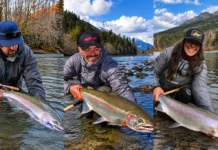
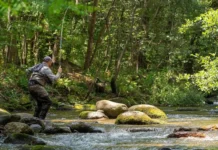
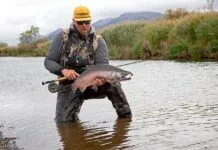
If you’ve been dreaming about a trip like this, now’s your chance. We’re doing a Togiak River Lodge giveaway. Just email me to get details on how to join the next trip.
Larry Richmann grew up on Lake Michigan, riding in boats before he could even walk. His dad used to joke that Larry could name every fish in In-Fisherman magazine before he knew his ABCs, and that early start turned into a lifelong obsession.
Fifteen years ago, he picked up a spey rod (before YouTube tutorials and easy resources) and taught himself to cast.
Through guide Floyd Carter, Larry joined the Togiak River Lodge Swing Program, helping shape one of Alaska’s most exclusive two-handed fisheries. Each summer, just twelve anglers and six guides have the river mostly to themselves.
That trip to Togiak River Lodge is hard to forget. You fly in on a bush plane, land on a gravel strip, and take a jet boat right up the river to camp. Once you’re there, it’s all about the swing.
Larry says every day on the water is different. New runs, new moods from the fish, and a new rhythm with each guide. That mix keeps both guides and anglers sharp.
Larry’s caught kings his whole life, but swinging them on the Togiak still gives him chills. Once that line goes tight, it’s game on. And those fish don’t quit. When it comes to hooking Chinook, Larry keeps it simple:
With only six guides and twelve anglers on the entire river, the Togiak setup is about as good as it gets. It’s remote, quiet, and full of fish.
Larry says one of the best runs on the whole river is right outside the lodge’s front door. In the evenings, someone’s usually out there casting a spey rod while others relax after dinner — then it’s back to fishing the next morning.
The guides run jet sleds to reach different beats, but there’s no crowding or competition. Everyone’s on the same team.
When Larry’s not guiding in Alaska, he’s chasing Great Lakes steelhead on Michigan’s St. Joe River. These fish start running in late October and keep showing up through spring.
When Larry talks about swinging flies, he keeps it simple. It’s all about patience.
That mindset has stuck with him since his dad first put him in a boat decades ago. In fact, his boat still carries that same lesson. It’s named “Just 1 More.” And if you want to see what that patience can get you, check out Larry’s page Just 1 More on Facebook, or better yet, throw your name in for the Togiak River Lodge trip giveaway and try it yourself.
Episode Transcript
840 Transcript 00:00:00 Dave: Today we’re heading deep into Alaska s Wild West, the Togiak. It’s one of the last true swing rivers for Chinook salmon in Alaska were twelve anglers, and six guides have most of this system to themselves. From chrome bright kings that melt thirty pound tippet to quiet evenings watching the river roll by at the lodge, this place has a pulse of its own. By the end of this episode, you’ll understand why Larry says all it takes is one swing, and why anglers who make the trip north always leave with goosebumps. This is the Wet Fly Swing podcast, where I show you the best places to travel to for fly fishing, how to find the best resources and tools to prepare for that big trip, and what you can do to give back to the fish species we all love. Today’s guest is Larry Richman, who guides up in Togiak every summer as part of Togiak River Lodge Swing program, a crew that’s redefining what modern Spey fishing looks like out of Bristol Bay. Today, you’re going to hear how a Michigan who taught himself how to cast a two hander became one of the go to guides swinging for Alaska kings and why he still comes home each fall to chase steelhead on the Saint Joe. We’re going to get into it all today. From Michigan to Alaska and back. Here we go. Here he is Larry Richmond excited for this one. You can find him at Intruder Fly fishing and at Togiak River Lodge. Com Larry how’s it going man. 00:01:16 Larry : Good. Beautiful morning on the river back home here in Michigan. 00:01:19 Dave: Yep. Is this a secret river? What river are you on here? 00:01:22 Speaker 3: No, this is. 00:01:23 Larry : Saint Joe River in Michigan. Oh, yeah. Uh, off of Lake Michigan, one of Lake Michigan’s tributaries. 00:01:29 Dave: There you go, sweet Lake Michigan. So we’re gonna touch on that for sure today. You’re a busy guy. You’re you’re going from the Great Lakes around to across the country. And I actually met you at Togiak, which was really cool because we, uh, you know, I didn’t know you at all, you know, and I and actually, my first time at Togiak and met all the guides there, and we went out on a day I can’t remember what day it was, I think day four or something like that. And we just had one of those cool days where we both got fish. We could talk about that, but it was, uh. 00:01:57 Larry : Yeah, we sure did. Didn’t we? 00:01:59 Dave: So tell me that first off, uh, what was the experience like for you? Because. Was that your first year up there? 00:02:04 Larry : No, that was my second year at the Togiak. Um, the togiak really drew me in. Obviously, the first year we were there, we had insanely high water. Um, so that was a little crazy, uh, to deal with and definitely a new way. But I was immediately drawn to that place. It’s absolutely epic. 00:02:23 Dave: Yeah. So your second year up at Togiak and tell us that a little bit, how did you come to connect with Togiak in that whole and, you know, all the guys up there? 00:02:32 Larry : Well, that kind of started through, um, Floyd Carter um, we had fished on the Queen Jack the first year, uh, together that we both kind of did, uh, that season. And when they were looking to put together a Spey program, uh, he had, uh, what’s the correct word I’m looking for? Referenced me, uh, to come up there and be part of the swing program, and And that’s kind of how I fell into it. And it was a question that didn’t need to be answered. It was a for sure. Yes, I’ll be there. 00:03:04 Dave: Right. And on the Queen, Jack. Now, what fish are you what are the. Because that’s Alaska as well, isn’t it? 00:03:10 Larry : Yeah, yeah. That’s, uh, Queen Jack and that’s out of, uh, little village, uh, called Igiugig. And that is all probably some of the most insane rainbow trout I’ve ever fished for in my life. I mean, they are they are a special creature there, that’s for sure. 00:03:26 Dave: Right? Right. So that’s rainbow. So the focus is rainbows up there. And you guys aren’t really. Do they have Chinook up there as well? 00:03:33 Larry : Um, the Queen Jack really doesn’t get much of a Chinook run. Uh, they kind of pass through it. Uh, they’re definitely very known for their sockeye run. And the rainbows come out of Lake Iliamna when the sockeye get ready to do their egg drop, and they come in there to just go to town and feed and pump up for winter, and that program kind of starts a little bit after Labor Day and then runs through the second week of October. And it’s just they’re on a feeding frenzy. They’re super grabby fish. We’re fishing six and seven weight rods in these trout. Twenty three inch trout will take you into your backing. Or they’re very different than the standard leopard, um, as well as in Alaska. 00:04:16 Dave: Yeah. And we’ve talked a little bit. We had Jack on the podcast a while back and he talked about that program. 00:04:21 Larry : Yeah, yeah, that’s all through the hatch with Jack Mitchell. 00:04:24 Dave: Yeah. Jack. Okay, cool. Well, you know, taking it back to, um, that togiak day we had. So, um. Yeah, I can’t remember if it was day four or whatever it was, but we went out that morning and, um, do you remember that morning, uh, on when we went up there and fished with, uh, we had the, of course, uh, the big day. What was that like for you? 00:04:42 Larry : Oh, man, it was awesome. I mean, obviously, we, uh, anytime that you can step into a run or two runs and be productive for First Chinook salmon on the swing is a pretty good day. Yeah, the Togiak definitely showed her colors that day for us, there’s no doubt about that. Uh, with some great grabs and big fish blistering runs, those fish are something else. They’re a very, very fun fish to hunt, there’s no doubt about that. 00:05:10 Dave: Yeah, that is the different thing up there, right? With Togiak, you have all the species up there, but the Chinook especially, you know, with that swing, you know, it was my first time getting one, you know, like that on the swing. And have you been I mean, I guess that’s the difference, right? There’s places you can do that, but not a lot of places around. Have you been able to, you know, swing for Chinook anywhere else? 00:05:29 Larry : Um, not like that. That river really is very built for swinging, and it is hard to find a river that’s suitable like that. And what the Larson brothers have done with their new program is pretty incredible. I got to give them a huge shout out, um, to basically kind of turning that into a no retention king program. No bait on the river, which definitely helps the species in the long run and well, set you up to be pretty successful, to be part of a big swing program there and get ripped by one of those fresh salt fish. 00:06:11 Dave: That’s the unique thing for me. I always, you know, compare a lot to the steelhead. And I was and now that I’m going out for Atlantic salmon later this, you know, next year, it’s going to be interesting to compare that. 00:06:20 Larry : That is on my bucket. 00:06:21 Dave: List. 00:06:22 Larry : I have yet to do Atlantics. 00:06:24 Dave: Yeah. Yeah, totally. Well, we’re going up to um, we’re going up to Newfoundland, which is probably not too far from where you’re at in Michigan. Um, up kind of, you know, eastern Canada. And, uh, yeah, it’ll be interesting to feel the difference because Chinook definitely is different than steelhead. You know, steelhead, for sure. You can get I mean, I haven’t ever caught a twenty pound or thirty pound steelhead, so I’ve never really felt that size. But I just know a hot steelhead can tear you up and, you know, definitely work you. But a hot Chinook. It seems like anytime you get a Chinook, they just could go and you might not be able to stop them. Is that have you had any of those fish? 00:06:55 Larry : You are not in control. Yeah, you are not in control. They decide when you’re in control and who knows when that’s going to happen. Um, I did this this year. Um, when we were out scouting in the beginning of the season. I had a fish that I never I never even got to put my eyes on. Uh, had me in my backing for the better part of fifteen minutes. Tried to turn it, tried to do whatever I could. Um, hard situation to explain, but, uh, the fish had ended up running through a little channel back into a bay, and we were getting ready to go chase it with the boat and then realized where it was at. And basically, as soon as I put the wood to it, it decided that I was not in control. Two blistering, headshakes, thirty pound test cut like it was butter. 00:07:46 Dave: Oh, really? There you go. So. Yeah. So that’s the thing about it. I guess you should feel. I shouldn’t feel. People shouldn’t feel too bad about losing Chinook up there because I know I made some mistakes. You know, I know the day I was out with Floyd, I’m going to hopefully get Floyd back on and talk about it. But we when I was out with him, I definitely I had a I had a rough day casting and I had one fish you know that it just it was one of those fish and just I was all wrapped up and it broke off and it was almost one of those moments where you feel like throwing your rod, you know? But it was more me just getting caught up. Have you had, uh, have you seen those moments on the river up there for the, you know, the Kings? 00:08:19 Speaker 3: Oh. 00:08:19 Larry : Yeah. For sure. If you’re not getting it handed to you every now and then by one of those kings, then you are, uh, one of the better part of a angler that I’ve never seen before. Uh, those fish are large in charge, to say the least. 00:08:34 Dave: That’s amazing. Yeah. So? So. Well, the cool thing is, right now we’re doing a giveaway with Togiak. So right now you can, uh, anybody listening? Yeah. So they can enter to win a trip, which is pretty epic because anywhere up in Alaska I think is is worthy. I think it’s a huge bucket list area to, you know, trip to get to. But also we’re going to have some spots available too, for people who want to jump on us. So, you know, anybody listening can check in with me by email and we can follow up with that. So so yeah, I mean, I think for what I’m looking at, you know, it’s uh, I mean Chinook right. Atlantic salmon steelheads always on the bucket though. And right now you’re you’re out there right. 00:09:08 Larry : You’re you’re in right now. I am right now on uh, right now, uh, testing the waters back home. We’ve, uh, finally got some rain in our forecast a few days ago. Bumped our rivers, obviously some cold temps. Dropping the water temperatures. First thing on my brain is it’s time to go check it out. 00:09:26 Dave: Yeah. Yeah, exactly. And you’re the type of guy I know. When I met you, the cool thing about you is. And I think, you know, Jonathan Farmer was on with us, too. And you make that good connection right away. You’ve got this energy that just exudes out of you right about like, everything. Talk about that a little bit. Have you been doing, you know, um, all over the country, the swinging for, for a while here, or have you been more at home and been expanding? 00:09:49 Larry : So I self taught myself how to swing flies about fifteen years ago. Um, we’ll do a quick rundown start from the beginning. 00:10:00 Dave: Yeah, let’s hear it. 00:10:00 Larry : My dad put me in a car seat and put me in a boat. That was forty two years ago, and, uh, it’s been a hardcore addiction ever since then. He used to tell me that I knew all the names of the fish in in fisherman magazine, which is throwing it way back before I actually knew what my ABCs were. 00:10:22 Dave: Yeah. 00:10:23 Larry : Uh, so I grew up. I grew up on Lake Michigan, uh, gear fished my entire life. Um, kind of got done with that part of my life. And then, you know, you start to transition and want to catch fish the way you want to catch fish and just happen to get into this, uh, new rhythm of things and picked up a wanted to pick up a spey rod, and that was about fifteen years ago. And uh, self-taught, you know, before there was really YouTube and, uh, books out there on it. And that was a struggle, uh, for anybody that is learning how to spey cast. It’s definitely a process. So pick up the Spey rod fifteen years ago. I’ve been doing the Great Lakes trip since then. In between all that, man, it’s just been a it’s been an ongoing process and learning curve of of all the different places in the world that you can actually do that and, um, make it work. 00:11:20 Dave: Exactly. No. That’s amazing. I think that the cool thing is I didn’t realize twenty ten. That’s about the same time that I learned I picked up the Spey rod because I got a late start to, you know, even though I was out in the West Coast and, you know, all the famous people that were getting started here. And, you know, I missed that boat a little bit in two thousand and nine, twenty ten, I went to the Skeena for the first time, and I basically said, okay, I’m going to have to have a tool, you know, up here. So I taught. So I watched Simon Bosworth videos for a month before doing that trip. And we spent and we spent three weeks up in the Skeena Country. And it was like, man, was I happy I had a spey rod, even though I could barely cast that eight weight. That eight weight saved my life. And I had the greatest still to this day. The three biggest steel I’ve ever caught came from the Skeena on that trip. 00:12:02 Larry : Which actually, I do believe you just did a giveaway that I happened to notice on Skeena. I definitely entered for that one, there’s no doubt. Uh, the there is a bucket list to get up to B.C. and do that. 00:12:14 Dave: Um, yeah. Yeah, definitely. 00:12:15 Larry : I have ever I’ve never I’ve never crossed the border to get up there and do that. Yet. 00:12:20 Dave: There you go. Well, there’s a connection for you because we have Brian at the Skeena Spey Lodge, as does our In the Bucket podcast. So we’ve got a connection for you there. If we could follow up. 00:12:29 Larry : On that, man. Yeah, I’d love to check it out for sure. 00:12:31 Dave: Um, yeah, yeah. 00:12:32 Larry : When, uh, when you try and mix it all, you know, it takes up a lot of your time, um, Um, when I was younger and saying, I’m just gonna fish for a living and I’m going to make all this money fishing you. When you start to grow up, you realize, yeah, maybe. Maybe I better have a backup. 00:12:49 Dave: Yeah. 00:12:51 Larry : Yeah. You know, uh, always the dream to survive and doing what you love. And, uh, somehow I’ve decided to just do it all. I’ve been a carpenter, you know, for twenty two years. Um, fortunately, got a great relationship with my boss. Um, and he lets me get away with murder. Basically leaving for two and a half months out of the year, coming back to work, getting to travel to Alaska, you know, guiding back home Fridays through Sundays. And then, uh, back in the construction world Mondays, Mondays through Fridays as well. 00:13:26 Dave: Amazing. You know, I think that most people that are dedicated, they’re passionate, which is a lot of people in fly fishing, you know, they find a way like you found a way to make it happen. You’re doing it. You’re living the dream, and I always love to go back to the gear fishing, because I feel like some of the greatest fly anglers that we’ve had on the podcast started out gear fishing, and they learned a lot about, you know, the fish. And then they got into fly and it helped them a lot. Do you attribute a lot of your success with steelhead now and things like that from your background? 00:13:51 Larry : Oh, one hundred percent, without a doubt. Um, you know, anybody out there that, um, like I said, grew up gear fishing, obviously on the latter end of that, uh, before those fifteen years ago, I was kind of about the time of the curve of the center pin. Um, I’m sure anglers out there know what that is. And, um, you know, it probably is one of the most deadliest techniques out there, there’s no doubt about it. But the learning curve that it had given me, knowing where those fish live and how they respond to to a lot of things, uh, definitely helped me in the fly aspect of things, there’s no doubt about it. You know, hooking fish is really cool, hooking fish the way you want to hook fish is even cooler. 00:14:37 Dave: Yeah. 00:14:38 Larry : So when you start gear fishing and you already kind of have a run on where those fish live and how they operate, and then you go to present a fly to them. It definitely helps to know where they’re living. There’s no doubt about that. 00:14:53 Dave: Yep. Nice. And so now you said you’re guiding out there. So you’re on the Saint Joe. Talk about that a little bit. So if somebody’s listening now and they’re thinking, you know, Michigan, uh, steelhead, is that mostly your species you’re focusing on? 00:15:04 Larry : Yeah, definitely focusing on on steelhead here in Michigan. There’s no doubt about that. They start to enter our systems. Well about this last week of October. Um, and then they run through basically, uh, you know, spurts of them come in, uh, through November and December. Then we get a lull in January and probably middle of February, and then we get another push that starts to come in, uh, on the latter end of March there. And they definitely are happy fish. There’s a lot of guys out there that might say that these aren’t steelhead, and that’s a whole nother battle that I’m not willing to get into. 00:15:40 Dave: Right. Yeah. Well, I’ve said that before. I think that I think that a lot of I think a lot of people say, well, some people say that, but I feel like, you know what I mean? It is the same species. It’s a, you know, Oncorhynchus, right? 00:15:51 Larry : It actually came from Washington state. They came from Washington state. 00:15:54 Dave: Yeah. So really the only difference is, is that it’s been, you know, transplanted obviously, and it migrates to the Great Lakes instead of the ocean. You know what I mean? Like that’s the biggest difference. And if you think about all the brown trout and all the transplant, I mean, I feel like I think it’s a steelhead. There’s no question in my mind it’s just a little bit different than the steelhead of maybe the West Coast. 00:16:14 Larry : Yeah. I mean, it’s a steelhead. You know, regardless, it is one epic fish. I have caught steelhead all over the place and, um, they grab and rip the fly just as good as any other steelhead in our class. The fish that come in, uh, on the on the Lake Michigan side of things. And in arch ribs, uh, I mean, they’re a pretty dominant, uh, sized species. I mean, for the most part, uh, you know, our average steelhead, you know, ranges anywhere from, you know, eight to twelve pounds, and then you’ve got your twelve to sixteen pound class fish. And then every season, you know, we’re seeing those maybe two to five that are in that eighteen to twenty pound class fish. Amazing. Um, so you always got a chance of laying into one of those every season. 00:16:54 Dave: Yep. And is the game up there the swing game similar to, uh, anywhere else that you’d be swinging flies? 00:17:00 Larry : Yeah, absolutely. We’re, uh, you know, uh, on the early end of our season, you know, we’re fishing, uh, floating lines with your standard tips, ten foot of T11, ten foot of T14, weighted or weighted bugs. And then as we start to move into the colder part of our season, which is actually really cold here, uh, when you talk about winter steelheading, uh, in Michigan, um, it’s a special kind of cold you’re fishing in, you know, I’ve got a steelhead, a negative ten degrees on the swing, believe it or not. 00:17:29 Dave: Oh my god. Yeah. So that’s that’s the thing you got to deal with a little bit of weather. 00:17:34 Larry : Yeah, yeah. When you’re jumping in the water and it’s, uh, thirty six degrees, uh, your feet can feel that. There’s no doubt about it. 00:17:41 Dave: Yep. That’s awesome. Well, we’ll talk a little more about that kind of as we go, but I want to touch back on that trip that we were at, you know, because it kind of it’s, uh. I haven’t forgot about that thing since we did it, but, you know, I remember rolling up there, you know, it’s the whole experience, right? You fly in with the plane, which is an experience you drop on the gravel landing pad. You guys are there to pick everybody up on the landing strip, take the jetboat ride up river, you know, up to Togiak Lodge, which is right on the river. And then you’re there, right? You’re there for the week. What is it? Um, are you planning? Well, first off, are you going to be there this next year? 00:18:13 Larry : Oh, there’s, uh, I will be. I will be at the Togiak River in until I die or can’t walk. 00:18:20 Dave: Okay, good, good. Okay. So. So, yeah, you’re going to be back. And that’s the struggle for me, is that I kind of feel the same way. The challenge is like, okay, I want to go Atlantic salmon fishing. And I’ve got the same struggles as everybody with family. So I probably, you know, likely won’t be there this year. But the cool thing is that you’re going to be there this year. I’m sure Floyd and the other gang will be there. And so but when we went up there, we kind of split it up, right? Each day we took out with a different guide and did a different thing. How do you look at that each day when you’re getting ready for is it a different day each day for you? What’s that like? 00:18:50 Larry : Oh yeah. Absolutely. It’s definitely a different day each day. You know, depending on what your game plan is, what your you know, the success for your anglers is extremely important to. I will say, uh, the crew that we have put together at the Togiak and for that matter, the kayak and back home, you know, it’s all about the anglers success. You know, that’s you start out your day by planning that. What is the best plan for success for them. And the way that we have done it, uh, is clients roll through different guides because everybody has a different pep in their step and a different way of viewing what the fish are doing, how they’re doing it, and where you’re going to go to be successful. And when you’re open to learning fishing with different anglers each day, uh, can really what’s, uh, what’s the word I’m looking for here? Broaden your horizons on all the different techniques that everybody has. Uh, which in return makes you a better angler at the end of the day. Yep. 00:19:55 Dave: Yep. Definitely. So we mixed it up. So we. And like we said, we went out with you. I think it was day four or whatever that was. And we went up to a spot. We don’t have to necessarily name the spot, although I’m sure there’s spots. 00:20:05 Larry : No name spots. No, I’m just kidding. 00:20:07 Dave: Yeah, yeah, it’s so remote I can’t remember. But we went up to that spot where there was a deep run at the top. Deeper run, faster run. And then I was down at the bottom and, uh, and I just had kind of that moment of, you know, just hooked into one. And the cool thing is, is that there’s other species, right? I think during the trip, I hooked, uh, I landed a sockeye. There’s lots of chum out there. You land, which are good, you know, good fighting fish. But you never. You get that first hook in for a second there. You’re not quite sure. And then how do you know? What’s your thing? When you see something, you see. 00:20:35 Larry : That you never know until you know. 00:20:37 Dave: Yeah. And then, you know, and then they tell you because. 00:20:40 Larry : And then, you know, all you can do is let that line go tight. And regardless of what species it is, is you’ve had a successful tug, you’re doing something right. You’re getting a response from an awesome species, whether it be sockeye chum kings. Um, obviously everybody’s after the hunt for the king. Yeah. And when one of those pull and you pull back, you know what it is? 00:21:09 Dave: Yeah, you know it. That’s the the the chewing. The gum is the thing that George Cook said before I went up there. He talked about that on the podcast. You know, let them chew the gum because you can make a mistake. And I did that a few times before you get into it where you, you know, talk about that. It’s so unique. Right. It’s different than steelhead. How is the Chinook take and how are you setting the hook different from steelhead? 00:21:29 Larry : Uh, I would say with anything, uh, patience is a virtue. Uh, whether it be waiting for that grab and anticipating it, you’ve got to be ready to be patient when they grab it. Um, hands down, you know, any species, you have to let them turn their head. If you do not let them turn your head, then your success rate just dropped below fifty percent. 00:21:55 Dave: Mhm. Yeah. Let them turn. So you feel something there. You let them chew the gum. You’re feeling it. They’re chewing the gum and then you. And then on the Chinook you, you set the hook. 00:22:03 Larry : And then you go, then you blow the bubble. 00:22:06 Dave: Yeah. Then you go. And it is different than steelhead because steelhead you’re not really putting the, you know, uh, you know, you’re not really setting that hook super hard like Chinook. 00:22:14 Larry : Oh no. You’re putting the what? No. Those Chinook, they’ve got a tough jawline. And you better be putting the wood to him with that nine or ten weight rod, because if you’re not plucking that hook into their jaws, you’re in for a chance of losing a fish, that’s for sure. 00:22:30 Dave: Yeah. And so that’s it. So you put the wood to him and it’s just like you really put the wood to him. And then once you hook up, then it’s like, okay, instantly you know what’s going on, right? You kind of it’s. 00:22:39 Larry : Game on at that point. Game game on. 00:22:41 Dave: Yeah, yeah game on. 00:22:42 Larry : You’re in for the races and uh, yeah, I will say that those, you know, I’ve caught Chinook my entire life. 00:22:50 Dave: Oh, you. 00:22:50 Larry : Have uh, whether it be, uh, gear fishing on the lake, trolling, um, back when I used to gear fish, uh, you know, on the Great Lakes trips. And I will say that those Chinook are something special. They are a mean fish. And the way that they grab that fly, it gives me chills, to be quite honest with you, it just thinking about it right now, I’m on a river fishing for steelhead and thinking about those fish. Just oh man, they are awesome. 00:23:19 Dave: Yep. Yeah. They are. Yeah. You don’t. I mean, the memory for me hasn’t popped out of my mind since that trip, which was in, I want to say July. Right. I think sometime in July. And and the cool thing is, is on that trip we were Jonathan Farmer. Shout out to Jonathan. He you know, when we were going up, we were like, we were like, hey, we need to make sure, Larry. Because, you know, I don’t know, we kind of I think we hit it off. You hit it off with Jonathan there, but we wanted to make sure you weren’t just, like, in our pocket because you didn’t need to be. We were just going to fish. We wanted you to get fishing. That was our goal for the day. And so you had a chance to get up on a swing there. How often do you do that with clients in your boat? 00:23:52 Larry : Oh, not that much. I mean, obviously, uh, you know, the golden rule is when you’re a guy, don’t touch the rod. 00:23:59 Dave: Right. Unless your clients tell you that you should touch the rod. 00:24:02 Larry : The guy touches the rod, and all of a sudden, something happens. Um, yeah, but it was really cool to enjoy just fishing with you guys. I mean, you both are great anglers. You didn’t. You didn’t need me in your ear or at your side. Um, just to kind of point you in the right direction and say, here it is. Put it in there. Do it right and you’ll be successful. And, uh, to have the opportunity to fish with you guys and actually have Jonathan, which did a great job on a scoop for me, uh, and putting a beautiful big pen in the net, uh, was really awesome to experience that. And not only that for you, I believe about twenty minutes before that, uh, put almost an identical species in the net right before that, in the same run. Just a little lower. 00:24:51 Dave: Yeah, I still have that photo that’s just kind of. There, I see it, you know, it’s just this, uh, they’re a cool fish, right? They look almost. It’s really cool. It almost looks like it’s got a big a big. They got big shoulders and all that. It almost looks. It reminds me a little bit of a redfish. How crazy those Chinook are, but in a different way. 00:25:10 Larry : When I look out, I might see Little Tunas. 00:25:12 Dave: Yeah. Yeah, totally. Yeah. It’s really cool because I mean, yeah, Bristol Bay, they were just in the ocean. They’re coming in, they’re fresh. So that fish and but it was different. You caught your fish in a little bit faster run right. Do you remember what a sinking line you were using their tip. 00:25:25 Larry : Uh, yeah, I actually went up there. I kind of came through there. Our standard, uh, you know, obviously you always want to do something a little different. I mean, our standard program that we were, you know, being successful that day was, um, you know, Skagit with, uh, ten foot of T18 or T14 and. 00:25:44 Dave: Yeah. 00:25:44 Larry : Yeah, T8 or T18 and I just yeah. Said, you know what, guys? I’m going to come in behind you. And, uh, I came in with a game changer sink three with ten foot of T14. And I guess I got it down there in the right place at the right time. 00:26:01 Dave: Yep. Yeah, definitely. So yeah, that was cool. And then the other thing is we have, you know, the jet sleds, right. So you’re zipping around, uh, up and down getting the spots. And I think I can’t remember if there’s five boats or six boats on the river. Right. Because you guys. And is it that time of year now that it’s there’s six. 00:26:18 Larry : There’s six. Yeah, there’s six guides and, uh, twelve of us, uh, well, I should say twelve anglers, six guides. And, you know, I have to say I have fished in a lot of places and, um, to be part of that program and have a river system like that, I guess kind of at your disposal, uh, with only twelve anglers is quite remarkable, uh, for this day and age, for the amount of anglers that are out there and, uh, especially of being salmon season. Yeah. Unless you’re getting extremely remote. Um, that’s about as remote as you can get. Uh, when it’s salmon season, I would say anywhere in the world. 00:27:03 Dave: Yeah, exactly. The thing that resonated with me is the fact that, you know, you’re at the lodge, just, you know, amazing lodge right on the river. We’re sitting there in the evening. Somebody out there with the rod, you know, practices. 00:27:13 Larry : one of the best runs on the river. One of the best runs on the river is right outside the lodge front door. 00:27:18 Dave: Exactly. Yeah. And there’s been some fish hooked there, and it’s that. So that whole thing, you know, and you’re out there watching somebody cast a spey rod. Um, and then you’re hanging out and all that after dinner or whatever, and then it’s like, yeah, go in eventually, you know, go into your cabin, get ready for the morning. Uh, and then it’s like, go time again. Right? And so every day you’re rolling and you got a different guide. And so and then, then we go up to the spots and it is remote. So you’re not having a bunch of different sleds. The only competition you really have are other guides that are the other five guides. Right. You guys have worked that out. 00:27:49 Larry : Yeah. To be quite honest with you, I wouldn’t even call that, uh, competition. Uh, like I said, you know, we are, uh, what’s the word? 00:27:57 Dave: Um, you’re on the same team. 00:27:59 Larry : We are. Yes, yes, that is the correct way to say it. We are all on the same team, and we are team angler. Uh, that is in our boat. And we want them to be successful. We do a guide meeting every night prior to fishing. We don’t just jump in our boats and run about the river and, you know, step on anglers toes or any of that. It is. It’s a well thought out process on what needs to happen per angler. 00:28:28 Dave: Yeah, yeah, exactly. 00:28:29 Larry : And what spots they can fish and for them to be successful. 00:28:35 Dave: Yep. Exactly. What is the, um, the you know, you get somebody new up there. I’m sure you had some people. They’re fairly new. What do you think is the biggest mistake you see that people are making for Chinook fishing on the swing up there. 00:28:47 Larry : They set the hook way too early. 00:28:49 Dave: Yeah. That’s it. 00:28:50 Larry : Which I think in another, in another set of words is you farmed them. 00:28:55 Dave: Yeah. You farmed. Exactly. Yeah. You set the hook too early. Yeah. 00:28:59 Larry : No trout sets? 00:29:01 Dave: Yeah. No trout sets. None of that. And it takes a little bit. And the other cool thing is the the Spey. Right. Some people might be a little bit like, you know, newer to Sp-a and that’s that’s the whole thing. That’s the whole instruction thing for me too, out there. Right. You’re learning. You’re dialing in your sp-a. Do you guys feel like that’s an equal part of the Chinook, like people are trying to catch? Obviously a Chinook, but they’re also trying to dial in their sp-a if they’re new to it. 00:29:22 Larry : Oh, absolutely. It’s you know, I will say that those two rivers, um, the kizhakke included, are, uh, a sp-a angler’s Paradise, uh, to learn how to swing the fly properly for each species of fish, which is very different. But to be successful doing it, um, and I will say that, you know, uh, the waiting, uh, waiting for anglers can be tough. And the waiting on those two systems, uh, for the most part, is extremely friendly. 00:29:56 Dave: Right. 00:29:56 Larry : Uh, which helps anglers be successful. 00:29:59 Dave: Yep. So the waiting. Yeah. And the togiak, there’s a couple of spots that have some rocks and things like, you know, there’s a deep slot or something, but for the most part, yeah, it’s fairly easy waiting up there. And you’re dealing with. Yeah, the flows are up and down and changing right throughout depending on what’s going on with the flows. 00:30:14 Speaker 3: Yeah. 00:30:15 Larry : Which obviously changes each individual spot for waiting and all that. But, uh, you know, for the most part, uh, both of those systems are very forgiving waiting rivers. Um, which, you know, when you’re comfortable, you’re more likely for success. And, uh, especially when you’re learning as well. You know, we do a lot of teaching. Um, you’ve got to be comfortable for learning. If you’re not comfortable, then, um, there’s too many, too many things going on in your mind. 00:30:44 Dave: Yeah, definitely. And so the cool and one of the cool things is, is, um, you know, you mentioned that the Jack River, um, you know, you’ve got these two. I mean, the togiak is amazing because it’s Bristol Bay. There’s not a lot of places you can still catch Chinook like that in Alaska or really anywhere in the world. You know, it’s one of those spots where you got this opportunity to do that. The jack is a little bit different. Talk about that. Is it? It’s still Alaska. Are there more similarities or more differences between the two areas? 00:31:09 Speaker 3: Oh, there. I would say. 00:31:10 Larry : There’s definitely more differences than similarities. Very different landscape. At the Kodiak it’s more tundra. It almost looks like you’ve set down in Louisiana and you’re fishing redfish in some areas. Wow. Yeah, it’s basically it’s very big system. And you can almost fish any type of river system that you could have in your mind in that river, due to the fact of how it’s kind of low tundra and there’s three main channels, and then the main channels are all broken up through, uh, all these sets of different braids that are smaller, uh, intimate water, which is really neat. So if you’re if you’re in the mood for fishing big water, you can fish big water. If you’re in the mood for fishing small, Mall. Uh, what seems to be more likable? Trout water? Um, you can get in that kind of water. So in that aspect, it is a little bit different than the togiak. 00:32:15 Dave: Yeah, but you’re still swinging flies for the most part. Jacks operation. You’re swinging up there for those big rainbows. 00:32:20 Speaker 3: Oh, yeah. 00:32:21 Larry : Yeah, it’s definitely a swing program. Um, and obviously, um, you can be successful there with a nine foot rod, there’s no doubt about it. But anybody who’s swung flies know that that’s the way you cover water. And you can cover water typically better in that scenario. 00:32:39 Dave: Yeah. Okay. And so that’s so so you’re at Togiak. Let’s just take it back there. So you’re at Togiak for when do you move. What’s your season. So when do you finish up at Togiak and when do you head up to is that you go the key Jack after. 00:32:50 Speaker 3: Uh, so uh. 00:32:50 Larry : Togiak finishes up, uh, well basically basically I will save that for the most part. My season starts April first First on Lake Michigan. Most of our fish are out of our rivers. So I start gear fishing on Lake Michigan. Trolling that begins April first. Uh, so I run two months of that and then April or. I’m sorry, not April. June. Oh, boy. June. About June sixteenth is when we head off for the togiak. And that runs through about July sixteenth when we get back. All right. So it’s a four week program and then back to Michigan, back to the Great Lakes for two months for me. And then the weekend after Labor Day, which is usually about September either seventh or eighth, it’s back to the jack for the six week program, which runs until October sixteenth. And then it’s back to Michigan, and about two weeks later our steelhead start entering our systems. And that’s why I’m on the water right now for having this conversation to see what’s going on. And then we swing steelhead in Michigan here, which is still pretty underrated where I’m at. Um, it’s not as big as it is in other places of the world. I will say that. 00:34:14 Dave: Oh it’s not. Yeah, but Michigan is known for in the Great Lakes. Definitely steelhead fish. I mean, we I know when I first started this podcast, you know, nine years ago, we had an episode, I think it was Kevin Feenstra who’s up on, um, what’s the. 00:34:27 Larry : Yeah, he’s on the Muskegon River. 00:34:29 Dave: Yeah, Muskegon. 00:34:29 Larry : Probably the more known swing river in Michigan right now. Um, which is yeah, a beautiful river. Um, definitely a super pristine river. Uh, we love to go up there and fish that on the swing. And probably one of our most underrated rivers, uh, is my home river, which is the Saint Joe. Uh, about forty minutes from my house. Um, really? Overall, a pretty big system. Uh. It’s broad. Uh, our CFS on this system usually runs for those, uh, that look at the CFS. Like most of us crazy anglers out there, uh, runs anywhere from about two thousand five hundred to forty five hundred with it getting as high. 00:35:12 Dave: As. 00:35:13 Larry : ten thousand. 00:35:14 Dave: Yeah, yeah. No, that’s a good river. 00:35:16 Larry : Yeah, absolutely. A big, broad system. Um, and yeah, it’s a swingy river. Uh, no doubt about it. 00:35:23 Dave: Yep. So you guys are exploring out there today? Kind of. It’s early, early in the run, but you might. There’s probably some fish hanging around out there. 00:35:29 Larry : Yeah, we’re definitely early in the run. Yep. Definitely early in the run. I do believe actually, while we were, uh, having this conversation, my buddy may have farmed one. Oh up at the top of the run. 00:35:41 Dave: Nice, nice. Okay, so if people wanted to connect on that, you’re doing, uh, the kind of trips out there, uh, you know, throughout the year. 00:35:48 Larry : Yeah, absolutely. Yeah. That starts, like I said, the last week of October. We run that through December. Um, you know, basically Fridays through Sundays is is my operation due to the fact that I’m building in between that. But with it being a home river, it’s not far from where I’m at. And, um, it’s a very under swung river. There’s no doubt about it. There’s probably only, uh, I will say, a solid handful of us, um, that really kind of rip around and and swing this river. 00:36:16 Dave: Amazing. Yeah. I think we’ll have to definitely, uh, you know, Larry, get you back on for a full episode on The Saint Joe, because that’s one for. Yeah. We have done nothing on the Saint Joe that has not been in our wheelhouse, so I feel like that’s one we should talk more about because I’m guessing you’re using similar techniques, but it’s probably like all rivers are a little bit different. Right. And how you fish them. 00:36:36 Larry : Yeah. All, you know, similar techniques to I mean, you’re still anywhere in the world. You’re steelhead fish and you’re looking at water temperatures. You’re basing your decisions on, you know, what the fish are doing, what time of year you are at in the run. Um, and basing all that information on your techniques. I mean, right now we’re fishing, uh, floaters with ten foot of T14 and ten foot of T11. Uh, obviously, as water temperatures change, you know, we start upping our game and, uh, into the multi density lines and, uh, trying to figure out what kind of water they’re in, what, what kind of water they want to eat in. Um, you know, they our, our fish come in and they will settle into, into big holes. And, uh, you got to get the right rig down there to em, uh, to be successful. 00:37:25 Dave: Yep. Definitely. Just like Chinook. Right. You got to figure, you know, T18, you know, I don’t hear T18 that very often, but on the togiak, T18 is is pretty common, right. And that’s because. And why is that? Why is it obviously a bigger rod. What’s that. 00:37:39 Larry : Well, and I also do think Chinook Chinook tend to sit I mean, regardless, uh, no matter if you’re fishing five to eight foot of water, I will say the Chinook species, they tend to be a little bit It more in the bottom half of the water column versus sitting, uh, up higher on the hydroplanes like steelhead. And I just think you got to get that fly a little closer to him to get him to aggressively move to it. 00:38:08 Dave: Yep. So that’s what it is. So the TT because you got to get down there. The bigger hunkering down in those buckets or whatever. 00:38:14 Larry : But um yeah yeah you gotta you gotta get down to him. 00:38:17 Dave: Okay. Cool. Well we’re going to take it out of here in a little bit, but I just want to give a shout out to, um, you know, some of the other guides that were on the trip. So when we, when we were there, I can’t remember if you remember everybody, but we had, um, we had Chris Floyd, we talked about Floyd, uh, Chris Childs. Floyd. Yeah. Um, who are the who are I missing on other guys? You we had a few other ones out there. Right. 00:38:36 Larry : Um, we got, uh, big perm. I’ll, I’ll make a shout out to him, which is Aaron. 00:38:41 Dave: Oh, yeah. Aaron. 00:38:42 Larry : Yeah. And then Ryan, uh, which is, I believe he’s over on the Clearwater doing some stuff every now and then. And then, uh, we had a new guy join us this year. Bailey and I cannot pronounce his last name, but it starts with an A, and he’s over on the Wisconsin side of Lake Michigan, basically doing the same thing I’m doing. He’s on the. He is on the west side of the lake, uh, in Wisconsin, and I’m on the east side of the lake. So we connected there on a lot of planes. Uh, we’re looking to get together here and, uh, do mission together on, uh, the two different sides of Lake Michigan. The east side and the west side. 00:39:20 Dave: Yep. East and west side. That’s so cool. Yeah. And Bailey, I think actually, it might have been one of our best days out there. Uh, we, you know, we hit one of the runs there, and it was just it was on fire there for a bit. 00:39:31 Larry : Yeah. Aren’t those the best? 00:39:32 Dave: Yeah, they are, they are the best. They’re sitting there the days when you could, uh, you know, it doesn’t take much. I mean, it really, it only takes one. It only takes one to really just be there. And you’re like your breaths out and you’re sitting there and you know, and you’re, like, ready to take. You could take a break, right? Like after that. But we had a few in a row there and it was kind of one of those mornings. That was pretty epic. Um, but Bailey was great. And yeah, Ryan and Aaron, the whole gang. So I’m guessing those guys will all be back next year. Um, and, you know, for round two, which does it feel like to you? Does it come? The years seem to go by fast. Do they go by quick to you, or does it seem like a long time between seasons? 00:40:05 Larry : I, I blink and it’s the next year and I’m getting ready to start it all over again. Yeah. Um, it definitely is. With the way that my schedule works. It’s a nice break up in between all my seasons. You know, I spend a handful of my season, uh, gear fishing, trolling Lake Michigan when our fish aren’t in the systems, and it’s broken up by a wonderful visit to the Togiak to guide there for four weeks. Uh, then I come back and I get to spend some time on the lake, uh, again for a couple months. Then it’s broken up by the end of the season, uh, heading out to the Kodiak for six weeks, and then it’s back to the swing game and fall steelhead, uh, as soon as I get back. So it’s a nice transition from it all. 00:40:47 Dave: Yeah. It is, it is nice. Well, let’s take it out here real quick with our. We mentioned it before our kind of giveaway segment. Uh, we’re giving away a trip. One lucky winner is going to take away, um, you know, a trip to Togiak Lodge, which is no short, uh, giveaway. So we’re doing that. Uh, so we’re gonna have a link for everybody to access that giveaway. And as we take it out of here, I just want to give a I got a couple random questions for you and a couple of tips we’re going to get out of you. And, uh, so if you take it to steal, let’s just go swinging. In general, somebody’s coming out with you either on the togiak or, you know, maybe your water there. What are a few? What are you telling them before to prepare for a successful day? Any high level things you’re talking about? 00:41:27 Larry : Patience. 00:41:28 Dave: Yeah. 00:41:29 Larry : Anywhere you are going to swing a fly, you have to have patience. And I tell everyone all it takes is one swing. That’s all it takes out of the hundreds you might throw in a day. All it takes is one. That’s it. Yeah, it takes one swing to become successful. And don’t give up on it. 00:41:53 Dave: Yep. 00:41:54 Larry : That’s all it takes. One swing for all to go down and for the battle to begin. 00:41:59 Dave: It’s battle to be okay. And now you’re on the water. So you’re thinking about that patience. All right, I got to be patient. So now you’re on the water getting ready. Let’s just take it to Togiak and you’re jumping in that run. What do you anything else you’re giving them for advice as you’re kind of sitting there, watch them hopefully hook into something. 00:42:14 Larry : Um, most of the time. Bottom hand, slow down. Yep. Look at your deep loop. 00:42:21 Dave: Look at the D loop. Right. 00:42:23 Larry : Yeah. 00:42:23 Dave: Look at it. Because you want to look at the d loop and make sure you’re getting a decent the right d loop to load up the rod and all that. 00:42:29 Larry : That’s correct. Yeah. Yeah. And the biggest thing and it kind of breaks down to that patient factor is slow down. 00:42:36 Dave: Yeah. 00:42:37 Larry : Enjoy it because all it takes is one. All it takes is one baby. 00:42:41 Dave: It’s just one nice. That’s it I love it, I love it. 00:42:45 Larry : Yeah. Which is actually the name of the very first boat my dad put me in, in a sense. Yeah. And still is. The name of my boat to this day is just one more. 00:42:55 Dave: Oh, just one more. So that’s on the side of your boat right now? 00:42:58 Larry : Yep. And that’s also that’s on my big boat. And that’s also my, uh, that’s my big lake fishing. Uh, Facebook is just one more. 00:43:07 Dave: Just one more. Okay. And you have. So the boat you’re in now is not your big boat. What boat are you sitting in right now? 00:43:12 Larry : No. Nope. I’m. I’m sitting in my eighteen foot, uh, river man jet sled today when I’m on, uh, Lake Michigan fishing the big lake. I’m on a thirty one open tierra. 00:43:22 Dave: Oh, wow. A thirty one foot boat. 00:43:24 Larry : Yes. 00:43:25 Dave: Oh, wow. That’s a huge. That seems like a giant boat. 00:43:27 Larry : It is. It’s got a twelve and a half foot beam. Uh, it’s a dance floor. 00:43:32 Dave: Uh, do you ever. Do you ever do. 00:43:35 Larry : Dance floor compared to your standard jet boat? 00:43:38 Dave: Right, right. You could do some partying out there, right? That’s plenty of room to do that. 00:43:43 Larry : Oh, yeah. Yeah, I’ve had a few of those groups. 00:43:45 Dave: Yeah, you have, you have. Right. That’s that’s the interesting thing with the fishing is that you, you know, that wasn’t at Togiak. You’re not getting that right. I think people that are spending, you know, a decent amount of money to go on a steelhead trip, most of them, I found in our experience, are not out there partying, getting wasted. Right. That’s not part of the deal. 00:44:01 Larry : No, no definitely not. And I wouldn’t say that that’s always the case on the big lake. But no, it’s definitely a time for, you know, a group of guys to get together, let loose. 00:44:10 Dave: Oh, yeah. 00:44:10 Larry : Um, have a good time, enjoy each other and, you know, catch some fish doing it and work the rods. And it’s a good time for, for all anglers, you know, uh, to just take it easy. It’s not. So, um, what’s I guess, in a way, sometimes swinging flies can be intense. You know, you’re you’re constantly working and waiting and, um, you know, sometimes you forget to stop and look around and Big Lake, you know, those guys get that chance. Uh, because they’re, you know, they’re they’re not so intense as us. Um. Yeah. But yeah, that’s, you know, sometimes you just gotta stop and look around. 00:44:54 Dave: Yeah, that’s a great reminder. Cool. Well, a couple random ones here, Larry, and we’ll let you get out of here. So the first one is do you have any, uh, superstitions around your fishing, your your fly fishing or anything? 00:45:05 Larry : Oh, man. Do I have any superstitions? That’s a. 00:45:08 Dave: Good. 00:45:08 Larry : Question. Uh, if your hands smell like fish, don’t wash them. 00:45:12 Dave: Oh, wow. There you go. Yeah, there you go. 00:45:15 Larry : If your gloves smell right, don’t wash them. 00:45:19 Dave: Yeah, I like that one. Right. So that’s like the that’s like the professional athlete who, you know, doesn’t change whatever that is. They’re on a winning streak. 00:45:26 Larry : Yeah. Their socks, their jockstrap. Yeah. Well I’m a fisherman, so I’m gonna be changing my socks and my jock straps. But my gloves, if my gloves smell right, they’re staying right. 00:45:37 Dave: Oh, man. That’s good. That is probably the best one. So. Okay. And, uh, and tell me this. If the Togiak River, uh, could talk, what would it say when you’re out there? 00:45:47 Larry : I get, uh, chills. I don’t know if that place gives me the chills the second I step off the plane and I get to that river, my brain is at a hundred on. Chills for the hunt. Yep. I guess if that makes sense. 00:46:04 Dave: Um, yeah. 00:46:05 Larry : Yeah, literally. I’m talking to you right now thinking about that feeling. Um, literally just got chills. 00:46:14 Dave: Nice. I know, I know, it’s kind of weird. It’s not weird because anybody that fishes it or has it, goosebumps and chills are just part. I’ve had them a couple times this episode because of the experience, you know? I mean, that’s what we’re all in it for. We’re not in it for, you know, to catch thousands of fish or kill a bunch of fish. It’s really just that moment. 00:46:31 Larry : Absolutely not. There’s no need for that species. And, uh, like I said on my shout out to the larsens. What they’re doing with that system and running a business. And the way that they’ve adapted to save, to make that river better. I don’t know if save is the correct word. To make that river better is remarkable. Um, it’s pretty cool. 00:46:56 Dave: Yeah, it is nice. Cool. Larry. Well, I think we could leave it there for this one. We’re like we said, we’re going to get you back on and follow up with a good episode where we can talk more about The Saint Joe. Yeah. 00:47:06 Larry : I love to talk about fishing. If there’s one thing I can talk about for plenty of hours, that’s fishing. 00:47:11 Dave: Love it man. Well, it was good having you up there. And we’ll send everybody out to, um, intruder fly fishing on Instagram. Is that the best place? 00:47:18 Larry : Yeah, absolutely. Yeah. Go check it out. There’s a bunch of cool stuff from the togiak. The Jack. Um, a little bit of, uh, the steelhead back home that we do, the systems, all that stuff. Uh, a little bit, a little bit. A little flavor for everyone on there. 00:47:32 Dave: Okay, so. And that intruder, fly fishing people can connect with you DM you if they want to check in on trips, stuff like that. 00:47:38 Larry : Absolutely. Yeah, I’d love to put some anglers that have any doubts that, uh, Michigan steelhead are badass. Come fish with me. 00:47:45 Dave: Yep. Awesome. All right. Larry. Well, hey, I just want to thank you for that day on the water. It was definitely a epic trip. 00:47:51 Larry : Yeah, I want to thank. I probably need to thank you more than you need to thank me. Uh, and to to be able to enjoy a day with guys and just fish and, uh, not only be a guide, but be a friend and, you know, step into a run with, uh, some great anglers and. Yeah, just be successful was a lot of fun. 00:48:11 Dave: Totally. Yeah. I always go back to the quote, uh, you know, Nick, uh, at lamps and, you know, our good friend out there, we the first trip we did with him up to Alaska, you know, he was like, at the end of the trip, man. He was like friends forever, you know what I mean? That’s the. 00:48:23 Larry : Cool. 00:48:23 Dave: Thing. Like that’s it, right? 00:48:25 Larry : I mean, it, uh, somebody actually said I. I’ll give a shout out, I believe, um, it came from, uh, one of our. I can’t think of his last name unfortunately. Fan. But Josh was up at the Jack and, uh, he says, you know, sometimes you just wish you could bottle up those moments because those are the ones. Right on to. 00:48:46 Dave: Amazing. That’s so cool. Well, we’ll leave it there, Larry, thanks again for all your time and we’ll look forward to keeping in touch. 00:48:52 Larry : Great talking to you, Dave. Uh, look forward to fishing with you again anytime you want to come fish Michigan steelhead, you get Ahold of me. 00:49:00 Dave: There you go. If you want to follow Larry’s adventures, you can connect with him at, uh, intruder fly fishing on Instagram. That’s intruder underscore fly fishing on Instagram, where he shares great photos both of Alaska Togiak Michigan and everything else he has going. If you want to get access to one of our trips here for Togiak River Lodge, you can check in with me anytime. Dave. Com you can also join Wet Fly Swing Pro, which is our community, our insider community, where you can get access first, access to trips, everything else we have going there connect with, uh, other listeners of the podcast and learn from each other. This is the greatest way to up your game this year. If you’re brand new to fly fishing, or if you’ve been in it for ten years or more, uh, this is the place for the community where we’re talking and keeping this conversation going. Uh, I just want to give you a shout out. We’re going to have more, uh, great Alaska episodes to come. So all you have to do is subscribe to this podcast and you can get the next one right to your inbox. All right. I want to thank you for joining us today for this great episode, and I appreciate you for staying in all the way till the very end. I hope you have a great morning. Great afternoon. Uh, if it’s evening, wherever you are in the world, maybe that’s up in Bristol Bay as well. Right now, if you’re enjoying this one, you’re sitting there, uh, with the water in your backdrop. And I wish I was you. And I hope you have a great one. And we’ll talk to you soon.
Big thanks to Larry Richmann for reminding us that all it takes is one perfect swing.