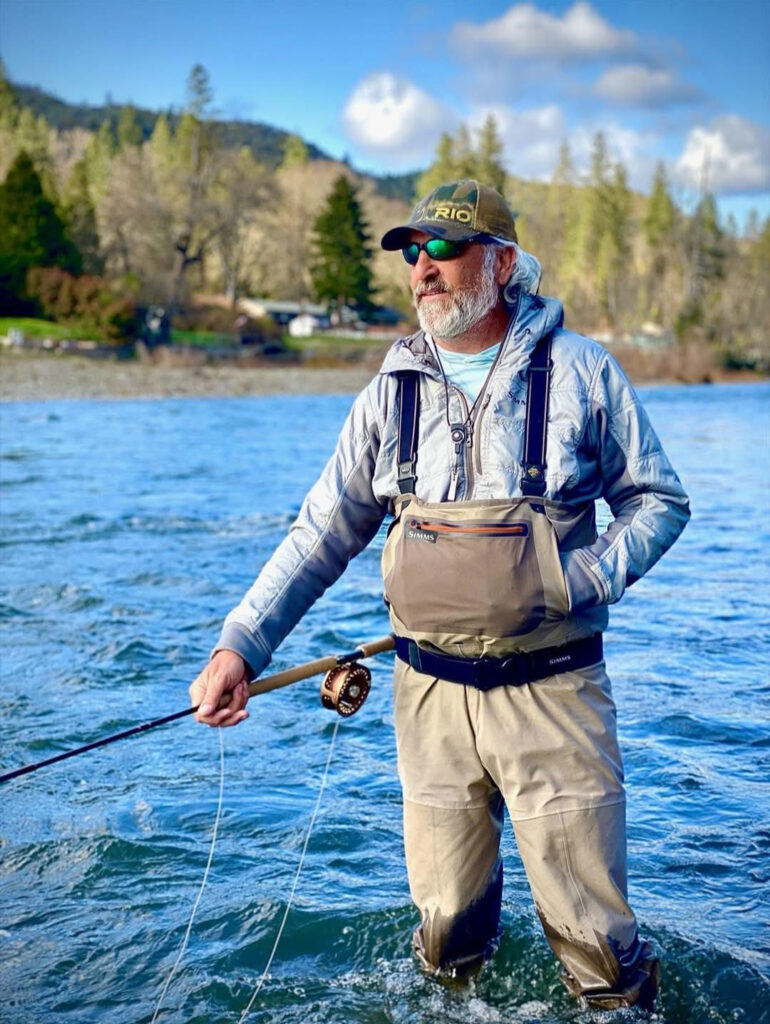
In this episode, we dive into Jeff Putnam’s straightforward approach to spey casting, built on feel, timing, and simplicity. Jeff walks us through the four steps to better spey casting, common mistakes he sees on the water (and how to fix them), and what to do when your confidence takes a hit mid-swing. (We’ve all been there!)
We also get into the evolution of spey lines and rods, the Rogue River, Northern California, and tips for everything from trout with a three-weight to winter steelhead on big rivers.
Jeff Putnam grew up in Sacramento, California, and picked up a fly rod when he was just 10 or 11 years old. He started tying flies before he ever picked up a fly rod, tossing them on a spinning setup around the Truckee, the South Fork of the American, and up in the Sierras.
By 17, he was working at Keeny’s Fly Shop, guiding on local rivers, and teaching casting lessons. In the early ’90s, he earned his single-handed casting certification and built a loyal following by keeping fly casting simple and easy to learn. Over the years, Jeff has worked in shops, guided in California, Colorado, and Montana, and helped major gear companies design rods and lines.
Jeff keeps things simple when it comes to two-handed rods. On the Rogue River, summer and fall steelhead usually run 3 to 6 pounds, with the occasional fish hitting 10 pounds or more. For that, he likes a lighter setup, usually a 5-wt, 12-ft rod, or sometimes a 6-wt up to 12.5 ft.
When Jeff first started spey casting back in the ’90s, Skagit heads weren’t around yet. He learned on long-belly lines like the Rio WindCutter and Airflo’s Delta Taper. The old “Accelerator” line was out too, though Jeff laughs that it was one of the hardest lines to cast. It was thin in the middle, thick at both ends.
Over the years, Jeff studied every casting style he could get his hands on. Now, after decades of casting and teaching, he’s found the common thread in all of them. His approach boils down to four simple steps that work with any fly line.
Over the years, he studied every casting style he could get his hands on and took something from all of them. Now, after decades of casting and teaching, he’s boiled it down to one thing: the four simple steps that work with any fly line.
Start with a straight fly line and no slack. The head length should be outside the rod tip, with 4 to 5 inches of running line out too. Keep the rod tip low. That’s the most important thing on step number one.
Point the rod tip where you want to cast, usually the far bank or out into the river.
Bring the rod tip back on a flat, straight plane with a small lifting curve at the end. Jeff calls this “by far the most difficult step” and the one that needs the most attention.
Once your D-loop is formed and the anchor point is set, step four is simply your forward stroke.
Jeff says you don’t need to overcomplicate it. Just work through each step until it feels natural. Want to see exactly how it looks? You can watch Jeff’s video right here to see each move in action:
Jeff says the biggest issue he sees is people blowing their anchor. That happens when your D loop and anchor don’t stick to the water but instead lift into the air. You’ll know it right away because it makes a loud whooshing sound. His advice? Focus on step three. Practice a switch cast to get it right.
Jeff teaches on the Rogue River seven days a week, year-round. Most of his lessons are on fly casting and fly fishing, but he also mixes in single-hand spey. He reminds people that spey casting is a technique and that it works with both one-handed and two-handed rods.
Jeff keeps his classes small so everyone gets attention. Group lessons usually run about four hours with no more than four people. That way, he can give each angler enough tools to go home and practice for a couple of weeks before coming back for a tune-up. A lot of his students are just looking to get consistent, especially before a big trip like the Skeena.
When he does tune-ups, Jeff says he isn’t trying to rebuild someone’s casting style. Instead, he targets the parts that need fixing. And most of the time, it comes down to two big things: 1) blowing the anchor and 2)forgetting the bottom hand.
Jeff also offers casting help online through his website. All you need to do is send him a short two-minute video—one minute from the side and one minute straight at the camera. He’ll analyze it and then send back his own video showing you the correct way to cast.
This service works for both single-hand and two-hand casting, and anglers from anywhere in the world can take advantage of it. Jeff says it’s been very popular because it’s simple, personal, and easy to access anytime.
Jeff breaks down some of the trickier casts into simple steps. A switch cast is his starting point. It’s basically a single spey that doesn’t change direction. From there, you can transition into a touch-and-go single spey or even a snake roll. He says the snake roll looks complicated, but really it’s just tracing a backwards lowercase “e” with your rod tip.
For Jeff, the snake roll is one of the most valuable casts. It saves false casts, covers water faster, and gets the fly back in front of fish right away. More water covered means more chances to hook up.
When it comes to lines, Jeff keeps it simple: pick one that helps load the rod right at the tip and makes casting smooth.
Jeff’s favorite rods are the ones he helped design with Bob Meiser’s team. They’re light, sensitive, and have “soul,” not stiff broomsticks with no feel. A lighter rod helps anglers feel the bend, which improves timing and makes learning spey casting easier. He says once rods hit around $700, the feel really changes, but you don’t need to spend that much to get started.
Episode Transcript
Dave (2s):
There’s something about the sound of a D Loop forming just right, and today’s guest has spending a lifetime chasing that moment from backyard practice sessions to guiding anglers through steelhead country. His approach to casting isn’t about hype or gear. It’s about feel, timing, and simplicity. In today’s episode, we break down the four steps to clean up your spa cast, what some common issues and struggles people have, and how to fix those, and what to do when your cast or your confidence falls apart on the water. This is the Wet Fly Swing podcast where I show you the best places to travel to for fly fishing, how to find the best resources and tools to prepare for that big trip, And what you can do to give back to fish species. We all love Jeff Putnam shares his story and the evolution of spa lines and rods.
Dave (45s):
Today we’re gonna get into trout steelhead. We’re gonna get in single hand. We’re gonna find out how Jeff fine tunes anglers that he’s teaching in his schools, where you can connect to some online resources and what he’s got going. This coming year. We’re gonna talk the rogue River. We’re gonna talk Northern California. We’re gonna be all over the country and it’s gonna be a great one, whether you’re chasing trout with a three weight spay rod, or swinging for winter steelhead. Jeff has the tips that’ll make your cast better this year. All right, here we go. Jeff Putnam. You can find him@jpflyfishing.com. How are you doing, Jeff?
Jeff (1m 20s):
I’m doing great, Dave. Thank you very much for inviting me to the podcast.
Dave (1m 23s):
Yeah, thanks for coming on here. This is gonna be an exciting one. We always love talking spay, two-handed casting steelhead, You know, trout, whatever. We’ve just come back, You know, I just came back from Alaska, had some a month up there on a couple of different trips, and we fished my first time fishing for King Salmon Oh. On the swing. And we were using kind of some of the heavier stuff. So I’m really excited about this because, You know, I think everybody has challenges. I had my challenges on that trip and You know, shout out to Justin. He was up there and, but yeah, I think that there’s little things that we could all do better. And I, I know that’s something I, I will talk about today. You have a fly fishing school, so you have been doing this for a long time. We’re gonna help some people learn maybe how to become better fly casters.
Dave (2m 5s):
But before we get into all that, take us back real quick on the whole thing. Have you been doing this a while? When did you first get into fly fishing?
Jeff (2m 12s):
Yeah, so I’ve been addicted to fly fishing ever since I was a little kid. I grew up in Sacramento, California, and every opportunity I could pick up a fly rod, which started when I was about 10, 11 years old, I actually started tying flies before I started fly casting. I would use those on a spinning rod with a little bubble and kind of did my thing around, You know, the Truckee River South Fork of the American, the Sierras and all that. And then one day I saw a gentleman fishing on the Truckee River with a fly rod, which I had seen on TV on American sportsman with Kurt Gowdy. So I was enamored by what this guy was doing, watching this beautiful fly line going back and forth and he was catching trout on the surface.
Jeff (2m 56s):
I sat on the bank, I watched him, he turns around and kind of describes kind of what he’s doing, and I was hooked from that Second, just by watching this gentleman from there, I would cast in my swimming pool every day in my backyard pretending I was like he was in Alaska or to pretending I was someplace. That’s all I wanted to do. Wow. So started at a very early age and started fishing the Sacramento area. I’ll tell you what, what kind of happened was when I started driving, I started cutting school a few times, right, because the salmon and steelhead were coming in. So I would head out to the river, I’d catch my fish and I’d report it to the local fly shops.
Jeff (3m 37s):
Hey, I was here. I caught some fish there and one thing led to another. And so they would send people to me on the river. Most of it was through Keen’s Fly shop. I kind of grew up in that store. I got a job with Bill Keeny, the owner when I was about 17 years old. And started guiding through the shop, started teaching lessons, really focused on fly casting. And in a be I think it was 1992 or 93, I got my certification for single-handed casting. And once I got that certification, And that was early in the program, I started developing a real big following. And the goal for me was to try to teach fly casting and make it as easy as possible.
Jeff (4m 19s):
So I did that in California for several years. In the summertime I would go out and guide in Colorado, I would go to Montana and guide back to Colorado for a few years. And then back to Sacramento. I’ve worked in the fly fishing industry. I’ve pretty much done everything from, as I mentioned, working in fly shops to working in lodges, working with all the big equipment manufacturers, helping them, You know, design fly rods and fly lines. So Dave, I’ve been addicted since I’ve been a child. This is all I know how to do. That’s
Dave (4m 53s):
Awesome. So you, you’re roughly, I’m just kind of putting the timeframe you, so like 50 years or so, so like mid seventies, is that kind of when you were first learning about as a kid?
Jeff (5m 2s):
So I’m 53 right now and I was around 10, 11, so right around you, almost 86, 87 ish, right in there. Okay. I think I, I remember going to Yellowstone Park with my family when I was, it was 1985. It was before the big fires they had. So yeah, I’ve been in, in fortunate enough to meet a lot of good people in the industry. A gentleman by the name of Bob Quigley, I was introduced to as a kid through my math teacher in seventh grade who turned out to be a big fly fisherman. I was doing really poor in his class. Yep. And he calls my mom and parents go in and he’s like, Hey Jeff, you gotta focus. What are you doing in my class? ’cause you’re not paying attention, but I, I see your math book is open.
Jeff (5m 45s):
And I said, well, my math book, I have a fly fisherman magazine and I’m reading about how to catch fish on Hat Creek in Spring Creek conditions. Right. And turns out he said, well, I fly fish and if you get a B or better on the next test, I’ll take you fishing. Long story short, him and I fished for probably about seven, eight years together all over the west coast. Oh wow. He became one of my, yeah, my best mentors in the world. That’s cool. That’s Richard Chin is his name. So wonderful person.
Dave (6m 10s):
Oh yeah. Richard Chin. Okay. That’s amazing. Yeah, that’s, I had a little bit of that back in high school as well. We had some teachers that were in fly fishing and had a connection there. It’s pretty awesome how that comes together. How cool. So, so you’re, yeah. So in the, well, let’s go back. So Sacramento sounds like you are very familiar with that area. What is the Sacramento, because you hear a lot about, I haven’t fished it yet, but you hear about like the fishing still good down there. Did you see many changes in, I’m guessing, I mean, were you fishing steelhead down there in that area as well?
Jeff (6m 40s):
Yeah, actually I caught my first steelhead when I was 12 years old on a swung fly. I was fishing with my math teacher. We were out on the American River. And it was interesting back in, and I call back in the day, which is early to mid eighties, there was a bigger population of fish in the river year round, more trout that maybe possibly hadn’t migrated yet. There was a good population of steelhead and a big population of Kenny salmon also striped bass. So we had the best of the best, right. Literally running right through town. And I saw the change in the fishing probably around mid to late nineties, and who knows what that is, obviously water environment, You know, fishing conditions in the ocean, all of that thing attributes to the quality of fishing.
Jeff (7m 27s):
But I really kind of saw a downturn on it and I kind of stepped back and looking at the different anadromous fish runs on the entire West Coast is kind of, everything started to drop, You know, about that time. So, yeah,
Dave (7m 40s):
That’s right. Yeah, that was the whole, You know, again, it probably goes back to the ocean conditions is a big part of it because yeah, the early nineties in, into the mid nineties was when you saw these changes, ocean conditions probably, and then ESA listings. Right. A lot of the fish that changed down there. Did you also see a bump after that? Did you see kind of in the mid two thousands and later where you, the runs came back? Yeah,
Jeff (8m 2s):
Absolutely. The numbers came back around, I’d say around 2008, 9, 10, 11 fishing got pretty darn good on the American River. And then it just kind of went to a plateau and then started dropping off a little bit more. But here’s the, the reality, it’s kind of interesting. I’m still in contact with people that fish on the American River in Sacramento and a couple gentlemen, they fish it at least three times a week. They’re showing me steelhead, they’re showing me stripe and bass. They’re showing me everything. They’re still catching them, but it’s just a matter of putting in the time to get those fish. You know what I mean? Yeah. But it’s fishing in the Sacramento area, it’s phenomenal. It’s right in town. It’s hard to be,
Dave (8m 41s):
Yeah, that’s right. Okay, cool. So, and you’re not too far away. I mean, I’m guessing, You know, you got the rogue really close, but even all the rivers of the Columbia and up in Washington, I mean, it’s all tracking similarly on the same thing. So, and is the American River, You know, I mean, that’s the cool thing about where you’re at or down there in the northern California is that that’s kind of where, You know, we’ve had John Chewy on, he is talked about the history of fly fishing and steelhead fishing kind of began down there in that area. Do You know a little bit about the history? Do You know the rivers, I mean, the American is a pretty famous river, right? Yeah,
Jeff (9m 10s):
It, it is. And it runs right through town. It’s, it’s a valley river, so it’s not directly connected to the ocean. But when you talk about the guys that had been doing this back in the sixties and seventies when they were on the eel, the Smith, some of them would even come up into Southern Oregon and fish the Checo and the Gal River, the Russian River. I was lucky enough to fish those when they were still pretty good. But boy, they have all changed tremendously. Yeah. You know, not being the same. But the Road River here, what’s really cool about it is I can go out there pretty much any month of the year, with the exception of maybe April and May. That gets a little slow, but every other month you have an opportunity of catching a steelhead in this river.
Jeff (9m 55s):
And, and Dave, one of the big things that I’ve noticed about is southern Oregon with the Rogue River specifically, because it’s not really used for agriculture, like the American River in Sacramento, in the, the Valley Rivers, including the Yuba, the Feather, that’s all agriculture. So the demand of water is based on farming for the most part. Where here it’s, they put the fish first. Every time I talk to somebody, it’s about the fish. It’s about the, so it’s a wonderful thing to experience ow how they really wanna protect the fishery up here. So I’m very happy to be part of that as well.
Dave (10m 31s):
Yeah, that’s great. Yeah, the Rogue is awesome. I’m actually in the process of reading a book right now. It’s about Woolridge, You know, so the Woolridge is are, oh, there you go. They, yeah, we were up at Togiak River Lodge And they all, they use all woolridge boats and Exactly. And I was on the, we were sitting there at the lodge and I was like, oh, take a look at this book. ’cause I love the history, You know, and, And they wrote a book about the whole family, but they basically grew up on the rogue back in the turn of the century.
Jeff (10m 56s):
Absolutely.
Dave (10m 57s):
And, and it’s really interesting, You know, just hearing about all, I’m sure the stuff, You know, you see all the time and the stories and, and, and the fishing and Woolridge was a big, like his, he was addicted to water and the fish and stuff. So it’s cool. Do you, do you see, like, now, are you in Grants Pass? Or what town are you in?
Jeff (11m 14s):
I’m actually in the town of Rogue River.
Dave (11m 16s):
And where’s Rogue River? Where is that? Is that in
Jeff (11m 17s):
Between Grants Pass and Medford.
Dave (11m 19s):
Oh, okay. Yeah, yeah. Rogue River. Gotcha. Yeah, so you’re right there kind of in the upper, so you’re not, you’re kind of right in the prime. You can go up River or downward Right. Into the Wild and Scenic.
Jeff (11m 27s):
Exactly right. Well said. Yeah.
Dave (11m 29s):
Good. Okay. Well what do you like as far as Steelhead do, do, we’re gonna talk two-handed a little bit here today, You know, is the setup you use on the Rogue for say, steelhead in the Upper River, similar to what you might use on the American? Yeah,
Jeff (11m 41s):
It very similar. The Rogue River kind of has a special size of fish where they fall kind of between the three to six pound range. And that’s our summer and fall run. It’s not uncommon to get fish up to 10 pounds or maybe over where the American River, their runs down there primarily focused around the winter run. They don’t have as good of a summer run as we do up here. So the winter run fish in the valley rivers, I would say maybe a six or a seven weight if you had one rod to do everything. But up here on the Rogue, with a smaller size of fish, I’m usually throwing a five weight, 12 foot long or up to a six weight, maybe a 12 and a half foot.
Jeff (12m 22s):
So a little bit larger, or excuse me, a little bit lighter of the rod up here on the Rogue.
Dave (12m 26s):
Gotcha. So 12 foot and then down on the, on the sack in there, the American, you might be using a 12 and a half or 13 foot or longer. Correct.
Jeff (12m 33s):
Little said. Yeah.
Dave (12m 34s):
Yeah. Good. Okay. And is it still, You know, we found, you’ve been in this, ’cause you started in the nineties right? When things kind of started beginning, You know, really getting going. But as far as the tight, You know, Skagit lines, candy lines, you got all this stuff, long belly, short belly, You know, have you seen, have you done it all and then seen the transition from kind of long to short and all that?
Jeff (12m 57s):
Yeah, absolutely. When I first started there, pretty much, there was no Skagit heads. There was, You know, you had Ed Ward, Mike McCune and Scott O’Donnell. They were kind of up in the Pacific Northwest Deck, Hogan included. And, and those guys were doing the Skagit thing way back in the day, in, in my neck of the woods. It was Long Bellies, the Rio Wind Cutter, even before the Rio Wind Cutter, we were using the accelerator, which we’re talking way back in the day. What
Dave (13m 25s):
Was the accelerator? Was the accelerator What? Who made
Jeff (13m 27s):
That line? Oh, the accelerator was one of the worst design spay lines on the planet because it had a taper that dropped down to a thin taper and then it got thick again. So trying to cast that was nearly impossible. So they kind of really focused on the wind cutter.
Dave (13m 44s):
Okay. So that was a Rio, that was a early Rio line?
Jeff (13m 47s):
That is correct, yeah. And Airflow had been doing some stuff with the, the Delta Taper and Deck Hogan really made that popular. Simon Goss Worth kind of came out with Rio, and that’s where the wind cutter kind really was developed. But there was no short heads for the first four or five years. So I learned on longer heads. Yeah. And then I started seeing how they were actually casting Scandinavia heads, shorter heads in, You know, parts of Norway in Europe. So I learned the underhanded Scandinavian technique. And then Ed Ward, his name started getting bigger with the Skagit. So I learned Edward’s Skagit techniques.
Jeff (14m 27s):
I basically learned everything. And what’s interesting now is, as an instructor, after learning all those methods, my goal was to again, try to simplify the sport, find the commonality. Now I teach it where there’s four steps to spa casting four simple steps. And once you learn this technique, you can cast any fly line you want to cast. So you don’t have to, to change your style, you just change the stroke length based upon the length of the head you’re using.
Dave (14m 59s):
Let on DeMar Lodge give you the Montana fly fishing experience You deserve. The gin clear waters of the Missouri River offer a world class experience with one of the finest rainbow trout and brown trout fisheries in the world. Whether you’re a seasoned angler or new to the sport, their family of guides will tailor a trip just for you. You can head over to on demark lodge.com to fish one of the great trout streams in the country when it comes to high quality flies that truly elevate your fly fishing game. Drift hook.com is a trusted source you need. I’ve been using Drift hook’s expertly selected flies for a while now, And they never disappoint. Plus they stand behind their products with a money back guarantee. Are you ready to upgrade your fly box?
Dave (15m 39s):
Head over to drift hook.com today and use the code swing at checkout to get 15% off your first order. That’s drift hook, D-R-I-F-T-H-O-O k.com. Don’t miss out. So yeah, let’s jump into that. ’cause I, I know four steps, I’m thinking guessing what they might be, but let’s talk about that because You know, I think that ev everybody has, could use some help right. On their cast, but absolutely. How do you break that? Let’s just take it, say we’re, I guess coming into your school week, talk more about how that looks, but yeah, give us the four steps first.
Jeff (16m 9s):
You bet. So basically there’s, step one is the start. When you’re starting, you want a straight fly line with absolutely no slack. The head length is outside of the rod tip with a little bit of running line, maybe four or five inches out of the rod tip as well. Low rod tip, no slack. That’s the most important thing on step number one. And depending on what cast you’re doing, okay, now we start talking into about the different space cast, which is the sustained anchor casts or a touch and go sustained anchor casts are easier to start off with. That would be like a Snap T or a double spay. Yep.
Jeff (16m 49s):
Or there are the Touch and goes, which is the single spay or the snake roll. And then there’s several other casts in each of those categories, but we break ’em down with those two. So on a sustained anchor cast, step one, let’s say if you’re doing the Snap T, it would be the snap or the repositioning of the fly line. So a lot of people say, oh, you draw basically a big C shape, you bring the rod tip back to the water that puts the fly line in position. So then you can execute the next three steps, which after the snap. Step number two would be acknowledging your target by pointing the rod tip to where you want to cast towards, which is usually the far bank out into the river.
Jeff (17m 33s):
And then step number three is bringing the rod tip back on a flat straight plane with a little bit of a lifting curve at the end of it. That step number three is by far the most difficult to execute and requires the most attention. Once your dlo is formed and your anchor point is on the water after step three, your step four is simply your forward stroke. Okay. So you take all four steps and then what I try to do is I try to break each one of those steps down so you can practice them separately without have to thinking about the other three steps involved.
Jeff (18m 13s):
So that’s kind of my method. And on my YouTube channel, JP Fly Fishing Schools, I have a, a brand new video that breaks that down. So Oh,
Dave (18m 22s):
Perfect. Yeah.
Jeff (18m 22s):
Easy to follow.
Dave (18m 23s):
Okay. Awesome. Well, yeah, we’ll put that in the show notes so people can take a look at that after this episode. Super. This is awesome. So I love the simplicity, break it down, and obviously there’s lots of more steps and things in the middle there. What is, maybe talk about your, your school. Do you do these, is it online? Is it all in person? How do you do, how do you do the schools? Yeah,
Jeff (18m 43s):
Gr great question. So a lot of people will actually come up to the Rogue River where I teach seven days a week, year-round, fly fishing, fly casting. Some of the lessons I do are also single-handed spay. So we wanna remember that spay casting is a technique, whether you’re using a single-handed rod or a two-handed rod. So I teach that as well. And then I also travel back down to Sacramento twice a year. I also travel down to Redding and then whoever wants me to come and put on a school through different fly shops or fly fishing clubs, I’m always available for that as well. Cool.
Dave (19m 19s):
Well this is awesome. Yeah, maybe, maybe down the line we could talk more about the putting something like this together. I think that, You know, we’re actually doing kind of a, a fly casting challenge. We’re work on it now, trying to get some, and we, this might be a good chance to talk more about it, but just, yeah, just trying to help people, You know, increase their skills a little bit. Like I said at the start, I had a day on that Alaska trip where, You know, it just, it all struggled. I was probably tired, You know, I started, I broke a big fish off. Oh. And, and I’ve been talking about this a little bit because it’s a good, I think everybody has these moments, but we had, Floyd was our guide that day and he just, You know, he’s this real unique type of guide where he’s, he’s intense. Yeah.
Dave (19m 59s):
Yeah. And, and he was trying to get me to put this together and I just, it just didn’t happen. And You know, and the next day I, he came up and he said, Hey man, You know, you have a good cast, you just gotta stick with it. Everybody has these days, right? And I said, All right. And I got out the next day and had this, it landed one of the best fish of my life pretty much How cool. And, and right. And, and it came back to me so the casting came back. But yeah, what do you, maybe right there, what do you tell somebody when they’re out there struggling, they’re on having that day, what does somebody do with their cast? I mean, obviously depends on what type of caster, but what would be the advice if you’re sitting there for that person?
Jeff (20m 32s):
Absolutely. The number one issue that I commonly see all the time is people blowing their anchor. Okay. So after step three, that anchor point in D loop do not want to be established on the water. It wants to lift up in the air. And you could hear that when you cast because you’ll usually hear like a whooshing sound, right. Of an unstable anchor on the water. So addressing step number three is the most important part of the spay cast. And I recommend focusing on a switch cast to isolate step number three. And that’s simply usually by looking up at your rod tip as you form your D loop and anchor point on what people could call the back cast, right?
Jeff (21m 14s):
Yeah. Usually back cast is associated with overhead casting. Right. But just for simplicity, the space cast, when you set your D loop and anchor point on the water, we’ll just call it the back cast during this little audio presentation here. Perfect. That. So we get the back cast by looking up and focusing on your rod tip. If you do that, your arms hands, your body will actually follow exactly what your brain is telling it to do by just simply looking at your rod tip. Hmm. So I tell people when you’re casting, put your opposite foot forward, face your target. So I’m a right-handed caster, I’m gonna put my left foot in front of my right foot And that gives me the opportunity to look up and watch the rod tip path.
Jeff (21m 58s):
It’s all about that path, especially on step three. Yeah. And so practice just a couple switch casts. Look at your rod tip when you feel comfortable, go right back to whatever cast you were doing. And you’ll always notice that step three, the switch cast path is in every single spay cast you ever do.
Dave (22m 20s):
Yeah. And what is the switch cast? Yeah,
Jeff (22m 22s):
So switch cast is pretty much a practice cast. It does not switch directions. So the point that you’re picking it up, the direction you’re picking it up in is exactly where you’re going to cast towards. And by eliminating or taking out the variable of direction change, that’s one less thing to think about. Now our attention could be focused more on the placement of the anchor point, the shape of the D loop and the rod tip path, your timing and acceleration and all the other stuff that goes into
Dave (22m 49s):
It. Yeah, that makes sense. So take out, forget about the fishing for a second, where that, right, where you’re gonna hook that fish, focus on the cast and, and and left foot forward, which helps you look back at your cast. And that’s a good advice. ’cause now you can see the rod tip and then you can also see the D loop right as it comes back.
Jeff (23m 3s):
Exactly. Dave and I, I tell people, you are your best teacher by just simply watching and observing everything that’s going on. So true. Yeah.
Dave (23m 10s):
Perfect. Okay, good. So that’s a awesome tip right there. Well, let’s take it to your class a little bit because the school sounds great. I think that if people can get on the water with you, obviously that would be the best. But we’re gonna talk about it here. What is that, let’s see, talk about the school when people come in. Is this a day daily or is this like a multi-day? How does that look?
Jeff (23m 28s):
Yeah, so I do teach group lessons that are usually a half a day. I try to take four people, I want to give everybody a lot of attention a lot of time. And in about four hours I’m gonna give everybody in that group enough information to where they’re gonna wanna stop and go practice on their own over possibly let’s say a two week period. If you can get out three times a week for 30, 40 minutes, it’s gonna make a huge difference. You’re gonna hit the plateau where you go, Hey, I gotta, I, I want distance, I want tighter loops and I wanna use even less effort to do this. So then I say, well come back for maybe a one to two hour tuneup lesson. Okay. Usually after that people are often running on their own.
Jeff (24m 9s):
Yeah. If they don’t fish for a while, they may come back to me prior to going on a trip. I do a lot of tuneup trips. I’ve got a gentleman I’m working right now, he’s headed up to the Chena River in about two weeks. Oh nice. Right. So when I hear, I’m hearing some pretty good fish numbers up there this year.
Dave (24m 25s):
Where’s he going? Where, where’s he going On the Cheena?
Jeff (24m 27s):
He’s gonna go on the lower Cheena down by where the, the calem comes into it. I don’t know if you’re familiar with that, right? In the, the town of Terrace.
Dave (24m 33s):
Oh, by Terrace. Oh, oh yeah, yeah. No, we, we do our steelhead actually we’ve got a, a group going up there. I won’t be up there this year, but we’re going up to Brian Ska Cheena Spain Lodge. Oh
Jeff (24m 41s):
Perfect. There you go.
Dave (24m 41s):
Beautiful. So we’re gonna be, yeah. And that, so I know the, that Lower River, which is really cool, you get fish there that are migrating through the river.
Jeff (24m 49s):
Absolutely. You can catch those suta strain fish, which are the big monsters. One of my clients landed a fish 42 inches about five, six years ago down in the lower, and the, the guy said, oh, this is probably that big su stut genetic fish. Who knows where it was going to. But it’s exciting. I love fishing on that lower section.
Dave (25m 7s):
Yeah, that’s cool. So you’re tuning this, so you got a guy who’s gotta, gotta get tuned up for maybe the fish of a lifetime. And so what do you, what does the tune up look like? You just kind of watch his cast and give him some pointers?
Jeff (25m 18s):
Yeah, so basically everybody comes with, Hey Jeff, my casting is inconsistent. And I try to kind of specifically target, well do you not like the forward stroke? Are you not getting enough distance? Are you hearing the line ripping off the water? But reality is I watch them for about one minute and it just falls into place exactly what we need to do. And I just touch base on the parts of the cast that need to be fixed. I’m not trying to, You know, reinvent their casting style or casting stroke, but just target specific things that will help them. And usually it always comes down to I’m blowing my anchor and they’re unfamiliar with how to keep the raw tip parallel to the water surface without gaining elevation on step three.
Jeff (26m 2s):
So I just, I gave a lot of weight right there. Yeah. If you, if you don’t wanna hire me for less, just watch your raw tip on step number three. Yeah. But, but that pretty much sums up what the most of that lesson’s gonna be about. And then a lot of people, Dave, don’t have an understanding of how powerful their bottom hand is. Right. When they’re casting spay. So I see that top hand dominant pushing they, and they’ll say, oh my shoulder’s getting a little tired. Well let’s say this, you’ve got a 12 to 13 foot rod in your hand, your shoulder should never be tired. That’s a long amplifier. You’ve got the ability to use very little motion and movement. But the key is focusing on the bottom hand being the engine of the cast.
Jeff (26m 46s):
That’s where your power comes from. Not the top hand.
Dave (26m 49s):
Yeah. Bottom hand. That’s it. That was my struggle early on. And still is sometimes, but yeah, the bottom hand is key, so
Jeff (26m 56s):
Absolutely. Okay. And indeed, just to, just to point this out to, on my website, under my space shop, if people go in there, you can actually go online and see my video analysis. Oh really? Which basically people will send me a video of themselves and I, I say, send me a two minute video, one minute of casting from a side view, the second minute casting straight at the camera. And all I need is couple minutes of the video. I will analyze it and then I will actually respond with a video showing the correct way to cast. Oh cool. And that’s been very, very popular.
Jeff (27m 38s):
So you can do that at any time and from anywhere in the world too.
Dave (27m 41s):
You can. And so where is that on your, I’m on your website, so you go, where do you go? Yeah.
Jeff (27m 44s):
Oh. And it should be under, let’s see, is it my fly shop that’s there?
Dave (27m 49s):
Oh yeah. Fly shop.
Jeff (27m 50s):
And then if you scroll down you’ll see video analysis. Video analysis. There you go. Right there. Yeah.
Dave (27m 53s):
Video analysis. This is great. Yeah, I love this. You got, okay, perfect. And looking at this and then good. So you can just submit that. That’s awesome. And we’ve, we’ve been working with, well we’ve had some episodes where we’ve talked about, we had Marty and Calin And they were talking more about single hand, but you will do this for two hand and all, both two hand and single
Jeff (28m 11s):
Absolutely everything. Yeah, you
Dave (28m 12s):
Bet. Gotcha. And you got a little form here where people can submit This is perfect. Yes. Okay, great to hear. So We have that resource for sure. We’ll be working on that as well. What is, You know, as you switch over to, You know, you’ve got two handed and then you go to single-handed or maybe trout. When you think Trout Spade or most people, do you think they’re thinking double-handed Trout spa or single-handed or both?
Jeff (28m 33s):
Oh, I think two-handed. Yeah, two-handed. And generally we’re dropping the rod size down into 2, 3, 4 or a five weight. And I would say the five weight can be a little large for trout. I worked as an advisor with Rio Flylines and Far Bank company, which is also Redington and Sage. Simon GOs worth, this is probably around 2010. We were doing a show together in California. And he said to me, he goes, Hey what, what are you using for trout? And I said, oh, I really like the four weight. And he goes, man, I’ll tell you, try to drop down to a three. The technology Jeff, in the last few years, it’s come to a whole new point where we don’t need heavy rods anymore.
Jeff (29m 13s):
So I picked up a three weight under his advice. And I’ll tell you for just trout only that let’s say from 12 to 22 inches, a three weight is the magic number in my opinion. If you wanna cast further or cast in the wind or throw a larger fly, you might move to a four weight. But boy, your three weight really preserves the fight of a small trout. And that’s typical, You know, it’s nice to go get 20 inch trout if you can, but we’re catching a lot of 13, 14, 15 inch. Right, exactly. And so a three weight is I think, perfect for that. Some people will ask me, they’ll go, Hey, what do you think about a two weight? Well if you have perfect conditions, if you need a really delicate presentation kind of on a Spring Creek, you might be swinging a small soft tackle with no wind.
Jeff (30m 1s):
I think that’s appropriate. But a three weight, if you just got one trout rod, it’s a great way to
Dave (30m 6s):
Go. Three weight is all around. Yeah. So that, and is it kind of the, the two weights, so a three weight would be like a five weight single hand rod. Exactly. Which just add two. That’s
Jeff (30m 13s):
Right. Well said.
Dave (30m 13s):
Yeah. So that, And that makes sense. So you got your typical, You know, nine foot five weight is your all around most common, You know, trout rod or whatever. Right. But then you got the, You know, the six weight might be better for wind or maybe the, the four weight is better if you just need that subtle presentation. So same thing here.
Jeff (30m 28s):
Yep. Well said. Well said. And, and just to add a little bit to that, I would say that looking for those rods in terms of the technique, ’cause everybody says, oh two end of spay, you’re swinging. Well, not necessarily. You can actually dead drift a indicator split shot system or a dryly. You can do that with it as well. But it’s better designed when you’re swinging or stripping a streamer back to you. But yeah, you can definitely do some dryly, dead drifting as well with the two-handed rods.
Dave (31m 1s):
Yeah. Perfect. Okay, well let’s get back into the school. So we’re in there for a four hour. So in that four hour session, describe that. How does that look if somebody’s in person is, do you, did, is it always the same process when you go through that?
Jeff (31m 14s):
It, it pretty much is when I start off the class, I wanna start everybody off with something they’re familiar with. So generally we’ll start with roll casting and everybody’s, You know, if, if you’ve been single-handed casting, You know what a roll cast is. But now it’s using the bottom hand, which is the big hurdle for somebody that’s brand new starting off. So we basically roll cast for a little bit and then I start working on formation of the D loop and anchor point and really focus on the switch cast as the teaching technique for that. And then we start to add a little bit of direction change by the end of those four hours. I want everybody in the class to feel comfortable with at least one cast.
Jeff (31m 56s):
And, and I love starting off the snap tea ’cause it’s an easier cast. You can slow down, you can really analyze everything. And at the end of the class we may touch on the double spay from the opposite side of the river. But the way I’m teaching it is the only step that changes out of the four steps is step number one. So I can teach step number one as a snap for a snap T step number one for a double spay could be the flop step number one could even be like a Perry Poke setup. Yeah. But once you do that, it’s always now pointing to your target on the far bank. Step number two. Then followed by step number three, which is forming your D loop and anchor point and executing step number four, your forward stroke.
Jeff (32m 42s):
So when people take this class, they go, oh, this is actually easy to remember. I only have to change step one depending on what side of the river I’m on. Right. Yeah. So I make it real simple and then we do a little recap at the end. I usually hand out a cheat sheet with all the diagrams and all the information that we went over. And people usually after that are off and running to the races. So it’s, it’s exciting to see though, how somebody can be intimidated at first, but by the end their confidence is up And they might be even shooting some fly line at the end of that four hour lesson. Right. Exactly. That’s a good day for me.
Dave (33m 16s):
Yeah. That’s awesome. How often do you get people that are brand new to fly fishing? Do you recommend is starting with spay two handed spay, okay. Or should they start with, did you ever get that somebody that hasn’t even cast a single hand rod?
Jeff (33m 29s):
Absolutely. Just the other day I had a gentleman who, once again into steelhead fishing, who’s never picked up a single-handed rod before. Those people are actually easier to teach than somebody that has experience with a single-handed rod. Yep. So, You know, I I like it when they’re, they’re fresh and brand new, but the reality is most people have been single-handed casting prior to picking up a two-handed rod. Yeah,
Dave (33m 51s):
That’s right. That’s the common. Okay. And and what about a few of the casts? So I think the, You know, mentioned that, You know earlier that the touch and go versus say the, the snap tee and stuff. Yeah. You know, if somebody had isn’t really good with the snake roll. Could you describe a little bit a about how to do some of those touch and go casts? Yeah,
Jeff (34m 9s):
Absolutely. So if you look at a switch cast, A switch cast is basically a single spay that does not change directions. So when I’m teaching my method, they’re gonna learn how to switch cast. And it’s very easy to go from a switch cast non-changing directions to changing 20 to 45, 60, 70 degrees. And now it becomes a touch and go single spay Reality is, single spay has been one of the most challenging casts for people to execute. It’s timing sensitive. The anchor points are a little bit harder to establish on the water.
Jeff (34m 49s):
But because I’m teaching the switch cast, it’s my basic beginning cast, it’s very easy to transition into that touch and go. The other one is a snake roll. And people go, oh man, snake rolls are difficult. And I say this to ’em, I say, it’s a touch and go. It has the same four steps except they’re continuous, you don’t snap. And then point to the target. You basically start your rod tip low on the water, and if you are a right-handed caster, you’re gonna be on river right. To use this over your dominant shoulder. So imagine we’re in a river and we’re looking downstream at our fly line hanging out in the current, I look at the rod tip and I’m gonna take that fly line and I’m gonna make a direction change of approximately 45 degrees to 90 degrees.
Jeff (35m 41s):
Okay. As I start the rod tip low on the surface of the water with no slack like I do every step one, I start the rod tip and I trace a clock and I’m going counterclockwise from six o’clock at the water surface. I follow the curvature of the clock back to three up to 12 noon over the top to nine. Then I cut the clock in half back to three.
Dave (36m 10s):
Oh right.
Jeff (36m 11s):
Right. When I cut the clock in half back to three, the rod tip stays above the top of my head about three or four feet. That one continual motion. And it looks like a lowercase letter E backwards. Okay. That’s all we’re tracing. Yeah. And then you’re gonna hang out at your rod tip is gonna be around the two o’clock position. Like it finishes every step three in. That’s always the same. Yep. At that moment, you’re waiting for the fly line to fall to the water surface to create the anchor point and form the D loop. When that fly line is one inch from touching the water surface, it’s time to execute step four, your forward stroke.
Jeff (36m 55s):
So there’s the simple breakdown. Wow, that’s cool. A a Yeah. Snake roll. Snake roll. And, and I’ll tell you, the snake role for me is one of the most important casts that people can learn when they’re fishing two handed rods, because you can apply that to your single-handed rod and now you can change direction when you’re trout fishing without one single false cast. Oh right. And we know right when you’re false casting your flies in the air, it’s not on the water. So it’s kind of wasted time. I want to do a snake roll and immediately get the fly back into the water where the fish can see it. So I’ve noticed that since I started spa casting way back in the day, my hook rate has gone up ’cause I’m covering more water and showing my fly to new fish more throughout the day.
Dave (37m 46s):
That’s awesome. Yeah. So that’s the thing. So the snake roll versus say, I mean the, the advantage of the snake roll is that you’re fishing more. Is that, is that the main thing that you’re able to get out there because you could do another cast, You know, you could do whatever, a snap tee or a different cast there. What, what would be this? Why is the snake roll worthwhile? Yeah,
Jeff (38m 3s):
That’s it is because it eliminates the step one of the snap in setting up the fly line. Right? Yeah. So you’re basically going from, at the end of your swing at the hang down, you’re instantly picking it up, dropping your anchor point, that touch and go goes right back out to the water. Yeah. So it’s so much more efficient. And I really recommend when people are doing that snake roll, try it over your opposite shoulder so that when you’re fishing trout, you can be on either side of the river, you can cast in reverse over your opposite shoulder or on your dominant side. Gotcha. Really important cast.
Dave (38m 39s):
So this is for, and you could do this for single hand spay too, for trout. Yeah,
Jeff (38m 43s):
Absolutely. That’s where it really shines. And, and so, so people, they’ll ask me, Hey, why do you take a single-handed rod out for trout Jeb? Why aren’t you use using spay all the time? I will say this, Dave, I am a dry fly fanatic. Yeah. And I love head hunting. And for me, if I could take a four weight, nine foot with a 12 foot liter, five x and You know, small little Spring Creek style flies, that for me is the, the, the peak of fly fishing besides swinging a up a steelhead. But I, I enjoy that so much. So when I go to, let’s say Hat Creek or even the McLeod or whatever river it is, I’m usually gonna take my two-handed trout bay and then also my nine foot four weight trout rod.
Jeff (39m 25s):
And if I know that there’s a big hatch, I’ll target heads with my single-handed rod because it’s more accurate than a two-handed rod. But if the fish aren’t up on top, no problem. I’ll break my spay rod out and I’ll start swinging and searching and covering a lot of water to find the fish. Yeah,
Dave (39m 42s):
Perfect. So yeah. And then McLeod’s another one of those rivers we heard Alex in our, in our group, he was talking about that he was up there in Alaska as well and he, he had fish McLeod for trout. Yeah. So yeah, I mean the, the, that area, there’s some amazing famous rivers, You know, those names you hear about and, and you have Trout Bay works well up there, so that
Jeff (39m 60s):
Absolutely, absolutely.
Dave (40m 3s):
Let’s take a break and check in with Jackson Hole Fly Company right now the right gear can turn a good day on the water into an unforgettable one Jackson Hole. Fly company’s combo kits are built to match the rhythm of the river, giving you everything you need in one simple package. Each kit pairs a perfectly matched rod and reel with essential accessories ready to fish right outta the box. From the beginner friendly Crystal Creek to the high performance Flat Creek, there’s a setup for every angler. And don’t forget about their packs and slings. I’ve been loving my Jackson Hole sling pack for a number of years now, the perfect size to fit all your gear, but not too heavy and not too big to drag you down.
Dave (40m 43s):
Check out their slings and rods and much more at Jackson hole fly company.com. And you can support this podcast by checking in with Jackson Hole Fly Company today. So you have the trout spay, what about lines? Because you think of, we talked about, You know, the evolution of lines is made with the Skagit, especially has made spay two-hand space so much easier for people to get into. What is the line if you’re fishing for like single hand spay for trout? Do you need a special line or can you just use your regular line?
Jeff (41m 14s):
Well, I’ll tell you what, Rio was nice enough to develop their single handed Trouts spay, which is basically a 34 foot head with a, a very nice taper where the mass of the taper is at the rear of the head. So as the taper goes out, it continually gets smaller and smaller. That is the best taper for space casting with a single-handed rod, which would be similar to like a double taper Right. Except we’re just extending and pulling that front taper out longer over a 34 foot
Dave (41m 48s):
Oh okay.
Jeff (41m 49s):
Range, right? Yeah. So being that the mass is in the back of the head, it allows the rod to load when you’re roll casting and you want the mass of the fly line close to the rod tip just outside of it when you’re spa casting. So using a, like a real gold with kind of a weight forward taper, it’s a little bit more difficult. It’s ar actually harder to throw and form a tighter loop just because the mass of the fly line is out in the front of the taper and it wants to fall out when the fly line’s turning over. So yeah, Rio’s single-handed spay line is by far my favorite single-handed spa casting line, but it also overhead casts incredibly well.
Jeff (42m 32s):
Oh it does. Nice. Yeah. I, I can’t say enough about that. And what’s important for two-handed trout spay is, and I’m, I’m a fan of what Rio’s doing, but you can get these fly lines from, You know, various manufacturers. Yeah. I recommend when you are using Trout spay that your fly line, the head is integrated into the running line because we’re doing so much stripping for the presentation, you don’t want the loop to loop connection of the head and running line bumping through the guides as you strip it in. Right. So that’s where I’m really focused on. I, I love the integrated heads and I think Rio, in their trout spay models, they have one of the most versatile tapers for kind of medium to small flies.
Jeff (43m 19s):
If you wanna throw something a little heavier, you can get an integrated Skagit head, You know, for trouts, which that’s also a nice line to throw if you’re gonna be stripping in. And then some people go, You know, I’m just gonna put on a thin diameter running line, maybe around 25 thousands and I’m just gonna put on a separate head. And, and a lot of those people might not strip the fly in that close and and that’s okay too. But reality is, I really love the integrated lines from Rio when you’re using two handed Trout Bay.
Dave (43m 49s):
Yeah. And what was the name of that one? If they’re gonna pick that up? The, for the two handed Trout Bay? Yeah,
Jeff (43m 53s):
That’s called Trout Bay.
Dave (43m 54s):
Yeah, just Trout Bay. Okay. Yeah,
Jeff (43m 56s):
You got it.
Dave (43m 56s):
So that, so they got the line. Okay, good. So, so that’s a good place we can go to check some of that out. And then, and then what about Rods? It sounds like, You know, I mean there’s lots of great rods out there, so many brands have great rods. Do you have one? What, what’s your, do you have one you love to use or do you have a few? Yeah,
Jeff (44m 11s):
My favorite is on my website. So I’m working locally with a rod manufacturer that actually just moved from Medford over to Bend and it was Bob Meiser Oh yeah. Who’s been around since day one. Sure. He’s, he kind of vetted the term switch rod back in the nineties. Yep. So I’ve been working with his engineer and working on my own series of two handed rods that I offer through my website. And basically what we’re looking at is a rod that is very sensitive, very light that has soul to it. Yeah. You know, I’m not into the telephone poles, the broomsticks that don’t have a lot of feedback and feel to ’em.
Jeff (44m 52s):
And when I put lighter rods that my clients can feel the rod bend, they’re connected to it. So it helps with their timing, it helps acceleration issues, it really helps them become a better space caster much quicker. And, and it’s, I’ll tell you, you can put a price point on, on rods once you start getting up into two handed rods that are about $700 or more, that’s where they really start to change in terms of the feel.
Dave (45m 18s):
Oh they do. Absolutely. So the feel gets more, like you said, it’s not a, a stiff whatever. You get more of the the sole
Jeff (45m 25s):
Exactly. Right. And they’re lighter in hand and a light rod means less mass, which now interprets, I feel every head shake the fish has to offer during the fight, which brings me back to it. I love, I love the, You know, fish fight as well. Yep. And, and again, just in terms of overall ease of casting, at the same time, I don’t wanna see a statement, oh, you gotta spend that much money to get into this. No, there are some really good rods from three to $500 that you can fish for years on end and be very happy with it. Just, You know, kind of depends what you’re looking for. But here’s one thing I do hear from my clients all the time, Jeff, I’m so new to this, I won’t be able to feel it.
Jeff (46m 8s):
I completely disagree with that. Okay. And every time I put a rod in somebody’s hand, they go, oh. Oh, okay. You feel I get it now. Right? Yeah. So the light bulb pops on and, and, and when they say, when during a lesson I feel this, that for me is the magic word right there. ’cause if you can feel this now, your skills are going to increase tremendously in a, in a much shorter period of time.
Dave (46m 30s):
Definitely. Yeah. You can feel it. Yeah. That’s a big part of, we’ve talked quite a bit about, about with the single hand rods, we’ve had some casting instructors that have talked about the, You know, the nuclear arm arms race up to faster and faster and faster. And the fact that sometimes if you don’t get it right, you don’t feel right. That’s the key. Right. Especially if you’re new to fly casting, you can’t, if you don’t feel it, that’s not a good thing. Right.
Jeff (46m 49s):
Absolutely. Absolutely. And the manufacturers have sped up the rods because they’re more forgiving. Right? Yeah. The more a rod bends, the more you’re gonna see of the negative things that are occurring in your cast. And, and I actually like that. I tell my clients that’s feedback for you. Well, well, Jeff, I’m throwing tailing loops every other cast. Okay. So let’s work on your acceleration, let’s work on why that tailing loop is being formed. And then as soon as we address that, oh, you’re right Jeff. I can feel this. So yeah, I do love rods that have sold to ’em. Some of the Winston rods too, they fall in that same category. There’s a lot of fuel to ’em. So, You know, and I’m not specific on one manufacturer’s, just when you purchase a rod, please cast the rod before you make the purchase.
Jeff (47m 35s):
Yeah. Right. Don’t do this online unless you’ve already cast it. Or maybe a, you cast your friend’s rod on a fishing trip, put it in your hands. Don’t trust what is being sold to you without actually filling it first.
Dave (47m 48s):
Perfect. So, and then, and Bob Miser, that’s interesting. ’cause I think he, I think he’s transitioned out, right? Yeah. Did he sell the company and, and so, but your rods are made by one of his engineers essentially.
Jeff (48m 0s):
Exactly right. Absolutely. Yeah. Nick Moses and his brother Trent have moved the business over to Ben and they’re doing a phenomenal job. Nick Moses is one of the best rod builders currently in the United States because he’s been taught by some of the legends in this area.
Dave (48m 17s):
Yeah. So is Nick, is is Miser Rod still out there going and, and is, who’s running that? Or is that Nick running that as well? Nick
Jeff (48m 25s):
Moses is running the miser rods.
Dave (48m 27s):
Oh yeah, yeah, yeah. That’s Nick. Okay. So we’ve connected Yeah, that’s right. Yeah. Yeah. I think I’ve chatted with Nick somewhere along those lines, so that’s perfect. Okay. So good stuff. All right, so we’ve got the rod, we got the line. Maybe let’s take it back to a little bit on the steelhead. So we’re out there fish for steelhead. What are you, You know, again, this is, You know, trying to get people a little bit lift up, say they don’t have a chance to do the the school. Yep. What are some other things they should be thinking about if they’ve got some heavy stuff they’re throwing And they wanna improve their cast, maybe they’ve got some struggles.
Jeff (48m 56s):
Absolutely. Keep your heads short. So using a Skagit head is gonna make it a lot easier to learn the entire spa casting method. Stay away from super fast heavy sink tips at first. ’cause that changes your timing. So maybe start off with an intermediate or something that sinks less than six inches per second. That also makes a big difference. Casting sometimes with a shorter rod, some people are under the impression, they’ll come to me brand new and they’ll go, Hey, I bought this 14 foot eight with Jeff and I’m gonna be fishing here on the rogue and I’m going, oh boy, that’s a way too big of a rod. Well, You know, so and so told me that the longer the rod, the easier it is to cast.
Jeff (49m 37s):
Not so true.
Dave (49m 38s):
Not true. So that’s another myth. So why is the longer rod not better than the shorter? Because
Jeff (49m 42s):
The longer rod makes it easier to blow the anchor and pull it off the water. Oh
Dave (49m 47s):
Right, right. Which is what I was doing that day when we were using those 14 foot nine and 10 weights. There you
Jeff (49m 52s):
Go. Very common. Right. Very common with that long of a rod, your casting stroke needs to slow way down. And if somebody’s brand new to it, they pick up a two-handed rod and, and instantly their brain goes to muscle power and get it out there quick. Right. It’s the absolute opposite with those longer spay rods.
Dave (50m 12s):
Right, right. So you’re gonna slow everything down even more.
Jeff (50m 15s):
Absolutely. And typically.
Dave (50m 15s):
Gotcha. Okay. So those are awesome. And then what about the, the integrated fly lines where you’ve got kind of floating, You know, sink, intermediate sinking. Right. The fist is one that that’s out there. Yeah. Yeah. Are those lines that you recommend are those good lines to be using? Yeah. But how would you pick a Yeah. How do you select your line for steelhead?
Jeff (50m 31s):
You bet. So they have the different density heads now that are very popular. Different, and let’s, I’m gonna step back from that. Besides, yeah. Besides those, the number one system to set up with it would be a floating running line of the appropriate diameter. Okay. There’s different diameters and they’re all relative to the rod weight that you’re using.
Dave (50m 55s):
Oh they are. So the running line, so you have the, the mono and the other. So you wanna get one that’s actually the diameter correct. To the, the setup you’re using?
Jeff (51m 3s):
That is correct. If I’m using, we’ll just make it real simple, if I’m using, let’s say a six weight, I want the diameter to be around 32 thousandths. Okay. When I get up to my eight weight, I want to get that up to maybe 38 thousandths, maybe even 40 thousandths for the eights and nines. And if I’m using the trout spray, I wanna get that down into about maybe 22 to 25 thousandths. And the thinner the diameter, the less resistance going through the guides. But think about it, when you’re using an eight weight or nine weight, you’ve got a Skagit head that’s close to 600 grains and you’re stripping that in. And if it’s cold outside, you want something to be able to grab onto. Yeah. So larger diameter running line is important And they all should be floating because you’re gonna be storing those loops of fly line at your feet or on the water surface.
Jeff (51m 53s):
And if it sinks, it doesn’t wanna come back out and shoot through the guides. So a floating running line by far is most important. The appropriate grain weight of Skagit head and the balance tip that must go on the end of the Skagit head. So important. So we’ll just say that if you have a Skagit head that is 450 grains or less, you can use T eight. Okay. Which is tungsten eight grains per foot. That works really well on 450 grain heads or less. If you go from 450 to 5 25, you’re looking for 11 grains per foot in your head.
Jeff (52m 38s):
So that would be a mo medium. Okay. And then once you get up to over 550 grains to about 6 25, now you’re using T 14. Hmm. Okay. So mots coming T 14. And then if you’re going beyond 650 grains, then you wanna use the extra heavy mo, which is T 17. Okay. What a lot of people will assume, they’ll go, Hey Jeff, T 17 sinks at, You know, nine inches per second. Boy that sinks a lot faster than T eight does at six inches per second. I’m gonna throw that on. No you won’t. No. Okay. If it’s right, if it’s not balanced, it won’t work.
Jeff (53m 19s):
It is this, the head itself that is responsible for lifting that heavy tip up off the water. So a lot of people think, oh, if I put that T eight on there too, I’m gonna get more load in my rod. No, you’re not. It’s the head that lifts the tip up off the water, it’s the head not the tip. Right. So it’s all about the size of the head based upon the rod. And then if you really back out of the whole equation, Dave, and you look at it, it really boils down to the fly size. Oh right. It’s the fly size. And then what’s based upon the fly size. How does that work? Oh, that’s based upon the conditions we’re fishing in. Yeah. So if I go up to BC and I fish the Copper River and the water’s low and clear, my fly’s not gonna be that big.
Jeff (54m 3s):
So therefore I wouldn’t want to throw a 600 green Skagit head. Right. That where I’d have to throw T 14 tips. That’s, that’s too much splash down on the presentation. Mm. So I might have to back off on that, go to my seven weight, put a scan head on and run just a long monofilament liter or a Versa liter or a poly leader that’s balanced to that head size. And one thing I also on my website is under my fly shop, if you go to spa zone, the first document I put up there on spay zone is adding tips or leader to a spay line. So this can get very confusing, but on this one page, I basically have made it very easy to balance the heads and the tips and the leaders that go on all these different lines.
Jeff (54m 52s):
Oh
Dave (54m 52s):
Perfect. Yeah, I see it. This is great. Yeah, we’ll have a, a link to that page as well so people can take a look. Super. Yeah. That’s awesome. So that’s it. So depending on what you start with the, the conditions and then you choose the fly and then you go up from there. So yeah, if you’re using a giant fly, you’re probably not gonna be using a T eight or it won’t be as effective or it won’t be as easy.
Jeff (55m 10s):
Yeah, well said. And it’s almost impossible to cast some of the big flies that you throw, let’s say on the lower schema. Some of those are four to five, six inches in length. Yeah. T eight and T 11 will not turn those over. Right. So you have to go to T 14 to get that done. So
Dave (55m 27s):
Yeah. Good. Okay, cool. Well let’s take it outta here shortly. And this is our, we mentioned a couple times our Wetly swing Pro member community segment. We’ve got a group in there of amazing people that are traveling and, and kind of just learning from each other. And today this is presented by Patagonia. We were up there using their swift current waiters and big shout out to Patagonia ’cause they’re an awesome company doing great stuff. So that, so in today’s shout out, first off, I wanna give it, I mentioned, I wanna mention Justin. So he was out there when we were at the Togiak. He was, we were on the dock, it was pretty sweet. There was this giant dock which had a run right out in front Oh okay. From the lodge. And everybody was sitting there. All the, all the good, the real, I never went out there ’cause I’m kind of, You know, I’m kind of scared about that, You know, not, not quite at the level, but, but Justin had this beautiful cast and he was just sitting there doing the, doing both sides and, and everything.
Dave (56m 15s):
And, and it was just cool to watch. So I wanna give Justin a big shout out ’cause that was fun. That was a fun week, having him up there and all that. But talk about that on first off, we’re gonna get a few more tips outta you, but should we be learning the cast as well with top hand, You know, your left or right hand as the top hand? What, what’s your advice there?
Jeff (56m 32s):
Yeah, well said myself, because when I, I did my certification in 2003, I became the first, or excuse me, the fifth person to be certified for two-handed space casting by the, it was back then it was the FFF, which is now FFI. And so when I went through that, I made a kind of a promise to myself that I wanna be able to teach both left-handed casters and right-handed casters. So I actually went through that test and learned how to cast left hand. Hmm. For the test. Now put me in phishing situations. I’m very glad that I did. Yeah. Because either side of my body, I feel very comfortable.
Jeff (57m 14s):
The downside to not casting with both hands, if you just cast with your right hand and you bring the rod across your body, we call that the CAC handed or reverse casting. If you do that, for the most part, it’s going to get you the distance you need. But if you were to switch hands, let’s see if you’re right-handed caster dominant and you switched over to your left, you’re gonna find out when you cast with both hands separately, that you actually increase the length of movement. Your stroke length can get longer. Mm. ’cause it’s not, your body is not interfering with your top right hand against your shoulder.
Jeff (57m 54s):
So now imagine if I switch to my left, I could bring my left arm and hand much further back. So for me that’s important. But reality is, most of us we’re catching fish under about 70 feet away. So if you’re fish in the small streams and stuff, hey no problem. Just cast in reverse. It’s not a big deal. I will say teaching people, it’s kind of fascinating that I say to ’em, have you ever tried this with your opposite hand? And they go, oh no, no. I just, I have, You know, no dexterity, no muscle memory. And I’m going good, because now you have no bad habits. Yeah. So let’s try that out. And most people are very surprised how well they cast with their opposite hand with two handed rods.
Dave (58m 34s):
There you go. So it’s something that yeah, you should probably, yeah. It’s something if you’re gonna do it for your life, probably be good to learn and just have that in your toolbox.
Jeff (58m 42s):
Absolutely. And in reality comes down to, you’re gonna have to cast off both sides because you’re gonna have wind. The wind is our big issue. So if you have a downstream wind and you’re on river left, you do not want that anchor point and dlo on your upstream side. So reverse is a necessity in some fishing situations.
Dave (59m 1s):
Yeah. Good. Okay. And you said, so you were the first person certified for two handed casting with the FFF?
Jeff (59m 6s):
Yes. They, they, there was actually five people in front of me, but they all were grandfathered in through the program. Oh wow. Yeah. I took my, I think it was 2003 by the five gentlemen, Simon Goss Worth was one of ’em. Let’s see, Steve Cho was in that group as well. Al Burr, they’d all done their certification basically. I was the first person to go through the test. And the test took me over five and a half hours because I kept questioning the process of the test.
Dave (59m 37s):
Oh really? Because it was brand new.
Jeff (59m 39s):
They’re brand new. And they said, Hey man, we love your feedback here. This is exactly what we, we need to know of how to conduct this test in the future. So it worked out good. We all learned a bunch of stuff and, and Simon was nice enough to share his scotch with me during the test and I had to say, Hey Simon, I gotta, I gotta pass this thing, man. Right, right. No more scotch. Yeah. But it was a, a really good eye-opening lesson for me in terms of how testing works, but also how we’re gonna be teaching us our students in the future. Right. That was a really wonderful thing for me to go through. So I passed that when I was up there. I everybody’s saying, Jeff, You know, this has got like a over a almost a 90% failure rate. How, how are you gonna get this done?
Jeff (1h 0m 19s):
Are you gonna be able to do this? Yeah. And for me it was, this is my life. Right? Yeah. I, I was doing this every single day teaching people. And, and so for me, I I, I went into it a little different because I knew this is my profession and, and I’ve been teaching so much. It was kind of funny, the FFI called me up probably let’s say 15 years after I went through that program. They called me up and said, Hey, our instructors need help to pass the certification test. Hmm. We would like to hire you and send the instructors so you can get them to pass the test so they can be certified. So that worked out really well. Oh wow. Right. And I worked with them and even learned more about the process of, You know, really testing.
Jeff (1h 1m 0s):
And it’s funny how different it is from teaching a fly fisherman, You know, to go out and, and, and teach that person casting verse teaching an instructor. Right. Night and day difference, two different things. It was, but it was fascinating and, and what I learned from it was invaluable.
Dave (1h 1m 19s):
Wow. That’s awesome. Yeah. This is great. So, yeah. So you’re there. So now obviously FFI is going strong. Do they have still, is is the two handed instruction, do you stay on that? Is that still a big part of what they do?
Jeff (1h 1m 30s):
They they do. Absolutely. And, and Dave, I actually stopped my certification probably about 10 years ago. I’m not certified by them anymore. And
Dave (1h 1m 40s):
We have Oh, so you have to keep it so you have to keep the certification like an or how does that work to keep it?
Jeff (1h 1m 43s):
Yeah, well you basically have to pay a yearly fee. Oh,
Dave (1h 1m 46s):
I see. To do this, right.
Jeff (1h 1m 47s):
A fee. So I’m looking back over paying this yearly fee over 20 something years. And I’m going, how many people actually hired me based upon my certification? Probably about three people knew about it and then came out and did that. So I lived, let my certification go. But the program has gotten even better where now they, instead of just one, two, two-handed certification, they have the basic And they have a master’s certification. Mm. So they’re really driving and pushing the bar further, which I absolutely love to hear. I want to recommend other casters teachers around the world. If somebody says, Hey Jeff, I’m in such and such place, I can’t get to see you.
Jeff (1h 2m 27s):
Who do you recommend? Usually if they’ve gone through the FFI and they’re certified, especially in two-handed, they’re pretty good instructors. Yeah. ’cause they’ve raised the bar so much. Right.
Dave (1h 2m 36s):
So that’s it. So it is good for people if they really wanna get serious about this, they, and to take that. And it’s not, I mean, I’ve heard some people probably take it that aren’t even instructors just ’cause they want to get, You know, to that next level. But do you think it’s mostly instructors that are taking those? Yeah,
Jeff (1h 2m 50s):
I think it’s mostly instructors that are, but you’re right. There’s a lot of retired people that I know say, Hey, You know what, I just wanna get better at this. And, and what you’re gonna get better at is you’re gonna get better at explaining what you’re doing. Right. Because when you, you bring somebody new into this, the last thing they want to hear is all this crazy terminology that they’re not gonna remember after an hour to two hours of doing this. Yeah. So being an instructor certified, you have the ability to very clearly state what you’re trying to, to, to the point you’re trying to get across with as few words as you possibly can use. That’s the strong point to that. Yeah.
Dave (1h 3m 29s):
That’s big. Okay. And as we take it outta here, I want to hear about, You know, We have this casting challenge coming, which is really exciting. If you were to have an exercise or two that you could tell people now that they, hey go do this exercise, You know, whether it’s on the grass or maybe you have to be on the water, what do you have a couple exercises people could work on? What would that be? For spa for,
Jeff (1h 3m 47s):
Okay. For spa casting. So being able to work on the switch cast. Right. Yeah. Going back to the switch cast, because that breaks everything down. Working on the switch cast and try to actually do this in non-moving water, that’s approximately waste deep. And the reason why I say that is if you go to the SAMA every year, that’s about the, I think the third Saturday of April every year at the Golden Gate casting ponds in San Francisco, they’ve got this incredible event. There’s so much history out there too. It’s kind of where, You know, fly fishing got started on the west coast. Yeah. But you’ll see some of the best bay casters from around the world.
Jeff (1h 4m 30s):
And these guys are in non-moving water waist deep and you can really break the cast down. But what they, they possess by being able to cast on non-moving water, they understand tension and acceleration like nobody else. And the tension that you start with low rod tip and think about it, you don’t have the current pulling the line tight. Right? Right. So when you start lifting up and your rod’s one inch from the surface of the water, you’re connected with the tension, you become one of the smoothest casters you possibly can be. That’s cool. So yeah, I always look at that as one of the most important teaching tools for spay casting.
Jeff (1h 5m 12s):
Especially for the casting contests. Yep. And be prepared to change directions. You know, I say that you might do, let’s say a single spay, you might have to change 45 degrees. Well, when you’re trying to knock one out of the park, you’re generating so much power and so much speed as you set your D loop and anchor point up that sometimes that D loop and anchor point wanna kick out too far away from you. Meaning it’s more than maybe a rod and a half length away from you. Once your D loops and anchor points get out that far, you start to really lose the load. Mm. Okay. So being able to change direction and keeping that anchor point tight close to you is one of the most important things you can do to generate the tension and power to make that forward cast, to give you the ultimate distance that you’re trying for.
Dave (1h 6m 3s):
Yeah. That’s it. Okay. So those are two things we could work on for sure. The tension, acceleration, then changing the direction and keeping your anchor point close to you, not getting too wide.
Jeff (1h 6m 13s):
Absolutely.
Dave (1h 6m 14s):
Wow. This is awesome. Nice, Jeff. Well I think we could probably leave it there today. I think this gives us some stuff to work on. And like we said, you got a bunch of resources on your website@jpflyfishing.com And they can check in with you. This has been really great. Hopefully we’ll be in touch, You know, again, moving ahead, maybe we will connect on some school stuff down the line. But yeah, any other words of advice as we get outta here? Do you feel like we’ve, we’ve covered enough to get people a a start here?
Jeff (1h 6m 40s):
Yeah, I think we, I think we’ve given enough information to not scare too many people away. Yeah. And, and You know, the, the ultimate thing is once you get your equipment, get out on the water, that’s where we’re gonna have the fun, right? It’s all about being on the water, enjoying nature in its true form. That’s the real reward for doing this. If you get your equipment and you’re not catching fish, it doesn’t matter. You’re gonna still have a really good time practicing your casting in one of the most beautiful environments you can be in.
Dave (1h 7m 7s):
Perfect. All right, Jeff, we’ll be in touch. Thanks again for all your time.
Jeff (1h 7m 11s):
Thank you very much, Dave. I appreciate you.
Dave (1h 7m 14s):
You can check out more with Jeff. You can find videos, recommendations for lines, everything we talked about today on his website, including the four step casting breakdown, JP fly fishing.com. You can also check him out on YouTube if you get a chance to let him know on social, you heard this podcast and let ’em know you checked in if you’re interested. Wetly Swing Pro, this is our place where we’re connecting with people like Jeff and others. We’re sharing stories, we’re building trips, we’re doing it all. Wetly Swing Pro. We’re gonna be opening this up really quickly. You can go to wetly swing.com/pro, leave your name and email and we’ll follow up with you when the doors open again for Wet Fly Swing Pro, this is our community. If you’re interested, if you wanna take everything to the next level, this is your best way.
Dave (1h 7m 54s):
One, shout out to the Steelhead School. We’ve got some good stuff going. If you want to get involved in that, Jeff, we got Jeff Liske and Brian Ska are running that. So check in with me. And we also have a couple of big podcasts in the Bucket and the Great Lakes dude is coming up next week. All right. Deep breath. Deep breath. That was, that was a lot. And now we can relax and get onto the next, the next thing you got going today. So I’m excited to get onto my next thing. Hope you’re having a good day. Hope you have a great morning. Hope you’re have an amazing afternoon if evening, if it’s late in the evening or if it’s early. I hope you’re enjoying it and we look forward to seeing you and talking to you on that next episode. We’ll talk to you then.