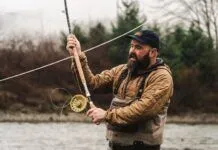
When you spend enough time around steelhead guides, you start to notice something: the truly fishy ones never stop learning. That’s exactly the vibe I get every time I’m on the river with Pat Beahen. The guy reads water like it’s printed in large font, and he’s got this river-smart intensity that makes you believe a fish could grab at any second.
This episode pulls together decades of Pat’s life chasing steelhead across BC — from Whistler beginnings to long seasons on the Bulkley and the Dean. If you’re a Great Lakes angler looking to level up your swung-fly game, this one’s packed with insight.
Pat grew up along the St. Lawrence, fishing warmwater species before stumbling into fly fishing at a shop called Fishing Buddies. Steelhead didn’t click for him until he started watching old Lani Waller tapes on repeat.
He eventually landed in Whistler chasing snow — not steelhead — but that changed fast when he met Brian Niska, who pulled him into guiding and spey casting traditions handed down from the Mike Maxwell era.
Pat’s first lodge gig came in 2008 after a birthday phone call from Whitey at Bulkley River Lodge. Before that, he spent years bouncing between Whistler guiding and month-long BC steelhead road trips.
He talks about that tight-knit era — the friendly competition, the early-days learning curve, and the shared obsession with steelhead among anglers like April Vokey and others.
Most of Pat’s year is spoken for with two major lodge seasons plus a March–April stretch on his home rivers around Squamish. When he’s off the water, he’s splitting wood, looking for shed antlers, and hanging with his cat and wife.
But guiding months are long days — dark to dark — and he emphasizes how little downtime a BC guide actually gets.
Pat simplifies gear choices better than anyone. If you’re new to Great Lakes steelhead swing fishing, pay close attention here.
He notes that a shorter rod pairs naturally with today’s shorter heads, and the goal is simply to make casting and setup easy enough so a visiting angler fishes effectively right away.
When a client is swinging well, he gives them space. When something’s off, he steps in immediately. It’s a balance he learned during his Whistler days guiding one-off day trips — where you had just a few hours to teach, adjust, and find a fish.
Pat considers gradient the #1 factor determining where migrating fish briefly stop — and therefore where we can catch them. He explains how subtle changes in river slope can reveal the “elevator” zones steelhead slide into during their push upstream.
This is one of the best tutorials on swung-fly control we’ve ever had on the podcast.
On certain Skeena tributaries — especially the Bulkley — Pat fishes dries fast and confidently. Fish there grew up competing hard for limited insect life, making them more willing to smash surface flies.
Pat closes with a classic Whistler-era story involving sockeye, rainbow trout, a timid wader, a rotten Chinook at his feet, and Pat’s legendary sensitivity to smells. If you know him, you know: when Pat starts retching, everyone else starts laughing.
Episode Transcript
WFS 850 Transcript 00:00:00 Jeff: Hey, hey, this is your Great Lakes dude, Jeff Lasky coming to you on the Wet Fly Swing podcast, where we’re going to be going rage angler on all things Great Lakes from Gear Fly, Big Water and Swing and flies. Of course, if it concerns the Great Lakes, we’ve got you covered. So stay tuned to this next episode. Welcome to the Wet Fly Swing Great Lakes podcast. I’m your host, Jeff Liskay aka Great Lakes dude. Well, this episode is going to be from Canada. I have been up in BC for the last four weeks visiting my great friends in across the border in Canada here, enjoying some great steelhead fishing, visiting some friends, camaraderie, having some great times. But I’m blessed to be with some of the best steelhead guides on the planet. So I figured while I’m up here, I would take advantage of interviewing some of my great friends who’ve guided me to some of my best steelhead up here in my life, and I’m at the Bulkley River Lodge again, interviewing the head guide, Pat Beahen. And I’m going to introduce you now. Pat, welcome to the show. 00:01:12 Pat: Hi, Jeff, thanks for welcoming me to the Wet Fly Swing Podcast. And yeah, excited to have a chat with you here. 00:01:19 Jeff: Yeah. Let’s toast a little kokanee here. 00:01:22 Pat: Yeah, we’re having a little blue can as we do up here in uh, on steelhead rivers. We’re going to taste the adventure. 00:01:28 Jeff: So, Pat, I’ve known you now for about three or four years, and, uh, why don’t you just give a little introduction of how you got into fishing? Little family life gives it a quick little background, man. 00:01:37 Pat: Yeah. All right. I was, uh, born in eastern Ontario in, um, a town called Ottawa, uh, which is our national capital of Canada. I was fortunate to, um, have some parents that, uh, were kind of water people. And dad in particular, uh, really liked the, um, the water and, uh, shipping and things like that. He was a sailor in the Coast Guard. And because of. That just south of Ottawa, the Saint Lawrence River runs a drains the Great Lakes of. Course out to the ocean. And they bought a property there and um, when I was about four or five I was able to experience fishing. And, uh, very quickly Dad and mum realized that, uh, that was sort of my thing. So, yeah, being fortunate that they, uh, nurtured that and I had access to water, I just it became a thing that I that’s all I wanted. And so from an early age, I really just wanted, uh, to be on the water fishing and, uh, a river rat, I guess, is sort of what started happening. And after that, you know, through my teen years, I was able to get into, uh, working in a shop, a place called Fishing Buddies. And this was, uh, more warm water, uh, situation where we were bass fishing, and that’s really what I was interested in. It was really quite fun. And I mean, going through high school and things like that, my interests, as much as they were, should have been about girls and, uh, partying, which I made a little bit of time for. The priority was definitely fishing. 00:03:00 Jeff: You did graduate, right? 00:03:01 Pat: I did graduate, yeah, but it was like, yeah, maybe I had an extra year in there. 00:03:06 Jeff: Me too. 00:03:09 Pat: So, you know, there’s always these pivots that you have in your life and and, uh, mine fortunately surrounded, uh, fishing and, uh, working in this shop at Fishing Buddies, I was really exposed to some really cool aspects outside of bass and things like that being in the national capital. I mean, this shop tailored to people worldwide, we sold like big Tiagra like seventy and one hundred, like tuna rods, big stuff, you know, like that. People would, you know, diplomats would come and purchase things. So we got to sell a lot of cool stuff. And part of that actually had a one thousand square foot fly fishing area in Ottawa. And so although I was not really into the fly fishing techniques and angling. Because I was so involved in bass, I still got exposed to it. So one of the first parts of the fly fishing journey for me was actually that, and basically just learning the tackle and selling it. A few memories of that. The old Lanny Waller, three videos of fly fishing for trophy steelhead. Oh yeah, we used to have that on in the shop. And I just remember looking at that video over and over and over again going, wow, that looks really, really cool. 00:04:18 Jeff: Right I bet. Right. 00:04:21 Pat: So, uh, one little side note to the fishing buddies days, and then we’ll move on to that and, uh, moving out west. But, uh, the guy that ran the fly fishing section, his name was Milt McKay. And, uh, we called him the old trout. And we old nicknames, as you do in these shops. And, uh, my nickname was LBD, and that stood for Little bass, dickhead. 00:04:44 Jeff: Well, it probably suited you right at the time. 00:04:47 Pat: Yeah, totally. So there was a pivot there. Um, the shop eventually closed. It was an independent store. Things just changed for the owner. And and so the shop closed. And so that gave me an opportunity to, um, follow sort of one of my other passions, which was skiing. Right. And, uh, I had had a bunch of buddies move out to Whistler, and they were there in about nineteen ninety nine, ninety eight and ninety nine, I guess was when I moved out October, I guess. So I moved out there to ski and, uh, chased, you know, the the powder dream in Whistler and very fortunate in my first year as a ski bum, I guess, uh, one of my roommates, uh, was best friends with a good friend, uh, Brian Niska. That’s where we met. And, uh, of course, the fishing discussion happened when we met. And, uh, fortunate for me, Brian took a shine to me and showed me the ropes. And not long after that, Brian started Whistler fly fishing and asked me if I would like to be a guide in Whistler. And that’s really where the journey that takes us to present day began. And so that was now in two thousand. So we’re looking at twenty five years of guiding and most of that full time fishing guide. And so there’s been a ton of good times, but that’s sort of what has brought me to present day being a professional steelhead guide. 00:06:11 Jeff: Right. I mean, you can’t get a better mentor than Bryan, right? I just got done spending a week with him and just the overwhelming knowledge of it because he’s immersed with it. And your mentor, he’s he’s my mentor already. I just met him. Right. So it’s pretty amazing how we pass the torch along with this information, you know? 00:06:26 Pat: Absolutely. I mean, they always talk about like, do you create your own destinies or do they kind of find you? And like, there’s always a little bit of both, right. But I mean, literally, his buddy Steve ended up being my roommate. That’s all it was. And then he’s like, listen, I don’t need to listen to your fishing stories. How about you just meet my buddy Bryan, and you guys can talk fishing because I’m really not that interested. And so that’s sort of how it began. And uh, but yeah, Brian, I mean, come on, he was there for like some of my first Spey casts, my first steelhead on the Thompson. Like a bunch of good times, right? And, uh, yeah, I mean, we all had a bit of a different run in Whistler, but, I mean, we were all there for the better part of fifteen years, including the Fly Shop and all sorts of shenanigans. And, uh, yeah, we’ve been through lots of highs and, uh, the odd low and just a bunch of good times, though, and, and the and the learning curve and the, you know, the, uh, forwarding of, of tradition and sport and things like that. You know, Brian was taught by some of our forefathers, you know, uh, with, uh, Mike Maxwell and some people that, you know, had a it was basically a different era in Spey casting back then. And that’s where, you know, Brian was brought into it from an older tradition, not not into this modern style of casting and ways that we look at it today. So it was really interesting to get that side of it too. Right? We came in before sort of the modern era, let’s say. 00:07:48 Jeff: Yes. Longer lines than that. And it’s like now we have these shorter lines. And he was even a competitor and, you know, the Spey Orama then I think you are an FFI certified single hand instructor, too. 00:08:01 Pat: That’s right. Yeah. Not I mean, I don’t think I’m paying my dues and whatnot and current, but that’s fine. I still went through the process and failed my first one. I actually broke the instructors. Uh, rod on my first test. Yeah, good old Pete Morrison there. And, uh, but that wasn’t why I failed it. That was just embarrassing. Yeah, it was probably one. 00:08:22 Jeff: Of those trick questions, right? 00:08:24 Pat: Well, actually, I snagged a bush behind me and gave her a yank and snapped the tip, you know? 00:08:28 Jeff: Okay, so. So we got you up to date around two thousand or so now, and then you transferred up here, started working at the bulk River Lodge around two thousand and eight or so. 00:08:39 Pat: Uh, yeah. So two thousand and eight was first kind of lodge assignment, I guess. So prior to that, we would be doing seasonal work in Whistler. And uh, so yeah, on, uh, it was actually a birthday gift, uh, from Whitey, who owns the lodge here at Bulkley River. And, uh, yeah, it was on my birthday, and I got a call, and he we had a quick chat, and he’s like, I’d like to offer you a position at Bulkley River Lodge. So that year came up and, uh, started guiding the Bulkley. I’d fished it a few times before, Brian. Brian had guided it. And, uh, after he was done guiding, we would roll in and, you know, kind of poach for a month. You know, poach means we’d just fish on our own and bug the guides that were working currently. But and so during that time, it was really cool because we were able to hang with some of the other people that, uh, were, I guess, influential and just, you know, in those times when we were all kind of learning the gig, right, going back to two thousand, we would obviously we’d be fishing and you’d create a little posse of fishermen, but as you would travel around during the seasons to each new zone, whether it be the Skeena or back in the day when we would use to go to the Thompson, there’d be a meeting of, you know, our friends and some of them were new and some of them were new, and you would hang out and you’d share ideas. And then, you know, those were like the really early learning years and sharing of ideas and learning from others. You know, like some of my good buddies like Dave Hughes and, you know, just awesome stuff where you only got to see them for a little while. But man, they were fun times and chasing fun fish, right? 00:10:11 Jeff: Yeah. I think, uh, Brian showed me a picture of the early days of you, and I was like, who’s that? And he goes, oh, that’s Pat. And I go, oh yeah, that’s young Pat. 00:10:20 Pat: Oh yeah, we were all young back then. I mean, yeah, I mean, remember meeting like Adrian Comeau and and you know, April and Stevie and like the whole like we were just we were just hell bent on steelhead and we just, I mean, whether you, we liked each other or not, which we mostly did. Right? But we were all trying to beat each other the holes and, like, totally telling lies about where we’re going first or not and stuff like that. It was just so good, right? So yeah, those are the early days. And there’s like, I think, you know, one way or the other. I think we all kind of formed each other in a little bit of a way, you know, because we were learning. Right. And we still are. But those the early days of learning is like nothing else, right? 00:10:59 Jeff: Yeah. You can’t get enough. Right. Yeah. So that sort of brings us up to date. You’re currently working there. You do have another job, which I see in you in the summer on the Dean River. Why don’t you go over your, like, the calendar year for you? Like you have three areas you guide for, you know, the twelve months. 00:11:13 Pat: My life’s pretty, uh, scripted, uh, because I’ve got two lodge gigs that basically cover almost, you know, five, five plus months a year. And then I do a small, like, uh, winter period, basically March and April on my local rivers, which is the Squamish, Whistler area. And so that lets call it seven months of potential working time that I’m doing. And the rest of the time I like to, uh, either just hang out and gather wood or go hunting for elk antlers in the woods when they shed them. Spending time with my cat and my wife and traveling maybe to Europe and things like that. It’s sort of what I do, and any warm water destination that I can get my hands on to go sight fishing. I love the sight game. 00:11:54 Jeff: Right. Yeah. People say, oh, he’s only working seven months. Well, let me tell you a fishing guide in British Columbia. Or that the day starts O’dark thirty. And after you get done visiting and camaraderie with all the clients and the guests, you know, it’s a long day, period. Especially when we, you know, you float the canyon or something. It’s it’s almost dark to dark by the time you really get thought about. So seven months of work really boils down to way more than a year. Let’s talk a little bit about I think you are probably one of the fishiest steelhead guides I’ve ever met, because you’re always thinking, like you said in early days, that we all call you the squirrel on Red bull because you’re the most engaging guide I know. Very, very impressive. But what’s a good building like a ladder for being a successful steel header. Let’s just really base it because there’ll be some basic listeners, the basic outfit that you would say, hey, I’m going to go fish for true steelhead. Where would it be? 00:12:49 Pat: Pat basically a seven weight is sort of where I like to be with it. Um, possibly an eight, but a seven should cover it. Typically I’m going to look at the twelve and a half to no more than thirteen foot range because I’m going to want you know, certainly for it’s interesting with the lines and the setups. You know, I still go back and forth all over the place with different things, but I tend to these days gravitate to a little bit shorter Skagit style head for most casters. So if you’re if you’re an infrequent caster, so say you’re coming up to a lodge or something like that for a week or two of the year, and you’re not necessarily angling outside of that. We want something that’s going to be kind of easy and does a little bit of the work for you, for you, and so I tend to gravitate a little bit more to those twenty twenty two foot head areas. And certainly for beginners, I think that’s a good area to run. And then the seasoned steelhead can still run those once they you know once they just make the little adjustments. So yeah. So seven weight twelve and a half twenty twenty two foot head. 00:13:54 Jeff: The little shorter. We’ve all started out with the fourteen and fifteen foot big Viking sticks and stuff. And then you like the shorter rods just to match with the shorter lines. Or is it because of backdrop behind you, or is there a reason a blind control or. 00:14:08 Pat: You know, the easiest terms? It’s probably more. The shorter rod to the shorter line is where I’d go with it. Certainly there are benefits to that in tighter constraints with certain casts for sure, but I think just some of the casting deficiencies can be overcome a little bit with the just the setup in the starting point with that type of setup. And again, I’m also pushing a little bit of my personal preference into that because I tend to fish that style of rod. And so because I’ve kind of figured out how to run that, I end up teaching that style of cast to my clients because I know it’s easier. 00:14:48 Ad: Since nineteen seventy two, four wheel campers have been building rugged, lightweight campers designed to fit almost any truck and every kind of adventure. Whether you’re keeping it simple like me with the project M or gearing up for full time off the grid travel, there’s a four wheel camper built to match your lifestyle. You can head over to four Wheel Campers right now to use the builder tool to find your perfect topper, slide in or flat bed camper for your next journey. When it comes to high quality flyers that truly elevate your fly fishing game, drift is the trusted source you need. I’ve been using drift hooks, expertly selected flies for a while now, and they never disappoint. Plus, they stand behind their products with a money back guarantee. Are you ready to upgrade your fly box? Head over to Drift Hook com today and use the code at checkout to get fifteen percent off your first order. That’s drift hook drive. Don’t miss out. 00:15:45 Jeff: It’s easy for you to educate somebody in a very short amount of time to make them successful. Correct. 00:15:51 Pat: At the end of the day, we want to get that fly out there under tension and swinging. Right. And so that’s the beauty of, uh, sort of the beginning of guiding where I came from. I didn’t come from a large, uh, standpoint where we had clients, you know, that were had fished a bunch and that do it and spend big money on it. We had like day trippers in Whistler. It’s like one shot. You got one day to, like, teach them, figure them out, hopefully catch a fish and then they’re gone the next day. You don’t ever see them again. And if they really liked it, maybe you do see them again. And and of course, I do have some of my long lasting clients from those days. But most of the time in Whistler we were doing one off trips, one shot, and you had to teach him everything and also seal the deal with a fish in one day. So you had to streamline a lot of things for them as well as your, you know, how you taught things. 00:16:43 Jeff: And so being a fishing guide. Right? 00:16:45 Pat: Yeah. 00:16:46 Jeff: It goes back to the cubicle in the you know, they don’t say, oh yeah, I had a great boat ride with Pat. They’re like, show me a picture of a fish. You know, it’s like it’s that’s I hate to say it, but that is the bottom line of a fishing guide, right? 00:16:57 Pat: The it was always the call when you in this case, we’d be out of cell service most of the day. And of course, as soon as you’d roll back into cell service, there’d be a call to the wife or the kids or something. And immediately the first question, well, what’d you catch? Right? And you were like, oh my gosh, hopefully they have the right thing to say here. You know, like the pressure’s on. You know, they didn’t want to hear, oh, no, Pat taught me lots. You know, we had such a great day. And the scenery is beautiful. 00:17:21 Jeff: Yeah. 00:17:21 Pat: Exactly. Which it was. It was it was awesome. But that’s not what the kids or the wife wanted to hear. No, no. 00:17:28 Jeff: Especially their buddies back at home, at the office or at their work, you know? 00:17:31 Pat: Yeah. So in general, that’s the the, you know, the basic setup. But, you know, there’s a lot of choices out there. And, uh, clearly, I mean, one of the recommendations, as much as we have things that we throw out there to our, our new clients or, you know, old clients, what have you. And as we develop and change our thoughts on gear, clearly finding your, you know, local independent fly shop is the key between us guides and good companies that make this gear and somebody who can explain it thoroughly and set you up with it. And that’s an important conversation to have, right between either the trip planning, if that’s what you’re doing, have a good conversation with the operator and then take that to the fly shop. And things need to be set up at that point. I think that’s, you know, I can see that go wrong often and I can see it go right often. And so that’s where good communication about spending good dollars the right way should happen, right? 00:18:33 Jeff: Yeah. You know, that communication between the guide and the angler is key. Some anglers are pretty introverted. And they they feel like they don’t want to ask it. But it’s really important to open that communication line. So as a guide you understand her skill set which is obvious after a little while, but, you know, achieve their goals at the end of the day. Let’s talk a little bit about I just was with you in the summer, my first time at a Dene River. It was spectacular. The set up, everything. Hickman runs there. But just maybe the difference between the Dene, why it’s so alluring, and the bulk lake. 00:19:07 Pat: The Dene River. So for those who don’t know, it’s a it’s a remote Mid coast river in British Columbia. It’s a summer run fishery that, uh, that occurs at a time of year. It’s a little bit earlier than most summer run rivers. It’s just got a geographical difference in that the fish on the Dean experience gradient immediately out of the ocean. Uh, this is a long fjord kind of inlet. They experienced some gradient immediately out of the ocean. A lot of steelhead rivers tend to have more of a meandering, slower estuary type area, whether it be, uh, you know, for a kilometer or fifty, sixty, seventy kilometers, in the case of, like a river, like the Skeena or something. And anything in between, depending on the size of the river. But typically it’s slow meandering. So the fish kind of just roll in and kind of acclimatize to their new reality of being in a freshwater river. The dean that’s not what happens. The Dean they they basically come over the edge of, you know, they come out of a deeper water edge in the ocean, and they immediately hop up and they’re into having to swim fast and adjust to powering up a pretty heavily graded river. And so there’s a difference there because there’s not a lot of adjustment time immediately after entering the river. What I’m talking about is just like the fish is awareness to surroundings and things like that. Like any fish that just first enters a new river, they tend to be a little aggressive to things that move and they can be pretty bitey. And so yeah, the catching the fish and whatnot, if they’re there you probably get bit. If they’re not there, there’s probably not a fish there. And you’re not getting them. They pulse through. It’s it’s very much a boom or bust kind of place. 00:20:54 Jeff: We lived it right. 00:20:55 Pat: Yeah. 00:20:56 Jeff: So the one thing that, uh, Pat showed me was he’s like, wait till you see a steelhead pogo. And I’m like, what? And he tells me, so why don’t you tell the listeners like what? The deal is like a pogo steelhead. 00:21:08 Pat: I’ve been working on a theory about this, and I’ll explain that here in a second. But in general, what happens is the, uh, you’ll be kind of fishing, probably on some sort of tide change, and, uh, nothing will be happening. And then all of a sudden you’ll just see a fish launch itself out of the river like three or four feet, typically on like some sort of upstream angle. And it literally just flies out of the water and you’re generally speaking, looking downstream because that’s the way your swing is headed. Basically, what you should be thinking is, okay, here they come. And that is the case. And a lot of the times you don’t get them when you see that. But some of the times you do get them when you see it. They travel really fast in that lower Dean. It all depends on river flow and water temperatures and what area of gradient they’re experiencing, of course. But, um, here’s what I think is happening with Pogoing. And this is just my made up theory. So if somebody knows, they can leave it in the comments or what have you. But this is my best thought about this, and it’s taken me a few years to figure it out. What I think is happening is these fish come out of this, uh, you know, ocean environment where, uh, their surroundings are much different than a river environment. These fish are moving quite fast and because they’re experiencing gradient, what’s also going on on the bottom when there’s gradient is there’s typically slightly bigger rocks at times than what you would just normally find in a normal steelhead run nothing out of the ordinary, but like something that might be two to four feet, you know, round. And some of them just, you know, two feet round, you know, like cobble. Right. And so what I think is happening is these fish just start nuking up the river and all of a sudden they just see a rock beside them. They’re like and they just they literally freak out and go, wow, what’s that? And they, they launch out of the water because they don’t know what that is and they freak out. And the easiest way to get away from that thing is to launch into the air. Part of why I think that is what’s going on is that it’s very much a predator escape move that I’ve witnessed with trout, predominantly for me with bull trout predation. So when bull trout chase smaller rainbow trout, it’s the exact same escaping move that goes on. So it was sort of like that launching move that the fish did to me was a predator escape move. Did they have predators on the dean like chasing them for the most part? No. The odd time I see a seal go after him. Guess what? They do the same move. But I think they’re just getting themselves freaked out by a rock because of how fast they’re swimming, and they’re not yet acclimatized to that river environment. So I think that’s the deal with what’s going on with the, um, with the pole going thing. And it’s just an interesting steelhead behavior that you don’t see often in other areas. And the one other thing that’s led me to believe that that’s what’s going on is that when we do get periods, for sure on the dean, like anywhere else, it’s a coastal river. There’s rain, there’s glaciers. We get periods of time where the river clarity is diminished. And guess what happens when that occurs? There’s less pogoing that goes on because they don’t see the rocks as much. So this is sort of where I’ve come up with people have explained it to including some biologists think it’s very interesting and that’s where we’ve left it. 00:24:38 Jeff: I’m going to roll with them. So all these steelhead rivers, right. Some have to migrate up, you know, seven hundred and fifty kilometers. What makes them stop? 00:24:48 Pat: Well, for sure, for me, gradient makes them stop. For me, it’s probably the single biggest thing that I could use against the fish in terms of getting an opportunity to catch one. We know that if steelhead slows down and for sure if it parks, we have a way better chance at presenting a fly to that fish and having it move and take the fly. So I tend to think that gradient is a big deal. That’s very, very important on any coastal river where you have a watershed that’s, you know, maybe inside of, I don’t know, sixty miles, seventy miles, right. Certainly as they go up river and they start to hold more and they start to maybe move less. Maybe it’s a little less important. Or maybe that gradient is just more subtle, right, than these steeper gradient rivers. Right. But yeah. So gradient comes in many different ways shapes and forms. But I’m always looking at gradient for sure. And then secondary to that would be sort of water temperatures and things like that. And the ability and what’s the fish’s reality at present and at what speed they’re moving. 00:26:04 Jeff: Yeah I just got done floating, you know, a couple days ago. And uh, huge gradient. There’s a nice little elevator, flat spot, huge gradient caught a fish. The other my other buddies like, how’d you catch it? And I says, just look upstream. The gradient gives itself away. Upstream. It’s sort of hard to see going downstream, but you know, like me and you like, we always look at the river. We can read it much faster, but Mother Nature gives away the secrets when you look upriver. Right? When you’re running the jet boat up river, you’re like, oh, there’s the sweet spot, there’s the sweet spot. You can almost see it, right? 00:26:36 Pat: Oh, yeah. For sure. I mean, you can visually see it. I mean, there’s sometimes it just falls away. You’re like, oh my gosh, look at that thing going down. I mean, it may not even be a, a true rapid or anything like that, but just a heavy spill. Right. And again, it can be subtle, like it just depends on sort of like maybe what’s going on downstream. Right? You know, if it’s a long flat area. Right. And then all of a sudden a little bit of gradient, well that could be significant, right. But if it’s, you know, climb, drop, climb, drop flat climb, drop, then there’s a lot going on in there. Right? So some are obvious, some are very subtle. One thing that’s interesting, at interesting, at least from running a jetboat, you can use your just the way you apply throttle to come up things. You can kind of understand a little bit what they’re going through. Yeah, that’s kind of neat. I’ve been able to like be like, oh yeah, that makes sense why they’re sitting here, huh? I mean, other than the obvious, like, visual aspect, right? And then likewise, same thing going down with the raft. Right. But that’s kind of working in a different way. But yeah, gradients, something I think that people should pay attention to for sure. And then the other part of that is, you know, you got to differentiate migrating fish versus holding fish too, right? There’s times where they’re just pushing hard and migrating, and that’s where gradients are very important. But then when they’re kind of when they’ve kind of found where they need to be and they’re kind of now set up in areas, then it becomes a different game, right? It becomes holding water. And like more, uh, living environments, especially with summer run fish where they’re going to winter over in a lot of cases. And so identifying those differences become important as well, I guess, which would also be like the the seasonal movement of the fish. Right. It’s where that starts coming in, right? There’s times where they’re pushing hard when water temperatures are warmer generally and, you know, flows are at a reasonable rate. But then as water temperatures drop and the season pushes on and some of these summer run systems, then we’re going to be changing from moving areas to holding type areas. And again every river’s got them. They’re all designed differently. I think one of the biggest things with Steelheading like we focus on casting, we focus on the fish, we focus on flies, sink tips, all this stuff. But like understanding environments is where it really gets exciting and you have to peel back the layers of each individual river and then within each individual run and each individual situation, and like where that comes together and where that comes from is you as the angler using your eyes. And when you have experiences with fish or not, immerse yourself in that environment and peel it apart and dig it open and try to figure out everything about it, and then apply the steelhead to it and then you afterwards, right. And just use your eyes. Question everything. Why why why? 00:29:32 Jeff: Yeah. I mean as a fishing guide, you’re sitting up there watching, you know, I would say myself, I don’t necessarily have to have the rod in my hand, but just watching the cast, every cast, you could almost say like, ah, that probably was not the way I would like to see it. And if you don’t get the reaction, sometimes you’re saying like, yeah, you better do that again, where they’re just, you know, sometimes they’re just that cast swing, cast swing. It’s it’s very easy on tough years to get complacent because you haven’t had any feedback as an angler for it could be a day or two. Right. So you doubt everything, but you rely on the guide to say, nope, you’re doing it right. Do this, which you are really good at. So this is leading into my next question. I feel like you are the most successful with clients that I’ve ever seen a guide with. What do you think makes you so successful? Just being engaged or what? Man. 00:30:22 Pat: Okay. I try hard every day for sure. That’s sort of part of it, right? I mean, part of it probably comes like I look at it as a little bit of a competition, right? Not between like myself and being successful to, you know, put my clients on fish or anything like that. But, uh, fishing is a challenge, right? It’s not easy to do it every day as a career. And to be consistent is not easy. So that’s the challenge, right? Is trying to be consistent with the approach. And then of course for my guests. Right. I want to see them succeed with skill set. and appreciation of the sport. All of those things, but absolutely trying to catch fish, right? Because of the challenge of the game, you know, when I wake up in the morning, it’s already like the things are going off in the head. Okay. What’s going on? I mean, trying to figure out, okay, what are the key things today that are going to allow us to have success? And those are like so then right away, that’s what we’re going to acknowledge under these set of circumstances that we have today. And so it’s the drive to get them is the key to my success. It’s still there burning every morning. Get up. Let’s go. Sometimes with the clients that I’ve been fishing a long time with, they’re like, okay, Betty, we can just chill out. It’s all good. I’m like, no, no, we can’t. We gotta go. 00:31:50 Jeff: Every run with Pat is like, put a rally suit on, he’s cheering you on, and you might not have had a grab for a week, but he’s still cheering you on and he’s like, they’re in there. They live there. Do it, do it, do it. And it’s like you believe it’s just the enthusiasm you have that any cast could be the cast. 00:32:07 Pat: Yeah. You know, I get amped up sometimes, but there’s other times I believe, like swing fishing in particular. This is one of the fine lines of guiding for me is like, and again, you have all sorts of different clients. And so you have to run it different every day and throughout the day and through somebody’s tired moments or excited moments. But, uh, one of the things that I love to be able to do is kind of set people up in a spot, give them their key things that they need to work on in this area. Step back, observe. If they’re crushing the assignment, I want flow. I want that guest or client or whoever to get in there and feel it right, because we know that if you kind of start to sense the swing and the swing speed and you just kind of get the vibe of a certain area, you get that. You just get to an area where you’re fishing better, right? Everything’s working out. And then of course, time and time again, we’ve all been through it. As swing fishermen, you just get that little feeling inside like, oh man, this is starting to feel good. Of course, you know. And oh man, it should happen on this. Cast me. 00:33:11 Speaker 4: Oh, there it is. You know, like you got him. 00:33:14 Pat: So as much as we can be excited as guides and, you know, wanting them to get fish, I think there’s this, like, fine line where you got to, like, set them up and just step back too. And I think I do that sometimes a lot. Well, but I mean, if you step out of line, if things aren’t happening, I’m jumping in there and we’re fixing it and getting her squared up so we can have better success, right? 00:33:34 Jeff: Yeah, absolutely, man. And you’re top notch. I call you fishing in your pocket. 00:33:39 Pat: Okay, here’s the thing. I’ve heard this from a lot of clients. They’re like, okay. Uh, yeah. Oh, yeah. You saw that? Yeah. Oh, yeah. Yeah, yeah. You’re always watching. I’m like, yeah, I’m always watching. You think I’m just like, what do you think I’m doing back there? I may not say anything, but I’m always watching. And, uh, we got a little mantra too, from a few clients. It’s like, uh, I got a little patch that I wear on my waders and says, always be ready. Yep. Yeah. So everybody out there, when you’re swinging, always be ready because you never know what’s going to happen. And then always have a plan. You know, if you’re in one of those tricky areas, whether it be a logjam or fast water, think ahead to what might happen and, uh, have a plan to deal with, you know, the fight that you just picked with maybe a big fish or something? 00:34:22 Jeff: Absolutely. 00:34:23 Pat: So always be ready. 00:34:24 Jeff: Speaking about big fish, do you think they live in different places than the average fish? 00:34:31 Speaker 4: Here’s the thing. 00:34:32 Pat: First of all, I have a lot of, like, good fishing friends. And let’s just take the guiding outside of it. Just like our own angling. And they catch like there’s certain anglers, which is interesting to see that sometimes just catch big ones. You know, there’s a few of them out there, some buddies, you know, and, uh, I don’t fashion myself as a big fish. I’m not sure what it is exactly. Okay, so that’s that. But to in general, I mean, I’ve been party to more big fish with clients than I have been myself, but that’s maybe just the nature of the game. We I don’t fish that much. I just guide a lot. But I do believe that, like in general, you can somewhat split big fish water a little bit. Like there’s again, if we look at look environments we just look at like a forty inch buck. Let’s say he’s he’s going to be, you know, in that thirty eight to forty inch range. Uh, he’s going to be in the seventeen to twenty inch girth range. He’s going to have pretty sizable head. And so when we look at holding, uh, pockets, a fish of that size is going to need a hydraulic that’s going to kind of just help to hold his position. So typically, you know, those bigger fish spots might be just a little bit chunkier rock, bigger fish places. I think those fish just probably feel a little bit more comfortable resting in those areas too. They have a little bit more cover around them. Rivers being rivers, the holding areas come in many different ways, and so there can be other types of scenarios where they’re in leggit zones. I’ve seen some big fish that we haven’t caught, just like floating rivers and looking at them, I’ve also seen them sit in like just froggy goofy places too. You’re like, oh really? You’re just gonna go sit there like, okay, so but yeah, in general I would look for bigger fish sometimes in those bigger, you know, bigger rock kind of areas versus smaller rock kind of areas, you know, a six to eight pound doe. And he needs a rock size of a no bigger than a volleyball. Right. And sometimes even smaller than that to break her current. You know, we see we see them sitting there when the water’s clear. And so it’s really interesting when the water is clear to see where certain things hang out, whether you’re catching them or not. Right. Because you visually see what environment they’re in. 00:36:50 Jeff: That would be a great way we can segue into, well, water issues, high water issues. 00:36:55 Pat: For me, high water issues, of course, are probably going to come with some level of turbidity. And that can be difficult, of course, because, you know, these are, you know, steelhead one hundred percent. The number one thing why we catch them is that they’re visual feeders. They have lateral lines and they have other tools I’m sure, to, to detect, uh, whether it be prey or predators. But ultimately it’s their eyes. That’s what they’re using to, you know, again, evade predation and you know, things and how to get fish. So when the, when water clarity is diminished, um, I mean, if it’s mud with like zero to six inches of visibility, it’s going to be really tough sledding. And that’s typically at the front edge of a, of a rain event. And then what’s going to happen is there’s going to be suspended load in the system. And suspended load is any number of things from silt to, uh, debris from the bank that is being agitated in the current, and that is going to diminish their visibility. And it may in fact provide too much stimulus to their eyes where they kind of just go into a shutdown scenario. But shortly thereafter, on any system, regardless of how big or small, there’s going to be a point where things start to thin out and the clarity becomes even just marginally better. And typically that’s going to be anywhere from a, you know, it could be twelve hours, it could be three days in a bigger system. As that starts to occur right away, fish are going to be able to respond better to seeing things. Even though it may not look good to us still. So all we need to do there is kind of offer up some slightly larger presentations, maybe make them a bit more wiggly and lifelike, and always provide ample triggers, whether it be flash food, item triggers or things like that. And typically that also occurs with a dropping river. So, you know, as things tighten up, fish tend to move around, new realities become present, and then they become bitey again. That would be the high water scenario. 00:38:56 Ad: Let’s take a break and check in with Jackson Hole Fly Company right now. The right gear can turn a good day on the water into an unforgettable one. Jackson Hole Flight Company’s combo kits are built to match the rhythm of the river, giving you everything you need in one simple package. Each kit pairs a perfectly matched rod and reel with essential accessories, ready to fish right out of the box. From the beginner friendly Crystal Creek to the high performance Flat Creek, there’s a setup for every angler. And don’t forget about their packs and slings. I’ve been loving my Jackson Hole Sling pack for a number of years now. The perfect size to fit all your gear, but not too heavy and not too big to drag you down. Check out their slings and rods and much more at Jackson Hole. Fly Company.com and you can support this podcast by checking in with Jackson Hole Fly Company today, there’s a place where every bend in the river feels like it’s been waiting for you. Where the air smells of sage and pine and trout rise beneath the shadows of the Tetons. That places visit Idaho’s Yellowstone Teton territory. The heartbeat of fly fishing in the west, from the legendary Henrys Fork to the winding South Fork of the snake. This is where big fish and bigger stories live. You’ll find endless waters welcoming towns and locals who still wave as you drive by, with drift boat in tow. This is your starting point for world class fly fishing, year round recreation, and wild country that stays with you long after you’ve packed up your gear. Check it out right now. That’s wet. Fly to visit Idaho for yourself and support this podcast while you go. 00:40:36 Jeff: So high water when you think the success is actually achievable. We’re talking eight inches of visibility a foot. 00:40:45 Pat: Yeah. I mean, we always talk about this, like, uh, our knee to. I’m tapping my knee here. Right. Uh, our knee to our boots. Right. So that’s, you know, let’s call that sixteen inches ish. I think something to remember about, like, light in the water is that if we’re seeing our boot at, like, even though it’s a diminished sixteen inches the way that our eyes pick things up when we see sixteen inches down, we’re actually getting reflected back up. So it’s actually more like thirty two inches of visibility. That’s probably what’s present in there. So there’s always a little bit more visibility than what our eyes perceive it as. And their eyes are definitely better in their environment than our eyes are for sure. 00:41:32 Jeff: Yeah. I think it’s a confidence thing. Right. Obviously you’re not going to catch as many when it’s gritty, but it’s achievable. I’ve learned a lot on the Great Lakes that’s like that. And I’m sure you had a super high water last year, and I’m sure you were like, man, this is going to be you adjusted and you caught fish. 00:41:50 Pat: Okay, so what was interesting about last year on these trips and whatnot was that we were fortunate to have a fairly good, uh, return. And so because of that, there were more fish in places. And so then therefore, you were able to nail a few more fish during the turbid times. One thing to go back to, uh, so if we think about areas. So when we’re talking about that, uh, what I like to look for when fishing dirtier water because the fish sometimes will move around, but a lot of times they just hunker where they are and they take it. They don’t all move into like some special place unless it’s very volatile. Right. And they get pushed to margins. And in which case, if it’s like that, we’re probably not fishing, right. Like it’s dangerous, then you don’t need to be on the river when there’s logs coming down. It just take a day off, go tie flies or whatever. But, um, what I like to look for is more areas where I can get my presentation into whatever degree of visibility I believe is present. For the longest period of time as possible. So if I can find flat areas where I can keep the fly in there versus an area that’s like a little bit more steeper or coming in on a fast seam, and then it’s only in there for like ten feet of the swing versus forty feet of the swing. That’s what I’m going to look for. Right. So I might choose one or two runs and instead of moving around, I might just sit there for a lot longer than I would ever sit in a run and just work it until hopefully something happens. 00:43:20 Jeff: What about the opposite? We had some really hot, sunny days, and I think the fish still quite bite when it’s bright and sunny. Do they? You get in the bite, but not as good as it would be if a cloudy day, right? 00:43:32 Pat: Yeah. I mean, so sun for me, I’m definitely a light angle guy. I’m not looking for shade typically. I’m not sure I’ve seen or found that for me on my rivers. I know I’ve heard it on some other rivers, that that’s sort of the deal. But for me, I play light angle typically, so I’m not a huge fan of it directly into their eyes on a real bright, sunny day. If that’s the case, maybe I’m going to look for some really stuff to break it up a little bit. If I’m on my game and I have my choice with, uh, moving around, I’m going to typically want the sun from, you know, coming straight upstream or from the sides is sort of what I. And I’ll, you know, again, if I have my choices, I’ll run my beats and runs like that and I’ll wait till the sun’s on a certain part, but they’ll still bite sometimes, like with it straight in their eyes, too. But I maybe overthink it sometimes. You know, I. 00:44:23 Jeff: Think we all. 00:44:24 Pat: Do, don’t. 00:44:24 Jeff: We? They should be biting. They should be biting. Yeah, but they’re just not there. 00:44:28 Pat: Yeah, they’re just not there. But if I can control it, I will, you know. Um, and so, you know, and then low water. Low water, I mean, I love low water because I can see things. The low water is clear. Yeah. You got to lighten things up. And, you know, low water is cool because you can fish like things like dry flies and, you know, imitations of whatever food source they’re on. And so, yeah, low water is pretty fun cuz it just expands how you can fish to them. 00:44:49 Jeff: You spot him. You got him. 00:44:51 Pat: Yeah. I mean, spotting is really cool, right? I mean low water we can low and even just, you know, typically low clear water. I can jet around and look out from the jetboat on step and sometimes spot them and just pull over and play a fish and see if they’re going to bite. You know, the clear water situation for me as a guide and for anglers, you get to look around and see where the fish are. You’ll see them before or after, but then you just getting feedback outside of the line, right. What’s on the line. So that’s always nice. 00:45:20 Jeff: Yeah, I think anytime that you see them you’re like you have confidence they live there, right? 00:45:25 Pat: Yeah. And also you get you get to study the environments too that they’re living in. And you get some understanding as to like the rock size and the shapes and the buckets and all that stuff. Right. And so that’s I mean, again, I think everybody should be paying more attention to the environments that they live in than the fish themselves. Because if you can understand that, guess what ends up there eventually over and over again. 00:45:49 Jeff: So it’s obvious, right? That’s where they live, right? 00:45:52 Pat: Yeah. It’s just it’s cool to pick it apart though. It’s an ecosystem and they’re just part of that ecosystem. So it’s cool to understand all parts of it. 00:46:00 Jeff: Let’s chat a little bit about swing speed, because me and you’ve had some serious conversations over some cocaine. And on the river it will go through a run. And a lot of times you’ll say, I’ll say, man, you know, I don’t know if I fished that. Well. You’re like, no, I think you did. You’re like, well, we’ll have that like faster or slower, but let’s just talk a little bit about when you cast it out and you’re, you know, people hear this, you know, pull back, man. Feed it in tension. Let’s just go over a few of the key bullet point terminologies that first swung fly. I think that a lot of times it gets overlooked, You know, as a basic, you know, swung fly angler. Just getting it from the Great Lakes is this this podcast is going to be not only for British Columbia steelhead, it’s also going to be for Great Lakes. So why don’t you just engage me a little bit with like a swung fly presentation? 00:46:47 Pat: Yeah. So the swung fly, it’s a really interesting thing, right. Because at its most basic form we lay a cast out there and let’s make sure that we lay it a nice tight cast to the water, because then we want to be able to position the belly or the sink tip into an angle in which we think we can steer it, then into the lie that we’re working into. So, you know, it starts with a nice tight. Okay, let’s talk sink tips okay. So we’re sink tip fishing at this. 00:47:21 Jeff: Point. 00:47:21 Pat: Okay. Dry flies a little bit different because, uh, the speeds of the current are different at the surface than they are down below. So that’s I think it starts maybe even before we make the cast. let’s understand what the current is doing. In general, the current is moving faster at the surface and slower at the bottom. The difference is of the rock and possibly bends or little shelfs. In the case of bedrock, areas are going to affect the speed of the current on the bottom, and it’s going to be slower at the bottom, and it’s going to be a little bit faster at the top. Current kind of moves down river in a helical motion. It spins as it goes down river. So we want to make sure that in faster water areas we generally speaking with a sink tip, penetrate the surface current to some degree with whatever sink tip we’ve chosen, what density we’ve chosen, and that allows us to present the fly a little bit slower to the fish. And the reason we want to present the fly a little bit slower to the fish is so that they can see it for a period of time, so that they can acknowledge the fly and therefore pursue and actually put it in their mouth. So again, we really need to look at the depth, the speed, and then we determine what type of angle we’re going to put our belly or our sink tip and therefore our fly what angle we’re going to present to the fish in. I tend to be a big advocate of casting across, lifting the rod and pulling the head out of the water and then angling the sink tip upstream and changing it from a perpendicular or cross current situation into a slightly down current angle with the sink tip, and then give it a dead drift to penetrate the surface current. 00:49:18 Jeff: And then just let the river do its thing and straighten. They form the bow and keep it going. 00:49:23 Pat: Then I’ll typically give it a dead drift with a high rod, then I’ll slot it in, and then I’ll hold for one to three second count to apply the tension to the system. And then as I see the belly come under tension, I will then steer the fly based on what my belly is telling me to do. So if it’s just steering in a nice continuous motion with the current, I’m just going to hang on. If I see it start to stall out and slow down, I will tend to apply an inside mend to maintain the same speed that I had the fly moving at. That’s very general, but that’s typically what I want to do. I want to control speed, not necessarily get it deeper, but if we get it a little bit under the surface current, we’re going to be able to control the speed. 00:50:10 Jeff: I like that the chase, that how fast you want that fly to come. You know, if it’s going to be broadside a little faster or slower. What about you get into some a little bit confused currents where you’re making a longer cast across multiple various currents and you’ve got this nice, you know, nice arc moving. You’re moving. All of a sudden it hits this unusual water hydraulics that throws that little snake into your line. A lot of anglers that ask me, what do you do? Do you make a downstream end? Do you take it out? You know, what do you do? How do you eliminate that little bit of confused water hydraulics and get it back on track to a fishing presentation? 00:50:47 Pat: Again, once I set the fly on its initial path, I’m going to not want to upset the fly too much with what I’m doing, but if I see it getting sticky or in some sort of slow moving current, I’m going to maybe lift the rod a little bit. Very subtle. Right? And then I might maybe mend in or downstream a little bit to, to allow the, uh, head that’s stuck in some funky pocket and release it from that. But I’m not going to try to move the fly too, too much because it’s set. Once it’s set, I don’t want to be moving it too, too much. It’s on its own journey and it’s swinging and moving. but the the head can interfere with that quite a bit. So if you see that kind of getting caught up, lift the rod a little bit. Little bit of downstream. And in the case of usually a swirly current or some sort of sticky hydraulic, which tends to be kind of very flat moving, which would come off a big, big rocks and things like that. I mean, the river environment gets quite complicated at times, and so there’s times where you have to kind of change things up, right. Don’t be a robot out there, that’s for sure. It’s not cast men. And hang on, you got to be looking at things all the time and constantly adjusting to men less don’t mend or men more as you move through, even just a single run. So part of that all starts like even before you step in the water, reading the water and kind of coming up with a game plan for yourself as to, you know, how you’re going to fish it. And then the other thing is to I mean, I fish it a certain way, but there’s a lot of different ways to fish for these things, so you can fish them fast. You can fish them slow. It all depends. You know what area you want to try to catch a fish out of? What part of the run you want to catch fish out of? Do you want to fish the entire pool? Do you just want to fish insides outsides? You know you can choose. And then you have to approach it differently each time. And so, you know, it all works. That’s why I think that’s why steelhead is appealing to a lot of people, is that they will bite a lot of different types of presentations, a lot of different ways. And so come up with your own style for what works for you and how you enjoy fishing for them, right? Yeah, I fish for them. Kind of like like on a business like approach. Right. So I kind of I fish them not down and dirty, but I mean, yeah, but there’s times where like I’ll put the sink tips away because the dry fly is the better way to go on these, you know, systems sometimes, right. There’s certain years where it’s just that’s the way it is. You’re putting yourself at a disadvantage if you’re not putting the dry on. 00:53:19 Jeff: Yeah. Before we jump into the dry fly game. I’ve got a question I’ve always wanted to ask you, and I have my own opinion, but we have two identical sink tips ten foot and a twelve foot. They both have the same sink rate, regardless if it’s team material or inches per second. Does a shorter ten foot swing faster than a twelve foot? 00:53:41 Pat: I would tend to think, and it depends again, how we position this sink tip in the current, right? That’s way more important, right? Like you can take let’s just for argument’s sake, you can take ten feet of T11 and let’s go just do an older type sink tip that still exists. And you can take fifteen feet of type three. And if you put the type three in the hands of somebody who knows how to like slink it in there, that thing can get like way lower and way slower than just chucking, you know, ten feet at T11 straight. For sure, the longer ones gonna probably get down a little bit more, right? But again, it depends how we angle it in the current and then what we do with it after we angle it in the current. 00:54:28 Jeff: You know, I keep thinking of these fishing systems like you say we’ve got a little shorter rods now, little shorter heads. The ratio is now we’ve got, you know, ten foot of this or twelve foot of this, but it feels like as our shorter fishing systems get, we can maneuver those angles much better. But I’ve noticed sometimes that a ten foot tip I’m not sure why. Maybe because we can position that angle better sometimes because we’re not fishing super deep to right? So it’s like, wow, that ten foot tip seems to be catching more fish at that circumstance, right? So it’s sort of like I’ve been sort of wondering myself. 00:55:03 Pat: Well, I mean, and then there’s times where like that, you know, like these, these longer tips, if you want to sneak inside, you know, into that last third of the run, maybe that you’re a little too low then. 00:55:13 Jeff: Yeah. And I think the fifteen foot tips I remember when I first started coming up here? Your people were standing in ankle deep water in these bigger, longer rods. They were blowing their anchors. If they had a shorter one because they just because they were standing in ankle deep water with a fifteen foot row was just like, that’s all you heard. So it’s like, put it to a fifteen footer on it, solve the problems too. 00:55:35 Pat: Yeah. So and no cheater or anything like that. Right. Oh the cheaters sink tip was the cheater. Okay, here’s the deal though. Uh, shorter tips for sure. They’re day to day. No matter who we are, they cast easier and they cast more consistent. Do they cast prettier? Maybe not. You take a little bit longer tip. Yeah. And you can kind of produce a nicer loop and nicer layover. So again, that’s a casting thing. If you want your your layouts to be nicer. Right. But I mean a good cast you can lay out anything nice. But this is a steelhead truism of one of two things being deeper or too high up in the water column when angling them under any condition. Okay. Winter or summer? You’re better to be too high up than you are. To be better. Too low for a lot of reasons. But the big one is they look up. We know this. So in general, you’re better off to be a little bit more up and a little bit more controlled in the up situation than being down low is sort of where if we’re talking about lengths and how they fish, again, for the length of cast that you’re putting out there, and you want to fish the entire length of that cast from outside bucket to right to dangle, you’re better off being a little higher than too low. 00:56:51 Jeff: You’re right, because you could slink it in if you have to in the beginning, and then add that downstream to the bank, man, like you said, to speed it up, to get it, to get that last little bit. 00:56:59 Pat: Yep. And I mean, that’s again where you gotta like, don’t be afraid to change your tips every run, you know, analyze. Look at the run. Look at the situation. Look at the water temps. Look at what type of river you’re on. Look at the frequency of fish that you’re fishing to, all of those things come into play, and then you choose your approach right, right to it. And so it can get complicated. 00:57:23 Jeff: And it can also get overthinking. 00:57:24 Pat: And we can get overthinking and that’s that. So like yeah, I mean that’s the fun of Steelheading is kind of know knowing when to plug in which variable or to remove a variable that’s just not important right now. So don’t even think about that. Right. Like that’s and that comes with experience and trial and error. And you know, that’s where the mystery kind of lies with these things. You know, like and sometimes they’re just not there and all that, you know, like but yeah, just remember that they’re uh, you know, when we talk sink tips and gear, it’s all tools in the chest, and it’s better to have more of them than not. And it’s, you know, and find which ones work for you and then go fishing. 00:58:01 Jeff: Right. Let’s stop talking a little bit about dredging up, because these last few weeks we’ve had some pretty epic surface eats. What’s so different about it? Like, I mean, we know this is on the surface. We’re trying to catch a steelhead that’s going to come to the surface. Do you do anything different with the cast angles or what do you do like for dry fly fishing? We know we have a fly on a surface, but just walk us through a short little. Like the difference. 00:58:26 Pat: A little bit depends on the river that you’re, you’re fishing to. Uh, and typically we’re talking somewhere on rivers and these fish have, uh, you know, grown up in a younger, um, you know, life stage where they were smaller and they were chasing insects as they were getting to, uh, through smolt size. And then, of course, they went to the ocean and came back. And then when they come back to the river, they tend to mimic some of their, uh, life history that they had when they were a younger fish. And, um, so depending on what river you’re on, they can be really aggressive. And, uh, one of the things we see here on some of the Skeena Tribs is that some of the rivers, there’s quite a lot of competition. When they were small fish for the limited bug life that was there, and so they tended to be quite aggressive towards, you know, the food items that were present. And so when they come back on this river, let’s say the Bulkley, they, they can be pretty aggressive with the dry flies. So when we’re talking about how to fish them, typically I want my dry fly to be under tension almost immediately at the end of the cast. And then I’m going to choose whether to do nothing and just let it come across on the currents with a big belly and kind of presenting somewhat broadside at the start of the swing, and then typically straightening out and tightening up through mid-swing. And if there’s conflicting currents, meaning faster currents at the extension of my cast and moderate to slow currents down the inside of my casting length, I’m probably going to put a small mend on it and achieve tension early in the swing and kind of steer it a little slower. And then as I come to Mid-swing, I’m going to add a big belly to the inside and continue the speed around in general. So I fish them one of two ways. So in even current areas, no meant in areas where there’s conflicting currents. Even though they’re within the fishing range or the holding range, I’m going to slow it down at the far end of my cast and then speed it up. 01:00:20 Jeff: If you got everything right, you’ve adjusted your angles, you’ve adjusted the speed with your men’s. If the fish is a hot fish and we know it’s going to be the aggressive fish we’re looking for, we might bypass of other fish. But it’s pretty in no doubt. Right. They’re going to come for it. So you can fish pretty aggressively through a run with a dry fly. Correct? Oh yeah. You don’t have to really let go surgically unless it shows itself that you’re going to go back on it, of course. But you know, if it doesn’t, you’re going to move through the run pretty quickly. Right? 01:00:47 Pat: My style. So if it’s me fishing, not necessarily like working the beats with the clients, I fish super fast. One of our good buddies, Ajax, who’s just up here last week, he said, Pat, I fished that with my feet. Remember you told me that a bunch of years ago? Fish with your feet, right? And what he means by that, he’s like, get moving. Like, go after, find the aggressive fish. Find the biter. Right. Maybe there’s not a fish in that run today. So don’t waste time there and mean. And second, you get some feedback. Yeah. Then start to slow down. Right. Whether it be dry or wet. 01:01:17 Jeff: Yeah. With Tommy, I bet you it came ten feet. Ten feet. It was immediate, like, oh, there’s something coming for my ten feet away. Now, granted. Perfect conditions. Clear water. Yeah, yeah. But I like that. Move with your feet. It’s like. I can’t imagine that with you. With you fishing fast there. Uh. 01:01:32 Pat: But again, it comes down to conditions. And sometimes you do need to slow down and and be more methodical. And again, that comes down to like water temperatures, frequency of fish, things like that. Right. Yeah. And just understanding what, what’s at stake at this point in time. 01:01:45 Jeff: Yeah. We’re getting pretty close to the time to wrap it up. Do you want to bring up anything conservation out, you know, or, or some other technique that you’ve been working on. Anything you want to tell the listeners? 01:01:54 Pat: I’m pretty chill that way. I mean, this is exciting talk. And I like, uh, some of the, you know, most of the stuff we talked about on this podcast, it’s been great. Of course, I’m not a big conservation, uh, person in terms of getting involved and really doing my thing. I definitely try to like, teach my clients to be aware of what’s going on and and where they can, uh, give their support and whatnot. But, I mean, I think most of us realize that we’re dealing with a, you know, a pretty precious resource and, uh, something that’s truly special and that gives us, you know, lifetime of joy pursuing and having a career in. And, you know, I’m very grateful to have had a species that has been so giving that way. And so I, you know, first of all, for all those people out there that are doing the big fight with conservation, thank you. But I think something that came to mind and while I was angling today and, uh, with my clients and just thinking about things, I think being mindful of the resource and, you know, in our present day with things like, you know, social media and of course, we’re doing a podcast here, you know, trying to be conservative with how we how we share it and how we approach certain things with these systems. They are very sensitive, right? And we all get joy from them, and we all need to try to participate together within them. And so just maybe being thoughtful of, you know, your impact to the system through medias and things should be important. And also then of course, honoring the catch that, you know, we have always, you know, keep them wet and do your darndest to just, uh, take care of them wherever you can. 01:03:33 Jeff: Well, let me tell you, Pat, that’s a pretty good advice, no matter where you fish for these things, right? Even if they’re hatchery fish. Right. 01:03:38 Pat: Don’t expect they’ve all, uh, overcome a lot of things. Right. So that’s pretty neat to interact with, right? 01:03:45 Jeff: Yeah. Well, you have a story that you could share with everybody that sort of sticks in your memory a little bit. 01:03:52 Pat: I do have a story. And again, I was thinking about this one today because, I mean, there’s a lot of stories out there. Uh, this one’s, you know, a pretty, uh, it’s a pretty good one. It happened way back in the, uh, in my Whistler fly fishing days. It just so happened to be it was around two thousand and seven, uh, year before I came up to the Bulkley River. So the setup is there’s a river north of Whistler that gets a bunch of sockeye salmon, very similar to, like, an Alaska style river system where you get a bunch of sockeyes and there’s some other salmon in there. And, um, just something that the listeners should know about me is that I’m pretty sensitive to, like, uh, a lot of things, but, uh, in particular, I’m really sensitive to a lot of smells. And I have this knack for retching and, you know, making people laugh. But it’s a bit it’s a bit comical, but, I mean, it’s just who I am. And and so on this particular day, I had these, uh, I had this fella from, uh, California and his wife, and the fella was like a really good angler. And he had taken his wife on this excursion to go fish these, uh, rainbow trout, basically spawning or rainbow trout eating eggs behind spawning sockeye, very similar to a lot of the Alaska fisheries. So I had sent him off into a mid-river spot and say, okay, go down there and catch your fish. And then I was kind of more holding her hand, and she was a bit of a timid waiter. And we were standing on the bank and I wanted to move across a little, you know, quick section of water. And she didn’t want to do it. And below my feet was a rotting Chinook salmon. And it was absolutely like just rancid. Right. And I started retching and she’s looking at me going like, what the heck is wrong with this guy? Like he’s like, almost ready to vomit, which I wasn’t going to vomit, but I’m retching and I’m like, come on, let’s move across this little riffle here so we can get away from this thing. I’ll stop retching and maybe we’ll catch some fish and, you know, sure we did. We moved across the riffle and, um, we caught some fish. And Robert, her, her husband was there. And, uh, so that was sort of like how we wrapped up the day, and they had a great day fishing. And, uh, they were extremely happy. And I brought them back to Whistler. And, uh, so let’s fast forward one year later, they call me back and they said, hey, Pat, remember, it’s us from California. Um, we’d like to go fishing with you again, and. And, uh, this is right when I got the assignment to Bulkley River. And I explained to, uh, the fella that I couldn’t, um, I couldn’t guide him. That I had a new lodge gig to go to, and I recommended another guide to Whistler, of which he, you know, went with. And, uh, at this point in the in the conversation, he said, well, Pat, the big reason, although the fishing was great last year that we wanted to come visit with you wasn’t because of the fishing, but, uh, we wanted to talk to you about, you know, my wife and, uh, we got back to California and, and he said, well, you know, when you were like, having that moment with that salmon and like, you were retching and you were smelling it, and it was horrible. Well, um, she thought it was really odd that she couldn’t smell the salmon. And, uh, they went and saw an ear, nose and throat doctor. And it turned out that she had a tumor in her frontal lobe that was cancerous. And it had taken out her olfactory sense and was millimeters from taking out her optic nerve and she had it successfully removed. And she’s doing fine today. And they, uh, yeah, they just wanted to come and share that with me. And I felt horrible that I wasn’t there to, um, to fish with them again. But we shared that story together. And so that goes down as one of my, uh, wildest client river memories that I’ve ever had. It was all because of that big old Chinook. Well, that big sticky. 01:07:24 Jeff: That’s a pretty good story, because it was not like usually, though, the big fish we land or this and that. But that’s a heartwarming story. I mean, right, that it all worked out. And then just the fact that she remembered, like, you know, boy, I didn’t smell something. And he was like, going down. 01:07:40 Pat: No, it was really cool. They had no idea prior to that. And they just thought, wow, Pat was struggling and I couldn’t smell a thing. There’s something weird here. And they pursued it. And so that was I mean, it’s you never know. That’s the coolest part about guiding ultimately, right? Like it’s. Yeah, the big fish, the angling. That’s great, I love it. Right. That’s the day to day. But there’s these other things that happen surrounding it that are just really special and and really cool. 01:08:05 Jeff: The clients almost become family, right? Just like the lodge here. It’s just like family. Yeah, I would say. 01:08:10 Pat: We’re really, uh, I’m really privileged to have this as a career and really happy to do it. 01:08:15 Jeff: You do it, you do it. One hell of a job. Thanks. Yeah, man. But, uh, I can’t thank you enough for coming on here and sharing your wealth of knowledge about p man. We’re going to wrap it up if you have any questions to reach out to Pat through Dave or myself, we’ll be happy to answer the questions with messages. If you have that, we’d love to have you to come and visit and go, uh, have Pat guide you one day or Whitey’s crew or Brian crew would be super cool. So, uh, I’m going to sign out here with this episode and, uh, can’t thank you enough. Pat. 01:08:46 Pat: All right, Great Lakes dude. Thanks. Wet fly swing. And, uh, thanks for having me. 01:08:52 Ad: That is a wrap. You can grab all of the show notes at Wet Fly. Com and please follow us on Instagram and share this episode out with someone you love. Please send me an email at com if you have any feedback or want us to put together an episode on this podcast for you, check in any time. I hope you enjoyed this podcast and would love to meet up with you on the water. We have new fly fishing schools going all year long and all around the country, so if you want to connect, let’s do it right now. All right, time to get out of here. I hope you have a great evening. I hope you have a great morning or great afternoon wherever in the world you are. And I appreciate you for stopping by and checking out the show today. We’ll talk to you soon.
This chat with Pat could’ve gone on for hours — and honestly, we barely scratched the surface. But if you’re a steelheader in the Great Lakes or BC, there’s a ton here to take straight to the river. From gradient to dry flies to reading subtle hydraulics, Pat lays it all out.