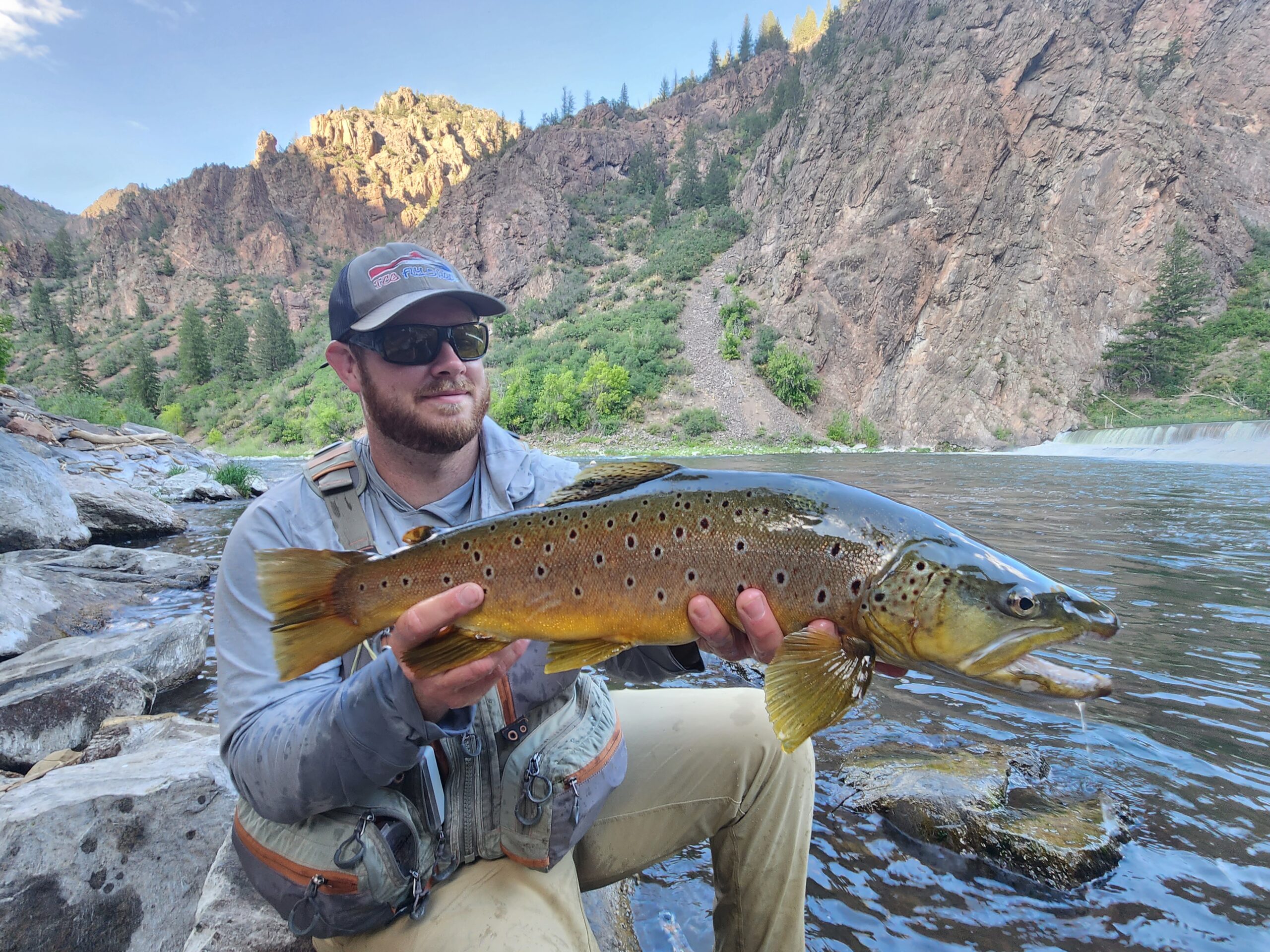
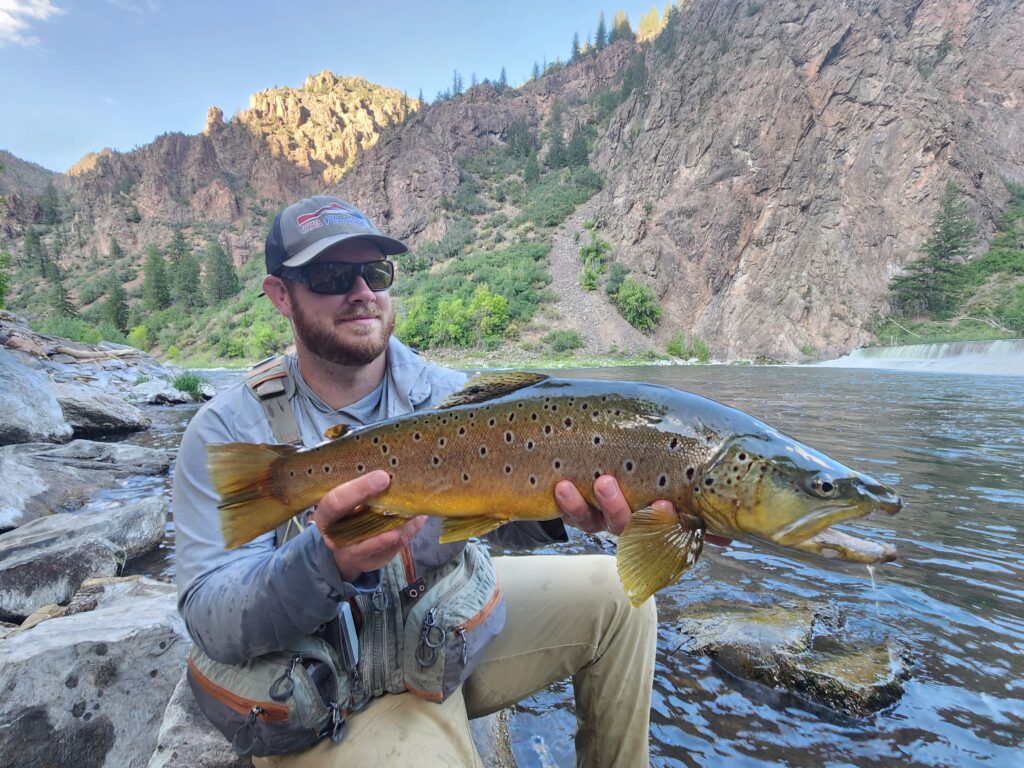
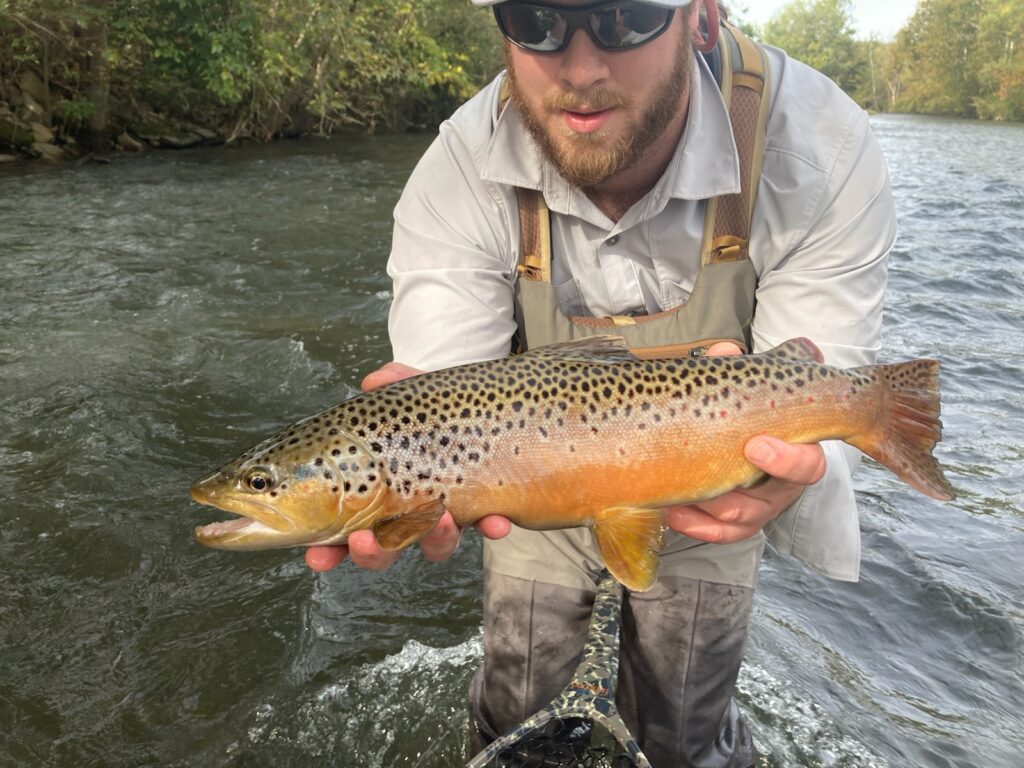
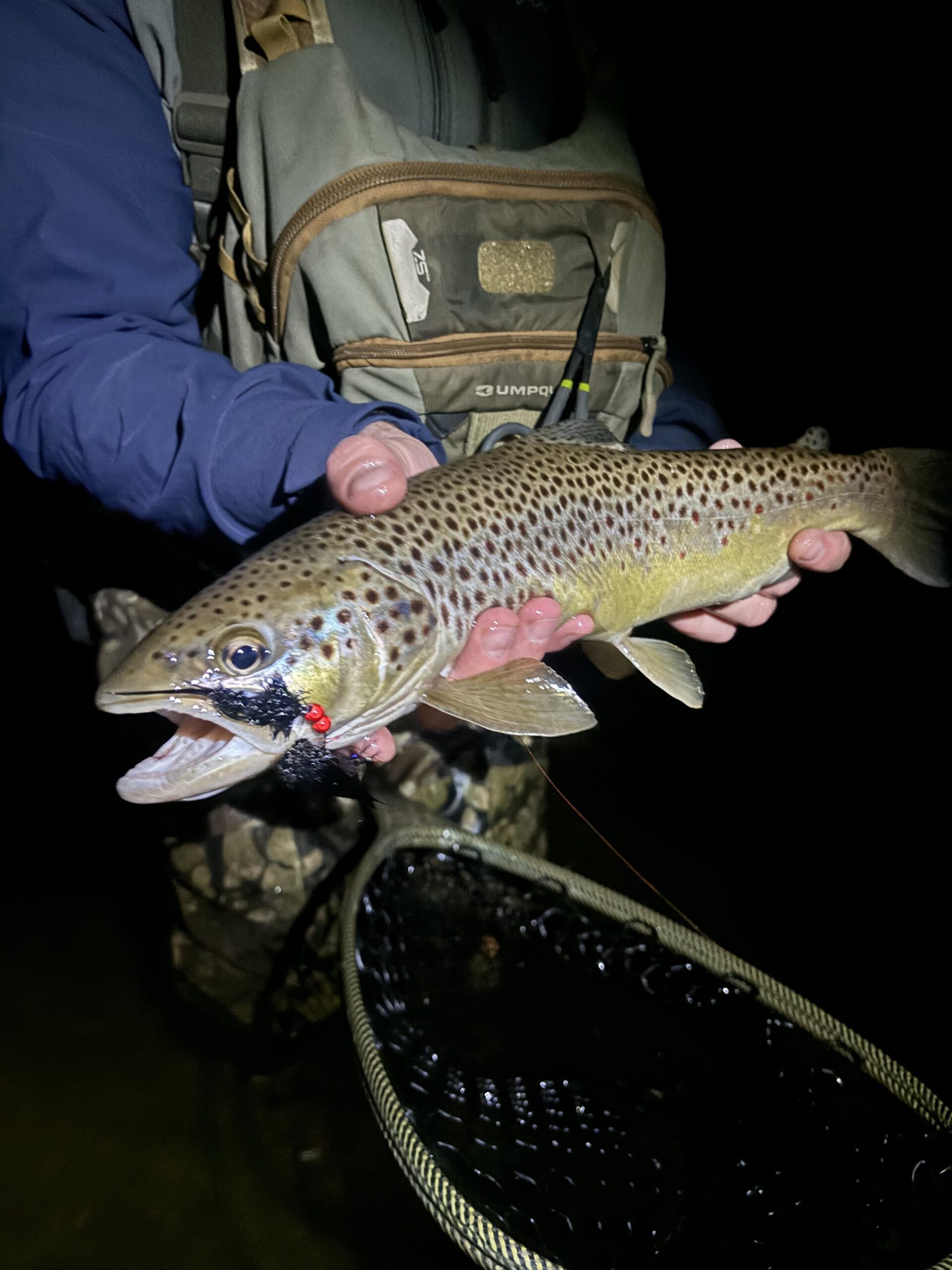
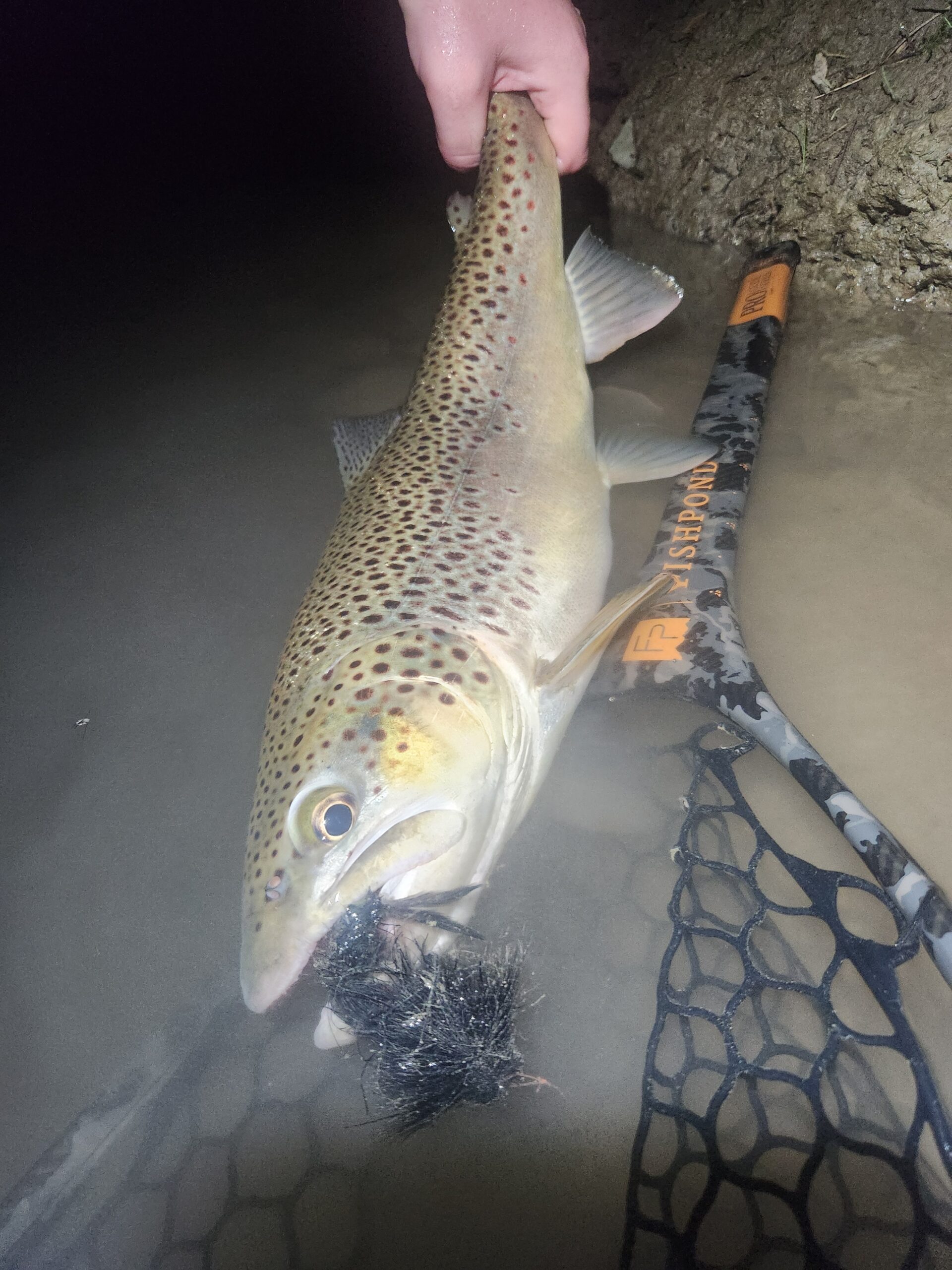
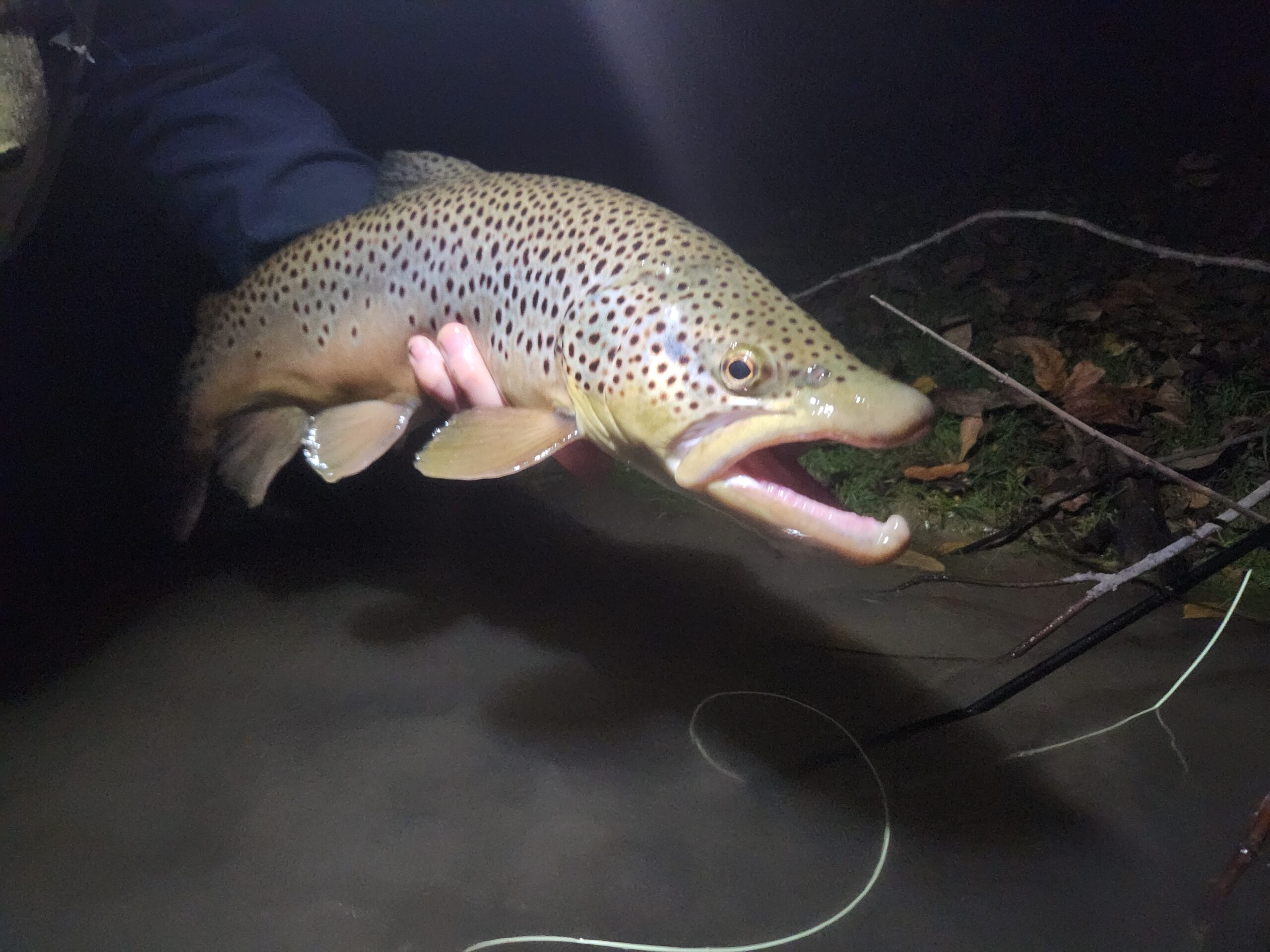
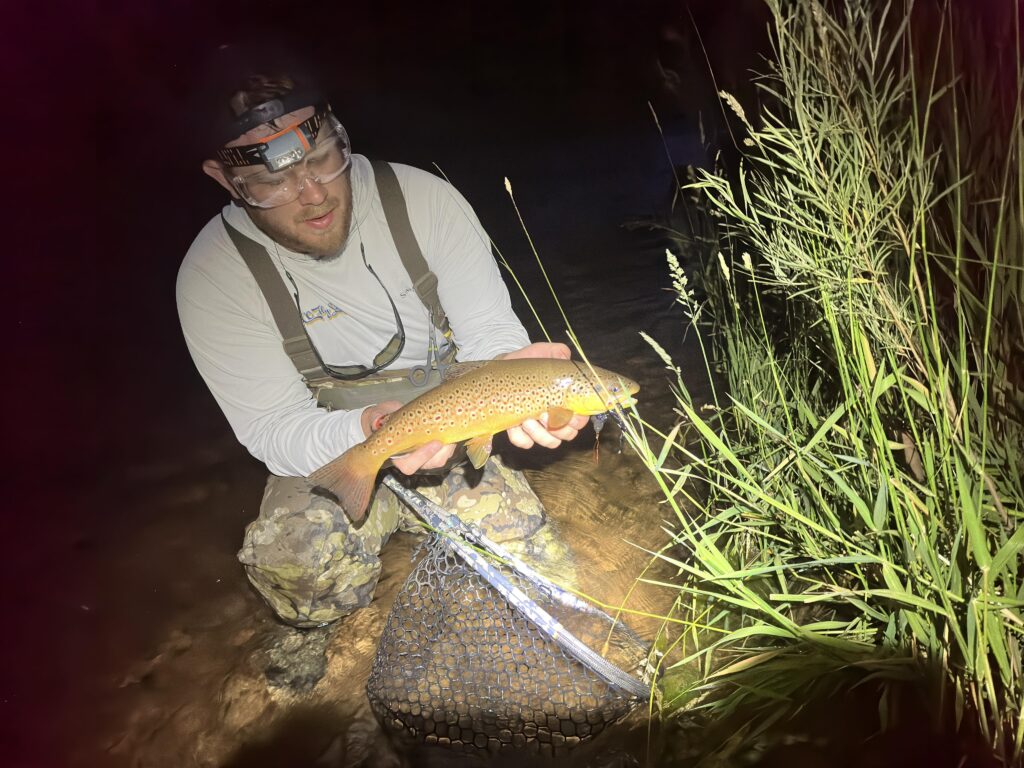
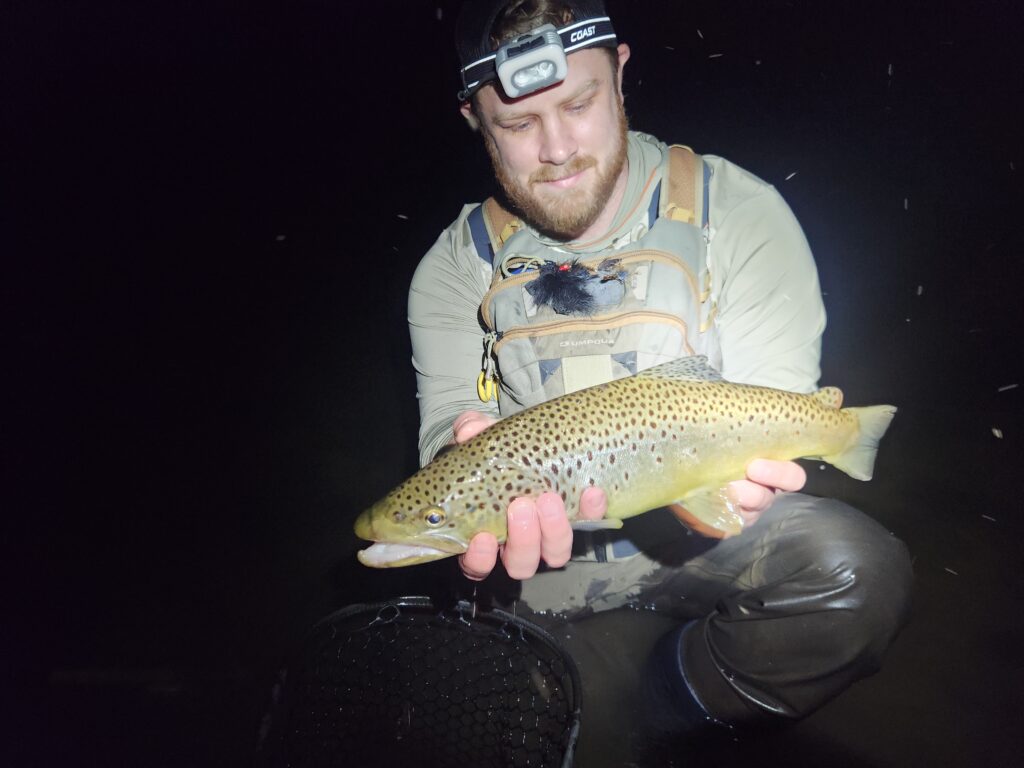
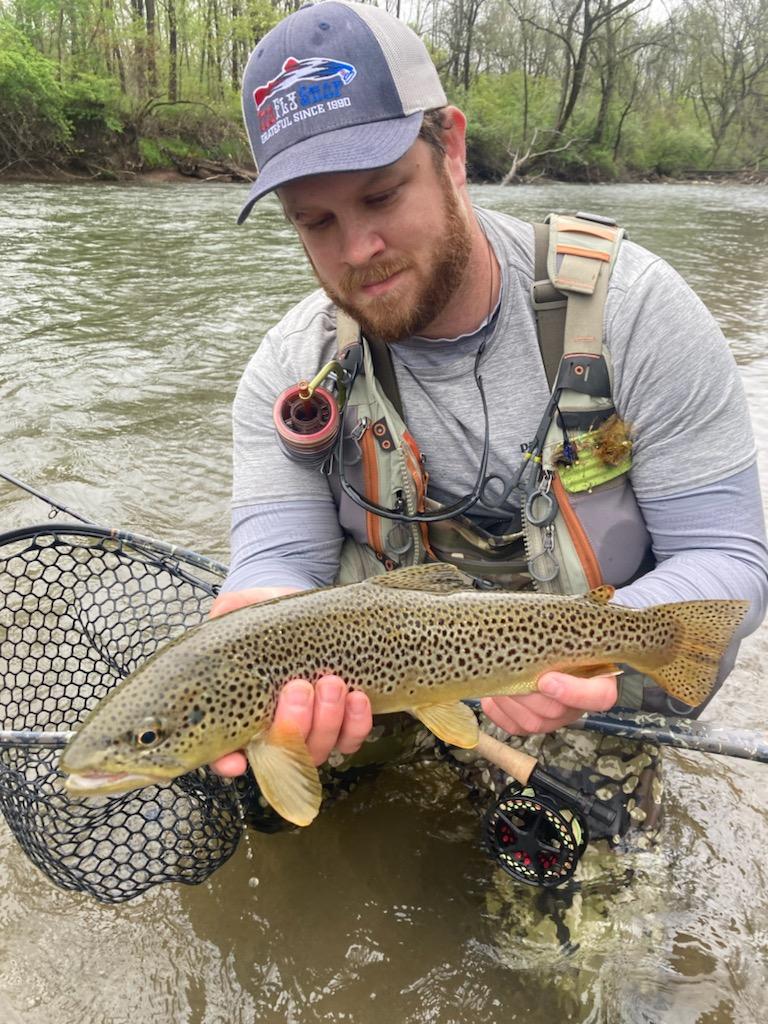
Looking to unlock the secrets of night fishing for brown trout? Imagine swinging mice and streamers under the glow of your headlamp, hooking big browns long after the sun goes down.
In this episode, you’ll discover how glow-in-the-dark flies work, why unweighted streamers can turn the bite on, and how to read water by feel, not sight.
Frank Landis, a Pennsylvania fly fishing guide, shares his expert insights on stream temperatures, seasonal triggers, the truth behind mouse patterns, and why slowing down is the key to success after dark.
Summer trout fishing is slowing down across most of Pennsylvania, and many anglers are now focusing on smallmouth bass. But for Frank, it’s a different story… he’s out night fishing for big browns when everyone else is done for the day.
One of the coolest highlights for Frank was the 17-year periodical cicada hatch in central Pennsylvania. This rare event sparked an epic feeding frenzy, mostly for wild brown trout but also for stocked rainbows. He says it was like bringing western-style salmon fly fishing right to Pennsylvania’s backyard.
Frank says night fishing flips all the rules around. You lose most of your senses, so everything feels new and different. It’s not always about catching more fish than you would during the day, but about the fresh perspective it gives.
Plus, nighttime opens the door to chase big trout! Frank also loves that fewer people fish at night, so there’s less known about it. He night fishes mostly in Pennsylvania and Colorado using heavier gear than during the day, like a 6-weight rod with 12 to 16-pound tippet.
He targets big fish using mouse or frog patterns on the surface or big streamers and wet flies underwater. These could also work during the day, but Frank says his local fish rarely react well to mice in daylight. He says darkness loosens their inhibition, so big trout take more risks chasing bigger meals.
Frank says the biggest thing to avoid when night fishing is bright light, like a full moon or streetlights from nearby towns. He doesn’t stick to a set time to fish; he’s had success right at sunset, midnight, or early morning. Sometimes fish will hit dry flies at dusk, but the big predators might only show up later at night.
One thing he does avoid is high water. He prefers lower, clear flows in summer and early fall for the best night fishing conditions.
Frank says you really need to know the river well before fishing it at night. That means scouting during the day to learn where fish hold and to avoid surprises like branches or rocks you can’t see in the dark.
Fish move around at night, so the spots that worked for daytime nymphing might not be best at night. Usually, you’ll want to look for shallow, skinny water instead of deep, fast runs. Once you get a feel for it, you start picking out good night spots based on what you saw during the day.
Seeing your fly is super important too. Even though brown trout use their lateral line to sense vibrations, Frank believes they still rely a lot on their eyesight to decide when to strike.
Fishing big streamers at night means focusing on slow but moving water, but not the super still “frog water.” Frank likes to cast perpendicular to the bank and let the fly swing naturally across the current, similar to swinging for salmon or steelhead.
He says the key is getting a good dead drift at first, with just enough movement to make the fly look alive but not rushed. And the best chances for strikes come right when the fly starts its swing and when it stops at the end.
Frank usually fishes with big, dark streamers around 4 to 5 inches long—something with a good silhouette that moves well in the water. He says any large woolly bugger, especially unweighted or lightly weighted, is a great place to start for night fishing for brown trout.
Most of his flies are unweighted or neutrally buoyant, so they sink slowly as they get waterlogged, usually staying within about six inches to a foot below the surface. You don’t need to fish too deep; a slower retrieval or adjusting your mends can help control depth. Dumbbell eyes or some lead wraps can be added for when you really want to get down, but 95% of Frank’s streamer fishing is with articulated, unweighted flies that push water and give a strong silhouette.
Frank sticks to all floating lines when night fishing because it’s easier to mend and control the fly near the surface. Floating lines also let him switch quickly between streamers and surface patterns like mice.
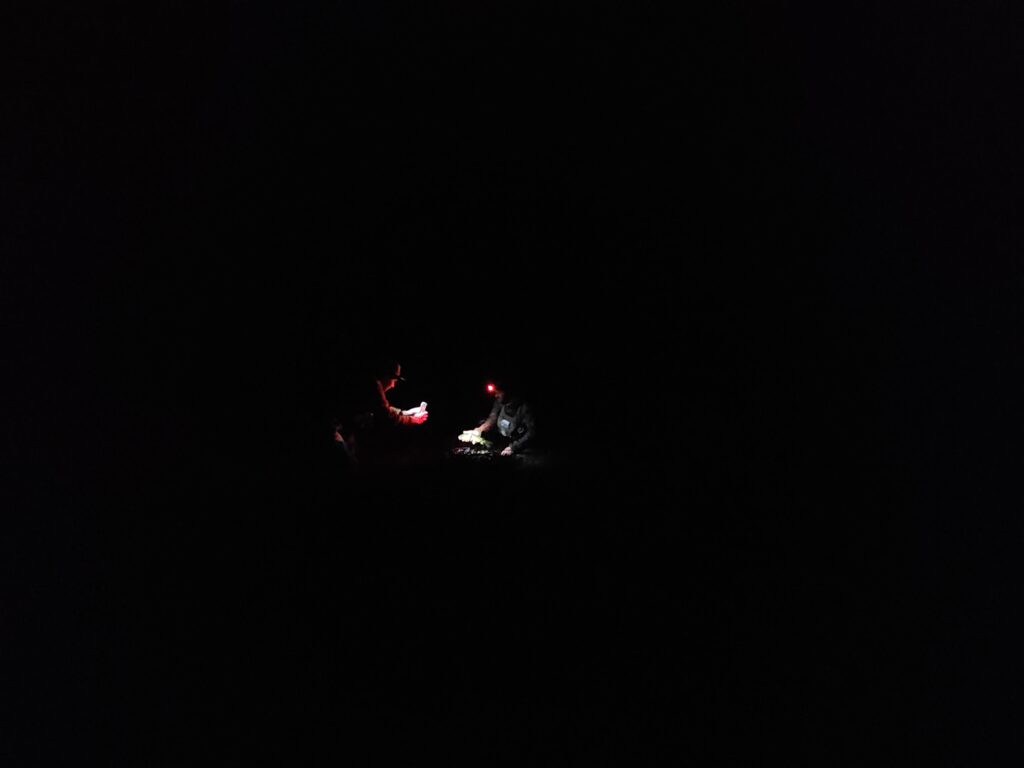
Frank always carries two lights when night fishing: a headlamp and a powerful handheld light. The headlamp has both white and red light settings. The white light is for normal tasks like taking pictures, but the red light is key for preserving night vision and not spooking fish. He avoids shining white light on the water while fishing because it often scares the fish.
The handheld light is for after fishing. It helps Frank scan the water to see where fish are holding or if they’ve moved to different spots. He doesn’t use this light while actively fishing because it can spook the fish.
Episode Transcript
Dave (2s):
Today’s guest is known for mastering both summer hatches and after dark hunts, he leans into the thrill of chasing brown trout by headlamp swinging mice and streamers long after most anglers have packed it in. By the end of this episode, you’ll learn how glow in the dark flies work. Why you’ll want to fish an unweighted streamer and how to read water by feel, not by sight. This is the Wet Fly Swing podcast where I show you the best places to travel to for fly fishing, how to find the best resources and tools to prepare for that big trip, And what you can do to give back to fish species we all love. Frank Lantis is a Pennsylvania fly fishing guide and one of the most thoughtful voices on how and why night fishing works. We’re gonna dig into stream temperatures, seasonal triggers, the myths around fishing, mouse patterns, and the power of slowing everything down.
Dave (50s):
Here he is, Frank Lanis. You can find him at Frank Fly Fishes on Instagram. How are you doing, Frank?
Frank (58s):
Good. How we doing today?
Dave (59s):
Not too bad, not too bad. Really excited to jump into this with you today and talk. We’re gonna dig into some on Brown Trout. I know, You know, that’s a big focus. We’re probably gonna touch on some nighttime fishing, maybe mixed up with a little daytime and just kind of give people some, You know, background on, You know, improving their brown trout game. I think that obviously that’s a species a lot of people are interested in. So first off, maybe just gimme a heads up, what’s going on this time of year as this goes live? It’s probably gonna be live in, You know, August, but right now it’s kind of July. Are you out there busy fishing right now?
Frank (1m 30s):
Yeah, we’re in the doll days. The, the long summer days. Right now the trout fishing is kind of slowing down through most of the state. You do have a few places where you can, You know, kind of pick and choose your spots wisely. But really a lot of it’s shifted over to small mouth for a lot of people. We just had a local pretty cool smallmouth bass tournament called the Bass Thumb Tournament, the TCO sponsored, so that was just this weekend, so we’re mid-July, it’s summer. People are thinking bass more than trout. But on that note, I kind of switch over to Target and Trout at nighttime this time of year. So that’s kind of a cool thing that I do. And then the real cool thing that we just wrapped up was the 17 year periodical cicada. Oh yeah. That kind of wrapped up at the end of June. That was a really, really awesome time in the middle part of the state.
Frank (2m 13s):
That was a, a good month of, of, of amazing fishing really. So that was, that’s all wrapped up. That’s all over, but that was the highlight of the last season, so,
Dave (2m 23s):
Hmm. Nice. So the cicadas, that was, I mean, I guess, yeah, we’ve talked a little bit about that, but describe that again, was this is something that’s gonna come again next year or not quite at the same level?
Frank (2m 33s):
No, it’s a 17 year cycle. So these, there are annual cicadas that come every year, but not in the numbers. These periodical cicadas, they come once every 17 years and, and what’s called broods and they come in certain parts of the state or parts of the east coast really. And the, the one that was in and around like the central part of the state, like center county was this year that was brewed 14 and that was just awesome fishing for about a month and really, really, really amazing. I can’t, I can’t put in the words how cool it was, it was like kind of giving you western fishing right here in Pennsylvania that we don’t normally get to do. Kind of reminiscent of salmon flies, but Oh yeah, your, your MPA, so, yeah, pretty cool.
Frank (3m 14s):
And
Dave (3m 14s):
Were you targeting brown trout, or which species were you focusing on?
Frank (3m 18s):
Yeah, just mostly focusing on brown trout, wild brown trout. The, the stocked rainbows that you encountered along the way. Didn’t, didn’t mind the cicada either. They were happy to cooperate. But yeah, mostly our wild, our best wild brown trout rivers in the state, probably our most famous ones. Those were the ones that got the best cicada activity, which ended up being just an amazing kind of lineup, stars kind of aligning for us. So,
Dave (3m 41s):
Yeah. Nice. Are most of the people, when they come to you for a guide trip, are they thinking brown trout? Is that the species you’re usually guiding?
Frank (3m 48s):
Yep. Some people are, are thinking along those lines if they’re thinking about that at all. We do get a lot of beginners who are just, You know, they just wanna catch a fish. They don’t care if it’s a brown trout or a stocked rainbow trout or, or a, a fall fish or, or whatever. They just kind of wanna learn the, the ropes of fly fishing. There’s that population. But the, the ones that are a little bit more, You know, pointed to what they’re trying to do, they’re definitely looking for brown trout.
Dave (4m 9s):
And if we’re coming there and maybe hooking up with you, let’s just say it’s mid-August or even getting towards September, what does that look like as far as, do things start to cool off a little bit or when does the brown trout daytime stuff come back in?
Frank (4m 23s):
Yeah, right now if you wanna fish for, You know, a wild shot in the daytime, it’s, it’s typically a morning game. So you can still do it throughout the summer, but you might be relegated to a shorter window of time. Like for instance, my local creek that’s kind of right, right across the road from me, there is some awesome like, You know, dry flight terrestrial fishing, but it’s, it’s like a two hour window. You fish at dawn, the water might be, You know, 62 degrees or something like that and you have a, a short window. And even though the fishing is, is safe to do at about 65 degrees, our trout in this local creek, they just shut off at the 65 and you might as well just go home. So you got about two hours until, until that happens. And that kind of is now until August. And then obviously once the nights get a little longer and the night and the nights get a little cooler, then that really changes things.
Frank (5m 7s):
’cause right now, June and July, the nights are short and warm sometimes, even though August days might be warmer, if the nights are kind of longer and the nights are a little cooler, that can open up a longer window, You know, obviously the following day. So.
Dave (5m 20s):
Okay. And what are those temperatures again, you, you, that you feel like we should be thinking about if you’re fishing out there where you, where things shut off? Is it pretty, is it like day and night like that when you get that certain temperature It just clicks?
Frank (5m 31s):
Yeah, I’ve seen like on like the, the yellow breaches, which is my like local trout stream, which has good populations of wild brown trout in certain sections. They’re not big, but there’s, there’s a good number of them. I’ve seen it like time and time again the fishing is really good and then all of a sudden, You know, that water hits 65 and it’s not as if like you catch a fish, you’re gonna kill ’em. But the fish just don’t, they just stop cooperating. They kind of, they kind of shut off and kind of hang low. So under 65 degrees in terms of the quality of the fishing in terms of keeping things safe for the trap, we’re looking more like 68 degrees in the water out of the, You know, the typical rule of thumb. So
Dave (6m 4s):
Yep, 68. That’s right. Okay. And are these, and we’re talking today we’re gonna talk mostly about Pennsylvania fishing, but I know you’ve traveled out west are some of the things, techniques and stuff that you’re doing in Pennsylvania, are they applying for browns out west as well?
Frank (6m 19s):
Absolutely, definitely. In fact, I think, You know, having techniques that work for wherever you’re at at home when you go to a new place, don’t be afraid to try ’em because I found myself in some pretty, some pretty fun situations in, in places because I’m doing things that maybe the local scene in that neck of the woods doesn’t do, but there’s still fish. That doesn’t mean it doesn’t work. And You know, those same people could maybe come to my backyard and try something And I might be surprised at what works here too. So there’s still fish and you can definitely apply whatever you do at home. Yeah, don’t be afraid to mix it up. There might be a program and that might be worth listening to as well, like wherever you’re going. I can think of some places in Colorado where they’re like preaching like the, the tail waters where they’re preaching, You know, small bugs. Small bugs.
Frank (6m 59s):
And I found that, You know, there are definitely times in situations where that’s, that’s certainly true. But there were also a lot of situations where that wasn’t true and you can get away with doing some, some quite different things that just to probably just because the fish aren’t used to seeing it, it it works really well. So.
Dave (7m 13s):
Right. That’s a great point. Nice. And then on the night fishing, is that strictly, yeah. Why is the night fishing so good? I mean, could you go out in the day, like the morning or maybe in the fall and catch as many fish during the daylight or is the, talk about that a little bit. What does the night provide?
Frank (7m 29s):
Yeah, so part of the, the fun of the night fishing is just how different it is. So sometimes it’s not necessarily that it’s good, it’s compared to the daytime fishing for instance, like you might catch more fish during the day, but at night You know, you’re, you’re stripped of most of your senses and It just completely flips the rules around. And so you’re just kind of, kind of approaching everything from a completely new perspective. And that’s mostly the fun of it for me is just like how different it is. Obviously. Then alongside of that there’s the big fish, You know, side of the coin there, right? So a big part of night fishing is chasing the large trout, like chasing the big one and that definitely the night gives you that opportunity. So that’s, that’s definitely part of it.
Frank (8m 10s):
But honestly I just kind of like that less people are doing it, there’s less known about it. It’s kind of the final frontier of like what we, what’s out there to learn. Not that there’s not plenty to learn during the day too, but so much is written about during the day at nighttime, You know, you’re hard pressed to find information and honestly whatever information you do find, it’s probably pretty localized and pretty how to put this, it’s boxed into an area, You know, one guy might have an idea and it might work for him, but there’s probably a lot more out there that there, there is to learn that just hasn’t been tapped into yet. So the kind of, the excitement of kind of treading in new waters is, is pretty cool so. Right,
Dave (8m 43s):
Right, right. And have you fished nights in other states? Because I know some states don’t allow it, right?
Frank (8m 48s):
Yeah, I’ve spent most of my night fishing out of Pennsylvania and Colorado. That’s definitely where I Okay. The most days in at night somewhere else. Obviously some of our surrounding states too, like, You know, east coast I’ve spent some, a little bit of time, but like in my travels I spend the most time in Colorado, You know, after dark, so.
Dave (9m 6s):
Gotcha. Okay. And, and that after dark. So maybe describe that a little bit. What does that look like? You know, it sounds like there is a good chance to get some bigger fish. Describe what people would be thinking about if they haven’t done it yet and what You know they should be prepared for.
Frank (9m 19s):
Yeah, so you’re typically using a much heavier setup in terms of rod and leader and tip it and everything that you would during the day just because you can get away with it. So I’m fishing a six weight rod with down the maybe 12 or 16 pound on the, on the, You know, tippet side of things. So it’s a pretty, pretty heavy stuff compared to the typical shot rig. And then I’m fishing bigger flies, I’m, you can definitely mph and dry fly fish at night. There are situations where that works. That’s not really what I set out to do. I’m looking for the predatory fish, so whether that be like top water stuff like a, like a mouse or a frog style pattern or like a subsurface pattern like, like a big streamer or a big wet fly or something like that. I’m looking for the, it’s fun for me to, to chase them with the, with the big fly and get that predatory response and you’d be surprised.
Frank (10m 5s):
I mean plenty of 10 inch fish will eat a fly half their size. It’s pretty cool so.
Dave (10m 9s):
Right, that is cool. So it opens up more opportunity. I mean, can you fish like, You know, going back to the daytime, is it harder to fish mouse and the big streamers in the daytime to find bigger fish?
Frank (10m 21s):
Yeah, we’re, you can definitely fish the big streamers certainly in the daytime And I’m not saying you’d never catch one on a mouse in the daytime either, but I just don’t think that, at least my fish here locally are gonna respond very well to a mouse getting, You know, stripped or, or swung across the surface during the day. They might, you might get a random, You know, fish to slash at it, but it’s something about the cover of darkness that yeah kind of are g loosens there inhibitions a little bit. So like, kind of similar to how you might get a big fish to chase a big streamer in, on a cloudy, rainy day with off colored water with some color in it, maybe some muddy or some really green water that big trout might be willing to chase that really large meal and then take that risk exposing itself to eat it.
Frank (11m 1s):
You have that same effect at night just because the sun’s not out. So you can kind of see that same right correlation there. So I, I liken like if you spend a lot of time fishing for brown track, You know that the, they don’t love bright sunny days, at least as a rule of thumb that rule can be broken. But they definitely seem to consistently like cloudier drizzly days and at night it’s kind of the same thing. A dark night is, gives you the same advantages as those cloudy dary days. And on the other hand a full moon might actually kind of be counterproductive at night, so.
Dave (11m 32s):
Oh right, okay. And if we were, You know, let’s just take it to September. Let’s just say we were looking, we were gonna be there in September, haven’t really fished much of the Pennsylvania streams, focusing on brown trout would be the key, You know, what would you be telling us? Would, would night still be best or do you think day or what would be the questions we’d want to ask?
Frank (11m 51s):
I love night fishing in September. It’s probably like the, my favorite time ’cause it’s just getting a little bit cooler, but the fish are still kind of on that nocturnal schedule because at some point when it was warm they shift a lot of fish shift to night feeding because of thermal reasons, right. The day is just a little too warm, they’re not gonna die, but like, they’d rather just expend their energy at night when temperatures are, are kind of more conducive. So they kind of get used to that and they kind of get in that pattern. What’s nice about September is things are cooling down. Some of the earlier pres spawn behaviors are starting to show themselves towards the end of the month. Maybe Fisher are getting, they’re not really spawning, but they’re getting started moving around so you can kind of cross paths with some, some fish that might surprise you at that time of year. But I love night fishing in September, however, during the day the terrestrial fishing is still pretty good.
Frank (12m 34s):
You can kind of continue on the summer program through September fishing like, You know, beetles, ants, those types of bugs. Not so much the aquatic insects to as much of a degree, but you just kind of some more flexibility with temps. You know, you might be able to fish a few more hours and not have to worry about, You know, having to bag it because of warm water temperatures or fishing kind of come into a halt for some reason. So September is still totally fine to fish in the day, but that is like one of my like favorite times to, to night fish, so.
Dave (13m 4s):
Okay, perfect. Well let’s stick on that a little bit. So if we were getting ready to come in there for the night, what, what you talked about the gear, so the heavier gear that makes it better, right? Easier to land some of these bigger fish. Yeah. What else should we be thinking about? Is this you kind of, you’re wait until a certain time of the night, You know, are you fishing throughout? Talk about that a little bit. Like what flies? Yeah, sure.
Frank (13m 24s):
Yeah. The only thing that I really avoid at night fishing is really bright moon or like a lot of like ambient light from towns and street lights and, and houses and whatever. Sometimes like clouds can help you or hurt you in that sense. So maybe in a remote area, if clouds roll in that could block out a pretty bright moon and make it darker, which could be good. However, in an urban area if clouds roll in, they’re just gonna bounce and reflect a lot of light from the town down onto you and make things actually extremely bright. You could almost tie a knot without a flashlight on. So in that sense, I avoid the light. So it’s not necessarily, You know, there can be some different conditions depending on where you are. It’s not a, there’s no blanket rule, but I definitely avoid the bright conditions, otherwise I don’t, I haven’t found a real rhyme or reason to fish, You know, right when the sun goes down versus middle of the night versus early morning.
Frank (14m 14s):
I’ve done them all And I’ve had success and failures in, in all of those situations. And it’s just situational. There might be fish that were, You know, out eating dry flies are at a dusk, You know, kind of sipping spinners or something on the surface, whatever was, You know, hanging around. And they might hold in that same water and if you, you strip a mouse over their head, they might come and eat it, You know, on the other hand it might take a few hours for the fish that really has like, wants to eat a big meal at night to come out and you might not be able to catch him at 10:00 PM but maybe he’s out and really feeding at 2:00 AM But those are just, I, You know, those are not rules, those are just kind of right observations. I, I’ve seen it all kind of work and fail. But the one, the one thing that I really do avoid is, is bright moonlight or, or bright streetlight or something like that.
Frank (14m 54s):
Okay. And then obviously I try and avoid high water is something else I avoid. So lower clear water, the summertime, early fall flows kind of go hand in hand with the night fishing. So
Dave (15m 2s):
Yeah. So clear water too. Okay. And How are you go about, is it typically where you really wanna get to know the stream and the daytime beforehand where fish hold or How are you kind of finding fish? Are they hiding or holding in different areas during the night?
Frank (15m 16s):
Yeah, you, you should probably know the river you’re gonna fish at night really well during the day first. I think that’s, that’s key for success. If you don’t know where to wait or you don’t know where a fish might be, that’s the starting point. And it’s also kind of from a safety perspective and, and yep or a minimum not having headaches while you’re out there and You know, knowing what you’re casting into and knowing where the, the, You know, the, the wall with a bunch of branches that sticking out, you can’t see it at night so you better know it’s there so you don’t cast right into that, right. I mean you could see a little bit, but there’s gonna be a lot of stuff surprises you. So knowing the river, just from the, You know, understanding the layout of where you’re going is really important. And then having some ideas on where fish could be is super important too. But they do move at night.
Frank (15m 57s):
So the place that you might, You know, go fishing NIMS or something, it might be like your prime nimron, you always go there and catch fish that might be not productive at night for different reasons. Maybe it’s really deep and the water’s a little faster that’s not as conducive to night fishing. Maybe you wanna find the more skinny shallow water near that, that’s not necessarily right where you were having success during the day, but you don’t have to stray far either, right? So one you kind of get used to where you have success at night and you’ve night fished a little bit and you kind of get a, You know, an index of what works and what doesn’t. And then when you’re fishing a a stretch of river in the daytime you might say, ah, that’s a place I wanna try next time I come back at night.
Frank (16m 36s):
Just because you have the reference.
Dave (16m 38s):
Okay, yeah, that makes sense. So it sounds like yeah, you, you’re getting, since conditions are darker, it’s harder to see the fish can’t see as well either. So you want the low, You know, lower clear water, You know, so they can just see better. And that sounds like that’s a big key.
Frank (16m 51s):
Yeah, I think them seeing your fly is pretty important. A lot of people know that brownout feed on their lateral line, which is basically that, that simply means they sense vibration. But I don’t think that’s the only, they, they definitely use their eyesight quite a bit. Kind of my theory on how they feed at night is I think they, they use their lateral line to sense the vibration, like to kind of alert them so that the prey is near. But then I think they do use their eyes to kind of seal the deal, like their eyes kind of pick it up and that’s the last thing that they see and then they choose to strike or not. But if it was all lateral line, it was all vibration. We’d have a lot more successful when the water was muddy and and stuff like that. And we just don’t. So I definitely think the eye, the, the visual component of the fish feeding I think is pretty important too.
Frank (17m 32s):
So
Dave (17m 34s):
San Juan Rod works started with a simple belief, great fly rods and gear shouldn’t cost a fortune as a family run company. They focus on building high quality fly fishing products that perform on the water without the premium price tag. You can try San Juan Rod works for 30 days risk free right now, and if you’re not satisfied send it back for a full refund. You can go to San juan rod works.com. That’s S-A-N-J-U-A-N rod works.com. This year I ventured into the heart of Eastern Idaho’s Yellowstone Teton territory where the fish were larger than life and the waters held the secrets of the best fly fishing out west with crystal clear rivers like the Henry’s fork and the South Fork of the Snake and enough lakes to keep you going all year long, make your way to Yellowstone Teton territory and embark on a journey to one of North America’s finest fly fishing destinations.
Dave (18m 27s):
It’s time to experience eastern Idaho for yourself and support this podcast at the same time. How are you presenting? Let’s just take it to, let’s start with maybe a streamer, big streamer. What’s that look like? Does this depend on the water type or How are you, You know, How are you fishing that fly?
Frank (18m 43s):
So I’ll just go through some generic water that would be good at night. So I kind of like the slower water, but not the slowest water. So I don’t love like the frog water that’s barely moving. I like water that’s moving along, but moving along slow. Kind of like a really slow walk versus like a, You know, the water that’s just creeping along that’s hard to fish because it’s, you need that current to help move your fly. So most of our presentations are using some type of swing, right? So I’m gonna cast not, not too, not dissimilar to like salmon and a steelhead swinging, right? You’re where, You know, you’re starting that fly across. That’s kind of the starting point of my presentation is you’re just getting a good dead swing where we don’t give it too much animation or don’t move the fly too much.
Frank (19m 24s):
From there, once you kind of get a good swing dialed in, you can mess with, You know, men’s and strips and, and ways to animate the fly a little bit. But You know, a typical presentation would be stand, You know, casting perpendicular to the bank and maybe you think there’s fish holding on side structure land that fly as close to the bank as you can if you’re fishing a streamer, maybe a few upstream thens to get to allow it to sink a little bit and then kind of just pick a point where you want that swing to begin and hold the rod still. And then that, You know, as soon as the tension reaches your fly, it’ll start kind of kicking across the surface and then eventually it’ll stop at the end of your swing. And both that start and that stop are likely times of fish would strike.
Dave (20m 4s):
So right when you make that first cast and right at the very end the hang down is our two good places.
Frank (20m 9s):
Yep, definitely.
Dave (20m 10s):
Okay. So yeah, we’re on the water. We’re doing a kind of a, a nice slow swing, like slow walk speed and it’s kinda interesting ’cause we just got back from Alaska, we were up with Togiak River Lodge fishing for king, You know, Chinook salmon and we were fishing some water that was like you’re describing pretty like slow walk stuff and You know, we had some sinking lines out and we were doing some work and mending was a big part of it. Right. Depending on whether you’re mending downstream or upstream. Talk about that a little bit. What types of mends are these? Does it depend on the water? Are you doing big mends, little mends? How would somebody understand that?
Frank (20m 45s):
Yeah, so at the beginning of the drift, if you, you want your fly to sink more, you do as big of a mend as you can without pulling it off the bank. We don’t wanna move the fly closer to us. Oh, okay. Because you want it to stay where you put it, obviously, or in that lane, or if you do move it, you just need to compensate or understand that. But the mends, just similar to nim fing, right? If you stack mend above your indicator or your, You know, or your dryly or whatever, it’s gonna kind of drift more freely that’s allowing it to sink. And then eventually, You know, as the belly forms in the line, it’ll kick and start to, You know, swim and kick across the surface. And at any point in there you could add another smaller mend to speed up the swing or to maybe even pause the swing temporarily or, or kind of, I almost like try and explain it to people as like you start a new swing.
Frank (21m 30s):
So like I was sometimes during the middle of a swing as the fly’s getting downstream of me a little bit, I’ll actually throw a downstream man with some slack. So it’s kind of a man, but it’s also, you’re putting a little slack there, which causes it to pause one more time, but then the tension kicks up pretty quickly and so you kind of, it was swinging you, you put that slack in that mend in in the, in the presentation it paused is, and then the tension kicks up again and it kind of gives it some mild, like some, some pretty subtle but pretty good action because I don’t, You know, some people have definitely had success like ripping flies across and just making a lot of commotion. But there’s so many times where a subtle, You know, less is more kind of presentation is good at night where you give the fish a chance to see the fly, you make it look alive, but you don’t pull it out of their zone too quickly.
Frank (22m 15s):
That’s a good recipe for success. Now at the same point, You know, there’s a time and place to strip a little fly, You know, real fast. They, they’ll, they’ll respond to that too. But especially with the big streamers and some of the bigger, some of the bigger flies I’m using, I definitely have success kinda with the slower, more patient presentations with with subtle action and, and using men’s just to kind of speed up and slow down that swing.
Dave (22m 37s):
Right, okay. So yeah, it depends on the situation and and what you want to achieve. Do you, do you find that as far as depth, You know, are you trying to get down towards the bottom? Are you, You know what, describe that a little bit. How do You know when you’re at the right depth?
Frank (22m 51s):
Yeah, you definitely don’t, I don’t even think you want to be down towards the bottom most of the time. I think there’s some extreme situations where that might be a good idea. So like the fish are, the fish are really not active and they’re laying really low. So I’ve had a couple times where getting super deep was kind of the only thing that worked at night. But if they’re, if if, if it’s a good night, if the fish are actually feeding and doing what they’re supposed to do, I think staying within six inches to a foot of the surface is totally adequate. And then probably good. I think they probably see the fly better silhouette against the sky and above them than they do kind of imagine you have a fly, You know, looking at it against the sky, you can kind of pick out that silhouette, but if you sink it too low and maybe the fish is seeing it against the bank, that’s not lit at all.
Frank (23m 32s):
That’s probably a harder food form to see. So I think just keeping it up and the reason We have to mend and stuff to get depth is because I’m not using, I’m often not using any weighted streamers. I’m using streamers that sink pretty slow. So even to get a couple feet just to get it down a little bit, we will take some that if you start swinging right away, it’s gonna be like almost pushing awake right on the surface. Even though the, the fly isn’t, You know, a, a surface pattern. If you, you say have a deer hair head, it’s like a spon deer hair head or, or whatever that’s not weighted, it will still kind of be very close to the surface. So you can kind of mess with fishing anywhere from right on half on the surface, kind of pushing awake, but under the water down to like a couple feet deep. But I wouldn’t go too much or deeper than that unless the going’s getting tough.
Dave (24m 14s):
So yeah. Okay, that makes sense. And, and on the lines, so are you using sinking lines or dry lines? What that, what does that look like?
Frank (24m 20s):
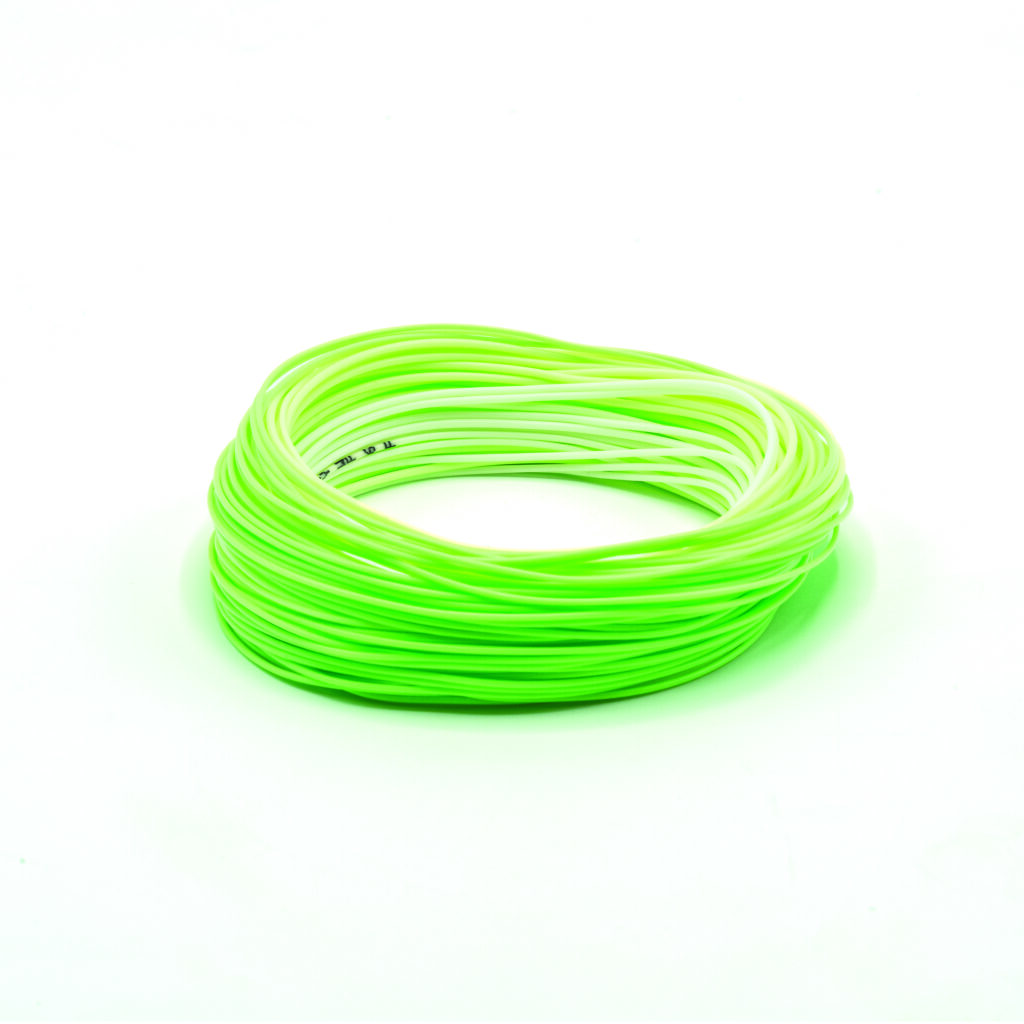
All floating lines, everything is so close to the surface that that’s, that’s kind of easier and also mending, like you have a little bit more control mending a floating line to the leader. Yeah, obviously on a sinking line there’s gonna be a point where you, you can’t really adjust that, You know, the tip of that line at all with the mends so that the floating line gives us a lot more control. Also the versatility, I might go from fishing a mouse or sorry fish fishing a streamer to fishing a mouse. So I want everything to float sometimes. So there’s that. Yep. The one little nuance about, You know, lines at night is they do make glow on the dark lines, which are awesome. You basically charge ’em up with a flashlight. So you just take a really bright light, run it through your, your kind of cup, the light in your hand and run the line through your hand and just kind of slowly pull it through.
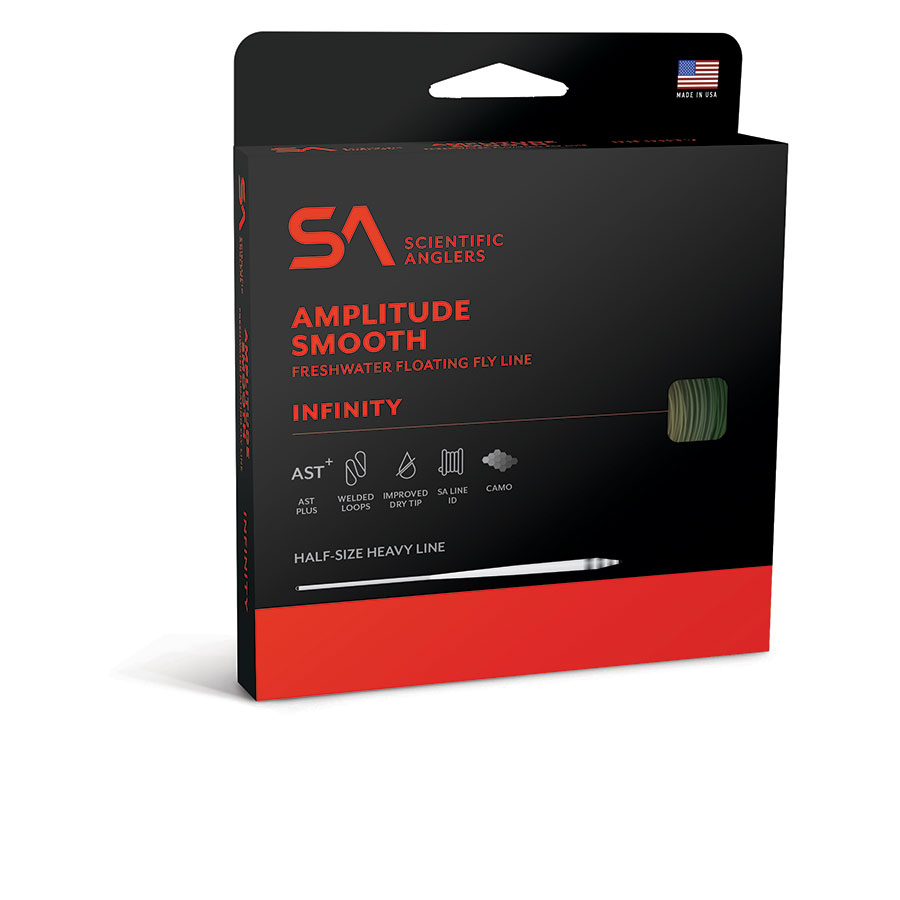
Frank (25m 2s):
And scientific angler infinity glow is my favorite line to use at night just because it’s a, it’s a half size heavy, it turns over the big fly, it mends really well, but it also gives you that glow feature. And the glow line is no different during the day than any other line in terms of its function. So you can still use it for your daytime fishing. It’s not like it’s a dedicated nighttime line. You can just kind of, you have that added ability to see it when you want to. I often don’t use it because I think it’s more fun to not be able to see anything to kinda have the challenge. Right. So like if it was all about effectiveness and just like catching as many fish as possible every single time, maybe I would charge that line up a little more often. But I kind of like the, the feeling of being totally like, You know, just totally dark.
Frank (25m 44s):
Yeah. And just not, not being able to see it. It’s like it’s more of a fun element. It’s just more of a choice I make when I’m guiding at night. I’ll almost always put it on, if I’m fishing new water And I’m not quite sure what my flies are doing in a certain, You know, piece of water, have what the currents are doing, where I’m at, where I’m landing, I might charge it up then. But if it’s the run I’m really comfortable with, I don’t even bother because I think it’s more fun to just kind of be blind out there. It’s kind of the point, right. We’re out there at night, so.
Dave (26m 8s):
Right, right. That’s great. So the glow in the dark line just gives you the ability to see what you’re line’s doing, where it’s at and, and kind of track your fly better essentially.
Frank (26m 17s):
Absolutely. And some guys will even put like little glow tabs on their mouse patterns so that you can actually even see your fly out there. Oh wow. So like a stick on piece of foam. I’ve tied some mice with like glow in the dark yarn as like a little post on ’em. So there’s some things you can do to even see your fly if it’s a surface fly. I don’t ever really do that at all. I think that’s, You know, You know, to the point that I mentioned earlier, it’s even more down the, the road of making it easier, which is totally fine. I mean it’s so effective. I’m, I, I actually talked to a guy I got message him back and forth on Instagram. He’s just another, You know, night fishing maniac like myself. He thinks it’s funny because the way he fishes, he, he almost couldn’t detect a strike without the clothes tab because he’s giving the flies so much action.
Frank (26m 58s):
So much action. There’s so much slack in his presentation, he would never feel the strike. Right? Oh yeah. He would even maybe not even hear it if they sip it in. So like him seeing that glow tab disappear, that’s his indication on a strike, which I found interesting ’cause I don’t fish like that at all. Kind of getting back to the point of like, there’s a lot of ways to do this and, and depending on what it is you’re doing, maybe that glow liner that, You know, that glow tab that you put on your fly that might be like critical to what you’re doing depending on how you wanna fish and where you’re fishing and what type of presentation you’re doing. I’ve just kind of gravitated towards the, the techniques that don’t really need it. But You know, it would always help.
Dave (27m 32s):
Yeah, it would always help. Okay. And on, on the fly, describe that a little bit. What it sounds like you’re using streamers and mouse for streamers. Describe the, you talked about the size, but maybe some fly patterns that you like using out there.
Frank (27m 45s):
Yeah, basically if you take any of your daytime trout streamers that you like, that are, let’s say the size of your, anywhere from, like, if you look at your hand on the big side, the length of your hand, maybe half of that size often pretty too. I mean I, I like a fly that’s like, You know, maybe four or five inches tops, You know, so that’s kind of what I’m looking at. And just something that has a little bit of movement, has a big silhouette and pushes a little bit of water. So like, You know, a lot of the flies I use are kind of just my patterns that I tie myself. But I mean, if you just go to the fly shop and just take a big dark streamer that’s lightly weighted, that will work at night. In fact I give a a good a good place to start that I tell people like, if you just wanna fly that’s gonna work at night, just tie or b or purchase the biggest wooly bugger you could do.
Frank (28m 27s):
Like that would be totally fine. That would work at night. So.
Dave (28m 30s):
Okay, so the biggest wooly bugger you can get, make it easy. So biggest wooly bugger black, no weight and throw it on there with with. And then how do you, well you’d probably want to have some weight or describe that in the fly to get it down. It’s gonna sink just ’cause the hooks got some weight or How are you getting it below?
Frank (28m 45s):
Yeah, I mean if you just like a, an unweighted mph will kind of sink slowly or You know, a drive by the sinking is not gonna necessarily hold on the surface, You know, after maybe some patterns at first will float, but after they get waterlogged they’ll sink, You know? Yeah. So honestly, like you don’t need, you could have a little bit of weight and it wouldn’t hurt. And I have a few patterns that I’ll tie with some weight for those extreme situations. Like, okay, I really wanna get down, but mostly I’m tying ’em unweighted and like the six inches below the surface, which is, is pretty easy to achieve with an unweighted. But I just, just on the way to the, the hooks and the materials getting water logged and everything, they kind of become n even if they’re just neutrally buoyant and they just aren’t buoyant and they just kind of go with the flow, just the slow pool of gravity down is gonna pull ’em down by the hooks. And that’s good enough often.
Frank (29m 25s):
So you don’t need to get super, super deep and, but if you do, You know, the more you men and the more you kind of adjust your angles, you can get a little bit deeper as needed. Even with unweighted flies, but yeah, but also, also, yeah, You know, dumbbell eyes on your streamer isn’t gonna like make it unfishable at night either. Either. So if you just wanna go out there and experiment, I mean, I wouldn’t put too much thought into the weight, just don’t, I, I would encourage people to not try and dredge the bottom necessarily. Right. Keep it closer to the surface and you can do that by, You know, retrieving a little faster If you have a weighted fly, pulling it in quicker, we’ll keep it closer to the surface. So that’s a simple thing you can do to kind of work around that. So I don’t think it’s too important, but I, when I’m tying for specifically for night patterns, I’m either doing going completely unweighted or maybe I’m throwing a bunch of lead wraps in there for the or or some dumbbell eyes or something for the few times I really wanna get deep.
Frank (30m 13s):
But You know, 95% of what I’m doing streamer side is articulated and unweighted and You know, gives a good silhouette and moves a little bit.
Dave (30m 22s):
Okay. Is on the fly action, are you getting that mostly through the articulation or are you doing some, You know, stripping things with your fly with the fly line?
Frank (30m 31s):
There’s a time and a place to strip things like strip flies and fast, but I’m kind of relying on the, the movement of the material itself, whether, whether that’s bu or something else or like you said, the articulation oftentimes when you pause a fly or, or it speeds up and like when you incorporate those changes into your presentation, the fly will then kind of show a little bit of movement there. And then obviously like with some material, like with bu it’s, it’s an awesome material if you just let a, a bu fly dangle in the current, it’s just wiggling just sitting there. Right. Yeah. So there’s gonna be a little bit of action just on the materials that you select, You know, just like any other fly you don’t need, it doesn’t need to be doing anything like acrobatic. I think the fish, yeah, if they see something stop close to the surface that’s like slowly wiggling, there’s not many things in nature that can just come to a dead stop close to the surface.
Frank (31m 17s):
Right. Yeah, I mean think of anything that’s like dead floating down like a stick or a branch or something. Like your fly stopping is kind of a tell to the fish that it might be alive and if they’re in the mood they’ll, they’ll just come and get it. So yeah, you don’t have to do any, You know, crazy, You know, acrobatic action to your fly. You know, you don’t need like a game changer that’s gonna swim really awesome and look really cool swimming though, I think that would work. I don’t think it’s necessary just a little bit of kick a little bit of side to side kick. If you can get that fly to turn a little bit when you pause it, that’s all that you need. So sometimes just having it go from facing one way to kind of face in broadside, that’s just, that’s all the action you need.
Dave (31m 53s):
That’s it. Okay. And if we take it to, You know, somebody’s preparing for this, let’s just say they’re in, You know, their home water, they’re thinking about doing the night, they’re getting prepared. What are the questions, You know, they maybe should be asking themselves to get ready for a nighttime excursion for Browns. Anything else that we haven’t really talked about that might get them prepared?
Frank (32m 11s):
Yeah, a good thing that would help would be what lights you choose to carry. So you have, I carry two lights pretty much anytime I night fish, which would be like a headlamp and a handheld, like a really powerful handheld light And I use them differently. The headlamp will have two things that you’d need, two things you need a white light to get, You know, just to take a picture, You know, just normal flashlight use on the headlamp. But then also a red light is super important. I mean if you’re gonna change your flies or you might be shining towards where you’re fishing and you need to see something, maybe you get your getting your fly out of a tree or something. If you don’t wanna kill your night vision and you don’t wanna spook the fish, I would use the red light from what most of our experience of white light on the water doesn’t always, always spook fish, but it very often does.
Frank (32m 54s):
So we try to avoid putting the white light on the water at all until we’re done fishing. Or maybe you caught a really nice trout and you wanna take a picture of it then yeah, throw the white light on. But for just getting around for tying a nod for switching flies, untangling something, You know, whatever, try and keep that red light on. So you want your headlight, you want your headlamp to be able to go from off to red to off without cycling through any white setting. Mm
Dave (33m 22s):
Yep.
Frank (33m 23s):
So just having that like flexibility there. And then I have a really bright handheld light that’s, I think it’s really important to kind of how I do things because that’s what provides me information once I’m done fishing. So let’s say I fish through a stretch of water and maybe it was slower than it was the night before, I might shine that light in there and that’s gonna cut through the water. I’m gonna be able to see fish, I’m gonna be able to see where they’re holding and say okay, like the fish aren’t actually holding in the places where they would typically hold when the night fishing is good, maybe they’ve dropped, You know, closer to their cover or You know, more into their shelter spots or they’re not really feeding. So that bright light is kind of more to give information and I wouldn’t shine that light until I was done fishing or like ev maybe even when I’m going home, I don’t try and spot a fish and then come back and fish at the same night.
Frank (34m 8s):
Besides the point that that’s like kind of not what I’m really trying to do out there. It’s also likely that the fish will be spooked anyway. So maybe if you gave it a few hours and like circled around it might be uns spooked, but like, You know, I’m not trying to like spot it and come back for, it’s kind of the, the, the fun of the chase, the fair chase of it is to not do that and to kind of be a little more blind, but Right. That’s not to say though you see a nice fish when you’re spotting. Maybe you come back next week and try and get ’em right. I think that’s fair. Good. So
Dave (34m 35s):
Exactly. Do you find these fish, if you did that, you found a, a nice big brown trout in there and they’ll hold in that same pool if nothing changes the next week or longer.
Frank (34m 44s):
Yeah, yeah. I’ve caught ’em actually one of the better fish I’ve caught in the last two years, I caught him about a year apart and within 10 feet of where I caught him the past year. Huh,
Dave (34m 56s):
Amazing.
Frank (34m 57s):
And he would, and he grew quite a bit. He went from, it was, it was a bigger fish. He went from 22 inches even to 23 and a half in one year. Yep. Exact same fish I would say within a 10 foot circle of where I caught him the year before. So that was kind of a cool thing just to kind of see the A the growth of a, the, A big fish growing that much is, that’s pretty cool in and of itself. But then just like the, You know, it was the same time of year I believe it was like, kind of what we were talking about late September. Yeah. Kind of that, that sweet spot time of year and like I said, it was like literally almost the same place, but I’ve gone back to that spot so many times like before and after and shined the light there and he wasn’t there all a lot of other times. So they’re not like always, always there, but they have their spots and they’ll, they’ll go back to him. So
Dave (35m 37s):
Check out Jackson Hole fly company today. Premium fly gear straight to your door without the premium price. Jackson Hole fly company designs and builds their own fly rods, reels, flies and gear delivering quality you can trust at prices that let you fish more and spend less. Whether you’re picking up a fly rod for the first time or guiding every day they’ve got what you need, check ’em out right now. That’s Jackson Hole fly company.com. Jackson Hole fly company.com. Trout Routes by Onyx is built for fly anglers who want better intel without spending hours digging for the information. You’ll get access to public land maps, stream access points, regulations, and even road and trail maps all in one place.
Dave (36m 20s):
It’s become my go-to app for scouting new trips. You can check ’em out right now. Go to wetly swing.com/trout routes and download the app today. Are the streams you’re fishing at night here? Are they like spring creeks versus free stones, other types of water? What are you fishing there?
Frank (36m 38s):
Yeah, so we, in Pennsylvania We have a lot of true spring creeks that are 100% like spring fed. Like I live in the Cumberland Valley, so I’m living, I live in Carlisle right on the Latote and close to Big Spring and close to falling spring and close to some other classic like spring creeks that, that honestly all, they don’t fish as well as they did. If you, if you read about what guys wrote about in the seventies and before our spring creeks aren’t as good as they used to be. At least these, these ones in, in the Cumberland Valley, but they still hold fish and they’re totally different. Those true spring creeks are like a totally different, You know, kind of a schedule or program than like what you’re gonna see on some streams that are limestone influence. I mean there’s some spring influence but there’s also a lot of runoff or certainly from creeks that are like totally runoff.
Frank (37m 23s):
It’s a totally different angle at night because in some of these places, like I mentioned earlier, fish are like kind of thermally cornered into feeding at night. So We have some of our good trout streams in central Pennsylvania, You know, up north of here, center County, Andro State College within an hour they’re gonna get a little too warm during the day, but they might kind of drop to kind of a nice temperature at night when it’s like that the fish are feeding at night like they would feed during the day. It’s kind of kind of crazy. You can catch really good numbers of fish in those situations. However, on a Spring Creek when the water is 52 degrees every single day of the year, day and night, there’s no thermal reason for them to feed at night. So you don’t have like the predictability of these fish on Spring Creeks.
Frank (38m 5s):
It’s kind of takes a little bit more patience. You have to find a fish when he is hungry, You know, brown trout in general, You know, especially the bigger ones they eat when they’re hungry and that’s not all the time. And just because it’s nighttime doesn’t guarantee that a big fish is just gonna jump on a mouse pattern because the sun went down. So the luck component or like the persistence and kind of staying after it. If I am fishing the Spring Creek And I think there’s a big fish around, what I kind of do, my, my plan there is to try and figure out where they live and then keep a memory of that and hit that spot over and over until hopefully we find a day that equal operates. But I find that I don’t catch as many fish on Spring Creek set night. However, if there’s a, a freestone with some spring influence somewhere, We have tons of rivers like that in PA where, You know, there’s spring and runoff mixed, You know, those can be quite good at night kind of across the board, so.
Dave (38m 56s):
Okay. Yeah, that makes total sense. So, so there is a little variation there. Okay. And then let’s just take it real quick back. We didn’t talk about this at the start, but maybe just to remind us again, your area, You know, what part of the, your, it sounds like you’re near central PA or describe the, the streams. Yeah, kinda some of the big streams you’re, you’re near.
Frank (39m 15s):
Sure. I live in South central Pennsylvania, so I live in the Cumberland Valley, so We have, You know, a mix of some spring creeks and a couple also a couple little free stones too and, and some kind of, You know, the yellow breaches kind of mix of the two. There’s some springs, but it’s also a lot of runoff. That’s where I live, but I’m not far from like the state college area, which I, I’ll also fish and guide up there quite a bit too. So that’s like kind of dead center and dead middle of the state. If you, if you did a, did an X through the state would be right where the, the cross airs are. Right. So state college
Dave (39m 44s):
And
Frank (39m 44s):
All that, that’s state, the state college and the vicinity up there is is another area that I frequent. You know, you do have some good stuff in the northeast and the southeast too. I don’t get out that way as much. You know, I spend most of my time south central or like main central. Sometimes I’ll get up to like north central to fish the more true free stones and like the smaller streams up there, there’s some good small stream fishing up there, but most of 90% of my time is south central and like dead central.
Dave (40m 8s):
And you are right in the heart of some of the most, You know, kind of famous waters, right? I mean you hear a lot about state college and, and that, is that mainly because of the, the spring creeks? Why is that area so known around, You know, the country?
Frank (40m 22s):
Yeah, so that’s, yeah, year spot on the water temperatures are conducive to year-round fishing both in the summer and the winter. Now, like I said, in the summer, some of the rivers can get a little on the borderline, the marginal side and then some of them stay quite good, You know, and some of them it’s like more like the section that you’re in, maybe the, maybe a big spring comes in to a section of the creek and there’s actually rivers where the upper stretches a little warmer than the lower stretch because a huge spring comes in, in the middle of their creek somewhere. So you have a lot of spring influence, the bug life, the hatches are really good, especially in the springtime. We have great hatches in central Pennsylvania and there’s a really great populations of brown trout. We don’t have, we don’t have as many giant, giant fish.
Frank (41m 4s):
Like you’re not gonna find many fish in the mid to upper twenties. Like you hear about, You know, in Montana or some of these other right famous rivers where like, yeah, you, you have better chances of these huge fish. But We have fantastic numbers of fish and, and a lot of them are good like, You know, catching an 18 inch wild brown trout. I think that’s a, personally I think that’s a good fish. Yeah, I mean some’s a big, some people might, it’s not 20 inches or whatever, but I think an 18 inch brown is like awesome. I mean I, I’ll take that any day and We have for sure, We have plenty of that variety throughout the state, honestly. And they showed themselves sometimes in places you wouldn’t suspect. And obviously We have the big fish too. Like we, you get a couple of ’em and everybody has a few honey holes that they’re not gonna share with you. But overall, like you’re not just gonna show up to a river and plan on catching a 22 inch brown trout.
Frank (41m 47s):
That’s just not a, that’s not what We have. However, the quality of our fishing and the, the year round like aspect of our fishing, whether that’s winter fishing, night fishing in the summertime or whatever, we could, you could fish every day of the year in Pennsylvania. And if you were in some more, You know, like, let’s call it extreme climates like in the West where, You know, the elevations factoring in and it’s like super miserable winters, right? You just don’t have the, it’s not gonna be enjoyable if, if, if at all possible in some places. So we really have like a nice year round opportunity for some really, really good, good wild brown trout fishing. That’s, You know, compares to a lot of places that I have traveled to fish, honestly. You know, obviously I love the Rockies, but there’s there, we, We have some good stuff here at home, so,
Dave (42m 29s):
Yeah, definitely. Okay, and, and you mentioned, You know, a mix between the free stones and all that. What it would be if you had a if you were on a Freestone, what would be a typical way to find some of those springs? It sounds like the fish would be around the springs. How do you find springs in within free stones?
Frank (42m 46s):
Yeah, so it’s a good question and it takes some, it’s gonna take some exploration or some research and there’s no, sometimes the spring’s come in quite randomly and if you wade, if you wet wade some places in the summertime and you’re walking up the, the bank and you’re like, oh wait, why are my feet cold right now? Mm, right. That’s a little spring. That’s a little bit of groundwater coming in. And so sometimes they’re obvious. Sometimes it’s like, we call it a spring, but really it’s a creek that feeds in and that creek is predominantly spring fed and it’s just very obvious that that creek coming into the other river is colder than the river that you’re standing in. So that will cool down at least one of the banks or maybe the whole thing, depending on the, the size differential there. Another thing you can look for is like the vegetation on the bottom.
Frank (43m 26s):
So the stable water temperatures of spring creeks allow like some more greener weeds to kind of grow. So if you see like a little trickle coming in to the off the bank and you see some like weeds that are kind of bright green that you weren’t seeing anywhere else in the river, it’s a good indication that that water quality and the water temperature is different than the rest of that could be a spring. Also, one thing that I’ve noticed is where anytime you have a bank that’s kind of like high up, almost like a cliff, not actual cliff, not a sheer cliff, but like one bank is way higher than the other one by a lot. Oftentimes there’s some groundwater coming in on that high side of that bank. That’s another thing. And those are a little harder to find, but, but I’ve seen that in a, in a bunch of situations where, okay, there’s a spring coming in, I know about it.
Frank (44m 10s):
Oh there’s always a big high bank there. So I’ve seen that time and time again throughout the states. That’s another little clue you could maybe find, but it’ll take some exploration. It’s not, like I said, sometimes It just says it’s obvious as like the tributary is a Spring creek, but then sometimes it’s just like groundwater coming in, You know, down where I live here We have some wa the rivers that are pretty much warm water rivers that like have weird little springs in ’em that you would just never know unless you locked into ’em. So.
Dave (44m 34s):
Right, right. That’s it. Okay, so we talked streamers on the mouse. If you’re kind of doing the mouse thing, talk about that a little bit. What type of mouse size? Is it the same thing where you’re casting towards the bank and letting it swing across?
Frank (44m 47s):
Yeah, you could do that exact same presentation and, and have success. Obviously you don’t have to worry about the fly sinking ’cause it’s not, but you can still pause it and speed it up with the men’s in, in a similar way. So you have that, there’s kind of two, we’ll call ’em mouse patterns. I don’t know that fish always eat ’em for mice, but that’s a different story. We, we will just call ’em mice. Right. So there’s two kind of styles. You could have one that sits like totally flushed to the surface that would be like a good, like commercial one would be like, like a master splinter. You, you can see that on, find that online. That’s like a really easy to tie like foam mouse pattern with a single hook and like a little tail. You could use like a size four size two hooks, like a a B 10 S stinger and just kind of basically tie a foam over that like gurgler style and, and as long as it’s pushing awake that’ll be pretty effective.
Frank (45m 34s):
And then you can kind of get more extravagant with your top water flies where like portions of them actually hang under the water a little bit. So it’ll still have a, a floating, You know, component up near the eye that’ll push awake. But then some of that fly kind of dangles below if you ever like watch a video of a real mouth mouse like swimming. Yeah, it’s whole butt. It’s whole rear is completely like under the water kicking and that’s what’s actually swimming it. So an actual mouse has a good bit or even think of what a frog might look like. Swimming, that’s a lot of that’s gonna be under water. So I like to have surface patterns that, You know, have some part of them that’s a little bit, You know, just under the surface and inch or two, it doesn’t have to be a lot, but just not totally flush. So that would be like a good, You know, two styles of flies anyway.
Dave (46m 17s):
Gotcha. That makes sense. Kinda not too different than even going to the dryly insects. Right. Where it seems like a lot of those flies that sit down the surface tend to perform a little better Right. Than the ones sitting high.
Frank (46m 28s):
Right. And if you ever listen to like the Trout Bitten Guys podcast And I think you might have had them on them on as guests. Yeah, We have don’t even, they they call it like mouse a murder, just like to like to that point that like it’s a dry fly but it kind of hangs low. I don’t call it that just because I don’t know. I just don’t. Yeah. But it makes sense why you would, You know, I just think of it as like a, You know, a fly I guess. I guess it’s a good name for it. I just don’t, yeah, It just, I never called it that But yeah, that’s a good point. Like it’s very similar to a fish that like might not want the dry fly that’s totally in the flush to the surface. They might want it in the film they want, might want that A merger. Yeah. Yeah. Similar concept for sure. Maybe for different reasons, but effectively it feels the same to us, so yeah.
Frank (47m 8s):
Yeah,
Dave (47m 8s):
Definitely. That’s cool. How did you come into the, you’re working with a couple, You know, TCO Fly Shop and Relentless to pretty decent names. How’d you come into working with them?
Frank (47m 21s):
Yeah, so I’ve been living here in Carlisle for probably 10 or 11 years now. I’m actually a teacher full time, so that’s like, like my main, You know, job. And then I started working at the TCL location in Boiling Springs, just part-time in the shop. And then, You know, one thing led to another a couple years later I was guiding for them and it was kind of that easy just kind of getting some time on the floor, just like, You know, working the cash register, selling stuff, talking to customers and You know, kind of getting to know people and then you fish with people and kind of build your reputation and You know, ended up guiding and it’s been working with them ever since. And it’s been great because TCO has stores throughout the, the state.
Dave (47m 59s):
Oh right.
Frank (47m 59s):
We have a state college shop, We have a shop here like 10 minutes from my house so I can kind of, You know, guide and fish out of a couple different locations and You know, it’s kind of good to cover bigger chunks of the state. ’cause You know, someone might, they wanna fish Spring Creek up in State College, they’re gonna call the state college store and You know, so It just kind of, it’s kind of good for the, almost like the networking side of the business, just kind of getting to getting to know more people and kind of, You know, finding your way around some new locations and meeting different anglers that are, that are other guides and other anglers that are good that you can learn from. So it’s been good on those fronts. So
Dave (48m 31s):
That’s awesome. And then Relentless did give us the head, we’ve talked to them before, but give us a little heads up on what Relentless does. Yeah,
Frank (48m 38s):
So basically Jake V Walk is the owner of Relentless Fly Fishing and he used to work for TCO for years and then he kind of broke off and kind of started his own business, which is the guide service for TCO.
Dave (48m 49s):
Oh, okay. That’s what it is. Yeah.
Frank (48m 51s):
Yeah. So for a while State College was kind of doing their own thing, but it’s kind of like, it’s kind of all become a big family at this point where if you call a TCO location, you’re pretty much not, not always. ’cause we do work with some other guides, but you typically get a relentless guide or You know, most of the time. Yeah.
Dave (49m 8s):
Gotcha. Okay. So
Frank (49m 9s):
It’s like the contracted guide service for TCO generally. Yeah.
Dave (49m 13s):
Yeah. Yeah. Okay. Perfect. Perfect. So, well let’s take it real quick and then we will start to take it outta here. But if, let’s just give a couple of tips in the daytime. Let’s say we’re searching for Brown’s, You know, daytime out there and we’re still in that September window, what does that look like? Are you still really focusing on streamers? Are you mixing this up with different types of techniques?
Frank (49m 32s):
I’d say towards the end of like September, early October, I can, you can start getting on those streamers as the fish kinda shift towards like a pres spawn mentality. So that’s definitely fun when, when that comes. Some water would be nice for that. Sometimes our flows are low that time of year, so like when we do get a little bit of rain, that’s when that maybe the streamer fishing would be good that time of year towards the later in the month, but through the early mid part of the month, I think like all forms of terrestrials is, is kind of what I like to fish. Whether that’s, You know, your typical dry fly terrestrials, sunken terrestrials, anything in between. Like, and that goes from that could be hoppers, crickets, Beatles ants. You could kind of even throw like your green weenies or like mod flies into that mix. They kind of tend to work really well.
Frank (50m 12s):
They’re in this window too. So kind of like a, a smattering of all those like non aquatic insects, kind of the, You know, things that fall from above and those, those all work really well. So I, I enjoy fishing. All of those flies through the month of September. And yeah, like I said, the mornings are good when it’s warmer, but You know, as the days cool down and the night cool down, you can really kind of branch out and, You know, start fishing midday a little bit more too. So,
Dave (50m 35s):
Okay.
Frank (50m 36s):
More opportunity even in the summer, so
Dave (50m 37s):
Yeah. Yeah. But that goes back to that 65 degree temperature. If you’re, if you’re staying at or below that, you’re probably good to be fishing.
Frank (50m 44s):
Definitely. I mean, you’re good to be. I I think you’re like realistically you’re, you’re probably fine fishing up to 68 as long as you’re like being mindful of how long you’re fighting fish and not holding ’em out of the water forever to take pictures and stuff for too long. If you’re, if you’re thoughtful with your handling, I think you’re probably, most people are fine up to 68. Maybe if you’re less experienced, maybe give yourself a couple degrees of leeway in case you make some mistakes. ’cause that’s normal for, for people who just aren’t as experienced to fumble fish around a little bit more. So if you’re not as sharp with your skills, maybe kick it back a couple degrees. But You know, I just found in some places that like even though you can fish up to 68 degrees, the fishing itself might not be good as you approach it.
Frank (51m 24s):
It might shut off the Ford. That’s not everywhere. I’ve had some, I’ve found some fish that are feeding really hard up close to 68 because there’s a food form available, but in a lot of places it’s not the case.
Dave (51m 34s):
Yeah, okay. And on those sunken terrestrials, what would those be like? I mean we, I think of ants, You know, or whatever on the surface, but are you just a different pattern where it’s kinda like we’d said before, just like part of it’s down in the surface film?
Frank (51m 46s):
Yeah, that that, that definitely works too because like they definitely don’t all float like perfectly. I find with like the smaller terrestrials, they’re either floating or they’re like sunk. Right. So yeah, you can almost fish them like a nymph. So like mm, like a small beetle pattern or whatever terrestrial you would fish on the surface and just add a, some split shot or tie it with the tungsten bead and You know, that’ll catch fish, You know, as a same thing, just, I mean, think of like any bug that falls in from a tree and then it drifts down the pool and hits the white water and gets churned around and it might not be floating anymore and it’s just as available to the fish. We think of ’em as dry flies often, but they’re super, super available at all anywhere in the water column. You know, you could fish a dry dropper where the terrestrial is floating, they might eat that and then you could have just something small off the back that’s just like, just inches below.
Frank (52m 33s):
And that can be really effective, You know, during these terrestrial moments, so.
Dave (52m 37s):
Right, right. Awesome. And on the cicadas, that was really interesting ’cause I know there was a lot of information out there on it. Are you thinking for next year or years to come you’re gonna be fishing those or do you just kinda wait until that next big one?
Frank (52m 49s):
So, You know, that’s a good question. Like, do the phish remember it? I mean, they’re, they’re not gonna see that bug for 17 years, right. So. Right. Yeah, definitely not. Like, so gonna be something we look forward to. At least we’re gonna, I’m looking forward to it, but like, man, so many things can happen in 17 years. Who knows what’s gonna, You know? Yeah, I’m not even thinking about that. I’m, I’m hopeful that I’m, I’m able to fish it again in the same way. That’d be great. But like for next year, say, I don’t think the Phish will remember it. We have annual cicadas and they could definitely like eat something big randomly, but it won’t be like the mayhem that it was this year.
Dave (53m 20s):
Okay. So the annual, so those annuals aren’t anything, like, you’re not gonna go out there and have a big targeted Yeah. Okay.
Frank (53m 27s):
It would be like a rare occurrence for you to see an annual cicada on the water at all when you’re fishing in the summer. Oh, even, yeah. Like they, they, I’m sure they, they fallen hit sometimes, but like you might fish for three days and not see one at all and that would be totally normal. You might hear with the trees a little bit, but these periodical ones, it was like, there was millions of them in like each, in each like drainage of each river. So it was crazy like you’d see them coming down and you’d be like, all right, there’s one, see when it’s gonna get eaten and then it would drift 30 feet and sure enough a fish would come and eat it, so. Wow. Yeah, that’s what it was. It was pretty cool. And so the fish, I think they’ll remember them this year a little bit. So like if you’re out fishing next month and You know, throw a cicada on like that, that might get a response.
Frank (54m 10s):
It’s not gonna be like gangbusters, like all day long fish rising to it, like left and right, but like you’ll be able, I think you’ll be able to get ’em to eat, but I just not at a, at a high rate so they remember but it kind of drifts away, You know, like any other big attach anywhere. So
Dave (54m 25s):
Yeah. Perfect. Cool. Well this is awesome. I think we’ve definitely, You know, scratched the surface pretty well on this. I wanted to take us outta here with our, You know, it’s not Friday today, but we do a fly shop Friday segment. We had you, you mentioned TCO first off, I want to present, this is presented by Patagonia’s Swift current waiters. Today we’re gonna give a big shout out to Patagonia. I was just, like I said, we were just up in Alaska fishing for salmon and pretty much lived outta the waiters. It, it was awesome. Super comfortable. So we’re gonna give a big shout out to Patagonia there making a push for these wares for you. Before we get into the fly shot Friday segment, what are your go-to waiters? Are you a big waiter? You, are you fishing in the summertime? Like no waiters, what’s that look like?
Dave (55m 6s):
Yeah,
Frank (55m 6s):
We’re about at the point of the year where I take the waiters off and just run the, the, the boots with the, You know, the little knee pre wet weighting fold overs. I just run that right now. But yeah, I’ve been wearing gron waiters for the last Oh,
Dave (55m 19s):
Grins.
Frank (55m 20s):
Yeah. Yeah. Last year and a half now. Yep. So Awesome. Awesome. I have a couple pairs of their waiters, the between the disease, like the boundary zips and then the, the vectors too, which are kind of a new material different than Goretex been experimenting with them. So yeah, TC started carrying them a little while ago and that’s been good. That’s what I’ve been wearing for a little bit, so
Dave (55m 38s):
That’s awesome. No, it’s cool to hear. We actually at, on that trip at Togiak, we were on the, we had a couple of the marketing guys from Grins were there, so I was hanging out with them for the week. It was really cool and they were giving us some, some insight onto that. So yeah, grins definitely is doing some good stuff too, so that’s great. Yeah,
Frank (55m 53s):
I mean they’re well known in the commercial fishing, You know Yeah. Realm. And they’re kind of starting to make some products for us that, You know, as fly fishing guys that are just, You know, walking around a creek. So that’s great. Another awesome product for them, I’ll plug it in, is their, their deck boots are awesome. You know, that’s just like, oh yeah, that’s the flip flop of the winter for me. I mean summer I wear flip flops in the winter I wear those and that’s kind of how I roll when I’m fishing because you jump out of the car and it was like snowy or muddy or rainy and it’s cold, you can just slide those things on so easy. They’re waterproof, they’re, that’s kinda like, that’s the, the, that’s the thing I’m most excited about from any of these companies with, from the, that side of things. So, yeah, they’re great.
Dave (56m 29s):
That is good. So the deck boots and that, and do the deck boots, do they slip on really easy or does it take a little bit of work?
Frank (56m 35s):
I have the shorter ones, so I have ones that just go over your ankle. Those slip on super easy. Yep,
Dave (56m 39s):
They do. Okay. Because I’ve worn some deck boots from other companies that, man, I don’t know if it was the wrong size, but they just, it took a little work to get ’em on. So I feel like run’s probably has that, You know, figured out. Right.
Frank (56m 49s):
Yeah. That’s never been, like I said, they feel like to me like they’re the flip flops that that’s how easy they are. They’re like sliding the flip flop on. That’s cool. Yep.
Dave (56m 56s):
Yeah. Yeah. Good. Okay. So we got some good shout outs to sub gear, which is always awesome. And then the fly shop. So we mentioned TCO. Are there other fly shops? Are there a ton of fly shops? I would imagine Pennsylvania has a ton. Are there a bunch in Pennsylvania around Carlisle and your area?
Frank (57m 10s):
Yeah, We have another, there’s a couple that are like kind of unique to certain like rivers. So like there’s, right, you have like the feather hook that’s just on Penn Creek and that’s kind of what they service. We have a couple other ones that are kind of, You know, scattered throughout the state too. So yeah, there’s a bunch. There’s a, there’s, yeah, there’s a variety so.
Dave (57m 29s):
Okay, perfect. Well yeah, I just wanna take it outta here real quick with just a couple of tips on what we talked about. So we covered this, You know, we got people a good, You know, fired up and ready to go for this. But what would you be telling somebody if they’re thinking now they’ve got this information, they’re gonna be heading out on the water here and focusing on some of these browns, just a couple tips to help them, You know, find some fish, have some more success. What would you be telling ’em? Yeah,
Frank (57m 51s):
On the, on the night fishing side, ’cause that’s kinda what we talked about most, I guess. You know, I would go out during the day And I would fish like you would, right? Just go fish nims, fish drives, whatever, You know, whatever you wanna do. Just go fish and kind of be observant of where is it easy to wait, where does the water slow down a bit and where are some like skinnier, slower spots in near obviously good spots. And just pick one or two spots that you have just like kind of stored in your mind. Study the bank, see what the trees are giving you see where the water drops off, where it’s deeper, it’s shallow, remember that. And then just hammer a couple spots for the, especially at the start, don’t try and cover a ton of water.
Frank (58m 33s):
Right. Take a couple, especially if you’re getting any response for fish or sorry from fish. Don’t, don’t move. I’ve had plenty of times where I’ve re fished the same water back and forth two and three times and still catch fish after multiple passes. Unlike daytime fishing where like right. You know, I might lose a lot of confidence if I’ve fished through something And I wade through it and that’s that I might move on at night. I don’t lose the confidence I keep, I can keep fishing the same water if it’s good water. If you’re, if you’re getting a response from fish, I would not be afraid to fish it more than one time. So cover less water would be my big tip. And just kind of have a good mental map of where you are so that way you can, You know, avoid some of the, the obvious challenges of just being blind out there.
Frank (59m 13s):
Right,
Dave (59m 14s):
Right, right. That’s awesome. No, that those are, that’s a great tip for sure. And you mentioned, You know, headlamps and stuff. Well let, let’s just stay on the gear for a little bit. What, do you have a type of headlamp that you love? A brand or what, what are you using there?
Frank (59m 26s):
Yeah, I really like, I really shifted to a brand called Coast. Oh yeah, coast Headlamp. Yeah. Coast, yeah. They’re my favorite. They make a pretty cool light that’s, it’s more of, I don’t know how necessary it is, but it’s definitely awesome. It’s a voice controlled light. Oh wow. So I could be wearing it and if it’s like turned on, I could say Coast Red and the red light will come on Nice. And then I can say Coast off and it will turn off. Right.
Dave (59m 51s):
That’s sweet. I
Frank (59m 52s):
Have to be a little careful because if you don’t enunciate really well and you mumble a little bit, it could mishear you. I’ve had that happen a couple times, but if you speak clearly, it’s gonna pretty much get it right. And I’ve been really impressed with it. It’s been great for taking pictures of fish or like handling fish. ’cause I can just like kind of turn, I can like say, you can even adjust the brightness. I can say coast high or coast low and it’ll dimmer brighten the light accordingly. Hmm. So like, You know, while you’re trying to, like you have a big fish, you’re trying to get a picture at night by yourself and you have now lights are involved. It’s, it’s a mess. It can be, it can kind of be funny and kind of a, just a disaster. It’s chaos sometimes. And not having to hit a button with your finger can be nice. So I’ve, I’ve been experimenting with that light that’s, You know, not too crazy expensive.
Frank (1h 0m 35s):
It’s a hundred, a hundred dollars I think, or at least it was when I bought it. Wow. So it’s nothing nuts. But then they make a really good one that’s like 30 bucks that I love too. I forget the model name, but it’s just like the basic one that has a red and white light and it’s really good. And then the, the handheld light that I use from them is really awesome. It’s called the XP 11 R and it’s a handheld light. It’s about the size of a mag light, maybe a little bigger, but it’s like of the mini mag light rather. And it’s, it has like 2000 lumens on like the turbo mode, which doesn’t hold that brightness like, like indefinitely. You turn it on and off, but like for a few seconds to see some fish, I’ve turned that light on and people are like, whoa.
Frank (1h 1m 15s):
Like what is that? And I’m like, yeah, this is, isn’t this awesome? So Oh wow. That, that is, that is the handheld light that I, that I roll with. Okay. And it’s really, really, really good. So this is
Dave (1h 1m 23s):
Great man.
Frank (1h 1m 24s):
Those and they’re all, a lot of them are storm proof. They’re not like, you can’t dunk ’em in the water though. I have dropped, if you, if you grab ’em outta the water real fast, you might be good if it sits there for a few seconds and water starts to creep in, it’s not good. But they’re pretty weatherproof I’d say. They do make a couple that are totally waterproof. I haven’t messed with those yet.
Dave (1h 1m 41s):
Wow. That’s sweet. No, this is awesome. Those are great products for sure. And then, and you mentioned on the pitcher. So give us, before we get outta here, one tip on the photos, I guess getting the right light and stuff, but how do you get a good photo in the dark and like, are you doing this with your phone? What, what’s your tip there? It sounds like it would be hard to do,
Frank (1h 1m 57s):
It’s tough to get a good photo by yourself. Some guys will set up the tripod and go for the hero shot. That’s a little much for me. I kind of try And I try and use the net as scale, right? Mm. And then get a good picture, get your phone close to the fish and just kinda capture the essence of it. It’s not gonna be perfect. It’s not gonna be like, You know, you just have low expectations for the pictures by yourself. ’cause it’s a mess. Don’t have the brightest part of your light shining right on the fish. ’cause it creates like a, a reflection, a glare, a really bright spot. It doesn’t show up well. So maybe turn your headlight to a dimmer setting and then get that phone close to the fish. Also be mindful you, you, if you’re wearing a hat or something, you can easily cast shadows or like if you hold your phone right in front of your face, your phone casts a shadow.
Frank (1h 2m 44s):
So like kind of hold your phone off to the side and then have the light on the fish and then maybe hold the fish’s tail with your hand. Keep ’em in the water a little bit. It’s tough, it’s not easy, but it’s, it’s tricky. Yeah. But it’s way easier with a friend so
Dave (1h 2m 58s):
It is. Right, right, right. So yeah, having a friend out there is probably better too. So. Okay, cool Frank. Well this has been awesome today. I think we could leave it there. We’ll send everybody out to at Frank Fly Fishes on Instagram and they can track you down at TCO Fly Shop, relentless fly fishing as well. And yep. Yeah, man, appreciate all your time today. This has been really great. Hope to keep in touch with you and maybe get on the water down the line eventually and we’ll talk to you soon.
Frank (1h 3m 21s):
Hey, if you’re ever my way, gimme a call man. We’ll do it
Dave (1h 3m 25s):
If brown trout are your thing, especially ones that come in after dark, I hope this episode gave you a little insight and some freshness on what you can expect in Pennsylvania and other areas around the country. You can follow Frank at Frank Fly Fishes on Instagram. You can also find him TCO, fly Shop and Relentless Fly Fishing. Appreciate Frank for all his time today. If you’re interested in Wet Fly Swing Pro, this is our community where we’re connecting. You can get on the waiting list for our next launch, which will be this year. You can go to wetly swing.com/pro, enter your name there and then we’ll be following up with you when we open this up, when we open up the carts later this year.
Dave (1h 4m 6s):
Wetly Swing Pro, we’re doing the good stuff in there. Thanks again for stopping by today. Hope you had a great podcast. I hope you have a great day And I hope you have a great year and we’ll talk to you very soon.