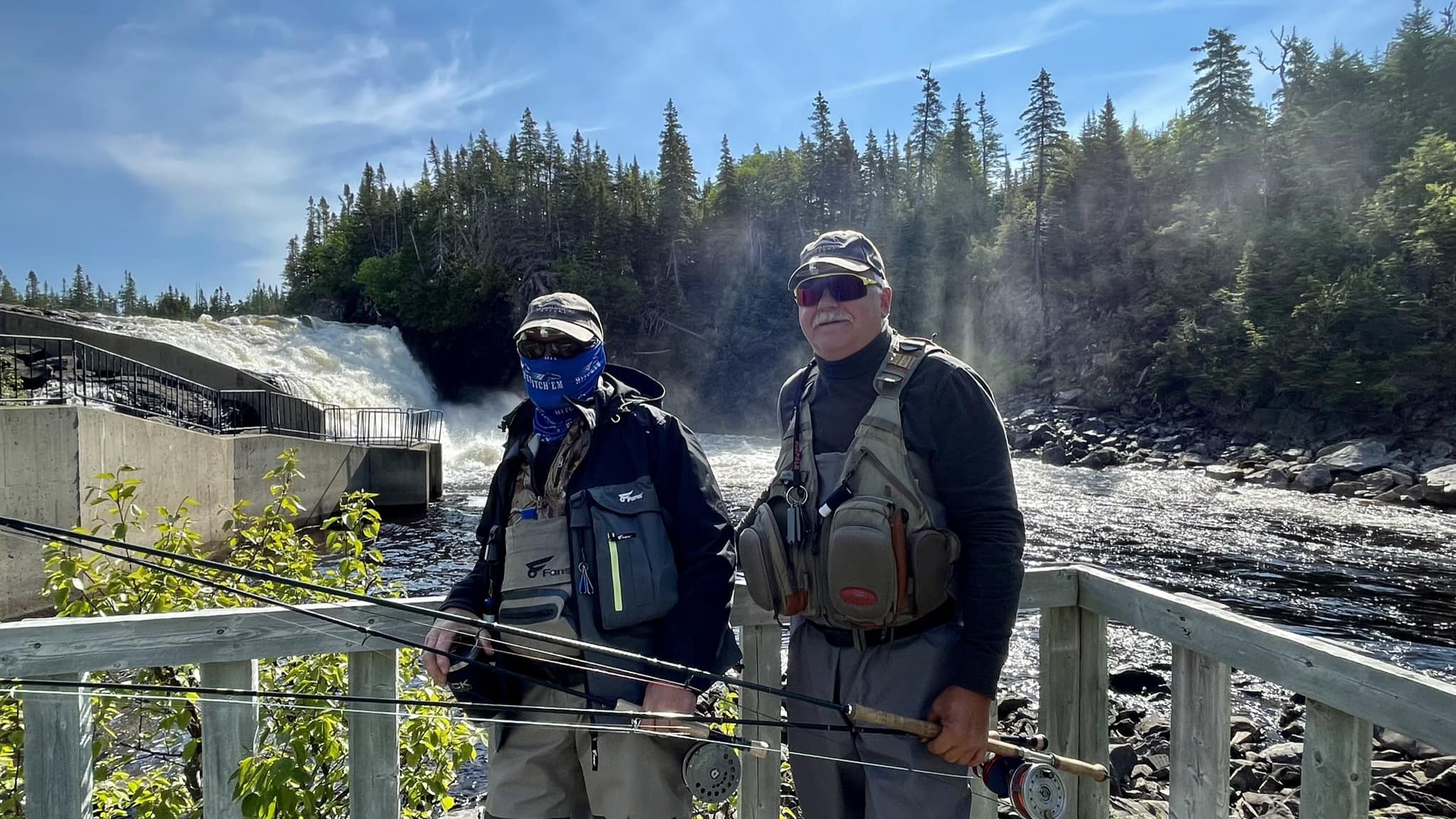
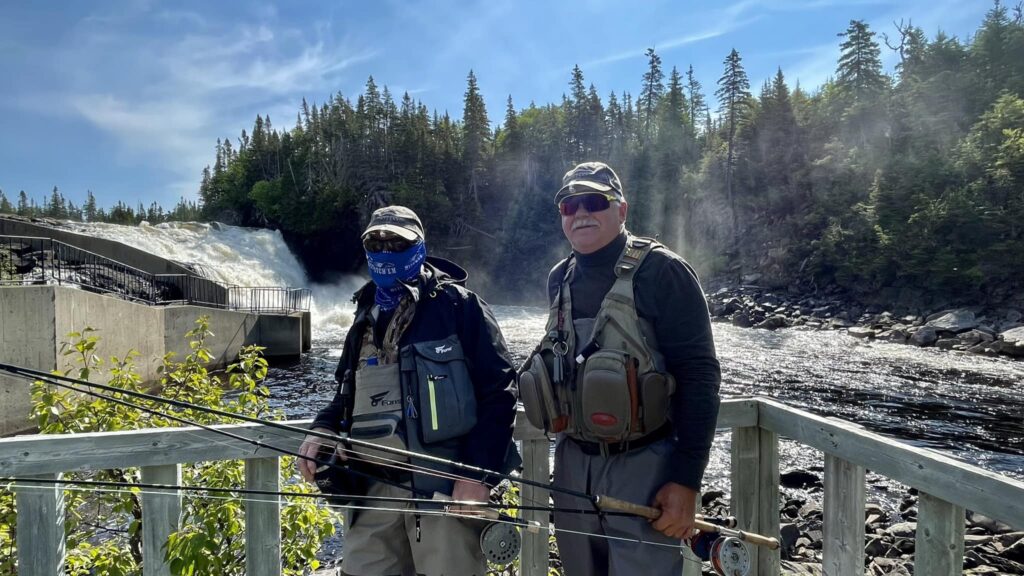
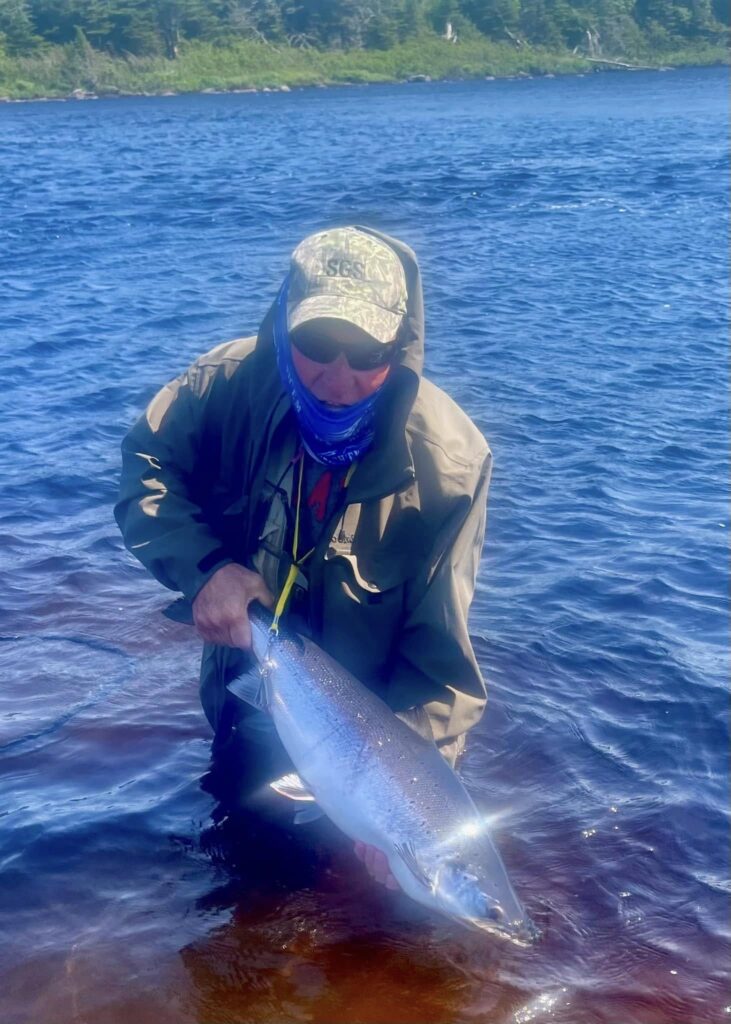
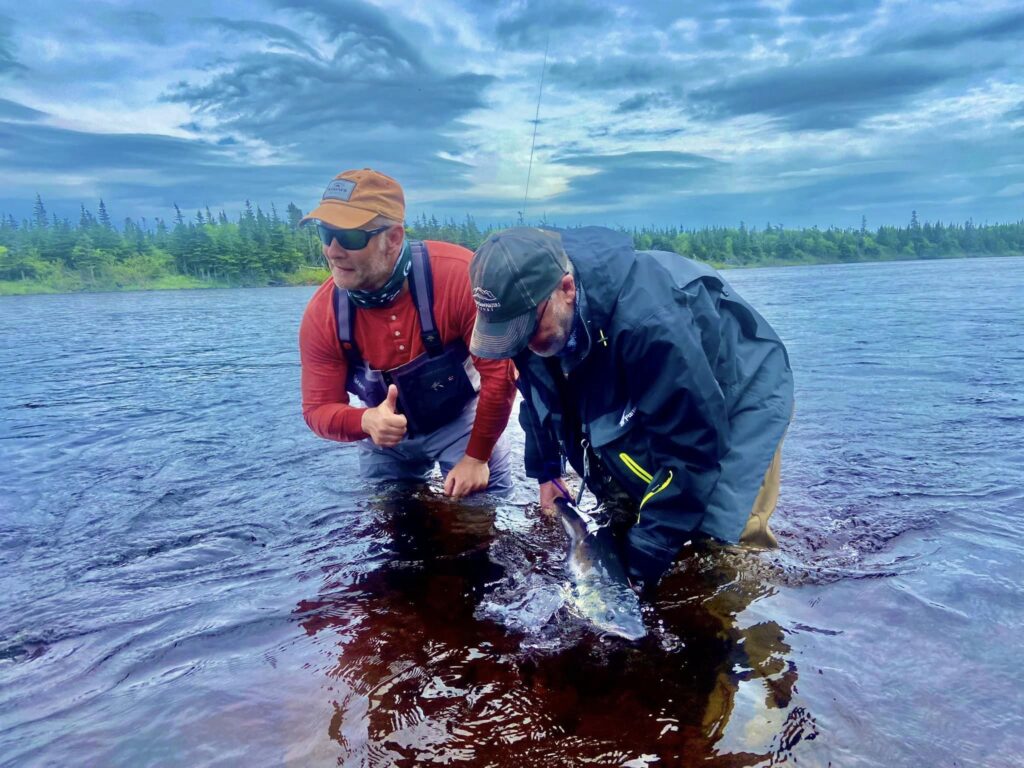
Les Wentzell, founder of Mountain Waters Resort and our guide on this year’s big trip, breaks down fishing for Atlantic Salmon on Portland Creek. You’ll hear why a WiFi signal is the perfect way to think about covering water.
Plus, get the scoop on what to do the moment you get a hookup, why a dead-straight cast can make or break your day, and Les’s simple but powerful leader formula, the secret weapon every angler needs. Here’s Les Wenzel from Mountain Waters Resort.
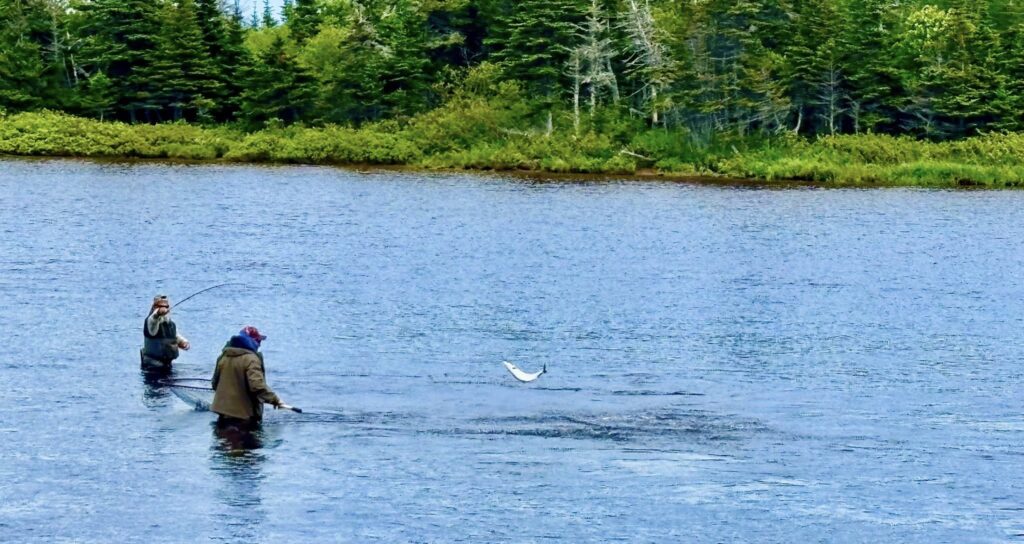
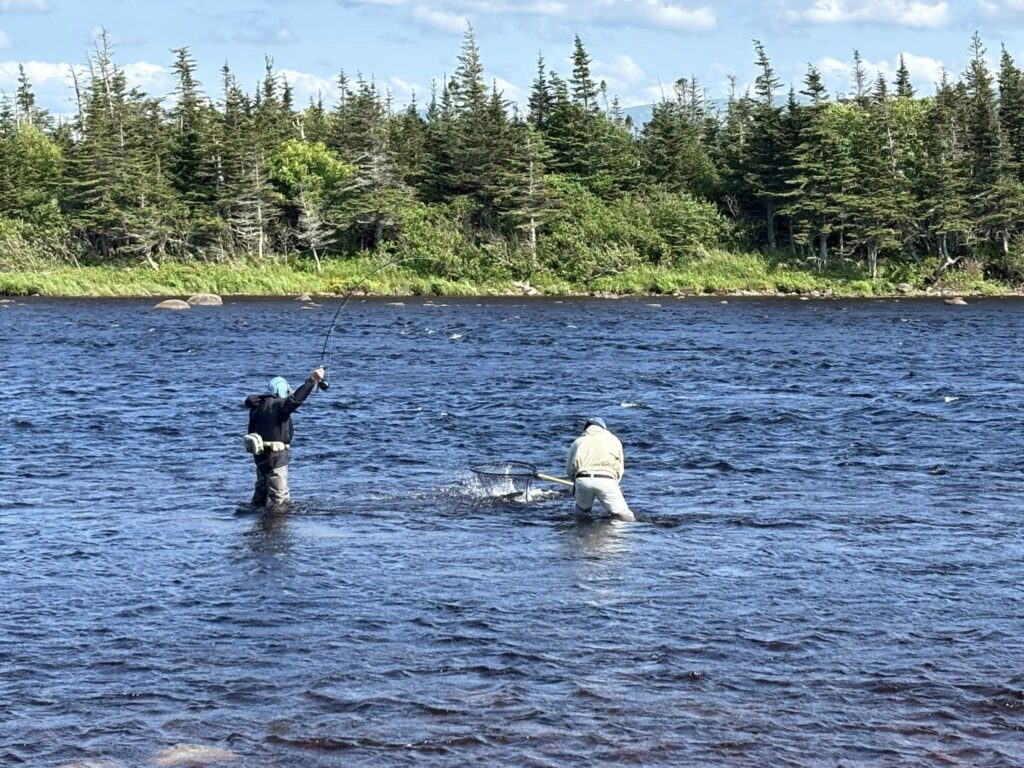
Portland Creek is right where the lake meets the ocean in Newfoundland. The water starts in the mountains and runs into what they call “ponds”. There’s a narrow channel between ponds where you can fish from a small boat. The big lake outside is eight miles long, with a couple of tributaries where fish move in and out.
The Portland Creek River itself is about a mile long and flows from the lake out to the ocean. There are also fishing spots on the north and south sides of the river.
Once you arrive, you’ll be picked up from Deer Lake and taken to the property, which is about 300 yards from where the fishing starts. Fishing usually kicks off around 8 AM and continues until noon. After a couple of hours, it resumes from 2 PM to 6 PM. You can fish all day if you want to, but fishing in the dark isn’t allowed.
Trout fishing around Portland Creek is fantastic, especially in the inner pond. Les says some clients had two amazing days where every cast brought a fish. Most trout are brook trout, with some searun trout and a few browns that can get up to six pounds.
They swing flies for trout in the summer, mainly July and August, which is the best time. The spring season is ideal for targeting larger trout with spinners and lures. Salmon season kicks in around the last days of June.
Once you arrive, you’ll be picked up from Deer Lake and taken to the property, which is about 300 yards from where the fishing starts.
Les explains that most anglers still use single-handed rods, although spey rods are also gaining popularity. Many switch between the two depending on how tired their arm gets.
The wind makes casting tough, so he recommends using a line a bit heavier than your rod, like a 9 or 10 weight for single-hand rods, and keeping your fly line and leader short. Long lines in the wind just float without fishing much.
Start close with short casts, then gradually lengthen your casts to cover more ground without missing fish between you and the farther casts. Fish hold near gravel and boulders, mostly in runs, usually in water 18 inches to 5 feet deep, sometimes stacking in groups.
Les uses an 8.5-foot Fenwick rod with a 9-weight Airflo floating line, which he says works well, especially in windy conditions. He has been using this rod for 20 years now.
He points out that heavier lines help in windy conditions, and while some anglers do fine with an 8-weight, most prefer going one size heavier to handle the weather.
Les keeps his leader setup pretty simple. He usually goes with a straight leader, mostly 6 or 8-pound test, sometimes switching from 10 to 6-pound test if it’s windy.
His leaders are about 12 feet long, but he’ll shorten them to around 8 or 9 feet on windy days. He says he doesn’t like going shorter than that because shorter leaders just don’t work as well for salmon fishing.
Les says some anglers go there just to hook a fish, others want to catch on a dry fly, or try specific patterns. He shared stories about unusual flies, such as tube flies, which surprised everyone by catching fish. One of the craziest flies he’s seen is a black silver tip that looked like it had been through a bomb but still caught a 12-pound salmon.
If you wanna see how I tie the Undertaker fly, I’ve got a video for that. Check it out and maybe give it a try on your next trip:
Les says the most luck with dry flies is on calm, sunny days with no wind. He calls it the “dead float,” where the fly goes out and drifts down the river without creating ripples. You have to keep the line above the fly so the fly hits the water first.
His go-to flies are the Bombers with lots of caribou hair. They look pretty big, about an inch and a half long, but it’s amazing how even small fish go for them. We also discuss classic patterns such as the White Wulff, Gray Wulff, and Royal Coachman patterns.
Start fishing with about 15 to 20 feet of line, casting at a 45-degree angle upstream. Let the fly drift down toward you, then repeat the cast a dozen times before adding more line. This way, you cover more water gradually without spooking fish.
You can fish both sides of the river and even the center, casting out 30 to 40 feet. Unlike steelhead fishing, where you move frequently, when you fish for Atlantic Salmon, you stay put in one spot to avoid crowding others and to fish the area thoroughly.
Les also notes that during prime time, there are usually fish in the run, and sometimes they jump close by, even if they don’t always show themselves, especially when the water is cold or high early in the season.
Several groups are working diligently to protect Atlantic salmon in the area. The Atlantic Salmon Federation covers all of Atlantic Canada. There’s also a local group called the Salmon Preservation Association for the Waters of Newfoundland (SPAWN), which focuses on the fish in their own backyard.
Over the years, factors such as fishing limits and commercial fishing have significantly impacted salmon numbers. While some rules have helped slow down the decline, it sometimes feels like it’s too late. Nevertheless, everyone is hoping these amazing fish will make a strong comeback.
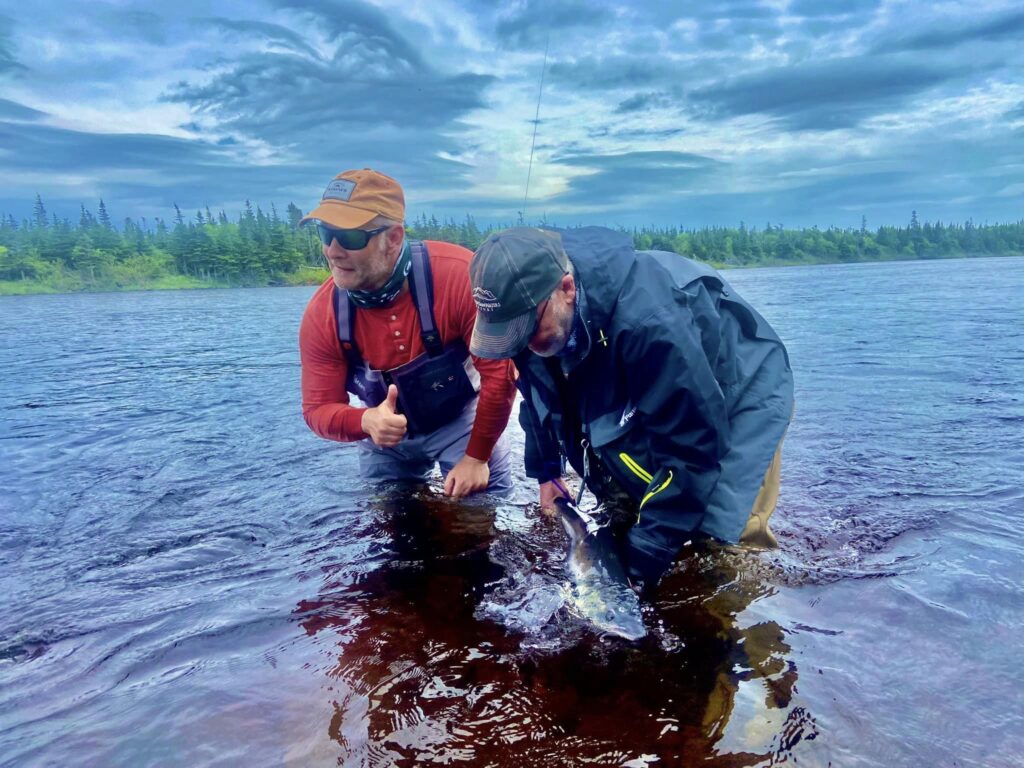
Brown trout fishing peaks in July and August, with some anglers using lures. However, lure use is not permitted in the scheduled salmon rivers, such as Portland Creek itself, but is allowed in the lake. Anglers are now limited to keeping just two salmon per season, compared to eight per day in the past.
Episode Transcript
Dave (2s):
There’s more than one way to swing for naus fish from single hand raws to space setups from surface flies to wet flies, from riffle hitches to bombers and muddler. Today we’re taking it back to Atlantic salmon as we head into Newfoundland to learn how they do it and how you can boost your chances with salmon, trout, and steelhead this season. This is the Wet Fly Swing podcast where I show you the best places to travel to for fly fishing, how to find the best resources and tools to prepare for that big trip, And what you can do to give back to the fish species we all love. Les Wezel, founder of Mountain Waters Resort, and our guide on this year’s big trip is gonna break down how he chases salmon on Portland Creek. You’re gonna hear why a wifi signal is the perfect analogy for covering water for Atlantic salmon.
Dave (45s):
What to do the moment you get a hookup, if you see that fish and why a dead straight cast can make or break your day. We’re also going to get less leader formula. We always love the leader formula. This is definitely keeping it simple and, and is the secret weapon. All right, let’s do this. Here is Les Wenzel from Mountain waters resort.ca. How are you doing, Les? Doing
Les (1m 11s):
Great, Dave. Thanks
Dave (1m 12s):
For putting this together today. We are, it’s exciting because we’re getting closer, the closer the year goes on, the closer that we get to getting up to the lodge. I’m gonna be there in June, kind of later in June, which is exciting. It’ll be my first time. I’ve talked a lot about Atlantic salmon. I’m gonna have some great anglers on, but never done it. So this will be my first time. We’re gonna talk about that trip today, you know, and give some people some tips for swinging flies and all that. Before we jump into it with Mountain Waters Resort and everything you guys do there, take us back to fly fishing. I wanna hear the, the initial story that, when did you get started? Were you, I know Rod got started when he was a youngster. How about you?
Les (1m 49s):
I got started now into the, the salmon as such when I was just a, a kid about Rod’s age, I guess I was more into the trout than the salmon, but as, as it progressed, and I guess when I became a teenager, a young teenager, I started into the, the salmon fishing, and we used to go for salmon earlier in the little streams that ran right directly to the ocean. This place was kind of a little ways away at the time from where we grew up. So as the years went by, I actually, myself and Rod started coming in here in our teens by bicycle, and the place was booming pretty big at that time with the fishermen.
Les (2m 30s):
So we started getting into the, the fishing in air at the park itself. And I didn’t fish outside river part of the river until later in my late teens, early twenties. That’s when I started there and got to know all the places that were here to fish from all the older people. And, and then my work took me away for a few years. And yeah, then we finally ended up getting interest in the place and yeah, so that’s it. We ended up partnering. Yeah.
Dave (2m 58s):
Yeah. And were you there, I know if you’re kinda similar to Rod’s age range and that it sounds like Lee Wolf, that was just before, like you as you’re a kid, like just after Lee Wolf kind of wrapped up his program. Is that the case?
Les (3m 12s):
Yeah, I’m a couple years younger than Rod. Yeah, Dave. And in my case, Lee Wolf was gone. He was gone by the time I started coming in here and the place was still running. It was going by a Great Lakes carbon company, and then there was a company called Sperry ran after that, that purchased the place. And they ran it for a few years and eventually the place ended up being basically given to the church for $1. Oh wow. And the church ended up owning all land and, and the property, everything that was on there. And they done nothing with it, and it just sat for a number of years, just stagnant.
Dave (3m 51s):
Yep. And what did it take, so to kickstart this, like where did that idea come from? It seems like that’s kind of a big, a big thing to take on. Did that, was that that start from you?
Les (4m 0s):
Yeah, it kind of started from me. I, I’m, I wanna say that I wanna take credit for that. I was away working at the time and I ended up coming home in the, in the salmon season of course, and was on the river fishing and just had a good look around again. And the place was getting run down at that time pretty good. There was a, a newer road that was put in for a spray program years before, and the local people was coming in here and they were, you know, just offloading garbage here and there, and there was, they were fishing as well, But I just got the idea on my head, you know, what a great spot this could be if, if somebody had it and, and cleaned it up and, and just the nature, the scenery is just a, it was a beautiful spot.
Les (4m 45s):
It still is. So the idea with me and my wife at the time, we, we took it another couple, two couples, actually there were three couples. And the more we talked about it, the more it rested, we got into it and we approached the church with a sum of money for to purchase the property. And it was about six weeks later, we got word back that yes, you can have it. Hmm. So we bought it. You did? We bought a 170 acres. Wow. And the land, basically, there was a hair strip on the land at the time. There was a bunch of rundown cabins. The cookhouse a garage, and the land itself is, except for high watermark, which is nom man’s Right.
Les (5m 28s):
For five meters, I think eight meters. The land is both sides of the river. Right from the lake to the ocean. Yeah,
Dave (5m 34s):
That’s right. Yeah. And this is, and you have the Portland Creek, basically. Maybe describe that a little bit. We haven’t talked in detail about kind of the, the lake and the water there. How, how does, you got the ocean literally right there. I mean, it’s interesting where Newfoundland is, because you’re way, you know, you’re way up there. You’ve, you’re on the edge of the ocean, but you have this lake looking a water by talk about how the river flows in and out of that and where you fish.
Les (5m 59s):
Okay. So if you go back to the mountains, Dave, where the mountains is starts, basically the, the water from the mountains runs into what we call the inner, I’ll call a lake, but actually we call it ponds.
Dave (6m 10s):
Ponds, okay.
Les (6m 11s):
That flies into the inner pond and that flows into the inner pond. And that pond is six miles long. And there’s places in that, that pond where it’s probably three, 400 feet deep to water. It’s like a, it’s like a fjord that you might see in Norway as such. Oh yeah. So then there’s a, a narrows between that pond and the next one that you can get through with a small boat and which is a good spot for fishing as well. And then the, the, then the lake outside is eight miles long. And on that lake, there’s a couple of nice tributaries that runs into that lake as well as from the inner lake as such that that fish comes and goes up one of them, just a little way, the other one quite ways.
Les (6m 57s):
So if you come to the, out, out part of the lake, the Portland Creek River empties out from that lake to the ocean. And Portland Creek River itself is about a mile long.
Dave (7m 8s):
Yeah. So that’s Portland Creek. So that’s that mile long. And then you have, I see the trips. There’s another, there’s a long trip on the south side and one on the north side. And, and that those are areas you can also fish?
Les (7m 18s):
Yes, you can fish them as well.
Dave (7m 19s):
Gotcha. Wow. And, and so, and you mentioned the trout too, so there’s a little bit of opportunity. We’ve talked a lot about Atlantic salmon, but are there, maybe describe that, what’s the trout fishing look like in this area?
Les (7m 31s):
The trout fishing is, we’ve had the last couple years we’ve had clients in, and we had some fantastic fishing at the, the inner pond. And there was a week there where it was just amazing. We had four fishermen up there for two days in a row, and they couldn’t believe it. Every cast they had a fish on and they were ecstatic about the trout. And of course the scenery, which made the trip more than anything.
Dave (7m 55s):
Yeah. What are the tr these are, are these brook trout that are migrating to the ocean.
Les (8m 0s):
These are some brook trout, and then there’s some sea run trout that comes in as well.
Dave (8m 4s):
Oh. And the sea trout. So now are these, are these brown trout or are these all brook trout?
Les (8m 9s):
They’re mostly brook trout. There’s some browns.
Dave (8m 11s):
Some browns. Okay.
Les (8m 13s):
Yeah, you can catch, you can catch ’em up to, we’ve caught ’em up six pounds.
Dave (8m 18s):
The, the brook trout or the browns?
Les (8m 20s):
The browns, yeah.
Dave (8m 21s):
Gotcha. And is this a, is it all swinging for all species? Brook and browns and, and everything?
Les (8m 27s):
We swing flies in the summertime for pretty well, for, for the trout and the salmon in the springtime. Like another two weeks from now, the spring season will open up and for that we’ll be using the, the spinners lures.
Dave (8m 42s):
Oh, gotcha. For, for and for which species?
Les (8m 44s):
That’s trout.
Dave (8m 45s):
Okay. Could you target the brook trout on, you know, with the fly in, in these areas?
Les (8m 52s):
Yes, you can. Later in the summer, like in July is a good time for the trout. July and August is, is the best time, about the best time for the trout. Like a multiple, lots of trout. The, some of the big trout we get in the springtime, you get ’em in the summer too, of course. But in the springtime, it seems like when the heist leaves the lake, that’s the prime time for, for getting the bigger trout. Okay. And the salmon works around the last week of June, last 10 days of June. From that forward is for the Atlantic salmon.
Dave (9m 23s):
Yeah. So that, and that’s gonna be our focus on the, you know, This year is Atlantic salmon, kind of later in June through July. I mean, people can fish not only, you know, June, July, but even August, September, October. Right. For Lang salmon. Is that, do you guys fish through that whole season or do you focus more in that kind of June, July?
Les (9m 41s):
We do June July and we do August. August can be a little slower depending on the water levels and the water temperature of course. And the season closes here. I think right now it’s like the fort or 5th of September summer’s around there that, that’s when the season closes on this river. Oh,
Dave (9m 58s):
Okay.
Les (9m 58s):
There is a fall fishery on some rivers, just a couple hours south of here.
Dave (10m 2s):
Yeah. Okay. And what is, you know, we haven’t really talked, I mean you’ve got Newfoundland, Labrador, you know, these giant areas and, and we’re kind of focusing on Newfoundland. Do you know, I mean, have you traveled all around Newfoundland itself? You know, what, what does that look like? Are there lots of opportunities on the island for fishing, for Atlantic salmon?
Les (10m 22s):
There is, there’s lots of salmon rivers on the island and of course just south of us, about three, four hours south. They all start getting salmon there probably 10 days, two weeks sometimes before we get ’em here is just the way they migrate. Hmm. And on the east coast as wild island, there’s salmon rivers, not as many, not as big. Central. Newfoundland got some big rivers, Gander river, exploits river, those are pretty big rivers and Labrador. I fished on the Labrador. One place that was remarkable was the Hawk River. Hmm. I took a Cano trip up there back in 1985 and had to, was wicked. The fishing was on Unreal. Really?
Dave (11m 2s):
Yeah. That’s a big area though, right? The Labrador and it’s pretty remote.
Les (11m 7s):
It’s a big area. Yeah. It’s float plane accessible. Like if you don’t have the time, some of those places you gotta go in float plane, helicopter, whatever. Yeah,
Dave (11m 16s):
Yeah. Exactly. And for the, for some of the people, the US folks listening that aren’t quite on all the, the geography is this, which province are we in? Is this the province? Describe that a little bit. Newfoundland Labrador.
Les (11m 30s):
We’re in the province of Newfoundland. Newfoundland Labrador, what is it? Nine miles stretch across the ocean at the northern tip of Newfoundland. And that’s the Labrador part once you cross over there. Yep. It’s a ferry ride of a couple hours on the ferry. And then you got the trans Labrador highway, of course that runs on up through Labrador, some of the coastal communities on the southern part of Labrador. And then after the road kind of hits inland going in towards some of the bigger centers in there. So the sit the towns north of that is, is kind of isolated. Yeah, yeah. Yeah. There’s some great rivers up there. Right,
Dave (12m 7s):
Right. But you can, there is some driving eventually the road kind of peter’s out probably. But you can access some of Labrador by road.
Les (12m 15s):
Yes, you can. I’ve made trip a few times myself since the road went through.
Dave (12m 19s):
Gotcha. Okay. Yeah, so that’s it. I mean that’s the, the cool thing. You got Labrador, Newfoundland, that province, and then right next to that is Quebec and then Ontario, which we’ve talked about a decent amount as well as well. So, alright. So yeah, you guys are right on the edge of, I mean, what’s the weather look like there? I’m kind of curious on, you know, do you guys, what are the, what are the winters like there and then what are your, you know, right now I guess we’re talking, it’s kind of getting into May, it’s gonna be June. What can you expect for weather that time of year?
Les (12m 45s):
Oh, you can have some nice days. You can have some not. And nice days, Newfoundland is well known for if you don’t like the weather, wait five minutes. Yep. It could change. And, and that happens quite often. And going forward from here, I mean we’ll have 10, 12, 15 degree day temperatures from here on forward until warms up later in early June. And by night we can have, right now down this morning it was five degrees. Hmm. At SIUs. Of
Dave (13m 15s):
Course. Yeah. So that’s kind of like a 40, yeah. 42 degrees, something like that. It’s not too bad.
Les (13m 19s):
Yeah. We still got snow on the mountains there yet, so that kind of keeps things cooled off as well. Right,
Dave (13m 23s):
Okay. And what will be today? What, what will be the high temperature today?
Les (13m 27s):
Right now we got a plus 10.
Dave (13m 29s):
You got a plus 10. Okay. Yeah, so plus 10. So get
Les (13m 32s):
Up to probably 1215 this afternoon.
Dave (13m 34s):
1215. Yeah. So yeah, it’s gonna be pretty mild. Yeah, well you’re right on the, you know, you’re in a, I don’t know if it’s a temperate, you know, but it’s pretty mild. You’re on the coast, right? So you get some cold weather for the most part. You’re not getting a ton of snow in the wintertime.
Les (13m 47s):
Not anymore, Dave. No, but the, the global warming you might call it. Yeah. We used to have winter go and March month would be buried in snow and minus 20, minus 25 like that. But those days are long gone and everything is warming up. Of course. Yep. And because of that, one of the things with the later in the summer is the water temperature in the rivers and Porter Creek river is, it just seems to, it hardly ever shuts down. And when a lot of the other rivers all around closes because of water temperature, this river is for some reason it might be the, the big deep lake and behind Yeah. The lake. But the, the temperature is, yeah, they just haven’t closed, never closed the last year or the year before.
Dave (14m 33s):
Right. So the lake basically that keeps it cool. I mean that’s a big part of it. So even in August when things are really hot or warmer, you’re still getting some pretty cool temperatures and some fish action.
Les (14m 43s):
Well we’re getting cool enough that they don’t shut it down. Its borderline, you know. Yeah. Some of the are shut down. Yeah. They don’t have the big watershed behind ’em. Right. Yeah.
Dave (14m 52s):
Gotcha. Nice. Well let’s jump into a little bit on, you know, on the fishing, what we’re gonna be looking at here. So we’re, you know, gonna be there, I mean really anywhere between June and July that, you know, that’s kinda the timeframe, whether that’s This year or next year. But as we come in there, maybe talk about that a little bit. What’s the, you’ve, you described a couple of those areas where might be the first place we’re gonna be heading out to. Are we gonna be hitting that lower part of Portland Creek where it’s kind of going out towards the ocean?
Les (15m 18s):
You’ll be coming in landing in the town of Deer Lake and you’ll get picked up there and brought to the property and once, once the orientation, everything else is all done and you’re good to go. We’ll be, it’s probably 300 yards, I’ll say yards. Yeah. From where you’re gonna be staying down to where you’re gonna start fishing first. And that’s basically right where the river starts to run out of the lake.
Dave (15m 42s):
Gotcha. And this is that lower that mile section. So you’re gonna be fishing there. What is the, you know, what will that look like in the morning? Is that typically you’re getting out there right at daylight or you know, can you get out there? Are you fish, can you fish all day? Does it matter like how much light and all that stuff?
Les (15m 60s):
No, you gotta wait, you gotta, you can’t fish while it’s dark. You’re not allowed to fish in the dark. You gotta stop like an hour after sunset I guess it is in the evening. And you can fish daylight in the morning. And what we normally do, we start fishing normally around eight o’clock and we fish till 12, take a couple hour break and then fish till six.
Dave (16m 19s):
Yeah. W could you potentially fish there just all day? I mean, is is the middle of the day say, you know, 1:00 PM just as good as say mornings. Evenings?
Les (16m 29s):
Yeah, it sure is.
Dave (16m 30s):
Yeah. Okay. So you could, so for the diehards, so you could fish all day if you wanted to. Oh yeah. Skip lunch. This is great. Okay. And talk about the gear a little bit. We’ve talked about this before, but do you see, it sounds like mostly it’s a single-handed rods out there. You don’t see a lot of spray rods in that area.
Les (16m 46s):
We’ve seen it’s mostly single hand rods. Yes. We grew up with single hand rods and everybody around there was single hand and most of the people that was coming earlier with single hand, but then spray rods did start showing up. And the last couple years there is quite a few spay rods showing up. And so a lot of them, they’ll bring more than just the spay. They’ll bring their hand rods as well as single wan. Yeah. They’re flexible. Right. They’ll fluctuate between the spay and the, the single wan. And some of them will your single hand until the harm gets tired, you might say. And then they’ll go to the bay.
Dave (17m 20s):
Yeah. Go to a bay. Do you find that, do, does your arm get tired out there? I mean you’re probably doing, you’re a lot more guiding than fishing, but back when you were fishing a lot more are, are you getting tired out there after a full day of casting?
Les (17m 31s):
Well, the most tired time you would get with the, if the wind was up.
Dave (17m 34s):
Oh yeah.
Les (17m 35s):
On a, on a cam day when it’s not too much wind. I mean back then was younger too. Right. So, yeah. You know, somebody is not doing it all the time. Yes. You will get a tired arm. Yeah,
Dave (17m 46s):
Yeah. You know, that seems to be something that can come up the wind, you’re right there. What, what do you, how are you coaching somebody on the win? How do you deal with the casting? I know that’s been, I’ve dealt with some wind before as well. What, what are your tips there?
Les (17m 58s):
Well, the biggest thing with the wind is if you’re casting is having the right line for the rod or a tad ier than the rod nine 10 weight line for a single hand rod and not a lot of line and on top of not a lot of, and you don’t need a lot of line, this river, you can cast a lot of line in the river, but it’s a big river. But on a windy day you’ll be doing more fighting than you will be casting. And if you got a long line out, and I would say 90% of the time with the long line, you’re not fishing. ’cause the line is substream and it’s floating down and the, and the, the fly at the end of it is so, and just bobbing on down or whatever.
Les (18m 39s):
And that’s not fishing. So you’re just better off with the short line.
Dave (18m 44s):
And by line, are you talking about your leader tippet or the actual fly line?
Les (18m 48s):
Well, I’m talking about you won’t be cast a long fly line on a day and you won’t be using a long tipt on a windy day.
Dave (18m 55s):
Gotcha. Okay. Yeah, that seems to be, I know in some of the rivers, the bigger rivers we have out here, I’m not sure how similar in size they are, but sometimes I know there’s been that, you know, conversation like, is it better to cast further if you’re casting way across the river, are you actually covering more river, more fish or is it better to come in tighter? Right. And just, you know, like what are your thoughts there? Do you think if it’s good conditions, is it better to cast further to chuck that, you know, mega cast and does that help you cover water?
Les (19m 25s):
What we do, Dave, is we kind of put it as the wifi. So if you look at your wifi signal on your computer or your phone or whatever, and you see it starts off with a short bar and then the bars get longer as they go out. Yep. So you start off with a short line and you start fishing and you have so many casts with that short line, and then you just take it another foot and you do the same thing again for so many casts. And every time you make the line a little longer, you’re covering more area. Yeah. And what you’re also doing is any fish that’s between you and the farthe point that you will end up casting if you go out there right away.
Les (20m 5s):
Well, you know, you, your, your line is over the fish and you’ve missed all them fish. Mm. As you go out, you’re covering the ground as you go out. And it’s only getting disturbed as you go out with the line. As
Dave (20m 18s):
You go out. Okay. So start in reclose. And is that, so is the water out there, is this mostly just a gravel? Are there, are there slots and boulders all throughout where fish are kind of holding? Or could they be just holding anywhere out in front of you?
Les (20m 30s):
They could be anywhere, but there is gravel and there is boulders. Not huge, huge boulders, but boulders that salmon lay beside down behind and yeah, it’s, it’s a, it’s, it’s a good spot and it’s not deep, deep water. Yeah. You can, you know, the water, the deepest part of the water in normal conditions on that river where the salmon are being caught for the most part is, is probably five feet.
Dave (20m 55s):
Oh, five feet. Yeah.
Les (20m 57s):
The deepest.
Dave (20m 57s):
Yep. So what’s the shallowest? You might see a fish holding in
Les (21m 1s):
18 inches? Yeah, even less than that sometimes. Hmm.
Dave (21m 4s):
Wow. So they’re coming in here and are these fish coming in as like together kinda stacking up in these runs? Are you like in a, if you’re sitting there fishing a run that’s only, you know, you out 30 feet. Are you, is there how many fish might be in front of you there you think?
Les (21m 19s):
Oh, there’s hard to tell is the, there could be 10 or could be 50.
Dave (21m 23s):
Yeah. Really. Oh wow. Yeah. So, so it could be,
Les (21m 26s):
Yeah. Or, or or in that spot there might be three or four, you know,
Dave (21m 29s):
You don’t know,
Les (21m 30s):
But there’s places where they do, they, they congregate in, in, in bigger schools than others.
Dave (21m 35s):
Yeah. Okay.
Les (21m 37s):
We got one spot here at the, at the lower end of the big pool called the deep hole. I wouldn’t even want to think how many fish holds up right there. Mm.
Dave (21m 45s):
So you’re not catching them in like necessarily pools, you’re catching ’em when they’re up in the runs? Or are you fishing the actual deep pools and scour pools?
Les (21m 53s):
They’re in the runs mostly where we catch ’em. But we also catch ’em sometimes in the deep pool with, with what we call the, the bomber, the dry flies.
Dave (22m 2s):
Oh you do? Okay. Yeah. So the bomber of the dry flies. Yeah.
Les (22m 4s):
That’s deeper water. Right. That’s real deep water.
Dave (22m 7s):
Yeah. I think that’s for, I mean, when people come there, do you find that you get a mix of people that are like, oh man, I just wanna catch a fish versus say a person that’s like, I wanna catch a fish on a dry fly. You know what I mean? Do do you find there’s a mix or is it most people just come and they’re like, Hey, they just wanna hook their hook, hook that fish no matter what technique.
Les (22m 27s):
Oh, some people, some people just want to hook the fish, Dave. And there is people that, you know, they got specific flies that they wanna try and see what they can do. We’ve had that happen a few times and, and sometimes it works, you know. Yeah. I think Rod mentioned to you earlier about the, the tube flies. Oh yeah. We saw some of those. The first one we looked at them, we said, well, you know, what are you doing with that in your, in your kit? And they said, well, we used them in some places and we kinda laughed, you know, but yeah, they were pretty persistent and you know, they caught fish on
Dave (23m 1s):
Them. They caught fish. Yeah. That’s it. Yeah, they did. I know Calvin shared a couple of those that he used, which are, yeah, they’re just tiny little tiny tubes with some, you know, some feather, or not even feather. I think it was hair coming off the back. What, so what is the craziest fly you’ve ever seen that’s caught a fish out there? What, what do you think? Anything crazy, weird?
Les (23m 21s):
Well, I think one of the craziest ones I ever seen is, is called a, a black silver tip. And there was hardly anything left on it. Oh yeah. The fly was, it looked like it had went through a, a bomb or whatever, had blown it pieces. There was nothing really left to it. And, and there was a 12 pound salmon.
Dave (23m 40s):
No kidding. Just, yeah. So the sparse, and that’s interesting because I love, you know, one of the flies that we use out here is one actually my dad invented a long time ago called the Max Canyon. And it’s orange, orange and white and black. But I, I love a black and orange. It’s mostly black with a little bit of orange and like a couple pieces of crystal flash. Do you think that one would work well there?
Les (23m 59s):
It sure it could. Yeah.
Dave (24m 1s):
Orange Is orange a color you guys ever see much of out there?
Les (24m 3s):
We do On, on the bombers. On the bombers,
Dave (24m 5s):
Yeah.
Les (24m 6s):
Bombers got quite a bit of orange and Yeah. Some of the wet flies not, not so much, not too many wet flies, but bombers got lots of orange.
Dave (24m 14s):
Yeah. Okay. Yeah. That’s one thing that I’m excited, I I know you know where people come from. Right. Because that’s where it is. I’m, I’m excited because if I come there, catch a, my first Atlantic salmon on a fly that my dad, you know, kind of created and, you know what I mean, it’s, it’d be kind of cool to do that. And, and even if I didn’t, it would be cool, you know, even if I came there and didn’t catch a fish, it would still be amazing. Right. Because yeah. You know, we’re traveling out to this new area. Yeah. And
Les (24m 38s):
Yeah, so we had Calvin, Calvin came last year and that was the second time he came early and we put him out on the river and turned around and walked back in and I said to Rod, rod was there the same time and I said, you know, it’s a little early and he’s up way up at the head, the pole there. It might not be too much up there at this time. And, and before we got back to the shoreline, he, Calvin just shouted out he had fish on. Yeah. And I, if I, my memory serves me correctly, I think it was the Undertaker tube fly.
Dave (25m 9s):
Oh, the undertaker. Yeah. Nice. The undertaker. And
Les (25m 14s):
He fished a lot of tube flies there last year when he was here and I don’t know if it was 15 or 17 fish yolk while he was there.
Dave (25m 20s):
Oh, no kidding. He hooked 15, 17 fish.
Les (25m 22s):
He did? Yeah. He fished third. It was nights that he fished till until nine o’clock at night with him. Sure. But he enjoyed himself. Yeah. That’s great.
Dave (25m 31s):
Yeah. The undertaker is a, yeah, it’s basically a black fly with a little green and red butt, you know, a little tag. Right. That is that pretty much the fly. Yep. Yeah.
Les (25m 40s):
Undertaker is a good fly. The blue charm is a good fly. They’re all great flies.
Dave (25m 44s):
Yeah. So the undertaker is a great pattern. Again, you know, another pattern that we use, you know, old school pattern out here, it’s called the green butt skunk. Right. Green butt skunk. I think it’s obviously got a green butt. It’s got, it’s just like this fly the undertaker, it just has a little bit of a white wing. Right. Like a skunk kind of thing. But yeah. And, and I actually have a video. I just realized that back in the day when I was tying on YouTube, I do have an undertaker video, I tie it. So we’ll put a link to that in the show notes. When I was kinda getting into this, one thing we’ve done some coverage of is Atlantic salmon fly patterns, you know what I mean? Like these really beautiful jock Scotts and all this crazy stuff. And there’s a whole world of, of fly tires. I think some of them that don’t even fish at all. They just tie these beautiful flies.
Dave (26m 24s):
Do you guys see any of that or are there people tying these flies out in your area? Do you ever see people taking those to, you know, fish ’em?
Les (26m 31s):
We used to have the old guy, Henry Green, you’re familiar with the name and they used to come here and he used to, he used to tie flies at the cottage where he stayed. He used to come for six weeks every summer. Hmm. Set up his gear and he’d tie flies and fish ’em under the river here and the s department of, of whatever he, you know, make ’em up as you go. And yeah. That some of the, the good remarkable flies like Mar Lodges and Jock Scotts and Blue Charms, undertakers, stuff like that. He tie all that.
Dave (27m 1s):
Do you think that that makes a difference or it sounds like, you know, you could tie on anything with a little speck of black and might work out there. Is it kind of like the sparse or the better for the most part on these flies?
Les (27m 13s):
Yeah. Some guys tie a beautiful looking fly rod Brophy beam, one of them. And it’s just, it’s amazing Oh, how beautiful a fly is. And I think Rod would probably tell himself that, you know, he catches lots of salmon on those flies and there’s times when he’ll catch a fish on something that probably nobody else wouldn’t probably use or, yeah. Yeah. Right. Sometimes you can catch your salmon on something that looks the worst in your box.
Dave (27m 40s):
Definitely. Okay, so you mentioned the, the, you know, starting out short, so just starting out with a little bit of, you know, line right at your feet and then working your way out. Is the cast, is the cast a always the same or are you just systematically casting kind of at an angle out? Describe that a little bit where we’re gonna be casting as we’re working our line out.
Les (28m 0s):
Well, you start off Dave with 15, 20 feet line, something like that. Just, you gotta have enough line out there. You can actually do a cast and you just start out with that and you cast, you’re stand in the river and you cast like 45 degrees to the river that’s running out and you cast with, with a wet fly. You cast 45 degrees and you get that fly starts ripping along, ripping along, and he just comes in and comes in and it just ends up straight down from you and you just repeat that or sometimes a dozen times and then you pull ite another foot.
Dave (28m 33s):
Oh yeah, take us back to that again. So you’ve got this, you’re in the run and now are we fishing river, right and river left both sides of the river?
Les (28m 41s):
We are, We are,
Dave (28m 42s):
Yeah. Both sides of the river. So we’re gonna be on both sides of the river. So let’s just say we’re on, you know, river, right? And we’re making a cast. So we, we make our cast out at 45. We start out say 15, 20 feet and then, and talk about that. Once you make that cast, what are you doing with the cast to have a better chance?
Les (28m 58s):
Well the thing with the cast is, is all about how, how good you can cast and a good caster. You wanna be able to lay that line out. Whenever you make that cast, that casting line, you wanna lay that out straight and you tip it needs to go straight out past that. And the fly is straight down below and it’s fishing right away. So at 45 degrees to the river and then it’s doing a sweep with the current, it’s coming in, coming across, coming across toward you and ends up directly below you. And once it gets below you, then you repeat that cast again. And after a dozen times or whatever, then you pull out another foot of line or two feet of line and you repeat the oil procedure.
Les (29m 39s):
And of course as the line gets a little longer, you’re covering more area because your arc is getting wider and you’re just slowly reaching to what you’re hoping is you’re reaching out to find a fish and, and you basically, you cast as much as you can at the end of what you’re comfortable with. And at the end of the day, if nothing happens, then if you want you can pull in and start again with the same fly or retire or fly on. Mm.
Dave (30m 7s):
Because
Les (30m 8s):
What we find sometimes salmon is, is very, very stubborn. That’s what we say. And sometimes you gotta torment them to get ’em engaged.
Dave (30m 19s):
Right. And so that makes sense on the arc. Yeah. You start out small, the, the further you get out there, the further water you’re covering out deeper are the fish, are they all the way across? Could you cast, you know, 15 feet or a hundred feet and still find fish out there?
Les (30m 33s):
Yeah, for the most part where we’re gonna be fishing, there’s, from where you’re standing they can be out there 30 feet, 40 feet out. Yeah. And, and below you all the way through, right? Yeah. And right side of the river, left side of the river is the same procedure just depending on what side of the river you’re on. You’re fishing the center part of the river
Dave (30m 54s):
Center part. Okay. How is the, the waiting here, is this something where it’s pretty easy the waiting and kind of getting out there Are, are you pretty much finding your spot and you’re sticking to that spot while you’re fishing that run?
Les (31m 8s):
Well what we try and do is keep the client in one spot. What’re fishing. We find a lot of people that come here is, is got a background of steel lid fishing. And I guess with steel lid, you, you do a cast or two and you make a step or two. Yeah. And the thing, what we find here is we put you in that one spot and we’d like for you to stay there. And another reason for that is the, the amount of area that you got the fish in. ’cause if you were walking, you’d be down on the next guy in no time. And where you are fishing in that one spot, there’s gonna be fish out there that you’re gonna be fishing over.
Dave (31m 42s):
Yeah. For the most part there’s fish out there. I mean you’re in there during the prime time, it’s likely that there’s at least one fish out there in the run. You, you know, wherever you’re at,
Les (31m 51s):
Oh there’s fish out there. And if you’re here in July and August and you’re there fishing and, and you’re, if you’re ever wondering if there’s any fish out there and then one will jump, yeah, three 10 feet from you just though from you and then another one 20 feet, 15 feet down river, up river, whatever. Oh right. Then you know they’re there. Then you’re kind of saying to yourself, well how come he is not not biking what I got on my line? Yeah.
Dave (32m 15s):
How often do they, are they not jumping at all, you know, and not, not giving you any signs that they’re there.
Les (32m 22s):
You don’t see as much jumping when the river is high early in the season, you got higher water, you got colder water and the fish don’t jump as much as they do when the water warms up and when it gets lower. I think they jump more and warmer temperatures for some reason it does something to ’em. I haven’t really figured that out. Gotcha.
Dave (32m 40s):
Talk about the gear a little bit. I know on my gear I’ve got a mix of stuff, you know, old rods from, you know, old lamb glass to some other newer stuff. What, what do you use, what is your rod of choice? Are you using the same rod you’ve always used? Talk about that. Like kind of what Rod, you know, length, weight and then lines and stuff like that.
Les (32m 59s):
Yeah, I got a eight and a half foot Fenwick rod that I use. Dave. It’s for eight weight line and I use a nine weight on it. Nine weight line floating line, a weight forward. Airstream.
Dave (33m 10s):
What, what is the line, what’s the brand you used?
Les (33m 13s):
Airflow. Oh
Dave (33m 14s):
Yeah, airflow. Yep.
Les (33m 15s):
Yep. That’s, I don’t know if you can still get them or not, but that’s a good line.
Dave (33m 19s):
Yeah. Airflow’s great. Yep.
Les (33m 21s):
I’ve had it for a while but it still works great. Yep. And even last or last year we had a couple guys come and the lines they had was not, wasn’t working out too well for ’em, they were too light. So I think Rod gave one guy his and I gave mine to the other guy until they ended up getting the line and the difference was unbelievable what they found. Yeah.
Dave (33m 43s):
You want a heavier, a little bit heavier line for the, to balance it.
Les (33m 47s):
That’s right. And a little heavier line works way better in a little bit of wind
Dave (33m 51s):
And wind. Yeah. So if you gotta And you think the typical, the best rod there is, is it a nine weight or is it an eight weight?
Les (33m 57s):
Well it depends on the fisherman. Like the, it depends on the, the person who was behind the rod, right? Yeah. You know, it’s depends how good the caster you are and everything else. And there’s, there’s people can, can lay the line out just as easy with a eight weight as somebody else can with a nine. So heavier we, we like to go one size heavier and most of the reason for that, all the reason really is the wind.
Dave (34m 20s):
Oh, the wind. Yeah.
Les (34m 21s):
Because on, on a cam day when there’s no wind, you could put a, you can put a five weight, you can have a rod, a short rod with a five weight line and lay a line out there. You know, if, if you know anything about casting. Yeah. I I’ve also caught salmon air on, on a seven foot rod with a five weight line. Hmm. And that in itself is, is another story that’s, you got the long rods, you’re playing the fish for the most part. When you go to a little short rod, then the fish starts playing you.
Dave (34m 50s):
Yeah. Right. That’s And what, what was that? Why were you using this such a short rod? Was this back in the day?
Les (34m 56s):
I just, I still got it. It was just, I just wanted to try it and just get the fun over it. Right. Yeah. And it was a lot of fun.
Dave (35m 3s):
Right. But you, you lose your leverage. Right. The shorter of the, the lever, the harder it is to work the fish in, well
Les (35m 9s):
Shorter to rod with a single hand rod when you, when you do your casting is the longer rod is just a elbow to the wrist and the hand forward for the most part. But the shorter rod, you start ending up using the shoulder as well.
Dave (35m 21s):
Yeah. What’s the biggest salmon you’ve ever seen caught on a, on a, a single handed rod
Les (35m 28s):
Or there 25 pounds I guess for myself.
Dave (35m 30s):
Yeah. Really? Yeah. So you landed a 25 pound salmon and what was that experience like? Did, do you remember that pretty well?
Les (35m 36s):
That was absolutely amazing and I, I hooked that salmon at the, at the head of the inner inner lake.
Dave (35m 44s):
Oh the head of the inner lake. So this is at, so this is not in between the two ponds? No, this is at the upper.
Les (35m 50s):
That one came on through the river and went up to two lakes and it was in August and it was Yeah, some,
Dave (35m 56s):
So when would that, when is that, when we’re there you’ve got this amazing channel which is going out to the ocean, but when would you go up and fish say in between the lakes or at the head of the lake or those other two tributaries? For Atlantic salmon?
Les (36m 7s):
For the most part, the middle of June from the, sorry, the middle of onward for the fishing up the lakes.
Dave (36m 13s):
Oh. Because it takes a little more time to get up there. So once you get into Jo Yeah.
Les (36m 16s):
Once they leave the ocean right here, they’re in here pretty quick. ’cause it’s only a mile from the ocean. Right,
Dave (36m 21s):
I see.
Les (36m 22s):
And it’s only, I want to say about 15 feet difference in elevation of, of the ocean and where the river runs outta the lake.
Dave (36m 32s):
I see. Yep. Okay. So, so those other areas you can hit once fish migrate into the lake and then they get up a little bit later in the season and then that, that makes total sense. And then as far as you mentioned with the, the brown trout, when would, when are the brown trout in there? When, when are they, when are you guys hooking into them?
Les (36m 51s):
Well we, we hook them in in July, mostly July and in August. But like I told you earlier, in, in now the heist has gone to lake two more weeks, the season will open up and some people will be getting five pounders on the lure up the lake. Mm. Not fly
Dave (37m 9s):
Now fly. So there are some people using conventional gear up there. It’s not just flies
Les (37m 14s):
Just for just locals in, in the Hurley spring. Other than that, using, using the wet flies, dry flies, you can use it but the most luck you’re going to have like later on while we with the flies.
Dave (37m 27s):
Okay. Yeah, I was wondering about that because I, I, you know, here where we’re at, we have a lot of conventional fishermen. There’s probably actually there’s more conventional fishermen than there are fly anglers, you know what I mean? So it’s Right. But I, it sounded like in your area that there’s a lot more fly, almost all fly anglers. But it actually sounds like there’s definitely are guys throwing spoons or whatever like gear out there. Oh
Les (37m 47s):
We do, we do. We go to the, we go to the mouth of this, this Porter Creek river right where it empties into the ocean and just moving forward here in another couple weeks and you, you can catch some of the sea run trout that’s coming right in from the ocean. Oh you can’t with the lu at the mo of the river, you’re not allowed to use it in the river itself because it’s a scheduled salmon river.
Dave (38m 8s):
Oh I see. So no lures in the river.
Les (38m 11s):
No lures in any scheduled rivers.
Dave (38m 14s):
What are scheduled rivers?
Les (38m 15s):
Well scheduled waters and that’s waters where most rivers are scheduled. That’s big enough. Any river that’s big enough for an Atlantic salmon to come in.
Dave (38m 24s):
Oh I see. Which
Les (38m 25s):
Don’t have to be a real big river and you’re not allowed to use lures in those rivers. You can use them, you can’t use a lure in the river at Portland Creek, but you can use a lure in the lake.
Dave (38m 36s):
Yeah.
Les (38m 37s):
But the river itself is scheduled but the lake is not.
Dave (38m 39s):
Oh really? That’s interesting. ’cause you could potentially, could you not hook a salmon in the lake?
Les (38m 45s):
Yes, but you can’t keep it.
Dave (38m 46s):
Oh you can’t keep it. Yeah.
Les (38m 48s):
If you oak a salmon on a lure in the lake, you gotta let it go. Okay.
Dave (38m 51s):
And can you still keep salmon anywhere in there? Can you still kill salmon?
Les (38m 57s):
Yes, you can. I think it’s two a season right now on this river and that’s it.
Dave (39m 4s):
Two per season. Yeah.
Les (39m 5s):
When I was a kid growing up you used to be able to keep eight per day. Right.
Dave (39m 8s):
Wow. Eight per day. Yeah. I guess we’re kind of where We are because partly of those regulations. Right. A little, little. Probably too many keeping
Les (39m 16s):
You can only catch ’em once.
Dave (39m 18s):
Yeah. Just once. That makes sense. And I think probably, I’m guessing there’s a lot of places probably for Lanston where you can’t keep anything. My guess is right. Maybe not.
Les (39m 26s):
Places where you can’t keep anything. And for the most part, a lot of the fishermen, most of the fishermen really that we have, they just wanna open and
Dave (39m 34s):
Release. Yeah. Catch and release.
Les (39m 36s):
We even had fishermen a year before last that the water, they had one day to go and the water was getting pretty warm, the river was still open and they just decided to go do some sightseeing. They didn’t really wanna fish because they said, you know, there’s really warm water, yo fish not gonna be good on to fish. Right. No. You know, that’s a person’s own preference. But those guys were obviously into looking after the fish.
Dave (40m 2s):
Yeah, that’s right.
Les (40m 3s):
Which is a great thing to see.
Dave (40m 4s):
Are there any conservation groups in your neck of the woods? Is there are groups out there kind of fighting to protect, you know, like who’s fighting to help protect on the regulations to help protect those fish out there?
Les (40m 16s):
There is a, a group called the Atlantic Salmon Federation. Oh
Dave (40m 20s):
Yeah, yeah.
Les (40m 22s):
I think there’s another one if they’re still on the goal called Spawn. Spawn. It’s PAW and I’m not quite sure what that stands for now Dave.
Dave (40m 29s):
Okay. Spawn. That’s interesting.
Les (40m 31s):
Atlantic Salmon Federation is pretty big.
Dave (40m 34s):
Yeah, they’re huge. Yeah,
Les (40m 35s):
I know they’re in Atlantic Canada. I don’t know how far west they go, but they’re in Atlantic, well they, Atlantic Salmon Federation, so they’re in Atlantic Canada for sure.
Dave (40m 44s):
Oh yeah, here it is. It’s called the Salmon Preservation Association for the waters of Newfoundland Spawn.
Les (40m 51s):
Yes. Since there
Dave (40m 52s):
You go, since formed in 1979, spawns mandate is to, is the conservation of Atlantic salmon. So yeah, you, so you, you have right there, I mean you’ve got not only one international group but you also have a local group, which is amazing. That’s protecting.
Les (41m 5s):
Yeah. Well over the years they, they got to the point over the years where as we talked about earlier, the hate fish per day you could keep was having a big impact on the fish. And then of course the commercial fishering, the hoan was, I think that was the really the big thing that that put the, the hoop into it. Yeah. And that subsided somewhat, but you know, sometimes it’s too little, too late. But we’re just open and to keep our fingers crossed that they will come back somewhat like they were.
Dave (41m 35s):
Yeah. Right. No, it’s, it’s challenging times. I think that’s what’s pretty amazing, the fact that you still have this great fishery there, you know, given that there’s, you know, you hear about these stories in other parts of the world with Atlantic salmon and steelhead, you know, steelhead in our area Right. Have, we’ve seen major impacts on the west coast all around the Pacific rim. But no, this is, I think having these groups is a key. I think that would be somebody I’d love to chat with more. But, but let’s take it back on. So We are talking gear a little bit so we’ve got the gear lined out. I was interested on that Fenwick rod mainly because I’ve talked to a lot of expert fly casters This year and they’ve talked a lot about how some of the older, maybe older rod, the, the me more medium action, full action rods are a lot better for casting.
Dave (42m 20s):
What is your take? Is that Fenwick a pretty old rod and is, would you consider it a full, like a full medium action? What, what type of action is it?
Les (42m 28s):
I think it’s about medium action. I’ve had to rod for about 20 years. Yeah. And for myself it’s fine. And I’ve tried rods, I’ve tried other lines on the rods, like people’s rods. And a lot of it Dave is to me is if you can cast the line and you’re into it, then you take, hey Rod, whatever, rod whatever line. And if, if you are a caster, you can go and tell pretty quick if that rod is any good for you or not. Yeah. And, and you know, and, and sometimes you can probably take three or four rods and, and they might all be okay for you, but there might be just the one that’s not and the next guy might take that same rod and it would definitely be no good for him.
Les (43m 13s):
Right. It’s all to do with the casters guy behind the rod is a lot. And, and you can pay big money for some of those rods and some of those lines and, and you can have some great stuff and the guy can walk in front of you with a 20-year-old rod that everybody looks at and frowns on and all of a sudden he’s got a fish on.
Dave (43m 34s):
Right. Exactly. No, that’s what I love about it. I think that there’s, I think that there, all the rods are kind of like good these, you know, these days, but it’s really, that’s why you gotta go out and cast the rod. You know, it’s a good idea to go into your local shop or you know, test out a few raws different lines. But I think one thing is a good takeaway is for sure if you have an eight weight, you know you’re coming in there or a nine weight to maybe go up one line heavier. So if you have a nine weight, maybe try putting a 10 weight line on it. A
Les (43m 60s):
Hundred percent. That’s why last year when the couple of lines was here that we ended up myself and Rod giving them our reels with the lines. Yeah. Their rod seemed fine, but just the line wasn’t big enough. Right. With the, with the conditions.
Dave (44m 11s):
Yeah. Okay. What about the, the, the leader? Is your talk about your leader set up. Is that pretty state straightforward? We’ve got everything set up other than leader, what, what do we got there?
Les (44m 21s):
Yeah, we pretty well like the maximum leader, that’s what we use. It’s the, the brown color stuff and some people use the tapered leaders and, and you taper down from, you can go from 12, 15 pounds right down to four or pounds and some people just put on a straight six or a straight eight depending on water levels. And it’s a preference.
Dave (44m 43s):
Yeah. What do you do? What do you like to do?
Les (44m 46s):
I just, for the most part I just use a straight liter. Yeah.
Dave (44m 49s):
Just eight pound or six pound. Eight
Les (44m 51s):
Or six pound. And sometimes I’ll go from a 10 to a six, like if it’s windy but for the part I’ll just use a straight leader.
Dave (44m 59s):
Straight leader. And then how long is, what would your liter typically be?
Les (45m 2s):
About 12 feet. I shortened it up on a windy day. It could be nine feet on a windy day, eight feet.
Dave (45m 8s):
But never like down to say six feet or four feet or anything like that.
Les (45m 12s):
No I don’t. That don’t work. You know, you can probably catch the salmon but it don’t work as well as if it’s a little farther, that’s for sure.
Dave (45m 19s):
Yeah. Okay. And then talk about, I think the dryly is something would be pretty cool to, you know, have some action on the surface. Is that something that you’re doing quite a bit out there, the dries versus say a wet fly?
Les (45m 30s):
The most luck that we find with the dry fly is on cam days with no wind and top that off. Go take a step farther is what we call the dead float versus having a rippling across the water and with the dead flows, you basically, that fly goes out and when the fly is coming down the river you sometimes you gotta main your line, but if you get good at it, the line stays above the fly. ’cause the first thing you want coming down that river over them fish is the fly, not the line.
Dave (46m 1s):
And what would be a fly you would be casting with the dead float?
Les (46m 5s):
That’s the bombers, what we call the, the hor bombers. There’s different collars now you get the brown bomber, the hor bombers, the dirty bomber. Hmm. And before that we used to have the white wolf, the gray wolfs, the rile. Coachmen and stuff like that.
Dave (46m 18s):
Yeah. The wolf.
Les (46m 19s):
But the bombers are different shape, a lot of hair on it. His caribou and they work good.
Dave (46m 27s):
Yeah, they do.
Les (46m 28s):
Some of them is pretty big and it’s amazing. You know, you, you look at it and say that’s that’s pretty big. But
Dave (46m 34s):
How big? How big?
Les (46m 36s):
Oh like, I don’t know, inch and a half long.
Dave (46m 39s):
Yeah, it’s like a size four or two or something like that. Yeah,
Les (46m 42s):
Actually, well with all the air on it, it looks big. Great. Yeah, it’s good that you can see it going on the water and, and when that fish comes, it’s amazing how small of a fish you can get on the big bomber.
Dave (46m 53s):
God, a big bomb like so you got the Big Mo and the wolf is really interesting too. Again, back to Lee Wolf because I think that he actually invented those wolf patterns, which are so famous now for his, when he was going to Canada. And a lot of people I don’t think know that, But I think, I’m trying to think, I know Jack Dennis was on the podcast, he told the story about how that was named. But essentially somebody helped him name those flies. But is the wolf something that we, we could potentially fish up there if we wanted to get some of that history in?
Les (47m 19s):
You can certainly fish it no problem at all. And I’ll be honest with you, I don’t know who ties them anymore around here, the white wolf stuff they got, but there’s hardly anybody uses them. Everybody’s got old bombers.
Dave (47m 33s):
The bombers. And what would be that w is it the the royal wolf or what would be the pattern you might use if you wanted to use something?
Les (47m 40s):
It’s the white wolf. The white wolf and then called the gray wolf. That was the only difference with the color. One was gray and one was white and, and there was the Royal Coachman with the other one that was a dry fly. It was all tied similar, right? Yeah.
Dave (47m 54s):
The Royal Coachman, right? Yeah. Same thing. They same, I mean it’s just like the bomber. It’s got a bunch of caribou or you know, whatever sticking out the front that, that basically creates a, a disturbance.
Les (48m 5s):
That’s right. Well they used to have a tip on the front like the bombers got and the bombers now is like a wrap around the hook. It’s almost like it’s pretty rounded the air coming out of it. Yeah. And thing going straight back from the high of the hook and the, the white wolf is, they had like two wings going out on them.
Dave (48m 23s):
Yeah. Two wings
Les (48m 24s):
On the back. Yeah.
Dave (48m 25s):
Yeah, that’s right. Wow. Yeah, I mean, like I said, for me it would be cool to catch one on a, on a wolf or, or a bomber or really anything, you know, But I, I think there’s kinda, there’s some options here. So you got the leader, we got the fly. Pretty straightforward out there. Anything else we should be thinking about as far as, you know, somebody’s coming in there, they got a big trip. What are you telling them before they get there to kind of be ready to have the best success?
Les (48m 51s):
Well, we would like to see people come with felt thunder boots, wading boots for one thing.
Dave (48m 55s):
Oh, so felts. So no rubber, no rubber boots felt
Les (48m 58s):
Is what works really well in this river. What
Dave (49m 1s):
About studs? Do you, do you guys use studs on your boots too?
Les (49m 4s):
Some people use the cleats as well, but we find the felts is even better than the cleats. And if you’re gonna bring boots with felts, make sure you wash ’em really, really well before you come with them. Yeah. Just because of whatever might be on them not to bring in. Right. Yeah. And as regards to wading, the water is not deep, deep, deep as such. It can be up to your waist, maybe a little higher. And it depends on the person I I’ll agile and what kinda shape the person’s in. And the bottom can be a little rocky in places and the outer part of the river can be quite rocky, so you just gotta take your time. Yep. But for the most part right here where we started off fishing, you don’t wait too far.
Les (49m 47s):
Anyway,
Dave (49m 48s):
So we get started. So we’ve got the morning, the evening fishing. What, what’s it like once we wrap up at the end of the day, we’re coming back to the, the lodge. What’s that experience like? Is that pretty cool hanging out there in the evenings?
Les (49m 59s):
Yeah, it is. It’s a great spot. You’ll get to see it. There’s a nice, nice building put up there and supper’s usually around six o’clock.
Dave (50m 7s):
What, what’s typical supper? What are we looking at for food there? Do you, do you have, you know, I’m just kind of always try to get that picture. That’s kind of something that can be like an X factor. What, what do you think that’ll look like?
Les (50m 21s):
Well, you’ll have some steak, you’ll have pork chops. Steak. Ooh. Yeah, you’ll have lobster. Oh,
Dave (50m 27s):
Lobster
Les (50m 28s):
And Oh, you will? Yeah. Oh,
Dave (50m 29s):
Nice. And what about drinks? Do you guys have some adult beverages there as well?
Les (50m 34s):
Yeah, we do. Yeah. Yeah. No, it’s, it’s a full blown lodge as regards to the lodge. The cabins are nice and the building itself where you’re eating us all nice stuff and, and there is a new building that was put up a couple years ago.
Dave (50m 47s):
And is Lee Wolf’s, I know the old cabins have all been taken away, but were Lee Wolf’s original cabin. Do you remember that? What that looked like? The actual, when you know, after Lee Wolf was there, what, what his cabin, the situation looked like. Did he have just one or was there a few different cabins?
Les (51m 1s):
Well, there was quite a few here on the property that he had for people to stay in, but his own personal cabin was, was situated. It’s about, I’d say 150 feet from where I live right now. I live on the river. Oh,
Dave (51m 14s):
You do? So you’re right on the river.
Les (51m 16s):
I live about 150 feet from where Lee Wolf’s original cabin was at. And the place where my cabin and the place where I live right now used to be the pilot’s cabin back in the day.
Dave (51m 26s):
Oh, the pilot’s cabin. Yeah. So this was his pilot, Lee Wolf or No, he was the pilot. That’s right. Lee Wolf was a pilot,
Les (51m 33s):
Well he was a pilot in a small float plane, but he also used to bring clients in from Gander, Newfoundland and DC three airplane. And they would land on the strip here.
Dave (51m 46s):
Oh, so there’s a strip. So there’s actually a concrete strip.
Les (51m 50s):
No, it was not concrete, it was dirt and it was close to 4,000 feet long.
Dave (51m 54s):
Oh, okay.
Les (51m 55s):
And that’s all on the property. It’s growing up now the strip is growing up and, but yeah, that’s, he used to bring a lot of his people in by that way, by that plane. And this is where the pilot would stay and some more of his guests stay.
Dave (52m 10s):
That’s awesome. It’s kind of cool. Do you ever think about that much? The fact that, you know, Lee Wolfe was such a kind of a famous fly angler in the history there. Do, do you, is that something you think about much? And then also do you, have you, you know, talked to, ever talked to Joan Wolf or any of the family?
Les (52m 27s):
I’ve never talked to Joan. I think Roy and I, through email I’ve had contact with her and the two sons, Al and Barry, they were here. Yeah. They kind of grew up during the summertime and I guess back in the day, Dave, when Lee Wolf was doing what he was doing, you know, the wilderness was not what it is today. And an entrepreneur back then, there was so many more chances for doing what he’d done that it was, it was tough. It was a tough life, but there was many opportunities. Yeah. And then an abundance of resources, you know, like, like the fish.
Dave (53m 2s):
Yeah. Good. Well let’s wrap it up here with our, you know, this is kind of our three tip segment that we do. You know, again, we’re thinking about this trip, we’re gonna be coming there, people are gonna be coming there, getting excited for a chance. So if you had somebody that’s the night before getting ready to fish, what are a few tips you’re giving that person for the next day for Atlantic salmon to, you know, have, like we said, have some more success? Well,
Les (53m 26s):
Well, depending on the weather of course is the, that’s the other thing is if they’re coming to bring some warm clothes just because of the weather conditions that might be. Yep. And the night before, if we’re going fishing the next morning is basically you’re gonna know where you’re gonna go fishing first and foremost. So you can have that in your head that night as you go to bed. Yep.
Dave (53m 45s):
So you know, where you, you know, kind of the spot you’re gonna be hitting and you’re gonna be knowing what to focus on.
Les (53m 50s):
That’s right. And you’ll have an idea of some people got spay rods, single hand rods. Well you can bring whatever the next morning wet you and there’s only like a lot of fishing we’re gonna be doing, as I told you, is not too far from the lodge. And if somebody forgets something or whatever, it’s just a hop skip jump to go back, pick it up and you’re gonna have a big river and hopefully there’s gonna be a bunch of fish in there.
Dave (54m 16s):
Yeah, yeah. So when you’re on the water, it’s basically, you know, what are you telling somebody as you’re sitting there, you know, waiting for that first hookup or you know, you’re watching somebody, what if they’re, I think a big struggle is the fact that, you know, you, you really need to cast straight. Like if you’re casting, you’re probably don’t want somebody casting 90 degrees out and then making a big mend. Does that ever catch fish if somebody’s doing that where they’re actually, you know, maybe struggling with the cast a little bit, can you mend, is that okay to do?
Les (54m 41s):
You can mend yes and yes, you might catch a fish, but you won’t catch hardly any fish compared to what you will catch if you put that line out straight and it’s fishing right away.
Dave (54m 52s):
Yeah. Straight line. So this is key. This is a very important key and straight line because that’s mainly because those fish could be literally, it could hit the water and there could be a fish right under it.
Les (55m 1s):
A hundred percent. And the, and the thing, again, what we find is, is if the fly is rippling along the water coming down, we find that that thing fishes way, way better than if that fly is up river just floating down. You don’t even see the fly is just, is sunk so far underwater and oh, you would never know you got a fish on until you, you pulled or whatever, you know. Oh, I see. To have that fly rip across the water and see that fish when it comes breaks water for that fly. I mean that’s the trail itself.
Dave (55m 31s):
That’s what you want. Yeah. So that’s where the, the Portland hitch comes in the riffle hitch, which is helps the fly stay on the surface for the most part. And you’re actually seeing that’s what’s exciting about this because when these fish hit, for the most part, you’re gonna see this fish eat a lot of the time. Is that true?
Les (55m 46s):
That’s true. And that depends on the person behind the rod on how the reaction is as regards to setting up on that fish. I had a guy last year and he raised that same fish about six times and the fish was probably 1215 pounds and he never did help
Dave (56m 1s):
The fish. No kidding. Like six. So he cast it came up and he made six different casts to it.
Les (56m 6s):
He rose the fish, the fish came for the fly, but his, his reaction was just, it was too slow, too fast or just, you know, not never had the in between. And he ended up getting so excited on the last three. He just, that was it. He gave up on the fish.
Dave (56m 21s):
Oh he did. So if you’re swinging that down, you make your cast this nice straight cast, your your fly, you can see it kind of rippling across the water and you see the e what do you do in that moment?
Les (56m 31s):
You sit, you just sit up on the fish as soon as you see, as soon as you see any action.
Dave (56m 35s):
Is it, I’ve heard people say it’s like answering your cell phone. Is that what you wanna do with the rod?
Les (56m 39s):
That’s what you wanna do with the rod. Some people, you know, some people with cell phones, they grab it like it’s the last thing in the world and some more takes their time. But it’s something like answering a cell phone.
Dave (56m 49s):
Now this is like the, this is the, the prime mister or the president call. You want to answer that phone quickly, not too quickly though.
Les (56m 56s):
That’s right. So Mr. Fish is no different. Awesome.
Dave (56m 59s):
Okay, well there’s a couple of good ones I think I, I feel like there’s gonna be a chance that, you know, we’re gonna miss some fish. If you’re out there fishing, what percentage of fish do you think out of, you know, a fish? I always think of it as touches. We always talk, call ’em tips taps with steelhead because we have summer steelhead where we live and the summer steelhead are, are a lot like Atlantic salmon. In fact we’ve had, there’s been books written for Atlantic salmon that I’ve read since I was a kid that I used for summer steelhead because they’re so similar. But we talk about these tips and taps and tugs and the fish do all these little things and you’re always thinking like, what is it doing under there? Right? It’s not grabbing it, but it could be grabbing it or it could be pulling it. Are you getting all those things, all sorts of different little grabs and stuff like that out there?
Les (57m 40s):
Not as much, not as much that stuff Dave, because we’re, we’re surface fishing and you know, you, you’ll get that stuff if you are, like I said earlier, if you’ve got a sink and fly that fly sunk or whatever. But with the surface fishing, the, the hatching, you’re, you’re gonna see it most of the times you’re gonna see it. Right. And you react right now. Yeah,
Dave (57m 60s):
You react right now.
Les (58m 1s):
And it’s not a big pullback on the rod, it’s just a
Dave (58m 4s):
Thick, so that’s one big thing about, I mean that’s a great tip too, the wet flies versus the surface. The fact that you use the surface because now you can see the flies. If you’re using a wet fly out, there’ll be the same thing. You’ll probably be getting a lot of, a lot of those things where you’re not hooking up.
Les (58m 17s):
That’s right. And, and again, you know, I’d say probably 80% of the fish, if you see a fish come for your fly and see the hatch action, I’d say 80% of the time you’re gonna hook that fish and the other 20. Yep. You might not. Oh
Dave (58m 31s):
Wow. So that’s good. 80 20, I mean I’ll take 80 any, any day. That’s pretty amazing. Yeah.
Les (58m 36s):
If, if, if you see a fish, he comes for the fly and you miss him, I’ll say 80% of the time that fish will come back.
Dave (58m 43s):
Yeah. Now out there, do you’ve probably heard of the 80 20 rule, you know, where like 20% of the people are catching 80% of the fish. Is that the case out there? Do you find people you know or is it, do you think most people, if you’re in a run, you have a pretty good shot at at hooking one?
Les (58m 58s):
Well, you know, it depends on the fellow who’s fishing and stuff like that. But for the most part, if there’s fish, deer and if you can, if you’re a decent caster, yeah, you catch fish.
Dave (59m 8s):
Awesome Les, well I could talk to you all day here about this. I’m excited because right around the corner we’re gonna be out there on the water and, and we will, we’ll kind of leave it there for today and we will be picking your brain more as we once we get out on the water. But we’ll send everybody out to mountain waters resort.ca if they have questions for you or you know, Ryan or anybody on trips. And yeah, appreciate your time today. This has been a lot of fun.
Les (59m 32s):
No problem Dave. Thank you. And we’ll chat later.
Dave (59m 36s):
All right, if you get a chance, your call to action today is a check in with Les and Ryan. Go to mountain waters resort.ca. If you’re interested in one of these trips and you wanna find out more about availability, check in right now. Mountain waters resort.ca. We are gonna be there as well This year and we’ve got some good stuff coming in upcoming years. So let me know if you’re interested as well, Dave, at wetly swing.com. If you haven’t already, if you’re brand new to the show, please hit that subscribe button, follow the show so you get the next episode delivered to your inbox. The next one and next week we got Phil Roy back on for Laur Zone. Always we’re talking, we talked to Lakes Ponds today, still water a little bit today. Didn’t really get into it, but I’m guessing if Phil was up there, there would probably be some fishing in those, in those ponds.
Dave (1h 0m 21s):
I’m not sure for Atlantic salmon, but that’s something of interest for you. So La Toro zone next week. And that’s all I have for you. I hope you have a great morning, hope you have an amazing afternoon and if it’s evening, I hope you’re having a great dinner. Maybe you are listening in the background right now. That’s all I got and, and we will talk to you very soon. Thanks.
If you’re interested in one of these trips and want to see what’s available, now’s the time to check it out. Check in with Les and Ryan to learn more .