Fly fishing has always evolved, but some moments change everything.
From bamboo to fiberglass to graphite, each shift has redefined how anglers experience the water. In this episode, Larry Kenney shares what it was like to be at the center of one of the most important transitions in fly fishing history—the move to graphite fly rods.
Larry, co-founder of Scott Fly Rods, takes us through the early days of rod building, the rise of graphite innovation, and the lessons he’s learned from decades in the industry. Along the way, he shares practical advice that challenges how anglers think about gear, casting, and improvement.
Larry Kenney’s journey began with a passion for fishing that eventually led him into rod building.
In the 1970s, he partnered with Harry Wilson to grow Scott Fly Rods. At the time, fiberglass dominated the market, and most rods were built within the same limitations.
Larry didn’t begin as a rod builder right away. His involvement grew naturally as his interest in fly fishing deepened and opportunities emerged through his partnership with Harry Wilson.
What started small quickly turned into a serious venture as demand increased.
The introduction of graphite in the mid-1970s transformed fly rod design.
Fiberglass rods were heavier and limited in performance, while graphite allowed for lighter, longer, and more responsive rods. Larry and his team developed rods like the 9-foot 4-weight, which was groundbreaking at the time.
This shift marked the beginning of modern fly fishing equipment.
Larry explains that success came from both innovation and timing.
Scott Fly Rods grew during a period when graphite was emerging, and fly shops were expanding across the country. This created the ideal environment for growth.
A key technical topic in the episode is ferrule design.
Scott used spigot ferrules, which allowed for a smoother bend and better taper continuity. Other companies used tip-over ferrules, which were easier to produce but changed the rod’s flex.
During this time, several companies were shaping the industry.
Fenwick was a dominant force, while brands like Sage, Winston, and Orvis contributed to innovation and competition.
Although graphite became dominant, fiberglass continued to have a place in fly fishing.
Larry later revisited fiberglass rod building, focusing on craftsmanship and performance for specific fishing situations.
Larry offers a realistic perspective on rod pricing.
While premium rods may use advanced materials, the difference in performance is not always significant. Many mid-range rods provide excellent value and performance.
One of the most important lessons from this episode is the importance of casting skill.
Larry explains that a good caster can make almost any rod perform well, while a poor caster will struggle regardless of equipment.
Larry shares a memorable story about catching his first steelhead on the fly.
This experience highlights the excitement and challenge that define fly fishing and keep anglers coming back.
Looking back, Larry reflects on what he would have done differently.
He would have taken more risks, traveled more, and explored opportunities earlier in life.
Larry explains progressive rod action and why it matters in fly rod design.
A progressive rod bends more and more into the butt section as pressure increases during the cast. This allows the entire rod to engage, creating smoother casting and better control.
This type of action remains a key feature of many high-quality fly rods.
Episode Transcript
00:00:00 Dave: Some parts of fly fishing evolve quickly. Materials change, resins improve, rod prices climb. But every once in a while, someone is there at the exact moment the material shifts. Today’s guest helped build one of the most influential rod companies in the country. From the garage days of fiberglass to the early experiments with long light graphite rods in the mid nineteen seventies. He was there when fly rod stopped looking like bamboo and started becoming something entirely different. This is the Wet Fly Swing podcast where I show you the best places to travel to for fly fishing. How to find the best resources and tools to prepare for that big trip, and what you can do to give back to the fish species we all love. Larry Kenney is here to talk about the founding of Scott Fly Rods. We’re going to find out how internal spigot ferrules mattered and what made early graphite revolutionary and how timing shaped the company’s growth. We’re also going to find out about the difference between spigot ferrules and tip over, but ferrules and why this mattered at the time. What separates a good rod from an expensive rod. We’re gonna get into some details there. Why? Progressive rod action still defines great casting tools, and the one piece of advice he’d give to every twenty five year old angler today. This is going to be a good one. All right, let’s get into it. Here he is. Larry. Kenney, how are you doing? Larry.
00:01:19 Larry: Good enough.
00:01:20 Dave: Yeah. Good to have you on here. Um, I’m excited about this conversation because you were part of a pretty major company out there. Scott. Fly rods, I think. Uh, you go way back on the history. We’re going to talk about that. And what makes those rods unique and just your history of being involved, right? At the time when there was fiberglass and a lot of transitions, I think on the early days and in the present day. But first off, maybe take us back there. What is your connection? I guess fly fishing start at a young age, right? Did the rod building come pretty quick?
00:01:51 Larry: Uh, the rod building took quite a while, actually. The fishing. The fishing started at a young age. The rod building didn’t start until I was in my late twenties.
00:01:59 Dave: Gotcha. When did the, um. Like, how did the rod building come? Is that something where you were just always interested in it?
00:02:06 Larry: You know, it’s hard to say. I was captivated by fly fishing. And that led me to join up with Harry Wilson when we started the scout fly Rod Company in the late or the mid seventies. So I moved from being interested in fly fishing to, uh, getting involved with a guy who was building rods and wanted to increase the size of the rod company to something that was more professional than working out of his garage. So rod building, I started, I started at the ground floor.
00:02:35 Dave: You did you start and how was and who was Harry Wilson? What was his. I’m not sure if he’s still around or what was his.
00:02:41 Larry: Uh, no. Harry died twenty years ago or so, but Harry was an older guy. He was a an interesting man. He had an early MBA from the University of Chicago. And, uh, he’d worked as a management consultant when I met him. And I met him through our mutual interest in fly fishing for striped bass. We got to be friends. We fished steelhead, salmon and striped bass together. And at that point, he was actually building a fly reel that he’d patented using the lathe in the back room shop of a guy who had a tackle shop out in the Mission District in San Francisco. His thought was, okay, I’m building rods because I like to build rods. I want to get this lathe, patent this fly reel patented, and we’ll use the rod business if we can do it. So a few fiberglass fly rods to pay for the reel. Well, the reel never happened. It was far too complicated. And the timing of our getting into rod building more seriously was perfect because it coincided with the introduction of graphite to the market as a rod building material, and it also coincided with the start of the the professional fly shop. If you think in the fifties and 60s, there were probably just a handful of dedicated fly fishing shops across the country. By the middle eighties, there were probably one hundred. So we. We were fortunate to that extent that not only did we have a new material that we could work with, but we had an increasing number of outlets through which we could sell the rods we built. So while we started with, I think, really fine fiberglass fly rods that Harry was building, graphite gradually took over. And by nineteen eighty two, eighty three or so, most of our business, the great majority of our business was graphite, and we’d gotten into graphite in a big way. By being one of the first, if not the first, to come up with a long light line rod, which was something that wasn’t quite possible in in fiberglass due to weight.
00:04:44 Dave: Right? So what was that first rod that you came up with? That was the unique transition. You had all the fiberglass and graphite comes. So you were one of the first brands to have this longer rod. And what was the length and weight on that.
00:04:56 Larry: Write about the same time. Fenwick came out with a nine foot graphite rod. Their model HMG for a five weight fly line. We came out with a nine foot four weight and then a nine foot six weight. And they were at that time, kind of revolutionary. I mean, nobody built rods like that. It was possible, I suppose, to do it in in bamboo. Some people are doing it now, but nobody was doing it then. You get people excited about something and word of mouth builds and you start doing better. We had a few dealers on the West Coast. We got a couple of dealers on the East Coast, and we grew reasonably well from then on.
00:05:31 Dave: Who were the first dealers you had out there? Do you remember those.
00:05:34 Larry: On the West Coast? It’s interesting. We started selling in the San Francisco shops of Eddie Bauer and Abercrombie and Fitch. We had a dealer in Portland, the Barbless hook. We had a dealer in Eugene, the caddisfly.
00:05:49 Dave: Oh, wow. The caddisfly.
00:05:50 Larry: Yeah. Back when Bob Gard.
00:05:52 Dave: Yes. They’re still around.
00:05:53 Larry: Yeah, Exactly. But, um, we got picked up our fiberglass rods, got picked up by. Fireside angler out in New York, and they had a national catalog and did pretty well for us. So we were lucky. I mean, it was a combination of having something, a product that was good and the rods were good, the fiberglass rods were excellent, the graphite rods were revolutionary, but being there at the right time and we started that business in the sixties, we’d have gone nowhere.
00:06:24 Dave: Or the eighties you would have been flooded, right? A lot of rods were doing.
00:06:27 Speaker 3: In the eighties.
00:06:28 Larry: You know, might have done it in the eighties, but it would have been a lot more expensive.
00:06:32 Dave: Right. So and what was the year that that first graphite rod came out?
00:06:36 Larry: Harry was fooling with graphite when I first ran into him. And before I actually just before I joined up with him, Jay Kennedy Fisher Company had some graphite material and they were making blanks. They weren’t doing it commercially. They were just trying to see what was going on. So we fooled around with that a little bit. In nineteen seventy four, seventy five, and by seventy six we developed the nine foot four weight in the nine foot six weight. And I think what was significant about what we were doing with it is we used the same kind of internal spigot ferrule that we were using on fiberglass rods rather than the tip over, but ferrule that Fenwick was using, or metal ferrules, which were not uncommon on fiberglass.
00:07:21 Dave: Right. So the two feral types at the time were. Yeah, the metal ferrule, like the bamboo style or. And what were the other two? What was the style you had?
00:07:29 Larry: Well, the ferrule that Jim Green developed for Fenwick, which was where the tip section slides over the the top of the bus section. I call them tip over, but ferrules tip over.
00:07:40 Dave: But yeah.
00:07:41 Larry: But, um, we used that internal spigot ferrule, which was a variation that Harry had perfected over what John Tarantino had done for Hardy and for Fisher and Winston in the sixties for fiberglass, where an insert protrudes out of the tip end of the butt section and is inserted into the butt end of the next section above it.
00:08:04 Dave: Oh yeah. Right, right. And you don’t see those like anymore, right? Most of them are the tip over butt section.
00:08:10 Larry: Well, tip over. But ferrules are production efficient and spigot ferrules are labor intensive. I think the spigot ferrule is a better design for many, many purposes because it allows a continuous taper across sections rather than having to make a bigger section into which the butt section inserts.
00:08:28 Dave: Right? Right.
00:08:30 Larry: There’s a lot of argument about that. Yeah. Good rods built with both.
00:08:34 Dave: Yeah. With both. Okay. And then also the fly shops you mentioned. So in the, the sixties, you know, what happened there between the sixties and 70s where you started to have this flood of new fly shops? You know what triggered that?
00:08:45 Larry: Think about fiberglass and fiberglass was introduced after World War Two in the early mid fifties. And by the sixties it had really taken over everything. And by the mid or, I’m sorry, by the early eighties, it was dead. Nobody wanted it. You know, anglers are curious people. They’re fully convinced that the new rod or the new fly pattern or the new fly reel is going to make them better at what they’re what they’re trying to do, you know, which is patent nonsense. Yeah. But there were certain advantages to graphite. Lightness let you do things with length that you couldn’t do before. But where did I get away from your question?
00:09:26 Dave: Oh, no, you got it. I was just I think it’s a hard question. I think the fly shots because I remember. Yeah. I mean, in the eighties it’s like you had this heyday. Well, still in fly shops are, you know, still going strong out there. You know I’m not sure. I think there’s been dips.
00:09:38 Larry: They’re not doing that well lately but they’re still doing.
00:09:40 Dave: Yeah. They’re still doing.
00:09:42 Larry: Of other shops that had I think Dan Bailey picked up our fiberglass rods and did did reasonably well with them. We were I say we were both lucky and good.
00:09:50 Dave: Lucky and good. Yeah, it’s a good, good place to be. And then. And you were in San Francisco. Are you still in San Francisco?
00:09:55 Larry: I’m across the bay in Marin County now.
00:09:57 Dave: Okay.
00:09:58 Larry: Yeah. I came back to California from eleven years up in rural Oregon.
00:10:02 Dave: Oh, really? Okay. Where are you at in Oregon?
00:10:04 Larry: I was rural.
00:10:06 Dave: East. I’m thinking east. You’re southeast?
00:10:09 Larry: No, actually, I wasn’t. I was down on on the main stem. Umpqua River down. Oh. From Sutherland and Roseburg, ten fifteen miles.
00:10:18 Dave: Oh, sure. Yeah. That’s pretty rural. That’s cool. So the the San Francisco, you know, we’ve talked quite a bit about that. You know, the connection because of like the Golden Gate Casting club and all the amazing innovation really that’s come through there. Is that did Harry have a connection to that or was did you guys have a connection to that at all, or was that separate?
00:10:35 Larry: We did have a connection to it, though. Harry was never a member of the Golden Gate Club. We used the Golden Gate casting ponds extensively, and Harry had a number of friends out there, but I think somebody high hatted Harry at one point at the Golden Gate Club, which is probably in the late sixties and early 70s, was a little on the snobbish side and that put him off. He was a member of a club down in San Jose that was very active in the steelhead salmon striper community. But as I said, we used Golden Gate a lot. I’ve been a member of Golden Gate for twenty years. It’s an important organization.
00:11:12 Dave: Yeah it is. What is the the first rod you built, was that focused on trout or did you guys expand out in different species soon, or was it mostly trout?
00:11:21 Larry: I think probably the trout rods that Harry built in fiberglass early on led us to building trout rods primarily, though we both fished steelhead and salmon and striped bass and saltwater as much as we could. So we always built. We built to the idea that we were going to have a complete range of rods in whatever material we were using, and we did in fiberglass. I don’t think our heavier line weight rods were as good as some of the others that were out there. They were good, but they weren’t as good, I think, as Winston’s glass rods. But our light line rods in any material, I think, were as good as any and better than most.
00:11:59 Dave: Yeah. At the time when you started and say that mid nineteen seventies, who were the brands that were there? I mean, like the rod companies?
00:12:06 Larry: Well, Fenwick owned the fly market at that point.
00:12:08 Dave: Yeah, Fenwick was huge.
00:12:10 Larry: And it’s a shame that they didn’t continue. But through a couple of company sales, they ended up really sort of losing it. But you know, sage came on a little later than we did and did marvellous stuff. Winston was doing similar work to what we were doing. And though they’d had a, you know, twenty five, thirty year head start was in about the same place we were. Llama glass was building rods and trying. You know, you go back through old issues of fly Fisher and magazine and look at the ads.
00:12:41 Dave: Right.
00:12:41 Larry: Fenwick, sage, Scott, Winston. Glass. Orvis was, of course.
00:12:46 Dave: Orvis, right?
00:12:47 Larry: Not far behind anybody.
00:12:49 Dave: Yeah. That’s it. Those are some of the big ones.
00:12:51 Speaker 3: I think Leonard.
00:12:52 Larry: Tried. And right about the time that Leonard started getting into, uh, into graphite rods, it was about the time they they went out of business as well.
00:13:00 Dave: Yeah. You know, we had the fiberglass change, like you said, fiberglass to graphite. Graphite, obviously still going strong. What happened? Were you there when, you know, more recently the fiberglass. Um, you know, you heard a lot more about fiberglass recently and you’ve been building some of those, right? Or been connected to that?
00:13:15 Larry: Yeah. You know, it’s funny. I always really liked fiberglass rods. My first good rods were Winston glass rods, and my next good rods were rods that Harry made and later that we made together. But, uh, I always had a soft spot in my heart for a material which I think was too quickly overlooked when everybody got interested in graphite. I mean, as I say, the angler is a curious person. He wants something new or better and brighter. And, uh, graphite offered that. And fiberglass just sort of got pushed behind him. So I was living in rural Oregon in the early nineties. After I’d left Scott Rods and I started thinking, why couldn’t there be someone who wanted to build artisan level fiberglass rods in appropriate lengths and line weights to the same level of excellence and performance that people were doing with bamboo at that time? And there were a couple of people who were trying. Dennis Frankie was one name from Wisconsin who was doing interesting work with fiberglass. And I started thinking about it and I thought, well, what the hell, I’m going to try this. I’ve got to have something to do. I was working for a magazine group at that point, after I’d left Scott and didn’t particularly want to stay with that. So I started in a real small way, designing some mandrels, which I had a fellow on the East Coast who had a little rod blank rolling shop bill blanks for me, which I built rods and I kind of puttered around for for a couple of years coming up with stuff. But I kept thinking, you know, this is something that actually might be interesting to do. And I ended up moving back to San Francisco because my mother was in poor health. So. So we came down to the city and moved into the San Francisco house there. And I thought, I need something to do with what appears to be semi-retirement. So I chanced upon company in New Zealand, CTS, who’s still in business and doing blanks and rods. And they said they they’d work with me if I had some mandrels built, they’d fabricate a limited number of rods, and I was talking a really limited number of rods. I mean, if I could build fifty rods a year, that’s a lot. But they were happy to work with me on that. So we worked together for a while and I developed four or five models, and Lord knows, they started to sell to people. All of a sudden I was busier than I really wanted to be. I only.
00:15:41 Dave: Want right?
00:15:42 Larry: I wanted to build a couple of rods a week at the most. So it took off from there. I built three piece rods in fiberglass in three, four and five weight line configurations at a number of lengths, and we did well. I expect I had an impact far greater than the size of my business, possibly because my name was known from my association with Scott, and possibly because some relatively well-known people were fishing my rods. But it grew from there.
00:16:14 Dave: And that was in the nineties when you started that late nineties.
00:16:18 Larry: And I really didn’t get going until about two thousand and eight, two thousand and seven.
00:16:23 Dave: And you had an actual. I mean, what was the name of the company? Did you actually have the.
00:16:27 Speaker 3: L Kenney fly rods?
00:16:29 Dave: Yeah. That’s right. And so, and at that time, late nineties, was that where fiberglass, you know, you started seeing all these other companies because now it seems like everybody’s got a fiberglass rod in their lineup.
00:16:38 Larry: You know, I don’t think that proliferation of glass rod builders began until ten years or so into the twenty first century. That’s right. But, you know, I wasn’t the only one with the idea that this was a good material. And again, anglers want something new, even if what they want is old.
00:16:56 Dave: Right. Yeah. The bamboo in point, right. There are some people we have that are listeners, you know. You know, shout out to Ed and Brandon, lots of small bamboo builders that are just, you know, love the bamboo and they love the tradition, right? So I feel like it’s never going to go away. They’ll probably just, I don’t know, I mean, what’s your thought on bamboo? Have you ever dug into that at a high level?
00:17:14 Larry: I’ve mentioned to other people before, you know, I have the greatest respect for good bamboo rod builders and good bamboo rods. And I fish a couple of them myself, but I simply don’t have the patience to put twenty hours into something, right? You know, the Golden Gate Club, of which I’m a member, has a number of fine bamboo rod makers. Kim Anderson and Tom Chen and Haruko, who do really good stuff. And Brandon was out with, you know, in this neck of the woods for a while. So was Mario. Where’s Nikki? We got visitors from all over at Golden Gate with interesting rods. But yeah, I love them. I love bamboo, but bamboo and fiberglass in my mind still make the best relatively short light line rods up to about eight feet. Bamboo and glass, I think are the best materials you can possibly use. You get to eight and a half feet and over and it’s arguable whether it’s it’s the wisest choice.
00:18:12 Dave: Is that because like weight becomes a factor, a bigger factor?
00:18:15 Larry: Yeah. It’s like they become self deflecting. They’re heavier.
00:18:21 Dave: Fishing expeditions offers world class fly fishing right off Alaska’s incredible road system. From monster rainbow trout to feisty Arctic grayling, you’ll chase big species in the stunning landscape. Whether you’re a seasoned angler or just starting out, their expert guides ensure an unforgettable adventure. Book your trip today before spots fill up and experience Alaska’s diversity like never before. Check them out right now. That’s fishing expeditions dot com. Today’s show is brought to you by Visit Idaho and Yellowstone Teton Territory, a place that should be on every angler’s list, from the Henry’s Fork to the south fork of the snake and all the hidden creeks and alpine lakes in between. This region is built for fly fishers who like a little room to roam. You can head over to Wet Fly right now for guides, lodges, and trip ideas to plan your next adventure. That’s Teton T e t o n. You mentioned earlier that you. When you left Scott and I guess I’m not sure the exact date. But why did you leave Scott? What was going on there?
00:19:23 Larry: After Harry Wilson had a stroke in nineteen eighty six, we sold his shares and all the shares in the company except mine to Bill Ford of the Ford Motor Company family. Really nice guy and an angler. And by nineteen ninety three, He had a friend who wanted to buy in as well and wanted to move the company to Colorado, which was, you know, a reasonable decision. It’s a great fishing state. I wasn’t particularly interested in that. My roots are in the West Coast. There’s no steelhead in Colorado.
00:19:55 Dave: Right?
00:19:55 Larry: It’s sort of like the sons of Norway meet Patagonia, but, uh. Yeah. But at any rate, um, so there were differences of opinion. And I moved to Oregon because I was doing a lot of off site work anyway, handling international sales and marketing and some raw design. And ultimately, you know, Scott and Larry Kenney separated reasonably amicably. And I stayed on as a director of the company for a couple of years. But, um, they’re still doing great work. I’m really proud of what they do.
00:20:27 Dave: Yeah. They are. Yeah. I think Scott still has it feels to me like it’s kind of unique out there. Like Scott, it’s definitely one of the higher end, right? The best rods is up there with all of them still.
00:20:38 Larry: That comes and goes. I mean, sage ruled the roost for. That’s true.
00:20:42 Dave: Yeah. Sage has. Yeah.
00:20:44 Larry: And you don’t hear as much about them anymore. I think Scott has been sensible in sticking to just high quality, relatively relatively high priced stuff. They experimented a little bit with inexpensive rods, and I don’t think it worked very well. The production has always been relatively small compared to sage, I think. I’m guessing at one point that Sage’s repair facility was probably the third biggest rod company in the United States. They had so many rods out there that aftermarket work on them required probably a whole a whole rolling plan. At any rate, they still do good stuff. But Scott stuck with it. I mean, Winston’s fallen a little bit on hard times. I’d love to see them come back.
00:21:28 Dave: Yeah, definitely. What do you think the difference is between you mentioned like an expensive and I’m not sure, to be honest with you, I haven’t ever I have not owned a Scott rod, but the difference between an expensive higher end rod and, say, a less expensive. You know, whatever middle tier or lower tier. What is the big difference?
00:21:45 Larry: Well, the cynic in me wants to say not a hell of a lot, right? I’m sure that the new proprietary mixes of different kinds of graphite’s that are used in the more expensive rods of a company’s line require more time investment in in manufacturing, the blank and the components are probably a little more expensive. But, um, I think there’s a sweet spot in a mid-range rod that leads me to kind of look at that in some cases.
00:22:15 Dave: Yeah, I think another Golden Gate person that we hear a lot about is, uh, Tim Rajeff. And I feel like the echo, he really went right in the middle to that really affordable rod that a lot of people say is the most durable rod. You know what I mean? He just obviously.
00:22:30 Larry: Inserted Tfoh.
00:22:31 Dave: And TFA too. Yeah.
00:22:33 Larry: But, um, what is the company? I’m trying to remember the name Asquith.
00:22:37 Dave: Oh, Asquith.
00:22:39 Larry: Being sold by Loomis. They’re selling a sixteen hundred dollars fly rod.
00:22:42 Dave: Oh, really? Sixteen hundred dollars. So is that above everybody else as far as just your.
00:22:47 Larry: Oh, yeah. By by four hundred bucks, I mean, the most expensive. Winston’s and Scott’s and Sage’s and Orvis are probably eleven, twelve hundred dollars.
00:22:55 Dave: Right. Asquith.
00:22:56 Larry: And it’s hard for me to see right where the money where the money really comes from for that.
00:23:02 Dave: Yeah. Well, that was one you didn’t mention at the start, but I’m not even sure it was Loomis. Gary Loomis back in those old days. Was he around?
00:23:09 Larry: Yeah. Oh, yeah, he was around all of the significant force because he was a sort of a premier machinist materials guy. And they, you know, too easy to forget too many names. And they had Steve Rajeff designing rods for them. And I don’t think Steve’s ever designed a bad rod in his life.
00:23:25 Dave: Right. There’s, there’s so many connections and we’ve heard a lot of them, but, uh.
00:23:29 Larry: And again, the connection to the Golden Gate Club.
00:23:32 Dave: Oh, yeah.
00:23:33 Larry: Because Tim and Steve were raised half a mile from the club.
00:23:37 Dave: That’s right, that’s right. And Steve is still known as the kind of the greatest fly casting champion of all time. You know, his unique. Do you know Steve? Have you? I’m sure you’ve run into him. Yeah. Sure. What’s the difference between when you look at Steve and Tim? Do they look a lot different as far as their size and physicality?
00:23:53 Larry: Do they look a lot different in terms of what?
00:23:55 Dave: Yeah, well, you’ve heard that, Steve. Is this like, uh, super strong, you know, kind of specimen that that’s part of the, you know, his success. But obviously technique is a big part of it. But I guess, you know, Tim went one way with the rods with Echo and Steve, he’s been in the business, you know, doing designing and stuff like that. Do you still talk to those guys at the at the club or any of those folks.
00:24:17 Larry: When they’re, when they’re down from their from their homes in the northwest, we run into each other probably a couple times a year. But you know, Tim’s a champion caster like Steve. He’s never focused on it to the extent that Steve has. Um, Steve’s a unique guy in terms of casting his dedication and interest spectacular.
00:24:37 Dave: We talk a lot about, you know, somebody is looking to get another rod, right? They got a bunch of rods already. What is it when you think of feel that people should be. How should we be thinking about that? To choose the right rod for the right situation. I mean, what does feel mean? Do you know what? Like you take the rod and you shake it, right? Can you get a feel for the rod there? How do you do that?
00:24:55 Larry: I think a good caster can. I think what most anglers ought to do is spend a hell of a lot more time learning to cast than spending money on tackle. I think Russ Chatham had a line a long time ago, and you can just add a zero to his numbers now. He said, you know, spend your hundreds on travel and your dollars on tackle. But as far as you know, a good rod, you know, the choices are are pretty bloody obvious. I mean, it’s not a complicated process. If you’re a trout fisherman, you’re you’re going to probably want a couple of rods, something for small streams, something for bigger water, something for little flies, something for bigger flies. What does that mean? You got a seven or a seven and a half foot rod to fish creeks with, with a number four line and an eight and a half or an eight foot or a nine foot rod with a five line to fish, you know, bigger water and then a seven line rod to fish streamers. Doesn’t take a big intellect to figure it out, but we make the decisions really, really hard. And I’m just as bad as anybody else. At one point, I must have had twenty five or thirty rods in my rod locker.
00:25:59 Dave: Yeah you do. That’s the thing. We make it. It’s like, that’s like the fly fishing is all about right? Or it’s known for you can make it as difficult or go as deep as you want. You know, if you want to get into get nerdy on bug etymology, you can go deep down into certain families of bugs, or you can just keep a high level and just put on a whatever fly the shop recommended, right? Same thing with fly rods are pretty easy. You don’t have to know the recovery action of a fly rod to pick a good rod, right?
00:26:24 Larry: No. And a good caster can make anything work. A bad caster isn’t going to be able to take a top line rod and use it to its potential. So, you know, place yourself somewhere in that matrix and something will happen.
00:26:37 Dave: Good to go.
00:26:38 Larry: But learn to cast.
00:26:39 Dave: Yeah, learn to cast. I think that’s the best tip. Learn to cast. We’ve definitely heard that a lot. Like that’s a huge thing. Spend some extra money on a casting instructor if you have it.
00:26:48 Larry: Yes.
00:26:49 Dave: Yeah, I love that. Did you have a connection to some of the work going on in Japan? Maybe talk about that a little bit. As far as are you familiar with. I think I read something about that.
00:26:59 Larry: I mentioned that I’d used CTS to manufacture my own blanks, to fabricate my blanks on mandrels that I built. And at one point oh, ten years ago or so, CTS decided that they wanted to put their logo on every blank that went out of the shop, and I went, what the hell’s going on here? I did all the design work. I bought the Mandrels. I designed the Mandrels. You guys are doing a great job fabricating it, but they’re not your blanks. And the people who ran CTS said, look, we’re we’re faced with an intolerable situation. We have to compete with cheap Asian imports on the one hand, and expensive US made rods on the other. So for us, visibility is viability and we need to be visible. So we’re going to put our stamp on everything. And I said well I’m not going to work for me. No I’m not going to continue working with you. At that point, I’d run into a guy I’d met a couple times before and had hit it off with really well. Bill Higashi. Tomonari Higashi. He goes by Bill to his to his US friends, and he’d been the editor of fly fishing magazine, Japan. I met him down in Chile when we were both fishing with a bunch of people down there at one point. So I emailed Bill for some help. Did he know any Japanese fabricators who could do my stuff? And we found someone. And that was great. They did better work than CTS. They didn’t want to put their name on everything. So I worked with Bill as kind of an intermediary since I obviously speak no Japanese. Bill is fluent in English, as you or I, and we continued that connection up to the point where I decided it was time for me to sort of back off and get out of the business. I mean, I’m pushing eighty right now. Don’t expect to be doing this for that much longer. And Bill and a road building friend of his in Japan essentially bought my designs and the right to use my name and are still building the rods that I do. But Bill’s tapped into everybody in Japan.
00:28:58 Dave: Yeah. Japan. Have you been over there? Have you spent some time in Japan fishing at all?
00:29:02 Larry: Oh, no. I’d set up a trip with. We were going to fish together up in the north, in Japan and meet with a lot of people. And this was going to be in twenty twenty. I just got back from a New Zealand trip and was looking for in February, and was looking forward to June of twenty twenty to spend time in Japan and Covid hit. So it completely knocked my plans out for going to Japan. And at this point I don’t see me doing that. Bill and his partner, Katsumi Harada, came over here and spent a. Spent a week staying at my house and working in my shop.
00:29:35 Dave: Oh, nice.
00:29:36 Larry: So that they did all the legwork rather than me having to do it, but I’m really pissed. I would have really enjoyed that trip.
00:29:45 Dave: Stonefly nets makes nets with soul, each one handcrafted to stand out and built to last. When you spend time on the water, your gear matters. And these are the kinds of nets you can pass down for generations. I know my stonefly net goes with me everywhere and has seen the abuse, but it seems to get better each day. I’m on the water. Every net is shaped from premium hardwoods, balanced by hand and finish to handle a lifetime of use. We all love a big fish story, but it’s the moments around it that stick. Stonefly helps turn every one of those into something you’ll remember. Head over to Stonefly Nets dot com right now to see what stories you can create with this beautiful custom landing net. That’s stonefly nets dot com. When it comes to premium flies that deliver results, drift hook. Com is the name to trust this season. Whether you’re chasing trout with dry flies, swinging streamers, or dialing in those Euro nymphs, they’ve got everything you need. Here’s a quick story. I was fishing a tricky Spring Creek earlier this year and nothing was working. Then I pulled out a royal wolf from the drift hook box. I cast upstream, letting it drift effortlessly toward a holding fish. It was textbook. One of the biggest fish in the run rows slipped the fly and the fight was on. That’s definitely a moment I’ll never forget. Their flight kit shipped free. Straight to your door, fully stocked and ready for action. You can support a great small business right now and this podcast by heading over to drift hook dot com today. That’s drift hook d r I f t h o o k. Use the code swing at checkout to get fifteen percent off your first order. What have you been? You know, if you look back on your places, what are you focusing on? Do you have like a home water now or in the last ten years you’ve been fishing or what does that look like?
00:31:26 Larry: You know, it’s funny, I used to think of my home waters as basically California steelhead and trout waters. I fished all over the north part of the state. I mean, foolishly and a lot. Yeah.
00:31:37 Dave: All the famous Northern California River steelhead started, right?
00:31:41 Larry: Well, where a lot of it started. At any rate. And then as I as my means to fish more widely increased, I find myself fishing California less and less. I spent eleven years up in Oregon living on the Umpqua, so I fished that quite a lot. I fished the rogue quite a lot, but I was traveling and I tick it off. I fish a lot in Baja. I fished in Canada, I fished in Europe, I fished in South America, I fished in New Zealand. And I treasure all those trips. But, you know, it’s kind of made me feel like I’m a flibbertigibbet no longer having a home water, right? The coastal steelhead streams that I love to fish in the seventies and early 80s are really shadows of their former self for a couple of reasons. The fish runs are down and just a significantly low flow fishing restrictions, which are necessary to kept a lot of people off the water, have kept everybody off the water. One stream I can think of that I like to fish a lot, lets you fish when the flows are more than one hundred and one hundred and fifty cfs at a certain gauge. Well, frequently that that window of being fishable is two days long, a week long. You know, when you get a storm and it goes up to one thousand cfs, or you don’t get a storm and it drops to one hundred cfs and it’s illegal to fish it. So that home water sort of went away. But I still have dreams of hitting it right for a week. I used to sort of live out of a Volkswagen camper up on the north coast for a week at a time, fishing up and down wherever I could.
00:33:20 Dave: That’s cool.
00:33:22 Larry: Gone are the days.
00:33:23 Dave: Yeah, yeah, those are the days. The Volkswagen camera. Do you remember your first steelhead you caught on the fly.
00:33:29 Larry: Like I did it yesterday?
00:33:30 Dave: Where was it?
00:33:31 Larry: I’m not even going to.
00:33:32 Dave: Okay. Secret? Yeah. You got a secret spot. It was in California. Oregon?
00:33:36 Larry: It was? Oh, it was in California. Coastal stream.
00:33:38 Dave: California. Oh, coastal. So winter steelhead.
00:33:40 Larry: In winter steelhead. And that was most of what I did. Most of what my my cohort did. We fished from basically late November into early March. But no, this fish was a bright hen of about twelve pounds that jumped about eight times. Ripped me up one side and it was wonderful, right?
00:33:58 Dave: What did it take? How were you? Fishing?
00:34:00 Larry: The fly?
00:34:01 Dave: Yeah. Were you swinging flies or doing something else?
00:34:03 Larry: Oh, definitely. Swinging. Swinging. Um. Sinking. Shooting heads on coastal water in foggy cold conditions. And probably fishing a comet or a boss.
00:34:13 Dave: Right. So this is in the, what, the eighties? Somewhere in their seventies.
00:34:16 Larry: Oh, I’d been in the seventies.
00:34:18 Dave: Yeah.
00:34:19 Larry: Actually, I’d taken steelhead before that because my father and I fished for steelhead when I was a kid. We fished the Russian River, But my father fished it alternately with a bait and a bait rod and a fly rod. And I fished bait when I was a little kid. So we took fish. But that first big fish on the fly was was something else.
00:34:37 Dave: That was it.
00:34:38 Larry: I’m looking at a picture of it right now.
00:34:40 Dave: Oh. No way. Maybe we can get a, uh. Maybe there’s a way we can get a copy of that, throw it in the show notes so people can take a look at it. So your dad was your influence to get you into fly fishing originally, or at least to see it?
00:34:51 Larry: I expect that had to be the case. I mean, my father’s friends all fished and hunted. My friend’s father’s all all fished and hunted. We camped together and camping and fishing were sort of synonymous for us. That’s why you went camping? You didn’t go camping to sit in the sun. But when I was in college, in graduate school, I. I fell in with a bunch of reprobates who backpacked a lot. And we backpacked in order to fish. So, you know, it goes back a long ways.
00:35:20 Dave: It does. Those are some good days. Um, did you guys make a steelhead rod like for. And were you swinging with a single hand rod back then or whatever?
00:35:30 Larry: If the nine foot four and the nine foot six were our first two rods that were popular. The next two rods that came were a nine and a half foot eight and a nine and a half foot nine in graphite. And they were wonderful rods. They were not as durable as contemporary graphite rods are. We didn’t know as much about resin or Feryal reinforcement, but they were incredibly good rods. And yeah, we spent a lot of time at it.
00:35:57 Dave: So nine and a half. And the nine and a half is. Do you think that’s a better steelhead rod than the nine foot or even shorter.
00:36:05 Larry: It depends on where you are. Yeah. You know, if you’re deep waiting nine and a half or ten feet is nice. If you’re fishing out of a boat, nine feet is probably better than eight and a half. Might be better still. But, um, you know, there’s trade offs in everything, but no, we paid a lot of attention to, to steelhead rods because it was something we did. We built ten foot seven, eight and nine line rods. Nine and a half foot rods. Good rods. All.
00:36:31 Dave: Yeah. That’s it. So now, as you look at it, sounds like you’re still doing some travel. Are you still out there? Got some trips looking ahead.
00:36:38 Larry: I think my next trip will be Baja, but I’m not sure quite when. I’m waiting for a window. I’d love to go up the coast. I was planning to fish a the Russian River with a friend of mine, but we just got this big storm that came through for the last five days. And the river levels are insane.
00:36:54 Dave: Yeah, you’ve been getting some weather down there the last couple years a lot.
00:36:58 Larry: And the good side of that is we don’t have to worry about a drought. It’s good for the fish. It’s not good for the fishermen.
00:37:04 Dave: Right. Gosh, the steelhead number. You know, obviously we’ve heard a lot. We’ve been talking a lot about the changes the ups and downs. Um, they’re still what do you think is your favorite? You know as far as steelhead, coastal rivers or even coastal, just those Northern California rivers, you know, take away the fish numbers just in general, if you had to go to the perfect place.
00:37:22 Larry: Boy, that’s a hard call.
00:37:23 Dave: Yeah, there’s a lot, right? Like I could think of a dozen. Great.
00:37:26 Larry: In California. I would say the eel and the Klamath for inland streams. The Smith, which is the northernmost coastal stream. The Navarro, another coastal stream. All wonderful. But they’re all great in their own way. You know, the trouble is, how do you spend enough time on any one of them?
00:37:48 Dave: Yeah, there’s not enough time. Exactly. This is awesome. Well, let’s take it out of here. We got a little segment of our top tips and tricks segment we’re going to get into. And I have a couple random questions for you here as we get into it. But maybe first off, just looking back, I mean, obviously you were at the start of one of the great companies, you know, in history. If you go back to I love the question of your think of your twenty five year old self back when you were twenty five. You probably remember those days. Would you have any advice you’d give that person knowing what you know now?
00:38:18 Larry: Yeah, I think I would. I think I would have dropped out of graduate school earlier. I think I would have, um, I probably wouldn’t have known about the opportunities in fly rod building. I would have gone into publishing or something like that. I was doing everything I could to avoid going to law school. So I went to graduate school, basically studying intellectual history through sort of literary analysis, which is of course, the, you know, the road to unemployment and.
00:38:49 Dave: Right.
00:38:51 Larry: And a little income. But, um, I would have fished a lot more widely. I think I’d have taken a lot more chances. I’ve always been relatively conservative in the things I’ve done, but I think I would have I would have tried to travel more than I did.
00:39:03 Dave: Yeah. That’s it. And what was the law school? That was something. Where did that was that kind of a goal that somebody had for you?
00:39:10 Larry: Oh, that was sort of the expectation among a bunch of my friends when we were in when we were in college, was law school seems like a reasonable thing to do. You know, none of us are smart enough at science to want to be doctors. I guess we better be lawyers.
00:39:22 Dave: It seems like a lot of work. It seems like it’d be a lot of work. But you were on that. You were like an undergrad for that. Thinking about it.
00:39:28 Larry: Up till the time I was probably a junior or so, at which point I fell in love with with literary analysis and intellectual history. So I went to graduate school in that. But I’m no scholar. That made itself clear to me shortly.
00:39:42 Dave: Nice, nice. Well, this is good. Well, a couple random ones here. You mentioned kind of the Oregon, San Francisco. Take us back there a little bit on the Oregon. So you made that move to the Umpqua. Seems like a pretty unique move from where you’re at. What?
00:39:55 Larry: The Bay area had sort of just grown horrible for me. You know, it was crowded. I just was unhappy. And my wife was was unhappy as well. So we, uh, we were looking around and we both liked the Umpqua friends with Jim and Sharon Van Loan up at Steamboat in. My wife went looking for property and I think she lived in the bedroom off Jim’s office there for weeks at a time. But we ended up buying a place downriver, fifteen acres up on the ridge and a couple of acres on the river. And I was gradually sort of divesting myself from Scott Rods at the time, and it seemed like a great move. We had we had a lot of fun for ten years. I enjoyed we heated with wood. I shot grouse and deer off my front porch. I mean, it was, you know.
00:40:41 Dave: Nice.
00:40:42 Larry: What every city boy wanted.
00:40:44 Dave: And did you fish the North Umpqua during those times?
00:40:47 Larry: No. It’s funny. I fished the North Umpqua probably no more when I lived there than I did when I was driving to it, living in California. I fished the Mainstem Umpqua a lot. I fished the rogue as much as I fished the Umpqua, but of course I fished it. Yeah. It was, you know, I used to take a. I bought a little cheap trailer. Fifteen foot, twelve, fifteen foot trailer, made in the sixties, weighed a thousand tons. Horrible to pull, but I used to drive up at four o’clock at night from my place down on the main Umpqua up to like the Susan Creek Campground on the. On the Umpqua on the north, and fish the evening and fish the morning and pull the trailer back and go to work at ten o’clock.
00:41:29 Dave: Nice. That’s some dedication. Did you ever run into Frank Moore out there when he was? Yeah.
00:41:34 Larry: Yeah. Frank and Jeannie were friends.
00:41:36 Dave: Okay.
00:41:37 Larry: I miss them greatly.
00:41:38 Dave: Yeah, he was definitely one of a kind. That whole whole thing up there. But, uh. Well, this has been great. Uh, Larry, I think we could probably leave it there for the day, and, um, you know, I’ll definitely be keeping in touch with you here. You know, maybe just let me know on, you know, looking ahead, it sounds like you’ve got the you’re hitting the some Mexico. Is that is that kind of what you’re thinking as you look ahead a little bit? And what is the species down there you’re going to be chasing?
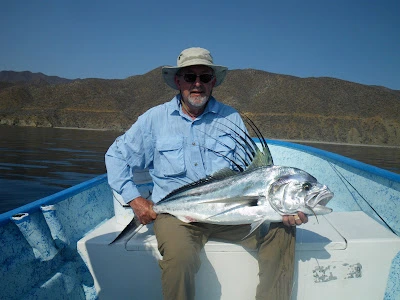
00:42:03 Larry: I just passed on a trip with a bunch of friends of mine that I’ve done for the last ten years, because I want to do something new. We generally go down to just below La Paz and fish for Roosterfish and Dorado. But, uh, I’m thinking now Magdalena Bay again. I’ve been down there twice. And the possibilities for for marlin and and big fish are are very real. Anyway, it’s all in the planning stages. I don’t know, we’ll see.
00:42:28 Dave: Yeah. You don’t know. What’s your rod down there for. For roosters. If you go down what will you be using.
00:42:33 Larry: My fishing eleven. Wade Scott graphite an older one one of their helium series eight foot eight three piece eleven weight a nine for the for the dorado which aren’t that um aren’t that huge and and an eleven for the rooster and the big fish and for marlin. I’ve got a thirteen weight Scott that Jim Bacci sent me as a blank to build up that I’ve not yet fished. I’m looking forward to doing that.
00:42:59 Dave: Amazing. This is good. We’ve heard that on the rods. You mentioned the eighties. We’ve heard some of the casting champions say that some of those rods from the eighties, they’re actually using those rods because, you know, something was different about them. I’m not sure. Is that does that resonate with you that some of those rods you guys were building in the seventies and 80s are just as good as what they have today.
00:43:17 Larry: I think some of the rods and my dad was fishing in the forties or as good as the rods we have today. Yeah.
00:43:23 Dave: Yeah. That’s awesome.
00:43:25 Larry: I mean, I have an AC Powell nine foot five, six line bamboo that, uh, that he ordered in nineteen forty and picked up after the war. That, uh, is one of the nicest casting rods I’ve ever had. You know, good fly rods aren’t a mystery. They’re not the easiest thing to come up with. But again, it’s not. It’s not rocket science.
00:43:46 Dave: No. Have you ever casted a bad fly rod?
00:43:49 Larry: Many. You have many, many.
00:43:51 Dave: What do you feel when you feel a bad fly rod?
00:43:54 Larry: No life.
00:43:55 Dave: Oh no life. No recovery like that. That’s recovery.
00:43:59 Larry: You know they’re not alive in your hands, but you got to put a line in a rod to see. I mean, I like progressive action rods, which bend more and more into the butt section of the rod as you put more pressure on it and cast longer. And there’s arguments for other kinds of other kinds of rod action. But I come out of the West Coast and the Golden Gate Angling, Casting Society and Club, and that’s what we like.
00:44:22 Dave: And what is the progressive? What does that mean exactly on a rod?
00:44:26 Larry: Well, think of a rod that has a stiff tip and a soft button, and it’s going to move relatively slowly. Then think of a rod that has a light tip and a stiff butt, and that tip’s going to move fast. A progressive action rod is going to be somewhere in the middle between all parts of the rod are going to come into play at some time while you’re using it.
00:44:46 Dave: Yeah. Okay. Perfect. Good. Larry. Well, I think we’ll leave it there for the day and we’ll have everybody connect here if they want to check in. And um, definitely appreciate all your time today. This has been great to finally connect and hear some of the background on one of the great rods up there. Yeah. And thanks for all your time.
00:45:01 Larry: You’re welcome. Thank you. Have a good one. David.
00:45:05 Dave: Did this episode made you think differently about casting, about your casting stroke, choosing a good rod or the way you approach the water. The next step isn’t buying another rod. It’s actually sharpening your fundamentals. And that’s exactly why we built the dry fly school. A place to slow things down, refine your mechanics, and build your skills on one of the greatest rivers in the country. Dry fly school. We’re heading to the Big Mo again this year if you’re interested. I’m going to be there. We actually just launched a giveaway right now wet fly dot com slash giveaway. You can enter that also if you want to pick one of the spots that are available, send me an email Dave at fly dot com and I’ll let you know what we have going for availability. We’re excited for this one. The big Mo, we are back the dry fly school. We’re going to be there right in prime time. Um, excited for it. So that’s all I have for you today. Thanks for stopping in till the very end. I hope you have a great afternoon. Great evening or morning, wherever you are on this planet. And I look forward to seeing you and talking to you on the next episode.
00:46:00 Speaker 4: Thanks for listening to the Wet Fly Swing Fly Fishing show. For notes and links from this episode, visit Wet Fly dot com.
Larry Kenney’s story offers a clear look into how fly rod design has evolved and what truly matters in fly fishing.
From graphite innovation to the importance of casting fundamentals, his insights highlight that skill and experience often outweigh equipment.
If improving your casting could make a bigger difference than upgrading your gear, what is one thing you can start practicing today?