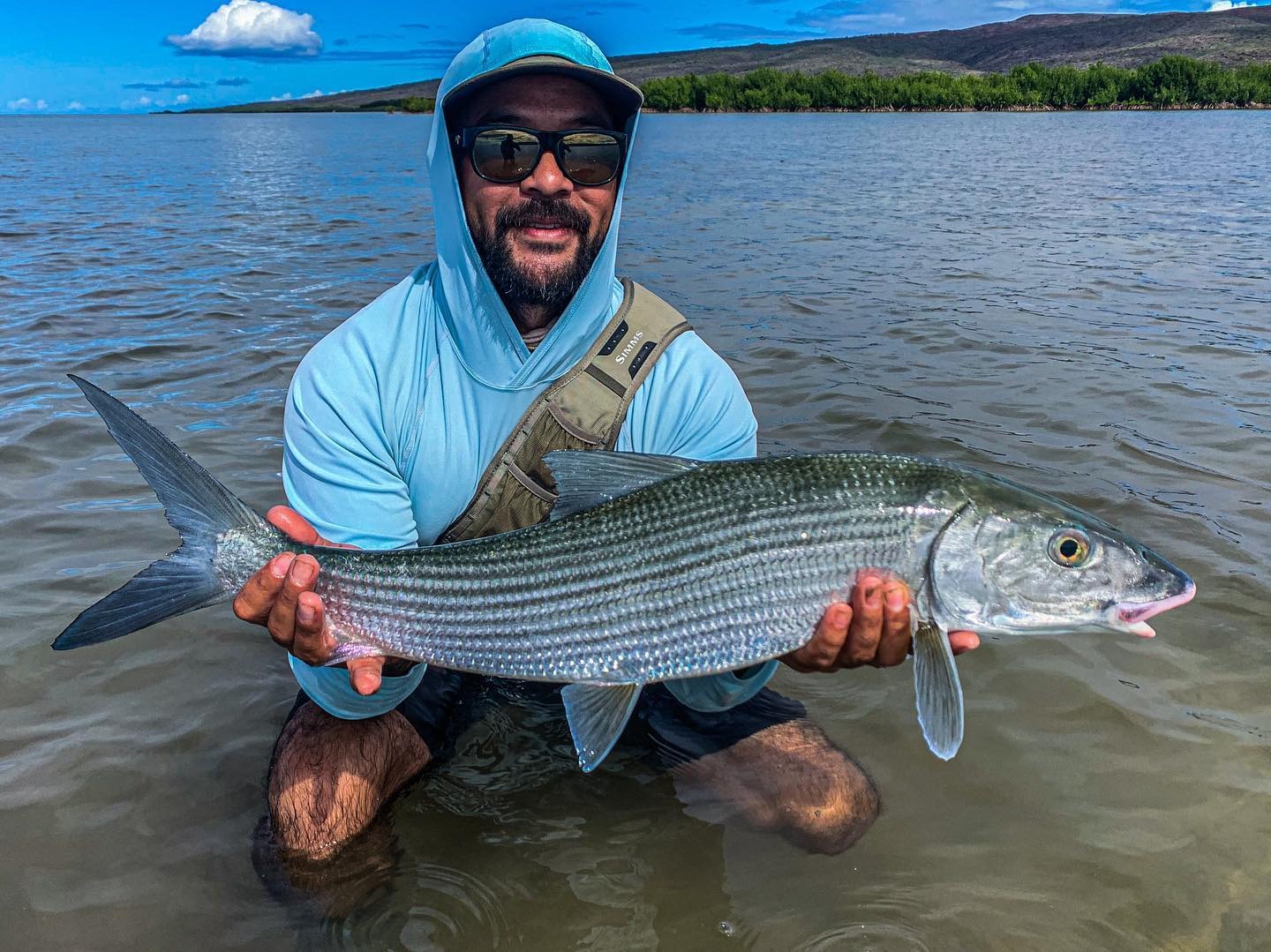
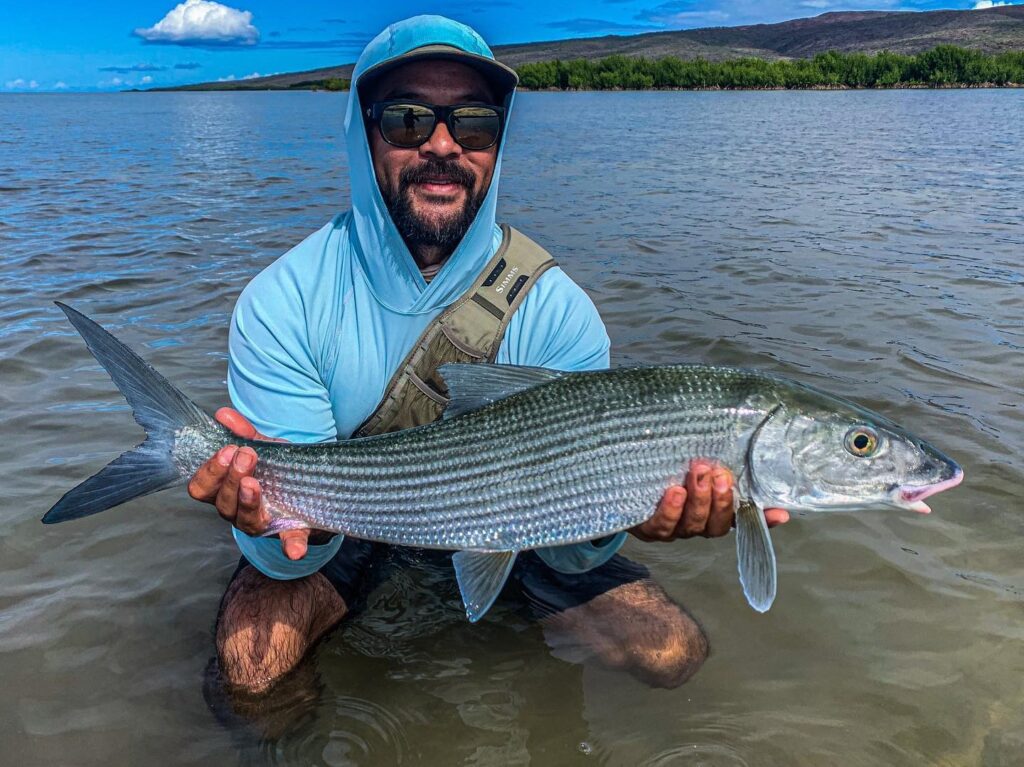
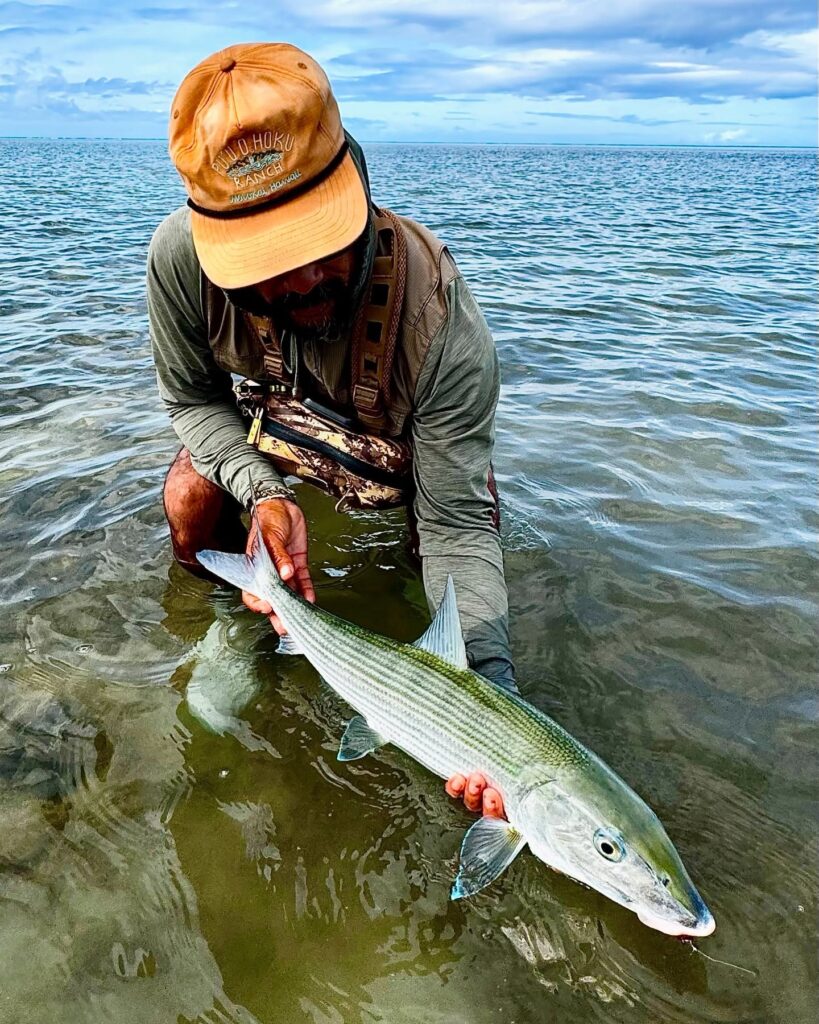
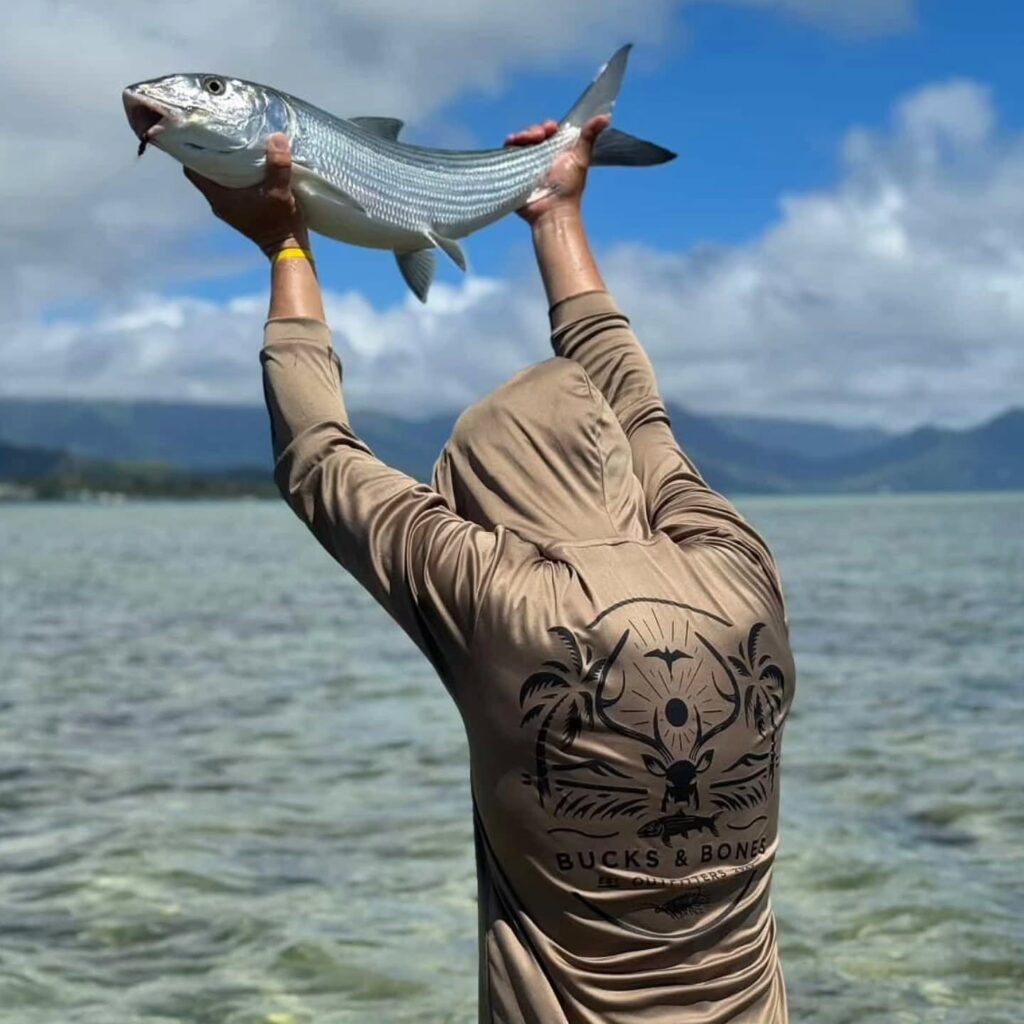
The first time you hear someone describe bonefish moving through Hawaiian water like ghosts, you get curious. When that someone is a Molokai-born fisherman who grew up reading tides the way most of us read a map, the story gets even better. This episode’s all about the soul of the islands, the hunt, and a cast-and-blast program unlike anything else in fly fishing.
If you’ve ever wondered what fly fishing Hawaii really looks like beyond the resorts and crowded beaches, Josiah brings you straight into the heart of Molokai — the largest bonefish fishery in the state and a place shaped by culture, conservation, and community. This is a deep dive into Hawaiian bonefish, axis deer, and the lifestyle that ties it all together.
Josiah grew up in a subsistence fishing family on Molokai. Fly fishing didn’t enter the picture until a visiting angler asked his dad about bonefish on the fly. That question set off a twenty-year journey, eventually becoming therapy for Josiah after returning from Iraq.
Fly fishing soon turned into a calling — a way to heal, reconnect with home, and share Molokai’s rhythms with other anglers.
Molokai sits between Maui and Oahu, but it’s a world apart. No big resorts, no rapid development — just community-driven decisions and strong cultural continuity. Native Hawaiian practices shape the island’s relationship with land and water, including how visitors should interact with these resources.
Josiah notes that visitors are welcome when they go with local guides who understand cultural protocols and reef stewardship. DIY on Molokai is “not illegal, but heavily frowned upon” because unmanaged pressure damages fragile flats ecosystems.
Molokai is the largest bonefish fishery in Hawai‘i, with miles of flats and deeply influenced fish behavior. The ocean is huge, the tides are powerful, and the average bonefish runs 5–7 pounds.
Fall and winter bring fewer fish but bigger individuals. A typical day might include eyes on a dozen fish, shots at 5–6, and landing one or two — but every one of those fish is a heavyweight.
Everything is tidal. Bonefish leave the reef entirely, schooling up in deep water before sliding onto the flats to feed. Josiah fishes dropping tides, rising tides, and visibility windows — always trying to position clients so the wind becomes an advantage, not a barrier.
He prioritizes getting clients to see fish, but sometimes it comes down to direction-and-distance shots.
The biggest challenge for many visiting anglers isn’t distance — it’s speed. Molokai flats often go quiet for long periods, then deliver a fish with seconds to respond.
His own progression came from hundreds of hours casting into the wind, asking good anglers for tips, and learning to double-haul with both hands.
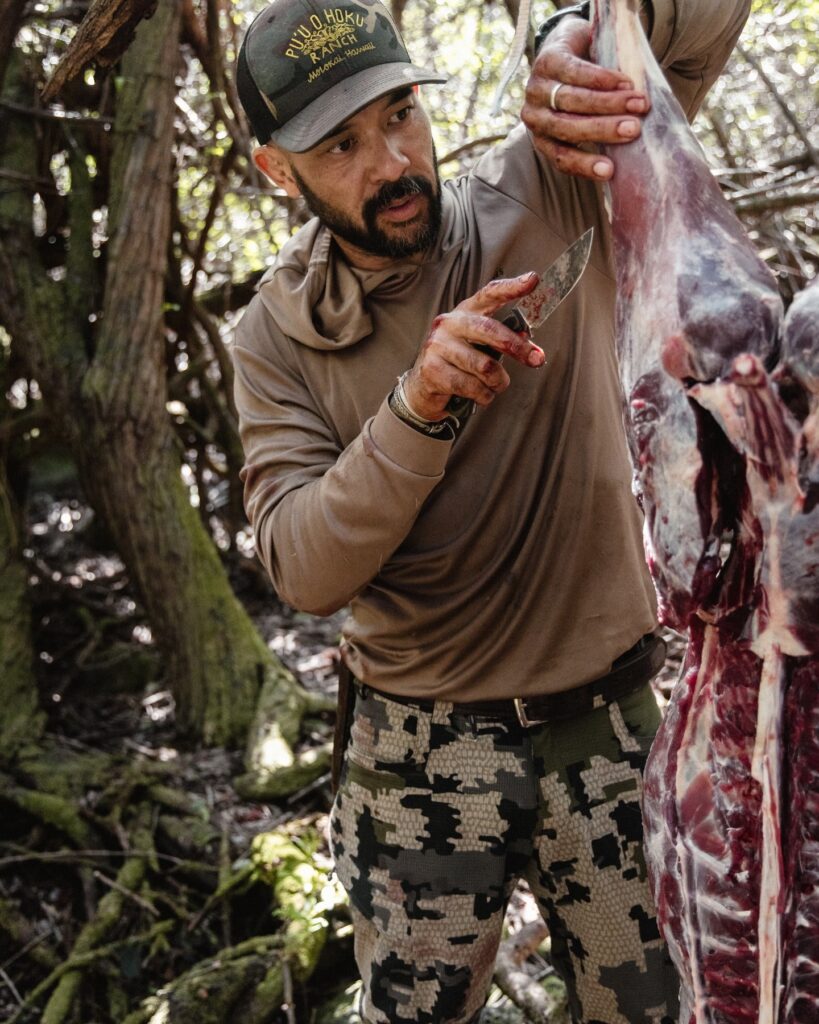
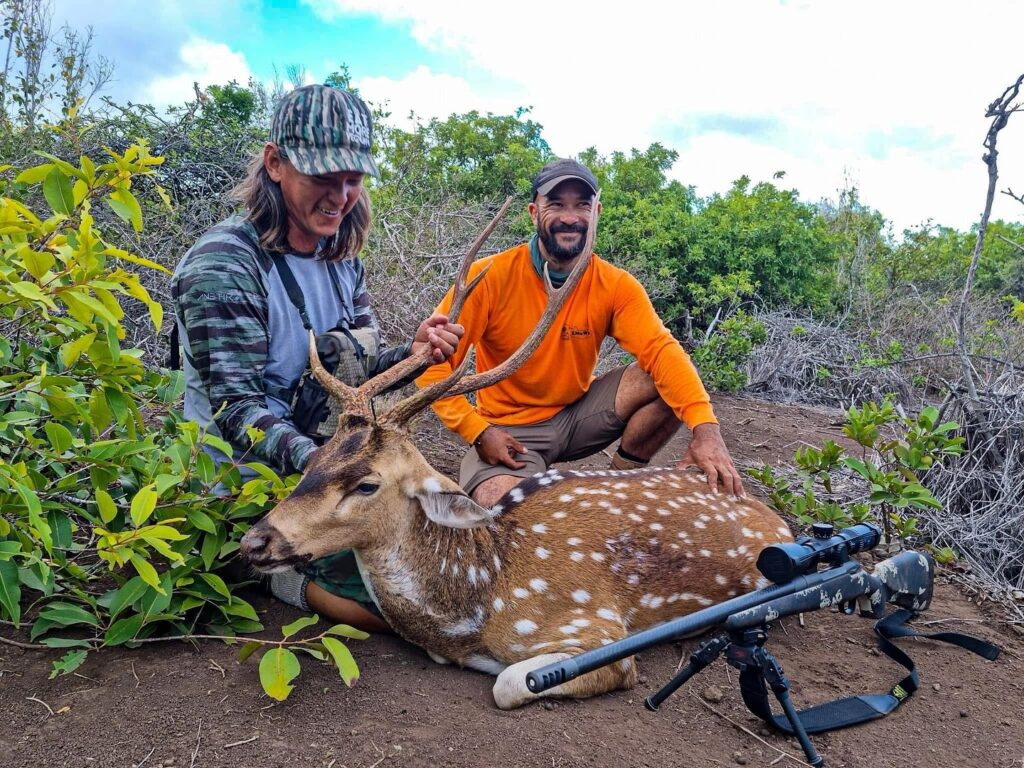
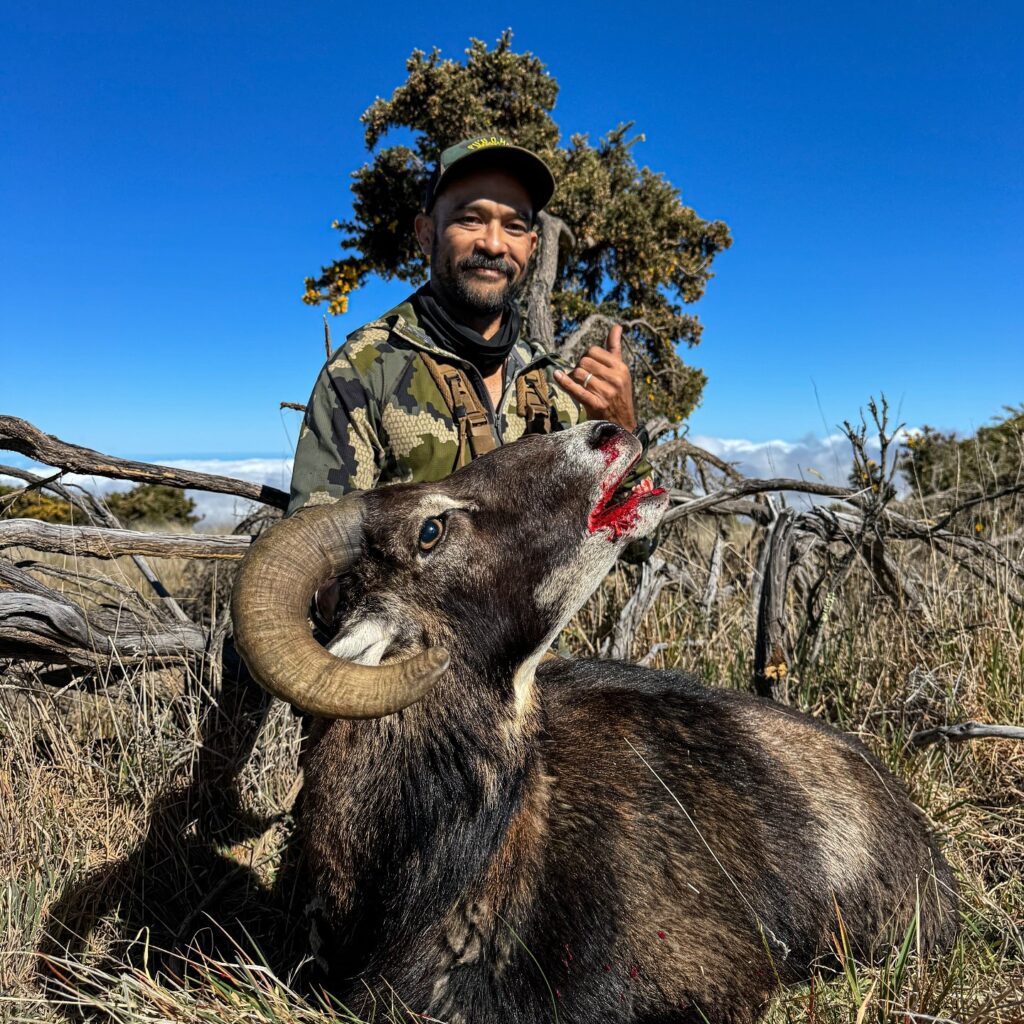
Josiah also guides hunts for axis deer — an introduced species from the 1860s that’s now fully naturalized. The Bucks and Bones package lets visitors hunt at dawn, fish for bonefish mid-day, and hunt again in the evening.
The herd is huge, and management is essential for reducing ecological pressure on native vegetation.
Many guests harvest their first-ever animal with Josiah. The program can be tailored to beginners, youth hunters, older hunters, or highly seasoned guests who want to chase trophy-class axis bucks. Access varies from physically demanding ridges to easy-to-reach areas near the cottages.
He believes subsistence fishing should remain central, even as he advocates for better gillnet regulation and habitat protection.
Episode Transcript
WFS 858 Transcript
00:00:00 Dave: What does it look like when someone grows up on a remote Hawaiian island, learns to read the ocean the way most of us read a map, and then turns that lifetime of knowledge into one of the most unique cast and blast experiences anywhere in the world. Today’s guest has done just that. Born and raised on Molokai, Josiah Ching grew up in a subsistence fishing family, learning tides, reefs, and the rhythms of the ocean long before he ever picked up a fly rod. After serving in the US Army in Iraq and returning home, fly fishing didn’t just become a passion, it became therapy, connection and eventually his calling. This is the Wet Fly Swing podcast, where I show you the best places to travel to for fly fishing, how to find the best resources and tools to prepare for that big trip, and what you can do to give back to fish species we all love. Josiah Ching runs Buck and bones, offering something few places on earth can match sight fishing for trophy Hawaiian bonefish in the morning and spot and stock axis deer hunting in the evening, all while sharing the cultural protocols, ecological history and traditional knowledge that make Molokai more than just another island. In this episode, you’re going to hear how bonefish move through the islands like ghosts. Why? Local knowledge is everything. How conservation and Hawaiian culture shape every day on the water, and what it takes to build a high quality, low impact guiding program that the local community actually supports. All right, let’s get into it. Here he is. Josiah Ching. You can find him at bucksandbones.com How’s it going, Josiah?
00:01:29 Josiah: Good, good. Thanks for having me.
00:01:31 Dave: Yeah, this is going to be a fun one today. I’m excited because we hear a lot about. I mean, I’ve been to Hawaii, you know, a few times, and we hear a lot about a lot of people in our audience who are going to Hawaii, and they want to go fish for bonefish or, you know, whatever. And some people don’t even realize that, you know, there’s actually opportunities. So I think today we’re going to talk about that where you are because you’re on a Pacific island as well, not Maui, you know, not Oahu, but a kind of unique area. And then also you have hunting, you actually have deer hunting. So you’ve got this cast and blast, which I think is unique. So we’re going to get into that today, help people get going on this, but maybe take us back first on fly fishing. Let’s hear how you got into it. Have you? When did Bucks and Bones start for you?
00:02:07 Speaker 3: Kind of a culmination of life and life experiences, I guess. You know, in a nutshell. Um, I was born into a part native Hawaiian, born and raised out here, um, born into a fishing family. You know, not uncommon out here. It’s a part of our lifestyle, you know, subsistence fishing, not necessarily fly fishing, you know, so always was on or or in the ocean and in some capacity. And I grew up here, left high school right after graduation, joined the Army. So I served six years. I was a scout. So did did Iraq, uh, two thousand and five, two thousand and six, came home, uh, lived in Texas for a few years. I met my wife in San Antonio. And so we’ve been back out here now raising our family for about twelve years. And kind of during that process, the time when, when I was away, my dad retired from his full time job on telecommunications and started his charter service and was originally doing like nearshore bottom fishing, like tackle type of stuff, whale watching, that sort of thing. And then, um, kind of out of the blue. After a couple of years, he had a guy call and ask about bonefish on on fly and we, we knew really nothing about fly fishing but knew the fish, you know, and my dad just being a guy who he is has, you know, just a wealth of traditional fishing knowledge and that sort of thing. So it was kind of that situation where it was, I don’t know specifically about fly fishing, but I know the fish.
00:03:42 Dave: Yeah. Which is a big part of it.
00:03:44 Josiah: Yeah, kind of a big part of it.
00:03:46 Speaker 3: When when you’re a guy, you know. Yeah. And so he, he had that, that first guy and this is like twenty years ago. So started from that and then like a week later, had another guy call and asked the same thing. And so he had kind of this light bulb moment. And so he just went on a deep dive, you know, down the rabbit hole, trying to learn fly fishing himself and then learn that and became known for that. Um, and so after I came home, after, you know, going to Iraq all like kind of not uncommon for a lot of guys of kind of that generation, you know, um, uh, you know, just dealing with some, some little struggles, that sort of thing, you know, and my dad knew and, and saw all of this sort of thing. And, um, whether he, he knew it or not, you know, he always makes that joke. He’s like, I taught Josiah how to fly fish. And I saved his life, you know, because it became a really, really massive form of therapy for me initially. You know, just that Zen state that you can achieve out there, which is not uncommon. So, so, so many people say the same thing, right? Um, it’s not always just about the fish and the fishing. So that really was what grabbed me really, really deeply. And then, yeah, I started working with my dad beforehand as the deckhand guide, that sort of thing, and kept doing it and kind of fell passionately in love with fly fishing. The therapeutic aspects. And then obviously the fish, you know, the bones and, um, oh, here we call them eel is the Hawaiian word for bonefish. And, you know, for, for all the reasons person, it was just the hunt, the challenge. It’s it’s not easy out here. It’s big water. It’s a big ocean. It’s a big fishery. It’s windy. They’re big fish, you know, and, uh, yeah, I was just all of those things that that kind of got me by the heart and soul. And, um. Now I just love sharing that. The hunt, the challenge. You know, before I started my business, I. I also worked full time in conservation on the island for years. Um, which is a huge aspect of it too, because even in Hawaiian culture, you know, we have the concept of mauka to makai in our traditional land management systems because they knew and understood, you know, what happens on the land affects what’s going on in the ocean. And, um, so then working in conservation, I did a lot of, uh, native ecosystem restoration stuff, erosion control projects, all these sorts of things. You know, you talk about the hunting also dealing with these non-native ungulates, you know, these introduced mammals who have um, in various forms, um, drastically altered the native ecosystems, you know, and the trickle down effects from that with erosion and runoff and that sort of thing, you know, nitrate runoff from old agricultural fields causing like, coral bleaching, you know, turtles getting tumors and cancers and all these sorts of things. And so being born and raised in this place and then having the opportunity to live and spend so much time on the land and out there and then working on the front lines and conservation, you know, seeing all these things and being able to connect all of these dots in, like this, this big picture. And then so when I finally felt like it was time for me to start my business full time, I knew that I had to do everything that I could, you know, as a Hawaiian, as a community member, as a, as a human to kind of keep all of those things at the forefront of my business. So I really do try and do everything that I can to educate all of my clients about the hows and whys, you know, both, um, culturally, you know, protocols, different sorts of things, but also the importance of being mindful of our impact and then the resource management. And even when you look at the visitor industry and that sort of thing, there are some people who are opposed to, to visitors and, and that sort of thing and understanding it. You know, it’s a slippery slope, but, um, I kind of look at that as a resource like any other, you know, need needs to be managed. Too much of a good thing for sure. You know, there’s potential to to kill the thing that you love. Sorry. I know it’s a lot. And sorry if I’m rambling. No. That’s great. At any time, if you want.
00:08:01 Dave: That’s great. I think that I think there’s a lot. You have a lot going, you know, you’ve got the connection to, you know, the local land, the kind of the local community. Then you’ve got the species and conservation and then you’ve got the connection to, you know, your travels and, you know, Iraq. I mean, we just had a thing this morning. We did a met with Project Healing Waters. We’re putting together an event on the white River in Arkansas. And I’ve never really worked with Project Healing Waters too much. They’ve been on the podcast, but we’re going to be doing an event where we’re bringing out veterans to help kind of get them on the water. And just like you said, like it changed, you know, it changes lives, you know, fly fishing and just outdoors, right? So that feels like you’re you’re in tune with all that.
00:08:41 Speaker 3: Oh, totally. Totally. Um, and I’ve always wanted to be able to, at some point, get my business to the capacity to be able to get involved with some organizations like that because like, not just changing my life person, you know, I have several very dear friends who I’ve also seen first hand impacts, you know, guys who are combat veterans to, you know, who are wounded or medically retired because of being injured overseas and stuff. And it really is magical.
00:09:09 Dave: Yeah. It’s amazing. And and where you’re at is, you know, Hawaii is one of those places that, you know, is amazing and maybe talk about that. Like, what island, where are you at? And how does that compare to the other Hawaiian islands for somebody new.
00:09:20 Speaker 3: I based on on the island of Molokai, which is one of the smaller, lesser known, less developed islands, which is not at all a bad thing, the community here has put in a generations of of some serious work, in the sense of being very active in participating and having a say in what happens here on the island in regards specifically to development, whether that’s, you know, hotels, condos, resorts, all of that sort of thing because they’ve just seen it. You were literally like in the middle of the island chain, and you can look across the channel and you can see new buildings on Maui, you know, throughout your life, all these kinds of things. And it’s it’s tough, you know, it’s a slippery slope. And you hear the same story from small communities. I mean, around the states, you know, really. But oh, man, it was great. This was what it was like. And, and boom, twenty years later, it’s this thing that nobody recognizes anymore, you know? So, um, has been very mindful of that for a long, long, long, long time. The culture is still very strong here, the highest percentage of native Hawaiians as well. So a lot of people still are able to enjoy a very traditional lifestyle, you know, subsistence fishermen, farming, hunting, that sort of thing. And that’s real wealth as sort of freedom, that ability to to feed yourself with your own hands. And so this understandably protective of that, you know, and that also is an aspect of Hawaiian culture, you know, and in any small community, I’m sure that you go to especially rural communities when it’s immediately apparent, like, who’s a visitor? Just like, oh, who are these people? What are their intentions here? What are they doing? Um, so the community really, especially the native Hawaiians, are not so much opposed to the fishing industry, that sort of thing. It’s just that, as it should be, right? They would want to see people go with people from the community, especially Hawaiians from the place, who can educate them about place and space. You know, what to do, what not to do. Instead of just having a bunch of people coming over and just trampling all over the reef, right?
00:11:35 Dave: Like everybody going in having like, okay, Molokai is open and you’ve got one hundred new lodges and outfitters and a million percent.
00:11:44 Speaker 3: That is like the worst case.
00:11:46 Dave: That’s what you don’t want. You want the natural. What it sounds like you guys provide is the natural connection to the natural land. Totally.
00:11:54 Speaker 3: And like, I think I have it on my website and my social media. You know, the vision is is high quality, low impact, just doing everything you can to provide a legit experience. And I really take a lot of pride in not just being successful with the results of catching fish or getting shots at fish or harvesting an animal, but a legitimate cultural, historical and ecological education that guests get when they come out and hunt or fish with me because that’s everything to us, right? That’s why I am who I am. And so that’s very, very it’s critical. You have to you have to have that.
00:12:30 Dave: And that’s how Molokai is set up. It sounds like you’ve got Oahu. Like you said, you’re almost a stone’s throw away from Oahu. Maui is right there. You’re kind of in between. Wean and you’ve got those which are way built up, right? There’s all sorts of stuff you got. I mean, think of the history of Oahu, right, with, you know, talk about the military Pearl Harbor, right. All that history. But you’ve got this really unique natural island in the middle where you’re providing that experience. What does it look like for somebody coming in? Let’s just say they were doing a trip with the family to Maui, and they’re listening now and they’re like, well, how do I get this together? Is that an easy thing, putting this together if they’re doing a trip?
00:13:03 Speaker 3: Yeah. Relatively simple. Well, we can elaborate on on that a little bit to that. I’ve been working with a local ranch on the island, um, really amazing family. And so we’re building the whole model now with, um, hunting or fishing with lodging, meals, all of that sort of thing. Um, just building the whole all inclusive models because I saw that opportunity. I have some friends of Brian and Serena Kraft who own Alaska Sportsmen’s Lodge. Um, and so I was fortunate to be able to go up with my dad a few years ago, a couple of times. And, and that really kind of got me starting to scratch my head with looking at like, a place for everybody, right? Because I would have so many clients come over and do exactly like you said, where family might fly in, and they’ll stay at like the Four Seasons or something like that on Oahu or Maui, wherever it is. And then he might fly over or a couple guys will fly over for a couple of days just because they’re not sure, like what’s available. But it’s quick. You fly into either Maui or Oahu and it’s like a twenty thirty minute little puddle jumper. Um, right now there’s only one airline flying into Molokai. Um, and that’s Mokulele Airlines. So definitely plan ahead. Plan ahead. Um, there can be some little logistical challenges and stuff.
00:14:18 Dave: Okay. What does it look like for, you know, bonefish has come up a number of times, you know, all around the world where we’ve had episodes, but specifically, Hawaii is known for sometimes people don’t even know there’s bonefish there, but there’s some big bonefish, right. In Hawaii, if, you know, like, especially off Oahu. What does that opportunity look like for bonefish? Is it pretty good fishing? What do you focus on? Big fish. Uh, you know, just catching a fish. What are your thoughts compared to other areas?
00:14:42 Speaker 3: It’s really interesting here. It’s the largest fishery in the state, hands down, for sure.
00:14:49 Dave: For all around. Not just fly fishing, but everything. Because there’s subsistence fishing. Right, too, that people are doing on bones.
00:14:54 Speaker 3: Yep, yep. But I mean, for fly fishing specifically is the largest fishery in the state. So therein lies challenges in itself. I feel like it’s a giant haystack. And you’re looking for moving needles. I have fish other islands caught fish on on other islands and just comparing things. It’s really interesting, unique to see behavior between different islands, even though it’s the same species. I would say, and I think a lot of the the Hawaii guys would kind of agree that there’s kind of a seasonal shift as you start to get into, like the fall and winter months, where overall the numbers are going to decrease, but you will get higher than average sized fish coming in. You know it’s that trade off. I mean it’s already a quality versus quantity fishery. And I would say becomes even more so that way during the fall and winter. Average day though, if you were to ask me, you know, I think this talking to, you know, a lot of guys that have guided I haven’t unfortunately been able to fish bones anywhere else, you know. But I’d say average day here is probably getting eyes on about a dozen fish shots, at maybe a half dozen, and cooking or landing one or two of those fish. But our average fish is going to be five to seven pounds. So lots of big singles, pairs of big school of bones crushes, anything over three. You know, so I’ve had more than a few guys tell me that it’s a lot more like permit fishing than Bonefishing.
00:16:28 Dave: Patagonia just launched the next evolution in waders, and they’re built for anglers just like you. The Swift Current line includes ultra light, packable options for the hiking crew and expedition ready waders. If you’re hard on your gear like me. They’re designed for comfort, built from recycled materials and backed by Patagonia’s Ironclad warranty. You can check them out right now at Wet Fly. That’s what. You are Swift current waders. Check them out now. Since nineteen seventy two, Four Wheel Campers has been building rugged, lightweight campers designed to fit almost any truck and every kind of adventure. Whether you’re keeping it simple like me with the project M or gearing up for full time off the grid travel, there’s a four wheel camper built to match your lifestyle. You can head over to four Wheel Campers right now to use the builder tool to find your perfect topper, slide in or flat bed camper for your next journey. So what does that look like in the fishing? Are you take us there to you find you know that fish talk about where you’re fishing and then what’s it like when you’re when you’re seeing the fish?
00:17:40 Speaker 3: It’s for sure. I mean, like, this is the nature of the game, right? All tidal based. So I really like being out there for the full action. If you can get a high the drop throughout that and then fishing that at rise again because the fish do move around on different parts of the tide on different days has been kind of my experience. Um, but we do a mix of both, and it’s all dependent on what the conditions throw at us, whether we’re fishing off the skiff or getting on the foot and wading them up, which is always great. Typical shots aren’t always crazy long, you know, but that also depends on on conditions. I would say average shots are probably about forty fifty foot range. You know, even closer if you’re sneaky, which is kind of my approach. You know, it’s always so windy here. I really, really, really like to close the gap as much as possible and get in tight. It’s just been my experience that there’s less room for error. You know what I mean? I mean, you can see the fish a lot better. You can read the fish a lot better. You can cast a lot more accurately. And then, especially when you’re guiding, I really, really, really try as much as possible to get the client to physically see the fish over just direction and distance, you know? But it does get to that point throughout the day where you can determine whether this guy just has a really tough time seeing the fish or, you know, or if we just need to find the fish, right, right, right bottom, whatever it might be. But still, you know, I can’t count how many guys you get fish to hand. And it’s it’s all just direction and distance. You know, the guy never even saw the fish the whole time. A lot of variables, you know.
00:19:16 Dave: Yeah, yeah, there’s a lot. That’s why obviously getting somebody local and on Molokai. Could you even go there on your own, fly in and try to DIY it? Is that even an option?
00:19:24 Speaker 3: Technically, nothing is illegal, you know. But I would say frowned upon for sure by the community for sure. I mean, best to know someone for sure, whether that’s a friend, family, someone you know, even if it’s not. I always say this to tell everybody this is not just to protect my business. You know, there are other guide services and stuff on the island. This is just strictly desires of the community, and I just try to be as mindful and respectful of that as possible.
00:19:50 Dave: Yeah, I find that is a you know, and we just did an episode with, um, a native, uh, Warm Springs reservation in our area. There’s a big, you know, Native American fishing. It’s cool. On the Deschutes River. Half of the upper river is all warm springs. You have to have a native permit, and you have to get a native guide. And it’s this kind of a similar thing. And I was talking to him about it. And it’s again, you know, he sees things differently. A lot of people, you know, he’s talking about the same things land and connecting to, you know, all that. And I feel like, you know, that’s kind of what you’re talking about here. And to have somebody just roam in and be, you know, disrespectful or, and you find that in other islands, too, I think just because of the history, right? You find a way to be respectful. And not just that vacationer that’s coming in with a bunch of money saying like, hey, you know, I’m number one, right? I feel like that’s a big struggle with what’s your take on that overall, have you traveled? Do you stick pretty close to Molokai or do you get out? Have you seen some of the other islands?
00:20:44 Speaker 3: I travel a pretty good bit. Well, my wife, like I said, is from Texas, you know, so lots of family and friends back there. You know, I have some good guide buddies I fish with. I hire guys every time we go back and I’m able to, you know, um, but back and forth between the islands as much as possible. But I’m happy I did Australia last year with some, some really good buddies. It was a GT trip. We did a week with East Coast angling, a bit of fly, mostly spin, but still that that was mental.
00:21:15 Dave: Yeah, GT that’s sweet. So and the other islands, when you look around like for example Maui, you know, I’ve heard things that maybe the fishing isn’t, I don’t know. Is it as good as it different. What’s that like when you look around all the Hawaiian because they’re not all, like, equal, right?
00:21:29 Speaker 3: No. You know, different. Well, way, way back at one point in history, Molokai, Maui and Lanai used to all be one island. Um, and then kind of, you know, plate tectonics or whatnot over time is split them apart. Maui, I’m for sure is more well known. Right. All the other islands, I think with more of the visitor industry, more of the resorts, all that sort of thing are are more well known. I have some really dear friends who live there, fish and all it is, is just the the size of the fishery here. We just have a much, much, much larger area of flats versus some of the other islands where they’re, they’re limited in size, which is not necessarily a bad thing. Like, I’ve seen it work in the sense of like the times I’ve fished Oahu. I’ve been very impressed by the numbers of fish you see during the day, because they’re forced to congregate in, like, only certain areas, you know what I mean? Where there’s the type of habitat that they want when they’re coming in on the tides or whatnot to feed. So that can work for you, you know, versus like what I was explaining earlier, some days it can be pretty tough to find them when you’ve got miles and miles of flats to find fish on, you know. And and I haven’t done it. I’ve heard Maui is I mean, there’s fish on all the islands. It’s just a matter of accessibility and the right conditions. You know, I know a lot of the guys on Maui will do like the kind of Pyramid Lake thing where they get up on stepladder.
00:22:51 Dave: Oh, really? Oh, wow.
00:22:52 Speaker 3: And just do a lot of blind casting and that sort of thing, you know, not my cup of tea. Personally, I don’t do any blind casting.
00:23:00 Dave: No. So this is all site fishing. You’re sight fishing for everything.
00:23:03 Speaker 3: All site fishing for me one hundred percent.
00:23:05 Dave: Site fishing is yours for somebody who you know, let’s say they really haven’t done the saltwater thing. You know, they’ve been fishing a while, but they’re, you know, they’re kind of not the best maybe. Caster. What’s that going to look like? Are they going to have success if they book a trip with you out there, is that going to be a little challenging?
00:23:22 Speaker 3: Obviously I would say like I’m sure anywhere else, the higher your skill set is, the higher your odds of success. But I’ve had some very, very beginning. Anglers be successful too, but a lot of that also just depends on on the day and the conditions and the numbers of fish that are out on the flats, and the amount of opportunities that that you’re able to get. Right. I mean, if you get enough shots, you’re going to get the one fish that it can get pretty technical, honestly. And I say this having cut my teeth out here, I’d never fly fish before. I learned how to how to chase these guys. So I really had no idea what I was doing in the sense that, like, the learning curve was just like like this. Yeah. You know, um, but thankfully I had my dad to kind of teach me a little bit. And then the big basis, I think for me, that really helped me learn really quickly was that that cultural basis and understanding of fish and fish behavior. But, um, yeah, for sure, being able to double haul it, punching it, um, as far as you can and do a good win seeing fish, reading fish. I really, really, really increasingly over the years and really coming to see that the area where a lot of guys struggle, especially when you’re not able to do it a lot, is not so much casting ability or that sort of thing. It’s trimming the fat. It’s like making the shot quick, you know, because we all know how flats fishing can be. It’s like long periods of inactivity sometimes. And then boom, here’s a fish sixty feet coming towards you. You got five seconds to make your shot, you know. And so when I say trimming the fat, it’s that it’s not being lulled into that sense of complacency.
00:25:02 Dave: Yeah. So practicing. So if somebody’s coming with you, lots of practice casting, getting just be ready to go for sure.
00:25:09 Speaker 3: Being quick and being accurate. You know, the more so the better.
00:25:13 Dave: Yeah. Perfect. Well, I want to hear this other part of it because you have you know we’re going to get more on bonefish, but you also have this hunting piece which I think is really interesting. You interesting. You know, cast and blast is something that we’ve talked about for years because we have our own cast and blast people. I think around the country we have about half of our audience are hunters and they’re fly anglers. Right. So you have a lot of hunting. I have never seen a deer in Hawaii. But tell me about this deer hunting operation you have. And is that something you mix in? Like if somebody wanted to book a trip, are you putting that that package together where you do both.
00:25:41 Speaker 3: I do, yeah, I’ve had guys do it same day.
00:25:44 Dave: Yeah. Same day. Wow.
00:25:45 Speaker 3: Get out really, really early morning, harvest a deer and then get out there and go catch bones or vice versa. You know, go catch a couple bones and then go out afternoon and evening hunt. And that all kind of started. It’s pretty funny actually. Going back is, you know, it’s like talking about starting a business for a few years. Right. And it was actually a good buddy of mine. And he’s like, man, when you get this going and you start doing the the access to your because their access gear, which are introduced, I think in the mid eighteen hundreds.
00:26:13 Dave: Oh what now what are access tiers. So are these these.
00:26:16 Speaker 3: Native to India. So they’re those spotted deer.
00:26:18 Dave: Gotcha. So are they similar size to say, like a blacktail or mule deer you’d find on the West Coast?
00:26:24 Speaker 3: Yeah, I would say more like a blacktail, smaller than whitetail, like a big buck is maybe two hundred, you know. So yeah, they were introduced to Hawaii I think eighteen sixties or something like that. And now there’s bunches and bunches of them, but have have always been a huge part of our, our lifestyle growing up, you know, hunted them. And we’ve been hunting with my dad since I was a kid, you know, um, and then eating these deer throughout our lives, tons and tons of people in the community still feed their families on these things, too.
00:26:54 Dave: Wow.
00:26:54 Speaker 3: So, yeah, it just kind of started from that, you know, and it was kind of funny. I had a couple buddies talking about it and they were like, man, you start doing this, uh, you gotta call it the big Buck and Bonar package.
00:27:06 Dave: Right? There you go.
00:27:08 Speaker 3: And I was kind of from that when I decided I was going to start my business full time. I called it a really good buddy of mine, and he was like, dude, it’s bucks and bones time, and that’s it.
00:27:16 Dave: Bucks and bones? Yeah. Bucks and bones is a better rings a little better than the other one.
00:27:20 Speaker 3: Yeah. That’s how it started.
00:27:22 Dave: Yeah. Bucks and bones. That’s good. So and are these animals you kind of know it sounds like you have that conservation background. Are they self-sustaining or are they just out there doing their thing?
00:27:31 Speaker 3: They are just running wild completely, completely free range. And there’s lots of them, you know. So actually we always joke around that on our ranch, the only high fences are to keep the deer out, you know, from eating the vegetables and stuff in the farms and gardens and that sort of thing.
00:27:46 Dave: That’s amazing. So you have these animals that are eighteen sixty. I mean, you’re going on two hundred years of these animals being so they’re pretty much a kind of a wild species. Now, they’ve been out there so long, they’re doing their thing.
00:27:57 Speaker 3: Oh, totally, totally naturalized, one hundred percent naturalized. Yeah. And so it’s kind of been one of the the big motivators for us here and the the ranch that I’m working with when we started the hunting program was, was really just as management. So like our our biggest hunt that we offer and when we try to kind of push The Moses is just our meat hunt and this is a dough only hunt we run that year round. And really just trying to push that, just to bring the numbers down a little bit, to restore a little bit of the balance to the landscape.
00:28:28 Dave: So you can get a dough any time, any month of the year out there.
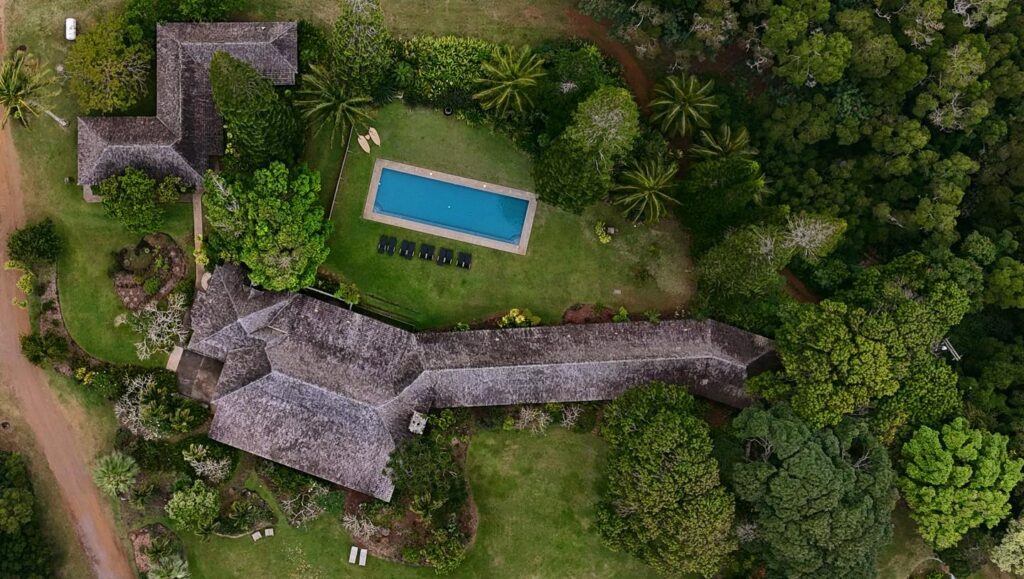
00:28:32 Speaker 3: Yeah. Yeah. They’re not native animals, you know. So there’s no real seasons or anything. And we’re hunting private property. So the, the ranch here that my business, uh, is partnered with has sixteen thousand acres total. Um, and then they’ve got, like I said, lodging. I’ll get you information on their website, but it’s pool. Hoku ranch. Oh, so they’ve got a lodge. They’ve got a couple of cottages that we use. Uh, so typical stay kind of for our guests is going to be them doing either day or two. We do one day hunts, we do half day hunts. Even pretty high odds of success it is.
00:29:06 Dave: So you get out there. And is this rifle hunting mostly or bow?
00:29:09 Speaker 3: We do both. We do both. Most of our our visitors just coming in kind of a lot of guys who do rifles because it’s quick, easy. I do rifle rentals, we offer full processing services. We ship everything. We have a taxidermist that we work with, so trying to get all the bases covered so guys could literally just show up with the family and not need anything, you know, bring your gear.
00:29:32 Dave: And go home and they can get an even amount even shipped to them. The whole thing.
00:29:36 Speaker 3: Yeah, yeah. Everything will be, you know, meat shipped straight to the house. Crazy. So, so and then the ranch also has different activities for the family. We’ve got horseback rides and you can schedule yoga, lay making workshops.
00:29:49 Dave: So yeah, I’m trying to get a perspective on, you know, for me, hunting. I mean, we just went deer hunting. We’d go every year. I went this year. It’s funny because we’ve been on a roll a number of years, and we got skunked this year. And it was one of those things where it’s just, you know, hunting where we go is hard. I mean, it’s like we’re hiking up tops of mountains. Once you get one, it’s it’s just a ton of work. Is this something where, you know, what if they weren’t hunters? What if they wanted to learn about hunting? Is this something where somebody could do that, too?
00:30:13 Speaker 3: Oh, know. Totally. Um, we’ve had a bunch of people come out and harvest their first animals with us. Um, and so really open to being able to cater packages and the program to whatever people might need. We could do the full hunting one hundred one if people want or need to do that. And that’s kind of one of the really cool things in unique opportunities we have with the program here, being able to offer a little bit of something for everybody, you know, from your really experienced guys who can get out and really get after it, while also trying to have some areas that are more accessible, you know, a little less physically demanding and stuff. So you can kind of cover all the bases. Uh, we’ve had some elderly clientele come out, you know, lots of youth hunters, kids coming out with their parents and stuff, harvesting their first animals.
00:30:58 Dave: Amazing.
00:30:59 Speaker 3: So really, um, there’s potential for everybody.
00:31:02 Dave: Okay. Well, that’s that’s great to hear. So. So you have that part of it, the hunting, which is. And then really you got the whole thing because you’re building this lodge out. Is the lodge set up now where if somebody wanted to maybe even bring out the family, right? Bring out the kids. The family. Is that an option right now or is that down the line a little bit?
00:31:17 Speaker 3: Totally. No, no. That’s all fully going up and running in operation right now.
00:31:22 Dave: Oh, cool. And do you do typically is it kind of you pick a day or two or is it mostly a week or how does that look on booking?
00:31:29 Speaker 3: It really just depends on on what the guest is interested in. I would say for hunts, probably most of our our guys are doing a one or two day hunt, maybe like a three or four day stay less if they’re bringing their families or they’re not bringing their families. Right. It’s just a couple buddies coming over. They’ll just do in and out kind of thing. And then the fishing also, I mean, always obviously best to be able to give yourself a couple of days if possible, just because, I mean, it can vary so drastically day to day. You know, you can get out one day and not see a single fish and then get out next day and they’re everywhere. So lots, lots of variables there. But I would say kind of typically a lot of my my anglers are probably doing. I mean, if they’re if they’re serious, more of my repeat guys are probably doing like two or three days. So not not uncommon to have single day trips. A lot of guys will hop over for the day. You know, they’re already on Maui or Oahu, didn’t know about anything, found out about me or whatnot. And they’re there for like a week and then they can swing it. They’ll fly in first flight that morning, we’ll fish, and then they can get back to the airport that afternoon and get back to whatever island they’re staying on.
00:32:38 Dave: And it really sounds cool because I think that, like you said, you’ve got this. Maybe describe that when you fly into Molokai. How is it different than, you know, are there uh, the towns talk about that. Where are they staying? Is this it sounds like there’s a sixteen acre property. Is that pretty much what the whole island? Is it mostly natural or. There is some actual towns in there?
00:32:56 Speaker 3: For the most part, yeah. The majority of the island is is undeveloped. Um, so you fly in the airport, it’s kind of the central area of the island. Um, and then you can pick up your car or rental, whatever you might want to go with. Um, with. We can also arrange pickup and transportation if needed. And then just depending on on where they stay, there’s a couple other hotels and stuff in the island that you guys stay with, or if they want to come and stay up on the ranch, they can do that. The ranch is about forty five minutes from the main town, which is where we fish from. But if guys are hunting as well, you know, it’s not a big thing because we pick them up in the Polaris, like at the back door of the cottage, you know, and then we go get after it.
00:33:36 Dave: Wow. This is great. Okay. Well, so you have the hunting piece. Let’s take it back into the bonefish because I know again, there’s people going to be wanting to maybe get their first bonefish or get their first, you know, their largest bonefish. Take us to I mean, I’m guessing that seems like always a struggle. Like how many days I feel like, you know, we’ve done these trips where we’ve gone out for something and always thought, okay, we’re going to hit this other species up. In Alaska, for example, we’re chasing Chinook, we’re going to get our Chinook, and then we’re going to go chase these big rainbows. And what happens is you end up just sticking with that one species because it’s like, oh man, you know, you just want to get more of them. I feel like I would feel like that a little bit with the hunting versus bones. Like I’d want to just keep going for the bones. But what would be you think three days would be a good, you know, minimum. And do you think some maybe even stay in five sort of full week sort of thing?
00:34:20 Speaker 3: I think three to five days is probably pretty perfect, honestly. And depending on what on what the the guest is looking at. For guys who are obviously looking for more like trophy caliber animals in the sense of, you know, access bucks and stuff, you’re definitely going to want to allow yourself a couple of days to to shop around and look for them on the big, big bucks get pretty, pretty elusive. Uh, so lots and lots and lots of time spent glassing trying to find those guys. Um, and then same for the bones, you know? Um, nice to give yourself a couple of days. Just in the worst case scenario, you run into a bit of weather or a, you know, bad day of fishing.
00:34:59 Dave: Let’s talk a little. I mean, you’ve been doing this. You mentioned your dad was the one that kind of got you into this. What has been your, you’re, you know, in fly fishing. Have you kind of been teaching yourself, how have you got to this point where you know what I mean? Like with, you know, at this level of guiding, obviously I’m trying to get like that learning curve of bonefish. How challenging has that been for you?
00:35:18 Speaker 3: What’s challenging, you know, but like I said, because of my my background growing up fishing and stuff in the ways that that we fish a lot like other ways that were like sight fishing based. I say for sure, one big advantage was that I never had a challenge seeing the fish, which is a big thing. So then from there on out, for me, it was really a matter of learning how to cast.
00:35:43 Dave: What did you do with your casting? Did you just practice?
00:35:45 Speaker 3: Yeah, just being a psychopath basically. You know, just hundreds of hours of getting out there because most days here by like noonish, it’s it’s blowing pretty good. I’d say like fifteen to to twenty. And so every time I would go out and fish for a long while, I knew I was like, okay, I got this window before the wind comes up where I’m going to have the highest odds of being the most successful. And then when it comes up, it’s kind of gonna call it for me. But when that did happen, a lot of times what I would do is I would just start trying to cast, like, straight into the wind and then like adapting my approach to fishing, where I started to use the wind as an advantage instead of a disadvantage. You know, so like, I see a fish here, I’m not just going to go straight after that fish. And I guess also my hunting background too, right. Was thinking that like, let me just reposition myself, get upwind where I can be above this fish and now have the wind on my back and work with me. So lots of that sort of thing, you know. And then I yeah, just lots and lots of time casting, casting, casting, you know, a little bit of the YouTube University. Every time I’d have a client come out who was a really solid caster, you know, asked them for a couple of tips and tricks and. Yeah, just doing it. I just I just love it. I’m actually, like, pretty blessed because I can rip a pretty solid double haul with either hand.
00:37:06 Dave: Yeah. Oh. You can. Both hands.
00:37:08 Speaker 3: Yeah, yeah, yeah. Which is a huge blessing.
00:37:10 Dave: Yep. Is that something you’ve always kind of had both hands.
00:37:13 Speaker 3: Always been, like, somewhat ambidextrous. And actually, initially when I first started fly-fishing, I started out casting left handed because I throw lefty. And so that that motion felt more comfortable. But then I have like, better fine motor skills, I guess, with my right hand. And so I started doing that for a bit. And then once I kind of got proficient with the double haul and everything with my right hand, I tried the left one day and I was like, wow, oh, this works too.
00:37:40 Dave: And so depending on what you need, what is your what is your wind? Because I have heard that sometimes that you can actually if you know how to do it, you can cast into the wind almost as effectively out there. What you know, what are your tips there on the wind? What are you doing?
00:37:53 Speaker 3: Line speed, tight loops, you know, letting that log rod load really well. I’m keeping that rod tip high stopping and then more and more and more. So the hall. Hall. Hall is everything, you know. You can wave that rod around as much as you want to, and it’s not going to do anything if you’re not doing something with that, that hauling hand, you know. So it’s really become those things for me. Just that the timing, the technique and then the hall, you know, stopping that pause, let the line load that rod before you come back forward, you know, and then on that final presentation, if you need it, just punch it. Punch. You cannot over accentuate that hall in that punch.
00:38:37 Dave: We’ve heard many of the stories on this podcast. Togiak River Lodge is one of the great destinations for swinging flies, for Chinook, stripping for coho all day, and unwinding in a lodge right on the riverbank of the Togiak River, with access to all five salmon species plus rainbows, Dolly Varden and more, Togiak offers a true Alaskan experience. Picture over thirty miles of river season guides, high quality boats and low fishing pressure. Its fly fishing Alaska at its best. I’ll be heading up this summer, so reach out to Jordan and the crew to see what dates they have available this year. You can learn more right now at Wet Fly. That’s togiak. Alaskan fly fishing like you’ve always dreamed about. When it comes to premium flies that deliver results, drift is the name to trust this season. Whether you’re chasing trout with dry flies, swinging streamers, or dialing in those Euro nymphs, they’ve got everything you need. Here’s a quick story I was fishing a tricky Spring Creek earlier this year and nothing was working. Then I pulled out a royal wolf from the drift hook box. I cast upstream, letting it drift effortlessly toward a holding fish. It was textbook. One of the biggest fish in the run. Rose slipped the fly and the fight was on. That’s definitely a moment I’ll never forget. Their fly kit shipped free, straight to your door, fully stocked and ready for action. You can support a great small business right now in this podcast by heading over to drift Book.com today. That’s Drift hook. Use the code at checkout to get fifteen percent off your first order. What is your rod weight and length? What do you like to use?
00:40:19 Speaker 3: I typically fish eights and nines.
00:40:21 Dave: Oh you do. Eight and nine. So not a seven. So seven weights. A little too late.
00:40:24 Speaker 4: A little too late. You can get away with it.
00:40:25 Speaker 3: I mean, if you’re a stick, you know, or we fish some lighter winds and and nicer days, I personally will do it. But it also gets to a point where, like, our average fish are so big, too, that you’re kind of doing them a disservice by toying around with them that long, you know? So I, I like to fish personally a tight drag, you know, eight or nine weight and just kind of break their spirits as quick as you can and get them to hand.
00:40:50 Dave: And when would you go with a nine versus an eight?
00:40:52 Speaker 3: Probably on windier days, you know. But I mean eights are great too. You can also overline throw a nine weight line on an eight weight rod, which is a nice kind of happy medium, but you’re really not going to be under-gunned with with either. Even in wind conditions eight or nine, you can still make them both work.
00:41:08 Dave: eight or nine and line wise, do you have a specific line you like or.
00:41:12 Speaker 3: Uh, I use a lot of real stuff. A real elite series. You know, the Flats Pro? Uh, I use the permit line more than the bonefish line. I think it’s just that shooting head out here with the wind and all that kind of stuff helps a little bit more. And, uh, leader wise, same. Pretty basic leader setup. I fish like a twelve foot leader. I’ll do just a twenty foot, ten foot tapered nose, real ones. And then I again real usually about two, two and a half feet of sixteen pound for a tippet section. So your total leader length is about twelve feet. And I like that sixteen is just a little happy medium between, you know, just a little bit of stealth but also a little bit more strength because we do have some reef and coral and there are big fish.
00:41:58 Dave: That’s right. So do you use the floral? Is that kind of versus mono or what are you using?
00:42:02 Speaker 3: They’re all floral. All floral.
00:42:04 Dave: Yeah. Mainly because what’s the biggest feature of the flora out there.
00:42:07 Speaker 3: Abrasion resistance. You know for me yeah. Strength and and transparency too. You know it’s a lot less visible okay.
00:42:15 Dave: And you guys go typically are you getting out on there on a boat.
00:42:18 Speaker 3: Typically typically not always fishing off of one. But um, more often than not using them to access the flats. Yeah.
00:42:25 Dave: Yeah. When you get out there on the flats, what do you, what are you looking for if you’re to a new flat, are you looking at you know, if you think about depth structure kind of all that, you know, currents, is there a lot to it when you’re thinking about I mean, you got the tides. Obviously you want to hit to a dropping tide. It sounds like in that range. How do you work that for if somebody was out there, maybe out there on their own in some other area, let’s say just fishing. Do you have any recommendations there or, you know, how do you find the new water, the best water?
00:42:52 Speaker 3: Well, it’s interesting with bonefish because they’re a transitory species. You know, so, like, you could literally go out there at the wrong time and think that they don’t exist at all.
00:43:02 Dave: Right. So they might just not even be anywhere out there at that time of day.
00:43:06 Speaker 3: Yeah. No. And they aren’t here. That’s the way it is. You know, they leave the reef entirely and they go out into the deep water and school up.
00:43:14 Dave: So what are they doing when they go out in the deep water?
00:43:16 Speaker 3: Strength in numbers. You know, schooling up and staying.
00:43:19 Dave: Away from sharks.
00:43:20 Speaker 3: And stuff for safety. Yeah, sharks eat them too. You know, it’s another big piece of the fishery that we have here that you don’t have in a lot of other like classic bonefish destinations too, that I feel has like really altered their behavior out here to the.
00:43:37 Dave: What has what’s been the biggest. Oh, wow. Yeah.
00:43:40 Speaker 3: And getting eaten by by geese.
00:43:43 Dave: Yeah. Yeah we heard that and I didn’t I didn’t attend it, but, um, one of our members in the community said that he was at Bonefish Tarpon Trust event, which I think was this last weekend, and they said that I think it was on. I can’t remember if it was permit. One of the species are just getting hammered by sharks. It’s like it’s the biggest problem in some of these areas around the world. So it sounds like predation, right? I mean, right, changing environment and conditions and all that stuff. So it sounds like that’s a problem here. Maybe not a problem, but a factor.
00:44:09 Speaker 3: Yeah for sure. For sure I would say like I feel like it’s probably the easiest time of their lives, but probably also the most dangerous, which is why they’re so skittish, you know, when they’re up on the flats feeding because they’re in warmer water, bunch more food, you know. But then what also happens when they’re in that flat ecosystem is that they have that third dimension removed in the sense of, you know, when they’re being chased by predators now, they can’t go up and down. They can only go this way. And I’ve seen it where like sharks and stuff will hunt them in areas where they know it’s really, really shallow reef and so they can corral these fish and reefs that they can’t get through. And luncheon. I’ve lost fish like I’ve had clients tighten on bones and that.
00:44:52 Dave: Oh no.
00:44:52 Speaker 3: Kidding. And had six foot black tips. Come up and just wreck them. Bam! Yeah.
00:44:58 Dave: Wow. Damn, that is nuts. So? So. Yeah. So that’s part of it. So you have predation. You got these fish that for the bonefish. They’re traveling out in the school, so they’re coming in to feed because that’s where they can get the most food at a certain time. Right. And then they go out. So that’s kind of what you’re saying. You’re hitting them when they’re in the flats because you’re doing the site fishing. That’s your focus. So you’re finding these really amazing flat areas, and then you’re taking your clients out there and you guys are spending what, like a during that tidal cycle on that one area and then moving to a new area.
00:45:25 Speaker 3: Or you’re moving around bumping around the flats. I always say for the sake of transparency too, just because of conditions and everything here, like our day, there’s opportunities and chances when conditions will allow it for you. When you say a day to get like a full eight hour day, but our average fishing window here is like four to six hours on average. And then that’s just because a combination of things are going to eventually force you to have to call the day. That’s going to be like rising tides, which are going to start to agitate the water. Winds which are going to start to do the same thing. So a lot of days by like early afternoon with that tide rising and those like fifteen, twenty knot winds building, it turns the whole flat into like a washing machine. And then tide gets high. You can’t see fish leave anyway.
00:46:12 Dave: So but that sounds amazing to me because, you know, you’re in Hawaii. So it’s like, all right, got my fishing in. Now it’s time to kick back and relax. Or maybe do some hunting.
00:46:20 Speaker 3: Yeah, one hundred percent. Um, and trying to do it exactly like that, you know, and it really for guys who are coming out and visiting it, it maximizes efficiency when you think about it in that sense, too, you know, because you could literally you could come out and do two days, but you could do both in the same day, each day. You know, instead of doing a one full day hunt, one full day fish, you could, in theory do like a morning hunt, fish and afternoon hunt again, or vice versa, you know.
00:46:50 Dave: Yeah. Would there be another species that you could catch or hunt out there that you would add you got bonefish? What would be a third one on on the day.
00:46:58 Speaker 3: Bones, we’ve got uh we’ve got bluefin trevally. We got milkies. Still trying to dial that program a little bit more. Crack that. But I would say honestly, in the state of Hawai’i for, uh, shots at and for guys to have opportunities to land, when I say, like legit, I’m talking like forty, fifty pound plus fish on the flats, on a fly rod.
00:47:23 Dave: On the flats. So a GT on the flats.
00:47:25 Speaker 3: Yeah, it would be here for sure.
00:47:27 Dave: You could do that. And that’s a put your time in. You would have a chance at that.
00:47:30 Speaker 3: Oh you’re going to be investing your time. It’s going to be hard not to touch that bonefish rod. You know every time one comes along because that that will happen you know. But I don’t know if you’re going to need that kind of guy who’s a little bit familiar with it, has maybe done it in another place or something. But the opportunity for for sure is there?
00:47:49 Dave: Yeah. You’d have to almost break it, like you said. Day like day one is bonefish day. Day two is GTT day and just focused. You have that one shot or whatever it is. Okay. Well let’s let’s kind of take it out here. I love to always have a segment to take us out. You know the conservation you mentioned. So I always say our Conservation Corner segment, it sounds like you have a lot of another life where you did a ton of conservation before all this. What does that look like for Hawaii? We’ve talked about that a little bit of the bonefish, because you’ve got people that are killing bonefish, right? Because it’s part of their you know, they’ve done it for thousands of years. What are you seeing there for bonefish? Are you worried about any things. Do you feel like populations are pretty steady there or do you have some? Is there some work that you’re doing or you’ve heard about that’s going on? Or how do you balance that? Maybe might be the better question since you’re kind of in the middle of it.
00:48:33 Speaker 3: Yeah, for sure. I feel like populations are are pretty sustainable or, you know, self-sustaining. There is a bit of gillnetting still going on. You know, it would be really curious to see what what might happen in five or ten years if we were to to stop some of that, you know, or at least tighten up a bit on enforcement and regulations. And that’s always been one of the interesting things, the management perspective. I do think there’s a bit that could be done. A lot of people still do eat them, you know, especially I love it, dude. The raw preparation, traditional prep is probably my my favorite raw fish, you know. But obviously I’m like extremely selective if and when I do harvest one. But understanding right. There’s I mean people have different relationships with the fish for different reasons. You know, there there are people who feed their families and earn a bit of money and provide their, their families through that means. So that’s what they, they feel is, is right. You know, so but I also always said even for myself is, you know, I was a Hawaiian and running a business and doing the guide service that I feel like subsistence fishing should always come at the forefront in the conversation, you know? Um, and take precedence over recreational stuff for sure. You know, when you look at worst case scenarios like Covid and that whole shutdown, you know, guys all over the world and stuff were out of business, you know, but you still have the resource there as a means of, of subsisting on and living, you know. And that was my dad’s mission. He always told us that growing up, my younger sister and I got a lot of the education when it came to the outdoor world hunting, fishing, diving, gathering, all that sort of stuff. And it was always that in at the forefront as I’m teaching you guys all of these things so that nobody in our family is, is ever going to be hungry. You know, you guys just can’t be lazy. You know, it’s out there. You just have to go get it.
00:50:35 Dave: Yeah, right. You gotta work for it. That’s really cool. Yeah, I feel like that. That’s the you know, that’s a perfect world, you know? Like, that would be great for everybody to be, because most people, you know, in the country are probably getting their food from wherever, you know, from the store. Have no idea where the chicken’s coming from. The, you know, anything, the fish, you know, Atlantic salmon. You got all these fish in the store. Where is that? So I feel like, yeah, you want to get to this place. And how do we slowly maybe get back there to a closer to that, you know, and I feel like, yeah, Covid opened our eyes to be like, yeah, this is like stuff can happen.
00:51:08 Speaker 3: Oh, totally. And it’s been very interesting too. And you see a lot of very affluent people making that conscious decision to return back to that type of lifestyle, which for us here has always been the norm. You know, grow your own food, catch your own fish, kill your own animals. So it’s really interesting to see a lot of these kinds of things that didn’t always hold much weight or value in the modern sense, now being brought back to like the forefront, you know? And so it’s a very, very interesting conversation, but I do agree with that. You know, I’ve always said that everyone who consumes meat, whether you decide you want to be a hunter for life or not, you should have a hand in dispatching or at least processing an animal so that you can make that mental connection, that that Big Mac isn’t just a Big Mac. It was at one point a living, breathing creature. You know.
00:52:04 Dave: I know, I feel like for me, hunting, if it wasn’t for my dad, I probably wouldn’t be a hunter now. And he got me in when I was a little kid. And I’ve always done it, you know, for my whole life. And. And now I’m trying to get my kids into it, you know? And it’s the same thing. I mean, they see that bloody carcass and your elbows down, gutting it out, you know? I mean, it’s a visceral moment where it’s like, okay, that’s how it how it happens. You know, the hamburger for McDonald’s, right? The other interesting thing is with species, you know, when you look at the Endangered Species Act, for example, a federal government, you know, mandate or a, you know, regulation that protects fish if they get to a certain level. So I think that that might factor into this right where you have these bonefish that if they do get low enough, maybe there have to be some other things that go into place. Do you feel that that’s a valid part of this process where because I understand you’re saying subsistence fishing takes number one, and that totally makes sense. Do you think that what happens if you get to a point where the numbers are actually getting so low that it’s impacting the actual subsidence?
00:53:04 Speaker 3: Or, um, it would be really interesting, but also really challenging, I think. And I think the biggest hurdle would be enforcement, you know, which is also really interesting when you look at like the Hawaiian culture, because at one point our ancestors had all of this stuff under wraps in the sense of having systems of management.
00:53:24 Dave: Yeah, they were okay before it was everything was working fine.
00:53:27 Speaker 3: Yeah, they knew and understood the system spawning cycles, life cycles, all these types of things. And it’s just kind of been in an unfortunate that throughout the system, you know, and decades that a lot of people have kind of lost that traditional knowledge, you know, or at least the application of it, you know, which is which is kind of tragic in a nutshell, when you look at, like, everything else that the Hawaiian community has lost. Right. And then you can’t knock people too. Right. I mean, you got to survive in the Western economic sense, and you need money to do that. So there’s a slippery slope sometimes to when people will apply traditional knowledge in the sense of gathering and harvesting, but ignore the seasonality and the spawning cycles of some things. You know what I mean? And overlook that in order to be able to subsist in the economic sense. And I feel like that is where you really start to inadvertently do damage, right? Like you’re shooting yourself in the foot when it starts to get to that point. But what you do from there on out is, is also really challenging to write. Who does the enforcement? Who does the regulation? And then people have differing opinions too, right. Who says how much is too much?
00:54:45 Dave: Yeah, it’s a tough. We’ve been doing some episodes. In fact, I just had Nick from The Conservation Angler on and he talked about steelhead populations, which again, it’s interesting because they go around the Pacific Rim. I don’t think steelhead River historically, maybe they’ve been in the waters of Hawaii because it’s in the Pacific. But you know, steelhead have had some ups and downs for sure. You know, we’re kind of in this really interesting. But he talked about how they’re trying to document specific areas where fish are spawning. You know, it’s very important because there’s certain within each basin. So he’s trying to get the word out to have people mark these locations. Because knowing where they are, because fish, all the habitat isn’t created equal. There’s some places that are bettering and knowing that and protecting that is important. Do you think in Hawaii, is the habitat a big part of this too? Not just the harvesting. Is there a chunk of habitat?
00:55:29 Speaker 3: Yeah, a million percent, I would say so. You know, little, uh, environmental trickle downs and disconnects, you know, and that’s one thing that’s really interesting in the Hawaiian culture and in the the language. I mean, everything is in the language itself. You know, you look at like place names and stuff that can tell you what a place was for or whatever. So if there’s place names that like Oyo, which literally translates to like the Oyo sands or the sands of the Oyo, you know, like Bonefish Sands, because they knew back then, like that’s where the bonefish are, you know, for whatever reason, that might be a spawning area, it might be a feeding area, whatever it might be. But I really, really would love at some point to see some more serious work in that capacity, whether that’s like tagging, telemetry studies, um, that sort of thing, because I would not be surprised if it were something like that where like populations from the individual islands all intermingled and congregated in some other areas, you know, for some like larger or mass like spawning events. Um, because we’ve caught fish here on Molokai that were tagged on Oahu and.
00:56:42 Dave: That’s really.
00:56:43 Speaker 3: seventy miles away, that channels a couple thousand feet deep. And I bet you that fish crossed that channel on the bottom. Oh, you know, deep, deep water.
00:56:53 Dave: Yeah. Where are these fish spawning? Do they spawn in deep waters? Do they know where they’re spawning?
00:56:58 Speaker 3: It’s kind of a mystery. You know, some people know. I mean, there’s lots of traditional knowledge. You know, you talk to some old timers and stuff who can tell you stuff that they’ve seen. You know, the only time I’ve ever seen big congregations of bones has been in deeper water, either out like side the reef, you know, ten, twelve feet of water or deeper, you know. But, um, you’re talking like dozens and dozens of fish, obviously doing something because they’re just milling around.
00:57:25 Dave: But that’s how they kind of they’re known they’re they’re not on shallow water spawning.
00:57:29 Speaker 3: No, they’re they’re not doing that sort of stuff like up in on the flats.
00:57:32 Dave: Yeah, it’s like broadcast spawning.
00:57:34 Speaker 3: Yeah. In deeper water. Probably like a couple hundred feet deep.
00:57:38 Dave: Wow. Amazing. It’s interesting. You know, I think that’s what’s cool where you’re at, because you’re in this place that probably isn’t as studied as maybe Belize and some of these other places. Right? For bonefish. But it feels like probably a good part of their life history that you know, that area to understand might shed some light on them.
00:57:55 Speaker 3: Totally, totally. And I also feel like that’s kind of a big part of the nature of the beast with the Hawaiian bones and why they are what they are is because they’re not sheltered and safe and staying in the reef on the flats all day. They’re coming in, they’re feeding for a few hours and they’re leaving, you know, and then that deep water, man, it’s cold. It’s strong currents.
00:58:14 Dave: It’s got to be big.
00:58:15 Speaker 3: Big hungry fish, you know. So the way I tell my clients and look at it, it’s like every single one of these fish that’s out there is like an Olympic caliber athlete. All the weak ones die. You know what I mean? They’re all just prime physical specimens.
00:58:30 Dave: Yep. What’s the biggest bonefish you’ve heard of out there?
00:58:33 Speaker 3: Twenty seven pounds. Twenty seven pounds in a gill net. Like back in the day.
00:58:37 Dave: No kidding. Twenty seven. And an average bonefish. And fishing around the world. What would be a good bone?
00:58:43 Speaker 3: Typical around the world, I think. I mean, for a guy to catch a ten pound plus bonefish is like world class for sure. Something to write home about.
00:58:51 Dave: You’ve seen some ten pounders?
00:58:53 Speaker 3: Oh, yeah. Yeah. I’ve take fish at like thirty one and a half inches, you know, like nose to fork. I think bonefish Tarpon trust their charts is a twenty six inch fork. Length is a ten pound fish. So twenty six is ten. What’s like thirty one thirty two.
00:59:08 Dave: Yeah. That’s a massive fish.
00:59:10 Speaker 3: Thirteen. Fourteen. Bigger fish. I know some older dudes that have caught like nineteen pound fish. You know, different things. The state record fish I think is sixteen pounds, which is wild because the dude caught it in like one hundred and twenty feet of water on a whole baitfish. He was fishing for like snappers and GT’s.
00:59:28 Dave: And right.
00:59:28 Speaker 3: Caught a of sixteen pound bonefish. So I personally feel once they get to a certain size like fifteen plus, like they don’t even mess around on the flats anymore because I think they completely changed their behavior because they have a hard time finding enough to eat.
00:59:44 Dave: They’re like a trout.
00:59:46 Speaker 3: Yeah, it’s kind of like a theory that I have because you’ll you’ll see them around once in a while, you know. But I mean, they’re out there.
00:59:54 Dave: That would make sense. Yeah. As they get to that bigger size, kind of like a a brown trout or a trout, they start small eating bugs and stuff. And as soon as they hit that twenty inch range, they’re like, okay, we’re eating fish now, we’re going for it. Yeah.
01:00:04 Speaker 3: It would be really, really interesting to to see and be able to document that, those types of behavioral changes. Because that’s also why I feel like, like I was saying earlier, a big school of bonefish for us is anything over three. And that’s just because like our average fish is five to seven pounds, I feel like they have to split off or they’re not going to be able to find enough to eat during the tides.
01:00:25 Dave: Right? They gotta go for it. What does it feel like for you? You know, being where you are, it seems like you’re in this place where, you know, I mean, who wouldn’t want to do what you’re doing and live? Do you think about, like and you’ve traveled to Texas and stuff? Do you ever think about maybe down the line, Hawaii or moving to some other areas? Are you in Hawaii for for the long term?
01:00:43 Speaker 3: Oh man. I like to say this is where my bones are going to go into the ground. Been around, been traveling a bit and um, but love it. You know, it’s here. Like I said, Texas is honestly probably second home. It’s the only other place I’ve really lived for an extended period of time, but for right now and for the foreseeable future, it’s taken me, like I said, a few years to figure this all out, get to this point in my life, but I’m happy here. I’m really excited to just continue to invest my energy and commit myself to hopefully building something people will think is special, you know, and really trying to do it with financial gain and all of that stuff, not being at the forefront, you know, really just trying to do it for all of the right reasons. Like because I’m passionate about it, you know, and understand the the value of the conservational side of things. And then being able to, like I said, provide that educational experience.
01:01:41 Dave: Yeah, it’s interesting because you have also on the conservation piece and remind us again, what was your background, the work you did before?
01:01:46 Speaker 3: I was a project coordinator for, um, the Molokai Land Trust for a little over four years. And so they’re a like a eighteen hundred acre conservation preserve on the northwest end of the island. So lots and lots of, like, kind of forestry related stuff, um, removing some non-native tree species, weeding, fencing, um, all that sort of stuff. Seabird monitoring out, planting tons of stuff.
01:02:12 Dave: You hear about a lot about climate change, not just for temperatures of streams, brook trout, you know, whatever species, but also raising changes, sea levels. Is that something that ever is a thinking like way? I guess we’re thinking way ahead, but right. Temperatures are changing. Is that something that you’re thinking about? People are thinking about? You’re on the Hawaiian Islands where you’re at.
01:02:30 Speaker 3: For sure, for sure. Sea level rise, all that sort of stuff. It’s it’s real and it’s happening, you know, whatever you want to refer to it as. I know that can be a touchy subject for different people, but we’re seeing higher tides than we’ve ever seen in our lives. You know, those king tides that they’re calling them now. And like there’s days you come in or go out, leave and the entire catwalk is underwater. You know, you’re, like, liable to have your boat float up onto the catwalk. But, um, that sort of stuff never used to happen growing up. I swear it’s hotter every summer than it ever was when we were kids, you know? And even the seasons, they seem to just be shifting further and further into each other, almost to the point where it seems they’re going to do that complete flip flop at some point, you know?
01:03:18 Dave: Right. It seems like, yeah, obviously you can’t deny it because stuff around the world, not just in certain areas. You know, we have some of our editors, you know, are in the Philippines, you know, that are working and they man, they’re having right now, man, they are having like, warnings. It seems like every week on all the, um, you know, not just monsoons, but the events, the I mean, this is the time, right? Do you have much of that down in your area where. Yeah we.
01:03:40 Speaker 3: Do. We’ll get our storm seasons and hurricane seasons.
01:03:43 Dave: Yeah. I feel like it’s hard. That’s one of those things that it’s such a big thing. You’re sitting there thinking, okay, what do we do? That’s always the question. How do you how do you do something? And I don’t even know if we don’t really have the answer exactly. Other than maybe connect with some local groups, maybe doing good work. Right.
01:03:58 Speaker 3: Yeah. Be prepared. You know, as possible. That’s always what happens in every community. Just goes into full buckle down mode. You know, every time we get that, which is a challenge here too, you know, because we got everything’s barged in, you know. So.
01:04:12 Dave: Oh, right.
01:04:13 Speaker 3: One big event.
01:04:14 Dave: That cuts.
01:04:14 Speaker 3: Off that man. Yeah. So stores will get cleaned out and then you’re like, yeah. Also, that becomes even even more crucial, you know, know, because we we experience it. And it’s real out here.
01:04:25 Dave: Yeah, totally. Wow. It’s amazing. Well, I think, uh, Josiah, this is. I could sit here and chat forever because we haven’t even got into your your military background, which I think is, you know, probably lots of stories there, but I think maybe we’ll leave it there for today and maybe bring you back another. Hopefully we can get some people out to your neck of the woods, and I can maybe get out there eventually and visit you.
01:04:44 Speaker 3: Oh, it would be awesome. We’d love to have you.
01:04:47 Dave: Yeah. And I think, I think hopefully this is inspiring people to realize. Yeah. It’s not you don’t just have to go into Maui or, you know, any of the other islands. We’ve got this other opportunity here. So, um. Yeah, man. Well, I want to appreciate it. Just say thanks again for all your time, and we’ll be keeping in touch with you as we move ahead here.
01:05:01 Speaker 3: Perfect, perfect. Well, thank you, man. I really appreciate you guys having me on.
01:05:07 Dave: There we go. If you want to check in with Josiah’s trips, uh, you want to get into this, uh, sounds amazing, right? Uh, big bonefish, maybe some deer hunting bucks and bones. Com. That’s the best place right now. You can also find them on Instagram at, uh, at Bucks and Bones. I want to let you know if you’re interested in this trip. Check in with me. You can go to. This is our pro community where we’re leveling up our trips, making that great trip of the year, connecting with the community that’s going to support you and and get a bunch of great master classes and events along the way. We fly Swing Pro, check it out. Right now. I want to give you a big update what we have coming up this year, some big trips. We’ve got, uh, we’re heading back to Togiak River Lodge. We’re also working on a Pike trip. If you’re interested in heading up to northern Canada. In Saskatchewan, we got that one going too. So check in with me if you have any questions. Dave, I want to let you also know this is on YouTube. This is actually on YouTube. Right now. We have select podcast episodes that are going live on YouTube. If you want to check that out, you can do that right now. Subscribe to the podcast there. Uh, we’re growing that channel, so would love if you would get your support there. And we also will be heading out on Spotify as well. So right now, if you want to watch the full episode, subscribe to us on YouTube. You’ll support this podcast there as well. And tomorrow, right around the corner in, uh, not very long in just a few hours. Michael, Brian from Utah is going to be here. He’s going to talk everything about Utah fly fishing. He’s a guide out there near the Great Salt Lake. Uh, don’t miss this one. Tomorrow Mike’s going to bring his A game, and it’s going to be fun. All right, that’s all I have for you. Uh, we are in the evening now. Here. So if it’s evening, if it’s morning or if it’s afternoon. Uh, hope you’re enjoying your day. Hope you enjoy this podcast, and I hope to see you soon on the water or see you on the next podcast. Talk to you then.
01:06:56 Speaker 5: Thanks for listening to the Wet Fly Swing Fly Fishing show. For notes and links from this episode, visit Wet Fly Comm.
This one felt like stepping into a different rhythm — a place shaped by tide, culture, and lived experience. Josiah brings all of that into every hunt and every bonefish day on Molokai. If you’re looking for an authentic Hawaiian fishing adventure with deep roots, this is where you find it.